

Submitted:
28 February 2024
Posted:
29 February 2024
You are already at the latest version
Abstract
Predatory research field in science is when an emerging scientific topic destroys current topics and characterizes a main scientific change. Predatory research field can be a basic driver of scientific and technological change that generates a 'creative destruction' in science and society in contexts of knowledge-based competition and rapid changes. The prediction of proposed theory of predatory research fields is that it destroys with a fast growth other research fields. The theoretical approach is tested here in research fields of large language models (LLM) by analyzing the transformers (a deep learning architecture based on the multi-head attention mechanism) proposed in 2017 and from November 2022 started main applications in generative artificial intelligence with innovations of BERT, ChatGPT, Microsoft Copilot (launched on February 7, 2023) and other natural language processing tools driven by AI technology for engaging conversations, gain insights, automate tasks, etc., etc. Statistical evidence suggests that growth rate of transformer technologies is 80.58%, a high level compared to all other research fields in machine learning (having a growth rate of 13.83%). Moreover, predatory research field of transformers has a destructive power such that all other domains in LLM from 2021 to 2023 have a general reduction of scientific growth. The impact of transformers is much more drastic of previous radical technologies such as CNN having a temporal growth rate of 0.16%, lower than 0.38% by transformers, ceteris paribus. These analysis reveals that transformers have characteristics to generate a radical scientific and technological change in a not-too-distant future. Overall, then, the study suggests that predatory research field on emerging topics and technologies can generate path-breaking innovations and the examination here can clarify the essential elements of the science dynamics for a better theory of scientific and technological change, providing also main implications for knowledge policy to support promising research fields and technologies to guide economic and social change.
Keywords:
Predatory research field
; Science evolution
; Science of Science
; Social dynamics of science
; Transformers
; ChatGPT
; BERT
; Microsoft Copilot:
; Large Language Model
; Emerging technology
; Radical Technology
; Natural Language Processing Tool
; AI Technology
; Deep Learning Architecture
; Multi-Head Attention Mechanism.
1. Introduction and Investigation Goal
One of the fundamental
problems in science is how a scientific field and related technology emerge and
sustain scientific and technological change (Kuhn, 1962; Lakatos et al., 1980;
Price, 1986; Scharnhorst et al., 2012). This study confronts the problem here
by developing the concept of predatory research field, which endeavors to
explain one of the sources of scientific and technological change. Proposed
concept is especially relevant in a world of knowledge-based competition and
'creative destruction' in existing competences both in science, technology and
society (Teece et al., 1997). The goal here is both extending a theory of
scientific change that clarifies some new dynamics of emerging scientific
fields that generate technology change and designing science policy for
supporting new fields and technologies having a potential impact in almost
every sphere of human activity. This study is based on increasing availability
of digital data about documents and recorded knowledge that offers unparalleled
opportunities to explore new aspects in the structure and evolution of science
and technology (Fortunato et al., 2018; Scopus, 2023). Efforts of scholars to
describe, explain and predict different aspects of science and technology have
intensified in recent years with a wide range of theoretical, mathematical,
statistical and computational approaches (Scharnhorst et al., 2012). In
particular, the investigation of the evolution of emerging research fields and
technologies is basic for planning the allocation with effectiveness of
resources towards positive scientific and societal impact (Coccia, 2018, 2020).
For example, the emergence of new fields in bioinformatics, nanophysics,
quantum computing, and data science generates conditions for ‘‘converging
technologies’’ with high potential of growth that influences our lives in
society (Roco and Bainbridge, 2002).
Although the vast literature in these topics,
quantitative works on behaviour related to the emergence and effects of new
disciplines and technologies on other related research fields are lacking to
date. This study suggest the concept of predatory research field and is
analyzed in practical contexts of large language models (LLM) to show
evolutionary behaviour to design appropriate research policy implications
directed to scientific and technological development.
2. Critique of Current Literature
The development of this study flows from a
recognition that research scientists have performed less well in the
understanding of how and why certain scientific fields and technologies emerge
in regimes of rapid change and generate radical impacts on other research
fields and technologies (Coccia, 2018, 2020; Sun et al., 2013). Many theories
of scientific development have been inspired by theory of Kuhn (1962) with the
notion of paradigm shifts and Lakatos (1980) with the management of research
program. Some theory of science development explains the evolution of fields
with branching mechanisms, caused by evolutionary growth with new discoveries
or technologies (Coccia, 2020, 2022a; Dalle Lucca Tosi and dos Reis, 2022;
Mulkay, 1975; Small and Garfield, 1985), specialization or merging of different
research fields (Coccia, 2018; Coccia et al., 2022; Coccia et al., 2024). Other
models focus on the synthesis of elements of preexisting disciplines (Noyons and
van Raan, 1998). All of these models point to the self-organizing development
of science exhibiting growth and interaction between inter-related research
fields measured with co-citations in publications (van Raan, 1990). Studies
also shows that the evolution of research fields is guided by the social
interactions among scientists with an invisible college (Crane, 1972; Sun et
al., 2013; Wagner, 2008; cf. also, Dalle Lucca Tosi and dos Reis, 2022).
Regardless the sources or specific dynamics leading to the birth and evolution
of a new discipline and technology, such an event is critical to clarify
scientific and technological development and impact in science and society
(Bettencourt et al., 2009).
Although the vast literature, quantitative works on
how emerging research fields and technologies impact on other research fields
and technologies are lacking to date. In particular, how an emerging research
fields can affect patterns of growth of other research fields and related
technologies is a topic hardly known in science. This paper endeavors to
analyze the dynamics of a new research field and how can affect inter-related
pathways of growth of other research fields in a context of knowledge-based
competition and 'creative destruction' in existing competences both in science,
technology and society (Teece et al., 1997). The study is based on a large
dataset of publications for bibliometric and scientometric analyses to show how
a new research field evolves and destroys established research fields and
technologies to clarify the evolutionary behaviour that can explain scientific
and technological change (Cozzens et al., 2010).
3. Research Philosophy
Proposed theoretical framework to explain here
predatory behaviour in scientific fields is developed with an evolutionary
perspective of technological change guided by generalized or universal
Darwinism (Dawkins, 1983; Nelson, 2006; Levit et al., 2011). Hodgson (2002, p.
260) maintains that: “Darwinism involves a general theory of all open, complex
systems”. In this context, Hodgson and Knudsen (2006) suggest a generalization
of the Darwinian concepts of selection, variation and retention to explain how
a complex system evolves (cf., Hodgson, 2002; Stoelhorst, 2008). In the economics
of technical change, and in Science of Science (Sun et al., 2013) the
generalization of Darwinian principles (“Generalized Darwinism”) can assist in
explaining the multidisciplinary nature of scientific and innovation processes
(cf., Hodgson and Knudsen, 2006; Levit et al., 2011; Nelson, 2006; Schubert,
2014; Wagner and Rosen, 2014). In fact, the heuristic principles of
“Generalized Darwinism” can explain aspects of scientific and technological
development considering analogies between evolution in the biological dynamics
and similar-looking processes in science and technology (Oppenheimer, 1955).
Arthur (2009) argues that Darwinism can explain technology and science
development as it has been done for the development of species (cf., Schuster,
2016, p. 7). In general, technological and scientific evolution, as biological
evolution, displays radiations, stasis, extinctions, and novelty (Kauffman and
Macready, 1995; Kauffman, 1996; Solé et al., 2013). Kauffman and Macready
(1995, p. 26) state that: “Technological evolution, like biological evolution,
can be considered a search across a space of possibilities on complex,
multipeaked ‘fitness,’ ‘efficiency,’ or ‘cost’ landscapes”. Schuster (2016, p.
8) shows the similarity between technological and biological evolution, for
instance, technologies have finite lifetimes like biological organisms and
similar dynamics. The evolution and diffusion of a new research field and
technology are associated with the nature of some comparable research field or
technology in use (remark: this study uses the concept of research field or
technology interchangeably, when research field is associated with a
technology, such as quantum sensing, quantum optics, deep learning, etc…). When
comparable research fields and technologies do exist, each research field or
technology tends to affect the behavior of others (Coccia, 2018). In fact, the
evolution of a research field and/or technology is a process of substitution of
a new for the established one. Pistorius and Utterback (1997) argue that
emerging technologies often substitute for established one in a context of
competition between new and established technology. As a matter of fact,
Pistorius and Utterback (1997, p. 72) claim: “Pure competition, where an
emerging technology has a negative influence on the growth of a mature
technology, and the mature technology has a negative influence on the growth of
the emerging technology.” Overall, then, a competition is often embodied in
substitutes, and Porter (1980) considers substitutes as one of the forces in
his model of industrial competition for competitive advantage of firms and
nations (cf. Calabrese et al., 2005; Coccia 2005a, 2015b, 2017b, 2018c, 2018d,
2019d; Coccia and Wang 2015). The model of Fisher and Pry (1971, p. 75) argues
that technological evolution consists of substituting a new technology for the
established one. Fisher and Pry (1971, p. 88) state that: “The speed with which
a substitution takes place is not a simple measure of the pace of technical
advance . . .. It is, rather a measure of the unbalance in these factors
between the competitive elements of the substitution.” Competition between
research fields and technologies can be also analyzed with a perspective of
Predator-Prey Approach. Farrell (1993a, b) used a model of Lotka-Volterra to
examine pure competition between various technologies. In particular, the
predator-prey relation is when one technology enhances the growth rate of the
other, but the second inhibits the growth rate of the first (Pistorius and
Utterback 1997, p. 74). In fact, a predator-prey relationship can exist between
an emerging and established research field or technology, where emerging
research field or technology enters in a niche domain or market. In this case,
emerging research field or technology can benefit from the presence of
established technology. At the same time, emerging research field or technology
may reduce the share of established research field or technology in a specific
domain or market. In this philosophical stance, the study here introduces the
concept of predatory research field.
3.1. Theory of Predatory Fields in Science
- ▪
-
Postulates
- −
- Let A the space or domain in which scientific fields and technologies evolve
- −
- Let α1, α2, …, αj, …, αn scientific fields or technologies that birth, evolve and decline in A over time
- −
- Let τ a new scientific field or technology that emerges suddenly in A
- ▪
- Prediction
Predatory research field or technology is a
new technology/research field τ having an accelerated grow rate that destroys
or inhibits the growth of other alternative established technologies/research
fields (α1, α2, …, αj, …, αn ), by
reducing their share in domain or market to become a dominant research field or
technology that generates major scientific and technological change in human
society.
3.2. Research Design
- ▪
- Case study to test the prediction of predatory research field or technology: research fields and technologies of transformers and Convolutional Neural Network (CNN)
The crux of the test of just mentioned prediction
is rooted in the transformer architecture (a new technology in information
science) and since this concept is uncommon in the social sciences some brief
backgrounds is useful to understand and clarify the test of the proposed
theory. A large language model (LLM) is a language model that has the ability
to achieve general-purpose language generation and understanding (Pinaya et
al., 2023). LLMs are trained on massive amounts of text data and as a
consequence can generate coherent and fluent text for specific tasks (such as
language translation, text summarization, conversational agents, etc., Tojin et
al., 2023). The transformer architecture is a deep learning architecture and a
basic building block of all LLMs and was introduced in the paper “Attention is
all you need,” published in December 2017 by Vaswani et al. (2017). A critical
advantage of transformer architecture is the ability to process input faster
than a Recurrent Neural Network (RNN) for many Natural Language
Processing (NLP) tasks (Dell, 2023). One of the main radical innovations in
transformer models is the development of large-scale, pretrained language
models, referred to as generative pretraining transformers (GPTs) that are a
Large Language Model based on human-like processes (Menon, 2023). Main examples
are: OpenAI's GPT series, from GPT-1 in 2018 to ChatGPT-4 in 2023 capable of
generating human-like content (OpenAI, 2015, 2022), Google's Bidirectional
Encoder Representations from Transformers (BERT) model (Devlin et al., 2018),
Microsoft Copilot a chatbot developed by Microsoft and launched on February 7,
2023 (Mehdi et al., 2023). These pretrained models can be used for specific NLP
tasks with relatively little additional training data, making them highly
effective for a wide range of NLP applications (cf., Assael et al., 2022;
Kariampuzha et al., 2023).
We assume that Transformers is a predatory research
field and to generalize the scientific concept with a backward induction. We
also analyze a previous technology/research field, having similar purposes for
a comparative analysis, Convolutional Neural Networks (CNNs, a Deep Learning
algorithm that can take in an input image, assign importance -learnable weights
and biases- to various aspects/objects in the image, and be able to
differentiate one from the other, Saha, 2018 ) to assess its behaviour as
predatory research field compared to transformer architecture. A comparative
analysis of these main research fields and technologies in the field of Depp
Learning can clarify general characteristics and properties of predatory
research fields that can be a main driver of scientific and technological
change.
- ▪
- Measures and sources of data
This study uses number of scientific documents
concerning research topics and technologies under study. Data are from Scopus
(2023), downloaded on 9 November 2023.
- ▪
- Logic structure of search
In order to detect with accuracy the research
fields and technologies under study in the database Scopus (2023), a definition
of General Domain D for queries is introduced to detect scientific documents
for A) transformers and B) CNN
- A)
- Search strategy for Transformers
D= ("machine learning" OR "data
science" OR "artificial intelligence").
After that we refine the Domain for two
technologies under study to analyze predatory research fields.
- ☐
-
Transformers, period under study 2017-2023Domain Restricted for Transformers is called DTRDTR= ("machine learning" OR "data science" OR "artificial intelligence")AND("large language models" OR "LLM" OR "Natural Language Processing" OR "Natural Languages" OR "Sentiment Analysis" OR "Text Mining" OR "Question Answering Systems" OR "Semantic Web" OR "Chatbot" OR "Knowledge Representation" OR "Natural Language Understanding" OR "Text-mining" OR "Opinion Mining" OR "Topic Modeling" OR "Word Embedding")OrDTR= (D) AND ("large language models" OR "LLM" OR "Natural Language Processing" OR "Natural Languages" OR "Sentiment Analysis" OR "Text Mining" OR "Question Answering Systems" OR "Semantic Web" OR "Chatbot" OR "Knowledge Representation" OR "Natural Language Understanding" OR "Text-mining" OR "Opinion Mining" OR "Topic Modeling" OR "Word Embedding")In order to detect the impact of Transformers (TRF) in science that is also used with other terms, the query is given by:TRF= (DTR) AND ("bert" OR "chatgpt" OR "transformer" OR "attention mechanism"). This set TFR includes the technology with predatory behaviour.The complement of set TRF is TRFC :TRFC = (DTR) AND NOT ("bert" OR "chatgpt" OR "transformer" OR "attention mechanism").This set included the technologies that have been predated by TRF.Of course, TRF+ TRFC =DTR
- B)
- Search strategy for CNN
- ☐
- Convolutional Neural networks, in short CNN, period under study before 2017, year of the emergence of Transformers
The general domain is D, as defined above, but in
order to detect the science dynamics of CNN, we refine the search with a
restriction considering the field in which CNN operates. The keywords are
stopped when the restricted set has a marginal increase of scientific documents.
- Domain Restricted for CNN is called DCNN
- DCNN= ("machine learning" OR "data science" OR "artificial intelligence")
- AND
- ("computer vision" OR "image recognition" OR "Image Processing" OR "Object Detection" OR "Image Segmentation" OR "Image Enhancement" OR "Object Recognition" OR "Image Analysis" OR "Image Classification" OR "Images Classification" OR "Face Recognition" OR "Machine Vision" OR "Image Interpretation" OR "Gesture Recognition" OR "Machine-vision" OR "Augmented Reality")
- Or
- DCNN= (D) AND ("computer vision" OR "image recognition" OR "Image Processing" OR "Object Detection" OR "Image Segmentation" OR "Image Enhancement" OR "Object Recognition" OR "Image Analysis" OR "Image Classification" OR "Images Classification" OR "Face Recognition" OR "Machine Vision" OR "Image Interpretation" OR "Gesture Recognition" OR "Machine-vision" OR "Augmented Reality")
- In order to detect the impact of CNN, the query is given by:
- CNN=(DCNN) AND ("convolutional neural network" OR "CNN"). This set CNN includes the technology with predatory behaviour.
- The complement of set CNN is CNN C is
- CNN C = (DCNN) AND NOT ("convolutional neural network" OR "CNN"). This set included the technologies that have been predated by CNN.
- Moreover, CNN+CNNC=DCNN
- ▪
- Samples
In particular, the study considers the following
sample of data, detected using the previous logic structure of search:
- Set of Transformers TRF: 4,322 scientific documents (all data available from 1961 to 2023).
- Complement of set TRF, TRFC : 55,120 scientific documents (all data available from 1972 to 2023).
- Set of CNN: 21,967 scientific documents (all data available from 1997 to 2023).
- Complement set of CNN, CNN C: 91,056 scientific documents (all data available from 1965 to 2023).
- ▪
- Data and information analysis procedures
Let P(TRF) =number of publication of Transformers,
having predatory behaviour.
Let P(TRFC) =number of publication of
technologies predated by Transformers.
Let DTRF = P(TRF) +P(TRFC), total number
of publication in the domain of technologies of Large Language Models
Let P(CNN) =number of publication of CNN, having
predatory behaviour.
Let P(CNNC) =number of publication of
technologies predated by CNN.
Let DCNN = P(CNN) +P(CNNC), total number
of publication in the domain of technologies of Large Language Models
These shares of the growth of predatory research
fields in the related domain are calculated over time and visualized
graphically.
After that, the temporal growth of these
technologies is analyzed with a rate of growth compound continuously: r.
In this case, the function of publication development is exponential:
Hence, where e is the base of natural logarithm (2.71828…)
Where P0 is the population to the time
0, Pt is the population to time t.
T= t − 0
r= rate of exponential growth of technology from 0
to t period.
Finally, trends of predatory research
field/technology i at t are analyzed with the following model:
Log10 yi,t = a +
b time+ ui,t
yi.t is scientific products in
predatory research fields/technology i over time t
t=time
ui,t = error term
(a = constant; b=coefficient of
regression)
4. Analysis of Data and Test of the Prediction
4.1. Pattens of Temporal Change
Table 1 shows
that growth rate of transformers is 80.58%, a high level compared to all other
research fields/technologies in machine learning (having a growth rate of
13.83%. Predatory research field of transformers seems to have a destructive
power over time, such that all other domains in LLM from 2021 to 2023 have a
general reduction of scientific growth.

Table 1.
Exponential rate of growth in Large Language Models of predator (transformer=TFT) and CNN compared to prey in their domain (i.e., all other alternative models).
Table 1.
Exponential rate of growth in Large Language Models of predator (transformer=TFT) and CNN compared to prey in their domain (i.e., all other alternative models).
| Transformers | Domain excluded Transformers, representing all Preys | |
| Publications | Rate% | Rate % |
| rTRF = Exponential growth 2016-2023 | 80.58 | 13.83 |
| r’TRF = Exponential growth 2021-2023 | 32.51 | −1.00 |
| CNN | Domain excluded CNN with all Preys | |
| Publications | Rate% | Rate % |
| r CNN= Exponential growth 1997-2015 | 23.52 | 13.27 |
| r’CNN = Exponential growth 2015-2023 | 47.05 | 26.79 |
| r’’CNN = Exponential growth 1997-2023 | 32.51 | 15.27 |
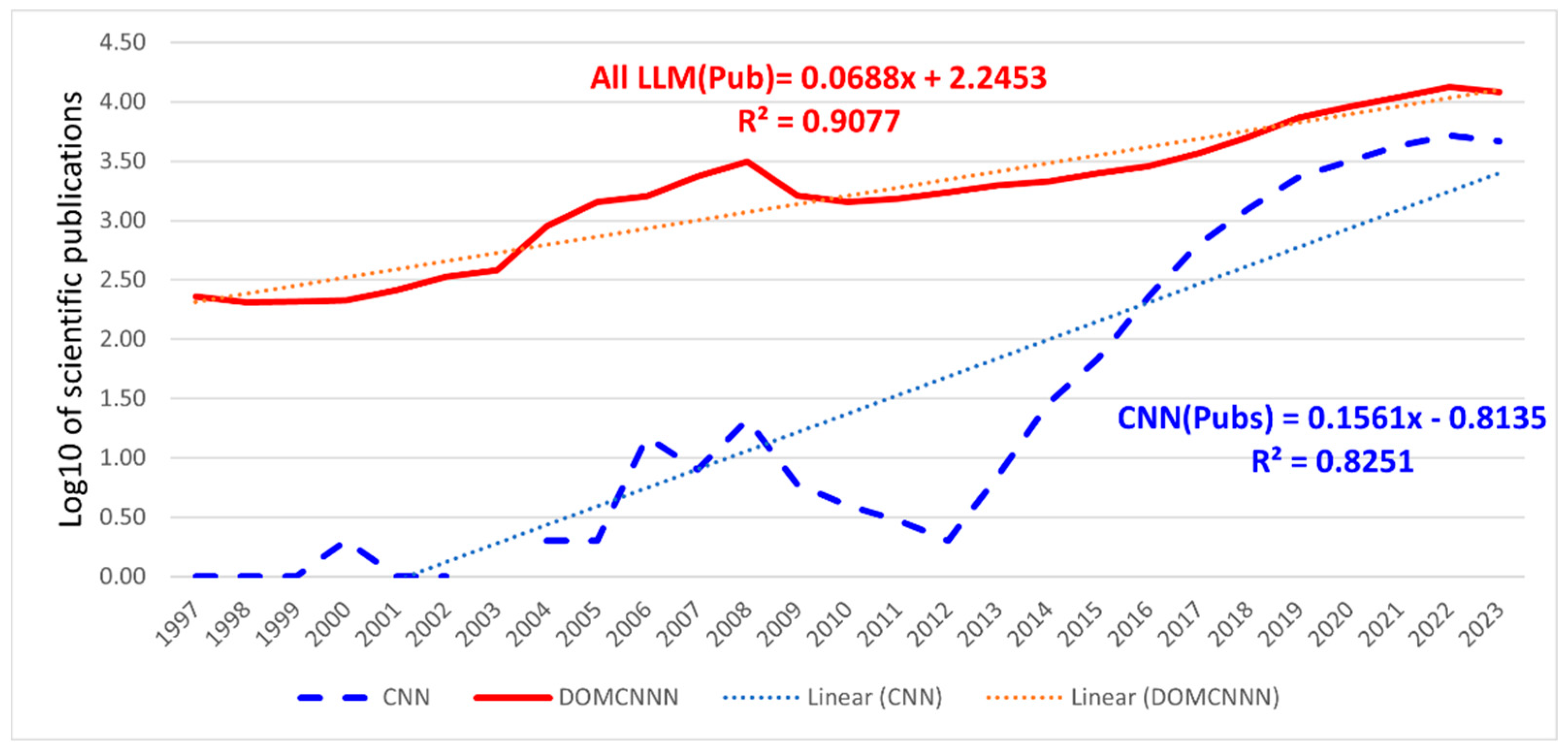
Table 2 shows
a preliminary analysis of regression of estimated relationship. The impact of
transformers is much more drastic of previous radical technology of CNN in the
domain of deep learning having a growth rate of 0.16% (p-value 0.001, R2
=.95), lower than 0.38% (p-value 0.001, R2 =.83 ) by transformers. R2
is remarkably high, showing a high goodness of fit of models, and F-test of
robustness of the model (the ratio of the variance explained by the model to
the unexplained variance) is significant at 0.001. These aspects reveal that
transformers have characteristics to generate a radical scientific and
technological change higher than CCN in a not-too-distant future. Figure 1 and Figure
2 confirm previous results with a visual representation of estimated
relationships.
Table 2.
Parametric estimates of the relationships based on publications.
| Dependent variable Publications | Constant α |
Coefficient β |
R2 | F | Period |
| Log10 Pubs Transformers | 0.45*** | 0.38*** (0.034) |
0.95 (0.222) |
125.47*** | 2016-2023 |
| Log10 Pubs not transformers | 3.29*** | 0.08*** (0.011) |
0.89 (0.068) |
50.45*** | |
| Log10 Pubs CNN | −0.81*** | 0.16*** (0.015) |
0.83 (0.584) |
113.40*** | 1997-2023 |
| Log10 Pubs not CNN | 2.24*** | 0.07*** (0.004) |
0.91 (0.177) |
247.00*** |
Note: *** p<0.001; Explanatory variable: time; period is from starting year of the publications on technology to 2023 (last year available); In round parentheses the Standard Error.
Figure 1.
Estimated relationships for temporal evolution of Transformers (TFR, blue dotted line) compared to overall domain of Large Language Models, LLM (red continuous line) -Publications.
Figure 1.
Estimated relationships for temporal evolution of Transformers (TFR, blue dotted line) compared to overall domain of Large Language Models, LLM (red continuous line) -Publications.
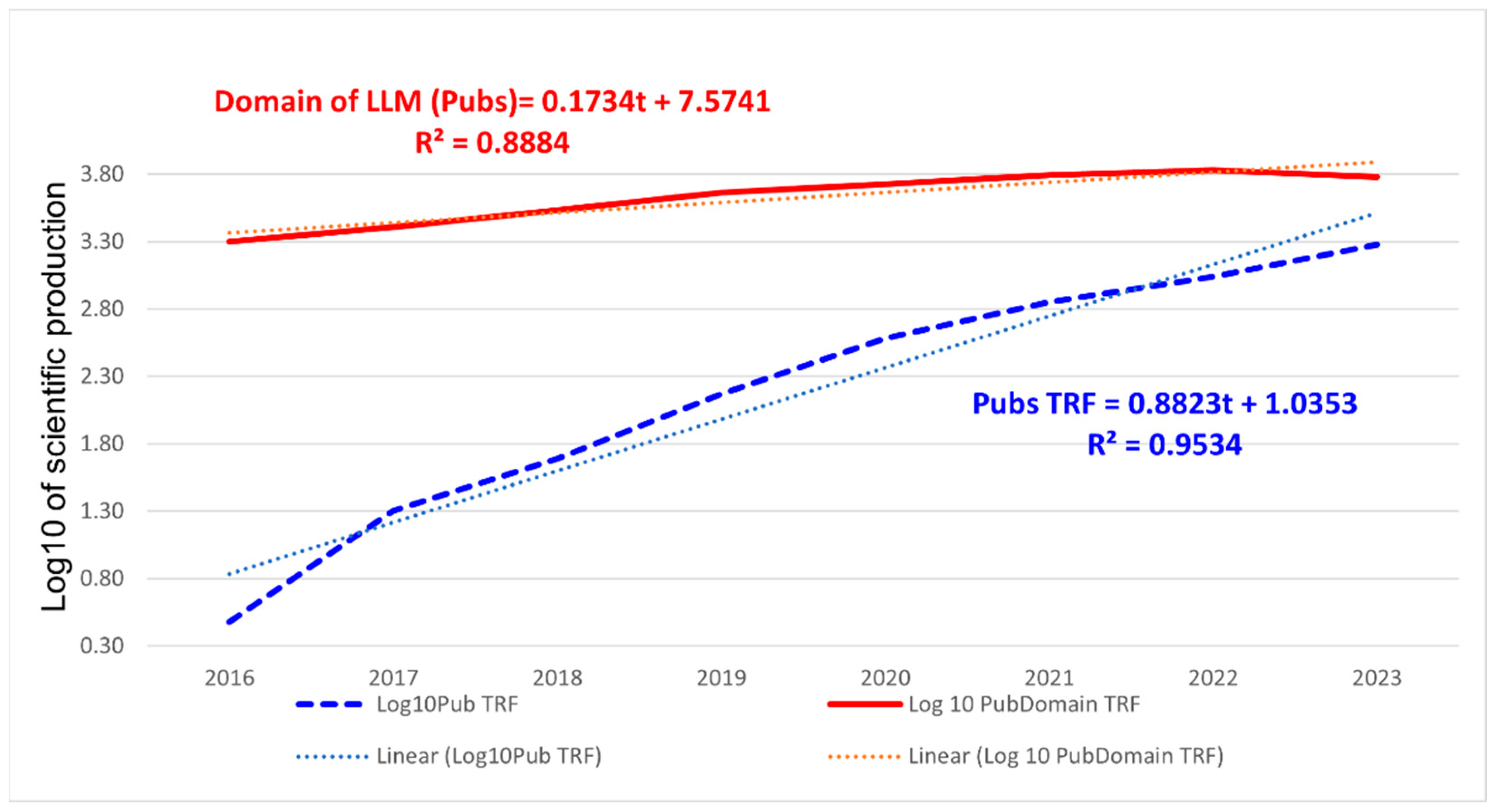
Figure 2.
Estimated relationships for temporal evolution of CNN (blue dotted line) compared to overall domain of Large Language Models (red continuous line)- Publications.
Figure 2.
Estimated relationships for temporal evolution of CNN (blue dotted line) compared to overall domain of Large Language Models (red continuous line)- Publications.
4.2. Patterns of Morphological Change of Transformers and CNN in the Domain of LLM
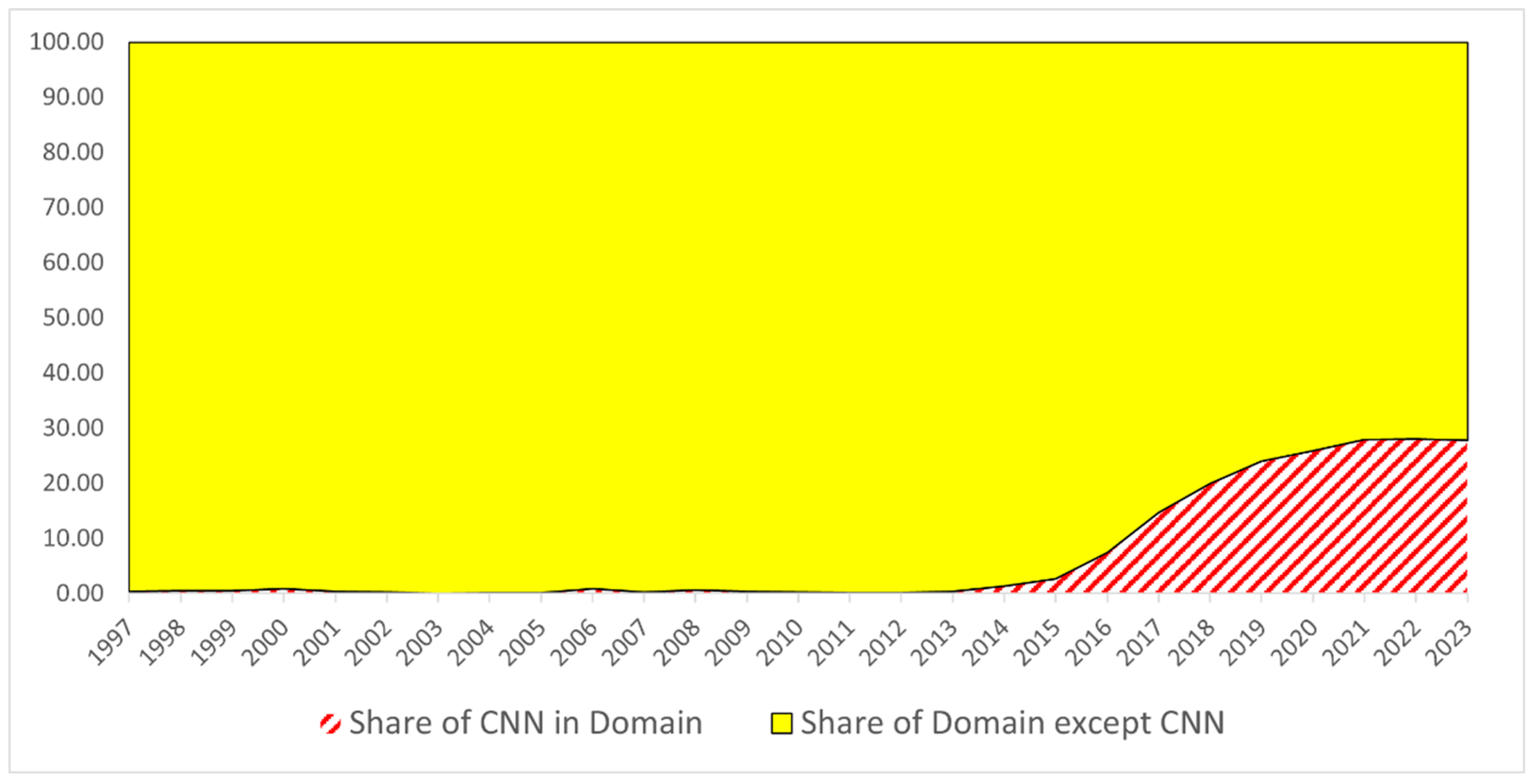
Figure 3 and 4 show a visual representation of how the emerging research field/technology of transformers and CNN is growing with a predatory behaviour, in a short period of time, increasing its share in the related domain occupying the space of alternative technologies/research fields and laying the foundation to be a dominant research field/technology for supporting a scientific and technological change.
Figure 3.
Patterns of morphological change in domain of large language models (LLMs) generated by emerging technology of transformers (publications).
Figure 3.
Patterns of morphological change in domain of large language models (LLMs) generated by emerging technology of transformers (publications).
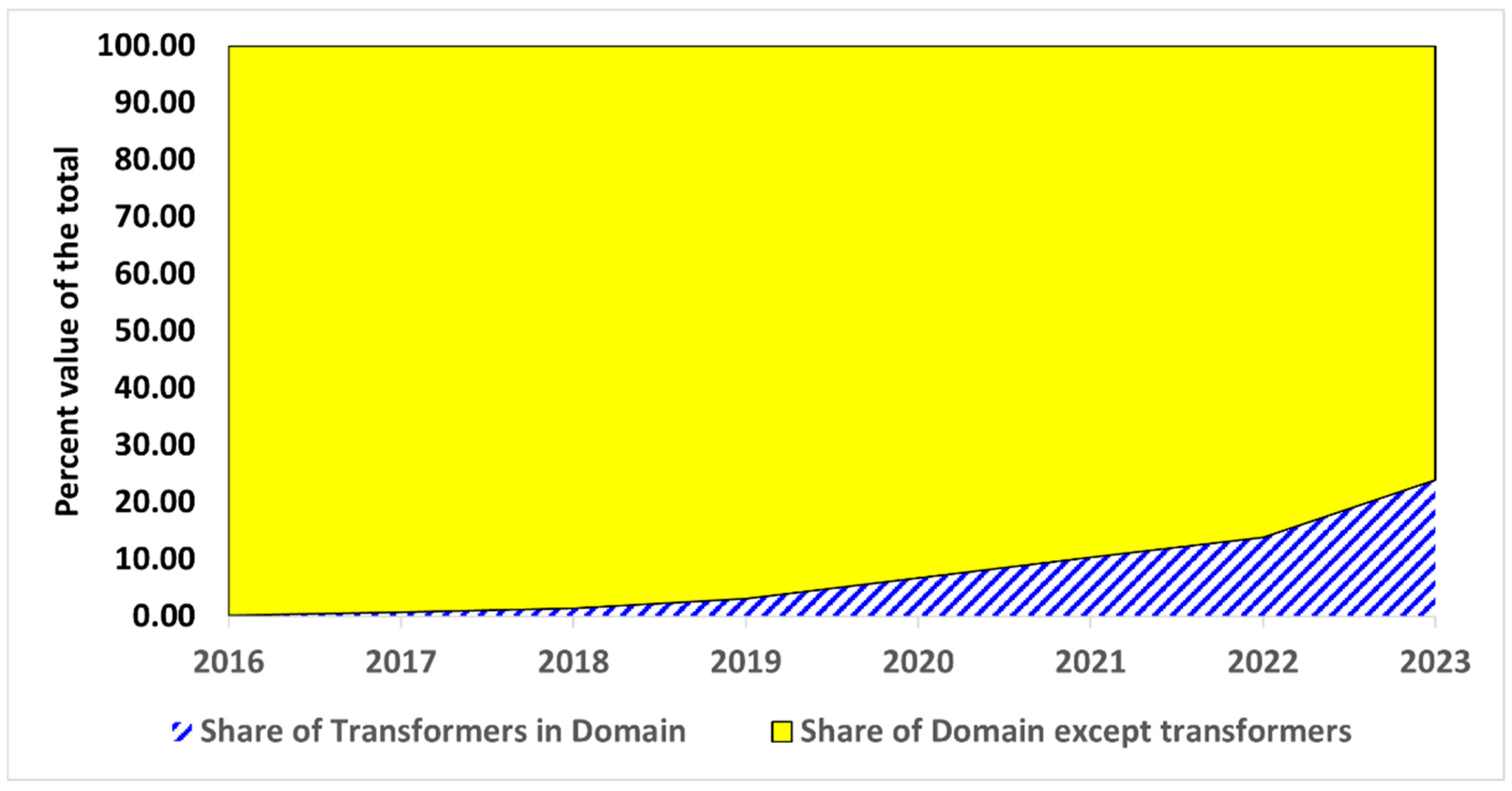
Figure 3.
Patterns of morphological change in domain of large language models (LLM) generated by CNN (publications).
Figure 3.
Patterns of morphological change in domain of large language models (LLM) generated by CNN (publications).
5. Discussions
5.1. Explanations of Results
The prediction of the proposed theory of predatory research fields/technologies, verified with empirical evidence in the context of LLL, can be explained with the approach of destructive technology that lay the foundations for radical scientific and technological change, based on new products and/or processes, that have high technical and/or economic performance directed to reduce market share or destroy the usage value of established technologies/products/processes previously used in markets, generating technological and social change (Coccia, 2020). Adner (2002, pp. 668-669) claims that: “Disruptive technologies . . . introduce a different performance package from mainstream technologies” (cf., Calvano, 2007; Coccia, 2019).
Abernathy and Clark (1985, pp. 4ff and pp. 12-13, original emphasis) claim that:
An innovation is . . . . derived from advances in science, . . . . that disrupts and renders established technical and production competence obsolete, yet is applied to existing markets and customers, is … labelled ‘Revolutionary’. It thus seems clear that the power of an innovation to unleash Schumpeter's ‘creative destruction’ must be gauged by the extent to which it alters the parameters of competition, as well as by the shifts it causes in required technical competence. An innovation of the most unique and unduplicative sort will only have great significance for competition and the evolution of industry when effectively linked to market needs.
Christensen (1997) argues that disruptive technology has specific characteristics: a) higher technological performance; b) provide products/processes that satisfy needs and are demanded by mainstream market. Christensen et al. (2015) claim that disruptive technologies or innovations can be generated by small firms with fewer resources that successfully challenge established incumbent businesses (e.g., the case of OpenAI for ChatGPT). Innovative firms, generating disruptive innovations, grow more rapidly than other ones (Abernathy and Clark, 1985; Tushman and Anderson, 1986, p. 439). Christensen’s (1997) approach also shows that disruptive technologies generate significant shifts in markets (cf., Henderson, 2006). In general, technological and market shifts embody competence-destroying and competence-enhancing because some firms can either destroy or enhance the competence and technologies existing in a specific industry (cf., Hill and Rothaermel, 2003; Tushman and Anderson, 1986). Predatory research fields and technologies are disruptive technologies that undermine the competences and complementary assets of existing producers, and change markets and habits of consumers in society (Christensen and Raynor, 2003; Garud et al., 2015; Markides, 2006; cf., Coccia, 2005). The diffusion and growth rate of predatory research fields, guided by emerging firms, support disruptive innovations that are important drivers to create and sustain competitive advantage of firms amidst rapidly changing business environments (Kessler and Chakrabarti, 1996, p. 1143). Calvano (2007) argues that it is the role of destruction rather than creation in driving innovative activity, such as predatory research field of transformers that is supporting, more and more, applications of Artificial Intelligence in practical contexts (cf., Nonaka and Nishiguchi, 2001; Nonaka and Toyama, 2003).
Predatory research fields, as disruptive technology, affect the behavior of other technologies and research fields, generating a process of actual substitution of a new technique or research topic for the established one and, as a consequence, fostering technical, industrial and corporate change. What this study adds is that predatory research field explain a modern dynamics of the scientific and technological evolution in LLM that has the potential to be a disruptive technology that generates cluster of radical innovations in generative artificial intelligence in a short period of time fostering a wide technological, economic and social change.
5.2. Deduction for General Properties of Predatory Research Field
- a)
-
Let PTi a research field i having predatory behaviourLet Prj research fields that are preys in the inter-related domain D of i; j=1, 2, …, m(PTi, Prj )⊆Dt=year of emergence of PTiσi=growth rate of predator PTiτ j =growth rate of pray Pr jA predatory behaviour of PTi in the domain D is when at t+nσi>0, and σi >2 τ j , ∀ j=1, 2, …, m
- b)
- Predatory research fields is always associated with some comparable established research fields/technologies (pray ) in markets.
- c)
- The long-run behavior and evolution of any predatory technology is not independent of from the behavior of other comparable technologies.
- d)
- In the short run, predatory research fields/technologies destroy with a rapid growth alternative technologies and lay the foundations for radical shifts driven by clusters of radical innovations.
- e)
- A predatory behaviour, in a short period of time, increases its share in the related domain occupying the space of alternative technologies/research fields and laying the foundation to be a dominant research field/technology for supporting a major scientific and technological change.
- f)
- In the long run, predatory research field/technology has a series of technological advances of its own resulting from various major and minor innovations that pave the technological direction to be a dominant technology over other established technologies/research field in markets.
6. Conclusions
This study shows, for the first time, the basic role of predatory research fields in driving scientific and technological change. The theoretical framework is verified in the case study of transformer architecture technology that has an unparalleled growth at expense of other established technologies and research fields, occupying space, destroying them, and creating basic conditions to generate a drastic scientific change in LLM with consequential radical technological change driven by generative artificial intelligence having main effects on economic and social change. Driving force of Transformers and related applications such as ChatGPT by Open AI launched in November 2022, Microsoft copilot emerged in February 2023, etc. is the improvement of performance in LLM such as it is able to enter into the mainstream of research field and technological domain. In particular, transformer architecture outperforms in terms of performance other technologies such as Recurrent Neural networks (RNNs) because of the “attention mechanism” concept that focuses on different parts of the input sequence when making each output token. This science dynamics affects and attracts community of scholars in this new scientific fields to develop various major and minor innovations that pave the technological direction by ‘‘expanding the adjacent possible’’ (Kauffman, 1996; Monechi at al., 201; Tria et al., 2014; Iacopini et al., 2018) to be a dominant technology over other established technologies in markets (Crane, 1972; Guimera et al., 2005; Wagner, 2008).
5.1. Theoretical Implications
Predatory research fields of transformer architecture, as disruptive topics and/or technologies, introduce a different performance package from mainstream technologies. Scientific and technological development raises the disruptive technology’s performance on the focal mainstream attributes to a level sufficient to satisfy mainstream customers (Adner, 2002; Adner and Zemsky. 2005). The underlying force is the learning via diffusion and diffusion by learning that support the development and adoption of the predatory research field with disruptive technology in turbulent (complex and fast changing) markets.
5.2. Managerial and Policy Implications
In fact, this study shows main properties of the evolution of technologies, which can guide R&D investments towards fruitful scientific and technological domains for a positive socioeconomic impact (Coccia, 2022). Hence, policymakers and R&D managers can use the findings here for making efficient decisions regarding the sponsoring of specific trajectories in LLM to foster technology transfer with fruitful effects for generating radical innovations and boosting up next technological change. In the presence of these findings, organizations can apply an ambidexterity strategy of innovation management by balancing exploration and exploitation approaches in LLM, which allow the organization to be adaptable to turbulent environments and achieve and sustain competitive advantage (Duncan, 1976; March, 1991; Raisch and Birkinshaw, 2008). In particular, organization can apply an innovation strategy of exploration based on search, risk taking, experimentation, selection, discoveries and flexibility between different scientific technological pathways. Firms that focus only on exploration have to consider facing the risk of wasting resources on some research topics and emerging technologies that may fail and never be developed (Coccia, 2023). The innovation management implications is that financial resources on vital fields of research can be an accelerator factor of progress and diffusion of science and technology (Mosleh et al., 2022; Roshani et al., 2021, 2022). Policymakers and R&D managers can apply results of this study for an effective allocation of resources towards new research fields and converging technologies to foster the development of new knowledge, scientific research and innovations for a positive impact in science and society.
5.3. Limitations and Ideas for Future Research
This study shows for the first time, to our knowledge, evolutionary dynamics of predatory research fields that is verified with emerging technologies of transformers in LLM to explain some properties of evolutionary pathways. These findings here can encourage further theoretical exploration in the terra incognita of the predatory behaviour in science and technology to clarify basic properties of scientific and technological evolution. These conclusions are, of course, tentative. This study provides some interesting but preliminary results in these complex fields of research related to technological analysis of emerging technologies. Some limitations are that: 1) scientific outputs and research topics can only detect certain aspects of the ongoing dynamics of predatory research fields and next study should apply complementary analysis; 2) confounding factors (e.g., level of public and private R&D investments, international collaboration in specific technologies, etc.) affect the evolution of technologies having a predatory behaviour and these aspects have to be considered in future studies to improve data gathering for technological analyses.
In short, there is need for much more detailed research into the investigation of the predatory behaviour to clarify evolutionary patterns of technologies and support implications for innovation management and technological forecasting. Despite these limitations, the results here clearly illustrate that a predatory research field can clarify basic characteristics of scientific and technological change in environments with rapid changes. These aspects are basic for improving the prediction of evolutionary pathways of emerging technologies and supporting R&D investments towards technologies and innovations having a high potential of growth and of impact on socioeconomic system. To conclude, the proposed theoretical framework may lay the foundation for development of more sophisticated concepts and theoretical frameworks in economics of technical change to explain and forecast technological evolution. However, a comprehensive explanation of the predatory behaviour in the evolution of technology is a difficult topic for manifold complex and inter-related factors in the presence of changing and turbulent environment (Ziman, 2000), such that Wright (1997, p. 1562) properly claims that: “In the world of technological change, bounded rationality is the rule.”
Acknowledgments
I would like to thank Enrico Borriello from ASU for fruitful suggestions in study design during preliminary drafts. All data are available on Scopus (2024). The author has no known competing financial interests or personal relationships that could influence the work reported in this paper. This study has no funders.
References
- Adner R (2002) When are technologies disruptive: a demand-based view of the emergence of competition. 6: Strateg Manag J 23.
- Adner R, Zemsky P (2005) Disruptive technologies and the emergence of competition. 2: RAND J Econ 36(2 (Summer)).
- Amarlou, A. , & Coccia, M. Estimation of diffusion modelling of unhealthy nanoparticles by using natural and safe microparticles. Nanochemistry Research 2023, 8, 117–121. [Google Scholar] [CrossRef]
- Anastopoulos, I.; Bontempi, E.; Coccia, M.; Quina, M.; Shaaban, M. Sustainable strategic materials recovery, what’s next? Next Sustainability, VSI: Sustainable strategic materials recovery_Editorial, n. 100006. 2023. [Google Scholar] [CrossRef]
- Anastopoulos, I.; Bontempi, E.; Coccia, M.; Quina, M.; Shaaban, M. Sustainable strategic materials recovery, what’s next? Next Sustainability, VSI: Sustainable strategic materials recovery_Editorial, n. 100006. 2023. [Google Scholar] [CrossRef]
- Arthur B., W. 2009. The Nature of Technology. What it is and How it Evolves. Free Press, Simon & Schuster, London.
- Assael, Yannis; Sommerschield, Thea; Shillingford, Brendan; Bordbar, Mahyar; Pavlopoulos, John; Chatzipanagiotou, Marita; Androutsopoulos, Ion; Prag, Jonathan; de Freitas, Nando (2022). Restoring and attributing ancient texts using deep neural networks. Nature. 2: 603 (7900), 7900.
- Barton, C.M. Complexity, Social Complexity, and Modeling. J. Archaeol. Method Theory 2014, 21, 306–324. [Google Scholar] [CrossRef]
- Basalla, G. 1988. The History of Technology. Cambridge University Press, Cambridge.
- Batra, K. , Zorn, K.M., Foil, D.H., (...), Lane, T.R., Ekins, S. 2021. Quantum Machine Learning Algorithms for Drug Discovery Applications, Journal of Chemical Information and Modeling, 61(6), pp. 2641. [Google Scholar]
- Bettencourt, L.M.; Kaiser, D.I.; Kaur, J. Scientific discovery and topological transitions in collaboration networks. J. Inf. 2009, 3, 210–221. [Google Scholar] [CrossRef]
- Börner, K.; Glänzel, W.; Scharnhorst, A.; Besselaar, P.v.D. Modeling science: studying the structure and dynamics of science. Scientometrics 2011, 89, 347–348. [Google Scholar] [CrossRef]
- Calabrese, G.; Coccia, M.; Rolfo, S. Strategy and market management of new product development and incremental innovation: evidence from Italian SMEs. Int. J. Prod. Dev. 2005, 2, 170. [Google Scholar] [CrossRef]
- Carberry, D. , Nourbakhsh A., Karon, J., (...), Andersson, M.P., Mansouri, S.S.2021. Building Knowledge Capacity for Quantum Computing in Engineering Education, Computer Aided Chemical Engineering 50, pp. 2065. [Google Scholar]
- Cavallo, E.; Ferrari, E.; Coccia, M. Likely technological trajectories in agricultural tractors by analysing innovative attitudes of farmers. Int. J. Technol. Policy Manag. 2015, 15, 158. [Google Scholar] [CrossRef]
- Coccia, M. (2019) Theories of Revolution. In: Farazmand A. (eds) Global Encyclopedia of Public Administration, Public Policy, and Governance. Springer, Cham. [CrossRef]
- Coccia, M. Metrics of R&D performance and management of public research labs, “IEMC” 03 Proceedings. Managing Technologically Driven Organizations: The Human Side of Innovation and Change. 2003; 231–235. [Google Scholar] [CrossRef]
- Coccia, M. Spatial Metrics of the Technological Transfer: Analysis and Strategic Management. Technol. Anal. Strat. Manag. 2004, 16, 31–51. [Google Scholar] [CrossRef]
- Coccia, M. A scientometric model for the assessment of scientific research performance within public institutes. Scientometrics 2005, 65, 307–321. [Google Scholar] [CrossRef]
- Coccia, M. Measuring intensity of technological change: The seismic approach. Technol. Forecast. Soc. Chang. 2005, 72, 117–144. [Google Scholar] [CrossRef]
- Coccia, M. New organisational behaviour of public research institutions: lessons learned from Italian case study. Int. J. Bus. Innov. Res. 2008, 2, 402. [Google Scholar] [CrossRef]
- Coccia, M. Spatial mobility of knowledge transfer and absorptive capacity: analysis and measurement of the impact within the geoeconomic space. J. Technol. Transf. 2007, 33, 105–122. [Google Scholar] [CrossRef]
- Coccia, M. What is the optimal rate of R&D investment to maximize productivity growth? Technol. Forecast. Soc. Chang. 2009, 76, 433–446. [Google Scholar] [CrossRef]
- Coccia, M. Foresight of technological determinants and primary energy resources of future economic long waves. Int. J. Foresight Innov. Policy 2010, 6, 225. [Google Scholar] [CrossRef]
- Coccia, M. Public and private R&D investments as complementary inputs for productivity growth. Int. J. Technol. Policy Manag. 2010, 10, 73. [Google Scholar] [CrossRef]
- Coccia, M. Spatial patterns of technology transfer and measurement of its friction in the geo-economic space. Int. J. Technol. Transf. Commer. 2010, 9, 255. [Google Scholar] [CrossRef]
- Coccia, M. Evolutionary trajectories of the nanotechnology research across worldwide economic players. Technol. Anal. Strat. Manag. 2012, 24, 1029–1050. [Google Scholar] [CrossRef]
- Coccia, M. Converging scientific fields and new technological paradigms as main drivers of the division of scientific labour in drug discovery process: the effects on strategic management of the R&D corporate change. Technol. Anal. Strat. Manag. 2014, 26, 733–749. [Google Scholar] [CrossRef]
- Coccia, M. Socio-cultural origins of the patterns of technological innovation: What is the likely interaction among religious culture, religious plurality and innovation? Towards a theory of socio-cultural drivers of the patterns of technological innovation. Technol. Soc. 2014, 36, 13–25. [Google Scholar] [CrossRef]
- Coccia, M. General sources of general purpose tech. in complex societies: Theory of global leadership-driven innovation, warfare and human dev. Technol. Soc. 2015, 42, 199–226. [Google Scholar] [CrossRef]
- Coccia, M. Spatial relation between geo-climate zones and technological outputs to explain the evolution of technology. Int. J. Transitions Innov. Syst. 2015, 4. [Google Scholar] [CrossRef]
- Coccia, M. Technological paradigms and trajectories as determinants of the R&D corporate change in drug discovery industry. Int. J. Knowl. Learn. 2015, 10, 29. [Google Scholar] [CrossRef]
- Coccia, M. Radical innovations as drivers of breakthroughs: characteristics and properties of the management of technology leading to superior organisational performance in the discovery process of R&D labs. Technol. Anal. Strat. Manag. 2016, 28, 381–395. [Google Scholar] [CrossRef]
- Coccia, M. 2017. Sources of disruptive technologies for industrial change. L’industria –rivista di economia e politica industriale, vol. 38, n. 1, pp. 97-120. [CrossRef]
- Coccia, M. Sources of technological innovation: Radical and incremental innovation problem-driven to support competitive advantage of firms. Technol. Anal. Strat. Manag. 2017, 29, 1048–1061. [Google Scholar] [CrossRef]
- Coccia, M. The Fishbone diagram to identify, systematize and analyze the sources of general purpose technologies. J. Soc. Adm. Sci. 2017, 4, 291–303. [Google Scholar] [CrossRef]
- Coccia, M. The source and nature of general purpose technologies for supporting next K-waves: Global leadership and the case study of the U.S. Navy's Mobile User Objective System. Technol. Forecast. Soc. Chang. 2017, 116, 331–339. [Google Scholar] [CrossRef]
- Coccia, M. 2017a. Disruptive firms and industrial change, Journal of Economic and Social Thought, vol. 4, n. 4, pp. 437-450. [CrossRef]
- Coccia, M. Varieties of capitalism's theory of innovation and a conceptual integration with leadership-oriented executives: the relation between typologies of executive, technological and socioeconomic performances. Int. J. Public Sect. Perform. Manag. 2017, 3, 148. [Google Scholar] [CrossRef]
- Coccia, M. A Theory of the General Causes of Long Waves: War, General Purpose Technologies, and Economic Change. Technol. Forecast. Soc. Chang. 2018, 128, 287–295. [Google Scholar] [CrossRef]
- Coccia, M. 2018. An introduction to the methods of inquiry in social sciences, J. Adm. Soc. Sci. - JSAS – vol. 5, n. 2, pp. 116-126. [CrossRef]
- Coccia, M. 2018. Classification of innovation considering technological interaction, Journal of Economics Bibliography, vol. 5, n. 2, pp. 76-93. [CrossRef]
- Coccia, M. 2018. Competition between basic and applied research in the organizational behaviour of public research labs, J. Econ. Lib., vol. 5, n. 2, pp. 118-133. [CrossRef]
- Coccia, M. General properties of the evolution of research fields: a scientometric study of human microbiome, evolutionary robotics and astrobiology. Scientometrics 2018, 117, 1265–1283. [Google Scholar] [CrossRef]
- Coccia, M. Optimization in R&D intensity and tax on corporate profits for supporting labor productivity of nations. J. Technol. Transf. 2018, 43, 792–814. [Google Scholar] [CrossRef]
- Coccia, M. 2018a. An introduction to the theories of institutional change, Journal of Economics Library, vol. 5, n. 4, pp. 337-344. [CrossRef]
- Coccia, M. Theorem of not independence of any technological innovation. J. Econ. Bibliogr. 2018, 5, 29–35. [Google Scholar] [CrossRef]
- Coccia, M. A theory of classification and evolution of technologies within a Generalised Darwinism. Technol. Anal. Strat. Manag. 2019, 31, 517–531. [Google Scholar] [CrossRef]
- Coccia, M. 2019. Artificial intelligence technology in oncology: a new technological paradigm. ArXiv.org e-Print archive, Cornell University, USA. Permanent arXiv available at http://arxiv.org/abs/1905. 0687. [Google Scholar]
- Coccia, M. 2019. Comparative Institutional Changes. A. Farazmand (ed.), Global Encyclopedia of Public Administration, Public Policy, and Governance, Springer. [CrossRef]
- Coccia, M. 2019. Intrinsic and extrinsic incentives to support motivation and performance of public organizations, Journal of Economics Bibliography, vol. 6, no. 1, pp. 20-29. [CrossRef]
- Coccia, M. 2019. New Patterns of Technological Evolution: Theory and Practice, ©KSP Books, ISBN: 978-605-7602-88-6.
- Coccia, M. 2019. Technological Parasitism. Journal of Economic and Social Thought, vol. 6, no. 3, pp. 173-209. [CrossRef]
- Coccia, M. The theory of technological parasitism for the measurement of the evolution of technology and technological forecasting. Technol. Forecast. Soc. Chang. 2019, 141, 289–304. [Google Scholar] [CrossRef]
- Coccia, M. 2019. Theories of the evolution of technology based on processes of competitive substitution and multi-mode interaction between technologies. Journal of Economics Bibliography, vol. 6, n. 2, pp. 99-109. [CrossRef]
- Coccia, M. What Is Technology and Technology Change? A New Conception with Systemic-Purposeful Perspective for Technology Analysis. J. Soc. Adm. Sci. 2019, 6, 145–169. [Google Scholar] [CrossRef]
- Coccia, M. Why do nations produce science advances and new technology? Technol. Soc. 2019, 59, 101124. [Google Scholar] [CrossRef]
- Coccia, M. Asymmetry of the technological cycle of disruptive innovations. Technol. Anal. Strat. Manag. 2020, 32, 1462–1477. [Google Scholar] [CrossRef]
- Coccia, M. 2020. Comparative Concepts of Technology for Strategic Management. In: Farazmand A. (eds), Global Encyclopedia of Public Administration, Public Policy, and Governance. Springer Nature. [CrossRef]
- Coccia, M. Deep learning technology for improving cancer care in society: New directions in cancer imaging driven by artificial intelligence. Technol. Soc. 2020, 60, 101198. [Google Scholar] [CrossRef]
- Coccia, M. 2020. Destructive Technologies for Industrial and Corporate Change. In: Farazmand A. (eds), Global Encyclopedia of Public Administration, Public Policy, and Governance. Springer, Cham. [CrossRef]
- Coccia, M. Fishbone diagram for technological analysis and foresight. Int. J. Foresight Innov. Policy 2020, 14, 225. [Google Scholar] [CrossRef]
- Coccia, M. The evolution of scientific disciplines in applied sciences: dynamics and empirical properties of experimental physics. Scientometrics 2020, 124, 451–487. [Google Scholar] [CrossRef]
- Coccia, M. 2021. Effects of human progress driven by technological change on physical and mental health, STUDI DI SOCIOLOGIA, 2021, N. 2, pp. 113-132. [CrossRef]
- Coccia, M. 2021. Technological Innovation. The Blackwell Encyclopedia of Sociology. Edited by George Ritzer and Chris Rojek. John Wiley & Sons, Ltd. [CrossRef]
- Coccia, M. 2022. Disruptive innovations in quantum technologies for social change. Journal of Economics Bibliography, vol. 9, n.1, pp. 21-39. [CrossRef]
- Coccia, M. Technological trajectories in quantum computing to design a quantum ecosystem for industrial change. Technol. Anal. Strat. Manag. 2022, 1–16. [Google Scholar] [CrossRef]
- Coccia, M. Probability of discoveries between research fields to explain scientific and technological change. Technol. Soc. 2022, 68, 101874. [Google Scholar] [CrossRef]
- Coccia, M. High potential of technology to face new respiratory viruses: mechanical ventilation devices for effective healthcare to next pandemic emergencies. Technol. Soc. 2023, 73, 102233. [Google Scholar] [CrossRef]
- Coccia, M. 2023. Innovation Failure: Typologies for appropriate R&D management. Journal of Social and Administrative Sciences - J. Adm. Soc. Sci. - JSAS - vol. 10, n.1-2 (March-June), pp.10-30. [CrossRef]
- Coccia, M. New directions of technologies pointing the way to a sustainable global society. Sustain. Futur. 2023, 5. [Google Scholar] [CrossRef]
- Coccia, M. New Perspectives in Innovation Failure Analysis: A taxonomy of general errors and strategic management for reducing risks. Technol. Soc. 2023, 75. [Google Scholar] [CrossRef]
- Coccia, M. New Perspectives in Innovation Failure Analysis: A taxonomy of general errors and strategic management for reducing risks. Technol. Soc. 2023, 75. [Google Scholar] [CrossRef]
- Coccia, M. 2023. Promising technologies for fostering simultaneous environmental and socioeconomic sustainability. Journal of Economic and Social Thought - J. Econ. Soc. Thoug. – JEST, vol. 10, n.1-2 (March-June), pp. 28-47. [CrossRef]
- Coccia, M. , 2018. Disruptive firms and technological change, Quaderni IRCrES-CNR, vol., 3, n. 1, pp. 3-18. [CrossRef]
- Coccia, M. , Bellitto M. 2018. Human progress and its socioeconomic effects in society, Journal of Economic and Social Thought, vol. 5, n. 2, pp. 160-178. [CrossRef]
- Coccia, M. , Benati I. 2018. Comparative Models of Inquiry, A. Farazmand (ed.), Global Encyclopedia of Public Administration, Public Policy, and Governance, Springer. [CrossRef]
- Coccia, M. , Benati I. 2018. Comparative Studies. Global Encyclopedia of Public Administration, Public Policy, and Governance –section Bureaucracy (edited by Ali Farazmand). Chapter No. 1197-1, pp. 1-7. [CrossRef]
- Coccia, M.; Bontempi, E. New trajectories of technologies for the removal of pollutants and emerging contaminants in the environment. Environ. Res. 2023, 229, 115938. [Google Scholar] [CrossRef]
- Coccia, M.; Falavigna, G.; Manello, A. The impact of hybrid public and market-oriented financing mechanisms on the scientific portfolio and performances of public research labs: a scientometric analysis. Scientometrics 2015, 102, 151–168. [Google Scholar] [CrossRef]
- Coccia, M.; Finardi, U. New technological trajectories of non-thermal plasma technology in medicine. Int. J. Biomed. Eng. Technol. 2013, 11, 337. [Google Scholar] [CrossRef]
- Coccia, M.; Finardi, U.; Margon, D. Current trends in nanotechnology research across worldwide geo-economic players. J. Technol. Transf. 2012, 37, 777–787. [Google Scholar] [CrossRef]
- Coccia, M. , Ghazinoori S., Roshani S. 2023. Evolutionary Pathways of Ecosystem Literature in Organization and Management Studies. Research Square. [CrossRef]
- Coccia, M.; Roshani, S.; Mosleh, M. Evolution of Quantum Computing: Theoretical and Innovation Management Implications for Emerging Quantum Industry. IEEE Trans. Eng. Manag. 2022, 71, 2270–2280. [Google Scholar] [CrossRef]
- Coccia, M.; Roshani, S.; Mosleh, M. Evolution of Quantum Computing: Theoretical and Innovation Management Implications for Emerging Quantum Industry. IEEE Trans. Eng. Manag. 2024, 71, 2270–2280. [Google Scholar] [CrossRef]
- Coccia, M. , Rolfo S. 2000. Ricerca pubblica e trasferimento tecnologico: il caso della regione Piemonte in Rolfo S. (eds) Innovazione e piccole imprese in Piemonte, FrancoAngeli Editore, Milano (Italy), pp. 236-256. 9: ISBN, 9788. [Google Scholar]
- Coccia, M.; Rolfo, S. Strategic change of public research units in their scientific activity. Technovation 2008, 28, 485–494. [Google Scholar] [CrossRef]
- Coccia, M.; Roshani, S. General laws of funding for scientific citations: how citations change in funded and unfunded research between basic and applied sciences. J. Data Inf. Sci. 2024. [Google Scholar] [CrossRef]
- Coccia, M.; Roshani, S.; Mosleh, M. Scientific Developments and New Technological Trajectories in Sensor Research. Sensors 2021, 21, 7803. [Google Scholar] [CrossRef]
- Coccia, M.; Wang, L. Path-breaking directions of nanotechnology-based chemotherapy and molecular cancer therapy. Technol. Forecast. Soc. Chang. 2015, 94, 155–169. [Google Scholar] [CrossRef]
- Coccia, M.; Wang, L. Evolution and convergence of the patterns of international scientific collaboration. Proc. Natl. Acad. Sci. 2016, 113, 2057–2061. [Google Scholar] [CrossRef]
- Coccia, M.; Watts, J. A theory of the evolution of technology: Technological parasitism and the implications for innovation magement. J. Eng. Technol. Manag. 2020, 55, 101552. [Google Scholar] [CrossRef]
- Coccia, M. 2024. Variability in Research Topics Driving Different Technological Trajectories. Preprints 2024, 2024020603. [Google Scholar] [CrossRef]
- Coccia, M.; Roshani, S. Research funding and citations in papers of Nobel Laureates in Physics, Chemistry and Medicine, 2019-2020. J. Data Inf. Sci. 2024. [Google Scholar] [CrossRef]
- Coccia, M.; Roshani, S.; Mosleh, M. Evolution of Sensor Research for Clarifying the Dynamics and Properties of Future Directions. Sensors 2022, 22, 9419. [Google Scholar] [CrossRef]
- Coe M., M. 2021. Basketry, cordage, and perishable artifact manufacture at Bonneville Estates Rockshelter: Diachronic technological variation. J. Ir. Archaeol. 1013; 64. [Google Scholar]
- Cowan, R. 1989. Technological Variety And Competition: Issues Of Diffusion And Intervention, Working Papers 89-23, C.V. Starr Center for Applied Economics, New York University.
- Cozzens, S.; Gatchair, S.; Kang, J.; Kim, K.-S.; Lee, H.J.; Ordóñez, G.; Porter, A. Emerging technologies: quantitative identification and measurement. Technol. Anal. Strateg. Manag. 2010, 22, 361–376. [Google Scholar] [CrossRef]
- Crane, D. 1972. Invisible Colleges: Diffusion of Knowledge in Scientific Communities. Chicago: University of Chicago Press.
- Tosi, M.D.L.; dos Reis, J.C. Understanding the evolution of a scientific field by clustering and visualizing knowledge graphs. J. Inf. Sci. 2020, 48, 71–89. [Google Scholar] [CrossRef]
- Dawkins, R. 1983. Universal Darwinism. In: Bendall, D.S. (ed.), Evolution from Molecules to Man. Cambridge University Press, Cambridge, pp. 403 - 425.
- Dell Technologies 2023. Transformer (machine learning model). Available online: https://infohub.delltechnologies.com/l/generative-ai-in-the-enterprise/transformer-models/(accessed December 2023).
- Duncan, R. (1976). The ambidextrous organization: Designing dual structures for innovation. Killman, R. H., L. R. Pondy, and D. Sleven (eds.) The Management of Organization. New York: North Holland. 167-188.
- Farrell CJ (1993a) A theory of technological. Technol Forecast Soc Chang 44(2); 161–178.
- Farrell CJ (1993b) Survival of the fittest technologies: CDs, disposable razors and unleaded petrol would have made Charles Darwin smile. They have all seen off rivals in the economic jungle. 3: New Scientist 137 (), 6 February.
- Fisher JC, Pry RH (1971) A simple substitution model of technological change. 7: Technol Forecast Soc Chang 3(2–3).
- Fortunato, S.; Bergstrom, C.T.; Börner, K.; Evans, J.A.; Helbing, D.; Milojević, S.; Petersen, A.M.; Radicchi, F.; Sinatra, R.; Uzzi, B.; et al. Science of science. Science 2018, 359. [Google Scholar] [CrossRef] [PubMed]
- Glänzel, W.; Thijs, B. Using ‘core documents’ for detecting and labelling new emerging topics. Scientometrics 2012, 91, 399–416. [Google Scholar] [CrossRef]
- Guimerà, R.; Uzzi, B.; Spiro, J.; Amaral, L.A.N. Team Assembly Mechanisms Determine Collaboration Network Structure and Team Performance. Science 2008, 308, 697–702. [Google Scholar] [CrossRef]
- Hicks, D.; Isett, K.R. Powerful numbers: Exemplary quantitative studies of science that had policy impact. Quant. Sci. Stud. 2020, 1, 969–982. [Google Scholar] [CrossRef]
- Hodgson, G.M. Darwinism in economics: from analogy to ontology. J. Evol. Econ. 2002, 12, 259–281. [Google Scholar] [CrossRef]
- Hodgson G., M. , Knudsen T., 2006. Why we need a generalized Darwinism, and why generalized Darwinism is not enough. Journal of Economic Behavior and Organization 61(1), pp. 1-19.
- Iacopini, I.; Milojević, S.; Latora, V. Network Dynamics of Innovation Processes. Phys. Rev. Lett. 2018, 120, 048301. [Google Scholar] [CrossRef]
- Kariampuzha, W.Z.; Alyea, G.; Qu, S.; Sanjak, J.; Mathé, E.; Sid, E.; Chatelaine, H.; Yadaw, A.; Xu, Y.; Zhu, Q. Precision information extraction for rare disease epidemiology at scale. J. Transl. Med. 2023, 21, 1–18. [Google Scholar] [CrossRef]
- Kauffman, S.; Macready, W. Technological evolution and adaptive organizations: Ideas from biology may find applications in economics. Complexity 1995, 1, 26–43. [Google Scholar] [CrossRef]
- Kauffman, S.A. , 1996. Investigations: the Nature of Autonomous Agents and the Worlds They Mutually Create. SFI Working Papers. Santa Fe Institute, USA.
- Kuhn, T.S. , 1962, The Structure of Scientific Revolutions, Chicago: University of Chicago Press.
- Lakatos, I. , Worrall J., Currie, G. 1980. Eds., The Methodology of Scientific Research Programmes: Volume 1: Philosophical Papers. Cambridge: Cambridge University Press.
- Levit, G., U. Hossfeld, and U. Witt. 2011. “Can Darwinism be “Generalized” and of What use Would This be?” Journal of Evolutionary Economics 21 (4): 545–562.
- Coccia, M. A theory of classification and evolution of technologies within a Generalised Darwinism. Technol. Anal. Strat. Manag. 2019, 31, 517–531. [Google Scholar] [CrossRef]
- Coccia, M. Asymmetry of the technological cycle of disruptive innovations. Technol. Anal. Strat. Manag. 2020, 32, 1462–1477. [Google Scholar] [CrossRef]
- M. Coccia, “Classification of innovation considering technological interaction,” Journal of Economics Bibliography, vol. 5, n. 2, pp. 76-93, 2018. [CrossRef]
- M. Coccia, “Comparative Institutional Changes,” in Global Encyclopedia of Public Administration, Public Policy, and Governance, A. Farazmand, Ed., Cham: Springer International Publishing, 2019a, pp. 1–6. [CrossRef]
- M. Coccia, “Destructive Technologies for Industrial and Corporate Change,” in Global Encyclopedia of Public Administration, Public Policy, and Governance, A. Farazmand, Ed., Cham: Springer International Publishing, 2020b, pp. 1–7. [CrossRef]
- Coccia, M. New Perspectives in Innovation Failure Analysis: A taxonomy of general errors and strategic management for reducing risks. Technol. Soc. 2023, 75. [Google Scholar] [CrossRef]
- Coccia, M. Political economy of R&D to support the modern competitiveness of nations and determinants of economic optimization and inertia. Technovation 2012, 32, 370–379. [Google Scholar] [CrossRef]
- Coccia, M. Radical innovations as drivers of breakthroughs: characteristics and properties of the management of technology leading to superior organisational performance in the discovery process of R&D labs. Technol. Anal. Strat. Manag. 2015, 28, 381–395. [Google Scholar] [CrossRef]
- Coccia, M. Sources of technological innovation: Radical and incremental innovation problem-driven to support competitive advantage of firms. Technol. Anal. Strat. Manag. 2017, 29, 1048–1061. [Google Scholar] [CrossRef]
- M. Coccia, “Technological Innovation,” in The Blackwell Encyclopedia of Sociology, 1st ed., G. Ritzer, Ed., Wiley, 2021, pp. 1–6. [CrossRef]
- Coccia, M. Technological trajectories in quantum computing to design a quantum ecosystem for industrial change. Technol. Anal. Strat. Manag. 2022, 1–16. [Google Scholar] [CrossRef]
- Coccia, M. Why do nations produce science advances and new technology? Technol. Soc. 2019, 59, 101124. [Google Scholar] [CrossRef]
- Coccia, M.; Roshani, S.; Mosleh, M. Evolution of Quantum Computing: Theoretical and Innovation Management Implications for Emerging Quantum Industry. IEEE Trans. Eng. Manag. 2022, 71, 2270–2280. [Google Scholar] [CrossRef]
- Coccia, M.; Roshani, S.; Mosleh, M. Scientific Developments and New Technological Trajectories in Sensor Research. Sensors 2021, 21, 7803. [Google Scholar] [CrossRef] [PubMed]
- March, J. G. (1991). Exploration and exploitation in organizational learning. Organization Science, 2, 71-87.
- March, J. G. (1991). Exploration and exploitation in organizational learning. Organization Science, 2, 71-87.
- Mario Coccia, “Sources of disruptive technologies for industrial change,” L’industria, no. 1, pp. 97–120, 2017a. [CrossRef]
- Mehdi, Y. (2023) Reinventing search with a new AI-powered Microsoft Bing and Edge, your copilot for the web, Microsoft Feb 7, 2023, (https://blogs.microsoft.com/blog/2023/02/07/reinventing-search-with-a-new-ai-powered-microsoft-bing-and-edge-your-copilot-for-the-web/, accessed 24). 20 February.
- Menon, P. (2023). Introduction to Large Language Models and the Transformer Architecture. Medium. https://rpradeepmenon.medium.com/introduction-to-large-language-models-and-the-transformer-architecture-534408ed7e61. (accessed on 19 February 2024).
- Monechi, B.; Ruiz-Serrano. ; Tria, F.; Loreto, V. Waves of novelties in the expansion into the adjacent possible. PLOS ONE 2017, 12, e0179303. [Google Scholar] [CrossRef]
- Mosleh, M.; Roshani, S.; Coccia, M. Scientific laws of research funding to support citations and diffusion of knowledge in life science. Scientometrics 2022, 127, 1931–1951. [Google Scholar] [CrossRef]
- Mulkay, M.J. Three Models of Scientific Development. Sociol. Rev. 1975, 23, 509–526. [Google Scholar] [CrossRef]
- Nelson, R. Evolutionary social science and universal Darwinism. J. Evol. Econ. 2006, 16, 491–510. [Google Scholar] [CrossRef]
- Nonaka, I. , and Nishiguchi, T. (2001). Knowledge Emergence: Social, Technical, and Evolutionary Dimensions of Knowledge Creation. Oxford: Oxford University Press.
- Nonaka, I.; Toyama, R. The knowledge-creating theory revisited: knowledge creation as a synthesizing process. Knowl. Manag. Res. Pr. 2003, 1, 2–10. [Google Scholar] [CrossRef]
- Noyons E. C., M. , van Raan A. F. J. 1998. Monitoring scientific developments from a dynamic perspective: Self-organized structuring to map neural network research. Journal of the American Society for Information Science 49, 68–81.
- Núñez-Delgado, A.; Zhang, Z.; Bontempi, E.; Coccia, M.; Race, M.; Zhou, Y. Editorial on the Topic “New Research on Detection and Removal of Emerging Pollutants”. Materials 2023, 16, 725. [Google Scholar] [CrossRef]
- Open AI 2015. "Introducing OpenAI". OpenAI. , 2015. Archived from the original on August 8, 2017. 12 December 2022; 23.
- OpenAI (2022). Introducing ChatGPT. Available online: https://openai.com/blog/chatgpt (accessed on 4 December 2023).
- Oppenheimer, R. 1955. "Analogy in Science." Sixty-Third annual meeting of the American Psychological Association, San Francisco, CA, 4 September.
- Pagliaro, M.; Coccia, M. How self-determination of scholars outclasses shrinking public research lab budgets, supporting scientific production: a case study and R&D management implications. Heliyon 2021, 7, e05998. [Google Scholar] [CrossRef] [PubMed]
- Pinaya, Walter H. L.; Graham, Mark S.; Kerfoot, Eric; Tudosiu, Petru-Daniel; Dafflon, Jessica; Fernandez, Virginia; Sanchez, Pedro; Wolleb, Julia; da Costa, Pedro F.; Patel, Ashay (2023). "Generative AI for Medical Imaging: extending the MONAI Framework". arXiv:2307. 1520.
- Pistorius CWI, Utterback JM (1997) Multi-mode interaction among technologies. 6: Res Policy 26(1).
- Price, D. 1986. Little science, big science. Columbia University Press.
- Raisch, S.; Birkinshaw, J. Organizational Ambidexterity: Antecedents, Outcomes, and Moderators. J. Manag. 2008, 34, 375–409. [Google Scholar] [CrossRef]
- Roco, M. , Bainbridge, W. 2002. Converging Technologies for Improving Human Performance: Integrating From the Nanoscale. Journal of Nanoparticle Research 4, 281–295 (2002).
- Roshani, S.; Coccia, M.; Mosleh, M. Sensor Technology for Opening New Pathways in Diagnosis and Therapeutics of Breast, Lung, Colorectal and Prostate Cancer. HighTech Innov. J. 2022, 3, 356–375. [Google Scholar] [CrossRef]
- Roshani, S.; Bagherylooieh, M.-R.; Mosleh, M.; Coccia, M. What is the relationship between research funding and citation-based performance? A comparative analysis between critical disciplines. Scientometrics 2021, 126, 7859–7874. [Google Scholar] [CrossRef]
- Saha, S. (2018) A Comprehensive Guide to Convolutional Neural Networks — the ELI5 way, Medium. https://towardsdatascience.com/a-comprehensive-guide-to-convolutional-neural-networks-the-eli5-way-3bd2b1164a53 (accessed 19 february 2024).
- Sahal, D. 1981. Patterns of Technological Innovation. Addison-Wesley Publishing Company, Inc., Reading, Massachusetts.
- Scharnhorst, A. , Borner, K. & Besselaar, P. 2012. Models of Science Dynamics: Encounters Between Complexity Theory and Information Sciences. Springer Verlag.
- Schubert, C. 2014. ““Generalized Darwinism” and the Quest for an Evolutionary Theory of Policy-Making.” Journal of Evolutionary Economics 24 (3): 479–513.
- Schuster, P. Major transitions in evolution and in technology. Complexity 2016, 21, 7–13. [Google Scholar] [CrossRef]
- Scopus 2023. Start exploring. Documents. Available online: https://www.scopus.com/search/form.uri?display=basic (accessed on 9 November 2023).
- Small, H.; Garfield, E. The geography of science: disciplinary and national mappings. J. Inf. Sci. 1985, 11, 147–159. [Google Scholar] [CrossRef]
- Solée, R.V.; Valverde, S.; Casals, M.R.; Kauffman, S.A.; Farmer, D.; Eldredge, N. The evolutionary ecology of technological innovations. Complexity 2013, 18, 15–27. [Google Scholar] [CrossRef]
- Stoelhorst, J.W. The explanatory logic and ontological commitments of generalized Darwinism. J. Econ. Methodol. 2008, 15, 343–363. [Google Scholar] [CrossRef]
- Sun, X.; Kaur, J.; Milojević, S.; Flammini, A.; Menczer, F. Social Dynamics of Science. Sci. Rep. 2013, 3, 1069. [Google Scholar] [CrossRef]
- Teece, D. J. , Pisano, G., Shuen, A. 1997. Dynamic Capabilities and Strategic Management. Strategic Management Journal, 18(7), 509–533. http://www.jstor. 3088. [Google Scholar]
- Tojin, T. Eapen,Daniel J. Finkenstadt,Josh Folk,and Lokesh Venkataswamy 2023. How Generative AI Can Augment Human Creativity". Harvard Business Review. June-August, 2023.
- Tria, F.; Loreto, V.; Servedio, V.D.P.; Strogatz, S.H. The dynamics of correlated novelties. Sci. Rep. 2014, 4, srep05890. [Google Scholar] [CrossRef]
- Utterback J., M. , Pistorius C., Yilmaz E. 2019. The Dynamics of Competition and of the Diffusion of Innovations. MIT Sloan School Working Paper 5519-18. 20 February 2019. [Google Scholar]
- van Raan, A. F. J. 1990. Fractal dimension of co-citations. Nature 347, 626.
- Vaswani, Ashish; Shazeer, Noam; Parmar, Niki; Uszkoreit, Jakob; Jones, Llion; Gomez, Aidan N; Kaiser, Łukasz; Polosukhin, Illia (2017). "Attention is All you Need" (PDF). Advances in Neural Information Processing Systems. Curran Associates, Inc. 30.
- Wagner, A. , Rosen W. 2014. Spaces of the possible: universal Darwinism and the wall between technological and biological innovation. Journal of the Royal Society Interface, 11, pp.1-11.
- Wagner, C. 2008. The new invisible college: Science for development. Brookings Institution Press.
- Wright, G. 1997. Towards A More Historical Approach to Technological Change, The Economic Journal, vol. 107, September, pp. 1560-1566.
- Ziman, J. (Ed.) 2000. Technological innovation as an evolutionary process. Cambridge University Press, Cambridge, MA.
Disclaimer/Publisher’s Note: The statements, opinions and data contained in all publications are solely those of the individual author(s) and contributor(s) and not of MDPI and/or the editor(s). MDPI and/or the editor(s) disclaim responsibility for any injury to people or property resulting from any ideas, methods, instructions or products referred to in the content. |
© 2024 by the authors. Licensee MDPI, Basel, Switzerland. This article is an open access article distributed under the terms and conditions of the Creative Commons Attribution (CC BY) license (http://creativecommons.org/licenses/by/4.0/).
Copyright: This open access article is published under a Creative Commons CC BY 4.0 license, which permit the free download, distribution, and reuse, provided that the author and preprint are cited in any reuse.


