
Submitted:
15 February 2024
Posted:
16 February 2024
You are already at the latest version
Abstract
The purpose of this paper is to examine the role and impact of public governance on European supranational public policies that seek to foster scientific and economic growth within innovation ecosystems (IEs) through the PITCCH initiative. The PITCCH is a European innovation development initiative funded by Horizon 2020 under the 'Innovation in SMEs' measure.The research methodology for this study is based on a 10-month real-time ethnographic field study of the PITCCH project, which allowed for the observation of the project governance and the capture of the perspectives of innovation-driven small and medium enterprises (i-SMEs) in their engagement with IE stakeholders.The findings of this research demonstrate the role of public governance in providing result-oriented practical support to the IE through the lens of i-SMEs, and they contribute to the existing literature on regional economic growth supported by supranational public policies. These findings have both academic and practical applications. They enrich the current literature on this topic and provide insights for policymakers and governing representatives seeking to implement effective public policies.
Keywords:
innovation ecosystem
; public policies
; public governance
; European public initiatives
; innovation-driven SME
; sustainable economic development
1. Introduction
It is widely recognized that public governance plays a crucial role in fostering and driving innovation ecosystems (IEs) by providing necessary infrastructure and resources, promoting collaboration and partnerships, ensuring fairness and inclusivity, and shaping the direction and focus of innovation efforts. Within IEs, economic development is driven by innovation-driven small and medium enterprises (i-SMEs) and entrepreneurs who focus on value creation, innovation, and skills and capabilities [1,2,3].
Collaboration between SMEs and large enterprises (LEs) is a key factor in the overall competitiveness of an industry. This is supported by the fact that, while LEs tend to be more innovative than SMEs in Europe, the latter make up a significantly larger number. Therefore, SMEs play a vital role in promoting economic development globally. They create employment opportunities, produce new goods and services, and have a significant impact on economic growth. In Europe, there are 23 million small firms that make up 99.8% of non-financial businesses and account for about two-thirds of all jobs. Due to their size and flexibility, small firms are often key drivers of innovation as well [4].
This role of SMEs has garnered increasing recognition, leading not only to greater interest from innovation scholars but also to increased awareness among governments of the need to support the small business sector through tailored policy measures [5].
There is a longstanding issue in Europe of providing sufficient financing to i-SMEs, and improving the funding available to innovative firms is critical to the EU’s innovation performance [6]. In addition to financial support, attention to focused funding allocation and result-driven funding execution in public governance is emerging as a key booster of territorial competitiveness and economic prosperity. Too often, the focus is more on public policy than public governance. These two aspects should be differentiated: while public policy refers to actions taken by government and institutions, public governance encompasses more informal means of supporting entrepreneurs. Both help provide a stronger foundation for robust entrepreneurial growth by providing official and community support [7,8].
In this context, tailored entrepreneurial measures are needed to support the evolution and growth of innovative SMEs. Entrepreneurship public policies are governmental initiatives designed to influence the formation, viability, and commercial success of new and smaller-scale firms. In most cases, these initiatives are developed at different governance levels—local, regional, national, and supranational—so that entrepreneurship policies can better reach small-scale stakeholders at the local and regional levels [9,10].
Result-oriented governing initiatives are generally seen as increasingly important for developing entrepreneurship and innovation-related policies [11]. These initiatives can enable firms to establish or strengthen cooperative ties [12], acquire and improve knowledge and learning capabilities through external relations [13,14], and contribute to the promotion of entrepreneurship and venture capital development [15].
The potential role of public policy in supporting the development of innovation ecosystems is twofold. On the one hand, public policies directly influence the cooperation between firms and related institutions, and even firms’ cooperative behavior. On the other hand, public policies focus on creating and consolidating IEs and their smooth functioning [16,17].
This paper aims to understand the role and impact of government initiatives within IEs that promote the growth of i-SMEs, with a focus on public governance leading to the implementation of public policies. Specifically, the research investigates the role and impact of public governance in European supranational public policies that support scientific and economic growth within IEs through the lens of i-SMEs. To answer the research question, the case of the PITCCH initiative (Grant agreement ID: 882463) was studied using a comprehensive ethnographic approach. The PITCCH initiative is a European initiative for the development of innovation financed by Horizon 2020.
2. Literature Review
Corporations are increasingly focusing their innovation efforts on specific locations where innovation and entrepreneurial activity are particularly high within their technological domain, leading to the development of innovation ecosystems (IEs). This shift represents a departure from the traditional model of a single firm bringing breakthrough ideas to the market and instead involves large enterprises becoming nodes in a larger network [18,19,20]. Following this trend, the number of publications aiming to contribute to the IE literature has increased exponentially [21]. The concept of an IE refers to a network of interconnected firms centered around a focal enterprise or platform and involves a complex multilevel theoretical framework that highlights the interactive nature of innovation and the interactions between social and economic agents [18,19,20,21,22,23,24].
For the purpose of this paper, in the wake of Panetti’s taxonomy [22], which classifies IEs into regional, entrepreneurial, university, and smart, the entrepreneurial ecosystem (EE) approach will be examined. EE refers to “a set of interdependent actors and factors coordinated in such a way that they enable productive entrepreneurship” [23,24,25,26]. This approach emphasizes entrepreneurship as the primary outcome of the ecosystem and a key driver of its creation and development [21,27,28,29]. EEs also foster the combination of social, political, economic, and cultural elements within a region to support the development and growth of innovative start-ups [30,31]. Evolutionary theorist Sidney G. Winter’s work on the Evolutionary Theory of Economic Change has made important contributions to the broader understanding of entrepreneurship, linking a firm’s capabilities to a dynamic environment [32] and proposing an approach to entrepreneurship that is evolutionary, socially interactive, knowledge-intensive, and non-linear [30,33,34,35,36]
Although the location of an EE is a significant factor [30], the trend toward digital technology and globalization is thought to be reducing the reliance on physical location [28,37,38,39]. In particular, the digitization of business processes allows new ventures to reinvent how they create, capture, and deliver value [40,41,42] within an EE, and the openness of digital platforms and the resulting ease of access to boundary resources reduces the cost of entry for start-ups, enabling more entrepreneurial experimentation [43,44].
SMEs that are highly innovative often fail to recognize that successful cooperation depends on factors such as partnership governance and skilled management, and may lack the managerial skills and experience to establish successful cooperative relationships. In this regard, public support for innovative activity by easing resource constraints may help promote cooperation [45,46,47]. Public programs aimed at stimulating and facilitating entrepreneurial activity are believed to be a key driver of the growth of major venture markets worldwide [15].
In addition, a public actor can facilitate the emergence of diverse business ecosystems and the performance of entrepreneurial activity through knowledge recombination and mutation [48], ultimately supporting the functioning of the wider IE [16].
Evaluations of innovation support programs suggest that public support can positively influence cooperative behavior through the concept of behavioral additionality [49,50], which refers to the impact of public policy on internal company processes such as knowledge acquisition, learning development, R&D management capabilities, competencies, and strategies, including cooperation strategies [16]. This concept was introduced by Buisseret et al. [51] to describe the change in firms’ behavior as a result of public policy.
Public policy support for SMEs often focuses on reducing fiscal and administrative burdens and providing financial assistance but may overlook other challenges that SMEs face in their innovation activities. To compensate for resource constraints, SMEs may adopt open innovation strategies and engage in collaborative R&D in order to expand their organizational boundaries [5]. Enhancing the scale and effectiveness of entrepreneurial processes is a key challenge for public policy [52,53].
In the European context, entrepreneurship has played a central role in addressing industrial weaknesses within the broader EU economy. Experts have emphasized the importance of aligning incentives and fostering engagement between actors, institutions, and policy settings to facilitate entrepreneurial search processes [52,54]. Innovation is not solely about generating new ideas, as is often the focus of science and research policies, but also about effectively utilizing these ideas to increase competitiveness and address problems or challenges. This problem-solving aspect of innovation may make it a relevant force for addressing significant social and economic issues that policymakers care about [55,56].
However, government intervention in the field of innovation may be hampered by two well-documented problems. First, government programs may allocate funds and support in an incompetent or even counterproductive manner. Second, the theory of regulatory capture suggests that private- and public-sector entities may be organized solely to capture direct and indirect subsidies provided by the public sector, such as programs designed to support nascent entrepreneurs that instead benefit the cronies of ruling or legislative officials [15,57,58].
A growing literature on outcome-oriented policymaking [10] suggests that evaluations should focus on outcome and result indicators [10,50,52] and utilize evaluation and monitoring frameworks [2,59,60,61,62,63] to assess factors that influence the growth of entrepreneurial ecosystems, such as the number of individual funds assigned and the number of companies participating in the programs [15].
2.1. The Limitations of the Existing Literature
The existing literature on the role of public governance in supporting the success of public initiatives is limited and tends to focus more on public policy than public governance. Additionally, the governance effects on intellectual property-related issues have not received adequate attention in the literature on public policy, even though these legal aspects can pose challenges for companies with limited resources in terms of initiating or maintaining collaborations.
Furthermore, the coordination of resources by public governance to support the growth of IEs through public policy is an area that requires further investigation. While effective resource coordination can facilitate the building and implementation of collaboration processes, best practices in this area are not widely shared among scholars and practitioners.
3. Methodology
To address the research question, the authors conducted a 10-month-long, real-time ethnographic field study of the PITCCH initiative at RINA Consulting (hereafter referred to as RINA-C). This research site met two specific criteria: first, it was heavily involved in the PITCCH initiative, as RINA-C is a member of the Consortium implementing a governance approach (as shown in Figure 1); second, in order to provide a comprehensive and holistic understanding of the PITCCH dynamics, RINA-C was the best location to observe the i-SME perspective and its engagement with all PITCCH stakeholders. The second author of this paper, an innovation academic researcher, acted as a participant observer, observing the IE-supporting practices without offering his own opinions or volunteering his input. By collaborating with RINA-C, the authors were able to meaningfully address the research question by observing “the world in the world” and recognizing “that this world is not just what we think about but what we think with” [64].
3.1. Source of Data
The primary source of data for this field research was participant observation and close interaction with many of the participants in the initiative, including SMEs, consortium members, and technology providers. The second author of this paper conducted fieldwork at RINA-C from October 2021 to July 2022, spending five days a week on-site. This prolonged firsthand exposure to the phenomena allowed the researchers to gather accurate and sensitive data through detailed observation [65]. The intensity of the fieldwork required the researcher to develop social relationships and maintain credibility with respondents from different organizational levels and functions. In addition to participant observation, two questionnaires were designed to gather perspectives from i-SMEs and LEs. The researcher also maintained a diary to take notes and keep a chronological record of meetings attended (see Table 1). Typical diary entries included the purpose of the meeting, who was present, and key points discussed. The diary also acted as a catalog for internal documents (see Table 2) and recorded audio files from meetings, discussions, and interviews.
3.2. Data Analysis
The data analysis process was conducted in two stages. During the first stage, the researchers organized and consolidated the data by sorting it and transcribing audio recordings. They also labeled and stored the data chronologically in labeled folders. By the end of this process, the researchers had over 100 pages of data that were analyzed in relation to the chronological sequence of feedback from PITCCH stakeholders. However, this chronological analysis was not sufficient to fully answer the research question. Therefore, in the second stage of the analysis, a more analytical approach was taken, involving both a within-case comparison and a cross-case comparison [65]. This allowed for a more in-depth examination of the data and its relevance to the research question.
4. PITCCH Project
The PITCCH project was funded as part of the Horizon 2020 program, the largest EU Research and Innovation program. The project was scheduled to last 36 months, with the research timeframe occurring between the 20th and 29th month. The main goal of the public initiative was to encourage collaboration between LEs and i-SMEs through targeted actions, specifically corporate challenges (CCs). CCs were launched through the PITCCH digital platform, which allowed i-SMEs to submit their proposals. The goal of the PITCCH digital platform was to create a diverse, non-sectorial meeting place that focused on specific technologies or sectors but also included the most interesting initiatives at the European level in areas such as climate, energy, health, and creativity. The PITCCH digital platform became a hub for LEs, i-SMEs, technology centers (TCs), and Consortium members from across Europe, with the aim of accelerating the market adoption of advanced technologies across different sectors and building a Pan-European open innovation network.
To initiate collaboration between LEs and i-SMEs, the first step of the process involved identifying LEs with specific technological CCs. The CCs were chosen to ensure the widest representation of companies across sectors working with advanced technologies and representing current and future European challenges. The Consortium members launched 16 CCs, inspired by LEs, to attract i-SMEs with advanced technology-based solutions to submit their ideas. For each CC, a winning i-SME was selected from an initial pre-selection of candidates; the winning i-SME then completed a six-month R&D project in cooperation with the LE responsible for the related CC, with support from consortium members and TCs.
Initially, the plan was to have three waves of challenges, each consisting of five challenges. However, due to the Covid-19 pandemic, it was possible to reallocate public funds that were originally earmarked for travel to develop two additional challenges in the first round, bringing the total number of CCs to 16. Each of the three rounds was handled using three different approaches, as shown in Table 3.
In the first Round of CCs, a pilot version of the initiative, TCs were not involved as the model was being tested with the sole participation of the Consortium, which provided brokerage services to the i-SMEs. In the second round of challenges, TCs were introduced, with roles and services described in Paragraph 5.1—“The PITCCH Innovation Ecosystem.” In this round, a voucher of €10,000 per CC was made available to the i-SMEs, who were required to request the participation of at least one TC. In the third round, a mixed modality was adopted, with half of the total budget (€10,000) provided by the large enterprises (LEs) and the other half by the PITCCH Consortium. In this case, it was not mandatory to select a TC, but the i-SME could decide autonomously how to allocate the funds received to solve the CC. During the ten-month study period, the researcher observed the first round of the challenge until its completion, had a full experience of the second round, and saw the third round begin. Therefore, the research period allowed the researcher to fully observe the initiative. The scale and impact of the PITCCH initiative are highlighted in Table 4, which reports the number of participants for each type of stakeholder.
5. Results and Discussion
A key goal of the PITCCH project was to promote a sustainable European IE that could continue to create value beyond the end of the project. To achieve this, it was necessary to engage a critical mass of stakeholders and mobilize key ones within the IE. Figure 1 shows the PITCCH IE, with the PITCCH Consortium as the central element. The Consortium is responsible for the governance of the project and all activities aimed at creating innovation and value within PITCCH. It oversees the management of all tasks throughout the duration of the project, providing the initiative’s added value. A more detailed description of the Consortium members is provided below.
5.1. The PITCCH Consortium vs. the Role of Public Governance
Figure 1 illustrates the five main stakeholders of the initiative and the five organizations supporting the PITCCH IE, along with each stakeholder’s comparative advantages in the IE. The arrows show the assets and resources exchanged between the stakeholders and their relationships.
The role of public governance played by the Consortium is shown by the arrows connecting the Consortium with other stakeholders such as the European Commission, TCs, i-SMEs, and LEs. The Consortium provided services such as moderation and training to help i-SMEs effectively present their solutions to LEs, and translated LE needs into specific technology requirements to streamline the process for i-SMEs during the pre-selection phase and the initial stages of the six-month project. The Consortium also played a crucial role in the area of intellectual property rights (IPRs), ensuring that i-SMEs retained the rights to the solutions they developed for CCs and overseeing the cooperation agreement process. The Consortium provided Horizon 2020 funding to i-SMEs through a 3rd Party Agreement, in which the i-SMEs temporarily become part of the Consortium in order to receive the grant. To track the progress of the projects, the Consortium asked i-SMEs to provide regular technical reports.
5.2. The Impact of Public Governance in Supporting the IE
This paragraph discusses the impact of public governance in supporting the IE through the five driving forces that are essential for a thriving IE, i.e., funding, sophisticated demand, human capital, specialized infrastructure, and culture and incentives [18].
Funding
“Money is not the most important thing. What is more important is to have the opportunity to collaborate with LE with whom I would never have come in contact otherwise” (source: i-SMEs survey).
PITCCH funding was not provided in a single structure but was rolled out through three rounds, as shown in Table 3. In the first and second rounds of CCs, funding was provided entirely by the European Community through the PITCCH Consortium. However, in the third Round of CCs, a mixed model was adopted, with part of the financing coming directly from the LE that subscribes to the CC and part coming from public funds. This model was established to evaluate the performance of the project without public funds, with the goal of building a sustainable Pan-European Innovation Network that would continue beyond the end of the 36-month project. Some i-SME participants pointed to financial support as an important factor in increasing participation, but all of them agreed that the opportunity to directly engage with LEs, share risk, and establish use cases and references were far more important than funding. However, some i-SMEs noted that the budget was often not proportional to the effort required for the 6-month project, especially if the solution developed for the LE was not part of the SME’s core activities. Despite this, most i-SMEs were eager to be part of the initiative, hoping to attract LEs in the future and valuing the opportunity to explore new collaboration opportunities. Therefore, the funding approach was designed as an incentive to promote participation in the program rather than as a financial means to cover all costs for the innovation project.
Sophisticated demand
“The application form makes it difficult to understand how to structure the proposal. Thanks to the plenary and one-to-one sessions set up by the Consortium, we better understood the expected results” (source: i-SMEs survey).
The CCs were designed to address the most advanced technologies, such as nanotechnology, micro/nano-electronics, industrial biotechnology, and advanced materials, which span various business sectors, including digital, industry and space, health, energy and mobility, and bioeconomy. This technological complexity led to information asymmetries between LEs and i-SMEs, as i-SMEs often struggled to fully understand the needs of LEs in terms of CC description and expected results. To address this information gap, the Consortium reviewed the initial CC concept and provided ongoing support to i-SMEs through various tools, such as plenary and one-to-one catch-up sessions. The plenary sessions provided general tips and advice for i-SMEs to effectively present their solutions to target LEs, while the one-to-one sessions focused on individual i-SME presentations.
Specialized infrastructure
“Technology centers (TCs) as facilitators change the tone of the dialogue from B2B pressure to community collaboration” (source: i-SMEs survey).
Within the PITCCH IE, the main stakeholders are LEs and TCs. During the preliminary stages of collaboration with LEs, i-SMEs were able to engage with TCs by selecting a suitable TC from a list on the digital platform. Beginning in the second Round of CCs, i-SMEs benefited from the specialized infrastructures of TCs thanks to the funds made available by the public initiative. Specifically, in addition to receiving €5,000 in funding as CC winners, i-SMEs received a voucher/grant of €10,000 to engage TCs.
TCs acted as facilitators for more structured collaborations between LEs and i-SMEs. In addition to their role as intermediaries, they supported i-SMEs with access to advanced research infrastructure and expertise in key enabling and digital technologies, such as solution integration, testing, and scaling-up pilot lines. By interacting with both LEs and i-SMEs, TCs were able to better interpret the needs of i-SMEs and translate them into technology requests. Through their engagement, the Consortium helped i-SMEs bridge the gap between internal and external knowledge and contributed to the definition of cutting-edge projects that could potentially be translated into competitive products and services.
Interviews with i-SMEs revealed that they had a positive perception of the presence of TCs, as they facilitated the interaction with LEs and gave the project a greater sense of collaboration. However, many i-SMEs preferred a more flexible type of TC engagement that would allow them to better allocate the received funding to cover the various stages of the innovation process. As a result, the third round enabled i-SMEs to use the €10,000 grant freely.
Human capital
“Unlike some other challenges I’ve faced, this one gave us valuable training and support to pitch our solution” (source: i-SMEs survey).
The Consortium offered moderation and training services to help i-SME representatives effectively pitch their solutions to LEs. The training was provided through plenary and one-to-one sessions with i-SMEs, aimed at sharing best practice techniques for planning, structuring, rehearsing, and delivering a pitch. In addition, to streamline the process of i-SME pre-selection and the subsequent 6-month project execution, the LE needs were translated into specific technical requirements and discussed with i-SMEs.
Culture and incentives
“The PITCCH process is refreshing and straight to the point. It has the advantage that you can easily judge if it’s your cup of tea” (source: i-SMEs survey).
The Consortium fostered a culture of trust and cooperation by establishing the PITCCH digital platform as an open hub for information sharing and engagement. This arrangement created a sense of community within the IE, addressing the common skepticism among i-SMEs that their high-innovative solutions would not be given a chance and that no resources would be allocated to developing these new technologies.
In recognition of the role of intellectual property rights (IPRs) as an incentive to participate in the initiative, the Consortium developed a cooperation agreement process to protect i-SME proprietary knowledge. This process prevented conflicts between LEs and i-SMEs over IPRs, specifically avoiding the scenario in which LEs would demand IPRs without any compensation for the i-SME. The IPR system created a cultural approach aimed at ensuring the necessary protections for the i-SMEs to exploit their innovation efforts and investments.
Interviews with i-SMEs emphasized their appreciation of the CC system for participating in the initiative and confirmed the sense of community facilitated by the mediation of the Consortium, which reduced the pressure associated with the information-asymmetric interaction with LEs.
6. Conclusions
This ethnographic research provides insights into the role of European supranational public governance in supporting IEs through the PITCCH initiative, which is unique due to the active participation of the Consortium (see Figure 1) in the role of the public governance provider organization. This study supports Hart’s argument [8] that public governance focuses on informal ways of supporting the results of public policy, which can provide a stronger foundation for entrepreneurial growth by providing official and communal support [52]. In the case of the PITCCH Consortium, it deployed specific comparative advantages to shape the initiative towards a more i-SME-oriented approach through processes such as facilitation, negotiation, technology advising and positioning, and moderation and training. Through this governance, the public actor was also able to indirectly influence the functioning of the wider IE by supporting the performance of entrepreneurial activity during the innovation challenges of knowledge recombination and mutation. The PITCCH public initiative was able to test different approaches through the deployment of three Rounds of CCs and gather feedback from i-SMEs to determine which was the most effective in driving i-SME engagement. The 1st round was the most appreciated because it provided a higher budget and greater flexibility for i-SMEs to allocate funds and did not require them to engage in potentially narrow-scope collaborations with TCs.
The PITCCH public governance also confirms several points in the existing literature about its role in supporting IE development.
One such point is the use of outcome/results indicators and monitoring and evaluation tools to effectively address the intentions and objectives of public policy [52]. During the project, the Consortium collected, analyzed, and elaborated on the outcomes of collaborations between LEs, i-SMEs, and TCs to address challenges. A Sustainability Plan was drafted at the beginning of the public initiative and periodically revised and integrated with the results of individual projects. This plan was shared with the European Commission in order to influence the planning of future initiatives based on the success or failure of previous ones rather than other political considerations.
Another contribution to the literature is the effect of public innovation support programs on firms’ cooperative behavior. The PITCCH Sustainability Plan was also designed to capture the non-tangible and indirect effects on i-SMEs’ willingness to cooperate more openly and trustfully.
The PITCCH initiative also supports the existing literature on the knowledge spillovers from the engagement between LEs and i-SMEs [14,66,67]. Technical reports provided by i-SMEs to the Consortium at the end of their collaborations with LEs showed that public intervention can increase learning within IE boundaries by supporting and promoting i-SME innovation efforts.
Furthermore, the PITCCH public governance confirms the importance of addressing intellectual property (IP) issues in public policy and the role of public governance in facilitating the resolution of IP-related challenges. The PITCCH initiative provided support to i-SMEs in navigating the IP landscape and addressing IP-related issues through the provision of IP-related information, IP-related training, and IP-related services. According to the existing literature, intellectual property rights (IPR) protection can hinder cooperation between start-ups and competitors, leading to a higher risk of cooperation failure [16,68,69]. The PITCCH governance implemented a cooperation-agreement-based IPR system as a cultural approach to protect the innovation efforts of i-SMEs, which had positive systemic results for the PITCCH IE.
In terms of funding, the literature warns that public policy should not aim to compete with independent venture funds or substandard finance firms that struggle to secure private capital but rather should leverage substantial funds from nonpublic sources by emulating successful past initiatives [15]. The PITCCH Collaboration Challenges (CCs) faced this limitation in the first two rounds, where the funding was only publicly sourced, and the program was not attractive to i-SMEs. The third round partially addressed this issue by providing funding from LEs in addition to public funding. However, the PITCCH initiative demonstrated that the funds provided by public initiatives for i-SMEs can create a conducive environment for innovation by allowing i-SMEs to deepen their technical and market knowledge, gather references, implement use cases, and gain visibility to identify potential stakeholders for financing the project.
One limitation of the project is the number and diversity of i-SMEs that offered solutions to the CCs. Some CCs received few i-SME proposals, and among those, some did not align with the objectives, limiting the LE’s choice of the winning i-SME and the innovation engine itself. In addition, the IE would have benefited from a more diverse range of i-SMEs. This is supported by the fact that most of the participating SMEs came from the countries leading the initiative, i.e., the five Consortium members—Italy, Spain, Germany, Portugal, and the Netherlands—resulting in limited diversity among the i-SME audience.
In conclusion, this study illustrates the role of European supranational public governance in supporting the development of IEs through the PITCCH initiative and its efforts to provide result-driven practical support to i-SMEs. The findings of this research contribute to the existing literature on regional economic growth supported by supranational public policies and have implications for policymakers and governing representatives seeking to implement effective public policies.
One limitation of this study is the research timeframe, which was limited to ten months. While this allowed for a broad view of internal processes and the collection of necessary feedback, it only provides partial evidence of long-term results. The researchers recognize that the impacts of public innovation support policies may take time to materialize and may extend beyond the immediate and short-term innovation effects.
Funding
This research received no external funding.
Institutional Review Board Statement
Not applicable.
Informed Consent Statement
Not applicable.
Data Availability Statement
The authors confirm that all relevant data are included in the article.
Acknowledgments
The authors want to thank the company subject to the ethnographic research and the SMEs who contributed to the final manuscript by sharing valuable feedback.
Conflicts of Interest
The authors declare no conflicts of interest.
References
- Van Praag CM, Versloot PH. What is the value of entrepreneurship? A review of recent research. Small business economics. 2007;29(4):351–82. [CrossRef]
- Di Mattia, M. The impact of EU Cohesion Policy as a growth tool for Italian SMEs. 2023. [Google Scholar]
- Feldman M, Lanahan L, Miller J. Inadvertent infrastructure and regional entrepreneurship policy. M. Fritsch. Vol. Handbook of research on entrepreneurship and regional development (1st Ed., pp. 216-251). Cheltenham: Edward Elgar; 2011.
- SMEs overview. [Internet]. European Investment Bank; 2021 [cited 2023 Feb 24]. Available from: https://www.eib.org/attachments/publications/small_and_medium_enterprises_over view_2021_en.pdf.
- De Marco CE, Martelli I, Di Minin A. European SMEs’ engagement in open innovation When the important thing is to win and not just to participate, what should innovation policy do? Technological Forecasting and Social Change. 2020;152:119843. [CrossRef]
- Fasil CB, Biagi F, Boden M, Christensen P, Conte A, Nepelski DP, et al. Current challenges in fostering the European innovation ecosystem. Joint Research Centre (Seville site); 2017. [CrossRef]
- Hart, DM. The emergence of entrepreneurship policy. Cambridge University Press; 2009.
- Hart, DM. The emergence of entrepreneurship policy: governance, start-ups, and growth in the US knowledge economy. Cambridge University Press; 2003.
- Nooteboom B, Stam E. Innovation, the economy, and policy. Micro-foundations for innovation policy. 2008;17–51. [CrossRef]
- McCann, P. The regional and urban policy of the European Union: Cohesion, results-orientation and smart specialisation. Edward Elgar Publishing; 2015.
- Clark M, Sartorius R, Bamberger M. Monitoring and evaluation: Some tools, methods and approaches. Washington, DC: The World Bank. 2004.
- Aschhoff B, Fier A, Löhlein H. Detecting behavioural additionality-an empirical study on the impact of public R&D funding on firms’ cooperative behaviour in Germany. ZEW-Centre for European Economic Research Discussion Paper. 2006;(06–037).
- Clarysse B, Wright M, Mustar P. Behavioural additionality of R&D subsidies: A learning perspective. Research policy. 2009;38(10):1517–33. [CrossRef]
- Afcha Chavez, SM. Behavioural additionality in the context of regional innovation policy in Spain. Innovation. 2011;13(1):95–110. [CrossRef]
- Lerner, J. The future of public efforts to boost entrepreneurship and venture capital. Small Business Economics. 2010;35:255–64. [CrossRef]
- Radicic D, Pugh G, Douglas D. Promoting cooperation in innovation ecosystems: evidence from European traditional manufacturing SMEs. Small Business Economics. 2020;54:257–83. [CrossRef]
- Saublens, C. Regional policy for smart growth of SMEs: Guide for Managing Authorities and bodies in charge of the development and implementation of Research and Innovation Strategies for Smart Specialisation. Publications Office of the European Union; 2013.
- Bettanti A, Lanati A, Missoni A. Biopharmaceutical innovation ecosystems: a stakeholder model and the case of Lombardy. The Journal of Technology Transfer. 2021;1–26. [CrossRef]
- Adner, R. Match your innovation strategy to your innovation ecosystem. Harvard business review. 2006;84(4):98.
- Bogers M, Chesbrough H, Moedas C. Open innovation: Research, practices, and policies. California management review. 2018;60(2):5–16. [CrossRef]
- Audretsch DB, Belitski M. Entrepreneurial ecosystems in cities: establishing the framework conditions. The Journal of Technology Transfer. 2017;42:1030–51. [CrossRef]
- Panetti E, Parmentola A, Ferretti M, Reynolds EB. Exploring the relational dimension in a smart innovation ecosystem: A comprehensive framework to define the network structure and the network portfolio. The Journal of Technology Transfer. 2020;45:1775–96. [CrossRef]
- Stam FC, Spigel B. Entrepreneurial ecosystems. USE Discussion paper series. 2016;16(13).
- Cavallo A, Ghezzi A, Balocco R. Entrepreneurial ecosystem research: Present debates and future directions. International entrepreneurship and management journal. 2019;15:1291–321. [CrossRef]
- Colombo MG, Dagnino GB, Lehmann EE, Salmador M. The governance of entrepreneurial ecosystems. Small Business Economics. 2019;52:419–28. [CrossRef]
- Lehmann EE, Menter M. University–industry collaboration and regional wealth. The Journal of Technology Transfer. 2016;41:1284–307. [CrossRef]
- Stam, E. Entrepreneurial ecosystems and regional policy: a sympathetic critique. European planning studies. 2015;23(9):1759–69. [CrossRef]
- Acs ZJ, Estrin S, Mickiewicz T, Szerb L. Institutions, entrepreneurship and growth: the role of national entrepreneurial ecosystems. Available at SSRN 2912453. 2017.
- Auerswald PE, Dani L. The adaptive life cycle of entrepreneurial ecosystems: the biotechnology cluster. Small Business Economics. 2017;49:97–117. [CrossRef]
- Spigel, B. The relational organization of entrepreneurial ecosystems. Entrepreneurship theory and practice. 2017;41(1):49–72. [CrossRef]
- Cunningham JA, Menter M, Wirsching K. Entrepreneurial ecosystem governance: A principal investigator-centered governance framework. Small Business Economics. 2019;52:545–62. [CrossRef]
- Salter AJ, McKelvey M. Evolutionary analysis of innovation and entrepreneurship: Sidney G. Winter—recipient of the 2015 Global Award for Entrepreneurship Research. Small Business Economics. 2016;47:1–14. [CrossRef]
- Cooke, P. Routledge revivals: Localities (1989): The changing face of urban Britain. Routledge; 2016. [CrossRef]
- Colombelli A, Paolucci E, Ughetto E. Hierarchical and relational governance and the life cycle of entrepreneurial ecosystems. Small Business Economics. 2019;52:505–21. [CrossRef]
- Malerba F, McKelvey M. Knowledge-intensive innovative entrepreneurship integrating Schumpeter, evolutionary economics, and innovation systems. Small Business Economics. 2020;54:503–22. [CrossRef]
- Cooke P, Uranga MG, Etxebarria G. Regional innovation systems: Institutional and organisational dimensions. Research policy. 1997;26(4–5):475–91.
- Anselin L, Varga A, Acs Z. Local geographic spillovers between university research and high technology innovations. Journal of urban economics. 1997;42(3):422–48. [CrossRef]
- Florida R, Adler P, Mellander C. The city as innovation machine. Vol. Transitions in Regional Economic Development. eBook; 2018.
- Acs ZJ, Stam E, Audretsch DB, O’Connor A. The lineages of the entrepreneurial ecosystem approach. Small Business Economics. 2017;49:1–10. [CrossRef]
- Autio E, Nambisan S, Thomas LD, Wright M. Digital affordances, spatial affordances, and the genesis of entrepreneurial ecosystems. Strategic Entrepreneurship Journal. 2018;12(1):72–95. [CrossRef]
- Prahalad CK, Ramaswamy V. The new frontier of experience innovation. MIT Sloan management review. 2003.
- Urbinati A, Chiaroni D, Chiesa V, Frattini F. The role of digital technologies in open innovation processes: an exploratory multiple case study analysis. R&d Management. 2020;50(1):136–60. [CrossRef]
- Nambisan, S. Digital entrepreneurship: Toward a digital technology perspective of entrepreneurship. Entrepreneurship theory and practice. 2017;41(6):1029–55. [CrossRef]
- Hayter, CS. A trajectory of early-stage spinoff success: the role of knowledge intermediaries within an entrepreneurial university ecosystem. Small Business Economics. 2016;47:633–56. [CrossRef]
- Hoffmann WH, Schlosser R. Success factors of strategic alliances in small and medium-sized enterprises—An empirical survey. Long range planning. 2001;34(3):357–81. [CrossRef]
- Carayannis EG, Grigoroudis E, Alexander JM. In pursuit of smart growth: technology transfer theories, policies and practices. The Journal of Technology Transfer. 2020;45:1607–10. [CrossRef]
- Radicic D, Pugh GT, Hollanders H, Wintjes R. The impact of innovation support programmes on SME innovation in traditional manufacturing industries: an evaluation for seven EU regions. UNU-MERIT Working Paper. 2014;(2014–033).
- Attour A, Lazaric N. From knowledge to business ecosystems: emergence of an entrepreneurial activity during knowledge replication. Small Business Economics. 2020;54:575–87. [CrossRef]
- Antonioli D, Marzucchi A. Evaluating the additionality of innovation policy. A review focused on the behavioural dimension. World Review of Science, Technology and Sustainable Development. 2012;9(2–4):124–48. [CrossRef]
- Gök A, Edler J. The use of behavioural additionality evaluation in innovation policy making. Research Evaluation. 2012;21(4):306–18. [CrossRef]
- Buisseret TJ, Cameron HM, Georghiou L. What difference does it make? Additionality in the public support of R&D in large firms. International Journal of Technology Management. 1995;10(4–6):587–600.
- McCann P, Ortega-Argilés R. Smart specialisation, entrepreneurship and SMEs: issues and challenges for a results-oriented EU regional policy. Small Business Economics. 2016;46:537–52. [CrossRef]
- Davies HT, Nutley SM. What works?: Evidence-based policy and practice in public services. Policy Press; 2000.
- Mouqué, D. What are counterfactual impact evaluations teaching us about enterprise and innovation support. Regional Focus. 2012;2:2012.
- Edler J, Fagerberg J. Innovation policy: what, why, and how. Oxford Review of Economic Policy. 2017;33(1):2–23. [CrossRef]
- Nepelski D, Van Roy V. Innovation and innovator assessment in R&I ecosystems: the case of the EU Framework Programme. The Journal of Technology Transfer. 2021;46(3):792–827. [CrossRef]
- Taylor, MZ. The politics of innovation: Why some countries are better than others at science and technology. Oxford University Press; 2016. [CrossRef]
- Vlaisavljevic V, Medina CC, Van Looy B. The role of policies and the contribution of cluster agency in the development of biotech open innovation ecosystem. Technological Forecasting and Social Change. 2020;155:119987. [CrossRef]
- Davis AM, Engkvist O, Fairclough RJ, Feierberg I, Freeman A, Iyer P. Public-private partnerships: Compound and data sharing in drug discovery and development. SLAS DISCOVERY: Advancing the Science of Drug Discovery. 2021;26(5):604–19. [CrossRef]
- Pawson, R. Evidence-based policy: a realist perspective. Evidence-based Policy. 2006;1–208.
- Hempel K, Fiala N. Measuring success of youth livelihood interventions: A practical guide to monitoring and evaluation. 2011.
- Link AN, Vonortas NS. Handbook on the theory and practice of program evaluation. Edward Elgar Publishing; 2013.
- Gault, F. Innovation indicators and measurement: an overview. Handbook of innovation indicators and measurement. 2013;3–38.
- Ingold, T. Worlds of sense and sensing the world: a response to Sarah Pink and David Howes. Social Anthropology/Anthropologie Sociale. 2011;19(3):313–7. [CrossRef]
- Van Maanen, J. Ethnography as work: Some rules of engagement. Journal of management studies. 2011;48(1):218–34. [CrossRef]
- Autio E, Kanninen S, Gustafsson R. First-and second-order additionality and learning outcomes in collaborative R&D programs. Research Policy. 2008;37(1):59–76. [CrossRef]
- Weiblen T, Chesbrough HW. Engaging with startups to enhance corporate innovation. California management review. 2015;57(2):66–90. [CrossRef]
- Dhont-Peltrault E, Pfister E. R&D cooperation versus R&D subcontracting: empirical evidence from French survey data. Economics of Innovation and New Technology. 2011;20(4):309–41. [CrossRef]
- Backs S, Günther M, Stummer C. Stimulating academic patenting in a university ecosystem: An agent-based simulation approach. The Journal of Technology Transfer. 2019;44:434–61. [CrossRef]
Figure 1.
PITCCH Innovation Ecosystem.
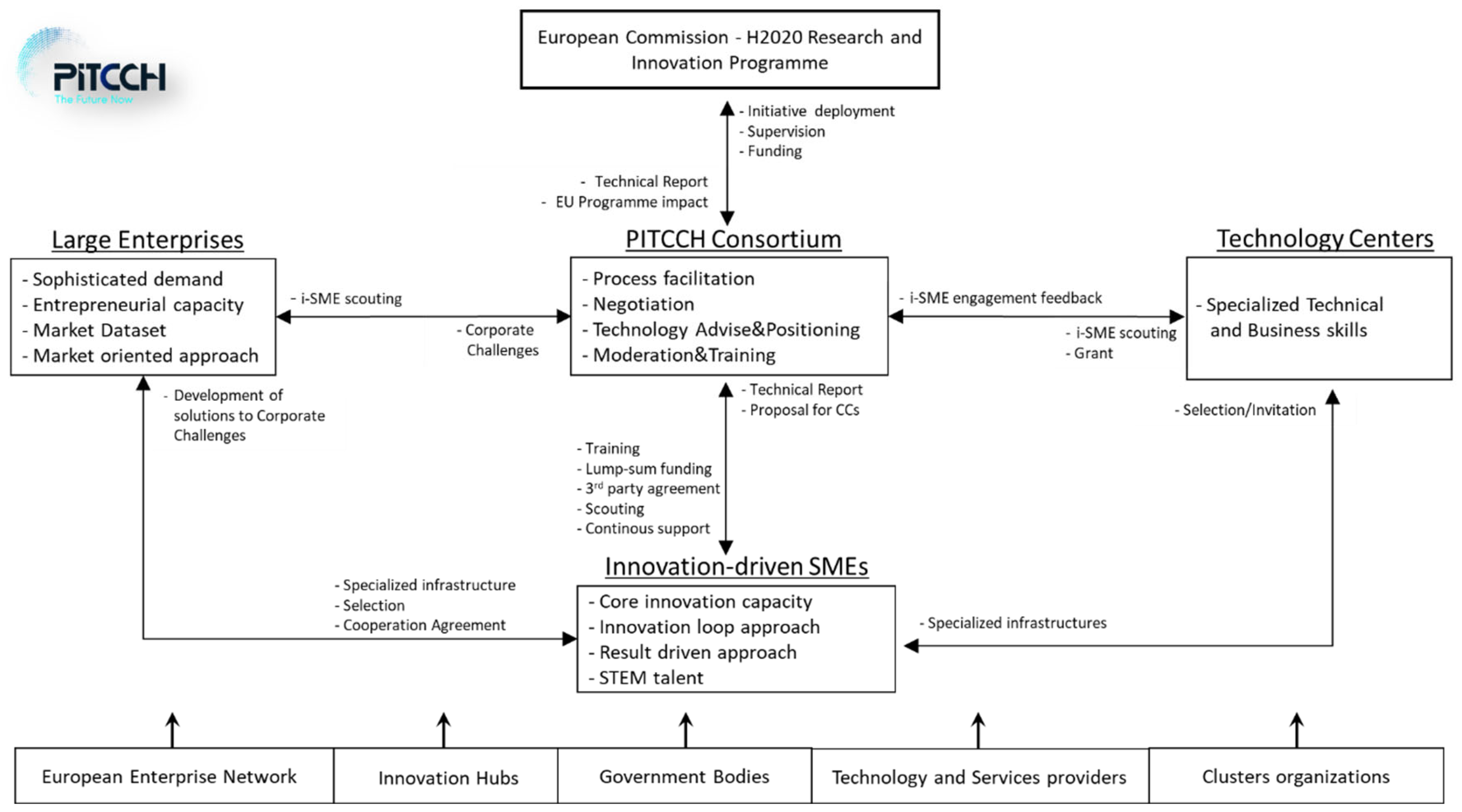

Table 1.
Meetings attended by the researcher.
| Participants | Type |
|---|---|
| EU Project Officer, PITCCH consortium, researcher | Ongoing meeting |
| LEs, PITCCH Consortium, i-SMEs, researcher | Corporate challenge final meeting |
| LEs, PITCCH Consortium, researcher | i-SMEs engagement |
| LEs, PITCCH Consortium, researcher | PITCCH operations wrap-up meeting |
| PITCCH consortium, researcher (every two weeks) | Review meeting |
| PITCCH consortium, researcher | Deliverable review |
| RINA-C (weekly internal meeting), researcher | Conversations with informants |
| i-SMEs, PITCCH Consortium, researcher | Plenary session |
| i-SMEs, PITCCH Consortium, researcher | One-to-one session |
| i-SMEs, PITCCH Consortium, researcher | PITCCH day |
Table 2.
Internal documents consulted by the researcher.
| Document Type | Source | Recipients |
|---|---|---|
| Deliverable | PITCCH Consortium | EU Project Officer |
| Grant Agreement | PITCCH Consortium | i-SMEs, Technology centers (TCs) |
| Customized collaboration agreement | LEs | i-SMEs, PITCCH Consortium |
| Project ppt presentation | LEs | PITCCH Consortium |
| Pitch day ppt presentations | i-SMEs | PITCCH Consortium, LEs |
| Survey to LEs | PITCCH Consortium | LEs |
| Survey to i-SMEs | PITCCH Consortium | i-SMEs |
| Technical Report | PITCCH Consortium | EU Project Officer |
| Third-party Agreement | PITCCH Consortium | i-SMEs, Technology centers (TCs) |
Table 3.
Different approaches to the PITCCH project.
| 1st Round | 2nd Round | 3rd round | |
|---|---|---|---|
| PITCCH participation Funding (*) | € 10.000 | € 10.000 | /// |
| Winning Funding | € 25000 (PITCCH Consortium) |
€ 5.000 + € 10.000 (PITCCH Consortium + Grant to TCs) | € 5.000 + € 5.000 (PITCCH Consortium + LEs contributions) |
| Funding type | Lump-sum | Lump-sum + Grant | Lump-sum |
(*) Due to Covid-19 pandemic restrictions, the funding to attend the PITCCH was redistributed over the project.
Table 4.
Impact in terms of firms in the PITCCH project.
| PITCCH program participants |
|
|---|---|
| i-SMEs (registered on the PITCCH digital platform) | 512 |
| i-SMEs (which submitted a proposal to CCs) | 92 |
| Technology Centers (TCs) | 23 |
| Large Enterprises (LEs) | 26 |
| Ecosystem support organizations | 28 |
| Government bodies (regional, national public authorities, agencies, associations) | 11 |
| Technology and Services providers (consultancy firms, accelerators, etc.) | 7 |
| Innovation hubs (scientific parks, tech platforms, etc.) | 4 |
| Cluster organizations | 4 |
| Enterprise European Network | 2 |
| Innovation Challenges (CCs) | 16 |
Disclaimer/Publisher’s Note: The statements, opinions and data contained in all publications are solely those of the individual author(s) and contributor(s) and not of MDPI and/or the editor(s). MDPI and/or the editor(s) disclaim responsibility for any injury to people or property resulting from any ideas, methods, instructions or products referred to in the content. |
© 2024 by the authors. Licensee MDPI, Basel, Switzerland. This article is an open access article distributed under the terms and conditions of the Creative Commons Attribution (CC BY) license (http://creativecommons.org/licenses/by/4.0/).
Copyright: This open access article is published under a Creative Commons CC BY 4.0 license, which permit the free download, distribution, and reuse, provided that the author and preprint are cited in any reuse.


