

Submitted:
14 February 2024
Posted:
16 February 2024
You are already at the latest version
Abstract
Silica fly ash, Certyd aggregate, and an alkaline solution were used to produce lightweight geo-polymer concretes. The compressive strength, water absorption, bulk density and SEM photos showing the structure of the obtained composite were carried out. Tests conducted on the specifi-cation of lightweight geopolymer concretes have revealed significant chemical interactions between the ash aggregate and the geopolymer mortar, particularly when the coarse aggregate surface has been pre-treated with an alkaline solution. Statistical analysis of the experimental data, which in-vestigated the influence of three key variables on compressive strength, water absorption, and bulk density of Lightweight Geopolymer Concrete (LBG), identified the following factors as having the most substantial impact: the quantity of alkali used, the curing temperature, and the concentration of alkali in the mixture. The optimal test series exhibited a commendable compressive strength of 20.14 megapascals (MPa), accompanied by a water absorption rate of 14.72% and a bulk density of 1486.6 kilograms per cubic meter (kg/m³). These findings underscore the importance of alkali con-tent, curing temperature, and alkali concentration in tailoring the properties of lightweight geo-polymer concrete to meet specific performance requirements.
Keywords:
lightweight geopolymer concrete
; aluminosilicate artificial aggregate
; fly ashes
; compressive strength of geopolymers
; water absorption
; bulk density
1. Introduction
A literature review shows that interest fly ash-based geopolymers concrete first emerged in the 1980s and continues worldwide.
The technology for producing lightweight geopolymer concrete based on fly ash and alumino-silicate artificial aggregate was developed with sustainable development in mind, aiming to reduce negative human impact on the environment. Sustainable development is based on proper resource management and caring for the natural environment. To achieve a sustainable state of development, developing specific consumer behaviors that would ensure a balance between human needs and environmental possibilities is essential. The starting point in achieving these goals is to minimize the negative impact of factors in the industrial and construction sectors on the environment.
In developing the research program, the elimination of Portland cement, previously the main component of concrete, was a priority. Studies have shown that producing one ton of cement releases 0.9 tons of CO2, accounting for 5% to 7% of global CO2 emissions [4,14,19]. Many studies have shown that geopolymer concrete is an alternative to cement-based concrete, and its synthesis is a process that consumes half the energy required for Portland cement production and releases 80% less carbon dioxide [3,11,13,23]. Geopolymer production can, therefore, significantly reduce the environmental burden by reducing gas emissions.
In addition to gas emissions, the use of some waste products from the energy, mining, and metallurgical sectors, including fly ash, is also essential. Fly ash is a highly dispersed material consisting of spherical particles represented by hollow aluminosilicate balls with a diameter of 0.1-100 μm, responsible for the binding properties in alkali-activated lightweight concrete [1,10,28,32,33]. It allows the elimination of the problem of waste stacking on specially prepared landfills, which has a significant impact on the environment.
Cement-free building materials were also obtained using ground perlite raw material using alkaline activation, outlined in a 2022 article by Acar M.C., Çelik A.I., Kayabaşı R., et al. [2]. Several tests were carried out, including compressive strength, which came out at the level of 6 - 16 MPa. Cementless paste and mortar were produced based on the alkaline activation of raw perlite and proved suitable as building materials. However, the durability of the mixes decreased with increasing water content in both paste and mortar. Most importantly, cement-free pastes and mortars can be produced environmentally friendly, requiring no high energy and no greenhouse gas emissions [2].
Equally important is replacing natural aggregates, because of unwillingness to extract raw materials from protected natural environments, with recycled aggregates [5,9,18,24] or artificial aggregates made from industrial waste or by-products [26,29]. There are two techniques for producing artificial aggregates [6]: sintering [17,30] and cold bonding [15,22]. The aggregate used in the study was obtained by sintering with simultaneous granulation, resulting in a lightweight, porous ceramic aggregate with high thermal insulation [12,25] and resistance to atmospheric and chemical factors as well as fungi, insects, and rodents. In addition, it is odorless, highly crush-resistant, and has relatively low water absorption.
Replacing Portland cement in concrete with fly ash and natural aggregates with alumino-silicate artificial aggregate required the research to demonstrate that the resulting product meets the requirements of norms and regulations and has similarities to traditional concrete. The fly ash was combined with artificial aggregate using an alkaline solution, resulting in a geopolymer, or artificial concrete. The production of geopolymers can thus lead to a significant reduction in environmental impact by reducing emissions, utilizing certain waste products from the energy, mining, and metallurgical sectors, as well as replacing natural raw materials with artificial fly ash aggregate, which can prove particularly useful in sustainable development-based construction [21].
In 2008, Obada Kayali conducted research using fly ash lightweight aggregates to produce high-strength concretes. Concrete produced using these aggregates was about 22% lighter and obtained strengths of 40-60 MPa. However, cement and natural aggregate were used in its production [16].
Anja Terzic, Lato Pezo, and others 2015 [31] analyzed the impact of using granulated aggregates based on fly ash obtained by various processing techniques on the behavior of lightweight concretes. The experimental plan assumed the use of four lightweight artificial aggregates. The performance of lightweight concrete was compared with traditional concrete by testing, inter alia, compressive strength. An increase in concrete strength was observed due to increased ash fineness, which also affected the granules' sintering time and the reduction of the sintering temperature. The 28- and 56-day-old lightweight concrete samples were characterized by properties meeting the requirements for traditional concretes and amounted to 56 - 58 MPa. Cement, water, natural aggregate, and artificial aggregate were used to produce concrete in these studies [31].
The compressive strength test is essential in the context of the conducted analyses. Many publications have been released in which researchers focused on preparing cement-free composites based on alkali-activated fly ash and testing their basic properties. Eric Asa, Monisha Shrestha, Edmund Baffoe-Twum, and Bright Awuku researched cement-free composites based on fly ash and described their findings in an article in 2020. They focused on developing sustainable building materials using 100% calcium and potassium hydroxide (KOH) alkaline solution and examining the engineering properties of the resulting fly ash-based geopolymer concrete. They conducted laboratory tests to determine the mechanical properties of geopolymer concrete, such as compressive and bending strength. In the study's first phase, carbon nanotubes (CNT - Carbon Nanotubes) were added to the mixture to determine their influence on the strength of geopolymer mortar. The results of the experiments showed that the mortar and concrete made entirely from fly ash require an alkaline solution to obtain strength properties comparable to those of Portland cement. However, it was found that increasing the amount of KOH generates a significant amount of heat, causing the concrete to set too quickly. The study also showed that adding CNT to the mixture makes the geopolymer concrete harder than traditional concrete without CNT [7].
In the same year, Zijian Su, Wei Hou, and others conducted research in which they synthesized a foamed geopolymer from fly ash to produce lightweight geopolymer concrete (GLWC - Geopolymeric Lightweight Concrete). The fly ash was activated with a sodium silicate solution, and aluminum powder was used as a foaming agent. The synthesized mortars were cured at 40°C for 28 days, resulting in a product with a bulk density ranging from 600 to 1600 kg/m3. The results showed that GLWC had higher mechanical strength than commercial cellular concrete and achieved 80–90% of its 28-day strength after seven days of curing. In addition, for densities ranging from 600 to 1200 kg/m3, the thermal conductivity decreased from 0.70 to 0.22 W/m·K, much better than its counterpart, ordinary Portland cement (OPC) concrete [27].
The article presented geopolymer concrete produced using various waste additives, different concentrations of NaOH solution, and a range of curing conditions involving varying times and temperatures. The resulting conclusion emphasized the significantly improved physico-mechanical properties displayed by geopolymer composites when compared to traditional Portland cement-based concretes. The research results allowed for obtaining a patent [8]. Based on available domestic and international literature sources, a decision was made to conduct research into lightweight concretes formulated by incorporating alkali-activated fly ash, supplemented by the inclusion of alumino-silicate artificial aggregates. It is worth noting that the literature review did not yield any information regarding waste additives in the form of such aggregates. Previous studies exclusively employed natural aggregates, with artificial aggregates taking the form of fibers, chips, sawdust, or foam. The literature analysis unequivocally confirmed that, as of the present date, no research has been undertaken in the field of integrating alumino-silicate artificial aggregates into geopolymer concretes. Based on research conducted by K. Kalinowska-Wichrowska et al. 2022 [31], who proposed a solution to improve the adhesion of geopolymer grout to coarse artificial aggregate with high porosity by impregnating the 4-8 mm fraction of the aggregate with an alkali solution, it was decided to use surface impregnation of coarse aggregate.
A hypothesis was put forward that it is possible to monolithically bind the alkali-activated precursor with artificial lightweight aggregate, which would improve the properties of lightweight concrete and eliminate the need for Portland cement. The aim was to develop a recipe for cement-free composites based on raw waste energy materials activated by alkalis and to investigate their properties.
2. Materials and Methods
2.1. Materials
2.1.1. Silica fly ash
Lightweight concretes based on alkali-activated waste materials were prepared using fly ash, consisting of spherical, vitrified fine grains from coal combustion by the power plant in Ostrołęka. Table 1 presents the basic properties of the fly ash used in the study. Figure 1 shows the silica fly ash used in the research.
2.1.2. Fly ash aggregate
Certyd is an lightweight waste aggerate made from fly ash produced by the LSA Aggregate Production Plant in fractions of 0-2 mm, 1-4 mm, and 4-9 mm. The coarse aggregate was surface-impregnated with an alkaline solution of appropriate NaOH concentration before being added to the geopolymer mixture to reduce porosity and increase adhesion to the geopolymer paste. After hardening, the impregnated aggregate was evaluated for water absorption and crushing strength. The results showed that the impregnated coarse aggregate had significantly reduced absorbability compared to the non-impregnated aggregate. The crushing index, which is a measure of crushing strength for high-class concrete aggregates, was 27.3% for the non-impregnated coarse aggregate. However, the impregnated coarse aggregate obtained a crushing index in the range of 14-15%, which falls within the acceptable limit for high-class concrete aggregates. Furthermore, the crushing index decreased with higher concentration of activator, indicating that impregnation with alkali solution improves the suitability of coarse ash-pore aggregate for high-class concrete applications. They also compared the compressive strength of composites containing impregnated aggregate with composites containing non-impregnated aggregate, noting that impregnation of the aggregate increases the compressive strength of concrete by almost twice [31]. Table 2 presents the properties of Certyd aggregate for each fraction, and Figure 2 shows the three fractions of the aggregate used in the research.
An ash-porous aggregate gaining popularity in Poland is Certyd, made of sintering fly ash from electrostatic precipitators and an ash-slag mixture from the wet discharge of combustion waste from the hard coal combustion process in fine coal boilers. The aggregate production technology is based on two processes: drying and firing with the sintering of ash granulates using a rotary kiln operating in a co-current media system. Air is supplied in a radial system through the armor. The sintering process is carried out without external fuel but only with combustion heat emitted in the production process by the remains of carbon contained in the ash, ranging from 5.5% to 19% of the coal weight.
In the laboratory of the Faculty of Civil Engineering and Environmental Sciences of Bialystok University of Technology, the aggregate was also tested for the percentage content of silica and aluminum, obtaining the results given in Table 3.
Artificial aggregates are characterized by low bulk density, very high porosity (20-50%), and as a result, high water absorption and low crushing strength depending on the faction. Regarding their oxide composition, most of them contain large amounts of silica and aluminum oxide, which can enter into a polymerization reaction with alkalis, such as sodium hydroxide.
2.1.3. Alkaline activator
The alkaline activators of various concentrations ranging from 2 to 6 mol/dm3 were used for the research. The sodium hydroxide solution with water glass, referred to as the alkaline solution or activator in the article, was prepared from solid sodium hydroxide flakes from OLTCHIM, which were dissolved in distilled water to obtain the sodium hydroxide solution by the exothermic reaction. To cool the solution to room temperature, it was left for 24 hours and then mixed with sodium silicate solution. The mass ratio of sodium silicate solution to sodium hydroxide solution (Na2SiO2/NaOH) was constant and equal to 2.5. The activator was the R-145 water glass solution from ANSER. Table 4 shows the mass ratio of solid NaOH to distilled water.
2.2. Methods
The research aimed to investigate the influence of NaOH concentration, amount of activator, and curing temperature on the properties of lightweight alkali-activated concrete made from waste materials. The following explanatory variables were adopted in the experiment:
X1 - the amount of activator: 100, 200, 300 [kg/m3];
X2 - concentration of NaOH solution: 2, 4, 6 [mol/dm3];
X3 - curing temperature: 25°C, 65°C, 105°C.
The geopolymer mixture based on waste materials in the form of alkali-activated silica fly ash and fly ash aggregate was prepared according to the experiment plan, assuming that in all series, the fly ash aggregate of fraction 4-9 mm will be surface impregnated with the alkali solution.

Table 5.
The range of variability of the factors under consideration.
| Lp. | X1 | X2 | X3 | Amount of alkaline solution [kg/m3] | Concentration of NaOH solution [mol/dm3] | Curing temperature [°C] |
|---|---|---|---|---|---|---|
| 1 | -1 | -1 | -1 | 100 | 2 | 25 |
| 2 | +1 | -1 | -1 | 100 | 2 | 105 |
| 3 | -1 | +1 | -1 | 300 | 2 | 25 |
| 4 | +1 | +1 | -1 | 300 | 2 | 105 |
| 5 | -1 | -1 | +1 | 100 | 6 | 25 |
| 6 | +1 | -1 | +1 | 100 | 6 | 105 |
| 7 | -1 | +1 | +1 | 300 | 6 | 25 |
| 8 | +1 | +1 | +1 | 300 | 6 | 105 |
| 9 | -1 | 0 | 0 | 200 | 4 | 25 |
| 10 | +1 | 0 | 0 | 200 | 4 | 105 |
| 11 | 0 | -1 | 0 | 100 | 4 | 65 |
| 12 | 0 | +1 | 0 | 300 | 4 | 65 |
| 13 | 0 | 0 | -1 | 200 | 2 | 65 |
| 14 | 0 | 0 | +1 | 200 | 6 | 65 |
Table 6 shows the selection of the geopolymer mixture composition. The alkaline activators of various concentrations ranging from 2 to 6 mol/dm3 were used for the research. In preliminary research, it has been established that in the case of alumino-silicate artificial aggregate, the molality of 2-6 is sufficient. Such a range was also dictated by the reduced consumption of alkali in lightweight geopolymer concretes, which translates into economic and environmental aspects.
Moreover, alkaline activation can occur at low temperatures, which means that making building materials using alkaline activation is more energy efficient than traditional cement making. According to the literature analysis, polycondensation reaction is not a spontaneous reaction and requires external energy supply. It initiates after raising the temperature above 35°C. It is also assumed that polycondensation reactions of geopolymers occur at room temperature, but temperatures of 60-105°C are considered optimal [20]. The analysis dictated the recipe selection, the results of preliminary research, and economic considerations.
Table 6.
Selection of the geopolymer mix composition.
| Lp. | Fly-ash | Activator | Activator used for impregantion | Aggragate (Certyd) | Curing temperature | Concentration of NaOH solution | ||
|---|---|---|---|---|---|---|---|---|
| 0 - 2 mm | 1 - 4 mm | 4 - 9 mm | ||||||
| kg | kg/m3 | kg/m3 | kg | kg | kg | [oC] | - | |
| 1 | 200 | 100 | 150,89 | 269,45 | 269,45 | 538,90 | 25 | 2 |
| 2 | 200 | 100 | 150,89 | 269,45 | 269,45 | 538,90 | 105 | 2 |
| 3 | 600 | 300 | 88,69 | 158,37 | 158,37 | 316,74 | 25 | 2 |
| 4 | 600 | 300 | 88,69 | 158,37 | 158,37 | 316,74 | 105 | 2 |
| 5 | 200 | 100 | 150,89 | 269,45 | 269,45 | 538,90 | 25 | 6 |
| 6 | 200 | 100 | 150,89 | 269,45 | 269,45 | 538,90 | 105 | 6 |
| 7 | 600 | 300 | 88,69 | 158,37 | 158,37 | 316,74 | 25 | 6 |
| 8 | 600 | 300 | 88,69 | 158,37 | 158,37 | 316,74 | 105 | 6 |
| 9 | 400 | 200 | 124,64 | 222,58 | 222,58 | 445,16 | 25 | 4 |
| 10 | 400 | 200 | 124,64 | 222,58 | 222,58 | 445,16 | 105 | 4 |
| 11 | 200 | 100 | 150,89 | 269,45 | 269,45 | 538,90 | 65 | 4 |
| 12 | 600 | 300 | 88,69 | 158,37 | 158,37 | 316,74 | 65 | 4 |
| 13 | 400 | 200 | 124,64 | 222,58 | 222,58 | 445,16 | 65 | 2 |
| 14 | 400 | 200 | 124,64 | 222,58 | 222,58 | 445,16 | 65 | 6 |
Before the impregnation of the aggregate, tests were carried out on the absorption of the given aggregate and the crushing strength of the non-impregnated and surface-impregnated aggregate. Due to minor differences in the mass increase of the coarse aggregate, it was decided to impregnate the surface of the aggregate for 10 s at a later stage of the research. In addition, it was noticed that this increase was about 30% of the weight of the coarse aggregate; therefore, in the following research stage, the coarse aggregate was surface impregnated in an alkaline solution corresponding to 30% of the weight of the coarse aggregate. In the case of the crushing strength test, the non-impregnated aggregate of 4-8 mm fraction was tested in the first stage, obtaining a crushing strength of 25.13%. In the next stage, the impregnated aggregate was tested with an alkaline solution, obtaining a crushing index in the range of 14.39–14.78% (depending on the concentration of NaOH in the solution). Therefore, the results showed that the ash aggregate impregnated with an alkaline solution is suitable for use in high-grade concrete.
The geopolymer concrete mix preparation consisted of measuring the appropriate amount of each component. First, the aggregate of the 4–9 mm fraction was surface impregnated with an alkaline solution of appropriate concentration for 10 s, then sieved, getting rid of the excess solution, and weighed. Next, cement and ash aggregate of 0–2 mm and 1–4 mm fractions were poured into the mixer drum. All the ingredients were mixed for 60 seconds, the mixer was stopped, and then they were mixed by hand. The ingredients were mixed again for 60 seconds; after stopping, the drum was filled with an impregnated aggregate of the 4-9 mm fraction and an alkaline solution of the appropriate concentration. The entire content was mixed for 60 seconds. The mixer was stopped for the fourth time; the ingredients were mixed manually in order to separate the ingredients from the drum walls, and the device was turned on again for 60 seconds. The last step was repeated twice. The entire mixing process took 5 minutes. The ready mix was partly placed in steel molds with dimensions of 10 x 10 x 10 cm corresponding to the PN-EN 12390-1 standard, previously covered with grease in order to protect them against adhering to the mix. The compaction of the molds ensured vibro-vibropressing and vibration for 30 seconds. Then vibro-pressing for another 30 seconds. Below in Figure 4, the stages of creating cementless composites are presented.
Figure 3.
Stages of creating cementless composites.
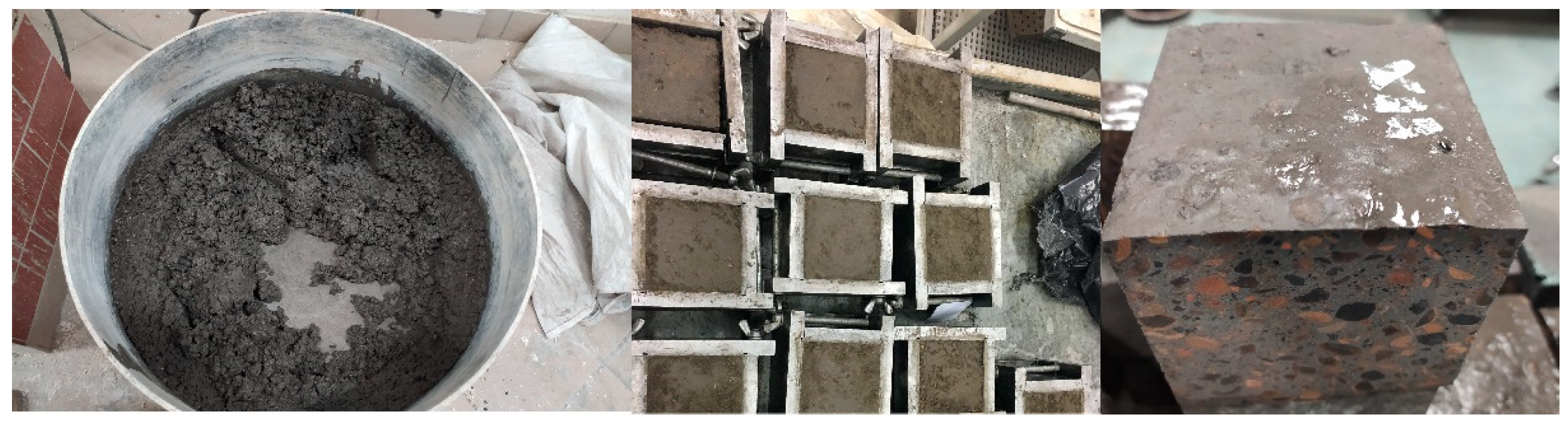
The samples were left air-dry for 24 hours and then placed in a dryer heated to the appropriate temperature for another 24 hours. After this time, the samples were demoulded and placed above the water for 28 days from the molding date. After this period, they were tested for compressive strength, water absorption, bulk density, and capillary rise. In the Figure 5, the fracture of the geopolymer composite after the compressive strength test was presented.
3. Results
The influence of coarse ash aggregate surface impregnation on the properties of lightweight concrete based on alkali-activated waste materials was investigated. Figure 3 presents the results of the compressive strength of lightweight geopolymer concrete based on surface-impregnated artificial aggregate and fly ash. The analysis of the test results, aimed at examining the effect of the activator concentration on the properties of geopolymer concrete, allowed to conclude that the surface impregnation of coarse aggregate with the activator causes an almost two-fold increase in compressive strength. These premises meant that the main tests were carried out using coarse ash porous aggregate impregnated on the surface. Surface impregnation of the lightweight aggregate allowed to obtain a mixture of appropriate workability and consistency, thus improving the properties of ready-made lightweight geopolymer composites based on waste energy raw materials activated with alkali.
Figure 4.
The results of the compressive strength of lightweight geopolymer concrete based on surface-impregnated Certyd and fly ash.
Figure 4.
The results of the compressive strength of lightweight geopolymer concrete based on surface-impregnated Certyd and fly ash.
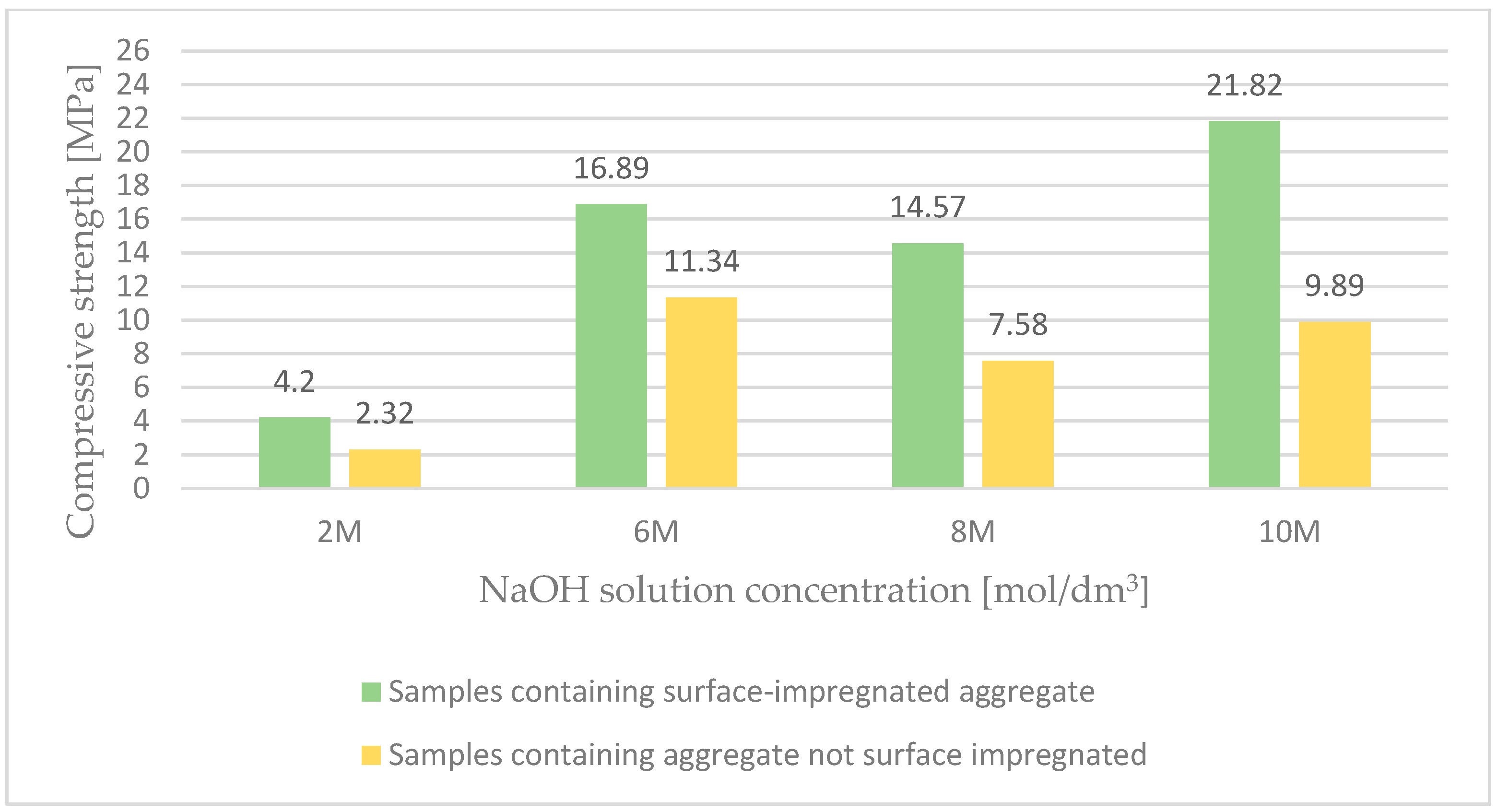
The initial analysis focused on the influence of the concentration of NaOH solution, amount of activator, and curing temperature on the compressive strength, water absorption and bulk density of geopolymer composites. One-dimensional significance tests were conducted to obtain average boundary values, which allowed determining the explanatory influence of the indicated variables on strength, water absorption and bulk density.
The results of compressive strength tests of geopolymer lightweight concrete were subjected to preliminary analysis, and basic statistical measures were determined and presented in Table 7. The differences between strength values from individual stages of preliminary testing were minor; therefore, in the analysis conducted, they were deemed insignificant.
Based on the results presented in Table 7, it can be concluded that the highest compressive strength was obtained with an NaOH solution of 300 kg/m3, a concentration of 6 mol/dm3, and a curing temperature of 105°C. The average compressive strength was 26.92 MPa, with a relatively low variance of 0.312. The variability of the results with these parameters was very low, at approximately 2.07%. The second-best result was obtained with an NaOH solution of 200 kg/m3, a concentration of 6 mol/dm3, and a curing temperature of 65°C. In this case, the average compressive strength was 22.86 MPa, with a variance of 0.508. The variability of the results with these parameters was similarly low, at approximately 3.12%. The samples with the lowest compressive strength had an NaOH solution of 100 kg/m3, a concentration of 2 mol/dm3, and a curing temperature of 25°C. The average compressive strength was only 0.33 MPa, with a variance of 0.0083. The variability of the results with these parameters was very high, at approximately 27.52%. The coefficient of variation Vi for each sample, which characterizes the relative variation of the observed variable Y, ranged from 2.07% to 27.52%.
After calculating the regression coefficients, the following equation was obtained to describe the relationship between compressive strength and the indicated factors:
The interpretation of the coefficients of the obtained model leads to the conclusion that an increase in the amount of activator by 1 kg/m3 results in an increase in compressive strength of alkali-activated lightweight concrete by 0.04 MPa, while an increase in activator concentration by 1 mol/dm3 leads to an increase in compressive strength by 1.95 MPa. Additionally, an increase in the curing temperature by 1°C also results in an increase in compressive strength of this geopolymer by approximately 0.14 MPa.
The results in Table 7 indicate that the highest compressive strengths of lightweight concrete made from alkaline-activated waste materials were obtained in series 8. The mean compressive strength was 26.92, and the standard deviation was 0.5586. These results are based on a small random sample of n=5. The results of random samples are the basis for statistical inference, which may include estimating unknown parameter levels (e.g., expected values) in the general population. Of course, their statistical estimation is done under uncertainty, with a declared probability. Point estimation (which is highly dangerous) or interval estimation can be made, which covers the estimated parameter at the declared level of confidence and is much safer. In this study, a Neyman confidence interval was determined for the expected value of the variable being tested, based on the results obtained in series 8, assuming that the estimator of the estimated parameter is the arithmetic mean obtained in this random sample and with a confidence level of α=0.05:
The determined interval is one of those that cover the expected value of the variable being tested at the declared confidence level. Therefore, the result obtained indicates that with 95% confidence, the mean compressive strength of lightweight concrete made from alkaline-activated waste materials (in the general population) is between 26.14 MPa and 27.70 MPa. An essential part of the conducted analysis is to indicate the absolute and relative precision of estimation, which is necessary for this type of research. The absolute precision of estimation allows us to assess how many units we can be wrong by when determining the confidence interval endpoints.
[MPa]
The relative precision of estimation, expressed in percentages, allows us to decide whether the inference can be considered statistically safe.
The relative precision of estimation is lower than 5%, meaning the inference can be considered entirely safe. Importantly, achieving such a favorable result with such a small random sample is particularly satisfying. Increasing the number of units in random samples leads to a significant increase in estimation precision due to the decrease in the range of random endpoints of confidence intervals.
The results of water absorption tests of geopolymer lightweight concrete were subjected to preliminary analysis, and basic statistical measures were determined and presented in Table 8.
Based on the results in Table 8, it can be concluded that the lowest water absorption was achieved with an activator amount of 300 kg/m3, a concentration of 6 mol/dm3 and a heating temperature of 105°C. The average water absorption of the tested samples was 14.19%, with a very low variance of 0.07%2. The diversity of results with these parameters was very low, approximately 1.88%. The second favorable result was obtained with an activator amount of 200 kg/m3, a concentration of 4 mol/dm3 and a heating temperature of 105°C. The average water absorption in this case was 14.37%, with a variance of 0.01%2. The diversity of results with these parameters was very low, approximately 0.72%. The highest absorbability was demonstrated by samples with an activator amount of 100 kg/m3, a concentration of 6 mol/dm3 and a heating temperature of 25°C. The average, where the water absorption is as much as 21.65%, with a variance of 0.27%2. The variation in results with these parameters was around 2.41%, which may indicate the reliability of the results obtained in individual samples. The values of the coefficient of variation Vi for each sample, characterizing the measure of the relative variability of the observed value of the Y variable, range from 0.96% to 14.25%.
Model coefficients were calculated using the single least squares method. After calculating the values of the regression coefficients, the following form of the equation describing the dependence of compressive strength on the indicated factors was obtained:
Interpreting the coefficients of the obtained model, it can be concluded that an increase in the amount of activator by 1 kg/m3 causes a decrease in the water absorption of lightweight concretes based on alkaline-activated waste raw materials by approximately 0.01%, while the concentration of the activator increases by 1 mol/dm3 causes an increase in the water absorption of concrete by approx. 0.62%, while an increase in the maturing temperature by 1°C causes a decrease in the water absorption of this geopolymer by approx. 0.05%.
The results in Table 8 clearly indicate the lowest absorption rates for lightweight concrete based on alkaline-activated waste raw materials in series (8), where the average water absorption is 14.19% and the standard deviation is 0.27%. The results of random sample observations, which constitute the basis for statistical inference, allow, among other things, the estimation of an unknown level of a parameter in the general population. At the declared level of probability, an interval estimate of the expected water absorption of geopolymers was made. The results obtained in series (8) were used as the basis for estimation, assuming that the estimator of the estimated parameter is the arithmetic mean obtained in this random sample, and the confidence level is α = 0.05:
The designated interval is one of those that covers the expected value of the tested variable at the declared confidence level. The obtained result means that, with 95% certainty, the average water absorption of lightweight concretes based on alkaline-activated waste raw materials (in the general population) ranges from 13.82% to 14.56%. The absolute precision of the estimate allows us to assess how many units we can be wrong when determining the ends of the confidence interval.
[%]
The relative precision of the estimation, expressed as a percentage, allows you to assess whether the inference can be considered statistically safe.
The level of relative estimation precision is lower than 5%, which means that inference can be considered completely safe.
The results of bulk density tests of geopolymer lightweight concrete were subjected to preliminary analysis, and basic statistical measures were determined and presented in Table 9.
Based on the results in Table 9, it can be concluded that the lowest density was obtained with an activator amount of 100 kg/m3, a concentration of 6 mol/dm3 and a heating temperature of 25°C. The average density of the tested samples was 1355.76 g/dm3, with a variance of 241.5680 g/dm2. The diversity of results with these parameters was very low approx. 1.15%. The second relatively favorable result was obtained with an activator amount of 100 kg/m3, a concentration of 6 mol/dm3 and a heating temperature of 105°C. Medium density in this case is 1387.60 g/dm3, with a variance of 94.1400 (g/dm3)2. The variation in results with these parameters was very low, approximately 0.7%. The highest density was obtained in samples with an activator amount of 300 kg/m3, a concentration of 2 mol/dm3 and a heating temperature of 105°C. The average bulk density was obtained as high as 1756.68 g/dm3, with a variance of 334.8920 (g/dm3)2. The variation in results with these parameters was not high and was approximately 1.0417%, which may indicate the reliability of the results obtained in individual samples. The values of the coefficient of variation Vi for each sample, characterizing the measure of the relative variability of the observed value of the variable Y, are ranges from 0.7% to 5.4%.
The regression function determined by a single least squares method, describing the dependence of bulk density on the amount of activator, its concentration and annealing temperature, takes the form:
The interpretation of the coefficients of the obtained model leads to the conclusion that an increase in the amount of activator by 1 kg/m3 causes an increase in the bulk density of lightweight concretes based on alkaline-activated waste raw materials by approximately 0.078 g/dm3, while an increase in the activator concentration by 1 mol/dm3 causes a decrease in density concrete by approx. 23.71 g/dm3. However, an increase in the ripening temperature by every 1°C results in an increase in the density of this geopolymer by approximately 2.245 g/dm3.
The results of random sample observations, which constitute the basis for statistical inference, allow, among other things, the estimation of an unknown level of a parameter in the general population. At the declared level of probability, an interval estimate of the expected value of the bulk density of geopolymers was made. The results obtained in series (5) were used as the basis for estimation, assuming that the estimator of the estimated parameter is the arithmetic mean obtained in this random sample, and the confidence level is α = 0.05:
The designated interval is one of those that covers the expected value of the tested variable at the declared confidence level. The obtained result means that, with 95% certainty, the average density of lightweight concretes based on alkaline-activated waste raw materials (in the general population) ranges from 1334.19 g/dm3 to 1377.33 g/dm3.
The absolute precision of estimation indicates that when determining the ends of the confidence interval, we may be wrong by [g/dm3]. In turn, the relative precision of estimation equal to allows us to assess whether such inferences can be considered statistically safe.
Lightweight concrete samples based on the fly ash in an amount of 600 kg/m3, alumino-silicate artificial aggregate activated by a 6 mol/dm3 alkali solution, and ripened at a temperature of 105°C were also examined under a scanning electron microscope and showed a fine-grained structure with a small amount of micro and macro cracks, as shown in Figure 6 . The Interfacial Tranzition Zone between the GP and the aggregate was determined to be very good. The majority of the fly ash has reacted. Figure 7 shows samples produced with sodium hydroxide instead of an alkaline solution.
Figure 5.
Samples of lightweight concrete based on fly ash, activated alkaline alumino-silicate artificial aggregate, of approximately mag 600 x with the contact zone between the lightweight aggregate and the geopolymer paste marked in red.
Figure 5.
Samples of lightweight concrete based on fly ash, activated alkaline alumino-silicate artificial aggregate, of approximately mag 600 x with the contact zone between the lightweight aggregate and the geopolymer paste marked in red.
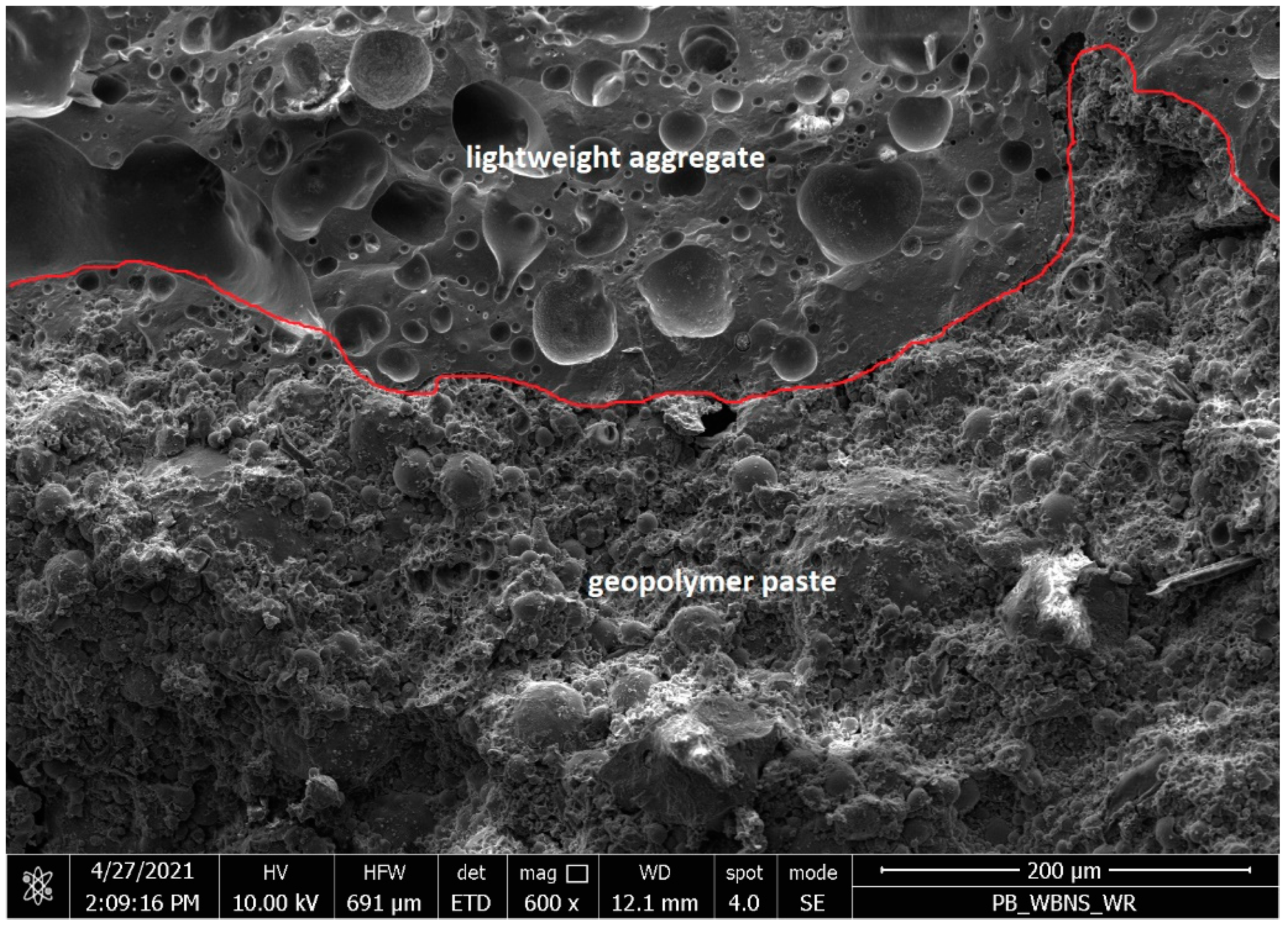
The best microstructure was obtained by lightweight geopolymer concretes containing 400-600 kg/m3 of the fly ash, corresponding to 200-300 kg/m3 of an alkali solution with a concentration of 4mol/dm3 and a maturation temperature of 105°C. Then we obtain a monolithic combination of polycondensation products with coarse aggregate, with a small number of pores, where a significant amount of fly ash particles undergo polymerization, creating a fine-grained structure of silica and aluminum oxide copolymers and stabilizing metal cations, mainly sodium and calcium, and bound water.
Table 10.
Results of semi-quantitative compositional analyses of sample (8).
| Area | 1 | 2 | 3 | 4 | 5 | 6 | 7 | 8 | 9 | 10 |
|---|---|---|---|---|---|---|---|---|---|---|
| Distance from the edge of the aggregate [μm] | 0-80 | 80-160 | 160-240 | 240-320 | 320-400 | 400-480 | 480-560 | 560-640 | 640-720 | 720-800 |
| Concentration [% of mass] | ||||||||||
| C | 60,86 | 58,65 | 57,16 | 57,96 | 61,43 | 67,01 | 64,76 | 64,20 | 67,42 | 64,36 |
| Si | 19,99 | 21,99 | 23,08 | 22,60 | 20,82 | 17,96 | 18,56 | 18,97 | 16,82 | 18,68 |
| Al | 7,51 | 8,63 | 9,13 | 9,07 | 8,30 | 7,24 | 7,74 | 7,64 | 7,13 | 7,79 |
| Na | 5,34 | 5,15 | 4,87 | 4,79 | 4,21 | 3,80 | 3,61 | 3,84 | 3,63 | 4,38 |
| Fe | 3,92 | 3,16 | 3,28 | 3,43 | 3,03 | 2,25 | 3,02 | 3,22 | 2,94 | 3,13 |
| Ca | 2,38 | 2,41 | 2,48 | 2,15 | 2,20 | 1,74 | 2,31 | 2,13 | 2,06 | 1,66 |
The analysis of the results of semi-quantitative tests of the composition of the areas of the aggregate-geopolymer grout contact zone in sample of series (8), which was made by the Institute of Construction Technology, showed:
- higher overall porosity of the tested sample based on the higher concentration of carbon that comes from the resin filling the air pores;
- locally, in the contact zone (0 - 80 μm from the edge of the aggregate) of the tested sample, the pore content was higher;
- increased concentration of sodium ions in the area of the contact zone (0 - 80 μm from the edge of the aggregate) of the tested sample compared to greater distances from the aggregate boundary;
- in the tested sample, the maximum concentration of silicon and aluminum ions in zone 3 (160 – 240 μm from the edge of the aggregate).
4. Conclusions
Based on the conducted research results and statistical analysis the following conclusions were presented:
- Tests on the specification of lightweight geopolymer concretes have shown that there are chemical connections between the ash aggregate / after prior impregnation of the coarse aggregate surface with an alkaline solution / and the geopolymer mortar.
- All three factors significantly impact the compressive strength of lightweight geopolymer concrete made from alkaline-activated waste materials.
- In the case of the crushing strength test, it was shown that the aggregate impregnated with an alkaline solution obtains a crushing index in the range of 14.39-14.78% (depending on the concentration of NaOH in the solution), which is twice as good as the crushing strength of ash porous aggregate non-impregnated surface of 25.13%. Furthermore, using surface-impregnated aggregate also resulted in a two-fold increase in the strength of geopolymer concretes compared to concretes containing non-impregnated aggregate.
- The highest average compressive strength was obtained for series 8, characterized by a concentration of NaOH solution of 6 mol/dm3 and a curing temperature of 105°C, with an activator dosage of 300 kg/dm3.
- The lowest values were observed for series 1. The observation suggests that a low concentration of NaOH solution (which is an important factor) and insufficiently high curing temperature, as well as the amount of activator, negatively affect the compressive strength of the geopolymer concrete.
- The results show that samples ripened at 25°C achieved significantly lower results than the other temperatures. Additionally, they are difficult to demold, which may affect their quality.
- Statistical inference methods, based on the results of a random sample, allowed for interval estimation of the parameter, which is the mean compressive strength. The results from the most favorable series of tests determined that with 95% confidence, the mean compressive strength of lightweight geopolymer concrete lies in the range of 26.14 MPa to 27.70 MPa. Therefore, the inference can be considered completely safe, as confirmed by the relative precision of estimation, which is 2.9% (lower than 5%).
- The best microstructure was obtained by lightweight geopolymer concretes containing 400-600 kg/m3 of fly ash, corresponding to 200-300 kg/m3 of an alkali solution with a concentration of 4mol/dm3 and a maturation temperature of 105°C. Then we obtain a monolithic combination of polycondensation products with coarse aggregate, with a small number of pores, where a significant amount of fly ash particles undergo polymerization, creating a fine-grained structure of silica and aluminum oxide copolymers and stabilizing metal cations, mainly sodium and calcium, and bound water.
- The obtained results and the literature analysis allowed concluding that a geopolymer composite based on raw waste materials, activated with alkali, with great compressive strength of 26 MPa, was obtained. Furthermore, higher strengths were obtained by researchers in the case of partial use of natural aggregates and cement.
5. Patents
Bołtryk Michał, Nalewajko Marta, Nietupski Adam, The method of producing lightweight geopolymer concrete on aluminosilicate artificial aggregate (Invention), Application confirmed, Application number: P.442271, Date of application: 14-09-2022.
Author Contributions
Conceptualization, N.M. and M.B.; methodology, N.M. and M.B.; software, N.M.; validation, N.M.; formal analysis, N.M. and M.B.; investigation, M.N.; resources, N.M. and M.B.; data curation, N.M.; writing—original draft preparation, N.M. and M.B.; writing—review and editing, N.M. and M.B.; visualization, N.M.; supervision, M.B.; project administration, N.M. and M.B. All authors have read and agreed to the published version of the manuscript.
Funding
The study was performed under a research project funded by the Polish Ministry of Education and Science.
Institutional Review Board Statement
Not applicable.
Informed Consent Statement
Not applicable.
Data Availability Statement
Not applicable.
Acknowledgments
Not applicable.
Conflicts of Interest
The authors declare no conflict of interest.
References
- Abadel, A.A; Alghamdi, H.; Alharbi, Y.R.; Alamri, M.; Khawaji, M.; Abdulaziz, M.A.M; Nehdi, M.L. Investigation of Alkali-Activated Slag-Based Composite Incorporating Dehydrated Cement Powder and Red Mud. Materials 2023, 16, 1551. [Google Scholar] [CrossRef]
- Acar, M.C.; Çelik, A.I.; Kayabaşı, R.; Şener, A.; Özdöner, N.; özkılıç, Y.O. Production of perlite-based-aerated geopolymer using hydrogen peroxide as eco-friendly material for energy-efficient buildings. Journal of Materials Research and Technology, Volume 24, May–June 2023, Pages 81-99.
- Agnihotri, A.; Jethoo, A.S.; Ramana, P. Mechanical and Durability Analysis of Recycled Materials. Key Eng. Mater. 2021, 882, 228–236. [Google Scholar] [CrossRef]
- Ahmed, M.; Colajanni, P.; Pagnotta, S. A Review of Current Research on the Use of Geopolymer Recycled Aggregate Concrete for Structural Members. Materials 2022, 15, 8911. [Google Scholar] [CrossRef]
- Akhtar, A.; Sarmah, A.K. Construction and demolition waste generation and properties of recycled aggregate concrete: A global perspective. J. Clean. Prod. 2018, 186, 262–281. [Google Scholar]
- Almadani, M.; Razak, R.A.; Abdullah, M.M.A.B.; Mohamed, R. Geopolymer-Based Artificial Aggregates: A Review on Methods of Producing, Properties, and Improving Techniques. Materials 2022, 15, 5516. [Google Scholar] [CrossRef] [PubMed]
- Asa, E.; Shrestha, M.; Baffoe-Twum, E.; Awuku, B. Development of sustainable construction material from fly ash class C, Journal of Engineering, Design and Technology, Vol. 18 No. 6, pp. 1615–1640.
- Bołtryk Michał, Nalewajko Marta, Nietupski Adam, The method of producing light-weight geopolymer concrete on aluminosilicate artificial aggregate (Invention), Ap-plication confirmed, Application number: P.442271, Date of application: 14-09-2022.
- Dimitriou, G.; Savva, P.; Petrou, M.F. Enhancing mechanical and durability properties of recycled aggregate concrete. Constr. Build. Mater. 2018, 158, 228–235. [Google Scholar] [CrossRef]
- Fernández-Jiménez, A.; Palomo, A. Composition and microstructure of alkali activated fly ash binder: Effect of the activator. Cem. Concr. Res. 2005, 35, 1984–1992. [Google Scholar] [CrossRef]
- Ge, W.; Chen, J.; Min, F.; Song, S.; Liu, H. Potential Evaluation for Preparing Geopolymers from Quartz by Low-Alkali Activation. Materials 2023, 16, 1552. [Google Scholar] [CrossRef]
- Hao, D.L.C.; Razak, R.A.; Kheimi, M.; Yahya, Z.; Abdullah, M.M.A.B.; Nergis, D.D.B.; Fansuri, H.; Ediati, R.; Mohamed, R.; Abdullah, A. Artificial Lightweight Aggregates Made from Pozzolanic Material: A Review on the Method, Physical and Mechanical. Materials 2022, 15, 3929. [Google Scholar] [CrossRef] [PubMed]
- Hoyos-Montilla, A.A.; Puertas, F.; Tobon, J. Study of the reaction stages of alkali-activated cementitious materials using microcalorimetry. Adv. Cem. Res. 2021, 33, 1–13. [Google Scholar] [CrossRef]
- Imbabi, M.S.; Carrigan, C.; McKenna, S. Trends and developments in green cement and concrete technology. Int. J. Sustain. Built Environ. 2012, 1, 194–216. [Google Scholar] [CrossRef]
- Jeon, D.; Yum, W.S.; Song, H.; Yoon, S.; Bae, Y.; Oh, J.E. Use of Coal Bottom Ash and CaO-CaCl2-Activated GGBFS Binder in the Manufacturing of Artificial Fine Aggregates through Cold-Bonded Pelletization. Materials 2020, 13, 5598. [Google Scholar] [CrossRef] [PubMed]
- Kayali, O. Fly ash lightweight aggregates in high performance concrete. Construction and Building Materials, Volume 22, Issue 12, pp. 2393–2399.
- Kwek, S.Y.; Awang, H.; Cheah, C.B.; Mohamad, H. Development of sintered aggregate derived from POFA and silt for lightweight concrete. J. Build. Eng. 2022, 49, 104039. [Google Scholar]
- Liu, C.; Xu, X.; Lv, Z.; Xing, L. Self-healing of Concrete Cracks by Immobilizing Microorganisms in Recycled Aggregate. J. Adv. Concr. Technol. 2020, 18, 168–178. [Google Scholar] [CrossRef]
- Malhotra, V.M.; Mehta, P.K. High-Performance, High-Volume Fly Ash Concrete: Materials, Mixture Proportioning, Properties, Construction Practice, and Case Histories; Supplementary Cementing Materials for Sustainable Development: Ottawa, ON, Canada, 2002. [Google Scholar]
- Mikuła, J. Ecological solutions in production. Modern environmentally friendly composite materials. Politechnika Krakowska, Kraków 2014, ISBN 978-83-7242-780-9.
- Nalewajko, M. Use of waste materials in alkaline-activated lightweight concrete. Economics and Environment. No. 3(74) 2020, pages: 82-93.
- Narattha, C.; Chaipanich, A. Phase characterizations, physical properties and strength of environment-friendly cold-bonded fly ash lightweight aggregates. J. Clean. Prod. 2018, 171, 1094–1100. [Google Scholar]
- Nawaz, M.; Heitor, A.; Sivakumar, M. Geopolymers in construction—Recent developments. Constr. Build. Mater. 2020, 260, 120472. [Google Scholar]
- Pawluczuk, E.; Kalinowska-Wichrowska, K.; Bołtryk, M.; Jiménez, J.R.; Fernández, J.M. The Influence of Heat and Mechanical Treatment of Concrete Rubble on the Properties of Recycled Aggregate Concrete. Materials 2019, 12, 367. [Google Scholar] [CrossRef]
- Pramusanto, P.; Nurrochman, A.; Mamby, H.E.; Nugraha, P. High strength lightweight concrete with expandable perlite as the aggregate. IOP Conf. Ser. Mater. Sci. Eng. 2020, 830, 42040. [Google Scholar] [CrossRef]
- Qian, D.; Yu, R.; Shui, Z.; Sun, Y.; Jiang, C.; Zhou, F.; Ding, M.; Tong, X.; He, Y. A novel development of green ultra-high performance concrete (UHPC) based on appropriate application of recycled cementitious material. J. Clean. Prod. 2020, 261, 121231. [Google Scholar]
- Su, Z.; Hou, W.; Sun, Z.; Lv, W. Study of In Situ Foamed Fly Ash Geopolymer. Materials 2020, 13, 4059. [Google Scholar] [CrossRef]
- Sviridov, A.S.; Nor, P.E. Technology of extraction of aluminosilicate microspheres from ash and slag waste on the example of ash dump omsk CHPP-2. Actual Issues Energy 2020, 1, 121–125. [Google Scholar] [CrossRef]
- Tajra, F.; Abd Elrahman, M.; Lehmann, C.; Stephan, D. Properties of lightweight concrete made with core-shell structured lightweight aggregate. Constr. Build. Mater. 2019, 205, 39–51. [Google Scholar] [CrossRef]
- Terzić, A.; Pezo, L.; Mitić, V.; Radojević, Z. Artificial fly ash based aggregates properties influence on lightweight concrete performances. Ceram. Int. 2015, 41, 2714–2726. [Google Scholar] [CrossRef]
- Wichrowska – Kalinowska, K.; Pawluczuk, E.; Bołtryk, M.; Nietupski, A. Geopolymer Concrete with Lightweight Artificial Aggregates. Materials 2022, 15(9), 3012. [Google Scholar] [CrossRef]
- Yatsenko, E.A.; Goltsman, B.M.; Trofimov, S.V.; Novikov, Y.V.; Smoliy, V.A.; Ryabova, A.V.; Klimova, L.V. Influence of Various Coal Energy Wastes and Foaming Agents on Foamed Geopolymer Materials’ Synthesis. Materials 2023, 16, 264. [Google Scholar]
- Zierold, K.M.; Odoh, C. A Review on fly ash from coal-fired power plants: chemical composition, regulations, and health evidence. Rev. Environ. Health 2020, 35, 401–418. [Google Scholar] [PubMed]
Figure 1.
Silica fly ash used to futher tests.
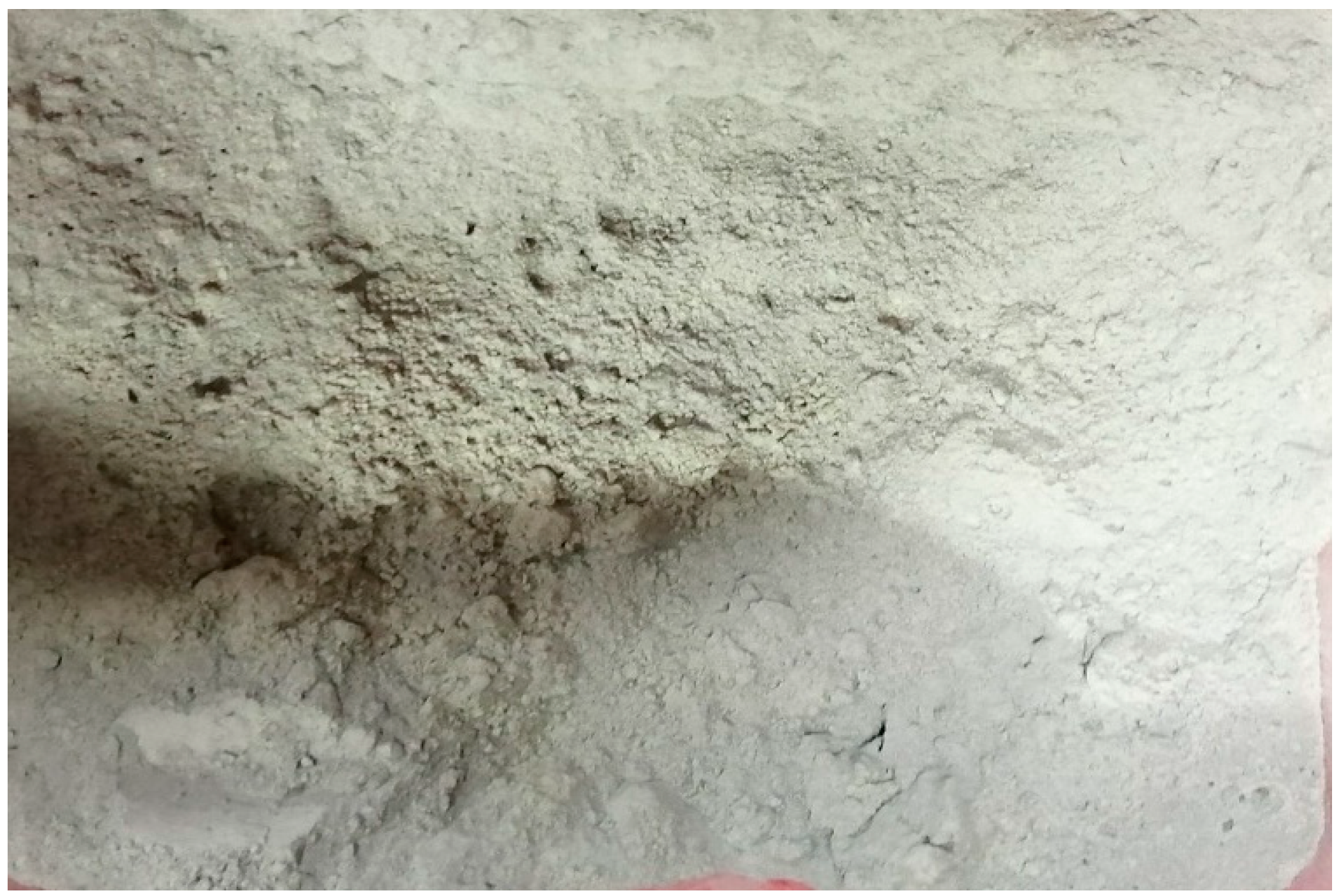
Figure 2.
Lightweight ash aggregate of Certyd type, with particle sizes of 0-2 mm, 1-4 mm, and 4-9 mm.
Figure 2.
Lightweight ash aggregate of Certyd type, with particle sizes of 0-2 mm, 1-4 mm, and 4-9 mm.
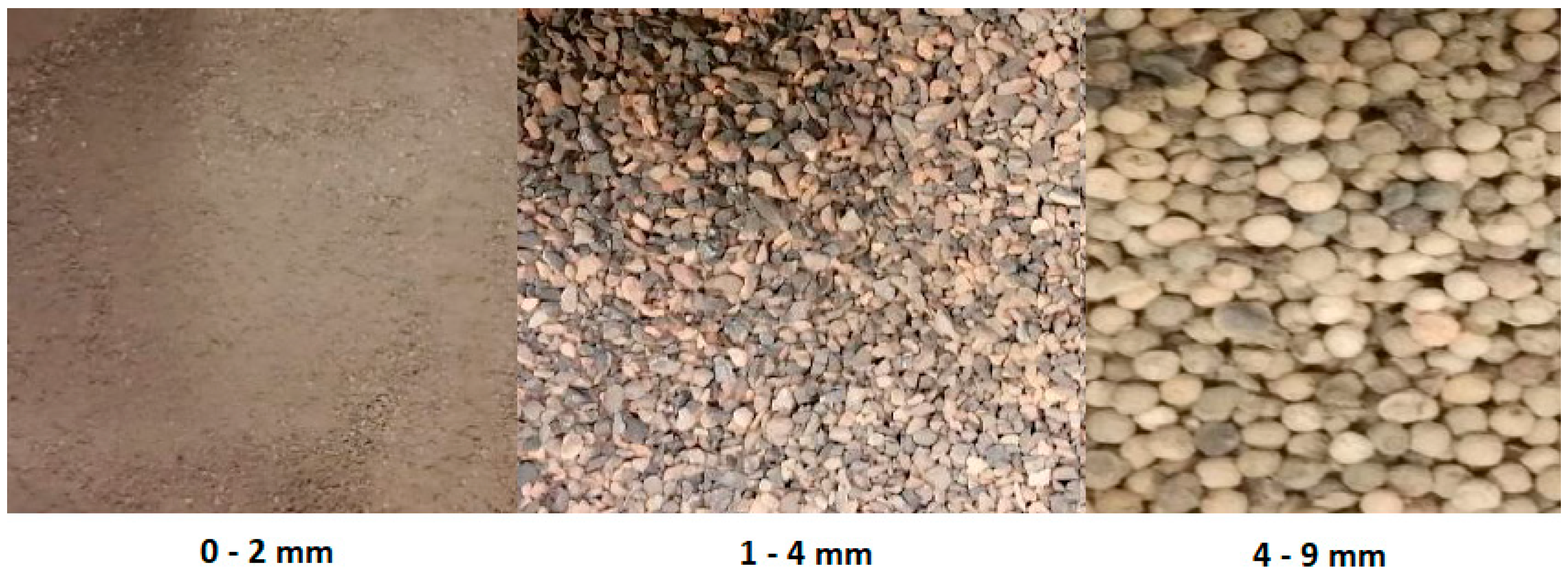
Figure 6.
Samples of lightweight concrete based on fly ash, activated with sodium hydroxide solution alumino-silicate artificial aggregate, of approximately mag 5 000 x with the contact zone between the lightweight aggregate and the geopolymer paste.
Figure 6.
Samples of lightweight concrete based on fly ash, activated with sodium hydroxide solution alumino-silicate artificial aggregate, of approximately mag 5 000 x with the contact zone between the lightweight aggregate and the geopolymer paste.
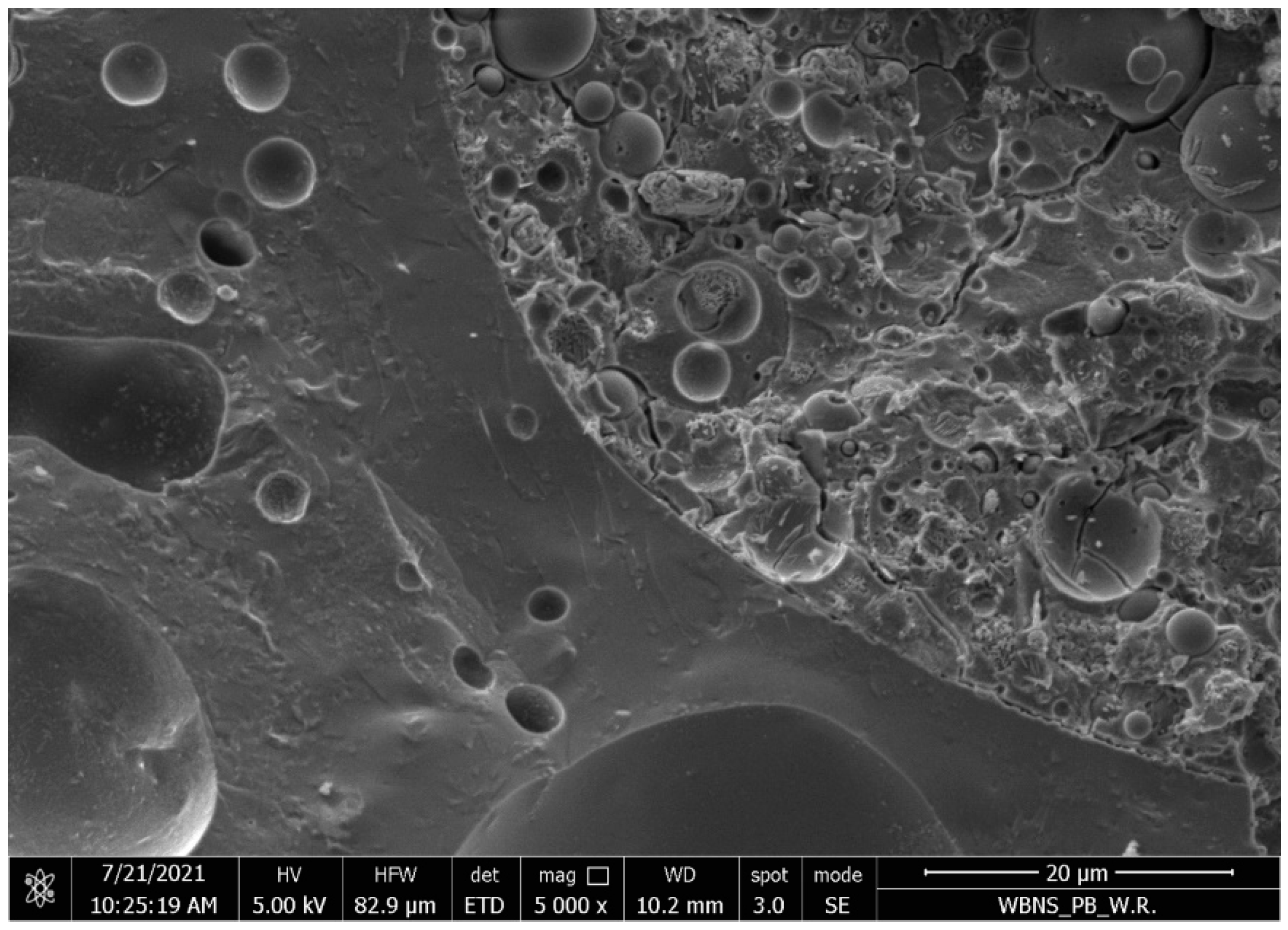
Table 1.
Basic properties of silica fly ash.
| Oxide | Percentage [%] |
|---|---|
| SiO2 | 54,60 |
| Al2O3 | 25,30 |
| Fe2O3 | 4,97 |
| K2O | 2,80 |
| CaO | 2,14 |
| MgO | 1,80 |
| TiO2 | 1,07 |
| Na2O | 0,84 |
| P2O5 | 0,55 |
| SO3 | 0,37 |
| BaO | 0,15 |
| SrO | 0,07 |
| Mn3O4 | 0,06 |
| Loss on ignition | 4,37 |
| Total | 99,09 |
Table 2.
Properties of Certyd fly ash aggregate.
| Technical parameters | Standards/Procedures | 0/2 | 1/4 | 4/9 |
|---|---|---|---|---|
| Bulk density [kg/m3] | PN-EN 1097-3:2000 | 900 ± 10% | 900 ± 10% | 700 ± 10% |
| Thermal conductivity [W/m·K] | PN-EN 12667:2002 | 0,18 | 0,16 | 0,14 |
| Chloride content [%] | PN-EN 1744-1:2010 | 0,00 | 0,00 | 0,00 |
| Sulfate content soluble in acid [%] | 0,25 | 0,25 | 0,25 | |
| Total sulfur content in terms of S [%] | 0,32 | 0,32 | 0,32 | |
| Alkali-reactivity (rapid method) | PN-B 06714/46 | 0,00 | 0,00 | 0,00 |
| Radioactivity [Bq/kg] | Instruction ITB nr 55/2010 | f1 < 1,2 f2< 240 |
f1 < 1,2 f2< 240 |
f1 < 1,2 f2< 240 |
Table 3.
The content of silica and aluminum oxides on the surface of the Certyd aggregate.
| Fraction | 0 - 2 mm | 1 - 4 mm | 4 - 9 mm |
|---|---|---|---|
| Amount | % | % | % |
| Al2O3 | 13,36 | 10,09 | 10,44 |
| SiO2 | 10,83 | 8,44 | 8,11 |
Table 4.
The ratio of the mass of solid NaOH to distilled water.
| Concentration of NaOH solution [mol/dm3] | The weight of NaOH in 1 kg of solution [g] | Mass of water in 1 kg of solution [g] |
|---|---|---|
| 2 | 80 | 920 |
| 4 | 140 | 860 |
| 6 | 239 | 761 |
| 8 | 260 | 740 |
| 10 | 314 | 686 |
Table 7.
Results of compressive strength test of geopolymers, MPa.
| Activator [kg/m3] | Curing temperature [0C] | Concentration of NaOH solution [mol/dm3] | Series No. | The average Compressive strength [MPa] | Standard deviation | Variance | Coefficient of variation [%] |
|---|---|---|---|---|---|---|---|
| Activator 100 | 25 | 2 | (1) | 0,3300 | 0,0908 | 0,0083 | 27,5241 |
| 6 | (5) | 0,6560 | 0,0439 | 0,0019 | 6,6969 | ||
| 65 | 4 | (11) | 1,7600 | 0,2966 | 0,0880 | 16,8550 | |
| 105 | 2 | (2) | 3,8800 | 0,3421 | 0,1170 | 8,8158 | |
| 6 | (6) | 5,1200 | 0,4764 | 0,2270 | 9,3056 | ||
| Activator 200 | 25 | 4 | (9) | 5,1000 | 0,2806 | 0,0788 | 5,5024 |
| 65 | 2 | (13) | 4,8100 | 0,2793 | 0,0780 | 5,8063 | |
| 6 | (14) | 22,86 | 0,7127 | 0,508 | 3,1179 | ||
| 105 | 4 | (10) | 19,1400 | 0,4278 | 0,183 | 2,2350 | |
| Activator 300 | 25 | 2 | (3) | 1,2300 | 0,0274 | 0,0008 | 2,2265 |
| 6 | (7) | 5,24 | 0,2460 | 0,0605 | 4,6940 | ||
| 65 | 4 | (12) | 10,6200 | 0,5450 | 0,297 | 5,1316 | |
| 105 | 2 | (4) | 11,6400 | 0,5225 | 0,273 | 4,4888 | |
| 6 | (8) | 26,9200 | 0,5586 | 0,312 | 2,0749 |
Table 8.
The Results of water absorption of geopolymers.
| Activator [kg/m3] | Curing temperature [0C] | Concentration of NaOH solution [mol/dm3] | Series No. | Arithmetic mean of water absorption [%] | Standard deviation | Variance | Coefficient of variation [%] |
|---|---|---|---|---|---|---|---|
| Activator 100 | 25 | 2 | (1) | 20,0704 | 0,4518 | 0,2041 | 2,2511 |
| 6 | (5) | 21,6464 | 0,5218 | 0,2722 | 2,4104 | ||
| 65 | 4 | (11) | 16,49 | 0,1578 | 0,0249 | 0,9569 | |
| 105 | 2 | (2) | 17,368 | 0,2545 | 0,0648 | 1,4653 | |
| 6 | (6) | 20,662 | 0,2541 | 0,0646 | 1,2298 | ||
| Activator 200 | 25 | 4 | (9) | 21,642 | 0,3933 | 0,1547 | 1,8172 |
| 65 | 2 | (13) | 15,166 | 0,2803 | 0,0786 | 1,8484 | |
| 6 | (14) | 16,558 | 0,3662 | 0,1341 | 2,2114 | ||
| 105 | 4 | (10) | 14,366 | 0,1031 | 0,0106 | 0,7177 | |
| Activator 300 | 25 | 2 | (3) | 14,724 | 0,2975 | 0,0885 | 2,0208 |
| 6 | (7) | 21,532 | 0,2671 | 0,0713 | 1,2403 | ||
| 65 | 4 | (12) | 16,434 | 0,1627 | 0,0265 | 0,9902 | |
| 105 | 2 | (4) | 14,87 | 0,3501 | 0,1226 | 2,3542 | |
| 6 | (8) | 14,188 | 0,2672 | 0,0714 | 1,8829 |
Table 9.
The Results of bulk density of geopolymers.
| Activator [kg/m3] | Curing temperature [0C] | Concentration of NaOH solution [mol/dm3] | Series No. | Arithmetic mean of bulk density [g/dm3] | Standard deviation | Variance | Coefficient of variation [%] |
|---|---|---|---|---|---|---|---|
| Activator 100 | 25 | 2 | (1) | 1415,24 | 10,2473 | 105,008 | 0,7241 |
| 6 | (5) | 1355,76 | 15,5425 | 241,568 | 1,1464 | ||
| 65 | 4 | (11) | 1673,76 | 22,8479 | 522,028 | 1,3651 | |
| 105 | 2 | (2) | 1565,6 | 36,3995 | 1324,925 | 2,325 | |
| 6 | (6) | 1418,44 | 13,9402 | 194,328 | 0,9828 | ||
| Activator 200 | 25 | 4 | (9) | 1387,6 | 9,7026 | 94,14 | 0,6992 |
| 65 | 2 | (13) | 1705,8 | 18,1611 | 329,825 | 1,0647 | |
| 6 | (14) | 1592,76 | 37,1242 | 1378,208 | 2,3308 | ||
| 105 | 4 | (10) | 1709,16 | 16,8389 | 283,548 | 0,9852 | |
| Activator 300 | 25 | 2 | (3) | 1600,28 | 39,5645 | 1565,352 | 2,4724 |
| 6 | (7) | 1457,76 | 45,5547 | 2075,228 | 3,125 | ||
| 65 | 4 | (12) | 1653,3 | 12,8092 | 164,075 | 0,7748 | |
| 105 | 2 | (4) | 1756,68 | 18,3001 | 334,892 | 1,0417 | |
| 6 | (8) | 1704,72 | 13,2322 | 175,092 | 0,7762 |
Disclaimer/Publisher’s Note: The statements, opinions and data contained in all publications are solely those of the individual author(s) and contributor(s) and not of MDPI and/or the editor(s). MDPI and/or the editor(s) disclaim responsibility for any injury to people or property resulting from any ideas, methods, instructions or products referred to in the content. |
© 2024 by the authors. Licensee MDPI, Basel, Switzerland. This article is an open access article distributed under the terms and conditions of the Creative Commons Attribution (CC BY) license (http://creativecommons.org/licenses/by/4.0/).
Copyright: This open access article is published under a Creative Commons CC BY 4.0 license, which permit the free download, distribution, and reuse, provided that the author and preprint are cited in any reuse.


