

Submitted:
05 February 2024
Posted:
06 February 2024
You are already at the latest version
Abstract
Water reuse is critical to national development, sustenance, and survival in this era of climate, demographic, and social changes. There is no national systemic approach to address the challenge systematically. The paper presents a framework and a method to develop a national research strategy for water reuse. It presents an ontology of water reuse strategy that encapsulates the combinatorial complexity of the problem clearly, concisely, and comprehensively. Subsequently, it discusses the method to use the framework to develop a national strategy, adapt it through feedback and learning, and ultimately effect a revolutionary change in the strategy for water reuse.
Keywords:
water reuse
; ontology
; ontological framework
1. Introduction
“In practice, all the water on the planet is eventually reused.” [1] (p. 5) The long-term global transportation and transformation of water for use and reuse transcends geographical boundaries. However, to assure daily water security, public health security, and ecosystem resilience for the stakeholders the transportation and transformation must be managed and controlled internationally, nationally, regionally, and locally. For instance, the reuse of municipal water in the U.S. could potentially increase the nation’s available resources by approximately 6% of total water use [2] while the water conservation could reduce the household water use by more than 30% [3]. Hence the need for a national research strategy for water reuse.
There is a rapidly growing body of literature on water reuse. As of November 13, 2023, there were 1846 papers with ‘water reuse’ in their title indexed in the Scopus database, covering many countries. This corpus excludes papers that address water reuse in their content. There is also a large, growing corpus on the subject not indexed in Scopus. Despite the large volume of research, there is no clear, concise, and comprehensive framework to guide the research to address the challenge. There is no ‘Google Map’ for research on water reuse.
Tzanakakis et al. [1] (p. 17) conduct an extensive review of the literature and list the following knowledge gaps in water reuse research:
- Possible interactions of agricultural reuse with soils, plants, and crops;
- Fate of organic microcontaminants in receiving environmental media and targets;
- Epidemiological risk of antibiotic-resistant bacteria and/or resistance genes released in the environment with treated effluents;
- Issues concerning climate change and/or variability;
- Strategies to overcome barriers to water reuse;
- Links among reuse schemes, ecosystems’ services, and SDGs.
These are significant gaps, and there may be many more. We shall not know the missing gaps without a framework to map the corpus. There may be pathways for water reuse that have been effective and must be reinforced, those that have been ineffective and must be redirected, and those that have been untested/unknown and must be researched.
Almost all the countries today are being compelled to address the challenge of water reuse by the changes in their demography, climate, economy, industry, sociology, and other similar factors. There is a need for a systemic framework to systematically guide a country’s national research strategy for water reuse. The framework must help systematize the local research, localize the global research, and globalize the local research. We present an ontological framework for developing a national research strategy for water reuse.
An ontology is an organization of the terminologies, taxonomies, and narratives of a problem that can be conceptualized as a scientific theory of the problem [4,5,6,7] of water reuse. As a scientific theory it can be used to describe, explain, predict, and control [8] water reuse through feedback and learning [9,10] systemically as part of a broader ecosystem, and systematically by exploring the innumerable pathways within it. Ontological frameworks have been used to study river water sharing [11], national healthcare policies [12,13,14,15,16], design thinking [17], public health informatics [18], local climate change [19], and other domains. In the following we: (a) present an ontology of water reuse strategy based on the present definitions of water reuse, (b) discuss how it can be used as a comprehensive, national research design framework, and (c) delineate its implications for research on, policies for, and the practice of water reuse.
2. The Ontology of Water Reuse
Water reuse is a complex combinatorial problem. Its many definitions simplify the problem and address only parts of it and not the whole. A coordinated national research strategy for water reuse must address the combinatorial complexity systemically and systematically.
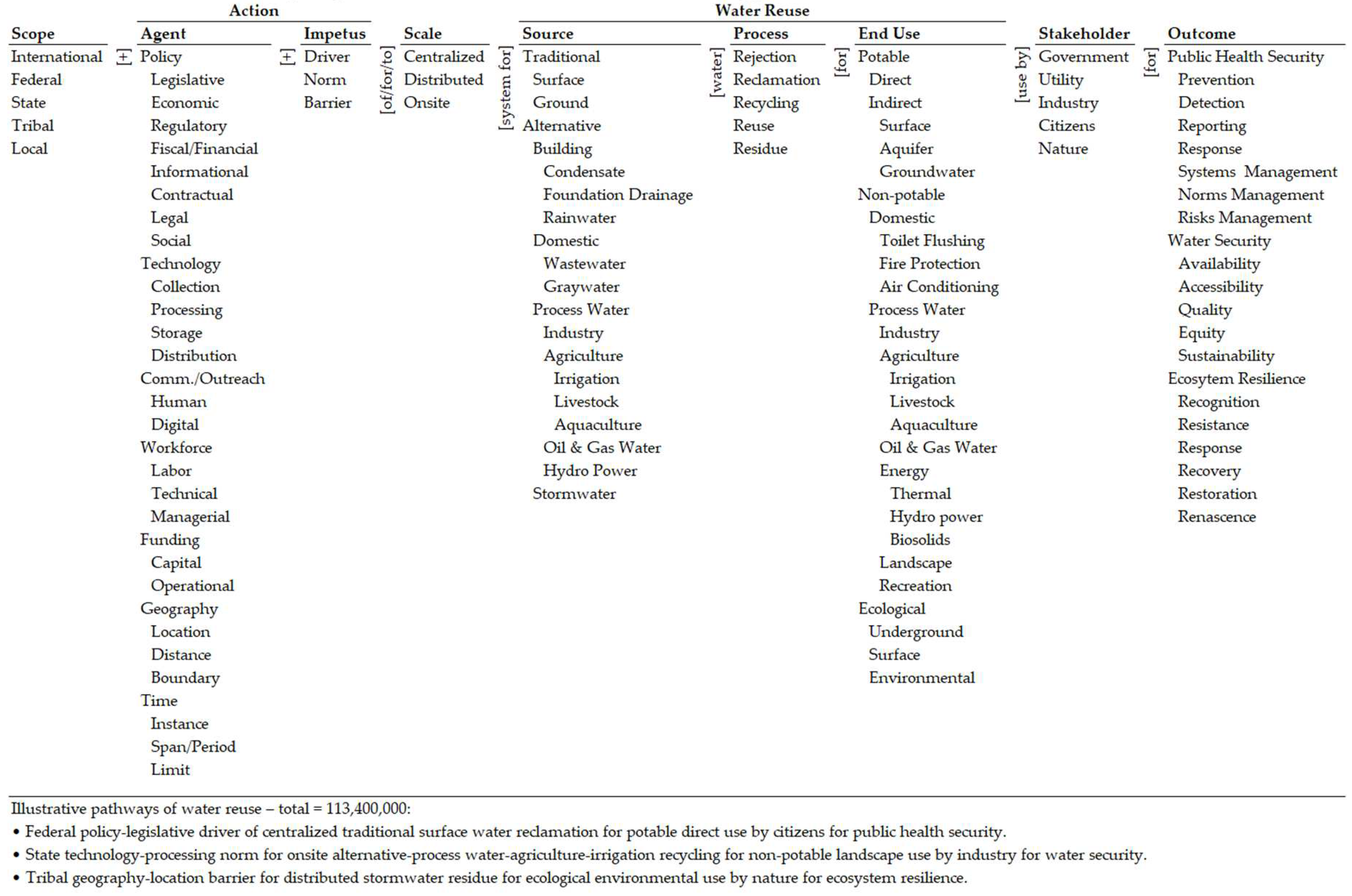
The Ontology of Water Reuse Strategy (Figure 1) will be used to do so. It incorporates the key terminologies and taxonomies of water reuse strategy from the WRF research projects, the associated workshops, the 1846 global papers with ‘water reuse’ in the title indexed in Scopus (as of November 13, 2023), and other related literature. The ontology, after validation by the stakeholders, can serve as the framework for developing a coordinated national strategy for water reuse. It is described below.
2.1. Water Reuse
‘Water Reuse’ at the center of the ontology is defined as a combination of the sources of water (Figure 1—Source), processes of reuse (Figure 1—Process), and end uses (Figure 1—End Use) of water, denoted by the taxonomies in the three columns. Each taxonomy is based on the current literature and its elements are reasonably mutually exclusive and sufficiently exhaustive. We shall discuss each in detail.
2.1.1. Sources of Water
A major part of the taxonomy of sources of water is based on the classification by Hayek et al. [20] (p. xii). They classify water sources as traditional and alternative sources. Further, they classify traditional sources as surface and groundwater. We have reorganized and extended their list of alternative water sources. We have grouped condensate, foundation drainage, and rainwater under buildings as a source. Similarly, we have grouped domestic wastewater and graywater as domestic alternative sources. Stormwater has been retained as a separate alternative source. We have refined the sources of processed water as: industry, agriculture, oil & gas, and hydro power [1,20,21,22,23,24]. Agriculture sources have been further classified as irrigation, livestock, and aquaculture [1,20,21,22,23,24].
The qualitative and quantitative properties of these sources of water are different. They are also likely to be different based on the geographical location, annual season, and other spatio-temporal factors. These sources must be separated, differentiated, integrated, and combined for effective water reuse.
2.1.2. Process of Water Reuse
The stages of the water reuse process are derived from the common body of knowledge and extended to include rejection and residue, as the first and the last stages. Reclamation, recycling, and reuse are commonly used in many definitions [21,25,26,27,28]. Rejection [29] is not commonly used but is included in the taxonomy as a logical first stage. Similarly, residue is the logical last stage of the process—recognizing that some water may not be reused by a stakeholder. Procházková et al. [30] (p.1) state the importance of managing the residue: “… water should be reused in a responsible and sustainable manner because if the liquid residue after water reuse has not been appropriately treated, it may pose a risk to both human health and the environment.”
The stages of the water reuse process are generally sequential. While ideally one may want to have both rejection and residue be zero, and maximize reclamation, recycling, and reuse, that is unlikely.
2.1.3. End Use of Water
The taxonomy of uses of water is based on the classification by Hayek et al. [20] (p. xii). We have retained their major potable and non-potable categories, but have reorganized the subcategories based on the literature [21,25,26,27,28,31]. In addition, we have added a third major category of end use—Ecological, with three subcategories of underground, surface, and environmental. The potable and non-potable water that is not reused will in a sense be ‘used’ by the ecology. The completion of this reuse sequence will be an important segment of the circular economy of water reuse [25,32,33,34,35]. While the potable and non-potable reuses’ time horizons are short, that of the ecological reuse is long. The desirable and undesirable effects of ecological reuse can emerge and be propagated over a long period of time and large distances.
2.1.4. Water Reuse Definition
This ontological definition of water reuse encapsulates 14*5*20 = 1,400 potential combinations of source-process-end use. It includes, for example: (a) traditional surface water reclamation for potable direct use, (b) alternative-process water-agriculture-irrigation recycling for non-potable landscape use, and (c) stormwater residue for ecological environmental use. It encapsulates and extends the present definitions of water reuse. Only a subset of the 1,400 potential combinations may be instantiated at one place at a time; many may not be instantiable.
2.2. Stakeholders
There are many stakeholders in water reuse, each with their own perspectives, motivations, and interests [1,20,36,37]. We have broadly categorized them as belonging to the government, utilities, industry, citizenry, and the nature (at large). They are listed in the corresponding column (Figure 1—Stakeholder). The list can be lengthened, shortened, aggregated, and disaggregated.
Thus, the three types of water reuse illustrated earlier may be combined with the types of stakeholders as follows: (a) traditional surface water reclamation for potable direct use by citizens, (b) alternative-process water-agriculture-irrigation recycling for non-potable landscape use by industry, and (c) stormwater residue for ecological environmental use by nature. In combination with the five types of stakeholders there are 1,400*5 = 7,000 pathways.
2.3. Outcome
The desired outcomes of water reuse are listed in the last column (Figure 1—Outcome). They are public health security, water security, and ecosystem resilience.
Globally, all water is essentially reused water [1], and water is essential for the health and wellbeing of the public. All reuses of water must assure the public’s health security. It includes prevention, detection, reporting, responding, managing systems, managing norms, and managing risks of factors that may affect public health security [38,39,40].
The changes in global climate, demographics, agriculture, and industry are increasing the role of water reuse in assuring water security. An outcome of water reuse is to improve the availability, accessibility, quality, equity, and sustainability of water locally, regionally, nationally, and globally [41,42,43].
The ecosystem is an essential part of all water reuse—it is the ultimate source and sink of water. The resilience of the ecosystem is critical to the sustainability of water reuse. The ecosystem is the end user of water rejected for reuse and water that is the residue of reuse. The ecosystem must be resilient to the changes due to water reuse for the latter to be sustainable. Ecosystem resilience denotes the capability to recognize changes, resist dysfunctional ones, respond to them, recover from them, restore the ecosystem, and potentially renasce the same [44,45].
Combining the outcomes with the three illustrative pathways, we have: (a) traditional surface water reclamation for potable direct use by citizens for public health security risks management, (b) alternative-process water-agriculture-irrigation recycling for non-potable landscape use by industry for water security equity, and (c) stormwater residue for ecological environmental use by nature for ecosystem resilience restoration. In combination with the 18 outcomes there are 1,400*5*18 = 126,000 pathways.
2.4. Scale
The scale of water reuse may be one or a combination of the three: centralized, distributed, and onsite (Figure 1—Scale) [20]. Generally, centralized systems cover a large geographical area, have multiple sources, cater to many end users, and handle large volumes of water for reuse. Distributed systems cover a smaller geographical area, cater to a few sources and end users, and handle moderate volumes of water for reuse. Onsite systems are designed for individual sources and users, handle a small volume for reuse. The complexity of the reuse process will likely be proportional to its scale; the number of stakeholders will also be similarly proportional.
Thus, the three illustrative pathways can be: (a) centralized traditional surface water reclamation for potable direct use by citizens for public health security, (b) onsite alternative-process water-agriculture-irrigation recycling for non-potable landscape use by industry for water security, and (c) distributed stormwater residue for ecological environmental use by nature for ecosystem resilience. In combination with the three scales of operation there are 1,400* 5*18*3 = 378,000 pathways.
2.5. Action
The actions for water reuse (Figure 1—Action) will be determined by the agents (Figure 1—Agent) and the impetus (Figure 1—Impetus) they provide. Many agents may provide the impetus; and these agents may drive it, normalize it, or be barriers to it. We shall describe the two in slightly greater detail next.
2.5.1. Agent
Many categories of agents, each with multiple subcategories may provide the impetus for water reuse. The ontology lists: policies, technology, communication/outreach, workforce, funding, geography, and time. These categories and subcategories are simply a reorganization and relabeling of the terminology in the vast body of literature on water reuse. The policy subcategories are based on Lascoumes et al. [46], the technology subcategories are derived from the literature and correspond to the stages of processing water for reuse, the communication/outreach subcategories denote the two broad methods practiced today, the workforce and funding subcategories are derived from the literature and correspond to the divisions in practice, and the geography and time categories are logical parameters that affect water reuse.
2.5.2. Impetus
The agents may drive water reuse, normalize it, or be barriers to it. The categories of drivers and barriers are widely used in the literature [47], that of norms is not. Yet, norms are implicit in the research and are essential for effective water reuse. In a sense, the ultimate objective is to normalize water reuse. Norms are also necessary, as reference levels, to manage the drivers and barriers through feedback and learning [48].
2.5.3. Summary of Action
The ontology encapsulates 25*3 = 75 Agent-Impetus combinations. They include, for example: (a) policy-legislative driver, (b) technology-processing norm, and (c) geography-location barrier. Thus, extending the earlier illustrations, one may have: (a) policy-legislative driver of centralized traditional surface water reclamation for potable direct use by citizens for public health security, (b) technology-processing norm for onsite alternative-process water-agriculture-irrigation recycling for non-potable landscape use by industry for water security, and (c) geography-location barrier for distributed stormwater residue for ecological environmental use by nature for ecosystem resilience. In combination with the action combinations there are 1,400*5*18*3*75 = 28,350,000 pathways.
2.6. Scope
Last, the scope of the water reuse problem may vary (Figure 1—Scope). It ranges from the international to the local, and includes federal, state, tribal, and local. The scope defines the boundary of a water reuse project; yet, given the property of water to freely move across geographical boundaries, the definition of scope becomes fuzzy. A state water reuse project may have to necessarily consider federal, state, and local policies in implementation.
Thus, in combination with the scope one may envision, illustratively (Figure 1): (a) federal policy-legislative driver of centralized traditional surface water reclamation for potable direct use by citizens for public health security, (b) state technology-processing norm for onsite alternative-process water-agriculture-irrigation recycling for non-potable landscape use by industry for water security, and (c) tribal geography-location barrier for distributed stormwater residue for ecological environmental use by nature for ecosystem resilience. In combination with the scope there are 1,400*5*18*3* 75*4 = 113,400,000 pathways for water reuse encapsulated in the ontology.
2.7. Summary of Ontology of Strategy for Water Reuse
We have used the metaphor of the Google Map to characterize the ontology. Like a Google Map, the ontology many pathways to reuse water. It will help locate one’s state of water reuse in the map, define the desired state, determine the gap, and design pathways to bridge the gap.
A coordinated national research strategy for water reuse must help discover, for all the stakeholders:
- Effective pathways across the ontology and how to reinforce them.
- Ineffective pathways across the ontology and how to redirect them.
- Innovative pathways across the ontology and experiment with them.
- Infeasible pathways across the ontology to avoid them.
In the following discussion we describe a process of developing a national research strategy for water reuse using the ontology.
4. Discussion—National Research Strategy for Water Reuse
The federal government or a designated national research body of the country must play a central role in developing a national research strategy for water reuse, translating the research to policies, translating the policies into practice, and modifying the research strategy based on the feedback from the implementation of the policies and practices. Given the complexity of the challenge, an ad hoc strategy, as has been pursued to date, will be inadequate. These recommendations are based on the policy briefs developed for the G20 Summit in India in 2023 [49,50].
At present, there does not appear to be any national framework or concerted effort to address the challenge of water reuse and provide a roadmap. The national body’s agenda must inform and be informed by the constituent state/province, tribal, and local agendas, those of other countries (especially the neighbors), and those of the United Nations (UN) and its agencies, the World Health Organization (WHO), and similar bodies.
The ontology of strategy for water reuse or a similar one must be adopted as a framework for the country and its constituent entities. Within the framework, each entity must choose its pathways based on its local requirements, priorities, and resources. The adoption of a common framework will help formalize and transfer knowledge about, and feedback and learnings from the implementation within a country and to other countries. Such an approach will help move the cycle of generating and applying knowledge on the challenge from a selective, segmented, and siloed effort to a synoptic, systemic, and systematic one.
The framework must be used to periodically map the state-of-the-art, state-of-the-need, and state-of-the-practice of water reuse. Analyzing the gaps between the three states must guide the translation of research to policy to practice and then back to research, for feedback and learning to achieve the sustainable development goals’ vision. As such, the national committee must help the member countries collaborate, coordinate their policies, and communicate their learning.
The national body must form a national committee and encourage the creation of regional and local groups for water reuse. These committees must adapt and adopt the ontology as a common framework and pursue a systemic approach that harnesses the resources and unleashes the forces necessary for water reuse. These committees must be responsible and accountable for the outcomes.
A recommended agenda for the national body is as follows:
- Finalize the ontology in consultation with the stakeholders and researchers through extensive meetings.
- Finalize the corpus of national and global research literature on water reuse.
-
Map the documents onto the ontology to determine:
- The elements of the ontology that have been heavily addressed (bright spots), less addressed (light spots), and not addressed (blind/blank spots) in the corpus.
- The primary, secondary, tertiary, quaternary, and quinary themes in the corpus.
- These maps will highlight the gaps within the corpus.
- Solicit feedback from stakeholders and researchers based on the ontology and the maps derived from the corpuses.
- The feedback should help prioritize the pathways to be reinforced, redirected, experimented, and avoided.
- The priority of pathways to be reinforced, redirected, experimented, and avoided shall form the basis of project ideas and research roadmap.
- Develop a final roadmap anchored on the ontology, the mapping of the corpus, and the feedback from the stakeholders and researchers.
- Like a Google Map, the roadmap shall highlight the key pathways and their priorities.
- The roadmap shall be disseminated via the document, presentations, webinars, and roundtables.
- The ontology and the associated maps will be the basis for scientifically: (a) describing the pathways to water reuse, (b) explaining their logic, (c) predicting the outcomes of choosing different pathways, and (d) controlling the outcomes through continuous feedback and learning.
5. Conclusion
The complex challenge of national water reuse strategy cannot be simply the sum of many local, incremental, and ad hoc strategies. A synoptic view of the problem, as provided by the ontology, is necessary to address it systematically and systemically. The fragmentation of the formulations and segmentation of the solutions can diminish the intended, functional consequences, and enhance the unintended, dysfunctional consequences. They can lead to biases and blind-spots in addressing the problem. A way to optimize the effort for water reuse is to: (a) Have a roadmap like the ontology of water reuse strategy that has been proposed; (b) Institute a process for continuous feedback and learning with the stakeholders, (c) Institute a process for continuous feedback and learning between research, policies, and practices; and (d) Adapt the roadmap as new knowledge is generated. One could, using the approach, bring about a revolutionary change in the strategic management [9] of water reuse.
Author Contributions
Conceptualization, A.R. and T.S.; methodology, A.R. and T.S.; writing—original draft preparation, A.R. and T.S.; writing—review and editing, A.R. and T.S.; visualization, A.R. and T.S. All authors have read and agreed to the published version of the manuscript.
Funding
This research received no external funding.
Institutional Review Board Statement
Not applicable.
Informed Consent Statement
Not applicable.
Data Availability Statement
Not applicable.
Acknowledgments
Not applicable.
Conflicts of Interest
The authors declare no conflicts of interest.
References
- Tzanakakis, V.A.; Capodaglio, A.G.; Angelakis, A.N. Insights into Global Water Reuse Opportunities. Sustainability (Switzerland) 2023, 15, 7. [Google Scholar] [CrossRef]
- National Research Council of the National Academies. Water Reuse: Potential for Expanding the Nation’s Water Supply Through Reuse of Municipal Wastewater; The National Academies Press: Washington, D.C., 2012; ISBN 0-309-22462-4. [Google Scholar]
- Water Reuse: Issues, Technologies, and Applications; Asano, T., Burton, F.L., Leverenz, H.L., Tsuchihashi, R., Tchobanoglous, G., Eds.; 1st ed.; McGraw-Hill: New York, 2007; ISBN 978-0-07-145927-3.
- Gruber, T.R.; Liu, L.; Ozsu, M.T. Encyclopedia of Database Systems; Springer-Verlag: New York, 2008. [Google Scholar]
- Quine, W.V.O. From a Logical Point of View: 9 Logico-Philosophical Essays; Harvard University Press, 1980; ISBN 978-0-674-32351-3. [Google Scholar]
- Cimino, J.J. In Defense of the Desiderata. J Biomed Inform 2006, 39, 299–306. [Google Scholar] [CrossRef] [PubMed]
- Chandrasekaran, B.; Josephson, J.R.; Benjamins, V.R. What Are Ontologies, and Why Do We Need Them? IEEE Intell Syst App 1999, 14, 20–26. [Google Scholar] [CrossRef]
- Coon, D.; Mitterer, J.O. Psychology: A Journey; Cengage Learning; 2013; ISBN 978-1-285-68733-9. [Google Scholar]
- Ramaprasad, A. Revolutionary Change and Strategic Management. Behav Sci 1982, 27, 387–392. [Google Scholar] [CrossRef]
- Ramaprasad, A. On the Definition of Feedback. Behav Sci 1983, 28, 4–13. [Google Scholar] [CrossRef]
- Acharya, V.; Halanaik, B.; Ramaprasad, A.; Swamy, T.R.K.; Singai, C.B.; Syn, T. Transboundary Sharing of River Water: Informating the Policies. River Res Applic 2020, 36, 161–170. [Google Scholar] [CrossRef]
- Dai, G.; Deng, F.; Ramaprasad, A.; Syn, T. China’s National Health Policies: An Ontological Analysis. Online Journal of Public Health Informatics 2016, 8. [Google Scholar] [CrossRef]
- Nunez, A.; Ramaprasad, A.; Syn, T. National Healthcare Policies in Chile: An Ontological Meta-Analysis. Studies in Health Technology and Informatics 2015, 1105–1105. [Google Scholar] [CrossRef]
- Sastry, N.K.B.; Madhumitha, M.; Ramaprasad, A.; Syn, T. National Healthcare Programs and Policies in India: An Ontological Analysis. Int J Community Med Public Health 2017, 4, 307–313. [Google Scholar] [CrossRef]
- Ramaprasad, A.; Win, K.T.; Syn, T.; Beydoun, G.; Dawson, L. Australia’s National Health Programs: An Ontological Mapping. AJIS 2016, 20. [Google Scholar] [CrossRef]
- Chandra, A.; Sreeganga, S.D.; Rath, N.; Ramaprasad, A. Healthcare Policies to Eliminate Neglected Tropical Diseases (NTDs) in India: A Roadmap. International Journal of Environmental Research and Public Health 2023, 20, 6842. [Google Scholar] [CrossRef]
- Ramaprasad, A.; Syn, T. Design Thinking and Evaluation Using an Ontology. In Design Science: Perspectives from Europe; Helfert, M., Donnellan, B., Kenneally, J., Eds.; Communications in Computer and Information Science; Springer International Publishing: Switzerland, 2014; ISBN 978-3-319-13935-7. [Google Scholar]
- Ramaprasad, A.; Syn, T. Ontological Meta-Analysis and Synthesis. Commun. Assoc. Info. Syst. 2015, 37, 138–153. [Google Scholar] [CrossRef]
- Manzano, C.A.; Ramaprasad, A.; Syn, T. Information Systems to Manage Local Climate Change Effects: A Unified Framework. In Proceedings of the PACIS 2018 Proceedings; 2018. [Google Scholar]
- Hayek, C.; Lall, U.; Becker, W.; Knowles, P.; Faber, L. Implementing Onsite and Distributed Water Reuse Systems in the United States: Literature Review; The Water Research Foundation, 2022. [Google Scholar]
- Angelakis, A.N.; Tzanakakis, V.A.; Capodaglio, A.G.; Dercas, N. A Critical Review of Water Reuse: Lessons from Prehistoric Greece for Present and Future Challenges. Water 2023, 15, 2385. [Google Scholar] [CrossRef]
- Tortajada, C.; Nambiar, S. Communications on Technological Innovations: Potable Water Reuse. Water (Switzerland) 2019, 11. [Google Scholar] [CrossRef]
- National Academy of Sciences. Understanding Water Reuse: Potential for Expanding the Nation’s Water Supply Through Reuse of Municipal Wastewater; National Academies Press: Washington, D.C., 2012; p. 13514. ISBN 978-0-309-26520-1. [Google Scholar]
- Wade Miller, G. Integrated Concepts in Water Reuse: Managing Global Water Needs. Desalination 2006, 187, 65–75. [Google Scholar] [CrossRef]
- Fernandes, E.; Cunha Marques, R. Review of Water Reuse from a Circular Economy Perspective. Water (Switzerland) 2023, 15. [Google Scholar] [CrossRef]
- Shoushtarian, F.; Negahban-Azar, M. Worldwide Regulations and Guidelines for Agricultural Water Reuse: A Critical Review. Water 2020, 12, 971. [Google Scholar] [CrossRef]
- Chen, Z.; Ngo, H.H.; Guo, W. A Critical Review on Sustainability Assessment of Recycled Water Schemes. Science of The Total Environment 2012, 426, 13–31. [Google Scholar] [CrossRef]
- Smith, D.W. Water Reclamation and Reuse. Journal (Water Pollution Control Federation) 1980, 52, 1242–1284. [Google Scholar]
- Cordeiro, S.; Ferrario, F.; Pereira, H.X.; Ferreira, F.; Matos, J.S. Water Reuse, a Sustainable Alternative in the Context of Water Scarcity and Climate Change in the Lisbon Metropolitan Area. Sustainability (Switzerland) 2023, 15. [Google Scholar] [CrossRef]
- Procházková, M.; Touš, M.; Horňák, D.; Miklas, V.; Vondra, M.; Máša, V. Industrial Wastewater in the Context of European Union Water Reuse Legislation and Goals. Journal of Cleaner Production 2023, 426, 139037. [Google Scholar] [CrossRef]
- Xu, C.-Y.; Singh, V.P. A Review on Monthly Water Balance Models for Water Resources Investigations. Water Resources Management 1998, 12, 20–50. [Google Scholar] [CrossRef]
- Bellver-Domingo, Á.; Hernández-Sancho, F. Circular Economy and Payment for Ecosystem Services: A Framework Proposal Based on Water Reuse. Journal of Environmental Management 2022, 305. [Google Scholar] [CrossRef] [PubMed]
- Bortoli, M.; Hollas, C.E.; Cunha, A.; Steinmetz, R.L.R.; Coldebella, A.; de Prá, M.C.; Soares, H.M.; Kunz, A. Water Reuse as a Strategy for Mitigating Atmospheric Emissions and Protecting Water Resources for the Circularity of the Swine Production Chain. Journal of Cleaner Production 2022, 345. [Google Scholar] [CrossRef]
- Chen, C.-Y.; Wang, S.-W.; Kim, H.; Pan, S.-Y.; Fan, C.; Lin, Y.J. Non-Conventional Water Reuse in Agriculture: A Circular Water Economy. Water Research 2021, 199. [Google Scholar] [CrossRef] [PubMed]
- Voulvoulis, N. Water Reuse from a Circular Economy Perspective and Potential Risks from an Unregulated Approach. Current Opinion in Environmental Science and Health 2018, 2, 32–45. [Google Scholar] [CrossRef]
- Rupiper, A.M.; Loge, F.J. Identifying and Overcoming Barriers to Onsite Non-Potable Water Reuse in California from Local Stakeholder Perspectives. Resources, Conservation and Recycling: X 2019, 4. [Google Scholar] [CrossRef]
- Wagner, T.R.; Nelson, K.L.; Binz, C.; Hacker, M.E. Actor Roles and Networks in Implementing Urban Water Innovation: A Study of Onsite Water Reuse in the San Francisco Bay Area. Environmental Science and Technology 2023, 57, 6205–6215. [Google Scholar] [CrossRef] [PubMed]
- Nuclear Threat Initiative; Johns Hopkins Center for Health Security. Global Health Security Index; Hohns Hopkins Bloomberg School of Public Health: Baltimore, MD, 2019. [Google Scholar]
- Sapkota, A.R. Water Reuse, Food Production and Public Health: Adopting Transdisciplinary, Systems-Based Approaches to Achieve Water and Food Security in a Changing Climate. Environmental Research 2019, 171, 576–580. [Google Scholar] [CrossRef]
- World Health Organization Health Systems for Health Security; World Health Organization: Geneva, Switzerland, 2021.
- Asian Development Bank Asian Water Development Outlook 2020: Advancing Water Security across Asia and the Pacific; Asian Development Bank, 2020; ISBN 978-92-9262-616-7.
- UN ESCAP Water Security & the Global Water Agenda: A UN-Water Analytical Brief; United Nations University (UNU), 2013.
- Van Beek, E.; Arriens, W.L. Water Security: Putting the Concept into Practice; TEC Background Papers; Global Water Partnership: Stockholm, 2014. [Google Scholar]
- Drechsel, P.; Qadir, M.; Baumann, J. Water Reuse to Free up Freshwater for Higher-Value Use and Increase Climate Resilience and Water Productivity. Irrigation and Drainage 2022, 71, 100–109. [Google Scholar] [CrossRef]
- Liotine, M.; Ramaprasad, A.; Syn, T. Managing a Smart City’s Resilience to Ebola: An Ontological Framework. In Proceedings of the 49th Hawaii International Conference on System Sciences (HICSS); IEEE Computer Society; 2016; pp. 2935–2943. [Google Scholar]
- Lascoumes, P.; Galès, P.L.; Bezes, P.; Borraz, O.; Palier, B.; King, D.; Hood, C. Special Issue of Governance: Understanding Public Policy Through Its Instruments; 2006; p. 121. [Google Scholar]
- Lee, K.; Jepson, W. Drivers and Barriers to Urban Water Reuse: A Systematic Review. Water Security 2020, 11, 100073. [Google Scholar] [CrossRef]
- Ramaprasad, A. On the Definition of Feedback. Syst. Res. 1983, 28, 4–13. [Google Scholar] [CrossRef]
- Ramaprasad, A.; Martínez, V.; Nunez, A.; Sreeganga, S.D. Pathways to Universal Digital Access to Inclusive Healthcare in the G20. In T20 Policy Brief; G20/T20 India: New Delhi, India, 2023. [Google Scholar]
- Ramaprasad, A.; Mehta, V.K.; Gowrish, R. A.; Mehta, V.K.; Gowrish, R. A Digitalisation Roadmap for Climate-Smart Agriculture in India. In T20 Policy Brief; G20/T20 India: New Delhi, India, 2023. [Google Scholar]
Figure 1.
Ontology of Water Reuse.
Disclaimer/Publisher’s Note: The statements, opinions and data contained in all publications are solely those of the individual author(s) and contributor(s) and not of MDPI and/or the editor(s). MDPI and/or the editor(s) disclaim responsibility for any injury to people or property resulting from any ideas, methods, instructions or products referred to in the content. |
© 2024 by the authors. Licensee MDPI, Basel, Switzerland. This article is an open access article distributed under the terms and conditions of the Creative Commons Attribution (CC BY) license (http://creativecommons.org/licenses/by/4.0/).
Copyright: This open access article is published under a Creative Commons CC BY 4.0 license, which permit the free download, distribution, and reuse, provided that the author and preprint are cited in any reuse.


