

Submitted:
02 February 2024
Posted:
02 February 2024
You are already at the latest version
Abstract
Contemporary cities are facing many challenges, from social and economic issues to the new risks related to the impacts of climate change. Focusing on energy consumptions, and the related GHG emissions, cities are considered not only the main global contributors but also the areas most exposed to risks, because of their density of population and economic activities. Implementing urban planning strategies with the purpose of increasing energy efficiency and resilience overall are, for all these reasons, considered a top priority. This paper investigates the innovative contents about energy-efficient and energy-resilient urban planning solutions that have started to be implemented in the cities of the Emilia-Romagna region. Two kinds of planning instruments are therefore analyzed: the voluntary Sustainable Energy and Climate Action Plans (SECAPs) and the mandatory General Urban Plans (GUPs), recently approved in several cities of Emilia-Romagna. A comparative analysis of three cities in the Emilia-Romagna region, Bologna, Modena and Ravenna, is proposed on the strategies of their newly local city plans and SECAPs with focus on energy management and planning. The aim is to assess whether the new structure of local city plans and the influence of SECAPs could be useful in implementing such urban energy resiliency solutions.
Keywords:
urban planning tools
; resilient city
; sustainability
; SECAPs.
1. Introduction
Cities and human settlements have been widely acknowledged as crucial focal points in the global endeavour to combat climate change [1]. Global mitigation and adaptation policies and strategies, including the United Nations Framework Convention on Climate Change, or UNFCCC [2], the Kyoto Protocol [3] and the 2015 Paris Agreement [4] have emphasized the imperative to curtail climate-altering emissions and to enhance social resilience against the impacts of climate change.
Within this framework, cities are responsible for the production of more than 70 per cent of the world's climate-altering emissions [5], primarily due to their more than 50 per cent population concentration [6]. Consequently, cities are among the territories most susceptible to the impacts of climate change, in terms of economic damage, loss of life and disruption to vital services [7].
One of the fundamental contributors to greenhouse gas emissions is energy consumption. Therefore, the ways in which cities manage to develop more efficient and robust energy production and consumption systems holds pivotal significance for mitigation efforts, as well as providing benefits in air quality, health, and quality of life [8]. Conversely, successful adaptation policies on an urban scale possess the potential to significantly diminish the overall costs of impacts and reduce systemic risks [7,8,9].
While mitigation actions often have a top-down structure stemming from major international agreements and are sector-specific, adaptation actions demonstrate greater efficacy when tailored and executed at the local level, with a recognised increasingly important role of regional coordination, support for resource-poor local governments, and strategic backing from the national level [10].
The role of spatial planning in implementing adaptation and mitigation strategies has been debated over the years [11]. Current understanding acknowledges the pivotal role of spatial planning in the endeavor against climate change [12], as it allows for the integration of emission reduction strategies, typically confined to smaller scales such as building energy conservation standards, into overarching urban development strategies, thus maximising their impacts to local resilience and development [13,14]
Existing literature reviews suggest that the analysis of the relationship between different planning instruments in relation to climate has not yet been adequately explored. This contribution aims to begin to fill this gap, by choosing as a field of study the medium-sized city of Emilia-Romagna, representative of the Italian and regional urban realities, and characterised by distinct challenges and opportunities in addressing climate change effects.
In particular this article aims to: investigate the instruments, encompassing action plans and coordination networks, that cities adopt to respond to climate change, both nationally and internationally (Section 2.1 and Section 2.2); present the case selection and the comparative analysis methodology (Section 2.3); explore the relationships between Sustainable Energy and Climate Action Plans (SECAPs) and General Urban Plans (GUPs) in the average Emilia-Romagna city [15] (Chapter 3); and finally propose criteria for integrating climate-related considerations into municipal urban planning, with particular reference to energy efficiency and resilience [16] (Chapter 4).
2. Materials and Methods
2.1. Policies and Instruments for Tackling Climate Change in the Urban Environment
2.1.1. International Urban Climate Networks
The acknowledgment of the role cities can play in the challenges posed by climate change has led to bottom-up engagement and coordination among various local institutions globally [17]. The ensuing section highlights examples of city climate networks.
A seminal example of city networks focused on environmental concerns is Agenda 21, which saw several cities globally adopting a Local Agenda 21. The initiative is a urban-level implementation at the urban scale of the principles of sustainable development originally defined by the United Nations in the early 1990s following the Rio Janeiro conference [18].
In the following years, several other city networks were formed, one example being the International Council for Local Environmental Initiative, ICLEI, founded in 1990 [19], which aims to integrate climate change issues into broader local sustainability policies. It consists of more than 2,500 regional and local institutions in over 125 countries.
Founded in 2005, the C40 Cities initiative initially comprised 40 large cities globally and has since expanded to include 96 major urban centers (Milan and Rome are participating for Italy). The initiative aims to reduce with the the emissions of its member cities by half within a decade [20], while enhancing adaptation and air quality policies on more than 582 million citizens worldwide, equivalent to about 36% of the world's GDP.
The Covenant of Mayors initiative was established by the European Commission in 2008 fosters voluntary cooperation between signatory local and regional authorities and the European Commission. with the aim of going beyond the climate and energy targets set by the European Union [21].
The Sustainable Energy and Climate Action Plans (SECAPs) are the fundamental tool of the Covenant of Mayors. Their main objectives are:
- Mitigation, aligning with the European Union’s commitment to cut net greenhouse gas emissions by 55% compared to the 1990 level and to achieve climate neutrality by 2050.
- adaptation of cities to the negative consequences of climate change through systemic actions, such as a better data-based knowledge of local vulnerabilities and localized best practices for climate risk management and prevention.
- universal access to safe, clean, and affordable energy for everyone.
The municipality which chooses to join the Covenant elaborates the SECAP with the support of the Covenant of Mayors office at the European Commission and the Joint Research Centre [22] for technical issues. Apart from implementing and monitoring actions, subscribing municipalities pledge to share best practices, experiences, and knowledge with the Covenant of Mayors network through institutional cooperation.
Consequently, the SECAPs are important documents for assessing the policies and actions of municipalities that impact energy and resilience. They are composed by:
- The Baseline Emission Inventory (BEI) which assesses the situation of greenhouse gas emissions.
- The Risk and Vulnerability Assessment (RVA), with regard to the analysis of climate risk in terms of adaptation.
- The Plan of actions, which encompass both mitigation and adaptation measures.
- The BEI establishes a base year and covers key sectors such as municipal, tertiary, residential, and transport, assessing energy consumption and carbon dioxide equivalent emissions [23]. It is recommended in the guidelines to focus on interventions involving public buildings or services, both for reasons of increased implementation possibilities and to ensure a leading role to the municipal administration in driving change in society and the local economy.
The RVA assesses hazard, exposure, vulnerability, and resilience aspects of human and material assets threatened by climate change, using either spatial impact models or indicator-based vulnerability analyses. The assessment can be carried out with different levels of detail and depth depending on the size of the city. Spatial impacts models allow to appreciate the variations of the risk levels throughout the area. A simpler methodology, suitable for smaller municipalities with fewer resources, is an indicator-based vulnerability analysis. It starts with an assessment of qualitative aspects of climate hazards in the territory, which lead to point values of vulnerability and exposure.
Following the knowledge framework implemented by the BEI and the RVA, SECAPs outline a series of actions to achieve specific objectives in emissions reduction and increased resilience by 2030.
These actions include short- to medium-term initiatives, detailed with action sheets specifying descriptions, responsible entities, timelines, affected municipal sectors, impact focus, expected results, involved stakeholder groups, investment costs, and monitoring indicators.
2.1.2. Examples of Relevant Action Plans
In addition to the study of SECAPs, it was deemed necessary to analyse a selection of climate action plans deemed noteworthy to comprehend current best practices and gather some insights in energy and resilience climate planning.
The 2030 Climate Emergency Plan [24] of the city of Barcelona is the outcome of a substantial participatory process engaging numerous associations, together with local institutions and citizens, to join existing climate networks or create ad hoc aggregations to implement climate change projects in the city.
The plan places emphasis on energy poverty, health risks, and inequalities, influencing the selection of indicators.
Furthermore, it aims at developing a low-carbon city, independent from fossil fuels, and distributing the economic benefits of innovations among citizens.
The plan also promotes sustainable mobility and the closure of material and energy cycles with various actions.
The Air and Climate Plan (CAP) of Milano [25] stands out for the participatory process that involved the municipality and stakeholders. This plan adopts an integrated approach that addresses air pollution in conjunction with mitigation and adaptation measures, an aspect often overlooked or treated separately in sectoral document. The plan's strategic actions often affect more than one aspect simultaneously, maximizing synergies and achieving multiple objectives.
In the long term, by 2050, the objectives are:
- Compliance with the values set by the WHO Air Quality Guidelines.
- Carbon neutrality.
- Containment the local temperature increases to within 2°C, through urban cooling actions and reduction of the heat island phenomenon.
The SECAP of the city of Mantua [26] envisions a model of distributed energy generation that could improve the relationship between energy, territory, nature, and urban layout.
Beyond its environmental significance, the low-carbon economy is seen also as an opportunity for sustainable economic development and improved quality of life in the territory. This commitment to energy-saving transformation and greater use of renewable energy sources, however, must necessarily be balanced with imperative safeguarding and conservation requirements of the great historical-artistic value of the city centre.
Furthermore, Mantua has a significant industrial presence, which significantly influences the city's emissions trend with its strategic choices. Synergies between these initiatives, such as the district heating network fuelled by waste heat, and urban energy planning can contribute to the comprehensive approach taken by Mantua in addressing climate change.
2.1.3. Considerations
The examples examined illustrate how issues related to energy and resilience can be integrated into a developmental framework, creating new opportunities, and maximizing the benefits of transformative processes for a broad spectrum of stakeholders. To ensure accurate reception by citizens, the participatory dimension must be taken care of and pursued at all stages of the process, from plan development to implementation and monitoring. The most comprehensive plans, as in the case of Barcelona and Milan, are those that devoted considerable attention to the participatory process in determining the needs to be met and the objectives to be achieved.
The dimension of social equity and inclusiveness, although at first it might seem secondary in a climate plan, plays a crucial role because it allows for a more precise targeting of measures, a more efficient allocation of resources and helps to safeguard precisely the most vulnerable elements. In essence, it functions as an adaptation measure, contributing to the overall increase in urban system resilience.
2.2. The Climate Change Mitigation and Adaptation Approach in the Medium-Sized City of Emilia-Romagna in Italy
2.2.1. The Specificity of the Medium-Sized City
Medium-sized cities constitute a significant reality in the European and Italian context. European countries, compared to the rest of the world, exhibit, for historical and geographical reasons, a higher percentage of their population in medium-sized and small cities, with densities lower than in Asian cities but much higher than in US cities [27]. Europe's dense network of medium-sized and small cities tends to be less concentrated around the relatively few large urban agglomerations than on other continents.
European institutions have recognized this peculiarity for several years, as evidenced by initiatives like URBAN II, a partnership program with cities conducted between 2000 and 2006. Promoted by the Directorate General for Regional Policies, the program aimed to foster sustainable development in territories facing crises and characterized by this specific urban distribution. European development funds were utilized jointly to address the economic and societal challenges of these regions [27]. More recent research and in-depth programmes strive to better define the specificities and challenges of European medium and small cities through morphological, functional and administrative analyses [27,28]. Medium-sized cities actively participate in dedicated European coordination networks, such as the Eurotowns network [29] as well as in forms of competition that enhance and reward the implementation of sustainable development policies, such as the Green Leaf Award [30]
While large metropolitan concentrations, participating in networks like C40 Cities, can more readily activate plans, programs, and attract international funding for climate transition policies, medium-sized cities can still play a crucial role in fostering balanced and multi-centred territorial development [31].
This is one of the main reasons of the focus of this contribution on the medium-sized cities of Emilia-Romagna region in Italy, on three case studies, which share similarities in size, demographic and socio-economic features, and with important differences in the challenges they face in terms of combating climate change, as explained in Section 2.3.
2.2.2. Energy and Resilience References in the Strategies and Urban Planning Laws in the Emilia-Romagna Region
Emilia-Romagna stands out as one of the most committed Italian regions in integrating mitigation and adaptation solutions into urban planning [32].
This commitment is evident in documents like the Regional Strategy for Climate Change Mitigation and Adaptation [33], whose aim is to make the territory zero-emission and resilient to the impacts of climate change. It follows the signing in 2015 of the Under2 coalition, which commits the region to reducing its emissions by 20 per cent by 2020 compared to 1990, and by 80 per cent by 2050.
A pivotal step in this endeavour is the Regional Law 24/2017, the New Urban Planning Law, prioritizing the regeneration of urbanized territories to enhance urban and building quality, by focusing on energy and resources efficiency, the environmental performance of building materials, and the comfort of buildings [34].
In the enunciation of the general principles and objectives, in Article 1, among the objectives of sustainability, equity and competitiveness of the social and economic system, and the fulfilment of the fundamental rights of current and future generations. The soil is indicated as a common good and a non-renewable resource that performs functions and produces ecosystem services, also in function of the prevention and mitigation of hydrogeological instability events and climate change mitigation and adaptation strategies, hence the importance of soil consumption reduction. The regeneration of urbanised territories is indicated as the main instrument for urban and building quality improvement.
In Article 5 of the law, the Region assumes the objective of zero soil consumption to be achieved by 2050, and to this end prepares the instruments of territorial and urban planning with a view to maximising the reuse and regeneration of urbanised territory. The reduction of soil consumption also implies, as the law makes explicit, in addition to the regulation of settlement transformations, the designation of areas to re-become permeable. This constitutes a relevant adaptation strategy as it enhances drainage in case of extreme events, and it mitigates temperatures increase in summer.
Furthermore, the law introduces bonus rules for regeneration projects adopting recognized energy-environmental protocols, providing incentives such as discounts on construction taxes and regional contributions.
The main instrument introduced by this law is the General Urban Plan (GUP), the new standard mandatory urban plan. The GUP focuses on energy efficiency and resilience, i.e. the urban organism's ability to adapt to environmental and social challenges and to react positively to emergencies. To achieve these goals, it is crucial to achieve a comprehensive understanding of the morphological, social, economic, climatic, and environmental context, grasped in its dynamic dimension.
The GUP presents differences in competences and objectives with respect to previous planning instruments:
- It identifies the perimeter of the urbanized territory to differentiate areas suitable for regeneration from those subject to soil consumption restrictions.
- It identifies homogeneous parts of the city requiring uniform discipline, focusing on general objectives for improvement without detailing areas for new settlements or transformations.
- The GUP, therefore, does not establish building capacity, which is delegated to public-private agreements and public initiative implementation plans.
- The GUP focuses on the characteristics and requirements of resilience, focusing on the urban organism's ability to adapt to challenges and emergencies.
In contrast to previous planning, the GUP intends to pursue a greater integration of urban themes with a broader framework of environmental, social, and economic issues and with relevant sustainability policies and actions from national, to supra-regional, to local level.
In conclusion, the GUP is structured to emphasize the strategic dimension over traditional planning, providing indications and objectives within a continuous process of evaluation and flexibility in decision-making. The evolution towards a more strategic and flexible is affecting various spheres of town planning, following a debate on the possible advantages, disadvantages, and concrete applicability of such an approach [35].
The relationships between voluntary action plans (SECAPs), as explained in Section 2.1.1 and the mandatory urban plans (GUPs) in three case studies within Emilia-Romagna will be explored to understand the dynamics and methodologies employed in these municipalities.
2.3. Three Case studies
2.3.1. Case Selection Criteria
The cities of Bologna, Modena and Ravenna have been chosen, whose key features are summarised in Table 1.
The choice of the case studies was guided by the following characteristics:
- Medium-sized cities in the Emilia-Romagna region, as depicted in Figure 1.
- Provincial capitals.
- Cities representing diverse territorial and socio-economic contexts: agricultural, industrial, and coastal areas, historical heritage city centers are featured in various combinations.
- Cities with both an approved SECAP and a GUP.
- Municipalities that have been engaged for years in initiatives on sustainable development and efforts against climate change.
Bologna is the Capital of the metropolitan city and of the region Emilia Romagna. It encompasses a population of 391,686 inhabitants and a territorial extension of 141 km2 [36] The metropolitan area covers 3,702 km2, has a population of 1 million inhabitants, and includes the 55 municipalities of the provincial territory. Bologna is located in the southern Po Valley, near the Apennines Mountain range, between the valleys of the Reno river and the Savena stream. The city represents a crucial transportation node for road and railways in northern Italy. It is located at centre of important east-west and north-south national communication routes. The surrounding area hosts important mechanical, electronic and food industries, as well as cultural institutions.
Modena is the capital city of the province of the same name, with a population of 184,971 inhabitants [37] and an area of 183.19 km2. The city is located, like Bologna, in the Po Valley, part of Italy’s largest plain. Modena is flanked but not crossed by two rivers, the Secchia and Panaro, and it features an important blue network of canals and watercourses. The territory is considered a crucial hydraulic node for the Po Valley. The city is economically considered one of the major European cities, due to the presence of important food, engineering, and ceramics industries.
Ravenna has a population of 157,262 inhabitants [38], within the second largest municipality in Italy, with a surface area of 653.82 km2. The city centre is located 8 km from the Adriatic Sea, to which it is connected by the Candiano canal. The territory near the coast is characterised by a complex system of beaches, wetlands, basins, floodplains, natural watercourses and an elaborate network of artificial canals, the result of a historical process of modification of its morphological and landscape structures by man. It is characterised by the presence of an important port area, connected to the Adriatic north-south national railway lines, and by a globally significant historical, artistic, and architectural heritage.
The selected cities offer a diverse range of characteristics, providing valuable insights into urban planning strategies, mitigation, and adaptation measures in the face of climate change challenges within the Emilia-Romagna region.
2.3.2. A Comparative Analysis Method
A comparative analysis was conducted on the formation of knowledge frameworks and the strategies and actions outlined in Sustainable Energy and Climate Action Plans (SECAPs) and General Urban Plans (GUPs) for the three case studies—Bologna, Modena, and Ravenna.
The comparison aimed to explore the relationships of inclusion, reference, and interference between the various actions of the Action Plans and the articulations of the GUPs strategies, particularly focusing on energy management and resilience.
SECAPs and GUPs were compared in relation to the planning and implementation of actions that, directly or indirectly, foster mitigation and adaptation to climate change.
For mitigation, references were sought in the GUPs for strategies involving a reduction in energy consumption, hence emissions, in the transport, building, production and agricultural sectors. The GUPs, consequently, support the implementation of SECAPs and more generally of the contrast to against climate change when they integrate in their strategies and regulations the development of pedestrian and bicycle mobility; the support of electric vehicles; the strengthening of the public transport system; the energy efficiency of buildings, of public and private equipment, and of the productive systems; the development of green infrastructures and of an agriculture that improves ecosystem services related to carbon sequestration; the production of energy from renewable sources and the improvement of the efficiency of existing energy production systems; the reduction of waste and waste production; and the raising of citizens' awareness towards more virtuous lifestyles.
In order to make coherent comparisons, it was decided to reorganise the data sources and actions according to the following thematic categories:
- General strategies.
- Energy efficiency of buildings.
- Public lighting.
- Transport.
- Production of energy from renewable sources.
- Waste cycle.
- Green purchasing by public administration.
- Information, awareness, and participation.
- Agriculture.
- Industry.
- Water safety.
- Water resource quality and availability.
- Summer urban comfort.
- Emergency planning and management.
- Subsidence.
The results summarised in the following paragraphs are the result of this iterative work of reference comparison and analysis.
3. Results
The comparison of the knowledge frameworks and the strategies and actions between the three case studies allows some considerations. Firstly, the differentiated relationships between SECAP and GUP in the three case studies emerged. Secondly, different approaches to the energy resilience theme are found, as summarised below.
3.1. Bologna
Bologna organises the SECAP, approved in 2021, in macro-chapters with explicit references to the planning actions of the GUP, approved in the same year (Municipal Council Resolution No. 342648 of 26 July 2021). About energy-related issues, both instruments emphasise the importance of promoting the use of national incentives for energy renovation, combined with high energy performance requirements for urban and building redevelopment and regeneration interventions. Several actions of the SECAP, such as preliminary energy diagnoses and further mapping of energy consumption, support the expansion of the GUP’s knowledge framework and the identification of priority areas for intervention, also with reference to publicly owned buildings.
The SECAP refers repeatedly to Zero-Energy Districts (ZED) or Positive Energy Districts (PED) as a target for energy efficiency and renewable energy production to be achieved in the areas to be redeveloped. The GUP, in addition to explicitly referring to the energy objectives of the SECAP, specifies high energy performance requirements in urban and building interventions.
The production of energy from renewable sources (RES) in the actions of the SECAP and the GUP is addressed through, on the one hand, the prescription of minimum levels of RES coverage in accordance with the general objective of making the city emission neutral. Both instruments emphasise the promotion of neighbourhood energy communities, part of a local and decentralised energy production system, with the aim of achieving 100 per cent coverage from renewable energy sources and providing low-cost energy to combat energy poverty. See Table 2 for an example of comparison.
3.2. Modena
Modena, with a SECAP (2019) that follows the drafting standards of the Covenant of Mayors, incorporates elements of the GUP knowledge framework within the SECAP, taking advantage of the contextual elaboration of the two instruments. The General Urban Plan has been approved by the Municipal Council Resolution No. 46 of 22 June 2023.
The actions in Modena's SECAP relating to the energy efficiency of buildings can be included in the more general actions of the GUP relating to the promotion of energy efficiency in public buildings and to the regeneration discipline for transformations. In the SECAP there are several specific actions concerning the redevelopment of relevant buildings, such as the former AMCM, which are referred as significant regeneration operations to be completed in the GUP framework.
Renewable energy production occupies a considerable section of the SECAP with 4 actions relating to the enhancement of photovoltaic production in municipal buildings and the promotion of incentives and energy communities for the private sector. In the GUP the topic is not dealt with at the strategy level, except in an indirect way when talking about energy efficiency in buildings and in an action relating to agriculture in which the creation of photovoltaic parks is promoted to decrease energy consumption. See Table 3 for an example of comparison.
3.3. Ravenna
Ravenna presents the most complex and articulated of the three case studies, where the GUP (assumed by Municipal Council Resolution No. 14 of 14 January 2022) deepens in a spatial and strategic way the actions that in the PAESC, which was approved in the end of 2020, are treated on a more general level.
The topic of energy efficiency of buildings is present in the SECAP and in the GUP as like the other two case studies. Only the SECAP emphasises the importance of promoting the use of national incentives for energy requalification to promote energy improvements, while the GUP imposes higher performance requirements than the national standards for urban and building regeneration interventions, with the aim to enhance buildings energy efficiency and the urban energy metabolism overall.
Only the GUP promotes and regulates the energy qualification of industrial and tertiary areas, including tourist facilities on the coast, in an overall design of environmental and energy improvement.
The production of energy from renewable sources (RES) is addressed differently in the SECAP and the GUP. In the GUP there is a general reference to innovating the energy cycle, while in the SECAP the state of installation of RES plants in the territory and the development objectives foreseen in the following years are detailed, as well as projects such as the experimental wind turbines in the passenger terminal at the port, or the installation of photovoltaic plants in schools and on public residential buildings. Only the GUP refers to energy communities, while the SECAP proposes to develop the use of RES more by exploiting the possibilities of the most recent regulations. See Table 4 for an example of comparison.
3.4. Summary of Results
The following Table 5 is a summary assessment of the integration between the two instruments in the three case studies, following the categorisation of the analysis and including both knowledge frameworks and strategies and actions. The assessment ranges from Excellent integration, when there is full correspondence, to poor, when the sources or actions between the two instruments do not coincide or in one of the two instruments the topic is not addressed. The full categories of the study are reported, with an highlighting of the integration of energy-related issues.
4. Discussion
This contribution delves into the integration of climate change challenges into planning practice, particularly in relation to energy issues.
To achieve this goal, three cases of average cities in the Emilia-Romagna region were studied, which compared to the international and national review of cases can be considered overall examples of good practices. The combination of the presence of a recent regional law with a strong focus on the issues and the presence of cities that have already drawn up their urban plans on the basis of this new approach has made the Emilia-Romagna region a field of study that can be a significant field of study for identifying urban planning trends related to climate change.
Optimal urban planning for climate change, however, requires a plurality of instruments acting in synergy, to grasp the multi-scalar and multi-functional implications that climate impacts cause in an already complex organism such as the city.
While waiting for the effects of General Urban Plans (GUPs) to unfold on the territory, several considerations can already be drawn from the study of the adopted documents, which may be supplemented in the future with the acquisition of new data and experiences.
This analysis suggests that greater integration between Sustainable Energy and Climate Action Plans (SECAPs) and GUPs could positively impact their intended objectives.
GUPs and SECAPs should therefore not be considered as separate and independent instruments, as neither of them alone can fully address the complex planning required for energy and resilience issues.
For example, some mitigation measures, such as the purchase of certified electricity from renewable sources or the detailed regulation of the types of vehicles that can circulate according to their level of pollution, are addressed in the SECAP and not in the GUP.
The GUP should therefore remain, given the vastness of its scope and scale of intervention, the potentially most incisive instrument in the transformation of the urban territory and its functions to achieve the transition to carbon neutrality and prepare the city for the impacts of the present and future climate.
The SECAP maintains its original function as a stimulus and solicitation for administrations to implement mitigation and adaptation actions. The presence of innovative actions, especially those of urban relevance, can be the lever through which, at a political-decision-making level, transformative elements can be introduced within the GUP, adding greater value to innovations that may have limited impact if solely confined to the SECAP.
As an example, the energy renovation of buildings is applied to singular buildings in the SECAP, while in the GUP it can be implemented in regeneration interventions on a larger scale.
The analysis shows how a joint elaboration, in the beginning phase, and a parallel updating of the two instruments to verify their synergies and coherence, could be desirable. The greatest integrations have developed in cases where the SECAP and GUP were drafted together.
The knowledge framework could benefit from a better integration of the SECAP and the GUP, where each instrument can draw useful information from the other.
The participatory process, which is quite relevant in the examples reviewed, should be strengthen and integrated between SECAP and GUP, as the results showed. It might therefore be appropriate to tend towards a single participatory process, albeit declined in different phases and with different stakeholders, to make the most of the acquisitions of ideas, needs, suggestions and directions that might emerge and to communicate to citizens and stakeholders the sense of participating in a coherent and structured process.
Funding
This research received no external funding.
Data Availability Statement
Data sharing not applicable.
Conflicts of Interest
The authors declare no conflicts of interest.
References
- Rosenzweig, C. Solecki, W.; Hammer, S. A.; Mehrotra, S. Cities lead the way in climate–change action. Nature 2010, 467(7318), pp. 909–911. [CrossRef]
- United Nations ‐ UN. Agenda 21, 1992. Available online: https://sustainabledevelopment.un.org/content/documents/Agenda21.pdf (accessed on 13 December 2023).
- United Nations - UN. Kyoto Protocol to the United Nations Framework Convention on Climate Change, 1997.
- United Nations Framework Convention on Climate Change - UNFCC. Conference of the Parties, Twenty-first Session, Paris Durban Platform for Enhanced Action. Paris, France, 2015. Available online: https://unfccc.int/resource/docs/2015/cop21/eng/ l09r01.pdf (accessed on 13 December 2023).
- International Energy Agency - IEA. Empowering Cities for a Net Zero Future, 2021. Available online: https://www.iea.org/reports/empowering-cities-for-a-net-zero-future (accessed on 13 December 2023).
- Organization for Economic Co-operation and Development - OECD. Environmental Outlook to 2030; OECD: 2008. [CrossRef]
- Dodman, D.; Hayward, B.; Pelling, M.; Castan Broto, V.; Chow, W.; Chu, E.; Dawson, R.; Khirfan, L.; McPhearson, T.; Prakash, A.; Zheng, Y.; Ziervogel, G.; Cities, Settlements and Key Infrastructure. In Climate Change 2022: Impacts, Adaptation and Vulnerability. Contribution of Working Group II to the Sixth Assessment Report of the Intergovernmental Panel on Climate Change; Pörtner, H., Roberts, D. C., Tignor, M., Poloczanska, E. S., Mintenbeck, K., Alegría, A., Craig, M., Langsdorf, S., Löschke, S., Möller, V., Okem, A., Rama, B., Eds; Cambridge University Press; Cambridge, UK and New York, NY, USA, 2022; pp. 907–1040.
- Bollen, J.; Guay, B.; Jamet, S.; Corfee-Morlot, J. Co-Benefits of Climate Change Mitigation Policies: Literature Review and New Results; OECD: Paris, France, 2009. [Google Scholar]
- Hallegatte, S.; Corfee-Morlot, J. Understanding Climate Change Impacts, Vulnerability and Adaptation at City Scale: An Introduction. Climatic Change 2011, 104, no. 1, pp. 1–12. [CrossRef]
- European Environment Agency - EEA. Urban Adaptation to Climate Change in Europe: Challenges and Opportunities for Cities Together with Supportive National and European Policies. Publications Office, 2012. [CrossRef]
- Betsill, M. M.; Bulkeley, H. Cities and the Multilevel Governance of Global Climate Change. Global Governance 2006, 12, no. 2, p. 141.
- Musco, F. Decarbonizing and Climate Proof Planning: Dalla Pianificazione Territoriale a Bassa Emissione All’adattamento. In Il Clima Cambia La Città. Strategie Di Adattamento e Mitigazione Nella Pianificazione Urbanistica; Musco, F., Zanchini, E., Eds.; FrancoAngeli: Milano, Italy, 2014. [Google Scholar]
- Filpa, A. Comprendere e Affrontare Le Problematiche Climatiche Degli Insediamenti Urbani. Riflessioni Da Un Percorso Di Ricerca. In Il Clima Cambia La Città. Strategie Di Adattamento e Mitigazione Nella Pianificazione Urbanistica; Musco, F., Zanchini, E., Eds.; FrancoAngeli: Milano, Italy, 2014. [Google Scholar]
- Pinto, F. Urban Planning and Climate Change: Adaptation and Mitigation Strategies. Tema. Journal of Land Use 2014 Mobility and Environment. [CrossRef]
- De Pascali, P.; Bagaini, A. The Success of the Sustainable Energy Action Plan (SEAP) in Italy. Weakness and Integrative Attempts with Urban Planning. Archivio Studi Urbani e Regionali 2021, no. 131, pp. 71–96. [CrossRef]
- De Pascali, P. Introduzione All’integrazione Necessaria Energia-Urbanistica. Archivio Studi Urbani e Regionali 2021, no. 131 , pp. 5–22. [CrossRef]
- Heidrich, O.; Reckien, D.; Olazabal, M.; Foley, A.; Salvia, M.; de Gregorio Hurtado, S.; Orru, H.; et al. National Climate Policies across Europe and Their Impacts on Cities Strategies. Journal of Environmental Management 2016, 168, pp. 36–45. [CrossRef]
- United Nations - UN. Conference on Environment and Development, Rio de Janeiro, Brazil, 3-14 June 1992. Available online: https://www.un.org/en/conferences/environment/rio1992 (accessed on 13 December 2023).
- ICLEI. ICLEI – Local Governments for Sustainability. Available online: https://iclei.org/about_iclei_2/ (accessed on 13 December 2023).
- C40 Cities. Annual Report 2021. Available online: https://www.c40.org/news/c40-releases-2021-annual-report/ (accessed on 13 December 2023).
- European Commission. Limiting Global Climate Change to 2 Degrees Celsius The Way Ahead for 2020 and Beyond, 2007. Available online: https://eur-lex.europa.eu/LexUriServ/LexUriServ.do?uri=COM:2007:0002:FIN:EN:PDF (accessed on 13 December 2023).
- European Commission; Joint Research Centre - JRC. How to Develop a Sustainable Energy and Climate Action Plan (SECAP). Part 1, The SECAP Process, Step-by-Step towards Low Carbon and Climate Resilient Cities by 2030. Publications Office, 2018. [CrossRef]
- European Commission. Joint Research Centre JRC. How to Develop a Sustainable Energy and Climate Action Plan (SECAP). Part 2, Baseline Emission Inventory (BEI) and Risk and Vulnerability Assessment (RVA). Publications Office, 2018. [CrossRef]
- Ajuntament de Barcelona. Climate Emergency Action Plan for 2030. 2021. Available online: http://hdl.handle.net/11703/123712 (accessed on 13 December 2023).
- Comune di Milano. Piano Aria e Clima. 2022. Available online: https://www.comune.milano.it/aree-tematiche/ambiente/aria-e-clima/piano-aria-clima (accessed on 13 December 2023).
- Comune di Mantova. Piano d’azione per l’energia Sostenibile ed il Clima (PAESC), 2020. Available online: https://www.comune.mantova.it/index.php/news-mantova-sostenibile/item/5295-paesc-approvato?highlight=WyJwYWVzYyJd (accessed on 13 December 2023).
- European Spatial Planning Observation Network – ESPON. ESPON 1.4.1 - The Role of Small and Medium-Sized Towns (SMESTO). Final Report; ESPON: Luxembourg, 2006. Available online: https://www.espon.eu/sites/default/files/attachments/fr-1.4.1_revised-full.pdf (accessed on 13 December 2023).
- Servillo, L.; Atkinson, R.; Smith, I.; Russo, A.; Sýkora, L.; Demazière, C.; Hamdouch, A.; TOWN, Small and Medium Sized Towns in Their Functional Territorial Context. Final Report. European Spatial Planning Observation Network, ESPON: Luxembourg, 2014. Available online: https://www.espon.eu/sites/default/files/attachments/TOWN_Final_Report_061114.pdf (accessed on 13 December 2023).
- Eurotowns. The Network of Medium-Sized Cities in Europe. Available online: https://www.eurotowns.org (accessed on 13 December 2023).
- European Union. European Green Leaf Award. Available online: https://environment.ec.europa.eu/topics/urban-environment/european-green-leaf-award_en (accessed on 13 December 2023).
- Clerici, M. A. Commercio, consumo e città: Quaderno di lavoro; Viganoni, L., Ed; FrancoAngeli: Milano, 2017. Available online: http://digital.casalini.it/9788891767554 (accessed on 13 December 2023).
- Tedeschi, G. Piani Urbanistici e Piani per Il Clima Nella Città Media Emiliana: Criteri per l’integrazione. Doctoral thesis, Università degli Studi di Parma, Parma, Italy, 2023. Available online: https://hdl.handle.net/1889/5329 (accessed on 13 December 2023).
- Regione Emilia-Romagna. La Regione Ed Il Clima: La Strategia Di Mitigazione e Adattamento per i Cambiamenti Climatici, 2018. Available online: https://ambiente.regione.emilia-romagna.it/it/cambiamenti-climatici/temi/la-regione-per-il-clima/strategia-regionale-per-i-cambiamenti-climatici (accessed on 13 December 2023).
- Alagna, F.; Fini, G.; Pavignani, R. Esperienze di Pianificazione in Emilia-Romagna: fra Transizione Energetica, Adattamento ai Cambiamenti Climatici e Nuova Legge Urbanistica orientata alla Rigenerazione Urbana. Archivio Studi Urbani e Regionali 2021, no. 131, pp. 23–43. [CrossRef]
- Abis, E.; Garau, C. An Assessment of the Effectiveness of Strategic Spatial Planning: A Study of Sardinian Municipalities. European Planning Studies 2016 24, no. 1, pp. 139–162. 1. [CrossRef]
- Comune di Bologna. I Numeri Di Bologna Metropolitana. Available online: http://www.inumeridibolognametropolitana.it (accessed on 13 December 2023).
- Provinca di Modena. Modenastatistiche. Available online: https://www.provincia.modena.it/modenastatistiche/. (accessed on 13 December 2023).
- Comune di Ravenna. Statistica Popolazione Residente. Available online: https://www.comune.ra.it/aree-tematiche/anagrafe-elettorale-leva/statistica/popolazione-residente/ (accessed on 13 December 2023).
Figure 1.
Location of the three case studies in the Po Valley, Emilia-Romagna, northern Italy. Elaboration of the author from Google Maps.
Figure 1.
Location of the three case studies in the Po Valley, Emilia-Romagna, northern Italy. Elaboration of the author from Google Maps.
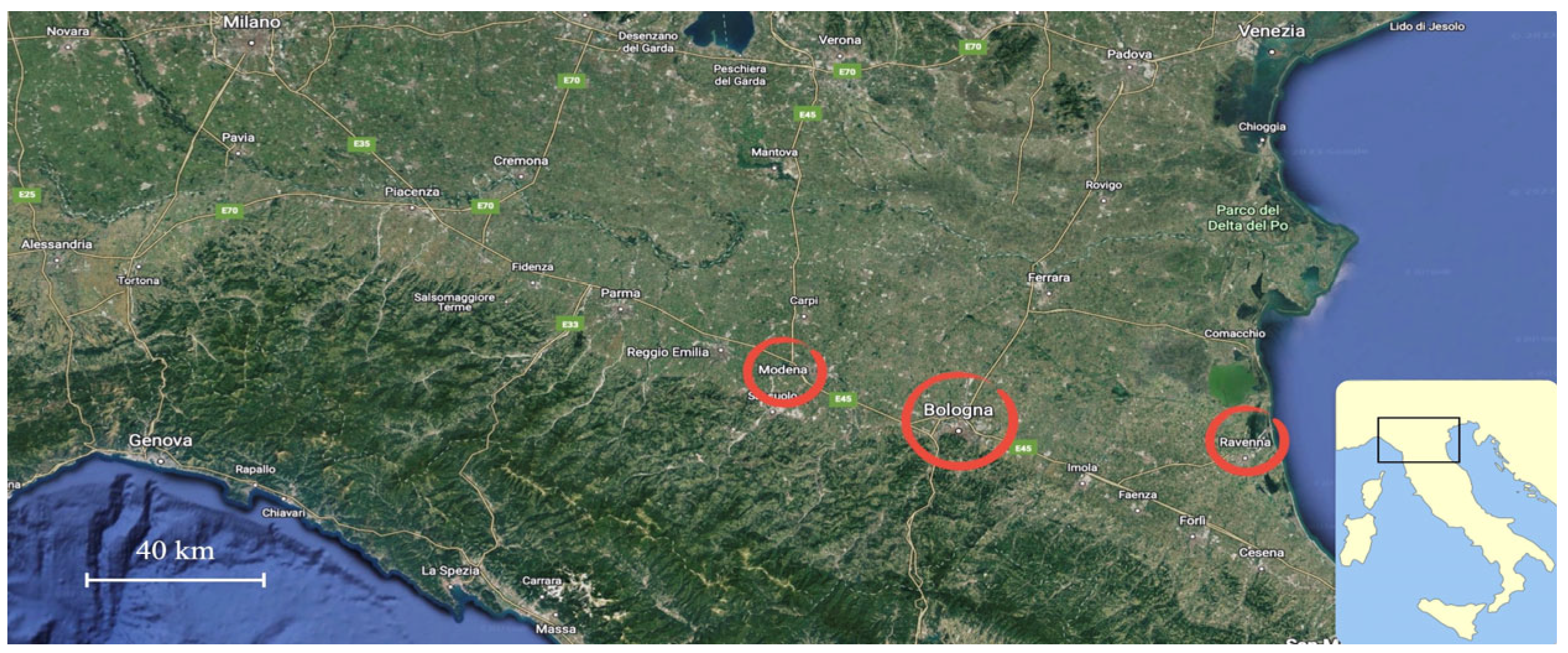

Table 1.
Population and extension of three case studies.
| Bologna | Modena | Ravenna | |
| Population | 391,686 | 184,971 | 157,262 |
| Extension (ha) | 14,100 | 18,300 | 65,300 |
Table 2.
Example of comparative analysis between SECAP and GUP actions in Bologna case study, in three categories considered relevant to energy efficiency and resilience.
Table 2.
Example of comparative analysis between SECAP and GUP actions in Bologna case study, in three categories considered relevant to energy efficiency and resilience.
| SECAP Actions | Categories | GUP Actions |
|---|---|---|
| Mapping of the energy performance of buildings, actual energy consumption, fuel systems to promote urban transformations towards zero-energy districts, ZED, or energy-producing districts, PED. | Energy efficiency of buildings | Planning measures to encourage renovation and efficiency of the existing building stock. National energy incentives optimisation. Excellent energy performance for urban requirements for interventions above a certain size. |
| Dissemination and promotion of energy communities by granting public areas to set up large-scale photovoltaic plants to combat energy poverty. | Energy production from renewable sources | Planning the implementation of energy production plants from renewable sources by creating local distribution networks and energy communities |
| Increasing of Logistics efficiency with the creation of Proximity Logistics Spaces and Urban Freight Consolidation Centres. Use of zero-emission vehicles. | Transport | Implementation of the Sustainable Logistics Urban Plan to locate and regulate spaces dedicated to freight exchange such as Proximity Logistics Spaces and Urban Freight Consolidation Centres. |
Table 3.
Example of comparative analysis between SECAP and GUP actions in Modena case study, in three categories considered relevant to energy efficiency and resilience.
Table 3.
Example of comparative analysis between SECAP and GUP actions in Modena case study, in three categories considered relevant to energy efficiency and resilience.
| SECAP Actions | Categories | GUP Actions |
|---|---|---|
| Palazzo Ducale di Modena energy efficiency project. | Energy efficiency of buildings | Regeneration discipline for transformations to foster widespread energy efficiency, seismic safety, urban comfort, including through complex urban projects. |
| Regeneration of former Cattle Market area with the realisation of new office buildings with high energy performance. | ||
| HPE-COXA renovation project. High-performance energy and environmental company buildings with solutions such as green roofs, rainwater harvesting, photovoltaic panels. | Industry | Measures supporting ecological qualification of production facilities. Improvement of the energy and environmental performance of production sites also through conversion into Eco Industrial Districts (APEA). |
| Citizenship awareness initiatives to promote sustainable mobility. | Information, awareness and participation | No specific awareness actions in the Modena GUP. |
| Working group, fostered by the local University, with the aim of developing initiatives to raise awareness of sustainability, energy and mobility issues for staff and students. |
Table 4.
Example of comparative analysis between SECAP and GUP actions in Ravenna case study, in three categories considered relevant to energy efficiency and resilience.
Table 4.
Example of comparative analysis between SECAP and GUP actions in Ravenna case study, in three categories considered relevant to energy efficiency and resilience.
| SECAP Actions | Categories | GUP Actions |
|---|---|---|
| Mapping of the energy performance of buildings, actual energy consumption, fuel systems to promote urban transformations towards zero-energy districts, ZED, or energy-producing districts, PED. | Energy efficiency of buildings | Planning measures to encourage renovation and efficiency of the existing building stock. National energy incentives optimisation. Excellent energy performance for urban requirements for interventions above a certain size. |
| Expected increase in photovoltaics due to national energy programs such as the 110% superbonus and the construction of energy communities. | Energy production from renewable sources | Requirements to include an emission balance in relevant agricultural transformations. Promotion of agricultural solar parks with renewable roofing. |
| Information and awareness-raising campaigns on climate change and energy issues. | Information, awareness and participation | Fostering of green communities for waste and energy management, with the participation of inhabitants. |
Table 5.
Summary of the integration between SECAPs and GUPs in the 3 case studies. In bold the features considered more connected to the energy-related issues.
Table 5.
Summary of the integration between SECAPs and GUPs in the 3 case studies. In bold the features considered more connected to the energy-related issues.
| Categories | SECAP-GUP Integration | ||
| Bologna | Modena | Ravenna | |
| General strategies | Excellent | Good | Very Good |
| Energy efficiency of buildings | Excellent | Very Good | Very Good |
| Street lighting | Very Good | Poor | Good |
| Transport | Excellent | Very Good | Very Good |
| Energy production from renewable sources | Very Good | Good | Very Good |
| Waste cycle | Good | Poor | Good |
| Information, awareness and participation | Poor | Poor | Good |
| Agriculture | Good | Very Good | Poor |
| Industry | Very Good | Very Good | Poor |
| Hydraulic Safety | Excellent | Excellent | Excellent |
| Water quality and availability | Very Good | Excellent | Good |
| Urban heat comfort | Excellent | Very Good | Excellent |
| Emergency planning and management | Very Good | Poor | Excellent |
| Subsidence | Not treated | Poor | Excellent |
Disclaimer/Publisher’s Note: The statements, opinions and data contained in all publications are solely those of the individual author(s) and contributor(s) and not of MDPI and/or the editor(s). MDPI and/or the editor(s) disclaim responsibility for any injury to people or property resulting from any ideas, methods, instructions or products referred to in the content. |
© 2024 by the authors. Licensee MDPI, Basel, Switzerland. This article is an open access article distributed under the terms and conditions of the Creative Commons Attribution (CC BY) license (http://creativecommons.org/licenses/by/4.0/).
Copyright: This open access article is published under a Creative Commons CC BY 4.0 license, which permit the free download, distribution, and reuse, provided that the author and preprint are cited in any reuse.


