
Submitted:
31 January 2024
Posted:
01 February 2024
You are already at the latest version
Abstract
Due to the major impact of climate change on the world's environment, political and economic systems, climate change mitigation has become a pressing priority for the international community and requires rapid action from the whole society. With the continuous advancement of artificial intelligence research, the integration of AI and other technologies makes it more and more used in the whole society. It has become a promising and innovative avenue in the field of climate change mitigation. This paper comprehensively considers the key role of AI technology in the field of climate change mitigation, such as climate modeling, the optimization of renewable energy systems, the development of intelligent solutions for sustainable practices and CSS technology, and affirms its future prospects. It also describes the challenges of AI in the field of climate change mitigation. As researchers, policymakers, and industries collaborate to refine AI methodologies and integrate them into practical applications, a concerted effort is required to establish ethical guidelines, transparency standards, and inclusive governance frameworks.
Keywords:
Climate change mitigation
; Artificial Intelligence
; Traditional AI
1. Climate Change Mitigation
Climate change mitigation refers to the systematic efforts and strategies implemented to reduce or prevent the emission of greenhouse gases [1] and mitigate the impact of human activities on the Earth’s climate. The urgency of addressing climate change has become a global priority [2], given the severe consequences of rising temperatures, extreme weather events, and disruptions to ecosystems. This field involves a comprehensive understanding of the complex interactions between human activities, natural processes, and the Earth’s climate system.
Figure 1.
The urgency of addressing climate change.

At its core, climate change mitigation focuses on decreasing the overall carbon footprint by transitioning from fossil fuel-based energy sources to sustainable and renewable alternatives [3]. This transition encompasses various sectors [4], including energy production, transportation, industry, and agriculture. Through the adoption of cleaner technologies, energy efficiency measures, and sustainable practices, nations aim to reduce their greenhouse gas emissions [5] and contribute to the global effort to limit the average temperature increase.
Artificial intelligence (AI) has emerged as a crucial tool in the realm of climate change mitigation. Machine learning algorithms [6] can analyze vast datasets to identify patterns, optimize energy consumption, and improve the efficiency of renewable energy sources. Additionally, AI plays a pivotal role in climate modeling [4], helping scientists simulate and understand the complex dynamics of the Earth’s climate system. By providing accurate predictions [7] and insights, AI empowers policymakers and stakeholders to make informed decisions in their pursuit of sustainable and climate-friendly policies.
One notable application of AI in climate change mitigation is the development of smart grids and energy management systems [8]. These systems leverage AI algorithms to optimize the distribution of energy, balance supply and demand, and integrate renewable energy sources seamlessly into the existing infrastructure. Furthermore, AI-driven technologies contribute to enhancing the resilience of communities by providing early warning systems for extreme weather events and supporting adaptive measures.
As the global community faces the imperative to mitigate climate change, ongoing research and innovation in artificial intelligence continue to shape and enhance our capabilities [4]. Whether through advanced climate modeling, optimization of renewable energy systems, or the development of intelligent solutions for sustainable practices [9], AI holds promise as a transformative force in the collective effort to address one of the most pressing challenges of our time.
This paper begins with traditional AI approaches, providing a historical perspective essential for appreciating the ongoing evolution of AI. Secondly, the rise of machine learning, deep learning and neural network architectures pushed AI into new territory, shifting from a rules-based symbolic approach to a data-driven paradigm. Then, the role of AI in mitigating climate change is introduced in terms of climate modeling, optimization of renewable energy systems, development of smart solutions for sustainable practices, and CSS technology. Eventually, the challenges of AI in mitigating climate change and how to deal with them are analyzed.
2. Traditional Artificial Intelligence Methods
Traditional artificial intelligence methods refer to the foundational approaches and techniques that paved the way [10] for the development of intelligent systems before the advent of more recent advancements like deep learning [11]. These methods are characterized by their rule-based, symbolic, and knowledge-driven nature, relying on explicit representations of knowledge and logical reasoning [12].
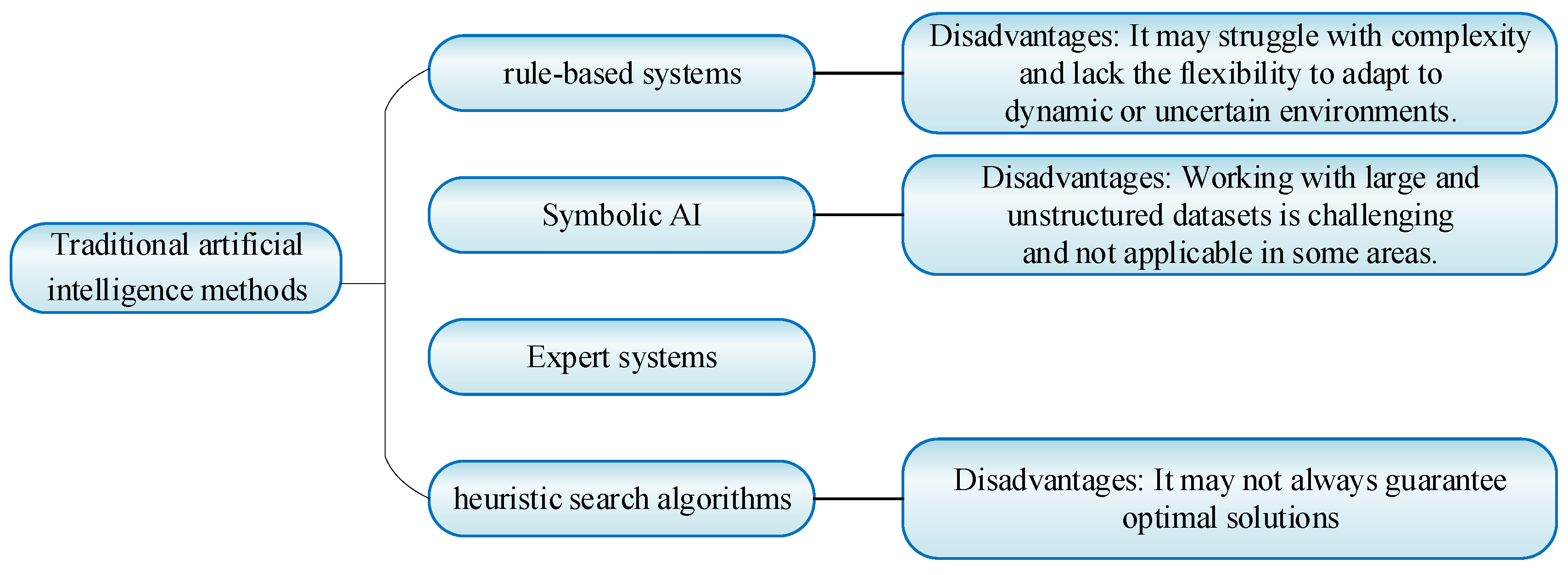
One key aspect of traditional AI methods involves rule-based systems, where explicit rules and logic are defined [13] to solve specific problems. These systems rely on a set of predefined rules and conditions, making decisions based on logical deductions. While effective for certain applications, rule-based approaches may struggle with complexity and may lack the flexibility to adapt to dynamic or uncertain environments.
Symbolic AI [14], another traditional approach, focuses on representing knowledge using symbols and relationships. This method involves the creation of knowledge bases, where information is stored in a structured format. Symbolic reasoning allows for the manipulation of symbols to derive new knowledge or make decisions. However, scaling symbolic AI to handle large and unstructured datasets can be challenging, limiting its applicability in certain domains.
Expert systems represent a notable application of traditional AI, where knowledge from human experts is codified into a computer program [15]. These systems aim to emulate the decision-making capabilities of human experts in specific domains. Expert systems played a significant role in areas such as medical diagnosis, finance, and engineering, providing valuable insights based on predefined rules and knowledge.

Table 1.
Advantages of traditional AI.
| Methods | Advantage or use |
| Rule-based systems | Making decisions based on logical deductions |
| Symbolic AI | Allowing for the manipulation of symbols to make decisions |
| Expert systems | Emulating the decision-making capabilities of human experts in specific domains |
| Heuristic search algorithms | Find solutions to problems by exploring possible paths in a search space |
Traditional AI methods also encompass heuristic search algorithms, which are used to find solutions to problems by exploring possible paths in a search space [16]. Algorithms like depth-first search, breadth-first search, and A* search are examples of heuristic search techniques employed in problem-solving. While effective in certain scenarios, these methods may face challenges in handling large search spaces and may not always guarantee optimal solutions.
Traditional artificial intelligence methods have laid the groundwork for the field, offering valuable insights into rule-based reasoning, symbolic representation, expert systems, and heuristic search. While these approaches have made significant contributions, the field has evolved with the rise of machine learning and deep learning [17], which leverage data-driven methods to discover patterns and make predictions. Understanding the strengths and limitations of traditional AI methods provides a historical perspective essential for appreciating the ongoing evolution of artificial intelligence.
Figure 2.
Introduction of Traditional artificial intelligence.
3. Recent AI Methods
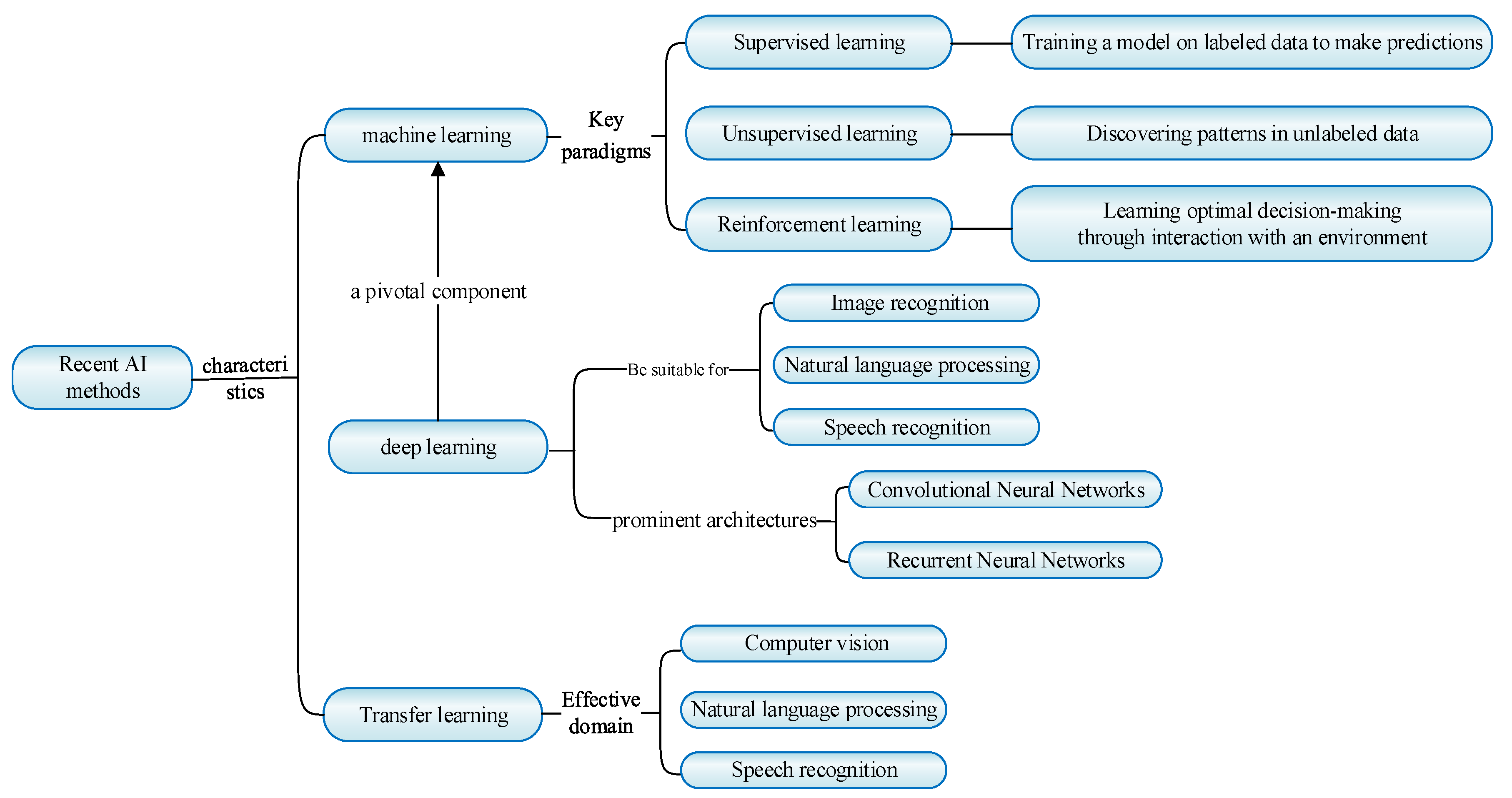
Recent AI methods represent the cutting-edge advancements in the field, characterized by the rise of machine learning, deep learning, and neural network architectures [18]. These methods have propelled artificial intelligence into new frontiers [19], enabling systems to learn from data, recognize patterns, and make predictions with remarkable accuracy. The shift towards data-driven approaches has been instrumental in solving complex[18] problems and has found applications across diverse domains [20].
Machine learning, a pivotal component of recent AI methods, involves the development of algorithms that enable systems to learn patterns from data without explicit programming [21]. Supervised learning [22], unsupervised learning [23], and reinforcement learning are key paradigms within machine learning, each offering unique capabilities. Supervised learning involves training a model on labeled data to make predictions, unsupervised learning discovers patterns in unlabeled data, and reinforcement learning [24] focuses on learning optimal decision-making through interaction with an environment.
Deep learning, a subset of machine learning [25], has gained immense popularity for its ability to automatically learn hierarchical representations of data. Neural networks with multiple layers (deep neural networks) can capture intricate features and relationships [26], making them well-suited for tasks such as image recognition [27], natural language processing, and speech recognition [28]. Convolutional Neural Networks (CNNs) and Recurrent Neural Networks (RNNs) [29] are prominent architectures within deep learning, each tailored for specific types of data and tasks.
Transfer learning is another recent AI method that leverages pre-trained models on large datasets to boost performance on new, related tasks with limited data [30]. This approach facilitates the transfer of knowledge from one domain to another, enabling more efficient training and improved generalization [31]. Transfer learning has proven effective in various applications, including computer vision, natural language processing, and speech recognition.
Figure 3.
Recent AI methods.
The integration of AI methods with big data technologies has been a significant trend [32]. The ability to process and analyze massive datasets [33] has empowered AI systems to derive meaningful insights and predictions. Cloud computing platforms and distributed computing frameworks have played a crucial role in facilitating the scalability and accessibility of AI methods, enabling organizations to harness the power of AI for diverse applications.
Recent AI methods mark a paradigm shift from rule-based, symbolic approaches to data-driven methodologies. Machine learning, deep learning, transfer learning, and the synergy with big data technologies have propelled AI to unprecedented levels of performance and applicability. As research in AI continues to advance, these recent methods will likely contribute to addressing complex challenges and unlocking new possibilities in fields ranging from healthcare [34] and finance to autonomous systems and robotics [35].
Table 2.
The integration of AI methods with big data technologies.
| Content | Description |
| Recent AI methods | Marking a paradigm shift from rule-based, symbolic approaches to data-driven methodologies |
| Processing and analyzing massive datasets | Deriving meaningful insights and predictions |
| Cloud computing platforms and distributed computing frameworks |
Facilitating the scalability and accessibility of AI methods |
| Machine learning, deep learning, transfer learning, and the synergy with big data technologies | Propelling AI to unprecedented levels of performance and applicability |
3. AI for Climate Change Mitigation
AI for climate change mitigation represents a promising and innovative avenue [36] for addressing the urgent global challenge of reducing greenhouse gas emissions and mitigating the impact of climate change. As the consequences of climate change become increasingly evident, researchers and policymakers are exploring the integration of artificial intelligence (AI) technologies to develop effective and sustainable solutions. This interdisciplinary approach leverages the power of AI to enhance our understanding of climate systems [37], optimize resource utilization, and facilitate the transition to a low-carbon economy.
One key application of AI in climate change mitigation is in the field of climate modeling [38]. Advanced machine learning algorithms can analyze vast datasets, including historical climate data, satellite observations, and simulation outputs, to improve the accuracy and precision of climate models. By incorporating AI-driven insights, scientists can better understand complex climate interactions, anticipate changes, and refine predictions [39], ultimately aiding in the development of informed policies and mitigation strategies.
Renewable energy plays a pivotal role in mitigating climate change, and AI technologies contribute significantly to optimizing the efficiency and integration of renewable energy sources. AI-driven systems can enhance the forecasting of renewable energy production [40], helping grid operators balance supply and demand. Additionally, AI supports the design and management of smart grids, enabling better control and distribution of energy resources. These advancements are crucial for transitioning away from fossil fuels and promoting the widespread adoption of clean and sustainable energy solutions.
In agriculture, AI applications contribute to climate change mitigation by optimizing resource usage and improving crop yield predictions [41]. AI-driven precision agriculture techniques can enhance the efficiency of irrigation systems [42], minimize pesticide and fertilizer usage, and reduce overall environmental impact. These technologies empower farmers to make data-driven decisions [43], promoting sustainable practices and resilience [44] in the face of changing climate conditions.
The development of AI-enhanced carbon capture and storage (CCS) technologies is another area of focus for climate change mitigation [45]. AI algorithms can assist in identifying optimal locations for carbon capture facilities, predicting storage site viability, and optimizing the operation of CCS infrastructure [46]. These advancements are essential for achieving the necessary reductions in carbon dioxide emissions and meeting climate targets.
Table 3.
AI for Climate Change Mitigation.
| Avenue | Mode of action | Fruit |
| Reducing greenhouse gas emissions |
effective and sustainable solutions enhance understanding | Optimize resource utilization facilitate the transition to a low-carbon economy |
| Climate modeling | Improve the accuracy and precision | Aiding in the development of informed policies and mitigation strategies |
| Renewable energy | Enhance the forecasting balance supply and demand |
Promoting the widespread adoption of clean and sustainable energy |
| Better control and distribution of energy resources | ||
| Agriculture | Enhance the efficiency of irrigation systems | Reduce overall environmental impact |
| Empower farmers to make data-driven decisions | Promoting sustainable practices and resilience | |
| Carbon capture and storage |
Optimizing the operation of CSS infrastructure | Reduction in carbon dioxide emissions |
AI for climate change mitigation is not only about technological innovations but also involves addressing societal challenges [47]. The deployment of AI technologies must consider ethical considerations, including issues related to fairness, transparency, and access to benefits. Ensuring that AI solutions do not exacerbate existing social inequalities and that they are accessible to diverse communities is crucial for fostering sustainable and inclusive climate mitigation efforts.
Collaboration between governments, industries, and researchers is essential for realizing the full potential of AI in climate change mitigation. Policymakers play a critical role in creating a regulatory framework that encourages the responsible deployment [48] of AI technologies while fostering innovation. International cooperation can facilitate the exchange of knowledge, data, and best practices, allowing for a more comprehensive and coordinated global approach to addressing climate change [49].
AI for climate change mitigation holds great promise in revolutionizing our approach to addressing the complex challenges posed by global warming [50]. From improving climate models to optimizing renewable energy systems and promoting sustainable practices in agriculture [51], the integration of AI technologies offers a multifaceted and holistic strategy for mitigating the impact of climate change on a global scale [37]. However, it is imperative to approach these innovations with careful consideration of ethical, social, and regulatory dimensions to ensure that AI becomes a force for positive change in the fight against climate change.
4. Challenges of AI for Climate Change Mitigation
AI for climate change mitigation, while holding great promise, is not without its challenges.
Figure 4.
Challenges of AI for Climate Change Mitigation.
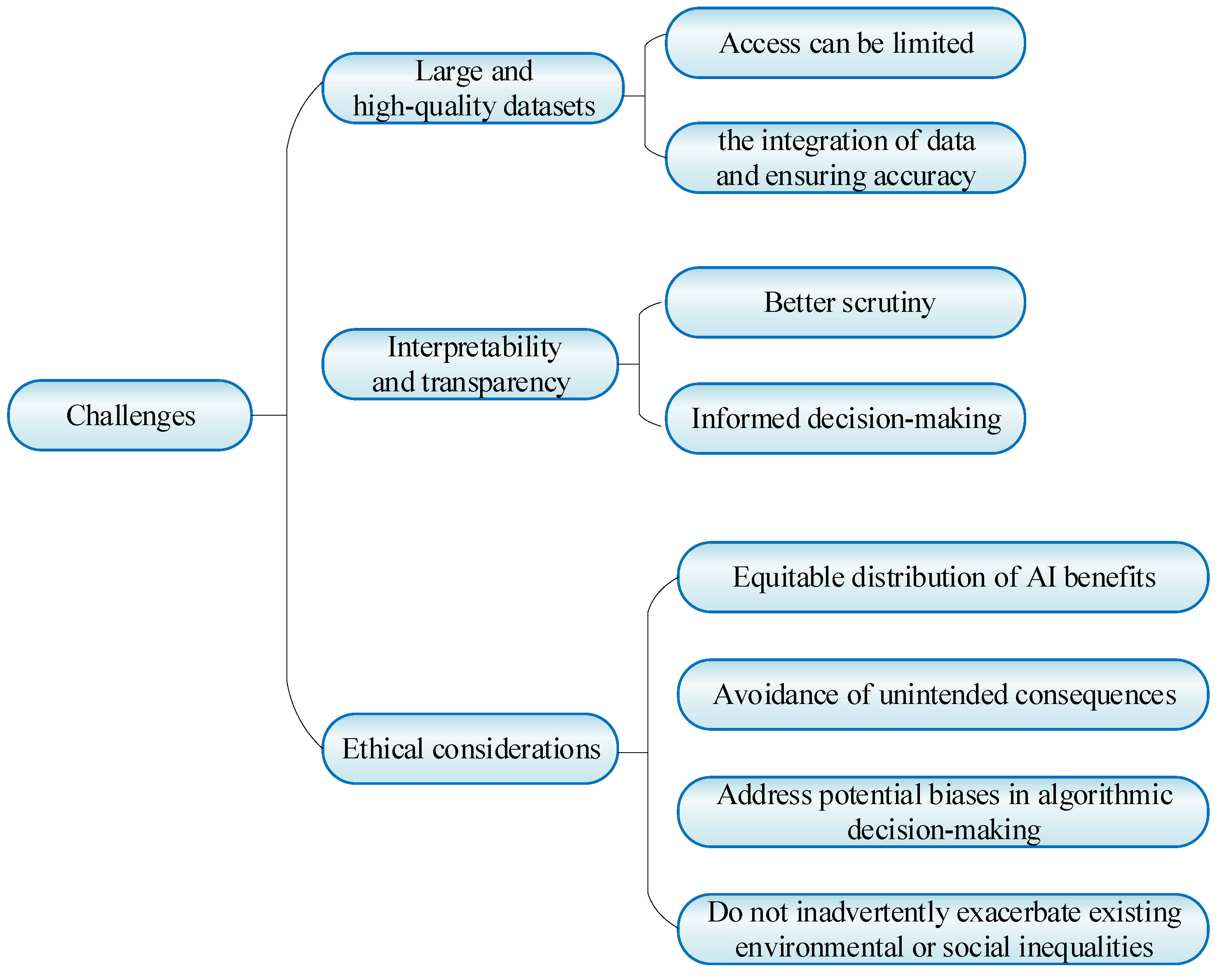
One significant challenge is the need for large and high-quality datasets for effective AI modeling [52]. Climate data, often spanning diverse and complex variables [53], requires extensive datasets for training accurate and reliable models. Access to such comprehensive datasets can be limited, hindering the development of robust AI solutions. Additionally, the integration of data from different sources [54,55] and ensuring its accuracy and representativeness pose challenges that must be addressed to enhance the effectiveness of AI applications in climate change mitigation.
Another challenge lies in the interpretability and transparency of AI models deployed for climate-related tasks. Given the critical nature of decisions based on climate data, stakeholders and policymakers require a clear understanding of how AI systems reach their conclusions. Ensuring the transparency of AI algorithms in climate change applications is essential for building trust and facilitating the adoption of AI-driven solutions. Researchers and practitioners in the field are actively exploring methods for making AI models more interpretable [56], allowing for better scrutiny and informed decision-making.
Ethical considerations also play a significant role in the challenges of AI for climate change mitigation. The equitable distribution of AI benefits, avoidance of unintended consequences, and addressing potential biases in algorithmic decision-making are crucial aspects of the ethical dimension. Ensuring that AI solutions do not inadvertently exacerbate existing environmental or social inequalities [57] is essential. Moreover, the responsible use of AI technologies in climate-related applications necessitates adherence to ethical standards to prevent unintended negative impacts on vulnerable communities and ecosystems. Addressing these challenges requires collaboration among researchers, policymakers, and stakeholders to establish ethical guidelines and governance frameworks for the responsible deployment of AI in climate change mitigation efforts [58].
5. Conclusion
In conclusion, the intersection of artificial intelligence (AI) and climate change mitigation represents a dynamic and promising field with the potential to significantly transform our approach to addressing the global climate crisis [59]. AI technologies offer innovative solutions across various domains, including climate modeling, renewable energy optimization, agriculture, and carbon capture. The ability of AI to analyze vast datasets, identify patterns, and make informed predictions has the potential to enhance our understanding of climate systems and facilitate the development of effective mitigation strategies.
While the prospects are encouraging, it is crucial to address the challenges associated with the responsible deployment of AI in climate change mitigation. Overcoming issues related to data availability [60], model interpretability [61], and ethical considerations is essential for ensuring the reliability and fairness of AI-driven solutions. As researchers, policymakers, and industries collaborate to refine AI methodologies and integrate them into practical applications, a concerted effort is required to establish ethical guidelines, transparency standards, and inclusive governance frameworks [62]. By navigating these challenges, the fusion of AI and climate change mitigation can contribute significantly to building a sustainable and resilient future, where technology plays a pivotal role in achieving environmental goals and fostering global collaboration for a healthier planet.
Data Availability Statement
There is no data associated with this paper.
Acknowledgments
We thank all the anonymous reviewers for their hard reviewing work.
Conflicts of Interest
The author declares there is no conflict of interest regarding this paper.
References
- M. Cai, I. Murtazashvili, J. B. Murtazashvili, and R. Salahodjaev, “Patience and climate change mitigation: Global evidence,” Environmental Research, vol. 186, 2020. [CrossRef]
- R. Raper, J. Boeddinghaus, M. Coeckelbergh, W. Gross, P. Campigotto, and C. N. Lincoln, “Sustainability Budgets: A Practical Management and Governance Method for Achieving Goal 13 of the Sustainable Development Goals for AI Development,” Sustainability, vol. 14, 2022. [CrossRef]
- E. Scholtz, A. Oudalov, and I. Harjunkoski, “Power systems of the future,” Computers & Chemical Engineering, vol. 180, 2024.
- L. H. Kaack, P. L. Donti, E. Strubell, G. Kamiya, F. Creutzig, and D. Rolnick, “Aligning artificial intelligence with climate change mitigation,” Nature Climate Change, vol. 12, pp. 518-527, 2022. [CrossRef]
- J. Fuglestvedt, J. Rogelj, R. J. Millar, M. Allen, O. Boucher, M. Cain, et al., “Implications of possible interpretations of ‘greenhouse gas balance’ in the Paris Agreement,” Philos Trans A Math Phys Eng Sci, vol. 376, 2018.
- Portugal, P. Alencar, and D. Cowan, “The use of machine learning algorithms in recommender systems: A systematic review,” Expert Systems with Applications, vol. 97, pp. 205-227, 2018. [CrossRef]
- R. Nishant, M. Kennedy, and J. Corbett, “Artificial intelligence for sustainability: Challenges, opportunities, and a research agenda,” International Journal of Information Management, vol. 53, 2020.
- Joshi, S. Capezza, A. Alhaji, and M.-Y. Chow, “Survey on AI and Machine Learning Techniques for Microgrid Energy Management Systems,” IEEE/CAA Journal of Automatica Sinica, vol. 10, pp. 1513-1529, 2023. [CrossRef]
- R. Vinuesa, H. Azizpour, I. Leite, M. Balaam, V. Dignum, S. Domisch, et al., “The role of artificial intelligence in achieving the Sustainable Development Goals,” Nature Communications, vol. 11, 2020. [CrossRef]
- S. Wang, “Deep learning for COVID-19 diagnosis via chest images,” Computers, Materials & Continua, vol. 76, pp. 129-132, 2023. [CrossRef]
- Y. Guo, Y. Liu, A. Oerlemans, S. Lao, S. Wu, and M. S. Lew, “Deep learning for visual understanding: A review,” Neurocomputing, vol. 187, pp. 27-48, 2016. [CrossRef]
- X. Jiang, “Deep Learning for Medical Image-Based Cancer Diagnosis,” Cancers, vol. 15, p. 3608, 2023. [CrossRef]
- N. H. Siddique, B. P. Amavasai, and A. Ikuta, “Editorial: Hybrid Techniques in AI,” Artificial Intelligence Review, vol. 27, pp. 77-78, 2008. [CrossRef]
- R. Hoehndorf, N. Queralt-Rosinach, and T. Kuhn, “Data Science and symbolic AI: Synergies, challenges and opportunities,” Data Science, vol. 1, pp. 27-38, 2017.
- D. Harel, R. Yerushalmi, A. Marron, and A. Elyasaf, “Categorizing methods for integrating machine learning with executable specifications,” Science China Information Sciences, vol. 67, 2023. [CrossRef]
- W. He, X. Li, X. Song, Y. Hao, R. Zhang, Z. Du, et al., “Chip design with machine learning: a survey from algorithm perspective,” Science China Information Sciences, vol. 66, 2023. [CrossRef]
- B. Zhang, J. Zhu, and H. Su, “Toward the third generation artificial intelligence,” Science China Information Sciences, vol. 66, 2023. [CrossRef]
- L. Cao, “Deep Learning Applications,” IEEE Intelligent Systems, vol. 37, pp. 3-5, 2022.
- J. Wang, “Deep learning in pediatric neuroimaging,” Displays, vol. 80, p. 102583, 2023.
- J. J. Wang, “SNSVM: SqueezeNet-Guided SVM for Breast Cancer Diagnosis,” CMC-Computers Materials & Continua, vol. 76, pp. 2201-2216, 2023.
- M. Zemelka-Wiacek, I. Agache, C. A. Akdis, M. Akdis, T. B. Casale, S. Dramburg, et al., “Hot topics in allergen immunotherapy, 2023: Current status and future perspective,” Allergy, 2023.
- T. Jiang, J. L. Gradus, and A. J. Rosellini, “Supervised Machine Learning: A Brief Primer,” Behav Ther, vol. 51, pp. 675-687, 2020. [CrossRef]
- Munoz-Martin, S. Bianchi, G. Pedretti, O. Melnic, S. Ambrogio, and D. Ielmini, “Unsupervised Learning to Overcome Catastrophic Forgetting in Neural Networks,” IEEE Journal on Exploratory Solid-State Computational Devices and Circuits, vol. 5, pp. 58-66, 2019. [CrossRef]
- Y. Matsuo, Y. LeCun, M. Sahani, D. Precup, D. Silver, M. Sugiyama, et al., “Deep learning, reinforcement learning, and world models,” Neural Networks, vol. 152, pp. 267-275, 2022.
- C. Janiesch, P. Zschech, and K. Heinrich, “Machine learning and deep learning,” Electronic Markets, vol. 31, pp. 685-695, 2021.
- Y. Zhang and J. Wang, “Deep Learning and Vision Transformer for Medical Image Analysis,” Journal of Imaging, vol. 9, p. 147, 2023. [CrossRef]
- Y. Chen, Y. Huang, Z. Zhang, Z. Wang, B. Liu, C. Liu, et al., “Plant image recognition with deep learning: A review,” Computers and Electronics in Agriculture, vol. 212, 2023. [CrossRef]
- Z. Song, “English speech recognition based on deep learning with multiple features,” Computing, vol. 102, pp. 663-682, 2019. [CrossRef]
- Barredo Arrieta, N. Díaz-Rodríguez, J. Del Ser, A. Bennetot, S. Tabik, A. Barbado, et al., “Explainable Artificial Intelligence (XAI): Concepts, taxonomies, opportunities and challenges toward responsible AI,” Information Fusion, vol. 58, pp. 82-115, 2020.
- E. Waisberg, J. Ong, S. A. Kamran, P. Paladugu, N. Zaman, A. G. Lee, et al., “Transfer learning as an AI-based solution to address limited datasets in space medicine,” Life Sciences in Space Research, vol. 36, pp. 36-38, 2023. [CrossRef]
- D. Rolnick, P. L. Donti, L. H. Kaack, K. Kochanski, A. Lacoste, K. Sankaran, et al., “Tackling Climate Change with Machine Learning,” ACM Computing Surveys, vol. 55, pp. 1-96, 2022. [CrossRef]
- M. G. W. Wei, S. H. Ahmed, C. Zhu, “Guest Editorial: Special Section on Integration of Big Data and Artificial Intelligence for Internet of Things,” IEEE Transactions on Industrial Informatics, vol. 16, pp. 2562-2565, 2020.
- S. Sai, V. Chamola, K.-K. R. Choo, B. Sikdar, and J. J. P. C. Rodrigues, “Confluence of Blockchain and Artificial Intelligence Technologies for Secure and Scalable Healthcare Solutions: A Review,” IEEE Internet of Things Journal, vol. 10, pp. 5873-5897, 2023. [CrossRef]
- S. Vatansever, A. Schlessinger, D. Wacker, H. Ü. Kaniskan, J. Jin, M. M. Zhou, et al., “Artificial intelligence and machine learning-aided drug discovery in central nervous system diseases: State-of-the-arts and future directions,” Medicinal Research Reviews, vol. 41, pp. 1427-1473, 2020.
- S. Cho, I. Kim, J. Kim, H. Woo, and W. Shin, “A Maturity Model for Trustworthy AI Software Development,” Applied Sciences, vol. 13, 2023. [CrossRef]
- W. Leal Filho, T. Wall, S. A. Rui Mucova, G. J. Nagy, A.-L. Balogun, J. M. Luetz, et al., “Deploying artificial intelligence for climate change adaptation,” Technological Forecasting and Social Change, vol. 180, 2022. [CrossRef]
- J. Cowls, A. Tsamados, M. Taddeo, and L. Floridi, “The AI gambit: leveraging artificial intelligence to combat climate change-opportunities, challenges, and recommendations,” AI Soc, vol. 38, pp. 283-307, 2023.
- T. Schneider, S. Behera, G. Boccaletti, C. Deser, K. Emanuel, R. Ferrari, et al., “Harnessing AI and computing to advance climate modelling and prediction,” Nature Climate Change, vol. 13, pp. 887-889, 2023. [CrossRef]
- S. Dewitte, J. P. Cornelis, R. Müller, and A. Munteanu, “Artificial Intelligence Revolutionises Weather Forecast, Climate Monitoring and Decadal Prediction,” Remote Sensing, vol. 13, 2021.
- H. Zhang, D. Yue, and X. Xie, “Distributed Model Predictive Control for Hybrid Energy Resource System With Large-Scale Decomposition Coordination Approach,” IEEE Access, vol. 4, pp. 9332-9344, 2016. [CrossRef]
- M. A. Goralski and T. K. Tan, “Artificial intelligence and sustainable development,” The International Journal of Management Education, vol. 18, 2020. [CrossRef]
- K. A. Sudduth, M. J. Woodward-Greene, B. W. Penning, M. A. Locke, A. R. Rivers, and K. S. Veum, “AI Down on the Farm,” IT Professional, vol. 22, pp. 22-26, 2020.
- S. A. Bhat and N.-F. Huang, “Big Data and AI Revolution in Precision Agriculture: Survey and Challenges,” IEEE Access, vol. 9, pp. 110209-110222, 2021. [CrossRef]
- J. Jung, M. Maeda, A. Chang, M. Bhandari, A. Ashapure, and J. Landivar-Bowles, “The potential of remote sensing and artificial intelligence as tools to improve the resilience of agriculture production systems,” Current Opinion in Biotechnology, vol. 70, pp. 15-22, 2021. [CrossRef]
- C. Zahasky and S. Krevor, “Global geologic carbon storage requirements of climate change mitigation scenarios,” Energy & Environmental Science, vol. 13, pp. 1561-1567, 2020. [CrossRef]
- Q. Qerimi and B. S. Sergi, “The case for global regulation of carbon capture and storage and artificial intelligence for climate change,” International Journal of Greenhouse Gas Control, vol. 120, 2022. [CrossRef]
- N. A. Menad, A. Hemmati-Sarapardeh, A. Varamesh, and S. Shamshirband, “Predicting solubility of CO2 in brine by advanced machine learning systems: Application to carbon capture and sequestration,” Journal of CO2 Utilization, vol. 33, pp. 83-95, 2019. [CrossRef]
- R. Madhavan, J. A. Kerr, A. R. Corcos, and B. P. Isaacoff, “Toward Trustworthy and Responsible Artificial Intelligence Policy Development,” IEEE Intelligent Systems, vol. 35, pp. 103-108, 2020. [CrossRef]
- K. A. Garrett, D. P. Bebber, B. A. Etherton, K. M. Gold, A. I. Plex Sula, and M. G. Selvaraj, “Climate Change Effects on Pathogen Emergence: Artificial Intelligence to Translate Big Data for Mitigation,” Annu Rev Phytopathol, vol. 60, pp. 357-378, 2022. [CrossRef]
- L. Gaur, A. Afaq, G. K. Arora, and N. Khan, “Artificial intelligence for carbon emissions using system of systems theory,” Ecological Informatics, vol. 76, 2023. [CrossRef]
- M. Awais, S. M. Z. A. Naqvi, H. Zhang, L. Li, W. Zhang, F. A. Awwad, et al., “AI and machine learning for soil analysis: an assessment of sustainable agricultural practices,” Bioresources and Bioprocessing, vol. 10, 2023. [CrossRef]
- M. Chantry, H. Christensen, P. Dueben, and T. Palmer, “Opportunities and challenges for machine learning in weather and climate modelling: hard, medium and soft AI,” Philos Trans A Math Phys Eng Sci, vol. 379, p. 20200083, 2021.
- S. Deb, S. Sidheekh, C. F. Clements, N. C. Krishnan, and P. S. Dutta, “Machine learning methods trained on simple models can predict critical transitions in complex natural systems,” R Soc Open Sci, vol. 9, p. 211475, 2022. [CrossRef]
- Y.-D. Zhang and Z.-C. Dong, “Advances in multimodal data fusion in neuroimaging: Overview, challenges, and novel orientation,” Information Fusion, vol. 64, pp. 149-187, 2020.
- S. Wang, “Advances in data preprocessing for biomedical data fusion: an overview of the methods, challenges, and prospects,” Information Fusion, vol. 76, pp. 376-421, 2021.
- T. Zhang, H. Qiu, M. Mellia, Y. Li, H. Li, and K. Xu, “Interpreting AI for Networking: Where We Are and Where We Are Going,” IEEE Communications Magazine, vol. 60, pp. 25-31, 2022. [CrossRef]
- M. Coeckelbergh, “AI for climate: freedom, justice, and other ethical and political challenges,” AI and Ethics, vol. 1, pp. 67-72, 2020. [CrossRef]
- N. A. Smuha, “The EU Approach to Ethics Guidelines for Trustworthy Artificial Intelligence,” Computer Law Review International, vol. 20, pp. 97-106, 2019. [CrossRef]
- S. Khareghani, “Capitalizing on AI?s Potential to Help Tackle the Climate Crisis [Opinion],” IEEE Technology and Society Magazine, vol. 39, pp. 41-47, 2020. [CrossRef]
- Polyviou and E. D. Zamani, “Are we Nearly There Yet? A Desires & Realities Framework for Europe’s AI Strategy,” Information Systems Frontiers, vol. 25, pp. 143-159, 2022. [CrossRef]
- K. Kobayashi and S. B. Alam, “Explainable, interpretable, and trustworthy AI for an intelligent digital twin: A case study on remaining useful life,” Engineering Applications of Artificial Intelligence, vol. 129, 2024. [CrossRef]
- V. Almeida, L. S. Mendes, and D. Doneda, “On the Development of AI Governance Frameworks,” IEEE Internet Computing, vol. 27, pp. 70-74, 2023. [CrossRef]
Disclaimer/Publisher’s Note: The statements, opinions and data contained in all publications are solely those of the individual author(s) and contributor(s) and not of MDPI and/or the editor(s). MDPI and/or the editor(s) disclaim responsibility for any injury to people or property resulting from any ideas, methods, instructions or products referred to in the content. |
© 2024 by the authors. Licensee MDPI, Basel, Switzerland. This article is an open access article distributed under the terms and conditions of the Creative Commons Attribution (CC BY) license (http://creativecommons.org/licenses/by/4.0/).
Copyright: This open access article is published under a Creative Commons CC BY 4.0 license, which permit the free download, distribution, and reuse, provided that the author and preprint are cited in any reuse.


