

Submitted:
19 January 2024
Posted:
23 January 2024
You are already at the latest version
Abstract
Effectively addressing juvenile delinquency among adolescents in Nigeria necessitates a keen focus on parenting styles and family structures. Given that parents serve as primary custodians and paramount influencers in socializing their children, their pivotal roles cannot be understated. When parents conscientiously strive to exemplify positive role models for their children, the likelihood of yielding optimal and desired outcomes is significantly enhanced. Regrettably, a considerable number of parents have embraced parenting styles that inadvertently expose their children to various forms of juvenile delinquency. The article explores the complex relationship between parenting styles and juvenile delinquency, shedding light on the connections between family structure and delinquent behavior. Also, the connection between marital discord and juvenile delinquency as well as the impacts of single parenting, were explored. The theoretical framework employed in this article is the Social Learning Theory, formulated by Albert Bandura in 1977. The article underlines that a substantial portion of delinquent acts among adolescents can be attributed to familial discord and the specific parenting styles employed. Consequently, this study advocates for a paradigm shift towards more effective and constructive parenting styles. Additionally, it emphasizes the imperative for the government and relevant institutions to accord due importance to the institution of the family in their policies and interventions.
Keywords:
Adolescent
; Family
; Juvenile Parent
; Children
; Delinquency
; Single Parenting
Introduction
Despite the increasing impact of new agents of socialization, such as social networking and peer groups, on child behavior, and the ongoing trend in modernization, especially in the realm of child socialization, the family still occupies an unparalleled and unequalled position in the psycho-social well-being and development of a child. The family stands as the foremost and indeed, most important moderator of children's behavioral compositions and their perspectives on the social environment, particularly in the early stages. According to Mugo et al. (2016), the family influences the artistic, moral, social, and even spiritual formations of a child, activating the child's expedition into the wider and complex world. There is no doubt that the family is the first school that exposes a person to acceptable and tolerable social norms, guiding them on what to embrace or discard, what to appreciate or dispose of, and the possible ways to survive and deal with life challenges. The family institution plays irrefutable roles in a person's overall development, with the capacity to impact individuals either positively or negatively. For instance, poor parenting styles, insufficient and inadequate parental control, laughable upbringing, marital instability, infidelity, and the inability to provide a better environment for development can expose a child to delinquent acts (Dixon, 2017).
Wrongdoings and unexpected behaviors among juveniles are becoming exceedingly worrisome, especially for parents, teachers, government authorities, caretakers, and Nigerian society at large. Daily reports from news outlets highlight adolescents engaging in delinquent deeds such as stealing, ruthlessness, disrespecting elders, vandalism, examination malpractices, harassment, cultism, running away from home, and not abiding by the rules laid down by their communities (Aremu, 2020). This view is corroborated by Thisdaylive (2022) in a publication where it was reported that the tendency of teenagers to engage in criminal activities in Nigeria is increasing at a geometric progression. For example, on 4th of April, 2022, it was reported that the Ondo state Security network agency, also called ‘Amotekun’, apprehended two juveniles who engaged in armed robbery activities, Timilehin Femi, aged 12 and Ojo Sunday, aged 16, along with 20-year-old Odeyemi Ayodele, their supplier of weapons in Ijore, Ifedore local government area. In the same vein, it was reported that on March 5, 2022, 18-year-old Abdulsamad Suleiman alongside his accomplice, Mu’Azzam Lawani,17, were apprehended by the Kano state Police command in connecting with the suspected murder of 21-year-old housewife, Rukeyser Jamilu. Nigeria is currently experiencing an upsurge in juvenile delinquency, exacerbated by the nation's increasing complexity. With young ones having more access to the internet, social networking sites, meeting people of different backgrounds, and having more opportunities to join different social clubs, they are exposed to behaviors that may go against accepted norms. According to Eke (2019), delinquent acts among adolescents can be classified into two categories: status offenses (e.g., indolence, haughtiness, running away from home) and criminal offenses (e.g., stealing, cultism, vandalism, murder, pick-pocketing, rape, harassment, drug abuse).
Adolescence is a critical stage where young individuals are subjected to numerous choices in their social environment. Exposure to different social realities, together with the nature of family or parental upbringing, can modify or transform juvenile behaviors (Busari, 2010). Simply put, the type of influence parents have on adolescents may determine the kind of person or attributes possessed by such individuals. In a study carried out in very vulnerable areas of New York, USA, Craig and Cashwell (2019) found that the most effective way to help adolescents with behavioral difficulties is to focus on or assess their parental background. They also identified three important factors that can increase the possibility of delinquent behaviors among young individuals: (a) Insufficient or careless supervision of young ones by parents or step-parents, (b) Excessive discipline, whether physical or verbal, by parents or caretakers, and (c) Lack of unity or cohesiveness among family members or relatives.
According to Sheldon and Brown (2019), more than 65 percent of parents still use physical punishment while controlling their young ones; only 26.7 percent use verbal punishment. Although a high level of consistency and steadiness in discipline is needed to prevent or control delinquency among juveniles, such discipline must be viable and impactful. Parenting styles not only modify or influence behaviors of individuals when they are young, but they also influence their behaviors when they grow old and become parents – such reality may continue from one parent to another in the form of generational transmission.
Problem Statement
Family plays a significantly influential role in a person's life. It is imperative to examine how family structure and parenting style can shape the decision to engage in delinquent activities. For instance, being raised by a single parent, regardless of the reason such as death, separation/divorce, or imprisonment, can expose an adolescent to delinquent acts. Adolescents who experience a stable life, receive adequate parental supervision, and live in a supportive family environment with effective disciplinary measures for moral development are more likely to behave in acceptable ways compared to those raised in disruptive, unwelcoming, and traumatic homes, lacking proper care essential for social and moral development. In many cases, a child with only one parent is more likely to receive partial treatment and experience only half the guidance and supervision provided by both parents. This condition often leads the child in the wrong direction, engaging in actions like dropping out of school, running away from home, stealing, and other immoral habits. According to social learning theory, aggressive and hostile attitudes are learned, especially from parents. When parents display aggressive behavior towards a situation, young ones tend to emulate this behavior decisively to achieve their goals. While not all children born into conflicting families or raised by violating parents become criminals, exposure to violence and conflict can increase the likelihood of such children exhibiting anti-social behaviors. Family criminality, disharmony, marital infidelity, along with other social factors, may hinder adolescents from reaching their full potential. Positive parenting and a good parenting style are not only crucial during childhood but also during adolescence. When children receive optimal parental guidance, especially during adolescence, they may grow up to become responsible parents. Okpako (2004) suggests that parents should be held responsible for any deviant acts perpetrated by young ones, as their adopted parenting styles may not contribute to the proper development of their children in line with accepted social norms.
Researchers and sociologists continue to assess and investigate the links between parenting style, family background, and juvenile delinquent behaviors in Nigeria. However, most studies only cover specific populations and fail to provide comprehensive and universally applicable conclusions. Despite numerous academic researches and studies, issues regarding causal correlations between parenting styles and juvenile delinquency remain largely unresolved. Moreover, it is essential to recognize that parenting styles do not always lead to delinquent acts among young individuals, as evidence suggests that some adolescents from challenging parental backgrounds perform admirably and conform to recognized social norms. This research study aims to investigate the causative relationship between parenting styles and delinquent acts among adolescents, while also assessing the impact of family structure on juvenile delinquency.
Literature Review
Conceptualizing Juvenile Delinquency
Juvenile delinquency is a multifaceted and complex concept, with numerous causative factors contributing to its nature and scope. Defining the concept universally poses challenges, given the variations from one researcher to another and from one society to another. In simpler terms, juvenile delinquency refers to deviant behaviors carried out by teenagers who have not yet reached the legally approved adult age. Put succinctly, any deviant conduct exhibited by individuals under the age of 18 (as per the standards in many countries) falls under the classification of juvenile delinquency. According to Sambo (2008), juvenile delinquency encompasses offensive and prohibitive acts committed by young people, typically under the age of 21. While it might not be entirely logical to confine deviant acts to a specific age bracket, it is reasonable to conclude that delinquent behaviors are predominantly exhibited by young individuals within the age category recognized as legally underage by a given society. The Longman Dictionary defines juvenile delinquency as criminal or antisocial behavior by children—juveniles who are young, not fully matured to be considered adults, and not yet subject to prosecution in the traditional court of law. Essentially, as Nigeria undergoes a considerable degree of industrial development and experiences social diversities, more opportunities become available for young adolescents, potentially leading them towards engaging in antisocial activities (Odebunmi, 2007). Additionally, it can be argued that the family is gradually losing its position as a major influencer of social conduct among juveniles.
Categorizing Juvenile Delinquents in Nigeria
Essentially, a more effective approach to describing or explaining juvenile delinquency is through categorization. Juvenile delinquency, from the Nigerian perspective, is characterized by various crucial forms and traits. When discussing delinquent acts among young individuals, it is essential to recognize that these acts have their causes, categories, and driving forces. Some deviant acts among adolescents are very serious, such as killing, raping, and vandalizing, while others are more minor in nature, such as disobeying parental orders or refusing to come home on time. According to UNICEF Nigeria (2001), juvenile delinquency can be classified into different unique forms, and the table below is developed to illustrate these categories:
Figure 1.
UNICEF Nigeria (2001), juvenile delinquency Classification. Source: Author’s Compilation, 2023.
Figure 1.
UNICEF Nigeria (2001), juvenile delinquency Classification. Source: Author’s Compilation, 2023.
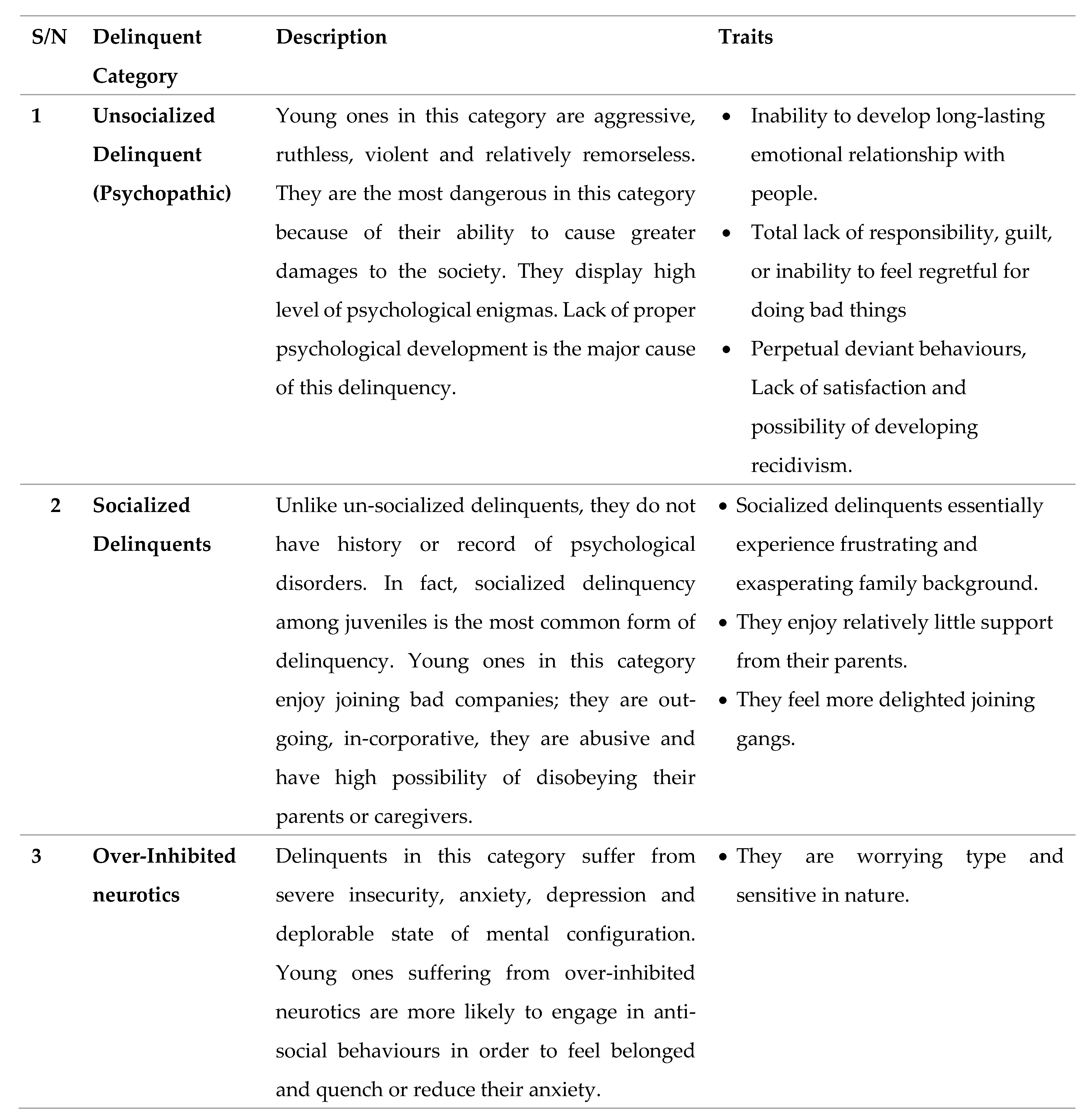
While there are many categories of juvenile delinquency, the role of parenting style and family structure in juvenile delinquency cannot be unrecognized. Whether a juvenile feels insecure, overprotected, or bullied, parents and caretakers are greatly answerable since they are literally the first and important natural janitors.
Parenting Style and Juvenile Delinquency in Nigeria
Parenting is an imperative process of guiding young individuals toward adulthood, a necessary phase everyone must undergo to become desirable social beings capable of handling major life challenges. According to Utti (2015), parenting is like a vehicle that transports individuals to an acceptable and suitable destination in life. It involves caretaking, child-rearing, nurturing, indoctrinating, and educating children to become the best versions of themselves, adhering to social rules necessary for survival. In the era of modernity and urbanization, parenting styles are undergoing an unprecedented paradigm shift as parents seek financial opportunities in a complex world, often leaving their young ones in the care of various recruited caretakers. The challenges faced by parents who relocate from their native communities in search of better prospects contribute to difficulties in fulfilling their parenting roles (Inman et al., 2017).
Boroffice (2004) contends that depriving and ineffective parenting styles can lead to delinquent acts among juveniles. Harsh, oppressive, and unsupportive parenting may drive adolescents to engage in bizarre and unexpected behaviors, such as refusing to attend classes, running away from home, bullying others, and committing serious crimes like rape, theft, housebreaking, and cultism. It's noteworthy that a significant number of apprehended juveniles for deviant acts attribute their behavior to harsh treatment by their parents and the lack of proper developmental training due to disorganized family structures and unfavorable parenting styles (Odebumi, 2017). Responsiveness, attention, regard, and affection significantly contribute to the mental and social development of an adolescent. As noted by Otuadah (2006), juveniles who display high levels of maturity, friendliness, obedience, and cheerfulness are likely to be raised under relatively better parental styles. Parenting styles can be categorized into four: authoritative parenting style, authoritarian parenting style, permissive or lenient parenting style, and negligent or inattentive parenting style.
Authoritative Parental Style: Parents adopting this parenting style encourage their children, establish standards, and inspire them to appreciate social values, especially those reinforcing social expectations. Authoritative parents guide their adolescents in controlling their actions while pursuing their goals. They engage in positive debates and relevant conversations, often fostering healthy competition with their children to help them stand out and be admired. Despite challenging their children, parents in this category typically assume most parenting responsibilities (Hoeve, 2019). Numerous research studies indicate that adolescents raised by authoritative parents exhibit high levels of confidence, respect, generosity, warmth, and competence. They tend to adeptly address social problems and cope with pressures from peer groups and daily social interactions. Sadeghi et al. (2017) observed that while authoritative parents oversee their adolescents' activities, they do not restrict their capacities or decision-making abilities. Given the logical and modest approach of authoritative parents, they may also educate their children about the complexities associated with deviant behaviors. In essence, authoritative parenting fosters high levels of self-control, self-reliance, and confidence, enabling adolescents to navigate problem-solving scenarios and cope with the challenges of the adolescent period (Mussen, 2013). The authoritative parenting style is generally recognized as a superior approach that enhances the developmental processes of young individuals.
Authoritarian parenting style: This category of parents exhibits a high level of discipline, strictness, and severity. They expect their adolescents to adhere strictly to established standards or values without room for dissent. Authoritarian parents subject their children to rigorous developmental training and often employ various forms of punishment to enforce compliance with their desires. Adolescents raised by authoritarian parents have limited opportunities to explore their environments or make decisions without their parents' consent. Research indicates that adolescents brought up by authoritarian parents frequently struggle with social pressures, experience low self-esteem, and harbor unnecessary fears (Ang & Goh, 2016). Authoritarian parents often fail to provide explanations for their actions and decisions, and they may restrict their interaction with their children. Adolescents in this category find joy in communicating with people outside their immediate family, making them susceptible to external influences. The emotional toll on these young individuals may manifest as aggression or violence due to their upbringing under authoritarian parents.
Permissive Parents: Parents that exhibit this type of parenting style are compassionate, soft, indulgence and forgiving in nature. They are not strict or stringent towards their teens. In fact, they believe showing love and affection instead of punishment or retribution is the best parenting practice. In most cases, they allow their children to make decisions, pursue goals independently and explore opportunities without interferences. Also, they are not active participants in designing or sharpening their children’s actions (Kopko,2017). Moreover, permissive parents permit their children to recognize which social standard or norm best suitable for their particular personality. Juveniles raised by permissive parents are likely to depend on older people and seek empathy from their parents even when it is not necessary.
Inattentive, Careless, or Negligent Parenting Style: This category of parents rarely fulfills their crucial parenting responsibilities and lacks a sense of entitlement, involvement, and attachment. Their children's performances, actions, and choices receive little or no attention from them. Negligent parents may contribute minimally to the upbringing of their children, neglecting their needs and failing to establish norms and rules. Children raised by such parents often lack awareness of their surroundings, show little regard for social standards, and neglect their responsibilities at the expense of others. Additionally, they are more likely to act according to their own preferences, even if such actions may adversely affect others. Moreover, inattentive parents exert minimal effort in directing, influencing, or controlling the behaviors of their juveniles, predisposing them to various antisocial and immoral actions. Many empirical studies have indicated that most convicted adolescents criticize their parents for neglecting to monitor their behaviors in the early stages due to negligence and abandonment.
Single Parenting and Juvenile Delinquency
In discussing some of the most significant factors contributing to delinquent behaviors among adolescents in Nigeria, it is crucial to consider the impact of single parenting as a contributing causal factor. A significant number of children are being raised by single parents, and this reality has lasting negative outcomes. Two empirical explanations shed light on how single parents may contribute to the development of delinquent juveniles. According to Matsueda and Heimer (1987), most single parents struggle with ineffective monitoring or control of their children due to the challenges of meeting all the necessary demands crucial for raising successful children, especially in terms of moral development. The second explanation, proposed by Dornbush et al (1985), suggests that single parents often grant their children greater independence and autonomy, hindering effective control over their behavior. Along the same lines, children in single-parent households are more likely to be exposed to negative influences due to less supervision, limited child/parent interactions, increased independence, and vulnerability to peer pressures. It should be noted that the causal relationship between single parenting and delinquent acts among adolescents is more complex than these two widely held opinions.
An empirical study conducted by Webster-Stratton (1989) on single mother and child interaction revealed that many single parents frequently use critical and even abusive statements while correcting their children. These mothers often remind their children about their absent fathers and the failed relationship. Children in this category have been shown to display deviant and non-compliant attitudes. Runaway teenagers are more likely to come from single-parent families, especially those with step-parents. Many apprehended teenagers have admitted that they were treated poorly and did not receive proper attention from their step-parents. In addition to running away, heavy drug and alcohol abuse, stealing, harassing vulnerable people, trouble-making, cultism, and school absenteeism have been linked to problems associated with single parenting. Studies have also shown that single parents are more likely to reside in areas with little or no economic mobility due to financial constraints, exposing their children to a lower quality of life. According to Sadeghi, et al (2017), single parenting can contribute to delinquency among young ones in the following ways:
- Unfavourable financial challenges and economic situations essential to single parents can place adolescents at very great risks.
- Children raised or socialized by two parents may do better and outperform those socialized by single parents.
- Bad neighborhoods and negative influences from peers where single parents live may indeed contribute to delinquent acts among adolescents.
- Indeterminate treatments by formal organizations like courts, police and school concerning the matters related to children from single-parenting families may also expose them to delinquent acts.
However, other studies have shown that the constituting events leading to single-parenthood determines the likelihood of teenagers to engage in criminal activities(Kroese et al., 2021).
It is important to understand that although these experiences all result in single-parent families, they may have different consequences and tendencies for delinquent behavior. This coincides with the tenets of family crisis model. The family crisis model simply proposes that emotional resentment, psychological distress and social tension, which are leading factors of juvenile delinquency, are often related to parental separation than parental death (Mack et al., 2007). To put it differently, children who experience parental separation may feel resentment towards their parents and this fuels anti social behavior of the children which results in feeling of detachment from family and increases the engagement in delinquent behaviors. Contrarily, children raised in a single-parent as a result of the death of one biological parent may experience traumatic events that lead to depression and anxiety, but this does not necessarily lead them to engage in criminal behavior. Moreover, children born into single parent households are less likely to engage in criminal behavior because they did not experience any form of family crisis or detachment.
Marital Discord and Juvenile delinquency
Marital discord or disharmony can be extremely damaging, particularly when it affects the social well-being of young individuals. Studies indicate that most juveniles raised in homes where there is no unity and collective agreement between both parents may exhibit a high level of disobedience, aggressiveness, and fierceness. According to Grych and Fincham (1990), marital disputes are likely to have the highest contribution to delinquency among children. It is crucial not to overlook the importance of raising children in peaceful homes with peaceful parents.
When parents exhibit peaceful behavior, their children may imitate them and extract their positive qualities. Unfortunately, when a child witnesses their parent, especially their mother, being battered or assaulted by their father, such a child may develop difficult temperaments and exhibit aggressive behavior. Social learning theory suggests that aggressive behavior is mostly learned; as parents display violent behavior, their children can unconsciously learn to copy it as an acceptable and basic means of achieving their goals. Empirical studies have shown that young adolescents raised and nurtured in an affectionate, supportive, and accepting environment or neighborhood tend to become more conscious and make sense of their surroundings, especially when it comes to goal-setting and pursuing economically and socially fulfilling lives. In sharp contrast, children raised by unloving, aggressive, harsh, and relatively authoritarian or unstable parents often grow up to become self-absorbed or self-regarded adolescents (Chollar, 1987). From the foregoing, the following points can be noted:
- Salubrious home environment, where young ones share cohesion, involvement, affection and high level of appreciation with their parents can reduce the incidence of delinquent behaviours.
- It can easily be established that rejection and denunciation from parents can sharply increase the possibility of delinquency among juveniles.
- Child to parent interaction as well as parent to child communication are very paramount especially when it comes to the matter of child social, moral and psychological development. Also, constant interaction can reduce the incidence of delinquency among adolescents in Nigeria
Impacts of Single Parenting
Impact on Single Personality and Behavioral Outcome
Single parenting creates a huge gap in the life of children, particularly when one parent is nonexistent in a child’s life, the child would lose the general support that would have stemmed from that parent. Generally, it is apparent that numerous children are presently living in a single-parent family. However, the upbringing of a child is a dual responsibility of both parents, and these parents are primarily responsible for the overall development of their children (Salami and Alawode, 2000). Consequently, children growing up under such family makeup might not receive the adequate attention they need because the single parent might be overwhelmed by many responsibilities resulting from the struggle for survival. When children are raised by a single parent, life becomes more difficult and demanding for both the parent and the child (Tenibiaje M.O, et al, 2011). This might lead to personality disorder and maladjustment in life if that period is not well controlled in the child’s life. Generally, several studies revealed that children who have experienced whichever form of family shift have more exacerbated behavioral outcomes than children in secure dual parenting families (A.J Cherlin, 2005). When the single parent (either mother or father) is not at home, leaving children under the care or supervision of a stepparent, children are vulnerable to numerous problems such as emotional disturbance, feelings of insecurity, and fear. Stepparents may not show adequate love and affection to their stepchildren. Hence, these children suffer from cognitive difficulties and behavioral disorders (Adelani T. & Ogunbiowo B, 2008).
According to a national study involving 6710 teenagers between the ages of 12 and 17, teenagers living with just their mothers were more likely than those living with both parents to smoke, be absent from school, run away from home, have behavioral issues at school, or get arrested by the police, regardless of socioeconomic status (Amato et al, 1994). This is in line with the study of Lauer et al (2002) who revealed that children brought up by a single parent have more likelihood to break the rules. They tell lies to smuggle in their ways all the time. At times, children in a single-parent home can be more uncultured, cry louder, and have high temperament.
Impact on Educational Outcomes
Studies on educational outcomes of children reveal that children’s academic performance gets better when both biological parents are actively present in their lives (Nyarko 2007; Nyarko & Vorgelegt, 2007) As parents get involved in the educational activities of their children, there is a high chance that there would be a positive influence on their academic performance. However, this does not necessarily mean that a child will automatically succeed in his academic performance once there’s parental involvement in academic activities, the child’s ability and the school environment also play a vital role in this regard (Nyarko, 2007). On the other hand, growing up in a single-parent household critically impacts the academic performance of the children. These impacts usually stem from the lack of financial resources by a single parent to fund their children’s education. Additionally, these children lose concentration in their academic pursuits because of a persistent lack of basic needs like food, personal care items, and educational materials (Jacobs & Harvey, 2005). A study conducted Donkor (2010) shows that parents acknowledge that the poor academic performance of their children stemmed from the lack of parental involvement and supervision in children’s educational activities, particularly homework. Salami and Alawode (2000) posited that the two parents have a significant role to play in a child’s education. The father is to provide funds for essential tools to aid academic achievement while the mother is to augment the father’s effort in this respect. When the father is not present, the mother does not have the full capacity to provide all the basic needs together with total involvement and supervision of the academic activities and performance of the child. This is also applicable when the mother is absent and the father is not well positioned financially.
Theoretical Framework
The Social Learning Theory
In 1977, Albert Bandura introduced the social learning theory to illustrate the phenomenon of observational learning. He posits that most social behaviors are learned through imitation, which may attract either punishment or reward. According to this theory, individuals are observational beings and products of their social environment. In essence, both their personality and behavior are significantly conditioned by others. Bandura employs the term "model" to explain influences from the social environment, including parents, caregivers, peers, and relatives. Children, in addition to being taught or nurtured, are excellent observers and likely to learn behaviors from their significant others, especially parents, through the process called "imitation." As children grow up, they tend to view certain people as models worthy of imitation, influencing and shaping their personalities. However, it's important to note that children may not only emulate the positive aspects of their models; they can also reproduce negative behaviors, which may have long-lasting effects. Studies have shown that antisocial behaviors among adolescents, such as smoking, stealing, bullying, and pilfering, are often not explicitly taught by their parents but are learned through imitation. It should be emphasized that imbalances in reward and punishment after successfully reproducing observed habits can lead to developmental problems. In situations where bad behaviors are not punished or good behaviors are not rewarded, adolescents may develop nonchalant attitudes, neglect responsibilities, override others, or associate with negative peer groups. Lack of reward may lead to depression, discouragement, dissuasion, and sadness among adolescents. Therefore, models, especially parents, must be cautious of their behaviors and appropriately reward or punish their young ones for imitating specific behaviors.
Applying social learning behavior to juvenile delinquency implies that most delinquent acts among adolescents are learned behaviors. This includes parents engaging in frequent disputes or showing little regard for their children's needs. Many apprehended adolescents have accused their parents of exposing them to harsh conditions that led them to engage in juvenile acts. For instance, a father who hits his wife in the presence of his children may contribute to the likelihood of juvenile delinquency. Parents or caretakers who smoke or abuse alcohol can similarly instill negative attitudes in young ones. Therefore, being conscious of what adolescents are learning through their models is crucial to preventing the incidence of juvenile delinquency.
Limitations and Future Research
The study faces several limitations that may impact the generalizability and robustness of its findings. Firstly, the research is predominantly focused on the Nigerian context, and the cultural specificities may limit its applicability to other regions with different societal norms and parenting practices. The theoretical assumptions, particularly the reliance on the Social Learning Theory, may not universally resonate, as individual variations can deviate from assumed patterns. Moreover, the study heavily emphasizes parental influence on juvenile delinquency, potentially overlooking external factors like peer influence, school environment, and broader societal dynamics that could also contribute to delinquent behaviors. The lack of empirical data and specific case studies weakens the evidential support for the claims made in the article. Additionally, the article does not specify the time frame within which the data were collected or the studies referenced. Social dynamics, family structures, and parenting styles can evolve over time, and outdated information may not accurately reflect the current situation. Future research endeavors could address these limitations and further contribute to the understanding of the relationship between family structure, parenting styles, and juvenile delinquency. Cross-cultural analyses involving different countries and cultures would provide valuable insights into variations in these dynamics. A comparative approach would help discern cultural influences on family dynamics and their impact on juvenile behavior.
Longitudinal studies conducted over an extended period could offer insights into the long-term effects of parenting styles and family structures on juvenile behavior. Tracking individuals from childhood to adulthood would provide a more nuanced understanding of developmental trajectories. A mixed-methods approach, combining qualitative and quantitative research methods, could enhance the depth and reliability of the findings. Interviews, surveys, and observations could complement statistical data, offering a more holistic view of the factors influencing juvenile delinquency. Moreover, future research could focus on identifying effective intervention strategies for mitigating the impact of negative family structures and parenting styles on juvenile delinquency. This could inform policies and programs aimed at promoting positive parenting practices. Lastly, incorporating the perspectives of adolescents, teachers, and community members in research could provide a more comprehensive understanding of the complex interplay between family dynamics and juvenile behavior. Including multiple perspectives would enrich the research and offer a more holistic view of the factors contributing to juvenile delinquency.
Conclusions
Parenting style and family structure are potent factors contributing to juvenile delinquency. It is evident from the discussion that deficiencies or shortcomings in parenting style can trigger delinquent acts among young individuals in Nigeria. From theft, cultism, stealing, annoyances, bullying to drug abuse and prostitution, parents indeed bear a significant responsibility. This study reveals that parents adopting an authoritarian parenting style are more likely to be harsh and cruel when controlling or directing their adolescents. This situation can lead to depression, low self-esteem, sadness, or despair among young ones. Depressed adolescents may seek solace by associating with outsiders, thereby increasing the likelihood of juvenile delinquency. Furthermore, parents who are permissive in nature may find it challenging to adequately and effectively monitor or control their adolescents, exposing them to activities that may elevate the risk of juvenile delinquency. Additionally, this study indicates that family structure, especially single parenting and marital discord, can have a lasting impact on juveniles. Children raised by single parents are more likely to face challenges that may expose them to delinquent acts compared to those brought up by both parents. Marital discord or dissonance can also elevate the chances of delinquent behaviors among adolescents.
Recommendations
There is no doubt that the family plays a crucial role in socializing children and imparting the norms of any given society. Efforts should be made to educate parents on proper ways to raise their children, emphasizing the potential consequences of juvenile delinquency among adolescents. Action should be taken, especially in designing programs or initiatives to assist single parents in monitoring and supervising their children, as well as promoting the importance of parents spending quality time with their children. Given that the family is a fundamental component primarily responsible for the initial socialization of children, governments at all levels and relevant bodies should take responsibility for ensuring that parents adhere to effective parenting styles to reduce the incidence of juvenile delinquency. Correctional homes should ensure that young individuals thoroughly learn social norms before being released. Finally, traditional ways of fostering collective responsibility and maintaining strong family bonds should also be encouraged.
Funding
The author did not receive any financial backing for the research, authorship, and/or publication of this article.
Authors' contributions
Not applicable.
Declarations Ethics Approval Statement and consent to participate
The research obtained official approval from the Research Ethics Committee within the Department of Sociology at the University of Ilorin. All procedures carried out during the study strictly adhered to the relevant guidelines and regulations. The data collection instrument underwent a comprehensive evaluation by the same Research Ethics Committee at the University of Ilorin, Department of Sociology, resulting in the approval for the commencement of data collection. To ensure ethical practices, the researcher obtained verbal consent from the respondents for their voluntary participation in the study. The researcher assured respondents that only the study assistants involved in data collection would have access to the questionnaires, and confidentiality would be maintained. Additionally, participants were informed that neither the management nor anyone else would be able to identify them as the respondents.
Consent for publication
Not applicable.
Availability of data and materials
Not Applicable.
Competing interests
The author affirms that there are no possible conflicts of interest concerning the research, authorship, and/or publication of this article.
References
- Amato, P.R and Reza, S.J. (1994) Contact with Non- Resident Parents, inter Parental Conflict and Children’s Behaviour; Journals of Family Issues 15: 191-207. https://doi.org/10.1177/0192513X94015002. [CrossRef]
- Adelani .T. and Ogunbanwo .B. (2008) “Emergence of Single Parenthood in Nigeria and Its Implication on Child Rearing” Department of Nursing, Ladoke Akintola University of Technology, Osogbo. Continental J. Nursing Science. Wilolud Online Journals https://doi.org/10.5281/zenodo.824437. [CrossRef]
- Ang, R. P. & Goh, Dion H. Authoritarian parenting Style in Asian Societies: A Cluster – analytic Investigation. Contemporary Family Therapy. An international Journal. 2016, 28, 132–151. https://doi.org/10.1007/s10591-006-9699-y. [CrossRef]
- Aremu, C. A. (2020). Path analytic investigation of some factors affecting juvenile delinquency among secondary school adolescents in South-West Nigeria. Pre-field seminar paper presented to the University of Ibadan.
- Boroffice, O. B. (2003). Recreation and Health Behaviour of Adolescents in Contemporary Issues and Researches on Adolescents (Edited by I. A. Nwanuoke, O. Bampgbose & O. A. Moronkola). Ibadan (Omoade Printing Press) pp 110 – 126.
- Brown, K. (2009). The risk of Harm to Young Children in Institutional Care. London.
- Busari, A. O. (2010). Psychology of Adolescence for Colleges and Universities, Nigeria. Glory-Land Publishing.
- Cashwell, Craig S.& Niccholas A.(2019). Family Functioning and Risk Behaviors: Influences on adolescent delinquency School Counselor. 44: 105-15.
- Cherlin, A.J. (2005) “American Marriage in the Early Twenty-First Century” The Future of Children. 5, No.2 (2005):33-55. https://www.jstor.org/stable/3556562.
- David, F. (2022, May 3). Examining Society’s Failure and Teenagers’ Propensity to crime. THISDAYLIVE https://www.thisdaylive.com/index.php/2022/05/03/examining-societys-failure-and-teenagers-propensity-to-crime?amp=1.
- Dixon, J. A. (2017). Predicting Student Perceptions of School Connectedness: The Contributions of Parent Attachment and Peer Attachment. Open Access Dissertations Paper 2 University of Miami. Retrieved From Http://Scholarly Repository. Miami.Edu/Oa. Dissertations 2 on 28/6/2012.
- Eke, E. (2019). Juvenile delinquency in Nigeria. Enugu, Eli Demak Publishers.
- Hoeve, M., Dubas, J.S., Eichelsheim, V.I., van der Laan, P.H., Smeenk, W., & Gerris, J.R.M. (2019). The relationship between parenting and delinquency: A meta-analysis. Abnormal Child Psychology, 37, 749-775. https://doi.org/10.1007/s10802-009-9310-8. [CrossRef]
- Jacobs, N. & Harvey, D. (2005). Do parents make a difference to children‟s academic achievement? Differences between parents of higher and lower achieving students, Educational Studies, 31 (4), 431–448. https://doi.org/10.1080/03055690500415746. [CrossRef]
- Kroese, J., Bernasco, W., Liefbroer, A. C., & Rouwendal, J. (2021). Growing up in single-parent families and the criminal involvement of adolescents: A systematic review. Psychology, Crime & Law, 27(1), 61–75. https://doi.org/10.1080/1068316X.2020.1774589. [CrossRef]
- Lauer, H. and Lauer, J. (2002) Social Problems and the Quality of Life: 8th Edition. McGraw Hill Companies 31-39. https://lccn.loc.gov/85070714.
- Mack, K. Y., Leiber, M. J., Featherstone, R. A., & Monserud, M. A. (2007). Reassessing the family-delinquency association: Do family type, family processes, and economic factors make a difference? Journal of Criminal Justice, 35(1), 51–67. https://doi.org/10.1016/j.jcrimjus.2006.11.015. [CrossRef]
- Mugo, Musembi & Kamau .K. (2016) Juvenile Justice and Management of Offenders in Kenya. Annotated Biography of Research 1958-2005. Gtz, Government of Kenya. https://doi.org/10.20944/preprints202401.1659.v1. [CrossRef]
- Nyarko, K. and Vorgelegt,V. (2007) “Parental Involvement” A sine Qua Non in Adolescents’ Educational Achievement. Unpublished Doctor of Philosophy Theses, Ludwig-Maximilians University Munchen.
- Odebunmi, A. (2017). Parenting: A Cross-Cultural and Psychological Perspective. Abuja. Afabunmi Nigeria Limited.
- Okpako, J. E. F. (2004). Parenting the Nigerian Adolescents towards Smooth Transition to Adulthood. In I. A. Nwazuoke, O. Bamgbose and O. A. Moronkola (Eds.) Contemporary Issues And Researches In Adolescents. Ibadan, Omoade Printing Press.
- Tenibiaje, M.O. & Joseph, T. D. (2011). Effects of single parenthood on the academic performance of secondary school students in Ekiti State, Nigeria. International Review of Social Sciences and Humanities, 2(1), 240-248.
- Otuadah, C. E. (2008). Parental behaviour and peer group influence as correlates of delinquency among secondary school students in Warri Metropolis (Unpublished M.Ed. Project of DELSU, Abraka). https://doi.org/10.6007/IJARPED/v8-i4/6906. [CrossRef]
- Salami,S.O. & Alawode, E.A. (2000). Influence of single-parenting on the academic.
- achievement of adolescents in secondary schools: Implications for counseling. Department.
- of Guidance and Counseling University of Ibadan, Ibadan.
- Sambo, S. (2008). Understanding Guidance andCounseling. Nigeria. Ahmadu Bello University Press, Kaduna State.
- Sheldon, L., & Brown, A. (2019). Parental Discipline Practices and their Impact on Juvenile Delinquency: A Survey on Physical and Verbal Punishment. In S. Johnson (Ed.), Parenting Styles and Generational Transmission (pp. 211-241). American Psychological Association. https://doi.org/10.31234/osf.io/hwtnr. [CrossRef]
- UNICEF (2001). Children and Women’s Right in Nigeria Sitiation AndAssessment Analysis. Abuja. National Planning Commission and UNICEF.
- Utti, A. (2015). Relationship between Parenting Styles and Students’ Academic Achievement in Secondary Schools in Ethiope East LGA of Delta State. Unpublished M. Ed. Thesis of Delta State University, Abraka.
Disclaimer/Publisher’s Note: The statements, opinions and data contained in all publications are solely those of the individual author(s) and contributor(s) and not of MDPI and/or the editor(s). MDPI and/or the editor(s) disclaim responsibility for any injury to people or property resulting from any ideas, methods, instructions or products referred to in the content. |
© 2024 by the authors. Licensee MDPI, Basel, Switzerland. This article is an open access article distributed under the terms and conditions of the Creative Commons Attribution (CC BY) license (http://creativecommons.org/licenses/by/4.0/).
Copyright: This open access article is published under a Creative Commons CC BY 4.0 license, which permit the free download, distribution, and reuse, provided that the author and preprint are cited in any reuse.