
Submitted:
22 January 2024
Posted:
23 January 2024
You are already at the latest version
Abstract
Background: Rapid advancements in Distributed Ledger Technology (DLT), including blockchain, are foundational to a new era of digital innovation. This innovation has catalyzed the emergence of ‘Decentralized Science (DeSci),’ a new concept and movement that aims to address the challenges of modern science. Objective: Given the novelty of the field of DeSci, this study aims to provide a comprehensive definition of the term as well as explore and conceptualize shared values and guiding principles inherent to DeSci. Methods: In line with the objectives of this study, an exploratory literature review was conducted to identify and synthesize the scholarly and secondary literature. The search and selection process included six databases (PubMed, Google Scholar, Web of Science, IEEE Xplore, arXiv, and Social Science Research Network), and the search period was limited to the last 15 years, from 2008 to 2023. To identify relevant secondary literature, such as articles, reports, blog posts, and website content, a keyword search was conducted in three search engines (Google.com, Bing.com, and Yahoo.com). Owing to the novelty of the concept and movement of DeSci, the exploratory literature review was supplemented by an anonymous online-based expert survey using a combination of single-choice and open-ended questions. The experts were selected based on predefined inclusion criteria, in association with their activities in the field of DeSci. The responses to the single-choice questions were subject to statistical analysis, whereas the open-ended questions were analyzed using qualitative content analysis. Results: Seven studies were selected for evaluation as part of the search and selection process to identify relevant scholarly literature. Following the review of secondary literature, additional 24 publications were included in the analysis. In the expert survey, 39 valid datasets were collected and analyzed. Following the synthesis of the results of the exploratory literature review and expert survey, a comprehensive definition of the term ‘Decentralized Science’ (DeSci) was formulated to reflect recurring themes. As no publications that explicitly discussed or addressed the values or principles of DeSci in the exploratory literature review could be identified, a set of shared values and guiding principles for DeSci were defined based on the results of the expert survey. Conclusion: The results of this study underscore the emerging nature of DeSci, as evidenced by the limited availability of relevant information and scarcity of academic publications. While this study proposes a comprehensive definition of DeSci as well as a set of shared values and guiding principles, the results of this study highlight the importance of ongoing evaluation and validation. Furthermore, the results of this study indicate a clear need for future research in the field of DeSci, emphasizing its dynamic and developing nature.
Keywords:
decentralized science (DeSci)
; decentralized autonomous organization (DAO)
; blockchain technology
; distributed ledger technology (DLT)
; web3
; science
; definition
; values
; principles
1. Introduction:
Rapid advancements in Distributed Ledger Technology (DLT), including blockchain, are foundational to a new era of digital innovation. At the forefront of these developments are applications such as cryptocurrencies (exemplified by Bitcoin) and extended functionalities through platforms such as Ethereum. These advancements have enabled features such as smart contracts, Decentralized Autonomous Organizations (DAOs), and Non-Fungible Tokens (NFTs), which are transforming various sectors.
An emergent and innovative discipline, driven by the technological advancements, is the concept and movement known as ‘Decentralized Science (DeSci).’ DeSci aims to address some of the most pressing challenges of modern science, such as the scientific publishing system, insufficient diversity and interdisciplinary collaboration, and the lack of transparency in funding allocation [1]. Owing to the novelty of the field of DeSci, a comprehensive and inclusive definition of the term has yet to be established. A definition of the term, as well as guiding principles and shared values, is essential as it can serve as the foundation for the expanding DeSci landscape. Considering the anticipated impact and transformative potential of DeSci in the coming years, this study aims to establish a theoretical foundation for an emergent and rapidly evolving field.
2. Theoretical Background:
Given the novelty of the term ‘Decentralized Science’ along with its associated complexity and the objectives of this work, it is crucial to offer a fundamental introduction to the distinct concepts of ‘Decentralization’ and ‘Science’. Therefore, each term is introduced and discussed individually, highlighting the relevant theories and scientific concepts in this context.
2.1. Decentralization:
The Cambridge Dictionary defines ‘decentralization’ as "the act or process of decentralizing an organization or government (= moving control from a single place to several smaller ones)" [2]. In the context of emerging technologies such as DLT, DAOs, and Web3, decentralization embodies the principle of distributing power, decision-making, and resources across a network of participants. This approach aims to reduce reliance on centralized authorities or institutions, fostering transparency, security, and resilience.
2.1.1. Distributed Ledger Technology (DLT):
Distributed Ledger Technology (DLT) represents a paradigm shift in data management and information exchange, fundamentally transforming the way transactions are recorded, stored, and verified. At its core, the DLT is characterized by distributed and decentralized systems. It operates as a synchronized database across a network of nodes, each of which holds an identical ledger copy. By utilizing cryptographic techniques and consensus mechanisms, DLT ensures data integrity, security, and transparency. Transactions, once added, become immutable and tamper-evident, fostering trust among the participants [3]. Immutability refers to the fact that recorded transactions cannot be altered without affecting the entire ledger, thereby maintaining a permanent and verifiable record.
In the context of DLT, decentralization refers to the process of dispersing control and decision-making authority from a central entity to multiple, independent nodes or stakeholders. Decentralized systems promote enhanced collaboration, democratic governance, and reduced vulnerability to single points of failure or manipulation. While decentralization often involves distributed architectures, a distributed system is not inherently decentralized because central authorities may still control the allocation of resources or decision-making processes [3].
While DLT includes various applications, blockchain technology is a prominent example that is particularly important for understanding DeSci. Blockchain technology emerged in 2008 with the release of the Bitcoin whitepaper by an individual or group of individuals using the pseudonym Satoshi Nakamoto [4]. The whitepaper, titled "Bitcoin: A Peer-to-Peer Electronic Cash System," outlined the design and implementation of a decentralized digital currency that could operate without the need for a central authority such as a bank or government [4]. At the core of Bitcoin and other subsequent blockchain-based systems is the innovative concept of a decentralized, distributed, and cryptographically secured ledger. A blockchain comprises a series of blocks, each containing a set of transactions, timestamps, and references to the previous block through a cryptographic hash [5]. These blocks are linked together to form a chain that is resistant to tampering and modification.
The success and innovation of Bitcoin have led to the development of numerous other blockchain platforms, each with its unique features and applications. One of the most significant and influential blockchain platforms to emerge after Bitcoin was Ethereum, founded by Vitalik Buterin and launched in 2015 [6]. Ethereum expanded on the capabilities of blockchain technology by introducing the concept of smart contracts, which are self-executing contracts with the terms of the agreement directly written into the code. Smart contracts can be used for a wide range of applications such as automating financial transactions or creating decentralized applications (dApps) [6]. By utilizing smart contracts, dApps can run on the Ethereum blockchain without any central authority or intermediaries. This technological advancement laid the groundwork for the development of Decentralized Autonomous Organizations (DAOs), a novel organizational structure that leverages the benefits of smart contracts [6].
While the impact of Bitcoin and Ethereum has been significant in the field of blockchain technology, science has been an early focus of many blockchain-based projects. Several blockchain protocols have emerged that aim to incentivize and facilitate scientific research with cryptocurrencies and distributed computing [7]. Gridcoin, for example, launched in 2013, is a blockchain-based project that incentivizes users to contribute their computing power to scientific research projects, such as the search for extraterrestrial intelligence or the mapping of the human genome in exchange for the cryptocurrency ‘Gridcoin (GRC)’ [8].
2.1.2. Decentralized Autonomous Organizations (DAOs):
The emergence of Ethereum and its introduction of smart contracts have enabled the development of Decentralized Autonomous Organizations (DAOs), a novel organizational structure that leverages the benefits of blockchain technology. Utilizing smart contracts, DAOs aim to minimize centralized decision-making and control, such as over shared funds, by distributing power and decision-making authority across a network of participants [9]. The decision-making process in DAOs is mainly based on so-called ‘governance tokens’, which are used to vote on proposals or initiatives. Governance to-kens can represent ownership (e.g., of the treasury of the DAO) or a form of access (e.g., for token-gated communities). Treasuries in the context of DAOs, which commonly refer to pooled monetary values, are considered to be one of the key elements of DAOs. Using predefined governance rules and consensus mechanisms, members use their governance tokens to manage treasuries and make decisions on allocating funds for certain activities [9].
Although the concept of DAOs is relatively new, there has been increasing governmental effort to provide a regulatory background for their registration and operation. For example, in Wyoming, DAOs can operate as limited liability companies (LLCs) and are defined as: “A decentralized autonomous organization (DAO) is a limited liability company with special provisions allowing the company to be algorithmically run or managed (in whole or in part) through smart contracts executed by computers” [10]. This definition highlights the importance of smart contracts for DAOs but does not include other aspects that are often considered important, such as the community, treasuries, or decentralized decision-making.
Another commonly used definition and description of DAOs is: “A DAO is a collectively-owned, blockchain-governed organization working towards a shared mission. (...) They have built-in treasuries that no one has the authority to access without the approval of the group. Decisions are governed by proposals and voting to ensure everyone in the organization has a voice, and everything happens transparently on-chain.” [11]. This definition is more specific and highlights certain characteristics of DAOs, such as transparency in the decision-making process, the existence of a treasury in terms of jointly managed (monetary) assets, and the utilization of blockchain technology.
One of the key advantages of DAOs is the transparency and immutability of the decision-making processes and transactions within the organization. DAOs operate on the principle of ensuring the transparency and immutability of their decision-making processes and transactions by leveraging blockchain technology to create a tamper-proof, time-stamped record of all activities. This record enables stakeholders to access and verify the history and outcomes of decisions, promoting trust and accountability, while mitigating the potential for corruption, fraud, or mismanagement. Using blockchain technology, smart contracts, and (governance) tokens, DAOs enable decentralized collaboration in a way that was not previously achievable.
2.1.3. Web3:
Given the anticipated relevance of Web3 in DeSci, it is important to understand the distinction between the terms ‘Web3’ and ‘Web 3.0’. The term ‘Web’ refers to the ‘World Wide Web’, with the so-called ‘static web’ or ‘Web 1.0’ as the first iteration dating back to the early 1990s [12]. Web 1.0, which was conceptualized by Tim Berners-Lee and characterized by a rather unilateral flow of information, where users primarily consumed content, with only limited opportunity for the creation of content by its users [25]. The primary focus of Web 1.0 is to provide a platform for sharing and accessing information [13].
Web 2.0 represented a significant shift from the ‘read-only’ concept of Web 1.0 to the ‘read-write’ concept, characterized by the rise of social media platforms that enabled users to interact with one another and create content [14]. Unlike Web 1.0, Web 2.0 is marked by user-generated content and the ability to collaborate, share, and interact with other users [15].
Although the terms ‘Web3’ and ‘Web 3.0’ are often used interchangeably, there are important differences between them. The concept of Web 3.0, also known as the ‘semantic web,’ dates back to Tim Berners-Lee, and describes a highly interconnected, decentralized, and intelligent version of the World Wide Web that uses technologies such as artificial intelligence (AI) to provide a more personalized user experience [16]. The coinage of the term Web3 is predominantly associated with a co-founder of Ethereum, Gavin Wood, and dates back to 2014. Web3 focuses on the aspects of decentralization and ownership through the use of DLT, particularly blockchain technology [13]. While both concepts share the vision of a new version of the web that prioritizes decentralization, trustless systems, and user empowerment, they differ in their technological approaches.
Web3's goal is to create a decentralized and user-centric Internet, where individuals have more control over their data and digital identity. Building on the ‘read-only’ concept of Web 1.0 and the ‘read-write’ concept of Web 2.0, Web3 seeks to develop a new version of the World Wide Web that enables users to ‘own’ digital assets using blockchain technology, cryptocurrencies, and NFTs [13, 15]. This ‘read-write-own’ iteration of the web empowers users to not only consume and create content but also take ownership and control of their data and digital assets [15].
2.2. Science:
The concept of ‘science’ has been a fundamental aspect of human civilization for thousands of years, yet there remains some inconsistency in defining the term. The Cambridge Dictionary defines ‘science’ as: “(knowledge from) the careful study of the structure and behaviour of the physical world, especially by watching, measuring, and doing experiments, and the development of theories to describe the results of these activities” [17]. At its core, science can be understood as the “pursuit of knowledge”, which relies on different principles and values, such as objectivity, replicability, and empirical evidence [18].
2.2.1. Principles and Values of Science:
Fundamental principles and values have a long history in science. For example, originally published in 1942, Robert K. Merton defined four important norms and principles that “comprise the ethos of modern science” – universalism, communism, disinterestedness, and organized skepticism [19]. Universalism underscores the need for objectivity and impartiality in science, emphasizing that scientific knowledge should be evaluated without depending on a scientist's nationality, religion, race, or other social attributes. Communism, in this context, refers to the openness, accessibility, and transparency of science. Disinterestedness emphasizes the integrity of science, prioritizes the pursuit of truth over personal gain, and discourages unethical practices such as data manipulation. Organized skepticism refers to the necessity of doubt in validating and reviewing scientific knowledge.
The “ethos of modern science”, as defined by Merton, can be considered an important milestone in the formulation of more recent fundamental principles and values of science. For example, the ‘European Code of Conduct for Research Integrity’ serves as the official reference document for science projects and research funding across Europe and identifies four fundamental principles of science: reliability, honesty, respect, and accountability [20]. The principle of reliability is a fundamental aspect of research integrity that entails a commitment to maintain the highest quality standards in all stages of the research process, such as methodology, data analysis, and resource allocation. Honesty, the second fundamental principle, refers to transparency in science, not only during the research process, but also in the review and communication of related information. In this context, the principle of honesty necessitates the avoidance of biases and dishonest practices such as data manipulation. The third principle is respect, which emphasizes the importance of respect for all entities involved in the research process, such as colleagues, participants, and the environment. Lastly, the principle of accountability demands that researchers take responsibility for their work, including its broader implications and associated processes such as supervision and mentorship.
2.2.2. Challenges and Difficulties of Modern Science:
Modern science faces challenges that have the potential to compromise its integrity and progress. The most notable challenges and difficulties of modern science include, but are not limited to, the following:
- Reproducibility: Reproducibility refers to the ability to successfully replicate research findings based on information provided by the original researchers [21]. This requires a comprehensive disclosure of all relevant information and accuracy of the provided data.
- Funding: Science funding presents several challenges that can affect the integrity and progress of research, such as the need to compete for resources, preference for novel results, and lack of transparency [22].
- Intellectual Property (IP): Intellectual property (IP) in the context of science refers to novel scientific discoveries or innovations resulting from research that can be safeguarded through IP rights such as patents and copyrights [23]. While IP rights are crucial for promoting innovation and fostering new ideas, they can also limit access to scientific discoveries and conflicts with accessibility, knowledge sharing, and collaboration [24].
- Diversity: The modern scientific landscape has been criticized for its lack of diversity. Studies have highlighted the underrepresentation of non-western groups and women among editors, reviewers, and scientists [25]. Lack of diversity can result in reduced innovation and fewer novel scientific discoveries. For example, the underrepresentation of women in science has been cited as a factor contributing to the underfunding of women's health research [26].
- Trust: Owing to various factors, such as the low level of scientific literacy within the public, lack of clear and easy-to-understand communication of research methods and results, and inaccessibility of the scientific process, modern science suffers from a lack of trust [27].
- Collaboration: Despite the importance of interdisciplinary collaboration in modern science, there is often a lack of collaboration among individual scientists as well as among stakeholders such as caregivers, patients, and policymakers [1]. Developing novel treatments, for example, is a highly complex process that affects various stakeholders; however, opportunities for collaboration are often limited.
- Publishing: The scientific publishing system is considered one of the most significant challenges in modern science [28]. Journals play a crucial role in the modern scientific system by communicating and increasing the visibility of new scientific achievements, while improving publications through editing. However, the system faces criticism owing to its mostly non-transparent gatekeeping, including the selection of reviewers for the peer-review process and determining the alignment of a scientific publication with the journal's scope [29]. Furthermore, many articles remain behind paywalls, limiting access without subscriptions or payments [30].
2.2.3. Open Science:
The challenges and difficulties of modern science, particularly the scientific publishing system, are considered to be the key driver for the ‘open science’ movement [31]. The European Commission refers to open science as “a new approach to the scientific process based on cooperative work and new ways of diffusing knowledge by using digital technologies and new collaborative tools” [32]. Similarly, the Organization for Economic Cooperation and Development (OECD) defines the term open science as: “efforts by researchers, governments, research funding agencies or the scientific community itself to make the primary outputs of publicly funded research results – publications and the research data – publicly accessible in digital format with no or minimal restriction as a means for accelerating research” [33]. Both definitions emphasize the importance of collaboration, accessibility, and digital technology in facilitating the dissemination of scientific knowledge. By making research outputs publicly available, open science aims to foster a more inclusive and efficient scientific community, thereby accelerating scientific progress and innovation [31].
Accessibility of scientific knowledge lies at the core of the open science movement, which encompasses other ‘open’ principles, such as ‘open access’ (providing free and unrestricted online access to research articles), ‘open source’ (sharing the source code of soft-ware or tools, allowing others to use, modify, and distribute them) or ‘open data’ (making research data freely available and accessible for others to analyze, reuse, and build upon) [32].
While the open science movement has gained substantial recognition from academia and policymakers, numerous challenges in modern science remain unaddressed, such as funding and intellectual property concerns. Furthermore, although open access is one of the key components of open science, a significant number of articles are not publicly available without cost, indicating that further efforts are needed to fully embrace open science principles and address the remaining challenges in the scientific community [34].
2.3. Decentralized Science:
The open science movement and efforts for increased accessibility of science can be considered fundamental to what is currently known as ‘Decentralized Science (DeSci)’. While the term ‘DeSci’ is claimed to be coined in 2021 [35], academic publications on the use of blockchain technology in science precede this term by several years, indicating early interest in the concept [36]. In 2018, Etzrodt introduced the idea of “Decentralizing Science” as the short title of his academic publication “Advancing science through incentivizing collaboration, not competition” [37]. Although the terms ‘Decentralized Science’ and ‘DeSci’ are not explicitly mentioned in the publication, it can be regarded as a relevant contribution to the field, particularly considering the relatively few scientific publications on the subject. While the origin of DeSci remains undefined, there are significant parallels between DeSci and the concept of ‘Decentralized Finance (DeFi)’ [35]. While DeFi emerged and aims to create a more open, transparent, and accessible financial system by leveraging blockchain technology, DeSci is aimed at addressing some of the most pressing challenges in modern science [1, 38].
In a notable article (‘correspondence’) published in Nature in 2021, Sarah Hamburg was the first to introduce the term ‘Decentralized Science’ and its abbreviation ‘DeSci’ to a wide academic audience [39]. Hamburg characterizes DeSci as a movement that “aims to harness new technologies such as blockchain and ‘Web3’ to address some important research pain points, silos and bottlenecks”. While Hamburg does not further elaborate on these “research pain points, silos and bottlenecks,” her article provides examples of relevant projects and DAOs (e.g., Vita-DAO). Additionally, the current focus areas of DeSci, such as “efficient peer-to-peer data storage” and “improved mechanisms for funding research”, have been mentioned [39].
In another study published in the same year, a different understanding of ‘Decentralized Science,’ abbreviated as ‘DecSci’ is presented, diverging from the more commonly used abbreviation ‘DeSci’ [40]. They characterize ‘DecSci’ as “an interoperable decentralized system for an open peer review ecosystem, relying on emerging distributed technologies such as blockchain”. The authors further elaborate on the objectives of ‘DecSci’: “Such a system, named 'Decentralized Science' (DecSci), aims to enable a decentralized reviewer reputation system, which relies on an Open Access by-design infrastructure, together with transparent governance processes”. While the definition and understanding of decentralized science articulated by Tenorio-Fornés et al. do not align with the current consensus on the term and concept of DeSci, it underscores the necessity for standardization and a comprehensive, universally accepted definition.
DeSci is commonly defined as: “Decentralized science (DeSci) is a movement that aims to build public infrastructure for funding, creating, reviewing, crediting, storing, and disseminating scientific knowledge fairly and equitably using the Web3 stack“ [41]. The definition relies on the so-called “Web3 stack”, which is not conclusively defined, but generally includes blockchain technology, cryptocurrencies, NFTs, and DAOs [42]. The term ‘DeSci’ is further characterized by its emphasis on the decentralized aspect of science. Both decentralization and the ‘Web3 stack’ distinguish DeSci from other efforts such as the open science movement. By leveraging blockchain technology and associated features such as NFTs or DAOs, DeSci aims to address the challenges faced by what is often referred to as ‘traditional’ or ‘centralized science’ (CeSci) [43].
2.3.1. The DeSci Landscape:
Despite the growing interest in DeSci, leading to the establishment of a variety of new DAOs and projects in the field last year, there is currently no comprehensive scientific or secondary literature available that estimates the size of the DeSci movement. To better comprehend the current DeSci landscape and movement and to illustrate the novelty of the overall concept, Table 1 presents an overview of selected projects and DAOs in the field of DeSci, along with their focus areas and the corresponding number of community members. The number of community members was based on the number of people who joined the Discord channel of the respective DAO or project in the field of DeSci. Discord (https://discord.com/), a messaging and social interaction platform, is commonly used to organize communities within the DeSci ecosystem.
The numbers representing the quantity of community members should be understood within the context of the data collection date, which was September 22, 2023. Consequently, these values may vary depending on when the data is reviewed. It is also plausible to hypothesize that the number of unique community members could be substantially lower, given the likelihood that most of them are participants in more than one Discord channel. This presumption is further fortified by the understanding that the sole number of community members on a single platform, such as a Discord channel, does not directly correlate with the activity level of those members within a certain community.
At the time of writing, the DeSci landscape was primarily characterized by DAOs. These entities concentrate predominantly on existing scientific issues (e.g., publishing) and research areas that typically receive insufficient funding (e.g., HairDAO targeting hair loss). One particularly noteworthy DAO in the field of DeSci is VitaDAO. VitaDAO is dedicated to longevity research and was initiated by a company called Molecule in 2021 that “connects life science research to funding“ [44, 45]. VitaDAO, aside from being one of the largest communities in DeSci (with 9472 members in Discord as of September 2023), has also been proven to be remarkably influential in shaping the DeSci landscape. It has a substantial impact on intellectual property, research funding, and decentralized community collaboration [46]. In early 2023, VitaDAO announced a successful fundraising round, securing $4.1 million from various contributors, including Pfizer Ventures [47]. This event not only marked the first instance of a DeSci-focused DAO receiving funding from a pharmaceutical company but also the first time a pharmaceutical company actively participated in a DAO's voting process [46]. With increased recognition and interest from investors and (pharmaceutical) companies as well as regulatory clarity, DeSci is expected to have a significant impact on scientific research, funding, and collaboration [46].
2.3.2. DeSci-DAOs:
DAOs play a crucial role in the current DeSci movement. As previously elaborated, there has been increased effort to define and provide a regulatory background for DAOs. To date, no definition of DAOs has been established in the context of DeSci. These DAOs are hereafter referred to as ‘DeSci-DAOs’ and the following definition will be used as the basis for this study:
“A DeSci-DAO is a decentralized, blockchain technology-based organization that aims to advance scientific knowledge and innovation, by facilitating (interdisciplinary) collaboration, participation, diversity, and communication. DeSci-DAOs leverage smart contracts and tokens to facilitate transparent and tamper-proof blockchain transactions, interactions, and decision-making, ensuring fair and democratic distribution of resources through built-in treasuries and governance mechanisms.”
The provided definition not only serves as the foundation for this study but also offers a comprehensive and scientific explanation of DAOs in the context of DeSci. It encapsulates key aspects of decentralized organizations within the field of decentralized science, emphasizing their goals, mechanisms, and guiding principles. Establishing a precise and comprehensive definition of DeSci-DAOs is essential for the advancement of DeSci. The definition should entail a set of requirements or criteria that an entity must meet to qualify as DeSci-DAO. This clarification is important given that numerous projects in the DeSci landscape self-identify as DAOs yet fail to meet certain criteria of the provided definition.
According to the proposed definition of DeSci-DAOs, numerous projects that identify themselves as DAOs may best be characterized as ‘Decentralized In Name Only’ (DINO) [48]. The term ‘DINO’ refers to the dichotomy between the decentralization claims of many projects and their high degree of centralization. Notably, the DINO phenomenon is not exclusively limited to DAOs, but represents a broader conceptual issue of blockchain technology-related projects. If we analyze the selected projects listed in Table 1 for the availability of tokens, an essential prerequisite for governance, community participation, and decentralized decision-making, it becomes evident that many projects that label themselves as DAOs fall short of fulfilling this requirement. Table 2 provides a comprehensive overview of selected DeSci-DAOs and projects that self-identify as DAOs, detailing their corresponding Discord member counts and the number of individual token holders. The number of token holders was determined by on-chain analysis using block explorers, such as Etherscan (https://etherscan.io), for tokens issued on Ethereum. Certain types of tokens, such as membership NFTs or funding-related NFTs were excluded from the analysis because of the absence of features that enabled governance or decision-making functionality.
Upon analyzing DeSci-DAOs and projects self-identified as DAOs for token availability, it is evident that as of September 2023, numerous projects fail to satisfy this criterion. Table 2 further underscores the disparity between the number of token holders and community members, with the former significantly lower. Moreover, it is important to note that the number of token holders does not directly translate into participation in DAO activities such as governance decisions. For example, taking a closer look at VitaDAO illustrates the disparity between token holders and activities in governance decisions. Analysis of the average number of voters in the second quarter of 2023 (April to June 2023) showed that, on average, only 39 of the 2000 token holders (1.95%) actively participated in the governance processes through voting on governance proposals (VitaDAO reached 2000 token holders on 23.05.2023 [49]). While the active participation of token holders in governance processes, as demonstrated by VitaDAO, is a key aspect of decentralization, it is also crucial to remember the strategic approach of progressive decentralization adopted by many DeSci projects [50].
Progressive decentralization involves initiating a project with a relatively high degree of centralization, often to facilitate rapid communication and to expedite product/market fit among a select group of founders, while designing it with future decentralization in mind [50]. DeSci-DAOs following this model may incorporate ‘DAO’ into their title at launch, despite their current organizational structure exhibiting low levels of decentralization and autonomy. While the concept of progressive decentralization holds promise for the evolution of DeSci-DAOs, the transformation from centralized to fully decentralized entities is an ongoing process. How these organizations navigate this path remains to be seen, ultimately shaping the future trajectory of DeSci and potentially redefining the broader landscape of scientific research, collaboration, and funding.
3. Objective:
The main objective of this study was to formulate a comprehensive and representative definition of the term ‘Decentralized Science’ (DeSci) by employing a dual-methodological approach. This involves conducting an exploratory literature review and an online-based expert survey. Furthermore, this study aimed to investigate the shared values and guiding principles inherent in the concept of DeSci. By establishing this definitional framework, this study aims to provide a foundation for facilitating scientific advancement and interdisciplinary discourse in DeSci.
Considering the theoretical background and objective of this study, three guiding research questions can be established:
- How can DeSci be comprehensively and integratively defined?
- What are the shared values underlying the term and concept of DeSci?
- What guiding principles are important in the concept of DeSci?
4. Methods:
To answer the research questions, an exploratory literature review and expert survey were conducted.
4.1. Exploratory Literature Review:
Owing to the novelty of the concept and movement of DeSci, an exploratory literature review was conducted to identify and synthesize scholarly and secondary literature.
4.1.1. Search Strategy
To identify academic publications relevant to the objective of this study, systematic literature research was performed using six databases. The databases included in the search were Google Scholar, PubMed, Web of Science, IEEE Xplore, arXiv, and Social Science Research Network (SSRN). The search period was limited to the last 15 years from 2008 to 2023 (incl. September 2023). The search period was based on the publication date of the Bitcoin whitepaper, as the foundation of blockchain technology and decentralization in terms of DeSci. Furthermore, to identify relevant secondary literature, three search engines (Google.com, Bing.com, and Yahoo.com) were used. Key words such as ‘Decentralized Science’, ‘DeSci,’ ‘blockchain technology,’ ‘values,’ ‘principles,’ ‘decentralized autonomous organizations,’ and ‘DAO’ were used to identify relevant publications. Boolean operators (AND, OR) were used to narrow the search and create search strings by combining the keywords.
4.1.2. Study Selection
After conducting a comprehensive search of the six databases, titles and abstracts of the resulting articles were screened and selected for inclusion. Literature management software (Mendeley; Elsevier) was used to remove duplicates and organize the identified publications. The screening process involved reviewing the titles, abstracts, and full-text articles. Only publications published in English with accessible abstracts were included. Publications that were unsuitable, such as those lacking thematic relevance or with a different focus, were excluded from further evaluation. To supplement the literature search, reference mining was used to identify additional publications. This involved analyzing the reference lists of the selected articles to identify related sources
Following the search process to identify relevant secondary literature, the full texts of the articles, blog posts, websites, and opinion pieces were systematically accessed and screened for relevance to the study's predefined research questions. Articles that lacked thematic relevance or were published in languages other than English were also excluded. Publications that only indirectly touched upon the study's research questions or did not comprehensively address them were excluded. For an article to be included in the subsequent analysis, it had to address at least one of the research questions outlined in the framework of this study.
4.1.3. Data Extraction
Microsoft Excel (version 16.73) was used to evaluate the identified publications. Data were extracted in accordance with the research questions and study objectives. The extracted data included the title of the publication, year of publication, author(s), provided definition of DeSci, shared values, or guiding principles associated with DeSci.
4.1.4. Data Analysis
The data extracted from the selected studies were analyzed using thematic synthesis. Line-by-line coding of the extracted data was performed to categorize emergent ideas and concepts. Following the initial coding, the related codes were grouped together to identify overarching themes. Subsequently, the defined themes were synthesized in a narrative format to address the specific research questions of this study.
4.2. Expert Survey:
An expert survey was conducted using a combination of single-choice and open-ended questions to gain insights into expert perspectives on Decentralized Science (DeSci). This section outlines the methods used for expert recruitment, survey characteristics, data collection, data analysis, and data protection.
4.2.1. Definition of Experts
The following criteria were used to define experts in the context of the qualitative expert survey:
-
Activity within an organization (including DAO), project, or initiative with a primary focus in the field of DeSci for ≥ 6 months.
- ○
-
Activity should be defined as:
- ■
- Regular activity within an organization (incl. DAO), a project or initiative in the field of DeSci (e.g., as a steward, community manager, developer, workgroup member)
- OR
- ■
- Participation in an organization (incl. DAO), project, or initiative in the field of DeSci in the sense of contributions that are associated with compensation (e.g., compensation in tokens including stable coins like USDC or reputation points)
- OR
- ■
- Participation in decision-making processes (e.g., governance) within an organization (incl. DAO), project, or initiative in the field of DeSci based on tokens (incl. NFTs)
4.2.2. Expert Recruitment
To ensure a diverse group of participants, the survey was shared among various Discord channels of the DAOs, projects, and initiatives focused on DeSci. Additionally, personal contacts within the DeSci community were used to reach potential participants.
4.2.3. Survey Characteristics
The survey employed a mix of single-choice and open-ended questions organized into three distinct parts for data collection. The first part, labeled ‘Engagement in Decentralized Science (DeSci),’ features three single-choice questions that evaluate participants based on the criteria for ‘expert status,’ as elaborated in Section 4.2.1. The second part was designed to gather background and professional information from study participants. This part consisted of five single-choice questions and was used to profile the current experts in DeSci. The third part directly addressed the research questions through four open-ended exploratory questions. The complete survey is provided in the appendix (Section 9).
The survey was pretested by three experts in the field of DeSci to validate its comprehensibility and clarity. This pre-testing served two main objectives: 1) to establish the reliability of the survey by ensuring that the questions elicited consistent responses across multiple experts, and 2) to validate that the questions effectively measured what they intended in the context of DeSci. Owing to the specialized nature of DeSci and the limited pool of available experts, a pre-test sample of three was deemed sufficient for this study. Based on the results of the pre-test, an additional statement assessing the professional experience of the participants was added to the survey (statement S3).
4.2.4. Data Collection
Data were collected using the online survey tool LimeSurvey (version 6.2.7) from September 15, 2023, to October 15, 2023. The survey was designed to collect both quantitative and qualitative data to gain insight into expert perspectives on DeSci.
4.2.5. Data Analysis
The collected data were analyzed using both statistical and content analytical methods. Descriptive methods, such as frequency counts and percentages, as well as measures of central tendency (e.g., mean and median), were primarily used to analyze single-choice questions from the expert survey. This analysis provided insights into the characteristics, demographics, and professional backgrounds of participating experts.
For the open-ended questions in the survey, qualitative content analysis was conducted following Mayring's approach [51]. The software QCAmap 2020 was used for the coding process, aligning the extracted data with predefined categories [51]. Each piece of extracted data was reviewed and allocated to the most relevant category based on its content. To further deepen the analysis, inductive category formation was employed to create subcategories within the initially defined primary categories. The use of inductive category formation allows for a flexible and open-ended approach to data analysis, while still providing a systematic and rigorous method for identifying and categorizing relevant information. The resulting categories were used to organize and structure the data for further analysis in a way that was relevant to the research questions and objectives of the study.
4.2.6. Data Protection
The expert survey was conducted anonymously to protect the participants' privacy. All collected data was securely encrypted and stored on the servers of the survey provider (LimeSurvey). The evaluated data and results were stored offline on a password-protected storage device in a lockable cabinet with access limited to the researcher. The data will be maintained for 10 years for reproducibility, and subsequently deleted to ensure confidentiality. Prior to the start of the online survey, participants had to consent to the privacy and data protection policies.
4.2.7. Ethics Statement
In the context of this research, ethical approval was deemed not applicable because of the theoretical nature of the exploratory literature review and anonymous data collection, which involved no sensitive information and ensured participants' confidentiality and privacy. As the data were collected anonymously, without the saving of potential identifiers such as IP addresses, the possibility of tracing responses back to individual participants was precluded. Data collection adhered to applicable institutional guidelines, exempting research activities from formal ethical reviews when they involve the collection of anonymous data and do not engage with sensitive topics or vulnerable populations.
5. Results:
In this section, the results obtained from the exploratory literature review and the expert survey are presented.
5.1. Exploratory Literature Review
As part of search and selection process to identify the relevant scholarly literature, seven studies were included in the evaluation process. Although the search parameters were set to span a 15-year period from 2008 to September 2023, all publications included in the evaluation were published within the last three years. Two of the included articles had not yet undergone peer review at the time of data collection [52, 53]. Two of the included publications were published by the same first author [54, 55], who was also a co-author of another included publication [43]. An overview of the identified scholarly publications is presented in Table 3.
During the review of the secondary literature conducted in 2023, information was sourced from 24 articles, blog posts, and websites. For simplicity, different sources of information are referred to as publications. The earliest publication in this dataset dates back to 2021, although the majority were published in 2023 (n = 13). The publication date could not be determined in two publications [63, 83]. The identified secondary sources of information are listed in Table 4.
5.1.1. Definitions of DeSci
Of the 31 publications identified, all provided definitions for DeSci. Three publications [67, 71, 73] explicitly cited the definition set forth by the Ethereum Foundation, which describes DeSci as “Decentralized science (DeSci) is a movement that aims to build public infrastructure for funding, creating, reviewing, crediting, storing, and disseminating scientific knowledge fairly and equitably using the Web3 stack” [41]. In the paper titled “Call to Join the Decentralized Science Movement,” Hamburg defined DeSci in 2021 as follows: “The decentralized science (DeSci) movement aims to harness new technologies such as blockchain and ‘Web3’ to address some important research pain points, silos and bottlenecks” [39]. This definition was cited in another definition included in the evaluation [56].
The recurring themes across the definitions of DeSci were summarized into three main categories, with a total of eight subcategories. Recurring ‘Technological Aspects’ include ‘Web3’ [1, 39, 41, 54, 57, 59, 61, 69, 71–74], ‘Distributed Ledger Technology’ [1, 39, 52, 56, 63, 66, 69, 72, 74] and ‘Decentralization’ [35, 52, 54, 57, 63, 70, 76], whereas scientific aspects frequently cite ‘Research Funding’ [1, 41, 52, 55, 59–63, 65, 67–69, 73, 74, 77], ‘Publishing’ [61, 62, 64, 70, 71, 73, 76] and ‘Collaboration’ [1, 35, 53, 56, 57, 59, 60, 64–66, 71, 77]. ‘Socio-Economic Aspects’, such ‘Infrastructure’ [41, 60, 67, 69, 71, 73], and ‘Censorship Resistance’ [58, 70, 76] were included in 9 of the 31 definitions.
The definitions of DeSci were systematically examined to identify recurring themes, which were then organized into main categories and subcategories. Table 5 displays these categorizations along with the number of publications in which they appear. This table synthesizes the themes mentioned more than once by adopting a methodology intended to capture only those aspects with a higher level of consensus within the current DeSci landscape.
5.1.2. Shared Values and Guiding Principles of DeSci
Despite a thorough examination of all selected publications for the shared values or guiding principles of DeSci, no publications could be identified that explicitly discuss or focus on these particular aspects. Two publications have highlighted the importance of shared values for DeSci [66, 68]. The first refers to shared values as a foundation for the emerging decentralized science movement: “DeSci lacks a clear set of shared values. Currently, different segments are defined by the problems they’re attempting to solve. For a new culture within science to emerge, the movement would benefit from rallying behind common principles” [68]. The second publication also highlights the importance of common values for DeSci in addressing open questions such as: “Whom do DAOs serve? Are we going to build an alternative universe with its economics where every party gets its benefit and the public good is the most? Will it be more sustainable and fair than the current one? Common values of the whole DeSci community will depend on these points” [66].
5.2. Expert Survey
In the period from September 15, 2023, to October 15, 2023, a total of 76 people started the online survey. Of the initial respondents, 39 completed the survey, yielding a dropout rate of 51.3%. It is noteworthy that all respondents who finalized their participation met the criteria specified in Section 4.2.1, qualifying as experts in this study.
5.2.1. Engagement in DeSci
The first part of the survey had two objectives: to verify the qualifications of respondents based on the expert criteria set forth in Section 4.2.1, and to explore participants' level of involvement in the field of Decentralized Science (DeSci).
The first question assessed regular participation in an organization, project, or initiative related to DeSci for six months or more. Of the 39 respondents, 35 indicated regular participation, representing 89.7% of all participants. The second question investigated whether respondents had received any form of compensation, such as tokens or reputation points, for their involvement in DeSci activities over the past six months. A total of 27 respondents (27/39, 69.2%) confirmed that they had received compensation. The final question in this segment focused on respondents' involvement in decision-making processes within a DeSci-related organization, project, or initiative. Among the total respondents, 26 out of 39 (66.7%) reported participation in decision-making processes.
5.2.2. Background and Professional Information
The second part consisted of five statements aimed at collecting demographic (S1), educational (S2), and professional (S3) data. Statements four and five (S4 and S5) were designed to explore involvement in Decentralized Autonomous Organizations (DAOs), focusing primarily on Decentralized Science (DeSci). Statement four was designed to quantify the number of DAOs in which participants held membership, whereas statement five aimed to assess the duration of such involvement.
Criteria for DAO membership relevant to S4 and S5 were explicitly defined: participants had attended at least one community meeting in the past three months or had to own one or more governance tokens, including Non-Fungible Tokens (NFTs), of a DeSci-DAO. A comprehensive distribution of the responses, represented as percentages of the total participant pool, is shown in Table 6.
The data revealed that the majority of the respondents fell within the 26 – 30 (28.2%) and 31 – 35 (28.2%) age ranges, constituting 56.4% of the sample. In terms of the highest level of education achieved, the most frequently reported credentials were the achievement of a postgraduate or master’s degree, captured by 18 of the 39 respondents (46.1%). Notably, none of the participants indicated non-academic education in the sense of vocational training or apprenticeship. Therefore, except for one participant with a high school diploma, all respondents achieved some type of academic qualification. Regarding the statement on professional experience, the majority (33.3 %) indicated having more than 13–15 years of experience. All participants indicated membership in a DAO with a primary focus on DeSci, based on the specified membership criteria. Furthermore, a substantial proportion of participants (23 of 39, 59.0%) reported affiliations with multiple DAOs. The predominant duration of such involvement was 12–18 months, as reported by 9 out of 39 respondents (23.1%).
5.2.3. Definition of DeSci
The qualitative content analysis of expert responses concerning the definition of DeSci yielded six main categories, further subdivided into 14 subcategories. Employing inductive category formation, these thematic clusters were derived from recurrent motifs within experts' answers. Table 7 presents a tabulated overview of emergent primary categories and their associated subcategories. Each subcategory is accompanied by a descriptive annotation along with the frequency of its mention in the collected data sample. It should be noted that as some statements aligned with multiple categories, the percentage exceeded 100%.
The category ‘Technological Aspects’ refers to recurring themes related to the different means of technology associated with DeSci, based on the statements provided by the participating experts, which were emphasized by 26 of the 39 experts (66.7%). Within this category, the subcategory of ‘Web3’ reflects the focus on aspects related to Web3 and associated tools referenced by 8 of the 39 experts (20.5%). The ‘Distributed Ledger Technology’ subcategory, which includes the attributes of blockchain such as immutable data storage, was acknowledged by 10 experts (25.6%). Another technological emphasis was ‘Decentralization,’ which covers the tools and methods for decentralized research and data sharing, as acknowledged by eight of the 39 experts (20.5%).
The ‘Scientific Aspects’ main category emphasizes the scientific objectives and the focus areas underscored in the expert statements about DeSci. This category is further divided into three subcategories: ‘Research Funding’, ‘Publishing’, and ‘Collaboration’. Scientific Aspects were referred to by 28 of 39 respondents (71.8%). ‘Research Funding,’ which encompasses transparent funding mechanisms and alternative models like token-based incentives, was cited by 9 experts (23.1%). Similarly, nine experts (23.1 %) acknowledged ‘Publishing’, which focuses on decentralized peer reviews and blockchain-enabled publishing. ‘Collaboration,’ referring to collective knowledge generation and global cooperation, was highlighted by 10 experts (25.6%).
The third main category, ‘Socio-Economic Aspects,’ synthesizes aspects related to the socio-economic implications and objectives associated with DeSci, with 19 of the 39 experts (48.7%) addressing them. Within this category, ‘Infrastructure,’ which includes public and open systems, was acknowledged by seven experts (17.9%). ‘Censorship Resistance,’ emphasizing decentralized authority and freedom from gatekeeping, was cited by nine experts (23.1%).
The category ‘Governance and Organizational Aspects’ embodies responses that refer to the structural and decision-making aspects of DeSci and was highlighted by 15 experts (38.5%). The subcategory ‘Decentralized Governance’ encompassing community-driven research and principles of decentralized decision-making was referenced by eight of the 39 experts (20.5%). The ‘Organizational Structure,’ which referring to the participation by non-affiliated individuals and DeSci organizations like DAOs, was cited by seven experts (17.9%).
The ‘Innovative Aspects’ category consolidates viewpoints that highlight the novel and transformative potential of DeSci. It focuses on the evolution of existing scientific models and the creation and sharing of intellectual property, which was referenced by 11 of the 309 experts (28.2%). Within this main category, the subcategory 'Intellectual Property (IP) and Knowledge Creation’ summarizes themes regarding shared IP rights and decentralized knowledge creation and was acknowledged by six experts (15.4%). ‘Evolution of Traditional Models,’ addressing shifts in traditional research paradigms, was highlighted by 5 experts (12.8%).
The last main category ‘Ethical and Philosophical Aspects’ synthesizes the responses related to the ethical and philosophical challenges and principles of DeSci. These considerations were mentioned by 10 of 39 experts (25.6%). ‘Openness’ as a theme, discussing open access to research and transparency, was cited by six experts (15.4%). The subcategory ‘Ethical Principles,’ which highlights aspects of fairness, equality, and ethical standards in DeSci, was emphasized by four of the 39 experts (10.3%).
5.2.4. Shared Values of DeSci
To define the shared values of DeSci in accordance with the objectives of this study, the answers provided by the participating experts were synthesized. Table 8 presents an overview of the six categories and their corresponding themes. The cumulative percentage surpassed 100% owing to the multiple categorizations of individual expert answers.
The dominant theme, both in frequency and emphasis, was ‘Transparency and Openness’, which was referred to by 36 of the 39 experts (92.3%). Within this category, ‘Transparency’ was most commonly referenced (14/39), followed by ‘Open’ (7/39) and ‘Open source’ (4/39). Openness was a predominant theme, especially if the ‘open values’ are summarized (e.g., ‘Open governance’, ‘Open data sharing’), being referenced by a total of 16 of the 39 experts.
The second category, ‘Democratization and Community,’ resonated with 43.7% of the experts (17/39), with the most recurring themes being ‘Democratization’ (4/39) and ‘Community-based’ (4/39). Themes such as ‘Accountability’ (6/39) and ‘Reproducibility’ were categorized in the ‘Accountability and Integrity’ category and were referenced by 14 of the 39 experts (35.9%). The category ‘Ownership and Incentives,’ with the themes ‘Ownership’ and ‘Funding’ both being referenced by three of the 39 experts, was referenced by a total of 12 experts (12/39; 30.7%). The category of ‘Decentralization’ was referenced by 11 of the 39 experts (28.2%). The last category ‘Innovations and Advancements’ was referenced by nine of the 39 experts (23.2%) and summarizes themes such as ‘Innovation’ (3/39) and ‘Technological advancements’ (2/39).
5.2.5. Guiding Principles of DeSci
In accordance with the objectives of this study, which aimed to define the guiding principles of DeSci, a synthesis of the answers provided by the experts was conducted. The synthesis resulted in the definition of five categories, summarizing a total of 27 themes. Table 9 presents an overview of the synthesis that was conducted to define the guiding principles of DeSci. Because some of the answers provided by the experts included multiple themes, the overall percentage exceeded 100%.
Themes such as ‘Integrity’ and ‘Validation’, which were both cited by four of the experts, were summarized in one category that was cited by 19 of the 39 experts (48.7%). The main category ‘Collaboration and Community’ was referenced by 15 of the 39 experts (38.5%), including themes such as ‘Collaboration’ (7/39) and ‘Community-driven’ (4/39). ‘Openness’ as the third category synthesizes themes such as ‘Open source’ (6/39) and ‘Open data’ (4/39). The category ‘Decentralization’ was mentioned by 10 of the 39 experts (25.6%). Nine of the 39 experts (23.2%) mentioned aspects attributable to the last category, ‘Incentives and Rewards’.
5.3. Synthesis of the Results
The results were synthesized owing to the different methodologies used to answer the research questions of this study. This synthesis will provide the foundation for the subsequent discussion and the conclusion sections.
5.3.1. Defining DeSci
To create a holistic definition of DeSci, the results of the exploratory literature review were synthesized with the results of the expert survey. Consequently, Decentralized Science (DeSci) can be defined as:
Decentralized Science (DeSci) represents a collaborative and decentralized approach to science, leveraging technological and infrastructural advancements such as Distributed Ledger Technology (DLT), Web3, cryptocurrencies, and Decentralized Autonomous Organizations (DAOs) to enable permissionless, open, and inclusive participation, facilitating collective governance, equitable incentivization, unrestricted access, shared ownership, and transparent funding of the scientific process.
5.3.2. Shared Values of DeSci
As no shared values of DeSci could be determined in the process of the exploratory literature review (Section 5.1.2), the results from the expert survey (Section 5.2.4) will be foundational to the subsequent values of DeSci. Given that certain findings related to the shared values of DeSci coincide with the results regarding the guiding principles of DeSci, it became evident that recurring themes from the expert survey, specifically, ‘Decentralization’ and ‘Collaboration and Community’, needed to be synthesized. Consequently, these themes were integrated and presented as guiding principles in DeSci to capture their significance and essence more accurately. Consequently, the shared values of DeSci can be defined as:
Shared Values of Decentralized Science (DeSci):
-
Universal Openness and Transparency:
- Emphasizing the complete accessibility and visibility of research processes, methodologies, and data on a global scale. By fostering a culture of exploration and discovery, the boundaries of current scientific understanding are pushed, ensuring that every step taken is transparently shared and open to all.
-
Integrity and Accountability:
- Uphold the highest standards of honesty, reproducibility, and integrity, ensuring that science remains impartial and free of fabrication. Accountability emphasizes that scientists are responsible for their findings and methodologies.
-
Shared Ownership and Incentivization:
- Recognizing contributors to the scientific process and ensuring that they are appropriately rewarded and credited. The process and results of science belong to the community and its benefits should be shared accordingly. Furthermore, research funding should be transparently allocated and distributed, promoting equitable access to resources and involving the community in funding decisions to support diverse and impactful scientific endeavors.
-
Innovation and Continuous Advancement:
- Prioritizing and valuing innovative approaches and methodologies in science. Emphasizing the importance of continuous learning, evolution, and integration of advanced technologies.
A visual representation of the shared values of DeSci is presented in Figure 1.
5.3.3. Guiding Principles of DeSci
Similar to the shared values of DeSci, the exploratory literature review (Section 5.2.2) did not yield any definitive guiding principles for DeSci. As a result, the results of the expert survey (Section 5.2.5) will be foundational to the subsequent guiding principles of DeSci. Notably, during this synthesis, themes related to the ‘Integrity and Validation’ category were consolidated with the category of ‘Accountability and Integrity’ and subsequently repositioned to the shared values section. Consequently, the guiding principle of DeSci can be defined as:
Guiding Principles of Decentralized Science (DeSci):
-
Trust, Verification, and Reproducibility:
- Emphasizing the importance of fostering trust in scientific endeavors by adhering to rigorous validation, verification, and reproducibility standards. Decentralized science should be trustworthy, consistent, and open to scrutiny and replication.
-
Collective Collaboration and Community-Driven:
- Fostering collaborative science and collective consensus, where a broader community drives the direction, execution, and consumption of scientific knowledge. Harnessing the collective power of diverse voices to ensure holistic and comprehensive scientific outcomes.
-
Autonomous Decentralization and Democratization:
- Transitioning from centralized systems to an autonomous, decentralized model ensures that science becomes a collective endeavor that is unhindered by gatekeeping and restrictions. By preserving scientific knowledge within decentralized networks, long-term accessibility can be ensured without relying on centralized institutions. This approach promotes the collective, permissionless, and distributed ownership of scientific knowledge.
-
Merit-based Incentivization and Recognition:
- Prioritizing a meritocratic system in which contributors are incentivized based on the value of their contributions. This not only recognizes individual achievements, but also ensures a thriving ecosystem in which innovation and effort are appropriately rewarded. Embracing true ownership and fostering an environment of self-sovereignty empowers contributors to control and agency their data and scientific proceedings.
An illustrated overview of the guiding principles of DeSci is shown in Figure 2.
6. Discussion
In the subsequent sections, the results are subject to a detailed discussion to facilitate a nuanced understanding of the study's implications.
6.1. Defining DeSci
The results from the exploratory literature research clearly underline the novelty of the concept and movement of DeSci, as all identified articles were published after 2021. As the majority of the were published in 2023 (n = 15), with a noteworthy increase from 2022 (n = 12) to 2021 (n =2), this could imply increasing interest in the topic. This increased interest could be attributed to the success of some DeSci projects, such as VitaDAO. In this regard, the successful funding of research in the field of longevity or a funding round with participants, such as Pfizer Ventures, is likely to contribute to the recent increase in interest and information published [47].
All the main and subcategories defined based on the recurring themes identified in the provided definitions of DeSci from the exploratory literature review were reinforced by the conducted expert survey. This implies the high impact of the available literature, such as the definition of DeSci by the Ethereum Foundation, on the understanding and perception of DeSci by the participating experts. The expert survey further extended the results of the literature review by forming three new main categories: ‘Governance and Organizational Aspects’, ‘Innovative Aspects’, and ‘Ethical and Philosophical Aspects’. The main category of ‘Governance and Organizational Aspects’ reflects the increased reference of decentralized governance and decision-making aspects in DeSci, emphasizing new organizational structures, such as DAOs. The explicit reference of DAOs and decentralized decision-making can be seen as a specification of the characteristics native to Web3. This further aligns with the current state of the DeSci ecosystem, where a majority of projects aim to establish themselves as DAOs. The ‘Innovative Aspects’ main category with the subcategories ‘Evolution of Traditional Models’ and ‘Intellectual Property (IP) and Knowledge Creation’ specifically address some of the challenges of the traditional scientific model, such as research funding and IP rights management. Without the opportunity to decentralize and collectively manage IP, such as with novel IP-NFTs [78], the evolution of the traditional scientific process remains difficult. The ability to collectively own, govern, and participate in the revenue sharing of scientific IP can potentially lower the dependency of researchers within the traditional scientific system, leading to new ways of participation and collaboration. The main category ‘Ethical and Philosophical Aspects’ refers to the aspects of ‘Openness,’ such as open access and transparency, that were perceived important by the experts. The importance of aspects related to openness aligns with the understanding that open science is considered to be one of the foundations of DeSci. The ‘Ethical Principles’ refer to the importance of fairness and equality as well as the potentially ethical considerations of DeSci. Potential ethical challenges may include the absence of ethics committees or institutional review boards providing oversight and guidance for scientific research. If the process of scientific research is decentralized, without any ethical oversight, potentially harmful research can be conducted [79].
The results of the exploratory literature review, as well as the expert survey led to the following definition of DeSci in accordance with the first objective of this study: Decentralized Science (DeSci) represents a collaborative and decentralized approach to science, leveraging technological and infrastructural advancements such as Distributed Ledger Technology (DLT), Web3, cryptocurrencies, and Decentralized Autonomous Organizations (DAOs) to enable permissionless, open, and inclusive participation, facilitating collective governance, equitable incentivization, unrestricted access, shared ownership, and transparent funding of the scientific process. While this definition aims to provide a comprehensive and holistic approach to defining DeSci by including the identified and recurring themes from the literature review and expert survey, adaptations might be necessary in the future, owing to the rapid advancements in the field of emerging technologies such as DLT and associated developments such as Web3. Furthermore, the resulting definition of DeSci should be evaluated in the context of the current DeSci ecosystem at the time of this study. The current DeSci ecosystem is strongly focused on natural sciences, such as medicine, biology, and biotechnology, as exemplified by VitaDAO. This context should be considered when evaluating the provided definition because the ecosystem is likely to be substantially reflected in the evaluated publications and responses from expert surveys.
6.2. Shared Values of DeSci
In the exploratory literature review, no publications focusing on the shared values of DeSci could be identified. However, two publications noted a lack of shared or common values [66, 68], with one explicitly highlighting the need for shared values and principles for the new movement of DeSci to emerge: “DeSci lacks a clear set of shared values. Currently, different segments are defined by the problems they’re attempting to solve. For a new culture within science to emerge, the movement would benefit from rallying behind common principles” [68]. The citation further refers to the early establishment of said values and principles before the movement of DeSci fully emerges and needs to ‘rallying behind.’ Although the early establishment of shared values would be beneficial, the lack of these values is likely attributable to the novelty of the movement. Given the recency of the identified publications on DeSci and the overall size of the current movement with the largest community of a DeSci project, VitaDAO, comprising of less than 10.000 members, the establishment of a clear set of shared values of DeSci might be complicated. Moreover, the limited size of the current DeSci movement was further reinforced by the results of the expert survey. The majority of the 39 participating experts indicated that they were members of two or more DeSci DAOs (23/39; 59.0%), therefore reducing the number of unique members of the current DeSci members even further, strengthening the limited size of the current DeSci ecosystem.
Although no publications that explicitly refer to the shared values of DeSci could be identified, it is noteworthy that some definitions of DeSci identified in accordance with the first research question and objective of this study indirectly encompass values. For example, the definition in accordance with the Ethereum foundation: “Decentralized science (DeSci) is a movement that aims to build public infrastructure for funding, creating, reviewing, crediting, storing, and disseminating scientific knowledge fairly and equitably using the Web3 stack” [41], which includes the values of equality and fairness. While some definitions, such as those from the Ethereum Foundation, indirectly include some values inherent to DeSci, they do not provide a comprehensive or explicit discussion on the shared values of the concept. Given the aim of this study to directly address and analyze the shared values of DeSci, publications that only touched upon these values indirectly through definitions were deemed to lack direct thematic relevance and were subsequently excluded from further analysis.
As a result, the shared values of DeSci specified in this study were based on an analysis of the responses from the expert survey. The analysis resulted in the following definition of a set of shared values:
- Universal Openness and Transparency
- Integrity and Accountability
- Shared Ownership and Incentivization
- Innovation and Continuous Advancement
In difference to the identified recurring themes during the analysis of the data, aspects related to ‘Democratization and Community’ as well as ‘Decentralization’ were excluded from the definition of the final set of the shared values of DeSci. This decision was based on the duplication of themes in the responses from the expert survey regarding shared values and guiding principles of DeSci. The duplication of themes may be partially attributable to an unclear distinction between values and principles, which may be further reinforced by the decentralization of DeSci. The possible lack of clarity in this distinction may become even more important to consider, assuming the participation of non-native English-speaking experts.
The definition of the shared values of DeSci in this study was based on the understanding that shared values refer to the overarching ethos or fundamental beliefs that guide behavior within a specific community, organization, or movement. The guiding principles of DeSci were defined based on the understanding that principles refer to more actionable tenets and guidelines derived from shared values. Based on this understanding, some of the recurring themes identified in the responses of the expert survey were believed to provide a better fit for the guiding principles and vice versa.
6.3. Guiding Principles of DeSci
The third objective of this research was to explore and define the guiding principles of DeSci. Similar to the exploration of the shared values of DeSci, no publications could be identified that directly addressed or explicitly discussed any principles of DeSci. The guiding principles of DeSci defined in this study are therefore based on the responses of the expert survey, as well as the understanding that principles refer to more actionable tenets and guidelines compared to shared values:
- Trust, Verification, and Reproducibility
- Collective Collaboration and Community-Driven
- Autonomous Decentralization and Democratization
- Merit-based Incentivization and Recognition
The guiding principles of DeSci are closely related to defined shared values. For example, while the shared values of ‘Universal Openness and Transparency’ refer to the importance of transparency, the guiding principles of ‘Trust, Verification and Reproducibility’ provide specific aspects such as validation and verification to achieve the transparency that is aimed for. Similarly, while the shared values of ‘Shared Ownership and Incentivization’ strengthen the importance of incentivization for increased participation and collaboration, the principles of ‘Merit-based Incentivization and Recognition’ provide specifications on what aspects could be prioritized to appropriately compensate and incentivize contributions.
Owing to the duplication of identified themes in the analysis of the experts’ responses to the shared values and guiding principles of DeSci, the guiding principles defined in this study represent a modification of the results from the expert survey. In this regard, recurring themes related to ‘Integrity and Validation’ were transferred and merged with the shared values of ‘Accountability and Integrity.’ Given that these principles aim to provide more actionable guidelines, the defined guiding values of DeSci now encompass aspects related to autonomy and decentralization (‘Autonomous Decentralization and Democratization’). Therefore, the guiding principles of DeSci reflect the current DeSci ecosystem, in which DAOs are predominant.
As the guiding principles of DeSci are defined solely based on the responses from the expert survey, the results need to be critically evaluated. Although DeSci aims to include a diverse set of different stakeholders, the results of the expert survey indicate that experts in the current DeSci ecosystem tend to possess a considerable level of education, which may result in collusion. Except for one participant with a high school diploma or equivalent, all experts indicated that they had obtained an undergraduate degree or higher (38/39, 97.4%). Furthermore, the professional experience of the participating experts, with the majority indicating a professional experience of six years or more (27/39, 69.2%), could imply that a certain level of seniority associated with sufficient financial compensation is needed to allow active participation in the current DeSci ecosystem. This could be attributed to insufficient and immature compensation mechanisms and opportunities in the current DeSci ecosystem, in addition to the complexities of receiving compensation from DAOs. For example, even if a DAO is incorporated in Wyoming or Delaware based on existing legal structures, receiving compensation for non-US residents might be complicated with regard to tax, health insurance, and pension.
6.4. Limitations
Although this study provides a comprehensive exploration of the emerging field of Decentralized Science (DeSci), there are several limitations to be considered. The limited availability and recency of the literature and available information on DeSci, with the majority of publications published in 2023, can be seen as a limitation of this study. While a diverse range of information, including blogs, articles, reports, and websites, was included to supplement the limited academic literature, it is essential to acknowledge that these sources may vary in rigor and credibility when compared with peer-reviewed academic literature.
Another limitation is the gap in literature regarding the values and principles of DeSci. As no publication that explicitly discusses or covers either the values or principles of DeSci could be identified, the analysis relied solely on the results of the expert survey. While offering invaluable insights, this survey introduces its own set of challenges and possible limitations. The dissemination of the survey link primarily within the DeSci community by the researcher raises concerns regarding selection bias. There is also the potential for biases stemming from the chosen experts, as their individual experiences may not encompass the breadth and depth of the DeSci community. Given the decentralized nature of DeSci, there may be additional limitations owing to the language used, as not all participants may be fluent English speakers. Moreover, given the limited number of participating experts, the generalizability of the findings on a global scale is further limited. A possible response bias, in which the participating experts responded in a way deemed socially acceptable or favorable rather than providing their genuine perspective, could further limit the results of this study. Technical constraints during the survey administration, data collection, and subsequent analyses should be considered. Furthermore, biases stemming from the researcher's own perspectives and experiences might have impacted the objectivity of data interpretation.
Moreover, the present focus of the DeSci ecosystem on natural sciences may have influenced the findings. Consequently, insights or practices from other scientific disciplines may be underrepresented, potentially limiting the comprehensiveness of the results of this study. Finally, considering the rapidly evolving nature of DeSci, the results, conclusions, and definitions presented in this study may require future revisions, which underscore the importance of ongoing evaluation, validation, and adaptation.
7. Conclusion
This study aimed to explore the emerging field of Decentralized Science (DeSci), focusing on its definition, shared values, and guiding principles. The novelty of DeSci is apparent based on the limited number of publications identified in the exploratory review. The results further underscore the key themes and concepts associated with the current definitions of DeSci, such as Web3, decentralization, research funding, and collaboration. Furthermore, the lack of publications that explicitly discuss or focus on the shared values or guiding principles of DeSci underscores the emerging nature of DeSci.
Owing to the limited number of available publications on DeSci, an expert survey was conducted to allow for a more comprehensive exploration of the study objectives. The insights from experts reinforced the results of the literature review and highlighted the importance of new key aspects relevant to DeSci, such as governance, innovation, and ethical considerations. Consequently, this study proposes a comprehensive definition of DeSci that reflects its collaborative and decentralized ethos. However, this definition, primarily shaped by the current DeSci ecosystem and focusing on natural sciences, requires continual re-evaluation to remain relevant.
Based on the results of the expert survey, shared values and guiding principles of DeSci were defined. The proposed shared values of DeSci, including universal openness, transparency, integrity, and shared ownership, aim to form the foundation for its evolution. The identified and defined guiding principles of DeSci include aspects related to collaboration, decentralization, incentivization, and verification. In addition to the overarching concept of shared values for the community and organizations in DeSci, the defined guiding principles aim to provide more actionable guidelines. While the results of this study offer valuable insights into the emerging field of Decentralized Science, they highlight the lack of existing literature and the clear need for future research on DeSci.
Funding
The author received no financial support for the research, authorship, and/or publication of this article.
Acknowledgments
The author expresses sincere gratitude to all the survey participants for their valuable contributions. This gratitude further extends to anyone who shared or referred the survey, supporting the research process.
Conflict of Interest
The author holds direct and indirect investments in several projects, initiatives, and DAOs within the field of DeSci, including but not limited to BeakerDAO, VitaDAO, HairDAO, AthenaDAO, ValleyDAO, and ResearchHub. Additionally, the author has personal connections with various active members and founders in the DeSci community and is an active member of BeakerDAO.
Abbreviations
| CeSci | Centralized Science |
| DAO | Decentralized Autonomous Organizations |
| DApps | Decentralized Applications |
| DeFi | Decentralized Finance |
| DeSci | Decentralized Science |
| DINO | Decentralization In Name Only |
| DLT | Distributed Ledger Technology |
| GRC | Gridcoin |
| IP | Intellectual Property |
| IP-NFT | Intellectual Property Non-Fungible Token |
| LLC | Limited Liability Company |
| n.d. | no date |
| NFT | Non-fungible Token |
| OECD | Organization for Economic Cooperation and Development |
| SSRN | Social Science Research Network |
Appendix
Survey:
Title:
Decentralized Science (DeSci) - Definition, Shared Values, and Guiding Principles
Introduction:
To all DeSci Contributors and Community Members,
I invite you to participate in a scientific research study designed to explore the concept and movement of ‘Decentralized Science (DeSci)’. Your expert opinion is invaluable for understanding DeSci's shared values and guiding principles. Your time and contributions to this endeavor are greatly appreciated.
I would like to emphasize that this survey strictly adheres to all ethical and data protection standards and is conducted solely for scientific purposes. I assure all participants that their information will be treated with the utmost discretion, and anonymity will be maintained in any resulting publications.
The survey is expected to take approximately 10-15 minutes to complete. I would be grateful if you could take the time to contribute to this research.
Thank you for your participation,
Lukas Weidener
E-Mail: weidener@protonmail.com
Privacy policy:
- By completing and submitting the questionnaire, you consent to the following conditions:
- You agree that anonymous data collected from you in the context of this survey will be stored on password-protected computers for scientific evaluation.
- You consent to authorized supervisory authorities, who are obligated to maintain secrecy, inspecting the anonymized data, to the extent that this is necessary for verifying the proper conduct of the study.
- You acknowledge that your participation in the survey is voluntary and that you are giving informed consent. This consent for the collection and processing of anonymous data is irrevocable. Due to the anonymous nature of the data collection, it is not possible to retrospectively delete the stored data.
- You agree that your data will be retained for a minimum of ten years following the completion of the survey, after which it will be deleted, unless legal or statutory retention periods require otherwise.
Part 1: Engagement in Decentralized Science (DeSci)
Q1: Have you been regularly participating in activities within an organization (including a DAO), a project, or an initiative in the field of DeSci (for example, as a steward, community manager, developer, or workgroup member) for six months or more?
Answers: Yes No
Q2: Have you participated in an organization (including a DAO), project, or an initiative in the field of DeSci in a way that involved compensation (for instance, receiving tokens including stablecoins like USDC or reputation points) in the last six months?
Answers: Yes No
Q3: Have you participated in decision-making processes (such as governance) within an organization (including a DAO), a project, or an initiative in the field of DeSci using tokens (including NFTs) in the last six months?
Answers: Yes No
Part 2: Background and Professional Information
S1: Please indicate your age (in years):
Answers: < 20 20 – 25 26 – 30 31 – 35 36 – 40 > 40
S2: Please indicate the highest level of education you have completed:
Answers:
- ○
- High School Diploma or Equivalent (e.g., Secondary School)
- ○
- Vocational Training or Apprenticeship (Non-academic)
- ○
- Undergraduate Degree / Bachelor's Degree
- ○
- Postgraduate Degree / Master's Degree
- ○
- Doctorate or Equivalent (e.g., PhD, MD)
- ○
- Academic Position (e.g., Junior Professorship/Professorship)
S3: Please indicate your years of professional experience:
Answers: < 5 6 – 10 11 – 15 16 – 20 > 20
S4: Please indicate the number of DAO(s) with a primary focus on DeSci you are currently a member* of:
Answers: 0 1 2 3 4 5 > 5
*Membership in a DAO is based on the following criteria:
Attended at least one community meeting in the last 3 months (at time of data collection)
AND/OR:
Ownership of ≥ 1 (‘governance’) token(s) of the DAO (incl. NFT(s))
S5: Please indicate the length of time you have been a member* of any DAO(s) with a primary focus in the field of DeSci (in months):
Answers: < 6 6 – 12 12 -18 18 – 24 > 24
*Membership in a DAO is based on the following criteria:
Attended at least one community meeting in the last 3 months (at time of data collection)
AND/OR:
Ownership of ≥ 1 ("governance") token(s) of the DAO (incl. NFT(s))
Part 3: Exploratory Questions (free text answers)
Q4: How do you define the term ‘Decentralized Science – DeSci’?
Q5: In your opinion, what are the shared values underpinning the concept and movement of DeSci?
Q6: Which guiding principles do you consider most important within the context of DeSci?
References
- Shilina, S. (2023). Decentralized science (DeSci): Web3-mediated future of science. URL: https://medium.com/paradigm-research/decentralized-science-desci-web3-mediated-future-of-science-2547f9a88c40Accessed 12.12.23.
- Cambridge Dictionary. (2023). Decentralization | English meaning - Cambridge Dictionary. URL: https://dictionary.cambridge.org/dictionary/english/decentralizationAccessed 12.12.23.
- Rauchs, M., Glidden, A., Gordon, B. et al. (2018). Distributed Ledger Technology Systems: A Conceptual Framework. SSRN Electronic Journal. [CrossRef]
- Nakamoto, S. (2008). Bitcoin: A Peer-to-Peer Electronic Cash System. URL: https://bitcoin.org/bitcoin.pdfAccessed 12.12.23.
- Bashir, I. (2017). Mastering blockchain. Packt Publishing. ISBN 1787125440.
- Buterin, V. (2014). A next-generation smart contract and decentralized application platform. URL: https://blockchainlab.com/pdf/Ethereum_white_paper-a_next_generation_smart_contract_and_decentralized_application_platform-vitalik-buterin.pdfAccessed 12.12.23.
- Kondru, K., Saranya, R., Chacko, A. (2021). A Review of Distributed Supercomputing Platforms Using Blockchain. In: Lecture Notes in Networks and Systems. Springer, pp 123–133. [CrossRef]
- Gridcoin. (2013). Gridcoin (GRC) - first coin utilizing BOINC - Official Thread. URL: https://bitcointalk.org/index.php?topic=324118.0Accessed 12.12.23.
- El Faqir, Y., Arroyo, J., Hassan, S. (2020). An overview of decentralized autonomous organizations on the blockchain. [CrossRef]
- State of Wyoming. (2021). Decentralized Autonomous Organizations - SF0038. URL: https://www.wyoleg.gov/Legislation/2021/SF0038Accessed 12.12.23.
- Ethereum Foundation. (2023). Decentralized autonomous organizations (DAOs). URL: https://ethereum.org/en/dao/Accessed 12.12.23.
- Leiner, B., Cerf, V., Clark, D., et al. (2009). A brief history of the internet. ACM SIGCOMM Computer Communication Review 39:22–31. [CrossRef]
- Voshmgir, S. (2020). Token economy: How the Web3 reinvents the internet. ISBN 3982103819.
- Allen, M. (2013). What was Web 2.0? Versions as the dominant mode of internet history. New Media & Society, 15(2), 260-275. [CrossRef]
- Ethereum Foundation. (2023). What is Web3? URL: https://ethereum.org/en/web3/Accessed 12.12.23.
- Berners-Lee, T., Hendler, J., & Lassila, O. (2001). THE SEMANTIC WEB. Scientific American, 284(5), 34–43. URL: http://www.jstor.org/stable/26059207Accessed 12.12.23.
- Cambridge Dictionary. (2023). Science | English meaning - Cambridge Dictionary. URL: https://dictionary.cambridge.org/dictionary/english/scienceAccessed 12.12.23.
- Britannica, TE. (2023). Science | Definition, Disciplines, & Facts | Britannica. URL: https://www.britannica.com/science/scienceAccessed 12.12.23.
- Merton, R. (1973). The sociology of science: Theoretical and empirical investigations. University of Chicago Press. ISBN 0226520919.
- All European Academies (ALLEA). (2017). The European Code of Conduct for Research Integrity. URL: https://www.allea.org/wp-content/uploads/2017/05/ALLEA-European-Code-of-Conduct-for-Research-Integrity-2017.pdfAccessed 12.12.23.
- Munafò, M., Nosek, B., Bishop, D., et al. (2017). A manifesto for reproducible science. Nat Hum Behav 1:1–9. [CrossRef]
- Howard, D., Laird, F. (2013). The New Normal in Funding University Science. Issues in Science and Technology, 30(1), 71–76. URL: http://www.jstor.org/stable/43315823Accessed 12.12.23.
- Dutfield, G. (2009). Intellectual property rights and the life science industries: past, present and future. World Scientific. ISBN 9812832289.
- Murray, F., Stern, S. (2007). Do formal intellectual property rights hinder the free flow of scientific knowledge?. An empirical test of the anti-commons hypothesis. J Econ Behav Organ 63:648–687. [CrossRef]
- Murray, D., Siler, K., Larivière, V., et al. (2018). Author-Reviewer Homophily in Peer Review. bioRxiv 400515. [CrossRef]
- Ovseiko, P., Greenhalgh, T., Adam, P., et al. (2016). A global call for action to include gender in research impact assessment. Health Res Policy Syst 14:50. [CrossRef]
- Boyd, L., Hutchison, E. (2016). Science Literacy: Concepts, Contexts, and Consequences. Washington, DC: The National Academies Press. [CrossRef]
- Larivière, V., Haustein, S., Mongeon, P. (2015). The Oligopoly of Academic Publishers in the Digital Era. PLoS ONE 10(6): e0127502. [CrossRef]
- Smith, R. (2006). Peer review: A flawed process at the heart of science and journals. J R Soc Med 99:178–182. [CrossRef]
- Solomon, D. , Björk, B.-C. (2012). A study of open access journals using article processing charges. J Am Soc Inf Sci Tec, 63: 1485-1495. [CrossRef]
- Suber, P. (2012). Open Access.The MIT Press. [CrossRef]
- European Commission, Directorate-General for Research and Innovation. (2016). Open innovation, open science, open to the world a vision for Europe. [CrossRef]
- OECD. (2015). Making Open Science a Reality. OECD Science, Technology and Industry Policy Papers. [CrossRef]
- Piwowar, H., Priem, J., Larivière, V., et al. (2018). The state of OA: a large-scale analysis of the prevalence and impact of Open Access articles. PeerJ 6:e4375. [CrossRef]
- Koepsell, D. (2022). A DeSci Origin Story. URL: https://medium.com/coinmonks/a-desci-origin-story-b6b234f7b1a3Accessed 12.12.23.
- Bartling, S., Fecher, B. (2016). Blockchain for science and knowledge creation. [CrossRef]
- Etzrodt, M. (2018). Advancing science through incentivizing collaboration, not competition. [CrossRef]
- Zetzsche, D., Arner, D., Buckley, R. (2020). Decentralized Finance. Journal of Financial Regulation 6:172–203. [CrossRef]
- Hamburg, S. (2021). Call to join the decentralized science movement. Nature 600:221. [CrossRef]
- Tenorio-Fornés, Á., Tirador, E., Sánchez-Ruiz, A., Hassan, S. (2021). Decentralizing science: Towards an interoperable open peer review ecosystem using blockchain. Inf Process Manag 58:102724. [CrossRef]
- Ethereum Foundation. (2023). Decentralized science (DeSci). URL: https://ethereum.org/en/desci/Accessed 12.12.23.
- Dempsey, C., Wang, A., Mart, J. (2022). A simple guide to the Web3 stack. URL: https://www.coinbase.com/de/learn/market-updates/around-the-block-issue-22Accessed 12.12.23.
- Wang, F-Y., Ding, W., Wang, X., et al. (2022). The DAO to DeSci: AI for Free, Fair, and Responsibility Sensitive Sciences. IEEE Intell Syst 37:16–22. [CrossRef]
- Pearl, J., UltraRare Bio. (2023). DeSci Wiki. URL: https://docs.google.com/document/d/1aQC6zn-eXflSmpts0XGE7CawbUEHwnL6o-OFXO52PTc/edit#heading=h.arcrgw3lu7wtAccessed 12.12.23.
- Molecule | A New Era of Drug Development. URL: https://www.molecule.to/Accessed 12.12.23.
- Cumbers, J. (2023). Longevity Startup VitaDAO Raises $4.1m, Backed By Pfizer, Balaji Srinivasan. URL: https://www.forbes.com/sites/johncumbers/2023/01/30/longevity-startup-vitadao-raises-41m-backed-by-pfizer-balaji-srinivasan/?sh=75a5a7595e6aAccessed 12.12.23.
- VitaDAO. (2023).VitaDAO Closes $4.1m Fundraising Round With Pfizer And Shine Capital. URL: https://www.vitadao.com/blog-article/vitadao-closes-4-1m-fundraising-round-with-pfizer-and-shine-capitalAccessed 12.12.23.
- Song, J. (2021). Altcoins are DINOs (Decentralized in Name Only). URL: https://jimmysong.substack.com/p/altcoins-are-dinos-decentralizedAccessed 12.12.23.
- VitaDAO. (2023).VitaDAO auf Twitter: „2000 Token Holders. The $VITA family is growing - step by step. URL: https://twitter.com/vita_dao/status/1660992494505451522Accessed 12.12.23.
- Walden, J. (2020). Progressive Decentralization: A Playbook for Building Crypto Applications - a16z crypto. URL: https://a16zcrypto.com/posts/article/progressive-decentralization-crypto-product-management/Accessed 12.12.23.
- Mayring, P. (2021). Qualitative Content Analysis: A Step-by-Step Guide. Sage, London.
- Dehouche, N., Della Ventura, L., Blythman, R., et al. (2023). Removing the barriers for Participation in Decentralized Science from Traditional Academia. [CrossRef]
- Ducrée, J., Codyre, M., Walshe, R., Barting, S. (2022). DeSci - Decentralized Science. [CrossRef]
- Ding, W., Li, J., Qin, R., et al. (2023). A New Architecture and Mechanism for Decentralized Science MetaMarkets. IEEE Trans Syst Man Cybern Syst 53:5321–5330. [CrossRef]
- Ding, W., Hou, J., Li, J., et al. (2022). DeSci Based on Web3 and DAO: A Comprehensive Overview and Reference Model. IEEE Trans Comput Soc Syst 9:1563–1573. [CrossRef]
- Sicard, F. (2022). Can decentralized science help tackle the deterioration in working conditions in academia? Frontiers in Blockchain. [CrossRef]
- Starr, J., Menchaca, C., Bagazinski, M., et al. (2023) DeSci for Web3 Builders. URL: https://thesciencecommons.substack.com/p/desci-for-web3-buildersAccessed 12.12.23.
- Knight, R. (2023). Decentralized Science — Next Big Sector in Crypto. URL: https://medium.datadriveninvestor.com/decentralized-science-next-big-sector-in-crypto-e30b8508e52Accessed 12.12.23.
- Xiaohui, A. (2023). Decentralized Science – should Science be crypto-fied? URL: https://researcherblogs.ki.se/2023/02/13/decentralized-science-should-science-be-crypto-fied/Accessed 12.12.23.
- Dunbar, S., Basile, S. (2023). The Decentralized Science Ecosystem: Building a Better Research Economy. URL: https://messari.io/report/the-decentralized-science-ecosystem-building-a-better-research-economyAccessed 12.12.23.
- Magennis, E., Diaz, F., Menchaca, C. (2023). DeSci Landscape Analysis: Exploring Crowdfunding Effects On Project Development. URL: https://mirror.xyz/erinmagennis.eth/rSAHHVavkVHVqrKsp9C0w-GScJzKcJMnGxYBw0IrQUgAccessed 12.12.23.
- Pečiulis, R. (2023). The Future Of Medicine Is Tokens. URL: https://zeeprime.capital/the-future-of-medicine-is-tokensAccessed 12.12.23.
- Kisley, M. (2023). Is Decentralised Science better science? URL: https://litmaps.substack.com/p/is-decentralised-science-better-scienceAccessed 12.12.23.
- Fang, J. (2023). From Open Software Movement to Open Research Movement: Why DeSci will be the next big wave for Web3. URL: https://medium.com/@jason_11487/why-desci-will-be-the-next-big-wave-for-web3-4515771d0de7Accessed 12.12.23.
- Strauss, C. (2023). Unlocking Scientific Innovation Through Decentralized Science – Part I. URL: https://law.stanford.edu/2023/07/27/unlocking-scientific-innovation-through-decentralized-science-part-i/Accessed 12.12.23.
- JocelynDAO. (2023). Why DeSci is not yet perfect? Top 7 challenges. URL: https://medium.com/@phs_dao/why-desci-is-not-yet-perfect-top-7-challenges-d2e601241266Accessed 12.12.23.
- Bio.xyz. (2023). Decentralized Science. URL: https://docs.molecule.to/bio.xyz/biodao-bible/decentralized-scienceAccessed 12.12.23.
- Hamburg, S. (2022). A Guide to DeSci, the Latest Web3 Movement. URL: https://a16zcrypto.com/posts/article/what-is-decentralized-science-aka-desciAccessed 12.12.23.
- Belova, K. (2022). What Is Decentralized Science (DeSci) and What Makes It Special? URL: https://pixelplex.io/blog/what-is-decentralized-science-detailed-guide/Accessed 12.12.23.
- Parasol, M. (2022). DeSci: Can crypto improve scientific research? URL: https://cointelegraph.com/magazine/desci-tokens-help-improve-scientific-research/Accessed 12.12.23.
- Coinmonks. (2022). DeSci - Decentralised Science and its potential to change the world. URL: https://medium.com/coinmonks/desci-decentralised-science-and-its-potential-to-change-the-world-f00761d420a9Accessed 12.12.23.
- Moreland, K. (2022). DeSci: Modern Science Enabled by Web3 Technology. URL: https://www.ledger.com/academy/desci-modern-science-enabled-by-web3-technologyAccessed 12.12.23.
- Akinosho, S. (2022). Is DeSci the Future of Research? URL: https://hackernoon.com/is-desci-the-future-of-researchAccessed 12.12.23.
- Hawkins, J. (2022). Decentralised Science — a cure for the Science sector’s woes? URL: https://medium.com/localglobe-notes/decentralised-science-a-cure-for-the-science-sectors-woes-afa33e9ec56eAccessed 12.12.23.
- Cook, J. (2021). DeSci: The case for decentralised science. URL: https://tothepoles.co.uk/2021/09/14/desci-the-case-for-decentralised-science/Accessed 12.12.23.
- Weisser, V. (n.d.). Decentralized Science and Biotech. URL: https://www.vincentweisser.com/decentralized-scienceAccessed 12.12.23.
- Cumbers, J. (2023). The DeSci Movement: Will Crypto Really Solve Science’s Biggest Problems? URL: https://www.forbes.com/sites/johncumbers/2023/04/28/the-desci-movement-will-crypto-really-solve-sciences-biggest-problems/?sh=f1fa51334d1bAccessed 12.12.23.
- Golato T (2021) IP-NFTs for Researchers: A New Biomedical Funding Paradigm. URL: https://medium.com/molecule-blog/ip-nfts-for-researchers-a-new-biomedical-funding-paradigm-91312d8d92e6Accessed 12.12.23.
- Lukács, B., Weidener, L., Heurich, B. (2023) Opportunities and Limitations of Decentralization in Decentralized Science. Blockchain Autumn School 2023. [CrossRef]
Figure 1.
Graphical illustration of the shared values of Decentralized Science (DeSci).
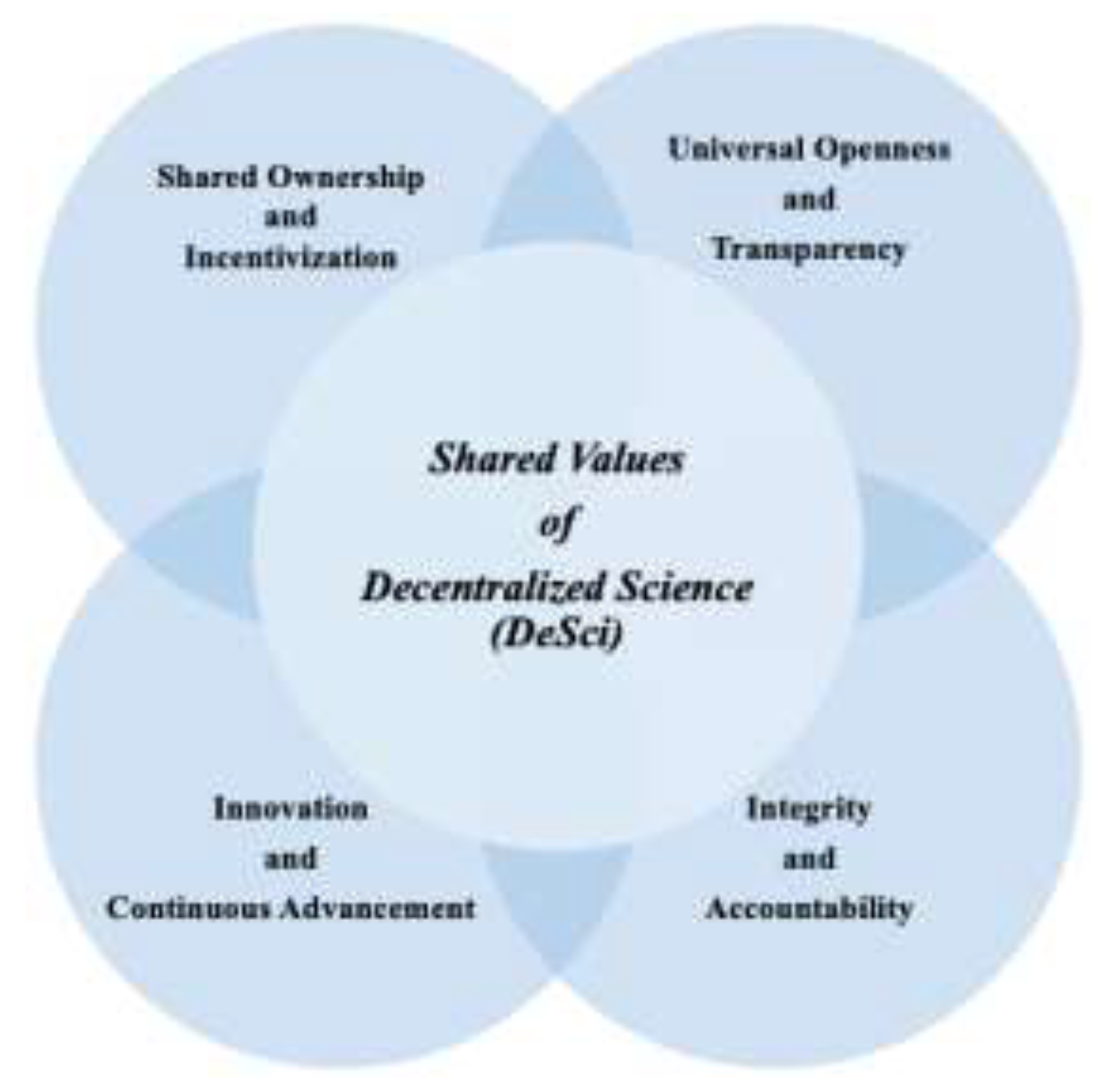
Figure 2.
Graphical illustration of the guiding principles of Decentralized Science (DeSci).
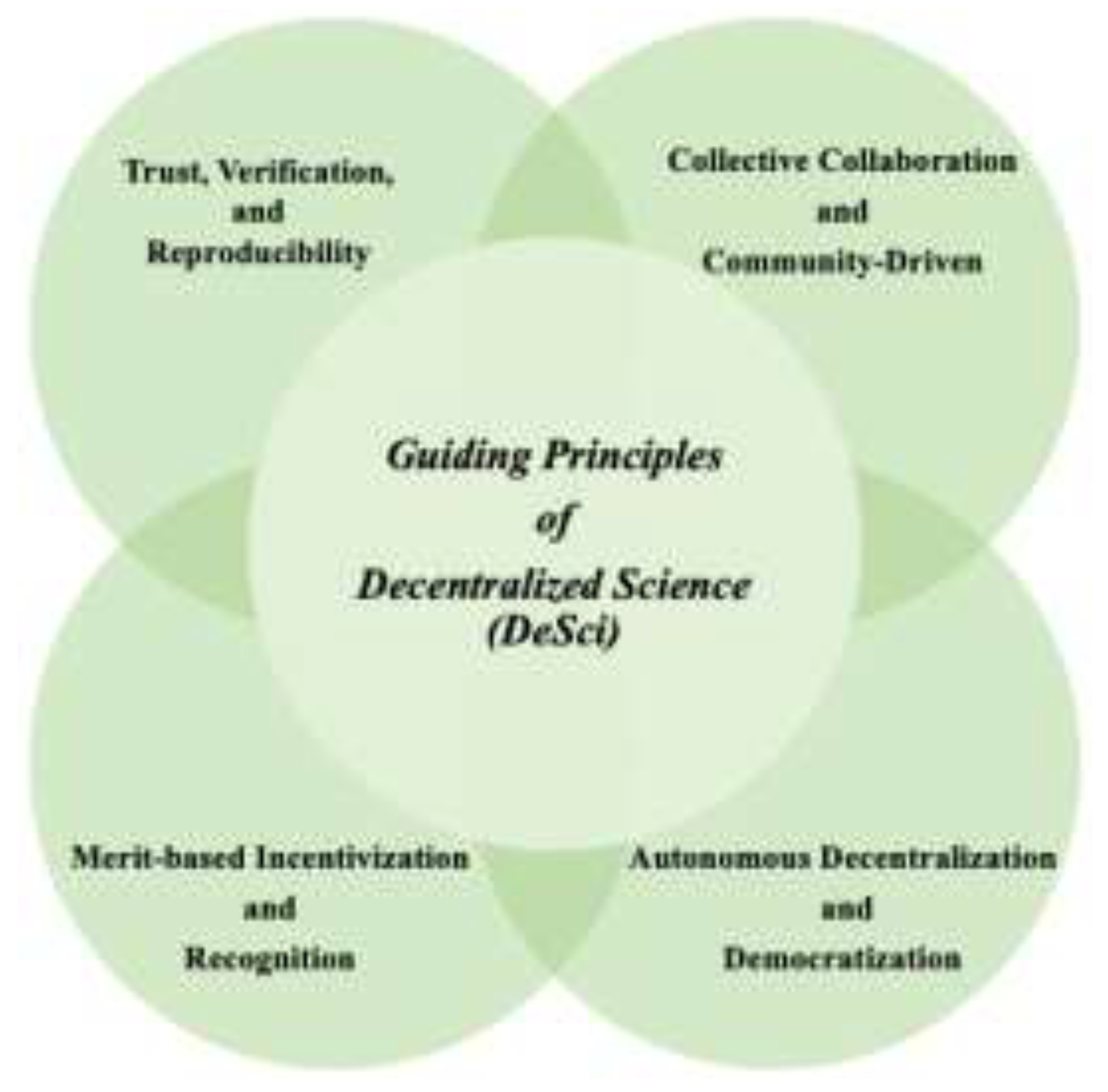

Table 1.
Projects and DAOs with a primary focus in the field of DeSci with the associated focus area and corresponding number of community members in Discord as of September 22, 2023.
Table 1.
Projects and DAOs with a primary focus in the field of DeSci with the associated focus area and corresponding number of community members in Discord as of September 22, 2023.
| Project name | Focus area | Discord members |
|---|---|---|
| VitaDAO | Longevity research and funding | 9472 |
| AntidoteDAO | Funding cancer research initiatives | 3377 |
| GenomesDAO | Genomic data sharing and storing | 2880 |
| LabDAO | Tools and infrastructure for computational biology | 2012 |
| TalentDAO | Decentralized publication protocol for social sciences | 1768 |
| PsyDAO | Psychedelic and mental health research | 1644 |
| DeSciWorld | Connecting decentralized science communities | 1209 |
| ValleyDAO | Synthetic biology technology funding and access | 1153 |
| DeSci Labs | Scientific publishing and digital society | 972 |
| CerebrumDAO | Brain health and preventing neurodegeneration | 970 |
| AthenaDAO | Funding women's health research | 900 |
| ResearchCoin | Accelerating scientific research and publishing | 772 |
| HairDAO | Research and funding dedicated to hair loss | 757 |
| NewAtlantisDAO | Ocean health and marine biodiversity | 420 |
| VibeBio | Rare disease research and treatment development | 249 |
Table 2.
DeSci-DAOs and project that self-identify as DAOs with their corresponding Discord member count and the number of on-chain token holders as of September 22, 2023.
Table 2.
DeSci-DAOs and project that self-identify as DAOs with their corresponding Discord member count and the number of on-chain token holders as of September 22, 2023.
| Project name | Discord members | Number of token holders |
|---|---|---|
| VitaDAO | 9472 | 2465 |
| AntidoteDAO | 3377 | - |
| GenomesDAO | 2880 | 201 |
| LabDAO | 2012 | - |
| TalentDAO | 1768 | - |
| PsyDAO | 1644 | - |
| DeSciDAO (DeSciWorld) | 1209 | - |
| ValleyDAO | 1153 | 144 |
| CerebrumDAO | 970 | - |
| AthenaDAO | 900 | 86 |
| ResearchHub DAO | 772 | 514 |
| HairDAO | 757 | 161 |
| NewAtlantisDAO | 420 | - |
Table 3.
Identified and included scholarly publications.
| Title | Author(s) | Year |
|---|---|---|
| Removing the barriers for Participation in Decentralized Science from Traditional Academia [52] | Dehouche et al. | 2023 |
| A New Architecture and Mechanism for Decentralized Science MetaMarkets [54] | Ding et al. | 2023 |
| DeSci - Decentralized Science [53] | Jens Ducrée et al. | 2022 |
| The DAO to DeSci: AI for Free, Fair, and Responsibility Sensitive Sciences [43] | Wang et al. | 2022 |
| Can decentralized science help tackle the deterioration in working conditions in academia? [56] | Sicard, François | 2022 |
| DeSci Based on Web3 and DAO: A Comprehensive Overview and Reference Model [55] | Ding et al. | 2022 |
| Call to join the decentralized science movement [39] | Hamburg, Sarah | 2021 |
Table 4.
Identified and included secondary literature.
| Title | Author(s) | Year |
|---|---|---|
| DeSci for Web3 Builders [57] | Starr et al. | 2023 |
| Decentralized science (DeSci): Web3-mediated future of science [1] | Shilina, Sasha | 2023 |
| Decentralized Science — Next Big Sector in Crypto [58] | Knight, Richard | 2023 |
| Decentralized Science – should Science be crypto-fied? [59] | Xiaohui Ang, Hazel | 2023 |
| The DeSci Movement: Will Crypto Really Solve Science's Biggest Problems? [46] | Cumbers, John | 2023 |
| The Decentralized Science Ecosystem: Building a Better Research Economy [60] | Dunbar, Stephanie; Basile, Stephen | 2023 |
| DeSci Landscape Analysis: Exploring Crowdfunding Effects On Project Development [61] | Magennis et al. | 2023 |
| The Future of Medicine Is Token [62] | Pečiulis, Rapolas | 2023 |
| Is Decentralised Science better science? [63] | Kisley, Marina | 2023 |
| From Open Software Movement to Open Research Movement: Why DeSci will be the next big wave for Web3 [64] | Fang, Jason | 2023 |
| Unlocking Scientific Innovation Through Decentralized Science – Part I [65] | Strauss, Christine | 2023 |
| Why DeSci is not yet perfect? Top 7 challenges [66] | JocelynDAO | 2023 |
| Decentralized Science [67] | bio.xyz | 2023 |
| A Guide to DeSci, the Latest Web3 Movement [68] | Hamburg, Sarah | 2022 |
| A DeSci Origin Story [35] | Koepsell, David | 2022 |
| What Is Decentralized Science (DeSci) and What Makes It Special? [69] | Belova, Kira | 2022 |
| DeSci: Can crypto improve scientific research? [70] | Parasol, Max | 2022 |
| DeSci - Decentralised Science and its potential to change the world. [71] | Coinmonks | 2022 |
| DeSci: Modern Science Enabled by Web3 Technology [72] | Moreland, Kirsty | 2022 |
| Is DeSci the Future of Research? [73] | Akinosho, Samuel | 2022 |
| Decentralized Science – a cure for the Science sector’s woes? [74] | Hawkins, Julia | 2022 |
| DeSci: The case for decentralised science [75] | Cook, Joseph | 2021 |
| Decentralized Science and Biotech [76] | Weisser, Vincent | n.d.* |
| Decentralized science (DeSci) [41] | Ethereum Foundation | n.d.* |
*n.d.: no date; publication date could not be determined.
Table 5.
Synthesis of recurring themes in definitions of Decentralized Science (DeSci).
| Main category | Subcategory | Specifications | Publications |
|---|---|---|---|
| Technological Aspects | Aspects related to the different means of technology mentioned in the included definitions of DeSci | ||
| Web3 | Web3 technologies; Web3 space; Web3 stack | [1, 39, 41, 54, 57, 59, 61, 69, 71–74] | |
| Distributed Ledger Technology | Blockchain tools; blockchain-based solutions; blockchain; DLT; | [1, 39, 52, 56, 63, 66, 69, 72, 74] | |
| Decentralization | Decentralized and distributed scientific research model; decentralized tools; decentralized technologies | [35, 52, 54, 57, 63, 70, 76] | |
| Scientific Aspects | Aspects related to scientific aims or focus areas mentioned in the included definitions of DeSci | ||
| Research Funding | Funding models; permissionless capital formation; new funding paradigms; funding inequities; | [1, 41, 52, 55, 59–63, 65, 67–69, 73, 74, 77] | |
| Publishing | Peer Review; reviewing scientific knowledge; publishing; open access | [60, 61, 63, 69, 70, 72, 75]. | |
| Collaboration | Collaborative research; open research; open-source research; open scientific research; citizen science; | [1, 35, 43, 53, 56, 58, 59, 63–65, 70, 76] | |
|
Socio-Economic Aspects |
Aspects relating to social and economic ramifications, aims or focus areas in the included definitions of DeSci | ||
| Infrastructure | Public infrastructure to fund and disseminate scientific knowledge | [41, 60, 67, 69, 71, 73] | |
| Censorship Resistance | Resistance to censorship and control by central authorities; without traditional gatekeepers; rejecting institutional influence | [58, 70, 76] |
Table 6.
Background and professional information of the experts participating and included in the analysis.
Table 6.
Background and professional information of the experts participating and included in the analysis.
| Background and Professional Information | n (%) |
|---|---|
| Age (in years) | |
| < 20 | 1 (2.6%) |
| 20 – 25 | 4 (10.2%) |
| 26 – 30 | 11 (28.2%) |
| 31 – 35 | 11 (28.2%) |
| 36 – 40 | 7 (17.9%) |
| > 40 | 5 (12.8%) |
| Education | |
| High School Diploma or Equivalent (e.g., Secondary School) | 1 (2.6%) |
| Vocational Training or Apprenticeship (Non-academic) | 0 (0.0%) |
| Undergraduate Degree / Bachelor's Degree | 12 (30.7%) |
| Postgraduate Degree / Master's Degree | 18 (46.1%) |
| Doctorate or Equivalent (e.g., PhD, MD) | 8 (20.5%) |
| Academic Position (e.g., Junior Professorship/Professorship) | 0 (0.0%) |
| Professional experience (in years) | |
| < 5 | 12 (30.7%) |
| 6 – 10 | 9 (23.1%) |
| 11 – 15 | 13 (33.3%) |
| 16 – 20 | 2 (5.1%) |
| > 20 | 3 (7.7%) |
| Membership in DeSci-DAOs (number) | |
| 0 | 0 (0.0%) |
| 1 | 16 (41.0%) |
| 2 | 11 (28.2%) |
| 3 | 7 (17.9%) |
| 4 | 1 (2.6%) |
| 5 | 0 (0.0%) |
| > 5 | 4 (10.2%) |
| Membership in DeSci-DAOs (duration; in months) | |
| < 6 | 7 (17.9%) |
| 6 – 12 | 8 (20.5%) |
| 12 – 18 | 9 (23.1%) |
| 18 – 24 | 7 (17.9%) |
| > 24 | 8 (20.5%) |
Table 7.
Overview of the main and associated subcategories related to the analyzed expert responses concerning the definition of 'Decentralized Science' (DeSci) with the quantity and percentage of occurrence.
Table 7.
Overview of the main and associated subcategories related to the analyzed expert responses concerning the definition of 'Decentralized Science' (DeSci) with the quantity and percentage of occurrence.
| Main category | Subcategory | Specifications | n (%) |
|---|---|---|---|
| Technological Aspects | Aspects related to the different means of technology associated with DeSci | 26 (66.7%) | |
| Web3 | Web3's emphasis on decentralized internet, its technological stack, and the tools it supports | 8 (20.5%) | |
| Distributed Ledger Technology | Blockchain technology and associated features, immutable and traceable infrastructures, platforms utilizing DLT | 10 (25.6%) | |
| Decentralization | Tools and methods facilitating decentralized research, data sharing, and decision-making | 8 (20,5%) | |
| Scientific Aspects | Aspects related to the scientific objectives or focus areas of DeSci | 28 (71.8%) | |
| Research Funding | Alternative funding models (e.g., quadratic funding), transparent funding mechanisms, token-based incentives | 9 (23.1%) | |
| Publishing | Decentralized peer review, initiatives promoting open access, blockchain-enabled publishing | 9 (23.1%) | |
| Collaboration | Collective knowledge generation, open-source scientific processes, global researcher cooperation | 10 (25.6%) | |
|
Socio-Economic Aspects |
Aspects related to socio-economic implications and objectives of DeSci | 19 (48.7%) | |
| Infrastructure | Systems and tools promoting public and open infrastructure, value generation in science, knowledge dissemination methods | 7 (17.9%) | |
| Censorship Resistance | Initiatives against institutional control, promoting research free from gatekeepers, decentralized authority models | 9 (23.1%) | |
| Governance and Organizational Aspects | Aspects related to decentralized governance and organization within DeSci | 15 (38.5%) | |
| Decentralized Governance | Community-driven research, principles of decentralized decision-making and authority, emphasis on collective intelligence | 8 (20.5%) | |
| Organizational Structure | Models promoting participation by non-affiliated individuals, concepts of fractional ownership, and the collaborative essence of DeSci organizations (e.g., DAOs) | 7 (17.9%) | |
| Innovative Aspects | Aspects related to innovations and novel concepts of traditional scientific methods | 11 (28.2%) | |
| Intellectual Property (IP) and Knowledge Creation | Approaches for shared IP rights, decentralized knowledge creation | 6 (15.4%) | |
| Evolution of Traditional Models | Movements and initiatives diverging from traditional research paradigms, innovative shifts in the scientific research process | 5 (12.8%) | |
| Ethical and Philosophical Aspects | Aspects related to foundational beliefs and moral values in DeSci | 10 (25.6%) | |
| Openness | Open access to research, transparency in research processes and decision-making, equitable participation | 6 (15.4%) | |
| Ethical Principles | Advocacy against corporate proprietorship, principles of fairness and equality in scientific research, promoting ethical standards in DeSci | 4 (10.3%) |
Table 8.
Overview of the synthesis of provided expert answers asked about the shared values of DeSci.
Table 8.
Overview of the synthesis of provided expert answers asked about the shared values of DeSci.
| Category | Themes (n) | n (%) |
|---|---|---|
| Transparency and Openness | Transparency (14), Open (7), Open source (4), Open governance (3), Verification (2), Removal of barriers (2), Open-mindedness (1), Open data sharing (1), Accessibility (1), Honesty (1) | 36 (92.3%) |
| Democratization and Community | Democratization (4), Community-based (4), Collaboration (3) Community (2), Fairness (2), Inclusiveness (1), Collective benefit (1) | 17 (43.7%) |
| Accountability and Integrity | Accountability (6), Reproducibility (4), Integrity (2), Verification (2) | 14 (35.9%) |
| Ownership and Incentives | Ownership (3), Funding (3), Recognition (2), Value creation (2), Incentives (2) | 12 (30.7%) |
| Decentralization | Decentralization (7), Distributed systems (2), Permissionless (2) | 11 (28.2%) |
| Innovation and Advancements | Innovation (3), Technological advancements (2), Exploration (1), Evolution (1), Digital assets (1), Web3 (1) | 9 (23.2%) |
Table 9.
Overview of the synthesis of provided expert answers asked about the guiding principles of DeSci.
Table 9.
Overview of the synthesis of provided expert answers asked about the guiding principles of DeSci.
| Category | Themes (n) | n (%) |
|---|---|---|
| Integrity and Validation | Integrity (4), Validation (4), Reproducibility (3), Trust (3), Trustworthiness (2), Verification (1), Replication (1), Truth (1) | 19 (48.7%) |
| Collaboration and Community | Collaboration (7), Community-driven (4), Collective consensus (2), Collective organizing (1), Networking (1) | 15 (38.5%) |
| Openness | Open source (6), Open data (4), Accessibility (3), Exploration (1) | 14 (35.9%) |
| Decentralization | Decentralization (5), Autonomy (2), Distributed approach (1), Democratization (1), Permissionless (1) | 10 (25.6%) |
| Incentive and Rewards | Incentive (4), Reward (2), Merit-based (1), Recognition (1), Credits (1) | 9 (23.2%) |
Disclaimer/Publisher’s Note: The statements, opinions and data contained in all publications are solely those of the individual author(s) and contributor(s) and not of MDPI and/or the editor(s). MDPI and/or the editor(s) disclaim responsibility for any injury to people or property resulting from any ideas, methods, instructions or products referred to in the content. |
© 2024 by the authors. Licensee MDPI, Basel, Switzerland. This article is an open access article distributed under the terms and conditions of the Creative Commons Attribution (CC BY) license (http://creativecommons.org/licenses/by/4.0/).
Copyright: This open access article is published under a Creative Commons CC BY 4.0 license, which permit the free download, distribution, and reuse, provided that the author and preprint are cited in any reuse.


