
Submitted:
16 January 2024
Posted:
18 January 2024
You are already at the latest version
Abstract
In our digital era, digital platforms become an unprecedented opportunities for manufacturing enterprises to leverage their business strategy. This study investigates how manufacturing enterprises can enhance organizational duality through digital platforms. Specifically, this study examines the effect of digital platforms and capability reconfiguration on entrepreneurial organizational duality. The study also examines how network digital atmosphere moderates this relationship. Based on analysis of 286 manufacturing enterprises undergoing digital transformation, the results indicate that digital platforms positively affect both organizational duality and the capability reconfiguration. The results indicate that digital platforms have a positive indirect effect on organizational duality via evolutionary capability reconfiguration and substitutional capability reconfiguration, respectively. The study also shows that network digital atmosphere moderate this effect.These findings contribute theoretically to the research on digital platforms and manufacturing enterprises while also providing important managerial implications for policymakers and manufacturing enterprises to help firms implement digital strategies.
Keywords:
digital platforms
; capability reconfiguration
; organizational duality
; network digital atmosphere
1. Introduction
Digital platforms have profoundly changed many industries, shaped the concept of platform economy, and become an important driving engine to promote the transformation of China’s traditional enterprises to digitalization. Digital platforms help companies to monitor and optimise their assets and operations using granular data analytics and management, transforming the way enterprises interact and collaborate internally and externally, as well as revolutionising the way they are managed [1]. However, However, due to the platform transformation involves the subversive adjustment of the logic of proposition, process and structure and cooperation network and other elements, the complexity of the construction of digital platforms makes it difficult for enterprises to break through the inherent inertia and the locking effect of resources and capabilities, which makes the construction of digital platforms of manufacturing enterprises blocked by the mountains [2]. Therefore, it is of great practical significance to discuss the construction and value of the digital platform of traditional manufacturing enterprises for the platform transformation of traditional enterprises and the high-quality development of China’s digital economy and real economy.
Existing studies have explored how digital platforms can change organizational processes at the enterprise level, including facilitating digital business models [3], accelerating internal digital transformation [4], redesigning customer relationship management processes and adaptive digital governance [5,6]. Despite the increase in research efforts in this area in recent years, there are still many gaps in the understanding of digital platforms driving organizational transformation, and in particular the implementation of digital platforms’ technological architectures triggering organizational capability enhancements needs to be further explored [7]. Park et al. (2020) argued that digitization plays an important role in achieving duality without the need to separate the two activities in terms of time and space [8]. Therefore, it is important to explore the effect of digital platforms on the role of duality in business organizations. In addition, the capability-based perspective argues that superior resources are no longer a necessary basis for competitive advantage [9,10]. The ability to continuously rebuild and enhance capabilities is the key to corporate innovation [11]. The impact of digital platform capabilities on organizational agility under dynamic environmental conditions has been investigated [12]. However, the role of capability reconfiguration in facilitating organizational duality enhancement through digital platforms is not well explained in the literature. Therefore, this paper explores the process mechanism of digital platforms acting on organizational duality based on the capability reconfiguration perspective. Since the influence of the external network context plays an indispensable role when enterprises want to complete the platform transformation in the context of the digital era [13], this paper also examines the boundary conditions of the digital atmosphere of the enterprise network for the digital platforms to influence the organizational duality.
In summary, this paper takes the digital platforms of manufacturing enterprises as the research object, explores the role mechanism between network digital atmosphere, digital platforms, capability reconfiguration and organizational duality, and tries to answer two theoretical questions: (1) How are the mediating mechanisms of digital platforms and capability reconfiguration on organizational duality? (2) Does the network digital atmosphere moderate the effects of digital platforms, capability reconfiguration on organizational duality? The conclusions of the study provide referable theoretical guidelines and practical guidance for the value creation logic of corporate digital platforms.
2. Theoretical Background
2.1. Digital Platforms and Organizational Duality
Digital platforms are comprehensive platforms that utilise digital technologies and information systems to integrate, connect and manage various businesses and processes [14,15]. Digital platforms have the nature of technology-driven, network effect, expandability and customer orientation [16,17]. Firms with higher digital platforms enable intelligent and timely collaboration and sharing of information across departments [18]. At the same time, digital platforms challenge traditional business propositions by providing technological elements such as hardware or software devices whose functionality can be extended with complementary modules, as well as a set of rules, standards and organizational processes to coordinate third parties and adopters [19].
The resource base view holds that heterogeneous resources are a prerequisite for the formation of an enterprise’s core competitive capabilities. Firms acquire core competencies through the continuous accumulation and efficient use of core resources. Digital platforms are software-based systems that support e-business processes by providing core functionality for all interoperable modules and interfaces [20]. As one of the important heterogeneous resources of an enterprise, its value and inimitability will become a key source of competitive advantage for the enterprise. Applying digital platforms to all aspects of the enterprise’s production, operation and management is conducive to bringing into play the great commercial value it lurks in, helping the enterprise to achieve outstanding results in expanding market scale, reducing costs and increasing efficiency, and fostering innovation [1]. Park et al. (2020) argued that digitalization plays an important role in realising the duality of nature without the need to separate the two activities in time and space, revealing the important role of digitization in achieving organizational duality [8]. Wan et al. (2016) argued that the platform approach can facilitate the alignment between organizational utilisation and exploration of trade-offs [9]. Abdalla and Nakagawa (2021) argued that organizational transformations powered by digital technologies have a positive impact on organizational efficiency and adaptability improvement [10]. Ahmed et al. (2022) examined the mediating role of intellectual capital and the moderating role of environmental dynamics and argued that digital platforms for manufacturing SMEs can promote organizational agility [12]. Thus, we predicted that:
H1a. Digital platforms have a positive impact on organizational efficiency;
H1b. Digital platforms have a positive impact on organizational flexibility.
2.2. Digital Platforms and Capacity Reconfiguration
The capability-based perspective argues that superior resources are no longer a necessary basis for competitive advantage. Resources have a certain static nature and do not have the ability to renew themselves; their strength lies in their ability to adapt to dynamic environmental changes through continuous evolution and reorganization [11]. Capability reconfiguration is the process by which firms rapidly identify and capture external opportunities in a dynamic environment to bring about changes in their internal operational processes, organizational practices, and the relationships between practices, and includes two complementary approaches, capability evolution and capability substitution [21]. Capability evolution focuses on modifying the constitutive routines of individual functions in an incremental manner without changing the original purpose of the function; capability substitution entails the replacement of an existing capability or an overall portfolio of capabilities by new knowledge as well as new functions that assume fundamentally different functions. Xie et al. (2022) argued that SMEs adopting digital platforms should make full use of both evolutionary capability reconfiguration and substitutional capability reconfiguration to reshape their existing capabilities, to establish new digital capabilities and promote business model innovation [22]. On the one hand, with the help of digital platforms, enterprises can integrate resources of different dimensions, realize data “upgrading”, and form extended functions such as accurate user profiles, precise recommendation systems and personal credit. In this process, organizations can absorb new knowledge elements and update their current technologies to repair and improve their routines. On the other hand, digital platforms acquire heterogeneous knowledge beyond organizational and technological boundaries through resource integration, which can break the confinement of characteristic elements such as stereotypes, backward cultures, and industrial agglomerations, expand the reserve of heterogeneous knowledge, and accelerate the process of capability substitution [23]. Thus, we predicted that:
H2a. Digital platforms have a positive impact on evolutionary capability reconfiguration;
H2b. Digital platforms have a positive impact on substitutional capability reconfiguration.
2.3. Capability Reconfiguration and Organizational Duality
Capability reconfiguration can accomplish real-time adjustments to routine practices and homeopathic replacements of existing capabilities through two complementary approaches, capability evolution and capability substitution, enabling firms to respond quickly to changes in dynamic environments, and to enhance their capabilities and strategic flexibility [24]. However, balancing dualistic competencies within a single domain increases the likelihood of misuse of both activities or practices, leading to negative transfer effects, misapplication of behaviours applicable to one activity to the other, and leading to internal confusion [25]. Therefore, we argues that the two dimensions of capability reconfiguration act on each of the two dimensions of organizational duality. Firstly, capability evolution can promote the timely adjustment and enhancement of existing capabilities of enterprises, improve the efficiency of resource portfolio construction, provide sufficient choice space for resource integration, avoid the uncertainty, risk and cost brought by organizational exploration, and improve the predictability of new opportunities and markets. When technology changes, enterprises first adapt and adjust existing capabilities through learning and knowledge absorption, and due to path dependence, the improvement and enhancement of existing resources and capabilities are conducive to promoting the efficiency of daily operations [26]. Secondly, capability substitution can help enterprises break the original “core rigidity” within the organization, break through the existing technology and market dependence, enable enterprises to actively capture potential innovation opportunities [11], help adapt to the dynamic uncertainty environment, and improve organizational flexibility. Therefore, we predicted that:
H3a. Evolutionary capability reconfiguration has a positive impact on organizational efficiency;
H3b. Substitutional capability reconfiguration has a positive effect on organizational flexibility.
2.4. Digital Platforms, Capability Reconfiguration and Organizational Duality
Capability reconfiguration is considered to be the key to unravelling the relationship between the resource-based view and the capability-based view [21]. On the one hand, evolutionary capability reconfiguration allows firms to adjust value creation and improve organizational efficiency by applying structured knowledge from familiar domains to new ones after applying digital platforms. Firms improve the use of existing technological knowledge with the help of technologies such as big data analytics, the Internet of Things, social media technologies, and cloud computing, including reducing instability in the use of technological knowledge, achieving better connectivity, effective communication, and higher automation to gain organizational production and operational efficiency [27]. On the other hand, substitutional capability reconfiguration allows companies to enhance organizational flexibility by replacing existing capabilities with new digital capabilities through a conceptual combination process. By learning a new or different knowledge base, firms can completely replace old capabilities with emerging capabilities, which are often the basis for the formation of organizational flexibility and agility [26]. Based on Industrial Internet platforms, firms combine emerging physical and cyber components in manufacturing systems to build flexible supply chains based on sensors and actuators [28], enhancing organizational market responsiveness. Therefore, the following hypotheses are proposed in this paper:
H4a. Evolutionary capability reconfiguration moderates the effect of digital platforms on organizational efficiency.
H4b. Substitutional capability reconfiguration moderates the effect of digital platforms on organizational flexibility.
2.5. Digital Platforms, Network Digital Atmosphere, Capability Reconfiguration, and Organizational Duality
Network embeddedness is a core concept of network theory, which refers to the position and status of a firm in a network, as well as its relationship with other subjects in the network [13]. A network can be considered to have a stronger “digital atmosphere” if more firms are engaged in digital activities in the network [29]. The stronger the digital atmosphere of the network, the more it helps enterprises to acquire the depth and breadth of digital knowledge through tacit knowledge spillover channels, reduce the knowledge potential gap, and promote the evolution and renewal of organizational practices within the organization, so as to carry out internal and external business activities efficiently. In addition, when embedded in a network richly endowed with digital resources, enterprises will break down their understanding of emerging digital technologies in the process of communication and collaboration, and their willingness to introduce new technologies and equipment will be stronger, and enterprises will rely on emerging digital technologies to bring them closer to the market and enhance their organizational market responsiveness. At the same time, in a strong digital atmosphere, enterprises will also have a more in-depth understanding of the new dominant logic of the collaborating enterprises, enterprises are more likely to collect diversified technologies and information through digital platforms, develop new products and services that are inconsistent with past organizational practices or technological trajectories [27], and lay the foundation for improved organizational agility through the reconfiguration of alternative capabilities. Therefore, this paper proposes the following hypothesis:
H5a. Networked digital atmosphere positively regulates the mediating role of evolutionary capability reconfiguration between digital platforms and organizational duality;
H5b. Networked digital atmosphere positively regulates the mediating role of substitutional capability reconfiguration between digital platforms and organizational duality.
In addition, in order to explore how digital platforms affect organizational duality, this paper incorporates four firm-level control variables into the model: firm age, firm size, firm ownership and industry ownership.
In summary, the conceptual model of the relationship between digital platforms, capability reconfiguration and organizational duality constructed in this study is shown in Figure 1.
3. Method
3.1. Data Collection and Sample
Currently, China’s traditional manufacturing firms are undergoing a digital transformation, and with the use of ever-increasing digital resources, Chinese manufacturing firms are beginning to gradually build digital platforms, thus contributing to China’s digital development. In this study, to capture the relationship between digital platforms and organizational duality, we collected data from manufacturing firms that use or have previously used digital platforms in their operations or management processes in China. The individual respondents included middle-level managers, senior-level managers, and project managers familiar with their enterprises’ digitalization strategies.
To ensure the validity of the questionnaire results, this survey was designed in two stages. First, a questionnaire was designed and distributed to 50 manufacturing practitioners for pretest. Due to positive feedback and satisfactory reliability, minor changes were made and then a link to the survey was provided. The formal questionnaire was implemented in January 2023 for this study. The questionnaire was distributed through the Credamo platform, which is a Chinese professional data-collection platform comparable to Amazon’s Mechanical Turk. In this paper, a total of 350 questionnaires were distributed and 335 questionnaires were recovered. After excluding the invalid questionnaires, 286 samples were used in the formal analysis of the study with an effective recovery rate of 81.71%.
Table 1 shows the sample characteristics. Regarding firm age, 56.30% of the firms had been established between 10-15 years. Regarding firm size, the firms were concentrated between 301-1000 people. In terms of firm ownership, 61.50% of the firms in our sample were private enterprises and 32.20% were state-owned enterprises. Moreover, the average annual sales of enterprises are concentrated between 30 million and 200 million.
3.2. Variables
In this study, digital platforms, capability reconfiguration, organizational duality and network digital atmosphere were measured by traditional scales. To ensure the translation accuracy of the questionnaire, all items were translated from English into Chinese by a professional translator, and then they were translated back into English by another translator. Meanwhile, all statements were measured on a five-point, Likert-type scale, ranging from 1 (strongly disagree) to 5 (strongly agree).
Digital platforms. Digital platforms were used to assess the degree of application of each firm’s digital platforms. Digital platforms were a second-order construct. We used four first-order constructs consisting of eighteen items: Business platform, IT platform, Data platform, and Intelligent application platform. Business platform precipitates reusable business capabilities, realizes reuse of enterprise-level business capabilities and connectivity and synergy between various business segments, ensures the stability and efficiency of key business links, and enhances the effectiveness of business innovation. Technology platform Provides basic cloud-native capabilities and technical support, and is a collection of infrastructure and tools to support the entire digital transformation. Using scales developed by Cenamor et al. (2019) and Sedera et al. (2016), the business platform and IT platform were measured using five items respectively (e.g., “Our platform has effectively standardized administrative processes and operational processes”; “Our IT projects using digital platforms require less resources (time, money to develop and deploy”) [14,17]. Data platform loosely couples data resources with data production systems to provide data capability support for innovative and changeable business scenarios in the business front office. Intelligent application platform is the enterprise brain with intelligence as the core driving force, and it is the creation and command organ of the intelligent enterprise auxiliary decision-making system. Using scales developed by Li et al., (2021), and Benitez et al. (2022), the data platform and intelligent application platform were measured using four items respectively (e.g., “Our platform can realize the cloud classification and hierarchical storage of various types of data, such as R&D, production, operation and service”; “Our platform uses 5G and artificial intelligence are utilized to build flexible production lines”) [30,31].
Capability reconfiguration. Capacity reconfiguration was used to assess the extent to which firms evolve and reconfigure their existing capabilities to adapt to changes in a dynamic environment [21]. Capability reconfiguration was measured in two dimensions: Evolutionary capability reconfiguration and Substitutional capability reconfiguration. Evolutionary capability reconfiguration was used to measure the degree of evolution of an organization’s existing capabilities. Substitutional capability reconfiguration was used to measure the extent to which existing capabilities were replaced by new capabilities through emerging digital platforms. The scale was developed from the classic scales developed by Lavie (2006) and Pan and Bo (2017), and then combined with the characteristics of this study, the evolutionary capability reconfiguration was measured using four items (e.g., “Our firm makes simple adjustments to existing capabilities and practices”), and the substitutional capability reconfiguration was measured using five items (e.g., “Our firm explores new concepts or new fundamental principles”) [21,24].
Organizational duality. Organizational duality was used to measure the extent to which an organization actively adapts to future needs while increasing efficiency in the use of existing capacity. Organizational duality was measured around Organizational efficiency and Organizational flexibility. Organizational efficiency refers to time and cost efficiency. Organizational flexibility refers to Logistics flexibility, production flexibility, supply chain flexibility, product flexibility and information flexibility. Using classical scales developed by Kortmann et al. (2014) and Lu and Ramamurthy (2011), each using 6 items to measure organizational efficiency (e.g., “Our firm reveals outstanding delivery speed and reliability”) and organizational flexibility respectively (e.g., “Our firm has the ability to rapidly respond to customers’ needs”) [32,33].
Network digital atmosphere. Network digital atmosphere was used to measure the number of businesses engaged in digital activities in the corporate network. The scale was developed from the classic scales developed by Li and Wang (2022), with 4 items (e.g., “Our business partners apply a wider range of digital platform technologies”) [29].
Moreover, to capture the specific effect of how digital platforms affect organizational duality, we included four firm-level control variables in our model: firm age, firm size, firm ownership, and industry ownership.
3.3. Measures
In this study, Partial Least Squares Structural Equation Modeling PLS-SEM was used to validate the model. PLS-SEM is a variance-based technique that is suitable for testing and validating the model in this study for the following three reasons. First, PLS-SEM allows for the analysis of hierarchical latent variable models that include different measurement models [34]. The digital platforms in this study were measured by four first-order variables business platform, IT platform, data platform, and intelligent application platform, and the structural model was estimated using a two-stage partial least squares approach. In the first stage, the variable scores of the first-order latent variables were estimated; in the second stage, the estimates were obtained by substituting all the first-order latent variable scores into the structural equation model as observed terms. Second, the relationships studied included mediating and moderating effects, which could be analyzed simultaneously using PLS-SEM [35]. Specifically, PLS-SEM could estimate different causal relationships between exogenous and endogenous variables. Third, the PLS-SEM method as a variance-based structural equation modeling technique is more suitable for structural measurement models and exploratory studies with small samples [36]. In this study, a nonparametric process of bootstrapping with 5000 subsamples was also used to test the statistical significance of the path coefficients [37].
3.4. Reliability and Validity
Reliability, composite reliability, and convergent validity of individual metrics of the measurement model for all first-order reflective structures (Hair et al., 2016). In this study, Cronbach’s α for all first-order factors ranged between 0.790 and 0.920, and individual factor loadings ranged between 0.757 and 0.882; these values were greater than the generally accepted threshold of 0.70 (Table 2). The composite reliability values for all first-order constructs ranged between 0.864 and 0.929, which was above the threshold value of 0.70, validating the internal consistency reliability of all constructs. All average variance extracted (AVE) values were above the critical threshold of 0.50, supporting the convergent validity of all constructs (Table 2).
This paper followed the recommendations from previous research to estimate measurement models for second-order formative constructs [36]. As shown in Table 3, the highest Variance Inflation Factor (VIF) values for each metric were below the threshold value of 5, which implies that the metrics in this study do not suffer from the problem of covariance. In addition, after bootstrapping 5000 subsamples, the weights of all digital platforms specification indicators were above 0.2, which was highly significant, and the highest cross-dimensional correlations were less than 0.70. These results provided support for the formation indicator measurement model of digital platforms as a second-order factor.
Table 4 showed the HTMT of the differential validity of each measurement variable, which was more sensitive to the problem of variance-based validity of structural equations, and the data showed that all values are less than 0.85, indicating that the model has good differential validity. In conclusion, the measurement model in this paper satisfies the basic requirements of reliability and validity.
3.5. Common Method Bias
Statistical analyses were conducted in this study to assess the severity of common method bias. First, potential common method bias issues were examined using the Harman one-factor test [38]. The results of the exploratory factor analysis of all items in the model indicated that the eigenvalues of four factors were greater than 1. In addition, the first factor explained 10.632% of the variance, which was less than 50% of the total variance explained, suggesting that common method variable dimensionality bias did not affect the results of this study. Second, this paper included a common method factor in the PLS model with indicators for all major constructs and calculated the variance explained by the major constructs and method substantive for each indicator [39]. The results showed that the average variance of substantive explanation for individual indicators was 0.656, while the average variance based on the common method was 0.003. the ratio of substantive to method variance was approximately 219:1. furthermore, all method factor loadings were insignificant. Given the small magnitude and non-significance of the method variance, this paper suggested that the common method variable dimensionality bias did not affect the results of this study.
4. Results
The path coefficients and explained variance of the structural model were shown in Figure 2. Digital platforms explained 82.6% of the variance in the evolutionary capability reconfiguration and 46.2% of the variance in the substitutional capability reconfiguration. 54.0% of the variance in organizational efficiency was represented by the digital platforms and evolutionary capability reconfiguration. 41.1% of organizational flexibility was represented by the digital platforms and substitutional capability reconfiguration. In addition, the absolute goodness-of-fit index SRMR of the PLS-SEM structural model was 0.046, which was less than 0.08; the NFI was 0.843, which was close to 1; and the d_ULS was 1.202, and the d_G was 0.578, which ware both less than 0.95, indicating that the model had a good degree of fit.
The path coefficients from the PLS-SEM analyses indicated that digital platforms had a significant positive effect on organizational efficiency (β = 0.521; t = 7.218; p = 0.000) and organizational flexibility (β = 0.442; t = 5.338; p = 0.000), thus supporting H1a and H1b. digital platforms had a significant positive effect on evolutionary capability reconfiguration (β = 0.813; t = 21.700; p = 0.000) and substitutional capability reconfiguration (β = 0.679; t =10.980; p = 0.000) had a significant positive effect, thus supporting H2a and H2b. PLS-SEM analysis also showed that evolutionary capability reconfiguration had a significant positive effect on organizational efficiency (β = 0.290; t =4.043; p = 0.000) and substitutional capability reconfiguration had a significant positive effect on organizational flexibility (β = 0.254; t = 2.735; p = 0.006) had a significant positive effect, thus supporting H3a and H3b.
The significant effect of digital platforms on capability reconfiguration and organizational duality suggested the presence of a mediating effect.The PLS-SEM results indicate that digital platforms had a positive indirect effect on organizational efficiency through evolutionary capability reconfiguration (β = 0.236; t = 3.795; p = 0.000), and the calculated variance explained VAF value of approximately 0.312, which was greater than 0.2 and less than 0.8, suggesting that evolutionary capability reconfiguration plays a role in the relationship between digital platforms and organizational efficiency, thus supporting H4a. digital platforms had a positive indirect effect on organizational flexibility through substitutional capability reconfiguration (β = 0.173; t = 2.722; p = 0.005), with a variance explained VAF value of 0.281, suggesting that there was a partially mediating effect of substitutional capability reconfiguration between digital platforms and organizational flexibility, supporting hypothesis H4b.
The results showed a significant negative effect of network digital atmosphere on the relationship between digital platforms and evolutionary capability reconfiguration (β = -0.112; t = 3.479; p = 0.001). In contrast, the network digital atmosphere had a significant and positive moderating effect on the relationship between digital platforms and alternative capability reconfiguration (β = 0.107; t = 2.615; p = 0.009), suggesting that the network digital atmosphere positively moderated the effect of digital platforms on alternative capability reconfiguration. This study further tested the results of the mediated effects analysis of the introduced moderating variables based on the PROCESS macro program (Table 9). The results showed that the indirect effects were significant at different levels of regulation and none of the bias-corrected bootstrap 95% confidence intervals include zero. Specifically, when the level of digital atmosphere in the network was high, the indirect effect of digital platforms affecting organizational efficiency through evolutionary capability reconfiguration was 0.204 (CI = [0.105, 0.322]), and that of organizational flexibility through substitutional capability reconfiguration was 0.242 (CI = [0.066, 0.408]), and Hypothesis H5a was not supported; and when the network’s digital climate level was low, the indirect effect of digital platforms affecting organizational efficiency through evolutionary capability reconfiguration was 0.268 (CI=[0.132, 0.419]) and organizational flexibility through substitution capability reconfiguration was 0.178 (CI=[0.049, 0.302]), hypothesis H5b was supported.
Regarding the control variables, the results showed that there is no significant effect of firm age, firm size, firm nature and industry nature on organizational flexibility as well as organizational efficiency.
In conclusion, the research hypotheses of this study were tested except for hypothesis H5a which was not supported.

Table 5.
Structural models and hypothesis testing.
| Structural Paths | Path. coeff. | S.E. | t-Values | p-Values | Hypothesis |
|---|---|---|---|---|---|
| Direct effect | |||||
| Digital platforms → Organizational efficiency | 0.521 | 0.072 | 7.218 | 0.000 | H1a; supported |
| Digital platforms → Organizational flexibility | 0.442 | 0.083 | 5.338 | 0.000 | H1b; supported |
| Digital platforms → Evolutionary capability reconfiguration | 0.813 | 0.037 | 21.700 | 0.000 | H2a; supported |
| Digital Platforms → Substitutional capability reconfiguration | 0.679 | 0.062 | 10.980 | 0.000 | H2b; supported |
| Evolutionary capability reconfiguration → Organizational efficiency | 0.290 | 0.072 | 4.043 | 0.000 | H3a; supported |
| Substitutional capability reconfiguration → Organizational flexibility | 0.254 | 0.093 | 2.735 | 0.006 | H3b; supported |
| Mediating effect | |||||
| Digital platforms → Evolutionary capability reconfiguration → Organizational efficiency | 0.236 | 0.062 | 3.795 | 0.000 | H4a; supported |
| Digital platforms → Substitutional capability reconfiguration → Organizational flexibility | 0.173 | 0.063 | 2.722 | 0.007 | H4b; supported |
| Moderating effect | |||||
| Digital network atmosphere × Digital platforms → Evolutionary capability reconfiguration | -0.112 | 0.032 | 3.479 | 0.001 | H5a; Not supported |
| Digital network atmosphere × Digital platforms → Substitutional capability reconfiguration | 0.107 | 0.041 | 2.615 | 0.009 | H5b; supported |
Table 6.
Analysis results of moderated mediating effects.
| Moderator | Adjusting variables | Indirect effect | S.E. | t-Value | p-Value | Lower CI | Upper CI |
|---|---|---|---|---|---|---|---|
| Evolutionary capability reconfiguration | + (SD) | 0.204 | 0.055 | 3.692 | 0.000 | 0.105 | 0.322 |
| Mean | 0.236 | 0.063 | 3.728 | 0.000 | 0.121 | 0.367 | |
| - (SD) | 0.268 | 0.073 | 3.673 | 0.000 | 0.132 | 0.419 | |
| Substitutional capability reconfiguration | + (SD) | 0.242 | 0.087 | 2.796 | 0.005 | 0.066 | 0.408 |
| Mean | 0.210 | 0.074 | 2.834 | 0.005 | 0.058 | 0.351 | |
| - (SD) | 0.178 | 0.064 | 2.773 | 0.006 | 0.049 | 0.302 |
5. Conclusion, Implications and Limitations
5.1. Conclusion and Discussion
Digital platforms, as an emerging organizational form, have become a key organizational paradigm driving the digital economy. However, and many firms’ digitalization efforts are unsuccessful. This lack of success is especially relevant for the challenge of whether and how to use digital platforms for their business activities to improve organizational efficiency and flexibility. Current understanding of the organizational duality implications of implementing digital platforms is limited. Therefore, based on the resource-based theory and dynamic capability theory, this study constructed a conceptual model of the impact of digital platforms on organizational duality using capability reconfiguration as a mediating variable and networked digital atmosphere as a moderating variable, and tested the model with a sample of 286 manufacturing companies, with the following conclusions and discussion.
First, digital platforms consist of four dimensions: business platform, IT platform, data platform and intelligent application platform. Meanwhile, digital platforms positively and significantly affect organizational duality and have a higher impact on organizational efficiency relative to organizational flexibility. Based on this conclusion, we can know that manufacturing enterprises can achieve significant improvement in organizational efficiency and organizational flexibility by paying attention to the application of business platform, IT platform, data platform and intelligent application platform.
Second, digital platforms positively affect organizational duality through capability reconfiguration. In the analysis of mediating effects, we find that digital platforms affect organizational duality through two paths: digital platforms affect organizational efficiency through evolutionary capability reconfiguration; and organizational flexibility through substitutional capability reconfiguration. The finding clearly indicates that digital platforms are a source of organizational duality enhancement, which positively affects organizational duality in two ways: first, by creating a positive direct effect on organizational duality. Secondly, it has an indirect effect on organizational efficiency and organizational flexibility through evolutionary capability reconfiguration and substitutional capability reconfiguration, which is a mediating variable with partial mediating effects. This suggests that firms can improve organizational duality through the implementation of digital platforms, and that the enhancement of evolutionary capability reconfiguration is a key link in the formation of the impact of digital platforms on organizational efficiency, while the enhancement of substitutional capability reconfiguration is a key link in the formation of the impact of digital platforms on organizational flexibility.
Third, the network digital atmosphere moderates the mediating role of capability reconfiguration between digital platforms and organizational duality. The results show that the stronger the network digital atmosphere, the weaker the mediating role of evolutionary capability reconfiguration activities in the relationship between digital platforms and organizational efficiency; the stronger the mediating role of substitutional capability reconfiguration in the relationship between digital platforms and organizational flexibility. Thus, when enterprises are embedded in enterprise networks with a strong digital atmosphere, with a wider and deeper digital knowledge base, they pay more attention to the frequent iteration of digital technology in the process of utilising digital platforms, and strengthen the ability to develop new functions of the system to replace the existing knowledge and enhance the organizational flexibility; when enterprises are embedded in enterprise networks with a weak digital atmosphere, they are more likely to perceive their own old practices and knowledge, thus prompting timely adjustment and improvement of existing capabilities and enhancing organizational efficiency.
5.2. Theoretical Implications
Our research makes three key contributions to the literature. First, this study contributes to the emerging information management literature on digital platforms by revealing the relationship between digital platforms and organizational-level binary capabilities. Existing literature on digital platforms are stuck at the level of qualitative analysis, with few empirical analyses focusing on the relationship between digital platforms and organizational duality. The results of this study suggest that manufacturing organizations can use digital platforms to transform their operations and production processes as well as to explain new business logics for value creation. In addition, the existing theoretical literature on digital platforms have a broad research object, mostly focusing on e-commerce platforms, with less research on digital platforms for manufacturing firms; this paper refines and expands the vein of digital platforms and the scope of the research object, and enriches the theory of transformation of manufacturing firms.
Second, this study enriches the mechanism of digital platforms on organizational duality. It extends the dynamic capability view of how digital platforms affect the organizational duality of manufacturing enterprises through capability reconfiguration, and clarifies the internal mechanism between digital platforms and organizational duality by dividing capability reconfiguration into evolutionary capability reconfiguration and substitutional capability reconfiguration, which enriches the exploration of the mediator variables between digital platforms and organizational duality to a certain extent, and extends the academic scope of capability reconfiguration.
Third, this study refines the research findings on the mechanism of digital platforms’ influence on organizational duality. This study explores the moderating effect of network digital atmosphere, finds that the intensity of network digital atmosphere acts on the different influence mechanisms between digital platforms and organizational duality, and clarifies the boundary conditions of digital platforms affecting organizational duality, which lays the theoretical foundation for subsequent research and provides valuable theoretical extensions.
5.3. Managerial Implications
This study constructs the mechanism of digital platforms and capability reconfiguration influencing organizational duality and considers the moderating role of networked digital atmosphere, which has important practical value for the strategic management and operation management of domestic manufacturing enterprises.
Firstly, manufacturing enterprises should use digital platforms in the digital era to continuously improve the organization’s core competencies in information capture, resource integration, and redundant coordination, to promote the combination and utilization of internal and external resources, and to identify and seize market opportunities. In addition, manufacturing enterprises should use the integration and configuration functions of the digital platforms to transform the organization’s static technical resources into dynamic capabilities for dynamic resource updating, real-time iteration and resource replacement, accelerating the expansion and substitution of the enterprise’s capabilities, and thus enhancing the efficiency and flexibility of the organization.
Second, capability reconfiguration completes real-time adjustment of enterprise routines and replacement of existing capabilities in line with the trend through capability evolution and capability substitution, so that manufacturing enterprises can quickly respond to changes in the dynamic environment and increase enterprise efficiency and strategic flexibility. Therefore, manufacturing enterprises should not only obtain the required forward-looking key knowledge through the implementation of digital platforms, but also transform these static digital resources into “dynamic resources” that can bring continuous innovation and vitality to the enterprise by utilizing the “processing” of capabilities, thus breaking the core rigidity that may occur in the enterprise, and continuously improving the enterprise’s efficiency. In this way, the core rigidity of the enterprise can be broken, and the capacity of the enterprise can be continuously upgraded and iteratively renewed, thus providing the necessary prerequisites for improving organizational efficiency and flexibility.
Third, manufacturing enterprises should carefully analyze their own industry environment, technical environment and limitations, and use the perspective of power change to give full play to the empowering effect of digital platforms, so as to maximize the application of digital platforms. For example, when the external technical conditions are poor, the digital platforms can revitalize the utilization efficiency of internal resources, and when the external digital technology is booming, the digital platforms can be used for the substitution of new technologies and market exploration, which can bring more growth opportunities for the enterprise and promote the sustainable growth of the enterprise.
5.4. Limitations and Future Research
Due to research constraints, this study still has several limitations. First of all, the samples in this study come from manufacturing enterprises in East China, subsequent studies can choose to cover sample data from different regions to draw more general conclusions. Second, this study uses cross-sectional data as the source of empirical data, and future research can collect longitudinal data and introduce industry difference indicators to compare the impact differences between different industries in order to further enrich the relevant findings. Third, this study only explored the mediating role of capability reconfiguration and the moderating effect of networked digital atmosphere, and future research can further explore the moderating role of other variables such as network synergy, corporate culture, and other internal scenarios in the relationship between digital platforms and organizational duality.
Author Contributions
Conceptualization, Feng Ji and Yonghua Zhou; methodology, Guiqing Cheng and Mingxu Shao; validation, Feng Ji and Guiqing Cheng; data curation, Guiqing Cheng and Mingxu Shao; writing—original draft preparation, Feng Ji; writing—review and editing, Feng Ji and Guiqing Cheng. All authors have read and agreed to the published version of the manuscript.
Funding
This research was funded by The National Natural Science Foundation of China (72072171).
References
- Cozzolino, A.; Verona, G.; Rothaermel, F.T. Unpacking the disruption process: New technology, business models, and incumbent adaptation. Journal of Management Studies 2018, 55, 1166–1202. [Google Scholar] [CrossRef]
- Qian, Y.; Sun, X.B.; Su, Z.H.; Dong, L.Y. A case study of dynamic capabilities of traditional enterprises and business model innovation mechanism of digital platform. Research Development Management 2021, 33, 175–188. [Google Scholar]
- Ritter, T.; Pedersen, C.L. Digitization capability and the digitalization of business models in business-to-business firms: Past, present, and future. Industrial Marketing Management 2020, 86, 180–190. [Google Scholar] [CrossRef]
- Li, L.; Su, F.; Zhang, W.; Mao, J.Y. Digital transformation by SME entrepreneurs: A capability perspective. Information Systems Journal 2018, 28, 1129–1157. [Google Scholar] [CrossRef]
- Khanagha, S.; Ramezan Zadeh, M.T.; Mihalache, O.R.; Volberda, H.W. Embracing bewilderment: Responding to technological disruption in heterogeneous market environments. Journal of Management Studies 2018, 55, 1079–1121. [Google Scholar] [CrossRef]
- Helfat, C.E.; Raubitschek, R.S. Dynamic and integrative capabilities for profiting from innovation in digital platform-based ecosystems. Research policy 2018, 47, 1391–1399. [Google Scholar] [CrossRef]
- Sakas, D.; Vlachos, D.; Nasiopoulos, D. Modelling strategic management for the development of competitive advantage, based on technology. Journal of Systems and Information Technology 2014, 16, 187–209. [Google Scholar] [CrossRef]
- Park, Y.; Pavlou, P.A.; Saraf, N. Configurations for achieving organizational ambidexterity with digitization. Information Systems Research 2020, 31, 1376–1397. [Google Scholar] [CrossRef]
- Wan, X.; Cenamor, J.; Parker, G.; Van Alstyne, M. Unraveling platform strategies: A review from an organizational ambidexterity perspective. Sustainability 2017, 9, 734–752. [Google Scholar] [CrossRef]
- Abdalla, S.; Nakagawa, K. The interplay of digital transformation and collaborative innovation on supply chain ambidexterity. Technology Innovation Management Review 2021, 11, 45–56. [Google Scholar] [CrossRef]
- Girod, S.J.; Whittington, R. Reconfiguration, restructuring and firm performance: Dynamic capabilities and environmental dynamism. Strategic management journal 2017, 38, 1121–1133. [Google Scholar] [CrossRef]
- Ahmed, A.; Bhatti, S.H.; Gölgeci, I.; Arslan, A. Digital platform capability and organizational agility of emerging market manufacturing SMEs: The mediating role of intellectual capital and the moderating role of environmental dynamism. Technological Forecasting Social Change 2022, 177, 121513. [Google Scholar] [CrossRef]
- Wu, S.Q.; Cao, X.Y.; Cai, T.T. Research on the relationship between network embedding, knowledge search and enterprise innovation ability——Empirical test based on Jiangsu advanced manufacturing cluster. Science and Technology Progress and Countermeasures 2020, 37, 99–105. [Google Scholar]
- Cenamor, J.; Parida, V.; Wincent, J. How entrepreneurial SMEs compete through digital platforms: The roles of digital platform capability, network capability and ambidexterity. Journal of Business Research 2019, 100, 196–206. [Google Scholar] [CrossRef]
- Mancha, R.; Gordon, S.; Iyer BF, P. A Platform Strategy: A Case Study Of Digital Platform Entrepreneurship. Journal Of Information Technology Case Application Research 2018, 20, 55–70. [Google Scholar] [CrossRef]
- Okano, M.T.; Antunes, S.N.; Fernandes, M.E. Digital transformation in the manufacturing industry under the optics of digital platforms and ecosystems. Independent Journal of Management Production 2021, 12, 1139–1159. [Google Scholar] [CrossRef]
- Sedera, D.; Lokuge, S.; Grover, V.; Sarker, S.; Sarker, S. Innovating with enterprise systems and digital platforms: A contingent resource-based theory view. Information Management 2016, 53, 366–379. [Google Scholar] [CrossRef]
- Helfat, C.E.; Raubitschek, R.S. Dynamic and integrative capabilities for profiting from innovation in digital platform-based ecosystems. Research policy 2018, 47, 1391–1399. [Google Scholar] [CrossRef]
- Molla, A.; Duan, S.X.; Deng, H.; Tay, R. The effects of digital platform expectations, information schema congruity and behavioural factors on mobility as a service (MaaS) adoption. Information Technology People 2022. [Google Scholar] [CrossRef]
- Hanseth, O.; Modol, J.R. The dynamics of architecture-governance configurations: An assemblage theory approach. Journal of the Association for Information Systems 2021, 22, 5. [Google Scholar] [CrossRef]
- Lavie, D. Capability reconfiguration: An analysis of incumbent responses to technological change. Academy of management review 2006, 31, 153–174. [Google Scholar] [CrossRef]
- Xie, X.; Han, Y.; Anderson, A.; Ribeiro-Navarrete, S. Digital platforms and SEMs’ business model innovation: Exploring the mediating mechanisms of capability reconfiguration. International journal of information management 2022, 65, 102513. [Google Scholar] [CrossRef]
- Wang, J.; Xu, C.; Zhang, J.; Bao, J.; Zhong, R. A collaborative architecture of the industrial internet platform for manufacturing systems. Robotics and Computer-Integrated Manufacturing 2020, 61, 101854. [Google Scholar] [CrossRef]
- Pan, H.; Bo, Y. Local search, capability reconfiguration and innovation performance of catch-up firms. Science Research Management 2017, 38, 72. [Google Scholar]
- Wu, X.B.; Chen, Y. Research on the influence mechanism of organizational duality of small and medium-sized enterprises on enterprise performance. Journal of Zhejiang University (Humanities and Social Sciences Edition) 2014, 44, 97–109. [Google Scholar]
- Ovuakporie, O.D.; Pillai, K.G.; Wang, C.; Wei, Y. Differential moderating effects of strategic and operational reconfiguration on the relationship between open innovation practices and innovation performance. Research Policy 2021, 50, 104146. [Google Scholar] [CrossRef]
- Li, J.; Qiu, J.J.; Zhou, Y.; et al. Study on the reference architecture and assessment framework of industrial internet platform. IEEE Access 2020, 8, 164950–164971. [Google Scholar] [CrossRef]
- Li, Y.J. Digital transformation of small and medium-sized enterprises: Theoretical logic, practical dilemmas and international experience. People’s Forum Academic Frontiers 2022, 250, 37–51. [Google Scholar]
- Li, Y.; Wang, J.H. Research on learning and forgetting, organizational resilience and enterprise digital capability acquisition. Research Management 2022, 43, 74–83. [Google Scholar]
- Li, J.; Zhou, Y.; Qiu, J.; et al. Construction and practice of industrial Internet platform application level and performance evaluation system for manufacturing enterprises. Computer Integrated Manufacturing Systems 2021, 27, 1843–1859. [Google Scholar]
- Benitez, J.; Arenas, A.; Castillo, A.; Esteves, J. Impact of digital leadership capability on innovation performance: The role of platform digitization capability. Information Management 2022, 59, 103590. [Google Scholar] [CrossRef]
- Kortmann, S.; Gelhard, C.; Zimmermann, C.; et al. Linking strategic flexibility and operational efficiency: The mediating role of ambidextrous operational capabilities. Journal Operation Management 2014, 32, 475–490. [Google Scholar] [CrossRef]
- Lu, Y.; Ramamurthy, K. Understanding the link between information technology capability and organizational agility: An empirical examination. MIS quarterly 2011, 35, 931–954. [Google Scholar] [CrossRef]
- Ringle, C.M.; Sarstedtand, M.; Straub, D.W. A Critical Look at the Use of PLS-PM in MIS Quarterly. MIS Quarterly 2012, 36, 3–14. [Google Scholar] [CrossRef]
- Hsieh, J.K.; Hsieh, Y.C. Dialogic co-creation and service innovation performance in high-tech companies. Journal of Business Research 2015, 68, 2266–2271. [Google Scholar] [CrossRef]
- Hair, J.F.; Ringle, C.M.; Sarstedt, M. Partial least squares structural equation modeling: Rigorous applications, better results and higher acceptance. Long Range Planning 2013, 40, 414–433. [Google Scholar] [CrossRef]
- Davison, A.C.; Hinkley, D.V. Bootstrap methods and their application (No. 1); Cambridge university press, 1997. [Google Scholar]
- Podsakoff, P.M.; Organ, D.W. Self-reports in organizational research: Problems and prospects. Journal of management 1986, 12, 531–544. [Google Scholar] [CrossRef]
- Liang, H.; Saraf, N.; Xue, H.Y. Assimilation of enterprise systems: The effect of institutional pressures and the mediating role of top management. Mis Quarterly 2007, 31, 59–87. [Google Scholar] [CrossRef]
Figure 1.
Conceptual model.
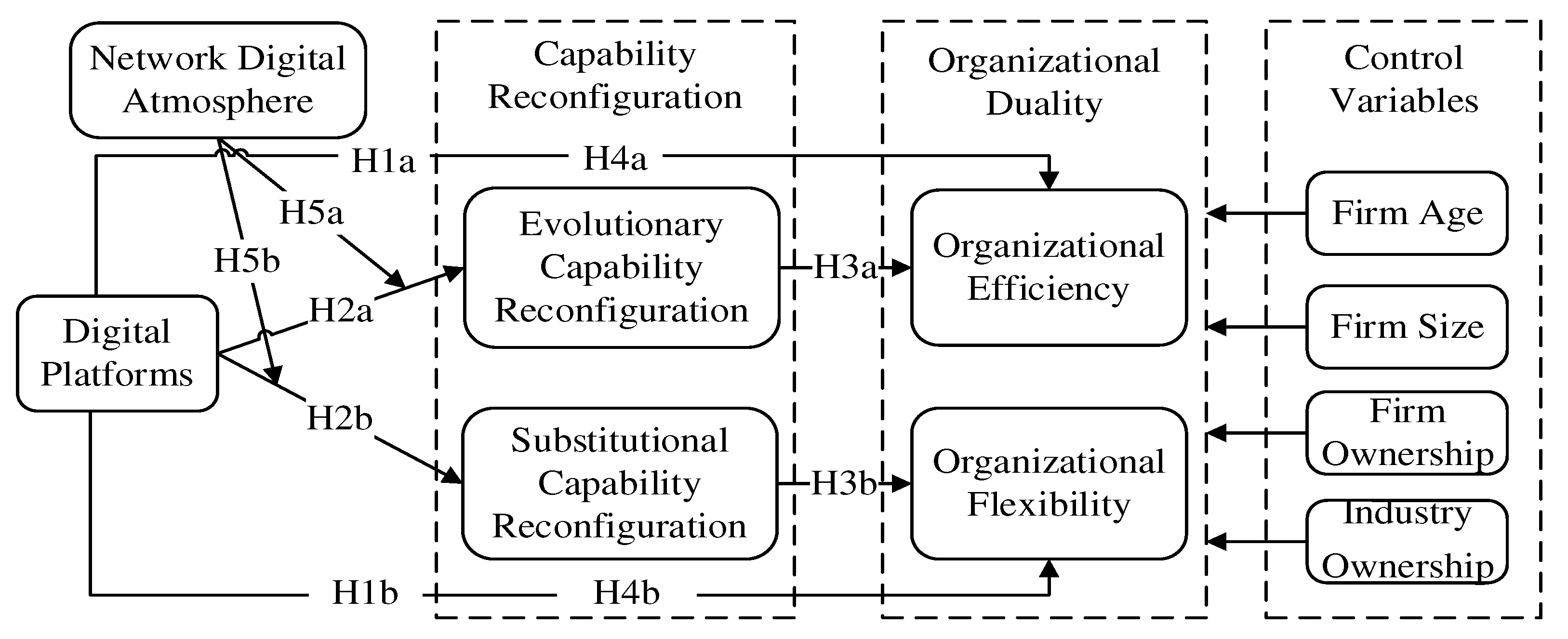
Figure 2.
Analysis results of structural equation model.
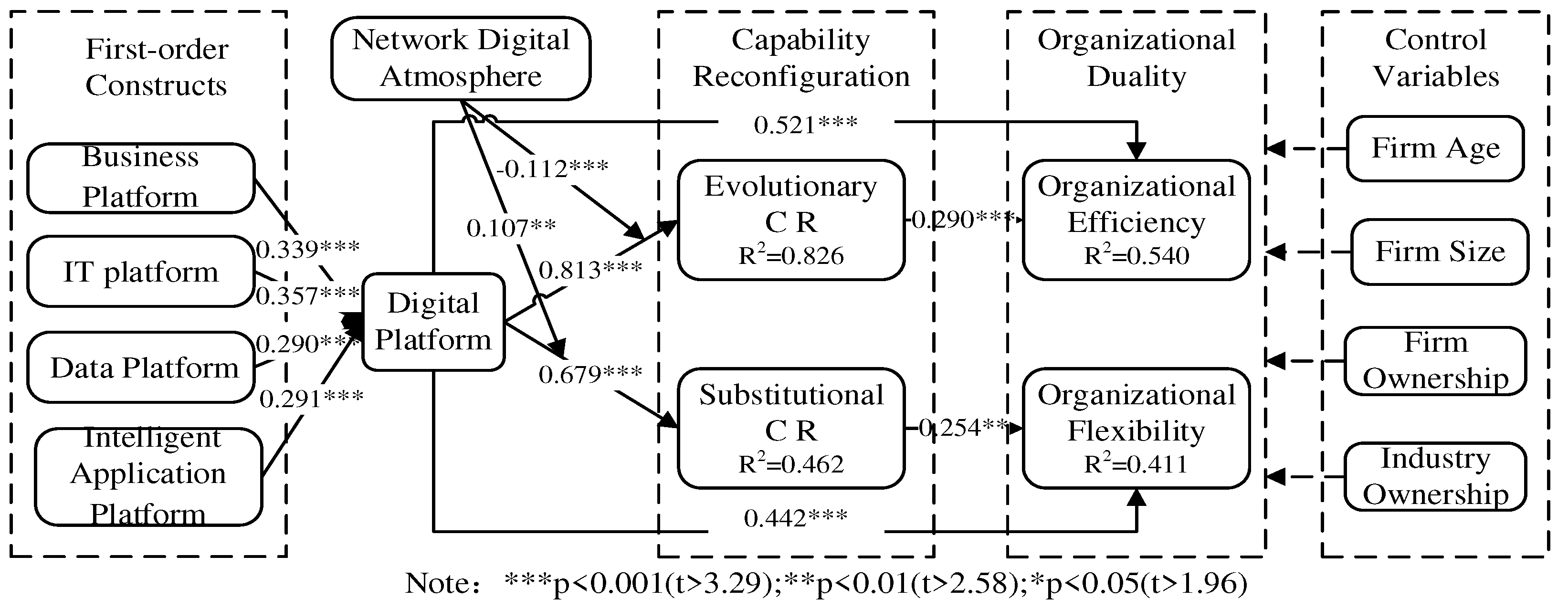
Table 1.
Sample distribution characteristics.
| variable | sample characteristics | sample size | Percentage% |
|---|---|---|---|
| Firm age | < 5 years | 7 | 2.40% |
| 5-10years | 54 | 18.90% | |
| 11-15years | 101 | 35.30% | |
| 16-25years | 70 | 24.50% | |
| > 25 years | 54 | 18.90% | |
| Firm size | < 300 employees | 54 | 18.90% |
| 301-1000 employees | 114 | 39.90% | |
| 1001-2000 employees | 41 | 14.30% | |
| 2001-3000 employees | 17 | 5.90% | |
| > 3000 employees | 60 | 21.00% | |
| Firm ownership | Private enterprises | 176 | 61.50% |
| State-owned enterprises | 92 | 32.20% | |
| Sino-foreign joint venture | 12 | 4.20% | |
| Foreign-owned enterprises | 4 | 1.40% | |
| Other | 2 | 0.70% | |
| Average annual sales | < 30 million | 34 | 12.20% |
| 30-100million | 71 | 47.20% | |
| 100-200 million | 60 | 35.70% | |
| 200-300 million | 53 | 3.10% | |
| > 300 million | 68 | 1.70% | |
| Industry ownership | Textile/Leather/Clothing/Footwear manufacturing industry | 33 | 11.50% |
| Culturaland educational/Industrial aesthetics/Sports/Entertainment products/Toy manufacturing industry | 15 | 5.20% | |
| Computer/Electronics/Mechatronics/Machinery and other high-end equipment manufacturing industry | 161 | 56.30% | |
| Chemical/Fiber/Metal/Pharmaceutical manufacturing industry | 46 | 16.10% | |
| Other industries | 31 | 10.80% |
Table 2.
Reliability and validity evaluation table of first-order constructs.
| Item wording | S.L. | Cronbach’s α | ρA | C.R | AVE |
|---|---|---|---|---|---|
| Business platform DP | 0.883 | 0.885 | 0.915 | 0.682 | |
| Our platform has effectively standardized administrative processes and operational processes. | 0.811 | ||||
| Our platform helps us supplement the existing business processes or functions in our organization. | 0.796 | ||||
| Our business processes or functions run smoothly with digital platforms. | 0.835 | ||||
| Our platform has the capability to exchange real-time information with our partners. | 0.840 | ||||
| Our platform provides seamless connectivity between partner systems and our systems to support business process coupling. | 0.845 | ||||
| IT platform DP | 0.904 | 0.906 | 0.929 | 0.723 | |
| Our IT projects using digital platforms require less resources (time, money) to develop and deploy. | 0.818 | ||||
| Our IT projects regularly trial new technologies seeking business opportunities. | 0.868 | ||||
| Our platform can be easily extended to accommodate new IT applications or functions. | 0.838 | ||||
| Our platform employs standards that are accepted by most current and potential partners. | 0.866 | ||||
| Our platform consists of modular software components, most of which can be reused in other business applications. | 0.861 | ||||
| Data platform DP | 0.875 | 0.877 | 0.915 | 0.728 | |
| Our platform can realize the cloud classification and hierarchical storage of various types of data, such as R&D, production, operation and service. | 0.835 | ||||
| Our platform can exchange real-time information with partners and realize the digitalization and online management of assets such as people, property, materials and data. | 0.882 | ||||
| Our firm relies on the platform to carry out correlation and analysis of internal and external data, and to realize innovative application and open sharing of data. | 0.842 | ||||
| Our firm uses platform tools for data collection, cleaning and processing, mining analysis and data visualization. | 0.854 | ||||
| Intelligent application platform DP | 0.875 | 0.877 | 0.914 | 0.727 | |
| Our platform uses 5G and artificial intelligence are utilized to build flexible production lines. | 0.832 | ||||
| Our platform uses artificial intelligence to make global decisions about demand, production and supply chains. | 0.851 | ||||
| Our platform uses deep learning for personalized, customized, and modular design to achieve new product development. | 0.872 | ||||
| Our platform uses artificial intelligence to extract, integrate, and aggregate domain knowledge to build a knowledge graph for internal and external use. | 0.856 | ||||
| Evolutionary capability reconfiguration CR | 0.861 | 0.862 | 0.906 | 0.706 | |
| Our firm makes simple adjustments to existing capabilities and practices. | 0.818 | ||||
| Our firm improves existing technology to promote innovation. | 0.856 | ||||
| Our firm assimilates new knowledge to develop their existing knowledge base | 0.842 | ||||
| Our firm uses existing knowledge to seek out new solutions actively. | 0.846 | ||||
| Substitutional capability reconfiguration CR | 0.867 | 0.869 | 0.904 | 0.653 | |
| Our firm explores new concepts or new fundamental principles. | 0.822 | ||||
| Our firm develops new skills and carries out a great deal of retraining. | 0.845 | ||||
| Our firm learns from completely new or different knowledge bases. | 0.764 | ||||
| Our firm adopts new methods and procedures for new business development. | 0.792 | ||||
| Our firm absorbs and creates new knowledge to replace outdated knowledge. | 0.816 | ||||
| Organizational efficiency OD | 0.877 | 0.879 | 0.907 | 0.620 | |
| Our firm reveals outstanding delivery speed and reliability. | 0.762 | ||||
| Our firm has an excellent production cycle time. | 0.799 | ||||
| Our firm is famous for the timeliness of delivery. | 0.814 | ||||
| Our firm reveals low engineering change rates in the production stage. | 0.790 | ||||
| Our firm has very low total quality costs relative to the total output. | 0.800 | ||||
| Our firm has a very short manufacturing lead time. | 0.757 | ||||
| Organizational flexibility OD | 0.920 | 0.921 | 0.938 | 0.714 | |
| Our firm has the ability to rapidly respond to customers’ needs. | 0.817 | ||||
| Our firm has the ability to rapidly adapt production to demand fluctuations. | 0.847 | ||||
| Our firm has the ability to rapidly cope with problems from suppliers. | 0.864 | ||||
| Our firm rapidly implements decisions to face market changes. | 0.843 | ||||
| Our firm continuously searches for forms to reinvent or redesign our organization. | 0.878 | ||||
| Our firm sees market changes as opportunities for rapid capitalization. | 0.821 | ||||
| Network digital atmosphere | 0.790 | 0.792 | 0.864 | 0.614 | |
| Our business partners apply a wider range of digital platform technologies. | 0.790 | ||||
| Firms that engage with our business frequently have a high level of digital service delivery. | 0.771 | ||||
| Firms that have been working with us for a long time are actively undergoing digital transformation. | 0.770 | ||||
| Our business partners are using business processes based on digital technologies. | 0.803 |
Table 3.
Formative structure accuracy assessment table.
| Formative structure | Second-order constructs | Path. Coeff. | S.E. | t-values | p-values | Cross dimensional correlation (highest) | VIF(highest) |
|---|---|---|---|---|---|---|---|
| Digital platforms | Business platform | 0.339 | 0.014 | 24.513 | 0.000 | 0.537 | 2.497 |
| IT platform | 0.357 | 0.021 | 16.627 | 0.000 | 0.516 | 2.794 | |
| Data platform | 0.290 | 0.013 | 22.073 | 0.000 | 0.537 | 2.795 | |
| Intelligent application platform | 0.291 | 0.017 | 17.185 | 0.000 | 0.526 | 2.499 |
Table 4.
HTMT differential validity evaluation table.
| Mean | S.D. | 1 | 2 | 3 | 4 | 5 | 6 | 7 | 8 | 9 | 10 | |
|---|---|---|---|---|---|---|---|---|---|---|---|---|
| 1. Digital platforms | 4.034 | 0.705 | ||||||||||
| 2. Evolutionary capability reconfiguration | 4.025 | 0.894 | 0.764 | |||||||||
| 3. Substitutional capability reconfiguration | 4.050 | 0.837 | 0.783 | 0.560 | ||||||||
| 4. Organizational Efficiency | 3.973 | 0.958 | 0.713 | 0.468 | 0.605 | |||||||
| 5. Organizational Flexibility | 4.104 | 0.782 | 0.838 | 0.702 | 0.654 | 0.593 | ||||||
| 6. Digital network atmosphere | 4.002 | 0.671 | 0.318 | 0.572 | 0.057 | 0.120 | 0.083 | |||||
| 7. Firm age | 3.380 | 1.069 | 0.202 | 0.093 | 0.203 | 0.113 | 0.129 | 0.102 | ||||
| 8. Firm size | 2.700 | 1.404 | 0.245 | 0.226 | 0.170 | 0.135 | 0.129 | 0.074 | 0.530 | |||
| 9. Firm Ownership | 1.480 | 0.709 | 0.140 | 0.073 | 0.034 | 0.094 | 0.092 | 0.073 | 0.161 | 0.100 | ||
| 10. Industry Ownership | 3.090 | 1.050 | 0.189 | 0.097 | 0.086 | 0.148 | 0.118 | 0.095 | 0.048 | 0.147 | 0.005 |
Disclaimer/Publisher’s Note: The statements, opinions and data contained in all publications are solely those of the individual author(s) and contributor(s) and not of MDPI and/or the editor(s). MDPI and/or the editor(s) disclaim responsibility for any injury to people or property resulting from any ideas, methods, instructions or products referred to in the content. |
© 2024 by the authors. Licensee MDPI, Basel, Switzerland. This article is an open access article distributed under the terms and conditions of the Creative Commons Attribution (CC BY) license (http://creativecommons.org/licenses/by/4.0/).
Copyright: This open access article is published under a Creative Commons CC BY 4.0 license, which permit the free download, distribution, and reuse, provided that the author and preprint are cited in any reuse.