

Submitted:
16 January 2024
Posted:
16 January 2024
You are already at the latest version
Abstract
Portugal’s EPAC silo network, initially planned in the 1930s but constructed and utilized primarily in the 1970s, consisted of 31 silos with a total capacity of 841,100 t. The network’s usage declined, however, due to market liberalization and Portugal’s accession to the European Economic Community in 1985. This study focuses on adapting a methodology to inventory and analyse the 31 silos in the EPAC network considering their general features, construction, technological facilities, and socioeconomic aspects. The silos are situated in 30 cities and towns, predominantly in the country’s key grain-growing regions, particularly the Alentejo region. While there are variations in design and construction, most EPAC silos contain two or three rows of circular reinforced-concrete cells and use the spaces between cells for storage. Their capacities range from 6,000 to 35,000 t. Some are inland grain reception and storage silos, while others are larger-capacity port silos designed to unload grain rapidly onto ships using mechanical or pneumatic unloaders. These structures are a significant part of Portugal’s agro-industrial heritage and have in some cases been repurposed as museums or event venues. Compared to other agro-industrial buildings, silos pose unique conversion challenges due to their height and design complexities. Examples of successful reuse in countries like Spain and Italy may provide insights for potential silo projects in Portugal. However, analysis suggests that such proposals and similar initiatives may be viable only in the more highly populated towns.
Keywords:
wheat
; grain store
; silo
; EPAC
; industrial heritage
1. Introduction
Since ancient times, the storage of grain, especially wheat in the Mediterranean area, has been particularly important [1]. In Europe castles and monasteries were used until the 19th century as wheat storage facilities [2]. Storage methods changed radically with the introduction of the grain elevator in Buffalo, USA, in 1843: traditional horizontal granaries were replaced by tall structures called ‘silos’ or ‘vertical storage units’ [3-5]. In late 19th-century Portugal, wheat imports sparked protests by domestic producers, which resulted in the enactment of protectionist laws from 1889 to 1899 [6-8] aimed at ensuring a minimal profit for producers without harming consumers; this led to an increase in domestic production [9,10]. At the beginning of the 20th century, over half of Portugal’s wheat production came from the districts of Evora, Portalegre, and Beja. The Alentejo region, which boasted favourable growing conditions but a large amount of uncultivated land, was targeted to increase national production [11]. From 1914 onwards, multiple political and social crises had their impact on protectionist wheat policies, and urgent measures were taken accordingly to reduce the cost of bread. Under these measures, collectively known as Pão Político (political bread), the state imported wheat and sold it on to flour mills at below market value [10]. The authoritarian regime known as the Estado Novo (New State) arrived in 1926. That same year, the I Congreso Nacional do Trigo (First National Wheat Conference) was held with the aim of achieving national self-sufficiency in wheat production [12]. In 1929 the Campanha do Trigo (Wheat Drive) (Figure 1) was run to bring large unfarmed areas, especially in the Alentejo region, into production, leading to deforestation, landscape change, and subsequent erosion issues [13-15].
Production was supported through subsidies and loans for wheat growers [10]. As a result of the Campanha do Trigo, production rose and the price of wheat fell, leading to conflicts between wheat growers and flour millers [9, 17, 18]. So, the national authorities created the Federação Nacional de Produtores do Trigo (FNPT, National Wheat Growers Federation) in 1932 [10] and the Federação Nacional dos Industrais do Moagen (FNIM, National Milling Industries Federation) in 1934, in an endeavour to control wheat production, processing, and marketing [12-19]. In 1935 the FNPT commissioned Professor Ruy Mayer of the Instituto Superior de Agronomia (ISA, School of Agriculture) in Lisbon to prepare a study in which the country was divided into eight zones based on the amount of grain produced (Figure 2). Zones I, II, III, and VIII were wheat-exporting zones, while the others were wheat importers. The study proposed the construction of a network of 30 silos to store and distribute wheat, using the railway to link production zones with consumption zones. Three types of silos were envisioned: (i) central silos, (ii) auxiliary silos, and (iii) other (smaller silos and granaries) [12, 15, 20].
Something similar to what happened in Portugal occurred in other European countries under authoritarian regimes as well. In Italy, from 1925 to 1931, Mussolini decided to pursue self-sufficiency in wheat production, which ultimately turned out to be a complete failure [21]. Later, around 1936, the ammasso (stockpile) was established in Italy, which mandated the delivery of all wheat crops to the state [22, 23]. In Spain the Servicio Nacional del Trigo (SNT, National Wheat Service) established a monopsonistic grain market and set up the National Network of Silos and Granaries, which began building storage units in 1951 and continued right up to 1990 [24]. The Portuguese government established a free market for wheat in 1947, offering a guaranteed price for other grains, such as maize and rye. It also purchased all barley intended for breweries, resulting in significant growth for the FNPT [9]. This led to the creation of the Instituto dos Cereais (IC, Grain Institute) in 1972, which represented the entire grain sector and held coordination and discipline functions in economic intervention until its dissolution in 1977 [25].
In 1972 the FNPT revised Ruy Mayer’s silo plan to include new categories. The objective was to build silos with a large reception and dispatch capacity, where different products could be stored and seed could be selected as well. The FNPT was eager to own its own silos; it was leasing over 300 granaries in 1971, and this was proving costly. The construction of silos in the Azores was also considered. In 1976 the Empresa Pública do Abastecimento dos Cereais (EPAC) [26] was established to replace the IC. The EPAC ensured the country’s supply of grain and seeds, defending the interests of growers and consumers and maintaining the quality of processing activities, all with the aim of protecting the interests of the Portuguese economy [27, 28]. During this period, significant investments were made in storage silos, although some storage silos, such as the one in Beato, Lisbon, had already been constructed with partial financing under the Marshall Plan in 1956.
Portugal’s admission to the European Economic Community (EEC) in 1986 brought market liberalisation and the policy of importing wheat at lower prices. In Portugal, as in other countries, like Spain, this resulted in a significant reduction in silo use [29]. In 1987 the state created a company, Silos Portuários, SA (SILOPOR), so that Portugal’s port silos could continue to be used for international imports. The EPAC was transformed into Empresa para Agroalimentação e Cereais, SA, in 1991 [30], and in 1999 it was dissolved [31] and its assets were transferred to the Direção Geral do Tesouro e Finanças (DGTF, Directorate-General of the Treasury and Finances). In 2002 all the silos were placed under the responsibility of the Instituto Nacional de Intervenção e Garantia Agrícola (National Agricultural Intervention and Guarantee Institute) after the dissolution of SILOPOR in 2001 [32]. The objective was to improve storage management and transfer silo ownership to growers and corporations. Many silos were let to agricultural cooperatives or private companies under 25-year leases that made the tenant responsible for maintenance [10]. The port silos of Leixões, Beato, and Trafaria and the inland silo in Vale de Figueira, Santarem, are currently managed by companies under public concessions. These silos function as temporary customs warehouses, providing services for the reception, handling, storage, and dispatch of food commodities and products related with companies in the industry [28]. Over time some tenants have returned silos they no longer use to the public authorities, and as a result these silos’ state of preservation has declined. In the 20th century, other countries, such as Spain and Italy, also set up networks of storage silos (primarily for wheat), most of which have since been either turned over to private interests or abandoned and only occasionally repurposed [9, 33]. National silo networks can become important again, since they are strategic elements of infrastructure that can mitigate dependency on grain-exporting countries in adverse scenarios, such as those caused by conflicts like the current war in Ukraine, pandemics, or blocked trade routes [23].
Silos form as much a part of the skyline of Portuguese towns and cities as do castles and churches, and, like other agro-industrial assets, silos contribute to the country’s cultural heritage [10, 27, 34, 35]. In some cases, silos are being refurbished instead of being allowed to crumble away. These silos have value as part of Portugal’s industrial heritage, so it is important to document them and showcase them through reuse [25, 37, 38]. Similar efforts are being made in other countries [25, 29, 38, 39]. Drawing up a comprehensive inventory is the first step toward making decisions that factor in the present condition of silos and their environment. It is our duty to seek a second life for these structures, whose construction consumed significant resources in their day, so we can keep them from being demolished and work our way toward greater environmental sustainability and a smaller carbon footprint [23].
The main objective of this project is to inventory the silos in Portugal’s EPAC network, analyse their construction and technological characteristics, and propose ideas for their reuse.
2. Materials and Methods
Given the lack of an inventory containing detailed silo information, the first step was to collect data from the EPAC archives in Lisbon and the records kept by other institutions, such as the Assembly of the Portuguese Republic, Universidade de Évora (Evora University), and the ISA. Second, the variables proposed by Fernández-Fernández et al. (2023) were screened to select the most appropriate variables for EPAC silos. Third, fieldwork was conducted at all 31 silos in the EPAC network. Each silo was photographed, and its main characteristics were recorded and grouped into four major categories (general features, construction features, technological facilities, and socioeconomic aspects). In the fourth step, the data were analysed using basic statistical analysis, and, lastly, lines of action were proposed (Figure 3).
A document search was used to identify 31 silos and 92 granaries constructed in Portugal and belonging first to the FNPT, then the Instituto dos Cereais, and finally to the EPAC. All of the granaries either are still being used to store grain or have been reused for other activities, so they were not included in the study. All 31 silos were then visited and photographed. The relevant variables were selected from among those proposed by Fernández-Fernández et al. (2023) for Spanish silos, and additional variables of interest were added to inventory the EPAC silos properly. The variables fall into the following four categories (Table 1):
-
General features:
- ○
- Location (region, district, and town);
- ○
- Geolocation (coordinates ETRS89 Use 30)
- ○
- Year when built;
- ○
- Year when enlarged;
- ○
- Ownership (state owned; leased to cooperative, institute, or private company; owned by private company or municipality);
- ○
- Use (grain store, disused, or reused);
- ○
- State of conservation. (1) Good condition: The silo is in good condition, i.e., it has no significant construction defects, although the mechanical facilities are in a poor state of repair. (2) Fair condition: The silo is leaky, it has water in its elevator shaft, its electric wiring has been burgled, its perimeter fencing is broken, etc. (3) Unusable: The silo is badly damaged or even in ruins. (4) Demolished: The silo has been demolished.
-
Construction features:
- ○
- Category (reception and storage silo or port silo);
- ○
- Storage capacity (t);
- ○
- Height (m);
- ○
- Ground plan (square or L-shaped);
- ○
- Roof shape (flat roof, gable roof, flat and gable roof, or vaulted roof);
- ○
- Tower position (front tower, side tower, corner tower, or interior tower);
- ○
- Number of storage cells;
- ○
- Number of rows of cells;
- ○
- Number of rows of internal cells or intercellular spaces;
- ○
- Shape of cells (circular or square);
- ○
- Cell dimensions (m);
- ○
- Façade types (straight; semicircular type I, which consists of straight façade, semicircular façade and straight façade; semicircular type II, which consists of semicircular façade and straight façade; semicircular type III, which consists of semicircular façade only);
- ○
- Cell construction material (reinforced concrete or reinforced brick);
-
Technological facilities:
- ○
- Receiving machinery capacity (t/h);
- ○
- Number of elevators;
- ○
- Number of upper-storey horizontal conveyors;
- ○
- Number of lower-storey horizontal conveyors;
- ○
- Existence of firefighting system (yes or no);
- ○
- Existence of lift (yes or no);
- ○
- Existence of temperature sensors (yes or no);
- ○
- Existence of railway (yes or no);
- ○
- Lorry weighbridge (t);
- ○
- Railway weighbridge (t).
-
Socioeconomic aspects:
- ○
- Population;
- ○
- Demographic patterns;
- ○
- Yearly municipal budget (€);
- ○
- Economic activity;
- ○
- Connections by road;
- ○
- Distances to larger urban centres (km).
The information collected is all available in Supplementary Materials Tables S1 and S2. All data were subjected to basic statistical analyses.
3. Results and Discussion
3.1. Geographical distribution, development, and evolution of the EPAC silo network
The silos in the EPAC network stand at 30 locations in Portugal’s leading grain-producing districts, many of them in the Alentejo region (18 silos, 33.7% of the network’s storage capacity). Within the Alentejo region, the district of Beja has eight silos (16.2% of the network’s capacity), Portalegre has five silos (6.3% of the network’s capacity), and Evora has four silos (8.5% of the network’s capacity). The Lisbon region has only three silos, but they account for 38.8% of the storage capacity, as two of them (Trafaria and Beato) are port silos. The North region has three silos, accounting for 14.0% of the EPAC network’s capacity (including the Leixões port silo in Porto). The Centre region has three silos and 4.8% of the network’s capacity. The Azores region has two silos and 6.5% of the capacity. Finally, Madeira and the Algarve region have one silo each (Table 2).
Figure 2 shows the territorial distribution of the silos in the EPAC network and the variations in their locations compared to Mayer’s 1932 study. During the revision of the Silo Construction Plan in 1972, several options were considered for the construction of a new port silo in the Lisbon region, in addition to the silo already planned in Leixões, in the North (Porto) region. Harbour depth was an important factor in this plan, to enable large vessels to dock. Ultimately Trafaria was chosen as the location for the silo’s construction. The EPAC silo network may be said to be located in the leading grain-producing areas of the country plus the ports of Leixões and Lisbon. The network mainly covers the regions of Alentejo, Lisbon, and Centre; Beja is the district with the most silos, eight, while only one silo was built in the Algarve region, which is a coastal area with limited grain production. The Campanha do Trigo (1929) heralded state intervention in and regulation of the Portuguese grain market. In 1935 the construction of a network of wheat storage and distribution silos was proposed, with the idea of using the railway to connect the locations where wheat was produced, ground, and consumed [12]. In the network’s early stages, in 1938, Professor Ruy Mayer classified the planned silos into three types: (i) central silos, located at strategic crossroads (Casa Branca, Entrocamento, and Leixões), (ii) auxiliary silos, near farmers and production areas, and (iii) other, which included smaller silos and granaries [15, 20] (Figure 1, Table 2). After the 1972 revision of the Silo Construction Plan, silos were classified as (i) regionais (‘regional’ silos, close to farmers), (ii) de concentraçao ou termináis (‘concentrating or terminal’ silos, close to farmers and for transfers of wheat from other regions), or (iii) portuarios (‘port’ silos, primarily for imports). Additionally, objectives were set to build silos with greater storage, reception, and dispatch capacity, designed to store different products simultaneously and enable seed grain selection [12].
Portugal built its first silos considerably later than other countries, like Spain, except for the silo in Mértola, Beja, which dates back to 1938. In the 1950s, four silos were built in Portugal (Vila Franca de Xira in 1956; Beato in Lisbon, whose first two phases were built in 1958 and 1962 respectively; the silo in Catarina da Fonte do Bispo, Faro, in 1958; and the silo in Caldas de Rainha, Leiria, in 1959). Three more were built in the 1960s (one inside the city of Beja in 1961, one in Vila de Boím, Portalegre, in 1964, and one in Alter do Chao, Portalegre, in 1969). Construction on the rest of the silos began in 1970 with the Aljustrel silo. The 1970s were the most prolific decade for construction [34], accounting for 64.5% of all silos in the network. In the end, a total of 31 silos were built in the EPAC network, very close to the number called for in Ruy Mayer’s plan [20], but they had a capacity of 841,100 t, much higher than the 92,800 t Mayer proposed for his 30 silos. Half of these silos (51.6%) were enlarged in the mid-1970s and early 1980s (Table S1). Unlike Italy and Spain, which started constructing silos in the 1930s to 1950s, Portugal built its silos later, mainly in the 1970s. As a result, Portuguese silos had larger capacities than those of other countries. Only 4.7% of Spanish silos can hold more than 10,000 t (with a maximum of 40,000 t) [39], while only eight silos in the EPAC network have a capacity of under 10,000 t, and some, such as the Trafaria port silo in Lisbon, can hold up to 200,000 t.
Starting in 1986, with the liberalization of the market, Portugal, like Spain, experienced a significant decline in silo use [29, 40]. Some silos fell into disuse (38.7% of the total), and most were burgled. All the facilities they contained were destroyed. Currently, just over half of the silos in the network (53.3%) are leased to agricultural cooperatives, institutes, or private companies. They are mainly port silos, and they form the bulk of the silos that are still being used for grain storage (51.6%). Other silos are owned by private companies (10.0%) or have been transferred to municipalities (3.3%), and the remainder are state owned (33.3%) (Table 3). The number of unused silos is expected to increase in the coming years, as the 25-year leases to cooperatives and private companies will expire in 2030-2035, and it is anticipated that several leases will not be renewed.
3.2. Layout and construction characteristics
3.2.1. Early silos
The first silo was built in 1938 in Mértola. It consists of two rows of square cells raised off the ground and made of reinforced brick with reinforced-concrete pillars at the corners. The elevator tower is located on the side of the silo and houses the staircase and grain-lifting machinery. The 12-cell silo has a small storage capacity (4,500 t) and is 37.5 m tall. It was constructed adjacent to granaries and a flour mill, which remained in operation until 1961. The granaries and the silo were later used as storage facilities by the EPAC. It took 15 years to complete the first phase of the silo in Angra do Heroísmo, the capital of Terceira Island in the Azores archipelago. This was the first in a series of silos made with circular reinforced-concrete cells. This 11,000-t silo has three rows of cells, with four cells per row. The cells are made of reinforced concrete and have a diameter of 6.5 m. The intercell spaces are also utilized as storage space, thus creating two additional rows of smaller cells between the main cells. The tower is positioned at the front of the silo. Three years later, in 1956, the silo in Vila Franca de Xira, near Lisbon, was constructed. This silo has a small capacity (6,500 t), with two rows of cells. Each row has four circular cells, also made of reinforced concrete. The intercell space is used for storage, and the silo’s tower is located at the front. Two years later, in 1958, the first phase of the Beato port silo in Lisbon was constructed on the right bank of the Tagus River. The second phase was completed in 1962, making for a total storage capacity of 43,000 t. With two subsequent expansions in 1975 and 1985, this silo eventually grew to a total capacity of 120,000 t and 128 cells. The cells built in the first three phases are 7 m in diameter, while those built in the fourth phase are 13 m in diameter. All cell walls are 0.20 m thick. This silo is the second largest in capacity, surpassed only by the Trafaria silo (200,000 t) on the left bank of the Tagus River, opposite Lisbon. This silo is actually a complex of three independent interconnected silos. One of them, which has a rectangular layout, consists of 63 cells arranged in three rows (the intercell spaces are used as well), with two towers at the north and south ends; this section was built in phases one and two of the complex’s construction. The second silo is attached to the south tower of the original silo by a new elevator tower. It also has a rectangular layout and consists of 27 cells, also arranged in three rows; this constituted phase three of construction. In the fourth phase, a T-shaped building was raised with a tower in the centre of the T, housing 17 storage cells and 12 dispatch cells raised above six loading points. In the same year, 1958, the Santa Catarina da Fonte do Bispo silo was constructed, the only silo built in the Algarve region. This building has a small capacity, just 1,300 t, and consists of two rows of circular reinforced-concrete cells with a diameter of 3.6 m apiece. The Caldas de Rainha silo was built shortly thereafter, in 1959, with a capacity of 6,500 t. It also consists of circular reinforced-concrete cells with a diameter of 4.5 m arranged in a rectangular layout. In 1961 a silo was built right inside the city of Beja. It has three rows of main cells made of reinforced concrete; each row contains six cells, each measuring 6.3 m in diameter. The silo thus has a storage capacity of 15,000 t. It is worth noting that the construction of all these silos featuring circular cells differed from that of the silos built with circular cells in countries like Spain: in other countries, all such silos were constructed with two rows of cells and a significant separation between the rows, and the intercell space was not utilized for storage, as it was in Portugal [39]. The Vila Boím silo was constructed later, in 1964. It has a square layout and consists of 14 square cells similar to those in the Mértola silo, with a storage capacity of 4,000 t. This silo has its tower at one corner, resembling the Type B silos of Spain’s national network of silos and granaries [39]. The 1960s ended with the construction of the Alter do Chão silo, built in 1969, consisting of two rows of five primary cells, circular in shape and measuring 5.45 m in diameter. The silo therefore has a storage capacity of 8,000 t. These silos are not very tall, ranging from 26 m (the Santa Catarina da Fonte do Bispo silo) to 45 m (the silo inside Beja). The Beato silo is much taller, 65 m. These silos are significantly taller than Spanish silos from the 1960s, which rarely exceeded 30 m in height [29].
3.2.2. Silos from the 1970s
The silos built from the 1970s onwards all contain circular cells and have a rectangular layout with the tower located at one of their front ends. In these silos, the cells are grouped into two or three rows, although the intercell spaces are also utilized for storage, effectively creating three or five rows of cells (alternating between the circular primary cells and the intercell spaces). Silos with three rows form the majority, 58.6%, and they tend to have larger capacities. The rows of cells are elevated four meters above the ground, leaving a practically open ground floor for unloading grain. Their storage capacities vary from 6,000 t (the Mogadouro silo) to 35,000 t (the Reguengos de Monsaraz silo). These silos are taller, ranging from 37.5 meters (the Aljustrel silo) to 70 meters (the silo outside Beja). The Leixões port silo was built in 1978. It has a rectangular layout with the elevator tower at one end and three tows of 60-meter-tall circular storage cells having a diameter of eight meters per cell. The main cells have a capacity of 2,000 t, while the internal cells have a capacity of 600 t. All are raised off the ground. The silo has a storage capacity of 100,000 t. The tower is connected via a 30-meter-high metal walkway to a battery of 3x3 dispatch cells, which are five meters in diameter and 30 meters tall. These dispatch cells are positioned above three truck unloading points. The last silos in the EPAC network were built in the 1980s. One of the last two was constructed in 1984 in Funchal, the capital of Madeira Island. This silo was later demolished. The other was built in 1986 at the port of Trafaria. That is the last EPAC silo built to receive large ships and unload grain from them quickly for storage in the silo, transfer to smaller ships, or transfer to barges that would then sail up the Tagus River to unload at shallower ports. The Trafaria silo consists of circular cells with diameters of 8 and 10 m, raised off the floor. They are grouped into four rectangular modules, two of which have three rows of cells apiece, and the other two, four rows, for a total of 114 storage cells. Standing 70 meters tall, the silo can hold 200,000 t. Its elevator tower is located at one corner of one of its cell groups. Additionally, the silo has an elevated bulk discharge cell module consisting of 10 cells located above five truck-loading points. This silo is a true building/machine complex, to use the term Azcárate [41] coined for modern Spanish silos. In capacity, these silos far surpass contemporary Spanish silos, only two of which can hold more than 30,000 t [5].
3.2.3. Construction features
Only in the early silos is the structure made of reinforced-concrete pillars and beams with square-shaped reinforced-brick walls. The vast majority of EPAC silos (93.3%) have circular cells constructed of reinforced concrete. This differs greatly from Spanish silos, only the most modern of which are made of reinforced concrete [5]. All silos have one or more receiving hoppers where the grain from incoming vehicles (lorries and/or trains) falls into a pit, to be subsequently lifted to the top of the silo. Likewise, all silos have an elevator tower. This is where the grain-lifting machinery, seed selection machinery, the staircase, and the elevator are located. The tower is therefore always several metres taller than the rest of the silo, so that grain can be dropped from the vertical elevators to the upper horizontal conveyors, and from there to the cells (Figure 4). The tower is usually positioned at the front of the silo, at one of its two ends (in 83.3% of silos), or else at one of the corners of the silo (as at the Vila de Boím and Trafaria silos) or in a lateral position (as at the Mértola silo). Sometimes, when a silo is expanded, the tower ends up inside the silo (Vale de Figueira and Beato silos). The elevator tower is built out of reinforced-concrete pillars and slabs, with brick walls that are rendered on both sides and painted a cream colour on the outside.
In the most modern silos, the walls in the storeys housing the selection machinery are made of reinforced concrete. The tower has windows on all storeys, with variations between silos. The Evora silo’s tower is exceptionally spacious, as it was designed to accommodate a large amount of cleaning, sorting, and weighing machinery (Figure 5.a). In 53.4% of the towers visited, there is a 10,000-l reservoir at the very top to provide water for the firefighting system. The layout and characteristics of the towers closely resemble those of Spanish silo towers, as they serve the same purpose [39]. The most common silo roofs are flat roofs (found in 56.7% of silos) and symmetrical gable roofs (40.0%); of the remainder, some are domed, while others are inclined flat roofs or inclined roofs (Figures 5.b & 5.c). Most of the flat roofs are finished with waterproofing membranes installed on top of a reinforced-concrete support structure. Inclined roofs are covered with fibre cement sheets or metal plates, supported by rafters and concrete beams in older silos, and by steel frames and metal rafters in newer ones. All silos except the oldest have downspouts outside. The facades are formed by the outer walls of the storage cells. The vast majority (93.3%) of these storage cells form a wall that is semicircular in outline, the exceptions being the silos in Mértola and Vila de Boím, whose cells form straight walls. The facade material is reinforced concrete painted white, except for the silos in Mértola and Vila de Boím, which are made of reinforced brick and are rendered with mortar. The semicircular walls may be divided into three types. In Type I semicircular facades, which account for 16.7% of the cases, the semicircles stand on top of the ground storey, which is rectangular with straight walls. The semicircular portion ends at the top of the cells, where there is another straight-walled, rectangular section that forms the upper corridor (Figure 5.d). In Type II semicircular facades, which account for over half of the silos (53.3%), the semicircles stand on the ground, rise as far as the cells do, and are topped with a section similar to the one found in Type I (Figure 5.e). Most modern silos (23.3%) have Type III semicircular facades. In Type III, the semicircles start at ground level and rise to several meters above the end of the cells to create the upper corridor, providing continuity of line and giving the building structure a more robust appearance (Figure 5.f).
3.3. Technological development
3.3.1. Early silos
The early silos (those built before the 1960s) have an elevator tower with two vertical elevators. These elevators receive the grain unloaded into the external receiving hopper (Figure 6.a). One elevator runs to the top of the silo to feed one or two upper horizontal conveyors that drop the grain through tubes to the cells. The other, shorter elevator carries grain to the cleaning machinery and is used only if grain has to be weighed, selected, or processed to remove impurities. The cleaning machinery is located halfway up the elevator tower. The elevators have a housing with a circular or rectangular cross-section, inside of which a belt ascends on one side and descends on the other, with buckets that lift the grain to the top (Figure 6.b). These elevators have characteristics similar to those of silos in other countries, like Spain [39].
The conveyors consist of a square-section housing and a chain with crossbars that moves inside the housing, dragging the grain forward (Figures 6.c & 6.d). Grain is extracted from the cells at the bottom, using manually operated gates that allow the grain to be unloaded onto a lower horizontal conveyor, which then returns the grain to one of the elevators to gain height so it can go through selection, bagging, or bulk dispatching, depending on what is needed (Figures 6.e & 6.f). Even these early silos are fitted with a pneumatic system for vacuuming up dust at points where dust is likely to be created, unlike Spanish silos of the 1950s and 1960s, which were rarely equipped with dust collection systems [39]. This system ends in an extractor and a settling cyclone where the larger particles settle out and are collected (Figure 6.g).
3.3.2. Silos from the 1970s
Silos built from the 1970s onwards can be grouped into two types, based on what machinery is installed. First, there are silos built at various inland locations to receive and store grain. These silos have two or three rows of cells, with one or two cell elevators and one or two cleaning and weighing elevators, one to three upper horizontal conveyors for loading the cells, and one or two lower horizontal conveyors for emptying the cells, although grain can be released directly into a vehicle from the cells on the outer row. Branches carrying incoming grain to cells and outgoing grain from cells are opened by manually operated valves and, in some cases, automatic valves. Reception hoppers for grain arriving by both rail and road are located on the sides of the elevator tower; horizontal conveyors are thus required to carry the grain from the bottom of the hoppers to the elevators (Figure 6.h). This machinery, which is used for both reception and dispatch, has a capacity of 120-360 t/h. These silos are more highly mechanized than those built decades earlier, and they can handle loading, unloading, cleaning, weighing, and even seed selection simultaneously. They can process large quantities of grain daily, all controlled from a control room on the ground storey of the silo [42, 43] (CME, 1969; Sociedade de Construçoes Valura LDA, 1970) (Figure 6.i). The majority of the EPAC network silos (80.5%) fall into this group. All these silos have an elevator in the elevator tower, and some of them have probes to monitor grain temperature (Figure 6.j). Similarly, all of them have a 60- to 80-t, 14- to 16-m long weighbridge. Bringing railway facilities right up to silos proved to be a significant step forward for grain distribution in Europe, and in the 1970s and 1980s rail became consolidated as one of the major means of transporting grain, according to Barciela [44]. This statement aligns with the findings of our study, which shows that 54.9% of the silos (all built in the 1970s) have rail reception and dispatch facilities. The function of this group of silos is the same as that of the ‘transition and reserve’ silos built for Spain’s national network of silos and granaries: these silos collected grain from smaller silos and stored it until it could be marketed, and they were therefore located at sites with good road and rail connections [5, 45].
3.3.3. Port silos
The other type of silo built from the 1970s onwards is the port silo (Leixões (1978-80), Beato (1958-85), and Trafaria (1986)). Port silos are the largest-capacity silos: together they account for 50% of the capacity of the entire EPAC network. Port silos are more highly mechanized, because they receive grain from large-tonnage ships and need to unload quickly (Figure 6.k). For this purpose, they have mechanical and/or pneumatic unloaders with capacities of up to 600 t/h apiece (Figure 6.l). These devices are fully reversible and can be used for both unloading and loading. Silos of this type do not have machinery for cleaning and selecting grain; instead, they have automatic online scales for weighing grain and can receive and dispatch at the high rate of 1,000-3,000 t/h (Figure 6.m). In these silos, the number of elevators ranges from seven in Leixões to 14 in Trafaria, with three upper horizontal conveyors for loading cells in each module or group of cells built at the same time, and three to four lower conveyors for unloading cell groups. There are also 10 to 13 specific grain-dispatching cells apart from the storage cells; the dispatching cells are usually located above the lorry/train dispatch points (Figure 6.n). In these silos, operations are fully automated and optimized and are all carried out from control rooms equipped with computer systems that reduce operation times for greater process efficiency (Figure 6.o). Systems provide real-time information about the status of each cell, and supplier and customer management programs dispatch goods fully automatically through terminals identifying the hauler, the company, and the goods to be collected (Figure 6.p). These silos have probes in each cell to monitor grain temperature continuously. It is worth noting that in over half of the silos there is a fire protection system consisting of steel pipes with hose connections running from a reservoir at the top of the elevator tower. Additionally, 87% of the silos have a basket-type device for lowering an operator into grain cells.
3.4. Possibilities of reuse for Portugal’s silos
Currently just over half of the EPAC silos are being used for grain storage, but some of these silos are expected to become obsolete in the near future. Few repurposing proposals have been submitted, primarily due to the high cost of refurbishing structures like these. Unlike other agro-industrial constructions like flour mills and public slaughterhouses, whose open-plan, single-storey distribution makes them ideal candidates for conversion into museums, cultural centres, and similar venues [46, 47], silos are uncomfortably tall and are divided into numerous small cells [29]. Some innovative projects for silo reuse have nevertheless emerged in Portugal [48]. For example, the Vila Boím silo has been transformed into an event and meeting space by a beverage company (Figure 7.a & b). The Instituto Lusíada de Cultura (Lusíada Institute of Culture) has been working since 2020 to refurbish an agricultural cooperative’s silo in Santa Catarina da Fonte do Bispo, in the municipality of Tavira in the Algarve region, to create Museo Zer0, the first digital art museum in Portugal and Europe [49] (Figure 7.c). The Braganza silo will be transformed into the future Museum of the Portuguese Language after a public investment of nearly 11 million euros; this is hoped to have a significant impact on the region both economically and culturally (Figure 7.d). There are also other proposals farther from completion, such as the transformation of the Mértola silo into a biological station with a 4.5 million-euro investment linked to the Universidade do Porto (University of Porto) [50]. Another innovative proposal is to create a ‘Route of the Silos’ in the Alentejo region to showcase and capitalize on silos as a means of attracting population and economic resources to rural areas [12]. In some cases, silos have served as canvases for outdoor murals, as seen in the silo in Agra do Heroísmo on Terceira Island in the Azores (Figure 7.e).
Other countries, like Spain, have seen many ambitious attempts to weave silos into the surrounding urban fabric and give fresh lustre to their value [51]. Several such proposals have been completed. For example, in Fuentes de Andalucía, Sevilla, a silo now holds a museum on its ground storey and a viewing platform on its roof. This project received an award from the Fundación de Patrimonio Industrial de Andalucía (Industrial Heritage of Andalusia Foundation) in 2014 [52]. In Pozoblanco, Córdoba, a more ambitious proposal called for a silo to be integrated into a new building containing a theatre with over 800 seats [53]. The silo in Alcaracejos, Córdoba, has been made over into a spa resort. Where grain was once stored, massages are now given using oils from the local olive trees. The silo in Belorado, Burgos, was transformed into the Museo Internacional de Radiocomunicación Inocencio Bocanegra (Inocencio Bocanegra International Radiocommunication Museum) in 2013 [54]. In the Spanish province of Ciudad Real, ten silos were painted as part of the ‘Titanes’ project to promote the social integration of people with disabilities through art, transforming the landscape of La Mancha [55] (Figure 7.e). In Italy, the silo at Livorno harbour has been transformed into an event venue, and the port silo in Genoa, known as Silo Hennebique, is being converted into a cruise terminal, hotel, student residence, and multicultural space with an investment of 130 million euros [56]. In Moscow, the silo known as ‘Tank 41’ has been made into a theatre [57], and in Oslo, Norway, a silo has been transformed into the Grünerløkka student quarters [58]. These are some examples of successful silo refurbishment projects. There have also been cases of silo demolition; the silo in Vila Viçosa was demolished over 30 years ago, and the silo at Funchal harbour on the island of Madeira was knocked down in a renovation of the port and Avenida Sá Carneiro. Although government authorities are not very inclined to invest heavily in repurposing silos, there is a growing trend towards unconventional tourism based on ethnographic and industrial assets (old mills, oil mills, wineries, mining structures, etc.). These abandoned, purposeless buildings are being turned into assets, part of the cultural heritage with great potential to enhance the value of their home territory [24, 59]. There is also increasing social awareness in favour of reusing existing buildings instead of constructing new ones, for a smaller carbon footprint [58, 60-63].
Based on the data in Supplementary Materials Table S2, over half of the EPAC silos are located in towns with more than 10,000 inhabitants. Their reuse could become a cultural and economic resource for the town and a new opportunity for the future. In socioeconomic terms, these towns can be grouped into two categories. The first group consists of towns with over 10,000 inhabitants (including five cities with over 50,000 inhabitants) and a stable or slightly growing population, with occasional exceptions. These towns are well connected by roads, and some even have railway connections (in the case of islands, ports and airports). They engage in an array of economic activities covering the primary, secondary, and tertiary sectors and have a municipal budget of several million euros. For these cities, it is recommended to invest public funds to transform abandoned silos into tourist attractions, venues for cultural activities and sports, business premises, government offices, and public housing, according to Mateo (2011). Fernández-Fernández et al. (2017a) in Spain included villages with more than 2,000 inhabitants in this group, but in Portugal towns with less than 10,000 inhabitants are mostly losing population and have poor connections. The second group consists of 14 towns and villages with fewer than 10,000 inhabitants, experiencing negative or very negative population trends. These towns are mostly poorly connected and have an economy based mainly on the primary sector. Therefore, public investment cannot be recommended. However, private entrepreneurial initiatives may still be a possibility, as seen in the cases of the silos in Vila de Boím, Portalegre, and Santa Catarina da Fonte do Bispo, Faro.
4. Conclusions
The methodology used by Fernández-Fernández et al. (2023) in Spain to characterize silos has been adapted for the EPAC silo network in Portugal and used to inventory the EPAC silos and evaluate potential alternatives for their reuse. Although planned in the 1930s, the EPAC silo network was mainly built and used in the 1970s. Its usage declined after the liberalization of the wheat market and Portugal’s accession to the European Economic Community (EEC). Silos are still present in many villages across Portugal and form part of the rural landscape. The silos in the EPAC network are located in 30 towns, primarily in the country’s biggest grain-producing regions, especially the Alentejo region, which has the largest number of silos and the greatest storage capacity. Altogether, 31 silos were built for the EPAC network, with a total capacity of 841,100 t, much larger than originally proposed. Most of these silos were enlarged in the 1970s and early 1980s.
Currently, over half of the silos are leased to agricultural cooperatives or private companies. The number of unused silos is expected to increase in the coming years as lease contracts expire, because not all tenants may choose to renew. EPAC silos exhibit a range of design and construction characteristics. The first silo, built in 1938 in Mértola, consists of two rows of square cells raised above the ground, constructed with reinforced brick and concrete pillars, with a capacity of 4,500 t. In 1952, the first silo with circular cells was constructed in Angra do Heroísmo, with a capacity of 11,000 t. In the 1950s and 1960s, several more silos were built with diverse capacities and designs. From the 1970s onwards, silos were designed with circular cells grouped into two or three rows, with the intercell space used for storage. These silos are taller and have larger capacities, ranging from 6,000 to 35,000 t. Their cells are built out of reinforced concrete. Most silos have an elevator tower at one end and a flat or sloping roof. The facades are made of reinforced concrete, mostly painted white.
The technological development of EPAC silos may be divided into various stages. Early silos (those built up to the 1960s) were equipped with vertical elevators that carried grain through tubes to storage cells. Shorter elevators were also used for cleaning and selecting grain. These silos had pneumatic systems to collect dust and extract coarse particles. From the 1970s onwards, two types of silos were built. First, there were reception and storage silos located at inland sites. They were highly mechanized and could perform operations such as loading, unloading, cleaning, weighing, and seed selection. These silos had elevators, horizontal conveyors, and probes to monitor grain temperature. Second, there were port silos designed to unload grain quickly from large vessels. These silos had larger capacities and were outfitted with mechanical or pneumatic unloaders, automatic weighing scales, and automated control systems. They did not have machinery for grain cleaning and selection, but they were equipped with real-time information systems and management programs for cargo dispatch.
The possibility of repurposing silos is now being explored, since several silos are expected to fall into disuse by 2030-2035. Unlike other agro-industrial buildings, silos present challenges due to their height and design. However, some innovative initiatives have been proposed, such as converting silos into event venues, museums, or biological stations, or creating a silo-based tourist route in the Alentejo region. Other countries, like Spain, have put together successful refurbishment projects, transforming silos into museums, theatres, spas, and homes. While some authorities may be reluctant to invest in repurposing silos, there is a growing interest in utilizing existing structures and promoting tourism based on the country’s cultural and industrial heritage. Through reuse, silos could become cultural and economic resources for cities and towns, particularly those with stable populations, good connections, and a well-rounded array of business activities. In short, this research can be considered the first step towards inventorying, documenting, informing about, and enhancing the value of abandoned silos in the defunct EPAC network, as well as raising awareness about the neglected state of some of these properties. Further studies can delve into specific refurbishment proposals for EPAC network silos.
Supplementary Materials
The following supporting information can be downloaded at the website of this paper posted on Preprints.org. Table S1: Information collected from the silos in Portugal’s EPAC network; Table S2: Indicators for 30 towns in Portugal, sites of 31 silos.
Author Contributions
All authors contributed to the concept and design, acquisition, analysis, interpretation of data and drafting of the manuscript. All authors have read and agreed to the published version of the manuscript.
Funding
This research received no external funding.
Data Availability Statement
Not applicable.
Acknowledgments
The authors would like to express their gratitude for the hearty cooperation of the companies, cooperatives, and other entities that lease or own the silos and the invaluable cooperation of the municipal chambers of the territories where the silos are located.
Conflicts of Interest
The authors declare no conflict of interest.
References
- Teague, W.D. Flour for Man’s Bread: a History of Milling. Minnesota Archive Editions, New York, U.S., 2007.
- Pereira, J.L. 1980. Contribución fiscal del partido de Cáceres durante el siglo XVI: alcabalas y tercias. Norba. Revista de arte geografía e historia 1980, 1. http://hdl.handle.net/10662/810.
- Banham, R. A Concrete Atlantis. US Building and European Modern Architecture; MIT Press, Massachusetts. U.S., 1989.
- Salido, J. El almacenamiento de cereal en los establecimientos rurales hispanorromanos. In: Horrea d'Hispanie et de la méditerranée romaine, Arce, J., Goffaux, B., Eds.; Casa de Velázquez: Madrid, Spain, 2011; pp. 127-141.
- Fernández-Fernández M.V. Catalogación de las unidades de almacenamiento vertical de cereales de la red básica de Castilla y León, propuesta de una nueva clasificación y posibilidades de reutilización. Master’s thesis, Univ. de León, León, Spain 2016.
- DG. Lei de 15 de Julio de 1889. Diário do Governo n.º 156/1889 de 16 de Julho.
- DG. Decreto de 29 de Agosto de 1889. Diário do Governo n.º 198/1889 de 4 de Setiembre.
- DG. Lei de 14 de Julio de 1899. Diário do Governo n.º 156/1899 de 15 de Julho.
- Amaral, L. 1996. Política e economia: O Estado Novo, os latifundiários alentejanos e os antecedentes da EPAC. Analise Social 1996, 31, 465-486.
- Ribeiro, I., Diniz, A. Celeiro Epac. A Paisagem Industrial de Évora. Sciencia Antiquitatis 2019, 2, 153-176.
- Reis, J. “Lei da Fome”: as origens do proteccionismo cerealífero (1889-1914). Análise Social 1979, 15, 745-793.
- Alves, J. Arquiteturas do Trigo: Espaços de Silagem no Alentejo, do século XIX à atualidade. Disssertacao para a obtençao do grau de mestre em arquitectura, Universidade de Évora, Portugal, 2016. http://hdl.handle.net/10174/19745.
- Pais, J. M. Elementos para a história do fascismo nos campos: a campanha do trigo: 1928-38 (I), Análise Social 1976, 12 (46), 401-473.
- Machado, J., Valadas, A.M., Ferrerira, J., Marques, M.F., Gameiro M.M. Elementos para a história do fascismo nos campos: A «Campanha do Trigo»: 1928-38 (II). Análise Social 1978, 14, (54), 321-389.
- Pratas, A.M. Arquitectura e memoria. Proposta de reabilitaçao das moagens de Mértola. Dissertacao de Mestrado Integrado em Arquitetura, Universidade de Coimbra, Portugal, 2018.
- FNPT. Federação Nacional de Produtores de Trigo: XXV aniversário. Federação Nacional de Produtores de Trigo, Lisboa, 1958.
- Galvão, J.M. A campanha do trigo: comemoração do seu trigésimo aniversário: discurso proferido na inauguração do marco comemorativo em Agua de Peixes-Viana do Alentejo em 28/12/59. Ed. Minerva Commercial, Beja, Portugal, 1960.
- Lucena, M. Salazar, a «fórmula» da agricultura portuguesa e a intervençao estatal no sector primario. Análise Social 1991, 26, (110), 97-206. https://www.jstor.org/stable/41010848.
- Palomares, S., Viscomi, P., Quintas, A. La patrimonalización rural del sur ibérico. 4rth international congress for heritage education and socialisation in rural áreas. Zalamea de la Serena. La Descomunal. Revista iberoamericana de patrimonio y comunidad 2016, 187-200.
- Mayer, R. Estabelecimento de silos para trigo em Portugal: Relatório apresentado à Federação Nacional dos Produtores de Trigo. Ed. Sociedade Tipográfica, Lisbon, Portugal, 1938.
- Lyttelton, A. Liberal and Fascist Italy: Short Oxford History of Italy: 1900-1945. Ed. John A. Davis, Oxford University Press, U.K., 2002.
- Clough, S.B. The economic history of modern Italy. Ed. Columbia University Press, Nueva York, U.S., 1964.
- Ferreira-Lopes, P., Mateo, C., Landi, S. La historia y fundamentos de la construcción de la Red Nacional de Silos mediante un análisis comparativo entre España, Italia y Portugal. In Proceedings of the XII Congreso nacional y cuarto congreso internacional hispoanoamericono de Historia de la construcción. Mieres, Spain, 4-8 October 2022.
- Fernández-Fernández, M.V., Marcelo, V., Valenciano, J.B., González-Fernández, A.B. Characterisation of the National Network of Silos and Granaries in Castilla y León, Spain: A Case Study. Sustainability 2023, 15 (4) 3755 . [CrossRef]
- Palmeiro, A. Postais Ilustradros: UM Olhar sobre os silos do distrito de Portalegre. In Proceedings of the III Seminário de I&DT, Centro Interdisciplinar de Investigação e Inovação, Instituto Politécnico de Portalegre, Portugal, 6-7 December 2012.
- DRE. Decreto-Lei 663/76 de 4 agosto de 1976, Institui as empresas públicas Empresa Pública do Abastecimento de Cereais (EPAC) e Instituto dos Cereais, E. P. (ICEP), e aprova os respectivos estatutos. Diário da República (Portugal) n.º 181/1976. Série I de 1976-08-04. https://dre.tretas.org/dre/111961/decreto-lei-663-76-de-4-de-agosto (accessed on 8 January 2024).
- Vieira, J.A. Arquiteturas do trigo: espaços de silagem no Alentejo, do século XIX à atualidade. Trabalho de dissertaçao. Maestrado en Arquitetura, Universidad de Evora, Portugal, 2016.
- EPAC. História. https://epac-comercial.webnode.pt/historia/ (accessed on 8 January 2024).
- Fernández-Fernández, M.V., Marcelo, V., Valenciano, J.B., López, F.J. History, construction characteristics and possible reuse of Spain’s network of silos and granaries. Land Use Policy 2017, 63, 298-311. [CrossRef]
- DRE. Decreto-Lei 26/91 de 11 de janeiro, transforma a Empresa Pública de Abastecimento de Cereais (EPAC) em sociedade anónima. Diário da República (Portugal) n.º 9/1991, Série I-A de 1991-01-11, 175-180. https://dre.pt/dre/detalhe/decreto-lei/26-693841 (accessed on 8 January 2024).
- DRE. Decreto-Lei 572-A/99 de 29 de Dezembro, determina a dissolução e regula a liquidação da EPAC - Empresa para Agroalimentação e Cereais, S. A. Diário da República (Portugal) n.º 301/1999, 1º Suplemento, Série I-A de 1999-12-29, 2-3. https://data.dre.pt/eli/dec-lei/572-a/1999/12/29/p/dre/pt/html (accessed on 8 January 2024).
- DRE. Decreto-Lei nº 188/2001 de 25 de junho, regula o processo de liquidação da SILOPOR - Empresa de Silos Portuários, S. A., e estabelece um conjunto de regras sobre a concessão da actividade da Empresa. Diário da República (Portugal) n.º 145/2001, Série I-A de 2001-06-25. https://dre.tretas.org/dre/142331/decreto-lei-188-2001-de-25-de-junho (accessed on 8 January 2024).
- Vaquero, M. Innovation in times of autarky: the construction of the wheat silos in Fascist Italy. Fabrikart 2011, 10, 264-277.
- Verde, P. Representaçao tipológica através da fotografía silos no Alentejo, partindo da obra de Bernd e Hila Becher. Disssertacao para a obtençao do grau de mestre em arquitectura, Universidade de Evora, Portugal, 2010.
- Maurílio, F. As arquiteturas do cereal em Évora. In Património industrial Ibero-americano: recentes abordagens, Palomares, S., Quintas, A., de Lima, F., Viscomi, P., Eds.; Biblioteca Estudos & Colóquios, Universidad de Evora, Evora, Portugal, 2020; Serie e-books nº 22. https://books.openedition.org/cidehus/13907.
- Benito, P. Patrimonio industrial y cultura del territorio. Boletín de la A.G.E. 2002, 34, 213-227.
- Mateo, C. Red Nacional de Silos y Graneros de España. In Proceeding of the III International Venue of the Agriculture and Food Productivion Section of TICCIH Nogent-sur-Seine, France, 20-22 October 2011.
- Fernández-Fernández, M.V., Marcelo, V., Valenciano, J.B., Boto, J. Catalogación de los silos pertenecientes a la red española de silos y graneros en Castilla y León. In Proceedings of the IX Congreso Ibérico de Agroengenharia, Braganza, Portugal. 4-6September 2017.
- Fernández-Fernández, M.V., Marcelo, V., Valenciano, J.B., López, F.J., Pastrana, P. Spain’s national network of silos and granaries: architectural and technological change over time. SJAR 2020, 18 (3) . [CrossRef]
- Marcelo, V., Valenciano, J.B., López, J., Pastrana P. The D5 Silo of Manganeses of the Lampreana (Zamora): History, construction characteristics and technology. AART 2021, 2 (2). [CrossRef]
- Azcárate, C.A. Catedrales Olvidadas, La Red Nacional de Silos en España 1949-1990. Ed. T6, Ministerio de Medio Ambiente y Medio Rural y Marino, Madrid, Spain, 2009.
- CME. Parecer de construção de um silo para 20000 toneladas na Horta das Figueiras em Évora. Acessível no Divisão de Gestão Urbanística da Câmara Municipal de Évora, Évora, Portugal, 1969.
- Sociedade de construções Valura LDA. Memória descritiva de silos para 20000 toneladas em Évora. Acessível no Divisão de Gestão Urbanística da Câmara Municipal de Évora, Évora, Portugal, 1970.
- Barciela, C.F. La modernización de la agricultura y la política agraria. Papeles de Economía Española 1997, 73, 112-133.
- Moreno A. Un análisis tecnológico sobre la red nacional de silos y graneros desde la ingeniería industrial en el ámbito agrario: ¿con qué maquinaria y cómo funcionaban? In Proceedings of the I Jornadas de patrimonio industrial agrario: silos a debate, Villanueva del Fresno, Spain. 26-28 September 2014.
- Pardo, C.J. El patrimonio industrial en España: Análisis turístico y significado territorial de algunos proyectos de recuperación. Boletín de la Asociación de Geógrafos Españoles 2010, 53, 239-264.
- Fuentes, J.M., López-Sánchez, M., García, A.I., Ayuga, F. Public abattoirs in Spain: History, construction characteristics and the possibility of their reuse. J. Cult. Herit. 2015, 16, 632-639.
- Matoso, R. Visita a antigos espaços industriais - Antigos Celeiros da Epac e Antiga Fábrica de escolha de sementes de trigo. In Ciclo de Conferências «Cultura, Espaço Público e Desenvolvimento - que opções para uma política cultural transformadora». Évora, Portugal, 2014; pp. 33-36.
- MZ. Museo Zer0. https://www.museu0.pt/ (accessed on 8 January 2024).
- Radiopax. Mértola: Antigos celeiros da EPAC vão transformar-se numa Estação Biológica https://www.radiopax.com/mertola-antigos-celeiros-da-epac-vao-transformar-se-numa-estacao-biologica/ (accessed on 8 January 2024).
- Aguilar, E., Merino, D., Migens, M. Cultura, políticas de desarrollo y turismo rural en el ámbito de la globalización. Horizontes Antropológicos, 2003, 20, 161-183.
- FUPIA. Se fallan los Premios Fundación Patrimonio Industrial de Andalucía. Fundación Patrimonio Industrial de Andalucía. http://www.fupia.es (accessed on 8 January 2024).
- JA. Informe final, año 2006, sobre el expediente POZ/2004/SIL sobre la actuación completa en el silo de Pozoblanco iniciado en 2004. Junta de Andalucía, Consejería de Agricultura, Pesca y Desarrollo Rural, Sevilla, Spain, 2006.
- 54. MIRIB. Museo Internacional de Radiotransmisión Inocencio Bocanegra http://www.belorado.es/node/329 (accessed on 8 January 2024).
- 55. Titanes. Arte público e inclusión social. Iamtitanes.com https://iamtitanes.com/ (accessed on 8 January 2024).
- Comune di Genova. Bando pubblico per la ristrutturazione e la gestione del silos Hennebique. https://www.portsofgenoa.com/it/archivio-notizie/item/1357-hennebique.html (accessed on 8 January 2024).
- Río, A.S.; Blanco, S. La tempestad en el silo: reutilización de un almacén de grano para representaciones teatrales. In Espacios industriales abandonados. Gestión del patrimonio y medio ambiente, 15th. ed.; Colección: Los ojos de la memoria; INCUNA, CICEES, Eds.; Miguel A. Álvarez Areces: Gijón, Spain, 2015; pp. 433-440.
- Salazar, A. Del trigo al hombre. Rehabilitar el silo. Trabajo fin de Master, Máster en Intervención Sostenible en el Medio Construido, Escuela Técnica Superior de Arquitectura del Vallès, Universidad politécnica de Cataluña, Barcelona, Spain, 2015.
- Laumain, X., López, A., Moreno, J., Sánchez, D. Turismo como desencadenante de la recuperación de patrimonio industrial. In In Proceedings of the III Jornadas de Patrimonio Industrial Activo, Murcia, Spain, 15-16 November 2013.
- García, A.I., Ayuga, F. Reuse of abandoned buildings and the rural landscape: The situation in Spain. ASABE, 2007, 50, 1383-1394.
- Fuentes, J.M. Methodological bases for documenting and reusing vernacular farm architecture. J. Cult. Herit. 2010, 11, 119-129. [CrossRef]
- Fuentes, J.M., Gallego, E., García, A.I., Ayuga, F. New uses for old traditional farm buildings: The case of the underground wine cellars in Spain. Land Use Policy 2010, 27, 738-748. [CrossRef]
- Cano, M.; Garzón, E.; Sanchez-Soto, P.J. Historic preservation, GIS, & rural development: The case of Almería province, Spain. Appl. Geogr. 2013, 42, 34-47. [CrossRef]
Figure 1.
a & b) Campanha do trigo posters. c) Campanha do trigo 20th anniversary poster [16].
Figure 1.
a & b) Campanha do trigo posters. c) Campanha do trigo 20th anniversary poster [16].
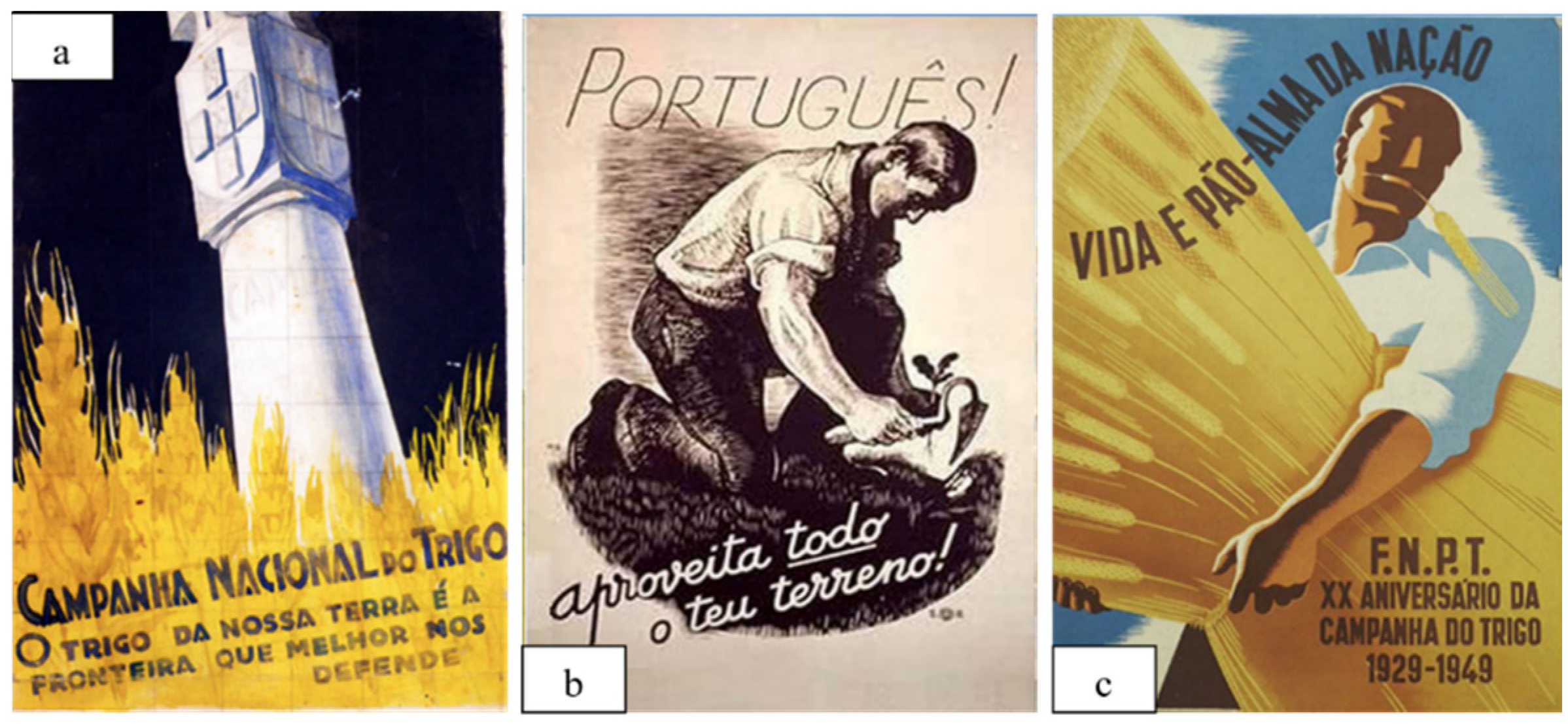
Figure 2.
Left: sites of 30 silos designed by Ruy Mayer (1938) in Portugal; right: sites of 31 silos built by EPAC in Portugal.
Figure 2.
Left: sites of 30 silos designed by Ruy Mayer (1938) in Portugal; right: sites of 31 silos built by EPAC in Portugal.
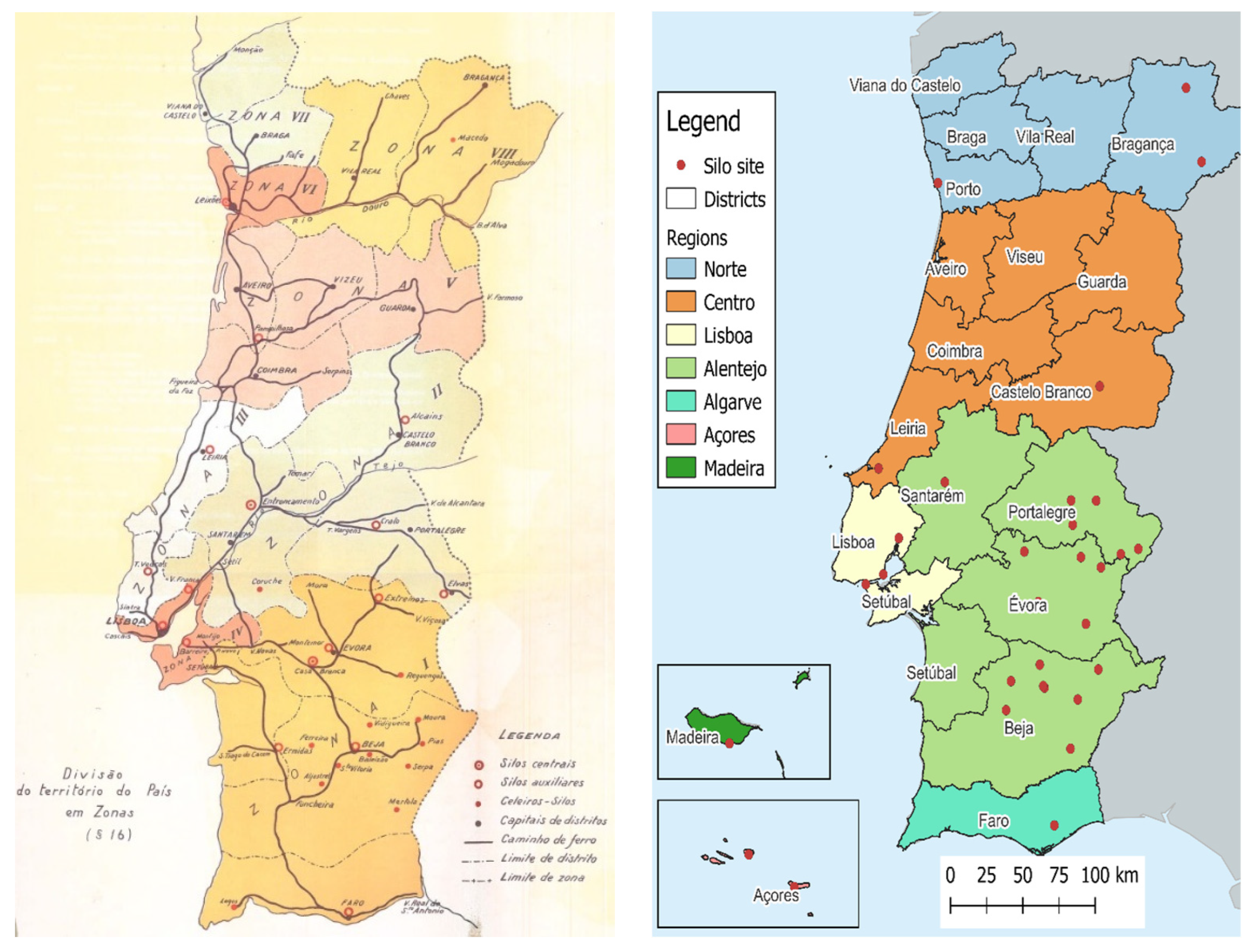
Figure 3.
Methodology workflow.
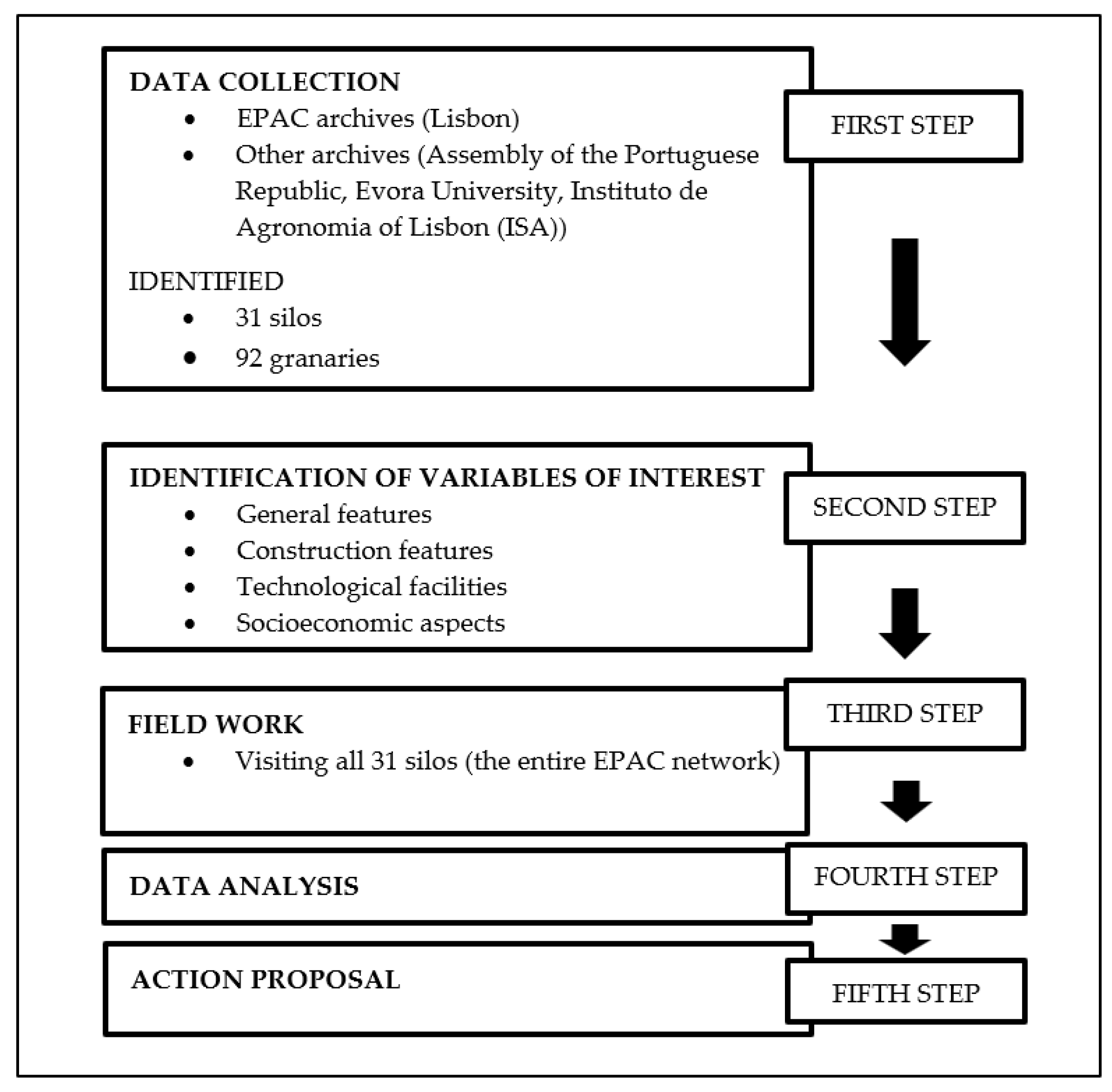
Figure 4.
Cross-section and plan view of a typical EPAC silo.
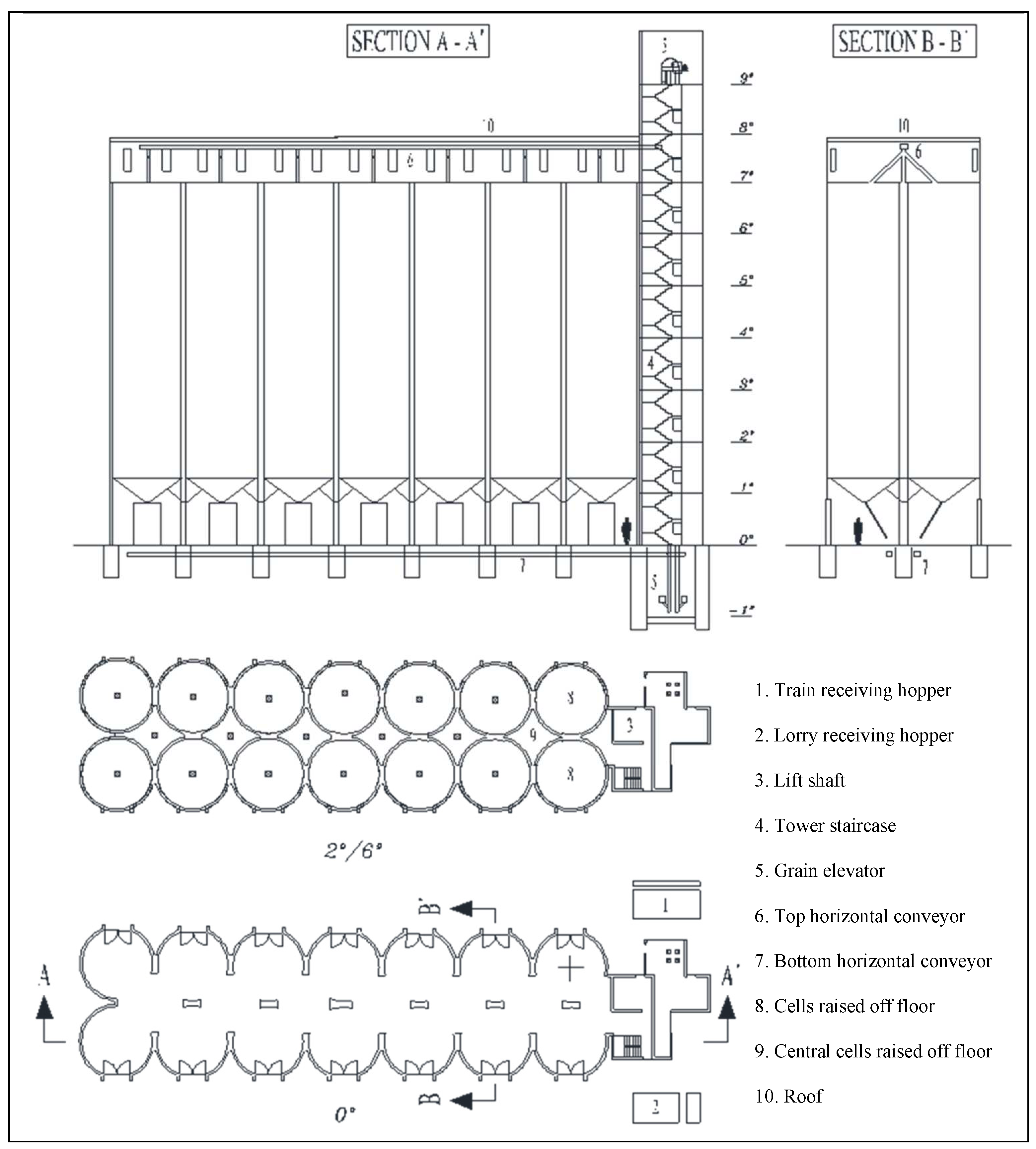
Figure 5.
EPAC silo construction details: a) tower at the silo in Evora, Alentejo, b) gable roof on the silo in Vale Figueria, Centre, c) curved roof on the silo in Evora, Alentejo; Different types of semicircular façades: d) Type I, silo in Alter do Chão, Alentejo; e) Type II, silo in Portoalegre, Alentejo; f) Type III, silo in Trafaria, Lisbon.
Figure 5.
EPAC silo construction details: a) tower at the silo in Evora, Alentejo, b) gable roof on the silo in Vale Figueria, Centre, c) curved roof on the silo in Evora, Alentejo; Different types of semicircular façades: d) Type I, silo in Alter do Chão, Alentejo; e) Type II, silo in Portoalegre, Alentejo; f) Type III, silo in Trafaria, Lisbon.

Figure 6.
a) Reception hopper in silo in Aljustrel, Alentejo ; b) grain elevator and detail of elevator scoop in silo in Vila de Boím, Alentejo; c) upper horizontal belt conveyor and loading tubes in silo in Pavia, Alentejo; d) detail of drive chain and crossbars inside upper horizontal belt conveyor in silo in Mogadouro, North; e) offloading tubes and lower horizontal belt conveyor in silo in Mértola, Alentejo; f) external bulk offloading tube in silo in Portalegre, Alentejo; g) dust collector in silo in Vale de Figueira, Centre; h) underground horizontal conveyor from hopper to elevators in silo in Cuba, Alentejo; i) control panel in silo in Ferreira do Alentejo, Alentejo; j) temperature sensor controls in silo at Vale de Figueira, Centre; k) aerial view of Trafaria silos, Lisbon; l) detail of pneumatic unloader working in Trafaria silos, Lisbon; m) online scale in Trafaria silos, Lisbon; n) dispatch cells at Beato silos, Lisbon; o) computerized control room in silo in Leixões, North; p) computer terminal for haulers in Beato silos, Lisbon.
Figure 6.
a) Reception hopper in silo in Aljustrel, Alentejo ; b) grain elevator and detail of elevator scoop in silo in Vila de Boím, Alentejo; c) upper horizontal belt conveyor and loading tubes in silo in Pavia, Alentejo; d) detail of drive chain and crossbars inside upper horizontal belt conveyor in silo in Mogadouro, North; e) offloading tubes and lower horizontal belt conveyor in silo in Mértola, Alentejo; f) external bulk offloading tube in silo in Portalegre, Alentejo; g) dust collector in silo in Vale de Figueira, Centre; h) underground horizontal conveyor from hopper to elevators in silo in Cuba, Alentejo; i) control panel in silo in Ferreira do Alentejo, Alentejo; j) temperature sensor controls in silo at Vale de Figueira, Centre; k) aerial view of Trafaria silos, Lisbon; l) detail of pneumatic unloader working in Trafaria silos, Lisbon; m) online scale in Trafaria silos, Lisbon; n) dispatch cells at Beato silos, Lisbon; o) computerized control room in silo in Leixões, North; p) computer terminal for haulers in Beato silos, Lisbon.
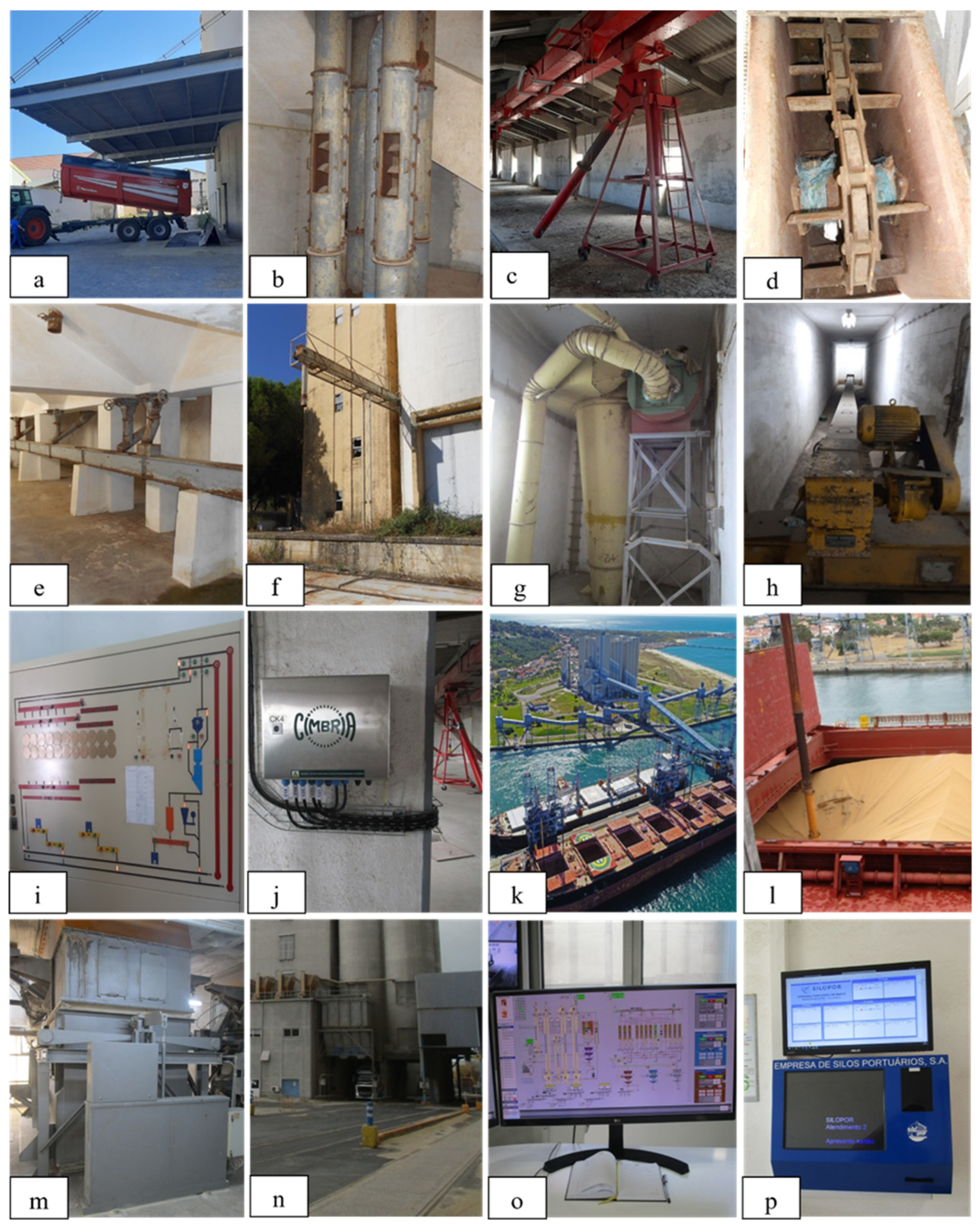
Figure 7.
Examples of reused silos. a & b) Before and after refurbishment of silo in Vila de Boím, Alentejo; c) 3D view of Museo Zer0 in Catarina da Fonte do Bispo, Algarve; d) 3D view of future museum in Braganza, North; e) Silo in Angra do Heroísmo, Isla Terceira, Azores; f) ‘Titans’ project, silo in Herencia, Spain.
Figure 7.
Examples of reused silos. a & b) Before and after refurbishment of silo in Vila de Boím, Alentejo; c) 3D view of Museo Zer0 in Catarina da Fonte do Bispo, Algarve; d) 3D view of future museum in Braganza, North; e) Silo in Angra do Heroísmo, Isla Terceira, Azores; f) ‘Titans’ project, silo in Herencia, Spain.
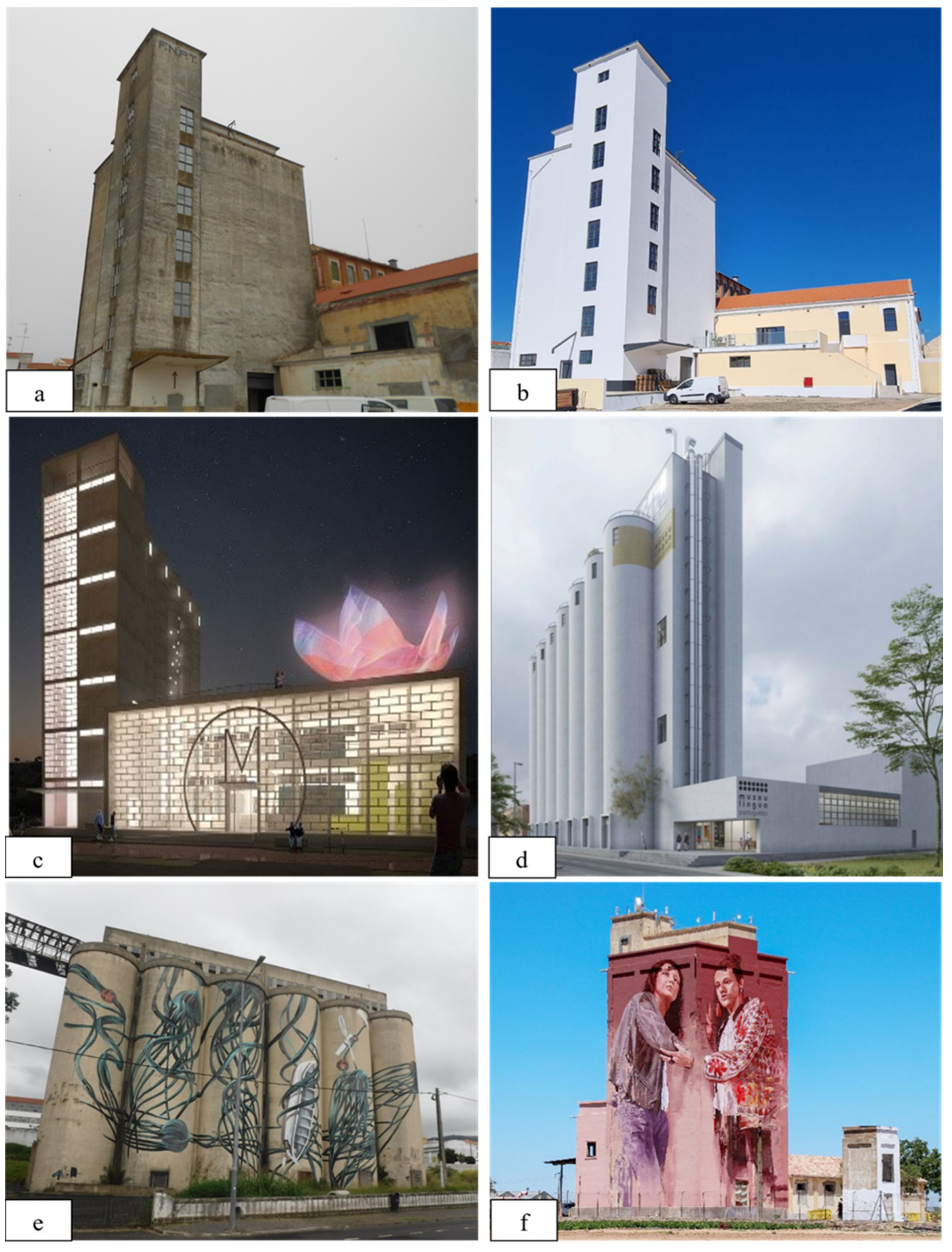

Table 1.
Fieldwork variables used to inventory the 31 silos in the EPAC network. Adapted from Fernández-Fernández et al. (2023).
Table 1.
Fieldwork variables used to inventory the 31 silos in the EPAC network. Adapted from Fernández-Fernández et al. (2023).
| Categories | Variables of interest |
|---|---|
| General features | Region |
| District Town | |
| Geolocation | |
| Year when built Ownership (state owned; leased to cooperative, institute, or private company; owned by private company or municipality) Use State of conservation | |
| Construction features | Category |
| Storage capacity (t) | |
| Height (m) Ground plan | |
| Roof shape | |
| Tower position | |
| Number of storage cells Number of rows of cells Number of rows of internal cells or intercellular spaces Cell shape Cell dimensions Façade types (straight or semicircular type I, II, or III) Cell construction material | |
| Technological facilities | Receiving machinery capacity (t/h) Number of elevators Number of upper-storey horizontal conveyors Number of lower-storey horizontal conveyors Existence of firefighting system Existence of lift Existence of temperature sensors Existence of railway |
| Lorry weighbridge (t) | |
| Railway weighbridge (t) | |
| Socioeconomic aspects | Population Demographic patterns Yearly municipal budget (€) Economic activity Land communications |
| Distances to larger urban centres (km) |
Table 2.
Location and capacity of silos proposed in Mayer’s study [12, 15, 20] and silos actually built in the EPAC network.
Table 2.
Location and capacity of silos proposed in Mayer’s study [12, 15, 20] and silos actually built in the EPAC network.
| Proposed by Mayer (1938) | EPAC network | |||||
|---|---|---|---|---|---|---|
| Zone | Town | Silo type | Capacity (t x 1000) |
Region | Town | Capacity (t x 1000) |
| 1 | Beja | Auxiliary | 2.0 | Alentejo | Inside Beja | 15.0 |
| 1 | Casa Branca | Central | 16.0 | Alentejo | Outside Beja | 26.5 |
| 1 | Ermidas | Auxiliary | 1.4 | Alentejo | Alter do Chão | 8.0 |
| 1 | Estremoz | Auxiliary | 2.0 | Alentejo | Estremoz | 16.0 |
| 1 | Evora | Auxiliary | 2.0 | Alentejo | Evora | 23.0 |
| 1 | Faro | Auxiliary | 2.0 | Alentejo | Fronteira | 16.0 |
| 1 | Lagos | Granary-silo | 2.5 | Alentejo | Vila Viçosa | 2.3 |
| 1 | Sta. Vitoria | Granary-silo | 2.0 | Alentejo | Pavia | 18.0 |
| 1 | Reguengos | Granary-silo | 2.5 | Alentejo | Reguengos de Monsaraz | 35.0 |
| 1 | Moura | Granary-silo | 2.0 | Alentejo | Moura | 10.0 |
| 1 | Serpa | Granary-silo | 3.0 | Alentejo | Serpa | 19.0 |
| 1 | Mértola | Granary-silo | 2.0 | Alentejo | Mértola | 4.5 |
| 1 | Baleizao | Granary-silo | 2.0 | Alentejo | Portalegre | 10.0 |
| 1 | Vidigueira | Granary-silo | 2.0 | Alentejo | Vila de Boím | 4.0 |
| 1 | Ferreira do Alentejo | Granary-silo | 2.0 | Alentejo | Ferreira do Alentejo | 23.5 |
| 1 | Aljustrel | Granary-silo | 2.0 | Alentejo | Aljustrel | 14.5 |
| 1 | Pias | Granary-silo | 2.5 | Alentejo | Elvas | 15.0 |
| 2 | Elvas | Auxiliary | 1.4 | Alentejo | Cuba | 23.5 |
| 2 | Crato | Auxiliary | 2.0 | Centre | Alcains | 10.0 |
| 2 | Alcains | Auxiliary | 1.4 | Centre | Vale de Figueria | 24.0 |
| 2 | Coruche | Granary-silo | 2.0 | Centre | Caldas de Rainha | 6.5 |
| 2 | Entrocamiento | Central | 16.0 | Lisbon | Vila Franca de Xira | 6.5 |
| 2 | Vila Franca de Xira | Auxiliary | 3.0 | Lisbon | Beato | 120.0 |
| 3 | Leiria | Auxiliary | 1.2 | Lisbon | Trafaria | 200.0 |
| 3 | Torres Vedrás | Auxiliary | 1.2 | North | Mogadouro | 6.0 |
| 4 | Barreiro | Auxiliary | 2.0 | North | Braganza | 12.0 |
| 4 | Lisbon | Auxiliary | 2.0 | North | Leixões | 100.0 |
| 5 | Pampilhosa | Auxiliary | 1.2 | Madeira | Funchal | 16.0 |
| 6 | Leixões | Auxiliary | 8.0 | Azores | Punta Delgada | 34.0 |
| 8 | Macedo de Cavaleiros | Granary-silo | 2.0 | Azores | Angra do Heroismo | 21.0 |
| Algarve | Santa Catarina da Fonte do Bispo | 1.3 | ||||
| Total | 30 silos | 92.8 | 31 silos | Total | 841.1 | |
Table 3.
EPAC silo statistics.
| Category | Total | Min. | Max. | Mean | Silo distribution in percentages |
|---|---|---|---|---|---|
| Region | 7 | 58.1% Alentejo; 9.7% Lisbon; 9.7% Centre; 9.7% North; 6.5% Azores; 3.2% Madeira; 3.2% Algarve | |||
| District | 25.8% Beja; 16.1% Evora; 16.1% Portalegre; 6.5% Lisbon; 6.5% Braganza; remaining districts each contain 3.2% of the silos in the network | ||||
| Town | 30 | ||||
| Year when built | 1938 | 1986 | 1970 | ||
| Year when expanded | 1962 | 1985 | 1977 | ||
| Ownership | 36.7% leased to cooperatives; 33.3% state owned; 13.3% leased to private companies, 10.0% owned by private companies; 3.3% owned by municipalities; 3.3% leased to institutes | ||||
| Use | 51.6% grain store; 38.7% disused; 9.7% reused | ||||
| State of conservation | 51.6% good condition, 33.3% fair condition, 9.6% unusable, 6.5% demolished | ||||
| Category | 3 | ||||
| Capacity (t x 103) | 2,300 | 200,000 | 27,132 | ||
| Height (m) | 26 | 70 | 43.2 | ||
| Ground plan | 96.7% square; 3.3% L-shaped | ||||
| Roof shape | 53.4% flat roof; 40.0% gable roof; 3.3% flat and gable roof; 3.3% vaulted roof | ||||
| Tower position | 83.4% front tower; 6.6% corner tower; 6.6% interior tower; 3.4% side tower | ||||
| No. storage cells | 11 | 157 | 36 | ||
| No. rows of cells | 2 | 4 | 2.4 | ||
| No. rows of internal cells or intercellular spaces | 1 | 3 | 1.5 | ||
| Cell shape | 93.3% circular; 6.7% square | ||||
| Cell dimensions | 2 | 13 | |||
| Façade types | 6.7% straight; 16.7% semicircular I; 53.3% semicircular II; 23.3% semicircular III | ||||
| Construction material | 93.3% reinforced concrete; 6.7% reinforced brick | ||||
| Receiving machinery capacity (t/h) | 50 | 3,000 | 195.6 | ||
| No. elevators | 2 | 14 | 3.2 | ||
| No. upper-storey horizontal conveyors | 1 | 10 | 2.6 | ||
| No. lower-storey horizontal conveyors | 1 | 9 | 2 | ||
| Firefighting system | 53.3% yes; 46.7% no | ||||
| Lift | 85.7% yes; 14.3% no | ||||
| Temperature sensors | 86.6% no; 13.3% yes | ||||
| Railway | 56.7% yes; 43.3% no | ||||
| Lorry weighbridge (t) | 30 | 100 | 66.4 | ||
| Railway weighbridge (t) | 200 | 200 | 200 |
Disclaimer/Publisher’s Note: The statements, opinions and data contained in all publications are solely those of the individual author(s) and contributor(s) and not of MDPI and/or the editor(s). MDPI and/or the editor(s) disclaim responsibility for any injury to people or property resulting from any ideas, methods, instructions or products referred to in the content. |
© 2024 by the authors. Licensee MDPI, Basel, Switzerland. This article is an open access article distributed under the terms and conditions of the Creative Commons Attribution (CC BY) license (http://creativecommons.org/licenses/by/4.0/).
Copyright: This open access article is published under a Creative Commons CC BY 4.0 license, which permit the free download, distribution, and reuse, provided that the author and preprint are cited in any reuse.