
Submitted:
16 January 2024
Posted:
16 January 2024
You are already at the latest version
Abstract
Through processing and organizing the basic data and related literature on brownfield governance of Chinese local governments in recent years, the study constructed a risk evaluation index system for brownfield governance of Chinese local governments based on hierarchical analysis, taking into account the purpose of realizing the sustainable use of soil. Specific indicators were established under the two overall objectives of environmental protection and human health, including the degree of soil pollution, the degree of groundwater pollution, the degree of air pollution, the emission of toxic and hazardous substances, the type of land use, the intensity of land use, the maturity of governance technology, the scope of application of governance technology, the degree of perfection of policies and regulations, the strength of implementation of policies and regulations, the benefits of brownfield reuse, and the satisfaction of the public. In addition, the study takes Qitaihe City, which has already achieved the effect of brownfield management, as an example to further analyze the index system.
Keywords:
brownfield
; local government
; risk indicators
1. Introduction
Soil is the foundation of everything, the basis for the survival of all life, an important part of the ecological environment and a carrier resource for social and economic development. Accompanied by the rapid economic and social development, human activities continue to expand, which is the human diversified demand for land is also increasing year by year, but the rapid development of industrialization and urbanization led to soil ecological environment increasingly suffering serious damage, solid waste and industrial waste erosion of soil has led to serious soil pollution problems. A large number of destroyed non-renewable land resources and the further development of the economy generated by the large demand for land have produced a sharp contradiction. In the system of "population-resources-environment", land resources play a fundamental role, and the sustainable utilization of land is the basic guarantee for the realization of sustainable development of human society. Since the 1960s and 1970s, the world economy has achieved remarkable growth, and the ensuing crises of population, resources and environment have plagued the development of human society, thus the idea of sustainable development has been rapidly developed. The collision between the acute human-land conflict and the idea of sustainable development has triggered a fierce change in the field of land use.
1980s, Europe and the United States in the process of urbanization and development of the note: there is a large amount of land through the development of reasonable governance can carry the city's new construction projects, which can effectively alleviate the pressure of urban construction, revitalization of abandoned land 1. This is also of great significance for the treatment of soil pollution. This type of land is mainly due to the early de-industrialization of Europe and the United States produced a large number of industrial and commercial wasteland with different levels of pollution 2, which is often referred to as "brownfield". The renovation of contaminated and abandoned land is in line with the principle of sustainable development, which can be regarded as the embryonic stage of sustainable land use. The research on sustainable land use originates from land suitability evaluation, which is a kind of judgment and assessment on the extension trend of land suitability in the direction of time, and it is the embodiment of the idea of sustainable development in the field of land evaluation. In the 1990s, some international soil scientists and land evaluation experts extended the concept of sustainable development to land use and put forward the concept of sustainable land use management.
Brownfields are highly valuable land resources, and effective management of brownfields is fully compatible with the concept of sustainable land use and is an important step towards the sustainable development of human society. Brownfield management has been a popular topic since the establishment of the theory of sustainable land use, and has achieved considerable results. However, although brownfield management has occupied an important position in the field of sustainable land resources, it involves the level of soil contamination, sustainable development capacity, management level and other factors, which leads to the research on brownfield environmental risk assessment, so far, it is still concentrated in the field of environmental risk assessment of contaminated sites similar to the concept of brownfield, which is not sufficiently targeted to the brownfields.
In particular, Chinese environmental risk assessment research, which also started in the 1980s, still focuses on areas of high social concern, such as water pollution control, transport and storage of chemicals, and human health risks, and mainly introduces and applies foreign research results, lacking innovation and the ability to adapt to local conditions. However, it is worth paying attention to the fact that China has experienced decades of rapid economic development, a large amount of developed industrial land has been gradually idled and abandoned with the adjustment of the industrial structure and the shift of the economic center of gravity, resulting in a large amount of unused industrial polluted land. By 2023, China will have one of the largest brownfield inventories in the world. In the face of this reality, China has not established a corresponding environmental risk evaluation system for brownfield sites, which is obviously one of the problems in controlling the risk of brownfield governance in China. In addition, there are two main reasons for the lack of significant effect of brownfield governance in China: firstly, China's industrialization and urbanization process is too fast, and the speed of governance does not match the speed of land abandonment; secondly, because of the lack of effective national integrated planning of brownfield governance in China, mostly relying on local governments, which are limited by their technical level and financial capacity, making it difficult for them to carry out efficient governance. Thus, it seems that there is a huge demand from local governments in China for clear indicators to evaluate the risk of brownfield governance. After all, only if the risk of brownfield governance can be assessed in a targeted manner can financial expenditures and social risks be better controlled.
In view of the above, this study aims to comprehensively consider the personalized elements of local brownfield sites in China that have been contaminated by industry, and use hierarchical analysis to systematically quantify, analyze, and evaluate the security risks that the government may face in the process of brownfield governance, to establish a system of indicators for evaluating the risk of brownfield redevelopment by the local government in China, and to provide reference for the effective assessment and control of governance risks for brownfield governance on a global scale.
2. Literature Review
2.1. Brownfield management
The Environmental Protection Agency (EPA), founded in the 1980s, defines "brownfield" as "Abandoned, unused or underutilized industrial or commercial wasteland, where environmental contamination exists or is assumed to exist, increases the cost, duration and uncertainty of redevelopment projects and ultimately complicates the expansion of use or redevelopment." 3. The Small Business Liability Relief and Brownfield Revival Act passed by the U.S. Congress in 2002 defines it as "brown land is a real estate that makes its expansion, development and reuses very complicated due to the presence or presence or presence of harmful substances, pollutants and pollutants"4. Other countries have different definitions of brownfields. The United Kingdom defines brownfield as land permanently occupied by residential and related ground infrastructure that is being or has been developed; Canada defines brownfield as abandoned or underutilized commercial, industrial land or public property, with a certain reuse potential; Japan defines brownfields as land with actual or potential pollution that makes its intrinsic value unused or underutilized 5. Generally speaking, brownfield has the characteristics of "already developed", "abandoned, idle or inefficient utilization", and "there are many obstacles to its redevelopment and utilization due to pollution". This actually makes the development and utilization of brownfields a very challenging problem. In particular, most of the brownfield is originally used for industrial land, so it is very likely that the land will be polluted by industrial pollution or even dangerous chemicals, which actually creates a huge safety hazard for the redevelopment and utilization of brownfield.
Brownfield soil management is brownfield soil remediation, which is a necessary prerequisite for the redevelopment and utilization of brownfield sites to create more economic benefits and social value. It mainly refers to the brownfield site due to the impact of long-term industrial production activities, the soil contains a variety of pollutants, such as mercury, chromium, lead, cadmium, arsenic, nickel and other heavy metals, as well as benzene, chlorinated hydrocarbons, petroleum hydrocarbons, polycyclic aromatic hydrocarbons, pesticides, polychlorinated biphenyls, and other organic compounds, it is a process of taking appropriate measures to treat and remediate the soil 678. Brownfield soil treatment is generally a process of absorbing, degrading and transforming pollutants in the soil using physical, chemical or biological methods to reduce their concentrations to acceptable levels or to convert toxic and hazardous pollutants into harmless substances. However, the technology of re-developing and utilizing brownfield sites for more lasting economic and social benefits is more complex than soil remediation. In recent years, research on brownfield management in Europe and the United States has focused on site remediation 9, economic measures, policy market 101112, pollutant treatment, planning implications 13, risk assessment, liability 141516, and parcel scenic planning, etc., and has basically achieved more significant results. Since private groups and social capital often face unrestricted environmental liability and excessive transaction costs when taking on environmental responsibility 17, only by giving full play to the role of the government can the governance risks triggered by the lack of responsibility be effectively avoided. David Osborne and Peter Hutchinson proposed that the establishment of a sound risk assessment system is the basis for the implementation of effective public crisis prevention 18. The governance experience of various countries can basically be summarized into three points: first, with the support of legal policies, specialized legal policies on brownfield remediation have been formulated for all aspects of brownfield remediation, including standards for controlling soil contaminants, determining environmental liability, and methods of paying for remediation costs. Second, the collaboration of participants support, including the central government, local governments, non-governmental organizations, landowners, developers and other relevant stakeholders. Finally, there is the support of financial inputs to provide strong financial support for brownfield remediation through various means, such as state investment, private financing, and specialized funds 19. However, the above governance experience is based on a relatively complete risk assessment for brownfields. The United States was the first country to introduce risk assessment to polluted land research. In the 1980s superfund project in the United States, risk assessment was an important policy tool that was used to determine the risk of health hazards that contaminated land may pose to the local population and to explore the screening of remediation technologies and the goals for remediation of contaminated land on the basis of risk assessment 20. It was also during this period that European and American countries successively established a health risk evaluation index system for contaminated sites on the basis of risk evaluation. An increasing number of developed countries have incorporated brownfield risk assessment into brownfield governance, and environmental risk assessment has become an important component of environmental impact assessment for construction projects, regional development and policy formulation 21 . However, research on environmental risk assessment of brownfields has so far focused on the field of environmental risk assessment of contaminated sites, which is similar to the concept of brownfields, and is not sufficiently specific to brownfields. Therefore, Xiao Long et al. pointed out that the fundamental way to solve this problem of brownfield governance is to prevent it on the basis of the lowest cost, rather than to cure it through high expenditure 22. This also explains why foreign countries pay more attention to the risk monitoring and assessment of brownfield governance, which is an important topic that still needs to be continuously researched by most countries in brownfield governance.
Brownfield governance in China, on the other hand, started a bit later than other countries. Chinese academics' research on brownfield governance is still mostly confined to the introduction of brownfield governance and redevelopment experiences 232425, laws and regulations 26, site governance 2728, management mechanisms 2930, and technical specifications, etc. in Europe and the United States , which have implications for the redevelopment of brownfield sites in China. Overall, there is no assessment system and pollution cleanup standards that can be recommended and applied to the risk level of brownfield sites nationwide in China, and there is a lack of technical standards for brownfield contamination, risk control, upgrading and renovation, and post-management 31. This is actually prone to the phenomenon of shifting responsibilities to each other in the later management process, which may even result in serious safety accidents.
Through the combing of related research on brownfield governance in various countries, it can be seen that although the research direction of brownfield governance in most countries is very different, they all point to the same goal in the end - controlling the risk of brownfield governance in the pre-stage. For this reason, it is necessary to establish a system of risk assessment indicators for brownfield governance. The safety issue runs through the whole brownfield management-redevelopment process, so as long as the safety risk is controlled before the brownfield soil remediation stage, the risk of secondary pollution can be effectively prevented, and effectively generate healthy economic returns, maintain public health and safety, and safeguard the image of the government.
2.2. Construction of risk evaluation index system
In September 1991, the International Symposium on Sustainable Land Use Evaluation in Developing Countries was held in Thailand 32, and in June 1993, the International Symposium on Sustainable Land Use Management in the 21st Century was held in Canada 33. The agendas of the two conferences included many scholars discussing indicators and methods for evaluating sustainable land use from natural, environmental, economic and social perspectives.
The Food and Agriculture Organization of the United Nations (FAO) issued documents such as the Outline for Sustainable Land Use Evaluation in 1993, which clearly proposed evaluation indicators for sustainable land use evaluation in natural, economic and social aspects. The basic ideas and principles of sustainable land use evaluation put forward in the Outline for Sustainable Land Use Evaluation became the platform for guiding the sustainable land use management of countries at a later stage. However, this indicator system is only a highly generalized framework, and there is still room for in-depth research on the specific evaluation indicator system and evaluation methods. Moreover, even if the basic idea and principle of sustainable land use are the same, the specific evaluation indexes (especially the threshold value) will certainly be different due to the different natural and socio-economic conditions in different countries and regions and the different problems they face. For this reason, studies in different countries and regions have taken this as a general guide to explore appropriate indicator systems and methods for evaluating sustainable land use in the light of the actual situation in their own countries.
Indicators of sustainable land use are constructed by countries because they are quantitative data, a system of statistical data, which are used as indices to describe the state of society, to develop social planning and social analysis, and to assess the present and the future 34. Appropriate indicators can effectively transform complex data or phenomena into concise and understandable management units used to assess achievements, changes and performance 35. This is the key to the attractiveness of indicators 36, which can summarise a large amount of information in an easy-to-understand manner 37, and their use in brownfield management to provide a more intuitive reflection of potential risks that require attention. The current international environmental risk assessment started in the 1970s, and in 1975, the U.S. Nuclear Regulatory Commission (NRC) proposed and established the Probabilistic Risk Assessment (PRA) method, and in 1983, the U.S. National Academy of Sciences (NAS) put forward the "four-step approach" to risk assessment, which can be regarded as a milestone in the enlightenment of risk assessment. Since then, risk assessment research has been further accelerated and has become an important part of environmental management. Risk assessment research in China started in the 1980s, when risk assessment was regarded as safety assessment, and a lot of research has been carried out by Chinese academics on this basis. Various risk assessment methods and models have been developed. At present, the environmental risk evaluation system basically presents the following trends: First, not only consider chemical pollutants, but also take into account the adverse effects of non-chemical factors on the environment; second, shift from considering only a single source of pollution to the consideration of composite sources of pollution; third, shift from the evaluation of the risk of human health to the human health risk and ecological environment risk; fourth, the risk group rises to the entire ecosystem; fifth, the scope of evaluation from the region to the whole, and eventually expanded to the global; six, from qualitative to quantitative analysis change. However, despite the proliferation of environmental risk assessment methods, most of the studies still remain at the stage of exploring theoretical frameworks and technical routes. Among them, the construction of risk indicators is the most representative, and also the most relevant to the content of this paper. Darbra's (2010) view of a single point of accident may lead to more serious accidents in adjacent facilities, i.e., the "domino effect" 38has been frequently used as a consideration in the construction of risk indicator system research since then. For example, the risk evaluation indicators used by Schuller (2015) to quantitatively analyze the frequency of risky accidents in enterprises using Bayesian hierarchical analysis include the "domino effect" 39. Christian Delvosalle et al. (2014) evaluated large-scale accidents in chemical plants by means of accident tree and event tree evaluation methods, and established risk evaluation indicators in terms of probability and consequences of accidents 40. SA Jozi (2015), on the other hand, constructed indicators to analyze corporate risk prioritization in terms of health, safety, and environmental risk dimensions using an example of a power plant in Iran 41. Planas E (2016) used a fuzzy integrated evaluation method for quantitative evaluation and environmental risk management, while qualitatively identifying the environmental risks of a project from environmental vulnerability based on the ARAMIS model 42. Hao Yuling proposed a risk evaluation index system based on the BP neural network gave a more operational evaluation method 43. AN Xuitong's risk evaluation index system based on grey network analysis (G-ANP) has also been proven to be feasible 44.
From the perspective of focusing on the risk evaluation indicator system for brownfield governance, some countries have also made attempts, although their main starting points are all mainly focused on the risk evaluation of contaminated sites, which is similar in concept, but still has a certain degree of relevance. For example, countries such as the Netherlands and Australia have gradually established guidelines for environmental risk assessment and health risk assessment, which are applied in the process of contaminated land assessment, treatment and remediation. The EU Public Forum on Contaminated Sites, established in 1994, completed the Consultative Action Guidelines on Risk Assessment of Contaminated Sites in 1996, which greatly facilitated the writing and sharing of the results of research in the field of ecological risk assessment in the EU countries. The above risk assessment system has coincided with the risk assessment needs of brownfield governance. Therefore, the indicator system established through the brownfield governance for local governments in China should be highly universal, and will be conducive to providing useful ideas for the construction of the risk assessment indicator system for global brownfield governance.
3. Methodology of the study
This paper adopts the hierarchical analysis method to analyze the evaluation index system of brownfield governance risk for local governments in China. Hierarchical analysis is a decision analysis method that decomposes a complex problem into multiple levels and factors, and arrives at a comprehensive assessment result by comparing and judging the relative importance of each factor. The specific steps are as follows:
(i) Establish a hierarchical model
According to the assessment index system, the problem is divided into three levels: the target level, the criterion level and the index level, and the hierarchical structure model is constructed, as shown in Figure 1. The target level is the highest, indicating the purpose of the assessment; the criterion level is the middle level, indicating the important factors affecting the assessment results; and the index level is the lowest, indicating the specific assessment indexes. Based on this, the construction of the evaluation index system for brownfield governance risk of local governments in China can be realized through three levels: the first level is the target level (A), i.e., the predetermined goal or the ideal result; the second level is the criterion level (B), which contains the intermediate links involved in achieving the goal, including the criteria and sub-criteria to be considered; and the third level is the indicator level (C), i.e. the specific elements under the criteria considered for the achievement of the objective.
The evaluation index system is shown in Table 1.
(1) Target level A: i.e., the predetermined goal or ideal result. In this paper, the goal is to reasonably evaluate the government's brownfield governance risk, which is required to take into account both environmental protection and human health 45.
(2) Criterion level B: This layer includes five aspects: land contamination status 46, land use planning 47, level of governance technology 4849, implementation of policies and regulations, and socio-economic development.
(3) Index level C: Including the degree of soil pollution, the degree of groundwater pollution, the degree of air pollution, the emission of toxic and hazardous substances, the type of land use, the intensity of land use, the maturity of the treatment technology, the scope of application of the treatment technology, the degree of improvement of the policies and regulations, the strength of the implementation of the policies and regulations, the effectiveness of brownfield reuse, and the satisfaction of the public.
(ii) Constructing a judgment matrix
For each factor in the same hierarchy, a judgment matrix is constructed by comparing the other factors two by two through the expert survey method and the Delphi method. The judgment matrix indicates the relative importance of the factors. In this paper, the judgment matrix is constructed using the 1-9 scale method, and the meanings of the specific scales are as follows:
For each factor in the same hierarchy, a judgment matrix was constructed by comparing the other factors two by two through the expert survey method and the Delphi method. The judgment matrix indicates the relative importance of the factors.
According to the Environmental Protection Law of the People's Republic of China, the Water Pollution Prevention and Control Law of the People's Republic of China, the Air Pollution Prevention and Control Law of the People's Republic of China, the Regulations on the Management of Pollution Prevention and Control in Protected Areas of Drinking Water Sources, the Law of the People's Republic of China on Environmental Protection Against Solid Waste, the Law of the People's Republic of China on the Prevention and Control of Radioactive Pollution, the Interim Measures for Reporting Accidents of Environmental Pollution and Damage, the regulations on the prevention and control of environmental pollution caused by solid waste and the survey reports on polluted sites in each province of China, and the basic data materials on brownfield sites in China obtained by relying on the business status of enterprises, the statistics of inefficient sites, and the information of the list of industrial heritage due to the lack of authoritative and effective brownfield site databases at the state level, we invited a number of experts in the field of environmental economics and administrative management to give scores for the values of the various levels, and then constructed the judgement matrix as follows taking the average value:
(1) Target level judgment matrix
(2) Criterion level judgment matrix

Table 3.
Criterion level judgment matrix.
| Land Pollution Status | Land use planning | Governance Technology Level | Implementation of Policies and Regulations | Socio-economic development | |
| Land Pollution Status | 1 | 1/2 | 3 | 2 | 2 |
| Land use planning | 2 | 1 | 2 | 3 | 3 |
| Governance Technology Level | 1/3 | 1/2 | 1 | 1/2 | 1/2 |
| Implementation of Policies and Regulations | 1/2 | 1/3 | 2 | 1 | 1 |
| Socio-economic development | 1/2 | 1/3 | 2 | 1 | 1 |
(3) Judgment matrix of the index level (taking the land pollution status as an example)
Table 4.
Index level judgment matrix of soil pollution status.
| Level of soil contamination | Level of groundwater contamination | Air Pollution | Toxic and Harmful Substance Emissions | |
| Level of soil contamination | 1 | 3 | 2 | 4 |
| Level of groundwater contamination | 1/3 | 1 | 1/2 | 2 |
| Air Pollution | 1/2 | 2 | 1 | 3 |
| Toxic and Harmful Substance Emissions | 1/4 | 1/2 | 1/3 | 1 |
1. Hierarchical single ranking
For each judgment matrix, calculate the importance weight of each factor and perform hierarchical single sorting. Specific methods include the sum method, the root method, the eigenvector method and so on. In this paper, the sum method is used for calculation.
(1) The results of the single ranking of the target level: environmental protection (0.75), Health of mankind (0.25)
(2) Sorting results of criterion level list: land pollution status (0.36), land use planning (0.28), level of treatment technology (0.18), implementation of policies and regulations (0.09), socio-economic development (0.09)
(3) Sorting results of index level (taking land pollution as an example): soil pollution level (0.46), groundwater pollution level (0.26), air pollution level (0.20), toxic and harmful substance emission (0.08).
2. Consistency test
As there may be subjectivity and inconsistency when experts construct the judgment matrix, it is necessary to carry out consistency tests on the judgement matrix. The specific method includes calculating the consistency index CI and the consistency ratio CR. When CR is less than 0.1, the judgment matrix is considered to have satisfactory consistency; otherwise, the judgment matrix needs to be corrected.
The formula for calculating the consistency index CI is:
CI = (λmax - n) / (n - 1)
Of which, λmax is the maximum eigenvalue of the judgment matrix and n is the order of the judgment matrix.
The formula for the consistency ratio CR is:
CR = CI / RI
of which RI is the average random consistency index, as shown in Table 5.
(1) Consistency test of target level judgment matrix:
λmax = 2, CI = (2 - 2) / (2 - 1) = 0, CR = 0 / 0 = 0 < 0.1, passes the consistency test.
(2) Criterion level judgment matrix consistency test:
λmax = 5.076, CI = (5.076 - 5) / (5 - 1) = 0.019, CR = 0.019 / 1.12 = 0.017 < 0.1, passes consistency test.
(3) Index level judgment matrix consistency test (taking land pollution status as an example):
λmax = 4.023, CI = (4.023 - 4) / (4 - 1) = 0.008, CR = 0.008 / 0.9 = 0.009 < 0.1, passes the consistency test.
3. Hierarchical total ranking results
Hierarchical total sorting is based on the results of hierarchical single sorting, each level of factors according to its degree of influence on the previous level of factors weighted sum, resulting in the level of factors on the total goal weight. This process is done layer by layer from the highest level to the lowest level.
(1) Total ranking of the criterion level on the objective level
Based on the results of the single ranking of the criterion level, the weights of the factors of the criterion layer for the target layer can be obtained:
By weighting and summing the weights of the factors in the guideline layer with the weights of the target layer, the total ranking weights of the guideline layer on the target layer can be obtained: land pollution status (0.32), land use planning (0.24), level of governance technology (0.15), implementation of policies and regulations (0.09), and socio-economic development (0.09).
(2) Total ranking of indicator layer to the target layer
According to the results of the single sorting of the indicator layer, the weight of each factor of the indicator layer for the guideline layer it belongs to can be obtained. By weighting and summing the weights of each factor of the indicator layer with the weights of the criterion layer to which it belongs, the total ranking weight of the indicator layer on the target layer can be obtained. Taking the land pollution status as an example, the total ranking weights of the factors in the indicator layer under it are calculated as follows:
Degree of soil pollution: 0.46 × 0.36 = 0.17
Degree of groundwater pollution: 0.26 × 0.36 = 0.10
Air pollution level: 0.20 × 0.36 = 0.07
Toxic and hazardous substance emission: 0.08 × 0.36 = 0.03
Adding up the total ranking weights of the factors of each indicator layer, we can get the total ranking weight of the factors of the indicator layer under the state of land pollution to the target layer: 0.17 + 0.10 + 0.07 + 0.03 = 0.37.
According to the same method, we can calculate the total ranking weights of the factors of the indicator layer under other guideline layers to the target layer. The total ranking weights of the indicator layer on the target layer are finally obtained as follows:
Table 7.
Total ranking weights of indicator layer to target layer.
| Indicator layer to target layer | weighting |
|---|---|
| Soil contamination level | 0.17 |
| Groundwater pollution level | 0.14 |
| Air pollution | 0.12 |
| Toxic and Harmful Substances Emission | 0.12 |
| Land use type | 0.12 |
| Intensity of land use | 0.14 |
| Maturity of treatment technology | 0.14 |
| Scope of application of treatment technology | 0.14 |
| Perfection of policies and regulations | 0.14 |
| Enforcement Strength of Policies and Regulations | 0.14 |
| Benefits of Brownfield Reuse | 0.14 |
| Public Satisfaction | 0.14 |
In summary, through the study of the hierarchical analysis method of the security index system of brownfield governance for local governments in China, the total ranking weights of each level of factors for the target level can be obtained. These results can provide references and lessons for local governments in brownfield governance and help to assess the security of brownfield governance.
4. Discussion and Results
4.1. Case Analysis
The brownfield management of the Qitaihe mining area in Heilongjiang Province, China is a more positive case of brownfield management. The city of Qitaihe used to be an important coal-producing area, but unscientific mining behavior such as expanding the scale of mining and extracting the rich and abandoning the poor has caused a great waste of coal resources, resulting in serious ecological damage, and part of the mining area has become abandoned land. Since the coal industry is the economic pillar of Qitaihe City, the brownfield management of mining areas is of great significance to Qitaihe City.
On 3 August 2017, the Qitaihe Municipal Government issued the "Qitaihe Soil Pollution Prevention and Control Work Programme", which broadly makes a clear plan for the management of brownfield sites in mining areas. The main contents include carrying out soil pollution investigation, mastering the soil environment situation, and strengthening environmental supervision; implementing access management of construction land and preventing risks to the human environment; strengthening classification management of agricultural land and protection of uncontaminated soil; carrying out pollution treatment and remediation, and improving the quality of the regional soil environment; upgrading the scientific and technological level of soil pollution prevention and control, and promoting the development of soil environmental protection and treatment industry; playing a leading role in the government, increasing law enforcement, and strict accountability; finally achieving the goal of Qitaihe City brownfield treatment. Combining the objectives of environmental protection and human health in the target layer of the risk evaluation index system and the weights of the guideline layer, which are land contamination (0.32), land use planning (0.24), governance technology level (0.15), policy and regulation implementation (0.09), and socio-economic development (0.09) respectively. It can be found that the above initiatives share a common governance idea with the construction of the indicator system based on the hierarchical analysis method in this paper.
In recent years, Qitaihe City has implemented an ecological revitalization project based on the Work Programme for the Prevention and Control of Soil Pollution and the strategic goal of "an ecological city", and has achieved some milestones. By the end of 2022, the Qitaihe Municipal Government has adopted backfilling, slope cutting, transporting, leveling, mulching, tree planting and other means to restore and manage the ecological protection of 465 areas with serious ecological and environmental damage, such as historical mining wasteland, gangue mountain occupation, coal mining subsidence land, shanty relocation wasteland, and historical damaged mountains, and the cumulative restoration of the land area of 2018.53 hectares; restoration of 700 hectares of wetlands.
Although considerable results have been achieved, there are certain problems in brownfield management in Qitaihe City. Combined with the indicator system, Qitaihe City has not formed a dynamic regulatory system for contaminated land due to the lack of in-depth investigations into soil contamination, which accounts for the highest percentage of contaminated soils, and this has led to policies that stay in remediation of severely damaged areas, but the attention and investigation of the contaminated areas are far from enough. This will lead to brownfield governance and remediation floating on the surface, not able to address the root causes of the continuous expansion of contaminated soil. In addition, its land use planning is not clear enough and the level of treatment technology is low, resulting in a lack of sufficient mass base and public satisfaction, which intuitively reflects the weakness of Qitaihe City's policy implementation capacity and risk evaluation capacity.
4.2. Conclusion and Outlook
Through the study of the hierarchical analysis method on the security indicator system of brownfield governance in Chinese local governments, this paper draws the following conclusions:
The hierarchical analysis method is an effective decision analysis method, which can help decision-makers to clarify the importance of each factor in decision making, and improve the scientificity and effectiveness of decision making. In the brownfield governance of local governments in China, the use of hierarchical analysis can systematically assess the safety of brownfield governance and provide scientific and effective decision-making support for local governments.
First, environmental protection and human health are the focus of the assessment. At the objective level, the weight of environmental protection is 0.67 and the weight of human health is 0.33, indicating that more attention needs to be paid to environmental protection in brownfield governance. This is in line with the current trend and requirements of global environmental protection, and reflects the great importance that the Chinese government attaches to environmental protection. In the guideline layer, the higher weights of land contamination status, land use planning, level of governance technology and implementation of policies and regulations indicate that these factors are important factors affecting the security of brownfield governance. Therefore, local governments need to focus on these aspects in brownfield governance and take effective measures for governance and regulation.
In the guideline layer, the land contamination status is the most important factor with a weight of 0.36, indicating that the land contamination status has an important impact on the security of brownfield governance. Therefore, local governments should take the land contamination status as the primary consideration in brownfield governance and take effective measures to reduce the level of land contamination and improve the security of brownfield governance.
In the indicator layer, the degree of soil contamination, the degree of groundwater contamination and the degree of air contamination are the three most important indicators, with weights of 0.17, 0.14 and 0.12, respectively, which indicates that soil, groundwater and air are the environmental elements that need to be focussed on in brownfield management. Local governments should strengthen the monitoring and management of these environmental elements in brownfield governance to ensure that brownfield governance will not have a serious impact on the surrounding environment. Secondly, in the indicator layer, the weight of indicators such as the degree of soil pollution, the degree of groundwater pollution, the degree of air pollution, and the emission of toxic and hazardous substances is high, which indicates that these indicators are important indicators for assessing the safety of brownfield governance. The assessment results of these indicators will directly affect the security of brownfield governance. Therefore, these indicators need to be monitored and assessed in detail during the assessment process. At the same time, the weights of indicators such as land use type, land use intensity, maturity of governance technology, and the application range of governance technology are also high, indicating that these factors are also important factors affecting the security of brownfield governance. Local governments need to take these factors into full consideration in brownfield governance and formulate scientific and reasonable land use planning and governance technology programs.
The total ranking weights derived in this study can be used as a reference basis for local governments in brownfield governance. Based on these weight values, local governments can formulate brownfield governance policies and measures in a targeted manner to improve the security and effectiveness of brownfield governance. Moreover, the consistency test found that the CR value of all judgment matrices is less than 0.1, indicating that the judgment matrices have satisfactory consistency. This ensures the reliability and accuracy of the results of the hierarchical analysis method. Meanwhile, the results of the hierarchical total ranking show that the importance and priority of each factor in the whole problem are clearly reflected. This helps local governments to take targeted measures in brownfield governance to improve the effectiveness and safety of governance.
However, only the hierarchical analysis method was used in this study to assess the riskiness of brownfield governance. Although the applicability test of the indicator system can also be completed well through the empirical analysis of brownfield governance in Qitaihe City, China, the empirical analyses based on it have to be further studied due to the insufficient sample data. This also reflects that in practical application, local governments need to comprehensively consider other factors, such as economic costs, social impacts, etc., in order to develop a more comprehensive and scientific brownfield governance strategy. At the same time, the needs and priorities of brownfield governance will change with social and economic development. Therefore, local governments need to regularly assess and update the brownfield governance security indicator system to adapt to new situations and requirements.
Author Contributions
Conceptualization, D.Y.; methodology, D.Y. and X.X.; software, X.X.; validation, X.X.; formal analysis, X.X.; investigation, D.Y. and X.X.; resources, D.Y., X.X. ; data curation, X.X.; writing—original draft preparation, X.X., D.Y.; writing—review and editing, D.Y. and X.X. ; project administration, D.Y.; funding acquisition, D.Y. All authors have read and agreed to the published version of the manuscript.
Funding
This research was funded by General Programme of the National Social Science Foundation of China, 2022,grant number 22BZZ085.
Institutional Review Board Statement
Not applicable.
Informed Consent Statement
Not applicable.
Data Availability Statement
Data are available from authors upon reasonable request.
Conflicts of Interest
The authors declare no conflicts of interest.
References
- YUE Xiaoyan, GENG Yuhuan. Review and Prospect of Stakeholders Research on Urban Brownfield Redevelopment[A]. 1.Metallurgical Architecture Research Institute Co.Ltd.Proceedings of the 2022 Academic Exchange Conference on Industrial Architecture[C]. Metallurgical Architecture Research Institute of China Limited: Journal of Industrial Architecture,2022:7.
- SUN Qunlang, ZHENG Dianjuan. From Environmental Governance to Economic Redevelopment - The Shift in Urban Brownfield Governance Policies in the United States in the 1990s[J]. Jilin University Journal Social Sciences Edition, 2023, 63, 195–207+240.
- Rafson H J, Rafson R N. Brownfields: Redeveloping Environmentally Distressed Properties. New York: The McGraw-Hill Company, Inc., 1999.
- U. S. Congress. Small Business Liability Relief and Brownfields Revitalization Act. January 11, 2002. https: / /www. govinfo. gov / content / pkg / PLAW-107publ118 / pdf / PLAW-107publ118. pdf, 2020-05-04.
- SONG Yang, LIN Huiying,Wang Shijun. Experiences and insights of brownfield reuse in foreign countries[J]. World Geography Research,2015,(03):65-74.
- LUO Qisi. Soil remediation of “brownfield” sites. Garden 2015, 5, 26–29.
- Wang, Z. Research progress on soil management of brownfield sites. Shanxi Archit. 2018, 44, 170–171. [Google Scholar]
- Tedd, P.; Charles, J.A.; Driscoll, R. Sustainable brownfield redevelopment-risk management. Eng. Geol. 2001, 60, 333–339. [Google Scholar] [CrossRef]
- Wernstedt K, Blackman A, Lyon T P et al. Revitalizing underperforming and contaminated land through voluntary action: Perspectives from U.S. voluntary cleanup programs. Land Use Policy 2013, 31, 545–556. [Google Scholar] [CrossRef]
- Davison, G.; Legacy, C. Positive planning and sustainable brownfield regeneration: The role and potential of government land development agencies. Int. Plan. Stud. 2014, 19, 416–421. [Google Scholar] [CrossRef]
- Howland, M. The private market for brownfield properties. Cityscape 2010, 12, 37–54. [Google Scholar]
- De Sousa, C.A. Policy performance and brownfield redevelopment in Milwaukee, Wisconsin. Prof. Geogr. 2005, 57, 312–327. [Google Scholar] [CrossRef]
- Bliek, D.; Gauthier, P. Mobilising urban heritage to counter the commodification of brownfield landscapes: Lessons from Montreal’s Lachine Canal. Can. J. Urban Res. 2007, 16, 39–58. [Google Scholar]
- Swickard, T.J. Regulatory incentives to promote private sector brownfield remediation and reuse. J. Soil Contam. 2008, 17, 121–136. [Google Scholar] [CrossRef]
- Dixon, T. The property development industry and sustainable urban brownfield regeneration in England:An analysis of case studies in Thames Gateway and Greater Manchester. Urban Stud. 2007, 44, 2379–2400. [Google Scholar] [CrossRef]
- Dixon, T.; Adams, D. Housing supply and brownfield regeneration in a post-Barker World: Is there enough brownfield land in England and Scotland? Urban Stud. 2008, 45, 115–139. [Google Scholar] [CrossRef]
- Stefanie Sommers, the brownfield problem: liability for lenders, owners, a-nd developers in canada and the united states. Colorado Journal of Int-ernational Environmental Law and Policy 2008, Spring.
- Osborne, Hutchinson. The Price of Government: How to Deal with Public Finance Crises [M]. Shang Hongri, Translation. Shanghai: Shanghai Translation Publishing House, 2011.
- Zhao, Q. Review of the progress of soil pollution research in urban land replacement. Soil 2009, 41, 350–355. [Google Scholar]
- USEPA, Risk Assessment Guidance for Superfund. EPA/9285/6-03, 1991.
- LIN Jiajia. Research on environmental risk evaluation of brownfileds and its regulation [D]. Nanjing Agricultural University,2014.
- XIAO Long, HOU Jingxin, LIU Xiaoxia et al. Progress of foreign brownfield research. Geogr. Res. Dev. 2015, 34, 142–147.
- ZHUANG Xiaojing, XIE Hongbin. From brownfield to green space: research status and progress. Resour. Dev. Mark. 2017, 33, 922–927.
- XUE Yinglan, ZHANG Hongyu, HAO Chunxu, et al. Environmental economic policy system for contaminated site risk control: foreign experience and local practice. China Environ. Manag. 2021, 13, 135–142.
- CAI Yunnan, HE Zhiwen, LIANG Rui . The concept of brownfield and the practice of development and utilisation at home and abroad. J. Guangdong Univ. Technol. 2022, 39, 115–122.
- ZHU Yuming, SU Haitang, GUO Peng. Comparative study on policies and regulations of brownfield management and redevelopment in China and abroad. Environ. Prot. Sci. 2009, 35, 40–43.
- Zhao, Q.; Fan, L. Management of Urban "Brownfield" Redevelopment under the Perspective of Multiple Interests. Urban Dev. Res. 2010, 17, 98–101. [Google Scholar]
- Gao, J.; Liu, C.; Chen, T. From "Permanent Cleanup" to "Global Planning"-The Evolution of Brownfield Management Strategies in the United States and the Implications for China. Int. Urban Plan. 2018, 33, 25–34. [Google Scholar] [CrossRef]
- MA Yan, DONG Zhanfeng, DU Xiaoming, et al. Thoughts and Suggestions on Constructing a Long-term Mechanism for Soil Pollution Remediation and Governance in China. Environ. Prot. 2015, 43, 53–56.
- SONG Yang, ZHANG Xinjia, LV Yang, et al. Review and outlook of urban brownfield research from the perspective of geography. Geoscience 2019, 39, 886–897.
- Wen, D.; Xie, Z.; Lu, T. Soil remediation treatment and reuse of industrial polluted sites in foreign countries - A case study of Ruhr area in Germany. China Land Resour. Econ. 2018, 31, 52–58. [Google Scholar]
- Dumanski, J.; Pushparajah, E.; Lattam, M.; Myers, R.; Elliot, C.R. Evaluation for sustainable land management in the developing world; technical papers: proceedings. International Board for Soil Research and Management - Proceeding (IBSRAM), 1991.
- Sanchez A .Proceedings of the International Workshop on Sustainable ForestManagement: Monitoring and Verification of Greenhouse Gases[C]//International Workshop on Sustainable ForestManagement: Monitoring and Verification of Greenhouse Gases, San Jose,Costa Rica, July 29-31, 1996.Lawrence Berkeley National Laboratory, 1997.
- Zhu, Q.; Wu, H. Social indicator system [M]. Beijing: China Social Science Press, 2001: 3.Grace, K.L.L.; Edwin, H.W.C. Indicators for evaluating environmental performance of the Hong Kong urban renewal projects. Facilities 2009, 27, 515–530. [Google Scholar]
- Grace, K.L.L.; Edwin, H.W.C. Indicators for evaluating environmental performance of the Hong Kong urban renewal projects. Facilities 2009, 27, 515–530. [Google Scholar]
- Simpson, D.; Katirai, M. Indicator Issues and Proposed Framework for a Disaster Preparedness Index (DPI); University of Louisville: Louisville, KY, USA, 2006. [Google Scholar]
- Ghadeer, J.; Ziad, M. Governance and climate vulnerability index. Water Resour. Manag. 2012, 26, 41–47. [Google Scholar]
- Darbra, R.M.; Palacios, A. Casal. Domino effect in chemical accidents: Main features and accident sequences. J. Hazard. Mater. 2010, 183, 565–573. [Google Scholar] [CrossRef] [PubMed]
- Schuller J, Gestel PJ, et al. Methods for determining and processing probabilities[M].Ministerie van Binnenlandse Zaken en Koninkrijksrelation, 2015.
- Delvosalle, C.; Fievez, C.; Pipart, A.; Debray, B. ARAMIS project: A comprehensivemethodology for the identification of reference accident scenarios in process industries. J. Hazard. Mater. 2014, 130, 200–219. [Google Scholar] [CrossRef] [PubMed]
- Jozi, S.A.; Saffarian, S.; Shafiee, M.; Majd, N.M. Safety, Health,and Environmental Risk Assessment of a Gas Power Plant: A Case Study from Southern Iran. Hum. Ecol. Risk Assess. 2015, 21, 1479–1495. [Google Scholar] [CrossRef]
- Planas, E.; Arnaldos, J.; Silvetti, B.; Vallee, A.; Casal, J. A Risk Severity Index for industrial plants and sites. J. Hazard. Mater. 2016, 130, 242–250. [Google Scholar] [CrossRef]
- HAO Yuling. Research on the environmental risk evaluation method of chemical enterprises based on BP artificial neural network [D]. Shanghai:East China University of Science and Technology,2011.
- AN Xuitong. Research and application of risk evaluation of large-scale chemical projects based on G-ANP method[D]. Chongqing: Chongqing University,2010.
- Wan, L. Study on the Risks, Benefits and Financial Measures of Brownfield Redevelopment. China Circ. Econ. 2009, 23, 68–70. [Google Scholar]
- ZHANG Hua, GUO Peng, WANG Liqin. "Brownfield Phenomenon and Its Management Countermeasures[J]. Environmental Protection Science 2008, 48-50+57.
- Zhu, Y.; Su, H.; Guo, P. Comparative study on policies and regulations of brownfield management and redevelopment in China and abroad. Environ. Prot. Sci. 2009, 35, 40–43. [Google Scholar]
- Luo, Y. Current status and trend of remediation technologies for contaminated soil. Prog. Chem. 2009, 21, 558–565. [Google Scholar]
- Xie, J.; Li, F. Analysis of the current status of remediation and redevelopment of contaminated sites in China (Abstract). World Environ. 2011, 56–59. [Google Scholar]
Figure 1.
Hierarchy model.
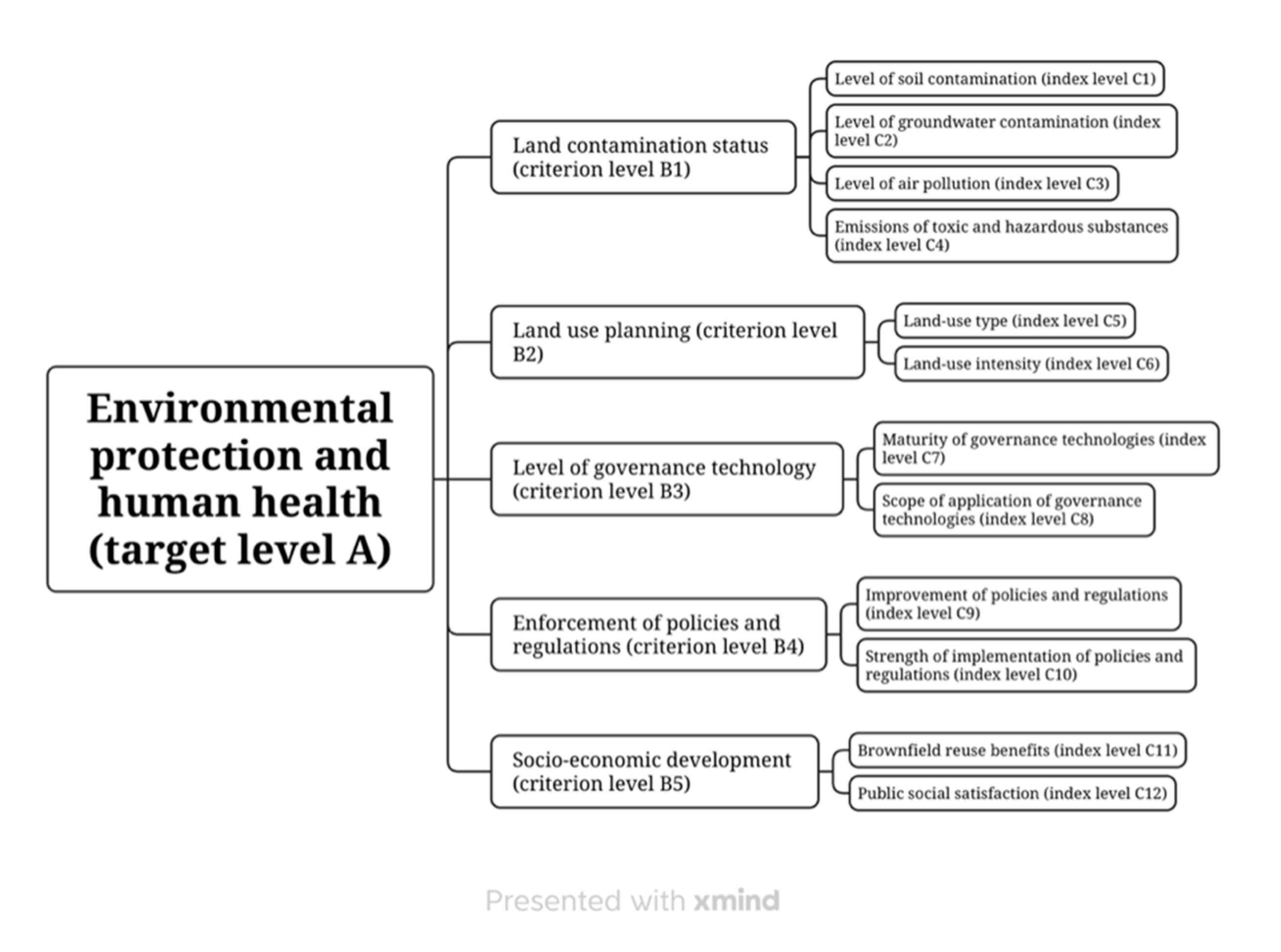
Table 1.
Judgment matrix scales and meanings.
| scale | connotation |
|---|---|
| 1 | Equally important |
| 3 | Slightly more important |
| 5 | More important |
| 7 | Very important |
| 9 | Extremely important |
| 2,4,6,8 | Median of two adjacent judgments |
| inverse number | If the ratio of importance of factor i to factor j is aij, then the ratio of importance of factor j to factor i is aji = 1/aij |
Table 2.
Judgment matrix of the target level.
| environmental protection | Health of mankind | |
| environmental protection | 1 | 3 |
| Health of mankind | 1/3 | 1 |
Table 5.
Average random consistency index RI values.
| n | 1 | 2 | 3 | 4 | 5 | 6 | 7 | 8 | 9 | … |
| RI | 0 | 0 | 0.58 | 0.90 | 1.12 | 1.24 | 1.32 | 1.41 | 1.45 | … |
Table 6.
Criteria level to target layer weight sorting.
| Guideline level to target level | weighting |
|---|---|
| Land contamination status | 0.36 |
| Land use planning | 0.28 |
| Level of treatment technology | 0.18 |
| Enforcement of policies and regulations | 0.09 |
| Socio-economic development | 0.09 |
Disclaimer/Publisher’s Note: The statements, opinions and data contained in all publications are solely those of the individual author(s) and contributor(s) and not of MDPI and/or the editor(s). MDPI and/or the editor(s) disclaim responsibility for any injury to people or property resulting from any ideas, methods, instructions or products referred to in the content. |
© 2024 by the authors. Licensee MDPI, Basel, Switzerland. This article is an open access article distributed under the terms and conditions of the Creative Commons Attribution (CC BY) license (http://creativecommons.org/licenses/by/4.0/).
Copyright: This open access article is published under a Creative Commons CC BY 4.0 license, which permit the free download, distribution, and reuse, provided that the author and preprint are cited in any reuse.