

Submitted:
12 January 2024
Posted:
14 January 2024
You are already at the latest version
Abstract
: Peach processing generates significant amounts of by-products including peels, pomace, and seeds that are often discarded as waste, despite their rich content of bioactive components. Various extraction methods, such as solvent extraction, ultrasound-assisted extraction, and alkaline and acid hydrolysis, have been employed to recover valuable components from peach by-products and repurpose them in various products. These compounds have shown potential applications in the food, pharmaceutical, and cosmetic industries due to their antioxidant, antimicrobial, and anti-inflammatory properties. Furthermore, these wastes can also be used to produce functional ingredients, natural colorants, dietary supplements Alternative uses consist the use as animal feed, as composting materials and biofuels. This comprehensive review provides an overview of the valorization of peach by-products, focusing on their valorization and extraction techniques and potential applications.
Keywords:
bioactive compounds
; extraction
; peach
; peel
; pomace
; seeds
1. Introduction
Peach (Prunus persica) is a widely cherished and economically significant fruit, sought after for its sweet and juicy flavor. The global production of peaches and their processing generate vast amounts of wastes, including peels, seeds, and pomace, which are often overlooked and treated as waste. However, as the paradigm of sustainability gains traction across various industries, there is a growing interest in exploring innovative methods to unlock the hidden potential of these peach by-products.
The valorization of peach by-products represents a compelling opportunity to transform what was once considered waste into valuable resources. By harnessing the rich array of bioactive compounds, essential nutrients, and functional components present in peach peels, seeds, and pomace, numerous industries can embrace more sustainable practices and foster a circular economy. This review paper aims to provide an extensive overview of the current research and applications surrounding the valorization of peach by-products.
Key objectives of this review include:
Unveiling the nutritional and bioactive potential: The biochemical composition of peach by-products will be explored, shedding light on their diverse nutritional content, such as antioxidant compounds and dietary fibers. By understanding the richness of these by-products, novel avenues for their utilization in the food and nutraceutical sectors can be identified.
Innovative and green extraction and processing techniques: The review will delve into various conventional and alternative extraction methods used to isolate and preserve the valuable compounds within peach by-products. Special attention will be given to environmentally friendly approaches that minimize energy consumption, solvent usage, and waste generation.
Environmental and economic impact: An essential aspect of valorization is its potential to contribute to sustainability goals and environmental conservation. We will assess the environmental benefits of diverting peach by-products from landfills and the potential for generating revenue streams, thus making these practices economically viable.
In conclusion, the objective of this review is to provide a comprehensive understanding of the valorization of peach by-products, accentuating their potential as valuable resources within a circular economy. By shedding light on innovative extraction techniques, industrial applications, and environmental impacts, this review aims to stimulate further research and encourage industries to embrace sustainable practices that harness the untapped potential of peach by-products.
2. Peach and its products and by-products
Peaches (Prunus persica) are juicy, delicious drupe fruits that are classified as "stone fruits" because their seeds are protected by a tough, stone-like endocarp. Peaches and nectarines, belonging to the same Prunus persica species and Rosaceae family, yielded a combined production of over 24.5 million tons in 2020 [1]. Apart from their economic significance, peaches offer substantial nutritional advantages due to their abundant content of organic acids, sugars, vitamins and minerals [2].
The peach fruit is composed of three distinct parts. The first, constituting approximately 75.2% of the fruit’s weight, is the succulent and yellow-hued pulp or mesocarp. With a wide-ranging taste that alternates between acidic and sweet, its average pH typically fluctuates from 3.5 to 4.0 [3]. The peel, or exocarp, forms the second part, accounting for around 22.5% of the fruit. The final part comprises the endocarp, better known as the stone, enclosing the seed within a sturdy shell. Depending on the peach species, the seed makes up 5.0 to 12.5% of the fruit's weight [4]. On average, the stone comprises 6% of seed and 94% of seed shell [5].
Peaches, with their delectable flavor and vibrant color, are enjoyed worldwide in various forms, from fresh consumption to processed products. Among processed peach products, canned peaches in syrup account for 93%, peach jam for 6%, and peach juice for 1% [6]. The journey of a peach from orchard to consumer’s table involves a series of carefully orchestrated steps. Harvesting is a critical phase, as it determines the fruit’s ripeness and quality. Ripe peaches are handpicked or mechanically harvested, ensuring minimal damage to the delicate fruit. Once harvested, the peaches undergo a meticulous sorting process to segregate them based on size, ripeness, and blemishes. This sorting not only enhances the visual appeal of the final product but also facilitates uniform processing.
The subsequent processing phase transforms these fresh peaches into an array of products that cater to diverse consumer preferences and demands. Techniques such as blanching, peeling, pitting, and slicing are employed to create an assortment of products, including canned peaches, frozen fruits, jams, jellies, juices, and dried fruits. These techniques visually presented in Figure 1, while generating desirable products, concurrently produce significant amounts of wastes, such as seeds, peels, and pomace that traditionally faced underutilization.
According to Plazzotta et al. [7], the global annual processing of peaches to create juices amounts to approximately 15 million metric tons, resulting in an estimated 10% of discarded materials contingent upon the fruit's ripeness. This implies that, considering the worldwide yearly peach production and accounting for 10% of residues or by-products [7], a staggering 2.4 million tons of peach wastes are generated on a global scale annually. The escalation in fruit harvesting and processing activities, coupled with inadequate handling techniques and infrastructure, serves to augment the by-product output, which currently remains vastly underutilized across the globe. Studies underscore that peach by-products encompass a rich array of components, including oils (in seeds), phenolic compounds (in peel and pomace), pectin (in peel), and proteins (in seeds) [8,9].
Traditionally, these by-products were discarded, contributing to environmental waste and loss of valuable resources. In recent years, a shift towards sustainable practices and circular economy concepts has prompted a reevaluation of these peach by-products. Researchers and industries alike are recognizing the potential value of these discarded components and are exploring innovative methods to harness their inherent nutritional and functional properties. Through innovative extraction and processing techniques, these by-products are being transformed into a range of value-added products, such as functional ingredients, natural antioxidants, essential oils, dietary fibers, fertilizers and even biofuels (Figure 2). The valorization of these by-products not only minimizes waste but also contributes to the diversification of products and revenue streams within the peach industry.
The increasing interest in peach by-products potential applications and valorization is obvious in the increasing trend of publications (Figure 3), where up until August of 2023, 211 documents regarding peach by-products have been published. Among these publications, 63% are associated with peach seeds, 27% belong to studies on peach peel, and 10% revolve around peach pomace. Twenty-four of these papers correspond to extraction of seed oil, twenty-one deal with valorization of peach by-products by extraction of phenolic compounds, nine refer to carotenoids isolation, whereas the extraction of pectin is studied in eight works.
3. Peach peels
3.1. Peach peels identification
The composition of peach peels has been extensively studied, revealing the presence of a great variety of value-added components. According to the international literature, peach peels are a rich source of valuable compounds, dietary fibers, pectin, and minerals, which contribute to their nutritional and functional properties. The chemical composition of peach peels is presented in Table 1. It should be noted that the concentrations of these components vary depending on parameters such as peach variety, growing conditions, harvest maturity stage, and analytical methods used [10].
A great variety of researches indicated that fruit peels present several beneficial organic components, which are highly accumulated in the peel compared to the pulp [14]. Additionally, Saidani et al. [12] detected various phenolic compounds in peach peels, including hydroxycinnamic acids (e.g., chlorogenic acid), flavonoids (e.g., catechins, quercetin), and anthocyanins (e.g., cyanidin-3-glucoside) (Table 2). Peach peels exhibit a higher concentration of total phenolic components, ranging from two to three times more than the levels found in the flesh and whole extracts [15]. These compounds have antioxidant properties and are associated with potential health benefits such as reduced oxidative stress, inflammation, and protection against certain diseases. Furthermore, peach peels are a great source of carotenoids, including β-carotene, zeaxanthin, and lutein [16].
Mannino et al. [17] utilized untargeted analysis methodologies (HPLC-DAD-ESI-MS) to identify 37 different phytochemicals in hydroalcoholic extracts of the peel from two peach varieties, as presented in Table 2. In a research conducted by Patra & Baek [21], the composition of peach peels was examined, confirming the presence of several components, including chlorogenic acid, epicatechin, cyanidin-3-glycoside, catechin, and rutin. Additionally, in their study, Saidani et al. [12] conducted an analysis of the phenolic composition of peach peel and unveiled the presence of several distinct compounds. The analysis revealed the presence of flavonols, namely quercetin-3-galactoside, a combination of quercetin-3-O-glucoside and quercetin-3-o-rutinoside, and kaempferol-3-O-glucoside. Hydroxycinnamic acids, such as p-coumaroylquinic acid, 4-caffeoylquinic acid, chlorogenic acid, neochlorogenic acid, and a derivative of caffeoylquinic acid, were also identified. Notably, the anthocyanin cyanidin-3-O-glucoside was also detected in the analyzed peach peel samples.
According to those findings, the flavonoid content in peach peels varied between 39- 245 mg equivalent of catechins per 100 g of fresh weight (fw), while for peach pomace, the range was 8.- 112 mg equivalent of catechins per 100 g fw, considering nine different peach cultivars. The study of Saidani et al. [12] also identified chlorogenic acid as the predominant hydroxycinnamic acid in peach peel, ranging from 6.74 to 31.2 mg/100 g (fw), followed by neochlorogenic acid (1.02–7.98 mg/100 g fw) and anthocyanins (0.24 to 17.6 mg cyanidin-3-glycoside per 100 g fw). These components were found to be more abundant in peach peels compared to peach pulp. Anthocyanins are primarily found in the peel of peaches, similar to flavonols. However, in some cultivars, a small amount of anthocyanin pigments can also be detected in the flesh, specifically in the area surrounding the stone. The concentration of anthocyanins in the peel is generally consistent with the percentage of red color observed on the epidermis [15]. Furthermore, Redondo et al. [16] observed that peach peel exhibited a higher concentration of quercetin (7.1 mg 100/g fw) compared to other fruits such as apricot (6.4 mg 100/g fw) and plum (5.8 mg 100/g fw).
Dabbou et al. [18] investigated the effect of peach variety (Early May Crest, Sweet Cap and O’ Henry) and harvesting stage (commercial ripening and full ripening) on phenolic profile and antioxidant activity of peach by-products. Specifically, according to this research, regardless of the harvesting stage, the peach peel contained higher concentrations of phenolics, including total hydroxycinnamic acids, total anthocyanins, and total flavonols compared to the peach pulp. Regarding the examined peach varieties, the O’ Henry variety had the highest carotenoid content, despite a decrease in the peel during ripening. On the other hand, Sweet Cap exhibited the highest phenol content, which further increased in the peel as the fruit ripened.
Regarding carbohydrates, peach peels accumulate different types of soluble sugars and polyols, such as sucrose, glucose, fructose and sorbitol [12,13,22] and a percentage of dietary fibers, including cellulose, hemicellulose, and pectins. The study of Lu et al. [23] revealed that carbohydrates accounted for 52.20% of the total content of peach peels flour, with soluble dietary fiber (pectin) comprising 27.30% of the carbohydrates fraction. Dietary fibers are tightly correlated with digestive health and regulation of blood sugar levels, among other health benefits [24].
3.2. Valorization of peach peels
Over the last years, peach peels have gained attention due to their potential for valorization. A wide range of techniques can be employed to effectively utilize peach peels, extracting their valuable components, such as phenolic compounds, flavonoids, and other antioxidants, and turning them into valuable products [12]. Extraction techniques like maceration, ultrasound-assisted extraction, alkaline and acid hydrolysis can be employed to isolate these compounds from the peach peels (Table 3). The extracted compounds can be used as natural antioxidants, food additives, or even as raw materials of nutraceuticals.
3.2.1. Maceration extraction of phenolic compounds
Maceration extraction is a widely used technique for the recovery of phenolic components and carotenoids from peach peels. Regarding phenolic components, a suitable solvent, typically water, alcohol or a hydroalcoholic mixture, is used to extract the bioactive components present in the peel. The solvent is chosen based on its ability to effectively dissolve and extract phenolics from the plant matrix. Liu et al. [26] determined the anthocyanin content of two peach varieties (Hujingmilu and Yulu) using the pH differential method. Additionally, Chang et al. [29] studied the phenolic content and antioxidant activity of eight clingstone peach cultivars (Andross, Bolinha, Corona, Halford, Kakamas, Ross, Walgant, and breeding line 18-8-23). Specifically, phenolic components of peach peels were extracted using 80% aqueous methanol as solvent, while consequently peach extracts were analyzed by HPLC and anthocyanins, hydroxycinnamates, flavonols, and flavan-3-ols were detected (Table 3). Regarding the extraction of peach peels free phenolics, Liu et al. [30] also estimated the total phenolic content of peach peels of four different Chinese commercial cultivars (Hujingmilu, Dahonghua, Fenghuayulu, and Wulingyulu) using two different solvents (ethanol and acetone). The phenolic content in peach peel tissue was found to be 45.5-64.8% higher compared to the flesh, indicating that removing the peel could result in significant nutrient loss.
In their extensive study, Saidani et al. [12] examined nine commercial peach cultivars and qualified hydroxycinnamates, flavanols, and anthocyanins using UPLC. For extracting the aforementioned components, the researchers used a mixture of water, methanol, and formic acid. In particular, a total of 12 phenolic components were identified in the peach peels, which included 5 hydroxycinnamic acids, 3 flavan-3-ols, 3 flavonols, and 1 anthocyanin (specifically, cyanidin-3-O-glucoside) and presented in Table 3. Within the peach cultivars examined, the total polyphenol composition in the peel tissue ranged from 88.9 to 277.0 mg gallic acid equivalents/100g fw. Similarly, the total flavonoids content varied from 39.3 to 245 mg catechin equivalents/100 g fw, while the level of total anthocyanins (compounds responsible for the red color of peach skin) reached quantities up to 17.6 mg cyanidin-3-glucoside equivalents/100 g fw. On the contrary, de Escalada Pla et al. [24] reported lower concentrations of total polyphenols (0.61 – 0.91 g/100 g dw).
3.2.2. Ultrasound-assisted extraction of phenolic compounds
Ultrasound-assisted extraction (UAE) has gained attention as an efficient technique for the recovery of polyphenols from various plant materials, including peach peels. This method utilizes high-frequency sound waves to enhance the extraction process by promoting mass transfer and disrupting cell structures, leading to improved extraction efficiency [32].
Several studies have demonstrated the effectiveness of UAE in extracting phenolic components from peach peels. For example, Zhao et al. [27] found that an extraction time of 30 min at 60 kHz, 30 W using 80% MeOH as solvent resulted in the extraction of total phenolics from peach peels of 17 different Chinese peach cultivars to a concentration up to 12.68 mg gallic acid equivalents/g dw. Furthermore, a great variety of antioxidants such as chlorogenic acid, procyanidin B1, catechin, neochlorogenic acid, cyanidin-3-O-glucoside, quercetin-3-O-glucoside, quercetin-3-O-rutinoside, quercetin-3-O-galactoside, and kaempferol-3-O-rutinoside were identified, quantified, and presented in Table 3. Additionally, the researchers compared the phenolic profile of peach pulp and peels. In general, both tissues contained predominantly chlorogenic acid and catechins. However, the peel tissue exhibited higher levels of phenolic compounds compared to the pulp, whereas flavonols and anthocyanins were primarily detected in peach peels. Mihaylova et al. [13] investigated the recovery of free phenolics from peach peels using UAE of 30 min at 50oC, and 80% EtOH as solvent, and quantified total phenolics (6.82 – 13.12 mg gallic acid equivalents/g dw), anthocyanins (327.84 – 1246.77 μg cyanidin-3-glucoside/g dw), and flavonoids (164.14 – 515.83 μg quercetin equivalents/g dw) of peach peels from 8 different Bulgarian cultivars.
3.2.3 Alkaline and acid hydrolysis for extraction of bound phenolic compounds
Regarding bound phenolics, alkaline and acid hydrolysis are two commonly used techniques for the recovery of these compounds from different plant matrices. These hydrolysis techniques involve the use of alkaline or acid solutions to break down linkages of phenolic compounds with different macronutrients, facilitating their extraction and recovery. According to the literature, alkaline hydrolysis involves the use of alkaline solutions, such as potassium hydroxide (KOH), sodium hydroxide (NaOH), or ammonium hydroxide (NH4OH), to break down ester bond linking of phenolic acids to the cell walls and thus is an effective way to release phenolic components from polysaccharides [33]. Acid hydrolysis, on the other hand, utilizes acid solutions, such as hydrochloric acid (HCl) or sulfuric acid (H2SO4), in order to hydrolyze glycosidic bonds and solubilize sugars, but in general tends to leave ester bonds intact [34]. Chen et al. [35] further supports the notion that alkaline hydrolysis is more effective than acid hydrolysis in releasing phenolic components. Their findings align with the idea that alkaline conditions facilitate a more efficient extraction process, resulting in higher phenolic compound yields. In contrast, acid hydrolysis may lead to a higher loss of phenolic components during the extraction process due to the elevated temperatures used, whereas alkaline treatment is performed at room temperature [33].
In case of peach peels, a distinct number of studies has been conducted regarding the extraction of bound phenolics. For instance, Liu et al. [30] chose acid hydrolysis for the recovery of bound phenolics from peach peels. Specifically, an extraction using a mixture of MeOH and H2SO4 at a ratio of 90:10, at 85oC, for 20 h resulted in an extracted phenolic content up to 84.02 mg gallic acid equivalents/100g fw, a value quite lower than the reported concentration of free phenolics (Table 3). In case of Mihaylova et al. [13], they applied both acid and alkaline hydrolysis for the extraction of bound phenolics. The findings of the study showed that alkaline hydrolysis was a more effective method for extracting phenolic compounds from peach peels. Moreover, the results indicated that the studied peach peel varieties predominantly contained free phenolics, as the proportion of bound phenolics in the total phenolic content ranged from 7 to 31%.
3.2.4. Exploitation of peach peels extract
Extracts derived from peach peels can be utilized in the development of functional foods, dietary supplements, and natural additives. Incorporating peach peel extracts into food products can enhance their nutritional value and provide additional health benefits [10]. Furthermore, the utilization of peach peels as a source of antioxidants promotes sustainability by reducing waste and maximizing the potential value of this by-product [36]. Phenols in foods have generally demonstrated greater effectiveness in preventing lipid peroxidation compared to many vitamins [28]. These natural antioxidants have been documented to exhibit greater potency, efficiency, and safety compared to synthetic antioxidants [37].
Specifically, the antioxidants extract from peach peels can be used as natural food additives and preservatives. It can help prolong the shelf life of food products by preventing oxidative degradation and microbial growth. Additionally, the extract can be incorporated into functional foods and beverages to enhance their nutritional value and provide health benefits [14,19,38,39].
Furthermore, peach peels contain carotenoids and anthocyanins, the natural pigments which are responsible for the vibrant colors of the fruit. These pigments can be extracted by conventional methods such as maceration or novel techniques such as ultrasound-assisted extraction and used as natural colorants in the food and beverage industry. They can also be employed in the production of a variety of food products such as jams, jellies, beverages, and other products, providing an alternative to synthetic colorants [40,41]. It should be noted that according to Kultys & Kurek [40], industrial production of certain carotenoids, including beta-carotene, lutein, lycopene, and zeaxanthin, is carried out on a large scale for their utilization as ingredients in food and supplements. The market for carotenoids is anticipated to witness substantial growth, increasing from USD 1.5 billion in 2019 to USD 2.0 billion by 2026. This growth can be attributed to the rising demand for natural carotenoids as food colorants, along with advancements in carotenoid recovery techniques. It is important to consider the low stability of carotenoids in the presence of oxygen, light, and high temperatures, and to take care in all processing conditions. When handling carotenoids in an industrial setting or during food processing, these factors must be carefully managed to ensure the stability of these valuable compound.
The antioxidant and anti-inflammatory properties of peach peel antioxidants extract make them valuable for the development of pharmaceutical and cosmetic formulations. These extracts can be utilized in the production of nutraceuticals, dietary supplements, and pharmaceutical drugs and can be also incorporated into skincare products [19,40,42]. Wadhwa et al. [42] discussed the importance of peach antioxidants as substitutes of synthetic food antioxidants such as butylated hydroxyanizole (BHA) and butylated hydroxytoluene (BHT), whereas the presence of those phytochemicals exhibits antioxidative, antimicrobial and immune-modulatory effects. Schilderman et al. [43] reported that high doses of BHT may have toxic effects.
Additionally, antioxidants derived from peach peels can also be employed in agricultural and horticultural applications. Specifically, they can potentially be used as natural plant growth enhancers, biopesticides, and biofertilizers. The extract's antioxidants and antimicrobial properties can help protect plants from oxidative stress and diseases, promoting healthier plant growth and increased crop yield [19,42]. According to Bento et al. [19], a number of components found in plant tissues, including peach peels, have been proven to exert antimicrobial activity, such as acids, aliphatic alcohols, aldehydes, isoflavonoids, ketones, and terpenes. Inhibition of bacteria has been scientifically proven against Staphylococcus, Bacillus, Klebsiella and Escherichia strains [44,45]. Antifungal activity has also been reported for plant defensins, which are plant derived proteins, with a small size and a high concentration of cysteine. For example, defensin PpDFN1 has been identified in peach and presented antifungal activity against fungi species that commonly affect plant tissues, such as Monilinia, Penicillium and Botrytis species [46]. Another protective aspect of peach peels extracts includes its antiparasitic effect. In particular, such extracts have been tested against helminths and other nematodes that affect humans and the poultry industry [47]. Indeed, the antiparasitic effect was confirmed and compared to commercial drugs that are commonly used, presenting similar results.
3.2.5. Other uses of peach peels
Additionally, peach by-products and especially peach peels are considered to be a great source of dietary fibers, such as cellulose, hemicellulose, and pectins [24,42]. These fibers can be isolated and processed to produce functional dietary fiber ingredients that can be used to enhance the nutritional value and functional properties of various food products, such as baked goods, beverages, and dairy products [48].
Typically, food industry’s by-products can be valorized as a feedstock. Peach peels can be dried, ground, and incorporated into animal feed formulations, providing a source of dietary fibers, vitamins, and minerals, while reducing waste and providing a sustainable feed option [40,42].
Another method of peach peel management is its utilization for biofuel production. Through different biological processes (e.g., anaerobic digestion or enzymatic hydrolysis), the carbohydrates present in the peels can be converted into biofuels like biogas or bioethanol. This can contribute to renewable energy generation and reduce the environmental impact of waste disposal. According to Wadhwa et al. [42], the untreated peach peels can be used directly as a substrate for microbial growth or they can undergo enzymatic treatments to enhance their potential for bioenergy production. Specifically, high concentrations of cellulose, pectin, and hemicellulose in those plant tissues can function as an appropriate substrate for fermentation using S. cerevisae with encouraging results.
The use of peach peel as packaging material has gained significant attention in recent years due to its potential to address environmental concerns associated with traditional packaging methods. The composition of peach peel, which consists of cellulose, hemicellulose, lignin, and other bioactive compounds, makes it suitable for packaging applications. These natural components provide mechanical strength, barrier properties, and antimicrobial activity, which are essential for preserving and protecting different types of products. A distinct number of studies has been conducted regarding the formation of films from peach peels and their usage as a potential packaging material. Specifically, according to Lu et al. [23], the formed yellow peach skin film shows significant potential for being utilized in the field of oil packaging, exhibits outstanding mechanical properties and possesses the capability to effectively inhibit oil oxidation, minimizing peroxide value from 60.32 meq/kg (control sample) to 50.75 meq/kg (film formed with combination of peach peel, sodium alginate, and glycerol).
4. Peach seeds
4.1. Peach seeds identification
The peach fruit yields various valuable byproducts, with the endocarp being another one. This endocarp consists of a seed covered by a hard shell, known as the seed shell or kernel shell. On average, the seed constitutes about 6% of the endocarp, while the kernel shell makes up about 94% [5]. The seed's weight accounts for 5 to 12.5% of the entire fruit, depending on the peach species [4,49]. The chemical composition of peach seeds is presented in Table 4.
This by-product is rich in pectin and also in bioactive components such as phenolics, and vitamins, posing a challenge for the scientific community to recover and utilize these substances in various industries such as pharmaceuticals, food, and cosmetics [10]. Efforts are being made to enhance the circular economy and food sustainability by recovering bioactive compounds from peach seeds. Notably, the seeds are abundant in phenolic compounds, carotenoids, fatty acids, and protein [13,51]. Among the phenolic compounds, researchers identified 18 using liquid chromatography photodiode array quadrupole time-of-flight mass spectrometry (LC-MS/QTof) analysis. These compounds can be categorized into flavons, flavonols, flavan-3-ols (monomers, dimers, and polymeric procyanidins), and phenolic acids (hydroxycinnamic and hydroxybenzoic acids) (Table 5). Regarding the flavan-3-ols, six compounds were identified, with catechin being the primary monomeric flavan-3-ol, along with minor amounts of epicatechin and its derivatives like epicatechin gallate, epigallocatechin, gallocatechin, and epigallocatechin gallate [52]. Procyanidins were found to be the major class of phenolic compounds, with procyanidin B1 and other minor dimer procyanidins also identified [53]. Polymeric procyanidins in both dimer and trimer forms were detected in peach seeds [4].
Hydroxycinnamic acids comprised the second main group of polyphenolic compounds found in peach seeds, with five identified compounds, primarily caffeoylquinic derivatives, especially chlorogenic acid [4,55]. Other hydroxycinnamic acid derivatives, such as neochlorogenic acid, coumaroylquinic acids, and a phenylpropanoid o-diphenol phaselic acid, were also detected [54,56]. Besides hydroxycinnamic acids, peach kernels contain other phenolic acids like protocatechuic acid 4-O-glucoside, 2-hydroxybenzoic acid, 2,3-dihydroxybenzoic acid, ellagic acid acetyl-xyloside, and 3-O-methylgallic acid [54]. Hydroxyphenylpropanoic acids, including 3-hydroxy-(3-hydroxyphenyl) propionic acid, dihydrocaffeic acid 3-O-glucuronide, and 3-hydroxy-3-(3-hydroxyphenyl) propionic acid, were also identified [54]. Flavonols and flavonoids were another group of polyphenols identified in peach seeds, with compounds like quercetin, quercetin 3-galactoside, 3-rutinoside, and 3-glucoside, isorhamnetin 3-rutinoside, kaempferol 3-galactoside, hesperidin, and luteolin [53,57]. Some of these compounds were also found in other fruits, while hesperidin-7-rutinoside and luteolin-7-glucoside were not previously detected in peach but are found in other plants [58].
Peach seeds are a source of carotenoids, including β-carotene and xanthophylls like zeaxanthin, violaxanthin, and β-cryptoxanthin. The concentrations of these compounds vary based on factors like peach variety, cultivation region, fruit maturity, and climate [59,60]. Zeaxanthin was the most prevalent carotenoid found in peach seeds, followed by β-carotene, while other compounds were present in trace amounts [4,61].
Peach stones have a significant lignocellulosic composition, with a protective network mainly comprising lignin, followed by cellulose and hemicellulose [62,63]. The kernel and seed of peach consist of 46% cellulose, 14% hemicellulose, and 33% lignin [5].
Shukla & Kant [64], using conventional Soxhlet extraction with different solvents, found 7.48% crude fat in dry peach seeds. The peach seed oil is of considerable importance in Chinese medicine due to its high content of unsaturated fatty acids [65] (Table 6). Oleic acid constitutes 55.2% of the total fatty acids, followed by linoleic acid at 30.8%, while palmitic acid, stearic acid, and α-linolenic acid were also identified [65,66].
Furthermore, peach seeds are rich in proteins, comprising approximately 40% of the seed's content [8,68]. Protein content in peach seeds was found to be 29.36% [64]. The proteins in peach seeds include superoxide dismutase, an antioxidant enzyme, as well as 14 bioactive peptides [68].
In conclusion, peach seeds offer a wealth of valuable substances, such as phenolic components, carotenoids, lignocellulosic compounds, proteins and fatty acids, making them a potential source for various applications in different industries. The recovery and utilization of these compounds present exciting opportunities for enhancing the circular economy and promoting food sustainability.
4.2. Valorization of peach seeds
4.2.1. Extraction of oil
Peach seeds are rich in oil, comprising approximately 48.4% of their composition, which offers significant health and nutritional benefits, primarily due to its high content of oleic and linoleic acids [66,69,70,71]. Extracting oil from peach seeds can be achieved through both conventional and alternative methods. Conventional methods include hydrodistillation, Soxhlet extraction, and maceration, while an alternative method is supercritical fluid extraction, which is also utilized for extracting oil from apricot kernels, walnuts, and peach seeds (Table 7) [71,72,73,74,75].
Soxhlet extraction involves the use of different solvents, dichloromethane, ethanol, n-hexane, and ethyl acetate, with ethanol or dichloromethane yielding the highest extraction rates due to the polarity of the extracted compounds. The solubility is enhanced as these solvents easily penetrate the solid matrix [71,78].
Maceration, another conventional method, yields lower results, likely because of its lower temperature compared to Soxhlet extraction. The high viscosity at lower temperatures hinders solvent penetration into the matrix, leading to decreased extraction efficiency [71,76,79]. Even lower extraction yields are observed with hydrodistillation, a method relying on the use of a polar solvent like water. The high viscosity and surface tension of water limit oil extraction [79].
In contrast, supercritical carbon dioxide offers comparative advantages over conventional methods. This alternative method involves low temperatures and energy consumption, solvent recycling, and the possibility of adjusting solvents, making it a preferred choice [75,80,81,82]. When extracting peach seed oil using this method, a yield of 23.5% dry basis is achieved with pure CO2 at 50°C/300 bar [10]. Researchers have studied various combinations of temperature and pressure to optimize extraction. An increase in temperature at low pressure decreases the extraction yield, likely due to reduced solvent density. Conversely, an increase in pressure leads to higher yields as the vapor pressure is enhanced, outweighing the reduction in solvent density [71]. Additionally, increasing pressure at constant temperature increases the density of CO2 and, consequently, the extraction efficiency [81,83,84].
4.2.2. Exploitation of peach seeds oil
The peach kernel and the oil extracted from the peach seed are equally important and find applications in various industries, including food, cosmetics, pharmaceuticals, and energy production [71,85,86,87].
Peach seeds oil is an innovative source of bioactive components, such as essential fatty acids, carotenoids, and phenolic compounds [88,89]. Notably, it contains high quantities of linoleic acid, which play a vital role in cell membrane synthesis and tissue regeneration, making peach seed oil valuable in pharmaceutical and cosmetic industries [87,90]. The abundance of vitamin E, particularly γ-tocopherol, provides the oil with strong antioxidant properties, further increasing its attractiveness to the pharmaceutical and cosmetic sectors [91]. Furthermore, Sodeifian & Sajadian [67] analyzed the total phenolic compounds in peach seed oil and quantified it at 334.5 mg GAE/100 g oil. Using gas chromatography–mass spectrometry (GC–MS), they determined that unsaturated fatty acids comprised 86% of the total content, with oleic and linoleic acid being the primary representatives at 55-74% and 12-31%, respectively [67]. Additionally, the saturated fatty acids palmitic, stearic, and α-linolenic acid were estimated at 7.97, 2.37, and 0.11%, respectively [10,65].
In addition to its applications in pharmaceuticals and cosmetics, peach seed oil has been explored for medical purposes. Studies have shown that the oil enhances blood circulation, reduces blood stasis, and decreases abnormal blood lipid levels, thereby slowing down the progression of atherosclerosis [65,92]. This effect is attributed to the reduction of tissue factor protein levels, limiting the formation of atherosclerotic plaque, and the anti-inflammatory and anti-oxidative activities of the oil [65,93]. Studies have even indicated that peach seed oil has potential benefits in mitigating the effects of cerebral ischemia [94]. The antioxidant properties, derived from the presence of phenolic compounds, further contribute to the potential protection against various human diseases [95].
Furthermore, peach seed oil is utilized as a food supplement due to its bioactive compound content, which provides protection against oxidation [96]. It has been found to be effective in preventing enzymatic browning in fruits and vegetables and inhibiting lipid oxidation and fungal growth [97,98]. The valuable source of polyphenols in peach seeds oil contributes to its antioxidant activity and the inhibition of enzyme activity [10]. In addition, the high content of unsaturated acids contributes to the oil's antioxidant activity, making it a preferred choice for the food industries [67].
4.2.3. Recovery of bioactive components
Both conventional and alternative extraction techniques are employed to obtain bioactive components from peach seeds. However, there is a growing preference for alternative methods due to their lower energy consumption, reduced solvent usage, environmental friendliness, and ability to produce final products of higher-quality [10,99]. Various studies have explored different extraction methods to obtain the antioxidants present in peach seeds. Hong et al. [54] used high-pressure liquid chromatography (HPLC) in combination with a photodiode array detector (PDA) to determine that peach seeds exhibited a total phenolics content (TPC) of 0.47 (mg gallic acid equivalents (GAE)/g), a total flavonoids content (TFC) of 0.18 (mg quercetin equivalents (QE)/g), and a total tannins content (TTC) of 0.07 (mg catechin equivalents (CE)/g). Additionally, the antioxidant activity measured by 2,2′-diphenyl-1-picrylhydrazyl antioxidant assay (DPPH) was 0.98 (mg ascorbic acid equivalents (AAE)/g), and the total antioxidant capacity (TAC) was 0.27 (mg AAE/g) [13]. Peach seed was found to have the highest radical scavenging capacity among all stone fruits [54].
Similarly, Nowicka & Wojdyło [4] confirmed the high antioxidant capacity of peach seeds by examining 20 different peach varieties using untargeted analysis (LC-QTOF-MS/MS). They identified and quantified the phenolic content, with total polyphenols ranging from 3.8 to 12.7 g/100 dry matter and cyanogenic glycoside content varying between 17.4 and 245.7 mg/100 dry matter [10]. The flavan-3-ols dimers, procyanidin B1, and procyanidin B2 were estimated at approximately 150.65 and 28.12 mg/100 g dry matter, respectively. The subsequent group, comprising hydroxycinnamic acids and hydroxybenzoic acids, ranged from 130.94 to 2275.95 mg/100 g [4]. Notable compounds of this group include chlorogenic acid, neochlorogenic acid, and ferulic acid [20]. The high polyphenol content was confirmed by the FRAP method, which indicated the highest antioxidant capacity for peach seed (3.3 mmol Trolox/100 fw) compared to peach peel (2.2 mmol Trolox/100 fw) and pulp (0.2 mmol Trolox/100 fw) [10].
Peach seeds were found to contain significant amounts of carotenoids, including β-carotene, xanthophylls (mono- or di-hydroxylated carotenoids), zeaxanthin, violaxanthin, and β-cryptoxanthin [100]. The total carotenoids were measured at 109.3 mg β-carotene equivalents/100 g, with β-carotene and β-cryptoxanthin estimated at 7.8 μg/g and 1.01 μg/g, respectively [4]. This high carotenoid content contributes to the pharmaceutical industry's interest in peach seeds due to their potent antioxidant activity [100].
Finally, peach seeds were found to contain a protein concentration of 29.36% (dry basis) [64]. Combinatorial peptide ligand libraries (CPLLs) technology was used to detect 97 unique genetic products from peach seeds, with one identified protein specifically related to peach seeds and 14 bioactive peptides [8,68,101]. The presence of antioxidant and antihypertensive peptides in peach seeds makes them a valuable source of bioactive compounds for food applications [68].
4.2.4. Other uses of peach seeds
The peach kernel offers versatile utilization both as a single by-product and separately as the kernel and seed. In the former case, the entire endocarp is either naturally decomposed in landfills or subjected to drying, combustion, pyrolysis, or gasification to produce energy [102,103,104]. However, peach seeds can serve various beneficial purposes. For instance, Redondo et al. [20] highlighted the potential use of peach seeds as animal feed due to their antioxidant activity and polyphenol content.
Another promising application was presented by Qiu et al. [105], who studied the sugar yields of peach seeds with the use of Deep Eutectic Solvent (DES) as a biomass pre-treatment method. The DES treatment significantly increased glucose yields by approximately 90% and facilitated the extraction of lignin, with 70.2% of lignin being obtained from peach seeds [10]. This biomass could be utilized in the conversion of biofuels and chemicals, offering a sustainable approach.
Uysal et al. [5] demonstrated the production of biosorbent from peach seeds through the creation of activated carbon with zinc chloride activation. The process involved bio-oil production at different temperatures (300 and 400°C) followed by activation through pre-carbonization and zinc chloride impregnation at temperatures ranging from 500 to 700°C. The resulting activated carbon exhibited excellent adsorption capacities, particularly for phenol and methylene blue, with values ranging from 51.6 to 64.9 mg/g and 104.2 to 121.9 mg/g, respectively. Moreover, peach seed powder proved to be a potential adsorbent for removing Acid Blue 25 (AB25), a common basic dye, from aqueous solutions, with an adsorption time of 120 min [106].
Lastly, peach seeds can serve as a source of nutrients due to their centesimal composition and specific characteristics [107]. Efforts have been made to produce flour from peach seeds. Pelentir et al. [108] investigated the addition of maltodextrin in the drying process of the flour, resulting in a final product with high contents of oleic and linoleic acids (around 50% each), which are relatively scarce in vegetable oils. Additionally, the flour contains varying proportions of starch and protein [107,108]. Although this flour holds promise as an innovative product, further toxicological studies are required before considering its integration into the human diet [107].
5. Peach pomace
5.1. Peach pomace identification
Peach pomace represents a large portion of the by-product generated during peach juice processing (ca. 24% of fruit weight). The chemical composition of peach pulp is presented in Table 8. Peach pomace contains a variety of phytochemicals, the concentration of which depends on many factors such as peach maturity, horticultural practices, genotype, postharvest storage conditions, geographic origin, and processing procedure [109]. It is rich in various bioactive components such as polyphenols, carotenoids, vitamins, minerals, and amino acids, which are linked with promotion of health (Table 9).
The extraction technique and the kind of peach have an immediate impact on the phenolic concentration. According to Vizzotto et al. [113] research, red-fleshed peaches had a higher phenolic content than light-fleshed peaches. The ethanolic pomace extract was found to be richer in phenolics than the methanolic extract [112], whereas Loizzo et al. [110] concluded that peach pomace is characterized by a higher phenolic concentration than peach peels and seeds. However, Liu et al. [109] and Saidani et al. [12] reported that the phenolic content of peach peels is substantially higher than that of peach pomace. According to Vizzotto et al. [113], the peach cultivars with the highest phenolic content have a bitter flavor. During fruit development and ripening, the phenolic composition of pomace was found to be reduced [55]. Additionally, Liu et al. [109] found that both the pulp and peel of late-maturing varieties had higher total phenolic contents than early-maturing types.
Peach pomace contains chlorogenic acid, rutin, cyanidin-3-glucoside, catechin, epicatechin, neochlorogenic acid, flavan-3-ol, procyanidins, quinic acid, fumaric acid, protocatechuic acid, nicotiflorin, isoquercitrin, quercetin, astragalin, hesperidin, and amentoflavone. The main phenolic ingredient in peach pomace extract is chlorogenic acid, a common hydroxycinnamic acid. According to Zuo et al. [116], chlorogenic acid has a variety of health advantages, including an anti-diabetic effect, DNA protection effect, neuroprotective effect, and inhibitory activity against the hepatitis B virus. Geduk & Atsız [112] noted that the ethanolic pomace extract had a substantially higher chlorogenic acid content than the methanolic extract. Neochlorogenic acid is another hydroxycinnamic acid present in peach pomace, with a concentration that is noticeably lower than that of chlorogenic acid [12,55,109,112].
The pulp contains a significant number of flavonoids in total. Flavonoids exhibit a wide range of biological activities, including leukocyte movement, antibacterial and anti-inflammatory effects, and glucose metabolism. According to Gutiérrez et al. [117], these substances are linked to favorable effects on coronary heart disease, hypertension, insulin resistance, glucose and lipid metabolism. All of the peach cultivars studied by Liu et al. [110] were found to possess catechins in their pomace; however, the peels contain considerably more catechins than the pomace. According to Vizzotto et al. [113], cyanidin 3-rutinoside and cyanidin 3-glucoside are the two primary anthocyanins found in peach pomace. On the contrary, Andreotti et al. [55] reported low concentrations of these compounds in the peach cultivars tested, with the exception of a white peach that exhibited a large accumulation of cyanidin-3-glucoside.
Carotenoids play a pivotal role in human nutrition, and peach pomace stands out as a significant source of these natural pigments. The consumption of carotenoids has been linked to a reduced risk of various degenerative and chronic diseases, including certain types of cancer [118]. In the realm of peach pomace, several noteworthy carotenoids have been identified, including β-carotene, lutein, β-cryptoxanthin, phytoene, and zeaxanthin [110,113,115,119]. The composition of carotenoids in peach pulp undergoes significant changes during fruit maturation. According to Wu et al. [115], lutein and phytoene are the dominant carotenoids in most peach cultivars during the immature and mature stages, respectively. Loizzo et al. [110] reported that Tabacchiera peach pulp is rich in β-carotene, followed by β-cryptoxanthin and lutein. A similar pattern was observed by Gil et al. [60] in peach pulp cultivars from California, where β-carotene and β-cryptoxanthin were the primary carotenoids. The carotenoid content in peaches is also influenced by fruit flesh color, with yellow-flesh peaches generally containing higher levels of carotenoids compared to their light-colored counterparts. Genetic mutations have been identified as one of the key factors contributing to variations in carotenoid content among different peach cultivars [60,113,115,119]. Cao et al. [119] highlighted the role of carotenoid cleavage dioxygenase (PpCCD4) in regulating carotenoid degradation in white peaches. In contrast, yellow-pulp peach fruit exhibits a mutation in the CCD4 gene that impedes carotenoid breakdown, resulting in higher carotenoid accumulation in the pulp [120].
Peach pomace is a reservoir of sugars, surpassing the sugar content found in the peel fraction. The primary sugar detected in peach pulp is sucrose, while other sugars like fructose, glucose, and sorbitol are present in lower concentrations [12,114,121]. The precise sugar composition plays a pivotal role in determining the sweetness intensity of peach pomace. Notably, sorbitol (2.98 g/100 g pomace) plays a central role in shaping the peach aroma [122]. Moreover, according to Saidani et al. [12], sucrose (8.64 – 11.5 g/100 g pomace) is closely linked to the sweetness of the Big Top cultivar.
As far as carboxylic acids are concerned, malic, quinic, and citric acids dominate in peach pomace, with concentrations noticeably higher compared to these of the peel [12,114,121]. The composition of organic acids in peach pomace presents significant alterations during fruit maturation. Saidani et al. [12] observed that in mature peaches, the content of malic (0.40 – 1.03 g/100 g pomace) and quinic (0.11 – 0.27 g/100 g pomace) acids decreases in comparison to immature peaches. Conversely, regarding citric acid, the highest concentration (0.41 g/100 g pomace) was noted at intermediate maturities.
Amino acids represent a critical component of peaches, with asparagine taking precedence in peach pomace, followed by aspartic acid, glutamic acid, proline, and alanine. Additionally, glutamine, serine, and threonine have also been identified in peach pomace [121,123]. The deficiency of amino acids in one's diet can lead to reduced protein production and consequent nutritional imbalances. Of particular note is asparagine, which has garnered attention for its potential health benefits, including the regulation of blood pressure, bronchitis management, anti-peptic ulcer properties, gastric function enhancement, immune system regulation, infection prevention, and increased insulin secretion [123,124]. Aspartic acid plays an active role in reducing blood nitrogen and carbon dioxide levels while enhancing liver function [125]. Glutamic acid and proline are associated with health benefits such as reducing blood ammonia levels and treating gastrointestinal diseases and scalds, respectively [126,127]. Alanine contributes to maintaining appropriate blood glucose levels and toxin removal, providing essential nutrients to the body [125,128]. Furthermore, as noted by Yu & Yang [125], aspartic acid and glutamic acid are responsible for the umami taste sensation, while proline, alanine, and serine contribute to the perception of sweetness.
Peach pomace stands out as a valuable source of ascorbic acid, which has been extensively investigated for its diverse biological and health-related benefits, primarily its potent antioxidant properties [109,129]. Notably, various studies, including those by Gil et al. [60], Saidani et al. [12], and Liu et al. [109], have identified significant variations in ascorbic acid content among different peach cultivars. Interestingly, while peach pomace is known for its ascorbic acid content, it is worth noting that peach peel contains approximately 1.5-2 times more ascorbic acid than the pomace [109].
Turning to minerals, potassium reigns as the most abundant mineral in peach pomace, with calcium, magnesium, manganese, and iron also present in measurable quantities. These minerals are integral components of essential nutrients in the human diet, with potassium playing a crucial role in maintaining cellular organization and permeability. However, it's worth mentioning that these compounds are generally more concentrated in the peel compared to the pomace [2,12].
The impressive antioxidant potential of peach pomace is often linked to the cumulative levels of total phenolics, carotenoids, and ascorbic acid within it. These phytochemicals function as antioxidants by inhibiting oxidation processes, acting as free radical scavengers, metal chelators, and influencing cell signaling pathways and gene expression [110]. Loizzo et al. [110] specifically noted a significant correlation between carotenoids and the total antioxidant capacity of peach pomace. However, Gil et al. [60] reported that white-pulp peach cultivars exhibited stronger antioxidant activity than their yellow-pulp counterparts, even though white-pulp cultivars had lower total carotenoid content. Additionally, both Gil et al. [60] and Vizzotto et al. [113] found that the correlation between total phenolics and antioxidant activity was stronger than that of ascorbic acid and carotenoids. Liu et al. [109] established a high correlation between total phenolics, total flavonoids, ascorbic acid content, and antioxidant activity in peach pomace. Saidani et al. [12] similarly discovered a significant positive relationship between total phenolics, total flavonoids, and antioxidant activity. Moreover, Ding et al. [130] emphasized that neochlorogenic and chlorogenic acid contributed notably to the antioxidant activity of peach pomace, surpassing the influence of other phenolic compounds. Finally, while Vizzotto et al. [113] and Manzoor et al. [2] observed a strong correlation between the total phenolics content of pulp and antioxidant activity, Saidani et al. [12] and Vizzotto et al. [113] suggested a slightly lesser contribution of anthocyanins to the antioxidant activity of pulp.
5.2. Valorization of peach pomace
While peach pomace is known to harbor a diverse array of bioactive components, research into the effective extraction of these phytochemicals has been somewhat limited. Mokrani & Madani [131] conducted an exhaustive study on whole peach fruit extraction, investigating the impact of various parameters such as time, temperature, solvent type, acetone concentration, and solvent acidity on the extraction of total phenolic content, total flavonoid content, and antioxidant activity. They determined that the optimal extraction conditions entailed using 60% acetone without acidification, with an extraction duration of 180 min at a temperature of 25°C. In a different approach, Tsiaka et al. [132] focused on the extraction of phenolic components from peach skin and pomace using ultrasound and microwave-assisted techniques. The ultrasound-assisted extraction achieved its best results with an extraction time of 15 min, a pulse duration/pulse interval ratio of 8/5, and a solvent/solid ratio of 35/1 mL/g. Conversely, the microwave-assisted extraction exhibited optimal performance with an extraction time of 20 min, an extraction temperature of 58°C, and a solvent/solid ratio of 16/1 mL/g. Vargas et al. [133] undertook the extraction of peach pomace and peels through stirring at room temperature. Their investigation revealed that the most effective recovery of carotenoids was achieved after four consecutive extractions, each lasting 10 min, employing 38.5 mL of ethanol.
6. Conclusions
In conclusion, this review has provided a comprehensive overview of the valorization potential of peach by-products, shedding light on their untapped value in various industries and sectors. The abundance of peach by-products generated by the global peach processing industry presents a unique opportunity for sustainable resource utilization, waste reduction, and economic growth.
Through the examination of diverse valorization strategies, it is evident that peach by-products can be transformed into high-value products such as bioactive compounds, functional foods, natural colorants, and biofuels. These applications not only contribute to reducing environmental burdens associated with waste disposal but also have the potential to generate additional revenue streams for peach growers and processors. Furthermore, the nutritional and health-promoting properties of peach by-products underscore their potential in the development of functional foods and nutraceuticals, aligning with the growing consumer demand for natural and health-enhancing products.
While significant progress has been made in exploring the valorization pathways of peach by-products, there are still challenges that need to be addressed, including optimizing extraction and conversion processes, scaling up production, ensuring product safety and quality, and developing effective marketing strategies.
In the context of a circular and sustainable economy, the valorization of peach by-products represents a promising avenue for reducing waste, conserving resources, and promoting economic growth. Future research should focus on enhancing the efficiency and sustainability of valorization processes while considering the broader environmental and socioeconomic impacts. Collaboration between researchers, industry stakeholders, and policymakers will be crucial in unlocking the full potential of peach by-products and advancing the concept of circular agriculture and bioeconomy. Overall, the valorization of peach by-products holds great promise and should continue to be a subject of significant interest and investigation in the years to come.
Author Contributions
Conceptualization, N.S., I.M., and A.M.G.; writing—original draft preparation, N.S., A.M.D., and K.K.; writing—review and editing, I.M. and A.M.G.; supervision, A.M.G. All authors have read and agreed to the published version of the manuscript.
Funding
This research was funded by the Hellenic Foundation for Research and Innovation (HFRI) in the frame of the “2nd Call for H.F.R.I.’s Research Projects to Support Faculty Members & Re-searchers” under grant agreement No. 3308.
Institutional Review Board Statement
Not applicable.
Informed Consent Statement
Not applicable.
Data Availability Statement
Not applicable.
Acknowledgments
Not applicable.
Conflicts of Interest
The authors declare no conflict of interest.
References
- Food and Agricultural Organization of the United Nations (FAOSTAT) Website. 2020. https://www.fao.org/faostat/en/#data/QCL.
- Manzoor, M.; Anwar, F.; Mahmood, Z.; Rashid, U.; Ashraf, M. Variation in minerals, phenolics and antioxidant activity of peel and pulp of different varieties of peach (Prunus persica L.) fruit from Pakistan. Molecules 2012, 17(6), 6491–6506. [Google Scholar] [CrossRef] [PubMed]
- Featherstone, S. A Complete Course in Canning and Related Processes: Volume 1 Fundemental Information on Canning; Woodhead Publishing, Cambridge, UK, 2015.
- Nowicka, P.; Wojdyło, A. Content of bioactive compounds in the peach kernels and their antioxidant, anti-hyperglycemic, anti-aging properties. Eur Food Res Technol 2019, 245(5), 1123–1136. [Google Scholar] [CrossRef]
- Uysal, T.; Duman, G.; Onal, Y.; Yasa, I.; Yanik, J. Production of activated carbon and fungicidal oil from peach stone by two-stage process. J Anal Appl Pyrolysis 2014, 108, 47–55. [Google Scholar] [CrossRef]
- Kamenidou, I.; Tzimitra-Kalogianni, I.; Zotos, Y.; Mattas, K. Household purchasing and consumption behaviour towards processed peach products. New Medit 2002, 1(1), 45–49. [Google Scholar]
- Plazzotta, S.; Ibarz, R.; Manzocco, L.; Martín-Belloso, O. Optimizing the antioxidant biocompound recovery from peach waste extraction assisted by ultrasounds or microwaves. Ultrason Sonochem 2020, 63, 104954. [Google Scholar] [CrossRef]
- Vásquez-Villanueva, R.; Marina, M.L.; García, M.C. Revalorization of a peach (Prunus persica (L.) Batsch) byproduct: Extraction and characterization of ACE-inhibitory peptides from peach stones. J Funct Foods 2015, 18, 137–146. [Google Scholar] [CrossRef]
- Wu, H.; Shi, J.; Xue, S.; Kakuda, Y.; Wang, D.; Jiang, Y.; Ye, X.; Li, Y.; Subramanian, J. Essential oil extracted from peach (Prunus persica) kernel and its physicochemical and antioxidant properties. LWT-Food Sci Technol 2011, 44(10), 2032–2039. [Google Scholar] [CrossRef]
- Rudke, C.R.M.; Zielinski, A.A.F.; Ferreira, S.R.S. From biorefinery to food product design: Peach (Prunus persica) by-products deserve attention. Food Bioproc Technol 2023, 16(6), 1197–1215. [Google Scholar] [CrossRef] [PubMed]
- Zhivkova, V. Evaluation of Nutritional and Mineral Composition of Apricot, Peach and Nectarine Wasted Peels. Calitatea 2020, 21(179), 144–146. [Google Scholar]
- Saidani, F.; Giménez, R.; Aubert, C.; Chalot, G.; Betrán, J. A.; Gogorcena, Y. Phenolic, sugar and acid profiles and the antioxidant composition in the peel and pulp of peach fruits. J Food Compos Anal 2017, 62, 126–133. [Google Scholar] [CrossRef]
- Mihaylova, D.; Popova, A.; Desseva, I.; Dincheva, I.; Tumbarski, Y. Valorization of Peels of Eight Peach Varieties: GC–MS Profile, Free and Bound Phenolics and Corresponding Biological Activities. Antioxidants 2023, 12(1), 205. [Google Scholar] [CrossRef] [PubMed]
- Michailidis, M.; Karagiannis, E.; Nasiopoulou, E.; Skodra, C.; Molassiotis, A.; Tanou, G. Peach, apple, and pear fruit quality: To peel or not to peel? Horticulturae 2021, 7(4), 85. [Google Scholar] [CrossRef]
- Bassi, D.; Mignani, I.; Spinardi, A.; Tura, D. Peach (Prunus persica (L.) Batsch). In Nutritional composition of fruit cultivars, Simmonds, M.S.J.; Preedy, V.R., Eds.; Academic Press, USA, 2016; pp. 535-571. [CrossRef]
- Brown, A.F.; Yousef, G.G.; Guzman, I.; Chebrolu, K.K.; Werner, D.J.; Parker, M.; Gasic, K.; Perkins-Veazie, P. Variation of carotenoids and polyphenolics in peach and implications on breeding for modified phytochemical profiles. J Am Soc Hortic Sci 2014, 139(6), 676–686. [Google Scholar] [CrossRef]
- Mannino, G.; Ricciardi, M.; Gatti, N.; Serio, G.; Vigliante, I.; Contartese, V.; Gentile, C.; Bertea, C.M. Changes in the Phytochemical Profile and Antioxidant Properties of Prunus persica Fruits after the Application of a Commercial Biostimulant Based on Seaweed and Yeast Extract. Int J Mol Sci 2022, 23(24), 15911. [Google Scholar] [CrossRef] [PubMed]
- Dabbou, S.; Maatallah, S.; Castagna, A.; Guizani, M.; Sghaeir, W.; Hajlaoui, H.; Ranieri, A. Carotenoids, phenolic profile, mineral content and antioxidant properties in flesh and peel of Prunus persica fruits during two maturation stages. Plant Foods Hum Nutr 2017, 72, 103–110. [Google Scholar] [CrossRef] [PubMed]
- Bento, C.; Goncalves, A.C.; Silva, B.; Silva, L.R. Peach (Prunus persica): Phytochemicals and health benefits. Food Rev Int 2022, 38(8), 1703–1734. [Google Scholar] [CrossRef]
- Redondo, D.; Gimeno, D.; Calvo, H.; Venturini, M.E.; Oria, R.; Arias, E. Antioxidant activity and phenol content in different tissues of stone fruits at thinning and at commercial maturity stages. Waste Biomass Valor 2021, 12, 1861–1875. [Google Scholar] [CrossRef]
- Patra, J.K.; Baek, K.H. Comparative study of proteasome inhibitory, synergistic antibacterial, synergistic anticandidal, and antioxidant activities of gold nanoparticles biosynthesized using fruit waste materials. Int J Nanomed 2016, 4691–4705. [Google Scholar] [CrossRef]
- Petruccelli, R.; Bonetti, A.; Ciaccheri, L.; Ieri, F.; Ganino, T.; Faraloni, C. Evaluation of the fruit quality and phytochemical compounds in peach and nectarine cultivars. Plants 2023, 12(8), 1618. [Google Scholar] [CrossRef]
- Lu, X.; Chen, Z.; Ma, Q.; Mu, J.; Li, X.; Liu, H. Preparation and characterization of yellow peach peel/sodium alginate/glycerol antioxidant film applicable for oil package. Polymers 2022, 14(9), 1693. [Google Scholar] [CrossRef]
- de Escalada Pla, M.F.; González, P.; Sette, P.; Portillo, F.; Rojas, A.M.; Gerschenson, L.N. Effect of processing on physico-chemical characteristics of dietary fibre concentrates obtained from peach (Prunus persica L.) peel and pulp. Food Res Int, 2012; 49(1), 184–192. [Google Scholar] [CrossRef]
- Colaric, M.; Veberic, R.; Stampar, F.; Hudina, M. Evaluation of peach and nectarine fruit quality and correlations between sensory and chemical attributes. J Sci Food Agric 2005, 85(15), 2611–2616. [Google Scholar] [CrossRef]
- Liu, T.; Song, S.; Yuan, Y.; Wu, D.; Chen, M.; Sun, Q.; Zhang, B.; Xu, C.; Chen, K. Improved peach peel color development by fruit bagging. Enhanced expression of anthocyanin biosynthetic and regulatory genes using white non-woven polypropylene as replacement for yellow paper. Sci Hortic, 2015b; 184, 142–148. [Google Scholar] [CrossRef]
- Zhao, X.; Zhang, W.; Yin, X.; Su, M.; Sun, C. , Li; X., Chen, K. Phenolic composition and antioxidant properties of different peach [Prunus persica (L.) Batsch] cultivars in China. Int J Mol Sci 2015, 16(3), 5762–5778. [Google Scholar] [CrossRef] [PubMed]
- Zhang, Y. Antioxidant effect of peach skin extracts from 13 varieties of South Carolina grown peaches. Doctoral dissertation, Clemson University, USA, August 2014.
- Chang, S.; Tan, C.; Frankel, E.N.; Barrett, D.M. Low-density lipoprotein antioxidant activity of phenolic compounds and polyphenol oxidase activity in selected clingstone peach cultivars. J Agric Food Chem 2000, 48(2), 147–151. [Google Scholar] [CrossRef]
- Liu, H.; Jiang, W.; Cao, J.; Ma, L. Evaluation of antioxidant properties of extractable and nonextractable polyphenols in peel and flesh tissue of different peach varieties. J Food Proc Preserv 2018, 42(6), e13624. [Google Scholar] [CrossRef]
- Zhou, H.; Yu, Z.; Ye, Z. Key proteins associated to coloured compounds of peach peel using iTRAQ proteomic techniques during development and postharvest. Sci Hortic 2018, 239, 123–132. [Google Scholar] [CrossRef]
- Yusoff, I.M.; Taher, Z.M.; Rahmat, Z.; Chua, L.S. A review of ultrasound-assisted extraction for plant bioactive compounds: Phenolics, flavonoids, thymols, saponins and proteins. Food Res Int 2022, 157, 111268. [Google Scholar] [CrossRef]
- Acosta-Estrada, B.A.; Gutiérrez-Uribe, J.A.; Serna-Saldívar, S.O. Bound phenolics in foods, a review. Food Chem 2014, 152, 46–55. [Google Scholar] [CrossRef] [PubMed]
- Verma, B.; Hucl, P.; Chibbar, R.N. Phenolic acid composition and antioxidant capacity of acid and alkali hydrolysed wheat bran fractions. Food Chem 2009, 116(4), 947–954. [Google Scholar] [CrossRef]
- Chen, G.L.; Zhang, X.; Chen, S.G.; Han, M.D.; Gao, Y.Q. Antioxidant activities and contents of free, esterified and insoluble-bound phenolics in 14 subtropical fruit leaves collected from the south of China. J Funct Foods 2017, 30, 290–302. [Google Scholar] [CrossRef]
- Layne, D.; Bassi, D. The peach: botany, production and uses, Cabi., 2008.
- Pokorny, J.; Yanishlieva, N.; Gordon, M. Antioxidants in Food: Practical Application. In The development of oxidative rancidity in foods, Gordon, M., Ed.; Woodhead Publishing Limited, Florida, USA, 2001; pp 11.
- Rossato, S.B.; Haas, C.; Raseira, M.D.C.B.; Moreira, J.C.F.; Zuanazzi, J.A.S. Antioxidant potential of peels and fleshes of peaches from different cultivars. J Med Food 2009, 12(5), 1119–1126. [Google Scholar] [CrossRef]
- Kan, J.; Chen, C.; Huo, T.; Xie, W.; Hui, Y.; Liu, J.; Jin, C. Polyphenolic-enriched peach peels extract regulates lipid metabolism and improves the gut microbiota composition in high fat diet-fed mice. J Funct Foods 2020, 72, 104082. [Google Scholar] [CrossRef]
- Kultys, E.; Kurek, M.A. Green extraction of carotenoids from fruit and vegetable byproducts: A review. Molecules 2022, 27(2), 518. [Google Scholar] [CrossRef] [PubMed]
- Zhao, B.; Sun, M.; Li, J.; Su, Z.; Cai, Z.; Shen, Z.; Ma, R.; Yan, J.; Yu, M. Carotenoid profiling of yellow-flesh peach fruit. Foods 2022, 11(12), 1669. [Google Scholar] [CrossRef] [PubMed]
- Wadhwa, M.; Bakshi, M.P.S.; Makkar, H.P.S. Wastes to worth: value added products from fruit and vegetable wastes. CABI Reviews 2016, 2015, 1–25. [Google Scholar] [CrossRef]
- Schilderman, P.A.E.L.; Ten Vaarwerk, F.J.; Lutgerink, J.T.; Van der Wurff, A.; Ten Hoor, F.; Kleinjans, J.C.S. Induction of oxidative DNA damage and early lesions in rat gastro-intestinal epithelium in relation to prostaglandin H synthase-mediated metabolism of butylated hydroxyanisole. Food Chem Toxicol 1995, 33(2), 99–109. [Google Scholar] [CrossRef] [PubMed]
- Raturi, R.; Singh, H.; Bahuguna, P.; Sati, S.C.; Badoni, P.P. Antibacterial and antioxidant activity of methanolic extract of bark of Prunus persica. J Appl Nat Sci 2011, 3(2), 312–314. [Google Scholar] [CrossRef]
- Yao, X.C.; Cao, Y.; Wu, S.J. Antioxidant activity and antibacterial activity of peach gum derived oligosaccharides. Int J Biol Macromol 2013, 62, 1–3. [Google Scholar] [CrossRef]
- Nanni, V. Antimicrobial Activity of Peach and Grapevine Defensins, Doctoral dissertation, Università di Bologna, Bologna, Italy, 2012.
- Kumar, D.R.; Kumar, M.A.; Naidu, P.B. Evaluation of Anthelmintic Activity of Prunus Persica (L.). Asian J Pharm Clin Res 2015, 4(5), 716–721. [Google Scholar]
- Angulo-López, J.E.; Flores-Gallegos, A.C.; Ascacio-Valdes, J.A.; Contreras Esquivel, J.C.; Torres-León, C.; Rúelas-Chácon, X.; Aguilar, C.N. Antioxidant dietary fiber sourced from agro-industrial byproducts and its applications. Foods 2022, 12(1), 159. [Google Scholar] [CrossRef]
- Sousa, S.D.F.; da Silva, F.B.; de Araújo, A.C.; Gomes, J.P. Determinação das propriedades físicas e físico-químicas de pêssegos cultivar Rubimel. Rev Bras Tecnol Agroind 2018, 12(2). [Google Scholar] [CrossRef]
- Shahid, I.; Dildar, A. Nutritional and physicochemical studies on fruit pulp, seed and shell of indigenous Prunus persica. J Med Plants Res 2011, 5(16), 3917–3921. [Google Scholar]
- Zerva, E.; Abatis, D.; Skaltsounis, A.L.; Fokialakis, N. Development and application of a methodology for the recovery of high added value products from peach industry waste. Planta Medica 2012, 78(11), PJ98. [Google Scholar] [CrossRef]
- Tomás-Barberán, F.A.; Gil, M.I.; Cremin, P.; Waterhouse, A.L.; Hess-Pierce, B.; Kader, A.A. HPLC− DAD− ESIMS analysis of phenolic compounds in nectarines, peaches, and plums. J Agric Food Chem 2001, 49(10), 4748–4760. [Google Scholar] [CrossRef] [PubMed]
- Mokrani, A.; Krisa, S.; Cluzet, S.; Da Costa, G.; Temsamani, H.; Renouf, E.; Mérillon, J.M.; Madani, K.; Mesnil, M.; Monvoisin, A.; Richard, T. Phenolic contents and bioactive potential of peach fruit extracts. Food Chem 2016a, 202, 212–220. [Google Scholar] [CrossRef] [PubMed]
- Hong, Y.; Wang, Z.; Barrow, C.J.; Dunshea, F.R.; Suleria, H.A. High-throughput screening and characterization of phenolic compounds in stone fruits waste by LC-ESI-QTOF-MS/MS and their potential antioxidant activities. Antioxidants 2021, 10(2), 234. [Google Scholar] [CrossRef] [PubMed]
- Andreotti, C.; Ravaglia, D.; Ragaini, A.; Costa, G. Phenolic compounds in peach (Prunus persica) cultivars at harvest and during fruit maturation. Ann Appl Biol 2008, 153(1), 11–23. [Google Scholar] [CrossRef]
- de Ancos, B.; González, E.M.; Cano, M.P. Ellagic acid, vitamin C, and total phenolic contents and radical scavenging capacity affected by freezing and frozen storage in raspberry fruit. J Agric Food Chem 2000, 48(10), 4565–4570. [Google Scholar] [CrossRef] [PubMed]
- Nowicka, P.; Wojdyło, A.; Samoticha, J. Evaluation of phytochemicals, antioxidant capacity, and antidiabetic activity of novel smoothies from selected Prunus fruits. J Funct Foods 2016, 25, 397–407. [Google Scholar] [CrossRef]
- Nüβlein, B.; Kreis, W. Purification and characterization of a cynaroside 7-O-β-D-glucosidase from Cynarae scolymi folium. In IV International Congress on Artichoke, Bari, Italy, 2000, October; pp. 413-420. [CrossRef]
- Campbell, O.E.; Padilla-Zakour, O.I. Phenolic and carotenoid composition of canned peaches (Prunus persica) and apricots (Prunus armeniaca) as affected by variety and peeling. Food Res Int 2013, 54(1), 448–455. [Google Scholar] [CrossRef]
- Gil, M.I.; Tomás-Barberán, F.A.; Hess-Pierce, B.; Kader, A.A. Antioxidant capacities, phenolic compounds, carotenoids, and vitamin C contents of nectarine, peach, and plum cultivars from California. J Agric Food Chem 2002, 50(17), 4976–4982. [Google Scholar] [CrossRef]
- Giuffrida, D.; Torre, G.; Dugo, P.; Dugo, G. Determination of the carotenoid profile in peach fruits, juice and jam. Fruits 2013, 68(1), 39–44. [Google Scholar] [CrossRef]
- Buratti, C.; Foschini, D.; Barbanera, M.; Fantozzi, F. Fermentable sugars production from peach tree prunings: Response surface model optimization of NaOH alkaline pretreatment. Biomass Bioenerg 2018, 112, 128–137. [Google Scholar] [CrossRef]
- Conde-Mejia, C.; Jimenez-Gutierrez, A.; El-Halwagi, M. A comparison of pretreatment methods for bioethanol production from lignocellulosic materials. Proc Saf Environ Prot 2012, 90(3), 189–202. [Google Scholar] [CrossRef]
- Shukla, R.K.; Kant, R. Assessment of phytochemical screening by Fourier Transform Infrared spectroscopic analysis of peach (Prunus persica) seed biomass from Uttarakhand region of India. J Appl Nat Sci 2020, 12(4), 519–524. [Google Scholar] [CrossRef]
- Rahma, E.H.; Abd El-Aal, M.H. Chemical characterization of peach kernel oil and protein: Functional properties, in vitro digestibility and amino acids profile of the flour. Food Chem 1988, 28(1), 31–43. [Google Scholar] [CrossRef]
- Hao, E.; Pang, G.; Du, Z.; Lai, Y.H.; Chen, J.R.; Xie, J.; Zhou, K.; Hou, X.; Hsia, C.D.; Deng, J. Peach kernel oil downregulates expression of tissue factor and reduces atherosclerosis in ApoE knockout mice. Int J Mol Sci 2019, 20(2), 405. [Google Scholar] [CrossRef] [PubMed]
- Sodeifian, G.; Sajadian, S.A. Antioxidant capacity, physicochemical properties, thermal behavior, and oxidative stability of nectarine (Prunus persica var. nucipersica) kernel oil. J Food Proc Preserv 2021, 45(2), e15198. [Google Scholar] [CrossRef]
- Gonzalez-Garcia, E.; Marina, M.L.; García, M.C.; Righetti, P.G.; Fasoli, E. Identification of plum and peach seed proteins by nLC-MS/MS via combinatorial peptide ligand libraries. J Proteom 2016, 148, 105–112. [Google Scholar] [CrossRef]
- Gettens, C.S. Propriedades funcionais, nutricionais e atividade antimicrobiana de subprodutos agroindustriais de pêssego e sua aplicação em cookies. Doctoral dissertation, Dissertação (mestrado)–Programa de Pós-Graduação em Nutrição e Alimentos. Universidade Federal de Pelotas, 2016.
- Lazos, E.S. Composition and oil characteristics of apricot, peach and cherry kernel. Grasas y Aceites 1991, 42(2), 127–131. [Google Scholar] [CrossRef]
- Mezzomo, N.; Mileo, B.R.; Friedrich, M.T.; Martínez, J.; Ferreira, S.R. Supercritical fluid extraction of peach (Prunus persica) almond oil: process yield and extract composition. Biores Technol 2010, 101(14), 5622–5632. [Google Scholar] [CrossRef]
- Martínez, M.L.; Mattea, M.A.; Maestri, D.M. Pressing and supercritical carbon dioxide extraction of walnut oil. J Food Eng 2008, 88(3), 399–404. [Google Scholar] [CrossRef]
- Oliveira, R.; Fátima Rodrigues, M.; Gabriela Bernardo-Gil, M. Characterization and supercritical carbon dioxide extraction of walnut oil. J Am Oil Chem Soc 2002, 79(3), 225–230. [Google Scholar] [CrossRef]
- Özkal, S.G.; Salgın, U.; Yener, M.E. Supercritical carbon dioxide extraction of hazelnut oil. J Food Eng 2005, 69(2), 217–223. [Google Scholar] [CrossRef]
- Reverchon, E.; De Marco, I. Supercritical fluid extraction and fractionation of natural matter. J Supercrit Fluids 2006, 38(2), 146–166. [Google Scholar] [CrossRef]
- Kahla, N.E.; SafeKordi, A. Evaluation of temperature & solvent effect on peach kernel oil extraction & determination & quantification of its fatty. Evaluation 2012, 2(2). [Google Scholar]
- Mezzomo, N.; Martínez, J.; Ferreira, S.R. Supercritical fluid extraction of peach (Prunus persica) almond oil: kinetics, mathematical modeling and scale-up. J Supercrit Fluids 2009, 51(1), 10–16. [Google Scholar] [CrossRef]
- Barwick, V.J. Strategies for solvent selection—a literature review. Trends Anal Chem 1997, 16(6), 293–309. [Google Scholar] [CrossRef]
- Markom, M.; Hasan, M.; Daud, W.R.W.; Singh, H.; Jahim, J.M. Extraction of hydrolysable tannins from Phyllanthus niruri Linn.: Effects of solvents and extraction methods. Sep Purif Technol 2007, 52(3), 487–496. [Google Scholar] [CrossRef]
- Jouyban, A.; Chan, H.K.; Foster, N.R. Mathematical representation of solute solubility in supercritical carbon dioxide using empirical expressions. J Supercrit Fluids 2002, 24(1), 19–35. [Google Scholar] [CrossRef]
- Michielin, E.M.; Bresciani, L.F.; Danielski, L.; Yunes, R.A.; Ferreira, S.R. Composition profile of horsetail (Equisetum giganteum L.) oleoresin: comparing SFE and organic solvents extraction. J Supercrit Fluids 2005, 33(2), 131–138. [Google Scholar] [CrossRef]
- Vági, E.; Simándi, B.; Suhajda, A.; Hethelyi, E. Essential oil composition and antimicrobial activity of Origanum majorana L. extracts obtained with ethyl alcohol and supercritical carbon dioxide. Food Res Int 2005, 38(1), 51–57. [Google Scholar] [CrossRef]
- Danielski, L.; Michielin, E.M.; Ferreira, S.R. Horsetail (Equisetum giganteum L.) oleoresin and supercritical CO2: Experimental solubility and empirical data correlation. J Food Eng 2007, 78(3), 1054–1059. [Google Scholar] [CrossRef]
- Kitzberger, C.S.; Lomonaco, R.H.; Michielin, E.M.; Danielski, L.; Correia, J.; Ferreira, S.R. Supercritical fluid extraction of shiitake oil: curve modeling and extract composition. J Food Eng 2009, 90(1), 35–43. [Google Scholar] [CrossRef]
- Karadimou, C.C.; Koletti, A.E.; Moschona, A.; Gika, H.G.; Vlachos, D.; Assimopoulou, A.N. Assimopoulou, A.N. Peach Kernel: A Potential Source for Cosmeceuticals. In Metrology Promoting Harmonization & Standardization in Food & Nutrition, Thessaloniki, Greece, 1st–4th October 2017.
- Li, W.; Xing, L.; Cai, Y.; Qu, H. Classification and quantification analysis of Radix scutellariae from different origins with near infrared diffuse reflection spectroscopy. Vib Spectrosc 2011, 55(1), 58–64. [Google Scholar] [CrossRef]
- Ordoudi, S.A.; Bakirtzi, C.; Tsimidou, M.Z. The potential of tree fruit stone and seed wastes in Greece as sources of bioactive ingredients. Recycling 2018, 3(1), 9. [Google Scholar] [CrossRef]
- Górnaś, P.; Mišina, I.; Olšteine, A.; Krasnova, I.; Pugajeva, I.; Lācis, G.; Siger, A.; Michalak, M.; Soliven, A.; Segliņa, D. Phenolic compounds in different fruit parts of crab apple: Dihydrochalcones as promising quality markers of industrial apple pomace by-products. Ind Crops Prod 2015, 74, 607–612. [Google Scholar] [CrossRef]
- Rodrigues, F.; Pimentel, F.B.; Oliveira, M.B.P. Olive by-products: Challenge application in cosmetic industry. Ind Crops Prod 2015, 70, 116–124. [Google Scholar] [CrossRef]
- de Jesus Raposo, M.F.; de Morais, R.M.S.C.; de Morais, A.M.M.B. Health applications of bioactive compounds from marine microalgae. Life Sci 2013, 93(15), 479–486. [Google Scholar] [CrossRef]
- Matthaeus, B.; Oezcan, M.M. Fatty acids and tocopherol contents of some Prunus spp. kernel oils. J Food Lipids 2009, 16(2), 187–199. [Google Scholar] [CrossRef]
- Qi, Z.X.; Lei, C.H.E.N. Effect of Chinese drugs for promoting blood circulation and eliminating blood stasis on vascular endothelial growth factor expression in rabbits with glucocorticoid-induced ischemic necrosis of femoral head. J Tradit Chin Med 2009, 29(2), 137–140. [Google Scholar] [CrossRef]
- Kutlu, T.; Durmaz, G.; Ates, B.; Erdogan, A. Protective effect of dietary apricot kernel oil supplementation on cholesterol levels and antioxidant status of liver in hypercholesteremic rats. J Food Agric Environ 2009, 7, 61–65. [Google Scholar]
- Li, Y.; Wang, L. Genetic resources, breeding programs in China, and gene mining of peach: a review. Hortic Plant J 2020, 6(4), 205–215. [Google Scholar] [CrossRef]
- Anagnostopoulou, M.A.; Kefalas, P.; Papageorgiou, V.P.; Assimopoulou, A.N.; Boskou, D. Radical scavenging activity of various extracts and fractions of sweet orange peel (Citrus sinensis). Food Chem 2006, 94(1), 19–25. [Google Scholar] [CrossRef]
- Ahn, J.H.; Kim, Y.P.; Seo, E.M.; Choi, Y.K.; Kim, H.S. Antioxidant effect of natural plant extracts on the microencapsulated high oleic sunflower oil. J Food Eng 2008, 84(2), 327–334. [Google Scholar] [CrossRef]
- Redondo, D.; Venturini, M.E.; Oria, R.; Arias, E. Inhibitory effect of microwaved thinned nectarine extracts on polyphenol oxidase activity. Food Chem 2016, 197, 603–610. [Google Scholar] [CrossRef]
- Zheng, H.Z.; Kim, Y.I.; Chung, S.K. A profile of physicochemical and antioxidant changes during fruit growth for the utilization of unripe apples. Food Chem 2012, 131(1), 106–110. [Google Scholar] [CrossRef]
- Martins, C.M.; Ferro, D.M.; de Brito, E.S.; Ferreira, S.R.S. Industrial relevance of Tamarindus indica L. by-products as source of valuable active metabolites. Innov Food Sci Emerg Technol 2020, 66, 102518. [Google Scholar] [CrossRef]
- Lara, M.V.; Bonghi, C.; Famiani, F.; Vizzotto, G.; Walker, R.P.; Drincovich, M.F. Stone fruit as biofactories of phytochemicals with potential roles in human nutrition and health. Front Plant Sci 2020, 11, 562252. [Google Scholar] [CrossRef]
- Vásquez-Villanueva, R.; Orellana, J.M.; Marina, M.L.; García, M.C. Isolation and characterization of angiotensin converting enzyme inhibitory peptides from peach seed hydrolysates: In vivo assessment of antihypertensive activity. J Agric Food Chem 2019, 67(37), 10313–10320. [Google Scholar] [CrossRef]
- Kaltschmitt, M. Renewable energy from biomass: introduction; Springer, New York, USA, 2019; pp. 1-14.
- Paraskevopoulou, C.; Vlachos, D.; Bechtsis, D.; Tsolakis, N. An assessment of circular economy interventions in the peach canning industry. Int J Prod Econ 2022, 249, 108533. [Google Scholar] [CrossRef]
- Skoulou, V.; Zabaniotou, A. Investigation of agricultural and animal wastes in Greece and their allocation to potential application for energy production. Renew Sust Energ Rev 2007, 11(8), 1698–1719. [Google Scholar] [CrossRef]
- Qiu, P.L.; Liu, S.Y.; Bradshaw, M.; Rooney-Latham, S.; Takamatsu, S.; Bulgakov, T.S.; Tang, S.R.; Feng, J.; Jin, D.N.; Aroge, T.; Li, Y.; Wang, L.L.; Braun, U. Multi-locus phylogeny and taxonomy of an unresolved, heterogeneous species complex within the genus Golovinomyces (Ascomycota, Erysiphales), including G. ambrosiae, G. circumfusus and G. spadiceus. BMC Microbiol 2020, 20, 1–16. [Google Scholar] [CrossRef] [PubMed]
- Kul, A.R.; Aldemir, A.; Hasan, E.L.İ.K. Adsorption of Acid Blue 25 on peach seed powder: Isotherm, kinetic and thermodynamic studies. Environ Res Technol 2019, 2(4), 233–242. [Google Scholar] [CrossRef]
- Lima, B.NB.; Lima, F.F.; Tavares, M.I.B.; Costa, A.M.M.; Pierucci, A.P.T.R. Determination of the centesimal composition and characterization of flours from fruit seeds. Food Chem 2014, 151, 293–299. [Google Scholar] [CrossRef] [PubMed]
- Pelentir, N.; Block, J.M.; Monteiro Fritz, A.R.; Reginatto, V.; Amante, E.R. Production and chemical characterization of peach (Prunus persica) kernel flour. J Food Proc Eng 2011, 34(4), 1253–1265. [Google Scholar] [CrossRef]
- Liu, H.; Cao, J.; Jiang, W. Evaluation and comparison of vitamin C, phenolic compounds, antioxidant properties and metal chelating activity of pulp and peel from selected peach cultivars. LWT - Food Sci Technol 2015a, 63, 1042-1048. [CrossRef]
- Loizzo, M.R.; Pacetti, D.; Lucci, P.; Núñez, O.; Menichini, F.; Frega, N.G.; Tundis, R. Prunus persica var. platycarpa (Tabacchiera Peach): Bioactive Compounds and Antioxidant Activity of Pulp, Peel and Seed Ethanolic Extracts. Plant Foods Human Nutr 2015, 70, 331–337. [Google Scholar] [CrossRef] [PubMed]
- Argun, H.; Dao, S. Bio-hydrogen production from waste peach pulp by dark fermentation: Effect of inoculum addition. Int J Hydrog Energy 2017, 42(4), 2569–2574. [Google Scholar] [CrossRef]
- Geduk, A.S.; Atsız, S. LC-MS/MS phenolic composition of peach (Prunus persica (L.) Batsch) extracts and an evaluation of their antidiabetic, antioxidant, and antibacterial activities. S Afr J Bot 2022, 147, 636–645. [Google Scholar] [CrossRef]
- Vizzotto, M.; Cisneros-Zevallos, L.; Byrne, D.H. Large Variation Found in the Phytochemical and Antioxidant Activity of Peach and Plum Germplasm. J Am Soc Hortic Sci 2007, 132(3), 334–340. [Google Scholar] [CrossRef]
- Montevecchi, G.; Simone, G.V.; Masino, F.; Bignami, C.; Antonelli, A. Physical and chemical characterization of Pescabivona, a Sicilian white flesh peach cultivar [Prunus persica (L.) Batsch]. Food Res Int 2012, 45, 123–131. [Google Scholar] [CrossRef]
- Wu, J.; Fan, J.; Li, Y.; Cao, K.; Chen, C.; Wang, X.; Fang, W.; Zhu, G.; Wang, L. Characterizing of carotenoid diversity in peach fruits affected by the maturation and varieties. J Food Compos Anal 2022, 113, 104711. [Google Scholar] [CrossRef]
- Zuo, J.; Tang, W.; Xu, Y. Chapter 68-Anti-hepatitis b virus activity of chlorogenic acid and its related compounds. In Coffee in Health and Disease Prevention; Preedy, V.R., Ed.; Academic Press: San Diego, CA, USA, 2015; pp. 607–613. [Google Scholar]
- Gutiérrez-Grijalva, E.P.; Picos-Salas, M.A.; Leyva-López, N.; Criollo-Mendoza, M.S.; Vazquez-Olivo, G.; Heredia, J.B. Flavonoids and Phenolic Acids from Oregano: Occurrence, Biological Activity and Health Benefits. Plants 2017, 7(1), 2. [Google Scholar] [CrossRef] [PubMed]
- Goula, A.M.; Ververi, M.; Adamopoulou, A.; Kaderides, K. Green ultrasound-assisted extraction of carotenoids from pomegranate wastes using vegetable oils. Ultrason Sonochem 2017, 34, 821–830. [Google Scholar] [CrossRef]
- Cao, S.; Liang, M.; Shi, L.; Shao, J.; Song, C.; Bian, K.; Chen, W.; Yang, Z. Accumulation of carotenoids and expression of carotenogenic genes in peach fruit. Food Chem 2017, 214, 137–146. [Google Scholar] [CrossRef] [PubMed]
- Falchi, R.; Vendramin, E.; Zanon, L.; Scalabrin, S.; Cipriani, G.; Verde, I.; Vizzotto, G.; Morgante, M. Three distinct mutational mechanisms acting on a single gene underpin the origin of yellow flesh in peach. Plant J 2013, 76(2), 175–187. [Google Scholar] [CrossRef] [PubMed]
- Sun, M.; Zhao, B.; Cai, Z.; Yan, J.; Ma, R.; Yu, M. Amino Acid Profiles in Peach (Prunus persica L.) Fruit. Foods 2022, 11, 1718. [Google Scholar] [CrossRef]
- Cirilli, M.; Bassi, D.; Ciacciulli, A. Sugars in peach fruit: a breeding perspective. Hortic Res 2016, 3, 12. [Google Scholar] [CrossRef]
- Zhang, X.; Su, M.; Du, J.; Zhou, H.; Li, X.; Zhang, M.; Hu, Y.; Ye, Z. Analysis of the free amino acid content and profile of 129 peach (Prunus persica (L.) Batsch) germplasms using LC-MS/MS without derivatization. J Food Compos Anal 2022, 114, 104811. [Google Scholar] [CrossRef]
- Planchet, E.; Rannou, O.; Ricoult, C.; Boutet-Mercey, S.; Maia-Grondard, A.; Limami, A.M. Nitrogen metabolism responses to water deficit act through both abscisic acid (ABA)-dependent and independent pathways in Medicago truncatula during post-germination. J Exp Bot 2011, 2, 605–615. [Google Scholar] [CrossRef]
- Yu, Z.; Yang, Z. Understanding different regulatory mechanisms of proteinaceous and non-proteinaceous amino acid formation in tea (Camellia sinensis) provides new insights into the safe and effective alteration of tea flavor and function. Critical Rev Food Sci Nutr 2020, 60(5), 844–858. [Google Scholar] [CrossRef]
- Urano, K.; Maruyama, K.; Ogata, Y.; Morishita, Y.; Takeda, M.; Sakurai, N.; Suzuki, H.; Saito, K.; Shibata, D.; Kobayashi, M.; Yamaguchi-Shinozaki, K.; Shinozaki, K. Characterization of the ABA-regulated global responses to dehydration in Arabidopsis by metabolomics. Plant J 2009, 57, 1065–1078. [Google Scholar] [CrossRef] [PubMed]
- Szabados, L.; Savoure, A. Proline: a multifunctional amino acid. Trends Plant Sci 2010, 15, 89–97. [Google Scholar] [CrossRef] [PubMed]
- Rocha, M.; Sodek, L.; Licausi, F.; Hameed, M.W.; Dornelas, M.C.; van Dongen, J.T. Analysis of alanine aminotransferase in various organs of soybean (Glycine max) and independence of different nitrogen fertilisers during hypoxic stress. Amino Acids 2010, 39, 1043–1053. [Google Scholar] [CrossRef]
- Bae, J.; Shin, D.H.; Chun, B.Y.; Choi, B.Y.; Kim, M.K.; Shin, M.H.; Lee, Y.H.; Park, P.S.; Kim, S.K. The effect of vitamin C intake on the risk of hyperuricemia and serum uric acid level in Korean Multi-Rural Communities Cohort. Joint Bone Spine 2014, 81, 513–519. [Google Scholar] [CrossRef] [PubMed]
- Ding, T.; Cao, K.; Fang, W.; Zhu, G.; Chen, C.; Wang, X.; Wang, L. Evaluation of phenolic components (anthocyanins, flavanols, phenolic acids, and flavonols) and their antioxidant properties of peach fruits. Sci Hortic 2020, 268, 109365. [Google Scholar] [CrossRef]
- Mokrani, A.; Madani, K. Effect of solvent, time and temperature on the extraction of phenolic compounds and antioxidant capacity of peach (Prunus persica L.) fruit. Sep Purif Technol 2016b, 162, 68–76. [Google Scholar] [CrossRef]
- Tsiaka, T.; Lantzouraki, D.Z.; Polychronaki, G.; Sotiroudis, G.; Kritsi, E.; Sinanoglou, V.J.; Kalogianni, D.P.; Zoumpoulakis, P. Optimization of ultrasound-and microwave-assisted extraction for the determination of phenolic compounds in peach byproducts using experimental design and liquid chromatography–tandem mass spectrometry. Molecules 2023, 28(2), 518. [Google Scholar] [CrossRef]
- de Vargas, E.F.; Jablonski, A.; Flôres, S.H.; Rios, A.O. Waste from peach (Prunus persica) processing used for optimisation of carotenoids ethanolic extraction. Int J Food Sc Technol 2017, 52(3), 757–762. [Google Scholar] [CrossRef]
Figure 1.
Processing of peach and production of by-products.
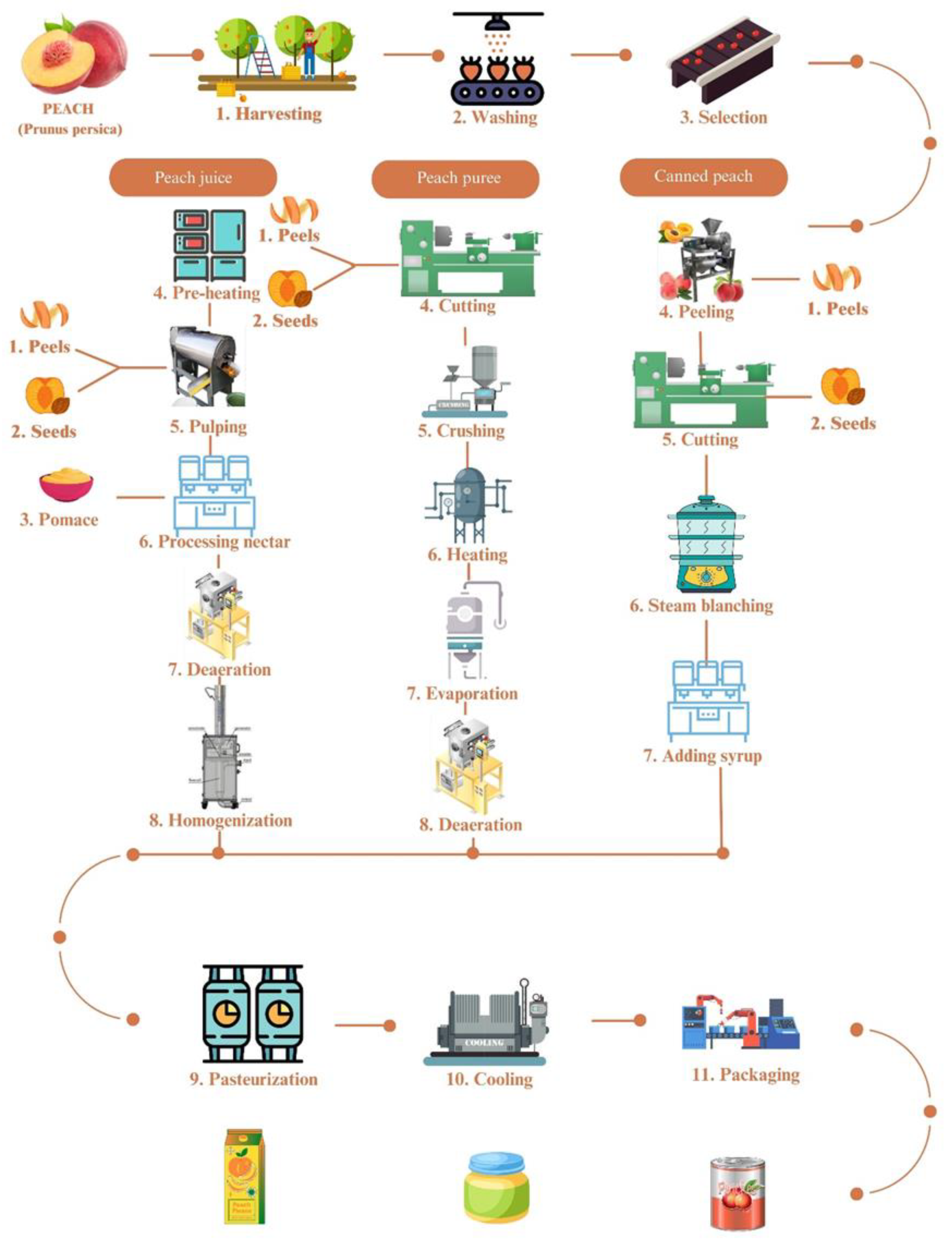
Figure 2.
Valorization of peach by-products.
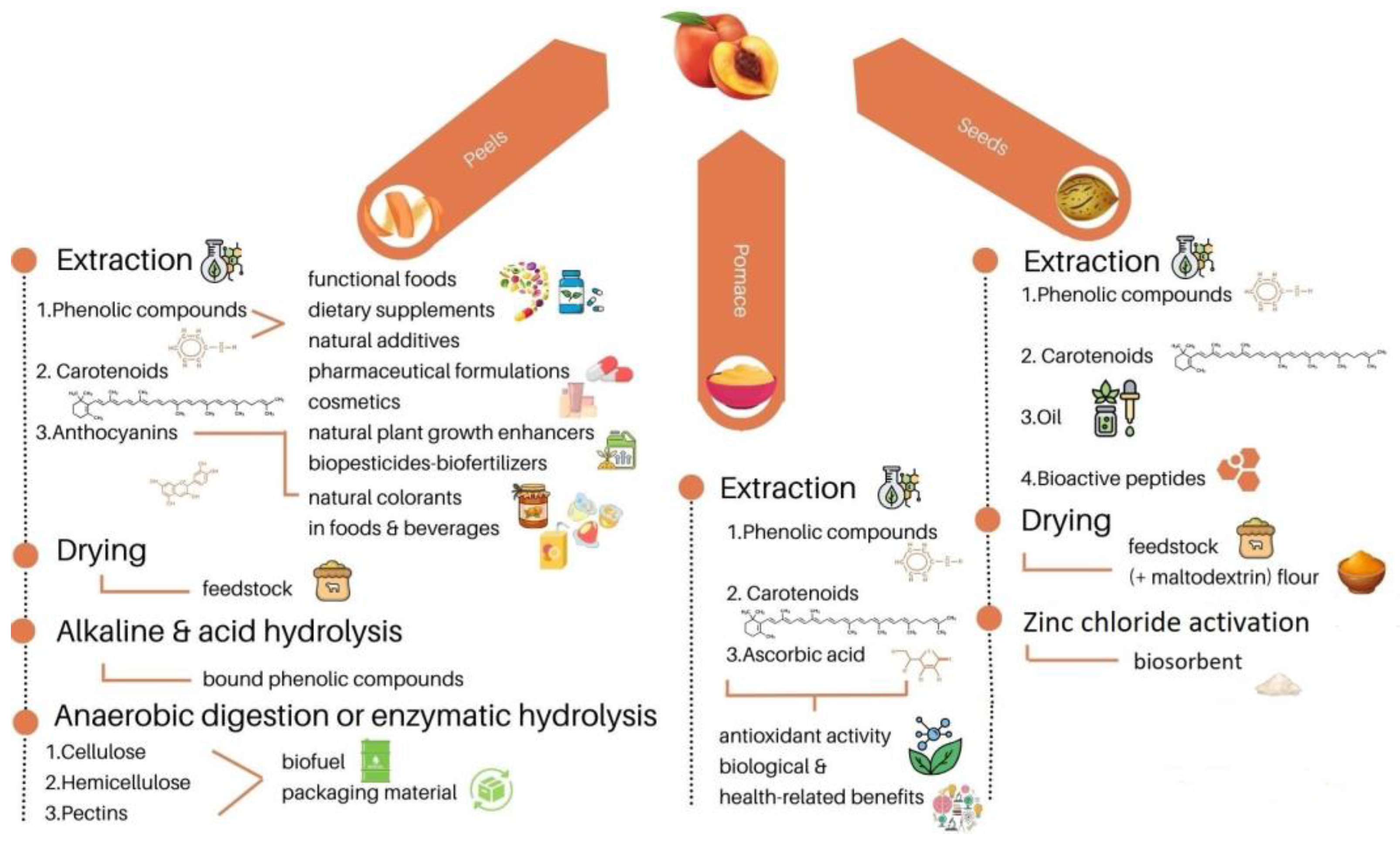
Figure 3.
Scopus database results for published articles on peach by-product (last accessed 30/08/2023, queries string entered: ‘peach peel’, ‘peach pomace’, ‘peach seeds’).
Figure 3.
Scopus database results for published articles on peach by-product (last accessed 30/08/2023, queries string entered: ‘peach peel’, ‘peach pomace’, ‘peach seeds’).
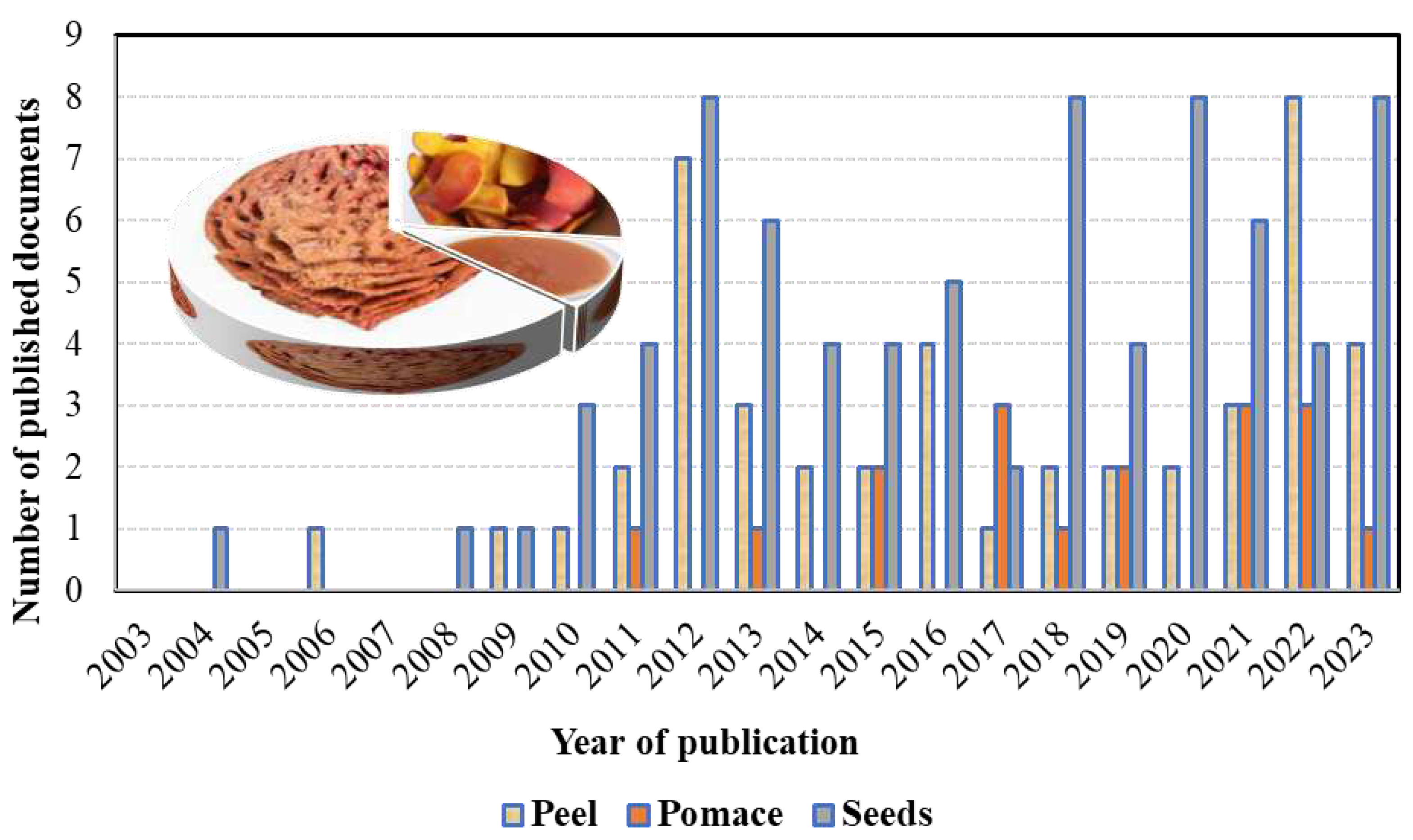

Table 1.
Chemical composition of peach peels.
| Component | Content | Reference |
|---|---|---|
| Moisture | 88.04 ± 0.30% | [11] |
| Sugars | 7.58 ± 0.25% 9.29 – 18.96 mg/g dw 5.42 – 10.2 g/100 g fw |
[11,12,13] |
| Total dietary fibers | 1.31 ± 0.20% | [11] |
| Protein | 1.14 ± 0.15% | [11] |
| Fat | 0.08% | [11] |
| Total ash | 0.49 ± 0.01% | [11] |
*dw: dry weight, fw: fresh weight.
Table 2.
Phenolic composition of peach peels.
| Phenolic compound | Content | Reference |
|---|---|---|
| Flavonols | ||
| 3’-Methylquercetin | 6.98 – 12.58 mg/100 g fw | [17] |
| Dihydrokaempferol | 0.28 – 0.45 mg/100 g fw | [17] |
| Dihydromyricetin | 0.31 – 1.45 mg/100 g fw | [17] |
| Dihydromyricetin-3-glucoside | 3.17 – 12.68 mg/100 g fw | [17] |
| Dihydroquercetin-3-galactoside | 23.09 – 160.55 mg/100 g fw | [17] |
| Dihydroquercetin-3-glucoside | 38.96 – 130.8 mg/100 g fw | [17] |
| Isorhamnetin-3-rutinoside | 4.61 – 22.66 mg/100 g fw | [17] |
| Kaempferol | 0.18 – 2.98 mg/100 g fw | [17] |
| Kaempferol-3-galactoside | 14.73 – 211.08 mg/100 g fw | [17] |
| Kaempferol-3-glucuronide | 3.76 – 21.32 mg/100 g fw | [17] |
| Kaempferol-3-glucoside | 0.08 – 78.89 mg/100 g fw | [12,17] |
| Kaempferol-3-rhamnoside | 65.64 – 129.32 mg/100 g fw | [17] |
| Quercetin | 5.34 – 12.81 mg/100 g fw | [17] |
| Quercetin-3-galactoside | 0.16 – 79.11 mg/100 g fw | [12,15,17,18] |
| Quercetin-3-glucoside | 0.52 – 9.69 mg/100 g fw | [15] |
| Quercetin-3-rutinoside | 0.53 – 50.61 mg/100 g fw | [15,17,18,19] |
| Anthocyanins | ||
| Cyanidin-3-glucoside | 0.07 – 32.51 mg/100 g fw | [12,15,18,19] |
| Cyanidin-3-rutinoside | 0.18 – 6.35 mg/100 g fw | [15,18,19] |
| Hydroxycinnamic acids | ||
| 4-caffeoylquinic acid | 0.08 – 0.70 mg/100 g fw | [12] |
| Caffeoylquinic acid derivative | 0.25 – 0.98 mg/100 g fw | [12] |
| Chlorogenic acid | 0.1 – 47.05 mg/100 g fw 84.2 – 355.9 mg/100 g dw |
[12,13,15,18,19,20] |
| Coumaric acid | 2.9 – 3.2 mg/100 g fw | [20] |
| Ferulic acid | 1.2 mg/100 g fw | [20] |
| Neochlorogenic acid | 0.03 – 34.6 mg/100 g fw | [12,15,18,19,20] |
| p-coumaroylquinic acid | 0.03 – 0.12 mg/100 g fw | [12] |
| trans-caffeic acid | 2.6 – 12.8 mg/100g dw | [13] |
| trans-ferulic acid | 2.6 – 13.7 mg/100 g dw | [13] |
| trans-p-coumaric acid | 8.3 – 18.5 mg/100 g dw | [13] |
| trans-sinapic acid | 2.2 – 7.2 mg/100 g dw | [13] |
| Hydroxybenzoic acids | ||
| Gallic acid | 4.47 – 8.48 mg/100 g fw | [18] |
| Protocatechuic acid | 3.3 – 27.3 mg/100 g dw | [13] |
| Flavan-3-ols | ||
| Catechin | 0.12 – 31.89 mg/100 g fw | [12,15,17,18,19,20] |
| Catechin 3’,5-diglucoside | 2.25 – 4.32 mg/100 g fw | [17] |
| Epicatechin | 0.64 – 20.6 mg/100 g fw | [15,17,18,19,20] |
| Flavanones | ||
| Eriodictyol | 0.36 – 0.51 mg/100 g fw | [17] |
| Eriodictyol-7-glucoside | 0.45 – 1.97 mg/100 g fw | [17] |
| Eriodictyol-7-neohesperidoside | 0.33 – 16.95 mg/100 g fw | [17] |
| Eriodictyol-7-rutinoside | 5.2 – 29.83 mg/100 g fw | [17] |
| Hesperetin | 3.43 – 13.75 mg/100 g fw | [17] |
| Hesperetin-7-rutinoside | 2.63 – 55.79 mg/100 g fw | [17] |
| Naringenin | 0.56 – 2.13 mg/100 g fw | [17] |
| Naringenin-7-glucoside | 3.2 – 32.46 mg/100 g fw | [17] |
| Naringenin-7-glucuronide | 3.79 – 13.01 mg/100 g fw | [17] |
| Naringenin-7-rutinoside | 1.32 – 9.43 mg/100 g fw | [17] |
| Flavones | ||
| Luteolin | 0.05 – 2.97 mg/100g fw | [17] |
| Luteolin-7-glucuronide | 8.45 – 156.89 mg/100g fw | [17] |
| Luteolin-7-rutinoside | 0.64 – 20.3 mg/100g fw | [17] |
| Proanthocyanidins | ||
| PAC-A type dimer | 2.87 – 7.24 mg/100 g fw | [17] |
| PAC-A type trimer | 0.07 – 0.29 mg/100 g fw | [17] |
| PAC-B type dimer | 119.13 – 1762.13 mg/100 g fw | [17] |
| PAC-B type tetramer | 0.44 – 3.53 mg/100 g fw | [17] |
| Procyanidin B1 | 0.04 – 49.23 mg/100 g fw | [12,15,19] |
| Procyanidin B2 | 0.02 – 0.10 mg/100 g fw | [12] |
*dw: dry weight, fw: fresh weight.
Table 3.
Extraction of antioxidants from peach peels.
| Extraction method | Conditions | Target compound | Yield | Reference |
|---|---|---|---|---|
| Maceration | 0.05% HCl in methanol, dark | Anthocyanins | Total anthocyanin content: 1-8 mg cyanidin-3-glucoside equivalents/100 g fw | [26] |
| Ultrasound-assisted extraction | 80% MeOH, 60 kHz, 30 W, 30 min | Phenolic compounds | Neochlorogenic acid: 5.77 – 342.75 mg/kg dw Chlorogenic acid: 52.2 – 1631.25 mg/kg dw Procyanidin B1: 54.76 – 539.22 mg/kg dw Catechin: 60.14 – 1030.06 mg/kg dw Cyanidin-3-glucoside: 9.33 – 670.59 mg/kg dw Quercetin-3-galactoside: 8.45 – 396.49 mg/kg dw Quercetin-3-glucoside: 2.45 – 581.21 mg/kg dw Quercetin-3-rutinoside: 59.15 – 193.25 mg/kg dw Kaempferol-3-rutinoside: 16.91 – 110.86 mg/kg dw Total phenolics: 4.58 – 12.68 mg gallic acid equivalents/g dw |
[27] |
| Ultrasound-assisted extraction | 50% EtOH, 42 kHz, 30 min, room temperature | Phenolic compounds | Total phenolic content: 8.38 – 18.81 mg gallic acid equivalents/g dw | [28] |
| Maceration | 80% MeOH, 1 min blending | Phenolic compounds | Total phenolic content: 877 – 1896 mg gallic acid equivalents/kg Neochlorogenic acid: 22.5 – 80.9 mg chlorogenic acid equivalents/kg Chlorogenic acid: 164.4 – 470.5 mg/kg Malvin: 0.0 – 75.6 mg/kg Rutin: 7.1 – 81.3 mg/kg Isoquercetin: 38.0 – 96.9 mg rutin equivalents/kg Procyanidin B1: 69.6 – 279 mg catechin equivalents/kg Catechin: 53.1 – 434 mg/kg |
[29] |
| Ultrasound-assisted extraction (free phenolics) Alkaline hydrolysis (bound phenolics) Acid hydrolysis (bound phenolics) |
80% EtOH, 50oC, 30 min (free) 2M NaOH, 18h digestion, 30 oC, 6M HCl to pH 1.5-2.0, extraction with ethyl acetate (bound-alkaline) MeOH/H2SO4 (90:10), 70oC, 24h, sonication, 10M NaOH to pH 12.0, extraction with ethyl acetate (bound-acid) |
Phenolic compounds | Total phenolic content: 6.82 – 13.12 mg gallic acid equivalents/g dw (free) 7 – 31% of total phenolics (bound) Total flavonoids: 164.14 – 515.83 μg quercetin equivalents/g dw (free) 0 – 76.93% of total flavonoids (bound) Total monomeric anthocyanins: 327.84 – 1246.77 μg cyanidin-3-glucoside/g dw (free) 0 – 49% of total anthocyanins (bound) |
[13] |
| Maceration | 80% MeOH, 8h, room temperature, shaking | Phenolic compounds | Total phenolic content: 1209.3 – 1354.5 mg gallic acid equivalents/100 g dw Total flavonoids: 599.7 – 785.5 mg catechin equivalents/100 g dw |
[2] |
| Maceration (free phenolics) Acid hydrolysis (bound phenolics) |
50% EtOH, pH 2.0, 1h, shaking, 70% acetone, shaking (free) MeOH/H2SO4 (90:10), 85 oC, 20h (bound) |
Phenolic compounds | Total phenolic content: 79.14 – 167.10 mg gallic acid equivalents/100 g fw (free) 52.93 – 84.02 mg gallic acid equivalents/100 g fw (bound) |
[30] |
| Maceration | MeOH/H2O/formic acid (60:38:2) | Phenolic compounds | Total phenolic content: 88.9 – 277.0 mg gallic acid equivalents/100 g fw Total flavonoids: 39.3 – 245 mg catechin equivalents/100 g fw Total anthocyanin content: 0.55 – 17.6 mg cyanidin-3-glucoside equivalents/100 g fw Quercetin-3-galactoside: 0.16 – 0.78 mg/100 g fw Quercetin-3-O-glucoside plus quercetin-3-O-rutinoside: 0.30 – 1.84 mg/100 g fw Kaempferol-3-O-glucoside: 0.08 – 0.40 mg/100 g fw Neochlorogenic acid: 1.02 – 7.98 mg/100 g fw p-coumaroylquinic acid: 0.03 – 0.12 mg/100 g fw Chlorogenic acid: 6.74 – 31.2 mg/100g fw 4-caffeoylquinic acid: 0.09 – 0.70 mg/100g fw Caffeoylquinic acid derivative: 0.25 – 0.98 mg/100g fw Procyanidin dimer B1: 0.04 – 0.77 mg/100g fw (+)-catechin: 0.12 – 0.80 mg/100g fw Procyanidin dimer B2: 0.02 – 0.10 mg/100g fw Cyanidin-3-glucoside: 0.07 – 4.89 mg/100g fw |
[12] |
| Maceration | 1% HCl/EtOH, pH 3.0, 60oC, 1h (anthocyanins) Acetone + BHT, 24h, 4oC (carotenoids, zeaxanthin, lycopene) |
Chlorophyll a content: 2.34 – 81.36 g/kg fw Chlorophyll b content: 2.94 – 31.13 g/kg fw Carotenoid content: 1.78 – 19.83 g/kg fw Lycopene content: 0.73 – 1.49 mg/kg fw Zeaxanthin content: 0 – 0.30 mg/kg fw B-carotenoid content: 0.31 – 10.63 mg/kg fw Anthocyanins content: 0 – 3.58 g/kg fw |
[31] | |
| Maceration | 1M NaOH, vacuum, 25oC, 18h, HCl to pH < 2.0 | Phenolic compounds | Total phenolic content: 0.61 – 0.91 g/100 g dw | [24] |
| Maceration | Hexane, 20 min, shaking 180 rpm, saponification with 0.1% methanolic KOH, 6 oC, 45 min (carotenoids) MeOH/H2O/formic acid (47.5:47.5:5), 20 min (phenolic compounds) |
Carotenoids and phenolic compounds | Cyanidin-3-glucoside: 74 – 178 mg/100g dw Cyanidin-3-rutinoside: 1 – 6 mg/100g dw Neochlorogenic acid: 23 – 27 mg/100g dw Chlorogenic acid: 52 – 136 mg/100g dw Caffeic acid: 1 – 3 mg/100g dw Procyanidin B1: 84 – 148 mg/100g dw Procyanidin B2: 12 – 41 mg/100g dw Procyanidin B3: 80 – 128 mg/100g dw Procyanidin B4: 2 – 9 mg/100g dw Catechin: 69 – 106 mg/100g dw Epicatechin: 4 – 10 mg/100g dw Quercetin-3-glucoside: 8 – 19 mg/100g dw Quercetin-3-rutinoside: 8 – 13 mg/100g dw Neoxanthin: 10.3 – 13.6 μg/g dw Violaxanthin: 5.6 – 36.5 μg/g dw Lutein epoxide: 8.2 – 20.6 μg/g dw Lutein: 9.6 – 15.1 μg/g dw Zeaxanthin: 10.1 – 18.7 μg/g dw β-cryptoxanthin: 6.3 – 13.2 μg/g dw β-carotene: 7.5 – 16.4 μg/g dw |
[16] |
* dw: dry weight, fw: fresh weight.
Table 4.
Chemical composition of peach seeds.
| Component | Content | Reference |
|---|---|---|
| Moisture | 6.9 ± 0.06% | [50] |
| Sugars | 47.44 ± 0.02% | [50] |
| Total dietary fibers | 1.8 ± 0.05% | [50] |
| Protein | 2.67 ± 0.10% | [50] |
| Fat | 37.69% | [50] |
| Total ash | 3.36 ± 0.02% | [50] |
Table 5.
Phenolic composition of peach seeds.
| Phenolic compound | Content | Reference |
|---|---|---|
| Flavonols | ||
| Isorhamnetin-3-O-glucoside | 0.53 – 66.67 mg/100 g dw | [4] |
| Keampferol-3-O-glucoside | 1.98 – 63.14 mg/100 g dw | [4] |
| Quercetin-3-O-glucoside | 2.87 mg/100 g dw | [4] |
| Luteolin-7-glucoside | 1.61 mg/100 g dw | [4] |
| Keampferol-7-neohesperidoside | 0.62 mg/100 g dw | [4] |
| Hesperidin-7-rutinoside | 0.55 mg/100 g dw | [4] |
| Hydroxycinnamic acids | ||
| Chlorogenic acid | 72.92– 1727.05 mg/100 g dw | [4] |
| Neochlorogenic acid | 130.07 mg/100 g dw | [4] |
| Gallic acid | 2.98 mg/100 g dw | [54] |
| Caffeic acid | 0.98 mg/100 g dw | [54] |
| 2-O-caffeoyl-L-malate | 17 – 130.52 mg/100g dw | [4] |
| 3-O-p-coumaroyloquinic acid | 9.6 – 70.22 mg/100 g dw | [4] |
| cis-5-p-coumaroyloquinic acid | 21.93 – 190.8 mg/100 g dw | [4] |
| Hydroxybenzoic acids | ||
| Ellagic acid | 0.77 – 9.42 mg/100 g dw | [4] |
| p-hydroxybenzoic acid | 18.64 mg/100 g dw | [54] |
| Flavan-3-ols | ||
| Epicatechin | 18.62 – 33.74 mg/100 g dw | [4] |
| Procyanidin B1 | 150.65 mg/100 g dw | [4] |
| Procyanidin B2 | 28.12 mg/100 g dw | [4] |
*dw: dry weight.
Table 6.
Fatty acids composition of peach seeds oil.
| Fatty acids | Content | Reference |
|---|---|---|
| Unsaturated fatty acids | ||
| Oleic acid | 55 – 74% | [67] |
| Linoleic acid | 12 – 31% | [67] |
| Saturated fatty acids | ||
| Palmitic acid | 7.97% | [65] |
| Stearic acid | 23.7% | [65] |
| α-linolenic acid | 0.11% | [65] |
Table 7.
Extraction of oil from peach seeds.
| Extraction method | Conditions | Yield* | Fatty acids composition | Reference |
|---|---|---|---|---|
| Soxhlet | Hexane, 70/80/90oC | 38% | Oleic acid: 74%Linoleic acid: 15% | [76] |
| Maceration | Hexane/ethanol | 22%/17% | Oleic acid: 74%Linoleic acid: 15% | [76] |
| Supercritical fluid extraction | 5% ethanol at 50°C/300 bar | 24% | Oleic acid: 60 – 65%Linoleic acid: 15 – 20% | [10,77] |
| Maceration | 130 mL petroleum ether at 65°C for 2.5 h | 30 – 50% | Oleic acid: 55.2 %Linoleic acid: 30.8%Palmitic acid: 7.97%Stearic acid: 2.37%α- linoleic acid: 0.11% | [65] |
| Soxhlet | n-hexane | 46.4 ± 1.3% | Oleic acid: 74.55%Linoleic acid: 16.85% | [67] |
*g oil/100 g dry weight.
Table 8.
Chemical composition of peach pomace.
| Component | Content | Reference |
|---|---|---|
| Moisture | 65.84 – 84.76% | [110,111] |
| Sugars | 12.14 – 26.38% 10.8 – 15.7 g/100 g fw |
[12,110,111] |
| Total dietary fibers | 1.78% | [110] |
| Protein | 0.68% | [110] |
| Fat | 0.21% | [110] |
| Total ash | 0.43 – 0.56% | [110,111] |
* fw: fresh weight.
Table 9.
Antioxidant compounds in peach pomace.
| Component | Content | Reference |
|---|---|---|
| Total phenolics | 105.1 ± 1.21 mg GAE/g extract | [112] |
| 3.62 – 19.4 mg GAE/100 g fw | [12] | |
| 24.83 – 86.33 mg of GAE/100 g fw | [109] | |
| 3.5 - 4.5 mg/g dw | [55] | |
| 711.7 – 881.3 mg GAE/100 g dw | [2] | |
| Flavonoids | 726.5 ± 8.2 mg QCT/100 g fw | [110] |
| 17.76 ± 130.17 mg RE/100 g fw | [109] | |
| 301.3 – 499.7 mg CE/100 g | [2] | |
| Phenols | 921.8 ± 2.5 mg CGA/100 g fw 461 ± 308 mg CGA/100 g fw |
[110,113] |
| Anthocyanins | 148.7 ± 83 mg C3G/100 g ft | [113] |
| Hydroxycinnamic acids | 103 – 303 mg/kg | [114] |
| 3.45 – 18.1 mg/100 g fw | [12] | |
| Chlorogenic acid | 15.029 ± 1.3 mg/kg extract | [109] |
| 0.12 – 1.82 mg/g dw | [55] | |
| 3.58 – 14.22 mg/100 g fw | [109] | |
| Neo-chlorogenic acid | 2.13 – 12.14 mg/100 g fw | [109] |
| Flavan-3-ols | 1160 – 2147 mg/kg | [114] |
| 0.05 – 1.89 mg/g dw | [55] | |
| Total carotenoids | 13.79 ± 2.45 μg/g fw | [115] |
| 61.9 ± 1.8 mg β-catotene/100 g fw | [110] | |
| 2.8 ± 0.9 mg β-catotene/100 g fw | [113] | |
| β-cryptoxanthin | 2.19 – 88.05 µg/g dw | [115] |
| β-carotene | 5.07 – 28.9 µg/g dw | [115] |
| lutein | 0.83 – 10.8 µg/g dw | [115] |
| zeaxanthin | 1.33 – 19.08 µg/g dw | [115] |
| (E/Z)-phytoene | 0.41 – 8.8 µg/g dw | [115] |
| Ascorbic acid | 4.15 – 14.2 mg/100 g fw | [12] |
| 2.48 – 5.54 mg/100 g fw | [109] |
*fw: fresh weight; dw: dry weight; GAE: gallic acid equivalents; QCT: quercetin equivalents; RE: rutin equivalents CE: catechin equivalents; CGA: chlorogenic acid equivalents; C3G: cyanidin-3-O-glucoside equivalents.
Disclaimer/Publisher’s Note: The statements, opinions and data contained in all publications are solely those of the individual author(s) and contributor(s) and not of MDPI and/or the editor(s). MDPI and/or the editor(s) disclaim responsibility for any injury to people or property resulting from any ideas, methods, instructions or products referred to in the content. |
© 2024 by the authors. Licensee MDPI, Basel, Switzerland. This article is an open access article distributed under the terms and conditions of the Creative Commons Attribution (CC BY) license (http://creativecommons.org/licenses/by/4.0/).
Copyright: This open access article is published under a Creative Commons CC BY 4.0 license, which permit the free download, distribution, and reuse, provided that the author and preprint are cited in any reuse.