

Submitted:
08 January 2024
Posted:
11 January 2024
You are already at the latest version
Abstract
This study investigated the chemical composition, and total phenolic content(TPC), total flavonoid content (TFC), and antioxidant activity Reziz date pomace extracted using different solvent system. The recovery, bioaccessibility, and stability of bioactive compounds were evaluated using In vitro gastrointestinal digestion. The results showed that pomace rich source of fiber but low in fat, and protein. Extraction data revealed that methanol, and ethanol were the most effective solvent for TPC and TFC extraction with higher antioxidant activity. In vitro gastrointestinal digestibility significantly affected recovery, bio-accessibility and stability of bioactive compounds. The TPC, TFC, and antioxidant activities were significantly increased after the mouth digestion but decreased during the gastric and intestinal digestion. The bioaccessibility of polyphenol and flavonoid were 35.22% and 23.57% respectively after the intestinal digestion. The chyme insoluble fraction (pellet) showed higher bioactive compounds and antioxidant activity compared to the chyme soluble fraction. The high fiber content of the date pomace seemed to affect the bioaccessibility of the bioactive compounds. TPC or TFC and the antioxidant activity determined by DPPH and ABTS were found to have a positive correlation with the oral, gastric, and intestinal digestion. The GC-MS analysis of digested date pomace in mouth, gastric, or intestinal digestion revealed an increase in the number of peaks (compounds) compared to the undigested sample. According to these findings, Ruzeiz date pomace could be utilized as a bioactive ingredient source in formulation of functional foods to promote healthy life.
Keywords:
Date Pomace
; Phenolic compounds
; antioxidants activities
; gastrointestinal in-vitro digestibility
; Recovery
; bioaccessibility
; stability
1. Introduction
Date palm (Phoenix dactylifera L.) is cultivated in tropical and subtropical region in North Africa & Middle Eastern countries and play an important nutritional, social and economic role for peoples of these regions [1]. In contrast to the most fruits, date fruit maturation goes through four stages, Kimri, Khalal, Rutab and Tamer, and generally it harvested in Tamer stage [2]. The ripe date fruit consists mainly of three parts flesh (pulp) (85.7%), seed (14.25% and skin (0.05%) and consumed fresh, dried or frozen. The flesh is rich source of carbohydrates, dietary fiber, vitamins, mineral and energy with low content of lipid and protein, depending on ripening stage [3-6]. Both date fruit and seed were reported to an excellent source of polyphenols, flavonoids, sterols, glycosides, lycopene and anthocyanin [7-10]. Several studies had shown that date fruits and seed had protective effect against obesity, hyperlipidemic, diabetic, inflammatory, fatty liver, cardiovascular disease [11-15] .
Saudi Arabia is one of the leading country in date production and export of dates, with annual production exceeding 1.5 million tons from around 500 different date varieties that represent 17.0% of world production [16].Ruziez variety is mainly grown in Al-Ahsa region, Eastern part of the kingdom and represent 69.0% of Ruziez trees in the kingdom with around 34 thousand palm trees [17]. Compared to the Deglet Noor, khalas , Sukkari and Ajwa varieties, Ruziez is less popular and consider second grade variety. Therefore, its utilized in of date syrup industry, that generate a huge waste or by-product such as the date pomace, a mix of seed, skin and part of pulp. The agro-industrial waste is known to be harmful to the environment by increase the production methane and carbon dioxide gases and polluting water and soil. The developed countries spend billions of dollars to treat or decrease the risk of agricultural and food waste that harm to human, animals and environment. The date -industry wastes or by-products is an excellent source of fiber and bioactive compounds that can be utilized as functional foods ingredient which is beneficial to human health [18,19]. The selection of the solvent polarity and efficient of extraction methods is very important for extraction of bioactive compounds from plants source, because of its structural complexity and diversity [20]. The beneficial effect of the phenolic compounds with antioxidant activity on the tissues, depend on its concertation in food and their bioaccessibility and bio-availability after ingestion [21]. These bioactive compounds are bound to dietary fiber, proteins, and carbohydrates within food matrix, therefore it had to be hydrolyzed and released by the enzymes and make them bioavailable for absorption in the human intestine [22-24]. The Ruziez date pomace, the by-product of date syrup industry is used in animal feeding or disposed in landfill. However, to the best of our knowledge, the date syrup industry waste or by-product has not been extensively. Therefore, the purpose of this investigation was to evaluate the proximate composition and total polyphenolic compounds and antioxidant activity of Ruziez date pomace using different solvent system and to investigate the impact of in vitro gastrointestinal digestion on the bioavailability and stability of phenolic components and antioxidant activity of date by-products.
2. Materials and Methods
2.1. Materials
The date pomace was donated by date syrup factory in Alhasa, Saudi Arabia. The date seeds were separated manually and the pomace was mixed with warm water to remove soluble sugar, the process was repeated until the pomace was sugar free. The pomace was air dried and processed into powder using a food grinder (Gold mill, GM-203, Korea) and stored at 4 C in polyethylene bags.
2.2. Methods
2.2.1. Proximate Composition
2.2.5. Date Pomace Extracts Preparation
The phenolic compounds were extracted using different solvents (ddH2O, (50 & 100%) ethanol, methanol and acetone), date pomace solvents mixture (1:50 w/v) stirred overnight at room temperature and filtered using Whatman filter paper #1.the extraction was repeated and the filtrate were combined. The solvents were removed using rotary evaporator (Heidloph, Instruments, Laborota 4003 control, Schabach, Germany) at 60°C and were freeze dried for analysis of bioactive compounds, flavonoids [27].
2.2.6. Total Phenolic Content (TPC) Determination
Folin-Ciocalteu reagent was used to determine the total phenolic content, the results were using the and expressed as Gallic acid equivalent (GAE) mg/gm sample. [28].
2.2.7. Total Flavonoid Determination
The total flavonoid content of different solvent system was estimated using catechin as described by Kim et al., [29]. The results are expressed as milligrams of catechin equivalents (CE)/ gm of the sample
2.2.8. Antioxidant Activity Determinations
DPPH Scavenging Activity
The DPPH radical scavenging activity of various solvent extracts was determined following the method Chang et al . [30]. The DPPH scavenging activity calculated
where A0 represents the absorbance of the control and A1 represents the absorbance of the extract, was used to compute the percentage inhibitory activity. The quantity of antioxidants needed to reduce the initial DPPH concentration by 50% is known as the half-maximal inhibitory concentration (IC50).
DPPH scavenging (%) = [(A0-A1)/A0] x100,
ABTS Radical Scavenging Capacity
The ABTS scavenging was determined according to Thaipong et al 2006 ., [31] and expressed as trolox equivalent (TE)/g, based on trolox calibration curve. The quantity of antioxidants needed to reduce the initial ABTS concentration by 50% is known as the half-maximal inhibitory concentration (IC50).
2.2.9. Simulated In Vitro Gastrointestinal Digestion
The simulated in vitro gastrointestinal was carried out according to the method of Gong et al., [32] with some modification. 5gm of date pomace was mixed with 3.5 ml of saliva simulating fluid amylase (20u/ml) 25ul CaCL2 (0.3m/L) and 0.5 ml water, the mixture and incubated for 30 min in shaking water bath at 37C. After the incubation, 7.5 ml simulating gastric fluid, 1.6 pepsin solution (25000U/ml), 5 ul CaCL2, (0.3m/l) and 0.75 water added to the mouth digested fluid mixture, the pH was adjusted to 3 with 1 m/l HCL the incubated in shaking water bath 37C for 30 min. The gastric chime was mixed with 11 ml simulating intestinal fluid, 5 ml pancreatin solution (800U/ml) 2.5 bile salt so (160mm/l), 40ul CaCL2 (0.3m/l) and 1.25 water. the mixture pH was adjusted to 7 using 1 m/l NaOH and incubated for 2hrs at 37 in shaking bath. At the end of the mixture was cooled in ice before transferring to dialysis tube 1 KD cutoff. The digested samples were dialyzed against NaCL 10mm/l) for 24hrs the freeze-dried for further analysis. Triplicate samples were kept after each step of the digestion and subjected to centrifugation for 12 min at 8000 at rpm 4°C to separate the chyme soluble fraction (CSF) from insoluble chime the pellet fraction (PF). Both fraction were lyophilized for determination of TPC, TFC and antioxidant activity.
Recovery Index and Bio-Accessibility Index
The recovery % and the bio-accessibility percentage was determined according Ortega et al., [33].
Recovery index:
Recovery index (%) = (PCDF/PCTF) × 100
Where PCDF represents the total phenol content (mg) in the digested (CSF+PF), and PCTF is the total phenol content (mg) determined in the test matrix.
Bio-accessibility index
The solubilized polyphenolic compounds in CSF fraction following intestinal dialysis is referred to as bio-accessibility.
Bio-accessibility index (%) = (PCS/PCDF) × 100
Where PCS denotes the total phenol content (mg) in the CSF following the duodenal dialysis step and PCDF denotes the total phenol content (mg) in the digested sample (CSF + PF) following the duodenal step.
2.2.10. GC-MS Analysis of Date Pomace
The bioactive chemicals of date pomace both before and after gastrointestinal digestion were identify by gas chromatography coupled with mass spectrometer (Turbomass, PerkinElmer, Inc., Waltham, MA, USA) as described by Adams, [34]. The Innowax FSC column (60cm x m 0.25 mm. 0.25 um film thickness as stationary phase and helium 0.8ml/min mobile phase were used, by injection of 0.1 ul of sample with split ratio 40:1. The oven temperature was set at 60C for 10 min and increased to 220C at rate of 4C/min held 10 min then increased to 240C at rate of 1 C/min. The temperature of the injector and transfer line were 250 and 280C respectively. The mass detection was carried out at 70eV with mass scan range m/35-50. The compounds were identified by comparing the mass spectra obtained with those of similar compounds from the National Institute of Standard and Technology Spectral Library and Wiley GC/MS Library. The identification was carried out by comparing retention time with reference standards and by comparing relative retention index (RRI) to C8 – C30 of n-alkanes under same operating condition.
2.2.11. Statistical Analysis
All samples were in triplicate, and mean ± standard deviation were calculated. One-way analysis of variance (ANOVA) was used to analyze the data and P ≤ 0.05, differences were judged significant. Pearson correlation analysis was used to examine the relationship between total phenolic and flavonoid levels and the antioxidant activity of extracts under different digesting processes.
3. Results
3.1. Chemical Composition
Table 1 shows proximate composition, of Ruziez date pomace powder. The results showed that date pomace contains high content of crude fiber (66.71%) and low levels of protein 4.85%), moisture (2.5%), ash (1.61%), fat (1.4%). The pomace was also found to contain high level of insoluble fiber (62.9%) and low soluble fiber (3.8%). Mineral analysis revealed that the date pomace is rich source of calcium (101.39 mg/kg), K (813 mg/kg), but low in iron (1.25 mg/kg), and zinc (0.5 mg/kg) and manganese (0.14. 0%).
3.2. Effect of the Extraction Solvent on Total Phenolic, Total Flavonoids, and Antioxidant Activity of Ruzeiz Date Pomace Powder
Table 2 shows the total phenolic (TPC), flavonoid (TFC) and IC50 DPPH, and ABTS antioxidant activities of the date pomace powder extracted with different solvents. The results revealed significant differences (P ≤ 0.05 in phenolic compounds content and antioxidant activities of different solvent system. There was a significant (P ≤ 0.05) difference in TPC content among solvents system used. Date pomace extracted with methanol (100%) showed significantly high TPC followed by methanol water > acetone > 50% aqueous methanol > 50% aqueous ethanol > 50% aqueous acetone, with values of 79, 70.4, 63.6, 49.5, 48.4, 37.2 and 23.5 mg GAE/gm respectively. Similarly, methanol (100%) showed significantly high TFC (10.1 mg QCE/gm), followed by ethanol (100%) (9.1 mg QCE/gm). The amount of TFC was reduced in the following order: water > 100% acetone > 50% aqueous methanol > 50% aqueous ethanol > 50% aqueous acetone. There were no significant differences in TFC among water, acetone and aqueous methanol. However aqueous methanol extracts showed significantly (P ≤ 0.05) higher TFC content than aqueous ethanol and acetone. Similar to phenolic compounds antioxidant activities were significantly affected by solvent systems. In general, aqueous of acetone, ethanol and methanol showed significantly low IC50 DPPH and ABTS activities compare pure solvents and water. The methanol extract showed the highest DPPH radical scavenging activity, with an IC50 concentration of 76 mg/l, followed by ethanol (100%), with an IC50 concentration of 87 mg/l, and aqueous acetone (50%) had the lowest activity, with an IC50 concentration of 383 mg/l. similar trend was observed with ABTS.
3.3. Recovery and Bio-Accessibility Index
Figure 1a shows the TPC, TFC, IC50 DPPH, and ABTS recovery indexes of the Ruziez date pomace powder after in vitro gastrointestinal digestion steps. The recovery index values of TPC and TFC were markedly differed during digestion stages. The mouth digestion stage showed the highest recovery index followed by the gastric and intestinal digestions stages, indicating that mouth digestion did not have an effect on bioactive compounds. The mouth digestion increased TPC and TFC recovery index by 107.1. % and 130.2% compared to the initial sample. In contrast gastric digestion and intestinal digestion were found to decrease the recovery index of TPC by 58.8% and 36.6% and TFC by 92.3%, and 52.75% respectively.
3.4. Bioactive Compounds Stability during In Vitro Gastrointestinal Digestion
Table 3 shows the stability of TPC, TFC, antioxidant capacities (DPPH and ABTS) content and activities in the chyme insoluble fraction or the pellet (CP) and the chyme soluble fraction (CSF) following in vitro gastrointestinal digestion. Overall, the mouth digestion showed significantly higher TPC compared to the initial sample and gastric and both intestinal digestion stages. The TPC increased 62.8 to 67.23 mg GAC/100 gm after mouth, but decreased significantly after gastric and intestinal digestions to 36.63 and 22.8 mg GAC/100 gm respectively. Similarly, TFC was significantly high after mouth stage, it increased from 5.63 to 7.33 mg QCE/100g sample, while there was slight none significant decrease during gastric stage from 5.63 to 5.2 mg QCE/100g. However, the last stage, the intestinal digestion showed significantly decrease from 5.63 to 2.97 mg QCE/100g).
Table 3 showed that most of the Ruziez date pomace polyphenol were present in the insoluble fraction of the chyme (pellet) compared to the soluble fraction (supernatant) after in vitro digestion stages. The TPC of the insoluble chime fraction (pellet) after mouth, gastric and intestinal digestion were 53.04 ±5.35, 25.9±3.62 and 14.77 ± 2.73 mg GAC/100g sample respectively, these values were significantly higher those soluble fraction (supernatant) 14.2 ± 3.05, 10.73 ± 1.04 and 8.03 ± 1.46 mg GAC/100g. The Total TPC of the chyme insoluble fraction and insoluble fraction after intestinal digestion were significantly lower than mouth and gastric stages. Similar trend was observed with TFC, insoluble fraction (pellet) showed significantly higher TFC than soluble fraction the (supernatant). The TFC of the insoluble fraction after mouth, gastric and intestinal digestion were 4.8 ± 0.26, 4.0 ± 0.1 and 2.27 ± 0.15 respectively while those of the soluble fraction were 1.53 ± 0.35, 1.2± 0.3 and 0.7 ± 0.10 respectively. Mouth digestion showed significantly compared gastric and intestinal digestion, but there were no significant differences in TFC among initial sample, mouth and gastric digestion. However intestinal digestion stage showed significantly lower TFC than the other stages. Table 3 shows the effect of in vitro digestibility on the antioxidant capacities as measured by DPPH and ABT. The antioxidants capacities exhibited similar trends to the phenolic compounds. The in vitro gastrointestinal digestion stages revealed significant difference in antioxidant activities. The mouth stage showed significant higher DPPH and ABTS activities compared to the initial sample and gastric and intestinal digestion. The DPPH and ABT activities significantly increased after mouth stage by 10.4% and 21,0% while it significantly decreased after gastric stage by 51.9% and 40.93% respectively compared to the initial samples. The DPPH and ABTS activities after the intestinal digestion the final stage were 24.37 ±5.22 % and 24.37 ± 5.55 respectively with loss of 68.2% and 68.67% compared to the initial sample.
3.5. Correlation between TPC, TFC, and Antioxidant Activity
Table 4 displayed the coefficient values of correlation obtained between TPC, TFC, and antioxidant activity measured using two different methodologies at various stages of gastrointestinal digestion. A strong and positive correlation (r = 0.855-0.995) was found between TPC or TFC and the antioxidant activity obtained with the DPPH and ABTS assays in the mouth, gastric, and intestinal steps at either P ≤ 0.05 or P ≤ 0.01. However, there was a weak correlation between TPC and antioxidant activity in the intestinal step, while there was strong correlation with TFC.
3.6. Identification of RDPC Powder Phenolic Compounds during Simulated In Vitro Gastrointestinal Digestion
The GC-MS analysis of Reziez date pomace that subjected to oral, gastric, and/or intestinal digestion are shown in Figure 2. The findings revealed that three phenolic compound peaks with high concentrations were identified The-hexadecanoic acid, 9 octadecenoic acid, and octadecenoic acid derivatives. Following oral, gastric, and intestinal digestion, more than 10 peaks in the gastric or intestinal fluid were found. In the mouth digestion stage, 14 peaks were identified including different compounds such as erythritol, 4TMS derivative, Xylitol, 5TMS derivative, beta-D(-)-Lyxopyranose, 4TMS derivative, arabinofuranose, 1,2,3,5-tetrakis-O-(trimethylsilyl), 3-(4-Hydroxy-3-methoxyphenyl)propionic acid, 2TMS derivative, and palmitic acid, TMS derivative. In the gastric step, 15 peaks were identified, including D-(-)-ribofuranose, tetrakis(trimethylsilyl) ether (isomer 2), D-allofuranose, pentakis(trimethylsilyl) ether, D-glucitol, 6TMS derivative, alpha.5TMS derivative, 9,12-octadecadienoic acid (Z, Z)-, TMS derivative, hexadecanamide, and 9-octadecenamide (Z). whereas there were 11 peaks identified in the intestinal stdigestion stage including various compounds such as D-(-)-fructofuranose, pentakis(trimethylsilyl) ether (isomer 1), L-(-)-sorbofuranose, pentakis(trimethylsilyl) ether, talose, 5TMS derivative, beta.4TMS derivative, -D (-)-lyxopyranose, beta.5TMS derivative -D-allopyranose, 9-octadecenamide (Z), and 3TMS derivative deoxycholic Acid.
4. Discussion
The moisture, fat and protein, content of the Ruziez date pomace were comparable to that of Manify, Sifri and Selag date cultivars press cake [35], but lower than that those of the Iranian date pomace [36]. In contrast, the carbohydrates content was higher than that reported by [36] probably due to the removal of date seed in this study, that is known to be higher fat content [37]. The minerals content of the date pomace was comparable with that of Ruziez date fruit [38], but lower than those of Barhee, Lulu and khulas date pomace [39]. Furthermore, the Ruziez date pomace powder is found to be rich in total fiber with the majority being insoluble since most of the soluble fiber was washed off during date syrup preparation. The total fiber of the Ruziez date pomace is higher than those found in date pomace of Barhee, Lulu and khulas by- product of syrup/dibs production [39]. These variations could be attributed to differences in genetic makeup, growing conditions, soil mineral content, fertilizers, irrigation, maturity stage and the processing methods [2]. These results indicate that Ruziez pomace could be considered an excellent source of dietary fiber. Studies have shown the functionality and physiological impacts of dietary fibers, with Soluble fibers enhancing the viscosity that have positive effect on decreasing plasma lipid and glycemic response, while the Insoluble fibers, that are particularly abundant in date pomace enhance fecal volume and decrease intestinal transit [40].
In This study, pure methanol and ethanol as solvents showed superior extraction efficiencies of total polyphenols and flavonoids with varying antioxidant activity from Ruziez date pomace, probably due the presence of various phenolic compounds with varying polarity and chemical properties that may or may not be soluble in a particular solvent [41]. Mohammed et al., [42], reported that the composition of the solvents and polarity had a major effect in extraction of phenolic compounds due to interactions between the polar sites of the antioxidant compounds and the solvent. Similar to our study Sultan et al., [42] found that the methanol extracts of medicinal plants had the highest content TPC and TFC with high antioxidant activity followed by ethanol. Several studies had shown that methanol was superior in extracting polyphenolic compounds from vegetable and fruits compared to aqueous extracts that showed low extraction efficiency [43,44]. The antioxidant activity data showed similar pattern to the phenolic and flavonoids compounds, with the methanol solvent showing a higher efficiency than the other solvents. In contrast, several studies investigated the effect of different solvent system on phenolic compounds and antioxidant capacity of different date varieties such as Ajwa date [9], Tantboucht dates [45], and wild date palm [46], and reported that 70% acetone and, 50% methanol were the most effective solvents. Despite the difficulty of finding a single solvent to extract all phenolic compounds, the majority of the phenolic components of the plant samples can be extracted using a mixture (50–70%) of organic solvent and water, and the more polar the solvent, the greater the antioxidant activity of the extract [47].
The results of recovery index agree of antioxidants contents and activity agree with those reported by Gullon et al. [23] who reported decrease in TPC and TFC recovery index during gastric and intestinal digestion of pomegranate peel. Similar trends were observed during in vitro gastrointestinal digestion of carob flour [33] and tomato [48]. In general, the recovery of TFC was higher than those of TPC indicating the release bound flavonoids compounds from the date pomace matrix probably due to the small particle size that increase the surface area and enzymes action that may results in breaking the bounds between phenolic compounds and fiber, lipid, proteins and sugars. Takanawa and Hirota, [49] reported that flavonoids attached to high molecular weight molecules compounds such proteins and carbohydrates could be liberated by digestive enzyme action, resulting in a large rise in their concentrations following gastric digestion. The low bioaccessibility in the stomach stage could be attributed to the limited solubility in gastric or to rapid destruction of a portion of the bioactive compounds due to the combination of pH and enzymatic actions [50]. The recovery index of the antioxidant mainly DPPH and ABTS showed same pattern of phenolic compounds, with the mouth stage digestion showing the highest recovery while intestinal showing the lowest. The mouth digestion stage increased DPPH and ABTS recovery index by 130.2% and 109.2%, whereas gastric digestion decreased DPPH and ABTS recovery by 48.3 and 59.1%, and further decrease were observed during intestinal digestion to 31.8 and 31.3% respectively. The increase in the release of antioxidant compounds in gastric digestion from date pomace matrix could be attributed to enzyme hydrolysis the glycosylic bond between the phenolic compound with antioxidant activities and fiber and sugars.
The bioaccessibility is referring to the available phenolic compounds such as polyphenol and flavonoids for absorption in intestine that released from the food matrix by digestion enzymes. However, studies had shown that some polyphenolic compounds such as anthocyanin glucosides were also absorbed rapidly into blood stream [51]. Fig.2b. Show the bioaccessibility indexes of the Ruziez date pomace powder TPC, TFC and IC50 DPPH, and ABTS after gastrointestinal digestion. Polyphenol bioaccessibility was significantly increased in after intestinal digestion compared to the gastric stage, whereas, flavonoids showed is no differences between the two digestion stages. The results showed that bioaccessibility of polyphenol and flavonoid after gastric digestion were 23.07 and 23.57% while in the intestinal digestion the last stage were 35.22% and 23.57% respectively. Antioxidants bioaccessibility data mainly, IC50 DPPH and ABTS after gastric stage digestion were 17.0 and 16.2% while after intestine stage were 19.98 and 17.32% respectively. The bioaccessibility of the date pomace phenolic compounds (35.22%) is in agreement with that of pomegranate peel 35.9% [23], but lower than those of apples 55%, carbo flour 81.0%, cinnamon beverage 79.8.0%, and date pits 78.45 and apple bagasse 91.58% [32,33,52,53] .The flavonoids bioaccessibility is lower than those pomegranate peel and carbo flour [23,33].The low phenolic compounds bioaccessiblity of date pomace could be attributed to high fiber content and/or inability of enzymes to release from the bound compounds from the matrix or due to the trapping during digestion by increasing viscosity of the fiber matrix in upper intestine [54].
The results of bioactive compounds stability in pomace during in vitro gastrointestinal digestion were in agreement with li et al. [55] who reported that TPC and TFC of rice-tatary buckwheat composite were significantly increased after mouth digestion compared to undigested samples. In contrast, an increase the release of polyphenol compounds and flavonoids after the final stage of intestinal digestion compared to gastric stage were reported in cooked green lentil, red and yellow quinoa, cooked pulses, cooked green lentil and lentil [56-58]. The in vitro gastrointestinal digestion finding suggest that amylase enzyme may promote the release polyphenols and flavonoids from matrix that is complexed with fiber and sugars by glcosidic bond, whereas the decrease in release in intestinal stage could be attributed to high pH that promote complex formation with protein, lipids and fiber, that hinder the phenolic compounds extractability.
The results of stability of antioxidant activity in pomace during in vitro gastrointestinal digestion were similar to TPC and TFC data which were higher in chyme insoluble fraction compared to the soluble fraction. This finding agree with that of Gullon et al., [23] who reported that pomegranate peel phenolic compounds and antioxidants activities were higher after mouth digestion compared to gastric and intestinal stages, they also observed that the chyme insoluble fraction (pellet) contain more bioactive compounds compared to chyme soluble fraction. Gunathilake et al., [50] observed that the gastric stage has a significant affected the antioxidant capacity of selected edible green leaves following simulated gastrointestinal digestion and dialysis. The antioxidant activity is known to be related to the amount of phenolic and flavonoids present. However, the antioxidant properties of these phenolic compounds may change due to chemical transformations during gastrointestinal digestion. The chemical structure of phenolic, pH, and interactions between phenolic and dietary fiber, or proteins and other dietary compounds released during digestion are known to affect polyphenol solubility and availability, as well as antioxidant activity in the intestinal [59].
The findings of correlation between TPC, TFC, and antioxidant activity agree with that of Carbonell-Capella et al. [60] who found a strong correlation between polyphenolics and antioxidant activity of beverages based on exotic fruits mixed with oat fruits before and after in vitro digestion. Similarly, Chen et al. [61] reported a high association between antioxidant activity and TPC of 33 fruits after an in vitro gastrointestinal digestion. In same way, Kriaa et al., [47], observed an excellent correlation between the total antioxidant capacity and the total phenolic and flavonoid contents of the methanol extract of three date palm leaves.
The increase in phenolic compounds after digestion as shown by the increase number of the peaks could be due to release the bound compounds to proteins or fiber in the original matrix by enzymatic digestion and pH change. Similarly, Mosele et al., [62] reported an increase number of the compounds (peaks) after in vitro gastrointestinal digestion compared to the initial sample or undigested sample of pomegranate products (juice, pulp and peel extract. Chandrasekara and Shahidi, [63] observed increase in phenolic compounds were released after in the gastric and intestinal digestion stages and colonic fermentation of five grains varieties, they suggested that those compounds may be absorbed or exert their antioxidant effects in the small intestine due to their solubility in the digest. Further study would be carried out to identify, quantitate and determine the fate of these phenolic compounds during in vitro gastrointestinal digestion stages, using the standard of these phenolic compounds instead of using the National Institute of Standard and Technology Spectral Library and Wiley GC/MS Library
Conclusions
The results of study revealed that Ruziez date pomace is rich source of fiber and bioactive compounds such polyphenols and flavonoids. In vitro gastrointestinal digestion process showed the release of the bioactive compounds from the pomace matrix compared to undigested sample that are bioaccessible to exert antioxidant activities and prevent of oxidative stress in intestine that promote health benefits effects. These results showed the possible application of the Ruziez date pomace as the potential bioactive source ingredient in the food industry, in formulation of functional foods to promote health life.
Author Declarations
We declared that the manuscript was submitted exclusively to this journal and that no part of it had been submitted elsewhere
Author Contributions
Writing—Original Draft (H.F.A); Methodology (M.A.O. and H.F.A..);Formal analysis, (H.F.A. ; M.A.O and M.A.M.); Data Curation and investigation (H.F.A);Software (N.A.A, A.A.Z and D.A.A);Conceptualization, visualization, and supervision (M.A.O., and F.M.A.) Software, visualization, and supervision (M.A.O. and F.M.A.),Review,Writing & Editing (M.A.O., M.A.M.)
Funding
Deanship of Scientific Research, King Saud University funded the publication of this project.
Acknowledgments
The researchers would like to thank the Deanship of Graduate Studies, King Saud University for funding the publication of this project
Conflicts of Interest
The authors declare that there are no commercial or financial relationships that could be interpreted as a potential conflict of interest during the research.
References
- Tengberg, M. Beginnings and early history of date palm garden cultivation in the Middle East. J. Arid. Environ. 2012, 86, 139–147. [Google Scholar] [CrossRef]
- Khalid, S.; Khalid, N.; Khan, R.S.; Ahmed, H.; Ahmad, A. A review on chemistry and pharmacology of Ajwa date fruit and pit. Trends Food Sci. Technol. 2017, 63, 60–69. [Google Scholar] [CrossRef]
- Abdul-Hamid, N.A.; Mustaffer, N.H.; Maulidiani, M.; Mediani, A.; Ismail, I.S.; Tham, C.L.; Shadid, K.; Abas, F. Quality evaluation of the physical properties, phytochemicals, biological activities and proximate analysis of nine Saudi date palm fruit varieties. J. Saudi Soc. Agric. Sci. 2020, 19, 151–160. [Google Scholar] [CrossRef]
- Mrabet, A.; Hammadi, H.; Rodríguez-Gutiérrez, G.; Jiménez-Araujo, A.; Sindic, M. Date palm fruits as a potential source of functional dietary fiber: A review. Food Sci. Technol. Res. 2019, 25, 1–10. [Google Scholar] [CrossRef]
- Alghamdi, A.A.; Awadelkarem, A.M.; Hossain, A.; Ibrahim, N.A.; Fawzi, M.; Ashraf, S.A. Nutritional assessment of different date fruits (Phoenix dactylifera L.) varieties cultivated in Hail province, Saudi Arabia. Biosci. Biotechnol. Res. Commun. 2018, 11, 10–21786. [Google Scholar] [CrossRef]
- Al-Harrasi, A.; Rehman, N.U.; Hussain, J.; Khan, A.L.; Al-Rawahi, A.; Gilani, S.A.; Al-Broumi, M.; Ali, L. Nutritional assessment and antioxidant analysis of 22 date palm (Phoenix dactylifera) varieties growing in Sultanate of Oman. Asian Pac. J. Trop. Med. 2014, 7, S591–S598. [Google Scholar] [CrossRef] [PubMed]
- Zarie, A.A.; Hassan, A.B.; Alshammari, G.M.; Yahya, M.A.; Osman, M.A. Date Industry by-Product: Date Seeds (Phoenix dactylifera L.) as Potential Natural Sources of Bioactive and Antioxidant Compounds. Appl. Sci. 2023, 13, 11922. [Google Scholar] [CrossRef]
- Echegaray, N.; Gullón, B.; Pateiro, M.; Amarowicz, R.; Misihairabgwi, J.M.; Lorenzo, J.M. Date fruit and its by-products as promising source of bioactive components: A review. Food Rev. Int. 2023, 39, 1411–1432. [Google Scholar] [CrossRef]
- Alqarni, M.M.; Osman, M.A.; Al-Tamimi, D.S.; Gassem, M.A.; Al-Khalifa, A.S.; Al-Juhaimi, F.; Mohamed Ahmed, I.A. Antioxidant and antihyperlipidemic effects of Ajwa date (Phoenix dactylifera L.) extracts in rats fed a cholesterol-rich diet. J. Food Biochem. 2019, 43, e12933. [Google Scholar] [CrossRef] [PubMed]
- Kuras, M.J.; Zielińska-Pisklak, M.; Duszyńska, J.; Jabłońska, J. Determination of the elemental composition and antioxidant properties of dates (Phoenix dactyliferia) originated from different regions. J. Food Sci. Technol. 2020, 57, 2828–2839. [Google Scholar] [CrossRef] [PubMed]
- Zarie, A.A.; Osman, M.A.; Alshammari, G.M.; Hassan, A.B.; Yagoub, A.E.A.; Yahya, M.A. Saudi date cultivars' seed extracts inhibit developing hepatic steatosis in rats fed a high-fat diet. Saudi J. Biol. Sci. 2023, 30, 103732. [Google Scholar]
- Younas, A.; Naqvi, S.A.; Khan, M.R.; Shabbir, M.A.; Jatoi, M.A.; Anwar, F.; Inam-Ur-Raheem, M.; Saari, N.; Aadil, R.M. Functional food and nutra-pharmaceutical perspectives of date (Phoenix dactylifera L.) fruit. J. Food Biochem. 2020, 44, e13332. [Google Scholar] [CrossRef] [PubMed]
- El Sohaimy, S.; Abdelwahab, A.; Brennan, C.S.; Aboul-Enein, A. Phenolic content, antioxidant and antimicrobial activities of Egyptian date palm (Phoenix dactylifera L.) fruits. 2015.
- Al-Sayyed, H.F.; Takruri, H.R.; Shomaf, M.S. The effect of date palm fruit (Phoenix dactylifera L.) on 7, 12-dimethylbenz (α) anthracene (DMBA)-induced mammary cancer in rats. Res. Opin. Anim. Vet. Sci. 2014, 4, 11–18. [Google Scholar]
- Zangiabadi, N.; Asadi-Shekaari, M.; Sheibani, V.; Jafari, M.; Shabani, M.; Asadi, A.R.; Tajadini, H.; Jarahi, M. Date fruit extract is a neuroprotective agent in diabetic peripheral neuropathy in streptozotocin-induced diabetic rats: A multimodal analysis. Oxid. Med. Cell. Longev. 2011, 2011. [Google Scholar] [CrossRef] [PubMed]
- Environment, M.o. Water and Agriculture, Riyadh, Saudi Arabia. Year book (2022).https://www.mewa.gov.sa/en/Pages/default.aspx.
- National center for palm and dates (N.c.p.d). Riyadh, Saudi Arabia.. (2018).https://www.mewa.gov.sa/en/Partners/Pages/ncpd.aspx.
- Oladzad, S.; Fallah, N.; Mahboubi, A.; Afsham, N.; Taherzadeh, M.J. Date fruit processing waste and approaches to its valorization: A review. Bioresour. Technol. 2021, 340, 125625. [Google Scholar] [CrossRef] [PubMed]
- Kadum, H.; Hamid, A.; Abas, F.; Ramli, N.S.; Mohammed, A.K.S.; Muhialdin, B.J. Applications of date (Phoenix dactylifera l.) fruits as bioactive ingredients in functional foods. J. Pure Appl. Microbiol. 2018, 12, 1101–1108. [Google Scholar] [CrossRef]
- Mohammed, E.A.; Abdalla, I.G.; Alfawaz, M.A.; Mohammed, M.A.; Al Maiman, S.A.; Osman, M.A.; Yagoub, A.E.A.; Hassan, A.B. Effects of extraction solvents on the total phenolic content, total flavonoid content, and antioxidant activity in the aerial part of root vegetables. Agriculture 2022, 12, 1820. [Google Scholar] [CrossRef]
- Zhu, Y.; Yang, S.; Huang, Y.; Huang, J.; Li, Y. Effect of in vitro gastrointestinal digestion on phenolic compounds and antioxidant properties of soluble and insoluble dietary fibers derived from hulless barley. J. Food Sci. 2021, 86, 628–634. [Google Scholar] [CrossRef] [PubMed]
- González-Aguilar, G.A.; Blancas-Benítez, F.J.; Sáyago-Ayerdi, S.G. Polyphenols associated with dietary fibers in plant foods: Molecular interactions and bioaccessibility. Curr. Opin. Food Sci. 2017, 13, 84–88. [Google Scholar] [CrossRef]
- Gullon, B.; Pintado, M.E.; Fernández-López, J.; Pérez-Álvarez, J.A.; Viuda-Martos, M. In vitro gastrointestinal digestion of pomegranate peel (Punica granatum) flour obtained from co-products: Changes in the antioxidant potential and bioactive compounds stability. J. Funct. Foods 2015, 19, 617–628. [Google Scholar] [CrossRef]
- Bouayed, J.; Hoffmann, L.; Bohn, T. Total phenolics, flavonoids, anthocyanins and antioxidant activity following simulated gastro-intestinal digestion and dialysis of apple varieties: Bioaccessibility and potential uptake. Food Chem. 2011, 128, 14–21. [Google Scholar] [CrossRef] [PubMed]
- AOAC, B.A.M. Association of official analytical chemists. Off. Methods Anal. 1990, 12. [Google Scholar]
- Prosky, L.; Asp, N.-G.; Schweizer, T.F.; Devries, J.W.; Furda, I. Determination of insoluble, soluble, and total dietary fiber in foods and food products: Interlaboratory study. J. Assoc. Off. Anal. Chem. 1988, 71, 1017–1023. [Google Scholar] [CrossRef] [PubMed]
- Al-Farsi, M.A.; Lee, C.Y. Optimization of phenolics and dietary fibre extraction from date seeds. Food Chem. 2008, 108, 977–985. [Google Scholar] [CrossRef] [PubMed]
- Waterhouse, A.L. Determination of total phenolics. Curr. Protoc. Food Anal. Chem. 2002, 6, I1–1. [Google Scholar]
- Kim, D.-O.; Jeong, S.W.; Lee, C.Y. Antioxidant capacity of phenolic phytochemicals from various cultivars of plums. Food Chem. 2003, 81, 321–326. [Google Scholar] [CrossRef]
- Chang, S.-T.; Wu, J.-H.; Wang, S.-Y.; Kang, P.-L.; Yang, N.-S.; Shyur, L.-F. Antioxidant activity of extracts from Acacia confusa bark and heartwood. J. Agric. Food Chem. 2001, 49, 3420–3424. [Google Scholar] [CrossRef] [PubMed]
- Thaipong, K.; Boonprakob, U.; Crosby, K.; Cisneros-Zevallos, L.; Byrne, D.H. Comparison of ABTS, DPPH, FRAP, and ORAC assays for estimating antioxidant activity from guava fruit extracts. J. Food Compost. Anal. 2006, 19, 669–675. [Google Scholar] [CrossRef]
- Gong, L.; Chi, J.; Zhang, Y.; Wang, J.; Sun, B. In vitro evaluation of the bioaccessibility of phenolic acids in different whole wheats as potential prebiotics. Lwt 2019, 100, 435–443. [Google Scholar] [CrossRef]
- Ortega, N.; Macià, A.; Romero, M.-P.; Reguant, J.; Motilva, M.-J. Matrix composition effect on the digestibility of carob flour phenols by an in-vitro digestion model. Food Chem. 2011, 124, 65–71. [Google Scholar] [CrossRef]
- Adams, R.P. Identification of essential oil components by gas chromatography/mass spectrometry. 5 online ed. Gruver TX USA: Texensis Publ.
- Fikry, M.; Al-Awaadah, A.; Rahman, R. Production and characterization of palm date powder rich in dietary fiber. J. Food Meas. Charact. 2021, 15, 2285–2296. [Google Scholar] [CrossRef]
- Majzoobi, M.; Karambakhsh, G.; Golmakani, M.; Mesbahi, G.; Farahnaki, A. Chemical composition and functional properties of date press cake, an agro-industrial waste. J. Agric. Sci. Technol. 2019, 21, 1807–1817. [Google Scholar]
- Chandrasekaran, M.; Bahkali, A.H. Valorization of date palm (Phoenix dactylifera) fruit processing by-products and wastes using bioprocess technology–Review. Saudi J. Biol. Sci. 2013, 20, 105–120. [Google Scholar] [CrossRef] [PubMed]
- El-Sharnouby, G.A.; Aleid, S.M.; Al-Otaibi, M.M. Liquid sugar extraction from date palm (Phoenix dactylifera L.) fruits. J. Food Process Technol. 2014, 5, 1–5. [Google Scholar]
- Hashim, I.; Khalil, A. Composition and functional properties of the date fruit residue a byproduct of date syrup/Debis production. Nutr. Food Technol. 2015, 1, 1–5. [Google Scholar]
- Elleuch, M.; Bedigian, D.; Roiseux, O.; Besbes, S.; Blecker, C.; Attia, H. Dietary fibre and fibre-rich by-products of food processing: Characterisation, technological functionality and commercial applications: A review. Food Chem. 2011, 124, 411–421. [Google Scholar] [CrossRef]
- Ali, A.; Chua, B.L.; Chow, Y.H. An insight into the extraction and fractionation technologies of the essential oils and bioactive compounds in Rosmarinus officinalis L.: Past, present and future. TrAC Trends Anal. Chem. 2019, 118, 338–351. [Google Scholar] [CrossRef]
- Sultana, B.; Anwar, F.; Ashraf, M. Effect of extraction solvent/technique on the antioxidant activity of selected medicinal plant extracts. Molecules 2009, 14, 2167–2180. [Google Scholar] [CrossRef] [PubMed]
- Kaur, C.; Kapoor, H.C. Anti-oxidant activity and total phenolic content of some Asian vegetables. Int. J. Food Sci. Technol. 2002, 37, 153–161. [Google Scholar] [CrossRef]
- Belyagoubi, L.; Belyagoubi-Benhammou, N.; Atik-Bekkara, F.; Coustard, J. Effects of extraction solvents on phenolic content and antioxidant properties of Pistacia atlantica Desf fruits from Algeria. Int. Food Res. J. 2016, 23. [Google Scholar]
- Bensaci, C.; Ghiaba, Z.; Saidi, M. Effects of extraction solvents on bound phenolic contents and antioxidant activities of Tantboucht dates (Phoenix dactylifera L.) from Algeria. J. Chem. Pharm. Res. 2015, 7, 27–31. [Google Scholar]
- Saha, S.; Barua, B.; Sikdar, D. Phytochemical screening, phenolic content and antioxidant activity of wild date palm (Phoenix sylvestris Roxb.) fruit extracted with different solvents. Int. Food Res. J. 2017, 24. [Google Scholar]
- Kriaa, W.; Fetoui, H.; Makni, M.; Zeghal, N.; Drira, N.-E. Phenolic contents and antioxidant activities of date palm (Phoenix dactylifera L.) leaves. Int. J. Food Prop. 2012, 15, 1220–1232. [Google Scholar] [CrossRef]
- Wang, C.; Wu, H.; Liu, Z.; Barrow, C.; Dunshea, F.; Suleria, H.A. Bioaccessibility and movement of phenolic compounds from tomato (Solanum lycopersicum) during in vitro gastrointestinal digestion and colonic fermentation. Food Funct. 2022, 13, 4954–4966. [Google Scholar] [CrossRef] [PubMed]
- Takahama, U.; Hirota, S. Interactions of flavonoids with α-amylase and starch slowing down its digestion. Food Funct. 2018, 9, 677–687. [Google Scholar] [CrossRef] [PubMed]
- Gunathilake, K.; Ranaweera, K.; Rupasinghe, H. Change of phenolics, carotenoids, and antioxidant capacity following simulated gastrointestinal digestion and dialysis of selected edible green leaves. Food Chem. 2018, 245, 371–379. [Google Scholar] [CrossRef] [PubMed]
- Talavera, S.; Felgines, C.; Texier, O.; Besson, C.; Lamaison, J.-L.; Rémésy, C. Anthocyanins are efficiently absorbed from the stomach in anesthetized rats. J. Nutr. 2003, 133, 4178–4182. [Google Scholar] [CrossRef] [PubMed]
- Helal, A.; Tagliazucchi, D.; Verzelloni, E.; Conte, A. Bioaccessibility of polyphenols and cinnamaldehyde in cinnamon beverages subjected to in vitro gastro-pancreatic digestion. J. Funct. Foods 2014, 7, 506–516. [Google Scholar] [CrossRef]
- Gullon, B.; Pintado, M.E.; Barber, X.; Fernández-López, J.; Pérez-Álvarez, J.A.; Viuda-Martos, M. Bioaccessibility, changes in the antioxidant potential and colonic fermentation of date pits and apple bagasse flours obtained from co-products during simulated in vitro gastrointestinal digestion. Food Res. Int. 2015, 78, 169–176. [Google Scholar] [CrossRef] [PubMed]
- Palafox-Carlos, H.; Ayala-Zavala, J.F.; González-Aguilar, G.A. The role of dietary fiber in the bioaccessibility and bioavailability of fruit and vegetable antioxidants. J. Food Sci. 2011, 76, R6–R15. [Google Scholar] [CrossRef] [PubMed]
- Li, N.; Zhang, G.; Zhang, D. Phenolic Compounds and Antioxidant Activity of Rice–Tartary Buckwheat Composite as Affected by In Vitro Digestion. J. Chem. 2022, 2022. [Google Scholar] [CrossRef]
- Lafarga, T.; Villaró, S.; Bobo, G.; Simó, J.; Aguiló-Aguayo, I. Bioaccessibility and antioxidant activity of phenolic compounds in cooked pulses. Int. J. Food Sci. Technol. 2019, 54, 1816–1823. [Google Scholar] [CrossRef]
- Zhang, B.; Deng, Z.; Tang, Y.; Chen, P.X.; Liu, R.; Ramdath, D.D.; Liu, Q.; Hernandez, M.; Tsao, R. Bioaccessibility, in vitro antioxidant and anti-inflammatory activities of phenolics in cooked green lentil (Lens culinaris). J. Funct. Foods 2017, 32, 248–255. [Google Scholar] [CrossRef]
- Chen, P.X.; Dupuis, J.H.; Marcone, M.F.; Pauls, P.K.; Liu, R.; Liu, Q.; Tang, Y.; Zhang, B.; Tsao, R. Physicochemical properties and in vitro digestibility of cooked regular and nondarkening cranberry beans (Phaseolus vulgaris L.) and their effects on bioaccessibility, phenolic composition, and antioxidant activity. J. Agric. Food Chem. 2015, 63, 10448–10458. [Google Scholar] [CrossRef] [PubMed]
- Bas-Bellver, C.; Barrera, C.; Betoret, N.; Seguí, L. Effect of Processing and In Vitro Digestion on Bioactive Constituents of Powdered IV Range Carrot (Daucus carota, L.) Wastes. Foods 2023, 12, 731. [Google Scholar] [CrossRef] [PubMed]
- Carbonell-Capella, J.M.; Buniowska, M.; Esteve, M.J.; Frigola, A. Effect of Stevia rebaudiana addition on bioaccessibility of bioactive compounds and antioxidant activity of beverages based on exotic fruits mixed with oat following simulated human digestion. Food Chem. 2015, 184, 122–130. [Google Scholar] [CrossRef] [PubMed]
- Chen, G.-L.; Chen, S.-G.; Zhao, Y.-Y.; Luo, C.-X.; Li, J.; Gao, Y.-Q. Total phenolic contents of 33 fruits and their antioxidant capacities before and after in vitro digestion. Ind. Crops Prod. 2014, 57, 150–157. [Google Scholar] [CrossRef]
- Mosele, J.I.; Macià, A.; Romero, M.-P.; Motilva, M.-J.; Rubió, L. Application of in vitro gastrointestinal digestion and colonic fermentation models to pomegranate products (juice, pulp and peel extract) to study the stability and catabolism of phenolic compounds. J. Funct. Foods 2015, 14, 529–540. [Google Scholar] [CrossRef]
- Chandrasekara, A.; Shahidi, F. Bioaccessibility and antioxidant potential of millet grain phenolics as affected by simulated in vitro digestion and microbial fermentation. J. Funct. Foods 2012, 4, 226–237. [Google Scholar] [CrossRef]
Figure 1.
Recovery index (A) and bio-accessibility index (B) of TPC, TFC, ABTS and DPPH after simulated gastro-intestinal digestion (Mouth, gastric and intestinal) of RDPC.
Figure 1.
Recovery index (A) and bio-accessibility index (B) of TPC, TFC, ABTS and DPPH after simulated gastro-intestinal digestion (Mouth, gastric and intestinal) of RDPC.
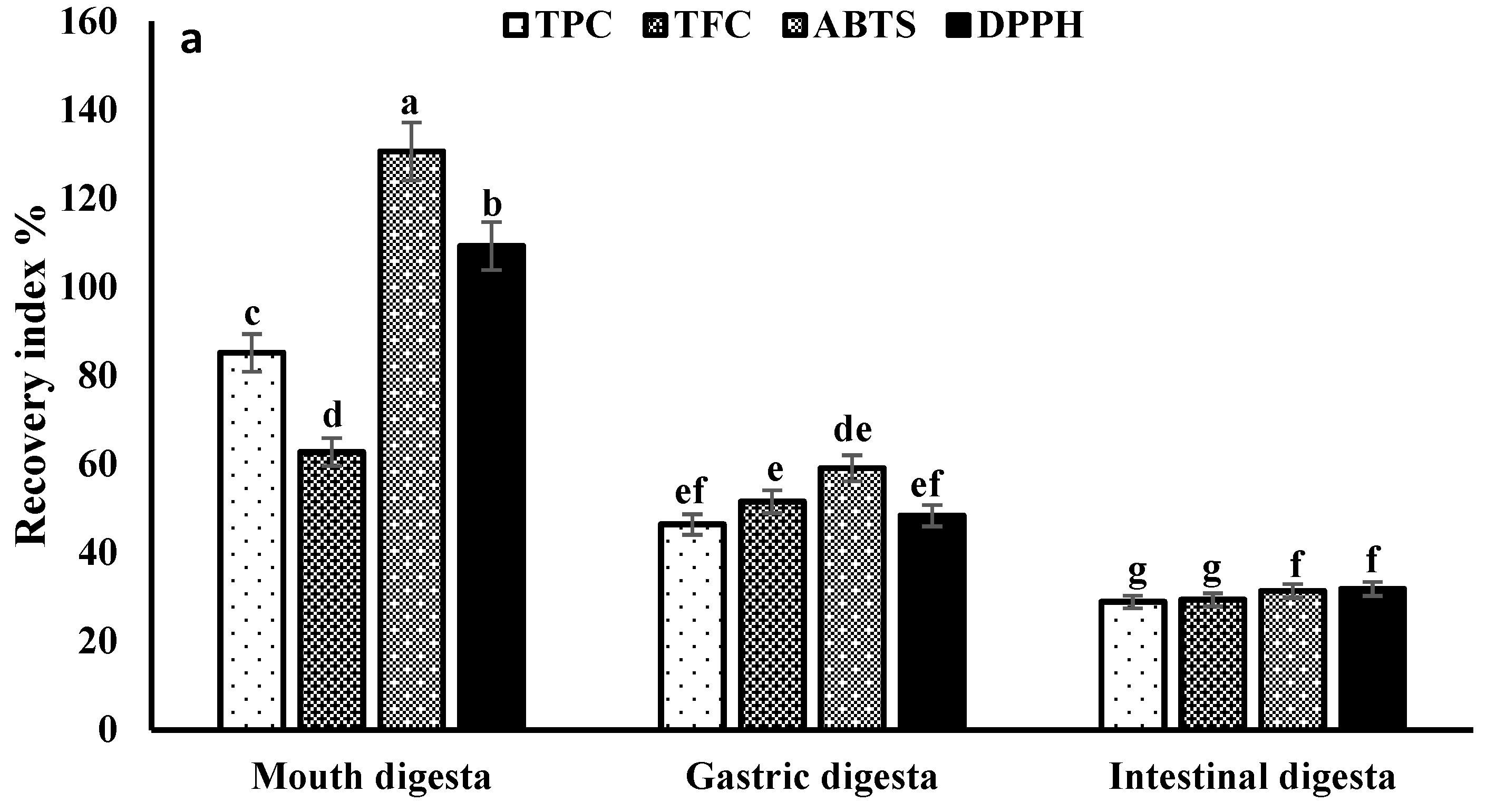
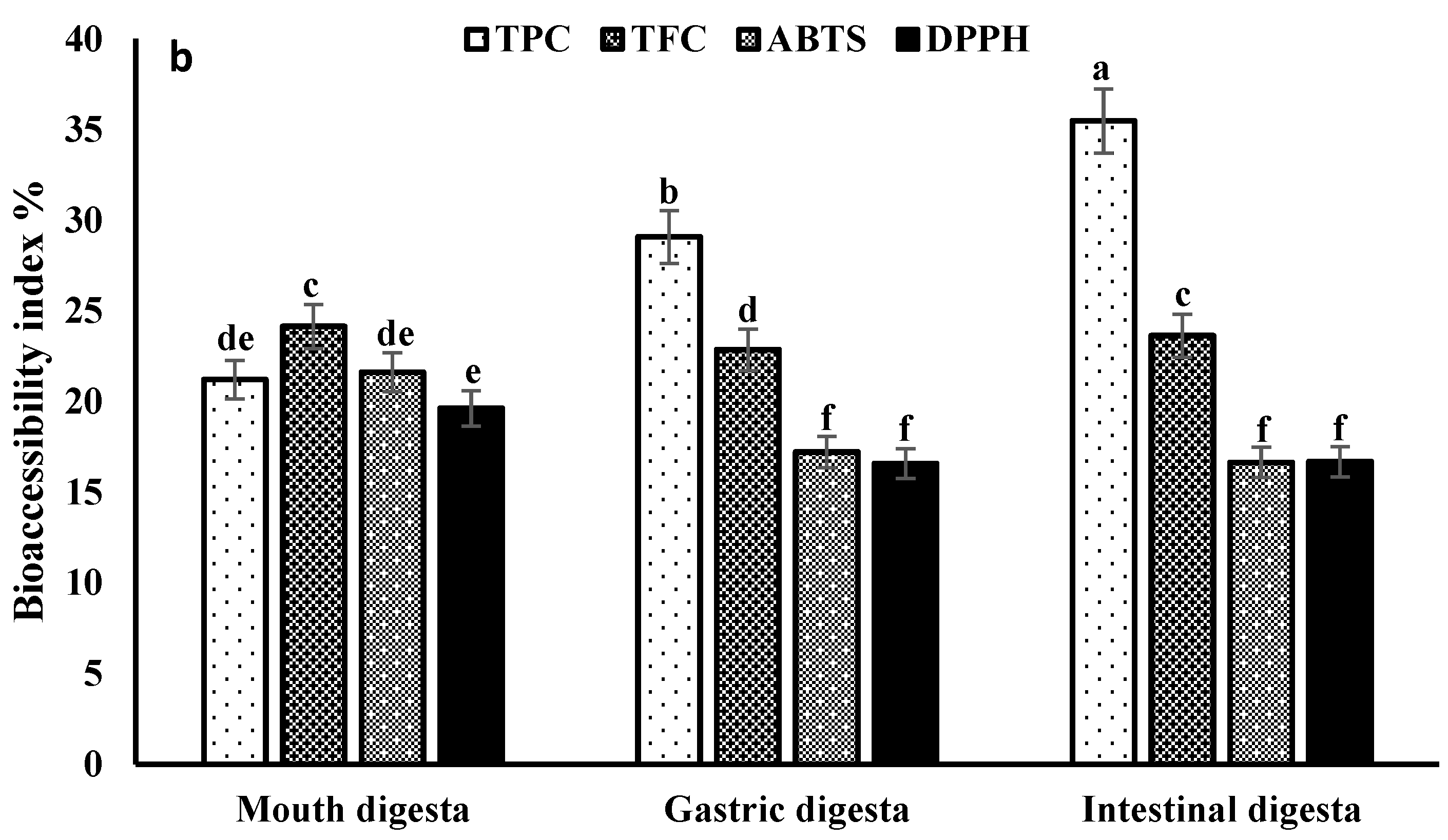
Figure 2.
GC-MS of undigested date palm (a) and that subjected to simulated gastro-intestinal digestion in mouth step (b), gastric (c), and intestinal step (d).
Figure 2.
GC-MS of undigested date palm (a) and that subjected to simulated gastro-intestinal digestion in mouth step (b), gastric (c), and intestinal step (d).
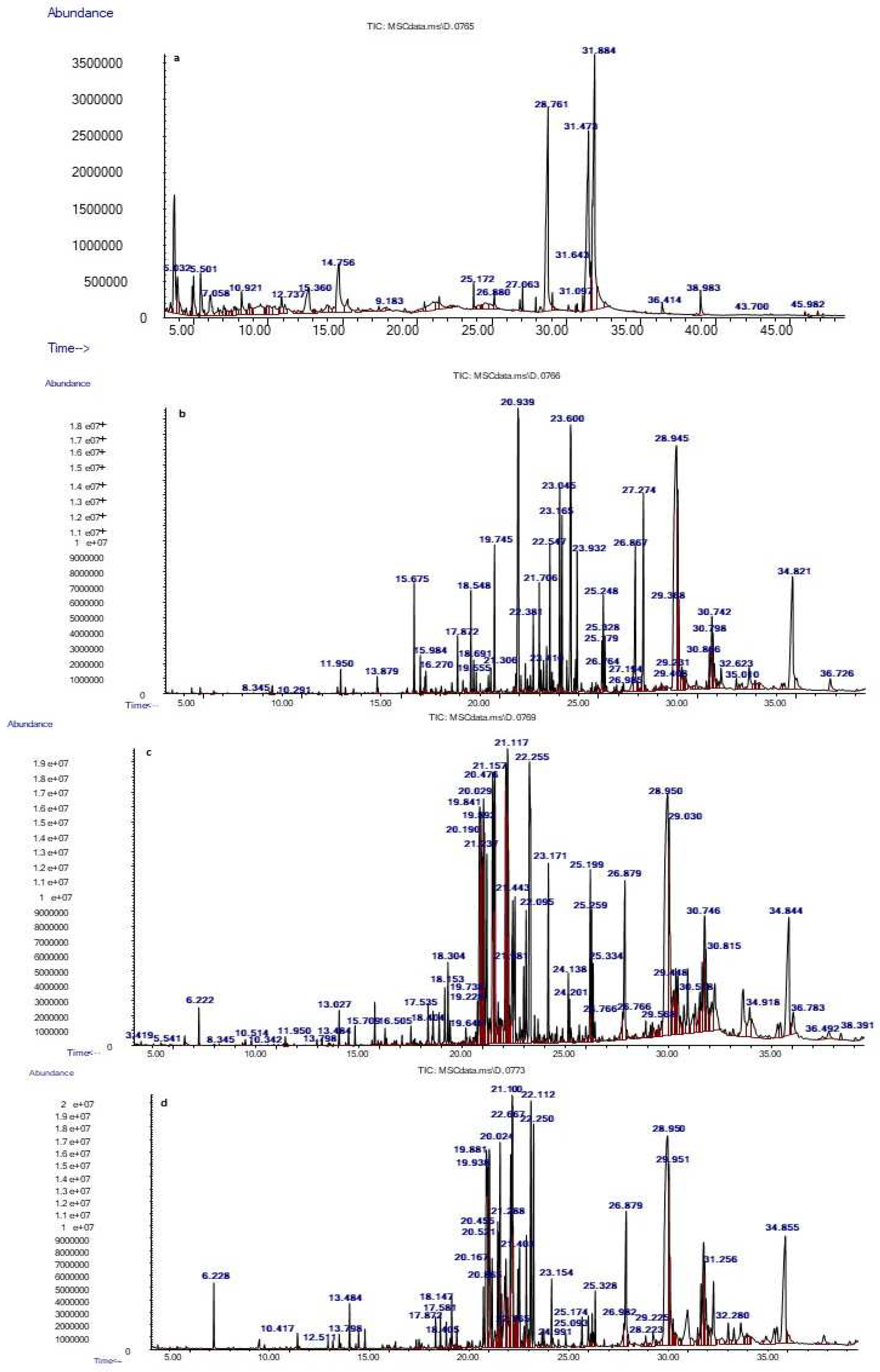

Table 1.
Chemical composition, fiber (gm/100 gm), and minerals (mg/kg) contents of RDPC.
| Chemical composition | Mean ± SD |
|---|---|
| Moisture | 2.51 ±0.05 |
| Ash | 1.61 ± 0.06 |
| Protein | 5.85 ± 0.16 |
| Fat | 1.40 ± 0.01 |
| fiber | 66.71± 0.44 |
| Carbohydrates | 21.72± 0.16 |
| Insoluble dietary fiber | 62.9 ± 0.2 |
| Soluble dietary fiber | 3.81 ± 0.24 |
| Acid detergent fiber (ADF) | 42.51 ± 0.33 |
| Neutral detergent fiber (NDF) | 48.1 ± 0.36 |
| Calcium | 101.39 ± 2.49 |
| Potassium | 813 ± 2.12 |
| Magnesium | 41.81 ± 7.00 |
| Manganese | 0.14 ± 14 |
| Iron | 1.25 ± 0.07 |
| Zinc | 0.5 ± 0.06 |
Values are means ± SD of triplicate samples.
Table 2.
Total phenolic (mg GAE/ 100 gm DW), flavonoid (mg QCE /100 gm DW) contents, IC50 DPPH (µg/ml) and IC50 ABTS (µg/ml) of RDPC extracted with different solvents.
Table 2.
Total phenolic (mg GAE/ 100 gm DW), flavonoid (mg QCE /100 gm DW) contents, IC50 DPPH (µg/ml) and IC50 ABTS (µg/ml) of RDPC extracted with different solvents.
| Solvents | TPC | TFC | DPPH | ABTS |
|---|---|---|---|---|
| Methanol | 79 ± 1.67a* | 10.1 ± 0.92a* | 76 ± 2.11g* | 68.7 ± 2.01f* |
| Ethanol | 70.4 ± 2.41b | 9.1 ± 0.87a | 87 ± 2.47f | 77 ± 1.52e |
| Acetone | 48.4 ± 2.48d | 5.2 ± 1.23b | 150 ± 1.32d | 253.1 ± 1.15c |
| Water | 63.6 ± 1.51c | 5.6 ± 0.68b | 102 ± 2.62e | 90.8 ± 3.43d |
| Methanol: water (50:50) | 49.5 ± 1.21d | 4.1 ± 0.89b | 215 ± 2.15c | 303.5 ± 1.92b |
| Ethanol: water (50:50) | 37.2 ± 1.85e | 2.2 ± 0.49c | 258 ± 3.96b | 297.8 ± 3.19b |
| Acetone: water (50:50) | 23.5 ± 1.36f | 1.9 ± 0.25c | 383 ± 1.64a | 367 ± 1.45a |
*Different letters in the same column or (p indicate that the mean difference is significant at the ≤ 0.05 level.
Table 3.
Antioxidant properties of pellet (PF) and chyme soluble fractions (CSF)) after simulated gastro-intestinal digestion (Mouth, gastric and intestinal) of RDPC.
Table 3.
Antioxidant properties of pellet (PF) and chyme soluble fractions (CSF)) after simulated gastro-intestinal digestion (Mouth, gastric and intestinal) of RDPC.
| Sample | Assay | Control | Mouth digest | Gastric digesta | Intestinal digesta | |||
|---|---|---|---|---|---|---|---|---|
| PF | CSF | PF | CSF | PF | CSF | |||
| Date cake | TPC | 62.80±6.38a | 53.03±5.35bA | 14.20±3.05dB | 25.90±3.62cA | 10.73±1.04dB | 14.77±2.73dA | 8.03±1.46dB |
| TFC | 5.63±0.55a | 4.80±0.26aA | 1.53±0.35cB | 4.00±0.10bA | 1.20±0.30 dB | 2.27±0.15cA | 0.70±0.10 dB | |
| DPPH | 76.63±2.12a | 67.27±1.01bA | 16.43±1.159dB | 30.73±2.02cA | 6.30±0.78eB | 20.30±4.03dA | 4.07±1.19eB | |
| ABTS | 68.73±2.01a | 70.33±2.75aA | 19.40±0.50cB | 34.00±3.02bA | 6.60±0.26 dB | 17.80±2.55cA | 3.73±2.75dB | |
For the same antioxidant assay, values in the same row followed with same lower case letter are not significantly different (p > 0.05) according to Tukey’s Multiple Range Test. For the same digestion step, values in the same row followed with same upper case letter are not significantly different (p > 0.05) according toTukey’s Multiple Range Test.
Table 4.
Coefficient values of correlation between the TPC or TFC and antioxidant activity under different steps of gastrointestinal digestion of RDPC.
Table 4.
Coefficient values of correlation between the TPC or TFC and antioxidant activity under different steps of gastrointestinal digestion of RDPC.
| Mouth digesta | Gastric digesta | Intestinal digesta | ||||
|---|---|---|---|---|---|---|
| TPC | TFC | TPC | TFC | TPC | TFC | |
| Mouth digesta | ||||||
| DPPH | 0.982** | 0.990** | 0.967** | 0.992** | 0.888* | 0.990** |
| ABTS | 0.982** | 0.989** | 0.943** | 0.992** | 0.873* | 0.986** |
| Gastric digesta | ||||||
| DPPH | 0.994** | 0.977** | 0.940** | 0.994** | 0.833* | 0.994** |
| ABTS | 0.988** | 0.970** | 0.979** | 0.984** | 0.855* | 0.995** |
| Intestinal digesta | ||||||
| DPPH | 0.980** | 0.931** | 0.951** | 0.965** | 0.762 | 0.979** |
| ABTS | 0.953** | 0.926** | 0.914* | 0.932** | 0.805 | 0.949** |
*Correlation is significant at the 0.05 level (2-tailed)/** Correlation is significant at the 0.01 level (2-taile.
Disclaimer/Publisher’s Note: The statements, opinions and data contained in all publications are solely those of the individual author(s) and contributor(s) and not of MDPI and/or the editor(s). MDPI and/or the editor(s) disclaim responsibility for any injury to people or property resulting from any ideas, methods, instructions or products referred to in the content. |
© 2024 by the authors. Licensee MDPI, Basel, Switzerland. This article is an open access article distributed under the terms and conditions of the Creative Commons Attribution (CC BY) license (https://creativecommons.org/licenses/by/4.0/).
Copyright: This open access article is published under a Creative Commons CC BY 4.0 license, which permit the free download, distribution, and reuse, provided that the author and preprint are cited in any reuse.


