
Submitted:
03 January 2024
Posted:
05 January 2024
Read the latest preprint version here
Abstract
This research investigates the impact of social media monitoring on Online Reputation Management (ORM) within Zimbabwe’s life assurance industry. Employing a mixed-methods approach, data was collected through questionnaires from 464 participants, yielding a response rate of 92.8%. Ethical considerations were meticulously addressed, with informed consent and confidentiality safeguards. Data analysis involved organizational and statistical techniques, including Structural Equation Modeling (SEM) for theoretical exploration. Descriptive statistics unveiled demographic insights and patterns in social media platform usage. Internal consistency assessments, Exploratory Factor Analysis (EFA), and Principal Component Analysis (PCA) informed the refinement of research instruments. The SEM analysis established significant relationships and moderation effects, providing empirical support for several hypotheses. Findings indicate that employees’ attitudes toward social media monitoring positively influence ORM, while perceived behavioural control exhibits a non-significant impact. Intriguingly, management commitment, though positively related to ORM, moderates the relationship with a negative effect. The study contributes to the understanding of ORM determinants, emphasizing the need for nuanced strategies considering both individual and organizational factors. The recommendations underscore the importance of management commitment and employee training for effective social media utilization. Future research avenues include exploring training interventions, delving into the dynamics of perceived behavioural control, and investigating emerging social media platforms’ impact on ORM.
Keywords:
online reputation management
; technology adoption
; life assurance
; social media
Introduction
Online Reputation Management (ORM) is an effective Internet marketing tool for reducing information costs and increasing trust and affective commitment (Cooley and Parks-Yancy, 2019). Reputation is a crucial determinant of how marketing influences business; reputation management becomes critical in reducing the risk of negative interaction (Swann, 2019). In an era dominated by digital interconnectedness, the life assurance industry in Zimbabwe stands at the crossroads of technological evolution and the ever-expanding influence of social media. Social media platforms have redefined communication channels, providing an unprecedented platform for individuals to express their opinions, share experiences, and shape perceptions (Dwivedi, Ismagilova, Hughes, Carlson, Filieri, Jacobson, Jain, Karjaluoto, Kefi, Krishen and Kumar 2021). Amidst this digital landscape, the strategic management of online reputation has become a critical facet for organizations, particularly in the dynamic and highly regulated life assurance sector.
Social media has emerged as a powerful tool for organizations to manage ORM as they engage with the diverse public in real-time (Cillo, Rialti, Del Giudice and Usai, 2021; Swann, 2019). This is particularly crucial in delivering comforting messages and valuable information during crises, as evidenced by its widespread adoption in leading economies (Sashi, Brynildsen and Bilgihan, 2019). Online Reputation Management (ORM) is a critical asset for life assurance companies, contributing to enhanced brand equity and various other benefits (Cillo et al., 2021). It has evolved as an extension of traditional public relations practices, adapting to the digital age where instantaneous communication necessitates swift and strategic responses (Chakraborty, 2019). The influence of reputation on stakeholder groups, employees, and customers in global markets is well-documented (Voramontri and Klieb, 2019) underscoring the importance of effective ORM.
The integration of online reputation management (ORM) practices has become a critical component of social media usage in organizational settings, contributing to establishing and maintaining a positive brand image (Vrontis, Makrides, Christofi and Thrassou, 2021). Despite the recognized effectiveness of ORM through social media, its application within the Zimbabwean life assurance industry remains a challenge. While public relations leaders in other sectors leverage social media for crisis management (Sashi et al., 2019), there is a significant deficiency in the literature regarding its implementation in the funeral assurance industry.
The dearth of online communication from life assurance firms in Zimbabwe, especially during global and local pandemics, raises concerns about the industry’s responsiveness and transparency. Studies affirm the utility of ORM as an e-marketing tool, yet life assurance firms in Zimbabwe seem to withhold vital information online, neglecting to reassure the public about their well-being, safety, and peace of mind, particularly in times of crisis (Swann, 2019). The research problem centres on understanding the factors that influence the reluctance or limited adoption of ORM by life assurance firms in Zimbabwe, especially when confronted with the challenges posed by global and local pandemics. This research seeks to address the gap in the literature and contribute valuable insights into the dynamics of ORM within the unique context of the Zimbabwean life assurance industry.
This research explores the intricate relationship between social media monitoring and online reputation management within Zimbabwe’s life assurance industry. The significance of reputation cannot be overstated, especially in an industry where trust and credibility are paramount. As online platforms become the virtual town squares where conversations about brands unfold, life assurance companies find themselves navigating a landscape where the impact of public sentiment on their reputation is profound. With its unique socio-economic and cultural dynamics, Zimbabwe provides an intriguing backdrop for this study. The life assurance industry, mirroring global trends, grapples with the challenges and opportunities of the digital age. As a powerful amplifier of public opinion, social media can shape the narrative surrounding life assurance providers, influencing customer perceptions, trust, and, ultimately, the industry’s success. Against this backdrop, as organizations grapple with the challenges of the digital age, understanding the impact of social media on reputation becomes a strategic imperative and a fundamental element in fostering enduring relationships with stakeholders in the dynamic landscape of the life assurance industry.
Despite the acknowledged importance of ORM, empirical evidence within specific sectors, including funeral assurance is still scant. This study, therefore, seeks to assess whether the adoption of social media monitoring is effective in managing online reputation management in Zimbabwe’s funeral assurance sector. Zimbabwe’s life assurance industry, comprises eleven (11) main life assurance firms (IPEC, 2023) operating within a thriving yet challenging environment, marked by uncertainties of global pandemics. The implications of these pandemics demand a proactive approach to ORM, particularly as funeral assurance firms face increased scrutiny from various stakeholders. As the digital revolution transforms communication channels, funeral assurance companies seem to lag in ORM practices despite investing in online platforms (Evans, Bratton and McKee, 2021).
The COVID-19 pandemic has exemplified the need for clear, open lines of communication between funeral service providers and the public. Customers, increasingly tech-savvy in a country with a 58.9% internet penetration rate (POTRAZ, 2019), turned to social media to express concerns and seek information from funeral assurance companies during the COVID-19 pandemic. This study explores the factors influencing the adoption of ORM by funeral assurance service providers, recognizing its role in crisis management, generating reviews, and proactively responding to stakeholder concerns. Ultimately, the effectiveness of ORM in this sector will shape both the online and offline reputation of funeral assurance firms in Zimbabwe.
Conceptual framework
The study is guided by the Theory of Planned Behaviour (TPB) developed by Ajzen (1991) (in Ajzen and Schmidt, 2020). The theory explains rational human behaviour, predicted by an individual’s perceived behavioural control, resulting in behavioural intention. These relationships are illustrated in Figure 1 below.
Theoretical Framework
The theoretical underpinning of the research is anchored in the Theory of Planned Behaviour (TPB), an extension of the Theory of Reasoned Action (TRA). Ajzen and Schmidt (2020) suggest that behaviour is influenced not only by attitudes and perceived norms but also by Perceived Behavioural Control (PBC), a unique aspect of TPB. The inclusion of PBC allows individuals to reflect on their experiences and potential inhibitors to behaviour. The study excludes social influences (subjective norms) in this organizational context, focusing on PBC and Attitude as practical measures influencing ORM adoption (Ajzen and Schmidt, 2020; Bosnjak et al., 2020; Conner, 2020).
Attitude
The literature emphasizes the role of attitudes, defined by Conner (2020) as an evaluative effect towards behaviour in the context of ORM adoption. Employee attitudes, influenced by the perceived benefits of social media, significantly impact organizational performance (Vrontis et al., 2021). The study extends these insights to emphasize the critical role of employee attitudes in shaping organizational interactions with customers, thereby affecting overall performance (Nusair, 2020).
Perceived Behavioural Control
Perceived Behavioural Control (PBC), defined as the perceived difficulty of behaviours and how a person can or cannot perform an activity, is crucial in influencing behavioural intentions and actual behaviour (Ajzen and Schmidt, 2020). PBC is positively linked to behavioural purposes and, ultimately, to actual conduct (Bosnjak, Ajzen and Schmidt, 2020; Ajzen and Schmidt, 2020). The availability of resources and opportunities significantly influences PBC, indicating that individuals with more resources and exposure to opportunities are likely to believe they control their behaviour (La Barbera and Ajzen, 2020). Research further substantiates this by showing that PBC is enhanced when individuals have the necessary resources to perform a behaviour, and barriers are removed from the process (Ajzen, 2020).
Management commitment
Management commitment is shown by management’s willingness to engage and exert meaningful effort towards the organisation (Goffin and Szwejczewski, 1996 cited in Carter and Campbell, 2012). William, Morrell and Mullane (2014) posit that top management commitment has a double barrel effect of increased job satisfaction and organization’s performance. Furthermore, management commitment plays an important role in ensuring good governance and an organisation’s accountability (Johari, Alam and Said, 2018).
Online reputation management (ORM)
Chang, Ku and Chen, (2019) emphasize the proactive role that business owners must play in ORM, suggesting that online reputation service providers often lack proactivity while attempting to fill the gap. The study acknowledges that being proactive in ORM can only be truly advanced by business owners or manufacturers. Cooley and Parks-Yancy, (2019) define reputation as the publicly kept social evaluation of an entity, incorporating the entity’s past behaviour, online posts, and third-party mentions on the internet. On the other hand, Dhir, Kaur, Chen and Pallesen (2019) argue that reputation, particularly in the context of corporations, is a challenging intangible asset that is difficult to manage. This complexity is underscored by the multifaceted nature of ORM, which involves monitoring, addressing, or rectifying undesirable or harmful mentions on the web (Dwivedi et al., 2021). The study aims to assess the adoption of ORM by funeral assurance firms in the context of a global crisis. Furthermore, the review acknowledges the role of the internet and social media platforms in facilitating crisis management, providing a backdrop for understanding the critical need for effective ORM in the funeral assurance sector (Choi, Yoon, Chung, Coh and Lee, 2020).
Factors Influencing ORM Adoption
Adopting social media emerges as a crucial element for building a positive organizational reputation (Lee, 2019). The effective use of Internet tools is the optimal solution for managing reputation (Ajzen, 2020). However, specific sectors exhibit uncertainty surrounding social media adoption due to the nature of their business (Sivarajah, Irani, Gupta and Mahroof, 2020). The literature review underscores the importance of understanding factors that influence the usage of technological systems, particularly in sectors where uncertainty prevails (Sashi et al., 2019). Social media monitoring, highlighted as a concept of private firms’ proactive practice to collect feedback on products and services, serves several purposes, including reputation management by analysing risks (Lee, 2019). The study explains that social media monitoring enables promotions, co-creation, and proactive reaction to customer feedback (Stamolampros, Korfiatis, Chalvatzis and Buhalis, 2019; Lee, 2019).
Additionally, it emphasizes the importance of managers being proactive in utilizing social media content to communicate and monitor activities in cyberspace (Kim, Moravec and Dennis, 2019). This proactive approach aids firms in understanding how the public perceives their actions (Evans et al., 2021). The review sheds light on the risks involved in adopting social media, emphasizing the need for organizations to balance brand control and authenticity to avoid employee alienation and resistance (Stamolampros et al., 2019). The importance of coordinated efforts across departments for effective social media monitoring is highlighted, enabling organizations to review public sentiments and passively detect impending disasters (Eid, Abdelmoety and Agag, 2020; Evans et al., 2021). This aligns with the notion that practitioners who appreciate the importance of social media listening are more likely to adopt social media monitoring (Sashi et al., 2019). The literature review provides a nuanced understanding of the factors influencing ORM adoption, particularly within the funeral assurance sector. By adopting the TPB as a theoretical framework, the study enriches the discussion by integrating attitudes and perceived behavioural control into the context of ORM.
Methodology
This section gives an account of the methodology adopted in this study. The study adopted a positivist approach by deducting the hypothesis from the Theory of Planned Behaviour. A causal research design was found plausible in this context, where causal relationships are tested. This chapter explains the research design, target population, sampling frame, and data collection methods. A detailed account of data collection is also given, followed by the data presentation and analysis procedure.
Research Philosophy
This study aligns with a positivist research philosophy grounded in the belief that truth and reality exist independently of the observer. Positivism advocates for scientific methods to objectively investigate human experiences, emphasizing a detachment from personal values, emotions, and ideologies during the research process (Park, Kong and Artino Jr, 2020; Kirongo and Odoyo, 2020). The core tenet is pursuing objective truth through experiments, observations, and quantitative analysis. This approach is reflected in confirmatory analysis, nomothetic experiments, and deductive reasoning (La Barbera and Ajzen, 2020).
The inquiry in this study adopts a deductive mode, focusing on the measurement and analysis of causal relationships, specifically hypothesis testing within the Theory of Planned Behaviour (TPB) framework. The chosen primary data collection method is a survey, emphasizing deductive inquiry to test existing theories. The research philosophy underscores the commitment to empirical rigor and the application of established approaches to contribute meaningful insights to Online Reputation Management in Zimbabwe’s life assurance industry.
Research Design
In pursuit of understanding organizations’ Online Reputation Management (ORM) usage intention, this study employs a causal research design. Causal research designs are instrumental in elucidating relationships between variables, making them well-suited for exploring the interplay between Attitude, perceived behavioural control, and the adoption of ORM (Bloomfield and Fisher, 2019). The chosen research design aligns with the scientific investigation paradigm, aiming to substantiate hypotheses and establish causation (Walliman, 2021).
An online survey was conducted to operationalize this design, providing a structured approach to test hypotheses and ascertain the causal links between affective and personal control collected data, facilitating the empirical examination of the theoretical framework, particularly within Zimbabwe’s life assurance industry. By adopting a causal research design, this study aims to contribute valuable insights into the dynamics of ORM adoption, addressing a critical knowledge gap in the industry.
Target Population
This study focused on engaging managers and marketing personnel within life assurance service providers listed in the Insurance and Pensions Commission (IPEC) Report (2023), specifically those headquartered in Harare. The identified target population encompasses 1600 marketing personnel, sole agents, and 380 management personnel across eleven (11) prominent life assurance firms as outlined in the IPEC report (2023). The rationale for selecting this target population lies in the active involvement of managers and marketing personnel in shaping the online image of their respective organizations. Recognizing their pivotal role in managing the organization’s reputation across various online platforms, including social media, positions them as critical informants for understanding the dynamics of ORM within Zimbabwe’s life assurance industry.
Sampling methods, techniques, and procedure
This research employed a stratified sampling technique, organizing sampling units based on the designated positions within Zimbabwean life assurance firms. The strata were formed according to the respondents’ roles, resulting in two distinct strata: management personnel and marketing personnel. The selection of these strata was informed by their direct involvement in the phenomenon under study in ten prominent life assurance firms listed in the IPEC database (2023). Within each stratum, respondents were randomly chosen to complete questionnaires.
This approach yielded a sample size of 310 respondents for marketing personnel and 190 respondents for management personnel, a determination explained in the subsequent section. The chosen sampling technique was driven by its cost-effectiveness and flexibility, ensuring the inclusion of participants directly engaged with the studied phenomenon. The stratified sampling method enhances the precision of insights gained from management and marketing perspectives, contributing to a comprehensive understanding of Online Reputation Management within the life assurance industry in Zimbabwe.
Sample size determination
Ensuring the reliability and statistical significance of results is paramount in quantitative research. In this study, determining an appropriate sample size was crucial to avoid statistically insignificant outcomes that might hinder robust conclusions and generalizations. A larger sample size was selected to achieve a level of precision within a +5% margin to reduce sampling error. The sample sizes for both categories of respondents, representing units of analysis, were calculated using Krejcie and Morgan’s (1970) formula.
Where: s denotes the required sample size, denotes the table value of chi-square for one (1) degree of freedom at a 95% confidence level, denotes the population proportion (assumed to be 0.50 since this would provide the maximum sample size), and signifies the degree of accuracy. This formula accounts for a 95% confidence level, assuming a population proportion (P) of 0.50 for maximum sample size and a degree of accuracy (d) set at 0.05. For marketing personnel within Zimbabwean life assurance firms, with a target population of 1600, the computed sample size was 310 respondents. The calculation used a χ-value of 1.96 for a 95% confidence interval. Similarly, the sample size was determined to be 190 respondents for management personnel participating in the study. This calculation followed the same formula, considering a target population of 380.
Data Sources
Two types of data sources were used, namely, secondary and primary. Primary data was used as a source of empirical evidence, while secondary data facilitated the problem definition and the identification of knowledge gaps. Apart from primary data, secondary data refers to the data already collected through primary sources and made readily available to researchers to accomplish their research endeavours (Sekaran and Bougie, 2019). Against this background, secondary data is used in the current research to identify the knowledge. The primary sources of secondary data were internal records that included reports, memos, and circulars from life assurance firms in Zimbabwe.
In addition, empirical literature from past research that focussed on the relationship between social interactions on social media and ORM was also used as a vital secondary data source in this study. According to Sekaran and Bougie (2019), primary data is initially obtained directly from the research subjects or respondents through surveys, interviews, and experiments. In the current research, primary data was collected from the respondents (marketing and management personnel working for Life assurance firms in Zimbabwe) using the research questionnaire.
Research instrument
A research instrument is crucial for obtaining, measuring, and analysing data from respondents (Walliman, 2021). In alignment with the deductive nature of the current research, a structured questionnaire utilizing a five-point Likert scale (ranging from strongly disagree [1] to agree [5]) was employed. This instrument was designed to collect data from participants, focusing on key variables such as Attitudes towards Social Media Monitoring (ATSM), Perceived Behavioural Control (PBC), Management Commitment (MC), and Online Reputation Management (ORM). The structured questionnaire comprised six sections, each aligned with the study variables.
These sections were derived from established empirical studies (see Lee, 2019; Kirongo and Odoyo, 2020; Bloomfield and Fisher. 2019; Cabiddu, Dessì and Floris, 2019), with slight modifications to suit the research context. Administered to marketing and management personnel within Zimbabwean life assurance firms, the rationale behind utilizing this established research instrument was its validated efficacy and reliability. By adopting a proven structured questionnaire, the research aimed to ensure objectivity and eliminate subjectivity in data collection. This approach contributes to the overall robustness and validity of the study.
Data Collection Procedure
In accordance with Sekaran and Bougie’s (2019) guidelines, where sample sizes below 50 are considered weaker, and those above 1000 are deemed excellent, the current empirical research opted for a sample size of 500 respondents, falling within the range considered suitable. These respondents were comprised of marketing and management personnel from Life Assurance service providers listed in the IPEC database (2023). To ensure robust data collection, 500 questionnaires were distributed over a six-week period. Weekly reminder emails were systematically dispatched to participants, leveraging a strategy proven to enhance response rates in prior research (Hair Jr, Page and Brunsveld, 2019). This methodical approach, rooted in established research practices, aimed to achieve a balanced sample size that aligns with the empirical rigor required for meaningful analysis and findings in this study.
Validity and reliability of research instruments
In the evaluation of the research instruments for this study, a comprehensive examination was conducted to ensure both validity and reliability. The assessment covered dimensions such as internal consistency, indicator reliability, content validity, convergent validity, and discriminant validity.
Content Validity was evaluated through the alignment of variable loadings, and it ensured that each variable item had higher loadings compared to other items in the same columns and rows. Convergent validity, a measure of the extent to which related variable items effectively measured the same construct, was assessed through the Average Variance Extracted (AVE) criteria. Discriminant Validity was also evaluated following the Fornell-Larcker criterion to examine the statistical differences between each variable. Based on the Fornell-Larcker criterion, discriminant validity is established if the square root of the AVE exceeds the highest construct correlation, ensuring distinctiveness.
Validity was precisely assessed based on criteria recommended by prior researchers (Collier, 2020), and convergent validity was confirmed using the AVE criteria detailed in Table 1. Discriminant validity was established through adherence to the Fornell-Larcker criterion. Reliability, an essential aspect of the trustworthiness of data, was confirmed through consistent Cronbach’s alpha values exceeding the mandatory threshold of 0.7 for each of the four (4) variables [ATSM (0.819), PBC (0.773), MC (0.828), and ORM (0.719)]. Thus, the research instruments demonstrated both validity and reliability, met established criteria, and ensured the robustness of the study’s findings.
Data Analysis and Presentation
The acquired data underwent meticulous organization, cleaning, and sorting in Microsoft Excel, including identifying and rectifying repetitions and missing variables. Subsequently, the data was exported to Statistical Package for Social Sciences (SPSS) version 28 for higher-level analyses, focusing on descriptive frequencies and dimension reduction using factor analysis. Structural Equation Modeling (SEM) used SPSS AMOS version 28 to delve into the relationships between variables in the theoretical framework. SEM, a powerful statistical technique amalgamating factor analysis, correlation and multiple regression, was chosen for its ability to illuminate structural relationships between measured variables and latent constructs (Collier, 2020). SEM estimation included Exploratory Factor Analysis (EFA) to eliminate redundant indicators and Confirmatory Factor Analysis (CFA) to validate the conceptualized theoretical relationships.
Caution was exercised in SEM applications due to its capacity to analyse intricate relationships, generating complex models that demand careful interpretation. Several goodness-of-fit indices, such as the Tucker-Lewis Index (TLI), Comparative Fit Index (CFI), Goodness-of-fit indices (GFI), Adjusted GFI (AGFI), and Root Mean Square Error of Approximation (RMSEA), were employed. Commonly reported fit statistics (TLI, CFI, GFI, and RMSEA) underwent scrutiny based on established rules of thumb for assessing model fit. SEM facilitated quantifying moderation effects among study variables (Hair Jr et al., 2021). The moderating variable (management commitment) was modeled continuously by introducing interaction terms into regression equations.
Findings
The findings section of the research unveils key empirical insights derived from an in-depth investigation into the impact of social media monitoring on online reputation management within Zimbabwe’s life assurance industry.
Descriptive statistics
The study, involving 500 administered questionnaires, achieved a noteworthy 92.8% response rate with 464 valid responses. Demographic insights indicated a male majority (76%), with respondents aged 26-35 comprising the largest segment (46%). Educational background revealed that 37.9% held bachelor’s degrees, while certificate and Ph.D. holders represented 7.5% and 1%, respectively. Notably, 38.8% reported working in their organizations for 3 to 5 years. Regarding social media usage, Facebook and YouTube were predominant (34.4%). Descriptive statistics uncovered positive attitudes towards social media monitoring (59.7%) and influencing (67.7%). Respondents expressed perceived behavioural control (49.8%), management commitment (70.9%), trust in organizational information (65%), and acknowledgment of ORM adaptation (66.8%). Overall, the findings portrayed a proactive engagement with social media and a positive disposition towards online reputation management within Zimbabwean life assurance firms.
Reliability scale
Reliability testing was conducted for the observed indicators or factor loadings related to all the latent variables by examining the mean values, item-total correlation, and the values of Cronbach’s alpha. In the same vein, Cronbach’s Alpha if item deleted values were also analysed in cases where Cronbach’s alpha values were less than 0.7 for the observed indicators. Table 2 below shows the reliability scales for the variables used as a unity of analysis in the current research. During the assessment of internal consistency, Cronbach’s alpha values were examined for the latent variables, revealing robust reliability for perceived behavioural control (PBC) with a Cronbach’s alpha of 0.773. Individual item deletions within the PBC construct did not significantly alter this value, supporting the retention of all observed indicators (PBC1, PBC2, PBC3, and PBC4) for subsequent analysis.
Similarly, the management commitment (MC) construct exhibited high internal consistency, surpassing the threshold at 0.828, warranting the retention of all indicators (MC1, MC2, MC3, and MC4). However, the online reputation management (ORM) construct initially fell below the acceptable Cronbach’s alpha threshold at 0.499. Through an iterative process, the elimination of ORM6 and subsequent removal of ORM1 led to a final Cronbach’s alpha of 0.719, surpassing the required threshold. Consequently, indicators ORM2, ORM3, ORM4, and ORM5 were retained for further statistical analysis, ensuring the reliability of the ORM construct in the study.
Exploratory factor analysis (EFA)
The exploratory factor analysis (EFA) was employed to examine the underlying structures among the observed variables in the study. The suitability of the research data for factor analysis was confirmed through the Kaiser-Meyer-Olkin (KMO) sampling adequacy test, which yielded a test statistic of 0.809, surpassing the recommended threshold of 0.6. Additionally, Bartlett’s sphericity test indicated statistical significance (p-value < 0.05) with a test statistic of 5776.321, further affirming the factorability of the correlation matrix and supporting the adequacy of the study sample for EFA. Principal component analysis (PCA) served as a data dimension reduction strategy to condense the information from all the observed variables into a more manageable set of linear combinations, capturing more than 50% of the variation in indicators (factor loadings).
The PCA results were premised on three extraction mechanisms (Initial Eigenvalues, Extraction Sums of Squared Loadings, and Rotation Sums of Squared Loadings) and were conducted in two phases, with no removal of principal components during the initial phase. An optimal solution with four (4) components, each associated with Eigenvalues greater or equal to 1, was obtained in the second phase. Collectively, these principal components explained 64.636% of the total variance, with individual contributions as follows: component 1 (21.958%), component 2 (13.937%), component 3 (9.528%), component 4 (8.437%), component 5 (6.592%), and component 6 (4.184%).
Furthermore, the extracted factors were rotated through varimax rotation, and the results (rotated solution) are presented in Table 3. The results in Table 3 indicated that factors linked to attitude towards social media monitoring (ATSM1, ATSM2, ATSM3, and ATSM4) loaded heavily to component 1, whereas factors associated with factors related to latent constructs such as perceived behavioural control (PBC1, PBC2, PBC3, and PBC4), management commitment (MC1, MC2, MC3, and MC4) and online reputation management (ORM1, ORM2, ORM3, ORM4, ORM5, and ORM6) also loaded heavily to components 5, 3, and 2 respectively. These findings authenticated that the rotated solution is optimal since each of the rotated components has at least three factors loading. Furthermore, the results infer that most of the factor loadings were associated with higher values of commonalities (exceeding a minimum threshold of 0.3), implying that the rotated solution was optimal.
The communalities column in Table 3 also indicated that indicators explaining variance smaller than 0.5 were eliminated, leading to the elimination of indicators ORM1 (0.146), and ORM6 (-0.296). These exclusions align with the indicator reliability test results discussed earlier. Additionally, the PCA was reapplied to extract one orthogonal factor for each variable, explaining much of the variations in factor loadings for the latent constructs used in determining the moderation effects of Management Commitment (MC) in the relationship between Attitudes towards Social Media Monitoring (ATSM) and Online Reputation Management (ORM).
The results of the third phase of PCA show that the extracted principal component for ATSM accounted for 64.829% of variations, while MC explained 66.242%. Subsequently, an additional variable representing the combined effect of ATSM and MC, denoted as ATSM*MC was computed using SPSS software. This variable was subsequently used to quantify the moderation effect of MC on the relationship between ATSM and ORM.
Confirmatory Factor Analysis (CFA)
Thus, the measurement model for the current research comprised five (5) latent variables and 16 observed indicator variables broken down as follows: ATSM (4-item scale), MC (4-item scale), PBC (4-item scale), ORM (4-item scale) and ATSM*MC (no scale). CFA was performed in the context of internal consistency and reliability, convergent validity, and discriminant validity.
Internal consistency and reliability
The internal consistency and reliability of the study were assessed by examining composite reliability (C.R.) and Cronbach’s alpha values. Table 4 below shows the internal consistency and reliability results. The findings indicated that C.R. values for the study variables, including ATSM (0.856), PBC (0.845), MC (0.863), and ORM (0.817), exceeded the minimum threshold of 0.6 prescribed in the theoretical literature. Additionally, Cronbach’s alpha values for all study variables surpassed the acceptable threshold of 0.7. These results verified that the specified measurement model adhered to internal consistency and reliability requirements for SEM estimation, meeting necessary and sufficient conditions for its applicability.
Convergent validity
Beyond internal consistency and reliability, the research conducted a convergent validity assessment, scrutinizing the Average Variance Extracted (AVE) values for each construct. To this effect, the results presented in Table 4 confirmed that AVE values for each variable surpassed the required threshold of 0.5, signifying convergent validity. The highest AVE value was recorded for MC (0.612), while ORM had the least (0.530). The findings established that latent constructs explained more than half of their indicators’ variance, affirming convergent validity for the study.
Discriminant validity
Discriminant validity was also assessed using the Fornell-Larcker criterion, as detailed in Table 4. The results indicated that the square root of the AVE for each variable was found to be bigger than the highest latent construct correlation for every construct. For Instance, for the ATSM variable, the square root of AVE ( = 0.77) exceeded the highest construct correlation (0.633), and discriminant validity was established. Therefore, the findings connote that none of the latent variables have discriminant validity problems, and thus, the discriminant validity was established for all the constructs employed in this research. Overall, the CFA results summarised in Table 4 confirmed that the SEM structural model is consistent with all the characteristics and minimum requirements for a good-fitting SEM model.
SEM Structural model
To achieve the study objectives, the structural model depicted in Figure 4.8 underwent estimation using SPSS AMOS 28 software. Initial assessment revealed unsatisfactory results, with many path coefficients not statistically significant at the 5% level, and goodness-of-fit statistics deviated from the anticipated expectations. Utilizing the modification index toolkit in SPSS AMOS 28, the specified and estimated structural model underwent adjustments based on the software’s suggestions.
Following the optional modifications and associated indices parameter changes, the research adopted parameter additions that yielded the most significant improvement. The modification process continued until achieving a satisfactory fit, involving the addition of correlations between error components e19 and the variable ATSM (213.869), between error components e11 and e19 (41.606), and between error components e7 and e17 (60.825). Subsequently, the model was re-specified and re-estimated, incorporating these modifications to obtain path coefficients for hypothesis testing.
Path coefficients and regression weights
The current research also sought to analyse the relationships between the constructs by evaluating the path coefficients and correlations estimated path coefficients of the modified structural SEM model presented in Table 5.
The research results shown in Table 5 revealed that the highest positive correlation (0.748) was reported between the stochastic error component e19 and the explanatory variable ATSM, whereas the least positive correlation (0.074) was observed between ATSM and MC variables. Negative correlations were also confirmed between MC and PBC (-0.120).
Figure 2.
Modified SEM Structural model with unstandardized path coefficients and regression weights.
Figure 2.
Modified SEM Structural model with unstandardized path coefficients and regression weights.
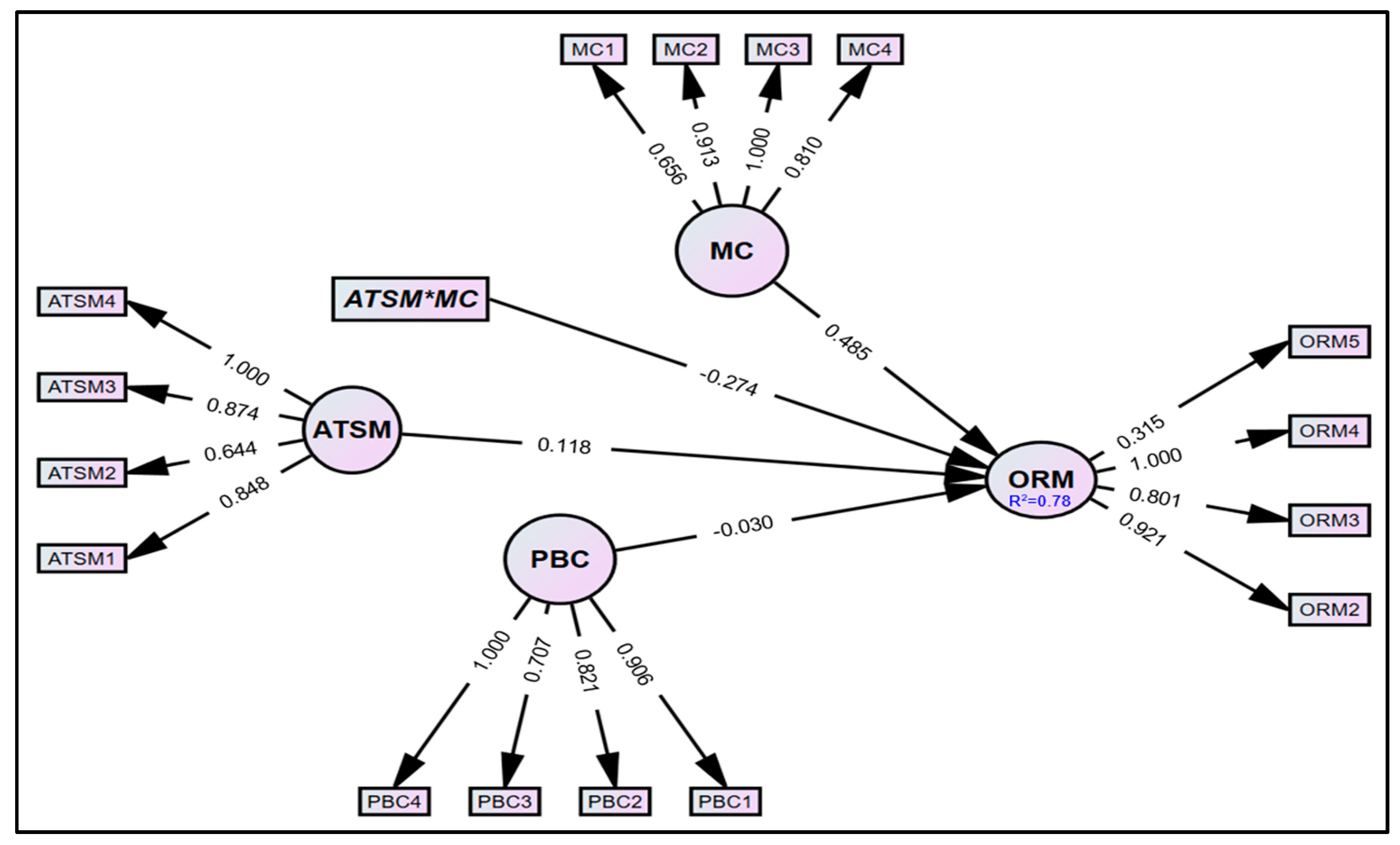
The standardised regression weights were also examined beyond variable correlations using the outcomes presented in Table 6. The results in Table 6 revealed that the path coefficient (ORM←ATSM = 0.144, p<0.05) for the Attitude Towards Social Media Monitoring variable (ATSM) was statistically significant at a conventional 5% level. This suggests that, with all other factors held constant, a 1% increase in Attitude towards social media monitoring would correspond to a 0.144-unit increase in Online Reputation Management (ORM).
On the other hand, the results presented in Table 6 indicated that the path coefficient for the Perceived Behavioural Control variable (ORM←PBC = -0.033, p>0.05) was negative but not statistically significant at the 5% level of significance. This result suggests a lack of statistical evidence, at the 5% significance level, to assert that increasing perceived behavioural control by 1% would result in a decline in Online Reputation Management by about 0.03 units, all else equal.
Furthermore, the results established a statistically significant positive direct influence of Management Commitment (MC) on ORM (ORM←MC = 0.568, p<0.05) at a 5% significance level. This result implies that a 1% increase in management commitment would lead to an approximately 0.6-unit increase in ORM, assuming other variables remain constant.
However, the study found the coefficient of the pooled variable, representing the combined influence of Attitude towards social media monitoring and management commitment (ATSM*MC), to be negative and statistically significant at the 5% level (ORM← ATSM*MC = -0.359, p<0.05). In other words, an increase in this combined effect by 1% is associated with a decrease in online reputation management by approximately 0.4 units, all else being equal. The results also indicate that Management commitment significantly moderates the relationship between attitudes toward monitoring social media and online reputation management.
Last but not least, the study’s results confirmed that all path coefficients of the indicators for latent variables, including ATSM, PBC, MC, and ORM, are positive and statistically significant at the 5% level. This implies that the respective indicators effectively measure the same construct (unidimensional), indicating robust empirical findings.
Goodness-of-fit test results
Finally, the goodness-of-fit indices were examined to determine whether the estimated modified structural model fit the research data satisfactorily. Table 7 presents the goodness-of-fit statistics for the final re-specified model, contrasting them with the statistics of the initial model. The study’s results, based on the Comparative Fit Index (CFI), Goodness-of-Fit Index (GFI), Tucker-Lewis Index (TLI), Adjusted Goodness-of-Fit Index (AGFI), and Root Mean Square Error of Approximation (RMSEA), indicated that the initially estimated structural SEM model yielded unsatisfactory goodness-of-fit results.
The re-specified model, however, demonstrated strong consistency with the characteristics of a well-fitting SEM model, with all goodness-of-fit statistics falling within desired ranges. Consequently, the research results affirmed that the re-specified SEM model provided an excellent fit to the research data, and the model’s path coefficients and regression weights were subsequently used for testing moderating effects and hypothesis testing.
Moderation Analysis
In the current research, two moderation relationships were examined. The moderation relationship focused on Management Commitment (MC) as a moderating variable influencing the relationship between Attitude towards social media monitoring (ATSM) and Online Reputation Management (ORM). The results of the moderation analysis for the conceptualized relationship are presented in Table 8 below. The findings indicated that, in the moderating relationship, the unstandardized direct effects of ATSM (ORM←ATSM = 0.118, p<0.05) on ORM were positive and statistically significant at the 5% level, with p-values smaller than 0.05. Moreover, the moderation analysis findings further established that the unstandardized direct effect of the moderating variable (MC) on ORM (ORM← MC = 0.485, p<0.05) is positive and statistically significant at a 5% level.
However, the research also revealed that the unstandardized direct effect of the interaction variable on ORM, denoted by ATSM*MC (ORM← ATSM*MC = -0.274, p<0.05), was negative and statistically significant at the 5% level. Since all three variables (ATSM, MC, and ATSM*MC) that defined the moderated relationship have statistically significant path coefficients at a 5% level, this suggests that MC is a considerable moderator and exerts a statistically significant negative moderation effect on the relationship between ATSM and ORM. Consequently, the research hypotheses were tested based on the research results, and Table 9 below shows the summary of the hypothesis testing results.
Hypotheses testing
Hypothesis 1
H1: Attitude toward social media monitoring positively influences employee adoption of ORM among life assurance firms in Zimbabwe.
The study found that attitude toward social media monitoring has a direct positive and statistically significant influence on online reputation management (ATSM ⟶ ORM = 0.144; 3.562; p < 0.05) at the 5% significance level. Therefore, hypothesis H1 was supported, indicating that employees’ attitude toward social media monitoring significantly influences ORM initiatives among life assurance firms in Zimbabwe.
Hypothesis 2
H2: Perceived behavioural control positively influences employee adoption of ORM in Zimbabwean life assurance firms.
The results indicated that perceived behavioural control has a non-statistically significant negative influence on online reputation management (PBC ⟶ ORM = -0.033; -0.801; p > 0.05) at a 5% significance level. Hypothesis H2 was not supported, suggesting that no sufficient statistical evidence supports the proposition that a significant positive relationship exists between PBC and ORM among life assurance firms in Zimbabwe.
Hypothesis 3
H3: Management commitment moderates the relationship between Attitude toward social media monitoring and employees’ adoption of ORM.
The study revealed that the interaction variable (ATSM*MC) has a statistically significant negative impact on online reputation management (ATSM*MC ⟶ ORM = -0.359; -7.459; p < 0.05). Hypothesis H3 was not supported, indicating that management commitment has a significant negative moderating effect on the relationship between attitude toward social media monitoring and online reputation management. Thus, the study suggests that management commitment has no significant positive moderating effect on the relationship between attitude toward social media monitoring and online reputation management.
Discussion of Findings
The study’s findings support the first research hypothesis (H1), indicating that Attitude toward Social Media Influence (ATSM) significantly and positively influences Online Reputation Management (ORM) in Zimbabwean life assurance firms. This aligns with previous research emphasizing the crucial role of social media monitoring in shaping and managing online reputation. The recommendation for managers is to leverage social media content for effective communication and monitoring, recognizing its impact on an organization’s reputation and consumer decisions. However, the study does not find statistically significant evidence to support the second research hypothesis (H2) that Perceived Behavioural Control (PBC) positively influences ORM in these firms. This finding is inconsistent with some prior studies suggesting a positive relationship between PBC and the adoption of web technologies. It indicates that PBC may not significantly influence online reputation management practices in the context of life assurance firms in Zimbabwe.
Furthermore, the study investigates the moderating effects of Management Commitment (MC) on the relationship between ATSM and ORM. While a direct positive relationship between MC and ORM is observed, the interaction effect (ATSM*MC) is negative and significant. This contradicts the third research hypothesis (H3), indicating that management commitment negatively moderates the relationship between attitudes toward social media monitoring and ORM. This result challenges previous claims that the success of technology adoption depends on top management’s commitment to fostering positive attitudes towards social media monitoring.
Conclusions
This research investigated the determinants of online reputation management adoption in Zimbabwean life assurance firms, exploring the roles of employee attitudes, perceived behavioural control, and management commitment. The study sought meaningful insights into the factors shaping online reputation management practices in this industry by employing a comprehensive methodology, including surveys, statistical analyses, and SEM.
The study’s key findings suggest that fostering positive employee attitudes toward social media monitoring and management commitment significantly enhances online reputation management. However, the perceived behavioural control of employees over social media does not emerge as a decisive factor in influencing online reputation management practices, and management commitment has a negative moderating effect on the relationship between employee attitudes toward social media monitoring and online reputation management.
Employees’ attitudes towards social media monitoring significantly and positively influence online reputation management in Zimbabwean life assurance firms. This suggests that fostering positive attitudes among employees toward social media has a statistically significant impact on online reputation management, meaning that employees’ perceived control over social media may not be a critical factor in shaping online reputation management practices in this context.
Moreover, the study reveals a significant positive relationship between management commitment and online reputation management, emphasizing the importance of solid leadership commitment in fostering effective online reputation management. However, the unexpected negative moderating effect of management commitment on the relationship between employees’ attitudes toward social media monitoring and online reputation management (ATSM*MC) introduces a nuanced perspective. This suggests that while overall management commitment is crucial, there might be complexities in how it moderates specific relationships within the organizational context.
The practical implications of these findings underscore the need for nurturing management commitment in Zimbabwean life assurance firms to yield favourable outcomes in fostering online reputation management. To build a positive online reputation, marketing personnel are encouraged to express dedication and commitment through various social media platforms. The study’s insights contribute to a nuanced understanding of the factors influencing online reputation management in the life assurance industry in Zimbabwe, emphasizing the interplay of employee attitudes, perceived control, and management commitment in shaping online reputation practices.
Recommendations
To this end, based on the empirical results, this study made the following recommendations:
Management Training and Awareness Programs
Organizations in the life assurance industry in Zimbabwe should invest in training programs to enhance employees’ understanding and positive attitudes toward social media monitoring. Management should actively promote awareness about the impact of social media on online reputation and instil a sense of responsibility among employees to actively contribute to maintaining a positive online presence.
Perceived Behavioural Control Interventions
While perceived behavioural control did not emerge as a significant factor in the study, organizations may still benefit from interventions to enhance employees’ perceived control over social media activities. Providing resources, guidelines, and support systems can empower employees to feel more in control of their interactions on social media, potentially influencing ORM outcomes.
Leadership Commitment Enhancement
Management commitment’s positive influence on ORM suggests that organizations must prioritize leadership dedication to online reputation management. Leaders should actively engage in social media practices, communicate transparently, and demonstrate a commitment to fostering a positive online image. This may involve implementing policies that encourage responsible social media use.
Balancing Management Commitment Moderation
Management commitment’s unexpected negative moderating effect on the relationship between employee attitudes and ORM necessitates further exploration. Organizations should carefully assess how management commitment is expressed and ensure it aligns with fostering positive attitudes. Balancing commitment with empowerment and support for employee initiatives can be crucial for achieving a harmonious online reputation.
Continuous Monitoring and Adaptation
The dynamics of social media and online reputation are continually evolving. Organizations should establish mechanisms for continuous monitoring of online activities and stay attuned to emerging trends. Regular reviews and adaptations of ORM strategies will help organizations remain resilient and responsive in the dynamic digital landscape.
Collaboration with Marketing Teams
Collaboration between management and marketing teams is essential. Marketing personnel can play a crucial role in translating management commitment into effective online reputation strategies. Cross-functional teams can work together to align social media efforts with broader organizational goals, ensuring a cohesive and positive online presence.
Feedback Mechanisms and Employee Involvement
Establishing feedback mechanisms for employees to express their views on social media strategies can provide valuable insights. Involving employees in the decision-making process regarding online reputation initiatives fosters a sense of ownership and may contribute to more effective implementation.
Benchmarking and Learning from Industry Leaders
Organizations can benefit from benchmarking against industry leaders known for their successful online reputation management. Learning from best practices within the life assurance sector and beyond can inspire innovative approaches and strategies.
Suggestions for Future Research
No research is completely flawless, and all come with certain limitations. This research is just like other prior studies with rules that must be recognized in future studies related to online reputation management. The current study examined the determinants of online reputation management adoption by life assurance firms in Zimbabwe, and in the future, there is a need to add some mediating variables between study variables. It is also emphasized that further studies should cover more dimensions of online reputation management to understand how organizations use social media under varied circumstances. Secondly, the sample size was only 477, which has some limitations. If the research had a larger sample size, like 900 or 1000, it may have found a broader conception regarding the determinants of online reputation management adoption by life assurance firms in Zimbabwe.
Future research endeavours could extend the current study by delving into various avenues to enhance our understanding of the intricate dynamics surrounding social media monitoring and online reputation management in Zimbabwe’s life assurance sector. Firstly, exploring the impact of targeted employee training programs on attitudes towards social media monitoring could provide insights into effective interventions for fostering positive perceptions. Additionally, a more in-depth investigation into the factors influencing perceived behavioural control in the context of social media usage could uncover organizational strategies to enhance employees’ perceived control and its subsequent impact on online reputation management.
Management commitment’s unexpected negative moderating effect on the relationship between employee attitudes and online reputation management warrants further exploration, focusing on nuances in how management commitment is expressed and perceived. A longitudinal analysis of online reputation management strategies could shed light on their sustained effectiveness over time, considering the evolving landscape of social media trends and public perceptions.
Comparative studies across industries within Zimbabwe and cross-cultural examinations would contribute to a more comprehensive understanding of online reputation management practices. Incorporating qualitative insights through interviews or focus group discussions with employees could provide a richer understanding of their attitudes and experiences regarding social media monitoring and online reputation management. Including perspectives from external stakeholders, such as customers and partners, in assessing online reputation and exploring the integration of advanced analytics and machine learning techniques could further enhance the sophistication and effectiveness of online reputation management strategies.
Finally, investigating the impact of emerging social media platforms on online reputation management would address the challenges and opportunities posed by evolving digital landscapes. These suggestions aim to advance the field by offering a nuanced and comprehensive exploration of social media’s role in shaping online reputation in the life assurance industry, providing practical insights for organizational strategies and interventions.
Data Availability
Data will be made available on request.
Declaration of Competing Interest
The authors declare that they have no known competing financial interests or personal relationships that might have influenced this research.
References
- Ajzen, I., and Schmidt, P. (2020). Changing behaviour using the theory of planned behaviour. The handbook of behaviour change, 17-31.
- Ali Qalati, S., Li, W., Ahmed, N., Ali Mirani, M., and Khan, A. (2020). Examining the factors affecting SME performance: the mediating role of social media adoption. Sustainability, 13(1), 75. [CrossRef]
- Arora, A. S., and Sanni, S. A. (2019). Ten years of ‘social media marketing in the Journal of Promotion Management: Research synthesis, emerging themes, and new directions. Journal of Promotion Management, 25(4), 476-499. [CrossRef]
- Benckendorff, P. J., Xiang, Z., and Sheldon, P. J. (2019). Tourism information technology. Cabi.
- Bloomfield, J., and Fisher, M. J. (2019). Quantitative research design. Journal of the Australasian Rehabilitation Nurses Association, 22(2), 27-30. [CrossRef]
- Bosnjak, M., Ajzen, I., and Schmidt, P. (2020). The theory of planned behaviour: Selected recent advances and applications. Europe’s Journal of Psychology, 16(3), 352. [CrossRef]
- Cabiddu, F., Dessì, C., and Floris, M. (2019). Social media communication strategies in fashion industry. In Exploring Digital Ecosystems: Organizational and Human Challenges (pp. 393-405). Cham: Springer International Publishing.
- Chakraborty, U. (2019). The impact of source credible online reviews on purchase intention: The mediating roles of brand equity dimensions. Journal of Research in Interactive Marketing, 13(2), 142-161. [CrossRef]
- Chang, Y. C., Ku, C. H., and Chen, C. H. (2019). Social media analytics: Extracting and visualizing Hilton hotel ratings and reviews from TripAdvisor. International Journal of Information Management, 48, 263-279. [CrossRef]
- Choi, J., Yoon, J., Chung, J., Coh, B. Y., and Lee, J. M. (2020). Social media analytics and business intelligence research: A systematic review. Information Processing and Management, 57(6), 102279. [CrossRef]
- Cillo, V., Rialti, R., Del Giudice, M., and Usai, A. (2021). Niche tourism destinations’ online reputation management and competitiveness in big data era: Evidence from three Italian cases. Current Issues in Tourism, 24(2), 177-191. [CrossRef]
- Cioppi, M., Curina, I., Forlani, F., and Pencarelli, T. (2019). Online presence, visibility and reputation: a systematic literature review in management studies. Journal of Research in Interactive Marketing, 13(4), 547-577. [CrossRef]
- Collier, J. (2020). Applied structural equation modeling using AMOS: Basic to advanced techniques. Routledge.
- Conner, M. (2020). Theory of planned behaviour. Handbook of sport psychology, 1-18.
- Cooley, D., and Parks-Yancy, R. (2019). The effect of social media on perceived information credibility and decision making. Journal of Internet Commerce, 18(3), 249-269. [CrossRef]
- Dewnarain, S., Ramkissoon, H., and Mavondo, F. (2019). Social customer relationship management: An integrated conceptual framework. Journal of Hospitality Marketing and Management, 28(2), 172-188. [CrossRef]
- Dhir, A., Kaur, P., Chen, S., and Pallesen, S. (2019). Antecedents and consequences of social media fatigue. International Journal of Information Management, 48, 193-202. [CrossRef]
- Duffy, B. E., and Chan, N. K. (2019). “You never really know who’s looking”: Imagined surveillance across social media platforms. New Media and Society, 21(1), 119-138.
- Dwivedi, Y.K., Ismagilova, E., Hughes, D.L., Carlson, J., Filieri, R., Jacobson, J., Jain, V., Karjaluoto, H., Kefi, H., Krishen, A.S. and Kumar, V., 2021. Setting the future of digital and social media marketing research: Perspectives and research propositions. International Journal of Information Management, 59, 102168. [CrossRef]
- Ebrahim, R. S. (2020). Trust’s role in understanding social media marketing’s impact on brand equity and brand loyalty. Journal of Relationship Marketing, 19(4), 287-308.
- Eid, R., Abdelmoety, Z., and Agag, G. (2020). Antecedents and consequences of social media marketing use: an empirical study of the U.K. exporting B2B SMEs. Journal of Business and Industrial Marketing, 35(2), 284-305.
- Evans, D., Bratton, S., and McKee, J. (2021). Social media marketing. A.G. Printing and Publishing.
- Hair Jr, J. F., Hult, G. T. M., Ringle, C. M., Sarstedt, M., Danks, N. P., Ray, S., ... and Ray, S. (2021). An introduction to structural equation modeling. Partial least squares structural equation modeling (PLS-SEM) using R: a workbook, 1-29.
- Hair Jr, J., Page, M., and Brunsveld, N. (2019). Essentials of business research methods. Routledge.
- Insurance and Pensions Commission. (2023). ‘Funeral assurance report for the half-year ended 30 June 2023’. Harare.
- Jibril, A. B., Kwarteng, M. A., Chovancova, M., and Pilik, M. (2019). The impact of social media on consumer-brand loyalty: A mediating role of online based-brand community. Cogent Business and Management, 6(1), 1673640. [CrossRef]
- Kim, A., Moravec, P. L., and Dennis, A. R. (2019). Combating fake news on social media with source ratings: The effects of user and expert reputation ratings. Journal of Management Information Systems, 36(3), 931-968. [CrossRef]
- Kirongo, A., and Odoyo, C. (2020). Research philosophy design and methodologies: A systematic review of research paradigms in information technology.
- La Barbera, F., and Ajzen, I. (2020). Control interactions in the theory of planned behaviour: Rethinking the role of subjective norm. Europe’s Journal of Psychology, 16(3), 401.
- Lee, J. W. (2019). Organizational usage of social media for corporate reputation management. Becker, Kip, 231-240. [CrossRef]
- Leong, C. M., Loi, A. M. W., and Woon, S. (2021). The influence of social media eWOM information on purchase intention. Journal of Marketing Analytics, 1-13. [CrossRef]
- Leung, X. Y., Sun, J., and Bai, B. (2019). Thematic framework of social media research: state of the art. Tourism Review, 74(3), 517-531. [CrossRef]
- Li, X., Wu, C., and Mai, F. (2019). The effect of online reviews on product sales: A joint sentiment-topic analysis. Information and Management, 56(2), 172-184. [CrossRef]
- Meel, P., and Vishwakarma, D. K. (2020). Fake news, rumor, information pollution in social media and web: A contemporary survey of state-of-the-arts, challenges and opportunities. Expert Systems with Applications, 153, 112986. [CrossRef]
- Nusair, K. (2020). Developing a comprehensive life cycle framework for social media research in hospitality and tourism: a bibliometric method 2002-2018. International Journal of Contemporary Hospitality Management, 32(3), 1041-1066.
- Park, Y. S., Konge, L., and Artino Jr, A. R. (2020). The positivism paradigm of research. Academic medicine, 95(5), 690-694.
- Patel, F., Levinson-Waldman, R., DenUyl, S., and Koreh, R. (2019). Social media monitoring. Brennan Center for Justice, 22, 1-57.
- Qalati, S. A., Yuan, L. W., Khan, M. A. S., and Anwar, F. (2021). A mediated model on the adoption of social media and SMEs’ performance in developing countries. Technology in Society, 64, 101513. [CrossRef]
- Saroj, A., and Pal, S. (2020). Use of social media in crisis management: A survey. International Journal of Disaster Risk Reduction, 48, 101584. [CrossRef]
- Sashi, C. M., Brynildsen, G., and Bilgihan, A. (2019). Social media, customer engagement and advocacy: An empirical investigation using Twitter data for quick service restaurants. International Journal of Contemporary Hospitality Management, 31(3), 1247-1272.
- Sekaran, U., and Bougie, R. (2019). Research methods for business. John Wiley and Sons, Incorporated.
- Sivarajah, U., Irani, Z., Gupta, S., and Mahroof, K. (2020). Role of big data and social media analytics for business to business sustainability: A participatory web context. Industrial Marketing Management, 86, 163-179. [CrossRef]
- Stamolampros, P., Korfiatis, N., Chalvatzis, K., and Buhalis, D. (2019). Job satisfaction and employee turnover determinants in high contact services: Insights from Employees’ Online reviews. Tourism Management, 75, 130-147. [CrossRef]
- Swann, P. (2019). Cases in public relations management: The rise of social media and activism. Routledge.
- Voramontri, D., and Klieb, L. (2019). Impact of social media on consumer behaviour. International Journal of Information and Decision Sciences, 11(3), 209-233.
- Vrontis, D., Makrides, A., Christofi, M., and Thrassou, A. (2021). Social media influencer marketing: A systematic review, integrative framework and future research agenda. International Journal of Consumer Studies, 45(4), 617-644. [CrossRef]
- Walliman, N. (2021). Research methods: The basics. Routledge.
- Zhuravskaya, E., Petrova, M., and Enikolopov, R. (2020). Political effects of the internet and social media. Annual review of economics, 12, 415-438. [CrossRef]
Figure 1.
Proposed conceptual framework.
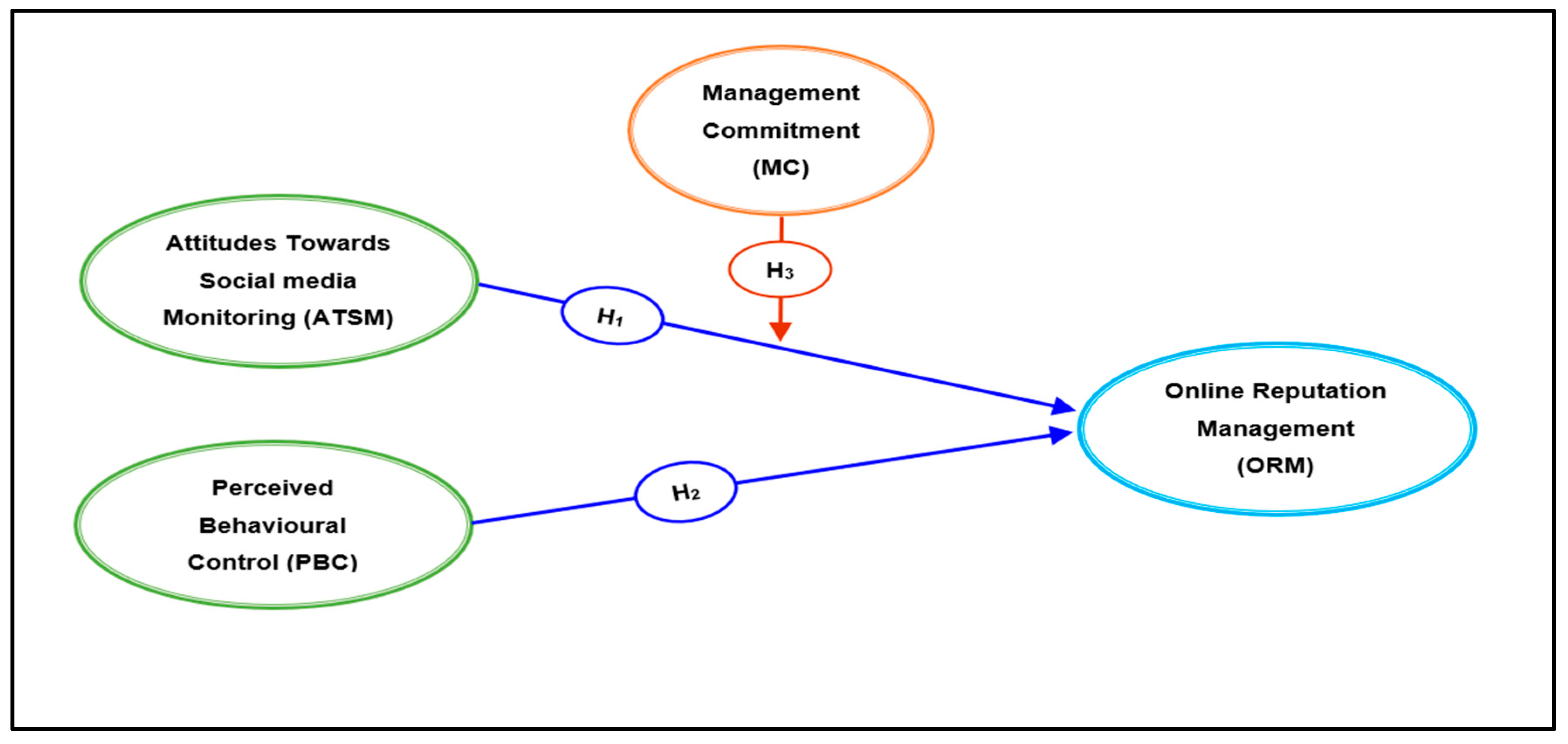

Table 1.
Validity and reliability assessment criteria.
| Measures of validity and reliability | Sufficient conditions |
|---|---|
| Internal consistency | CR ≥ 0.60 |
| Indicator Reliability | Cronbach’s alpha ≥ 0.70 |
| Convergent validity | AVE ≥ 0.50 |
| Discriminant validity | Fornell-Larcker criterion (AVE > highest construct correlation). |
Source: Hair Jr et al. (2021).
Table 2.
Indicator Reliability test results.
| Latent Variable | Items or constructs | Mean | Corrected Item-Total Correlation | Cronbach’s Alpha if Item Deleted | Item Deletion status | Original Cronbach’s Alpha prior to items deletion | Final Cronbach’s Alpha after items are deleted |
|---|---|---|---|---|---|---|---|
| ATSM | ATSM1 | 3.08 | 0.648 | 0.768 | Retained | 0.819 | 0.819 |
| ATSM2 | 3.52 | 0.577 | 0.800 | Retained | |||
| ATSM3 | 3.15 | 0.662 | 0.762 | Retained | |||
| ATSM4 | 3.24 | 0.680 | 0.753 | Retained | |||
| PBC | PBC1 | 3.09 | 0.633 | 0.688 | Retained | 0.773 | 0.773 |
| PBC2 | 3.19 | 0.540 | 0.737 | Retained | |||
| PBC3 | 3.09 | 0.478 | 0.769 | Retained | |||
| PBC4 | 3.55 | 0.658 | 0.674 | Retained | |||
| MC | MC1 | 3.35 | 0.561 | 0.822 | Retained | 0.828 | 0.828 |
| MC2 | 3.70 | 0.749 | 0.737 | Retained | |||
| MC3 | 3.90 | 0.750 | 0.738 | Retained | |||
| MC4 | 3.64 | 0.565 | 0.822 | Retained | |||
| ORM | ORM1 | 3.03 | 0.349 | 0.398 (0.719) | Retained (Deleted) | 0.499 (0.677) | 0.719 |
| ORM2 | 3.62 | 0.486 | 0.321 (0.548) | Retained (Retained) | |||
| ORM3 | 3.23 | 0.433 | 0.354 (0.581) | Retained (Retained) | |||
| ORM4 | 3.73 | 0.403 | 0.371 (0.553) | Retained (Retained) | |||
| ORM5 | 4.10 | 0.209 | 0.478 (0.688) | Retained (Retained) | |||
| ORM6 | 3.29 | -0.202 | 0.677 (-) | Deleted (-) |
Source: Computed by the researchers.
Table 3.
Rotated Component Matrix.
| Factor loadings | Component | Communalities | |||||
| 1 | 2 | 3 | 4 | 5 | 6 | ||
| ATSM1 | 0.771 | 0.076 | 0.048 | 0.123 | -0.116 | -0.094 | 0.639 |
| ATSM2 | 0.702 | -0.206 | 0.053 | -0.076 | 0.048 | -0.174 | 0.576 |
| ATSM3 | 0.789 | 0.083 | 0.146 | -0.002 | 0.047 | 0.116 | 0.666 |
| ATSM4 | 0.825 | 0.133 | 0.042 | 0.130 | -0.020 | -0.075 | 0.723 |
| PBC1 | 0.126 | -0.134 | 0.015 | 0.010 | 0.806 | 0.074 | 0.690 |
| PBC2 | -0.134 | 0.100 | -0.101 | -0.004 | 0.765 | -0.070 | 0.628 |
| PBC3 | 0.254 | -0.410 | -0.063 | 0.084 | 0.604 | -0.168 | 0.636 |
| PBC4 | -0.067 | 0.021 | 0.024 | 0.063 | 0.851 | 0.025 | 0.734 |
| MC1 | 0.291 | 0.119 | 0.722 | 0.089 | -0.014 | 0.065 | 0.632 |
| MC2 | 0.148 | 0.188 | 0.819 | 0.120 | -0.021 | -0.112 | 0.754 |
| MC3 | 0.065 | 0.377 | 0.753 | 0.118 | -0.109 | -0.124 | 0.754 |
| MC4 | 0.044 | 0.486 | 0.829 | -0.013 | 0.010 | -0.091 | 0.642 |
| ORM1 | 0.834 | 0.146 | 0.023 | 0.117 | 0.017 | 0.053 | 0.295 |
| ORM2 | 0.233 | 0.770 | 0.262 | 0.158 | 0.007 | -0.104 | 0.607 |
| ORM3 | 0.111 | 0.794 | 0.125 | 0.210 | -0.042 | 0.034 | 0.557 |
| ORM4 | 0.177 | 0.723 | 0.472 | 0.105 | -0.001 | 0.140 | 0.673 |
| ORM5 | -0.116 | 0.613 | 0.059 | -0.046 | -0.081 | -0.116 | 0.504 |
| ORM6 | 0.430 | -0.296 | -0.469 | -0.067 | 0.004 | -0.086 | 0.214 |
Source: Computed by the researchers.
Table 4.
Summary of Structural model assessment results.
| Latent Construct | Indicators | Loadings | Squared multiple correlations | Cronbach’s alpha |
CR | AVE | Square root of AVE | Internal consistency and reliability | Convergent Validity | Discriminant validity |
|---|---|---|---|---|---|---|---|---|---|---|
| Attitude towards social media monitoring (ATSM) | ATSM1 | 0.848 | 0.532 | 0.819 | 0.856 | 0.598 | 0.77 | No problem | No problem | No problem |
| ATSM2 | 0.644 | 0.375 | ||||||||
| ATSM3 | 0.874 | 0.583 | ||||||||
| ATSM4 | 1.000 | 0.633 | ||||||||
| Perceived Behavioural Control (PBC) | PBC1 | 0.906 | 0.538 | 0.773 | 0.845 | 0.581 | 0.76 | No problem | No problem | No problem |
| PBC2 | 0.821 | 0.419 | ||||||||
| PBC3 | 0.707 | 0.304 | ||||||||
| PBC4 | 1.000 | 0.631 | ||||||||
| Management Commitment (MC) | MC1 | 0.656 | 0.368 | 0.828 | 0.863 | 0.612 | 0.78 | No problem | No problem | No problem |
| MC2 | 0.913 | 0.635 | ||||||||
| MC3 | 1.000 | 0.764 | ||||||||
| MC4 | 0.810 | 0.498 | ||||||||
| Online Reputation Management (ORM) | ORM2 | 0.921 | 0.494 | 0.719 | 0.817 | 0.530 | 0.73 | No problem | No problem | No problem |
| ORM3 | 0.801 | 0.374 | ||||||||
| ORM4 | 1.000 | 0.591 | ||||||||
| ORM5 | 0.315 | 0.128 |
Table 5.
Variable correlations.
| Variable Correlations | Estimate | ||
|---|---|---|---|
| ATSM | <--> | MC | 0.074 |
| MC | <--> | PBC | -0.120 |
| ATSM | <--> | PBC | -0.037 |
| ATSM | <--> | ATSM_MC | -0.021 |
| MC | <--> | ATSM_MC | -0.574 |
| PBC | <--> | ATSM_MC | 0.112 |
| e19 | <--> | ATSM | 0.748 |
| e7 | <--> | e17 | 0.642 |
| e11 | <--> | e19 | 0.173 |
Source: Computed by the researchers.
Table 6.
Regression weights.
| Dependent variable | Path | Independent variable | Unstandardized Estimates | Standard Error | Critical Ratio | P-value | Standardized Estimates | R-square |
|---|---|---|---|---|---|---|---|---|
| ORM | ← | PBC | -0.030 | 0.038 | -0.801 | 0.423 | -0.033 | 0.78 |
| ORM | ← | MC | 0.485 | 0.049 | 10.001 | 0.000 | 0.568** | 0.78 |
| ORM | ← | ATSM | 0.118 | 0.033 | 3.562 | 0.000 | 0.144** | 0.78 |
| ORM | ← | ATSM*MC | -0.274 | 0.037 | -7.459 | 0.000 | -0.359** | 0.78 |
| ATSM1 | ← | ATSM | 0.848 | 0.053 | 15.866 | 0.000 | 0.730** | 0.53 |
| ATSM2 | ← | ATSM | 0.644 | 0.049 | 13.021 | 0.000 | 0.612** | 0.39 |
| ATSM3 | ← | ATSM | 0.874 | 0.052 | 16.686 | 0.000 | 0.763** | 0.57 |
| ATSM4 | ← | ATSM | 1.000 | - | - | - | 0.795 | 0.64 |
| MC1 | ← | MC | 0.656 | 0.047 | 14.025 | 0.000 | 0.607** | 0.39 |
| MC2 | ← | MC | 0.913 | 0.045 | 20.355 | 0.000 | 0.797** | 0.65 |
| MC3 | ← | MC | 1.000 | - | - | - | 0.874 | 0.74 |
| MC4 | ← | MC | 0.810 | 0.047 | 17.163 | 0.000 | 0.706** | 0.48 |
| PBC1 | ← | PBC | 0.906 | 0.068 | 13.275 | 0.000 | 0.733** | 0.55 |
| PBC2 | ← | PBC | 0.821 | 0.067 | 12.205 | 0.000 | 0.647** | 0.41 |
| PBC3 | ← | PBC | 0.707 | 0.066 | 10.653 | 0.000 | 0.551** | 0.32 |
| PBC4 | ← | PBC | 1.000 | - | - | - | 0.794 | 0.62 |
| ORM2 | ← | ORM | 0.921 | 0.064 | 14.491 | 0.000 | 0.703** | 0.51 |
| ORM3 | ← | ORM | 0.801 | 0.064 | 12.529 | 0.000 | 0.612** | 0.39 |
| ORM4 | ← | ORM | 1.000 | - | - | - | 0.769 | 0.59 |
| ORM5 | ← | ORM | 0.315 | 0.044 | 7.182 | 0.000 | 0.357** | 0.14 |
| Note: The superscript ** Indicates that the path coefficient is statistically significant at a 5% level of significance | ||||||||
Source: Computed by the researchers.
Table 7.
Goodness-of-fit test results.
| Test statistic | Acceptable threshold | Initial model | Re-specified or modified model |
|---|---|---|---|
| AGFI | ≥ 0.95 | 0.739 | 0.979 |
| CFI | ≥ 0.95 | 0.765 | 0.984 |
| CMIN/df | ≤ 3 | 5.908 | 2.350 |
| GFI | ≥ 0.95 | 0.800 | 0.984 |
| RMSEA | ≤0.08 | 0.103 | 0.080 |
| TLI | ≥ 0.95 | 0.717 | 0.980 |
Source: Computed by the researchers.
Table 8.
Moderation analysis test results.
| Moderation Relationship | Independent variable | Moderation variable | Interaction variable | Moderation effect | ||||||
|---|---|---|---|---|---|---|---|---|---|---|
| 1 | ATSM | Path | ATSM→ORM | MC | Path | MC→ORM | ATSM*MC | Path | ATSM*MC→ORM | Significant negative effect |
| Coefficient | 0.118** | Coefficient | 0.485** | Coefficient | -0.274** | |||||
| p-value | 0.000 | p-value | 0.000 | p-value | 0.000 | |||||
| Note: The superscript ** Indicates that the path coefficient is statistically significant at a 5% level of significance | ||||||||||
Source: Computed by the researchers.
Table 9.
Summary of Hypotheses testing.
| Independent | Path | Dependent | Hypothesis | Standardised estimates | Critical Ratio (C.R.) | R-squared | p-value | Decision |
|---|---|---|---|---|---|---|---|---|
| ATSM | ← | ORM | H1 | 0.144** | 3.562 | 0.78 | 0.000 | Supported |
| PBC | ← | ORM | H3 | -0.033 | -0.801 | 0.78 | 0.423 | Not supported |
| ATSM*MC | ← | ORM | H4 | -0.359** | -7.459 | 0.78 | 0.000 | Not supported |
Source: Computed by the researchers.
Disclaimer/Publisher’s Note: The statements, opinions and data contained in all publications are solely those of the individual author(s) and contributor(s) and not of MDPI and/or the editor(s). MDPI and/or the editor(s) disclaim responsibility for any injury to people or property resulting from any ideas, methods, instructions or products referred to in the content. |
© 2024 by the authors. Licensee MDPI, Basel, Switzerland. This article is an open access article distributed under the terms and conditions of the Creative Commons Attribution (CC BY) license (http://creativecommons.org/licenses/by/4.0/).
Copyright: This open access article is published under a Creative Commons CC BY 4.0 license, which permit the free download, distribution, and reuse, provided that the author and preprint are cited in any reuse.


