

Submitted:
31 December 2023
Posted:
02 January 2024
You are already at the latest version
Abstract
Objective: To compare the incidence of skin abrasions caused by traditional straight edge flip flop straps versus rolled inner seam (RIS) designs in a controlled laboratory setting using preserved fetal pig skin as a proxy for human skin.Methods: This study utilized a custom-built apparatus to apply friction from two flip flop strap designs to preserved fetal pig skin samples. Three trials were conducted for each strap design to determine the time to initial abrasion onset. A paired t-test was employed for statistical analysis.Results: The RIS design demonstrated a statistically significant delay in abrasion onset compared to the standard design across all trials (p < 0.05), indicating a gentler interaction with the skin.Conclusion: The RIS strap design may offer a beneficial alternative to traditional straps by reducing the friction that can lead to skin abrasions, suggesting a potential to decrease the risk of dorsal foot ulcers. Further studies involving human subjects are warranted to validate these findings in a real-world context.Keywords: Flip flop strap design, skin abrasions, dorsal foot ulcers, footwear design, developing countries, diabetic foot care.
Keywords:
Flip flop strap design
; skin abrasions
; dorsal foot ulcers
; footwear design
; developing countries
; diabetic foot care
Introduction
In many developing countries, flip flops are a predominant choice of footwear due to economic considerations and their adaptability to varied terrains. However, one medical concern linked to their extended use is the friction exerted by the straps on the dorsum of the foot. This friction, if persistent, can transition from simple skin abrasions to the more clinically significant dorsal foot ulcers1,2.
Foot ulcers pose a significant clinical challenge in regions with limited healthcare infrastructure. The majority of existing literature has primarily emphasized ulcers originating from plantar pressures3. However, there remains a conspicuous gap in understanding dorsal foot ulcers, even though they account for an estimated 15 percent of all foot ulcer presentations.
Anatomically, the dorsum of the foot, with its thin skin overlaying bony structures, is inherently vulnerable to frictional injuries. In situations where these injuries are not addressed promptly or adequately, they can evolve into non-healing ulcers. Within environments with constrained healthcare resources, such ulcers can further degenerate, leading to complications such as secondary infections and, in the most severe scenarios, necessitating amputation.
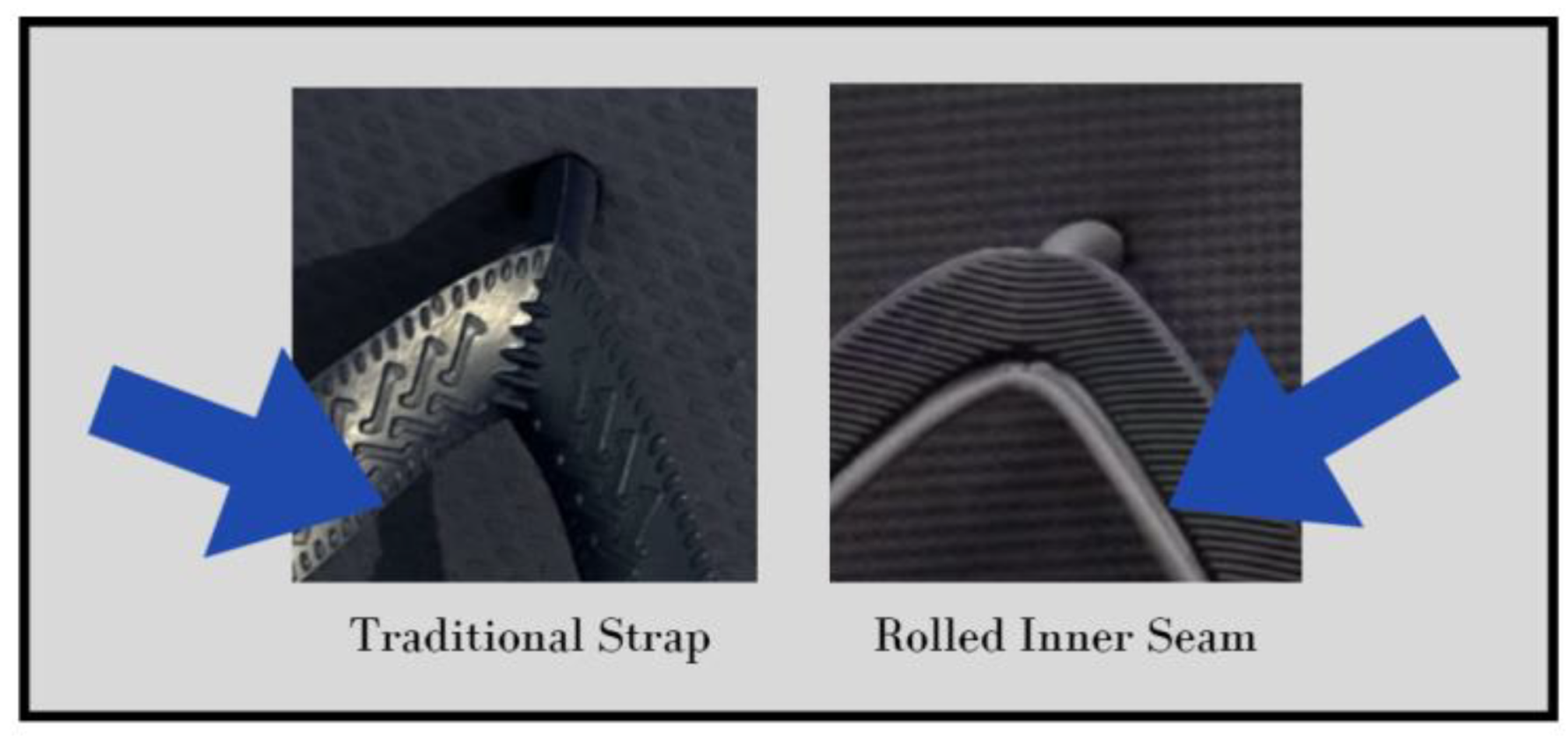
In this context, the design of the flip flop strap becomes crucial. While the traditional straight edge strap, common and economically viable, is now being assessed for its potential in contributing to dorsal skin abrasions, innovations in strap design are emerging. A notable contribution in this domain is the rolled inner seam (RIS) design, introduced by the author. This design aims to reduce the frictional forces exerted on the foot's dorsum, potentially minimizing the risk of abrasions and ulcers.
Considering the clinical implications associated with dorsal foot ulcers in economically challenged regions, there is a clear mandate for empirical studies that delve into the effects of varied strap designs. By utilizing fetal pig skin, which shares close histological and biomechanical parallels with human skin4, this study endeavors to juxtapose the traditional straight edge design against the novel RIS design. The ultimate goal is to derive evidence-based insights that can guide optimal footwear design choices and reduce the incidence of dorsal foot ulcers in vulnerable populations.
Methods
The aim of our research was to methodically determine the duration required for the initial appearance of abrasion on preserved fetal pig skin due to friction caused by two distinct flip flop strap designs. We specifically focused on the standard design in comparison to the rolled inner seam (RIS) design.
For our materials, we focused on two primary elements:
- Flip Flop Straps: We assessed two specific designs: the standard straight edged strap and the RIS iteration.
- Fetal Pig Skin: We selected preserved skin samples, primarily due to their sensitivity, which is believed to emulate the human skin's friction response closely.
To ensure consistency, the straps were acquired, cleaned, and cut to a uniform length. This step ensured each strap would interact with the skin under standard conditions when integrated with our custom testing device.
The preserved fetal pig skin was prepared to ensure that the samples we worked with were uniform in color and texture. We trimmed each of them to a precise size of 15cm x 10cm. Each sample underwent a detailed visual examination to make sure no abrasions or irregularities were already present before the experiment.
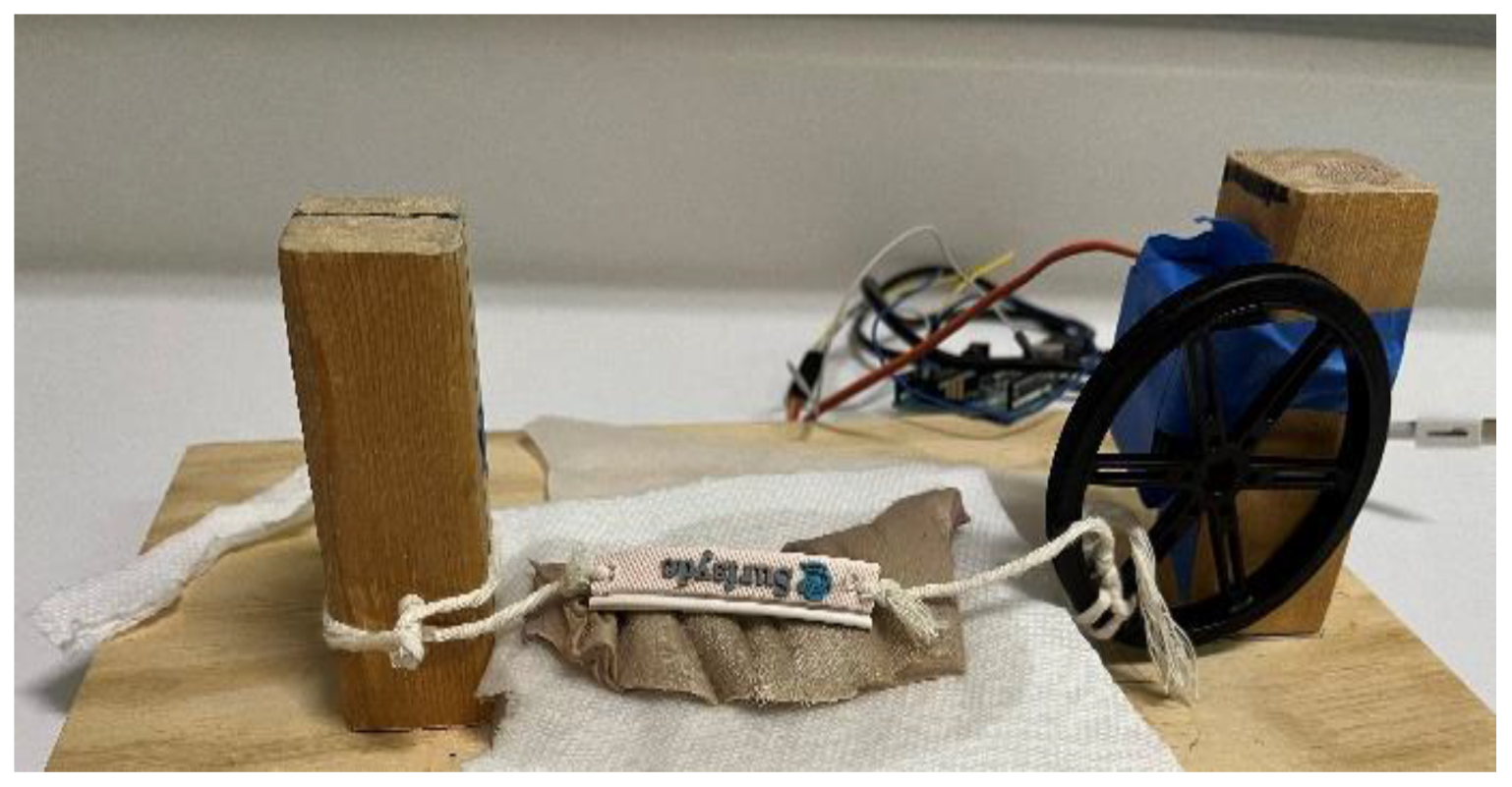
Our experiment relied on a custom-built apparatus crafted to mimic real-world frictional interactions between flip flop straps and skin. This device's movement was accurately controlled using an Arduino system, allowing us to emulate different walking scenarios.
During the testing phase, the pig skin samples faced the frictional forces of both strap designs. Each interaction was monitored with precision. We were keen on noting the exact moment the skin began showing signs of abrasion.
We conducted three separate trials for each strap design. In each of these, we recorded:
- The duration required for the standard strap design to cause observable abrasion.
- The duration for the RIS strap design to result in the same.
For our statistical analysis, we applied a paired t-test to spot any significant differences in the abrasion onset times between our two strap designs. By computing the mean times for abrasion onset across all three trials, we were able to contrast the results for both the standard and RIS strap designs.
Results Section
Objective and Method Overview: The primary focus was to determine the time to first observable abrasion on preserved fetal pig skin due to the frictional effects of two distinct flip flop strap designs: the standard and the rolled inner seam (RIS) designs.
Results:
Upon analysis of the three independent trials:
- First Trial: Abrasion was first evident at 38 minutes for the standard design and at 64 minutes for the RIS design.
- Second Trial: The onset of abrasion was recorded at 32 minutes for the standard and 68 minutes for the RIS design.
- Third Trial: The standard design showed abrasion at 46 minutes, while the RIS design manifested at 59 minutes.
Statistical Analysis:
A paired t-test was employed to compare the means of the times to abrasion onset between the two strap designs over the three trials. The mean time for abrasion onset for the standard design was 38.67 minutes, whereas for the RIS design, it was 63.67 minutes.
The t-test indicated a statistically significant difference in the times to abrasion onset between the standard and RIS designs (p < 0.05). The RIS design consistently presented a delayed onset of abrasion in comparison to the standard design.
Based on the conducted trials, the RIS design showed a consistently prolonged time to the initial appearance of abrasion as opposed to the standard design. This indicates that the RIS design may be gentler on the skin, potentially diminishing the immediate risk of skin damage due to friction during use.
Discussion
The growing prevalence of dorsal foot ulcers, particularly among diabetic patients, underscores the need to scrutinize the footwear choices that individuals make on a daily basis. The present study's focus on flip flop strap designs, particularly comparing the traditional straight edge with the rolled inner seam (RIS) design, offers critical insights into the potential mechanisms that might lead to abrasion and, subsequently, more severe foot complications.
Our findings revealed a statistically significant delay in the onset of abrasion when using the RIS design compared to the traditional straight edge design on preserved fetal pig skin. This delay suggests that the RIS design might mitigate the frictional forces exerted on the skin. In real-world applications, this reduction in friction could potentially translate to a decreased risk of skin abrasion and associated complications, especially for vulnerable populations like diabetics.
The use of fetal pig skin as a model, given its histological and morphological similarities to human skin, adds a layer of reliability to our results. However, it's essential to consider that the preserved nature of the pig skin might not perfectly capture the full range of responses seen in living human skin. Factors such as sweat, skin elasticity, and unique individual responses can alter the dynamics of friction and abrasion.
While the RIS design showed promise in this study, it's crucial to note that footwear is only one factor among many that contribute to dorsal foot ulcers. Other factors like poor glycemic control, peripheral neuropathy, and inadequate foot care practices also play pivotal roles. Therefore, while opting for footwear with reduced abrasive potential is beneficial, it should be part of a comprehensive approach to foot health, especially for at-risk individuals. Further, flip flops are not the recommended footwear for people with diabetes,. However, in developing countries most people can only afford this simplistic footwear. Hence design innovation is important.
Another aspect worth noting is the general wear and tear of flip flops. Over time, even a well-designed strap might exhibit changes in its frictional properties, necessitating periodic evaluations and possible replacements. Future studies could delve into the long-term effects of using these straps and their changing dynamics over prolonged use.
In conclusion, our study emphasizes the potential benefits of rethinking and redesigning commonly used footwear components to promote foot health. The RIS design offers a promising avenue in this direction. However, while improved flip flop design can be a step forward, comprehensive foot care remains paramount, especially for those at an elevated risk of complications.
Future Direction
Studies with a larger sample size will need to be considered. Further human studies, in healthy volunteers first then followed by a study in diabetics will be important to validate these results in real life scenarios.
Conclusion
Our study suggests that the innovative rolled inner seam (RIS) design for flip flop straps may reduce skin abrasion risks, a finding with potential implications for foot health in developing countries. While these results are promising, further research with human participants is essential to confirm the practical benefits. Addressing foot health through footwear design is a step forward, but it must be part of a holistic approach to foot care, especially in resource-limited settings.

Table 1.
Onset of abrasion times for both the standard design and the RIS design in three separate trials.
Table 1.
Onset of abrasion times for both the standard design and the RIS design in three separate trials.
| Trial | Standard Design (minutes) | RIS Design (minutes) |
| 1 | 38 | 64 |
| 2 | 32 | 68 |
| 3 | 46 | 59 |
Picture 1.
Comparison of traditional straight edge strap and Rolled inner seam strap.
Picture 2.
Apparatus to simulate strap motion.
Acknowledgements
Ms. Leyf Starling and Ms. Shayn Peirce-Cottler contributed advice for the design of the study.
References
- Ramaswamy, P., Rajan, P., Rima, J., & Richard, J. Footwear in the causation and prevention of foot ulcers in diabetes mellitus. The National Medical Journal of India. 2017; 30, 255–259.
- Volmer-Thole M, Lobmann R. Neuropathy and Diabetic Foot Syndrome. Int J Mol Sci. PMID: 27294922; PMCID: PMC4926450. 2016; 17, 917. [CrossRef]
- Razak AH, Zayegh A, Begg RK, Wahab Y. Foot plantar pressure measurement system: a review. Sensors (Basel). Epub 2012 Jul 23. PMID: 23012576; PMCID: PMC3444133. 2012; 12, 9884–912. [CrossRef]
- Ranamukhaarachchi SA, Lehnert S, Ranamukhaarachchi SL, Sprenger L, Schneider T, Mansoor I, Rai K, Häfeli UO, Stoeber B. A micromechanical comparison of human and porcine skin before and after preservation by freezing for medical device development. Sci Rep. PMID: 27558287; PMCID: PMC4997349. 2016; 6, 32074. [CrossRef]
Disclaimer/Publisher’s Note: The statements, opinions and data contained in all publications are solely those of the individual author(s) and contributor(s) and not of MDPI and/or the editor(s). MDPI and/or the editor(s) disclaim responsibility for any injury to people or property resulting from any ideas, methods, instructions or products referred to in the content.闷声 |
© 2024 by the authors. Licensee MDPI, Basel, Switzerland. This article is an open access article distributed under the terms and conditions of the Creative Commons Attribution (CC BY) license (http://creativecommons.org/licenses/by/4.0/).
Copyright: This open access article is published under a Creative Commons CC BY 4.0 license, which permit the free download, distribution, and reuse, provided that the author and preprint are cited in any reuse.


