

Submitted:
28 December 2023
Posted:
29 December 2023
Read the latest preprint version here
Abstract
This research aims to understand green economy transition in Cambodia and analyze its strengths, weaknesses, opportunities, and threats (SWOT). The research showed that Cambodia has been significantly transitioning its economy to green since 2009 as evidenced by its National Green Growth Roadmap. Cambodia also established the National Council for Green Growth in 2012 and upgraded it to the National Council for Sustainable Development in 2015. The members of the Council are from all the government’s ministries and relevant inter-ministerial councils/committees, which are significant for policymaking. All governors of the capital and provincial administrations are also its members, which are significant for supporting and implementing the works at the subnational levels. Under the structure of its Secretariat, Department of Green Economy is playing an important role in promoting green economic development in Cambodia by looking at the national policies and strategic plans, undertaking projects, and mobilizing resources. Through coordination of this Department, Cambodia officially became a Member of the United Nations Partnership for Action on Green Economy (PAGE) in 2022. The findings showed that Cambodia is transitioning its green economy at the right time, especially the new government’s Pentagonal Strategy strongly supported this green economy transition with a clear and strong political commitment. The Council governing this green economy transition is also significant to both policymaking and implementation levels, which is inclusive for promoting green economic development in Cambodia.
Keywords:
Cambodia green economy
; green growth
; green transition
; sustainable development
; Pentagonal Strategy
; carbon neutrality
; sustainable consumption and production
; eco-labeling
1. Introduction
With its high commitment to promote clean, green, and sustainable development, Cambodia produced a National Green Growth Roadmap in 2009, which has been getting more attention internationally [1]. This roadmap enables a win-win situation between the economy, environment, society, and culture toward achieving stable high economic growth, environmental sustainability, and human well-being [2]. The roadmap lays out seven key priority accesses: (i) access to clean water and sanitation; (ii) access to renewable energy; (iii) access to knowledge and information, including green education and skills; (iv) access to means for better mobility; (v) access to sustainable finance and investments; (vi) access to food security and non-chemical products; and (vii) access to sustainable land use [1].
Through an MoU on Green Growth Cooperation with Global Green Growth Institute (GGGI) since 2011, Cambodia has been significantly contributing to producing immediate tangible impacts towards achieving high economic growth while reducing environmental stress and improving quality of life in the country [3]. More importantly, as a founding member of an international treaty-based inter-governmental GGGI organization in 2012, Cambodia established a National Council for Green Growth (NCGG) to coordinate a green and low-carbon development and to ensure the balance of economic, environmental, and sociocultural goals within the kingdom [4]. In 2013, Cambodia importantly approved the National Policy and National Strategic Plan on Green Growth 2013-2030 with the aim to promote sustainable long-term economic and social development in Cambodia [5].
In alignment with the 2030 Agenda for Sustainable Development of the United Nations, Cambodia established a National Council for Sustainable Development (NCSD) in 2015 [6] by consolidating the National Council for Green Growth and its General Secretariat, the National Climate Change Committee and its Secretariat, the National Biodiversity Steering Committee and its Secretariat, and the National Biosafety Committee and its Secretariat [7]. This Council is a policy-making body with a mission to promote sustainable development and to ensure economic, environmental, and sociocultural balances within the country, and has its General Secretariat at the Ministry of Environment for supporting daily operation. The General Secretariat has five Departments overseeing green economy and green growth, science and technology, biodiversity, climate change, and its administrative works [8].
As an arm of the General Secretariat, the Department of Green Economy (DGE) has a mission to promote green economic development in Cambodia by looking at the national policies and strategic plans, undertaking projects, and mobilizing resources [9]. So far, the Department of Green Economy has been coordinating inter-ministries and collaborating with many development partners to implement various projects on sustainable cities, green building, sustainable energy, and sustainable consumption and production (SCP). In 2021, the General Secretariat was renamed to the General Directorate of Policy and Strategy, which is structured under the Ministry of Environment. However, the General Directorate still has five Departments as before and serves as the Secretariate of NCSD [10].
As summarized in a background above, green economic development in Cambodia has been promoted since 2009. However, it is still little known among some key stakeholders, especially financial and banking institutions. Furthermore, there is a limitation in terms of understanding what is green growth/green economy, and what is sustainable development, especially why it is essential to all relevant stakeholders across the country. Moreover, many relevant potentials, especially financial and banking institutions, are still not clear on the roles and responsibilities of the responsible governmental institution for green economic development in Cambodia while its governance has been reformed several times.
Hence, this research aims to understand green economy transition in Cambodia by demonstrating the background and progress of national green economic development and to analyze strengths, weaknesses, opportunities, and threats (SWOT Analysis) of promoting green economic development in Cambodia. Consequently, the significance of this research is to disseminate information of national green economy and improve understanding of green economic development in Cambodia, especially on institutional arrangements and reforms, national governance structures, and roles and responsibilities, as well as relevant regulations and policies, such as the code, laws, royal decrees, sub-degrees, national policies, strategic plans, and roadmaps for supporting green economic development in Cambodia, including key priority sectors and completed, on-going, and forthcoming projects.
2. Methodology
In order to realize its objectives, this research incorporated qualitative methods to examine and analyze green economic development in Cambodia through existing policies and regulations, national governance structures, roles and responsibilities, completed, on-going, and forthcoming projects. More importantly, this research conducted strengths, weaknesses, opportunities, and threats (SWOT) analysis of green economic development in Cambodia based on relevant existing relevant regulations and policies, such as the code, laws, royal decrees, sub-decrees, new government’s pentagonal strategy, national policies, strategy and action plans, roadmaps, project reports, as well as global, regional, and national cooperations on green growth and green economic development.
This research was based on both primary and secondary data in which primary data were data/information that have been gathered from the meetings and workshops with the Department of Green Economy, NCSD Secretariat, and Ministry of Environment and through direct participation, involvement, and works with them [11]. Some discussions have been based on the author’s knowledge and work experience over 12 years with the national green economy institutions: first, Division of Green Economy and Investment of NCGG General Secretariat (2013-2015) and then Department of Green Economy (DGE) of NCSD General Secretariat (2015-Present). These data are fully and/or partly published or available online as follows: (a) a Study on the Mechanism of National Green Economic Development in Cambodia with the Build Bright University [12], the Cambodia Green Urban Development Program (GUDP) Phase I with DGE and GGGI [13,14], the CUSA (Cambodia Urban Sustainability Assessment) Project with Hanyang University [15,16,17,18] and with Sungkyunkwan University [19], the Development of Cambodia INFF Finance Strategy based on CSDGs with Frankfurt School – UNEP Collaborating Centre for Climate and Sustainable Energy Finance and UNCDF [20], and the United Nations Partnership for Action on Green Economy (PAGE) in Cambodia with the UN PAGE Agencies (UNITAR, UNIDO, UNDP, UNEP, and ILO) and Department of Green Economy [21].
In addition, the secondary data were also used to support relevant document review that are available in hard and soft copies and on relevant agencies’ official websites. As we know, the document review is about reviewing existing and relevant reports, as well as documents that are available. These reviewing methods were found to be helpful in summarizing existing reports and documents whereas an accompanying study based on existing knowledge and information was also addressed as building block of all academic study and research activities regardless of disciplines [22,23,24,25,26]. Consequently, this research extensively collected and reviewed documents from the Department of Green Economy of NCSD General Secretariat, Ministry of Environment, National Assembly’s Website, and development partners, including UN Agencies, GGGI, and OECD.
3. Background of Green Economy Transition in Cambodia
3.1. Definitions
Green Economy: According to the United Nations Environment Programme (UNEP), a green economy at a visionary level is one that results in increased human well-being and social equity, while significantly reducing environmental risks and ecological scarcities. At the operational level, it is seen as one whose growth in income and employment is driven by investments that reduce carbon emissions and pollution, enhance energy and resource efficiency, and prevent the loss of biodiversity and ecosystem services [27]. Based on the National Policy on Green Growth and the National Strategic Plan on Green Growth 2013-2030, a green economy refers to the development of an economy with efficiency in using natural resources, environmental sustainability, green jobs, green technology, and economic reforms with further consideration into green encouragement, including green tax, green finance, especially green credit and micro-finance [5,28].
Green Growth: The Organization for Economic Co-operation and Development (OECD) documented that green growth means fostering economic development and growth while ensuring that natural assets continue to provide environmental services and resources on which our well-being relies [29]. Based on the National Policy and National Strategic Plan on Green Growth 2013-2030, green growth refers to a sustainable economic development that will cause no damage to the environment, which is based on the least use of natural resources with high yields, energy efficiency, low waste emission, clean development, green maintenance, and livelihood improvement to achieve balancing of economic development that focuses on great interest of whole society [5,28].
Sustainable Development: According to the World Commission on Environment and Development (1987) [30], the definition of sustainable development has reached the most consensus that “The development that meets the needs of the present without compromising the ability of future generations to meet their own needs”. Based on Cambodia’s National Policy and Strategic Plan on Green Growth 2013-2030, sustainable development refers to development of economy having no damage to the environment by minimizing the use of natural resources with high output, energy efficiency, low waste generation, and clean development, as well as enhancement of the quality of life to achieve balance of economic development, environmental protection, and social welfare [5,28].
We understand that the definitions of green economy and green growth defined in Cambodia’s National Policy on Green Growth [5] and National Strategic Plan on Green Growth 2013-2030 [28] demonstrated above clearly showed that green economy and/or green growth principles were strategically determined by the Royal Government as a means to achieve sustainable development within the Kingdom of Cambodia.
3.2. Green Economy under Green Growth Secretariat of MoE (Before Oct 2012)
As mentioned in introduction, Cambodia has restructured and upgraded its green economy institution several times. In the first time, it was known as the Green Growth Secretariat under the Ministry of Environment, served as a Secretariat for Inter-Ministerial Green Growth Working Group (IMGGWG), which was established in August 2009 [1]. The IMGGWG was chaired by a Secretary of State for Environment and had members from 15 relevant ministries, such as the Ministry of Interior, Ministry of Economy and Finance, Ministry of Agriculture, Forestry, and Fisheries, Ministry of Industry, Mines, and Energy, Ministry of Land Management, Urban Planning, and Construction, Ministry of Planning, Ministry of Public Works and Transport, Ministry of Education, Youth, and Sports, Ministry of Health, Ministry of Women’s Affairs, Ministry of Tourism, Ministry of Labour and Vocational Training, Ministry of Commerce, Ministry of Rural Development, Cambodia Chamber of Commerce, Phnom Penh Municipal Hall, and Phnom Penh Capital Department of Environment, including a National Project Coordinator for 2nd National Communication on Climate Change [31].
The above inter-ministerial body developed a National Green Growth Roadmap as an important tool contributed to the implementation of national sustainable development strategy and policy in Cambodia, combined the overall objective of pre-existing development strategies with the establishment and maintenance of green growth, and defined as environmentally sustainable economic progress that fosters the low-carbon and socially inclusive development. Importantly, it is aimed to unify development and environment objectives by a means of implementing policies tailored to address needs of all to create jobs and increase the resilience of the environment towards sustaining economic growth and environmental and human well-being in the long-term. Consequently, it laid out seven key priority accesses: (i) access to clean water and sanitation; (ii) access to renewable energy; (iii) access to knowledge and information, including green education and skills; (iv) access to means for better mobility; (v) access to sustainable finance and investments; (vi) access to food security and non-chemical products; and (vii) access to sustainable land use [1].
After the Global Green Growth Institute (GGGI) was launched on 16 June 2010 as a platform for evidence-based learning and policy innovation working to illuminate practical opportunities for country-led and industry-led progress on twin imperatives of economic development and environmental sustainability at the Second East Asia Climate Forum in Seoul, South Korea [3], Mr. Han Seung Soo, the Chairman of GGGI came to work with Cambodia and met Samdech Hun Sen, Prime Minister of Cambodia in 2011. During the meeting, Samdech Hun Sen stated that Cambodia is developing and despite the fact that the development is progressing with Cambodia’s own greenness, it had to be cautious as the greenness would reduce and be replaced by dryness. The GGGI’s Chairman expressed that the Republic of Korea is much interested in growing green resources and GGGI would like to share green growth experiences with the Kingdom of Cambodia [32].
Furthermore, the Royal Government of Cambodia represented by Dr. Mok Mareth, Senior Minister, Minister of Environment, signed an MoU on Green Growth Cooperation with the Chairman of GGGI in March 2011 to design the GGGI’s Cambodia National Green Growth Plan to produce immediate tangible impacts towards Cambodia’s achievement of sustainable economic growth while reducing environmental stress and improving quality of life. This MoU aimed to (i) formulate a green growth master plan tailored to the specific characteristics of Cambodia, (ii) build the green growth plan and working schedule in accordance with national strategic development plan (NSDP), (iii) converge sectoral issues and policies on green growth, such as energy, agriculture, and forestry in countrywide, (iv) coordinate the compatibility between industry development and environmental protection, and (v) identify and prioritize adaptation activities to green growth [32].
3.3. Green Economy under the General Secretariat of NCGG (Oct 2012–May 2015)
3.3.1. Institutional Structures
In June 2012, representatives from 16 countries, including Cambodia, signed the GGGI’s Establishment Agreement at the UN Conference on Sustainable Development (Rio+20) to establish/covert GGGI to be an international treaty-based, inter-governmental organization [31]. As a founding member country of this inter-governmental organization, Cambodia established a National Council for Green Growth (NCGG) on 10 October 2012 to improve green economic development, public health, environmental quality, people’s livelihood, and national cultural preservation based on the four key pillars of economy, environment, society, and culture in Cambodia [4]. The Council had Prime Minister as its honorable chair and Miniter of Environment as its chair as shown in Figure 1. A total of 26 ministries were its members, with two ministries were its deputy chairs, while other members were relevant government’s national and sub-national organizations, such as Supreme National Economic Council (SNEC), Council for the Development of Cambodia (CDC), National Committee for Disasters Management (NCDM), Council for Agricultural and Rural Development (CARD), and Cambodia National Mekong Committee (CNMC), as well as all Governors of the Capital and Provincial Administrations.
We see that the institutional structure was upgraded from a green growth secretariat that was under the Ministry of Environment to an inter-ministerial green growth council. Members of inter-ministerial working group of 15 ministries were structured to members of inter-ministerial council of 26 ministries, 5 inter-ministerial councils/committees (SNEC, CDC, NCDM, CARD, and CNMC), and all governors of the boards of governors of the capital and provincial administrations. More importantly, Miniter of Environment served as its chair while the Prime Minister was its honorable chair. Furthermore, Minister of Agriculture, Forestry, and Fisheries and Minister of Planning were its deputy chairs, respectively [4]. This shows a high commitment of the Royal Government to achieve green economy, green growth, and sustainable development within the kingdom.
According to the Royal Decree on the Establishment of the National Council for Green Growth (NCGG) dated on 10 October 2012 [4], this Council shall have a General Secretariat for its daily operation, which shall be housed at the Ministry of Environment. Its General Secretariat was led by a Secretary-General and supported by some Deputy Secretary-General (at least one). The Secretary-General of NCGG was also a member of the NCGG. The organization and functioning of the General Secretariat shall be defined by a Sub-decree. According to the Sub-decree on the Organization and Functioning of the General Secretariat of NCGG (named in English: General Secretariat for Green Growth), the General Secretariat had four divisions: (i) Division of Administration and Finance, (ii) Division of Green Environment and Natural Resources, (iii) Division of Green Economy and Investment, and (iv) Division of Monitoring and Evaluation [33].
3.3.2. National Policy and Strategic Plan
The National Policy on Green Growth was approved by the Royal Government on 1 March 2013 in the full cabinet meeting of the Council of Ministers. This policy is envisaged to strike the balance of economic development with environment, society, and culture, particularly sustainable use of national resources through integration, matching, and adaption, as well as harmonization between green growth/green economy principle and national policies [5]. The policy aims at enhancing well-being and livelihood of all people in harmonization with ecological safety through green growth based on green and blue economies, environment protection, social safety system, and uphold of national cultural identity. The objectives are to (i) develop an economy in balancing with the environment, society and culture; (ii) create a favorably enabling the environment for green growth in equity, balance, fraternity, and quality of socio-economic systems and ecology that uphold the national cultural value; (iii) coordinate and manage effectiveness of seven priority accesses (clean water and sanitation; renewable energy; green knowledge and information; means for better mobility; sustainable finance and investments; food security and non-chemical products; and sustainable land use); (iv) enhance education and training on green growth; (v) strengthen the information exchange, knowledge, good experiences, technology, and investment related to green growth; and (vi) stimulate the green growth cooperation at national and sub-national levels, region, and the world [5].
The National Strategic Plan on Green Growth 2013-2030 was also approved by the Royal Government of Cambodia on 1 March 2013 [28] in the full cabinet meeting of the Council of Ministers. This strategic plan is envisaged to develop a sustainable economy, achieving environmental, social, and cultural sustainability for poverty alleviation. The objective is to promote a national economy with stable growth, prevention and reduction of environmental pollution, safe ecosystem, poverty reduction, and promotion of public health service, educational quality, natural resources management, and sustainable land use, and water resources management to increase energy efficiency, ensuring food safety, and glorify the national culture. The strategic plan indicated to improve green growth by focusing on nine strategic directions: (1) green investment and green jobs creation; (2) green economy balance management with the environment; (3) sustainable blue economic development; (4) green environment and natural resources management; (5) green human resources development and education; (6) effective green technology management; (7) promotion of a green social safety system; (8) upholding and protection of green cultural heritage and national identity; and (9) good governance on green growth [28].
3.4. Green Economy under the General Secretariat of NCSD (May 2015 - Nov 2021)
3.4.1. Institutional Integration
In alignment with 2030 Agenda on Sustainable Development, Cambodia established a National Council for Sustainable Development (NCSD) in May 2015 by consolidating the National Council for Green Growth and its General Secretariat, National Climate Change Committee and its Secretariat, National Biodiversity Steering Committee and its Secretariat, and National Biosafety Committee and its Secretariat. This Council is a policy-making body with a mission to promote sustainable development and to ensure economic, environmental, and sociocultural balances within the Kingdom of Cambodia [6].
According to the Royal Decree on the Establishment of NCSD dated on 9th May 2015, the Council has Prime Minister as its honorable chair and Miniter of Environment as its chair as shown in Figure 2. A total of 29 ministries and state secretariate (all government’s ministries) are its members, with a Secretary of State of the Council of Ministers is the first deputy chair and a Secretary of State for Environment is the second deputy chair, while other members are from relevant government’s national and sub-national organizations. SNEC, CDC, NCDM, CARD, and CNMC, and all Governors of the Capital and Provincial Administrations are remained the members while adding the Secretary-General, then changed to Deputy Executive Director of the Secretariat, of National Committee for SubNational Democratic Development (NCDD). According to the member list, the Secretary-General of NCSD is the permanent member of NCSD.
We see that after the integration, the Council was renamed to the National Council for Sustainable Development, responsible not only for green growth/green economy but also climate change, science and technology, and biodiversity and biosafety. Members of the Council are also expanded from 26 ministries to include all government’s ministries (29 ministries). The number of relevant government’s inter-ministerial council/committee is also increased from 5 (SNEC, CDC, NCDM, CARD, and CNMC) to 6 (added NCDD). The Governors of the Capital and Provincial Administrations are also increased from 24 to 25 because a new province, Tboung Khmum, was formed in 2013.
The Miniter of Environment remained its chair while Prime Minister also remained its honorable chair. However, there is an order of the ‘deputy chair’ positions. The first deputy chair is given to the Secretary of State of the Council of Ministers whereas the second deputy chair is given to the Secretary of State for Environment. More importantly, the Council has an Executive Committee, which consists of 12 members. The Executive Committee is chaired by the Minister of Environment, supporting by two deputy chairs. The first deputy chair is a Secretary of State for Agriculture, Forestry and Fisheries whereas the second deputy chair is a Secretary of State for Environment. The Secretary-General of NCSD is also a permanent member of this Committee. This shows that the Royal Government has a high commitment for promoting green economic development in Cambodia as evidenced by well-structured national sustainable development council and its executive committee that has a regular meeting at least once in every quarter.
The Royal Decree on the Establishment of the National Council for Sustainable Development (NCSD) also has a General Secretariat for its daily operation, which is housed at the Ministry of Environment. The General Secretariat was led by a Secretary-General, assisted by some deputies as required. According to the Sub-decree on the Organization and Functioning of the General Secretariat of NCSD (GSSD), the General Secretariat has five departments as follows: (i) Department of Administration, Planning and Finance; (ii) Department of Climate Change; (iii) Department of Green Economy; (iv) Department of Science and Technology; and (v) Department of Biodiversity.
3.4.2. NCSD Roles and Duties
According to the Royal Decree No. 403 on the Establishment of the National Council for Sustainable Development (NCSD) dated on 9th May 2015 [6], this Council has roles and duties as follows:
- Formulating, directing, and evaluating policies, strategic plans, action plans, legal instruments, programs, and projects related to sustainable development;
- Promoting mainstreaming of sustainable development into relevant policies, legal instruments, strategic plans, action plans, programs, and projects in collaboration with relevant line ministries and agencies;
- Mobilizing resources for implementation of policies, legal instruments, strategic plans, action plans, programs, and projects related to sustainable development;
- Establishing and fostering partnerships with development partners, private sector, academia, other relevant stakeholders aimed at supporting sustainable development;
- Encouraging and promoting the research study, education, training, exchange of technologies and dissemination relevant to sustainable development;
- Proposing the national positions and strategies for participating in international agreements, meetings and negotiations relevant to sustainable development;
- Reviewing and giving approval on national communications under the multilateral environmental agreements to which Cambodia is a party;
- Managing the government information and communications relevant to sustainable development;
- Leading, managing and facilitating the works related to green economy, climate change, biodiversity conservation and biosafety; and
- Implementing any other duties assigned to it by the Royal Government of Cambodia.
The Royal Decree states that NCSD may convene for meeting at least once a year on invitation by chairperson or his authorized deputy. The NCSD Chair may, as necessary, invite representatives from ministries or agencies, technical officials, experts or private sectors to participate in consultation and research study on issues related to duties of the Council. Where the chairperson is not available, a deputy may chair the meeting of the NCSD as authorized by the chairperson. The Executive Committee of NCSD shall convene for meeting to review and consolidate performance and report to the NCSD at least once in every quarter. Modality and procedure for NCSD and Executive Committee operation shall be defined by an internal regulation of NCSD.
NCSD may establish the committee(s), working group(s), expert group(s), or other mechanisms for specific sectors of work as required. NCSD may have technical advisor(s), national or international expert(s) as required. NCSD shall have authority to use its own logo, seal, and separate budget as an annex to the budget of the Ministry of Environment. NCSD shall have authority to receive, manage, and use funds from various sources to perform its functions in accordance with legal procedure in force.
3.4.3. Department of Green Economy
According to Sub-decree on Organization and Functioning of the General Secretariat of the National Council for Sustainable Development (NCSD) dated on 18 May 2015 [8], Department of Green Economy is one of the five departments of the General Secretariat of NCSD. This Department has roles and duties as follows:
- Coordinating and implementing legal documents, policies, strategic plan, action plan, programs, and project for supporting the green economy pathway as well as monitoring and evaluation and annual report;
- Coordinating research in related impacts and benefits of development activities to sustainable development dimensions: Economy, environment, society and culture;
- Coordinating natural capital accounting and measuring green domestic products;
- Coordinating feasibility study and establishing pollution-based payment principal mechanism and payment for environmental service and coordinating, monitoring, and evaluating the implementation of agreed mechanism;
- Coordinating research and establishing supporting tool system for decision making such as impact assessment, multicriterial analysis, cost-benefit analysis to contribute to modification or establishment of legal documents, policies, strategic plan, action plan, programs, and projects;
- Researching and developing the policies and the mechanisms related to sustainable consumption and production, such as eco-label and green certification, green public procurement, and monitoring and evaluation of the agreed mechanism;
- Building and strengthening the cooperation with partners, civil society organization, private sector, academic institute and other stakeholders to promote green economy development;
- Disseminating and mobilizing resources for the implementation of agreed policies.
According to the Prakas on the Organization and Functioning of the Department of Green Economy dated on 3 December 2015 [9], the Department of Green Economy has five offices as follows: (i) Office of Administration, Planning and Finance; (ii) Office of Policy and Economic Instrument; (iii) Office of Sustainable Lifestyle; (iv) Office of Green Standard and SCP (Sustainable Consumption and Production); and (v) Office of Ecolabel and Green Certification as shown in Figure 3.
Office of Administration, Planning and Finance serves as the admin of Department whereas the Office of Policy and Economic Instrument is coordinating relevant policies and projects on sustainable energies. The Office of Sustainable Lifestyle is implementing the work and projects on sustainable cities and green buildings whereas the Office of Green Standard and SCP is implementing the work and projects on sustainable consumption and production, circular economy, and green public procumbent and the Office of Ecolabel and Green Certification is implementing the work and projects on ecolabels and green building certification. All offices of the Department of Green Economy are working as collaborating and helping each other since their works are interconnected.
3.5. Green Economy under General Directorate of Policy and Strategy (Nov 2021–Present)
3.5.1. Secretariat Refunctioning
In November 2021, Ministry of Environment was restructured to include the General Secretariat of NCSD in its structure by renaming it to the General Directorate of Policy and Strategy [10]. Five departments of General Secretariat are remained the same under the General Directorate of Policy and Strategy. According to the Royal Decree on the Amendment of the Royal Decree on the Organization and Functioning of the National Council for Sustainable Development (NCSD) dated on 24 November 2021 [34], General Directorate of Policy and Strategy serves as the Secretariat of the National Council for Sustainable Development. Therefore, the Director-General of the General Directorate of Policy and Strategy is also a permanent member of NCSD and its Executive Member.
We see that the amendment is mainly to determine that General Directorate of Policy and Strategy renamed from the General Secretariat of NCSD and under the structure of the Ministry of Environment is remained the NCSD Secretariat. It also indicated that Director-General of General Directorate of Policy and Strategy is a permanent member of NCSD and its Executive Member. Therefore, the General Directorate of Policy and Strategy serves as (i) a policy and strategic directorate-general of the Ministry of Environment and (ii) Secretariat of the National Council for Sustainable Development for the Council’s daily operations and continuing the works of the General Secretariat of NCSD, including green economy works and projects under the Department of Green Economy as shown in Figure 4.
3.5.2. Members of NCSD and Structure of Department of Green Economy
All government’s ministries are remained the members of the National Council for Sustainable Development (NCSD), with the Prime Minister as its honorable chair and the Miniter of Environment as its chair, as well as Secretary of State of the Council of Ministers is the first deputy chair whereas the Secretary of State for the Environment is the second deputy chair [34]. There is one ministry changed its name from the Ministry of Industry and Handicraft to the Ministry of Industry, Science, Technology and Innovation (MISTI) in March 2020. Therefore, the amendment of the Royal Decree updated this ministry’s name accordingly. Other members from inter-ministerial and sub-national organizations are remained the same. They are NCDD, SNEC, CDC, NCDM, CARD, CNMC, and all Governors of the Boards of Governors of the Capital and Provincial Administrations. The roles and duties of NCSD and its Executive Committee are remained the same.
Furthermore, the amended Royal Decree determined the Director-General of General Directorate of Policy and Strategy to replace the Secretary-General post of NCSD as the permanent member of NCSD and its Executive Committee. The amended Royal Decree also determined that officials and properties of the General Secretariat of NCSD shall be moved to under the structure and management of Ministry of Environment. According to the Sub-decree on Organization and Functioning of the Ministry of Environment dated on 17 November 2021, the roles and duties, as well as the structure and departments’ names of the General Directorate are remained the same with the General Secretariat of NCSD. According to Prakas on Organization and Functioning of Offices under the Departments of General Directorate of Policy and Strategy dated on 13 December 2021, the five offices of the Department of Green Economy are remained the same: (i) Office of Administration, Planning and Finance; (ii) Office of Policy and Economic Instrument; (iii) Office of Sustainable Lifestyle; (iv) Office of Green Standard and SCP (Sustainable Consumption and Production); and (v) Office of Ecolabel and Green Certification [35].
4. Progress of Green Economic Development in Cambodia
4.1. The Code and Policies Supporting Green Economy Transition
Environment and Natural Resources Code of Cambodia: The Code was recently approved by Cambodia’s National Assembly and Senate and endorsed by the King of Cambodia on 29 June 2023. The Code sets out the rules to be followed and practiced in strengthening, modernizing, harmonizing, and improving the management of environmental protection and conservation and restoration of natural resources, biodiversity, and ecosystem functions for sustainable living and development in Kingdom of Cambodia. The Code decisively includes significant provisions to strengthen conservation of natural resources and wildlife, build climate resilience, promote the use of renewable energy, and build sustainable urban environments with the capacity to effectively deal with waste management and pollution. The Code is subsequently replacing the three following laws: (i) The Law on Environmental Protection and Natural Resources Management – 1996; (ii) The Law on Protected Areas – 2008; and (iii) The Law on Biosafety – 2008 [36].
National Policy and Strategic Plan on Green Growth 2013-2030: As demonstrated in Section 3.3.2, the Policy and Strategic Plan on Green Growth were approved by the government on 1 March 2013 in the full cabinet meeting. The Policy is envisaged to strike balance of economic development with environment, society, and culture, particularly sustainable use of national resources through integration, matching, and adaption, as well as harmonization between green growth principle and national policies [5]. The Strategic Plan is to promote a national economy with stable growth, prevention and reduction of environmental pollution, safe ecosystem, poverty reduction, and promotion of public health service, educational quality, natural resources management, and sustainable land use, and water resources management to increase energy efficiency, ensuring food safety, and glorify the national culture. It indicated to improve green growth by focusing on nine strategic directions as follows: (1) green investment and green jobs creation; (2) green economy balance management with the environment; (3) sustainable development of blue economy; (4) green environment and natural resources management; (5) green human resources development and education; (6) effective green technology management; (7) promotion of a green social safety system; 8. upholding and protection of green cultural heritage and national identity; and (9) good governance on green growth [5,28].
Cambodia’s Long-Term Strategy for Carbon Neutrality: The strategy was endorsed in December 2021 with the aim to serve as a roadmap or vision document based on a comprehensive analysis and modelling of all relevant economic sectors and looks several decades ahead. It outlines priority mitigation actions for each sector to achieve the country’s goal of a carbon neutral economy in 2050. The strategy largely builds on existing commitments of the Royal Government of Cambodia and proposes a trajectory consistent with the updated Nationally Determined Contributions (NDC). It takes into consideration the balance between emissions reductions, economic growth, social justice, and climate resilience. The economic analysis shows that investments to be made under this strategy have the potential to create 449,000 additional jobs and deliver an additional 2.8% of the annual GDP growth by 2050 for Cambodia. It is stated that carbon neutrality can be achieved by 2050 through continued efforts to address forest sustainability and land use; decarbonize the power sector and pursue higher energy efficiency; as well as promote low-carbon agriculture, industrial processes, and waste management. The vision set out in this document provides an overall policy direction, while the exact commitments and programs of the Royal Government will continue to be articulated in Five-Year National Strategic Development Plans and corresponding sectoral plans [37].
Circular Economy Strategy and Action Plan: The CE Strategy and Action Plan was approved on 29 June 2021 to outline the key vision, mission, strategies, and roadmap for Cambodia to transition towards a circular economy. The goal is to (a) increase sustainable production and energy use; (b) increase sustainable consumption; (c) reduce waste generation at source; (d) improve effectiveness of waste collection, management, segregation and transport; (e) promote product reuse and repair; (f) increase recycling, composting and energy recovery; (g) ensure environmental controls at all waste management sites; and (h) promote widespread environmental education and awareness raising. It identified five strategic objectives: (i) increasing efficient use of raw materials, and promote sustainable design, production, remanufacturing, and distribution; (ii) promoting sustainable consumption and effective reuse and repair; (iii) enhancing waste collection and recycling; (iv) ensuring effective management of residual waste; and (v) enhancing crosscutting stakeholder engagement, awareness, and capacity building [38].
Green City Strategic Planning Methodology: A Guide for the Development of a Green City Strategic Plan: This strategic planning was endorsed in August 2016 and is a step-by-step guide for Cambodia’s municipalities, district and commune officials, as well as national line ministries, seeking to embark on the process of transforming Cambodia’s cities towards greater sustainability and green growth, with the assistance of the NCSD and GGGI. The methodology is essentially organized around ten key steps as following: (1) green city strategic planning governance arrangements; (2) baseline assessment of the urban context; (3) green city shared vision, mission and the urban development goals; (4) review of the key urban sectors for urban green growth; (5) establishing urban green growth priority objectives and actions for the key sectors; (6) identification of potential green city development projects; (7) prioritizing the green city development projects; (8) envisaging urban green growth scenarios; (9) preparing list of priority green city projects; and (10) implementation arrangements for the green city strategic plan [13].
Cambodia National Green Growth Roadmap: As demonstrated in Section 3.2, the roadmap was developed by the Inter-Ministerial Green Growth Working Group in 2009. It is an important tool contributed to implementation of national sustainable development strategy and policy in Cambodia, combined overall objective of pre-existing development strategies with the establishment and the maintenance of green growth, and defined as environmentally sustainable economic progress that fosters the low-carbon and socially inclusive development. Importantly, it is aimed to unify development and environment objectives by a means of implementing policies tailored to address needs of all to create jobs and increase the resilience of the environment towards sustaining economic growth and environmental and human well-being in the long-term. Consequently, it laid out seven key priority accesses: (i) access to clean water and sanitation; (ii) access to renewable energy; (iii) access to knowledge and information, including green education and skills; (iv) access to means for better mobility; (v) access to sustainable finance/investments; (vi) access to food security/non-chemical products; and (vii) access to sustainable land use [1].
Cambodia’s Roadmap for Sustainable Consumption and Production 2022-2035: The roadmap was developed to lay out priority strategies and actions to strengthen the sustainability of Cambodia economic and social development sectors, including protected areas management, mining, education, etc. The goal is to (1) promote sustainability in consumption and production of goods and services, thereby protecting the environment and social well-being while increasing business competitive and promoting innovation; (2) identify and implement policies and programs, including incentives and regulations, which effectively and efficiently enable business and consumer practices to become more sustainable; (3) strengthen research and development into business models, government services and community consumption behaviors to enhance SCP across the economy; (4) promote SCP leadership across all sectors, including national and subnational authorities, private sector, and civil society, especially through advancing women’s leadership; and (5) raise awareness and build capacity to Cambodia citizens to participate in SCP implementation at all levels of society and amongst the diverse range of communities within population, especially younger generation, women/girls, and marginalized groups [39]. Other supporting regulations/policies/initiatives were demonstrated in Appendix A1.
4.2. Pentagonal Strategy Phase I of the Royal Government of Cambodia
The Pentagonal Strategy Phase I for Growth, Employment, Equity, Efficiency, and Sustainability: Building the Foundation towards Realizing the Cambodia Vision 2050 is a new national development strategy of the Royal Government for the years 2023 to 2028 and a successor of the Rectangular Strategy [40]. It serves as a guide to direct activities of all stakeholders to continue maintaining the momentum of peace and the accumulation of the past achievements, as well as the building of foundations to achieve accelerated development in the medium and long terms through targeted reforms across all areas, remarked by Samdech Hun Manet, Prime Minister of the Kingdom of Cambodia [41].
The government successfully implemented the Triangular Strategy and Rectangular Strategy in four distinct phases, with major achievements in all areas, including politics, society, and economy, enabling Cambodia to proudly renew its image for over the last 25 years, since achieving full peace, national unity, and territorial integrity through the Win-Win Policy of Samdech Hun Sen. Based on the stocktaking of the achievements over the past 25 years, the assessments of regional and global trends, and prognostications for the next 25 years, the objective has been set towards realizing Cambodia Vision 2050 to meet people’s aspirations. Hence, the government adopted the “Pentagonal Strategy” to boost growth, create jobs, ensure equity, increase efficiency, and maintain sustainability [41].
The Pentagon Four indicated the “Resilient and Sustainable Development” in which the Royal Government of Cambodia continues to focus on five priorities:
(i) Optimization of demographic dividends, strengthening of demographic resilience and promotion of gender equality, with strategic objectives, focusing on optimizing the benefits from demographic dividends and strengthening the demographic resilience, by further promoting the implementation of the National Population Policy and promoting women’s participation in leadership;
(ii) Sustainable management of natural resources, cultural heritages and tourism, with strategic objectives, focusing on conservation for the development to enhance contribution to the development of agriculture, industry, and tourism; strengthening mineral resource management; ensuring the sustainability of forest resources, fisheries, and soil quality; as well as ensuring the sustainable protection, development and full utilization of cultural heritages and tourism.
(iii) Promotion of agriculture and rural development, with the strategic objectives, focusing on further strengthening the roles and development of modern, diversified, and resilient agricultural sector that supports rural development in order to ensure the food security and safety; increasing values added; promote competitiveness; and improving the quality of rural livelihoods;
(iv) Strengthening urban management and modernization, with strategic objectives, focusing on expanding the existing urban areas and developing new ones in the capital city and provinces; creating public gardens and green parks; and strengthening urban management and modernization to ensure safety, beauty, good environment, and well-being of people, as well as socio-economic efficiency; and
(v) Ensuring environmental sustainability and readiness for responding to climate change, as well as promotion of a green economy, with strategic objectives, focusing on minimize environmental pollution and impact; strengthening the water management and climate resilience; and contributing to the reduction of the impact of the global climate change to ensure sustainable development [40].
The Pentagon Five indicated the “Development of Digital Economy and Society” in which the Royal Government of Cambodia continues to focus on five priorities:
(i) Building the digital government and digital citizens, with the strategic objectives, focusing on spearheading the digital transformation, in which the Royal Government of Cambodia is a role model and steers the adoption of digital technologies, through digitalization of public administration and services to strengthen the effectiveness and efficiency in the deliveries of services to the people and private sectors, and through strengthening of data-driven governance;
(ii) Development of the digital economy, digital business, e-commerce, and digital innovative system, with strategic objectives, focusing on promoting digital transformation in the economic sectors; developing digital startups; promoting the Enterprises Go Digital; developing digital value chains and e-commerce; and promoting, building, and developing the digital innovation system, to facilitate business and trade, aimed at accelerating economic growth;
(iii) Building and development of the digital infrastructures, with strategic objectives, focusing on building and expanding digital infrastructures, including digital connectivity, telecommunications infrastructures and cloud or data centers, aimed at strengthening the quality and efficiency of digital connectivity, information sharing and provision of the telecommunications services;
(iv) Trustworthiness building in digital system, with strategic objectives, focusing on building trustworthiness in digital system, by developing infrastructures and institutional frameworks for digital security and raising awareness on digital security to promote the widespread use of digital technologies; and
(v) Development of the financial technology, with strategic objectives, focusing on developing financial technologies by fully grabbing the opportunities and reaping the benefits of digital technologies to promote financial inclusion, financial stability, and the financial innovation, through the implementation of the Cambodia Financial Technology Development Policy 2023-2028 [40].
4.3. SWOT Analysis
4.3.1. Strengths
This research examined the strengths of green economic development in Cambodia as follows:
- Cambodia has high economic growth with political stability;
- RGC’s Rectangular Strategy Four-Phase and Pentagonal Strategy Phase I have strongly supported green economy and low-carbon development;
- Cambodia has a strong responsible institution for promoting green economy and sustainable development for both policy-making and technical/implementing levels (Inter-Ministerial Council, Operating Secretariat, and Technical Department);
- Members of the National Council for Sustainable Development (NCSD) are Secretary of State levels from all RGC’s ministries and relevant committees—good for cross-sector policy making, coordination, and consultation. All Governors of the Capital and Provincial Administrations are also its members—good for implementation of the work at sub-national levels;
- Cambodia has significantly developed regulations and policies for supporting green economy transition, particularly the environmental code, new law on investment, green growth policy, carbon neutrality strategy, etc.
- Ministries and relevant institutions, as well as capital and provincial administrations (NCSD members) have been developing/integrating green economy/green growth principles in their development plan;
- Cambodia has been strongly supported by development partners, for example, UN PAGE Agencies: UNIDO, UNDP, UNITAR, ILO, and UNEP; GGGI; EU; etc.;
- Many relevant stakeholders have been supporting green economic development in Cambodia, which means that not only the government, but also private companies, business, academia, and civil societies have been supporting green economy;
- Public awareness on environmental issues, including climate change, clean and green development, and green economy and sustainable development has been largely started at all national and sub-national levels (nationwide) [42].
4.3.2. Weaknesses
This research examined the weaknesses of green economic development in Cambodia as follows:
- Cambodia is still lack of human/technical and financial resources for green economic development;
- Capacities of national institutions, especially sub-national institutions for integrating green economy/green growth principles into their development plan are still limited;
- Procedures for integrating green economic mechanisms into relevant sectors are still facing difficulties and challenging;
- Cambodia is still weak in R&D and science-based decision making; still limited in science and technology;
- Green growth/green economic development is not a common practice (needed strong commitments, efforts, and good understanding) [42].
4.3.3. Opportunities
This research examined the opportunities of green economic development in Cambodia as follows:
- There are highly increasing in global and regional interests on low-carbon and green economic development;
- Green growth/green economic development principles have always been integrated into the national development plans, and clearly addressed in the RGC’s Pentagonal Strategy Phase I;
- RGC has increased priority and targets in the National Development Plan for green economy and sustainable development;
- Cambodian livelihoods have improved—a right time to strengthening public and/or citizen’s involvements in environmental protection;
- Cambodia officially became a member of the UN Partnership for Action on Green Economy (PAGE) and has been implementing the five-year workplan, supported by five joint UN Agencies [43];
- Cambodia developed green and sustainable city strategic plan for the capital and seven secondary cities, with identified a list of 48 priority projects for green growth and circular economy promotion [42].
4.3.4. Threats
This research examined the threats of green economic development in Cambodia as follows:
- There is still limited in understanding of green economy and growth and sustainable development;
- Some existing policies and priorities are conflicting with green economy and green growth policy;
- Some of key economic sectors are also confronting with green growth and green economy principles;
- There is still limited in capacities of national government institutions for coordinating cross-cutting sector works;
- Green growth/green economy policy and project implementations are facing with impacts of climate change and global crisis [42].
5. Conclusions
5.1. Summary and Conclusions
By demonstrating the background and progress of green economy transition with an analysis of the strengths, weaknesses, opportunities, and threats, this research found that Cambodia has been significantly transitioning its green economy since 2009 as evidenced by the National Green Growth Roadmap. Cambodia has been strongly supported by the Global Green Growth Institute (GGGI) since 2011 as evidenced by MoU on Green Growth Cooperation. Furthermore, Cambodia internationally co-founded a treaty-based inter-governmental GGGI organization at the Rio+20 Earth Summit, which has its headquarters in Seoul, South Korea, with its Country’s Office in Cambodia. Moreover, the Government first established a National Inter-Ministerial Green Growth Secretariat, then upgraded it to National Inter-Ministerial Green Growth Council, and finally upgraded it to National Inter-Ministerial Sustainable Development Council in 2015.
The National Council for Sustainable Development (NCSD) is not only responsible for green growth/green economic development but also climate change mitigation and adaptation, science and technology, and biodiversity. More importantly, members of the NCSD are from all the government’s ministries and relevant inter-ministerial committees/ councils, which are significant for policymaking. Especially, all Governors of the Capital and Provincial Administrations are also members of the NCSD, which are significant for supporting and implementing the works at sub-national levels. The NCSD also has the Secretariat for its daily operation works, and this operating Secretariat has five departments, including the Department of Green Economy (DGE). This Department plays an important role in promoting green economic development in Cambodia by looking at the national policies and strategic plans, undertaking projects, and mobilizing the resources. Currently, this Department is implementing the works and projects on sustainable cities, green buildings, sustainable energy and energy efficiency, circular economy, sustainable consumption and production (SCP), and green public procumbent (GPP).
The green growth/green economy principles have been integrating into the national development plan since the beginning of Rectangular Strategy and clearly indicated by Pentagon Strategy Phase I for growth, employment, equity, efficiency, and sustainability: Building the foundation towards realizing the Cambodia vision 2050. This shows the high commitment of the government in promoting green growth/green economy development and sustainable development. Recently, Cambodia also endorsed the Environment and Natural Resources Code as a strong legal instrument for sustainable development with comprehensively outlined green economic development, including green and sustainable city development and sets out the rules to be followed and practiced in strengthening, modernizing, harmonizing, and improving management of environmental protection and conservation and restoration of natural resources, biodiversity, and ecosystem functions for sustainable living and development within the kingdom. More than that, Cambodia officially became a member of the UN Partnership for Action on Green Economy (PAGE), which has been implementing the five-year workplan supported by the five UN agencies. Remarkably, GGGI has supported Cambodia in the development of green and sustainable city plans for the Phnom Penh capital and seven emerging secondary cities.
The findings showed that Cambodia is transitioning its green economy with a high political commitment and started at the right time for its green economy transition. The present green economic development mechanisms could accelerate Cambodia to achieve its green and sustainable development and to balance the economic, environmental, and socio-cultural objectives. The research revealed that the green economic development in Cambodia has been dramatically set to reduce negative impacts on the environment while improving livelihoods with protecting the culture and natural heritage. Balancing the economy, environment, and socio-culture is a long-term vision and win-win solution for achieving clean, green, and sustainable development in Cambodia. More importantly, both Rectangular and Pentagonal Strategies have been strongly supporting the clean, green, and sustainable development; in particular, one of the five pentagonal strategies (Pentagon 4) is to promote resilient, sustainable, and inclusive development.
This research is limited to the national green economic development mechanisms of the main government responsible institutions (national inter-ministerial council, NCSD, and its operating secretariat, GSSD, and technical department, DGE). Therefore, other green economy or related divisions at the NCSD’s membered ministries and relevant councils/committees, as well as capital and provincial administrations were not covered in this research. Hence, future research exploring other existing green economy or related mechanisms at those NCSD’s membered national and sub-national institutions would be further improved understanding of green economy transition in specific sectors and sub-sectors, especially its progress and challenges at the sub-national levels.
5.2. General Recommendations
The following recommendations are made in general based on the findings of this research on green economy transition in Cambodia:
- Cambodia should invest more on research and development (R&D) in green growth and green economic development, particularly on green technology and innovation, renewable energies, and energy generation from municipal solid wastes.
- Green growth and green economic development are needed technological skills for creating alternative or renovating new resources; therefore, the government should support its young officials to pursue a master’s or PhD degree in these fields;
- National and international investments should take high considerations on negative impacts of investment projects on the environment and public health, such as the quality of life and natural resources.
- All relevant stakeholders should be contributing to and involving in green activities and sustainability or related projects because joining hands together we can achieve a clean, green, and sustainable development.
- Education ministry should increase green or environmental curriculum in order to make students widely known about green concepts and activities—this is good for them to think and act clean, green, and sustainable in everyday life.
5.3. Recommendations for DGE
The following recommendations are made for Department of Green Economy (DGE) based on the findings of this research on green economy transition in Cambodia:
- DGE should prepare educational documents or guidebooks in to help improving the understanding of the publics, especially students, on environmental-friendly or green activities in everyday life;
- DGE should create the media programs to promote national activities and raise awareness on clean, green, and sustainable activities and citizens’ involvement via television programs, YouTube, Facebook, etc.
- DGE should have a group of trainers to provide training on green economy concepts, such as “Think Green, Act Green” to the students from primary school to university levels, and to local officials and local communities.
- DGE should collaborate with research institutions to conduct research on renewable energies, energy generation from municipal wastes, green technology, etc.
- DGE should cooperate with research institutions to provide some courses relating to green growth/green economy for sharing experiences, exchange projects, and skill development, as well as providing places for students to intern or volunteer.
- DGE should involve students from universities and institutions in dissemination workshops, capacity development programs, green growth and economy seminars, and other national green growth programs.
- DGE should create an R&D office for coordinating the research and development on clean and renewable energies, energy generation from municipal solid wastes, green technology, green buildings, green industry, etc.
Funding
This research received no external funding.
Informed Consent Statement
Not applicable.
Data Availability Statement
Data will be made available upon request.
Acknowledgments
This research is awarded by the National Bank of Cambodia (NBC) to present at the 10th Annual Macroeconomic Conference on “Climate Risks and Green Economy Transition” on 8 December 2023 in Sofitel Phnom Penh Phokeethra, Cambodia.
Conflicts of Interest
The author declares no conflict of interest. The National Bank of Cambodia and the author’s affiliated institutions, including the Department of Green Economy, GDPS/MoE, had no role in the design of this research; in the collection, analyses, or interpretation of data; in the writing of the manuscript; or in the decision to publish the results.
Appendix

Table A1.
Regulations/policies/initiatives supporting green economy transition in Cambodia listed in ascending order by year.
Table A1.
Regulations/policies/initiatives supporting green economy transition in Cambodia listed in ascending order by year.
| No. | Title (Note) | Year |
|---|---|---|
| 1 | National Green Growth Roadmap [1] (published online in December 2009 and printed book in March 2010) | 2009 |
| 2 | Cambodia Climate Change Alliance [44] (led by MoE and supported by EU, Denmark, Sweden, and UNDP) | 2010 |
| 3 | Memorandum of Understanding on Green Growth Cooperation [32] (MoU with GGGI signed in March 2011) | 2011 |
| 4 | Royal Decree on the Establishment of National Council for Green Growth [4] (replaced by Royal Decree [6]) | 2012 |
| 5 | Sub-decree on Organization and Functioning of General Secretariat of NCGG [33] (replaced by Sub-decree [8]) | 2012 |
| 6 | National Policy on Green Growth [5] (approved by the Government on 1 March 2013 in the full cabinet meeting) | 2013 |
| 7 | National Strategic Plan on Green Growth 2013-2030 [28] | 2013 |
| 8 | Cambodia Climate Change Strategic Plan 2014-2023 [45] | 2014 |
| 9 | Royal Decree on the Establishment of National Council for Sustainable Development (NCSD) [6] | 2015 |
| 10 | Sub-decree on Organization and Functioning of General Secretariat of NCSD [8] (repealed by Sub-decree [10]) | 2015 |
| 11 | Prakas on Organization and Functioning of Department of Green Economy [9] (repealed by Prakas [35]) | 2015 |
| 12 | Green City Strategic Planning Methodology: A Guide for the Development of a Green City Strategic Plan [13] | 2016 |
| 13 | Memorandum of Understanding on Continuous Green Growth Cooperation [46] | 2016 |
| 14 | Phnom Penh Green City Strategic Plan 2017–2026 and List of Priority Green City Investment Projects [47] | 2017 |
| 15 | Phnom Penh Sustainable City Plan 2018–2030 [48] | 2018 |
| 16 | Green Growth Potential Assessment: Cambodia Country Report [49] | 2018 |
| 17 | Economic, Social and Environmental Impacts of Greening the Industrial Sector [50] | 2018 |
| 18 | Cambodia: De-risking Renewable Energy Investment [51] | 2019 |
| 19 | Guidelines and Certification Standards for Green Buildings in Cambodia [52] | 2019 |
| 20 | Sustainable City Strategic Plan 2020-2030 for Seven Secondary Cities [53] | 2020 |
| 21 | Full Economic Appraisal of the Potentials of Solar PV Energy in Cambodia [54] | 2020 |
| 22 | Royal Decree on the Amendment of the Royal Decree on the Establishment of NCSD [34] | 2021 |
| 23 | Sub-decree on Organization and Functioning of the Ministry of Environment [10] | 2021 |
| 24 | Prakas on Organization and Functioning of the Offices under General Directorate of Policy and Strategy [35] | 2021 |
| 25 | New Law on Investment [55] (indicating encouragements/incentives for environmental-friendly investments) | 2021 |
| 26 | Stocktaking and Analytical Options for Green Buildings in Cambodia [56] | 2021 |
| 27 | Guideline on Green Office and Green Event and Evaluation Mechanism [57] | 2021 |
| 28 | Cambodia’s Long-Term Strategy for Carbon Neutrality [37] | 2021 |
| 29 | Circular Economy Strategy and Action Plan [38] | 2021 |
| 30 | Cambodia’s Roadmap for Sustainable Consumption and Production 2022-2035 [39] | 2022 |
| 31 | Memorandum of Understanding on Continuous Green Growth Cooperation [58] | 2022 |
| 32 | UN Partnership for Action on Green Economy (PAGE) [43] | 2022 |
| 33 | National Energy Efficiency Policy 2022-2030 [59] | 2022 |
| 34 | Environment and Natural Resources Code of Cambodia [36] | 2023 |
| 35 | New Law on Public Procumbent [60] (indicating green public procumbent–GPP–promotion) | 2023 |
| 36 | Pentagonal Strategy for Growth, Employment, Equity, Efficiency, and Sustainability [40] | 2023 |
| 37 | Circular Strategy on Environment 2023-2028 [61] | 2023 |
| 38 | Draft Sub-decree on Ecolabel [62] | 2023 |
| 39 | Draft Cambodia’s Guidelines and Certification for Green Buildings (CamGCGB) [63] | 2023 |
| 40 | Draft NCSD Decision on the Establishment of National Steering Committee for UN PAGE in Cambodia [64] | 2023 |
References
- Ministry of Environment. 2009. The National Green Growth Roadmap. Available online: https://policy.asiapacificenergy.org/node/477 (accessed on 27 September 2023).
- Essam, Y.M.; Shannon, W.; Gary, K. 2013. Making Growth Green and Inclusive: The Case of Cambodia - Green Growth Papers; OECD Publishing: Paris, France; Volume 9.
- Kwon. S. 2013. Promoting a New Paradigm of Economic Growth and Environmental Sustainability; the Global Green Growth Institute (GGGI): Seoul, South Korea.
- Ministry of Royal Palace. 2012. The Royal Decree on the Establishment of the National Council for Green Growth; the Ministry of Royal Palace: Phnom Penh, Cambodia.
- Royal Government of Cambodia. 2013. The National Policy on Green Growth; Office of the Council of Ministers: Phnom Penh, Cambodia.
- Ministry of Royal Palace. 2015. The Royal Decree on the Establishment of the National Council for Sustainable Development; the Ministry of Royal Palace: Phnom Penh, Cambodia.
- National Council for Sustainable Development. Introduction to the National Council for Sustainable Development. Available online: https://ncsd.moe.gov.kh/ncsd/about-ncsd (accessed on 27 September 2023).
- Royal Government of Cambodia. 2015. The Sub-decree on Organization and Functioning of General Secretariat of the National Council for Sustainable Development; the Office of the Council of Ministers: Phnom Penh, Cambodia.
- Ministry of Environment. 2015. The Prakas on Organization and Functioning of the Department of Green Economy; the Ministry of Environment: Phnom Penh, Cambodia.
- Royal Government of Cambodia. 2021. The Sub-decree on Organization and Functioning of the Ministry of Environment; the Office of the Council of Ministers: Phnom Penh, Cambodia.
- Chan, P. 2019. Cambodian Green Economy – 2nd Edition; Lambert Academic Publishing: Chisinau, Moldova, European Union.
- Chan, P. 2016. A Study on the Mechanism of Green Economic Development in Cambodia. Master’s Thesis; the Build Bright University: Phnom Penh, Cambodia.
- NCSD; GGGI. 2016. Green City Strategic Planning Methodology: A Guide for the Development of a Green City Strategic Plan; the National Council for Sustainable Development: Phnom Penh, Cambodia.
- NCSD; GGGI. 2017. The Phnom Penh Green City Strategic Plan 2017–2026 and List of Priority Green City Investment Projects for Phnom Penh; the National Council for Sustainable Development: Phnom Penh, Cambodia.
- Chan, P.; Lee, M.H. 2019. Developing Sustainable City Indicators for Cambodia through Delphi Processes of Panel Surveys. Sustainability, 11, 3166. [CrossRef]
- Chan, P.; Lee, M.-H. 2019. Prioritizing Sustainable City Indicators for Cambodia. Urban Sci., 3, 104. [CrossRef]
- Chan, P. 2020. The Development and Prioritization of Consensus Sustainable City Indicators for Cambodia. Ph.D. Thesis, the Hanyang University, Seoul, Korea.
- Chan, P. 2020. Assessing Sustainability of the Capital and Emerging Secondary Cities of Cambodia Based on the 2018 Commune Database. Data, 5, 79. [CrossRef]
- Chan, P.; Gulbaram, K.; Schuetze, T. 2023. Assessing Urban Sustainability and the Potential to Improve the Quality of Education and Gender Equality in Phnom Penh, Cambodia. Sustainability, 15, 8828. [CrossRef]
- UNCDF; FSFM; MEF. 2022. Development of INFF Finance Strategy in Cambodia; Frankfurt School of Finance & Management: Frankfurt, Germany.
- Cambodia Development Resource Institute. 2023. PAGE Policy Scoping Study in Cambodia; Cambodia Development Resource Institute: Phnom Penh, Cambodia.
- Mattessich, P.W.; Monsey, B.R. 1992. Collaboration: What Makes It Work: A Review of Research Literature on Factors Influencing Successful Collaboration; Amherst H. Wilder Foundation: North Saint Paul, MN, USA.
- Snyder, H. 2019. Literature review as a research methodology: An overview and guidelines. J. Bus. Res., 104, 333–339. [CrossRef]
- Chan, P. 2021. Child-Friendly Urban Development: Smile Village Community Development Initiative in Phnom Penh. World, 2, 505-520. [CrossRef]
- Chan, P. 2022. An Empirical Study on Data Validation Methods of Delphi and General Consensus. Data, 7, 18. [CrossRef]
- Chan, P. 2022. The Consensus Planning and Design Criteria for Sustainable Buildings in Cambodia. Preprints (MDPI), 1-15. [CrossRef]
- UNEP. 2011. Towards a Green Economy: Pathways to Sustainable Development and Poverty Eradication. Available online: https://sustainabledevelopment.un.org/content/documents/126GER_synthesis_en.pdf (accessed on 3 October 2023).
- National Council for Green Growth. 2013. The National Strategic Plan on Green Growth 2013–2030. Available online: https://policy.asiapacificenergy.org/ru/node/2806 (accessed on 27 September 2023).
- OECD. 2011. Green Growth and Sustainable Development. Available online: https://www.oecd.org/greengrowth/ (accessed on 3 October 2023).
- World Commission on Environment and Development. 1987. From One Earth to One World: An Overview; Oxford University Press: Oxford, United Kingdom.
- Chan, P. 2016. Cambodian Green Economy – 1st Edition; Department of Green Economy: Phnom Penh, Cambodia.
- Lee, H.H. 2012. GGGI’s Green Growth Program in the Perspective of Development Impact Assessment – Slide Presentation; the Global Green Growth Institute: Seoul, South Korea.
- Royal Government of Cambodia. 2012. The Sub-decree on Organization and Functioning of General Secretariat of the National Council for Green Growth; the Office of the Council of Ministers: Phnom Penh, Cambodia.
- Ministry of Royal Palace. 2021. The Royal Decree on the Amendment of the Royal Decree on Organization and Functioning of the National Council for Sustainable Development; the Ministry of Royal Palace: Phnom Penh, Cambodia.
- Ministry of Environment. 2021. Prakas on Organization and Functioning of the Offices under the Departments of the General Directorate of Policy and Strategy; the Ministry of Environment: Phnom Penh, Cambodia.
- Ministry of Royal Palace. 2023. The Royal Kram to Endorse the Environment and Natural Resources Code of Cambodia; the Ministry of Royal Palace: Phnom Penh, Cambodia.
- National Council for Sustainable Development. 2021. Cambodia’s Long-Term Strategy for Carbon Neutrality; the National Council for Sustainable Development: Phnom Penh, Cambodia.
- National Council for Sustainable Development. 2021. Circular Economy Strategy and Action Plan; the National Council for Sustainable Development: Phnom Penh, Cambodia.
- Ministry of Environment; SWITCH-Asia. 2022. Cambodia’s Roadmap for Sustainable Consumption and Production 2022-2035; General Directorate of Policy and Strategy: Phnom Penh, Cambodia.
- Royal Government of Cambodia. 2023. Pentagonal Strategy for Growth, Employment, Equity, Efficiency, and Sustainability; the Office of the Council of Ministers: Phnom Penh, Cambodia.
- Royal Government of Cambodia. 2023. Introducing the “Pentagonal Strategy–Phase I” and the “Key Measures of the Royal Government for the Seventh Legislature of the National Assembly” by Samdech Hun Manet, Prime Minister of Cambodia at the First Plenary Session of the Council of Ministers; Peace Palace, 24th August 2023.
- Chan, P. 2023. Understanding Green Economic Development in Cambodia. In Proceedings of the 10th Annual Macroeconomic Conference on “Climate Risks and Green Economy Transition”, Phnom Penh, Cambodia, 8 December 2023.
- The United Nations Partnership for Action on Green Economy (PAGE): 2022 Annual Report. Available online: https://www.un-page.org/2022-annual-report/ (accessed on 7 October 2023).
- Ferguson, A.; Sin, S. 2014. Cambodia Climate Change Alliance (CCCA) - Final Report - June 2014; Swedish International Development Cooperation Agency: Stockholm, Sweden.
- Royal Government of Cambodia. 2014. Cambodia Climate Change Strategic Plan 2014-2023; Office of the Council of Ministers: Phnom Penh, Cambodia.
- GGGI. 2016. Cambodia and GGGI Extend Green Growth Partnership for Next 5 Years. Available online: https://gggi.org/cambodia-and-gggi-extend-green-growth-partnership-for-next-5-years/ (accessed on 28 November 2023).
- Chan, P. 2019. Sustainable City Assessment Indicators for Cambodia: Relevance, Development and Application; Lambert Academic Publishing: Chisinau, Moldova, European Union.
- NCSD.; GGGI, 2018; Phnom Penh Sustainable City Plan 2018–2030. Available online: https://ncsd.moe.gov.kh/resources/document/sustainable-city-plan-phnom-penh-2018-2030en (accessed on 28 November 2023).
- GGGI. 2018. Green Growth Potential Assessment: Cambodia Country Report; GGGI Cambodia Office: Phnom Penh, Cambodia.
- GGGI. 2018. The Economic, Social and Environmental Impacts of Greening the Industrial Sector; GGGI Cambodia Office: Phnom Penh, Cambodia.
- UNDP. 2019. Cambodia: De-risking Renewable Energy Investment; the United Nations Development Programme (UNDP): New York, USA.
- Nop, S. 2019. Guidelines and Certification for Green Buildings in Cambodia (2nd MKCF); Ministry of Environment: Phnom Penh, Cambodia.
- NCSD.; GGGI. 2020. Sustainable City Strategic Plan 2020-2030 for Seven Secondary Cities. Available online: https://gggi.org/report/sustainable-city-strategic-plan-2020-2030-for-seven-secondary-cities-en/ (accessed on 28 November 2023).
- UNDP. 2020. Full Economic Appraisal of the Potentials of Solar PV Energy in Cambodia; the United Nations Development Programme (UNDP): New York, USA.
- Ministry of Royal Palace. 2021. The Royal Kram to Endorse the New Law on Investment of Cambodia; the Ministry of Royal Palace: Phnom Penh, Cambodia.
- General Secretariat of the National Council for Sustainable Development. 2021. Stocktaking and Analytical Options for Green Buildings in Cambodia; Ministry of Environment: Phnom Penh, Cambodia.
- Department of Green Economy. 2021. Guideline on Green Office and Green Event and Evaluation Mechanism; the Ministry of Environment: Phnom Penh, Cambodia.
- GGGI. 2022. Green Growth Cooperation in Cambodia Deepened. Available online: https://gggi.org/green-growth-cooperation-in-cambodia-deepened/ (accessed on 28 November 2023).
- Royal Government of Cambodia. 2022. National Energy Efficiency Policy 2022-2030; Office of the Council of Ministers: Phnom Penh, Cambodia.
- Ministry of Royal Palace. 2023. The Royal Kram to Endorse the New Law on Public Procumbent; the Ministry of Royal Palace: Phnom Penh, Cambodia.
- Ministry of Environment. 2023. The Circular Strategy on Environment 2023-2028; the Ministry of Environment: Phnom Penh, Cambodia.
- Department of Green Economy. 2023. Draft Sub-decree on Eco-label; the Ministry of Environment: Phnom Penh, Cambodia.
- Department of Green Economy. 2023. Draft Cambodia’s Guidelines and Certification for Green Buildings (CamGCGB); the Ministry of Environment: Phnom Penh, Cambodia.
- Department of Green Economy. 2023. Draft NCSD Decision on the Establishment of National Steering Committee for UN PAGE in Cambodia; the National Council for Sustainable Development: Phnom Penh, Cambodia.
Figure 1.
Organizational structure of National Council for Green Growth (NCGG) and its General Secretariat. Source: Drawn by the author based on Royal Decree [4] and Sub-decree [33] in 2012.

Figure 2.
Organizational structure of National Council for Sustainable Development (NCSD) and its General Secretariat, namely General Secretariat of NCSD (GSSD). Source: Drawn by the author based on the Royal Decree [6] and Sub-decree [8] in 2015.
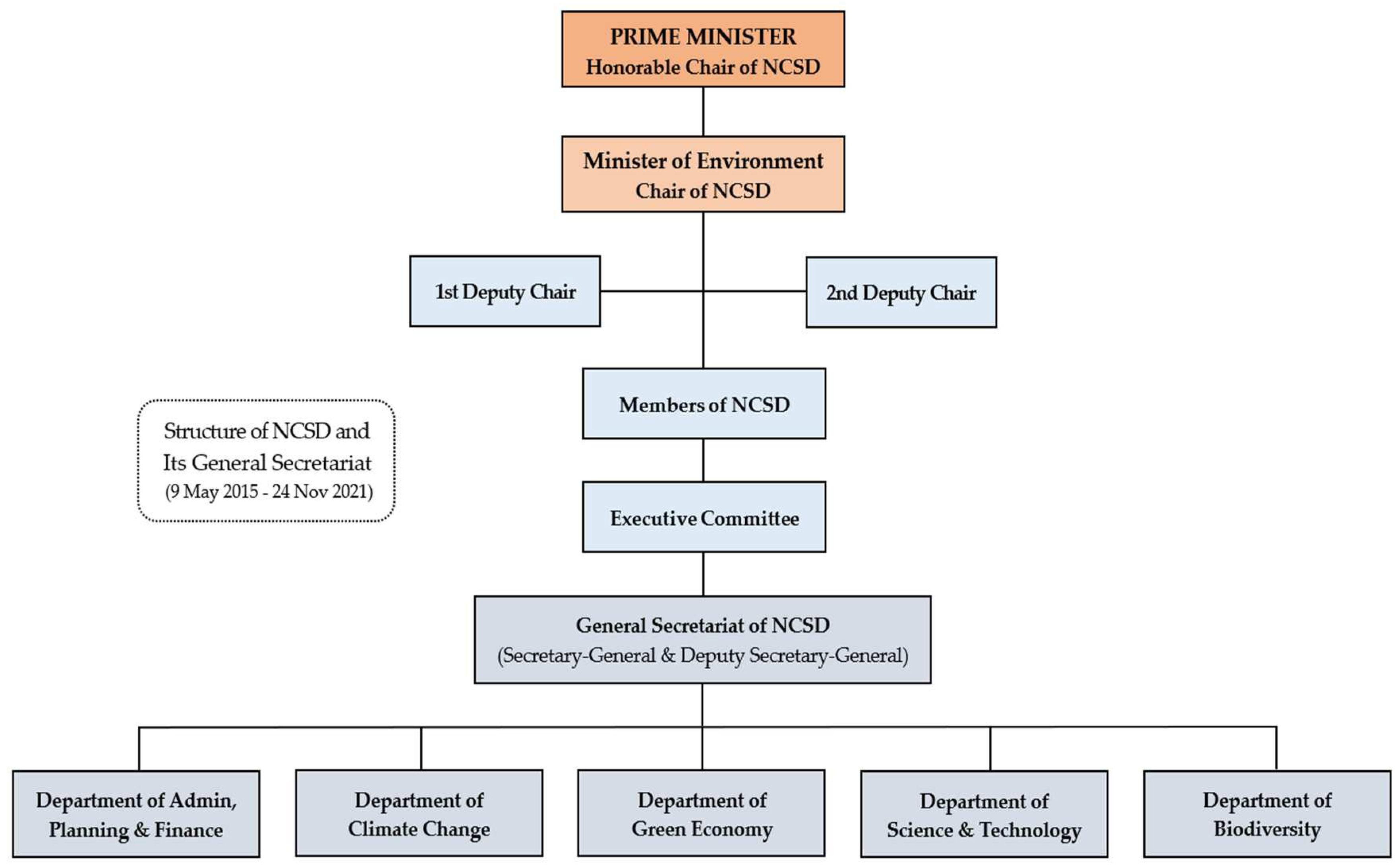
Figure 3.
Organizational structure of Department of Green Economy (DGE). Source: Drawn by the author based on MoE Prakas in 2015 [9].
Figure 3.
Organizational structure of Department of Green Economy (DGE). Source: Drawn by the author based on MoE Prakas in 2015 [9].
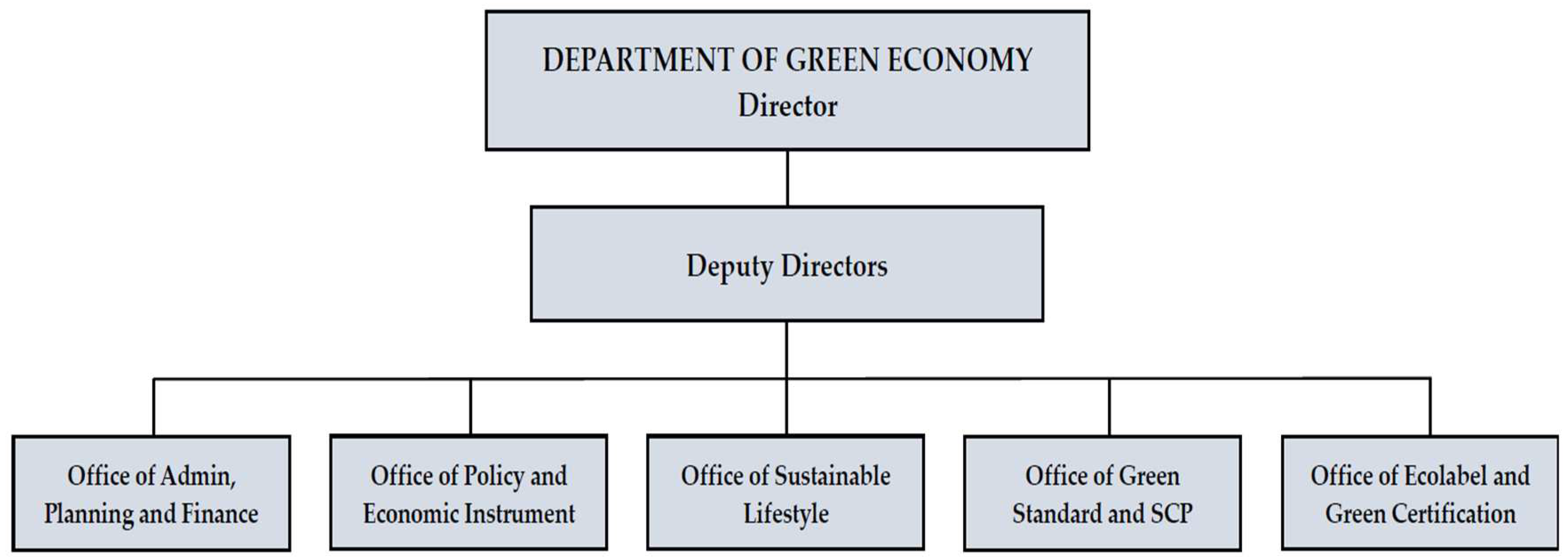
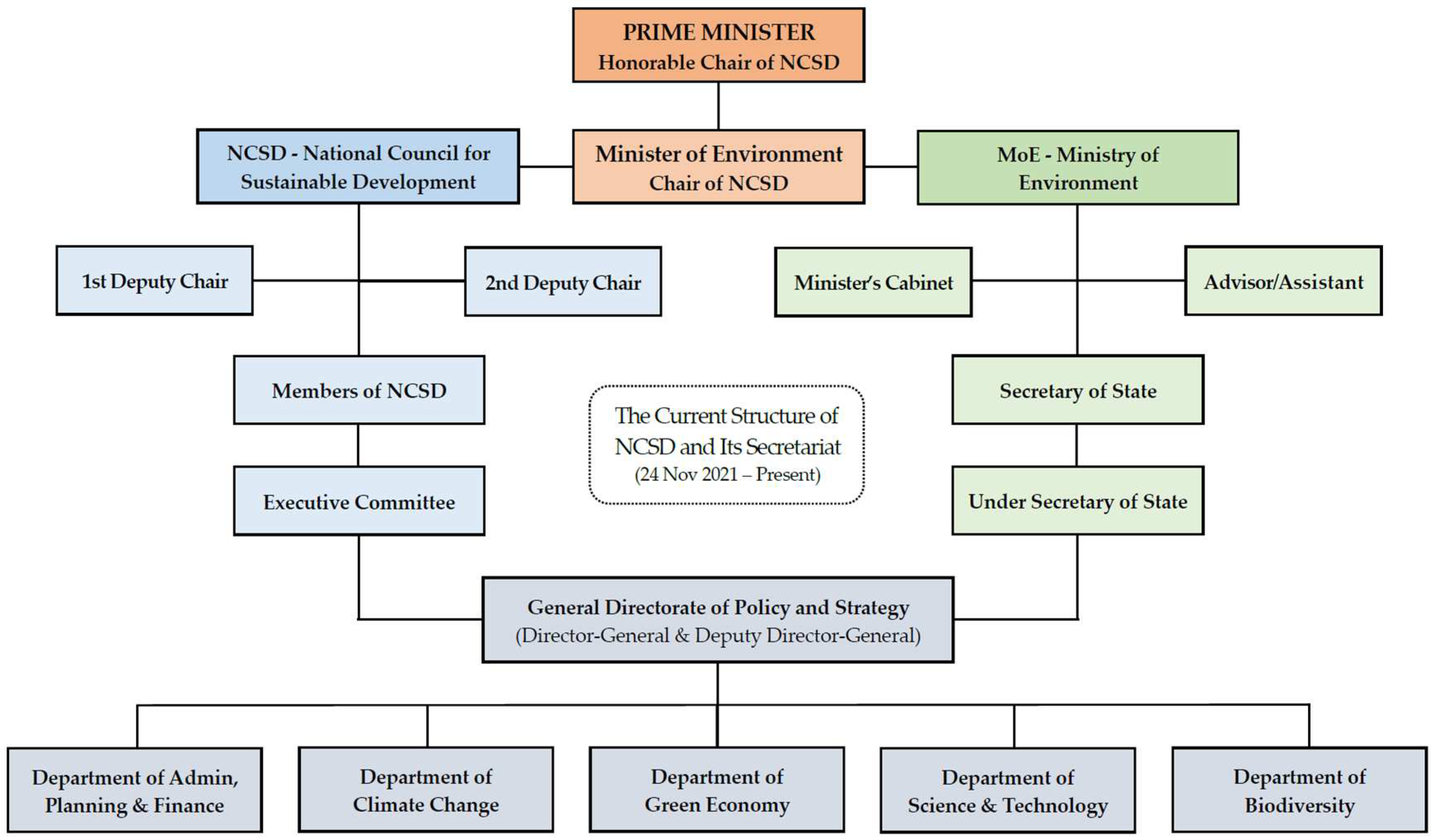
Disclaimer/Publisher’s Note: The statements, opinions and data contained in all publications are solely those of the individual author(s) and contributor(s) and not of MDPI and/or the editor(s). MDPI and/or the editor(s) disclaim responsibility for any injury to people or property resulting from any ideas, methods, instructions or products referred to in the content. |
© 2023 by the authors. Licensee MDPI, Basel, Switzerland. This article is an open access article distributed under the terms and conditions of the Creative Commons Attribution (CC BY) license (http://creativecommons.org/licenses/by/4.0/).
Copyright: This open access article is published under a Creative Commons CC BY 4.0 license, which permit the free download, distribution, and reuse, provided that the author and preprint are cited in any reuse.


