

Submitted:
25 December 2023
Posted:
26 December 2023
You are already at the latest version
Abstract
Genetic engineering and directed evolution are effective methods to address the low yield and poor industrialization level of microbial target products. The current research focus is on how to efficiently and rapidly screen beneficial mutants from constructed large-scale mutation libraries. Traditional screening methods such as plate screening and well plate screening are severely limited in their development and application due to their low efficiency and high costs. In the past decade, microfluidic technology has become an important high-throughput screening technology due to its fast speed, low cost, high automation, and high screening throughput, and it has developed rapidly. Droplet-based microfluidic high-throughput screening has been widely used in various fields such as strain/enzyme activity screening, pathogen detection, single-cell analysis, drug discovery, and chemical synthesis, and has been widely applied in industries such as materials, food, chemicals, textiles, and biomedicine. In particular, in the field of enzyme research, droplet-based microfluidic high-throughput screening has shown excellent performance in discovering enzymes with new functions, improved catalytic efficiency or stability, acid-base tolerance, etc. Currently, droplet-based microfluidic high-throughput screening technology has achieved high-throughput screening of enzymes such as glycosidase, lipase, peroxidase, protease, amylase, oxidase, and transaminase, as well as high-throughput detection of products such as riboflavin, coumarin, 3-dehydroquinate, lactic acid, and ethanol. This article reviews the application of droplet-based microfluidics in high-throughput screening, with a focus on high-throughput screening strategies based on UV, visible, and fluorescence spectroscopy, including labeled optical signal detection screening, as well as label-free electrochemical detection, mass spectrometry, Raman spectroscopy, nuclear magnetic resonance, etc. Furthermore, the research progress and development trends of droplet-based microfluidic technology in enzyme modification and strain screening are also introduced.
Keywords:
droplet-based microfluidics
; high-throughput screening
; ultraviolet spectrum
; visible spectrum
; fluorescence spectrum
1. Introduction
Natural microbial strains and enzymes often require evolution or modification. However, the probability of beneficial mutations is very low (<10-5), and conventional screening efficiency is limited by low screening throughput, resulting in high costs and long times for screening a large number of mutants (1). It is crucial to develop methods for rapid screening of microbial strains and enzyme mutants (2). With the development of automation equipment and rapid detection methods, various high-throughput screening (HTS) strategies have been established. Therefore, HTS strategies have been widely used in the isolation and screening of high-yielding microbial cell factories (3, 4). In the screening of industrial microbes, effective target recognition is a key factor, and high-throughput screening based on ultraviolet, visible, and fluorescence spectra in droplet-based microfluidics can greatly enhance target recognition (5-7).
Microfluidic technology has emerged as a response to the multidisciplinary convergence. It utilizes chemistry, fluid physics, microelectronic materials, nanotechnology, and biotechnology (8). By manipulating small amounts of fluids in channels at the micrometer or nanometer scale, it brings the screening process onto a chip, achieving automation and intelligence (9, 10). Moreover, microfluidics combined with fluorescence-activated cell sorting (FACS) systems equipped with flow cytometers (FC) overcome the limitations of traditional FACS. This integration is known as microfluidic FACS (11). Droplet microfluidics (DM) technology utilizes droplets as microreactor units, performing formation, manipulation, reactions, analysis, and screening operations using microchannels or microstructures. This technology has been widely applied in fields such as drug screening, protein crystallization, evolution, single-cell analysis, enzyme activity detection, and strain screening (12, 13). Its advantage lies in the ability to encapsulate single cells in droplets, where each droplet serves as an independent reaction system capable of culturing cells and producing metabolites or enzymes. This overcomes the limitations of traditional flow cytometry and fluorescence-activated cell sorting, which are restricted to detecting fluorescent signals directly associated with cells (14, 15). Fluorescence-activated droplet sorting (FADS) and absorbance-activated droplet sorting (AADS) are typical droplet microfluidic technologies. Microfluidic high-throughput screening technology involves detection, screening, small molecule reactions, and dynamic process analysis. Similar to the FACS principle, the FADS system has the advantage of being able to sort signals within cells, on cells, secreted outside of cells, and in cell-free systems. Additionally, due to its configuration of high-speed cameras, FADS enables visualization of sorting (14).
Absorption spectroscopy is widely used in colorimetry, protein quantification, enzyme kinetics, and other areas (16). Compared to FADS, the challenge of AADS detection is that absorbance is directly proportional to the path length, which means that the small volume of droplets and the resulting short optical path length will affect the sensitivity of detection (17). However, absorption activated droplet sorting (AADS) is currently approximately 10 times slower than typical fluorescence-activated droplet sorting (FADS), which means that, compared to FADS due to throughput limitations, a larger proportion of the sequence space is not accessible. Elliot et al. (18) has improved AADS in order to achieve a sorting speed of kHz. This is primarily done by using refractive index matching oil and eliminating side scattering to enhance signal quality. Additionally, a sorting algorithm has been implemented to enable sorting at higher frequencies. It has been widely applied in industries such as materials, food, chemical, textile, and biopharmaceuticals (as shown in Figure 1).
Droplet-based microfluidics plays an important role in directed evolution, enzyme activity detection, and strain screening. The throughput of the screening determines the size of the mutant library, thus determining the possibility of screening high-performance enzymes and strains from large mutant libraries. Through oil encapsulation, the adsorption in the flow channel can be reduced. Droplet encapsulation of individual bacteria allows for the synchronized directional evolution of enzymes during the screening process, making it widely applicable in enzyme directed evolution. In 2009, Baret et al. (19) first reported the application of droplet-based microfluidics in high-throughput screening of enzymes, with a screening rate of up to 2000 droplets/s and completing the screening of a library with 108 mutants in only 10 h. In 2014, Wang et al. (20) developed a screening method for yeast strains with xylose consumption ability and E. coli strains for lactate secretion using droplet-based microfluidics. Currently, FADS technology also has some drawbacks, such as the need to develop suitable fluorescent probes based on different enzyme molecules and catalytic reactions. For some enzyme molecules, rare cells, and target analytes that are small molecule drugs, there is a lack of applicable biomarkers and fluorescent probes, which limits its widespread application. To overcome these limitations, other types of droplet sorting technology, such as droplet sorting technology activated by different methods such as absorption, mass, and Raman, have been developed one after another. In 2016, Gielen et al. (21) proposed a droplet screening technology based on absorbance, with a screening rate of 300 droplets/s. High-throughput screening of different types of microorganisms such as E. coli, Bacillus subtilis, Gluconobacter cerinus, yeast, and lactobacillus for endogenous enzymes or metabolic products has been achieved (22-28). This review aims to summarize the screening strategies constructed using ultraviolet, visible, and fluorescence spectroscopy, as well as the applications of these strategies in high-throughput screening using droplet-based microfluidics, particularly in enzyme engineering and strain screening. Table 1 lists the recent applications of droplet-based microfluidics in strain and enzyme screening.
There are a total of 4 layers from the inside to the outside in Figure 1. The first layer represents microfluidic high-throughput screening. The second layer represents main functions of microfluidic high-throughput screening, including dynamic analysis, detection, screening, and small molecule reactions. The third layer represents the specific application fields of microfluidic high-throughput screening, mainly including food, biologic medicine, textile industry, and chemical industry. The fourth layer represents the specific applications of microfluidic high-throughput screening, mainly including chemical synthesis, nanomaterials, single-cell analysis, antibody screening, drug delivery, strain/enzyme screening, enzyme activity detection, and pathogenic bacteria.
2. Detection and screening based on ultraviolet spectroscopy
Generally, the detection of inorganic and organic compounds is based on the Lambert-Beer law, which quantifies the target substance based on the absorption of ultraviolet/visible light due to the structural and color differences of the substance itself. For reactions with specific absorbance, the change in OD value is caused by the substance itself, enzyme-catalyzed reactions, or absorbent reagents in coupled assays. By measuring the absorbance, products with complex molecular structures such as avilamycin (29), cephalosporin C (30), lycopene (31), and ferulic acid (32) can be screened. In high-throughput screening of strains and enzymes, direct quantitative identification of metabolic products can be used to screen for beneficial mutants. Mendoza et al. (33) directly measured metabolites at a wavelength of 272 nm to identify enzyme activity in high-throughput screening of lipases with high sn-2 specificity, and validated the activity with human pancreatic lipase, LIP2 lipase from Candida antarctica, and lipase from Saccharomyces cerevisiae. For substances that do not have obvious absorbance characteristics, detection can be performed by adding pH indicators, metal ion chelators, enzyme reactions, or chemical reaction coupling methods. For example, some metabolites can hydrolyze under acid/alkaline conditions to produce derivatives with specific absorption, form complex compounds with metal ions to generate distinct absorbance features, or generate substances with significant absorbance after substrate enzyme reactions. Ye et al. (34) determined the absorbance of the metabolite cefaclor hydrolyzed to generate derivatives under alkaline conditions at 340 nm, and screened out α-amino acid ester hydrolase with increased activity by 40%. Tian et al. (35) developed a colorimetric method based on the reaction between diacetyl and o-phenylenediamine, with the target compound showing specific absorption at 335 nm, leading to the selection of lactobacillus strains with high diacetyl production. The detection and screening strategy based on ultraviolet spectroscopy is simple and effective, and when combined with a microfluidic droplet system, it becomes an important tool for high-throughput screening. Building on the ability of PMMA material to block stray light interference, Cao et al. (36) proposed the concept of a microfluidic ultraviolet detection system and established an ultraviolet detection-microfluidic chip capillary electrophoresis analysis system. Ottevaere et al. (37) proposed a micro-optical system for ultraviolet/visible light absorption detection in microfluidic channels constructed using optical couplers and characterized samples of coumarin dyes.
3. Detection and screening based on visible light spectrum
The combination of high-throughput screening strategies based on visible light spectrum and droplet microfluidic systems is closely related, mainly used for enzyme activity assay, screening of enzyme variants, and strain selection (38-40). Similar to the UV spectrum screening strategy, the absorbance of the target substance in the visible light range is used as the screening criterion, and it can be divided into direct measurement, addition of pH indicators, addition of metal ion chelating agents, and enzyme-catalyzed reactions. Gielen et al. (41) established a coupled droplet microfluidic system for enzyme-directed evolution by embedding optical fibers in the droplet channel. They conducted miniaturized coupled analysis of NAD+-dependent amino acid dehydrogenase and successfully enriched the phenylalanine dehydrogenase activity variant by 2800-fold and identified a mutant with 4.5 times increased activity in the lysate. Maceiczyk et al. (40) developed a droplet microfluidic system using differential detection opto-thermal interferometry. The substance resulting from the reaction of β-galactosidase with a specific substrate has high absorbance, enabling high-throughput detection of enzyme activity. Ahmadi et al. (39) were the first to integrate a droplet-digital microfluidic system that can utilize both fluorescence signals and absorbance for screening. Yeast can be characterized by directly detecting absorbance at 595 nm to determine its growth status. Using this system, they studied the growth of mutant variants and wild types in an ionic liquid and successfully screened out mutants with excellent growth properties.
4. Detection and screening based on fluorescence spectroscopy
4.1. Detection and screening based on conventional strategies of fluorescence spectroscopy
Fluorescence analysis has the advantages of high selectivity, sensitivity, and easy integration with chips, making it the most widely used detection method in droplet microfluidic analysis, promoting the development of research fields such as genomics, molecular biology, and synthetic biology. Currently, various industrial microorganisms and enzymes have been screened using fluorescence spectroscopy-based screening strategies. By relying on the specific fluorescence signals of substrates or metabolites, direct screening can be conducted. Wagner et al. (42) screened for yeast strains with increased riboflavin production by correlating the secretion level of riboflavin with its yield. The target can emit fluorescence signals by adding fluorescent dyes or metal ion chelators. Kim et al. (43) screened for highly productive microalgae strains by directly measuring chlorophyll content and further increased lipid production by staining lipids using a dye, resulting in a 2.75-fold increase. Choi et al. (44) integrated ethidium bromide into a droplet-based microfluidic system, allowing high fluorescence signal emission from intact RNA substrates and low fluorescence signal when the RNA is degraded. This method enables nanoscale detection of ribonuclease hydrolytic activity.
The majority of screening based on fluorescence spectroscopy relies on enzyme reactions. For direct screening using endogenous enzymes, fluorescence substrates serve as sensitive means to detect enzyme activity, as they do not possess significant fluorescence signals themselves, but the enzymatic reaction products exhibit strong fluorescence signals. Based on the change in fluorescence intensity before and after the reaction, enzyme activity can be quantitatively analyzed (Figure 2A). Currently, there are various commercially available fluorescence substrates for enzyme activity detection, including glycosidases (45), lipases (46), proteases (47), peroxidases (48), and so on. β-Glucosidase can cleave the cellulose disaccharide formed by the endoglucanase hydrolysis of cellulose. It can be used in industry for the hydrolysis of cellulose and lactose (49, 50). Hardiman et al. (45) encapsulated the entire cell with enzyme substrates using random drift mutagenesis technique to create and screen a library of β-glucosidase mutants. Protease is an important enzyme in industry. Although many microorganisms are used for producing protease, only a few proteases are commercially applied and usually require extensive protein engineering, especially directed evolution. Tu et al. (47) were the first to use flow cytometry to screen protease and analyze its resistance improvement. In addition, it was found that the targeted evolution of protease can enhance its thermal stability and resistance to antioxidants. Ma et al. (46) developed a microfluidic chip to prepare homogeneous in vitro compartmentalized enzyme microreactors. They used high-throughput screening with fluorescent substrates to identify E. coli strains with esterase activity and performed directed evolution on the thermostable esterase AFEST, resulting in mutants with more than 2-fold improvement in catalytic efficiency. Agresti et al. (48) utilized a high-throughput screening platform based on droplet microfluidics and obtained peroxidase mutants with catalytic efficiency improved by more than 10-fold. Huebner et al. (51) encapsulated individual E. coli cells with the substrate 3-O-methylfluorescein phosphate in droplets to screen for highly active target enzymes.
Förster resonance energy transfer (FRET) is a special part of the enzymatic reaction strategy. After the substrate is catalyzed, the fluorescence is activated, and this substrate is usually used as a fluorescent probe. Varadarajan et al. (52) designed fluorescence probes and obtained peptide cleaving enzymes with high selectivity and high catalytic efficiency (Kcat/Km > 104 M-1s-1). Mizukami et al. (53) achieved specific fluorescence protein labeling screening by covalent modification of hydrolytic enzymes using designed fluorescence probes. Yang et al. (54) designed various FRET substrates and developed a high-throughput fluorescence screening method for lipases and esterases under alkaline conditions (pH 11.0). This method improved the sensitivity of fluorescence signals and allowed for dynamic analysis of enzyme activity.
For methods that involve detecting and screening through non-enzymatic metabolism of small molecules, it has been observed that many important small molecule metabolites cannot be directly detected through fluorescence, which becomes a bottleneck issue when using droplet microfluidic systems for metabolic pathway and microbial strain screening. The utilization of enzyme-coupled reaction strategies can indirectly convert these small molecules into fluorescent signals, providing an effective approach to address this issue (Figure 2B). A typical strategy involves the use of specific oxidoreductases for the target metabolite, which catalyze the oxidation reactions of the target metabolite to generate either H2O2 or NADH. These generated species are then converted into fluorescence signals by corresponding coupled enzymes and fluorescence probes, enabling the fluorescence coupling of the target metabolite. Currently, enzyme-coupled strategies have been employed for the quantitative detection of various metabolites such as lactate (55), ethanol (56), xylose (20), glucose (57), among others. Hammar et al. (55) utilized lactate dehydrogenase to oxidize lactate into pyruvate and simultaneously convert NAD+ to NADH. The NADH was then converted into a fluorescence signal by an NADH fluorescence coloring kit, enabling high-throughput single-cell screening of lactate-producing bacteria. Abalde-Cela et al. (56) established a microfluidic platform for quantitative detection of ethanol, using ethanol oxidase to produce H2O2 and coupling it with a fluorescence signal. This platform was used for screening high-yield ethanol-producing cyanobacterial strains. Ostafe et al. (57) developed a detection technique for cellulase activity through multi-enzyme fluorescence coupling using microfluidic sorting. This technique concentrated active cells 300-fold with a purity exceeding 90%. With the discovery and utilization of more specific oxidoreductases, this strategy has the potential to expand to the quantitative analysis of various metabolites such as sugars, amino acids, lipids, and hormones, providing an effective screening approach for various important metabolic pathways and strain-directed evolution.
4.2. Detection and screening based on fluorescence spectroscopy using biosensors
Due to the limitations of direct or indirect staining or fluorescence reactions for the detection and screening of target products or key intermediates, high-throughput screening (HTS) of microorganisms is often challenging. As a complementary and alternative approach, screening strategies using microbial genetic regulatory mechanisms to sense metabolic products have been proposed (58). There are generally two types of biosensors: protein-based biosensors and nucleic acid-based biosensors. Most protein-based biosensors are based on transcription factors (TFs) and engineered fluorescent proteins (FPs). Sun et al. (59) divide transcription factor sensors into two categories: endogenous transcription factor biosensors and whole-cell transcription factor biosensors. Various types of TF-based biosensors have been developed, capable of responding to different types of effectors. These biosensors have been widely used in HTS of metabolic products, including amino acids, organic acids, flavonoids, sugars, and lipids (60, 61) (Figure 2C). Tu et al. (62) utilized TF-based biosensors to respond to 3-dehydroquinate and established a biosensor-based FADS screening strategy, resulting in the identification of mutant strains with a 24% increase in 3-dehydroquinate production. Siedler et al. (61) developed biosensors for two types of flavonoids and their metabolic intermediates, using the transcriptional activator FdeR from H. seropedicae and the repressor protein QdoR from B. subtilis, which respectively responded to naringenin and catechol. This enhanced the fluorescence signal of the fluorescent protein system by 7-fold.
Nucleic acid-based biosensors mainly include RNA riboswitches, RNA spinach (63, 64), and structure-switching DNA biosensors (63, 65). RNA riboswitches targeting mRNA regulatory regions can detect various metabolites through RNA aptamer region, thereby regulating the transcription and translation of encoded proteins. Cheng et al. (66) used the competitive nature of arginine between arginase and arginine inhibitor to inhibit the expression of eGFP, a molecular sensor, and screened for arginine deimination enzyme mutants with increased activity and substrate affinity. With the rise and development of cell-free synthesis, researchers have found that the traditional genetic characteristics modified and optimized in active cells are no longer applicable to cell-free systems (67, 68). For example, when transcription factors are used in cell-free systems, they can cause self-transcription effects, response time delays, and increased translation burden. Ribosome switches have significant advantages, and their construction and screening are particularly important, with a close connection to high-throughput screening using droplet microfluidics (69, 70). Tabuchi et al. (71) were the first to use a droplet microfluidic system to screen for cell-free riboswitches and successfully obtained two types of ribosome switches for histamine, where histamine can either open or close the ribosome switch. RNA Spinach is a newly discovered special structure that produces a stable signal when combined with fluorescent groups. Based on RNA Spinach, biosensors called RNA "drop-in oligonucleotide adaptors" have been developed for the detection of metabolites (Figure 2D). Structure-switching DNA biosensors are commonly used for high-throughput screening of DNA-modifying enzymes. Vallejo et al. (72) established a droplet microfluidic high-throughput screening system for enzyme-directed evolution by adding fluorescent molecules and quenchers to the DNA strand. The screening frequency for enzymes involved in the synthesis and modification of artificial genetic polymers reached 108/h.
In the screening system of droplet microfluidics, microdroplets of picoliter (pL) volume as reactors are used to encapsulate enzyme genes, artificially constructed metabolic pathways, gene expression products, etc., which are coloured using specific fluorescent probes (Figure 2 top row). Microfluidic detection/sorting chip for efficient analysis and sorting of these microdroplets (Figure 2 bottom row). Figure 2A: Screening based on fluorescence spectroscopy is dependent on enzyme reactions. The enzymatic reaction products have a strong fluorescent signal, which is used to quantify the enzyme activity based on the change in fluorescence intensity before and after the reaction (45). Figure 2B: Small molecules can be indirectly converted to fluorescent signals using an enzyme coupling reaction strategy (56). Figure 2C: Assay screening based on transcription factors (TFs) (61). TFs-based biosensors, which can respond to different types of effectors, are widely used for HTS of metabolites, including amino acids, organic acids, flavonoids, sugars and lipids. Figure 2D: Biosensors based on RNA Spinach (53). RNA Spinach is a newly discovered special structure that generates stable signals when combined with fluorescent groups.
5. Detection screening based on other technologies
As the potential of droplet microfluidic high-throughput screening technology is being explored, researchers have applied it to the screening of more targets. However, they have discovered that some target screenings require the establishment of complex coupling reactions, which may not achieve simplicity and efficiency. Additionally, some target molecules are unable to generate detectable signals. In order to address these issues, label-free detection strategies associated with other detection methods have been established. These methods involve using intrinsic physical or chemical biomarkers for sorting (73). This includes electrochemical detection (74), mass spectrometry (75), Raman spectroscopy, nuclear magnetic resonance (73), Fourier transform infrared spectroscopy (FTIR), and Fourier transform near-infrared spectroscopy (FTNIR) (76).
Mass spectrometry is not only used for qualitative and quantitative analysis based on the charge-to-mass ratio of the detected substances but can also detect various fragmented substances. This has attracted researchers to combine it with droplet microfluidic technology. However, there are significant barriers between microfluidics and electrospray ionization mass spectrometry. Similar to capillary electrophoresis, the main barrier lies in the interference of surfactants in the electrospray process, which can significantly inhibit ionization efficiency and contaminate the mass spectrometer (79). Surfactants are essential in droplet-based microfluidic systems. They facilitate droplet formation, stabilize droplets, and provide a more important role in creating a biocompatible environment for reactions within the droplets. Therefore, it is necessary to design and synthesize compatible novel surfactants (80). Heinemann et al. (81) combined the nanoscale initiator mass spectrometry technique with droplet microfluidics to achieve real-time monitoring of extracellular glycosidase activity. Holland-Moritz et al. (82) used Mass Activated Droplet Sorting (MADS) with an accuracy of 98% to screen nanoscale transaminase enzyme-catalyzed reactions. However, the throughput was only 2500 droplets/h, which was 1000 times slower than FADS. Nevertheless, this is still significantly more efficient than traditional screening and HPLC-MS methods.
Raman spectroscopy is a detection method that relies on the Raman effect, offering advantages such as rapid and real-time analysis. The discovery of surface-enhanced Raman scattering (SERS) has significantly enhanced the sensitivity of Raman detection. Research has shown that droplet microfluidic technology can effectively overcome the limitations of SERS. Willner et al. (83) demonstrated the potential of SERS combined with microfluidics in high-throughput screening through single-cell analysis. Wang et al. (84) utilized Raman-activated droplet sorting (pDEP-RADS) based on positive dielectrophoresis to perform high-throughput screening of a yeast library of diacylglycerol acyltransferase, leading to the discovery of two unknown enzymes. In addition to Raman spectroscopy, Fourier-transform infrared spectroscopy (FTIR) and Fourier-transform near-infrared spectroscopy (FTNIR) are also representative label-free spectral detection methods. Currently, only a few researchers have combined them with droplet microfluidic technology, and there have been no notable achievements in the screening of strains or enzymes. However, due to the non-destructive nature, rapid automation, and other advantages of FTIR and FTNIR, their combination with high automation capabilities of droplet microfluidic chips demonstrates significant potential (11).
Nuclear magnetic resonance (NMR) is a technique for directly analyzing the structure of compounds, and its greatest advantage is its completely non-invasive nature. However, combining NMR with droplet microfluidics is more challenging due to several technical barriers. Unlike fluorescence, NMR detection is based on the principle of magnetic field detection, which requires a high level of uniformity and stability in the droplet samples. The sensitivity of conventional NMR is still insufficient for the microliter to picoliter-sized samples generated by droplet microfluidic chips (85). Swyer et al. (86) developed a method for analyzing chemical reactions using digital microfluidic chips in a high magnetic field environment, which addressed the issue of sample uniformity. This method allowed for the detection of the xylose-borate complexation and the catalytic process of glucose oxidase. Hale et al. (87) discovered that by utilizing structural homogenization and europium-based compounds, they could reduce the magnetic differences between the chip, oil phase, and liquid phase, resulting in improved sample uniformity.
6. Conclusion
In recent years, droplet microfluidics has gradually moved from the field of chemistry to biology. With the advancement of droplet microfluidic technology and the creation of various detection strategies, an important step has been taken towards the discovery of strains/enzymes with new or improved functions. Especially in the development of synthetic biology, the detection of natural bioactive compounds, directed evolution of strains/enzymes, and screening and identification of enzyme semi-rational or rational designs are intricately intertwined with droplet microfluidics. With its advantages of low cost, speed, high automation, and detection sensitivity, it has replaced traditional well plate screening and regular flow cytometry, becoming the preferred high-throughput screening technology in the field of synthetic biology.
Among the high-throughput screening strategies based on UV, visible, and fluorescence spectra, fluorescence detection strategy has the widest application and is the most mature, serving as a crucial means for industrialization and commercialization of strain/enzyme screening. UV-visible light detection is known for its simplicity but has limitations and limited applications. Biosensors are an important branch of fluorescence detection. Their essence lies in enhancing fluorescence intensity or overcoming the difficulties of generating fluorescence signals, thus compensating for the shortcomings of conventional strategies. Other label-free detection strategies provide effective supplements to optical detection, such as electrochemistry, mass spectrometry, nuclear magnetic resonance, etc.
Enzymes are the most important biocatalysts in nature and have been applied in various fields after thousands of years of natural evolution. However, natural enzymes often cannot meet the requirements of industry, making artificial selection and screening increasingly important. Directed evolution has been a key strategy for generating enzymes with desired characteristics such as high selectivity, but experimental barriers and the cost of analyzing large mutant libraries have limited these efforts. However, the biggest problem faced by directed evolution is that traditional microplate screening methods cannot meet the demands of high-capacity library screening. Meanwhile, the industrial and pharmaceutical sectors continue to have a fast-growing demand for novel and improved microbial catalysts. Therefore, directed evolution of enzymes and the discovery of new enzymes have directly benefited from the development of droplet microfluidics, which provide individual reaction environments and larger screening capacities for enzyme reactions. Enzymes that may require directed evolution in the future include esterases, cellulases, glucose dehydrogenases, and plastic-degrading enzymes. Carboxylesterases, for example, are detoxifying enzymes that can hydrolyze cocaine, chlorpyrifos, and other compounds. Cellulases find applications in the food and beverage industry where they can hydrolyze cell walls and lignocellulosic substrates. Glucose dehydrogenase converts glucose into gluconic acid. Plastic waste management has been one of the major ecological challenges in our society, and plastic-degrading enzymes can offer a solution to this problem. With the development of more new technologies, such as artificial intelligence and bioprinting, they will also provide more applications for microfluidic sorting devices.
Author Contributions
Writing—original draft preparation, S.H., B.W. and Q.L.; writing—review and editing, R.Z., J.Z. and J.C.; visualization, J.C.; supervision, J.C.; project administration, J.C. and J.Z.; funding acquisition, J.C. and J.Z. All authors have read and agreed to the published version of the manuscript.
Funding
This work was supported by the National Natural Science Foundation of China (22108017), the Natural Science Foundation of Sichuan Province (2022NSFSC1614), and partially supported by Solid-state Brewing Technology Innovation Center of Sichuan.
Institutional Review Board Statement
Not applicable.
Informed Consent Statement
Not applicable.
Data Availability Statement
Not applicable.
Acknowledgments
We thank Prof. Suyi Zhang from Luzhou Laojiao Co., Ltd. for his assistance in providing revision suggestions for this manuscript.
Conflicts of Interest
The authors declare no conflicts of interest.
References
- Moragues T, Arguijo D, Beneyton T, Modavi C, Simutis K, Abate AR, et al. Droplet-based microfluidics. Nature Reviews Methods Primers. 2023, 3, 32. [Google Scholar] [CrossRef]
- Chiu, F.; Stavrakis, S. High-throughput droplet-based microfluidics for directed evolution of enzymes. Electrophoresis. 2019, 40. [Google Scholar] [CrossRef] [PubMed]
- Jiang, J.; Yang, G.; Ma, F. Fluorescence coupling strategies in fluorescence-activated droplet sorting (FADS) for ultrahigh-throughput screening of enzymes, metabolites, and antibodies. Biotechnology advances. 2023, 66, 108173. [Google Scholar] [CrossRef] [PubMed]
- Muretta JM, Rajasekaran D, Blat Y, Little S, Myers M, Nair C, et al. HTS driven by fluorescence lifetime detection of FRET identifies activators and inhibitors of cardiac myosin. SLAS discovery : advancing life sciences R & D. 2023, 28, 223–232. [Google Scholar] [CrossRef]
- Sesen, M.; Alan, T.; Neild, A. Droplet control technologies for microfluidic high throughput screening (μHTS). Lab on a chip. 2017, 17, 2372–2394. [Google Scholar] [CrossRef] [PubMed]
- Rao C, Huisman DH, Vieira HM, Frodyma DE, Neilsen BK, Chakraborty B, et al. A Gene Expression High-Throughput Screen (GE-HTS) for Coordinated Detection of Functionally Similar Effectors in Cancer. Cancers. 2020, 12. [Google Scholar] [CrossRef]
- Yang D, Yu Z, Zheng M, Yang W, Liu Z, Zhou J, et al. Artificial intelligence-accelerated high-throughput screening of antibiotic combinations on a microfluidic combinatorial droplet system. Lab on a chip. 2023, 23, 3961–3977. [Google Scholar] [CrossRef]
- Sackmann, E.K.; Fulton, A.L.; Beebe, D.J. The present and future role of microfluidics in biomedical research. Nature. 2014, 507, 181–189. [Google Scholar] [CrossRef]
- Miansari, M.; Friend, J.R. Acoustic Nanofluidics via Room-Temperature Lithium Niobate Bonding: A Platform for Actuation and Manipulation of Nanoconfined Fluids and Particles. Advanced Functional Materials. 2016, 26. [Google Scholar] [CrossRef]
- Zhang, B.; wu, W.; Zhao, Q.; Yan, S. Geometric optimization of double layered microchannel with grooves array for enabling nanoparticle manipulation. Physics of Fluids. 2023, 35, 062009. [Google Scholar] [CrossRef]
- Zeng, W.; Guo, L.; Xu, S.; Chen, J.; Zhou, J. High-Throughput Screening Technology in Industrial Biotechnology. Trends in biotechnology. 2020, 38, 888–906. [Google Scholar] [CrossRef] [PubMed]
- Chou, W.-L.; Lee, P.-Y.; Yang, C.-L.; Huang, W.-Y.; Lin, Y.-S. Recent Advances in Applications of Droplet Microfluidics. Micromachines. 2015, 6, 1249–1271. [Google Scholar] [CrossRef]
- Amirifar L, Besanjideh M, Nasiri R, Shamloo A, Nasrollahi F, de Barros NR, et al. Droplet-based microfluidics in biomedical applications. Biofabrication. 2022, 14. [Google Scholar] [CrossRef]
- Weitong, Q.; Guangyu, Y. Research and application progress of microdroplets high throughput screening methods. synthetic biology. 2023, 4, 966–979. [Google Scholar] [CrossRef]
- Sun G, Qu L, Azi F, Liu Y, Li J, Lv X, et al. Recent progress in high-throughput droplet screening and sorting for bioanalysis. Biosensors & bioelectronics. 2023, 225, 115107. [Google Scholar] [CrossRef]
- Hansen, S.K.; Jamali, B.; Hubbuch, J. Selective high throughput protein quantification based on UV absorption spectra. Biotechnology and bioengineering. 2013, 110, 448–460. [Google Scholar] [CrossRef] [PubMed]
- Duncombe TA, Ponti A, Seebeck FP, Dittrich PS. UV-Vis Spectra-Activated Droplet Sorting for Label-Free Chemical Identification and Collection of Droplets. Analytical chemistry. 2021, 93, 13008–13013. [Google Scholar] [CrossRef] [PubMed]
- Medcalf, E.J.; Gantz, M.; Kaminski, T.S.; Hollfelder, F. Ultra-High-Throughput Absorbance-Activated Droplet Sorting for Enzyme Screening at Kilohertz Frequencies. Analytical chemistry. 2023, 95, 4597–4604. [Google Scholar] [CrossRef]
- Baret JC, Miller OJ, Taly V, Ryckelynck M, El-Harrak A, Frenz L, et al. Fluorescence-activated droplet sorting (FADS): efficient microfluidic cell sorting based on enzymatic activity. Lab on a chip. 2009, 9, 1850–1858. [Google Scholar] [CrossRef]
- Wang BL, Ghaderi A, Zhou H, Agresti J, Weitz DA, Fink GR, et al. Microfluidic high-throughput culturing of single cells for selection based on extracellular metabolite production or consumption. Nature biotechnology. 2014, 32, 473–478. [Google Scholar] [CrossRef]
- Gielen, F.; Hours, R.; Emond, S.; Fischlechner, M.; Schell, U.; Hollfelder, F. Ultrahigh-throughput–directed enzyme evolution by absorbance-activated droplet sorting (AADS). Proceedings of the National Academy of Sciences. 2016, 113, E7383–E7389. [Google Scholar] [CrossRef]
- Chen J, Vestergaard M, Jensen TG, Shen J, Dufva M, Solem C, et al. Finding the Needle in the Haystack-the Use of Microfluidic Droplet Technology to Identify Vitamin-Secreting Lactic Acid Bacteria. mBio. 2017, 8. [Google Scholar] [CrossRef]
- Beneyton, T.; Thomas, S.; Griffiths, A.D.; Nicaud, J.M.; Drevelle, A.; Rossignol, T. Droplet-based microfluidic high-throughput screening of heterologous enzymes secreted by the yeast Yarrowia lipolytica. Microbial cell factories. 2017, 16, 18. [Google Scholar] [CrossRef] [PubMed]
- Chen J, Vestergaard M, Jensen T, Shen J, Dufva M, Solem C, et al. Finding the Needle in the Haystack—the Use of Microfluidic Droplet Technology to Identify Vitamin-Secreting Lactic Acid Bacteria. mBio. 2017, 8, e00526–17. [Google Scholar] [CrossRef]
- Abatemarco J, Sarhan MF, Wagner JM, Lin JL, Liu L, Hassouneh W, et al. RNA-aptamers-in-droplets (RAPID) high-throughput screening for secretory phenotypes. Nature communications. 2017, 8, 332. [Google Scholar] [CrossRef] [PubMed]
- Jankowski, P.; Samborski, A.; Ostaszewski, R.; Garstecki, P. Evaluation of droplet-based microfluidic platforms as a convenient tool for lipases and esterases assays. Preparative biochemistry & biotechnology. 2019, 49, 727–734. [Google Scholar] [CrossRef]
- Terekhov SS, Smirnov IV, Malakhova MV, Samoilov AE, Manolov AI, Nazarov AS, et al. Ultrahigh-throughput functional profiling of microbiota communities. Proceedings of the National Academy of Sciences of the United States of America. 2018, 115, 9551–9556. [Google Scholar] [CrossRef]
- Lyu F, Pan M, Patil S, Wang J-H, Matin AC, Andrews JR, et al. Phenotyping antibiotic resistance with single-cell resolution for the detection of heteroresistance. Sensors and Actuators B: Chemical. 2018, 270, 396–404. [Google Scholar] [CrossRef]
- Cao, X.; Luo, Z.; Zeng, W.; Xu, S.; Zhao, L.; Zhou, J. Enhanced avermectin production by Streptomyces avermitilis ATCC 31267 using high-throughput screening aided by fluorescence-activated cell sorting. Applied Microbiology and Biotechnology. 2018, 102, 703–712. [Google Scholar] [CrossRef]
- Zhang, W.; Fu, J.; Wang, Y.; Zhang, X.; Li, J. Enhanced visible-light photocatalytic activity of ZnS/BiOBr/graphene oxide ternary composite. Journal of Physics and Chemistry of Solids. 2019, 127, 19–27. [Google Scholar] [CrossRef]
- Qiang W, Ling-ran F, Luo W, Han-guang L, Lin W, Ya Z, et al. Mutation Breeding of Lycopene-Producing Strain Blakeslea Trispora by a Novel Atmospheric and Room Temperature Plasma (ARTP). Applied Biochemistry and Biotechnology. 2014, 174, 452–460. [Google Scholar] [CrossRef]
- Zhou, S.; Liu, P.; Chen, J.; Du, G.; Li, H.; Zhou, J. Characterization of mutants of a tyrosine ammonia-lyase from Rhodotorula glutinis. Appl Microbiol Biotechnol. 2016, 100, 10443–10452. [Google Scholar] [CrossRef]
- Mendoza LD, Rodriguez JA, Leclaire J, Buono G, Fotiadu F, Carrière F, et al. An ultraviolet spectrophotometric assay for the screening of sn-2-specific lipases using 1,3-O-dioleoyl-2-O-α-eleostearoyl-sn-glycerol as substrate. Journal of lipid research. 2012, 53, 185–194. [Google Scholar] [CrossRef]
- Ye Lijuan, Wang Jiamin, Wang Lu, Cao Yi. Cell-based high throughput screening of a-amino acid ester hydrolase variants. Microbiology. 2011, 39, 0264–0271. [Google Scholar]
- Tian, H.; Yu, B.; Ai, L.; Yu, H.; Chen, C. A high-throughput system for screening high diacetyl-producing lactic acid bacteria in fermented milk in 96-well microplates. Journal of Food Measurement and Characterization. 2020, 14, 548–556. [Google Scholar] [CrossRef]
- Xiaodan, C.; Qun, F.; Zhaolun, F. Ultraviolet detection capillary electrophoresis system based on composite microfluidic chip. 2004, 25, 1231–1234. 2004, 25, 1231–1234. [Google Scholar]
- Ottevaere H, Van Overmeire S, Albero J, Nieradko L, Desmet G, Gorecki C, et al. Plastic light coupler for absorbance detection in silicon microfluidic channels. Microfluidics and Nanofluidics. 2015, 18, 559–568. [Google Scholar] [CrossRef]
- Hassan, S.U.; Nightingale, A.M.; Niu, X. Micromachined optical flow cell for sensitive measurement of droplets in tubing. Biomedical microdevices. 2018, 20, 92. [Google Scholar] [CrossRef] [PubMed]
- Ahmadi, F.; Samlali, K.; Vo, P.Q.N.; Shih, S.C.C. An integrated droplet-digital microfluidic system for on-demand droplet creation, mixing, incubation, and sorting. Lab on a chip. 2019, 19, 524–535. [Google Scholar] [CrossRef]
- Maceiczyk, R.M.; Hess, D.; Chiu, F.W.Y.; Stavrakis, S.; deMello, A.J. Differential detection photothermal spectroscopy: towards ultra-fast and sensitive label-free detection in picoliter & femtoliter droplets. Lab on a chip. 2017, 17, 3654–3663. [Google Scholar] [CrossRef] [PubMed]
- Gielen, F.; Hours, R.; Emond, S.; Fischlechner, M.; Schell, U.; Hollfelder, F. Ultrahigh-throughput–directed enzyme evolution by absorbance-activated droplet sorting (AADS). Proceedings of the National Academy of Sciences 2016, 113, E7383–E7389. [Google Scholar] [CrossRef]
- Wagner, J.; Liu, L.; Yuan, S.-F.; Venkataraman, M.; Abate, A.; Alper, H. A comparative analysis of single cell and droplet-based FACS for improving production phenotypes: Riboflavin overproduction in Yarrowia lipolytica. Metabolic Engineering. 2018, 47. [Google Scholar] [CrossRef]
- Kim HS, Hsu S-C, Han SI, Thapa HR, Guzman A, Browne DR, et al. High-throughput droplet microfluidics screening platform for selecting fast-growing and high lipid-producing microalgae from a mutant library. 2017, 1. [CrossRef]
- Choi JW, Vasamsetti BMK, Kim KW, Seo SH, Lee DH, Chang SI, et al. Analysis of ribonuclease activity in sub-nanoliter droplets by label-free fluorescence measurements. The Analyst. 2017, 142, 2610–2616. [Google Scholar] [CrossRef] [PubMed]
- Hardiman, E.; Gibbs, M.; Reeves, R.; Bergquist, P. Directed Evolution of a Thermophilic β-glucosidase for Cellulosic Bioethanol Production. Applied Biochemistry and Biotechnology. 2010, 161, 301–312. [Google Scholar] [CrossRef] [PubMed]
- Ma, F.; Xie, Y.; Huang, C.; Feng, Y.; Yang, G. An Improved Single Cell Ultrahigh Throughput Screening Method Based on In Vitro Compartmentalization. PloS one. 2014, 9, e89785. [Google Scholar] [CrossRef] [PubMed]
- Tu, R.; Martinez, R.; Prodanovic, R.; Klein, M.; Schwaneberg, U. A Flow Cytometry–Based Screening System for Directed Evolution of Proteases. SLAS Discovery. 2011, 16, 285–294. [Google Scholar] [CrossRef] [PubMed]
- Agresti JJ, Antipov E, Abate AR, Ahn K, Rowat AC, Baret JC, et al. Ultrahigh-throughput screening in drop-based microfluidics for directed evolution. Proceedings of the National Academy of Sciences of the United States of America. 2010, 107, 4004–4009. [Google Scholar] [CrossRef]
- Turner, P.; Mamo, G.; Karlsson, E.N. Potential and utilization of thermophiles and thermostable enzymes in biorefining. Microbial cell factories. 2007, 6, 9. [Google Scholar] [CrossRef] [PubMed]
- Nakkharat, P.; Haltrich, D. Purification and characterisation of an intracellular enzyme with beta-glucosidase and beta-galactosidase activity from the thermophilic fungus Talaromyces thermophilus CBS 236. 58. Journal of biotechnology. 2006, 123, 304–313. [Google Scholar] [CrossRef]
- Huebner A, Olguin LF, Bratton D, Whyte G, Huck WT, de Mello AJ, et al. Development of quantitative cell-based enzyme assays in microdroplets. Analytical chemistry. 2008, 80, 3890–3896. [Google Scholar] [CrossRef]
- Varadarajan, N.; Rodriguez, S.; Hwang, B.Y.; Georgiou, G.; Iverson, B.L. Highly active and selective endopeptidases with programmed substrate specificities. Nature chemical biology. 2008, 4, 290–294. [Google Scholar] [CrossRef]
- Mizukami, S.; Watanabe, S.; Hori, Y.; Kikuchi, K. Covalent protein labeling based on noncatalytic beta-lactamase and a designed FRET substrate. Journal of the American Chemical Society. 2009, 131, 5016–5017. [Google Scholar] [CrossRef] [PubMed]
- Yang, Y.; Babiak, P.; Reymond, J.-L. Low background FRET-substrates for lipases and esterases suitable for high-throughput screening under basic (pH 11) conditions. Organic & Biomolecular Chemistry. 2006, 4, 1746–1754. [Google Scholar] [CrossRef]
- Hammar P, Angermayr SA, Sjostrom SL, van der Meer J, Hellingwerf KJ, Hudson EP, et al. Single-cell screening of photosynthetic growth and lactate production by cyanobacteria. Biotechnology for biofuels. 2015, 8, 193. [Google Scholar] [CrossRef]
- Abalde-Cela, S.; Gould, A.; Liu, X.; Kazamia, E.; Smith, A.G.; Abell, C. High-throughput detection of ethanol-producing cyanobacteria in a microdroplet platform. Journal of the Royal Society, Interface. 2015, 12. [Google Scholar] [CrossRef] [PubMed]
- Ostafe, R.; Prodanović, R.; Lloyd Ung, W.; Weitz, D.A.; Fischer, R.J.B. A high-throughput cellulase screening system based on droplet microfluidics. Biomicrofluidics 2014, 8, 041102. [Google Scholar] [CrossRef] [PubMed]
- Williams, T.C.; Pretorius, I.S.; Paulsen, I.T. Synthetic Evolution of Metabolic Productivity Using Biosensors. Trends in biotechnology. 2016, 34, 371–381. [Google Scholar] [CrossRef]
- Mengchu, S.; Liangyu, L.; Xiaolin, S.; Xinxiao, S.; Jia, W.; Qipeng, Y. Fluorescence detection-based high-throughput screening systems and devices facilitate cell factories constructio. synthetic biology. 2023, 4, 947–965. [Google Scholar] [CrossRef]
- Cheng, F.; Tang, X.L.; Kardashliev, T. Transcription Factor-Based Biosensors in High-Throughput Screening: Advances and Applications. Biotechnology journal. 2018, 13, e1700648. [Google Scholar] [CrossRef]
- Siedler, S.; Stahlhut, S.G.; Malla, S.; Maury, J.; Neves, A.R. Novel biosensors based on flavonoid-responsive transcriptional regulators introduced into Escherichia coli. Metabolic Engineering. 2014, 21, 2–8. [Google Scholar] [CrossRef]
- Tu, R.; Li, L.; Yuan, H.; He, R.; Wang, Q. Biosensor-enabled droplet microfluidic system for the rapid screening of 3-dehydroshikimic acid produced in Escherichia coli. Journal of industrial microbiology & biotechnology. 2020, 47, 1155–1160. [Google Scholar] [CrossRef]
- Paige JS, Wu KY, Jaffrey SR. RNA mimics of green fluorescent protein. Science (New York, NY). 2011, 333, 642–646. [CrossRef]
- Zhang, K.; Yang, Q.; Huang, W.; Wang, K.; Zhu, X.; Xie, M. Detection of HIV-1 ribonuclease H activity in single-cell by using RNA mimics green fluorescent protein based biosensor. Sensors and Actuators B: Chemical. 2019, 281, 439–444. [Google Scholar] [CrossRef]
- Lim, H.G.; Jang, S.; Jang, S.; Seo, S.W.; Jung, G.Y. Design and optimization of genetically encoded biosensors for high-throughput screening of chemicals. Current Opinion in Biotechnology. 2018, 54, 18–25. [Google Scholar] [CrossRef]
- Cheng F, Kardashliev T, Pitzler C, Shehzad A, Lue H, Bernhagen J, et al. A Competitive Flow Cytometry Screening System for Directed Evolution of Therapeutic Enzyme. ACS synthetic biology. 2015, 4, 768–775. [Google Scholar] [CrossRef] [PubMed]
- Laohakunakorn N, Grasemann L, Lavickova B, Michielin G, Shahein A, Swank Z, et al. Bottom-Up Construction of Complex Biomolecular Systems With Cell-Free Synthetic Biology. Frontiers in bioengineering and biotechnology. 2020, 8, 213. [Google Scholar] [CrossRef]
- Lu, Y. Cell-free synthetic biology: Engineering in an open world. Synthetic and Systems Biotechnology. 2017, 2, 23–27. [Google Scholar] [CrossRef] [PubMed]
- Rodionov, D.A.; Vitreschak, A.G.; Mironov, A.A.; Gelfand, M.S. Comparative genomics of the methionine metabolism in Gram-positive bacteria: a variety of regulatory systems. Nucleic acids research. 2004, 32, 3340–3353. [Google Scholar] [CrossRef]
- Shin, J.; Noireaux, V. An E.coli cell-free expression toolbox: application to synthetic gene circuits and artificial cells. ACS synthetic biology. 2012, 1, 29–41. [Google Scholar] [CrossRef]
- Tabuchi, T.; Yokobayashi, Y. High-throughput screening of cell-free riboswitches by fluorescence-activated droplet sorting. Nucleic acids research. 2022, 50, 3535–3550. [Google Scholar] [CrossRef] [PubMed]
- Vallejo, D.; Nikoomanzar, A.; Paegel, B.M.; Chaput, J.C. Fluorescence-Activated Droplet Sorting for Single-Cell Directed Evolution. ACS synthetic biology. 2019, 8, 1430–1440. [Google Scholar] [CrossRef] [PubMed]
- Fu, X.; Zhang, Y.; Xu, Q.; Sun, X.; Meng, F. Recent Advances on Sorting Methods of High-Throughput Droplet-Based Microfluidics in Enzyme Directed Evolution. Frontiers in Chemistry. 2021, 6, 666867. [Google Scholar] [CrossRef] [PubMed]
- Gu, S.; Lu, Y.; Ding, Y.; Li, L.; Zhang, F.; Wu, Q. Droplet-based microfluidics for dose–response assay of enzyme inhibitors by electrochemical method. Analytica chimica acta. 2013, 796, 68–74. [Google Scholar] [CrossRef] [PubMed]
- Gasilova, N.; Yu, Q.; Qiao, L.; Girault, H.H. On-chip spyhole mass spectrometry for droplet-based microfluidics. Angewandte Chemie (International ed in English). 2014, 53, 4408–4412. [Google Scholar] [CrossRef]
- Pullagura, B.K.; Amarapalli, S.; Gundabala, V. Coupling electrohydrodynamics with photopolymerization for microfluidics-based generation of polyethylene glycol diacrylate (PEGDA) microparticles and hydrogels. Colloids and Surfaces A: Physicochemical and Engineering Aspects. 2021, 608, 125586. [Google Scholar] [CrossRef]
- Luo C, Yang X, Fu Q, Sun M, Ouyang Q, Chen Y, et al. Picoliter-volume aqueous droplets in oil: electrochemical detection and yeast cell electroporation. Electrophoresis. 2006, 27, 1977–1983. [Google Scholar] [CrossRef]
- Zhu, Y.; Fang, Q. Analytical detection techniques for droplet microfluidics--a review. Analytica chimica acta. 2013, 787, 24–35. [Google Scholar] [CrossRef]
- Goto H, Kanai Y, Yotsui A, Shimokihara S, Shitara S, Oyobiki R, et al. Microfluidic screening system based on boron-doped diamond electrodes and dielectrophoretic sorting for directed evolution of NAD(P)-dependent oxidoreductases. Lab on a chip. 2020, 20, 852–861. [Google Scholar] [CrossRef]
- Norris, J.L.; Porter, N.A.; Caprioli, R.M. Mass spectrometry of intracellular and membrane proteins using cleavable detergents. Analytical chemistry. 2003, 75, 6642–6647. [Google Scholar] [CrossRef]
- Heinemann J, Deng K, Shih SCC, Gao J, Adams PD, Singh AK, et al. On-chip integration of droplet microfluidics and nanostructure-initiator mass spectrometry for enzyme screening. Lab on a chip. 2017, 17, 323–331. [Google Scholar] [CrossRef]
- Holland-Moritz DA, Wismer MK, Mann BF, Farasat I, Devine P, Guetschow ED, et al. Mass Activated Droplet Sorting (MADS) Enables High-Throughput Screening of Enzymatic Reactions at Nanoliter Scale. Angewandte Chemie (International ed in English). 2020, 59, 4470–4477. [Google Scholar] [CrossRef]
- Willner, M.R.; McMillan, K.S.; Graham, D.; Vikesland, P.J.; Zagnoni, M. Surface-Enhanced Raman Scattering Based Microfluidics for Single-Cell Analysis. Analytical chemistry. 2018, 90, 12004–12010. [Google Scholar] [CrossRef] [PubMed]
- Wang X, Xin Y, Ren L, Sun Z, Zhu P, Ji Y, et al. Positive dielectrophoresis-based Raman-activated droplet sorting for culture-free and label-free screening of enzyme function in vivo. Science advances. 2020, 6, eabb3521. [Google Scholar] [CrossRef] [PubMed]
- Liu WW, Zhu Y. "Development and application of analytical detection techniques for droplet-based microfluidics"-A review. Analytica chimica acta. 2020, 1113, 66–84. [Google Scholar] [CrossRef]
- Swyer I, Soong R, Dryden MDM, Fey M, Maas WE, Simpson A, et al. Interfacing digital microfluidics with high-field nuclear magnetic resonance spectroscopy. Lab on a chip. 2016, 16, 4424–4435. [Google Scholar] [CrossRef] [PubMed]
- Hale, W.; Rossetto, G.; Greenhalgh, R.; Finch, G.; Utz, M. High-resolution nuclear magnetic resonance spectroscopy in microfluidic droplets. Lab on a chip. 2018, 18, 3018–3024. [Google Scholar] [CrossRef] [PubMed]
- Choi, K.; Mudrik, J.M.; Wheeler, A.R. A guiding light: spectroscopy on digital microfluidic devices using in-plane optical fibre waveguides. Anal Bioanal Chem. 2015, 407, 7467–7475. [Google Scholar] [CrossRef]
- Chen, J.; Vestergaard, M.; Jensen, T.G.; Jing, S.; Tg, J. Finding the Needle in the Haystack—the Use of Microfluidic Droplet Technology to Identify Vitamin-Secreting Lactic Acid Bacteria. mBio. 2017, 8, e00526–17. [Google Scholar] [CrossRef] [PubMed]
- Kim HS, Hsu SC, Han SI, Thapa HR, Guzman AR, Browne DR, et al. High-throughput droplet microfluidics screening platform for selecting fast-growing and high lipid-producing microalgae from a mutant library. Plant Direct. 2017, 1, e00011. [Google Scholar] [CrossRef]
- Qiao Y, Zhao X, Zhu J, Tu R, Dong L, Wang L, et al. Fluorescence-activated droplet sorting of lipolytic microorganisms using a compact optical system. Lab Chip. 2017, 18, 190–196. [Google Scholar]
- Xu, J.G.; Huang, M.S.; Wang, H.F.; Fang, Q. Forming a Large-Scale Droplet Array in a Microcage Array Chip for High-Throughput Screening. Anal Chem. 2019, 91, 10757–10763. [Google Scholar] [CrossRef] [PubMed]
- 93. Qiao Y, Hu R, Chen D, Wang L, Wang Z, Yu H, et al. Fluorescence-activated droplet sorting of PET degrading microorganisms. J Hazard Mater. 2022, 424 Pt B, 127417.
- Zhang, G.; Chen, Y.; Li, Q.; Zhou, J.; Li, J.; Du, G. Growth-coupled evolution and high-throughput screening assisted rapid enhancement for amylase-producing Bacillus licheniformis. Bioresour Technol. 2021, 337, 125467. [Google Scholar] [CrossRef] [PubMed]
- Prodanovic, R.; Ung, W.L.; Durdic, K.I.; Fischer, R.; Weitz, D.A.; Ostafe, R. A High-Throughput Screening System Based on Droplet Microfluidics for Glucose Oxidase Gene Libraries. Molecules. 2020, 25. [Google Scholar] [CrossRef] [PubMed]
- Guo, L.; Zeng, W.; Xu, S.; Zhou, J. Fluorescence-activated droplet sorting for enhanced pyruvic acid accumulation by Candida glabrata. Bioresour Technol. 2020, 318, 124258. [Google Scholar] [CrossRef]
- Steyer, D.J.; Kennedy, R.T. High-Throughput Nanoelectrospray Ionization-Mass Spectrometry Analysis of Microfluidic Droplet Samples. Anal Chem. 2019, 91, 6645–6651. [Google Scholar] [CrossRef]
- Diefenbach XW, Farasat I, Guetschow ED, Welch CJ, Kennedy RT, Sun S, et al. Enabling Biocatalysis by High-Throughput Protein Engineering Using Droplet Microfluidics Coupled to Mass Spectrometry. ACS Omega. 2018, 3, 1498–1508. [Google Scholar] [CrossRef]
Figure 1.
Application of microfluidic high-throughput screening.
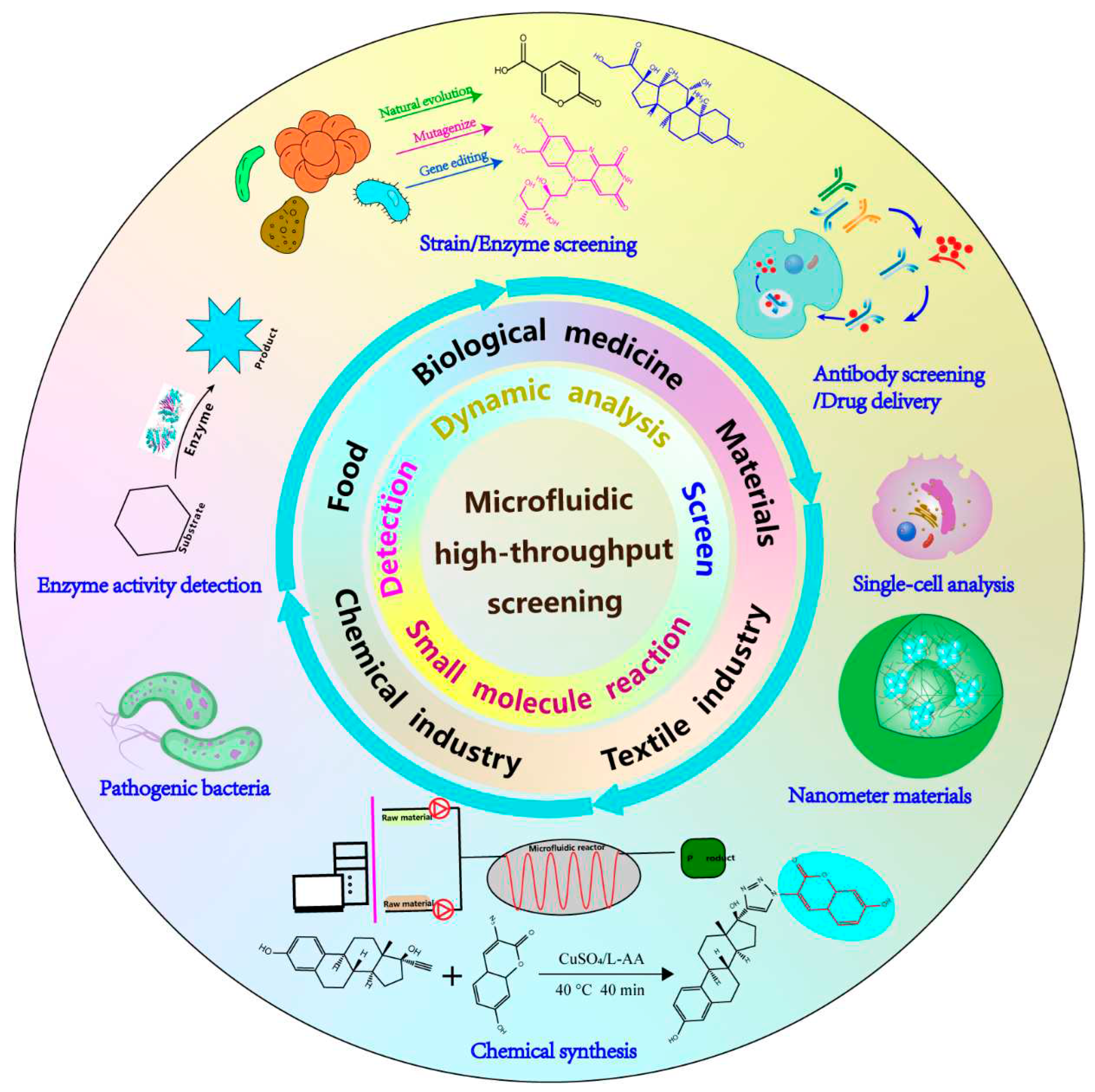
Figure 2.
The diagram of droplet microfluidic.
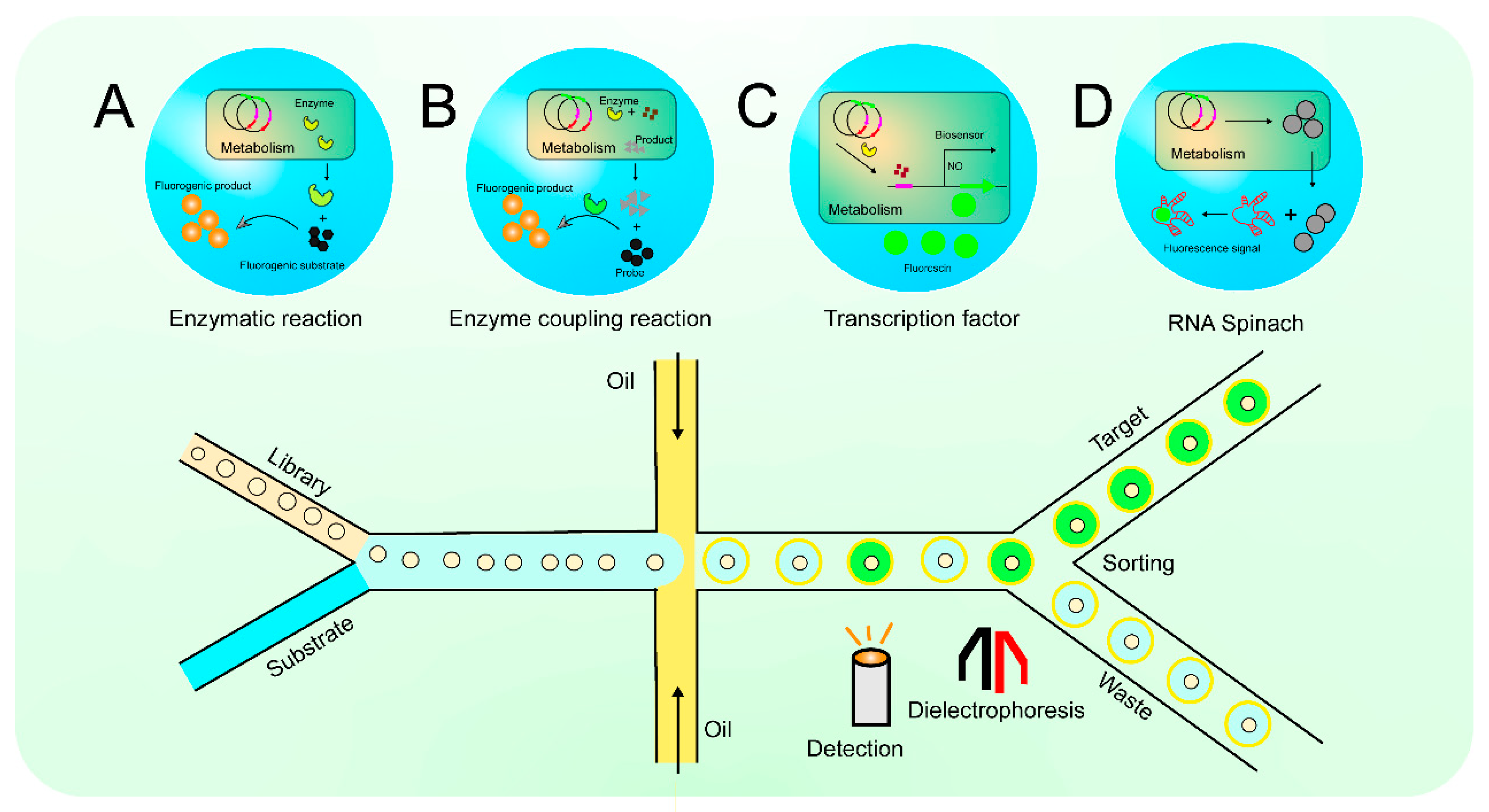

Table 1.
High throughput screening application of droplet microfluidic system.
| Spectrum | Screening analysis strategies | Screening target | Specific applications | References. |
| Ultraviolet light | Addition of metabolite dyes | - | A planar microfluidic spectroscopy detection system was proposed, which could continuously analyze and determine thymol blue of the staining at 180-890 nm, and realize high-throughput detection of the corresponding stained species | (88) |
| Ultraviolet light | Enzymatic reaction | E. coli | UV-Vis full-wavelength detection system to monitor E. coli growth at 280 nm and thiouric acid assay at 311 nm to identify strain expression ergothionease activity | (17) |
| Visible light | Direct measurement of absorbance | Yeast | Integrated droplet-digital microfluidic system to measure the growth of mutant and wild-type yeasts in ionic liquids | (39) |
| Visible light | Enzymatic reaction | HL-60 Cell population | Differential detection photothermal interferometry combined with droplet microfluidics, relying on electronic media and mitochondrial succinate-tetrazolium reductase reaction to generate absorbance, high-throughput analysis of HL-60 cell population metabolic activity | (40) |
| Visible light | Enzyme-coupled reaction | Glucose oxidase | Using the principle of enzyme colorimetry, glucose hydrolysis intermediate H2O2, 4-aminoantipyrine and phenol generate red quinone imine, thereby continuously determining glucose oxidase activity with high throughput | (38) |
| Fluorescence | Direct measurement of target metabolite | Lactic acid bacteria | Riboflavin has a natural fluorescent signal, and high-yield mutant strains are screened for use in milk fermentation, and riboflavin reaches 2.81 mg/L | (89) |
| Fluorescence | Addition of metabolite dyes | Microalgae strain | The fluorescent stain BODIPY was added to stain the lipids, and microalgae strains with a 2.75-fold increase in lipid yield were screened | (90) |
| Fluorescence | Embedding metal chelating agents | - | Add EtBr to bind to RNA to determine ribonuclease activity, the higher the activity, the lower the fluorescence signal | (44) |
| Fluorescence | Enzymatic reaction | Environmental microorganisms | Fluorescein dibutyrate was introduced as a fluorescent substrate, and 11 lipase-producing strains were screened from environmental microorganisms by FADS | (91) |
| Fluorescence | Enzymatic reaction | E. coli | A method was developed to rapidly form a large-scale droplet array using microcage array chips, which improved the operability of droplets and introduced fluorescent substrates to screen strains expressing esterase AFEST from mixed bacteria | (92) |
| Fluorescence | Enzymatic reaction | Viable bacteria in wastewater | The fluorescent substrate diphenyl dibenzoate can be degraded by PETase to produce a fluorescent signal, which can screen for strains that express PETase efficiently | (93) |
| Fluorescence | Enzyme-coupled reaction | Bacillus licheniformus | According to the modified 3,5-dinitrosalicylic acid (DNS) method, starch substrates are decomposed into glucose, DNS and glucose undergo redox reactions to produce fluorescent substances, and strains with α-amylase expression increased by 67% were screened | (94) |
| Fluorescence | Enzyme-coupled reaction | Yeast | The glucose in the microdroplets was decomposed by oxidase to produce H2O2, H2O2 reacted with vanadium bromoperoxidase to produce BrO-, and BrO- reacted with aminophenoxyfluorescein to produce strong fluorescence, and an enzyme coupling strategy was established to screen out glucose oxidase mutants 2.1 times higher than that of wild-type Kcat | (95) |
| Fluorescence | Protein-based biosensors | Candida glabrum | A biosensor expressing pH-sensitive fluorescent protein was constructed, and the ankyrin gene was introduced for expression, so that the fluorescent protein was anchored on the surface of Candida glabricis, so as to show the accumulation of pyruvate, and the strain with a 73.6% increase in pyruvate yield, reaching 48.6 g/L, was screened | (96) |
| Fluorescence | Transcription factor-based biosensors | E. coli | A biosensor in response to 3-dehydroshikimic acid (3-DHS) was constructed, and 3-DHS was positively regulated, expressing fluorescent protein, and screening mutant strains with high yield of 3-DHS, with a yield of 2.46 g/L at 24 h | (62) |
| Fluorescence | Nucleic acid-based biosensors(RNA Spinach) | Saccharomyces cerevisiae | Innovated on the basis of RNA Spinach, a universal sensing technology that provides small molecule metabolites by altering RNA sequences, and screened mutant strains with 28-fold and 3-fold higher yields of tyrosine and recombinant protein streptomycin, respectively | (25) |
| Non-spectral | Coupled mass spectrometry analysis | Transaminase | Combined with droplet microfluidics, a high-throughput and stable droplet analysis system was constructed to detect the reaction products of intradroplet transaminases, quantify enzyme activity, and evaluate enzyme mutants | (97) |
| Non-spectral | Coupled mass spectrometry analysis | E. coli | Transaminases can convert methyl 4-methyl-3-oxovalerate into the corresponding amine, and the amine is then spontaneously hydrolyzed to β-leucine, which is detected by the microfluidic-mass spectrometry analysis system and screened out a variety of mutants of transaminases | (98) |
| Raman spectroscopy | Coupled surface-enhanced Raman scattering | Prostate cancer cell population | Surface-enhanced Raman scattering combined with microfluidic system improved the sensitivity of the detection system, and the glycan expression and cell variability of prostate cancer cells were analyzed at high throughput by wheat germ lectin-modified nanometal particles | (83) |
Disclaimer/Publisher’s Note: The statements, opinions and data contained in all publications are solely those of the individual author(s) and contributor(s) and not of MDPI and/or the editor(s). MDPI and/or the editor(s) disclaim responsibility for any injury to people or property resulting from any ideas, methods, instructions or products referred to in the content. |
© 2023 by the authors. Licensee MDPI, Basel, Switzerland. This article is an open access article distributed under the terms and conditions of the Creative Commons Attribution (CC BY) license (http://creativecommons.org/licenses/by/4.0/).
Copyright: This open access article is published under a Creative Commons CC BY 4.0 license, which permit the free download, distribution, and reuse, provided that the author and preprint are cited in any reuse.