

Submitted:
22 December 2023
Posted:
22 December 2023
You are already at the latest version
Abstract
The collapse of the Rana Plaza factory profoundly affected the fashion industry and society, serving as a reminder of the importance of social issues in academics and practice. Some scholars have pointed out that academia lacks fashion studies on social issues that are more prevalent in developing countries. Therefore, this study aims to determine a meta-analysis of sustainable fashion research since the Rana Plaza collapse and how it aligns with the United Nations' sustainable development goals (SDGs). The applied method is automated content analysis, and seven academic agendas were extracted by analyzing sustainable fashion literature. The findings showed that academic scholarship has covered various topics, ranging from design to social issues, whereas the results have not clarified the relationship between social issues and developing countries. The findings also show that SDG 12 stood out, which is responsible consumption and production. Aside from the production community, consumers need to be aware of socio-environmental problems to make harmonious lifestyle choices with nature. Furthermore, scholars need to align themselves with an easier-to-understand concept of sustainable fashion to make a public appeal for it as a societal importance.
Keywords:
sustainable fashion
; sustainable development goals
; academic agenda
; automated content analysis
1. Introduction
The collapse of the Rana Plaza factory affected the fashion industry and society. The damage appeared man-made, and the disaster could have been preventable. The incidents have highlighted negative media coverage of brands producing apparel in those factories [1]. As such, it triggered some researchers to engage with the social issues facing the fashion industry due to compelling neglect in related discussions [2]. Furthermore, some scholars [3,4,5,6] have pointed out the lack of sustainable fashion studies from a social perspective in developing countries. This indicates that academia has not paid much attention to social issues. With the advancement of globalization, the textile and apparel industries have increasingly outsourced their production to developing countries. Practices associated with sweatshops, including violation of wages, safety and health issues, harassment, and overtime work, were found in domestic and foreign factories due to consumer demand for low-priced apparel [7]. Furthermore, garment production in developing countries is facing serious environmental issues. According to [8], the garment industry hurts the environment. It affects climate change and loss of biodiversity, adversely affects water cycles, causes chemical pollution, overuses and misuses non-renewable resources, generates waste, and harms the health of producer communities. To address these issues, there is a need for social norms, rules, and practical solutions to improve fashion products about resource efficiency and workers' rights while reducing the use of chemicals and pollution [8]. Alleviating the aforementioned socio-environmental negative effects, the recent sustainable fashion movement has the potential to create better circumstances for producer communities in both developed and developing countries. The fashion industry has the largest CO2 footprint of any sector and the second-largest consumer industry after the food industry. Sustainable fashion hints at deploying resources, mitigating climate change, and protecting biodiversity through sustainable production and consumption. However, the concept of sustainable fashion is not widely accepted by public opinion. Sustainable fashion is not limited to special products for ecologically and ethically conscious consumers. The fashion market is flooded with unsustainable products, and many consumers tend to buy cheap clothes that reflect the latest trends but are made using inferior materials and production processes. We must raise awareness and encourage more people to make conscious choices that benefit the environment and society.
According to [9], sustainable fashion remains a complex and elusive concept due to its broad and ambiguous nature. One reason the concept of sustainable fashion is difficult to understand stems from the definition of sustainable development, given that as human societies, we need to live and meet “without compromising the ability of future generations to meet their own needs [10].” The triple bottom line concept, which includes the environment, society, and economics, is also considered the basic definition of sustainable development. However, there is still a gap between the definition and what sustainability means. This is because the definition of sustainable development may vary depending on scholars' or practitioners' perceptions. Moreover, some scholars argue that sustainable development is relevant to macro-level perspectives, while others believe it is suitable for analyzing multi-level perspectives. These may partly explain why sustainable fashion has had difficulty penetrating the mass consumer market. Academics have a crucial role in explaining the importance of sustainable fashion to consumers and society. To achieve this, a new approach is needed to provide a comprehensive understanding of sustainable fashion. This study addresses the academic agenda surrounding sustainable fashion and the United Nation's (UN) sustainable development goals (SDGs).
This study aims to investigate the current state of sustainable fashion research through a meta-analysis of previous studies, particularly after the Rana Plaza collapse. The study also seeks to determine how sustainable fashion studies align with the United Nations' sustainable development goals (SDGs). To achieve this, the study poses the following research questions:
RQ1: How have academics managed the research agenda since the Rana Plaza collapse?
RQ2: What are the concerns about sustainable fashion?
RQ3: Will the results comprehensively represent themes of sustainable fashion studies, especially in social issues?
RQ4: What is the current attainment of sustainable fashion studies compared with the SDGs?
2. Related Literature
2.1. Sustainable Fashion and SDGs
The SDGs are global and comprehensive objectives developed by the international community. These objectives include social goals from the Millennium Development Goals, environmental goals from the Rio Declaration of 1992, and its subsequent Conferences of the Parties summits. The SDGs are regarded as a well-developed aspirational indicator containing inclusive, universal, and comprehensive themes. There are 17 Goals, 169 Targets, and 231 Indicators that make up the structure of the SDGs. The UN's SDGs are divided into three categories: social, economic, and environmental, as developed by [3] and are presented in Table 1.
There are two prominent relevant sustainable fashion institutions: the UN Alliance for Sustainable Fashion and the Conscious Fashion and Lifestyle Network (CFLN). The UN Alliance for Sustainable Fashion focuses on changing the path of fashion by reducing its negative environmental and social impacts and turning it into a driver of implementing the SDGs. CFLN is an online platform for multi-stakeholders in industry, the media, governments, and UN system entities. Various organizations are registered in it, including intergovernmental organizations, non-governmental organizations, civil society organizations, the private sector, philanthropic organizations, and partnership organizations.
Especially, Goal 12 is crucial for the fashion industry to prioritize responsible consumption and production within the 17 SDGs.In the article [11], the authors discuss how fashion brands can co-create with customers to achieve Goal 12, which is responsible consumption and production patterns. They suggest that people can consciously create a sustainable environment while consuming through interactions with the brand. The authors also argue that a sustainable fashion brand would attract consumers who value compassion, acceptance, and universalism. According to [12], traceability and transparency are crucial for the textile and clothing industry to achieve Goal 12. They propose increasing visibility in the value chain and social capital among business partners through reliable and comprehensive data analysis of business activities. This will help reduce social and environmental impacts. [12] suggests implementing various schemes, technologies, and standard measurement tools to encourage a common understanding of traceability and transparency. [13] focus on Goal 12 from a circular economy and analyze how it can be applied to the textile industry. It has been suggested that by focusing on Goal 12, the circular economy can offer a new perspective on the relationship between the market, consumers, and natural resources, and provide a path for both personal and industrial rediscovery of ways to solve the industry's current problems [13]. To implement circular economic principles at the core of a firm, it is recommended that the textile industry reorganize its resources, assets, capital, roles, and potentials around these principles [13].
Additionally, [11] posit that SDGs Goal 1, “No Poverty,” and Goal 11, “Sustainable Cities and Consumption,” are also relevant to community-based consumption initiatives and protecting traditional arts and crafts. In a developing country, light manufacturing industries, including fashion, could present economic development opportunities through trade expansion and foreign currency acquisition. For example, although Africa faces hunger and most of its population still resides in poverty, the younger generation is very interested in fashion brands and the creative industries [14] Many local designers are contributing to a burgeoning African fashion industry based on integrating Western and African cultures that apply local traditional artisanal skills and craftsmanship [14]. Additionally, the philosophy of Goal 11 is linked to a concept of slow fashion because local production and traditional values are key elements for it in the local community [15,16,17,18]. Promoting sustainable fashion requires the development of community-based sustainable consumption and production practices.
2.2. Reviewing Sustainable Fashion Literature Review
Table 2 shows a list of literature review, which relevant to sustainable fashion. The total number of literature reviews is 1,167, and the average is 73. This indicates that qualitative literature reviews have limitations in qualifying studies to analyze sustainable fashion systematically. The most common themes in sustainable fashion literature reviews were sustainable supply chain management (SSCM) and circular fashion. Existing literature reviews mostly focused on specific subjects. To the author’s knowledge, no academic article has comprehensively reviewed sustainable fashion studies from comprehensively.
Principles of sustainable fashion have gained attention in various academic fields, from social science to the natural sciences. The literature review studies have investigated the current state of the literature and identified research problems in detail and the core concept of sustainable fashion in each field. As an example, the research papers [2,3,19] focused on literature reviews concerning issues related to SSCM. One of the papers [2] noted that the discussion on SSCM often neglects social issues. However, social risk management is a crucial aspect for suppliers, and forming close relationships can lead to better operational performance and reduced negative impacts on buyers. Another paper [3] suggested that the textile and apparel industry need to take more balanced sustainable actions to achieve the SDGS. As per reference [19], there is a difference in the perception of fashion sustainability between developed and developing countries. Consumers in developed countries tend to view it as a lifestyle choice, while those in developing countries see it as a matter of legal compliance or corporate philanthropy. [5,21,22,23] reviewed the literature on circular economy issues. [20,22] focused on consumers’ sustainability awareness within the circular economy context. The authors argued that the textile industry was not sufficient countermeasures being taken by the circular economy. [21] systematically reviewed the circular fashion literature to understand the main drivers, strategies, practices, barriers, and enablers for internal and external circular fashion stakeholders. They argued that their conceptual model provided a more nuanced insight and revealed that circular fashion could open new business opportunities. [5] suggested the implementation of Extended Producer Responsibility for textile recycling to enhance production and the designer’s responsibility. The text below has been written without any spelling, grammar, or punctuation errors. I have also tried to make it clearer for better understanding. The study [6,24] focused on literature reviews of corporate social responsibility (CSR) research in the fashion industry. [24] identified three themes in CSR communication: critical issues, reacting to negative allegations, and needing explicit communication. They also found that supply chain management, human rights issues, and labor and employee treatment in developing countries were the most frequent issues in CSR studies. [25] investigated unclear topics in sustainable fashion from a CSR perspective. They proposed a micro-meso-macro framework, showing how CSR influenced sustainability within the fashion industry. Other themes in the literature reviews are fashion business models [25], conceptual models for sustainable fashion [26], slow fashion [27], and fashion marketing [1].
3. Methods
Sustainable fashion is relevant to various academic fields, from social science to natural science. Applying qualitative literature reviews to address sustainable fashion is appropriate for subjective views; however, capturing all of its relationships is challenging. This study addresses the principles of sustainable fashion using automated content analysis (ACA) to capture all its relationships because previous sustainable fashion literature reviews comprise segmentations. For example, sustainable fashion constitutes both social science and natural science; social science includes design, law and policy, sociology, psychology, management, marketing, and education, while chemical and biotechnology perspectives are included under natural science. Defining sustainable fashion and its main agenda requires a holistic understanding. Moreover, this approach requires big data to capture the entire picture. Notably, quantitative analysis efficiently deals with big data. This study explores the concepts of sustainable fashion based on a macro-level perspective using ACA. This section may be divided by subheadings. It should provide a concise and precise description of the experimental results, their interpretation, and the experimental conclusions that can be drawn.
3.1. Analytical Framework
This study establishes the analytical framework in two steps: (1) it applies ACA to analyze sustainable fashion studies' academic agenda comprehensively. (2) it uses the results of the ACA to analyze the academic attainment of these studies compared with the perspective of the SDGs.
3.1.1. Applying ACA to Extract Academic Agenda
Content analysis is a research method that provides a systematic and objective means to describe specific phenomena based on verbal, visual, or written data [27,29,30,31]. The advantage of the ACA is that it is efficient and effective in classifying massive amounts of data and achieving a greater understanding of the issues regarding the sharing economy [31]. Additionally, [32] referred to ACA's topic modeling method as a bottom-up approach to delineate the latent thematic structures.
3.1.2. Analyzing Academic Attainments through SDGs
This study developed coding criteria for the terms extracted by ACA. Human coders labeled the topic model results based on the interpretation of the terms compared with the 17 Goals. To address academic attainment, the analytical framework is based on comparing text mining results and the 17 SDGs. Table 3 presents an example of coding reference information on the topic modeling results compared to the SDGs.
For example, the term “sustainability” becomes relevant to all SDGs. The reference criteria regarding the terms “society,” “economics,” and “environment,” as developed by [3], are applied to Table 1. “Slow fashion” is relevant to Goals 1 and 12 [11]. Furthermore, a sustainable value chain [12] and circular economy [13] are important for achieving Goal 12. The values of occurrence probability that constitute the calculated topics were used as a weight for each term and summed up to evaluate the attainment of sustainable fashion studies based on the relevance of the 17 Goals.
3.2. Criteria for Data Collection
This section outlines the data gathering criteria. The study collected data from four databases: EBSCO, Ingenta, Taylor and Francis, and Web of Science, by analyzing academic articles. These are the leading providers of a comprehensive collection of academic and professional digital content, and they are sufficiently versatile to contain a wide range of subjects in sustainable fashion studies. The criteria for selecting data were journal articles and conference proceedings published in English from 2014 and 2021 that contained the search terms “sustainable fashion” and “fashion sustainability.” This study deleted overlapped articles that appeared in multiple databases. Additionally, this study eliminated the words that did not satisfy the definition of sustainable fashion. For example, the term “fashion” was often used as a synonym for “manner,” “way,” “method,” “system,” “mode,” “style,” “approach,” and “tool.” Ultimately, the total number of retrieved articles was 1067.
3.3. Data Retrieval and Text Mining
The methodology can be divided into three phases. Phase 1 details how the articles are collected from the databases. Phase 2 describes how the data was developed using DTM. Finally, Phase 3 explains the comprehensive approach framing based on the topic model. During Phase 1 of this study, this study searches for articles related to sustainable fashion and fashion sustainability on various databases, including EBSCO, Ingenta, Taylor and Francis, and Web of Science. Afterwards, this study counts the number of articles retrieved for each year to determine the frequency of publications on this topic.
In Phase 2, this study proceeds with data development. This study retrieves data from the titles and abstracts of journal articles. To analyze the data, a text mining tool called R version 3.5.2, which is produced by the R foundation is applied. To conduct the analysis, this study applies "tidytext" analysis in R, a method that requires a table with one token per row. Therefore, this study uses a document term matrix (DTM) and excluded "stop words" from the search terms.
In Phase 3, this study uses Latent Dirichlet Allocation (LDA) to analyze topics. LDA is based on the idea that words appear within specific topics. LDA searches for patterns of words that occur together within a collection of documents, which is known as a corpus. This pattern search is called unsupervised learning. In this study, the “topic models” package in R, which includes an LDA model, is used. In the topic model procedure, raw data is first transformed into a DTM and processes to evaluate the topic model. The "tidytext" package is used to extract the per-topic-per-word probabilities using beta from the model. Next, the output is interpreted based on the coherence of topics, and each pattern of topics is given a name.
4. Results
4.1. Number of Retrieved Articles
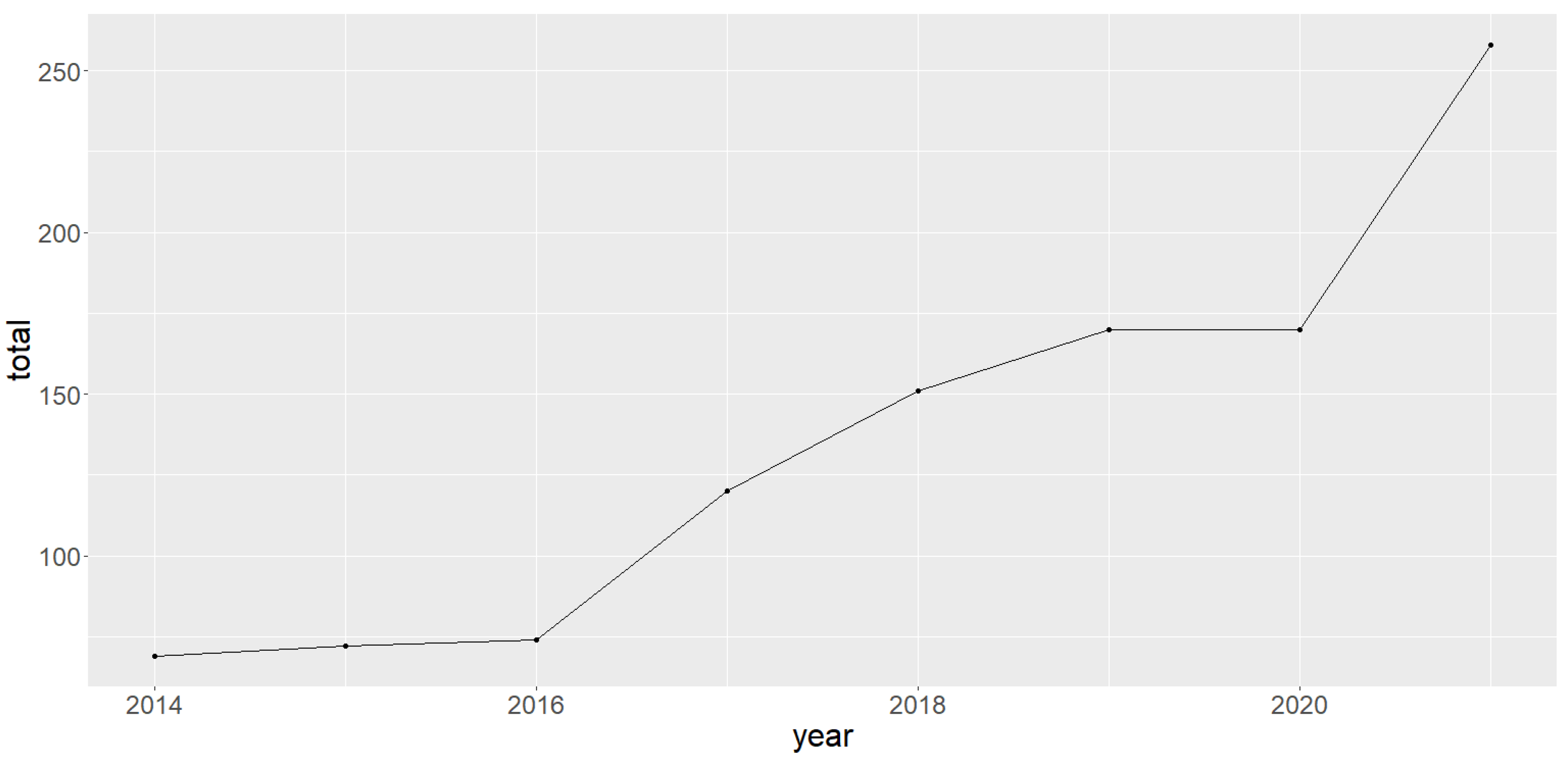
Figure 4 presents the total number of retrieved articles from 2014 to 2021. In Figure 4, the line shows that the slope is stable from 2014 (n = 69) to 2016 (n = 74) and it inclines from 2016 (n = 74) to 2019 (n = 170). Then, the line steeply inclines from 2020 (n = 170) to 2021 (n = 258). The total number of retrieved articles was approximately 3.7 times in eight years. This indicated that the research theme regarding sustainable fashion has been increasingly paying attention to the academic agenda since 2014.
Figure 1.
The number of retrieved articles: 2014-2021.
4.2. Results of Topic Model
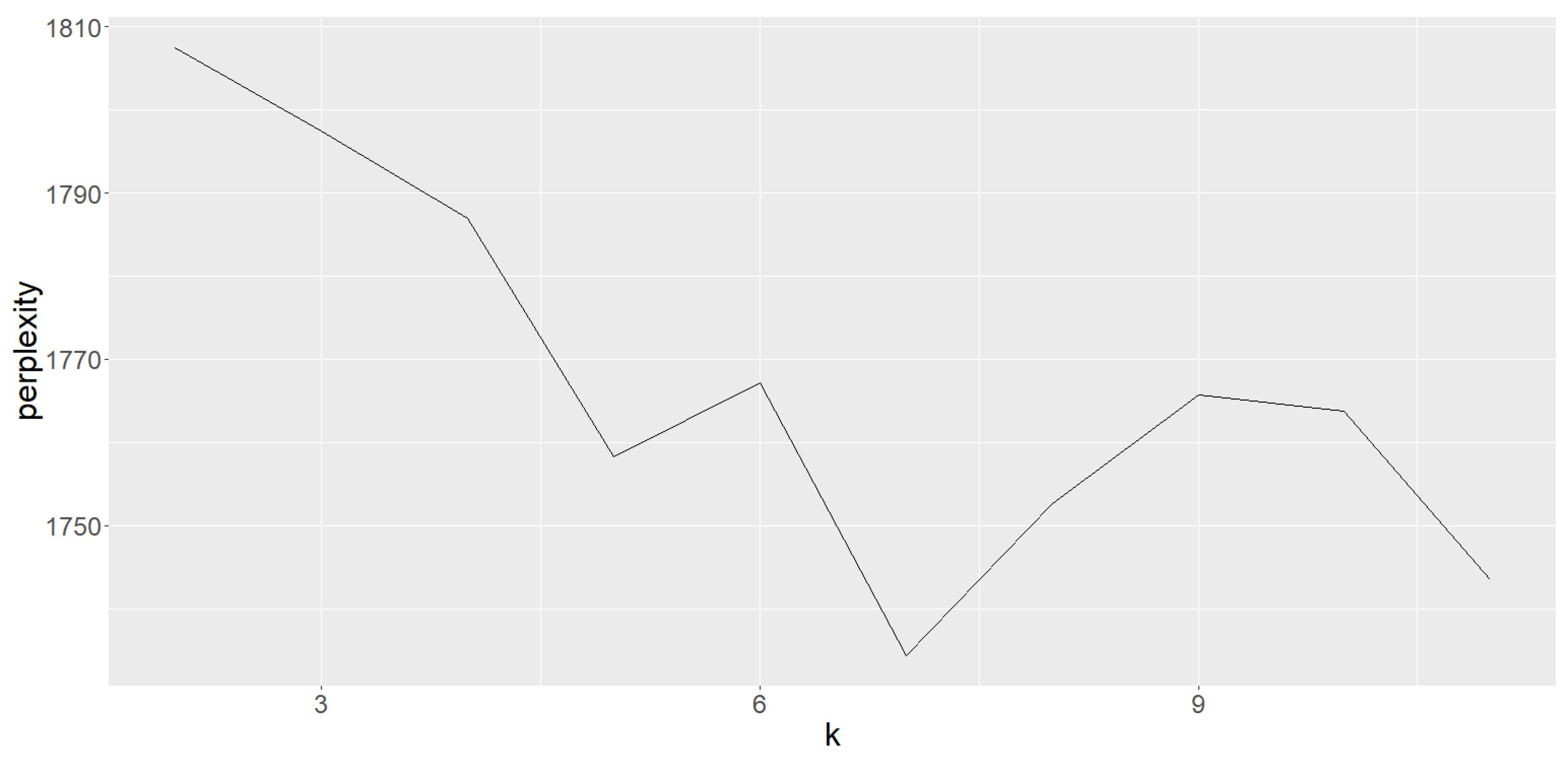
This study examines the LDA topic model to apply a comprehensive approach to explore academic agendas regarding sustainable fashion studies since 2014. Figure 5 presents the results of the perplexity score. Perplexity is a measure used to evaluate the performance of a probabilistic model. It can be calculated from the negative log-likelihood. The LDA topic model requires setting a parameter (k) to run the model and often uses perplexity as a tool to evaluate the model’s predictive performance. [35] noted that low perplexity indicates a good probabilistic model, which can accurately predict text data. Therefore, based on Figure 4, k = 7 was the most suitable number of topics.
Figure 2.
The perplexity score.
This study examines the LDA topic model to apply a comprehensive approach to explore academic agendas regarding sustainable fashion studies since 2014. Table 6 presents the results of the LDA topic model: it shows how each word is associated with each topic, and the beta score indicates the occurrence probability of the word in topics. Based on multiyear research on sustainable fashion studies, this study identified seven academic agendas indicating sustainable fashion studies.

Table 6.
Results of LDA topic model.
| topic1 | topic2 | topic3 | topic4 | ||||
|---|---|---|---|---|---|---|---|
| term | beta | term | beta | term | beta | term | beta |
| fashion | 0.034 | fashion | 0.036 | fashion | 0.031 | fashion | 0.041 |
| sustainable | 0.017 | sustainable | 0.021 | sustainable | 0.020 | sustainable | 0.019 |
| sustainability | 0.012 | sustainability | 0.017 | sustainability | 0.012 | sustainability | 0.018 |
| design | 0.010 | study | 0.011 | research | 0.008 | study | 0.012 |
| clothing | 0.010 | industry | 0.010 | consumption | 0.008 | brand | 0.011 |
| industry | 0.009 | design | 0.008 | study | 0.008 | industry | 0.009 |
| study | 0.008 | research | 0.007 | design | 0.007 | consumption | 0.008 |
| environmental | 0.007 | social | 0.007 | industry | 0.007 | design | 0.008 |
| consumption | 0.007 | consumers | 0.007 | social | 0.007 | business | 0.008 |
| research | 0.007 | clothing | 0.006 | clothing | 0.006 | consumer | 0.007 |
| consumer | 0.006 | environmental | 0.005 | apparel | 0.006 | paper | 0.007 |
| apparel | 0.006 | apparel | 0.005 | based | 0.005 | product | 0.007 |
| consumers | 0.006 | consumption | 0.005 | consumer | 0.005 | apparel | 0.006 |
| paper | 0.006 | supply | 0.005 | environmental | 0.005 | clothing | 0.006 |
| supply | 0.005 | consumer | 0.005 | consumers | 0.005 | consumers | 0.006 |
| social | 0.005 | textile | 0.005 | paper | 0.005 | textile | 0.005 |
| product | 0.005 | chain | 0.004 | supply | 0.004 | luxury | 0.005 |
| business | 0.005 | practices | 0.004 | product | 0.004 | products | 0.005 |
| model | 0.005 | brand | 0.004 | analysis | 0.004 | environmental | 0.005 |
| topic5 | topic6 | topic7 | |||||
| term | beta | term | beta | term | beta | ||
| fashion | 0.032 | fashion | 0.040 | fashion | 0.034 | ||
| sustainable | 0.018 | sustainable | 0.017 | sustainable | 0.019 | ||
| sustainability | 0.015 | sustainability | 0.013 | sustainability | 0.013 | ||
| study | 0.010 | clothing | 0.010 | study | 0.010 | ||
| consumption | 0.009 | apparel | 0.097 | industry | 0.010 | ||
| design | 0.009 | industry | 0.097 | consumer | 0.009 | ||
| consumer | 0.008 | study | 0.009 | research | 0.007 | ||
| industry | 0.008 | design | 0.008 | consumers | 0.007 | ||
| clothing | 0.008 | environmental | 0.008 | social | 0.006 | ||
| practices | 0.006 | consumption | 0.007 | consumption | 0.006 | ||
| environmental | 0.006 | purchase | 0.007 | environmental | 0.006 | ||
| paper | 0.006 | consumer | 0.007 | circular | 0.006 | ||
| consumers | 0.006 | fast | 0.006 | textile | 0.006 | ||
| research | 0.006 | consumers | 0.006 | clothing | 0.005 | ||
| product | 0.005 | slow | 0.006 | economy | 0.005 | ||
| apparel | 0.004 | supply | 0.006 | business | 0.005 | ||
| social | 0.004 | behavior | 0.005 | production | 0.005 | ||
| business | 0.004 | chain | 0.005 | model | 0.004 | ||
| model | 0.004 | social | 0.005 | product | 0.004 |
4.3. Result of Topic Model and Its Relevance to the SDGs 17 Goals
Table 5 shows a correspondence table between the topic model results and SDGs’ 17 goals. Each term was coded based on its relevance to each goal. In an analytical framework section, several terms already defined coding criteria. As for the rest, “consumer,” “consumption,” “product,” and “production” are relevant to Goal 12, “Responsible consumption and production pattern,” as well as “fashion,” “apparel,” “clothing,” and “textile,” since they concern products. The term “industry” is relevant to Goal 9, “Build resilient infrastructure, promote inclusive and sustainable industrialization, and foster innovation.” The terms “study,” “research,” and “paper” are relevant to Goal 4, which refers to education.
Table 5.
A correspondence table between results of Topic 1 and SDGs 17 Goals.
| Beta | Coding | #1 | #2 | #3 | #4 | #5 | #6 | #7 | #8 | #9 | #10 | #11 | #12 | #13 | #14 | #15 | #16 | #17 | |
|---|---|---|---|---|---|---|---|---|---|---|---|---|---|---|---|---|---|---|---|
| fashion | 0.034 | #12 | 0.034 | ||||||||||||||||
| sustainable | 0.017 | #goals | 0.017 | 0.017 | 0.017 | 0.017 | 0.017 | 0.017 | 0.017 | 0.017 | 0.017 | 0.017 | 0.017 | 0.017 | 0.017 | 0.017 | 0.017 | 0.017 | 0.017 |
| sustainability | 0.012 | #goals | 0.012 | 0.012 | 0.012 | 0.012 | 0.012 | 0.012 | 0.012 | 0.012 | 0.012 | 0.012 | 0.012 | 0.012 | 0.012 | 0.012 | 0.012 | 0.012 | 0.012 |
| design | 0.010 | #8 | 0.010 | ||||||||||||||||
| clothing | 0.010 | #12 | 0.010 | ||||||||||||||||
| industry | 0.009 | #9 | 0.009 | ||||||||||||||||
| study | 0.008 | #4 | 0.008 | ||||||||||||||||
| environmental | 0.007 | #environment | 0.007 | 0.007 | 0.007 | 0.007 | 0.007 | ||||||||||||
| consumption | 0.007 | #12 | 0.007 | ||||||||||||||||
| research | 0.007 | #4 | 0.007 | ||||||||||||||||
| consumer | 0.006 | #12 | 0.006 | ||||||||||||||||
| apparel | 0.006 | #12 | 0.006 | ||||||||||||||||
| consumers | 0.006 | #12 | 0.006 | ||||||||||||||||
| paper | 0.006 | #4 | 0.006 | ||||||||||||||||
| supply | 0.005 | #12 | 0.005 | ||||||||||||||||
| social | 0.005 | #social | 0.005 | 0.005 | 0.005 | 0.005 | 0.005 | 0.005 | 0.005 | 0.005 | |||||||||
| product | 0.005 | #12 | 0.005 | ||||||||||||||||
| business | 0.005 | #8 | 0.005 | ||||||||||||||||
| model | 0.005 | #8 | 0.005 | ||||||||||||||||
| chain | 0.005 | #12 | 0.005 | ||||||||||||||||
| Total | 0.034 | 0.034 | 0.034 | 0.055 | 0.034 | 0.036 | 0.029 | 0.049 | 0.046 | 0.036 | 0.034 | 0.167 | 0.029 | 0.029 | 0.029 | 0.034 | 0.042 | ||
| A correspondence table between results of Topic 2 and SDGs 17 Goals | |||||||||||||||||||
| Beta | Coding | #1 | #2 | #3 | #4 | #5 | #6 | #7 | #8 | #9 | #10 | #11 | #12 | #13 | #14 | #15 | #16 | #17 | |
| fashion | 0.036 | #12 | 0.036 | ||||||||||||||||
| sustainable | 0.021 | #goals | 0.021 | 0.021 | 0.021 | 0.021 | 0.021 | 0.021 | 0.021 | 0.021 | 0.021 | 0.021 | 0.021 | 0.021 | 0.021 | 0.021 | 0.021 | 0.021 | 0.021 |
| sustainability | 0.017 | #goals | 0.017 | 0.017 | 0.017 | 0.017 | 0.017 | 0.017 | 0.017 | 0.017 | 0.017 | 0.017 | 0.017 | 0.017 | 0.017 | 0.017 | 0.017 | 0.017 | 0.017 |
| study | 0.011 | #4 | 0.011 | ||||||||||||||||
| industry | 0.010 | #9 | 0.010 | ||||||||||||||||
| design | 0.008 | #8 | 0.008 | ||||||||||||||||
| research | 0.007 | #8 | 0.007 | ||||||||||||||||
| social | 0.007 | #social | 0.007 | 0.007 | 0.007 | 0.007 | 0.007 | 0.007 | 0.007 | 0.007 | |||||||||
| consumers | 0.007 | #12 | 0.007 | ||||||||||||||||
| clothing | 0.006 | #12 | 0.006 | ||||||||||||||||
| environmental | 0.005 | #environment | 0.005 | 0.005 | 0.005 | 0.005 | 0.005 | ||||||||||||
| apparel | 0.005 | #12 | 0.005 | ||||||||||||||||
| consumption | 0.005 | #12 | 0.005 | ||||||||||||||||
| supply | 0.005 | #12 | 0.005 | ||||||||||||||||
| consumer | 0.005 | #12 | 0.005 | ||||||||||||||||
| textile | 0.005 | #12 | 0.005 | ||||||||||||||||
| chain | 0.004 | #12 | 0.004 | ||||||||||||||||
| practices | 0.004 | #8 | 0.004 | ||||||||||||||||
| brand | 0.004 | #8 | 0.004 | ||||||||||||||||
| luxury | 0.004 | #8 | 0.004 | ||||||||||||||||
| Total | 0.045 | 0.045 | 0.045 | 0.056 | 0.045 | 0.044 | 0.038 | 0.067 | 0.054 | 0.044 | 0.045 | 0.124 | 0.038 | 0.038 | 0.038 | 0.045 | 0.051 | ||
| A correspondence table between results of Topic 3 and SDGs 17 Goals | |||||||||||||||||||
| Beta | Coding | #1 | #2 | #3 | #4 | #5 | #6 | #7 | #8 | #9 | #10 | #11 | #12 | #13 | #14 | #15 | #16 | #17 | |
| fashion | 0.031 | #12 | 0.031 | ||||||||||||||||
| sustainable | 0.020 | #goals | 0.020 | 0.020 | 0.020 | 0.020 | 0.020 | 0.020 | 0.020 | 0.020 | 0.020 | 0.020 | 0.020 | 0.020 | 0.020 | 0.020 | 0.020 | 0.020 | 0.020 |
| sustainability | 0.012 | #goals | 0.012 | 0.012 | 0.012 | 0.012 | 0.012 | 0.012 | 0.012 | 0.012 | 0.012 | 0.012 | 0.012 | 0.012 | 0.012 | 0.012 | 0.012 | 0.012 | 0.012 |
| research | 0.008 | #4 | 0.008 | ||||||||||||||||
| consumption | 0.008 | #12 | 0.008 | ||||||||||||||||
| study | 0.008 | #4 | 0.008 | ||||||||||||||||
| design | 0.007 | #8 | 0.007 | ||||||||||||||||
| industry | 0.007 | #9 | 0.007 | ||||||||||||||||
| social | 0.007 | #social | 0.007 | 0.007 | 0.007 | 0.007 | 0.007 | 0.007 | 0.007 | 0.007 | |||||||||
| clothing | 0.006 | #12 | 0.006 | ||||||||||||||||
| apparel | 0.006 | #12 | 0.006 | ||||||||||||||||
| based | 0.005 | #9 | 0.005 | ||||||||||||||||
| consumer | 0.005 | #12 | 0.005 | ||||||||||||||||
| environmental | 0.005 | #environment | 0.005 | 0.005 | 0.005 | 0.005 | 0.005 | ||||||||||||
| consumers | 0.005 | #12 | 0.005 | ||||||||||||||||
| paper | 0.005 | #4 | 0.004 | ||||||||||||||||
| supply | 0.004 | #12 | 0.005 | ||||||||||||||||
| product | 0.004 | #12 | 0.004 | ||||||||||||||||
| analysis | 0.004 | #4 | 0.004 | ||||||||||||||||
| chain | 0.004 | #12 | 0.004 | ||||||||||||||||
| Total | 0.039 | 0.039 | 0.039 | 0.063 | 0.039 | 0.037 | 0.032 | 0.039 | 0.049 | 0.037 | 0.039 | 0.111 | 0.032 | 0.032 | 0.032 | 0.039 | 0.044 | ||
| A correspondence table between results of Topic 4 and SDGs 17 Goals | |||||||||||||||||||
| Beta | Coding | #1 | #2 | #3 | #4 | #5 | #6 | #7 | #8 | #9 | #10 | #11 | #12 | #13 | #14 | #15 | #16 | #17 | |
| fashion | 0.041 | #12 | 0.041 | ||||||||||||||||
| sustainable | 0.019 | #goals | 0.019 | 0.019 | 0.019 | 0.019 | 0.019 | 0.019 | 0.019 | 0.019 | 0.019 | 0.019 | 0.019 | 0.019 | 0.019 | 0.019 | 0.019 | 0.019 | 0.019 |
| sustainability | 0.018 | #goals | 0.018 | 0.018 | 0.018 | 0.018 | 0.018 | 0.018 | 0.018 | 0.018 | 0.018 | 0.018 | 0.018 | 0.018 | 0.018 | 0.018 | 0.018 | 0.018 | 0.018 |
| study | 0.012 | #4 | 0.012 | ||||||||||||||||
| brand | 0.011 | #8 | 0.011 | ||||||||||||||||
| industry | 0.009 | #9 | 0.009 | ||||||||||||||||
| consumption | 0.008 | #12 | 0.008 | ||||||||||||||||
| design | 0.008 | #8 | 0.008 | ||||||||||||||||
| business | 0.008 | #8 | 0.008 | ||||||||||||||||
| consumer | 0.007 | #12 | 0.007 | ||||||||||||||||
| paper | 0.007 | #4 | 0.007 | ||||||||||||||||
| product | 0.007 | #12 | 0.007 | ||||||||||||||||
| apparel | 0.006 | #12 | 0.006 | ||||||||||||||||
| clothing | 0.006 | #12 | 0.006 | ||||||||||||||||
| consumers | 0.006 | #12 | 0.006 | ||||||||||||||||
| textile | 0.005 | #8 | 0.005 | ||||||||||||||||
| luxury | 0.005 | #12 | 0.005 | ||||||||||||||||
| products | 0.005 | #12 | 0.005 | ||||||||||||||||
| environmental | 0.005 | #environment | 0.005 | 0.005 | 0.005 | 0.005 | 0.005 | ||||||||||||
| Development | 0.004 | #8 | 0.004 | ||||||||||||||||
| Total | 0.037 | 0.037 | 0.037 | 0.056 | 0.037 | 0.042 | 0.037 | 0.073 | 0.051 | 0.042 | 0.037 | 0.133 | 0.037 | 0.037 | 0.037 | 0.037 | 0.042 | ||
| A correspondence table between results of Topic 5 and SDGs 17 Goals | |||||||||||||||||||
| Beta | Coding | #1 | #2 | #3 | #4 | #5 | #6 | #7 | #8 | #9 | #10 | #11 | #12 | #13 | #14 | #15 | #16 | #17 | |
| fashion | 0.032 | #12 | 0.032 | ||||||||||||||||
| sustainable | 0.018 | #goals | 0.018 | 0.018 | 0.018 | 0.018 | 0.018 | 0.018 | 0.018 | 0.018 | 0.018 | 0.018 | 0.018 | 0.018 | 0.018 | 0.018 | 0.018 | 0.018 | 0.018 |
| sustainability | 0.015 | #goals | 0.015 | 0.015 | 0.015 | 0.015 | 0.015 | 0.015 | 0.015 | 0.015 | 0.015 | 0.015 | 0.015 | 0.015 | 0.015 | 0.015 | 0.015 | 0.015 | 0.015 |
| study | 0.010 | #4 | 0.010 | ||||||||||||||||
| consumption | 0.009 | #12 | 0.009 | ||||||||||||||||
| design | 0.009 | #8 | 0.009 | ||||||||||||||||
| consumer | 0.008 | #12 | 0.008 | ||||||||||||||||
| industry | 0.008 | #9 | 0.008 | ||||||||||||||||
| clothing | 0.008 | #12 | 0.008 | ||||||||||||||||
| practices | 0.006 | #8 | 0.008 | ||||||||||||||||
| environmental | 0.006 | #environment | 0.006 | 0.006 | 0.006 | 0.006 | 0.006 | ||||||||||||
| paper | 0.006 | #4 | 0.006 | ||||||||||||||||
| consumers | 0.006 | #12 | 0.006 | ||||||||||||||||
| research | 0.006 | #4 | 0.006 | ||||||||||||||||
| product | 0.005 | #12 | 0.005 | ||||||||||||||||
| apparel | 0.004 | #12 | 0.004 | ||||||||||||||||
| social | 0.004 | #social | 0.004 | 0.004 | 0.004 | 0.004 | 0.004 | 0.004 | 0.004 | 0.004 | |||||||||
| business | 0.004 | #9 | 0.004 | ||||||||||||||||
| model | 0.004 | #8 | 0.004 | ||||||||||||||||
| ethical | 0.004 | #10 | 0.004 | ||||||||||||||||
| Total | 0.037 | 0.037 | 0.037 | 0.059 | 0.037 | 0.039 | 0.033 | 0.054 | 0.051 | 0.043 | 0.037 | 0.111 | 0.033 | 0.033 | 0.033 | 0.037 | 0.043 | ||
| A correspondence table between results of Topic 6 and SDGs 17 Goals | |||||||||||||||||||
| Beta | Coding | #1 | #2 | #3 | #4 | #5 | #6 | #7 | #8 | #9 | #10 | #11 | #12 | #13 | #14 | #15 | #16 | #17 | |
| fashion | 0.040 | #12 | 0.040 | ||||||||||||||||
| sustainable | 0.017 | #goals | 0.017 | 0.017 | 0.017 | 0.017 | 0.017 | 0.017 | 0.017 | 0.017 | 0.017 | 0.017 | 0.017 | 0.017 | 0.017 | 0.017 | 0.017 | 0.017 | 0.017 |
| sustainability | 0.013 | #goals | 0.013 | 0.013 | 0.013 | 0.013 | 0.013 | 0.013 | 0.013 | 0.013 | 0.013 | 0.013 | 0.013 | 0.013 | 0.013 | 0.013 | 0.013 | 0.013 | 0.013 |
| clothing | 0.010 | #12 | 0.010 | ||||||||||||||||
| apparel | 0.009 | #12 | 0.009 | ||||||||||||||||
| industry | 0.009 | #9 | 0.009 | ||||||||||||||||
| study | 0.009 | #4 | 0.009 | ||||||||||||||||
| design | 0.008 | #8 | 0.008 | ||||||||||||||||
| environmental | 0.008 | #environment | 0.008 | 0.008 | 0.008 | 0.008 | 0.008 | ||||||||||||
| consumption | 0.007 | #12 | 0.007 | ||||||||||||||||
| purchase | 0.007 | #12 | 0.007 | ||||||||||||||||
| consumer | 0.007 | #12 | 0.007 | ||||||||||||||||
| fast | 0.006 | #12 | 0.006 | ||||||||||||||||
| consumers | 0.006 | #12 | 0.006 | ||||||||||||||||
| slow | 0.006 | #12 | 0.006 | ||||||||||||||||
| supply | 0.006 | #12 | 0.006 | ||||||||||||||||
| behavior | 0.005 | #12 | 0.005 | ||||||||||||||||
| chain | 0.005 | #12 | 0.005 | ||||||||||||||||
| social | 0.005 | #social | 0.005 | 0.005 | 0.005 | 0.005 | 0.005 | 0.005 | 0.005 | 0.005 | |||||||||
| textile | 0.005 | #12 | 0.005 | ||||||||||||||||
| Total | 0.035 | 0.035 | 0.035 | 0.044 | 0.035 | 0.038 | 0.030 | 0.038 | 0.047 | 0.038 | 0.035 | 0.157 | 0.030 | 0.030 | 0.030 | 0.035 | 0.043 | ||
| A correspondence table between results of Topic 7 and SDGs 17 Goals | |||||||||||||||||||
| Beta | Coding | #1 | #2 | #3 | #4 | #5 | #6 | #7 | #8 | #9 | #10 | #11 | #12 | #13 | #14 | #15 | #16 | #17 | |
| fashion | 0.034 | #12 | 0034 | ||||||||||||||||
| sustainable | 0.019 | #goals | 0.019 | 0.019 | 0.019 | 0.019 | 0.019 | 0.019 | 0.019 | 0.019 | 0.019 | 0.019 | 0.019 | 0.019 | 0.019 | 0.019 | 0.019 | 0.019 | 0.019 |
| sustainability | 0.013 | #goals | 0.013 | 0.013 | 0.013 | 0.013 | 0.013 | 0.013 | 0.013 | 0.013 | 0.013 | 0.013 | 0.013 | 0.013 | 0.013 | 0.013 | 0.013 | 0.013 | 0.013 |
| study | 0.010 | #4 | 0.010 | ||||||||||||||||
| industry | 0.010 | #9 | 0.010 | ||||||||||||||||
| consumer | 0.009 | #12 | 0.009 | ||||||||||||||||
| research | 0.007 | #4 | 0.007 | ||||||||||||||||
| consumers | 0.007 | #12 | 0.007 | ||||||||||||||||
| social | 0.006 | #social | 0.006 | 0.006 | 0.006 | 0.006 | 0.006 | 0.006 | 0.006 | 0.006 | |||||||||
| consumption | 0.006 | #12 | 0.006 | ||||||||||||||||
| environmental | 0.006 | #environment | 0.006 | ||||||||||||||||
| circular | 0.006 | #12 | 0.006 | ||||||||||||||||
| textile | 0.006 | #12 | 0.006 | ||||||||||||||||
| clothing | 0.005 | #12 | 0.006 | ||||||||||||||||
| economy | 0.005 | #economy | 0.005 | 0.005 | 0.005 | 0.005 | 0.005 | ||||||||||||
| business | 0.005 | #8 | 0.005 | ||||||||||||||||
| production | 0.005 | #12 | 0.005 | ||||||||||||||||
| model | 0.004 | #8 | 0.004 | ||||||||||||||||
| product | 0.004 | #12 | 0.005 | ||||||||||||||||
| development | 0.004 | #8 | 0.004 | ||||||||||||||||
| Total | 0.038 | 0.038 | 0.038 | 0.055 | 0.038 | 0.038 | 0.032 | 0.050 | 0.053 | 0.043 | 0.038 | 0.126 | 0.032 | 0.032 | 0.032 | 0.038 | 0.049 | ||
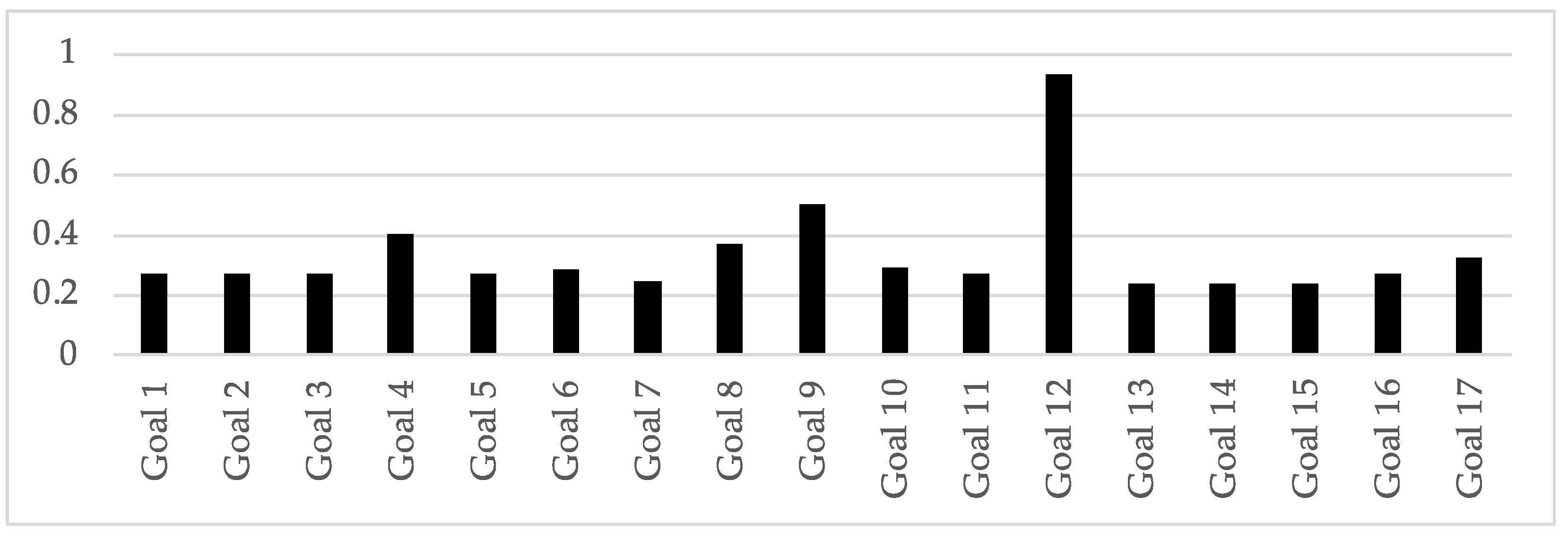
Figure 6 presents both the values of sums up each weight to evaluate how much the topics contributes to each goal and the results of each topic model’s relevance to the SDGs. The findings show that the academic agenda since the Rana Plaza Collapse attaches predominant weight to Goal 12, Goal 9 is ranked with the second-highest weight, and Goal 4 ranked third. According to McKinsey & Company in the State of Fashion 2017, the fashion industry would be the seventh-largest economy globally if ranked alongside individual countries’ gross domestic product. It is a 1.3 trillion USD global industry, employing more than 300 million people along the value chain [36]. Especially in developing countries, its economic and social impacts are not so small. [37] argues that local fashion design in developing countries can be a competitive commodity for exports and contribute to humanitarian assistance by promoting investment. This is why the UN works on sustainable fashion for developing countries [37].
Figure 6.
The values of summing up each weight in 17 goals.
4.4. Verification of the Research Question
This study verifies research questions based on the outcome of text mining analysis. Research question 1 is developed to examine how academia has managed the research agenda since the Rana Plaza collapse. Figure 4 shows the total number of retrieved articles on sustainable fashion from 2014 to 2021. The number of retrieved articles is increasing; consequently, the total number of retrieved articles is 3.7 times during this period. The increasing rate is especially remarkable from 2020 to 2021. This finding indicates that sustainable fashion studies have gained academic attention.
Research question 2 is about the nature of concerns around sustainable fashion studies. This question assumed that the entire picture of sustainable fashion might be observed through the ACA regarding topic modeling. The result of the ACA is aggregated into seven topics: Topic 1: Design for sustainable fashion; Topic 2: Social and sustainable supply chain; Topic 3: Social consumption and sustainable fashion; Topic 4: Brand and luxury sustainable fashion; Topic 5: Sustainable fashion study and business model practices; Topic 6: Clothing consumption and purchasing behavior; Topic 7: Circular economy and sustainable production and consumption. Although the most common themes in sustainable fashion literature reviews are SSCM and circular fashion, the result of the ACA reveals a similar tendency.
Research question 3 is about whether the results of ACA would present a lack of social perspectives on sustainable fashion studies in developing countries. This question is developed based on the assumption that the social aspects of sustainable fashion are receiving increasing academic attention. In this case, the definition of the social aspects of sustainable fashion includes improving the working environment, labor-management relations, child labor, labor abuse, harassment, cheap wages, health, prolonged work, and unsafe or servile conditions [7]. Based on the outcome of a literature review, academic scholarship has covered various topics, ranging from design to social issues, whereas the results of these studies have not clarified the relationship between social issues and developing countries. No related terms appear in the outcome of the topic model. This indicates that sustainable fashion studies have had little interest in issues in developing countries, such as how textiles and garments are made, how laborers work, and the working conditions.
Research question 4 concerns the current attainment of sustainable fashion studies as relevant to the SDGs. Within these 17 Goals, Goal 12 encourages a shift toward responsible consumption and production patterns, which predominantly compose the academic agenda. Goal 12, Target 12.8, would ensure that people have the information relevant to sustainable development and harmonious lifestyle choices with nature. The foundation of a responsible consumer and production community requires awareness of social problems [11]. The Rana Plaza collapse is symptomatic of a global fashion industry that abuses human rights and inequalities [38]. Shifting garment production to developing countries to capitalize on lower labor costs has enabled companies to mass-produce cheap clothes, and consumers appreciate the products. The transfer of production overseas has created an opportunity for economic development in developing countries. However, it has also led, for example, to cheap wages, prolonged work hours, and unsafe and servile working conditions. The Rana Plaza collapse is the unfortunate consequence of globalization, and there are many invisible victims of unethical production systems. Additional consequences include detrimental environmental effects on the environment, such as untreated contaminated water, water shortages, and harmful pesticides. The duty for social good is required both for managers in the fashion industry and researchers in fashion studies.
5. Conclusions
This study explored how academics have addressed sustainable fashion issues since the Rana Plaza collapse and identifies the primary themes of academic agendas concerning sustainable fashion and the current attainment of sustainable fashion studies. The findings show that academic interest in sustainable fashion studies has increased annually, and studies on circular fashion supply chains are prominent topics in sustainable fashion literatures. This study contributed to understanding the current state of researchers’ comprehension of sustainable fashion and that ACA is successfully implemented to analyze the complex nature of sustainable fashion themes. The results revealed that academic agendas covered topics ranging from design to social issues of sustainable fashion, whereas it is unclear whether social issues were related to developing countries. Another important social issue is related to SDGs Goal 1, “End poverty.” Sustainable fashion is linked to socio-economic development, and the fashion industry can become an important economic driver, especially for developing countries. The study compared sustainable fashion practices against the United Nations' Sustainable Development Goals (SDGs). Among the SDGs, Goal 12, which pertains to responsible consumption and production, emerged as the most significant for the academics studying sustainable fashion. This finding underscores the renewed emphasis on Goal 12, which highlights the importance of responsible consumption and production patterns, such as sustainable supply chains and circular economies. Lastly, this study highlights the importance of collaboration between researchers and practitioners to raise awareness about sustainable fashion. It also emphasizes the need to address social issues faced by the fashion industry in developing countries. In addition, scholars should adopt a more easily understandable concept of sustainable fashion to promote it as a societal good.
Funding
This research received no external funding.
Conflicts of Interest
The authors declare no conflict of interest.
References
- Tey, S. Y., Brindal, M., & Dibba, H. Factors influencing willingness to pay for sustainable apparel: A literature review. Journal of Global Fashion Marketing. 2018, 9(2), 129-147. [CrossRef]
- Koksal, D. Strahle, J. Muller, M., & Freise, M. Social sustainable supply chain management in the textile and apparel industry: A literature review. Sustainability, 2017. 9,100. [CrossRef]
- Cai, Y., &Choi, T. A United Nations’ Sustainable Development Goals perspective for sustainable textile and apparel supply chain management. Transportation Research Part E: Logistics and Transportation Review, 2020, 141.
- Karaosman, H., Morales-Alonso, G., & Brun, A. From a systematic literature review to a classification framework: sustainability integration in fashion operations. Sustainability. 2017, 9,30. [CrossRef]
- Filho, L. W., Ellams, D., Han, S., Tyler, D., Boiten, J. V., Paco, A., Moora, H., & Balogun, A. A review of the socio-economic advantages of textile recycling. Journal of cleaner production. 2019, 218, 10-20. [CrossRef]
- White, L. C., Nielsen, E. A., & Valentini, C. CSR research in the apparel industry: A quantitative and qualitative review of existing literature. Corporate social responsibility and environmental management. 2017.
- Rudell, F. Shopping with a social conscience: Consumer attitudes toward sweatshop labor. Clothing and Textiles Research Journal, 2006, 24(4), 282-296. [CrossRef]
- Fletcher, K. & Grose, L. Fashion & Sustainability. Laurence King Publishing Ltd, London. 2012.
- Niinimaki, K. Ethical foundations in sustainable fashion. Textiles and clothing sustainability, 2015, 1(1).
- Brundtland Report. https://sustainabledevelopment.un.org/content/documents/5987our-common-future.pdf. 1987.
- Palakshappa, N., & Dodds, S. Mobilising SDG 12: co-creating sustainability through brands. Marketing Intelligence and Planning, 2020, 39(2), 265-283. [CrossRef]
- Caronne, P. N. Traceability and Transparency: A way forward for SDG12 in the Textile and Clothing Industry. In Gardetti, A., M., & Muthu, S., S. (eds.) The UN Sustainable Development Goals for the Textile and Fashion Industry, Textile Science and Clothing Technology. https:// doi.org/10.1007/978-981-13-8787-6_1. 2020.
- Gardetti, M., & Luque, L., D., M. Sustainable Development Goal 12 and Its Relationship with the Textile Industry. In Gardetti, A., M., & Muthu, S., S. (eds.) The UN Sustainable Development Goals for the Textile and Fashion Industry, Textile Science and Clothing Technology. https:// doi.org/10.1007/978-981-13-8787-6_1. 2020.
- Corner, F. Why Fashion Matters. Thames & Hudson; 1st edition. London, UK. And New York. The US. 2014.
- Fletcher, K. Slow Fashion: An invitation of systems changes. Fashion Practice, 2007. 2(2), 259-266. [CrossRef]
- Jun, S.; and Jin, B. Sustainable Development of Slow Fashion Businesses: Customer Value Approach. Sustainability, 2016, 8.
- Clark, H. Slow + Fashion – an oxymoron – or a promise for the future. Fashion theory, 2008, 12(4), 427-446.
- Nagano, A. Applying Storytelling Approach to Analyze Kojima Jeans District based on Slow Fashion Perspectives. Sustainability, 2021. 13. [CrossRef]
- Yang, S., Song, Y., & Tong, S. Sustainable retailing in the fashion industry: A systematic literature review. Sustainability. 2017, 9, 1266. [CrossRef]
- Wagner, M. M., & Heinzel, T. Human perceptions of recycled textiles and circular fashion: A systematic literature review. Sustainability. 2020, 12, 599. [CrossRef]
- Ki, C. How fashion can achieve sustainable development through a circular economy and stakeholder engagement: A systematic literature review. Corporate Social Responsibility and Environmental Management, 2020, 27(6), 2401-2424. [CrossRef]
- Hole, G., & Hole, S. A. Recycling as the way to greener production: A mini review. Journal of cleaner production. 2019. 212. 910-915.
- Sandin, G., & Peters, M. G. Environmental impact of textile reuse and recycling: A review. Journal of cleaner production. 2018, 184, 353-365.
- Thorisdottir, S. T., & Johannsdottir, L. Sustainability within fashion business models: A systematic literature review. Sustainability. 2019, 11, 2233.
- Thorisdottir, S. T., & Johannsdottir, L. Corporate social responsibility influencing sustainability within the fashion industry: A systematic review. Sustainability. 2020. 12, 9167.
- Islam, M.M., Perry, P., & Gill, S. Mapping environmentally sustainable practices in textiles, apparel, and fashion industries: a systematic literature review. Journal of fashion marketing and management, 2021, 25(2). [CrossRef]
- Solino, S. J. L., Teixeira, L. M. B., & Dantas, M. J. I. The sustainability in fashion: a systematic literature review on slow fashion. International Journal for Innovation Education and Research. 2020. 8(10), 164-202.
- Nunez-Mir, C. G., Iannone III V. B., Pijanowski, C. B., Kong, N., & Fei, S. Automated content analysis: addressing the big literature challenge in ecology and evolution. Methods in ecology and evolution. 2016, 7, 1262-1272.
- McBee-Black, K. and Ha-Brookshire, J. Words matter: a content analysis of the definitions and usage of the terms for apparel marketed to people living with disabilities. Clothing and Textiles Research Journal, 2020, 38(3), 166-181. [CrossRef]
- Amado, A. Cortez, P., Rita, P., & Moro, S. Research trends on big data in marketing: a text mining and topic modeling based literature analysis. European research on management and business economics, 2018, 24. 1-7. [CrossRef]
- Chen, M., & Edwards, D. A comparative automated content analysis approach on the review of the sharing economy discourse in tourism and hospitality. Current issues in tourism. 2019, 22(1), 35-49.
- Keller, R. T., Hase, V., Thaker, J. Mahl, D., & Schafer, M. News media coverage of climate change in India 1997-2016: Using automated content analysis to assess themes and topics. Environmental Communication, 2020, 14(2). [CrossRef]
- Wickham, H., & Grolemund, G. R for data science: import, tidy, transform, visualize, and model data; O’Reilly Japan: Tokyo, Japan. 2017.
- Silge, J., & Robinson, D. Text Mining with R: A Tidy Approach. O'Reilly Media. 194. 2017.
- Saitoh, K. Zero kara tsukuru Deep Leaning: natural language processing. O’Reilly Japan: Tokyo, Japan. 2018.
- Ellen McArthur Foundation. A New Textile Economy: Redesigning fashion’s future. https://www.ellenmacarthurfoundation.org/publications/a-new-textiles-economy-redesigning-fashions-future. 2017.
- Domeisen, N. Why is the United Nations working in fashion? International Trade Forum 2006, 3,13-14.
- Vijeyarasa, R. & Liu, M. Fast Fashion for 2030: Using the Pattern of the Sustainable Development Goals (SDGs) to Cut a More Gender-Just Fashion Sector. Business and Human Rights Journal, 2022, 7(1). 45-66. [CrossRef]
Table 1.
The UN’s 17 SDGs under three categories [3].
Table 1.
The UN’s 17 SDGs under three categories [3].
| Social | Economic | Environment |
|---|---|---|
| #1 No Poverty | #8 Decent work and economic growth | #6 Clean water & sanitation |
| #2 Zero Hunger | #9 Industry innovation & infrastructure | #7 Affordable & clean energy |
| # 3 Good health and well being | #10 reduced inequalities | #13 Climate action |
| #4 Quality education | #12 Responsible consumption & production | #14 Life below water |
| #5 Gender equality | #17 Partnership for the goals | #15 Life on land |
| #11 Sustainable cities and consumption | #17 Partnership for the goal | |
| #16 Peace, justice, and strong institution | ||
| #17 Partnerships for the goals |
Table 2.
A list of literature review.
| Authors | Main Themes | The number of articles | |
|---|---|---|---|
| 1 | Koksak et al. (2017) | SSCM | 45 |
| 2 | Cai &Choi (2020) | SSCM | 64 |
| 3 | Yang et al. (2017) | SSCM | 48 |
| 4 | Karaosman et al. (2017) | SSCM | 38 |
| 5 | Jia et al. (2020) | SSCM, Circular economy | 109 |
| 6 | Wagner & Heinzel (2020) | Circular economy | 47 |
| 7 | Hole & Hole (2019) | Circular economy, recyling | 62 |
| 8 | Filho et al. (2019) | Circular economy, recyling | 85 |
| 9 | Ki et al. (2020) | Circular fashion | 119 |
| 10 | Sandin & Peters (2018) | Recyling | 41 |
| 11 | White et al. (2017) | CSR | 73 |
| 12 | Thorisdottir & Johannsdottir (2019) | CSR | 209 |
| 13 | Thorisdottir & Johannsdottir (2020) | Business model | 19 |
| 14 | Islam et al. (2021) | Conceptual model | 91 |
| 15 | Solino et al. (2020) | Slow fashion | 105 |
| 16 | Tey et al. (2018) | Marketing | 12 |
| Average | 73 |
Table 3.
Examples of coding reference information.
| Term | SDGs Goals |
|---|---|
| Sustainability, Sustainable | #1, #2, #3, #4, #5, #6, #7, #8, #9, #10, #11, #12, #13, #14, #15, #16, #17 |
| Socal | #1, #2, #3, #4, “5, #11, #16, #17 |
| Economic | #8, #9, #10, #12, #17 |
| Environment | #6, #7, #13, #14, #15, #17 |
| Supply chain, value chain | #12 |
| Circular economy | #12 |
| Slow fashion | #1, #11 |
| ・・・ |
Disclaimer/Publisher’s Note: The statements, opinions and data contained in all publications are solely those of the individual author(s) and contributor(s) and not of MDPI and/or the editor(s). MDPI and/or the editor(s) disclaim responsibility for any injury to people or property resulting from any ideas, methods, instructions or products referred to in the content. |
© 2023 by the authors. Licensee MDPI, Basel, Switzerland. This article is an open access article distributed under the terms and conditions of the Creative Commons Attribution (CC BY) license (http://creativecommons.org/licenses/by/4.0/).
Copyright: This open access article is published under a Creative Commons CC BY 4.0 license, which permit the free download, distribution, and reuse, provided that the author and preprint are cited in any reuse.


