

Submitted:
19 December 2023
Posted:
20 December 2023
You are already at the latest version
Abstract
Many historical areas are exposed to many problems and ongoing changes that may negatively affect those areas. One of these historical areas is Historic Jeddah in Saudi Arabia, which was placed on the UNESCO World Heritage List in 2014. This site is located within the scope of the second largest city in the Kingdom, which is witnessing a continuous urban movement in which the image of the city is changing in response to (Kingdom’s Vision 2030) to modernize the image of its major cities. The study aims to review the urban preservation strategies for historic Jeddah and the vision set for it through the ongoing modernization process of the city, especially with the projects that have been undertaken in it since 2021. The study follows both theoretical and descriptive approaches with the aim of reviewing current conservation strategies. This is with the aim of reaching results related to the challenges facing the area, demonstrating the effectiveness of the conservation strategies used, and deducing what could contribute in the future to the process of developing, preserving, and optimally exploiting it, without losing its value as a result of the modernization processes taking place now, but rather as a compatible part of it.
Keywords:
The World Heritage List
; Historic Jeddah
; Strategies
; Preservation
; Historical Areas
1. Introduction
The historic city of Jeddah has a distinctive architecture, as it witnessed many changes in its architecture throughout the various historical eras. It was influenced by Mamluk architecture, then the Ottoman architecture that prevailed in the Levant and Egypt at that time. As a result of several factors, the historical area of the city witnessed urban deterioration, especially with the rapid urban expansion since the founding of the Kingdom in (1932), Especially after the demolition of its historical wall in (1947) [1], which led to an acceleration of its urban deterioration after its historical urban fabric mixed with the urban fabric of the new areas, which led to lose its historical privacy, in addition to the loss of many heritage buildings, whether through neglect or under claims of modernization and development, without a vision or strategy to preserve that area and an awareness of its historical importance, until the end of the seventies of the twentieth century. As well as the changing of its demographic composition with the migration of its indigenous inhabitants to modern urban development areas and their replacement by a class of foreign expatriate workers, and their lack of interest in maintenance operations for its buildings, as is the case with many historical areas in existing cities, especially in the Kingdom and the Arab Gulf countries, this also contributed to the deterioration and neglect of the area for several decades.
With the renewed interest in this historical area, its urban fabric, and the heritage buildings it contains, in addition to its inclusion on the World Heritage List, it was necessary to review and analyze the plans and strategies drawn up, and studying the problems that it currently faces or may face in the future with the aim of achieving sustainable urban preservation, especially with the comprehensive urban development taking place in the city of Jeddah within the framework of the (Kingdom’s 2030 vision), through the urban development that the city has witnessed since (2021), including the removal of the districts adjacent to historic Jeddah and their conversion to a protection zone.
1.1. Study purpose
The study aims to support the concept of (preserving urban heritage); By reviewing and analyzing the urban preservation plans and strategies for the historic Jeddah, and reviewing the most important challenges it faces and their impacts related to those plans and strategies, this is with the aim of contributing to the process of its development and preservation without losing its value as a result of the modernization processes taking place in the city of Jeddah, but rather being a compatible part of it, then propose a set of recommendations that can be directed to everyone responsible for preserving that area, in addition to relevant community members. Especially with the implementation of some modern development projects in Jeddah, which include the expropriation of historical Jeddah and the removal of its neighboring districts as a protection zone, with the aim of ensuring that this preservation is primarily in the economic, social and urban interest of the area and its residents, which contributes to its direct preservation, in addition to the fact that it represents a national and human heritage that must be preserved.
1.2. Study significance
The importance of the study lies in ascertaining the effectiveness of the plans and strategies drawn up for the urban preservation of the historic Jeddah area, especially with the comprehensive development taking place in the entire city of Jeddah, in which this historical area is located, and explaining the most important problems and challenges facing this historical area as a world heritage site. The importance of the study also highlights the necessity of identifying international standards that are approved and applied globally in urban preservation operations, and emphasizing that the process of preserving historical and archaeological sites within existing cities, as is the case in the historic Jeddah that the study addresses require the concerted efforts of all governmental, civil and societal efforts to advance it, with the need to emphasize the importance of spreading awareness of the importance of developing and caring for such areas to improve them and their urban surroundings through all members of society connected to them, whether they live there or others, as an entry point to preserving them, then benefit from this in the future in developing plans and strategies for preserving historical areas within existing cities in the Kingdom of Saudi Arabia.
2. Materials and Methods
The study follows the theoretical and descriptive method: through deals with the concepts of cultural heritage, including the characteristics and patterns of archaeological and historical areas and their distinctive character according to the World Heritage Convention (1972) [2], and reviews how to deal with them and The urban problems that facing historical areas and buildings by presenting the most important approved strategies for that, mentioning and explaining the most important international charters and institutes that sponsors it.
Then the study moves to present and reviewing urban preservation plans and strategies for the historic Jeddah area as a model for a case study of historical areas within existing cities, since the beginning of the preparation of the first general and detailed plan to preserve and develop the area, and to classify its heritage buildings and its historical urban fabric by assigning a specialized international consulting between (1978) and (1979) [3,4]. Then, the establishment of the Department for the Protection of Historic Jeddah in (1993) and the launch of prince (Majid bin Abdelaziz) project to take care of historic Jeddah and the efforts of the Saudi Commission for Tourism and National Heritage (SCTH) after its establishment in (2000) to develop Historic Jeddah through which a special file was prepared to register the area on the UNESCO World Heritage List in (2011), This was initially met with failure and rejection by the international organization due to several considerations related to the current state of the area at that time. Whereas this failure was met by the Saudi Commission to develop many urgent and future plans to implement many specific projects in it to care for, maintain and preserve its urban heritage; These efforts succeeded in including it on this list in (2014) [3,4], Reaching the current stage in which the city of Jeddah is witnessing, through the (Kingdom’s 2030 vision), several projects to develop its various districts. Especially with the implementation of some modern development projects in Jeddah starting from (2021) until now, which include the expropriation of historical Jeddah and the removal of its neighboring districts as a protection zone, the study seeks to draw the attention of decision-makers to the importance of choosing strategies that support the historical area when developing the general plan for those areas currently being dealt with around historic Jeddah, in addition to the historical area itself after its expropriation, since the preservation process in itself is a process of sustainable development.
2.1. Definition of the cultural heritage
The World Heritage Convention (1972) defines cultural heritage in (Article 1) as including, the following [2]:
- Monuments: architectural works, works of monumental sculpture and painting, elements or structures of an archaeological nature, inscriptions, cave dwellings and combinations of features, which are of Outstanding Universal Value from the point of view of history, art or science;
- Groups of Buildings: groups of separate or connected buildings which, because of their architecture, their homogeneity or their place in the landscape, are of Outstanding Universal Value from the point of view of history, art or science;
- Sites: works of man or the combined works of nature and of man, and areas including archaeological sites which are of Outstanding Universal Value from the historical, aesthetic, ethnological or anthropological points of view.
2.2. Characteristics and patterns of archaeological and historical areas
The identity of archaeological and historical areas is formed from many components. Its buildings possess a quantitative and qualitative richness of architectural and historical styles, and are combined with tangible features such as: urban fabric, buildings and monuments, and intangible features such as: social traditions, popular culture, commercial activities, etc., so that all of this becomes a multi-dimensional civilizational system. These areas also gain moral value due to the events they witnessed and the meanings associated with them. Therefore, reviving the meanings and events associated with them aims to confirm their importance in the conscience of its people and visitors [5].
The archaeological and historical areas consist of a group of urban fabrics and foci that record specific periods of the city’s stages. These foci may be in the form of markets, distinctive gates, or archaeological or historical buildings with a distinctive architectural character. They also gain their value or not based on the state of the urban fabric, as well. Historical and archaeological areas have some other features that distinguish them, including: the distinctive and authentic urban environment, and the architectural features of buildings with a unique character that have the ability to continue and influence culturally, in addition to the distinguished urban fabric that contains the largest crowd of archaeological and historical buildings that are characterized by architectural vocabulary that confirms the character of these areas. In addition to the continuity of existence and life with its cultural, economic and social activities, which confirms the continuity of the existence of an active human life [5,6].
2.3. Dealing with archaeological and historical areas and buildings in historic cities
2.3.1. The urban problems that facing historical areas and buildings
The historic centers of cities are exposed to many dangers as a result of a number of factors, including: increasing rates of population growth, internal and external migration to them, and the increase in numbers and sizes of modern means of transportation and their penetration into areas that were not historically designed for this type of means. Which led to the emergence of other problems related to expanding existing old roads by demolishing some of these historical buildings, as well as providing places to wait for these modern means of transportation [7].
In addition, with the high profitability that is gained from constructing modern buildings in these areas; This led to an increase in the size and number of buildings, which exacerbated the problem of transportation and movement and finding special parking places for vehicles, including cars and others. Which in turn affected the climate and environment of these historical centers and led to the creation of a type of environmental pollution. These factors have led to the distortion and destruction of these historical areas of high heritage value [7].
The state of imminent danger threatening these historical buildings has also been exacerbated by neglect maintenance and care, and lack of community awareness of their historical, heritage and artistic value, and even its economic value [7,8].
Some development program implementers have failed to understand and realize the nature of these historical sites. Which led to the destruction of much of the fabric and character of areas of a historical and heritage nature. Therefore, the management of urban areas within historic city centers needs a kind of harmony and consistency when developing them urbanely. There must also be realistic scientific strategies and plans to protect and preserve buildings of historical, cultural and artistic value. This process is known as an integrated and comprehensive maintenance plan, which is followed by a repair and rehabilitation plan for buildings of historical and heritage value [8,9].
2.3.2. Rehabilitation of historical areas and buildings
The rehabilitation and maintenance process stems essentially from the environmental data in which the historical areas and buildings to be rehabilitated and maintained are located, taking into account the changes that result from the interactions of economic and social activities and the impact of these changes on the environment and buildings. Accordingly, any practical plan must give great attention to these buildings. Therefore, the process of maintenance and rehabilitation must be given preference and precedence over all other options [10], including the development option itself in its simple, abstract concept, as this process of preservation is considered in itself a development process [11], and lack of attention to the process of regulating uses at the level of the urban environment or deficiencies in maintenance procedures lead to the destruction of valuable buildings and thus the destruction of the historical area [8].
2.3.3. Considerations for the rehabilitation and maintenance of historic areas & buildings
It is important to realize and understand that the maintenance process does not limit or reduce the standard of living of the residents of these places with historical or heritage buildings. There must also be some kind of preparation to meet the requirements of the modern lifestyle. For example, if it is necessary for residents of historical areas to have modern vehicles, then it must be considered providing parking places for these vehicles away from those areas to an acceptable degree, while providing shaded pedestrian paths or using Internal means of transportation that do not pollute the environment, such as bicycles, electric cars, etc.; In order to avoid pollution of the environment surrounding those areas [10].
The infrastructure must also be provided with a high and appropriate technical method that does not conflict with the fact that it is an environment that represents a distinctive urban character. It must also be supplied with all the necessary needs and services that have become among the necessities of modern life. It is also necessary to supervise some necessary public activities and facilities that may be a source of nuisance that disturb the privacy and distinction of such historical areas, such as public restaurants and cafes, which must be placed under surveillance and supervision by the authorities [12].
Perhaps one of the most fundamental problems facing the rehabilitation process is how to create a new function and role for these historical buildings. The planner must be aware of the extent of the problems and shortcomings that the building or historical center suffers from, and the architect must also know the areas in which such historical buildings can be repurposed within the scope of the historic area, and through the integration of these efforts between architects, planners, administrators and other members of the team. These historical centers can be saved from a state of neglect and decay and transformed into a state of effectiveness to perform their historical and cultural role as invaluable heritage and cultural wealth [10].
2.4. Strategies and policies for preserving historic areas and buildings
The process of preserving the urban and architectural heritage of valuable historical, archaeological and heritage buildings and areas is carried out by following many strategies and policies, and the most important of these methods are [13,14]:
1- Restoration. 6- Clearance.
2- Protection. 7- Replacement.
3- Preservation. 8- Renewal.
4- Conservation. 9- Developing.
5- Adaptation-Reuse. 10- Upgrading.
This depends on the circumstances & condition of each area or building separately [13].
2.5. International conventions related to the preservation of historical areas and buildings
There were many agreements sponsored by UNESCO for the maintenance and preservation of historical areas and buildings, with the adoption of the (Venice Charter) [15] in (1964), which was issued in thirteen documents, the most important and famous of which was the first document known as (International Charter for the conservation and restoration of monuments and sites) [15]. Which is considered the first international charter upon which most international conventions were based after that, as it is considered one of the most important documents related to the preservation of archaeological and historical areas and buildings, as it has become the main reference for restoration and maintenance operations. This charter included important definitions in this field [15]. Leading up to the issuance of the (Convention Concerning the Protection of the World Cultural and Natural Heritage) in (1972), which approved a program aimed at classifying, naming and preserving sites of special importance to mankind (World Heritage List) [16], as well as (Nairobi Recommendations/ Recommendation concerning the Safeguarding and Contemporary Role of Historic Areas) in (1976) [17], which defined the protection of historical areas as renewal, prevention, restoration and maintenance. And the revitalization of historical or traditional areas and their environments, and thus protection includes all possible methods of intervention, [17]. In addition to the (Burra Charter) in (1979), which was adopted for places of cultural importance in (2013) to be a guide to best practices in preserving and managing cultural heritage, as it emphasizes The preservation process is required in sites of important cultural value, and during the preservation process, caution must be taken to minimize change in the archaeological building [18], as well as the (Washington Charter) for the Preservation of Historic Cities and Urban Areas in (1987) [19] which indicated that the new functions and activities should be compatible with the nature of the historical areas [19], and other relevant frameworks, charters, agreements and recommendations related to the processes of preserving the urban and cultural heritage and protecting historical areas and other cultural properties of humankind [3].
3. Historic Jeddah (the study case)
3.1. Location and historical importance of Jeddah
(Jeddah) is considered one of the governorates of (Mecca Region), and is located in the west of the Kingdom of Saudi Arabia on the coast of the Red Sea, where it is about (949 km) from the capital (Riyadh), and (79 km) from the city of (Mecca). Its population is about (4,697,000) people in (2021) [20]. Jeddah is considered the economic capital and the first tourist destination in the Kingdom, and the second largest city after the capital. It is also considered a gateway to (Mecca) due to its unique value to all Muslims. It has the largest seaport on the Red Sea, as it is considered a financial and business center in the Kingdom and a major port for exporting non-oil goods and to import local needs [20].
Jeddah has a long history [21], with the emergence and spread of Islam. The historical transformation of Jeddah took place during the reign of Caliph "Othman bin Affan" in (647); When he ordered it to be transformed into a port for sea pilgrims heading to perform the Hajj in (Mecca), where Jeddah remains to this day the main crossing for sea and air pilgrims and many land pilgrims, so that Jeddah continued under the influence of successive Islamic disputes, starting with the Umayyads and Abbasids, then the Ayyubids, then the Mamluks [21].
3.2. Historical urbanization in Jeddah (its development and the problems it faces)
Jeddah has a distinctive historical architecture that differs in quality from the rest of the urban and architectural product present in various regions of the Kingdom of Saudi Arabia. This is a result of the diversity and change in its construction that the city witnessed during various eras and times. It was greatly influenced by the Mamluk architecture and then the Ottoman architecture that prevailed in the Levant and Egypt at that time, and we can clearly distinguish the features of this distinct urbanism in the remaining historical part of the city, where the traces and evidence of that urban product of buildings, mosques, markets, and others are still witness to a different civilization distinguished by its use of local building materials that were commonly used at that time in building houses [3,20], which gave the historical part of Jeddah a distinction that earned it inclusion on the UNESCO World Heritage List.
For long time, this distinctive historical heritage was neglected, especially with the modernization and development processes that the city has witnessed since the founding of the (Third Saudi State) in (1902) by "King Abdulaziz Al Saud". Who subjugated Jeddah to his kingdom in (1926), where the Kingdom of Saudi Arabia was later established in (1932) [22]. As a result of this modernization, the historical parts of the city were neglected, and the historic city wall and many of its gates were demolished in (1947) with the aim of expanding and modernizing the city without taking into account the distinctive historical heritage that the city possesses, until the last quarter of the twentieth century, which witnessed the beginning of interest in the historical part of the city, and attempts to develop it in order to preserve it from neglect and extinction [3].
3.2.1. The historic city wall of Jeddah and its old gates
During the Mamluk era (1250-1517), Sultan "Al-Ashraf Qansuh al-Ghuri", the last Mamluk sultan in Egypt, built the Jeddah Wall in (1509) to protect it from Portuguese raids [1]; The wall includes seven gates: Bab Mecca, Bab Al-Madina, Bab Sharif, Bab Al-Nafi’a, Bab Al-Mughrabi, Bab Al-Sabbah, Bab Sarif. These gates were built in stages according to necessity. Because of the narrowness of the city gate, an eighth, double gate with sufficient width to allow cars to pass through it easily was added at the beginning of the Saudi era on the northern side of the wall, known as Bab Jadid. The wall was demolished in (1947) [1] due to the increasing urban expansion of the city [23] (Figure 1 and Figure 2).
3.2.2. Jeddah’s historic districts (Harrat) and buildings
Historic Jeddah is divided into four main districts; these districts were called (Harah). In the North is (Haret Al-Sham) and in the South is (Haret Al-Yemen) and (Haret Al-Bahar), adding to (Haret Al- Al-Mazloum), These districts (Harrat) contain many distinctive historical houses and buildings that are considered a valuable human heritage, where construction methods and building materials were used depending on the materials available in the local environment [23,24].
It is considered of the most famous and oldest buildings existing to date: the house of: (Al-Baeshen), (Al Sheikh), and (Al-Shafi’i Mosque), which is located in (Haret Al-Mazloum), as well as the house of (Al-Banaja), (Al-Zahid), (Al-Surti), and (Al-Pasha Mosque) in (Haret Al-Sham), the house of (Al-Nassif) and (Nour Wali) in (Haret Al-Yaman), and the house of (Al-Sharbatli) and (Al-Nimr) in (Haret Al-Bahr) and others [24] (Figure 3).
3.3. Problems of urban deterioration in historic Jeddah
With the rapid development movement that Jeddah witnessed at the beginning of the second half of the twentieth century, there was rapid urban and population growth, which is considered one of the most important causes of urban deterioration in the area [25], as the social composition changed, where its people moved to live in new modern districts, and renting the buildings they owned in the historical area to expatriate workers from different nationalities, which led to the deterioration of the area with the absence of the necessary maintenance and the severe neglect of these migrant workers who crowded these historic buildings. This exposed it more than once to the danger of fire as a result of high electrical loads, lack of safety measures, etc., in addition to the natural factors that in turn caused this urban deterioration as a result of the high level of humidity in the city [25]. This led to the erosion of wood and damage to the facades, as well as a rise in the groundwater level, which damaged the foundations of the buildings and led to them corroding and cracking, and the walls being saturated with moisture.
4. Strategies and policies for urban preservation of historic Jeddah
4.1. The beginnings of interest in the urban and architectural heritage of historic Jeddah
Interest in the historic Jeddah area began with the establishment of (the Old Jeddah Municipality) in (1977). Where many steps have been taken that aim to preserve the urban and architectural heritage of the old city of Jeddah, including [4]:
- -
- Preparing the first master and detailed plan to preserve and develop (historic Jeddah) and classify its heritage buildings and its historical urban fabric, by the British consultant “Robert Matthew” during the period (1978: 1983).
- -
- Establishing (the Historic Jeddah Protection Department in 1993) with the aim of protecting heritage buildings from demolition.
- -
- Establishing (Prince Majid bin Abdulaziz project to take care of historic Jeddah) which included restoration of (Nassif House) and turning it into a museum, revealing parts of route of old city wall, as well as partial restoration of 12 heritage buildings.
- -
- Forming a "Higher committee for fire extinguishing project", where first phase of the fire extinguishing network was implemented in (2011), which was then completed [3].
- -
4.2. Efforts of the Saudi Commission for Tourism and National Heritage to develop historic Jeddah
The Saudi Commission for Tourism and National Heritage (SCTH) was established in (2000) [3] (transformed into the Ministry of Tourism in 2020), where the Commission developed (the Historic Jeddah Development Project), through which it worked in cooperation with Jeddah Municipality to preserve, rehabilitate and develop that historical site. architecturally, culturally and economically, in a way that highlights its distinctive features and urban heritage, in addition to encouraging the owners of that urban heritage to protect, maintain and repurpose their properties in a manner commensurate with their historical and cultural value. The Authority has also played a role in the restoration of many heritage buildings and others, as well as the authority, in cooperation with the Jeddah Municipality, has worked to set a specific timetable for the completion of many projects in historic Jeddah. This is with the aim of highlighting the area’s historical and heritage importance and value. Among these efforts, the Authority has implemented many main tasks, including [4]:
- -
- Contracting with international consultants to prepare a protection and management plan for the area, within the framework of completing its registration file on the World Heritage List, which was completed in (2014) by including it on the list.
- -
- Contributing with the Jeddah Municipality in determining the priority plan for the projects required to be implemented to develop the area, and coordinating on the status of the area, the studies required to be implemented. One of the most important of these projects is the project to revive tourist axes and paths in historic Jeddah [26], as it is considered one of the most important of these historical and tourist paths and axes, what is known as the path: (Al-Nada axis), which represents the old city of Jeddah market, and the path: (Alawi axis), which Many important historical and heritage buildings are located on it, and it is considered the main axis of movement in the old city, as well as the path: (Abu Anaba Axis), on which, a person walking on foot can cross it in a walking time of fifteen minutes, and this axis is considered a distinguished tourist route, in addition to the distinguished historical buildings it contains, it is located on both sides of it many outlets display the products of productive families of crafts and handicrafts, and many Stores that serve popular foods [23,26] (Figure 4).
4.3. Strategies for preserving the historic Jeddah
The British consultant "Robert Matthew" is considered the first to develop a Masterplan to preserve the historical area during (1978: 1983), where he identified more than a thousand valuable historical buildings, which were classified into three levels based on several criteria related to the uniqueness of the building’s architectural style and its value. Historical, artistic and spatial, in accordance with adopted standards in that UNESCO classification, as the followings [27,28] (Figure 5):
- -
- First Class: It includes buildings of national importance.
- -
- Second Class: It includes buildings of regional importance.
- -
- Third Class: It includes buildings of local importance.
In addition, it also includes modern high-rise buildings that were constructed during recent periods, as well as vacant lands, paths, corridors, etc.
That plan also proposed adopting a “sustainable preservation” strategy [1] by reusing of the historical buildings according to their degree of classification as the followings:
- -
- First level buildings: being used institutionally, whether as governmental, administrative, cultural or educational buildings [28].
- -
The (Nominated Property) is the protection area that had registered in (2014) on the UNESCO World Heritage List, and it includes about more than 250 classified historical and heritage buildings. It also covers an area of 18 hectares. It is located within another circle called the (Buffer Zones), which is a group of urban areas that surround the (Nominated Property) on all sides and cover an area of 113.53 hectares and extend over the remaining parts of the historic area and its other surrounding areas. It is divided into four conservation areas with the aim of playing an important role in preserving the heritage conservation area (Nominated Property) and enabling it to continue and flourish in light of the changes and developments taking place in the city as a whole. It is followed in this area the “Historic Jeddah Building Requirements System” (Building Regulations) established by the Jeddah Municipality [23,28] (Figure 6).
With time and the acceleration of the modernization movement in the Kingdom, in addition to the various factors of deterioration in the historical area; Many historical buildings have been lost. There are now only about 600 buildings remaining out of about a thousand buildings that were inventoried by "Robert Matthew" in (1980), distributed between the protection and conservation areas. This means that the area has lost about (40%) of its buildings in less than 40 years. Therefore, the "Jeddah Municipality" has set a system of requirements (Historic Jeddah Building Requirements System - Building Regulations) to demonstrate strategies for urban preservation in the historic area, through three main paths that include [25]:
- -
- Restoration of the historical and heritage buildings.
- -
- Replacement by rebuilding heritage buildings that were already existing, but there is no point in restoring them due to their poor structural and urban condition.
- -
- Constructing new buildings on vacant lands or to replace some modern buildings that have no value but rather distort the urban and visual landscape of the area.
However, it is absolutely not permitted to demolish any historical building, as all historical buildings located within the (Nominated Property) area are subject to a protection policy that prevents removal, change, modification, addition, or other work [28,29] (Figure 7).
With the continuing state of urban deterioration in the historic area and the increase in the number of buildings on the verge of collapse, there was a need to adopt a number of clear and specific strategies to deal with historical and heritage buildings depending on the condition of each building individually. The Jeddah Municipality classified historical and heritage buildings based on their structural and urban condition, based on what was stated in Robert Matthew’s classification of heritage buildings [29].
Through this, the buildings were classified into categories (A, B, C), through which the buildings are classified as having either minor damage (A), stable damage (B), or unstable damage (C), and they all represent (82%) of the total buildings in the historical area, distributed rates of (9%) for category (A) buildings, (54%) for category (B) buildings, and (19%) for category (C) buildings respectively. These types require the use of a (Restoration) strategy, in order to prepare and adopt them for another strategy representative in (Adaptation/Reuse) strategy according to the relevant proposal in in Robert Matthew’s proposal of reuse heritage buildings Which was reviewed and approved by the Jeddah Municipality [25,29].
While the rest of the other buildings in the area are classified into categories (D, E), due to their poor structural and urban condition, where they classified as having major damage in which there is no point in restoration, and it includes cases of partial collapse or complete collapse. These buildings represent (14%) of the total buildings in the historical area. These types require the use of a strategy of (Replacement) and rebuilding, and then using them to meet many purposes compatible with the nature of the historical area [25,29].
As for vacant lands, they are classified as Category (F) and their percentage does not exceed (4%) of the area’s size. These lands are used for the purposes of new construction, which is compatible with the historical area and supports it in accordance with the established architectural rules and urban requirements (Figure 8).
In general, historical and heritage buildings are subject to an evaluation process carried out by a specialized committee of experts in the fields of architectural and structural preservation before proceeding to determine the appropriate strategy and then setting the policy for preservation. The evaluation process includes several criteria represented by the urban and structural condition of the building. In addition to the surrounding buildings and a study of the soil, foundations, walls bearing the building, etc. [27,28,29].
From the previously reviewed strategies and policies that were adopted for the urban preservation of the historic Jeddah area, we find that they were represented in several main directions, including the following (Table 2).
5. The challenges facing the process of preserving historic Jeddah while implementing modern development decisions for the city (2021 till now)
As a result of the development program pursued by the Kingdom of Saudi Arabia, represented by the issuance of (Kingdom's 2030 vision) in (2016), the political leadership adopted an ambitious program to modernize Jeddah as a tourist destination for the country and its second capital [31], which includes removing and clearness many of the existing districts of the city and replacing them with new districts designed according to the latest global systems aimed at the well-being of citizens, These removals included some districts adjacent to the historical area in Jeddah (the study case), starting from October 2021 until today [32].
Other sovereign decisions were also issued to expropriate the historical area, including the protection and conservation area from March (2022), without a final Masterplan for developing the area being announced to date, other than announcing that these removals of districts aim to create communities and surrounding areas that work to support the role of the historical area, and the expropriation of the historical area will contribute greatly to the easier and less restrictive urban control and development process of the area [32,33] (Figure 9).
It is expected that these modern development decisions for the city, which have begun to be implemented, will contribute to confronting the challenges facing the urban preservation process of historic Jeddah. Which can be summed up in the need for more investment and funding necessary to complete the preservation and restoration of the urban heritage of the area and then rehabilitate and repurpose it in the various proposed activities mentioned above, which is what is actually being done through those recent development decisions that provided the necessary support for the expropriation of the area and then It will then be invested through a plan currently being prepared, which will also contribute to creating an autonomous economy for the area that will enable it to continue and prosper as a historical tourist destination with diversified activities. In addition, starting preservation and restoration work of such expansion, which is supervised by the highest sovereign authorities in the Kingdom, will create an opportunity for local cadres to train in conservation and restoration work, which is what the area in particular and the Kingdom in general needs [33,34].
The expropriation of the historical area will also contribute to confronting one of the other most important challenges facing the area, which is represented by the existing imbalance in its demographic composition after its original people abandoned it and were replaced by foreign expatriate workers, which posed a danger to the area represented by the lack of belonging to it and its identity. In addition to other problems resulting from this, such as the misuse of these simple workers for existing buildings and their crowding in them as a result of their low level of financial income, which resulted in many other dangers that the area witnessed and suffered from for long periods, such as the outbreak of fires and lack of attention to periodic maintenance operations and others, which caused the area to lose many of the historical and heritage buildings that it owned [32,33].
As well as, the removing and clearness work that took place in surrounding of the historic area from entire districts and huge areas will give the concerned administration authorities a golden opportunity to replace them with new, contemporary districts and activities that support the historical area culturally, artistically, touristically, economically, etc., and contribute to its continuation and prosperity, This will appear during the coming period as all master & detailed plans for that area are approved and their implementation begins [32] (Figure 10).
6. Discussion
By presenting and reviewing urban preservation plans, programs and strategies for the historic Jeddah area as a case study model for historical areas within existing cities, the study concludes with the following results:
- A
- Historic Jeddah has a distinctive urban and architectural heritage, which qualified it to be registered on the UNESCO World Heritage List in 2014.
- B
- Interest in this urban and architectural heritage that Jeddah possesses did not begin until the last quarter of the twentieth century, which caused the historical area to lose many of its historical components before that time, such as its historical walls, which were demolished in 1947 and others. This long-term neglect also caused urban deterioration with its various causes.
- C
- Despite the great interest in historic Jeddah, especially at the beginning of the current century, and then the successful attempts to register it on the UNESCO World Heritage List; In addition to the attention it received through (Kingdom’s Vision 2030), it is possible to realize that the area is still suffering from urban deterioration as a result of the entire period of neglect and the accumulation of its causes, in addition to the large size of the historical area, whether in terms of area or in terms of the number of buildings it owns, which needs restoration and ongoing maintenance.
- D
-
Through the presentation and reviewing of the various plans and strategies that have been developed and implemented, it can be noted that the urban preservation strategies in the historical area in Jeddah have been based on two main trends & approaches:
- -
- -The first trend is to deal with the historical area itself and its urban fabric, where (developing) and (upgrading) strategies are followed through implementing some projects and taking many procedures followed in the area, such as organizing vehicle traffic, allocating paths for pedestrians, completing the firefighting network, and others.
- -
- The second trend is to deal with historical and heritage buildings, by following three strategies according to each case separately as a result of a special classification of buildings that was adopted from three basic classification levels that depend on the feasibility of preservation and restoration operations or not, as these strategies are represented in implementing strategies of (restoration) for first level of buildings, (replacement) for the second level of buildings, or (New Construction), where the last strategy is for vacant lands or as a result of following of (Clearance & Renewal) strategies for modern constructed buildings that pollute the urban and visual image.
However, the (Adaptation/Reuse) strategy is followed for the historical and heritage buildings that are being restored, in accordance with Robert Matthew’s proposal and classification in this regard. - E
- Although the Jeddah Municipality has adopted a number of strategies to deal with historical and heritage buildings depending on the condition of each building individually, the number of what has been restored is considered very small, as the study observed that 82% of the total buildings in (Nominated Property) (NP) needs to preservation and restoration operations, this may be due to the lack of funding necessary for such major work, which requires huge open budgets, in addition to the recent era of local cadres in preservation and restoration work, in addition to its scarcity and the small number of specialists. This always requires the use of foreign expertise, which increases time, effort and cost.
- F
- As a result of the Kingdom’s Vision (2030), the political leadership adopted a development program that includes removing many of the existing districts of Jeddah. These removals included some districts adjacent to the historic Jeddah, and other sovereign decisions were also issued by expropriating the historical area of Jeddah, without announcing to date a final masterplan to develop the area, while declaring that these removals aim to create surrounding areas that work to support the role of the historical area, and that expropriation of the historical area will contribute the urban control and development process of the area is easier and less restrictive manner, and perhaps as a result we expect that this will contribute to advancing the conservation process by providing all the financial, human, technical and logistical capabilities necessary to implement all the conservation plans and strategies followed in the area.
7. Conclusions
The study dealt with plans, programs and strategies for urban preservation of the historic Jeddah area as a case study model for historical areas within existing cities, as well as the challenges that faced the authorities responsible for urban preservation operations leading to the recent development decisions that removed many districts around the area with the complete expropriation of the area. Therefore, the study concludes that in order for the protection of historical Jeddah to be more effective, this must be done within a masterplan for the area and the entire surrounding removal areas, with the adoption of integrated development, economic, urban and social policies that take into account the preservation of what expresses the local character and identity, especially: the urban fabric, the relationships between buildings and surrounding environment, construction methods and materials used, the relationship between the area and its urban surroundings. In addition to the need to involve the residents of the area in making decisions related to preserving, developing or rehabilitating the area, provided that the study is comprehensive.
Based on the previous findings of the study, it recommends the following:
- -
- First: General recommendations;
- A.
- Paying attention to the rules and principles of shaping the urban and architectural fabric of historic Jeddah when following development policies, so that the area does not lose its continuity and continues its population structure with its social and economic characteristics.
- B.
- Participation of indigenous people in concerted efforts to confront existing challenges through popular, non-governmental institutions that enjoy official and public support.
- C.
- Preparing integrated studies of the values of the architectural and urban formation in the historical area, documenting them and linking them to the social values and principles that are rooted in the social fabric of the community of that area, before starting the development processes with the aim of preserving and consolidating them, so that the science of preservation does not turn into a mere financial investment only.
- -
- Second: Recommendations on the scope of the urban content of historic Jeddah;
- A.
- Studying the division of the historic Jeddah area into several administrative areas in order to facilitate dealing with the urban content therein within the framework of the comprehensive plan for the entire historical area, as one of the current challenges is how to deal with the enormity of the area as a whole.
- B.
- Establishing a set of controls, requirements, guidelines and technical standards that would achieve the strategies of the development plan, ensuring that a balance is achieved between the general directions of development and individual desires for improvement and investment (achieving communication and integration between investors, institutions and public bodies), with the aim of preserving the historical, urban and architectural heritage of historic Jeddah.
- C.
- Accelerating the process of restoring and reusing restored buildings, rehabilitating the area as a whole, rebuilding its dilapidated buildings with appropriate shaping of its original urban structure, and reviving the original urban character of the area as well as original or compatible activities with the area’s buildings through adherence to sustainable urban development standards.
- D.
- Continuation of infrastructure rehabilitation operations as a basis for development operations to ensure the possibility of its continued development according to the requirements of modernity, and without prejudice to historical value, within the framework of improving the urban environment.
- E.
- The necessity of providing a strategic plan for the ongoing periodic maintenance of restored, repurposed or reconstructed buildings within the framework of the sustainable development process for the region.
- F.
- A comprehensive plan must be developed to protect the historical area by setting scenarios for how to deal with disasters, sources of pollution, potential dangers, and others.
- -
- Third: Recommendations on the scope of the removal areas (the areas surrounding historic Jeddah);
- A.
- The current removal areas surrounding historic Jeddah must explicitly have their primary mission as protection areas for the historical area in Jeddah, and this option should be absolutely preferred over others when setting out to define uses and choose projects in these areas.
- B.
- A clear strategy must be developed and the necessary legislation must be enacted to regulate the reconstruction and urbanization process in the areas that have been removed and surrounding historic Jeddah, so that the character of the area, its fabric, its urban formation and its architectural character are preserved and integrated with it through all possible means of integration, as well as controlling the definition of new uses that must be compatible with the needs of the historical area.
- C.
- Modern urbanism can achieve contemporaneity with local belonging by meeting the requirements of modern life, provided that the urban cultural dimension of Jeddah’s historical heritage is preserved, and this is done by drawing inspiration from the spirit, philosophy, characteristics and features of local architecture, , with carrying out building and construction process by using the latest contemporary materials and methods.
Author Contributions
Author Contributions: Conceptualization, M.A., E.M. and K.M.H.; methodology, M.A.; software, E.M.; validation, I.E., M.G. and E.M.; formal analysis, K.M.H.; investigation, I.E.; resources, M.A.; data curation, E.M.; writing—original draft preparation, K.M.H.; writing—review and editing, I.E. and M.G.; visualization, E.M.; supervision, K.M.H.; project administration, M.A.; funding acquisition, M.A. All authors have read and agreed to the published version of the manuscript.
Funding
The Deanship of Scientific Research at Imam Mohammad ibn Saud Islamic University (IMSIU) KSA (grant number IMSIU-RG23116) supported and funded this work.
Institutional Review Board Statement
Not applicable.
Informed Consent Statement
Informed consent was obtained from all subjects involved in the study.
Data Availability Statement
The data used to support the findings of this study are available from the corresponding author upon request.
Conflicts of Interest
The authors declare no conflict of interest.
References
- Abdel Tawab, Ayman Gamal El-Din Ahmed. Al-Darwish, Angie Ibrahim. Al-Mutahar. Achieving the sustainable preservation of historical urban commercial spaces- Case study- historic Jeddah. Engineering Research Journal (ERJ) 2021, 5. Available online: https://digitalcommons.aaru.edu.jo/erjeng/vol5/iss4/1 (accessed on 30 October 2023).
- UNESCO. "Operational Guidelines for the Implementation of the World Heritage Convention", document-57-19, WORLD HERITAGE CENTRE, Paris, 2019. Available online: https://whc.unesco.org/en/compendium/154 (accessed on 30 October 2023).
- Heba, Khaled Mahmoud. Development and Employment of Archaeological Areas in Historic Cities: Examples of Historic Arab Cities; Noor Publishing House: Germany, 2016. [Google Scholar]
- Jeddah Municipality, General Authority for Tourism and Antiquities. Historic Jeddah: a journey of the past, present and future; General Authority for Tourism and Antiquities: Riyadh, 2014. [Google Scholar]
- Hamouda, Rawiya. Developing urban spaces as an entry point to preserving historical areas. Al-Azhar 7th International Engineering Conference, Faculty of Engineering, Al-Azhar University, Cairo, Egypt, 2000; pp. 11–12. [Google Scholar]
- Ruskin, John. The Lamp of Memory; Nabu Press: Charleston, South Carolina, US, 2012. [Google Scholar]
- Iskandar, Abdul Sattar. Methods and strategies for heritage conservation; Research and Training Center for Monuments Conservation, City and Regional Planning Dept., University of Engineering and Technology: Lahore, Pakistan, 2003. [Google Scholar]
- El- Ghonaimi, Islam Hamdi. The impact of implementing projects to preserve historical areas in improving the city’s urban fabric, a case study: developing the historical area in the city of Muharraq in the Kingdom of Bahrain; The First National Architectural Heritage Forum, Saudi Commission for Tourism and Antiquities: Jeddah, KSA, 2011; pp. 174–180. [Google Scholar]
- Heba, K. "Preserving architectural heritage in historical cities: study of the architectural heritage with the end of the nineteenth century and the beginning of the twentieth century in Alexandria, Egypt", Structural Repairs and Maintenance of Heritage Architecture XI, (STREMAH 2011), Chianciano Terme, Italy, 4- 7 September 2011, WIT Transactions on The Built Environment, Vol 118, UK and L. Binda, Politecnico di Milano, Italy 2011, pp. 239- 240. DOI: 10.2495/STR110201. Available online: https://www.witpress.com/Secure/elibrary/papers/STR11/STR11020FU1.pdf (accessed on 06 November 2023).
- Heba, Khaled Mahmoud. El-Ghonaimi, Islam Hamdi. Introduction to the preservation and development of historical and heritage areas and buildings; Scientific Publishing and Translation, Qassim University Qassim: Buraydah, KSA, 2018; pp. 16–19. [Google Scholar]
- Ibrahim, Abdul Baqi. Rooting cultural values in building the contemporary Islamic city; Center for Planning and Architectural Studies: Cairo, Egypt, 1986. [Google Scholar]
- Al-Dardiri, Dalia. Al-Ghunaimi, Islam Hamdi. Historic and heritage areas: preservation and development, an introduction to improving the city; Foundation for Cultural Development: Alexandria, Egypt, 2011. [Google Scholar]
- Feilden, B. Conservation of Historic Buildings; Routledge: London, UK, 2003. [Google Scholar]
- Pickard, R. Conservation in the Built Environment; Addison Wesley Longman Ltd: UK, 1996. [Google Scholar]
- ICOMOS, "International charter for the conservation and restoration of monuments and sites", (THE VENICE CHARTER 1964), Adopted by ICOMOS in 1965. Available online: https://www.icomos.org/images/DOCUMENTS/Charters/venice_e.pdf (accessed on 31 October 2023).
- UNESCO, "Convention Concerning the Protection of the World Cultural and Natural Heritage", The General Conference of UNESCO adopted on 16 November 1972. Available online: https://whc.unesco.org/en/conventiontext/ (accessed on 31 October 2023).
- UNESCO, "Recommendation concerning the Safeguarding and Contemporary Role of Historic Areas", UNESCO. General Conference, 19th, Nairobi, Kenya, 1976. Available online: https://unesdoc.unesco.org/ark:/48223/pf0000114038.page=136 (accessed on 31 October 2023).
- The Australia ICOMOS, "Burra Charter 1979", Adopted by in 2013. Available online: https://australia.icomos.org/publications/burra-charter-practice-notes/ (accessed on 4 November 2023).
- ICOMOS, (1987), "CHARTER FOR THE CONSERVATION OF HISTORIC TOWNS AND URBAN AREAS", (WASHINGTON CHARTER 1987), Adopted by ICOMOS General Assembly in Washington, DC, October 1987. Available online: https://www.icomos.org/images/DOCUMENTS/Charters/towns_e.pdf (accessed on 4 November 2023).
- Available online: https://en.wikipedia.org/wiki/Jeddah (accessed on 8 November 2023).
- Ibn al-Mujawar al-Shaybani, Jamal al-Din Abu al-Fath Yusuf ibn Yaqoub ibn Muhammad - Investigation: Mamdouh Hassan Muhammad. The description of the countries of Yemen, Mecca, and some of the Hijaz, called the History of the Clairvoyant, First Edition ed; Library of Religious Culture: Cairo, Egypt, 1996; pp. 53–61. [Google Scholar]
- Available online: https://en.wikipedia.org/wiki/Emirate_of_Nejd_and_Hasa (accessed on 9 November 2023).
- Heba, Khaled Mahmoud. Saudi National Heritage and UNESCO World Heritage List through the Saudi Vision (2030); The General Authority for Tourism and National Heritage: Qassim, KSA, 2019. [Google Scholar] [CrossRef]
- Al-Thaqafi, Abdullah bin Zahir. Architecture in the city of Jeddah in the Ottoman era 923-1334 H/ 1517-1916 AD, two volumes; Darat of King Abdelaziz, University Theses Series (46), No. 318: Riyadh, KSA, 2015. [Google Scholar]
- Saad, Walid. Siraj, Nada. Policies for conservation of the urban heritage in historical centers historic Jeddah Case study; Journal of Gulf and Arabian Peninsula Studies, Issue 185: Kuwait, 2020; pp. 379–389. [Google Scholar]
- Saudi Society for Urban Sciences and King Saud University. Historic Jeddah: A World Heritage Site; Saudi Society for Urban Sciences, an introductory bulletin for tourist trails in the historic city of Jeddah: Riyadh, KSA, 2014. [Google Scholar]
- Mathew, R. Study of the Historical District of Jeddah; Ministry of Municipalities and Rural Affairs: Jeddah, KSA, 1980. [Google Scholar]
- Alhojaly, Rawan Abdullatif. Alawad, Abeer Abdulaziz. A Proposed Model of Assessing the Adaptive Reuse of Heritage Buildings in Historic Jeddah. Buildings 2022, 12, 406. [Google Scholar] [CrossRef]
- Jeddah Municipality, Government area. Historic Jeddah Building Requirements System, KSA, 2014. Available online: https://www.jeddah.gov.sa/Business/LocalPlanning/HistoricalJeddah/pdf/Arabic/5.pdf (accessed on 7 November 2023).
- King Abdulaziz City for Science and Technology (KACST) Institute of Earth and Space Sciences.KSA, Available online: https://kacst.gov.sa/2022 (accessed on 28 October 2023).
- Ministry of Municipal and Rural Affairs, “The Comprehensive Urban Vision for Jeddah Governorate”, Future Saudi Cities, Ministry of Municipal and Rural Affairs & the United Nations Human Settlements Programme- UN-Habitat, Riyadh, KSA, 2019. Available online: https://unhabitat.org/sites/default/files/2020/04/jeddah.pdf (accessed on 6 November 2023).
- Available online: https://en.wikipedia.org/wiki/Demolitions_in_Jeddah (accessed on 14 October 2023).
- Imam, Ayman. Helmi, Mansour. Alkadi. "Exploring the Quality of Open Public Spaces in Historic Jeddah". ACE Architecture, City and Environment, Centre de Politica de Sol i Valoracions, CPSV/ Universitat Politècnica de Catalunya, UPC, Barcelona, España. Vol. 18, Issue 52, 2023. [CrossRef]
- Zaki, Sultan Khalid. Hegazy, Ibrahim. "Investigating the challenges and opportunities for sustainable waterfront development in Jeddah City". International Journal of Low-Carbon Technologies, Oxford University Press, UK, Volume 18, 2023. [CrossRef]
Figure 1.
(a) A map of the current Jeddah after the huge expansions it witnessed during last eighty years, and shows the size of the historical part of the city, which the city occupied within its old wall before its demolition in (1947). (b) Map of Jeddah as drawn by the Italian orientalist "Carlo Alfonso Nallino" in (1938). It shows the historic city wall [3].
Figure 1.
(a) A map of the current Jeddah after the huge expansions it witnessed during last eighty years, and shows the size of the historical part of the city, which the city occupied within its old wall before its demolition in (1947). (b) Map of Jeddah as drawn by the Italian orientalist "Carlo Alfonso Nallino" in (1938). It shows the historic city wall [3].
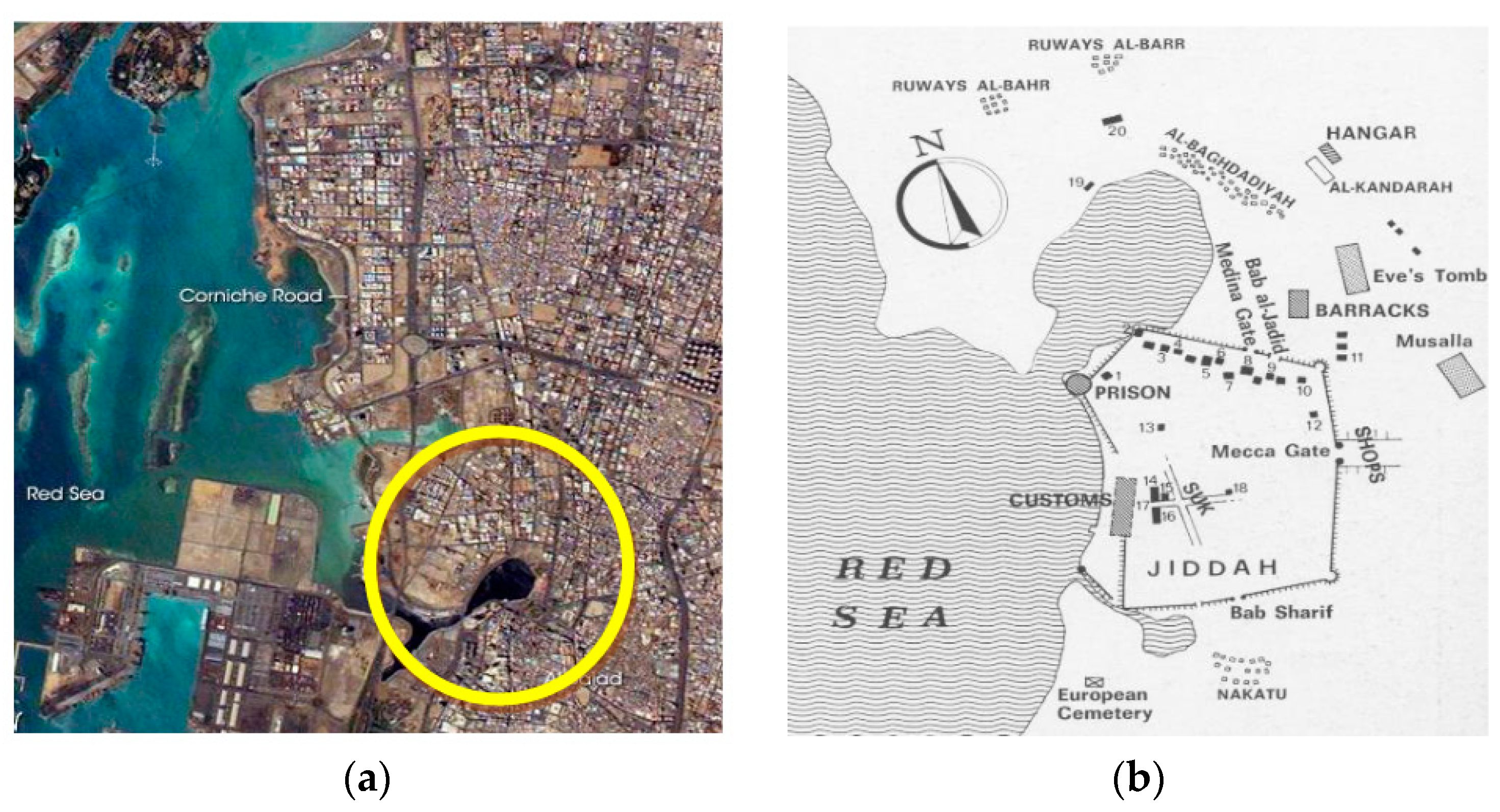
Figure 2.
(a) Jeddah as shown in an aerial photograph taken in (1938), where its urban mass appears inside the historic city wall, which represents the historical area of the current city. (b) "Bab Jadid" (New Gate), which was built at the end of the (1930s). It is considered the last gate built on the wall before its demolition and was a double gate that can accommodate cars [3].
Figure 2.
(a) Jeddah as shown in an aerial photograph taken in (1938), where its urban mass appears inside the historic city wall, which represents the historical area of the current city. (b) "Bab Jadid" (New Gate), which was built at the end of the (1930s). It is considered the last gate built on the wall before its demolition and was a double gate that can accommodate cars [3].
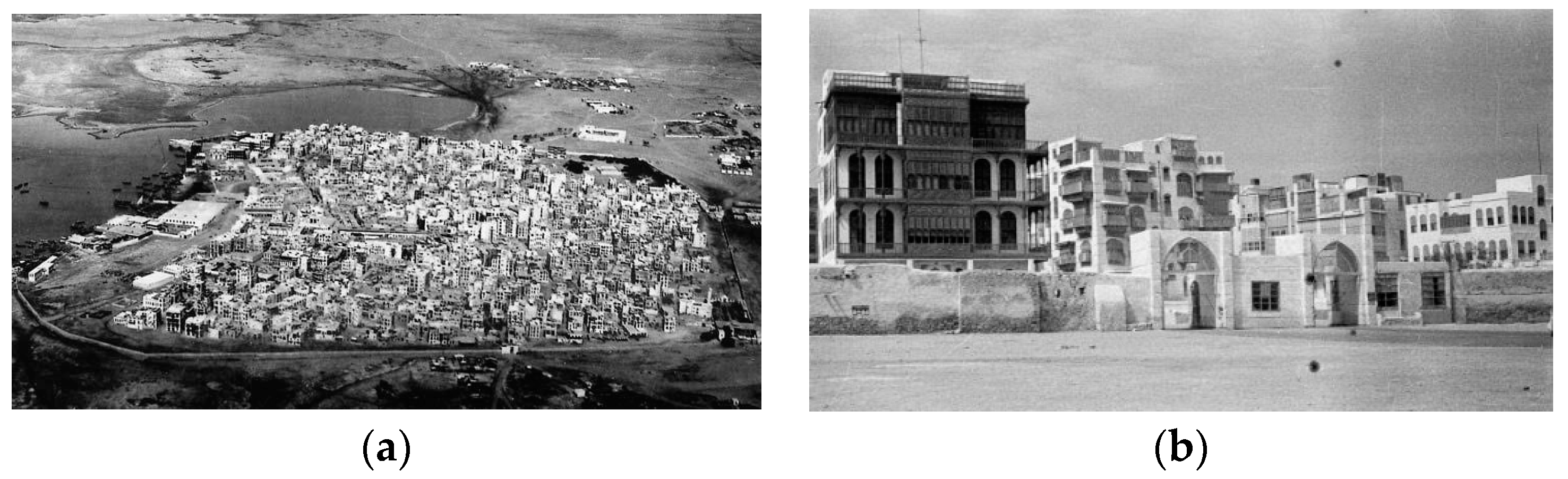
Figure 3.
(a) House of (Al-Baeshen). It was built in (1857) and is considered one of the examples of historical houses whose owners are still keen on maintaining and caring for it. (b) House of (Al-Nassif), which was built in (1872), and is considered one of its most important heritage landmarks, and has gained historical importance since "King Abdulaziz", the founder of the Kingdom, resided there in (1925) and it has now been transformed into a museum for Jeddah [3].
Figure 3.
(a) House of (Al-Baeshen). It was built in (1857) and is considered one of the examples of historical houses whose owners are still keen on maintaining and caring for it. (b) House of (Al-Nassif), which was built in (1872), and is considered one of its most important heritage landmarks, and has gained historical importance since "King Abdulaziz", the founder of the Kingdom, resided there in (1925) and it has now been transformed into a museum for Jeddah [3].
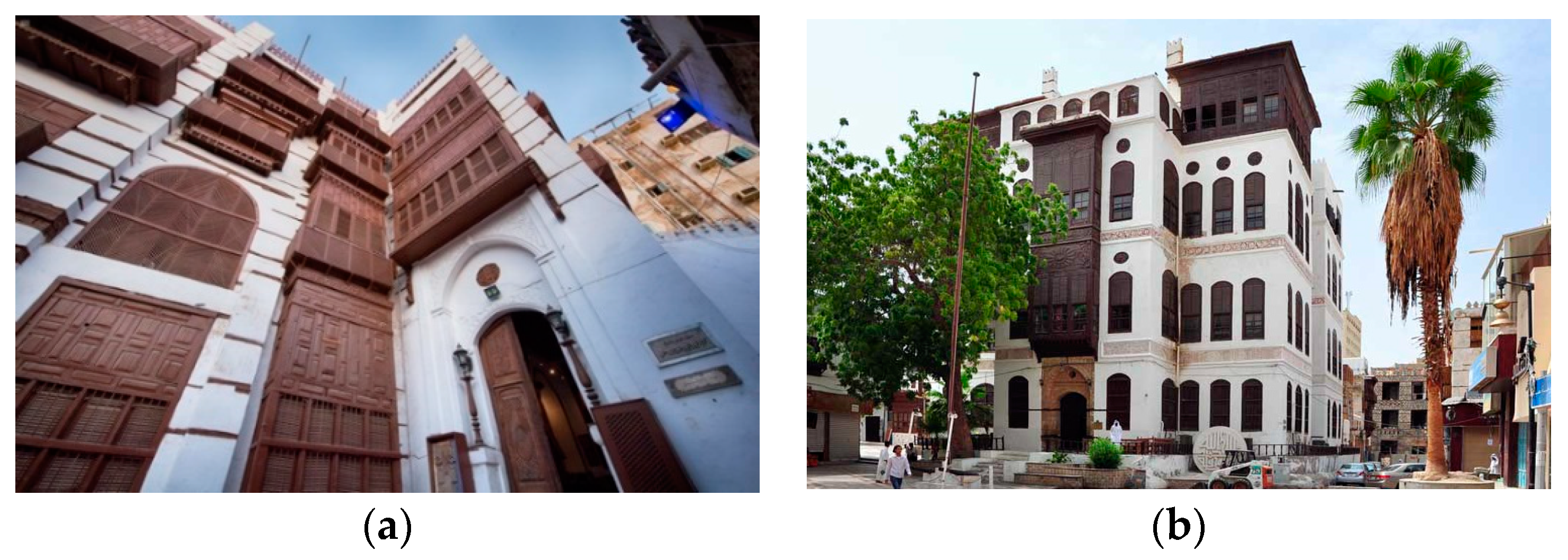
Figure 4.
The project to revive tourist axes and paths in historic Jeddah. (a) Path: “Abu Anaba axis,” on which many historical buildings are located. It has important historical and heritage houses, and a walker can cover it in a walking time of fifteen minutes. (b) Path: “Al-Nada axis,” which represents the market in the old city of Jeddah [26].
Figure 4.
The project to revive tourist axes and paths in historic Jeddah. (a) Path: “Abu Anaba axis,” on which many historical buildings are located. It has important historical and heritage houses, and a walker can cover it in a walking time of fifteen minutes. (b) Path: “Al-Nada axis,” which represents the market in the old city of Jeddah [26].
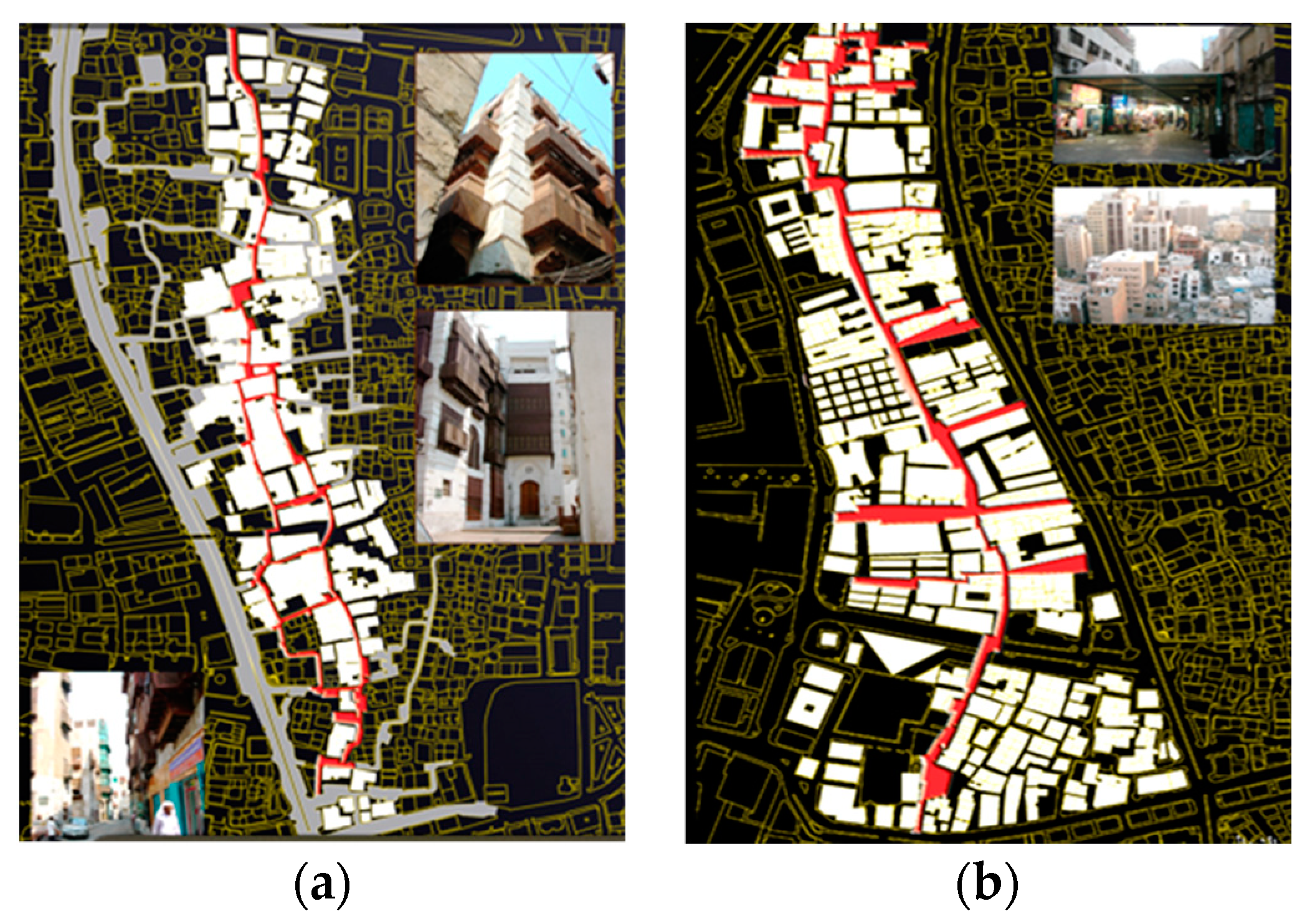
Figure 5.
Matthew's classification for the historical buildings in Historic Jeddah according to the uniqueness of the building’s architectural style and its value. historical, artistic and spatial, in accordance with adopted standards in that UNESCO classification [28].
Figure 5.
Matthew's classification for the historical buildings in Historic Jeddah according to the uniqueness of the building’s architectural style and its value. historical, artistic and spatial, in accordance with adopted standards in that UNESCO classification [28].
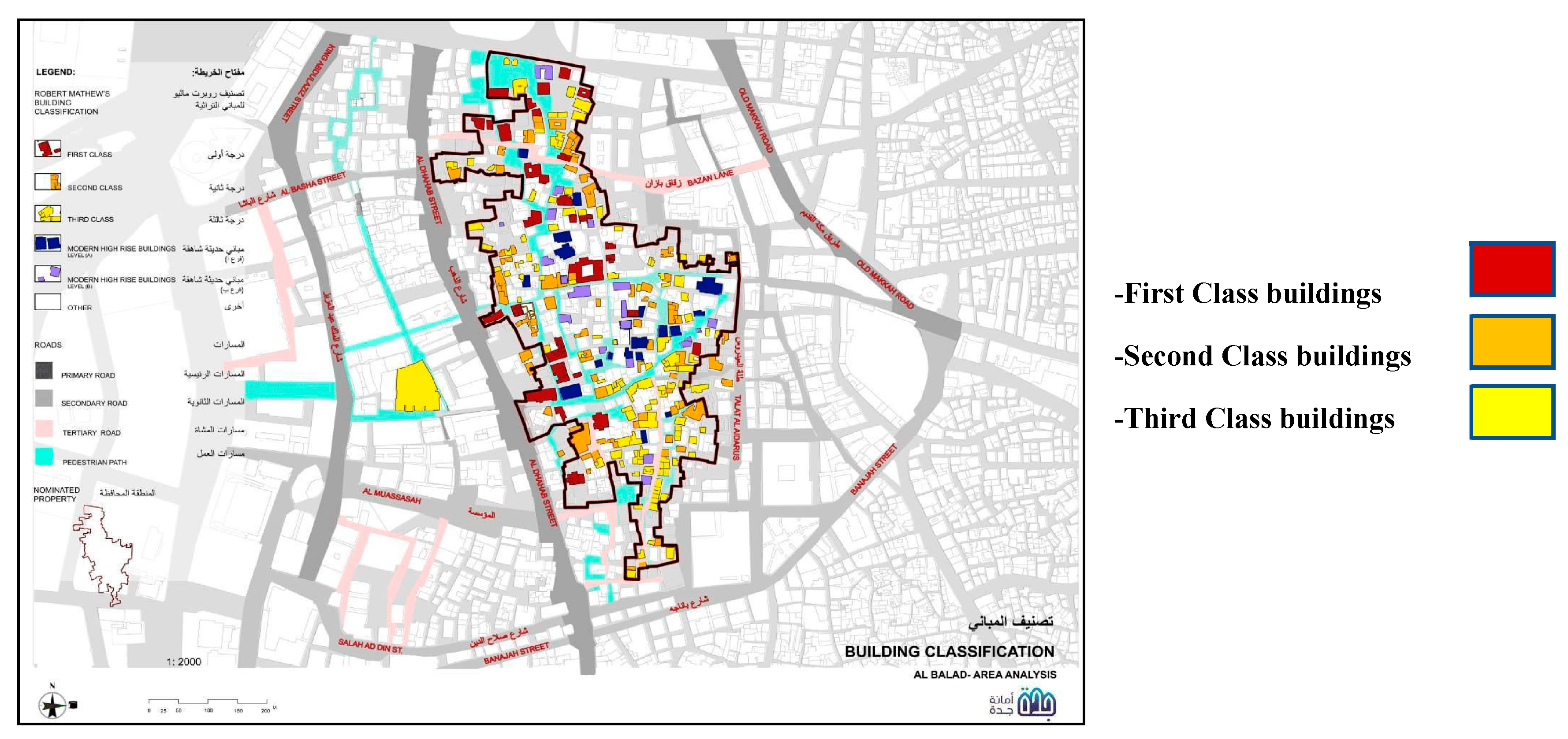
Figure 6.
The Historic Jeddah protection Area (Nominated Property) (NP) (shaded in white), which is the area that was registered in 2014 on the UNESCO World Heritage List, followed by the four (Buffer Zones) (bz1: bz4), which are a group of conservation areas surrounding the historic Jeddah protection area from all sides [29].
Figure 6.
The Historic Jeddah protection Area (Nominated Property) (NP) (shaded in white), which is the area that was registered in 2014 on the UNESCO World Heritage List, followed by the four (Buffer Zones) (bz1: bz4), which are a group of conservation areas surrounding the historic Jeddah protection area from all sides [29].
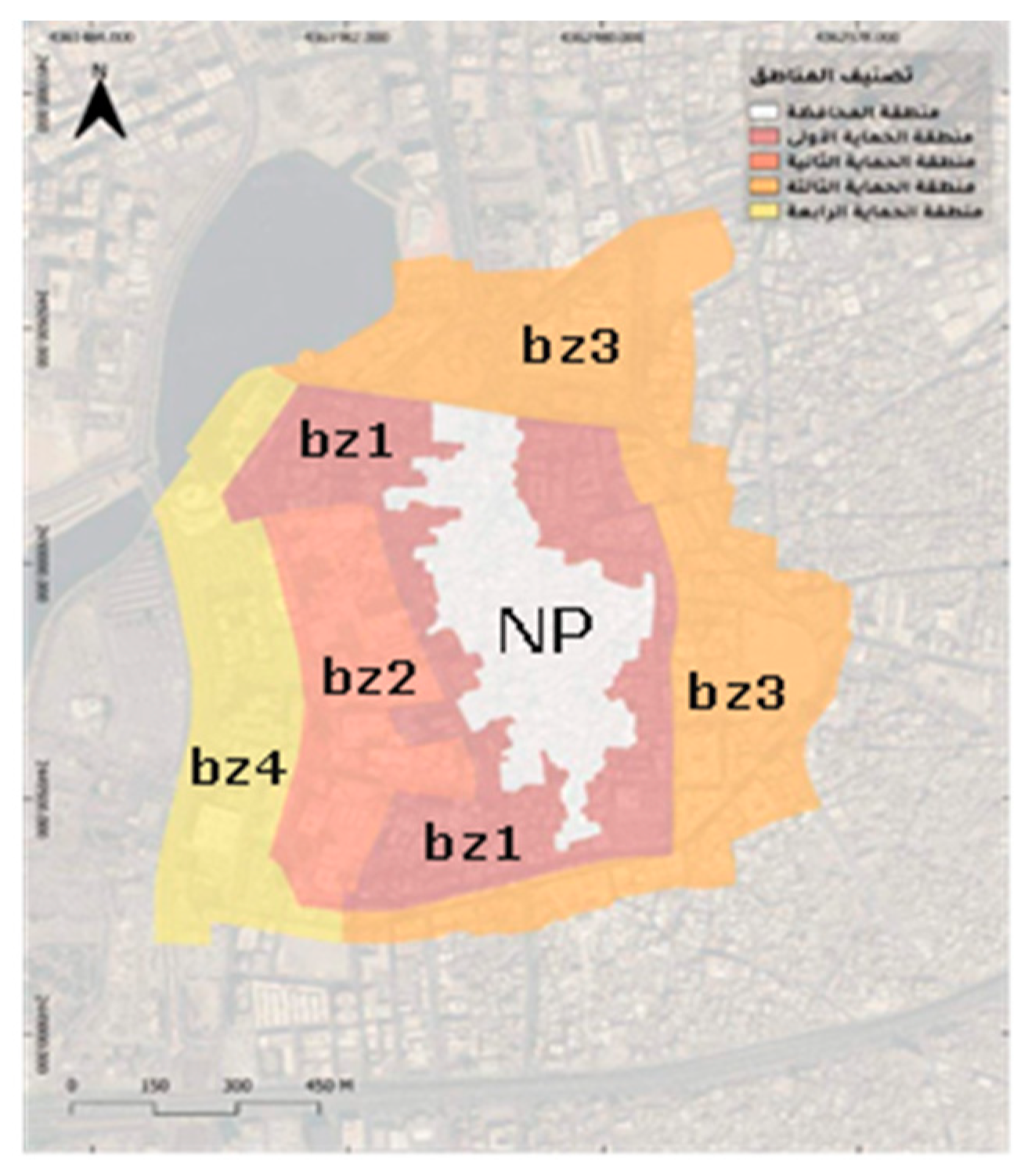
Figure 7.
The strategies for urban preservation in the historic Jeddah [29].
Figure 7.
The strategies for urban preservation in the historic Jeddah [29].
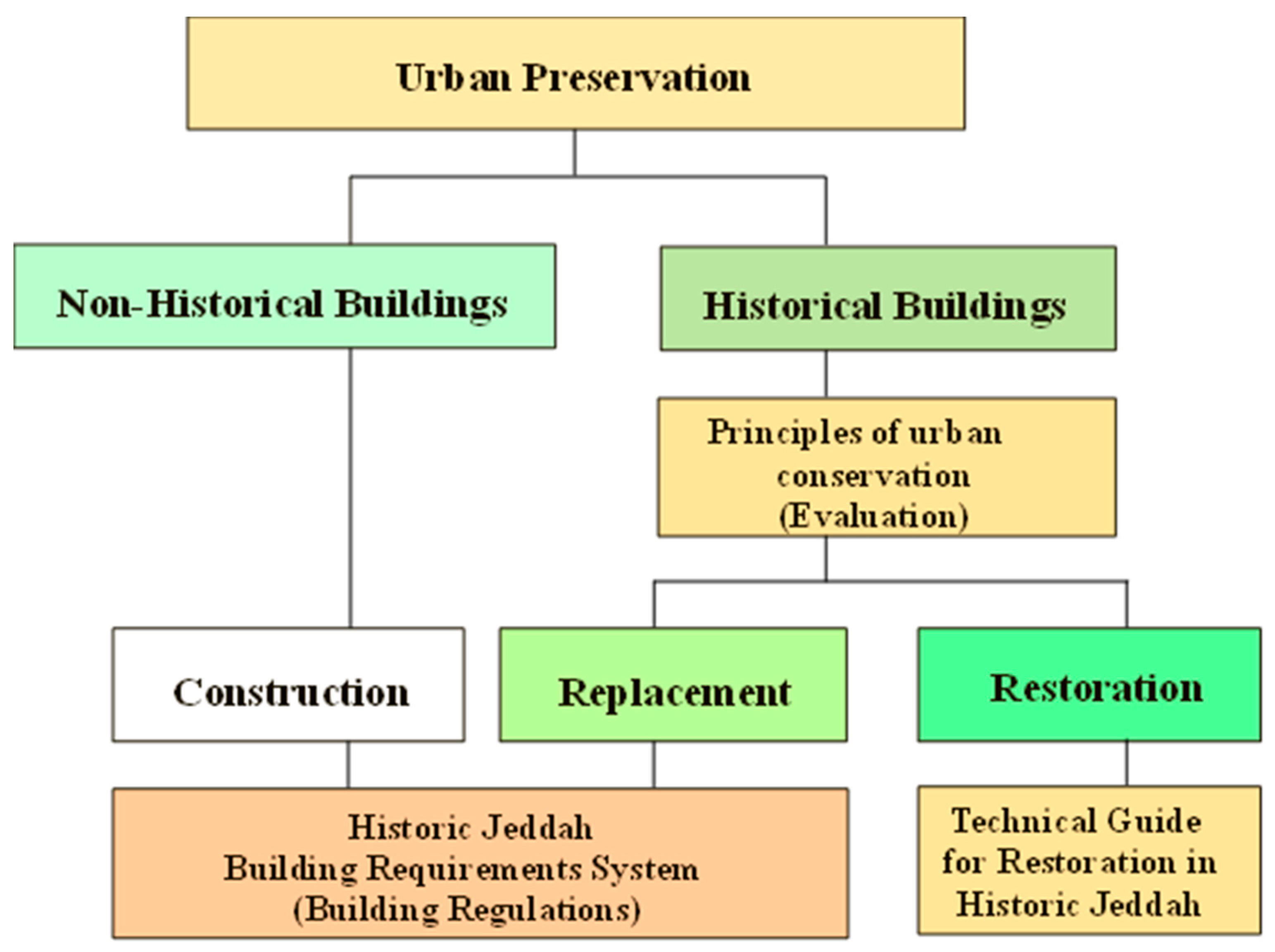
Figure 8.
Classification of heritage buildings in historic Jeddah according to their structural and urban condition and the preservation strategies followed [The Researchers].
Figure 8.
Classification of heritage buildings in historic Jeddah according to their structural and urban condition and the preservation strategies followed [The Researchers].
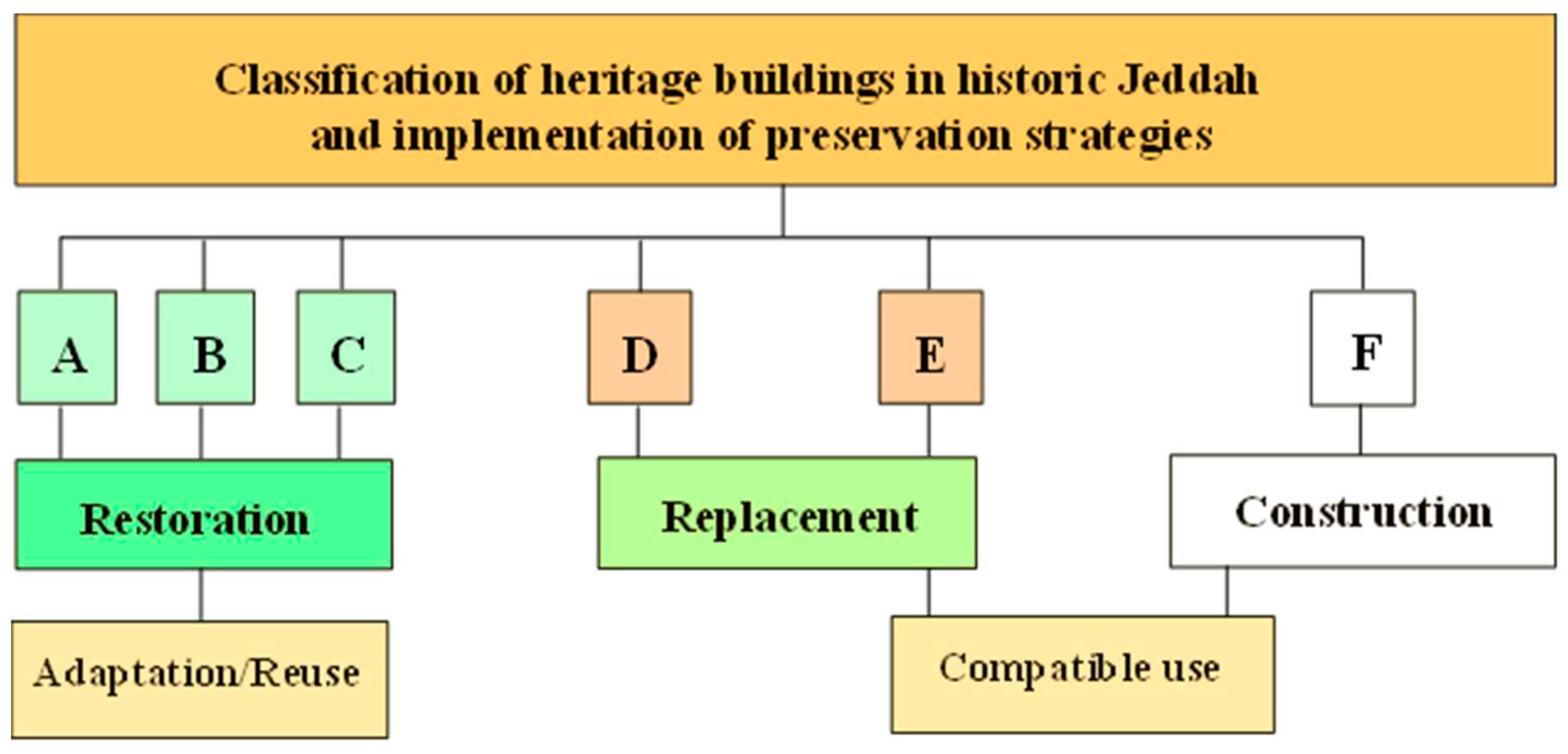
Figure 9.
Removing and clearness areas around the historical area, and expropriation areas within the scope of the historical area according to the recent development decisions in Jeddah (2021) & (2022), respectively [30].
Figure 9.
Removing and clearness areas around the historical area, and expropriation areas within the scope of the historical area according to the recent development decisions in Jeddah (2021) & (2022), respectively [30].
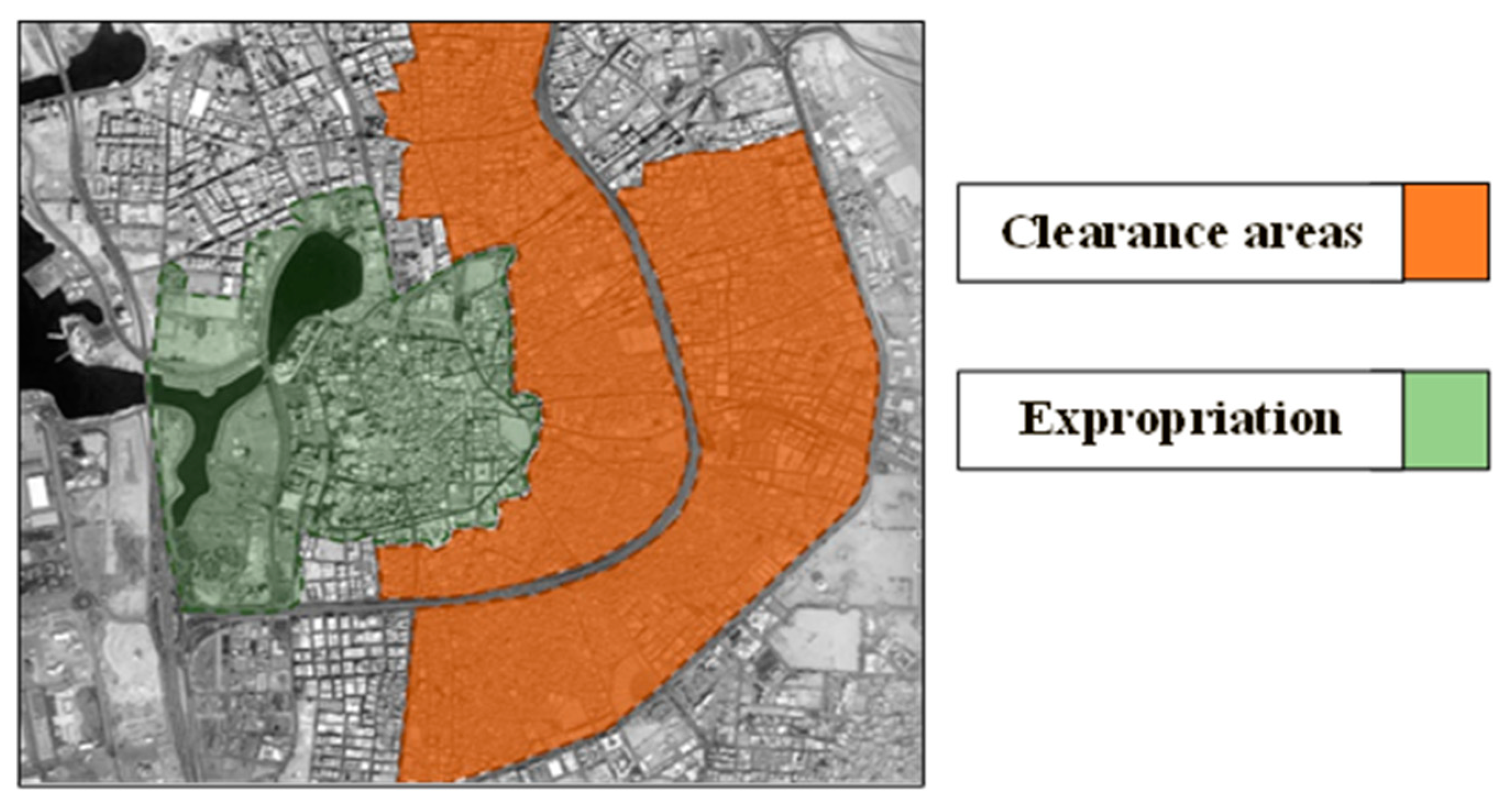
Figure 10.
The Protection Area (NP) within the scope of historic Jeddah and appears in the map to the (left) before the demolition work. It also appears in the map to the (right) within the scope of the demolition that took place of entire districts and huge areas, which will give the concerned administration authorities an opportunity to replace them with new and contemporary districts and activities that support the historical area contributes to its continuity and prosperity [30].
Figure 10.
The Protection Area (NP) within the scope of historic Jeddah and appears in the map to the (left) before the demolition work. It also appears in the map to the (right) within the scope of the demolition that took place of entire districts and huge areas, which will give the concerned administration authorities an opportunity to replace them with new and contemporary districts and activities that support the historical area contributes to its continuity and prosperity [30].
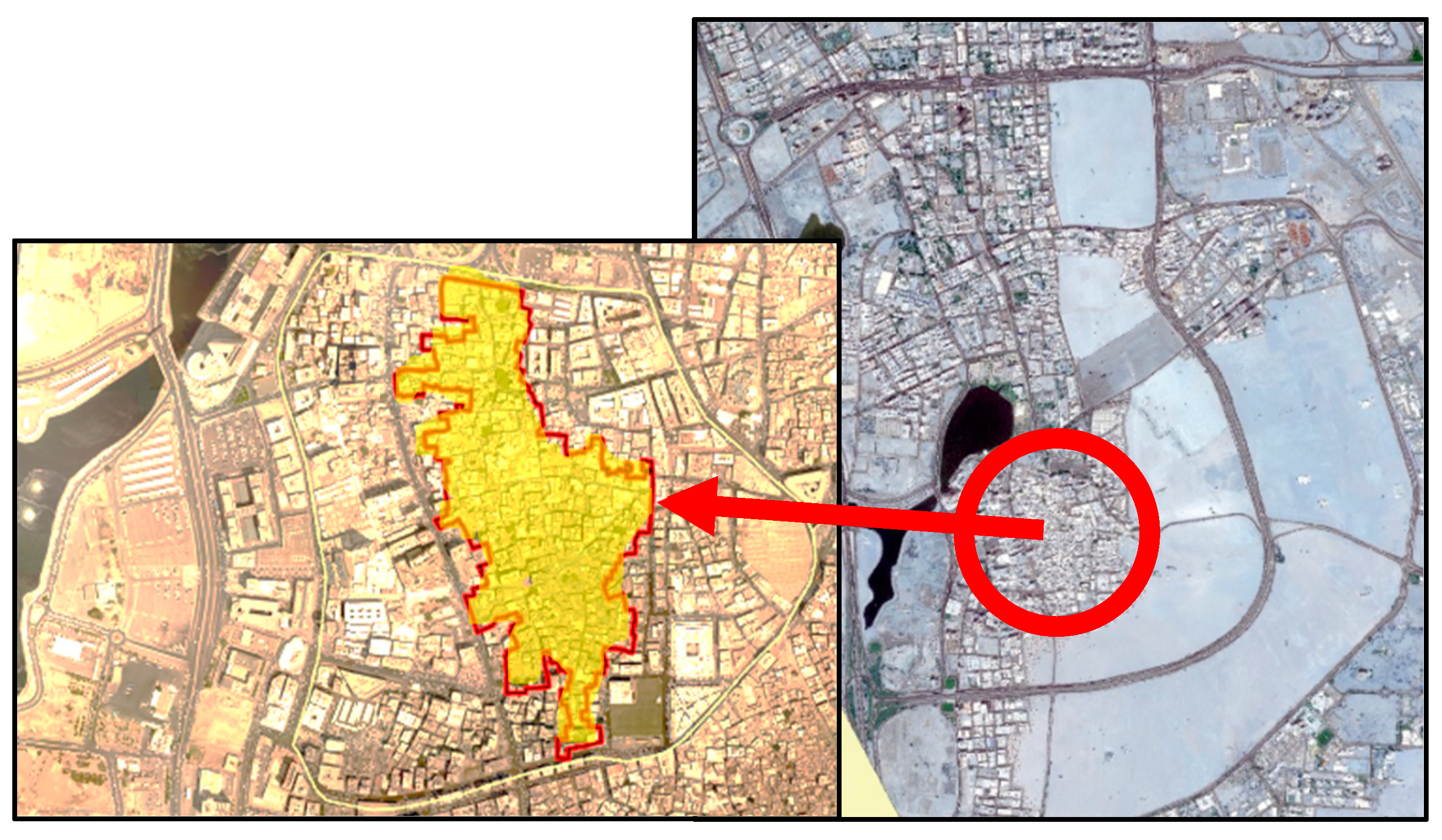

Table 1.
Classification of heritage buildings in historic Jeddah and proposals for their reuse*.
| Classification | Reuse proposal | Architectural processing External facades processing |
Architectural processing Interior design processing |
|
|---|---|---|---|---|
| First Class | - The optimal reuse is chosen according to the master plan, provided that it does not conflict with the nature and privacy of the building. The alternatives for proposed uses are as follows: governmental, administrative, cultural, and educational. Provided that the optimal proposal for reuse is subject to the approval of the relevant authorities. | - The presence of building materials and systems used in constructing and finishing the facades of heritage buildings, which must be in the traditional manner and in accordance with the original drawings of the building. | - The distribution and design of the building’s interior spaces, as well as all interior design elements, must be adhered to in accordance with the building’s original drawings. | |
| - Perfect match between the proportions of the interior spaces and the original design. | ||||
| Second Class | The optimal reuse is chosen according to the master plan, provided that it does not conflict with the nature and privacy of the building. The alternatives for proposed uses are as follows: governmental, administrative, cultural, and educational. Provided that the optimal proposal for reuse is subject to the approval of the relevant authorities. | - Alterations should range from 30% to 50% of the total elements and components of the original interior design. |
||
| Third Class | ||||
| - The presence of building materials and systems used in constructing and finishing the facades of heritage buildings, which must be in the traditional manner and in accordance with the original drawings of the building. - Preserving the original proportions of the facade design of the heritage building. |
*(Jeddah Municipality,2014. adapted).
Table 2.
Strategies that were adopted for the urban preservation of the historic Jeddah*.
| Strategy | Scope of use |
|---|---|
| Restoration | This is for historical buildings whose structural and urban condition is classified within the classifications (A, B, C). These restoration operations are subject to the requirements and standards of UNESCO for the preservation of these historical and heritage buildings |
| Replacement | This is for historical buildings whose structural condition is classified within classifications (D, E), and includes collapsed historical and heritage buildings that are rebuilt by returning to the internal and external documentation of the building based on the original records of the building until it returns to conform to what its former architectural character was (29). |
| New Construction by following (Clearance & Renewal) strategies |
This is for the vacant lands located in the area, which are constructed in accordance with the established architectural rules and urban requirements, provided that they are used to serve and develop the area. As well as the area also contains a number of relatively modern structural buildings that were constructed after the demolition of the city wall in (1947) and during the following periods, especially in the sixties and seventies of the twentieth century. These were mostly buildings that did not adhere to the heights set by "Robert Matthew" in his Masterplan, which led to urban and visual distortion. Therefore, the new construction policy is used to clearance and renewal them with building of appropriate buildings within the development scope of the historical area (29). |
| Adaptation/ Reuse | This is for historical and heritage buildings that are being restored and in accordance with Robert Matthew’s proposal and classification in this regard. which was reviewed and approved by the Jeddah Municipality (28). |
| Developing & Upgrading |
This is through some of the procedures followed in the area, such as preventing the entry of vehicles except for public service vehicles such as fire engines and ambulances, and restricting the area to pedestrians only, in addition to providing parking areas for cars in the surrounding areas, as well as providing the area with various necessary facilities and services and adopting specific systems and procedures for cleaning and maintenance operations, in addition to adopting fire-fighting and extinguishing systems and other development and upgrading works. |
*(The Researchers).
Disclaimer/Publisher’s Note: The statements, opinions and data contained in all publications are solely those of the individual author(s) and contributor(s) and not of MDPI and/or the editor(s). MDPI and/or the editor(s) disclaim responsibility for any injury to people or property resulting from any ideas, methods, instructions or products referred to in the content. |
© 2023 by the authors. Licensee MDPI, Basel, Switzerland. This article is an open access article distributed under the terms and conditions of the Creative Commons Attribution (CC BY) license (http://creativecommons.org/licenses/by/4.0/).
Copyright: This open access article is published under a Creative Commons CC BY 4.0 license, which permit the free download, distribution, and reuse, provided that the author and preprint are cited in any reuse.


