

Submitted:
13 December 2023
Posted:
14 December 2023
You are already at the latest version
Abstract
Plants have developed unique mechanisms to cope with the harsh environmental conditions to compensate for their lack of mobility. A key part of their coping mechanisms is the synthesis of secondary metabolites. In addition to their role in plants’ defense against pathogens, they also possess therapeutic properties against diseases, and their use by humans predates written history. Viruses are a unique class of submicroscopic agents, incapable of independent existence outside a living host. Pathogenic viruses continue to pose a significant threat on global health, leading to unprecedented fatalities on a yearly basis. The use of medicinal plants as a natural source for an-tiviral agents has been widely reported in literature in the past decades. Metabolomics is a powerful research tool for the identification of plant metabolites with antiviral potentials and can be used to isolate compounds with antiviral activities in plants and study the biosynthetic pathways involved in viral disease progression. This review discusses the use of medicinal plants as antiviral agents, with a special focus on the metabolomics evidence supporting their efficacy. Additionally, suggestions are made for the optimization of various metabolomics methods for characterizing the bio-active compounds in plants and subsequent understanding of the mechanism of their operation.
Keywords:
viral infections
; antiviral activity
; medicinal plants
; metabolomics
1. Introduction
The continuous emergence of viral diseases, leading to major global health challenges, warrants an intensified effort from a combined team of researchers and healthcare professionals. Continued/regularly occurring pathogenic viral infections of pandemic proportions, account for millions of deaths annually [1]. Although the development of conventional antiviral drugs has made a significant stride towards curbing this in the last decade, the limitations become increasingly conspicuous due to issues such as drug resistance [2], narrow spectrum of activities [3], costs [4], and adverse side effects [5]. This has led to a resurgence in the exploration of alternative treatment modalities from health stakeholders. Numerous chemical compounds found in natural sources are exclusive to plants, microbes, and marine life [6]. They provide important leads for drug discoveries and can potentially contribute to antiviral treatment/drug development [7,8,9]. Compounds derived from natural sources against viruses, play a crucial role in drug discovery and the development of new antiviral treatments [7,10]. Medicinal plants has emerged as a promising frontier in the search for innovative antiviral therapies [11].
Throughout history, different cultures have sought healing in the potency of plants for the alleviation of pains, and diseases. Their use in traditional medicine systems globally underscores their potential as a source of valuable antiviral compounds.
Plants respond to biotic and abiotic stress by synthesizing a large array of secondary metabolites with complex chemical combinations [12,13,14]. Although numerous studies have reported the activities and potentials of plants against viruses [15,16], it is important to validate traditional remedies through clinical trials [17,18].
The arrival of advanced analytical techniques to modern scientific research presents an opportunity for the exploration of plant-based compounds for their therapeutic effects. Metabolomics has emerged as an indispensable tool for the identification of different classes of antiviral secondary metabolites from plants over the last decade. These include various flavonoids, terpenoids, alkaloids and polyphenols, each of which exhibit various therapeutic effects during different stages of the viral cycle (e.g. viral attachment, entry, viral replication, and release) [19]. These identified antiviral plant metabolites account for about a quarter of all drugs developed and used today [20,21].
The interplay between medicinal plants, viral infections, and metabolomics offers a multifaceted view of the possibilities and potentials inherent in plants towards the development of new antiviral therapeutics. This review highlights the role of metabolomics in the discovery and development of new antiviral bioactive compounds from medicinal plants. It also identifies the obvious gaps in current knowledge and offers comprehensive suggestions to future research directions.
2. Overview of Viral Infections
Viruses have been part of life since time immemorial. They are the smallest known agents of human infections, with a diameter that ranges between 20 - 200 nanometers [22]. Viruses are ubiquitous and can be found in animals, plants, humans, and other living organisms. All viruses are referred to as obligate intracellular pathogens since they cannot complete their life cycle without a living host [23]. Although many of them are benign, non-pathogenic and can even save lives, some however do contribute to a considerable number of infections in humans [24,25]. Viral infections additionally present a significant public health concern. Over the last few decades, there has been an emergence of many new viruses, with a significant number of them having deleterious effect on human health in several ways [26]. Siegel (2017), reported 26 virus families implicated in human diseases with each exhibiting different genomic structure, physiochemical properties, molecular processes, and morphology.
Viral infections are diverse types and include: 1) sexually transmitted infections, including hepatitis B, HIV, herpes simplex virus (HSV) and human papillomavirus (HPV); 2) gastrointestinal infections, which lead to gastroenteritis caused by noroviruses, rotaviruses, adenoviruses and sapoviruses; 3) zoonotic infections, caused by viruses that can be hosted by both animals and humans, e.g. ebola, rabies, and hantaviruses; 4) hepatic infections, which can result in hepatitis, e.g. hepatitis A, B, C, D and E viruses and others which include yellow fever and the Epstein-Barr virus; 5) Respiratory infections such as the common cold (caused by rhinovirus), flu (caused by influenza viruses), COVID-19 (caused by SARS-CoV-2 virus) and the respiratory syncytial virus (RSV) [27,28,29].
The most common of these viral diseases are those that affect the respiratory system [30]. A collaboration between researchers from several institutions and countries reported that respiratory diseases were the third leading cause of death worldwide between the year 1990-2019, only next to cancer and cardiovascular diseases [31]. The influenza virus, which is the causative agent for the acute respiratory infection-seasonal flu, remains one of the biggest threats to public health according to the World Health Organization (WHO). The organization gave an estimated amount of 290,000 - 650,000 flu related deaths annually [32]. The SARS-CoV-2 has accounted for at least 14.9 million deaths directly or indirectly at the height of COVID-19 pandemic between the years 2020 and 2021 according to WHO [33].
Viral infections are risk factors for other medical conditions also, since they have the potential to weaken the immune system and induce an inflammatory response from the host cell [26,34]. Recent studies confirmed that oncogenic viruses implicated in the development of some cancer, account for about 10% of all global cancer burden [35]and may also be responsible for long-term persistent infections [36]. Viral infections can also result in secondary bacterial infections, a condition in which infected patients are predisposed to health complications from bacterial sources, due to a weakened immune system [37,38,39]. Cardiovascular diseases have also been linked to viral infections [40]. In 1932, Collins, (1932) reported that the peak period of influenza pandemic in the United States was in direct proportion to an increase in heart diseases. Also, in the wake of Covid-19 pandemic, there were many reports of heightened cases of cardiovascular diseases linked to the SARS-CoV-2 virus [42,43]
The unique nature of viruses and their ability to rapidly mutate, leading to an emerging pathogenesis and drug resistance, makes the current therapeutic and prophylactic options available for treating these increasingly smaller (Rouse and Lukacher, 2010; Wong et al., 2017; Moghadas et al., 2008; Strasfeld and Chou, 2010b; Faraz et al., 2022).. Plants have been used for centuries as part of traditional medicine in the treatment of a variety of diseases, including various viral infections. Since the first attempt to screen over 200 plants for anti-influenza activity some 7 decades ago by (Chantrill et al., 1952), many additional studies have shown the vast potential of an enormous array of various medicinal plants across diverse geographical locations, for antiviral activity and the potential for antiviral drug development, and as a standalone or to be used as complementary therapeutic agents to conventional antiviral medicines [47–52].
Metabolomics, which is the study of all metabolites present in a biological system at a given time, has become a valuable tool for the identification and quantification of possible new therapeutic compounds from plants. A combination of techniques including: Nuclear Magnetic Resonance (NMR) and advanced hyphenated mass spectrometry, are now central to metabolomics studies and are routinely applied towards new biomarker identification for the purpose of bettering our understanding of the chemical profiles of plants and their applications to health and disease. The aim of this review is to comprehensively evaluate the available literature on the properties of a diverse range of plant metabolites with antiviral properties, with a specific focus on the evidence from metabolomics studies, and to explore their potential use in the development of novel antiviral therapies.
3. A Brief History of the Use of Medicinal Plants Against Viral Infections
Medicinal plant use against a variety of viral infections across various cultures, dates to the dawn of human civilization. Traditional Chinese medicine, Eber papyrus of Ancient Egypt and the Ayurveda of India, are amongst the oldest cultures practicing medicinal plant use with well documented manuscripts available for such [53,54,55]. Ancient traditional Chinese medicine has a history of about 3000 years or more. Writings based on this practice describing the use of plants for healing purposes are among the oldest medical writings of any culture [56]. Examples of plants used to treat viral infections in ancient China include ephedra (Ephedra sinica) for the treatment of common cold [57], Andrographis paniculata for treating a cough, cold and influenza [58], Camellia sinensis (green tea) with confirmed activities against herpes, hepatitis B and C, and Epstein Barr viruses [59,60,61]. The Egyptian papyrus contains descriptions of plant and natural product preparations against plethora of diseases, also including various viral infections [62], with one of such plants being garlic (Allium sativum) [63], for the treatment of respiratory catarrh, influenza, and recurring colds [64]. Echinacea (Echinacea purpurea), also contained in the papyrus, has been reported to have activity against respiratory viral infections [65]. Ayurveda, a natural system of medicine with historical root in India, dating back to the last 3 millennia, describe the plants Aegle marmelos, Ficus religiosa, and Azadirachta indica, amongst others, to have activities against variety of viruses [52,66,67,68]. European herbal medicine and traditional African Medicine also have long history of incorporating plant use to combat various illnesses, including viral infections. Elderberry (Sambucus nigra) for instance has been used in Europe for many years as a remedy for colds and flu [69], while plants like Sutherlandia frutescens and Artemisia afra, native to Africa, have reported activities against various viral infections [70,71]. The last few decades have seen a resurgence in the use of medicinal plants as an alternative source for the treatment of various viral infections [72]. This is due in part to the rise in the prevalence of viral infections and growing concern about antibiotic resistance [73,74].
4. Mechanism of Actions of Antiviral Secondary Metabolites in Medicinal Plants
Plants’ secondary metabolites are organic compounds that are not directly involved in the growth, development, or reproduction of plants. They are produced as a survival strategy for plants against adverse conditions in their surrounding environment, and also to carry out important physiological tasks [12]. There are various criteria used in determining the classification of secondary metabolites in plants, and include chemical structure, composition of constituent elements and how soluble they are in water or organic solvents. The most commonly accepted criterion however is their biosynthetic pathway [75]. Based on these pathways, three classes of secondary metabolites have been identified in medicinal plants: 1) alkaloids, 2) terpenoids and 3) phenolic compounds [76]. Each exhibit different phytochemical constituents and pharmacological activities against various viral agents [75,77]. Commonly reported mechanisms of action of plant derived secondary metabolites against viruses include: 1) virus entry attachment [78,79], 2) inhibition of viral replication [80,81], 3) protein synthesis inhibition [82,83,84], 4) modulation of the host’s immune system [85], 5) modulation of cellular signaling pathway [86] and 6) direct virucidal activity [86,87].
4.1. Phenolics
Phenolic compounds are a diverse group of plant derived organic molecules characterized by the possession of at least one phenol group. They are the most widely distributed secondary metabolites in plants [88] and are synthesized as an adaptive response to unfavorable conditions [89]. Phenols are commonly found in all plant organs and are rich constituents of fruits, vegetables, beverages, cereals, and legumes [90].
Some well-known phenolic compounds include flavonoids, tannins, and phenolic acids. The specific mechanism of action of phenols against viruses depends on the type of phenolic compound and the virus been targeted. Phenols exert therapeutic interventions against viruses in a variety of ways, which include the disruption of the viruses’ envelopes. The lipid bilayer surrounding virus-encoded membrane-associated proteins, in some viruses responsible for mediating interactions between the virus and host cell, can be inhibited by phenolic compounds. The tannin: epigallocatechin-3-callate, found in green tea [91], has been reported to inhibit the binding of HIV envelope glycoprotein gp120 to the glycoprotein CD4 receptor found on the immune cells surface [92,93]. Phenolic interventions generally disrupt the infectivity of the virus [94,95]. Many phenolic compounds have also been reported to inhibit viral entry into the target host cells [95,96,97,98]. These they do by interfering with viral attachment proteins, or the receptors on the host cell’s surface [99,100]. An important step in the process of viral infection, is the replication process. Phenols often interfere with the process of viral replication by binding to and subsequently inactivating with various viral proteins or enzymes, and subsequently halt disease progression in the host cells [100,101,102]. Specific examples of compounds reported to interfere with viral replication includes epigallocatechin-3-gallate (EGCG), a catechin derived from green tea. EGCG has reportedly demonstrated inhibitory potential against M2 protein of influenza A virus. This it does by increasing IFN-λ2 expression in the human lung epithelial BEAS-2B cells, through the p38 mitogen-activated protein kinase signaling pathway [103]. Also, the inhibition of the HIV-1 enzyme reverse transcriptase and cellular DNA and RNA polymerases by four flavonoids namely quercetin, baicalein, myricetin, and quercetagetin were previously reported by ONO et al., (1990). The immunomodulatory effects of some phenolic compounds have also been previously indicated, where they are involved in the stimulation and production of signaling molecules, including cytokines and chemokines [105,106]. A key mechanism of defense against viral infection is programmed cell death [107]. Phenolic compounds can induce apoptotic cell death in host cell, and thereby limit the spread of viral infections [100,108,109]. Figure 1 schematically summarizes the antiretroviral activities of plant derived phenolic compounds effects.
4.2. Alkaloids
Alkaloids, primarily but not exclusively present in plants, are a class of naturally occurring organic compounds containing at least one nitrogen atom. They can be found in many plant structures and have been reported to have pharmacological effects against various microbial diseases and viruses. Alkaloids have in particular been highlighted for their broad-spectrum activities against both DNA and RNA viruses [110,111]. Due to their importance, they have also been identified as the largest class of plants’ secondary metabolites investigated to date for such (Abookleesh et al., 2022). The most well-known plant alkaloids found in nature include cocaine, morphine, and quinine.
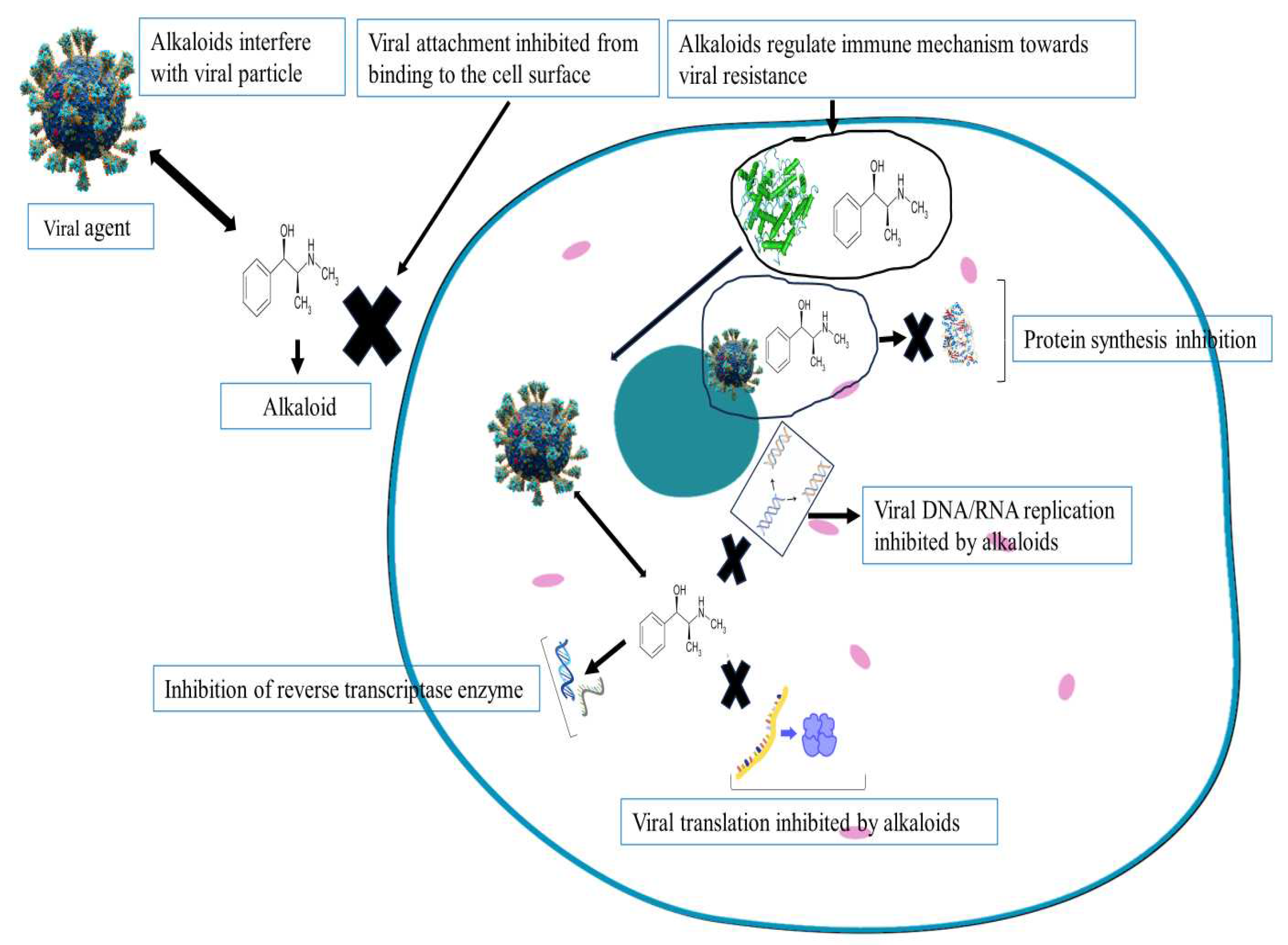
Alkaloids have been identified as important inhibitors of the flow of genetic information (from the DNA/RNA viral particle to the protein synthesis), necessary to ensure the lifecycle of the virus. The antiviral activities of alkaloids, as proven by experimental evidence, primarily involves inhibition of: 1) DNA and RNA replication, 2) RNA translation, 3) protein synthesis, 4) DNA intercalation, 5) enzymatic activities, 6) the translocation of the ribonucleoprotein complex, 7) DNA synthesis, and 8) protein synthesis. Many studies have reported the use of alkaloids for the treatment and prevention of viral infections [111,112,113]. Alkaloids can also regulate human immune mechanisms towards viral resistance, by mediating the humoral immune response [114].
Below is a schematic representation of the antiviral activities of alkaloids.
Figure 2.
A schematic diagram showing the mechanism of the antiviral activities of alkaloids.
4.3. Terpenoids
Terpenoids are a large group of diverse organic products that are ubiquitous in nature. They exist in six categories namely: hemiterpenes, monoterpenes, sesqui-terpenes, diterpenes, sesterpenes, triterpenes, and tetra-terpenoids [115]. As an essential component of all living cells, they are products of both primary and secondary cellular metabolism [116]. Terpenoids are mostly present in the leaves and fruits of higher plants, where they sometimes contribute to their vibrant colors. They are also highly volatile and combustible organic compounds [117]. As aromatic metabolites, they are largely responsible for the flavor and fragrance of plants [118]. Terpenoids are of special interest to medical chemists because of their significant pharmacological activities [119]. Common terpenoids include citral, menthol camphor and salvinorin A.
Various terpenoids have been shown to possess promising antimicrobial and antiviral properties [120]. Those with reported antiviral activities include glycyrrhizin, an important antiviral chemical compound found in the roots of the licorice plant (Glycyrrhiza glabra) [121]. Historical sources from China [122], India [123], and parts of Europe [124] make references to the use of glycyrrhizin in the treatment of viral respiratory tract and liver infection, caused by hepatitis. Fiore et al., (2008), reported the immunomodulatory activities of glycyrrhizin due to induction of interferon gamma, and Richard (2021) described it’s anti-inflammatory mechanisms. Glycyrrhizin furthermore inhibits replication of severe acute respiratory syndrome associated with corona virus (SARS-CV) infection, and also prevents the adsorption and penetration of the virus [127]. Isoborneol, a monoterpene present in a variety of different essential oils, totally inhibits the herpes simplex virus (HSV-1) replication, and that at a concentration of only 0.06% [128]. Additionally, β-pinene and limonene monoterpenes present in various essential oils, showed high anti-HSV-1 activity, and function by reducing the viral infectivity by 100%, by directly interfering with free viral particles [129]. Many studies have also indicated that celastrol, a pentacyclic triterpenoid, inhibits the replication of the dengue virus [130], human immunodeficiency virus [131], and hepatitis C virus [132]. Figure 3 shows a schematic summary of the antiviral activities of terpenoids.
References
- Baker, R.E.; Mahmud, A.S.; Miller, I.F.; Rajeev, M.; Rasambainarivo, F.; Rice, B.L.; Takahashi, S.; Tatem, A.J.; Wagner, C.E.; Wang, L.F.; et al. Infectious Disease in an Era of Global Change. Nat Rev Microbiol 2022, 20, 193–205. [Google Scholar] [CrossRef]
- Strasfeld, L.; Chou, S. Antiviral Drug Resistance: Mechanisms and Clinical Implications. Infect Dis Clin North Am 2010, 24, 413–437. [Google Scholar] [CrossRef] [PubMed]
- Chitalia, V.C.; Munawar, A.H. A Painful Lesson from the COVID-19 Pandemic: The Need for Broad-Spectrum, Host-Directed Antivirals. J Transl Med 2020, 18. [Google Scholar] [CrossRef]
- Fleßa, S.; Marschall, P. Socio-Economic Impact of Antiviral Intervention; 2009.
- Morris, D.J. Adverse Effects and Drug Interactions of Clinical Importance with Antiviral Drugs; 1994; Vol. 10. [CrossRef]
- Ntie-Kang, F.; Svozil, D. An Enumeration of Natural Products from Microbial, Marine and Terrestrial Sources. Physical Sciences Reviews 2020, 5. [Google Scholar] [CrossRef]
- Atanasov, A.G.; Zotchev, S.B.; Dirsch, V.M.; Orhan, I.E.; Banach, M.; Rollinger, J.M.; Barreca, D.; Weckwerth, W.; Bauer, R.; Bayer, E.A.; et al. Natural Products in Drug Discovery: Advances and Opportunities. Nat Rev Drug Discov 2021, 20, 200–216. [Google Scholar] [CrossRef] [PubMed]
- Ji, H.-F.; Li, X.-J.; Zhang, H.-Y. Natural Products and Drug Discovery Can Thousands of Years of Ancient Medical Knowledge Lead Us to New and Powerful Drug Combinations in the Fight against Cancer and Dementia?; 2009; Vol. 10. [CrossRef]
- Dias, D.A.; Urban, S.; Roessner, U. A Historical Overview of Natural Products in Drug Discovery. Metabolites 2012, 2, 303–336. [Google Scholar] [CrossRef]
- Lin, L.T.; Hsu, W.C.; Lin, C.C. Antiviral Natural Products and Herbal Medicines. J Tradit Complement Med 2014, 4, 24–35. [Google Scholar] [CrossRef] [PubMed]
- Kumar Shakya, A.; Arvind Kumar Shakya, C. Medicinal Plants: Future Source of New Drugs. Int J Herb Med 2016, 4, 59–64. [Google Scholar] [CrossRef]
- Guerriero, G.; Berni, R.; Muñoz-Sanchez, J.A.; Apone, F.; Abdel-Salam, E.M.; Qahtan, A.A.; Alatar, A.A.; Cantini, C.; Cai, G.; Hausman, J.F.; et al. Production of Plant Secondary Metabolites: Examples, Tips and Suggestions for Biotechnologists. Genes (Basel) 2018, 9. [Google Scholar] [CrossRef]
- Isah, T. Stress and Defense Responses in Plant Secondary Metabolites Production. Biol Res 2019, 52, 39. [Google Scholar] [CrossRef]
- Ramakrishna, A.; Ravishankar, G.A. Influence of Abiotic Stress Signals on Secondary Metabolites in Plants. Plant Signal Behav 2011, 6, 1720–1731. [Google Scholar] [CrossRef] [PubMed]
- Mark R., TePaske; James, B. Gloer Tubingensin A: An Antiviral Carbazole Alkaloid from the Sclerotia of Aspergillus Tubingensis; 1989; Vol. 54. [CrossRef]
- Rob Verpoorte Exploration of Nature’s: The Role of secondary Metabolites as leads in Drug Development; 1998. [CrossRef]
- Parveen, A.; Parveen, B.; Parveen, R.; Ahmad, S. Challenges and Guidelines for Clinical Trial of Herbal Drugs. In Proceedings of the Journal of Pharmacy and Bioallied Sciences; Wolters Kluwer Medknow Publications, October 1 2015; Vol. 7; pp. 329–333. [Google Scholar] [CrossRef]
- Owen, L.; Laird, K.; Shivkumar, M. Antiviral Plant-Derived Natural Products to Combat RNA Viruses: Targets throughout the Viral Life Cycle. Lett Appl Microbiol 2022, 75, 476–499. [Google Scholar] [CrossRef]
- Ghildiyal, R.; Prakash, V.; Chaudhary, V.K.; Gupta, V.; Gabrani, R. Phytochemicals as Antiviral Agents: Recent Updates. In Plant-derived Bioactives: Production, Properties and Therapeutic Applications; Springer Singapore, 2020; pp. 279–295 ISBN 9789811517617. [CrossRef]
- Yeshi, K.; Crayn, D.; Ritmejerytė, E.; Wangchuk, P. Plant Secondary Metabolites Produced in Response to Abiotic Stresses Has Potential Application in Pharmaceutical Product Development. Molecules 2022, 27. [Google Scholar] [CrossRef]
- A. Hussein, R.; A. El-Anssary, A. Plants Secondary Metabolites: The Key Drivers of the Pharmacological Actions of Medicinal Plants. In Herbal Medicine; IntechOpen, 2019. [CrossRef]
- Louten, J. Virus Structure and Classification. In Essential Human Virology; Elsevier, 2016; pp. 19–29. [CrossRef]
- Gelderblom, H.R. Structure and Classification of Viruses; 1996.
- Janeway, C.A.; Medzhitov, R. Innate Immune Recognition. Annu Rev Immunol 2002, 20, 197–216. [Google Scholar] [CrossRef] [PubMed]
- Cohen, F.S. How Viruses Invade Cells. Biophys J 2016, 110, 1028–1032. [Google Scholar] [CrossRef]
- Sudhan, S.S.; Sharma, P. Human Viruses: Emergence and Evolution. In Emerging and Reemerging Viral Pathogens: Volume 1: Fundamental and Basic Virology Aspects of Human, Animal and Plant Pathogens; Elsevier, 2019; pp. 53–68 ISBN 9780128194003. [CrossRef]
- Siegel, R.D. Classification of Human Viruses. In Principles and Practice of Pediatric Infectious Diseases; Elsevier Inc., 2017; pp. 1044–1048 ISBN 9780323401814. [CrossRef]
- Mathekga, A.D.M.; Meyer, J.J.M.; Horn, M.M.; Drewes, S.E. An Acylated Phloroglucinol with Antimicrobial Properties from Helichrysum Caespititium. Phytochemistry 2000, 53, 93–96. [Google Scholar] [CrossRef] [PubMed]
- Siegel, D.; Hui, H.C.; Doerffler, E.; Clarke, M.O.; Chun, K.; Zhang, L.; Neville, S.; Carra, E.; Lew, W.; Ross, B.; et al. Discovery and Synthesis of a Phosphoramidate Prodrug of a Pyrrolo[2,1-f][Triazin-4-Amino] Adenine C-Nucleoside (GS-5734) for the Treatment of Ebola and Emerging Viruses. J Med Chem 2017, 60, 1648–1661. [Google Scholar] [CrossRef]
- Boncristiani, H.F. Respiratory Viruses Defining Statement Introduction Human Respiratory Syncytial Virus Human Parainfluenza Viruses Human Metapneumovirus Rhinovirus Respiratory Adenoviruses Human Coronaviruses Unrelated to SARS SARS Coronavirus Human Bocavirus Further Reading; 2009.
- Hannah Ritchie, F.S. and M.R. Causes of Death.
- WHO WHO Launches New Global Influenza Strategy; 2019.
- WHO Methods for Estimating the Excess Mortality Associated with the COVID-19 Pandemic; 2023.
- Pawlotsky, J.M. Pathophysiology of Hepatitis C Virus Infection and Related Liver Disease. Trends Microbiol 2004, 12, 96–102. [Google Scholar] [CrossRef]
- Plummer, M.; de Martel, C.; Vignat, J.; Ferlay, J.; Bray, F.; Franceschi, S. Global Burden of Cancers Attributable to Infections in 2012: A Synthetic Analysis. Lancet Glob Health 2016, 4, e609–e616. [Google Scholar] [CrossRef]
- Maurice Green Oncogenic Viruses. Annu Rev Biochem 1970, 39, 701–756. [CrossRef]
- MacIntyre, C.R.; Chughtai, A.A.; Barnes, M.; Ridda, I.; Seale, H.; Toms, R.; Heywood, A. The Role of Pneumonia and Secondary Bacterial Infection in Fatal and Serious Outcomes of Pandemic Influenza a(H1N1)Pdm09. BMC Infect Dis 2018, 18. [Google Scholar] [CrossRef] [PubMed]
- Morris, D.E.; Cleary, D.W.; Clarke, S.C. Secondary Bacterial Infections Associated with Influenza Pandemics. Front Microbiol 2017, 8. [Google Scholar] [CrossRef] [PubMed]
- Dunn, C.; Brunetto, M.; Reynolds, G.; Christophides, T.; Kennedy, P.T.; Lampertico, P.; Das, A.; Lopes, A.R.; Borrow, P.; Williams, K.; et al. Cytokines Induced during Chronic Hepatitis B Virus Infection Promote a Pathway for NK Cell-Mediated Liver Damage. Journal of Experimental Medicine 2007, 204, 667–680. [Google Scholar] [CrossRef] [PubMed]
- Kawana, R. Viral and Other Myocarditis Cardiovascular Diseases Due to Viruses; 1985. [CrossRef]
- Collins, S.D. Excess Mortality from Causes Other than Influenza and Pneumonia during Influenza Epidemics; 1932; Vol. 47. [CrossRef]
- Bekkering, S.; Burgner, D. Viruses and Cardiovascular Disease: From Bad to Worse. Nature Cardiovascular Research 2022, 1, 601–602. [Google Scholar] [CrossRef]
- Schultheiss, H.P.; Baumeier, C.; Pietsch, H.; Bock, C.T.; Poller, W.; Escher, F. Cardiovascular Consequences of Viral Infections: From COVID to Other Viral Diseases. Cardiovasc Res 2021, 117, 2610–2623. [Google Scholar] [CrossRef] [PubMed]
- Wong, J.P.; Viswanathan, S.; Wang, M.; Sun, L.Q.; Clark, G.C.; D'elia, R. V. Current and Future Developments in the Treatment of Virus-Induced Hypercytokinemia. Future Med Chem 2017, 9, 169–178. [Google Scholar] [CrossRef] [PubMed]
- Rouse, B.T.; Lukacher, A.E. Some Unmet Challenges in the Immunology of Viral Infections; 2010.
- H Chantrill, B.B.; Coulthard, C.E.; Dickinson, L.; Inkley, G.W.; Morris, W.; Pyle, A.H. The Action of Plant Extracts on a Bacteriophage of Pseudornonas Pyocyanea and on Influenza A Virus; 1952; Vol. 6. [CrossRef]
- Thomas, E.; Stewart, L.E.; Darley, B.A.; Pham, A.M.; Esteban, I.; Panda, S.S. Plant-Based Natural Products and Extracts: Potential Source to Develop New Antiviral Drug Candidates. Molecules 2021, 26. [Google Scholar] [CrossRef]
- Welz, A.N.; Emberger-Klein, A.; Menrad, K. Why People Use Herbal Medicine: Insights from a Focus-Group Study in Germany. BMC Complement Altern Med 2018, 18. [Google Scholar] [CrossRef] [PubMed]
- Chattopadhyay, D.; Mukherjee, H. ; Paromita Bag, •; Ghosh, S.; Amalesh Samanta, •; Chakrabarti, • Sekhar Ethnomedicines in Antiviral Drug Discovery; 2009.
- Mukhtar, M.; Arshad, M.; Ahmad, M.; Pomerantz, R.J.; Wigdahl, B.; Parveen, Z. Antiviral Potentials of Medicinal Plants. Virus Res 2008, 131, 111–120. [Google Scholar] [CrossRef]
- Behl, T.; Rocchetti, G.; Chadha, S.; Zengin, G.; Bungau, S.; Kumar, A.; Mehta, V.; Uddin, M.S.; Khullar, G.; Setia, D.; et al. Phytochemicals from Plant Foods as Potential Source of Antiviral Agents: An Overview. Pharmaceuticals 2021, 14. [Google Scholar] [CrossRef]
- Bachar, S.C.; Mazumder, K.; Bachar, R.; Aktar, A.; Al Mahtab, M. A Review of Medicinal Plants with Antiviral Activity Available in Bangladesh and Mechanistic Insight Into Their Bioactive Metabolites on SARS-CoV-2, HIV and HBV. Front Pharmacol 2021, 12. [Google Scholar] [CrossRef] [PubMed]
- Mukherjee, A.; Banerjee, M.; Mandal, V.; Shukla, A.C.; Mandal, S.C. Modernization of Ayurveda: A Brief Overview of Indian Initiatives; 2013. [CrossRef]
- Stiefel, M.; Shaner, A.; Schaefer, S.D. The Edwin Smith Papyrus: The Birth of Analytical Thinking in Medicine and Otolaryngology. Laryngoscope 2006, 116, 182–188. [Google Scholar] [CrossRef] [PubMed]
- Chung, V.C.H.; Ma, P.H.X.; Lau, C.H.; Wong, S.Y.S.; Yeoh, E.K.; Griffiths, S.M. Views on Traditional Chinese Medicine amongst Chinese Population: A Systematic Review of Qualitative and Quantitative Studies. Health Expectations 2014, 17, 622–636. [Google Scholar] [CrossRef] [PubMed]
- Reid, D.P. The Shambhala Guide to Traditional Chinese Medicine; 1st ed.; Shambhala, 1996.
- Bensky, D.; Clavey, S.; Stõger, E.; Lai, L. Materia Medica 3rd Edition Compiled and Translated By; 2004.
- Fashner, J.; Ericson, K.; Werner, S.; Joseph, S. Treatment of the Common Cold in Children and Adults; 2012; Vol. 86.
- Song, J.M.; Seong, B.L. Tea Catechins as a Potential Alternative Anti-Infectious Agent. Expert Rev Anti Infect Ther 2007, 5, 497–506. [Google Scholar] [CrossRef] [PubMed]
- Xu, J.; Wang, J.; Deng, F.; Hu, Z.; Wang, H. Green Tea Extract and Its Major Component Epigallocatechin Gallate Inhibits Hepatitis B Virus in Vitro. Antiviral Res 2008, 78, 242–249. [Google Scholar] [CrossRef] [PubMed]
- Tran, J. Green Tea: A Potential Alternative Anti-Infectious Agent Catechins and Viral Infections. Advances in Anthropology 2013, 03, 198–202. [Google Scholar] [CrossRef]
- Aboelsoud, N.H. Herbal Medicine in Ancient Egypt. Journal of Medicinal Plants Research 2010, 4, 82–086. [Google Scholar]
- Rivlin, R.S. Recent Advances on the Nutritional Effects Associated with the Use of Garlic as a Supplement Historical Perspective on the Use of Garlic 1,2; 2001.
- Anadón, A.; Martínez-Larrañaga, M.R.; Ares, I.; Martínez, M.A. Interactions between Nutraceuticals/Nutrients and Therapeutic Drugs. In Nutraceuticals: Efficacy, Safety and Toxicity; Elsevier Inc., 2016; pp. 855–874 ISBN 9780128021477. [CrossRef]
- Hudson, J.; Vimalanathan, S. Echinacea-A Source of Potent Antivirals for Respiratory Virus Infections. Pharmaceuticals 2011, 4, 1019–1031. [Google Scholar] [CrossRef]
- Singh, D.; Singh, B.; Goel, R.K. Traditional Uses, Phytochemistry and Pharmacology of Ficus Religiosa: A Review. J Ethnopharmacol 2011, 134, 565–583. [Google Scholar] [CrossRef]
- Alzohairy, M.A. Therapeutics Role of Azadirachta Indica (Neem) and Their Active Constituents in Diseases Prevention and Treatment. Evidence-based Complementary and Alternative Medicine 2016, 2016. [CrossRef]
- Manandhar, B.; Paudel, K.R.; Sharma, B.; Karki, R. Phytochemical Profile and Pharmacological Activity of Aegle Marmelos Linn. J Integr Med 2018, 16, 153–163. [Google Scholar] [CrossRef]
- Cecil, G. Helman Feed a Cold, Starve a Fever — Folk Models of Infection in an English Suburban Community, and Their Relation to Medical Treatment. Culture, Medicine and Psychiatry volume 1978. [CrossRef]
- Harnett, S.M.; Oosthuizen, V.; Van De Venter, M. Anti-HIV Activities of Organic and Aqueous Extracts of Sutherlandia Frutescens and Lobostemon Trigonus. J Ethnopharmacol 2005, 96, 113–119. [Google Scholar] [CrossRef] [PubMed]
- Liu, N.Q.; Van der Kooy, F.; Verpoorte, R. Artemisia Afra: A Potential Flagship for African Medicinal Plants? South African Journal of Botany 2009, 75, 185–195. [Google Scholar] [CrossRef]
- Sagaya Jansi, R.; Khusro, A.; Agastian, P.; Alfarhan, A.; Al-Dhabi, N.A.; Arasu, M.V.; Rajagopal, R.; Barcelo, D.; Al-Tamimi, A. Emerging Paradigms of Viral Diseases and Paramount Role of Natural Resources as Antiviral Agents. Science of the Total Environment 2021, 759. [Google Scholar] [CrossRef] [PubMed]
- Wang, Y.; Dong, T.; Qi, G.; Qu, L.; Liang, W.; Qi, B.; Zhang, Z.; Shang, L.; Gao, H.; Du, X.; et al. Prevalence of Common Respiratory Viral Infections and Identification of Adenovirus in Hospitalized Adults in Harbin, China 2014 to 2017. Front Microbiol 2018, 9. [Google Scholar] [CrossRef] [PubMed]
- Strasfeld, L.; Chou, S. Antiviral Drug Resistance: Mechanisms and Clinical Implications. Infect Dis Clin North Am 2010, 24, 413–437. [Google Scholar] [CrossRef] [PubMed]
- Mera, I.F.G.; Falconí, D.E.G.; Córdova, V.M. Secondary Metabolites in Plants: Main Classes, Phytochemical Analysis and Pharmacological Activities. Bionatura 2019, 4. [Google Scholar] [CrossRef]
- Ávalos García Elena Pérez-Urria Carril, A. Metabolismo Secundario de Plantas. Reduca (Biología). Serie Fisiología Vegetal 2009, 2, 119–145. [Google Scholar]
- Ebenezer, K.S.; Manivannan, R.; Punniyamoorthy, A.; Tamilselvan, C. Plant Secondary Metabolites of Antiviral Properties a Rich Medicinal Source for Drug Discovery: A Mini Review. Journal of Drug Delivery and Therapeutics 2019, 9, 161–167. [Google Scholar] [CrossRef]
- Helfer, M.; Koppensteiner, H.; Schneider, M.; Rebensburg, S.; Forcisi, S.; Müller, C.; Schmitt-Kopplin, P.; Schindler, M.; Brack-Werner, R. The Root Extract of the Medicinal Plant Pelargonium Sidoides Is a Potent HIV-1 Attachment Inhibitor. PLoS One 2014, 9. [Google Scholar] [CrossRef]
- Derksen, A.; Kühn, J.; Hafezi, W.; Sendker, J.; Ehrhardt, C.; Ludwig, S.; Hensel, A. Antiviral Activity of Hydroalcoholic Extract from Eupatorium Perfoliatum L. Against the Attachment of Influenza A Virus. J Ethnopharmacol 2016, 188, 144–152. [Google Scholar] [CrossRef]
- Ebenezer, K.S.; Manivannan, R.; Punniyamoorthy, A.; Tamilselvan, C. Plant Secondary Metabolites of Antiviral Properties a Rich Medicinal Source for Drug Discovery: A Mini Review. Journal of Drug Delivery and Therapeutics 2019, 9, 161–167. [Google Scholar] [CrossRef]
- Ghildiyal, R.; Prakash, V.; Chaudhary, V.K.; Gupta, V.; Gabrani, R. Phytochemicals as Antiviral Agents: Recent Updates. In Plant-derived Bioactives: Production, Properties and Therapeutic Applications; Springer Singapore, 2020; pp. 279–295 ISBN 9789811517617. [CrossRef]
- Mansouri, S.; Kutky, M.; Hudak, K.A. Pokeweed Antiviral Protein Increases HIV-1 Particle Infectivity by Activating the Cellular Mitogen Activated Protein Kinase Pathway. PLoS One 2012, 7. [Google Scholar] [CrossRef] [PubMed]
- Oloche, J.J.; Oluremi, B.B.; Aruwa, C.E.; Sabiu, S. Molecular Modeling Identification of Key Secondary Metabolites from Xylopia Aethiopica as Promising Therapeutics Targeting Essential Measles Viral Proteins. Evidence-based Complementary and Alternative Medicine 2023, 2023. [CrossRef]
- Wink, M. Potential of DNA Intercalating Alkaloids and Other Plant Secondary Metabolites against SARS-CoV-2 Causing COVID-19. Diversity (Basel) 2020, 12. [Google Scholar] [CrossRef]
- Alhazmi, H.A.; Najmi, A.; Javed, S.A.; Sultana, S.; Al Bratty, M.; Makeen, H.A.; Meraya, A.M.; Ahsan, W.; Mohan, S.; Taha, M.M.E.; et al. Medicinal Plants and Isolated Molecules Demonstrating Immunomodulation Activity as Potential Alternative Therapies for Viral Diseases Including COVID-19. Front Immunol 2021, 12. [Google Scholar] [CrossRef] [PubMed]
- Bhuiyan, F.R.; Howlader, S.; Raihan, T.; Hasan, M. Plants Metabolites: Possibility of Natural Therapeutics Against the COVID-19 Pandemic. Front Med (Lausanne) 2020, 7. [Google Scholar] [CrossRef] [PubMed]
- Perez, G.R.M. Antiviral Activity of Compounds Isolated from Plants. Pharm Biol 2003, 41, 107–157. [Google Scholar] [CrossRef]
- Lin, D.; Xiao, M.; Zhao, J.; Li, Z.; Xing, B.; Li, X.; Kong, M.; Li, L.; Zhang, Q.; Liu, Y.; et al. An Overview of Plant Phenolic Compounds and Their Importance in Human Nutrition and Management of Type 2 Diabetes. Molecules 2016, 21. [Google Scholar] [CrossRef] [PubMed]
- Kumar, K.; Debnath, P.; Singh, S.; Kumar, N. An Overview of Plant Phenolics and Their Involvement in Abiotic Stress Tolerance. Stresses 2023, 3, 570–585. [Google Scholar] [CrossRef]
- Dai, J.; Mumper, R.J. Plant Phenolics: Extraction, Analysis and Their Antioxidant and Anticancer Properties. Molecules 2010, 15, 7313–7352. [Google Scholar] [CrossRef]
- Uchida, S.; Ozaki, M.; Akashi, T.; Yamashita, K.; Niwat, M.; Taniyamat, K. EFFECTS OF (-)-EPIGALLOCATECHIN-3-O-GALLATE (GREEN TEA TANNIN) ON THE LIFE SPAN OF STROKE-PRONE SPONTANEOUSLY HYPERTENSIVE RATS; 1993.
- Kawai, K.; Tsuno, N.H.; Kitayama, J.; Okaji, Y.; Yazawa, K.; Asakage, M.; Hori, N.; Watanabe, T.; Takahashi, K.; Nagawa, H. Basic and Clinical Immunology Basic and Clinical Immunology Epigallocatechin Gallate, the Main Component of Tea Polyphenol, Binds to CD4 and Interferes with Gp120 Binding. 2003. [CrossRef]
- Hamza, A.; Zhan, C.G. How Can (-)-Epigallocatechin Gallate from Green Tea Prevent HIV-1 Infection? Mechanistic Insights from Computational Modeling and the Implication for Rational Design of Anti-HIV-1 Entry Inhibitors. Journal of Physical Chemistry B 2006, 110, 2910–2917. [Google Scholar] [CrossRef]
- Chen, T.Y.; Chen, D.Y.; Wen, H.W.; Ou, J.L.; Chiou, S.S.; Chen, J.M.; Wong, M.L.; Hsu, W.L. Inhibition of Enveloped Viruses Infectivity by Curcumin. PLoS One 2013, 8. [Google Scholar] [CrossRef] [PubMed]
- Orfali, R.; Rateb, M.E.; Hassan, H.M.; Alonazi, M.; Gomaa, M.R.; Mahrous, N.; Gaballah, M.; Kandeil, A.; Perveen, S.; Abdelmohsen, U.R.; et al. Antibiotics Sinapic Acid Suppresses SARS CoV-2 Replication by Targeting Its Envelope Protein. Antibiotics 2021. [Google Scholar] [CrossRef] [PubMed]
- Goc, A.; Sumera, W.; Rath, M.; Niedzwiecki, A. Phenolic Compounds Disrupt Spike-Mediated Receptor-Binding and Entry of SARS-CoV-2 Pseudo-Virions. PLoS One 2021, 16. [Google Scholar] [CrossRef] [PubMed]
- Yamada, K.; Ogawa, H.; Hara, A.; Yoshida, Y.; Yonezawa, Y.; Karibe, K.; Nghia, V.B.; Yoshimura, H.; Yamamoto, Y.; Yamada, M.; et al. Mechanism of the Antiviral Effect of Hydroxytyrosol on Influenza Virus Appears to Involve Morphological Change of the Virus. Antiviral Res 2009, 83, 35–44. [Google Scholar] [CrossRef]
- Lin, C.W.; Tsai, F.J.; Tsai, C.H.; Lai, C.C.; Wan, L.; Ho, T.Y.; Hsieh, C.C.; Chao, P.D.L. Anti-SARS Coronavirus 3C-like Protease Effects of Isatis Indigotica Root and Plant-Derived Phenolic Compounds. Antiviral Res 2005, 68, 36–42. [Google Scholar] [CrossRef] [PubMed]
- Montenegro-Landívar, M.F.; Tapia-Quirós, P.; Vecino, X.; Reig, M.; Valderrama, C.; Granados, M.; Cortina, J.L.; Saurina, J. Polyphenols and Their Potential Role to Fight Viral Diseases: An Overview. Science of the Total Environment 2021, 801. [Google Scholar] [CrossRef]
- Tirado-Kulieva, V.A.; Hernández-Martínez, E.; Choque-Rivera, T.J. Phenolic Compounds versus SARS-CoV-2: An Update on the Main Findings against COVID-19. Heliyon 2022, 8. [Google Scholar] [CrossRef] [PubMed]
- Steinmann, J.; Buer, J.; Pietschmann, T.; Steinmann, E. Anti-Infective Properties of Epigallocatechin-3-Gallate (EGCG), a Component of Green Tea. Br J Pharmacol 2013, 168, 1059–1073. [Google Scholar] [CrossRef]
- Wu, Y.; Crich, D.; Pegan, S.D.; Lou, L.; Hansen, M.C.; Booth, C.; Desrochers, E.; Mullininx, L.N.; Starling, E.B.; Chang, K.Y.; et al. Polyphenols as Potential Inhibitors of Sars-Cov-2 Rna Dependent Rna Polymerase (Rdrp). Molecules 2021, 26. [Google Scholar] [CrossRef]
- Zhu, J.; Ou, L.; Zhou, Y.; Yang, Z.; Bie, M. (-)-Epigallocatechin-3-Gallate Induces Interferon-Λ2 Expression to Anti-Influenza A Virus in Human Bronchial Epithelial Cells (BEAS-2B) through P38 MAPK Signaling Pathway. J Thorac Dis 2020, 12, 989–997. [Google Scholar] [CrossRef]
- ONO, K.; NAKANE, H.; FUKUSHIMA, M.; CHERMANN, J.-C; BARRÉ-SINOUSSI, F. Differential Inhibitory Effects of Various Flavonoids on the Activities of Reverse Transcriptase and Cellular DNA and RNA Polymerases. Eur J Biochem 1990, 190, 469–476. [Google Scholar] [CrossRef] [PubMed]
- Wang, K.; Ping, S.; Huang, S.; Hu, L.; Xuan, H.; Zhang, C.; Hu, F. Molecular Mechanisms Underlying the in Vitro Anti-Inflammatory Effects of a Flavonoid-Rich Ethanol Extract from Chinese Propolis (Poplar Type). Evidence-based Complementary and Alternative Medicine 2013, 2013. [CrossRef]
- Giovinazzo, G.; Gerardi, C.; Uberti-Foppa, C.; Lopalco, L. Can Natural Polyphenols Help in Reducing Cytokine Storm in COVID-19 Patients? Molecules 2020, 25. [Google Scholar] [CrossRef]
- Upton, J.W.; Chan, F.K.M. Staying Alive: Cell Death in Antiviral Immunity. Mol Cell 2014, 54, 273–280. [Google Scholar] [CrossRef] [PubMed]
- Dejani, N.N.; Elshabrawy, H.A.; Bezerra Filho, C. da S.M.; de Sousa, D.P. Anticoronavirus and Immunomodulatory Phenolic Compounds: Opportunities and Pharmacotherapeutic Perspectives. Biomolecules 2021, 11. [CrossRef]
- Wang, B.; Ding, Y.; Zhao, P.; Li, W.; Li, M.; Zhu, J.; Ye, S. Systems Pharmacology-Based Drug Discovery and Active Mechanism of Natural Products for Coronavirus Pneumonia (COVID-19): An Example Using Flavonoids. Comput Biol Med 2022, 143. [Google Scholar] [CrossRef] [PubMed]
- Moradi, M.T.; Karimi, A.; Lorigooini, Z. Alkaloids as the Natural Anti-Influenza Virus Agents: A Systematic Review. Toxin Rev 2018, 37, 11–18. [Google Scholar] [CrossRef]
- Abookleesh, F.L.; Al-Anzi, B.S.; Ullah, A. Potential Antiviral Action of Alkaloids. Molecules 2022, 27. [Google Scholar] [CrossRef] [PubMed]
- Gürü, M.; Gürü, S.; Yılmaz Aydın, D. Effect of Alkaloids on SARS-CoV-2. NATURENGS MTU Journal of Engineering and Natural Sciences, Malatya Turgut Ozal University 2020, Special Issue. 10–18. [CrossRef]
- Peng, J.; Hu, J.F.; Kazi, A.B.; Li, Z.; Avery, M.; Peraud, O.; Hill, R.T.; Franzblau, S.G.; Zhang, F.; Schinazi, R.F.; et al. Manadomanzamines A and B: A Novel Alkaloid Ring System with Potent Activity against Mycobacteria and HIV-1. J Am Chem Soc 2003, 125, 13382–13386. [Google Scholar] [CrossRef] [PubMed]
- Amasheh, M.; Fromm, A.; Krug, S.M.; Amasheh, S.; Andres, S.; Zeitz, M.; Fromm, M.; Schulzke, J.D. TNFα-Induced and Berberine-Antagonized Tight Junction Barrier Impairment via Tyrosine Kinase, Akt and NFκB Signaling. J Cell Sci 2010, 123, 4145–4155. [Google Scholar] [CrossRef] [PubMed]
- Abdallah, I.I.; Quax, W.J. A Glimpse into the Biosynthesis of Terpenoids. KnE Life Sciences 2017, 3, 81. [Google Scholar] [CrossRef]
- Rodriguez-Concepcion, M.; Avalos, J.; Bonet, M.L.; Boronat, A.; Gomez-Gomez, L.; Hornero-Mendez, D.; Limon, M.C.; Meléndez-Martínez, A.J.; Olmedilla-Alonso, B.; Palou, A.; et al. A Global Perspective on Carotenoids: Metabolism, Biotechnology, and Benefits for Nutrition and Health. Prog Lipid Res 2018, 70, 62–93. [Google Scholar] [CrossRef]
- Yazaki, K.; Arimura, G.I.; Ohnishi, T. "Hidden" Terpenoids in Plants: Their Biosynthesis, Localization and Ecological Roles. Plant Cell Physiol 2017, 58, 1615–1621. [Google Scholar] [CrossRef] [PubMed]
- Huang, Y.; Xie, F.J.; Cao, X.; Li, M.Y. Research Progress in Biosynthesis and Regulation of Plant Terpenoids. Biotechnology and Biotechnological Equipment 2021, 35, 1800–1809. [Google Scholar] [CrossRef]
- Ashour, M.; Wink, M.; Gershenzon, J. Biochemistry of Terpenoids: Monoterpenes, Sesquiterpenes and Diterpenes. In Biochemistry of Plant Secondary Metabolism: Second Edition; Wiley Blackwell, 2010; Vol. 40, pp. 258–303 ISBN 9781444320503. [CrossRef]
- Hassan, S.T.S.; Masarčíková, R.; Berchová, K. Bioactive Natural Products with Anti-Herpes Simplex Virus Properties. Journal of Pharmacy and Pharmacology 2015, 67, 1325–1336. [Google Scholar] [CrossRef] [PubMed]
- Rizzato, G.; Scalabrin, E.; Radaelli, M.; Capodaglio, G.; Piccolo, O. A New Exploration of Licorice Metabolome. Food Chem 2017, 221, 959–968. [Google Scholar] [CrossRef] [PubMed]
- Wang, L.; Yang, R.; Yuan, B.; Liu, Y.; Liu, C. The Antiviral and Antimicrobial Activities of Licorice, a Widely-Used Chinese Herb. Acta Pharm Sin B 2015, 5, 310–315. [Google Scholar] [CrossRef] [PubMed]
- Thyagarajan, S.P.; Jayaram, S.; Gopalakrishnan, V.; Hari, R.; And, J.; Sripathi, M.S. CONFERENCE PROCEEDINGS Herbal Medicines for Liver Diseases in India. J Gastroenterol Hepatol 2002, 17, 370–376. [Google Scholar] [CrossRef] [PubMed]
- Marisa, R.; Assessor, D.; Calapai, G.; Delbò, M. Assessment Report on Glycyrrhiza Glabra L. and/or Glycyrrhiza Inflata Bat. and/or Glycyrrhiza Uralensis Fisch., Radix; 2013.
- Fiore, C.; Eisenhut, M.; Krausse, R.; Ragazzi, E.; Pellati, D.; Armanini, D.; Bielenberg, J. ANTIVIRAL EFFECTS OF GLYCYRRHIZA SPECIES 141 Antiviral Effects of Glycyrrhiza Species. Phytother. Res 2008, 22, 141–148. [Google Scholar] [CrossRef] [PubMed]
- Richard, S.A. Exploring the Pivotal Immunomodulatory and Anti-Inflammatory Potentials of Glycyrrhizic and Glycyrrhetinic Acids. Mediators Inflamm 2021, 2021. [CrossRef]
- Schmidt, R.; Enzinger, C.; Ropele, S.; Schmidt, H.; Fazekas, F.; Cinatl, J.; Morgenstern, B.; Bauer, G.; Chandra, P.; Rabenau, H.; et al. Glycyrrhizin, an Active Component of Liquorice Roots, and Replication of SARS-Associated Coronavirus; 1997; Vol. 71.
- Armaka, M.; Papanikolaou, E.; Sivropoulou, A.; Arsenakis, M. Antiviral Properties of Isoborneol, a Potent Inhibitor of Herpes Simplex Virus Type 1; 1999; Vol. 43. [CrossRef]
- Astani, A.; Schnitzler, P. Antiviral Activity of Monoterpenes Beta-Pinene and Limonene against Herpes Simplex Virus in Vitro; 2014.
- Yu, J.S.; Tseng, C.K.; Lin, C.K.; Hsu, Y.C.; Wu, Y.H.; Hsieh, C.L.; Lee, J.C. Celastrol Inhibits Dengue Virus Replication via Up-Regulating Type I Interferon and Downstream Interferon-Stimulated Responses. Antiviral Res 2017, 137, 49–57. [Google Scholar] [CrossRef]
- Narayan, V.; Ravindra, K.C.; Chiaro, C.; Cary, D.; Aggarwal, B.B.; Henderson, A.J.; Prabhu, K.S. Celastrol Inhibits Tat-Mediated Human Immunodeficiency Virus (HIV) Transcription and Replication. J Mol Biol 2011, 410, 972–983. [Google Scholar] [CrossRef]
- Tseng, C.K.; Hsu, S.P.; Lin, C.K.; Wu, Y.H.; Lee, J.C.; Young, K.C. Celastrol Inhibits Hepatitis C Virus Replication by Upregulating Heme Oxygenase-1 via the JNK MAPK/Nrf2 Pathway in Human Hepatoma Cells. Antiviral Res 2017, 146, 191–200. [Google Scholar] [CrossRef]
- Roberts, L.D.; Souza, A.L.; Gerszten, R.E.; Clish, C.B. Targeted Metabolomics. Curr Protoc Mol Biol 2012, 1. [Google Scholar] [CrossRef] [PubMed]
- Steinfath, M.; Strehmel, N.; Peters, R.; Schauer, N.; Groth, D.; Hummel, J.; Steup, M.; Selbig, J.; Kopka, J.; Geigenberger, P.; et al. Discovering Plant Metabolic Biomarkers for Phenotype Prediction Using an Untargeted Approach. Plant Biotechnol J 2010, 8, 900–911. [Google Scholar] [CrossRef] [PubMed]
- Nanusha, M.Y.; Krauss, M.; Schönsee, C.D.; Günthardt, B.F.; Bucheli, T.D.; Brack, W. Target Screening of Plant Secondary Metabolites in River Waters by Liquid Chromatography Coupled to High-Resolution Mass Spectrometry (LC-HRMS). Environ Sci Eur 2020, 32. [Google Scholar] [CrossRef]
- Ehrlich, P.R.; Raven, P.H. Butterflies and Plants: A Study in Coevolution; 1964; Vol. 18. [CrossRef]
- Jones, C.G.; Firn, R.D. On the Evolution of Plant Secondary Chemical Diversity. Philosophical Transactions - Royal Society of London, B 1991, 333, 273–280. [Google Scholar] [CrossRef]
- Lee, S.; Oh, D.G.; Singh, D.; Lee, J.S.; Lee, S.; Lee, C.H. Exploring the Metabolomic Diversity of Plant Species across Spatial (Leaf and Stem) Components and Phylogenic Groups. BMC Plant Biol 2020, 20. [Google Scholar] [CrossRef] [PubMed]
- Halouska, S.; Fenton, R.J.; Barletta, R.G.; Powers, R. Predicting the in Vivo Mechanism of Action for Drug Leads Using NMR Metabolomics. ACS Chem Biol 2012, 7, 166–171. [Google Scholar] [CrossRef]
- Shahid, M.; Singh, U.B.; Khan, M.S. Metabolomics-Based Mechanistic Insights into Revealing the Adverse Effects of Pesticides on Plants: An Interactive Review. Metabolites 2023, 13. [Google Scholar] [CrossRef]
- Hussein, M.; Han, M.-L.; Zhu, Y.; Zhou, Q.; Lin, Y.-W.; Hancock, R.E.W.; Hoyer, D.; Creek, D.J.; Li, J.; Velkov, T. Metabolomics Study of the Synergistic Killing of Polymyxin B in Combination with Amikacin against Polymyxin-Susceptible and-Resistant Pseudomonas Aeruginosa. 2019. [CrossRef]
- Liu, L.W.; Shi, Y.Y.; Li, Z.L.; Zuo, L.H.; Tang, M.; Jing, Z.W.; Zhao, H.Y.; Xue, P.; Zhou, L.; Du, Q.Z.; et al. Metabolomic Insights Into the Synergistic Effect of Biapenem in Combination With Xuebijing Injection Against Sepsis. Front Pharmacol 2020, 11. [Google Scholar] [CrossRef]
- Vidar, W.S.; Baumeister, T.U.H.; Caesar, L.K.; Kellogg, J.J.; Todd, D.A.; Linington, R.G.; M. Kvalheim, O.; Cech, N.B. Interaction Metabolomics to Discover Synergists in Natural Product Mixtures. J Nat Prod 2023, 86, 655–671. [Google Scholar] [CrossRef]
- Zhu, S.; Yue, J.; Wang, X.; Zhang, J.; Yu, M.; Zhan, Y.; Zhu, Y.; Sy, S.K.B.; Lv, Z. Metabolomics Revealed Mechanism for the Synergistic Effect of Sulbactam, Polymyxin-B and Amikacin Combination against Acinetobacter Baumannii. Front Microbiol 2023, 14. [Google Scholar] [CrossRef] [PubMed]
- Gupta, S.; Schillaci, M.; Roessner, U. Metabolomics as an Emerging Tool to Study Plant-Microbe Interactions. Emerg Top Life Sci 2022, 6, 175–183. [Google Scholar] [CrossRef] [PubMed]
- Serag, A.; Salem, M.A.; Gong, S.; Wu, J.-L.; Farag, M.A. Decoding Metabolic Reprogramming in Plants under Pathogen Attacks, a Comprehensive Review of Emerging Metabolomics Technologies to Maximize Their Applications. Metabolites 2023, 13, 424. [Google Scholar] [CrossRef] [PubMed]
- Sampaio, B.L.; Edrada-Ebel, R.; Da Costa, F.B. Effect of the Environment on the Secondary Metabolic Profile of Tithonia Diversifolia: A Model for Environmental Metabolomics of Plants. Sci Rep 2016, 6. [Google Scholar] [CrossRef] [PubMed]
- Prinsloo, G.; Nogemane, N. The Effects of Season and Water Availability on Chemical Composition, Secondary Metabolites and Biological Activity in Plants. Phytochemistry Reviews 2018, 17. [Google Scholar] [CrossRef]
- Adeosun, W.B.; More, G.K.; Steenkamp, P.; Prinsloo, G. Influence of Seasonal and Geographic Variation on the Anti-HSV-1 Properties and Chlorogenic Acids Content of Helichrysum Aureonitens Sch. Bip. Front Mol Biosci 2022, 9. [Google Scholar] [CrossRef]
- Manchester, M.; Anand, A. Metabolomics: Strategies to Define the Role of Metabolism in Virus Infection and Pathogenesis. In Advances in Virus Research; Academic Press Inc., 2017; Vol. 98, pp. 57–81. [CrossRef]
- Ren, Z.; Fang, M.; Muhae-Ud-Din, G.; Gao, H.; Yang, Y.; Liu, T.; Chen, W.; Gao, L. Metabolomics Analysis of Grains of Wheat Infected and Noninfected with Tilletia Controversa Kühn. Sci Rep 2021, 11. [Google Scholar] [CrossRef] [PubMed]
- Nothias, L.F.; Boutet-Mercey, S.; Cachet, X.; De La Torre, E.; Laboureur, L.; Gallard, J.F.; Retailleau, P.; Brunelle, A.; Dorrestein, P.C.; Costa, J.; et al. Environmentally Friendly Procedure Based on Supercritical Fluid Chromatography and Tandem Mass Spectrometry Molecular Networking for the Discovery of Potent Antiviral Compounds from Euphorbia Semiperfoliata. J Nat Prod 2017, 80, 2620–2629. [Google Scholar] [CrossRef] [PubMed]
- Carvalho, A.R.V.; Reis, J.D.E.; Gomes, P.W.P.; Ferraz, A.C.; Mardegan, H.A.; Menegatto, M.B. da S.; Souza Lima, R.L.; de Sarges, M.R. V.; Pamplona, S. das G.S.R.; Jeunon Gontijo, K.S.; et al. Untargeted-Based Metabolomics Analysis and in Vitro/in Silico Antiviral Activity of Extracts from Phyllanthus Brasiliensis (Aubl.) Poir. Phytochemical Analysis 2023. [CrossRef]
- Haggag, E.G.; Elshamy, A.M.; Rabeh, M.A.; Gabr, N.M.; Salem, M.; Youssif, K.A.; Samir, A.; Bin Muhsinah, A.; Alsayari, A.; Abdelmohsen, U.R. Antiviral Potential of Green Synthesized Silver Nanoparticles of Lampranthus Coccineus and Malephora Lutea. Int J Nanomedicine 2019, 14, 6217–6229. [Google Scholar] [CrossRef]
- Takeda, Y.; Okuyama, Y.; Nakano, H.; Yaoita, Y.; Machida, K.; Ogawa, H.; Imai, K. Antiviral Activities of Hibiscus Sabdariffa L. Tea Extract Against Human Influenza A Virus Rely Largely on Acidic PH but Partially on a Low-PH-Independent Mechanism. Food Environ Virol 2020, 12, 9–19. [Google Scholar] [CrossRef]
- More, G.K.; Vervoort, J.; Steenkamp, P.A.; Prinsloo, G. Metabolomic Profile of Medicinal Plants with Anti-RVFV Activity. Heliyon 2022, 8. [Google Scholar] [CrossRef]
- Aati, H.Y.; Ismail, A.; Rateb, M.E.; AboulMagd, A.M.; Hassan, H.M.; Hetta, M.H. Garcinia Cambogia Phenolics as Potent Anti-COVID-19 Agents: Phytochemical Profiling, Biological Activities, and Molecular Docking. Plants 2022, 11. [Google Scholar] [CrossRef] [PubMed]
- Cock, I.E.; Matthews, B. Metabolomic Profiling of Antiviral Scaevola Spinescens Extracts by High Resolution Tandem Mass Spectrometry. In Proceedings of the Acta Horticulturae; International Society for Horticultural Science, October 25 2016; Vol. 1125; pp. 1–18. [Google Scholar] [CrossRef]
- Nagai, T.; Shimizu, Y.; Shirahata, T.; Sunazuka, T.; Kiyohara, H.; Omura, S.; Yamada, H. Oral Adjuvant Activity for Nasal Influenza Vaccines Caused by Combination of Two Trihydroxy Fatty Acid Stereoisomers from the Tuber of Pinellia Ternata. Int Immunopharmacol 2010, 10, 655–661. [Google Scholar] [CrossRef] [PubMed]
- Mei, J.; Zhou, Y.; Yang, X.; Zhang, F.; Liu, X.; Yu, B. Active Components in Ephedra Sinica Stapf Disrupt the Interaction between ACE2 and SARS-CoV-2 RBD: Potent COVID-19 Therapeutic Agents. J Ethnopharmacol 2021, 278. [Google Scholar] [CrossRef] [PubMed]
- Ngoc, T.M.; Phuong, N.T.T.; Khoi, N.M.; Park, S.J.; Kwak, H.J.; Nhiem, N.X.; Trang, B.T.T.; Tai, B.H.; Song, J.H.; Ko, H.J.; et al. A New Naphthoquinone Analogue and Antiviral Constituents from the Root of Rhinacanthus Nasutus. Nat Prod Res 2019, 33, 360–366. [Google Scholar] [CrossRef]
- Chung, C.Y.; Liu, C.H.; Burnouf, T.; Wang, G.H.; Chang, S.P.; Jassey, A.; Tai, C.J.; Tai, C.J.; Huang, C.J.; Richardson, C.D.; et al. Activity-Based and Fraction-Guided Analysis of Phyllanthus Urinaria Identifies Loliolide as a Potent Inhibitor of Hepatitis C Virus Entry. Antiviral Res 2016, 130, 58–68. [Google Scholar] [CrossRef]
- Wu, S.F.; Lin, C.K.; Chuang, Y.S.; Chang, F.R.; Tseng, C.K.; Wu, Y.C.; Lee, J.C. Anti-Hepatitis C Virus Activity of 3-Hydroxy Caruilignan C from Swietenia Macrophylla Stems. J Viral Hepat 2012, 19, 364–370. [Google Scholar] [CrossRef] [PubMed]
- Gómez-Calderón, C.; Mesa-Castro, C.; Robledo, S.; Gómez, S.; Bolivar-Avila, S.; Diaz-Castillo, F.; Martínez-Gutierrez, M. Antiviral Effect of Compounds Derived from the Seeds of Mammea Americana and Tabernaemontana Cymosa on Dengue and Chikungunya Virus Infections. BMC Complement Altern Med 2017, 17. [Google Scholar] [CrossRef] [PubMed]
- Herrera-Ruiz, M.; Román-Ramos, R.; Zamilpa, A.; Tortoriello, J.; Jiménez-Ferrer, J.E. Flavonoids from Tilia Americana with Anxiolytic Activity in Plus-Maze Test. J Ethnopharmacol 2008, 118, 312–317. [Google Scholar] [CrossRef]
- Goulas, V.; Manganaris, G.A. Towards an Efficient Protocol for the Determination of Triterpenic Acids in Olive Fruit: A Comparative Study of Drying and Extraction Methods. Phytochemical Analysis 2012, 23, 444–449. [Google Scholar] [CrossRef]
- Kim, K.H.; Moon, E.; Kim, S.Y.; Choi, S.U.; Lee, K.R. Lignan Constituents of Tilia Amurensis and Their Biological Evaluation on Antitumor and Anti-Inflammatory Activities. Food and Chemical Toxicology 2012, 50, 3680–3686. [Google Scholar] [CrossRef] [PubMed]
- Oniszczuk, A.; Podgórski, R.; Oniszczuk, T.; Zukiewicz-Sobczak, W.; Nowak, R.; Waksmundzka-Hajnos, M. Extraction Methods for the Determination of Phenolic Compounds from Equisetum Arvense L. Herb. Ind Crops Prod 2014, 61, 377–381. [Google Scholar] [CrossRef]
- Noguerón-Merino, M.C.; Jiménez-Ferrer, E.; Román-Ramos, R.; Zamilpa, A.; Tortoriello, J.; Herrera-Ruiz, M. Interactions of a Standardized Flavonoid Fraction from Tilia Americana with Serotoninergic Drugs in Elevated plus Maze. J Ethnopharmacol 2015, 164, 319–327. [Google Scholar] [CrossRef] [PubMed]
- Zhang, A.; Sun, H.; Wang, X. Emerging Role and Recent Applications of Metabolomics Biomarkers in Obesity Disease Research. RSC Adv 2017, 7, 14966–14973. [Google Scholar] [CrossRef]
- Adeosun, W.B.; Bodede, O.; Prinsloo, G. Effect of Different Climatic Regions and Seasonal Variation on the Antibacterial and Antifungal Activity, and Chemical Profile of Helichrysum Aureonitens Sch. Bip. Metabolites 2022, 12. [Google Scholar] [CrossRef]
- Kell, D.B.; Oliver, S.G. The Metabolome 18 Years on: A Concept Comes of Age. Metabolomics 2016, 12. [Google Scholar] [CrossRef]
- Thompson, K.D. Lead Molecules from Natural Products: Discovery and New Trends; Khan, M.T.H., Ather, A., Eds.; First.; Elsevier: Amsterdam, 2006; Vol. Vol. 2. [Google Scholar]
- Bang, S.; Quy Ha, T.K.; Lee, C.; Li, W.; Oh, W.K.; Shim, S.H. Antiviral Activities of Compounds from Aerial Parts of Salvia Plebeia R. Br. J Ethnopharmacol 2016, 192, 398–405. [Google Scholar] [CrossRef] [PubMed]
- Yadav, A.K.; Banerjee, S.K.; Das, B.; Chaudhary, K. Editorial: Systems Biology and Omics Approaches for Understanding Complex Disease Biology. Front Genet 2022, 13. [Google Scholar] [CrossRef] [PubMed]
- Melini, F.; Luziatelli, F.; Bonini, P.; Ficca, A.G.; Melini, V.; Ruzzi, M. Optimization of the Growth Conditions through Response Surface Methodology and Metabolomics for Maximizing the Auxin Production by Pantoea Agglomerans C1. Front Microbiol 2023, 14. [Google Scholar] [CrossRef]
- Ferrell, J.E. Q&A: Systems Biology. J Biol 2009, 8. [Google Scholar] [CrossRef]
- Greene, C.S.; Troyanskaya, O.G. Integrative Systems Biology for Data-Driven Knowledge Discovery. Semin Nephrol 2010, 30, 443–454. [Google Scholar] [CrossRef] [PubMed]
- Debnath, M.; Prasad, G.B.K.S.; Bisen, P.S. Omics Technology. In Molecular Diagnostics: Promises and Possibilities; Springer Netherlands, 2010; pp. 11–31. [CrossRef]
Figure 1.
A schematic representation showing the mechanism of actions of the antiviral properties of phenolic compounds.
Figure 1.
A schematic representation showing the mechanism of actions of the antiviral properties of phenolic compounds.
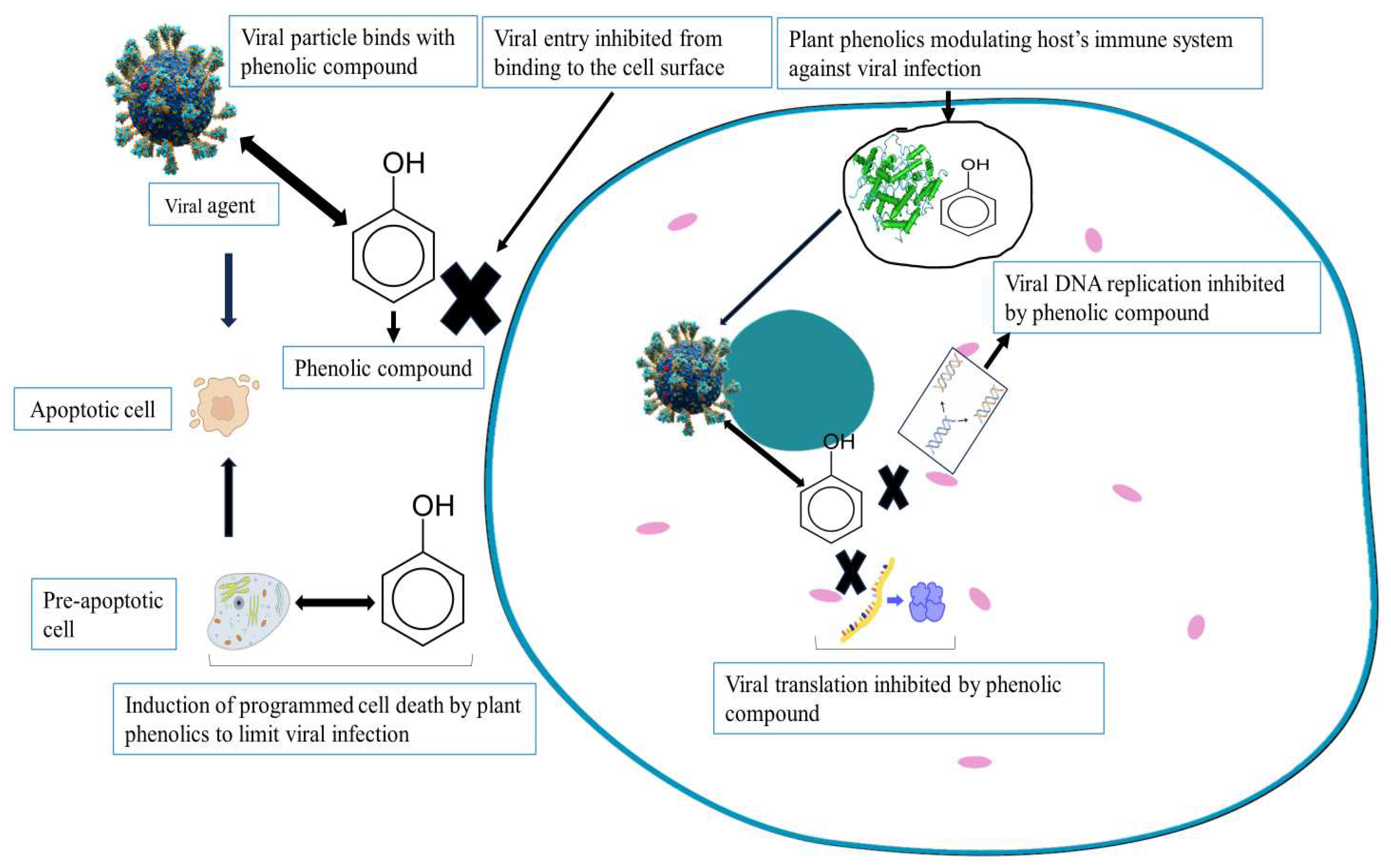
Figure 3.
A schematic diagram showing the mechanism of the antiviral activities of terpenoids.

Figure 4.
A flow diagram showing the typical steps for the discovery of antiviral compounds in a plant metabolomics study.
Figure 4.
A flow diagram showing the typical steps for the discovery of antiviral compounds in a plant metabolomics study.
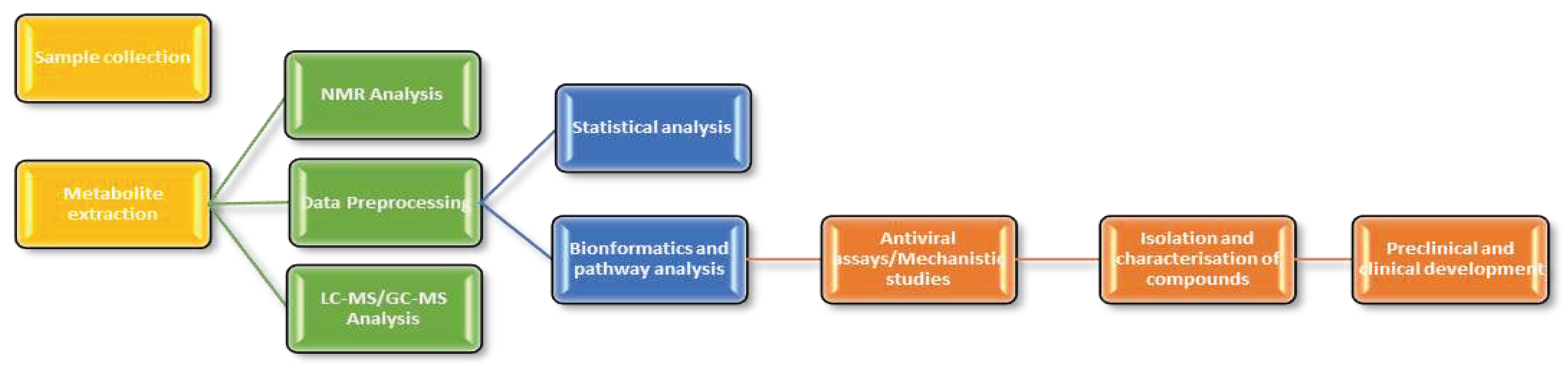

Table 1.
Metabolomics Studies on the Antiviral Compounds from Selected Plants.


* SFC-MS supercritical fluid chromatography tandem mass spectrometry. * UPLC-qTOF-MS ultra-performance liquid chromatography-quadrupole time-of-flight mass spectroscopy.
Disclaimer/Publisher’s Note: The statements, opinions and data contained in all publications are solely those of the individual author(s) and contributor(s) and not of MDPI and/or the editor(s). MDPI and/or the editor(s) disclaim responsibility for any injury to people or property resulting from any ideas, methods, instructions or products referred to in the content. |
© 2023 by the authors. Licensee MDPI, Basel, Switzerland. This article is an open access article distributed under the terms and conditions of the Creative Commons Attribution (CC BY) license (http://creativecommons.org/licenses/by/4.0/).
Copyright: This open access article is published under a Creative Commons CC BY 4.0 license, which permit the free download, distribution, and reuse, provided that the author and preprint are cited in any reuse.