

Submitted:
13 December 2023
Posted:
13 December 2023
You are already at the latest version
Abstract
: The article presents a brief review of cooling systems of various temperature levels (from 0.1 K to 230 K) for radio astronomical receivers of photonics and electronics. The features of various levels of cooling and the requirements for the design of the cooling system are considered in detail, as well as approaches to designing interfaces for cooled receivers: vacuum, cryogenic, electrical, mechanical, optical, and others required for the effective operation of the receiver,. The presented approaches to design are illustrated by a series of joint developments of the authors carried out over the past 45 years, including those produced last year.
Keywords:
radio astronomy
; cryogenic receivers
; cryogenic systems
; radio waves
; IR and optics ranges
; terahertz range
1. Introduction
Photonics and electronics devices used for astronomical research widely use cooling systems, including deep cryogenic ones to increase sensitivity [1-7]. Used cryogenic systems are represented by a wide range from very big cryosystems [8-9] to extremely miniature refrigerators [10]. Sensitivity and extremely small intrinsic noise are the main requirements for astronomical receivers. Deep cryogenic cooling contributes to their reduction like nothing else. "How do low temperatures attract the attention of researchers? The fact that the area near absolute zero turned out to be not so "dead" as they thought a century ago: all movement stops, everything freezes, and you can put a point. Quite the contrary, in terms of the abundance of physical phenomena that are observed when substances are cooled to the temperature of liquid helium and below, low temperature physics can safely compete with any other field of natural science."© [11].
Cooling systems are characterized by different temperature levels, which mainly determine their design. We should dwell on the very definition of temperature and the scale in which we work. In this review, the Kelvin scale will be used in Dalton's infinite round-trip interpretation.
An equally important influence on the design of the cooling system for astronomical receivers is their operating frequency range, including determining the level of required cooling. The relevant sections of the paper are devoted to all these issues.
Astronomy has traditionally presented the most ambitious challenges in the development of highly sensitive receiving equipment for both optical and radio astronomy and their intersection in the terahertz range. Now the cryogenics community publishes many papers about the development of cryogenics for astronomy in its journals (for example, Cryogenics [12]), and astronomical journals in their instrument sections regularly describe cryogenic astronomical equipment (for example, Astronomical Journal [13]). The more than half-century history of these developments sometimes escapes the attention of the authors. The pioneer of the cryogenics for astronomy was G.C. Messenger [14]. Meanwhile, the active use of refrigerators in radio astronomy began with the work of W. Gifford and H. Mc. Magon in 1959 [15] and basing on technologies presented by Guy K. White [16]. Further in 1966 fundamentals of development of cryosystem including of astronomy application have been published by [17].
Optical astronomy around the same years actively used Stirling machines [18]. The basic principles of cooling of optical and IR detectors were outlined in [19].
This work is devoted to an analysis of the development of equipment and methods and a review of the basic principles of designing cryogenic cooling of photonics and electronics receiving devices for astronomy, illustrated both by our own developments and the best examples of modern astronomical cryogenic equipment operating as part of a number of observatories around the world. World leadership in astronomical apparatus developments is being formed on its frontier associated with space technologies. Space technologies are actively represented in two series of regular conferences [20,21] held by the IEEE community and the Space Cryogenic Workshop [22], held by the Cryogenic Society of America. It is here that the cutting edge of research and development of cryogenic equipment for astronomy is formed, where the authors of this article work and where the results are reported.
The presented summative research has not only academic interest, but also a significant practical aspect. The development of terahertz astronomy, which fills the gap between optics and radio, involves the addition of several dozen existing telescopes to the creation of an extensive network of instruments in new territories of the earth, where there are currently no terahertz instruments at all. And a series of projects for the development of THz astronomy in northeastern Eurasia provides for the creation of an extensive line of cryogenic receivers.
2. Classification of cooling systems for astronomy
Cooling systems are used in the wide range of fields of human activity from research of fundamental physics, advanced technology to medicine and cosmetology. Each area forms its own approaches to the design of cryosystems and choices for itself from the vast variety of possible approaches and technologies its most effective ones. The cooling of optical and radio receivers has formed a certain development culture of its own. In this direction the astronomy is the customer of devices with the most ambitious and high performances. At the same time, the type and features of cryosystems fabricated for various astronomical telescopes have radical differences depending on an extensive set of factors, ranging from the band of the electromagnetic spectrum in which the receiving device operates to the atmospheric and climatic conditions of the observatory location and the design of the telescope in which the cooled receiving device operates.
Cryogenics as a science developed over 100 years ago. The foundations of approaches to the engineering development of cryogenic systems were also laid many decades ago. The development engineers have developed certain approaches to classification, methodology and have accumulated extensive experience and knowledge bases about the properties of various materials for cryogenics. All this knowledge is summarized in an extensive bibliography and the purpose of its presentation is not set here. However, there is a kind of cryogenics Bibles that are in the bookcase of every developer and whom he trusts. In the English-language segment of literature, such the Bible is the Brookhaven Reference Book [23], in the Russian-language - the Malkov Reference Book [24]. Personal communication with the developers of cryosystems eventually, after extensive discussions and disputes, which one is better, ended with the recognition that they complement each other well and the mutual exchange of available reference books. However, direct using of the available extensive knowledge and design approaches for specific fields, and in particular astronomy, seems inconvenient. Not everything is equally suitable, and a lot of things that are required, including new ones, simply do not exist. This publication is intended to systematize the current status of developments in this area.
2.1. Frequency range of astronomical instruments and their cooling problems
Astronomy, having begun its development with the optical range of the electromagnetic wave spectrum due to the presence of a pair of excellent photodetecting devices in each of us, has now become multi-frequency and equipped with millions of eyes - detectors that are operating at extreme sensitivity levels in the entire spectrum of electromagnetic radiation (EMR) (Figure 1) from ultra-low frequencies to the X–ray part of the spectrum. In edge areas, cryogenic cooling is practically not needed today because in the low frequency range due to the perfection of semiconductor technologies, and in extremely high ones – due to the enormous energy of X-ray and gamma quanta, for the detection of which cooling is not required.
The EMR ranges, where the main scientific tasks of astronomers are concentrated today, lie in two areas - terahertz (THz) and optical, including the VUV. And these ranges require receivers with deep cryogenic cooling. This does not mean that there is no progress in the development of other ranges, moreover, it exists, and also sometimes requires cryogenic cooling, but the scale of these needs in cryogenics is not comparable to photonics in optics and electronics in the THz range. However, the THz range is exactly between traditional microwave radio electronics and far-infrared optics, combining technologies and approaches inherent in both of them.
In this connection, the further presentation will focus on the problems of astronomy of these ranges.
2.2. Temperature levels of cooling for astronomical receivers
Astronomy uses a wide range of cooling systems from the boundary of cryotemperature to extremely low sub-kelvin levels. Table 1 shows the general classification of temperature levels of such systems.
Cryogenic temperatures in the professional community are divided into conventional levels. Actually, cryogenic temperatures are temperatures below 100 (in the USA 120) K. Non-cryogenic cooling is quite widely used in optical astronomy, as well as in climatic test chambers for studying the characteristics of devices and materials. The cryotemperature range is characterized by the transition to the liquid and, for the most part, to the solid state of the majority of gases present in the atmosphere. In particular, at T=90K oxygen turns into liquid at atmospheric pressure. At 77 K, nitrogen is liquefied, which is extremely widely used in astronomy and is both an independent, relatively cheap cryoagent and an auxiliary agent for cooling radiation screens at deeper cooling. The main accepted temperature levels are given in Table 1.
The next characteristic level is the hydrogen level (~20K), here not only is the phase transition of the main hydrogen isotope, but also the Debye temperature zone begins for the main structural materials from which the components of cooled astronomical receivers are made, which is associated with a dramatic change in their thermal characteristics ( heat capacity, thermal conductivity, thermal diffusivity). However, liquid hydrogen itself, against expectations due to fears of its explosiveness when mixed with atmospheric oxygen, is used in the professional community as a cryoagent. Also related to the hydrogen temperature level is a wide class of closed-cycle refrigerators, which were and are currently used for astronomical applications, although more often as cryo-vacuum pumps of cryo-vacuum chambers for a wide variety of purposes - from vacuum deposition installations, where detectors for astronomy are manufactured, to testing chambers where pre-launch studies of space equipment are carried out. But hydrogen-level refrigerators are also used to cool astronomical receivers. It should be noted that they do not contain hydrogen gas; the working gas is still helium. It’s just that, almost until the end of the 20th century, the material of the regenerator in cryorefrigerators, where heat exchange is carried out between the gas expanding in the detander cycle, pre-compressed in the compressor, and the metal structure of the cold finger of the cooler, mating with the cooled elements of the receiver, was made of an alloy of antimonous lead and exactly in the vicinity of hydrogen temperatures, the efficiency of such regenerators dropped dramatically due to the transition through the Debye temperature. With the transition to rare earth regenerators, the problem disappeared and the temperature of such refrigerators dropped to the helium level (4 K and below to the limit of 2 K). As is known, when the pressure decreases from atmospheric to vacuum, the temperature of the main helium isotope 4He can reach 1.6 K. There is a helium temperature level.
Lower temperatures – sub-Kelvin levels or below 1 K – require different approaches to implementing cooling including usage of the 3He isotop, thermomagnetic cycles, laser and other technologies of cryogenic cooling. And these temperatures are extremely actively used for astronomy for deep cooling of superconducting detectors in the terahertz range.
Even lower temperatures currently achieved by physicists are usually used for other purposes, primarily the study of extreme conditions not found in nature, for example, the study of the Bose-Einstein condensate and such a setup (with a temperature of about 10 nanokelvin) [25] is in a laboratory adjacent to the laboratory of the authors of this work. The astronomical application of the results of these studies also has promise for astronomy. On their basis, it is possible to construct highly stable time and frequency standards necessary for precision radio astronomical observations in the VLBI mode. But this is a distant prospect. And today physicists have already passed the nanokelvin milestone. The temperature scale, which will be discussed below, is indeed practically infinite towards absolute zero. And the levels of cryogenic temperatures listed in section 2.1 will be further illustrated by examples of the development of corresponding astronomical instruments.
2.3. Temperature scales
The problem of choosing a temperature scale has a long history. The scales of Reaumur and Celsius, Delille and Kelvin, Newton and Fahrenheit and many others replaced each other, sometimes competing and creating difficulties for users to communicate and recalculate. For today, there are actually Celsius and Kelvin in science and technology with household Fahrenheit in USA.
Cryogenics is using mainly the Kelvin scale. Although we still sometimes get orders for the development of a cryosystem at a temperature of minus 269 degrees Celsius. However, the authors of this article do not accept the Kelvin scale in its classical linear format, terminating at absolute zero Kelvin on some abstraction at minus 273.15 Celsius. We are supporters of the infinite in both directions logarithmic Kelvin scale, presented in Figure 2. Moreover, the experience of the logarithm on the Celsius scale was already available in the form of the Dalton scale. It was extremely convenient for fixing very high temperatures, and now in the era of ultra-low temperatures it is just as convenient for cryogenics. It is important that long before the era of cryogenics and the experiments of James Dewar and Heike Kamerling-Onnes, Dalton assumed infinity in the region of low temperatures as well.
The logarithm is good here for fixing an infinite path on the road to reach ultra-low temperatures. Now, by the way, the boundary of nanokelvin has been overcome, and obviously this is not the limit. Temperature is only a measure of kinetic energy. If you freeze and stop the movements of atoms and molecules to even lower speeds and bring the number of thermal fluctuations to units per day, months, years ... etc., you can get even closer to absolute zero, but not reach it. By the way, it is not difficult to estimate the fundamental limit of the temperature of a particular micro–object at this point in history - this is one fluctuation during the lifetime of the Universe. The logarithm is also good for a real assessment of the problem of achieving a certain level. Compare for yourself: the surface temperature of the Sun (~6000 K) is about an order of magnitude higher than your body temperature (~300 K). At the same time, the temperature of boiling helium differs from the temperature of your body by two orders of magnitude. And it is immediately obvious that the temperature of boiling nitrogen (78K) is not even an order of magnitude, but only 4 times lower than your body temperature. Approximately in this proportion, the problems of technology and the energy costs necessary to achieve certain levels are correlated.
Although, this section should be completed with two remarks, obvious in thermophysics, but quite often overlooked in applied works with the use of cryogenic technology in astronomy and other fields. The first remark concerns the fact that any thermometer measures only its own temperature. Misunderstanding of this fact often leads to dramatic errors in determining the temperature of the elements of the receiving system, and as a result, to errors in the results of astronomical measurements. The second fact upsets experimenters even more seriously: by definition, temperature is not just a measure of kinetic energy, but also necessarily in an equilibrium state. And since cryogenic receivers, as a rule, are not in an equilibrium state, the temperature in the strict sense is uncertain for them.
This creates an extensive range of interesting scientific and engineering problems already in terms of the radiophysical and optical properties of the receiving systems discussed below for receiver elements that are not in an equilibrium state.
2.4. The main types of cryosystems for astronomy
Cryosystems used for cooling astronomical radiation receivers can be divided into the following groups: cryoaccumulators, cryorefrigerators, their variations, as well as their combinations. Along with cooling systems built on the basis of gases and gas machines, various types of gas-free cooling systems are known, among them, first of all, thermoelectric and thermomagnetic. In recent years, laser cooling systems have also appeared, however, have not yet found application in astronomical applications. Although one of the obvious and very popular applications of devices with deep (nanokelvins) laser gas cooling in the state of Bose-Einstein condensate opens up enormous prospects in increasing the stability of time and frequency standards actively used to synchronize astronomical receivers operating in the mode of a very large baseline interferometer (VLBI).
2.4.1. Dewars or cryoaccumulators and liquid nitrogen cooling solutions
The cryoaccumulators use a pre-cooled cryoagent in various phase states:
- gaseous (cold flow of gases N2, H2 and He);
- solid (carbon dioxide);
- liquefied gas (nitrogen < 77 K, hydrogen - <20 K, helium - <4 K).
For millimeter and submillimeter range (or subTHz) receivers, liquid nitrogen or helium are most often used (depending on the requirements). Receivers in cryoaccumulators are placed either in boiling liquefied gas or in a so-called "vacuum basement" - a cavity between the outer and inner walls of the Dewar vessel. As a variant of the cryo battery circuit, there is a flow circuit containing a separate Dewar transport vessel, as well as a closed or open line for supplying cryoagent to the cooling facility. The scheme of the cryoaccumulator with a "vacuum basement" is close to the cryorefrigerator scheme, where a cryopanel with cooled receiver elements is attached to the cold stage of the refrigerator cooler. In essence, the energy required to maintain the temperature of the cooled object (elements of the receiving path of the astronomical receiver) below the state of thermodynamic equilibrium with the environment is stored in the form of liquefied cooled gas and is easily estimated as the volume of stored cryoagent multiplied by the sum of its specific vapor formation temperatures and heat capacity at a temperature drop (see Formula 1).
where Е is the energy or heat flow, which is able to fend off the supply of cold in a liquefied state, m is the cryoagent mass, λ is its specific integral heat capacity, δƬ is the temperature difference used for cooling and C is the specific heat of the phase transition.
E = m (λδƬ+C)
The designs of nitrogen Dewars (for example, Figure 3a shows a photo of a developed and manufactured filler nitrogen cryostat) are quite simple and design optimization is not difficult, whereas helium filler Dewars require a more thorough thermal design. As a rule, they require nitrogen radiation shields to fend off radiation thermal inflows. For their cooling, the design provides, in addition to the helium tank, a nitrogen tank with its own filling system. Estimates of heat flows are presented in the section 4.3.2. However, there is also experience in creating nitrogen-free (Figure 3b) helium Dewars for astronomy, where radiation screens are cooled by evaporated helium of the appropriate temperatures.
The choice of the working gas and the volume of the Dewar is determined by the heat flows and the release of the cooled receiver itself. The analysis of the parameters typical for astronomy of such systems is given in section 4.3.2.
Along with relatively simple liquid nitrogen Dewars, many equally simple, efficient and energy-saving closed-cycle refrigerators were used in astronomy, mainly on the Stirling machine. To reduce vibration loads, which are the main disadvantage of refrigerators compared to Dewars, the split-Stirling version or other thermodynamic cycles were more often used, until the Cryotiger became a certain perfection of such machines Comparable runs of cooling systems for various photodetectors using Cryotiger closed cycle refrigerators were produced in various configurations for equipping optical telescopes. [2, 26-27] Figure 4.
2.4.2. Hydrogen level refrigerators for astronomy and telecommunications
The hydrogen level of cooling has been and is actively used in astronomy and radio telecommunications. Various types of cm and mm radio frequency detectors and amplifiers can be cooled with such relatively cheap, compact and economical coolers compared to helium coolers.
The success in using low-noise HEMT amplifiers for SAO RAS produced by the Saturn Research Institute (A.M. Pilipenko) in astronomical satellites gave rise to their further extensive use on other antennas: the RT-22 (Simeiz), the RT-13 (Metsahovi), and the RT-64 in Bear Lakes and Kalyazin. In particular, on the basis of these HEMT amplifiers, a unique set of equipment for astronomy and telecommunications has been created.
In particular, it is impossible not to mention the extremely efficient system of cooling at the hydrogen level used for the X-band antennas in Bear Lakes and Kalyazin, used both for astronomical observations and for deep space communications that was developed by the authors of this publication. It successfully worked and is currently working for the Spektr-R and ExoMars missions [28]. The photo of cryogenic system is shown in Figure 5.
The key parameters demonstrating the quality and, as a result, the effectiveness of such a receiver is the ratio of noise temperatures. If the receiver without cryogenics gave about 40K of noise at the input and antenna noise of 14 K was added to them, it is obvious that the atmosphere did not dominate, but made a significant contribution. Cooling to a temperature of 6 K led to a reduction in receiver noise to 5 K and system noise with an atmosphere of up to 19K. This led to an almost threefold reduction in noise and a similar increase in sensitivity. Strictly speaking, the system is closer to the helium level in terms of temperature than the level of liquid hydrogen, but still it does not belong to the class of helium refrigerators. The gain and operating range of such a receiver are 30 dB and 8.4 – 8.5 GHz, respectively.
2.4.3. Cooling systems of helium level
The helium level systems are actively used for cooling down of coherent detectors (mixers) from the DBS to the mixers based on superconducting junctions. This approach was presented both in classic papers, like [29-31] and in modern receivers [32].
One of the most striking examples of an observatory where detectors are cooled to helium level is the SOFIA - stratospheric observatory on a plane [33]. The detecting devices are maintained at a temperature of 1.7-1.9K.
However, it should be recognized that in recent years, with the transition to pulse tubes and rare earth regenerators, helium level refrigerators have been increasingly used
Until recently, very little attention has been paid to the possibilities of deep cooling of receivers to the helium level – one of the main types of cryogenic systems used in optical telescopes. The reason was indicated above – the BTA optical telescope, operating in optics and the IR range, did not need such systems, and on the RATAN -600 radio telescope, operating at relatively long waves in conditions of a fairly significant atmospheric background, there was no need to cool below the level of liquid hydrogen.At the same time, the helium level was actively used both in the liquid configuration and dry in the refrigerator in the development of the SAO receiver for the RT-22 after the transition from the mixer to the DBS to the mixer at superconducting junctions
And currently, SAO RAS is preparing to switch to helium temperature level technologies for cooling the subTHz receivers on the BTA telescope. Moreover, the temperature of 4 K will be used only as a system of precooling for refrigerators of a deeper level of cooling, presented in the next section. In more details the cryogenic systems that are using in SAO RAS are presented in [34].
At the beginning of the era of cryogenic cooling, cryoaccumulators and Dewars were mainly used in astronomy. However, the convenience of using refrigerators that do not require the provision of liquid gases has made them the most widespread in observatories. The ideology of unified cartridges with closed-loop 4K refrigerators (Figure 6) should be recognized as a semi-industrial masterpiece of the approach to the design of cryosystems of astronomical receivers. It is implemented at the ALMA Observatory in an array of 64 telescopes, each of which is equipped with a set of cooled receivers of various frequencies of the THz range and replicated by hundreds of copies [35].
Cryogenic refrigerators, or gas fridge machines, operate by throttling or expanding the working gas in the cooler based on various thermodynamic cycles: Joule-Thomson, Stirling, Gifford-McMahon, etc., originating from the Carnot cycle and ultimately described by the equation of state of an ideal gas (2):
where V is the volume, P is the pressure, ν=m/M is the amount of substance in moles, R is the gas constant, Т is the thermodynamic temperature.
PV = νRT
Refrigerators of this kind are actively used to cool astronomical receivers at nitrogen, hydrogen and helium temperature levels. Here, the energy of maintaining the temperature of the cooled object below the temperature of thermodynamic equilibrium with the environment is taken from an electrical power source. At the same time, electricity power have a very noticeable value. The fact is that following the basics of thermodynamics, the efficiency of the cycle drops sharply. And if nitrogen-level refrigerators consume only hundreds of watts with a cooling capacity of several watts, then the L- helium-level refrigerators with a cooling capacity of 1-2 watts require a compressor power of 4-7 kW. However, it should be recognized that the given values of nitrogen refrigerators relate to the Stirling cycle, which is essentially close to the ideal reverse Carnot cycle. Helium refrigerators operate on other cycles and, in particular, the values given relate to Gifford-McMahon machines Figure 7 and coolers on pulse tubes.
There are two main methods of cooling detectors to a temperature below 0.3 K: adiabatic demagnetization refrigerators and refrigerators based on dissolution of 3Не in 4Не. At the turn and just below 0.3 K, sorption refrigerators also work on 3Не and 4Не.
2.4.5. Cryosorption cryostats
Cryosorption are actively used for astronomy (for example, [36]) when it is necessary to achieve subkelvin (subK) temperatures. One of the first mentions of the development of a 0.3 K system for mounting a subTHz receiver on the BTA optical telescope is given in [37], and the system itself was only at the design stage. In this article, a cryogenic system was proposed that provides the operating temperature of the receiving antenna arrays T~ 0.3 K. This is a closed-cycle system, i.e. it does not require the use of liquid refrigerants (nitrogen and helium), based on a refrigerator on pulse pipes and two sorption pumps on 3He and 4He. The system includes a refrigerator compressor on pulse tubes. Despite the lack of funding for this project at that time, work on the creation of such a cryogenic system was continued, and the next stage of development was already presented in [38]. Photos of the elements of the 0.3 K cooling system are shown in Figure 8.
2.4.6. Dilution cryostats
An even lower cooling level (0.1 K and below) required for radio astronomy can be provided by dilution cryostats. Cooling in the dilution cryostat is ensured by the fact that a mixture of two isotopes of helium 3He and 4He at a temperature below 0.8 K spontaneously decays into two phases: depleted and enriched 3He. To transfer the 3He atom from the enriched phase to the depleted one, it is required to expend energy (absorption of the heat of the dissolution process). If the 3He atom continuously crosses the phase interface, the mixture will be effectively cooled. Thus, the principle of operation of the dilution cryostat is based on the circulation of 3He and its transfer from one phase of the mixture to another.
Compared to adiabatic demagnetization systems, this system has the advantage that it is a continuously operating device and does not require the use of magnetic salts and an external source of a powerful magnetic field, which can negatively affect other components of the experiment (for example, detectors). In addition, its mass is very small at the coldest stages, and the cooling power can be distributed over large focal plane, which avoids narrow joints and heavy supports that are required by adiabatic systems. It is also possible to cool mechanical supports and electrical wires (by removing the heat that is transferred from higher temperatures through a reverse flow heat exchanger) without reducing the minimum temperature (for example, see [39]).
The schematic diagram of the operation of the classical dilution cryostat [40] is shown in Figure 9. The performance of the dissolution cycle (W / (mol / s)) is determined by formula 3:
where Q is the power supplied to the dissolution chamber (mixer); Т and Тс are the temperatures of the mixer and concentrated 3He at the entrance to the mixer; dn/dt is the circulation rate of 3Не, typical values 10-4 – 10-3 mol/s. At Т=0,1К these rates are dQ/dt> 100 μW, which is tens to hundreds of times more than what is required for the operation of low-temperature radiation and particle detectors or for most experiments in solid state physics and research in nanotechnology.
The sophisticated (and more commonly used) dilution refrigerator operates in a continuous cycle. In this case, a mixture of 3He/4He is liquefied in a condenser that is connected via a choke to the area of the mixing chamber that is rich of 3He. The 3He atoms, passing through the phase interface, take energy from the system. Next, it is necessary to distinguish between dilutions refrigerators with external and internal pumping. In the first case, the 3He vapor is pumped out by a high-vacuum pump (turbomolecular or diffusion). In the second – by a sorption pump.
Note that standard closed-cycle dilution refrigerators require gravity, and cannot be used for space observatories. If there is an open loop, this is possible, as for example, it was used for the Planck mission [41-43] (see Figure 10). These issues are considered in some detail in dissertation [44] Just as shown in [45], a modified version of a closed-loop dilution cryostat has already been proposed (will be discussed below).
The design of a dilution refrigerator with an open cycle is completely different from the designs of “classic” dilution refrigerators: 3He and 4He circulate from different tanks through capillaries, are mixed in a mixing chamber, providing cooling, and then the mixture is not recycled, but thrown into space. The resulting mixture is used to pre-cool clean streams using a countercurrent heat exchanger before being released into space. The heat exchanger consists of three capillaries soldered in parallel and connected at one end by a junction forming a mixing chamber. This design works in zero gravity, because the separation of the liquid and vapor phases for which gravity is required is excluded, and in this mixing chamber design, surface tension replaces gravity to separate rich and lean phases. The isotopes are pre-cooled by external cooling to 4.5 K. Further cooling to a temperature below 1.6 K is achieved due to the internal expansion process by Joule Thomson (JT) on the return line of the mixing chamber.
As noted above, [45] proposes a modified closed-loop cryostat that can be used for space missions, in which the mixture is not ejected into space, but is divided into components that are then re-circulated in the system. A schematic representation of such a cryogenic system is shown in Figure 11 from [46]. The low-temperature part of the cooler (countercurrent heat exchanger, mixing chamber and loading heater) is much the same as for the dilution cryostat with an open cycle, given above. However, the main difference between this cooler and the open–cycle version is the addition of a 3He-4He separation/circulation system. The returned mixture enters the alembic, where the two components are separated. The double-layer spiral heater in the alembic evaporates almost pure 3He, which circulates with the help of a room temperature compressor. The 4He liquid in the alembic passes through a heavy-duty filter and circulates using a fountain pump operating at a temperature of about 2K. The spent 3He and 4He are cooled first in a tank with a temperature of 1.7K, and then in an alembic before being sent down through a countercurrent heat exchanger. The mixing chamber is a Y-shaped connection of three capillaries forming a heat exchanger, so that capillary forces separate the enriched phase from the depleted one instead of gravity.
It should be recognized that for more than 10 years commercial refrigerators of subK levels (Oxford [47], Bluforce [48] etc.) have been available on the market. However, these machines are designed for laboratory experiments, and for radio astronomy they are used only for testing concepts and samples – applicants for ultra–sensitive detectors of the subTHz frequency range. It is difficult to imagine the installation of such refrigerators in the focus of even a ground-based telescope. In this connection, their own cryogenic systems are manufactured for each of the tasks.
Special requirements for cryosystems are imposed by subTHz observatories located not on Earth, but on various carriers from airplanes and balloons to spaceships. Below is one of the most interesting examples of this kind.
2.4.7. SubK systems for balloon missions
Balloon missions – balloon observatories – are less ambitious than space missions, but no less important. For example, such well-known missions as BOOMERANG experiment [9,49] and the “young” OLIMPO mission [50-51]. Strictly speaking, high-altitude balloons rising to heights above 40 km are located at the boundary of the atmosphere and space, since neither physically (the pressure and density of atmospheric gases decrease exponentially to infinity) nor formally (in different countries, the boundary of space lies at different levels from 40 to 100 km). In particular, the density of the atmosphere at the heights described in this subsection does not exceed 0.5% of the ground level. Such a low density of atmospheric gases determines the possibility of observations on THz waves from balloons is practically no worse than from spacecraft, but for much less money. Including due to the possibility of returning, recharging and reusing the cryosystem and receivers for subsequent flights.
One of the problems associated with a long balloon experiment is the requirement that the cryostat must operate autonomously during the entire measurement time. In this sense, passive cryostats with cryogenic liquids are the best option. Publication [52] provides a description of the cryostat, as well as a comparison of designs for the BOOMERANG and OLIMPO missions. For such projects, in addition to maintaining a stable temperature, the duration of work (more than two weeks) and strength, which should be designed to withstand external thermal and mechanical loads, are important. The low temperature of the outer stratosphere determines the design of vacuum seals in the outer shell of the cryostat, while the “shock” when the parachute opens determines the design of the support system for various internal cryostat tanks. The OLIMPO cryostat is part of the telescope: the inner frame supporting both the mirrors and the cryostat housing the detector system can be tilted to set the viewing angle from 0° to 60°. The schematic image of the cryostat, its nodes and photos are shown in Figure 12.
3. Specific features of cryogenic system technology for astronomical instruments
The cooling systems for astronomical receivers are calculated and designed for specific tasks and limitations. More than 45 years of experience in the development of cooling systems for astronomy by the team of authors of this article has formed a set of approaches and technologies presented below. The main problem of cooling systems, especially deep ones, is the need for effective thermal insulation of the cold zone, including the cooling object and the cold part of the cooler. The best heat insulator of all materials is vacuum. In this connection, all cryostats for cooling of astronomical receivers are vacuum devices. The issues of vacuum support in the design of a cryosystem are of a decisive nature. Along with effective thermal insulation, the structural elements of the cryosystem should, on the one hand, reliably position the cooled receiver relative to the telescope located at ambient temperature, on the other hand, there should be no significant heat flow along the elements of the supporting structure, which the cryosystem parries. Consideration of the full balance of heat flows is a key task of cryodesign. Modern design packages have made this task much easier in recent years. However, there are quite a lot of uncertainties and sources of errors in the calculations.
Along with thermal insulation, in a number of structural elements of the cryosystem, on the contrary, extremely low thermal resistances of materials are necessary, in particular, effective cooling thermal conductors between the cooler and the cooling object, which cannot always be fully combined in space.
All these problems, as well as a number of less general, and particular, but sometimes more complex, can be combined into the problem of interfaces: thermal, mechanical, electrical, optical, electrodynamic, vacuum, etc. In fact, having a cold source and an EMR receiver, as well as a telescope, it is only necessary to solve the problems of interfaces between them.
3.1. Cryogenic interface and basic elements of cryo design calculation
The cooling system is selected from the balance of heat flows and the cold capacity of the cooler. For cryoaccumulators, the minimum interval between refueling with cryoagent is taken into account. Refrigerators simply lay power that are to fend off all heat flows.
Let's estimate the parameters of the cryosystem cooling capacity for local cooling of the elements of the receiving devices. The total heat inflow that the cryosystem should compensate for is determined by the combination of internal (Joule) heat release QJ of the active elements of the device and external heat inflows: Q1 convective, radiation Q2 and conductive Q3 (by elements) of load-bearing structures:
The Joule heat dissipation Q_J for superconducting detectors and mixers at typical DC modes (at a voltage and current of the order of 3 mV and 30 μA, respectively) is:
The convective component of the thermal conductivity of the residual gas in the cryostat can easily be reduced due to efficient gas pumping. At pressures inside a vacuum cryostat with a cryosorption pump not exceeding 10-7 Torr and the characteristic geometry of the receiver and cryosystem, the heat inflow through the residual gas will not exceed 10-6 W.
The radiation component of the heat inflow splits into two: through the signal window (Q21) and through the other surfaces of the device (Q22):
In this case , the first term is expressed as:
where is the reduced coefficient of thermal radiation, is the blackbody radiation constant, Т1 and Т2 are the temperatures of the external environment and the cold surfaces of the receiver, respectively, is the window surface area. This term is fundamentally unavoidable, since any filter that passes the useful received radiation cannot completely avoid heating up by the radiation passing through it. The total heat input should not exceed the refrigerating capacity of the refrigerator or the capacity (volume) of the Dewar tank.
3.2. Vacuum interface
The vacuum cryostat, which is the basis of any cooling system for astronomy, is characterized by the size, shape, depth and method of providing vacuum. The vacuum density of the joints is ensured by their tightness. However, the vacuum level, and hence the vacuum pumping and control technologies, should be selected and maintained for reasons of reasonable sufficiency. In particular, the determining factor is the dominance of other components over the component (5) (6) in the overall balance.
At the same time, it is clear that different vacuum levels are required in different systems. For example, superconducting nanodetectors have negligible Joule heat dissipation and compact dimensions that minimize heat flows. The fact is that their operating temperature is only Kelvin and the cooling capacity of such systems is less than a microwatt. In this connection, the vacuum levels required for such receivers reach values of minus 8 - minus 10 degrees. At the same time, 4K refrigerators based on pulse tubes of the temperature level have a productivity three orders of magnitude higher and you can afford to limit yourself to minus 4-5 degrees in order to minimize the heat exchange between the cold and warm walls of the system with the sizes of Dewars characteristic of astronomical receivers. Moreover, in reality, such systems require preliminary pumping to minus 2-3 degrees, after which the cryosystem is started and, as it enters the mode, passing the characteristic condensation temperatures of atmospheric gases (oxygen 90K, Nitrogen 77 K) due to cryosorption, the refrigerator itself, equipped with a small coal cryosorption panel, begins to provide itself pumping the internal volume of the Dewar to values minus 5 - minus 6. Cryosystems of a higher temperature level than nitrogen, which are often used to cool the photodetector devices of optical telescopes, have big problems in terms of the vacuum interface. Cryosorption at such temperatures is not efficient enough and requires either good pre-pumping, with deep pre-cleaning and degassing of all internal components of the receiver, or the installation of a pumping device that is periodically switched on, for example, based on getters.
3.3. Mechanical interface
The main purpose of the mechanical interface is the mechanical assembly of the cryosystem structure with a cooled receiver as a whole. Along with the standard set of technologies for cryosystems, the task associated with vibrations generated by the mechanical system of the refrigerator is of key importance. Considering the noticeable power level of the compressor (up to 10 kW) and the vibration of the cooler engine (Gifford-McMahon) or the valve switch (pulse tubes) this task is gaining significant importance. The variety of forms of cryostats is presented in Figure 13.
3.4. Optical interface
For photodetectors, the optical interface is of key importance, providing vacuum insulation, through it comes the received signal, the attenuation of which needs to be minimized, but also the nearby section of the IR spectrum, bearing the main thermal load, which must be countered by the cryosystem. The calculation and manufacture of high-quality strip illumination solves this problem to a noticeable extent. Its solution is also facilitated by a lower temperature and a greater cooling capacity at these temperatures, compared with THz radio receivers and lower-frequency astronomical receivers. For radio receivers, quasi-optical or waveguide windows are used for signal input, which are essentially optical windows and also have selective illumination. Although sometimes, for visual control of the interior of the cryostat, cooled radio receivers also have a control optical interface. Conventionally, the category of optical interfaces can also include sealed inputs of optical fibers, through which optical signals can be brought inside the vacuum cryostats of cryogenic receivers.
3.5. DC, RF and digital interfaces
Various kinds of electrical interfaces of cryostating systems are needed both for the supply and removal of DC and RF signals of power supply systems, monitoring, etc. For this, there is an extensive set of nomenclature of both vacuum inputs and thermally connected wires, sensors, electrically controlled keys, valves, regulators, alarms, etc., commercially available and periodically updated on the website and in the index issue of the journal [53]. However, in recent years, the appearance of cryogenic systems both general and for astronomy has changed radically. In the 80s the cryostat was a tank of the appropriate size with a window and a wiring harness from the sensors to the devices of the outdoor monitoring system, and, say, a manometric condensation sensor was used to measure temperature as the most accurate. And the engineers of the support group who helped the astronomers during the observations were on continuous duty monitoring the work of cryogenics. Currently, the cryosystem is primarily a computer with a proper hard drive and software, and a tank and a refrigerator are already in the second place. An astronomer - operator, usually sitting thousands of kilometers from a telescope with a cryosystem, in general, may not even know how it looks and how it works, having a small and convenient interface signaling the state of the receiver as a whole, including its cryogenics, as well as the possibility of conducting observations.
Although for the designers of cryosystems of astronomical receivers, all the life hacks of electrical interfaces are still relevant. And, in particular, the features of laying and organization of interceptions (anchoring) on wires and loops through which signals are sent at intermediate temperature levels. If it is necessary to output microwave signals, specialized vacuum coaxials and waveguides are used, both for the main cross-section and for subTHZ - supersized, quasi-optical, also under temperature difference, not in a state of thermodynamic equilibrium and requiring a special approach to the analysis described in section 4.3. Among the novelties, close in technology of use, it is worth mentioning the fiber lines used for channeling optical radiation. However, all approaches used for cables are applicable here, with an additional bonus: the thermal conductivity of the glass from which the optical fibers are made is orders of magnitude lower than the metals used for RF and DC.
4. Development of cryogenic systems for astronomy: technical solutions of combined optical & radiophysycal problems
This section will briefly present individual technical solutions to the problems of cryogenic cooling outlined above and connected with combination of optical and radiophysical problems. These solutions were taken as the basis for successful developments and subsequently replicated in various applications.
4.1. 4K Cryostating systems
An optical cryostat based on the Cryomech PT410 cryorefrigerator has been developed, designed to study the thermophysical properties of materials (thermal coefficient of linear expansion, heat capacity, thermal conductivity), structures and mechanisms, 4K superconducting receivers, as well as for cooling samples and elements of the optical path with the possibility of using the Cryomech PT410 cryorefrigerator. A photo of the assembled cryogenic system and mounted system on an antivibration rack is shown in Figure 14.
Figure 14.
Photos of the 4K cryostating system based on Pulse Tube: (a) general view; (b) mounted cryosystem on an antivibration rack in order to increase the accuracy of measurements.
Figure 14.
Photos of the 4K cryostating system based on Pulse Tube: (a) general view; (b) mounted cryosystem on an antivibration rack in order to increase the accuracy of measurements.
The main characteristics of the system:
- Operating temperature 4К ± 0,1К;
- Heat load - 1 W;
- Vacuum level 10-4 mbar;
- Closed-cycle microcryogenic system (MCS) RDK-408D2 (SHI),
- 2 flanges for the installation of optical windows with a diameter of 25 mm;
- Flange KF D25 for pumping;
- Input of electrical and RF signals;
- Size of the working cavity: diameter 185 mm, height 70 mm, dimensions - not more than 1600 mm;
- Diameter not less than 700 mm;
- The presence of an interface for reducing the influence of temperature fluctuations with the possibility of observations with disabled MCS ;
- Availability of optical windows;
It is possible to perform on an antivibration rack.
The main scientific results obtained at the equipment:
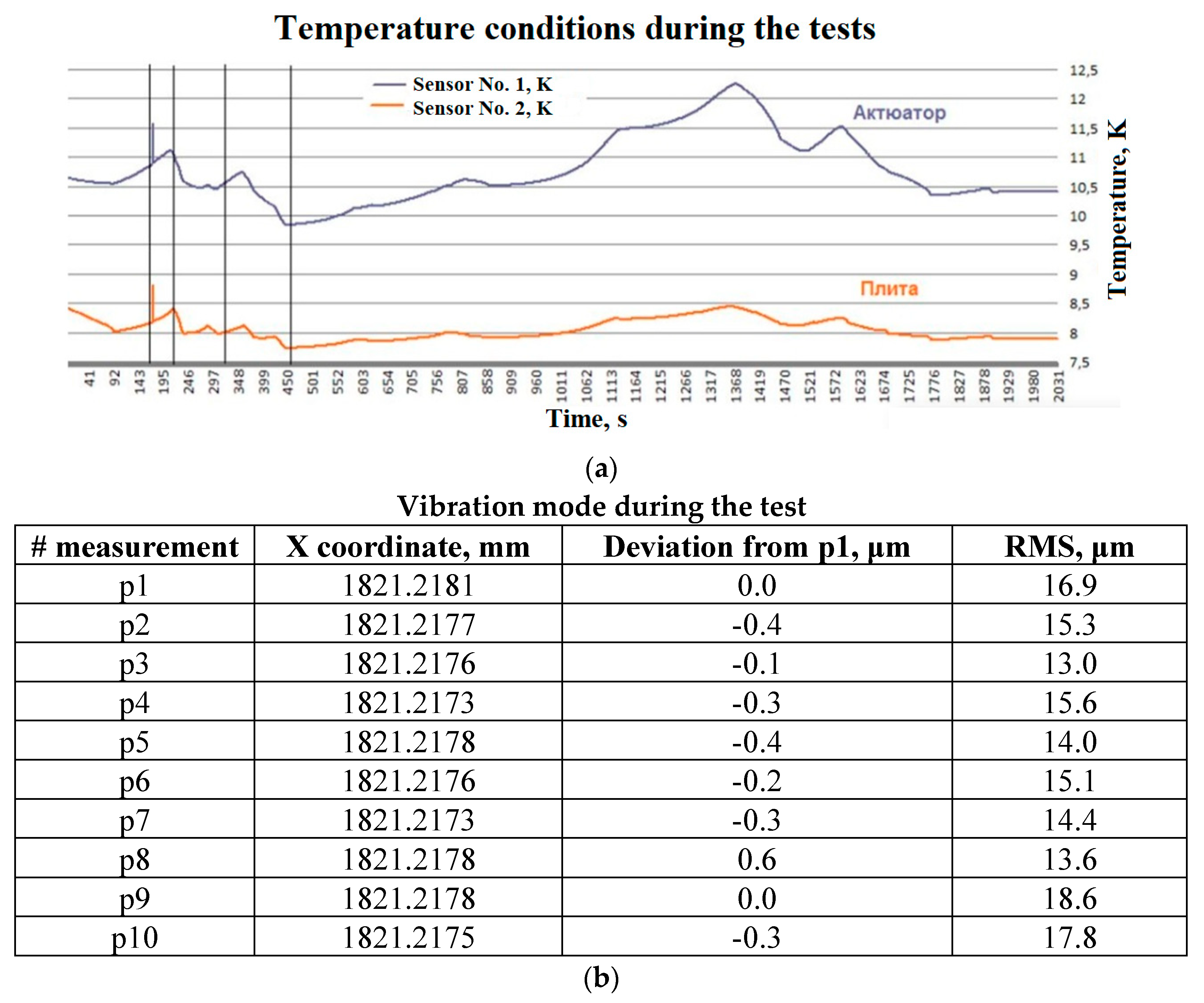
1. A prototype of an actuator that was designed for moving the main mirror of the Millimetron observatory at cryogenic temperatures has been tested [54]. Photographs of the test sample are shown in Figure 1. Some results of experimental studies are given in Figure 16.
The following characteristics of the actuator have been experimentally confirmed:
- Resolution in full-step mode - 0.64 μm;
- Resolution in microstep mode (practically possible) — 0.3 mm;
- Range of movement — ±3 mm;
- Repeatability error — from 0,2 to 1,55 μm (on average 0,8 μm) in range of 150 μm;
- Minimum consumption power (continuous operation) — 600 μW (T = 8...10 К);
- Minimum consumption power when moving is 1 μm — 4 μW·s (mJ) (T = 8...10 К).
The research was carried out jointly with JSC"Applied Mechanics" and Astro space center of Lebedev Physical Institute Russian academy of Sciences LPI.
Figure 1.
The device under study: (a) the actuator; (b) The gearbox and the stem, the device under test.
Figure 1.
The device under study: (a) the actuator; (b) The gearbox and the stem, the device under test.
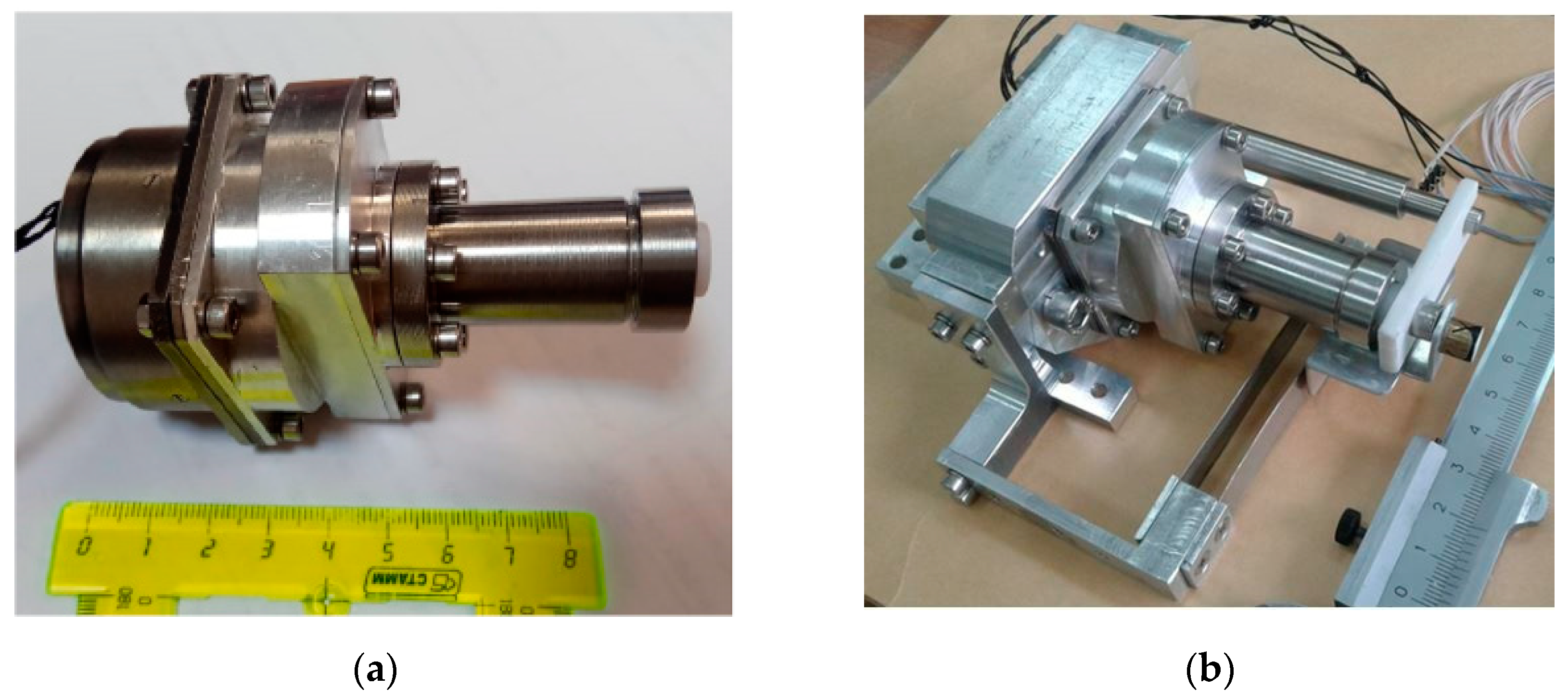
Figure 16.
Results of experimental studies.
2. Measurements of the thermal conductivity and heat capacity of beryllium samples intended for the manufacture of the switching mirror of the space cryogenic telescope "Millimetron" were carried out.
A photograph of the mounted sample and the results of experimental studies of thermal conductivity and heat capacity are shown in Figure 17.
4.1.2. Solving of the problem of vibrations and temperature fluctuations of cryogenic refrigerators
Refrigerator cooling systems, along with an extensive list of advantages, have a very significant disadvantage limiting their use for astronomical applications. Due to the periodic operation of the refrigerator cooler, temperature pulsations and mechanical vibrations occur, which are unacceptable when operating sensitive astronomical equipment. The paper presents the results of vibration studies and suggests some measures for reducing these negative effects.
The vibroacoustic effect of MCS mechanical parts has an interfering effect on detectors, amplifiers, measurement systems, etc. For studying the vibration level, a low-temperature closedcycle cryorefrigerator refrigeration unit was selected as the test object. The purpose of the test was to determine the vibration levels created by the equipment's of mechanisms at the points of the intended location of the tested and reference sensors. The tests were carried out on the following equipment:
- Accelerometers B&K 4371 - 2;
- Charge amplifiers B&K 2651 - 2;
- Power supply B&K 2805;
- 2 channel ADC M-AUDIO Transit;
The measurements were carried out at room temperature (thermal insulation shells were not installed on the installation). Two accelerometers with synchronous recording of signals on a laptop computer were used for measurements. One sensor is placed at the intended location of the electromagnetic radiation receivers on a low-temperature plate inside the working area of the installation. The second accelerometer was consistently placed near the main sources of vibration activity included in the stand. The signals were recorded under three different modes of operation of the installation:
- all mechanisms are disabled (recording duration ~ 60 s);
- all the main mechanisms (pumps, compressors) are turned on, the cooler is turned off (recording duration ~ 60 s);
- all the main mechanisms (pumps, compressors) are on, the cooler is on (recording duration ~ 30 s).
Figure 18 shows as an example the time realizations of the vibration acceleration signal measured at points in the center of the lower plate inside the working area of the installation and on the cooler during its operation. Figure 19 shows the amplitude spectra of vibration displacement at the same control points obtained by averaging over 30 samples with a length of 1 cm.
Figure 18.
Temporary implementation of the vibration acceleration signal at control points.
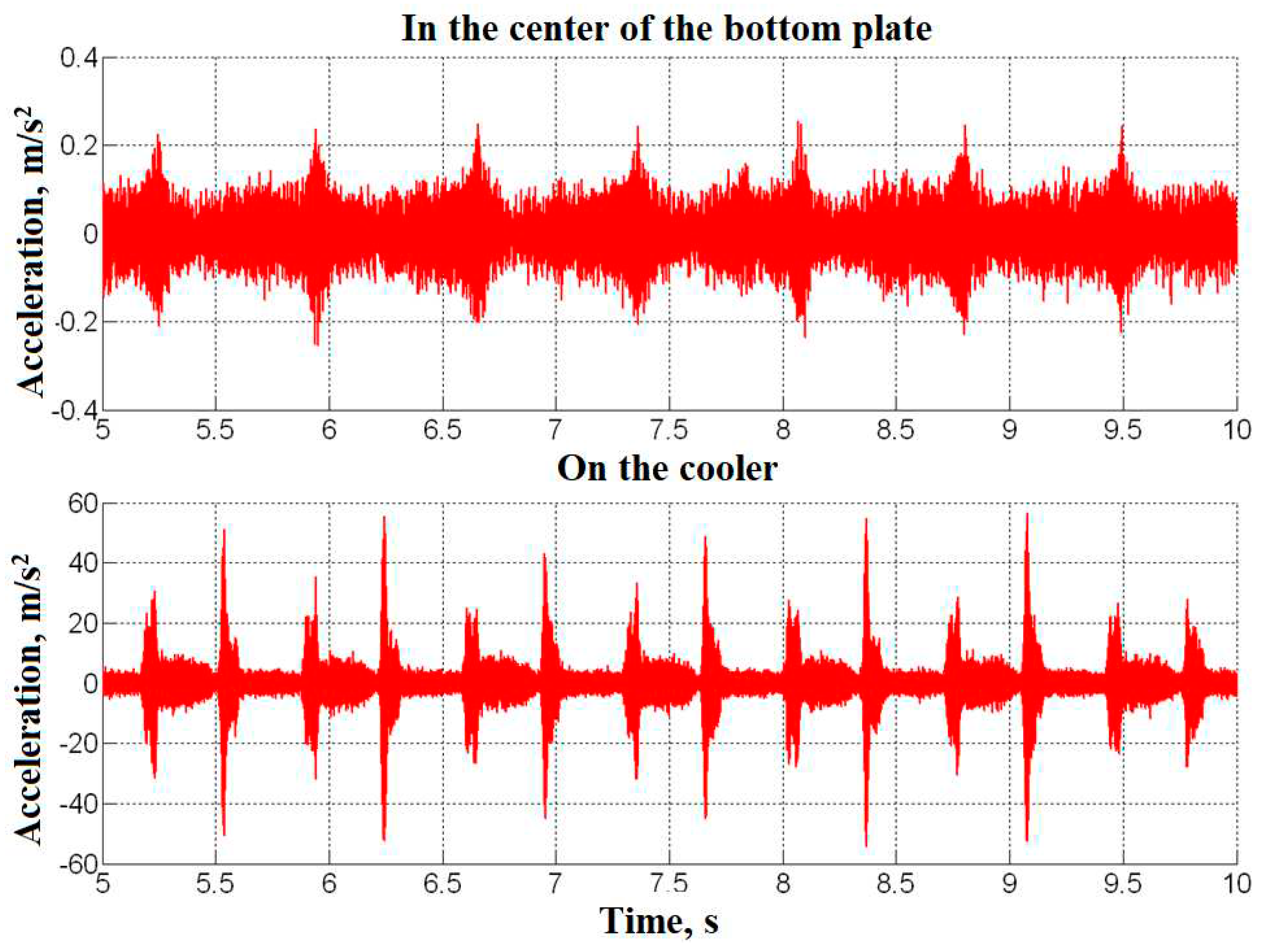
The excitation signal is a sequence of short pulses with a repetition period of about 0.6 s. The lower graph (Figure 18) corresponds to the spectrum of the source of the exciting force. The upper graph (Figure 18) illustrates the frequency dependence of the response to the impact from the cooler in the working area of the installation.
The graphs in Figure 19 demonstrate good vibration isolation of load-bearing structures located inside the working area of the installation from the main vibro-active sources of the stand in the range above 1 kHz. The nature of the cooler operation determines the signal in the form of successive pairs of pulses. The pulses alternate along the carrier frequency, which is clearly seen in Figure 18, where only low-frequency ones are visible (suppression of the order of 150 times), and high-frequency ones are almost completely absorbed by vibration isolation (suppression of at least 500 times).
Figure 19.
Averaged amplitude spectrum of vibration displacement. The blue curve is the background level (all mechanisms are off), the red curve is all mechanisms and the cooler are on. The analysis band is 1 Hz.
Figure 19.
Averaged amplitude spectrum of vibration displacement. The blue curve is the background level (all mechanisms are off), the red curve is all mechanisms and the cooler are on. The analysis band is 1 Hz.
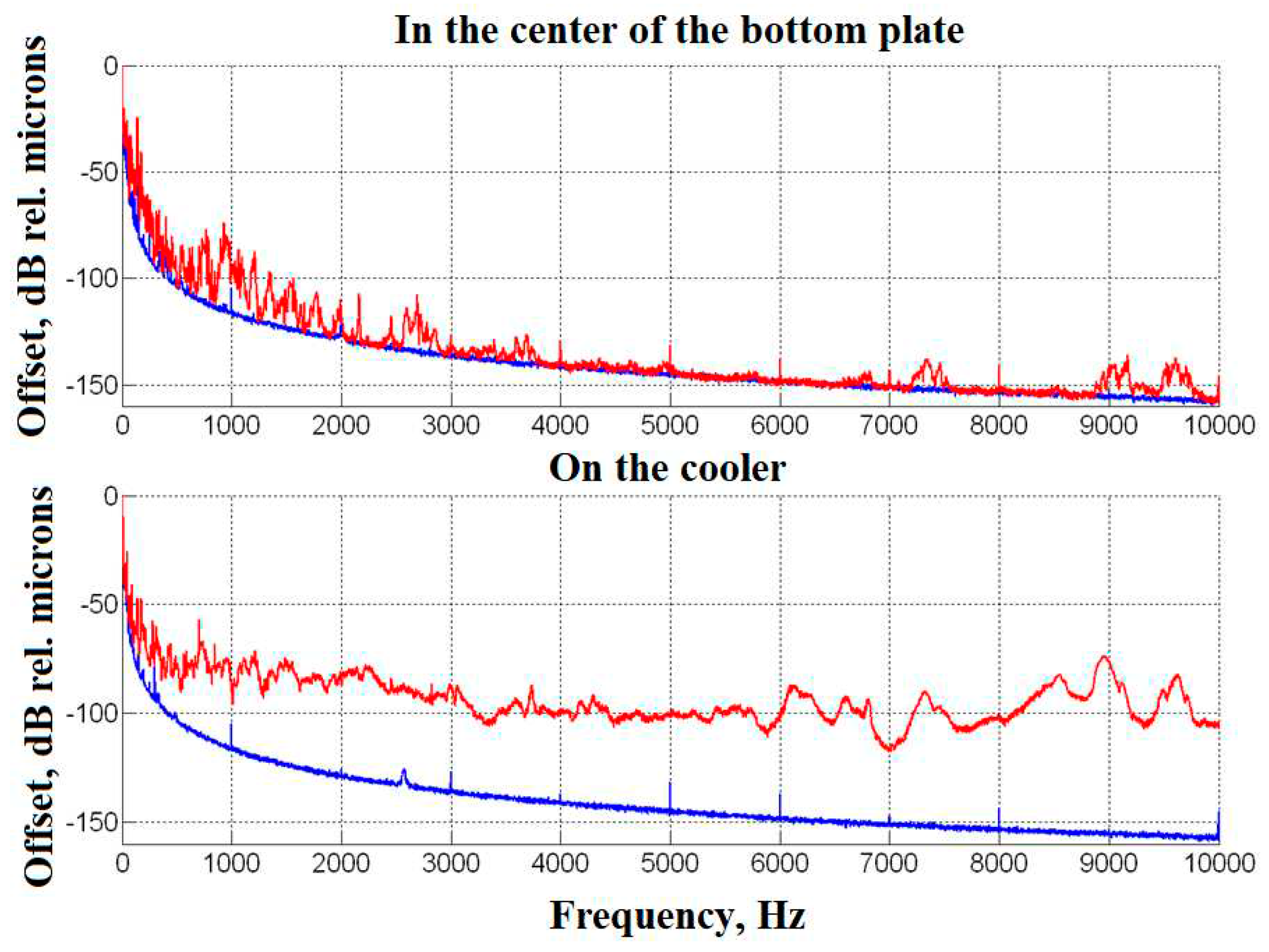
Figure 20.
The averaged amplitude spectrum of vibration displacement (frequency resolution 0.2 Hz). The black curve is the background level (all mechanisms are off), the blue curve is all the main mechanisms except the cooler, the red curve is all the mechanisms and the cooler are on. The control point is in the center of the lower plate inside the working area of the installation. The legend gives the integral values of the amplitudes of vibration displacements in the band 8-200 Hz in dB relative to 1 microns.
Figure 20.
The averaged amplitude spectrum of vibration displacement (frequency resolution 0.2 Hz). The black curve is the background level (all mechanisms are off), the blue curve is all the main mechanisms except the cooler, the red curve is all the mechanisms and the cooler are on. The control point is in the center of the lower plate inside the working area of the installation. The legend gives the integral values of the amplitudes of vibration displacements in the band 8-200 Hz in dB relative to 1 microns.
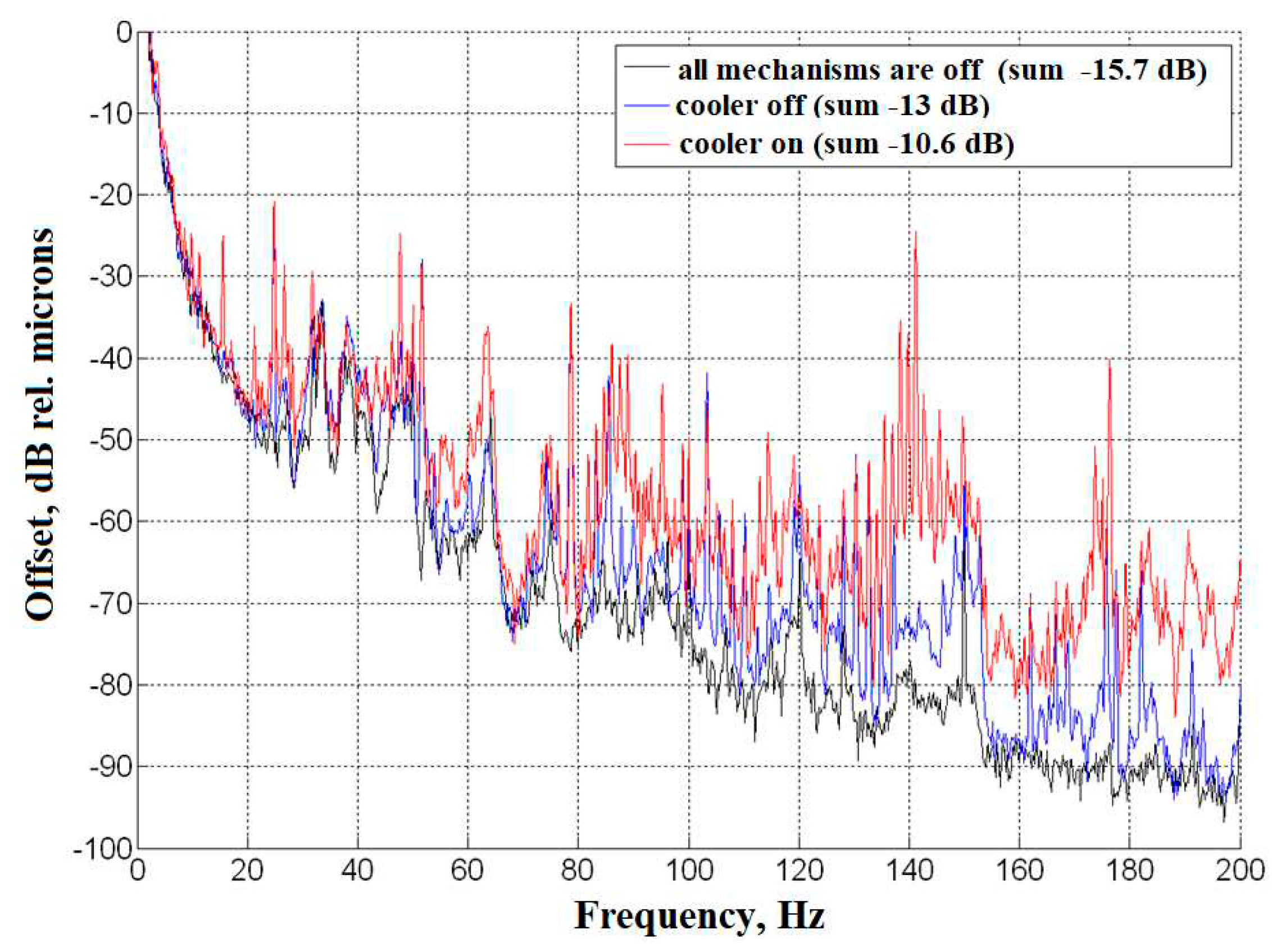
The most energy-intensive and dangerous in terms of vibration displacement amplitudes is the low-frequency range. Figure 20 shows the averaged amplitude spectra of vibration displacement at the control point in the center of the lower plate, in the working area of the installation in the range 0-200 Hz. The spectra were obtained by averaging over 6 samples of a signal with a duration of 5s. In the low-frequency range, the response at the control point is a set of discrete components that were created during the operation of the cooler (140 Hz, 176 Hz, etc.) and other installation mechanisms (24.8 Hz, 51.8 Hz, 78.8Hz, etc.).
As can be seen from Figure 20 at this point of the plate, the level of each of the narrow-band components individually does not exceed 0.1 microns. The integral level of the vibration displacement amplitude in the 8-200 Hz band is given in the legend of the graph and is ~ 0.3 microns when all the mechanisms of the installation and the cooler are working.
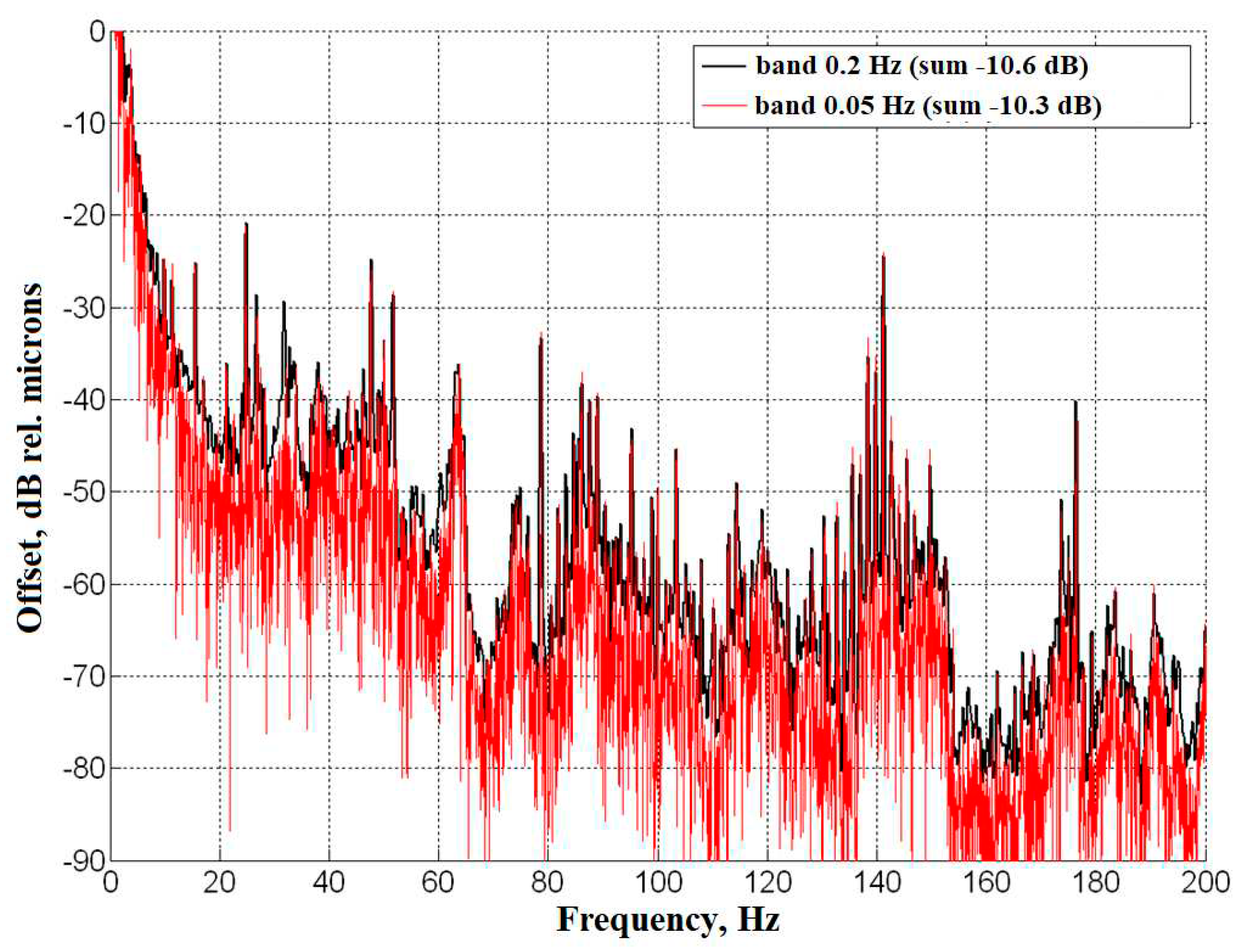
The frequency resolution of the spectra shown in Figure 20 is 0.2 Hz. The width of the discrete components is significantly smaller, as can be seen from Figure 21, which shows the amplitude spectra at the control point on the lower plate obtained at different frequency resolutions.
The sufficiently high level of intrinsic noise of the measuring channel used at this stage and the limited registration time does not allow for reliable measurement of the vibration spectrum in the range near zero frequencies. It is possible to extend the frequency range into the low frequency range using accelerometers with a built-in amplifier. It is also recommended to consider the possibility of using an optical vibration measurement method (laser vibrometer), which is operable, in particular, at the operating temperature of the object.
Figure 21.
Averaged amplitude spectrum of vibration displacements. All mechanisms and cooler are included. Black curve: 0.2 Hz frequency resolution, red curve: 0.05 Hz. The control point is in the center of the lower plate inside the working area of the installation. The legend gives integral values of vibration displacement amplitudes in the 8-200 Hz band.
Figure 21.
Averaged amplitude spectrum of vibration displacements. All mechanisms and cooler are included. Black curve: 0.2 Hz frequency resolution, red curve: 0.05 Hz. The control point is in the center of the lower plate inside the working area of the installation. The legend gives integral values of vibration displacement amplitudes in the 8-200 Hz band.
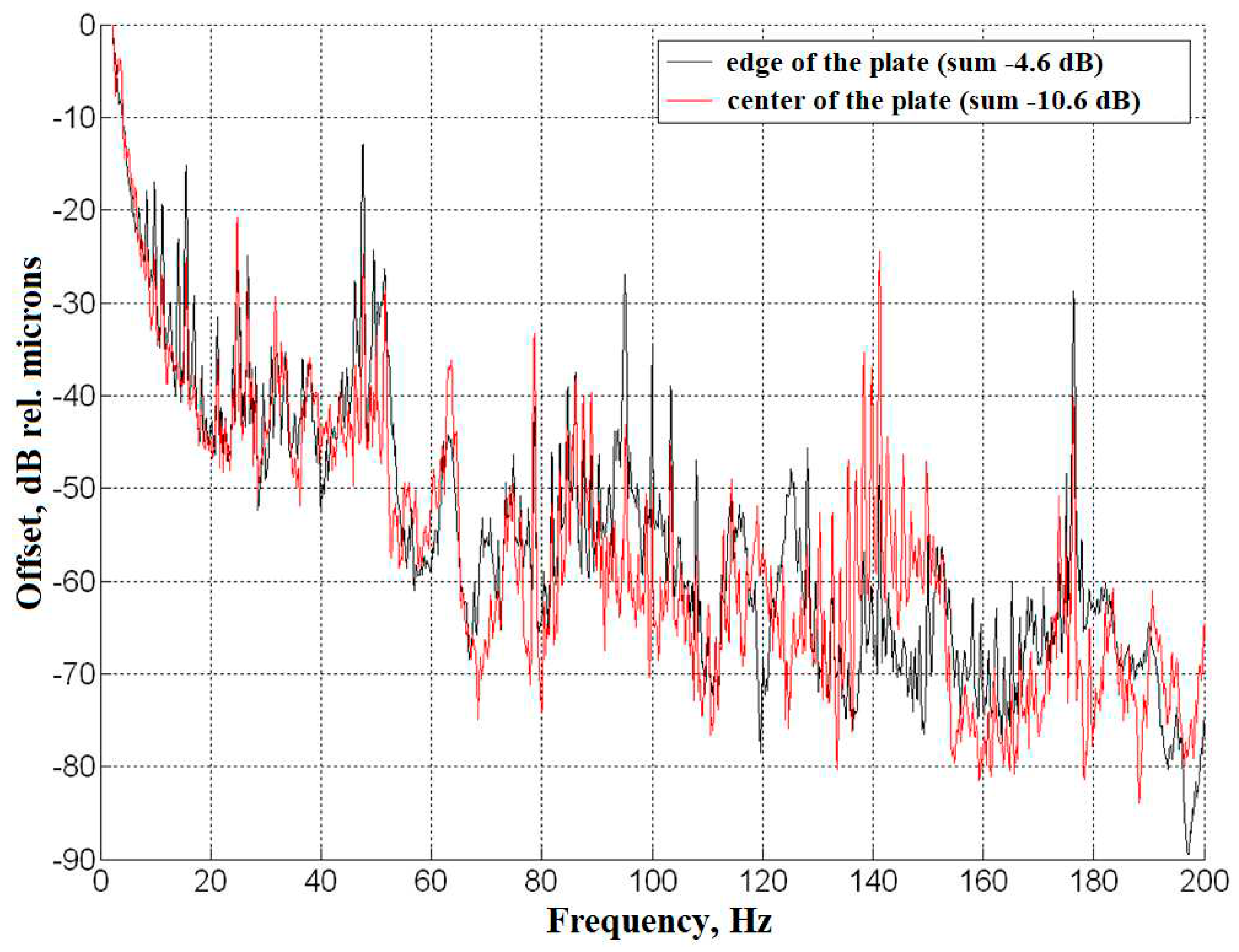
Attention should be paid to the unevenness of the vibration level on the low-temperature plate where the receiver is located. Figure 22 shows the averaged amplitude spectra of vibration displacement for two control points in the center (red curve) and on the edge (black curve) of the lower plate in the working area of the installation. As you can see, vibration levels in narrow frequency bands may differ by ~20 dB for different points of the plate; integral levels by 6 dB.
The placement of such equipment on the 10th floor, where the equipment of the cryogenic nanoelectronics laboratory is now located, leads to the fact that the studied samples show the influence of buses passing nearby and people passing through the floors. During the measurements, a significant influence of external interference in the room on the measurement levels was noted, which is due to the lack of measures taken to vibro-isolate the installation from the floor when it is placed.
Figure 22.
Averaged amplitude spectrum of vibration displacements (frequency resolution 0.2 Hz). All mechanisms and cooler are included. The red curve is the control point in the center of the lower plate, the black curve is on the edge of the lower plate. The legend gives integral values of vibration displacement amplitudes in the 8-200 Hz band.
Figure 22.
Averaged amplitude spectrum of vibration displacements (frequency resolution 0.2 Hz). All mechanisms and cooler are included. The red curve is the control point in the center of the lower plate, the black curve is on the edge of the lower plate. The legend gives integral values of vibration displacement amplitudes in the 8-200 Hz band.
Based on the results of vibration tests of the stand, the following conclusions can be formulated:
- vibrations in the working area are determined by the periodic action of the cooler, the width of the discrete components of vibrations is obviously < 0.1 Hz;
- vibration displacement levels on narrow-band components at control points on the lower plate in the working area of the installation do not exceed 0.22 microns (< 0.1 μm in the center of the plate). The integral level of vibration displacement in the 8-200 Hz band is in the range of 0.3-0.6 μm for different points of the plate;
- to provide measurements in the frequency range of 0-5 Hz, it is recommended to use a laser vibrometer. It is also recommended to evaluate its capabilities for measurements at operating temperatures. Achievable measurable levels using standard laser vibrometers will be no worse than 100 nm up to zero frequencies;
- to develop recommendations for reducing the vibration level of the structure in the working area of the installation, a more detailed measurement of the vibration acoustic characteristics of the stand (transmission coefficients from the source to the working area) should be carried out and measures for vibration isolation of the installation as a whole should be developed. For the following measurements, use a measuring path with a lower noise level;
- of course, for the final verification of the data obtained, it is useful to conduct a test during cooling, for this it is necessary to provide thermal and vacuum isolation of measuring equipment, since individual parameters, in particular, heat capacity, thermal conductivity, sound propagation velocity in the medium can vary depending on temperature.
4.1.3. Antivibration 4K cryostating system
The closed-cycle cryostating system with a reduced level of mechanical vibrations (vibration damping system) is designed to study samples of highly sensitive superconducting detectors, including those with the possibility of optical exposure. Photos of the cryosystem are shown in Figure 23. As a basic configuration (prototype) the 4K system presented in the previous section was used. The vibration damping system includes both design solutions and a specially designed structure of cooling pipes and screens, which integrally soften mechanical contact, which leads to a deterioration in the transmission of acoustic waves or vibration damping. Experiments have shown that the vibration damping system made it possible to reduce the vibration level of the cryosystem panel, on which the elements of the receiver detector are supposed to be placed, by 7-8 dB in comparison with the vibrations of the basic configuration system. The vibration displacement level of the prototype ranged from 50 to 150 microns. In the experiments of this cycle, the vibration level did not exceed 1 micron, and is almost an order of magnitude lower than the requirements of the terms of reference and the measurement metric program, which is obviously sufficient for receiving systems of sub-Hz waves, where the criterion for the negligibility of the vibration effect is the value: А_ν=λ/20 (А_ν is the vibration amplitude, λ is the wavelength).
Figure 23.
Photos of antivibration 4K cryostating system: (a) cryostat; (b) cryostat with vibration damping system.
Figure 23.
Photos of antivibration 4K cryostating system: (a) cryostat; (b) cryostat with vibration damping system.
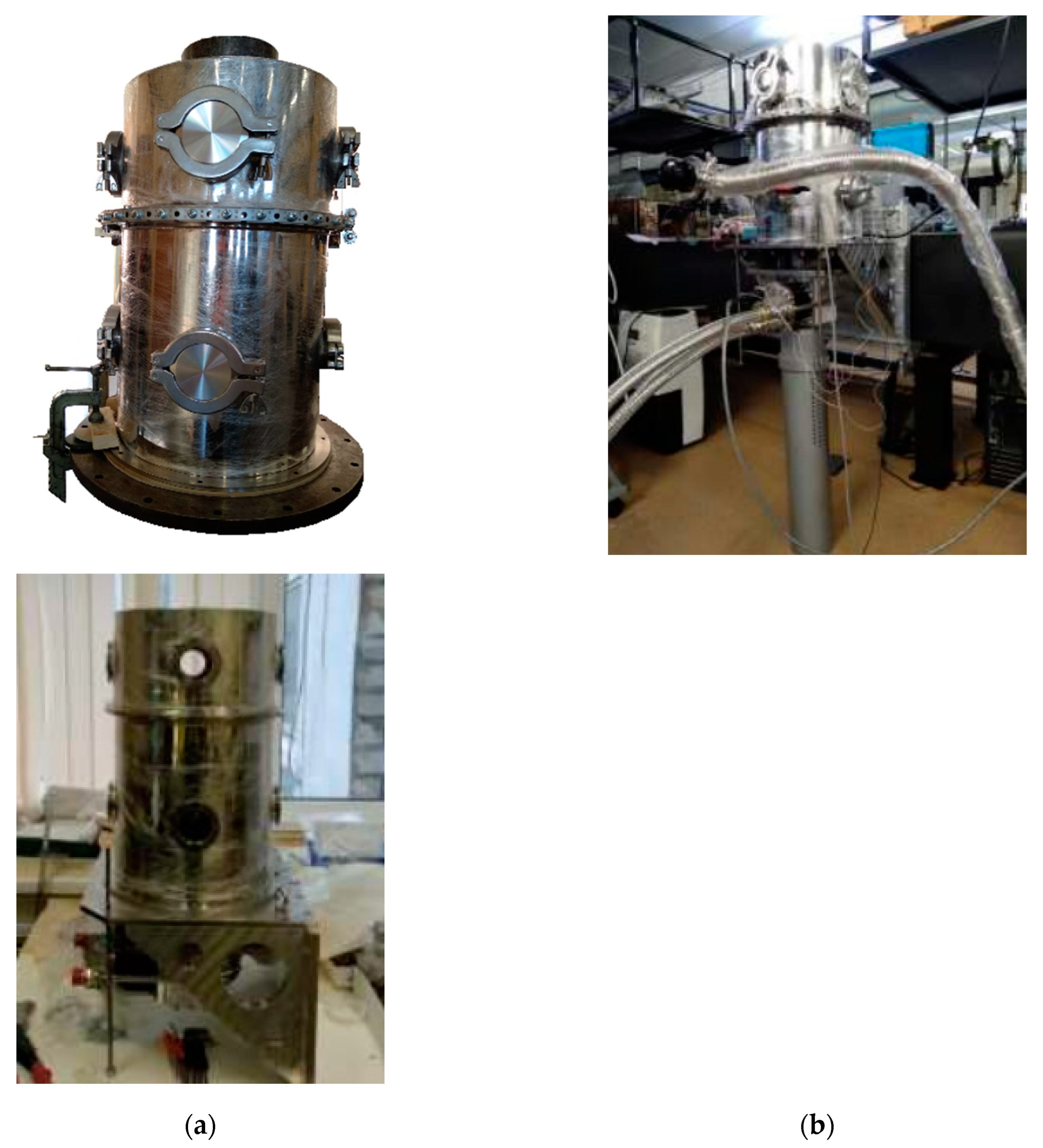
The main characteristics of the system:
- Operating temperature 4К ± 0.1К
- Heat load - 1 W
- Vacuum level 10-4 mbar
- Vibration displacement of the 4K plate in the horizontal plane - no more than 10 μm
- close-cycle MCS RDK-408D2 (SHI), mountain of MCS - Cold head up
- 4 flanges KF D50 for mountain of optical windows with diameter of 50 mm (optional), 3 flanges KF D50 or the mountain of electrical and RF connectors;
- Working cavity size: diameter 200 mm, height 90 mm;
- Overall dimensions of the product - diameter 400 mm, height 800 mm.
Additional options to the basic configuration: the presence of a vibration damping system; quick access to test samples and the possibility of quick installation of various equipment on 8 KF50 flanges.
Vibrations of cryostating systems
Cryosystems with refrigerators on pulse tubes are used for long-term experiments. The main disadvantage of such systems is the additional mechanical noise, which contributes to the general noise of receiving systems, which must be reduced in the case of high-precision / highly sensitive experiments. There are various mechanisms for suppressing such noise vibrations, for example, compressor decoupling, damping pads, etc. The 4K level cooling system with vibration damping system developed by the authors of the publication was presented above.
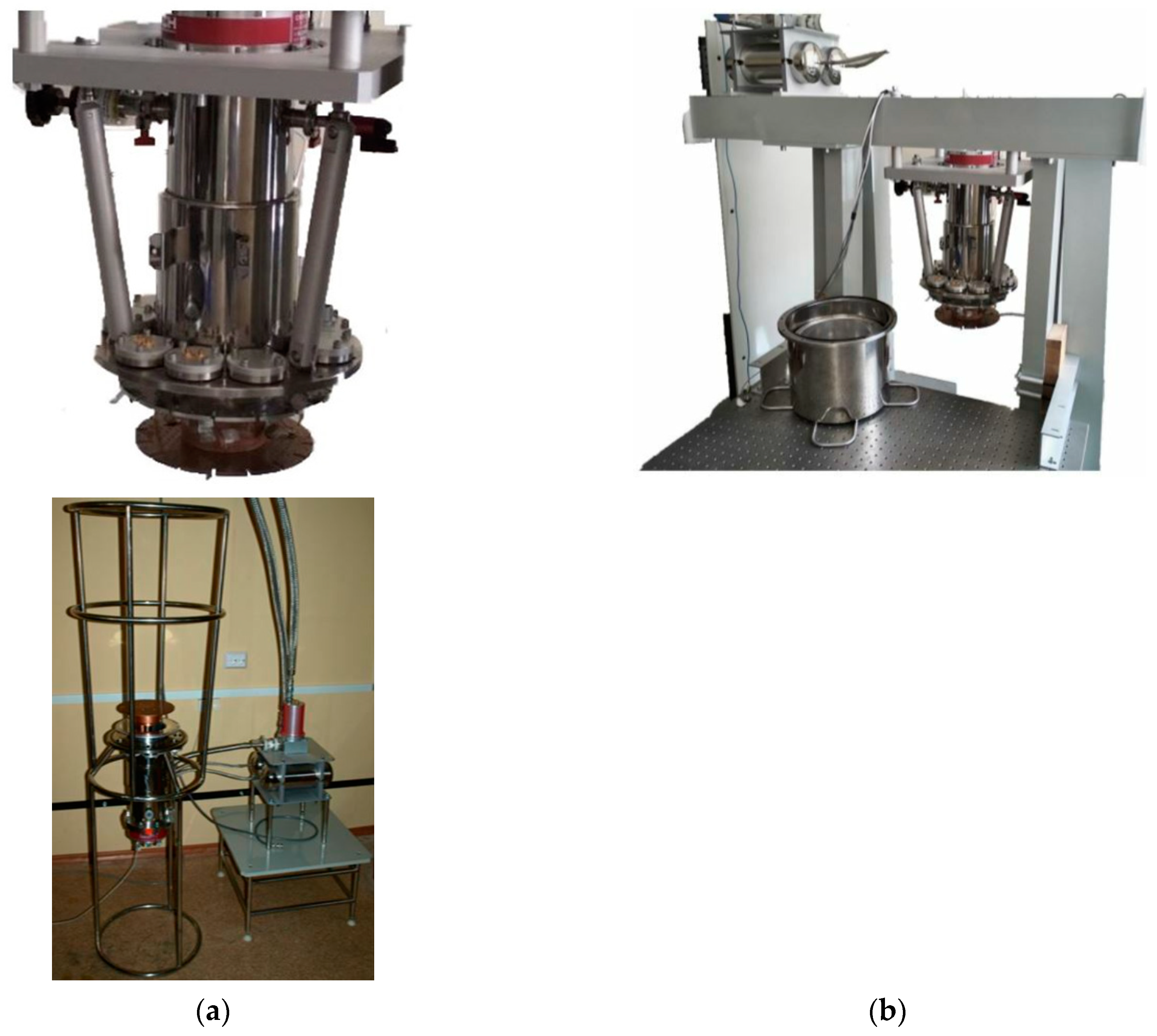
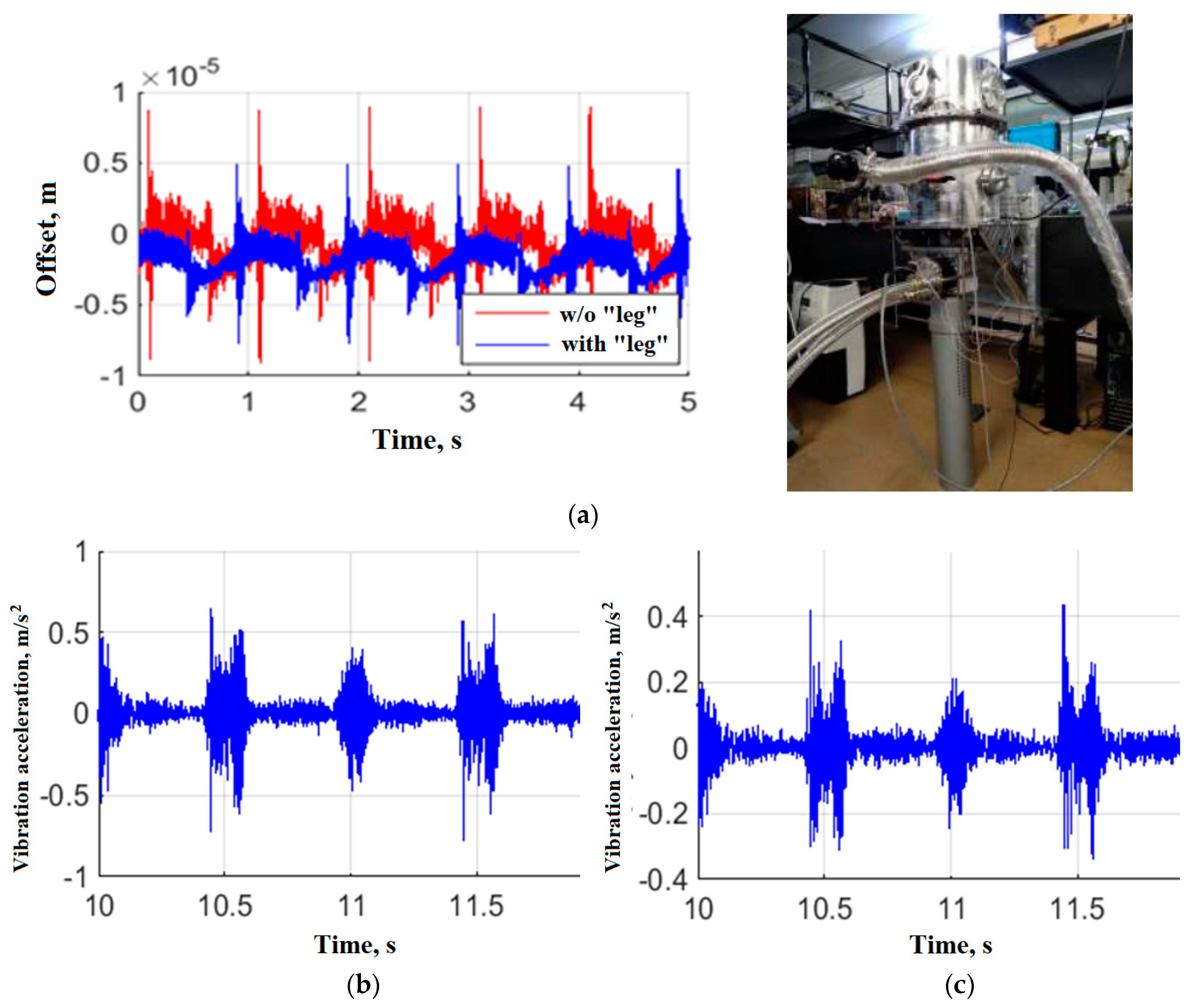
The solution to the problem of damping the vibrations of the refrigeration unit was achieved both through special measures in the design of the elements of the case and the layout of the cryostat, and the special design of the cold pipes and screens, which in total soften the mechanical contact, which leads to a decrease in the transmission of acoustic waves or vibration damping. But this obviously cannot but affect the heat transfer mechanisms and even vacuum conditions, which can lead to undesirable consequences in the receiver cryostatting characteristics. In fact, a compromise is required between achieving the required thermal and acoustic performance. Vibration measurements of the sample simulator were carried out by a laser vibrometer in the horizontal direction. The laser beam was directed at the sample through an optical window in the housing. The cryosystem was mounting in a clean room on the optical table of the Multi-petawatt laser stand PEARL-10 (see Figure 2). The compressor with a capacity of 7 kW was installed in an adjacent room (with a separate foundation and no requirements for the cleanliness of the room) and connected to the cryostat and cooler by flexible metal hoses laid into the clean area of the bunker where the cryostat was located. Some results of measuring the vibration level of various elements of the cryosystem are shown in Figure 25.
Figure 2.
Placement of the cryosystem in the room of the “PEARL - 10 Multi-Petavate laser” stand in order to study the vibration level.
Figure 2.
Placement of the cryosystem in the room of the “PEARL - 10 Multi-Petavate laser” stand in order to study the vibration level.
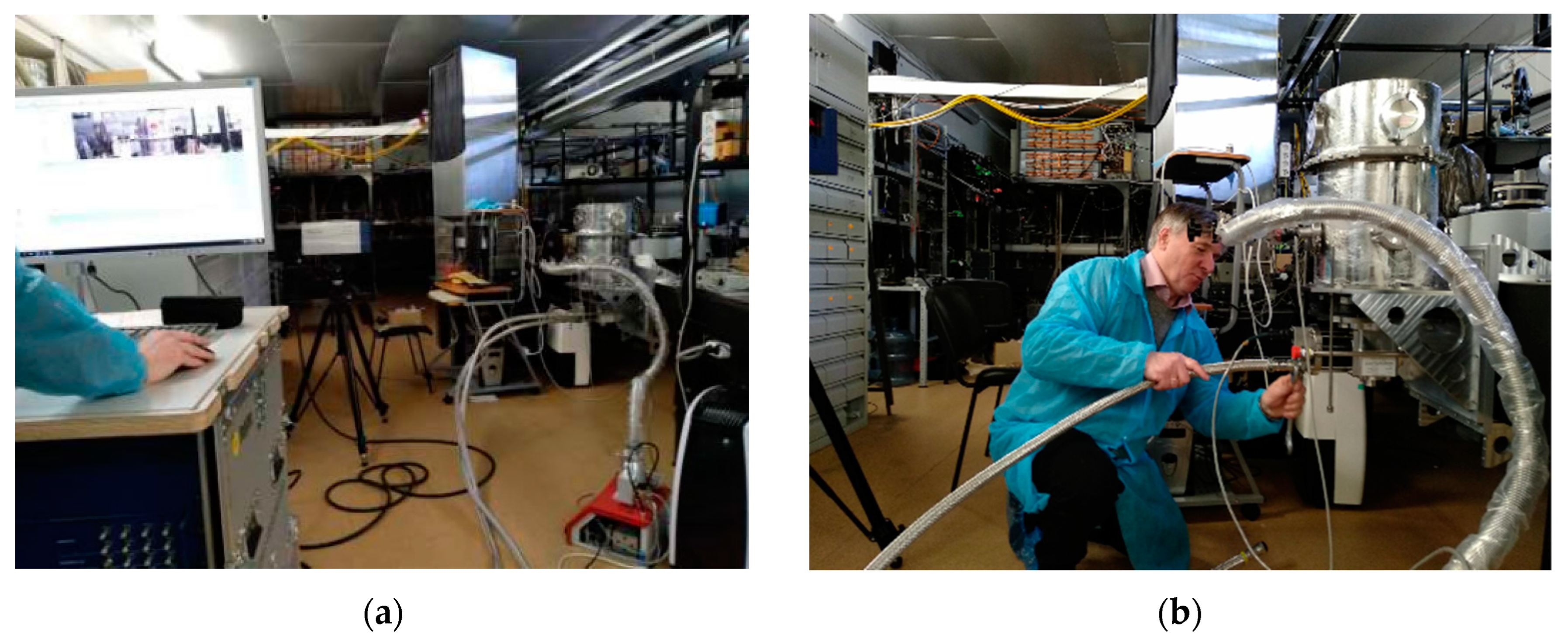
Figure 25.
Some results of measuring the vibration level of various elements of the cryosystem: (a) Vibrations of the sample simulator in the horizontal direction and the presence/absence of an additional support; (b) Vibrations of the bracket in the Z direction; (c) Vibrations of the table in the Z direction.
Figure 25.
Some results of measuring the vibration level of various elements of the cryosystem: (a) Vibrations of the sample simulator in the horizontal direction and the presence/absence of an additional support; (b) Vibrations of the bracket in the Z direction; (c) Vibrations of the table in the Z direction.
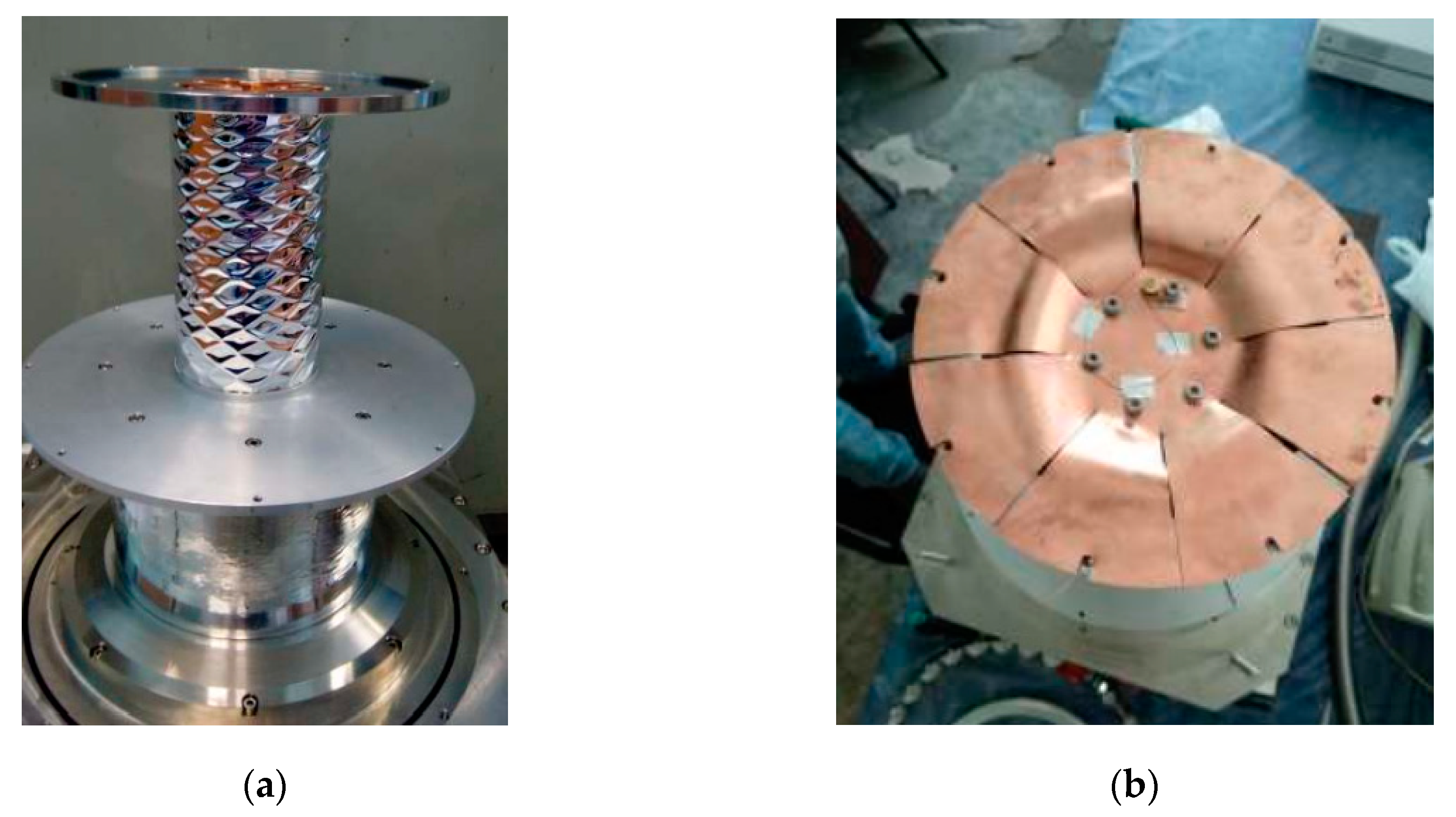
After a successful vibroacoustic test, the cooling capacity and the maximum achievable temperature of the cryostat design upgraded from the point of view of acoustics were checked. As expected, the passport characteristics of cryostating were not achieved during the first test. Computational, theoretical and experimental work was carried out to find the compromise mentioned above. The main measures to achieve the passport temperature in 4K:
- To reduce the 4K radiation losses, the support was covered with superinsulation Figure 26а.
- Installation under the 4K panel and on the cold finger of the cryomachine of an additional cooling line made of a spring ring of soft annealed copper to improve heat transfer between them ("cornflower"), Figure 26b.
Figure 26.
Additional measures to bring the cryogenic installation to the operating mode: (a) 4K support in super insulation; (b) Soft copper cooling pipe 0.5 mm thick “cornflower”.
Figure 26.
Additional measures to bring the cryogenic installation to the operating mode: (a) 4K support in super insulation; (b) Soft copper cooling pipe 0.5 mm thick “cornflower”.
4.1.4. The low-vibration 4K cryostating system for studying thermal deformations of panels of the main mirror of the Millimetron space mission at cryogenic temperatures
Together with the ASC LPI, a cryovacuum chamber was created for studing the thermal deformations of the panels of the main mirror of the “Millimetron” space telescope. A photo of the cryosystem is shown in Figure 27.
The main characteristics of the system:
- Operating temperature– 4К±0,5К;
- Residual pressure inside the cryostat – 10-5 mbar;
- The level of vibration displacements on a cold plate is no more than ±0,5 μm in frequency range up to 300 Гц;
- Vacuum inlets - 32 fiber optic, 2 KF25, KF16 and optical window;
- Overall dimensions: height – 1450 mm, diameter – 830 mm
Figure 27.
Photo of the 4K cryosystem for studying thermal deformations of the mirror panels of the Millimetron space mission installed in P.N.Lebedev Physical Institute RAS, June 2023.
Figure 27.
Photo of the 4K cryosystem for studying thermal deformations of the mirror panels of the Millimetron space mission installed in P.N.Lebedev Physical Institute RAS, June 2023.
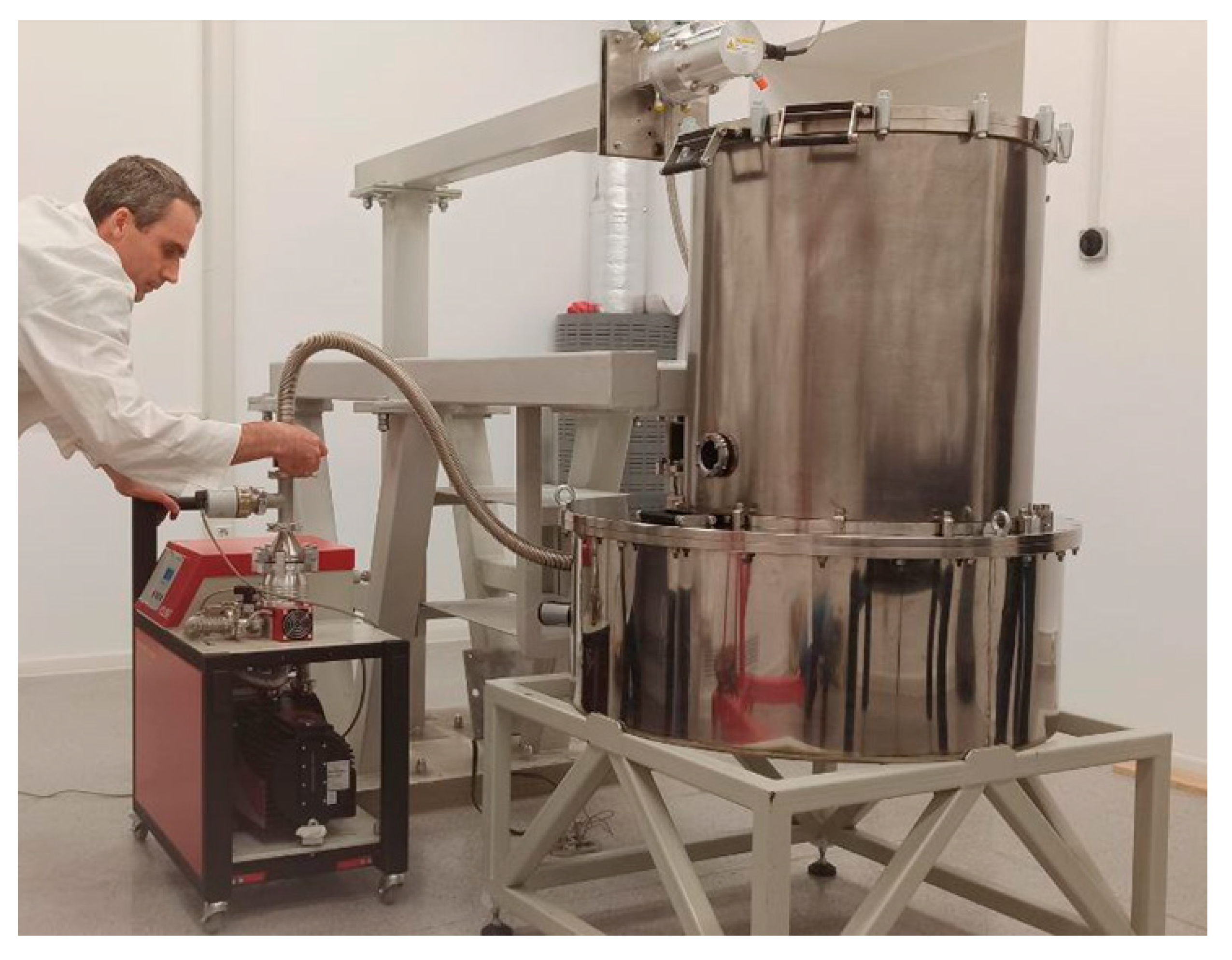
4.1.5. Cryovacuum resonator complex
The cryovacuum resonator complex [55-56], Figure 28, is a unique new- generation laboratory equipment for studying the dielectric parameters of gases and condensed matter (in the temperature range from -50 ° C to + 200 ° C), as well as the reflectivity of surfaces (reflection losses) in the frequency range from 100 to 520 GHz and the pressure range from 10-3 Torr to atmospheric at temperatures of 4-370 K. Radiation loss in the investigated substance determines the Q factor of two quasi-optical Fabry-Perot resonators located in the vacuum chamber. The length of the resonators differs by half: a long resonator (symmetrical) is formed by two identical spherical mirrors, a short resonator (asymmetrical) is formed by one spherical and one flat mirror. Deep cryogenic cooling (up to 4 K) is used to conduct reflectivity studies. A symmetrical resonator is used as a reference, and a test sample of the reflector is mounted on the flat mirror of the asymmetric resonator. For thermal isolation from the resonator housing, the mirror with the sample is fixed on fiberglass racks and is connected to the second stage of the cooler by a flexible cooling wire. The copper housing is connected to the first stage of the cooler and is also isolated from the chamber walls. The temperature deviation along the length of the housing does not exceed two degrees at 70 K. As the cryogenic basis of the equipment, a cryovacuum chamber with a closed-cycle cryorefrigerator "RDK-415D" manufactured by "Sumitomo Heavy Industries, Ltd." with a Gifford-McMahon thermodynamical cycle of a helium temperature level is used. This refrigerator is able to provide cooling without load to a temperature below 3 K in the second stage and up to 60 K in the first stage.
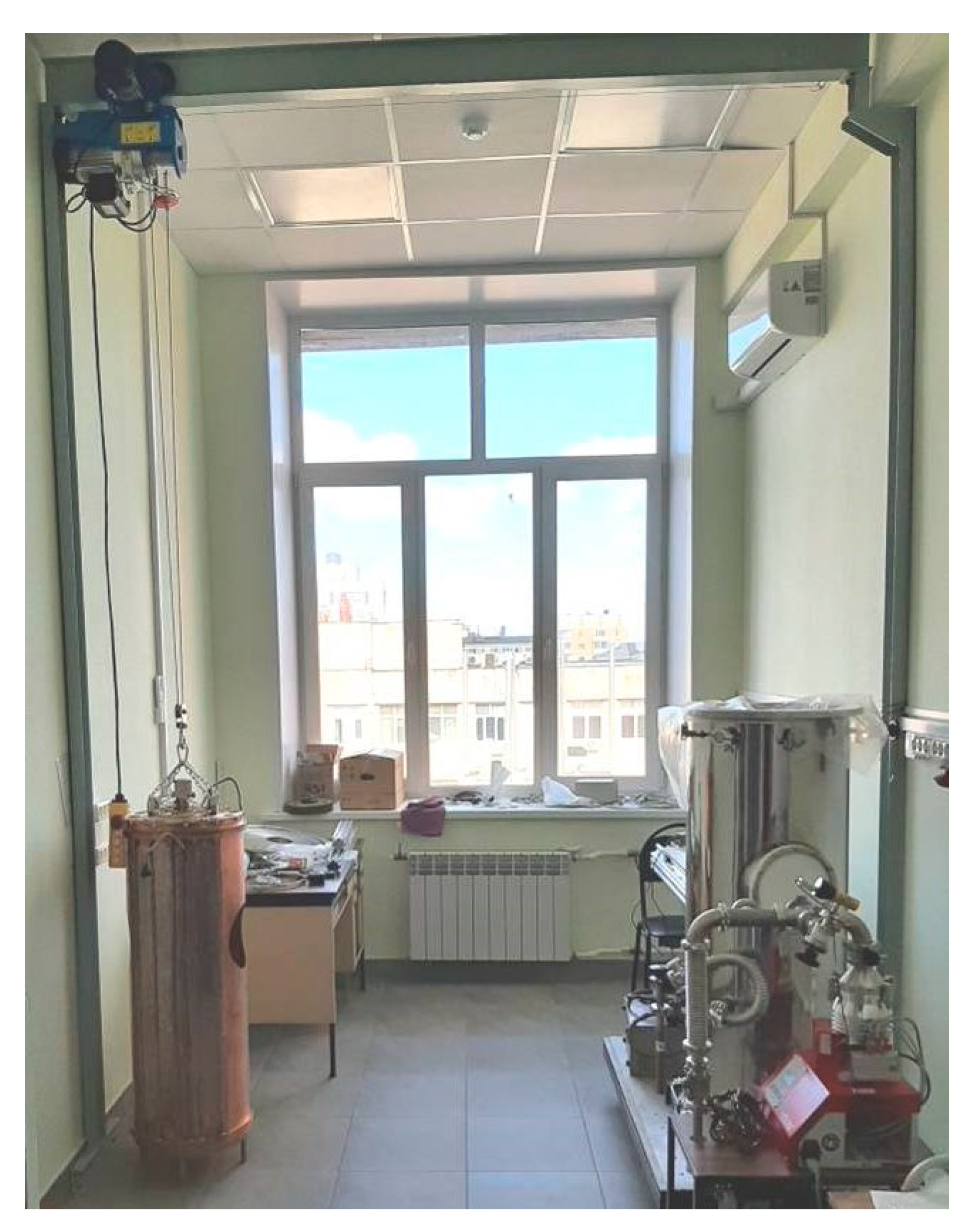
Also, the experimental setup is used in the temperature range from -50 °C to + 200 °C for studying the spectra of gases. But in this article we will not consider this direction because deep cooling is not provided in this mode, but only up to -50 °C (more details can be found on the website of the Department of microwave spectroscopy of the IAP RAS - https://mwl.ipfran.ru /#/). Currently, a new vacuum chamber has been developed and manufactured for such studies (see Figure 30) in order to increase the number of experiments.
The chamber is equipped with a pressure and temperature monitoring system and is thermally insulated from the external environment. The vacuum system provides metered injection and pumping of gases. The temperature of the mirrors, casing and sample is controlled by the automated “LakeShore Temperature Monitor” system (the sensors are marked Т1-Т7 in Figure 28).
Figure 28.
Schematic representation of a cryovacuum resonator complex (the figure from).
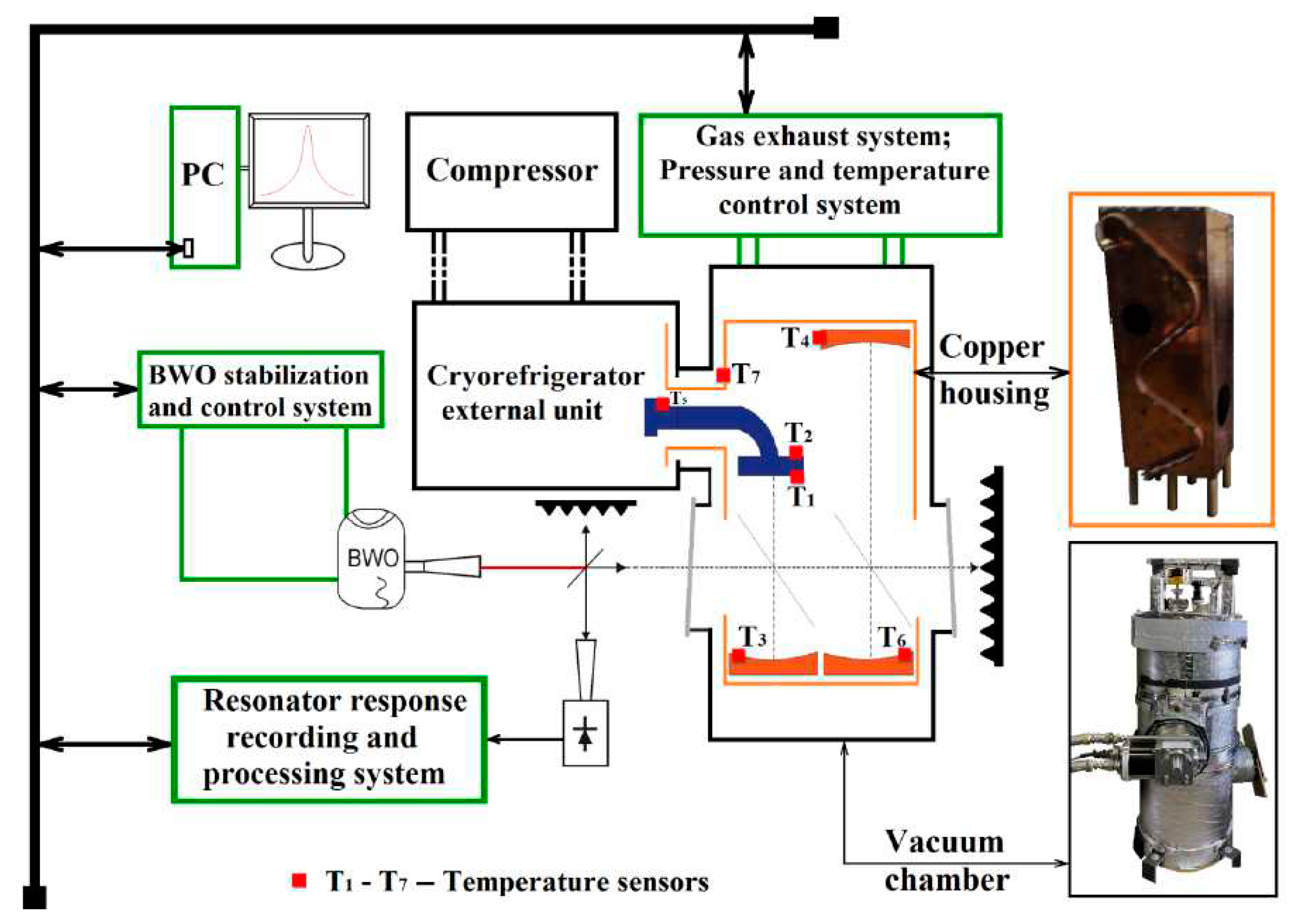
Figure 29.
The photos of the cryovacuum resonator complex IAP RAS, April, 2022.
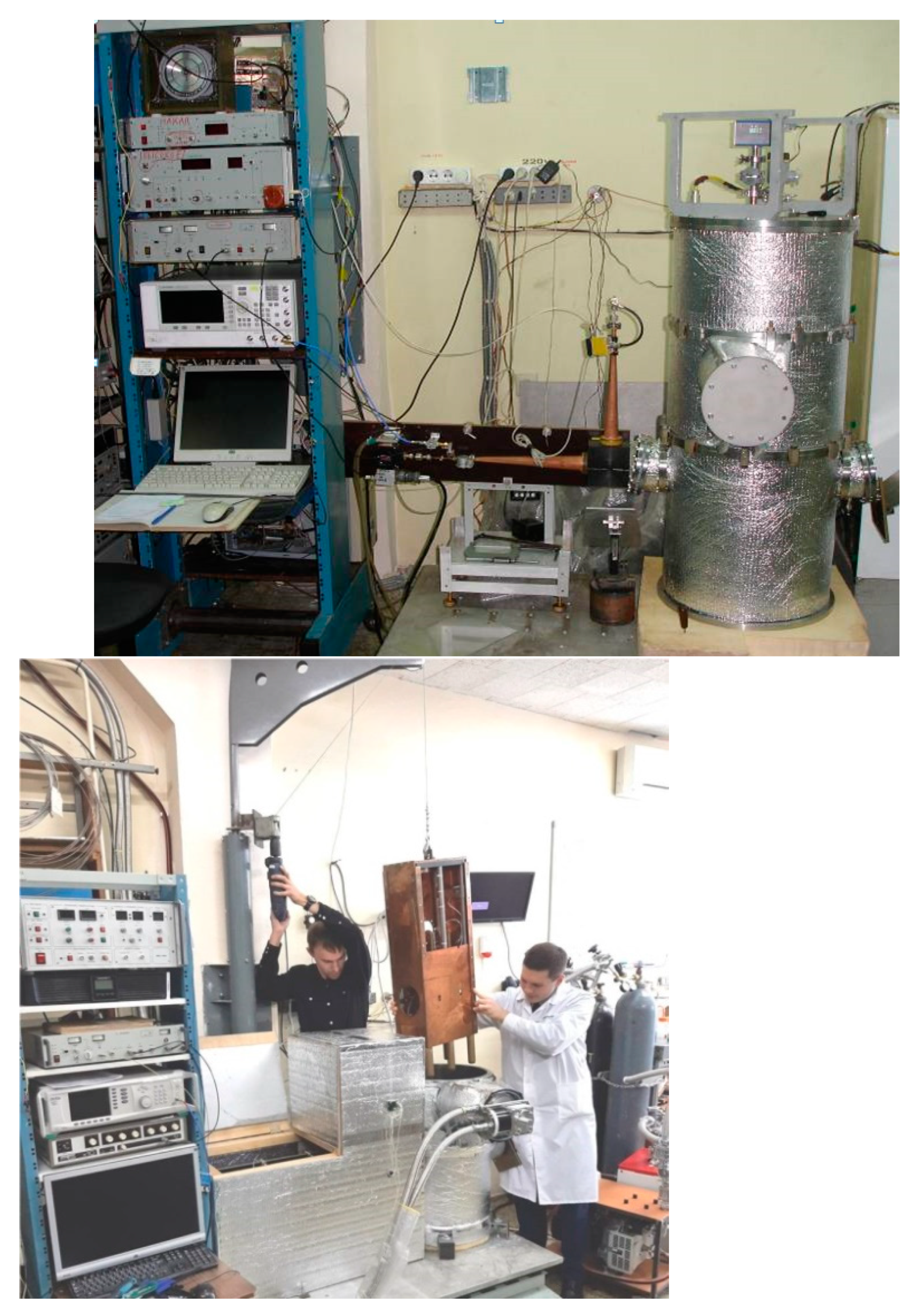
Figure 30.
A new vacuum stand for the study of gas spectra in the subTHz frequency range at temperatures from -50 °C to +200 °C, IAP RAS, May, 2023, “the first light@ November, 2023.
Figure 30.
A new vacuum stand for the study of gas spectra in the subTHz frequency range at temperatures from -50 °C to +200 °C, IAP RAS, May, 2023, “the first light@ November, 2023.
Main characteristics of the equipment:
- Frequency range: 36 ÷ 520 GHz;
- Temperature range for gases: with the possibility of long–term stabilization at any temperature within 220 – 370 K, without temperature stabilization within 10 – 220 K; for dielectrics and metals : 4 K - 900 K;
- Gas pressure: 0 – 1500 Torr;
- Sensitivity to changes in absorption in gas: ~0.001 dB/km ( 4*10-9 cm-1);
- The range of measured values of the refractive index: 1 – 10 with a relative error up to 10-4;
- Measured thickness of dielectric plane-parallel plates: 0.002 – 30 mm with an accuracy of up to 10-4;
- Minimum diameter of the solid sample under study: ~ 12 mm (on 140 GHz);
- Range of measured values (tgδ): 10-2÷10-7 with a relative error of up to 5%;
- Range of measured values of reflection losses:
- 10-1÷10-4 with an average relative measurement error ~5% at the level of reflection losses ~10-3.
The main scientific results obtained with this equipment
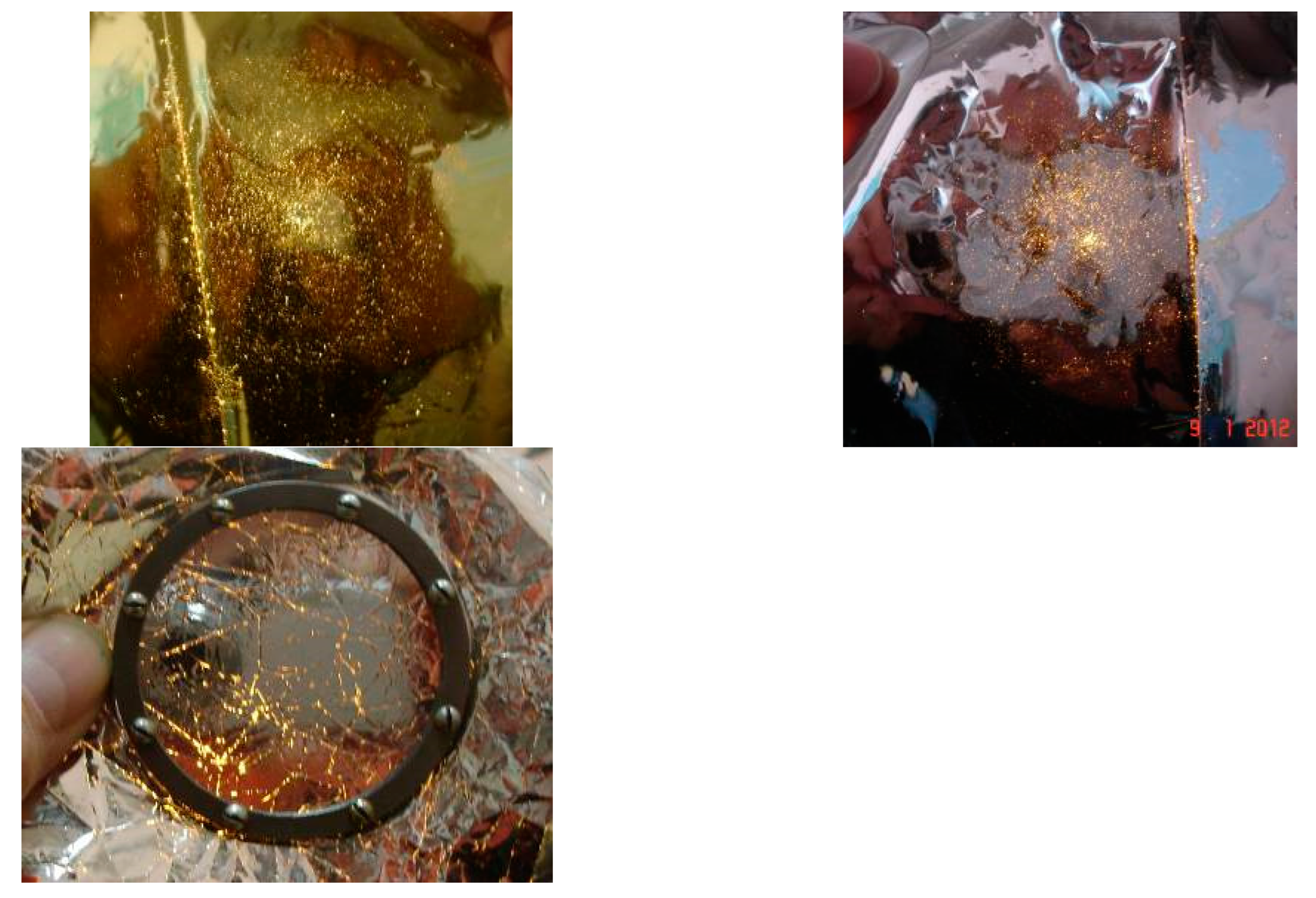
1. Studies of a wide class of metal coatings for antennas of ground-based and space-based radio telescopes and for the creation of highly sensitive cooled receivers have been carried out. The reflectivity of mirrors with different internal structures made of ultrapure silver, copper, gold, aluminum [57], and beryllium alloy [57] has been studied. It is shown that reflection losses when samples are cooled to liquid helium temperatures vary significantly depending on the structure of the surface of the reflecting layer and the presence of impurities, and a limit for reducing reflection losses is found. Reflection losses were investigated for the film reflectors of the Millimetron Space Observatory [55]. The following samples were examined (photos of some samples are shown in Figure 31):
- Polyimide. Thickness 20 μm. 1 side Al thickness 80 nm;
- Polyimide. Thickness 20 μm. 2 side Al thickness 80 nm;
- Polyimide. Thickness 20 μm. 1 side Al thickness (А 999) thickness ~0.1 mkm with SiO2-x protection thickness ~30 nm. Back side–In2O3:SnO2 (95:5) thickness ~30 nm;
- Polyimide. Тhickness 20 μm. Nb thickness 50 nm;
- Glass plate 1.8 mm with Nb 50 nm;
- Jammed Polyimide №1.
The prospects of using materials with high-temperature superconductivity (HTS) are shown [58], as well as classical superconductors of the second type based on Nb and NbTiN [56]. Data on losses of reflection of millimeter waves by these materials were obtained for the first time.
2. The dielectric properties of a wide class of dielectrics and semiconductors (crystals, ceramics, amorphous substances, plastics, etc.) have been studied. These studies made it possible to create a reference database for the selection of materials used. In particular: A cycle of studies of dielectrics with ultra-low absorption in the millimeter and submillimeter ranges for the output/input windows of megawatt generators (within the framework of the ITER program) was carried out. Based on the made research, thermal calculation of windows based on CVD diamonds for the output/input of heavy-duty radiation became possible. A class of dielectric liquids promising for cooling energy output windows in high-power and heavy-duty generators of MM and subMM ranges has been determined.
Figure 31.
Photos of samples of film reflectors of the space observatory “Millimetron”.
4.2. CCD matrix cooling systems
CCDs (Charge Coupled Devices) are used in many areas, both in science and in military and astronomical applications. As mentioned in the introduction, one of the most effective ways to reduce noise characteristics, and consequently increase the sensitivity of the receiving device, is to cool the device itself. Nitrogen level cooling (~80 K) is also quite popular for cooling optical and infrared photodetectors [59-60]. In this subsection will presented only short description of cooling device for CCD that was developed by our team, a line of developed various cooling systems of CCD matrices for BTA SAO RAS is presented in our previous paper [34]. But for some CCD matrix it is usable “soft” cooling – up to -40⁰C [61].
Based on the accumulated experience, specialized chambers were manufactured for cooling CCD arrays in the vacuum ultraviolet range with a temperature range from 80 K to 230 K. Since ground-based observations cannot be made in this range, it is assumed that it will be used for the Spectrum -UV space mission. Also, a cryogenic test system was additionally created for cooling several objects with gaseous or liquid nitrogen to simulate conditions of deep space, where manufactured cameras for cooled CCD arrays of the VUV range were tested. This is a system consisting of a nitrogen Dewar vessel, insulated metal hoses, interfaces for supplying cold to consumers and a temperature control and stabilization unit. The characteristics and photos of the systems are given in Table 2.
4.3. Components of cryogenic astronomical receivers that are outside the state of thermodynamic equilibrium
Mandatory elements of cryostating systems for receiving devices are the presence of a sealed optical window (for signal input to the detecting cell) and often there are thermally binding waveguide and quasi-optical lines inside the systems that supply the signal to a deeply cooled device (amplifier, mixer, detector). For the first time in the literature, these issues were addressed in publication [62]. As noted above, these elements are characterized by the fact that they are not in a state of thermodynamic equilibrium, and strictly speaking, even the term temperature is applicable to them with a reservation. In this connection, there are features in the calculation, analysis and design of such systems, discussed below.
4.3.1. Physical temperature and noise of a sealed window
The task of analyzing and creating a cryoreciver window is reduced to constructing a vacuum-dense and transparent entrance for the received radiation with a minimum of parasitic heat flows inside the cryostat. The heat flux and the temperature distribution over the window surface are calculated based on the thermal conductivity equation [3], formula 8:
where x, y, z are the cartesian coordinates, q is the heat source, Ср is the heat capacity, ρ is the thermal conductivity of the material. As a result, it was found that under certain conditions, the temperature of the central zone of the window can differ quite significantly from the ambient temperature (by 5-15 K). At the same time, it is very likely that the temperature of the outer surface will be below the dew point for a certain range of ambient temperature and humidity, which will inevitably lead to the precipitation of water condensate, which is extremely undesirable due to the significant absorption of water waves in the range of 0.1 - 1 THz. The presence of an infrared filter [63] between the cold receiver input and the window significantly improves the picture. The infrared filter, which is a layered or loose structure fixed on the radiation screen of the cryostat, absorbs most of the radiation from the heated environment lying outside the band of received signals. Along with undesirable condensation, radiation cooling of the window has positive consequences: the colder central zone of the window, through which the received signal mainly passes, has slightly lower temperature and losses. As a result, the overall noise temperature of the receiver decreases. Based on the obtained temperature distribution, in [3] the transfer equation is solved and a refined noise temperature is obtained, which for the implemented configurations of windows and receivers is 5-7% less than the calculated one without cooling.
Another important feature when designing a cryogenic system is the larger the optical window, the correspondingly greater the thermal load. For example, with a window diameter of about 100 mm and a background load of 300 K, the external power is about 9.5 watts. Various combinations of radiation filters, such as Zaytex, Fluorogold, , HDPE etc. are used for the solution.
The authors of the article have obtained successful experience in the installation and operation of hermetic optical windows of various diameters (including "extra-large" ones) and made of various materials. Some examples are given in Figure 32.
Figure 32.
Photos and characteristics (diameter/material) of optical windows.
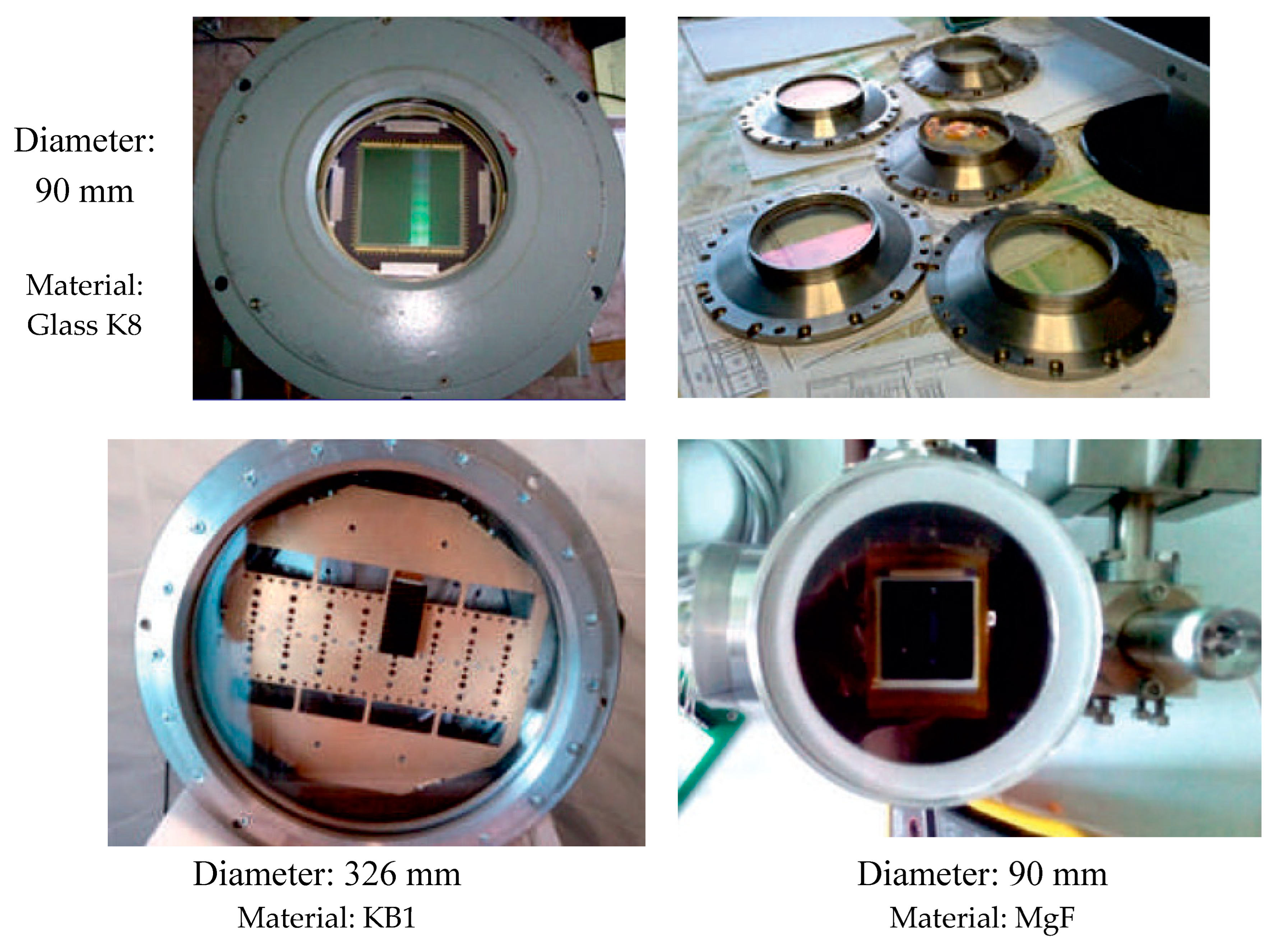
4.3.2. Dissipative transmission line at temperature drop
In addition to the window, a specific element of the cryostatised receiver is an incoming thermo-decoupling feeder, which, however, is sometimes absent if the horn of the antenna irradiator is placed inside the cryostat. The thermal-binding waveguide in the MM and subMM wavelength ranges is usually supersized and sometimes combines the function of transition to the main section of the waveguide. Here we also solved a problem similar to the one discussed in the previous section: on the basis of the thermal conductivity equation, the temperature distribution profile along the length of the line is determined [62]. Knowing the loss factor depending on the conductivity and the size of the waveguide, we can determine the attenuation constant as the product of the factor by the linear function D(λ) of the working wavelength. The calculated distributions of temperature and specific losses along the length of the line allow us to uniquely solve the transfer equation [64] for it and calculate its noise temperature, formula 9:
where 0 and Х are the coordinates of the waveguide ends, Ta=Ta (x) is the law of distribution of physical temperature along the length of the waveguide established from the solution of the equation of thermal conductivity, l(x) is the law of distribution of losses in a waveguide of a given section.
Another issue is the definition of a three–dimensional heat flux in a waveguide active device. The equation of thermal conductivity, taking into account the internal heat source, was solved to estimate the temperature of an active device placed in a waveguide chamber. This configuration is typical for converters and amplifiers of MM and sub-MM waves. Consider the three-dimensional problem of thermal conductivity for a model of a cubic device cooled from one of the faces () and located in a vacuum without heat transfer along the remaining faces (dT/dx=0; dT/dy=0; dT/dz=0),, with an internal heat source q having a heat dissipation characteristic of a diode (transistor) and characteristic dimensions l, approximately 2 orders of magnitude smaller than the external size L of the device (waveguide chamber). The distribution function of the source along the x coordinate in this case has the form:
For the rest of the coordinates, the distribution of the heat source is recorded similarly. Let 's write the function
satisfying the boundary conditions described above, and we introduce a variable t equal to the difference between the physical temperature and the temperature of the cooled wall, coupled with a cooler of conditionally infinite cooling capacity, while t and dt/dn = 0. We define the Laplace operator of the function (11)
The solution of the thermal conductivity equation can be written as:
where
Solving the system of equations (12) – (14) with respect to t, one can analytically find the temperature of the source in the center of the cube without using numerical methods:
where, is the the form factor. For the "small cube in a large cube" model with aspect ratio 1:100 form factor is =0,19.
Calculation (15) showed that the overheating of a standard planar SBD in vacuum can reach 10-13 K, including up to 10K – due to the contribution of the planar structure itself.
5. Conclusions
This paper provides a brief overview of the principles of operation, basic designs and features of the design and manufacture of cryogenic systems of various temperature levels for cooling detection devices of various frequency ranges for astronomy and other applications. The specific features of the cryodesign of such systems are considered: methods for thermal calculations of cryostats of various temperature levels for astronomical receivers were proposed, the fluctuation characteristics of refrigerators and their vibration were studied, measures were proposed to reduce the influence of these negative processes on the characteristics of the receivers, original designs of optical inputs to cryostats with extremely low losses of the useful signal were proposed, some transfer issues were considered radiation in a signal transmission channel that is nonstationary in temperature. The main result of the article is the presented development of an extensive range of cryogenic astronomical equipment for different observatories. Based on these developments of both optical (photonics) and radio-astronomical (electronics) equipment, a new project by the authors of the article is being built to develope receiving equipment in the intermediate terahertz range for new telescopes that are expected to be built in northeastern Eurasia: the Caucasus and Siberia region in Russia [65], Uzbekistan [65, 66], China [65, 67]. These observatories will inevitably be equipped with cryogenic receivers based on the experience described in the article and there is a close collaboration with teams of listened observatories.
Author Contributions
“Conceptualization, V.V..; methodology, Y.B., V.E., M.T., A.C. and S.S.; software, O.B. and Ig.L.; validation, M.E., A.S..; formal analysis, M.M.; investigation, A.E., A.G., A.K., A.V., I.L., S.S., N.T., and E.P; data curation, I.L.; writing—original draft preparation, A.G and V.V.; writing—review and editing, V.V and S.S..; supervision, V.V.; project administration, A.V.; funding acquisition, Y.B and V.V..
Funding
This work is supported by the grant of the Russian Science Foundation # 23-79-00006 ".
Acknowledgments
Cryogenic systems were manufactured on the basis of UNU No. 3589084 "СKP-7 - Center for Microwave Research of Materials and Substances.".
Conflicts of Interest
The authors declare no conflict of interest.
References
- Ladu, A.; Schirru, L.; Gaudiomonte, F.; Marongiu, P.; Angius, G.; Perini, F.; Vargiu, G.P. Upgrading of the L-P Band Cryogenic Receiver of the Sardinia Radio Telescope: A Feasibility Study. Sensors 2022, 22, 4261. [CrossRef]
- Murzin, V.A.; Markelov, S.V.; Ardilanov, V.I.; et alAfanaseva, T.; Borisenko, A.; Ivashchenko, N.; Pritychenko, M.; Mitiani, G.; Vdovin, V. Astronomical CCD systems for the 6-meter telescop BTA (a review). Appl. Phys. 2016, 4, 500–506 [in Russian].
- Vdovin, V.F. Problems of cryogenic cooling of superconductor and semiconductor receivers in the range 0.1–1 THz. Radiophys. Quantum Electron. 2005, 48, 779–791. [CrossRef]
- Ulbricht, G; Lucia, M. De; Baldwin, E. Applications for Microwave Kinetic Induction Detectors in Advanced Instrumentation. Appl. Sci.. 2021, 11, 2671. [CrossRef]
- Alzhanov, B; Shafiee, M.; Kazykenov, Z.; Bekbolanova, M.; Smoot, G.; Grossan, B. The cryogenic detector for cosmology observation. IOP Conf. Ser.: Mater. Sci. Eng. 2019, 502, 012060. 27th International Cryogenics Engineering Conference and International Cryogenic Materials Conference 2018 (ICEC-ICMC 2018) 3–7 September 2018, Oxford, United Kingdom.
- Han, Y.; Zhang, A. Cryogenic technology for infrared detection in space. Scientific Reports. 2022, 12, 2349. [CrossRef]
- Benford, D.J.; Moseley, S.H. Cryogenic detectors for infrared astronomy: the Single Aperture Far-InfraRed (SAFIR) observatory. NASA / GSFC, Infrared Astrophysics, Code 685, Greenbelt, MD 20771, USA.. 2004.
- Archer, J.W. High-performance, 2.5-K cryostat incorporating a 100–120-GHz dual polarization receiver. Scientific Instruments 1985, 56, 449-458.
- Lang, A.; Bernardis, P.De; Petris, M. De; Masi, S.; Melchiorri, F.; Aquilini, E.; Martinis, L.; Scaramuzzi, F.; Melchiorri, B.; Boscaleri, A.; et.al. The BOOMERANG experiment. Space Science Reviews 1995, 74, 145-150. [CrossRef]
- Little, W. A. Microminiature refrigeration. Rev. Sci. Instrum. 1984, 55, 661-680. [CrossRef]
- Edelman, V.S. Near the Absolute Zero; Publisher: M.:Science, Moscow, Russia, 1983; 176 pages [in Russian].
- 12. Space Cryogenics Workshop, 2021.
- 13. Available online: https://www.sciencedirect.com/journal/cryogenics/special-issue/10KMQLLLNS1 (accessed on 24 November 2023).
- 14. Astronomical Journal Available online: https://journals.aas.org/astronomical-journal/ (accessed on 24 November 2023).
- Messenger, G.C. Cooling of Microwave Crystal Mixers and Antennas Trans. Microwave Theory Tech. 1957. 1957, 5, 62-63. [CrossRef]
- Advances in Cryogenic Engineering Proceedings of the 1959 Cryogenic Engineering Conference University of California, Berkeley, California, USA, Editor: Timmerhaus, K.D., September 2–4, 1959.
- White, G.K. Experimental techniques in low-temperature physics, 3rd ed.; Publisher: Clarendon Press Oxford, England, 1979; pages 331.
- Barron, R.F. Cryogenic systems, 2rd ed.; Publisher: Oxford University Press, Clarendon Press. Oxford, England, 1985; pages 507.
- Köhler, J.W.L.; Jonkers, C.O. Fundamentals of the gas refrigeration machine. Philips Tech. Rev. 1954, 16, 69-78.
- Little, W.A. Microminiature refrigeration. Rev. Sci. Instrum. 1984, 5, 661-680. [CrossRef]
- 33 International Symposium on Space Terahertz Technology (coming) https://web.cvent.com/event/ed54f48e-ce7d-4361-8d7f-7c2e997215a6/summary (accessed on 24 November 2023).
- 32 International Symposium on Space Terahertz Technology (the last) https://www.showsbee.com/fairs/IEEE-ISSTT.html (accessed on 24 November 2023).
- 30th Space Cryogenics Workshop https://spacecryogenicsworkshop.org (accessed on 24 November 2023).
- Cryogenic materials. Handbook of Brookhaven National Laboratory, New York 11973, November 11 1966.
- Malkov, M.P.; Danilov, I.B.; Zeldovich, A.G.; Fradkov, A.B. Handbook on the Physical and Technical Foundations of Cryogenics, 3rd ed.; Energoatomizdat: Moscow, Russia, 1985; p. 432.
- Martiyanov, K.; Makhalov, V.; Turlapov, A. Observation of a Two-Dimensional Fermi Gas of Atoms. Phys. Rev. Lett. 2010, 105, 030404. [CrossRef]
- Masuda, T.; Hiramoto, A.; Ang, D.G.; Meisenhelder, C.; Panda, C.D.; Sasao, N.; Uetake, S.; DeMille, D.P., Doyle, J.M.; Gabrielse, G.; Yoshimura, K. High-sensitivity low-noise photodetector using a large-area silicon photomultiplier. Opt. Express. 2023, 31, 1943-1957. [CrossRef]
- Tan, G.H. Atacama Large Millimeter Array. Proc. of 3-rd ESA Workshop on Millimeter Wave Technology and Applications: circuit, systems, and measurement technique. 2003, p. 107.
- Vdovin,V.F.; Grachev, V.G.; Dryagin, S.Yu.; Eliseev, A.I.; Kamaletdinov, R.K.; Korotaev, D.V.; Lesnov, I.V.; Mansfeld, M.A., Pevzner, E.L.; Perminov, V.G.; Pilipenko, A.M.; Sapozhnikov, B.D.; Saurin, V.P.. Cryogenically cooled low-noise amplifier for radio-astronomical observations and centimeter-wave deep-space communications systems. Astrophysical Bulletin. 2016, 71, 134-138. [CrossRef]
- Raisanen A. V. Experimental studies cooled millimeter wave mixers // Acta Polytechnica Scandinavica, Electr. engine, ser. 1980. № 46 / Helsinki University of technology, Finland.
- Weiner, S.; Pospieszalsky, M.R.; Norrod, R. Cryojenic HEMT low-noise receiver for 1.3 - 43 GHz. IEEE Trans. Microwave Theory Tech.. 1987, MTT-35, 1067-1069.
- Zimmuidzinas, J.; Richards, P.I. Superconducting Detectors and Mixers for Millimeter and Submillimeter Proc. of the IEEE. 2004, 92, 1597-2006. [CrossRef]
- Rudakov, K.I; Khudchenko, A.V.; Richards, P.I.; Filippenko, L.V.; Paramonov, M.E.; Hesper, R; Ronsó da Costa Lima, D.D.; Baryshev, A.M.; Koshelets, V.P. THz Range Low-Noise SIS Receivers for Space and Ground-Based Radio Astronomy. Appl. Sci. 2021, 11, 10087. [CrossRef]
- Cryogenic Technologies for the Stratospheric Observatory for Infrared Astronomy (SOFIA) Science Instruments https://ntrs.nasa.gov/api/citations/20205008777/downloads/20205008777.pdf (accessed on 24 November 2023).
- Balega, Y.; Bolshakov, O.; Chernikov, A.; Edelman, V.; Eliseev, A.; Emelyanov, E; Gunbina, A.; Krasilnikov, A.; Lesnov, I.; Mansfeld, M.; et.al. Cryogenic Systems for Astronomical Research in the Special Astrophysical Observatory of the Russian Academy of Science. Photonics. 2023, 10, 1263. [CrossRef]
- About ALMA, at first glance https://www.almaobservatory.org/en/about-alma/ (accessed on 24 November 2023).
- May, A.J. Sub-Kelvin Cryogenics for Experimental Cosmology. Proceedings of the 28th International Cryogenic Engineering Conference and International Cryogenic Materials Conference 2022. ICEC28-ICMC 2022. 2022, 70, 240-248.
- Vystavkin, A.N.; Shitov, S.V.; Bankov, S.E.; Kovalenko, A.G.; Pestriakov, A.V.; Cohn, I.A.; Uvarov, A.V.; Vdovin, V.F.; Perminov, V.G.; Trofimov, V.N.; et al. High sensitive 0.13–0.38 THz TES array radiometer for the big telescope azimuthal of Special Astrophysical Observatory of Russian Academy of Sciences. In Proceedings of the 2007 Joint 32nd International Conference on Infrared and Millimeter Waves and the 15th International Conference on Terahertz Electronics, Cardiff, UK, 2–9 September 2007.
- Chernikov, A.N.; Trofimov, V.N. Helium-3 adsorption refrigerator cooled with a closed-cycle cryocooler. J. Surf. Investigation. X-Ray Synchrotron Neutron Tech. 2014, 8, 956–960. [CrossRef]
- Camus, Ph.; Vermeulen, G.; Volpe, A.; Triqueneaux, S.; Benoit, A.; Butterworth, J.; d’Escrivan, S.; Tirolien, Th.. Status of the Closed-Cycle Dilution Refrigerator Development for Space Astrophysics. Journal of Low Temperature Physics. 2013, 176, 5-6. [CrossRef]
- Frossati, G.;. Experimental techniques: Methods for cooling below 300 mK. Journal of Low Temperature Physics. 1992, 87, 595-663. [CrossRef]
- Benoit, A.; Pujol, S. A dilution refrigerator insensitive to gravity. Phys. B Condens. Matter 1991, 169, 457–458. [CrossRef]
- Benoit, A.; Caussignac, M.; Pujol, S. New types of dilution refrigerator and space applications. Phys. B 1994, 197, 48-53. [CrossRef]
- Sirbi, A.; Pouilloux, B.; Benoit, A.; Lamarre, J.-M. Influence of the astrophysical requirements on dilution refrigerator design. Cryogenics 1999, 39, 665–669. [CrossRef]
- Volpe, A. Development of a closed cycle dilution refrigerator for astrophysical experiments in space. Universite de Grenoble, 2014.
- Chaudhry, G.; Volpe, A.; Camus, Ph.; Triqueneaux, S.; Vermeulen, G.;-M. A closed-cycle dilution refrigerator for space applications. Cryogenics 2012, 52, 471-477. [CrossRef]
- Haziot A, Vermeulen G. A new type of mixing chamber for a zero gravity dilution refrigerator. Hartford, US: CEC-ICMC и 2019.
- Oxford Instruments Group/ Cryojenics https://nanoscience.oxinst.com/cryogenics (accessed on 24 November 2023).
- Blueforce https://bluefors.com (accessed on 24 November 2023).
- Masi., S.; de Bernardis, P.; et.al. The BOOMERanG experiment and the curvature of the universe. Progress in Particle and Nuclear Physics 2002, 48, 243-261. [CrossRef]
- Nati, F.; Ade, P.; et.al. The OLIMPO experiment. New Astronomy Reviews 2007, 51, 385-389. [CrossRef]
- Masi., S.; de Bernardis, P.; et.al. Kinetic Inductance Detectors for the OLIMPO experiment: in-flight operation and performance. Journal of Cosmology and Astroparticle Physics 2019, 2019. [CrossRef]
- Nati, L.; Calvo, de Bernardis, P.; Fiadino, P.; Lamagna, L.; Masi, S.; Piacentini, R.; Rispoli, R.. Cryogenic systems for Long Duration Balloon experiments. Memorie della Societa Astronomica Italiana 2008, 79, 878-882.
- Cold Facts issued by the Cryogenic Society of America, Inc.
- https://www.cryogenicsociety.org/cold-facts#:~:text=Cold%20Facts%2C%20an%20internationally%20recognized,%20every%20member%20of%20the%20CSA. (accessed on 24 November 2023).
- Yusov, A.V.; Kozlov, S.A.; Ustinova, E.A.; et.al.. Testing high-precision electromechanical actuators used for adjustment of deployable antennas of astronomy space missions. Cryogenics 2021, 118, 103346. [CrossRef]
- Parshin, V.V.; Serov, E.A.; Bubnov, G.M.; Vdovin, V.F.; Koshelev, M.A.; Tretyakov, M.Yu. CRYOGENIC RESONATOR COMPLEX. Radiophys. Quantum Electron 2013, 56. [CrossRef]
- Gunbina, A.A.; Serov, E.A.; Mineev, K.V.; Parshin, V.V.; Vdovin, V.F.; Chekushkin, A.M.; Khan, F.V.; Koshelets, V.P. Experimental Study of the Reflectivity of Superconducting Nb-Based Films in the Subterahertz Frequency Band. Radiophys. Quantum Electron 2022, 65, 471-480. [CrossRef]
- Serov, E.A.; Parshin, V.V.; Bubnov, G.M.. Reflectivity of metals in the millimeter wavelength range at cryogenic temperatures. IEEE Trans. Microw. Theory Techn 2016, 64, 3828-3838. [CrossRef]
- Parshin, V.V.; Serov, E.A.; Bubnov, G.M.; Vdovin, V.F.; Nikolenko, A.S., Lesnov, I,V.; Gunbina, A.A. Smirnov, A.V.; Malginov, V.A.; Dolzenko, D.E.; Khohlov, D.R. Terahertz Reflectivity of YBa2Cu3O7-δ at Cryogenic Temperatures. IEEE Trans. On Applied Superconductivity 2020, 30, 9001705.
- Gardner, D.V. Does Your CCD Camera Need Cooling? Available online: https://www.photonics.com/Articles/Does_Your_CCD_Camera_Need_Cooling/a12810 (accessed on 24 November 2023).
- Cease, H.; DePoy, D.; Derylo, G.; Diehl, H.T.; Estrada, J.; Flaugher, B.; Kuk, K.; Kuhlmann, S.; Lathrop, A.; Schultz, K.; et al. Cooling the dark energy camera CCD array using a closed-loop two-phase liquid nitrogen system. In Moden Technologies in Space and Ground-Base Telescopes and Instrumentation; SPIE: Bellingham, DC, USA, 2010; p. 77393N.
- Afanasieva, I.; Murzin, V.; Ardilanov, V.; Ivaschenko, N.; Pritchenko, M.; Moiseev, A; Shablovinskaya, E.; Malginov, E. Astronomical Camera Based on a CCD261-84 Detector with Increased Sensitivity in the Near-Infrared. Photonics. 2023, 10, 774. [CrossRef]
- Vdovin, V.F.; Korotaev, D.V.; Lapkin, I.V. Collection of abstracts of the 11th International School of Microwave Radiophysics and RF Electrodynamics. 1993, p.21.
- Lamb, W.. Infrared and Millimeter Waves. 1993, 14, p. 951.
- R. Siegel, J.R. Howell. Thermal Radiation. Heat transfer. New-York : McGraw-Hill Book Company, 1972.
- Doeleman, S.S.; Barrett, J.; Blackburn, L.; Bouman, K.; Broderick, A.E.; Chaves, R.; Fish, V.L.; Fitzpatrick, G.; Fuentes, A.; Freeman, M.; et al. Reference Array and Design Consideration for the next-generation Event Horizon Telescope. arXiv 2023, arXiv:2306.08787. [CrossRef]
- Hojaev, A.; Shanin, G.I.; Artyomenko, Y.N. Suffa Radio Observatory in Uzbekistan: Progress and radio-seeing research plans. IAU Spec. Sess. 2007, 5, 177–182. [CrossRef]
- Marchiori, G.; Rampini, F.; Tordi, M.; Spinola, M.; Bressan, R. Towards the Eurasian Submillimeter Telescope (ESMT): Telescope concept outline and first results. In Proceedings of the Ground-Based Astronomy in Russia. 21st Century; Romanyuk, I.I., Yakunin, I.A., Valeev, A.F., Kudryavtsev, D.O., Eds.; Special Astrophysical Observatory: Nizhnii Arkhyz, Russia, 2020; pp. 378–383.
- Wang, N. Xinjiang Qitai 110 m radio telescope. Sci. Sin. Phys. Mech. Astron. 2014, 44, 783–794. [CrossRef]
Figure 1.
THz waves in the Electromagnetic spectrum.
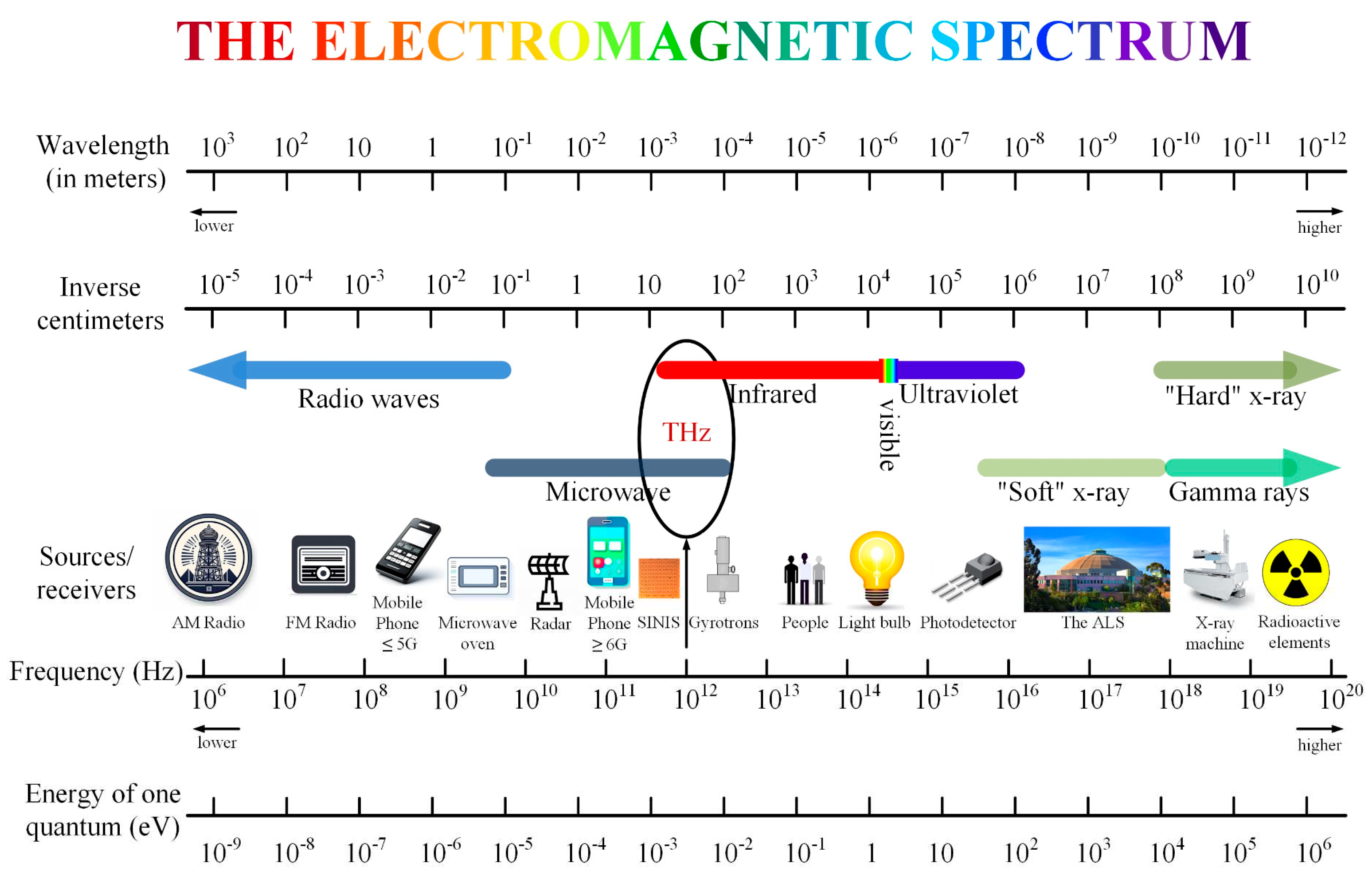
Figure 2.
The Kelvin - Dalton scale on a logarithmic scale.
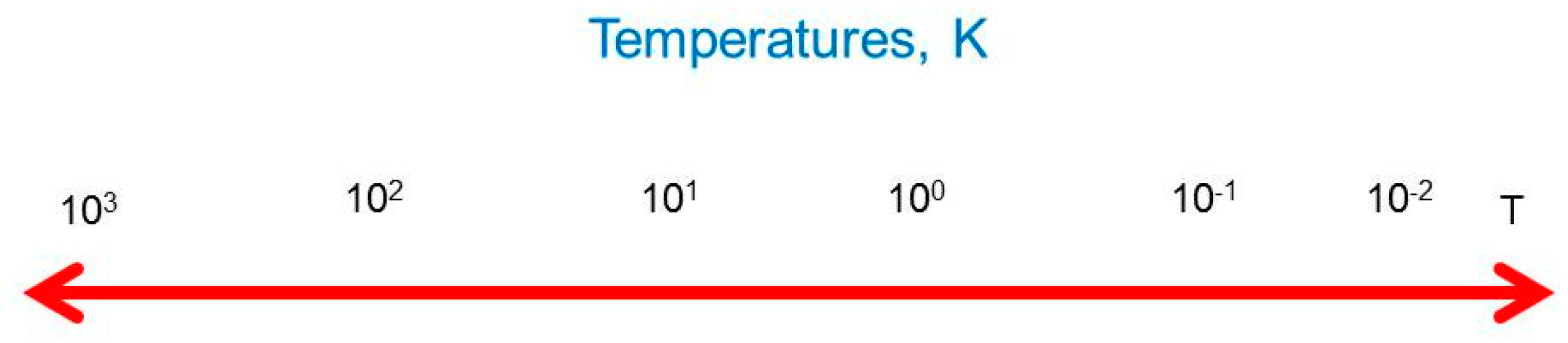
Figure 3.
(a) Liquid nitrogen cryostat with a set of unified interfaces; (b) Liquid nitrogen-free helium optical cryostat.
Figure 3.
(a) Liquid nitrogen cryostat with a set of unified interfaces; (b) Liquid nitrogen-free helium optical cryostat.
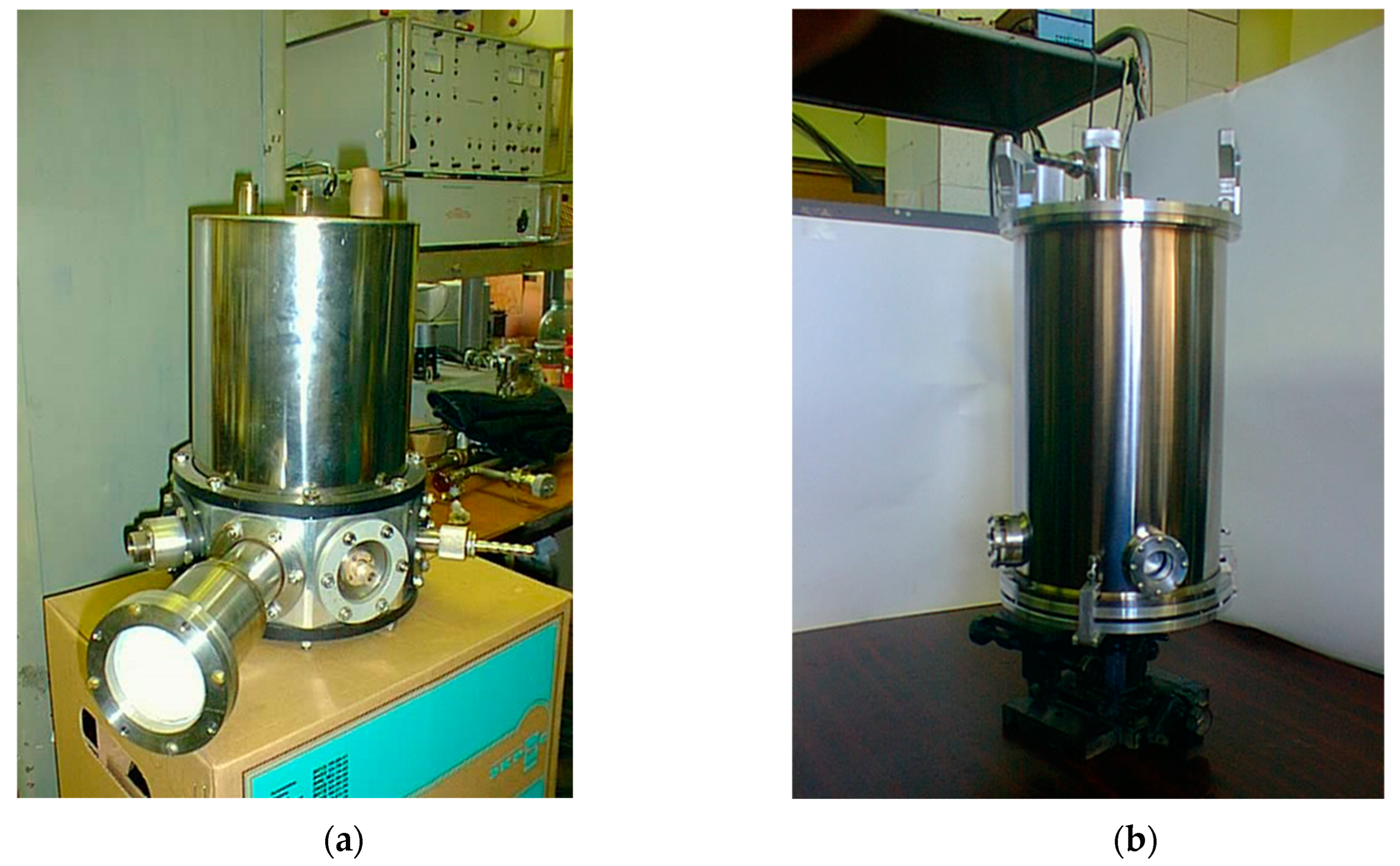
Figure 4.
Optical cryostat based on the CryoTiger refrigerator.
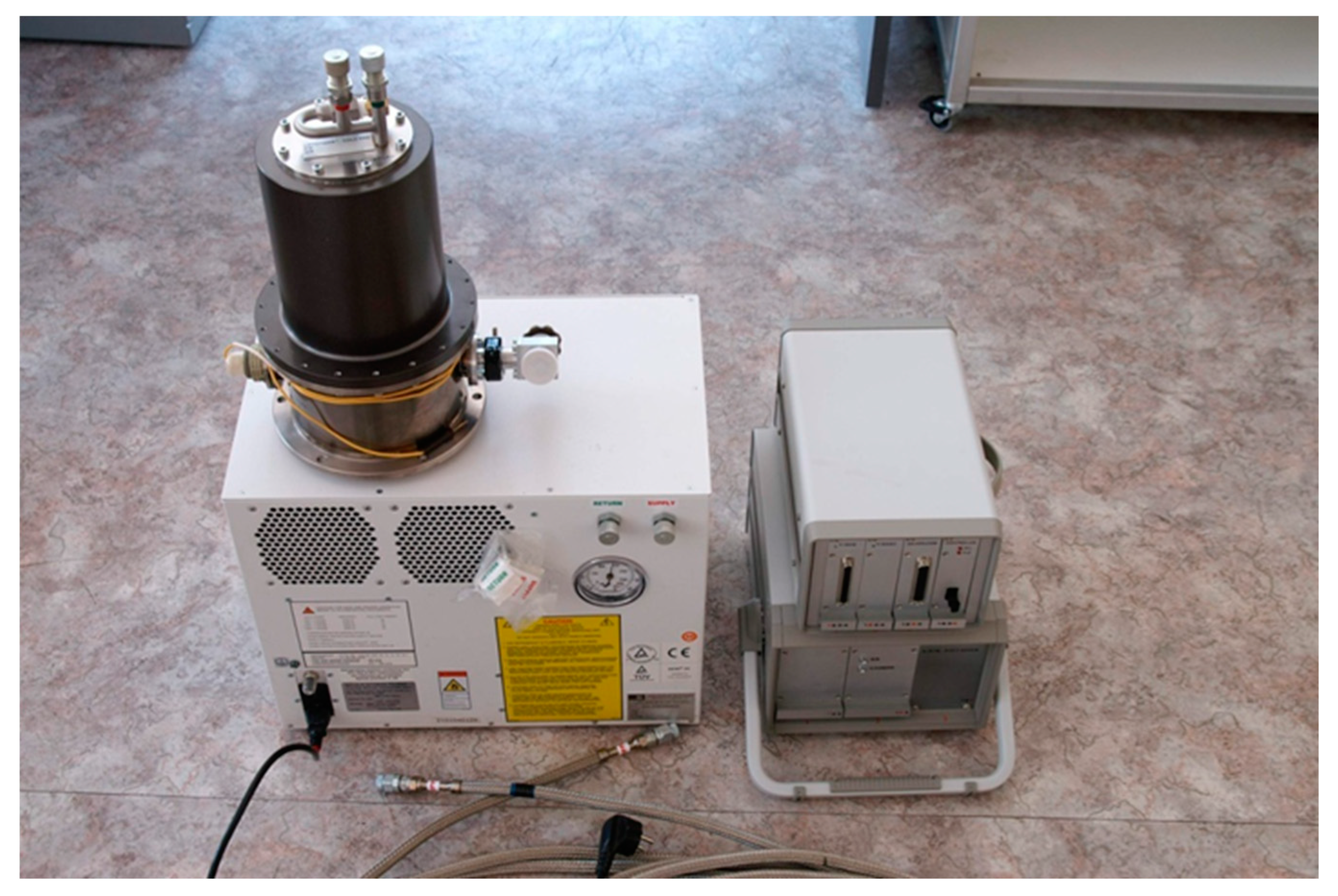
Figure 5.
Cryogenic system for cooling X-band receiver.
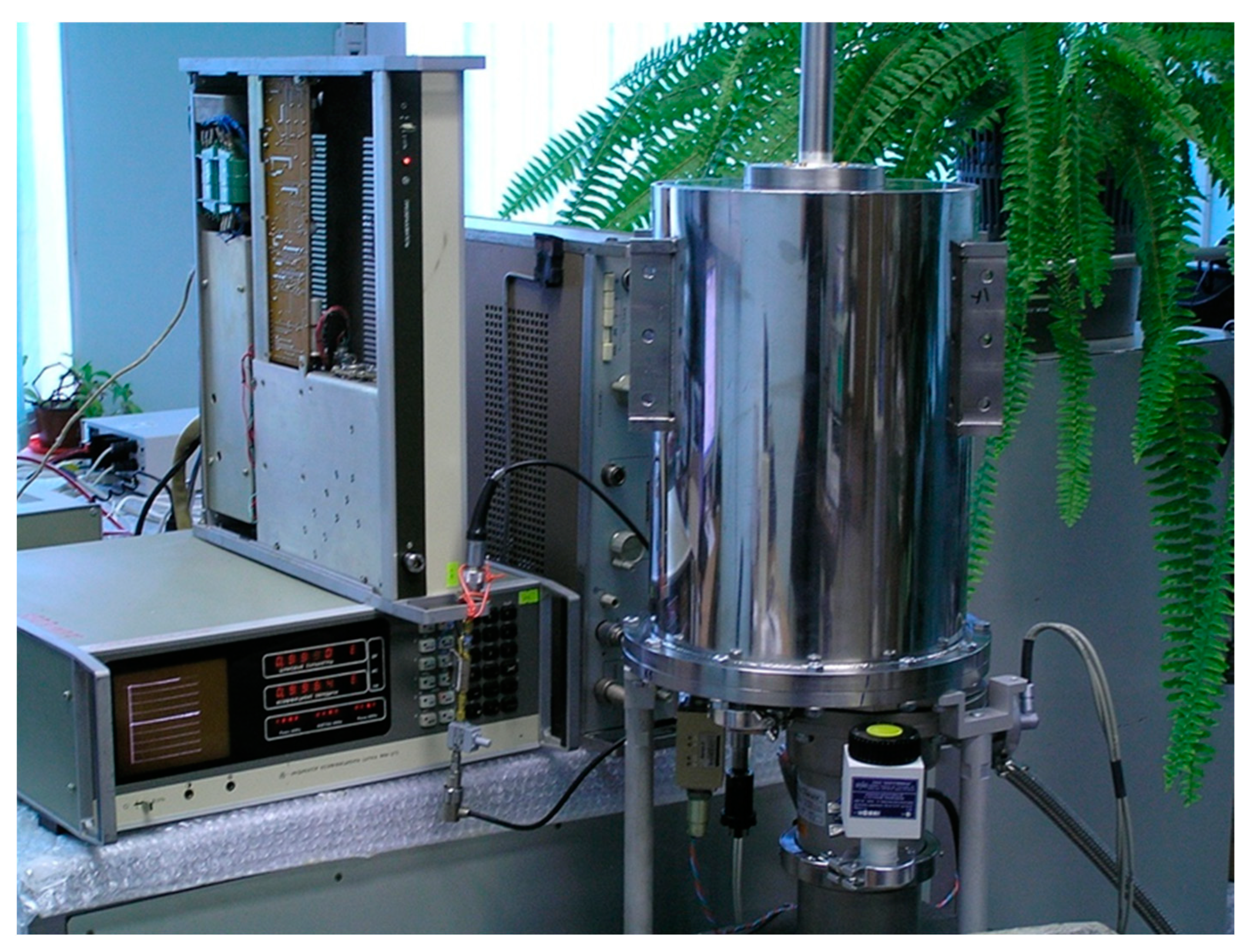
Figure 6.
Cryogenic cartridges of ALMA receivers.
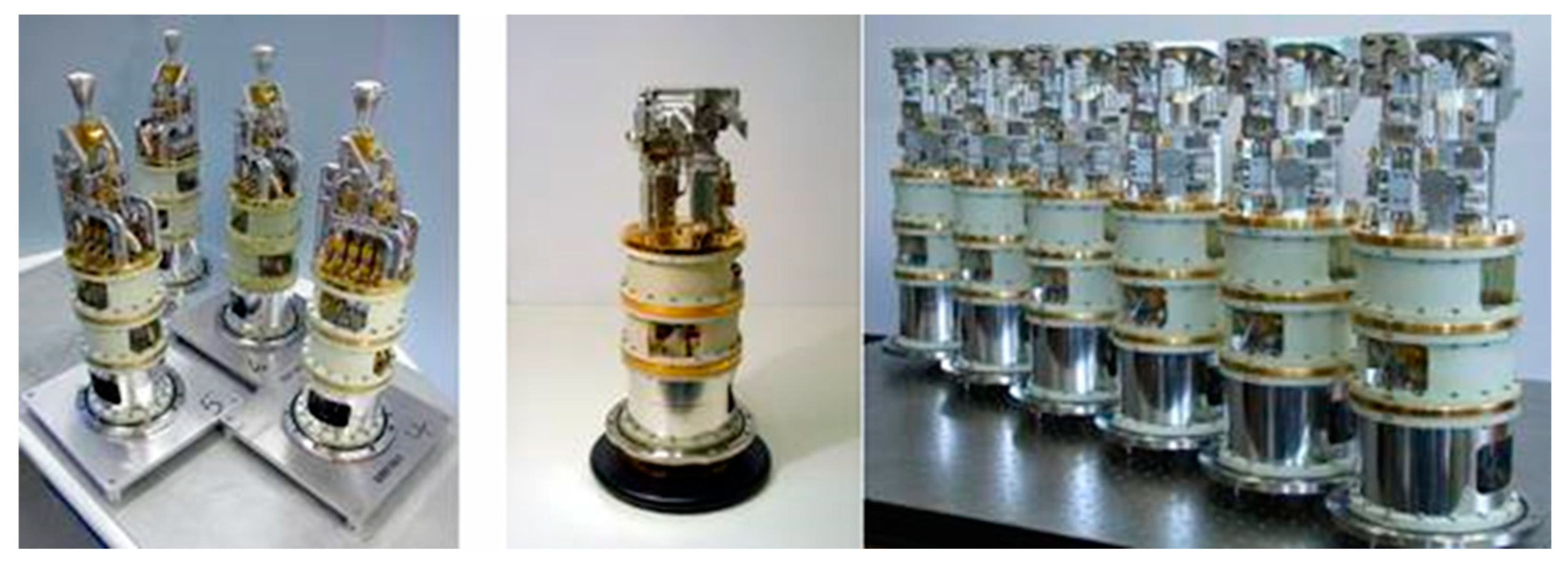
Figure 7.
4K cryostat based on a Gifford-McMahon cryomachine for a 2-3 mm superconducting receiver for the RT-13 radio telescope, Metsahovy Aalto High School.
Figure 7.
4K cryostat based on a Gifford-McMahon cryomachine for a 2-3 mm superconducting receiver for the RT-13 radio telescope, Metsahovy Aalto High School.
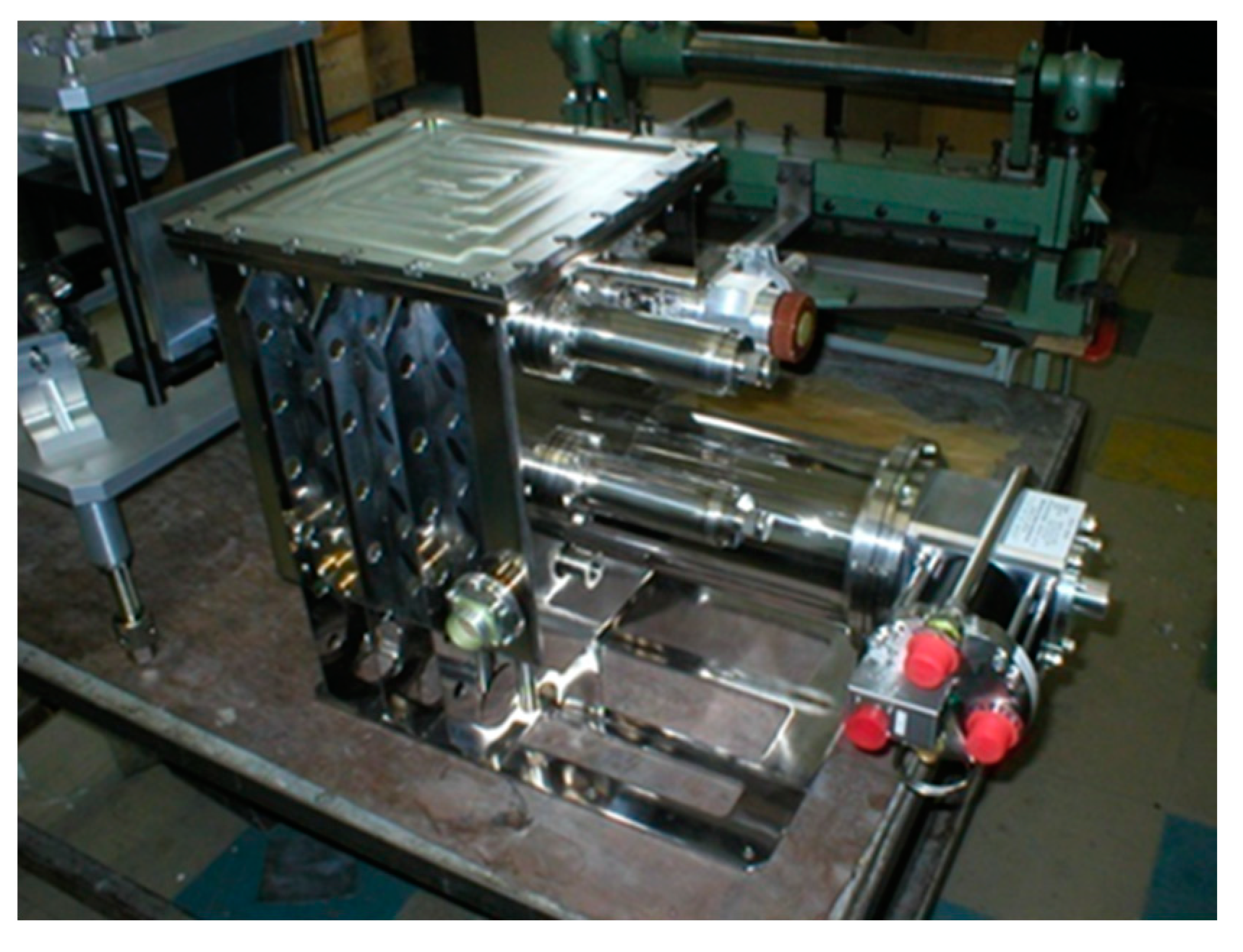
Figure 8.
The 0.3 K sorption cryostat.
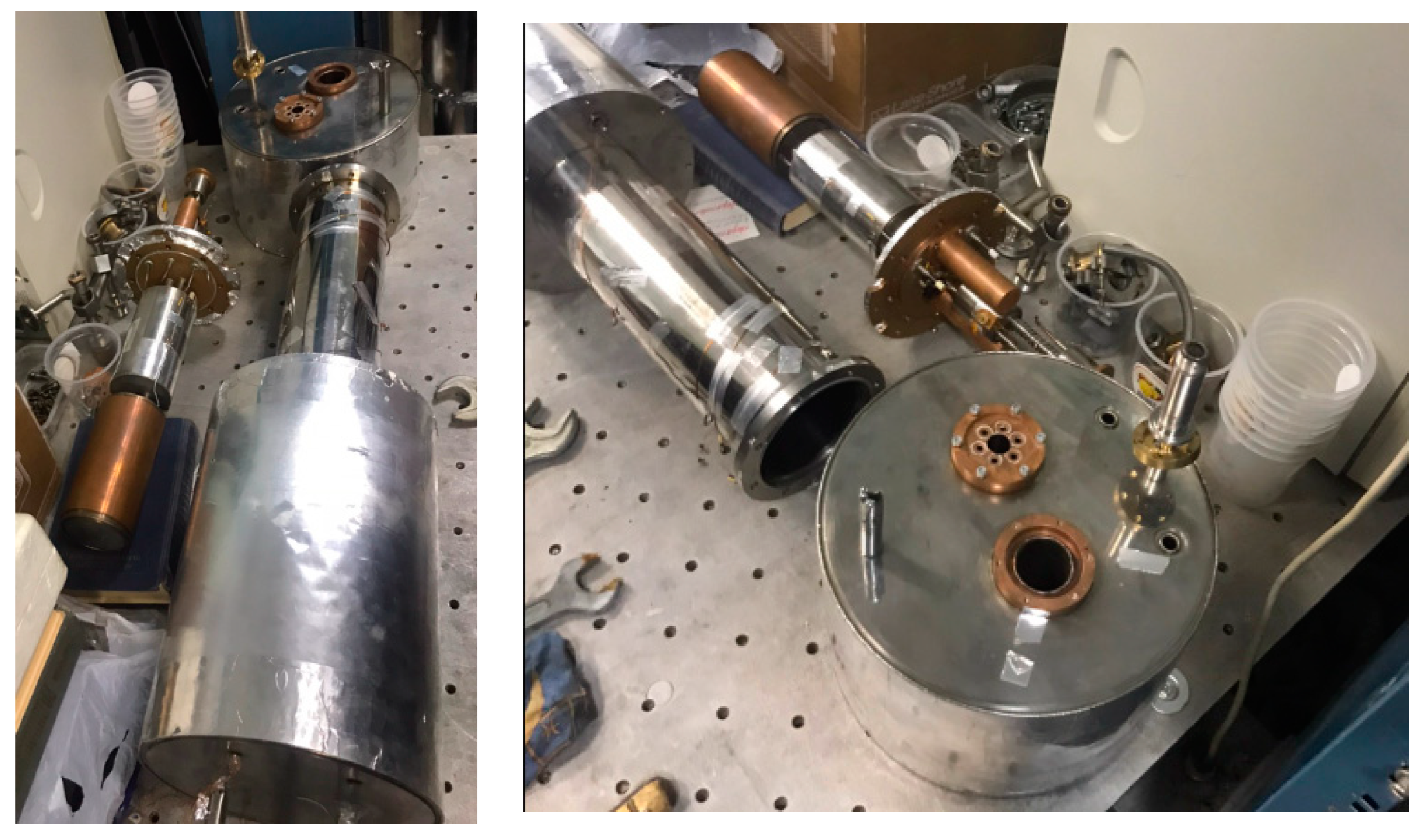
Figure 9.
Schematic diagram of the operation of a classical dilution cryostat.
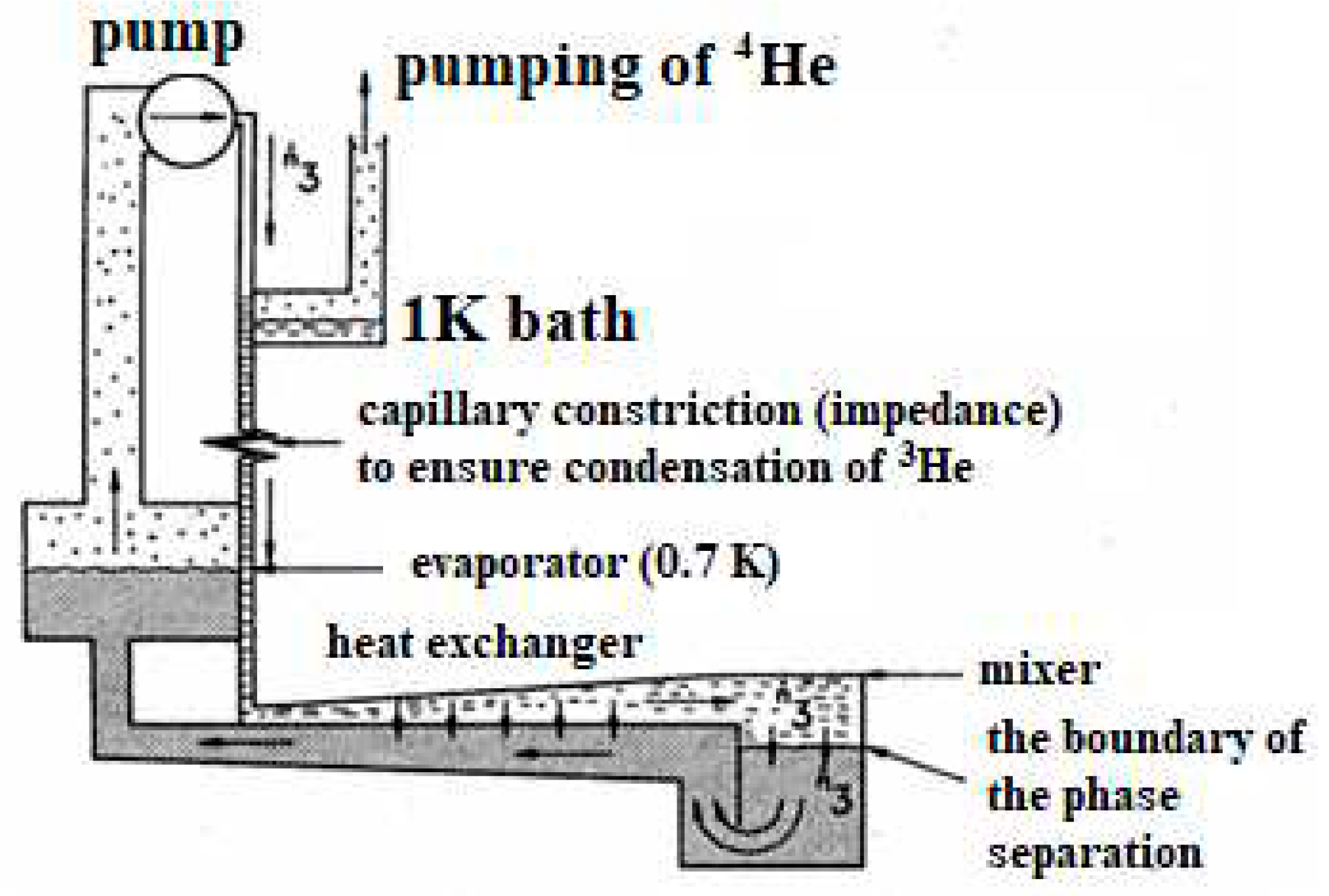
Figure 10.
Schematic image of an open-cycle cryostat that was used on board of the Planck Space Observatory.
Figure 10.
Schematic image of an open-cycle cryostat that was used on board of the Planck Space Observatory.
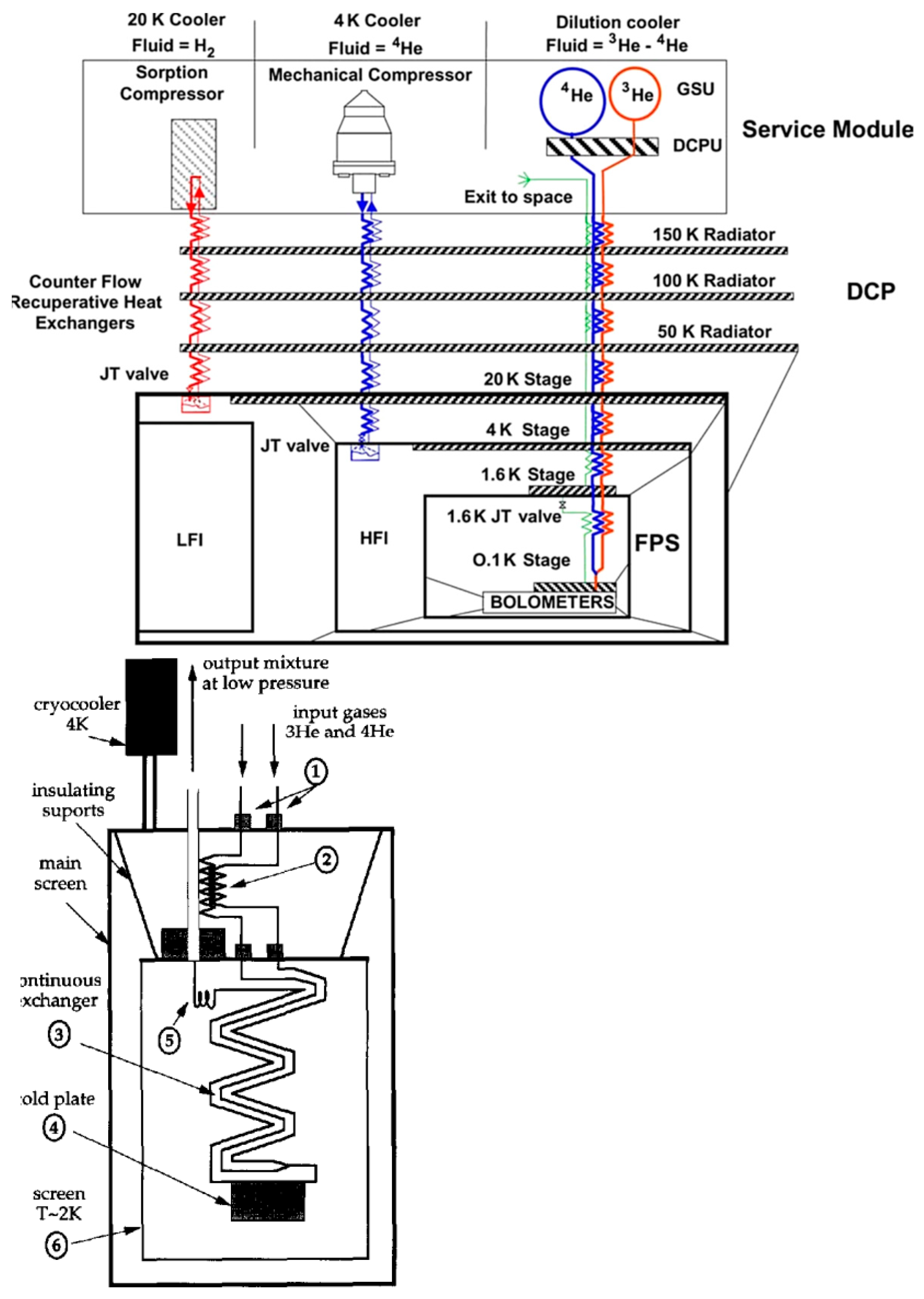
Figure 11.
Schematic representation of a closed-loop dilution cryostat for space applications.
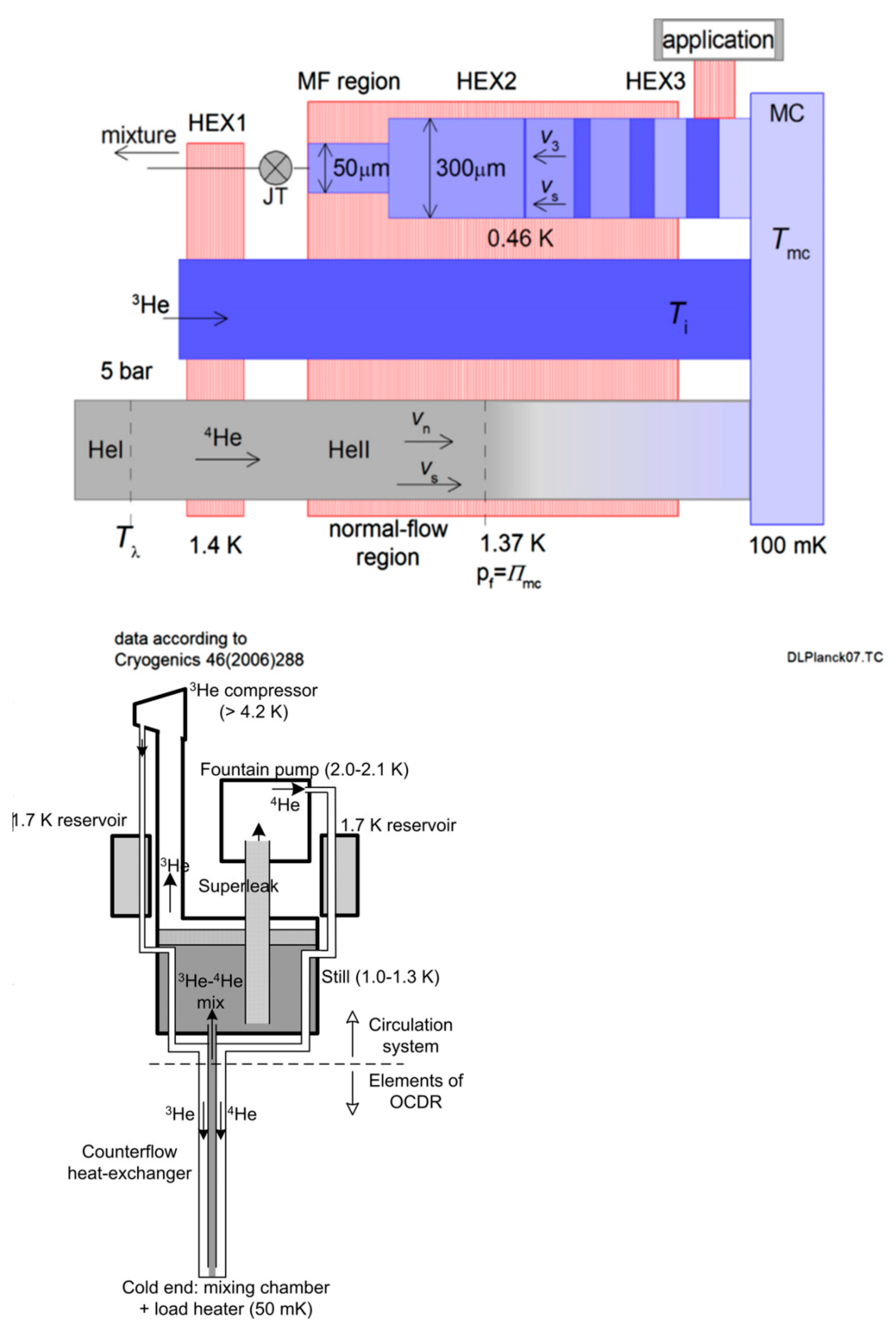
Figure 12.
Cryostat for the OLYMPO balloon mission: (a) Schematic image of the optical subKelvin cryostat; (b) 3D models of cryogenic system and a photo of "cold optics".
Figure 12.
Cryostat for the OLYMPO balloon mission: (a) Schematic image of the optical subKelvin cryostat; (b) 3D models of cryogenic system and a photo of "cold optics".
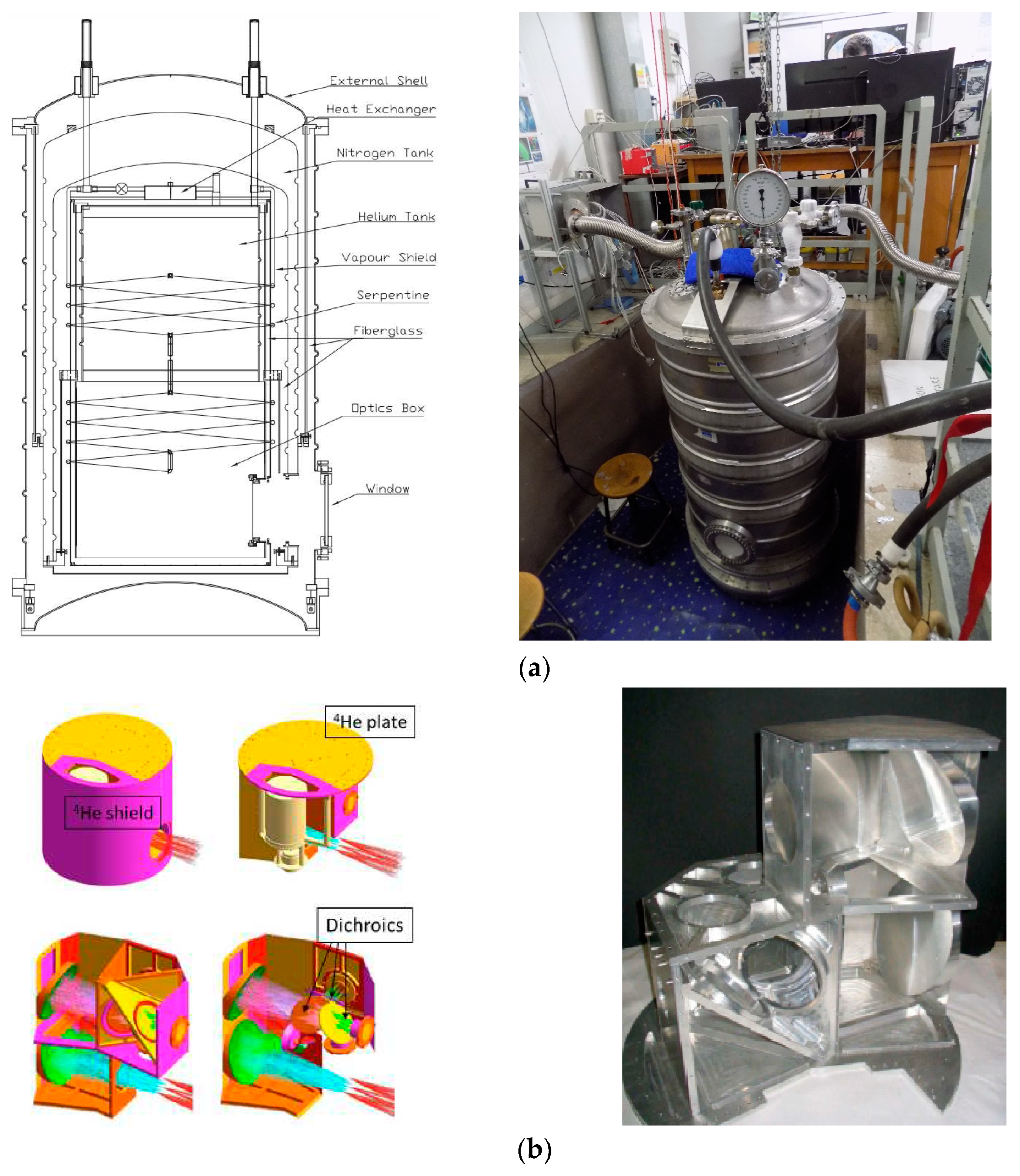
Figure 13.
Trapezoidal mechanical interface for optical cooling system .
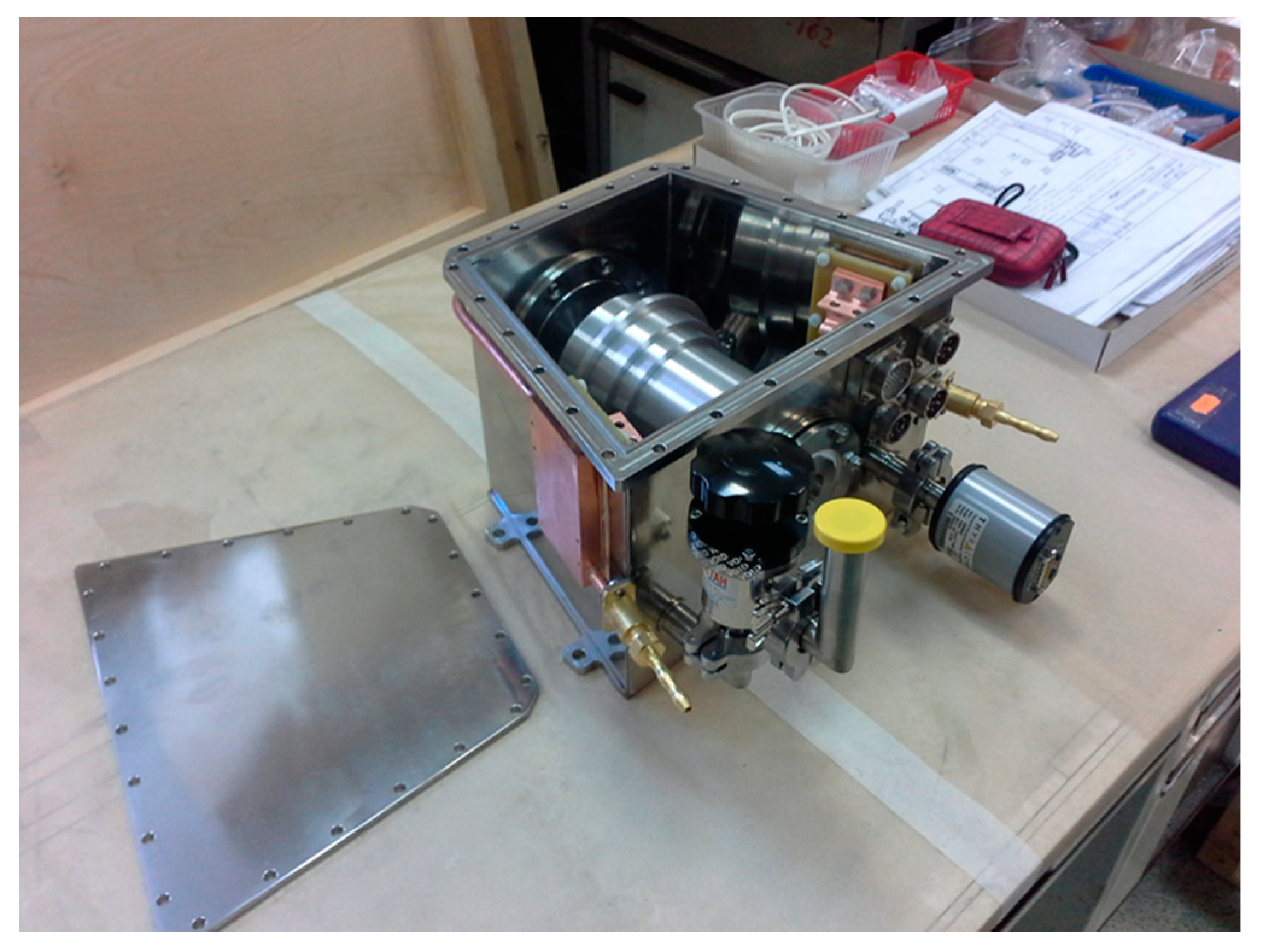
Figure 17.
Investigation of thermal conductivity and heat capacity of beryllium at cryogenic temperatures: (a) photo of the sample mounted on a cold plate of a cryostat; (b) the results of measuring the dependence of thermal conductivity on temperature; (c) the results of measuring the dependence of heat capacity on temperature.
Figure 17.
Investigation of thermal conductivity and heat capacity of beryllium at cryogenic temperatures: (a) photo of the sample mounted on a cold plate of a cryostat; (b) the results of measuring the dependence of thermal conductivity on temperature; (c) the results of measuring the dependence of heat capacity on temperature.
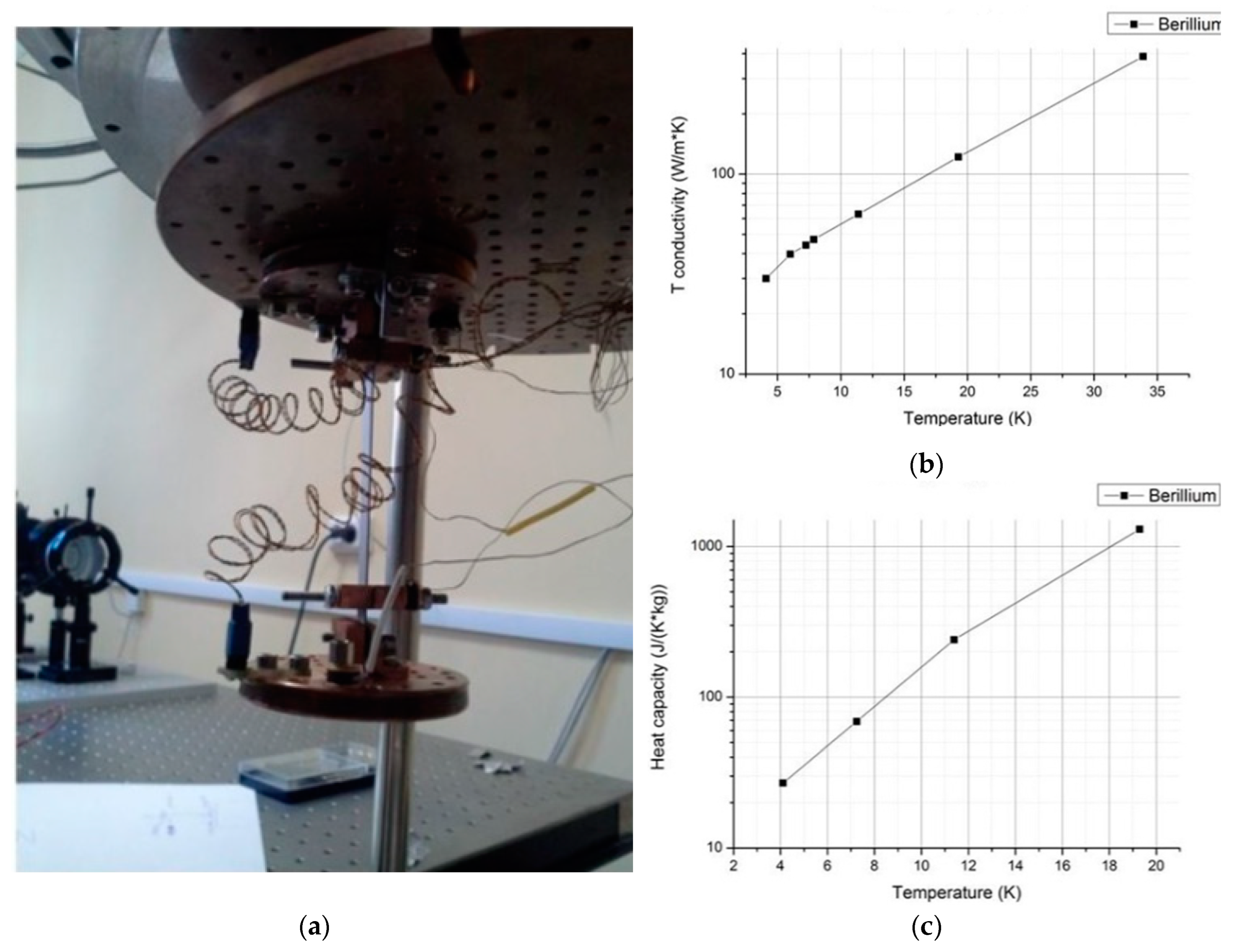

Table 1.
Classification of cryostating systems by temperature level.
| Group name | Temperature range | Applications | ||
|---|---|---|---|---|
| Non-cryogenic temperatures | Т > 100 (120) К | - climate chambers for testing astronomical receivers and their components - not cryogenic cooling of photodetectors |
||
| High cryogenic temperatures | ≤100 К | - cooling of photodetectors to reduce dark current | ||
| Nitrogen level | ~ 77 К | - high-temperature superconductors - cooling of photodetectors - cooling of microwave radio receivers |
||
| Hydrogen level | ~ 20 К | cooling of photodetectors, radio receivers of the centimeter and millimeter (MM) range, semiconductor amplifiers up to the MM range | ||
| Helium level | ~ 4 К (up to 1.6 K with pumping) |
- detecting devices based on superconductors of the second kind - superconducting readout electronics - antenna systems, cryogenic chambers for testing and laboratory experiment |
||
| Subkelvin cooling | < 1 К | - superconductors of the first kind - superconducting electronics - quantum computers and quantum communications - highly sensitive receiving systems for modern astronomy, telecommunications, radar, etc. |
||
| Extremely low temperatures reached | ~ 10-9 К | - problems of metrology - quantum standards of time and frequency, including for VLBI astronomy - fundamental physics |
Table 2.
Characteristics of the cooling systems for the UV Spectrum project.
| Photo | Characteristic | Advantages |
|---|---|---|
| Chamber with remote cooling | ||
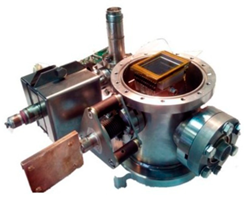 |
- Chamber with remote cooling; - Temperature range: 190 K – 230 K; - Type of cooling: liquid; - Cryoagent: liquid nitrogen; - Vacuum level: 10-4 mbar; - Availability of getter pumping; - Dimensions: 240 × 190 × 154 mm; - Electrical connector: SNC; - Optical window MgF, Diameter: 90 mm ; |
- -Vibration-free system; - Possibility of providing a high level of vacuum up to six months without pumping out with electromechanical pumps; - The presence of a large diameter window; - No liquid cryoagent inside the chamber. |
| Cryogenic transport system | ||
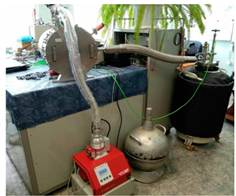 |
- Temperature range: 163 – 168 K; - The possibility of simultaneous temperature control of three cooled objects; - The ability to control the temperature – step 1 °, accuracy ± 0.5 degrees. |
- Ease of manufacture; - High speed and precision temperature control; - The possibility of measuring heat flow. |
Disclaimer/Publisher’s Note: The statements, opinions and data contained in all publications are solely those of the individual author(s) and contributor(s) and not of MDPI and/or the editor(s). MDPI and/or the editor(s) disclaim responsibility for any injury to people or property resulting from any ideas, methods, instructions or products referred to in the content. |
© 2023 by the authors. Licensee MDPI, Basel, Switzerland. This article is an open access article distributed under the terms and conditions of the Creative Commons Attribution (CC BY) license (http://creativecommons.org/licenses/by/4.0/).
Copyright: This open access article is published under a Creative Commons CC BY 4.0 license, which permit the free download, distribution, and reuse, provided that the author and preprint are cited in any reuse.


