
Submitted:
12 December 2023
Posted:
12 December 2023
You are already at the latest version
Abstract
Level index was introduced in 2017 for rooted trees which is a component of Gini index. In the origin, Gini index is a tool for economical investigations but Balaji and Mahmoud defined the graph theoretical applications of this index for statistical analysis of graphs. Level index is an important component of Gini index. In this paper we define a new graph polynomial which is called level polynomial and calculate the level polynomial of some classes of trees. We obtain some interesting relations between the level polynomials and some integer sequences.
Keywords:
Level index
; Level polynomial
; Triangular Numbers
; Subdivision of Stars
; Dendrimers
1. Introduction
The Gini index was defined by
Corrado Gini in 1912 [1]. It shows the income
inequality of social groups and is used by The World Bank for the economical
investigations. The graph theoretical application of Gini index introduced by
Balaji and Mahmoud in 2017 [2] for rooted
trees. They introduced two distance based topological index Gini index and
level index. Moreover, degree based Gini index was defined by Domicolo and
Mahmoud in 2019 [3].
The first distance based
topological index was introduced by Wiener in 1947 [4].
Wiener showed that there is a correlation between the physico chemical
properties of molecules and distances between the atoms. Haruo Hosoya defined
a distance counting polynomial in 1988 [5]
which is called Hosoya polynomial in the literature. The first derivative of
Hosoya polynomial gives Wiener index and second derive gives the Wiener polarity
index. Derivatives of Hosoya polynomial were used as molecular descriptors by
Konstantinova and Diudea [6], Estrada et al. [7]. Moreover vertex-weighted Wiener polynomials
were studied by Doslic [8].
The level concept was used in the
papers [9] and [10]
for rooted trees. In [9] Flajolet and
Prodinger obtained a number sequence and investigated properties of this
sequence. Statistical analysiss of level numbers were studied by Balaji and
Mahmoud [2].
In this paper we define a new
distance based graph plynomial which is called “Level Polynomial”. The first
derivative of level polynomial gives the level index of graphs. Moreover, we
compute the level polynomial and level index of triangular numbers, caterpillar
graphs, subdivisons of stars and regular dendrimer graphs. We obtain some
interesting relations between the coefficients of level polynomials of graphs
and some integer sequences.
2. Preliminaries
We use only simple, connected and
undirected graphs. The degree of a vertex
is denoted by
. A vertex with degree one is
named a leaf. The notation
is used to show the distance
between two any vertices
and
in a graph.
In a graph
, the number of vertices
is called order. The path and
star graphs with
vertices are denoted by
and
, respectively.
Definition 2.1
. The total distance from a vertex
to other vertices is presented by
the following phrase
Definition 2.2.
The Wiener index for a graph G
is
defined by the following equation [4]
Definition 2.3.
The Hosoya (Wiener) polynomial of a graph G
is denoted by
and it is computed by the
following equation where
denotes the vertex pairs having
distance
[5]
Theorem 2.4.
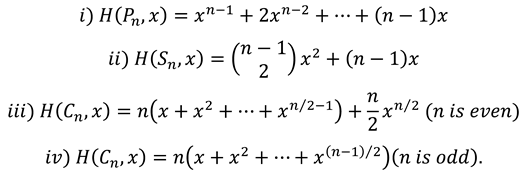
The Hosoya polynomials of paths, stars, cycles with even order and
odd order are presented as follows
Theorem 2.5.
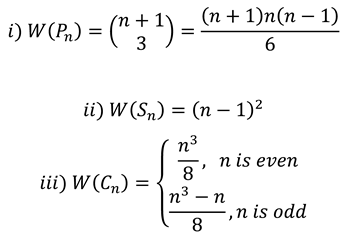
The Wiener indices of paths, stars and cycles are presented in the
following equations
Definition 2.6.
The Wiener index of a graph
is also computed by the
following equation [5]
3. Level Index and Dendrimer Graphs
In a rooted tree, a vertex
determined as a root or central vertex. The distance
from the central vertex is
denoted by [2].
This
distance (measured with edges) is called by level. The distance from the root
to a vertex with the highest level is called height of the tree [2]
.
Balaji and Mahmoud introduced two
distance based topological indices for rooted trees [2]
.
The first one is called level index and
level index of a tree is denoted by
. Level index of a tree
is computed by the following
equation
such that
and
showing the vertices at distances
and
from the central vertex of the
tree
.
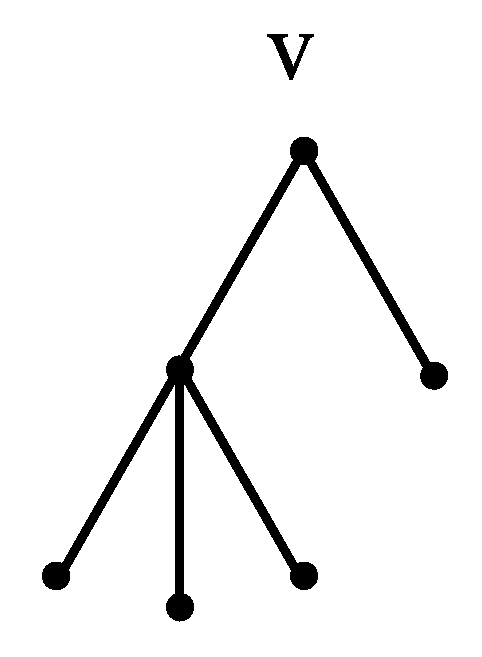
In order to exemplify the level
index, we use the example given in the paper [2].
Figure 1.
The tree which is used in the following
example.
Example 3.1.
The level index of
is computed by
Now we can describe a level
counting polynomial which is called level polynomial of the graphs.
Definition 3.2.
The level polynomial of a rooted tree
is given by
where
shows the number of vertex pairs
having level difference
. It is understood that level
index of a graph
equals to
Lemma 3.3.
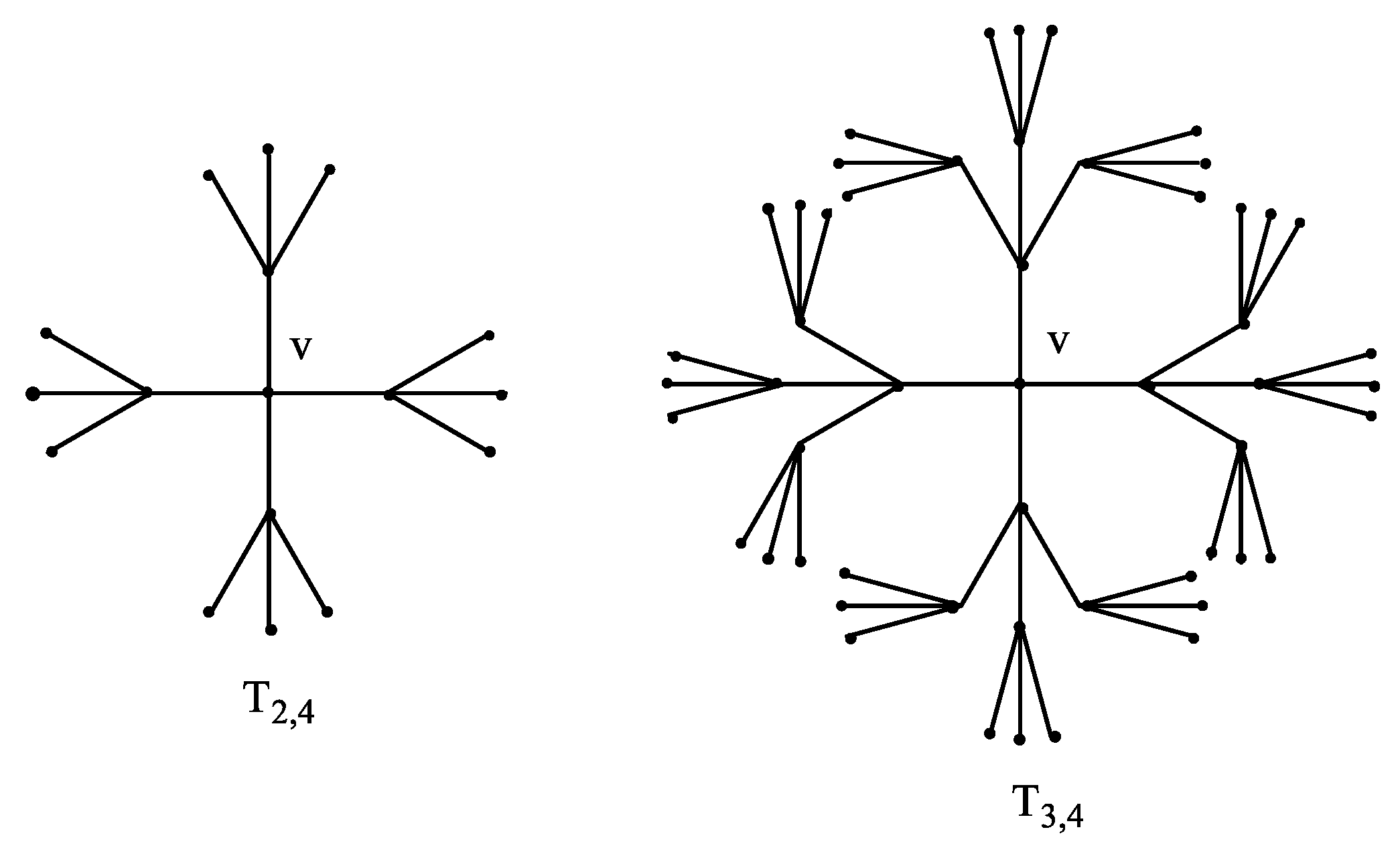
For a given dendrimer graph
(depicted in Figure 2) with central vertex
, the following properties are
hold [11]
The order of
is
,
contains
branches,
Every branch of
contains
vertices,
Every branch of
contains
leaves,
Every branch of
contains
non-leaf vertices,
There are
vertices at distance
from
.
Figure 2.
Dendrimers and
.
4. Main Results
In this section we obtain the main
results of the paper. We obtain the level polynomial of some classes of
graphs. If
denotes the number of vertices on
level
, we can show the level
polynomials of rooted trees as in the following theorem. Even though there
exists one vertex at first level (a0 = 1) in a rooted tree, the definition
of level polynomial can be extended to other graphs and
can take different values in the
future.
Theorem 4.1.
The level polynomial of a rooted tree
is obtained by the following
equation such that the number of vertices on level
is denoted by
Proof.
If the height of a rooted tree is showed by
,
the
exponents of
changes
from
to
. Since the level polynomial of a
rooted tree can be presented as
The main problem is finding the
coefficients of the level polynomial of
. Since a level has to be greater
than 1, there is no constant term in the level polynomial.
The coefficient of
is
, because the vertex pairs which
have level difference
are located on level 0 and level
. Similarly The coefficient of
is,
because the vertex pairs which
have level difference
are located on levels
and levels
.
By this way we obtain the
coefficient of
as
, because we want to obtain the
number of vertices which have level difference 2.
Finally the coefficient of
is
. Because the vertices which have
level difference 1 are located at consecutive levels. It means that the level
polynomial of a rooted tree
is presented as follows

Remark 4.2.
The level index of a rooted tree equals to following equation by
Defnition 3.2
We can find the level polynomials
of trees which represent the triangular numbers as in the following figure.
Let
be a tree which has
vertices on the level
(depicted in Figure 3 for
). It means that there is a
central vetrex, two vertices on first level, three vertices on the second level
and
vertices on
-th level (triangular numbers).
The sum of coefficient of level polynomial of
gives a new application of the
integer sequence A000914 from OEIS.
Theorem 4.3.
Assume that
is defined above. Then its level
polynomial is defined as follows
Proof.
For a given sequence
, the level partitions are defined
as in the following phrases,
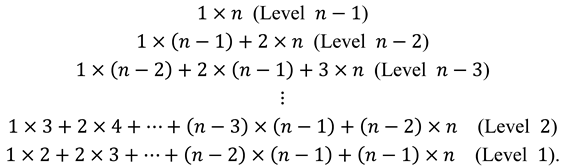
By these phrases for a given level
, the coefficients are ordered. Then
the level polynomial of
is presented as in the following
equation
Let
be as in the previous theorem.
Now it is denoted the sum of coefficients of level polynomials by
such that
Theorem 4.4.
For a positive integer
, the number of
is computed as in the following
equation
Proof.
In order to find the level number of a positive integer
, we use Therorem 4.3 in obtaining
the sum of coefficients of Level polynomials of the tree
.
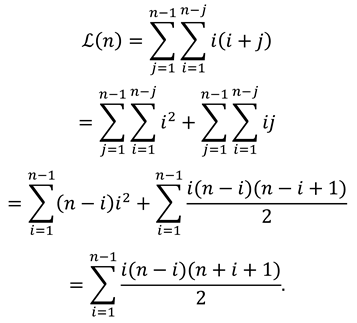
Now we obtain the initial terms of
the sequence of
. For a positive integer
, there is a tree
which has levels and there are
vertices on level
(
. By this way initial terms are
obtained as
Theorem 4.5.
The level index of the tree
is defined in the following
equation
Proof.
In order to find the level index of a positive integer
, we use Remark 4.2 in obtaining
the sum of coefficients of Level polynomials of the tree
.
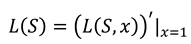
Since the level polynomial of
is given in the Theorem 4.2
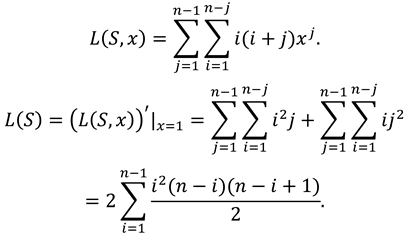
If we obtain the initial terms of
the sequence which is obtained in the Theorem 4.5
This sequence is appeared in the
OEIS with reference number A067056 for level index of greater than 1.
Theorem 4.6.
Let
be a tree with level
. Assume that
is a tree which is obtained from
by attaching a new vertex
to
-th level of
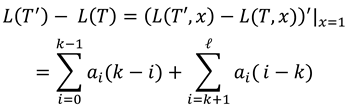
. Then the difference between the
level polynomials of
and
is
Proof.
Assume that a vertex
is attached the
-th level of
. Then difference between the
level polynomials of
and
is
with the open form. We can write
this equaion by
By the last equation, we can
compute the difference of level indices of
and
.
Theorem 4.7.
Let
be a rooted tree. Then the level
polynomial of
equals to Hosoya polynomial
if and only if
.
Proof.
Since a path
has one vertex at each level,
there exists one vertex for each distance from
. Then the level polynomais of
equals to Hosoya polynomial of
as in the following equation
Since the polynomials equal, we
obtain that
Now we assume that . It means that and there are at least two
vertices at a level. Let such a level be -th level and two vertices and be two vertices at this level.
Therefore, and are at the same level and the
difference of level equals to zero but the distance between and is two. For the vertices which
are located at the levels greater than , distances from equal to level difference plus
two. Then the Hosoya polynomial of is greater than Level polynomial
of as in the following equation.
If the number of vertices which
are the same level increases, then the difference
also increases.
Theorem 4.8.
The level polynomial of a star
of order
equals to following equation
Proof.
The star graph
Sn
is
consisted of a root and
leaves at distance one from the
root. Then we obtain the level polynomial and level index of
as follows
Let
be a caterpillar graph which is
defined in
.
is obtained from a path
by attaching leaves to vertices
of paths as the leaves located at consecutive level. It means that
is root, at level
for
there are
vertices, and at the level
there are
leaves. To easify the notation
we can write
instead of
.
Theorem 4.9.
The level polynomial of a caterpillar graph
equals to
Proof. The distance
can be obtained between the root
and
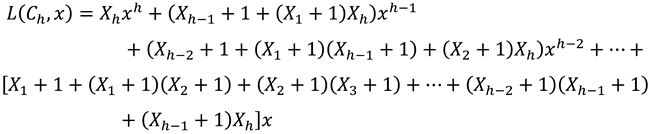
Then we can write the level
polynomial of
caterpillar graph
We compute the level index of
caterpillar
as in the following equation
The last equation equals to level
index of caterpillar which is obtained by direct calculation in the paper
.
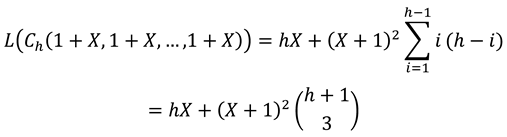
Corollary 4.10.
If it is taken ,
the
level polynomial and level index of a caterpillar graph
are given in the following
equations
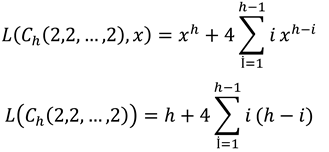
Corollary 4.11.
If it is taken as , the following equations are
obtained
Corollary 4.12. If it is taken
, the level polynomial and level
index of a caterpillar graph
are given in the following
equations
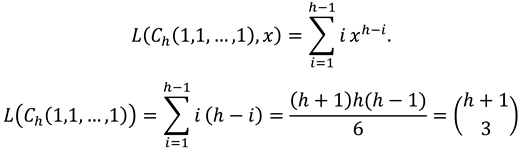
Theorem 4.13.
The level polynomial of tree
of order
is computed by the following equation
Proof.
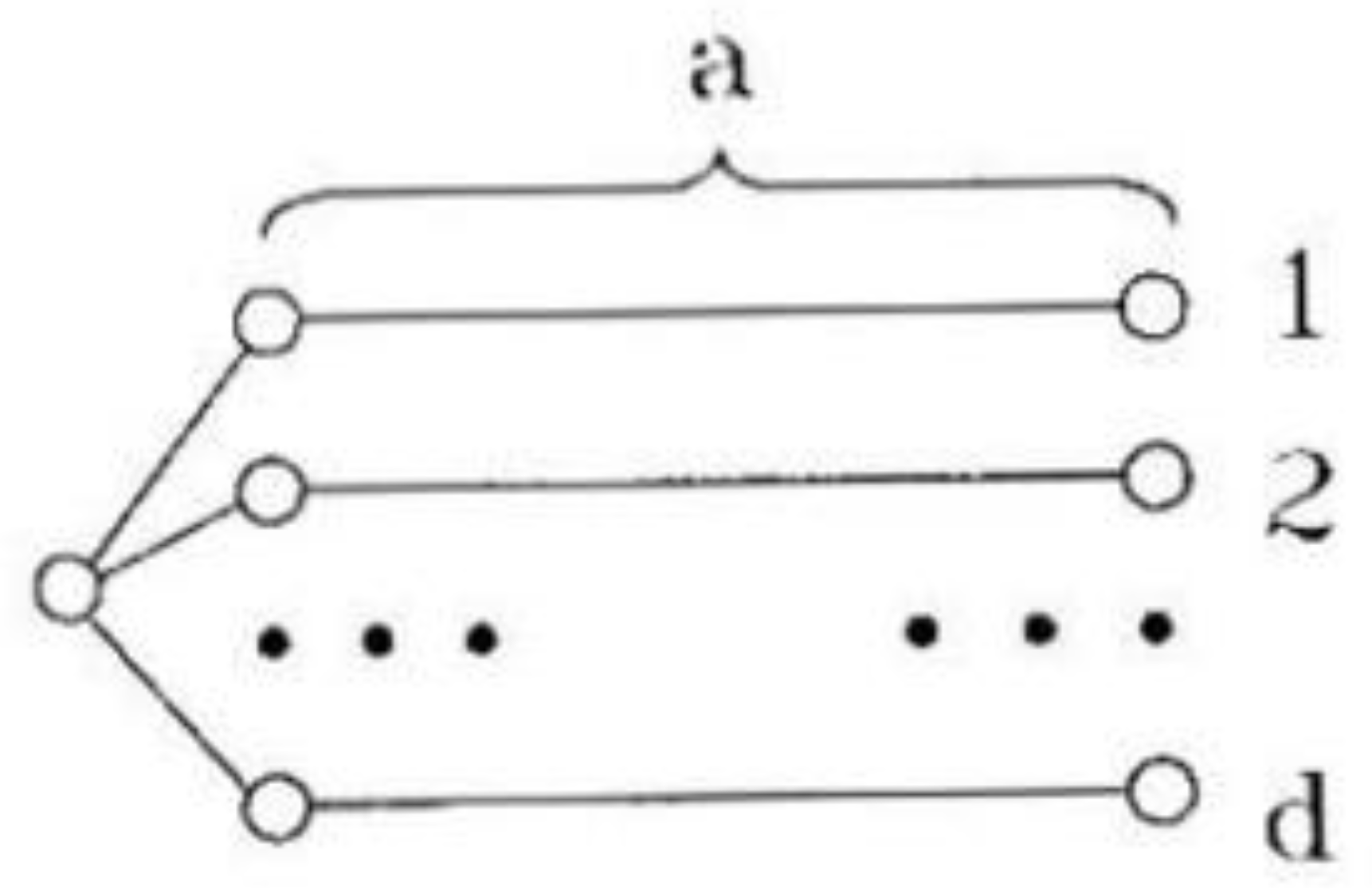
The tree is consisted a central vertex v and paths which are attached to (see
Figure 4). It means that .

The level index of
can be computed from the first
derivative of
.

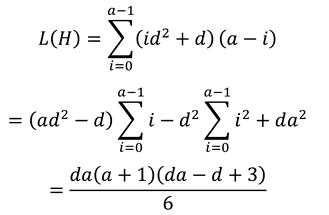
By this equation we obtain the
level index of
as in the following equation.
Theorem 4.14.
The level polynomial of dendrimer (depicted in Figure 2) graph
of order
is computed by the following
equation
Proof.
We use Theorem 4.1 for the level polynomial of dendrimer graph
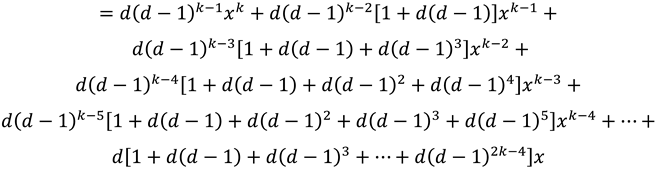
If the previous equation is
written in a closed form, we obtain that
To compute the level index of
dendrimer graph
, we can take the first derivative
of level polynom of
.

This equation can be restated as
follows.
The first term and second term of
are showed by the following
equation.
The third term of the is restated by the following equations
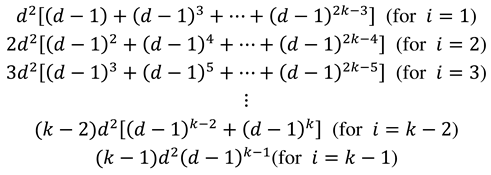
We can take for easy writing of the equations. By this way we obtain the equation as in the short equation
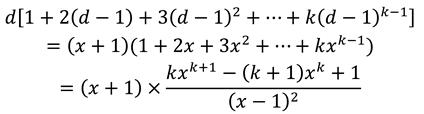
The third term of the can be written as follows
 such that
It follows from the fact that the coefficients of are symmetric around , and from the fact that the coefficients of odd powers sum to squares and of even powers to twice the triangular numbers.
The first ten coefficients of are 1, 2, 4, 6, 9, 12, 16, 20, 25, 30 which are the first terms of an interesting integer sequence which is appeared in OEIS by reference number A002620.
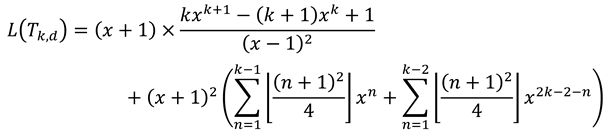
Finally the level index of the dendrimer graph equals to
Conclusion
In this paper, we define a new graph polynomial which is based on the level index of rooted trees. The level index was defined by Balaji and Mahmoud for statistical analysis of graphs. It is used to measure balancing of rooted trees.
We show that level index can be calculated by level polynomials of graphs. We obtain the level polynomial and level index of trees which represent the triangular numbers. The sum of coefficients of level polynomials and level index of triangular numbers correspond some integer sequences appeared in OEIS [12]. Moreover, we compute the level polynomial and level index of caterpillar graphs, subdivision of star graphs and dendrimer graphs.
It is clear that level polynomial concept can be applied to rooted trees which represent the square numbers, pentagonal numbers, hexagonal numbers and others. We know that Pascal triangle can be represented by a perfect binay tree. Then, level polynomials can be applied to many integer objects.
References
- Gini, C.; Veriabilità e Mutabilità. Cuppini, 1912, Bologna.
- Balaji, H.; Mahmoud, H.; The Gini Index of Random Trees with Applications to Caterpillars, J. Appl. Prob. 54 (2017), 701-709. [CrossRef]
- Domicolo, C.; Mahmoud, H.M.; Degree Based Gini Index for Graphs, Probability in the Engineering and Informational Sciences 34 (2) (2019): 1-15. [CrossRef]
- Wiener, A.H.; Structural determination of paraffin boiling points, J. Am. Chem. Soc. 69 (1947), 17-20. [CrossRef]
- Hosoya, H.; On some counting polynomials in chemistry, Discrete Applied Mathematics 19 (1988), 239-257. [CrossRef]
- Konstantinova, E.V.; Diudea, M.V., The Wiener Polynomial Derivatives and Other Topological Indices in Chemical Research, Croatica Chemica Acta 73 (2) (2000), 383-403.
- Estrada, E.; Ovidiu, I.; Gutman, I; Gutierrez, A.; Rodriguez, L.; Extended Wiener indices. A new set of descriptors for quantitative structure-property studies, New J. Chem (1998), 819-822. [CrossRef]
- Doslic, T.; The vertex-weighted Wiener polynomials for composite graphs, Ars Mathematica Contemporanea 1 (2008), 66-80. [CrossRef]
- Flajolet, P.; Prodinger, H.; Level number sequences for trees, Discrete Mathematics 65 (1987), 149-156. [CrossRef]
- Tangora, M.C.; Level number sequences for trees and the lambda algebra, Europen J. Combinatorics 12 (1991), 433-443. [CrossRef]
- Şahin, B.; Şener, Ü.G., Total domination type invariants of regular dendrimer. Celal Bayar University Journal of Science 16 (2) (2020), 225-228.
- Sloane, N. J. and Ploufe, S.; The Encyclopedia of Integer Sequences, Academic Press, 1995, http://oeis.org.
Figure 3.
The tree for
.
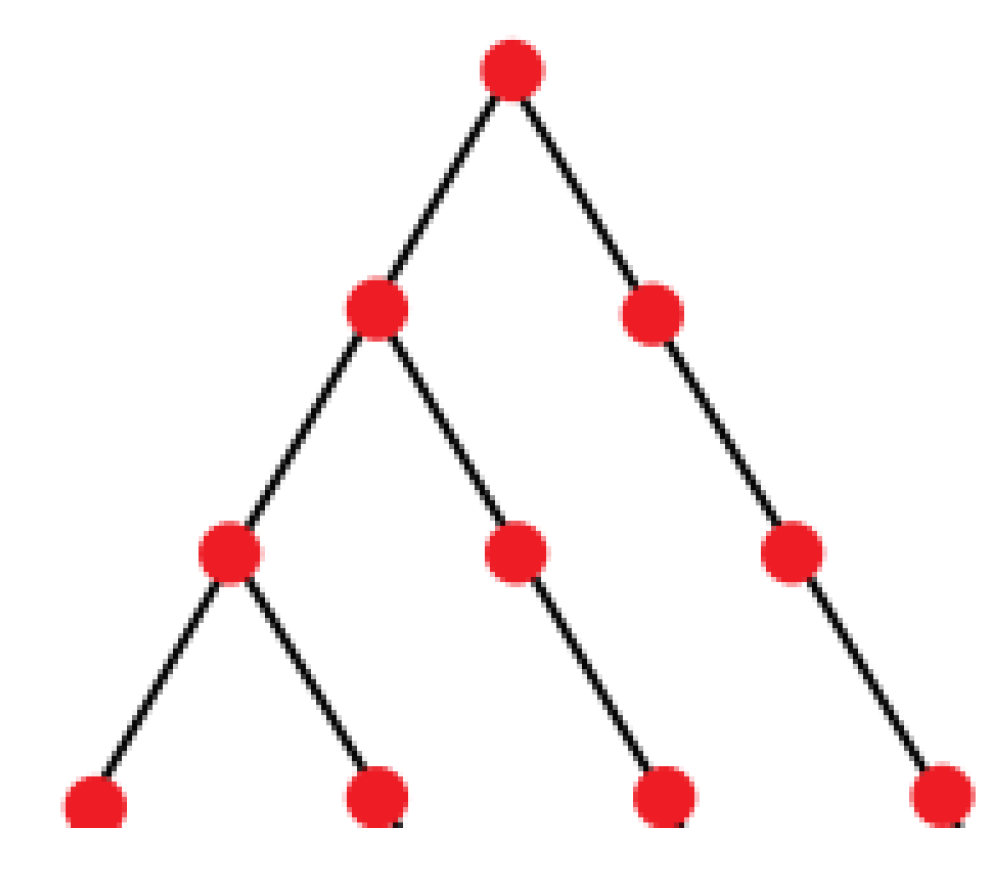
Figure 4.
The tree (Subdivisions of star graph).
Disclaimer/Publisher’s Note: The statements, opinions and data contained in all publications are solely those of the individual author(s) and contributor(s) and not of MDPI and/or the editor(s). MDPI and/or the editor(s) disclaim responsibility for any injury to people or property resulting from any ideas, methods, instructions or products referred to in the content. |
© 2023 by the authors. Licensee MDPI, Basel, Switzerland. This article is an open access article distributed under the terms and conditions of the Creative Commons Attribution (CC BY) license (http://creativecommons.org/licenses/by/4.0/).
Copyright: This open access article is published under a Creative Commons CC BY 4.0 license, which permit the free download, distribution, and reuse, provided that the author and preprint are cited in any reuse.


