
Submitted:
27 November 2023
Posted:
08 December 2023
You are already at the latest version
Abstract
Introduction:Stoma formation is among the most commonly performed surgical procedures to redirect gut contents for various reasons. Parastomal hernia (PSH) is characterized as the protrusion of abdominal contents through the abdominal wall defect in the locality of the stoma. Material and Methods:We reviewed retrospectively 65 patients with stoma formation from January2021 to January 2023. Age, smoking, hypertension, diabetes mellitus, American Society of Anesthesiologists (ASA) criteria, the etiology (benign or malignant), type of surgery, location of stoma exit, and type of stoma formed were documented.The data was collected for all patients from the hospital database. Results:We studied 65 patients. The mean age 55.96 years, with males in the majority: (70.8%).Out of 65, we had 34 patients had diabetes mellitus. Most of cases were performed trans-rectus stomas electively. The majority of cases due to malignancy.During an overall median follow-up of 12 months, 25 (38.4%) developed a parastomal hernia postoperativelyConclusion:In this study, we found an elevation in number of patients who had a parastomal hernia (PSH). Many risk factors were detected to be the main cause. One of these factors, a non-trans-rectus stoma is a risk factor for PSH. Larger studies are required.
Keywords:
parastomal hernia
; stoma
; PSH
Introduction:
The formation of stoma is considered a widely used technique in general surgery.
Patients who develop a bulging of the abdominal contents through a defect in the abdominal wall are considered to have parastomal hernias. The incidence of stomas that are complicated with parastomal hernias is ranging from 0% to 48% for end colostomies, 0% to 30.8 % for loop colostomies, and 1.8% to 28.3% for end ileostomies [1].
Multiple risk factors are associated with developing parastomal hernias. Advanced age> 60 years, increased BMI, diabetes mellitus, corticosteroid consumption, hypertension, any factor that result in increase of intra-abdominal pressure (e.g., constipation, benign prostatic hypertrophy, and ascites), and COPD. Cancer is considered a risk factor for parastomal hernias. Many surgical risk factors were defined at the moment of stoma creation include: oversized fascial trephine, extensive fascial dissection, inappropriate stoma location, emergent indication, and intraperitoneal tunneling [2].
In most cases, parastomal hernias are asymptomatic and need just observation. Surgical decision is given to symptomatic cases such as pain, prolapse, or difficulty maintaining a seal around the stoma with the ostomy device bag. A few cases may need an emergent intervention such as bowel obstruction or bowel compromise [3].
It is reasonable to understand the hazard elements for parastomal hernias in advance and decrease the morbidity and mortality associated with this worry in colorectal surgical procedures.
We conducted a retrospective cohort study to detect the risk factors and the frequency of occurrence of parastomal hernias in one center.
Materials and Methods:
We performed a retrospective, descriptive cross-sectional study conducted from January 2021 to January 2023. The data was collected for all patients from the hospital database. A total number of patients were 78. Out of 78 patients, 13 patients were excluded because they did not have complete information or missed follow-up. The remained number (65 patients) was studied in this research (Figure 1). Inclusion criteria were: age (between 18 years and 90 years), one year at least of follow-up, and patients who needed a stoma formation as part of the first operation. Exclusion criteria were patients who missed follow-up or incomplete information after surgery.
Physical examination and symptoms are diagnosed for clinical hernias. Two positions were used to examine the patients: supine and erect position while performing the Valsalva maneuver.
Serial abdominal CT scans were performed routinely every 6 to 12 months during follow-up to assess the development of a parastomal hernia.
We studied age, smoking, hypertension, diabetes mellitus, American Society of Anesthesiologists (ASA) criteria, the etiology (benign or malignant), type of surgery, location of stoma exit, and type of stoma formed.
Our main goal was to study if the parastomal hernias are associated with the site of the stoma formation.
We analyzed the data using IBM SPSS Statistics for Windows, Version 26.0.
Results:
We had in total 65 patients with mean age of 55.96 years (range, 20 to 80 years). Males accounted for 70.8 % (n=46) of these patients. The patients who had diabetes mellitus were 52.3 % (n=34). Our patients had ASA class I 24 (36.9 %), while class II and III were 23 (35.3 %) and 18 (27.6 %), respectively (Table 1).
We performed the majority of cases electively 75.3 % (n=49).
In this study, Hartmann’s procedure was the most frequently used 41 (63.07 %), followed by abdominoperineal resection, which accounted for 24 (36.9 %) cases
The most frequent of cases were due to malignancy 61.5 % (n=40).
In 42 (64.6%) of patients, end stomas were formed, while the rest were loop stomas.
Trans-rectus approach was the mostly used for stomas 48 (73.8 %), in contrast to non-trans-rectus stomas (only 17 patients) 26.1%.
In this study, we had 25 (38.4%) patients developed parastomal hernias.
We noticed that most parastomal hernias involved the sigmoid colon 40 (61.5 %).
Discussion:
Parastomal hernia is defined as a protrude of the abdominal contents though a defect in the abdominal wall at the site of previous surgery. It is considered as one of the most common complications of stoma creation. In the literature, it was mentioned many risk factors that are associated with developing parastoma hernia. However, new studies are required to define the main cause for the occurrence of parastomal hernia [4].
Another important risk factor was defined recently. Laparoscopy technique was thought to be a contribute factor in contrast to open surgery. However, there is no evidence for this to be confirmed [5,6].
In a study performed by Antoniou SA et al. revealed that using lateral pararectus approach was resulted in lower incidence of parastomal hernia in contrast to stoma creation through the rectus abdominis muscle. Moreover, The European Hernia Society (EHS) guidelines did not recommend a preference for stoma creation approach. In the last, it is the surgeon’s preference. Most of the cases are created through the rectus abdominis muscle to reduce the incidence of parastomal hernias [7].
The most common approach nowadays is observation, so only third of parastomal hernia patients may undergo surgical intervention [8].
Our study was mostly selected cases. Hartmann’s procedure was the most frequently used in this study. Colorectal cancer was the most common indication for stoma procedure.
In our study, we noticed that trans-rectus-stomas had the lower incidence of PSH.
Conclusion:
In this study, we found a rise in the incidence of parastomal hernias. Many risk factors were detected as a cause for PSH. In this context, large cohort studies and multicentric are required to establish international guidelines for diagnosis, treatment, and follow-up of PSH.
Funding
This research received no external funding.
Institutional Review Board Statement
The study was conducted in accordance with the Declaration of Helsinki, and approved by the Ethics Committee of University of Aleppo, approval protocol number 178, 2023.
Informed Consent Statement
Written informed consent has been obtained from the patients to publish this paper.
Data Availability Statement
Data are available and it could be reached through the corresponding author.
Conflicts of Interest
The authors declare no conflicts of interest.
References
- Soomro F H, Azam S, Ganeshmoorthy S, et al. (January 21, 2022) An Analysis of the Risk Factors for the Development of Parastomal Hernia: A Single Institutional Experience. Cureus 14(1): e21470. [CrossRef]
- Smith JM, Kapur SK, Mericli AF, Baumann DP, Butler CE. Parastomal hernia repair. Plast Aesthet Res 2022;9:10. [CrossRef]
- Mohamed I, Harries RL. Contemporary management of parastomal hernia. Br J Surg. 2023 Feb 15;110(3):299-301. [CrossRef] [PubMed]
- Hardt_J, Meerpohl_JJ, Metzendorf_MI, Kienle_P, Post_S, Herrle_F. Lateral pararectal versus transrectal stoma placement for prevention of parastomal herniation. Cochrane Database of Systematic Reviews 2019, Issue 4. Art. No.: CD009487. [CrossRef]
- Funahashi K, Suzuki T, Nagashima Y, et al. Risk factors for parastomal hernia in Japanese patients with permanent colostomy. Surg Today. 2014;44:1465–9. [CrossRef]
- Randall J, Lord B, Fulham J, et al. Parastomal hernias as the predominant stoma complication after laparoscopic colorectal surgery. Surg Laparosc Endosc Percutan Tech. 2012;22:420–3. [CrossRef]
- Antoniou SA, Agresta F, Garcia Alamino JM, et al. European hernia society guidelines on prevention and treatment of parastomal hernias. Hernia. 2018; 22:183–98. [CrossRef]
- Shah NR, Craft RO, Harold KL. Parastomal hernia repair. Surg Clin North Am 2013;93:1185-98. [CrossRef]
Figure 1.
Total and final number of patients.
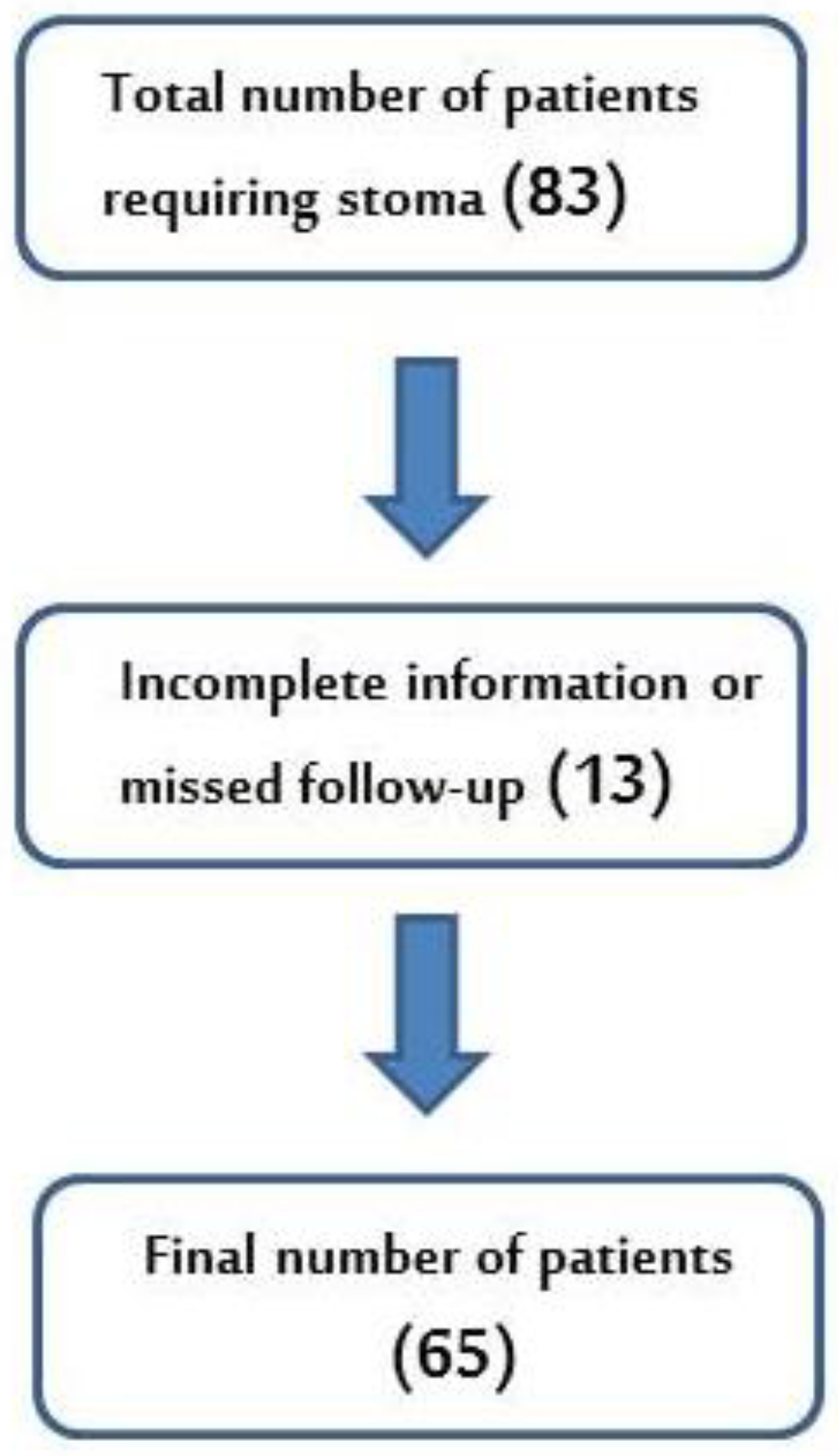

Table 1.
Risk factors of Parastomal Hernia.
| Patients with PSH | Patients without PSH | |
|---|---|---|
| Gender Male Female |
15 8 |
22 20 |
| Co-Morbids DM ASAI ASAII ASAIII |
17 7 10 10 |
23 17 13 8 |
| Type of Surgery Emergency Elective |
7 29 |
9 20 |
| Stoma Location Colonic Small Bowel |
26 6 |
23 10 |
| Stoma Exit Trans Rectus Non-Trans |
18 8 |
30 9 |
| Stoma Type End Stoma Loop Stoma |
30 8 |
12 15 |
| Etiology of Stoma Malignant Non-Malignant |
22 16 |
18 9 |
Disclaimer/Publisher’s Note: The statements, opinions and data contained in all publications are solely those of the individual author(s) and contributor(s) and not of MDPI and/or the editor(s). MDPI and/or the editor(s) disclaim responsibility for any injury to people or property resulting from any ideas, methods, instructions or products referred to in the content. |
© 2023 by the authors. Licensee MDPI, Basel, Switzerland. This article is an open access article distributed under the terms and conditions of the Creative Commons Attribution (CC BY) license (http://creativecommons.org/licenses/by/4.0/).
Copyright: This open access article is published under a Creative Commons CC BY 4.0 license, which permit the free download, distribution, and reuse, provided that the author and preprint are cited in any reuse.


