
Submitted:
30 November 2023
Posted:
01 December 2023
You are already at the latest version
Abstract
The population growth and its needs, has increasingly demanded water resources, requiring managers to adopt mechanisms to guarantee the availability and quality of water from springs. Among the instruments defined by law n. 9433/1997, water charges stand out. In this sense, the objective was to evaluate the evolution of charging for the use of water resources in Brazil, with emphasis on the channel of the Hydrographic Basin of the Paranaíba River. The methodology used was based on two phases, one of reviewing the articles available in Capes journals and the other, consulting the spreadsheets of the Araguari River Basin Agency with information on charges for the use of water within the competence of the Union in the Hydrographic Basin of the Paranaiba River. The results showed that charging for the use of water resources establish a relevant instrument for disciplining and raising financial resources that will enable improvements in the planning and management of water use. It should be noted that irrigation emerges as the main user of the flow captured from the Paranaíba River. However, the main source of funds for charging comes from the public supply. Among the Federation Units, the Federal District proved to be the largest source of contributions for charging the use of the Union's water resources in the Paranaíba River Basin.
Keywords:
water
; hydrographic basin
; instruments
; planning
; management
1. Introduction
The last decades have been a period of significant institutional reformulation and updating of the water resources management system. It is important to clarify that water, as an essential substance for life, also integrates social relations. Therefore, there is no possibility of separating the circulation of water from anthropic actions, neither of ignoring the hydrological circumstances that affect society. But, its importance reflects consequences for future generations, requiring decision-making by the State.
Based on this, a relationship of interdependence is created between society and water resources, considered a "hydrosocial" cycle [1], in which this cycle is manipulated to satisfy human needs, giving rise to the intervention process called "water resources management." Problems arising from water resources management, such as producing to meet market demands, ignoring the demand for natural resources beyond ecologically sustainable limits, require a dominant model of water management for a transformation in the role of the State.
In Brazil, since the implementation of the water resources regulatory framework, there have been different moments linked to the evolution of water resources management, with the main tool being the institution of the National Water Resources Policy - PNRH, through Federal Law n°. 9,433/1997, enabling the reduction of use conflicts, encouraging the rational use of water resources, to ensure the quality and quantity of water for current and future demands.
Even with complex and expensive introduction of the institutional structure, in practice, slightly changes have been observed in planning and water resources management. Despite having a solid theoretical foundation, the implementation of the charge was initially slow in Brazil due to disputes within and outside the government. Only eight years after the implementation of the PNRH, during the process of advances and setbacks, a new level of political consensus allowed the National Water Resources Council to approve the operational criteria and priorities for the application of resources from the charge for water use in 2005 [1].
The historic decision of the National Water Resources Council was based on a political agreement between economic groups that realized that, in addition to not threatening their interests, the charge can be highly instrumental to them [1]. Even with apparently democratic channels, such as river basin committees, the structure remains dominated by the same economic and political sectors. Alho da Costa [2] reports that the pressure exerted by the main water users – large users – on the politicians responsible for implementing the charge is a factor that contributes to the "retrogression", even influencing the non-application of instruments in many bodies of water, which are being deliberately used.
Therefore, instead of charging those directly responsible for the degradation of the aquatic environment, as they are considered large users, the burden is distributed to society, even to those who have never had access to public water and sewer services in the past. Given this, there is a need to investigate at which stage the charging of water resources from users in the Paranaíba River basin is, as this information will contribute to the control of water resource utilization, which is subject to scarcity and degradation of quality.
In this sense, this article proposes to evaluate the evolution of water resources charging in Brazil, with emphasis on the Paranaíba River basin. Also if this management tool still has improvements to be added besides being a tool to indicate to users the real value of water.
The research is characterized as qualitative, through exploratory research and the use of systematic literature review techniques, with a search in CAPES journals to compile and analyze sets of existing research data, that is, articles published between the dates 2001 and 2022 following the inclusion criteria. The second, quantitative stage involved analyzing the billing data carried out in the Paranaíba River channel provided by ABHA – the Multisectoral Association of Water Resources Users of the Araguari River Basin, responsible for implementing the decisions of the Paranaíba River Basin Committee (CBH – Paranaíba).
The review follows a logical order, with an introduction that presents the problem and objective. In the literature review, the evolution of management is addressed, as well as the instruments proposed by the National Water Resources Policy, including water billing. In the methodology, there are two stages: the first involves a bibliographic search in the Capes journals, and the second involves data collection on water billing in the Paranaíba River channel. The results and discussion present the bibliometrics and the data collected on water billing. Finally, considerations and references are made.
2. Literature Review
As presented by Campos [3], Integrated Water Resources Management (IWRM) began to be considered internationally in the mid-1970s. In Brazil, the debates were initiated in March 1983 at the International Seminar on Water Resources Management in Brasília, marking the beginning of widespread discussions on the topic at the symposiums of the Brazilian Association of Water Resources (ABRH). By the end of the 1980s, the states of São Paulo and Ceará began reforming their water administration systems by developing water resource master plans.
After the development of these master plans, it was observed that there was a distinct treatment between the drought-prone regions and the humid regions. The issue of water in the semi-arid region was anticipated due to the catastrophic drought from 1877 to 1879, while the legislation on water in the humid regions of Brazil had a greater influence due to the hydropower sector. In this context, Brazil had two sets of water legislation, one for the humid region and another for the drought-prone region [3]. With the dissemination of new paradigms, state and national policies were strongly influenced, leading to the National Water Law no. 9.433 (4).
In the context of ensuring availability and future demands without generating conflicts, there were needs to establish goals and limits for the use of water resources available in Brazil to ensure that it would not affect future generations. Therefore, with the publication of Law 9.433/97, all those who used water resources would be held responsible and charged.
Based on the National Water Resources Policy, established by Law 9.433/97 [4], the National Water Resources Management System (SINGREH) was created, based on Article 1. This text will focus on paragraph II, which refers to the principle that "water is a limited natural resource, endowed with economic value."
Among the instruments offered for water resources management, presented in Article 5 of Law 9.433/97, are:
Article 5. The instruments of the National Water Resources Policy are:
- I
- Water Resources Plans;
- II
- Water bodies classification according to their predominant uses;
- III
- Granting of water use rights;
- IV
- Charging for the use of water resources;
- V
- Compensation to municipalities;
- VI
- Water Resources Information System.
The IV clause (Charging for the use of water resources) will be the instrument used as the basis for all the text developed and discussions that will be raised later. Article 19 aims to recognize water as an economic asset and give users an indication of its real value, with fees charged according to Article 20 for water resources subject to authorization. So, charging for the use of water, under the terms of the Law, aims to conserve these water resources, as well as to provide economic resources for environmental maintenance and consequently for water availability.
The SINGREH would be responsible for coordinating, arbitrating, planning, regulating, and controlling the use, preservation, and recovery of water resources, as well as promoting charging for the use of water resources. The National Water Agency (ANA), which integrates SINGREH, is responsible for fostering discussions about the charging for the use of these water resources in the Basin Committees, especially in those under federal jurisdiction, such as the Paranaíba River.
According to Santin and Goellner [5], water resources management as a public policy involving all users and the population were a necessary step to overcome the focus on attacking only localized effects of pollution and increasing demand. The focus on planning and the use of management tools, such as granting the right to use water and charging for its use, have ensured effective results in the recovery, conservation, and better sharing of water resources in countries where they are applied.
Beyond that, the reality brought by Morais et al. [6] is that the model applied for charging management by committees was designed to work autonomously, but the committees have not yet acquired this autonomy. As the resources from charging for water use were collected, it would give them the conditions to develop without depending on state governments, financially or politically. However, as charging for water use is an essential condition for financial sustainability, and consequently, autonomy will depend on how charging is established in these committees.
Using the water resources legislation to which the Paranaíba Basin Committee is subordinate, participatory planning is implemented in the basin, as according to Oliveira et al. [7], the committee, by participating in water resources policy, ends up defining the direction of the territory. Therefore, when planning something for a particular location in the basin, there may be impacts on the entire basin, both positive and negative, ratified the importance of the role of the committee in applying effective integrated management to plan the future of the watershed.
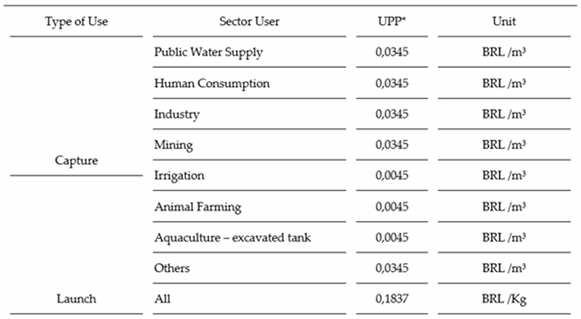
For charging for the use of Union water resources in the Paranaíba River Basin, there is normative no. 115/2020 [8], which regulates and provides for the update of mechanisms and values (Table 1).

Table 1.
Unit public prices (UPPs) for charging for the use of Union-owned water resources in the Paranaíba River Basin.
Table 1.
Unit public prices (UPPs) for charging for the use of Union-owned water resources in the Paranaíba River Basin.
 |
|---|
* Unit public prices. Source: Paranaíba River Basin Committee– CBHRP [8].
The normative also directs the collected values to be applied according to the water resources plan of the basin. Of these, 60% of the total amount collected is directed to expenses related to the implementation and maintenance of organs and entities integrated into SINGREH, prioritizing the state where it was collected. The collection of updated values is of great importance to CBH Paranaíba, as well as the correct application of these values to improve and ensure the functioning of the entire system, in addition to influencing the autonomy of the committee.
In order of the collection to encourage a reduction in consumption and contribute to the processes of improving quality, it would be necessary to control the volumes withdrawn and used, as well as the organic load present in the sewage water that returns to the system. Thus, the collection could achieve the objective of reducing the volume used per property and improving the conditions of the natural resource (Ladwig et al., 2017).
3. Materials and Methods
3.1. Study area characterization
Regarding the Paranaíba River basin (Figure 1), the river originates in Minas Gerais and runs approximately 1000 km, encompassing four Brazilian states: Goiás, Minas Gerais, Mato Grosso do Sul, and the Federal District.
Therefore, the water resources from the Paranaíba River basin are subject to charging since they are under the Union's domain.
3.2. First phase – CAPES journal articles
The applied methodology comprised an exploratory investigation. The method used was a systematic literature review, with the interest of compiling and analyzing sets of existing research data [10].
The question of interest was: How is the evolution of water resource charging in Brazil, with emphasis on the Paranaíba River basin? With the intention of answering this question, research was developed in January 2023, the investigation was directed to studies in Brazil, using CAPES journals, with the interest of analyzing all articles published between 2001 and 2022.
With the previous determination of the question of interest, databases were analyzed through inclusion and exclusion criteria of articles, with combinations of keywords, connected by boolean operators "AND" and "OR": ("Charging" AND "Water resources" AND "Brazil" OR Charning AND "Water resources" AND "Brazil"). The combination of keywords, boolean operators, quotes and parentheses were used as a search mode to limit or restrict information and ensure greater accuracy of the research. Thus, articles of quality were sought, or in other words, fundamentals that dealt with relevant subjects and were available for analysis [11].
Firstly, the articles were classified, observing aspects such as year of publication, author, journal, field of investigation and justifications for inclusion or exclusion of the article. Based on the registration of the most general information, the titles, abstracts, and keywords of all identified articles were read and verified, to filter the search for articles that clearly discussed water resource charging in Brazil. Regarding the exclusion criteria, review articles that were not available in full-text PDF format and articles that were repeated in the platform search were not included. After the initial classification, in the subsequent stage, the articles were read in full, which made it possible to exclude other works that did not meet the inclusion criteria.
3.3. Second phase – federal water resource charge data for the Paranaíba River Basin.
With the aid of a data spreadsheet for water resource charges carried out in the Paranaíba River Basin in 2021, provided by ABHA – Multisectoral Association of Water Resource Users in the Araguari River Basin, responsible for managing the Paranaíba River Basin Committee (CBH – Paranaíba), data were compiled and presented in figures and tables.
Among the analyzed variables were:
- (a)
- Purpose of water resource use: Among the uses charged in the Paranaíba River Basin, they were classified as follows: Public Supply, Aquaculture in Excavated Tanks, Human Consumption, Animal Husbandry, Sanitary Sewage, Industry, Irrigation, Mining – Sand/Gravel Extraction, Mining – Other Extractive Processes, and finally, other purposes.
- (b)
- Users by Purpose (Unit): The total number of users per type of water resource use charged in the Paranaíba River Basin was quantified.
- (c)
- Withdrawal Flow (m³): The volumes withdrawn and charged for different purposes were measured.
- (d)
- Discharge Flow (m³): The volumes of discharge resulting from post-use of water resources were measured.
- (e)
- Amount Charged (BRL): The revenues obtained from the charge for water resources extracted from the Paranaíba River Basin were quantified by purpose of use and federal unit.
Finally, the main municipalities that contribute the most to the revenue (BRL) from the water resource charge in the Paranaíba River Basin were listed, according to the main purpose of use.
4. Results and Discussion
4.1. Bibliometric analysis
The total number of articles found in the Capes journals, which composed the final database, was 81 (Figure 2).
Out of the 81 pre-selected articles, 51 were excluded due to duplication or lack of information. Then, the remaining 30 articles were read, and of these, 10 were excluded for not meeting the central theme of the research question. Finally, 20 articles met the inclusion criteria. Among the articles found, all were published from 2010 onwards and were updated each year, with the latest published in 2022. Articles published in the last 5 years were found, counting from 2015 (1), 2016 (1), 2017 (1), 2018 (3), 2019 (1), 2020 (1), 2021 (1), and 2022 (1), with 2018 being the standout year with the most publications on the subject.
In Table 2, the main conclusions observed in the selected articles on water resources charging in Brazil are presented.
Table 2.
Main conclusions observed in the selected articles on water resources charging in Brazil.
| Studies | Country | Main conclusions |
|---|---|---|
| (Alencar, K. et al., 2018) | Brazil | The implementation of water charges in the Rio Grande basin is feasible, indicating irrigation as the activity that most uses water in the basin. Furthermore, it is suggested not to establish a limit for the economic impact on the agricultural sector, or to establish it at a significant value to encourage rational water use. |
| (Alho da Costa, F., 2022) | Brazil | Charging for the use of water resources can be an important strategy to ensure the sustainable use of these resources in Brazil. The participation of society in the definition of charging policies and water resource management is of great importance to ensure equity and transparency in the process, requiring clear and effective legislation. |
| (Almeida, M. e Curi, W., 2016) | Brazil | It highlights that integrated water resource management involving the participation of different actors and joint actions is essential to ensure the availability of water for all uses and users. Finally, it is suggested that the implementation of public policies and incentive programs, such as tax reductions for companies that use sustainable practices, can help promote sustainable water resource management. |
| (Campos, J., 2013) | Brazil | Integrated water resource management is a relatively recent and complex challenge that requires the adoption of conservation measures and rational water use, as well as the promotion of public policies and actions that encourage society's participation in water resource management. |
| (Demajorovic, J. et al., 2015) | Brazil | Charging for water use can incentivize companies to adopt more sustainable and efficient water practices. The authors point out that charging can stimulate companies to invest in more efficient technologies, reduce waste, and promote water recirculation and reuse. However, water charging is not the sole solution for sustainable water resource management. |
| (Ferreira, A. F. A. e Oliveira-Filho, E. C., 2021) | Brazil | Farmers have a limited understanding of the importance of paying for water use and how this system can contribute to sustainable water resource management. While some farmers are willing to pay for water use, the majority do not recognize the need to financially contribute to water resource maintenance. |
| (Ióris, A., 2012) | Brazil | Water resource management in Brazil has a long history marked by progress and setbacks. Despite advances in water resource management in recent decades, significant challenges remain, such as lack of financial and human resources, water pollution, and water scarcity in arid and semi-arid regions |
| (Ladwig, N. et al., 2017) | Brazil | Charging for water use in irrigated rice production in the southern region of Santa Catarina can have a significant impact on production costs, especially for farmers with lower economic power. The study shows that costs vary according to river flow and users' capacity to pay for water, which can lead to inequalities in agricultural production and water distribution. |
| (Leite, G. e Vieira, W., 2010) | Brazil | Charging for water use can incentivize companies to adopt more sustainable and efficient water practices. The authors point out that charging can encourage companies to invest in more efficient technologies, reduce waste, and promote water recirculation and reuse. However, water charging is not the only solution for sustainable water resource management. |
| (Lima, L. et al., 2019) | Brazil | Farmers have a limited understanding of the importance of paying for water use and how this system can contribute to sustainable water resource management. While some farmers are willing to pay for water use, the majority do not recognize the need to contribute financially to the maintenance of water resources. |
| (Morais, J. et al., 2018) | Brazil | Water resource management in Brazil has a long history marked by progress and setbacks. Despite advancements in water resource management in recent decades, it still faces significant challenges such as lack of financial and human resources, water pollution, and water scarcity in arid and semi-arid regions. |
| (Odppes, R., et al., 2018) | Brazil | Charging for water use in irrigated rice production in the southern region of Santa Catarina can have a significant impact on production costs, especially for farmers with lower economic power. The study shows that costs vary according to river flow and users' payment capacity, which can lead to inequalities in agricultural production and water distribution. |
| (Santin, J. e Goellner, E., 2013) | Brazil | The use of the Shapley value can be an efficient methodology for charging for water use in river basins, especially in situations of high complexity and socioeconomic heterogeneity. |
| Oliveira, V. et al., 2020) | Brazil | Cost sharing is an effective tool for water resource management and can help incentivize the adoption of sustainable practices in the region. Additionally, the study highlights the importance of participation and cooperation among different stakeholders involved in watershed management. |
| (Resende Filho, M. et al., 2011) | Brazil | Charging for water use can lead to improved technical efficiency in water and input use in agricultural production. |
Source: Authors (2023).
It is evident in the authors' conclusions the importance of charging for water resource use, the need for social participation, the determination of a fair and appropriate value for the purpose, as well as incentives for sustainable practices that allow for consumption reduction and improvement in the quality of discharged effluents.
4.2. Federal water resource charging in the Rio Paranaíba
Table 1 presents the data on the withdrawal and discharge flow (m3), number of users by purpose (Un), and charged amount (BRL) for federal water resources in the Rio Paranaíba (Table 1).
Table 1.
Users by purpose, withdrawal and discharge flow (m3), and charged amount according to the purpose of use of water resources extracted from the Rio Paranaíba channel. Year 2021.
Table 1.
Users by purpose, withdrawal and discharge flow (m3), and charged amount according to the purpose of use of water resources extracted from the Rio Paranaíba channel. Year 2021.
| Purpose | Users by Purpose (Un) | Capture Flow (m³) |
Discharge Flow (m³) |
Charged Value (BRL) |
|---|---|---|---|---|
| Public Water Supply | 17 | 284.626.793,76 | 119.275.453,99 | 4.901.701,50 |
| Aquaculture in Excavated Tanks | 18 | 2.707.809,05 | 2.707.809,05 | 5.696,54 |
| Human Consumption | 13 | 114.548,87 | 114.548,87 | 2.428,3 |
| Animal Farming | 18 | 84.575,04 | 84.575,04 | 382,33 |
| Sanitation | 15 | 179.616.266,40 | 80.239.275,29 | 200.960,02 |
| Industry | 27 | 150.514.764,83 | 76.497.409,35 | 2.336.543,73 |
| Irrigation | 716 | 655.348.081,44 | 473.418.684,75 | 1.267.277,54 |
| Mining - Sand/Gravel Extraction | 11 | 866.012,00 | 866.012,00 | 15.706,45 |
| Mining - Other Extraction Processes | 7 | 24.766.923,28 | 24.640.923,28 | 382,33 |
| Others | 45 | 5.908.888,54 | 5.289.001,82 | 110.986,74 |
Source: ABHA [12]
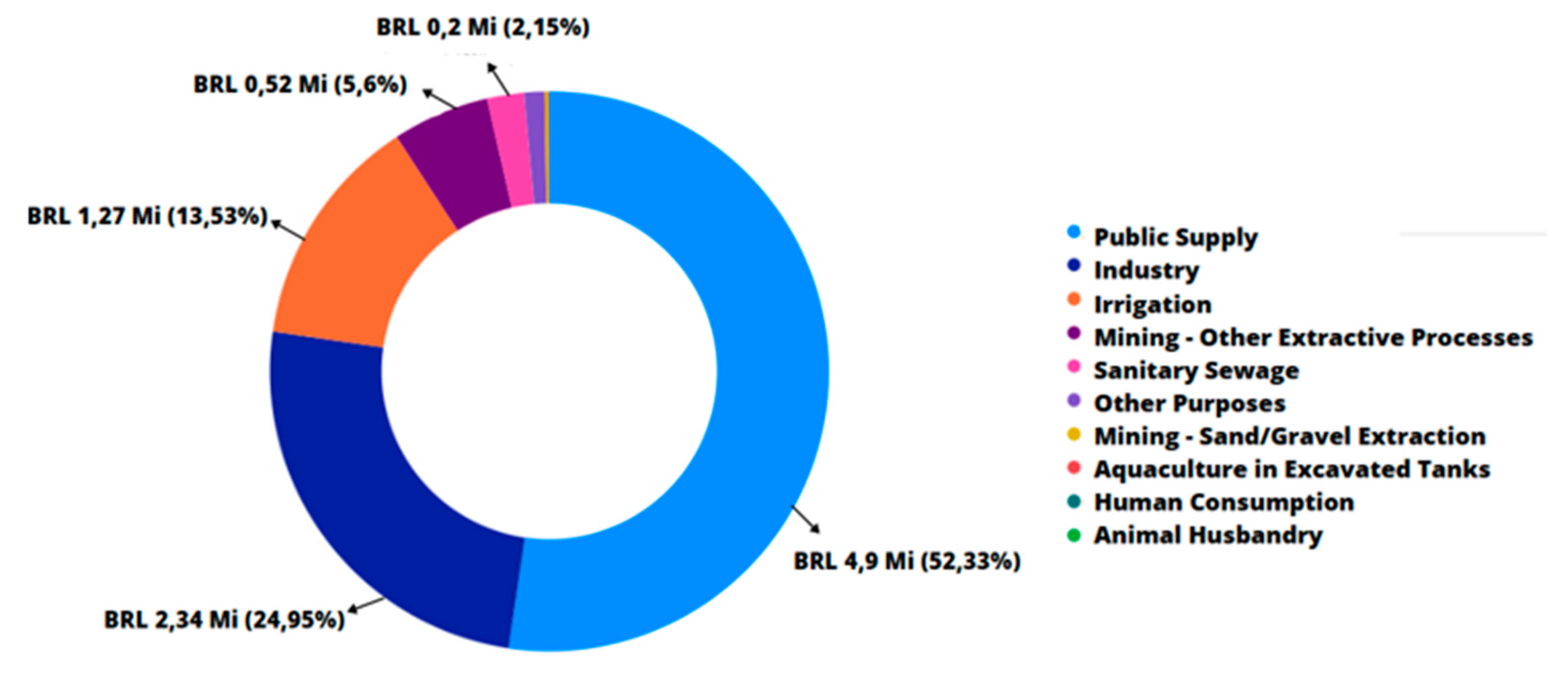
According to the data presented in Table 1, it is possible to observe that the purpose with the highest capture flow is irrigation, followed by public supply and sewage treatment. However, when analyzing the value charged per purpose (Figure 3), it is seen that the highest revenue comes from public supply, followed by industry and irrigation. Therefore, even if the purpose has the highest capture flow, its value charged in the Rio Paranaíba riverbed will be established differently through the value table presented by Normative Instruction n°. 115/2020.
The justification is that irrigation, despite having the highest volume of water intake, its value is based on the market and its real purpose. If its charge increases, it may become unfeasible for activities that use irrigation, especially agriculture, or in the worst-case scenario, it would increase production costs, ultimately affecting the final selling price.
According to Ladwig et al. [13], if the charge increases, agricultural producers will consider water as a significant input cost, which may lead to water rationing to maximize its use, prevent waste, and reuse water in the system. Although the market price is variable, it can be below or above the profit price of the production, which may vary throughout the agricultural year. In other words, if production costs are high, it may be an obstacle to implementing water use charges.
Not only in the Rio Paranaíba basin, but according to the survey conducted by Alencar et al. [14], irrigation agriculture is also the sector that most uses water, accounting for 46.4% of the authorized flow in the Rio Grande basin located in the Brazilian Cerrado.
It is necessary to implement new charging mechanisms indicated by the Committees for the Integration of the Paraíba do Sul River Basin (CEIVAP) and the Piracicaba, Capivari, and Jundiaí River Basin Committees (PCJ). These mechanisms' parameters are aligned with the activities existing in the basin, which can be an option to implement the CBH Paranaíba model since the difference in water intake and charges for irrigation can be observed.
Figure 3 shows the distribution of the predominant purposes by the Federal Units that compose the Rio Paranaíba Basin, namely the states of Goiás, Minas Gerais, Mato Grosso do Sul, and the Federal District.
Considering that the data available in the spreadsheet contained the purpose, but occasionally lacked the Federal Unit to which it was intended, it was decided to group this incomplete information into an item called "others". In other words, they are waters taken from the Paranaíba River channel by users, charged and intended for the listed uses, but without cataloging the Federal Unit to which it belongs. It is necessary to improve the internal processes of the Paranaíba River Basin Agency and the control mechanisms of the Paranaíba River Basin Committee, as well as the National Water Agency – ANA.
By far, the main revenue is intended for the purpose of public water supply, accounting for 52.33% and a revenue of R$ 4.9 million (Figure 3), although it is not the main volume captured (m3) since this occurs for irrigation (Table 1). The industry is present in second place with 24.95% and R$ 2.34 million, almost half of the uses and values attributed to public water supply. It is noteworthy that the use of water for irrigation, in third place, with 13.53% and revenue of R$ 1.27 million.
Since public water supply leads the revenue, and mostly comes from urban areas that will also generate proportional discharges, it is worth noting what Leite [15] reports, that an added value could be charged for the use of water associated with its high levels of effluent emissions, serving as a stimulus for this sector to adopt less polluting practices, such as treating their sewage, which is discharged into rivers without any control most of the time. This scenario of the basin with a high level of pollution due to the precarious situation of urban sanitation is verified in cities, in such a way that the effect of sewage discharge into the waters can reach unsustainable levels if the urban sector is not properly charged or stimulated to adopt more rational practices in the use of water.
Even though irrigation is the third largest revenue generator, there is no relation to the volume of water extraction, as it is the leader in water usage. This shows, as stated by Ladwig et al. [13], that the value charged for water will depend on the purpose of its use. In theory, those who consume more or pollute more should pay more for the use of water resources. However, in practice, the analysis shows that the establishment of water charges is associated with the purpose for which it is used.
Regarding industry, as the second largest revenue-generating sector and due to its importance as noted by Demajorovic et al. [16], there is a need to advance in the revision of prices applied to water consumption in the industrial sector, in order to find a value that will influence rational use of water in companies, or even adoption of water reuse. Among the purposes with the highest demand for water usage, according to Odppes et al. [17], increasing the tariff for water usage following the national trend can directly affect the average production cost for the industrial sector, and adopting water reuse or rationalization techniques could be an option.
Thus, Almeida and Curi [18] emphasize that integrated water resources management, involving the participation of different actors and joint actions, is essential to ensure the availability of water for all uses and users. Finally, they suggest that the implementation of public policies and incentive programs, such as tax reduction for companies that use sustainable practices, can help promote sustainable water resources management such as water reuse.
Lima et al. [19] describe that the increase in price related to water charges was low (0.04-0.09% of production costs), indicating that it can be absorbed by the industry. On the other hand, the revenue generated by the basins can be decisive for the implementation of various actions aimed at average water quantity and quality, which is good for the industry itself. By presenting this, it is seen that there is a need for the revision of values, and yet, it should not significantly affect the production cost of industries.
Table 2 displays the charges for the use of water resources according to their purpose and the Brazilian state to which the Paranaíba River Basin belongs.
Table 2.
Total values charged for water resources (BRL) according to the purpose of use and the federal unit belonging to the Paranaíba River Basin. Year 2021.
Table 2.
Total values charged for water resources (BRL) according to the purpose of use and the federal unit belonging to the Paranaíba River Basin. Year 2021.
| Federation Units | Charged Value (BRL) |
|---|---|
| Distrito Federal | 4737768,55 |
| Goiás | 2430934,15 |
| Minas Gerais | 1943371,74 |
| Mato Grosso do Sul | 68464,44 |
| Outras | 185935,91 |
Notes.: Absence of data that designates the UF, therefore, they were classified as others. Source: ABHA [12].
Of the federal charges in the channel of the Paranaíba River, the Federal District, despite having a smaller area than the state of Goiás, stands out in revenue, with almost double the amount collected. Goiás has approximately 2/3 of the Paranaíba River Basin, which has its channel dividing with the state of Minas Gerais in its greatest extension. Goiás's responsibility is amplified in this scenario, and it should improve management mechanisms, especially regarding the charging for the use of water resources.
It can be observed that there are values recorded, but without reference to which state the users belong, demonstrating that the data requires greater control in entering the information in the spreadsheet provided by ABHA – Multisectoral Association of Water Resource Users of the Araguari River Basin.
At the federal level, the charging is still being instituted, meaning it is in the process of evolution, and the last milestone was precisely the beginning of charging in the Paranaíba River basins in 2017, only 20 years after the establishment of the PNRH, which makes the basin's charging management susceptible to failures, as well as adjustments for improvement. According to Alho da Costa [2], in terms of the profile of the main users in each basin, there is a different majority-demanding agent, in the case of the Paranaíba River, it is the sanitation activity, usually related to public service, and it is rare for a private demander to be the most expressive within the context being analyzed.
Seeking to identify the municipal units most associated with the demand for water, the purpose of use, and the total collected, the federal capital stands out (Table 3).
Table 3.
Municipalities with the highest demand for water resources in the Rio Paranaíba riverbed and their main purpose.
Table 3.
Municipalities with the highest demand for water resources in the Rio Paranaíba riverbed and their main purpose.
| Municipalities | Predominant purpose of water resource use |
|---|---|
| Brasília | Irrigation |
| Catalão | Irrigation |
| Araporã | Irrigation |
| Santa Vitória | Irrigation |
| Davinópolis | Mining - Other Extraction Processes |
| Itumbiara | Irrigation |
| Ouvidor | Mining - Other Extraction Processes |
| Chapadão do Céu | Irrigação |
| Goiânia | Sanitary Sewage |
Source: ABHA [12].
It can be noticed from the predominant uses that irrigation is especially important in the areas surrounding Brasília, Santa Vitória, Araporã, and Catalão, suggesting the need for improved control and monitoring of these predominantly agricultural activities. For municipalities whose main activity is irrigation, Ladwing et al. (2017) states that cost can naturally be a limiting factor for staying in the agricultural business, especially when profits are reduced. On the other hand, following the function of the charging instrument, if the values are too low, the amount collected will not be sufficient for the environmental maintenance of SINGREH and the necessary investments in improvement actions in the hydrographic basin.
According to Ferreira and Oliveira-Filho [20], many farmers have a limited understanding of the importance of paying for the use of water and how this system can contribute to sustainable management of water resources. Although some farmers are willing to pay for the use of water, the majority do not recognize the need to contribute financially to the maintenance of water resources.
Nevertheless, attention should be given to adopting strategies for other purposes that aim to minimize the use of water resources, such as a possible value, using averages of what is charged in other basins as an example, to show the real value to users of water resources from the Paranaíba River channel and consequently compare and adjust with the values reached, which are already charged and adequate to the needs of the channel or basin, as according to Resende Filho et al. [21], charging for water use can lead to an improvement in the technical efficiency in the use of water and other inputs in agricultural production.
Starting from the purpose with the highest usage, which is irrigation, an important point in terms of charging rule is the exemptions that may generate externalities that will negatively impact the economic situation of the basin. For example, in the case of irrigation in properties with the "small farmers" fiscal module, the producers may be exempt from the charge for the use of water [2].
5. Conclusions
The objective of this study was to evaluate the evolution of the charging for the use of water resources in Brazil, with emphasis on the Paranaíba River Basin.
The management of water resources in Brazil took a long time to be implemented, becoming more serious after the National Water Resources Policy. From this point on, the evolution in the management of charging for the use of water resources began. Although the management of these resources only reached the Paranaíba River Basin twenty years after the PNHR, proposing that the Paranaíba River Basin Committee is evolving, it has not developed enough to guarantee the demands (current and future), through the current values collected, according to the purpose of use.
Thus, the charging for the use of water, under the terms of Law 9433/1997, proves to be an instrument for the economy of water resources, however, the charging for the use of water from the Paranaíba River Basin is considered recent for basin management, making it subject to flaws.
There is a need for adjustments to improve and evolve the existing charging, to find a more adequate value, which can be based on other basins, but taking into consideration the reality pre-sented by the specific river basin. Finding an adequate value is a difficult task, however, the low value of the charging does not stimulate the deepening of management, including the generation of sufficient financial resources for investment in the preservation of the water quality of the Paranaíba River Basin.
6. Patents
Author Contributions
Antônio Pasqualetto: conceptualization; methodology; validation; formal analysis; investigation; supervision; project administration; funding acquisition. Rayslla Rodrigues Quintanilha: resources; data curation; writing original draft preparation. Hellbia Samara Moreira de Carvalho Rodrigues: writing; review and editing; visualization.
Funding
Please add: This research received no external funding CAPES/FAPEG.
Data Availability Statement
The data was obtained by the Multisector Agency of Water Resources Users of the Araguari River Basin.
Acknowledgments
Thanks to the National Water and Basic Sanitation Agency; Paranaíba River Hydrographic Basin Committee; Multisector Agency of Water Resources Users of the Araguari River Basin.
Conflicts of Interest
The authors declare no conflict of interest.
References
- Ióris, A. (2012). Passado e Presente dos Recursos Hídricos no Brasil. Finisterra, 41(82), 55-74. [CrossRef]
- Alho da Costa, F. A. (2022). Cobrança pelo Uso dos Recursos Hídricos como Estratégia para seu Uso Sustentável no Brasil. Revista de Direito e Sustentabilidade, 7(2), 113.
- Campos, J. N. B. (2013). A Gestão Integrada dos Recursos Hídricos: Uma Perspectiva Histórica. Revista Eletrônica de Gestão e Tecnologias Ambientais, 1(1), 111-121. [CrossRef]
- Brasil. (1997). Lei n. 9.433, 8 de Janeiro de 1997 Dispõe Sobre a Política Nacional dos Recursos Hídricos e Dá Outras Providências. Brasília. Governo Federal.
- Santin, J. R., & Goellner, E. (2013). A Gestão dos Recursos Hídricos e a Cobrança pelo seu Uso. Sequência (Florianópolis), 34(67), 199-221. [CrossRef]
- Morais, J. L. M., Fadul, E., & Cerqueira, L. (2018). Limites e Desafios na Gestão de Recursos Hídricos por Comitês de Bacias Hidrográficas: Um Estudo nos Estados do Nordeste do Brasil. Revista Eletrônica da Administração (Porto Alegre), 24(1), 238-264. [CrossRef]
- Oliveira, V., Brose, M., & Vaz, V. (2020). Rateio de Custos Como Alternativa de Proteção e Recuperação da Bacia Hidrográfica do Rio Pardo. Colóquio (Taquara.), 17(4), 279-298. [CrossRef]
- Comitê da Bacia Hidrográfica do Rio Paranaíba. (2020). Deliberação n. 115/2020, Dispõe Sobre a Atualização dos Mecanismos e Valores de Cobrança pelo Uso dos Recursos Hídricos de Domínio da União na Bacia Hidrográfica do Rio Paranaíba e Dá Outras Providências. Itumbiara, CBHRP.
- Agência Reguladora de Águas, Energia e Saneamento Básico do Distrito Federal. (2023). Mapa da Bacia Hidrográfica do Rio Paranaíba. Brasília, Adasa.
- Donato, H., & Donato, M. (2019). Stages For Undertaking A Systematic Review. Acta Medica Portuguesa, 32(3), 227-235. [CrossRef]
- Galvão, T. F., & Pereira, M. G. (2014). Revisão Sistemática da Literatura: Passos para sua Elaboração. Epidemiologia e Serviços de Saúde, 23(1), 183-184.
- ABHA – the Multisectoral Association of Water Resources Users of the Araguari River Basin. Dados cobrança federal da água na calha do Rio Paranaíba. Araguari: ABHA. 2021.
- Ladwig, N., da Silva, E., & Back, L. (2017). A Cobrança do Uso da Água e o Impacto no Custo da Produção do Arroz Irrigado na Região Sul do Estado de Santa Catarina. Boletim de Geografia, 35(2), 31. [CrossRef]
- Alencar, K., Moreira, M., & Silva, D. (2018). Cost of Charging for Water Use in the Brazilian Cerrado Hydrographic Basin. Revista Ambiente & Água, 13(5), 1-15. [CrossRef]
- Leite, G., & Vieira, W. (2010). Proposta Metodológica de Cobrança pelo Uso dos Recursos Hídricos Usando o Valor de Shapley: Uma Aplicação à Bacia do Rio Paraíba do Sul. Estudos Econômicos - Instituto de Pesquisas Econômicas, 40(3), 651-677. [CrossRef]
- Demajorovic, J., Caruso, C., & Jacobi, P. R. (2015). Cobrança do Uso da Água e Comportamento dos Usuários Industriais na Bacia Hidrográfica do Piracicaba, Capivari e Jundiaí. Revista de Administração Pública, 49, 1193-1214. [CrossRef]
- Odppes, R. J., Michalovicz, D. T., & Bilotta, P. (2018). Reuso de Água em Indústria de Fabricação de Estruturas em Concreto: Uma Estratégia de Gestão Ambiental. Revista Tecnologia e Sociedade, 14(34), 82-100.
- Almeida, M., & Curi, W. (2016). Gestão do Uso de Água na Bacia do Rio Paraíba, PB, Brasil com Base em Modelos de Outorga e Cobrança. Revista Ambiente & Água, 11(4), 989-1005. [CrossRef]
- Lima, L., Spletozer, A., Jacovine, L., & Carvalho, A. (2019). Bulk Water Charges in the Dairy Industry: A Case Study of Interstate Basins in Minas Gerais, Brazil. Ciência Rural, 49(10), 2-7. [CrossRef]
- Ferreira, A. F. A., & Oliveira-Filho, E. C. (2021). Percepções e Disposição de Agricultores do Distrito Federal sobre Pagamento para Uso de Recursos Hídricos. Ambiente & Sociedade, 24, 2-18. [CrossRef]
- Resende Filho, M., Araújo, F., Silva, A., & Barros, E. (2011). Precificação da Água e Eficiência Técnica em Perímetros Irrigados: Uma Aplicação da Função Insumo Distância Paramétrica. Estudos Econômicos – Instituto de Pesquisas Econômicas, 41(1), 143-172. [CrossRef]
Figure 1.
Paranaíba River Basin. Source: Regulatory Agency of Water, Energy and Basic Sanitation of the Federal District – ADASA [9]
Figure 1.
Paranaíba River Basin. Source: Regulatory Agency of Water, Energy and Basic Sanitation of the Federal District – ADASA [9]
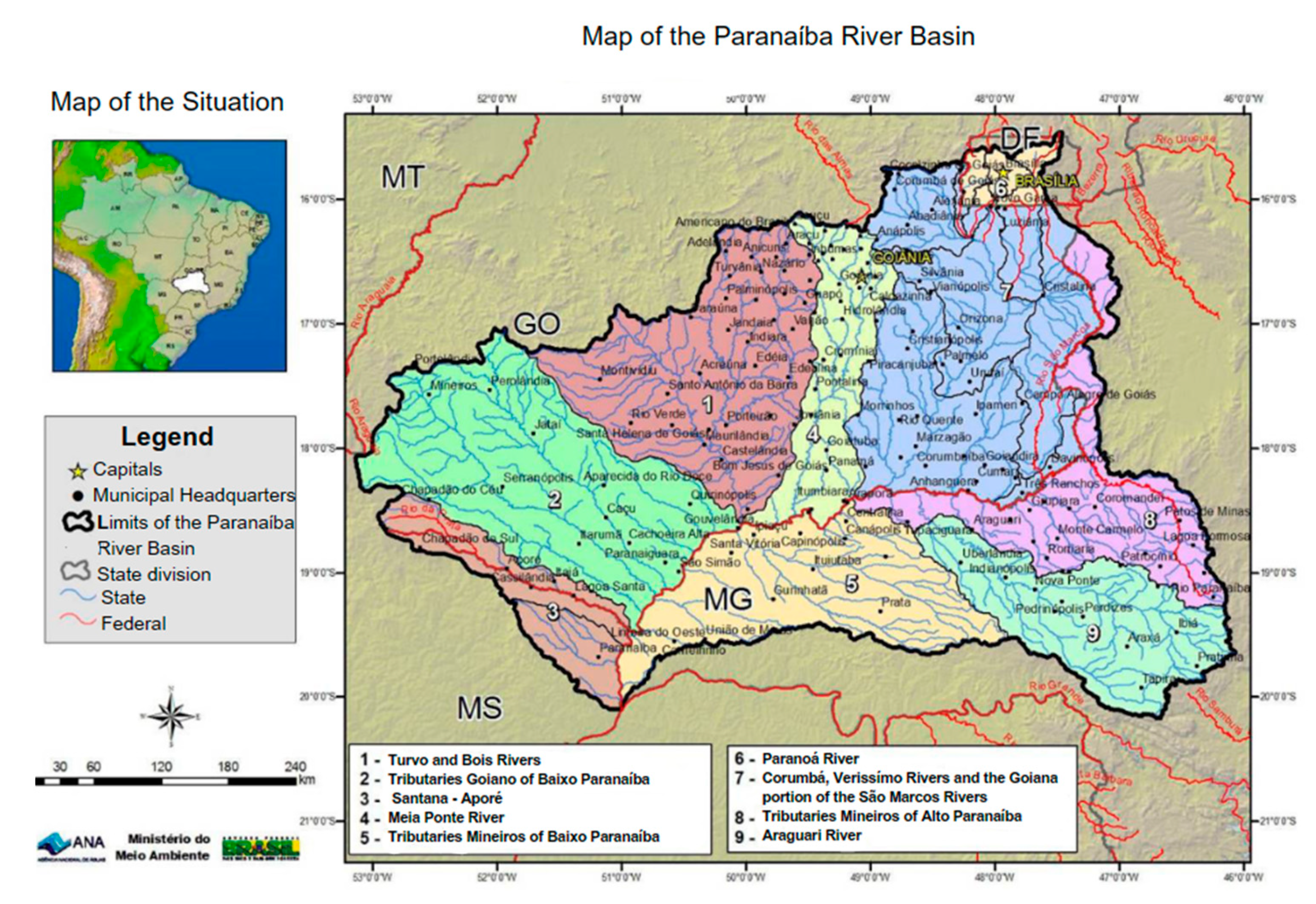
Figure 2.
Flowchart of the research and classification of articles that evaluated water pricing as a management instrument for water use, obtained from Capes, until the year 2022. Source: Authors, 2023
Figure 2.
Flowchart of the research and classification of articles that evaluated water pricing as a management instrument for water use, obtained from Capes, until the year 2022. Source: Authors, 2023

Figure 3.
Distribution of revenues (BRL) and most used purposes of use in the UF of GO, MS, MG e DF. Source: ABHA [12] Note: Absence of data that designates the purpose, therefore, they were classified as others.
Figure 3.
Distribution of revenues (BRL) and most used purposes of use in the UF of GO, MS, MG e DF. Source: ABHA [12] Note: Absence of data that designates the purpose, therefore, they were classified as others.
Disclaimer/Publisher’s Note: The statements, opinions and data contained in all publications are solely those of the individual author(s) and contributor(s) and not of MDPI and/or the editor(s). MDPI and/or the editor(s) disclaim responsibility for any injury to people or property resulting from any ideas, methods, instructions or products referred to in the content. |
© 2023 by the authors. Licensee MDPI, Basel, Switzerland. This article is an open access article distributed under the terms and conditions of the Creative Commons Attribution (CC BY) license (http://creativecommons.org/licenses/by/4.0/).
Copyright: This open access article is published under a Creative Commons CC BY 4.0 license, which permit the free download, distribution, and reuse, provided that the author and preprint are cited in any reuse.


