

Submitted:
28 November 2023
Posted:
30 November 2023
You are already at the latest version
Abstract
Exercising surds to represent figures is a common practice in scientific and Engineering fields, especially in scripts where calculators are banned or unapproachable. Peter Chew Theorem make result becomes simple when dealing with converting Quadratic Surds. The substance of the Peter Chew Theorem lies in enabling the forthcoming generation to simple break problems related to Quadratic Surds more effectively, easing a direct comparison with contemporary results. By employing the Peter Chew Theorem, one can streamline the tutoring and literacy of math, particularly concerning second- order direct equations with constant portions. This theorem's objective aligns with Albert Einstein's famed quotation Everything should be made as simple as possible, but not simpler.
Keywords:
Calculus
; Second Order Linear Equations With Constant Coefficients
; Peter Chew Theorem
; Quadratic Surds
1. Introduction
1.1. Surd 1
Exercising surds to represent figures is a common practice in scientific and Engineering fields, especially in scripts where calculators are banned or unapproachable. Peter Chew Theorem make result becomes simple when dealing with converting Quadratic Surds. The substance of the Peter Chew Theorem lies in enabling the forthcoming generation to simple break problems related to Quadratic Surds more effectively, easing a direct comparison with contemporary results.
1.2. Surds Explained with Worked Examples by Shefiu S. Zakariyah(PhD) 1
In a triangle ABC, AB = BC = and , without using a calculator find the length of AC. Figure 5. (pg 30)
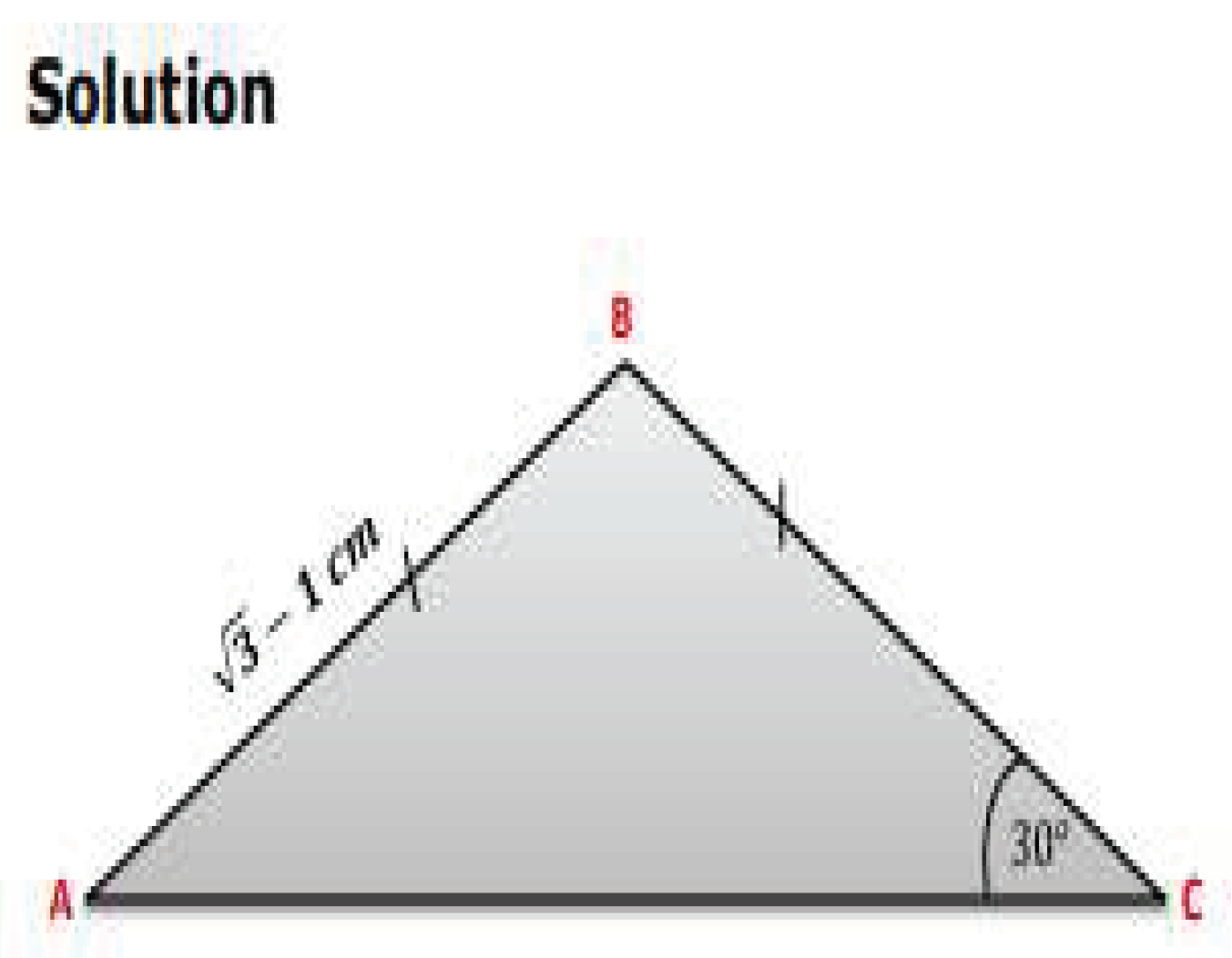
Figure 5.
| Where AB = c = , |
| BC = a = |
| AC = b |
| Also, ∠ BAC = ∠ ACB = . |
| AB= BC |
| ∠ B = - ( ∠ BAC + ∠ BAC ) |
| = |
| = |
| = 2 |
| b = |
| Current Method: |
| Let the square root of the be - for which x, y ∈R. Therefore |
| = x + y – 2 |
| Comparing the both sides, |
| We’ve , x + y = 12 |
| also - 2 |
| Divide 2sides by – 2, |
| Square 2 sides , xy = 27 ……………..…..(ii) |
| From (i), y = 12 – x …………………………(iii) |
| Substitute equation (iii) in equation (ii), |
| x ( 12 -x ) = 27 |
| 12 x - = 27. |
| - 12 x + 27 = 0 |
| ( x – 9 ) ( x – 3 ) = 0 |
| Therefore, either x – 9 = 0, x – 3 = 0 |
| x = 9, 3 |
| We now need to find the values for y, therefore |
| When x = 9, from (iii), y = 12 -9 = 3 . |
| And when x = 3 , from (iii) , y = 12 – 3 = 9 |
| Hence , the square root of the 12 – 6 are |
| - = |
| = |
| and + = |
| = |
| ∴ = ( ). |
| Since AC cannot be negative, thens AC = () cm . [ is negative ]. |
| Peter Chew . |
| = |
| Cause - 12x + 27 = 0, then x = 9, 3 |
| ∴ = - |
| = - |
| ∴ Length AC = - |
2. Current Method and Peter Chew Theorem
| Example: |
| sum of 2 real number in surd form. |
| Current Method, |
| i) Solution 1: |
| = |
| = |
| = |
| ii) Solution 2: If be + |
| = ( + |
| = x + y + 2 |
| Comparing the both sides, |
| We’ve x + y = 12 |
| y = 12- x ….. i) |
| also xy =35 ….….ii) |
| From i) and ii), x (12 - x) = 35 |
| - 12x + 35 = 0 |
| ( x – 7 ) ( x – 5 ) = 0 |
| Therefore, x = 7, 5 |
| From i), If x = 7, y = 12- 7 = 5 |
| If x = 5, y = 12- 5 = 7 |
| ∴ = + |
| iii) Peter Chew Theorem, |
| Cause - 12x + 35 = 0, then x = 7, 5 |
| ∴ = + |
3. Linear Second Order Differential Equation with Constant Coefficient
Solution to the Differential Equation.Diagram
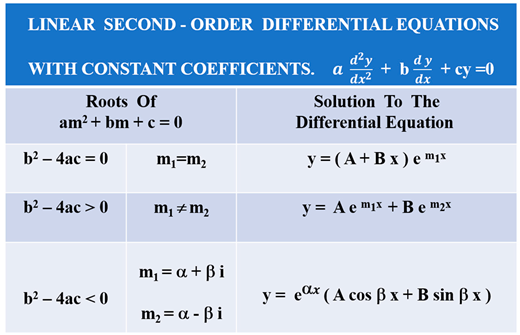
Example 1: Find the solution to the differential equation: - 3 - 10y =0.
Solution:
The auxiliary equation is:
m2 - 3m - 10 = 0 .
m1 = -2, m2 = 5
∴
y = C1 e -2x + C2 e 5x
Example 2: Find the general solution to the differential equation: - 2 + y =0.
Solution:
The auxiliary equation is:
m2 - 2m + 1 = 0 .
m1 = 1, m2 = 1
∴
y = ( A + B x ) ex
Example 3: Find the solution to the differential equation: +6 +13 =0.
Solution:
The auxiliary equation is:
m2 +6m +13 = 0 .
m1 = -3 + 2i , m2 = -3 – 2 i , Therefore,α= -3,β= 2
∴
y =e -3x ( A cos 2 x + B sin 2 x )
4. Application of Peter Chew Theorem for Calculus (Second Order Linear Equations with Constant Coefficients)
| Example 1 : Find the solution to the equation: . |
| Solution : |
| The auxiliary equation is: m 2 + 3 m + = 0 |
| Current Method, |
| If = - |
| Then = ( - |
| ∴ = x + y - 2 |
| Comparing the both sides , |
| We’ve x + y = 9 |
| y = 9 - x ….. i) |
| also x y = 8 ….….ii) |
| From i) and ii), x (9- x) = 8 |
| - 9x +8 = 0 |
| (x - 8)(x - 1) = 0 |
| x = 8, 1 |
| From i), If x = 8, y = 9- 8 = 1 |
| If x = 1, y = 9- 1 = 8 |
| ∴ = - |
| iii) Peter Chew Theorem, |
| Cause - 9x + 8 = 0, then x = 8, 1 |
| ∴ = - |
| Therefore |
| , |
| , |
| For , Solution To The Differential Equation is y = A + B |
| Therefore y(x)= A + B |
| Example 2 : Find the solution to the equation: . |
| Solution : |
| The auxiliary equation is: m 2 + 20 m += 0 |
| Current Method, |
| If = - |
| = ( - |
| = x + y - 2 |
| Comparing the both sides, |
| We’ve x + y = 100 |
| y = 100 - x ….. i) |
| also x y = 475 ….….ii) |
| From i) and ii), x (100 - x) = 475 |
| - 100x +475 = 0 |
| (x - 95) (x - 5) = 0 |
| x = 95, 5 |
| From i), If x = 95, y = 100 - 95 = 5 |
| If x = 5, y = 100 - 5 = 95 |
| ∴ = - |
| iii) Peter Chew Theorem, |
| Cause - 100x + 475 = 0, then x = 95, 5 |
| ∴ = - |
| From |
| - - 10 , + -10 |
| For , Solution To The Differential Equation is y = A + B |
| Therefore y(x) = A + B |
| Example 3 : Find the solution to the equation: . |
| Solution : |
| The auxiliary equation is: m 2 + 20 m += 0 |
| = |
| = |
| Current Method, |
| If = - |
| = ( - |
| = x + y - 2 |
| Comparing the both sides, |
| We’ve x + y = 3 844 |
| y = 3 844 - x ….. i) |
| also x y = 118 203 ….….ii) |
| from i) and ii), x (3 844 - x) = 118 203 |
| - 3 844 x + 118 203 = 0 |
| (x – 3 813) (x - 31) = 0 |
| x = 3 813, 31 |
| From i), If x = 3 813, y = 3 844 - 3813 = 31 |
| If x = 31 , y = 3 844 – 31 = 3 813 |
| ∴ = - |
| iii) Peter Chew Theorem, |
| Cause - 100x + 475 = 0, then x = 95, 5 |
| ∴ - 3 844 x + 118 203 = 0 = = - |
| From |
| - |
| - - 62 , - + - 62 |
| For , Solution To The Differential Equation is y = A + B |
| Therefore y(x) = A + B |
| Example 4 : Find the solution to the equation: . |
| Solution : |
| The auxiliary equation is: 2m 2 + m += 0 |
| = |
| Current Method, |
| Let be - |
| = ( - |
| = x + y - 2 |
| Comparing the both sides, |
| We’ve x + y = 2 |
| y = 2 - x ….. i) |
| also x y = 5 ….….ii) |
| From i) and ii), x (2 - x) = 5 |
| - 2 x + 5 = 0 |
| From i), If x = 1+2i, y = 2 - (1+2i) = 1 - 2i |
| If x = 1-2i , y = 2 - (1-2i) = 1 + 2i |
| ∴ = - |
| iii) Peter Chew Theorem, |
| Cause - 2 x + 5 = 0, then x = |
| ∴ = - |
| From = |
| = |
| = |
| For m1 = α + β i, m2 = α - β i . let α= , β = |
| Solution To The Differential Equation is y = ( A cos β x + B sin β x ) |
| Therefore y(x) = y = [ A cos( x) + B sin) x ) ] |
| Example 5 : Find the solution to the equation: . |
| Solution : |
| The auxiliary equation is: 2m 2 + m += 0 |
| = |
| Current Method, |
| Let be - |
| = ( - |
| = x + y - 2 |
| Comparing the both sides, |
| We’ve x + y = 6 |
| y = 6 - x ….. i) |
| also x y = 13 ….….ii) |
| From i) and ii), x (6 - x) = 13 |
| 6 x - = 13 |
| - 6 x + 13 = 0 |
| From i), If x = 3+2i, y = 6 - (3+2i) = 3 - 2i |
| If x = 3-2i , y = 6 - (3-2i) = 3 + 2i |
| ∴ = - |
| iii) Peter Chew Theorem, |
| Cause - 6 x + 13 = 0, then x = |
| ∴ = - |
| From = |
| = |
| = |
| For m1 = α + β i, m2 = α - β i . let α= , β = |
| Solution To The Differential Equation is y = ( A cos β x + B sin β x ) |
| Therefore , y(x) = y = [ A cos( x) + B sin) x ) ] |
5. Conclusion
In scientific and engineering domains, the use of surds as a representation for numbers holds substantial significance, especially in situations where the reliance on calculators is limited or non-existent. Surds become a crucial tool when dealing with complex computations involving irrational values. The application of the Peter Chew Theorem significantly simplifies solutions in the conversion of Quadratic Surds.
The Peter Chew Theorem stands as a transformative asset, aiming to facilitate a more simple and straightforward approach for the upcoming generation in handling and resolving problems associated with Quadratic Surds. Its primary objective revolves around empowering individuals to navigate and solve these intricate problems more efficiently, thereby enabling a direct comparison with the solutions derived through contemporary methodologies.
The integration of the Peter Chew Theorem into mathematical education serves to streamline the teaching and learning processes, particularly within the realm of calculus, specifically concerning second-order linear equations characterized by constant coefficients. This theorem acts as a pedagogical tool, enhancing the understanding and application of mathematical concepts related to Quadratic Surds, contributing to a more comprehensive grasp of calculus principles.
Aligned with the wisdom encapsulated in Albert Einstein’s renowned quote — " Everything should be made as simple as possible, but not simpler " — the Peter Chew Theorem embodies a philosophy centered on simplification without compromising accuracy or depth. Its pursuit of simplifying solutions to complex problems resonates with the fundamental principles driving mathematical innovation.
This theorem’s goal harmonizes with the perpetual quest within mathematics: to distill intricate problems into more manageable forms while preserving the precision required for comprehensive understanding and application.
References
- Shefiu S. Zakariyah, PhD Surds Explained with Worked Examples. (26, 30) Feb.2014. https://www.academia.edu/6086823/Surds_Explained_with_Worked_Examples.
- PETER CHEW . PETER CHEW THEOREM AND APPLICATION. CHEW, PETER, PETER CHEW THEOREM AND APPLICATION (MARCH 5, 2021). AVAILABLE AT SSRN: HTTPS://SSRN.COM/ABSTRACT=3798498 OR HTTP://DX.DOI.ORG/10.2139/SSRN.3798498.EUROPE PMC: PPR: PPR300039.
- Agata Stefanowice, Joe Kyle, Michael Grove. Proofs and Mathematical Reasonung. University of Birmingham, September. 2014.
- Dr. Yibiao Pan. Mathematical Proofs and Their Importance. December 5, 2017.
Disclaimer/Publisher’s Note: The statements, opinions and data contained in all publications are solely those of the individual author(s) and contributor(s) and not of MDPI and/or the editor(s). MDPI and/or the editor(s) disclaim responsibility for any injury to people or property resulting from any ideas, methods, instructions or products referred to in the content. |
© 2023 by the authors. Licensee MDPI, Basel, Switzerland. This article is an open access article distributed under the terms and conditions of the Creative Commons Attribution (CC BY) license (http://creativecommons.org/licenses/by/4.0/).
Copyright: This open access article is published under a Creative Commons CC BY 4.0 license, which permit the free download, distribution, and reuse, provided that the author and preprint are cited in any reuse.


