

Submitted:
14 November 2023
Posted:
15 November 2023
Read the latest preprint version here
Abstract
This paper presents an innovative approach for improving the seismic protection of existing structures by introducing an additional dissipative structure (ADS). The seismic energy impacting the building can be dissipated through the contribution provided by the ADS, thereby reducing the need for the existing building to ensure its own seismic capacity. This retrofitting technique is well-suited for structures facing architectural restrictions or challenging-to-update elements. It can help address foundation issues by applying loads to new external components. This paper describes the design of the ADS and proposes a displacement-based design procedure. The design process involves a non-linear static analysis and a simple procedure that must be iteratively repeated until the retrofitting target is achieved. This approach is simple and computationally efficient and can also be used for complex and irregular structures. Such structures are frequently encountered, and existing structures often exhibit unusual geometries and materials requiring extensive numerical modeling. The efficacy of the technique was evaluated using a case study involving a school building located in central Italy. The results of numerical analyses indicated that owing to the ADS’s contribution, the seismic capacity of both the buildings was enhanced, ad-dressing the challenges associated with complex foundation interventions.
Keywords:
passive damping
; dissipative devices
; seismic retrofitting
1. Introduction
In recent years, the European community's interest in multidisciplinary improvements to the building heritage of its member countries has materialized through substantial funding for activities aimed at enhancing both the energy efficiency and seismic resilience of public and private buildings [1,2]. In Italy, the building stock consists of historical or post-World War II constructions designed without seismic regulations, making the development of retrofitting techniques a matter of strong strategic interest.
The retrofitting of existing concrete buildings aims to reduce the risks associated with failure and damage. Traditional retrofitting strategies aim to increase structural strength to reduce ductility demand. However, in the last two decades, new conceptual approaches have gained prominence, falling into two categories: increasing available ductility and reducing demand. The latter can be achieved by reducing input energy through base isolation or increasing energy dissipation via additional dissipative devices. These devices, like dissipative bracings or external dissipative structures (e.g., dissipating frames) [3], introduce a nonlinear component to the retrofitted structure, altering its behavior and necessitating the evaluation of nonlinear responses.
Various conditions, such as interference with building utilization during the retrofit, can influence the choice of retrofitting strategy. In some cases, the use of dissipative braces can be disadvantageous, primarily in terms of architectural and functional impacts. As detailed in this paper, these problems can be overcome by creating additional dissipative structures directly connected to existing buildings. Implementing external dissipative structures involves constructing new foundations and placing dissipative devices outside the existing building, often within specially dimensioned framed constructions. Some applications have recently been developed, discussed, and realized [4,5,6].
Both solutions, dissipative bracing and dissipative frame, imply that the retrofitted structure will include a non-linear component that can modify the behavior of the structure itself and usually requires the evaluation of a nonlinear response. Based on international codes and scientific literature, the following considerations are made:
None of the existing codes, with the partial exception of FEMA, defines design criteria for additional dissipative systems FEMA 274 [7] and FEMA 356 [8] highlight the variability in design methods depending on the type of existing dissipative devices. These devices can be broadly grouped into two major categories: displacement-dependent devices (yielding metallic and friction dampers) and velocity-dependent devices (viscoelastic solids or viscous fluids). While a wide range of devices has been proposed in the literature, ongoing research aims to limit the residual damage induced by seismic events. The inadequacy of conventional structures for repair is a critical issue observed after severe earthquakes [9,10]. Additional dissipative structures offer significant benefits, including stiffness redistribution, damping, and attraction of base shear new foundations. Consequently, these interventions can significantly enhance seismic performance without increasing, in many cases, the base shear and floor accelerations in many cases.
Dissipative structures can be equipped with various types of dissipative devices, such as generic hysteretic or viscous dampers, Buckling-Restrained Braces [11], scorpion-yielding connectors [12], and shear link devices [13].
Numerous design procedures have been developed by researchers. The most innovative procedures are displacement-based and are intended for installing dissipative devices on additional braces. Among these procedures, a brief summary is presented below.
Kim and Choi [14] proposed a design procedure to provide the required effective damping using additional buckling-restrained braces (BRBs) to achieve the desired target displacement. Ponzo et al. [15] introduced an energy equivalence criterion for dimensioning the bracing system based on the ultimate frame displacement capacity.
Durucan and Dicleli [16] put forward an energy-based iterative design procedure for retrofitting existing RC frames using steel braces with shear links, demonstrating its effectiveness in achieving both operational and life safety performance levels.
Bergami and Nuti [17] defined a comprehensive design procedure for dissipative braces, encompassing the design of the braces' stiffness, yielding force, and metallic components for seismic retrofitting. An optimization procedure is also included, based on static nonlinear analysis, enabling a useful comparison between standard and innovative pushover procedures and considering the influence of higher-mode contributions ([18,19,20].
Mazza and Vulcano [21] developed a design procedure based on defining a target displacement and iteratively determining the properties of an equivalent damping system. Assumptions proposed in the procedure characterize the equivalent damping system in terms of equivalent stiffness and independently determined yielding force.
This paper describes an effective and easy-to-use displacement-based design procedure for the seismic upgrade of existing buildings (S) with additional dissipative structures (ADS) for seismic enhancement. The procedure is derived from Bergami et al. [17] and is based on the Capacity Spectrum Method [22]. It defines the retrofitted building's capacity by considering contributions from the existing structure and the ADS to achieve a desired performance level based on the target displacement. The procedure is iterative, and the capacity curve is determined via pushover analysis at each iteration. In this study, the design of an ADS is discussed, applied, and verified. The primary performance objective is to prevent earthquake-induced damage, ensuring life safety for the retrofitted building (S+ADS) and avoiding structural and non-structural element damage. The target displacement is related to the permissible inter-story drift value.
2. General Aspects of Retrofitting Using Additional Dissipative Structures
2.1. Additional Dissipative Structures
Among the various retrofitting approaches, additional dissipative structures have gained popularity due to their undeniable advantages. These structures divert seismic forces into a new construction with fresh foundations (as depicted in Figure 1), and most of the construction work occurs outdoors. Consequently, the existing structure can continue to operate. This intervention typically requires the ability to create a new volume. However, it is worth noting that the tower can often replace existing external structures, such as emergency stairs, with minimal impact on the building's architecture.
Dissipative towers are typically constructed using steel, though in cases requiring high stiffness, they may be made from reinforced concrete (R.C.). These towers must be connected to the existing building and equipped with dissipative devices. These devices can exhibit displacement-dependent behavior (e.g., yielding metallic and friction dampers) or velocity-dependent behavior (e.g., viscoelastic solids or viscous fluids). The devices can be installed in various configurations (as illustrated in Figure 2). This study considered the use of dissipative devices, such as BRBs ([23], at the base of the tower (Figure 2(a)) because it is deemed the most cost-effective and practical solution.
2.2. Retrofitting with ADS
In this context, where S represents the existing structure, ADS denotes the dissipative structure under design, and S+ADS represents the retrofitted building (as shown in Figure 3), the designer can simplify the capacity curve of the final configuration as the sum of the capacity curves of S and ADS. Hence, this study evaluates the behavior of ADS by subtracting the contribution of S from the overall response of S+ADS.
Both the capacity curves of S and ADS, if deemed useful for streamlining the design process, can be approximated as elasto-plastic according to well-established procedures, making the S+ADS curve trilinear.
Following the capacity spectrum method, seismic action is expressed in terms of the response spectrum. Once the capacity curve is defined, the structural response can be assessed. By evaluating the equivalent viscous damping ξeq,S+ADS associated with each point on the capacity curve, the structural response can be succinctly described by a specific performance indicator, defined by a displacement value and the corresponding base shear.
The force-displacement behavior of ADS can be modeled using a simple bilinear law characterized by the elastic horizontal stiffness KA, the yield horizontal strength FAy and the horizontal displacement corresponding to the devices yielding DAy.
KA depends on the structural solution of ADS (including geometry, material, and configuration), and also on the stiffness of the installed dissipative KA devices. FAy, DAy, and βA depend on the mechanical properties of the dissipative devices.
The design process is finalized to evaluate what follows:
1. Geometry and stiffness of the ADS (e.g. a Tower) that influences the deformed shape of the building in the elastic range;
2. The stiffness KA of the ADS;
3. The yielding limit of the ADS (DAy, VAy), which is the point beyond that of the system becomes dissipative (e.g. the plastic limit of the dissipative devices installed inside the ADS).
The designer has the flexibility to employ various approaches in determining the necessary stiffness and strength of the tower. This is essential to ensure that the building response remains within the desired range. To achieve this, the designer can refer to different damage indices, such as top displacement, interstorey drift, or base shear.
It evident that if the ADS yields before the existing structure S (DAy<DSy), the effectiveness of the intervention will be enhanced. Therefore, this assumption is fundamental and will be considered.
Now, it is valuable to express each limit state of interest in terms of displacement denoted as D*. The same Di* value can be achieved through the implementation of different combinations of retrofitting in terms of stiffness, strength, and, consequently, dissipation.
The first parameter to be determined was the tower stiffness (additional stiffness).
3. Energy dissipation capacity
According to an existing procedure [18] developed for the dimensioning of dissipative additional systems to be installed inside the building (dissipative bracings), the energy dissipated by S and ADS can be evaluated at each deformation value and, according to A.K. Chopra [24], it can be evaluated by calculating ξeq,S that is the equivalent viscous damping of the structure (function of the displacement D); it can be expressed as:
Equation (1) can be solved can be solved by determining all the necessary quantities from the capacity curve.
Being:
D the displacement reached by the control joint
Fs(D) the force corresponding to D ( force is the base shear).
Dsy displacement at yielding
Fsy the yielding force (base shear at yielding)
is the energy dissipated (cycle of amplitudes D);
IS,S is the elastic strain energy at D.
In a simplified approach an equivalent bilinear capacity curve (BCC) can be easily used. BCC can be determined (according one of the methods available in the literature o technical codes) from the “real” capacity curve (output of the pushover analysis).
This way, terms of Equation (1), considering an ideal elastoplastic hysteretic cycle, are determined as follows:
The hysteretic cycle of a real structure, that differs from the ideal cycle mathematically evaluated, can be evaluated according to specific corrective coefficient cS (for the structure) and cA for the ADS (c =1 for ideal elastoplastic behavior).
Therefore,
with the energy dissipated by the ideal hysteretic cycle of the ADS (elasto-plastic behavior defined by the elastic stiffness, yielding limit, and hardening ratio).
cS can be determined with specific analysis or by simply referring to provisions technical codes or scientific literature (e.g. [22]); according to the authors experience the assumption of cA ≈1 can be considered reasonable as well as the force-displacement relationship of ADS can be idealized as a bilinear curve.
The equivalent viscous damping ξeq,S+T of S+ADS, to be added to the inherent damping ξI (usually ξI =5% for r.c. structures and ξI =2% for steel structures) can be evaluated using the following expression:
where is the energy dissipated by j ADS connected to the structure (e.g. in a real application one or more dissipative towers can be designed).
Note that ξeq,S and ξeq,A are obtained by dividing the dissipated energy determined from the capacity curve of S or ADS respectively, by the elastic strain energy of the retrofitted building that is determined from the curve of S+ADS.
Figure 5.
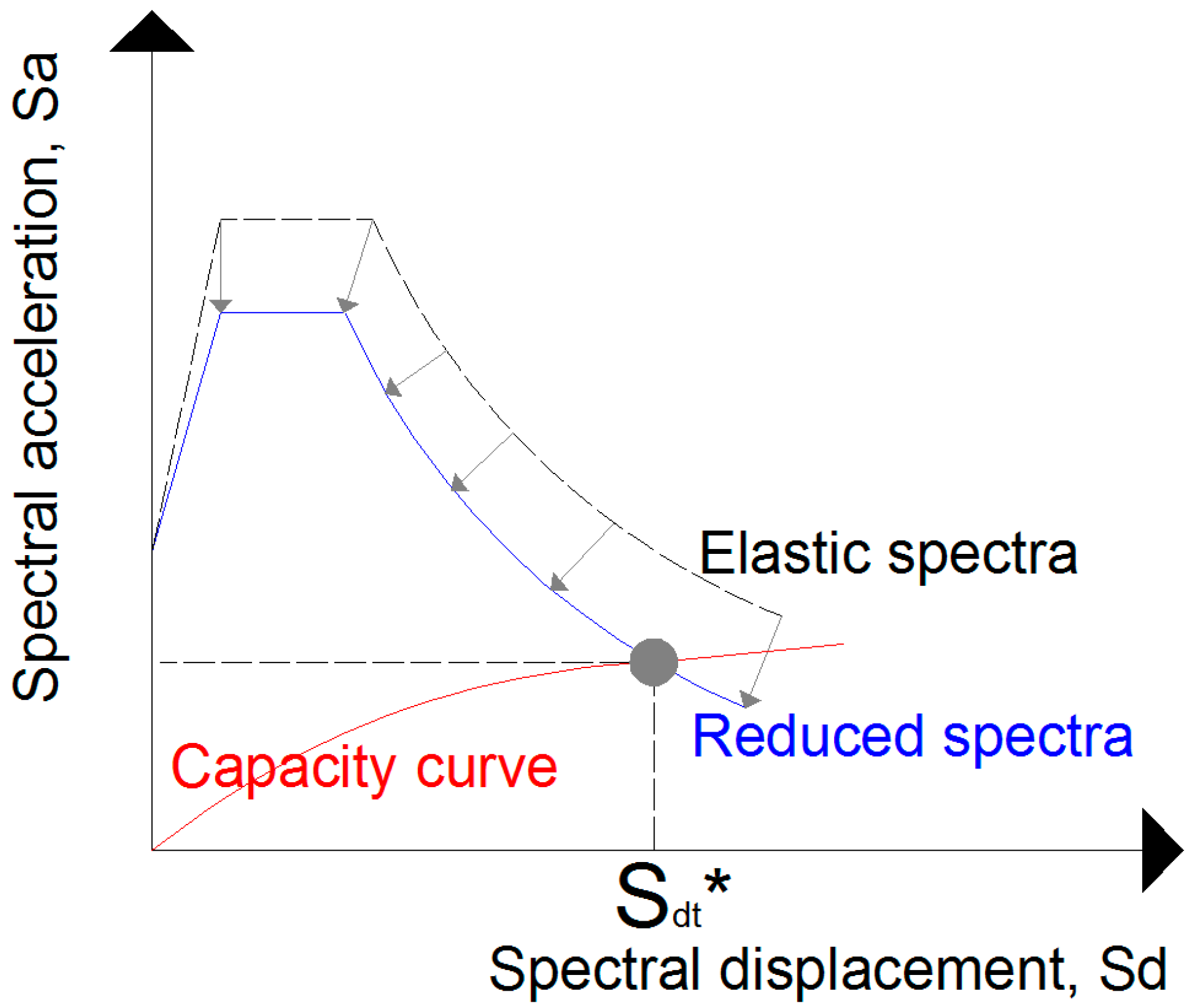
Evaluation of the equivalent viscous damping needed to achieve the target performance point.
Figure 5.
Evaluation of the equivalent viscous damping needed to achieve the target performance point.
4. Proposed Design Procedure
The previous sections discussed the key aspects of evaluating the seismic response of a structure with ADS. This section provides a detailed explanation of the proposed procedure.
The proposed procedure is based on the capacity spectrum method (CSM), and the design objective is expressed in terms of a displacement limit. It's crucial to emphasize that existing buildings, often designed without seismic considerations, tend to be irregular and sensitive to higher modes. This condition can significantly affect the effectiveness of a capacity spectrum-based design procedure, such as the one presented here. Therefore, when deemed suitable for a specific application, the use of a standard pushover analysis can be more efficiently replaced by alternative approaches, such as incremental modal pushover analysis (IMPA) [19]. IMPA extends the well-known modal pushover analysis (MPA) [24,25] to obtain a multimodal capacity curve, which proves valuable for seismic assessment or design implementation.
As dissipative towers alter the structural response of the original building, the procedure is inherently iterative. The capacity curve must be continually updated to reflect the characteristics of the new coupled structure (building + tower).
According to the CSM, considering the energy dissipated by the ADS (in addition to the dissipative capacity of the structure that is computed from the capacity curve of the original structure), the structural response is obtained by reducing the design spectrum based on the damping
tot of S+ADS.
To execute the procedure, the designer must define the desired performance. Since this is a displacement-based procedure, the definition is based on a target displacement, typically corresponding to a chosen limit state under specific seismic conditions. Subsequently, the total effective damping required to match the actual maximum displacement and the target displacement can be determined. The additional damping provided by the ADS (e.g. a dissipative tower)is estimated as the difference between the total damping and the hysteretic damping of the original structure. The characteristics of the ADS are then determined to meet the required additional damping. While the procedure is iterative, it converges after only a few iterations. The key steps are outlined below.
Step 1. Seismic action was defined in terms of the elastic response acceleration spectrum (T-Sa).
Step 2. The target displacement was selected (e.g., the top displacement, Dt*) according to the desired performance (limit state).
Step 3. The capacity curve for the retrofitted structure S+ADS, considering top displacement (Dt) and base shear (Fb), was established through a pushover analysis. A pushover analysis can be conducted by adopting one of the various force distribution methods outlined in the building codes and literature. It is advisable to employ a multimodal procedure. When a modal pushover analysis is performed, it's important to note that the modal shape is influenced by the interaction between the building and the tower. Consequently, at each iteration (Step 3, iteration 1 to n), the load profile must be adjusted to match the modal shape of the current braced structure. It is worth noting that during the initial iteration, the existing building is considered, and the capacity curve obtained at this stage is crucial for assessing the contribution provided by the existing framing structure.
Step 4. The capacity curve obtained in Step 3 can be approximated by a simpler bilinear curve that is completely defined by the yielding point (DS+ADS,y, FS+ADS,y) and the hardening ratio βS+ADS (at the first iteration, the parameters correspond to DS,y, S,y, βS of the existing building). This step can be avoided using a specific software (such as matlab or other calculation tools) and the evaluation of the energy can be performed using the real capacity curve from Step 3.
Step 5. The MDOF system is converted into an SDOF system by transforming the capacity curve into a capacity spectrum (Sdt-Sab).
where Γ is the participation factor of the modal shape φ (Γ=(φTMI)/(φTMφ)) and L=φTMI.
The modal characteristics of the braced structure may change at every iteration owing to new brace characteristics. Therefore, φ, Γ , and L must be updated with the current configuration.
Step 6. The equivalent viscous damping ξ*eq,S+ADS of S+ADS, which is necessary for obtaining the matching between the displacement of the equivalent SDOF system and the target spectral displacement Sdt*=Dt*/(ΓφT), was evaluated by imposing the equivalence of the target displacement and performance displacement. According to the capacity spectrum method the demand spectrum was obtained reducing the 5% damping response spectrum by multiplying for the damping correction factor η that is function of ξtot
From Equation (4.3) one obtain the damping needed to reduce displacement up to the target Sdt*.
Step 7. The damping provided by the structure can be determined using Equation (3.12) is Dt* the top displacement corresponding to and that are the energy dissipated by S and the elastic strain energies of S+T and are determined from the capacity curve of S and S+ADS, respectively).
Step 8. Given from Eq. (4.4), the equivalent viscous damping required to be supplied by the tower (additional equivalent viscous damping contribution due to the tower) is evaluated from Equations (3.11), and (8) as
Step 9. Once the additional equivalent viscous damping (to be provided by the tower) was evaluated using Equation (12), the stiffness and yielding strength required to achieve the desired additional damping can be determined using the same procedure previously adopted for the structure (Step 7). Therefore, the dissipative tower can be designed (e.g., according to the configuration in Figure 1, the extension to the other configurations of Figure 2 is very simple). The energy dissipated by the tower can be expressed as
D was obtained from the pushover analysis according to the control joint (where D is the top displacement Dt).
is the top displacement corresponding to the yielding of the dissipative devices: can be reasonably assumed as , once has been defined, is consequently determined.
A dissipative system usually consists of a dissipative device or a group of devices characterized by Kd and Fdy : the stiffness in the elastic range and the yielding force of the system respectively. The tower, excepting the dissipative devices, has to be designed to remain elastic and to be as stiffer as possible; the following suggestions should be considered.
Designing the tower structure helps calibrate the stiffness of the on dissipative elements: this has to be done after the definition of the global parameters of the additional dissipative system. The ADS can be considered as a series of springs: the dissipative system (with flexibility fd=1/Kd) and an elastic structure (with flexibility fe=1/Ke).
Assuming that the dissipative system is elasto-perfectly plastic:
with
Therefore, remembering Eq. 4.6, fA can be evaluated from Equation (3.11); consequently, selecting a reasonable value for (e.g., ) the dissipative system is defined.
Equation (14), being a dissipative tower, such as a series of dissipative devices and an elastic structure , selecting or designing the dissipative devices according to the desired and , the stiffness required for all components follows, resulting in the evaluation of fe.
5. Application of the procedure to an existing building
The proposed design procedure was applied to the retrofitting of a real building designed according to the 1964 Italian Code (Figure 6) to test a real case characterized by real materials and geometric boundary conditions.
The structure is a regular seven-story RC-frame building, and retrofitting was conducted to achieve a seismic upgrade of up to 60% of the seismic demand required for a new building, with the same function to be realized at the same site, according to Italian NTC 2018 (Italian technical code D.M. 2018, currently in effect in Italy) [26].
In accordance with the proposed approach, incremental modal pushover analyses have been conducted to derive capacity curves and assess the structural response in both the longitudinal and transverse directions. This paper presents the longitudinal analysis for conciseness, as it holds the most significance.
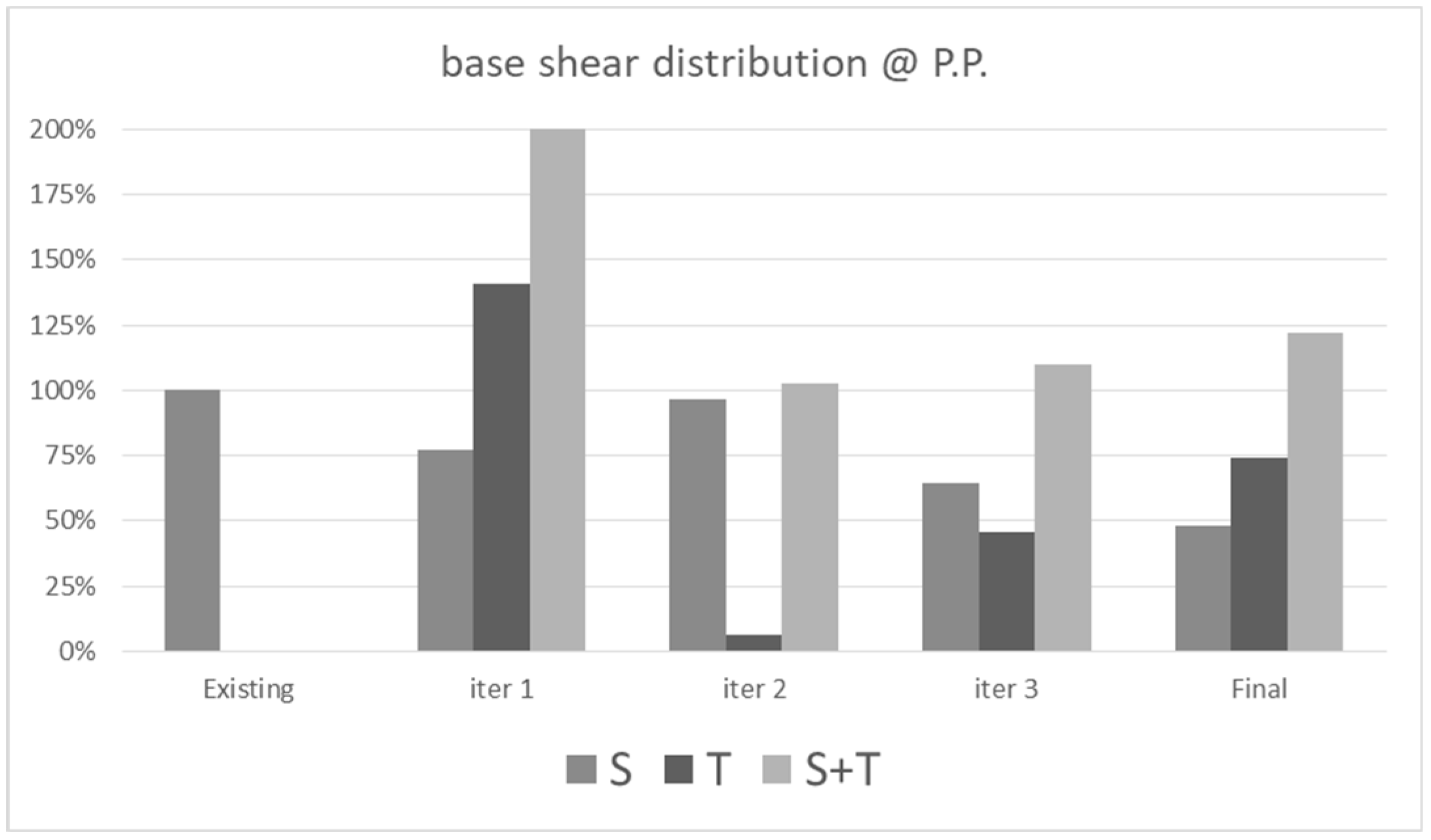
The chosen target displacement, denoted as D*, in the BRB design procedure corresponds to achieving an interstorey drift not exceeding 0.005 times the interstorey height (D0.005, where hi represents the interstorey height). This interstorey limit is reached before the collapse top displacement, Ds,u, is attained (D* = D0.005 < Ds,u = 70 mm). The procedure converged after four iterations. As depicted in Figure 7, the performance point before retrofitting is DS,pp = 100 mm (while the collapse displacement is Ds,u = 70 mm), with a base shear of VS,pp = 3200 kN. In contrast, for the retrofitted structure at the end of the fourth iteration, the performance point corresponds to DS+T,pp,4 = 65 mm and VS+B,pp,4 = 5250 kN. Figure 8 provides a comprehensive illustration of how the retrofitting system enhances the building's safety. Not only does the performance point align with the desired target, but the base shear absorbed by the tower's system significantly reduces the seismic forces absorbed by the existing foundations, which are often challenging to retrofit. The overall increase in base shear at the performance point is from 3200 to 5250 kN, distributed as follows: 2367 kN on the existing foundations (a 28% reduction) and 3899 kN on the new foundations of the three towers (refer to Figure 9). In terms of damping, the equivalent viscous damping in the final configuration is νS = 0.21, and νS+T,4 = 0.43.
5. Conclusions
This paper presents and discusses a displacement-based procedure for designing ADSs for the seismic rehabilitation of existing buildings.
The primary objective of this procedure is to achieve a specified target displacement, thereby limiting deformations and interstorey drift while enhancing dissipation. A closely related benefit is a significant reduction in the base shear on existing foundations.
The proposed procedure, which involves determining the stiffness and yielding force of the dissipative system, is relatively straightforward as it relies on static (non-linear) analysis. However, it requires several iterations to reach convergence. Additionally, it can adapt to various challenging situations working with existing structures, including irregularities in plan and elevation, low plastic limits, and other characteristics.
This approach distinguishes itself from others by considering the contributions of the existing structure. Furthermore, it meticulously evaluates the contribution of the dissipative system to meet the required performance of the new global system: the existing building + ADS.
This procedure originates from a revision of a method for designing dissipative braces [17,18,19,20]. Its effectiveness, based on non-linear static analysis, has been demonstrated through the applications discussed here.
The authors believe that the proposed approach represents a substantial advancement in displacement-based design for retrofitting with dissipative systems, especially given the limited discussion on the use of dissipative towers in the existing literature. This approach is both theoretically simple and straightforward in execution, making it suitable for professional applications without requiring expertise in complex non-linear dynamic analysis. Only common static pushover analysis is necessary.
References
- La Greca, P.; Margani, G. Seismic and energy renovation measures for sustainable cities: A critical analysis of the Italian scenario. Sustainability 2018, 10, 254. [Google Scholar] [CrossRef]
- Mangold, M.; Österbring, M.; Wallbaum, H.; Thuvander, L.; Femenias, P. Socio-economic impact of renovation and energy retrofitting of the Gothenburg building stock. Energy Build. 2016, 123, 41–49. [Google Scholar] [CrossRef]
- Foti, D.; Ruggiero, F.; Sabbà, M.F.; Lerna, M. A Dissipating Frames for Seismic Retrofitting and Building Energy-Eciency. MDPI Infrastructures; 2020. [Google Scholar]
- Roia, D.; Gara, F.; Balducci, A.; Dezi, L. Dynamic tests on an existing r.c. school building retrofitted with “dissipative towers”. 11th international conference on Vibration Problems. Sep 9–12, Lisbon, Portugal, 2013.
- Roia, D.; Gara, F.; Balducci, A.; Dezi, L. Ambient vibration tests on a reinforced concrete school building before and after retrofitting works with external steel. Dissipative Towers. Proceedings of the 9th International Conference on Structural Dynamics, EURODYN 2014; Porto, Portugal, 2014; June 30.
- Gioiella et al., 2017.
- FEMA-274. NEHRP 1997. Commentary on the Guidelines for the Seismic Rehabilitation of Buildings, Federal Emergency Management Agency Publication; U.S.A., 274.
- FEMA – ASCE. Prestandard and Commentary for the Seismic Rehabilitation of Buildings, Washington, DC, USA, 2000; p. 356.
- Kim, J.; Choi, H. Behavior and design of structures with buckling-restrained braces. Eng. Struct. 2004, 26, 693–706. [Google Scholar] [CrossRef]
- Ponzo et al., 2009.
- Durucan and Dicleli (2010).
- Bergami, A.V.; Nuti, C. Design of dissipative braces for an existing strategic building with a pushover based procedure. Proceedings of the COMPDYN 2013, 4th ECCOMAS Conference, Kos Island, Greece, Jun 12–14 2013, 2013. [CrossRef]
- Bergami, A.V.; Nuti, C. A design procedure of dissipative braces for seismic upgrading structures. Earthquake Struct. 2013, 4, 85–108. [Google Scholar] [CrossRef]
- Bergami et al., 2010.
- Bergami, A.V.; Nuti, C. A design procedure for seismic retrofitting of reinforced concrete frame and concentric braced steel buildings with dissipative bracings. In Proceedings of the COMPDYN 2015; Crete Island: Greece, 2015, 25–27 May, 746–758.
- Bergami, A.V.; Liu, X.; Nuti, C. Evaluation of a Modal Pushover Based Incremental Analysis; American Council on Education 2015, 12-13 June 12-13; Vietri sul Mare, Italy, 2015.
- Bergami, A.V.; Liu, X.; Nuti, C. Proposal and application of the incremental modal pushover analysis (IMPA). IABSE Reports. Proceedings of the IABSE Conference – Structural Engineering: Providing Solutions to Global Challenges, Sep 23–25, Geneva, Switzerland 2015, 1695–1700. [CrossRef]
- Bergami AV, Forte A, Lavorato D, Nuti C (2017). Proposal of a Incremental Modal Pushover Analysis (IMPA). Techno Press, Earthquake & Structures, Vol. 13, No. 6 (2017) 539-549, ISSN: 2092-7614 (Print), 2092-7622.
- Bergami A. V., Forte A., Lavorato D., Nuti C. (2017), “The incremental modal pushover analysis (IMPA): proposal and application”, 16WCEE, January 9-13, Santiago del Chile, Chile.
- Mazza and Vulcano (2015).
- Applied Technology Council. Seismic Evaluation and Retrofit of Concrete Buildings, Report ATC-40; Redwood City, CA, 1996; Vol. 1996.
- Black, C.J.; Makris, N.; Aiken, I.D. Component testing, seismic evaluation and characterization of buckling-restrained braces. J. Struct. Eng. 2004, 130, 880–894. [Google Scholar] [CrossRef]
- Chopra, A.K.; Goel, R.K. A modal pushover analysis procedure for estimating seismic demands for buildings. Earthquake Eng. Struct. Dyn. 2002, 31, 561–582. [Google Scholar] [CrossRef]
- Chopra, A.K.; Goel, R.K. Direct displacement-based design: Use of inelastic vs. elastic design spectra. Earthquake Spectra 2001, 17, 47–64. [Google Scholar] [CrossRef]
- Italian technical code D.M. 2018.
- Constantinou, M.C.; Soong, T.T.; Dargush, G.F. Passive Energy Dissipation Systems for Structural Design and Retrofit, MCEER; State University of New York at Buffalo, 1998.
- Fajfar, P. Capacity spectrum method based on inelastic spectra. Earthquake Eng. Struct. Dyn. 1999, 28, 979–993. [Google Scholar]
- Lavorato, D.; et al. Ultrahigh-performance fibre-reinforced concrete jacket for the repair and the seismic retrofitting of Italian and Chinese RC bridges. COMPDYN. Proceedings of the 6th Interna-Tional Conference on Computational Methods in Structural Dynamics and Earthquake Engineering; Vol. 1; Rhodes Island: Greece; 15-17 June 2017, 2017; pp. 2149–2160.
- Lavorato, D.; et al. A corrosion model for the interpretation of cyclic behavior of reinforced concrete sections. Struct. Concr. 2019, 1–15. [CrossRef]
- Mazzolani, F.M. Seismic Upgrading of RC Buildings by Advanced Techniques, The ILVA-IDEM Research Project, Polimerica Publisher, 2006.
- Sabelli, R.; Mahin, S.; Chang, C. Supplemental energy dissipation: State-of-the-art and state-of-the-practice. Eng. Struct. 2003, 25, 655–666. [Google Scholar] [CrossRef]
- Soong, T.T.; Spencer, B.F., Jr. Supplemental energy dissipation: State-of-the-art and state-of-the-practice. Eng. Struct. 2002, 24, 243–259. [Google Scholar] [CrossRef]
Figure 1.
Building S retrofitted with the ADS: distribution of base shear.
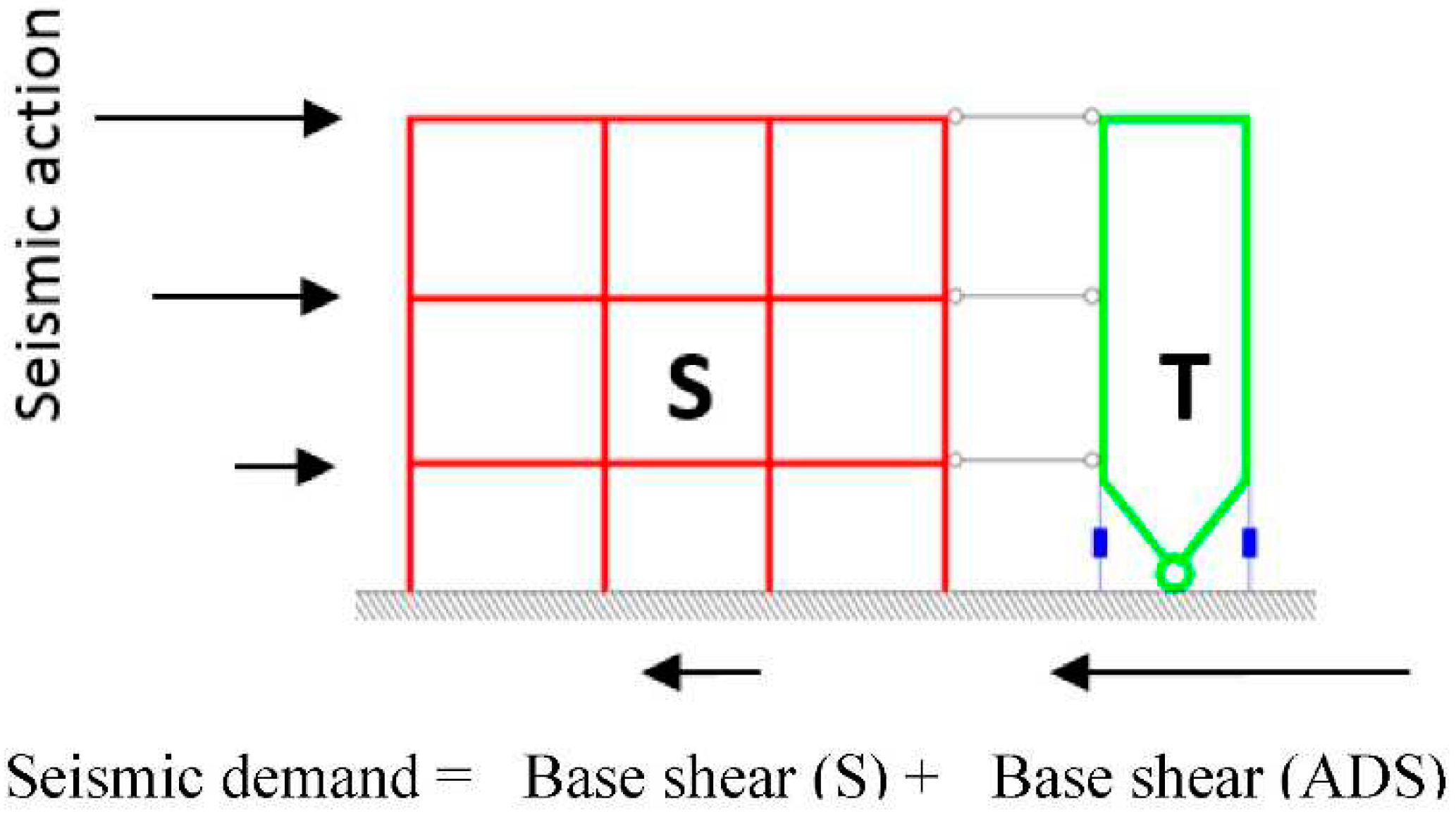
Figure 2.
Possible configurations of dissipative devices of the ADS: (a) at the hinge of a tower, (b) at each connection between S and contrast structure, (c) as dissipative braces inside framing system.
Figure 2.
Possible configurations of dissipative devices of the ADS: (a) at the hinge of a tower, (b) at each connection between S and contrast structure, (c) as dissipative braces inside framing system.
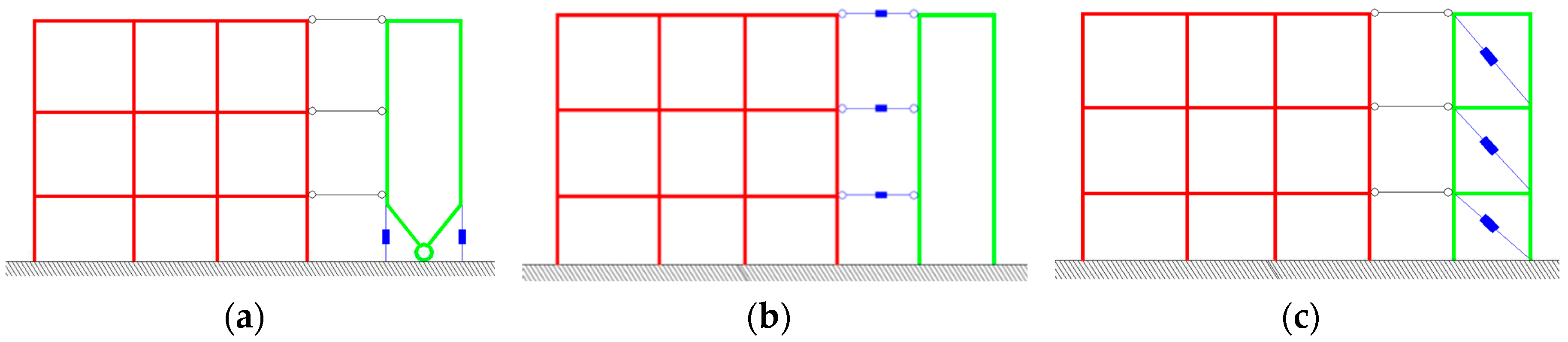
Figure 3.
Interaction between the structure (S) and ADS expressed in terms of horizontal components of the force-displacement relationship.
Figure 3.
Interaction between the structure (S) and ADS expressed in terms of horizontal components of the force-displacement relationship.
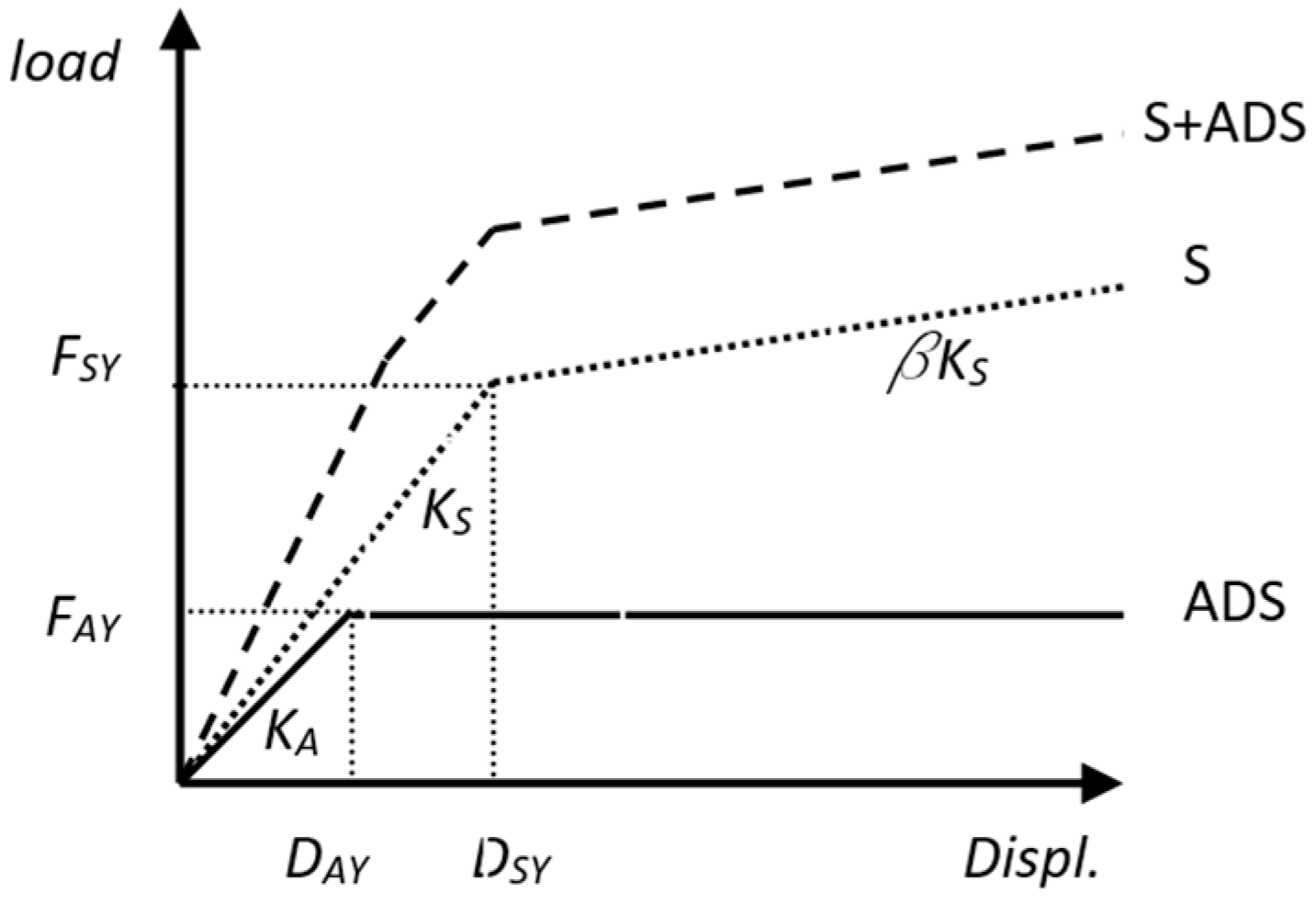
Figure 6.
Planar and 3D view of the existing building.
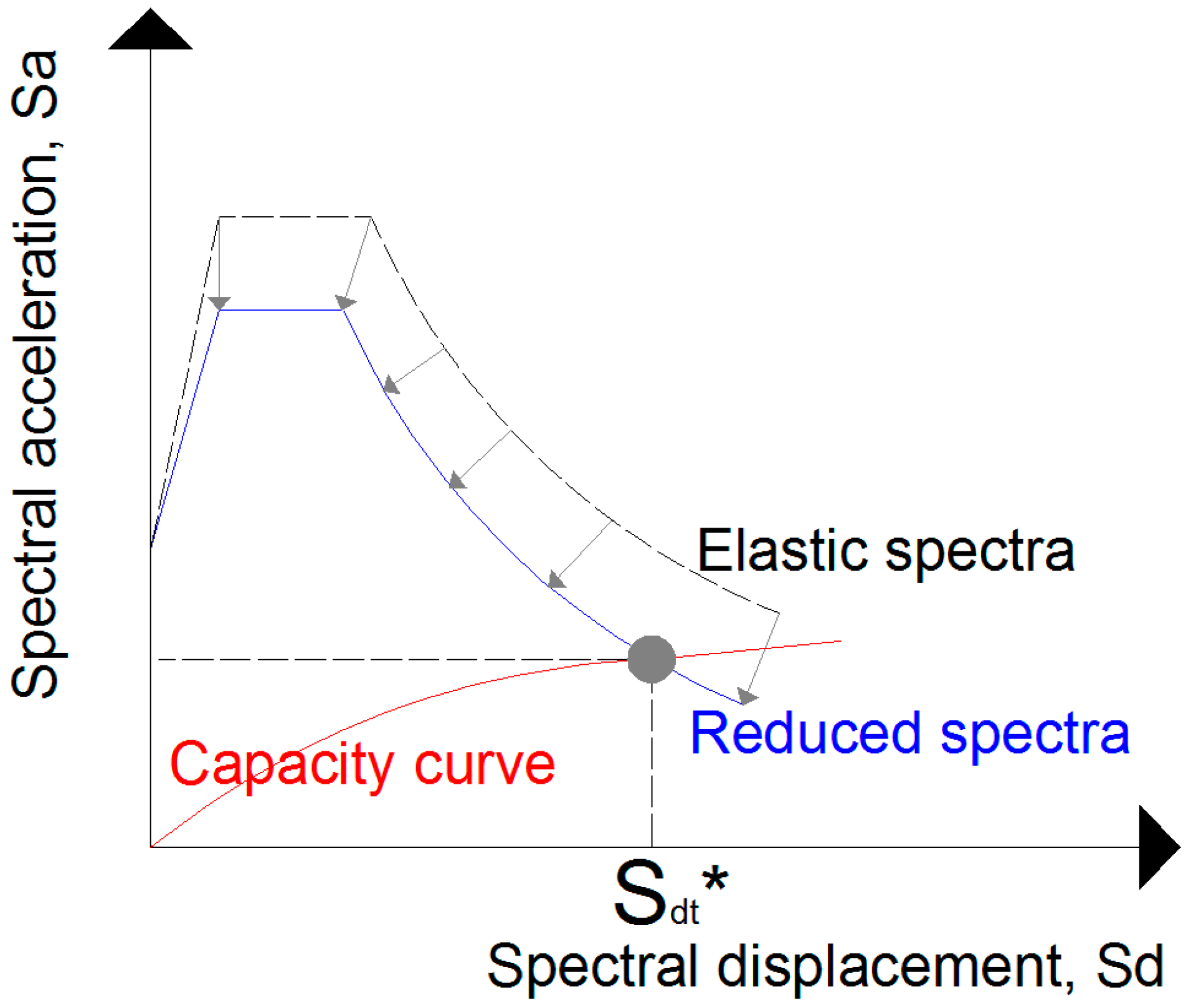
Figure 7.
Planar and 3D view of the retrofitted building (A1, A2, and A3 are the designed ADS).
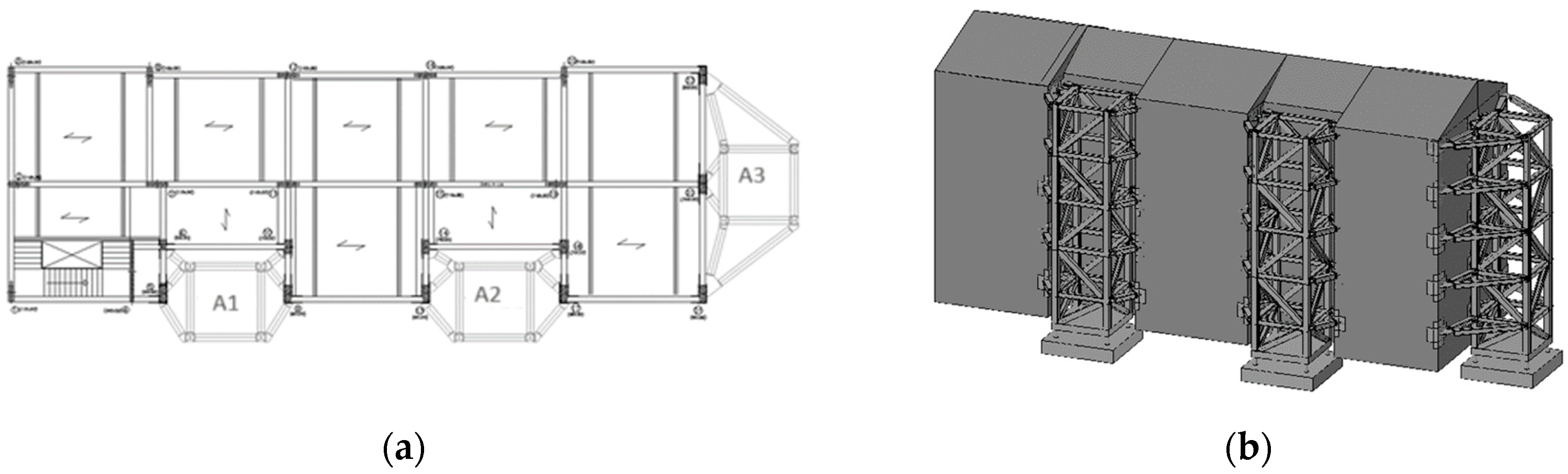
Figure 8.
Variation of global response S+ADS (cumulative base shear-top displacement) and contribution of the dissipative towers T (towers base shear-top displacement).
Figure 8.
Variation of global response S+ADS (cumulative base shear-top displacement) and contribution of the dissipative towers T (towers base shear-top displacement).
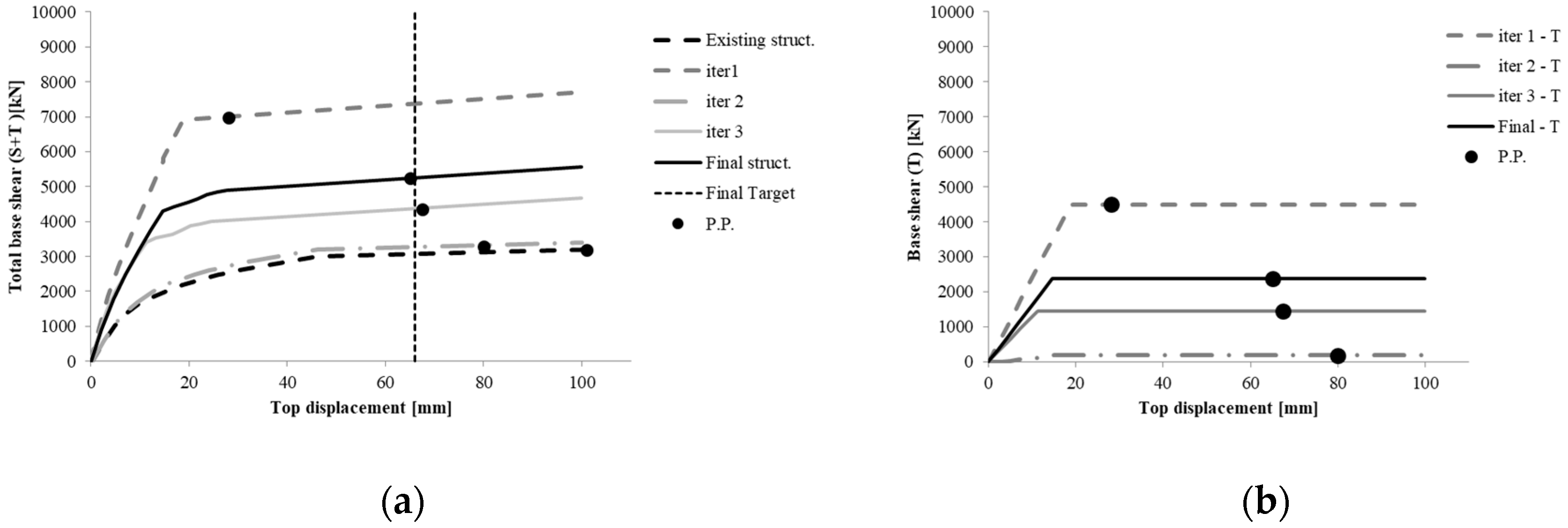
Figure 9.
Distribution of base shear between S and T according to the different stages of the design procedure (100% is the base shear of the existing structure at the performance point).
Figure 9.
Distribution of base shear between S and T according to the different stages of the design procedure (100% is the base shear of the existing structure at the performance point).
Disclaimer/Publisher’s Note: The statements, opinions and data contained in all publications are solely those of the individual author(s) and contributor(s) and not of MDPI and/or the editor(s). MDPI and/or the editor(s) disclaim responsibility for any injury to people or property resulting from any ideas, methods, instructions or products referred to in the content. |
© 2023 by the authors. Licensee MDPI, Basel, Switzerland. This article is an open access article distributed under the terms and conditions of the Creative Commons Attribution (CC BY) license (http://creativecommons.org/licenses/by/4.0/).
Copyright: This open access article is published under a Creative Commons CC BY 4.0 license, which permit the free download, distribution, and reuse, provided that the author and preprint are cited in any reuse.


