

Submitted:
05 November 2023
Posted:
08 November 2023
Read the latest preprint version here
Abstract
The CXC chemokine receptor 4 (CXCR4, CD184) is a member of the G protein-coupled receptor family that is expressed in most leukocytes. Overexpression of CXCR4 is associated with poor prognosis in not only hematopoietic malignancy but also solid tumors. Because CXCR4 is an attractive target for tumor therapy, reliable preclinical murine models using anti-CXCR4 monoclonal antibodies (mAbs) have been warranted. This study established a novel anti-mouse CXCR4 (mCXCR4) mAb using the Cell-Based Immunization and Screening (CBIS) method. Flow cytometric analysis showed that an anti-mCXCR4 mAb, Cx4Mab-1 (rat IgG2a, kappa), recognized mCXCR4-overexpressed Chinese hamster ovary-K1 (CHO/mCXCR4) cells and endogenously mCXCR4-expressing mouse myeloma P3X63Ag8U.1 (P3U1) cells. Furthermore, Cx4Mab-1 did not recognize mCXCR4-knockout P3U1 cells. The dissociation constants of Cx4Mab-1 for CHO/mCXCR4 and P3U1 were determined as 6.4 × 10⁻⁹ M and 2.3 × 10⁻⁹ M, respectively, indicating that Cx4Mab-1 possesses a high affinity to both endogenous and exogenous mCXCR4-expressing cells. These results indicate that Cx4Mab-1 could be a useful tool for preclinical mouse models.
Keywords:
mouse CXCR4
; monoclonal antibody
; CBIS method
1. Introduction
C-X-C motif chemokine receptor 4 (CXCR4, CD184) is a member of G-protein-coupled receptors for CXCL12 (SDF-1) [1,2]. CXCR4 is expressed on most leukocytes [3,4,5]. CXCR4 activation by CXCL12 induces cell migration, proliferation, and survival through the G-proteins-dependent or -independent (JAK/STAT) pathway [6,7]. Furthermore, the CXCL12/CXCR4 axis plays a critical role in embryonic development [8]. The mice lacking CXCR4 or CXCL12 die on embryonic day 18.5. Both mice exhibit abnormal development of the cerebellum, heart, and vessels in the gastrointestinal tract [9,10].
Overexpression of CXCR4 is associated with poor prognosis in various types of cancers through promoting the proliferation and metastasis [6]. CXCR4 is overexpressed in about 60% of colorectal cancers [11], one of the most common malignancies in the world. Many studies have reported that patients with high CXCR4-expressing colorectal cancers showed frequent lymph node metastasis and distant metastasis [12,13,14]. The metastasized colorectal cancer in the liver, which highly expresses CXCL12, exhibited elevated expression of CXCR4 compared to the primary site [15,16]. An animal experiment using a mouse colorectal cancer CT-26 cell line revealed that CXCR4 is important for metastasis to the liver [17]. Moreover, CXCR4 supports tumor growth by inducing angiogenesis [18,19]. These findings showed that CXCR4 is an attractive target for tumor therapy.
Mouse is a commonly used animal for preclinical studies to predict the efficiency and the safety of cancer therapies [20]. For assessment of cancer therapies, two models are established. The first one is the transplantation of tumors into mice. The other is the induction of tumors in mice by genetic modification and carcinogens. Both models with immunocompetent mice are used for the evaluation of cancer treatments in the presence of host immunity, an important factor affecting the efficiency and the safety of cancer therapies [21]. However, a preclinical model using anti-mouse CXCR4 (mCXCR4) monoclonal antibodies (mAbs) has not been reported.
2. Materials and Methods
2.1. Antibodies and animals
Anti-mCXCR4 (CD184) mAbs (clone L276F12 and clone 2B11/CXCR4) were purchased from BioLegend (San Diego, CA) and BD Biosciences (Franklin Lakes, NJ), respectively. Alexa Fluor 488-conjugated anti-rat IgG was purchased from Cell Signaling Technology, Inc. (Danvers, MA).
We purchased one five–week–old Sprague–Dawley rat from CLEA Japan (Tokyo, Japan). Animal experiments were approved by the Animal Care and Use Committee of Tohoku University (Approved number: 2022MdA-001).
2.2. Cell lines
We obtained LN229, P3X63Ag8U.1 (P3U1), and Chinese hamster ovary (CHO)-K1 cells from the American Type Culture Collection (Manassas, VA). We synthesized DNA (Eurofins Genomics KK) encoding mCXCR4 (Accession No.: NM_009911.3) and subcloned it into a pCAGzeo PAcH vector. PA tag, twelve amino acids (GVAMPGAEDDVV).[24], was added to the C-terminus of mCXCR4. The mCXCR4-PA plasmid was transfected into LN229 and CHO-K1 cells using a Neon transfection system (Thermo Fisher Scientific Inc., Waltham, MA). We established stable transfectants using a cell sorter (SH800; Sony Corp., Tokyo, Japan) after staining them by an anti-mCXCR4 mAb (clone L276F12). We cultivated them in a medium, containing 0.5 mg/mL of Zeocin (InvivoGen, San Diego, CA). We purchased GeneArt™ CRISPR nuclease vectors with OFP plasmid which target mCXCR4 (CGGCAATGGATTGGTGATCC) from Thermo Fisher Scientific Inc. The knockout plasmid was transfected into P3U1 cells. mCXCR4 knockout P3U1 was established by a cell sorter (SH800), and named as BINDS-56 (http://www.med-tohoku-antibody.com/topics/001_paper_cell.htm).
All cells were grown in a humidified incubator at 37oC, in an atmosphere of 5% CO2 and 95%
2.3. Production of hybridomas
For developing anti-mCXCR4 mAbs, a rat was immunized intraperitoneally with 1 × 10⁹ cells of LN229/mCXCR4. We added Alhydrogel adjuvant 2% (InvivoGen, San Diego, CA) as an adjuvant in the first immunization. Three additional injections of 1 × 10⁹ cells were performed without an adjuvant every week. We performed a final booster immunization of 1 × 10⁹ cells intraperitoneally two days before harvesting splenocytes. We fused the harvested splenocytes with P3U1 cells using polyethylene glycol 1500 (PEG1500; Roche Diagnostics, Indianapolis, IN). Hybridoma cells were cultured in the RPMI-1640 medium, supplemented as shown above. We further added 5 μg/mL of Plasmocin, 5% Briclone (NICB, Dublin, Ireland), and hypoxanthine, aminopterin and thymidine (HAT; Thermo Fisher Scientific, Inc.) into the medium. The supernatants were screened by flow cytometry using CHO/mCXCR4. The cultured supernatants of hybridomas were filtrated and purified using Capto L (Cytiva, Marlborough, MA).
2.4. Flow cytometry
We harvested CHO-K1 and CHO/mCXCR4 cells using 1 mM EDTA. The cells and P3U1 and BINDS-56 were washed with 0.1% bovine serum albumin (BSA) in PBS and reacted with 10 to 0.01 μg/mL of anti-mCXCR4 mAbs or blocking buffer (contol) for 30 min at 4oC. The cells were treated with 2 μg/mL of anti-rat IgG conjugated with Alexa Fluor 488. The fluorescence data were collected using the SA3800 Cell Analyzer (Sony Corporation, Tokyo, Japan).
A nti-mCXCR4 mAbs were serially diluted from 10 μg/mL to 0.61 ng/mL to determine the dissociation constant (KD). We used FlowJo v10.8.1 (Becton, Dickinson & Company, Ashland, OR) to calculate the geometric mean of fluorescence intensities of CHO/mCXCR4 and P3U1 at each concentration. The KD was estimated by fitting saturation binding curves to the built-in; one-site binding models in GraphPad PRISM 8 (GraphPad Software, Inc., La Jolla, CA).
3. Results
3.1. Establishment of a novel anti-mouse CXCR4 (mCXCR4) antibody
For developing anti-mCXCR4 mAbs, we immunized one rat with LN229/mCXCR4 cells as depicted in Figure 1A. The hybridomas were produced by fusion of the splenocytes with P3U1 cells using PEG1500 (Figure 1B). CHO/mCXCR4-reactive and CHO-K1-non-reactive mAbs-producing hybridomas were selected by flow cytometry (Figure 1C). After limiting dilution, a clone Cx4Mab-1 (rat IgG2a, kappa) was successfully developed (Figure 1D).
3.2. Specificity of Cx4Mab-1 in flow cytometry
We performed flow cytometry using Cx4Mab-1 against CHO/mCXCR4 and P3U1 cells. We further compared its reactivity with commercially available anti-CXCR4 mAbs (clone L276F12 and clone 2B11/CXCR4). Three mAbs reacted to CHO/mCXCR4 cells in a dose-dependent manner (Figure 2). Although Cx4Mab-1 and L276F12 did not bind to CHO-K1 cells even at 10 µg/mL, 2B11/CXCR4 reacted with CHO-K1 weakly (Supplementary Figure 1). Furthermore, three mAbs reacted to P3U1 cells dose-dependently (Figure 3A). In contrast, three mAbs did not bind to mCXCR4-knockout P3U1 (BINDS-56) cells even at 10 µg/mL (Figure 3B). These results indicated that Cx4Mab-1 recognizes both endogenous and exogenous mCXCR4-expressing cell lines.
3.3. Affinity of Cx4Mab-1 against mCXCR4-expressing cells
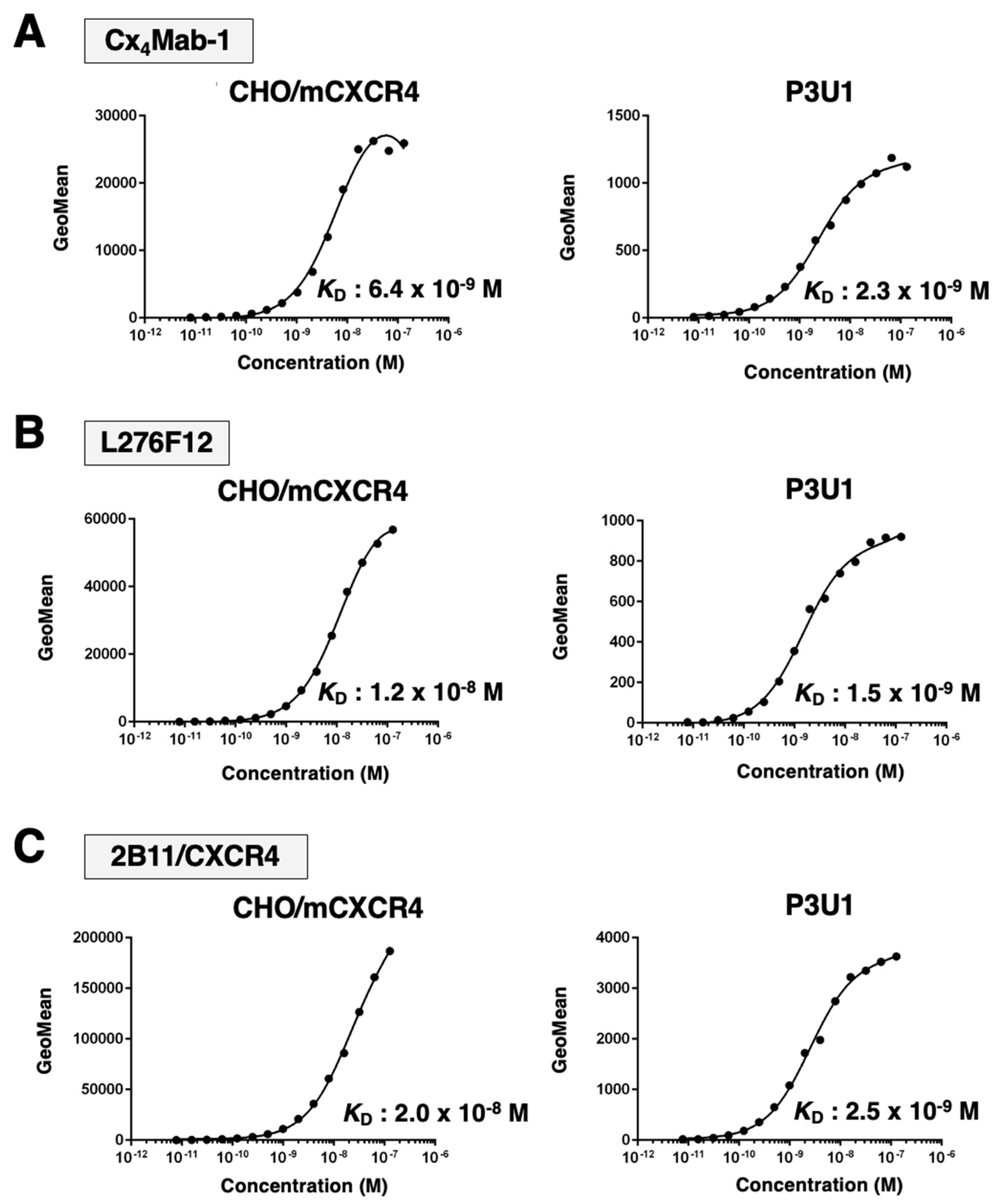
For determining the KD of Cx4Mab-1 to mCXCR4, the kinetic analysis was performed using flow cytometry against CHO/mCXCR4 and P3U1 cells. The geometric mean of Cx4Mab-1-treated cells was plotted. The KD values of Cx4Mab-1 for CHO/mCXCR4 and P3U1 were determined as 6.4 × 10⁻⁹ M and 2.3 × 10⁻⁹ M, respectively (Figure 4A). The KD of L276F12 for CHO/mCXCR4 and P3U1 were determined as 1.2 × 10⁻⁸ M and 1.5 × 10⁻⁹ M, respectively (Figure 4B). The KD values of 2B11/CXCR4 for CHO/mCXCR4 and P3U1 were determined as 2.0 × 10⁻⁸ M and 2.5 × 10⁻⁹ M, respectively (Figure 4C). These results indicated that Cx4Mab-1 possesses a high affinity to both endogenous and exogenous mCXCR4-expressing cells.
4. Discussion
CXCL12-CXCR4 signaling contributes to tumor growth and metastasis in various types of cancer [6]. Therefore, CXCR4-targeted therapies have been developed. Ulocuplumab is a fully human IgG4 anti-human CXCR4 (hCXCR4) mAb [25]. Ulocuplumab induced apoptosis of leukemia cells from chronic lymphocytic leukemia (CLL) patients by blocking CXCL12 binding to hCXCR4. Additionally, a phase Ib/II study in patients with relapsed/refractory multiple myeloma reported that the combination of ulocuplumab with lenalidomide and dexamethasone showed a high response rate (55.2%) and a clinical benefit rate (72.4%) [26]. PF-06747143, another humanized IgG1 anti-hCXCR4 mAb, also showed antitumor activities in multiple hematologic cancer models [27].
A potential side effect of anti-CXCR4 therapy is the toxicity to normal leukocytes and hematopoietic stem cells. The CXCL12/CXCR4 axis is essential for hematopoiesis in fetuses and adults. Deficiencies of CXCR4 or CXCL12 exhibit hematopoietic defects in fetal mice [9,10]. Studies using CXCR4 conditional knockout mice demonstrated that CXCL12/CXCR4 axis also plays critical roles in hematopoiesis in adult [28]. In the bone marrow, CXCL12-CXCR4 signaling tethers hematopoietic stem cells (HSCs) in the niches where the quiescent HSC pool is maintained by supplying the requisite factors. AMD3100 (Plerixafor/Mozobil), an antagonist of CXCR4, induces HSC mobilization from bone marrow to peripheral blood [29]. Cx4Mab-1 could be a useful tool for developing anti-CXCR4 therapies in preclinical murine models.
Supplementary Materials
The following supporting information can be downloaded at the website of this paper posted on Preprints.org.
References
- Bleul, C.C.; Farzan, M.; Choe, H.; Parolin, C.; Clark-Lewis, I.; Sodroski, J.; Springer, T.A. The lymphocyte chemoattractant SDF-1 is a ligand for LESTR/fusin and blocks HIV-1 entry. Nature 1996, 382, 829–833. [Google Scholar] [CrossRef]
- Oberlin, E.; Amara, A.; Bachelerie, F.; Bessia, C.; Virelizier, J.L.; Arenzana-Seisdedos, F.; Schwartz, O.; Heard, J.M.; Clark-Lewis, I.; Legler, D.F.; et al. The CXC chemokine SDF-1 is the ligand for LESTR/fusin and prevents infection by T-cell-line-adapted HIV-1. Nature 1996, 382, 833–835. [Google Scholar] [CrossRef]
- Lee, B.; Sharron, M.; Montaner, L.J.; Weissman, D.; Doms, R.W. Quantification of CD4, CCR5, and CXCR4 levels on lymphocyte subsets, dendritic cells, and differentially conditioned monocyte-derived macrophages. Proc Natl Acad Sci U S A 1999, 96, 5215–5220. [Google Scholar] [CrossRef]
- Nie, Y.; Waite, J.; Brewer, F.; Sunshine, M.J.; Littman, D.R.; Zou, Y.R. The role of CXCR4 in maintaining peripheral B cell compartments and humoral immunity. J Exp Med 2004, 200, 1145–1156. [Google Scholar] [CrossRef]
- Schabath, R.; Muller, G.; Schubel, A.; Kremmer, E.; Lipp, M.; Forster, R. The murine chemokine receptor CXCR4 is tightly regulated during T cell development and activation. J Leukoc Biol 1999, 66, 996–1004. [Google Scholar] [CrossRef]
- Chatterjee, S.; Behnam Azad, B.; Nimmagadda, S. The intricate role of CXCR4 in cancer. Adv Cancer Res 2014, 124, 31–82. [Google Scholar] [CrossRef]
- Busillo, J.M.; Benovic, J.L. Regulation of CXCR4 signaling. Biochim Biophys Acta 2007, 1768, 952–963. [Google Scholar] [CrossRef]
- Nagasawa, T.; Tachibana, K.; Kishimoto, T. A novel CXC chemokine PBSF/SDF-1 and its receptor CXCR4: their functions in development, hematopoiesis and HIV infection. Semin Immunol 1998, 10, 179–185. [Google Scholar] [CrossRef]
- Ma, Q.; Jones, D.; Borghesani, P.R.; Segal, R.A.; Nagasawa, T.; Kishimoto, T.; Bronson, R.T.; Springer, T.A. Impaired B-lymphopoiesis, myelopoiesis, and derailed cerebellar neuron migration in CXCR4- and SDF-1-deficient mice. Proc Natl Acad Sci U S A 1998, 95, 9448–9453. [Google Scholar] [CrossRef]
- Tachibana, K.; Hirota, S.; Iizasa, H.; Yoshida, H.; Kawabata, K.; Kataoka, Y.; Kitamura, Y.; Matsushima, K.; Yoshida, N.; Nishikawa, S.; et al. The chemokine receptor CXCR4 is essential for vascularization of the gastrointestinal tract. Nature 1998, 393, 591–594. [Google Scholar] [CrossRef]
- Hjazi, A.; Nasir, F.; Noor, R.; Alsalamy, A.; Zabibah, R.S.; Romero-Parra, R.M.; Ullah, M.I.; Mustafa, Y.F.; Qasim, M.T.; Akram, S.V. The pathological role of C-X-C chemokine receptor type 4 (CXCR4) in colorectal cancer (CRC) progression; special focus on molecular mechanisms and possible therapeutics. Pathol Res Pract 2023, 248, 154616. [Google Scholar] [CrossRef]
- Amara, S.; Chaar, I.; Khiari, M.; Ounissi, D.; Weslati, M.; Boughriba, R.; Hmida, A.B.; Bouraoui, S. Stromal cell derived factor-1 and CXCR4 expression in colorectal cancer promote liver metastasis. Cancer Biomark 2015, 15, 869–879. [Google Scholar] [CrossRef]
- Xu, C.; Zheng, L.; Li, D.; Chen, G.; Gu, J.; Chen, J.; Yao, Q. CXCR4 overexpression is correlated with poor prognosis in colorectal cancer. Life Sci 2018, 208, 333–340. [Google Scholar] [CrossRef]
- Yoshitake, N.; Fukui, H.; Yamagishi, H.; Sekikawa, A.; Fujii, S.; Tomita, S.; Ichikawa, K.; Imura, J.; Hiraishi, H.; Fujimori, T. Expression of SDF-1 alpha and nuclear CXCR4 predicts lymph node metastasis in colorectal cancer. Br J Cancer 2008, 98, 1682–1689. [Google Scholar] [CrossRef]
- Kim, J.; Takeuchi, H.; Lam, S.T.; Turner, R.R.; Wang, H.J.; Kuo, C.; Foshag, L.; Bilchik, A.J.; Hoon, D.S. Chemokine receptor CXCR4 expression in colorectal cancer patients increases the risk for recurrence and for poor survival. J Clin Oncol 2005, 23, 2744–2753. [Google Scholar] [CrossRef]
- Matsusue, R.; Kubo, H.; Hisamori, S.; Okoshi, K.; Takagi, H.; Hida, K.; Nakano, K.; Itami, A.; Kawada, K.; Nagayama, S.; et al. Hepatic stellate cells promote liver metastasis of colon cancer cells by the action of SDF-1/CXCR4 axis. Ann Surg Oncol 2009, 16, 2645–2653. [Google Scholar] [CrossRef]
- Zeelenberg, I.S.; Ruuls-Van Stalle, L.; Roos, E. The chemokine receptor CXCR4 is required for outgrowth of colon carcinoma micrometastases. Cancer Res 2003, 63, 3833–3839. [Google Scholar]
- Xu, J.; Liang, J.; Meng, Y.M.; Yan, J.; Yu, X.J.; Liu, C.Q.; Xu, L.; Zhuang, S.M.; Zheng, L. Vascular CXCR4 Expression Promotes Vessel Sprouting and Sensitivity to Sorafenib Treatment in Hepatocellular Carcinoma. Clin Cancer Res 2017, 23, 4482–4492. [Google Scholar] [CrossRef]
- Yoshida, S.; Kawai, H.; Eguchi, T.; Sukegawa, S.; Oo, M.W.; Anqi, C.; Takabatake, K.; Nakano, K.; Okamoto, K.; Nagatsuka, H. Tumor Angiogenic Inhibition Triggered Necrosis (TAITN) in Oral Cancer. Cells 2019, 8. [Google Scholar] [CrossRef]
- Ireson, C.R.; Alavijeh, M.S.; Palmer, A.M.; Fowler, E.R.; Jones, H.J. The role of mouse tumour models in the discovery and development of anticancer drugs. Br J Cancer 2019, 121, 101–108. [Google Scholar] [CrossRef]
- Chulpanova, D.S.; Kitaeva, K.V.; Rutland, C.S.; Rizvanov, A.A.; Solovyeva, V.V. Mouse Tumor Models for Advanced Cancer Immunotherapy. Int J Mol Sci 2020, 21. [Google Scholar] [CrossRef]
- Asano, T.; Nanamiya, R.; Takei, J.; Nakamura, T.; Yanaka, M.; Hosono, H.; Tanaka, T.; Sano, M.; Kaneko, M.K.; Kato, Y. Development of Anti-Mouse CC Chemokine Receptor 3 Monoclonal Antibodies for Flow Cytometry. Monoclon Antib Immunodiagn Immunother 2021, 40, 107–112. [Google Scholar] [CrossRef]
- Tanaka, T.; Nanamiya, R.; Takei, J.; Nakamura, T.; Yanaka, M.; Hosono, H.; Sano, M.; Asano, T.; Kaneko, M.K.; Kato, Y. Development of Anti-Mouse CC Chemokine Receptor 8 Monoclonal Antibodies for Flow Cytometry. Monoclon Antib Immunodiagn Immunother 2021, 40, 65–70. [Google Scholar] [CrossRef]
- Fujii, Y.; Kaneko, M.; Neyazaki, M.; Nogi, T.; Kato, Y.; Takagi, J. PA tag: a versatile protein tagging system using a super high affinity antibody against a dodecapeptide derived from human podoplanin. Protein Expr Purif 2014, 95, 240–247. [Google Scholar] [CrossRef]
- Kashyap, M.K.; Kumar, D.; Jones, H.; Amaya-Chanaga, C.I.; Choi, M.Y.; Melo-Cardenas, J.; Ale-Ali, A.; Kuhne, M.R.; Sabbatini, P.; Cohen, L.J.; et al. Ulocuplumab (BMS-936564 / MDX1338): a fully human anti-CXCR4 antibody induces cell death in chronic lymphocytic leukemia mediated through a reactive oxygen species-dependent pathway. Oncotarget 2016, 7, 2809–2822. [Google Scholar] [CrossRef]
- Ghobrial, I.M.; Liu, C.J.; Redd, R.A.; Perez, R.P.; Baz, R.; Zavidij, O.; Sklavenitis-Pistofidis, R.; Richardson, P.G.; Anderson, K.C.; Laubach, J.; et al. A Phase Ib/II Trial of the First-in-Class Anti-CXCR4 Antibody Ulocuplumab in Combination with Lenalidomide or Bortezomib Plus Dexamethasone in Relapsed Multiple Myeloma. Clin Cancer Res 2020, 26, 344–353. [Google Scholar] [CrossRef]
- Kashyap, M.K.; Amaya-Chanaga, C.I.; Kumar, D.; Simmons, B.; Huser, N.; Gu, Y.; Hallin, M.; Lindquist, K.; Yafawi, R.; Choi, M.Y.; et al. Targeting the CXCR4 pathway using a novel anti-CXCR4 IgG1 antibody (PF-06747143) in chronic lymphocytic leukemia. J Hematol Oncol 2017, 10, 112. [Google Scholar] [CrossRef]
- Sugiyama, T.; Kohara, H.; Noda, M.; Nagasawa, T. Maintenance of the hematopoietic stem cell pool by CXCL12-CXCR4 chemokine signaling in bone marrow stromal cell niches. Immunity 2006, 25, 977–988. [Google Scholar] [CrossRef]
- Larochelle, A.; Krouse, A.; Metzger, M.; Orlic, D.; Donahue, R.E.; Fricker, S.; Bridger, G.; Dunbar, C.E.; Hematti, P. AMD3100 mobilizes hematopoietic stem cells with long-term repopulating capacity in nonhuman primates. Blood 2006, 107, 3772–3778. [Google Scholar] [CrossRef]
Figure 1.
The scheme of establishment of Cx4Mab-1 by CBIS method. (A) We immunized LN229/mCXCR4 cells into a Sprague–Dawley rat intraperitoneally. (B) We fused the splenocytes with P3U1 cells. (C) The culture supernatants were screened by flow cytometry for selecting anti-mCXCR4 mAb-producing hybridomas. (D) Cx4Mab-1 was developed by limiting dilution.
Figure 1.
The scheme of establishment of Cx4Mab-1 by CBIS method. (A) We immunized LN229/mCXCR4 cells into a Sprague–Dawley rat intraperitoneally. (B) We fused the splenocytes with P3U1 cells. (C) The culture supernatants were screened by flow cytometry for selecting anti-mCXCR4 mAb-producing hybridomas. (D) Cx4Mab-1 was developed by limiting dilution.
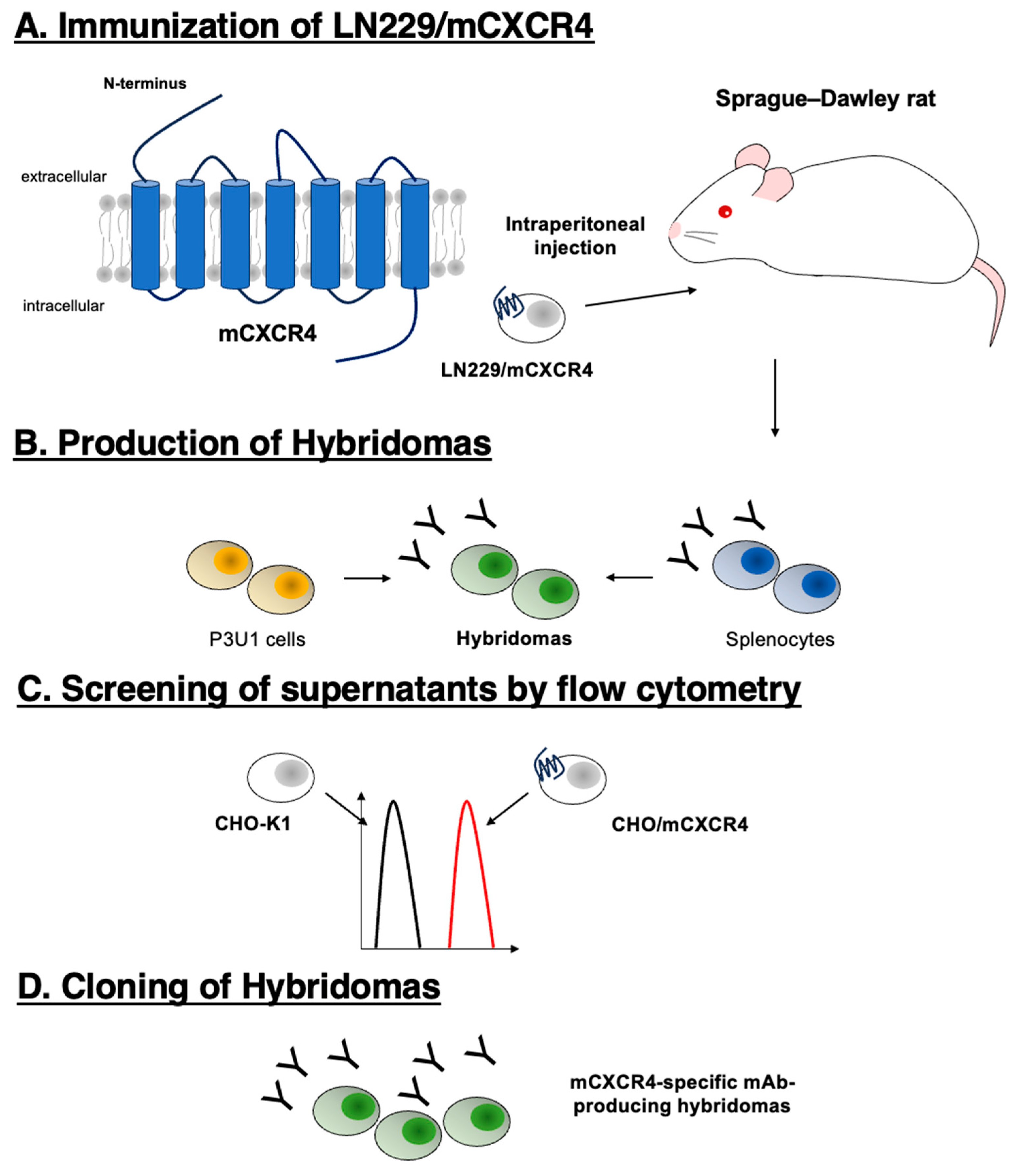
Figure 2.
Flow cytometry of mCXCR4-overexpressed cells using anti-mCXCR4 mAbs. CHO/mCXCR4 cells were treated with 0.01–10µg/mL of Cx4Mab-1, L276F12, or 2B11/CXCR4 followed by treatment with the secondary antibody. The red lines show the cells treated with each mAb. The black line shows the cells treated with blocking buffer and the secondary antibody (negative control).
Figure 2.
Flow cytometry of mCXCR4-overexpressed cells using anti-mCXCR4 mAbs. CHO/mCXCR4 cells were treated with 0.01–10µg/mL of Cx4Mab-1, L276F12, or 2B11/CXCR4 followed by treatment with the secondary antibody. The red lines show the cells treated with each mAb. The black line shows the cells treated with blocking buffer and the secondary antibody (negative control).
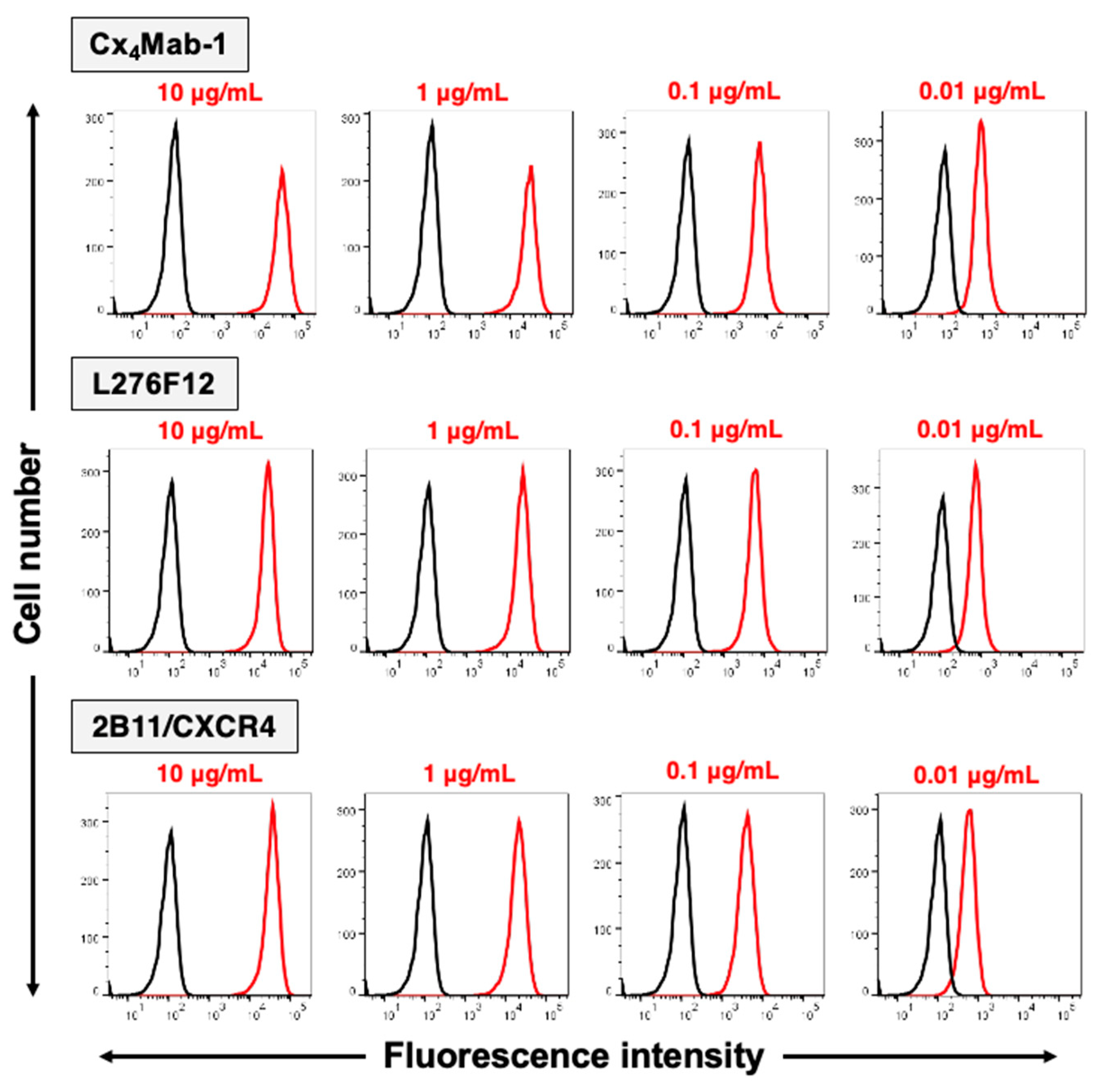
Figure 3.
Flow cytometry of endogenously mCXCR4-expressed cells using anti-mCXCR4 mAbs. P3U1 (A) and mCXCR4-knockout P3U1 (BINDS-56) (B) cells were treated with 0.01–10 µg/mL of Cx4Mab-1, L276F12, or 2B11/CXCR4 followed by treatment with the secondary antibody. The red line shows the cells treated with each mAb. The black line shows the cells treated with blocking buffer and the secondary antibody (negative control).
Figure 3.
Flow cytometry of endogenously mCXCR4-expressed cells using anti-mCXCR4 mAbs. P3U1 (A) and mCXCR4-knockout P3U1 (BINDS-56) (B) cells were treated with 0.01–10 µg/mL of Cx4Mab-1, L276F12, or 2B11/CXCR4 followed by treatment with the secondary antibody. The red line shows the cells treated with each mAb. The black line shows the cells treated with blocking buffer and the secondary antibody (negative control).
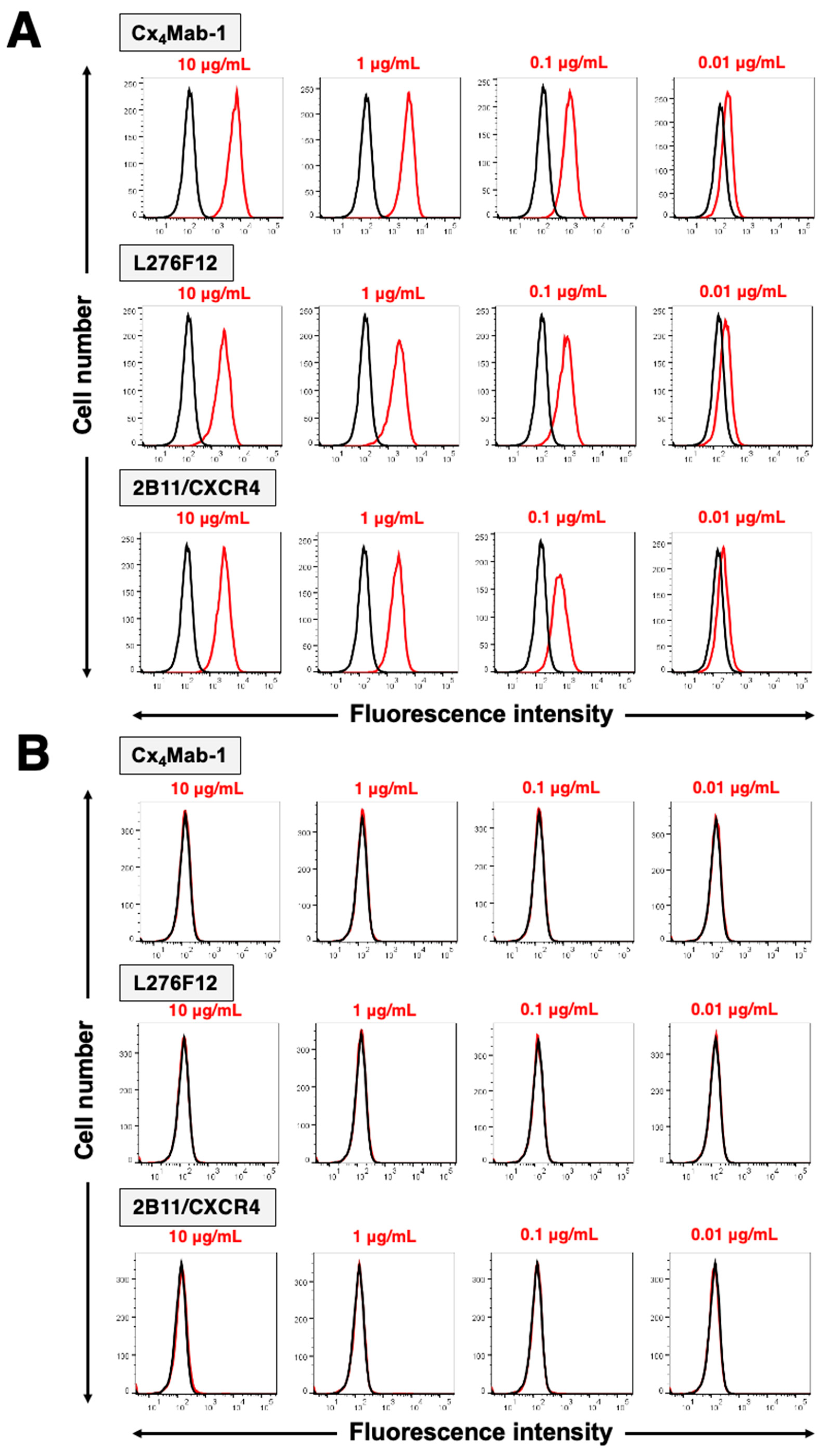
Figure 4.
Kinetic analyses of anti-mCXCR4 mAbs against mCXCR4-expressed cells through flow cytometry. The determination of the binding affinity of Cx4Mab-1 (A), L276F12 (B), and 2B11/CXCR4 (C) against CHO/mCXCR4 or P3U1 cells by flow cytometry. The dots show the geometric mean of fluorescence intensity of CHO/mCXCR4 and P3U1 at each concentration. The solid lines are the fitting curve calculated by GraphPad PRISM 8.
Figure 4.
Kinetic analyses of anti-mCXCR4 mAbs against mCXCR4-expressed cells through flow cytometry. The determination of the binding affinity of Cx4Mab-1 (A), L276F12 (B), and 2B11/CXCR4 (C) against CHO/mCXCR4 or P3U1 cells by flow cytometry. The dots show the geometric mean of fluorescence intensity of CHO/mCXCR4 and P3U1 at each concentration. The solid lines are the fitting curve calculated by GraphPad PRISM 8.
Disclaimer/Publisher’s Note: The statements, opinions and data contained in all publications are solely those of the individual author(s) and contributor(s) and not of MDPI and/or the editor(s). MDPI and/or the editor(s) disclaim responsibility for any injury to people or property resulting from any ideas, methods, instructions or products referred to in the content. |
© 2023 by the authors. Licensee MDPI, Basel, Switzerland. This article is an open access article distributed under the terms and conditions of the Creative Commons Attribution (CC BY) license (http://creativecommons.org/licenses/by/4.0/).
Copyright: This open access article is published under a Creative Commons CC BY 4.0 license, which permit the free download, distribution, and reuse, provided that the author and preprint are cited in any reuse.