

Submitted:
20 February 2025
Posted:
21 February 2025
You are already at the latest version
Abstract
This article reflects on emergent findings from an interdisciplinary practice-based doctoral research project situated in the fine arts. Grounded in artistic practices of ‘making’, and weaving in approaches from psychoanalysis and art psychotherapy, the author explores what happens when things are moved from one context to another and how meaning is continually (un)made and (re)made over time through returning to revisit and respond to material ‘made’ in the past as it meets the stuff of new situations in the present. Emphasising the affective ‘work’ of art-as-research, attention is drawn to sites of ‘making’ as reflexive spaces for imaginative encounter, performative enactment, and working through, where understanding emerges through the affective work of moving, (re)assembling, and (re)configuring diverse practices and materials, the interweaving of dialogues, and the negotiation of tensions and resistances encountered at the borders between different domains. Claiming a position in the broad area of reflective practice(s) the research amplifies the significance of ‘transference’ as a reflexive method of enquiry, and the creative potential of art as a performative research practice; pushing beyond more conventional ideas of reflection and reflexivity in its capacity to embrace complex relationalities, and engage affective, ethical, sensibilities through the moving, modifying, and handling of ‘stuff’.
Keywords:
art as research
; psychoanalysis
; art psychotherapy
; transference and countertransference
; affective reflexivity
; reflective practice
; ethics
Introduction
This article revisits research material from an art-based doctoral project which follows the intertwining dialogues and entanglements as I traverse institutional boundaries in healthcare and academia, unmaking, making, and remaking a body of work (Michaels, 2022a). Expanding previous reflections (Michaels, 2022b, in press) I explore the significance of ‘transference’ as a method of reflexive enquiry, and the ongoing learning that takes place through revisiting material ‘made’ in the past as it is ‘remade’ and amplified through touching the stuff of new situations in the present.
Background
Originating in the Latin transferre, ‘transference’ is generally understood as moving someone or something from one place to another. More than merely bearing or carrying it suggests motion and direction—moving that person, thing, or idea to somewhere different. The psychoanalytic concept of ‘transference’, introduced by Sigmund Freud, (2001 [1895]) is traditionally regarded as the unconscious repetition and transfer of past emotions and experiences onto a situation in the present, particularly (but not exclusively) one which involves a close relationship with another person. Initially seen as an obstacle to analytic work, transference is now more widely viewed as a useful tool, offering the opportunity to work on past issues in the present, and a framework for thinking about interpersonal and intersubjective phenomena, including the emotional and sensory experiences of the analyst/therapist, a phenomenon generally known as ‘countertransference’ (Heimann, 1950). A rather clunky term, Hinshelwood (2016:xiv) describes this as ‘the essence of the live connection between human beings’, reflecting more contemporary ideas of transference and countertransference as a complex entanglement that emerges as a form of narrative or ‘imaginative event’ (Schaverien, 2007), where feelings and thoughts are evoked in the analyst/therapist through attention to process, emotional sensitivity and receptivity, and an ordinary human capacity to pick up ‘vibrations’ (Hinshelwood, 2013). Not unlike empathy, this might be understood as an intensification of everyday experience, turning the spotlight on how aesthetic relations between people come alive. Indeed, Hinshelwood (2016) argues that, more than playing a role, countertransference is the specific experience of being ‘affected’ in that role. The implication is that this affect might kindle the transferential fire in the ‘here and now’ with immediacy of experience, while its significance and meaning in the present might only make itself known later. In other words, the transference is brought to life by the countertransference because the affect hits us as an echo in our internal world before we understand the cause; something is perceived, but its importance in the present only takes on meaning afterwards (Birksted-Breen, 2003). In the process of ‘working through’ in psychotherapy or analysis (Freud, 2001 [1914]), past experiences might then take on new emotional significance and meaning not previously held.
As an art psychotherapist, much of my understanding comes from reflecting on the thoughts, sensations, and conflicting emotions and ambivalences evoked through my experiences in/of a situation (Michaels, 2010, 2015). The introduction of ‘art’ brings a third dimension into the situation, changing the transferential dynamic through offering an intermediate, intersubjective, space between client and therapist. Exploring its significance for art therapy, Dalley (2013) draws attention to the artmaking process and product as inviting playful, imaginative, and contemplative, involvement between viewer and artwork, as well as playing a pivotal role in holding complex, conflicting, emotions, and acting as a focus for the transference. Alongside the interpersonal aspect, she suggests that it is through the affective impact and reaction to the art-making process and product, and how it resonates for both client and therapist, that the transference comes to life. The physical and sensory handling of materials in the imaginative, embodied, space of the artmaking process invites the emergence of unconscious images as well as conflicting elements and ambivalent, thoughts and feelings which may be beyond words (Hilbuch et al., 2016). This potentially amplifies and intensifies transference and countertransference responses through processes of witnessing, mirroring, reverberation, and reflection (Schaverien, 1999, 2007). How materials and objects are made use of, (re)interpreted, and understood culturally, in turn opens possibilities for transformation through revisiting, reworking, and ‘working through’ as material made in the past comes to life in the here-and-now of the therapeutic relationship through the ‘work’ of art (Dalley, 2013; Miller, 2022). The art psychotherapist’s own artistic response also offers opportunities for exploring and reflecting on transference/countertransference phenomena, with the aim of deepening attunement and broadening understanding of a situation through paying attention to how the artmaking process resonates internally (Deaver &McAuliffe, 2009; Fish, 2012, 2019; Miller, 2022; Nash, 2020).
While intense transferences may develop in psychoanalysis and psychotherapy, feelings, imaginings, and bodily reactions are part of everyday life, subtly colouring our responses to materials, inanimate objects, artworks, institutions, and other things, including the relationship between researcher and the material of their research. It is through our associations, imaginings, and our capacity to feel ourselves into things (Currie, 2011) that past experiences are brought to life in the present. Indeed, although ‘transference’ emerges within the bounds of psychoanalytic thinking, the concept itself is not lifeless; rather, as a living relationship in which there is constant movement (Joseph, 1985; Schaverien, 1999) it remains open to modification and re-evaluation in different circumstances.
Transference as a Method of Enquiry
Despite encouraging a more meditative, contemplative, playful, and imaginative attitude, psychoanalytic ideas are strikingly absent in accounts of reflective practice and reflexivity, and little attention has been paid to the role of transference as a reflexive method of enquiry outside the clinical setting (Brown, 2006). Mapping clinical concepts onto social or artistic research is complex (Parker, 2010). Nevertheless, the use of countertransference is of growing interest to psycho-social researchers (Braddock, 2010; Brown, 2006; Holmes, 2014; Jervis, 2009). Indeed, it has been argued that psychoanalytic ideas may enrich researcher reflexivity in qualitative research through offering an affective dimension which invites the researcher to embrace, rather than reject, their vulnerability and to use emotional reactions and responses as sources of knowledge (Gemignani, 2011; Hollway, 2006, 2016; Kenny & Gilmore, 2014).
For the philosopher Donald Schön (1983) the power of the psychoanalytic transference lies in its use as a ‘virtual’ world, the creation and maintenance of which, he argues, is ‘both a method of enquiry and a strategy of intervention’ (p.161). He suggests that in such a ‘virtual’ world (implying something in essence or effect rather than in fact) it may be possible to experiment and slow down phenomena which would ordinarily be lost to reflection (p. 160-161). Arguing in favour of more artistic, intuitive processes, Schön writes of the inherently unstable, complex, nature of practice, stressing the tacit knowledge that is difficult to articulate, but ‘implicit in our patterns of action and in our feel for the stuff with which we are dealing’ (p.49, my italics). He proposes that, if the transference can become an object of curiosity, dialogue, and shared enquiry, then thoughts and feelings may be seen as sources of discovery to be paid attention to rather than acted on or defended against. The implication is that the ‘virtual’ world of transference offers opportunities for past experiences, situations, relations, feelings, and imaginings to be explored, and worked through or reworked in the present—potentially transforming understanding and moving us from one place to another.
While Schaverien (2019) suggests that countertransference to artworks may be a useful research tool in art psychotherapy, my enquiry shifts the emphasis from art as/in therapy to art as a ‘primary way of examining experience’ (McNiff, 2008). Increasingly acknowledged as a valid method of enquiry the arts unsettle established ways of knowing, moving across boundaries, inspiring connections, and making empathic participation possible through forms and practices that are evocative and compelling (Barone & Eisner, 2012; Cheng, 2010; Leavy, 2009, 2017). Reflexive by nature, it might be said that this is made possible through the multiplicity of models, metaphors, and approaches the arts offer (Candy, 2019), and by the transfer of artistic energy through which an artist’s emotions, thoughts, and experiences are infused into the ‘work’ of art (Townsend, 2019). Indeed, artists are well known for moving, transposing, or transferring ideas, objects and things from one situation to another; an act that changes the register in which they are read, challenging preconceptions and opening new possibilities for understanding.
Creating the Circumstances for Something to Happen—An Experiment with Method
Grounded in artistic practice my enquiry brings together approaches from psychoanalysis, art psychotherapy and the arts in an experiment with method, involving processes of moving, handling, modifying, and assembling ideas, objects, and things (Vear, 2022). I embrace it as an active, imaginative, process of exploration, encounter, engagement, participation, and discovery through which new possibilities and insights into self and/or practice may emerge.
Within the overarching frame of the research setting, I create the circumstances for something to happen, assembling diverse ideas, materials, and practices and combining or redirecting their flow in anticipation of what might emerge (Ingold, 2010b). This might be likened to the idea of ‘gathering the transference’—establishing the setting and arranging the conditions for the emergence of something—a process that is as much about creating a psychological space as a physical one (Meltzer, 1994; Townsend, 2019; D.W. Winnicott, 2018 [1960]).
Learning through experience is at the core, with ‘experience’ understood as undergoing and encounter—bound up with life and dwelling with and in a situation as well as practical contact with, observation of, and reflection in/on events. While the method involves sustained immersion and direct personal encounter, I expand heuristic methods (Moustakas, 1990), by engaging in dialogue with the materials, process, and products of artmaking as well as different audiences (McNiff, 1998). Embedding myself in the environment, I involve myself in various artistic projects (initiated by myself and/or others), feeling my way forward and into the research situation through performing various tasks along the way. These tasks involve experiencing and observing different situations and myself in them over time; making contemporaneous notes and responsive, reflexive, artworks; documenting process through a range of media; returning to revisit and reconsider the sites of my research on an ongoing basis; and involving others in meaning-making. As artist-researcher I am situated amidst, rather than separate from, the situation I seek to understand; concerned with listening, sensing, and imagining, with mulling over practice, and being impressed by a thing—‘feeling its touch and feeling in response’ (Are, 2018: 2).
Rather than searching for meanings, patterns or codes, analysis takes place as part of the gathering, production, and assemblage of data as particular processes, thoughts, ideas, and feelings take on significance or begin to ‘glow’ (MacLure, 2013). I then revisit documentation to see where else these resonances have arisen in the past; a process of going back into and over that happens throughout the research process, including writing the thesis. The implication is that the world may reveal itself through fluctuations and movements in the situation I set up as artist-researcher, that I am ‘part of—affecting and affected by—the research process, and that the situation can answer back and contribute to this interaction’ (Knudsen & Stage, 2015:5-6).
Ethics
The study was subject to ethical scrutiny and approval by Sheffield Hallam University Research Ethics Committee and all necessary permissions and consents were gained from those involved.
Findings
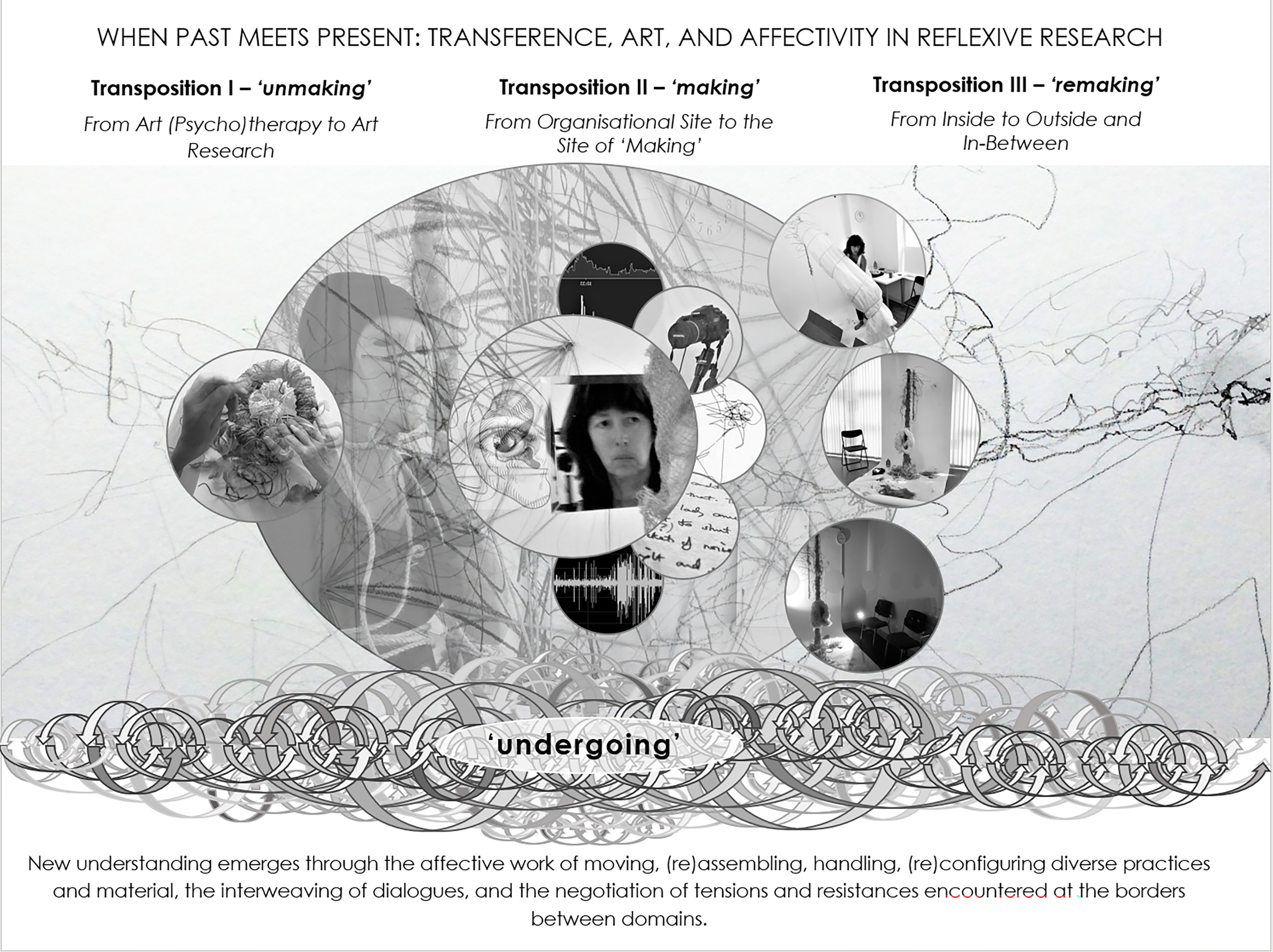
I conceptualise my research as a ‘speculative weaving in three Transpositions’, unmaking, making, and remaking. Although each ‘Transposition’ foregrounds a primary gesture which stands alone, each is intricately interwoven with the others in a reflexive conversation that continually loops back over and into as I return to revisit sites of making and research, feeling my way forward through the performance of tasks on their way to being completed. ‘Finding’ is therefore approached as a process rather than something to be found.
For the purposes of this article, I focus on the key artworks and projects as I revisit different sites, exploring what is activated through the process of moving ideas, practices, materials, objects, and things from one place to another. Further details can be found in my thesis and practice documentation (Michaels, 2022a) and at https://www.debbiemichaels.co.uk
From Art (Psycho)therapy to Art Research (Transposition I)
Early in my research I explore what might be activated through moving aspects of art psychotherapy into a fine art arena, for a group exhibition, symposium, and publications concerned with artistic production as research methodology (Michaels, 2016a, 2016b, 2016c) (Figure 1). Revisiting an ‘art-therapy-object’ (made by me) which hung on the wall of my art psychotherapy room, I document the unpicking and reconfiguring of its threads, acting something out to see what is activated. Entering into a dialogue with the process of transferring the art-therapy-object from the relative privacy of the art psychotherapy setting to a public exhibition space I invite audience members to sit with the unravelled art-therapy-object (as I do) for the duration of a traditional psychoanalytic hour and to become part of the drama through acting as witness to the object’s predicament.
Although unable to articulate a case at the time for how ‘Be|Tween’ functions as a site for reflexivity, with the time and space that follow the act, including conversations with others, I come to understand the ‘work’ of art as (re)framing my reflexive practice in a performative, imaginative, space, somewhere between fact and fiction.
Resonating with doubts, anxieties, and ambivalences about crossing disciplinary boundaries and loosening professional conventions, the making process gains new meaning through what it evokes and moves in me as the unravelled ‘art-therapy-object’ meets this new, unfamiliar, situation. While critical dialogues around the artwork provoke feelings of exposure and vulnerability, as well as embarrassment, other conversations raise my awareness of the dangers of more reductionist methods that attempt to understand something by separating out and measuring the component parts until a sense of the whole is lost. In contrast, through staging and dramatizing the work, and engaging with the narratives that take place around it, the artistic process becomes an empathic, imaginative, exploration; a transference and reorientation of practice through which something new is re-imagined—unmade and remade—by contemplating one situation in the context of another. Even though the materials are the same, some change has taken place.
From Organisational Site to the Site of ‘Making’ (Transposition II)
Crossing boundaries again for the main body of my research I assemble frames from psychoanalysis and art (psycho)therapy through which to observe and experience a neurorehabilitation day service and myself therein. Returning to the site of my art psychotherapy training placement (undertaken some years earlier), I negotiate a twelve-week observational placement based on a psychoanalytic training model of organisational observation (Hinshelwood & Skogstad, 2000). Interested in exploring what happens if I make art in response to my observations and experiences in/of the setting, I adapt the method, first encountered some years earlier (Maxwell, 2000), expanding its frame by transferring the intensity of experience from organisational site to art studio—a site of ‘making’ (Michaels, 2022a) (Figure 2).
Experiencing the situation and myself in it, I use my personality, including my sensory and emotional sensitivity, as an apparatus for receiving and processing subjective information; taking something from the outside, inside, and allowing it to inhabit and touch me bodily (Townsend, 2019). The model becomes ‘one hour a week observing in the organisation + one hour a week in the studio’, at a regular time and place over twelve weeks, a process I document using various artistic strategies. These include a research journal for recording observations and reflections, a Fitbit to record heartrate, speed, and journeys travelled and, in the studio, time-lapse photography and audio-visual recording as well as material documentation.
Entering the neurorehabilitation service as artist-researcher, I challenge convention for myself and the organisation, my silent presence provoking questions about why I am there, what I am doing, and whether I just sit there each week watching telly! In contrast, while appearing to ‘do’ nothing, I experience powerful, sometimes disturbing, sensory and emotional responses that surprise with their intensity and are, at times, difficult to sit with. The studio offers a transferential space away from the clinical setting (although connected to it), through which to explore my sensitivity to the situation as I move, handle, and manipulate materials, feelings, and thoughts within the constraints of time and space—a process that also evokes surprisingly powerful feelings which I describe in my thesis and elsewhere (Michaels, 2022a:55-122; in press).
Returning to the same sites each week and working through the process reflects the ritualistic habits of successive regular sessions in psychoanalysis and psychotherapy, creating a rhythm that is essential to the frame supporting and facilitating the research, as well as focussing attention and containing affect (Morra, 2008). Engaging in an imaginative dialogue with the ‘body’ of work as it emerges through the weekly routine puts me in touch with the painful predicament of people recovering from stroke, and the corresponding pull (more or less conscious) by those in a caring role, to turn towards ritual task performance and distancing in an effort to manage the emotional pain (Michaels, in press).
In the research institution disciplinary tensions between fine art and art psychotherapy unsettle further, pressing me to disrupt my process and break from more familiar ways of working. Provoking a turning point through the effect this has, I turn away from the recording devices in the studio, cover the cameras and myself, silence my voice, and hide my vulnerability and identity behind a black uniform and an expressionless mask (Michaels, 2022a: 106-113) (Figure 3).
As the layers of my subjectivity are sharpened I realise at an emotional level (although it is only later I articulate it) how intimately my process of making in response to the neurorehabilitation service is entangled with the institutional context in which I make. Gradually, the emphasis moves from ‘making something’ to the ‘performance of some thing in the making’; an all-encompassing intertwining of ‘undergoings’ and ‘goings on’ in which I am intimately entangled and through which I access the thinking (Ingold, 2010a, 2010b).
Entwined with these ‘undergoings’ and ‘goings on’ is the process of documenting my practice, including the reflexive conversations that take place around it which, rather than being separate, become part of the work (Figure 4). The multiplicity of recording devices employed act as documentary lenses, foregrounding the affective cultural sensitivity of documentary fragments and recollections captured in various media as they witness me having witnessed something else. What results is a multi-faceted, multi-layered ‘body’ of work which blends inner and outer experience, mixing raw observational material with subjective reflections and imaginative associations that respond not only to my experiences in the neurorehabilitation service, but also to the research institution and the unique, complex, situation in which I am embedded.
From Inside to Outside and In-Between (Transposition III)
Although the twelve-week observational project involves regularly moving across boundaries between various insides and outsides, the work itself is a mainly private, subjective, affair in that it involves ‘getting into the culture and simply experiencing it’ (Hinshelwood & Skogstad, 2000:165). Moving the work ‘outside’ and sharing my sensitivity across disciplines, the aim is to test prior conceptions and open a space for dialogue, something that might be considered vital to the negotiation of meaning (Leavy, 2009).
(Re)presenting the ‘body’ of work in different settings that bridge art, healthcare, and academia also involves processes of transference, reworking, or ‘remaking’—processes which often assume unexpected significance. For example, transferring the residual ‘body’ of material out of the studio and (re)situating in the place from where I had observed for Interrupting the Flow (Figure 5) brings the work to life again through the physical act of touching and moving it, and the powerful evocation of carefully handling a body through which I realise that I cannot separate its parts without damaging its integrity (Michaels, 2022a:152-154). The silent presence of the ‘body’ in the neurorehabilitation setting further stimulates and provokes responses from staff, ranging from ’just a load of materials’ and ‘makes no sense’ to ’reaching out to something that is difficult to grasp’, and a mask that is ‘disconnected emotionally—deathly’ (Michaels, 2022a:161).
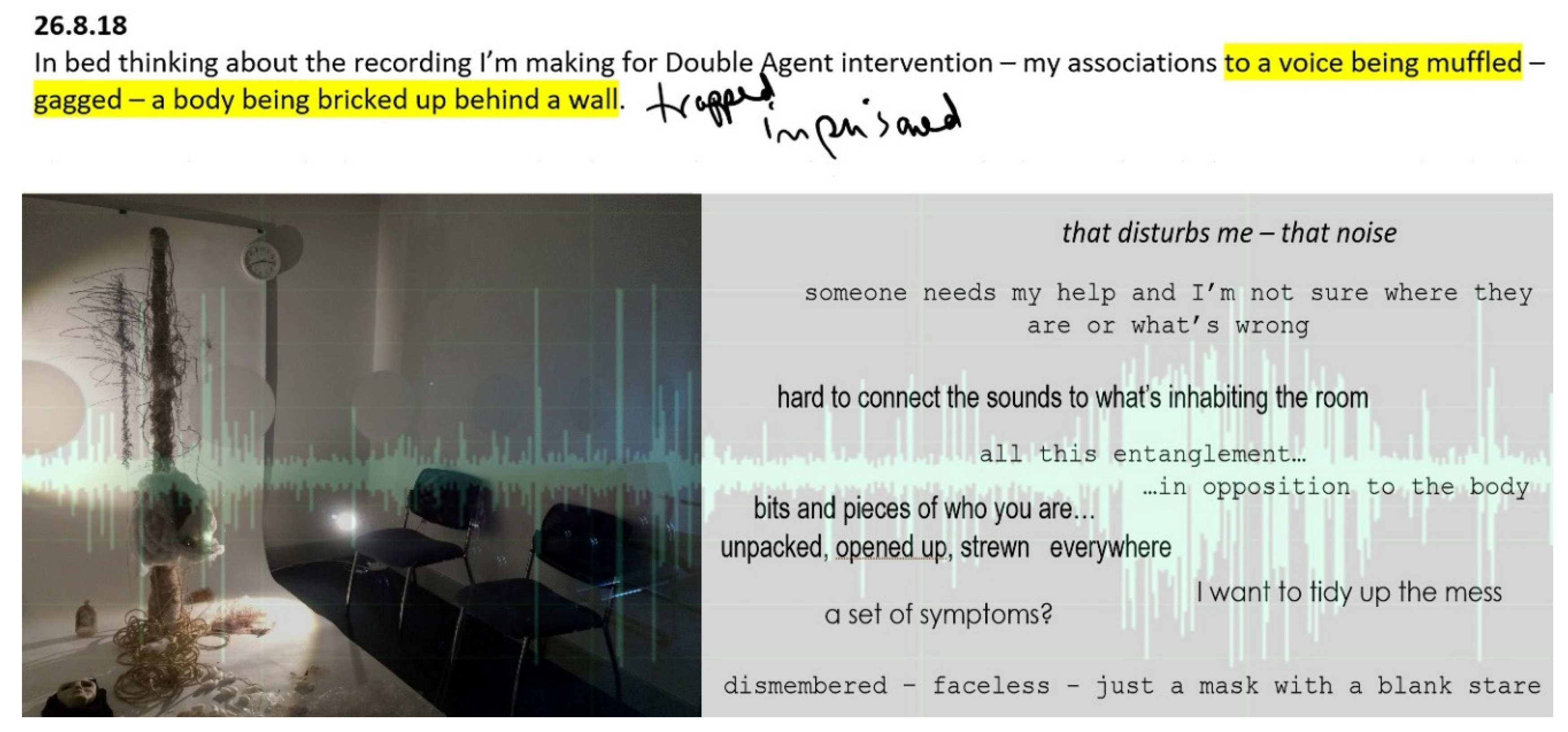
Later still, moving the ‘body’ again for a conference intervention, I rework the studio recordings for The-Voice-of-its-Making, a process that gives new texture and meaning to what has gone before (Michaels, 2018) (Figure 6).
As a counterpoint to the still, relatively silent presence of the material object-body-thing, the sound-piece amplifies a discomforting disturbance in the atmosphere that is difficult to clearly grasp or articulate, but nonetheless touches those encountering it through its resonance with the facelessness of some institutions and the evocation of someone in distress and trying to escape a situation (Michaels, 2022a:171-176).
In both these situations as well as others, the embodied act of moving, handling, (re)situating, and (re)presenting the ’body’ of work brings an ethics of attention, responsibility and care to the fore through what is evoked and provoked, offering an insight into how the art is working, as affective understanding is unmade and remade with each ’re’ iteration and performance of it. Encountering what was made then in the now, it is as if the volume has been turned up, intensifying the affective experience and ‘expanding the range and depth of thoughts and feelings that one is able to derive from one’s emotional experience’ (Ogden, 2004:1358) in Michaels, 2022a: 173)
Discussion
A key thread reaching out of this research is concerned with the reflexive learning that takes place through undergoing the embodied, performative, work of moving, handling, and (re)configuring diverse practices, ideas, materials, emotions, and other ‘things’ within the transferential frame set up by the unique situation. Viewed as a space of curiosity, dialogue, and shared enquiry the transference offers itself up as a ‘playground’ (Freud, 2001 [1914]:154). Here, the ‘work’ of art acts in an intersubjective, transitional space ‘between’ (Winnicott, 1991[1971]); an intermediate area of experiencing in which inner and outer worlds collide. Feelings, thoughts, and insights emerge at different times and from all directions, as material ‘made’ in the past is ‘unmade’ and ‘remade’ through touching the stuff of new situations in the present
Weaving threads across personal, professional, disciplinary, institutional, and material boundaries, as well as external and internal spaces, fact and fiction, the ‘work’ of art-as-research emerges through the entangled relations and tensions at the borders between different domains, offering a mediating space though which otherwise difficult conversations might occur. Reluctant to move towards the exclusivity, absolutes, and certainties often associated with knowing, the emotional, affective, and performative intensity of working through the transpositional, transferential, ‘making’ process necessarily opens spaces of resistance as well as possibility. Such tension is evident throughout my research, particularly in the material ‘body’ and ‘the-voice-of-its-making’ both of which provoke ambivalence through the artwork’s refusal to settle comfortably in one place. Sharing my sensitivity across disciplines and challenging more conventional ways of presenting research, the psychosocial presence of the ‘body’ and its voice is amplified and charged with resonant meaning as different audiences become participants in meaning-making through receiving, handling and response. Pressed to notice and feel more acutely, this deepens my understanding of the human situation and draws my attention to the nature of different sites, as well as an ethics of responsibility, attention, and care for/of the body—matters which are poignant not only in healthcare, but also academia.
Expanding Schön’s ideas, Candy (2019) suggests that reflection in creative practice is a ‘multi-faceted and pervasive process, embedded in the practitioner’s way of working’ (p.52). Drawing on my own practice, and (re)assembling threads from psychoanalysis, art psychotherapy and the arts in a new configuration, I do not plan to develop Schön’s idea of transference as a method of enquiry. Nonetheless, this resonates with my research which develops through an iterative, reflexive, conversation with the material of the situation as it emerges (Schön, 1983). Although I initially turn back to an already existing set of tools, as well as theoretical and physical sites, like the bricoleur (Levi-Strauss, 1966), it is the act of using whatever is to hand that calls the ‘work’ of art-as-research into existence, as the ‘making’ process begins to take on new significance and meaning through what it moves in me and others. More than representation, which implies something fixed, the emergent ‘body’ of work is alive with gestures and answering forms, inviting and enabling emotional connection and empathic response. Thinking through affect rather than merely reflecting on it (Massumi, 2015) the knowing resonates experientially over time through direct sensory engagement with the material of the research situation; what it evokes and provokes, what it brings into the present to be attended to, the degree of awareness it induces, and how it affects and ‘moves’ those it touches and who touch it. Attachment of value moves away from ‘meaning’ to how the art ‘works’ as it moves between the boundaries of time, place and context. Indeed, it is through the ongoing experiential exploration afforded by the ‘virtual’ transferential space, as well as the interwoven narratives that gather around the work of art-as-research, that I begin to get a feel for the stuff with which I am dealing. Maybe then, as Cazeaux (2008) suggests, it is ‘not simply the case that we leave one way of shaping experience and move to another; it is the tension between the two’ that is of concern (p.129).
It is true that I question at times whether I merely repeat the same thing by returning to go over old, familiar, ground; yet, with each iteration—(re)making—there is a retexturing of experience; a ‘re-turning’ of ground which opens it up, ‘breathing new life into it’ (Barad, 2014:168). Indeed, it is the working through—the ongoing transferential process of unmaking, making, and remaking, and the compression of time and space involved as material is continually moved, (re)organised, and (re)assembled in different contexts—that offers new ways of understanding. The implication is that there is not only a delay in understanding, but an ongoing provocation to further (re)makings as material that appears the same is reworked and retextured, each re-iteration giving new meaning to what has gone before. Implicit in this is the time and space that follows the act, allowing for experience to be assimilated, digested, transformed into understanding and articulated—‘worked through’ the body and put into words. By reflexively paying attention to my dealings with the research situation—looping back over and into how I administer and document the process, how I move, handle, and use ‘things’, including other bodies, and how I negotiate the tensions, entanglements, and resistances at the borders between domains—my understanding is also sophisticatedly moved.
Conclusion
Being a reflective, reflexive, practitioner means challenging familiar ways of doing things, unmaking and remaking the ties that both organise and constrain, and cultivating the many ways we can learn through experience. Much of the dialogue and questioning in this research remains unarticulated—embedded and embodied in the relational process of weaving the work. Nonetheless, claiming a position in the broad area of reflective practice(s) this research amplifies the significance of ‘transference’ as a method of enquiry, and the creative potential of art as a performative research practice; pushing beyond more conventional ideas of reflection and reflexivity in its capacity to embrace complex relationalities, and engage affective, ethical sensibilities through the moving, modifying, and handling of ‘stuff’. As a site in/through which one may be pressed to notice and feel more acutely—to be moved—the research value lies in the potential of this method to affectively (re)sensitise practitioners and researchers across arts and/in healthcare in ways that may not emerge through more traditional approaches to reflexive/reflective practice.
Acknowledgements
I extend my sincere thanks to Dr Sharon Kivland and Dr Yuen Fong Ling and to all those who (knowingly or otherwise) have contributed to, and supported this research, without whom it would not have been possible.
Conflicts of Interest
No conflicts of interest.
References
- Are, K. (2018). Touching stories: Objects, Writing, Diffraction and the Ethical hazard of Self-reflexivity. TEXT: Journal of Writing and Writing Courses(Special Issue 51), 1–12.
- Barad, K. (2014). Diffracting diffraction: Cutting Together-apart. Parallax, 20(3), 168–187. [CrossRef]
- Barone, T., & Eisner, E. W. (2012). Arts Based Research. Sage.
- Birksted-Breen, D. (2003). Time and the Après-coup. The International Journal of Psychoanalysis, 84(6), 1501–1515.
- Braddock, L. (2010). Emotions, Interpretation and the Psychoanalytic Countertransference. Anthropological Fieldwork: a Relational Process, Newcastle upon Tyne: Cambridge Scholars Publishing, 204–228.
- Brown, J. (2006). Reflexivity in the Research Process: Psychoanalytic Observations. International Journal of Social Research Methodology, 9(3), 181–197. [CrossRef]
- Candy, L. (2019). The Creative Reflective Practitioner: Research Through Making and Practice. Routledge.
- Cazeaux, C. (2008). Inherently Interdisciplinary: Four Perspectives on Practice-based Research. Journal of Visual Art Practice, 7(2), 107–132. [CrossRef]
- Cheng, I. K. (2010). Transforming Practice: Reflections on the Use of Art to Develop Professional Knowledge and Reflective Practice. Reflective Practice, 11(4), 489-498. [CrossRef]
- Currie, G. (2011). Empathy for Objects. In A. Coplan & P. Goldie (Eds.) Empathy: Philosophical and Psychological Perspectives (pp. 82–95). Oxford University Press.
- Dalley, T. (2013). Art as Therapy: Some New Perspectives. Images of Art Therapy (Psychology Revivals) (pp. 1-35). Routledge.
- Deaver, S. P., & McAuliffe, G. (2009). Reflective Visual Journaling during Art Therapy and Counselling Internships: A Qualitative Study. Reflective Practice, 10(5), 615-632. [CrossRef]
- Fish, B. J. (2012). Response Art: The Art of the Art Therapist. Art therapy, 29(3), 138–143. [CrossRef]
- _________(2019). Response art in Art Therapy: Historical and Contemporary Overview. Art therapy, 36(3), 122-132.
- Freud, S. (2001 [1914]). Remembering, Repeating, and Working Through: (Further Recommendations on the Technique of Psychoanalysis II) (1914) (J. Strachey, Ed. & Trans.; The Standard Edition of the Complete Psychological Works of Sigmund Freud: Case History of Schreber, Papers on Technique and Other Works, Volume XII (1911-1913) (pp. 147–156). Vintage. ([London: Hogarth, 1953-1974]).
- Freud, S., & Breuer, J. (2001 [1895]). The Standard Edition of the Complete Psychological Works of Sigmund Freud: Studies on Hysteria (J. Strachey, Ed. & Trans.; Vol. II (1893-1895)). Vintage. ([London: Hogarth, 1953-1974]).
- Gemignani, M. (2011). Between Researcher and Researched:An Introduction to Countertransference in Qualitative Inquiry. Qualitative Inquiry, 17(8), 701-708. [CrossRef]
- Heimann, P. (1950). On Counter-transference. The International Journal of Psychoanalysis, 31, 81–84.
- Hilbuch, A., Snir, S., Regev, D., & Orkibi, H. (2016). The Role of Art Materials in the Transferential Relationship: Art Psychotherapists’ Perspective. The Arts in Psychotherapy, 49, 19-26. [CrossRef]
- Hinshelwood, R. D. (2013). Observing Anxiety: A Psychoanalytic Training Method for Understanding Organisations. In S. Long (Ed.), Socioanalytic Methods: Discovering the Hidden in Organisations and Social Systems (pp. 47–66). Karnac Books.
- __________ (2016). Countertransference and Alive Moments: Help or Hindrance. Process Press Ltd.
- Hinshelwood, R. D., & Skogstad, W. (Eds.). (2000). Observing Organisations: Anxiety, Defence and Culture in Health care. Routledge.
- Hollway, W. (2006). Psychoanalysis in Social Psychological Research. The Psychologist, 19(9), 544–545.
- _________(2016). Emotional Experience plus Reflection: Countertransference and Reflexivity in Research. The Psychotherapist, 62.
- Holmes, J. (2014). Countertransference in Qualitative Research: A Critical Appraisal. Qualitative Research, 14(2), 166–183. [CrossRef]
- Ingold, T. (2010a). Bringing Things Back to Life: Creative Entanglements in a World of Materials NCRM Working Paper. Realities/Morgan Centre http://eprints.ncrm.ac.uk/1306/1/0510_creative_entanglements.pdf . Accessed 25/11/24.
- _______ (2010b). The Textility of Making. Cambridge Journal of Economics, 34(1), 91–102.
- Jervis, S. (2009). The Use of Self as a Research Tool. In S. Clark and P. Hoggett (Eds.), Researching Beneath the Surface: Psycho-social Research Methods in Practice (pp. 145–166). Karnac.
- Joseph, B. (1985). Transference: The Total Situation. The International Journal of Psychoanalysis, 66, 447–454.
- Kenny, K., & Gilmore, S. (2014). From Research Reflexivity to Research Affectivity: Ethnographic Research in Organizations (The Psychosocial and Organization Studies (pp. 158–182). Basingstoke: Palgrave Macmillan.
- Knudsen, B. T., & Stage, C. (Eds.). (2015). Affective Methodologies: Developing Cultural Research Strategies for the Study of Affect. Palgrave Macmillan.
- Leavy, P. (2009). Method Meets Art: Arts-based Research Practice. Guilford Press.
- _______ (Ed.) (2017). Handbook of Arts-based Research. Guilford Press.
- Levi-Strauss, C. (1966). The Savage Mind. University of Chicago Press.
- MacLure, M. (2013). The Wonder of Data. Cultural Studies? Critical Methodologies, 13(4), 228–232.
- Massumi, B. (Ed.) (2015). Politics of Affect. Politiy Press.
- Maxwell, D. (2000). Nowhere to Hide: A Day Case Centre. In R. D. H. W. Skogstad (Ed.), Observing Organisations: Anxiety, Defence and Culture in Healthcare. (pp. 122–141). Routledge.
- McNiff, S. (1998). Art-based Research. Jessica Kingsley.
- _________(2008). Art-based Research. In J. G. Knowles & A. L. Cole (Eds.), Handbook of the Arts in Qualitative Research: Perspectives, Methodologies, Examples and Issues (pp. 29–40). Sage Publications.
- Meltzer, D. (1994). The Psychoanalytic Process: Twenty Years on the Setting of the Analytic Encounter and the Gathering of Transference (1986). In A. Hahn (Ed.), Sincerity and Other Works: The Collected Papers of Donald Meltzer (pp. 551–556). Karnac.
- Michaels, D. (2010). A Space for Linking: Art Therapy and Stroke Rehabilitation. International Journal of Art Therapy, 15(2), 65–74. [CrossRef]
- __________ (2015). Art Therapy in Brain Injury and Stroke Services: a glimpse beneath the surface of organisational life. In M. Liebmann & S. Weston (Eds.), Art Therapy with Neurological Conditions (pp. 135–151). Jessica Kingsley.
- __________ (2016a). Be│tween [multi–media installation]. Sheffield Hallam University, Art and Design Research Unit, , Testing Testing, Sheffield Institute of Arts. https://www.debbiemichaels.co.uk/between.php . Accessed 25/11/24.
- __________ (2016b). Between. In M. Day & J. Ray (Eds.), Testing Testing: Prologue (Vol. 1) (pp. 43–46). Sheffield Hallam University, Art and Design Research Unit. ISBN: 978-1-84387-399-0, http://testingtesting.org.uk . Accessed 25/11/24.
- __________ (2016c). A Constructed Fiction. In M. Day & J. Ray (Eds.), Testing Testing: Dialogue (Vol. 2) (pp. 17–20). Sheffield Hallam University, Art and Design Research Unit. ISBN: 9781843874027, http://testingtesting.org.uk . Accessed 25/11/24.
- __________ (2018). The Voice of its Making [Soundpiece]. Sheffield Hallam University, Art and Design Research Unit, , Sheffield. https://www.debbiemichaels.co.uk/voice-of-its-making.php . Accessed 25/11/24.
- __________ (2022a). Organisational Encounters and Reflexive Undergoings: A Speculative Weaving in Three Transpositions [Ph.D. Thesis, Sheffield Hallam University]. https://shura.shu.ac.uk/31989/ . Accessed 25/11/24.
- __________ (2022b). Organisational Encounters and Speculative Weavings: Questioning a Body of Material. In C. Vear (Ed.), Routledge International Handbook of Practice-Based Research (pp. 691–698). Routledge.
- __________ (2024). Mourning Lost Parts: An Art-Based Response to Experiences in/of a Neurorehabilitation Day Service. Journal of Applied Arts and Health, 15(3). Accessed 24/12/24. [CrossRef]
- Miller, A. (2022). El Duende One-Canvas Art Making and the Significance of an Interim Period. Art therapy, 39(1), 24-33. [CrossRef]
- Morra, J. (2008). The Work of Research: Remembering, Repeating, and Working-Through. In M. Holly and M. Smith (Eds.), What is Research in the Visual Arts? Obsession, Archive, Encounter (pp. 46–63). Yale University Press and Sterling and Francine Clark Art Institute.
- Moustakas, C. (1990). Heuristic Research: Design, Methodology, and Applications. Sage.
- Nash, G. (2020). Response Art in Art Therapy Practice and Research with a Focus on Reflect Piece Imagery. International Journal of Art Therapy, 25(1), 39–48. [CrossRef]
- Ogden, T. H. (2004). On Holding and Containing, Being and Dreaming. The International Journal of Psychoanalysis, 85(6), 1349–1364.
- Parker, I. (2010). The Place of Transference in Psychosocial Research. Journal of Theoretical and Philosophical Psychology, 30(1), 17.
- Schaverien, J. (1999). The Revealing Image: Analytical Art Psychotherapy in Theory and Practice. Jessica Kingsley.
- __________ (2007). Countertransference as Active Imagination: Imaginative Experiences of the Analyst. Journal of Analytical Psychology, 52(4), 413–431.
- __________ (2019). Researching the Esoteric: Art Therapy Research. Art and Music: Therapy and Research, (pp. 21-34). Routledge.
- Schön, D. A. (1983). The Reflective Practitioner: How Professionals Think in Action. Basic Books.
- Townsend, P. (2019). Creative States of Mind: Psychoanalysis and the Artist’s Process. Routledge.
- Vear, C. (Ed.) (2022). Routledge International Handbook of Practice-Based Research. Routledge.
- Winnicott, D. W. (1991[1971]). Playing and Reality. Routledge.
- _________ (2018 [1960]). Counter-transference. The Maturational Processes and the Facilitating Environment: Studies in the Theory of Emotional Development (pp. 158-165). Routledge.
Figure 1.
Be|Tween, 2016, multi-media installation. ‘Testing Testing’, Sheffield Institute of Art. Digital composite © Debbie Michaels.
Figure 1.
Be|Tween, 2016, multi-media installation. ‘Testing Testing’, Sheffield Institute of Art. Digital composite © Debbie Michaels.
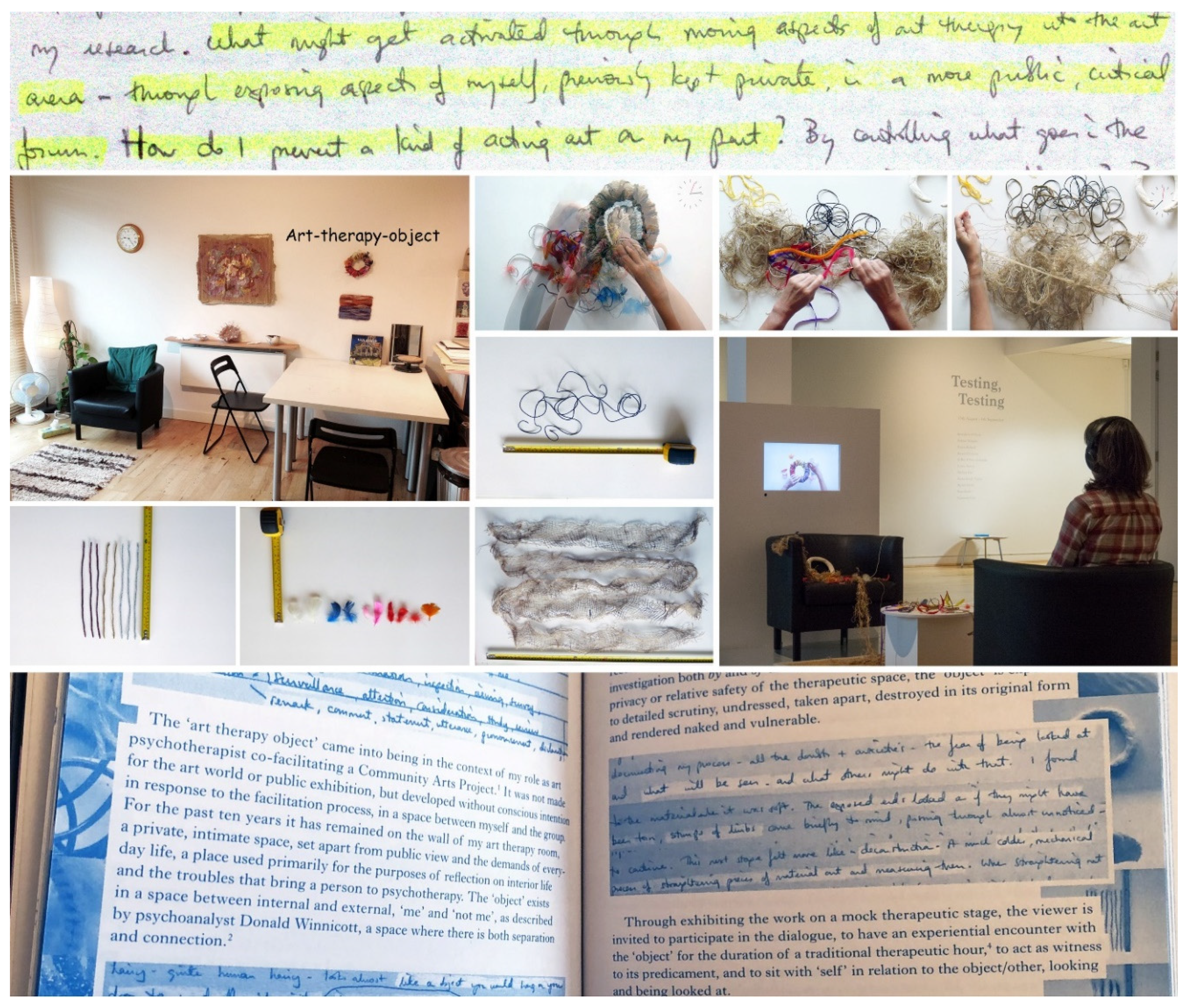
Figure 2.
Twelve weeks: Twelve Hours + Twelve Hours +. Project, January—April 2017. © Debbie Michaels.
Figure 2.
Twelve weeks: Twelve Hours + Twelve Hours +. Project, January—April 2017. © Debbie Michaels.
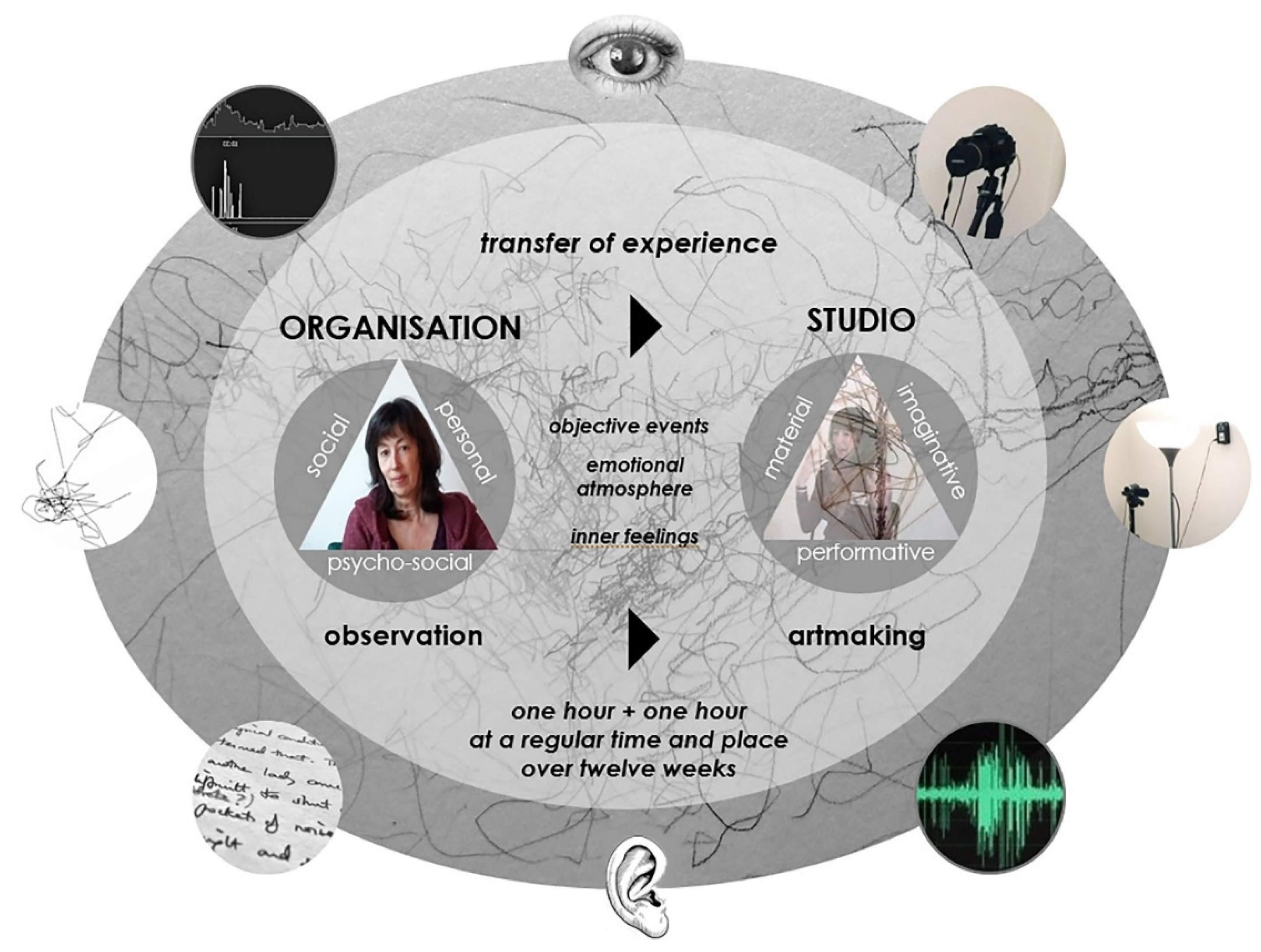
Figure 3.
I do not want to be seen even though I am. Practice documentation, 2017. Digital composite © Debbie Michaels.
Figure 3.
I do not want to be seen even though I am. Practice documentation, 2017. Digital composite © Debbie Michaels.
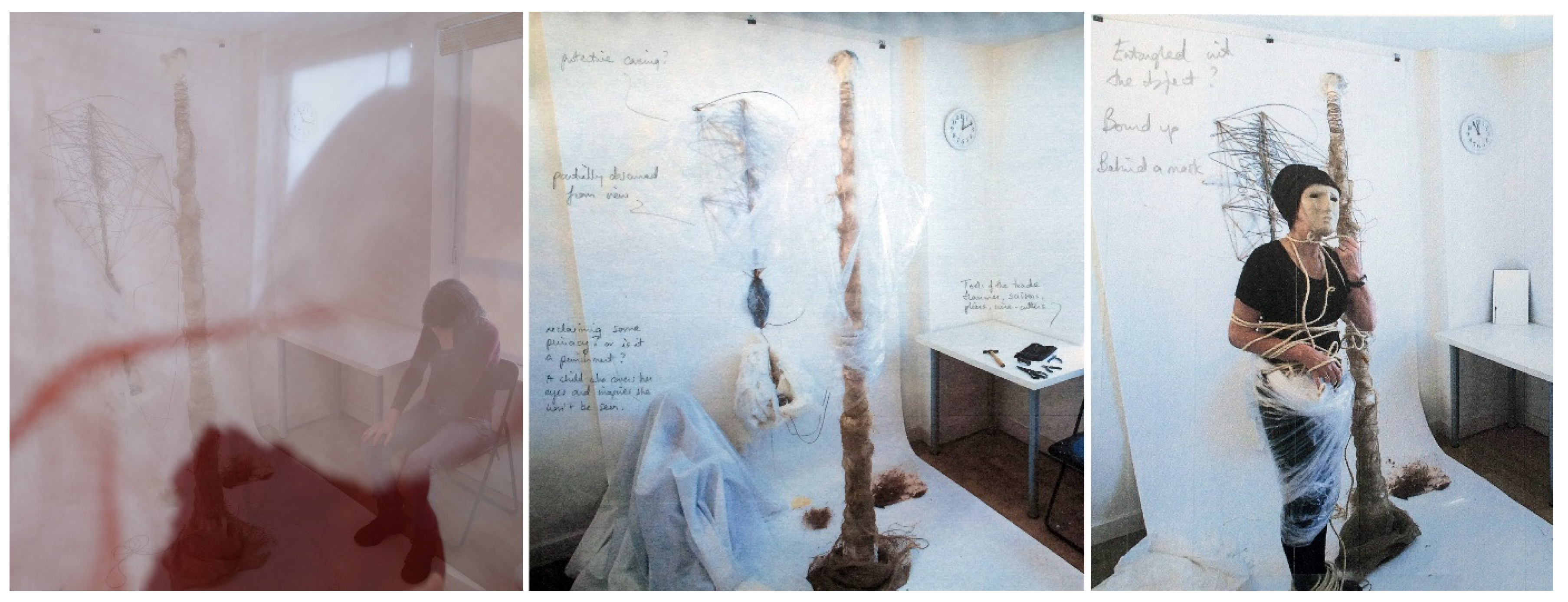
Figure 4.
Practice Documentation, 2017. Digital composite © Debbie Michaels.
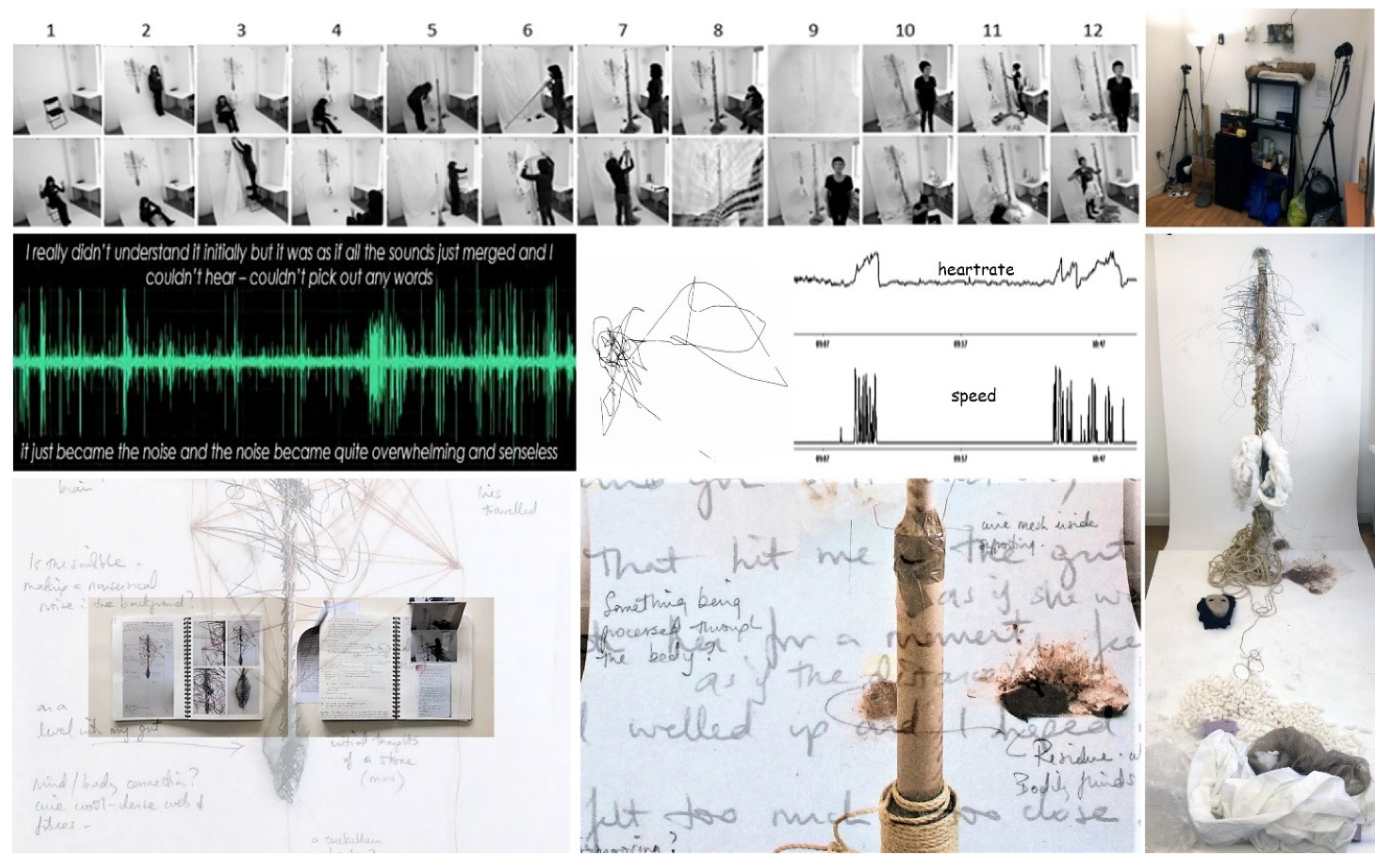
Figure 5.
Interrupting the Flow, 2018, mixed media installation, 5 hours duration, Sheffield. Digital composite. © Debbie Michaels.
Figure 5.
Interrupting the Flow, 2018, mixed media installation, 5 hours duration, Sheffield. Digital composite. © Debbie Michaels.
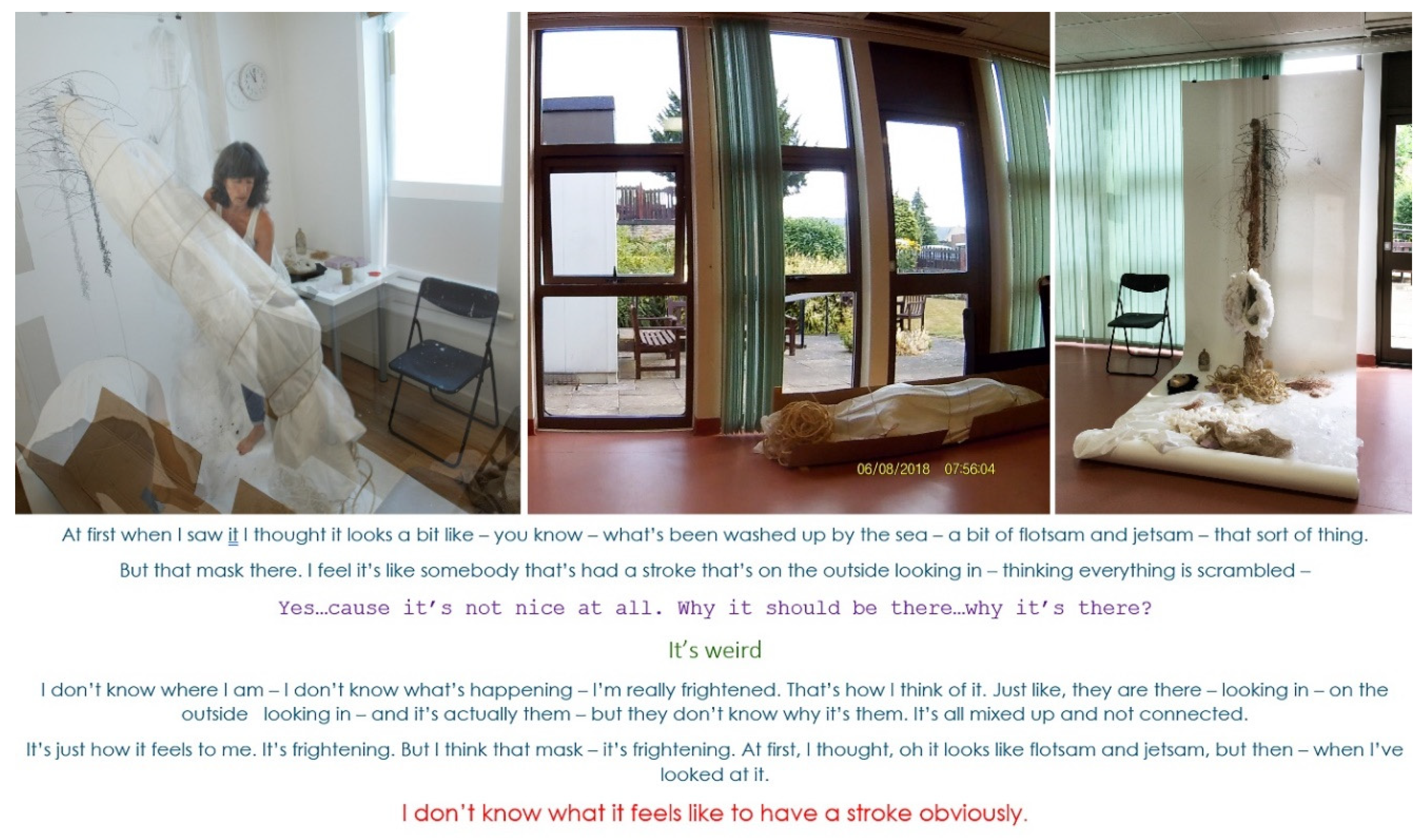
Figure 6.
The-Voice-of-its-Making, 2018, soundpiece, 60 minutes duration. ‘Double Agency’, Design4Health, Sheffield Hallam University Digital composite © Debbie Michaels.
Figure 6.
The-Voice-of-its-Making, 2018, soundpiece, 60 minutes duration. ‘Double Agency’, Design4Health, Sheffield Hallam University Digital composite © Debbie Michaels.
Disclaimer/Publisher’s Note: The statements, opinions and data contained in all publications are solely those of the individual author(s) and contributor(s) and not of MDPI and/or the editor(s). MDPI and/or the editor(s) disclaim responsibility for any injury to people or property resulting from any ideas, methods, instructions or products referred to in the content. |
© 2025 by the authors. Licensee MDPI, Basel, Switzerland. This article is an open access article distributed under the terms and conditions of the Creative Commons Attribution (CC BY) license (http://creativecommons.org/licenses/by/4.0/).
Copyright: This open access article is published under a Creative Commons CC BY 4.0 license, which permit the free download, distribution, and reuse, provided that the author and preprint are cited in any reuse.


