

Submitted:
03 November 2023
Posted:
06 November 2023
You are already at the latest version
Abstract
This paper examines the learning experience of an inter-faculty higher education course conducted in an expanded remote format, using digital space as facilitator. The study focuses on the implementation of personalized education, a pedagogical approach that emphasizes the diversification of resources, strategies, and actions to empower learners in assigning personal value and meaning to their learning journey. By presenting an action research project, this study highlights the pivotal role of personalized education in guiding the course design. To foster an engaging learning environment, the course incorporated open activities and leveraged tools and platforms of the social web. Through these means, the participants, forming a community of practice, were able to collaboratively generate knowledge before, during, and after synchronous sessions. Furthermore, the participants effectively disseminated this knowledge through networks and engaged in discussions with external stakeholders. The study underscores how personalized education facilitates situated and meaningful learning by fostering expanded, flexible, and distributed experiences. These experiences revolve around a transmedia narrative that seamlessly integrates digital culture into learning opportunities and processes, effectively naturalizing its presence. The results highlight the value of personalized education approaches in adapting to the complexities of the digital age and establishing meaningful learning experiences for students.
Keywords:
Higher education
; connected learning
; personalized education
; digital media y learning
; community of practice
; learning pathways
; digital culture
1. Introduction
The sudden and widespread adoption of emergency remote education solutions (Bozkurt & Sharma, 2020), as a consequence of the suspension of face-to-face activity in universities, has opened up the possibility of carrying out empirical studies of the "natural experiment" type, taking the circumstance of remoteness as an experimental condition, something that would have been ethically impossible to implement at the population level at any other time. However, beyond these essential observational studies, it is difficult to imagine a better moment of media, historical, and current convergence to aspire to change and improve education while producing scientific knowledge. Action research appears as an ideal approach for a study like this, based on the analysis of an educational experience designed to transform a face-to-face university course into a remote one, but with a longer-term vision of education for a hyperconnected society. In this scenario, the uses of social and digital media for communication are being transformed based on new styles of democratization of learning and creation-distribution of content and experiences (Gee & Esteban-Guitart, 2019; Jenkins et al., 2013). This is known as participatory culture and is based on the incorporation of the agency and autonomy of each educational community expanded by this digital empowerment (Esteban-Guitart et al., 2020; Jenkins, 2008).
Analyzing uses and technological practices related to learning that appear in the form of different styles of semiotic mediation resulting from participatory-communicative action processes (González-Patiño, 2011), we observe complex interactive transformations of spaces that affect, among others, the notion of presence. From a systemic point of view, and taking into consideration the digital—public and private—space, media and technologies would facilitate certain mutual inclusions that would be symbolically taken away from this virtual space, as long as the possibilities and decisions of the participants and involved agents allow it (educational ideologies, legal provisions, conventions, privacy, etc.). This aspect translates into both situations related to teaching and knowledge, as well as less regulated ones—such as the social web—where people enjoy autonomy to build and deploy their social and cultural identity. This condition of symbolic convertibility of the digital realm, enabling appropriations and inclusions of spaces and activities previously clearly geolocated (work, home, faculty, etc.), allows for another peculiarity of the fieldwork in this research: it constitutes the very scenario of reflective practices and knowledge production. Complementary to studies that explore institutionalized or recognizable contexts through their location, this study is situated in the interstice of those places, in an exercise of collaborative, participatory, and transformative approximation that also contributes the data corpus. And precisely the purpose of this publication is to document and reveal what we have learned, making it communicable and assessable, and transcending functional solutions and results, in an effort to make knowledge visible but usable, replicable, and therefore improvable (Lafuente et al., 2018).
Another reflection, especially relevant for the analysis of the educational experience presented in this article, concerns the function of formal higher education. Although its primary purpose remains to facilitate the construction of psychological instruments that improve individuals' professional and socialization projects, it is not so clear that it does so considering the type of learner it serves and, consequently, the interdependence and synergies between formal practices and other learning experiences that are increasingly present and difficult to categorize (Pereira et al., 2019). Higher education in the connected society will have to adapt to this new learning ecology by assuming and leading a transformation that connects intrinsically diverse teaching practices with experiences that occur outside the institution. Beyond the faculties of academic freedom and university autonomy, we propose to embrace as strengths the flexibility and adaptability that the diversity of teaching practices, which will develop because of differences in the use of digital media and learning by both teaching teams and students (available resources, degrees, competencies, skills, etc.), will provide. Trying to establish a homogeneous framework of solutions or best practices would add rigidity and tension that could cause a collapse in our adaptive and agile response capacity to provide solutions in a disruptive scenario without making significant structural improvements or having much time to do so.
Although the debate on educational improvement as a result of technological impact sometimes tends to be simplified around learning and assessment (such as questions about adaptation and personalization of teaching), an increasing number of authors propose creating areas of interest that link research and transdisciplinary knowledge creation, such as Digital Media and Learning (Gee, 2010) or the Connected Learning approach (Ito et al., 2013). This approach seeks to link young people's interests and job and academic opportunities both inside and outside the educational context so that we can address technological developments as situated in a deeply and rapidly evolving society that urges us to negotiate meanings and significance between a perhaps somewhat superficial global culture and closer communities of belonging with deep implications at the identity level. In this scenario, the management of diversity as a predominant social phenomenon tests many of our previous categories and concepts to understand and design positive and optimal educational experiences.
The theoretical considerations we share below, before presenting the case study, are relevant not only to justify it but also to make sense of the transformation carried out in a conventional educational practice that had been developing for years. The practice described now becomes an expanded experience, in the sense of being mediated by both public and private digital spaces, with a functioning proposal close to that of a community of practice and based on connected learning. In this context, diversity is considered a requirement for efficiency and sustainability, and the active role of the learner as a co-designer of the teaching and learning experience is emphasized (Esteban-Guitart et al., 2020; Ito et al., 2013; Kalantzis & Cope, 2012).
1.1. Learning Understood as Knowledge Creation in Times of Digital Culture
According to González-Patiño and Esteban-Guitart (2014), there are a series of characteristics that identify the connected society, also called the "Mobile-Centric Society": multimodality, convergence, creation-distribution, affinity spaces, and distributed knowledge. These elements force us to reposition formal education.
Educational practices continue to be generally based on written culture. In fact, we find significant differences and fronts of resistance to new media inclusions by educational institutions and agents. The rapid expansion of audiovisual media, first, and the creation of the public digital space later, marked the beginning of a swift process of semiotic complexity in which modes and media combined through technologies that offered diverse communication and dissemination alternatives ("PC-Centric Society"). In a very short time, our possibilities for access, creation, and negotiation of meaning multiplied exponentially, and to this informational multimodality, we must still add the integration or convergence of devices and platforms. This notion of technological convergence, or "device agnosticism," since we are always connected (always on) regardless of the mediating artifact, is not as impactful for our analysis as another that we could identify as cultural convergence, which would be related to the change in media uses and, for Jenkins (2008), would be at the basis of the participatory culture characteristic of our connected society or Mobile-Centric, in which it would not be easy to distinguish between content creation and dissemination processes. Convergence, as understood here, would have to do with the flow of content between different media and what the audience does to enjoy those entertainment experiences that attract them, fostering the emergence of new narratives that unfold across multiple media and platforms, which we know as transmedia (González-Martínez et al., 2019).
Therefore, what genuinely stimulates the public space of the internet and its platforms, such as social networks, is the emergence of a creative and participatory audience, as it publishes and disseminates and is part of communities that articulate identity, leading to the formation of fan phenomena or fandoms. These practices do not consist of mere submission to the persuasion of the media industry but a dialogue with its cultural texts through interrelated narratives that maintain, in turn, narrative independence and complete meaning. In this way, different digital media facilitate the creation and growth of affinity spaces or liquid interest communities (Gee & Esteban-Guitart, 2019), which often organize themselves on websites that allow quick joining and leaving, and where resources and values are shared while groups continually form and transform. In conclusion, the internet has changed the meaning of the creation and localization of knowledge, which is now distributed and takes place in an ecology that changes over time. As proposed by Gee (2013) and Jenkins (2008), in the society of digital culture, a new "social mind or identity" emerges because of the union between distributed collaboration and the cultural artifacts it has produced.
1.2. The Need to Produce Improvements and New Educational Experiences for the Connected Society: Personalized Education
Although, as we indicated, the main function of formal higher education remains, with an explicit and systematic intention that materializes in a unique and homogeneous curriculum, a deep reflection on, at least, the type of learner it targets and the very meaning of the institution is necessary and urgent, as well as the articulation and connection of formal educational practices with other learning experiences. Education is a social invention (Bruner & Palacios, 2008), and therefore, it will show different degrees of misalignment with the society it coexists with, as society transforms and constantly demands adaptation. Formal education, under the conditions of the connected society, must take into account the coordinates of this new learning ecology (Coll, 2013) and the connection of teaching practices with experiences occurring outside the institution. It would be appropriate, then, to situate this educational action within a pedagogical theoretical framework that, in addition to justifying it, serves as guidance to give it meaning. This is precisely the main objective of this article, namely: to describe and analyze in depth a case study that allows us to identify the central principles and elements of educational personalization as an appropriate approach for education in the current connected society.
We will begin with a terminological clarification to distinguish personalized education from other frequently used conceptions such as personalized learning (Chen, 2008; Grant & Basye, 2014; Minguillón et al., 2005). For us, educational personalization is a means, not the result of a process. That is, the learner is the one who gives meaning to the different learning experiences, so that while personalization integrates actions at the interpsychological or social level; learning, as a process of developing competencies or constructing knowledge, would do so at the intrapsychological or personal level (Esteban-Guitart & Gee, 2020). Therefore, educational personalization would include that diverse globality of strategies, activities, and resources that we provide so that students achieve meaningful and personally valuable learning, not just a "customization" of the learning process or an individualization of it (Penuel & Johnson, 2016; Pérez Guerrero & Ahedo Ruiz, 2020). As defined by Coll, Esteban-Guitart, and Iglesias (2020, p. 35): "Personalization (...) is that activity, practice, or experience that links the interests, objectives, and choices of learners with educational objectives and activities based on their participation-involvement in the control-selection of the processes involved (what, how, and when to learn)."
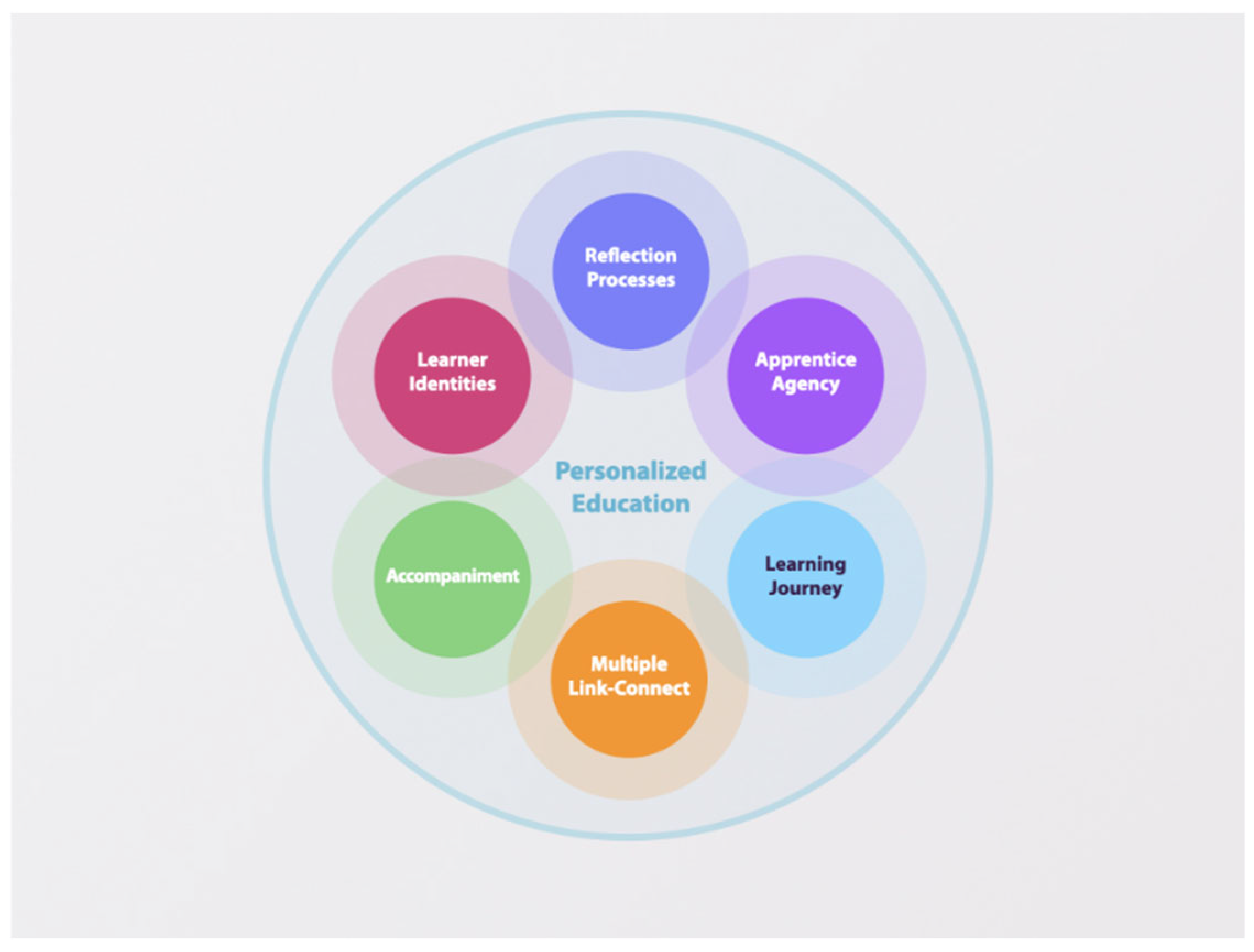
Learning with personal meaning and value, regardless of its degree of formalization, would be based on those experiences with cognitive and emotional impact that encourage the learner to expand knowledge about their personal history and the reality in which they live, offering them better conditions to intervene in it or create future action plans (Coll, 2018). Figure 1 shows the components or dimensions of the interrelated process on which personalized education is developed to provide a conceptual tool for analyzing its functioning.
Personalization necessarily takes the identities of learners as its starting point, which involves investigating and discovering what they perceive as significant or essential, whether it be interests, prior knowledge, activities, institutions, people, or cultural artifacts. Attention is also given to the projective dimension of identity in the form of life projects and decisions. Identity, as understood here, consists of a continuous process of resignification sensitive to the impact of activities, places, institutions, people, and objects perceived as significant by the learner (Esteban-Guitart, 2016, 2019). We opt for the notion of identity over interest, which is generally associated with the personalization of learning (Walkington & Hayata, 2017), since the former encompasses the latter. Identity is linked to the subjective realm of the learner's sense-making (Esteban-Guitart, 2016; Esteban-Guitart & Moll, 2014), while interests can be reduced to more superficial aspects, such as preferences or personal tastes personales (González-Patiño & Esteban-Guitart, 2019).
Student identities are conceived as the beginning of a constantly transforming pedagogical process through scaffolding, that is, by linking identity elements with content, competencies, or learning objects, identities are shaped and developed. In order to identify them, a resource has been proposed based on the creation of "identity artifacts", productions made by the learners themselves through which they project their interests, hobbies, activities, people, objects, and spaces perceived as especially significant. These will later be used by teachers for curricular and pedagogical purposes (Esteban-Guitart, 2019). Numerous studies conclude that the most resilient learning experiences, with a greater impact on long-term memory, are those that start from and connect with the needs, interests, and objectives of the learners (Barron, 2006; Staus et al., 2020).
The processes of personal and group reflection, in addition to deepening the identification of such interests and identities, allow for their enrichment by making them explicit. They also serve to analyze their origin and development, as well as the consequences they entail, regardless of whether this interest or identity-related goal-object has arisen in the formal context or in any other. In short, students' interests, identities, and developmental and learning processes are the result of dialogic discussion-reflection processes (Oliveira & Coelho, 2020). Among the resources that are usually used to foster reflection, we find everything from significant learning journals to cartographies of learning spaces and trajectories (Esteban-Guitart et al., 2017).
The next component on which personalization is developed is the agency processes, which refer to the learner's participation and control over their own learning, particularly in goal-setting, co-designing activities, and evaluation. There is empirical evidence on the relationship between student participation and involvement, with improvements in academic performance (Perin, 2011). To promote learner agency, they are often involved in creating personal plans that allow for the development of individual learning trajectories. Although conventional formal education addresses a homogeneous model of education (Coll, 2013), professionalizing trajectories that allow stackable credentials, sequences composed of numerous highly-focused and short-duration programs (stackable learning), have long been studied to promote achievement and upward mobility (Giani & Fox, 2017), as well as the growing interest in the diversity of places, agents, services, and learning situations that transcend traditional educational spaces and times (Álvarez-Arregui & Arreguit, 2019; Barron, 2006; Esteban-Guitart et al., 2018; Nasir et al., 2020). The forced condition of remote education brought about by Covid-19 has highlighted the vast variety of informal learning processes that, through digital media and the social web (tools, content, platforms, communities, and affinity networks), allow people to actively develop competencies and acquire necessary skills to face significant challenges in their personal and professional lives (Gee & Esteban-Guitart, 2019; González-Patiño & Esteban-Guitart, 2014).
On the other hand, the multiple or bimodal linkage-connection, which appears in Figure 1, refers to the channeling of learning experiences. Although we are aware that learning takes place throughout life (Esteban-Guitart et al., 2018), this does not imply that experiences, contexts, or activities are connected to each other; on the contrary, it is necessary to design explicit linkage-connection interventions that connect learners' learning experiences at the psychological-individual level, as well as agents, times, and educational spaces, such as when educational centers, families, and community entities are linked (Rodríguez-Ruiz et al., 2019). We then speak of multiple or bimodal linkage-connection because the linkage is double (Bronfenbrenner, 1985): at the micro level, learning experiences, previous knowledge, and experiences are articulated with new ones (psychological linkage), and on the other hand, at the meso level, educational continuity relationships are established between different life and socialization contexts, improving their developmental or learning potential (community linkage). It is worth remembering, according to Bronfenbrenner (1987, p. 58), that the effectiveness and impact of a mesosystem increase to the extent that: "the roles, activities, and dyads in which the linking person participates with other environments stimulate the emergence of mutual trust, a positive orientation, consensus of goals between environments, and a progressive balance of powers that responds to action on behalf of the developing person."
In order for these connections to occur, certain social, material, and other conditions related to the interests and objectives of the learner must be met, which underlie the learning trajectories that mobilize them (DiGiacomo et al., 2018). Accompaniment would therefore be the essential component of the process so that, based on the learner's expectations and needs, they can have access to the educational experiences they require at any given moment. In this sense, it would involve both recognition and pedagogical and social support, as well as material conditions that allow for the linkage of learners' identities, objectives, and projects with opportunities, services, agents, and social and educational resources.
The analysis we present in this article on an expanded experience, through social web, is part of an action research initiative that aims to reflect on the foundations of connected learning while also incorporating the components of educational personalization identified and described earlier. Our intention is to illustrate a stance for accompanying and experimenting with educational communities, whose methodological approach is action research and the mode of involvement is participatory consultancy (Wardrop & Withers, 2014). To specify this, we present an operational and applied approach to the transformation carried out on a digital identity course at UAM, which until the forced lockdown consisted of a conventional face-to-face educational practice. In this way, the experience allows us to theoretically and practically illustrate processes of transition from physical to virtual teaching.
2. Transforming a Digital Identity Course into an Expanded Experience
The learning experience examined in this study represents a participatory endeavor prompted by the necessity to transition a face-to-face course into a remote format. However, transcending the realm of educational emergencies, its design aimed to transform it into a connected experience that aligns with the expectations of education in the digital culture. As previously discussed, this experience embodies several essential characteristics: modularity and stackability, meaningfulness for learners, diversity and customizability, flexibility and ubiquity, participatory and community-oriented, hybridity encompassing a transmedia narrative, a focus on competency development and skill acquisition, and the inclusion of comprehensive evaluation encompassing achievements, processes, and the practical application of learning (accountability).
It is especially important to highlight the participatory dimension that drives this transformation. We have tried to "cultivate" a community around the participants' interest in improving their professional projection from a formal educational environment. Yet, we have proposed a predominantly situated learning activity, legitimizing it through identity dynamics and peripheral participation typical of communities of practice (Lave & Wenger, 1991; Wenger, 2005; Wenger et al., 2002). This allows for fostering relationships between non-formal and informal contexts, such as incorporating the higher education program from one of the leading social media platforms in the professional field (Hootsuite's Higher Education Program). However, the dissemination and reach that the notions of participatory culture and community of practice have achieved in recent academic and professional debates, particularly in educational research, should encourage us to critically review how this success has affected the core values that inspired the early years of situated learning theory and participatory culture. That is, when their focus was on relatively defined professional communities, face-to-face, we must ask ourselves what it now means to apply these ideas about learning and participation in universities, online communities, or work teams in companies (Jenkins et al., 2015).
2.1. Research and Procedural Context
The course under investigation has been a consistent component of the training provided by the External Internship and Employability Office (OPE) for the past 8 years, catering to groups of 40 participants in every edition. This is a service provided by UAM, responsible for implementing the employability of the entire university community and promoting the career development of students and graduates, managing many short, stackable courses in professional skills and cross-curricular areas: communication and teamwork, Design Thinking, leadership, integrative negotiation, public speaking, and coping with work stress and burnout, among others. Specifically, the digital identity course belongs to the advanced program aimed at students from all degree programs from the third year onwards, postgraduates, and members of Alumni UAM. These courses are always led by teaching and research staff from the university, although professionals invited by the director of each course may and often do participate.
The first author of this article is the director of the course, but both are part of Mediática, accessible at http://mediatica.co (González-Patiño, 2012), a collective that provides participatory advice to communities that want to produce changes in their digital uses and practices from the perspective of educational personalization. The goal we set out to achieve was to take advantage of the challenge of quickly adapting a short university course to the context of compulsory remote education, in order to experiment and investigate the impact of the expanded component, the mediation of digital technologies and tools of the social web, on a format that had been relying on face-to-face presence with good results for years, as reflected in student surveys.
The fieldwork that this study encompasses has extended from March 2021 to mid-May 2022. The structural richness of participation has allowed us to obtain a modally diverse data corpus that facilitates a good number of possible analytical approaches. Data collection involved a selection of techniques with a predominance of ethnographic methodology for collection, research, and visual analysis (González-Patiño, 2011; González-Patiño & Esteban-Guitart, 2015; Mitchell, 2011; Pink, 2013; Thomson, 2010). In particular, it involves an exercise in ethnography of the public and private digital space, based on participant observation in synchronous sessions and informal conversations with students and other stakeholders, such as UAM OPE staff. Additionally, data were collected from various complementary sources such as teacher quality assessment, informal observations, documentation and maintenance of the learning management system, or the mailing list.
2.2. Protocols and Scenarios for Distributed Collaboration
Before starting the course, enrolled students received a participation guide that presented in sufficient detail the type of learning experience they were going to be part of, with the intention that they would generate different expectations than they already had about more canonical university teaching and references from previous editions of the course:
"We spend more and more time on the internet, both personally and professionally, however, this does not necessarily make us more competent when it comes to using platforms and social networks as professional tools. The main objective of this laboratory is for each participant to develop basic but sufficient digital skills and competencies, so that when they finish they have designed and developed their online presence and on social media in a way that allows them to showcase themselves and establish relationships with professionals or relevant institutions for their academic or work interests.
This is a learning experience characterized by traces of what we recognize as digital culture (connected, open, active, participatory, etc.) and with some emphasis on learning by doing and project-based methodology... in fact, the most important one each participant will have in their entire life... oneself!"
Excerpt 1. Presentation text in the course participation guide
The course schedule is included in the participation guide. Content design is structured around four areas of interest:
- How to select platforms and social networks to build your online presence and establish a network of contacts that improves employability: generalist and vertical (specialized) networks, locating relevant contacts, sharing content, etc.
- Publishing with open content management tools (WordPress, Blogger, etc.): create a space or website as a hub for your online presence.
- Networking, designing a personal style guide, connecting different platforms and profiles, and obtaining a certain number of qualified contacts (visibility).
- Measure and analyze, an introduction to tools and indicators that allow you to evaluate dissemination and influence (SEO, SEM, engagement, Google Analytics, etc.).
However, this structure does not prevail in the organization of the synchronous remote sessions that, far from following the distribution of classes respecting the conventional format of topics, are integrated into a proposal that deliberately mixes content and activities with the objective of offering a narrative focused on each participant's mission of creating their positioning or identity in the internet space and social networks. The synchronous sessions were conducted via videoconference and included time both to expand the base of knowledge about the content to be discussed and to share the progress of each participant's personal work, which received feedback from the group (course director and the rest of the participants). The time distribution was negotiated in each session and, in fact, sharing this confluence of interests turned out to be a very appreciated cohesion element by the community that was being formed. Finally, the presentations that were used were available to the group in the cloud repository along with extra resources contributed by the teacher and the rest of the members. Likewise, participants benefited from access to Hootsuite's Higher Education Program, which includes on the one hand the possibility of learning and using the advanced features of one of the leading social media solutions platforms in the professional field, Hootsuite Pro, and on the other, access to their higher education training program with internationally recognized certification, Hootsuite University.
A central issue in this action research is to analyze the mediation and appropriations that participants make of the digital space of the internet, in which as a learning community it is about being present and participating with a transmedia discourse that identifies them as global actors and proposes common protocols, creating channels that promote interaction and the collective and open production of knowledge and allow processing relevant information. The strategy to achieve an experiential, multimodal and expanded proposal of these characteristics, a course that is projected above the synchronous in remote, the near or internal to the group, and the temporal, and that bets on the collective production of public knowledge, consisted of designing, implementing and using the following functional elements:
- ♦
- The central node or hub that integrates participation and communication, built using a Learning Management System or LMS, (Google Classroom) that serves to manage information, content, activities, and tracking in a convergent way, as well as to integrate and support actions on social networks and other functionalities that have been incorporated both for the holding of synchronous sessions and for the dynamization of the community (mailing list, video conferences, Hootsuite's Higher Education Program, etc.).
- ♦
- A short manual or style guide included in the course participation guide that provides the framework for desirable common protocols for the community, with simple technical and conceptual suggestions and recommendations to improve the quality of participation.
- ♦
- Social networks to invite conversation by energizing contributions and discussions, and to build trust by increasing relationship and access possibilities among participants and between them and potential interested parties, as happened with certain students and professionals who attended previous editions of the course. The digital style guide proposed the use of tags or hashtags #reputaciononline #uamskills or to mention certain institutional accounts such as @UAM_Madrid, @OPEUAM and @_mediatica to achieve these goals. Also, the academic direction-mediation used Mediatica's accounts on various platforms that allow for different approaches to each goal: Twitter (https://twitter.com/_mediatica) and Facebook (https://www.facebook.com/mediatica.co) to promote conversation and micro-publications, YouTube (https://www.youtube.com/mediaticaco) for audiovisual content, the professional networking network LinkedIn (https://www.linkedin.com/company/mediática) to stimulate discussion, among many others (Instagram, Slideshare, Researchgate.net, etc.).
- ♦
- The production of synchronous remote sessions was done using Google Meet functionality included in Google Workspace, which in addition to offering the possibility of creating streaming-type broadcasts with video conference guests, integrates and facilitates the workflow for storage and later access to audiovisual content on YouTube.
- ♦
- For the management of online collaborative work and the mailing list, a crucial communication tool for this community, Mediatica's G Suite platform for education was also used (Calendar, Groups, Drive, Documents, Presentations, Spreadsheets, etc.) that facilitated integration without too much effort with the LMS Classroom.
- ♦
- Issues related to responsive design have also been considered, to incorporate the possibilities offered by generalized access through mobile devices, and accessible design to facilitate content and processes for people with functional diversity; both issues were another factor that influenced the adoption of Google's Google Workspace system, so that, for example, the hub was built with Classroom which is a platform with applications and web access optimized for any type of device (mobiles, tablets and computer) and the video conferencing functionality Meet allows generating live subtitles.
The objectives of the community of practice founded on the participants' interest in creating and developing their own professional identity in the social web could be summarized as follows: we aim to be present on those digital media platforms relevant to participants and potential interested parties in managing online reputation, listening and processing valuable information, enhancing reflection and debate around our activity, providing tools that facilitate participation and reflection beyond the holding of synchronous remote sessions, and energizing interaction by promoting a participatory practice consistent with our style and interests as organizers and collaborators.
3. Results: Analyzing the Course as a Personalized Practice.
The analysis of the obtained data corpus allows us to identify those dimensions or elements of educational personalization described above (see Figure 1) and identified as relevant for a pedagogical approach suitable for the current connected society. We will illustrate them through some found examples.
Learner Identities
Instead of planning a syllabus focused on a series of essential content that the learner should know about social networks, they were offered a participation guide in a program oriented towards a mission: to create their own digital identity. Precisely, the activity with which they started the first synchronous session was to conduct a search for their traces of presence in the social web, and for the second, a search for visual and discursive references that they considered inspiring to define their positioning as a "personal brand" on the internet, a paradigmatic example of producing an identity artifact that investigates the interests and experiences of the participants, and that, when presented to the rest in the second session, served to configure particular learning itineraries that ran in parallel but gave cohesion to the emerging community of practice that was intended to be promoted at that moment. The professional diversity of the group is a constant in all editions of the course, which is offered to students and graduates from all faculties of the UAM, and one of the keys to making it work as a community of practice, guided by the shared interest in improving their media competence. Therefore, the fact that professional projects are from such different fields (doctors, nutritionists, business administration, marketing, psychologists, or professional models, among many others) provides the opportunity to transfer practices or inspiration through mechanisms of distributed leadership legitimized by the participants and in which the teacher accompanies from a mediation-facilitation positioning.
Reflection Processes
One of the activities to which most time was devoted during the synchronous remote sessions throughout the course was to individually present progress in each participant's mission to receive feedback from the rest of the group. In addition to promoting participation by turning each video conference into a truly interactive event, an aspect that surprised the students due to its dynamism as they expected theoretical exposition sessions in a "talking head" format as was usual in other subjects and courses, peer reflection was especially valued for the opportunity to place the learnings they were carrying out, individually and collectively, in relation to their interests, goals, and choices. By incorporating their approaches and perspectives in a continuous process of self and hetero-evaluation, as the intention was to propose a proposal based on metacognitive self-regulation (Sáiz-Manzanares & Queiruga-Dios, 2017), we focused on the reflective dimension and transformative projection regarding the utility of the learning outcomes.
Apprentice Agency
The students were involved in controlling their learning not only with respect to evaluation, as we have just seen, but also in defining objectives. This is a mission-oriented program in which they create their own toolkit to define their digital professional identity or positioning, and in the co-design of activities, as in addition to their participation in social networks, the content of the synchronous remote sessions was negotiated in each one and they had time for "tinkering" workshops to configure their profiles or use tools and platforms. In fact, they were not even given the usual reference document for higher education subjects, the teaching guide, which formally defines among other things the contents, objectives, activities and evaluation. Instead, through the participation guide, they were invited to build a community around their interests and goals (which we would explore through their identity artifacts), jointly deciding the organization of activities and creating knowledge in a distributed and open way.
Learning Journey
Each member of this community appropriates the expanded experience by choosing and creating different textual and participatory trajectories. The appropriation and uses of the resources and the digital space, both public and private, are heterogeneous and for a certain part of the students it involves a profound change both in the way of managing information and documents and in the way of creating knowledge and sharing it. However, given the way in which the expanded allows to compile, distribute and store the materials generated participatively in the remote synchronous sessions, we also find interconnections (intertextual ties, for example) between the shared reflections that are quite intense.
The proposed schedule allows to identify an organization that aligns around remote synchronous sessions, which could be equivalent to in-person classes, and although they propose a certain structure of activities and conceptual content, in practice they were negotiated according to the progress of each participant in their personal project, the authentic center of gravity of the virtual meetings. To further flexibilize these itineraries, it is worth remembering that the available resources were shared according to the interest in both private internet spaces for the group (the messages of the mailing list or the Drive folder of the course) and public spaces of the social web (in any network or platform using the hashtag #reputaciononline to facilitate tracking and recovery). This transmedia narrative, which reflects a diversity of alternatives close to the media uses and practices of the participants, allowed a very personal (engagement) and fluid (seamless) appropriation of the learning experience that the students reflected in the satisfaction surveys:
"The course, initially designed as face-to-face, had to be reoriented to online due to covid19 circumstances. I see no reason why it cannot continue online. In fact, it seems more appropriate. Regarding organization and content, perfect. The teacher has a deep knowledge of the content and due to his competence in different subjects (psychology, communication, research, etc.), he is especially suitable to lead it."
Excerpt 2. Comments collected in student satisfaction surveys
Multiple Link-Connect
The network of interconnections between resources, presentations, debates, and reflections on one's own digital identity unfold throughout the course, shaping a multimodal communicative experience oriented by the interest of the members of this community of practice in building their professional presence on social networks. In addition to the content initially proposed by the professor, the public and private contributions that the rest share as they progress in their mission must be added. Classroom, an LMS that functions as a node, organizes activity including joint mailing list tools, calendar, storage, activity proposals, and delivery management, etc. But it was designed to connect individual learning as well as articulate the connection with other spaces, like social networks, other agents, like former students or guests, and other institutions, like the collaboration with Mediática for participatory digital transformation advice (which among other things, allows this study) or with Hootsuite to optionally enjoy its Hootsuite's Student Program with its own international certification in parallel. Complementarily, the public digital space of social networks has been incorporated as a stage to develop and spread activity, strengthening participation and expanding the possibilities for conversation regardless of geographic location and temporality. This allows for open formats to continue participatory learning after synchronous encounters and to endure once they have passed.
Accompaniment
The operational approach to enhance participation involved transforming the role of the teacher into that of a virtual community moderator, drawing from the communities of practice approach (Sanz, 2005). This moderation or mediation entails various responsibilities, including guidance, monitoring, management, tracking, and energizing. The moderator, with a proactive attitude, performs the following functions:
- Facilitating participation and interaction: The moderator encourages active engagement of community members by facilitating discussions, posing questions to stimulate interaction, and fostering collaboration among participants.
- Establishing and maintaining norms: The moderator establishes clear guidelines for interaction within the community. These norms address aspects such as respectful communication, consideration of others' perspectives, and the responsibility to provide constructive feedback.
- Monitoring and managing the community: The moderator ensures the smooth operation of the virtual community by monitoring discussions, addressing conflicts or inappropriate behavior, and ensuring adherence to community guidelines. They also facilitate access to relevant resources and offer timely support to participants.
- Tracking progress and providing feedback: The moderator tracks participants' progress in their learning journeys and provides feedback to guide their development. This feedback can be given individually or collectively, aiming to support reflection, growth, and the achievement of learning objectives.
- Energizing and motivating: The moderator plays a vital role in sustaining enthusiasm and motivation within the community. They encourage active participation, acknowledge and celebrate achievements, and foster a positive and supportive learning environment.
By assuming these functions, the moderator acts as a facilitator, promoting a sense of belonging, collaboration, and collective knowledge construction within the virtual community. The participation guide provided to students prior to the start of the course explicitly emphasized the importance of support, flexibility, and relevance over strict instruction. In a section on quality assurance, the guide outlined the following criteria:
- Participation control: The course included mechanisms to ensure active student engagement and participation. This could involve monitoring attendance, contributions to discussions, completion of assignments, or other forms of active involvement.
- Tutoring and support: Students were provided with tutoring and support throughout the course. This could include opportunities for one-on-one consultations, virtual office hours, or access to resources and materials that facilitate their learning process.
- Perceived quality of teaching: The course design aimed to create a positive and engaging learning experience. To evaluate the quality of teaching, students were asked to provide feedback through surveys or assessments. This feedback helped assess the effectiveness of the course and allowed for continuous improvement.
- Self-evaluation by the course director: The course director engaged in self-reflection and self-evaluation to ensure the course met the intended objectives and addressed the needs of the students. This self-evaluation process aimed to identify areas for improvement and to enhance the overall learning experience.
By prioritizing these criteria, the course aimed to create an environment that fostered active participation, provided adequate support, and ensured the course's relevance and quality. This focus on student-centered learning and continuous improvement contributed to a positive and effective learning experience for the students.
4. Discussion and Conclusions
Amidst the urgent challenges posed by the widespread confinement situation (Bozkurt & Sharma, 2020), the field of education finds itself in a crucial position, grappling with the demands of our digitally-driven society. We are currently witnessing a historical juncture characterized by rapid and profound transformations, which necessitate educational professionals to discover solutions that strike a delicate balance between uncertainty and possibilities (Akama et al., 2018).
In the near future, the role of teachers is likely to evolve into that of self-managing professionals, requiring competencies akin to those of social scientists. Through the analysis of this expanded learning experience, our objective has been to comprehend the underlying logics of the digital world, enabling us to navigate and make sense of the world we inhabit (Horst & Miller, 2012). This digital landscape affords opportunities for connections across time and diverse contexts, facilitating situated and interest-driven learning.
Furthermore, this exploration brings forth methodological considerations that aim to assist interventions and inspire improvements in educational change processes. It also seeks to generate scientific knowledge from a participatory and transdisciplinary perspective, reflecting the essence of our interconnected society. This quest operates within the interplay of recognizable contexts, be they institutionalized, formal, or not, and expands into complex and dynamic participatory digital spaces, which rely on consensus rather than imposition (González-Patiño, 2018).
However, on the other hand, we need to identify possible barriers to collaboration that emerge even within the most solid forms of participatory culture. It is possible that individuals involved in a community have naturalized certain practices as universal, which can become major obstacles for someone who is not as culturally involved. In this case study, we would be specifically referring to digital uses and practices. People who decide to join a community that shares a specific interest may have had different levels of access to certain materials or practices beforehand. This reflection, which would lead us to analyze possible barriers to participation in appropriating the digital space of the internet, is in line with the proposals put forward by the Digital Identity Resources program (González-Patiño & Esteban-Guitart, 2015), which promotes the exploration of cultural resources (cultural artifacts or tools) and relevant uses and interests mediated by the digital, with the intention of incorporating them into learning or participatory practices and making them a meaningful process sensitive to the participants' ways of life. And this, precisely, is the principle upon which an educational approach based on personalization is built. Individuals can be encouraged or discouraged from deploying their identities, expressing certain interests or desires, and they will have varying probabilities of joining certain communities of practice. These communities can be open and, at the same time, limit participation because the organizing interest may be easier to find based on certain cultural and socioeconomic backgrounds. Although exceptional, one student who was initially enrolled to take the reputation online course in a face-to-face mode decided to drop out after it was adapted to a remote and digitally mediated version, without even giving it a try:
“I enrolled in this course because the teaching was face-to-face, and I completely detest the new online teaching environment. […] And I say this after having managed scattered projects in an international context, where retro-technologies of non-communication are vital, at least to understand what each person wants and to do or not do what one expects.”
Excerpt 3. Comments collected in student satisfaction surveys
In the new network society (Castells, 2009), we need to establish network structures, both local and global, for open collaboration among society, research, education, and innovation in ecosystems that, with a perspective of change for social improvement, promote the creation of teaching and learning experiences situated in new contexts, surpassing traditional models based on instruction understood as mere content transmission (Álvarez-Arregui, 2019). Advancing in this exploration will allow us to definitively leave behind the debate of the previous century, the 20th century, about the dichotomy between face-to-face/offline and virtual/online learning, incorporating experiences and learning trajectories as a framework for the new educational action (Esteban-Guitart et al., 2018; Gee & Esteban-Guitart, 2019).
New pedagogical models need to be prepared to address scenarios of high complexity and uncertainty (Iglesias et al., 2020), providing support, based on evidence, to develop expanded, flexible, and distributed learning experiences around a transmedia narrative through which teachers and students naturalize digital culture in terms of learning opportunities and processes. Specifically in the context of higher education, educational personalization, which does not seek to be a mere process of individualization (customization), aims to incorporate the freedom, control, and responsibility (agency) of learners, involving them in coordinating the learning processes to transform them into personal projects or missions that facilitate meaningful and personally valuable learning experiences (Coll, 2018; Coll et al., 2020; Jubany, 2012). As a consequence, the role of the teacher should be oriented towards mediation and support (assistance, guidance, active listening), transcending traditional instrumental or functional relationships (Pérez Guerrero & Ahedo Ruiz, 2020; Tarabini, 2020).
References
- Akama, Y., Pink, S., & Sumartojo, S. (2018). Uncertainty and Possibility. New Approaches to Future Making in Design Anthropology. Routledge.
- Álvarez-Arregui, E. (2019). Evolución de la Universidad en la Sociedad del Aprendizaje y la Enseñanza. El valor de las competencias en el desarrollo profesional y personal. Aula Abierta, 48(4), Article 4. [CrossRef]
- Álvarez-Arregui, E., & Arreguit, X. (2019). El futuro de la Universidad y la Universidad del Futuro. Ecosistemas de formación continua para una sociedad de aprendizaje y enseñanza sostenible y responsable. Aula Abierta, 48(4), Article 4. [CrossRef]
- Barron, B. (2006). Interest and Self-Sustained Learning as Catalysts of Development: A Learning Ecology Perspective. Human Development, 49(4), 193–224. [CrossRef]
- Bozkurt, A., & Sharma, R. C. (2020). Emergency remote teaching in a time of global crisis due to CoronaVirus pandemic. Asian Journal of Distance Education, 15(1), i–vi. [CrossRef]
- Bronfenbrenner, U. (1985). Contexts of child rearing problems and prospects. Journal for the Study of Education and Development, 8(29), 45–55. [CrossRef]
- Bronfenbrenner, U. (1987). La ecología del desarrollo humano. Experimentos en entornos naturales y diseñados. Paidós.
- Bruner, J. S., & Palacios, J. (2008). Desarrollo cognitivo y educación (6th ed.). Morata.
- Castells, M. (2009). Comunicación y poder. Alianza.
- Chen, C.-M. (2008). Intelligent web-based learning system with personalized learning path guidance. Computers & Education, 51(2), 787–814. [CrossRef]
- Coll, C. (2013). El currículo escolar en el marco de la nueva ecología del aprendizaje. Aula de Innovación Educativa, 219, 31–36.
- Coll, C. (2018). La personalización del aprendizaje escolar, una exigencia de la nueva ecología del aprendizaje. Dosier Graó: La Personalización Del Aprendizaje, 3, 5–11.
- Coll, C., Esteban-Guitart, M., & Iglesias, E. (2020). Aprenentatge amb sentit i valor personal. Estratègies, recursos i experiències de personaltizació educativa. Graó.
- DiGiacomo, D. K., Van Horne, K., Van Steenis, E., & Penuel, W. R. (2018). The material and social constitution of interest. Learning, Culture and Social Interaction, 19, 51–60. [CrossRef]
- Esteban-Guitart, M. (2016). Funds of Identity. Connecting Meaningful Learning Experiences in and out of School. Cambridge University Press. [CrossRef]
- Esteban-Guitart, M. (2019). Identity in education and education in identities: Connecting curriculum and school practice to students’ lives and identities. In P. Hviid & M. Martsin (Eds.), Culture in education and education in culture (pp. 159–175). Springer.
- Esteban-Guitart, M., Coll, C., & Penuel, W. R. (2018). Learning across Settings and Time in the Digital Age. Digital Education Review, 33, 1–16. [CrossRef]
- Esteban-Guitart, M., & Gee, J.-P. (2020). “Inside the head and out in the world”. An approach to deep teaching and learning. Multidisciplinary Journal of Educational Research, 10, 1–25. [CrossRef]
- Esteban-Guitart, M., & Moll, L. C. (2014). Funds of Identity: A new concept based on the Funds of Knowledge approach: Culture & Psychology, 20(1), 31–48. [CrossRef]
- Esteban-Guitart, M., Monreal-Bosch, P., Palma, M., & González-Ceballos, I. (2020). Sustaining Students’ Identities within the Context of Participatory Culture. Designing, Implementing and Evaluating an Interactive Learning Activity. Sustainability, 12(12), Article 12. [CrossRef]
- Esteban-Guitart, M., Serra, J. M., & Vila, I. (2017). Informationalism and informalization of learnings in 21st century. A qualitative study on meaningful learning experiences. Social and Education History, 6(1), Article 1. [CrossRef]
- Gee, J.-P. (2010). New digital media and learning as an emerging area and ‘worked examples’ as one way forward. The MIT Press.
- Gee, J.-P. (2013). The anti-education era: Creating smarter students through digital learning. Palgrave Macmillan.
- Gee, J.-P., & Esteban-Guitart, M. (2019). Designing for deep learning in the context of digital and social media. [El diseño para el aprendizaje profundo en los medios de comunicación sociales y digitales]. Comunicar, 58, 9–18. [CrossRef]
- Giani, M., & Fox, H. L. (2017). Do stackable credentials reinforce stratification or promote upward mobility? An analysis of health professions pathways reform in a community college consortium. Journal of Vocational Education & Training, 69(1), 100–122. [CrossRef]
- González-Martínez, J., Esteban-Guitart, M., Rostan-Sanchez, C., Serrat-Sellabona, E., & Estebanell-Minguell, M. (2019). What’s up with transmedia and education? A literature review. Digital Education Review, 36, Article 36. [CrossRef]
- González-Patiño, J. (2011). Rutinas de la infancia urbana mediadas por la tecnología: Un análisis visual. Papeles de Trabajo Sobre Cultura, Educación y Desarrollo Humano, 7(2), 1–16.
- González-Patiño, J. (2012). Mediática | Inspiring the new learning for the digital culture. https://mediatica.co/.
- González-Patiño, J. (2018). Learn, Teach and Share, Participation in Expanded Educational Communities: Madrid Pikler Seminar as a Practice of Continuing Education between Childhood Professionals. Digital Education Review, 33, 203–216. [CrossRef]
- González-Patiño, J., & Esteban-Guitart, M. (2014). Some of the challenges and experiences of formal education in a Mobile-Centric Society (MCS). Digital Education Review, 25, 64–86. [CrossRef]
- González-Patiño, J., & Esteban-Guitart, M. (2015). Fondos digitales de conocimiento e identidad: Un análisis etnográfico y visual. Papeles de Trabajo Sobre Cultura, Educación y Desarrollo Humano, 11(2), 20–25.
- González-Patiño, J., & Esteban-Guitart, M. (2019). Affinity online: How connection and shared interest fuel learning. Mind, Culture, and Activity, 26(4), 383–386. [CrossRef]
- Grant, P., & Basye, D. (2014). Personalized learning: A guide for engaging students with technology. International Society for Technology in Education.
- Horst, H. A., & Miller, D. (2012). Digital anthropology. Berg.
- Iglesias, E., González-Patiño, J., Lalueza, J. L., & Esteban-Guitart, M. (2020). Por una educación crítica, intergeneracional, sostenible y comunitaria. Manifiesto en tiempos de pandemia. Revista Internacional de Educación Para La Justicia Social (RIEJS), 9(3).
- Ito, M., Gutiérrez, K., Livingstone, S. M., Penuel, B., Rhodes, J., Salen, K., Schor, J., Sefton-Green, J., & Watkins, S. C. (2013). Connected Learning: An Agenda for Research and Design. Digital Media and Learning Research Hub.
- Jenkins, H. (2008). Convergence culture: La cultura de la convergencia de los medios de comunicación. Paidós.
- Jenkins, H., Ford, S., & Green, J. (2013). Spreadable media: Creating value and meaning in a networked culture. New York University Press.
- Jenkins, H., Ito, M., & boyd, danah. (2015). Participatory culture in a networked era: A conversation on youth, learning, commerce, and politics. Polity Press.
- Jubany, J. (2012). Aprendizaje social y personalizado: Conectarse para aprender. Editorial UOC. https://www.editorialuoc.cat/aprendizaje-social-y-personalizado-conectarse-para-aprender.
- Kalantzis, M., & Cope, B. (2012). New learning: Elements of a science of education (2nd ed.). Cambridge University Press.
- Lafuente, A., Gómez, D., & Freire, J. (2018). El arte de documentar. Zenodo. [CrossRef]
- Lave, J., & Wenger, E. (1991). Situated learning: Legitimate peripheral participation. Cambridge University Press.
- Minguillón, J., Mor, E., Santanach, F., & Guàrdia, L. (2005). Personalización del proceso de aprendizaje usando learning objects reutilizables. Revista de Educación a Distancia (RED), IV, 1–14.
- Mitchell, C. (2011). Doing visual research. Sage Publications.
- Nasir, N. S., de Royston, M. M., Barron, B., Bell, P., Pea, R., Stevens, R., & Goldman, S. (2020). Learning pathways. In N. S. Nasir, C. D. Lee, R. Pea, & M. M. de Royston (Eds.), Handbook of the Cultural Foundations of Learning (pp. 201–218). Routledge.
- Oliveira, A. M. C., & Coelho, C. M. M. (2020). Subjective development process as a path to school learning: The classroom as a dialogic relational context. Studies in Psychology, 41(1), 115–137. [CrossRef]
- Penuel, W. R., & Johnson, R. (2016). Review of Continued Progress: Promising Evidence on Personalized Learning. National Education Policy Center. https://nepc.colorado.edu/thinktank/review-personalized-learning.
- Pereira, S., Fillol, J., & Moura, P. (2019). Young people learning from digital media outside of school: The informal meets the formal. [El aprendizaje de los jóvenes con medios digitales fuera de la escuela: De lo informal a lo formal]. Comunicar, 58, 41–50. [CrossRef]
- Pérez Guerrero, J., & Ahedo Ruiz, J. (2020). La educación personalizada según García Hoz. Revista Complutense de Educación, 31(2), 153–161. [CrossRef]
- Perin, D. (2011). Facilitating Student Learning Through Contextualization: A Review of Evidence. Community College Review, 39(3), 268–295. [CrossRef]
- Pink, S. (2013). Doing visual ethnography: Images, media, and representation in research (3a). SAGE.
- Rodríguez-Ruiz, B., Álvarez-Blanco, L., Martínez-González, R. A., & Epstein, J. L. (2019). Presentación del número Relación entre Centros Educativos, Familias y Entidades Comunitarias. Aula Abierta, 48(1), Article 1. [CrossRef]
- Sáiz-Manzanares, M. C., & Queiruga-Dios, M. Á. (2017). Evaluación de estrategias metacognitivas: Aplicación de métodos online. Revista de Psicología y Educación - Journal of Psychology and Education, 13(1), 23. [CrossRef]
- Sanz, S. (2005). Gestión de comunidades de práctica virtuales: Acceso y uso de contenidos. RUSC. Universities and Knowledge Society Journal, 2(2), 26–35. [CrossRef]
- Staus, N. L., Falk, J. H., Penuel, W., Dierking, L., Wyld, J., & Bailey, D. (2020). Interested, Disinterested, or Neutral: Exploring STEM Interest Profiles and Pathways in A Low-Income Urban Community. Eurasia Journal of Mathematics, Science and Technology Education, 16(6), em1853. [CrossRef]
- Tarabini, A. (2020). ¿Para qué sirve la escuela? Reflexiones sociológicas en tiempos de pandemia global. Revista de Sociología de la Educación-RASE, 13(2), Article 2. [CrossRef]
- Thomson, P. (2010). Doing visual research with children and young people. Routledge.
- Walkington, C., & Hayata, C. A. (2017). Designing learning personalized to students’ interests: Balancing rich experiences with mathematical goals. ZDM, 49(4), 519–530. [CrossRef]
- Wardrop, A., & Withers, D. M. (2014). The para-academic handbook: A toolkit for making-learning-creating-acting. HammerOn Press.
- Wenger, E. (2005). Communities of practice: Learning, meaning, and identity. Cambridge University Press.
- Wenger, E., McDermott, R., & Snyder, W. (2002). Cultivating communities of practice: A guide to managing knowledge. Harvard Business School Press.
Disclaimer/Publisher’s Note: The statements, opinions and data contained in all publications are solely those of the individual author(s) and contributor(s) and not of MDPI and/or the editor(s). MDPI and/or the editor(s) disclaim responsibility for any injury to people or property resulting from any ideas, methods, instructions or products referred to in the content. |
© 2023 by the authors. Licensee MDPI, Basel, Switzerland. This article is an open access article distributed under the terms and conditions of the Creative Commons Attribution (CC BY) license (http://creativecommons.org/licenses/by/4.0/).
Copyright: This open access article is published under a Creative Commons CC BY 4.0 license, which permit the free download, distribution, and reuse, provided that the author and preprint are cited in any reuse.