
Submitted:
05 November 2023
Posted:
06 November 2023
You are already at the latest version
Abstract
Abstract: The population issue has been increasingly urgent in China in recent years. Fertility desire is an essential component of fertility research. Studies on fertility desire mainly contain two aspects: socio-economic structure and individual family[1]. The psychological structure of individuals in individual families is the primary factor of fertility desire. Based on the parasocial relationship theory, this study analyzed the changes in real behavioral intention achieved by players through the identification and attachment to avatars while constructing parasocial relationships[2]. The results indicate that character attachment can significantly enhance the variables of game concentration and player self-identity, actively mediates parasocial emotions and parasocial cognition, and ultimately increases fertility desire. As a theoretical contribution, this study provides a comprehensive interpretation of the psychology of Chinese players in a Simulation Game and explores the theoretical connections among role attachment, role identity, and parasocial relationships in virtual game players.
Keywords:
Fertility Desire
; Parasocial Relationship
; Education Simulation Game
Introduction
1.1. Literature Review
1.1.1. Fertility Desire
According to the theory of planned behavior, some user's behaviors can be predicted and explained, including fertility desire and behavior[3]. Ajzen et al. classified fertility desire into subjective intention, behavioral perceptual control[4], and fertility attitude. However, individual psychological personality and characteristics play a crucial role in fertility desire. From the perspective of the decision-making system, Miller divided the willingness to conceive into three stages: a general fertility attitude, a specific fertility attitude, and the transformation of final fertility. In Miller's view, psychological needs are a crucial factor in fertility desire but can not be completely transformed into fertility behavior. People will consider whether to have children based on their reality. Certainly, psychological guidance plays an important role in the implementation of the final fertility behavior[5]. Therefore, people's psychological factors are an essential direction for the academic community to explore fertility desire. Individual fertility desire and behavior are influenced by individual and social factors, including cultural and economic factors. Kohler once proposed the theory of conjunctural action, referring to the dual influence of individual and environment on fertility desire[6]. In addition to individual and social reasons, there are other factors, such as religion and the economy[7]. Kagitcibasi categorized fertility desire thoroughly into three aspects: psychology, economy, and society.The psychological aspect mainly includes the value of children to individuals(voc)[8]. This study mainly measures the value of children of players.
1.1.2. Avatar Identification
Klimmt et al. proposed the theory of avatar identification. Unlike traditional media's identity construction, it is a social psychological phenomenon in which users have a sense of self-perception and identification when creating avatars. When building their avatars in virtual game experiences, players merge with the avatars, resulting in temporary changes in their self-perception[9]. During this process, consciousness is unable to control identification, strengthening the self-awareness that integrates with the avatars[10]. Meanwhile, individuals do not completely ignore reality in identification[11]. Therefore, in this brief identification process, avatar identification has selectivity and variability[12]. In nurturing games, the cognitive and emotional connection between players and avatars are enhanced. Players hold a positive attitude towards avatars, and their self-awareness temporarily disappears, potentially affecting individuals' parasocial relationships and their psychology and behavior in virtual and real worlds. In Education Simulation, players do not create their child avatars according to their ideas. In a sense, they create avatars according to their intentions[13].Simulation games mainly replicate various forms of "real" life to achieve the goal of "training" players, such as improving proficiency, analyzing situations, and predicting. They emphasize leisure and training while weakening social interaction[14]. Therefore, this study chose personal identity as one of the variables for research.
1.1.3. Parasocial Relationship
The theory of parasocial relationships was first proposed by Horton dan Wohl, who believed that media users would develop a similar "conversational giving and receiving" of media roles. The formation and development of parasocial relationships depend on the impression, identification, and attachment of media users toward media roles. The impact of parasocial relationships can be positive or negative, as it can affect the political views, consumer behavior, gender stereotypes, and trust of media users. The rise of social media has changed the nature of parasocial relationships, providing media users with more opportunities to interact online with media roles and increasing the social dimension of parasocial relationships[15]. Distinguishing between parasocial relationships (PSI) and parasocial interactions (PSR), three role categories can be created based on the process from society to quasi-society: 1. Media characters; 2. avatars played by actors; 3. Characters that do not exist in reality, illusions, or fictional characters[16]. However, individuals with different personalities or cultural systems also experience different processes of parasocial relationships[17], and game avatars belong to the third category mentioned by Giles[16]. Therefore, it is difficult for players to interact with avatars in the real world. In the game experience, the impact of avatars on players' cognition and emotions will be strengthened[10,11]. Players develop attachment to avatars, and their self-awareness will briefly disappear in the game, potentially affecting individuals' parasocial relationships and their psychology and behavior in the real world[12].
1.1.4. Education Simulation Game
As a plastic and accurate form of expressing real phenomena, simulation games have become a tool for people to understand complex concepts or gain empirical phenomena. Business simulation games[18], such as Monopoly and Beer Game, are widely used by many universities and enterprises to guide management training. Decision-making and research based on simulation games have played a positive role in promoting the development of real society.
This study took players of the Education Simulation Game "Chinese Parents" as the research subjects and measured their fertility desire after they experienced the game in depth. Chinese Parents is a Chinese-style educational simulation game that quickly became popular online in the second half of 2018. On the second day after its PC game was launched on September 29, 2018, the daily online population reached 32,527. In the 2018 Game Awards on the Steam platform(Steam2018), "Chinese Parents" was shortlisted on the three major lists of "Best First Time Experience Works (Platinum Level)," "Most Popular New Product (September)," and "Most Popular Game," and continued to hold the "Most Popular Game" list in the 2019 Game Awards(Steam2019). The game targets players born in the 1990s and 2000s who have entered university or the workplace or been new parents, with game scenes set against the backdrop of ordinary Chinese families. Players acting as parents can experience a cyclic process from the child being born, receiving preschool education to university education, entering the workplace, getting married, having children, and educating the next generation. During the game, players will face numerous choices to determine their development trajectory, such as how to allocate their time and energy to tutor their children in learning, entertainment, and socializing, how to cultivate their personal interests to promote their future professional choices and career development, how to regulate the relationship between parents' reputation and their children's anxiety and psychological shadow[19].
1.2. Model Framework and Assumptions
Model framework: In summary, based on the parasocial relationship theory of avatars, a model was constructed for the fertility desire of nurturing game players, and a mediation model for the fertility desire effect was proposed. Figure 1 presents the prediction of the relationship between fertility desire and role attachment, role identity, and the construction of parasocial relationships. In the model, role attachment can be related to the variables of game focus and player self-identity, the mesomeric effect between role attachment and parasocial emotion and parasocial cognition, and the mesomeric relationship between role attachment and fertility desire(Figure 1).
1.3. Theoretical Assumptions
Games are composed of multiple elements. Characters, as an important element of the game, are the primary reason for players to choose to experience the game for a long time. In the overall narrative process of the game, players' psychology and behavior will change with the characters and form intimate relationships with them. This intimate relationship can be divided into four dimensions: friendship and identification, responsibility, control, and attention to conflicts[20]. In WeiHua's later research on the applicability of the role attachment questionnaire, it was pointed out that in addition to the attention to conflicts, responsibility, friendship and identification, and control are all positively correlated with the total score of game addiction, while game addiction is positively correlated with game time. Meanwhile, players' emotional engagement in characters is similar to that in important others in real life[21]. Therefore, character attachment is closely related to the degree of concentration on the game. Different from those of traditional media characters, the parasocial relationships in games are relatively limited. Therefore, the interaction between game players and avatars is quite close, which can better meet the psychological needs of players and behavior predictability[22]. In addition, video games are a highly immersive and transformative experience[23]. Consequently, there is a close correlation among players' social relationships, game concentration, and character attachment. In summary, the following assumptions are proposed:
H1a.
Character attachment has a positive impact on Game Concentration.
H2a.
Character attachment has a positive impact on parasocial emotions.
H3a.
Game Concentration has a positive impact on parasocial emotions.
H4a.
Character attachment has a positive impact on parasocial cognition.
H5a.
Game Concentration has a positive impact on parasocial cognition.
H1b.
Game Concentration mediate the effect of Character attachment on parasocial emotions.
H1c.
Game Concentration mediate the effect of Character attachment on parasocial cognition.
The game avatar identity theory proposed by Klimmt et al[9].different from the identity construction of traditional media, is a social psychological phenomenon in which users have a sense of self-perception and identity when creating avatars. During the process of constructing their avatars in virtual game experiences, players merge with the avatars, resulting in temporary changes in their self-perception. The identification of characters can affect the outcomes inside and outside the virtual environment, such as aggression[24], self-efficacy[25], and sports activities[26]. Meanwhile, relevant research has confirmed that players experience self-recognition and character attachment. During games, players cannot control the identification process, and they unconsciously integrate with their avatars[20]. At the same time, individuals do not completely ignore the construction of social relationships. Therefore, during this brief identification process, avatar identification has variability[11]. To sum up, the following assumptions are proposed:
H6a.
Character attachment has a positive impact on The importance of player self-identity.
H7a.
The importance of player self-identity has a positive impact on parasocial cognition .
H8a.
The importance of player self-identity has a positive impact on parasocial emotions .
H6b.
The importance of player self-identity mediate the effect of Character attachment on parasocial emotions.
H6c.
The importance of player self-identity mediate the effect of Character attachment on parasocial cognition.
In the theory of parasocial relationships, players view avatars in games from the perspective of social relationships and treat them as friends, lovers, or even family members[16]. During this process, players are influenced by the virtual world and maintain the same sense and belief in reality[27]. Williams' research shows that players change their perception of danger in the real world after playing for a long time[28]. Poels et al. conducted a survey on players with high user stickiness and found that experiences with high stickiness predicted bringing the gaming experience back to the real world (such as specific game language and actions)[29]. Therefore, in many violent video games, prolonged exposure or viewing of specific media characters and content can generate parasocial relationships, thus affecting players' psychology and increasing their level of violence to some extent[30]. In addition to their psychological impact, players can cultivate a fictional friendship with their characters and engage in imaginative interactions with them[31], ultimately influencing consumers' future motivations and selection processes[32]. Therefore, it is necessary to start with an education simulation game to conduct a survey on players of "Chinese Parents" and predict the relationships among character attachment, parasocial relationship, and fertility desire. In summary, the assumptions are as follows.
H9a.
Parasocial emotions has a positive impact on voc.
H10a.
Parasocial cognition has a positive impact on voc.
H11a.
Character attachment has a positive impact on voc.
H2b.
Parasocial emotions mediate the effect of Character attachment on voc.
H4b.
Parasocial cognition mediate the effect of Character attachment on voc.
2. Materials and Methods
2.1. Method
The independent variable is role attachment; the dependent variable is fertility desire; intermediary variables include parasocial emotions, parasocial cognition, game concentration, and self-role identification. This study used a questionnaire survey to analyze the relationship between role attachment, game concentration, self-role identity, social cognition, social emotions, and fertility desire.
The survey questionnaire is adapted from previous relevant literature and uses the Likert 5-point scale, ranging from strongly disagree to strongly agree. Table 1 shows detailed information on the definition, measurement items, and sources of each construct. Before data collection, this research conducted a preliminary study to ensure that the questionnaire design was correct to address the issues mentioned above. By recruiting 100 players to participate in this pre-research, this study rewrote ambiguous questions, removed unnecessary entries, and reorganized the logical structure, ensuring the simplicity and clarity of this survey. In this way, an appropriate survey was developed, including survey questionnaires and demographic information.
Many studies show that electronic games have become an indispensable part of children's and young people's lives, with most players being teenagers[33]. Moreover, the reproductive concept of young people has always been a key issue of concern. Therefore, combining the two aspects, this study chose a player group aged 20-35 as the research object. Data collection was started in April 2022. Samples were drawn from development game columns such as Bilibili, Baidu Tieba, QQ game community, and students from universities such as Anhui and Jiangsu in China. Moreover, college students from Anhui and Sichuan in the Yangtze River Delta urban agglomeration in eastern China are considered more open than other areas because the Yangtze River Delta agglomeration has become one of China's economic centers[34]. In addition, coming from internet gaming platforms and different regions in China will reduce the impact of localization and provide a thorough understanding of player samples.
This study first retrieved student lists from academic secretaries of relevant universities in Sichuan and Anhui, and then counselors randomly sent 1,100 survey questionnaires to the college students through QQ and WeChat, respectively. Finally, 260 valid responses were recorded, with a response rate of 80%. The internet gaming platform charges 412 copies. There are a total of 672 questionnaires.
Demography: The current sampled demographic data are shown in the appendix, including 320 male and 352 female samples. Among them, users aged 20-23 are the major part, accounting for 40% of total samples.
2.2. Scale
Role Attachment Scale:This study consulted the game character attachment questionnaire developed by Lewis et al. (2008)[20], which was translated and analyzed for applicability by Chinese researcher Hua Wei et al., indicating its favorable reliability and validity[35]. The scale is divided into four dimensions, including 17 questions (six about friendship and identification, four about attention to conflicts, four about control, and three about responsibility). The internal consistency coefficient of this questionnaire in this study α is . 90.
Parasocial Relationship: Based on the scale developed by Schramm and Hartmann (2008) and the scale proposed by Rubin et al. in 1985[36,37], this study adjusted and revised relevant sentences and descriptions in reference to previous studies. Ultimately, the initial scale in this study was constructed. The scale includes two dimensions, composed of six questions: three on parasocial emotion and three on parasocial cognition. The internal consistency coefficient of this questionnaire in this study α is . 80.
Role Identification:According to Kern's (2001) "Media Figure Recognition Scale," this study measured avatar identification. The scale for this study consists of two aspects: game concentration and the importance of avatars in player self-identity. The internal consistency coefficient α reaches 0.89[11].
Fertility Desire:This study adopted the VOC scale, including economic and practical VOC (such as "finding another one to assist your family financially") and social normative VOC (for instance, "because some of your older relatives think you should have more children"), and emotional VOC in the initial VOC research (for example, "because of the feeling of special love between parents and children")[38]. Kagitcibasi (1982) discovered that VOC was closely related to the fertility rate of mothers in Türkiye. Chasiotis, Hofer, and Campos (2006) revealed that love for children had a positive prediction effect on the fertility desire of young couples[39]. Correspondingly, the emotion toward kids is a crucial factor affecting fertility desire. Therefore, this study referenced the emotional VOC in the VOC scale and adjusted it. There are three items in the emotional VOC. The internal consistency coefficient α is up to 0.95.
Based on relevant literature, age, income, and educational background may connect with a person's fertility desire[39]. Therefore, this study took these factors as covariates.
3. Results
3.1. Data Analysis
In order to further understand the mesomeric effects of players' fertility desire and social relationships, SPSS AU for Windows and AMOS 24 for Windows were introduced for detailed data statistical analysis. More specifically, SPSS was used to summarize sampled demographic data and verify the reliability of different structures and measurement items. AMOS was mainly employed for confirmatory factor analysis (CFA) and structural equation modeling (SEM) of variables, analyzing model fitting and related path coefficients between variables.
3.2. Reliability and Validity
From the Table 1, this study conducted CFA on six factors and 20 analysis items. The effective sample size for this analysis is 672, exceeding ten times the number of analysis items.It is moderate(Table 1).

Table 1.
Measures, Definitions, References for the Current Study.
| Constructs | Measurement items | References |
| character attachment (CA) | I sometimes forget my own feelings and take on those of my character. I enjoy pretending my character is a real person. I consider my character a friend of mine. I enjoy pretending I am my character. I could see myself being attracted to my character. I daydream about my character. I direct my attention to possible errors or contradictions in the video game.* I think about whether the action or the video game presentation was plausible.* |
Lewis ( 2008) |
| parasocial emotions | I am very worried about what the avatar I have developed will encounter in the next mission. There are situations where I wish I could tell the development character what to do. I hate people who hurt avatars in games |
Schramm and Hartmann(2008) Ramasubramanian and Kornfield(2012) |
| parasocial cognition | When I play the game, I feel that it has something to do with developing the character. When I'm not playing games, I always think about this character development. When the character is happy, I am happy too. |
Schramm and Hartmann(2008) Ramasubramanian and Kornfield(2012) |
| Game Concentration | I forgot myself in the game In the game, I feel like I'm in the game world |
Kern's (2001) |
| The importance of player self-identity | The roles I play reflect who I am My character and I become one. The roles I play affect how I see myself |
Kern's (2001) |
| Fertility desire(voc) | I feel happy watching my children grow up It's fun to have a kid around you Having a child to love and care for |
Arnold(1975) |
This study conducted CFA on six factors. From the perspective of measurement relationship and according to Carmines and Zeller (1979)[40], for each measurement relationship, the absolute value of the standardized load is greater than 0.6, and Cronbach's alpha is higher than 0.70, indicating a significant correlation and a good measurement relationship. The Table 2 shows that the AVE values corresponding to the six factors are greater than 0.5, and the CR values are all higher than 0.7, indicating good aggregation (convergence) validity of the data in this analysis(Table 2).
From Table 3 and Table 4. the Convergent validity mainly means the extent that different measures of the same hypothetical construct should be correlated highly with one another if the construct measurements are valid. Consequently, the standardized factor loadings coefficient should be above .5, and averaged variances expected (AVE) value should be higher than[41] .In terms of game concentration, the AVE square root value is 0.871, greater than the maximum absolute value of the correlation coefficient between factors of 0.201, representing good discriminant validity. For the importance of player self-identity, the AVE square root value is 0.837, greater than the maximum absolute value of the correlation coefficient between factors of 0.204, indicating satisfactory discriminant validity. Regarding character attachment, the AVE square root value is 0.828, greater than the maximum absolute value of the correlation coefficient between factors of 0.204, exhibiting favorable discriminant validity. For parasocial cognition, the AVE square root value is 0.827, higher than the maximum absolute value of the correlation coefficient between factors of 0.169, indicating good discriminant validity. In terms of parasocial emotions, the AVE square root value is 0.838, greater than the maximum absolute value of the correlation coefficient between factors of 0.199, representing high discriminant validity. Regarding fertility desire, the AVE square root value is 0.848, greater than the maximum absolute value of the correlation coefficient between factors of 0.162, implying satisfactory discriminant validity (Table 3 and Table 4).
The goodness of fit with absolute fit indices and incremental fit indices was also confirmed in the present model. Table 5 shows the results of all the fit indices. To be more specific, standardized root mean square residual (SRMR), goodness-of-fit index (GFI) and adjusted goodness-of-fit index (AGFI), root mean square error of approximation (RMSEA), normed fit index (NFI), incremental fit index (IFI), Tucker–Lewis index (TLI), and comparative fit index CFI) were all within the respective thresholds. Therefore, the current framework might achieve an adequate model fit with the responses collected(Table 5).
3.3. Path and Mediation Analysis
This study attempts to analyze the impact of role attachment on game attention, role self-identity and parasocial relationships, thereby affecting fertility intentions.Regarding the research questions of this study, the path analysis of the SEM was performed to test the relationship between different variables empirically. Figure 2.Path analysis of structural equation model (SEM). shows the results of the path analysis, and Table 6 and Table 7 show the results of the standard coefficient in path analysis, mediation analysis, and summarizes the hypotheses results(Figure 1. Table 6 and Table 7).
4. Discussion
The results show that out of 11 hypotheses, ten are valid. First, this study validated the impact of character attachment on game concentration, with a coefficient of 0.16. H1a holds. Based on previous literature, players in electronic games create game characters through customization, which directly affects players' character attachment, making them generate a strong sense of physical presence and emotional support. Especially in creating fun and immersion, it plays a unique role in enhancing the game experience[42]. Research has shown that game characters and players establish emotional attachments. Their helping or hindering players can make the game challenging and interesting and spur players to pay more attention to the game[43].
Second, this study demonstrated the effect of role attachment on role self-identity, with a coefficient of 0.204. H6a holds. From the above hypothesis, it is proven that interaction and communication with characters can promote players' attachment to characters, especially for some games with self-customized characters. Meanwhile, compared to players with non-self-customized characters, such players are more likely to gain self-activation and identification[44], which is a concern for many game players. The best way to handle game characters or social roles in games is self-understanding and identification[45].
Third, this study verified the influence of role attachment on parasocial relationship, with coefficients of 0.114 and 0.134, respectively. H3a and H4a are valid. From previous literature, it can be seen that parasocial relationship is actually a lasting, long-term, and positive intimate connection between users and virtual entities through repeated contact[15]. In the parasocial theory, players will view the avatars in the game as reliable friends from the perspective of individual social relationships[46,47,48,49]. Through the experience, players form the same worldview and values as in the virtual world. Generally, with the increase in the experience time and attachment level[50], the impact on real cognition and emotions will be strengthened.
Fourth, this study validated the impact of role identity and game concentration on parasocial relationship and their mesomeric effects, with coefficients of 0.109, 0.086, 0.102, and 0.159, respectively. Therefore, H2a, H5a, H7a, H8a, H2b, H4b, H6b, and H6C are valid. According to the literature, as the degree of game character attachment rises, players' sense of engagement elevates, and their sense of identity becomes stronger. Meanwhile, social behavior shows a spirally upward trend. The context of nurturing games will affect individuals' emotions, physiological arousal, and cognition. If the game contains prosocial elements, individual prosocial schema or script will be activated and rehearsed. Correspondingly, individual cognition and emotion are easily stimulated[51].
Finally, this study confirmed the effect of parasocial relationship on fertility desire, with coefficients of 0.095 and 0.138, respectively. H9a and H10a hold. Parasocial relationship represents various emotional aspects of real-life relationships. However, it is usually inseparable from real-life behavior and emotion[10]. Poels et al. conducted a survey on players with high user stickiness. They found that experiences with high stickiness predicted that the game experience would be brought back into the real world (such as specific game language and actions) and influence real-world behavior and psychology[29].
5. Conclusions
First, from the perspective of theory, this paper sorts out the relationships among role attachment, role identity, and parasocial relationship. The views of Horton & Wohl, Lewis, and others are basically verified. The audience will regard media characters as real ones in social life, react to them, and generate emotional attachment, thus forming an imagined interpersonal relationship similar to real-life face-to-face communication[15]. Role attachment was proposed by Lewis based on the theory of parasocial interaction. The parasocial interaction theory suggests that the interaction between the audience and media figures (such as hosts and TV series protagonists) creates a simulated and imaginative emotional attachment, which has certain similarities with attachments in real life[20].
Moreover, a distinction is made between the theories of parasocial relationship and parasocial interaction. Parasocial relationship is composed of cognition and emotional behavior. This study focused on the players of the game "Chinese Parents." This Education Simulation Game is called a "Buddha-like game" in China. Buddha-like is a cultural phenomenon, referring to a life attitude of pursuing inner peace and a calm and gentle atmosphere without desire, sadness, or joy. The predominant characteristic of this type of game is that players reduce their interaction and socialization with other players while immersing themselves in the cultivation of their characters. Therefore, when utilizing parasocial relationships as a relevant theory, this study excluded the variable of parasocial behavior. The experience of electronic games is a process experience. This study emphasized a set of cognitive, emotional, and behavioral processes caused by parasocial contact. By dealing with the characters in the game, relationships with them of varying intensities may be established. Some treatments involve recognition, empathy, and behavioral change. In contrast[52], parasocial interaction focuses on players' self-expression and social communication.
Additionally, the impact of role attachment on fertility desire, H11a, is not demonstrated in this study. The role attachment theory was proposed by Lewis based on the parasocial interaction theory[20].There are multiple types of character attachment, including safety, obsession, alienation, and fear. This study did not consider which type of attachment a childbearing subject had for a character[53]. Meanwhile, the game "Chinese Parents" differs from large role-playing games. The personalized creation of game characters is relatively limited. Moreover, the game has low controllability and inferior quality. Players' visual requirements for characters are usually based on high-quality games. Therefore, the above-mentioned character attachment variable may not necessarily have a strong impact on players' behavior and psychology. Based on the theory of character attachment, future research can expand and refine the relationship model between players and character attachment.
Finally, the assumptions about fertility desire have been demonstrated. However, the correlation coefficients are low. It can be concluded from the structuralist theory that population change is the result of the modernization process, especially emphasizing the role of structural background factors that affect and constrain population change, such as the economy, society, people's thoughts and concepts, and the modernization process. Notestein (1945) proposed that the process of industrialization and urbanization led to demographic transformation. Additionally, the spread and diffusion of individualism also contribute to changes in traditional family values, altering the previous preference for large families. At the micro level, Notestein believed that the growth in the cost of childbirth and the decline in the economic value of children were the main reasons for the fall in fertility rate. The improvement in infant survival rate also weakens people's motivation to have more children, thus triggering spontaneous birth control. Therefore, fertility desire interacts with multiple elements[54]. However, in China, people's ideological concepts are more important than other factors. Confucian filial piety is a key component of Chinese family relationship, while family relationship is the foundation of the ethical order and social structure of Chinese society[55,56]. The parent-child relationship in the family also influences social relationship. The family is the basic unit of Chinese society. The traditional social hierarchy and power structure originate from the Confucian family power structure. Therefore, Chinese culture emphasizes the inheritance and reproduction of families[57]. There is a Chinese saying that goes, "childlessness is unfilial." Individuals must marry and have children to achieve filial piety, which is considered the mainstream way of life. With the development of the economy, the impact of this cultural system on young people is abating. Therefore, the behavior of childbirth is not discussed in this paper. Instead, this article focuses on psychology and the value of children. Moreover, this type of game player is chosen as the research target, hoping to explore the influencing factors of people's fertility desire from virtual games.
Author Contributions
“Conceptualization, Yuan.qi. and Liu.shaojun.; methodology, Yuan.qi.; software, Yuan.qi.; validation, Yuan.qi., Liu.shaojun. and Yin.jun.; formal analysis, Yuan.qi.; investigation, Yuan.qi.; resources, Yuan.qi.; data curation, Yuan.qi.; writing—original draft preparation, Yuan.qi.; writing—review and editing, Yuan.qi.; visualization, Yuan.qi.; supervision, Yuan.qi.; project administration, Yuan.qi.; funding acquisition, Yin.jun. All authors have read and agreed to the published version of the manuscript.”
Funding
“This research was funded by the Digital MediaArt, Key Laboratory of Sichuan Province, Sichuan Conservatory of Music “Research on emotional paradigm of virtual idol fans” (Grant No. 22DMAKL05). and Anhui Provincial Education Department Project of Humanities Base”Research on the reshaping of values of “fandom culture” users based on user experience theory(Grant No.SK2021A0135). and Fund of Anhui Normal University Project Cultivation“Research on red animation creation under immersive experience”.
Informed Consent Statement
Informed consent was obtained from all subjects involved in the study
Data Availability Statement
Conflicts of Interest
The authors declare no conflict of interest.
Appendix A
Table A1.
Appendix Demographics of the Current Study.
| Attributes | Value | Frequency | Percentage |
| Gender | Male Female |
320 352 |
47.62 52.38 |
| Age |
18-21 22-24 25-27 28-30 31-40 |
190 179 148 106 49 |
28.2 26.6 22.0 15.7 7.2 |
| Region | Zhe jiang Jiangsu Anhui Liaoning Sichuan Fujian Other |
217 103 74 55 50 48 125 |
32.29 15.33 11.01 8.18 7.44 7.14 17.2 |
References
- 加藤春子. 子どもを持つ母親の意識の違いに関連する諸要因の考察. 生涯学習研究と実践 2001, 81-95.
- Lewis, M.L.; Weber, R.; Bowman, N.D. “They may be pixels, but they're MY pixels:” Developing a metric of character attachment in role-playing video games. CyberPsychology & Behavior 2008, 11, 515–518. [Google Scholar] [CrossRef]
- Ajzen, I. The theory of planned behavior. Organ Behav Hum Dec 1991, 50, 179–211. [Google Scholar] [CrossRef]
- Ajzen, I.; Klobas, J. Fertility intentions: An approach based on the theory of planned behavior. Demogr Res 2013, 29, 203–232. [Google Scholar] [CrossRef]
- Miller, W.B. REFEREED ARTICLES - Differences between fertility desires and intentions: implications for theory, research and policy. Vienna Yearb. Popul. Res. 2012, 9, 75–98. [Google Scholar] [CrossRef]
- Kohler, H.P. Postponement of Childbearing and Low Fertility in Europe. In JSTOR: 2006.
- 胡杨; 温馨; 王彤; 杨玉婷. 三孩政策下育龄女性就业形式对生育意愿的影响研究. Modern Management 2023, 13, 1200.
- Kagitcibasi, C. Old Age Security Value of Children and Development: Cross-National Evidence. J. Comp. Fam. Stud. 1982, 13, 133–142. [Google Scholar] [CrossRef]
- Klimmt, C.; Hefner, D.; Vorderer, P. The video game experience as “true” identification: A theory of enjoyable alterations of players’ self-perception. Commun Theor 2009, 19, 351–373. [Google Scholar] [CrossRef]
- Cohen, J. Audience identification with media characters. In Psychology of entertainment, Routledge: 2013; pp 183-197.
- Cohen, J. Defining identification: A theoretical look at the identification of audiences with media characters. In Advances in Foundational Mass Communication Theories, Routledge: 2018; pp 253-272.
- Li, D.D.; Liau, A.K.; Khoo, A. Player–Avatar Identification in video gaming: Concept and measurement. Comput. Hum. Behav. 2013, 29, 257–263. [Google Scholar] [CrossRef]
- McArthur, V. Challenging the User-Avatar Dichotomy in Avatar Customization Research. Eludamos: J. Comput. Game Cult. 2018, 9, 75–94. [Google Scholar] [CrossRef]
- Ramasubramanian, S.; Kornfield, S. Japanese anime heroines as role models for US youth: Wishful identification, parasocial interaction, and intercultural entertainment effects. J Int Intercult Comm 2012, 5, 189–207. [Google Scholar] [CrossRef]
- Horton, D.; Richard Wohl, R. Mass communication and para-social interaction: Observations on intimacy at a distance. Psychiatry 1956, 19, 215–229. [Google Scholar] [CrossRef]
- Giles, D. Media framing analysis. Media Psychology Review 2008, 1. [Google Scholar]
- Jarzyna, C.L. Parasocial interaction, the COVID-19 quarantine, and digital age media. Human Arenas 2021, 4, 413–429. [Google Scholar] [CrossRef]
- Karhulahti, V. Defining the videogame. Game studies, 2015; 15. [Google Scholar]
- 康健秋; 禹娜. 霍夫斯泰德文化维度理论视角下的中国式教育观——基于《 中国式家长》 游戏的分析. 教育与教学研究 2021, 35, 38-51.
- Lewis, M.L.; Weber, R.; Bowman, N.D. “They may be pixels, but they're MY pixels:” Developing a metric of character attachment in role-playing video games. CyberPsychology & Behavior 2008, 11, 515–518. [Google Scholar] [CrossRef]
- Bhattacharjya, M.; Ganesh, M.I. Negotiating intimacy and harm: Female internet users in Mumbai. EROTICS: Sex, rights and the internet 2011, 66.
- Milman, D.; Mills, D. The relationship between parasocial friendship quality with non-playable video game characters, gaming motivations, and obsessive vs harmonious passion. Telematics Informatics Rep. 2023, 10, 100057. [Google Scholar] [CrossRef]
- Jennett, C.; Cox, A.L.; Cairns, P.; Dhoparee, S.; Epps, A.; Tijs, T.; Walton, A. Measuring and defining the experience of immersion in games. Int. J. Human-Computer Stud. 2008, 66, 641–661. [Google Scholar] [CrossRef]
- Konijn, E.A.; Bijvank, M.N.; Bushman, B.J. I wish I were a warrior: The role of wishful identification in the effects of violent video games on aggression in adolescent boys. Dev. Psychol. 2007, 43, 1038–1044. [Google Scholar] [CrossRef]
- Peng, W. The Mediational Role of Identification in the Relationship between Experience Mode and Self-Efficacy: Enactive Role-Playing versus Passive Observation. CyberPsychology Behav. 2008, 11, 649–652. [Google Scholar] [CrossRef]
- Fox, J.; Bailenson, J.N. Virtual Self-Modeling: The Effects of Vicarious Reinforcement and Identification on Exercise Behaviors. Media Psychol. 2009, 12, 1–25. [Google Scholar] [CrossRef]
- Chong, Y.M.G.; Teng, K.Z.S.; Siew, S.C.A.; Skoric, M.M. Cultivation Effects of Video Games: A Longer-Term Experimental Test of First- and Second-Order Effects. J. Soc. Clin. Psychol. 2012, 31, 952–971. [Google Scholar] [CrossRef]
- Williams, D.; Ducheneaut, N.; Xiong, L.; Zhang, Y.; Yee, N.; Nickell, E. From tree house to barracks: The social life of guilds in World of Warcraft. Games Cult 2006, 1, 338–361. [Google Scholar] [CrossRef]
- Herrewijn, L.; Poels, K. Rated A for Advertising: A Critical Reflection on In-Game Advertising. Handbook of digital games 2014, 305–335. [Google Scholar] [CrossRef]
- Ferguson, C.J. The Good, The Bad and the Ugly: A Meta-analytic Review of Positive and Negative Effects of Violent Video Games. Psychiatr. Q. 2007, 78, 309–316. [Google Scholar] [CrossRef]
- Madison, T.P.; Porter, L.V. Cognitive and Imagery Attributes of Parasocial Relationships. Imagination, Cogn. Pers. 2015, 35, 359–379. [Google Scholar] [CrossRef]
- Gleich, U. Parasocial interaction with people on the screen. New horizons in media psychology: Research cooperation and projects in Europe 1997, 35-55.
- Greenberg, B.S.; Sherry, J.; Lachlan, K.; Lucas, K.; Holmstrom, A. Orientations to Video Games Among Gender and Age Groups. Simul. Gaming 2008, 41, 238–259. [Google Scholar] [CrossRef]
- 蔣淑雯. 新發展格局下對外開放與市場一體化水平測度分析——以長三角地區為例. 中國商論 2023, 9-11.
- 魏华; 周宗奎; 田媛; 罗青; 吴姝欣. 游戏角色依恋问卷在中国大学生中的适用性研究. 中国临床心理学杂志 2012, 20, 165-167.
- Schramm, H.; Hartmann, T. The PSI-Process Scales. A new measure to assess the intensity and breadth of parasocial processes. comm 2008, 33, 385–401. [Google Scholar] [CrossRef]
- Rubin, A.M.; Perse, E.M.; Powell, R.A. Loneliness, parasocial interaction, and local television news viewing. Hum. Commun. Res. 1985, 12, 155–180. [Google Scholar] [CrossRef]
- Bulatao, R.A. The Value of Children: A Cross-National Study, Volume Two. Philippines. 1975.
- Kagitcibasi, C. Changing value of children in Turkey. 1982.
- Carmines, E.G.; Zeller, R.A. Reliability and validity assessment. Sage publications: 1979; p.
- Fornell, C.; Larcker, D.F. Structural equation models with unobservable variables and measurement error: Algebra and statistics. In Sage Publications Sage CA: Los Angeles, CA: 1981.
- Kim, K.; Schmierbach, M.G.; Bellur, S.(.; Chung, M.-Y.; Fraustino, J.D.; Dardis, F.; Ahern, L. Is it a sense of autonomy, control, or attachment? Exploring the effects of in-game customization on game enjoyment. Comput. Hum. Behav. 2015, 48, 695–705. [CrossRef]
- Daviault, C. Does game playing experience have an impact on the player-PNPC relationship? Bulletin of Science, Technology & Society 2012, 32, 441–446. [Google Scholar] [CrossRef]
- Fischer, S. Powerful or pretty: A content analysis of gender images in children's animated films. Auburn University: 2010; p.
- Klimmt, C.; Hefner, D.; Vorderer, P.; Roth, C.; Blake, C. Identification With Video Game Characters as Automatic Shift of Self-Perceptions. Media Psychol. 2010, 13, 323–338. [Google Scholar] [CrossRef]
- Giles, D.C. Parasocial Interaction: A Review of the Literature and a Model for Future Research. Media Psychol. 2002, 4, 279–305. [Google Scholar] [CrossRef]
- Klimmt, C.; Hartmann, T.; Schramm, H. Parasocial interactions and relationships. In Psychology of entertainment, Routledge: 2013; pp 291-313.
- Perse, E.M.; Rubin, R.B. Attribution in Social and Parasocial Relationships. Commun. Res. 1989, 16, 59–77. [Google Scholar] [CrossRef]
- Tukachinsky, R.; Tokunaga, R.S. 10 The effects of engagement with entertainment. Annals of the International Communication Association 2013, 37, 287–322. [Google Scholar] [CrossRef]
- Chong, Y.M.G.; Teng, K.Z.S.; Siew, S.C.A.; Skoric, M.M. Cultivation Effects of Video Games: A Longer-Term Experimental Test of First- and Second-Order Effects. J. Soc. Clin. Psychol. 2012, 31, 952–971. [Google Scholar] [CrossRef]
- DeWall, C.N.; Anderson, C.A.; Bushman, B.J. The general aggression model: Theoretical extensions to violence. Psychol. Violence 2011, 1, 245–258. [Google Scholar] [CrossRef]
- Schramm, H.; Hartmann, T. The PSI-Process Scales. A new measure to assess the intensity and breadth of parasocial processes. comm 2008, 33, 385–401. [Google Scholar] [CrossRef]
- Brennan, K.A.; Clark, C.L.; Shaver, P.R. Self-report measurement of adult attachment: An integrative overview. Attachment theory and close relationships 1998, 46, 76. [Google Scholar]
- Notestein, F.W. International population readjustments. Proceedings of the Academy of Political Science 1945, 21, 94–102. [Google Scholar] [CrossRef]
- Lee, M.J.; Hwang, M.J. Factors Contributing to Childbearing Intentions of Married Working Women in Korea. J. Popul. Soc. Stud. 2017, 25, 213–234. [Google Scholar] [CrossRef]
- Lam, G.; Yan, Y.; Tu, E.J.-C. Significance of family-friendly measures on fertility in Hong Kong. Asian Educ. Dev. Stud. 2017, 6, 125–137. [Google Scholar] [CrossRef]
- 肖英. 找到你:中國式家庭關系的影像再現——《找到你》中的青年婚姻關系之思考. 粵海風 2019, 67-73.
Figure 1.
Model framework.

Figure 2.
Path analysis of structural equation model (SEM).
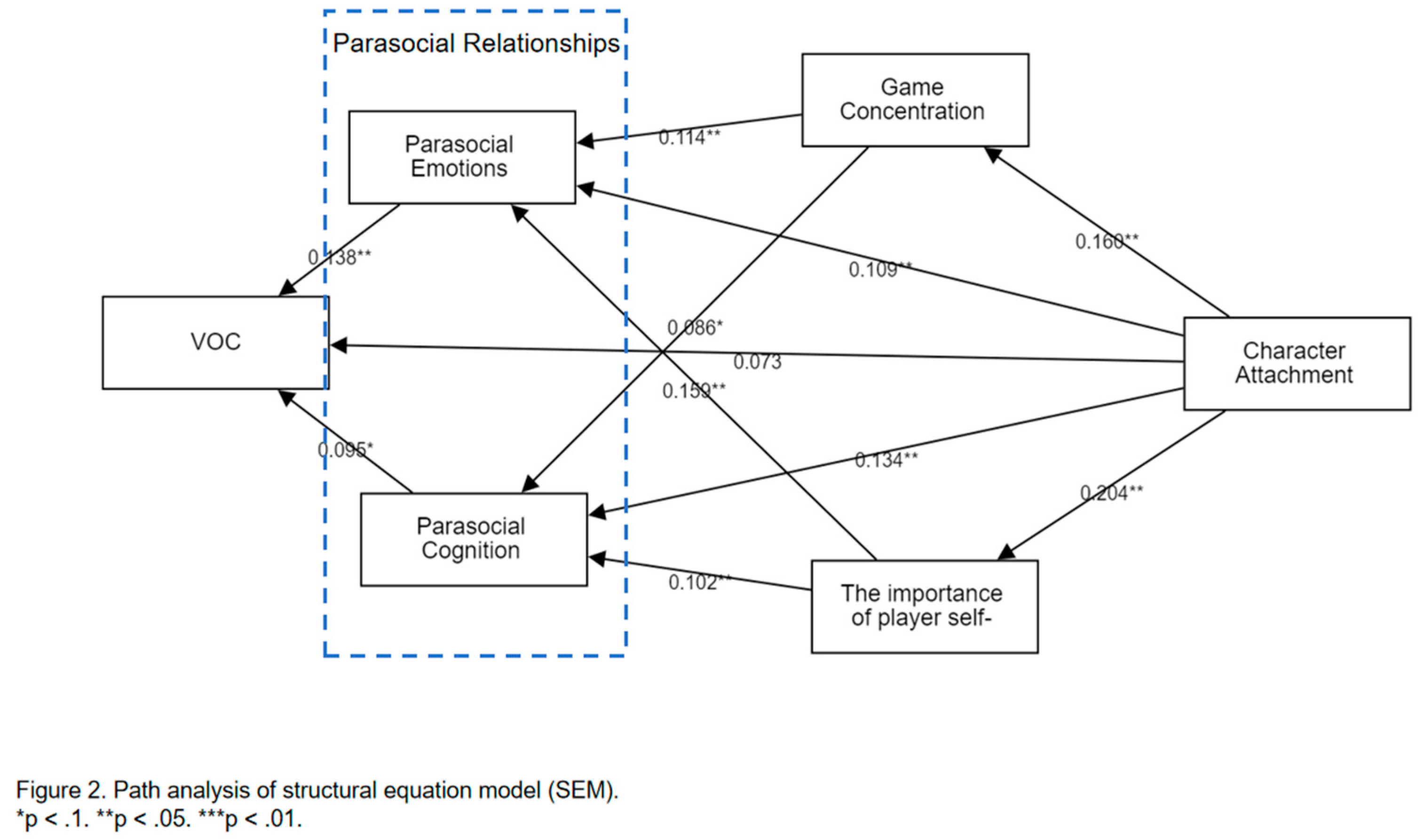
Table 2.
Reliability and Factor loading of All Different Constructs.
| Constructs | Cronbach’s alpha | Variables | Coef. | Std. Error | T(CR) | p | Std. Estimate |
| Game Concentration | .862 | r5 | 1.000 | - | - | - | 0.851 |
| Game Concentration | r6 | 0.993 | 0.101 | 9.860 | 0.000 | 0.892 | |
| The importance of player self-identity | .875 | r11 | 1.000 | - | - | - | 0.877 |
| The importance of player self-identity | r10 | 0.886 | 0.038 | 23.479 | 0.000 | 0.801 | |
| The importance of player self-identity | r12 | 0.906 | 0.037 | 24.369 | 0.000 | 0.833 | |
| character attachment (CA) | .850 | y1 | 1.000 | - | - | - | 0.835 |
| character attachment (CA) | y2 | 1.014 | 0.037 | 27.406 | 0.000 | 0.856 | |
| character attachment (CA) | y3 | 0.958 | 0.037 | 25.727 | 0.000 | 0.822 | |
| character attachment (CA) | y4 | 0.991 | 0.037 | 26.849 | 0.000 | 0.845 | |
| character attachment (CA) | y5 | 0.928 | 0.037 | 25.268 | 0.000 | 0.813 | |
| character attachment (CA) | y6 | 0.934 | 0.038 | 24.447 | 0.000 | 0.795 | |
| parasocial cognition | .866 | z1 | 1.000 | - | - | - | 0.847 |
| parasocial cognition | z2 | 1.006 | 0.044 | 22.767 | 0.000 | 0.827 | |
| parasocial cognition | z3 | 0.918 | 0.041 | 22.341 | 0.000 | 0.806 | |
| parasocial emotions | .875 | q1 | 1.000 | - | - | - | 0.867 |
| parasocial emotions | q2 | 0.954 | 0.038 | 24.878 | 0.000 | 0.857 | |
| parasocial emotions | q3 | 0.875 | 0.038 | 23.059 | 0.000 | 0.788 | |
| Fertility desire(voc) | .884 | s1 | 1.000 | - | - | - | 0.843 |
| Fertility desire(voc) | s2 | 1.057 | 0.042 | 25.327 | 0.000 | 0.871 | |
| Fertility desire(voc) | s3 | 0.942 | 0.039 | 24.353 | 0.000 | 0.829 |
Table 3.
AVE and CR of All Different Constructs.
| Factor | AVE | CR |
|---|---|---|
| Game Concentration | 0.759 | 0.863 |
| The importance of player self-identity | 0.701 | 0.875 |
| character attachment (CA) | 0.685 | 0.929 |
| parasocial cognition | 0.684 | 0.867 |
| parasocial emotions | 0.703 | 0.876 |
| Fertility desire(voc) | 0.719 | 0.885 |
Table 4.
Correlation and Discriminant Validity of Different Constructs.
| Game Concentration | The importance of player self-identity | character attachment (CA) | parasocial cognition | parasocial emotions | Fertility desire(voc) | |
|---|---|---|---|---|---|---|
| Game Concentration | 0.871 | |||||
| The importance of player self-identity | 0.201 | 0.837 | ||||
| character attachment (CA) | 0.161 | 0.204 | 0.828 | |||
| parasocial cognition | 0.131 | 0.144 | 0.169 | 0.827 | ||
| parasocial emotions | 0.173 | 0.199 | 0.159 | 0.124 | 0.838 | |
| Fertility desire(voc) | 0.089 | 0.089 | 0.111 | 0.124 | 0.162 | 0.848 |
Table 5.
The Goodness of Fit in the Current Model.
| Measure | χ2 | df | p | χ2/df | GFI | RMSEA | RMR | CFI | NFI | NNFI |
| Acceptable values | - | - | >0.05 | <3 | >0.9 | <0.10 | <0.05 | >0.9 | >0.9 | >0.9 |
| Value | 20.906 | 4 | 0.000 | 5.226 | 0.988 | 0.079 | 0.036 | 0.895 | 0.881 | 0.605 |
| Other Measure | TLI | AGFI | IFI | PGFI | PNFI | PCFI | SRMR | RMSEA 90% CI | ||
| Acceptable values | >0.9 | >0.9 | >0.9 | >0.5 | >0.5 | >0.5 | <0.1 | - | ||
| Value | 0.605 | 0.934 | 0.901 | 0.188 | 0.235 | 0.239 | 0.039 | 0.048 ~ 0.114 |
Default Model: χ2(15)=175.300, p=1.000
Table 6.
Path Analysis Result and Hypotheses Testing.
| Path direction | Indirect effect | SE | z (CR) | Result | |
| H1a | Character Attachment→Game Concentration | 0.160** | 0.032 | 4.205 | Accepted |
| H6a | Character Attachment→The importance of player self-identity | 0.204** | 0.040 | 5.402 | Accepted |
| H11a | Character Attachment→VOC | 0.073 | 0.041 | 1.878 | NO Accepted |
| H10a | Parasocial Cognition→VOC | 0.095* | 0.040 | 2.466 | Accepted |
| H9a | Parasocial Emotions→VOC | 0.138** | 0.040 | 3.607 | Accepted |
| H5a | Game Concentration→Parasocial Cognition | 0.086* | 0.046 | 2.263 | Accepted |
| H7a | The importance of player self-identity→Parasocial Cognition | 0.102** | 0.037 | 2.661 | Accepted |
| H4a | Character Attachment→Parasocial Cognition | 0.134** | 0.039 | 3.451 | Accepted |
| H3a | Game Concentration→Parasocial Emotions | 0.114** | 0.045 | 3.002 | Accepted |
| H8a | The importance of player self-identity→Parasocial Emotions | 0.159** | 0.036 | 4.162 | Accepted |
| H2a | Character Attachment→Parasocial Emotions | 0.109** | 0.039 | 2.815 | Accepted |
Table 7.
Mediation Analysis Result and Hypotheses Testing.
| Mediation direction | Effect | Boot SE | BootLLCI | BootULCI | z | p | Result | ||
| Character Attachment⇒Parasocial Emotions⇒VOC | 0.020 | 0.008 | 0.004 | 0.038 | 2.331 | 0.020 | Accepted | ||
| Character Attachment⇒Parasocial Emotions⇒VOC | 0.020 | 0.008 | 0.004 | 0.038 | 2.331 | 0.020 | Accepted | ||
| Character Attachment⇒The importance of player self-identity⇒Parasocial Emotions | 0.032 | 0.012 | 0.012 | 0.059 | 2.700 | 0.007 | Accepted | ||
| Character Attachment⇒Game Concentration⇒Parasocial Emotions | 0.015 | 0.007 | 0.004 | 0.030 | 2.126 | 0.034 | Accepted | ||
| Character Attachment⇒The importance of player self-identity⇒Parasocial Cognition | 0.021 | 0.010 | 0.004 | 0.042 | 2.178 | 0.029 | Accepted | ||
| Character Attachment⇒Game Concentration⇒Parasocial Cognition | 0.011 | 0.006 | 0.001 | 0.025 | 1.768 | 0.077 | Accepted | ||
| Character Attachment⇒Game Concentration⇒Parasocial Emotions⇒VOC | 0.003 | 0.002 | 0.001 | 0.007 | 1.838 | 0.066 | Accepted | ||
| Character Attachment⇒Game Concentration⇒Parasocial Emotions⇒VOC | 0.003 | 0.002 | 0.001 | 0.007 | 1.838 | 0.066 | Accepted | ||
| Character Attachment⇒The importance of player self-identity⇒Game Concentration⇒Parasocial Emotions | 0.003 | 0.002 | 0.001 | 0.007 | 1.893 | 0.058 | Accepted | ||
| Character Attachment⇒The importance of player self-identity⇒Game Concentration⇒Parasocial Cognition | 0.003 | 0.002 | 0.000 | 0.006 | 1.574 | 0.115 | Accepted | ||
Disclaimer/Publisher’s Note: The statements, opinions and data contained in all publications are solely those of the individual author(s) and contributor(s) and not of MDPI and/or the editor(s). MDPI and/or the editor(s) disclaim responsibility for any injury to people or property resulting from any ideas, methods, instructions or products referred to in the content. |
© 2023 by the authors. Licensee MDPI, Basel, Switzerland. This article is an open access article distributed under the terms and conditions of the Creative Commons Attribution (CC BY) license (http://creativecommons.org/licenses/by/4.0/).
Copyright: This open access article is published under a Creative Commons CC BY 4.0 license, which permit the free download, distribution, and reuse, provided that the author and preprint are cited in any reuse.


