

Submitted:
02 November 2023
Posted:
03 November 2023
You are already at the latest version
Abstract
Although corporate social responsibility (CSR) initiatives have gained increased significance within the restaurant industry during the pandemic, there is a lack of understanding of how customers’ perceived risks influence their dining intentions for effective crisis response. This study investigates the relationship between perceived CSR, restaurant image, and dining intentions during the crisis. In addition, the study examines three types of perceived risks (quality, health, and environmental) associated with restaurants and their influence on perceived CSR, restaurant image, and dining intentions during this period. The results demonstrate that perceived CSR positively impacts a restaurant’s image and concurrently reduces perceived risks among consumers during the coronavirus disease 2019 (COVID-19) pandemic. Furthermore, perceived health risks have a negative influence on customers’ dining intentions. This study offers valuable insights into the theoretical foundations and managerial implications of CSR’s effects and risk management, particularly in the context of future pandemics within the restaurant industry.
Keywords:
Corporate Social Responsibility
; Theory of Perceived Risk
; Crisis
; Restaurants
; Dining Intention
1. Introduction
The unprecedented coronavirus disease 2019 (COVID-19) pandemic has afflicted tens of thousands and caused thousands of deaths worldwide since 2020 (Manuel & Herron, 2020). Among various industries, the restaurant sector has suffered a significant impact from the coronavirus outbreak, resulting in customer decline due to virus-related fears and rumors (Yu et al., 2021). Furthermore, this impact has the potential to intensify rapidly, posing a greater threat to the survival of businesses in the restaurant industry compared with other sectors (Song et al., 2021). Consequently, timely strategies have become imperative to reduce the harm and ensure swift responses during crises for restaurants.
In the restaurant industry, the concept of corporate social responsibility (CSR) gains heightened significance during crises (Lee & Ham, 2021). CSR entails a business’s ethical and responsible practices that consider not only profit but also the well-being of employees, customers, and the larger community (Atzori & Murphy, 2018). A restaurant that harbors a strong commitment to health and safety measures, supports its staff, and engages in initiatives to aid the community is likely to hold a positive image (Liu et al., 2022). This positive image can alleviate customers’ fears and uncertainties, leading to improved patronage and loyalty (Simakhajornboon & Sirichodnisakorn, 2022). Similarly, understanding customer perceptions and decision-making factors during crises is vital to proactively prepare for unforeseen events, such as the outbreak of diseases like severe acute respiratory syndrome (SARS) (Pine & McKercher, 2004) and the COVID-19 pandemic. By understanding how consumers respond to crises and what influences their decisions, restaurant businesses can tailor their strategies to align with customer expectations, including the importance of CSR values (Liu et al., 2022).
Traditionally, CSR has been recognized as a significant factor within the restaurant industry in enhancing customer retention (Chen et al., 2021). Moreover, CSR serves as a means to cultivate a favorable company image while attracting and retaining loyal customers, which aligns with the principles of the social identity theory (Ali et al., 2021; Reich et al., 2010). It also effectively distinguishes and elevates brand equity by contributing to environmental preservation and resource conservation (Liu et al., 2014). Given the inherent value of CSR, marketers regard CSR practices as a source of competitive advantage and a strategic avenue for overcoming business challenges, especially during a crisis (Harnrungchalotorn & Phayonlerd, 2018).
Customers’ perception of risk plays a crucial role in changing their attitudes and behaviors within the restaurant industry (Rather, 2021). The perceived risk among customers employs a substantial influence on their decision-making process, as consumers tend to be more attentive to potential negative consequences (Crespo et al., 2009). Chen and Chang (2012) also highlighted that perceived risk incorporates concerns regarding unfavorable environmental impacts related to consumer purchasing choices. Research has demonstrated a strong connection between a restaurant’s reputation and perceived risk, suggesting that reducing perceived risk can lead to increased customer loyalty and a higher likelihood of repeat visits (Lacey et al., 2009). Given the circumstances of the pandemic, it is likely that restaurant consumers may exhibit caution in visiting dining establishments due to various risks, including health and environmental concerns. Consequently, the perceived risk experienced by customers during COVID-19 could potentially weaken the relationship between perceived CSR and customer perceptions and behaviors within the restaurant industry.
Given the highly unprecedented effects of COVID-19, it is reasonable to assume that the connection between perceived CSR and customers’ attitudes and behaviors, such as their perceptions of a restaurant, brand loyalty, and dining intentions, may be significantly influenced by various sub-factors of perceived risk during this pandemic (Liu et al., 2022). Therefore, gaining a comprehensive understanding of how customers’ perceived risks impact their dining intentions is crucial for effective crisis response. However, previous studies have primarily focused on the financial performance resulting from CSR rather than on customers’ dining intentions (Lee et al., 2013). Furthermore, there is a lack of empirical evidence regarding how customers’ perceptions of CSR in restaurants contribute to such scenarios.
To address the research gap, this study aims to explore how consumers’ perceptions of CSR impact dining intentions by applying the theory of perceived risk. Specifically, this study seeks to (1) identify the types of perceived risks associated with restaurants during the crisis, (2) demonstrate the influence of consumers’ perceived CSR on restaurant image and their dining intentions, and (3) examine the relationships among perceived CSR, perceived risk, restaurant image, and dining intentions.
2. Literature Review
2.1. CSR Activities in the Hospitality Industry
CSR is not a new concept; in fact, it has gained increasing attention in the business world over the past decade (Albus & Ro, 2017). This shift in focus is attributed to the fact that customers no longer judge a company solely based on its profit-making capabilities; they now expect companies to act as responsible corporate citizens, prioritizing more than just profits (Albus & Ro, 2017). CSR incorporates a company’s obligations and responsibilities regarding its social impact. Carroll (1991) proposed a four-dimensional pyramid model to describe CSR, including economic, legal, ethical, and philanthropic dimensions. CSR practices are widely recognized as a source of competitive advantage and a means of generating long-term revenue for marketers in the hospitality industry (Chen et al., 2021).
Among the diverse range of hospitality and restaurant firms, Starbucks stands out as a company that places a strong emphasis on CSR in its management strategy. This is evident through initiatives like price discounts for tumbler users, efforts to reduce water consumption, and the employment of disabled baristas. Starbucks’ commitment to this management philosophy has not only allowed it to build lasting relationships with customers but has also positioned it as a more competitive brand compared with others (Harnrungchalotorn & Phayonlerd, 2018). During the COVID-19 pandemic, numerous hospitality corporations have embraced various CSR practices as part of their marketing strategies to navigate the business crisis (Tong et al., 2021). Furthermore, CSR has been viewed as an opportunity for firms to demonstrate their authenticity in times of crisis. For example, several branded hotels (such as Marriott, InterContinental, Hilton, etc.) have provided complimentary accommodation or food to healthcare workers combating the COVID-19 pandemic as part of their strategic philanthropic activities during this challenging period (Rhou & Singal, 2020).
While many studies over several decades have aimed to demonstrate the impact of CSR in the hospitality and restaurant industry, only a few hospitality scholars have explored the effects of CSR activities during a pandemic. For instance, Shin et al. (2021) investigated how CSR philanthropic activities by hotels during COVID-19 influenced their financial performance and customer booking behavior. Similarly, Huang and Liu (2020) examined the effectiveness of CSR donation appeals in hospitality marketing during the pandemic. However, the impact of CSR activities in crisis circumstances has received relatively less attention in current hospitality research when compared with general CSR studies.
2.2. Social Identity Theory
The social identity theory, developed originally through early research in social psychology by Tajfel in 1978, forms the foundation of this study. According to the social identity theory, customers tend to identify themselves with businesses they perceive as highly socially responsible. Consequently, they attribute a higher value to these businesses and exhibit a greater degree of commitment, often leading to increased loyalty (Ali et al., 2021). Numerous studies have demonstrated that hotels and restaurants actively engaged in CSR practices can help consumers develop a meaningful social identity (e.g., Srivastava & Singh, 2021). This, in turn, has a significant impact on consumer behavior and their support for the corporation (Ghaderi et al., 2019).
In light of these insights, this study is grounded in the assumption that the relationship between customer-perceived CSR and a restaurant’s image and dining intention can be effectively explained by the social identity theory. To elaborate, when a restaurant actively participates in CSR initiatives, it can create a positive image in the minds of consumers. This positive image, established in shared values and beliefs, may encourage consumers to choose the restaurant for their dining experiences.
Impact of Perceived CSR on Restaurant Image. Brand image refers to the general perceptions and beliefs of customers about a particular brand (Adeniji et al., 2015). It plays a crucial role in building brand value and enhancing a company’s competitiveness in the market (Chen et al., 2021). A brand’s image is shaped by various attributes, and in the highly competitive hotel and restaurant industry, establishing a strong brand is essential for business success (Sheth & Parvatiyar, 2000). Notably, CSR promotes a positive company image while attracting and retaining new and loyal customers (Reich et al., 2010).
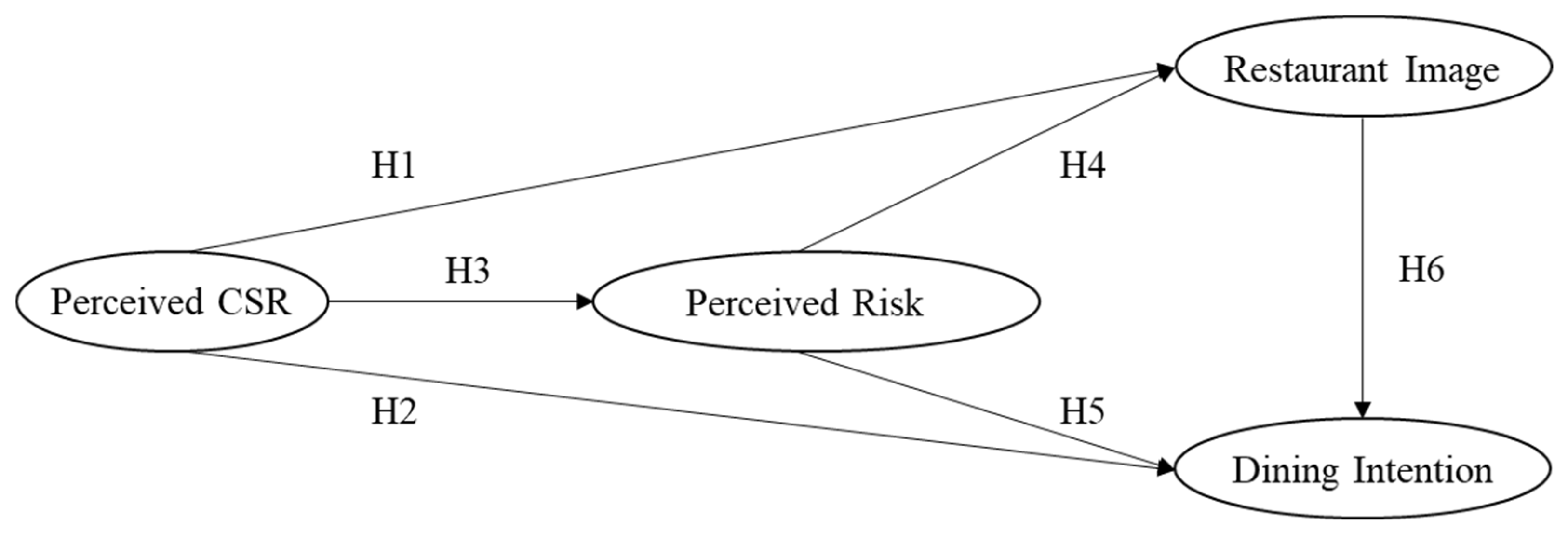
Previous research has consistently demonstrated a positive association between perceived CSR and restaurant image. For instance, Martinez et al. (2014) found that enhancing CSR practices can lead to an improved brand image and reputation, highlighting CSR’s significant contribution to brand image. In addition, Mohammed and Rashid (2018) explored the mediating role of brand image between CSR initiatives and customer satisfaction. Furthermore, Lho et al. (2019) provided evidence that the four dimensions of CSR (economic, philanthropic, ethical, and legal) positively influence a hotel’s brand image. Based on the aforementioned prior research, our study anticipates a positive impact of customers’ perceived CSR on a restaurant’s image. Thus, we hypothesize:
H1: The perceived CSR has a positive impact on the restaurant’s image.
Impact of Perceived CSR on Dining Intention. Dining intention toward socially responsible restaurants reflects the likelihood of customers recommending a restaurant to others, returning to it, or spreading positive word-of-mouth due to the restaurant’s socially responsible practices (Jeong & Jang, 2010). This intention is a commonly used outcome variable to examine the effects of restaurants’ CSR practices on customer perceptions and responses (Xu & Jeong, 2019). With an increasing number of restaurant customers becoming more conscious of socially responsible actions, such as environmental and social initiatives, CSR practices have gained importance in influencing customers’ dining intentions (Tong & Wong, 2014).
To encourage restaurants to be more proactive in implementing CSR initiatives during the pandemic, it is crucial for them to understand the relationship between customers’ perceptions of CSR initiatives taken by restaurants during this crisis and their dining intentions. Previous research has shown that consumers’ perceived importance of CSR positively influences their intentions to revisit restaurants (Liu & Tse, 2021). Similarly, Xu and Jung (2019) found that green messages in restaurants positively impact dining intentions. Hwang et al. (2020) also demonstrated that the philanthropic CSR initiatives of Starbucks positively affect customers’ behavioral intentions, including the intention to use the service, word-of-mouth intentions, and willingness to pay more. Thus, we hypothesize:
H2: The perceived CSR has a positive impact on dining intention.
2.3. Perceived Risk Theory
The concept of perceived risk theory originates from the fields of marketing and consumer behavior literature, as established by Bauer in 1960. It is defined as an individual’s subjective evaluation of uncertainty regarding the potential financial, physical, and social outcomes associated with a consumption experience, as articulated by Liebermann and Stashevsky in 2002. These perceptions tend to yield significant behavioral implications, particularly influencing consumer purchasing decisions, given that individuals tend to focus more on the potential negative consequences of their actions, as emphasized by Kim et al. in 2008. A previous study has highlighted that an increased perception of risk among customers can have a negative influence on their future intentions of dining out (Wei et al., 2021).
Impact of Perceived Risk on Restaurant Image and Dining Intention. Only a limited number of studies have investigated the influence of perceived risk on individuals’ behaviors in the hospitality industry, particularly when examining perceived risk from a multidimensional perspective. For instance, Yu et al. (2021) illustrated how four types of perceived COVID-19 risk impacted post-traumatic stress disorder and customers’ intention to revisit restaurants, including physical, psychological, financial, and performance risks. Huifeng et al. (2020) revealed that two risk factors (performance and financial risks) negatively affected customers’ intentions to visit restaurants. Hwang and Choe (2020) examined the impact of seven dimensions of perceived risk in the image of edible insect restaurants. The results of their study identified that five dimensions of perceived risk (i.e., quality, psychological, health, financial, and social) negatively affected the image of edible insect restaurants. Choi et al. (2013) found that risk perception of street food consumption is highly associated with health and environmental risks in terms of food safety. Consumers aware of these risks were more likely to have a negative attitude toward street food and were less likely to repurchase or recommend street food to others. Similarly, the COVID-19 crisis has led consumers to avoid eating foods that are unsafe for their health and the environment and pose a high risk of exposure to the virus at restaurants (Yost & Cheng, 2021). In accordance with the special circumstances of the pandemic, this study adopts three dimensions of perceived risk. These dimensions encompass (1) quality risk, referring to concerns about a product’s falling short of expectations; (2) health risk, associated with the possibility of a product or service posing health hazards; and (3) environmental risk, covering concerns regarding a product or service’s environmental impact (Al-Ansi et al., 2019; Featherman & Pavlou, 2003; Garner, 1986; Grewal et al., 1994).
The perceived CSR in the restaurant industry may influence the perceived risks that customers associate with dining out during the COVID-19 pandemic (Yu et al., 2021). Potential customers may hesitate to visit restaurants due to their heightened perception of risk (Shin et al., 2021). Consequently, even if customers hold a positive image of a restaurant and possess dining intentions toward establishments implementing CSR initiatives, they might find these options less appealing during this crisis because of increased perceived risks. Following the traditional research framework within the hospitality research literature (e.g., Hwang & Chae, 2020) and considering the unique nature of this pandemic, the following hypotheses are proposed:
H3: The perceived CSR has a negative impact on perceived risk.
H4: The perceived risks have a negative impact on a restaurant’s image.
H5: The perceived risks have a negative impact on dining intention.
2.5. Relationship Between Restaurant Image and Dining Intention
The existing literature has consistently demonstrated the substantial influence of restaurant image on customers’ dining intentions (Espinosa et al., 2018). Within the restaurant industry, a favorable restaurant image is widely recognized as a robust predictor of customers’ dining intentions and their likelihood to share positive feedback with others (Chen et al., 2014). Building upon these established findings, we suggest that a restaurant’s image will likely have a substantial and meaningful influence on customers’ dining intentions. Thus, we hypothesize:
H6: A restaurant’s image has a positive influence on dining intention.
Figure 1.
Proposed Research Model.
3. Methods
3.1. Participants and Data Collection
The participants for this study were recruited via Qualtrics (www.qualtrics.com). Initially, we collected a total of 573 completed surveys. Our target participants were individuals over 18 years old who had dined at a restaurant after the onset of COVID-19. Following the exclusion of unusable data, which included responses with significant missing values, failed attention checks, rapidly completed surveys, and similar or identical responses, we retained 526 responses for the subsequent analysis.
3.2. Measures and Instrument Development
Before responding to the survey questions, the participants were provided with the definition of CSR. They were then instructed to specify the name of the restaurant they had most recently visited in person. Based on their recent dining experience at that restaurant, the participants proceeded to answer the remaining questionnaires. All variables were assessed using multiple items adapted from existing literature and tailored to the context of this study. Specifically, perceived CSR was measured using nine items adapted from Brown et al. (1997) and Wong (2019), while perceived risks were assessed with nine items selected from Al-Ansi et al. (2019), Baker et al. (2016), and Klerck and Sweeney (2007). Restaurant image was evaluated using six items from Hwang and Choe (2019), and dining intention was gauged with three items sourced from Zeithaml and Bitner (1996). All measurement items were rated on a seven-point Likert scale, ranging from 1 (strongly disagree) to 7 (strongly agree). Demographic questions for the participants were included at the end of the survey.
4. Results
4.1. Participant Profiles
A summary of the demographic characteristics of the 526 responses is provided in Table 1. Among the respondents, 42.2% were male and 57.8% were female. The largest age group among the respondents was under 30 (31%), followed by those above 60 (24.7%). In terms of ethnicity, 392 (74.5%) respondents identified as Caucasian. Regarding the highest level of education, the majority of the respondents achieved a bachelor’s degree (27.0%). In terms of household income, 31.4% of the respondents reported an income of under $40,000, while 20.5% reported an income of $100,000 and above. The most common response for the average daily accommodation cost was in the range of $50–$99, accounting for 46.8% of all responses. Approximately 33.3% of the respondents mentioned that they dined out at restaurants a few times per week before the COVID-19 pandemic, while nearly 28.1% reported dining out once a week prior to the outbreak. However, this percentage decreased following the onset of COVID-19, with only 21.5% of the respondents indicating that they dined out at restaurants a few times per week.
4.2. Principal Component Analysis
We conducted a principal component analysis to identify the perceived risks associated with restaurants during the crisis. Following a comprehensive literature review, we adhered to the suggestion that three sub-groups of perceived risk should be analyzed collectively. These sub-groups were categorized as quality, health, and environmental risks. The results of the principal component analysis confirmed the validity of the factor model, with a Kaiser–Meyer–Olkin (KMO) measure of sampling adequacy at 0.910. Furthermore, the factor model accounted for 85.183% of the variance. Notably, all items exhibited factor loadings exceeding 0.761. In addition, Cronbach’s alpha values fell within the range of 0.890 to 0.921, indicating a high level of reliability exceeding 0.7 (refer to Table 2).
4.3. Confirmatory Factor Analysis (CFA)
CFA was employed to verify the reliability and validity of the scales (Anderson & Gerbing, 1988). The results are presented in Table 3. The CFA results were all above the acceptable level (χ2 = 1230.635, df = 301, χ2 /df = 4.088, p < 0.001, IFI = 0.925, CFI = 0.925, TLI = 0.913, and RESEA = 0.077). The factor loadings using standardized regression weights ranged from 0.59 to 0.951, and all factor loadings were significant at p < 0.001. Consequently, it was confirmed that all the measurement items in this study were reliable. In addition, average variance extracted (AVE) and composite reliability (CR) were examined to identify internal consistency and convergent validity. The AVE values ranged from 0.593 to 0.8, while the CR values ranged from 0.9 to 0.928. Given that the AVE values were higher than 0.5 and the CR values were higher than 0.7, the internal consistency and convergent validity of the measurement variables were acceptable (Fornell & Larcker, 1981). Lastly, we investigated discriminant validity to assess differentiation among the constructs. According to Fornell and Larcker (1981), discriminant validity is confirmed when the AVE value is greater than the squared correlation coefficients of the constructs (see Table 4).
4.4. Structural Equation Modeling (SEM)
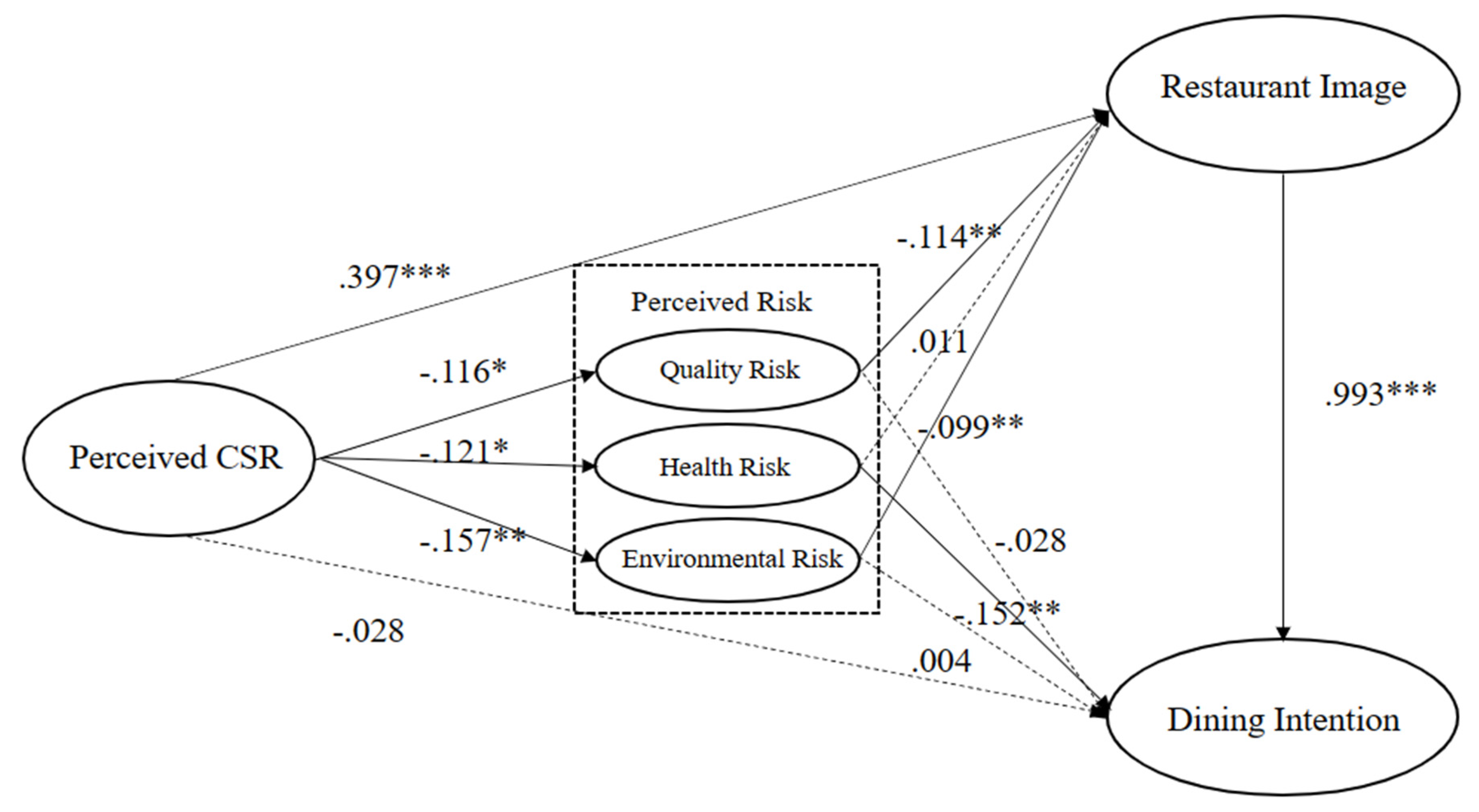
To validate the suggested hypotheses, we adopted SEM. The goodness of fit of this model was appropriate (χ2 = 1161.5, df = 297, χ2 /df = 3.910, p < 0.001, NFI = 0.909, IFI = 0.931, CFI = 0.930, TLI = 0.918, and RMSEA = 0.074). The SEM results with standardized coefficients are presented in Fig. 2. Specifically, perceived CSR (β = 0.397, p < 0.001) positively affected a restaurant’s image, thus supporting H1. Perceived CSR was significantly associated with quality risk (β = –0.116, p < 0.01), health risk (β = –0.121, p < 0.01), and environmental risk (β = –0.157, p < 0.05); thus, H3a, H3b, and H3c were statistically supported. Quality risk (β = –0.114, p < 0.05) and environmental risk (β = –0.099, p < 0.05) were found to be significantly associated with restaurant image; thus, H4a and H4c were supported. In addition, quality risk (β = –0.059, p < 0.05) and health risk (β = –0.152, p < 0.05) were found to be significantly associated with dining intention; thus, H5a and H5b were supported. Moreover, the data analysis revealed that restaurant image positively affected dining intention (β = 0.993, p < 0.001); therefore, H6 was supported. We summarized the hypothesis testing results in Table 5.
Figure 2.
Standardized Theoretical Path Coefficients.
5. Discussion and Implications
5.1. Summary of the Findings
While previous research has primarily focused on the relationship between CSR and financial performance in the restaurant industry, less attention has been given to understanding how customers’ perceptions of CSR impact their dining intentions, especially during a crisis. There has been a lack of theoretical evidence that explores the role of perceived risk in these dynamics. This study aims to bridge this gap by investigating whether the CSR initiatives implemented by restaurants influence their overall image and, subsequently, customers’ dining intentions. In addition, we examine the influence of three specific types of perceived risk, namely, quality, health, and environmental risks, on the relationships among these variables. The results of this study could provide valuable insights into the practical strategies that the restaurant industry can apply in times of crisis.
5.2. Theoretical Implications
This research can provide several theoretical implications for the restaurant industry. First, our study added to the literature related to the effect of CSR initiatives during the pandemic in the restaurant industry. Our results show that perceived CSR is a strong predictor of restaurant image compared with dining intention during the crisis. Specifically, we have demonstrated that the more customers are aware of a restaurant’s CSR, the higher will be the restaurant’s image. Consistent with the result of other research (e.g., Martinez et al., 2014), we observed the effects of perceived CSR on restaurant image even during the COVID-19 pandemic. However, the lack of a significant association between perceived CSR and dining intention may be due to various factors. For instance, consumers may perceive CSR initiatives positively, which would enhance a restaurant’s image as socially responsible. However, this positive image might not necessarily translate directly into their dining intentions during a crisis, where other factors like health and safety risks play a more dominant role (Yost & Cheng, 2021). The relationship between CSR and dining intention could be mediated or influenced by other variables not considered in the study, such as trust in the CSR initiatives or the severity of the crisis (Kim & Ham, 2016; Kim et al., 2021).
Second, we confirmed three types of perceived risk at restaurants during the pandemic. We extracted three factors of perceived risk (i.e., quality, health, and environmental risks) through principal component analysis. Furthermore, CFA was performed to determine the adequacy of the measurement structure, and the results showed high levels of validity and reliability. Prior research has demonstrated that four dimensions of the perceived risk of COVID-19 (i.e., psychological, financial, performance, and physical risks) are predictors of post-traumatic stress disorder (PTSD) and revisit intention at hotels (Yu et al., 2021). Thus, the results of the current study contribute to important theoretical implications by investigating three types of perceived risk in times of crisis in the restaurant industry.
Third, our research enriched the understanding of CSR in times of crisis. In particular, our results contribute to the existing COVID-19 hospitality literature indicating that customers’ perceived risk should be taken into consideration to strengthen the effects of CSR practices during the pandemic. This study reinforces the theoretical support that perceived CSR reduces three aspects of perceived risk (i.e., quality, health, and environmental risks). Given that diverse hospitality corporations have been involved in various CSR initiatives as one of the risk management strategies to respond to the COVID-19 pandemic, this study can contribute to the hospitality literature by understanding that perceived CSR can decrease three types of perceived risk (i.e., quality, health, and environmental) during the pandemic. Furthermore, this research can provide a body of hospitality literature on how people perceive and interpret CSR during crises in the restaurant industry. Our results demonstrate that quality and environmental risks were not significant indicators of consumers’ dining intention. This finding is not surprising since consumers may prioritize other factors, such as health and safety concerns, over quality and environmental concerns during a pandemic (Yost & Cheng, 2021), confirming our study results that health risks significantly impacted consumers’ intention to dine out at a restaurant other than the mediating effect of restaurant image. During a pandemic, consumers prioritize their immediate safety and health, often placing these concerns above other factors, such as a restaurant’s image.
Fourth, consistent with previous research (Hwang & Choe, 2020; Namkung & Jang, 2017), the results of this study confirmed the positive relationship between restaurant image and dining intention. Specifically, when consumers have a positive image of a restaurant, they are more willing to eat out at restaurants. On a related note, we identified the important role of a restaurant’s image by examining its impact on dining intentions during the pandemic, which can contribute to theoretical implications.
5.3. Managerial Implications
Based on the findings above, the authors present a series of practical implications, particularly for the restaurant industry. First, one finding provides significant guidance for restaurants to understand the role of CSR on restaurant image during the pandemic. In times of crisis, implementing CSR initiatives can be traditionally viewed as a great opportunity to show authenticity and reduce customers’ skepticism toward those initiatives. Thus, restaurant companies should perform a variety of CSR initiatives to enhance restaurant image and visit intention during the uncommon golden period by supporting local communities, donating food, ensuring employees’ well-being, and reducing environmental issues. For instance, restaurants can demonstrate their commitment to the well-being of the local community by engaging in initiatives such as food drives, partnering with local charities, or even offering free meals to those in need. Meanwhile, restaurants can prioritize the health, safety, and overall welfare of their staff. This may involve implementing stringent health and safety protocols, offering mental health support, or providing flexible work arrangements to accommodate employees’ needs. Furthermore, there has been an increasing trend in the importance of CSR initiatives in the food service industry. These CSR marketing practices were not only highlighted during the pandemic phases. Thus, restaurants can harness the benefits of CSR initiatives for future advertising plans to accelerate post-crisis recovery. For example, restaurants can create advertisements that showcase their sustainability efforts, which may include using eco-friendly packaging, sourcing ingredients from local farms, or implementing energy-saving practices.
Second, our findings identified that perceived health risks negatively affect customers’ dining intentions. This result is plausible because customers may fear being infected with the virus while eating out during this period. Hence, restaurant practitioners should lead initiatives that prove the capacity of the industry to help their customers reduce their perceived health risks. For example, it would be crucial for restaurants to adopt various cleaning technological systems (e.g., contactless ordering kiosks and cleaning robot systems) to minimize perceived risks in the health aspect. In addition, restaurant managers need to provide strict employee hygiene training by mandatorily letting the staff wear masks and asking them to frequently wash their hands before and after serving customers.
Furthermore, our results indicate a negative association between perceived quality and environmental risks with a restaurant’s image. Thus, reducing perceived quality and environmental risks is crucial for enhancing a restaurant’s image. To reduce perceived quality risks, restaurants could emphasize providing quality food, ensuring food safety practices, and implementing standardized cooking procedures and staff training. To reduce perceived environmental risks, restaurants could implement sustainable practices, such as recycling, composting, and reducing single-use plastics. They can also enhance energy efficiency by using LED lighting, energy-efficient appliances, and smart thermostats. By addressing quality and environmental risks and making these efforts visible to customers, restaurants can positively influence their image, attract more consumers, and build long-term loyalty.
5.4. Limitations and Future Research
While the current study identified interesting findings and implications, there are some limitations of this study that are recommended to be addressed in future studies.
First, this study concentrated on the effects of CSR only in the food service industry. Therefore, the validity of the research results should be expanded through comparison with other service industries (e.g., hotels) in future studies. For example, during the pandemic, large-scale hotel corporations have also been involved in CSR activities, such as free accommodation for healthcare workers and food donations. Hence, we expect that diverse types of perceived risk can weaken the relationship between perceived CSR and visit intention in other service businesses.
Second, this study did not classify consumers according to personality traits or individual characteristics. Accordingly, we may have overlooked the potential effects of various individualistic features on customers’ dining intentions. Consumers’ personal characteristics, such as environmental consciousness, skepticism, or personal value, can be crucial in their attitudes toward CSR activities. Thus, future research should include how consumer knowledge or characteristics may influence the effects of CSR on individuals’ dining intentions.
Third, this study has a cross-sectional design, so the data were gathered during the COVID-19 period. However, it is important for the restaurant industry to mitigate customers’ perceived risks even in the post-pandemic era. In addition, the types of customer perceived risks may differ after the post-pandemic phase because the impact and the types of perceived risks may have changed over time compared with those during the pandemic. Therefore, follow-up studies should consider how the impact and the type of risk perceived by customers differed in the post-pandemic period compared with during the pandemic in the restaurant industry.
References
- Adeniji, A. A., Osibanjo, A. O., Abiodun, A. J., & Oni-Ojo, E. E. (2015). Corporate image: A strategy for enhancing customer loyalty and profitability. Journal of South African Business Research, 1-12. [CrossRef]
- Al-Ansi, A., Olya, H. G., & Han, H. (2019). Effect of general risk on trust, satisfaction, and recommendation intention for halal food. International Journal of Hospitality Management, 83, 210-219.
- Albus, H., & Ro, H. (2017). Corporate social responsibility: The effect of green practices in a service recovery. Journal of Hospitality & Tourism Research, 41(1), 41-65.
- Ali, W., Danni, Y., Latif, B., Kouser, R., & Baqader, S. (2021). Corporate social responsibility and customer loyalty in food chains—Mediating role of customer satisfaction and corporate reputation. Sustainability, 13(16), 8681. [CrossRef]
- Atzori, R., Shapoval, V., & Murphy, K. S. (2018). Measuring Generation Y consumers' perceptions of green practices at Starbucks: An IPA analysis. Journal of foodservice business research, 21(1), 1-21. [CrossRef]
- Bauer, R. A. (1960). Consumer behavior as risk-taking. In Proceedings of the 43rd National Conference of the American Marketing Association, Chicago, Illinois.
- Brown, T. J., & Dacin, P. A. (1997). The company and the product: Corporate associations and consumer product responses. Journal of marketing, 61(1), 68–84.
- Caroll, J. M. (1991). The task-artifact cycle. Designing Interaction-Psychology at Human-Computer Interface.
- Chen, C. C., Khan, A., Hongsuchon, T., Ruangkanjanases, A., Chen, Y. T., Sivarak, O., & Chen, S. C. (2021). The role of corporate social responsibility and corporate image in times of crisis: The mediating role of customer trust. International journal of environmental research and public health, 18(16), 8275. [CrossRef]
- Chen, H. B., Yeh, S. S., & Huan, T. C. (2014). Nostalgic emotion, experiential value, brand image, and consumption intentions of customers of nostalgic-themed restaurants. Journal of Business Research, 67(3), 354-360. [CrossRef]
- Chen, Y. S., & Chang, C. H. (2012). Enhance green purchase intentions: The roles of green perceived value, green perceived risk, and green trust. Management Decision, 50(3), 502–520.
- Choi, J., Lee, A., & Ok, C. (2013). The effects of consumers' perceived risk and benefit on attitude and behavioral intention: A study of street food. Journal of Travel & Tourism Marketing, 30(3), 222–237. [CrossRef]
- Crespo, Á. H., Del Bosque, I. R., & de los Salmones Sánchez, M. G. (2009). The influence of perceived risk on Internet shopping behavior: a multidimensional perspective. Journal of Risk Research, 12(2), 259-277. [CrossRef]
- Espinosa, J. A., Ortinau, D. J., Krey, N., & Monahan, L. (2018). I’ll have the usual: how restaurant brand image, loyalty, and satisfaction keep customers coming back. Journal of Product & Brand Management, 27(6), 599-614.
- Featherman, M. S., & Pavlou, P. A. (2003). Predicting e-services adoption: a perceived risk facets perspective. International journal of human-computer studies, 59(4), 451-474. [CrossRef]
- Garner, S. J. (1986). Perceived risk and information sources in services purchasing. The mid-Atlantic journal of business, 24(2), 49-58.
- Ghaderi, Z., Mirzapour, M., Henderson, J. C., & Richardson, S. (2019). Corporate social responsibility and hotel performance: A view from Tehran, Iran. Tourism Management Perspectives, 29, 41-47. [CrossRef]
- Grewal, D., Gotlieb, J., & Marmorstein, H. (1994). The moderating effects of message framing and source credibility on the price-perceived risk relationship. Journal of consumer research, 21(1), 145-153. [CrossRef]
- Harnrungchalotorn, S., & Phayonlerd, Y. (2018). Starbucks with corporate social responsibility: How Starbucks succeeds in a business world with CSR (master’s thesis). Karlstads Universitet, 651 88 Karlstad.
- Huang, H., & Liu, S. Q. (2020). “Donate to help combat COVID-19!” How typeface affects the effectiveness of CSR marketing?. International Journal of Contemporary Hospitality Management, 32(10), 3315-3333.
- Huifeng, P., Ha, H. Y., & Lee, J. W. (2020). Perceived risks and restaurant visit intentions in China: Do online customer reviews matter?. Journal of Hospitality and Tourism Management, 43, 179-189. [CrossRef]
- Hwang, J., & Choe, J. Y. (2019). Exploring perceived risk in building successful drone food delivery services. International Journal of Contemporary Hospitality Management, 31(8), 3249–3269. [CrossRef]
- Hwang, J., & Choe, J. Y. (2020). How to enhance the image of edible insect restaurants: Focusing on perceived risk theory. International Journal of Hospitality Management, 87, 102464. [CrossRef]
- Hwang, J., Kim, J. J., & Lee, S. (2020). The importance of philanthropic corporate social responsibility and its impact on attitude and behavioral intentions: The moderating role of the barista disability status. Sustainability, 12(15), 6235. [CrossRef]
- Jeong, E., & Jang, S. (2010). Effects of restaurant green practices: Which practices are important and effective?
- Kim, D. J., Ferrin, D. L., & Rao, H. R. (2008). A trust-based consumer decision-making model in electronic commerce: The role of trust, perceived risk, and their antecedents. Decision support systems, 44(2), 544-564. [CrossRef]
- Kim, E., & Ham, S. (2016). Restaurants’ disclosure of nutritional information as a corporate social responsibility initiative: Customers’ attitudinal and behavioral responses. International Journal of Hospitality Management, 55, 96-106. [CrossRef]
- Kim, M., Kim, E. J., & Bai, B. (2021). Examining restaurant purchase intention during crises: the role of message appeal. International Journal of Contemporary Hospitality Management, 33(12), 4373-4390. [CrossRef]
- Klerck, D., & Sweeney, J. C. (2007). The effect of knowledge types on consumer-perceived risk and adoption of genetically modified foods. Psychology & Marketing, 24(2), 171-193. [CrossRef]
- Lacey, S., Bruwer, J., & Li, E. (2009). The role of perceived risk in wine purchase decisions in restaurants. International journal of wine business research, 21(2), 99-117. [CrossRef]
- Lee, S., Singal, M., & Kang, K. H. (2013). The corporate social responsibility–financial performance link in the US restaurant industry: do economic conditions matter?. International Journal of Hospitality Management, 32, 2-10.
- Lee, S., Kim, B., & Ham, S. (2018). Strategic CSR for airlines: does materiality matter?. International Journal of Contemporary Hospitality Management, 30(12), 3592-3608.
- Lee, S., & Ham, S. (2021). Food service industry in the era of COVID-19: trends and research implications. Nutrition Research and Practice, 15, S22-S31. [CrossRef]
- Lho, H., Park, J., & Yu, J. (2019). The effects of corporate social responsibility (CSR) initiatives on brand image, brand prestige, and behavioral intention. International Journal of Tourism and Hospitality Research, 33(4), 63-74. [CrossRef]
- Liebermann, Y., & Stashevsky, S. (2002). Perceived risks as barriers to Internet and e-commerce usage. Qualitative Market Research: An International Journal, 5(4), 291-300. [CrossRef]
- Liu, M., Wong, I., Shi, G., Chu, R., & Brock, J. (2014). The impact of corporate social responsibility (CSR) performance and perceived brand quality on customer-based brand preference. Journal of services marketing, 28(3), 181–194. [CrossRef]
- Liu, P., & Tse, E. C. (2021). The Impact of Perceived Corporate Social Responsibility on Dining Intention in US Restaurants: Focusing on Customers’ Health. Journal of Culinary Science & Technology, 1-22. [CrossRef]
- Liu, P., Tse, E. C. Y., & He, Z. (2022). Influence of Customer Satisfaction, Trust, and Brand Awareness in Health-related Corporate Social Responsibility Aspects of Customers Revisit Intention: A Comparison between US and China. Journal of Quality Assurance in Hospitality & Tourism, 1-27. [CrossRef]
- Manuel, T., & Herron, T. L. (2020). An ethical perspective of business CSR and the COVID-19 pandemic. Society and Business Review, 15(3), 235-253. [CrossRef]
- Mohammed, A., & Rashid, B. (2018). A conceptual model of corporate social responsibility dimensions, brand image, and customer satisfaction in Malaysian hotel industry. Kasetsart Journal of social sciences, 39(2), 358-364. [CrossRef]
- Namkung, Y., & Jang, S. (2017). Are consumers willing to pay more for green practices at restaurants?. Journal of Hospitality & Tourism Research, 41(3), 329-356. [CrossRef]
- Pine, R., & McKercher, B. (2004). The impact of SARS on Hong Kong’s tourism industry. International Journal of Contemporary Hospitality Management, 16(2), 139-143.
- Rather, R. A. (2021). Demystifying the effects of perceived risk and fear on customer engagement, co-creation and revisit intention during COVID-19: A protection motivation theory approach. Journal of Destination Marketing & Management, 20, 100564. [CrossRef]
- Reich, A. Z., Xu, Y. H., & McCleary, K. W. (2010). The influence of social responsibility image relative to product and service quality on brand loyalty: An exploratory study of quick-service restaurants. Hospitality Review, 28(1), 2.
- Rhou, Y., & Singal, M. (2020). A review of the business case for CSR in the hospitality industry. International Journal of Hospitality Management, 84, 102330. [CrossRef]
- Sheth, J. N., & Parvatiyar, A. (2000). The domain and conceptual foundations of relationship marketing. Handbook of relationship marketing, 3–38.
- Shin, H., Sharma, A., Nicolau, J. L., & Kang, J. (2021). The impact of hotel CSR for strategic philanthropy on booking behavior and hotel performance during the COVID-19 pandemic. Tourism Management, 85, 104322. [CrossRef]
- Simakhajornboon, P., & Sirichodnisakorn, C. (2022). The effect of customer perception of CSR initiative on customer loyalty in the hotel industry. Humanities, Arts and Social Sciences Studies, 384-396.
- Song, H. J., Yeon, J., & Lee, S. (2021). Impact of the COVID-19 pandemic: Evidence from the US restaurant industry. International Journal of Hospitality Management, 92, 102702. [CrossRef]
- Srivastava, S., & Singh, N. (2021). Do Corporate Social Responsibility (CSR) initiatives boost customer retention in the hotel industry? A moderation-mediation approach. Journal of Hospitality Marketing & Management, 30(4), 459-485. [CrossRef]
- Tajfel, H. E. (1978). Differentiation between social groups: Studies in the social psychology of intergroup relations. Academic Press.
- Tong, C., & Wong, A. (2014). The influences of corporate social responsibility to customer repurchases intentions, customer word-of-mouth intentions and customer perceived food quality of fast-food restaurants in Hong Kong and the mediating effects of corporate reputation. British Journal of Economics, Management & Trade, 4(11), 1655–1678. [CrossRef]
- Tong, Z., Xie, Y., & Xiao, H. (2021). Effect of CSR contribution timing during COVID-19 pandemic on consumers’ prepayment purchase intentions: Evidence from hospitality industry in China. International Journal of Hospitality Management, 97, 102997. [CrossRef]
- Wei, C., Chen, H., & Lee, Y. M. (2021). COVID-19 preventive measures and restaurant customers’ intention to dine out: The role of brand trust and perceived risk. Service Business, 1-20. [CrossRef]
- Wong, A. T. T. (2019). Do corporate social responsibility and safety of food affect reputation? A study of fast-food restaurants industry in Hong Kong. Journal of Economics, Management and Trade. [CrossRef]
- Xu, Y., & Jeong, E. (2019). The effect of message framings and green practices on customers’ attitudes and behavior intentions toward green restaurants. International Journal of Contemporary Hospitality Management. [CrossRef]
- Yost, E., & Cheng, Y. (2021). Customers’ risk perception and dine-out motivation during a pandemic: Insight for the restaurant industry. International Journal of Hospitality Management, 95, 102889. [CrossRef]
- Yu, J., Lee, K., & Hyun, S. S. (2021). Understanding the influence of the perceived risk of the coronavirus disease (COVID-19) on the post-traumatic stress disorder and revisit intention of hotel guests. Journal of hospitality and tourism management, 46, 327-335. [CrossRef]
- Zeithaml, V. A., & Bitner, M. J. (1996). Customer expectations of services. Services Marketing. New York: McGraw-Hill.

Table 1.
Demographic Profile (N = 526).
| Demographic Characteristics | Descriptive |
Frequency (n=526) |
Percentage (%) |
| Gender | Male | 222 | 42.2 |
| Female | 304 | 57.8 | |
| Age | Under 30 | 168 | 31.0 |
| 31-40 | 82 | 15.6 | |
| 41-50 | 75 | 14.3 | |
| 51-60 | 76 | 14.4 | |
| Over 60 | 130 | 24.7 | |
| Ethnicity | Caucasian | 392 | 74.5 |
| African American | 73 | 13.9 | |
| Native American | 8 | 1.5 | |
| Hispanic/Latino | 31 | 5.9 | |
| Asian/Pacific Islander | 21 | 4.0 | |
| Others | 1 | .2 | |
| Highest Education Level | Less than a high school diploma | 9 | 1.7 |
| High school diploma/GED | 106 | 20.2 | |
| Some college | 137 | 26.0 | |
| Associate degree | 63 | 12.0 | |
| Bachelor’s degree | 142 | 27.0 | |
| Graduate Degree | 69 | 13.1 | |
| Household Income | Less than $40,000 | 165 | 31.4 |
| $40,000 - $59,999 | 103 | 19.6 | |
| $60,000 - $79,999 | 89 | 16.9 | |
| $80,000 - $99,999 | 61 | 11.6 | |
| $100,000 and above | 108 | 20.5 | |
| The frequency of dining out at restaurants before the COVID-19 virus | Once a day | 22 | 4.2 |
| A few times per week | 175 | 33.3 | |
| Once a week | 148 | 28.1 | |
| 2-3 times per month | 126 | 24.0 | |
| Once a month | 55 | 10.5 | |
| The frequency of ordering restaurant foods after COVID-19 | Once a day | 15 | 2.9 |
| A few times per week | 113 | 21.5 | |
| Once a week | 177 | 33.7 | |
| 2-3 times per month | 123 | 23.4 | |
| Once a month | 88 | 16.7 | |
| None | 10 | 1.9 |
Table 2.
Exploratory Factor Analysis for the Three Types of Perceived Risk.
| Variables | Standardized factor loadings | Eigenvalue | Explained variance (%) | Cronbach’s alpha |
| Health risk | 6.402 | 71.135 | .890 | |
| I worry that ordering food from this restaurant is harmful. | .835 | |||
| I worry about my health after ordering food from this restaurant. | .904 | |||
| I worry that ordering food from this restaurant is unhealthy. | .794 | |||
| Quality risk | .732 | 8.134 | .912 | |
| I worry about the lower quality of this restaurant than before. | .761 | |||
| I worry because of the low quality of this restaurant. | .912 | |||
| I am concerned about the quality of this restaurant. | .865 | |||
| Environmental risk | .532 | 5.914 | .921 | |
| I am concerned about the cleanliness of this restaurant. | .899 | |||
| I am concerned about the environmental conditions of this restaurant. | .867 | |||
| I am concerned about the hygiene standards of this restaurant. | .829 |
Note: Total explained variance = 85.183 %, KMO measure of sampling adequacy = .910, Bartlett’s test of sphericity (p < .001).
Table 3.
Confirmatory Factor Analysis with Items and Loadings.
| Construct and scale item | Standardized factor loadings |
| Perceived CSR | |
| This restaurant protects the environment. | .725 |
| This restaurant shows it is committed toward society by improving the welfare of the communities in which it operates. | .823 |
| This restaurant directs part of its budget to donations to social causes. | .782 |
| This restaurant provides a safe and relaxed dining environment for customers. | .621 |
| This restaurant offers good working conditions for its employees. | .691 |
| This restaurant is very involved with the local community. | .805 |
| This restaurant commits to using a substantial portion of its profits to help communities where it does its business. | .875 |
| This restaurant includes charity work in its business activities. | .791 |
| This restaurant shows concern over environmental degradation. | .789 |
| Quality risk | |
| I worry about the lower quality of this restaurant than before. | .870 |
| I worry because of the low quality of this restaurant. | .951 |
| I am concerned about the quality of this restaurant. | .840 |
| Health risk | |
| I worry that ordering food from this restaurant is harmful. | .802 |
| I worry about my health after ordering food from this restaurant. | .930 |
| I worry that ordering food from this restaurant is unhealthy. | .861 |
| Environmental risk | |
| I am concerned about the cleanliness of this restaurant. | .920 |
| I am concerned about the environmental conditions of this restaurant. | .919 |
| I am concerned about the hygiene standards of this restaurant. | .843 |
| Restaurant image | |
| This restaurant has a distinctive character. | .589 |
| I often say positive things about this restaurant. | .841 |
| I hear positive feedback about this restaurant. | .780 |
| The overall image for dining out at this restaurant is good. | .821 |
| The overall image of this restaurant is great. | .873 |
| Overall, I have a good image of this restaurant. | .887 |
| Dining intention | |
| I would order food (dining-in or dining-out) from this restaurant again. | .835 |
| I am willing to order food (dining-in or dining-out) from this restaurant again. | .892 |
| I plan to return to order food (dining-in or dining-out) from this restaurant. | .884 |
Goodness-of-fit statistics: 2 = 1230.635, df = 301, 2 /df = 4.088, p < .001, IFI = .925, CFI = .925, TLI = .913, and RESEA = .077. Notes 1: All factor loadings are significant at p < .001
Table 4.
Discriminant Validity and Means of Variables.
| Construct | PCSR | QR | HR | ER | RI | DI | AVE | CR |
Means (SD) |
| PCSR | 1 | 0.593 | 0.929 | 4.89 (1.01) |
|||||
| QR | -0.118 (0.01) |
1 | 0.789 | 0.918 | 3.03 (1.57) |
||||
| HR | -0.129 (0.01) |
0.731 (0.53) |
1 | 0.745 | 0.9 | 2.73 (1.65) |
|||
| ER | -0.126 (0.01) |
0.766 (0.59) |
0.785 (0.62) |
1 | 0.8 | 0.923 | 2.98 (1.69) |
||
| RI | 0.569 (0.32) |
-0.363 (0.13) |
-0.331 (0.11) |
-0.361 (0.13) |
1 | 0.647 | 0.916 | 5.27 (1.13) |
|
| DI | 0.424 (0.18) |
-0.439 (0.19) |
-0.453 (0.21) |
-0.44 (0.19) |
0.716 (0.51) |
1 | 0.758 | 0.903 | 5.85 (1.18) |
Note: PCSR: Perceived corporate social responsibility; QR: Quality risk; HR: Health risk; ER: Environmental risk; RI: Restaurant image; DI: Dining intention.
Table 5.
Standardized Parameter Estimates for the Structural Model.
| Standardized Estimate | t-value | Hypothesis | ||||
| H1 | PCSR | → | RI | .397*** | 10.273 | Supported |
| H2 | PCSR | → | DI | -.028 | -.644 | Not supported |
| H3a | PCSR | → | QR | -.116* | -1.779 | Supported |
| H3b | PCSR | → | HR | -.121* | -1.884 | Supported |
| H3c | PCSR | → | ER | -.157** | -2.081 | Supported |
| H4a | QR | → | RI | -.114** | -3.100 | Supported |
| H4b | HR | → | RI | .011 | .263 | Not supported |
| H4c | ER | → | RI | -.099** | -2.424 | Supported |
| H5a | QR | → | DI | -.028 | -.627 | Not supported |
| H5b | HR | → | DI | -.152** | -2.817 | Supported |
| H5c | ER | → | DI | -.004 | .076 | Not supported |
| H6 | RI | → | DI | .933*** | 10.683 | Supported |
PCSR = Perceived Corporate Social Responsibility; QR = Quality risk; HR = Health risk; ER= Environmental risk; RI= Restaurant image; DI=Dining intention. * p < .01, **p < .05, *** p < .001.
Disclaimer/Publisher’s Note: The statements, opinions and data contained in all publications are solely those of the individual author(s) and contributor(s) and not of MDPI and/or the editor(s). MDPI and/or the editor(s) disclaim responsibility for any injury to people or property resulting from any ideas, methods, instructions or products referred to in the content. |
© 2023 by the authors. Licensee MDPI, Basel, Switzerland. This article is an open access article distributed under the terms and conditions of the Creative Commons Attribution (CC BY) license (http://creativecommons.org/licenses/by/4.0/).
Copyright: This open access article is published under a Creative Commons CC BY 4.0 license, which permit the free download, distribution, and reuse, provided that the author and preprint are cited in any reuse.