
Submitted:
15 June 2024
Posted:
18 June 2024
Read the latest preprint version here
Abstract
The theory of limited numbers says that the number is not infinite, that is, the number is limited in parts or completely. To reach a conclusion about the limited number, one must understand the meaning of mathematics and varied spaces, therefore, one must understand that mathematics and spaces interact. Mathematics has the function of describing the world precisely, where numbers represent elements or facts that rationally belong to space, and spaces have different intensities of specific physical concepts in each space; therefore, there is no infinite element or fact due to differences in the intensities of specific physical concepts in spaces that do not allow for the fact or fact in all spaces.
Keywords:
limited number
; different physical spaces
; mathematical sense
; number belongs to space
1. Introduction
The objective of the theory is the denial that the number is infinite, as stating that numbers are infinite constitutes an irrational practice, as it disrespects the meaning of mathematics that involves the characteristics of physical spaces. Thus, the theory contributes to a better understanding of the progression of numbers, helping with coherent mathematical teaching.
The theory of limited numbers: says that the practice of stating that the number is infinite is wrong, as mathematics has the function of representing elements or facts, that is, it describes the world with rigor and precision. Furthermore, the number belongs to physical space, as a physical space is different from other physical spaces due to the difference in properties between them, therefore there is no infinite element or infinite fact, that is, there is no infinite number. What exists are elements or facts that fill physical spaces.
To argue that the number is limited, you need to understand two things:
- the meaning of mathematics
- The different physical spaces
Therefore, it is necessary to make an association between the meaning of mathematics and physical spaces. Thus, it is possible to understand that in fact the number belongs to physical space and therefore the number is limited due to the difference in physical spaces that does not allow any infinite element in fact infinite, only if all physical spaces were equal would the number be infinite.
2. Sense of Mathematics
The knowledge of mathematics today is not the same as it was at the beginning of the history of mathematics, because in the trajectory of thousands of years ago there was an evolution in the knowledge of mathematics, just as in the future of thousands of years mathematics will continue to evolve its knowledge, with the aim of describing the world with rigor and precision.
The first signs of knowledge of mathematics occurred due to the need to represent elements, giving rise to mathematics that emerged in Ancient Egypt and the Babylonian Empire, around 3500 BC. However, in prehistory, human beings already used the concepts of count and measure. to represent were the stones and the sheep, where each stone represented a sheep. An example if there were 15 stones and because there were also 15 sheep, in this in case two stones are missing during the count and because two sheep are also missing. This need to represent the elements in the case of sheep arose with the aim of avoiding losses of sheep, that is, avoiding losses.
The emergence of the representation of elements aims to describe the world with rigor and precision. Many people benefit from mathematics because mathematics makes life easier for everyone, as is the case with the sheep counter who, because of mathematics, did not suffer any harm.
Therefore, based on the meaning of mathematics, it is possible to state that mathematics is related to physical spaces.
3. The Use of Mathematics in Every Thing
Furthermore, mathematics is used in many things, such as probability, which analyzes the possibility of an event occurring. Percentage is used to compare quantities, profits, discounts and losses. Geometry is present in traffic signs, houses and buildings. The quadratic or 2-degree function is used to calculate projectile launches and motions. With intriguenometry it is possible to determine the height of a given building and measure the distance between the Earth and the Moon. The proportion is applicable to decreasing or increasing quantities, an example would be the amount of food. Set theory helps determine the number of respondents and their groups. The exponential function explains radioactive decay and ecological and sociological growth. [3,4,5,6,7].
4. Detailed Examples of Math Usage
Example 01: A group of friends made up of 8 people goes to eat at a pizzeria, where they buy 2 pizzas of 8 slices each, that is, 16 slices in total. When the two pizzas arrive, one of the friends tries to get everyone to eat the same number of slices, so the division calculation was made: if the total is 16 slices and there are 8 people to eat, each person can eat 2 slices equally each .
In this case, the division is calculated so that none of the 8 friends eats more or less than any member of the group, the division arises to maintain equality.
Example 02: a survey intensely emphasizes the presence of mathematics in their work. A search for
for example, it aims to understand the profile of crime in Brazil, that is, characteristics of crime. The numbers indicate the reality of crime in Brazil: poorer regions have more violence, richer regions have less violence.
In this case, it is up to public policies to act in the poorest regions, through the implementation of opportunities for people to escape poverty. All this because numbers present information and from that it is possible to deduce solutions.
Example 03: Mathematics is strongly linked to health, as numbers indicate information that can
be contained in food products or medical tests. The information, through numbers, can indicate the ideal amount of consumption or not of this food. Additionally, medical tests can diagnose a disease. In this case, numbers can help humanity stay healthy.
Example 04: Numbers can help with people's safety, showing limits for people in elevators, boats,
plane and car. The limits are known through a study with numbers. Additionally, the numbers indicate the speed limit of a means of transport.
Example 05: The existence of commerce depends on mathematics, such as the product that is sold
selling has a value, but the value can be changed as you seek the ideal profit from the product.
In this case, knowledge of the number is essential to know the value of a product, to obtain the desired profit.
In general, mathematics is present in everything, that is, in any physical space, because it arose from the need to describe the world with rigor and precision. [6]
5. The Various Physical Spaces
The physical spaces that exist in the world are different from each other, as each physical space has its characteristics that are different from other physical spaces. Example: The volcanic space is different from the characteristics of the ice in Antarctica, that is, the temperature of the volcano is between 800 and 1200, while in Antarctica it is -89, in addition to other characteristics that differentiate these spaces. Therefore, the various physical spaces constitute specific facts or elements highlighted from all physical spaces due to their characteristics. In this sense, there is no infinite fact or element. [4.5]
6. Examples of Physical Spaces that Reinforce the Theory
Volcano: has a high temperature that is between 800 and 1200, so it does not allow elements such as: animals and objects.
Universe: they have countless planets with varied elements provided by the intensity of the specific physical concept such as position.
earth: planet earth distributes a variety of chemical elements provided by the intensities of the specific physical concept
Antarctica: has a temperature of -89.9, in this sense they do not allow many adapted animals
the hot climate.
Water: interacts with many polar chemicals, but polar chemicals do not interact with water, such as the relationship between water and oil.
Energy production: not infinite. Water, sun and wind help with energy.
To reinforce the understanding of the limited number, let's use coherent imagination (respecting scientific concepts) to represent the real world through an example:

Table 1.
imagination of varied physical spaces.
| 1 | 2 | 3 | 4 | 5 | ….. |
Source: prepared by the author.
The universe is made up of countless spaces, let's imagine that squares 1,2,3,4,5... They represent some of the physical spaces that make up the universe, space 1 is the city of Rio de Janeiro, space 2 is the volcano, space 3 is the Amazon, space 4 is Antarctica and space 5 is the city of Belém.
→stating that balls in high production can be infinite, this is a mistake, as it can fill spaces 1,3,4 and 5. However, except space 2 which is the volcano, as the volcano has properties that do not allow such elements .
→stating that Antarctic animals in high production of new species can have activities in all spaces is a mistake, as these animals cannot live, mainly, in spaces 2 and 3.
Set of different elements or facts related to each other, which is a possibility in mathematics, such as: A+B+C+D An infinite relationship is not possible, as it does not describe an event in parts capable of facilitating some understanding. A relationship between different elements or facts is only possible when it is possible to represent an event in parts capable of facilitating some understanding. So mathematics tends to the limit.
Note: according to science, two bodies cannot occupy the same space at the same time.
7. Representation and Its Relationships
ICX→EFX≠ICY→EFY∴∃lim
ICX=INTENSITY OF THE SPECIFIC PHYSICAL CONCEPT
EFX=element or fact x
ICY=INTENSITY OF THE SPECIFIC PHYSICAL CONCEPT
EFY=element or fact y
Given the information presented, it is possible to create an expression that defines the limited progression in part or in full and the relationship with physical spaces. In this sense, a certain intensity of the physical concept implies a specific element or fact, if there is a relevant change in the intensity of the specific physical concept (in physical space) it may imply a change in the element or fact. a variety of intensity of specific physical concept in spaces is observed in the universe, therefore, the universe has a variety of elements or facts that are not progressively infinite, that is, they are limited in parts or completely.
8. The Violation of the Real World
Science has the function of explaining and describing the natural world, thus stating that the number is infinite for the reason that on paper and pen it is possible to count infinitely in mathematics, it is inconsistent practice, because on paper and penit does not take into account the concepts of physical spaces. Also, it should be understood that mathematics and physics are related to each other, so concluding that the number is infinite in pen and paper is a violation of the real world.
EX: The XY element would only be infinite if there were conditions in all physical spaces to receive the XY element, in addition, the XY element to be infinite must occupy all physical spaces, in addition, physical spaces must be infinite. Therefore, coherent counting depends on the element and physical space.
9. The Theory Linked to Open Calculus
The theory of limited numbers is linked to some open calculations, considering that there are calculations linked to the idea of infinity and, in addition, the theory presented shows that mathematics is related to physical spaces that involve more open calculations. Therefore, the theory of limited numbers helps to solve the open calculus. [1,2]
From the information presented, it is possible to apply the deductive method of science to construct a reasoning for the millennium calculations and other open calculations. These are the following deductions:
Riemann Hypothesis
The theory states that the distribution of prime numbers is not random (as it is classified), but can follow a pattern described by an equation called the "Riemann zeta function". It is wrong to say that numbers are infinite, because there is no infinite representation of an element or fact in the form of a number
example: two apples being divided into two people 2 ÷ 2 an apple each will receive, it is a representation of an element or fact in the form of a number, if there is no way to know if there is a representation of an infinite element or fact in the form of a number There is no way to know that numbers are infinite, as there are several varied physical spaces. However, attempts may arise to assert that there are infinite elements or facts (all errors), citing an example in the representation of the elements:
Example: gases in the atmosphere can be considered infinite
This is a mistake, because the space of the universe has no atmosphere, so it would be correct to say that on planet Earth it is filling this space. It must be taken into account that space can be a limitation of an element or representation in fact, when observing its characteristics that may differ from other spaces.
Another example to reinforce reasoning:
Example: Infinite marbles can be filled in all spaces.
Wrong, because the balls don't fill all the spaces at once, for example: you can't fill a volcano. Given that in volcanic space the characteristics do not allow such objects.
therefore, the distribution of prime numbers is not infinite, that is, limited in parts or completely, affecting the conjecture in question.
Birch and Swinnerton-Dyer Conjecture
The Birch and Swinerton-Dyer conjecture was stated in 1965 and establishes a condition for a flat algebraic curve, f(x, y) = 0, defined over rationals - queÉ, with arguments x,y∈Q - having infinitely many rational points - That is this, (x,y)solutionoff(x,y)=0, with x,y∈Q—as the circumference.
Solution: Both to represent facts and elements, infinity does not exist, as what exists is a filling of physical spaces, where physical spaces are limited, due to their characteristics that do not allow infinite facts or elements. Therefore, there are no infinite rational points in elliptic curves and no multiple solutions for each congruence.
Problemn versus Np
The P vs.NP refers to the speed at which a computer can perform tasks such as factoring a number. In this important task in cryptography, the
The goal is to find the set of prime numbers that, when multiplied, produce the same number.
Solution: Subject for explanation: traveler's box
based on the idea of mathematics belongs to physical space, therefore space is linked to time, therefore variation in space travel leads to variation in time, therefore new calculations are needed to find extreme variations.
Hodge's Conjecture
Hodge's conjecture, in algebraic geometry, the claim that for certain "pretty" spaces (projective algebraic varieties), their complicated shapes can be covered (approximated) by a collection of simpler geometric pieces called algebraic cycles.
Solution: By the notion of physical space and its intensity of the specific physical concept, it is understood that co-approved classes that
occupying a physical space cannot form geometric objects, as they are already occupied, as they have the same properties.
Non-homologous sets can be subsets of another class if they have some property in common and a different one forming another class.
Totally homologous sets cannot form another class because they have completely the same properties.
Note: Only two millennium calculations were not solved (Yang-mills theory and mass gap hypothesis and Navier-Stokes equations) due to difficulties encountered.
Beal'sConjecture
If ax+by=cz, where, a, b, c, x, y and c are positive integers and x,y,z≥3 a,b and c have in common one prime factor, which means that a, b and c is divisible by the same prime number. Solution:
A number: AB, AC and BC which were formed by a, b and c. furthermore, space abc in other analyzes cannot be formed by origins of 2 sets of divisible (even) parts or 2 odd sets. Therefore, from 3 spaces x,y,z ≥ 3 it is possible for the number to have prime properties, that is, fractions, but they do not have infinite possibilities due to the theory of limited numbers (in this case the spaces are different from each other in certain cases).
Figure 1.
imagination ofthe list of physical spaces A, B and C. Source: prepared by the author.
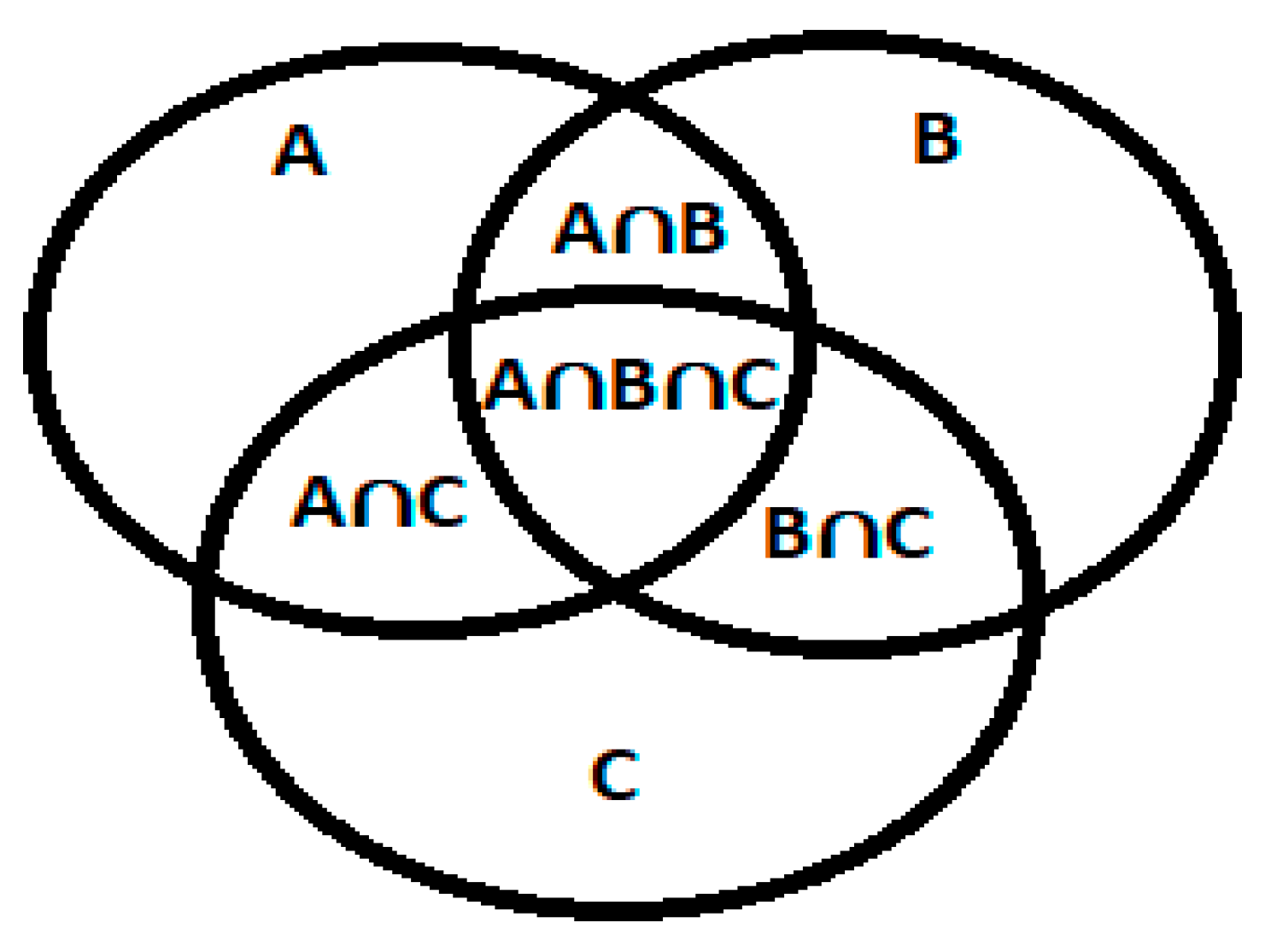
N=2 forms a new physical space AB with A and b in common, forming a single new physical space AB, then A and B are fractionated from a single physical space formed, making N=2 possible:
Figure 2.
imagination of the relationship between physical spaces A and B. Source: prepared by the author.
Figure 2.
imagination of the relationship between physical spaces A and B. Source: prepared by the author.
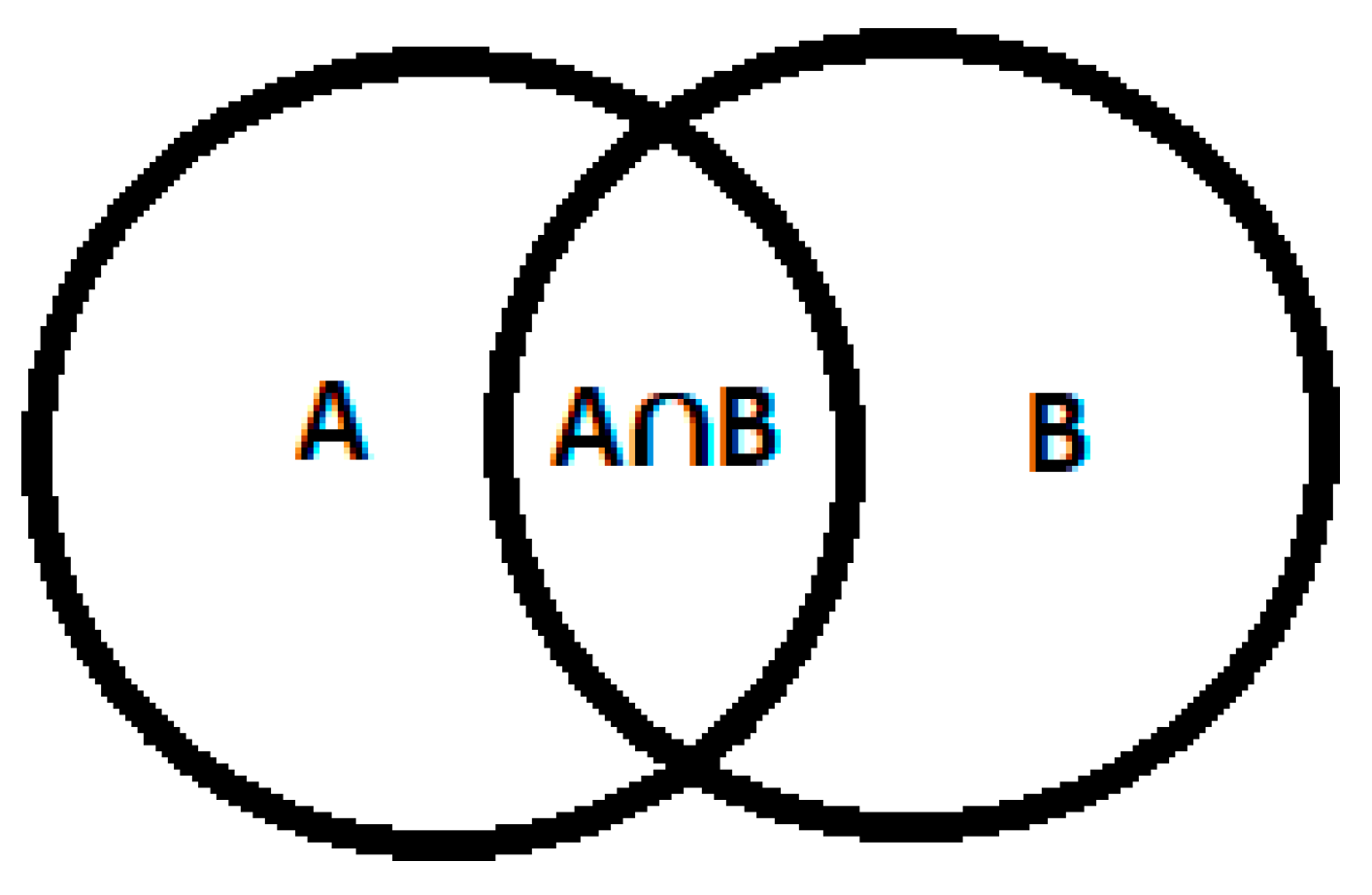
But it is possible to observe that in an exponent 3 the sums occur in sequence, therefore, there are differences between sums in sequence and simple sums. Thus, depending on the relationship, primary origins or different pairs of simple sums can have origins, because in the sequence sum, more areas can be distributed.
Therefore, the idea of the union relation of the parts provides the best understanding of the explanation of the solution of Beal's conjecture.
Goldbach's Conjecture
Every even number greater than 2 can be written as the sum of two primes.
Solution:
Two fractional numbers are capable of forming an integer, that is, an even space, as the union of prime number A with prime number B occurs, forming an integer, that is, even, but not infinite due to number theory limited.
Figure 3.
imagination of the relationship between physical spaces A and B. Source: prepared bythe author.
Figure 3.
imagination of the relationship between physical spaces A and B. Source: prepared bythe author.
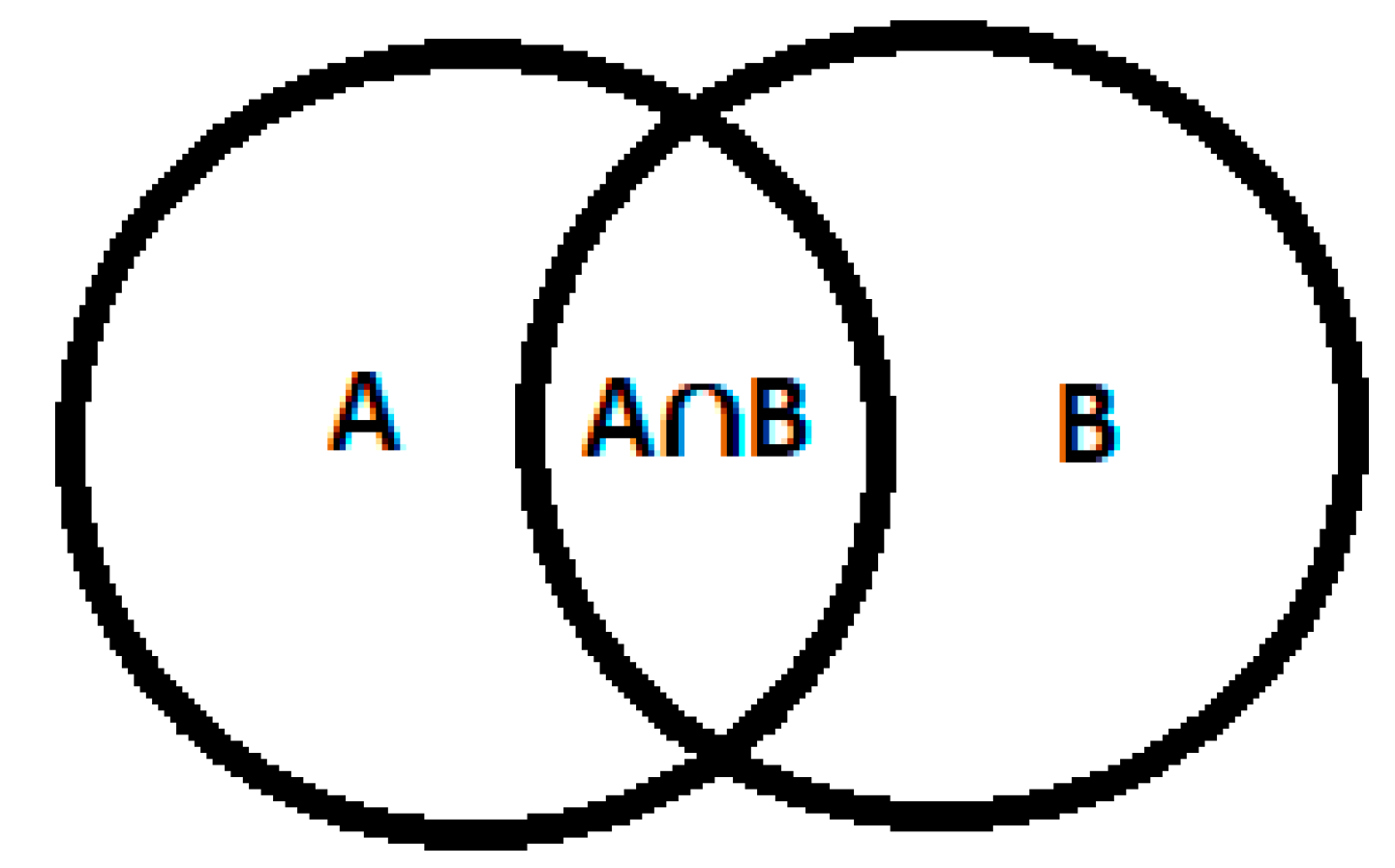
Two even numbers sa and c are capable of forming a pair greater than abcd and can be divided into parts ab and cd.
Figure 4.
imagination of the relationship between the physical spaces a,b and c,d. Source: prepared by the author.
Figure 4.
imagination of the relationship between the physical spaces a,b and c,d. Source: prepared by the author.
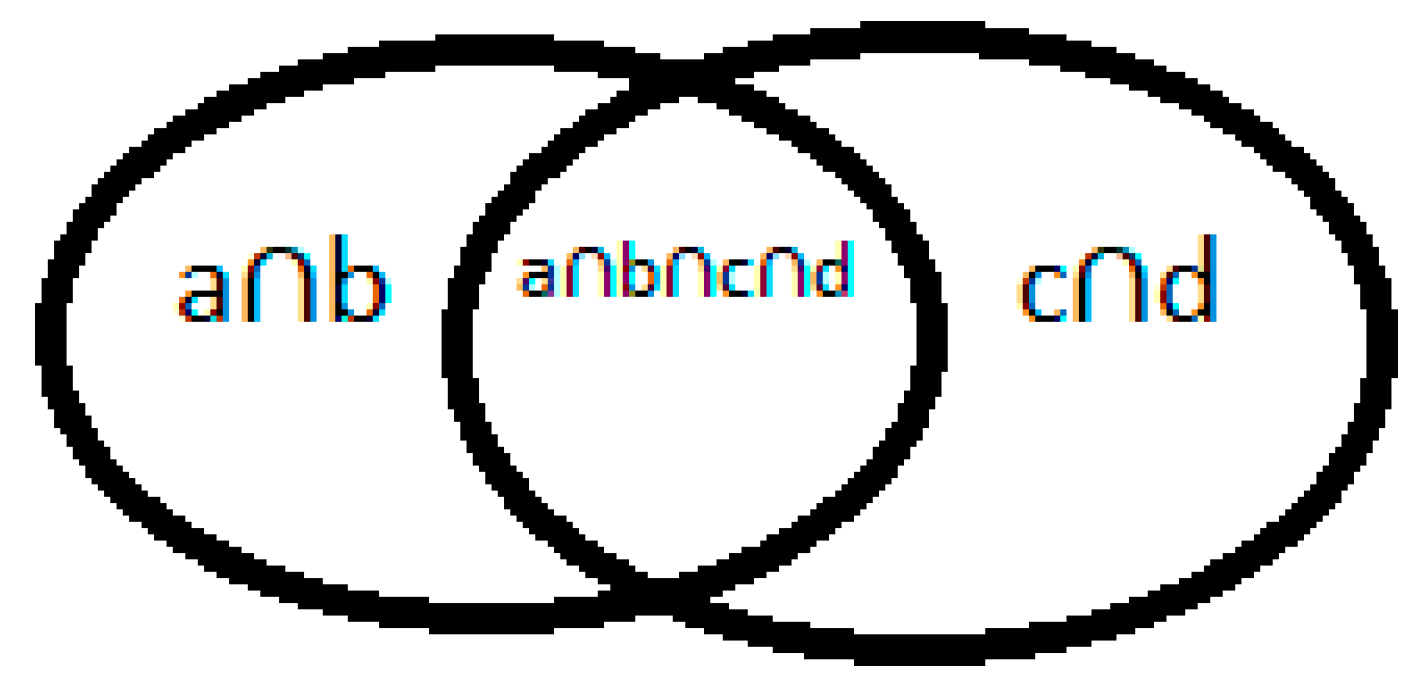
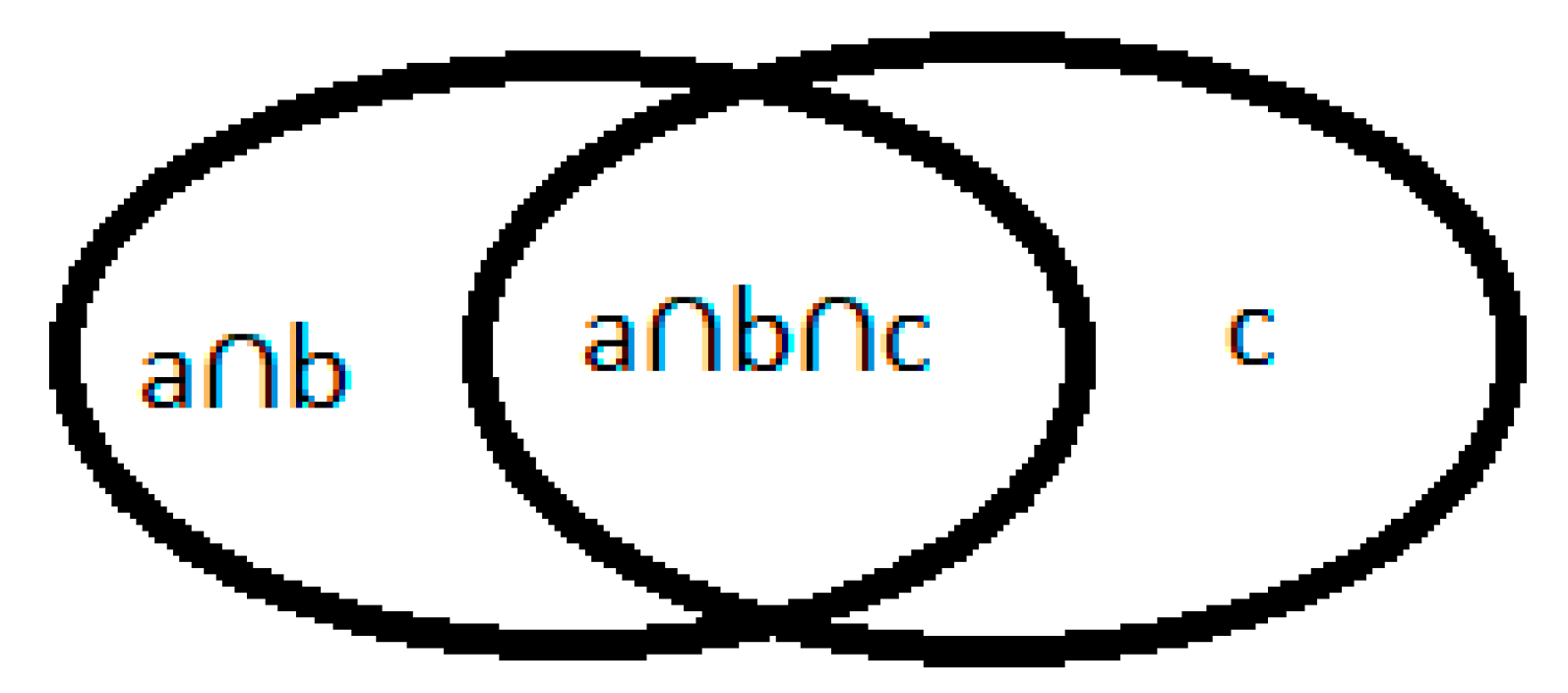
A pair ab and an odd c is capable of forming an odd abc, as abc cannot be divided into parts of two areas, leaving ab on one side and c on the other side.
Figure 5.
imagination of the relationship between the physical spaces ab and c. Source: prepared by the author.
Figure 5.
imagination of the relationship between the physical spaces ab and c. Source: prepared by the author.
Fermat-Catalan Conjecture
The Fermat-Catalan conjecture am+bn=ck only a finite number of solutions when a,b,c are repositive coprime integers m,n,k are positive integers that 1+1+1<1 mnk
Solution:
According to the theory of limited numbers, the number is limited due to the difference in physical space between them, the number would only be infinite if all spaces were equal.
Note: the number belongs to physical space as it is in accordance with the meaning of mathematics.
Conjecture of Twin Primes
The conjecture of twin primes says that there are infinitely many twin primes, but so far this claim has not been proven or disproved.
Solution:
According to the theory of limited numbers, the number is limited due to the differences in the physical spaces between them, the number would only be infinite if all spaces were equal.
Note: the number belongs to the space because it is in accordance with the meaning of mathematics.
Erdos Conjecture
Erdős' conjecture about arithmetic progressions was postulated by Paul Erdős and is treated in the area of additive combinatorics. It states that if A is a set of positive integers in which the sum of their reciprocals differs, then this set has an arithmetic progression of any size.
Solution:
According to the theory of limited numbers, the number is limited due to differences in physical spaces between them, the number would only be infinite if all spaces were equal.]
10. Conclusion
It is worth highlighting, therefore, that mathematics and spaces are related to each other, and from the information presented it is possible to deduce that numbers are limited.
As the number belongs to space in the form of an element or fact, mathematics aims to describe the world with rigor and precision. Furthermore, the world is made up of multiple physical spaces, so the number is limited because there is no infinite element or fact. The number would only be infinite if there were some element that belonged to all physical spaces or some fact forever.
There are countless theories that state that the universe is not eternal, and if the universe is not eternal, therefore, no fact is infinite. On the other hand, there is no existence of infinite elements due to differences in physical spaces, so mathematics does not have infinite elements or facts, it is possible to confirm the limited number theory. But if the universe is eternal, certain facts can be infinite, then the theory of limited numbers is partially correct, as the elements are not infinite due to differences in physical spaces.
It would be unscientific to say that the number is infinite, just because on paper and pen it is possible to count numbers infinitely. In paper and pen it does not take into account the physical concepts of spaces, so in fact in paper and pen you can have infinite mathematics, because in paper and pen it is possible to violate the real world.
Through the theory of limited numbers it is possible to seek a plausible solution for some open calculations.
References
- Church, Gemma.The mathematical problem that can paralyze modern life.Science-BBCNewsBrasil.June 13, 2019.
- Howacalculationcreatedover500yearsagocanhelpyougetrich-oratleastsave.Science- BBCNewsBrazil.August 15, 2019.
- Whatismathematics?Amodelofrealityorrealityitself?.Science-BBCNewsBrazil.November17,2019.
- Hawking,Stephen.Theuniverseinanutshell.Arx,SaoPaulo,216p.April,.
- 2004Hawking,Stephen.ABriefHistoryofTime.Intrinsic,RiodeJaneiro,256p.January2015.
- TAHAN,M.TheManICalculated.RiodeJaneiro,Record,2010.
- 02-Numbersofourday-to-daylife-Mathematics-Ens.Background,background.–Telecurso,Telecurso,.
- jul. 2015.11 minutes and 45 seconds. Available in: https://www.youtube.com/watch?v=6HNOg12ExEI&t=224sAccessed:July8,2015.
Disclaimer/Publisher’s Note: The statements, opinions and data contained in all publications are solely those of the individual author(s) and contributor(s) and not of MDPI and/or the editor(s). MDPI and/or the editor(s) disclaim responsibility for any injury to people or property resulting from any ideas, methods, instructions or products referred to in the content. |
© 2024 by the authors. Licensee MDPI, Basel, Switzerland. This article is an open access article distributed under the terms and conditions of the Creative Commons Attribution (CC BY) license (http://creativecommons.org/licenses/by/4.0/).
Copyright: This open access article is published under a Creative Commons CC BY 4.0 license, which permit the free download, distribution, and reuse, provided that the author and preprint are cited in any reuse.


