

Submitted:
29 October 2023
Posted:
30 October 2023
You are already at the latest version
Abstract
The Global Hunger Index (GHI) is a vital tool for assessing and understanding the state of hunger and food security across the world. In this review article, we examine the GHI scores of various countries in the years 2000, 2008, 2015, and 2023. We aim to explore the changes in GHI scores over this period, identify trends, and discuss the implications for global food security. The GHI provides a comprehensive snapshot of the world's progress in reducing hunger, and this analysis sheds light on the successes and challenges faced by different countries.
Keywords:
Global Hunger Index
; Food Security
; Malnutrition
; Hunger Reduction
; GHI Scores
; 2023
Introduction
Hunger remains a pressing global issue, affecting millions of people worldwide. The Global Hunger Index, compiled by various organizations, provides a holistic view of hunger by considering multiple factors, including undernourishment, child stunting, child wasting, and child mortality. In this review, we present GHI scores for 2000, 2008, 2015, and 2023, and assess changes in these scores. Our analysis focuses on absolute and percentage changes to identify trends and challenges in achieving food security.
Method
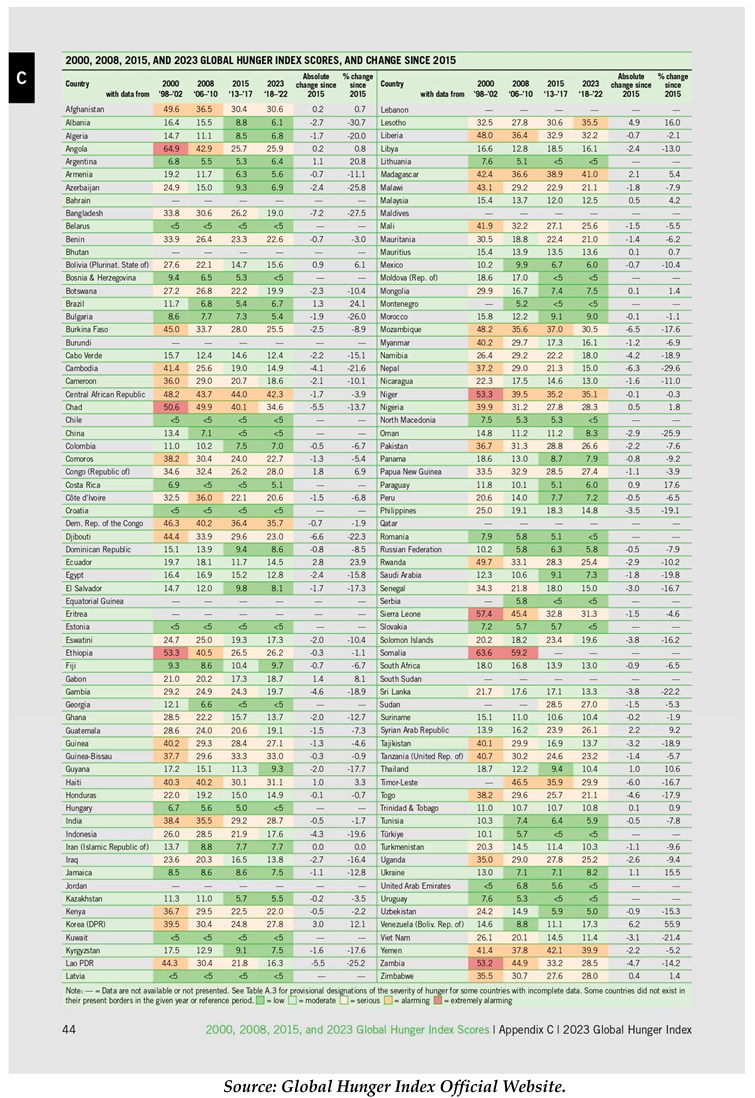
The data used in this review is sourced from the 2023 Global Hunger Index, which incorporates information from different time periods (‘98–’02, ‘06–’10, ‘13–’17, and ‘18–’22). This data enables us to observe the changes in GHI scores over two decades.
Results
Findings
Absolute Change in GHI Scores:
-
Improvements in Hunger Index:
- Several countries, including Afghanistan, Angola, and Argentina, have shown significant improvements in their GHI scores between 2015 and 2023, with positive absolute changes. These improvements may be attributed to various factors, such as economic development, social programs, and international aid.
- Notable reductions in hunger are observed in various African nations, such as Lesotho, Liberia, and Malawi. This demonstrates positive progress in addressing food security challenges on the African continent.
- Some countries, like Brazil and Chile, have maintained extremely low GHI scores throughout the years, indicating consistently low levels of hunger. Their consistent performance reflects effective policies and programs that promote food security and nutrition.
These improvements are commendable and underscore the importance of continued efforts to reduce hunger and improve food security on a global scale.
- 2.
-
Worsening Hunger Index:
- While many countries improved, some have seen their GHI scores worsen. Notably, Haiti and Yemen experienced an increase in their scores between 2015 and 2023, indicating increased hunger levels. These countries face significant challenges in addressing food security and require targeted interventions.
- Venezuela exhibited the most substantial negative change, indicating a severe deterioration in food security. The situation in Venezuela is a cause for concern, and it is crucial for the international community to provide assistance and support to address their food security crisis.
These contrasting trends in GHI scores highlight the complex nature of global food security and the need for a concerted effort to address the underlying causes of hunger in countries experiencing worsening conditions.
Percentage Change in GHI Scores:
- Positive Percentage Change: A few countries have made significant strides in reducing hunger, as indicated by a negative percentage change. Notable examples include Argentina and Angola, which have achieved substantial progress in reducing hunger.
- Negative Percentage Change: Some nations have experienced an increase in their GHI scores, indicating a worsening food security situation. Notable examples are Yemen and Venezuela. These countries have seen a significant deterioration in food security, necessitating urgent international support to address the growing crisis.
These contrasting trends in both absolute and percentage changes emphasize the multifaceted nature of global food security, highlighting the need for concerted efforts to address the underlying causes of hunger and improve food security worldwide.
Discussions
The analysis of GHI scores from 2000, 2008, 2015, and 2023 reveals both positive and negative trends in global food security. These trends are reflective of various socioeconomic, political, and environmental factors that impact a nation’s ability to ensure food security for its citizens. It is encouraging to see reductions in hunger in countries like Angola and Argentina. These improvements are indicative of effective strategies aimed at addressing food security challenges. Factors contributing to these positive trends may include robust economic development, targeted social programs, and international aid. These countries serve as examples of success in the fight against hunger and undernutrition. However, it is concerning that some countries, such as Haiti, Yemen, and Venezuela, have witnessed a deterioration in their GHI scores. These declines are particularly troubling and require urgent attention from the international community. Several factors may contribute to these negative trends, including:
- Conflict: Nations facing ongoing or recent conflicts, like Yemen, often experience severe disruptions to food production and distribution systems. This contributes to increased hunger levels and malnutrition among their populations.
- Economic Instability: Economic instability, often exacerbated by factors such as inflation, currency devaluation, or resource mismanagement, can lead to reduced access to affordable and nutritious food for vulnerable populations.
- Poor Governance: Weak governance, corruption, and lack of investment in agricultural and social programs can hinder a country’s ability to address food security effectively.
To address these worsening food security situations, targeted interventions and international assistance are vital. The global community must come together to support nations in crisis and help them build resilience against food insecurity. This support should encompass a range of strategies, including humanitarian aid, conflict resolution, capacity building, and long-term development initiatives.
The GHI trends from 2000 to 2023 emphasize the complex and multifaceted nature of global food security. While some nations have made significant progress, others continue to face considerable challenges. The international community’s commitment to addressing the root causes of hunger and malnutrition is crucial in achieving a world with zero hunger.
Recommendations
-
Countries with Positive Changes in GHI Scores: Countries that have demonstrated positive changes in their GHI scores should continue to build on their successes by:
- Sustaining Effective Policies: Maintain and strengthen policies and programs that have contributed to the reduction of hunger. Continuity is essential for long-term success.
- Investing in Nutrition: Prioritize nutrition-specific and nutrition-sensitive programs to ensure that citizens have access to diverse and nutritious food.
- Data Collection and Monitoring: Regularly collect and analyse data on food security to track progress and identify areas that need further attention.
-
Nations Experiencing Negative Changes in GHI Scores: Countries facing deteriorating food security situations should focus on addressing the underlying causes by:
- Conflict Resolution: If conflict is a major factor, prioritize conflict resolution and peacebuilding efforts to stabilize regions and protect food production and distribution systems.
- Economic Stability: Implement measures to achieve economic stability, including curbing inflation, strengthening currency value, and managing resources effectively.
- Good Governance: Enhance governance, transparency, and accountability to ensure that resources are allocated efficiently for food security initiatives. Effective governance is crucial for managing food crises.
-
The International Community: The international community should work collaboratively to support countries facing severe food security challenges by:
- Humanitarian Aid: Provide humanitarian aid, including food assistance and nutrition programs, to alleviate immediate hunger and malnutrition in crisis-affected regions.
- Conflict Resolution and Peacebuilding: Support diplomatic efforts to resolve conflicts and build peace in areas where violence is a major contributor to food insecurity.
- Capacity Building: Offer technical assistance, capacity building, and knowledge transfer to enhance a nation’s ability to address food security issues effectively.
- Sustainable Development: Invest in long-term sustainable development programs that promote food security and nutrition, with a focus on education, healthcare, and economic opportunities.
- Monitoring and Evaluation: Continuously monitor and evaluate the impact of interventions to ensure that resources are used efficiently and effectively.
These recommendations reflect the need for a multi-pronged approach to addressing food security at both the national and international levels. By implementing these strategies, countries can make substantial progress in reducing hunger and malnutrition and moving toward a more food-secure and nourished world.
Conclusions
The Global Hunger Index serves as a vital tool for assessing and comprehending the state of global food security. The analysis of GHI scores from 2000, 2008, 2015, and 2023 paints a diverse picture of progress in reducing hunger. While some countries have made remarkable strides, others have witnessed the worsening of their food security situation. This review underscores the critical importance of ongoing efforts to eliminate hunger and malnutrition on a global scale. The existence of both success stories and challenges emphasizes the multifaceted nature of the global fight against hunger. It is a testament to the complexity of factors that influence a nation’s ability to ensure food security for its citizens. The commitment to addressing the root causes of food insecurity is paramount, as it directly contributes to the achievement of a world with zero hunger.
As we move forward, it is crucial to build on the successes observed in countries with positive changes in GHI scores, while simultaneously addressing the underlying causes of food insecurity in nations facing negative trends. The international community must work collaboratively to support those in severe food security crises by providing aid, promoting peace and stability, and focusing on sustainable development. In the pursuit of a world free from hunger, the Global Hunger Index serves as a powerful compass, guiding us toward a future where every individual has access to adequate and nutritious food, ensuring a brighter and healthier world for all.
References
- Andrews, J. A., Hops, H., & Duncan, S. C. (1997). Adolescent modeling of parent substance use: The moderating effect of the relationship with the parent. Journal of Family Psychology, 11(3), 259–270. [CrossRef]
- Berndt, T. J., Hawkins, J. A., & Jiao, Z. (1999). Influences of friends and friendships on adjustment to junior high school. Merrill-Palmer Quarterly, 45(1), 13–41.
- Brechwald, W. A., & Prinstein, M. J. (2011). Beyond homophily: A decade of advances in understanding peer influence processes. Journal of Research on Adolescence, 21(1), 166–179. [CrossRef]
- Brown, B. B., Bakken, J. P., & Ameringer, S. W. (2009). A comprehensive conceptualization of the peer pressure process in adolescence. In G. R. Adams & M. D. Berzonsky (Eds.), Blackwell handbook of adolescence (pp. 361–393). Wiley-Blackwell.
- Chen, X., Chang, L., Liu, H., & He, Y. (2008). The peer group as a context: Mediating and moderating effects on relations between academic achievement and social functioning in Chinese children. Child Development, 79(6), 235–251.
- Original Dumas, T. M., Ellis, W. E., & Wolfe, D. A. (2012). Identity development as a buffer of adolescent risk behaviors in the context of peer group pressure and control. Journal of Adolescence, 35(4), 917–927. [CrossRef]
- Eccles, J. S., Midgley, C., Wigfield, A., Buchanan, C. M., Reuman, D., Flanagan, C., & Iver, D. M. (1993). Development during adolescence: The impact of stage-environment fit on young adolescents’ experiences in schools and in families. American Psychologist, 48(2), 90–101. [CrossRef]
- Eccles, J. S., Midgley, C., Wigfield, A., Buchanan, C. M., Reuman, D., & Flanagan, C. (1993). Developmental transitions in school: Perceived performance as a context for motivation in middle school. Journal of Adolescent Research, 8(2), 187–204.
- Fletcher, A. C., Steinberg, L., & Williams-Wheeler, M. (2004). Parental influences on adolescent problem behavior: Revisiting Stattin and Kerr. Child Development, 75(3), 781–796. [CrossRef]
- Fredricks, J. A., Blumenfeld, P. C., & Paris, A. H. (2004). School engagement: Potential of the concept, state of the evidence. Review of Educational Research, 74(1), 59–109. [CrossRef]
- Guay, F., Marsh, H. W., & Boivin, M. (2003). Academic self-concept and academic achievement: Developmental perspectives on their causal ordering. Journal of Educational Psychology, 95(1), 124–136. [CrossRef]
- Hartup, W. W. (1989). Social relationships and their developmental significance. American Psychologist, 44(2), 120–126. [CrossRef]
- Helsen, M., Vollebergh, W., & Meeus, W. (2000). Social support from parents and friends and emotional problems in adolescence. Journal of Youth and Adolescence, 29(3), 319–335. [CrossRef]
- Juvonen, J., & Murdock, T. B. (1995). Grade-level differences in the social value of effort: Implications for self-presentation tactics of early adolescents. Child Development, 66(6), 1694–1705. [CrossRef]
- King, R. B., & McInerney, D. M. (2016). Culture’s consequences on student motivation: Capturing cross-cultural universality and variability through personal investment theory. Educational Psychologist, 51(3), 376–401.
- Lamborn, S. D., Mounts, N. S., Steinberg, L., & Dornbusch, S. M. (1991). Patterns of competence and adjustment among adolescents from authoritative, authoritarian, indulgent, and neglectful families. Child Development, 62(5), 1049–1065. [CrossRef]
- Pomerantz, E. M., Grolnick, W. S., & Price, C. E. (2005). The role of parents in how children approach achievement: A dynamic process perspective. In A. J. Elliot & C. S. Dweck (Eds.), Handbook of competence and motivation (pp. 259–278). Guilford Press.
- Prinstein, M. J., & Dodge, K. A. (2008). Understanding peer influence in children and adolescents. Guilford Press.
- Prinstein, M. J., & Wang, S. S. (2005). False consensus and adolescent peer contagion: Examining discrepancies between perceptions and actual reported levels of friends’ deviant and health risk behaviors. Journal of Abnormal Child Psychology, 33(3), 293–306. [CrossRef]
- Ryan, A. M., & Patrick, H. (2001). The classroom social environment and changes in adolescents’ motivation and engagement during middle school. American Educational Research Journal, 38(2), 437–460. [CrossRef]
- Ryan, A. M., & Shim, S. S. (2006). Social achievement goals: The nature and consequences of different orientations toward social competence. Personality and Social Psychology Bulletin, 32(9), 1246–1263. [CrossRef]
- Sebanc, A. M., & Pierce, W. D. (2001). Social comparison and dimensions of perceived academic competence among adolescents. Journal of Research on Adolescence, 11(3), 219–242.
- Simpkins, S. D., Schaefer, D. R., Price, C. D., & Vest, A. E. (2013). Adolescent friendships, BMI, and physical activity: Untangling selection and influence through longitudinal social network analysis. Journal of Research on Adolescence, 23(3), 537–549. [CrossRef]
- Steinberg, L., & Monahan, K. C. (2007). Age differences in resistance to peer influence. Developmental Psychology, 43(6), 1531–1543. [CrossRef]
- Steinberg, L., Fletcher, A., & Darling, N. (1994). Parental monitoring and peer influences on adolescent substance use. Pediatrics, 93(6 Pt 2), 1060–1064. [CrossRef]
- Wentzel, K. R. (1998). Social relationships and motivation in middle school: The role of parents, teachers, and peers. Journal of Educational Psychology, 90(2), 202–209. [CrossRef]
Disclaimer/Publisher’s Note: The statements, opinions and data contained in all publications are solely those of the individual author(s) and contributor(s) and not of MDPI and/or the editor(s). MDPI and/or the editor(s) disclaim responsibility for any injury to people or property resulting from any ideas, methods, instructions or products referred to in the content. |
© 2023 by the author. Licensee MDPI, Basel, Switzerland. This article is an open access article distributed under the terms and conditions of the Creative Commons Attribution (CC BY) license (http://creativecommons.org/licenses/by/4.0/).
Copyright: This open access article is published under a Creative Commons CC BY 4.0 license, which permit the free download, distribution, and reuse, provided that the author and preprint are cited in any reuse.


