

Submitted:
26 October 2023
Posted:
30 October 2023
You are already at the latest version
Abstract
Flails are one of the more contentious and misunderstood classes of medieval weaponry, despite their prevalence in popular media: some researchers question their existence entirely and the bulk of historians are sceptical of widespread temporal and geographical prevalence while others, and a significant volume of period evidence, would argue the contrary. While the expansive use of flails in Eastern Europe and Byzantium is familiar, many Central, Western, and Southern European sources are less well-known or largely forgotten, especially those stemming from the later-early and early-high medieval eras (up to 1250). In this work, I collate and discuss the bulk of the available literary references and artistic depictions of flails and their use alongside some of the archaeological finds from Western, Central, and Southern Europe, with an emphasis on the 12th and 13th Centuries. The significance of this volume of evidence is examined, and an assessment of flails as a part of medieval culture and warfare is considered. Collectively, this would suggest that knowledge of flails as instruments of war and associated cultural connotations, if not their actual prevalence and use in warfare, was far more widespread across Europe this time period than has been previously estimated.
Keywords:
flail
; early medieval
; high medieval
; flexible weapon
; ball and chain
; morning star
; war flail
; holy water sprinkler
; threshing flail
; improvised weapon
Introduction
The flexible, non-rigid weapons commonly referred to under the umbrella term of flails are probably one of the most contentious and misunderstood aspects of medieval warfare, (Lepage, 2005; Tzouriadis, 2017) particularly when considering the early and much of the high Middle Ages (up to 1250) in Western Europe, (Laking, 1920) despite their prevalence in modern media, such as film, videogames, (Sturtevant 2016a, 2017; Manning 2016; Fernandes, 2019; Dahm, 2018; Tardy, 2020, Moreno, 2015, Devereaux, 2019, Mondschein, 2017) and “popular history” writings. (Tunis, 1999; Dougherty, 2008) Some researchers argue the existence of flails and their use in warfare during the medieval period is primarily a fallacy, (Sturtevant, 2016a, 2016b, and 2017; Warner, 1968, O’Bryan, 2013) or at best, their provenance is overstated; (Manning, 2016; Oakeshott, 2012) arguments to both sides of the discussion appear in amateur and academic circles within the field.
I believe this is down to a poor awareness of period sources, (Farcas, 2016) many of which are available if not particularly easy to access, combined with an at-times poorly researched and sensationalist approach to “modern (and popular) medievalism”; (Tzouriadis, 2017; Utz, 2016; Gallardo, 2016) some of the more obscure references to flails were known to writers in the 19th Century. (Viollet-le-Duc, 1874; Sternberg, 1886; Oman, 1898) These can be acquired today with a little effort and have been studied to some extent by various researchers who reason that flails were common enough to be known to medieval peoples in Western, Central, and Southern Europe at least for some parts of the medieval era. (Gallardo, 2016; Moreno, 2015; Nilsson, 2021; Campagnano, 2015) Much of the well-known primary Western European sources for flails date from the later medieval era (post-1250), while sources from before this date are generally not well-studied beyond a few exceptions.
For the purposes of this work, I will consider four different categories of flexible weapons for the discussion, examples of which are presented in Figure 1:
- Threshing flails – farming tools used for millennia, but occasionally pressed into service as improvised weapons.
- Weaponised derivatives of these which became popular in Europe from the 14th Century.
- Scourges – sometimes incorrectly referred to as flails – are punishment devices rather than weapons, often depicted in religious settings and referenced heavily in the Bible. (Moreno, 2015)
- War flails – a broad range of weapons including the “ball-and chain” type, which collectively are the primary source of contention around this class of weaponry and the primary focus of this work.
To my knowledge, there has been no recent effort to collate the various and disparate, but substantial body of evidence for flails and their use, which consists of a combination of artistic representations (statues, carvings, frescoes, manuscript illuminations, etc.), literary references, and archaeological finds, (DeVries and Smith, 2012; Nicolle, 1999) in the early and high medieval period within Western, Central, and Southern Europe, despite excellent work from researchers in the East of the continent and the Balkans highlighting the well-known use in those regions from as early as the 8th Century. (Kotowicz, 2006; Osypenko, 2019; Osypenko, 2020; Culic, 2016; Rabovyanov, 2016) As such, this work aims to draw together these sources and discuss their depictions and descriptions, highlighting the underlying period knowledge of flails, their use in warfare, associated symbology, political, and political importance within Western, Central, and Southern Europe in the early high medieval eras. I believe the collection of primary and secondary sources presented here is extensive but is by no means complete, and thus should not be considered exhaustive. Please note that while parallel development of flexible weaponry occurred during the medieval period across large parts of the world including Japan, (Gonzalez, 2013) China (Needham, 1958; Fauliot, 1982), Korea (Herrera, 2014), the pre-colonial Americas (Courville, 1948), and many other places, (Costa, 2015; Moreno, 2015; Gallardo, 2016; Escobar, 2018) these are beyond the scope of this work and will not be discussed further unless pertinent. The aim of this work does not include the development of weapon typologies but rather to provide a high-level overview and to highlight the previously underrated prevalence of flails within the region and period of interest by reviewing the available sources. A brief discussion of the likely historical use of flails in warfare will be presented, alongside some conclusions regarding the possible routes by which flails were introduced to Western, Central, and Southern Europe, likely before, but most certainly within the early medieval period; it was theorised that war flails migrated Westwards from Eastern Europe during the 10th-12th Centuries, but the provenance of many primary sources refutes this concept.
Much of the scepticism surrounding flails arise from the challenges in controlling such flexible weapons practically, with some researchers describing their motions as chaotic and as harmful to the wielder and their allies as to the enemy. (Sturtevant, 2016a; Moreno, 2015) As a riposte to this, several late Saxon (10th-11th Century) sources describe the ability of farmers to thresh crops without injury (Hill, 1998; Gallardo, 2016), and modern reproductions from 15th-16th Century “fight manuals” demonstrate comprehensively the opposite: with appropriate training and practice, flails are as controllable and precise as other weapons. (Rüther, 2023) The advantage of flails in their ability to “wrap around” shields, limbs, and weapons, (Zábojník, 2009) and hit at least as hard, if not harder than rigid weapons of similar weight and design (i.e. maces) with significant blunt force, (Rüther, 2022; van Dyke et al, 2007) makes them, hard to block, (Warner, 1968; Moreno, 2015) effective against certain types of armour, and especially dangerous under some circumstances. The “safe” use of flail in controlled environments, such as historical re-enactments, is a challenging balance to strike – maintaining the authenticity while also not risking serious injury to participants and observers alike. (Radtchenko, 2006)
Flails in Antiquity
The earliest historical depictions or descriptions of flails appear as symbols of kingly authority in both ancient Egypt and Mesopotamia, (Civil, 1963; Moreno, 2015) between 3500 and 2500 BC. In the case of the former, this was paired with the shepherd’s crook by the Second Dynasty (2890-2696 BC), both attributed to the deity Osiris. Surviving examples are present in the sarcophagus of Tutankhamen (Figure 2), the crook representing kingship, and the flail (or possibly scourge) the fertility of the land (or the law and justice embodied in the Pharaoh’s authority); (Steele, 2002; Norris, 2015), or alternatively the ability to provide both grain and meat; (Costa, 2015) both of these symbols are utilised as hieroglyphs. This demonstrates the basis for flails as farming tools at least as far back as the third and maybe fourth millennium BC, with the associated symbology emphasising the divine right and duty of the Pharaohs.
The earliest depictions of war flails, resembling medieval threshing flails in design, appear on a series of coins from Thessaly (Ancient Greece, e.g in Figure 3), dating from approximately 400 BC, (Robinson, 1933) although coins from the same time period also present flails as tools as well, likely mirroring their earlier symbology of the royal right to rule. (Seltman, 1946) A comprehensive selection of such artefacts can be found here (Link), where some Roman gladiators (2nd Century BC coins) are also depicted utilising flails. (Markowitz, 2021; Courville, 1948) Furthermore, the Roman writer Publius (or Vegetius, late 4th Century) describes the use of “Plumbata” by cavalry and infantry - interpreted to be a lead or iron ball connected with a line to a wooden handle (with a doubled meaning for lead-weighted darts) in his writing De Re Militari, (Schultz, 1889; Carley, 1962) a text that was known, and translated in the early part of the high medieval era, (Allmand, 2011) and will be discussed later. The prevalence of depictions flails on coins from Thessaly, whose cavalry were one of the cornerstones of Alexander the Great’s battlefield success, would suggest that these were employed at least to some degree during the ancient period alongside the more common spear, as one summary such finds describes the occurrence of flails as being at least as common as swords. (Papaioannou, 2019) Given the rapid expansion and ultimate expanse of Alexander the Great’s Macedonian Empire at its height, which covered from the Balkans in the northwest, as far south as Egypt, and as far east as India, it would not be unfeasible for flails to have spread along with the members of his army who settled in the newly captured providences. Adoption by subjugated peoples within the Macedonian successor states including perhaps, in the more northerly extremes their territory bordering the central Asian steppe, the ancestors of the later Hunnic invaders of Europe and other such steppe peoples could then have occurred. Archaeological finds from the Alps indicate that perhaps even the Celtic peoples fought by the Romans possessed knowledge of flails or perhaps maces. (Rageth and Zanier, 2010) Items resembling flail heads and skeletal remains bearing injuries consistent with blunt force trauma from these have been found in ancient Sarmatia (modern-day Ukraine and surrounding areas, dated 3-4th Century BC). (Kotowicz, 2006) Ornately carved stone balls found in Scotland and dating from ancient British times have been postulated to be “flail heads”, in a similar manner to the bolas throwing weapon of Central and Southern America. (Smith, 1876; Cowper, 1906; Courville 1948; O’Bryan 2013)
Cultural and Literary Context
At this stage, it is pertinent to discuss the various historical and more recent translations of the overarching term flail into European languages, (Snook, 1979; Tihle, 2017) as even in modern parlance there is significant confusion and no uniformity in the many and varied terms used to describe such weapons in primary (Carley, 1962) and secondary sources. (Tzouriadis, 2017) In modern English, the flail as a weapon is sometimes referred to interchangeably as the war flail, morning star, or holy water sprinkler, while in Old English, the term fleel is used. In modern French, the common term is fléau d’armes (war flail), while in older texts, the term plomée is commonly utilised, though this has several meanings which will be discussed later; a few other less common terms will be highlighted as necessary, given the prevalence of primary French language sources. Modern German has several more descriptive terms, including Kriegsflegel (war flail), Morgenstern (morning star), Kettenmorgenstern (chain morning star), Streitflegel (lit. fight flail), and Schlachtgeissel (battle whip). In most Slavic languages (Polish, Ukrainian, Russian), the term kisten or kiścień, is used, with Řemdih and Remdik used in Czech and Slovak respectively. Modern Spanish and Portuguese use the term mangual, while Italian is mazzafrusto, with the period term flagellum and many other more specific derivatives. (Nicolotti, 2018)
The semantics of the term flail begin to become complex around the time of the Hunnic invasion of the 4-5th Century AD. The high medieval (1160-1170) poem Servaes Legende, attested to Heinrich von Veldeke (d. after 1184), based upon the previous Gesta Sancti Servatii (c. 1126) which found its roots in Historia Francorum (by Gregory of Tours, d. 594), describes the following exchange between Attila the Hun and the city of Troyes (the original texts are unavailable to me) (Bathgate, 1990):
“Then Troyes: Bishop Lupus asks Atilla (Attila), “why do you destroy the whole land?” Atilla (Attila) says, “I am God’s flail; open the gates, and I will thresh both woman and man!”
In this context, the flail of God Attila refers himself as being can be misconstrued due to a tendency of the meaning between flail and scourge to merge, though the reference to threshing means this requires somewhat deeper analysis. This merged meaning of flail and scourge arises from the Latin term Flagella, meaning flail (several types), and also scourge (the whip-type devices) to refer to, (Nicolotti, 2018) in the latter case, a scourge in its alternate definition as a source of great suffering or trouble. Similar observations are seen in French with the term fléau, where alone, this word refers to scourge, but with the suffix d’armes, refers to the weapons described here. (Havard, 1876) The evolution of language incorporated the further meanings of the word flail, at least in English from just the farming tool to the associated military definition primarily discussed here; (Izdebska, 2016) the chaotic flailing of threshing flails is indeed the origin of the modern adjective to describe wild circular motions (such as of the arms), representing a further branching of the semantics of the word. (Hill, 1998)
The epithet Flagellum Dei, meaning scourge/flail of God, was first loosely associated with Attila around the turn of the 7th Century, but had become a truly negative connotation referring to him by the 11th Century, at least within Western Europe; the Eastern Roman Empire (centred on Byzantium), held a much higher view of the Flagellum Dei. (Ridley, 1992) The Flagellum Dei epithet was also applied to the Lombards at times during and after their conquest of northern Italy (568-774), to the Hungarians (Williams, 1979) during their various invasions of Germany during the 10th Century, (Köstler, 1883) and also the Magyars and Pechenegs by the Byzantines during the 10th-12th Centuries. (Paron, 2021) Even certain Christians have been described as Flagellum Dei or rather fléau de Dieu – in reference to punishing the impiety of the Flemmings and English (under King John) at the battle of Bouvines (1214). (Leon, 2019) The late 14th Century French work L’Arbe des Batailles criticises violence as a scourge upon the land, but also recognises it as a punishment from God, who allows it to occur as a price for sins; the soldiers who provide the violence are, in this context the flail of God or les executeurs de nostre Seigneur. (Niewinski, 2019) The 15th Century French nobleman and general Jean de Dueil was labelled le fléau des Anglais (plague/scourge of the English) during the Hundred Years War, and (de Boislisle, 1943) the English solider Richard Bingham (1528-1599) was referred to by the epithet the Flail of Connaught for his oppressive actions against the Irish. (Herron, 2002) Indeed the term Flagellum Dei could be applied to “the enemy generally, regardless of their origin. (Allmand, 1999)
In a reversal of meaning from ancient times, by the early parts of the high medieval period (as attested in the Domesday Book), the flail had become a symbol of poverty and villeinhood, (Stoljar, 1985; Homans, 1941; Power, 1940; Hyams, 1970) remaining a symbol of servitude and menial (farming) labour well into the Renaissance, Beauchamp, 1984) although these labours were viewed in something of a positive light in the period, (McDougall, 1983) flailing being viewed as a metaphor for God’s struggles inflicted upon Christians to test the strength of their belief. (Lipton, 1999) To break from one’s designated place in society was at times seen as a threat to your betters, as the French epic poem Partonopeus de Blois (c. 1170-1180) describes – drawing upon the symbols of “plough, pitchfork, and flail” as those of servitude, warning against the perils of fils à villain (lit. “naughty son”) being raised from the dirt to those of higher office and political influence, directly wishing upon them significant misfortune. (Eley, 2011) This symbolism was further carried into the proto-science-fiction works of the English poet Edmund Spenser (1552-1599), who incorporated a flail into an “iron man” character named Telus into several of his works; the flail included as a symbol of servitude to his human masters. (McCulloch, 2011)
From the 13th and into the 14th Centuries, flails begin appearing in heraldic designs in Germany, such as those of Pflegelberg, (Erisman; Frutos, 2019; Moreno, 2015) with similar depictions (a lion holding a flail) noted in Aragaonese arms. (Clemmensen, 2013; Moreno, 2015)
Depictions and Descriptions of Threshing Flails as Improvised Weapons in Western, Central, and Southern Europe in the Early and High Medieval Eras
Threshing flails are ancient farming tools used to separate grains from stalks during harvesting, with their use in parts of Europe dating back at least two millennia, (Andrén, 2005) the latest occurrence being in parts of Scandinavia by about 1000 AD. (Myrdal, 1997) As symbols of the peasantry, along with the pitchfork and the scythe, threshing flails are more tools than weapons, but when push comes to shove, such implements can be turned on their fellow man as improvised weapons, a practice which is generally accepted by historians. (Moreno, 2015; Gallardo, 2016) The Greek philosopher and mathematician Euclid is reported to have considered it “a futile labour [to teach mathematics to those who toil with] flail and axe”, indicating that the users of such tools were not worthy of being raised up intellectually. (Gug, 1985)
In Irish custom, the haft of a threshing flail was usually made of ash, while the beater (swingle or souple) could either be made of ash, hazel or holly. (Mac Coitir, 2020, Newman, 1985) Various means exist of attaching the two portions of a threshing flail together to ensure sufficient flexibility of the head, with the exact design employed varying with locale of manufacture, (Newman, 1985) the minutiae of which are beyond the scope of this work, though a selection of hinges is presented below. (Figure 4, Veiga de Oliveira, 1983) The primary sources describing threshing flails as improvised weapons are now presented and discussed..
(A) The Gaelic folklore tradition describing the legend of Finn mac Cumaill (Fionn Mac Cumhaill) likely dates from before the high medieval period, but references to the death of this character and a particular scene described in hell are found from the 10th Century, becoming a key part of the story by the 12th Century. One of the other characters in the story (Oscar), is described as using a flail in hell to keep demons away, which is later transferred to the titular character in some variations of the story. (Macculloch, 1916) The flail described is “like that used for threshing grain”, but via divine favour (via an angel), the flail strap is made so that “it will last” – and made more durable. (Maher, 2018; O’Hogain, 1987) This provides an interesting example of a threshing flail being used in a folklore setting as an improvised weapon.
(B) In the 19th Century writing The History of Normandy and of England, Palgrave describes the “proud Norman peasantry” mustering and rising up and mustering with an assortment of weapons including (threshing) flails to fight the English (Saxons?) and Germans invading Normandy during the time Duke Richard II (r. 996-1026) and later regents, during battles at Bihorel, Maromme, and on the Contentin peninsula (near Cherbourg), though period sources for these references are not provided. (Palgrave, 1864)
(C) A 12th Century fresco in the Royal Mantheon of San Isidoro (Spain), depicts peasant militias (described as pawns from the town of Bernesga, Spain, in modern references) armed with threshing flails supporting noble cavalrymen in battle. (Moreno, 2015, Gallardo, 2016)
(D) The Welsh tale Culhwch and Olwen, is connected to the legend of King Arthur and his Warriors and believed to originate orally from the 11th or 12th Century, though only manuscripts from the early 14th and 15th Centuries survive. The physical strength of one of the characters (Cacamwri, a servant of Arthur) is demonstrated by rending a barn to dust with a threshing flail. While allegorical and most certainly prone to the author’s exaggerations, this does highlight the period knowledge of the potential of a flail as a tool of destruction. (Toffee, 2013)
(E) The early 12th Century illuminated manuscript from Citeaux, an illustrated version of the earlier Moralia in Job (Dijon BM MS.173, Figure 5) depicts a folio (fol. 148r) of a threshing flail in what is described by Thompson as “a humorous play on the flail of God (Flagellum Dei) described in the book”. (Thompson, 2000) This work is associated with Pope Gregory the Great (d. c. 604), of which many reproductions were produced over the subsequent centuries.
The figure and the flail form a contorted “S” shape as an enlarged dropped first letter of the page, and represent one of the better depictions of the “hinge” of a threshing flail in period illustrations. In the context described in her thesis, (Thompson, 2000) based partly upon the interpretation of the work of Rudolph, (Rudolph, 1997) Thompson postulates that the folio represents the “spiritual struggle” and as such this can be likened to the use of the flail as a weapon to ward off temptation. (Thompson, 2000) This may have had a greater connection to the working classes intended by the author of the manuscript, but this is open to speculation.
(F) The poet Wace described in his mid-12th Century chronicle Roman de Rou, the mustering of the Saxon peasants (fyrd) for the Battle of Hastings with (pitch)forks amongst other weapons and tools they had to hand. (Planché, 1876) Here, the word “tinels” is used – referring to “heavy wooden implements” – perhaps clubs or flails.
| “Li vilains des viles aplouent |
| Tels armes portent com ils trouvcnt; |
| Machus portent e grans pels |
| Forches ferrdes e tinels.” |
| “The villeins of the towns applaud (gather?) |
| The arms bear where they find |
| March forth...? |
| Forks of iron and [heavy wooden implements].” |
(G) During the Anarchy (1138-1153), the English war of succession that followed the death of Henry I (d. 1135), a power struggle between two rival strands of the royal family resulted in numerous campaigns across England and modern-day France. One secondary source attests to, as with the later description of Jordan Fantosme (see below), the “peasants and churls turning out and driving the hated Guirribecs back over the border with fork and flail”, (Green, 1888) though no original, period reference is provided to corroborate this. In this context, “Guirribec” was used a derogatory term for the Angevins who were likely suffering from dysentery. (Bradbury, 1990)
(H) Van den vos Reinaerde (the tale of Reynard the Fox in Middle Dutch) is a mid-12th Century German tale (c. 1250 for the Dutch translation) telling the story of anthropomorphic animals in a manner comprised of both human and animal behaviours. In the tale, a bear is harassing a village which rouses the characters to gather their arms, a (threshing) flail (vhlegel) and pitchfork included, to kill the bear (Bouwman and Besamusca, 2009):
| “Sulc was die eenen bessem brochte, sulc eenen vleghel, sulc een rake, sulc quam gheloepen met eenen stake.” |
(I) One of the earliest primary references I’m aware of where threshing flails are used as improvised weapons outside of a fictional setting comes from The Chronicle of the War between the English and the Scots in 1173 and 1174 by Jordan Fantosme (107). (Hosler, 2017; Day, 2010; Clark, 2018; Short, 2022) He describes their use against Flemish mercenaries alongside (pitch)forks:
“N’i aveit el païs ne villain ne corbel / N’alast Flamens destruire a furke e a fleel”
“In all the countryside there as neither villein nor peasant who did not go after the Flemings with fork and flail to destroy them... ...by fifteen, by forties, by hundreds and by thousands/ by main force they make them tumble into the ditches … Upon their bodies descend crows and buzzards/ who carry away the souls to the fire which ever burns’”
In this context, given the specific reference to the villains and the known symbology of “fork and flail” as those of servitude and the lower classes, he must be referring to threshing flails as tools of the peasantry. Matthew Paris repeats this tale in his Historia Anglorum (c. 1250-1259). (Oman, 1898)
(J) The late 12th Century French romance Perceval ou le Conte du Graal (Perceval and the Story of the Grail) is an Arthurian tale written by Chretien de Troyes (fl. 1160-1191) which describes the story of the titular character on the quest for the holy grail (not the cup as per modern adaptions of the story). In the story, Gawain is accused of murder causing (to quote McDowell) “every single rogue to snatch up a pitchfork or a hammer or a flail”, the mob threatening to tear apart the tower of Gawain. (McDowell, 2007) In this context, the flails described would be threshing flails, being tools used as improvised weapons. The original text of the Perceval ou le Conte du Graal is unfortunately unavailable to me.
(K) It seems that threshing flails were not only employed as occasional improvised weapons but at times as implements of domestic violence – in the early 13th Century, a Hereford bailiff by the name of Robert Praepositus “struck his daughter in the eye with a flail and the eye was lost”. She survived the ordeal and went on to marry. (Hillaby, 2006) A similar court entry was recorded in Shropshire in 1256. (Skinner, 2017)
(L) Fol. 59v from the Chronicle of the Fifth Crusade (Corpus Christi MS 016II, Chronica Maiora II, Figure 6) by Matthew Paris (d. 1259), dated to the mid 13th Century, depicts the Frisian Hayo von Wolvega attacking the Tower of Damietta (modern-day Egypt) with a threshing flail as an improvised weapon during the 5th Crusade (1217-1221). (Day, 2010; James, 1925, Hewitt, 1855; Moreno, 2015)
This illumination likely stems from the testimony of Oliver of Paderborn (c. 1170-1227) who accompanied the 5th Crusade to the Holy Land. In his Historia Damiatina, “a flail by which grain is usually threshed” was weaponised by “interweaving it” with chains. Whilst this feature is omitted from the folio below, (Edwards, 2019; Edbury, 2016) it is a strong candidate for early “weaponising” threshing flails as is discussed later.
(M) Improvised threshing flails were still in use later in the medieval period (13th-14th Centuries) by the entrenched lower classes as well, especially in resistance to expansionist tendencies of land-hungry nobility of differing ethnicities, (Zientara, 1970) even predating the use of weaponised-type threshing flails during Hussite Wars (1419-1434) by at least a century. (Moreno, 2015; Wasiak, 2012; Tihle, 2017)
(N) One of the more interesting folios from the early 14th Century (c. 1330) manuscript The Taymouth Hours (BL Yates Thompson MS13, f185v, Figure 7) depicts a shortened threshing flail in the hands of a half-man half-lion (or other big cat) also carrying a (conical wicker?) shield with a gigue strap. (BL Catalogue) To my knowledge, this is the only depiction of this kind of flail within early-high medieval sources.
(O) In the Celtic folk tale of Irish or Scottish origin, entitled The Battle of the Birds, the birds in the story are described as using flails as weapons to fight the mice, with the more modern, translated text specifically mentioning threshing flails being utilised as improvised weapons, albeit in a fantastical setting. The story and its variants were first recorded in the 15th Century but is believed to be much older in origin, due to the prevalence of similar tales across Europe and into Asia. (Jacobs, 1892)
(P) A tale entitled the Lad with the Goat Skin tells the fable of a young smith of Dublin who, smitten with a princess, is bidden by the King of Dublin to collect a (threshing) flail from hell which is told to be feared by the Danes harrying Ireland at the time. (Kennedy, 1866; Jacobs, 1892) As with many folk tales, this piece is first referenced in the medieval era, but given the context of the tale, the story is likely a few centuries older, before the invasion of Ireland by the Normans in the 12th and 13th Centuries. (Kennedy, 1866; Jacobs, 1892) The overall structure of the story mirrors that of the c. 1200 French (possibly Breton) story Lai d’Eliduc (the lays of Eliduc), though there are no specific references to flails in that piece that can be determined, although war is described as “fléau de la guerre” – lit. “the scourge of war”. (de France, 1820) The 19th Century illustrations accompanying these two tales illustrate them as threshing flails. (Jacobs, 1892)
The Weaponisation of Threshing Flails in the Later Medieval Period
Even the biggest sceptics of flails being used in warfare (Sturtevant, 2017) cannot deny the volume of evidence for their provenance during the Hussite Wars (1419-1434). I will dub the type of flails used in this conflict as weaponised threshing flails, reflecting the similarity in design to the farming tool. Depictions of weapons evidently derived from threshing flails appear from around the turn of the 14th into the 15th Centuries. (Snook, 1979; Tihle, 2017; DeVries and Smith, 2012; Sturtevant, 2017; Grabarczyk, 2000) This “weaponisation” appears to have been achieved in a similar manner to earlier warclubs (see folio from Moniage de Guillaume and Figure 1), (Tzouriadis and Deacon, 2020; Tzouriadis, 2017) via the addition of iron or copper nails as force concentrators, rather than relying purely on the bludgeoning effect of the wooden head, though more elaborate designs with all-metal heads were certainly produced. (Moreno, 2015) As long, unwieldy, two-handed weapons, these are nearly always depicted being used by infantry, with several “fight manuals”, such as works of the Germans Hans Talhoffer (MS Thott 290 2o, 1459, see Link), (Hull, 2007; Talaga and Ridgeway, 2020; Aveyard et al, 2014; Grant, 2020) and Paulus Hector Mair (mid-16th Century, e.g. Amplissimum de Arte Athletica (Cod.icon. 393), see Link) (Impey, 2019; Moreno, 2015) and a number of Spanish sources (Ortiz, 2016) detailing their use alongside a plethora of other period weaponry. (Tzouriadis and Deacon, 2020) Flails of various types were also popular in Switzerland during the late medieval period. (Carey et al, 2006) A few select examples are presented for context.
Folio 25v from the early 15th Century manuscript Besançon BM MS.1360 Bellifortis, by Konrad Kesyer (Germany, Figure 8), illustrates a weaponised threshing flail alongside a halberd or bardiche-type axe being wielded by two plate-armoured knights riding in a war wagon, with a more conventional war flail in the hands of the rider of the horse pulling the wagon in a single image.
The former and the halberd are wielded by men riding a war wagon, possibly of Hussite origin, as these types of flail were popular amongst the Hussites during their prolonged struggle for independence, (Lawrynowicz and Nowakowski, 2008; Bena, 2014; Gorski and Wilczynska, 2012) along with a plethora of other weaponry. (Antoche, 2004) An account is provided describing the famous use of the flail by the Hussites as part of their “Wagenburg” (wagon fortress) – each wagon had a crew of twenty: six crossbowmen, two culverins (handguns?), two pavoisiers (shieldmen?), four men with flails, and four with polearms (halberds, etc.). (Biederman, 2014; Moreno, 2015; Gorski and Wilczynska, 2012) Several wagons would then form a circle to create the Wagenburg, from which the Hussites would fight as a makeshift fortress. (McLachlan, 2011; Gorski and Wilczynska, 2012) In this setting, the flails are believed to have been primarily defensive in nature, and given the inability to use a shield, some degree of body armour was also worn. (Grabarczyk, 2000) Women may also have been part of the crews. (Moreno, 2015) Skulls found in the modern-day Czech Republic and Slovakia with depressed skull fractures verify the effectiveness of flails on the battlefield (Warner, 1968) – as Osgood describes it (Osgood, 2005):
“A flail such as this in the hands of country peasants, who were accustomed to using it, must have been a terrifying weapon which could bash the finest helmets of the Crusaders (against the Hussites) to smithereens).
Gorski and Wilczynska similarly describe a Moravian noble’s fear in his words of warning to the King (Holy Roman Emperor), “I am very afraid of peasant’s flails”. (Gorski and Wilczynska, 2012) There are several contemporary and later manuscripts which depict the Hussites with their weaponised threshing flails, notably the Jena Codex (c. late 15th-early 16th Century, currently held in the Library of the National Museum of the Czech Republic, see fol. 76r).
Folios from the aforementioned German fight manuals shed some light as to how threshing flails and weaponised threshing flails were employed in a battlefield setting in previous centuries, even though the figures drawn are unarmoured in the majority of these works. A selection of folios from the work of Hector Mair (Opus Amplissimum de Arte Athletica (Cod.icon. 393), Bayerische Staatsbibliothek München, Munich, Germany, 16th Century) are presented in Figure 9. Talhoffer’s c. 1450 Fechtbuch (MS 78.A.15, Stiftung Preußischer Kulturbesitz, Berlin, Germany, see Link) contains two folios depicting flail combat but little extra beyond this. A comprehensive overview of the practical use of flails in combat is beyond the scope of this work.
Interestingly, Talhoffer also depicts what has been referred to as “divorce by combat” – a means of resolving marital challenges by duelling (see Figure 10). (Moreno, 2015) As a handicap to the physically stronger man, he was forced to fight with a club-like implement from a 3-foot-wide hole with one hand tied behind his back, while his female opponent had free reign and attacked him with “a rock wrapped in cloth” – in essence a primitive flail (see Link and Link). These practices are believed to predate Talhoffer (15th Century) by at least several hundred years, but may illustrate the practical implementation of “war flails” albeit in a non-military combat setting. The images presented are from MS. Cod.icon.394a (Bayerische Staatsbibliothek München, Munich, Germany), though additional depictions of this concept are also presented in MS Thott.290.2º (Kongelige Bibliotek, Copenhagen, Denmark).
A Few Comments on Scourges
At this point it is worth discussing the common confusion between scourges and flails, which is quite prevalent in secondary sources. (Carver, 1986; Hamburger, 1991; Baxter, 1987; Hahn, 1991) This probably arises as the overarching Latin term Flagellum can mean either flail or scourge as a noun or adjective depending upon the context of use, though there are several more specific terms available (lorum (whip), habena (strap), scutia (lash), stimulus (goad), fustis (staff), virga (rod), and catenae (chains). (Nicolotti, 2018) The similarity in depiction between certain scourge and certain flail designs may also contribute to this, (Carver, 1986) though it would seem this oft comes down to variability in terminology used, (Hamburger, 1991) or misunderstandings around the period designs of weaponry, particularly for secondary sources dating from the Victorian era. (Waterschoot, 2014)
Scourges are, rather than weapons, tools or punishment devices more akin to a whip, or the more modern “cat-o-nine-tails”. Scourges are depicted consisting of a wooden handle to which is connected a series of strands, likely leather, rope, or more rarely metal, (History Blog, 2016) in which are a series of knots (L’Engle, 2002) or perhaps bones. The most common depictions of scourges are not as instruments of war, but rather in a biblical context showing the punishment or chastisement of individuals or creatures; (Eberhart, 2005) use was also found for self-flagellation in monastic settings from the 1300s. (Nicolotti, 2018) Several war flails may be misconstrued as scourges and vice versa (see folios from Arthurian Romances and the Life of Eustace and Other Saints above). Although there are a great many folios, carvings, and statues depicting scourges, most of these are not presented within a warfare or battlefield context, and as such are beyond the scope of this work. Where weapons with some ambiguity between flail and scourge are depicted, these are discussed under the context of war flails, rather than here.
One such example of a depiction that is likely a (three-headed) scourge rather than a flail is fol. 79v from the 12th Century English manuscript Quaestiones hebraicae in Genesim, etc., also known as Hieronymi Questiones In Genesim, etc. (Figure 11). This depicts a naked male armed with a scourge or flail beaconing to a rabbit or hare playing a harp as part of a letter “A”. (Thompson, 2000)
Fol. 369v from the manuscript BNF Français 152 Bible Historiale – Part 1 (mid 14th Century, France, Figure 12) depicts a siege in which two soldiers threaten a woman in their castle (presumed prisoner) with what appear to be scourges. (fol. 369v)
One example of the confusion between flail and scourge arises in the early 11th Century manuscript known as the Harley Psalter (Harley MS 603), in which two folios (f14v and f53) present two different types of what are described as “flails” by Carver (Carver, 1986), but probably more accurately represent scourges, especially in the case of the former, as demonstrated by a similarly-designed (ornate and likely ceremonial) late-Saxon scourge, (Wilson and Blunt, 1961) which would be totally impractical as a battlefield weapon. Period illustrators were by no means exempt from this confusion as well, several examples exist of different drawings within the same manuscript produced by different artists whose styles differ sufficiently for items depicted (flails and scourges) to be sufficiently distinct. (Morey, 1931) Similar items have also been found and described. (History Blog, 2016)
Development and Use of War Flails Outside of Western, Central, and Southern Europe up to the Early and High Medieval Eras
It is pertinent before we analyse the bulk of European sources covering war flails to discuss the wider context of these weapons outside of this region of interest, as this likely had a significant impact on the development and adoption of these weapons within Europe.
War flails (known commonly as kistens – a word with either a Slavic or Turkic root (Kotowicz, 2006)) were prevalent in the Asian Steppe peoples (Bulgars, Avars, Khazars, Altai, etc.), primarily as a secondary weapon for cavalrymen, between the 5th and 10th Centuries which, during their contact with the Kyivan Rus and other Eastern European peoples, adopted these weapons during the 8th through 11th Centuries, where their use by infantry also expanded. (Taavistainen, 2004; Shpakovsky and Nicolle, 2013; Kotowicz, 2008; Zhirohov and Nicolle, 2019; Kotowicz, 2006) The cultural contact between West and East in the 11th to 13th Centuries meant that certain Western technologies and concepts were passed Eastwards while Eastern ones, such as flails, were passed Westwards. (Kirpičnikov, 1968) Use of flails in Central Europe (Poland primarily, but also parts of the former Holy Roman Empire – modern-day Germany) was prevalent from the 10th to the mid 14th Centuries, (Puziuk and Tyniec, 2013) when “Westernisation” of arms and armour became ever-more common (this development is discussed later), (Kotowicz and Skowronski, 2020; Kotowicz, 2008) though use in modern-day Russia and Ukraine (Novgorod etc.) continued well beyond this. (Drob and Vasilache, 2022) Such weapons were not just imported into Central Europe from the East – local production of flails was common at scale during the 11th and 12th Centuries, (Kotowicz and Michalak, 2007; Michalak, 2006) though Polish nobles were known to import weapons, including ornately decorated flail heads. (Kotowicz, 2006) The designs of flail heads across Eastern Europe and the Western Asian steppe evolved over time as contact with new cultures and armour technologies demanded it, with “feedback” occurring in the styles observed reflecting Eastwards migration of newer trends in materials; (Sitdikov, 2015) the patterns of flails adopted in Eastern Europe did evolve as the technology became entrenched after being adopted from the nomadic peoples that originated them. (Kirpičnikov, 1968) The Mongols were also known to use flails. (Culic, 2016)
Eastern European flail heads come in a wide range of designs and degree of decoration, and were initially made of bone, horn, antler, or stone, or perhaps wood, up to the 11th Century (Rabovyanov, 2021; Kotowicz and Michalak, 2007; Grotowsky, 2010; Michalak and Zamelska-Monczak, 2016) from which construction began to transition to metal (brass, bronze, iron, and lead). (Taavistainen, 2004; Shpakovsky and Nicolle, 2013; Kotowicz, 2008) Composite heads consisting of organic material (bone/horn) with an iron insert have also been found and described. (Zhirohov and Nicolle, 2019) Kisten heads are either constructed with a central hole or an attached loop through which the flexible portion of the weapon (rope, chain, or leather thonging) can be attached, but given the perishable nature of organic materials, these are rarely found with their associated heads. (Kotowicz, 2008; Michalak and Wolanin, 2008) In Eastern European use, kistens typically had a 40-50 cm wooden handle to which was attached the flexible component of the weapon and the ultimately the head were attached, although the thong or rope could be looped around the hand alone in lieu of this. (Kotowicz, 2006) The early, organic heads were likely carved, whereas the later metallic ones were either forged or cast depending upon the metal used. (Zdaniewicz and Adamiak, 2011)
Despite the relative lack of illustrations or textual sources referring to kistens in Eastern Europe (compared to the rest of the continent), hundreds of physical finds have been discovered dating from the 10th to 13th Centuries, extending from modern-day Russia and Ukraine into the Baltic states, Balkans (as far West as Slovenia and Croatia), (Culic, 2016, Rabovyanov, 2016, Grotowsky, 2010; Popov and Aladjov, 2016; Tihle, 2017; Svetec, 2023), Finland, and Poland (Kotowicz and Michalak, 2007) where direct trade and contact occurred between the Rus and Norse, given the fluidity and porosity of medieval borders. (Taavistainen, 2004) The extent of flail head finds in Eastern Europe has been extensively documented, particularly in more classical literature dating from the Soviet period, (Kirpičnikov, 1966) with maps of the finds produced and catalogued, (Osypenko 2019) and typologies of the style of head developed, though these do have their limitations, (Kotowicz, 2008; Osypenko, 2019; Osypenko, 2020) the discussion of which is beyond the scope of this work. Please see the many excellent Eastern European references for a summary of these.
Flails were also prevalent in the Middle East in the early medieval era, finding use in pre-Islamic Iran (6th-7th Century and before), (Phillip, 2019) while also being adopted as an anti-armour weapon by the Turks (as a secondary alongside the bow). (Zouache, 2007; Phillip, 2019) The works of the Islamic scholar and historian Ibn al-Athir (1160-1233) attest to a flail being carried and used to great effect by the Seljuk Sultan at the Battle of Manzikert (1071). (Alatas, 2018)
Depictions, Descriptions, and Archaeological Finds of War Flails in Western, Central, and Southern Europe in the Early and High Medieval Eras
In contrast to Eastern Europe and the Balkan, where physical finds of flail heads predominate, in Western, Central, and Southern Europe, primary textual and artistic references (carvings, statues, illuminated manuscripts, etc.) are far more common. (Hrynchyshyn, 2014; Taavistainen, 2004; Kotowicz and Skowronski, 2020; Imiolczyk and Zdaniewicz, 2022; Shpakovsky and Nicolle, 2013) The reasons for this may be twofold: firstly, the challenges arising in accessing Eastern European textual and artistic sources due to language barriers and present geopolitical tensions; and secondly, the misidentification of many archaeological finds outside of the Eastern regions of Europe, which may in fact be flail heads rather than weights or other artefacts, as discussed later.
Here I attempt to present all primary (and some secondary) sources available to me. Readers will note the somewhat extensive literary references to flails in the various medieval national matters, for to quote Jean Bodel (d. c. 1210) in La Chanson des Saisnes (Song of the Saxons):
“Ne sont que III matieres a nul home antandant: De France et de Bretaigne et de Rome la grant.”
“There are only three subjects matters for any discerning man: That of France, that of Britain and that of great Rome.”
I will highlight references to flails where present within the various chansons, poems, and other works of folklore, but please note that this is not an exhaustive list but based more upon the abundant secondary sources which cite and mention these; translations are approximate based upon the availability of original texts, translated versions, and dictionaries, where these are available. Furthermore, some of the references poetic or textual references may predate their first recorded written examples by a significant amount of time (decades or even centuries) when drawn from oral histories of their parent peoples, as these were commonly adapted and changed over time. Where possible, a commentary of the apparent construction of the weapons depicted, and on the reliability of the source(s) is provided. The sources are presented in approximate chronological order. In some cases, the original texts are not available, where I would refer readers to the cited secondary sources are cited for guidance. Several questioned depictions are also highlighted and where these have been suspected over the years, this is discussed along with previous assessments as to their authenticity.
(I) Flails are described in use by the Bretons to fight off the Northmen (Vikings) during the late 9th and early 10th Century in a ballad referring to the Breton leader Alain Barbe-torte (Alan II, Duke of Brittany, c.900-952). Flails are described thusly (in Breton, translated French, (Villemarqué, 1846) and English):
| “Ar Vretoned a weliz o vac’h el leur e louc’h Ken a lame pellenou demeuz ar pennou blouc’h Ha ne ket gant fustlou prenn a vac’h ar Vretoned Nemet gand sparrou houarned ha gand tried ar virc’hed.” “J’ai vu les Breston batter le blé dans l’aire foulée J’ai vu voler la balle arrachée aux épis sans barbe. Et ce n’est point avec des fléaux de bois que batten les Bretons Mais avec des é[ieux ferres et avex les pieds des chevaux. “I saw the Breton batter the wheat in the stomped area I saw the chaff fly off the beardless ears And it's not with wooden flails that the Bretons strike But with iron spikes and horses' feet.” |
The type of flail utilised is not comprehensively described, but the reference to iron suggests this is a weapon rather than a threshing flail as described in some other folk tales later. The “Saxons” mentioned here are the Norse, due to the related (Germanic family) languages spoken by the two peoples. (Spence, 1917)
(II) Flails (schlachtgeissel – lit: “battle whip”) are attested as being used in 10th Century Germany during the second Battle of Lechfeld (955) in which Kingdoms of Germany and Hungary clashed; these are described as consisting of a short wooden handle with three or four chains, at the end of which an iron ball studded or filled with lead was attached. (Köstler, 1883; Bánlaky, 1928) This account may arise from the Annales Altahenses or similar period document. (Pohl, 2004; Négyesi, 2003) Bánlaky suspected that the Schlachtgeissel originated from the Frankish Empire, and its use was passed onto the Carolingian successor states, used as a secondary or tertiary weapon by the German cavalry, (Bánlaky, 1928; Jócsik, 2022) as was also likely the case for the Steppe peoples who first introduced such weapons (kistens) to Europe. (Zhirohov and Nicolle, 2019) The flail may have been introduced to the Carolingians by the Huns. (Gotzinger, 1885; Jahns, 1880) If this were the case, a likely explanation is provided for the significant prevalence of flails in the many tales of the Matter of France, England, and further afield. A plethora of 10th and 11th Century grave finds from present-day Central and Eastern Hungary would support the notion that flails were also used by the Magyars (fighting for or with the Hungarians) during this time period. (Jócsik, 2022)
(III) The Welsh poem Geraint uab Erbin (Geraint, son of Erbin) is believed to originate from the 10th or 11th Century, but the earliest surviving version dates from c. 1250 (the Black Book of Carmarthen, in Welsh). (Bollard, 1994) A dwarf character in the poem is described as using a flail (type not specified) to “whip the queen’s companion” (a knight). (Fee, 2018) I do not have access to the original text, this reference is taken from the work of Fee. (Fee, 2018)
(IV) Courville claims that the “morning star” style flail was introduced into England with the Norman conquest and was used for four hundred years following this, alongside extensive adoption in Teutonic (German) and Slavic Europe. (Courville, 1948) For the first two cases, the limited evidence of flail type weapons (known examples and references presented here) render his position for the first two points obsolete – we can verify a limited knowledge and adoption of flails in England and Western Europe, but not to the significant extent observed in Slavic lands. Hewitt considers that “stone flails” were used by the Saxons at Hastings, but this is likely a misinterpretation of the source (William of Poitiers, d. 1090) cited. (Hewitt, 1855) This demonstrates the inaccuracies sometimes incurred in dealing with secondary sources, especially those from Victorian times and less recent works, in addition to those where the authors are not subject matter experts regarding their writings, (Hewitt, 1855, Cuming, 1854; Cowper, 1906; Demmin, 1911; Snook, 1979) though there are outliers in this respect. (Schultz, 1889; Viollet-le-Duc, 1874; Sternberg, 1886) Modern advances in science and understanding around medicine and historical recreation and interpretation have further allowed us to cast doubt on certain more classical sources in light of new evidence and lack of a “rose-tinted view” of the medieval era. (Tracy and DeVries, 2015)
(V) A war flail is reportedly depicted in a carving (statue) of one of the founders (Stifterfiguren) of Naumburg Cathedral (Germany, Figure 13), possibly dated to the late 11th Century, (Moreno, 2015) though this may be mis-dated and actually be a later creation from the 12th or early 13th Centuries, or fabricated in secondary sources of dubious accuracy. (Dona, 2021; Schultz, 1889; Demmin, 1911)
The weapon depicted is a ball and chain type flail with a smooth ball. I have been unable to find more recent images of this purported depiction. The other items depicted in the figure do provide a spread of late-Medieval flail designs, however, some of which are based on extant objects.
(VI) One of the earliest depictions in Southern Europe is a late 11th or possibly early 12th Century mosaic depicting the “Kiss of Judas” or the “Betrayal of Jesus” from the Basilica di San Marco (St Mark’s Basilica, Venice, Italy, Figure 14), depicting a mob armed with an assortment of weaponry including a ball and chain flail, a spiked flail, and a very uncommon double-headed flail alongside lanterns, torches, and two-headed axes.
The colours present in the artwork suggest the author intended to convey the use of metal (iron) flail heads on wooden hafts. As these are in the background of the image, no more detailed information regarding the dimensions of these weapons can be ascertained. This does demonstrate knowledge of these types of weapons in Italy by the end of the 11th Century at the earliest, or the early 12th Century at the latest. Their presence in a mob-like setting reinforces the stereotype that such weapons were used by pagans or heathens. (Tihle, 2017)
(VII) A similar depiction is presented in the Queen Melisende Psalter (fol. 7v in BL Egerton MS 1139, Figure 15), believed to have been prepared in Jerusalem c. 1130-1140, as part of a mob arresting Jesus, one of the weapons depicted is clearly a ball and chain flail, in addition to spears, maces, and torches. The colouring of the folio indicates the flail depicted has an iron head and chain on a wooden haft.
(VIII) War flails are not just depicted in military or mob-like settings, several images of demons wielding flails are present in both illuminated manuscripts and carvings present on churches. For example, L’Eglise Sainte-Foy de Conques (Abbey Church of Sainte-Foy, Conques, France, Figure 16), completed c. 1125, contains an elaborate carved arch above the entranceway depicting a battle between angels and demons, the latter of which are armed, amongst other things, with a long shield, and axe, and a war flail (Figure 76). (Deschamps, 1941; Denny, 1984; Moreno, 2015) This depicts a scene entitled “The Last Judgement”, as per the depiction in Winchester Psalter shown below.
(IX) Similar depictions are shown in the Winchester Psalter (c. 1150, England, BL Cotton MS Nero C IV, Figure 18), where during a scene titled The Final Judgment, a pair of demons armed (centre and left of the figure) with war flails are presented tormenting the damned alongside several others armed with pitchforks. (Denny, 1984; Moreno, 2015) The form of the flails presented here is very much of the ball-and-chain weapon type, rather than scourges (discussed earlier) as are oft-depicted in monastic or biblically focused manuscripts; the handles appear to be ~2/3 the length of the overall weapon, with the flexible portion being the remaining 1/3 of the total length. This demonstrates a certain awareness of these devices within England by the mid 12th Century.
The Anglo-Norman Roman de Brut (c. 1155), translated and adapted from the Latin De gestis Britonum or Historia Regum Britanniae (History of the Kings of Britain) by Geoffrey of Monmouth (c.1095-1155) by the poet Wace (c.1110-1175) describes plomées being used during a siege, (de Lincy, 1836) though in this context, this likely refers to leaded projectiles possibly hurled from slings, rather than flails, once again demonstrating the multifaceted meanings of many medieval words.
|
“Li Romain as murs les atendent
Qui à mervelle se desfendent...
...Lancent dars et plomées ruent
Maint en abatent et maint tuent”
“Romain had walls waiting for them
Which were wonderfully defensible...
...Arrows flew and [lead (ed projectiles)] were thrown
Many were cut down and killed...”
|
(X) The 12th Century manuscript La Chanson de Jerusalem describes flails (possibly threshing flails (as plomées), though these are also described as “large clubs with dangling chain”) being wielded by the Tafurs (Frankish Catholic zealots who adopted a vow of extreme poverty) during the 1099 Siege of Jerusalem. The Saracens are described as being similarly armed (perhaps with ball and chain flails), one of whom “smashed a flail down on the King of the Tafurs... (leaving him) dripping with blood, the blow from the flail having smashed his nose and badly damaged his head and brains”. Two Christian knights (Eurvin of Creel and Wicher the German) are noted as being similarly set upon by “infidel pagans... wielding large thick maces and hinged flails, big lead clubs...” This piece clearly describes flails of various types being used by both sides during the First Crusade (1096-1099). (Sweetenham, 2016; Esposito, 2018)
|
“Ha! Dex! La n’ot mestier gius ne gabbi ne ris.
Bauduïns de Belvais fu navrés ens el pis
Et Harpins de Boorges devant en mi le vis
Et Ricars de Calmont estoit el cief malmis
Et d’une grant plomee ferus Jehans d’Alis
Si que li ber en ert encor tos estordis. (vv. 2374-2379).”
“Anuit m'est avenus uns damages mortals,
Al besoing m'ont fali nostre malvais deu fals.
Mais tant les ferai batre de fus et de tinals
Et de maces plomees, de bastons et de paus
Que ja mais n'aront cure de tresces ne de bals! (vv. 1762-1766)”
“Cascuns porte en se main u maçue u baston,
Plomee u materas et piçois u bordon
U gisarme aceree u grant hace u piçon. (vv. 1823-1825)”
“Es vos le roi tafur par mi .I. sablonal
A .X.M. ribaus : cascuns tient hoe u pal
U gissarme u picçois d’acier poitevinal.
Portent mals et flaiaus, fondefles et mangal. (vv. 1982-1985)”
“Portent haues et peles et grans fausars et pis,
Gisarmes et maçües et mals de fer traitis,
Trençans misericordes et cotels couleïs
Et plomees de coivre a caaines assis.
Li auquant portent fondes, molto nt caillos coillis (vv. 3012-3016)”
“Es vos le roi tafur et dant Pieron corant
Et Tafurs et Ribals qui molt vienent huant:
N'i a cel ne port hace u macüe pesant,
Coutel u grant plomee a caaine pendant,
U pouçon u piçois u alesne poignant.
Li rois tafurs tenoit une grant fauc trençant,
Entre paiens e mist, tant en vait craventant
Que par mi les ocis ne pot aler avant. (vv. 5912-5919)”
“Des mors et des navrés vont la terre covrant,
Fors de Jerusalem les mainent reculant.
Tos tant fierent sor els a tas demaintenant,
As grans maces de fer les vont jus craventant
Et as grandes plomees contre terre tuant.
Del sanc as Sarrasins i ot plenté si grant
Contreval le fossé en vont li riu corant. (vv. 7546-7557)”
|
(XI and XII) The Song of Roland (Chanson de Roland), is a French epic poem possibly be written by the poet Turold (Turoldus in the manuscripts themselves) around the turn of the 11th Century (est. 1040-1115), which describes the battle of Roncevaux (778) from the time of Charlemgane. (Thibout, 1966) One of the characters in the poem, Olivier (Oliver), is stated as using a ball and chain flail, with depictions of this character in various medieval locations including as a gate guardian at the Cathedral of Verona, Italy (c. 1139, Figure 19), (Monfrin, 1965; Thibout, 1966; Beaud, 2017; Spiro, 2014; Moreno, 2015; Agrigoroaei, 2018) depicted opposite from Roland who is more conventionally armed (with sword and shield) and armoured in maille.
As the Song of Roland was composed around the time of the second crusade (1145-1149), coinciding with the liberation of parts of Spain and Portugal from the Moors and thus mirroring the deeds of the champions (or perhaps nephews?) of Charlemagne (Roland and Olivier), the time from which the story is believed to originate. (Spiro, 2014; Meneghetti, 1990) Roland is postulated to have been the nephew of Charlemagne, while Olivier could be an allegory for St. Romanus. (Dona, 2021)
The characters in period poems such as the Song of Roland are often transcribed into biblical or religious settings when illustrated or turned into physical carvings, with associated religious meanings attached to them. (Kahn, 1997) Beaud notes that in much of the epic literature (c.f. the Matters of France and Germany, and biblical depictions), flails are most commonly shown being used by “bandits, peasants, and pagans... are pejorative for the wielders...”. (Beaud, 2017) In use by the paladin Olivier, the meaning of the flail may be reversed, perhaps as an iconographic representation of divine rebuke transferred by the blows of the weapon. (Beaud, 2017) There has been speculation as to why Olivier is depicted unarmoured, (Dona, 2021) but the fact he’s carved carrying a shield indicates the stance of a warrior, rather than any more pacifistic option. Several archaeological finds present in the Abbey of Rencesvalles (Spain) are attested by some 16th Century sources to the flail of Olivier, but these are believed to be late medieval replicas or forgeries. (Dona, 2021)
(XIII) The mid-12th Century French epic Prise d’Orange (lit. “Taking of Orange”, originally written in Old French) describes the exploits of the hero Guillaume, who captures the walled city of Orange (France) from the “Saracens” (Moors, see below). Guillaume’s wargear is described in somewhat exaggerated terms in the original text, and includes, amongst other things, a fléau d’armes, though this is referred to as a plomée in the period text. (Cazanave, 2013; Sternberg, 1886) As with many of the similar French chansons, the origin of this particular story dates from the time of Charlemagne. An excerpt from the Prise D’Orange (IV, 241) (Schultz, 1889) is presented:
|
“S’o ot plomées et maint fanssart pesant
Et maintes maces et espées tranchanz”
|
(XIV) Some degree of confusion arising from the multiple meanings derived from certain words can be evidenced by references to the plomée in the Roman de Thebes (Romance of Thebes), is a mid-12th Century (c. 1150-1155) French epic poem believed to be an abbreviated and adapted version of the classical Thebiad. The story is fitted to 12th Century French methods of warfare and chivalric code, and includes several references to the use a plomée, (Constans, 1890; de Lage, 1966), at least one of which refers to something akin to a discus (v. 230-234 presented below), (Mosca, 2020; Ferlampin-Acher, 2007) while others are clearly in reference to the “leaded mace” or flail (v. 33-37 and 4175). (Mora-Lebrun, 1995) This story was also likely adapted into the late 12th Century Anglo-Norman romans d’aventures entitled the Ipomedon and the sequel Protheselaus.
|
“N’i avoit pas esté grant pose
que es geuz sort une mellee
par la raison d’une plomee (discus)
que li danzel iluec gitoient,
qui de giter mout se prisoient”
“Car il n'ont pas escus de chesne,
Espiés de fer, hanstes [de] fresne,
Elaives ne lances ne espees,
Maces de fer ne granz plomees (flail)
For solement danz Jupiter,
Qui tint un dart agu de fer.”
|
(XV) One of the earliest examples of a multi-headed flail is presented in a folio (97v) from the German manuscript Stuttgarter Passionale – Par Hiemalis (cid.bibl.fol.57, Figure 20), dated between variously 1130 and 1175. This folio depicts an unarmoured man wielding a three-headed ball-and-chain flail in one hand. The illustration is lacking the colour of some other depictions, but we can infer from the black hue of the balls and chains that this was intended to represent construction of iron. The balls of the flail present are round in nature, rather than spiked as in some contemporary depictions. The digitised images cut off two of the balls of the flail, but these are clearly visible on the opposite page, as pictured. As with one of the threshing flail depictions presented above, this image is worked into a highly-stylised letter.
(XVI) The use of flails outside of Western, Central, and Southern Europe continued in earnest throughout other parts of the known world, including the Byzantine Empire. Several folios from the Madrid Skylitzes (dated mid-11th Century) present images of weapons which are likely war flails, (D’Amato, 2011) some of which include the spiked ball varieties. This is backed up by significant archaeological evidence (flail head finds) from the former territories of that state, especially in the Balkans. (Culic, 2016, Rabovyanov, 2016) The well-characterised cultural contact between the Norse, Rus, and even English with Byzantium, in the form of the Varangian Guard and similar mercenary formations within the Byzantine Empire also resulted in foreign technologies being brought into the Empire and retained for centuries. (Katona, 2017) The prevalent interactions between the Byzantines and the Western and Southern European powers during the 11th, 12th, and 13th Centuries mean that a degree of technological and cultural awareness of each other’s capabilities and habits must have formed during this period, especially given the habits of certain peoples (Normans) to serve as mercenaries across much of the Mediterranean.
As discussed above, the Byzantines may have adopted flails from the Khazars, who served as mercenaries in the Imperial guard for centuries, or adopted from their Bulgar opponents in the 10th and 11th Centuries. (Grotowsky, 2010) These flails are occasionally confused with scourges in illustrations but have been described in use as (horseback) battlefield weapons – consisting of a wooden handle to which small (5 cm or less) bronze or antler, stone or bone balls were attached by leather or hemp rope. A great many depictions of such weapons appear in the Madrid Skylitzes, (D’Amato, 2005; D’Amati, 2011; Rabovyanov, 2021) though from the low quality of the images available, these could represent either flails or maces, though they are rather long to be the latter. See the 2011 work of D’Amato for a comprehensive selection of these and here for the full manuscript. Finds from the 11th Century around Romania verify such descriptions. (Culic, 2016) A Norman mercenary captain is described as being used to beaten (humiliated) by a Byzantine officer with a flail in several sources from both sides. (D’Amato, 2005)
(XVII) The c. 1170 chanson de geste entitled La Bataille Loquifier (the Battle of Loquifier, adapted from MS de l’Arsenal 6562), which is part of the Cycle of Guillaume d’Orange, includes several references to the plomée (flail) (Runeburg, 1913):
|
“S'i a fausars et quarriaus empené
Et pic et mache et coutiel afilé,
Et dars molus avoit a grant plenté.
III. grans plomees a deriere endossé,
Puis prist se loke, e le vous adoubé.
I. longement ot el chief saielé,
Ja tant n'aroit tout le cors desmembré.”
“Li Sarr. Avoit a sen costé
Les .III. espees don’t I je vous ai conté.
Se grant plomee’a d'encoste torsé
Et sen picois de brun achier tempré
Miséricorde a çaint a sen costé;
En sen dos furent si .m. hauberc saffre.”
“Quant .R. vit celui escapé
Hors de le tiere, molt en est aïré.
A se plomee avoit se main jeté
Que bien pesoit .i. grant caisne ramé:
IV diauble sont o lui empené.”
|
(XVIII) One of the more interesting medieval manuscripts depicting war flails is the Psalter Kupferstichkabinett 78 A 5 (Figure 21), believed to originate from northern Italy c. 1175, though now located in Berlin. (Peterson, 1987; Augustyn, 1989) This piece depicts war flails in no less three separate folios (fols. 10r, 45v, and 52r) one in the hands of a maille-armoured and shielded figure, and two in the hands of unarmoured figures. All three are depicted with spiked heads attached to the haft via a chain, though the proportions between the haft and chain are slightly variable across the depictions. Two of the depictions illustrate the haft with a spiral pattern running up it (in a similar manner to some warclub depictions in the Maciejowski bible), while the third is plainer in design. These folios depict various biblical scenes with a common thread of the old testament King David, who himself is not noted to be wielding the flail in any of the scenes.
(XIX and XX) War flails are not restricted to textual, drawn, or carved depictions; several archaeological finds of flail heads have been discovered such as the copper-alloy flail head found in Flintshire, Wales, UK (Veninger, 2015; Link, Figure 22). This has been dated between 900 and 1400, though the style matches earlier Slavic flail heads widely known in Eastern Europe to originate from the 12th Century. A similar flail head was recovered from a dig site in Mainz in the 1990s (Figure 23), believed to correspond to an early 13th Century pattern. (Taavistainen, 2004; Wamers, 1994) The majority of flail heads are of the order 50-80 grams if of organic origin (bone/antler) (Michalak and Zamelska-Monczak, 2016) and of a few hundred grams in weight if metal (iron, lead, brass) – much heavier and such a weapon would be too slow and unwieldy to be a viable battlefield weapon. (Zdaniewicz and Adamiak, 2011)
One of Sturtevant’s arguments against flails being used at all, was the prevalence of reproduction pieces passed off as genuine period artefacts; (Sturtevant, 2016a, 2016b, 2017) while completely disregarding the widespread number of finds from Eastern Europe and similar artefacts which have surfaced in the Central, Western, and Northern reaches of the continent. (Taavistainen, 2004; Terävä, 2014) The level of decay observed on physical finds is dependent on the material of production and the inclement conditions in which they were found. (Drob and Vasilache, 2022) A selection of possibly misidentified archaeological finds is presented in the appendix.
A number of archaeological finds of “mace heads” may actually be flail heads due to the small diameter holes being insufficient for a rigid wooden haft of appropriate thickness to maintain the necessary strength of the weapon when administering blows to the foe, (Michalak, 2019; Farcas, 2016, Imiolczyk and Zdaniewicz, 2022; Kotowicz, 2008; Zdaniewicz and Adamiak, 2011; Tihle, 2017; Michalak, 2006) despite similarities in the patterns of mace and flail heads observed. (Skhorokhod and Blazhchek, 2020; Daubney, 2007; Michalak, 2006) One particular example is Fig. 4.2 in the 2019 work of Michalak, (Michalak, 2019) in this case, the head was likely attached to a wooden handle via a piece of rope or suitably thick, or possibly plaited/braided leather thonging knotted above and below the head, (Zhirohov and Nicolle, 2019; Michalak and Wolanin, 2008) either of which would usually have rotted away with centuries in the ground and as such are not commonly observed when such items are dug up; (Moreno, 2015) were a rigid iron shaft also present (as a mace), the remains of this would have been recovered alongside the head, (Michalak, 2019) and indeed wooden hafts are observed in several cases where ground conditions were favourable to preservation. (Tihle, 2017) A wooden haft or handle may or may not have been present on flails, (Kotwicz, 2006) with the chord simply wrapped around the hand for use. (Shpakovsky and Nicolle, 2013; Kotowicz, 2006) More examples are presented in the work of D’Amato, (D’Amato, 2011) though he considers these to be maces rather than flails, despite comments to the contrary in earlier works. (D’Amato, 2005)
A similar degree of confuson may arise between those unfamiliar with the common patterns of flail heads may arise for a range of artefacts of similar design labelled as “weights”. These can include the medieval “standard” weights or “steelyard weights” which bear a striking resemblance to flail head, e.g. Figure 24.
The most likely distinguising factor between these two types of item is the overall size and weight – flails heads tend to mass ~300 g at a maximum, with definite steelyard weights massing more than 600 g, and being correspondingly larger, though a large number identified as such are significantly lighter and could thus function effectively as flail heads. The perishability of organic materials used as the flexible component of flails mean that it would be very easy for a flail to be misidentified as a flail in this manner. An example of a lead-filled, brass-shell steelyard weight is presented below. Several more possible flail heads identified as weights similar to this, though in the typical weight range of flail heads are presented in the appendix
(XXI) An 1174 English seal from the reign of Henry II depicting the legendary Gnostic figure Abrasax (Abraxas) wielding a flail and shield was used to countersign a charter of Louis VII of France. This is the only known utilisation of this particular seal. (Vincent, 2015)
(XXII) The Chanson d’Antioche (Song of Antioch, c. 1180) provides a similar description of the Tafurs (chant VIII, v.87, with modern French added for context, and English translation of the relevant parts), describing the use of “plomées” (leaden/leaded flails), and scythes – improvised weapons of the impoverished. (Funck-Brentano, 1922):
|
“Il ne portent o [avec] els ne lance ne espée,
Mais gisarme esmolne et machu-e plomée,
Li rois porte une faus qui moult bien est temprée
N’a paien si armé en tote la contrée
K’il nel porfende tot desci qu’en la corée
Moult tient bien de sa gent la compaigne serrée,
S’ont lor sas à lor cols à cordele torsée,
Si ont les contés nus et les pances pelées,
Les mustiax ont rostis et les plantes crevées
Par lailquel terre qu’il voisent moult gastent la contrée.”
“They do not wield lance or sword
But gisarme (farming tool)... and flail (plomée)
The King (of the Tafurs) carries a scythe which is well-soaked...”
|
(XXIII) In the last quarter of the 12th Century, depictions of war flails appear in Aragon, Northeastern Spain, for example in the archway of one of the many churches in the town of San Miguel de Uncastillo. (Perratore, 2015) The images depicted below (Nicolle, 1999; Manning, 2016) show a two-handed ball and chain type flail with a spherical ball and short chain (1/3 the length of the haft), though no further context of use is given. The original arch is present at the Museum of Fine Arts, Boston, USA, from which a selection of the below images (Figure 25 is taken, although a faithful copy of the archway is has been reproduced (as per Figure 26, Link).
(XXIV) The Old French poem Lancelot, le Chevalier de la Charrette, written by Chretien de Troyes c. 1180, is an Arthurian tale with Lancelot as a prominent character. In this story, a giant character arms himself with a mace de fer plomée (flail-mace of iron) and goes on a rampage. (Huet, 1912)
(XXV) The Celtic Irish tale Togail Bruidne Dá Derga (The Destruction of Da Derga’s Hostel), belonging to the Ulster Cycle of that country’s mythology dates from the 12th Century in the earliest recorded manuscripts, but the oral tradition is likely much older (Link). (Sayers, 1983) In the tale, three Manx giants (Vikings or Norse?) are described as being armed with iron flails (susta iarnae) comprising clubs with ball and chain. (Sayers, 1983, Brown, 1919)
“A blow, they give with three iron flails having seven chains triple-twisted, three-edged, with seven iron knobs at the end of every chain: each of them as heavy as an ingot of ten smeltings. Three big brown men. Dark equine backmanes on them, which reach their heels...
... Three hundred will fall by them in their first encounter, and they will surpass in prowess every three in the Hostel; and if they come forth upon you, the fragments of you will be fit to go through the sieve of a corn-kiln, from the way in which they will destroy you with the flails of iron. Woe to him that shall wreak the Destruction, though it were only on account of those three! For to combat against ‘them is not a 'paean round a sluggard.”
(XXVI) The late 12th Century French chanson La Mort Aymeri de Narbonne (Link, Link, Lines 2680-2690) features a reference to a plomée being used by a Christian to attack a Saracen (Moorish) camp, likely corresponding to the time of Charlemagne as many of the contemporary pieces are. (du Parc, 1884)
|
“D’une plomée va crestiens tuant,
Ça .ii., ça .iii. les ala craventant.
Et il s’escrient : « Aïde, Guiberz frans.
« Sainte Marie ! ja serons recreant. »
Guiberz l’oï, cele part vint corant,
Et li paiens s’adrece vers l’enfant ;
De sa plomée va la verje hauçant
Que la mace ert par terre traïnant,
Va la corroie larjement estendant”
“From a plomée (flail) goes Crestiens killing
First two thenIee, craving...
...from his plomée goes the heightening [strike?]
As the mace (head) drags along the ground.”
|
(XXVII) The c. 1185 epic poem Aliscans, originally written in the Picard language of northern France (Link and Link), contains several references to war flails, referred to as both morgensterns and kriegsflegels in a modern German translation of the text. (Knapp, 2013) Borel, a character from the poem, is described as causing great slaughter with a war flail even against armoured foes, while another character, Margot, is described as using a morning star, (Buridant, 2003; Hamilton, 1911) and with it killing two men with a single blow. The title of the poem is possibly a reference to the Roman settlement of Alsycamps, which continued in use until the early middle ages, and the story is likely a fictionalised retelling the story leading up to the expulsion of the “Saracens” (likely Moorish, as the term Saracen was used to refer to Arabs generally (Daniel, 1979)) from southern France around the end of the 10th Century. The “Saracens” in particular are noted as using a range of unusual arms including flails, a hammer, and a scythe, (Schulz, 1889) though these kinds of descriptors are not unique to Aliscans: many of the other chansons portray the “Saracens” with different weapons, likely as a means to emphasise their “otherness”. (Lofmark, 1972; Hamilton, 1911) The story is believed to be based upon the earlier Chançun de Willame, and inspired the later Willehalm, composed by the German knight Wolfram von Eschenbach. (Gibbs and Johnson, 1997) The latter of these also cites the use of war flails (kriegsflegels). The effectiveness of flails against maille-armoured opponents is discussed later, but this is recognised in Aliscans, thus likely reflecting period knowledge of the use of these weapons in a combat or battlefield setting. Flails are described around lines 5719, 5739 (where the Count Guillaume d’Orange flees a flail-wielding opponent, possibly a pagan), and 5990 (Sternberg, 1886):
|
“Un flaiel porte, la mace ert d’orpuement
Et tout li mances en estoit ensement
Et la chaine don’t la batier pent
Plain poig ert grosse, close estoit fierement
Ki ert molt dure, d’une pel de serpent
Ki ne crient arme d’acier ne ferrement.”
“N’i a celui ne portast I flael
Toz sont de coivre, bien over a cisel.”
|
(XXVIII) A flail is described in the c. 1200 German poem Nibelungenlied or The Song of the Nibelungs which is believed to originate from Passau in the south of the modern-day Germany. (Jähns, 1899; Whobrey, 2018; Shpakovsky and Nicolle, 2013) The duel between the character Alberich (Albrich) and a “dwarf king” is described as follows (from a modern-day translation (Link)):
|
“Alberich was full wrathy, / thereto a man of power.
Coat of mail and helmet / he on his body wore,
And in his hand a heavy / scourge of gold he swung.
Where was fighting Siegfried, / thither in mickle haste he sprung.
Seven knobs thick and heavy / on the club's end were seen,
Wherewith the shield that guarded / the knight that was so keen
He battered with such vigor / that pieces from it brake.
Lest he his life should forfeit / the noble stranger gan to quake.”
|
The weapon described here is referred to as a giessel (whip) in the original text, though this seemingly describes a war flail, though a bit of artistic license on the part of the authors is likely here, unless the reference to gold is instead describing copper alloy in the form of brass or bronze which can appear golden. Most of the period depictions of war flails picture these with single heads, rather than the seven attested to in the poem, with multi-headed flails only appearing later (post 1250), barring a few exceptions previously highlighted.. Shpakovsky and Nicolle postulate that the Germans viewed this as an alien weapon of some rarity in their locale, but nonetheless an awareness of the technology is demonstrated. (Shpakovsky and Nicolle, 2013) A late 13th-Century surviving versions of this work are extant and can be found here.
(XXIX) The c. 1200 French chanson Jourdain de Blaivies, which tells a tale of revenge in the time of Charlemagne, describes the use of a war flail (plomée) (Schulz, 1889; Sternberg, 1886):
|
“Li uns pleut hache et li autres espec
Li tiers sa mace et li quars sa plommée.”
|
(XXX) A 1202 inventory of weapons prepared after the capture of Robbio Castle (northern Italy) included, amongst other things, falciones (falchions/fauchards) and plumbatas (Kriegsflegels - war flails), though no further description than this is provided, and the original source (Angelucci Documenti) is unavailable. (Köhler, 1887)
(XXXI) The French epic poem Huon of Boreaux (c. first half of the 13th Century) describes a confrontation between the titular character and a pair of “men of brass, each of whom held in his hand an iron flail... beat with their flails without ceasing for a single moment”. These “brass men” are guarding a tower in which a damsel named Sybil is imprisoned by the giant Angolafer (perhaps the origin of so many “princess in the tower” stories). Huon triumphs over the brass men and slays the giant. (Church, 1904; Tuve, 1929) The legend itself is believed to originate from the time of Charlemagne.
(XXXII) Thorbeck’s interpretation of the events of the Battle of Las Navas de Tolosa (1212), where the power of the Moors during the Reconquista was broken, sealing their ultimate demise several centuries later, describes the use of a “látigo de guerra” (lit. war whip cf. Schlachtgeissel) by the Navarrese king Sanco the Strong, perhaps based on the account of the troubadour Guillermo de Aneliers. (Thorbeck, 1999; Moreno, 2015; Arnedo, 2010) The flail used or a similar example thereof was supposedly interred within the Abbey of Roncesvalles, (Thorbeck, 1999; Moreno, 2015; Arnedo, 2010) though items found are also attributed to the flails of Roland and Olivier, (Demmin, 1911) but these may be later reproductions or forgeries designed to act as “holy relics”, as these were first mentioned in a note from 1617. (Dona, 2021) The original Thorbeck reference is unavailable, however, and as such the sources he used cannot be analysed in any further detail. The remains of a flail were purportedly found upon the field of Battle of Las Navas de Tolosa (Abad, 2013; Moreno, 2015), though again, this text is not available and so cannot be discussed further.
(XXXIII) The Vercelli Mappamundi (Vercelli map of the world, c. 1217, held in the Archivio Capitolare of Vercelli), (Mittman, 2019) believed to be either an early or later 13th Century stylised map of the world depicts a figure carrying a multi-headed flail (more likely than a scourge, Figure 27). The accompanying text describes this crowned figure, who is riding a stylised giant bird bearing a horseshoe (described in one reference as “the iron-eating ostrich”) in its beak as “King Philip of France”, which could refer to Philip II (1165-1223) or Philip III (1245-1285). (Unknown; Davies, 2020; Lewy, 2021) Although otherwise heavily damaged, this portion of the map is still legible.
(XXXIV) A series of paintings from Iglesia de la Asunción, Alaiza, Spain depict several figures (perhaps demons?) armed with ball-and-chain type flails (Figure 28). The church itself is dated from the early 13th Century, though the style of the artwork (dress worn by the figures therein) more reflects late 12th Century styles.
(XXXV) The Roman treatise De Re Militari, originally written in Latin was translated into French and Norman French during the early and mid-13th Century respectively (as the Fitzwilliam Vegetius), (Carley, 1962; Moreno, 2015) and includes many references to the use of flails in a military setting. The original Latin text was adapted during the translation process to account for period terms. (Carley, 1962; Moreno, 2015) Due to the number of references to the flail (as plomez or plommez), I will refer readers to the thesis of Carley, (Carley, 1962) for further discussion.
(XXXVI) The 13th Century French chanson Doon de Mayence further mentions the use of the plomée (flail), M 10624 (Sternberg, 1886):
|
“Dont li veissies pierres et pessemens ruer Et de lanches ferir et d espees capler
De maches de plommees merveilleus cous donner”
|
(XXXVII) The stained-glass windows of Chatres Cathedral (France, constructed around 1160), most of which are believed to date from the first half the 13th Century; bay 100 (c. 1230-1250) depicts the 2nd Century martyrs Saints Gervais (Gervasius) and Proteus (Protasius), (Kolar, 2020) who is carrying a book in his left hand and an inverted ball and chain flail in his right, the haft held to his chest (Figure 29). This bay appears adjacent to the bay (99) depicting Saints Damien and Cosmos. (Link) The flail represented is depicted with a long red haft, perhaps intended to represent wood, with silvery fittings (iron) connecting a brown (copper alloy) head via a short chain. This represents one of the clearest representations of the fittings of a flail to its haft which, period artistic license notwithstanding, would suggest a conical socket containing a ring of iron, to which the chain of the flail is attached. This type of construction was well within the capabilities of smiths in the 13th Century and indeed earlier. The flail may also be an unusual depiction of a threshing flail (given the shortness of the item), as the saints depicted are the patrons of haymakers. (Kolar, 2020)
(XXXVIII) The c. mid-13th Century French or English manuscript Bible Moralisée (dated 1226-1275), currently held in the Bodleian Library at the University of Oxford (MS. Bodl. 270 b, Figure 30) contains a great many folios depicting demons tormenting people with an assortment of odd weapons, including a ball-and-chain flail (fol. 156r). In this image, a pink-hued demon (distinguished by horns, pointed ears, and a tail) wields a war flail two-handed, reinforcing the common iconography of flails being weapons wielded by the evil. The haft is depicted in brown (wooden) and the chain and (possibly spiked) ball in grey, suggesting construction in iron. The construction of this flail is one of the clearer examples presented and mirrors the design of the one presented above in several respects.
Later Sources
The number of visual depictions of war flails increases over the course of the 13th Century and onwards, with evolutions in style and use as will be discussed in due course, as the adaption of threshing flails into a weaponised form during the 14th Century was presented above. From c. 1250, war flails are depicted more commonly in use by heavily-armoured, mounted warriors rather than unarmoured or more-lightly armoured dismounted figures in earlier artwork. As such, a selection of pertinent examples from after 1250 is presented, rather than all known sources. A similar transition further takes place from this point in time whereby the previously numerous depictions of flails being wielded by “evil” persons (heathens, mobs, heretics) and creatures (demons) is surpassed by knightly or chivalric examples.
(XXXIX) One exception to this observation is fol. 179 from the Radziwill Chronicle (MS 34.5.30, currently held in the Research Department of Manuscrupts, Library of the Russian Academy of Sciences, St. Petersburg, Russian Federation, Figure 31), depicting the murder of Prince Ihor (Igor) by the Kyivans during the 1147 uprising. (Taavistainen, 2004)
The manuscript itself is dated from the 15th Century, but believed to be a copy of an earlier 13th Century manuscript. A short war flail is depicted being wielded by the figure in red – a wooden haft with a blued head. (Osypenko, 2020; Sturtevant, 2017) This is likely more representative of the flails used in Eastern Europe rather than those found more westwards where multi-headed designs become more prevalent after this point in time.
(XL) One of the earliest depictions of war flails being used by mounted warriors in Western Europe is a folio (210v) from the History of Outremer (BNF Français 2630, France, Figure 32), dated c. 1250. A single or possibly multi-headed iron flail with a wooden haft is depicted being used by a mounted warrior in the top left of the image. Given the usual “lag” in the visual reporting of items being depicted in comparison to their actual use, this serves as confirmation that war flails were indeed in use in Western Europe at least as early as 1250, and very likely before this.
(XLI) The count of Holland and Zeeland, William II (1227-1256) was reportedly killed by a blow to the head from a flail (type unspecified – referred to in the Dutch text as a Strijdvlegel) after his horse fell through ice on a frozen lake during the Battle of Hoogwoud (modern-day Netherlands) against the Frisians. His body was buried under a house but recovered by his son and then reburied in the Abbey of Middelburg (Netherlands). (Burgers, 1998)
(XLII) An inventory of the armoury of Sesa Castle (Huesca, Aragon, Spain) from 1274 describes the inclusion of “3 iron maces with their chains”, (listed as iii macas de fierro con sus cadenzas). As the Spanish word “maca” is the standard description for a ball-headed mace, this entry likely refers to flails rather than other possibilities.
(XLIII) A circular boxwood artefact (c. 4 cm in diameter, Figure 33) believed to be a draughts or backgammon piece originating from England depicts an armoured solider attacking what appears to be a giant, helmeted mollusc with a war flail. The timeframe of this piece can be narrowed by the ailettes present on the shoulders of the figure – items of armour which only came into brief use in the latter half of the 13th Century and were replaced not long after the turn of the 14th Century by dedicated shoulder cops and later pauldrons as metallurgy improved over time. The flail being wielded appears to be a ball-and-chain type. This item is held in the collection of British Museum.
(XLIV) A folio from Moniage de Guillaume (France), dated c. late 13th Century depicts two dismounted, maille-armoured warriors, one armed with a three-headed war flail, and the other with a giant two-handed war club and a sword belted at his waist. This image may have connections to the symbology of the 12th-Century Waldensian movement of France, whose leader is co-notated with a spiked flail, (Gerhardt, 2007) or perhaps represent Guillaume and Rainouart from the Cycle of Guillaume, discussed previously. The folio can be found here.
(XLV) A series of frescoes from a late 13th-early 14th Century Italian church (now destroyed) depict the story of La Chanson d’Otinel, a late 12th Century Norman or French tale about a Saracen (likely Moorish) knight from the time of Charlemagne who converts to Christianity. The titular character is depicted fighting on foot wielding “a flail or with three chains ending in lead spheres”, in contrast to the typical text of the story, where he fights mounted with a sword. (Gerhardinger, 2020) As Roland and Olivier (from the Song of Roland are somewhat intertwined in this story, (Fein and Rabin, 2019) the character depicted in these frescoes may be Olivier, as per the fresco from the Cathedral of Verona.
(XLVI) The c. 1277 French treatise De Regimine Principum, written by Giles of Rome, serving as Archbishop of Bourges (c. 1243-1316), for King Philip the Fair of France provides instruction on the correct governance of a kingdom in several sections including warfare, and was translated into several contemporary languages. The flail is explicitly mentioned (with reference to ball and chain) in both the French and Latin versions as plomée and plumbatis respectively. (Scala, 2021) To paraphrase both approximate translations: “For a ball of lead or iron, when some chain is attached to the wooden handle it gives a strong blow. For the sake of a ball with a chain attached to the spear strikes the air more violently than if they were themselves the spear itself would be attached to a wooden handle”.
(XLVII) Folio 282v from Arthurian Romances (Beinecke MS.229, France, Figure 34), dated c. last quarter of the 13th Century, depicts a maille-armoured figure wielding a three-headed flail (less likely a scourge, given a single head per strand). Somewhat amusingly, he is riding (or possibly choking) a giant chicken, (Shardtrand, 2020) suggesting a degree of artistic license is being taken here. The artist likely intended to convey a wooden-handled flail with iron heads. Whether these are connected to the haft via chains or another method cannot be determined. This may be a reference to King Philip the Fair of France (c. 1285-1314) or Guy of Dampierre. (Shardtrand, 2020)
(XLVIII) The French poet Guillaume Guiart (d. 1316) wrote of the use of flails (as plomées) in Branche des Royaux Lignanges, covering the Franco Flemish war (1297-1305), where he was injured in 1304. The references are as follows (Schulz, 1889), lines 1469 and 6948:
|
“La véissiez enteser maces
Et plomées pour faire plaies.”
“La ot tant bastons et plomées.”
|
(XLIX) A folio from (131v-2) from the early 14th Century French manuscript Vita et Passio Beati Dionysii (BNF Latin MS 5286, Figure 35) depicts a large battle scene where one of the soldiers (centre top) is wilding a ball and chain type war flail. This appears as a two-handed weapon where the chain or chord is about half the length of the haft. As the image is black and white and the wielding character is in the background, however, further information cannot be garnered.
(L) The c. 1310-1340 Franco-Italian manuscript Libreria Marciana Fr. Z 21 – Entrée d’Espagne contains no fewer than thirteen folios (fols. 17v, 22v, 23r, 23v, 24r, 27r, 32v, 33v, 36r, 43v, 44r, 44v, and 47v) of a mounted (possibly Saracen) knight (described as Farragu, or Farragut) wielding a three-headed ball-and-chain flail which in some of the folios is also presented with an additional spherical “head” at the top of the haft. The folios seem to have been illustrated by at least two different artists given the variance in design between the first (17r-27r, Figure 36) and second (32v to 47v, Figure 37) sets of similar folios from the manuscript. These two groups of folios are presented below, with a description (describing the flail as a “3-stringed mace”) available from Link.
The (Saracen) knight (paladin) depicted with the flail (Farragut) is one of the characters within several texts of the Matter of France and some Spanish texts dating back to the mid-12th Century at the latest, in addition to appearing in some Italian epics. He is sometimes depicted or referred to as a giant, and was eventually killed by the aforementioned Roland, who is also described in the manuscript from which these folios are drawn, alongside Charlemagne. Many of the other depictions of Farragut show him armed with more conventional knightly weapons (lance, sword), rather than the flail, but this is consistent in Fr. Z 21. The flail depicted is undoubtedly effective in the story as several of Farragut’s opponents are unhorsed by him fols. 22v and 27r.
(LI) An “Arming Treatise” entitled the Manner of Arming Knights for the Tourney (f.86v and 87 from BL Additional MS 46919) believed to have been compiled by Fr William Herebert of Hereford (d. 1333 or 1337) in the early 14th Century describes flails in the equipment of knights during tournaments. (Moffat, 2010) The type of flail mentioned here is not specified, but this suggests that flails were at least used in tournament settings. Note the use of the Latin-derived term “flagellu”, rather than the modern French “fléau”, which posed challenges in translating this piece. (Moffat, 2010)
|
“ayne payns ou gayns de baleyne sa espeye i. gladi’ & flagellű & galeam i. heaume.”
“gaignepains or gauntlets of baleen, his espeye that is sword, and flail, and helm that is heaume.”
|
(LII) A small, single-headed ball-and-chain flail is depicted in a folio (049r, Figure 38) from the c. 1330-1340 illuminated French manuscript Avignon BM MS.121 Psalter-Hours in the hands of a maille-clad dark-skinned warrior who also bears a small round shield, perhaps a buckler. A number of similarly armoured figures wielding an assortment of polearms and a lantern are present in the background, perhaps mirroring the mob arresting Jesus from the 12th Century frescoes presented above. The artist has chosen not to represent the wooden hafts of the various weapons present with brown pigment but instead coloured these in grey, as per the maille and steel or iron of the weapon heads, despite their being brown present in sword scabbards and hair. The flail depicted is one of the shorter examples known.
(LIII) In a demonstration of flails bearing symbology outside of the Christian sphere (albeit in Europe), a 14th (or possibly late 13th) Century legend held by the extant Islamic (Sufi) sect known as the Bektashi, originating from Albania, two giants (Tomorr and Shpirag) fought for the love of a goddess, with one (Shpirag) attacking the other with a cudgel, or flail. Shpirag is denoted as being the “evil” brother here and as such the connotation of flails being “weapons of the evil” persists across cultures and faiths. (Kristo, 2020)
(LIV) Folio 5v from the Life of Eustace and Other Saints (BL Egerton 745, Paris, France, Figure 39), dated c. 1st quarter of the 14th Century, depicts a battle between crusaders and Saracens, or perhaps the Moors. One of the Saracens is wielding a multi-headed ball-and-chain flail, interestingly containing three heads per strand across multiple strands. These kinds of items are normally depicted as scourges though these are not really battlefields weapons. The colouration of the piece suggests the weapon in question has a wooden haft and iron or possibly stone balls, perhaps with an iron chain, though this is not pictured.
(LV) Further descriptions of flails appear in the same literary cycle describe the battle where Finn is killed (See (I)) (Battle of Ventry - Cath Finntrágha in Irish) – a “strong iron flail... with seven balls of refine iron, and fifty iron chains from it, and fifty apples on each chain, and fifty venomous thorns on each apple” is wielded by Mongach of the sea to attack the King of the Bretons. This was first recorded in the 15th Century, but as with the rest of the cycle, the original oral tradition is much older. (Gregory, 1905; Link and Link)
The Practical Use of Flails and their Context in Warfare in the Medieval Period
Flails fall under the category of “blunt”, “impact”, or “crushing” weapons, of which other weapons in the class (maces, clubs) were far more common in the medieval period. (Tihle, 2017; Mitchell, 2002; Balbuena and Belda-Medina, 2022) Such blunt weapons, clubs in particular, were often seen as weapons of the lower classes in the medieval period, and were often depicted in the hands of heathens or pagans in some artwork, (Tihle, 2017) although the nobles of most nations were pragmatic enough to see the benefits of such weapons in addition to their swords, spears, and lances, despite the relative lack of prestige. (Moreno, 2016)
In Eastern Europe, war flails were commonly used by mounted troops in the early and high medieval periods, (Kirpičnikov, 1968; Shpakovsky and Nicolle, 2013) while as the majority of artwork presented above demonstrates, outside of this region, in Western, Central, and Southern Europe, they were predominately weapons of the infantry, at least up until 1250-1300; threshing flails and their weaponised derivatives would be purely the purview of infantry, given the impracticality of using such a weapon mounted.
In contrast to bladed weapons, which inflict cutting injuries on unarmoured flesh and bone, and lances, spears and arrows, which inflict piercing injuries, flails, maces, and clubs inflict damage through concussive force, which are capable of inflicting significant damage even through armour, depending upon type. (Mitchell, 2002) As maille (chainmail) armour, the pinnacle of armour technology up to around 1300, is flexible, the impact imparted via the impact of a flail or mace is transferred through the armour and into the target. Even if worn over padding such as a gambeson, maille provides only limited resistance against attacks from these weapons, (Tihle, 2017) and injuries can even be inflicted upon the head of a target through a substantial helmet. (Mitchell, 2002) These injuries can result in broken bones and/or cause significant internal bleeding depending upon the area of the body impacted, which would often result in prolonged, untreatable suffering with the medicine available in the middle ages. (Mitchell, 2002) The effectiveness of flails against unarmoured (i.e. unhelmeted opponents) can be attested by remains found in the Holy Land, with impacts from spherical masses upon their skulls, sufficient to cause immediate death. (Moreno, 2015; Mitchell, 2002) Due to the nature of the injuries they cause, flails can be utilised to stun or disable foes rather than outright kill them (Courville, 1948), and this tactic was believed to be used by nomadic Steppe tribes for the capture of prisoners. (Kirpičnikov, 1968; Osypenko, 2020) The wounds from flails specifically are likely indistinguishable from those caused by similar blunt weapons such as maces. (Geldof, 2015)
The heads of most Eastern European flails tend to mass between 2-300 g. With a combined handle, chain, and strap length of 70-80 cm (2-3 feet), a flail would strike, when swung at full force, with an equivalent impact of 6-14 kg. An 8 kg force is capable of breaking the strongest bones, though padded armour would provide some protection against this and increase the necessary impact. Against a more heavily armoured opponent – a strike to the head may serve to stun and thus temporarily disable them, even through a helmet. (Kirpičnikov, 1970)
Flails are highly effective weapons against unarmoured and maille-armoured targets, (Lyndsey, 2005) but are markedly less useful against warriors equipped with plate armour, depending upon the design of the flail employed. As the “arms race” between armour penetration and protection advanced, so did the necessity to change the design of flails employed in warfare. As outlined above, maille, while being resistant to slashing attacks and to a degree thrusts, offers little in the way of protection against blunt force weapons such as maces and flails, due to its inherent flexibility. This weakness is amongst the reasons that maille eventually gave way to plate armour as metallurgy improved during the later 13th and 14th Centuries, (Carley, 1962; Tihle, 2017) also driven in large part by advances in missile weapon technology. (Mäesalu, 2004)
Compared to the majority of other basic weaponry, flails require a degree of specialism and some degree of skill in use, (Hill, 1998; Gallardo, 2016) and would be rather situational as to their employment. (Moreno, 2016) Although the sceptics would cite the risk to one’s own self and allies, (Sturtevant, 2016a, 2016b, and 2017) the flail does possess a number of distinct advantages over other weaponry: to the unaware opponent, such a strange device would hold a potent psychological effect; the ability to entrance, hold off, or possibly even hit multiple opponents at the same time; bypass shields and blocks, and entrap opponents’ weapons; and effectively negate the benefits of armour, all with minimal risk to the user if used properly. (Moreno, 2016) A lone flail would be of little benefit in an infantry battle line, with later medieval sources noting their effectiveness when used en masse, a tactic demonstrated to great effect by the Hussites. (Grabarczyk, 2000) One-handed flails were generally regarded as secondary weapons by infantry, used for exploitation once other blows had been struck with more conventional weapons such as spears and axes, or for close-in use by lighter-equipped troops such as horse archers. (Kirpičnikov, 1970; Sitdikov et al, 2015; Osypenko, 2020)
Given the large variety of flail designs observed across Europe and the goals of this research, I shall not dwell too long on the construction of such weapons, but some overall conclusions can be drawn. The flexible portion (chain, rope, or thonging) of two-handed flails is often shorter than the haft, serving to increase the accuracy of blows and safety to the bearer at the expense of some damage potential. (Waldman, 2005) As with many other “blunt” weapons, flails tend to be somewhat more top-heavy than swords, though given the inherently chaotic nature of their motion, balance is secondary to the overall control and damage potential afforded to the user. (Tihle, 2017) Small flails were even made for children, to prepare them in the use of such weapons on the battlefield. (Kirpičnikov, 1970) The variation in the level of decoration on flail heads is significant, (Kotowicz, 2008) more basic (plain) flails are believed to have been the purview of the lower classes – more mass-produced weapons, while their more ornate counterparts were owned by the ruling classes. (Kirpičnikov, 1968) For example, a find from Poland depicts symbols commonly associated with Duke Oleg Swiatoslawicz (1055-1115). (Kotowicz, 2008)
While in the modern era we may take a somewhat grim view of the nature of the medieval era, we must consider that, as we are, medieval people were products of their times. Despite their limited scientific knowledge, superstitions, (Gordon, 2019) and deeply-held religious beliefs, (Ames, 2012) the vast majority of medieval people were practical and pragmatic, and would have likely recognised flails for what they were, highly effective - if somewhat chaotic and challenging to wield – weapons: a technology to be copied and adopted when encountered in other cultures as has occurred with many other concepts over the centuries. While I have not identified any texts to the effect, the common depictions of flails as weapons of demons, heretics, and pagans may reflect and parallel the similar held period beliefs around weapons such as crossbows – these were considered un-chivalric and thus banned by the Second Lateran Council (1139, Canon 29) (van der Veen, 2012):
“We prohibit under anathema that murderous art of ballistariorum et sagittariorum, which is hateful to God, to be employed against Christians and Catholics from now on”
In this context, the terms ballistariorum and sagittariorum were translated to mean “artillerymen or slingers” and “archers” respectively, though umbrella includes the crossbow as well.
Discussion, Conclusions, and Further Work
The breadth and depth of the sources outlined here present an interesting conundrum and, in some respects, raise more questions than they answer. I can unequivocally demonstrate that the peoples of Western, Central, and Southern early and high medieval Europe certainly had an awareness of flails as a general concept, at least as far back as 1100 and probably before this, based upon the many and varied references from the Matters of France and England, which draw upon earlier tales from the time of Charlemagne and before. The primary questions which arise from this are extent to which flails were used in battle, and how, when, and by whom the technology was introduced to the continent.
For the former of these, I would speculate that flail use outside of Eastern Europe was sporadic, infrequent, and situational, but not unknown, especially by the latter half of the 12th and into the 13th Centuries, after which point artistic depictions are far more common and use more commonly cited in non-fictional texts. The combination of archaeological finds and other evidence places flails as extant technology within the period and region of interest, though I believe many of the various items previously identified as “weights” need to be reassessed in comparison with the Eastern European typologies of kisten heads. Threshing flails were definitely utilised as improvised weapons by the lower classes when called upon, even in spite of period laws such as the various “assizes of arms” and similar requiring the lower classes to possess actual weaponry and defensive tools such as spears and shields respectively. (Hegg, 2021; Hosler, 2014) The evolution of threshing flails into the weaponised derivatives of the 14th Century and onwards is well-characterised and not in doubt.
For the latter question, there are a number of possibilities, but I would personally err towards an earlier introduction of flails with a low-level maintenance of the technology rather than a later adoption via contact with the Rus, through Byzantium or Poland, and so on in the 10th-11th Centuries. Unless flails remained as a constant technology from Roman times, the various invasions by the Huns (4th-6th Centuries), Moors (8th-9th Centuries), Magyars (9th-10th Centuries), to name a few, are the most likely sources. Given the extent of Frankish and Carolingian references to flails (from the Matter of France), the Huns and/or the Moors are the most likely sources from a French (and by extension English), Spanish, and Germanic perspective, while Byzantium and the Moorish invasion of Southern Italy (Sicily) likely provide the most appropriate explanation for Italian perspectives. Byzantium possibly retained flails as a technology from their Thessalian inception into the Roman era and onwards into the Middle Ages, or more likely rediscovered it in their many clashes with nomadic steppe peoples.
While I feel this work has presented a good basis for future study of flails in the early and high medieval period, I believe there is significantly more work which can be undertaken to both broaden and deepen our understanding. For example, there are few references to flails being employed in the Nordic lands outside of Finland, and I would welcome any further knowledge which would expand the library of sources for that area of the world, alongside more Germanic, Iberian, and Italian depictions and descriptions. I would especially welcome archaeological finds from the area of interest which resemble flails heads, and any further artistic or literary depictions and descriptions beyond those presented here, given the challenges incurred with language barriers, travel limitations, and so on.
Funding
This work received no external funding.
Acknowledgements
I wish to thank Dr N. Dos Reis (University of Potiers, CESCM) for his valuable discussions and help with the French texts and translations, Dr S. Gordon (University of Cardiff) and Dr S. Bennett, for their valuable discussions and proofing, Mr. B. Peart for his kind proofing, Ms G. Caulfield (UCL) for her valuable discussions and the suggestion of the title, Dr P. Alekseychik (Medieval Advisor) for originally inspiring this work and his tireless presentation of eclectic and poorly-known medieval sources, Mr T. Vlasatý (Project Forlǫg) for providing a few key references from the Central and Eastern European side of things and some helpful discussions, the various members of the Historia Normannis, Sericum et Gladium, and Chanz des Reis historical re-enactment societies for their valuable discussions in the preparation of this work, and I am especially indebted to the staff at various national and academic libraries and museums for their assistance in sourcing images, manuscript information, and associated permissions.
Conflicts of Interest
The author(s) declares no conflict of interest. All images are © the original owners and are available online publicly, with links provided where possible and copyright permissions noted in the captions of each image. Although this work is published under the CC-BY 4.0 license, some images are reproduced under other licenses as noted in their captions where applicable.
Appendix
Here I present a selection of miscellaneous supporting images including some late-medieval folios from illuminated manuscripts (Figure A1) and other artistic depictions (woodcuts) (Figure A2), several archaeological finds which may be flail heads that have been misidentified (Figure A3, Figure A4 and Figure A5), and links to flails and their components which have been sold at auction in recent years.
Manuscript Images
Figure A1.
Fol. 104v (battle between Herculsed and Antaeus) from Historia Ancienne Jusqu’a César, Acre, 1275-1291. (© British Library Board, BL MS 15268, permission granted for non-commercial reproduction, Image from Link).
Figure A1.
Fol. 104v (battle between Herculsed and Antaeus) from Historia Ancienne Jusqu’a César, Acre, 1275-1291. (© British Library Board, BL MS 15268, permission granted for non-commercial reproduction, Image from Link).
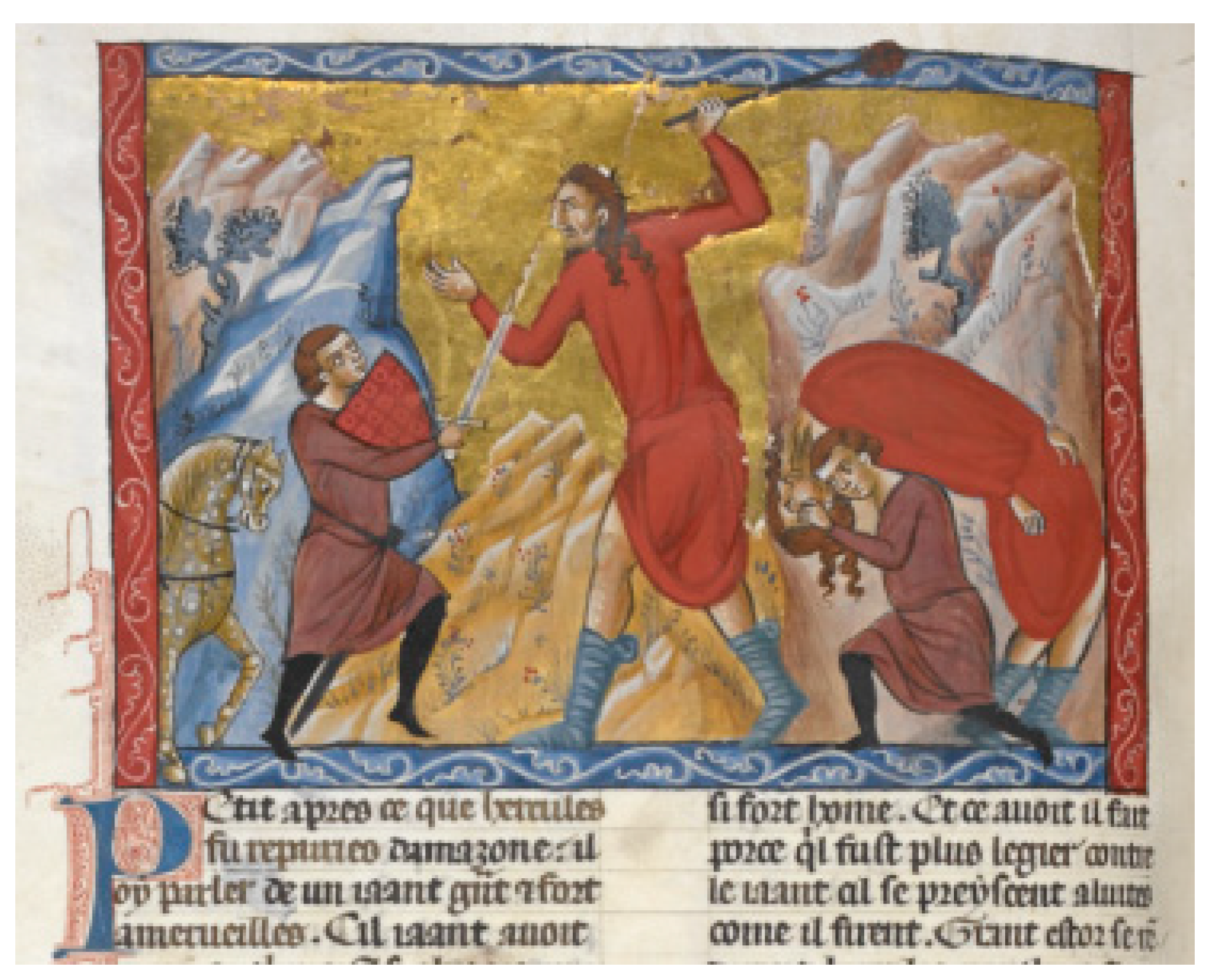
Figure A2.
“The Battle of Naked Men and Peasants”, Hans Lützelburger (dated 1522). (Image in the public domain, provided courtesy of US National Gallery of Art, Washington, USA, from Link)
Figure A2.
“The Battle of Naked Men and Peasants”, Hans Lützelburger (dated 1522). (Image in the public domain, provided courtesy of US National Gallery of Art, Washington, USA, from Link)
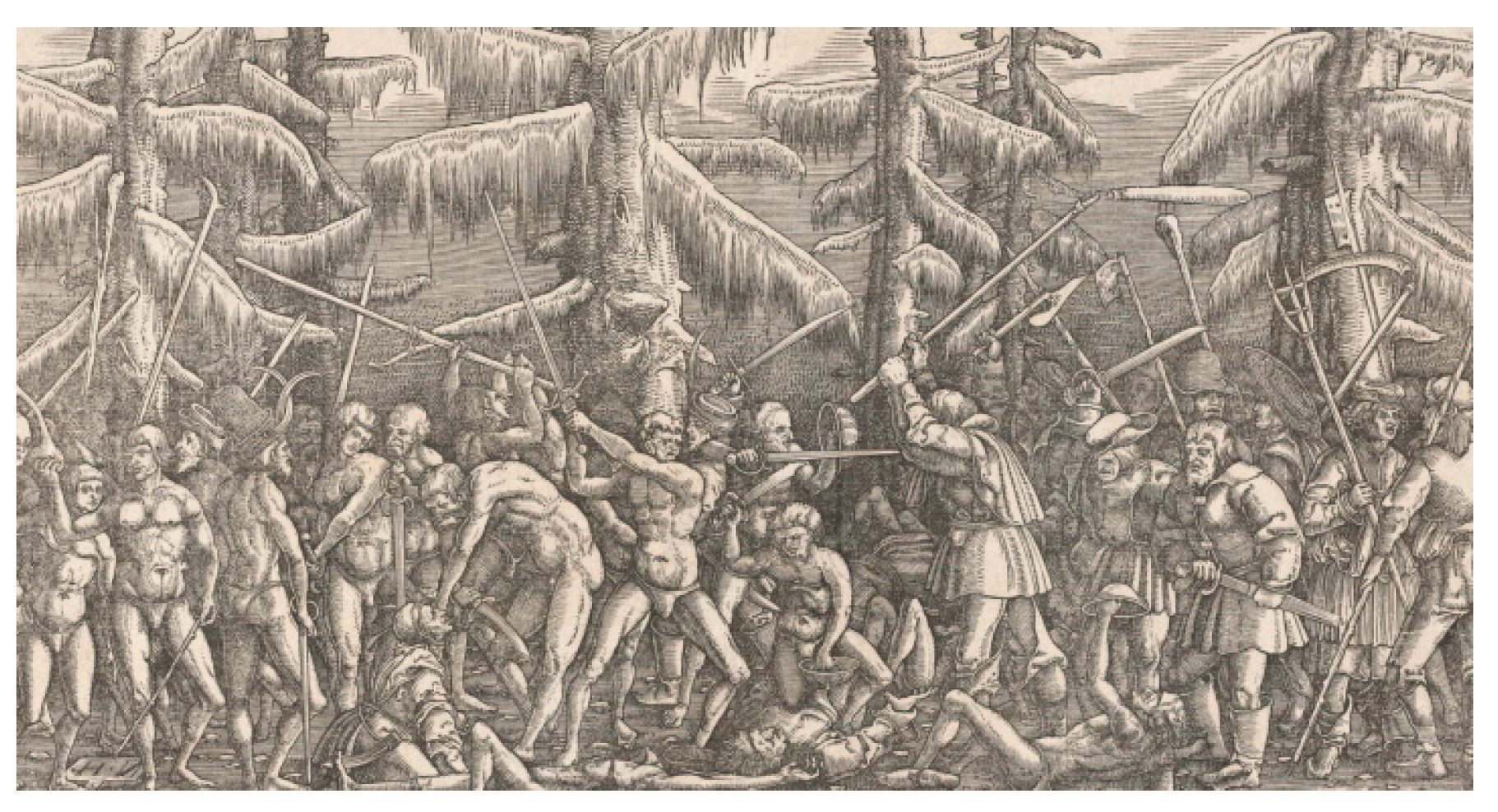
Possibly Misidentified Archaeological Finds from the UK
The UK Potable Antiques Scheme has a large database of finds. Searching using the term “steelyard weight” reveals a great many artefacts recovered which match the pattern of flail heads from Eastern Europe. Given the weights of these do not often match up with the ounces used at the time, they may well be misidentified flail heads. I am unaware of any similar artefact databases from other countries in the region of interest so would welcome direction to or access to these in order to aid this research. A small selection from the UK database within the likely mass range for flail heads (1-200 g) is presented below for context.
Figure A3.
Lead alloy weight (Item DENO-0A3621) from W. Midlands, possibly a flail head, matching E European patterns, dated 1066-1800. Weighs 90 g. (Image Courtesy of the Portable Antiques Scheme, shared under CC BY 3.0 DEED license, available with more information at Link).
Figure A3.
Lead alloy weight (Item DENO-0A3621) from W. Midlands, possibly a flail head, matching E European patterns, dated 1066-1800. Weighs 90 g. (Image Courtesy of the Portable Antiques Scheme, shared under CC BY 3.0 DEED license, available with more information at Link).
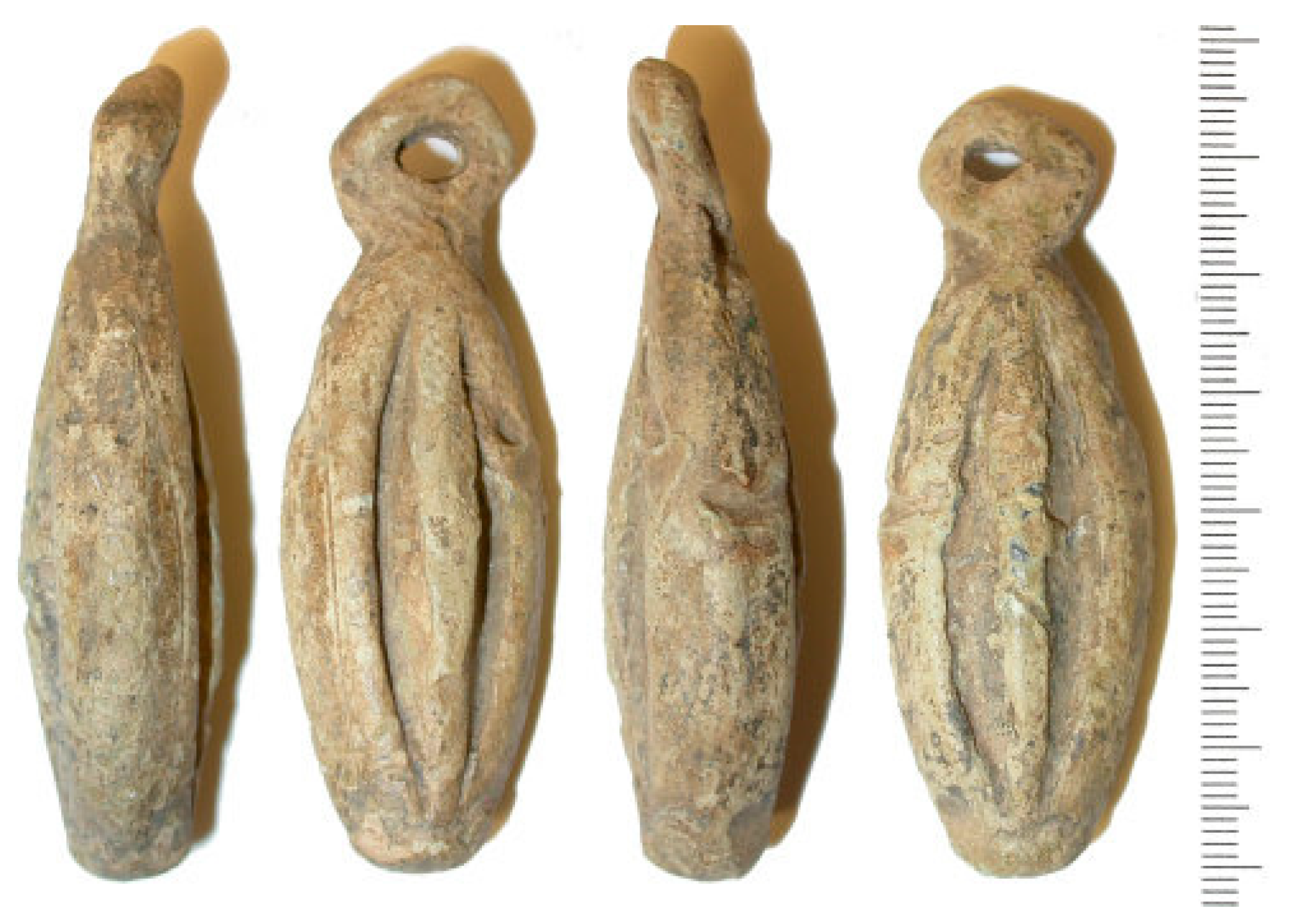
Figure A4.
Possibly morning star (or flail) head (Item NCL-A14BD8) from NE England. Spikes have corroded over time. Dated 1300-1600. Weighs 51 g. (Image Courtesy of the Portable Antiques Scheme, shared under CC BY 3.0 DEED license, available with more information at Link).
Figure A4.
Possibly morning star (or flail) head (Item NCL-A14BD8) from NE England. Spikes have corroded over time. Dated 1300-1600. Weighs 51 g. (Image Courtesy of the Portable Antiques Scheme, shared under CC BY 3.0 DEED license, available with more information at Link).
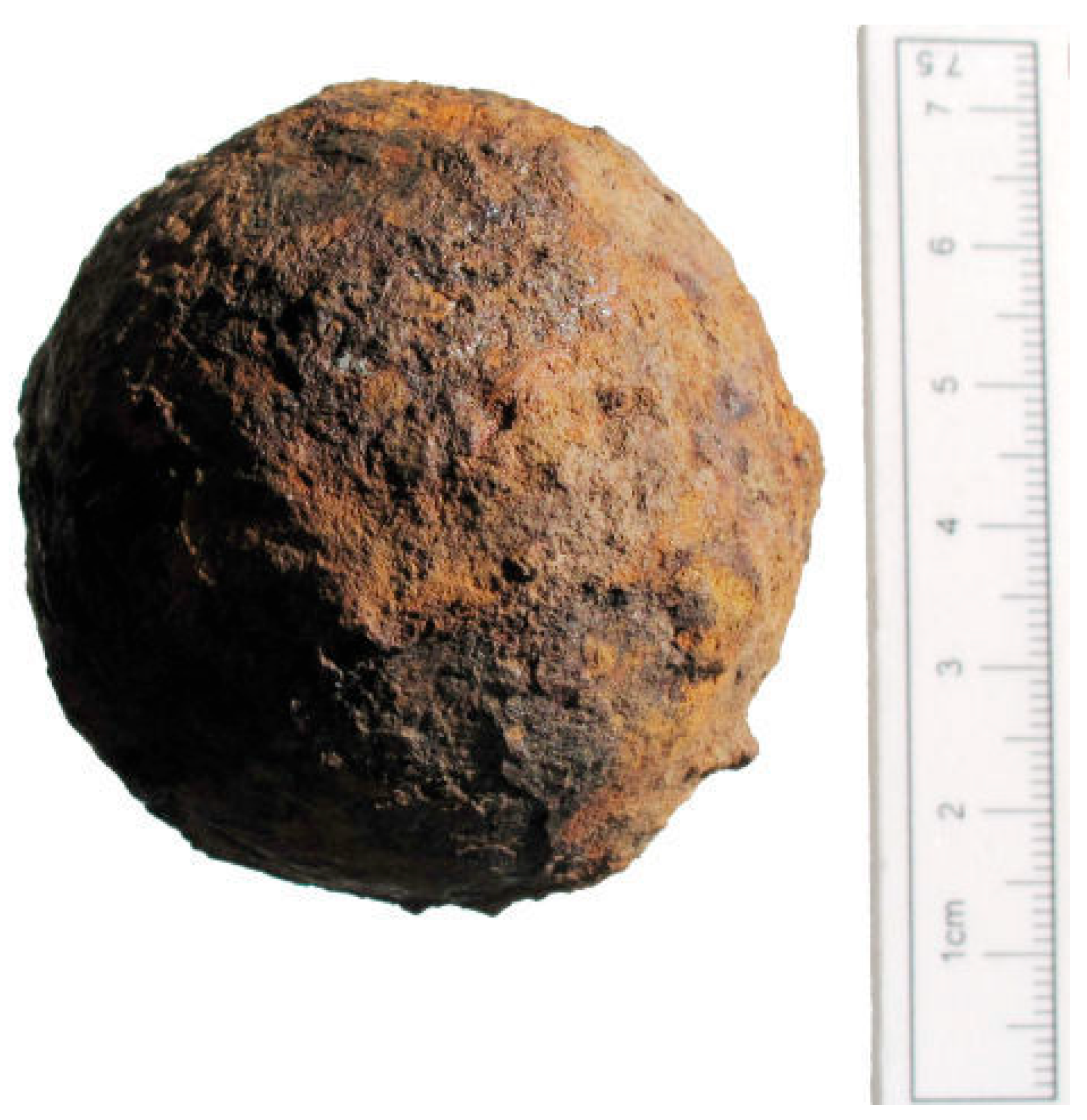
Figure A5.
Lead alloy weight (Item PUBLIC-AF81CE) found in Norfolk, dated 1300-1700. Matches several Eastern European flail patterns. Weights 85.48 g. (Image Courtesy of the Portable Antiques Scheme, shared under CC BY 3.0 DEED license, available with more information at Link).
Figure A5.
Lead alloy weight (Item PUBLIC-AF81CE) found in Norfolk, dated 1300-1700. Matches several Eastern European flail patterns. Weights 85.48 g. (Image Courtesy of the Portable Antiques Scheme, shared under CC BY 3.0 DEED license, available with more information at Link).
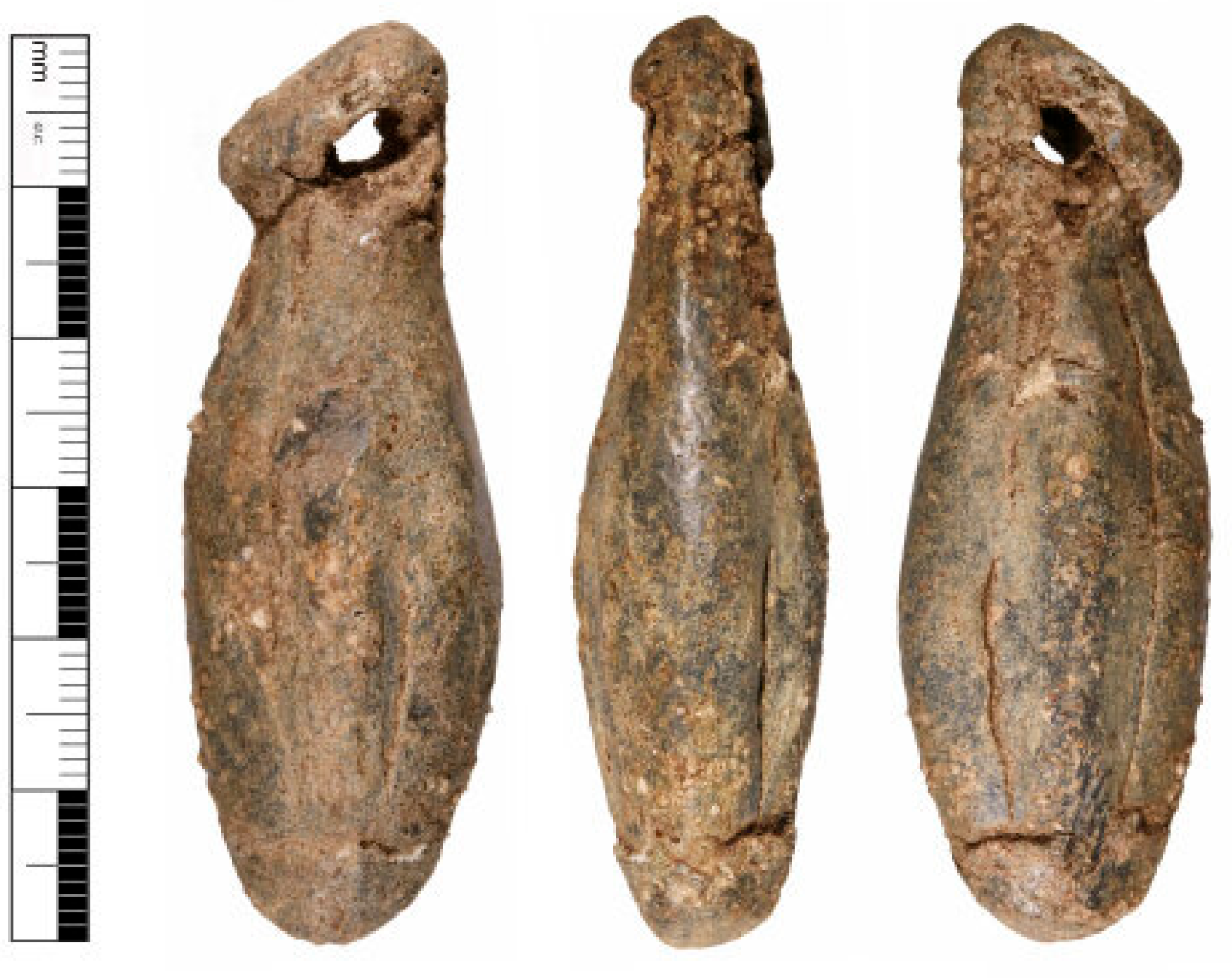
Finds Sold at Auction
A selection of flail heads, sometimes with attached chains, appear at antiques auctions from time to time. These are often dated with a wide window of provenance, and as such do not represent the most reliable source of information, but are in some cases representative of the range of flail construction observed across the Middle Ages, though some items may be reproductions and thus not be genuine. A few examples are presented in Link, Link, Link, and Link for reader interest.
References
- R. S. Abad, Atlas ilustrado de la Guerra en el Edad media en España, Susaeta, Spain, 2013.
- V. Agrigoriaei, Francigena, 2018, 4, 63-100.
- S. K. Alatas, PhD Thesis, University of Lyon, France, 2018. (In French).
- C. Allmand, War and the Non-Combatant in the Middle Ages, in Medieval Warfare – A History, Ed: M. Keen, Bookcraft, Midsomer Norton, UK, 1999, Ch. 9, p.264.
- C. Allmand,. The De re militari of Vegetius: the reception, transmission and legacy of a Roman text in the Middle Age, Cambridge University Press, Cambridge, UK, 2011.
- C. C. Ames, History Compass, 2012, 10, 4, 334-352. [CrossRef]
- A. Andren, Scot. Archaeol. J., 2005, 27, 2, 105-138.
- E. C. Antoche, Turcica, 2004, 36, 91-124. (In French).
- M. G. Arnedo, Guía de vestuario masculine Almogávares: Siglos XII-XIII, 2010, Grupos de Recreación Histórica Medieval Almogávar.
- W. Augustyn, Jahrbuch der Berliner Museen, 1989, 31, 107-126. https://www.jstor.org/stable/4125853.
- A. G. Aveyard, B. T. Davison, D. P. Haggerty and, J. C. Cardwell, Martial Arts of the Middle Age and Renaissance, 2014. https://digitalcommons.wpi.edu/iqp-all/2742.
- M. L. P. Balbuena and J. Belda-Medina, The Effects of Multilingualism in Medieval England: The Impact of French on Middle English Military Terminology, Ch. 3 in Bi- and Multilingualism from Various Perspectives of Applied Linguistics, Vandenhoeck & Ruprecht, Gottingen, Germany, Eds: Z. Chlopek and P. E. Gebal, 2022, p.67.
- J. Bánlaky, A Magyar Nemzet Hadtortenelme, Grill Karoly Konyvkiao, Budapest, Hungary, 1928. https://www.arcanum.com/hu/online-kiadvanyok/Banlaky-banlaky-jozsef-a-magyar-nemzethadtortenelme-2/.
- R. H. Bathgate, Hendrik Van Veldeke's The Legend of St. Servaes Translated, Dutch Crossing, 1990, 14, 4, 3-22. [CrossRef]
- R. Baxter, J. Warburg Courtauld Inst., 1987, 50, 196-201.
- G. Beauchamp, Centennial Review, 1981, 345-362.
- M. Beaud, Force et tempérance: Roland et Olivier gardiens du portail du duomo de Vérone. Paper presented at Le combatant à l'époque romane, 27e colloque international d'art roman d'Issoire, France, 20-21 October, 2017.
- S. Bena, MA Thesis, Central European University, Budapest, Hungary, 2014.
- J. Biederman, Médiévales, 2014, 67, 69-82. [CrossRef]
- J. Bradbury, Geofffrey V of Anjou, Count and Knight, in The Ideals and Practice of Medieval Knighthood III: Papers from the Fourth Strawberry Hill Conference, 1988, Eds: C. Harper-Bill and R. Harvey, Boydell and Brewer, Martlesham, UK, 1990. Ch. 2.
- British Library (BL) Catalogue, Yates Thompson Manuscripts (12th century-17th century) (Yates Thompson MS 1-59).
- J. K. Bollard, Arthur in the Early Welsh Traidition, in The Romance of Arthur: An Anthology of Medieval Texts in Translation, Routledge, London, UK, 1994, 14-16.
- A. Bouwman and B. Besamusca, Of Reynaert the Fox, Amsterdam University Press, Amsterdam, Netherlands, 2007, p.84-85.
- A. C. L. Brown, Mod. Philology, 1919, 16, 11, 553-568.
- C. Buridant, Le Moyen Francais, 2003, 51, 113-157.
- J. W. J. Burgers, Holland, 1998, 30, 1-21.
- G. Campagnano, Armi Immanicate da Botta II – Il Mazzafrusto, 2015, Zweilawyer, https://zweilawyer.com/2015/05/31/armi-immanicate-da-botta-ii-il-mazzafrusto/ (Accessed 04/07/2023) In Italian.
- B. T. Carey, J. B. Allfree and J. Cairns, Warfare in the Medieval World, Pen and Sword, Barnsley, UK, 2006.
- L. K. Carley, PhD Thesis, University of Nottingham, UK, 1962.
- M. O. H. Carver, Archaeologia, 1986, 108, 117-145.
- C. Cazanave, Les Grandes figures historiques dans les Lettres et les Arts, 2013, 2 61-100. http://figures-historiques.revue.univlille3.fr/n-2-2013.
- A. J. Church, Church, Alfred John. Stories of Charlemagne and the Twelve Peers of France: From the Old Romances, Macmillan, New York, USA, 1904, p.349-350.
- M. Civil, Sumerian Harvest Time, Expedition Magazine, 1963, 5, 4. http://www.penn.museum/sites/expedition/?p=652.
- J. Clark, The Green Children of Woolpit, 2018, p97.
- S. Clemmensen, Jörg Rugens Wappenbuch, 2013, http://www.armorial.dk/.
- L. Constans, Roman de Thebes, Librairie de Firmin Didot, Paris, France, 1890.
- A. L. M. C. Costa, Armas Brancas, Draco, Sao Paolo, Brazil, 2015.
- C. B. Courville, J. Coll. Med. Evangelists, 1948, 2, 3, 85-111.
- H. S. Cowper, The Art of Attack, Holmes, Uliverston, UK, 1906.
- D. Culic, Archaeol., 2016, 3, 31-48.
- H. S. Cuming, J. Brit. Archaeol. Assoc., 1854, 10, 2, 165-175. [CrossRef]
- M. Dahm Medieval Warfare on Film II, 2018?
- R. D’Amato, Acta Militaria Medievalia, 2011, 7, 7-48.
- R. D’Amato, Porhyra, 2005, 4, 1-75.
- N. Daniel, The Arabs and Medieval Europe, Longman, London, UK, 1979.
- H. Davies, Int. J. Hist. Cartog., 2020, 72, 2, 181-191. [CrossRef]
- J. P. Day, PhD Thesis, University of Aberystwyth, Wales, UK, 2010.
- A. Daubney, A Decade of Discovery: Proceedings of the Portable Antiquities Scheme Conference 2007, 2007, British Archaeological Reports, 510, 194-200.
- J. de Boislisle, Bibliothèque de l'école des chartes, 1943, 104, 384-388.
- M. de France, Poésies de Marie de France, poète anglo-normand du XIIIe siècle, ou Recueil de lais, fables et autres productions de cette femme célèbre: publiées d'après les manuscrits de France et d'Angleterre, avec une notice sur la vie et les ouvrages de Marie; la traduction de ses Lais en regard du texte, avec des notes, des commentaires, des observations sur les usages et coutumes des François et des Anglois dans les XIIe et XIIIe siècles. Vol. 1, Chasseriau, Paris, France, 1820, p439.
- G. R. De Lage, Roman de Thebes, Champion, Paris, France, 1966.
- A. Le Roux de Lincy, Le Roman de Brut, par Wace, poète du XIIe siècle, publié pour la première fois, Frere, Paris, 1836, p.147.
- A. Demmin, An Illustrated History of Arms and Armour: From the Earliest Period to the Present Time, Bell, London, UK, 1911, p.424-426.
- D. Denny, The Art Bulletin, 1984, 66, 1, 7-14. [CrossRef]
- P. Deschamps, Monuments et Memoires de la Fondation Eugene Piot, 1941, 38, 156-185.
- B. Devereaux, Collections: The Siege of Gondor, Part V: Just Flailing About Flails, A Collection of Unmitigated Pedantry blog, 2019, accessed 27/06/23. https://acoup.blog/2019/06/07/collections-the-siege-of-gondor-part-v-just-flailing-about-flails/.
- K. DeVries and R. D. Smith, Medieval Military Technology, University of Toronto Press, Canada, 2012, p28-30.
- C. Dona, Francigena, 2021, 7, 7-88.
- M. J. Dougherty, Weapons and Fighting Techniques of the Medieval Warrior: 1000-1500 AD, Metro Books, New York, USA, 2008, p91.
- C. Doyle, P. Doyle, T. Doyle, V. Lynn, S. Mac Philib, R. Meehan, D. Power, and A. Siggins, Guide to the National Museum of Ireland: Country Life, p30.
- A. Drob and V. Vasilache, Arheologia Moldovei, 2022, 45, 219-226.
- J. C. du Parc, La Mort Aymeri de Narbonne: Chanson de Geste, Fermin Didot, Paris, France, 1884. https://gallica.bnf.fr/ark:/12148/bpt6k97721205.
- C. A. Eberhart, Consensus, 2005, 30, 1, 37-74. http://scholars.wlu.ca/consensus/vol30/iss1/4.
- P. Edbury, Ernoul, Eracles, and the Fifth Crusade, in The Fifth Crusade in Context, Eds E. J. Mylod, G. Perry, T. Smith, and J. Vandeburie, Routledge, London, UK, 2016, Ch. 11, p172. [CrossRef]
- D. Edwards, PhD Thesis, Royal Holloway, University of London, UK, 2019.
- P. Eley, ARTONOPEUS DE BLOIS - ROMANCE IN THE MAKING, Brewer, Woodbridge, Suffolk, UK, 2011, p.86.
- W. Erisman, Canting arms: a comparison of two regional styles. https://www.ellipsis.cx/~liana/latex/kw/gwenllian/gwenllian.pdf.
- R. Escobar, Saps, Blackjacks and Slungshots: A History of Forgotten Weapons, Catoblepas Press, Columbus, USA, 2018.
- D. Esposito, PhD Thesis, University of Naples, Italy, 2018.
- A.-O. Farcas, MA Thesis, Central European University, Budapest, Hungary, 2016.
- P. Faulliot, El Blanco Invisible, Teorema, Barcelona, Spain, 1982.
- C. Fee, Arthur: God and Hero in Avalon, Reakton, Clerkenwell, UK, 2018, p. 59.
- S. G. Fein and D. Raybin, The Anglo-Norman Otinel, in The Roland and Otuel Romances and the Anglo-French Otinel, Eds: E. Melick, S. Fein, and D. Raybin, Medieval Institute Publications, Kalamazoo, MI, USA, 2019, Ch. 9. [CrossRef]
- Christine Ferlampin-Acher. Le Roman de Thèbes, geste de deus freres: le roman et son double, Eds S. Baudelle, M.- M. Castellani, Ph. Logié et E. Poulain-Gautret. Romans d’antiquité et littérature du Nord, 2007 Mélanges offerts à Aimé Petit, Champion, p. 309-318. hal-01619060.
- D. J. C. Fernandes, Bachelord’s/Master’s Thesis, University of Murcia, Spain, 2019.
- A. M. Frutos, ERAE, 2019, 25, 25-184.
- F. Funck-Brentano, Le Moyen Age, Hachette, New York, USA, 1922.
- J. M. Gallardo, ¿Existió el llamado en castellano mangual o mayal (‘flail’ en inglés), un arma de una mano medieval y fue usado en combate real? SÍ. Un ejemplo de “polémica barata a través de internet” en el mundo popular y académico., 2016, https://handlingthosebastards.wordpress.com/2016/06/05/existio-el-llamado-en-castellano-mangual-o-mayal-flail-en-ingles-un-arma-de-una-mano-medieval-y-fue-usado-en-combate-real-si-un-ejemplo-de-polemica-barata-a-traves-de-internet/.
- M. R. Geldof, “And to describe the shapes of the dead”: Making Sense of the Archaeology of Armed Violence in Wounds and Wound Repair in Medieval Culture, BRILL, Netherlands, 2015, Ch. 2, p. 66.
- M. E. Gerhardinger, A proposito dell’affresco staccato con episodi de La chanson d’Otinel, Attività & Ricerche, BOLLETTINO DEI MUSEI E DEGLI ISTITUTI ELLA CULTURA DELLA CITTÀ DI TREVISO, 2020, 1, 75-85.
- C. Gerhardt, In vero iudicio fecisti. Eine historisierte O-Initiale im ‚Corvinus-Graduale, 2007.
- M. E. Gibbs and S. M. Johnson, Medieval German Literature, Routledge, Oxford, UK, 1997, 195-196.
- A. R. Gonzalez, Feudalismo en las Antípodas: comparación entre un caballero medieval europeo y un guerrero samurái. In Kokoro: Revista para la difusión de la cultura japonesa 2013, 13, 2-23.
- S. Gordon, Supernatural Encounters: Demons and the Restless Dead in Medieval England, c. 1050–1450, Routledge, Oxford, UK, 2019.
- S. Gorski and E. Wilczynska, Medeival Warfare, 2012, 2, 3, 27-34. https://www.jstor.org/stable/48578020.
- E. Gotzinger, Reallexikon der deutschen Altertümer, Urban, Munich, Germany, 1885, p.493.
- T. Grabarczyk, FASCICULI ARCHAEOLOGIAE HISTORICAE, 2000, 12.
- N. Grant, The Medieval Longsword, Bloomsbury, London, UK, 2020, p.24.
- P. Grotowski, Arms and Armour of the Warrior Saints: Tradition and Innovation in Byzantine Iconography (843–1261), Ch. 1, BRILL, 2010, p.28.
- A. S. Green, Henry the Second, Macmillan, New York, USA, 1888, p6.
- I. A. Gregory, Gods and Fighting Men, John Murry, London, UK, 1905.
- R. Gug, Misque Acienne, 1985, 20.
- C. Hahn, Gesta, 30, 2, 1991, 119-139. [CrossRef]
- J. E. Hamburger, The Art Bulletin, 1991, 73, 2, 209-236.
- T. E. Hamilton, The Cyclic Revelations of the Chanson of Willame, Stephens, Columbia, MI, USA, 1911, p. 163.
- O. Havard, Le Moyen Age et Ses Institutions, Mame et fils, Paris, France, 1876.
- V. Hegg, BA/MA Thesis, University of Bergen, Norway, 2021.
- A. S. Herrera, BA/MA Thesis, University of Seville, Spain. 2014.
- T. Herron, New Hibernia Review, 2002, 6, 2, 82-105.
- J. Hewitt, Hewitt, John. Ancient armour and weapons in Europe: from the iron period of the northern nations to the end of the thirteenth (-seventeenth) century. Vol. 1, Henry and Parker, London, UK, 1855.
- D. Hill, Landscape Hist., 1998, 20, 1, 29-39. [CrossRef]
- J. Hillaby, Naturalists’ Field Club, 2006, 11-56.
- The History Blog, Medieval copper scourge found at Rufford Abbey, April 4, 2016, http://www.thehistoryblog.com/archives/41442. (Accessed 05/07/2023).
- G. C. Homans, English Villagers of the Thirteenth Century, Harvard U. Press, Harvard, MA, USA, 1941.
- J. D. Hosler, History Compass, 2014, 12, 5, 398-411. [CrossRef]
- J. D. Hosler, Chivalric Carnage? Fighting, Capturing and Killing at the Battles of Dol and Fornham in 1173, in Prowess, Piety, and Public Order in Medieval Society, Eds: C. M. Nakashian, and D. P. Franke, Brill, Lieden, Netherlands, 2017, Ch. 2, p.51.
- B. V. Hrynchyshyn, Medieval bladed weapons in the figurative sources, 2014.
- G. Huet, Romania, 1912, 41, 164, 518-540.
- J. Hull, Fight Earnestly, 2007.
- P. R. Hyams, Econ. Hist. Rev., 1970, 23, 1, 18-31. https://www.jstor.org/stable/2594561.
- E. Imiolczyk and R. Zdaniewicz, Fasciculi Arcaeologiae Historicae, 2022, 35, 147-159. [CrossRef]
- E. Impey, The Antiquaries Journal, 2019, 99, 225-270. [CrossRef]
- D. Izdebska, Metaphors of Weapons and Armour Through Time, in Mapping English Metaphor Through Time, Eds. W. Anderson, E. Bramwell, and C. Hough, Oxford University Press, Oxford, UK, 2016, Ch. 14, p. 222.
- J. Jacobs, Celtic Folk and Fairy Tales, G. P. Putnam’s Sons, New York, USA, 1892.
- M. Jähns, Handbuch einer Geschichte des Kriegswesens von der Urzeit bis zur Renaissance: Technischer Theil: Bewaffnung, Kampfweise, Befestigung, Belagerung, Seewesen, Volume 1, Grunow, Leipzig, Germany, 1880.
- M. Jähns, Entwicklungsgeschichte der alten Trutzwaffen: mit einem Anhange über die Feuerwaffen, Unknown, Germany, 1899, p 200-202.
- M. R. James, Vol. Warpole Soc., 1925-1926, 14, 1-26. https://www.jstor.org/stable/41830691.
- K. Jócsik, BA Thesis, University of Nitra, Hungary, 2022.
- D. Kahn, Cahiers de Civilisation Medievale, 1997, 46-160, 337-372. [CrossRef]
- C. Katona, Viking and Medieval Scandinavia, 2017, 13, 23-60.
- P. Kennedy, Legendary Fictions of the Irish Celts, Macmillan, London, UK, 1866.
- A. N. Kirpičnikov, Svod arkheologicheskikh istochnikov, 1966.
- A. N. Kirpičnikov, Gladius, 1968, 7, 45-74.
- A. N. Kirpičnikov, Gladius, 1970, 9, 31-51.
- F. P. Knapp, Aliscans, DeGuyter, Berlin, Germany, 2013.
- G. Köhler, Die Entwickelung [sic] des Kriegswesens und der Kriegführung in der Ritterzeit von Mitte des 11. Jahrhunderts bis zu den Hussitenskriegen, Unknown, Germany, 1887, p51, 98-99.
- A. Kolar, MA Thesis, University of Oregon, Eugene, OR, USA, 2020.
- K. Köstler, Die Ungarnschlacht auf dem Lechfelde am 10. August 955 und die Folgen der Ungarnkriege uberhaupt, Unknown, Germany, 1883, p7-8.
- P. N Kotowicz, Acta Militaria Mediaevalia, 2006, 2, 51-66.
- P. N. Kotowicz and A. Michalak, Acta Archaeologica Carpathica, 2008, 52-53, 337-382.
- P. N. Kotowicz, Fasciculi, Archaeologae Historicae, 2008, 51, 75-85.
- P. N. Kotowicz and P. Skowronski, Archaeologiae Historicae, 2020, 33, 49-69.
- M. Kristo, BA/MA Thesis, University of Torino, Italy, 2020.
- G. F. Laking, HAFTED WEAPONS IN GENERAL USE 1-ROM THE MIDDLE OF THE XIVth CENTURY TO THE COMMENCEMENT OF THE XVIth CENTURY in A Record of European Arms and Armour Through Seven Centuries, Bell, London, UK, 1920, Vol 3, pp 123-124.
- O. Lawrynowicz and P. A. Nowakowski, Studies in Post-Medieval Archaeology, 2008, 3, 303-316.
- S. L’Engle, Viator, 2002, 33, 133-165.
- E. Leon, Revue Historique, 2019, 689, 140-143. https://www.jstor.org/stable/10.2307/26782495.
- J.-D. G. G. Lepage, Medieval Armies and Weapons in Western Europe, McFarland, Jefferson, NC, USA, 2005.
- M. Lewy, Imago Mundi, 2021, 73, 1, 64-72. [CrossRef]
- G. S. Lindsey, MA Thesis, University of Akron, OH, USA, 2005.
- S. Lipton, J. Americ. Acad. Relig., 1999, 67, 3, 703-706. http://www.jstor.org/stable/1466227.
- C. Lofmark, Rennewart in Wolfram's 'Willehalm': A Study of Wolfram Von Eschenbach and His Sources, Cambridge University Press, UK, 1972, p. 159.
- J. A. Macculloch, The Mythology of All Races in Thirteen Volumes:Celtic, Marshall Jones, Boston, USA, 1916, p.183.
- N. Mac Coitir, Irish Forestry, 2020, 77, 94-105.
- M. Maher, PhD Thesis, University of Glasgow, UK, 2018.
- S. Manning, The Case Against the Medieval Ball and Chain, May 2016. https://scottmanning.com/content/the-case-against-the-medieval-ball-and-chain/.
- M. Markowitz, Weapons on Ancient Coins, Coin Week, 2021. https://coinweek.com/ancient-coins/weaponson-ancient-coins/.
- A. Mäesalu, Muinasaja Teadus, 2004, 14, 227-248.
- L. McCulloch, The Automaton in English Renaissance Literature, 2011, Ch. 4, p61-76.
- G. McDowell, Double Indignity: Two Tales in Chretien de Troyes’s Perceval, in Fresh Writing, Eds: C. S. Mick et al., Hayden McNeil, Phymouth, MI, USA, 2007, p.134.
- S. McLachlan, Medieval Handgonnes: The First Black Powder Infantry Weapons, Bloomsbury, London, UK, 2011.
- M. L. Meneghetti, Memorias de la Real Adademia de Buenas Letras de Barcelona, 1990, 67-80.
- A. Michalak, Acta Militaria Mediaevalia, 2006, 2, 103-114.
- A. Michalak and P. Wolanin, Acta Archaeologca, 2008, 54, 99-120. https://www.ceeol.com/search/article-detail?id=244148.
- A. Michalak and K. Zamelska-Monczak, Acta Militaria Mediaevalia, 2016, 12, 199-206.
- A. Michalak, Acta Archaeologiae Militaris, 2019, 5, 133-142. [CrossRef]
- P. D. Mitchell, MD Thesis, 2002, UCL, London, UK.
- A. S. Mittman in A Critical Companion to English Mappae Mundi of the Twelfth and Thirteenth Centuries, Eds: D. Terkla and N. Millea, Boydell Press, Rochester, NY, USA, 2019, Ch. 6.
- J. Monfrin, Romania, 1965, 86, 343, 3, 414-424. https://www.jstor.org/stable/45038644.
- D. M. McDougall, Agrarian Metaphors, 1983. https://discovery.ucl.ac.uk/1381762/2/388805_Vol2.pdf.
- R. Moffat, Arms and Armour, 2010, 7, 1, 5-29.
- K. Mondschein, Game of Thrones and the Medieval Art of War, McFarland, Jefferson, NC, USA, 2017.
- F. Mora-Lebrun, Le Roman de Thebes: edition du manuscript S, British Library, London, UK, 1995.
- P. J. R. Moreno, Armas de Percusion Articuladas, Historia Rei Militaris, 2015, 8, p81-88.
- C. R. Morey, Class. Philology, 1931, 26, 4, 374-385. https://www.jstor.org/stable/265109.
- J. Myrdal, The agricultural transformation of Sweden, 1000-1300, Ch. 7 in Medieval Farming and Technology: The Impact of Agricultural Change in Northwest Europe, BRILL, Eds: G. G. Astill and J. Langdon, 1997, p.164.
- E. Mosca, BA/MA Thesis, University of Padova, Italy, 2020.
- J. Needham, Proc. Royal Soc. A., 1959, 250, 147-179.
- L. Négyesi, Hadtörténelmi Közlemények, 2003, 1, 206-230. https://militaria.hu/hadtorteneti-intezet-es-muzeum/hadtortenelmi-kozlemenyek-letoltes/2003.pdf.
- P. R. Newman, Folk Life, 1985, 24, 1 70-86. [CrossRef]
- D. C. Nicolle, Arms and Armour of the Crusading Era 1050-1350: Western Europe and the Crusader, Greenhill, London, UK, 1999, p118, 130.
- A. Nicolotti, J. Study Historical Jesus, 2017, 15, 1, 1-59.
- A. Niewinksi, Teka Komisji Historycznej TN KUL, 2019, 1, 16, 9-31. [CrossRef]
- S. Nilsson, Military Flails Didn’t Exist? – Let’s Take a Closer Look, YouTube, 2021. https://www.youtube.com/watch?v=0PHASxS8Voc.
- P. Norris, PhD Thesis, University of Manchester, UK, 2015.
- E. Oakeshott, European Weapons and Armour from the Renaissance to the Industrial Revolution, Bodyell Press, Martlesham, UK, 2012.
- J. O’Bryan, A History of Weapons, Chronicle, San Francisco, USA, 2013, p152-153.
- D. O’Hogain, Bealoideas, 1986-1987, 54/55, 207-242. https://www.jstor.org/stable/20522287.
- C. Oman, A History of the Art of War, Putnam & Sons, New York, USA, 1898, p. 397.
- M. V. Ortiz, The Destreza Verdadera: A Global Phenomenon, in Late Medeival and Early Modern Fight Books, BRILL, Eds: D. Janquet, K. Verelst, and T. Dawson, 2016, Ch. 12.
- R. Osgood, The Unknown Warrior: the Archaeology of the Common Soldier, The History Press, Cheltenham, UK, 2005.
- M. S. Osypenko, Наукoвий вісник Націoнальнoгo музею істoрії України, 2020, 6, 63-71.
- M. S. Osypenko, Arheologia, 2019, 4, 72-89.
- F. Palgrave, The History of Normandy and of England Vol. 3, Macmillan, London, UK, 1864, p36 and 104.
- A. Papaioannou, Horse and Horsemen on Classical and Hellenistic Coins in Thessaly, MA Thesis, International Hellenic University, Thessalonica, Greece, 2019.
- A. Paron, Quaestiones Medi Aevi Novae, 2021, 26, 5-31. https://www.ceeol.com/search/article-detail?id=1007048.
- J. Perratore, J. Medieval Iberian Studies, 2015. [CrossRef]
- E. A. Peterson, Zeitshrift fur Kunstgeschichte, 1987, 50, 3, 375-384. https://www.jstor.org/stable/1482386.
- F. C. Philip, 16th International Congress of Turkish Arts, Ankara, Turkey, 3-5 October, 2019.
- J. R. Planché, A Cyclopaedia of Costume Vol 1, 1876, Chatto and Windus, London, UK, p.190-192.
- M. Pohl, PhD Thesis, Ludwig-Maximilians-Universität München (Munich), Germany, 2004.
- S. Popov and J. Aaladjov, Вoстoчная Еврoпа в древнoсти и средневекoвье, 2016, 28, 241-244.
- E. Power, Econ. Hist. Rev., 1940, 10, 2, 155-158. https://www.jstor.org/stable/2590795.
- J. Puziuk and A. Tyniec, MATERIAŁY ARCHEOLOGICZNE, 2013, 39, 33-53.
- D. Rabovyanov, The use of war-flails in the Bulgarian lands during the Byzantine conquest period – archaeological evidence from the northern borders of the empire, in War in Eleventh-Century Byzantium, Eds: G. Theotokis and M. Mesko, Routledge, Oxford, UK, 2021, Ch.13.
- D. Radtchenko, Rethinking History, 2006, 10, 1, 127-148. [CrossRef]
- R. Rdaniewicz and M. Adamiak, Acta Militaria Mediaevalia, 2011, 7, 191-202.
- J. Rageth and W. Zanier, Germania, 2010, 88, 1-2, 241-283.
- F. H. Ridley, Florilegium, 1992, 11, 101-115.
- E. S. G. Robinson, The British Museum Quarterly, 1933, 8, 1, 49-50. https://www.jstor.org/stable/4421548.
- C. Rudolph, Violence and Daily Life: Reading, Art, and Polemics in the Citeaux Moralia in Job, Princeton University Press, USA, 1997.
- J. Runeburg, Acta Societatis Scientiarum Fennicas, 1913, 37.
- B. Rüther, Flail FAQ - The Mangual! Weapon or Toy?, YouTube, 2023. https://www.youtube.com/watch?v=ADxKtdxmxN4.
- b. Rüther, Flail FAQ - What hits harder? Flail vs Staff, YouTube, 2022. https://www.youtube.com/watch?v=f7a3jLx8ZJQ.
- W. Sayers, The Canadian Journal of Irish Studies, 1983, 9, 1, 45-80. http://www.jstor.org/stable/25512561?origin=JSTOR-pdf.
- G. Scala, PhD Thesis, University of Zurich, Switzerland, 2021.
- A. Schultz, Das höfische leben zur zeit der minnesinger. Vol. 1., S. Hirzel, Leipzig, Germany, 1889.
- C. Seltman, The Numismatic Chronicle and Journal of the Royal Numismatic Society, 1946, 6, 3/4, 81-90. https://www.jstor.org/stable/42663242.
- E. R. Shartrand, PhD Thesis, University of Delaware, USA, 2020.
- I. Short, Historical Miscellany, 2022, www.anglo-norman-texts.net.
- V. Shpakovsky and D. Nicolle, Armies of the Volga Bulgars & Khanate of Kazan: 9th–16th centurie, Bloomsbury, London, UK, 2013, p.33-34.
- A. G. Sitdikov, I. L. Izmailov, and R. R. Khayrutdinov, J. Sust. Dev., 2015, 8, 7, 167-177. [CrossRef]
- V. M. Skhorokhod and D. Blazhchek, Arheologia, 2020, 2, 94-100. [CrossRef]
- P. Skinner, Living with Disfigurement in Early Medieval Europe, Springer Nature, New York, USA, 2017, p.84.
- J. A. Smith, Proc. Soc. Antiquit. Scot., 1876, 11, 29-62.
- G. A. Snook, Amer. Soc. Arms Collect. Bull., 1979, 79, 3-13.
- L. Spence, Legends and Romances of Brittany, Stokes, New York, USA, 1917.
- A. L. Spiro, PhD Thesis, Columbia University, New York, USA, 2014.
- P. Steele, Ancient Egypt, Rosen Publishing, New York, 2002, p12.
- A. Sternberg, Die Angriffswaffen im Altfranzosischen Epos Vol. 48, Elwert, Marburg, Germany, 1886. P.44.
- S. Stoljar, J. Legal History, 1985, 6, 1, 33-48. [CrossRef]
- P. B. Sturtevant, The Curious Case of the Weapon that Didn’t Exist, The Public Medievalist, May 2016(a). https://publicmedievalist.com/curious-case-weapon-didnt-exist/.
- P. B. Sturtevant, Solving the Curious Case of the Weapon that Didn’t Exist, The Public Medievalist, Dec. 2016(b). https://publicmedievalistcom/flail-redux/.
- P. B. Sturtevant, The Medieval Weapon that Never Existed: The Military Flail, Medieval Warfare, 2017, 6, 6, 50-53. https://www.jstor.org/stable/48578200.
- F. Svetec, MA Thesis, Univerisyt of Zadar, Croatia, 2023.
- C. Sweetenham, The Chanson des Chétifs and Chanson de Jérusalem Completing the Central Trilogy of the old French Crusade Cycle, Routledge, Oxford, UK, 2016.
- J.-P. Taavistainen, Esti Arheoloogiaajakiri, 2004, 8, 1, 33-48.
- M. Talaga and H. Ridgeway, Gestalt Theory, 2020, 42, 2, 145-164. [CrossRef]
- J.-M. Tardy, BA/MA Thesis, Université Jean Monnet, Saint-Etienne, 2020.
- E. Terävä, MA Thesis, University of Helsinki, Finland, 2014.
- M. Thibout, Bull. Monumental, 1966, 124, 3, 334-338.
- J. A. Thompson, PhD Thesis, University of St. Andrews, UK, 2000.
- C. V. Thorbeck, El Lunes de las Navas, University of Jaen, Spain, 1999.
- P. Tihle, BA/MA Thesis, University of Ljubljana, Slovenia, 2017.
- J. Toffee, Cacamwri, Osla Big-Knife and Llyn Lliwan, Mabinogion Astronomy Blog, 2013. Accessed 28/06/23. https://mabinogionastronomy.blogspot.com/2013/09/cacamwri-oslabig-knife-and-llyn-lliwan.html.
- L. Tracy and K. DeVries, Wounds and Wound Repair in Medieval Culture, Vol 1, BRILL, 2015, p.66.
- E. Tunis, Weapons: A Pictorial History, John Hopkins University Press, Baltimore, USA, 1999, 35-36.
- R. Tuve, PMLA, 1929, 44, 3, 706-714. https://www.jstor.org/stable/457410.
- I.-E. Tzouriadis, PhD Thesis, University of Leeds, UK, 2017.
- I.-E. Tzouriadis and J. H. Deacon, Acta Periodica Duellatorum, 2020, 8, 1, 45-72. [CrossRef]
- Unknown Author, Vercelli Mappamundi, http://www.myoldmaps.com/early-medieval-monographs/2203-vercelli-mappamundi/225-matthew-paris-world/2203-vercelli2.pdf.
- R. Utz, Proceedings of Anglistentag 2016 Hamburg, Eds: U. Berns and J. Mathieson, 2016, Hamburg, Germany.
- V. van der Veen, Medieval Warfare, 2012, 2, 2, 38-41. https://www.jstor.org/stable/48577944.
- E. Van Dyke, C. Mallary, R. Meador, and D. Sansoucy, BSc Thesis, Worcester Polytechnic Institute, MA, USA, 2007.
- E. Veiga de Oliveira, F. Galhano and B. Pereira, Alfaia agrícola Portuguesa, Portugese National Institute of Science, Ethnology Study Centre, Lisbon, Portugal, 1983.
- J. Veninger, PhD Thesis, University of Exeter, UK, 2015.
- L. Villemarqué, Barzaz-Breiz: Cjamts Populaires de la Bretagne, Vol 1, Franck, Paris, 1846, 199-202.
- N. Vincent, The seals of King Henry II and his court, in Seals and their Context in the Middle Ages, Ed. P. R. Schofield, Oxbow, Oxford, UK. 2015, Ch. 2, p15. https://www.jstor.org/stable/j.ctvh1dsk8.
- M. Viollet-le-Duc, Dictionnaire Raisonné de Mobilier Francais, Book 5, Morel, Paris, France, 1874, 427-429.
- J. Waldman, Waldman, John. Hafted weapons in medieval and renaissance Europe: The evolution of European staff weapons between 1200 and 1650, Brill, Lieden, Netherlands, 2005, Ch. 11.
- E. Wamers, Mainzer Archäologische Schriften, 2004, 1.
- P. Warner, Sieges of the Middle Ages, Pen and Sword, Yorkshire, UK, 1968, p37.
- W. Wasiak, Acta Universitatis Lodziensis. Folia Archaeological, 2012, 29, 209-234. [CrossRef]
- W. Waterschoot, In Monte Artium, 2014, 7, 115-134. [CrossRef]
- W. Whobrey, The Nibelungenlied: with The Klage, Hacket, Indianapolis, USA, 2018, p43.
- J. Williams, Etzel der rîche - The depiction of Attila the Hun in the literature of medieval Germany: with reference to related Byzantine, Italic, Gallic, Scandinavian and Hungarian sources (450-1300), PhD Thesis, Queen’s University Belfast, 1979.
- D. M. Wilson and C. E. Blunt, Archaeologia, 1961, 98, 75-122.
- J. Zábojník, Slovenska Archeologia, 2009, 57, 169-182.
- M. Zhirohov and D. Nicolle, The Khazars: A Judeo-Turkish Empire on the Steppes, 7th-11th Centuries AD, Bloomsbury, Oxford, UK, 2019.
- B. Zientara, Acta Potoniae Historica, 1970, 22, 207-225. https://rcin.org.pl/ihpan/dlibra/publication/19663/edition/5584#description.
- A. Zouache, Annales Islamologique, 2007, 41, 277-326.
Figure 1.
Examples of war flail, threshing flail, and the head of a warclub (left, demonstrative of the pattern weaponisation of threshing flails, based on the clubs found in the Maciejowski Bible) produced by and from the collection of the author (war flail ironwork by Wieland Forge, UK), and scourge (right) kindly loaned from the collection of Mr M. Dandy. Photos: own work. Please note that these are modern “combat safe” interpretations based upon period designs.
Figure 1.
Examples of war flail, threshing flail, and the head of a warclub (left, demonstrative of the pattern weaponisation of threshing flails, based on the clubs found in the Maciejowski Bible) produced by and from the collection of the author (war flail ironwork by Wieland Forge, UK), and scourge (right) kindly loaned from the collection of Mr M. Dandy. Photos: own work. Please note that these are modern “combat safe” interpretations based upon period designs.
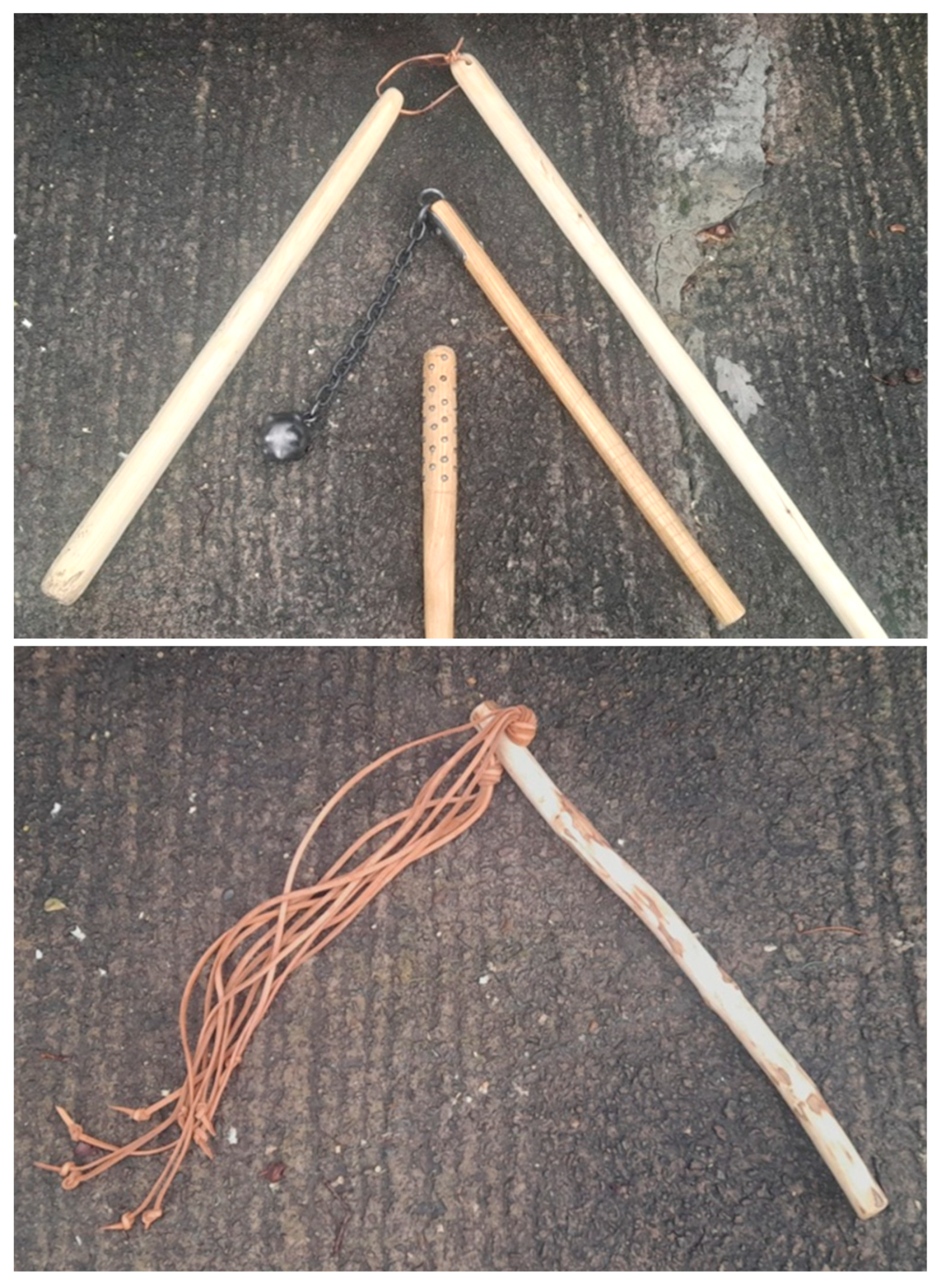
Figure 2.
The coffinette of Tutankhamen (Pacific Science Centre, Seattle, WA, USA) depicting the crook and flail. (© D. Denisenkov, permission granted for non-commercial reproduction under CC BY-SA 2.0 DEED license, image cropped from original (link) but otherwise unaltered).
Figure 2.
The coffinette of Tutankhamen (Pacific Science Centre, Seattle, WA, USA) depicting the crook and flail. (© D. Denisenkov, permission granted for non-commercial reproduction under CC BY-SA 2.0 DEED license, image cropped from original (link) but otherwise unaltered).

Figure 3.
Thessalian coin (400-370 BC) depicting cavalryman with flail. (© Forum Ancient Coins (www.forumancientcoins.com), permission granted for non-commercial reproduction, exact image from Link).
Figure 3.
Thessalian coin (400-370 BC) depicting cavalryman with flail. (© Forum Ancient Coins (www.forumancientcoins.com), permission granted for non-commercial reproduction, exact image from Link).
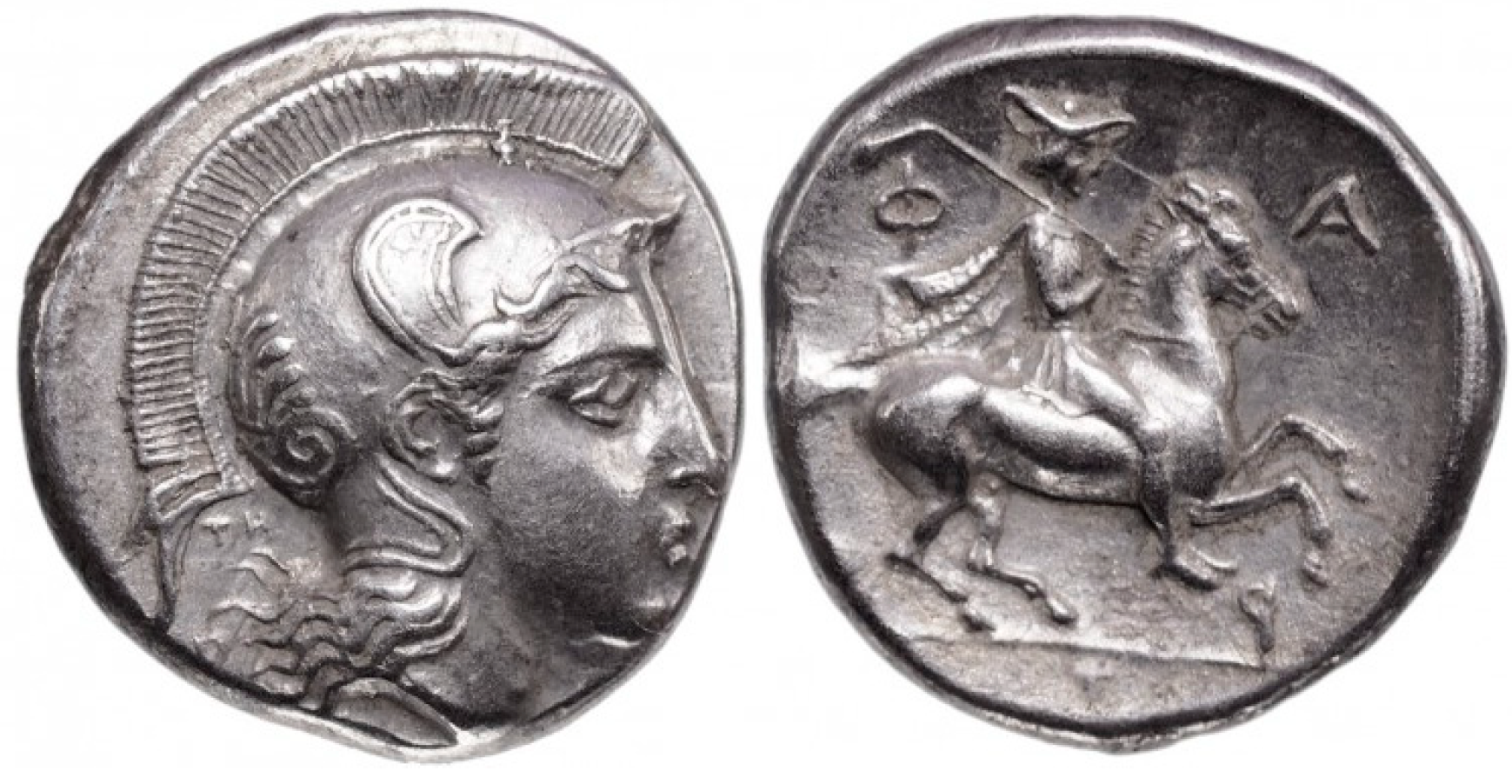
Figure 4.
Threshing flail hinges from Portuguese tradition. (Reproduced with kind permission of Etnografica Press, CRIA (Centre for Research in Anthropology), Lisbon, Portugal. From Ref: Veiga de Oliveira, 1983; sourced from Gallardo, 2016).
Figure 4.
Threshing flail hinges from Portuguese tradition. (Reproduced with kind permission of Etnografica Press, CRIA (Centre for Research in Anthropology), Lisbon, Portugal. From Ref: Veiga de Oliveira, 1983; sourced from Gallardo, 2016).
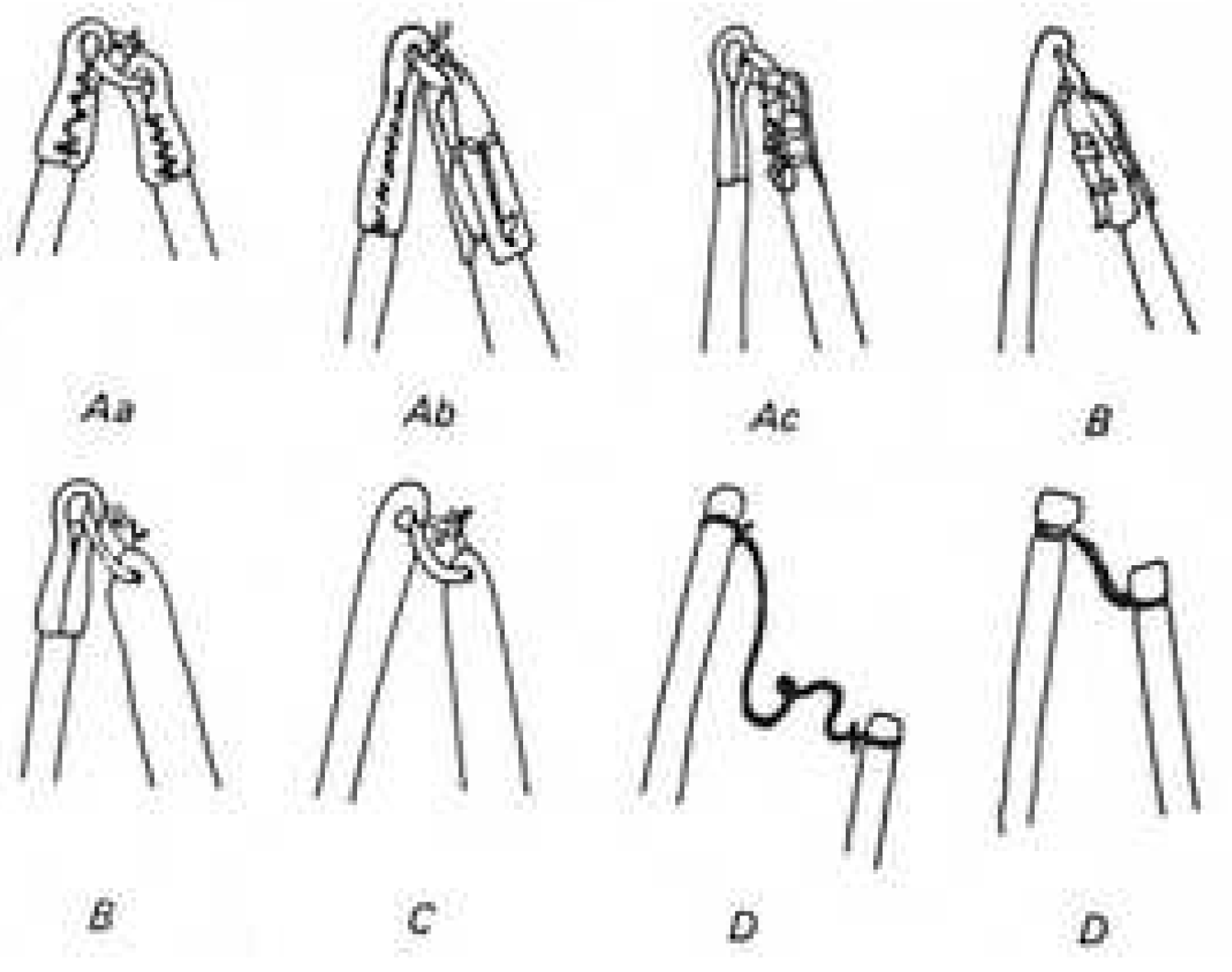
Figure 5.
Fol. 148r from Citeaux Moralia in Job (© Bibliothèque Municipale de Dijon, MS. 173, permission granted for non-commercial reproduction).
Figure 5.
Fol. 148r from Citeaux Moralia in Job (© Bibliothèque Municipale de Dijon, MS. 173, permission granted for non-commercial reproduction).

Figure 6.
Fol. 59v from the Chronicle of the Fifth Crusade (aka Chromica Maiora II, © The Parker Library, Corpus Christi College, Cambridge, MS 016II, permission granted for non-commercial reproduction under CC BY-NC 4.0 license, image from Link). Note also the staff slingers and archers also in the boat.
Figure 6.
Fol. 59v from the Chronicle of the Fifth Crusade (aka Chromica Maiora II, © The Parker Library, Corpus Christi College, Cambridge, MS 016II, permission granted for non-commercial reproduction under CC BY-NC 4.0 license, image from Link). Note also the staff slingers and archers also in the boat.
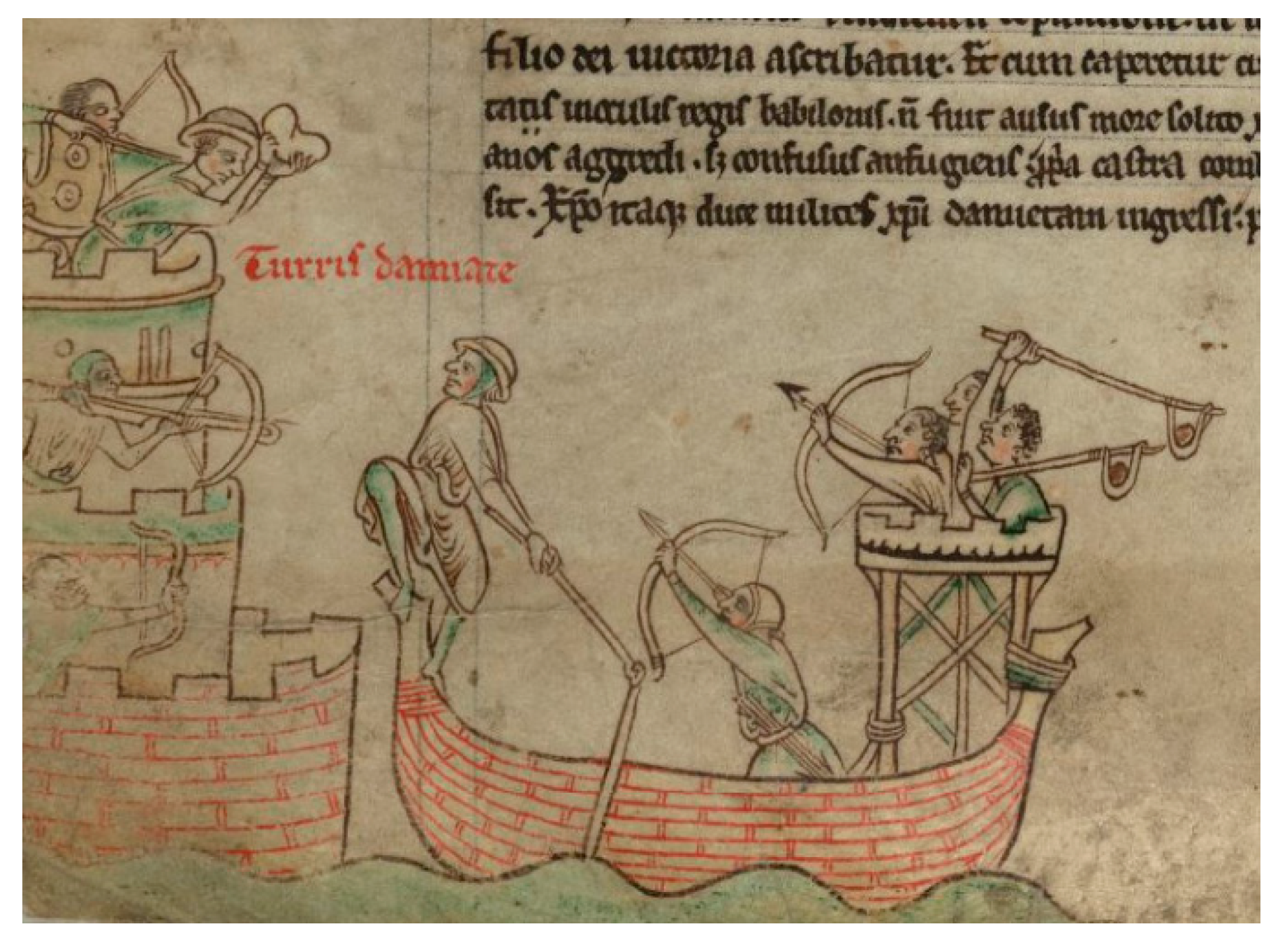
Figure 7.
Fol. 185v from The Taymouth Hours. (© British Library Board, BL MS Yates Thompson 13, permission granted for non-commercial reproduction, image from Link).
Figure 7.
Fol. 185v from The Taymouth Hours. (© British Library Board, BL MS Yates Thompson 13, permission granted for non-commercial reproduction, image from Link).
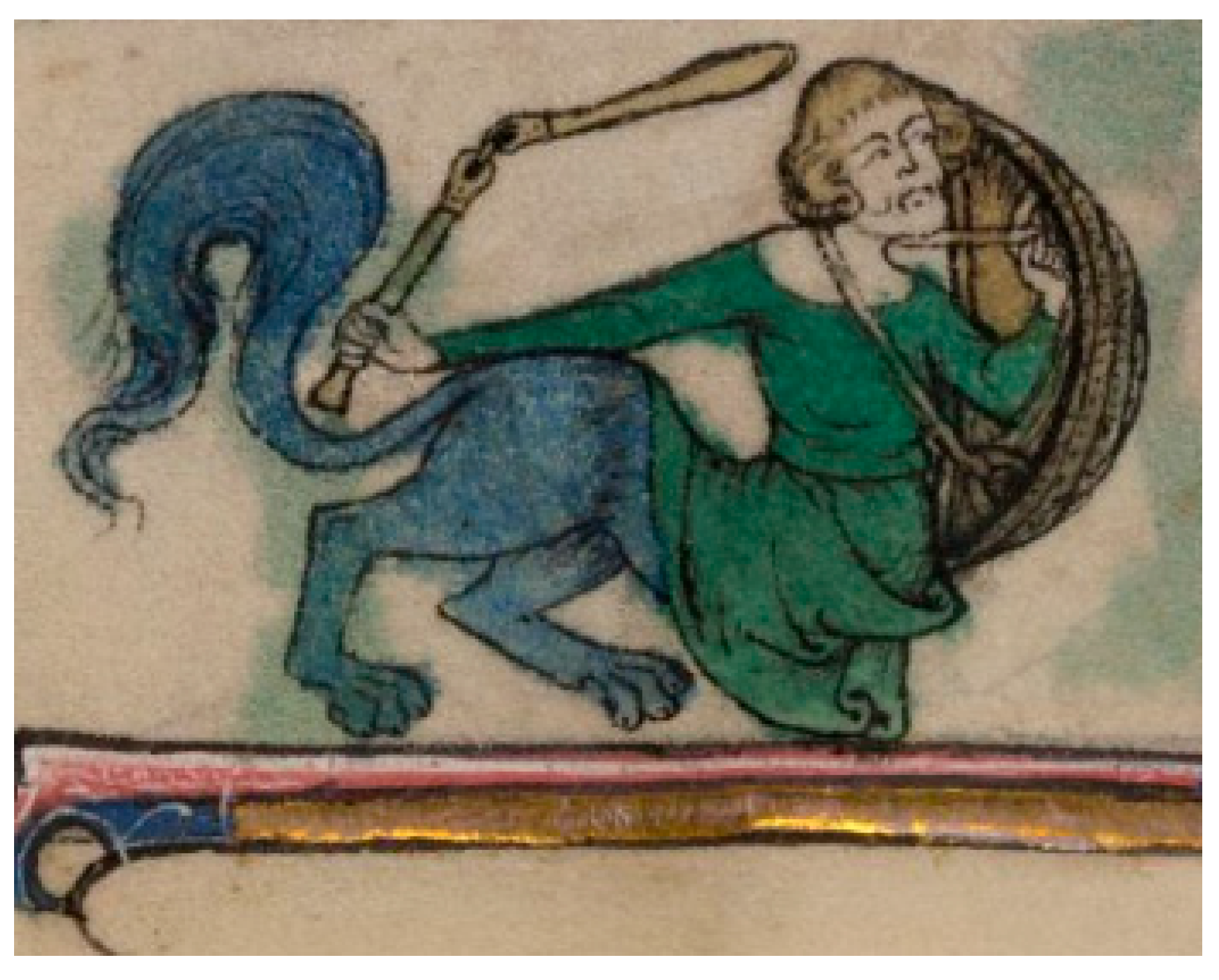
Figure 8.
Fol. 25v from Besançon BM MS.1360 Bellifortis. (© Besançon Bibliotheque Munucipale, MS 1360, permission granted for non-commercial reproduction, image from Link).
Figure 8.
Fol. 25v from Besançon BM MS.1360 Bellifortis. (© Besançon Bibliotheque Munucipale, MS 1360, permission granted for non-commercial reproduction, image from Link).
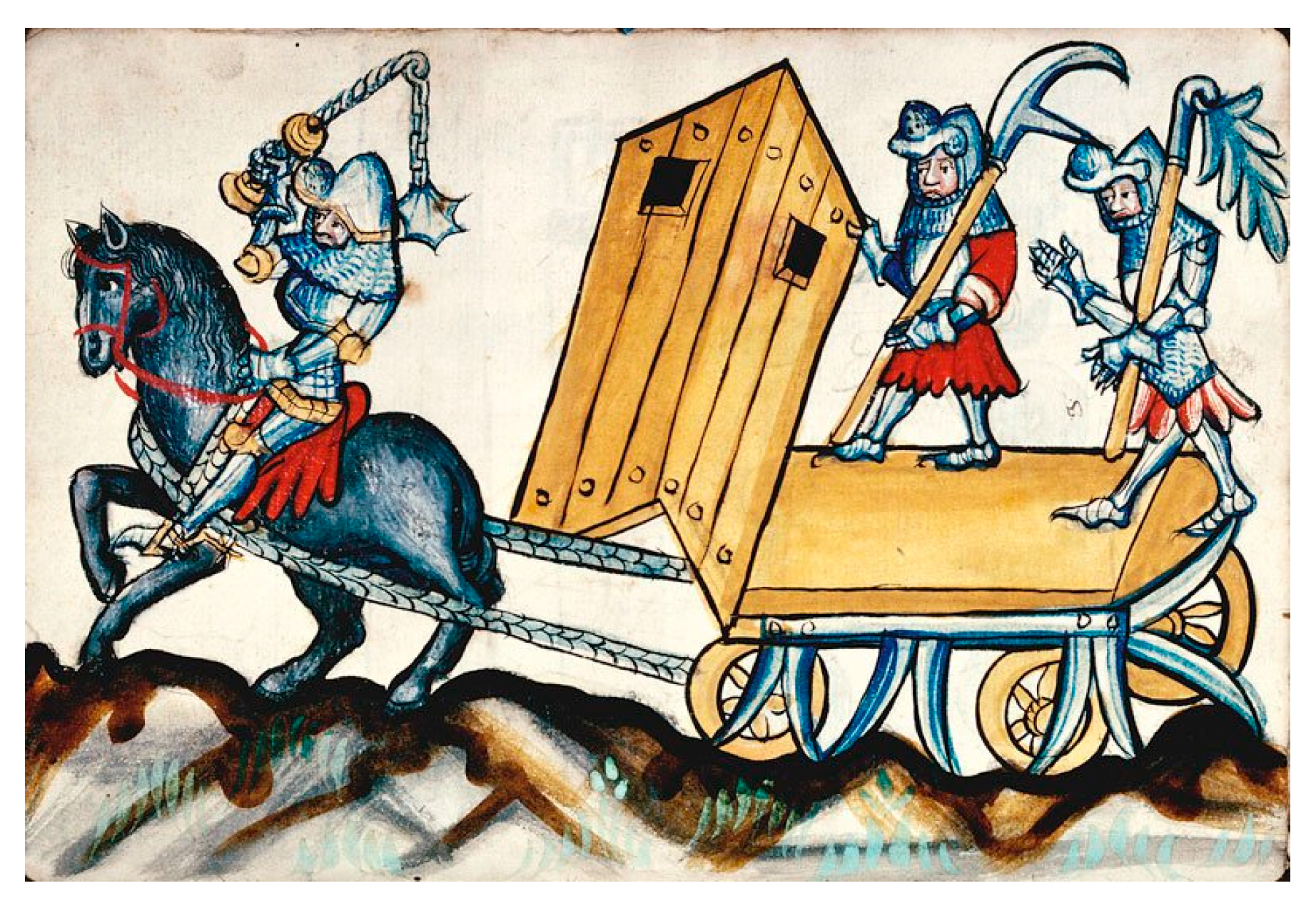
Figure 9.
Fols. 209r (1), 209v (2), 210r (3), 210v (4), 211r (5), 211v (6), 212r (7), and 212v (8) from Opus Amplissimum de Arte Athletica. (©Bayerische Staatsbibliothek München, Cod.icon. 393, permission granted for non-commercial reproduction, images from Link).
Figure 9.
Fols. 209r (1), 209v (2), 210r (3), 210v (4), 211r (5), 211v (6), 212r (7), and 212v (8) from Opus Amplissimum de Arte Athletica. (©Bayerische Staatsbibliothek München, Cod.icon. 393, permission granted for non-commercial reproduction, images from Link).
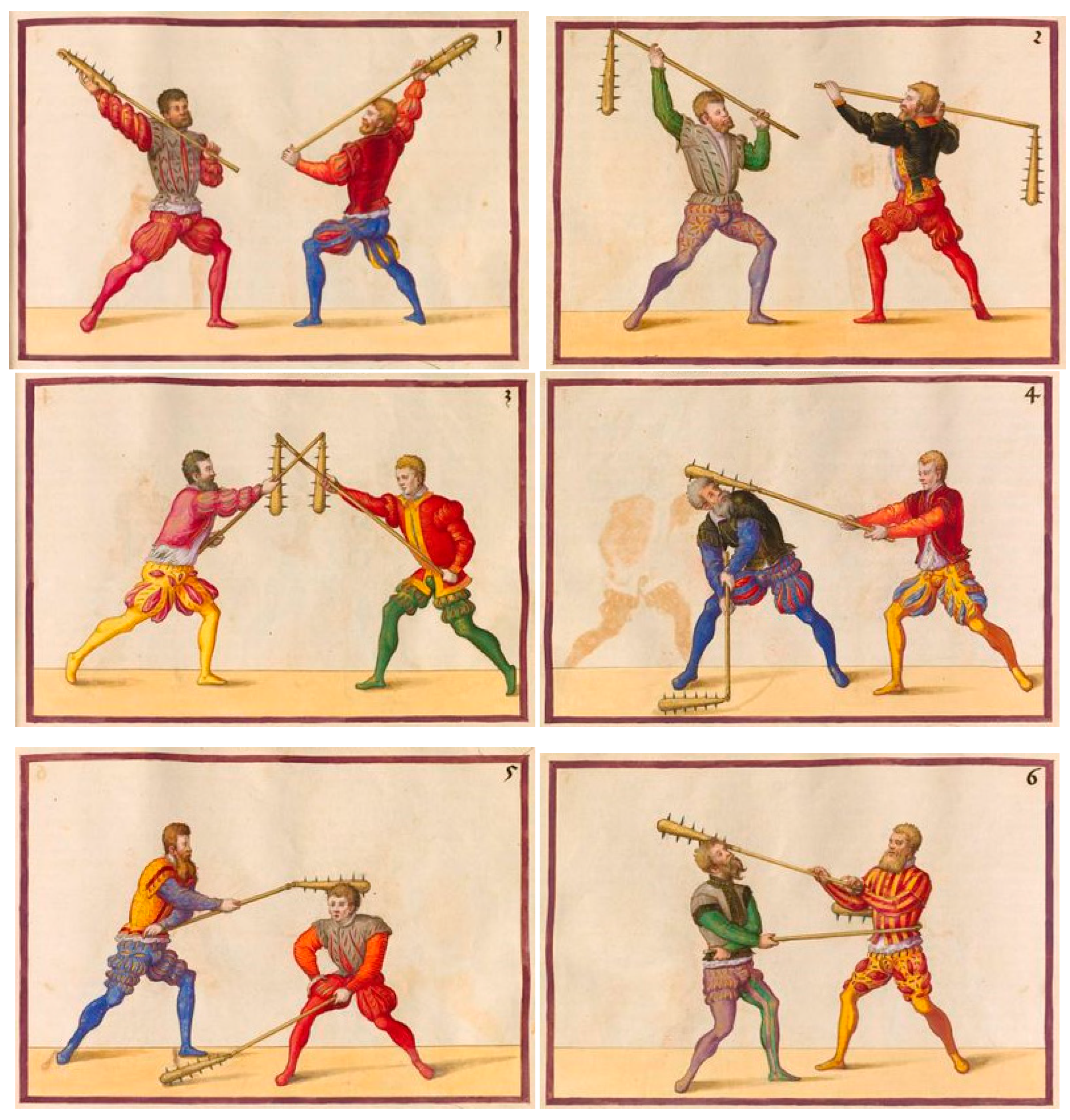
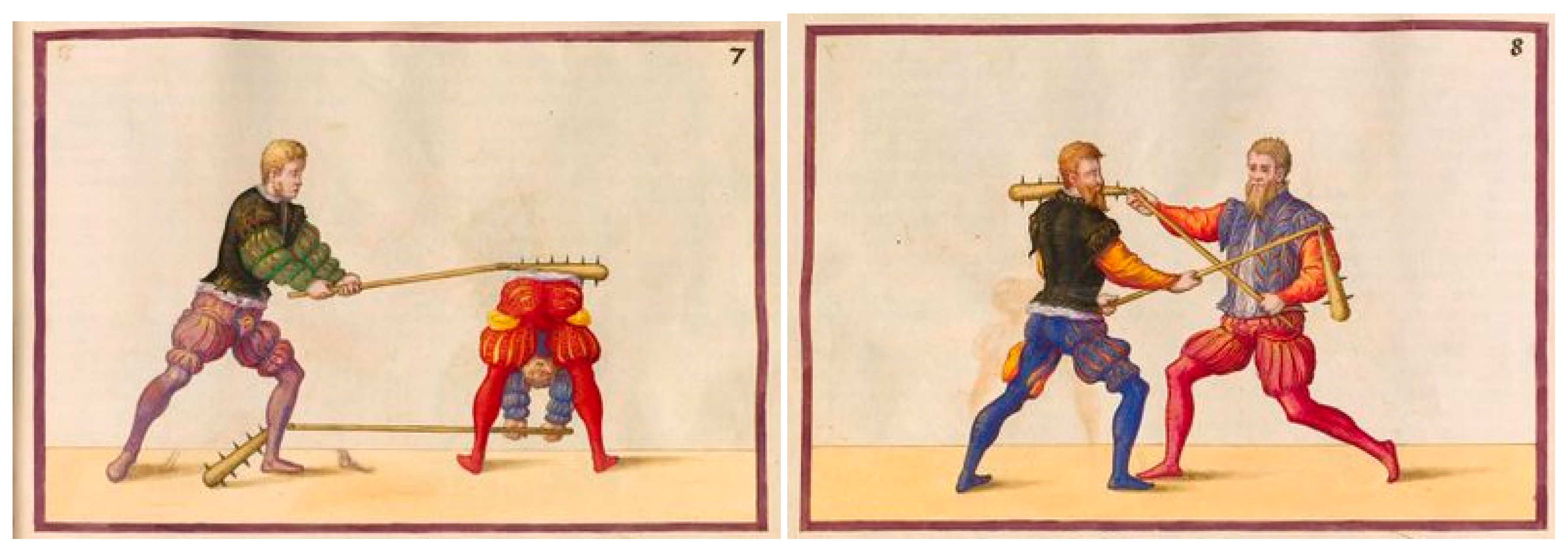
Figure 10.
Fols. 122v (left) and 123r (right) from Talhoffer Fechtbuch (c. 1467) illustrating “divorce by combat” with “rock in cloth sack” pseudo-flail. (© Bayerische Staatsbibliothek München, MS. Cod.icon. 394a, permission granted for non-commercial reproduction, images from Link).
Figure 10.
Fols. 122v (left) and 123r (right) from Talhoffer Fechtbuch (c. 1467) illustrating “divorce by combat” with “rock in cloth sack” pseudo-flail. (© Bayerische Staatsbibliothek München, MS. Cod.icon. 394a, permission granted for non-commercial reproduction, images from Link).
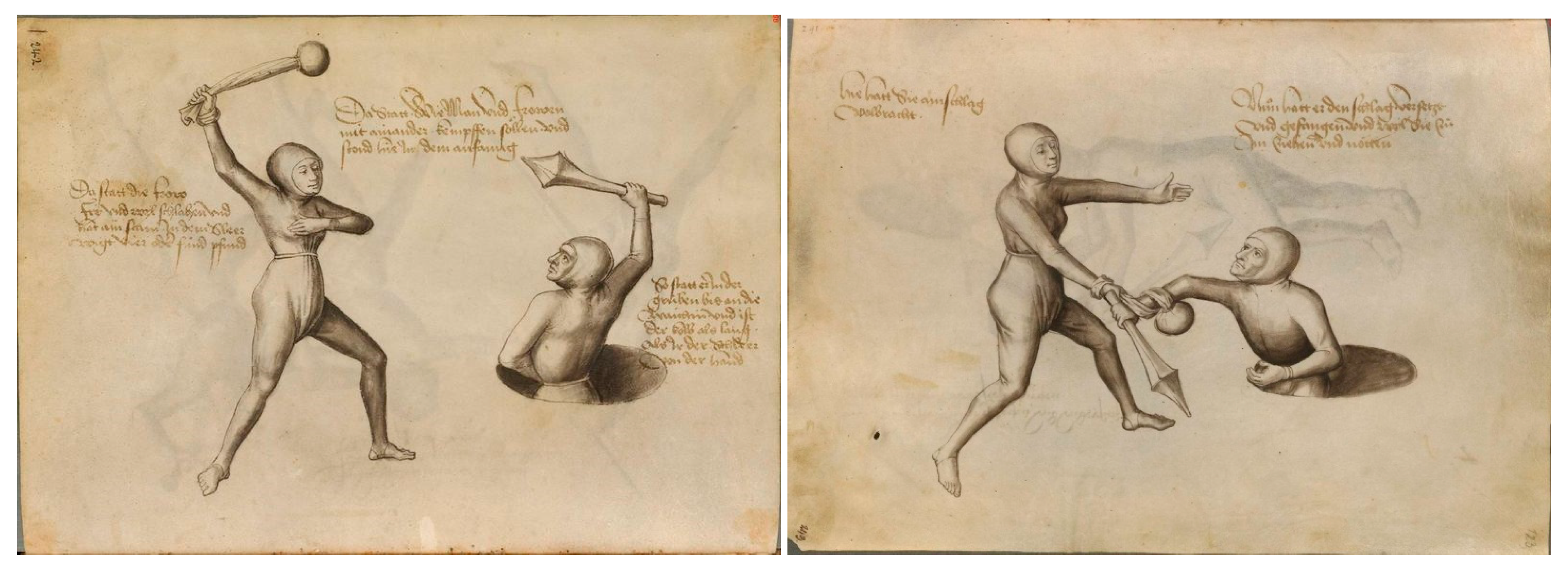
Figure 11.
Likely scourge or possible flail depicted in fol 79v of Quaestiones hebraicae in Genesim. (© The Master and Fellows of Trinity College, Cambridge, Trinity College Library MS B.2.34, permission granted for non-commercial reproduction, image from Link).
Figure 11.
Likely scourge or possible flail depicted in fol 79v of Quaestiones hebraicae in Genesim. (© The Master and Fellows of Trinity College, Cambridge, Trinity College Library MS B.2.34, permission granted for non-commercial reproduction, image from Link).
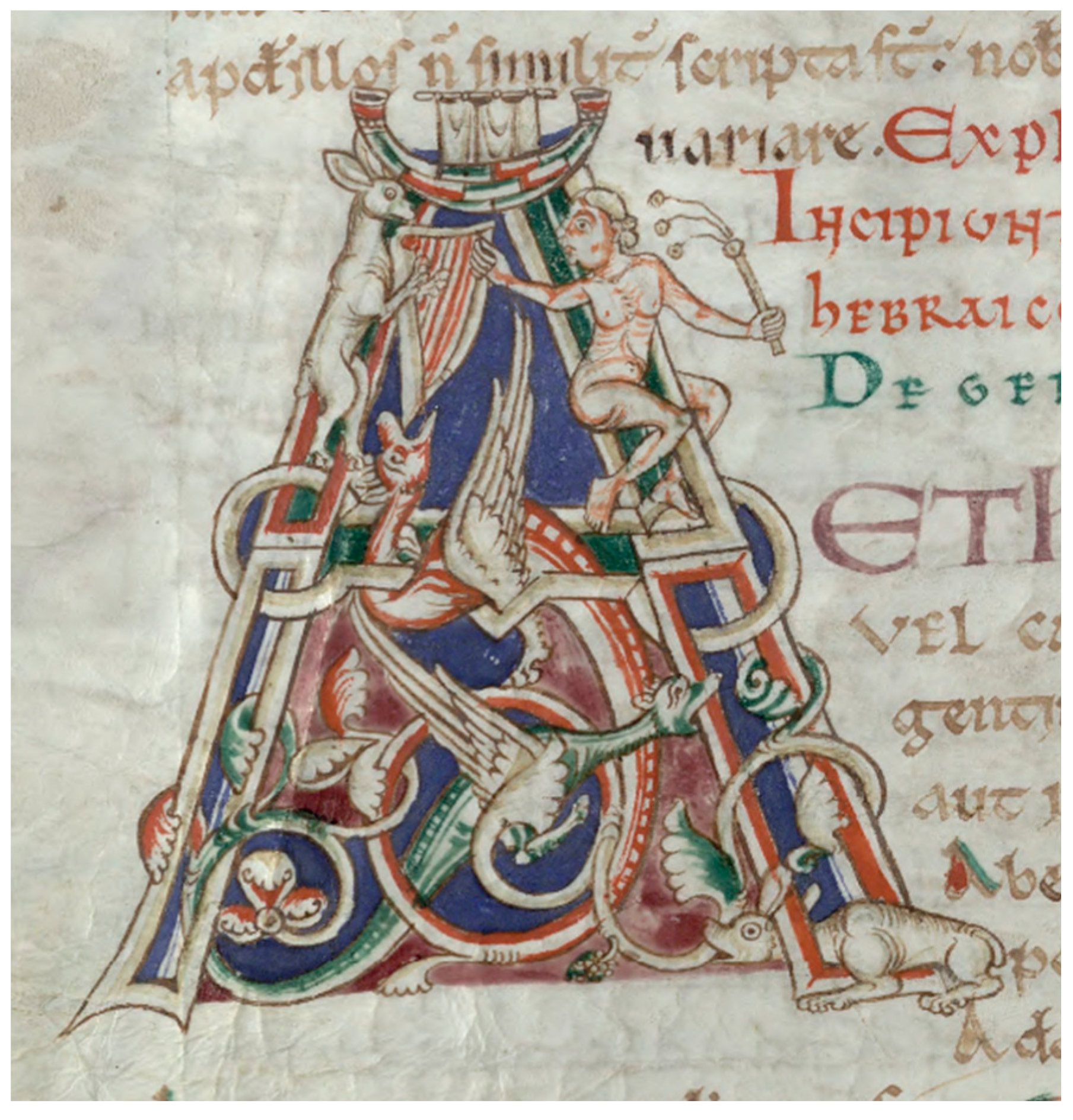
Figure 12.
Fol. 369v from Bible Historiale – Part I (© Bibliothèque nationale de France, BnF MS 152, permission granted for non-commercial reproduction, image from Link).
Figure 12.
Fol. 369v from Bible Historiale – Part I (© Bibliothèque nationale de France, BnF MS 152, permission granted for non-commercial reproduction, image from Link).
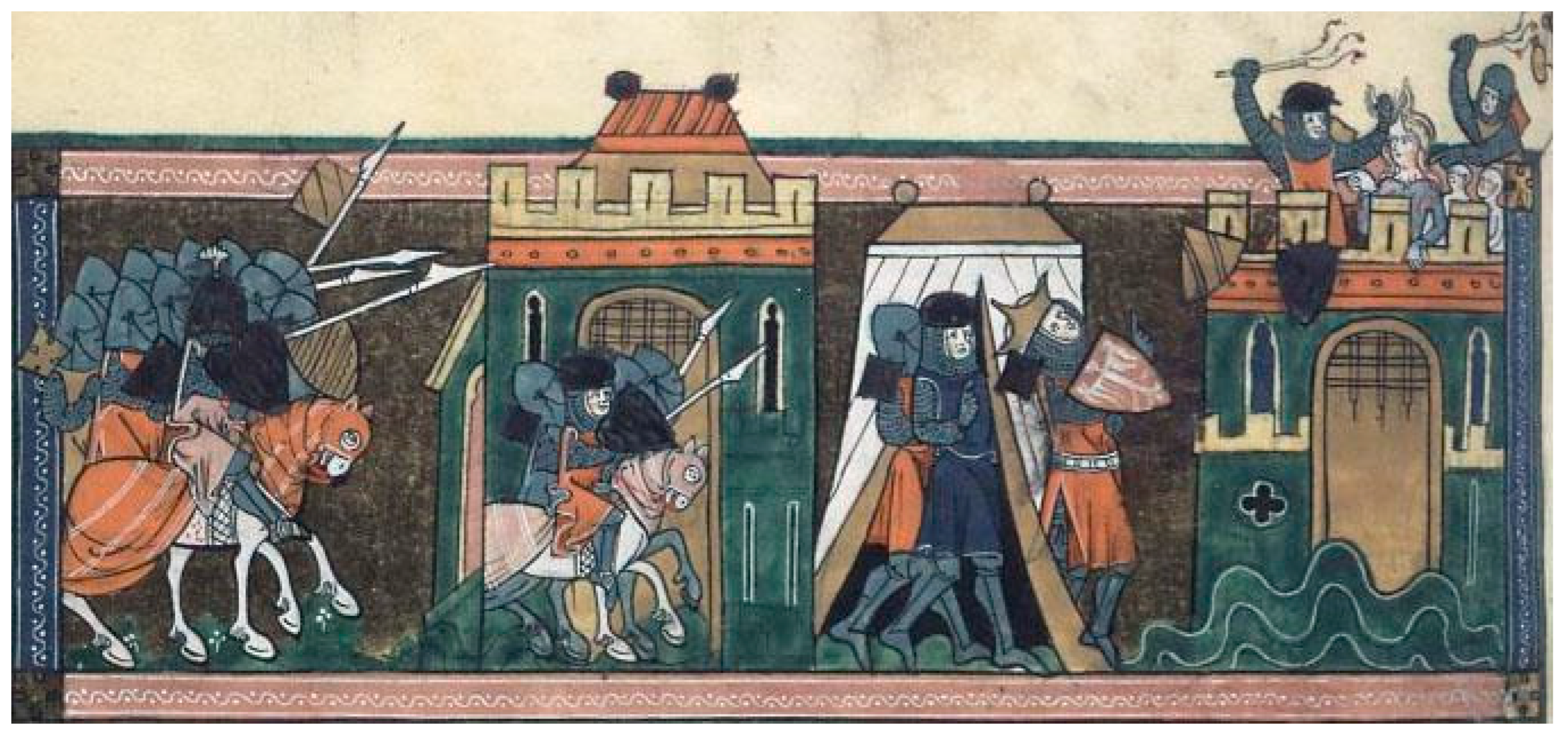
Figure 13.
Depiction of the flail depicted in Naumburg cathedral (top left). A selection of later period war flails are also presented in this iamge. This figure originates from one of several 19th Century works in French and German, and has been copied extensively. (Image from Campagnano, 2015 – Link).
Figure 13.
Depiction of the flail depicted in Naumburg cathedral (top left). A selection of later period war flails are also presented in this iamge. This figure originates from one of several 19th Century works in French and German, and has been copied extensively. (Image from Campagnano, 2015 – Link).

Figure 14.
Mosaic from the Barrel Vault, Basilica di San Marco, Venice. (Image provided courtesy of the Web Gallery of Art (Link), specific image from Link).
Figure 14.
Mosaic from the Barrel Vault, Basilica di San Marco, Venice. (Image provided courtesy of the Web Gallery of Art (Link), specific image from Link).
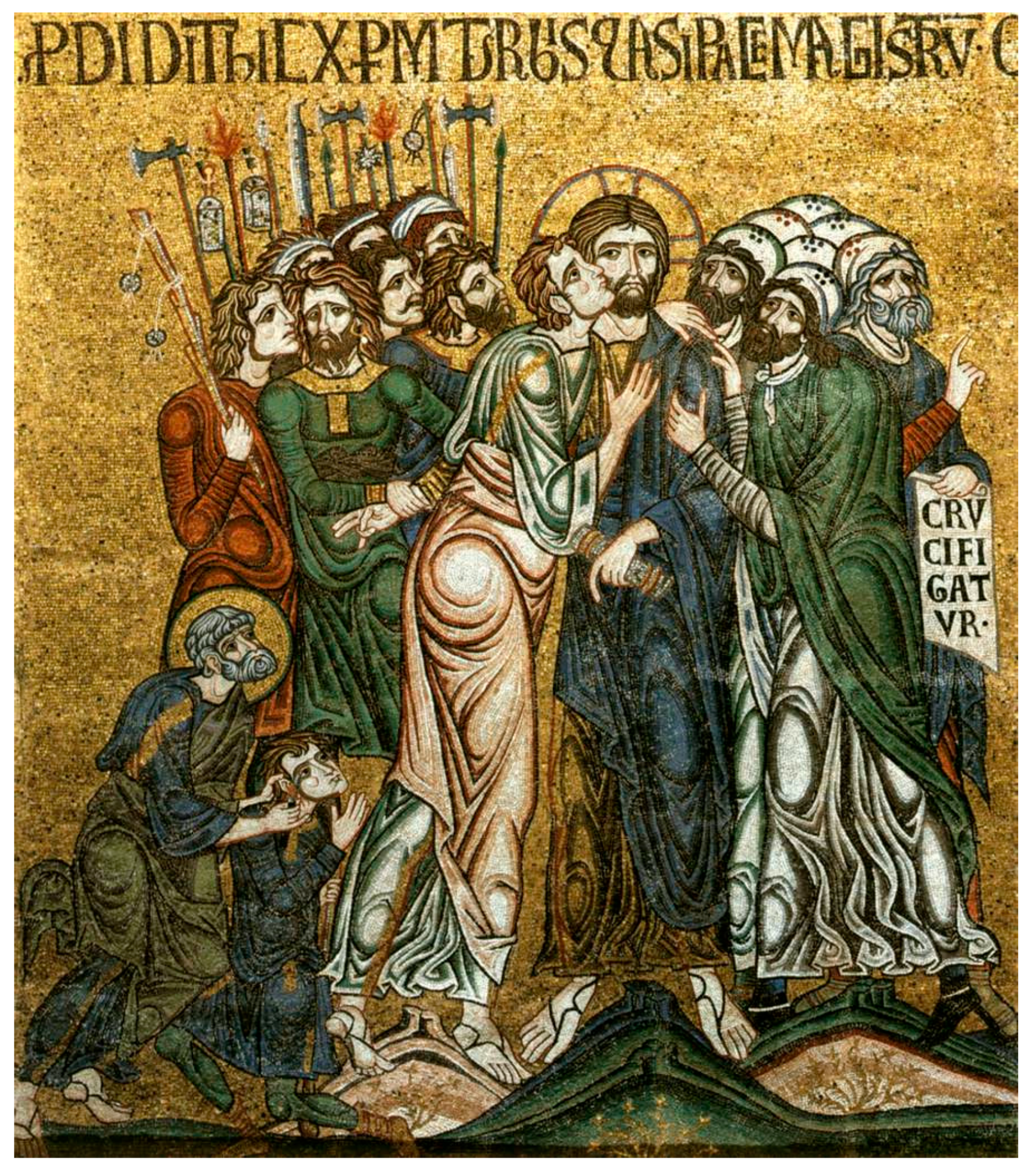
Figure 15.
Fol. 7v from the Queen Melisende Psalter (© British Library Board, BL Egerton MS. 1139, permission granted for non-commercial reproduction, image from Link).
Figure 15.
Fol. 7v from the Queen Melisende Psalter (© British Library Board, BL Egerton MS. 1139, permission granted for non-commercial reproduction, image from Link).
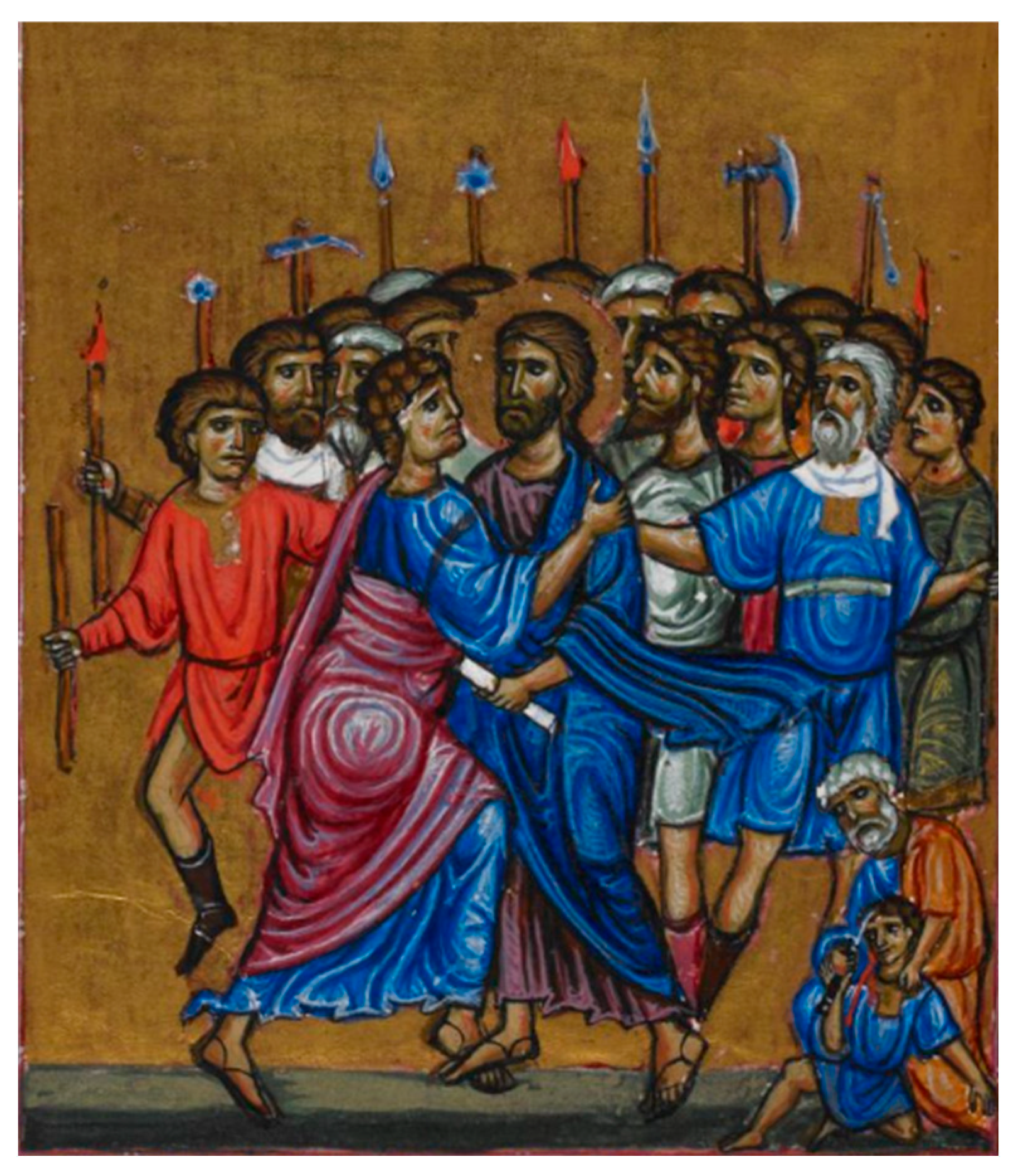
Figure 16.
Carving from Sainte-Foy Abbey entranceway. The demon with the flail appears in the upper-right hand side of the doorway carving. (© Jean-Louis Zimmerman, image sourced from Link under CC BY 2.0 license for non-commercial reproduction).
Figure 16.
Carving from Sainte-Foy Abbey entranceway. The demon with the flail appears in the upper-right hand side of the doorway carving. (© Jean-Louis Zimmerman, image sourced from Link under CC BY 2.0 license for non-commercial reproduction).
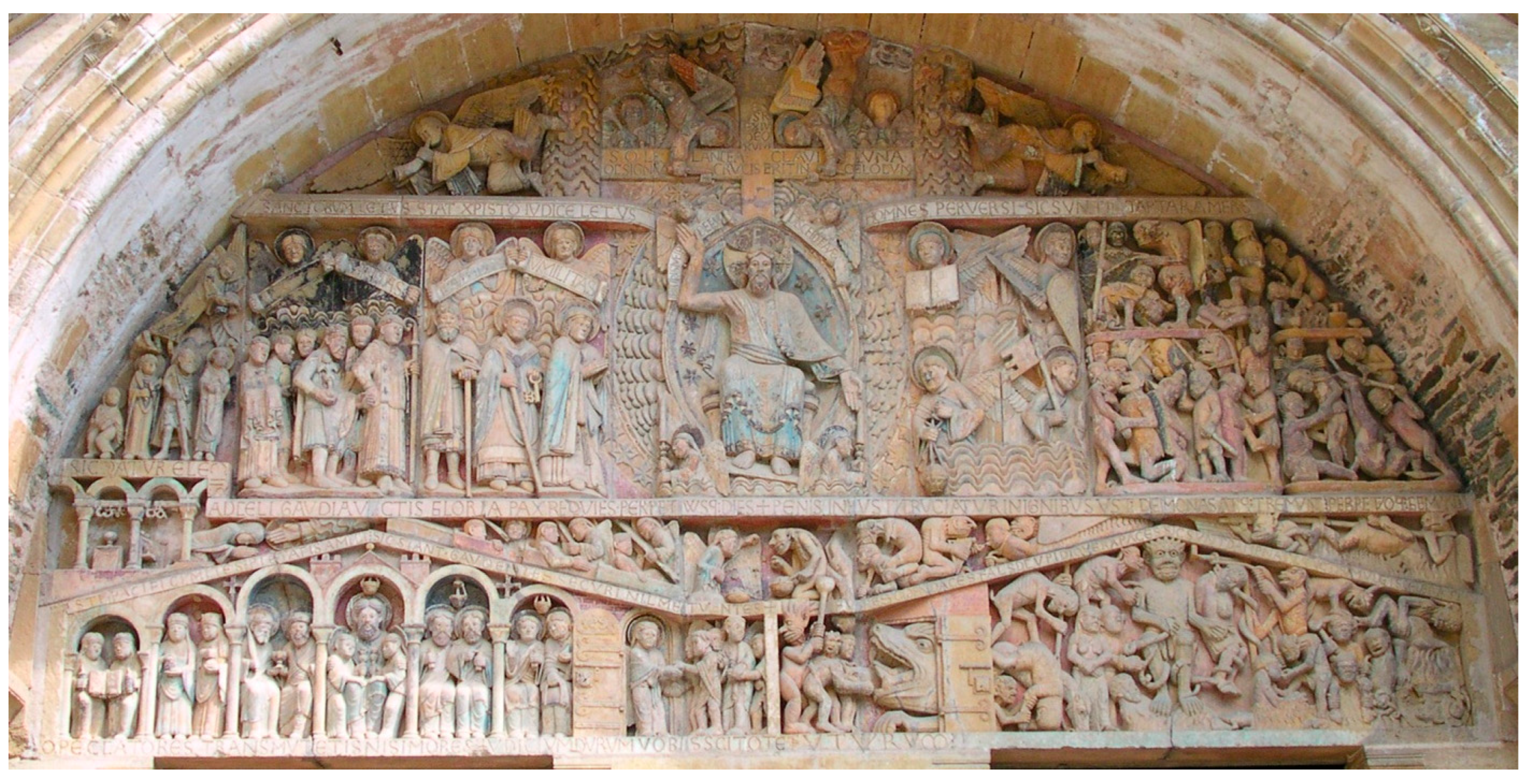
Figure 17.
High resolution image of carving demon with flail from Sainte-Foy Abbey entranceway. (© www.monestirs.cat, image kindly provided with permission for non-commercial reproduction).
Figure 17.
High resolution image of carving demon with flail from Sainte-Foy Abbey entranceway. (© www.monestirs.cat, image kindly provided with permission for non-commercial reproduction).
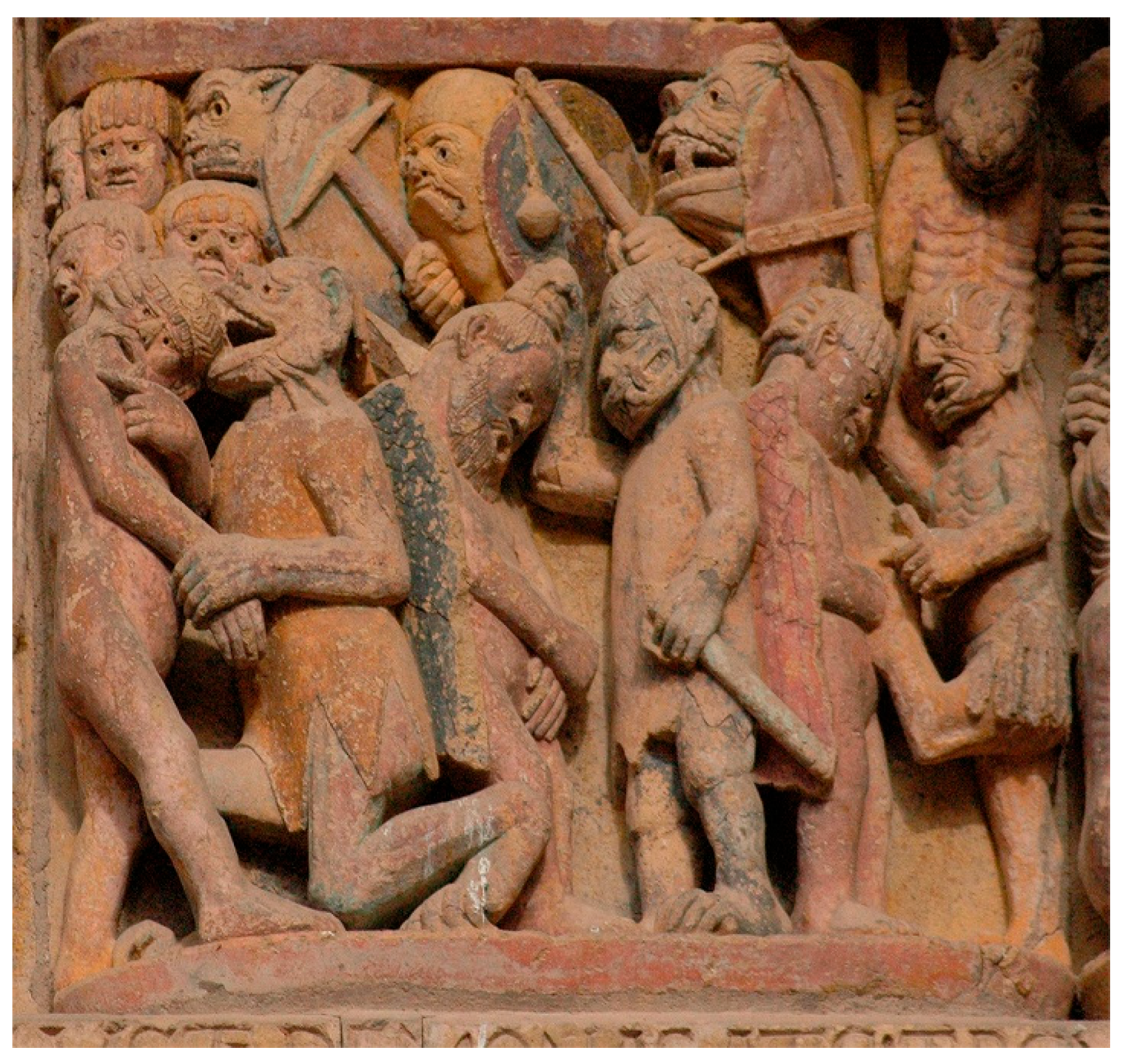
Figure 18.
Fol. 39r from the Winchester Psalter (© British Library Board, BL Cotton MS Nero C IV, permission granted for non-commercial reproduction, image from link). (Denny, 1984).
Figure 18.
Fol. 39r from the Winchester Psalter (© British Library Board, BL Cotton MS Nero C IV, permission granted for non-commercial reproduction, image from link). (Denny, 1984).
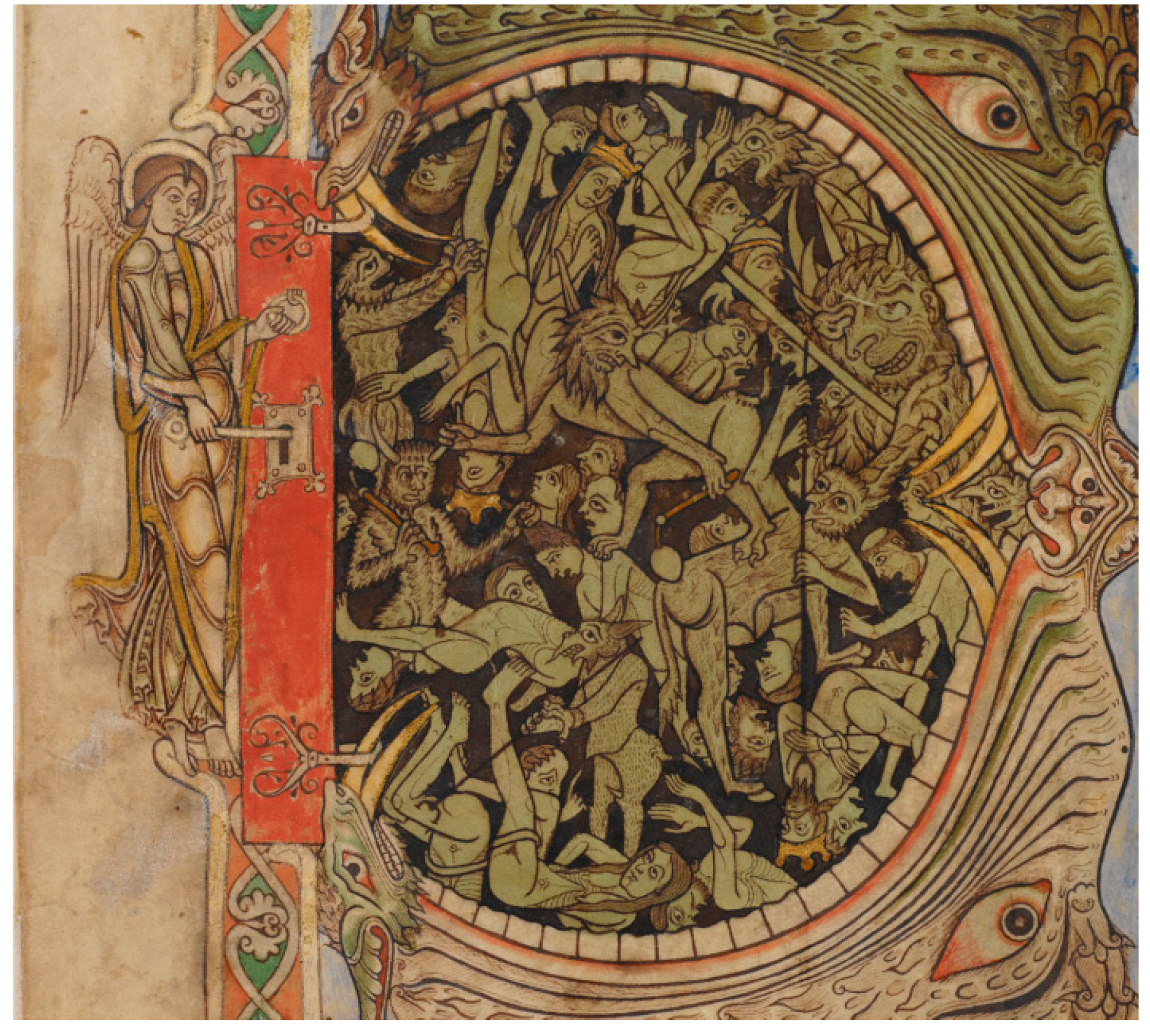
Figure 19.
Carving from the gate guardian statue on the entranceway of the Cathedral of Verona, depicting Olivier from the Song of Roland with a flail, Verona, Italy. (Images from Agrigoroaei, 2018 (a), and Dona, 2021 (b); reproduced under CC-BY 4.0 license).
Figure 19.
Carving from the gate guardian statue on the entranceway of the Cathedral of Verona, depicting Olivier from the Song of Roland with a flail, Verona, Italy. (Images from Agrigoroaei, 2018 (a), and Dona, 2021 (b); reproduced under CC-BY 4.0 license).
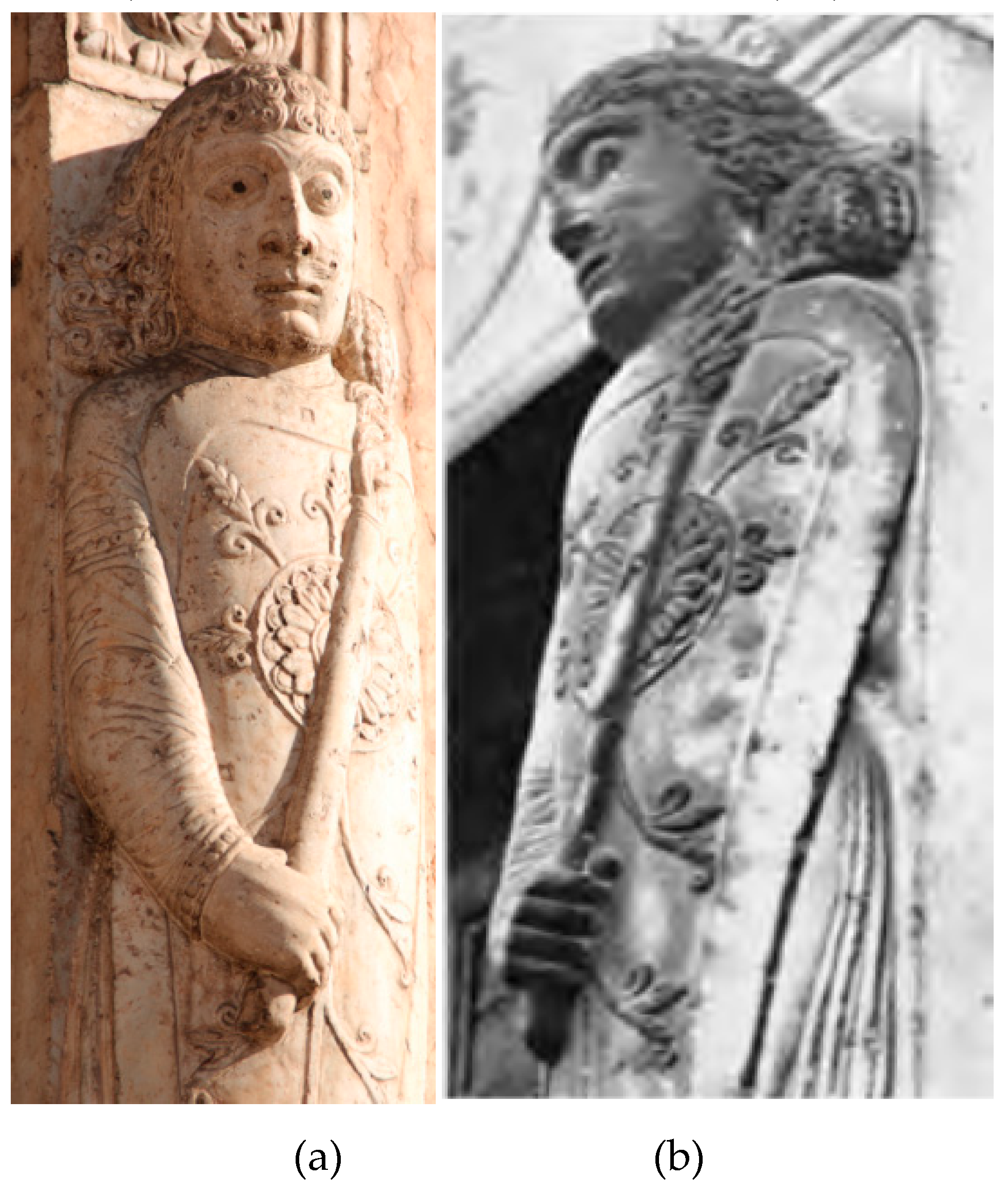
Figure 20.
Fol. 97v from the Stuttgarter Passionale – Par Hielamis. Dual-spread cropped to illustrate three-headed flail. (Württembergische Landesbibliothek, MS. Cod.bibl.fol.57, reproduction under Public Domain 1.0 license, images from Link).
Figure 20.
Fol. 97v from the Stuttgarter Passionale – Par Hielamis. Dual-spread cropped to illustrate three-headed flail. (Württembergische Landesbibliothek, MS. Cod.bibl.fol.57, reproduction under Public Domain 1.0 license, images from Link).
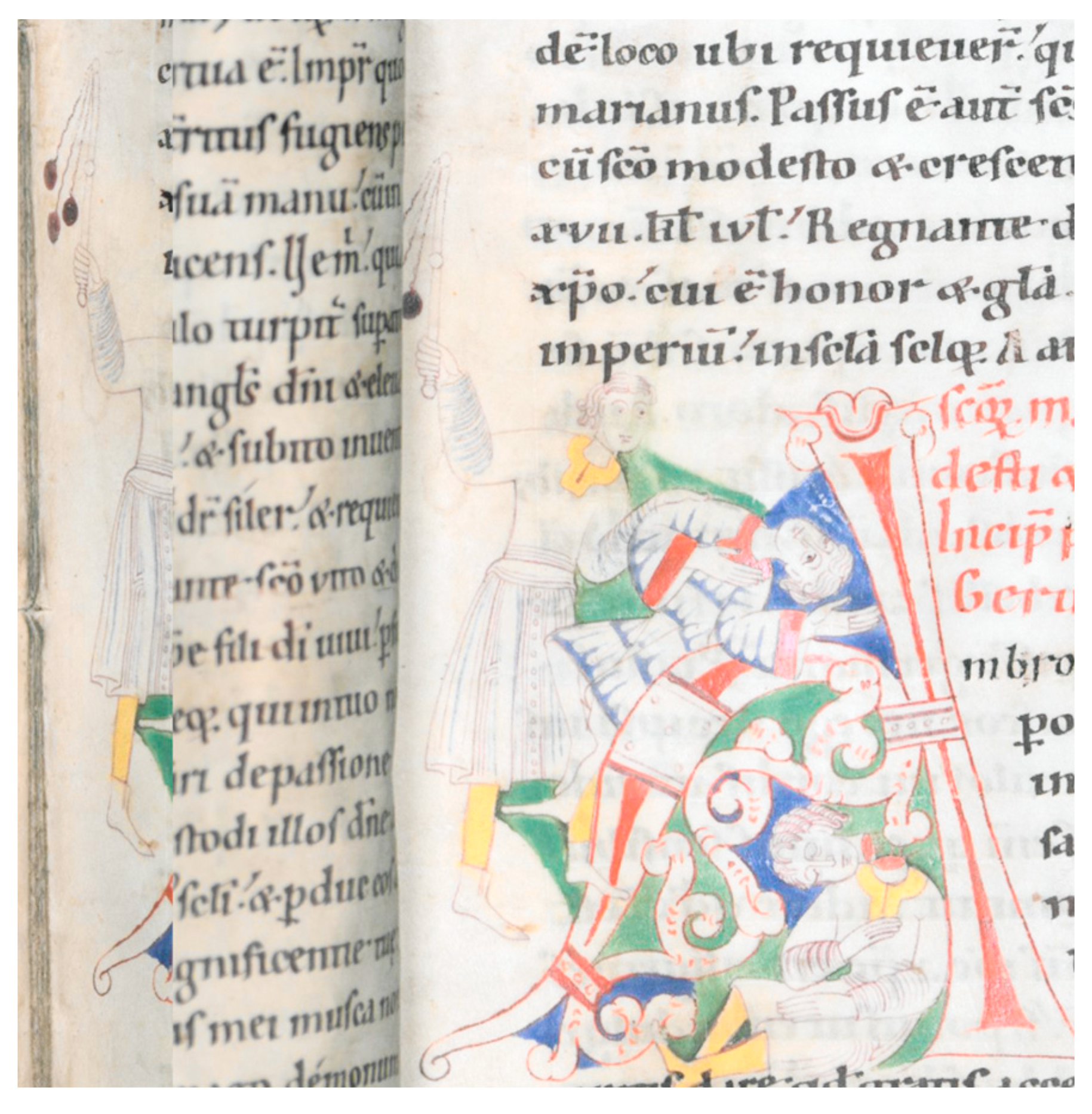
Figure 21.
Fols. 10r (a), 45v (b), and 52r (c) from from Kupferstichkabinett MS. 78 A 5. (Images kindly provided by Kupferstichkabinett, Staatliche Museen zu Berlin (SMB)/ Kai Perstling and reproduced under the PDM 1.0 DEED license, full manuscript available digitised here).
Figure 21.
Fols. 10r (a), 45v (b), and 52r (c) from from Kupferstichkabinett MS. 78 A 5. (Images kindly provided by Kupferstichkabinett, Staatliche Museen zu Berlin (SMB)/ Kai Perstling and reproduced under the PDM 1.0 DEED license, full manuscript available digitised here).
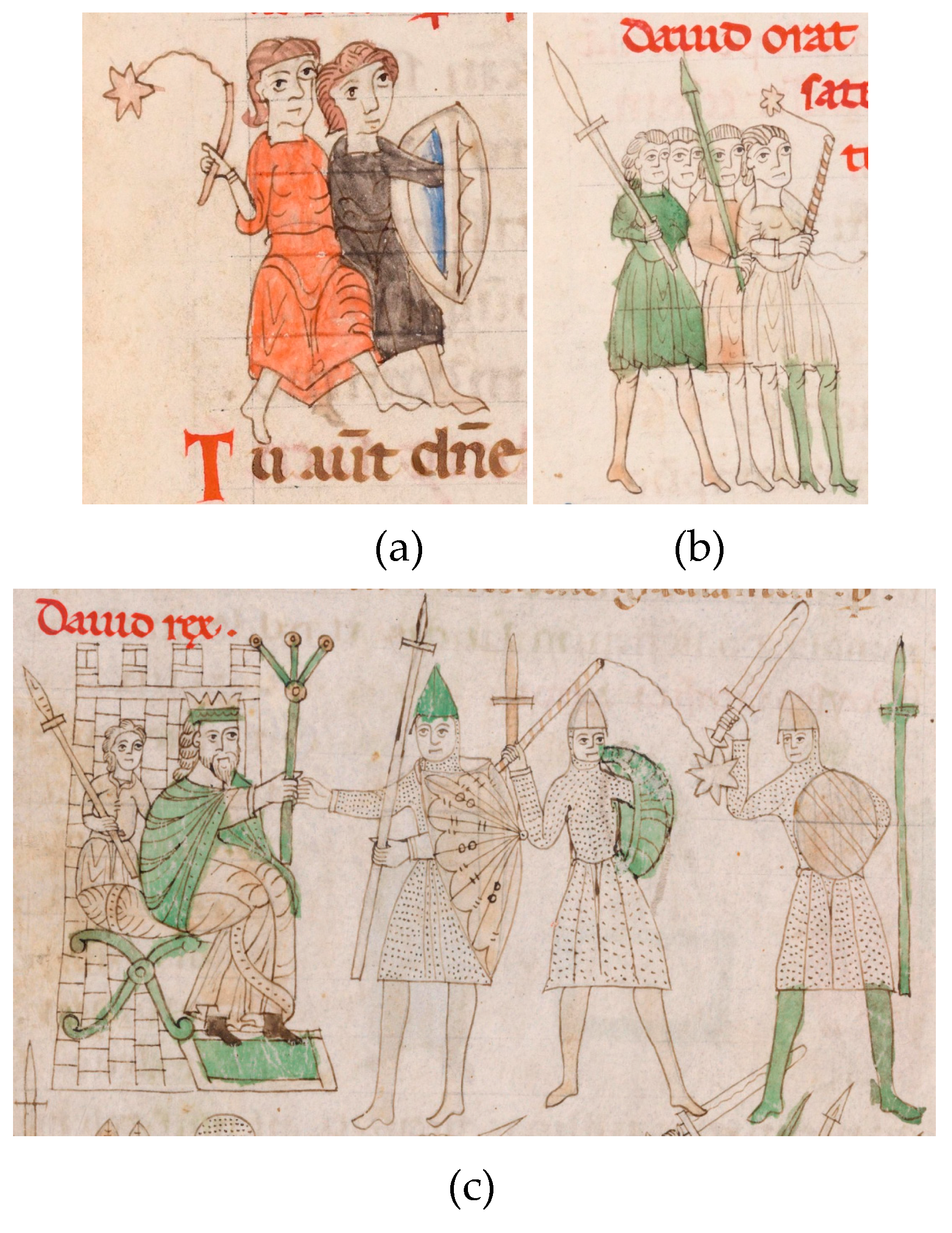
Figure 22.
Copper-alloy flail head (Item LVPL-8F1BE0) found in Flintshire, Wales, dated 900-1400, weighs 220 g, and matches patters from Eastern Europe. (Item discussed in Veninger, 2015; Image Courtesy of the Portable Antiques Scheme, shared under CC BY 3.0 DEED license, available with more information at Link).
Figure 22.
Copper-alloy flail head (Item LVPL-8F1BE0) found in Flintshire, Wales, dated 900-1400, weighs 220 g, and matches patters from Eastern Europe. (Item discussed in Veninger, 2015; Image Courtesy of the Portable Antiques Scheme, shared under CC BY 3.0 DEED license, available with more information at Link).
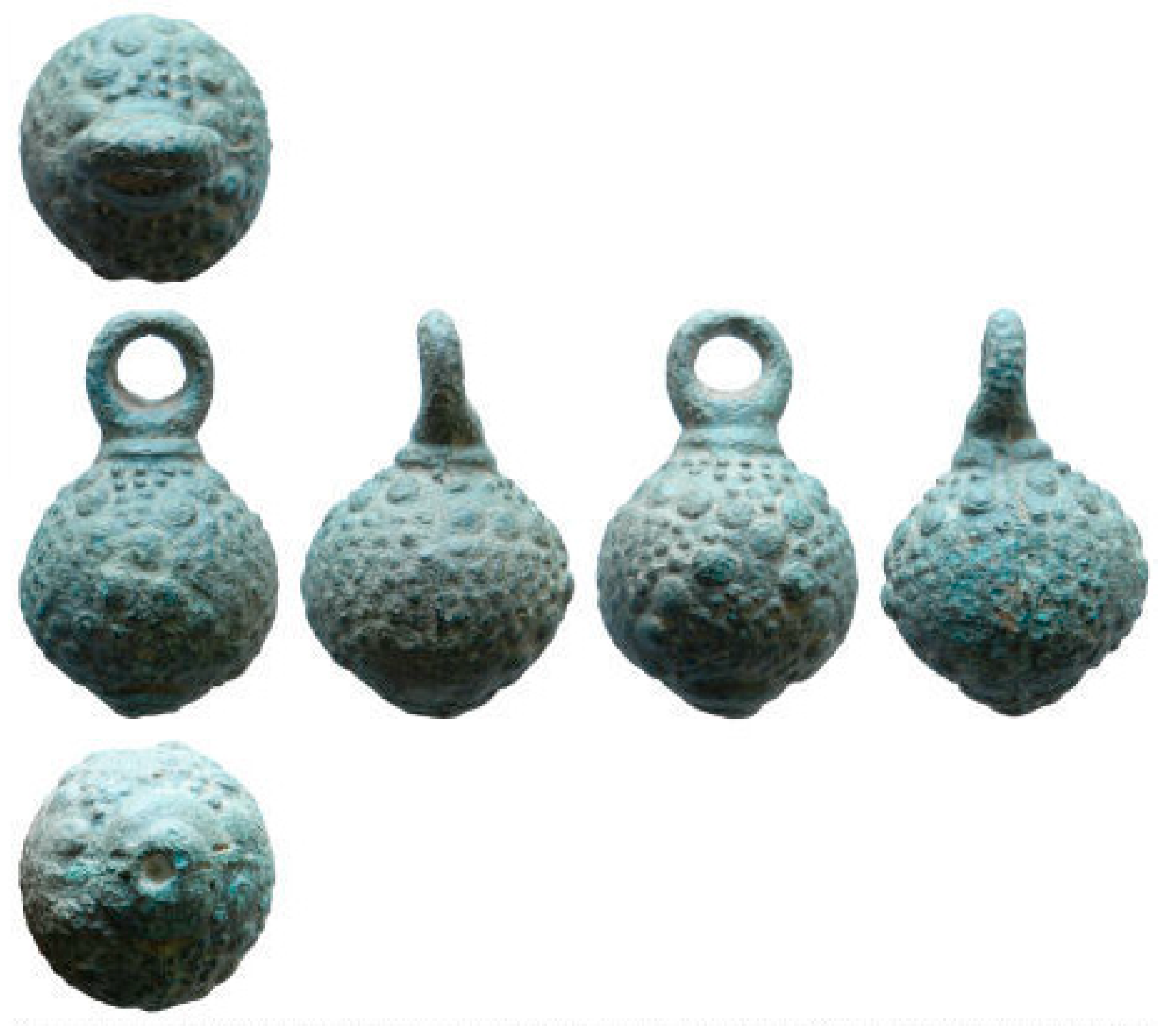
Figure 23.
Bronze (copper alloy) weight (c. 4 cm long), identified as a flail head and matching the patterns of those found in E. Europe, found in Mainz, Germany, currently held in a private collection. (Image © Egon Wamers, permission kindly granted for non-commercial reproduction). (Wamers, 1994; Taavistainen, 2004) Several other examples have been found in the former territories of the Holy Roman Empire (c. 1200), which are now within the borders of Poland. (Kotowicz, 2006).
Figure 23.
Bronze (copper alloy) weight (c. 4 cm long), identified as a flail head and matching the patterns of those found in E. Europe, found in Mainz, Germany, currently held in a private collection. (Image © Egon Wamers, permission kindly granted for non-commercial reproduction). (Wamers, 1994; Taavistainen, 2004) Several other examples have been found in the former territories of the Holy Roman Empire (c. 1200), which are now within the borders of Poland. (Kotowicz, 2006).
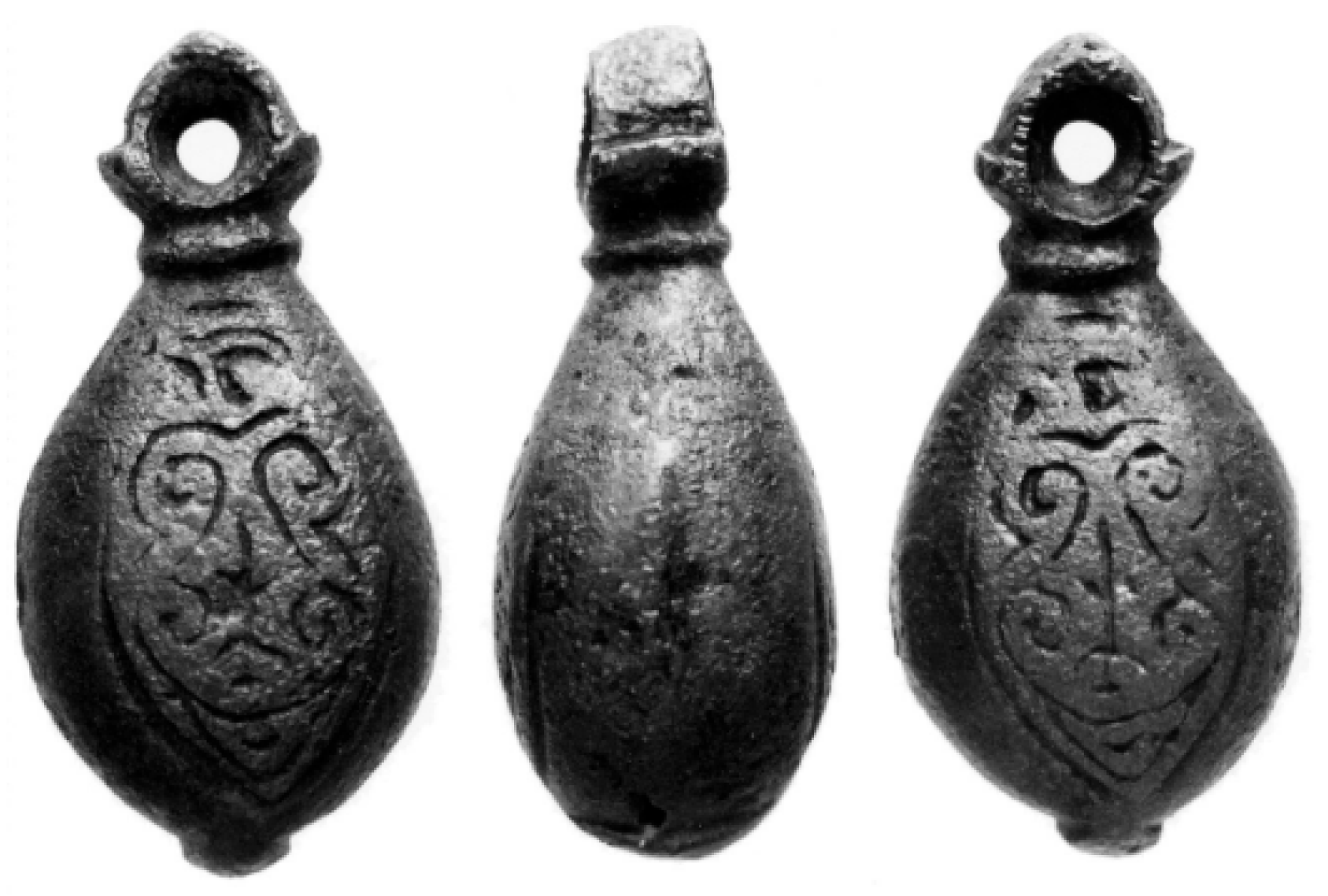
Figure 24.
Late 13th Century English steelyard weight, massing ~ 800 g, 6 x 7 cm in size. Flail heads are typically half this size, although this form matches many several typographical matches collected from Eastern Europe. (Item was sold by Bonhams Auctioneers, London, image kindly provided from link with permission for non-commercial reproduction).
Figure 24.
Late 13th Century English steelyard weight, massing ~ 800 g, 6 x 7 cm in size. Flail heads are typically half this size, although this form matches many several typographical matches collected from Eastern Europe. (Item was sold by Bonhams Auctioneers, London, image kindly provided from link with permission for non-commercial reproduction).
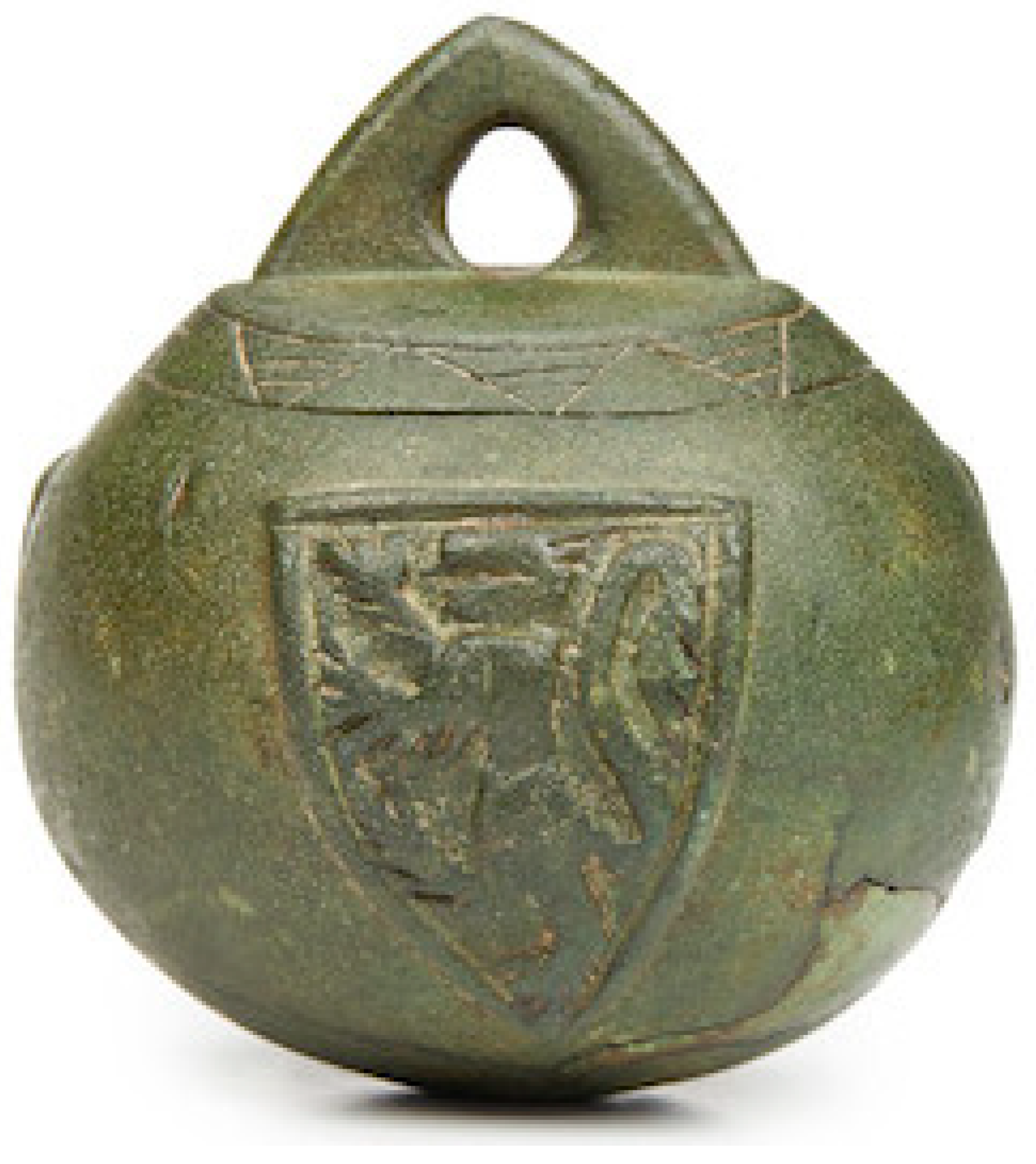
Figure 25.
Carving from the entrance of the Church of San Miguel de Uncastillo, Spain, the flail is depicted on the inner ring (10 o’clock from the centre, left image (a); in the centre right of the right image (b). Item from the Bartlett Collection, number 28.32. (Photographs © Museum of the Fine Arts (MFA), Boston, MA, USA, permission granted for non-commercial reproduction, images from Link).
Figure 25.
Carving from the entrance of the Church of San Miguel de Uncastillo, Spain, the flail is depicted on the inner ring (10 o’clock from the centre, left image (a); in the centre right of the right image (b). Item from the Bartlett Collection, number 28.32. (Photographs © Museum of the Fine Arts (MFA), Boston, MA, USA, permission granted for non-commercial reproduction, images from Link).
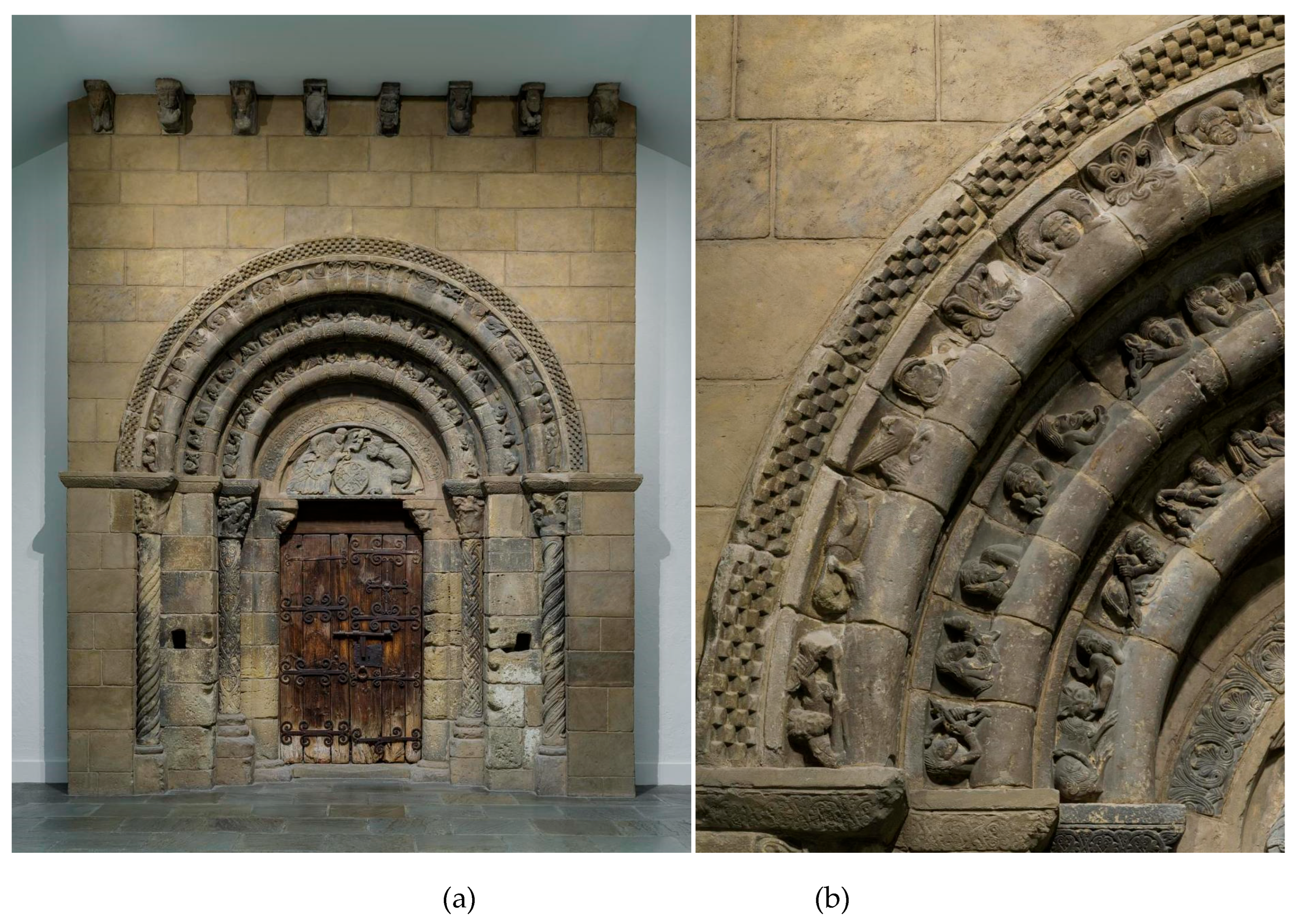
Figure 26.
Highlighted flail on the reproduction of the original arch. (Image reproduced with kind courtesy and permission of HRM Ediciones (https://www.hrmediciones.com/), Historia Rei Militaris, vol. 8 (Moreno, 2015).).
Figure 26.
Highlighted flail on the reproduction of the original arch. (Image reproduced with kind courtesy and permission of HRM Ediciones (https://www.hrmediciones.com/), Historia Rei Militaris, vol. 8 (Moreno, 2015).).
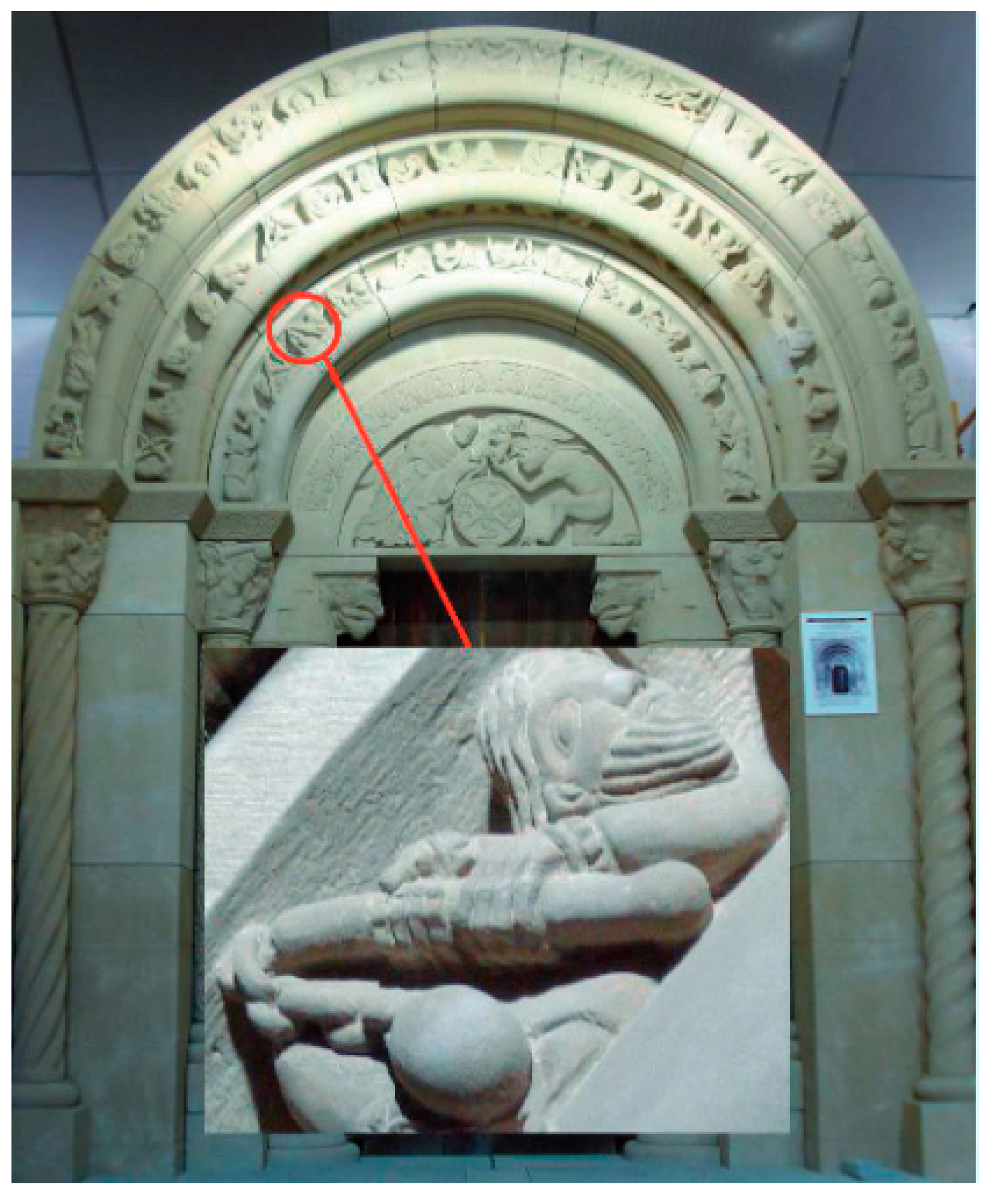
Figure 27.
Depiction of King Philip II or III of France from the Vercelli Mappamundi (© Fondazione Museo del Tesoro del Duomo e Archivio Capitolare di Vercelli, Italy, permission granted for non-commercial reproduction, Mappamundi, Capitulary Archive - Vercelli, Rotoli figurati, 6).
Figure 27.
Depiction of King Philip II or III of France from the Vercelli Mappamundi (© Fondazione Museo del Tesoro del Duomo e Archivio Capitolare di Vercelli, Italy, permission granted for non-commercial reproduction, Mappamundi, Capitulary Archive - Vercelli, Rotoli figurati, 6).
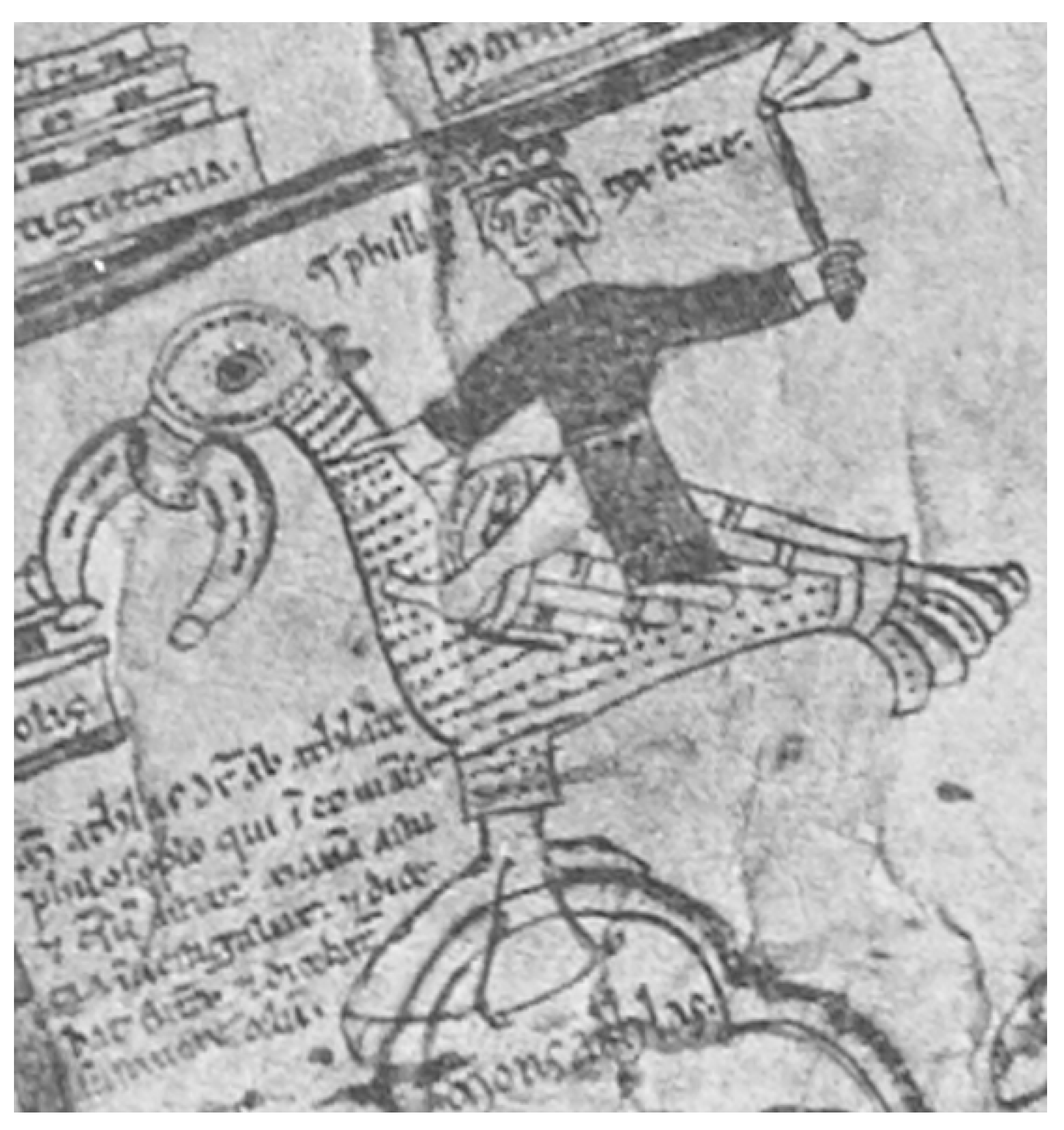
Figure 28.
Paintings from the church of Iglesia de la Asunción, Alaiza, Spain. (© Asier Sarasua Aranberri, image sourced from Link under CC BY-SA 2.0 DEED license).
Figure 28.
Paintings from the church of Iglesia de la Asunción, Alaiza, Spain. (© Asier Sarasua Aranberri, image sourced from Link under CC BY-SA 2.0 DEED license).
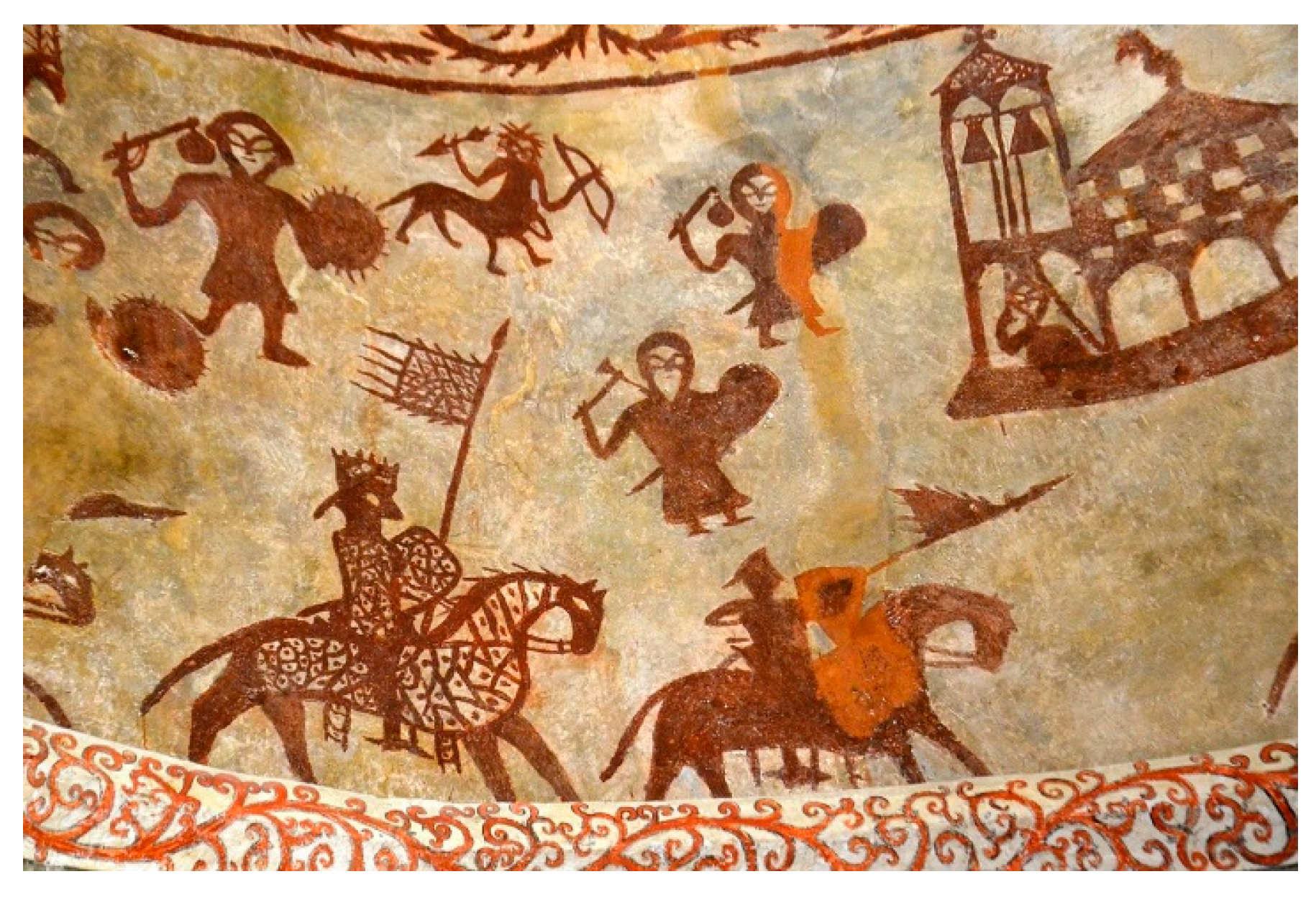
Figure 29.
Stained glass bay 100 of Chatres Cathedral (a) with a zoom on Proteus (b). (© Jean-Yves Cordier, kindly provided with permission for reproduction, images from Link).
Figure 29.
Stained glass bay 100 of Chatres Cathedral (a) with a zoom on Proteus (b). (© Jean-Yves Cordier, kindly provided with permission for reproduction, images from Link).
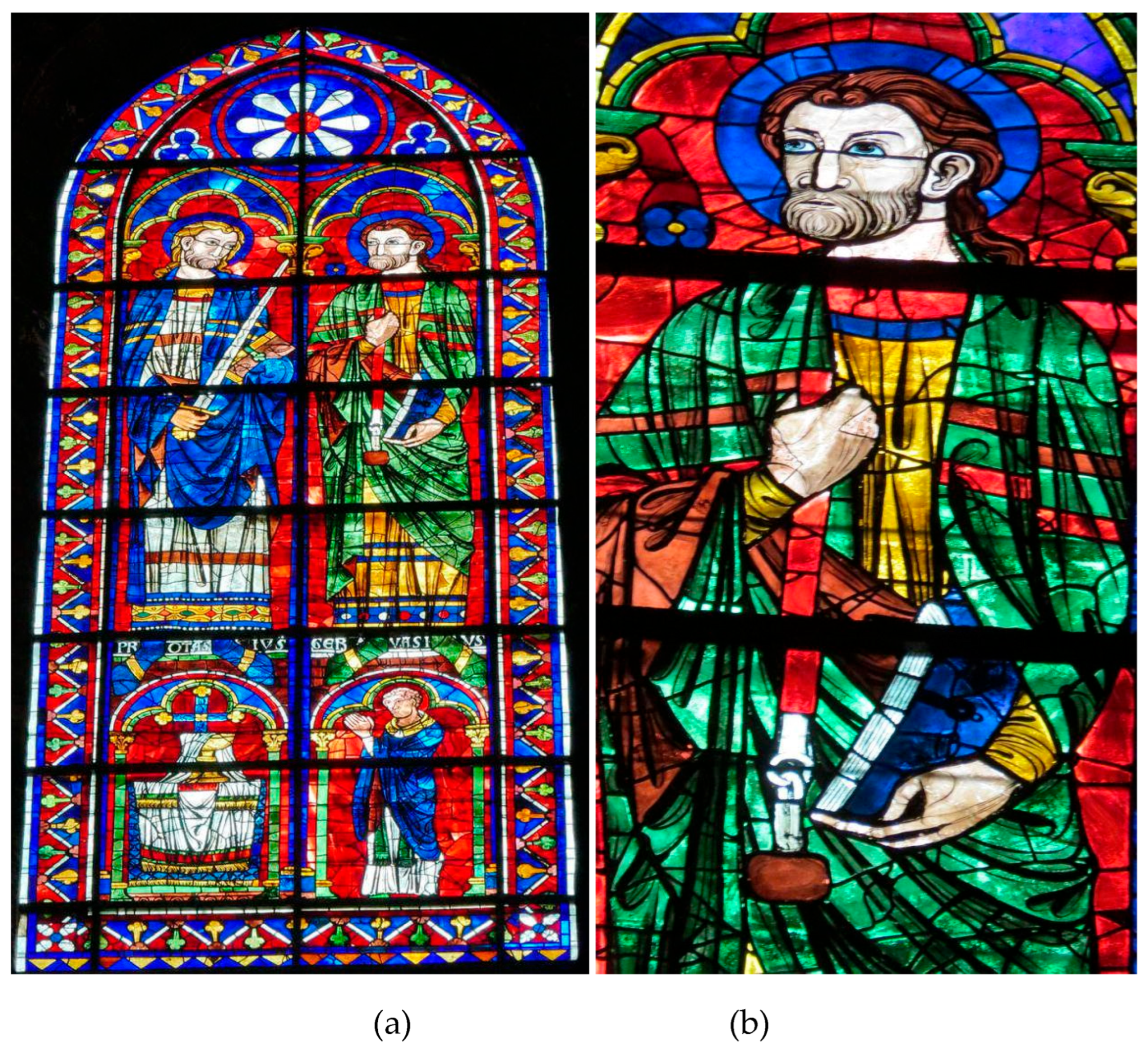
Figure 30.
Fol. 156r from the Bible Moralisée (© The Bodleian Libraries, University of Oxford, MS. Bodl. 270b, permission granted for non-commercial reproduction under CC BY-NC 4.0 license, image from Link).
Figure 30.
Fol. 156r from the Bible Moralisée (© The Bodleian Libraries, University of Oxford, MS. Bodl. 270b, permission granted for non-commercial reproduction under CC BY-NC 4.0 license, image from Link).

Figure 31.
Fol. 179 from the Radziwill Chronicle. (© Library of the Russian Academy of Sciences, MS 34.5.30, permission granted for non-commercial reproduction).
Figure 31.
Fol. 179 from the Radziwill Chronicle. (© Library of the Russian Academy of Sciences, MS 34.5.30, permission granted for non-commercial reproduction).
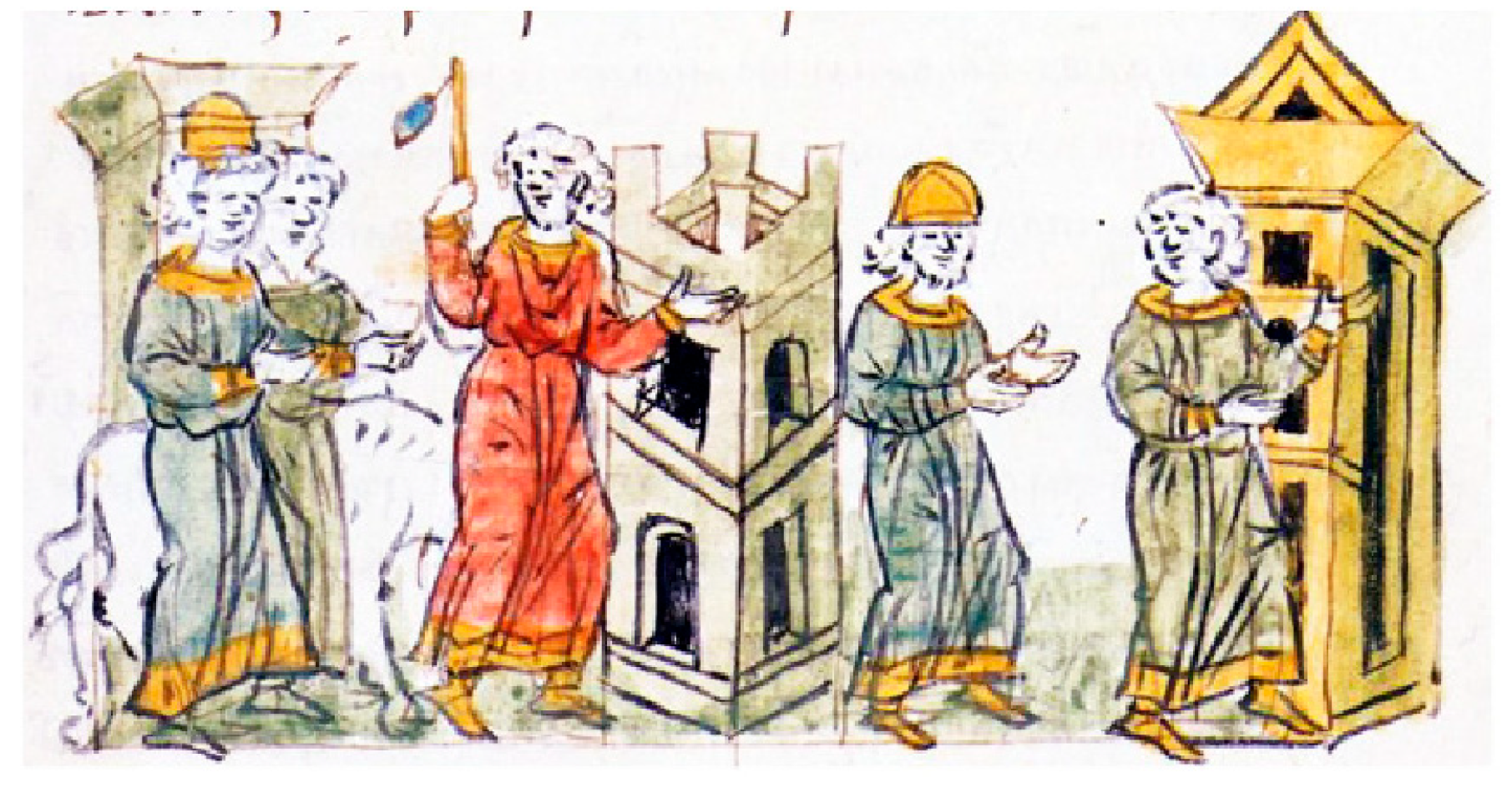
Figure 32.
Fol. 210v from the History of Outremer (© Bibliothèque nationale de France, BnF MS 2630, permission granted for non-commercial reproduction, image from Link).
Figure 32.
Fol. 210v from the History of Outremer (© Bibliothèque nationale de France, BnF MS 2630, permission granted for non-commercial reproduction, image from Link).
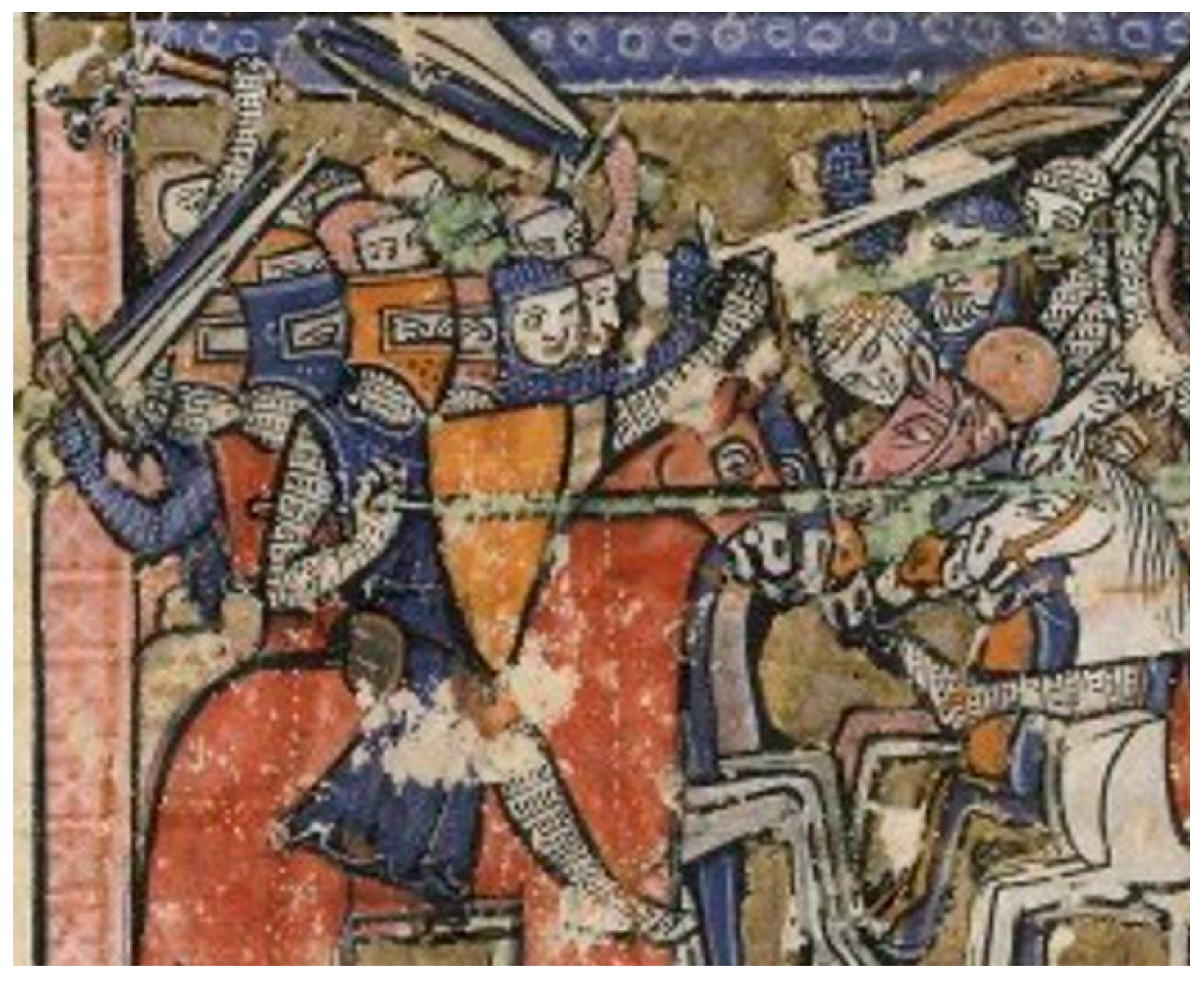
Figure 33.
Draughts piece from the British Museum (Item 1853,0214.2). (© The Trustees of the British Museum, shared under a Creative Commons Atttribution-NonCommercial-ShareAlike 4.0 International (CC BY-NC-SA 4.0) license for non-commercial reproduction only, image from Link).
Figure 33.
Draughts piece from the British Museum (Item 1853,0214.2). (© The Trustees of the British Museum, shared under a Creative Commons Atttribution-NonCommercial-ShareAlike 4.0 International (CC BY-NC-SA 4.0) license for non-commercial reproduction only, image from Link).
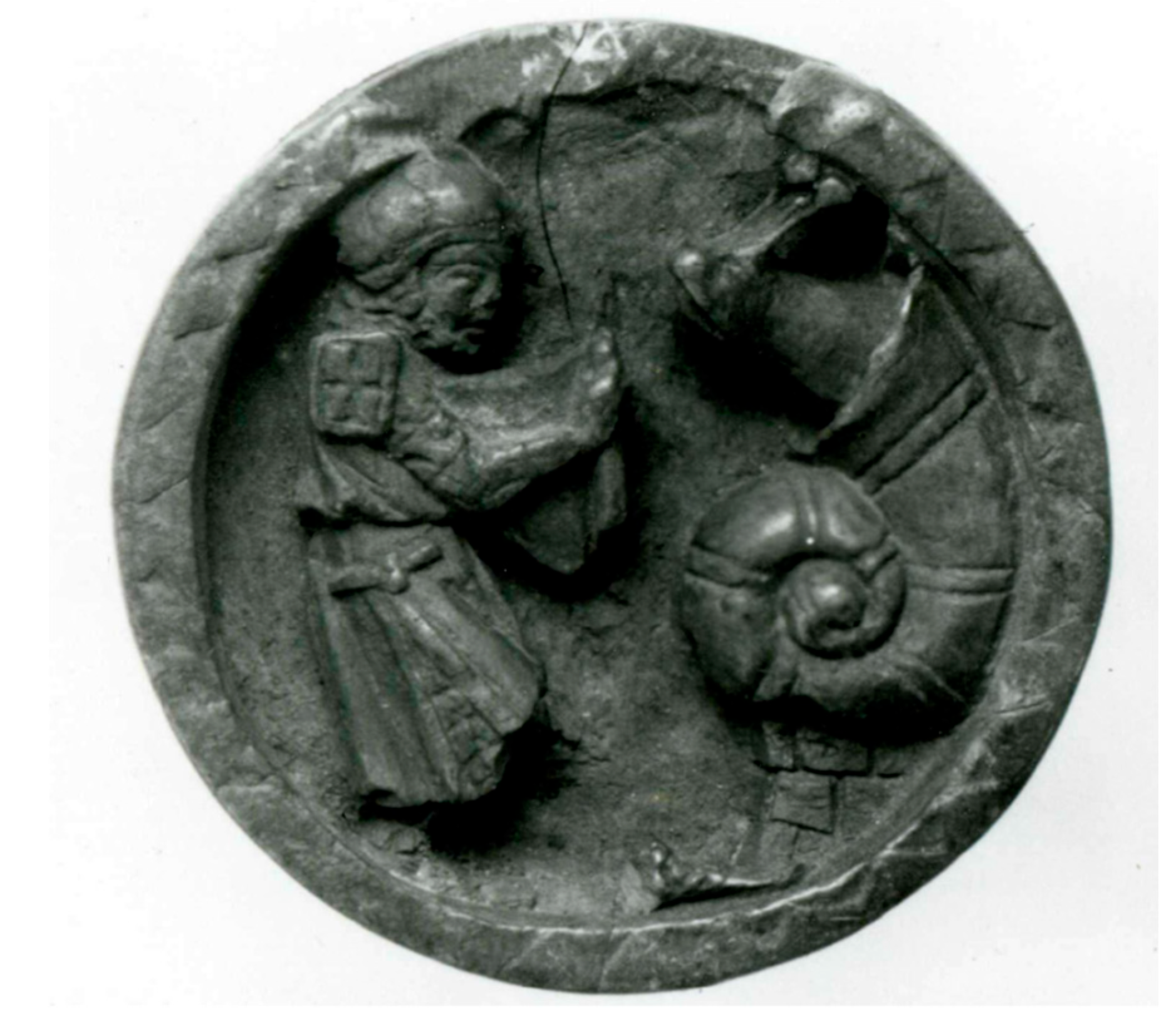
Figure 34.
Fol. 282v from Arthurian Romances. (Provided courtesy of the Beinecke Rare Book and Manuscript Library, Yale University, New Haven, CT, USA, image from Link).
Figure 34.
Fol. 282v from Arthurian Romances. (Provided courtesy of the Beinecke Rare Book and Manuscript Library, Yale University, New Haven, CT, USA, image from Link).

Figure 35.
Fol. 131v-2 from Vita et Passio Beati Dionysii. (© Bibliothèque nationale de France, Gallica, BnF MS 5286, permission granted for non-commercial reproduction, image from Link).
Figure 35.
Fol. 131v-2 from Vita et Passio Beati Dionysii. (© Bibliothèque nationale de France, Gallica, BnF MS 5286, permission granted for non-commercial reproduction, image from Link).
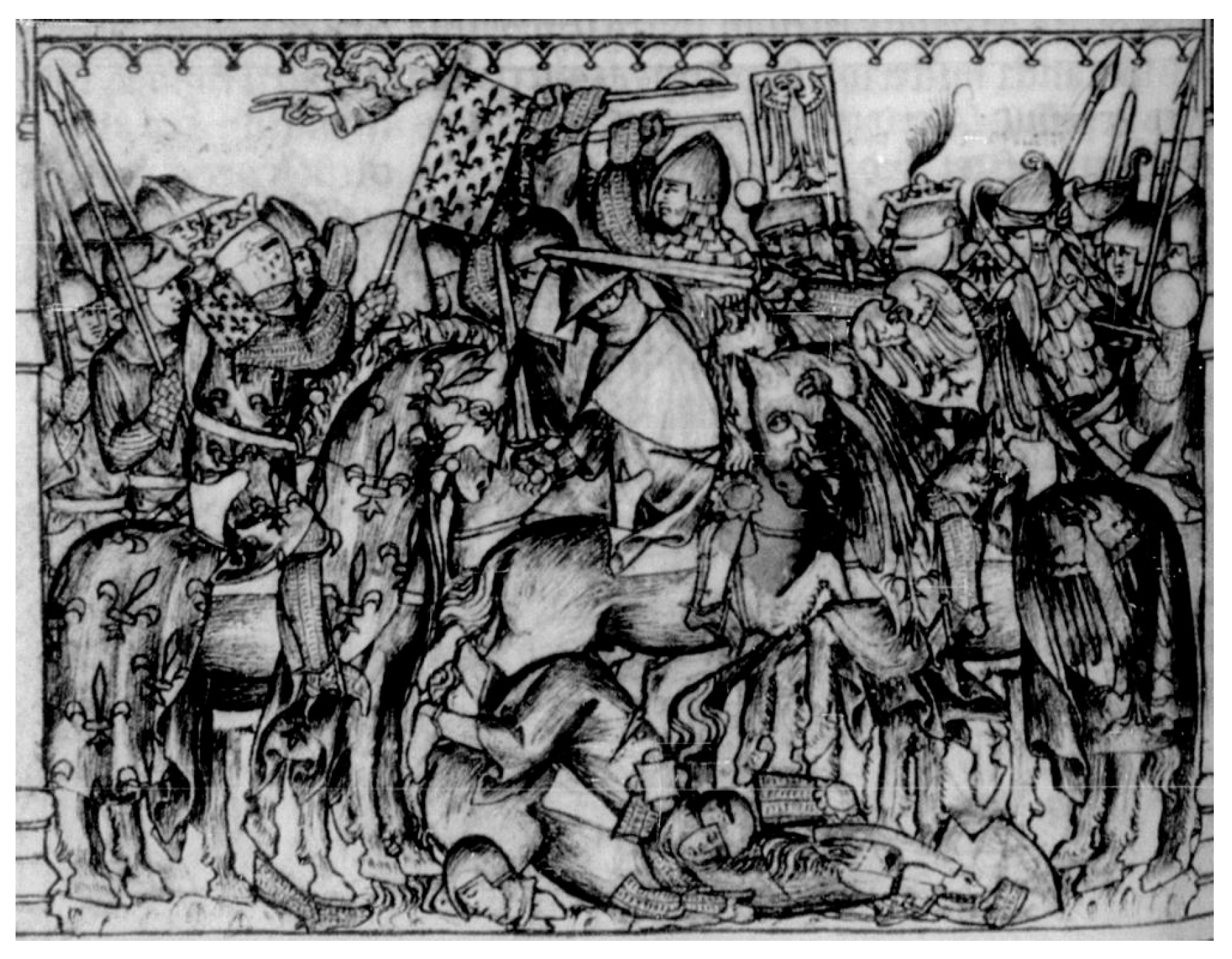
Figure 36.
Fols. 17v (a), 22v (b), 23r (c), 23v (d), 24r (e), and 27r (f) from Libreria Marciana. (© Biblioteca Nazionale Marciana (Venice)/ICCU (Istituto Centrale per il Catalogo Unico)/RIALFrI (Digital Repository of Medieval Franco-Italian Literature), Italy, MS francese Z 21 (257) with permission for non-commercial reproduction under CC 1.0 license. Images are from Link).
Figure 36.
Fols. 17v (a), 22v (b), 23r (c), 23v (d), 24r (e), and 27r (f) from Libreria Marciana. (© Biblioteca Nazionale Marciana (Venice)/ICCU (Istituto Centrale per il Catalogo Unico)/RIALFrI (Digital Repository of Medieval Franco-Italian Literature), Italy, MS francese Z 21 (257) with permission for non-commercial reproduction under CC 1.0 license. Images are from Link).
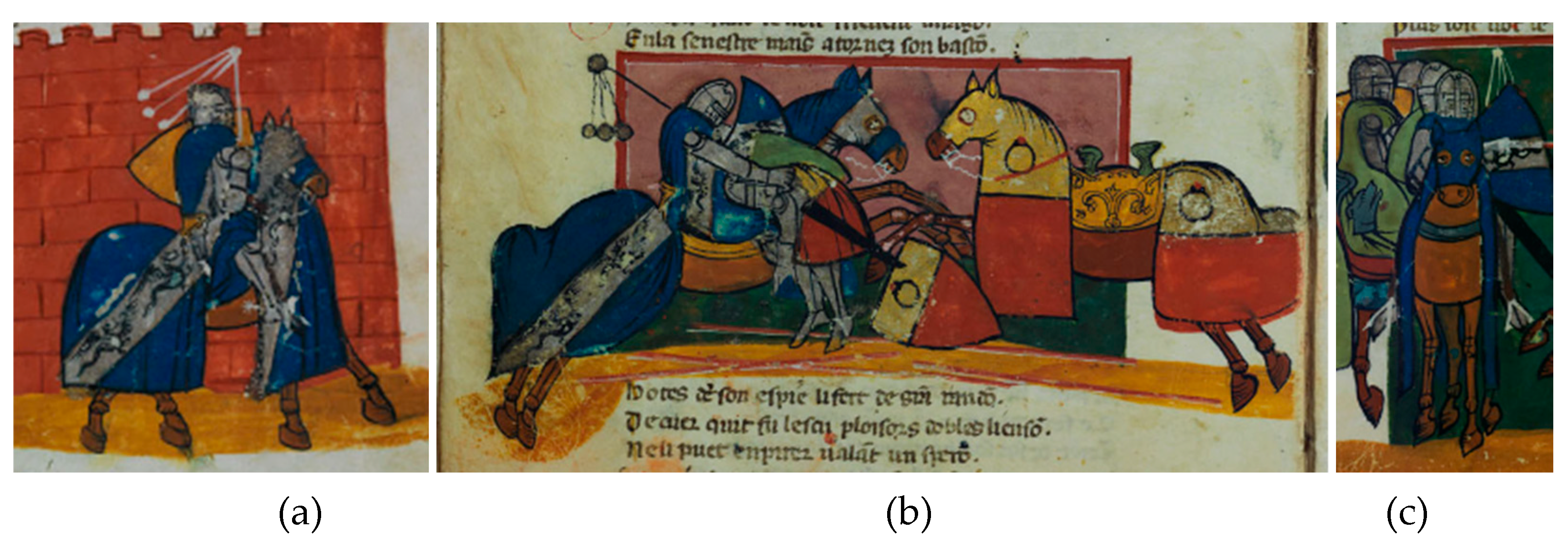
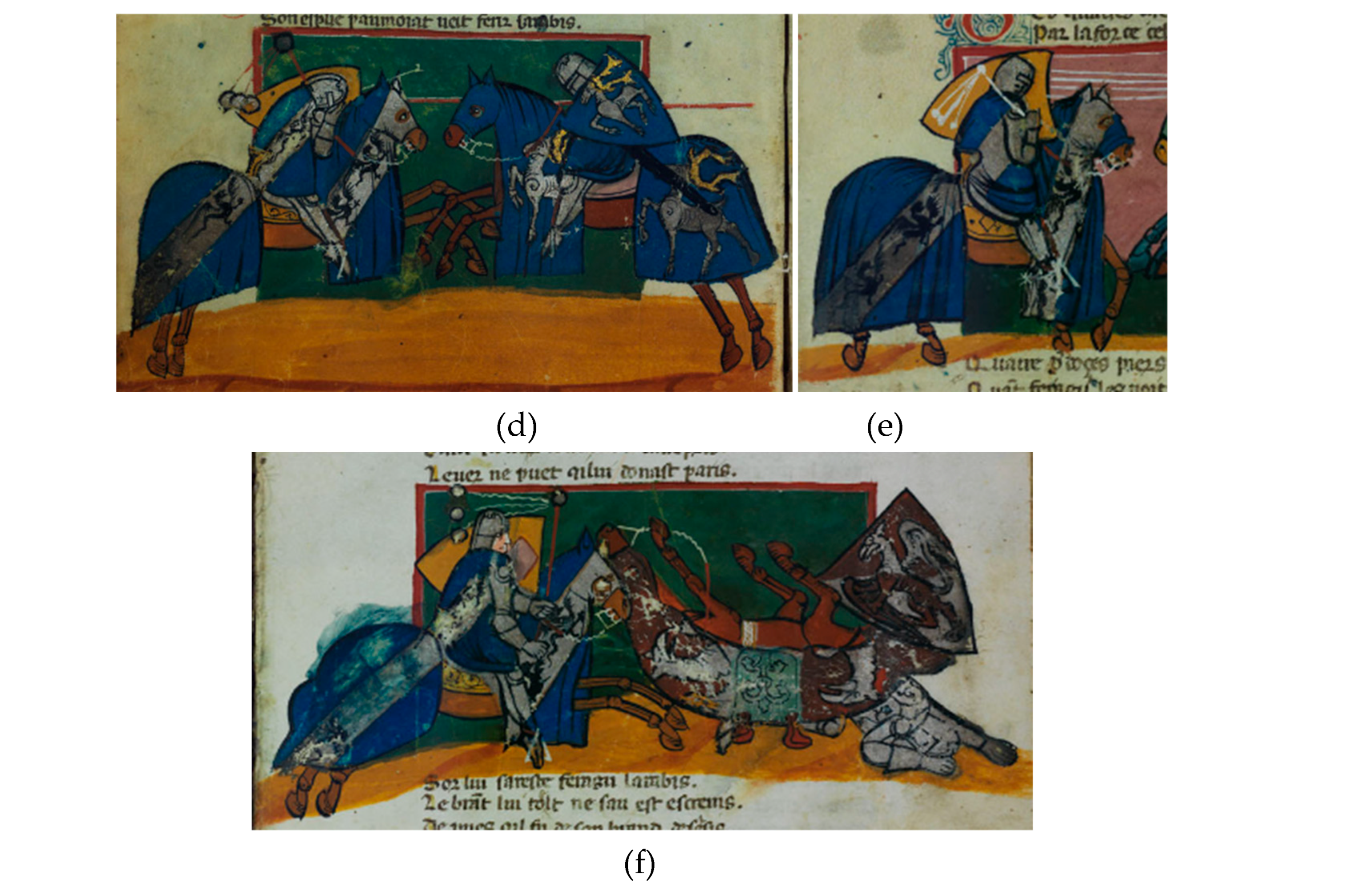
Figure 37.
Fols. 32v (a), 33v (b), 36r (c), 43v (d), 44r (e), 44v (f), and 47r (g) from Libreria Marciana. (© Biblioteca Nazionale Marciana (Venice)/ICCU (Istituto Centrale per il Catalogo Unico)/RIALFrI (Digital Repository of Medieval Franco-Italian Literature), Italy, MS francese Z 21 (257) with permission for non-commercial reproduction under CC 1.0 license. Images are from Link).
Figure 37.
Fols. 32v (a), 33v (b), 36r (c), 43v (d), 44r (e), 44v (f), and 47r (g) from Libreria Marciana. (© Biblioteca Nazionale Marciana (Venice)/ICCU (Istituto Centrale per il Catalogo Unico)/RIALFrI (Digital Repository of Medieval Franco-Italian Literature), Italy, MS francese Z 21 (257) with permission for non-commercial reproduction under CC 1.0 license. Images are from Link).
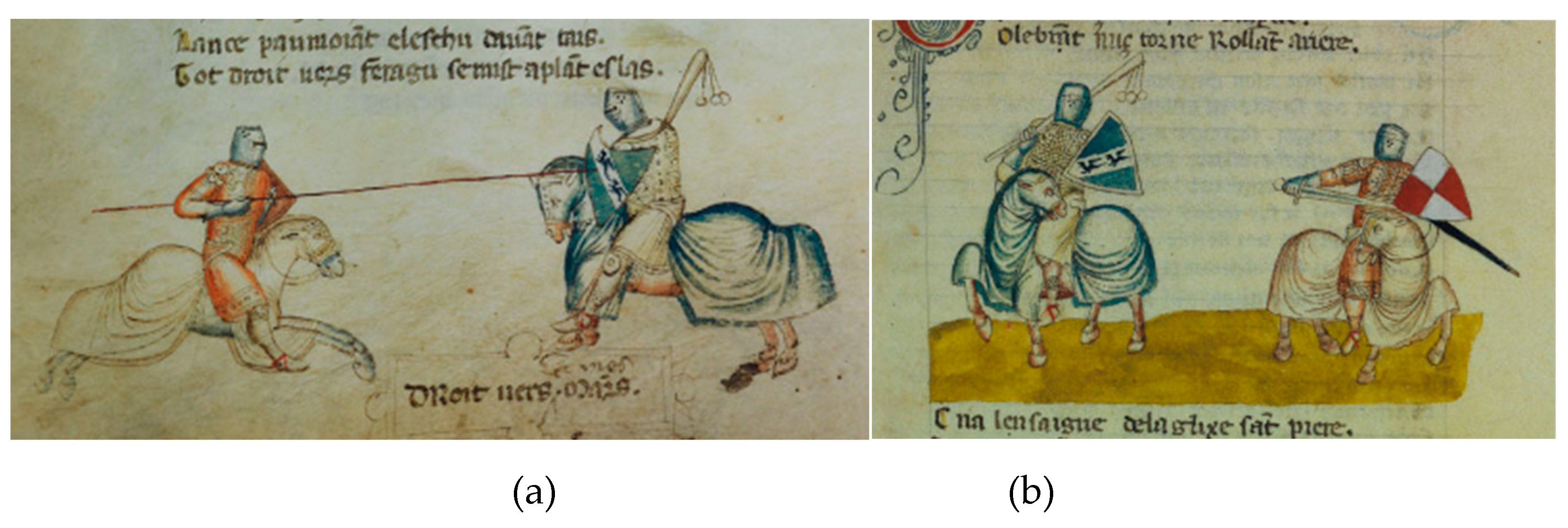
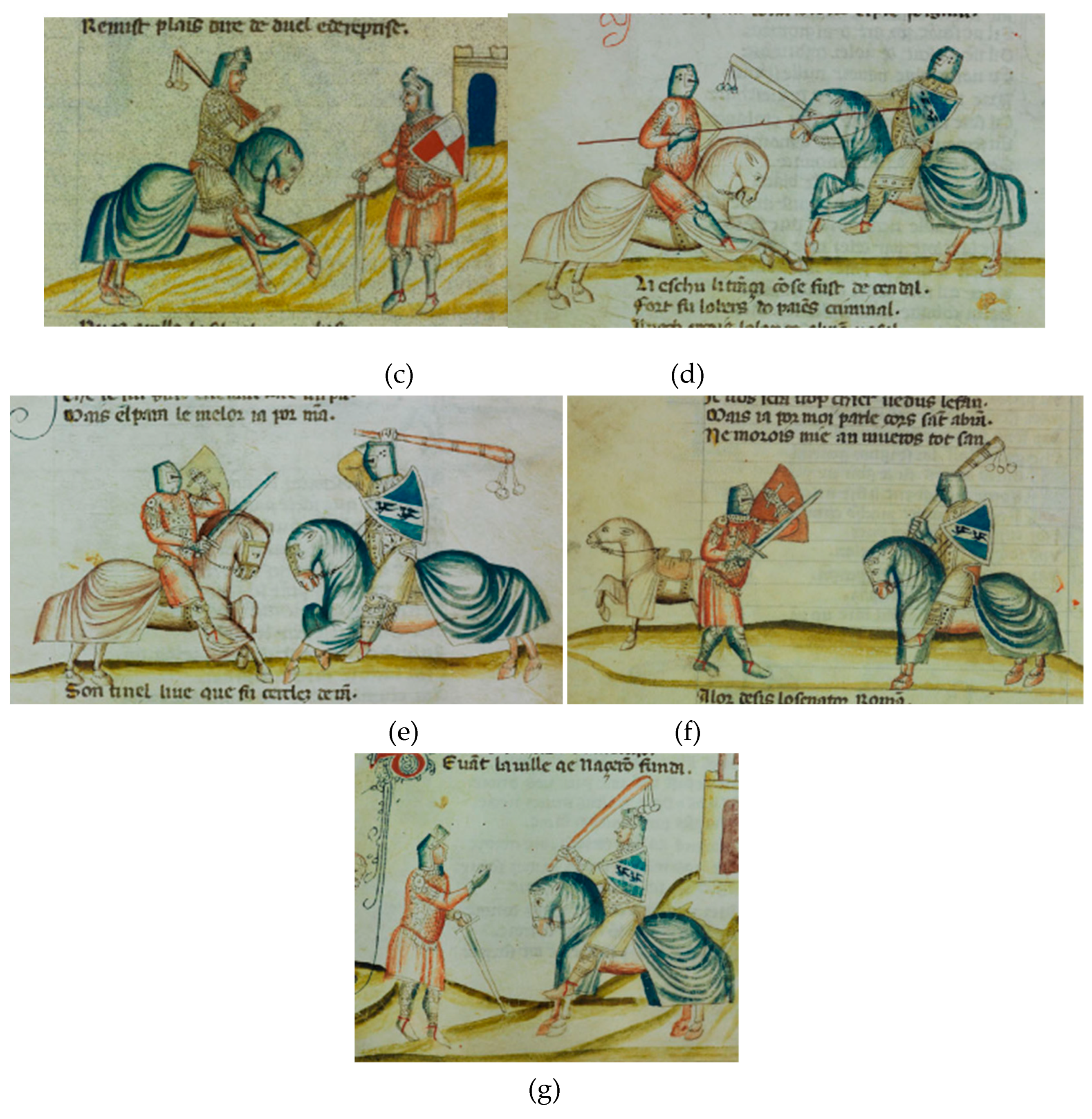
Figure 38.
Fol. 49r from Psalter-Hours. (© Avignon Bibliotheque Municipale, permission granted for non-commercial reproduction, image from Link).
Figure 38.
Fol. 49r from Psalter-Hours. (© Avignon Bibliotheque Municipale, permission granted for non-commercial reproduction, image from Link).
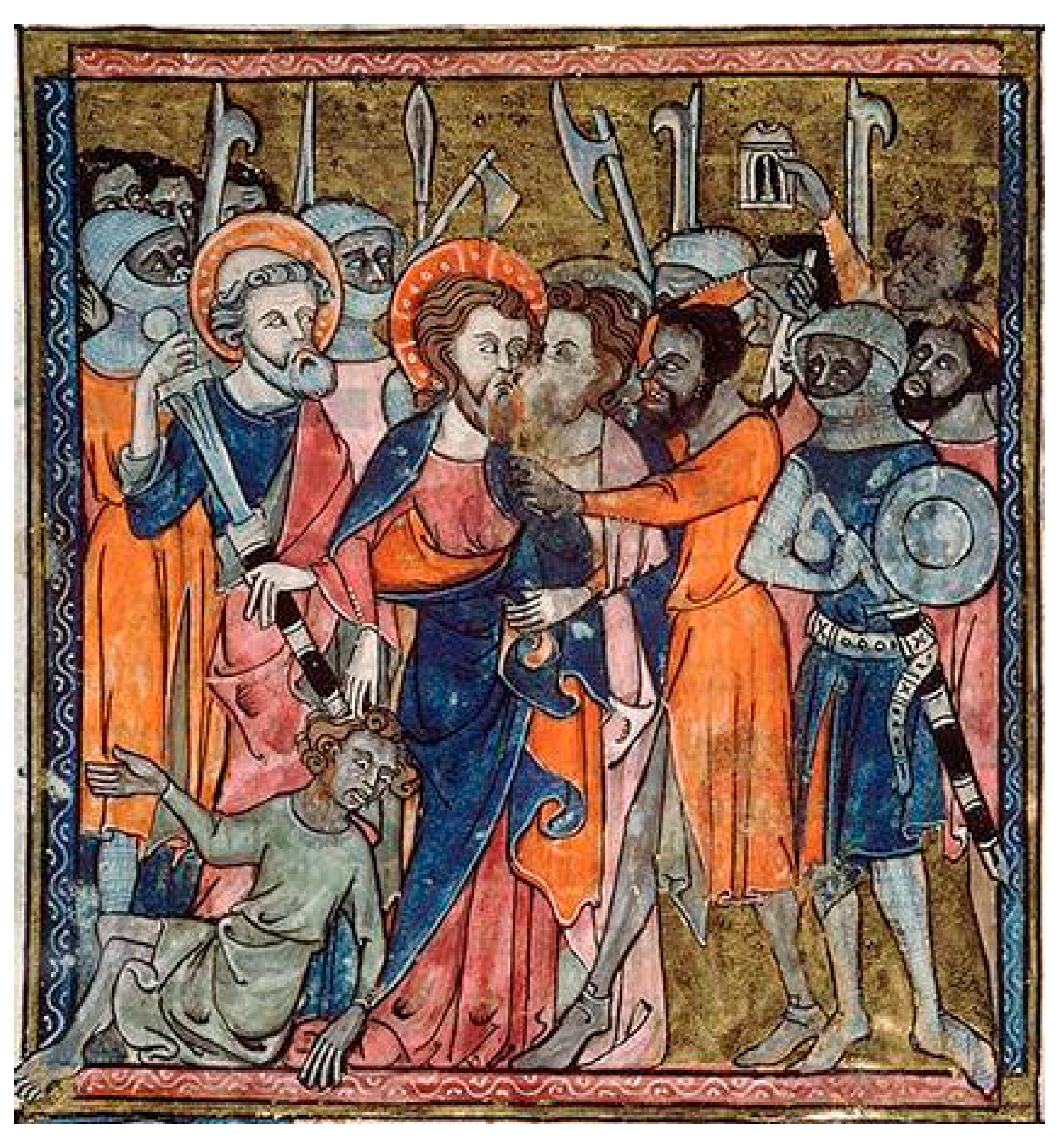
Figure 39.
Fol. 5v from the Life of Eustace and Other Saints. (© British Library Board, BL MS Egerton 745, permission granted for non-commercial reproduction, image from Link).
Figure 39.
Fol. 5v from the Life of Eustace and Other Saints. (© British Library Board, BL MS Egerton 745, permission granted for non-commercial reproduction, image from Link).
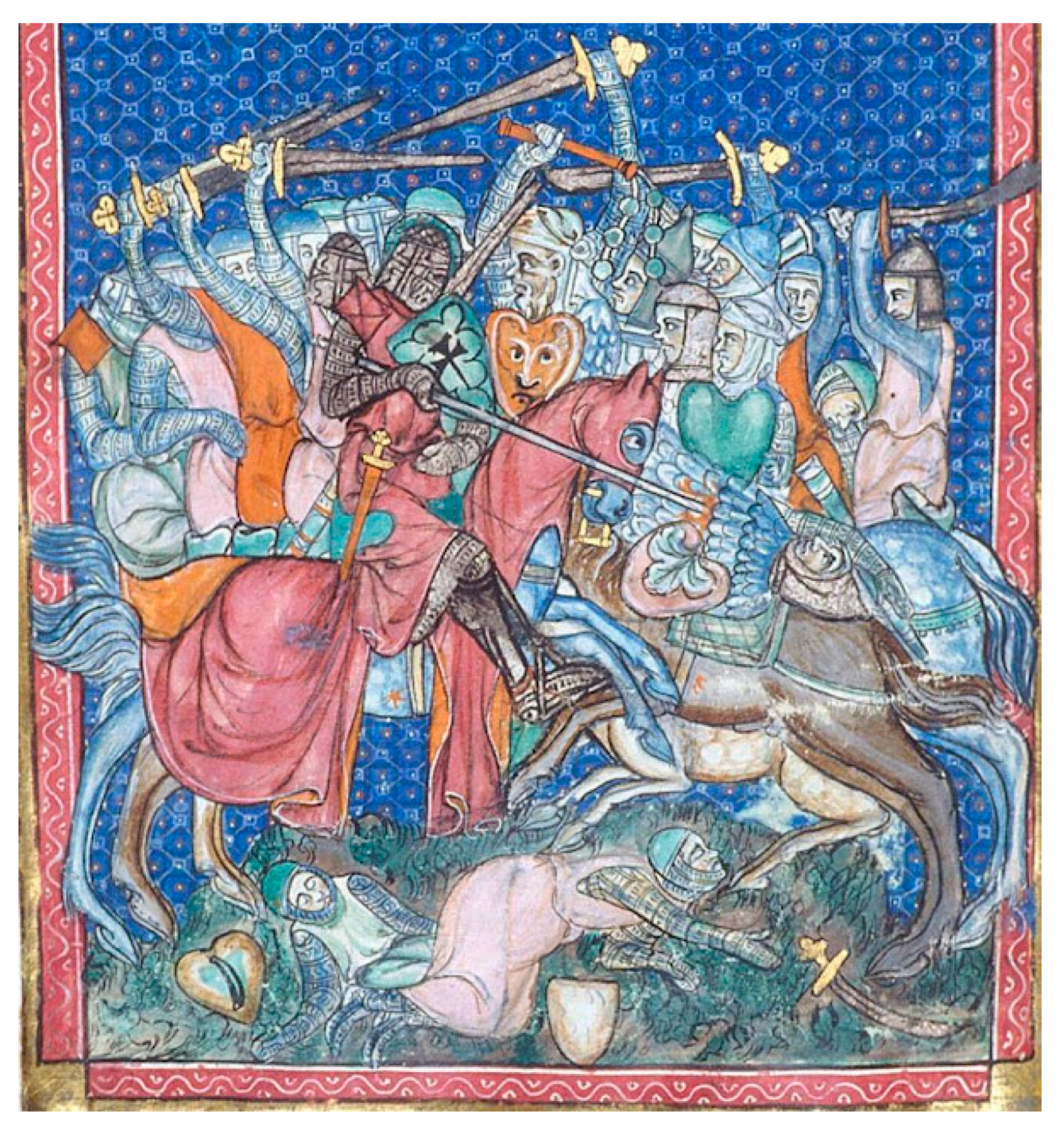
Disclaimer/Publisher’s Note: The statements, opinions and data contained in all publications are solely those of the individual author(s) and contributor(s) and not of MDPI and/or the editor(s). MDPI and/or the editor(s) disclaim responsibility for any injury to people or property resulting from any ideas, methods, instructions or products referred to in the content. |
© 2023 by the authors. Licensee MDPI, Basel, Switzerland. This article is an open access article distributed under the terms and conditions of the Creative Commons Attribution (CC BY) license (http://creativecommons.org/licenses/by/4.0/).
Copyright: This open access article is published under a Creative Commons CC BY 4.0 license, which permit the free download, distribution, and reuse, provided that the author and preprint are cited in any reuse.


