
Submitted:
24 October 2023
Posted:
25 October 2023
You are already at the latest version
Abstract
Chronic traumatic encephalopathy (CTE) is a unique neurodegenerative disease that is associated with repetitive head impacts (RHI) in both civilian and military settings. In 2014, the research criteria for the clinical manifestation of CTE, traumatic encephalopathy syndrome (TES) were proposed to improve the clinical identification and understanding of the complex neuropathological phenomena underlying CTE. This review provides a comprehensive overview of the current understanding of the neuropathological and clinical features of CTE, proposed biomarkers of traumatic brain injury (TBI) in both research and clinical settings, and a range of treatments based on previous preclinical and clinical research studies. Due to the heterogeneity of TBI, there is no universally agreed-upon serum, CSF, or neuroimaging marker for its diagnosis. However, as our understanding of this complex disease continues to evolve, it is likely that there will be more robust, early diagnostic methods and effective clinical treatments. This is especially important given the increasing evidence of a correlation between TBI and neurodegenerative conditions, such as Alzheimer's disease and CTE1. As public awareness of these conditions grows, it is imperative to prioritize both basic and clinical research, as well as the implementation of necessary safe and preventative measures.
Keywords:
chronic traumatic encephalopathy (CTE)
; Alzheimer’s disease (AD)
; traumatic encephalopathy syndrome (TES)
; traumatic brain injury (TBI)
; repetitive head impacts (RHI)
1. Background
Chronic traumatic encephalopathy (CTE) is a distinct neurodegenerative disease and often associated with a history of repetitive head impacts (RHI) in the context of sports or combat settings. The defining neuropathological characteristic of CTE includes hyperphosphorylated tau at the depths of cortical sulci and peri-vascular regions 2. CTE was first reported in a group of boxers, who were described as “punch drunk” by Martland in 1928. His report was focused on a group of boxers who had suffered repetitive head blows throughout their sporting careers, with clinical presentations of both psychiatric symptoms as well as severe memory and neurocognitive deficits, similar to typical dementia patients 3. The disease nomenclature evolved into “dementia pugilistica” 4, and finally CTE in 1949 5 . Renewed interest in CTE began when Omalu et al. reported finding evidence of CTE in three retired football players 6,7,8. McKee reported similar findings in three new individuals when reviewing the world literature on CTE including one football player, followed by numerous reports and case studies of evidence of CTE in athletes, veterans, and others exposed to repetitive head trauma.
In 2014, research diagnostic criteria for traumatic encephalopathy syndrome (TES) were proposed for use in clinical research settings to diagnose CTE while alive by Montenigro et al. 9. They proposed five general criterion for diagnosis of TES, which included (1) a history of multiple head impacts, (2) no other neurological disorders accounting for all the clinical features, (3) clinical features present for a minimum of 12 months, (4) at least one core clinical feature must be present, and (5) the presence of at least two supportive features.
The core features included cognitive deficits, behavioral symptoms, and mood symptoms. The cognitive symptoms, supported by detailed neuropsychological assessments, included changes in episodic memory, executive function, and attention, as defined by 1.5 standard deviations below normal. Behavioral symptoms included verbal or physical aggression, while mood symptoms included feeling depressed or hopeless. The supportive features included impulsivity, anxiety, apathy, paranoia, suicidality, headache, motor signs including dysarthria and dysgraphia, documented decline, as well as a delayed onset.
The validity of TES was assessed by Mez at al. 10 who examined a total of 336 brain donors exposed to repetitive head impacts in the setting of contact sports, military service, and/or physical violence. A total of 309 donors were diagnosed with TES, with 244 donors with CTE pathology. The TES criterion had measured sensitivity and specificity of 0.97 and 0.21, respectively 10. Hence, TES criterion laid a solid foundation for ruling out CTE pathology but provided limited evidence for ruling in CTE pathology. Having cognitive symptoms was significantly associated with having CTE pathology; by augmenting the TES criteria to require cognitive symptoms, specificity improved (0.48) with limited reduction in sensitivity (0.90). Among older donors (age ≥ 60 years), if AD pathology was present, accuracy of a TES diagnosis was markedly reduced. Furthermore, when the diagnosis of AD was excluded, specificity increased from 0.21 to 0.40, with an acceptable reduction in sensitivity from 0.95 to 0.82. Nonetheless, CTE pathology frequently occurred among those with AD pathology. The authors found that having cognitive symptoms was significantly associated with CTE pathology, increasing the odds by 3.6-fold.
This review endeavors to offer a comprehensive exploration of the underlying pathophysiological mechanisms of traumatic encephalopathy syndrome (TES) and chronic traumatic encephalopathy (CTE). Additionally, it provides an in-depth survey of the present neuroimaging and plasma biomarkers employed in the diagnosis of traumatic brain injury (TBI). Furthermore, it scrutinizes the currently utilized clinical regimens in TBI treatment (refer to Figure 1). Given the rapid evolution of the research field concerning TES, CTE, and TBI at large, this review aims to encapsulate some of the most promising trajectories in the field11.
2. Neuropathology
In 1973, Corsellis et al. 12 examined 15 boxers with dementia pugilistica and described the neuropathologic substrate of CTE as involving (1) neurofibrillary tangles (NFTs) in the absence of plaques, particularly involving the medial temporal lobe and brainstem tegmentum, (2) neuronal loss in the substantia nigra, occasionally with NFTs, (3) scarring of the cerebellar tonsils, and (4) cavum septum pellucidum. The neuropathological characterization of CTE has undergone further iterations 13. As per the National Institute of Neurological Disorders and Stroke (NINDS)-funded study entitled, “Understanding Neurologic Injury in Traumatic Encephalopathy (UNITE)”, the CTE pathognomonic lesion is defined as p-tau aggregates as neurofibrillary tangles (NFT) in neurons, with or without p-tau in astrocytes, deposited around small blood vessels, in an irregular pattern at the depths of the cortical sulci, typically involving superficial cortical layers 14. The NINDS panel concluded that the pattern of p-tau in CTE is distinct from that of any other neurodegenerative disease. The molecular structure of tau filaments in CTE has also since been shown to be unique with a different characteristic conformation of the β-helix region, creating a hydrophobic cavity that is absent in tau filaments from the brains of Alzheimer’s disease patients 15.
McKee at al. reported ß-amyloid deposition, an essential feature of AD, in 43% of CTE cases 16. The number of neuritic plaques seen even in late-stage CTE cases (with or without concomitant AD-diagnostic pathology) was significantly lower than those found in pure AD controls. The pure CTE cases showed tau deposition in a prominent perivascular distribution, and an absence of ß-amyloid deposition using immuno-histochemical techniques, which is a pattern of neurodegenerative changes consistent with previous characterizations of neuro-degenerative changes in CTE and a pattern distinct from that typically seen in AD 14. Gardner et al. performed a systematic review of 85 athlete autopsies and found that only 20% had pure CTE, 52% appeared to have CTE plus other neuropathology, 5% had no CTE, and 24% had no observed neuropathology, leading the investigators to highlight the heterogeneity of the disease 17.
McKee et al. 2 described CTE to have four progressive neuropathological stages. In stage 1, brains are typically of normal weight and show focal epicenters of perivascular p-tau, NFTs, neutrophil neurites, and astrocytic tangles involving the sulcal depths, especially of the superior and dorsolateral frontal cortices. Occasional degeneration p-tau immunoreactive glia and glial processes, TDP-43 neurites, and white matter reactive microglia clusters with axonal swellings are also observed. In Stage 2, brains are typically of normal weight with more frequent epicenters at the depths of the sulci and NFTs are scattered throughout superficial cortical layers as well as the locus coeruleus and substantia innominata. The lateral and third ventricles are often mildly enlarged, along with a cavum septum pellucidum and pallor of the locus coeruleus and substantia nigra. In stage 3, the brain is typically reduced in weight with mild cerebral atrophy and ventricular dilatation. Septal abnormalities are more common. There is depigmentation of the locus coeruleus and substantia nigra, as well as atrophy of the mammillary bodies, thalamus, and hypothalamus. Thinning of the corpus callosum is also typical. P-tau pathology is widespread in the broader cortical areas, and NF pathology is seen in the olfactory bulbs, amygdala, hippocampus, hypothalamus, mammillary bodies, nucleus basalis of Meynert, substantia nigra, dorsal and median raphe nuclei, locus coeruleus, and entorhinal cortex. In Stage 4, brains have a marked reduction in weight due to generalized cerebral cortical atrophy of the medial temporal lobe, thalamus, hypothalamus, and mammillary bodies. Septal abnormalities are seen in most cases. Complete depigmentation of the locus coeruleus and substantia nigra can be observed (Figure 2).
Some staging features are only found in a few cases cited as CTE, making the identification of stage-defining criteria complex. These stages arose from multiple case studies of the examined brains and are therefore based on cross-sectional rather than longitudinal data 14. It is well established that tau pathology and ß-amyloid depositions can be found in adults who are healthy or have diverse health conditions. In a study by Bieniek et al., the investigators found cortical tau pathology consistent with CTE in 32% of 66 athletes with a history of contact sports compared with 0% of 198 age- matched controls in the same brain bank18. Stern et al. examined the clinical presentation of CTE in 36 patients with neuropathologically confirmed CTE 19. The results of the study suggested that the existence of two distinct clinical presentations of CTE. One group had initial changes in behavior or mood, prior to the onset of cognitive disturbances and with an earlier age onset (n =22), and the other group had initial changes in cognition and an older age of onset (n = 11). There was also an understated third group who were asymptomatic. Memory disturbances were predominant in patients in the cognitive group, who were also older, but three quarters of the behavior/mood group also had significant memory impairments. Other studies, including the one by Hampshire et al. reported abnormal functional changes on functional MRI in the activation of the dorsal frontoparietal network of retired NFL players compared with healthy controls 20.
3. Potential TES Biomarkers
As CTE is largely a postmortem diagnosis, the precise diagnosis of traumatic encephalopathy syndrome remains largely elusive. The clinical diagnosis of TES would largely depend on neuroimaging, along with CSF and plasma biomarkers (see Table 1.), that would be measurable in the clinical setting. Although there is no consensus on a set of TES biomarkers, there is agreement on a set of converging neuroimaging, and so CSF/plasma markers warrant further discussions.
3.1. Neuroimaging
Asken et al. 21 reported data from a total of 18 structural MRI scans obtained from nine patients with TES (n = 5 with 2+ scans; first available scan: 4.1 – 1.4 years before death, range 2–6 years; last available scan: mean 2.7 – 2.6 years before death, range 0–6 years). The regions of interest (ROIs) selected included dorsal frontal, ventral frontal, temporal, parietal, occipital, thalamus, and the medial temporal subset of the overall temporal lobe. Structural MRIs obtained for each patient were evaluated for the presence or absence of cavum septum pellucidum (CSP) by the lead investigator and verified by a second investigator. If present, the grade and length of the CSP were reported. All nine patients had a CSP (Grade 3, n = 6; Grade 2, n = 3; mean length = 15.6 – 4.9 mm) with no clear differences between patients with High CTE (Grade 3, n = 3; Grade 2, n = 1; mean length = 15.8 – 4.8 mm) versus without CTE. Significant medial temporal atrophy was noted on structural MRI closest to death among all nine patients irrespective of neuropathological diagnoses. The thalamus was also a common area of atrophy. Both the ventral frontal cortex (8/9 patients) and dorsal frontal cortex (7/9) had voxels with significant atrophy in most patients, although the common regions were relatively small within the larger ROIs. Smaller regions where all four patients with High CTE had significant atrophy were seen in the ventral and orbitofrontal cortex, and right posterolateral frontal cortex. Five of the nine patients underwent longitudinal MRI scans. Medial temporal and thalamic regions consistently had the lowest volumes at the initial visit and seemed to show more rapid volume decline than other ROIs.
There is insufficient evidence for the use of diffusion tenson imaging (DTI) to characterize, diagnose, and prognosticate at the individual TES patient level. However, there is a number of intriguing studies that have been reported correlating affective changes with DTI measures. With regard to white matter changes, Strain et al used DTI to examine 26 retired NFL players and found a significant association between depression symptom severity and disruption of white matter integrity22. Retired impaired NFL players also showed an increase in deep white matter lesions on T2-weighted fluid-attenuated inversion recovery when compared with matched controls but not when compared with the unimpaired retired NFL players 22. In the study by Asken et al. 21, six patients underwent antemortem DTI (N = 3 with High CTE; N = 1 with Low CTE; N = 2 with no CTE). All six patients had significantly diminished fractional anisotropy (FA), along the fornix irrespective of neuropathological diagnoses. Five of the six patients had significantly decreased FA in the genu of the corpus callosum (genu CC ROI median W score = -1.24) and medial temporal white matter in the areas of the uncinate fasciculus and cingulum-hippocampal bundle.
In the study by Asken et al. 21, five patients underwent antemortem FDG-PET (n = 2 High CTE, n = 1 Low CTE, n = 2 no CTE). Glucose hypometabolism correlated with common areas of atrophy. Confluent areas of hypometabolism were observed in the thalamus of four of five patients. Four of five patients also showed hypometabolism in the MTL, and three of five patients had hypometabolism in the left dorsal frontal cortex.
PET imaging using tau-specific tracers have been developed with the aim of an in vivo CTE diagnosis. These tracers have been validated mainly in preclinical studies of AD and in postmortem AD cases, demonstrating increased tau ligand binding in the cortex of patients with AD compared to healthy age-matched controls 23. A growing area of interest involves the potential ability of tracers to sensitively and specifically identify p-tau aggregates that are seen in CTE versus those in other neurodegenerative diseases that involve tau. In a study by Stern et al. 24 involving 26 former NFL players and 31 control subjects, flortaucipir positron-emission tomography (PET) and florbetapir PET was employed to measure the deposition of tau and amyloid-beta, respectively, in the brains of former NFL players with cognitive and neuropsychiatric symptoms, and in asymptomatic men with no history of traumatic brain injury. The regional tau standardized uptake value ratio (SUVR), which is the ratio of radioactivity in a cerebral region to that in the reference cerebellum, was used to explore the associations of SUVR with symptom severity and with years of football play in the former-player group versus the control group. The inclusion criteria for the former players were male sex, age 40 to 69 years, a minimum of 2 years playing football in the NFL, a minimum of 12 years of total tackle football experience, and cognitive, behavioral, and mood symptoms reported by the participant through telephone screening. Each participant underwent flortaucipir PET , florbetapir , and T1-weighted volumetric MRI of the head. The mean flortaucipir SUVR was higher among former players than among controls in three regions of the brain: bilateral superior frontal (1.09 vs. 0.98; adjusted mean difference, 0.13; 95% confidence interval 25, 0.06 to 0.20; P<0.001); bilateral medial temporal (1.23 vs. 1.12; adjusted mean difference, 0.13; 95% CI, 0.05 to 0.21; P<0.001); and left parietal (1.12 vs. 1.01; adjusted mean difference, 0.12; 95% CI, 0.05 to 0.20; P = 0.002). All of the former NFL players in the study reported cognitive symptoms, and more than 35% had impaired delayed-recall scores on an objective memory test.
3.2. CSF
A number of studies have proposed the use of CSF as a potential CTE biomarker. Neurofilament light (NfL) polypeptide and tau protein in the CSF have been found to be elevated immediately after boxing matches, and these elevations normalize in the following days and weeks after rest from head injury 23. A study evaluating total tau (t-tau) plasma levels reported that all former NFL players had a concentration greater than or equal to 3.56 pg/mL, indicating that t-tau elevations may be a promising biomarker for the presence of remote head injuries, occurring in patient’s distant past 26. t-tau serum elevations were seen exclusively in former players, and levels did not correlate with cognitive testing. t-tau elevations are also seen in other neurodegenerative and cerebrovascular conditions, limiting its specificity. Hence, T-tau is likely a general marker of brain injury that occurs with a variety of disorders, including AD, frontotemporal degeneration, and stroke, but has less specificity for CTE.
3.3. Plasma
Asken et al. examined antemortem plasma GFAP, NfL, and total tau for eight of the nine patients with TES 21. Five patients had longitudinal GFAP and NfL data, and two had longitudinal total tau data. Most patients had elevated plasma GFAP, NfL, and total tau at their initial visit compared to age-matched healthy controls. Three of five patients with longitudinal GFAP and NfL data demonstrated increasing concentrations over time, and four had increasing NfL over time.
In aging cohorts, plasma GFAP was tightly linked to AD- related a-ßeta 42 plaque 27−29. The mechanisms underlying plasma GFAP changes in patients without AD remains to be determined, but could reflect astrocytic dysfunction and inflammation in non-AD disease pathogenesis. AD-based biomarkers such as Aß-PET, CSF Aß- and phosphorylated tau, or plasma phosphorylated tau in studies of patients with previous repetitive head impacts and TES may add to more specific biomarker signatures that are specific to CTE and minimize risk of misattributing biomarker changes to AD (co)pathology.
Neuron specific enolase (NSE) is also known as gamma-enolase or enolase 2 (encoded by ENO2 gene), exists as a homodimer in mature neurons and neuroendocrine cells 30. NSE is elevated in blood in both mTBI, as well as more severe TBI patients 31−36. The main challenge of using NSE in the clinical setting is the fact that it is also abundantly expressed in red blood cells, which prompted researchers to use a hemolysis correction when measuring NSE in blood37. Ubiquitin C-terminal hydrolase-L1 (UCH-L1) is a protein that mainly resides in the neuronal cell body cytoplasm 30. UCH-L1 was first reported to be released into CSF and serum among severe TBI patients34,38−42. The use of CSF UCH-L1 is a potentially robust clinical outcome predicting marker of mortality following non-penetrating TBI43 . UCHL-1 was also reported to be elevated in serum/plasma in mTBI, including athletes after concussion44,45 . Based on the results of a multi-center TBI study (ALERT-TBI), GFAP and UCHL-1 have been shown high sensitivity (0.976) and negative predictive value (0.996) for detection of traumatic intracranial injury in the acute setting46. These robust TBI biomarker findings ultimately led to FDA approval of GFAP and UCHL-1 to aid in TBI evaluation in a clinical setting47.
S100B is an astroglial 11 kDa calcium-binding protein. It is one of the most examined brain injury biomarkers 48,49. S100B has been studied in various TBI severities 50,51. One important confounding factor regarding the use of S100B as a TBI biomarker is that fact it can also be released from adipose tissue and cardiac/skeletal muscles, and S100B levels are also elevated in orthopedic trauma without head injuries 52. Despite these confounding factors, S100B is actually a sensitive biomarker for predicting CT abnormality and post-concussive syndrome (PCS) development among mTBI patients 53−55.
C-terminal breakdown products (BDPs) of axonal protein αII-spectrin (SBDP150 and SBDP145) byproduct of calpain, and SBDP120 produced by caspase-3, have been identified as potential cell death biomarkers in both preclinical models of TBI and human CSF samples 52,56−63. The N-terminal spectrin fragment (SNTF) (~140 kDa) was also demonstrated to be elevated in circulation after concussion 52,56,57,63. One caveat to consider is that the αII-spectrin protein, although enriched in the CNS, is also expressed in other organs as well as peripheral blood mononuclear cells (PBMC)30 .
Myelin basic protein (MBP) is an oligodendrocyte protein and a main component of the myelin sheath that covers nerve fibers. MBP degradation as a result of activation of proteases including calpain, might be released in biofluids after TBI. MBP was found to be elevated in severe TBI in pediatric and adult populations43,64.
There is a set of emerging TBI biomarkers which includes dendritic protein microtubule-associated protein-2 (MAP-2) 65,66 , brain-derived nerve growth factor (BDNF) 67, and postsynaptic protein neurogranin 68. In addition, microRNA (miRNA), a class of small endogenous RNA molecules (19–28 nt), which regulates gene expression at the posttranscriptional level, has been reported to be elevated in biofluid (CSF, serum, or plasma) in several rodent models of TBI of various severities 69. Redell et al. reported elevations of three miRNAs (MiR-16, MiR-92a, MiR-765) in acute plasma samples after severe TBI 70. Similar studies have identified a total of 10 candidate miRNAs using acute CSF and/or serum samples from human TBI that range from mild to severe TBI 30,71. Another recent study showed that two miRNAs (miR-142-3p and miR-423-3p) can potentially identify mild TBI patients who are likely to develop PCS chronically 72.
Another promising area of TBI biomarker study is the study of circulating microvesicles and exosomes (MV/E) in CSF and/or blood after TBI 73. Exosomes and microvesicles are lipid-bilayered, encapsulated particles (10–100 nm in diameter) that are released from cells into the CSF and blood during disease, including TBI, and often contain distinct proteins or miRNA content 74. Manek et al. reported elevated MV/E released into CSF in TBI patients containing elevated levels of several protein biomarkers (SBDPs, synaptophysin, UCH-L1, and GFAP) 75. Nekludov et al. also found that microvesicles isolated from TBI subject plasma (n = 15) contained brain-derived GFAP and aquaporin-4 76. Circulating exosomes that contain Tau have been proposed to be a better diagnostic biomarker for chronic TBI subjects at risk of developing CTE 77.
TBI induces a cascade of secondary biological phenomena, which includes production of a series of pro- and anti-inflammatory cytokines78. In individuals with severe TBI, increased levels of (IL)-6, IL-1, IL-8, IL-10 and tumor necrosis factor alpha (TNFα), were associated with worse clinical outcomes79. Based on a recent meta-analysis, IL-6 was shown to be a robust potential of pro-inflammatory marker in acute mild TBI patients80. Il-6 has also been reported to have potential prognostic biomarker value of clinical outcomes post TBI81. Moreover, as one of the outcomes of the Transforming Research and Clinical Knowledge in Traumatic Brain Injury (TRACK-TBI) study, high-sensitivity C-Reactive Protein (hsCRP) measured within 2 weeks of TBI was found to be a prognostic biomarker of disability 6 months later 82. Intriguingly, posttraumatic stress disorder (PSTD), a highly comorbid psychiatric illness in brain injury patients83, has been shown to be a pro-inflammatory condition associated with elevation of pro-inflammatory markers, including CRP, IL-6 and TNFα84. Also Depression, another highly comorbid psychiatric condition with TBI85, has been shown to be associated with low-grade inflammation, as manifested by mildly elevated CRP levels86.
4. Treatment
Although there are no established treatments for TES, there are pharmacological and non-pharmacological treatment options for treatment of TBI/TES symptoms. The following section provides a wide scope of potential pharmacological and non-pharmacological treatment options for TBI/TES patients.
4.1. Non-Pharmacological Management
Non-pharmaceutical regimen recommendations include cognitive rehabilitation therapy, motor therapy, mood and behavior therapy including cognitive behavioral therapy, mindfulness, the Mediterranean diet, and aerobic exercise. Vestibular rehabilitative therapy is indicated for patients with inner ear injury due to repetitive TBI. Occupational-ocular therapy is recommended for those with visual disturbances 87.
4.2. Clinical Pharmacological Management
Currently, there are no FDA-approved disease-modifying regimens available for Chronic Traumatic Encephalopathy (CTE). The existing treatments are considered “off-label” and primarily focus on alleviating symptoms. In addressing memory impairment, which is a common issue in CTE, medications originally developed for Alzheimer’s disease, such as galantamine, donepezil, and rivastigmine, have been repurposed for CTE patients87. Additionally, to tackle apathy symptoms, stimulants like methylphenidate and dopamine agonists such as carbidopa/levodopa, pramipexole, amantadine, and memantine may be employed. Amantadine has been the subject of extensive examination in moderate to severe TBI patients. A recent meta-analysis, encompassing 14 clinical trials and 6 observational studies, demonstrated the cognitive benefits of amantadine for this patient population. Notably, the improvements in cognition were more prominent in younger patients with less severe TBIs88. Stimulants can also prove beneficial in managing attention and concentration deficits. When dealing with depression and anxiety symptoms, selective serotonin reuptake inhibitors (SSRIs) like sertraline and escitalopram can be used, but caution is advised due to the potential risk of suicidality, as suicide cases have been documented in CTE. 89. Another promising approach for addressing working memory (WM) deficits resulting from traumatic brain injury involves the use of an alpha-2-adrenergic receptor agonist known as guanfacine. Through functional MRI imaging, a study by McAllister et al. demonstrated improvements in verbal WM in 13 mild TBI patients one month after their injury. Moreover, the group treated with guanfacine exhibited increased activation in WM circuitry, particularly in the prefrontal cortex (PFC) region. 90.
4.3. Clinical Use Of Nutraceutical Regimen
The elevated metabolic rate heightens the probability of reactive oxygen species (ROS) production 91. Numerous preclinical studies are dedicated to exploring the use of antioxidants in the treatment of traumatic brain injuries (TBIs). Antioxidants work by effectively diminishing the potency of various oxidizing agents, including reactive oxygen species (ROS) and reactive nitrogen species (RNS). 91,92. Antioxidants can be broadly categorized into two types: hydrophilic (water-soluble) and hydrophobic (fat-soluble). Apart from reduced glutathione (GSH), uric acid, and coenzyme Q10, the primary sources of antioxidants are derived from dietary intake. The list of antioxidant therapies employed in the treatment of traumatic brain injuries (TBI) includes ascorbic acid (vitamin C), N-acetylcysteine (NAC), flavonoids, resveratrol, alpha-tocopherol (vitamin E), coenzyme Q10, carotenoids, omega-3 fatty acids, Pycnogenol®, and phenelzine 91.
4.4. Preclinical Investigational Pharmacological Intervention
Numerous extensively studied models of traumatic brain injury (TBI) exist, encompassing non-impact head acceleration, blast wave, weight drop, fluid percussion, and controlled cortical impact (CCI) models 93,94. A wide array of models, including those simulating mild traumatic brain injury (mTBI), accurately mirror neuropathological features such as the presence of neurofibrillary tangles, Aβ, phosphorylated tau, and TDP-43 deposition, alongside injury induced indicators like microgliosis, astrogliosis, endoplasmic reticulum (ER) stress, glutamate excitotoxicity, and white matter alterations. These models also capture the long-lasting, chronic cognitive deficits and mood fluctuations associated with TBI. 94−101. Moreover, there exists several prospective treatment targets, encompassing tau acetylation, tau phosphorylation, and the realms of neuroinflammation and immunotherapy.
4.5. Targeting Tau Acetylation
P-tau accumulation results from tau phosphorylation, preceded by ac-tau post-translational acetylation, which is likely a result of neuroinflammation, endoplasmic reticulum, and oxidative stress 87,102,103. Studies investigating the treatment of tauopathies have largely targeted this pathway. For example, salsalate reduced inflammation, promoted neuroprotection and neurogenesis through gene upregulation. It also prevented hippocampal atrophy, and resulted in functional reversal of acetylation in mTBI rodent models by reducing p300 lysine acetyltransferase, inhibiting tau acetylation on lysine 174, and inhibiting microgliosis 104,105. Methylene blue, which modulates K280/K281 acetylation activity, was reported to increase neuroprotection, diminish behavioral deficits and mood changes, and minimized neuronal degeneration, neuroinflammation, lesion volume, microgliosis, and mitochondrial dysfunction in TBI rodent models 106−108. Histone deacetylase 6 (HDAC) and sirtuins (SIRT1 and SIRT2) increased tau deacetylation, presenting another potential treatment methodology that targets the same pathway mechanism but in a different manner109 .
4.6. Targeting Tau Phosphorylation
Kinase inhibition has also been effectively explored in preclinical models. Glycogen synthase 3 beta (GSK-3ß) which is activated by p-tau to cause further tau phosphorylation, promoted amyloid-ß related cell death, and downregulated antioxidant defenses like nuclear factor E2-related factor 2 (Nrf2) 87,110−112. Dimethyl fumarate (DMF) modulated GSK-3ß activity, induced the Nrf2 transcriptional signature, and modulated astrogliosis and microgliosis in tauopathy mouse models 113. The blocking of GSK magnesium binding by lithium led to GSK phosphorylation. It also blocked receptor tyrosine kinase activity, diminished neurodegeneration, maintained the integrity of the blood-brain barrier, improved cognitive outcomes, and diminished lesion sizes in a TBI preclinical mouse model 114−120. Lithium may treat many CTE features like mood, impulsivity, suicidal ideation, and depression. Valproic acid, alone or administered with lithium, results in neuroprotection and improved functional outcomes. The GSK3 inhibitor L803-mts prevented TBI-induced depression in mTBI weight-drop rodent models 115. Several studies demonstrated that cyclin dependent kinase (CDK) inhibitors (roscovitine and its derivative CR-8) diminished neuroinflammation and neurodegeneration while improving functional outcomes in TBI rat models 121. A prior study has shown that the combined use of lithium and roscovitine led to more prominent reductions in cortical and blood p-tau when used in combination rather than when used alone in a mouse model of repetitive mild TBI 101. Using a preclinical CTE model based on combined repetitive mild TBI and chronic stress, Tang and Fesharaki-Zadeh et al., examined the long-term pharmacological use of Fyn Kinase inhibition, AZD0530. Post-injury Fyn inhibition led to a reduction of focal phospho-tau accumulation, as well as neurobehavioral rescue as measured by rescuing object recognition and improving spatial memory function (Figure 3)94.
4.7. Targeting Inflammation
Damage and cellular demise lead to the extracellular release of various ions, molecules, and proteins collectively known as damage-associated molecular patterns (DAMPs).122,123. These DAMPs encompass ATP and K+, double-stranded DNA, and the high mobility group 1 (NMG1) chromatin protein. ATP binds and activates P2 × 7 receptors, while elevated K+ stimulates pannexin receptors 124. DAMPs bind extracellular receptors that activate intracellular inflammasomes124. Activated inflammasomes in neurons and astrocytes convert pro-IL-1β and pro-IL-18 into its biologically active forms 125. Extracellular IL-1β and IL-18 levels increase acutely post injury and are the main inducers of microglia and other early inflammatory processes124. TNFα, IL-6, IL-12 and interferon γ are additionally released in acute phase of injury 124. Neurovascular changes, infiltration of peripheral inflammatory cells and activation of resident microglia and astrocytes leads to a more global release of cytokines, chemokines, and bioactive lipids126,127 . The alteration of microglia activation is a key event in switching from inflammation with early and largely deleterious effects to a later phase of tissue repair and remodeling 126. Microglia can differentiate into either pro-inflammatory M1 or an anti-inflammatory M2 phenotypes128. M1 microglia intensify inflammation, bolster the presence of pro-inflammatory cells, and facilitate the clearance of apoptotic cells. They secrete pro-inflammatory cytokines, including IL-1β, TNFα, and IL-6, along with chemokines that attract more inflammatory cells to the site of injury. Moreover, M1 microglia amplify oxidative stress through elevated expression of NADPH oxidase and iNOS. 129. All subtypes of M2 microglia exhibit anti-inflammatory characteristics128,130. M2a microglia play a pivotal role in mitigating inflammation, promoting cell proliferation and migration, and facilitating tissue repair. M2b microglia express toll-like receptors and exhibit high levels of arginase-1, IL-1, TNFα, IL-6, and CD86. The exact function of M2b microglia is not fully elucidated, but they seem to possess a dual role involving both pro- and anti-inflammatory activities. M2c microglia also contribute to anti-inflammatory processes, distinct from M2a microglia, by expressing elevated levels of TGFβ, CD206, CD163, and sphingosine kinase 1. 130. The precise identification of the inflammatory mediators essential for achieving optimal therapeutic effects remains an ongoing challenge131.
Previous investigations have aimed at addressing the intricate inflammatory cascade and metabolic changes in preclinical models of CTE. A recent study specifically centered on the potential application of the pyrimidine derivative OCH, which is believed to safeguard mitochondrial function and maintain adequate ATP synthesis following traumatic brain injury (TBI).132. OCH demonstrated enhancements in ATP production, respiratory efficiency, and cerebral blood flow, coupled with reductions in glycolysis activity, CTE biomarker levels, and β-amyloid concentrations. Furthermore, OCH treatment effectively preserved sensorimotor function. 132. The use of salubrinal (SAL), a stress modulator, significantly diminished ER stress, oxidative stress, pro-inflammatory cytokines, and inducible nitric oxide synthase. SAL treatment also reduced impulsive-like behavior in rodent models of repetitive TBI 133. Calpain-2 has been implicated in the progression of neurodegeneration subsequent to TBI. The application of a selective calpain-2 inhibitor, known as C2I, resulted in a significant reduction in calpain-2 activation. This intervention effectively halted the elevation of tau phosphorylation and TDP-43 alterations, curbed astrogliosis and microgliosis, and successfully mitigated cognitive impairment in a preclinical model of repeated mild traumatic brain injury. 134. Inhibiting monoacylglycerol lipase (MAGL), responsible for the metabolism of 2-arachidonoylglycerol (2-AG), yielded significant reductions in neurodegeneration, tau phosphorylation, TDP-43 aggregation, astrogliosis, and proinflammatory cytokines. This intervention also resulted in improved cognitive outcomes in a rodent model of repetitive mild TBI. Additionally, the application of 2-AG enhanced blood-brain barrier integrity and reduced the expression of inflammatory cytokines when utilized in a preclinical CHI rodent model. 135.
Glucocorticoids exert a broad anti-inflammatory effect by inhibiting the synthesis of interleukins and bioactive lipids. They also suppress cell-mediated immunity, reduce leukocyte count and activity.136. Despite several preclinical studies, none have investigated whether the anti-inflammatory properties of dexamethasone translate into improved brain function 123. Clinical trials have yielded limited success, likely due to a narrow therapeutic window137. A significant phase III trial, known as CRASH (corticosteroid randomization after significant head injury), included 10,008 adults with TBI and a Glasgow Coma Score (GCS) ≤14137. Within 8 hours of the injury, these patients received a 48-hour infusion of methylprednisolone or a placebo. Intriguingly, the methylprednisolone group exhibited a higher risk of mortality compared to the placebo group, irrespective of the injury severity, thus diminishing the potential clinical efficacy of this regimen.
Non-steroidal anti-inflammatory drugs (NSAIDs) represent a class of medications known for their potent analgesic, antipyretic, and anti-inflammatory properties achieved through the inhibition of COX-1 and COX-2 .138). COX-2 selective drugs like carprofen, celecoxib, meloxicam, nimesulide, and rofecoxib have undergone testing in various preclinical TBI models139. Despite their anti-inflammatory potential, these agents have not proven sufficiently effective in targeting COX-1 or COX-2, making them less promising as therapeutic options for TBI treatment 123. TNFα is a pro-inflammatory cytokine that is rapidly induced by traumatic injury126. Inhibition of TNFα via the use of HU-211, a synthetic cannabinoid, produced long-term improvements in Morris water maze, beam walking and balancing. When administered within two hours post-injury, it led to reduced edema and improved blood-brain barrier integrity139. Another potent TNFα antagonist, decreased IL-1β and IL-6 at 3 days post-injury and decreased TNFα at both 3 and 7 days post-injury140. Similar to TNFα, IL-1β is an acute proinflammatory cytokine whose expression increases rapidly after injury141. Mice engineered to overexpress IL-1ra, a decoy receptor for IL-1β, had less edema one-day post-injury and improved neurological scores between 1 and 14 days post-injury142. Administration of anakinra, a recombinant human IL-1 receptor antagonist, two hours after experimental TBI had little effect on lesion volume, rotarod for motor assessment, or Morris water maze for spatial memory143. In a phase II randomized control clinical trial, administering anakinra within 24 h of injury modified the neuroinflammatory response, but given the small study size, it was not determined whether anakinra had a therapeutic effect 144.
Phophodiesterase inhibitors diminish the breakdown of the second messenger cyclic AMP to 5′AMP123. Rolipram, an inhibitor of phosphodiesterase IV, modified histology and function when dosed 30 min prior to injury145. Dosing Rolipram 30 min post injury produced a similar reduction of IL-1β and TNFα levels 3 h after injury yet lesion size was increase over vehicle controls146.
Minocycline is a lipophilic tetracycline-based antibiotic that can cross the BBB, with anti-inflammatory action at higher concentrations147. Multiple prior studies have demonstrated the anti-inflammatory effects of minocycline148,149. Dosing of minocycline between 5 min and 1 h after injury improved performance on a variety of behavioral tasks including novel object recognition, elevated plus maze, Morris water maze and active place avoidance148,150. Lowered production of IL-1β likely underlies the inhibitory action of minocycline on microglia151. The combination of minocycline and N- acetylcysteine (NAC), synergistically improved memory in Active Place Avoidance (APA) task, a complex spatial memory task150.
Progesterone, a gonadal hormone, exhibits multiple anti-inflammatory actions152. When administered 30 minutes post injury, progesterone initially increased IL-1β levels at 6 h, with subsequent lowering levels at 24 h. IL- 6 was inhibited at both 6 and 24 h post-injury. Progesterone decreased TNFα at 6 h post-injury and increased TGFβ levels 24 h after injury153. The PROtect phase II trial included seventy-seven patients in a group that received progesterone and 23 patients in a group that received placebo within 11 h of injury154. Patients began progesterone treatment 6.3 ± 2.1 h post injury. Patients receiving progesterone had a lower 30-day mortality rate than control group. Patients with moderate traumatic brain injury had better clinical outcomes on the Glasgow Outcome Scale-Extended test and Disability Rating Scale. A large, multi-center Phase III PROtect III trial, examined whether progesterone produced a more favorable functional recovery as compared to placebo using the Extended-Glasgow Outcome Score 6 months post injury155. The study was terminated after no significant effect was observed in 882 patients. A second large scale trial (SYNAPSE) examined progesterone given to 569 study subjects when dosed to severe TBI patients (Glasgow Coma Score < 8)156. Progesterone did not differ from control in any of the study outcomes based on Glasgow Outcome Score at 3 months, reduced mortality at 1 and 6 months, and the Extended-Glasgow Outcome Score at 6 months.
Erythropoietin controls proliferation of erythrocyte precursors in bone marrow, and based on a number of preclinical models of TBI and stroke, erythropoietin has demonstrated anti-apoptotic, anti-oxidative, angiogenic, and neurotrophic activities157. When dosed 5 minutes after injury, erythropoietin effectively reduced. IL-1β, IL-6 and CXCL2158. One hour dosing of erythropoietin prevented increased IL-1β and microglia later after injury in a model that combined weight drop and hypoxia one-hour dosing of erythropoietin prevented increased IL-1β and microglia later after injury159. Erythropoietin was compared with high or low hemoglobin transfusion in 200 patients with a closed head injury having a Glasgow Coma Score > 3160. Transfusion was initiated within 6 h after injury. Patients were transfused to maintain a hemoglobin threshold of 7 or 10 g/dl and either received erythropoietin or placebo. In a separate observational study, erythropoietin therapy was administered within the first 2 weeks post injury, with patients on erythropoietin treatment having significantly longer stays in the intensive care unit, in turn potentially suggestive of a longer survival161. The evidence for the use of erythropoietin has not reached the threshold for its use in a phase III trial123.
Anakinra, a recombinant human IL-1 receptor antagonist (IL-1ra), was studied in a phase II randomized control clinical trial, assessing neuroinflammatory modulation using anakinra following TBI144. This trial involved the study of twenty TBI patients with a Glasgow Coma Score of ≤8, who were recruited within the first 24 hours after the injury. Using microdialysis probes within the brain parenchyma, various cytokines including IL-1ra were examined. CCL22 levels were reported to be significantly lowered in the anakinra group. The study was too small to establish anakinra as an effective clinical regimen but provided an intriguing approach for the use of extracellular fluid as a probe as opposed to baseline serum or CSF markers.
A limited number of previous studies have explored the use of statins for TBI, with two notable large observational trials. In one of these trials, conducted by Schneider et al., 523 patients with moderate to severe TBI (Abbreviated Injury Score of ≥3) were observed152. Among the patients, 22% were regular users of statins162 . The statin users were found to have a lower risk of in-hospital death. At one year assessment of Extended Glasgow Outcome Scale of the 264 remaining patients, statin users had a small, but significantly higher likelihood of more optimal recovery, but the net therapeutic effect of statins was not measurable once controlled for cardiovascular comorbidities in statin users.
4.8. Immunotherapy
Immunotherapy employing monoclonal antibodies has also been a subject of investigation in preclinical studies focused on tauopathies 87. A recent study demonstrated that the delivery of an adeno-associated virus (AAV) vector coding for an anti-p tau antibody reduced CNS p tau levels in rodent models of repeated traumatic brain injury 163. Furthermore, in an in-vitro study, several tau antibodies demonstrated their efficacy in preventing neuronal tau uptake. Specifically, the antibody 6C5 successfully thwarted interneuronal propagation and the progression of tau aggregation after cellular uptake164.
Specific antibodies targeting the pathogenic cis-P-tau post TBI have been reported to lead to improved structural and functional outcomes 165−167. Removal of microglia using PLX5622, a colony-stimulating factor 1 receptor (CSF-1R), was reported to have little effect on the outcome of TBI, but induction of turnover of these cells via either pharmacologic or genetic approaches can result in a neuroprotective microglial phenotype and profound recovery post TBI. The beneficial properties of these repopulating microglia is critically dependent on interleukin-6 (IL-6) trans-signaling via the soluble IL-6 receptor (IL-6R) and robustly promote adult neurogenesis 168.
4.9. Potential dietary targets
The consumption of a Western diet (WD) and the associated obesity have been consistently linked to systemic inflammatory responses, cognitive decline, and worsened outcomes following brain injuries169−171. WD-induced secretion of interleukins such as IL-1 b and IL-6 can disrupt neural circuits involved in cognition and memory 172. In a preclinical study focused on the secondary injury outcomes resulting from a closed head injury (mTBI), obese C57 BL/6 mice fed a WD were compared to lean mice. At a chronic time point (30 days), the obese mice displayed significantly increased microglial activation and a chronic state of inflammation173.
Ketogenic diet (KD) is a fat-rich diet low in proteins and carbohydrates, with low obesogenic, and has been demonstrated to be neuroprotective 169,174,175. Unlike WD, the KD diet can reduce neuronal inflammation176 , rescue behavioral patterns of depression in animal models 177, diminish cognitive defects 178 ,and modulate neuronal injury 179 . In addition, an alternative Mediterranean diet (MD) consumption has also been associated with reduced risk of dementia and better memory and language performance 180 . Preclinical studies have reported that antioxidants and flavonoids from fruits and vegetables in these diets suppress neuro-inflammation by reducing oxidative stress and apoptosis via inhibition of NF-KB-dependent inflammatory signaling 181.
5. Future Directions
Chronic traumatic encephalopathy (CTE) and traumatic encephalopathy syndrome (TES) have gained special attention in the public discourse. The diagnosis of CTE remains predominantly pathological, and in turn making the diagnosis of TES and emerging CTE pathological diagnosis challenging. As TES is a relatively novel clinical diagnostic classification, the exact prevalence of TES amongst athletes, combat veterans and civilians, remains largely unknown. A recent study encompassed 176 participants, consisting of 110 boxers and 66 mixed martial artists (MMA), who were all included in the analysis. Among them, 72 individuals (41% of the total) were categorized as having traumatic encephalopathy syndrome (TES), with the likelihood of TES increasing as age advanced. TES-positive (TES+) participants were more likely to be boxers, initiated their fighting careers at a younger age, engaged in more professional fights, and experienced more frequent knockouts182.
There are a number of diagnostic challenges, which include limited research pertaining to diagnostic validity 181. There are also limitations pertaining to absence of universally agreed upon biomarkers 30. Despite proposed neuroimaging correlates for TBI and CTE, their diagnostic and prognostic utility remain elusive. Diagnostic challenges include small sample size, inherent heterogeneity of TBI/CTE among injured individuals, as well as the widely varying interval between injury and clinical assessment 87. The majority of the completed studies lack female study participants, a significant limitation and hinders clinical applicability. Given the tauopathy nature of CTE/TES, a wider use of tau markers, including tau PET ligands like flortaucapir is needed183. Identification of sensitive and specific CTE/TES biomarkers would facilitate early diagnosis, monitoring of disease progression, as well as assessing disease prognosis. Access to validated biomarkers would also provide the necessary basis to study the natural progression of the disease in a more systematic way.
Currently, there are no FDA approved drugs for CTE/TES which would offer a disease modifying effect. Although a number of preclinical studies have proposed potential therapeutic effects for CTE94, there is an urgent need for large scale clinical trials. Moreover, there are a number of proposed preclinical models of CTE 94,99,184−186, but there is no agreement on a specific animal model of CTE. The lissencephalic nature of rodent cortex also adds a layer of complexity in its application to clinical studies. Moreover, the central role of neuroinflammation is increasingly more recognized in TBI87,187. Development of disease specific immunomodulating agents, including humanized monoclonal antibodies is, quite possibly, in the CTE/TES treatment horizon188.
Given the lack of current treatment options, the most viable CTE/TES treatment option is prevention and safe practices. There is a great need for continuing optimization of protective sports gear, vigilant enforcement of sports contact rules and protocols, and raising public awareness189,190.
One area poised for significant future advancements is development of highly sensitive and specific assays for traumatic brain injury (TBI) in serum and cerebrospinal fluid (CSF). Despite numerous studies, there is currently a lack of consensus regarding proposed biomarkers for TBI. The recent FDA approval of GFAP and UCHL-1 for acute assessment of TBI in the ED setting and examining the necessity of CT neuroimaging, is a major step forward46,47. Research on other TBI biomarkers has produced mixed results. For example, two prior studies found no correlation between serum S100B concentration and clinical outcomes, as measured by tools such as the Glasgow Outcome Scale (GOS), Glasgow Outcome Scale-Extended (GOS-E), or imaging studies191,192. Similarly, another study found that GFAP was not an effective clinical predictive marker based on GOS-E and functional timeline 193, while an earlier study demonstrated that serum cleaved tau (c-tau) was also not a reliable predictor after mild TBI194 .
The research and clinical management of chronic traumatic encephalopathy (CTE) and traumatic encephalopathy syndrome (TES) are rapidly evolving areas, as our current understanding of their neuropathological mechanisms continues to expand11. Advancements in ultra-sensitive biofluid assays would be crucial for earlier and more accurate clinical detection of CTE/TES, as well as the potential for more effective treatments. In addition, the development and refinement of disease-specific markers such as tau PET ligands would further expand the much-needed arsenal for timely and effective management of this complex disease, both in research and clinical settings.

Table 2.
TBI pharmacological treatments reported in preclinical and clinical studies. An overview of the reported TBI pharmacological regimen examined in preclinical and clinical studies. A number of these regimen, including cholinesterase inhibitors, NMDA receptor antagonists, SSRIs, guanfacine, NSAIDs, as well as glucorticoids and progesterone are cross-purposed medications that have been utilized in treatment of TBI clinical studies. Tau phosphorylation, tau acetylation and immunotherapy regimen have largely been examined in the preclinical TBI setting.
Table 2.
TBI pharmacological treatments reported in preclinical and clinical studies. An overview of the reported TBI pharmacological regimen examined in preclinical and clinical studies. A number of these regimen, including cholinesterase inhibitors, NMDA receptor antagonists, SSRIs, guanfacine, NSAIDs, as well as glucorticoids and progesterone are cross-purposed medications that have been utilized in treatment of TBI clinical studies. Tau phosphorylation, tau acetylation and immunotherapy regimen have largely been examined in the preclinical TBI setting.
| TBI Pharmacological Regimen | Proposed Mechanism |
|---|---|
| Cholinesterase Inhibitors | Cholinesterase inhibitors including galantamine, donepezil, and rivastigmine, have been repurposed for TBI patients87. |
| NMDA receptor antagonists | NMDA receptor antagonist, amantadine, has been shown to improve cognition in moderate to severe TBI patients88. |
| SSRIs | Selective serotonin reuptake inhibitors (SSRIs) like sertraline and escitalopram have been utilized to mange behavioral symptoms in TBI patients89. |
| Guanfacine | Guanfacine has been reported to improve working memory deficits in mild TBI patients90. |
| Nutraceuticals | A number of nutraceuticals have been utilized in treatment of TBI preclinical and clinical studies, including N-acetylcysteine (NAC), flavonoids, resveratrol, alpha-tocopherol (vitamin E), coenzyme Q1091. |
| NSAIDs | COX-2 selective drugs like carprofen, celecoxib, meloxicam, nimesulide, and rofecoxib have undergone testing in various preclinical TBI models, with no significant degree of established efficacy123. |
| Glucocorticoids | Despite several promising preclinical studies, clinical trials have resulted in limited success, likely due to a narrow therapeutic window137. |
| Phosphodiesterase Inhibitors | Phophodiesterase inhibitors have been utilized mostly in preclinical studies, and have not systematically studied in clinical trial setting146. |
| Minocycline | In prior preclinical studies, minocycline given between 5 min and 1 h after injury improved performance on a variety of neurobehavioral150. |
| Progesterone | A large, multi-center Phase III PROtect III trial, , as well as a second larger scale trial (SYNAPSE) examined progesterone did not establish clinical effiacy156. |
| Erythropoietin | Despite preclinical studies success, the evidence for the use of erythropoietin has not reached the threshold for its use in a phase III trial123. |
| Anakinra | A small phase II randomized controlled clinical trial reported anti-inflammatory benefits in Anakinra treated group, but the study size was too small to establish efficacy, but provided an intriguing potential future approach144. |
| Tau phosphorylation targets | The studies focusing on tau-phosphorylation targets have been mostly preclinical, with possible future clinical applications94. |
| Tau acetylation targets | Tau acetylation inhibitors including salsalate, as well as methylene blue, as well as histone deacetylase 6 and sirtuins have largely been examined in the preclinical setting109. |
| Immunotherapy | Specific antibodies targeting the pathogenic cis-P-tau post TBI have been reported to lead to improved structural and functional outcomes165, but yet to be examine in larger clinical trial setting. |
References
- Asken, B.M. et al. Alzheimer’s pathology is associated with altered cognition, brain volume, and plasma biomarker patterns in traumatic encephalopathy syndrome. Alzheimer's Research & Therapy 15, 126 (2023). [CrossRef]
- McKee, A.C. et al. The first NINDS/NIBIB consensus meeting to define neuropathological criteria for the diagnosis of chronic traumatic encephalopathy. Acta Neuropathol 131, 75-86 (2016). [CrossRef]
- Martland, H.S. Punch drunk. Journal of the American Medical Association 91, 1103-1107 (1928). [CrossRef]
- Castellani, R.J. & Perry, G. Dementia pugilistica revisited. Journal of Alzheimer's disease 60, 1209-1221 (2017). [CrossRef]
- Asken, B.M., Sullan, M.J., DeKosky, S.T., Jaffee, M.S. & Bauer, R.M. Research gaps and controversies in chronic traumatic encephalopathy: A review. JAMA neurology 74, 1255-1262 (2017). [CrossRef]
- Omalu, B.I., Bailes, J., Hammers, J.L. & Fitzsimmons, R.P. Chronic traumatic encephalopathy, suicides and parasuicides in professional American athletes: The role of the forensic pathologist. The American journal of forensic medicine and pathology 31, 130-132 (2010). [CrossRef]
- Omalu, B.I. et al. Chronic traumatic encephalopathy in a national football league player: Part II. Neurosurgery 59, 1086-1092; discussion 1092-1083 (2006). [CrossRef]
- Omalu, B.I. et al. Chronic traumatic encephalopathy in a National Football League player. Neurosurgery 57, 128-134; discussion 128-134 (2005). [CrossRef]
- Montenigro, P.H. et al. Clinical subtypes of chronic traumatic encephalopathy: Literature review and proposed research diagnostic criteria for traumatic encephalopathy syndrome. Alzheimer's research & therapy 6, 1-17 (2014). [CrossRef]
- Mez, J. et al. Validity of the 2014 traumatic encephalopathy syndrome criteria for CTE pathology. Alzheimer's & Dementia 17, 1709-1724 (2021). [CrossRef]
- Kelly, J.P., Priemer, D.S., Perl, D.P. & Filley, C.M. Sports concussion and chronic traumatic encephalopathy: Finding a path forward. Annals of neurology 93, 222-225 (2023). [CrossRef]
- Corsellis, J.A.N., Bruton, C.J. & Freeman-Browne, D. The aftermath of boxing. Psychological Medicine 3, 270-303 (1973). [CrossRef]
- McKee, A.C. et al. The spectrum of disease in chronic traumatic encephalopathy. Brain 136, 43-64 (2013). [CrossRef]
- Alosco, M.L. et al. Developing methods to detect and diagnose chronic traumatic encephalopathy during life: Rationale, design, and methodology for the DIAGNOSE CTE Research Project. Alzheimer's research & therapy 13, 1-23 (2021). [CrossRef]
- Falcon, B. et al. Novel tau filament fold in chronic traumatic encephalopathy encloses hydrophobic molecules. Nature 568, 420-423 (2019). [CrossRef]
- McKee, A.C., Stein, T.D., Kiernan, P.T. & Alvarez, V.E. The neuropathology of chronic traumatic encephalopathy. Brain pathology 25, 350-364 (2015). [CrossRef]
- Gardner, A., Iverson, G.L. & McCrory, P. Chronic traumatic encephalopathy in sport: A systematic review. British journal of sports medicine 48, 84-90 (2014). [CrossRef]
- Bieniek, K.F. et al. Association between contact sports participation and chronic traumatic encephalopathy: A retrospective cohort study. Brain Pathology 30, 63-74 (2020). [CrossRef]
- Stern, R.A. et al. Clinical presentation of chronic traumatic encephalopathy. Neurology 81, 1122-1129 (2013). [CrossRef]
- Hampshire, A., MacDonald, A. & Owen, A.M. Hypoconnectivity and hyperfrontality in retired American football players. Scientific reports 3, 1-8 (2013). [CrossRef]
- Asken, B.M. et al. Multi-Modal Biomarkers of Repetitive Head Impacts and Traumatic Encephalopathy Syndrome: A Clinicopathological Case Series. Journal of Neurotrauma 39, 1195-1213 (2022). [CrossRef]
- Strain, J. et al. Depressive symptoms and white matter dysfunction in retired NFL players with concussion history. Neurology 81, 25-32 (2013). [CrossRef]
- Turk, K.W. & Budson, A.E. Chronic traumatic encephalopathy. CONTINUUM: Lifelong Learning in Neurology 25, 187-207 (2019). [CrossRef]
- Stern, R.A. et al. Tau positron-emission tomography in former national football league players. New England journal of medicine 380, 1716-1725 (2019). [CrossRef]
- Grashow, R. et al. Premortem chronic traumatic encephalopathy diagnoses in professional football. Annals of neurology 88, 106-112 (2020). [CrossRef]
- Alosco, M.L. et al. Cerebrospinal fluid tau, Aβ, and sTREM2 in Former National Football League Players: Modeling the relationship between repetitive head impacts, microglial activation, and neurodegeneration. Alzheimer's & Dementia 14, 1159-1170 (2018). [CrossRef]
- Asken, B.M. et al. Plasma glial fibrillary acidic protein levels differ along the spectra of amyloid burden and clinical disease stage. Journal of Alzheimer's Disease 78, 265-276 (2020). [CrossRef]
- Benedet, A.L. et al. Differences between plasma and cerebrospinal fluid glial fibrillary acidic protein levels across the Alzheimer disease continuum. JAMA neurology 78, 1471-1483 (2021). [CrossRef]
- Pereira, J.B. et al. Plasma GFAP is an early marker of amyloid-β but not tau pathology in Alzheimer’s disease. Brain 144, 3505-3516 (2021). [CrossRef]
- Wang, K.K. et al. An update on diagnostic and prognostic biomarkers for traumatic brain injury. Expert review of molecular diagnostics 18, 165-180 (2018). [CrossRef]
- Böhmer, A.E. et al. Neuron-specific enolase, S100B, and glial fibrillary acidic protein levels as outcome predictors in patients with severe traumatic brain injury. Neurosurgery 68, 1624-1631 (2011). [CrossRef]
- Stein, D.M. et al. Association of CSF biomarkers and secondary insults following severe traumatic brain injury. Neurocritical care 14, 200-207 (2011). [CrossRef]
- Berger, R.P. et al. Neuron-specific enolase and S100B in cerebrospinal fluid after severe traumatic brain injury in infants and children. Pediatrics 109, e31-e31 (2002). [CrossRef]
- Liu, M. et al. A novel rat model of blast-induced traumatic brain injury simulating different damage degree: Implications for morphological, neurological, and biomarker changes. Frontiers in cellular neuroscience 9, 168 (2015). [CrossRef]
- Topolovec-Vranic, J. et al. The value of serum biomarkers in prediction models of outcome after mild traumatic brain injury. Journal of Trauma and Acute Care Surgery 71, S478-S486 (2011). [CrossRef]
- Buonora, J.E. et al. Multivariate analysis of traumatic brain injury: Development of an assessment score. Frontiers in neurology 6, 68 (2015). [CrossRef]
- Verfaillie, C.J. & Delanghe, J.R. Hemolysis correction factor in the measurement of serum neuron-specific enolase. Clinical chemistry and laboratory medicine 48, 891-892 (2010). [CrossRef]
- Kobeissy, F.H. et al. Novel differential neuroproteomics analysis of traumatic brain injury in rats. Molecular & Cellular Proteomics 5, 1887-1898 (2006). [CrossRef]
- Mondello, S. et al. Clinical utility of serum levels of ubiquitin C-terminal hydrolase as a biomarker for severe traumatic brain injury. Neurosurgery 70, 666 (2012). [CrossRef]
- Brophy, G.M. et al. Biokinetic analysis of ubiquitin C-terminal hydrolase-L1 (UCH-L1) in severe traumatic brain injury patient biofluids. Journal of neurotrauma 28, 861-870 (2011). [CrossRef]
- Blyth, B.J. et al. Validation of serum markers for blood-brain barrier disruption in traumatic brain injury. Journal of neurotrauma 26, 1497-1507 (2009). [CrossRef]
- Papa, L. et al. Ubiquitin C-terminal hydrolase is a novel biomarker in humans for severe traumatic brain injury. Critical care medicine 38, 138 (2010). [CrossRef]
- Zhang, Z.-Y. et al. Comparison of the performances of copeptin and multiple biomarkers in long-term prognosis of severe traumatic brain injury. Peptides 60, 13-17 (2014). [CrossRef]
- Diaz-Arrastia, R. et al. Acute biomarkers of traumatic brain injury: Relationship between plasma levels of ubiquitin C-terminal hydrolase-L1 and glial fibrillary acidic protein. Journal of neurotrauma 31, 19-25 (2014). [CrossRef]
- Papa, L. et al. Elevated levels of serum glial fibrillary acidic protein breakdown products in mild and moderate traumatic brain injury are associated with intracranial lesions and neurosurgical intervention. Annals of emergency medicine 59, 471-483 (2012). [CrossRef]
- Bazarian, J.J. et al. Serum GFAP and UCH-L1 for prediction of absence of intracranial injuries on head CT (ALERT-TBI): A multicentre observational study. The Lancet Neurology 17, 782-789 (2018). [CrossRef]
- Korley, F.K. et al. Comparison of GFAP and UCH-L1 measurements from two prototype assays: The Abbott i-STAT and ARCHITECT assays. Neurotrauma reports 2, 193-199 (2021). [CrossRef]
- Schulte, S., Podlog, L.W., Hamson-Utley, J.J., Strathmann, F.G. & Strüder, H.K. A systematic review of the biomarker S100B: Implications for sport-related concussion management. Journal of Athletic Training 49, 830-850 (2014). [CrossRef]
- Filippidis, A.S., Papadopoulos, D.C., Kapsalaki, E.Z. & Fountas, K.N. Role of the S100B serum biomarker in the treatment of children suffering from mild traumatic brain injury. Neurosurgical Focus 29, E2 (2010). [CrossRef]
- Kiechle, K. et al. Subject-specific increases in serum S-100B distinguish sports-related concussion from sports-related exertion. PloS one 9, e84977 (2014). [CrossRef]
- Cervellin, G. et al. Serum levels of protein S100B predict intracranial lesions in mild head injury. Clinical biochemistry 45, 408-411 (2012). [CrossRef]
- Papa, L. et al. GFAP out-performs S100β in detecting traumatic intracranial lesions on computed tomography in trauma patients with mild traumatic brain injury and those with extracranial lesions. Journal of neurotrauma 31, 1815-1822 (2014). [CrossRef]
- Metting, Z., Wilczak, N., Rodiger, L., Schaaf, J. & Van Der Naalt, J. GFAP and S100B in the acute phase of mild traumatic brain injury. Neurology 78, 1428-1433 (2012). [CrossRef]
- Barbosa, R.R. et al. Evaluation and management of mild traumatic brain injury: An Eastern Association for the Surgery of Trauma practice management guideline. Journal of Trauma and Acute Care Surgery 73, S307-S314 (2012). [CrossRef]
- Zongo, D. et al. S100-B protein as a screening tool for the early assessment of minor head injury. Annals of emergency medicine 59, 209-218 (2012). [CrossRef]
- Pike, B.R. et al. Accumulation of calpain and caspase-3 proteolytic fragments of brain-derived αII-spectrin in cerebral spinal fluid after middle cerebral artery occlusion in rats. Journal of Cerebral Blood Flow & Metabolism 24, 98-106 (2004). [CrossRef]
- Mondello, S. et al. αII-spectrin breakdown products (SBDPs): Diagnosis and outcome in severe traumatic brain injury patients. Journal of neurotrauma 27, 1203-1213 (2010). [CrossRef]
- Vartanian, M.G. et al. Phenytoin pretreatment prevents hypoxic-ischemic brain damage in neonatal rats. Developmental brain research 95, 169-175 (1996). [CrossRef]
- Berger, R.P. et al. Translating biomarkers research to clinical care: Applications and issues for rehabilomics. PM&R 3, S31-S38 (2011). [CrossRef]
- Pike, B.R. et al. Accumulation of non-erythroid αII-spectrin and calpain-cleaved αII-spectrin breakdown products in cerebrospinal fluid after traumatic brain injury in rats. Journal of neurochemistry 78, 1297-1306 (2001). [CrossRef]
- Yokobori, S. et al. Acute diagnostic biomarkers for spinal cord injury: Review of the literature and preliminary research report. World neurosurgery 83, 867-878 (2015). [CrossRef]
- Massaro, A.N. et al. Serum biomarkers of MRI brain injury in neonatal hypoxic ischemic encephalopathy treated with whole-body hypothermia: A pilot study. Pediatric critical care medicine: A journal of the Society of Critical Care Medicine and the World Federation of Pediatric Intensive and Critical Care Societies 14, 310 (2013). [CrossRef]
- Siman, R. et al. Evidence that the blood biomarker SNTF predicts brain imaging changes and persistent cognitive dysfunction in mild TBI patients. Frontiers in neurology 4, 190 (2013). [CrossRef]
- Ringger, N.C. et al. A novel marker for traumatic brain injury: CSF αII-spectrin breakdown product levels. Journal of neurotrauma 21, 1443-1456 (2004). [CrossRef]
- Mondello, S. et al. Increased levels of serum MAP-2 at 6-months correlate with improved outcome in survivors of severe traumatic brain injury. Brain injury 26, 1629-1635 (2012). [CrossRef]
- Papa, L. et al. Temporal profile of microtubule-associated protein 2: A novel indicator of diffuse brain injury severity and early mortality after brain trauma. Journal of neurotrauma 35, 32-40 (2018). [CrossRef]
- Korley, F.K. et al. Circulating brain-derived neurotrophic factor has diagnostic and prognostic value in traumatic brain injury. Journal of neurotrauma 33, 215-225 (2016). [CrossRef]
- Yang, J., Korley, F.K., Dai, M. & Everett, A.D. Serum neurogranin measurement as a biomarker of acute traumatic brain injury. Clinical biochemistry 48, 843-848 (2015). [CrossRef]
- Balakathiresan, N. et al. MicroRNA let-7i is a promising serum biomarker for blast-induced traumatic brain injury. Journal of neurotrauma 29, 1379-1387 (2012). [CrossRef]
- Redell, J.B., Moore, A.N., Ward III, N.H., Hergenroeder, G.W. & Dash, P.K. Human traumatic brain injury alters plasma microRNA levels. Journal of neurotrauma 27, 2147-2156 (2010). [CrossRef]
- Bhomia, M., Balakathiresan, N.S., Wang, K.K., Papa, L. & Maheshwari, R.K. A panel of serum MiRNA biomarkers for the diagnosis of severe to mild traumatic brain injury in humans. Scientific reports 6, 1-12 (2016). [CrossRef]
- Mitra, B. et al. Plasma micro-RNA biomarkers for diagnosis and prognosis after traumatic brain injury: A pilot study. Journal of Clinical Neuroscience 38, 37-42 (2017). [CrossRef]
- Agoston, D.V., Shutes-David, A. & Peskind, E.R. Biofluid biomarkers of traumatic brain injury. Brain injury 31, 1195-1203 (2017). [CrossRef]
- Moyron, R.B. et al. Differential protein expression in exosomal samples taken from trauma patients. PROTEOMICS–Clinical Applications 11, 1700061 (2017). [CrossRef]
- Manek, R. et al. Protein biomarkers and neuroproteomics characterization of microvesicles/exosomes from human cerebrospinal fluid following traumatic brain injury. Molecular neurobiology 55, 6112-6128 (2018). [CrossRef]
- Nekludov, M., Bellander, B.-M., Gryth, D., Wallen, H. & Mobarrez, F. Brain-derived microparticles in patients with severe isolated TBI. Brain injury 31, 1856-1862 (2017). [CrossRef]
- Stern, R.A. et al. Preliminary study of plasma exosomal tau as a potential biomarker for chronic traumatic encephalopathy. Journal of alzheimer's disease 51, 1099-1109 (2016). [CrossRef]
- Shi, K., Zhang, J., Dong, J.-f. & Shi, F.-D. Dissemination of brain inflammation in traumatic brain injury. Cellular & molecular immunology 16, 523-530 (2019). [CrossRef]
- Rodney, T., Osier, N. & Gill, J. Pro-and anti-inflammatory biomarkers and traumatic brain injury outcomes: A review. Cytokine 110, 248-256 (2018). [CrossRef]
- Visser, K. et al. Blood-based biomarkers of inflammation in mild traumatic brain injury: A systematic review. Neuroscience & Biobehavioral Reviews 132, 154-168 (2022). [CrossRef]
- Ooi, S.Z.Y. et al. Interleukin-6 as a prognostic biomarker of clinical outcomes after traumatic brain injury: A systematic review. Neurosurgical Review 45, 3035-3054 (2022). [CrossRef]
- Xu, L.B. et al. High-sensitivity C-reactive protein is a prognostic biomarker of six-month disability after traumatic brain injury: Results from the TRACK-TBI study. Journal of neurotrauma 38, 918-927 (2021). [CrossRef]
- Monsour, M., Ebedes, D. & Borlongan, C.V. A review of the pathology and treatment of TBI and PTSD. Experimental neurology 351, 114009 (2022). [CrossRef]
- Katrinli, S., Oliveira, N.C., Felger, J.C., Michopoulos, V. & Smith, A.K. The role of the immune system in posttraumatic stress disorder. Translational Psychiatry 12, 313 (2022). [CrossRef]
- Conroy, S.K., Brownlowe, K.B. & McAllister, T.W. Depression comorbid with stroke, traumatic brain injury, Parkinson’s disease, and multiple sclerosis: Diagnosis and treatment. Focus 18, 150-161 (2020). [CrossRef]
- Osimo, E.F., Baxter, L.J., Lewis, G., Jones, P.B. & Khandaker, G.M. Prevalence of low-grade inflammation in depression: A systematic review and meta-analysis of CRP levels. Psychological medicine 49, 1958-1970 (2019). [CrossRef]
- Pierre, K. et al. Chronic traumatic encephalopathy: Update on current clinical diagnosis and management. Biomedicines 9, 415 (2021). [CrossRef]
- Mohamed, M.S., El Sayed, I., Zaki, A. & Abdelmonem, S. Assessment of the effect of amantadine in patients with traumatic brain injury: A meta-analysis. Journal of Trauma and Acute Care Surgery 92, 605-614 (2022). [CrossRef]
- Silverberg, N.D. & Panenka, W.J. Antidepressants for depression after concussion and traumatic brain injury are still best practice. BMC psychiatry 19, 1-3 (2019). [CrossRef]
- McAllister, T.W. et al. Alpha-2 adrenergic challenge with guanfacine one month after mild traumatic brain injury: Altered working memory and BOLD response. Int J Psychophysiol 82, 107-114 (2011). [CrossRef]
- Fesharaki-Zadeh, A. Oxidative Stress in Traumatic Brain Injury. Int J Mol Sci 23 (2022). [CrossRef]
- Di Pietro, V. et al. Antioxidant Therapies in Traumatic Brain Injury. Antioxidants (Basel) 9 (2020). [CrossRef]
- Xiong, Y., Mahmood, A. & Chopp, M. Animal models of traumatic brain injury. Nature Reviews Neuroscience 14, 128-142 (2013). [CrossRef]
- Tang, S.J. et al. Fyn kinase inhibition reduces protein aggregation, increases synapse density and improves memory in transgenic and traumatic Tauopathy. Acta Neuropathologica Communications 8, 96 (2020). [CrossRef]
- Ojo, J.O. et al. Repetitive mild traumatic brain injury augments tau pathology and glial activation in aged hTau mice. J Neuropathol Exp Neurol 72, 137-151 (2013). [CrossRef]
- Weber, J.T. Experimental models of repetitive brain injuries. Prog Brain Res 161, 253-261 (2007). [CrossRef]
- Mouzon, B. et al. Repetitive mild traumatic brain injury in a mouse model produces learning and memory deficits accompanied by histological changes. J Neurotrauma 29, 2761-2773 (2012). [CrossRef]
- Huang, L. et al. Tissue vulnerability is increased following repetitive mild traumatic brain injury in the rat. Brain Res 1499, 109-120 (2013). [CrossRef]
- Petraglia, A.L. et al. The spectrum of neurobehavioral sequelae after repetitive mild traumatic brain injury: A novel mouse model of chronic traumatic encephalopathy. J Neurotrauma 31, 1211-1224 (2014). [CrossRef]
- Lucke-Wold, B.P. et al. Linking traumatic brain injury to chronic traumatic encephalopathy: Identification of potential mechanisms leading to neurofibrillary tangle development. J Neurotrauma 31, 1129-1138 (2014). [CrossRef]
- Rubenstein, R. et al. Novel Mouse Tauopathy Model for Repetitive Mild Traumatic Brain Injury: Evaluation of Long-Term Effects on Cognition and Biomarker Levels After Therapeutic Inhibition of Tau Phosphorylation. Front Neurol 10, 124 (2019). [CrossRef]
- Lucke-Wold, B. et al. Role of Tau Acetylation in Alzheimer's Disease and Chronic Traumatic Encephalopathy: The Way Forward for Successful Treatment. J Neurol Neurosurg 4 (2017). [CrossRef]
- Min, S.W. et al. Critical role of acetylation in tau-mediated neurodegeneration and cognitive deficits. Nat Med 21, 1154-1162 (2015). [CrossRef]
- Lagraoui, M. et al. Salsalate treatment following traumatic brain injury reduces inflammation and promotes a neuroprotective and neurogenic transcriptional response with concomitant functional recovery. Brain Behav Immun 61, 96-109 (2017). [CrossRef]
- Shirakawa, K. et al. Salicylate, diflunisal and their metabolites inhibit CBP/p300 and exhibit anticancer activity. Elife 5 (2016). [CrossRef]
- Tucker, D., Lu, Y. & Zhang, Q. From Mitochondrial Function to Neuroprotection-an Emerging Role for Methylene Blue. Mol Neurobiol 55, 5137-5153 (2018). [CrossRef]
- Vekaria, H.J., Talley Watts, L., Lin, A.L. & Sullivan, P.G. Targeting mitochondrial dysfunction in CNS injury using Methylene Blue; still a magic bullet? Neurochem Int 109, 117-125 (2017). [CrossRef]
- Talley Watts, L. et al. Methylene blue is neuroprotective against mild traumatic brain injury. J Neurotrauma 31, 1063-1071 (2014). [CrossRef]
- Cohen, T.J. et al. The acetylation of tau inhibits its function and promotes pathological tau aggregation. Nat Commun 2, 252 (2011). [CrossRef]
- Rojo, A.I., Sagarra, M.R. d. & Cuadrado, A. GSK-3β down-regulates the transcription factor Nrf2 after oxidant damage: Relevance to exposure of neuronal cells to oxidative stress. Journal of neurochemistry 105, 192-202 (2008). [CrossRef]
- Rankin, C.A., Sun, Q. & Gamblin, T.C. Tau phosphorylation by GSK-3β promotes tangle-like filament morphology. Molecular neurodegeneration 2, 1-14 (2007). [CrossRef]
- Hernandez, F., Lucas, J.J. & Avila, J. GSK3 and tau: Two convergence points in Alzheimer's disease. Journal of Alzheimer's disease 33, S141-S144 (2013). [CrossRef]
- Cuadrado, A., Kügler, S. & Lastres-Becker, I. Pharmacological targeting of GSK-3 and NRF2 provides neuroprotection in a preclinical model of tauopathy. Redox biology 14, 522-534 (2018). [CrossRef]
- Dash, P.K. et al. Involvement of the glycogen synthase kinase-3 signaling pathway in TBI pathology and neurocognitive outcome. PloS one 6, e24648 (2011). [CrossRef]
- Shapira, M. et al. Role of glycogen synthase kinase-3β in early depressive behavior induced by mild traumatic brain injury. Molecular and Cellular Neuroscience 34, 571-577 (2007). [CrossRef]
- Yu, F., Zhang, Y. & Chuang, D.-M. Lithium reduces BACE1 overexpression, beta amyloid accumulation, and spatial learning deficits in mice with traumatic brain injury. Journal of neurotrauma 29, 2342-2351 (2012). [CrossRef]
- Yu, F. et al. Lithium ameliorates neurodegeneration, suppresses neuroinflammation, and improves behavioral performance in a mouse model of traumatic brain injury. Journal of neurotrauma 29, 362-374 (2012). [CrossRef]
- Yu, F. et al. Posttrauma cotreatment with lithium and valproate: Reduction of lesion volume, attenuation of blood-brain barrier disruption, and improvement in motor coordination in mice with traumatic brain injury. Journal of neurosurgery 119, 766-773 (2013). [CrossRef]
- Zhu, Z.-F., Wang, Q.-G., Han, B.-J. & William, C.P. Neuroprotective effect and cognitive outcome of chronic lithium on traumatic brain injury in mice. Brain research bulletin 83, 272-277 (2010). [CrossRef]
- Leeds, P.R. et al. A new avenue for lithium: Intervention in traumatic brain injury. ACS chemical neuroscience 5, 422-433 (2014). [CrossRef]
- Kabadi, S.V. & Faden, A.I. Selective CDK inhibitors: Promising candidates for future clinical traumatic brain injury trials. Neural Regeneration Research 9, 1578 (2014). [CrossRef]
- de Rivero Vaccari, J.P., Dietrich, W.D. & Keane, R.W. Activation and regulation of cellular inflammasomes: Gaps in our knowledge for central nervous system injury. Journal of Cerebral Blood Flow & Metabolism 34, 369-375 (2014). [CrossRef]
- Bergold, P.J. Treatment of traumatic brain injury with anti-inflammatory drugs. Experimental neurology 275, 367-380 (2016). [CrossRef]
- L. Kelso, M. & E. Gendelman, H. Bridge between neuroimmunity and traumatic brain injury. Current pharmaceutical design 20, 4284-4298 (2014).
- Adamczak, S.E. et al. Pyroptotic neuronal cell death mediated by the AIM2 inflammasome. Journal of Cerebral Blood Flow & Metabolism 34, 621-629 (2014). [CrossRef]
- Lozano, D. et al. Neuroinflammatory responses to traumatic brain injury: Etiology, clinical consequences, and therapeutic opportunities. Neuropsychiatric disease and treatment, 97-106 (2015). [CrossRef]
- Woodcock, T. & Morganti-Kossmann, M.C. The role of markers of inflammation in traumatic brain injury. Frontiers in neurology 4, 18 (2013). [CrossRef]
- Wu, H. et al. Mer regulates microglial/macrophage M1/M2 polarization and alleviates neuroinflammation following traumatic brain injury. Journal of neuroinflammation 18, 1-20 (2021). [CrossRef]
- Rodriguez-Rodriguez, A., Jose Egea-Guerrero, J., Murillo-Cabezas, F. & Carrillo-Vico, A. Oxidative stress in traumatic brain injury. Current medicinal chemistry 21, 1201-1211 (2014). [CrossRef]
- Gensel, J.C. & Zhang, B. Macrophage activation and its role in repair and pathology after spinal cord injury. Brain research 1619, 1-11 (2015). [CrossRef]
- Loane, D.J., Stoica, B.A. & Faden, A.I. Neuroprotection for traumatic brain injury. Handbook of clinical neurology 127, 343-366 (2015). [CrossRef]
- Pozdnyakov, D.I., Miroshnichenko, K.A., Voronkov, A.V. & Kovaleva, T. y. G. The administration of the new pyrimidine derivative—4-{2-[2-(3, 4-Dimethoxyphenyl)-Vinyl]-6-Ethyl-4-Oxo-5-Phenyl-4H-pyrimidine-1-Il} benzsulfamide restores the activity of brain cells in experimental chronic traumatic encephalopathy by maintaining mitochondrial function. Medicina 55, 386 (2019). [CrossRef]
- Logsdon, A.F. et al. Salubrinal reduces oxidative stress, neuroinflammation and impulsive-like behavior in a rodent model of traumatic brain injury. Brain research 1643, 140-151 (2016). [CrossRef]
- Wang, Y. et al. Calpain-2 as a therapeutic target in repeated concussion–induced neuropathy and behavioral impairment. Science Advances 6, eaba5547 (2020). [CrossRef]
- Panikashvili, D. et al. The endocannabinoid 2-AG protects the blood–brain barrier after closed head injury and inhibits mRNA expression of proinflammatory cytokines. Neurobiology of disease 22, 257-264 (2006). [CrossRef]
- Alderson, P. & Roberts, I. Corticosteroids for acute traumatic brain injury. Cochrane Database Syst Rev 2005, Cd000196 (2005). [CrossRef]
- Roberts, I. et al. Effect of intravenous corticosteroids on death within 14 days in 10008 adults with clinically significant head injury (MRC CRASH trial): Randomised placebo-controlled trial. Lancet 364, 1321-1328 (2004). [CrossRef]
- Hein, A.M. & O’Banion, M.K. Neuroinflammation and memory: The role of prostaglandins. Molecular neurobiology 40, 15-32 (2009). [CrossRef]
- Shohami, E., Gallily, R., Mechoulam, R., Bass, R. & Ben-Hur, T. Cytokine production in the brain following closed head injury: Dexanabinol (HU-211) is a novel TNF-α inhibitor and an effective neuroprotectant. Journal of neuroimmunology 72, 169-177 (1997). [CrossRef]
- Chio, C.-C. et al. Etanercept attenuates traumatic brain injury in rats by reducing early microglial expression of tumor necrosis factor-α. BMC neuroscience 14, 1-12 (2013). [CrossRef]
- Finnie, J. Neuroinflammation: Beneficial and detrimental effects after traumatic brain injury. Inflammopharmacology 21, 309-320 (2013). [CrossRef]
- Tehranian, R. et al. Improved recovery and delayed cytokine induction after closed head injury in mice with central overexpression of the secreted isoform of the interleukin-1 receptor antagonist. Journal of neurotrauma 19, 939-951 (2002). [CrossRef]
- Anderson, G.D. et al. Comparison of the effects of erythropoietin and anakinra on functional recovery and gene expression in a traumatic brain injury model. Frontiers in Pharmacology 4, 129 (2013). [CrossRef]
- Helmy, A. et al. Recombinant human interleukin-1 receptor antagonist in severe traumatic brain injury: A phase II randomized control trial. Journal of Cerebral Blood Flow & Metabolism 34, 845-851 (2014). [CrossRef]
- Atkins, C.M., Cepero, M.L., Kang, Y., Liebl, D.J. & Dietrich, W.D. Effects of early rolipram treatment on histopathological outcome after controlled cortical impact injury in mice. Neuroscience letters 532, 1-6 (2013). [CrossRef]
- Atkins, C. et al. Postinjury treatment with rolipram increases hemorrhage after traumatic brain injury. Journal of neuroscience research 90, 1861-1871 (2012). [CrossRef]
- Garrido-Mesa, N., Zarzuelo, A. & Galvez, J. What is behind the non-antibiotic properties of minocycline? Pharmacological research 67, 18-30 (2013). [CrossRef]
- Abdel Baki, S.G., Schwab, B., Haber, M., Fenton, A.A. & Bergold, P.J. Minocycline synergizes with N-acetylcysteine and improves cognition and memory following traumatic brain injury in rats. PloS one 5, e12490 (2010). [CrossRef]
- Adembri, C. et al. Minocycline but not tigecycline is neuroprotective and reduces the neuroinflammatory response induced by the superimposition of sepsis upon traumatic brain injury. Critical care medicine 42, e570-e582 (2014). [CrossRef]
- Haber, M. et al. Minocycline plus N-acetylcysteine synergize to modulate inflammation and prevent cognitive and memory deficits in a rat model of mild traumatic brain injury. Experimental neurology 249, 169-177 (2013). [CrossRef]
- Homsi, S. et al. Blockade of acute microglial activation by minocycline promotes neuroprotection and reduces locomotor hyperactivity after closed head injury in mice: A twelve-week follow-up study. Journal of neurotrauma 27, 911-921 (2010). [CrossRef]
- Wei, J. & Xiao, G.-m. The neuroprotective effects of progesterone on traumatic brain injury: Current status and future prospects. Acta Pharmacologica Sinica 34, 1485-1490 (2013). [CrossRef]
- Sarkaki, A.R., Khaksari Haddad, M., Soltani, Z., Shahrokhi, N. & Mahmoodi, M. Time-and dose-dependent neuroprotective effects of sex steroid hormones on inflammatory cytokines after a traumatic brain injury. Journal of neurotrauma 30, 47-54 (2013). [CrossRef]
- Wright, D.W. et al. ProTECT: A randomized clinical trial of progesterone for acute traumatic brain injury. Annals of emergency medicine 49, 391-402. e392 (2007). [CrossRef]
- Wright, D.W. et al. Very early administration of progesterone for acute traumatic brain injury. New England Journal of Medicine 371, 2457-2466 (2014). [CrossRef]
- Skolnick, B.E. et al. A clinical trial of progesterone for severe traumatic brain injury. New England Journal of Medicine 371, 2467-2476 (2014). [CrossRef]
- Radosevich, J.J., Patanwala, A.E. & Erstad, B.L. Emerging pharmacological agents to improve survival from traumatic brain injury. Brain injury 27, 1492-1499 (2013). [CrossRef]
- Bian, X.-x., Yuan, X.-s. & Qi, C.-p. Effect of recombinant human erythropoietin on serum S100B protein and interleukin-6 levels after traumatic brain injury in the rat. Neurologia medico-chirurgica 50, 361-366 (2010). [CrossRef]
- Hellewell, S.C., Yan, E.B., Alwis, D.S., Bye, N. & Morganti-Kossmann, M.C. Erythropoietin improves motor and cognitive deficit, axonal pathology, and neuroinflammation in a combined model of diffuse traumatic brain injury and hypoxia, in association with upregulation of the erythropoietin receptor. Journal of neuroinflammation 10, 1-21 (2013). [CrossRef]
- Robertson, C.S. et al. Effect of erythropoietin and transfusion threshold on neurological recovery after traumatic brain injury: A randomized clinical trial. Jama 312, 36-47 (2014). [CrossRef]
- Talving, P. et al. Erythropoiesis-stimulating agent administration and survival after severe traumatic brain injury: A prospective study. Arch Surg 147, 251-255 (2012). [CrossRef]
- Schneider, E.B. et al. Premorbid statin use is associated with improved survival and functional outcomes in older head-injured individuals. J Trauma 71, 815-819 (2011). [CrossRef]
- Sacramento, C.B. et al. Anti-phospho-tau gene therapy for chronic traumatic encephalopathy. Human gene therapy 31, 57-69 (2020). [CrossRef]
- Nobuhara, C.K. et al. Tau antibody targeting pathological species blocks neuronal uptake and interneuron propagation of tau in vitro. The American journal of pathology 187, 1399-1412 (2017). [CrossRef]
- Kondo, A. et al. Antibody against early driver of neurodegeneration cis P-tau blocks brain injury and tauopathy. Nature 523, 431-436 (2015). [CrossRef]
- Lu, K.P. et al. Potential of the antibody against cis–phosphorylated tau in the early diagnosis, treatment, and prevention of Alzheimer disease and brain injury. JAMA neurology 73, 1356-1362 (2016). [CrossRef]
- Houck, A., Kondo, A. & Lu, K.P. (AAN Enterprises, 2017).
- Willis, E.F. et al. Repopulating microglia promote brain repair in an IL-6-dependent manner. Cell 180, 833-846. e816 (2020). [CrossRef]
- Shaito, A. et al. Western diet aggravates neuronal insult in post-traumatic brain injury: Proposed pathways for interplay. EBioMedicine 57, 102829 (2020). [CrossRef]
- Nguyen, J.C., Killcross, A.S. & Jenkins, T.A. Obesity and cognitive decline: Role of inflammation and vascular changes. Frontiers in neuroscience 8, 375 (2014). [CrossRef]
- Posey, K.A. et al. Hypothalamic proinflammatory lipid accumulation, inflammation, and insulin resistance in rats fed a high-fat diet. American Journal of Physiology-Endocrinology and Metabolism 296, E1003-E1012 (2009). [CrossRef]
- Gemma, C. & Bickford, P.C. Interleukin-1ß and Caspase-1: Players in the regulation of age-related cognitive dysfunction. Reviews in the neurosciences 18, 137-148 (2007). [CrossRef]
- Sherman, M. et al. Adult obese mice suffer from chronic secondary brain injury after mild TBI. Journal of neuroinflammation 13, 1-10 (2016). [CrossRef]
- Avena, N.M. & Gold, M.S. Food and addiction–sugars, fats and hedonic overeating. Addiction 106, 1214-1215 (2011). [CrossRef]
- Zilberter, T. & Zilberter, Y. Ketogenic ratio determines metabolic effects of macronutrients and prevents interpretive bias. Frontiers in nutrition 5, 75 (2018). [CrossRef]
- Gasior, M., Rogawski, M.A. & Hartman, A.L. Neuroprotective and disease-modifying effects of the ketogenic diet. Behavioural pharmacology 17, 431 (2006). [CrossRef]
- Murphy, P., Likhodii, S., Nylen, K. & Burnham, W. The antidepressant properties of the ketogenic diet. Biological psychiatry 56, 981-983 (2004). [CrossRef]
- Krikorian, R. et al. Dietary ketosis enhances memory in mild cognitive impairment. Neurobiology of aging 33, 425. e419-425. e427 (2012). [CrossRef]
- White, H. & Venkatesh, B. Clinical review: Ketones and brain injury. Critical care 15, 1-10 (2011). [CrossRef]
- Anastasiou, C.A. et al. Mediterranean diet and cognitive health: Initial results from the Hellenic Longitudinal Investigation of Ageing and Diet. PloS one 12, e0182048 (2017). [CrossRef]
- McGrattan, A.M. et al. Diet and inflammation in cognitive ageing and Alzheimer’s disease. Current nutrition reports 8, 53-65 (2019). [CrossRef]
- Ritter, A., Shan, G., Montes, A., Randall, R. & Bernick, C. Traumatic encephalopathy syndrome: Application of new criteria to a cohort exposed to repetitive head impacts. British journal of sports medicine 57, 389-394 (2023). [CrossRef]
- Ruprecht, R., Scheurer, E. & Lenz, C. Systematic review on the characterization of chronic traumatic encephalopathy by MRI and MRS. Journal of Magnetic Resonance Imaging 49, 212-228 (2019). [CrossRef]
- Goldstein, L.E., McKee, A.C. & Stanton, P.K. Considerations for animal models of blast-related traumatic brain injury and chronic traumatic encephalopathy. Alzheimer's research & therapy 6, 1-10 (2014). [CrossRef]
- Fitzgerald, N.D. & Cammack, K.M. Chronic Traumatic Encephalopathy: A Review of Clinical Diagnosis, Animal Models, Sex Differences, and A Revised Return-to-Play Protocol. (2017).
- Risling, M. et al. Modelling human pathology of traumatic brain injury in animal models. Journal of internal medicine 285, 594-607 (2019). [CrossRef]
- Fesharaki-Zadeh, A., Miyauchi, J.T., St. Laurent-Arriot, K., Tsirka, S.E. & Bergold, P.J. Increased Behavioral Deficits and Inflammation in a Mouse Model of Co-Morbid Traumatic Brain Injury and Post-Traumatic Stress Disorder. ASN neuro 12, 1759091420979567 (2020). [CrossRef]
- Breen, P.W. & Krishnan, V. Recent preclinical insights into the treatment of chronic traumatic encephalopathy. Frontiers in Neuroscience 14, 616 (2020). [CrossRef]
- Lindsley, C.W. Vol. 8 1629-1631 (ACS Publications, 2017).
- Fesharaki-Zadeh, A. Chronic traumatic encephalopathy: A brief overview. Frontiers in neurology, 713 (2019). [CrossRef]
- Nylen, K. et al. Increased serum-GFAP in patients with severe traumatic brain injury is related to outcome. Journal of the neurological sciences 240, 85-91 (2006). [CrossRef]
- Shahim, P. et al. Serum neurofilament light protein predicts clinical outcome in traumatic brain injury. Scientific reports 6, 36791 (2016). [CrossRef]
- Abbasi, M., Sajjadi, M., Fathi, M. & Maghsoudi, M. Serum S100B protein as an outcome prediction tool in emergency department patients with traumatic brain injury. Turkish journal of emergency medicine 14, 147-152 (2014). [CrossRef]
- Bazarian, J.J., Zemlan, F.P., Mookerjee, S. & Stigbrand, T. Serum S-100B and cleaved-tau are poor predictors of long-term outcome after mild traumatic brain injury. Brain injury 20, 759-765 (2006). [CrossRef]
- McKee, A.C. et al. Chronic traumatic encephalopathy (CTE): Criteria for neuropathological diagnosis and relationship to repetitive head impacts. Acta neuropathologica, 1-24 (2023). [CrossRef]
Figure 1.
Schematic illustration of major plasma markers of TBI including GFAP (Glial Fibrillary Acidic Protein), NfL (Neurofibrillary light chain), total tau, NSE (Neuron Specific Enolase), UCHL-1 (Ubiquitin C-terminal hydrolase-1), S100B, SBDP (Spectrin Breakdown Products), MBP (Myelin Basic Protein), MAP-2 (Microtubule-Associated Protein-2), BDNF (Brain Derived Neurotrophic Factor), microRNA, and MV/E (microvesicles and exosomes). Also included are the major clinical treatment options used in treatment of TBI patients, including cholinesterase inhibitors (ChEI), NMDA receptor antagonist (Amantadine), SSRIs, guanfacine, NSAIDs, Nutracuticals such as NAC, phosphodiesterase inhibitor (PDEI), Minocycline (Minocyn), glucorticoids and progesterone (P4), Erythropoietin (EPO) and Anakinra. Some of the current promising neuroimaging tools for clinical TBI patients include diffusion tensor imaging (DTI) imaging, structural MRI with corresponding volumetric analysis, as well as Tau PET imaging. Images created with BioRender.com.
Figure 1.
Schematic illustration of major plasma markers of TBI including GFAP (Glial Fibrillary Acidic Protein), NfL (Neurofibrillary light chain), total tau, NSE (Neuron Specific Enolase), UCHL-1 (Ubiquitin C-terminal hydrolase-1), S100B, SBDP (Spectrin Breakdown Products), MBP (Myelin Basic Protein), MAP-2 (Microtubule-Associated Protein-2), BDNF (Brain Derived Neurotrophic Factor), microRNA, and MV/E (microvesicles and exosomes). Also included are the major clinical treatment options used in treatment of TBI patients, including cholinesterase inhibitors (ChEI), NMDA receptor antagonist (Amantadine), SSRIs, guanfacine, NSAIDs, Nutracuticals such as NAC, phosphodiesterase inhibitor (PDEI), Minocycline (Minocyn), glucorticoids and progesterone (P4), Erythropoietin (EPO) and Anakinra. Some of the current promising neuroimaging tools for clinical TBI patients include diffusion tensor imaging (DTI) imaging, structural MRI with corresponding volumetric analysis, as well as Tau PET imaging. Images created with BioRender.com.
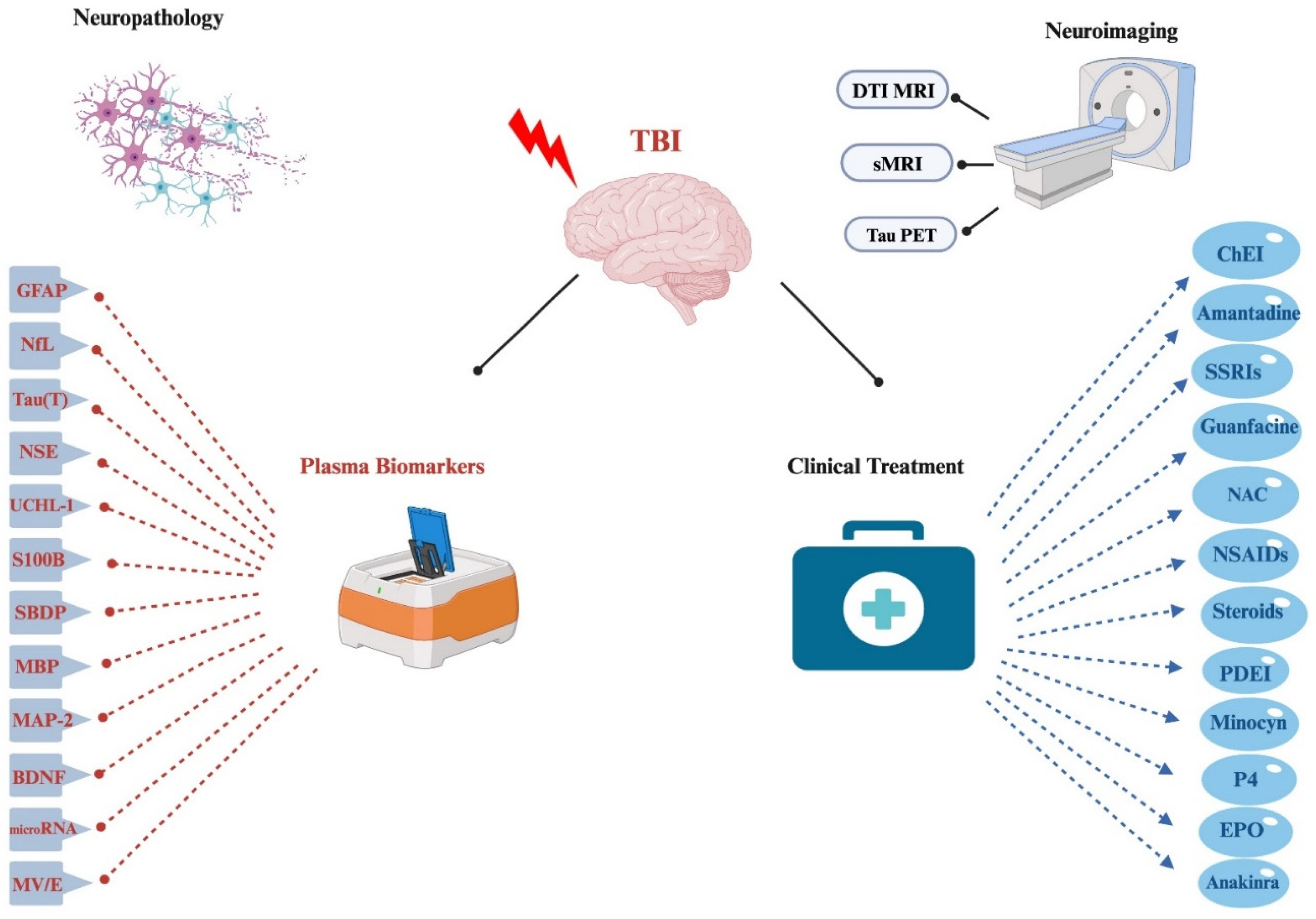
Figure 2.
Top panel: Depiction McKee staging system (I-IV). McKee Stage I CTE is define by one or two isolated CTE lesions at the depths of the cortical sulci. In stage II, there are typically three or more cortical CTE lesions. In stage III CTE, there are multiple loci of CTE lesions and diffuse NFTs in the medial temporal lobe. In stage IV CTE, CTE lesions and NFTs are ubiquitously distributed throughout the cerebral cortex, diencephalon, and brainstem. Bottom panel: a Pathognomonic CTE lesion in stage I CTE using AT8 positive neurofibrillary tangles, dot-like and threadlike neurites surrounding a small blood vessel. b Characteristic CTE lesion in stage II CTE. A cluster of AT8 positive neurofibrillary tangles and dense dot-like neurites encircling several small blood vessels, c Defining CTE lesion in stage III CTE. A large collection of AT8 positive neurofibrillary tangles and dense dot-like neurites enclose several small blood vessels. d Pathognomonic CTE lesion in stage IV CTE. A large accumulation of AT8 positive neurofibrillary tangles. [Images adopted from McKee at al. Acta Neuropathologica 2023195].
Figure 2.
Top panel: Depiction McKee staging system (I-IV). McKee Stage I CTE is define by one or two isolated CTE lesions at the depths of the cortical sulci. In stage II, there are typically three or more cortical CTE lesions. In stage III CTE, there are multiple loci of CTE lesions and diffuse NFTs in the medial temporal lobe. In stage IV CTE, CTE lesions and NFTs are ubiquitously distributed throughout the cerebral cortex, diencephalon, and brainstem. Bottom panel: a Pathognomonic CTE lesion in stage I CTE using AT8 positive neurofibrillary tangles, dot-like and threadlike neurites surrounding a small blood vessel. b Characteristic CTE lesion in stage II CTE. A cluster of AT8 positive neurofibrillary tangles and dense dot-like neurites encircling several small blood vessels, c Defining CTE lesion in stage III CTE. A large collection of AT8 positive neurofibrillary tangles and dense dot-like neurites enclose several small blood vessels. d Pathognomonic CTE lesion in stage IV CTE. A large accumulation of AT8 positive neurofibrillary tangles. [Images adopted from McKee at al. Acta Neuropathologica 2023195].
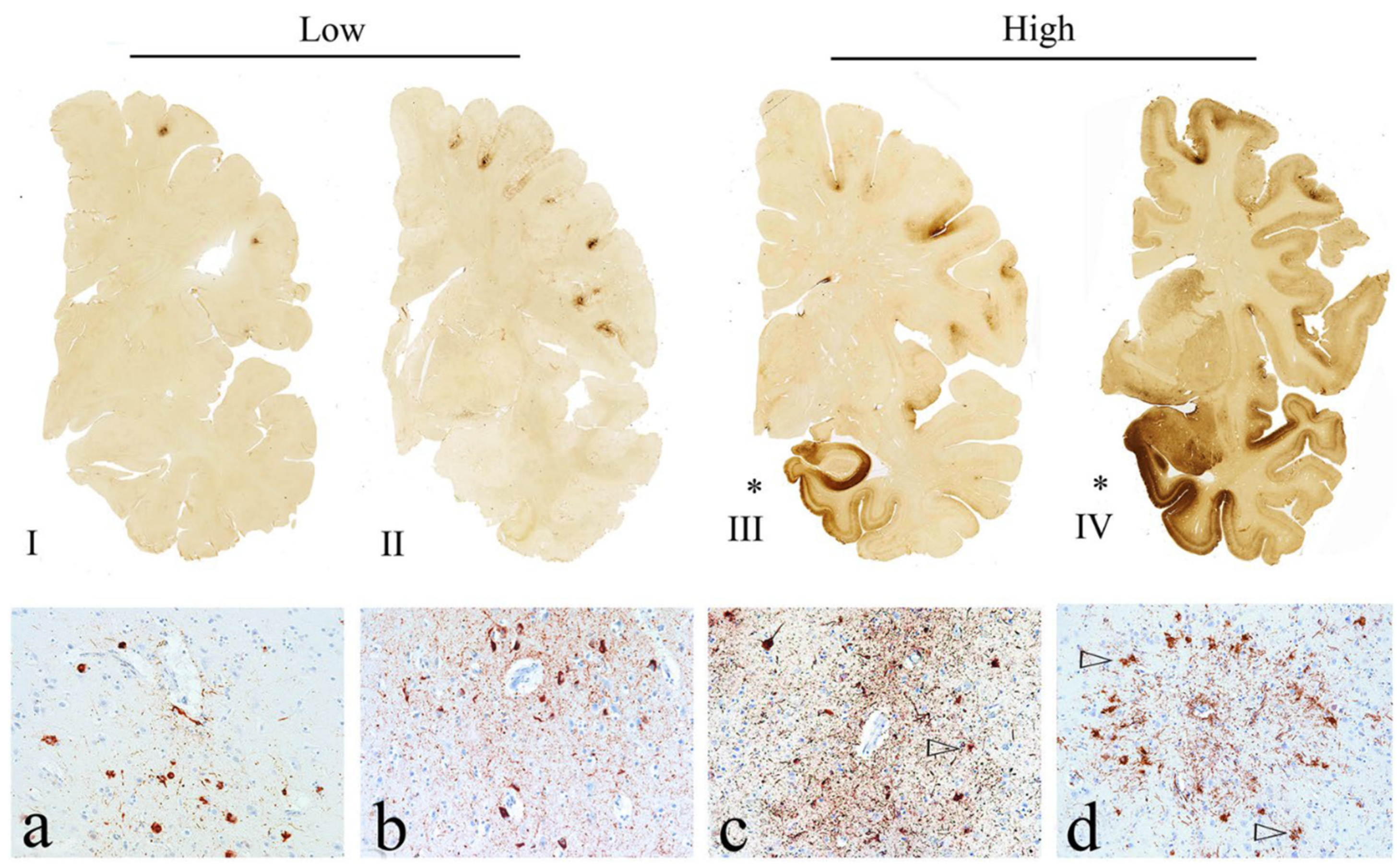
Figure 3.
Representative images using immunofluorescent staining for PHF1 of coronal cerebral cortex sections within 0.5–1 mm medial to the site of injury in 7.5-month-old control mice from SV (Sham Vehicle treated), IV (Injured Vehicle treated), and IA (Injured AZD0530 treated) groups. [Images adopted from Tang et al. Acta Neuropathologica Communications 202094].
Figure 3.
Representative images using immunofluorescent staining for PHF1 of coronal cerebral cortex sections within 0.5–1 mm medial to the site of injury in 7.5-month-old control mice from SV (Sham Vehicle treated), IV (Injured Vehicle treated), and IA (Injured AZD0530 treated) groups. [Images adopted from Tang et al. Acta Neuropathologica Communications 202094].
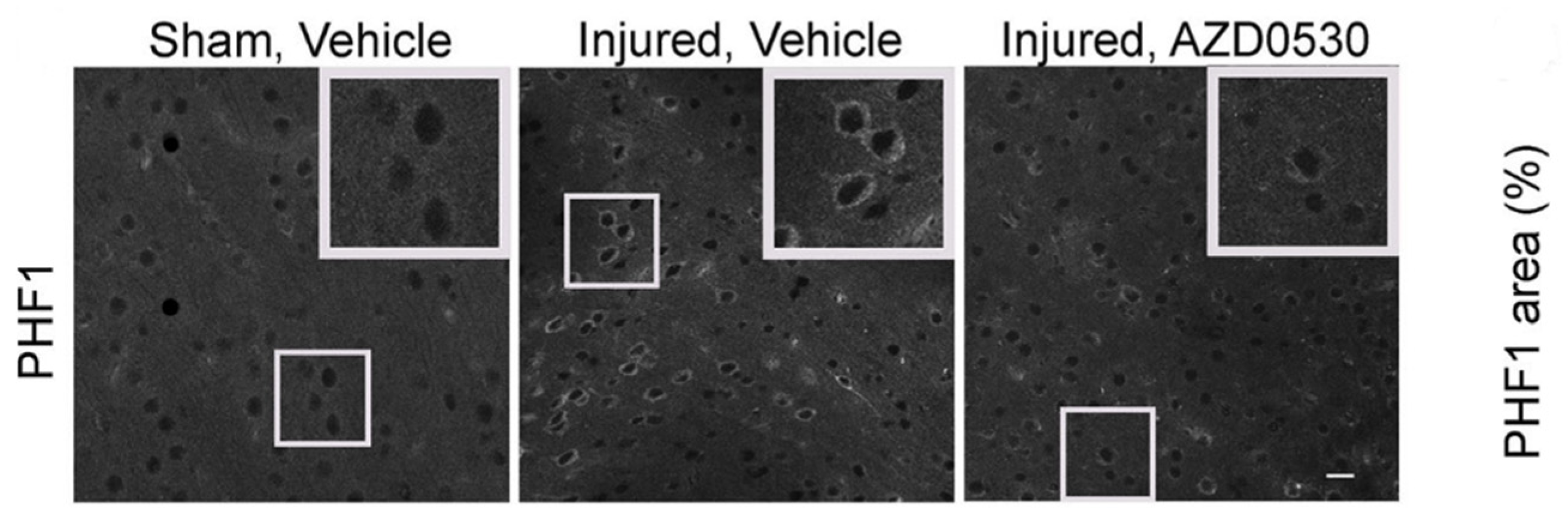
Table 1.
TBI Plasma Biomarkers. Summary of reported TBI serum markers including GFAP (Glial Fibrillary Acidic Protein), NfL (Neurofibrillary light chain), total tau, NSE (Neuron Specific Enolase), UCHL-1 (Ubiquitin C-terminal hydrolase-1), S100B, SBDP (Spectrin Breakdown Products), MBP (Myelin Basic Protein), MAP-2 (Microtubule-Associated Protein-2), BDNF (Brain Derived Neurotrophic Factor), microRNA, and MV/E (microvesicles and exosomes).
Table 1.
TBI Plasma Biomarkers. Summary of reported TBI serum markers including GFAP (Glial Fibrillary Acidic Protein), NfL (Neurofibrillary light chain), total tau, NSE (Neuron Specific Enolase), UCHL-1 (Ubiquitin C-terminal hydrolase-1), S100B, SBDP (Spectrin Breakdown Products), MBP (Myelin Basic Protein), MAP-2 (Microtubule-Associated Protein-2), BDNF (Brain Derived Neurotrophic Factor), microRNA, and MV/E (microvesicles and exosomes).
| Serum Biomarker | TBI Outcomes |
|---|---|
| GFAP | Clinical TBI studies have reported longitudinal elevation in GFAP levels 27. GFAP was also recently approved by the FDA as a TBI outcome clinical measure 47. |
| NfL | Clinical TBI studies have reported elevated NfL serum levels both acutely and longitudinally27. |
| Tau (total) | Total tau elevation has been reported both acutely and chronically in TBI populations 27. |
| NSE | NSE elevated levels have reported in both mild and more severe TBI populations31,32. |
| UCHL-1 | UCHL-1 has been shown to be robustly elevated in both mTBI and more severe TBI patients 134. UCHL-1 was recently FDA approved as a TBI outcome clinical measure 47. |
| S100B | S100B has been reported to be more acutely elevated in various TBI severity cases 48,49. |
| SBDP | SBDPs are products of calpain and caspase-3 post TBI, and have been reported to be elevated in both preclinical and clinical studies 56,65. |
| MBP | MBP is an oligodentrocyte protein and a product of proteases including calpain and reported to be elevated in severe TBI patients 43,64. |
| MAP-2 | An emerging biomarker for TBI patients39. |
| BDNF | Mainly reported in the preclinical TBI studies, with potential application to clinical TBI population67. |
| microRNA | a class of small endogenous RNA molecules, and has been reported to be elevated in biofluid (CSF, serum, or plasma) in several rodent models of TBI of various severities69. |
| MV/E | lipid-bilayered, encapsulated particles (10–100 nm in diameter) that are released from cells into the CSF and blood during TBI73. reported elevated MV/E released into CSF in TBI patients74. |
|
Proinflammatory cytokines (IL-6, IL-1, IL-8, IL-10, TNFα, CRP) |
Proinflammatory markers, especially Il-6 and CRP have been shown to have robust diagnostic and prognostic value (ref). |
Disclaimer/Publisher’s Note: The statements, opinions and data contained in all publications are solely those of the individual author(s) and contributor(s) and not of MDPI and/or the editor(s). MDPI and/or the editor(s) disclaim responsibility for any injury to people or property resulting from any ideas, methods, instructions or products referred to in the content. |
© 2023 by the authors. Licensee MDPI, Basel, Switzerland. This article is an open access article distributed under the terms and conditions of the Creative Commons Attribution (CC BY) license (http://creativecommons.org/licenses/by/4.0/).
Copyright: This open access article is published under a Creative Commons CC BY 4.0 license, which permit the free download, distribution, and reuse, provided that the author and preprint are cited in any reuse.


