

Submitted:
18 October 2023
Posted:
19 October 2023
You are already at the latest version
Abstract
As a prominent organizational issue there was limited evidence in the literature about the relationship between organizational strategy, workplace health, safety, and wellbeing, and performance measurement that demonstrate a measurable impact on organizational performance. Whilst the literature reports numerous studies into the relationship between employee engagement and performance, they hardly incorporate workplace health, safety, and well-being within this relationship. This mixed-methods study investigated the relationship between organizational strategy, workplace health, safety, and wellbeing strategy, employee engagement, and strategy efficacy from a corporate perspective. Findings from Phase two, the online survey, revealed a seven-factor HSW Strategy framework. The workplace health, safety, and wellbeing strategy framework provide empirical evidence towards a suitable and valuable framework for high-risk businesses to improve individual and organizational performance.
Keywords:
health and safety
; wellbeing
; strategy
; sustainability
; resilience
1. Introduction
The safety and well-being of an organization’s people [talent] are key to achieving the goals of its strategy and broader organizational performance [1]. As such, organizations have a role in ensuring that talent is in an optimal state of well-being and engagement, including having decent meaningful work [2,3] that enables them to realize strategic goals. Organizations increasingly recognize the importance of the relationship between talent safety and wellbeing, and strategy success, which ultimately benefits both the individual and organization.
However, traditional indicators suggest that the human and financial costs of work-related injury, illness, chronic disease, and mental health issues are significant detractors of optimal performance in Australia [4,5]. Workplace health, safety, and wellbeing (HSW) is not limited to individual consequences only but can also affect the ‘financial, interpersonal and reputational health of a business and, potentially, the wider community’ [6] (p.8).
As such, HSW is a strategic imperative that organizations must respond to [7,8] including being on the “corporate agenda” as a governance and strategic priority [9]. Recognition of the broader impact of HSW also fits with concepts such as corporate social responsibility [10], license to operate [11], and legitimacy obligations which also represent a shift away from the focus on risk and risk mitigation as it relates to workplace health and safety.
HSW has largely remained detached from organizational strategy. Organisational-level HSW is a challenging area due to the operational focus of corporate strategies and plans aimed at improving workplace-level performance. There is limited evidence reported in the extant literature connecting HSW to organizational strategy and its potential contribution to achieving organizational goals. Yet, achieving business goals is increasingly empirically associated with subsequent performance [12]. As such, there is a clear need to conceptualize the relationship between enhancing HSW capacity and strategic performance in achieving organizational goals.
Surprisingly, organizations have had little insight into how HSW adds value in achieving organizational strategic goals as much of the traditional focus of workplace health and safety has been dominated by a risk management and mitigation approach. The dominant aim has been to minimize the potential for unexpected negative outcomes in the workplace such as avoiding the costs associated with workplace injuries, disability, and illness. Consequently, the business case and potential added value of HSW have resulted in numerous commentators reporting on the “benefits” of HSW to include both operational and strategic perspectives [13,14,15]. What is less known, representing a gap in the extant literature, is a practice perspective as to how HSW can be strategically operationalized to achieve optimal organizational outcomes when these outcomes have traditionally been framed in terms of the “benefits” derived from the prominent risk management approach to HSW.
The benefits of HSW
The current notion of “benefits” has largely employed a broad cross-section of reporting indicators such as reduced injuries and illness, reduced worker compensation costs, and improved productivity and compliance [16,17,18]. They have been predominantly associated with a risk management approach with the aim of mitigating risk to achieve “zero incidents”. More recently the focus has shifted to areas such as safety management systems, leadership and culture, and performance measurement to articulate the value of workplace health and safety [15,19].
However, such “benefits” appear to be limited in their ability to demonstrate the business value of HSW from a strategic perspective. This is especially apparent given that performance improvement attributed to traditional workplace health and safety practices has plateaued in the quest for “zero incidents” aimed at reducing costs and improving productivity. Furthermore, there are limited literature sources that consider corporate sustainability and social responsibility indicators. Indeed, it can be argued that focusing on an organization’s sustainability and social fiduciary responsibility from an HSW perspective will generate outcomes that include, but are not limited to, the traditional workplace health and safety indicators of success while enabling higher levels of employee engagement with the organization’s strategic priorities.
From a practice perspective, it has become clear that the reliance on traditional approaches, including hazard management, safety management systems, human factors (physical and psychological attributes and considerations), and culture is not going to achieve the desired level of health and safety performance improvement alone [20], or contribute to the strategy outcomes of an organization. Hence, greater governance and oversight, more resilient business controls [6,21], and a reconceptualization of HSW measurement that focuses on the presence of capacity and positive work outcomes [22] have shifted to becoming a strategic imperative.
In recognition of the limitations of traditional approaches [risk mitigation foci and narrow understanding of benefits], views such as “high-reliability organizations” [23], resilience engineering [24], and “Safety 2” [24,25] have emerged to illustrate new thinking about organizational safety and its management. These approaches provide adaptable risk models that enable the use of resources [including talent] in a proactive manner to balance safety and operational aspirations [26]. Although being extremely valuable in changing the focus, these frameworks appear to remain safety-centric with health and wellbeing being cast as prominent occupational and societal risks [27] rather than a strategic opportunity.
Strategy and HSW
It is evident that new holistic strategy-centric HSW approaches are required [28,29] that enhance engagement and discretionary effort to leverage talent to engage with organizational strategic priorities and improve organisational outcomes. These approaches need not only mitigate pathologies and risk but support positive individual and organisational outcomes, through a shift to wellness thinking [30].
From a talent perspective, there is well-established evidence that employee health and well-being, engagement, and individual and organisational performance outcomes are systemically linked [13,31]. However, high levels of work and job dissatisfaction continue to be reported suggesting that increasing disengagement is a significant talent issue for business [32]. Coupled with declining levels of physical and psychological health has resulted in employees seeking a more balanced working life that supports greater overall well-being. When employees perceive that they are unable to achieve greater work / life balance, they default to disengaging from their work to accommodate a greater sense of well-being. This has significant implications within the context of realizing organisational aspirations. Central to addressing this common issue is having a safe working environment and conditions [33], a sense of work-related personal growth and accomplishment [34], and engagement derived from decent meaningful work [2,3].
From an organisational strategy perspective, the need to maintain high levels of employee engagement to realize organisational aspirations resonates with the commonly held assumption that talent is critical to strategy development. This is because engagement is associated with the generative and synergistic value motivated employees contribute to organisational systems [35]. Not only does higher engagement contribute to anticipating the future and the creation of enabling work environments [22], but is fundamentally necessary for innovation and the execution of organisational strategy [36]. Furthermore, engaged employees fulfil the role as the central actors within the HSW strategy implementation process [37].
To operationalize HSW as an enabler of strategy and innovation requires that talent understand how their role contributes to the broader purpose of the organization. This is achieved by providing a “Line of Sight” defined ‘as an employee’s understanding of the organizations strategic goals and what actions are necessary’ [39] (p.500) in its execution. In contrast, a lack of meaning and purpose, role clarity and alignment with organisational goals has been found to have a negative impact on personal wellbeing, engagement, and ultimately the achievement of organisational goals [34,39,40,41].
With such challenges in the operational environment, we suggest that there is: (a) a strategic organisational performance incentive associated with increasing employee engagement within HSW, and (b) a clear need to shift thinking and practice enabled by frameworks that place an emphasis on health and wellbeing within the organizations strategy to (c) achieve optimal individual outcomes that benefit the organization as described by the “mutual gains” hypothesis [42].
Despite the recognition that traditional HSW approaches are limited in their ability to realize strategic goals, to date there has been limited empirical evidence about the relationship between organisational strategy, HSW, and organisational performance measurement. Models and frameworks that have attempted to illustrate the complexity of this proposed relationship are also rare. Whilst the literature reports numerous studies concerning the relationship between employee engagement and performance, they have not defined and operationalized HSW strategy within this relationship. This gap led to calls for further research into HSW from a business perspective [28,29].
How then, can organizations strategically incorporate HSW imperatives to achieve improved performance outcomes within the context of exponentially increasing prevalence of chronic disease, mental health issues, and job dissatisfaction?
A key premise of this paper is that a practice perspective for operationalizing HSW in an organization’s corporate strategy is missing from the literature and necessary to gain traction in deriving strategic value for organizations. Drawing on prominent theories, models, and frameworks from the extant literature, this paper presents a HSW strategy and employee engagement framework that seeks to address this gap. It does so by integrating organisational and WHS strategy, employee engagement, and well-being in an attempt to optimize strategy realization. The purpose of this paper is twofold: firstly, as part of a broader mixed method study it provides a brief review of the initial framework derived from the literature and revised in phase one of the study, and secondly, to report on the outcomes from the second quantitative phase that sought to determine the validity and reliability of the HSW strategy and employee engagement framework within the context of an organisational strategy.
2. Literature Review
The broad objective of our study was to develop an industry confirmed HSW strategy and employee engagement framework for integration into organisational strategy within the Australian context. A systematic literature review was conducted. To ensure relevance to the study, key words including workplace health and safety, safety culture, wellness, wellbeing, strategy, strategic management, corporate governance, employee engagement, leadership, motivation, safety or health or wellbeing performance measurement were used to guide the search. The literature review revealed several models or frameworks pertaining to HSW approaches in addition to well-developed theories for organisational strategy and employee engagement. The following are briefly highlighted as they were deemed suitable to inform the objectives of the study.
- Organisational strategy. Discussion on strategy formulation in the literature suggests that it is a complex process comprising cognitive, behavioral, social, and technical dimensions [43]. A prominent theory of strategy formulation extensively reported in the literature associated with HSW is the resource-based view (RBV) with significant contributions coming from the work of Barney[44], Prahalad and Hamel[45] and recently Miller [46]. RBV adopts an “inside-out” view by focusing on the internal capabilities of the organization, tangible and intangible resources and core competencies to be competitive and sustainable [47]. Strengths of RBV include that it provides the initial direction for the organization and defines the resources required as “inputs” that enable an organization to carry out its activities are the primary source of a business profit [47]. Talent, and the attendant organisational capabilities are considered a source of competitive advantage and are therefore central to the execution of the organization’s strategy and achievement of strategic goals.
- Workplace safety. Safety science has evolved significantly through recent theories such as “Safety 2” [22] and resilience engineering [26]; both of which have contributed to the reconceptualization of organisational safety management. These approaches support a more adaptive and responsive process recognizing employees as being a crucial “solution” in maintaining the balance between organisational performance and safety which is a far more positive approach to the traditional risk mitigation focus. From a strategic perspective, Carden et al., [12] (p.143) outline a model drawing on enterprise-wide risk management principles suggesting that it is ‘imperative for companies to manage unforeseen events and safety risks’. The model is based on the input (safety risks) – process (corporate governance) – output (fewer incidents) quality management approach. Significantly, the approach was consistent with the framework applied to wellbeing by Danna and Griffin [48].
More recently, Zou and Sunindijo [49] outline a strategic safety management approach applied to the construction and engineering sector which aligns with traditional business centric methods. Strategy formulation, they suggest consists of phases related to: (a) the circumstances in which strategy emerges (Strategy context), (b) how strategy content is developed (Strategy process), and (c) the dimensions, content, and outcome of the strategy process for implementation (Strategy content).
Consistent with traditional business thinking the framework includes a safety vision, goals, and core competencies with the starting point for strategy development being an assessment of the strengths and weaknesses of existing safety strategies, and the external environment to formulate new strategies, develop implementation and evaluation plans. Similarly, the concept of “guided adaptability” informed by resilience engineering theory is a shift from traditional thinking to a more proactive business centric approach adopted to balance safety and organisational performance requirements through organisational capacity. Guided adaptability dimensions of Anticipation, Readiness to respond, Synchronization and Proactive learning [26] support the creation, revision, and refinement of risk models in strategy development that meet operational demands, whilst maintaining safety.
- Workplace health and wellbeing. Despite limited evidence, one strategic approach that focuses on the macro level of the enterprise is the Healthy Workplace Framework [50]. This framework establishes four avenues to address and promote holistic worker health, safety, and wellbeing: (i) the psychosocial work environment (ii) the physical work environment (iii) personal health resources, and (iv) linkages between the enterprise and its wider community” (p.83). More recently, Cooklin et al., [51] applied this framework in several Australian workplaces and found that there were positive associations with such interventions. Similar frameworks to follow this methodology include the UK Work Well Model (2017) and US NIOSH Total Worker Health Model (2011). It is also evident that the design of work and promotion of recovery is often an overlooked element of wellbeing. One organization centric theory that supports this is the job-demand resources (JDR) model [39] which seeks to optimize a balance between personal “inputs and outputs”. JDR considers that the individual’s resources such as job autonomy, supervisor support, and goal clarity create motivation, but once the demands of the role exceed the individual’s ability to cope, performance is reduced due to physical and psychological health impairment.
Based on a review of the literature summarized above, an initial framework was developed to operationalize HSW with the organisational strategy context. The initial framework included the following constructs ensuring the proper delineation of study based on the theory and extant literature. The adopted constructs and definitions are outlined below:
- Organisational Context. The set of organisational circumstances under which the strategy process and content is determined to set the direction and scope of an organization over the long term. It is informed by how employees perceive the enactment of organisational policies and procedures relating to HSW in their organization at a given point in time and the organizations obligations beyond legal compliance [52].
- HSW Strategy. A strategic direction and allocation of resources dedicated to matching internal capabilities with opportunities and threats in achieving a future state of HSW, as embedded in, and acknowledged as a priority of the organisational strategy while being underpinned by the organisational mission, values, and priorities [52].
- HSW Employee engagement. A workplace approach designed to ensure that employees are committed to their organisation’s goals and values, motivated to contribute to organisational success, and are able at the same time to enhance their own sense of well-being through a positive, fulfilling, work-related state of mind that is characterized by vigor, dedication, and absorption [52].
- Leadership. Strategic leadership is the ability to anticipate, envision, maintain flexibility, think strategically, and work with others to initiate changes that will create a viable future for the organization [53].
Having developed the initial framework, the study progressed to testing and refining the model based on an exploratory study methodology. In the next section we outline the methodology applied to this study into HSW strategy and employee engagement.
3. Materials and Methods
The study adopted a pragmatic paradigm, in that it was problem focused and did not ascribe a particular ontology to its perspective. Rather, it sought to explore the nature of the problem [operationalizing HSW as part of organisational strategy] and provide an evidence-based insight as to a possible response to the problem. The study adopted a sequential mixed methods approach incorporating both qualitative enquiry (to gain a deeper understanding) and quantitative enquiry to validate the qualitative insights and triangulate the data.
The methodology is illustrated in Figure 1 below.
Summary of Semi-structured Interviews [Phase one – qualitative enquiry]
Eight semi-structured interviews with industry experts were conducted in phase one revealing 17 themes relating to each construct of the initial framework. These themes were used for the development of the survey instrument to validate the findings from phase one across a larger sample of the population and triangulate the modification of the framework in phase two. In addition to providing richer data and a greater depth of understanding of each proposed construct the participants were also asked to review the full framework. This led to a revised framework for investigation in phase two (Figure 2). Prior to progressing to the online anonymous survey development and administration, the revised framework was provided to the participants from the semi-structured interviews to confirm that the changes reflected their input and was acceptable. No further changes were required following the review by phase one participants.
Triangulation and validation of Phase One results [Phase Two – quantitative enquiry]
Phase two of the mixed method study was a cross-sectional survey used to (a) triangulate and [b] validate the qualitative findings from phase one. It sought to refine the framework from an alternative source of data while also validating the HSW strategy and employee engagement constructs embedded in the initial framework. The second phase of the study also examined the associations between the variables presented in the initial framework. The HSW Strategy and Employee Engagement Survey (WEES) was designed specifically for this study and was presented in three parts (i) demographics, (ii) HSW strategy, and (iii) Employee engagement, including the Utrecht Work Engagement Scale (UWES) variables as presented in the initial framework (Figure 2).
Participant selection
A non-probability sampling approach was deemed as being the most appropriate for the pilot and the main phase of the survey because it ‘will produce findings that can be transferable to other studies’ [54] (p. 15) and purposefully selects participants that are familiar with the subject matter. The criteria established to select appropriate participants and delimit the sample group was based on the following:
- experience at a management level (middle or executive) responsible for the WHS or wellbeing strategy; or
- experience at a management level (middle or executive) responsible for employee engagement or human capital management; and,
- currently working in either public or private sector organizations.
Survey development and administration
Prior to administration the draft WEES instrument was provided to the semi-structured interview (Phase one) participants to review the format and questions proposed for each construct. This was deemed necessary as: (a) most of the questions contained in the survey had not been applied in a research setting, and (b) a similar conceptual framework to what was developed had not been tested in previous studies.
Pilot Survey
Piloting was a crucial step in the research process as it provided insight into problems associated with ‘wording, order, and presentation of questions that might cause respondents to provide inaccurate responses’[58] (p. 738). The survey pilot adopted a convenience sampling strategy. Initially seven respondents completed the pilot survey. Snowball sampling was then utilized to increase the responses by requesting the initial group to provide the survey link to known cases that met the sample group criteria for completion. The pilot phase served to modify the main survey instrument and ensure it adequately captured the associations between the variables and understanding the who, what and why of the population [59]. Consequently, the pilot phase was able to confirm that the instrument was suitable for the administration of the main survey.
Main Survey
The main survey was conducted via an anonymous online platform (Lime Survey software). Participants for the main survey were recruited through purposive sampling. As noted in the literature [60] recruitment of participants that have specialized knowledge and / or leadership in their fields typically yield low response rates. Despite this challenge the study was able to recruit, vet, and accept 95 completed responses that met the sampling criteria.
Data analysis
On completion of the survey, data were checked to confirm the sampling criteria was met and the completeness of each case. All cases that did not meet the criteria or have at least 95 percent completion of the survey, were discarded. The remaining data was then cleaned and screened using Statistical Package for Social Sciences (SPSS) software. The data were checked for missing values and the normality of distribution using descriptive statistics, including skewness and kurtosis values and probability plots. No further cases were deleted.
The SPSS analysis output identified one (1) missing value in the “Gender” response question which used a series mean to complete the case data.
An exploratory factor analysis (EFA) was conducted. The Maximum Likelihood method was used due to the normality of the dataset (Hair et al., 2009) and because it allowed computation of a wide range of indexes of the goodness of fit, statistical significance testing of factor loadings, and correlations among factors, and the computation of confidence intervals [61]. Oblique (Oblimim) rotation was applied to achieve the most parsimonious model because the items were deemed to be mostly correlational in nature when rotated [62,63].
4. Results
4.1. Sample Demographics
Of the 95 valid respondents, 69.5 percent were male with the majority being senior managers (48.5%) with 10 years or more experience (82.1%). This suggested they were well advanced in their career at a senior decision-making level; and were suitably positioned to respond to questions on HSW strategy development and employee engagement in organizations. Most (79%) had postgraduate qualifications suggesting advanced theoretical understanding of certain key concepts.
The majority of the 95 responses were from Queensland (43.2%). 49.5 percent of responses were in the ‘Other’ industry type which included “high risk” industries such as utilities, power transmission, and resources/energy organizations.
Table 1 provides the demographics frequency breakdown for position, discipline, gender, location, industry type, experience, and education.
4.2. HSW Strategy Scale
For the 27 items measuring HSW strategy, latent variable, 19 (70%) reported a mean score of four or above (Agree or Strongly Agree). The question that the sample group mostly agreed with was ‘Leadership influences organisational context, work health, safety, and wellbeing strategy and employee engagement’ (M=4.59, SD=.78). This result was consistent with the views of most participants from the semi-structured interview phase, and literature review, in that leadership effects strategy understanding, prosocial safety behavior, discretionary effort, wellbeing, and employee engagement. The second most supported question was ‘Prevention of harm, including physical safety is an inherent core of worker wellbeing’ (M=4.57, SD=.66). In contrast, the question that respondents were least likely to agree with was ‘Individual enablers influence work health, safety, and wellbeing strategy’ (M=3.73, SD=.92).
Examination of the means and standard deviations for the questions relating to each construct included in the HSW Strategy items (Organisational context, HSW strategy, HSW employee engagement, and HSW strategy efficacy) indicated consistent mean scores across each of the attributes indicating that the instrument provided meaningful information about the attributes being studied [64].
An Exploratory Factor Analysis (EFA) of the 27 questions measuring HSW strategy were analyzed using the Maximum Likelihood method with Oblique (Oblimim) rotation. The rotated solution produced a seven-factor model with eigenvalues of greater than one explaining 52 percent of the variance. The Kaiser-Meyer-Olkin Measure of Sampling Adequacy was good (0.70), and Bartlett's Test of Sphericity (x2=949.114, df=351, p<0.000) indicated that the data fit the model well and the appropriateness of factor analysis and extraction. The instrument yielded a high reliability statistic with a Cronbach's alpha of 0.86. Each of the factors was reviewed based on current theory to determine the construct they best represented based on the structure matrix loadings.
Table 2 outlines the mean, standard deviation, and factor item loadings for the Structure matrix across each of the seven factors.
The seven factors revealed for HSW strategy mapped well against the revised conceptual framework from phase one, supporting the proposed relationships between organisational context, strategy content, and employee engagement, and strategy efficacy.
The factors are summarized below:
- Factor one was explained by two variables with loadings of 0.41 and 0.80. This represented the physical safety and personal growth elements of HSW. This was labelled Worker Wellbeing.
- Factor two was explained by one variable with a loading of -0.97 and represented the UWES (vigor, dedication, and absorption), risk recognition, proactive action, and individual capability. This was labelled Individual Capacity.
- Factor three was explained by three variables with loadings of 0.54, 0.70 and 0.74, This factor represented relationships between engagement, efficacy, and strategy feedback loops in the conceptual framework. This was labelled Engagement and Efficacy.
- Factor four was explained by six variables with loadings ranging between 0.41 to 0.70 representing the organisational context in which the HSW strategy emerges, and content dimensions for safety, wellness, and wellbeing from the conceptual framework. This was labelled Strategy Context and Content.
- Factor five was explained by three variables with loadings ranging between 0.44 to 0.68. This represented attributes such as leader-member coaching, mentoring, strength of interpersonal relationships, and the individual’s ability to influence and act on HSW. This was labelled Connection and Ownership.
- Factor six was explained by two variables with loadings of -0.64 and -0.60. This factor represented relationships between engagement and efficacy and organisational processes. This was labelled Engagement and Processes.
- Factor seven was explained by two variables with loadings of 0.54 and 0.53. This factor represented processes inclusive of governance, resourcing requirements, and involvement of employees at various levels in the organization in strategy to determine the content. This was labelled Strategy Process Content.
In summary, the seven factors revealed for HSW strategy were consistent with the framework derived from the literature and phase one of the study. An examination of the means and standard deviations for the questions relating to each construct (organisational context, HSW strategy, HSW employee engagement, and HSW strategy efficacy) indicated consistent mean scores across each of the attributes indicating that the instrument provided meaningful information about the attributes being studied [64], confirming the frameworks internal validity.
5. Discussion
As outlined the broad objective of our mixed method study was to develop a strategy-centric framework which placed employee health and wellbeing as an organisational strategic priority within the broader context of the organizations’ overarching strategy. The following is a discussion of the results and key findings relating to the HSW Strategy Framework.
Our proposed framework (Figure 2) comprised elements relating to the way in which strategy emerges, its dimensions, and implementation. Although strategy efficacy was recognized as a key component of the framework, due to the extensive literature in this domain, this area is excluded from further discussion as it was delimited in our study.
- Organisational context. The online survey was able to confirm that immediate and long term HSW strategy content is determined by internal organisational aspects and external obligations. An organizations’ HSW strategy content and priorities are informed by the strategy process embedded within organisational context. This context relates to legal obligations and corporate governance requirements and its effect on organisational culture. In addition, the consideration of organisational strategy requires feedback loops within the strategy cycles informed by employees’ perception of HSW priorities based on normal work and risk. This was confirmed by both phases of the study. As such, our study was able to make original contribution and define organisational context as:
The set of organisational circumstances under which the strategy process and content is determined to set the direction and scope of an organization over the long term. It is informed by how employees perceive the enactment of organisational policies and procedures relating to HSW in their organization at a given point in time and the organizations’ obligations beyond legal compliance.
- HSW strategy. The study proposed that the HSW strategy process and content are interrelated and need to match internal capabilities with the risk and opportunity management efforts of the organization to achieve a future state of HSW, acknowledged as an organisational strategic priority. In our study the HSW strategy dimensions included within the conceptual framework were informed by, and was able to extend, the frameworks outlined by Zou and Sunindijo [49], Yorio, Willmer, and Moore [37], World Health Organisation and Burton [50] and O’Neill and Wolfe [6]. It was also evident that prominent contributions from Hollnagel [22], and Provan et al., [26] informed current thinking on strategy which has attributes that are analogous with the resource-based view. In particular, guided adaptability dimensions of Anticipation, Readiness to respond, Synchronization and Proactive learning [26] were incorporated in the framework to support the creation, revision, and refinement of risk models in strategy development that meet operational demands. As such, the dynamic iterative cycle adopted for this study related to organisational context, corresponds with strategy development as outlined by Zou and Sunindijo [49], and with the Anticipation and the Plan and Revise phase of resilience engineering. In this study, Readiness and respond phase were aligned with the matching of resources and capabilities, Synchronization and Proactive learning phases were related to the feedback loops as iterative cycles and strategy efficacy indicators were included in the conceptual framework developed for this study. This research, therefore, made original contribution to the research in HSW through the operationalization and validation of HSW strategy in phase one and two, and was able to re-define HSW strategy as:
A strategic direction and allocation of resources dedicated to matching internal capabilities with opportunities and threats in achieving a future state of HSW, as embedded in, and acknowledged as a priority of the organisational strategy while being underpinned by the organisational mission, values, and priorities.
6. Conclusion
This study sought to address the gap in the literature related to conceptualizing and deriving the definition and operationalization of HSW strategy within the organisational strategy context. Importantly, the study was able to address the calls for further research [28,29] into HSW from a business perspective because of a paucity of research with a limited focus on health and wellbeing as a priority within organisational strategy. More specifically this study provided new professional practice insights by demonstrating HSW and its relationship with organisational strategy. This resulted in an industry validated framework (Figure 2) that may enable “high-risk” businesses to strategically improve HSW and business performance.
This study added to the limited number of reported mixed-methods studies in the literature pertaining to HSW. The paper presents a conceptualized and validated framework that is intended to contribute to practice by conceptualizing how HSW can be operationalized in an organisational context. From a practice perspective the final framework was not able to be applied within situated research setting. Further research is necessary to examine the relationships between the components, support refinement of the framework and evaluate its impact on organisational improvement.
Further, future research opportunities may include (i) conducting a broad inter-disciplinary study across a cross section of industries to refine the framework (ii) extending the measurement component of the framework to evaluate impact and efficacy of the framework (iii) apply the framework and evaluate the short- and long-term benefits of the framework in a variety of professional settings.
Author Contributions
Conceptualization, BH and LvL; methodology, BH, LvL and AR; formal analysis, BH and LvL; investigation BH, LvL and AR; resources, BH; data curation, BH and LvL; writing—original draft preparation, BH and LvL; writing—review and editing, BH, LvL and AR; supervision, LvL and AR; project administration, BH; funding acquisition, LvL. All authors have read and agreed to the published version of the manuscript.
Funding
This research was funded through Australian Government Research Training Scheme.
Institutional Review Board Statement
The study was conducted in accordance with the Declaration of Helsinki and approved by the Ethics Committee of the University of Southern Queensland (H18REA120, 24/05/2018) for studies involving humans.
Informed Consent Statement
Informed consent was obtained from all subjects involved in the study.
Data Availability Statement
The data presented in this study are openly available from the University of Southern Queensland Exemplar Repository at https://doi.org/10.26192/fmfm-5e77.
Conflicts of Interest
The authors declare no conflict of interest. The funders had no role in the design of the study; in the collection, analyses, or interpretation of data; in the writing of the manuscript; or in the decision to publish the results.
References
- Zwetsloot, G. I. J. M.; van Scheppingen, A. R.; Dijkman, A. J.; Heinrich, J.; den Besten, H. The organizational benefits of investing in workplace health. International Journal of Workplace Health Management 2010. [Google Scholar] [CrossRef]
- Albrecht, S. L.; Green, C. R.; Marty, A. Meaningful Work, Job Resources, and Employee Engagement. Sustainability 2021, 13, 4045. [Google Scholar] [CrossRef]
- Wrzesniewski, A.; LoBuglio, N.; Dutton, J. E.; Berg, J. M. Job crafting and cultivating positive meaning and identity in work. In Advances in positive organizational psychology; Emerald Group Publishing Limited, 2013.
- Xiang, J.; Mittinty, M.; Tong, M. X.; Pisaniello, D.; Bi, P. Characterising the burden of work-related injuries in South Australia: a 15-year data analysis. International journal of environmental research and public health 2020, 17, 2015. [Google Scholar] [CrossRef]
- O’Neill, S.; Martinov-Bennie, N.; Cheung, A.; Wolfe, K. Issues in the Measurement and Reporting of Work Health and Safety Performance: A Review; Canberra., Available Online:. Available online: https://www.safeworkaustralia.gov.au (accessed on 01 December 2016).
- O’Neill, S.; Wolfe, K. Measuring and Reporting on Work Health and Safety; Safe Work Australia. Canberra. Avaliable online: https://www.safeworkaustralia.gov.au (acessed on 06 June 2018).
- Bar-Haim, A.; Karassin, O. A Multilevel Model of Responsibility Towards Employees as a Dimension of Corporate Social Responsibility. J. Mgmt. & Sustainability 2018, 8, 1. [Google Scholar]
- Kercher, K. Corporate Social Responsibility: Impact of globalisation and international business. Corporate Governance eJournal 2007, 4, 1–14. [Google Scholar] [CrossRef]
- Abbey, J. Work wellbeing : A new perspective. Governance Directions 2015, 67, 334–339. [Google Scholar]
- Zwetsloot, G.; Starren, A.; Schenk, C.; Heuverswyn, K.; Kauppinnen, K.; Lindstrom, K.; et al. Corporate Social Responsibility and Safety and Health at Work; European Agency for Safety and Health at Work: Luxembourg, 2004; Available online: https://www.lu.lv (accessed on 06 June 2019).
- Hopkins, A, Toohey, J, Stacy, R & Else, D. Orgnisations. In in HaSPA (Health and Safety Professionals Alliance), The core body of knowledge for generalist OHS professional; Safety Institute of Australia: Tullamarine, VIC, 2012; Available online: https://www.ohsbok.org.au (accessed on 19 19 August 2016).
- Carden, L. L.; Boyd, R. O.; Valenti, A. Risk management and corporate governance: Safety and health work model. Southern Journal of Business and Ethics 2015, 7, 137. [Google Scholar]
- Harter, J. K.; Schmidt, F. L.; Agrawal, S.; Plowman, S. K.; Blue, A. The Relationship between Engagement at Work and Organizational Outcomes Q12 Meta-Analysis; Gallup Organisation. 2013. Available online: https://news.gallup.com/reports. (accessed on 16 February 2017).
- McCarthy, G.; Almeida, S.; Ahrens, J. Understanding employee well-being practices in Australian organizations. 2011.
- Gahan, P.; Sievewright, B.; Evans, P. Workplace Health and Safety, Business Productivity and Sustainability:A Report Prepared for Safe Work Australia. Centre for Workplace Leadership; Canberra. Australia, 2014. avaliable online: https://www.safeworkaustralia.gov.au. (accessed on 27 August 2016).
- Zwetsloot, G.; Van Scheppingen, A. Towards a Strategic Business Case for Health Management; Work Healt.; Johansson, U., Ahonen, G., Roslander, R., Eds.; Taylor & Francis, 2007.
- Bevan, S. The Business Case for Employees’ Health and Wellbeing; The Work Foundation. London, 2010. Available online: http://investorsinpeople.ph/wp-content/uploads (accessed on 24 May 2016).
- Hafner, M.; van Stolk, C.; Saunders, C.; Krapels, J.; Baruch, B. Health, Wellbeing and Productivity in the Workplace; Europe. 2015. available online https://www.rand.org/pubs. (accessed on 06 June 2019).
- Braithwaite, J.; Hibbert, P.; Blakely, B.; Plumb, J.; Hannaford, N.; Long, J. C.; et al. Health system frameworks and performance indicators in eight countries: a comparative international analysis. SAGE open medicine 2017, 5, 2050312116686516. [Google Scholar] [CrossRef] [PubMed]
- Borys, D.; Else, D.; Leggett, S. The fifth age of safety: the adaptive age. Journal of health and safety research and practice 2009, 1, 19–27. [Google Scholar]
- Boardman, J.; Lyon, A. Defining Best Practice in Corporate Occupational Health and Safety Governance; London. 2006. Available online: https://www.hse.gov.uk (accessed on 20 September 2017).
- Hollnagel, E. A tale of two safeties. Nuclear Safety and Simulation 2013, 4, 1–9. [Google Scholar]
- Weick, K. E.; Sutcliffe, K. M. Managing the Unexpected: Resilient Performance in an Age of Uncertainty; John Wiley & Sons, 2011; Vol. 8.
- Hollnagel, E.; Woods, D. D.; Leveson, N. Resilience Engineering: Concepts and Precepts; Ashgate Publishing, Ltd., 2006.
- Hollnagel, E. Safety-I and Safety-II: The Past and Future of Safety Management; CRC press, 2018.
- Provan, D. J.; Woods, D. D.; Dekker, S. W. A.; Rae, A. J. Safety II professionals: How resilience engineering can transform safety practice. Reliability Engineering & System Safety 2020, 195, 106740. [Google Scholar]
- Litchfield, P.; Cooper, C.; Hancock, C.; Watt, P. Work and wellbeing in the 21st century. International Journal of Environmental Research and Public Health 2016, 13. [Google Scholar] [CrossRef]
- Fan, D.; Zhu, C. J.; Timming, A. R.; Su, Y.; Huang, X.; Lu, Y. Using the past to map out the future of occupational health and safety research: where do we go from here? The International Journal of Human Resource Management 2020, 31, 90–127. [Google Scholar] [CrossRef]
- Zanko, M.; Dawson, P. Occupational Health and Safety Management in Organizations: A Review. International Journal of Management Reviews 2012, 14, 328–344. [Google Scholar] [CrossRef]
- Biswas, A.; Begum, M.; Van Eerd, D.; Smith, P. M.; Gignac, M. A. M. Organizational perspectives on how to successfully integrate health promotion activities into occupational health and safety. Journal of Occupational and Environmental Medicine 2021, 63, 270–284. [Google Scholar] [CrossRef] [PubMed]
- Bryson, A.; Forth, J.; Stokes, L. Does Worker Wellbeing Affect Workplace Performance; London. 2014, available online:. Available online: https://www.gov.uk/government/publications (accessed on 18 June 2017).
- Lee, C.; Esen, E.; DiNicola, S. Employee Job Satisfaction and Engagement: The Doors of Opportunity Are Open; 2017.
- Swamy, D. R.; Nanjundeswaraswamy, T. S.; Rashmi, S. Quality of work life: scale development and validation. International Journal of Caring Sciences 2015, 8, 281. [Google Scholar]
- Warr, P.; Nielsen, K. Wellbeing and work performance. Handbook of well-being. Salt Lake City, UT: DEF Publishers, 2018. [Google Scholar]
- Melander, A.; Löfving, M.; Andersson, D.; Elgh, F.; Thulin, M. Introducing the Hoshin Kanri strategic management system in manufacturing SMEs. Management Decision 2016. [Google Scholar] [CrossRef]
- Van der Laan, L.; Yap, J. Foresight & Strategy in the Asia Pacific Region. Management for Professionals 2016. [Google Scholar]
- Yorio, P. L.; Willmer, D. R.; Moore, S. M. Health and safety management systems through a multilevel and strategic management perspective: Theoretical and empirical considerations. Safety science 2015, 72, 221–228. [Google Scholar] [CrossRef]
- Boswell, W. R.; Bingham, J. B.; Colvin, A. J. S. Aligning employees through “line of sight. ” Business horizons 2006, 49, 499–509. [Google Scholar] [CrossRef]
- Bakker, A. B.; Demerouti, E. The job demands-resources model: State of the art. Journal of managerial psychology 2007. [Google Scholar] [CrossRef]
- Hackman, J. R.; Oldham, G. R. Motivation through the design of work: Test of a theory. Organizational behavior and human performance 1976, 16, 250–279. [Google Scholar] [CrossRef]
- Truss, C.; Alfes, K.; Delbridge, R.; Shantz, A.; Soane, E. Employee Engagement in Theory and Practice; Routledge, 2013.
- Van De Voorde, K.; Paauwe, J.; Van Veldhoven, M. Employee well-being and the HRM–organizational performance relationship: a review of quantitative studies. International Journal of Management Reviews 2012, 14, 391–407. [Google Scholar] [CrossRef]
- Johnsen, Å. Strategic management thinking and practice in the public sector: A strategic planning for all seasons? Financial Accountability & Management 2015, 31, 243–268. [Google Scholar]
- Barney, J. Firm resources and sustained competitive advantage. Journal of management 1991, 17, 99–120. [Google Scholar] [CrossRef]
- Prahalad CK, H. G. The Core Competence of the corporation Harvard Business Review, Vol. 68. 1990. [Google Scholar]
- Miller, D. The resource-based view of the firm. In Oxford Research Encyclopedia of Business and Management; 2019.
- Henry, A. Understanding Strategic Management; Oxford University Press, USA, 2008.
- Danna, K.; Griffin, R. W. Health and well-being in the workplace: A review and synthesis of the literature. Journal of management 1999, 25, 357–384. [Google Scholar] [CrossRef]
- Zou, P. X. W.; Sunindijo, R. Y. Strategic Safety Management in Construction and Engineering; John Wiley & Sons, 2015.
- World Health Organisation; J.Burton. WHO Healthy Workplace Framework and Model Synthesis Report; 2010; pp 1–13.
- Cooklin, A.; Husser, M. E.; Joss, M. N.; Oldenburg, B. Integrated Approaches to Worker Health, Safety and Well-Being: Research Report 1213-088-R1C; Melbourne, Australia. 2013, available online:. Available online: https://research.iscrr.com.au (accessed on 18 August 2016).
- Halliday, B. Work health, safety, and wellbeing strategy and employee engagement: a mixed-methods study, University of Southern Queensland, 2020.
- Ireland, R. D.; Hitt, M. A. Achieving and maintaining strategic competitiveness in the 21st century: The role of strategic leadership. Academy of Management Perspectives 1999, 13, 43–57. [Google Scholar] [CrossRef]
- Andres, L. Designing and Doing Survey Research; Sage, 2012.
- Williams, B.; Onsman, A.; Brown, T. Exploratory factor analysis: A five-step guide for novices. Australasian journal of paramedicine 2010, 8. [Google Scholar] [CrossRef]
- Costello, A. B.; Osborne, J. Best practices in exploratory factor analysis: Four recommendations for getting the most from your analysis. Practical assessment, research, and evaluation 2005, 10. [Google Scholar]
- Hertzog, M. A. Considerations in determining sample size for pilot studies. Research in nursing & health 2008, 31, 180–191. [Google Scholar]
- Bryson, G. L.; Turgeon, A. F.; Choi, P. T. The science of opinion: survey methods in research. Canadian Journal of Anesthesia/Journal canadien d’anesthésie 2012, 59, 736–742. [Google Scholar] [CrossRef] [PubMed]
- Taheri, B.; Porter, C.; Valantasis-Kanellos, N.; König, C. Quantitative data gathering techniques. Research methods for business and management: A guide to writing your dissertation. 2015, 155–174.
- Saunders, M. N. K.; Lewis, P.; Thornhill, A. Research Methods for Business Students 5th ed.; Pearson Education Limited, Edinburgh Gate, Harlow, Essex CM20 2JE, England., 2007.
- Fabrigar, L. R.; Wegener, D. T.; MacCallum, R. C.; Strahan, E. J. Evaluating the use of exploratory factor analysis in psychological research. Psychological methods 1999, 4, 272. [Google Scholar] [CrossRef]
- Hair, J.; Black, W.; Babin, B.; Anderson, R. Multivariate Data Analysis; 7th Editio.; Pearson Prentice Hall, 2009.
- Osborne, J. W. What is rotating in exploratory factor analysis? Practical Assessment, Research, and Evaluation 2015, 20. [Google Scholar]
- O’Dwyer, L. M.; Bernauer, J. A. Quantitative Research for the Qualitative Researcher; SAGE publications, 2013.
Figure 1.
Research methodology.
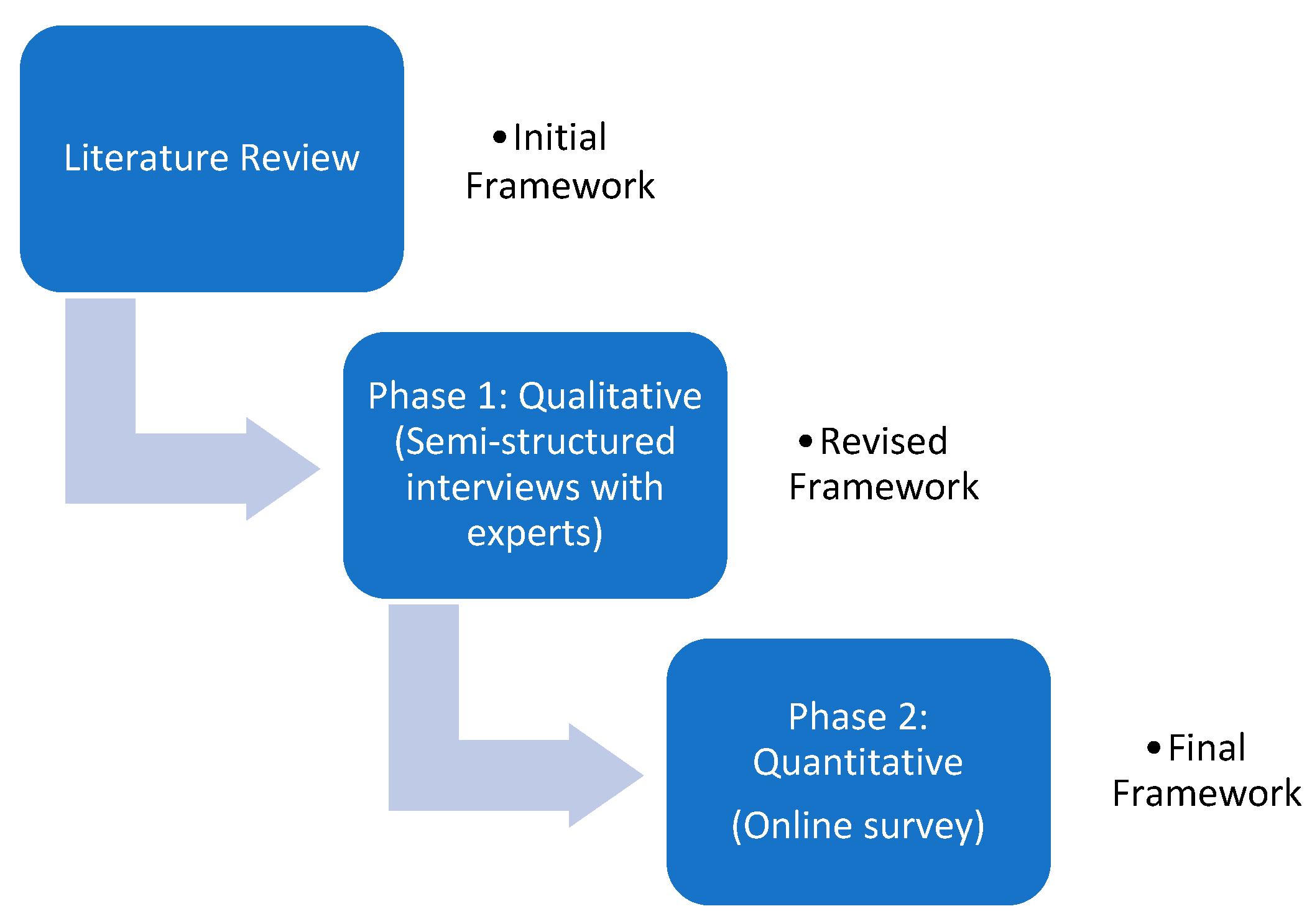
Figure 2.
Revised HSW Strategy Framework for Phase 2.
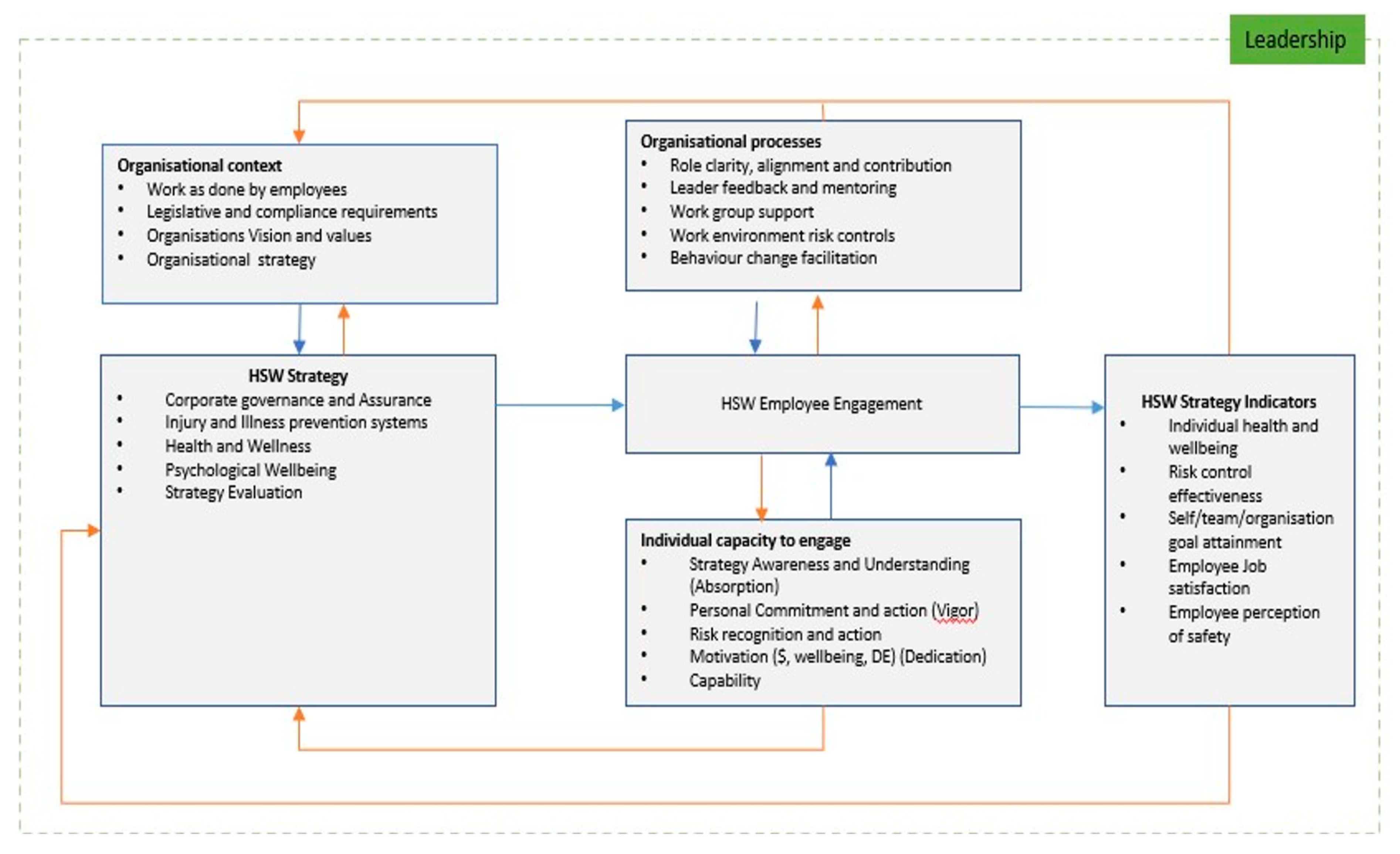

Table 1.
Demographics position, discipline, gender, location, industry type, experience, and education.
Table 1.
Demographics position, discipline, gender, location, industry type, experience, and education.
| Position | Frequency | % of total |
|---|---|---|
| Senior Manager | 46 | 48.5 |
| Practitioner | 30 | 31.5 |
| Manager | 19 | 20.0 |
| Discipline | Frequency | % of total |
| Workplace Health and Safety | 44 | 46.4 |
| Other | 31 | 31.6 |
| Human Resources | 18 | 18.9 |
| Wellbeing or Health | 2 | 2.1 |
| Gender | Frequency | % of total |
| Male | 66 | 69.5 |
| Female | 29 | 30.5 |
| Location | Frequency | % of total |
| Queensland | 41 | 43.2 |
| Victoria | 18 | 18.9 |
| New South Wales | 17 | 17.9 |
| South Australia | 6 | 6.3 |
| Western Australia | 4 | 4.2 |
| Tasmania | 4 | 4.2 |
| Northern Territory | 3 | 3.2 |
| Australian Capital Territory | 2 | 2.1 |
| Industry Type | Frequency | % of total |
| Other | 47 | 49.5 |
| Public | 23 | 24.2 |
| Manufacturing | 7 | 7.4 |
| Resources | 7 | 7.4 |
| Construction | 6 | 6.3 |
| Transport | 5 | 5.3 |
| Experience | Frequency | % of total |
| 10 or more | 78 | 82.1 |
| 5-9 | 10 | 10.5 |
| 0-4 | 7 | 7.4 |
| Education level | Frequency | % of total |
| Postgraduate | 75 | 79.0 |
| Undergraduate | 13 | 13.6 |
| Vocational | 7 | 7.4 |
(Source: Developed this research).
Table 2.
Mean, standard deviation, and factor item loadings.
| Question | Mean(M) | Standard Deviation (SD) |
Factor | ||||||
|---|---|---|---|---|---|---|---|---|---|
| 1 | 2 | 3 | 4 | 5 | 6 | 7 | |||
| Individual risk awareness and proactive action are central to personal growth in HSW Capability | 4.28 | .76 | 0.98 | ||||||
| Prevention of harm, including physical safety is an inherent core of Worker Wellbeing | 4.57 | .66 | 0.62 | - | |||||
| Individual Enablers influences Work Health, Safety and Wellbeing Employee Engagement | 4.17 | .74 | -0.97 | ||||||
| Individual Enablers influence Work Health, Safety and Wellbeing Strategy | 3.73 | .92 | 0.79 | ||||||
| Work Health, Safety and Wellbeing Strategy Efficacy influences Work Health, Safety and Wellbeing Strategy | 3.80 | .77 | 0.70 | ||||||
| Work Health, Safety and Wellbeing Employee Engagement influences Individual Enablers | 3.79 | .80 | 0.54 | -0.51 | |||||
| Leadership influences Organisational Context, Work Health, Safety and Well-being Strategy and Employee Engagement | 4.59 | .78 | -0.80 | ||||||
| Work Health, Safety and Wellbeing Strategy influences Work Health, Safety and Wellbeing Employee Engagement | 4.27 | .73 | -0.70 | ||||||
| Organisational Culture influences HSW strategy development over the short and long-term | 4.43 | .68 | -0.62 | ||||||
| Individual leadership capability affects wellbeing and the level of engagement in strategy | 4.54 | .70 | -0.58 | ||||||
| Organisational processes influence Work Health, Safety and Wellbeing Employee Engagement | 4.22 | .80. | 0.50 | -0.55 | |||||
| To be in an optimal state of wellbeing employees need to be connected at the individual, team and organisational levels and have purpose in their work | 4.48 | .68 | -0.54 | ||||||
| Organizational Context influences Work Health, Safety and Wellbeing Strategy | 4.38 | .59 | -0.42 | ||||||
| Worker Wellbeing includes employees managing lifestyle health and psychological health risks as an organisational priority. Which positively affects employee commitment | 4.46 | .73 | -0.41 | ||||||
| Meaningful consultation for understanding the HSW Strategy implementation impacts on the level of employee engagement in the short and long term | 4.30 | .63 | 0.68 | ||||||
| HSW Strategy measurement must focus on broader outcomes related to individual wellbeing, work completed, worker perceptions on safety systems, risk management effectiveness and safety | 4.18 | .73 | 0.67 | ||||||
| Organisational and leader trust is dependent on values-based feedback which affects employee motivation and individual wellbeing. | 4.29 | .68 | 0.53 | ||||||
| Ownership enhances personal growth and the capability to engage in HSW Strategy | 4.35 | .61 | 0.44 | ||||||
| Personal risk awareness and control needs to be facilitated by the organisation as part of strategy implementation to engage employees in HSW | 4.26 | .62 | 0.42 | ||||||
| Work Health, Safety and Wellbeing Employee Engagement influences Organisational Processes | 3.87 | .85 | -0.64 | ||||||
| Work Health, Safety and Wellbeing Employee Engagement influences Work Health, Safety and Wellbeing strategy efficacy |
4.36 |
.76 | -0.60 | ||||||
| HSW strategy and resource allocation must be integrated and address immediate risks prior to longer term strategic risks. | 4.00 | .88 | 0.54 | ||||||
| Employees need to be involved in HSW strategy development at an early stage and be clear on their personal contribution as it relates to vision, mission and goals | 4.15 | .87 | 0.53 | ||||||
(Source: SPSS version 26 output Structure matrix).
Disclaimer/Publisher’s Note: The statements, opinions and data contained in all publications are solely those of the individual author(s) and contributor(s) and not of MDPI and/or the editor(s). MDPI and/or the editor(s) disclaim responsibility for any injury to people or property resulting from any ideas, methods, instructions or products referred to in the content. |
© 2023 by the authors. Licensee MDPI, Basel, Switzerland. This article is an open access article distributed under the terms and conditions of the Creative Commons Attribution (CC BY) license (http://creativecommons.org/licenses/by/4.0/).
Copyright: This open access article is published under a Creative Commons CC BY 4.0 license, which permit the free download, distribution, and reuse, provided that the author and preprint are cited in any reuse.


