

Submitted:
10 October 2023
Posted:
11 October 2023
You are already at the latest version
Abstract
Circular economy has recently emerged as a key strategy for promoting sustainability and reducing waste in various industrial sectors. This paper provides an overview of circularity in aerospace, wind energy, transportation, automotive and sports goods using data and information from the literature and the EC funded project "RECREATE". The survey reviews the different definitions, assessment methods and metrics used to explore and evaluate circularity, including assessment frameworks such as Life Cycle Assessment (LCA) and assessment indicators. Furthermore, explores the challenges, possibilities and the available tools for enhancing circularity, such as digital tools. The survey highlights the importance of a holistic and systemic technique to circularity, concerning all stakeholders along the value chain. Overall, this study aims to contribute to a better understanding of circular economy and provides insights for future research.
Keywords:
circular economy
; circularity assessment
; industries
; circularity enhancement
; digital tools
1. Introduction
Both researchers and professionals remain highly interested in the concept of the circular economy (CE). The quantity of published works featuring the term 'circular economy' or ‘circularity’ has witnessed exponentially growth in the past two years [1]. The imperative to address the intricate equilibrium between industrial progress, environmental integrity, human well-being, and economic advancement has led to the adoption of contemporary resource management and low-carbon development strategies, exemplified by the implementation of the CE framework [2]. This demonstrates the increasing attention and research dedicated to the topic. Despite the enthusiasm and efforts from various stakeholders, the transition to a CE presents significant challenges. The CE concept is indeed crucial for achieving sustainability goals. It offers a different approach to the traditional linear economic model of “Take-Make-Dispose”. In the linear economic model, raw materials are sourced, transformed into finished products, and sold to consumers, leading to waste generation when consumers eventually discard the goods approaching the conclusion of their usable life cycle[3,4]. The linear economy operates under the implicit assumption that resources are limitless and not at risk of depletion during the process of manufacturing products [5]. However, industries are now increasingly focused on improving resource and process efficiency throughout production and consumption stages to align with the principles of circularity. These principles prioritize waste and pollution reduction, optimizing product and material utilization, and regenerating natural systems. Fundamentally, the CE is built upon several pillars such as designing manufactured products with added value to extend their lifespan, creating versatile products for multi-purpose use, systematically reintroducing solid waste into the industrial sector for competitive recycling of secondary raw materials and adopting a systemic approach to supply chain management that evaluates the interrelationships between energy production, material extraction and environment [3]. By adopting these principles, industries can shift toward a circular flow of goods and materials, contributing to more sustainable resource utilization. The circularity has emerged as a potential approach for fostering sustainable development [6]. CE advocates for a strategic shift in addressing pressing issues of environmental degradation and resource shortage. The core 3R principles (reduce, reuse, and recycle),as shown in Figure 1, aim to establish a circular system where materials are continuously recycled and energy is derived from renewable sources, and resources are utilized to create value while ensuring human health and society [7].
With growing engagement from researchers and strategists in CE practices, various R frameworks have emerged in order to enhance the long-term preservation of resource value over multiple product life cycles (such as 4R’s, 6R’s, 9R’s). Presently, the implementation of CE is often relies on the utilization of the 9R principles (refuse, rethink, reduce, reuse, repair, refurbish, remanufacture, repurpose, recycle, recover) [8]. The importance of CE and the widespread adoption of its principles has never been more essential due to the ever-increasing consumer demand, which has a significant negative impact on the environment and society. It offers a sustainable approach to sustaining the manufacturing of products and services while mitigating negative effects on the environment and communities [9].
The term of the CE has gained familiarity among scholars, politicians, and practitioners. However, due to it originates from various epistemological fields, there isn't much consensus in the literature about its exact meaning and implications [10]. Current research will focus on industries that have a significant environmental impact and are critical to achieving a sustainable economy. The first industry is aerospace, involving the manufacture of aircraft, spacecraft and related products. The second industry is wind energy, which includes the processing and use of wind to generate electricity. The third industry is the automobile industry, which involves the manufacture of automobiles and other vehicles. The fourth industry is transportation, including goods and people using vehicles, such as ships, trains, trucks, and airplanes. The fifth and final industry is sports equipment, which includes a variety of products used in sports, such as tennis rackets, skis, etc. Considering the varying environmental impact, resource consumption, and potential for enhancing circularity and sustainability, this study will comprehensively examine circularity within each industry. This work will include definitions, challenges, and opportunities, taking into account the diversity across sectors.
2. Research Methodology
The studies included in this literature survey were focused on the exploration of circularity across various industrial sectors. Both circularity assessment and enhancement methods applied in different industrial contexts were considered, covering a range of sectors. The scope extended to both theoretical investigations and practical implementations. The literature review was carried out from May to August 2023 through all databases of “Science Direct” and “Springer”. The scientific database "Google Scholar" was primarily utilized to retrieve papers, with a specific focus on conference proceedings articles. One major limitation was that only studies published in the English language were included. The searching was implemented based on the following keywords (as presented also in Figure 2):
- “Circular economy” and “definition”
- “Circular economy” and “assessment”
- “Circular economy” and “enhancement”
- “Circular economy” and (“industry 4.0” or “digitalization”)
- “Circular economy” and “aerospace industry”
- “Circular economy” and “wind energy industry”
- “Circular economy” and (“transportation industry” or “automotive industry”)
- “Circular economy” and “sport equipment industry”
Moreover, a comprehensive examination of each study was conducted to ensure that it fulfilled the eligibility criteria. Fundamentally, each potential research publication and article considered for inclusion in this study underwent an evaluation for their relevance to the subject of investigation. Initially, the study involved scrutinizing the titles and abstracts of all related papers, and any that did not align with the inclusion criteria were excluded from consideration. Following this initial screening, a comprehensive assessment of the articles was carried out, and a thorough review of their references was undertaken, both forwards and backwards.
3. Definitions and assessment of Circular Economy
3.1. Definitions of CE
3.1.1. Literature review of definitions of Circular Economy (CE)
The concept of CE has a rich historical background, evolving over time to address sustainability challenges in economic systems. Early definition in the 1970s proposed by Walter R. Stahel and Genevieve Reday, and the waste hierarchy framework laid the foundation for more sustainable resource management practices. The term CE originated with the goal of reducing input consumption in industrial production. However, its ability extends beyond industry and may be adapted to diverse sources and sectors [11]. Additionally, the idea of industrial ecology in the 1990s emphasized mimicking natural ecosystems to minimize waste and optimize resource utilization [12]. However, it was the Ellen MacArthur Foundation that significantly influenced the contemporary understanding of circularity principles. The Foundation's most well-known definition advocates that “circular economy is an industrial system that is restorative or regenerative by intention and design. It replaces the ‘end-of-life’ concept with restoration, shifts towards the use of renewable energy, eliminates the use of toxic chemicals, which impair reuse, and aims for the elimination of waste through the superior design of materials, products, systems, and, within this, business models” [3]. Another significant definition, as presented in the EU Action Plan for the Circular Economy: “In a circular economy the value of products and materials is maintained for as long as possible; waste and resource use are minimized, and resources are kept within the economy when a product has reached the end of its life, to be used again and again to create further value”[13].
The CE concept has a significant history that involves many scholars, thinkers, and organizations, who have each contributed in different ways to its definition. The aim is to comprehend the complete scope and the possibilities of the circular economy by examining various viewpoints. Many researchers and experts have studied and analyzed different definitions of the CE concept in modern sustainability methods. As a result, a variety of literature has emerged, presenting comprehensive reviews that include the interpretations of the circularity across different industries. This review examines different viewpoints from researchers, practitioners, and organizations all around the world using important resources, as detailed in Table 1.
Awan et al. [14] studied 26 publications and recorded the definitions of Circular Economy. Based on the characteristics identified in this paper, proposed a new definition for CE as follows: “Circular Economy (CE) is an approach and a series of processes aimed at minimizing material usage in production and consumption, enhancing material resilience, closing loops, and fostering sustainable exchanges to maximize ecological system benefits”. Geisendorf et al. [15] examined the status and analyzed the similarities, disparities, and interconnections between the concepts of circular economy and sustainability. Conceptual links between the CE and sustainability varies in literature, encompassing conditions, benefits, and trade-offs, with the subset relationship being suggested as suitable to preserve diversity and highlight complementary strategies for practitioners and policymakers. Finally, they characterize the CE as a regenerative framework where the inflow of resources and the generation of waste, emissions, and energy loss are minimized by controlling, closing, and constraining material and energy cycles. This objective is attainable through enduring design, effective upkeep, repair, reuse, remanufacturing, refurbishment, and recycling. Geisendorf et al. [16] suggested a modified circular economy definition following an analysis and comparison of the most prominent associated concepts. The definition that they propose for a circular economy is as follows: “Within a circular economy, the value of products and materials is preserved, waste is avoided, and resources are retained within the economic system once a product's lifecycle concludes”. Alhawari et al. [17], in a review of 91 studies on the CE, concluded that there are significant differences in how the key constructs are defined and conceptualized. While some focus more on economic and industrial aspects, little attention is given to the ecosystem. Finally, they suggested a comprehensive definition of CE as follows: “CE involves a set of organizational planning processes aimed at creating and delivering products, components, and materials to achieve their highest utility for customers and society. This is achieved through the effective and efficient utilization of ecosystem, economic, and product cycles by closing loops for all related resource flows”. Nobre and Tavares [18] after the review of the six most known CE definitions and their inputs from 44 PhD specialists about their perspective of the definition of CE, analyzed their findings and concluded in one revised definition. This revised definition of the CE is as follows: "The Circular Economy is an economic framework aspiring to eliminate waste and pollution across the entire lifecycle of materials. This encompasses the stages from raw material extraction within the environment to industrial processing and eventual consumption by end-users across various ecosystems. Upon reaching the end of its lifespan, materials are reintegrated into either industrial processes or, in the case of treated organic residuals, safely returned to the environment as part of a natural regenerative cycle. The essence of this approach lies in generating value at macro, meso, and micro levels while maximizing the intricate notion of sustainability. Clean and renewable energy sources are employed, and the use and consumption of resources are optimized. Both government entities and responsible consumers actively participate in ensuring the sustained operation of this system". Korhonen et al. have taken a critical scientific approach to examining the emerging business concept of the CE. By carefully evaluating CE through the focal point of feasible improvement and its three key dimensions - economic, environmental and social - proposed a revised definition of CE: “The circular economy denotes an economic system derived from societal production-consumption frameworks, aiming to maximize the utility obtained from the linear flow of materials and energy through the interconnected nature-society-nature cycle. This objective is achieved by implementing cyclical material flows, harnessing renewable energy sources, and adopting energy flows akin to cascading processes. A successful circular economy substantially contributes to all three dimensions of sustainable development. It does so by constraining the material and energy throughput to a level harmonious with nature's capacity and by integrating ecosystem cycles into economic cycles, respecting their inherent reproduction rates”. Kirchherr et al. [21] first gathered 114 definitions of CE in 2017 and then in 2023 contributed an overhauled precise investigation of 221 CE definitions and conceptualizations. After analyzing the center components show within the inspected definitions, proposed the following meta-definition for the circular economy: "The circular economy is a regenerative economic system that requires a fundamental paradigm shift, replacing the traditional 'end of life' concept with a focus on reducing, reusing, recycling, and recovering materials throughout the supply chain. The essential objective is to advance value maintenance and feasible improvement, fostering environmental quality, economic growth, and social value for both present and future eras. This transformative model relies on a collaborative alliance of stakeholders, including industry, consumers, policymakers, and academia, leveraging their technological innovations and capabilities" [1]. Figge et al. [20] challenged and considered that the definition proposed by Kirchherr et al. do not meet the requirements of a good definition. Therefore, they proposed a new definition as follows: "The CE embodies a resource utilization framework operating across various levels. It mandates the full closure of all resource loops, with recycling and other strategies that enhance the scale and direction of resource movements serving as integral components of the circular economy. In an ideal conceptual scenario, all resource loops would be entirely closed. However, in practical implementation, some utilization of virgin resources is unavoidable". In the process, they tried to offer their critique of how the circular economy is often defined in contemporary literature and encouraged and other researchers to discuss and share their ideas with researchers and continue the discussion on of a proper definition of CE.
3.1.2. Definitions of Circular Economy (CE) in the EC funded research project “RECREATE”
Circularity is a promising concept for addressing sustainability. In order to realize the full ability of this model, it is important to understand various perspectives. In the EC-funded research project "RECREATE", the circular economy was explored for inputs from partners. Questionnaires were distributed to representative stakeholders and invited them to define the term "circular economy" from their perspectives. This subsection presents the responses, as demonstrated in Table 2, gathered from this effort, providing an insight into the views of those actively participating.
3.1.3. Re-definition of Circular Economy
Taking after a careful comparison of established definitions and the insights gathered from the questionnaires inside the project “RECREATE”, we propose a refined definition of Circular Economy as follows: “The Circular Economy (CE) is a visionary economic model that focuses on closed cycles, where ideally there is an endless regeneration of resources. CE should be shaped through supportive regulations and policies, this transformative concept emphasizes integration of renewable energy and sustainable practices. CE prioritizes circularity, minimizing waste and maximizing value creation, promoting a harmonious interaction between society, economy and environment and reflecting a collaborative spirit of innovation and responsible resource management”.
3.2. Assessment of CE
Assessing the principles of the CE is essential in understanding their real-world impact. It provides us with a way to understand how well different industries are incorporating circular strategies into their practices, essentially showing us how they're adapting to a more sustainable approach. By evaluating the real-world application, knowledge is gained, various problems, barriers and possibilities for improvement for the transition to a circular economy are identified. In addition, assessment promotes transparency and continuous improvement, ultimately leading society towards a more harmonious and sustainable relationship with our planet's limited resources.
Circularity assessment tools evaluate the impact or benefits of a circular system, aiding in selecting preferred circular strategies or gauging the sustainability enhancement of existing systems. These tools are divided into two categories: assessment frameworks and assessment indicators. Frameworks offer multiple indicators tailored to specific cases, while indicator-based tools provide assessment through a single indicator like resource potential. Both types encompass burden-based measures (e.g., CO2 equivalent, mineral resources, fossil fuel energy) and value-based indicators (e.g., euros, years), which evaluate economic value added or extended utility within the analyzed system. The most known assessment frameworks for CE are developed upon three foundational methodologies: specifically, Life Cycle Assessment (LCA), Material Flow Analysis (MFA), and Input-Output analysis.
Life Cycle Assessment (LCA) stands as a predominant tool frequently utilized for quantifying and assessing the advantages or consequences of CE strategies, often serving as a means to deliberate and select from among various circular approaches [22]. For many years, the main use of LCA was to assess the environmental impacts only. Presently, LCA emerges as the most well-defined framework for scrutinizing environmental aspects, capable of comprehensively evaluating circular systems, Product Service Systems, and recycling mechanisms [23]. Stijn et al.[24] introduced the Circular Economy Life Cycle Assessment (CE-LCA) model, which adapts existing LCA standards to account for multiple use cycles and employs a circular allocation approach in order to facilitate circular building component development . Antwi-Afari et al. [25] have broaden the scope of LCA to encompass cradle-to-cradle considerations, and in combination with the prognostic circularity indicator for building systems. This comprehensive approach facilitated the assessment of environmental, technical, functional, and systemic aspects across the product system. Lei et al. [26] examined the integration of life cycle assessment (LCA) into the circular economy framework, emphasizing its potential to mitigate additional environmental impacts associated with increased circularity. The paper systematically reviews LCA's applications in the context of the built environment within a circular economy approach, highlighting the need for its incorporation. Larsen et al. [27] examined the integration of life cycle thinking, including LCA, Life Cycle Costing (LCC), and Social Life Cycle Assessment (S-LCA), into an integrated methodology called Life Cycle Sustainability Assessment (LCSA) to facilitate the transition of the construction industry toward a CE. Finally, Chen et al. [28] provided a comprehensive summary and systematic evaluation of the utilization of LCA and Product Service System (PSS) integration within the circular economy framework, focusing on a micro-level perspective. Drawing from this analysis, the study highlights the research challenges and suggests possible avenues for future research aimed at advancing the implementation of LCA within the circular economy paradigm, particularly from a business perspective.
Material Flow Analysis (MFA) is a method that evaluates the dynamics and alterations within material flows of a system by quantifying mass balances within a specific spatial context. While MFA provides insights into the quantity of materials utilized, it lacks information regarding material quality and scarcity. The primary hurdles faced in MFA studies include data uncertainty and availability. However, due to its adaptable and uncomplicated nature, MFA can be employed across all levels of analysis, encompassing macro, meso, and micro scales [22]. Barkhausen et al. [29] a systematic literature review examines 44 prospective studies that utilize material flow analysis and life cycle assessment in combination, revealing a diverse landscape of integrated approaches with significant potential for assessing circular economy policy impacts, particularly within the context of the eco-design framework.
The last assessment framework for CE is the Input output analysis. Input-output analysis (IO analysis) was developed to explore economic interdependencies among sectors within regional, national, or international economies. It has been extended to assess environmental and socio-economic impacts associated with these sectors, often in conjunction with LCA to overcome limitations of process-based LCA [22].
Furthermore, the second category of the circularity assessment is the assessment indicators. Corona et al. [22] conducted a literature review that identifies a range of CE assessment indicators, categorized into distinct types. Among them, four standalone CE assessment indicators, four derived from LCA methodology, and one derived from the MFA framework were found. The first one is the longevity Indicator. It is a non-monetary measure of how long a material remains within a product system, incorporating initial lifetime and durability gained through reuse and recycling, without addressing the decrease in recycled material quality [30]. Also, the Resource Potential Indicator (RPI) which evaluates the intrinsic value of a material for reuse, accounting for technological feasibility in recycling based on the average recoverable material share using available recycling technologies [31]. The next one is the Value Based Resource Efficiency (VRE) Indicator that quantifies circularity as the percentage of value from stressed resources incorporated in a product returned after its end-of-life, considering both market value of resources and their societal and environmental implications [32]. Furthermore, the Sustainable Circular Index (SCI) is a composite indicator that reflecting the sustainability and circularity degree of an organization, comprising economic, social, environmental, and circularity dimensions [33]. The next four indicators derived from LCA methodologies, each offering distinct perspectives on environmental and economic integration. The Eco-Efficient Value Ratio (EVR) [23] and the Eco-efficiency Index (EEI) employ monetization techniques to integrate environmental and economic considerations. They focus on increasing value added, benefiting both producers and consumers, with the assumption that such value reflects consumer willingness to pay for a service. The EEI combines value added and ReCiPe method-based environmental impacts, with monetization involving stakeholder preferences. In contrast, the EVR compares environmental burden to value added, using marginal prevention costs for monetization. The Global Resource Indicator (GRI) was introduced as a midpoint characterization indicator for resource use in LCA. It considers scarcity, geopolitical availability, and recyclability of resources. Scarcity incorporates extraction rates and available reserves, geopolitical availability addresses distribution homogeneity, and recyclability factors in recycling and dispersion rates [34]. Finally, the Circular Performance Indicator (CPI) measures the ratio of environmental benefit achieved through waste treatment compared to the maximum potential benefit based on material quality. This indicator quantifies reduced resource consumption through Cumulative Exergy Extraction from the Natural Environment (CEENE), accounting for predefined material quality factors [35]. Khadim et al. [36] conducted an evaluation and examination of 35 currently available tools by conducting an expanded systematic analysis of 51 meticulously chosen sources encompassing both scholarly and non-academic literature.
Several researchers have recognized the complex nature of circularity and have used multi-criteria approaches (MCDM) and fuzzy logic to evaluate them. Ng and Martinez Hernandez [37] developed a decision-making framework that combines multi-criteria analysis and process modelling to evaluate the performance of CE. Shen et al. [38] utilized a fuzzy multi-criteria approach to assess green supply chain performance, while Olugu and Wong [39] employed an expert fuzzy rule-based system for closed-loop supply chain performance measurement. Moreover, Sassanelli et al. [40] except for the Multi-criteria approaches (MCDM) and fuzzy logic methods above for the assessment of CE, conducted a literature review and presented also other ways to make the assessment possible. For instance, the assessment of CE could be achieved with the design for X (DfX) methodologies such as Design for Disassembly (DfD), Design for End-of-Life (DfEoL) etc. and guidelines or with the Analytic Hierarchy Process (AHP) that is a decision-making tool that helps evaluate the performance of CE systems based on multiple criteria. AHP allows for the prioritization and comparison of different factors, such as energy consumption, resource recycling, environmental protection, costs, and social aspects. There are also approaches that combine assessment methods in order to assess CE. Markatos and Pantelakis [41] introduced a decision support tool that combines life-cycle-based metrics that encompass ecological and economic aspects, along with a circular economy indicator (CEI) centered on material/component attributes. This CEI is associated with quality characteristics and accommodates the quality decline of materials through multiple recycling loops. The tool works with a multi-criteria decision analysis (MCDA) approach to mitigate subjectivity while prioritizing the importance of the criteria being considered. Figure 3 shows the possible tools for the circular assessment.
Last but not least, currently there are existing tools for the assessment of the circularity in different areas. Valls-Val et al. [42] conducted a review in order to evaluate distinct tools specifically designed to assess organizational circularity. The investigation extends to the essential information required by these tools, covering inquiries, categorizations, input data, achievable outcomes, and communication methods. The review underscores the escalating presence of circular assessment tools while underlining the lack of standardization in terms of features and content. Although these tools offer an initial reference, it's crucial to recognize that their application in decision-making could yield contrasting outcomes within the same context, depending on the tool chosen. Ιn reference, some of the available tools are the Acodea [43], CEEI [44], CIRCelligence [45], CircularTRANS [46], Circulytics [47], CTI Tool [48], Inedit [49], MATChE Readiness Assessment [50], MCI (Material Circularity Indicator) [51], TECNUN [52].
3.3. Circular economy in different industries
3.3.1. Aerospace industry
The aerospace industry is appeared as one of the leading industries, profiting from big investments that consistently drive advancements in science and technology. The aviation sector, especially, which extensively utilizes aerospace technologies, stands out as the most rapidly developing field. This progress in aviation brings forth new technological achievements aimed at minimizing energy consumption, environmental impact, and costs, particularly concerning sustainable development from the perspective of thermal scientists [53]. The disposal of end-of-life aviation composite waste and aircraft structures presents significant challenges that need to be addressed [54]. According to the International Air Transport Association (IATA) [55], approximately 11,000 aircraft are projected to be retired by 2030. The integration of CE concepts throughout the aircraft manufacturing supply chain process can offer numerous benefits to companies. By adopting CE principles such as recycling, remanufacturing, and reuse, companies can develop strategies that create mutually beneficial outcomes, enhance brand image, expand market share, and increase profitability while minimizing environmental degradation [56]. However, the aerospace industry encounters considerable obstacles in transitioning from a linear to a circular approach. This shift is particularly challenging due to the stringent quality demands necessary to adhere to safety standards [57].
Salesa et al. [58] focused on the examination of strategies implemented by airlines to integrate circular economy principles into their waste management systems. Additionally, they introduced a suggested framework for evaluating materials management, recycling procedures, and the utilization of eco-efficient designs within the airline sector. It underscores the significance of sustainable practices in waste management, resource utilization efficiency, and the integration of novel materials and products.
It is worth noting that one of the most important tools, the ReSOLVE framework that developed by the Ellen MacArthur Foundation, is a comprehensive tool designed to guide businesses and organizations in assessing and implementing circular economy strategies. In this framework were proposed six actions that businesses and governments can adopt to shift towards a circular economy. It stands for : Regenerate, Share, Optimise, Loop, Virtualise, and Exchange [59]. Dias et al. [56] pointed out the practices that could potentially be used for applying circular economy principles in the aerospace industry, promoting environmental sustainability, cost savings, and resource optimization. They observed that circular strategies for financial benefits, alternative and renewable fuels, reuse and recycling of materials, circularity-oriented product designs and integration of industry 4.0 technologies drive CE in the aerospace industry, as shown in Figure 4. In their work, the study followed a specific protocol, which included workshops with professionals from different companies in the aerospace industry. These workshops were recorded and transcribed for data collection. In addition to the primary information obtained through the workshops, secondary data was collected from official company websites and electronic communication channels. They used the ReSOLVE framework to analyse and discuss the effect of CE practices on environmental sustainability in the aerospace industry. They also presented the framework to the companies involved in the study and discussed its applicability. The use of the ReSOLVE framework helped to identify CE initiatives.
They also mentioned the barriers and challenges to implementing CE in the aerospace industry. The first issue is that the aerospace industry has a specific and limited supply chain, which creates a dependency on suppliers for the development and production of environmentally friendly materials The complexity and long-life cycle of aerospace products make it difficult to develop components and materials that support circular economy initiatives. Similar supply chain-related obstacles have been observed in the CE literature [60]. Also, Ritzén and Sandström [60], presented the absence of accessible technologies as obstacles to CE integration. So, the aerospace industry faces technological challenges in adopting circular economy practices. Last but not least, Jabbour et al. [61] mentioned the insufficiency of appropriate legal frameworks (regulations) in Brazil.
Furthermore, Andersson and Stavileci [62] mentioned that three pivotal dimensions are important for the implementation of CE: business model, sustainable development, and technology and this insights garnered from GKN Aerospace Sweden .The key challenges faced by GKN Aerospace Sweden were the prioritization of critical materials within existing product compositions, the exploration of additive manufacturing for circular material flows, the identification of prime lifecycle stages for delivering value, the definition of aerospace's role in advancing Circular Economy principles. The strategic avenues to address these challenges is considered that it may be the early critical material analysis using tools like material criticality lists, the leveraging additive manufacturing for efficient material use and supplier independence, the tailoring lifecycle strategies to align with customer preferences, the shifting industry focus towards high-value services alongside physical products. This knowledge sheds light on the complex interplay of dimensions and challenges in the pursuit of a circular and sustainable economy, while offering realistic solutions to drive progress in the aerospace sector.
Finally, Bachmann et al. [63] explored, due to the aviation sector's reliance on carbon fibre and petroleum-based matrices for lightweight structures raises environmental concerns, eco-friendly alternatives like bio-based and recycled materials for aircraft components, supported by comprehensive Life Cycle Assessments, aligning with Circular Economy principles to advance aviation's carbon neutrality goals by 2050.
3.3.2. Wind energy industry
Wind energy has rapidly developed as a promising and economically viable renewable energy source. Characterized as a clean and sustainable natural resource, it is abundant in Europe. Despite challenges like public acceptance and technical limitations, Europe's wind resources could generate over 33,000 TWh of energy annually, satisfying the region's electricity needs tenfold [64]. Wind energy, a significant decarbonization solution, has rapidly grown as a global energy source [65]. While it is often promoted for its emission-free operational phase, the issue of unrecyclable wind turbine blades, a significant component, poses a challenge [66]. Although contemporary wind turbines generate higher energy output per unit, their environmental footprint also is often amplified by increased material demands during manufacturing. This underlines the importance of extending the use of materials to the maximum extent possible. It is imperative that priority is given to the optimal design of wind turbines and effective life cycle management through the application of circular economy principles focusing on resource conservation. This approach is essential for a successful transition towards resource-efficient and sustainable wind energy systems [67].
Savvidou and Johnsson [65] addressed to fill knowledge gaps related to material needs during the shift to low-carbon electricity and the possibility of utilizing secondary materials from the energy system. Through an investigation of Sweden's wind power sector until 2050, the study underscores the vital role of circular approaches and the reduction of carbon-intensive material production in meeting emission goals and establishing closed material cycles within the realm of renewable energy infrastructure. Gennitsaris et al. [68] introduced a novel integration of LCA and Data Envelopment Analysis (DEA) for assessing diverse end-of-life strategies for decommissioning wind turbines in a circular economy context. Through scenarios focused on a representative wind turbine type, including options like mechanical recycling, landfill disposal, and advanced thermal recycling methods, the study not only evaluates their effectiveness but also suggests circular economy-based policy scenarios to enhance sustainable waste management. Real-world calculations reveal that enhancing the efficiency of energy-intensive thermal recycling processes could optimize environmental outcomes, while a circular approach emphasizing remanufacturing, reuse, or design for recycling of wind turbine blades holds promise for long-term sustainability. Sherwood et al. [69] introduced a methodology, termed Performance-weighted Resource Depletion (PwRD), which evaluates the sustainability of products based on their resource usage efficiency and lifespan, enabling direct comparison between different products in terms of circularity. By quantifying concerns related to resource supply risk and indicating practical actions for circular economy preservation, the PwRD metric is applied to the case of neodymium for wind turbine generators, demonstrating that the electricity generated by a wind turbine in the USA does not justify the required neodymium quantity. The demand for product functionality is a crucial variable in PwRD, equally significant as resource utilization for maintaining a circular economy. In regions with low per capita electricity demand, like the Philippines and Pakistan, the same neodymium quantity used in a US-installed wind turbine was deemed acceptable for circular economy retention. Diez-Cañamero and Mendoza [70] examined the relationship between circular economy performance and carbon footprint for seven end-of-life wind turbine blade management options: repurposing, grinding, solvolysis, pyrolysis, cement co-processing, incineration with energy recovery, and landfilling. Utilizing circularity indicators and life cycle assessment, with solvolysis showing the highest circularity and lowest carbon footprint. Ghosh et al. introduced the Circular Economy Lifecycle Assessment and Visualization (CELAVI) framework, which assesses supply chain environmental impacts during the transition to a circular economy. By analyzing circularity pathways, costs, and wind turbine installations, the researchers suggested that higher circularity costs could be advantageous due to revenue from circular approaches. Also, Nag et al. focused on addressing challenges faced by aging wind farms in India by proposing a research framework that identifies and prioritizes value requirements for the life cycle extension of wind turbine products, emphasizing circular services such as repair, upgrade, and smart monitoring as key priorities.
However, the transition to innovative renewable energy generation and consumption systems must be actively pursued by embracing CE strategies supported by circular business models (CBM). These approaches aim to enhance both resource efficiency and overall sustainability [71]. Circular business models have the potential to bring significant economic and social benefits to the wind energy sector. Despite significant research on sustainability, the wind industry has mainly focused on technological developments at the level of materials, components and products, with limited attention to the implementation of CBM. Mendoza et al. [72] evaluated 14 CBM that can be applied to the wind industry, offering insights into their drivers, value creation, sustainability benefits, challenges and opportunities, and provides comprehensive guidelines for policy, industry and academic actions to promote their adoption. Although the focus is on wind energy, the broader implications extend to the renewable and low-carbon energy sectors. They concluded that there are many challenges for the Implementation of CBMs such as the lack of comprehensive sustainability studies, the limited availability of holistic frameworks, standards, tools, and indicators etc. However, the application of CBMs in the wind industry presents various opportunities for enhancing competitiveness, capitalizing on circular economy strategies, and generating comprehensive economic, social, and environmental value. CBMs can optimize resource efficiency, reduce risks, and contribute to the industry's sustainability goals.
3.3.3. Transportation- Automotive industry
Transportation plays an essential part in our economy and everyday lives, giving essential portability and contributing to both the internal market and citizens' well-being through the flexibility of movement. As a driver of economic development and employment, it is crucial that transportation evolves to meet emerging sustainability challenges [73]. The transportation sector holds a significant responsibility for CO2 emissions and air pollutants. Despite differing impacts of climate change and air pollution, there's a lack of comprehensive evaluations regarding alternative fuels and advanced vehicle technologies to combat both issues [74]. Environmental policies aim to reduce emissions and increase the diversity of energy sources, often supporting alternative fuels such as electricity [75]. In this complex situation, the concept of circular economy has captured the interest due to the fact that presents an approach aimed at minimizing environmental impacts and optimizing the utilization of resources, serving as a sustainable strategy. In order to facilitate the move towards a circular economy, governments have introduced targeted measures to encourage the automotive industry's sustainable and circular evolution. These policies aim to motivate companies to move away from conventional vehicles and embrace electric vehicles (EVs) [76].
Demartini et al. [77] developed a model utilizing both system dynamics and agent-based methodologies to assess how the shift to electric and net zero economies impacts automotive supply chains and associated stakeholders. By integrating principles of circular economy, the study reveals that while this transition presents opportunities like novel business prospects and decreased raw material use, it could also lead to workforce challenges, notably within manufacturing. The study highlighted the need for proactive measures by companies and policymakers to mitigate the potential impact on jobs by focusing on skill enhancement and strategic support for workforce relocation, particularly within end-of-life processes in the supply chain. Bruggen et al. [78] enhanced the solution-focused sustainability assessment (SfSA) framework by incorporating a "chain approach", involving stakeholders along a specific product chain to explore different views on possible solutions. Focusing on plastics in the automotive sector, this method reveals interlinked barriers, highlighting the role of policy and economic measures alongside systemic changes. Mügge et al. [79] developed a data-driven decision support framework using digital twins and circular economy Key Performance Indicators (KPIs) to facilitate optimal end-of-life circular strategies for vehicles, incorporating user-centered design and involving stakeholders across the value chain and also, Kanellou et al. established key performance indicators (KPIs) for monitoring the adoption of circular economy models in the automotive industry. Nag et al. [80] proposed a multi-theoretical framework and employs a decision-making method to identify and evaluate drivers and sub-drivers for the adoption of circular principles in transitioning from a Product-Service System (PSS) business model to a CBM in the context of the emerging CE in the Indian automotive industry. Also, some researchers [81,82] investigated the CE initiatives of the automotive industry under Industry 4.0. For instance, Yadav et al. [83] addressed the challenges in sustainable supply chain management (SSCM) by developing a framework that leverages the principles of Industry 4.0 and the circular economy, identifying key challenges and solution measures through expert input, and applying a hybrid methodology to prioritize these measures for the effective adoption of SSCM in an automotive organization. Rodríguez-González et al. examined the impact of CE practices on the financial performance of Mexican automotive manufacturing companies, considering also, the mediating role of sustainable supply chain management (SSCM). In general there are many publications that refers to the circular economy implementation in the automotive industry, analyzing factors such as regulations, business models, emerging technologies, and best practices [84,85].
Finally, Baldassarre et al. [86] investigated the drivers and barriers for increasing the use of recycled plastics in new vehicles within the EU automotive sector, utilizing literature analysis and stakeholder interviews to outline the value chain, identify specific challenges and opportunities, and contribute to advancing circularity in the sector. Kayikci et al. [87] examined Smart and Sustainable Circular Economy (SSCE) barriers within an automotive industry Eco-Cluster, utilizing interrelated concepts of intelligence, sustainability, and circularity, identifying key cause and effect barriers and proposing solutions using the Fuzzy DEMATEL method, aiming to guide the establishment and improvement of Eco-Clusters in the automotive sector, with policy-related barriers emerging as significant challenges. Urbinati et al. [88] addressed a notable research gap by presenting a comprehensive framework of enablers, barriers, and contextual factors affecting CBM design, focusing on the automotive industry. Through a case study of the Italian automotive industry, the study shed light on the relative importance of these factors and offers practical insights for managers and policy makers, while recognizing limitations in the methodology, the sample, and potential for future qualitative and quantitative research to investigate the interactions and customer interactions further.
3.3.4. Sports equipment industry
In 2016, the global sports market, which includes events, teams, sports equipment and infrastructure, was estimated to have an annual value of $600-700 billion, outstripping the GDP growth of many countries [89]. The sports goods sector includes sport equipment, clothes, footwear and related items. Nevertheless, there has been limited research on measuring the carbon footprint at the end of sporting equipment use. Recognized as an important catalyst for promoting sustainable development, the sport sector is strongly supported by scientific studies covering ecology, management and economics. Organizations representing public and business sectors strongly recognize the potential of sport to have a positive impact on critical global challenges. Nevertheless, these efforts remain insufficient, leading to the realization that a fundamental transformation is urgently needed. To truly embrace the principles of sustainable development, changes are needed in societies and businesses. The CE model encompasses natural ecosystems, business activities, everyday lifestyles and a proactive orientation that departs from the reactive attitude of waste management that focuses solely on dealing with the consequences [90].
Fuchs and Hovemann [91] examined the implementation of CE practices in the outdoor sporting goods industry (OSGI) using a qualitative approach involving document analysis and expert interviews. Findings reveal that many OSGI brands and retailers adopt CE-related practices, suggesting the presence of institutional isomorphism and the potential for increasing uniformity in CE practices within the industry. By identifying the core principles of these practices, such as reducing, recycling products and materials and regenerating nature, companies can strategically adapt CE approaches to their circumstances, differentiate and lead the conversation rather than simply following trends, while improving communication with consumers. Also, Fuchs and Hovemann [92] focused on identifying the most appropriate CE practices for the outdoor sporting goods industry, analyzing the challenges and contributing factors through expert interviews. Findings highlighted challenges such as product complexity and low return rates, while design for durability and repairability emerges as a key factor, suggesting that 'reduction' practices should be the foundation on which other CE elements can be built. Petronis and Valušytė [93] explored how Circular Design (CD) practices are employed in CE implementation within sports while emphasizing the role of this in driving the transition to a CE in the sports industry. The research offers insights into potential CD principles that are appropriate for specific scenarios in sports, enhancing practical understanding of CE's application in the field. In light of growing environmental concerns, Szto and Wilson [94] examined the post-usage fate of sporting goods, specifically focusing on bicycles and their contribution to waste accumulation through planned obsolescence. The research highlighted structural environmental barriers in the bike industry and supported the extended producer responsibility and the CE as crucial strategies. It urged governments, manufacturers, marketers, and consumers to collectively engage in more sustainable practices to address the ecological footprint of sporting goods and calls for further research on consumer perspectives and environmentally friendly production. A brief overview of the five industries, as demonstrated in Figure 5, was presented but nevertheless the implementation of the circularity in industrial sectors is an ongoing process that is evolving every day.
4. Enhancement of Circular Economy (CE)
Integrating technologies into the industrial landscape, embodies the five major facets of the Fourth Industrial Revolution: digitalization, automation, human-machine interaction, value-added services and businesses, and automatic data exchange and communication. This interconnection among various systems and assets leads to several advantages over traditional CE models. These benefits include increased efficiency and resource utilization, reduced waste through enhanced traceability and optimized waste management, and extended product and equipment lifespans, ultimately contributing to more sustainable CE practices. This transition to digitalized CBMs empowers managers to align their goals with CE principles and utilize Industry 4.0 technologies to support their strategies effectively [95]. However, achieving sustainable benefits from digitalization requires innovative business models, particularly advanced service-based models [96]. Also, ICT (Information and Communication) solutions help the transitioning to a circular economy. Some solutions were identified as particularly crucial for supporting the principles of circularity such as cloud manufacturing and big data [97]. Furthermore, resource accounting, supported by digital systems, is expected to be a key factor in achieving a circular economy. It enables continuous monitoring of resources, data-driven decisions about their lifecycle, and minimizing waste through informed choices. While waste management is vital, a CE goes beyond recycling, and waste management companies are expanding their roles upstream into business markets to prevent resources from becoming waste in the first place [98]. Moreover, Gatenholm et al. [99] explored logistical flows and trade-offs in aftermarket supply chains to enhance circularity by slowing down resource flows. It identified trade-offs in the aftermarket involving material, people, information, and knowledge, highlighting the need to extend the traditional view of logistics to include the flow of knowledge and people. Their study emphasized the importance of "slowing" as a favorable condition to improve circularity, challenging the conventional notion of time in logistics. Additionally, it provided insights for professionals and policymakers to develop environmentally sustainable aftermarket services that prioritize knowledge and customer co-creation, ultimately contributing to circular economy goals. Future research could delve into logistics gap analysis, expand the scope to complete service offerings, and explore the role of different actors in providing logistics services in the aftermarket. Last but not least, various concepts like Material Passports have emerged, enabling the digital registration of data sets describing an object's characteristics, location, history, and ownership status. These passports are implemented and are often leveraging digital platforms to facilitate data management and circular economy practices [100].
Digitalization has the potential to significantly advance the shift towards a sustainable circular economy [101]. It contributes by providing accurate data on product availability, location, and condition, thereby facilitating the closure of material loops. Additionally, digitalization streamlines processes within companies, reducing waste, extending product lifespans, and cutting transaction costs. This support from digitalization enhances CBMs by aiding loop closure, slowing the material loop, and improving resource efficiency [102]. There is a unidirectional connection, with Industry 4.0 driving circularity, and a bidirectional relationship, signifying mutual benefits between these concepts. CE's significant domains within Industry 4.0 involve recycling and reusing strategies in smart production and sustainable supply chains. The research emphasizes the relevance of applying these concepts at the company (micro) and industry (meso) levels [103]. Organizations should consider exploring emerging digital technologies to enhance their transition efforts, sustainability and leverage available data across the product life cycle [104]. Many researchers advocate for the adoption of these technologies [105,106,107,108,109,110,111,112,113]. The manufacturing and consumption landscape is undergoing significant transformation due to the rise of emerging digital technologies such as the Internet of Things (IoT), big data analytics (BDA), artificial intelligence (AI) etc., as detailed in Figure 6 [114]. With these technologies, devices can seamlessly interact with each other and with online services, enabling a range of goals such as automated manufacturing, smart homes and efficient waste management [115,116,117]. In the usage phase, digital tools (DTs), particularly IoT, transform products into "smart" entities, promoting resource efficiency and extending product lifespans by monitoring and optimizing usage. In the end-of-life stage, DTs assist in closing the loop through efficient recycling and second-life utilization, emphasizing the interconnectedness of design, end-of-life activities and end of life decision-making process [118,119]. The possibility of using digital technologies to help shift how products are made and used towards a circular economy is becoming more popular. This could be a helpful way to overcome the challenges of transitioning to a circular economy [120]. The application of these digital tools holds the key to overcoming barriers, facilitating resource-efficient smart factories, enhancing workforce productivity and promoting closed-loop manufacturing processes [121]. Also, these technology-based systems enable knowledge creation, improved experiences, resource accessibility, sustainability, and data-centric decision-making, all contributing to the advancement of circular entrepreneurship [122]. These digital technologies also play a vital role in implementing advanced Circular Economy and Industrial Symbiosis solutions by enabling efficient monitoring of resource and energy flows and supporting human decision-making [123]. Also, by incorporating responsive design techniques and digital tools, the design process can become more efficient and aligned with circular principles. Digital technology can optimize design decisions, enable circular concepts like disassembly, and facilitate efficient maintenance, thereby reducing waste [124]. Nevertheless, there is a recommendation for assessing technology implementation approaches, considering factors like ease of implementation, cost, localization, data privacy, and ethical AI use on public data [125]. Also, the successful implementation of CE principles depends on engaging various stakeholders, including governments, international institutions, and companies, to transition toward more sustainable and digitalized processes in supply chains [126].
For instance, Bag and Pretorius [127] proposed an integrative research framework that outlines key pathways for adoption. This framework highlights the significance of Industry 4.0 technology adoption, particularly big data analytics-powered artificial intelligence, in enhancing both sustainable manufacturing practices and circular economy capabilities. Islam et al. [128] and Bressanelli et al. [129] explored the role of IoT, Big Data, and analytics in facilitating the transition toward a CE through usage-focused Business Models (BMs). It identifies eight key functionalities enabled by these digital technologies that align with the three fundamental CE value drivers: resource efficiency improvement, product lifespan extension, and closing the loop. The study emphasized the importance of coupling IoT with Big Data and analytics and highlighted that, while IoT is instrumental in tracking product usage and preventing premature wear, functions related to the product's lifecycle stages are critical for achieving CE, particularly in extending product lifespan and closing the loop. Also, the home appliance industry, the textile and clothing industry and food supply chain present a promising opportunity for the adoption of Industry 4.0 technologies such as the Internet of Things (IoT), Big Data, Blockchain and the Cloud in facilitating serviceable business models within the context of the CE [129,130,131,132,133]. More specifically, a combination of IoT, machine learning, robotics, transportation management systems, and 3D printing can enhance the link between technology and sustainable practices while improving business performance in Circular Supply Chains [104,134,135]. Agrawal et al. [136] investigated the transition in supply chains from a linear economy to CE and eventually to a net-zero economy (NZE). It identifies 19 key drivers, such as high automation, manufacturing process flexibility, and real-time sensing, through DEMATEL analysis. Also, Magrini et al. [137] and Joshi et al. [138] focused on the utilization of Internet of Things (IoT) and Blockchain, using the case study of Electrical and Electronic Equipment (EEE). IoT and blockchain can enable producers to maintain control over products until their end-of-life, thereby promoting circular strategies and aiding decision-making. Liu et al. [139] investigated the role of DTs in advancing CE strategies through a systematic literature review. The findings highlight 13 key digital functions categorized into three groups, along with their mechanisms, resulting in a proposed Digital Function for Circular Economy (DF4CE) framework. The research contributes theoretical understanding, practical insights for collaboration and data security, managerial implications for DT implementation, and outlines avenues for future research, acknowledging the need for wider technology inclusion and validation in subsequent studies. Including a focus on specific digital tools like IoT, BDA, and AI, while overlooking other technologies that could offer insights for Circular Economy strategies. Additionally, the literature review did not adequately address the potential energy-related implications of digitalization.
4.1. Internet of Things (IoT)
The officially recognized definition of the Internet of Things (IoT) was provided by the International Telecommunication Union (ITU) as follows: ‘‘Internet of Things is defined as a global infrastructure for the information society, which activates advanced services, connecting physical and digital components, based on existing and evolving interoperable information and communication technologies’’ [140]. The combination of Artificial Intelligence (AI) and the Internet of Things (IoT) presents great prospects for the circular economy. This collaboration enables a manufacturing model with reduced costs, enhanced efficiency, and individualized production. For instance, IoT's incorporation of low-cost sensors into reusable products facilitates efficient asset management and recycling in the circular economy. The link between CE principles and IoT strengthens efficiency, enabling institutions to achieve profitability and conservation goals through data analysis and AI. IoT's monitoring of manufacturing and product lifecycles enhances the efficiency of the entire value chain. Moreover, IoT-driven leasing models can transition conventional value chains toward circular economy practices, emphasizing asset durability and reducing waste. The potential of digital transformation and big data to support circular economy models underscores the transformative impact of IoT in promoting sustainability [141].
Voulgaridis et al. [142] explored the relationship between IoT technologies and Digital CE principles through a review of academic papers. It investigates the application fields, architectural models, and features of IoT technologies, as well as the integration of Digital CE concepts. The findings indicate a connection between Digital CE and IoT within the context of Industry 4.0, with a focus on lifecycle and use-cycle monitoring. Ingemarsdotter et al. [143] used a two-step approach to analyze how companies are implementing IoT for circular strategies compared to expected opportunities. Akbari and Hopkins [144] proved through a survey of 223 supply chain experts that a relatively low adoption rate of I4.0 technologies, with the Internet of Things (IoT) being the most prevalent. Kazancoglu et al. [145] investigated the significance of IoT-enabled technologies in enhancing supply chain visibility, particularly in food supply chains. The application of IoT technologies aids in the collection and analysis of data in real-time, enabling quicker decision-making and minimizing food waste within the supply chain. Garcia-Muiña et al. [146] noticed that the ready access to production data facilitated by IoT technologies has combined with the Canvas Business Model to enable the re-evaluation of the existing linear business model. The integration of concepts such as environmental conservation, social advancement, and economic robustness has led to the creation of a new business model. The fusion of eco-design prediction and real-time digital assessment transforms sustainability analysis into dynamic corporate social responsibility strategies, encouraging long-term managerial perspectives and facilitating the application of circular economy principles by reshaping business models and value creation processes. Chau et al. [147] underscored the significant impact of IoT, emphasizing the need for both policymakers and businesses to adopt this technology for real-time control and optimization of end-of-life product lifecycles. In order to fully utilize the potential of IoT, it is essential to increase the automation of manual remanufacturing procedures. Creating strong and unified laws that are in line with the trends of Industry 4.0 is crucial for the growth of developing nations. Particularly in significant fields, it becomes crucial when they aim to enact measures to enhance their domestic industries.
4.2. Big Data analytics
Big Data Analytics (BDA) holds transformative potential for effective decision-making within organizations, offering significant implications for driving and supporting CE efforts [148,149]. BDA is seen as a vital facilitator for obtaining decision-making information in the CE context, with collaborative relationships with stakeholders enhancing access to relevant data. Gupta et al. [150] proposed a model linking CE and BDA, emphasizing proactive management of the entire system through collective stakeholder engagement, suggesting implications for both researchers and practitioners in these fields. They are also offering a theoretical foundation for future empirical research in this field. Combining CE principles, network-oriented thinking, and digitalization can provide a significant competitive advantage in business, facilitated by technologies like digitalization and big data. Salminen et al. [151] presented a conceptual tool for responsible business leadership, utilizing Evolute, an intelligent web-based system, to analyze co-evolution throughout the lifecycle of a business's transition to a circular economy. Giudice et al. [152] contributed significantly by empirically confirming the positive impact of circular economy practices, including design, relationship management, and HR management, on firm performance. They also underscored the vital role of a big data-driven supply chain, particularly in enhancing HR management, leading to overall improved firm performance.
4.3. Artificial Intelligence
Artificial intelligence (AI) includes a range of technologies focused on mimicking human cognitive functions like learning and reasoning [153]. By utilizing data from diverse sources such as videos, images, audio, text, and numerical data, AI aids in problem-solving through tasks like pattern recognition, prediction, optimization, and generating recommendations. AI holds the potential to facilitate and accelerate the transition towards a circular economy. Ellen MacArthur Foundation demonstrated that AI can be effectively leveraged across three pivotal domains of CE: designing circular materials, products and components, operationalizing CBMs and optimizing infrastructures for seamless circular product and material flows. While the global economic prospects of AI are projected at USD 13 trillion by 2030, its substantial application in the circular economy remains largely underexplored [154].
Particularly AI, is becoming essential for achieving data-driven circular product design, minimizing biases in testing and prototyping, and enhancing overall efficiency. Ghoreishi and Happonen [155] identified key circular design tools and strategies that enhance product design while highlighting how AI contributes to circularity by facilitating real-time data analysis, reducing time and energy consumption, enabling rapid prototyping, and supporting effective material and product management, maintenance, and reuse. Awan et al. [156] discussed the integration of AI and big data analytics in supply chain management. They highlighted the need for research to identify the most suitable AI and data analytics approaches, underscoring the importance of informed decision-making and its potential for enhancing performance in the circular economy and sustainability.
4.4. Blockchain
Blockchain technology involves a shared database (distribution of information) that continuously records transactions and their chronological sequence. It functions as a decentralized ledger containing digital transactions, data records, and executables shared among participants [157].
Juszczyk and Shahzad [158] investigated the impact of blockchain technology on promoting a CE. Significant effects were observed in sectors like spare parts management, where real-time data on quality, repair, and reuse status were enhanced. Additionally, blockchain improved transparency in the stage of manufacturing and verified ethical work practices. Furthermore, blockchain's capacity to provide impartial and auditable data about energy sources validated whether energy sold to customers originated from renewable sources. Rehman Khan et al. [159] emphasized that blockchain has a positive impact on the circular economy, subsequently benefiting green supply chain activities like recycling, remanufacturing, green design, and green manufacturing. Also, highlighted the capability of blockchain to enhance transparency, security, and effectiveness in supply chains, while also promoting the integration of circular economy strategies for enduring sustainability and economic advantages. Teisserenc and Sepasgozar [110] proposed a conceptual model for integrating blockchain technology and digital twin(s) (DT) in the building, engineering, construction, operations, and mining (BECOM) industry. This model aims to enhance trust, security, efficiency, and transparency by addressing key challenges such as fragmented data and lack of trust in the industry.
5. Conclusions and Discussion
This work has demonstrated that there is a need to establish a definition of the circular economy as it provides an important guide to aligning industries, policies and actions towards sustainable and regenerative practices. A noteworthy academic discourse has been initiated concerning the precise definition of the CE. This scientific conversation has gone beyond the academic sphere and is now a subject of substantial discussion in broader contexts. Furthermore, in various industries, the sector of assessing the circularity is emerging as a compass that directs these industries towards transformation. Assessment methodologies do not measure progress. However, they measure the efficiency of the transformation from a linear to a circular economy. Also, identify ways to improve. The adoption of adaptable assessment frameworks will be essential in realizing the potential of the economy driving industries towards continuous environmental management and innovative growth. It is evident that embracing circularity presents both challenges and opportunities for industries.
While certain sectors or industries have made advancements in implementing strategies, others face barriers such as regulatory obstacles, limited consumer awareness and financial constraints. By adopting practices, industries cannot only reduce their environmental impact but also foster innovation, reduce reliance on finite resources and fundamentally reshape how we perceive value creation within a sustainable context.
One of the most promising ways to improve circularity is to apply Industry 4.0 principles and more specifically digital tools based on it. By combining technologies to monitor, analyze and enhance operations, industries can pave the way for a new era of resource efficiency reduction, in waste and sustainable development, within the framework of a circular economy. However, the implementation of Industry 4.0 to industrial sectors is at an early stage. Nevertheless, the theoretical background for the adoption of these technologies exists and is continuously developing. Finally. the main conclusion of this work is that a lot of information is provided for future research and for or an easier transition to the CE.
Author Contributions
Conceptualization, C.V. and K.T.; methodology, C.V. and K.T.; investigation, C.V. and K.T.; resources, C.V.; data curation, C.V.; writing—original draft preparation, C.V.; writing—review and editing, C.V. and K.T.; visualization, C.V.; supervision, K.T.; project administration, K.T.; funding acquisition, K.T. All authors have read and agreed to the published version of the manuscript.
Funding
The present work was conducted in the frame of the Horizon Europe project RECREATE: “REcycling technologies for Circular REuse and remanufacturing of fiber-reinforced composite mATErials” (grant agreement no.:101058756). This project has received funding from the European Union's Horizon research and innovation programme.
Data Availability Statement
Not applicable.
Conflicts of Interest
The authors declare no conflict of interest.
References
- Kirchherr, J.; Yang, N.-H.N.; Schulze-Spüntrup, F.; Heerink, M.J.; Hartley, K. Conceptualizing the Circular Economy (Revisited): An Analysis of 221 Definitions. Resources, Conservation and Recycling 2023, 194, 107001. [Google Scholar] [CrossRef]
- Winans, K.; Kendall, A.; Deng, H. The History and Current Applications of the Circular Economy Concept. Renewable and Sustainable Energy Reviews 2017, 68, 825–833. [Google Scholar] [CrossRef]
- Ellen MacArthur Foundation Towards the Circular Economy: Economic and Business Rationale for an Accelerated Transition. 2013.
- Ghisellini, P.; Ripa, M.; Ulgiati, S. Exploring Environmental and Economic Costs and Benefits of a Circular Economy Approach to the Construction and Demolition Sector. A Literature Review. Journal of Cleaner Production 2018, 178, 618–643. [Google Scholar] [CrossRef]
- Goyal, S.; Esposito, M.; Kapoor, A. Circular Economy Business Models in Developing Economies: Lessons from India on Reduce, Recycle, and Reuse Paradigms. Thunderbird Int Bus Rev 2018, 60, 729–740. [Google Scholar] [CrossRef]
- Arruda, E.H.; Melatto, R.A.P.B.; Levy, W.; Conti, D.D.M. Circular Economy: A Brief Literature Review (2015–2020). Sustainable Operations and Computers 2021, 2, 79–86. [Google Scholar] [CrossRef]
- Heshmati, A. A Review of the Circular Economy and Its Implementation.
- Rathi, R.; Sabale, D.B.; Antony, J.; Kaswan, M.S.; Jayaraman, R. An Analysis of Circular Economy Deployment in Developing Nations’ Manufacturing Sector: A Systematic State-of-the-Art Review. Sustainability 2022, 14, 11354. [Google Scholar] [CrossRef]
- Patwa, N.; Sivarajah, U.; Seetharaman, A.; Sarkar, S.; Maiti, K.; Hingorani, K. Towards a Circular Economy: An Emerging Economies Context. Journal of Business Research 2021, 122, 725–735. [Google Scholar] [CrossRef]
- Homrich, A.S.; Galvão, G.; Abadia, L.G.; Carvalho, M.M. The Circular Economy Umbrella: Trends and Gaps on Integrating Pathways. Journal of Cleaner Production 2018, 175, 525–543. [Google Scholar] [CrossRef]
- Stahel, W.R. The Circular Economy. Nature 2016, 531, 435–438. [Google Scholar] [CrossRef] [PubMed]
- Rizos, V.; Tuokko, K.; Behrens, A. A Review of Definitions, Processes and Impacts.
- Circular Economy Package: Questions & Answers. Available online: https://ec.europa.eu/commission/presscorner/detail/en/MEMO_15_6204 (accessed on 27 July 2023).
- Awan, U.; Kanwal, N.; Bhutta, M.K.S. Awan, U.; Kanwal, N.; Bhutta, M.K.S. A Literature Analysis of Definitions for a Circular Economy. In Logistics Operations and Management for Recycling and Reuse; Golinska-Dawson, P., Ed.; EcoProduction; Springer Berlin Heidelberg: Berlin, Heidelberg, 2020; pp. 19–34. ISBN 978-3-642-33856-4. [Google Scholar]
- Geissdoerfer, M.; Savaget, P.; Bocken, N.M.P.; Hultink, E.J. The Circular Economy – A New Sustainability Paradigm? Journal of Cleaner Production 2017, 143, 757–768. [Google Scholar] [CrossRef]
- Geisendorf, S.; Pietrulla, F. The Circular Economy and Circular Economic Concepts-a Literature Analysis and Redefinition. Thunderbird Int Bus Rev 2018, 60, 771–782. [Google Scholar] [CrossRef]
- Alhawari, O.; Awan, U.; Bhutta, M.K.S.; Ülkü, M.A. Insights from Circular Economy Literature: A Review of Extant Definitions and Unravelling Paths to Future Research. Sustainability 2021, 13, 859. [Google Scholar] [CrossRef]
- Nobre, G.C.; Tavares, E. The Quest for a Circular Economy Final Definition: A Scientific Perspective. Journal of Cleaner Production 2021, 314, 127973. [Google Scholar] [CrossRef]
- Korhonen, J.; Honkasalo, A.; Seppälä, J. Circular Economy: The Concept and Its Limitations. Ecological Economics 2018, 143, 37–46. [Google Scholar] [CrossRef]
- Figge, F.; Thorpe, A.S.; Gutberlet, M. Definitions of the Circular Economy: Circularity Matters. Ecological Economics 2023, 208, 107823. [Google Scholar] [CrossRef]
- Kirchherr, J.; Reike, D.; Hekkert, M. Conceptualizing the Circular Economy: An Analysis of 114 Definitions. Resources, Conservation and Recycling 2017, 127, 221–232. [Google Scholar] [CrossRef]
- Corona, B.; Shen, L.; Reike, D.; Rosales Carreón, J.; Worrell, E. Towards Sustainable Development through the Circular Economy—A Review and Critical Assessment on Current Circularity Metrics. Resources, Conservation and Recycling 2019, 151, 104498. [Google Scholar] [CrossRef]
- Scheepens, A.E.; Vogtländer, J.G.; Brezet, J.C. Two Life Cycle Assessment (LCA) Based Methods to Analyse and Design Complex (Regional) Circular Economy Systems. Case: Making Water Tourism More Sustainable. Journal of Cleaner Production 2016, 114, 257–268. [Google Scholar] [CrossRef]
- van Stijn, A.; Malabi Eberhardt, L.C.; Wouterszoon Jansen, B.; Meijer, A. A Circular Economy Life Cycle Assessment (CE-LCA) Model for Building Components. Resources, Conservation and Recycling 2021, 174, 105683. [Google Scholar] [CrossRef]
- Antwi-Afari, P.; Ng, S.T.; Chen, J.; Oluleye, B.I.; Antwi-Afari, M.F.; Ababio, B.K. Enhancing Life Cycle Assessment for Circular Economy Measurement of Different Case Scenarios of Modular Steel Slab. Building and Environment 2023, 239, 110411. [Google Scholar] [CrossRef]
- Lei, H.; Li, L.; Yang, W.; Bian, Y.; Li, C.-Q. An Analytical Review on Application of Life Cycle Assessment in Circular Economy for Built Environment. Journal of Building Engineering 2021, 44, 103374. [Google Scholar] [CrossRef]
- Larsen, V.G.; Tollin, N.; Sattrup, P.A.; Birkved, M.; Holmboe, T. What Are the Challenges in Assessing Circular Economy for the Built Environment? A Literature Review on Integrating LCA, LCC and S-LCA in Life Cycle Sustainability Assessment, LCSA. Journal of Building Engineering 2022, 50, 104203. [Google Scholar] [CrossRef]
- Chen, Z.; Huang, L. Application Review of LCA (Life Cycle Assessment) in Circular Economy: From the Perspective of PSS (Product Service System). Procedia CIRP 2019, 83, 210–217. [Google Scholar] [CrossRef]
- Barkhausen, R.; Rostek, L.; Miao, Z.C.; Zeller, V. Combinations of Material Flow Analysis and Life Cycle Assessment and Their Applicability to Assess Circular Economy Requirements in EU Product Regulations. A Systematic Literature Review. Journal of Cleaner Production 2023, 407, 137017. [Google Scholar] [CrossRef]
- Franklin-Johnson, E.; Figge, F.; Canning, L. Resource Duration as a Managerial Indicator for Circular Economy Performance. Journal of Cleaner Production 2016, 133, 589–598. [Google Scholar] [CrossRef]
- Park, J.Y.; Chertow, M.R. Establishing and Testing the “Reuse Potential” Indicator for Managing Wastes as Resources. Journal of Environmental Management 2014, 137, 45–53. [Google Scholar] [CrossRef] [PubMed]
- Di Maio, F.; Rem, P.C.; Baldé, K.; Polder, M. Measuring Resource Efficiency and Circular Economy: A Market Value Approach. Resources, Conservation and Recycling 2017, 122, 163–171. [Google Scholar] [CrossRef]
- Azevedo, S.G.; Godina, R.; Matias, J.C. de O. Proposal of a Sustainable Circular Index for Manufacturing Companies. Resources 2017, 6, 63. [Google Scholar] [CrossRef]
- Adibi, N.; Lafhaj, Z.; Yehya, M.; Payet, J. Global Resource Indicator for Life Cycle Impact Assessment: Applied in Wind Turbine Case Study. Journal of Cleaner Production 2017, 165, 1517–1528. [Google Scholar] [CrossRef]
- Huysman, S.; De Schaepmeester, J.; Ragaert, K.; Dewulf, J.; De Meester, S. Performance Indicators for a Circular Economy: A Case Study on Post-Industrial Plastic Waste. Resources, Conservation and Recycling 2017, 120, 46–54. [Google Scholar] [CrossRef]
- Khadim, N.; Agliata, R.; Marino, A.; Thaheem, M.J.; Mollo, L. Critical Review of Nano and Micro-Level Building Circularity Indicators and Frameworks. Journal of Cleaner Production 2022, 357, 131859. [Google Scholar] [CrossRef]
- Ng, K.S.; Martinez, E. A Systematic Framework for Energetic, Environmental and Economic (3E) Assessment and Design of Polygeneration Systems. Chemical Engineering Research and Design 2015, 106. [Google Scholar] [CrossRef]
- Shen, L.; Olfat, L.; Govindan, K.; Khodaverdi, R.; Diabat, A. A Fuzzy Multi Criteria Approach for Evaluating Green Supplier’s Performance in Green Supply Chain with Linguistic Preferences. Resources, Conservation and Recycling 2013, 74, 170–179. [Google Scholar] [CrossRef]
- Olugu, E.U.; Wong, K.Y. An Expert Fuzzy Rule-Based System for Closed-Loop Supply Chain Performance Assessment in the Automotive Industry. Expert Systems with Applications 2012, 39, 375–384. [Google Scholar] [CrossRef]
- Sassanelli, C.; Rosa, P.; Rocca, R.; Terzi, S. Circular Economy Performance Assessment Methods: A Systematic Literature Review. Journal of Cleaner Production 2019, 229, 440–453. [Google Scholar] [CrossRef]
- Markatos, D.N.; Pantelakis, S.G. Assessment of the Impact of Material Selection on Aviation Sustainability, from a Circular Economy Perspective. Aerospace 2022, 9, 52. [Google Scholar] [CrossRef]
- Valls-Val, K.; Ibáñez-Forés, V.; Bovea, M.D. How Can Organisations Measure Their Level of Circularity? A Review of Available Tools. Journal of Cleaner Production 2022, 354, 131679. [Google Scholar] [CrossRef]
- Calculadora de Indicador de Circularidad. Acodea. Available online: https://acodea.solidforest.com/ (accessed on 11 August 2023).
- Autodiagnóstico Medición Sostenibilidad En Las Organizaciones - Formularios | CEEI Valencia | EmprenemJunts. Available online: https://ceeivalencia.emprenemjunts.es/?op=65&n=883. (accessed on 11 August 2023).
- Lead the Circular Economy with Circelligence by BCG. Available online: https://www.bcg.com/capabilities/climate-change-sustainability/circular-economy-circelligence (accessed on 11 August 2023).
- CircularTRANS. Proceso Para Transitar Hacia La Economía Circular. Available online: https://www.mondragon.edu/circulartrans/es/login (accessed on 11 August 2023).
- Circulytics - A World without Measurement Doesn’t Work. Available online: https://ellenmacarthurfoundation.org/resources/circulytics/overview (accessed on 11 August 2023).
- Home. Available online: https://ctitool.com/ (accessed on 11 August 2023).
- Inèdit - Autoevalúate. Available online: https://circular.ineditinnova.com/index/es (accessed on 11 August 2023).
- ready2LOOP.org ready2LOOP. Available online: https://ready2loop.org/ (accessed on 11 August 2023).
- Circulytics Resources. Available online: https://ellenmacarthurfoundation.org/resources/circulytics/resources (accessed on 11 August 2023).
- DIAGNÓSTICO | Economiacircular. Available online: https://economiacircular.wixsite.com/economiacircular/cuestionario (accessed on 11 August 2023).
- Balli, O.; Sohret, Y.; Karakoc, H.T. The Effects of Hydrogen Fuel Usage on the Exergetic Performance of a Turbojet Engine. International Journal of Hydrogen Energy 2018, 43, 10848–10858. [Google Scholar] [CrossRef]
- Chatziparaskeva, G.; Papamichael, I.; Voukkali, I.; Loizia, P.; Sourkouni, G.; Argirusis, C.; Zorpas, A.A. End-of-Life of Composite Materials in the Framework of the Circular Economy. Microplastics 2022, 1, 377–392. [Google Scholar] [CrossRef]
- Helping Aircraft Decommissioning. Available online: https://www.iata.org/en/programs/environment/aircraft-decommissioning/ (accessed on 9 August 2023).
- Rodrigues Dias, V.M.; Jugend, D.; De Camargo Fiorini, P.; Razzino, C.D.A.; Paula Pinheiro, M.A. Possibilities for Applying the Circular Economy in the Aerospace Industry: Practices, Opportunities and Challenges. Journal of Air Transport Management 2022, 102, 102227. [Google Scholar] [CrossRef]
- Domone, J.; Bliss, P.; Copus, M. A Circular Economy for Civil Aerospace.
- Salesa, A.; León, R.; Moneva, J.M. Airlines Practices to Incorporate Circular Economy Principles into the Waste Management System. Corp Soc Responsibility Env 2023, 30, 443–458. [Google Scholar] [CrossRef]
- Ellen MacArthur Foundation, Towards the Circular Economy Vol. 2: Opportunities for the Consumer Goods Sector. 2013.
- Ritzén, S.; Sandström, G.Ö. Barriers to the Circular Economy – Integration of Perspectives and Domains. Procedia CIRP 2017, 64, 7–12. [Google Scholar] [CrossRef]
- Chiappetta Jabbour, C.J.; Seuring, S.; Lopes De Sousa Jabbour, A.B.; Jugend, D.; De Camargo Fiorini, P.; Latan, H.; Izeppi, W.C. Stakeholders, Innovative Business Models for the Circular Economy and Sustainable Performance of Firms in an Emerging Economy Facing Institutional Voids. Journal of Environmental Management 2020, 264, 110416. [Google Scholar] [CrossRef] [PubMed]
- Andersson, D.; Stavileci, S. An assessment of how Circular Economy can be implemented in the Aerospace Industry.
- Bachmann, J.; Yi, X.; Tserpes, K.; Sguazzo, C.; Barbu, L.G.; Tse, B.; Soutis, C.; Ramón, E.; Linuesa, H.; Bechtel, S. Towards a Circular Economy in the Aviation Sector Using Eco-Composites for Interior and Secondary Structures. Results and Recommendations from the EU/China Project ECO-COMPASS. Aerospace 2021, 8, 131. [Google Scholar] [CrossRef]
- Getting Fit for 55 and Set for 2050. Available online: https://windeurope.org/data-and-analysis/product/getting-fit-for-55-and-set-for-2050 (accessed on 12 August 2023).
- Savvidou, G.; Johnsson, F. Material Requirements, Circularity Potential and Embodied Emissions Associated with Wind Energy. Sustainable Production and Consumption 2023, 40, 471–487. [Google Scholar] [CrossRef]
- Liu, P.; Barlow, C.Y. Wind Turbine Blade Waste in 2050. Waste Management 2017, 62, 229–240. [Google Scholar] [CrossRef] [PubMed]
- Jensen, P.D.; Purnell, P.; Velenturf, A.P.M. Highlighting the Need to Embed Circular Economy in Low Carbon Infrastructure Decommissioning: The Case of Offshore Wind. Sustainable Production and Consumption 2020, 24, 266–280. [Google Scholar] [CrossRef]
- Gennitsaris, S.; Sagani, A.; Sofianopoulou, S.; Dedoussis, V. Integrated LCA and DEA Approach for Circular Economy-Driven Performance Evaluation of Wind Turbine End-of-Life Treatment Options. Applied Energy 2023, 339, 120951. [Google Scholar] [CrossRef]
- Sherwood, J.; Gongora, G.T.; Velenturf, A.P.M. A Circular Economy Metric to Determine Sustainable Resource Use Illustrated with Neodymium for Wind Turbines. Journal of Cleaner Production 2022, 376, 134305. [Google Scholar] [CrossRef]
- Diez-Cañamero, B.; Mendoza, J.M.F. Circular Economy Performance and Carbon Footprint of Wind Turbine Blade Waste Management Alternatives. Waste Management 2023, 164, 94–105. [Google Scholar] [CrossRef]
- Mendoza, J.M.F.; Ibarra, D. Technology-Enabled Circular Business Models for the Hybridisation of Wind Farms: Integrated Wind and Solar Energy, Power-to-Gas and Power-to-Liquid Systems. Sustainable Production and Consumption 2023, 36, 308–327. [Google Scholar] [CrossRef]
- Mendoza, J.M.F.; Gallego-Schmid, A.; Velenturf, A.P.M.; Jensen, P.D.; Ibarra, D. Circular Economy Business Models and Technology Management Strategies in the Wind Industry: Sustainability Potential, Industrial Challenges and Opportunities. Renewable and Sustainable Energy Reviews 2022, 163, 112523. [Google Scholar] [CrossRef]
- 73. WHITE PAPER Roadmap to a Single European Transport Area – Towards a Competitive and Resource Efficient Transport System, 2011.
- Tong, F.; Azevedo, I.M.L. What Are the Best Combinations of Fuel-Vehicle Technologies to Mitigate Climate Change and Air Pollution Effects across the United States? Environ. Res. Lett. 2020, 15, 074046. [Google Scholar] [CrossRef]
- Moro, A.; Lonza, L. Electricity Carbon Intensity in European Member States: Impacts on GHG Emissions of Electric Vehicles. Transportation Research Part D: Transport and Environment 2018, 64, 5–14. [Google Scholar] [CrossRef] [PubMed]
- Harrison, G.; Gómez Vilchez, J.J.; Thiel, C. Industry Strategies for the Promotion of E-Mobility under Alternative Policy and Economic Scenarios. Eur. Transp. Res. Rev. 2018, 10, 19. [Google Scholar] [CrossRef]
- Demartini, M.; Ferrari, M.; Govindan, K.; Tonelli, F. The Transition to Electric Vehicles and a Net Zero Economy: A Model Based on Circular Economy, Stakeholder Theory, and System Thinking Approach. Journal of Cleaner Production 2023, 410, 137031. [Google Scholar] [CrossRef]
- van Bruggen, A.R.; Zonneveld, M.; Zijp, M.C.; Posthuma, L. Solution-Focused Sustainability Assessments for the Transition to the Circular Economy: The Case of Plastics in the Automotive Industry. Journal of Cleaner Production 2022, 358, 131606. [Google Scholar] [CrossRef]
- Mügge, J.; Hahn, I.R.; Riedelsheimer, T.; Chatzis, J.; Boes, J. End-of-Life Decision Support to Enable Circular Economy in the Automotive Industry Based on Digital Twin Data. Procedia CIRP 2023, 119, 1071–1077. [Google Scholar] [CrossRef]
- Nag, U.; Sharma, S.K.; Govindan, K. Investigating Drivers of Circular Supply Chain with Product-Service System in Automotive Firms of an Emerging Economy. Journal of Cleaner Production 2021, 319, 128629. [Google Scholar] [CrossRef]
- Rizvi, S.W.H.; Agrawal, S.; Murtaza, Q. Automotive Industry and Industry 4.0-Circular Economy Nexus through the Consumers’ and Manufacturers’ Perspectives: A Case Study. Renewable and Sustainable Energy Reviews 2023, 183, 113517. [Google Scholar] [CrossRef]
- Valladares Montemayor, H.M.; Chanda, R.H. Automotive Industry’s Circularity Applications and Industry 4.0. Environmental Challenges 2023, 12, 100725. [Google Scholar] [CrossRef]
- Yadav, G.; Luthra, S.; Jakhar, S.K.; Mangla, S.K.; Rai, D.P. A Framework to Overcome Sustainable Supply Chain Challenges through Solution Measures of Industry 4.0 and Circular Economy: An Automotive Case. Journal of Cleaner Production 2020, 254, 120112. [Google Scholar] [CrossRef]
- Saidani, M.; Yannou, B.; Leroy, Y.; Cluzel, F.; Kendall, A. A Taxonomy of Circular Economy Indicators. Journal of Cleaner Production 2019, 207, 542–559. [Google Scholar] [CrossRef]
- Schulz, M.; Niero, M.; Rehmann, L.-M.; Georg, S. Exploration of Decision-Contexts for Circular Economy in Automotive Industry. Procedia CIRP 2021, 98, 19–24. [Google Scholar] [CrossRef]
- Baldassarre, B.; Maury, T.; Mathieux, F.; Garbarino, E.; Antonopoulos, I.; Sala, S. Drivers and Barriers to the Circular Economy Transition: The Case of Recycled Plastics in the Automotive Sector in the European Union. Procedia CIRP 2022, 105, 37–42. [Google Scholar] [CrossRef]
- Kayikci, Y.; Kazancoglu, Y.; Lafci, C.; Gozacan, N. Exploring Barriers to Smart and Sustainable Circular Economy: The Case of an Automotive Eco-Cluster. Journal of Cleaner Production 2021, 314, 127920. [Google Scholar] [CrossRef]
- Urbinati, A.; Franzò, S.; Chiaroni, D. Enablers and Barriers for Circular Business Models: An Empirical Analysis in the Italian Automotive Industry. Sustainable Production and Consumption 2021, 27, 551–566. [Google Scholar] [CrossRef]
- The-Business-Sports.Pdf. Available online: https://assets.kpmg.com/content/dam/kpmg/in/pdf/2016/10/The-business-sports.pdf (accessed on 26 August 2023).
- Yarmoliuk, O. SUSTAINABLE MANAGEMENT IN SPORT. 1 April 2019. [Google Scholar]
- Fuchs, M.; Hovemann, G. Homogeneity or Heterogeneity: An Institutional Theory View on Circular Economy Practices in the Outdoor Sporting Goods Industry. Sustainability 2022, 14, 6279. [Google Scholar] [CrossRef]
- Fuchs, M.; Hovemann, G. The Circular Economy Concept in the Outdoor Sporting Goods Industry: Challenges and Enablers of Current Practices among Brands and Retailers. Sustainability 2022, 14, 7771. [Google Scholar] [CrossRef]
- Petronis, T.; Valusyte, R. Circular Design in the Sports Industry: From Sustainability to a Circular Economy. In Proceedings of the 2021 IEEE International Conference on Technology and Entrepreneurship (ICTE); IEEE: Kaunas, Lithuania, August 24, 2021; pp. 1–7. [Google Scholar]
- Szto, C.; Wilson, B. Reduce, Re-Use, Re-Ride: Bike Waste and Moving towards a Circular Economy for Sporting Goods. International Review for the Sociology of Sport 2023, 58, 911–931. [Google Scholar] [CrossRef] [PubMed]
- Rossi, J.; Bianchini, A.; Guarnieri, P. Circular Economy Model Enhanced by Intelligent Assets from Industry 4.0: The Proposition of an Innovative Tool to Analyze Case Studies. Sustainability 2020, 12, 7147. [Google Scholar] [CrossRef]
- Parida, V.; Sjödin, D.; Reim, W. Reviewing Literature on Digitalization, Business Model Innovation, and Sustainable Industry: Past Achievements and Future Promises. Sustainability 2019, 11, 391. [Google Scholar] [CrossRef]
- Demestichas, K.; Daskalakis, E. Information and Communication Technology Solutions for the Circular Economy. Sustainability 2020, 12, 7272. [Google Scholar] [CrossRef]
- Jørgensen, S.; Pedersen, L.J.T.; Skard, S. Resource Accounting for a Circular Economy: Evidence from a Digitalised Waste Management System. Accounting Forum 2023, 1–30. [Google Scholar] [CrossRef]
- Gatenholm, G.; Halldórsson, Á.; Bäckstrand, J. Enhanced Circularity in Aftermarkets: Logistics Tradeoffs. IJPDLM 2021, 51, 999–1021. [Google Scholar] [CrossRef]
- Çetin, S.; De Wolf, C.; Bocken, N. Circular Digital Built Environment: An Emerging Framework. Sustainability 2021, 13, 6348. [Google Scholar] [CrossRef]
- Tseng, M.-L.; Tran, T.P.T.; Ha, H.M.; Bui, T.-D.; Lim, M.K. Sustainable Industrial and Operation Engineering Trends and Challenges Toward Industry 4.0: A Data Driven Analysis. Journal of Industrial and Production Engineering 2021, 38, 581–598. [Google Scholar] [CrossRef]
- Antikainen, M.; Uusitalo, T.; Kivikytö-Reponen, P. Digitalisation as an Enabler of Circular Economy. Procedia CIRP 2018, 73, 45–49. [Google Scholar] [CrossRef]
- Ćwiklicki, M.; Wojnarowska, M. Circular Economy and Industry 4.0: One-Way or Two-Way Relationships? EE 2020, 31, 387–397. [Google Scholar] [CrossRef]
- Khan, S.A.R.; Shah, A.S.A.; Yu, Z.; Tanveer, M. A Systematic Literature Review on Circular Economy Practices: Challenges, Opportunities and Future Trends. JEEE 2022, 14, 754–795. [Google Scholar] [CrossRef]
- Hoosain, M.S.; Paul, B.S.; Ramakrishna, S. The Impact of 4IR Digital Technologies and Circular Thinking on the United Nations Sustainable Development Goals. Sustainability 2020, 12, 10143. [Google Scholar] [CrossRef]
- Rosário, A.; Dias, J. Sustainability and the Digital Transition: A Literature Review. Sustainability 2022, 14, 4072. [Google Scholar] [CrossRef]
- Nandi, S.; Hervani, A.A.; Helms, M.M.; Sarkis, J. Conceptualising Circular Economy Performance with Non-Traditional Valuation Methods: Lessons for a Post-Pandemic Recovery. International Journal of Logistics Research and Applications 2023, 26, 662–682. [Google Scholar] [CrossRef]
- Elghaish, F.; Matarneh, S.T.; Edwards, D.J.; Pour Rahimian, F.; El-Gohary, H.; Ejohwomu, O. Applications of Industry 4.0 Digital Technologies towards a Construction Circular Economy: Gap Analysis and Conceptual Framework. CI 2022, 22, 647–670. [Google Scholar] [CrossRef]
- Tavana, M.; Shaabani, A.; Raeesi Vanani, I.; Kumar Gangadhari, R. A Review of Digital Transformation on Supply Chain Process Management Using Text Mining. Processes 2022, 10, 842. [Google Scholar] [CrossRef]
- Teisserenc, B.; Sepasgozar, S. Adoption of Blockchain Technology through Digital Twins in the Construction Industry 4.0: A PESTELS Approach. Buildings 2021, 11, 670. [Google Scholar] [CrossRef]
- De Felice, F.; Petrillo, A. Green Transition: The Frontier of the Digicircular Economy Evidenced from a Systematic Literature Review. Sustainability 2021, 13, 11068. [Google Scholar] [CrossRef]
- Rusch, M.; Schöggl, J.; Baumgartner, R.J. Application of Digital Technologies for Sustainable Product Management in a Circular Economy: A Review. Bus Strat Env 2023, 32, 1159–1174. [Google Scholar] [CrossRef]
- Cagno, E.; Neri, A.; Negri, M.; Bassani, C.A.; Lampertico, T. The Role of Digital Technologies in Operationalizing the Circular Economy Transition: A Systematic Literature Review. Applied Sciences 2021, 11, 3328. [Google Scholar] [CrossRef]
- Lasi, H.; Fettke, P.; Kemper, H.-G.; Feld, T.; Hoffmann, M. Industry 4.0. Bus Inf Syst Eng 2014, 6, 239–242. [Google Scholar] [CrossRef]
- Whitmore, A.; Agarwal, A.; Da Xu, L. The Internet of Things—A Survey of Topics and Trends. Inf Syst Front 2015, 17, 261–274. [Google Scholar] [CrossRef]
- Talamo, C.; Pinto, M.R.; Viola, S.; Atta, N. Smart Cities and Enabling Technologies: Influences on Urban Facility Management Services. IOP Conference Series: Earth and Environmental Science 2019, 296, 012047. [Google Scholar] [CrossRef]
- Baiardi, L.; Ciaramella, A.; Bellintani, S. A Development and Management Model for “Smart” Temporary Residences. In Regeneration of the Built Environment from a Circular Economy Perspective; Della Torre, S., Cattaneo, S., Lenzi, C., Zanelli, A., Eds.; Research for Development; Springer International Publishing: Cham, 2020; ISBN 978-3-030-33255-6. [Google Scholar]
- Han, Y.; Shevchenko, T.; Yannou, B.; Ranjbari, M.; Shams Esfandabadi, Z.; Saidani, M.; Bouillass, G.; Bliumska-Danko, K.; Li, G. Exploring How Digital Technologies Enable a Circular Economy of Products. Sustainability 2023, 15, 2067. [Google Scholar] [CrossRef]
- Abruzzini, A.; Abrishami, S. Integration of BIM and Advanced Digital Technologies to the End of Life Decision-Making Process: A Paradigm of Future Opportunities. JEDT 2022, 20, 388–413. [Google Scholar] [CrossRef]
- Barry, M. The Circular Economy Is an Economic and Environmental Imperative but There Is a Huge Gap between a Big Concept and a Practical Reality. The Internet of Things Is the “Glue” That Links the Trillions of Items We Consume Each Year Globally, with the Changes in Everyday Consumer Behaviour, Product Recovery, Material Separation and Remanufacturing That We Need.
- Stock, T.; Seliger, G. Opportunities of Sustainable Manufacturing in Industry 4.0. Procedia CIRP 2016, 40, 536–541. [Google Scholar] [CrossRef]
- Saura, J.R.; Ribeiro-Soriano, D.; Palacios-Marqués, D. Adopting Digital Reservation Systems to Enable Circular Economy in Entrepreneurship. MD 2022. [Google Scholar] [CrossRef]
- Colla, V.; Pietrosanti, C.; Malfa, E.; Peters, K. Environment 4.0: How Digitalization and Machine Learning Can Improve the Environmental Footprint of the Steel Production Processes. Matériaux & Techniques 2020, 108, 507. [Google Scholar] [CrossRef]
- Talla, A.; McIlwaine, S. Industry 4.0 and the Circular Economy: Using Design-Stage Digital Technology to Reduce Construction Waste. SASBE 2022. [Google Scholar] [CrossRef]
- Choudhuri, B.; Srivastava, P.R.; Mangla, S.K.; Kazancoglu, Y. Enterprise Architecture as a Responsible Data Driven Urban Digitization Framework: Enabling Circular Cities in India. Ann Oper Res 2023. [Google Scholar] [CrossRef]
- Ciliberto, C.; Szopik-Depczyńska, K.; Tarczyńska-Łuniewska, M.; Ruggieri, A.; Ioppolo, G. Enabling the Circular Economy Transition: A Sustainable Lean Manufacturing Recipe for Industry 4.0. Bus Strat Env 2021, 30, 3255–3272. [Google Scholar] [CrossRef]
- Bag, S.; Pretorius, J.H.C. Relationships between Industry 4.0, Sustainable Manufacturing and Circular Economy: Proposal of a Research Framework. IJOA 2022, 30, 864–898. [Google Scholar] [CrossRef]
- Islam, M.T.; Iyer-Raniga, U.; Trewick, S. Recycling Perspectives of Circular Business Models: A Review. Recycling 2022, 7, 79. [Google Scholar] [CrossRef]
- Bressanelli, G.; Saccani, N.; Perona, M.; Baccanelli, I. Towards Circular Economy in the Household Appliance Industry: An Overview of Cases. Resources 2020, 9, 128. [Google Scholar] [CrossRef]
- Alves, L.; Ferreira Cruz, E.; Lopes, S.I.; Faria, P.M.; Rosado Da Cruz, A.M. Towards Circular Economy in the Textiles and Clothing Value Chain through Blockchain Technology and IoT: A Review. Waste Manag Res 2022, 40, 3–23. [Google Scholar] [CrossRef] [PubMed]
- Rejeb, A.; Rejeb, K.; Abdollahi, A.; Zailani, S.; Iranmanesh, M.; Ghobakhloo, M. Digitalization in Food Supply Chains: A Bibliometric Review and Key-Route Main Path Analysis. Sustainability 2021, 14, 83. [Google Scholar] [CrossRef]
- Huynh, P.H. “Enabling Circular Business Models in the Fashion Industry: The Role of Digital Innovation. ” IJPPM 2022, 71, 870–895. [Google Scholar] [CrossRef]
- Akram, S.V.; Malik, P.K.; Singh, R.; Gehlot, A.; Juyal, A.; Ghafoor, K.Z.; Shrestha, S. Implementation of Digitalized Technologies for Fashion Industry 4.0: Opportunities and Challenges. Scientific Programming 2022, 2022, 1–17. [Google Scholar] [CrossRef]
- Romagnoli, S.; Tarabu’, C.; Maleki Vishkaei, B.; De Giovanni, P. The Impact of Digital Technologies and Sustainable Practices on Circular Supply Chain Management. Logistics 2023, 7, 1. [Google Scholar] [CrossRef]
- Hettiarachchi, B.D.; Seuring, S.; Brandenburg, M. Industry 4.0-Driven Operations and Supply Chains for the Circular Economy: A Bibliometric Analysis. Oper Manag Res 2022, 15, 858–878. [Google Scholar] [CrossRef]
- Agrawal, R.; Priyadarshinee, P.; Kumar, A.; Luthra, S.; Garza-Reyes, J.A.; Kadyan, S. Are Emerging Technologies Unlocking the Potential of Sustainable Practices in the Context of a Net-Zero Economy? An Analysis of Driving Forces. Environ Sci Pollut Res 2023. [Google Scholar] [CrossRef]
- Magrini, C.; Nicolas, J.; Berg, H.; Bellini, A.; Paolini, E.; Vincenti, N.; Campadello, L.; Bonoli, A. Using Internet of Things and Distributed Ledger Technology for Digital Circular Economy Enablement: The Case of Electronic Equipment. Sustainability 2021, 13, 4982. [Google Scholar] [CrossRef]
- Joshi, S.; Sharma, M.; Barve, A. Implementation Challenges of Blockchain Technology in Closed-Loop Supply Chain: A Waste Electrical and Electronic Equipment (WEEE) Management Perspective in Developing Countries. Supply Chain Forum: An International Journal 2023, 24, 59–80. [Google Scholar] [CrossRef]
- Liu, Q.; Trevisan, A.H.; Yang, M.; Mascarenhas, J. A Framework of Digital Technologies for the Circular Economy: Digital Functions and Mechanisms. Bus Strat Env 2022, 31, 2171–2192. [Google Scholar] [CrossRef]
- Y.2060: Overview of the Internet of Things. Available online: https://www.itu.int/rec/T-REC-Y.2060-201206-I (accessed on 28 August 2023).
- Ramadoss, T.S.; Alam, H.; Seeram, R. Artificial Intelligence and Internet of Things Enabled Circular Economy.
- Voulgaridis, K.; Lagkas, T.; Angelopoulos, C.M.; Nikoletseas, S.E. IoT and Digital Circular Economy: Principles, Applications, and Challenges. Computer Networks 2022, 219, 109456. [Google Scholar] [CrossRef]
- Ingemarsdotter, E.; Jamsin, E.; Kortuem, G.; Balkenende, R. Circular Strategies Enabled by the Internet of Things—A Framework and Analysis of Current Practice. Sustainability 2019, 11, 5689. [Google Scholar] [CrossRef]
- Akbari, M.; Hopkins, J.L. Digital Technologies as Enablers of Supply Chain Sustainability in an Emerging Economy. Oper Manag Res 2022, 15, 689–710. [Google Scholar] [CrossRef]
- Kazancoglu, Y.; Ozbiltekin-Pala, M.; Sezer, M.D.; Kumar, A.; Luthra, S. Circular Dairy Supply Chain Management through Internet of Things-Enabled Technologies. Environ Sci Pollut Res 2022. [Google Scholar] [CrossRef]
- Garcia-Muiña; González-Sánchez; Ferrari; Volpi; Pini; Settembre-Blundo Identifying the Equilibrium Point between Sustainability Goals and Circular Economy Practices in an Industry 4.0 Manufacturing Context Using Eco-Design. Social Sciences 2019, 8, 241. [CrossRef]
- Chau, M.Q.; Nguyen, X.P.; Huynh, T.T.; Chu, V.D.; Le, T.H.; Nguyen, T.P.; Nguyen, D.T. Prospects of Application of IoT-Based Advanced Technologies in Remanufacturing Process towards Sustainable Development and Energy-Efficient Use. Energy Sources, Part A: Recovery, Utilization, and Environmental Effects 2021, 1–25. [Google Scholar] [CrossRef]
- Awan, U.; Shamim, S.; Khan, Z.; Zia, N.U.; Shariq, S.M.; Khan, M.N. Big Data Analytics Capability and Decision-Making: The Role of Data-Driven Insight on Circular Economy Performance. Technological Forecasting and Social Change 2021, 168, 120766. [Google Scholar] [CrossRef]
- Edwin Cheng, T.C.; Kamble, S.S.; Belhadi, A.; Ndubisi, N.O.; Lai, K.; Kharat, M.G. Linkages between Big Data Analytics, Circular Economy, Sustainable Supply Chain Flexibility, and Sustainable Performance in Manufacturing Firms. International Journal of Production Research 2022, 60, 6908–6922. [Google Scholar] [CrossRef]
- Gupta, S.; Chen, H.; Hazen, B.T.; Kaur, S.; Santibañez Gonzalez, E.D.R. Circular Economy and Big Data Analytics: A Stakeholder Perspective. Technological Forecasting and Social Change 2019, 144, 466–474. [Google Scholar] [CrossRef]
- Salminen, V.; Ruohomaa, H.; Kantola, J. Digitalization and Big Data Supporting Responsible Business Co-Evolution. In Advances in Human Factors, Business Management, Training and Education; Kantola, J.I., Barath, T., Nazir, S., Andre, T., Eds.; Advances in Intelligent Systems and Computing; Springer International Publishing: Cham, 2017; Vol. 498, pp. 1055–1067. ISBN 978-3-319-42069-1. [Google Scholar]
- Del Giudice, M.; Chierici, R.; Mazzucchelli, A.; Fiano, F. Supply Chain Management in the Era of Circular Economy: The Moderating Effect of Big Data. IJLM 2021, 32, 337–356. [Google Scholar] [CrossRef]
- Fraga-Lamas, P.; Lopes, S.I.; Fernández-Caramés, T.M. Green IoT and Edge AI as Key Technological Enablers for a Sustainable Digital Transition towards a Smart Circular Economy: An Industry 5.0 Use Case. Sensors 2021, 21, 5745. [Google Scholar] [CrossRef]
- Artificial Intelligence and the Circular Economy. Available online: https://ellenmacarthurfoundation.org/artificial-intelligence-and-the-circular-economy (accessed on 30 August 2023).
- Ghoreishi, M.; Happonen, A. New Promises AI Brings into Circular Economy Accelerated Product Design: A Review on Supporting Literature. E3S Web Conf. 2020, 158, 06002. [Google Scholar] [CrossRef]
- Awan, U.; Kanwal, N.; Alawi, S.; Huiskonen, J.; Dahanayake, A. Artificial Intelligence for Supply Chain Success in the Era of Data Analytics. In The Fourth Industrial Revolution: Implementation of Artificial Intelligence for Growing Business Success; Hamdan, A., Hassanien, A.E., Razzaque, A., Alareeni, B., Eds.; Studies in Computational Intelligence; Springer International Publishing: Cham, 2021; Vol. 935, pp. 3–21. ISBN 978-3-030-62795-9. [Google Scholar]
- Andoni, M.; Robu, V.; Flynn, D.; Abram, S.; Geach, D.; Jenkins, D.; McCallum, P.; Peacock, A. Blockchain Technology in the Energy Sector: A Systematic Review of Challenges and Opportunities. Renewable and Sustainable Energy Reviews 2019, 100, 143–174. [Google Scholar] [CrossRef]
- Juszczyk, O.; Shahzad, K. Blockchain Technology for Renewable Energy: Principles, Applications and Prospects. Energies 2022, 15, 4603. [Google Scholar] [CrossRef]
- Rehman Khan, S.A.; Yu, Z.; Sarwat, S.; Godil, D.I.; Amin, S.; Shujaat, S. The Role of Block Chain Technology in Circular Economy Practices to Improve Organisational Performance. International Journal of Logistics Research and Applications 2022, 25, 605–622. [Google Scholar] [CrossRef]
Figure 1.
The 3R’s framework of Circular Economy.
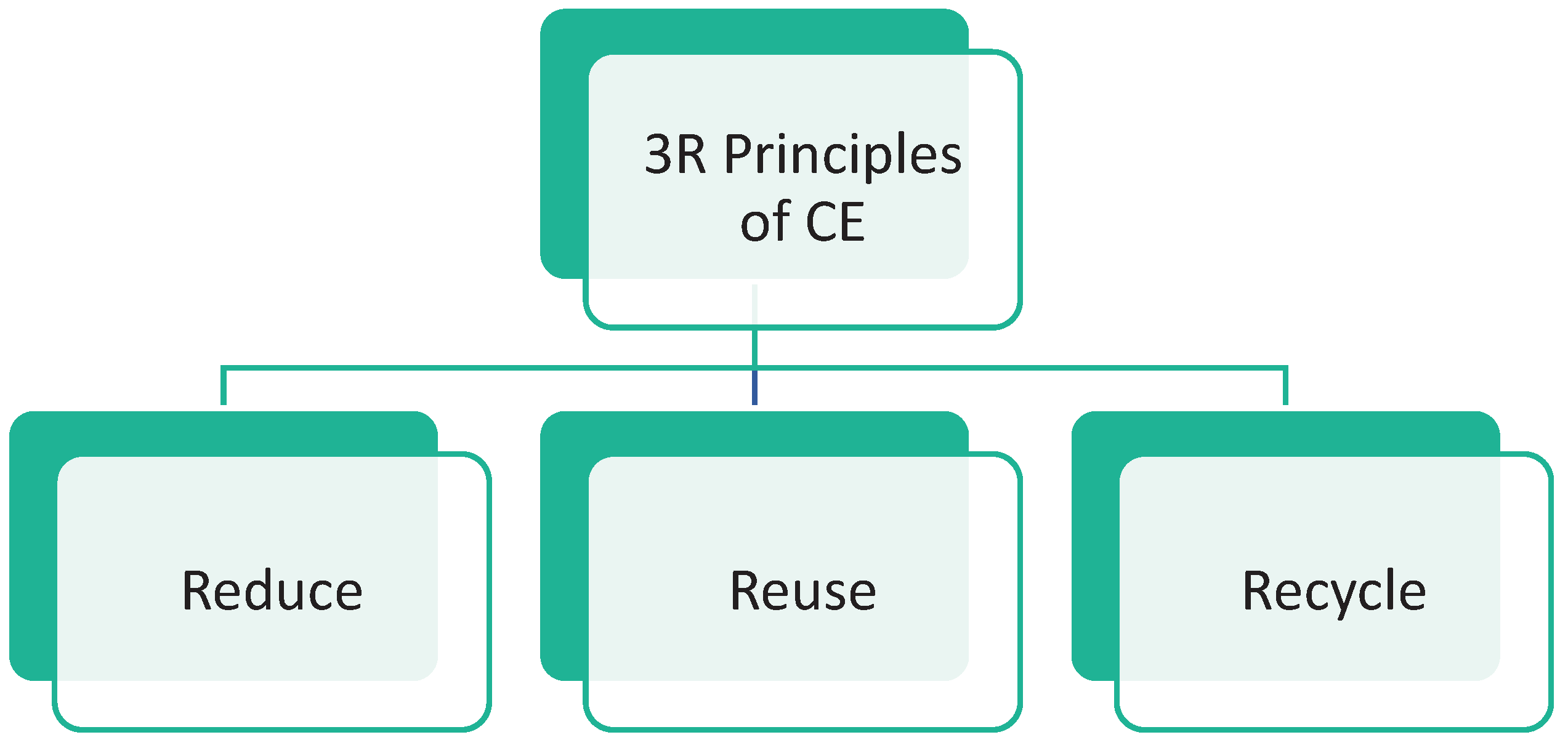
Figure 1.
Word Cloud on the keywords of the study.
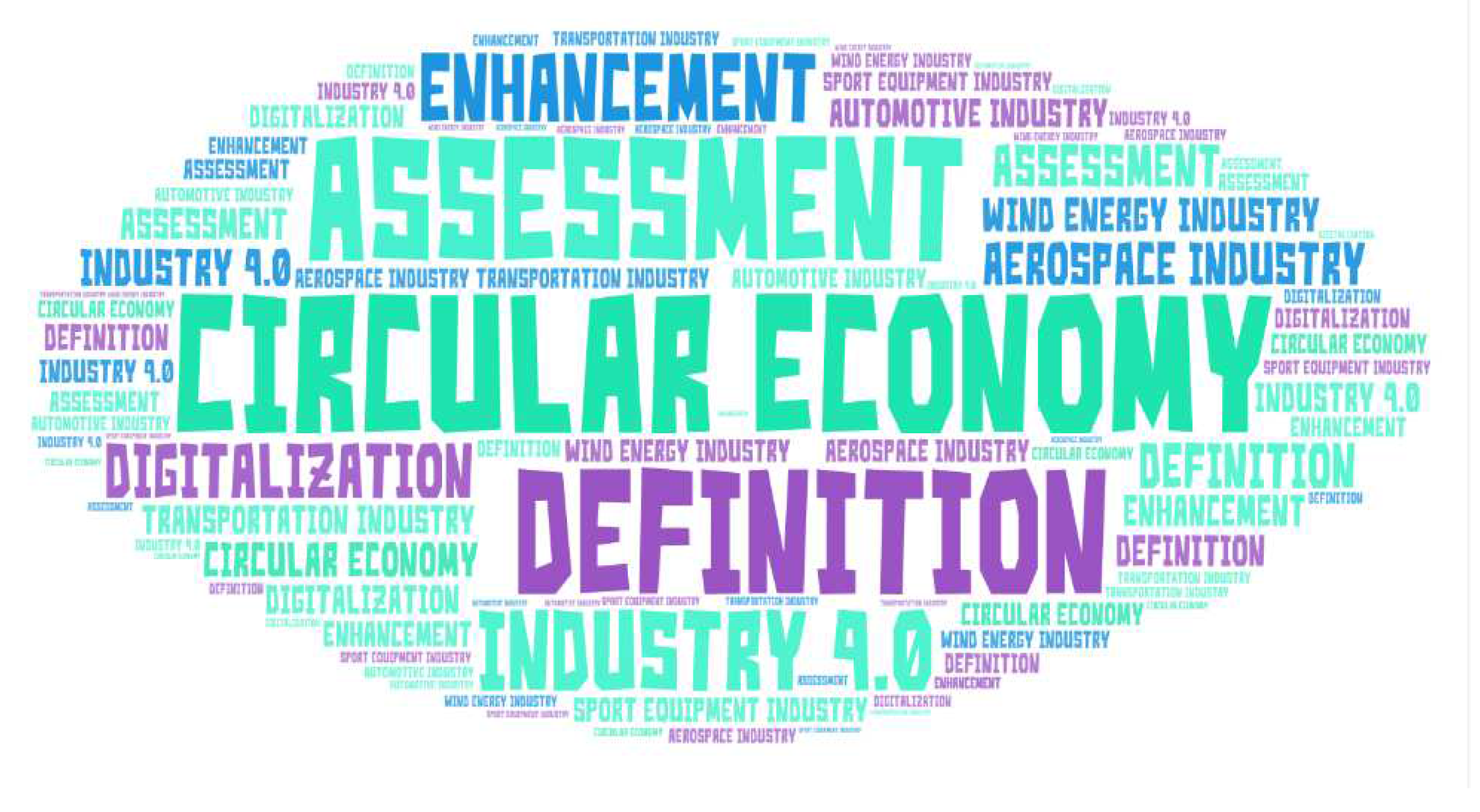
Figure 3.
Main tool for the assessment of circular economy
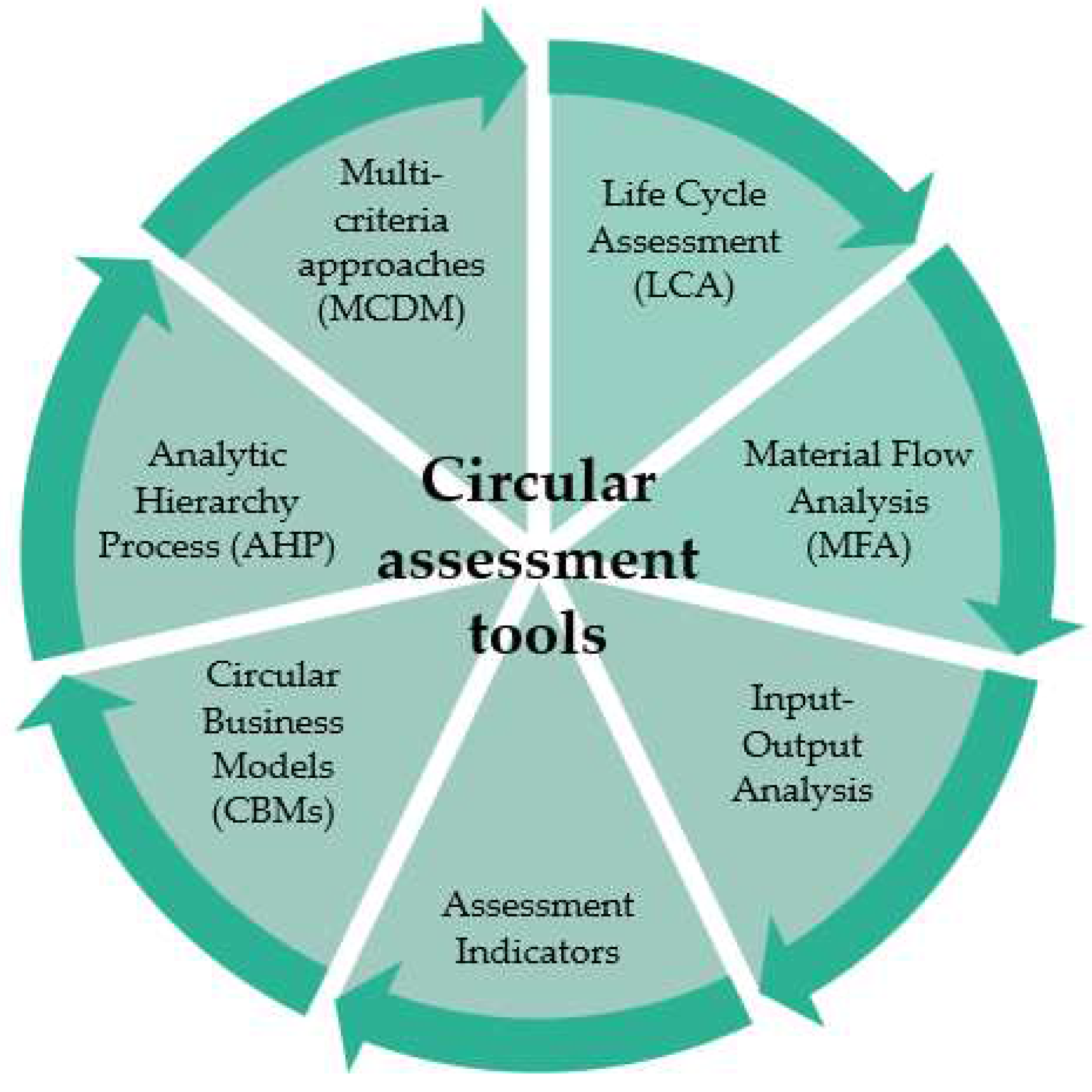
Figure 4.
Possibilities for the implementation of circular economy in the aerospace industry.
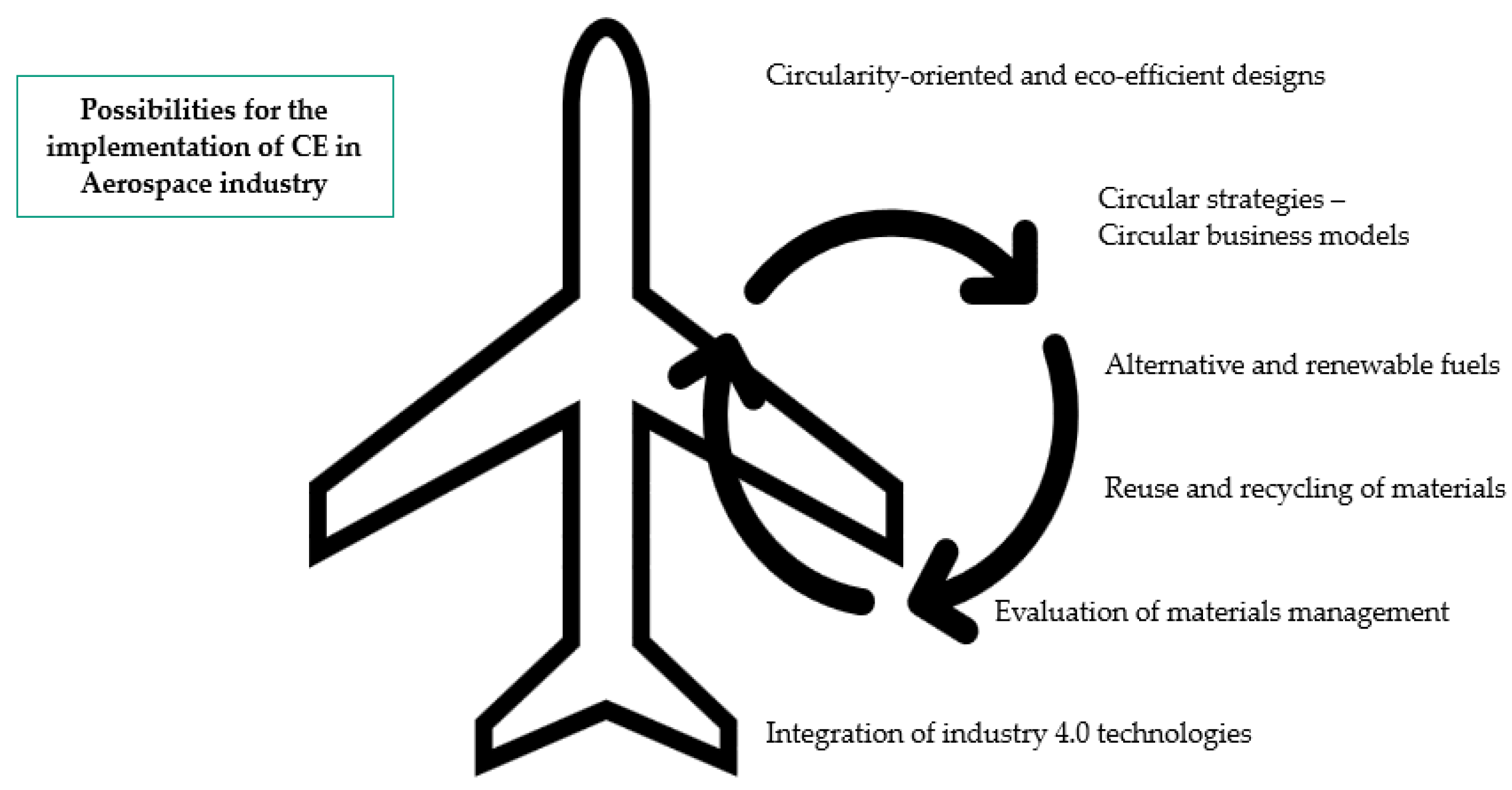
Figure 6.
Five main industries that are reviewed.

Figure 6.
Main emerging digital technologies of Industry 4.0.
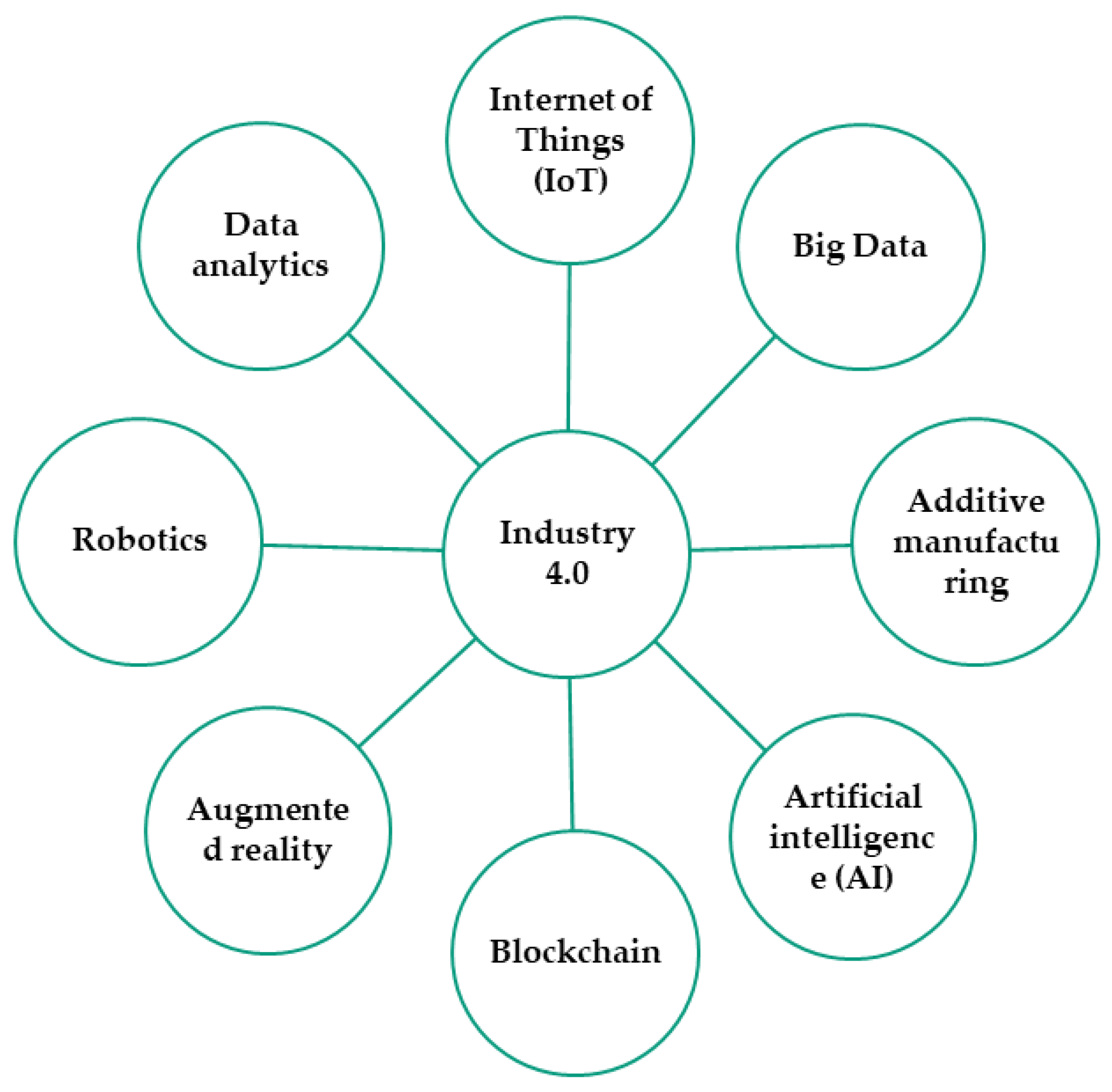

Table 1.
Previous reviews and redefinitions of the Circular Economy.
| Authors | Focus | References |
| Awan et al. | Review of 26 CE definitions | [14] |
| Geissdoerfer et al. | Investigation of the relationship between CE and sustainability | [15] |
| Geisendorf et al. | Review of current definitions of CE | [16] |
| Alhawari et al. | Review of CE definitions across 91 studies | [17] |
| Nobre et al. | Review of the most known CE definitions and inputs from 44 PhD specialists’ researchers | [18] |
| Korhonen et al. | Contribution to the scientific research on CE. | [19] |
| Kirchherr et al. | Review of 221 CE definitions | [1] |
| Figge et al. | Discussion about good CE definitions | [20] |
Table 2.
Definitions of the term "Circular Economy" in the context of the EC funded research project “RECREATE”.
Table 2.
Definitions of the term "Circular Economy" in the context of the EC funded research project “RECREATE”.
| Number of answers | Definitions of Circular Economy |
| 1 | Circular economy is a constant optimization process of minimal waste and product value loss. In an ideal case, this would mean every batch or gram of any material would slowly downcycle through several product lifetimes, always entering new suitable applications until none are found and the remaining value in the material is recovered either as chemical components or as energy. |
| 2 | From the perspective of circular business models, slowing, narrowing and closing loops of resource flows are equally important for the circular economy. |
| 3 | Circular economy means returning the intrinsic value of a material/raw material to existing cycles as best as possible after the first phase of its life. This can be both as a substitute for new raw materials and to increase the property level of other materials. |
| 4 | Reuse of products, assemblies, parts, materials and molecules possibly without any loss. |
| 5 | Creating a society and business economy which uses materials and products in multiple cycles. |
| 6 | Reuse of products, upcycle and recycle materials /products/consumables as often as possible for a close loop economy that benefits all areas of sustainability. |
| 7 | A circular economy is the closing of the raw material chain to form a circle. Whereby not only the material but also emissions and energy must be considered. |
| 8 | A model aiming to maintain value of products, components, and materials on a long-term basis, characterized by a continuous positive development cycle that preserves and enhances natural capital, optimizes resource yields, and minimizes system risks, while managing finite stocks and renewable flows of materials. |
| 9 | Reuse and recycle some End-of-Life materials in order to valorize them to provide the same or new functionalities. |
| 10 | A measurement that (a) can minimize usage on non-renewable resources, (b) popularize resource usage best practices, (c) deploy best practices, (d) build recycling facilities. |
Disclaimer/Publisher’s Note: The statements, opinions and data contained in all publications are solely those of the individual author(s) and contributor(s) and not of MDPI and/or the editor(s). MDPI and/or the editor(s) disclaim responsibility for any injury to people or property resulting from any ideas, methods, instructions or products referred to in the content. |
© 2023 by the authors. Licensee MDPI, Basel, Switzerland. This article is an open access article distributed under the terms and conditions of the Creative Commons Attribution (CC BY) license (http://creativecommons.org/licenses/by/4.0/).
Copyright: This open access article is published under a Creative Commons CC BY 4.0 license, which permit the free download, distribution, and reuse, provided that the author and preprint are cited in any reuse.


