

Submitted:
06 October 2023
Posted:
09 October 2023
You are already at the latest version
Preprints on COVID-19 and SARS-CoV-2
Abstract
Abstract: (1) Background: The Covid-19 pandemic has spread globally since January 2020 and is a threat to public health. This study aims to highlight the psychosocial impact on Greek nursing students and the challenges they received regarding the new sustainable educational reality, in the context of the sudden and exclusive application of distance education during the pandemic Covid-19; (2) Methods: Questionnaires were distributed through an online form (Lime Survey) to undergraduate nursing students enrolled in online courses. Data were collected between De-cember 2020 and January 2021 (3) Results: A total of 341 participants were included in the study. Some of the participants (9.1%) reported that being unemployed because of the Covid-19 affected their sustainability of life. Similarly, distance education had a negative impact on students' par-ticipation in social activities with their classmates (64.5%), while many of the participants were concerned that the sudden transition from face-to-face to distance education would have a negative impact on their future career (46.3%). Furthermore, the majority of students in this study seemed to disagree that distance education could be more effective than face-to-face education (72.1%); (4) Conclusions: It is undoubtedly proven that the effects of the Covid-19 pandemic have a great impact on the educational sector. These social and psychological changes endangered the viability of students in the Greek educational reality.
Keywords:
Covid-19
; pandemic
; distance education
; nursing students
; sustainability
1. Introduction
The disease Covid-19 emerged in the city of Yuan, China, in 2019. The World Health Organization recognised Covid-19 as a public health threat in an official announcement on 31 January 2020 [1,2]). However, the impact of the pandemic is far-reaching and includes areas such as health and education that disrupt the social fabric [3]. The exclusive use of distance education has proven to be a significant challenge in maintaining a quality educational environment, although it is not an unknown form of education. However, the sudden replacement of face-to-face education by distance education during the Covid-19 pandemic put the quality of education at risk [4]. Meanwhile, the Covid-19 pandemic period was an unprecedented global crisis that affected basic institutions such as education. The exploitation of new technological data through sectoral change in the field of education brings about a total transformation of social institutions, such as higher education, based on the development of digital technology. It is particularly striking that the pandemic has caused additional psychological stress, discomfort and insecurity among nursing students. More specifically, these negative feelings stem from the demands of the placement in relation to distance education and the difficulties in its implementation [5,6].
Due to this sudden transition in education, many difficulties arose that threatened the sustainability of nursing students, such as the rapid familiarisation with digital teaching, the provision and unequal access to technological resources, the lack of social interaction between teachers and students, and the management of their mental health during this transition [7,8]. The education of students as future workers is negatively affected as many of them are already under stress due to the crisis caused by the Covid-19 virus and the social distancing caused by the pandemic, unable to meet their basic needs. The change in their daily lives has led to oppression, including through, the sudden strengthening of the bonds of the family structure, even though collective care and social solidarity are seen as a necessity to deal with the Covid-19 pandemic [9]. The individual as a social being is called upon to face the Covid-19 pandemic not only on a biological level, but also on an economic, psychological; and cultural level [10]. Health and education authorities have a primary role in managing and implementing pandemic measures. Difficulties of access are noted in these areas, as individuals are at risk of being targeted by the latent inequalities brought to light by the pandemic in question [11]. In light of the above, the aim of the present study was to illustrate the psychosocial adaptation of the academic community in the abrupt and exclusive application of distance learning during the Covid-19 pandemic.
2. Materials and Methods
2.1. Participants and Material
The questionnaire comprised of 21 items, with a mean duration 5–8 min to complete. A total of 341 participants were included in the study. ATel was developed through theoretical research by experts in the Philippines [12]. The original version of the questionnaire was translated into Greek using the back-translation strategy for cross-cultural research. The internal consistency for the Greek version of the ATel was excellent (Cronbach's alpha = 0.90). A set of 10 additional questions related to ATel factors were added to the questionnaire. The questionnaire was assessed for facial validity by an interdisciplinary team of ten senior researchers in the fields of education and community nursing. Particular attention was paid to the construction of objects, in order to avoid ambiguity or incomprehensibility [13]. All students were informed about the main aims of the study and consecutively were asked to provide written informed consent, so as to participate in the study.
2.3. Statistical Methods
Discrete and qualitative data were expressed as counts and % proportions while continuous variables were expressed in the form of mean ± SD. Kolmogorov-Smirnov test was applied for testing the data normality. Cronbach’s alpha was applied for measuring internal consistency of data. Independent samples t-test or the corresponding non-parametric Mann-Whitney were applied for comparing means or distributions between continuous variables divided into two groups. More than two groups’ comparisons in continuous variables were performed using one-way ANOVA or the non-parametric Kruskal-Wallis test. Pearson’s or Spearman’s r coefficient were used to examined correlation of continuous variables. Multiple linear regression using ATel score as dependent variables and demographic, questionnaire items for beliefs and fears about e-education were used. Also McNemar test was used to test the equality of marginal frequencies. Statistical analysis of data was performed using an IBM SPSS Statistics 24.0 software and a level of significance was set to a=0.05.
2.4. Ethics
The first author of this research requested and obtained the license to use and translate the tool from its original developers. The study protocol was approved (University of Patras – Research and Ethics Committee No 18/38995/23/11/20, Hellenic Mediterranean University – Research and Ethics Committee No 37/15/12/20). All participants entering the study provided written informed consent after receiving a complete description of the study and answering any questions. Along with the questionnaires a cover letter explaining the purpose of the study was offered, providing the researchers’ affiliation and contact information, and clearly stating that answers would be confidential, and anonymity would be guaranteed in the final data reports.
3. Results
A total of 341 participants were included in the study, aged from 19 to 61 years, with a mean age of 24.4 ± 8.1 years old, mostly females (294, 89.2%) and without a marital status (single) (303, 88.9%). Most of them (224, 65.7%), were living within their parental family, and 110 (32.3%) have a person at high risk. Demographic characteristics in more details could be found in a previous article [13]. Table 1 includes more students’ demographic data. Most of the students were in Hellenic Mediterranean University HMU- (308, 90.3%) and the majority (154, 45.2%) were student of the 1st and 2nd year. Only 39, 11.4% self-report an education deficit disorder, and only 43 (12.6%) have a previous e-education experience.
Most of the participants were unemployment before the 1st pandemic (260, 76.2%) and a similar frequency (248, 72.7%) was found for the 2nd wave of pandemic. Between students 50 (14.7%) and 61 (17.9%) were working during 1st and 2nd pandemic respectively. The rest 31 (9.1%) during 1st wave, and 32 (9.4%) during 2nd wave was unemployment due to pandemic. Based on McNemar Bowker test there is a significant change in working status of students (χ2(3) =11.429, p=0.010).
Table 3 includes counts and % frequencies of the questionnaire items under 3 responses (agree, neutral, disagree). Agree (disagree) sum the count of responses of Agree/Absolutely Agree (Disagree/Absolutely Disagree) while Neutral remains unchanged.
Most of the items were highly answered on “agree” reply (16 of 20 items). Agree was ranging from 42.8 in item “(Conditions in my living environment (family, friendly, etc.)” influenced the use of distance education during the pandemic) to 72.4% in item “(From the beginning I had the appropriate technological equipment to respond the needs of e-education (tablet, smart phones, computer)”.
Items with higher replies in disagree were: “I believe that the application of distance education exclusively has been the occasion for the development of some of my skills” (37.2%), “Social isolation from my classmates and teachers makes me depressed” (44.0%), “I consider distance education to be more effective than lifelong education” (72.1%), “The new conditions, due to the Covid-19 pandemic, lead me to thoughts of dropping out of my studies” (84.2%).
Differences in the Attitudes about e-education scales in various occupational, demographic, or other variables were shown in Table 4. Age is weakly correlated with ATel (Spearman’s rs=0.254, p<0.001) (data not included in Table 4). A significant difference was found between students >22 years old in ATel scores (3.09 ± 0.95) vs those under ≤22 (2.65 ± 0.91) (p<0.001). Sex of students do not affect ATel scores (p=0.921). Students with children have a significant mean score 3.58±0.65 vs those without 2.78 ± 0.95 (p=0.016), while when marital status was single mean “ATel” score was significantly lower 2.74±0.95 than other marital statuses (3.25±0.80) (p<0.001). An increasing pattern in “ATel” scores was found for increasing study years (<=2 year: 2.59±0.99, 3rd year: 2.94±0.82, 4th year: 2.99±0.94, p<0.001). Students that they did not work at the 1st wave due to pandemic showed a higher mean score 3.22±0.98 than working and unemployed (p<0.001). This was not observed for the 2nd wave of pandemic (p=0.938).
Correlation of questionnaire items related to fears, attitudes, and beliefs, with ATel scale was shown in Table 5. All questionnaire items showed to be correlated significantly with ATel variable. The four Items with the higher correlation coefficients were: I consider distance education to be more effective than face-to-face education (rs=0.672, p<0.001), I believe that the transition from living to distance education has been an opportunity for the evolution of the education system (rs=0.631, p<0.001), I believe that the application of distance education exclusively has been the occasion for the development of some of my skills, rs=0.508, p<0.001, Distance education facilitates my professional, family, educational obligations because it provides me with flexibility, rs=0.533, p<0.001.
The differences in ATel scale between each questionnaire item was shown in Table 6. Almost all the items showed a significant difference in ATel scales. The item without significant effect in ATel scale was the item “The new conditions, due to the Covid-19 pandemic, lead me to thoughts of dropping out of my studies” which showed a p-valued of p=0.101 in 5-grade Likert scales and p=0.106 in recoded 3-grade Likert. Item from the beginning I felt able - or to meet the requirements of distance education due to my familiarity with electronic devices (tablet, smart phones, computer) showed no significance in ATel score when scale was recorded in 3 grades (p=0.063). The 5-items with the higher scores were: I believe that the transition from living to distance education has been an opportunity for the evolution of the education system (3,95 ±1.01), Distance education facilitates my professional, family, educational obligations because it provides me with flexibility (3.70 ± 0.89), I consider distance education to be more effective than face-to-face education (3.69 ± 1.54) and I believe that the application of distance education exclusively has been the occasion for the development of some of my skills (3.68±1.02). Boxplots were most preferable and more informative than error bars especially when there is a deviation from normality.
Figure 1.
Sample graphs (box and whisker plots) of ATel scale over questionnaire item.
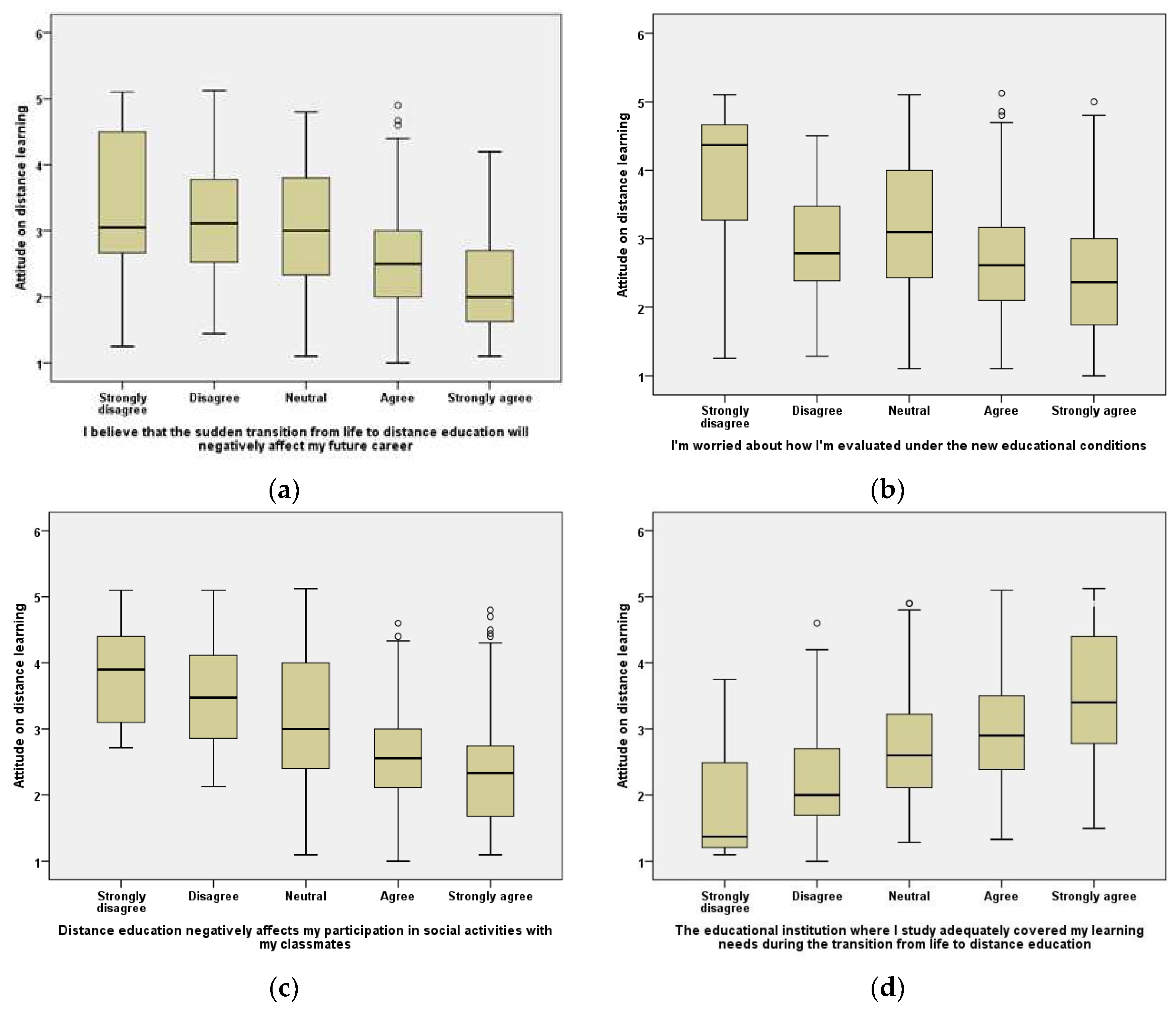

Table 7.
Multiple linear regression standardized and unstandardized beta’ s with 95% interval for ATel score as predicted from demographics and questionnaire items (forward model).
Table 7.
Multiple linear regression standardized and unstandardized beta’ s with 95% interval for ATel score as predicted from demographics and questionnaire items (forward model).
| beta | 95% LL |
95% UL |
p | |
|---|---|---|---|---|
| I consider distance education to be more effective than face-to-face education | 0.322 | 0,259 | 0,385 | <0.001 |
| I believe that the transition from living to distance education has been an opportunity for the evolution of the education system | 0.227 | 0,171 | 0,283 | <0.001 |
| Social isolation from my classmates and teachers makes me depressed | -0.110 | -0,163 | -0,057 | <0.001 |
| Distance education facilitates my professional. family. educational obligations because it provides me with flexibility | 0.153 | 0,094 | 0,211 | <0.001 |
| Distance education prevents me from doing group work with my classmates | -0.065 | -0,126 | -0,004 | 0.037 |
| From the beginning I had the appropriate technological equipment to respond the needs of e-education (tablet. smart phones. computer) | 0.094 | 0,034 | 0,154 | 0.002 |
| Distance education negatively affects my participation in social activities with my classmates | -0.083 | -0,144 | -0,022 | 0.007 |
| I believe that the sudden transition from face-to-face to distance education will negatively affect my future career | -0.057 | -0,112 | -0,002 | 0.042 |
4. Discussion
Overall, the results of the study provided evidence that distance education could be more effective than face-to-face education (beta: 0.322, 95%CI: 50.259-0.385, p<0.001). However, the results are in line with previous research, where the majority of students (54%) suggested an improvement in the effective management of distance education during the Covid-19 pandemic [14]. On the other hand, previous research revealed that the majority of participants (75.4%) identified a wide range of difficulties with the sudden transition from face-to-face to distance education during the pandemic [15]. According to the literature, particular emphasis was placed on the difficulty of accessing the internet, the lack of social interaction between students and the strain on their mental health due to the social isolation they experienced at the time [16].
It is worth noting that in a previous study in Mongolia, most participants emphasized that the use of technological media in the learning process could provide students with high quality knowledge, not just flexibility in the time and place of its acquisition. In addition, distance learning was reported to offer a wealth of interdisciplinary areas based on their interests, with the majority of participants (91%) indicating an intention to pursue medical education online [17]. However, a recent study in four Latin American countries (Peru, Ecuador, Colombia, Mexico) highlighted the particular difficulty of implementing modern educational environments enriched with innovative educational practices adapted to the needs of modern society. Specifically, the highest score was reported in Mexico and the lowest in Colombia in terms of knowledge of the level statement [18]. In addition, a previous study in 26 countries in the Global South highlighted as an important finding that innovating new digital tools and new ways of learning in education could led to cultivating and developing students' critical thinking [19].
The data of the present study strongly indicated that the sudden shift from face-to-face to distance education was an opportunity for the evolution of the education system (beta: 0.227, 95%CI: 0.171-0.283 p<0.001). Similarly, a previous study presented this sudden shift from face-to-face to distance learning during the Covid-19 pandemic, but highlighted the need for better preparation of young people in digital technology and internet connectivity. On the other hand, in the same study, a high percentage of participants (41%) connected the user experience to the digital educational reality through the use of different social network platforms [20]. It is worth noting, that the use of distance education could be a valuable educational tool for future progress [21]. Meanwhile, the role of university structures is focused on being able to attract scholars from all over the world to find solutions to problems and improve social welfare. They must also reward achievement and ensure the free exchange of knowledge, with an emphasis on cultivating critical thinking [22].
In addition, the current study found a strong relationship between social isolation from peers Furthermore, the current study found a strong association between social isolation from peers and teachers during the Covid-19 pandemic (beta=-0.110, 95% CI: -0.16 to -0.057, p<0.001). The same result is found in a previous study in which almost a third of the nursing student population experienced mild depression with higher levels of depression noted among Spanish students (59.1%) followed by Albanian(34.5%) and Greek (21.8%) students of the exclusive use of distance education in relation to the cultivation of negative emotions, such as isolation, loneliness, etc. [23]. On the other hand, previous research has shown that the wider use of distance education after the end of the Covid-19 pandemic, provided an opportunity to create new contexts of interaction through the development of innovative digital technologies (67% of participants) [24]. Meanwhile, another study found a strong link between negative emotions and the use of communication technologies, as they isolate people and deprive them of interaction [25]. However, one of the elements that needs immediate attention in the education system is the provision of mental health services and the implementation of student-centred methods and practices that focus on the prevention and restoration of mental health and well-being.
In our study, it was reported as a significant finding that distance education provided, the majority of participants, with the flexibility to combine their studies with meeting their work and family needs (beta: 0.153, 95% CI: 0.094-0.211, p<0.001). However, a previous study in Jordan, identified lack of human interaction and poor internet connectivity as disadvantages of distance education, despite the fact that distance education provided flexibility for some participants (50,5%) [26]. Meanwhile, a recent qualitative study in the United Kingdom introduced the technique of blended learning or blended teaching. This teaching model is called Hyflex and it combines online and face-to-face education. More specifically, it offers students and teachers the opportunity to deliver lectures in the classrooms they are familiar with, but also gives students the opportunity to participate face-to-face or remotely. The Hyflex (Hybrid Flexible) model is a teaching method that, like all blended models, combines online and face-to-face education [27]. According the literature studies of socialisation processes in teaching and learning during the Covid-19 pandemic identified that the shift to modern video technologies has led to a dramatic reduction in socialisation processes as a result of a reduction in the number of social interactions [28,29]. Under these conditions, both teachers and students experienced difficulties in recognising social situations and behavioural norms that were unfamiliar to them [30]. In addition, teachers reported insufficient peer support and the feeling that they had no one to help them prepare lessons for online teaching [31,32]. Finally, the lack of social cues in modern online communication, due to cameras being turned off and microphones being muted [33], negatively affected participants' mental health [34] and well-being, and led to a sense of social isolation. experienced by both teachers and students - a feeling of being "alone in the world" during the lesson [35].
As shown in the current study (beta=-0.083, 95%CI: -0.144 to -0.022, p=0.007), the abrupt transition from face-to-face to distance learning was a significant barrier to the development of social interaction and team spirit. This fact threatens the viability of nursing students, seriously jeopardizing their development and sustainability in the new educational reality [36]. A recent study in Spain showed that part of the participants (39.8 %) experienced high levels of stress due to this sudden change in education, while they often felt that it caused confusion in their social behavior [37].
In addition, this finding correlates with previous research, such as this one in Japan, where the majority of participating students expressed high levels of anxiety (58.5%) due to their social isolation from the educational process. as he distinguished the interaction offered by face-to-face education [38]. At the same time, it highlighted the opportunities offered by online educational materials in distance education, providing information that cultivates critical thinking [39]. This confirms that although students may be able to return to face-to-face education, they are likely to continue to face mental health and well-being challenges related to the pandemic – stress may persist for some students as PTSD (49.4 %), as mentioned in a recent study in Australia [25,33].
This teamwork may propose solutions to everyday challenges, with a forward-looking perspective. Studies of socialization processes in teaching and learning during the Covid-19 pandemic show that the shift to modern video technologies has led to a dramatic reduction in socialization processes as a result of a reduction in the number of social interactions [28,29].
A significant finding of this study (beta=0.094, 95%CI: 0.034-0.154, p=0.002) is related to the possession of the technological equipment needed for e-learning (Tablet, Smartphone, PC). In the present study, there was evidence that the majority of students had the appropriate technological resources to be able to meet the needs of distance learning. On the contrary, a recent qualitative study in Shanghai highlighted the difficulty nursing students had in finding technological equipment to meet their e-learning needs [40]. However, it is important to note that in the same study, technological resources were associated with the effectiveness of students' cognitive performance due to the need for practical application in nursing. At the same time, a recent study in Greece highlighted a particular weakness in the availability of equipment, while a differentiation between the technological quality of education provided in urban and rural areas was highlighted [41].
Eventually, the present study showed another significant finding related to the sudden transition from face-to-face to distance education and its negative impact on participants' future careers (beta=-0.074, 95%CI: -0.112 to -0.002, p=0.042). Similarly, previous studies have found that students are concerned about their future progress and at the same time, this future uncertainty leads them to adopt negative emotions [42,43]. Lastly, the present study highlighted another important finding related to the correlation between the sudden transition from residential to distance education and the negative impact of the latter on the future career of nursing students (beta = -0.074, 95% CI: -0.112 to -0.002, p=0.042). Similarly, previous studies have found that students worry about their future progress and at the same time this future uncertainty leads them to adopt negative emotions [42,43]. On the other hand, a recent qualitative study conducted in Iran found that online education has stimulated self-directed learning. More specifically, distance education has been increased students' use of educational websites to facilitate their learning [44].
5. Conclusions
The sudden and exclusive use of distance education was a global social change that changed the paradigm of educational institutions. highlights, the difficulty of psychosocial adaptation of nursing students as members of the academic community to the new educational reality. The Covid-19 pandemic posed significant challenges to the sustainability of the development of nursing students in the Greek reality. In conclusion, the triangle of knowledge (i.e. education, research, innovation) must be linked to the mission of service to society - to pursue the goal of sustainability, universities must lead this educational change by listening more to students, increasing their sense of responsibility towards others and providing the appropriate infrastructure to implement the new teaching methods that have emerged in the post-Covid-19 pandemic period. However, the collection of data that contributes to the quality of the change, the support of teachers in the correct choice of the digital teaching materials they tend to use, and the identification of the weaknesses that inevitably affect the effectiveness of the educational process are useful features of supportive educational systems, but need further study in order to accurately identify psychosocial transformations.
Author Contributions
Conceptualization, A.P.; methodology, A.P.; formal analysis, G.M. and A.P.; investigation and data curation, E.K., N.B., E.P. and A.P.; writing-original draft preparation, E.K.; writing-review and editing, E.K., E.P., N.B., G.M., and A.P.; supervision, A.P. All authors have read and agreed to the published version of the manuscript.
Funding
This research received no external funding.
Institutional Review Board Statement
This study was in accordance with the Declaration of Helsinki. All methods were performed in accordance with the relevant guidelines and regulations provided by the research ethics committee of the Hellenic Mediterranean University and University of Patras. Participants were informed that their participation was voluntary and that they had the right to cancel at any time during the completion of the sur-vey without facing any consequences. After reading the recruitment statement, all study participants were asked to sign the informed consent form.
Informed Consent Statement
All study participants were asked to sign the informed consent form.
Data Availability Statement
The datasets used and/or analyzed during the current study are available from the corresponding author on reasonable request.
Acknowledgments
The author would like to thank students for their participation in this study.
Conflicts of Interest
The authors declare no conflict of interest.
References
- Patelarou, A. E.; Konstantinidis, T.; Kartsoni, E.; Mechili, E. A.; Galanis, P.; Zografakis-Sfakianakis, M.; Patelarou, E. Development and Validation of a Questionnaire to Measure Knowledge of and Attitude toward COVID-19 among Nursing Students in Greece. Nurs. Rep. 2020, 10, 82–94. [Google Scholar] [CrossRef]
- Ahmady, S.; Kallestrup, P.; Sadoughi, M. M.; Katibeh, M.; Kalantarion, M.; Amini, M.; Khajeali, N. Distance Learning Strategies in Medical Education during COVID-19: A Systematic Review. J. Educ. Health Promot. 2021, 10, 421. [Google Scholar] [CrossRef]
- Chang, C.-Y.; Chung, M.-H.; Yang, J. C. Facilitating Nursing Students’ Skill Training in Distance Education via Online Game-Based Learning with the Watch-Summarize-Question Approach during the COVID-19 Pandemic: A Quasi-Experimental Study. Nurse Educ. Today 2022, 109, 105256. [Google Scholar] [CrossRef]
- Natarajan, J.; Joseph, M. A. Impact of Emergency Remote Teaching on Nursing Students’ Engagement, Social Presence, and Satisfaction during the COVID-19 Pandemic. Nurs. Forum 2022, 57(1), 42–48. [Google Scholar] [CrossRef]
- De Los Santos, J. A. A.; Labrague, L. J.; Falguera, C. C. Fear of COVID-19, Poor Quality of Sleep, Irritability, and Intention to Quit School among Nursing Students: A Cross-sectional Study. Perspect. Psychiatr. Care 2022, 58, 71–78. [Google Scholar] [CrossRef]
- Patelarou, E.; Galanis, P.; Mechili, E. A.; Argyriadi, A.; Argyriadis, A.; Asimakopoulou, E.; Kicaj, E.; Bucaj, J.; Carmona-Torres, J. M.; Cobo-Cuenca, A. I.; Doležel, J.; Finotto, S.; Jarošová, D.; Kalokairinou, A.; Mecugni, D.; Pulomenaj, V.; Malaj, K.; Sopjani, I.; Zahaj, M.; Patelarou, A. Assessment of COVID-19 Fear in Five European Countries before Mass Vaccination and Key Predictors among Nurses and Nursing Students. Vaccines (Basel) 2022, 10, 98. [Google Scholar] [CrossRef]
- Daniel, S. J. Education and the COVID-19 Pandemic. Prospects (Paris) 2020, 49, 91–96. [Google Scholar] [CrossRef]
- Thapa, P.; Bhandari, S. L.; Pathak, S. Nursing Students’ Attitude on the Practice of e-Learning: A Cross-Sectional Survey amid COVID-19 in Nepal. PLoS One 2021, 16, e0253651. [Google Scholar] [CrossRef]
- Kanter, J. B.; Williams, D. T.; Rauer, A. J. Strengthening Lower-Income Families: Lessons Learned from Policy Responses to the COVID-19 Pandemic. Fam. Process 2021, 60, 1389–1402. [Google Scholar] [CrossRef]
- Murthy, R. COVID-19 Pandemic and Emotional Health: Social Psychiatry Perspective. Ind. J. Soc. Psychiatr. 2020, 36, 24. [Google Scholar] [CrossRef]
- Miconi, D.; Li, Z. Y.; Frounfelker, R. L.; Santavicca, T.; Cénat, J. M.; Venkatesh, V.; Rousseau, C. Ethno-Cultural Disparities in Mental Health during the COVID-19 Pandemic: A Cross-Sectional Study on the Im-Pact of Exposure to the Virus and COVID-19-Related Discrimination and Stigma on Mental Health across Eth-No-Cultural Groups in Quebec (Canada). BJPsych open 2021, 7. [Google Scholar] [CrossRef]
- Guiillasper, J. N.; Soriano, G. P.; Oducado, R. Psychometric Properties of ‘Attitude towards e-Learning Scale among Nursing Students. Int J Edu Sci 2020, 30, 1–5. [Google Scholar] [CrossRef]
- Kartsoni, E.; Bakalis, N.; Patelarou, E.; Markakis, G.; Lahana, E.; Patelarou, A. Translation, Cultural Adaptation and Validation of the Attitude Scale towards e-Learning (ATel) into the Greek Language. Popul. Med. 2022, 4, 1–8. [Google Scholar] [CrossRef]
- Soriano, G. P. Psychometric Properties of ‘Attitude towards e-Learning Scale’ among Nursing Students. Int. J. Educ. Sci. 2020, 30, (1–3). [Google Scholar] [CrossRef]
- Maatuk, A. M.; Elberkawi, E. K.; Aljawarneh, S.; Rashaideh, H.; Alharbi, H. The COVID-19 Pandemic and E-Learning: Challenges and Opportunities from the Perspective of Students and Instructors. J. Comput. High. Educ. 2022, 34, 21–38. [Google Scholar] [CrossRef]
- Kartsoni, Ε.; Patelarou, A. The Psychosocial Adaptation of the Academic Community to the Abrupt Implementation of Distance Learning during the COVID-19 Pandemic. Archives of Hellenic Medicine 2021, 2021, 754–760. [Google Scholar]
- Baatarpurev, B.; Tsogbadrakh, B.; Bandi, S.; Samdankhuu, G.-E.; Nyamjav, S.; Badamdorj, O. Online Continuing Medical Education in Mongolia: Needs Assessment. Korean J. Med. Educ. 2022, 34, 191–200. [Google Scholar] [CrossRef]
- Alvarez-Risco, A.; Del-Aguila-Arcentales, S.; Rosen, M. A.; García-Ibarra, V.; Maycotte-Felkel, S.; Martínez-Toro, G. M. Expectations and Interests of University Students in COVID-19 Times about Sustainable Development Goals: Evidence from Colombia, Ecuador, Mexico, and Peru. Sustainability 2021, 13, 3306. [Google Scholar] [CrossRef]
- Okolie, U. C.; Igwe, P. A.; Mong, I. K.; Nwosu, H. E.; Kanu, C.; Ojemuyide, C. C. Enhancing Students’ Critical Thinking Skills through Engagement with Innovative Pedagogical Practices in Global South. High. Educ. Res. Dev. 2022, 41, 1184–1198. [Google Scholar] [CrossRef]
- Faggiano, M. P.; Fasanella, A. Lessons for a Digital Future from the School of the Pandemic: From Distance Learning to Virtual Reality. Front. Sociol. 2022, 7. [Google Scholar] [CrossRef]
- Huang, P.; Yu, Q. Online Interactions: Mobile Text-Chat as an Educational Pedagogic Tool. Behav. Sci. (Basel) 2022, 12, 487. [Google Scholar] [CrossRef]
- Trevisan, L. V.; Mello, S. F. D.; Silva, T. N. D.; Pedrozo, E. A. Transformative Learning for Sustainability Practices in Management and Education for Sustainable Development: A Meta-Synthesis. Revista de gestão social e ambiental. São Paulo 2022, 16, 1–17. [Google Scholar] [CrossRef]
- Mechili, E. A.; Saliaj, A.; Kamberi, F.; Girvalaki, C.; Peto, E.; Patelarou, A. E.; Bucaj, J.; Patelarou, E. Is the Mental Health of Young Students and Their Family Members Affected during the Quarantine Period? Evidence from the COVID-19 Pandemic in Albania. J. Psychiatr. Ment. Health Nurs. 2021, 28, 317–325. [Google Scholar] [CrossRef]
- Green, G.; Shorer, T. Beliefs, Emotions, and Usage of Information and Communication Technologies in Distance Learning during the COVID-19 Pandemic: Health Sciences Students’ Perspectives. Digit. Health 2022, 8, 205520762211311. [Google Scholar] [CrossRef]
- Liverpool, S.; Moinuddin, M.; Aithal, S.; Owen, M.; Bracegirdle, K.; Caravotta, M.; Walker, R.; Murphy, C.; Karkou, V. Mental Health and Wellbeing of Further and Higher Education Students Returning to Face-To-Face Learning after Covid-19 Restrictions. PLOS ONE 2023, 18(1), e0280689. [Google Scholar] [CrossRef]
- Al-Alami, Z. M.; Adwan, S. W.; Alsous, M. Remote Learning during Covid-19 Lockdown: A Study on Anatomy and Histology Education for Pharmacy Students in Jordan. Anat. Sci. Educ. 2022, 15, 249–260. [Google Scholar] [CrossRef]
- Detyna, M.; Koch, M. An Overview of Student Perceptions of Hybrid Flexible Learning at a London HEI. J. Interact. Media Educ. 2023, 2023. [Google Scholar] [CrossRef]
- Larivière-Bastien, D.; Aubuchon, O.; Blondin, A.; Dupont, D.; Libenstein, J.; Séguin, F.; Tremblay, A.; Zarglayoun, H.; Herba, C. M.; Beauchamp, M. H. Children’s Perspectives on Friendships and Socialization during the COVID-19 Pandemic: A Qualitative Approach. Child Care Health Dev. 2022, 48, 1017–1030. [Google Scholar] [CrossRef]
- Wut, T.-M.; Xu, J. Person-to-Person Interactions in Online Classroom Settings under the Impact of COVID-19: A Social Presence Theory Perspective. Asia Pac. Educ. Rev. 2021, 22, 371–383. [Google Scholar] [CrossRef]
- Hodges, C.; Fowler, D. COVID-19 Crisis and Faculty Members in Higher Education: From Emergency Remote Teaching to Better Teaching through Reflection. International Journal of Multidisciplinary Perspectives in Higher Education 2021, 5, 118–122. [Google Scholar] [CrossRef]
- Alenezi, A. R. Modeling the Social Factors Affecting Students’ Satisfaction with Online Learning: A Structural Equation Modeling Approach. Educ. Res. Int. 2022, 1–13. [Google Scholar] [CrossRef]
- Gurung, A. B.; Ali, M. A.; Lee, J.; Farah, M. A.; Al-Anazi, K. M. An Updated Review of Computer-Aided Drug Design and Its Application to COVID-19. Biomed Res. Int. 2021, 1–18. [Google Scholar] [CrossRef]
- Usher AM, K.; Jackson, D.; Massey, D.; Wynaden, D.; Grant, J.; West, C.; McGough, S.; Hopkins, M.; Muller, A.; Mather, C.; Byfield, Z.; Smith, Z.; Ngune, I.; Wynne, R. The Mental Health Impact of COVID-19 on Pre-registration Nursing Students in Australia: Findings from a National Cross-sectional Study. J. Adv. Nurs. 2023, 79(2), 581–592. [Google Scholar] [CrossRef]
- Marroquín, B.; Vine, V.; Morgan, R. Mental Health during the COVID-19 Pandemic: Effects of Stay-at-Home Policies, Social Distancing Behavior, and Social Resources. Psychiatry Res. 2020, 293, 113419. [Google Scholar] [CrossRef]
- Gordon, J. L.; Presseau, J. Effects of Parenthood and Gender on Well-Being and Work Productivity among Canadian Academic Research Faculty amidst the COVID-19 Pandemic. Can. Psychol. 2023, 64, 144–153. [Google Scholar] [CrossRef]
- Osingada, C. P.; Porta, C. M. Nursing and Sustainable Development Goals (SDGs) in a COVID-19 World: The State of the Science and a Call for Nursing to Lead. Public Health Nurs. 2020, 37, 799–805. [Google Scholar] [CrossRef]
- Mendez-Pinto, I.; Antuña-Casal, M.; Mosteiro-Diaz, M.-P. Psychological Disorders among Spanish Nursing Students Three Months after COVID-19 Lockdown: A Cross-Sectional Study. Int. J. Ment. Health Nurs. 2023, 32, 479–489. [Google Scholar] [CrossRef]
- Tanji, F.; Kodama, Y. Prevalence of Psychological Distress and Associated Factors in Nursing Students during the COVID-19 Pandemic: A Cross-Sectional Study. Int. J. Environ. Res. Public Health 2021, 18, 10358. [Google Scholar] [CrossRef]
- Fitzgerald, D. A.; Scott, K. M.; Ryan, M. S. Blended and E-Learning in Pediatric Education: Harnessing Lessons Learned from the COVID-19 Pandemic. Eur. J. Pediatr. 2022, 181, 447–452. [Google Scholar] [CrossRef]
- Liu, Y.; Sun, X.; Zhang, P.; Han, P.; Shao, H.; Duan, X.; Jiang, J. Generation Z Nursing Students’ Online Learning Experiences during COVID-19 Epidemic: A Qualitative Study. Heliyon 2023, 9, e14755. [Google Scholar] [CrossRef]
- Kartsoni, E.; Bakalis, N.; Markakis, G.; Zografakis-Sfakianakis, M.; Patelarou, E.; Patelarou, A. Distance Learning in Nursing Education during the COVID-19 Pandemic: Psychosocial Impact for the Greek Nursing Students—A Qualitative Approach. Healthcare (Basel) 2023, 11, 1178. [Google Scholar] [CrossRef]
- Chowdhury, U.; Suvro, M. A. H.; Farhan, S. M. D.; Uddin, M. J. Depression and Stress Regarding Future Career among University Students during COVID-19 Pandemic. PLoS One 2022, 17, e0266686. [Google Scholar] [CrossRef]
- Li, D. The Shift to Online Classes during the Covid-19 Pandemic: Benefits, Challenges, and Required Improvements from the Students’ Perspective. Electron. J. E-Learn. 2022, 20, 1–18. [Google Scholar] [CrossRef]
- Yeo, J.-Y.; Jang, M. S. Nursing Students’ Self-Directed Learning Experiences in Web-Based Virtual Simulation: A Qualitative Study. Jpn. J. Nurs. Sci. 2023, 20, e12514. [Google Scholar] [CrossRef]
Table 1.
Students’ demographic data.
| n | % | ||
|---|---|---|---|
| University | HMU* | 308 | 90.3% |
| Upatras ** | 33 | 9.7% | |
| Study year | 1st and2ndyear | 154 | 45.2% |
| 3rd year | 98 | 28.7% | |
| 4th year | 89 | 26.1% | |
|
Do you face any education deficit |
Yes | 39 | 11.4% |
| No | 302 | 88.6% | |
|
Do you have any previous e-education experience |
Yes | 43 | 12.6% |
| No | 298 | 87.4% | |
* HMU: Hellenic Mediterranean University; **Upatras: University of Patras.
Table 2.
Students’ demographic data.
| Work during 2nd wave | Total | ||||||||
|---|---|---|---|---|---|---|---|---|---|
| Unemployment | Unemployment due to pandemic |
Working | |||||||
| n | % | n | % | n | % | n | % | ||
| Work during 1st wave | Unemployment | 230 | 88.5% | 18 | 6.9% | 12 | 4.6% | 260 | 76,2% |
| Unemployemt due to pandemic | 9 | 29.0% | 14 | 45.2% | 8 | 25.8% | 31 | 9,1% | |
| Working | 9 | 18.0% | 0 | 0.0% | 41 | 82.0% | 50 | 14,7% | |
| Total | 248 | 72.7% | 32 | 9.4% | 61 | 17.9% | 341 | 100.0% | |
| Working status During | n | % | |||||||
| 1st wave | 2nd wave | ||||||||
| Unemployment | Unemployment | 230 | 88.5% | ||||||
|
Unemployment due to pandemic |
18 | 6.9% | |||||||
| Working | 12 | 4.6% | |||||||
| (Total)* | 260 | 76.2% | |||||||
| (Total) | 248 | 72.7% | |||||||
|
Unemployemt due to pandemic |
Unemployment | 9 | 29.0% | ||||||
| Unemployemtdue to pandemic | 14 | 45.2% | |||||||
| Working | 8 | 25.8 | |||||||
| (Total) | 31 | 9.1% | |||||||
| (Total) | 32 | 9.4% | |||||||
| Working | Unemployment | 9 | 18.0% | ||||||
|
Unemployment due to pandemic |
0 | 0.0% | |||||||
| Working | 41 | 82.0% | |||||||
| (Total) | 50 | 14.7% | |||||||
| (Total) | 61 | 17.9% | |||||||
*Total refers to subtotal of working category.
Table 3.
Recoded summary of questionnaire items.
| Attitude about e-education | |||
|---|---|---|---|
| Disagree | Neutral | Agree | |
| n (%) | n (%) | n (%) | |
| From the beginning I felt able - or to meet the requirements of distance education due to my familiarity with electronic devices (tablet, smart phones, computer) | 32 (9.4) | 76 (22.3) | 233 (68.3) |
| From the beginning I had the appropriate technological equipment to respond the needs of e-education (tablet, smart phones, computer) | 26 (7.6) | 68 (20) | 247 (72.4) |
| I encountered network connection problems while attending online courses during the pandemic | 74 (21.7) | 73 (20) | 194 (56.9) |
| The educational institution where I study adequately covered my education needs during the transition from life to distance education.] | 61 (17.9) | 121 (40) | 159 (46.6) |
| Conditions in my living environment (family, friendly, etc.) influenced the use of distance education during the pandemic | 123 (36.1) | 72 (20) | 146 (42.8) |
| My teachers cover my education needs in the implementation of distance education in the pandemic period | 43 (12.6) | 119 (30) | 179 (52.5) |
| The interaction with my teachers was different due to the transition to distance education | 32 (9.4) | 65 (20) | 244 (71.6) |
| I deal with my education obligations in distance education with self-discipline | 45 (13.2) | 81 (20) | 215 (63) |
| Distance education negatively affects my participation in social activities with my classmates | 51 (15) | 70 (20) | 220 (64.5) |
| Distance education prevents me from doing group work with my classmates | 64 (18.8) | 103 (30) | 174 (51) |
| Distance education facilitates my professional, family, educational obligations because it provides me with flexibility | 80 (23.5) | 106 (30) | 155 (45.5) |
| I believe that the application of distance education exclusively has been the occasion for the development of some of my skills | 127 (37.2) | 89 (30) | 125 (36.7) |
| I believe that the transition from living to distance education has been an opportunity for the evolution of the education system | 111 (32.6) | 80 (20) | 150 (44) |
| The sudden use of distance education due to the pandemic caused me negative emotions such as anxiety, worry. | 87 (25.5) | 55 (20) | 199 (58.4) |
| Social isolation from my classmates and teachers makes me depressed | 150 (44) | 72 (20) | 119 (34.9) |
| I consider distance education to be more effective than face-to-face education | 246 (72.1) | 60 (20) | 35 (10.3) |
| The pandemic and the sudden implementation of distance education cause me fear of extending my studies | 61 (17.9) | 60 (20) | 220 (64.5) |
| The new conditions, due to the Covid-19 pandemic, lead me to thoughts of dropping out of my studies | 287 (84.2) | 24 (10) | 30 (8.8) |
| I'm concerned about the progress of my score in distance education | 89 (26.1) | 82 (20) | 170 (49.9) |
| I'm worried about how I'm evaluated under the new educational conditions | 52 (15.2) | 69 (20) | 220 (64.5) |
| I believe that the sudden transition from life to distance education will negatively affect my future career | 98 (28.7) | 85 (20) | 158 (46.3) |
Table 4.
Effects of demographic variables and working status on attitudes about distance education.
| Attitudes about Distance education | p* | |||
|---|---|---|---|---|
| Mean | SD | |||
| Sex | Female | 2.80 | 0.93 | 0.921 |
| Male | 2.78 | 1.06 | ||
| Age groups | ≤22 | 2.65 | 0.91 | <0.001 |
| >22 | 3.09 | 0.95 | ||
| Children | No | 2.78 | 0.95 | 0.016 |
| Yes | 3.58 | 0.65 | ||
| Single | Yes | 2.74 | 0.95 | <0.001 |
| Other | 3.25 | 0.80 | ||
| University | HMU | 2.81 | 0.97 | 0.667 |
| Upatras | 2.69 | 0.75 | ||
| Study year | Till 2nd year | 2.59 | 0.99 | <0.001 |
| 3rd year | 2.94 | 0.82 | ||
| 4th year | 2.99 | 0.94 | ||
| Work during 1st wave | Unemployment | 2.69 | 0.92 | <0.001 |
|
Unemployemt due to pandemic |
3.22 | 0.98 | ||
| Working | 3.11 | 0.93 | ||
| work during 2nd wave | Unemployment | 2.75 | 0.94 | 0.938 |
|
Unemployemt due to pandemic |
2.61 | 0.96 | ||
| Working | 3.09 | 0.91 | ||
*p-values were based on non-parametric tests (Mann-Whitney or Kruskal-Wallis).
Table 5.
Spearman’s correlation of ATel scale with variables related to attitudes, beliefs for e-education.
Table 5.
Spearman’s correlation of ATel scale with variables related to attitudes, beliefs for e-education.
| Attitudes about distance education | ||
|---|---|---|
| rs | p | |
| From the beginning I felt able - or to meet the requirements of distance education due to my familiarity with electronic devices (tablet, smart phones, computer) | 0.177 | <0.001 |
| From the beginning I had the appropriate technological equipment to respond the needs of e-education (tablet, smart phones, computer) | 0.241 | <0.001 |
| I encountered network connection problems while attending online courses during the pandemic | -0.189 | <0.001 |
| The educational institution where I study adequately covered my education needs during the transition from life to distance education.] | 0.407 | <0.001 |
| Conditions in my living environment (family, friendly, etc.) influenced the use of distance education during the pandemic | -0.218 | <0.001 |
| My teachers cover my education needs in the implementation of distance education in the pandemic period | 0.369 | <0.001 |
| The interaction with my teachers was different due to the transition to distance education | -0.258 | <0.001 |
| I deal with my education obligations in distance education with self-discipline | 0.222 | <0.001 |
| Distance education negatively affects my participation in social activities with my classmates | -0.414 | <0.001 |
| Distance education prevents me from doing group work with my classmates | -0.409 | <0.001 |
| Distance education facilitates my professional, family, educational obligations because it provides me with flexibility | 0.533 | <0.001 |
| I believe that the application of distance education exclusively has been the occasion for the development of some of my skills | 0.508 | <0.001 |
| I believe that the transition from living to distance education has been an opportunity for the evolution of the education system | 0.631 | <0.001 |
| The sudden use of distance education due to the pandemic caused me negative emotions such as anxiety, worry. | -0.489 | <0.001 |
| Social isolation from my classmates and teachers makes me depressed | -0.383 | <0.001 |
| I consider distance education to be more effective than face-to-face education | 0.672 | <0.001 |
| The pandemic and the sudden implementation of distance education cause me fear of extending my studies | -0.359 | <0.001 |
| The new conditions, due to the Covid-19 pandemic, lead me to thoughts of dropping out of my studies | -0.114 | 0.035 |
| I'm concerned about the progress of my score in distance education | -0.327 | <0.001 |
| I'm worried about how I'm evaluated under the new educational conditions | -0.283 | <0.001 |
| I believe that the sudden transition from life to distance education will negatively affect my future career | -0.427 | <0.001 |
Table 6.
Effects of “Nursing Student’s Attitude toward distance education” questionnaire items on ATel scale.
Table 6.
Effects of “Nursing Student’s Attitude toward distance education” questionnaire items on ATel scale.
| Attitudes about Distance Education | p | p* | ||||||||||
|---|---|---|---|---|---|---|---|---|---|---|---|---|
| Strongly disagree |
Disagree | Neutral | Agree | Strongly agree |
||||||||
| Mean | SD | Mean | SD | Mean | SD | Mean | SD | Mean | SD | |||
| From the beginning I felt able - or to meet the requirements of distance education due to my familiarity with electronic devices (tablet, smart phones, computer) | 2.25 | 0.72 | 2.58 | 0.87 | 2.64 | 0.88 | 2.78 | 0.95 | 3.06 | 0.98 | 0.016 | 0.063 |
| From the beginning I had the appropriate technological equipment to respond the needs of e-education (tablet, smart phones, computer) | 2.25 | 0.72 | 2.59 | 0.90 | 2.54 | 0.87 | 2.73 | 0.94 | 3.13 | 0.95 | <0.001 | 0.008 |
| I encountered network connection problems while attending online courses during the pandemic | 3.18 | 1.07 | 3.16 | 1.04 | 2.84 | 0.89 | 2.65 | 0.86 | 2.62 | 0.98 | 0.007 | 0.001 |
| The educational institution where I study adequately covered my education needs during the transition from life to distance education.] | 1.82 | 0.88 | 2.19 | 0.86 | 2.71 | 0.86 | 3.02 | 0.84 | 3.45 | 1.01 | <0.001 | <0.001 |
| Conditions in my living environment (family, friendly, etc.) influenced the use of distance education during the pandemic | 3.15 | 1.03 | 2.98 | 0.90 | 2.80 | 0.88 | 2.64 | 0.92 | 2.46 | 1.05 | 0.003 | 0.001 |
| My teachers cover my education needs in the implementation of distance education in the pandemic period | 1.80 | 0.74 | 2.24 | 0.96 | 2.57 | 0.88 | 3.05 | 0.83 | 3.23 | 1.00 | <0.001 | <0.001 |
| The interaction with my teachers was different due to the transition to distance education | 3.68 | 0.89 | 3.06 | 1.00 | 2.97 | 1.01 | 2.88 | 0.89 | 2.39 | 0.86 | <0.001 | 0.007 |
| I deal with my education obligations in distance education with self-discipline | 3.02 | 1.15 | 2.34 | 0.85 | 2.62 | 0.88 | 2.90 | 0.93 | 3.07 | 1.01 | <0.001 | <0.001 |
| Distance education negatively affects my participation in social activities with my classmates | 3.87 | 0.86 | 3.54 | 0.86 | 3.08 | 1.03 | 2.63 | 0.72 | 2.37 | 0.89 | <0.001 | <0.001 |
| Distance education prevents me from doing group work with my classmates | 3.40 | 0.81 | 3.29 | 0.98 | 3.04 | 0.93 | 2.58 | 0.76 | 2.21 | 0.91 | <0.001 | <0.001 |
| Distance education facilitates my professional, family, educational obligations because it provides me with flexibility | 2.04 | 0.77 | 2.17 | 0.58 | 2.57 | 0.72 | 3.10 | 0.94 | 3.70 | 0.89 | <0.001 | <0.001 |
| I believe that the application of distance education exclusively has been the occasion for the development of some of my skills | 2.03 | 0.83 | 2.39 | 0.65 | 2.74 | 0.76 | 3.26 | 0.92 | 3.68 | 1.02 | <0.001 | <0.001 |
| I believe that the transition from living to distance education has been an opportunity for the evolution of the education system | 1.84 | 0.62 | 2.30 | 0.52 | 2.64 | 0.71 | 3.21 | 0.77 | 3.95 | 1.01 | <0.001 | <0.001 |
| The sudden use of distance education due to the pandemic caused me negative emotions such as anxiety, worry. | 3.90 | 0.90 | 3.23 | 0.86 | 2.99 | 0.80 | 2.62 | 0.80 | 2.17 | 0.79 | <0.001 | <0.001 |
| Social isolation from my classmates and teachers makes me depressed | 3.70 | 1.05 | 2.90 | 0.86 | 2.68 | 0.84 | 2.52 | 0.70 | 2.15 | 0.91 | <0.001 | <0.001 |
| I consider distance education to be more effective than face-to-face education | 2.14 | 0.64 | 2.82 | 0.63 | 3.57 | 0.75 | 4.08 | 0.71 | 3.69 | 1.54 | <0.001 | <0.001 |
| The pandemic and the sudden implementation of distance education cause me fear of extending my studies | 3.83 | 1.25 | 3.02 | 0.97 | 3.18 | 0.86 | 2.72 | 0.82 | 2.34 | 0.83 | <0.001 | <0.001 |
| The new conditions, due to the Covid-19 pandemic, lead me to thoughts of dropping out of my studies | 2.89 | 0.98 | 2.75 | 0.86 | 2.46 | 0.93 | 2.46 | 0.95 | 2.95 | 1.14 | 0.101 | 0.106 |
| I'm concerned about the progress of my score in distance education | 3.52 | 1.22 | 3.16 | 0.90 | 2.84 | 0.93 | 2.61 | 0.84 | 2.36 | 0.85 | <0.001 | <0.001 |
| I'm worried about how I'm evaluated under the new educational conditions | 3.89 | 1.11 | 2.91 | 0.78 | 3.15 | 1.00 | 2.68 | 0.85 | 2.45 | 0.93 | <0.001 | <0.001 |
| I believe that the sudden transition from life to distance education will negatively affect my future career | 3.44 | 1.09 | 3.14 | 0.84 | 3.05 | 0.93 | 2.55 | 0.80 | 2.16 | 0.72 | <0.001 | <0.001 |
*p-values as estimated from the recode scale (disagree, neutral, agree).
Disclaimer/Publisher’s Note: The statements, opinions and data contained in all publications are solely those of the individual author(s) and contributor(s) and not of MDPI and/or the editor(s). MDPI and/or the editor(s) disclaim responsibility for any injury to people or property resulting from any ideas, methods, instructions or products referred to in the content. |
© 2023 by the authors. Licensee MDPI, Basel, Switzerland. This article is an open access article distributed under the terms and conditions of the Creative Commons Attribution (CC BY) license (http://creativecommons.org/licenses/by/4.0/).
Copyright: This open access article is published under a Creative Commons CC BY 4.0 license, which permit the free download, distribution, and reuse, provided that the author and preprint are cited in any reuse.


