
Submitted:
21 September 2023
Posted:
09 October 2023
You are already at the latest version
Abstract
In recent years, ontology plays an important role in facilitating the semantic description of images which consists of describing the image by a set of words to describe the scene which signifies the belonging of the image. This description specified in several archaeological fields such as cultural, religious objects and heritage objects of France. However, the description of archaeological images is not yet exploited because this field is very diverse. In this article, we present a panel of ontology construction methods as well as archaeological ontologies. Also, we show our own OntunAr ontology to describe Tunisian archaeological images. In addition, we integrate OnTunAr into the automatic annotation of Tunisian archaeological images.
Keywords:
Ontology
; Automatic annotation
; Archaeological Images
1. Introduction
After the analysis of the image, the identification and recognition of its components is the description phase using the relevant words. Hence the utility of ontology [11] allows you to describe the visual components of the image. We focus on the Tunisian archaeological image specifically thanks to its diversification of periods and archaeological sites. Archaeological image description [20] makes it possible to describe the components of the image and to generate texts to achieve semantic coherence which aims to facilitate subsequent annotation. Moreover, automatic image annotation [18] and [8] is a technique used to describe the content of the image. Also, it refers to the process of assigning labels to the segment. Besides, Automatic Image Annotation [7,13,17] is a topic of current research. The purpose [2,23] of this technique is to facilitate and accelerate access to the objects of the image by human intervention or by a system. According to the work, there exists the automatic annotation of images is based on an automatic image annotation process [6]. We have shown the seven steps of this process that we have proposed and used in other works such as [9] and [6]. In this article, we present our own OnTunAr ontology that we created for the description of archaeological images and integrated into our automatic annotation model. This paper is organized into the following sections: Section 1 introduces existing works. Then section 2 presents the different archaeological ontologies and the methods of creating the ontology review of the literature. Our proposal is given in section 3. Finally, we give a conclusion of our work and some perspectives.
2. Methods
Computer ontology is knowledge engineering, [3,14] the ontology according to [15,27] « the ontology is a formal and explicit specification of a shared conceptualization ». Also, it allows « to analyze knowledge in a domain » which is another purpose of ontology. The ontology provides a representation that can be reused and shared by several applications and different communities. Likewise, it makes it possible to explain what is considered implicit in a domain. Otherwise, it is the specification of the terms of the domain and the formal analysis of the latter.
2.1. Archaeological Ontology
We found five types of archaeological ontology in the literature. We can cite the « Messaoudi ontology », « MONDIS » ontology, « PARCOURS » ontological model, the « CIDOC-CRM » ontology, and the « CARE » ontology.
- Messaoudi ontology
[16] introduced a domain ontology model dedicated to the semantic annotation of 3D representations of heritage objects aimed at creating a digital environment to describe the state of conservation of historic monuments. It took into consideration the three levels of study bringing together all the analyses carried out on the heritage: the visual appearance of its surface, its geometric shape, and the composition (physical and chemical) of its construction materials. The fusion of the three essential dimensions (semantic, spatial, and morphological) articulated with the identification of four thematic classes of observation (« Alteration », « Material », « Construction Technique » and « Architectural Components »), made it possible to take into consideration the quantitative aspects and the qualitative aspects inherent to the studies (visual, geometric and physicochemical) carried out by conservation experts. Through the interconnection of qualitative (linked to a formalization of domain knowledge) and quantitative descriptors, this ontology constitutes the conceptual scaffolding structuring a multidimensional information system dedicated to the spatial, geometric, and semantic correlation of sets of annotations developed by multiple actors and is based on multiple reading levels.
- b. « MONDIS » ontology
According to [10] MONDIS (MONument Damage Information System) is an information system structured by a domain ontology. It is based on an ontological representation of the field of heritage conservation, called Monument Damage Ontology. The latter makes it possible to reproduce in computer-readable form the basic dependence between the factors influencing the description, diagnosis, and intervention of damage to real estate objects. The creation of an ontology was initiated in order to exploit the capacity for automatic crossing reasoning: documentation on alterations of cultural heritage, the diagnosis of a particular monument, and intervention for possible restoration operations. The ontological model proposed by MONDIS is suitable for a wide range of populations. It makes it possible to cover a wide range of documentary and analytical studies for the evaluation of heritage as a whole and the matching of contents. It places more emphasis on qualitative aspects by considering architecture, alterations, diagnostics, and interventions, but makes little use of quantitative data despite the possibility of integrating information from these important analytical data sets.
- c. « PARCOURS » ontology
The PARCOURS ontological model (Cultural Heritage and Restoration-Conservation: Ontology for the Use of a Common Repository for Different Data Sources) makes it possible to uniformly query the different data sources available in databases [19]. Heterogeneous data can be of all types, such as entities coming from scientific imagery, analysis data, images, and many other instrumental measurements used to describe and monitor the state of conservation of heritage buildings. One of the main essential advantages of the PARCOURS model is that it makes it possible to connect heterogeneous data even though they come from distinct sources, each presenting different structures. The main objective of this ontology is to standardize and harmonize the quantity of data and various metadata in order to allow the expert user to carry out queries in order to obtain information concerning a particular entity. Also, it makes it possible to provide a common reference point that would facilitate the sharing of information between the different conservation-restoration stakeholders. The ontology was mainly constructed so that it represents the conservation-restoration processes undertaken on a cultural object considering a multidimensional aspect. This aspect has the particularity of relating the identification, location, and physical characteristics of the cultural heritage object with events that have an impact on the duration of its existence and therefore on its integrity.
- d. « CIDOC-CRM » ontology
The authors of [24] exploited the « CIDOC-CRM » ontology under the aegis of the International Committee for Documentation of the International Council of Museums (ICOM). This ontology is a conceptual reference model for information relating to cultural heritage that emanates from the world of museums. It has acquired the status of an ISO 2006 standard, but it remains in constant evolution and continues to be updated. It was essentially based on the description and modeling of notions, properties, and events that generate other events belonging to different classes. Indeed, the Introduction to the CIDOC Reference Conceptual Model (ISO 21127:2006), emanates from the world of museums and is used to structure and encode data on works, material or immaterial, of cultural heritage. This standard is mainly used as a reference for the semantic description of cultural heritage or museographic information, not so much in the scientific community. This ontology is characterized by a hierarchical organization of Classes, the definitions become more and more precise over the course of the “subclasses”. Class/Property associations (concepts/verbs) exist, knowing that a subclass inherits the properties of its parent classes. Several of these interactions and relationships are schematized in a series of diagrams available on the CIDOC website.
- e. « CARE » ontology
Also, we found an ontology for the international CARE project (Corpus Architecture Religiosae Europeae- IV-X sec) developed by [21]. The objective is to have an ontology of earlier Christian archaeological monuments relating to the European corpus of religious buildings from the 4th century to the 10th century. The knowledge of archaeologists is modeled through an application ontology that specializes in its field. The application is based on MediaWiki which has been extended to integrate domain semantics. For this purpose, Savonnet based itself on the « CIDOC (International Committee for Documentation) CRM (Conceptual Reference Model) » as a reference in the field essentially for the description of objects using the semantic wiki architecture of Wikibridge. The CARE ontology offers necessary knowledge related to the referencing of religious buildings on their evolution over the centuries through a spatiotemporal model specific to the discipline. The CARE ontology is oriented towards buildings from the origins until the 15th century, in all Christian countries.

Table 1.
Comparison between some archaeological ontologies.
| Advantages | Limits | |
|---|---|---|
|
Ontologie de Messaoudi [16] |
Models 3D heritage objects aimed at creating a digital environment for the conservation of historic monuments. | Dedicated to heritage objects from France presented in 3D |
| Ontologie MONDIS [10] | Represents a model of heritage conservation | Dedicated to the documentation of the damage to built heritage, their diagnosis, and possible interventions |
| Modèle ontologique PARCOURS [19] | Represents the conservation-restoration processes undertaken on a cultural object | Specific to the cultural heritage of France |
| Ontologie « CIDOC-CRM » [24] | Represents a conceptual reference model Describes heritage events | Specific for the cultural heritage of museums |
| Ontologie « CARE » [21] | Describes and models the domain with the integration of religious heritage verification forms | Specific for churches |
The five existing ontologies deal with very specific areas such as religious heritage, and the heritage of France where we cannot apply them to our areas of study. For this reason, we thought of creating our own ontology to do so we carried out a study on the methods for creating the ontology as you show in the table.
2.2. Taxonomies of Ontology Construction Methods
Generally speaking, the construction of the ontology begins with the identification of needs, modeling, the development of concepts, and the identification of the relationships concerned. We found nine ontology construction methods in the literature. Each method has its own construction steps which we identify in the following table. Consecutively, the demonstration of the ontology construction methods gives us the comparative table which signifies a distinction of the stages of each method. We used two symbols (+) means the method uses the designated step and the symbol (-) means it does not use it.
- Bachimont
This method is proposed in [4]. This method requires the developer to make semantic recognition after a description of the necessary terms of the ontology. This method is evaluated in three phases: linguistic specification of the ontology, knowledge modeling, and knowledge realization. This method accentuates the semantics of the modeled domain. Its concepts are represented differently depending on their contexts.
- b. Enterprise Ontology
This method is based on the qualification of the construction of the ontology “Enterprise Ontology” which is based on the extraction of different phases which are as follows, [25]: the determination of the WHY of the ontology, the creation of the ontology (identification of the main concepts, informal organization, structuring) and the verification and description of the ontology.
- c. Kactus
The Kactus method is presented by [12] whose aim is to carry out a study of the creation of ontology. So, the principle consists of dividing the ontology into components so that it generates a new ontology.
- d. Methondology
« Methodology » is a method for creating ontology, it is found in the project management process, from the identification of needs to the realization and maintenance stage, [22]. The Methodology approach has six phases which are: specification, conceptualization, formalization, integration, implementation, and maintenance. This method insists on using knowledge during the ontology conceptualization stage. Then, it is necessary to create a term thesaurus divided into concepts and verbs. Concepts are represented in the form of classification trees to group the necessary information such as (names and synonyms, instances, class attributes, and their instances and relationships linked to the concepts). Then, the verbs consist of creating relationship diagrams which involve creating tables such as instance attribute table, binary relationship table, instance attribute table, class table, constante table, and rules table.
- e. On To-Knowledge (OTK)
On To-Knowledge (OTK) [5] is a method that represents the life of ontology and it is divided into five phases: analysis of the accessibility of the ontology, modeling of the ontology, assignment, verification, and maintenance.
- f. Sensus
The SENSUS method consists of improving an ontology that has already been created, [1]. This method contains five phases which are as follows: extract the necessary terms from the existing ontology, link the terms to the concepts with which instances are found, identify the modeling part that correlates the concepts which are extracted previously, insert specific terms from the domain of ontology and integrate the entire subtree. During this step, the creator of the ontology must take into consideration the nodes which have many paths and which pass through the newly generated tree.
- g. Stanford
The Stanford method is deployed by Stanford University with the use of protected software which is based on six phases: [12]: identify the domain, exploit the ontologies already created, identify the essential terms of the ontology, determine the properties of the classes and their attributes, determine the facets of the attributes and create the instances of the classes in the hierarchy. The construction of this method is based on these different stages which answer the following questions: what is the domain to be modeled by the ontology? the objective of constructing the ontology? who will exploit and verify the ontology?
- h. TOVE
TOVE is a method [14] based on the ontology development process of the TOVE (TOrento Virtual Enterprise) project. It completes the stage of creating a logical knowledge model. The TOVE method is based on the following steps: the determination of the problems (scenarios) necessary for the application, the affirmation of the informal questions (based on the scenarios) to which the ontology allows to answer, the assignment of terminology of the terms that are asked in the questions, the formal specification of the axioms and description of the terminology terms and the verification of satisfaction of the ontology. The TOVE method always remains distracted. The different phases and approaches cannot describe the domain of ontology in detail.
- i.
- Uschold et King
The Uschold and King method has four phases, [26]: determining the goals and domain of the ontology, determining the components of the ontology: Concepts, relationships and determining the necessary terms of concepts, the explicit representation of the conceptualization of the ontology and the verification and documentation of the ontology. It is a method that represents the basis of ontology construction in a general way.
In the above, we have emerged from previous work that the existing ontologies are more or less complete to represent the knowledge of the Tunisian archaeological image. The field of Tunisian archeology is very diverse. The development of a classic ontology can cope with this heterogeneity. In addition, these ontologies guarantee several interesting objectives such as interoperability between systems and communication between different agents. And, Tunisian archaeological monuments do not have the same characteristics as churches, for example.
Table 2.
Comparison between different ontology construction methods.
| Steps Methods |
Spécification: analysis of the accessibility of the ontology | Modeling: Conceptualization | Verification and description | Assignment | Maintenance | Integration: Exploiting other ontologies | Implementation « Operational modeling » |
Formalization: Convert the conceptual model into a formal model |
|---|---|---|---|---|---|---|---|---|
| Bachimont [4] | + | + | + | + | + | - | - | - |
| Enterprise Ontology [25] | + | + | + | - | - | - | - | - |
| Kactus [12] | + | + | - | - | - | - | - | - |
|
Methontology [22] |
+ | + | + | + | + | + | + | + |
| On To-Knowledge (OTK) [5] | + | + | + | + | + | - | - | - |
| Sensus [1] | + | + | + | + | - | - | - | - |
| Stanford [12] | + | + | + | + | + | + | - | - |
| TOVE [14] | + | + | + | + | - | - | - | - |
| Uschold et King [26] | + | + | + | + | + | - | - | - |
On the other hand, and as we mentioned, we did not find, in the literature, any work dealing with the construction of Tunisian archaeological ontology. Given the need to integrate an ontology into our annotation model, we see it useful to create our own ontology. The latter makes it possible to represent knowledge about Tunisian archaeological monuments. Based on this comparison between the different methods and the steps they each involve, we chose the Stanford method to create our OnTunAr ontology we followed its steps.
3. Resultat : OnTunAr of our « AAIAT » model
During the description of the content of Tunisian archaeological images, we adopted the ontology to have a semantic description and to strengthen the automatic annotation of archaeological images. Moreover, we have focused our work on the exploitation of ontology thanks to its abundant advantages. Not only does ontology offer a formal framework that is made up of conceptual descriptions of the determined domain, but it also makes it possible to identify knowledge implicitly by automatic inference. The ontology provides a clear stereotype of a shared conceptualization and specifies the vocabulary of the domain studied. In addition, it makes it possible to explicitly determine the definition of the vocabulary (terms) and the significant modeling of the relationships between the terms. Therefore, the main utility of using ontology in our work is to stimulate the assignment of keywords to the monuments of the archaeological image it contains. During the creation of our ontology, we based ourselves on a few steps of the « Stanford » method. It essentially focuses on the semantic description of an image used. We show an example extract from our OnTunAr ontology and concept specification.
Figure 1.
Example of an extract from the OnTunAr ontology and its translation into OWL.
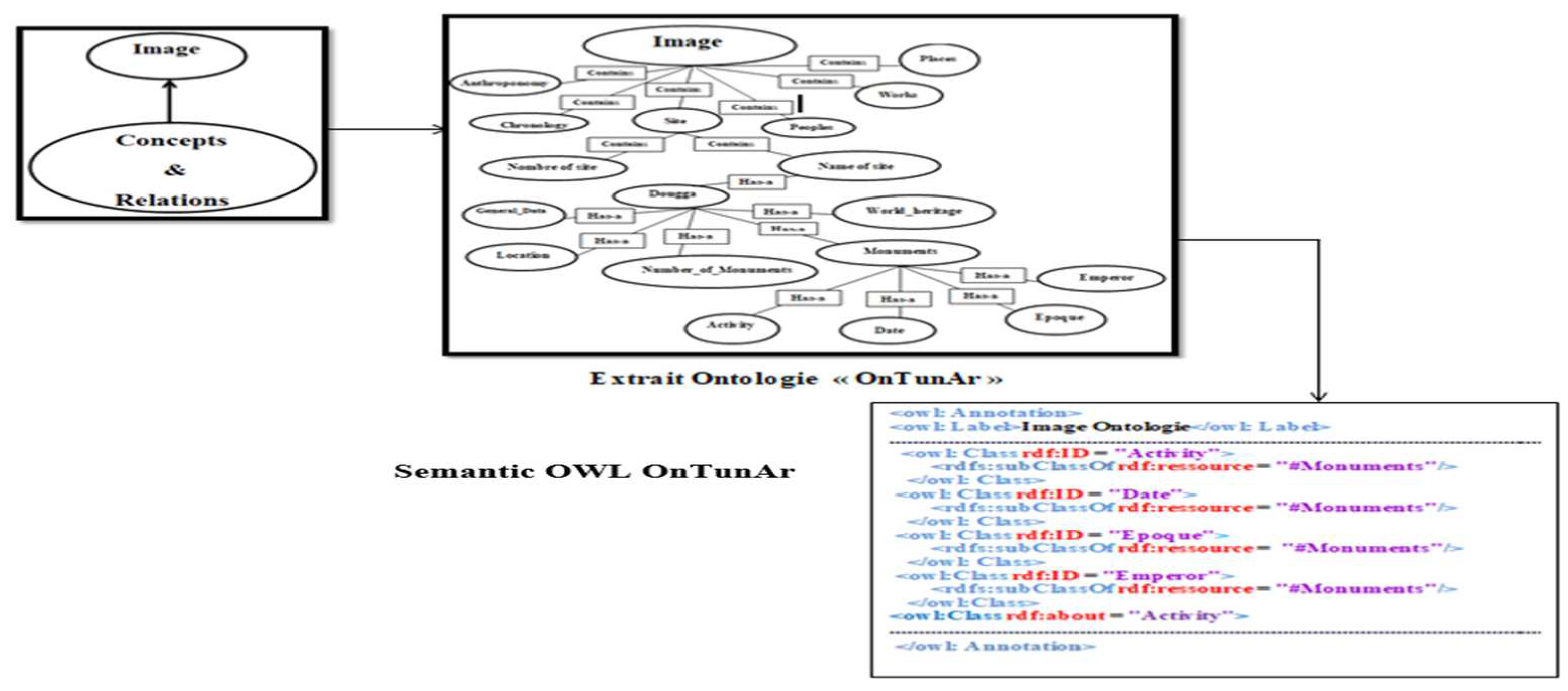
So, we propose an ontology called « Ontology Tunisian Archaeological: OnTunAr » to describe Tunisian archaeological images and to explain the creation of our ontology, we take as an example the site « DOUGGA » [9].
Figure 2.
Extract OnTunAr.
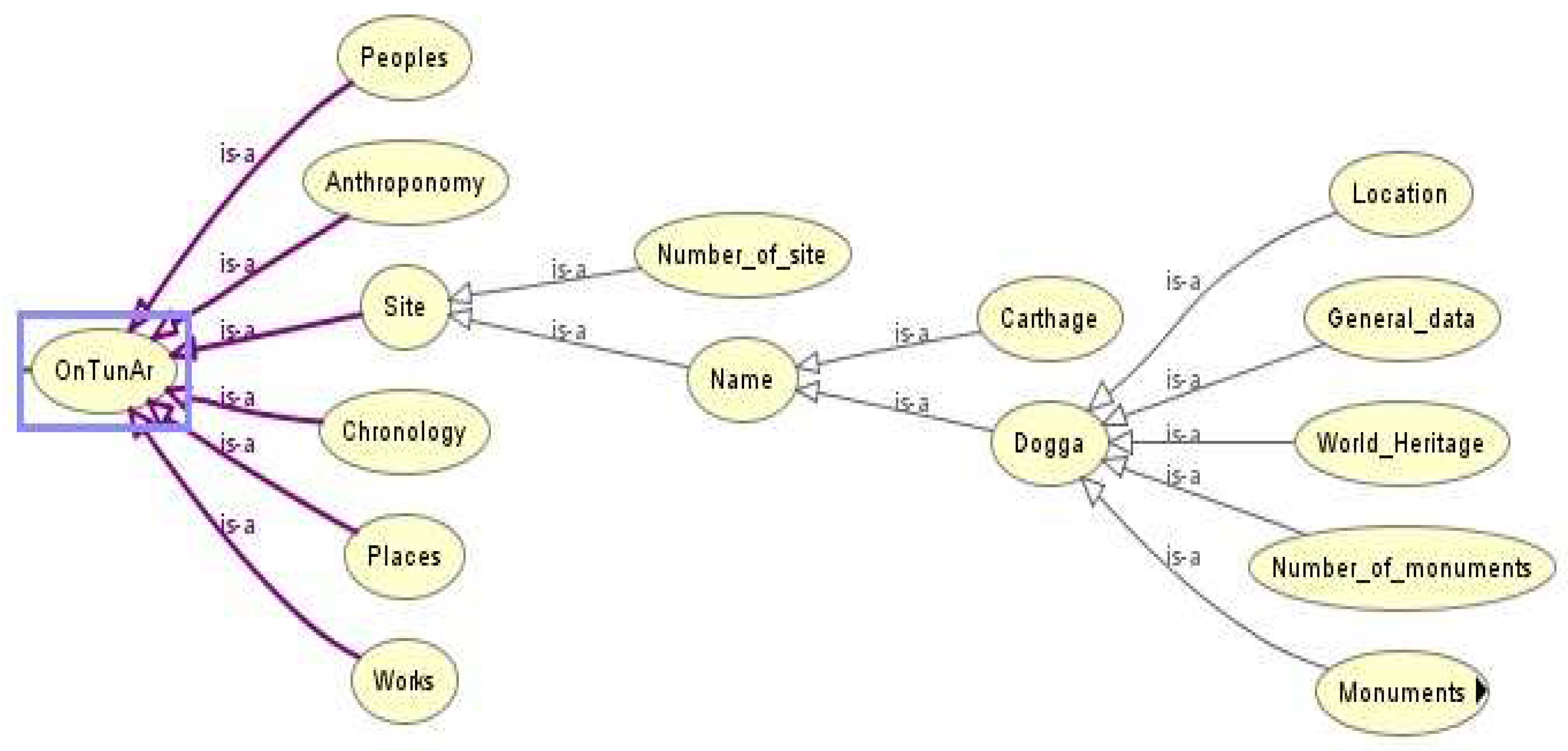
We focused on four steps to building « OnTunAr ». These steps are:
- Step 1: Domain specification
The specification step is necessary in the construction of the ontology. This step consists of formally specifying the domain and the integrity of the ontology. It serves to clarify the area to be studied which offers user-friendly modeling of Tunisian archaeological images. These images often represent an ancient certainty by which represent significant scenes. In addition, the specification is the step that makes it possible to specify the objective and the degree of granularity of the ontology to be built. During this step, we describe five aspects for specifying the ontology:
Table 3.
Specification OnTunAr.
| Objective | Semantically describe the archaeological monuments of the « DOUGGA » site (names, period, date, etc.) to facilitate automatic annotation |
| Users | Archaeologists, tourists, historians… |
| Sources of information | National Institute of Tunisian Heritage (INP), Internet |
| Scope of the ontology | Site, Anthroponomy, Places, date, Period, Emperor, Activity |
- b. Step 2: Validation of classes
The classes of our ontology are organized according to the relationships between synonymy, antonymy, contiguity, and/or hierarchy. Our « OnTunAr » ontology is made up of six classes:
- -
- « Anthroponomys »: this class brings together all the names of people (gods, heroes, etc.) cited in a document.
- -
- « Chronology »: This class includes terms of relative chronology and geological eras. The absolute chronology is not treated.
- -
- « Places »: this class brings together all the names of places and the physical and hydrographic geography of the continents.
- -
- « Peoples »: this class includes all the names of cultural entities recognized in Prehistory and Protohistory, the names of the inhabitants of a city mentioned in a historical document.
- -
- « Works »: this class includes artistic and literary works, whether religious, legal or poetic.
- -
- « Site »: this class describes Tunisian archaeological sites.
Some classes are made up of a set of subclasses which are also made up of a set of sub-subclasses.
- •
- The class « Anthroponomys » contains three subclasses which are:
- -
- « Divinity »: presents the description of the deities;
- -
- « Hero »: describes the list of heroes;
- -
- « Religieus-figures »: Contains the list of religious figures.
- •
- The « Peoples » class is made up of two subclasses which are:
- -
- « Name_People »: includes the names of historical entities;
- -
- « Civilization » (Civilization): represents the civilization that corresponds to the monument.
- -
- The « Site » class is made up of two subclasses which are:
- -
- « Name »: includes the names of Tunisian archaeological sites. We cite as an example the names of sites: Dougga, Sbeïtla, Carthage, El Djem and others;
- -
- « Number_of_site »: Contains the number of Tunisian archaeological sites.
Table 4.
Glossary of « DOUGGA » site.
| Classes | Subclasses | Description |
|---|---|---|
| « General_data » | Has no subclasses | Generally describes the « DOUGGA » site. Our testimony site, content is « Monumental Roman ruins cleared and surrounded by fields and pastures ». |
| « Location » | Has no subclasses | Geographically describes the location of the « DOUGGA » site. It indicates the location of the site in relation to the major cities of Tunisia. For the « DOUGGA » site, this concept contains « 108 km northwest of Tunis and 78 km northeast of El kef » as terms. |
| « World_heritage » | Has no subclasses | Contains the list of world heritages from the « DOUGGA » site. This site was added to the World Heritage list in 1997. |
| « Number_of_monuments » | Has no subclasses | Contains the number of monuments that exist on the « DOUGGA » site. We found 22 monuments on the « DOUGGA » site. |
| « Monuments » | « Activity » | Contains the condition of the monuments or their restoration |
| « Date » | Contains the date created or modified | |
| « Emperor » | Includes the creators of each monument | |
| « Epoque » | Includes the creators of each monument |
The e hierarchy of classes of the « OnTunAr » ontology is presented in the figure below. And to implement « OnTunAr », we used the Protégé tool.
Figure 3.
The hierarchy of classes « OnTunAr ».
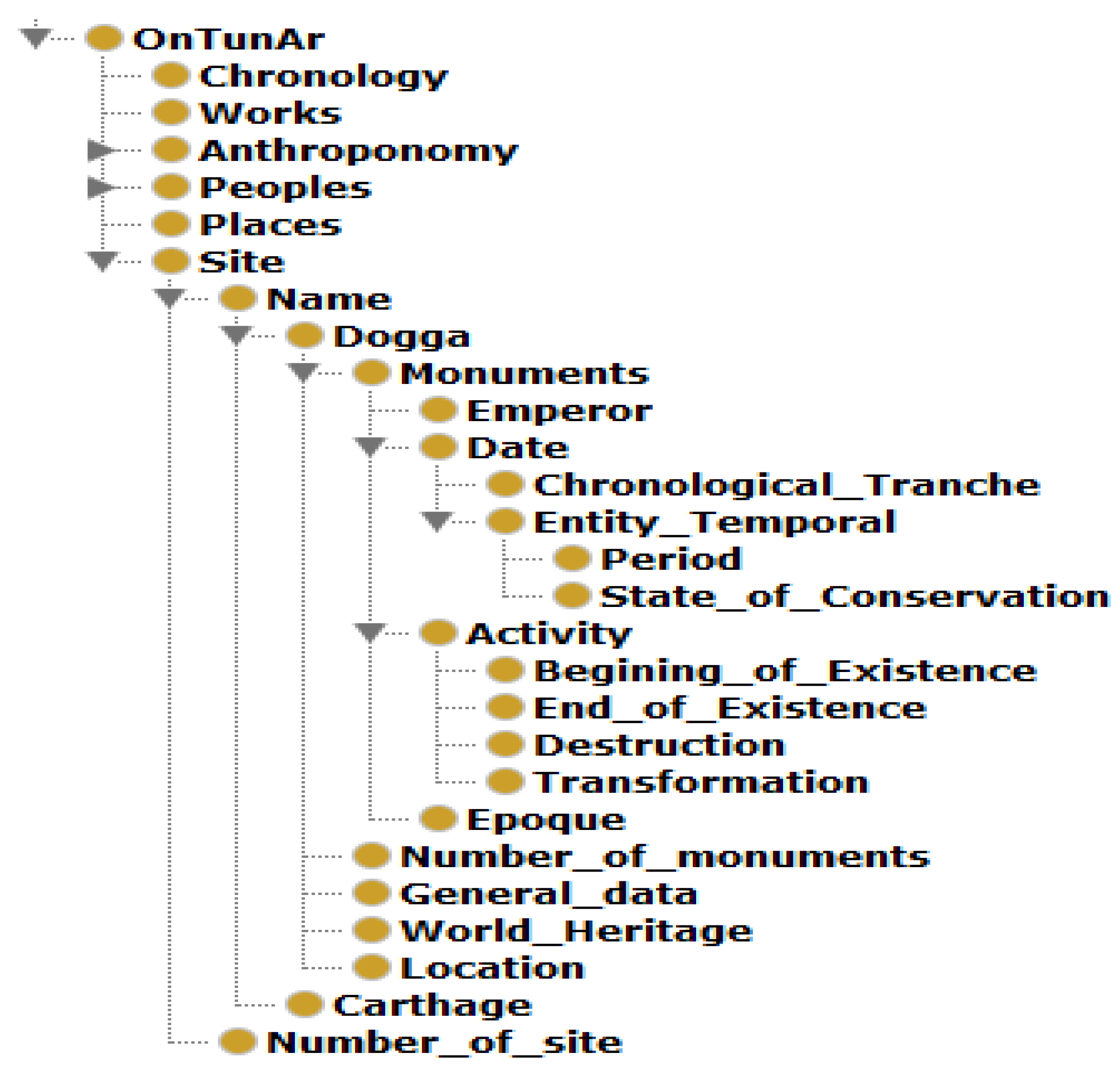
The primordial concept of the « OnTunAr » ontology is the concept of « Monuments ». It is used to describe archaeological monuments semantically. Hence, the glossary of the concept of « Monuments » allows us to explain more the description of objects or monuments of the « DOUGGA » site.
Table 5.
Glossary of the concept of « Monuments ».
| Classes | Subclasses | Description | |
|---|---|---|---|
| « Activity » | « End_of_Existence » | Represents the deteriorating state of the monument. | |
| « Begining_of_Existence » | Represents the monument’s construction state. | ||
| « Transformations » | Represents the monument's modification status. | ||
| « Epoque » | Has no subclasses | Represents the period the monument belongs to. | |
| « Emperor » | Has no subclasses | Including the inventors of the archaeological monuments of the « DOUGGA » site. | |
| « Date » | « Chronological Tranche » | Represents the chronological slice of monument creation. | |
| « Entity Temporal » | « Period » | Represents the period when the monument was created | |
| « State of Conservation » | Represents the modification date of the monument. | ||
In the figure below, we show the modeling of the « DOUGGA » site with its different classes.
Figure 4.
Site of « DOUGGA ».
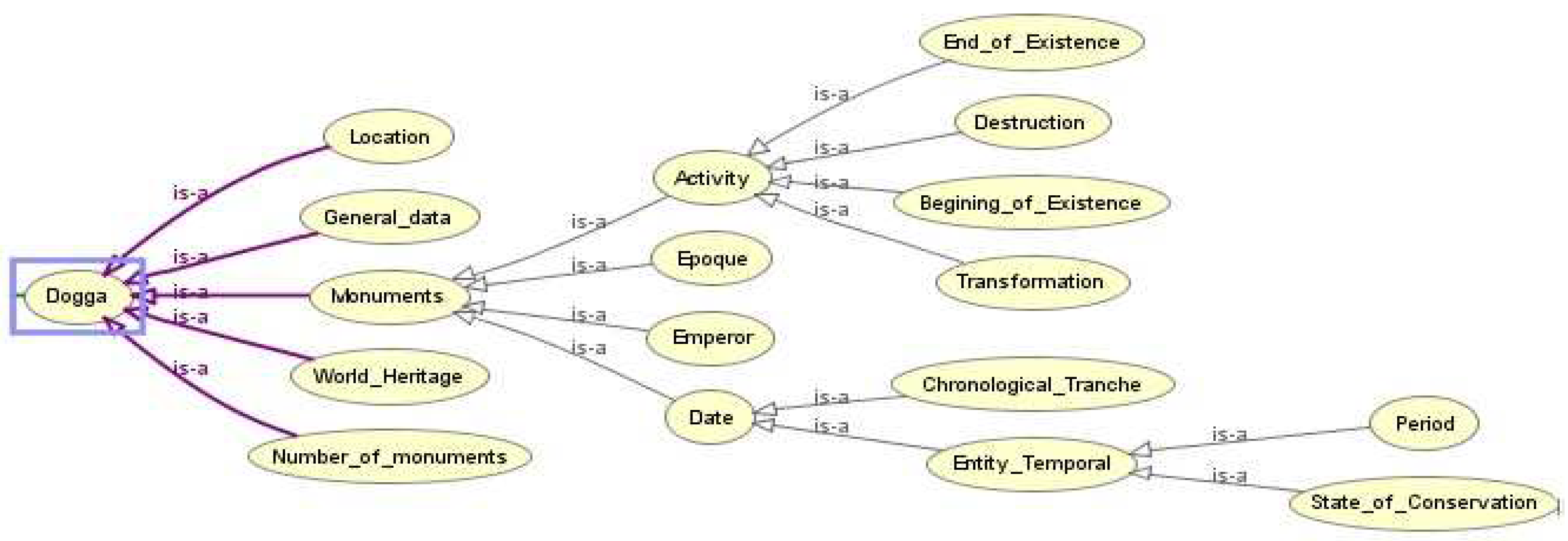
We show the attributes that the presented classes and subclasses can take
Table 6.
Class attributes.
| Classes | Attributes | |
|---|---|---|
|
« Number_of_ Monuments » |
22 | |
| « General_data » | Monumental Roman ruins open and surrounded by fields and pastures | |
| « World_heritage » | In 1997 | |
| « Location » | 108 km north-west of Tunis and 78 km north-east of El Kef | |
| « Monuments » | Libyco-Punic Mausoleum; Temple of Massinissa; Forum; Theater; Capitol; Sales place; Temple of Mercury; Temple of Caelestis; Temple of Fortune; Temple of Concord; Sanctuary of Minerva II; Temple of Saturn; Temple of Frugifer and Liber Pater; Neptune Chapel; Temple of Minerva I; Temple of Tellus; Temple known as Pluto; House of Dionysus and Odysseus; Temple of Victory of Caracalla; Temple known as Dar Lachheb; Circus; Labyrinth House; House of Venus; House of Odysseus; House “Omnia tibi Felicia”; Trifolium House; House of stairs; Cyclops Baths; Houses of the Seasons; Arch of Septimius Severus; Arch of Severus Alexander; Pluto Temple; Latrines of the thermal baths of Aïn Doura; Aïn Doura thermal baths; Licinian Baths; Walk; Cisterns; from Aïn el Hammam; Cisterns of Aïn Mizeb. | |
| « Activity » | End_of_existence; Beginning_of_existence ; Transformations | |
| « Epoque » | Numide; Roman | |
| « Emperor » | Commode; Claude; Antoninus the Pious; Septimius Severus ; Hadrian ; Gallienus ; Caracalla ; Marcus Aurelius and Lucius Verus ; Septimius Severus ; Severus Alexander ; | |
| « Date » | 2nd century BC ; 139 BC-AD ;168-169 ; 166-168 ; 180-192 ; 222-235 ; 41-54 ; 117-138 ; 138-161 ; 195 ; 128-138 ; 85 ; 261 ; 2nd – 3rd century AD AD ; 214 ; 163-166 ; 224 ; 4th century AD AD ; 3rd-4th century AD AD ; 3rd century AD AD ; 205 ; 222-235 ; 2nd – 3rd century AD AD; 3rd century AD AD; 54 | |
In the following table, we present some attributes of « OnTunAr » classes.
Table 7.
Attributes of « OnTunAr ».
| Name | Type | Values |
|---|---|---|
| Name_Monuments | String | Libyco-Punic Mausoleum, Forum, Theater, Capitol, Sanctuary of Minerva II, Market (sacellum), Arch of Septimius Severus, Arch of Alexander Severus, Licinian Baths |
| Name_Emperor | String | Atban, Antoninus the Pious, Marcus Aurelius and Lucius Verus, Antoninus the Pious, Marcus Licinus Rufus, Septimius Severus, Severus Alexander, Gallienus… |
| Name_Epoque | String | Roman, Numide. |
- b. Step 3: Extracting relationships
This step consists of identifying the relationships between the different classes and subclasses of the ontology. We show some relationships used to generate a conceptual model.
Table 8.
Relationships from « OnTunAr ».
| Relationship Name | Description | Concept A | Concept B |
|---|---|---|---|
| Creat_at | This relationship links the two concepts of « Monuments » and « Epoque » | « Monuments » | « Epoque » |
| Creat_in | This relationship links the two concepts of « Monuments » and « Date » | « Monuments » | « Date » |
| Creat_by | This relationship links the two concepts of « Monuments » and « Emperor » | « Monuments » | « Emperor » |
| Changed_to | This relationship links the two concepts of « Monuments » and « Activity » | « Monuments » | « Activity » |
| Is_a | This relationship links the two concepts of « Site » and « DOUGGA » | « Site » | « DOUGGA » |
| Contains | This relationship links the two concepts « DOUGGA » and « General_data » | « DOUGGA » | « General_data » |
| Exists_at | This relationship links the two concepts « DOUGGA » and « Location » | « DOUGGA » | « Location » |
| Consist_Of | This relationship links the two concepts of « DOUGGA » and « Monuments » | « DOUGGA » | « Monuments » |
- c. Step 4: Disambiguation of relationships
In this step, we determine the axioms in order to validate the semantic description between classes and relationships. In fact, this step consists of specifying the properties of the classes and asserting the values of the attributes. Axioms represent a hierarchy between concepts in the ontology. The essential goal of the axioms is to remove the ambiguity of the relationships between concepts after a study of the corpus of images used. Axioms allow disambiguation between ontology concepts. This makes it possible to generate a rational relationship between the two terms axiom and concept disambiguations. These two terms are used to construct sentences that are always true and specify restrictions on the value of attributes.
Table 9.
The axioms.
| Concept name | Description | Logical expression |
|---|---|---|
| « Monuments » | If there is a monument then there is an activity, a date of creation, an era, and an emperor. | ∃ Monument (m) Monument (m). Activity (m). A creation date. A period. An emperor (E) |
| « Emperor » | Whichever emperor invented a monument: Emperor (E) and Monument (m) | ∀ Emperor (E) Emperor (E) ∩ Monument (m) |
| « Epoque » | Whatever epoque contains monuments created by emperors: This relationship means that Epoque (Ep) and Monument (m) and Emperor (E) | ∀ Emperor (E) |
- d. Step 5: The integrity of OnTunAr with the « AAIAT » model
In the semantic part of our AAIAT model, we implemented our OnTunAr ontology to annotate image monuments with keywords. This OnTunAr ontology makes it possible to describe archaeological images of different Tunisian sites. To annotate, we start with the initialization of a vector of similar words Vm to annotate the given monument. Then, it queries OnTunAr and compares the monument to be annotated by the Concepts concerned Ms. Then, if the monument « Monument » corresponds to a concept Mc then it puts it in the vector Vm. Then, it calculates the similarity S (M_i, M_j) between similar concepts in Vm. Finally, he bestows the exact word Mexact on the monument.
Figure 5.
OnTunAr illustration.
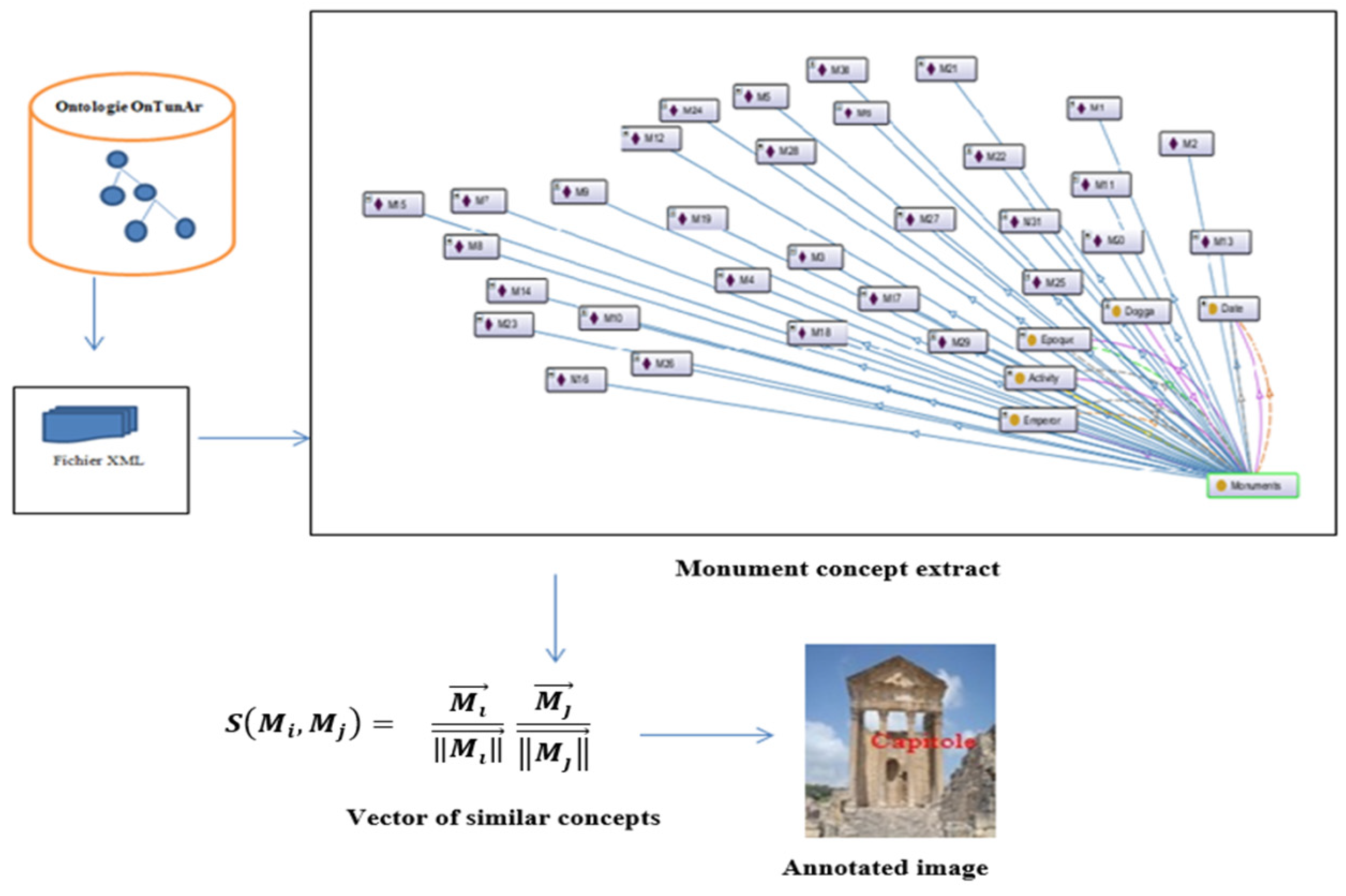
In the figure above, we show a perception of the semantic part of our AAIAT model which allows us to describe archaeological monuments as well as similar concepts. The OnTunAr ontology played a very important role in our AAIAT model. It improved the semantic part of our model. It also gave a cognitive aspect of the concepts to have a good understanding of the archaeological image. In addition, it made it easier to annotate monuments with keywords. These are presented by the concepts, their attributes, and the relationships between them.
4. Discussion
After processing the image and recognizing the monuments, we annotate these monuments with keywords by adding them using the integration of the OnTunAr ontology, the aim of which is to semantically describe the archaeological image. After evaluating the steps of our AAIAT model and evaluating the accuracy of the « annotation of Tunisian archaeological images » step, we compare the annotation results obtained using the OnTunAr ontology with the annotation results without ontology. To do this, we use the measurement metrics presented by the formulas below.
The results obtained are represented in the table below:
Figure 6.
Performance AAIAT.
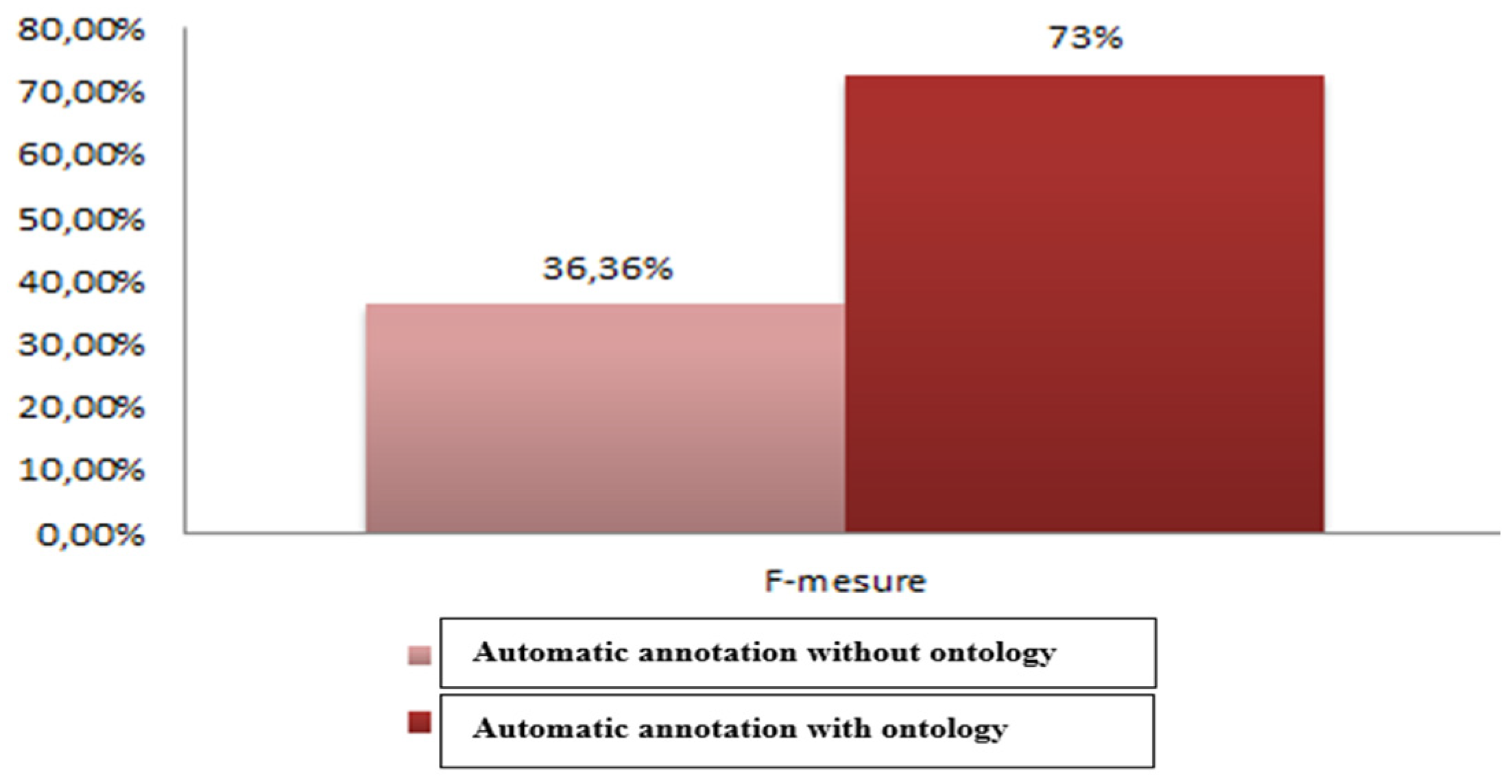
The use of the ontology in the AAIAT model gave an accuracy rate equal to 57.14%. However, experimenting with the model without ontology gave 28.57% for accuracy. These two values clearly show the importance of using ontology in order to properly annotate images.
Table 10.
Result of the annotation with and without ontology.
| Automatic annotation with ontology | Automatic annotation without ontology | ||||
|---|---|---|---|---|---|
| Precision | Racall | F-mesure | Precision | Racall | F-mesure |
| 57,14% | 100% | 73% | 28,57% | 50% | 36,36% |
5. Conclusion
In this article, we present our OnTunAr ontology for the automatic annotation and description of Tunisian archaeological images. Also, we have shown its components like the classes it contains and its relationships. We took the DOUGGA site as an example among the Tunisian sites. We have alleged the necessary classes, the relationships between them, and their attributes. Thus the integration to annotate archaeological images. In order to take into consideration the majority of Tunisian archaeological sites, we are thinking of conceptually enriching our OnTunAr ontology to deal with other eras apart from the Epoque Roman.
Author Contributions
Conceptualization: MBS, AY, MN; Methodology: MBS, AY, MN; Investigation: MBS, AY, MN; Verification and Validation: MBS, AY, MN; Writing-review and editing: MBS, AY, MN; all authors have read and agreed to the published version of the manuscript.
Funding
Not applicable.
Acknowledgments
I will first of all thank my director and my collaborator for this advice for the realization of this work as well as my parents who are properly executed by us. We thank the anonymous referees for their useful suggestions. We also thank the anonymous reviewers for their constructive comments.
Conflicts of Interest
The authors declare no conflict of interest.
References
- Ahcine H., G. « Construction d’une ontologie pour le web sémantique » mémoire de mastère en ingénierie des systèmes informatiques, 2014.
- Albatal, R. « Annotation automatiqued’images à base de phases visuelles » Thesis Memory, 2010.
- Andrewes, P. , Zaihrayeu I., Pane J. « A Classification of semantic annotation systems » Semantic Web, IOS Press Amsterdam, Vol.3, Issue 3, pp 223-248, August, 2012.
- Bachimont, B. « Engagement sémantique et engagement ontologique: conception et realisation d’ontologies en ingénierie des connaissances » International journal, Ingénierie des connaissances: Evolutions récentes et nouveaux défis, Eyrolles, pp.305-323.
- Ben Hmidi, H. « Chapitre I: Les ontologies ». dspace.univ-tlemcen.dz/bitstream/112/1062/5/ChapitreI.pdf, 2011.
- Ben Salah, M. , Yengui A. and Neji M. « Feature Extraction and Selection in Archeological for Automatic Annotation », International Journal of Image and Graphics, , (IJIG’2021). 10 April.
- Ben Salah, M. , Yangui A. and Neji M. « Archeology Images Segmentation for the Automatic Annotation » International Conference Business Information Management Association, (IBIMA’2018).
- Ben Salah, M. , Yangui A. and Neji M. « Archeology Images Segmentation for the Automatic Annotation » the 6th International Conference on Software Engineering and New Technologies December (ICENT’2017).
- Ben Salah, M. , Yengui A. and Neji M. « Construction of OTunAr : ontology of Tunisian Archeology » The 18th International Arab Conférence on Information Technology (ACIT'2017).
- Cacciotti, R. and Valach J. « The MONDIS project Semantic Web and the protection of historic buildings », In 2015 Digital Heritage (Vol. 2, pp. 307-313). IEEE, 15. 20 September.
- Carbouni N. and De Luca L. « An Ontological Approach to the Description of Visual and Iconographical Representations » Journal International Heritage, 1191 1210. 1191. [CrossRef]
- Guarnieri, F. « Contribution des ontologies à la création de bases de connaissances pour la maitrise des conformités réglementaires en santé, sécurité au travail et environnement » Mémoire de thèse, sciences et génie des activités à risques, le 18 décembre 2013.
- Guillaumin, M. , Mensink T., Verbeek J. and Schmid C. « Apprentissage de distance pour l’annotationd’images par plus prochesvoisins » Congres RFIA Reconnaissance des Formes et Intelligence Artificielle, 2010.
- Keita A., K. , Roussey C. and Laurini R. : « Un outil d’aide à la construction d’ontologies pré-consensuelles : le projet Towntology », LIRIS Laboratoire d'InfoRmatique en Image et Systèmes d'information, 2010.
- Jaouachi R., T. , Khemakhem M. T., Hernandez N., Haemmerlé O. and Jemaa M. B. « Vers une annotation sémantique des images web fondée sur des patrons RDF » CORIA, 2015.
- Messouadi T « Proposition d'une ontologie de domaine dédiée à l'annotation d'images spatialisées pour le suivi de la conservation du patrimoine culturel bâti » Paris: École Nationale Supérieure d'Arts et Métiers, 2017.
- Legrand, D. « Indexation et recherche d’images par le contenu » Partie 1: le traitement d’images pour les nuls, à l’INRA, le 12 juin 2019.
- Maihami, V. and Yaghmaee Farzin « Automatic Image Annotation Using Community Detection in Neighbor Images » International Journal Physica A, 507, 123-132, (IJP ‘2018).
- Niang, C. , Leboucher, E., Bouiller, L., Capderou, C., and Marinica, C. « An Ontological Model for Conservation-restoration of Cultural Objects » Digital Heritage International Congress (Digital Heritage), Sep 29-Oct 2, Granada, Spain, 2015.
- Qiao, T. , Zhang J., Xul D., and Tao D.: « MirrorGAN: Learning Text-to-image Generation by Redescription ». In the IEEE Conference on Computer Vision and Foundation (CVPR), 2023.
- Savonnet, M. « Systèmes d’information scientifique: des modèles conceptuels aux annotations sémantiques » Mémoire de thèse en université de Bourgogne, 2013.
- Staab, S. , Studer R., Schnurr H.P., and Sure Y. « Knowledge processes and ontologies », IEEE Intelligent Systems, 16(1) :26-34, 2001. [CrossRef]
- Stathis, P. , Kavallieratou E. and Papamarkos Ni « An Evaluation Tchenique for Binarization Algorithms » International Journal of Universal Computer Science, vol.14, no.18 (IJUCS ‘2008).
- Szabados A., V. and letricot R. « L’ontologie CIDOC CRM appliquée aux objets du patrimoine antique » the 3e Journées d’Informatique et Archéologie de Paris – JIAP2013.
- Thierry, L. « Une approche ontologie pour l’interopérabilité et la composition automatique de service web » de l’université de Toulouse, 2017.
- Uschold, M. et King M « Towards a methology for building ontologies » Workshop on Basic Ontological issues in Knowledge sharing, 1995.
- Zomahoun D., E. « Emergsem : une approche d'annotation collaborative et de recherche d'images basée sur les sémantiques émergentes » Mémoire de thèse, Université de Bourgogne, 2015.
Disclaimer/Publisher’s Note: The statements, opinions and data contained in all publications are solely those of the individual author(s) and contributor(s) and not of MDPI and/or the editor(s). MDPI and/or the editor(s) disclaim responsibility for any injury to people or property resulting from any ideas, methods, instructions or products referred to in the content. |
© 2023 by the authors. Licensee MDPI, Basel, Switzerland. This article is an open access article distributed under the terms and conditions of the Creative Commons Attribution (CC BY) license (https://creativecommons.org/licenses/by/4.0/).
Copyright: This open access article is published under a Creative Commons CC BY 4.0 license, which permit the free download, distribution, and reuse, provided that the author and preprint are cited in any reuse.


