

Submitted:
27 September 2023
Posted:
28 September 2023
Read the latest preprint version here
Abstract
Studies in the field of experimental hypnosis highlighted the role of hypnotizability in the physiological variability of the general population. It is associated, in fact, with a few differences which are observable in the ordinary state of consciousness and in the absence of suggestions. The aim of the present scoping review is summarizing them, and indicate their relevance to the neural mechanisms of hypnosis and to the prognosis and treatment of a few medical conditions.
Individuals with high, medium and low hypnotizability scores display different cerebral functional differences – i.e., functional equivalence between imagery and perception/action , excitability of the motor cortex, interoceptive accuracy - possibly related to brain structural and functional characteristics - , and different control of blood supply at peripheral and cerebral level, likely due to different availability of endothelial nitric oxide. These differences are reviewed to support the idea of their participation in hypnotic behaviour and to indicate their prognostic and therapeutic usefulness in a few medical conditions.
Keywords:
motor imagery
; functional equivalence
; interoception
; cerebral blood flow
; endothelial function
; hypnosis
1. Introduction
The object of this review is the description of the physiological correlates of hypnotizability which can be involved in hypnotic behavior and also exhibit a prognostic role in a few medical conditions and allow personalized treatments.
Hypnotizability, an individual trait substantially stable through life (Piccione et al., 1989), is associated with the proneness to enter hypnosis and/or to experience alteration of perception, memory and behavior following the administration of specific suggestions (Acunzo and Terhune, 2021). Experimental hypnosis takes advantage from the utilization of scales classifying the general population into highly (highs), medium (mediums) and low hypnotizable persons (lows) according to the hypnotizability scales total score or on the basis of the specific scales items the subjects pass (Terhune et al., 2011). Nonetheless, hypnotizability just roughly predicts the response to suggestions, as placebo and hypnotizability- related mechanisms, can cooperate, for instance, in the cognitive control of pain (Santarcangelo and Carli, 2021).
Hypnotizability has a few correlates - brain morpho-functional differences (Landry et al., 2017; Picerni et al., 2019), functional equivalence between imagery and perception/action (Ibanez-Marcelo et al., 2019), excitability of the motor cortex (Spina et al., 2020; Cesari et al., 2020), vascular peripheral (Jambrik et al., 2004, 2005) and cerebral control of blood flow (Rashid et al., 2022a,b) - which can be observed out of hypnosis and in the absence of specific suggestions. These correlates can be relevant to hypnotic behaviour and can be useful to prognosis and therapy in a few medical conditions.
2.1. Cerebral morpho-functional correlates of hypnotizability
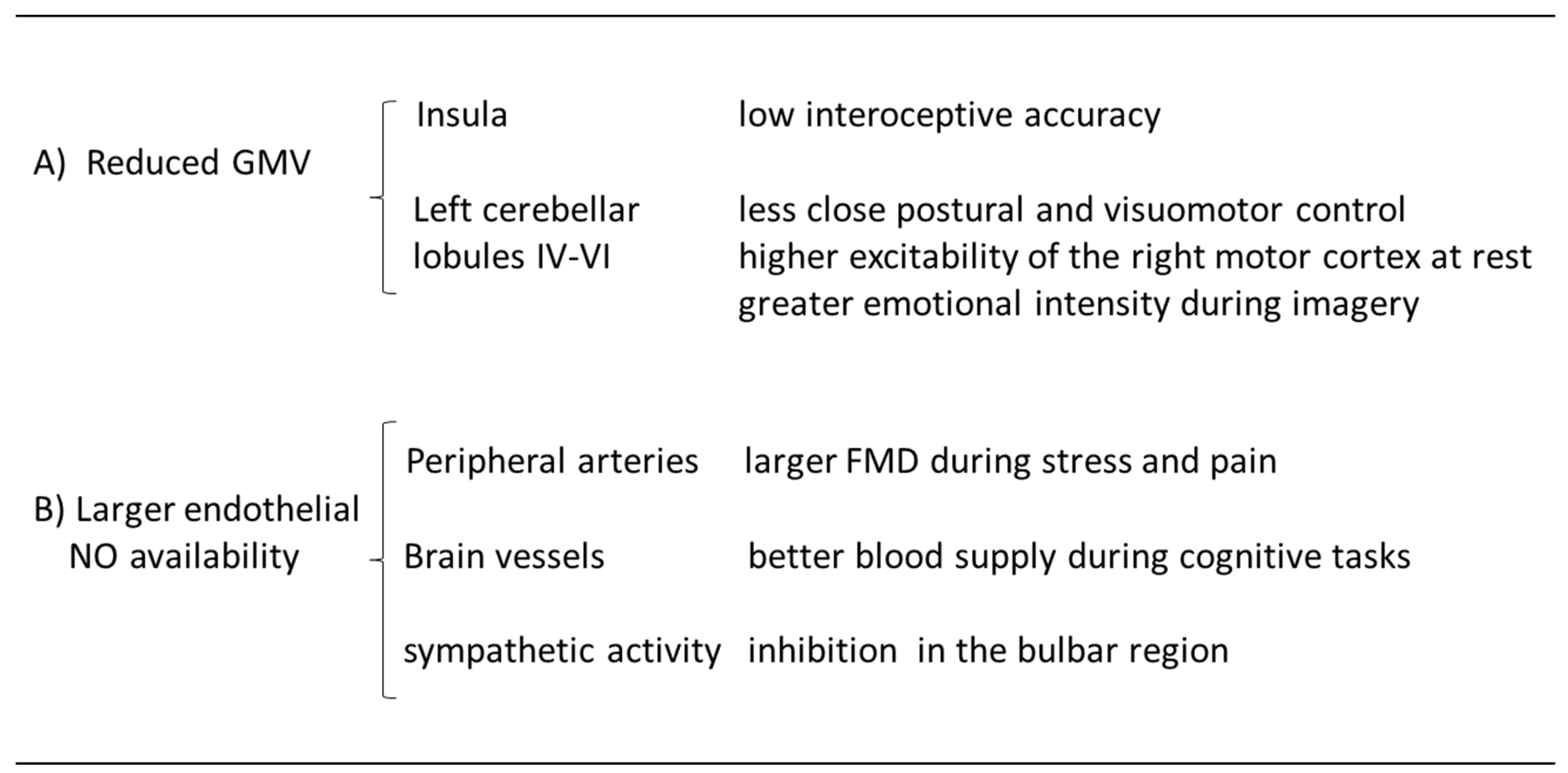
Reduction in the entire brain volume has been observed in individuals able to experience deeper hypnotic trance (McGeown et al., 2015), i.e., the highs. In these individuals other studies revealed reduced grey matter volume (GMV) in the insula (Figure 1A), larger GMV in the mid-temporal and mid-occipital cortices, stronger functional connectivity between the anterior cingulate and the prefrontal dorsolateral cortex (Landry et al., 2017), stronger functional equivalence (FE) between imagined and actual perception/action (Ibanez-Marcelo et al., 2019; Cesari et al. 2020), higher excitability of the right motor area in resting conditions (Spina et al., 2020) and of both sides motor areas during motor imagery (Spina et al., 2020; Cesari et al., 2020). Cerebellar morpho-functional differences have also been reported (Figure 1A). They consist of reduced grey matter volume in the highs’ left lobules IV-VI with respect to lows (Picerni et al., 2019) and of paradoxical control of pain experience and cortically evoked nociceptive potentials after bilateral transcranial cerebellar anodal stimulation in medium-to- high hypnotizables (Bocci et al., 2018).
The functional equivalence between actual and imagined actions indicates the degree of superimposition between the cortical activations observed during these conditions (Jeannerod and Frak, 1999; Guillot et al., 2012; Hurst and Boe, 2022; Yao, et al., 2023; Henschke et al., 2023). It has been studied in highs and lows through topological analysis of the EEG, which revealed stronger functional equivalence between actual and imagined sensori-motor conditions in highs than in lows (Ibanez-Marcelo et al., 2019). In contrast, significant hypnotizability related differences in the vividness of imagery have not been unanimously reported (Srzich et al., 2016).
Topological studies (Ibanez-Marcelo et al., 2019, 2020) suggested also differences in the cortical elaboration of sensory and imaginative stimuli. During imagery tasks, in fact, highs showed slight, distributed cortical topological changes almost non detectable through spectral analysis, whereas lows exhibited task-related localized changes detectable also through spectral analysis (Ibanez-Marcelo et al., 2019, 2020; Ruggirello et al., 2019; Cavallaro et al., 2010). Thus, EEG confirmed the hypothesis based on the study of the highs’ earlieast component of the vestibulo-spinal reflex (VR), which is not under volitional control. Highs, indeed, exhibited the same amplitude of this VR component during the actual and imagined rotation of the head, and this component (Santarcangelo et al., 2010).
The reduced grey matter volume in the cerebellar lobules IV-V could be responsible for the highs’ less close postural and visuomotor control and absence of learning across successive trials of postural and visuomotor tasks with respect to lows (Santarcangelo and Scattina, 2016). Moreover, reduced inhibition from these lobules on to left motor areas can be responsible for the greater excitability of the highs’ right motor cortex, which accounts for their lower motor threshold in the left (Spina et al., 2020) but not right hand (Cesari et al., 2020) in resting conditions. The highs’ higher excitability of both sides motor areas observed during motor imagery could be an effect of their stronger functional equivalence between the imagined and actual sensorimotor context.
The increase in the reported pain intensity and in the amplitude of cortically evoked nociceptive potentials observed after bilateral cerebellar transcranial anodal stimulation in medium-to high hypnotizable participants (Bocci et al., 2017) contrasts with the findings obtained in the general population and in low-to-medium hypnotizables. Together with the highs’ higher emotional intensity (Kirenskaia et al., 2011; Facco et al., 2017), it could be due to reduced inhibition of the regions involved in cognition and emotion by the cerebellar left lobule VI (Laricchiuta et al., 2022). The relation between hypnotizability and empathy, however, is debated (Facco et al., 2017; Scacchia and De Pascalis, 2020).
The experience of involuntariness in suggested action is one of the most important characteristics of hypnotic behavior (Dell , 2010) and has been interpreted on the basis of both dissociative ( Kirsch and Lynn, 1998) and socio-cognitive views ( Kirsch and Lynn, 1997). These two main theories have been theoretically reconciled on the basis of the complex nature of movement, which is often automatic and/or unconscious in the ordinary state of consciousness (Lynn and Green, 2011). This approach is supported by physiological findings allowing a simple interpretation of the highs’ experienced involuntariness. In fact, the highs’ stronger functional equivalence between imagined and actual action (banez-Marcelo et al., 2019) together with the greater excitability of their motor cortex (Spina et al., 202; Cesari et al., 2020) can increase the likelihood of ideomotor responses, thus reducing the perception of effort and agency.
The difference in the insula grey matter volume and in its connections can be involved in hypnotizability-related differences in interoception. Highs display lower interoceptive accuracy – the ability to detect visceral signals measured by the heartbeat count test - than lows, with mediums exhibiting intermediate values (Rosati et al., 2021). Accordingly, their heartbeat-evoked cortical potential is smaller than lows’ in the central-parietal regions which are reached by projections from the anterior insula (Callara et al., 2023).
The highs’ ability to modify the experience of their body, usually indicated as an effect of dissociation, can be sustained by their low interoceptive accuracy, that is by the insula morpho-functional characteristics, which could allow them to feel a body condition different from the real one (and facilitate dissociative experiences).
2.2. Hypnotizability, brain injuries, mental training
Stronger FE between imagery and perception/action and higher excitability of the motor cortex during imagery (Ibanez-Marcelo et al., 2019; Cesari et al., 2020) make highs more prone than lows to take advantage from mental training after brain lesions of any origin (Fontanelli et al., 2022). Thus hypnotic assessment could predict the outcome of mental training and Brain Computer Interface interventions. The latter, in fact, are ineffective in large part of the population and variably effective in the remaining part (Peters et al., 2022). Studies in progress are aimed at assessing whether training to mental imagery can increase FE in mediums/lows. Preliminary findings show that motor imagey training improves the velocity and accuracy of movement lasts at least two weeks after 5 days training (Terreni C., 2023). Transcranial magnetic stimulation and direct anodal stimulation aimed at improving motor responses are more costly than mental training, and the duration of their effects has not been consistently reported (Han et al., 2023). Moreover, the topologically different cortical elaboration of sensory and cognitive information - distributed in highs, localized in lows (Ibanez-Marcelo et al., 2019, 2020) - suggests that in highs brain lesions could be less impairing than in lows. Clinical studies, however, should investigate whether similar brain lesions produce less deficits in highs than in lows.
Figure 1.
Association between hypnotizability-related morphofunctional differences and behavior. A, at brain level; B) at vascular level.
Figure 1.
Association between hypnotizability-related morphofunctional differences and behavior. A, at brain level; B) at vascular level.
3.1. Peripheral and cerebral blood flow
The most important vascular difference between highs and lows is in the post-occlusion flow-mediated endothelial function (Figure 1B). It is defined as the difference in an artery diameter measured after and before the artery occlusion. In the general healthy population and in lows, after occlusion the flow-mediated dilation is larger than before it, as the swirling blood flow following dis-occlusion promotes the release of nitric oxide from endothelial cells. In highs the brachial artery post-occlusion flow-mediated dilation is significantly less reduced than in lows during tonic nociceptive stimulation (Jambrik et al., 2005) and non reduced at all during mental computation (Jambrik et al., 2004, 2005). Possible hypnotizability-related differences in cerebral blood flow were studied through near-infared spectroscopy.It was shown that
only highs exhibit a significant increase in blood supply during cognitive tasks (Figure 1B), suggesting that they can better adjust brain oxigenation to metabolic demands (Rashid et al., 2022a), which largely depends on both endothelial and neuronal nitric oxide release (Hoiland, et al., 2020). The metabolic demand, however, could be lower in medium-to-high hypnotizables than in lows, as suggested by the negative correlation between hypnotizability and the cerebrovascular reactivity observed during visual stimulation (Rashid et al 2022b) and could be due to the highs’ peculiar mode of information processing (Ibanez-Marcelo et al., 2019).
The highs’ greater increase in cerebral blood oxygenation during cognitive tasks could at least partially account for their greater absorption (Tellegen and Atkinson, 1974), together with the greater attentional stability depending on the brain dopamine content (for review, Presciuttini et al., 2014).
At systemic level, during long lasting relaxation highs increase their parasympathetic tone indicated by the High Frequency component of the heart rate variability more than lows (Santarcangelo et al., 2012). At variance with lows, in standing position and in the absence of suggestions, the highs’ increase in the Low Frequency component of heart rate variability is non significant (Santarcangelo et al., 2008). Both findings could be accounted for by higher release of nitric oxide in the bulbar regions responsible for sympathetic inhibition in the general population (Kishi, 2013). Sympathetic inhibiton could also induce more efficient activity of the immune system, with possible useful effects on autoimmune conditions ( Ruzyla-Smith et al., 1995; Fontanelli et al., 202)
3.2. Nitric oxide and cardiovascular protection
Endothelial nitric oxide controls vascular relaxation, thus is relevant to the function of all organs and systems (Grześk et al., 2023). Larger post occlusion flow-mediated dilation, in fact, is considered a predictor of less vulnerability to cardiovascular events (Mućka et al., 2022), and drugs containing nitric oxide donors are administered in clinical trials (Escobar Cervantes et al., 2023). Moreover, nitric oxide exerts a central inhibition of the sympathetic activity (Kishi, 2013), which is increased in patients with heart failure (Quarti-Trevano et al., 2023). In these respect, high hypnotizability may have a favorable prognostic role on case of cardiovascular events. At brain level, together with the strong FE and distributed mode of information processing (Ibanez-Marcelo et al., 2019; Ruggirello et al., 2020), more efficient blood flow could be responsible for better recovery from injuries due to vascular events. In fact, nitric oxide inhalation positively influences the course of cardio-cerebrovascular diseases (Huerta de la Cruz et al., 2022). We can hypothesize that highs were less vulnerable to vascular-based cognitive decline owing to their cerebrovascular peculiarities (Rajeev et al., 2023; Uemura et al., 2020), although eccessive NO amount has been associated with Alzheimer earlier degeneration (Malinski , 2007). Finally, the highs ability to modulate their autonomic activity (Sebastiani et al., 2005) could positively influence their microbiota (De Benedittis, 2022), whose alteration is also involved in cognitive decline (Weber et al., 2023).
4. Limitations and Conclusions
A limitation of the reported studies is that mediums, who represent 70% of the general population, have been seldom enrolled. Thus, at the moment, few hypnotizability-related findings can be extended to the general population (Jensen et al., 2017). The studies of FE (Ibanez-Marcelo et al., 2019; Ruggirello et al., 2020) and FMD (Jambrik et al., 2004, 2005 a, b) only highs and lows have been recruited. In a few studies – motor cortex excitability (Spina et al., 2020), interoceptive accuracy (Rosati et al., 2021) - mediums exhibit values intermediate, non always significantly different from highs and lows. In other experiments – cerebellar tDCS stimulation before nociceptive stimulation (Bocci et al., 2018), and cerebral blood flow (Rashid et al, 2022 a,b), interoception accuracy (Rosati et al., 2021)- the participants have been divided in low-to medium hypnotizables (score 0-5 on the Stanford Hypnotic Susceptibility Scale, form A) and medium-to-high hypnotizables (score 7-12 on SHSS, A), thus reducing the sensitivity of the study to hypnotizability.
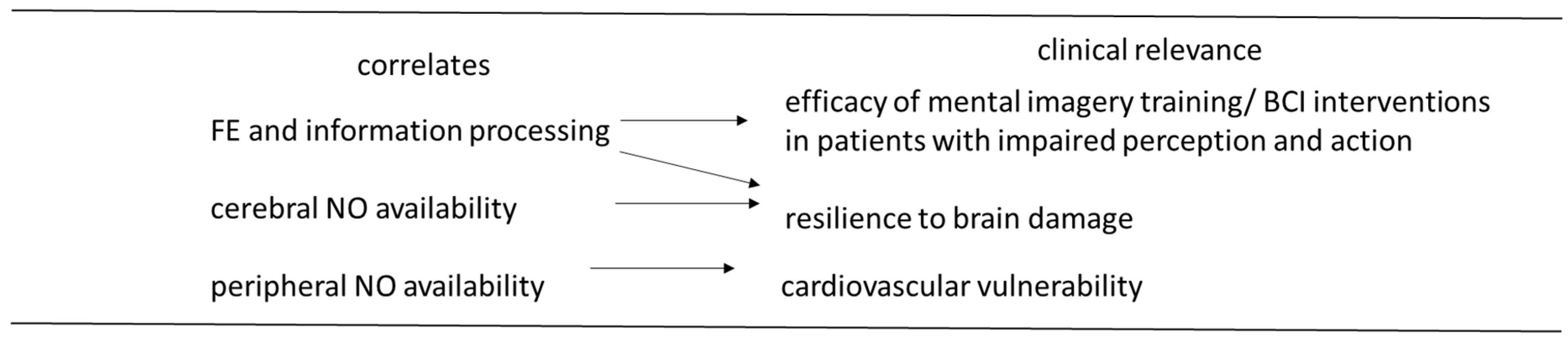
Figure 2.
Hypnotizability-related correlates relevant to prognosis and treatment. FE, functional equivalence between actual and imagined perception/action; NO, nitiric oxide.
Figure 2.
Hypnotizability-related correlates relevant to prognosis and treatment. FE, functional equivalence between actual and imagined perception/action; NO, nitiric oxide.
Finally, some of the suggested mechanisms of highs’ higher parasympathetic tone, i.e., the sympathetic inhibition of sympathetic activity by NO at bulbar level, should be experimentally confirmed.
In conclusion (Figure 2), this review is an attempt to translate psychological characteristics into physiological functions, and a call for medical doctors to consider the relevance of hypnotic assessment to their clinical practice.
Despite the above limitations, in fact, the described correlates of hypnotizability can account for part of hypnotic behaviour, i,e, proneness to ideomotor behavior, involuntariness in action, interoceptive accuracy, absorption. Moreover, the highs’ greater availability of endothelial nitric oxide, stronger functional equivalence between actual and imagined sensori-motor conditions and distributed mode of cortical information processing suggest that hypnotic assessment can predict lower vulnerability to cardiovascular diseases at peripheral and brain level, and better prognosis of vascular events. Thus, hypnotic assessment can be relevant to the outcome of motor imagery training in neurological patients and of interoceptive training in patients with altered interoception.
References
- Acunzo, D. J., & Terhune, D. B. (2021). A Critical Review of Standardized Measures of Hypnotic Suggestibility. The International journal of clinical and experimental hypnosis, 69(1), 50–71. [CrossRef]
- Ahmad, B., Gill, I., Liblik, K., Uppal, J. S., & El-Diasty, M. (2023). The Role of Hypnotherapy in Postoperative Cardiac Surgical Patients, A Scoping Review of Current Literature. Current problems in cardiology, 48(9), 101787. Advance online publication. [CrossRef]
- Bocci, T., Barloscio, D., Parenti, L., Sartucci, F., Carli, G., & Santarcangelo, E. L. (2017). High Hypnotizability Impairs the Cerebellar Control of Pain. Cerebellum (London, England), 16(1), 55–61. [CrossRef]
- Callara, A. L., Fontanelli, L., Belcari, I., Rho, G., Greco, A., Zelič, Ž., Sebastiani, L., & Santarcangelo, E. L. (2023). Modulation of the heartbeat evoked cortical potential by hypnotizability and hypnosis. Psychophysiology, e14309. Advance online publication. [CrossRef]
- Császár-Nagy, N., & Bókkon, I. (2022). Hypnotherapy and IBS: Implicit, long-term stress memory in the ENS. Heliyon, 9(1), e12751. [CrossRef]
- Cavallaro, F. I., Cacace, I., Del Testa, M., Andre, P., Carli, G., De Pascalis, V., Rocchi, R., & Santarcangelo, E. L. (2010). Hypnotizability-related EEG alpha and theta activities during visual and somesthetic imageries. Neuroscience letters, 470(1), 13–18. [CrossRef]
- Cesari, P., Modenese, M., Benedetti, S., Emadi Andani, M., & Fiorio, M. (2020). Hypnosis-induced modulation of corticospinal excitability during motor imagery. Scientific reports, 10(1), 16882. [CrossRef]
- De Benedittis G. (2022). Hypnobiome: A New, Potential Frontier of Hypnotherapy in the Treatment of Irritable Bowel Syndrome-A Narrative Review of the Literature. The International journal of clinical and experimental hypnosis, 70(3), 286–299. [CrossRef]
- Dell P. F. (2010). Involuntariness in hypnotic responding and dissociative symptoms. Journal of trauma & dissociation : The official journal of the International Society for the Study of Dissociation (ISSD), 11(1), 1–18. [CrossRef]
- Derbyshire, S. W., Whalley, M. G., & Oakley, D. A. (2009). Fibromyalgia pain and its modulation by hypnotic and non-hypnotic suggestion: An fMRI analysis. European journal of pain (London, England), 13(5), 542–550. [CrossRef]
- Elkins G. (2022). From Research to Clinical Practice. The International journal of clinical and experimental hypnosis, 70(3), 209–211. [CrossRef]
- Escobar Cervantes, C., Esteban Fernández, A., Recio Mayoral, A., Mirabet, S., González Costello, J., Rubio Gracia, J., Núñez Villota, J., González Franco, Á., & Bonilla Palomas, J. L. (2023). Identifying the patient with heart failure to be treated with vericiguat. Current medical research and opinion, 39(5), 661–669. [CrossRef]
- Facco, E., Testoni, I., Ronconi, L., Casiglia, E., Zanette, G., & Spiegel, D. (2017). Psychological Features of Hypnotizability: A First Step Towards Its Empirical Definition. The International journal of clinical and experimental hypnosis, 65(1), 98–119. [CrossRef]
- Fiorio, M., Modenese, M., & Cesari, P. (2020). The rubber hand illusion in hypnosis provides new insights into the sense of body ownership. Scientific reports, 10(1), 5706. [CrossRef]
- Fontanelli, L., Spina, V., Chisari, C., Siciliano, G., & Santarcangelo, E. L. (2022). Is hypnotic assessment relevant to neurology?. Neurological sciences : Official journal of the Italian Neurological Society and of the Italian Society of Clinical Neurophysiology, 43(8), 4655–4661. [CrossRef]
- Guillot, A., Di Rienzo, F., Macintyre, T., Moran, A., & Collet, C. (2012). Imagining is Not Doing but Involves Specific Motor Commands: A Review of Experimental Data Related to Motor Inhibition. Frontiers in human neuroscience, 6, 247. [CrossRef]
- Grześk, G., Witczyńska, A., Węglarz, M., Wołowiec, Ł., Nowaczyk, J., Grześk, E., & Nowaczyk, A. (2023). Soluble Guanylyl Cyclase Activators-Promising Therapeutic Option in the Pharmacotherapy of Heart Failure and Pulmonary Hypertension. Molecules (Basel, Switzerland), 28(2), 861. [CrossRef]
- Han K, Liu J, Tang Z, Su W, Liu Y, Lu H, Zhang H. Effects of excitatory transcranial magnetic stimulation over the different cerebral hemispheres dorsolateral prefrontal cortex for post-stroke cognitive impairment: A systematic review and meta-analysis. Front Neurosci. 2023 May 16;17:1102311. PMID: 37260845; PMCID: PMC10228699. [CrossRef]
- Henschke, J. U., & Pakan, J. M. P. (2023). Engaging distributed cortical and cerebellar networks through motor execution, observation, and imagery. Frontiers in systems neuroscience, 17, 1165307. [CrossRef]
- Hoiland, R. L., Caldwell, H. G., Howe, C. A., Nowak-Flück, D., Stacey, B. S., Bailey, D. M., Paton, J. F. R., Green, D. J., Sekhon, M. S., Macleod, D. B., & Ainslie, P. N. (2020). Nitric oxide is fundamental to neurovascular coupling in humans. The Journal of physiology, 598(21), 4927–4939. [CrossRef]
- Huerta de la Cruz, S., Santiago-Castañeda, C. L., Rodríguez-Palma, E. J., Medina-Terol, G. J., López-Preza, F. I., Rocha, L., Sánchez-López, A., Freeman, K., & Centurión, D. (2022). Targeting hydrogen sulfide and nitric oxide to repair cardiovascular injury after trauma. Nitric oxide : Biology and chemistry, 129, 82–101. [CrossRef]
- Hurst, A. J., & Boe, S. G. (2022). Imagining the way forward: A review of contemporary motor imagery theory. Frontiers in human neuroscience, 16, 1033493. [CrossRef]
- Jeannerod, M., & Frak, V. (1999). Mental imaging of motor activity in humans. Current opinion in neurobiology, 9(6), 735–739. [CrossRef]
- Jambrik, Z., Santarcangelo, E. L., Ghelarducci, B., Picano, E., & Sebastiani, L. (2004). Does hypnotizability modulate the stress-related endothelial dysfunction?. Brain research bulletin, 63(3), 213–216. [CrossRef]
- Jambrik, Z., Santarcangelo, E. L., Rudisch, T., Varga, A., Forster, T., & Carli, G. (2005). Modulation of pain-induced endothelial dysfunction by hypnotisability. Pain, 116(3), 181–186. [CrossRef]
- Kirenskaya, A. V., Novototsky-Vlasov, V. Y., Chistyakov, A. N., & Zvonikov, V. M. (2011). The relationship between hypnotizability, internal imagery, and efficiency of neurolinguistic programming. The International journal of clinical and experimental hypnosis, 59(2), 225–241. [CrossRef]
- Kirsch, I., & Lynn, S. J. (1997). Hypnotic involuntariness and the automaticity of everyday life. The American journal of clinical hypnosis, 40(1), 329–348. [CrossRef]
- Kirsch, I., & Lynn, S. J. (1998). Dissociation theories of hypnosis. Psychological bulletin, 123(1), 100–115. [CrossRef]
- Kishi T. (2013). Regulation of the sympathetic nervous system by nitric oxide and oxidative stress in the rostral ventrolateral medulla: 2012 Academic Conference Award from the Japanese Society of Hypertension. Hypertension research : Official journal of the Japanese Society of Hypertension, 36(10), 845–851. [CrossRef]
- Ibáñez-Marcelo, E., Campioni, L., Manzoni, D., Santarcangelo, E. L., & Petri, G. (2019). Spectral and topological analyses of the cortical representation of the head position: Does hypnotizability matter?. Brain and behavior, 9(6), e01277. [CrossRef]
- Ibáñez-Marcelo, E., Campioni, L., Phinyomark, A., Petri, G., & Santarcangelo, E. L. (2019). Topology highlights mesoscopic functional equivalence between imagery and perception: The case of hypnotizability. NeuroImage, 200, 437–449. [CrossRef]
- Landry, M., Lifshitz, M., & Raz, A. (2017). Brain correlates of hypnosis: A systematic review and meta-analytic exploration. Neuroscience and biobehavioral reviews, 81(Pt A), 75–98. [CrossRef]
- Laricchiuta, D., Picerni, E., Cutuli, D., & Petrosini, L. (2022). Cerebellum, Embodied Emotions, and Psychological Traits. Advances in experimental medicine and biology, 1378, 255–269. [CrossRef]
- Lifshitz, M., Howells, C., & Raz, A. (2012). Can expectation enhance response to suggestion? De-automatization illuminates a conundrum. Consciousness and cognition, 21(2), 1001–1008. [CrossRef]
- Lynn, S. J., & Green, J. P. (2011). The sociocognitive and dissociation theories of hypnosis: Toward a rapprochement. The International journal of clinical and experimental hypnosis, 59(3), 277–293. [CrossRef]
- Lynn, S. J., Green, J. P., Zahedi, A., & Apelian, C. (2023). The response set theory of hypnosis reconsidered: Toward an integrative model. The American journal of clinical hypnosis, 65(3), 186–210. [CrossRef]
- Ludwig, V. U., Seitz, J., Schönfeldt-Lecuona, C., Höse, A., Abler, B., Hole, G., Goebel, R., & Walter, H. (2015). The neural correlates of movement intentions: A pilot study comparing hypnotic and simulated paralysis. Consciousness and cognition, 35, 158–170. [CrossRef]
- Malinski T. (2007). Nitric oxide and nitroxidative stress in Alzheimer's disease. Journal of Alzheimer's disease : JAD, 11(2), 207–218. [CrossRef]
- Mućka, S., Miodońska, M., Jakubiak, G. K., Starzak, M., Cieślar, G., & Stanek, A. (2022). Endothelial Function Assessment by Flow-Mediated Dilation Method: A Valuable Tool in the Evaluation of the Cardiovascular System. International journal of environmental research and public health, 19(18), 11242. [CrossRef]
- Parris, B. A., Hasshim, N., & Dienes, Z. (2021). Look into my eyes: Pupillometry reveals that a post-hypnotic suggestion for word blindness reduces Stroop interference by marshalling greater effortful control. The European journal of neuroscience, 53(8), 2819–2834. [CrossRef]
- Peters, B., Eddy, B., Galvin-McLaughlin, D., Betz, G., Oken, B., & Fried-Oken, M. (2022). A systematic review of research on augmentative and alternative communication brain-computer interface systems for individuals with disabilities. Frontiers in human neuroscience, 16, 952380. [CrossRef]
- Piccione, C., Hilgard, E. R., & Zimbardo, P. G. (1989). On the degree of stability of measured hypnotizability over a 25-year period. Journal of personality and social psychology, 56(2), 289–295. [CrossRef]
- Picerni, E., Santarcangelo, E. L., Laricchiuta, D., Cutuli, D., Petrosini, L., Spalletta, G., & Piras, F. (2019). Cerebellar Structural Variations in Participants with Different Hypnotizability. Cerebellum (London, England), 18(1), 109–118. [CrossRef]
- Presciuttini, S., Gialluisi, A., Barbuti, S., Curcio, M., Scatena, F., Carli, G., & Santarcangelo, E. L. (2014). Hypnotizability and Catechol-O-Methyltransferase (COMT) polymorphysms in Italians. Frontiers in human neuroscience, 7, 929. [CrossRef]
- Quarti-Trevano, F., Dell'Oro, R., Cuspidi, C., Ambrosino, P., & Grassi, G. (2023). Endothelial, Vascular and Sympathetic Alterations as Therapeutic Targets in Chronic Heart Failure. Biomedicines, 11(3), 803. [CrossRef]
- Rajeev, V., Chai, Y. L., Poh, L., Selvaraji, S., Fann, D. Y., Jo, D. G., De Silva, T. M., Drummond, G. R., Sobey, C. G., Arumugam, T. V., Chen, C. P., & Lai, M. K. P. (2023). Chronic cerebral hypoperfusion: A critical feature in unravelling the etiology of vascular cognitive impairment. Acta neuropathologica communications, 11(1), 93. [CrossRef]
- Rashid, A., Santarcangelo, E. L., & Roatta, S. (2022a). Does hypnotizability affect neurovascular coupling during cognitive tasks?. Physiology & behavior, 257, 113915. [CrossRef]
- Rashid, A., Santarcangelo, E. L., & Roatta, S. (2022b). Cerebrovascular reactivity during visual stimulation: Does hypnotizability matter?. Brain research, 1794, 148059. [CrossRef]
- Rosati, A., Belcari, I., Santarcangelo, E. L., & Sebastiani, L. (2021). Interoceptive Accuracy as a Function of Hypnotizability. The International journal of clinical and experimental hypnosis, 69(4), 441–452. [CrossRef]
- Ruggirello, S., Campioni, L., Piermanni, S., Sebastiani, L., & Santarcangelo, E. L. (2019). Does hypnotic assessment predict the functional equivalence between motor imagery and action?. Brain and cognition, 136, 103598. [CrossRef]
- Ruzyla-Smith, P.; Barabasz, A.; Barabasz, M. & Warner, D. Effects of hypnosis on the immune response: B-cells, T-cells, helper and suppressor cells. American Journal of Clinical Hypnosis 1995; 38: 71-79. [CrossRef]
- Santarcangelo, E. L., & Carli, G. (2021). Individual Traits and Pain Treatment: The Case of Hypnotizability. Frontiers in neuroscience, 15, 683045. [CrossRef]
- Santarcangelo, E. L., Scattina, E., Carli, G., Ghelarducci, B., Orsini, P., & Manzoni, D. (2010). Can imagery become reality?. Experimental brain research, 206(3), 329–335. [CrossRef]
- Santarcangelo, E. L., & Scattina, E. (2016). Complementing the Latest APA Definition of Hypnosis: Sensory-Motor and Vascular Peculiarities Involved in Hypnotizability. The International journal of clinical and experimental hypnosis, 64(3), 318–330. [CrossRef]
- Santarcangelo, E. L., Balocchi, R., Scattina, E., Manzoni, D., Bruschini, L., Ghelarducci, B., & Varanini, M. (2008). Hypnotizability-dependent modulation of the changes in heart rate control induced by upright stance. Brain research bulletin, 75(5), 692–697. [CrossRef]
- Santarcangelo, E. L., Paoletti, G., Balocchi, R., Carli, G., Morizzo, C., Palombo, C., & Varanini, M. (2012). Hypnotizability modulates the cardiovascular correlates of participantive relaxation. The International journal of clinical and experimental hypnosis, 60(4), 383–396. [CrossRef]
- Scacchia, P., & De Pascalis, V. (2020). Effects of Prehypnotic Instructions on Hypnotizability and Relationships Between Hypnotizability, Absorption, and Empathy. The American journal of clinical hypnosis, 62(3), 231–266. [CrossRef]
- Sebastiani, L., D'Alessandro, L., Menicucci, D., Ghelarducci, B., & Santarcangelo, E. L. (2007). Role of relaxation and specific suggestions in hypnotic emotional numbing. International journal of psychophysiology : 63(1), 125–132. [CrossRef]
- Spina, V., Chisari, C., & Santarcangelo, E. L. (2020). High Motor Cortex Excitability in Highly Hypnotizable Individuals: A Favourable Factor for Neuroplasticity?. Neuroscience, 430, 125–130. [CrossRef]
- Srzich, A. J., Byblow, W. D., Stinear, J. W., Cirillo, J., & Anson, J. G. (2016). Can motor imagery and hypnotic susceptibility explain Conversion Disorder with motor symptoms?. Neuropsychologia, 89, 287–298. [CrossRef]
- Terhune DB, Cardeña E, Lindgren M. Dissociated control as a signature of typological variability in high hypnotic suggestibility. Conscious Cogn. 2011;20(3):727-36. [CrossRef]
- Terreni, C. Efficacia di un training immaginativo sul movimento: Studio sperimentale. Master thesis, Pisa University, 2023.
- Uemura, M. T., Maki, T., Ihara, M., Lee, V. M. Y., & Trojanowski, J. Q. (2020). Brain Microvascular Pericytes in Vascular Cognitive Impairment and Dementia. Frontiers in aging neuroscience, 12, 80. [CrossRef]
- Weber, C., Dilthey, A., & Finzer, P. (2023). The role of microbiome-host interactions in the development of Alzheimer´s disease. Frontiers in cellular and infection microbiology, 13, 1151021. [CrossRef]
- Wieder, L., Brown, R., Thompson, T., & Terhune, D. B. (2021). Suggestibility in functional neurological disorder: A meta-analysis. Journal of neurology, neurosurgery, and psychiatry, 92(2), 150–157. [CrossRef]
- Wolf, T. G., Faerber, K. A., Rummel, C., Halsband, U., & Campus, G. (2022). Functional Changes in Brain Activity Using Hypnosis: A Systematic Review. Brain sciences, 12(1), 108. [CrossRef]
- Yao, W. X., Ge, S., Zhang, J. Q., Hemmat, P., Jiang, B. Y., Liu, X. J., Lu, X., Yaghi, Z., & Yue, G. H. (2023). Bilateral transfer of motor performance as a function of motor imagery training: A systematic review and meta-analysis. Frontiers in psychology, 14, 1187175. [CrossRef]
- Zambach, S.A.; Cai, C.; Helms, H.C.C.; Hald, B.O.; Dong, Y.; Fordsmann, J.C.; Nielsen, R.M.; Hu, J.; Lønstrup, M.; Brodin, B.; et al. Precapillary sphincters and pericytes at first-order capillaries as key regulators for brain capillary perfusion. Proc. Natl. Acad. Sci. USA 2021, 118, e2023749118. [CrossRef]
- Zeng, J., Wang, L., Cai, Q., Wu, J., & Zhou, C. (2022). Effect of hypnosis before general anesthesia on postoperative outcomes in patients undergoing minor surgery for breast cancer: A systematic review and meta-analysis. Gland surgery, 11(3), 588–598. [CrossRef]
Disclaimer/Publisher’s Note: The statements, opinions and data contained in all publications are solely those of the individual author(s) and contributor(s) and not of MDPI and/or the editor(s). MDPI and/or the editor(s) disclaim responsibility for any injury to people or property resulting from any ideas, methods, instructions or products referred to in the content. |
© 2023 by the authors. Licensee MDPI, Basel, Switzerland. This article is an open access article distributed under the terms and conditions of the Creative Commons Attribution (CC BY) license (http://creativecommons.org/licenses/by/4.0/).
Copyright: This open access article is published under a Creative Commons CC BY 4.0 license, which permit the free download, distribution, and reuse, provided that the author and preprint are cited in any reuse.


