

Submitted:
22 September 2023
Posted:
22 September 2023
You are already at the latest version
Abstract
The hard-shelled seed industry plays an important role in the global agricultural economy. As a result of nut industrialization, considerable amounts of by-products and residues are produced year by year, burnt as fuel or discarded as non-valued waste, by-passing a potential source of valuable compounds or features. Over the last decade nutshells have received great interest due to their lignin concentration and their antioxidant, physical and mechanical features. It was found that these properties vary among cultivars, latitude and localities of plantation. On the other hand, there is inconsistences regarding to mechanical and some biochemical properties of both nutshells, which aimed to explore the status of potential hazelnut and walnut shells appli-cations into sustainable circular bio-economy chains. Hence, this review deals with the recent scientific literature on their chemical composition as well as their functional applications as an approach to sustain the utilization of the main by-product derived from the nut-industry.
Keywords:
antioxidants
; nutshells
; physicochemical properties
; valued raw material
Introduction
Hard-shelled seeds enclosing edible seeds or kernels are referred as nuts for the agroindustry, some are “biological seeds” or drupes such as Almond (Prunus amygdalus), Brazilian nut (Bertholletia excelsa), Cashew nut (Anacardium occidentale), Macadamia nut (Macadamia integrifolia), Pecan (Carya illinoinensis), Pistachio (Pistacia vera), and Walnut (Juglans regia), while others are hard-shelled plant fruits or nuts such as Chestnut (Castannea sativa) and hazelnut (Corylus avellana). In production terms, the hard-shelled seed industry plays an important role in the global agro-economy [1]. Nuts production has grown greatly over the past decade, with 4.6 million metric tons (t) in the 2019/2020 season [1]. Almonds were the most produced nuts (31%) in the world, followed by walnut (21%), cashew (17%) and hazelnuts (12%). Overall, the value of nuts supply has increased steadily over the past decade at an average rate of $USD 1.9 billion per year, reaching $USD 35.6 billion for 2019/2020 season [2,3]. As a result of nut industrialization processes, considerable amounts of by-products and residues are produced year by year, being stored or burnt as fuel for heaters or discarded as non-valued waste [4,5,6]. Barbu et al. (2017) [7] reported that shell residues derived from walnut and hazelnut comprises amount of 646,818 and 353,807 t respectively each year. For last decade, nutshells have been receiving much-increasing interest because of their biochemical performances [8,9]. Whereas in both species, those nutshells have gained attention as the main by-product of each productive industry. Considering the nutshell weight value (50% and reaching up to 60% w/w) [8]. It has been explored the utilization of nutshells for the extraction of phenolic compounds, with the purpose to obtain natural valued additives (Figure 1). Contini et al. (2008) [10] reported interesting concentrations of total phenolic compounds (TPC) in shells of hazelnut samples (56.6 mg GAE g‒1 DW) for cultivars Tonda Gentile Romana, Tonda di Giffoni (TDG), Tonda Gentile delle Langhe and Tombul processed at different roasting temperature and times. In addition, Manterola-Barroso et al. (2022) [9] reported an oxygen radical absorbance capacity (ORAC) of approximately 2100 μMol TE g‒1 DW in shell samples of cultivar Tonda di Giffoni. In relation to its chemical composition, it has been reported ranges of hemicelluloses (25 - 30%), cellulose (26 - 34.6%), lignin (40 - 43%) and extractives (3.3 - 4%) content [7,11,12]. Likewise, walnut shells present very similar biochemical features to hazelnut. In terms of antioxidants, Queirós et al. (2019) [13] reported TPC values of 31.79 mg GAE g‒1 DW and trolox equivalent antioxidant capacity (TEAC) around 18.86 mg TE g‒1 DW in shell methanol extracts. Moreover, the chemical composition was described as: 46.6% holocellulose, 49.7% polysaccharides, 29.9 - 49.1% lignin, 25.4% α-cellulose, 10.6%, total extractives, and 0.7% ashes [11,13]. In this sense, it is important to highlight the potential application and/or use of compounds such as lignin, whose chemical conformation is generated based on phenolic polymers with high antioxidant capacities and which, due to such characteristics become very prominent in a wide variety of areas of industrial development [14]. Ultimately, nutshells, are used to decrease plain cement dosages in cementitious products improving the mechanical and durability properties. Moreover, hazelnut shell help mitigating oxidative aging of asphalt binders [15]. In any case, increase the reduction of nut industries CO2 emissions [15,16,17]. Finally, based on the foregoing background the aim of this review was to explore the status of potential hazelnut and walnut nutshells applications into circular bio-economy chains.
2. Productive context and expectative of hazelnut and walnut shells: Potential by-product availability/accessibility
Hazelnuts are harvested all over the world, from approximately one million ha in 38 countries resulting in a 2020/2021 world production over 1.1 million t [3]. Turkey is the major producer with a production of 665,000 t (2020/2021) followed by Italy (140,560 t), USA (64,410 t), Chile (52,100 t), Azerbaijan (49,465 t), and Georgia (32,700 t) [3,18](Figure 2). Chile has become in the main producer country from southern hemisphere with an off-season nut supply of approximately 52,100 t (4.73% of total world production) in 2021/2022 season [18], with an estimated production of 136,000 t year‒1 for 2030 [18].
This nutshell has a mass value of over 50% of the total fruit weight (w/w) in stabilized nut [9,19]. It's becoming in the main hazelnut by-product production. It means that about 400,000 t are produced worldwide year by year [3,7] and 27,000 t year‒1 production of nutshell in Chile. Facts that support a high nutshell flow and volume production, in addition to their exponential growth over time.
Walnut global production was over 4.5 million t for the 2020/2021 season (Figure 2), experiencing an increase of 23% in the last 10 years [3]. Taking in account as weight value only the 50% and reaching up to 60% nutshell yield (w/w) in relation to kernel (40-50%) [8], there were produced approximately 2.2 million t of walnut by-product (nutshell). Walnuts are harvested all over the world, wherein China is the major producer, providing a 34.6% of the total world walnut supply, followed by the United States (13.3%), Iran (8.94%), Turkey (4.69%), Mexico (3.48 %), and Chile (1.83%) [3] (Figure 2). In fact, and contextualizing the Chilean national market, walnut exports reached 136,000 t for 2022 season [8]. As in the case of hazelnut, the walnut by-product production generates a huge volume of nutshells with an exponential industrial potential over time. In fact, being one of the most widely produced nuts globally. In this sense and articulating the state of the art from a commercial and industrial point of view, there is a great opportunity to reincorporate these by-products in the industrial chain due to the wide and interesting range of intrinsic properties and characteristics that they exhibit, ranging from chemical and biochemical to structural and physicals.
3. Nutshell as source of valuable biochemical components
3.1. Main chemical composition
Hazelnut shells are structurally composed of hemicelluloses (25-30%), cellulose (26- 32%), lignin (40-43%) and other H2O soluble extractives (3.3-4%) [7,20]. Other authors reported for some commercial hazelnut nutshell samples a lignin content of 36% w/wd with an extraction yield of 25% wd/ws (ws: weight of starting material and wd: weight [14]. Likewise, Husainie et al. (2021) [21] reported 30.2 % klason lignin, 28.9 % cellulose, 11.3 % hemicellulose for commercial hazelnut. Although, other authors have reported (by Kurschner – Hoffner method and acid hydrolysis) a lignin content of 46.70% weight percent (wt%), 26.86 wt% of cellulose and 21.65 wt% of hemicellulose [22]. On the other hand, walnut shell chemical composition is very similar to other wood biomass or nut-industry by-products such as hazelnut shells, that because cellulose, hemicellulose, and lignin are the main components. In fact, walnut shells are constituted by 49.7% polysaccharides, 29.9% lignin, and 10.6% other H2O extractives [13]. Moreover, Domingos et al. (2022) [23] reported 35% of lignin and 55.2% holocellulose (30.4 and 24.9% as α-cellulose and hemicelluloses respectively). Whereas Wei et al. (2010) [24] reported walnut lignin content of 53.5%, hemicelluloses 21.32%, and cellulose 25.16%. Quite similar to values reported from Jovicic et al. (2022) [25], study in which authors reported values of cellulose (32.62% ± 0.22), lignin (53.87% ± 0.85), holocellulose (42.45% ± 0.78) and extractives (2.46% ± 0.80) for walnut shell samples (cultivar Šejnovo) (Table 1).
3.2. Antioxidant properties
Regarding to hazelnut antioxidant features, Manterola-Barroso et al. (2022) [9] reported a mean ORAC antioxidant capacity (AC) of 2119 μmol TE g‒1 DW in control treatments of TDG shell samples, demonstrating an interesting antioxidant potential of hazelnut shells. Moreover, Pelvan et al. (2018) [26] have reported AC (ORAC method) values from roasted hazelnut skin samples, what could be a part and an approach to the antioxidant capacity of the hazelnut shell, of approximately 1,219 μmol TE g‒1, also TPC content (Folin-Ciocalteu) of 72.25 mg GAE g‒1 and RSA (DPPH method) of 1.01 mg mL‒1 (extract). Other authors also reported total phenolic compounds (TPC) values around 180 μg GAE g‒1 DW and a radical scavenging activity (RSA) of 1110 μg TE g−1 DW in samples (methanolic extracts). Although, for hazelnut, Masullo et al. (2017) [27] reported a higher value of TPC (340 μg GAE mg‒1) for methanolic (70%) shell extracts (cultivar Nocciola di Giffoni). Likewise, Di Michele et al. (2021) [28] reported ranges between 3.5 to 12 mg GAE g‒1 from 22 different extract preparation and characterization of hazelnut (Tonda Gentile Romana) shells. These findings are concomitant with those ranges of TPC reported by Yuan et al. (2018) [29] in hazelnut cultivar Lewis shell samples (6 – 7.7 mg GAE g‒1). In relation to studies related above, quantification and characterization of antioxidant capacity and phenolic compounds present in nutshells, these are directly related to the production of high quality antioxidants for different purposes (mainly for pharmaceutical and cosmetic industries), pointing directly to a natural source of phenolic compounds. Possibly meaning a period of characterization and behavioral determinations of antioxidant and phenolic compounds. Therefore, there is currently no direct application of walnut shells in relation to their antioxidant qualities.
Regarding walnut shell antioxidant properties, Queirós et al. (2019) [13] reported TPC values of approximately 31.79 mg GAE g‒1DW from commercial Portuguese walnut shell samples, but authors did not inform genotypic description and location. Complementary, same authors stated RSA values around 18.86 mg TE g‒1 DW, demonstrating that walnut represent higher antioxidant properties in comparison to other nut species as almond and pine nut, focused on nutshell valorization as byproduct. Regarding to the state of the art, skin and shell of walnuts, which are a rich source of phenolics, are responsible for effective scavenging of free radicals [30,31]. Moreover, regarding to phenolics, Han et al. (2018) [32] reported mean of 20.6 mg GAE g DW‒1 for commercial nutshell samples from California (United States). From North of Spain (Basque country), Herrera et al. (2020) [33] quantified and qualified the phenolic compounds by gas chromatography (GC) and GC-mass spectroscopy (GC-MS), identifying groups of phenolics: Phenols, phenolic acids and lignin units (2.22 mg g‒1), lignans (0.30 mg g‒1), stilbenes (0.02 mg g‒1), flavonoids (0.69 mg g‒1) and unknown fractions (0.23 mg g‒1). Therefore, by relating qualities of extracts and pure phenolic compounds from shells of J. regia to their current applications, it might be used as natural antioxidants and alternatives to synthetic antioxidants such as BHT (2,6-ditert-butyl-4-methylphenol) [34].
However, authors analyzed a walnut assort provided by local growers and no mentioned the origin of studied vegetal material. All the previous author findings were based on methanolic extracts of hazelnut and walnut shell samples from several origins. Moreover, it is important to highlight those inconsistencies in antioxidant determinations (RSA, ORAC and TPC) among the authors could be attributed to the environmental factors, as Manterola-Barroso et al. (2022) [9] reported, including weather and plantation conditions, as well as the evaluated genotype. Regarding both nutshell species antioxidants features there were not enough information, probably due to its main application and research area, is closely related to the ash production as raw material for amendment by pyrolysis. Although, it is important to highlight those inconsistencies in antioxidant determinations such RSA, ORAC and TPC (Table 1) among the authors could be attributed to the hemisphere, latitude and locality of evaluated samples, similarly, to reported by Manterola-Barroso et al. (2022) [9] for hazelnut. Likewise, in relation to the main chemical composition the ranges varied significantly less and all values were similar, values that probably match due to homogeneity in the determination methodologies employed.
Finally, in terms of potential applications, the vanguard aimed its use to construction industry and the manufacture of materials, such as resin or plastic composites, particleboards or construction panels [7, 35 – 37). Sandoval et al (2019) [15] emphasized its use on the mitigation of oxidative ageing in asphalt layers, as a filler in cement pavements. However, its current use continues to be as a fuel and material of low added value [5,6], ignoring its great antioxidant potential (phenolics) and its interesting chemical composition.
4. Physical features of hazelnut and walnut shells
4.1. Density and solubility
In relation to physical terms, hazelnut shell real density and theoretical density were determined by Barczewski et al. (2019) [37]. The authors reported values for hazelnut and walnut shell samples (unknown cultivars obtained from local growers in Poland) that rounds from 1.168 to 1.19 g cm‒3 and 1.155 to 1.211 g cm‒3 respectively. Likewise, Matin et al. (2023) [38,39] recently reported shell density values of 1.05 ± 0.09 and 1.3 ± 0.21 g cm‒3 for hazelnut cultivars Istarski duguljasti and Rimski okrugli respectively. In the case of walnut shell samples, Barczewski et al., 2019 [37] determined values between 1.098 and 1.164 g cm‒3 for real density and 1.103 and 1.207 g cm‒3 for theoretical density (Table 2). In fact, all authors showed results as determined on different volumes of milled byproducts.
Finally, regarding to solubility, Pirayesh et al. (2012) [11] reported solubility data for hazelnut samples in alcohol benzene (2/1) of 2.0%, whereas for walnut shell was a 3.2%. Same author showed determination with NaOH (1%) of 50.4 and 35.2% for hazelnut and walnut respectively. In addition, hot and cold water solubility ranged from 18.2 to 20.9% for hazelnut and between 7.6 and 10.2% for walnut shell analyzed samples.
4.2. Mass yield and morphological features
As above mentioned, both nutshells are the main by-products of the nut industry, also both represent a weight percentage (in relation to the total weight of the nut) between 50 and 60% respectively (w/w) [9]. Likewise, Milošević et al. (2017) [40] reported results (from 12 different cv of hazelnuts) of shape, informing values of 20.85 mm length, 19.93 mm width and 17.39 mm for shell thickness. Regarding walnut shell, the relation kernel/shell is quite higher than in hazelnut. In fact, the total weight of the shell ranges between 50 to 62% (w/w) of total nut biomass weigh [8,41]. On the other hand, Angmo et al. (2013) [42] reported walnut shell thickness mean values of 3.80 mm, 53.40 mm for nut length, 48.00 mm for nut diameter and 62.68 % of nutshell yield for Cv Skara Nurla Temisgam and Dhomkhar. Although, Ozkan and Koyuncu (2005) [41] reported lower values of shell thickness (1.13 mm), nut length (35.28 mm) and diameter (29.39 mm) means of 10 Turkish walnut genotypes. Therefore, both by-products exhibit large hardness and toughness [5,6]. In relation to hazelnut shell thickness around 1.75 mm [9,19], while walnut shell thickness ranges between 1.1 to 1.7 mm according to reported by Koyuncu et al. (2004) [43] (Table 2).
4.3. Nutshell cracking point
Structurally, nutshells (rich in lignocellulosic compounds) are characterized by exhibiting high hardness and firmness [5,6,44]. Valentini et al. (2015) [45] studied such properties, reporting values of force required for penetration of shells (from 18 hazelnut cultivars from different countries in Europe: Germany, France, Italy, Spain and England). These values ranged from 48.0 ± 3.8 to 185.7 ± 4.0 Newton (N) (an average of 87.89 ± 4.0). In addition, confirming a strong correlation (r = 0.94) between the thickness of the shell (6% max humidity) and the force required for its penetration (N). In this sense, Kabas et al. (2020) [46] affirmed the values above, reporting these “crack points” for hazelnut shell (kernel in shell) of 138.05, 55.73 and 89.23 N for longitudinal, transverse and suture orientations respectively. Otherwise, there are published values out of those ranges (Cetin et al., 2020) [47] were the average of hardness determination of 10 Turkish hazelnut cultivars shell samples were 294 N (ranged between 191.24 ± 32.70 and 519.56 ± 52.24 N). In relation to walnut nutshell, Koyuncu et al. (2004) [43] reported values of 333.0 (longitudinal), 472.0 (transverse) and 441.0 N (suture) for shell samples (2001-2002 season) of Yalova-3 cultivar. Likewise, Sharifian and Derafshi (2008) [48] determined values of force to cause nutshell fracture in west Azerbaijan (Iran) walnut nutshell samples (2006 season) of 270.40 N L (longitudinal), 499.20 N T (transverse) and 424.70 N S (suture) (Table 3). There are other authors that have studied the effect of different types of compression (flat, conical and spherical) and it interaction and relationships between force (N) and deformation (mm) of walnut shell (in-shell) samples, they determined forces to crack point of 211.83 N for spherical compression, 328.55 N for conical compression and 176.84 N for flat compression (Zhang et al., 2018) [49]. Although, the ranges observed were possible due to several factors such as: Species, evaluated cultivar, locality of plantation, soil-climate parameters and the point or direction where the force was generated. But in all reports, the basis was to determinate the maximum force to fracture the nutshell in different position (of the nut), with different methods or in relation to food industry (point of cracking in-shell kernel).
5. Industrial reincorporation for potential applications
The agricultural and forestry by-products have several benefits, among which reduced costs, availability, biodegradability, renewability, and increased flexibility [50,51]. Only a few scientific tentative have been performed to solve the utilization of these by-products under a circular bio-economy point of view. In fact, findings reported by Balart et al. (2016 and 2018) [35,36] indicate that hazelnut shell can be optimally used to reinforcing filler in fully biodegradable composites with polylactic acid matrix (PLA). Moreover, hazelnut shell samples in combination with jute (Corchorus capsularis) fibber have been reported as a natural and biodegradable filler in asbestos-free non-metallic organic friction composites in which phenolic resin was used as a binder. Following the same industrial area, walnut, hazelnut and sunflower (Helianthus annuus) husks have been used as fillers for the production of inexpensive, epoxy based composites improving certain critical parameters in the evaluated models (Barczewski et al., 2019) [37]. As a construction option, Barbu et al. (2017) [7] evaluated the influence of hazelnut and walnut shells bonded 10% with melamine urea formaldehyde (MUF) and polyurethane (PUR) on the mechanical and physical properties of particleboards (PBs). Demonstrating the suitable use of nutshells for improving the performance of dimensional stability and “Brinell hardness” (determined by the penetration of an object into the studied material) in PBs model (Barbu et al., 2017) [7]. All this with a view to the production of natural fiber composites (NFC) or boards, the most dynamic development directions. according to the technology in composites and particleboard, as it has been growing for the past years ().
On the other hand, from environmental and functional implications by-products such as hazelnut and walnut shells, their richness in phenolic compounds and antioxidant properties have been scarcely studied about their potential application with industrial purpose under circular bio-economy and sustainable context. Considering these materials as proper to reduce the oxidative aging effect on materials involved in roads infrastructure. In relation to cementitious pavements, nutshells are often used to decrease plain cement dosages in concrete pavements, improving the mechanical and durability properties and mitigating the oxidative aging of concrete and asphalt layers respectively, which also help in the reduction of those by-products industries CO2 emissions and footprint [16,17]. In fact, Sandoval et al. (2019) [15] determined that agro-industrial wastes derived from grape pomace (Vitis vinifera), with interesting antioxidant potential, mitigated the oxidative aging on asphalt in an experimental scale, process that contribute with all failure factors in durability, permeability and mechanical resistance. Nowadays, scientific initiatives have emerged after the association between academy and private companies conducted to increase the valorization of these by-products as an antioxidant modifier for asphalt binders conferring resistance and protection of the aging processes in the asphalt matrix. Based on the above, ANID (Fondef) VIU20P0027 “Modified eco-asphalt with an antioxidant additive obtained from hazelnut shells as the main waste product of the industry”, have obtained interesting results in terms of mitigation of oxidative aging in asphalt binders (around 25%), using an antioxidant additive made from hazelnut shells (un-published data).
Finally, in relation to the foregoing points and, it is possible to understand more accurately where the initiatives of circular bio-economy based on the use or valorization of these by-products for their application in industrial processes are being directed. However, there are still several gaps and inconsistencies regarding the main properties of both shells and it is necessary to study and research with more emphasis the interesting properties that constitute these by-products and thus shorten the breach to their potential applications. Due to the fact that the continuous development of a modern society in connection with technology leads to a high demand for inexpensive ready-to-use products.
6. Outlooks
Chemical, antioxidant and physical features of hazelnut and walnut shells were exposed and characterized in view of the valorization as the main by-product of both nut industries. Both nutshells were predominantly composed of lignin (27-52%), hemicellulose (25-30%), cellulose (26-34%), and extractives (3-3.4%). In fact, that in association with the huge antioxidant potential argue an interesting industrial application potential of those by-products, but there is another gap, that is actually linked to the identification of those compounds (mostly phenolics), so it would highly interesting to research in a deeper way the antioxidants properties, specially the phenolic components. Moreover, there is a great gap about research on physical properties of both by-products, such as photo-colorimetric features or hardness/cracking point. In this sense, it is important to highlight the potential application and/or use of compounds such as lignin, whose chemical conformation is generated based on phenolic polymers with high antioxidant capacities and which, due to such characteristics, are finding more and more applications in a wide variety of areas of industrial development.
In relation to all variations viewed above, there are several factors that may be influencing physical and structural features (that in some cases are closely correlated to chemical and antioxidant ones) such as the orchard location (soil, climate conditions and agronomical management), differences among cultivars or ecotypes and post-harvest processes as Akbari et al. (2012) [52] mentioned in their study. Moreover, there are scarce reports of hazelnut and walnut physic, mechanical and colorimetric properties and features that could be usefully for several industrial potential applications, such as development of alternative colorants, fillers in construction materials, and for asphalt and cementitious infrastructure sciences aims. Based on the background information reviewed and consulted, it can be inferred, due to the lack of clarity of the authors in the description of the vegetal material (nuts) used in their experiments and studies, a possible effect of the great gap between the representative fruit industry and science, innovation and development, which results in a scarcity of precision at the time of describing chemical and biochemical qualities, as well as physical and mechanical ones.
Author Contributions
Conceptualization, C.M-B., C.M-G., D.P-C., G.O., J.H. and; methodology, C.M-B., C.M-G., writing original draft, C.M-B., C.M-G., G.G-C, G.O. and J.H.; Investigation, C.M-B., and C.M-G.; Visualization and project administration, C.M-B. and C.M-G.; funding acquisition, C.M-G. All authors have read and agreed to the published version of the manuscript.
Funding
This study was supported by the FONDEF VIU20P0027 from Agencia Nacional de Investigación y Desarrollo (ANID), partially by DIUFRO PP22-0004 and DI22-0045, and 16PTECFS-66647 from Corporación de Fomento de la Producción (CORFO).
Acknowledgments
The authors would like to thank Scientific and Technological Bioresource Nucleus (BIOREN-UFRO) and its professional staff for providing us with help and knowledge about specific equipment and processes for this research (Microscopy and Flow Cytometry Unit); Agrichile S.A.; Doctoral Program in Science of Natural Resources of the Universidad de La Frontera; VIU20P0027 and CORFO 16PTECFS-66647 projects and their human and professional formation units; The Laboratory of Physiology and Plant Nutrition for Fruit Trees and its wonderful scientific and professional staff for their confidence and for making this review possible.
Conflicts of Interest
The authors declare that the research was conducted in the absence of any commercial or financial relationships that could be construed as a potential conflict of interest.
References
- USDA, Tree nuts: World Markets and Trade. https://usda.library.cornell.edu/concern/publications/tm70mv16z?locale=en. Accessed 03, November 2022.
- Du, F., and Tan, T. (2021). Recent Studies in Mechanical Properties of Selected Hard Shelled Seeds: A Review. JOM, 73(6), 1723-1735. [CrossRef]
- FAOSTAT. (2023). Agriculture data. Available online: https://www.fao.org/faostat/es/#data/QCL. (Accessed on May 03th, 2023).
- Demirbas, A (1999). Properties of charcoal derived from hazelnut shell and the production of briquettes using pyrolytic oil. Energy, 24, 141–150. [CrossRef]
- Haykiri-Acma, H., Yaman, S., and Kucukbayrak, S. (2017). Effects of torrefaction on lignin-rich biomass (hazelnut shell): Structural variations. J. Renew. Sustain. Energy, 9(6). [CrossRef]
- Rivas, S., Moure, A., and Parajó, J. C. (2020). Pretreatment of hazelnut shells as a key strategy for the solubilization and valorization of hemicelluloses into bioactive compounds. Agronomy, 10(6), 760. [CrossRef]
- Barbu, M.C.; Reh, R.; and Çavdar, A.D. (2017). Non-Wood Lignocellulosic Composites. In Materials Science and Engineering: Concepts, Methodologies, Tools, and Applications; IGI Global: Hershey, PA, USA, pp. 947–977.
- ChileNut, Reportes de Embarques (2021). Disponible en https://www.chilenut.cl/ourharvest/. Accessed October 5, 2022.
- Manterola-Barroso, C., Godoy, K., Alarcón, D., Padilla, D., and Meriño-Gergichevich, C. (2022). Antioxidants in Shell and Nut Yield Components after Ca, Mg and K Preharvest Spraying on Hazelnut Plantations in Southern Chile. Plants, 11(24), 3536. [CrossRef]
- Contini, M.; Baccelloni, S.; Massantini, R.; and Anelli, G. (2008). Extraction of natural antioxidants from hazelnut (Corylus avellana L.) shell and skin wastes by long maceration at room temperature. Food Chem. 110, 659–669. [CrossRef]
- Pirayesh, H., Khazaeian, A., and Tabarsa, T. (2012). The potential for using walnut (Juglans regia L.) shell as a raw material for wood-based particleboard manufacturing. Compos. B: Eng., 43(8), 3276-3280. [CrossRef]
- Hoşgün, E.Z.; Berikten, D.; Kıvanç, M.; and Bozan, B. (2017). Ethanol production from hazelnut shells through enzymatic saccharification and fermentation by low-temperature alkali pretreatment. Fuel, 196, 280–287. [CrossRef]
- Queirós, C. S., Cardoso, S., Lourenço, A., Ferreira, J., Miranda, I., Lourenço, M.J.V., and Pereira, H. (2020). Characterization of walnut, almond, and pine nut shells regarding chemical composition and extract composition. Biomass Convers. Biorefin., 10(1), 175-188. [CrossRef]
- Argenziano, R., Moccia, F., Esposito, R., D’Errico, G., Panzella, L., and Napolitano, A. (2022). Recovery of lignins with potent antioxidant properties from shells of edible nuts by a green ball milling/deep eutectic solvent (des) based protocol. Antioxidants, 11(10), 1860. [CrossRef]
- Sandoval, G., Thenoux, G., Molenaar, A. A. A., and Gonzalez, M. (2019). The antioxidant effect of grape pomace in asphalt binder. Int. J. Pavement Eng., 20(2), 163-171. [CrossRef]
- Denise Isperto, C., Labra, K.L., Landicho, J.M.B., and De Jesus, R. (2019). Optimized preparation of rice husk ash (RHA) as a supplementary cementitious material. Int. J. GEOMATE 16, 56-61.
- Baran, Y., Gökçe, H. S., and Durmaz, M. (2020). Physical and mechanical properties of cement containing regional hazelnut shell ash wastes. J. Clean. Prod., 259, 120965. [CrossRef]
- Agrichile Ferrero Hazelnut Company. Available online: https://agrichile.cl/noticias/agrichile-participa-en-webinaroportunidades-dedesarrollo-de-la-agroindustria-en-la-araucania-produccion-de-avellano-europeo/ (accessed on December, 2022).
- Meriño-Gergichevich, C., Luengo-Escobar, A., Alarcón, D., Reyes-Díaz, M., Ondrasek, G., Morina, F., and Ogass, K. (2021). Combined spraying of boron and zinc during fruit set and premature stage improves yield and fruit quality of European hazelnut cv. Tonda di Giffoni. Front. Plant Sci. 12, 984.
- Rivas, S., Moure, A., and Parajó, J. C. (2020). Pretreatment of hazelnut shells as a key strategy for the solubilization and valorization of hemicelluloses into bioactive compounds. Agronomy, 10(6), 760. [CrossRef]
- Husainie, S. M., Deng, X., Ghalia, M. A., Robinson, J., and Naguib, H. E. (2021). Natural fillers as reinforcement for closed-molded polyurethane foam plaques: Mechanical, morphological, and thermal properties. Mater.Today Commun., 27, 102187. [CrossRef]
- Kocaman, S., and Ahmetli, G. (2020). Effects of various methods of chemical modification of lignocellulose hazelnut shell waste on a newly synthesized bio-based epoxy composite. J. Polym. Environ., 28(4), 1190-1203. [CrossRef]
- Domingos, I., Ferreira, J., Cruz-Lopes, L. P., and Esteves, B. (2022). Liquefaction and chemical composition of walnut shells. Open Agric., 7(1), 249 256. [CrossRef]
- Wei, Q., Ma, X., Zhao, Z., Zhang, S., and Liu, S. (2010). Antioxidant activities and chemical profiles of pyroligneous acids from walnut shell. JAAP, 88(2), 149-154. [CrossRef]
- Jovičić, N., Antonović, A., Matin, A., Antolović, S., Kalambura, S., and Krička, T. (2022). Biomass valorization of walnut shell for liquefaction efficiency. Energies, 15(2), 495.
- Pelvan, E., Olgun, E. Ö., Karadağ, A., and Alasalvar, C. (2018). Phenolic profiles and antioxidant activity of Turkish Tombul hazelnut samples (natural, roasted, and roasted hazelnut skin). Food Chem., 244, 102-108. [CrossRef]
- Masullo, M., Cerulli, A., Mari, A., de Souza Santos, C. C., Pizza, C., and Piacente, S. (2017). LC-MS profiling highlights hazelnut (Nocciola di Giffoni PGI) shells as a byproduct rich in antioxidant phenolics. Food Res. Int., 101, 180-187. [CrossRef]
- Di Michele, A., Pagano, C., Allegrini, A., Blasi, F., Cossignani, L., Raimo, E. D., Faieta, M., Oliva, E., Pittia, P., Primavilla, S., Sergi, M., Vicino, C., Ricci, M., Schirone, B., and Perioli, L. (2021). Hazelnut shells as source of active ingredients: Extracts preparation and characterization. Molecules, 26(21), 6607. [CrossRef]
- Yuan, B., Lu, M., Eskridge, K. M., Isom, L. D., and Hanna, M. A. (2018). Extraction, identification, and quantification of antioxidant phenolics from hazelnut (Corylus avellana L.) shells. Food Chem., 244, 7-15. [CrossRef]
- Samaranayaka, A. G. P., John, J. A., and Shahidi, F. (2008). Antioxidant activity of english walnut (Juglans regia L.). J. Food Lipids, 15, 384–397.
- Stampar, F., Solar, A., Hudina, M., Veberic, R., and Colaric, M. (2006). Traditional walnut liqueur – Cocktail of phenolics. Food Chem., 95, 627–631. [CrossRef]
- Han, H., Wang, S., Rakita, M., Wang, Y., Han, Q., and Xu, Q. (2018). Effect of ultrasound-assisted extraction of phenolic compounds on the characteristics of walnut shells. Food Nutr. Sci., 9(8), 1034-1045. [CrossRef]
- Herrera, R., Hemming, J., Smeds, A., Gordobil, O., Willför, S., and Labidi, J. (2020). Recovery of bioactive compounds from hazelnuts and walnuts shells: Quantitative–qualitative analysis and chromatographic purification. Biomolecules, 10(10), 1363. [CrossRef]
- Zhang, Z., Liao, L., Moore, J., Wu, T., and Wang, Z. (2009). Antioxidant phenolic compounds from walnut kernels (Juglans regia L.). Food Chem., 113, 160–165. [CrossRef]
- Balart, J. F., Fombuena, V., Fenollar, O., Boronat, T., and Sánchez-Nacher, L. (2016). Processing and characterization of high environmental efficiency composites based on PLA and hazelnut shell flour (HSF) with biobased plasticizers derived from epoxidized linseed oil (ELO). Compos. B: Eng., 86, 168-177. [CrossRef]
- Balart, J. F., Montanes, N., Fombuena, V., Boronat, T., and Sánchez-Nacher, L. (2018). Disintegration in compost conditions and water uptake of green composites from poly (lactic acid) and hazelnut shell flour. J. Polym. Environ., 26, 701-715. [CrossRef]
- Barczewski, M., Sałasińska, K., and Szulc, J. (2019). Application of sunflower husk, hazelnut shell and walnut shell as waste agricultural fillers for epoxy-based composites: A study into mechanical behavior related to structural and rheological properties. Polym. Test., 75, 1-11.
- Matin, A., Krička, T., Grubor, M., Jurišić, V., Majdak, T., Špelić, K., Majdak, J., Matin, B., Jovičić, N., Antonović, A., and Brandić, I. (2023). Energy properties of agricultural biomass after the pyrolysis. J. Process. Energy Agric., 27(1), 39-44.
- Matin, A., Brandić, I., Voća, N., Bilandžija, N., Matin, B., Jurišić, V., Antonović, A. and Krička, T. (2023). Changes in the Properties of Hazelnut Shells Due to Conduction Drying. Agriculture, 13(3), 589. [CrossRef]
- Milosevic, T., and Milosevic, N. (2017). Determination of size and shape features of hazelnuts using multivariate analysis. Acta Sci. Pol. Hortorum Cultus, 16(5), 49-61.
- Ozkan, G., and Koyuncu, M. A. (2005). Physical and chemical composition of some walnut (Juglans regia L.) genotypes grown in Turkey. Grasas Aceites, 56(2), 141-146.
- Angmo, S., Acharyya, P., and Hasan, M. A. (2013). Performance of indigenous walnut selections under climatic conditions of Ladakh. In International Symposium on Agri-Foods for Health and Wealth. Bangkok, Thailand (pp. 167-176).
- Koyuncu, M. A., Ekinci, K. A. M. İ. L., and Savran, E. (2004). Cracking characteristics of walnut. Biosyst. Eng. 87(3), 305-311. [CrossRef]
- Demirbas, A. (2010). Direct and alkaline glycerol liquefaction of hazelnut shell. Energy Source. A: Recovery, Util., Environ. Eff., 32(8), 689-696. [CrossRef]
- Valentini, N., Moraglio, S. T., Rolle, L., Tavella, L., and Botta, R. (2015). Nut and kernel growth and shell hardening in eighteen hazelnut cultivars (Corylus avellana L.). Hortic. Sci. 42(3), 149-158. [CrossRef]
- Kabas, O. (2020). Cracking simulation of hazelnut shell using finite element method. Mitteilungen Klosterneuburg, 70, 148-156.
- Cetin, N., Yaman, M., Karaman, K., and Demir, B. (2020). Determination of some physicomechanical and biochemical parameters of hazelnut (Corylus avellana L.) cultivars. Turk. J. Agric. For., 44(5), 439-450. [CrossRef]
- Sharifian, F., and Derafshi, M. H. (2008). Mechanical behavior of walnut under cracking conditions. J. Appl. Sci., 8(5), 886-890.
- Zhang, H., Shen, L., Lan, H., Li, Y., Liu, Y., Tang, Y., and Li, W. (2018). Mechanical properties and finite element analysis of walnut under different cracking parts. Int. J. Agric. Biol. Eng., 11(6), 81-88. [CrossRef]
- Merkel, K.; Rydarowski, H.; Kazimierczak, J., and Bloda, A. (2014). Processing and characterization of reinforced polyethylene composites made with lignocellulosic fibres isolated from waste plant biomass such as hemp. Compos. B Eng. 67, 138–144. [CrossRef]
- Yu, X.; and Xu, H. (2014). Lightweight Composites Reinforced by Agricultural Byproducts. In Lightweight Materials from Biopolymers and Biofibers; American Chemical Society: Omaha, NE, USA, pp. 209–238.
- Akbari, V., Jamei, R., Heidari, R., and Esfahlan, A. J. (2012). Antiradical activity of different parts of Walnut (Juglans regia L.) fruit as a function of genotype. Food chem., 135(4), 2404-2410. [CrossRef]
- ODEPA-CIREN (2022). Catastro frutícola y principales resultados, Región de La Araucanía. Available online: https://www.odepa. (Accessed on December, 2022).
- Han, H.; Lee, K. (2022). Systematic approach to mimic phenolic natural polymers for biofabrication. Polymers, 14, 1282. [CrossRef]
- Saheb, D. N., and Jog, J. P. (1999). Natural fiber polymer composites: a review. Advances in Polymer Technology: Journal of the Polymer Processing Institute, 18(4), 351-363.
- Wang, X.; Zhao, M.; Su, G.; Cai, M.; Zhou, C.; and Huang, J.; Lin, L. (2015) The antioxidant activities and the xanthine oxidase inhibition effects of walnut (Juglans regia L.) fruit, stem and leaf. Int. J. Food Sci. Technol. 50, 233–239.
- Wang, J., Liu, E., and Li, L. (2019). Characterization on the recycling of waste seashells with Portland cement towards sustainable cementitious materials. J. Clean. Prod. 220, 235e252. [CrossRef]
Figure 1.
Graphical abstract of production, utilization, and potential applications of hazelnut and walnut nutshells.
Figure 1.
Graphical abstract of production, utilization, and potential applications of hazelnut and walnut nutshells.
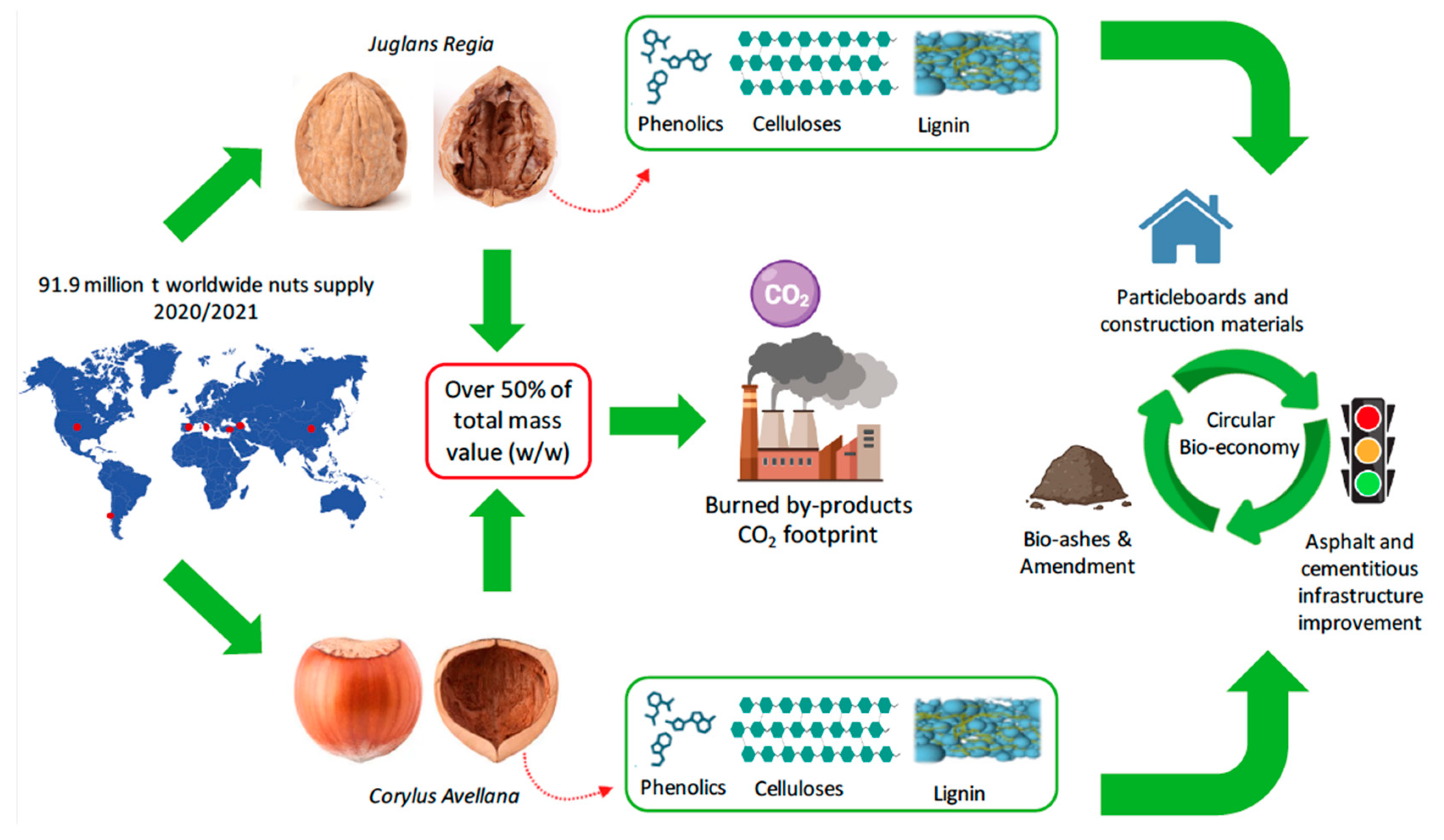
Figure 2.
Global production of hazelnut and walnut fruits (FAOSTAT, 2023; ODEPA-CIREN, 2021).
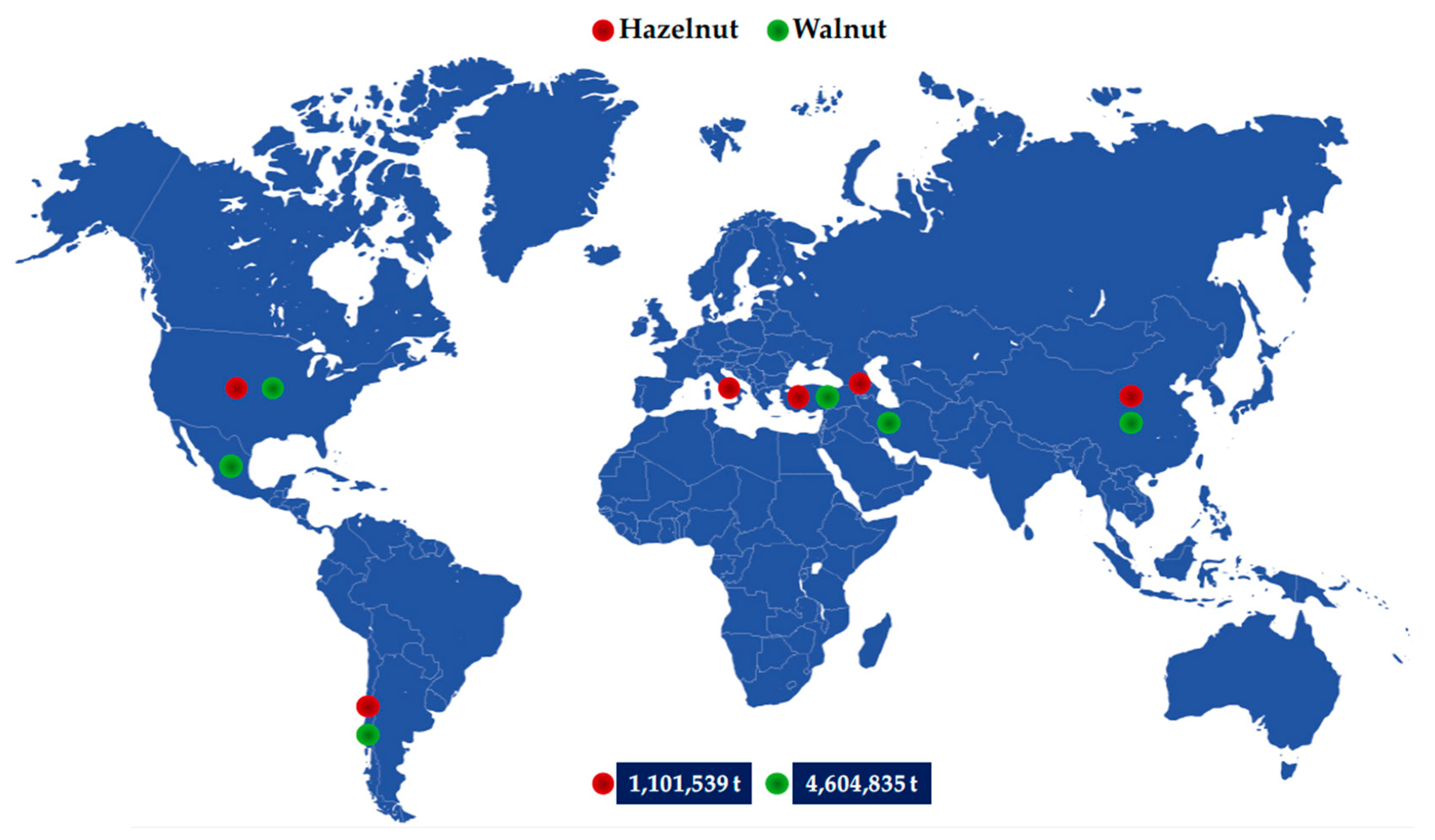

Table 1.
Main biochemical features of hazelnut and walnut shells, regarded on the following reported information. Values and ranges were interpreted as means. RSA (Radical Scavenging activity), TPC (Total Phenolic Compounds) and AC (ORAC Antioxidant Activity).
Table 1.
Main biochemical features of hazelnut and walnut shells, regarded on the following reported information. Values and ranges were interpreted as means. RSA (Radical Scavenging activity), TPC (Total Phenolic Compounds) and AC (ORAC Antioxidant Activity).
| Nutshell Species | Lignin | Hemicellulose | Cellulose | Extractives | RSA | TPC | AC | References |
| (%) | (μg TE g‒1 DW) | (mg GAE g‒1 DW) | (μmol TE g‒1 DW) | |||||
| Hazelnut | 36 – 46 | 21 – 30 | 26 – 34 | 3 – 3.4 | - | 56.6 | - | Barbu et al., 2017; Pirayesh et al., 2012; Argenziano et al., 2022; Kocaman; Ahmetli., 2020; Contini et al., 2008; Manterola-Barroso et al., 2022; Masullo et al., 2017; Di Michele et al., 2021; Yuan et al., 2018; and Pelvan et al., 2018. |
| 1,110 | 0.18 | 2,119 | ||||||
|
- |
0.34 |
- |
||||||
|
- |
3.5 - 12 |
- |
||||||
| - | 72.25 | - | ||||||
| 1.01 mg mL‒1 | - | 1,219 | ||||||
| Walnut | 29 – 53 | 21 – 24.9 | 25 – 32 | 4 – 10.6 | 18,860 | 31.79 | - | Domingos et al., 2022; Wei et al., 2010; Jovicic et al., 2022; Queirós et al., 2019; Herrera et al., 2020; and Han et al., 2018. |
| 3.14 – 7.17 μg mL‒1 | 3.49 μg g‒1 | - | ||||||
Table 2.
Average physical features of hazelnut and walnut shells.
| Nutshell Species | Density | Solubility | Morphology (nut traits) | References | |||
| NaOH | H2O | Len | Wid | STh | |||
| (g cm‒3) | (%) | (mm) | |||||
| Hazelnut | 1 - 1.3 | 50 - 50.4 | 18 - 20 | 18.8 - 25.9 | 17.2 - 22.7 | 1.3 - 1.7 |
Barczewski et al., 2019 Matin et al., 2023 Pirayesh et al., 2012 Manterola-Barroso et al., 2022 Meriño-Gergichevich et al., 2021 |
| Walnut | 1.1 - 1.2 | 35.2 | 7 - 10 | 38.2 - 50.4 | 29.2 - 34.4 | 1.1 - 1.7 |
Barczewski et al., 2019 Pirayesh et al., 2012 |
Table 3.
Hazelnut and walnut hardness based on cracking point. Values represented by (L), (T) and (S) correspond to Longitudinal, Transverse and Suture measurement respectively.
Table 3.
Hazelnut and walnut hardness based on cracking point. Values represented by (L), (T) and (S) correspond to Longitudinal, Transverse and Suture measurement respectively.
| Nutshell Species | Cracking Point | References | ||
| Longitudinal (L) | Transverse (T) | Suture (S) | ||
| (Newton) | ||||
| Hazelnut | 138 - 140 | 55 | 89 | Kabas et al., 2020; Cetin et al., 2020 |
| Walnut | 270 - 333 | 472 - 499 |
424 - 441 |
Koyuncu et al., 2004; Sharifian and Derafshi., 2008 |
Disclaimer/Publisher’s Note: The statements, opinions and data contained in all publications are solely those of the individual author(s) and contributor(s) and not of MDPI and/or the editor(s). MDPI and/or the editor(s) disclaim responsibility for any injury to people or property resulting from any ideas, methods, instructions or products referred to in the content. |
© 2023 by the authors. Licensee MDPI, Basel, Switzerland. This article is an open access article distributed under the terms and conditions of the Creative Commons Attribution (CC BY) license (http://creativecommons.org/licenses/by/4.0/).
Copyright: This open access article is published under a Creative Commons CC BY 4.0 license, which permit the free download, distribution, and reuse, provided that the author and preprint are cited in any reuse.


