
Submitted:
20 September 2023
Posted:
25 September 2023
You are already at the latest version
Abstract
A (2,6)-fullerene F is a 2-connected cubic planar graph whose faces are only 2-length and 6-length. Furthermore, it consists of exactly three 2-length faces by Euler's formula. The (2,6)-fullerene comes from Do\v{s}li\'{c}'s (k,6)-fullerene, a 2-connected 3-regular plane graph with only k-length faces and hexagons. Do\v{s}li\'{c} showed that the (k,6)-fullerenes only exist for k = 2, 3, 4 or 5, and some of the structural properties of (k,6)-fullerene for k = 3, 4 or 5 are studied. In this paper, we study the properties of (2,6)-fullerene. We obtain that the edge-connectivity of (2,6)-fullerenes is 2. Every (2,6)-fullerene is 1-extendable, but not 2-extendable. F is said to be k- resonant (k>0) if the deleting of any i (0=< i<= k) disjoint even faces of F results in a graph with at least one perfect matching. We have that every (2,6)-fullerene is 1-resonant. An edge set S of F is called an anti-Kekule set if F-S is connected and has no perfect matchings, where F-S denotes the subgraph obtained by deleting all edges in S from F. The anti-Kekule number of F, denoted by ak(F), is the cardinality of a smallest anti-Kekule set of F. We have that every (2,6)-fullerene F with |V(F)|>6 has anti-Kekule number 4. Further we mainly prove that there exists a (2,6)-fullerene F having f_{F} hexagonal faces, where f_{F} is related to the two parameters n, m.
Keywords:
(2
; 6)-fullerene
; edge-connectivity
; anti-Kekule number
; resonance
; perfect matching
1. Introduction
A fullerene is a 2-connected cubic planar graph whose faces are only length and 6-length. Došlić showed that all fullerenes only exist for , 3, 4 or 5 and are 1-extendable [1]. A fullerene is the usual fullerene as the molecular graph of a sphere carbon fullerene. A fullerene is the molecular graph of a boron-nitrogen fullerene. The structural properties, such as connectivity, extendability, resonance, anti-Kekulé number, are very useful for studying the number of perfect matchings in a graph[2,3]. And the number of perfect matchings is closely related to the stability of molecular graphs[4,5,6,7,8]. Therefore, many articles have studied the structural properties of graphs in both mathematics and chemistry [9,10,11]. Fullerene graphs are bicritical, cyclically 5-edge-connected, 2-extendable and 1-resonant [12,13,14,15]; Boron-nitrogen fullerene graphs are bipartite, 3-connected, 1-extendable, 2-resonant, and have the forcing number at least two [16,17]; A fullerene is 1-extendable, 1-resonant and has the connectivity 2 or 3 [18,19]. This paper is mainly concerned with the structural properties of fullerenes.
A fullerene F is a cubic planar graph such that every face is either length or length. A graph with two vertices and n parallel edges joining them is denoted by . The smallest fullerene is . A is a graph that can be embedded in the plane such that its edges intersect only at their ends. Any such embedding divides the plane into connected regions called . Two different faces are if their boundaries have an edge in common. A face is said to be the vertices and edges in its boundary, and vice versa. An edge is said to be the ends of the edge, and vice versa. Two vertices which are incident with a common edge are , and two distinct adjacent vertices are . If S is a set of vertices in a graph F, the set of all neighbours of the vertices in S is denoted by , and denotes the number of neighbours of S.
Let F be a fullerene graph with vertex-set and edge-set . We denote the number of vertices and edges in F by and . For , we let be the subgraph of F obtained from F by removing the elements in H. A of F is a set of disjoint edges M of F. A perfect matching of F is a matching M that covers all vertices of F. A perfect matching of a graph coincides with a Kekulé structure of some molecular graph in organic chemistry. A set of disjoint even faces of a graph F is a if F has a perfect matching M such that the boundary of each face in is an alternating cycle. F is said to be k-resonant () if any i () disjoint even faces of F form a resonant pattern. Moreover, F is called () if any matching of n edges is contained in a perfect matching of F. F is if F contains an edge and contains a perfect matching, for every pair of distinct vertices . In this paper, we show that every fullerene is 1-extendable, 1-resonant but not 2-extendable, bicritical.
The anti-Kekulé set of a fullerene F with perfect matchings is an edge set such that is connected and has no perfect matchings. The anti-Kekulé number of F, denoted by , is the cardinality of a smallest anti-Kekulé set of F. It is NP-complete to find the smallest anti-Kekulé set of a graph. Moreover, it has been shown that the anti-Kekulé set of a graph significantly affects the whole molecule structure by the valence bond theory. We have known the , , and fullerenes have the anti-Kekulé numbers 4, 4 and 3 respectively. In this paper, We show that every fullerene F has the anti-Kekulé number 4 with .
2. Main results
An edge-cut of F is a subset of edges such that is disconnected. An is an edge-cut with k edges. The of F, denoted by , is equal to the minimum cardinality of edge-cuts. F is if F cannot be separated into at least two components by removing less than k edges.
Lemma 1.
The fullerene F has edge-connectivity 2, where .
Proof.
Since every edge of F is incident with a 2-length face or a 6-length face, there is no cut edge in F. Therefore, F is 2-edge-connected. For one 2-length face C in F, denoted by . Then either or the two edges incident with x and y respectively other than form an 2-edge-cut of F. Therefore, , where . □
We call an edge e is a subgraph H if .
Lemma 2.
Every 2-edge-cut of a fullerene isolates a 2-length face.
Proof.
Let F be a fullerene. If , then , and the conclusion holds as F has no 2-edge-cut. So next we suppose . By Lemma 1, F has an 2-edge-cut. Let be an 2-edge-cut whose deletion separates F into two components, , . Then E is a matching of F as F is 3-regular and has edge-connectivity 2. Let every edge has one endpoint, say , on , the other endpoint, say , on , . Suppose the outer face of is exactly the outer face of F, thus lies in some inner face of . Then there are two hexagons, denoted by , , such that both and are incident with , , , . If one of and contains a cut edge, without losing generality, assume that contains a cut edge , then has two connected components, say , . Then both and cannot be incident to the same component (), otherwise, there exists a cut edge e in F, a contradiction. Then , . That is, all of , and are 2-length faces and we get a fullerene with six vertices, thus the conclusion holds. If both and contain cut edges, then there is a face with length more than 6, a contradiction. If neither nor has a cut edge, then and are 2-edge-connected, and in each of them there is only one face that is not 2-length or 6-length, and we denote these two boundaries of the exceptional faces by and , respectively. Let , , and be the number of vertices, edges and faces in , respectively. Let be the length of , and , be the number of 2-length faces, 6-length faces in , respectively. By Euler’s formula and the structure of , it follows that
By (1), we obtain that
Since F has no face with length more than 6, the two faces each has at most two additional vertices on . Hence . By (2), we can get . If , we have , which means that is a 2-length face, thus the conclusion holds. If , then and there are no additional vertices on , which implies that is a 2-length face, thus the conclusion holds. Therefore, every 2-edge-cut of a fullerene isolates a 2-length face.
□
In [1], Došlić proved that the fullerene is 1-extendable for . In fact, we may observe that the conclusions remain valid for .
Lemma 3
([1]). Let F be a fullerene graph. Then F is 1-extendable.
The resonance of faces of a plane bipartite graph is closely related to 1-extendable property. It was revealed that every face (including the infinite one) of a plane bipartite graph G is resonant if and only if G is 1-extendable [20]. Combing with Lemma 3, we can know every fullerene is 1-resonant.
Corollary 1.
Every fullerene is 1-resonant.
Moreover, we can know no fullerene is 2-extendable.
Theorem 1.
No fullerene is 2-extendable.
Proof.
Let F be a fullerene graph. Let f be a 2-length face of F with the boundary . By the definition of extendability, we know that . Then there exist two vertices of F which are different from such that and . Since the four vertices must be contained in the same hexagon of F, there is a vertex , of F such that . Obviously, is a matching and cannot be contained in a perfect matching of F. Thus no fullerene is 2-extendable.
□
Similarly, we can show no fullerene is bicritical.
Theorem 2.
No fullerene is bicritical.
Proof.
Let F be a fullerene graph. Let f be a 2-length face of F with the boundary . When , then has no perfect matchings. When , then there exists a vertex u of F which is different from such that . Then has a single vertex as a component. So has no perfect matchings. That is, F is not bicritical.
□
Theorem 3
(Tutte’s Theorem [21]). A graph G has a perfect matching if and only if for any , where is the number of odd components of .
Theorem 4
(Hall’s Theorem [21]). Let F be a bipartite graph with bipartition W and B. Then F has a perfect matching if and only if and for any , holds.
For the connected cubic simple bipartite graph, we can know its anti-Kekulé number is 4 [22].
Theorem 5
([22]). If G is a connected cubic simple bipartite graph, then .
The above result can be used to determine the anti-Kekulé numbers of some interesting graphs, such as, fullerenes [22], toroidal fullerenes [22] etc. Theorem 5 is also valid for fullerene when .
Theorem 6.
Let F be a fullerene graph with . Then .
Proof.
Let F be a fullerene. For any vertex u in F, if , then (see Figure 1(a) the graph ). For any vertex u in F, if , then (see Figure 1(b) the graph ). We can easily know that both and cannot exist anti-Kekulé set. On the other hand, if we let n and be the number of vertices and the hexagons of F, respectively, then by the Euler’s formula and the formula of degree sum, we can get . Thus if , then and . If , then , which is impossible as every hexagonal face must contain six vertices. If , then and (see Figure 1(b) the graph ). Therefore, when , there is no anti-Kekulé set in F.
Next, we discuss the anti-Kekulé number of F with . Then there is a vertex u in F and . Let x, y, z be the three neighbors of u. Let and be two edges incident with x other than , and let and be two edges incident with y other than . Since every face of F is 2-length or 6-length and F is 2-edge-connected, the four edges are pairwise different. We claim that is an anti-Kekulé set. It is obvious that has no perfect matchings as the two vertices x, y cannot be contained in the same perfect matching. If is no connected, then we obtain a cut edge in F, contradicting Lemma 1. Then we find an anti-Kekulé set of size 4 and so .
In the following, we show . Let A be an anti-Kekulé set of size . Then is connected and has no perfect matchings. According to Theorem 3, there exists such that . If we choose such an S with the maximum size, then has no even components. On the contrary, suppose that has an even component H. For any vertex , . Let , then , which is a contradiction to the choice of S.
Since is even, then by parity. For any edge , adding e to will connect at most two odd components, then . Since A is the smallest anti-Kekulé set of F, then has a perfect matching for any edge . Hence, by Theorem 3, for the above subset S, . Therefore, . We obtain , and the edge e connects exactly two components of .
Let be the odd components of , where . For , let denote the number of the set of edges with one end in and the other end in . Denote the number of edges between S and the odd components by N. Since F is cubic, S sends out at most to N. In addition, sends out exactly edges to N. Hence
Because F is 2-edge-connected, for every i. On the other hand, since , which implies that and are of the same parity. Every sends odd number edges, hence . Substituting it into (3), we have
the above inequality gives .
We find that the anti-Kekulé number of F is either 3 or 4. Suppose by the contrary that . Then there exists an anti-Kekulé set of cardinality three in F, such that is connected and has no perfect matchings. Assume W and B are the bipartition of F. By Hall’s theorem, there exists such that
where means in . Moreover, for , since A is the smallest anti-Kekulé set, has a perfect matching. Immediately by Theorem 4, for the above subset U,
for and 3, where means in . In addition, the neighbors of U will be increased by at most one if we add an edge to . Hence
Combining inequalities (4), (5) and (6), we have , and is incident with the vertices of U and in . Thus the edges going out from either goes into A or goes into the edges going out from . Then the number of edges between U and is . Since , , that is, there is no edge between and in . As a result, A is an edge-cut, which is a contradiction to the definition of anti-Kekulé set.
□
In [23], Grünbaum and Motzkin showed that (5,6)-fullerene and (4,6)-fullerene having n hexagonal faces exist for every non-negative integer n satisfying , and gave a similar result for (3,6)-fullerene. Therefore, we consider whether (2,6)-fullerene having n hexagonal faces also exists for any n. We tried to give a positive answer to this question, but we found that the conclusion seems quite elusive. Therefore, in this part, we mainly prove that there exists a fullerene F having hexagonal faces where is related to the two parameters n, m.
Let F be a fullerene. A H of F is a subgraph of F consisting of a cycle together with its interior and every inner face of H is also a face of F. We define as the of the exterior face of H. A face f of F is a of H if f is not a face of H and f has at least one edge in common with H. A path of length k (the number of edges) is called a k-. Denote by the number of hexagons of H.
Proposition 1.
In all the (2,6)-fullerenes, there exists a fragment, say , such that , .
Proof.
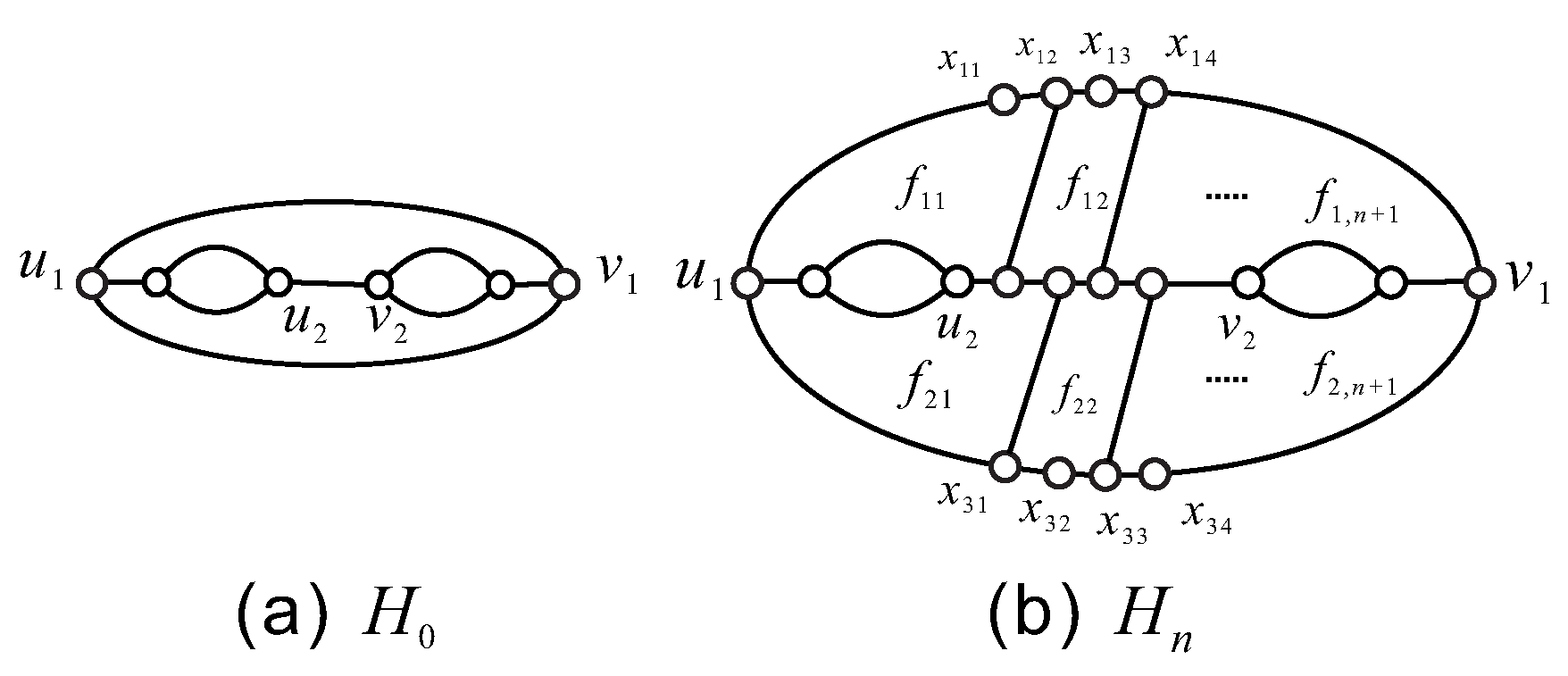
Let be a 2-length face and be two neighboring faces of (see Figure 2(a)). Then . Suppose that , are hexagons. Set , suppose both and are inner faces of and let be four neighboring faces of along the clockwise direction such that is incident with the two consecutive 2-degree vertices on (see Figure 2(b)). Then . Suppose that are hexagons, pairwise different, and intersecting if and only if , are intersecting at only one edge for , . Set . Suppose are the inner faces of and let be six neighboring faces of along the clockwise direction such that is incident with the two consecutive 2-degree vertices on (see Figure 2(c)). Then .
Suppose that the proposition holds for any integer less than n, where . According to the induction hypothesis, and be neighboring faces of along the clockwise direction such that is incident with the two consecutive 2-degree vertices on . Suppose that are hexagons, pairwise different, and intersecting if and only if , are intersecting at only one edge for , . Set . Suppose are all inner faces of (see Figure 3). Then , .
□
Proposition 2.
In all the (2,6)-fullerenes, there exists a fragment, say , such that , .
Proof.
Let be a , then . Let and be two 2-length faces. Its boundary is labelled , (). Let be a path that connects two vertices , () and . If both , are 2-paths, then as F is 2-connected, there is a hexagon, say , such that contains the paths , and the edges , . Set , without lose of generality, suppose is the inner face of (see Figure 4(a)). Thus . If both , are 4-paths, then all of whose internal vertices are denoted by and , respectively, such that , . Let , then there are 2 hexagons, denoted by , such that , . Set , also suppose are two inner faces of (see Figure 4(b)), then . Suppose , are -paths, . Let and . Suppose that (), then there are n hexagons between and , denoted by . Set such that are the inner faces of (see Figure 4(c)). Therefore, is a fragment and , . Thus there exists a fragment such that , .
□
Proposition 3.
In all the (2,6)-fullerenes, there exists a fragment, say , such that , , .
Proof.
Let , be two fragments as indicated in Figure 3. By Proposition 1, we know that and both have hexagons. Suppose n is a positive integer. Since there are 2-degree vertices on , we can record them clockwise as such that and are adjacent. Similarly, 2-degree vertices on are denoted by along the anticlockwise direction of such that and are adjacent. For and . Let , then and are contained in the hexagon, say . Set (see Figure 5(a)), then . For and . Let , , then and are contained in the hexagon, say , . Set , suppose all of are the inner faces of (see Figure 5(b), the embedding of ), then .
Next, we construct the fragment from as follows. We replace each edge by a path such that , , . Suppose that be the edges of F, . Therefore, there are hexagons between and , denoted by , . Set , (see Figure 5(c), the embedding of ). Therefore, is a fragment and , , .
□
Proposition 4.
In all the (2,6)-fullerenes, there exists a fragment, say , such that , .
Proof.
Let be the -fullerene with six vertices. Without lose of generality, suppose the exterior face of is a 2-length face with the boundary , and the remaining two 2-length faces are connected by an edge (see Figure 6(a) the embedding of and the labelling of ). Next, we construct the fragment from as follows: we replace the two parallel edges and one edge by two paths , and one path such that , , and , . Suppose that be the edges of F, . We construct hexagons between and , denoted by , . Set such that are the inner faces of , (see Figure 6(b)). Therefore, is a fragment and , . Thus there exists a fragment such that , .
□
By Propositions 1–4, we can find a fullerene F having hexagonal faces which related to the parameters n, m.
Theorem 7.
There exists a fullerene F such that , .
Proof.
Let be a fragment of F as shown in Figure 3. Its boundary is labelled along the clockwise direction, where and are two consecutive 2-degree vertices. Let be a fragment of F as shown in Figure 4(c). Its boundary is labelled along the clockwise direction, where and are two consecutive 3-degree vertices. Next assume the graphs and each drawn on a hemisphere, with the boundary as equator. If , then set . By Propositions 1 and 2, then , .
□
Theorem 8.
There exists a fullerene F such that , , .
Proof.
Let be a fragment of F as shown in Figure 3. Its boundary is labelled along the clockwise direction, where and are two consecutive 2-degree vertices. Let be a fragment of F as shown in Figure 5(c). Its boundary is labelled along the clockwise direction, where and are two consecutive 3-degree vertices. Next assume the graphs and each drawn on a hemisphere, with the boundary as equator. If , then set . By Propositions 1 and 3, then , , .
□
Theorem 9.
There exists a fullerene F such that , .
Proof.
Let be a fragment of F as shown in Figure 3. Its boundary is labelled along the clockwise direction, where and are two consecutive 2-degree vertices. Let be a fragment of F as shown in Figure 6(b). Its boundary is labelled along the clockwise direction, where and are two consecutive 3-degree vertices. Next assume the graphs and each drawn on a hemisphere, with the boundary as equator. If , then set . By Propositions 1 and 4, then , .
□
3. Conclusion
In this paper, we have obtained that every fullerene F is 1-extendable but not 2-extendable, 1-resonant and has the anti-Kekulé number 4 with . Moreover, every fullerene isn’t bicritical. At last, we prove that there exists a fullerene F having hexagonal faces, where is related to the two parameters n, m. There are, however, still several important open questions.
Problem 1.
Whether every fullerene is k-resonant ?
Problem 2.
Whether for every there exists a fullerene F such that ?
Acknowledgment
This work is supported by National Natural Science Foundation of China (grant no.11801148,11801149 and 11626089) and the Foundation for the Doctor of Henan Polytechnic University (grant no.B2014-060).
References
- T. Došlić. Cyclical edge-connectivity of fullerene graphs and (k,6)-cages[J]. Journal of Mathematical Chemistry 2003, 33(2), 103–112. [Google Scholar] [CrossRef]
- R. Yang, H. Zhang. 2-Resonant fullerenes[J]. European Journal of Combinatorics 2015, 49, 13–24. [Google Scholar] [CrossRef]
- R. Yang, H. Jia. Anti-Kekulé number of the {(3, 4), 4}-fullerene[J]. Frontiers in Chemistry 2023, 11. [Google Scholar]
- I. Gutman, O. E. Polansky. Mathematical concepts in organic chemistry[M]. Springer, Berlin, 1986. [CrossRef]
- X. Liu, D. J. Klein, W. A. Seitz, T. G. Schmalz. Sixty-atom carbon cages[J]. Journal of Mathematical Chemistry 1991, 12, 1265–1269. [Google Scholar] [CrossRef]
- N. Trinajstić. Chemical graph theory[M]. CRC Press, Boca Raton, 1992.
- B. Afshin, T. Došlić, S. Friedland. Matchings in m-generalized fullerene graphs[J]. ARS Mathematica Contemporanea 2015, 11, 301–313. [Google Scholar] [CrossRef]
- M. B. Ahmadi, V. A. Khorasani, E. Farhadi, Saturation number of fullerene and benzenoid graphs[J]. Match-communications in Mathematical and in Computer Chemistry 2017, 77, 737–747. [Google Scholar]
- T. Došlić. On some structural properties of fullerene graphs[J]. Journal of Mathematical Chemistry 2002, 31(2), 187–195. [Google Scholar] [CrossRef]
- W. C. Shiu, H. Zhang. A complete characterization for k-resonant Klein-bottle polyhexes[J]. Journal of Mathematical Chemistry 2008, 43(1), 45–59. [Google Scholar] [CrossRef]
- F. Zhang, L. Wang. k-Resonance of open-ended carbon nanotubes[J]. Journal of Mathematical Chemistry 2004, 35(2), 87–103. [Google Scholar] [CrossRef]
- T. Kaiser, M. Stehlik, R. Skrekovski. On the 2-resonance of fullerenes[J]. SIAM Journal on Discrete Mathematics 2011, 25(3-4), 1737–1745. [Google Scholar] [CrossRef]
- D. Ye, Z. Qi, H. Zhang. On k-resonant fullerene graphs[J]. SIAM Journal on Discrete Mathematics 2009, 23(2), 1023–1044. [Google Scholar] [CrossRef]
- F. Kardoš, R. Škrekovski. Cyclic edge-cuts in fullerene graphs[J]. Journal of Mathematical Chemistry 2008, 44(1). [Google Scholar] [CrossRef]
- T. Došlić. On lower bounds of number of perfect matchings in fullerene graphs[J]. Journal of Mathematical Chemistry 1998, 24(4), 359–364. [Google Scholar] [CrossRef]
- H. Zhang, S. Liu. 2-Resonance of plane bipartite graphs and its applications to boron-Cnitrogen fullerenes[J]. Discrete Applied Mathematics, 2010, 158(14), 1559–1569. [Google Scholar] [CrossRef]
- X. Jiang, H. Zhang. On forcing matching number of boron-Cnitrogen fullerene graphs[J]. Discrete Applied Mathematics 2011, 159(15), 1581–1593. [Google Scholar] [CrossRef]
- L. Lovász, M. Plummer. Matching theory[M]. New York: North-Holland Press, 1986.
- R. Yang, H. Zhang. Hexagonal resonance of (3,6)-fullerenes[J]. Journal of Mathematical Chemistry 2012, 50(1), 261–273. [Google Scholar] [CrossRef]
- H. Zhang, F. Zhang. Plane elementary bipartite graphs[J]. Discrete Applied Mathematics 2000, 105(1-3), 291–311. [Google Scholar] [CrossRef]
- J. A. Bondy, U. S. R. Murty. Graph theory[M]. New York: Springer,2008.
- Q. Li, W. Shiu, P. Sun, et al. On the anti-Kelulé problem of cubic graphs[J]. arXiv 2017, arXiv:1711.05398. [Google Scholar]
- B. Grünbaum, T. Motzkin. The number of hexagons and the simplicity of geodesics on certain polyhedra[J]. Canadian Journal of Mathematics 1963(15), 744–751. [Google Scholar] [CrossRef]
Figure 1.
The (2,6)-fullerenes (a), (b).
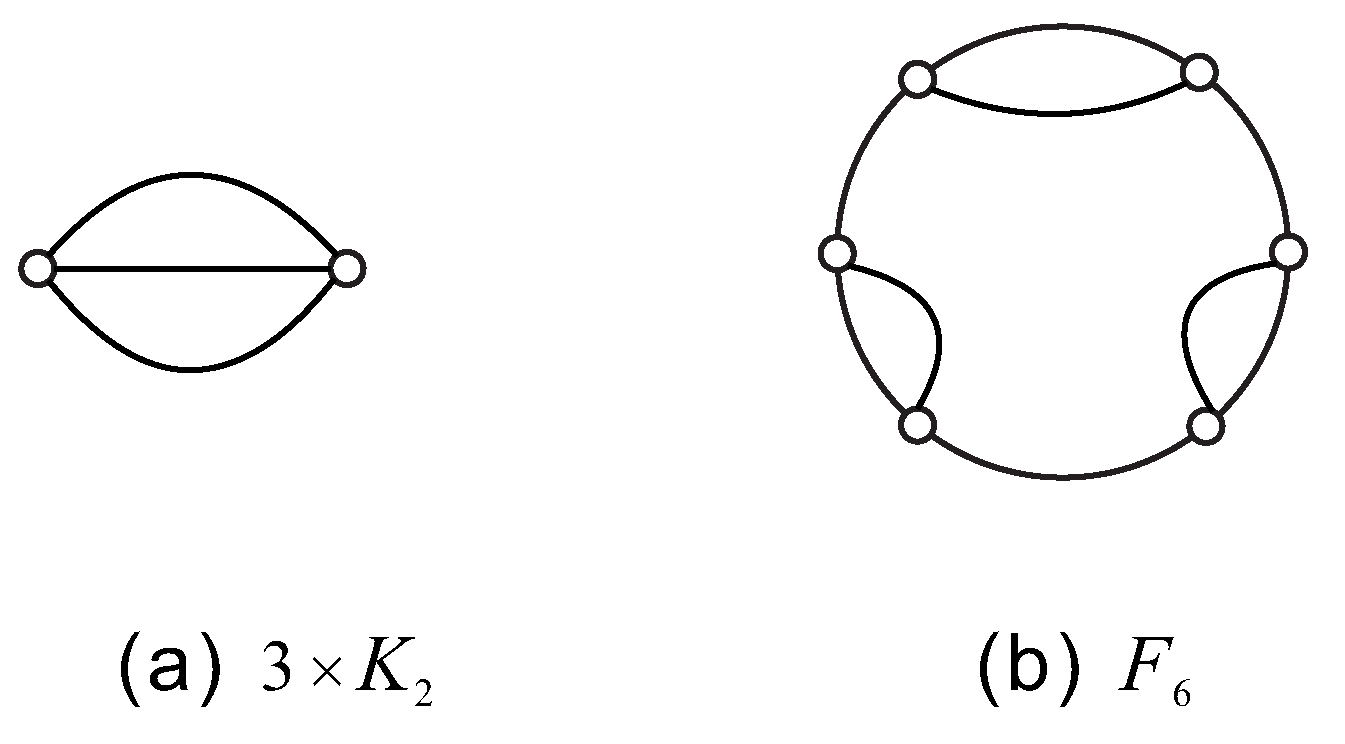
Figure 2.
The fragments (a), (b) and (c).
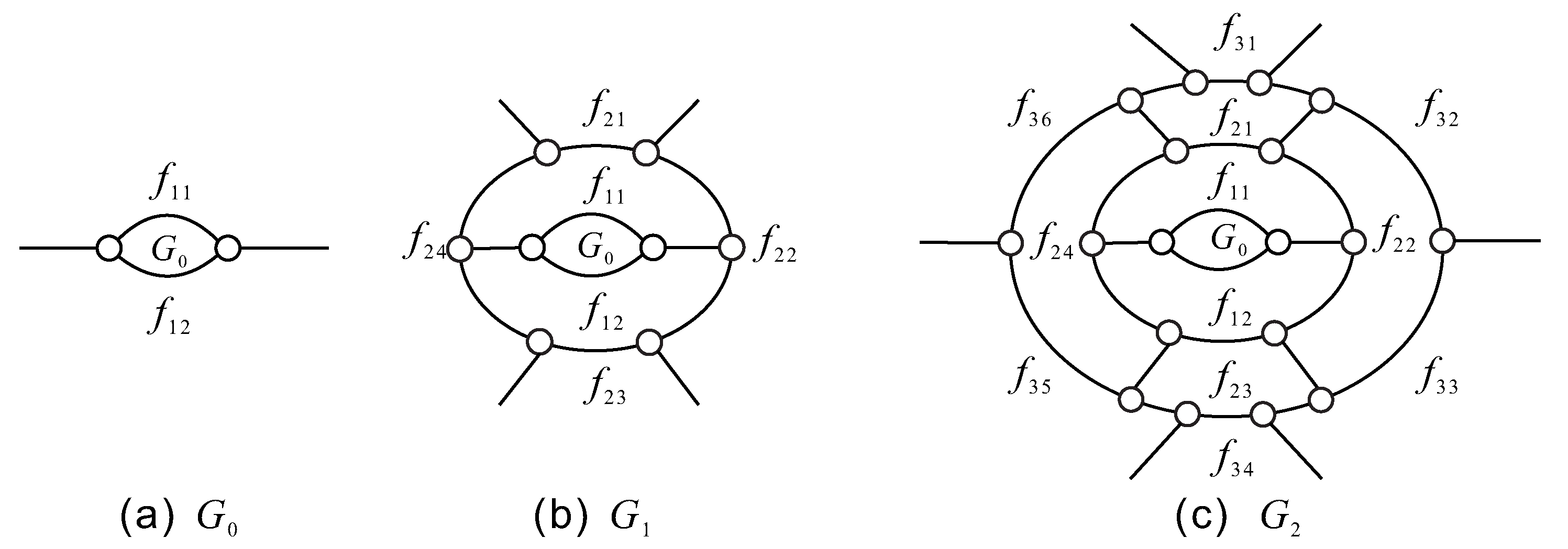
Figure 3.
The fragment .
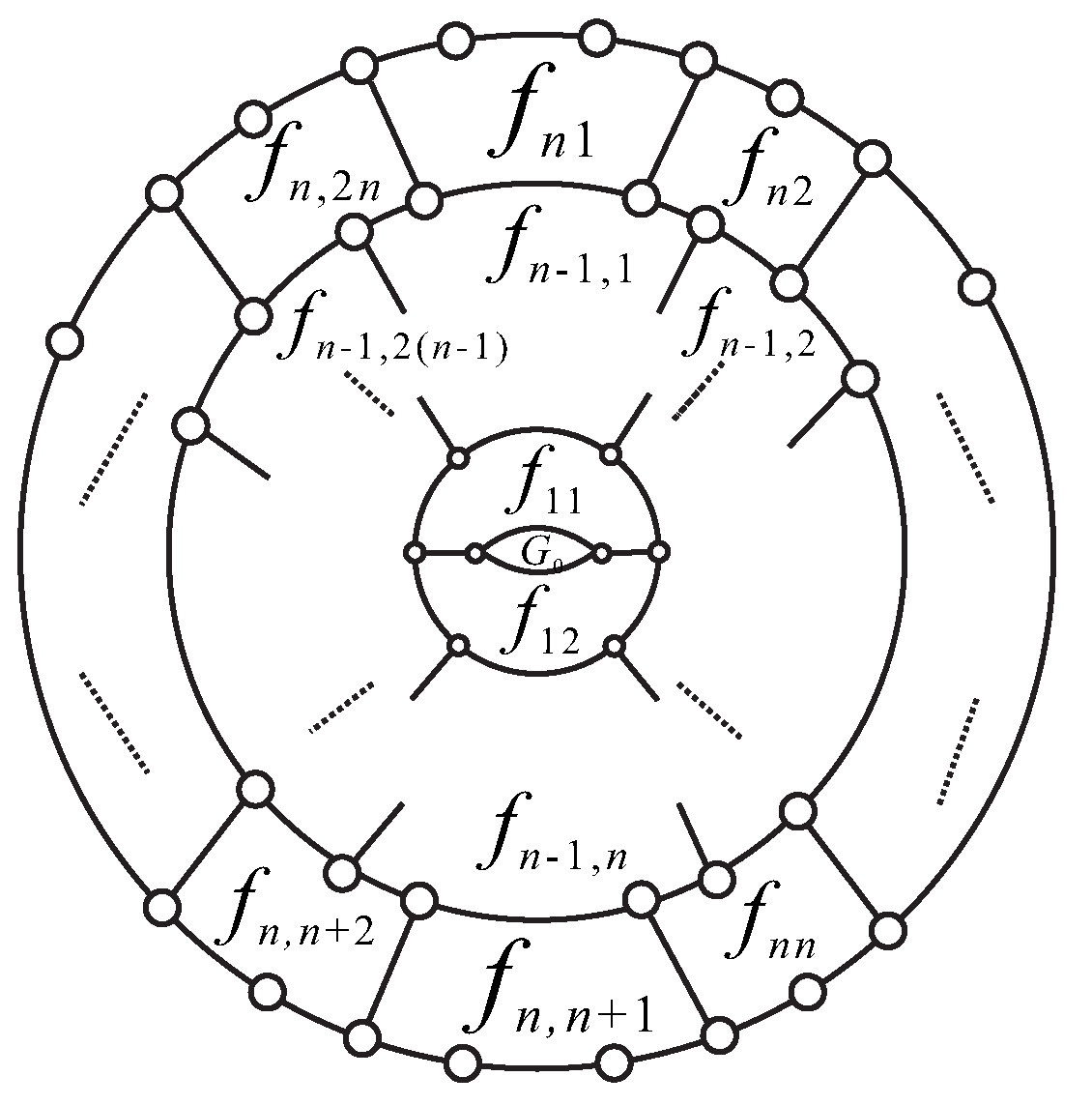
Figure 4.
The fragments (a), (b) and (c).
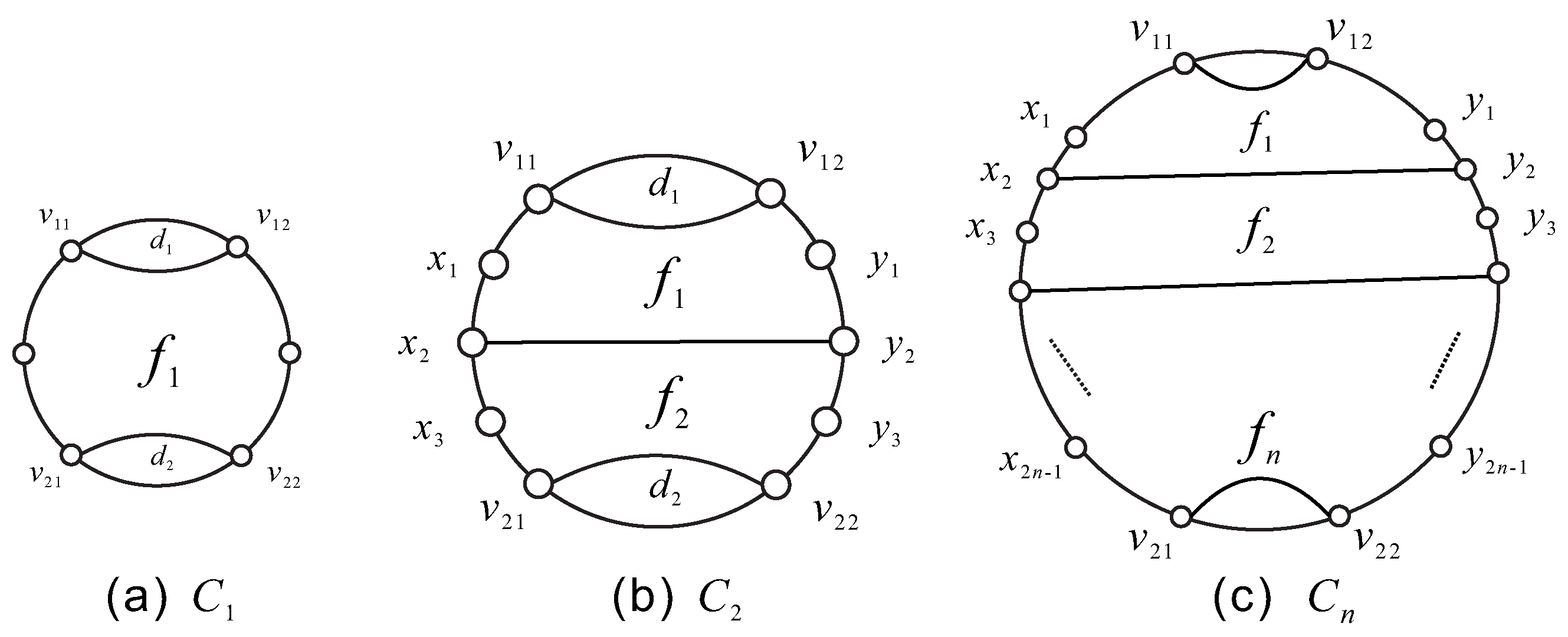
Figure 5.
The fragments (a), (b) and (c).
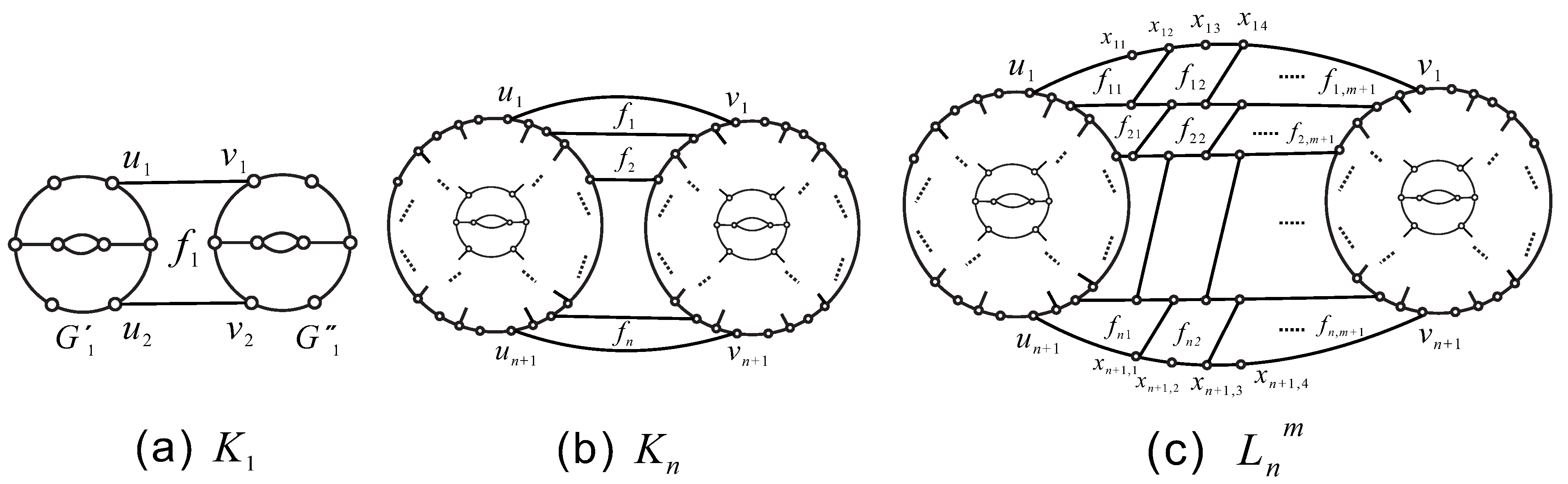
Figure 6.
The fragments (a), (b).
Disclaimer/Publisher’s Note: The statements, opinions and data contained in all publications are solely those of the individual author(s) and contributor(s) and not of MDPI and/or the editor(s). MDPI and/or the editor(s) disclaim responsibility for any injury to people or property resulting from any ideas, methods, instructions or products referred to in the content. |
© 2023 by the authors. Licensee MDPI, Basel, Switzerland. This article is an open access article distributed under the terms and conditions of the Creative Commons Attribution (CC BY) license (http://creativecommons.org/licenses/by/4.0/).
Copyright: This open access article is published under a Creative Commons CC BY 4.0 license, which permit the free download, distribution, and reuse, provided that the author and preprint are cited in any reuse.


