

Submitted:
18 September 2023
Posted:
18 September 2023
You are already at the latest version
Abstract
The wastewater circular economy (WW-CE) promises a solution to improve water and sanitation management worldwide. However, the transition from conventional to circular wastewater treatment plants (WWTPs) requires facilitation to aid in decision makers understanding of integral sustainability impacts of alternative WW-CE configurations. This research implemented Life Cycle Sustainability Assessment (LCSA), combining Life Cycle Assessment, Social Life Cycle Assessment and Life Cycle Costing with a Multi-criteria Decision Making (MCDM) model to quantify environmental, socio-cultural, and economic impacts of conventional WWTPs with the WW-CE. Two real WWTPs in Chile have embraced the WW-CEs and adopting the title of Biofactories. These were considered as case studies, compared under three scenarios to demonstrate the sustainability trade-offs of the transition from no sanitation to conventional WWTPs and Biofactory WW-CE configurations. Results demonstrated that the transition to WW-CEs improved integral sustainability according to the LCSA model implemented in both WWPTs. This study highlights the urgent need to adopt sustainable decision-making models to not only improve sanitation coverage, but also improve sustainability performance of the sanitation industry across the globe.
Keywords:
Wastewater
; Circular Economy
; Life Cycle Sustainability Assessment
; Decision Making
1. Introduction
Global water and sanitation sectors are under increasing pressure to sustain integrated water management for growing populations, balancing increased domestic and industrial demands with water scarcity and contamination challenges [1]. Global objectives were set to achieve “sustainable development” and decision makers in the water sector are faced with the challenge of making “sustainable decisions” [2]. Sustainable development is a complex subject pertaining to multiple definitions, often referring to maximizing economic growth, in harmony with ecosystems regenerative capacity and societal wellbeing over time [3]. Wastewater treatment plants (WWTPs) are a key infrastructure for achieving integral water management, protecting aquatic ecosystems from eutrophication and ecotoxicity [4]. However, chemical, energy and transport resources are required to achieve minimum compliance with discharge standards, contributing to fossil resource consumption and greenhouse gas emissions (GHG), among other environmental impacts [5]. Sanitation system workers must respond to a wide range of challenges to maintain operations and relationships with local authorities, supply chains and relationships with local communities [6]. This results in high costs of investment in treatment technology, operation, and maintenance [7]. Therefore, most wastewater discharges around the world are not adequately treated, and more “sustainable” WWTPs are of urgent importance [1]. The Sustainable Sanitation Alliance (SuSanA) declared health, environmental, technology, financial and socio-cultural objectives for achieving the United Nations agenda for sustainable development [8]. Decision makers, traditionally basing decisions on economic indicators, must now begin to incorporate and comprehend environmental and socio-cultural aspects as well [9]. Inherently different natures of environmental, economic, and social systems, and the trade-offs that can arise between these, defines sustainable decision making as a complex, multi-criteria problem [10]. Therefore, interpretation of the most sustainable choice between alternatives becomes more challenging and time consuming [11].
The wastewater circular economy (WW-CE) poses a promising solution to achieving sustainability in the water and sanitation sectors through the recovery of treated water, biosolids, nutrients, bioenergy, and biomaterials for use in adjacent economic sectors [12]. Water recovery from treated effluent is being implemented across regions for different applications, such as agriculture, industry, and public services, decreasing freshwater consumption and offering cost savings to stakeholders [13]. Biosolids products can be recovered for land application nutrient and organic matter recovery for local farmers, offering savings on fertilizer consumption (anaerobic digestion, composting), as well as dual energy recovery (incineration, pyrolysis) [14]. Biogas generated through anaerobic digestion of sludge can been recovered for use as a renewable biofuel, decreasing energy costs and generating revenues [15]. Successful resource recovery from wastewater is highly dependent on economic value, product quality and stakeholder perception, aspects that are geographically unique [16]. These systems can generate environmental, economic, and social benefits; however, no single solution exists for diverse sanitation challenges. Therefore, sustainability must be measured in an integral way on a case-by-case basis to ensure decision makers can achieve sustainable integrated water management over time.
To facilitate “sustainable decision making”, a wide variety of decision-making tools based on mathematical, life cycle and multi-criteria modelling have been developed [9]. Multi-criteria decision making (MCDM) is recommended for addressing the subjective nature of decision-making by attributing importance to influencing decision criterion, ranking alternatives based on preferences of the decision makers [17]. There are around 20 main objective and subjective MCDM processes, with different levels of stakeholder interactions [18]. Rezaei et al.,[19] considered economic (Net Present Value), environmental (Carbon Footprint, Eutrophication Potential), and social (Resource Recovery Value) impacts, assessed by a regret-based decision-making model to assess water reuse applications in Florida. Lohman et al., [20] applied MCDM for technical, resource recovery, environmental, social, and economic criteria, using Analytical Hierarchy Process (AHP) for establishing criteria weights and Technique for Order of Preference by Similarity to Ideal Solution (TOPSIS). TOPISIS has been employed significantly in this context. Ddiba et al., [21] surveyed computational tools for facilitating resource recovery in the sanitation industry, only four tools address MCDM and sustainability based on SuSanA defined sustainability criteria (SANTIAGO, EVAS, Poseidon and the Sustainable Sanitation Management Tool). Overall, these investigations and computational tools did not consider life cycle aspects, especially social, in a robust manner.
Life Cycle Sustainability Assessment (LCSA) is highlighted as the most comprehensive method for quantifying sustainability performance of systems [10]. LCSA integrates Life Cycle Assessment (LCA), Life Cycle Costing (LCC) and Social Life Cycle Assessment (SLCA) for environmental, economic and social impact quantification [22]. LCA is a standardized methodology establishing the framework for complementary LCC and SLCA methods, involving setting the goal and scope, compiling inventory data, impact characterization and interpretation [23,24,25]. Few studies have implemented LCSA with MCDM in the sanitation context. Opher [26] considered midpoint environmental impacts (International Reference Life Cycle Data System, 17 criteria) with economic (cash flow) and societal concerns (13 criteria) for water reuse options at various scales of centralization in Israel, implementing Analytical Hierarchy Process (AHP) and agglomerative hierarchical clustering (like TOPSIS). Safarpour et al., [27] applied AHP to LCSA considering endpoint environmental impacts (3 criteria), workers, local community, and consumer issues as well as economic criteria for assessing water demand management policies in Florida. Liu and Ren, [28] used fuzzy weighted sum MCDM method and game theory to compare sludge management options in China under environmental (3 criteria), cost (cashflow), social (3 criteria) and technical criteria (4 criteria). Tarpani and Azapagic, [29] implemented LCSA and MCDM weighted sum, assuming equal weights for all environmental midpoint (ReCiPe, 18 criteria), economic (cash flow) and social (socio-environmental aspect, 9 criteria) assessments, to advanced water treatment and sludge management scenarios in the United Kingdom. There were no clear methodological trends and variability occurred across decision criteria selection (LCSA and technical considerations), technology analysis, criteria weighting methods and MCDM algorithms. Additionally, no LCSA studies have addressed the co-product resource recovery in full-scale WW-CEs compared with conventional WWTPs. Further contributions are required to present LSCA decision making models of integrated resource recovery scenarios in different contexts.
In the Metropolitan Region (MR) of Chile, two WWTPs adopted the concept of the WW-CE, employing different resource recovery configurations. These facilities are known as the Biofactories, responsible for treatment and recovery of resources from wastewater generated by 7 million people and local industries. The Biofactories were developed in response to a range of environmental and social conditions that required the local water company (LWC) to innovate their systems. Integral sustainability assessment of these plants from a life cycle perspective has not been conducted to verify if the WW-CE improves environmental, social, and economic impacts. Considering the urgent need for sustainable water management, this case study provides an example to promote or caution the implementation of a WW-CE, depending on sustainability performance. The objective of this study is to implement LCSA-MCDM assessment of two real WW-CEs located in Chile, to assess sustainability impacts of the transition from conventional WWTPs. The two WW-CEs were compared to determine the best sustainability performance overall. Recommendations are made regarding strategies for improving sustainability of the Biofactories. Additionally, the MCDM-LCSA decision-making process was be compared to the participating LWC decision making processes to discuss implications of the results of this study to industry applications.
2. Methodology
2.1. Life Cycle Systainability Assessment
2.1.1. Study Sites
The two WW-CEs in Santiago, Chile referred to as Plant A and Plant B, currently serve total population equivalents (p.e., including domestic and industrial wastewater) of 6,045,292 and 4,188,539; and influent flowrates of 8.6 and 7.2 m3/ s, respectively. Both Plants are property of the LWC, that manage all potable water and wastewater plants of the MR. Each Plant was developed as a response to requirements for improved sanitation coverage and waste management in the MR. They are located at different locations along the Mapocho River, the main river running through the MR catchment, affecting different local communities. The Plants transitioned from conventional WWTPs to Biofactory WW-CE configurations through the recovery of waste streams to value added resources. Specifically, and in different capacities, treated effluent, biogas, nutrients and biosolids were recovered as products via alternative technology configurations and stakeholder engagement in each Plant. Biosolids produced by the plants are managed by the same biosolids recovery system. Additionally, some of the same chemical suppliers serve both plants.
2.1.2. Goal and Scope
The goal of the study was to quantify integral life cycle sustainability impacts, combining LCA, LCC and SLCA, of the two Plants. The aim was to verify if the implementation of a WW-CE improves integral sustainability overall in the context of Chile. Additionally, the Plants were compared to determine which Biofactory WW-CE configuration best improved integral sustainability impacts. The integral LSCA methodology was established by the ISO LCA guidelines that establish complementary SLCA and LCC methodologies also [23,24,25]. The life cycle of the Plants was estimated at 20-50 years for equipment and over 100 years for civil works, resulting in low relative contribution to environmental and socio-cultural impacts, therefore, this study considered the operation stage only [31]. Daily Plant impacts were averaged over one year of operation, for the treatment of a 1,000,000 p.e. as the adopted functional unit (FU). This considered 44.5 g Biological Oxygen Demand (BOD5)/ person/ day, resulting in a reference flow of 44,500 kg BOD5/ day treated in wastewater influent. Treated effluent, biogas, biosolids and return flows established corresponding waste and product reference flows for the resource recovery and advanced treatment scenarios established within the system boundaries. Environmental, social, and economic burdens were modelled by grouping unit processes by product systems, considering either mass (kg) or energy (kWh) of products. This was facilitated by collaboration with the LWC providing operational data and expert interviews.
2.1.3. System Boundaries
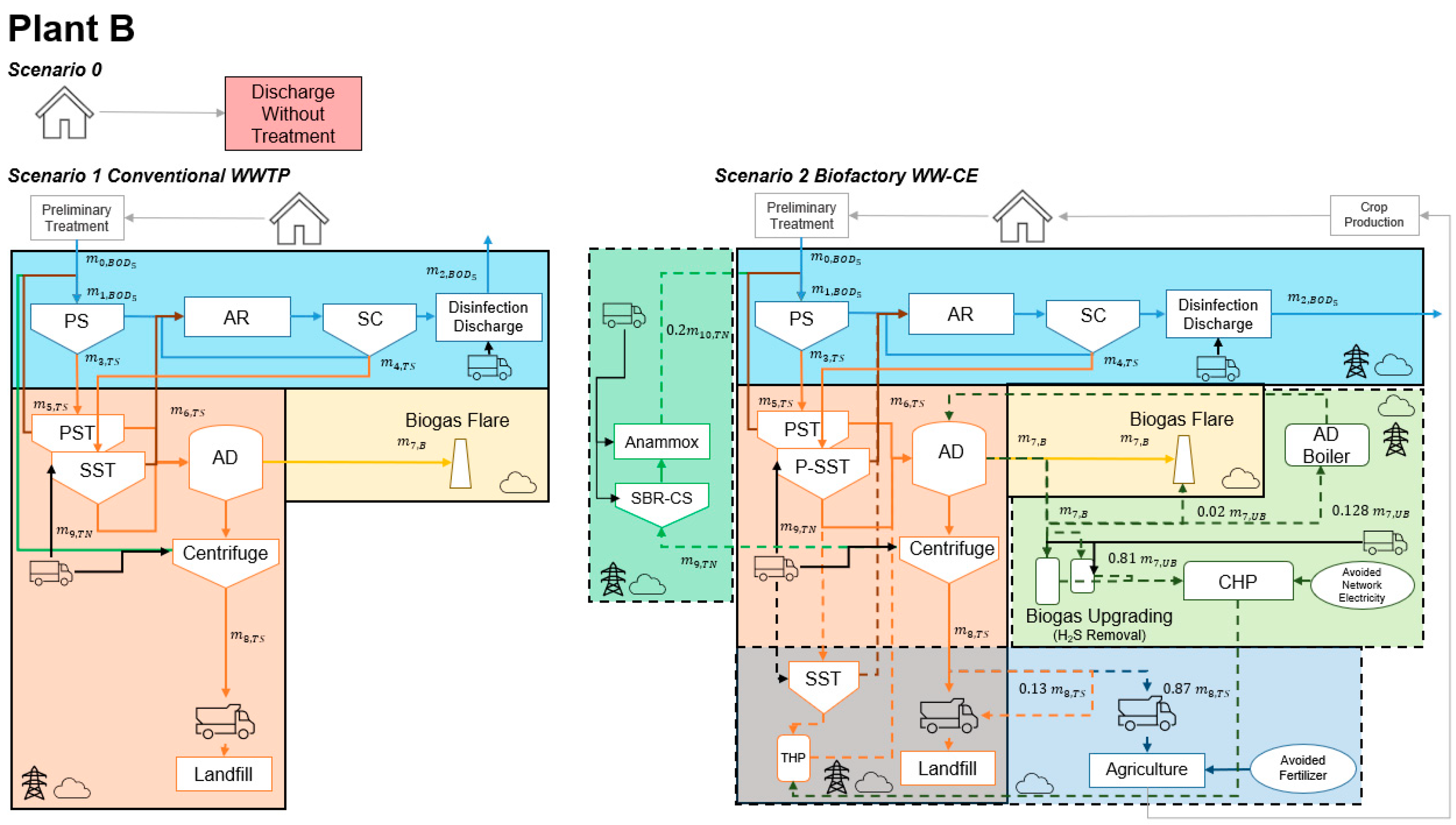
The scenarios analysed presented gate-to-cradle transition to gate-to-gate. The system boundaries from an integral sustainability perspective included identification of both technologies and stakeholders. Figure 1 and Figure 2 show the system boundaries of Plant A and Plant B respectively. The boundary began with the reception of wastewater post preliminary treatment removing larger contaminants, considered negligible. Plant unit processes were grouped by product and co-product systems. SLCA system boundaries determined the inclusion of Workers (W), value chain actors (VCA), clients (C), local community and children’s concerns (LC), wider society (WS) and farmers (F) as stakeholders. F were included as a separate stakeholder considering unique social impacts related to the Plants role in agriculture as a Biofactory WW-CE. WS refers to relationships with regulatory bodies and national policies related to sustainability.
A 0th scenario (S0) was the direct discharge of wastewater to the environment without treatment, modelled with influent wastewater data for LCA and set to all 0 values for SLCA and LCC. Scenario 1 (S1): Conventional WWTPs established a baseline system of WWTP with no product recovery, delineated by the solid black line in Figure 1. The technologies considered were primary sedimentation, aerobic reactors, secondary clarification (waste activated sludge WAS) and disinfection then discharge in both Plants. Likewise, sludge treatment involved primary and secondary sludge thickening, anaerobic digestion (AD), sludge dewatering via centrifuge with 100% of biogas flared and biosolids sent to landfill. The design of treatment technologies in each Plant under this scenario varied and more information is available in Table S1. Stakeholders included on site W, VCA for chemical and service supplies, LC affected by the Plants in general and WS.
Scenario 2 (S2): WW-CE considered current configurations of respective Plants as Biofactory WW-CEs, expanding system boundaries (dashed line) to include partial water recovery, biosolids recovery to agriculture, biogas recovery for energy generation and advanced nitrogen removal systems. Plant A provided local F with irrigation water for ‘fertigation’ via effluent raceway, considering avoided water consumption credits (20 % of discharged effluent volume). Plant B did not recover treated effluent, however, implemented additional sludge pre-thickening and THP processes, improving biogas production and biosolids quality (Devos et al., 2021). Different ratios of biosolids management to landfill and agricultural applications (75 % application in Plant A and 87 % application in Plant B) reflect biosolids quality that must comply as class B, where assumed avoided fertilizer consumption provided environmental credit (BCN, 2009). W, LC, VCA and WS of biosolids management were incorporated, as well F benefit by biosolids recovery. Transport of biosolids to landfill and agriculture pastures was considered, excluding the impact of heavy vehicles and machinery used for the application of biosolids to agricultural crops and crop production, however, improved yield was considered as socio-cultural benefit. Biogas energy recovery involved H2S removal by chemical absorption scrubbing and biological precipitation, for both Plants. CO2 removal by pressurized membrane separation produced domestic biomethane supply (DBM) in Plant A and avoided domestic natural gas consumption credits. Plant B used CHP to produce electricity, 12 % was injected to the grid and 88 % used within the plant for self-sufficiency, resulting in overall 80% avoided network energy consumption across the plant. 12% of the CHP heat provided vapor to THP process for additional avoided network energy consumption. For both systems, W, LC, VCA, C and WS were incorporated. Nitrogen removal technologies were implemented in sludge centrifuge return flows, initially directly recycled to primary treatment. Plant A required <1,000 mg/ L Total Solids (TS) for the ‘Demon’ anammox treatment, via coagulation-flocculation ‘Densadeg’ technology and a sequencing batch reactor (SBR) for nitrifier activation. Plant A had higher N in influent and effluent, requiring higher aeration flowrates and higher Cl2 dosage for nitrification in the water line. For Plant B, SBR reactors with high aeration rates were implemented for nitrification and solids removal, followed by ‘Demon’ anammox systems. W, VCA and WS were identified stakeholders involved in this system.
Figure 1.
Plant A system boundaries for scenario 0: wastewater discharge without treatment; scenario 1: conventional wastewater treatment plant (WWTP); and scenario 2: biofactory wastewater circular economy (WW-CE). Abbreviations: PS, primary sedimentation, AR, aerobic reactor, SC, secondary clarifier, PST, primary sludge thickening, SST, secondary sludge thickening, AD, anerobic digestor, DBM, domestic biomethane, SBR, sequencing batch reactor. Legend: blue box: effluent discharge; orange box: sludge treatment and biosolids disposal to landfill; yellow box: biogas flare; light blue box: partial water recovery; dark blue box: biosolids recovery to agriculture; light green box: biogas energy recovery; dark green box: advanced nitrogen removal.
Figure 1.
Plant A system boundaries for scenario 0: wastewater discharge without treatment; scenario 1: conventional wastewater treatment plant (WWTP); and scenario 2: biofactory wastewater circular economy (WW-CE). Abbreviations: PS, primary sedimentation, AR, aerobic reactor, SC, secondary clarifier, PST, primary sludge thickening, SST, secondary sludge thickening, AD, anerobic digestor, DBM, domestic biomethane, SBR, sequencing batch reactor. Legend: blue box: effluent discharge; orange box: sludge treatment and biosolids disposal to landfill; yellow box: biogas flare; light blue box: partial water recovery; dark blue box: biosolids recovery to agriculture; light green box: biogas energy recovery; dark green box: advanced nitrogen removal.
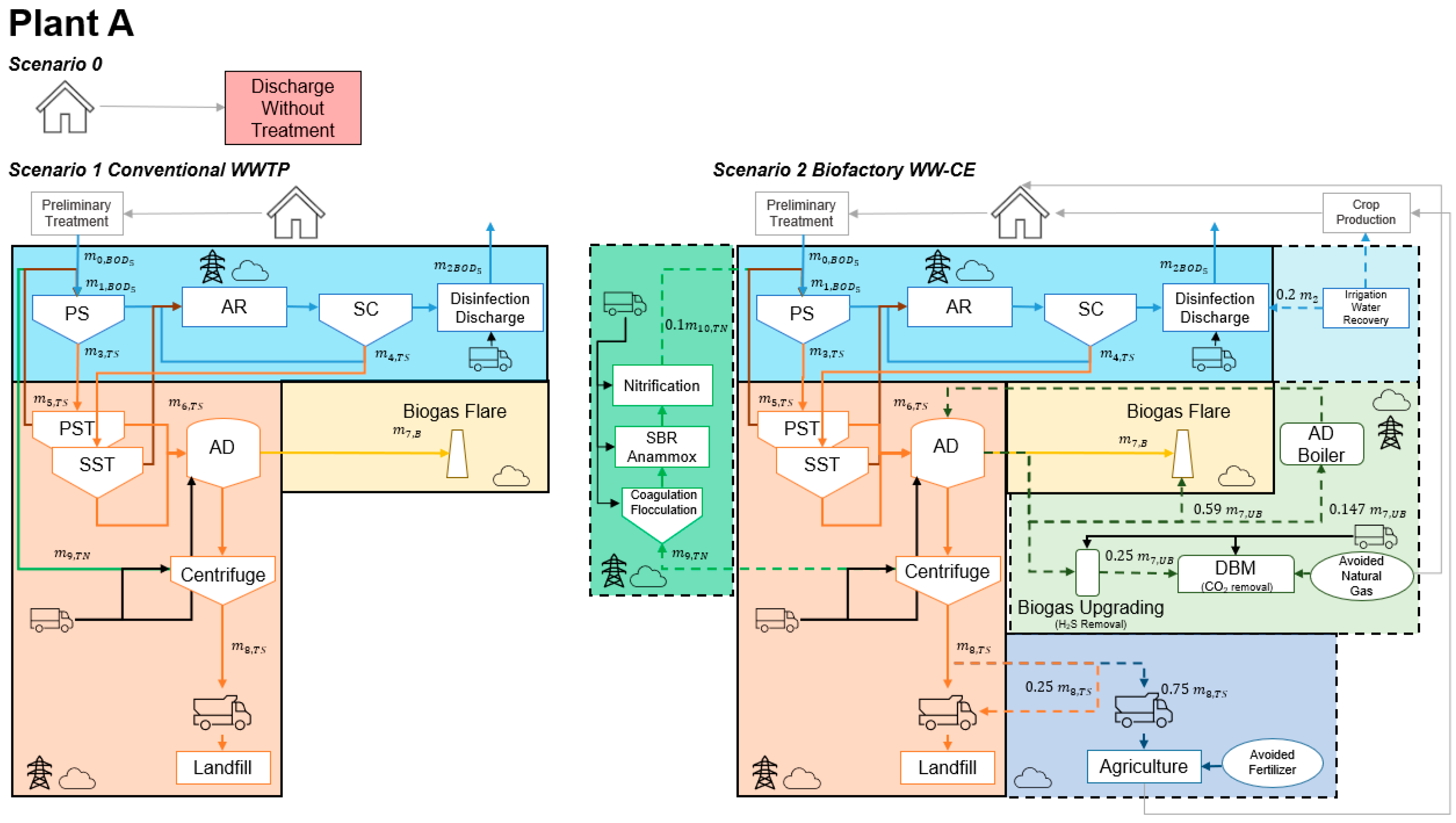
Figure 2.
Plant B system boundaries for scenario 0: wastewater discharge without treatment; scenario 1: conventional wastewater treatment plant (WWTP); and scenario 2: biofactory wastewater circular economy (WW-CE). Abbreviations: PS, primary sedimentation; AR, aerobic reactor; SC, secondary clarifier; PST, primary sludge thickening; SST, secondary sludge thickening; AD, anerobic digestor; P-SST, pre-secondary sludge thickening; THP, thermal hydrolysis pre-treatment; CHP, cogeneration heath and power; SBR, sequencing batch reactor. Legend: blue box: effluent discharge, orange box: sludge treatment and biosolids disposal to landfill; yellow box: biogas flare; dark blue box: biosolids recovery to agriculture; light green box: biogas energy recovery; dark green box: advanced nitrogen removal.
Figure 2.
Plant B system boundaries for scenario 0: wastewater discharge without treatment; scenario 1: conventional wastewater treatment plant (WWTP); and scenario 2: biofactory wastewater circular economy (WW-CE). Abbreviations: PS, primary sedimentation; AR, aerobic reactor; SC, secondary clarifier; PST, primary sludge thickening; SST, secondary sludge thickening; AD, anerobic digestor; P-SST, pre-secondary sludge thickening; THP, thermal hydrolysis pre-treatment; CHP, cogeneration heath and power; SBR, sequencing batch reactor. Legend: blue box: effluent discharge, orange box: sludge treatment and biosolids disposal to landfill; yellow box: biogas flare; dark blue box: biosolids recovery to agriculture; light green box: biogas energy recovery; dark green box: advanced nitrogen removal.
2.1.4. Integrated Life Cycle Inventories
For LCA inventories, material flow analysis (MFA) was conducted of wastewater across all unit processes defined in Figure 1 and Figure 2, determining influent, effluent, return and biosolids flows. MFA substances were TS, Volatile Solids (VS), Total Nitrogen (TN) and Phosphorous (TP), BOD5, chemical oxygen demand (COD) and 14 heavy meals (Table S2 and S3). Chemical consumption, energy consumption, transport processes, atmospheric GHG emissions, products and avoided products were also included in the LCA inventory (Table S5 and S6). LCC integrated capital investment, maintenance costs, operational costs and income with LCA [32]. Data was compiled from operational data, internal reports, and literature sources (Table S4 and S5). Socio-cultural impacts were quantified by SLCA Type II midpoint characterization of social indicators, measuring relationship between stakeholders with ‘activity variables’ (i.e. training hours) according to recommendations from methodological guidelines for stakeholder impact assessment [33]. The quantity of stakeholders involved in each product system were identified by expert W (internal stakeholders) within the LWC who interact with external stakeholders (VCA, C, LC, SC, F) (Table S7). The expert W were interviewed regarding their relationships with external stakeholders, quantifying respective activity variables. This approach was taken due to the sensitivity of external researchers’ intervention with LWCs established relationships with stakeholders. SLCA data was verified by field observations, supporting documents and relevant national legislation [34]. Historic documents quantified some indicators in conventional WWTPs (S1) where expert W interviewees were unable to quantify these indicators (Table S8). A generalized structure of the integrated LCSA data inventories is presented in Figure 3.
2.1.3. Impact Characterization
For LCA, ecosphere and technosphere flows were modelled using the EcoInvent databases. The impact characterization method was ReCiPe Midpoint (H) (world/ 2.0), including 17 impact indicators, determining the environmental decision criteria. The Type II SLCA methodology included 13 impact indicators quantified as activity variable across affected stakeholders and for each product system; and summed by scenario. For the Type II methodology, indicators were assigned monetized factors to quantify sub-category impacts (Table S9). For LCC, the Net Present Value (NPV) was calculated based on the cost inventory according to equation 1:
Where was the discount rate, set to 8 % according to LWC, was time period of future cash flow set to 1 year, was income, was operation costs, and were initial capital investment and average annual maintenance cost of the respective product systems normalized by Plant life cycles and reference flows. LCA and LCC cash flows were characterized using SimaPro, where Type II SLCA and NPV indicators were calculated externally. Figure 3 presents the summary of LCSA impact indicators as a decision criterion.
2.2. Interpretation with Multi-ctieria Assessment of Sustainability Impacts
2.2.1. Overview of Decision Criteria
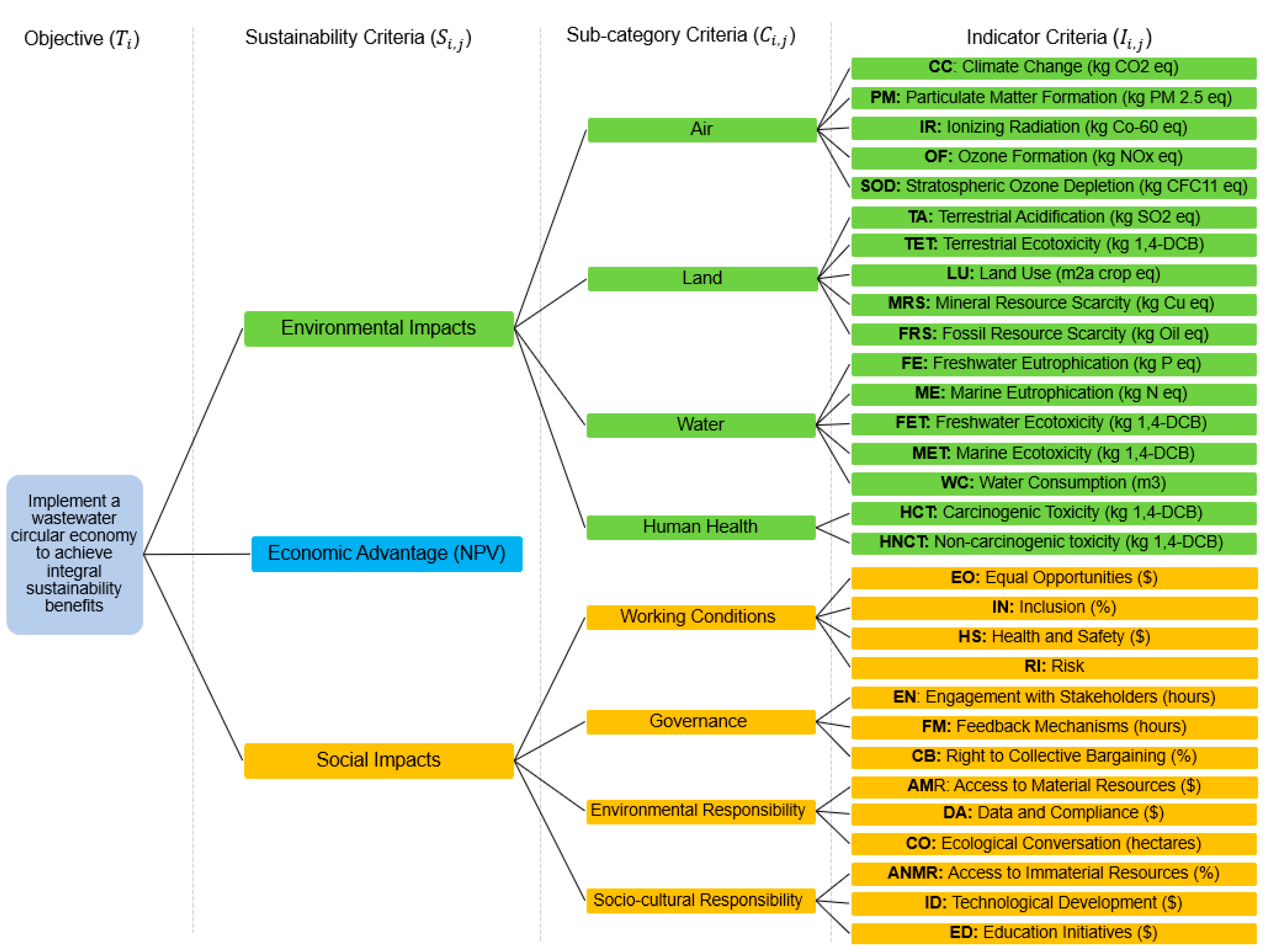
MCDM involves establishing alternatives for comparison, performance criteria, criteria weights, and applying a ranking method [18]. Six total alternatives were considered from the three scenarios comparing both Plants. The decision criteria involved three levels, indicator criteria (), sub-category criteria () and sustainability criteria (), to determine the overall sustainability score ( according to the decision tree in Figure 3. The decision tree was organized as such to facilitate subjective weighting methodologies and to break down the decision problem into domains that were easier for decision makers to interpret [35]. Environmental impact results generated in SimaPro were considered non-beneficial criteria, indicators positive values represented environmental impacts, therefore, impact categories results were normalized linearly according to:
Where is the number of alternatives . Social and economic indicators were considered beneficial criteria, where positive values represented social and economic benefits, therefore, indicator results were normalized linearly according to:
Figure 4.
Life Cycle Sustainability Assessment decision tree indicator criteria, measurement units, with respective abbreviations, sub-category criteria and sustainability criteria.
Figure 4.
Life Cycle Sustainability Assessment decision tree indicator criteria, measurement units, with respective abbreviations, sub-category criteria and sustainability criteria.
2.2.2. Criteria Weighting
A subjective weighting process was implemented to communicate results using Ranked Reciprocal Weighting method (RRW). The use of AHP resulted in an exhaustive quantity of pairwise comparisons for decision makers in this context. RRW produces similar weighting factors when compared to AHP [36]. A survey was designed to rank the relative LCSA indicators, sub-categories, and sustainability criteria in terms of the relative importance (Supplementary Data 1). A panel of experts involved in decision making processes from the LWC responded to the survey ranking factors according to their perspective of the most important protection areas related to the WW-CE implemented in the respective Biofactories. Average ranking, , positions of criteria were calculated, where is the total number of indicators per sub-category, sub-category per sustainability criteria and overall sustainability criteria. The following equation was applied to calculate the weighting factors:
2.2.3 Aggregated Sustainability Scores
A wide variety of aggregation measures can be implemented for determining performance of alternatives with respect to decision criteria [18]. In this case, Multi-attribute value theory (MAVT) was selected due to common use in wastewater treatment decision problems, with discrete performance criteria, and uncertainty regarding criteria weights is unknown. [23,24,25]. The weighted sum method was applied according to:
Where, , and are the indicator, sub-category, and sustainability weighting factors respectively. Weighted sum performance matrices were calculated for the total number of criteria in sub-category and sustainability criteria to produce a sustainability score of alternative scenarios , the lowest score demonstrated improved sustainability according to the normalization equations.
3. Results and Discussion
3.1. Environmental and Social Indicators
3.1.1. Normalized LCA and SLCA Indicators
Table 1 shows normalized environmental and socio-cultural impact indicator scores according to respective LCA and SLCA. Air and land sub-category impacts increased from S0 to S1 for both Plants where resource consumption, mainly network electricity, increased for conventional WWTPs. However, these improved in S2 where energy and biosolids recovery occurred in the Biofactory WW-CE. Plant B S2 had better performance in OF, PM, TA, TET, and LU due to AD-THP and CHP systems, avoiding higher rates of network energy and fertilizer consumption. However, CC and SOD increased in Plant B due to high emissions of CHP. Plant A decreased CC and SOD in S2 by partial water recovery to farmers. Plant A in S2 decreased IR and MRS more than Plant B. However, Plant B decreased FRS most by avoided network electricity consumption. Water sub-category indicators FE, FET and MET decreased in S1 where conventional WWTPs removed contaminants, S2 further decreasing these indicators. FE was benefit in Plant A by water recovery decreasing TP discharge to environment. Nitrogen removal systems, decreased TN, and TP loads in effluent, however, increased resource consumption in Plant B increased FE impacts in S2. ME increased due to application of TN in biosolids to agriculture. WC decreased in Plant A where water recovery occurred and increased in Plant B from increased resource consumption and lack of water recovery. HCT improved more in Plant B S2 due to avoided network energy, and HNCT increased impact in both plants from increased chemical consumption. Working conditions sub-category indicators EO and IN improved for both Plants across S0 to S2 by employment of W, training opportunities, and employment of women. Plant B had higher employment rate compared to Plant A. HS and RI increased impacts where W were exposed to risk and workplace accidents, RI increased for AD-THP and CHP in Plant B, S2. Accidents decreased across both Plants and Plant B had higher accident frequency. In social responsibility, ANMR, ID and ED improved across S1 and S2 for both Plants. Plant A is located near urban areas affecting a larger population of the LC comparatively, therefore, engaged in more instances of community ED, where Plant B generated more jobs and invested more in ID. In environmental responsibility, AMR improved by investment in infrastructure with community access, quality assurance and crop yield, and end of life management. Plant A had higher investment in community infrastructure, and better performance in DA and CO compared to Plant B in S2. Plant A contribution to CO is a legal obligation to conserve a 14-hectare ecological park, habitat to flora and fauna. DA improved where the coverage of data extended to product systems, and nitrogen removal systems improved compliance with discharge standards. FM were complaints from local communities due to odours which increased from application of biosolids to agriculture and Plant operations. FM is a disputable impact measure as complaints are a negative indicator, but the registrations of complaints by the LWC could be considered a positive socio-cultural mechanism. EN was higher in Plant A where more hours of engagement were dedicated to a larger LC, and CD was similar in both Plants, but Plant B had higher relative instance of unionized workers due to higher employment rates.
3.1.2. Indicator Criteria Weighted Sum Scores
Figure 5.a. shows RRW environmental indicator weighting factors. The air sub-category indicators preference was for CC (0.32) and PM (0.32), noting decreased importance of OF, IR and SOD (0.12). For land sub-category indicators, increased preference for LU was established as 0.29, decreasing preference for MRS and FRS to 0.16, while TET was 0.2. In the water sub-category, the highest importance was assigned to WC (0.44), FE was 0.22 weighting and ME (0.13), FET (0.13) and MET (0.09) decreased in importance. For human health, HCT and HNCT weights resulted the same (0.5). The RRW environmental indicator weighted sum determined increased impacts from S0-S1, 23 and 37 % for Plant A and Plant B respectively (Figure 5.b.). This was counterintuitive to the global urgency for sanitation and sustainable development but demonstrates the complexities of environmental trade-offs from increased resource consumption by conventional WWTPs. LCA of S0 was not able to consider biological contaminants impact on human and ecosystem health; and considering a dearth of data could not adequately represent the wider catchment environmental impacts. From S1 to S2, impacts decreased –40 % in both Plants. From S0 to S2, the Biofactory WW-CE decreased environmental impacts -22 % in Plant A and only -5 % in Plant B. Plant B had higher environmental impacts compared to the benefit of avoided water consumption in Plant A. Plant B had higher avoided electricity and fertilizer credits but also had higher normalized chemical, energy, and transport consumption as influent BOD5 loading was smaller compared to Plant A. The BOD/COD ratio was lower in Plant B, and TS loading higher, therefore, sludge production and resource consumption was greater than Plant A. This aligns with other LCA results stating that less biodegradable wastewater can impart higher environmental impacts [38].
The socio-cultural RRW indicator weighting factors in Figure 6.a. showed preference in working conditions sub-category to RI (0.48), HS was 0.26; and EO (0.16) and IN (0.12) decreased. For social responsibility, ED (0.26) and ANMR (0.32) were least important, and ID was prioritized to (0.43). Environmental responsibility indicators AMR and CO were decreased to 0.22; and DA increased importance (0.56). Finally, RRW weights of governance indicators decreased importance of FM (0.27) and CB (0.18), while allocating greatest importance to EN (0.55). Socio-cultural factors were improved across all scenarios considered in both Plants. Plant A decreased socio-cultural impacts –26 % and -20 % from S0-S1 for Plant A and Plant B respectively (Figure 6.b.). Under S0, all impacts were set to 0, therefore, the impacts were represented as the lack of stakeholder involvement overall. Socio-cultural impacts of Plant A and Plant B in this scenario were equal. From S1-S2, Plant A and Plant B benefit socio-cultural impacts a further - 60 % and - 30 % respectively, resulting in overall -70 and -45 % benefits from S0-S2 respectively. In Plant A, had 7 and 45 % lower impacts compared to Plant B across S1-2 respectively. FM had the highest contribution to socio-cultural impacts in S2. Plant B exhibited lower improvement in socio-cultural impacts due to lower instances of CO and higher exposure of RI to workers through AD-THP and CHP systems. However, DA improved compared to Plant A as influent TN was lower and had less instances of non-compliance. EO improved where more W were employed, and HS improved as accidents decreased.
3.2. Environmental and Social Sub-categories
3.2.1. Normalized LCA and SLCA Sub-categories
Normalized sub-category results refers to the weighted sum scores of environmental and social indicators (Table 2). Both Plants improved air and land indicators overall when implementing Biofactory WW-CEs (S2), Plant A had lower air impacts, while Plant B had lower land impacts. Water impacts improved in Plant A due to water recovery to local farmers, however, as water consumption increased in Plant B, water impacts increased. Human health impacts increased in Plant A due to increased chemical consumption, whereas avoided energy consumption in Plant B maintained impacts at the same level across all scenarios. Plant A working conditions improved overall, where increased exposure to RI in Plant B increased impacts in working conditions. Social responsibility, environmental responsibility and governance improved across all scenarios for both Plants, where Plant A had better performance than Plant B due to higher levels of engagement with nearby communities.
3.2.1. Sub-category Criteria Weighted Sum Scores
Figure 7.a. shows the environmental sub-category RRW weighting factors, where decision makers expressed preference for human health and water sub-categories (0.33), while decreasing importance of air and land sub-categories (0.17). The weighted sum scores for environmental sub-categories in Figure 6.b. shows 23 and 37 % increased impacts from S0-S1 for Plant A and Plant B respectively. From S1-S2, Plant A Biofactory WW-CE decreased sub-category impacts by -37 %, while Plant B Biofactory WW-CE decreased impacts by -31 % overall. From S0-S2, Plant A decreased environmental impacts overall -23 %, conversely, Plant B increased impacts by 5 %. Accordingly, Plant A had 5, 21 and 25 % lower impact compared to Plant B across S0-1-2, respectively.
Figure 8.a. shows LWC decision makers considered working conditions (0.5) to be the most important socio-cultural sub-criteria, where social responsibility, environmental responsibility and governance were set as the same importance (0.17). Plant A decreased socio-cultural sub-categories weighted sum from S0-S1 by -10 %, then from S1-S2 by -51 % (Figure 8.b.). Plant B decreased these by -3 and -15 % for S0-S1 and S1-S2 respectively. From S0-S2 Plant A improved socio-cultural impacts -56 % while Plant B -18 %. Plant A had overall better socio-cultural performance compared to Plant B by 7 and 45 % across S1-2, respectively.
3.2. Environmental and Social Sub-categories
3.3.1. Normalized LCSA Performance Indicators
Table 3 shows the normalized environmental and socio-cultural weighed sum scores and economic criteria performance. Figure 9 shows the normalized LCC and NPV results of both plants across scenarios. Plant A had higher chemical consumption costs due to the high price of FeCl, increasing from S1-S2, due to the incorporation of biogas upgrading and nitrogen removal systems. Energy and transport costs were lower in Plant A compared to Plant B, as well as capital investment and maintenance costs. However, income generated by treated influent and energy sold to the grid in Plant B resulted in higher income and a more favourable NPV result. NPV for both Plants across all scenarios were negative, which indicates non-profitability. LCC was limited to LCA inventories and did not consider wider financial aspects of the Plants functioning. Therefore, these results were not assertions of real economic performance. From S1-S2, Plant A energy, capital and maintenance costs increased by incorporating resource recovery product systems. However, waste transport costs decreased, where the charge for disposal of biosolids to landfill was minimized through biosolids recovery. Plant A income increased from the sale of biomethane to the MR natural gas provider. Plant B capital and maintenance costs increased from S1-S2, transport costs decreased as in Plant A, however, avoided energy consumption from CHP decreased energy cost also. Income in Plant B was increased in S2 due to higher normalized influent wastewater and income compared to Plant A. Therefore, Plant B had overall better NPV performance.
3.3.2. Overall Sustainability Impact Weighted Sum Scores
Figure 10.a. shows the RRW sustainability weighting factors favoured the environment (0.43), followed by economic (0.32) and socio-cultural (0.26) criteria. Figure 7.b. shows the overall sustainability weighted sum score. Socio-cultural and economic contributions to overall sustainability impact in S0 were equal for both Plant A and Plant B. Environmental impact contributions were 0.19 and 0.2 for Plant A and Plant B respectively, therefore, Plant B had only 2 % higher initial impact in S0. Plant A decreased overall sustainability score by -13 % from S0-S1, where environmental impacts increased, social and economic impacts decreased. From S1-S2 sustainability weighted sum was improved -20 % where environmental and social impacts decreased, however, economic impacts increased. From S0-S2 the overall improvement was -30 % for Plant A. Plant B decreased overall sustainability score by -20 % from S0-S1, where environmental impacts contributed most to overall sustainability. Socio-cultural impacts were higher in S1 Plant B compared to Plant A, however, economic advantage showed Plant B had lower impact (-6 %). Economic advantage in Plant B S2 improved impacts -48 % from S1-S2, resulting in an overall decreased of -58 % from S0-S1. Plant B had 61 % lower impact compared to Plant A in S2. Therefore, both Plants were effective in decreasing sustainability impacts from S0 to S1 and S2, demonstrating positive case studies of the WW-CE. Plant B Biofactory WW-CE was more ‘sustainable’ demonstrating lower impacts than Plant A due to economic performance.
4. Discussion
4.1. Model Limitations
Due to the novicey of SLCA methodology, propagated uncertainty of the sustainability scores was not able to be determined to test the statistical significance of the results. The propagation of uncertainty within a complex model with hundreds of parameters requires special consideration. However, it is unclear if uncertainty knowledge supports real life decision making [39]. LCA only considered environmental impacts, unable to capture broader ecological or biological aspects, reflected in the lower environmental impact scores of S0 compared to S1. The benefits of ‘fertigation’ from water recovery, and crop production, should be accounted for in future studies [40]. Biosolids recovery did not consider crop production or benefits to soil quality by application of organic matter to soil, this could improve environmental performance through nutrient and emission sequestration, as well as allocation of environmental burden to crops [41]. LCSA- MCDM assumed linear relationships between components, however, complex sustainability is a dynamic global system, where other modelling approaches could capture this within an LCSA framework [10]. Overall sustainability scores were directly influenced by the selection of impact categories and corresponding weightings. Impact categories, or decision criteria, selection and quantification are not standardized, academic communities are interested to reach a consensus to facilitate interpretation stages of LCSA methodologies [42]. Considering lack of consensus regarding quantification of socio-cultural impacts worldwide, significant research is required in this area. It is difficult to establish good or bad performance in the socio-cultural domain of sustainability. Data resolution of the SLCA component can be improved with more frequent monitoring of social indicators from the LWC. SLCA weighted impacts technically counter the concept that off-sets between impact categories cannot occur, i.e., good performance in one indicator does not counter act bad performance in another [30]. However, this aspect contrasts with the reality for the necessity to facilitate decision-making from a sustainability perspective with single scores. The same notion can be applied to environmental impact categories.
4.1. Reccomendations and Global Implications
Both Plants have established systems for improving sustainability impacts through the WW-CE. However, net-zero impacts were not achieved, and environmental impact trade-offs should be addressed with further innovations. Plant B should explore options for water recovery, Plant A should improve energy recovery as only 25 % of biogas was recovered and could benefit from AD-THP as observed in Plant B. Future circular economy configurations should be assessed by LCSA. A higher quantity of sludge and co-digestion through AD of organic wastes can be facilitated by THP, increasing biogas production and waste management from external sources [43]. Nutrient removal systems improved environmental responsibility in both plants due to improved compliance with discharge standards. As nutrient loadings increase in influent wastewater over time, nutrient management should be considered plant wide, as biosolids, water recovery and nutrient removal technologies are interconnected. Considering interconnected nature of environmental and socio-cultural impacts, upon increasing plant capacity for resource recovery, and abiding by management systems, further social benefit could be expected. Plant A should explore the use of alternative flocculants, where FeCl contributed significantly to chemical costs. Income will increase through improved resource recovery, mainly biomethane production and biosolids recovery. Wider financial aspects of the WW-CE, such as governmental tributary benefits proved by good social and environmental performance, was not captured by LCC [44]. This could be integrated with NPV [45].
The decision support models proposed for the sanitation sector, and resource recovery for a WW-CE, are seldom adopted by industry [21]. Decision making processes implemented by sanitation sectors around the world depend on local politics [46]. In the context of Chile, the LWC is a private company, decisions are based on integral asset management, considering risk, NPV and return on investment of alternative technologies. Decision making ‘criteria’ are measured according to the respective ISO management system for environmental management, health and safety, energy, quality assurance and integral risk management. ISO management systems adhere to local legislations as measures of compliance; therefore, data monitoring is triangulated between authorities, auditors, and the W compliance to respective responsibilities within the operation of the plants. In the public-sector, decision-making processes in local governments are generally constrained by investment costs [46]. Therefore, the future of the WW-CE needs to demonstrate treatment configurations that benefit environment, society as well as the economy, as exhibited in Plant B. Monetization of environmental and social impacts could address the primarily economic nature of decision making [47]. Comparing weighting factors across objective and subjective methodologies did not show significant differences in the weighted sum impacts across all decision criteria level in this context (Figure S1). Therefore, considering the urgency of sustainable integral water management, efforts should be focused on LCSA frameworks to inform sanitation design and decision contexts, where simple decision-making processes like the weighted sum method succeed in evaluating alternative scenarios. LCSA methodology must be established at a global level to ensure appropriate sustainability criteria are being measured in a standardized way, relating to national and global goals for sustainable development [48]. It is a tool that could enhance and synthesize sustainability reporting schemes, such as ESG and Global Compact, as is implemented by the LWC. LCSA could improve this process by providing a database processing and analysis with appropriate automation.
5. Conclusions
This study used a robust and simple LCSA-MCDM assessment to demonstrate how the WW-CE in Chile has improved overall sustainability compared to both discharge without treatment and conventional WWTPs for each respective wastewater influent flow. Plant A Biofactory WW-CE improved overall sustainability by -30 %, while Plant B -48 %, therefore demonstrating that Plant B had better sustainability performance due to the economic advantage provided by AD-THP and CHP systems. Plant A did show better environmental and socio-cultural performance, where improved resource recovery could aid in improving economic performance. Both Plants have successfully adopted the WW-CE concept, where the LWC mission to contribute to sustainability through this medium creates the opportunity for both systems to continue to improve upon current resource recovery configurations. This study has highlighted the critical need for implementing decision making models in real world decision contexts, as LCSA is not currently standard practice, but is the most robust tool for conducting sustainability assessments. There are significant opportunities to link LSCA-MCDM models to real-world decision-making contexts to achieve global sustainable development in the water and sanitation industries.
Supplementary Materials
The following supporting information can be downloaded at the website of this paper posted on Preprints.org, Figure S1: Comparison of equal, entropy and ranked reciprocal weighted sum methods for overall sustainability impact; Table S1 Detailed technology descriptions implemented in Plant A and Plant B product systems; Table S2. Normalized wastewater flow rates and substance concentrations of both influent and effluent for Plant A and Plant B for scenarios o: discharge without treatment, 1: conventional WWTPs and 2: biofactory WW-CE [49]; Table S3. Normalized biosolid flow rates and substance concentrations for Plant A and Plant B for scenarios o: discharge without treatment, 1: conventional WWTPs and 2: biofactory WW-CE [49]; Table S4. Capital investment and maintenance costs of Plant A and Plant B normalized to 1,000,000 p.e./ day for scenarios 0: discharge without treatment, 1: conventional wastewater treatment plants and 2: biofactory wastewater circular economies [49,50]; Table S5. Integrated LCA and LCC inventories of Plant A and Plant B normalized to 1,000,000 p.e./ day for scenarios 0: discharge without treatment, 1: conventional wastewater treatment plants and 2: biofactory wastewater circular economies [49,51,52,53,54]; Table S6. LCA inventory outputs of Plant A and Plant B normalized to 1,000,000 p.e./ day for scenarios 0: discharge without treatment, 1: conventional wastewater treatment plants and 2: biofactory wastewater circular economies; Table S7. Type II SLCA stakeholder quantities per product system of Plant A and Plant B normalized to 1,000,000 p.e./ day for scenarios 0: discharge without treatment, 1: conventional wastewater treatment plants and 2: biofactory wastewater circular economies; Table S8. Social Life Cycle Assessment Type II midpoint characterization inventories of Plant A and Plant B normalized to 1,000,000 p.e./ day for scenarios 0: discharge without treatment, 1: conventional wastewater treatment plants and 2: biofactory wastewater circular economies; Table S9. Summary of the relationships between social impact categories, inventory categories and subcategories to relevant stakeholders [7]. Supplementary Data S1: LCSA WW-CE Survey-Spanish.
Author Contributions
Conceptualization, methodology, software, formal analysis, writing—original draft preparation, investigation, data curation, funding acquisition, Madeline Furness; writing—review and editing, supervision, funding acquisition, Ricardo Bello-Mendoza, and Rolando Chamy Maggi.; All authors have read and agreed to the published version of the manuscript.
Funding
This research was funded by ANID Chile and the University of Canterbury Doctoral Research Scholarships.
Data Availability Statement
Data available on request due to restrictions
Acknowledgments
The authors would like to acknowledge the collaboration of the LWC in this research.
Conflicts of Interest
The authors declare no conflict of interest.
References
- UN-Water, “Summary Progress Update 2021 : SDG 6 — water and sanitation for all,” UN-Water Integr. Monit. Initiat., pp. 1–58, 2021, [Online]. Available: https://www.unwater.org/new-data-on-global-progress-towards-ensuring-water-and-sanitation-for-all-by-2030/.
- UN DESA, “The Sustainable Development Goals Report 2022,” 2022. [Online]. Available: https://unstats.un.org/sdgs/report/2022/The-Sustainable-Development-Goals-Report-2022.pdf.
- C. A. Ruggerio, “Sustainability and sustainable development: A review of principles and definitions,” Sci. Total Environ., vol. 786, p. 147481, 2021. [CrossRef]
- Boretti and L. Rosa, “Reassessing the projections of the World Water Development Report,” npj Clean Water, vol. 2, no. 1, 2019. [CrossRef]
- S. S. Rashid, S. N. Harun, M. M. Hanafiah, K. K. Razman, Y. Q. Liu, and D. A. Tholibon, “Life Cycle Assessment and Its Application in Wastewater Treatment: A Brief Overview,” Processes, vol. 11, no. 1, pp. 1–31, 2023. [CrossRef]
- E. G. Andary, C. Abi Shdid, A. Chowdhury, and I. Ahmad, “Integrated project delivery implementation framework for water and wastewater treatment plant projects,” Eng. Constr. Archit. Manag., vol. 27, no. 3, pp. 609–633, 2020. [CrossRef]
- R. R. Z. Tarpani and A. Azapagic, “Life cycle costs of advanced treatment techniques for wastewater reuse and resource recovery from sewage sludge,” J. Clean. Prod., vol. 204, pp. 832–847, 2018. [CrossRef]
- SuSanA, “Contribution of Sustainable Sanitation to the Agenda 2030 for Sustainable Development,” no. 1, pp. 1–4, 2017.
- G. Mannina, T. F. Rebouças, A. Cosenza, M. Sànchez-Marrè, and K. Gibert, “Decision support systems (DSS) for wastewater treatment plants – A review of the state of the art,” Bioresour. Technol., vol. 290, p. 121814, 2019. [CrossRef]
- Hosseinian-Far, M. Ramachandran, and D. Sarwar, Strategic Engineering for Cloud Computing and Big Data Analytics. 2017. [CrossRef]
- T. S. Brinsmead, “Integrated Sustainability Assessment: Identifying Methodological Options Australian Energy View project Safe Switching in Control View project,” no. May, 2019, [Online]. Available: https://www.researchgate.net/publication/333413032.
- U. Ghimire, G. Sarpong, and V. G. Gude, “Transitioning wastewater treatment plants toward circular economy and energy sustainability,” ACS Omega, vol. 6, no. 18, pp. 11794–11803, 2021. [CrossRef]
- M. Salgot and M. Folch, “Wastewater treatment and water reuse,” Curr. Opin. Environ. Sci. Heal., vol. 2, pp. 64–74, 2018. [CrossRef]
- M. C. Collivignarelli, M. Canato, A. Abbà, and M. Carnevale Miino, “Biosolids: What are the different types of reuse?,” J. Clean. Prod., vol. 238, 2019. [CrossRef]
- F. Ardolino, F. Parrillo, and U. Arena, “Biowaste-to-biomethane or biowaste-to-energy? An LCA study on anaerobic digestion of organic waste,” J. Clean. Prod., vol. 174, pp. 462–476, 2018. [CrossRef]
- P. Kehrein, M. Van Loosdrecht, P. Osseweijer, M. Garfí, J. Dewulf, and J. Posada, “A critical review of resource recovery from municipal wastewater treatment plants-market supply potentials, technologies and bottlenecks,” Environ. Sci. Water Res. Technol., vol. 6, no. 4, pp. 877–910, 2020. [CrossRef]
- E. Walling and C. Vaneeckhaute, “Developing successful environmental decision support systems: Challenges and best practices,” J. Environ. Manage., vol. 264, no. April, 2020. [CrossRef]
- H. Taherdoost and M. Madanchian, “Multi-Criteria Decision Making (MCDM) Methods and Concepts,” Encyclopedia, vol. 3, no. 1, pp. 77–87, 2023. [CrossRef]
- N. Rezaei, N. Diaz-Elsayed, S. Mohebbi, X. Xie, and Q. Zhang, “A multi-criteria sustainability assessment of water reuse applications: a case study in Lakeland, Florida,” Environ. Sci. Water Res. Technol., vol. 5, no. 1, pp. 102–118, 2019. [CrossRef]
- H. A. C. Lohman et al., “DMsan: A Multi-Criteria Decision Analysis Framework and Package to Characterize Contextualized Sustainability of Sanitation and Resource Recovery Technologies,” ACS Environ. Au, 2022. [CrossRef]
- D. Ddiba, K. Andersson, S. Dickin, E. Ekener, and G. Finnveden, “A review of how decision support tools address resource recovery in sanitation systems,” J. Environ. Manage., vol. 342, no. March, 2023. [CrossRef]
- S. Valdivia, J. Gerta, B. Marzia, T. Guido, and S. Stefano, “Principles for the application of life cycle sustainability assessment,” Int. J. Life Cycle Assess., no. 0123456789, 2021. [CrossRef]
- ISO 14040, “Environmental management — Life cycle assessment — Principles and framework,” 2006.
- UNEP, “Guidelines for Social Life Cycle Assessment of Products,” Management, vol. 15, no. 2, p. 104, 2020, [Online]. Available: http://www.unep.fr/shared/publications/pdf/DTIx1164xPA-guidelines_sLCA.pdf.
- G. Rebitze, D. Hunkeler, and O. Jollie, “LCC-The Economic Pillar of Sustainability: Methodology and Application to Watewater Treatment,” Environ. Prog., vol. 22, no. 4, pp. 241–249, 2003.
- T. Opher, “Comparative life cycle sustainability assessment of urban water reuse at various centralization scales,” pp. 1319–1332, 2019.
- H. Safarpour, M. Tabesh, S. A. Shahangian, M. Hajibabaei, and R. Sitzenfrei, “Life Cycle Sustainability Assessment of Wastewater Systems under Applying Water Demand Management Policies,” Sustain., vol. 14, no. 13, pp. 1–18, 2022. [CrossRef]
- Y. Liu and J. Ren, “Developing a sustainability-oriented multi-criteria game theoretical decision analysis framework: A case study of sludge management,” J. Clean. Prod., vol. 354, no. March, p. 131807, 2022. [CrossRef]
- R. R. Z. Tarpani and A. Azapagic, “Life cycle sustainability assessment of advanced treatment techniques for urban wastewater reuse and sewage sludge resource recovery,” Sci. Total Environ., vol. 869, no. January, p. 161771, 2023. [CrossRef]
- SETAC, “Guidelines for Social Life Cycle Assessment of Products,” Management, vol. 15, no. 2, p. 104, 2020, [Online]. Available: http://www.unep.fr/shared/publications/pdf/DTIx1164xPA-guidelines_sLCA.pdf.
- Padilla-Rivera and L. P. Güereca, “A proposal metric for sustainability evaluations of wastewater treatment systems (SEWATS),” Ecol. Indic., vol. 103, no. March, pp. 22–33, 2019. [CrossRef]
- P. Rathore, D. J. Killedar, D. Parde, and A. Sahare, “Life cycle cost analysis of wastewater treatment technologies,” IOP Conf. Ser. Earth Environ. Sci., vol. 1032, no. 1, 2022. [CrossRef]
- M. Traverso et al., “Methodological Sheets for Subcategories in Social Life Cycle Assessment (S-LCA),” p. 150, 2021, [Online]. Available: https://www.lifecycleinitiative.org/wp-content/uploads/2021/12/Methodological-Sheets_2021_final.pdf.
- LWC, “Intregrated Report 2022,” Santiago, 2022.
- R. Lauer, “Is Social Ontology Prior to Social Scientific Methodology?,” Philos. Soc. Sci., vol. 49, no. 3, pp. 171–189, 2019. [CrossRef]
- E. Roszkowska, “Rank Ordering Criteria Weighting Methods – a Comparative Overview,” Optimum. Stud. Ekon., vol. 5, no. 5(65), pp. 14–33, 2013. [CrossRef]
- Gherghel, C. Teodosiu, M. Notarnicola, and S. De Gisi, “Sustainable design of large wastewater treatment plants considering multi-criteria decision analysis and stakeholders’ involvement,” J. Environ. Manage., vol. 261, no. August 2019, 2020. [CrossRef]
- G. De Feo and C. Ferrara, “Investigation of the environmental impacts of municipal wastewater treatment plants through a Life Cycle Assessment software tool,” Environ. Technol. (United Kingdom), vol. 38, no. 15, pp. 1943–1948, 2017. [CrossRef]
- N. C. Onat, M. Kucukvar, and O. Tatari, “Uncertainty-embedded dynamic life cycle sustainability assessment framework: An ex-ante perspective on the impacts of alternative vehicle options,” Energy, vol. 112, pp. 715–728, 2016. [CrossRef]
- A. Al-Gheethi, A. N. Efaq, J. D. Bala, I. Norli, M. O. Abdel-Monem, and M. O. Ab. Kadir, “Removal of pathogenic bacteria from sewage-treated effluent and biosolids for agricultural purposes,” Appl. Water Sci., vol. 8, no. 2, pp. 1–25, 2018. [CrossRef]
- H. Zhang, “Using Biosolids as a Plant Nutrient Source,” Oklahoma, 2017. [Online]. Available: http://www.ncbi.nlm.nih.gov/pubmed/20864901.
- R. Andreas, S. Serenella, and N. Jungbluth, “Normalization and weighting: the open challenge in LCA,” Int. J. Life Cycle Assess., vol. 25, no. 9, pp. 1859–1865, 2020. [CrossRef]
- K. D. Orner et al., “Environmental and Economic Impacts of Managing Nutrients in Digestate Derived from Sewage Sludge and High-Strength Organic Waste,” Environ. Sci. Technol., vol. 56, no. 23, pp. 17256–17265, 2022. [CrossRef]
- de S. M. Gonçalves, F. L. de Carvalho, and P. de C. Fiorini, “Circular Economy and Financial Aspects: A Systematic Review of the Literature,” Sustain., vol. 14, no. 5, 2022. [CrossRef]
- Á. Mayor, S. Vinardell, K. Ganesan, C. Bacardí, J. L. Cortina, and C. Valderrama, “Life-cycle assessment and techno-economic evaluation of the value chain in nutrient recovery from wastewater treatment plants for agricultural application,” Sci. Total Environ., vol. 892, no. May, 2023. [CrossRef]
- OECD, Implementing the OECD Principles on Water Governance Indicator Framework and Evolving Practices: Indicator Framework and Evolving Practices. Paris: OECD Publishing, 2018. [Online]. Available: https://books.google.co.nz/books?id=7WJSDwAAQBAJ.
- K. Sjöstrand, A. Lindhe, T. Söderqvist, and L. Rosén, “Sustainability assessments of regional water supply interventions – Combining cost-benefit and multi-criteria decision analyses,” J. Environ. Manage., vol. 225, no. March, pp. 313–324, 2018. [CrossRef]
- M. Cordella et al., “Addressing sustainable development goals in life cycle sustainable assessment: Synergies, challenges and needs,” J. Clean. Prod., vol. 415, no. March 2022, p. 137719, 2023. [CrossRef]
- LWC, “Operational Data,” Santiago, 2019.
- Vineyard, A. Hicks, K. G. Karthikeyan, and P. Barak, “Economic analysis of electrodialysis, denitrification, and anammox for nitrogen removal in municipal wastewater treatment,” J. Clean. Prod., vol. 262, p. 121145, 2020. [CrossRef]
- N. Mills et al., “Second Generation Thermal Hydrolysis Processes,” Proc. Water Environ. Fed., vol. 2014, no. 2, pp. 1–13, 2015. [CrossRef]
- R. C. Maggi, “Implementacion de Tecnologias Anammox en Biofactorias,” Valparaiso, 2017.
- F. Ardolino, G. F. Cardamone, F. Parrillo, and U. Arena, “Biogas-to-biomethane upgrading: A comparative review and assessment in a life cycle perspective,” Renew. \& Sustain. ENERGY Rev., vol. 139, 2021. [CrossRef]
- ODEPA, “Evolucion de precios de fertilizantes internacional, importacion y nacional al mes de junio 2023,” Reporte Interactivo de Precios de Fertilizantes, 2023. https://apps.odepa.gob.cl/powerBI/reporte_fertilizantes.html (accessed Aug. 11, 2023).
Figure 3.
Integrated Life Cycle Sustainability Assessment data inventory input and output considerations for Life Cycle Assessment (environmental component), Life Cycle Costing (economic component) and Social Life Cycle Assessment (socio-cultural component).
Figure 3.
Integrated Life Cycle Sustainability Assessment data inventory input and output considerations for Life Cycle Assessment (environmental component), Life Cycle Costing (economic component) and Social Life Cycle Assessment (socio-cultural component).
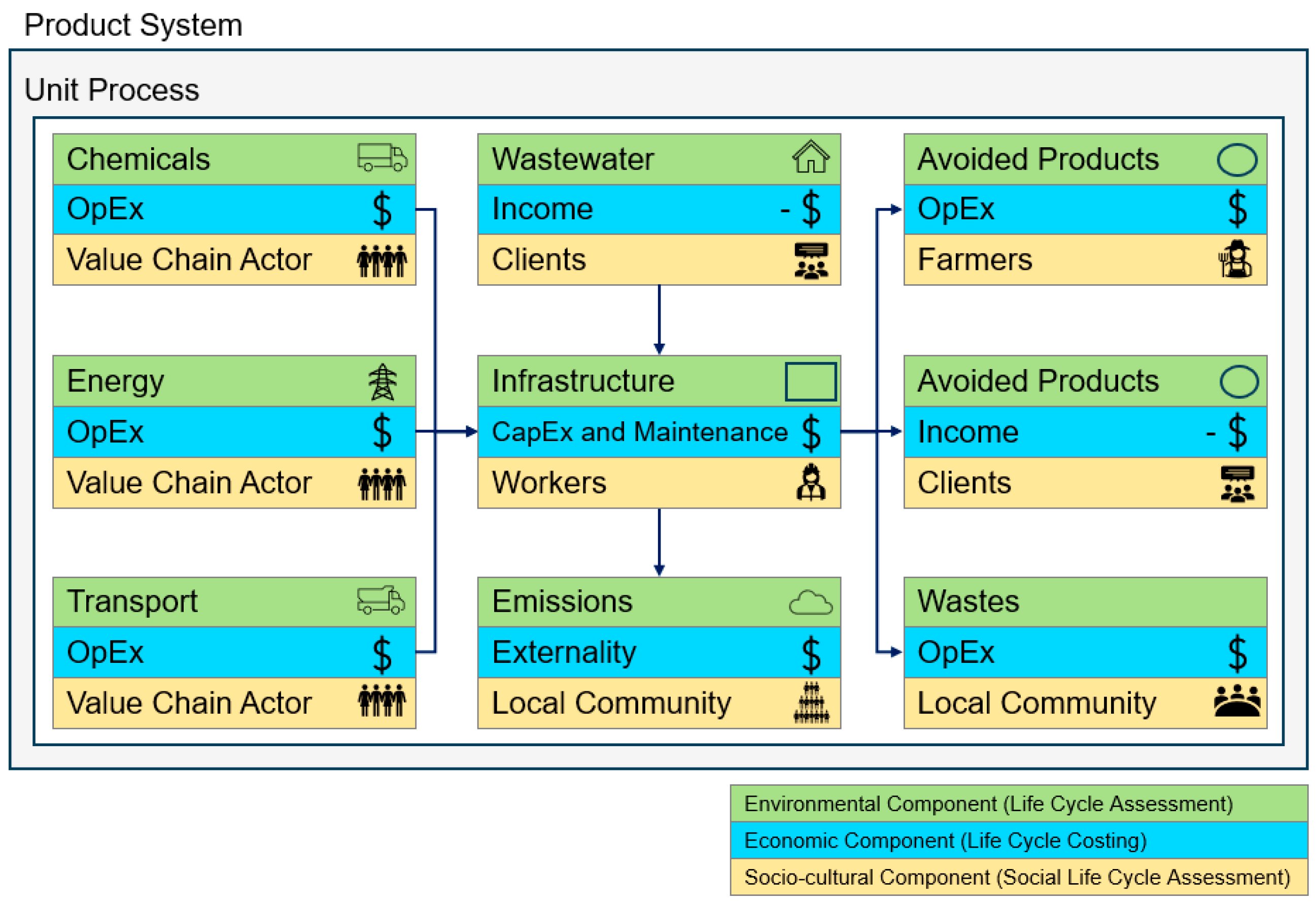
Figure 5.
LCA environmental indicator: (a) ranked weighting factors and (b) weighted sum score.
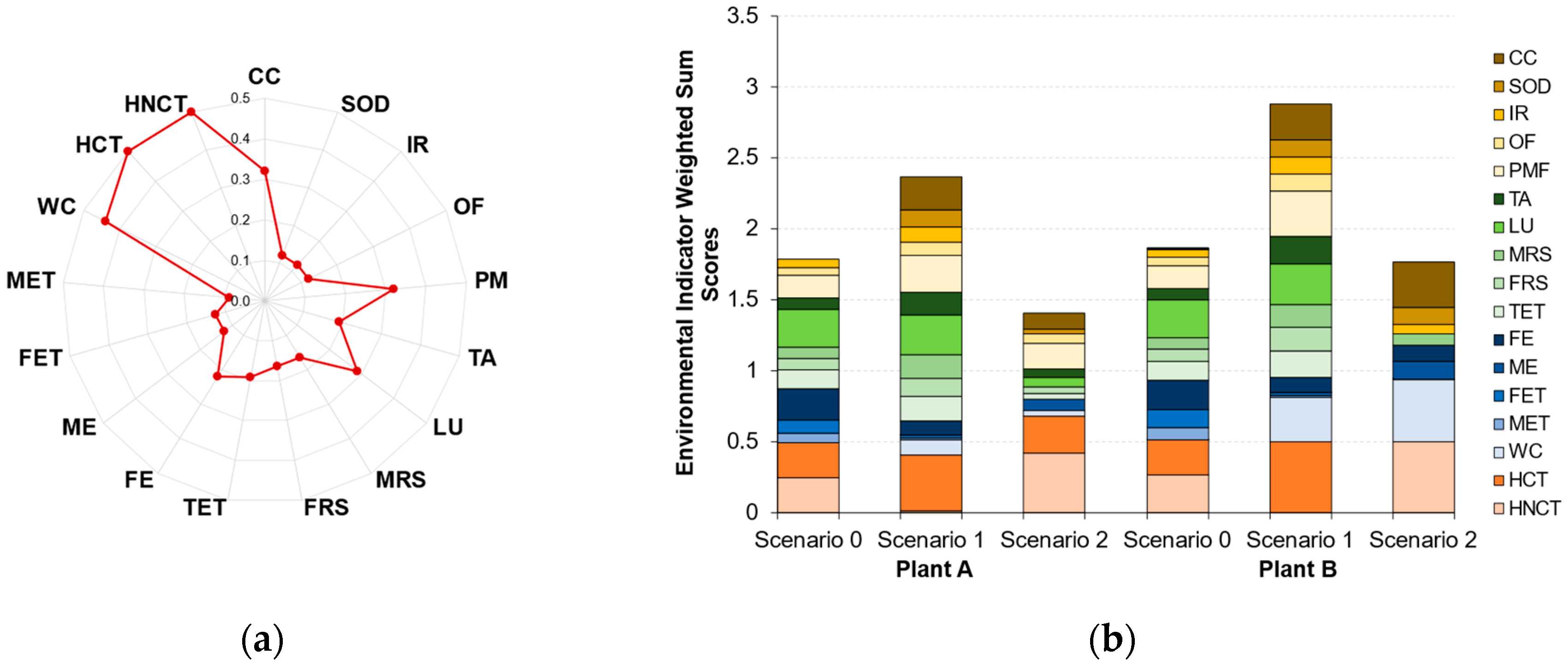
Figure 6.
SLCA socio-cultural indicator: (a) ranked weighting factors and (b) weighted sum score.
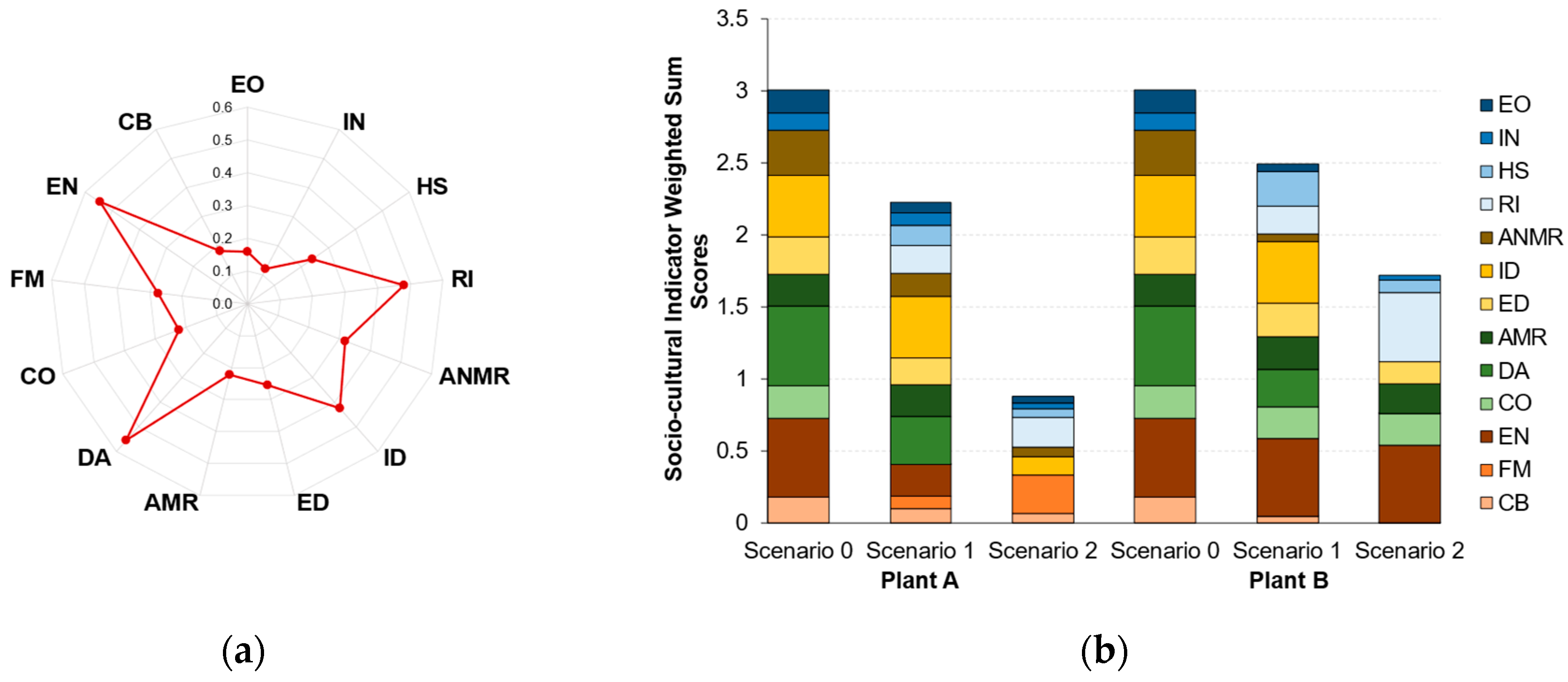
Figure 7.
LCA environmental indicator: (a) ranked weighting factors and (b) weighted sum score.
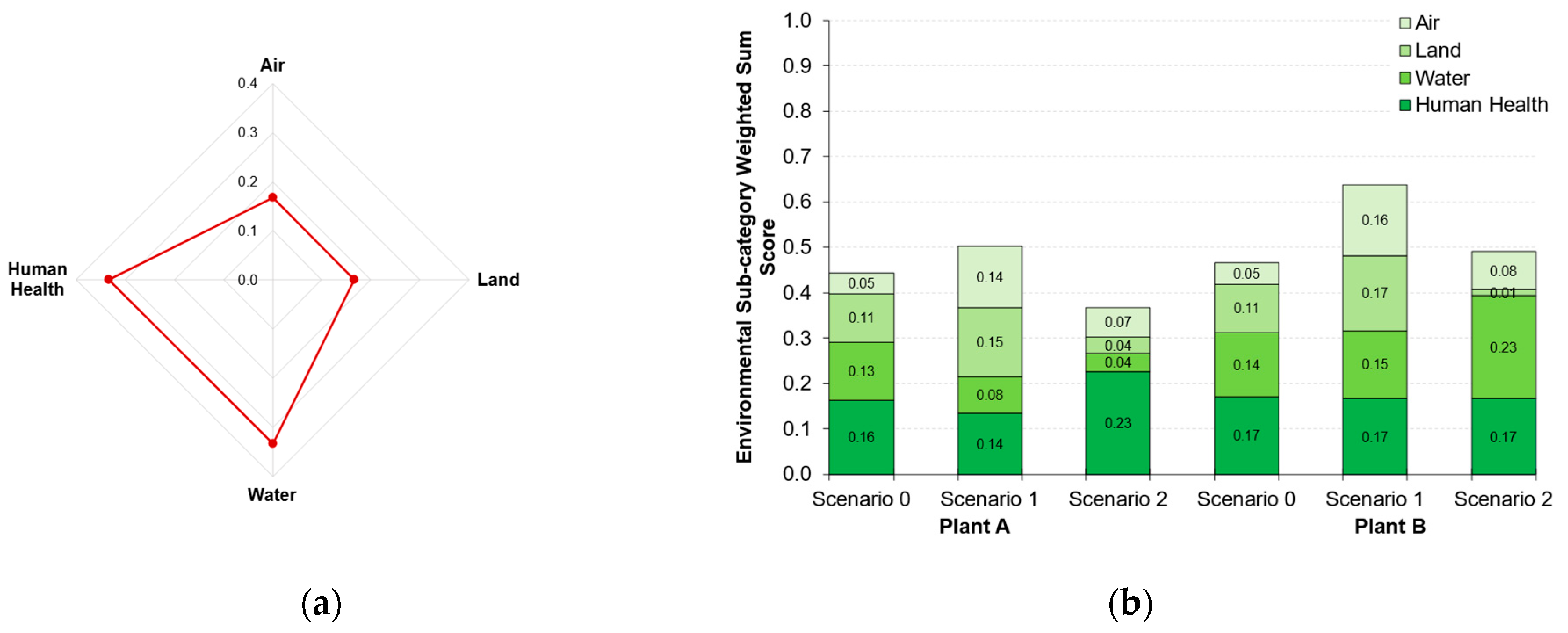
Figure 8.
SLCA socio-cultural indicator: (a) ranked weighting factors and (b) weighted sum score.
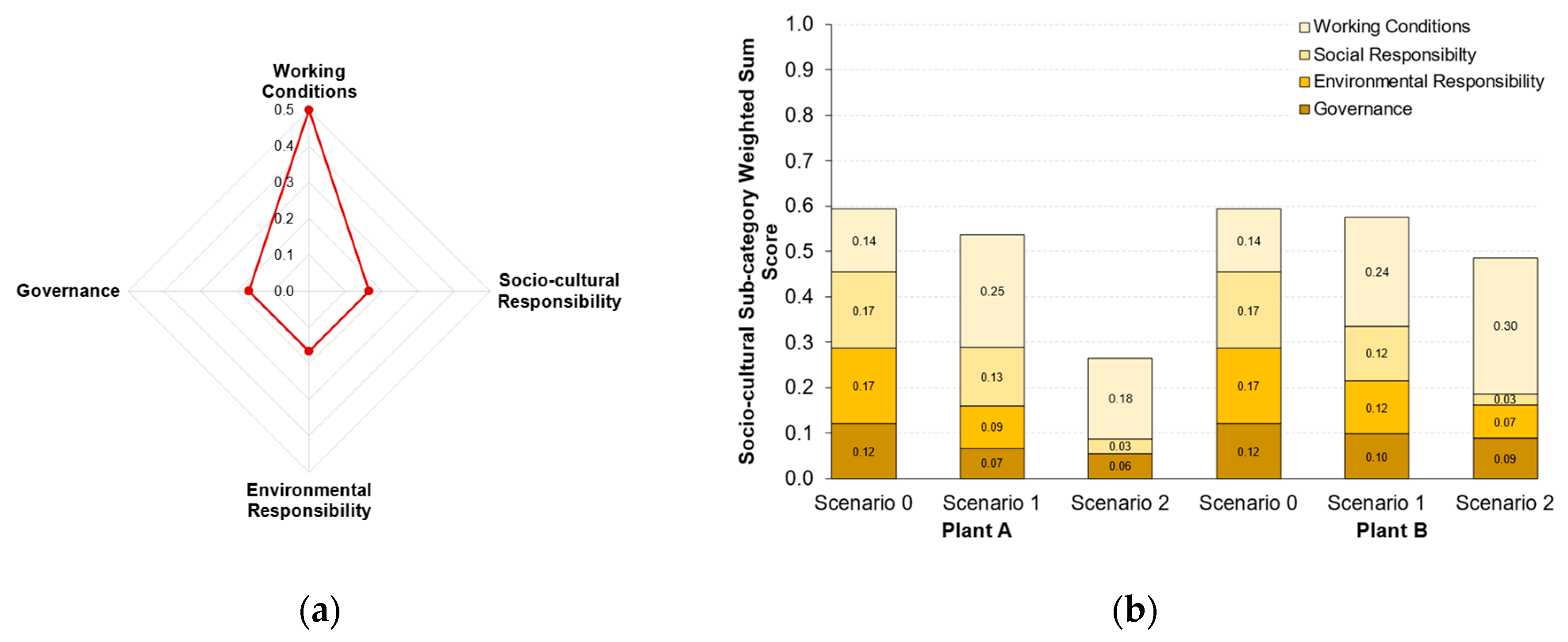
Figure 9.
Normalized LCC and economic impact as Net Present Value of 1,000,000 p.e./ day of Plant A and Plant B for scenarios 0: discharge without treatment, 1: conventional wastewater treatment plants and 2: biofactory wastewater circular economies.
Figure 9.
Normalized LCC and economic impact as Net Present Value of 1,000,000 p.e./ day of Plant A and Plant B for scenarios 0: discharge without treatment, 1: conventional wastewater treatment plants and 2: biofactory wastewater circular economies.
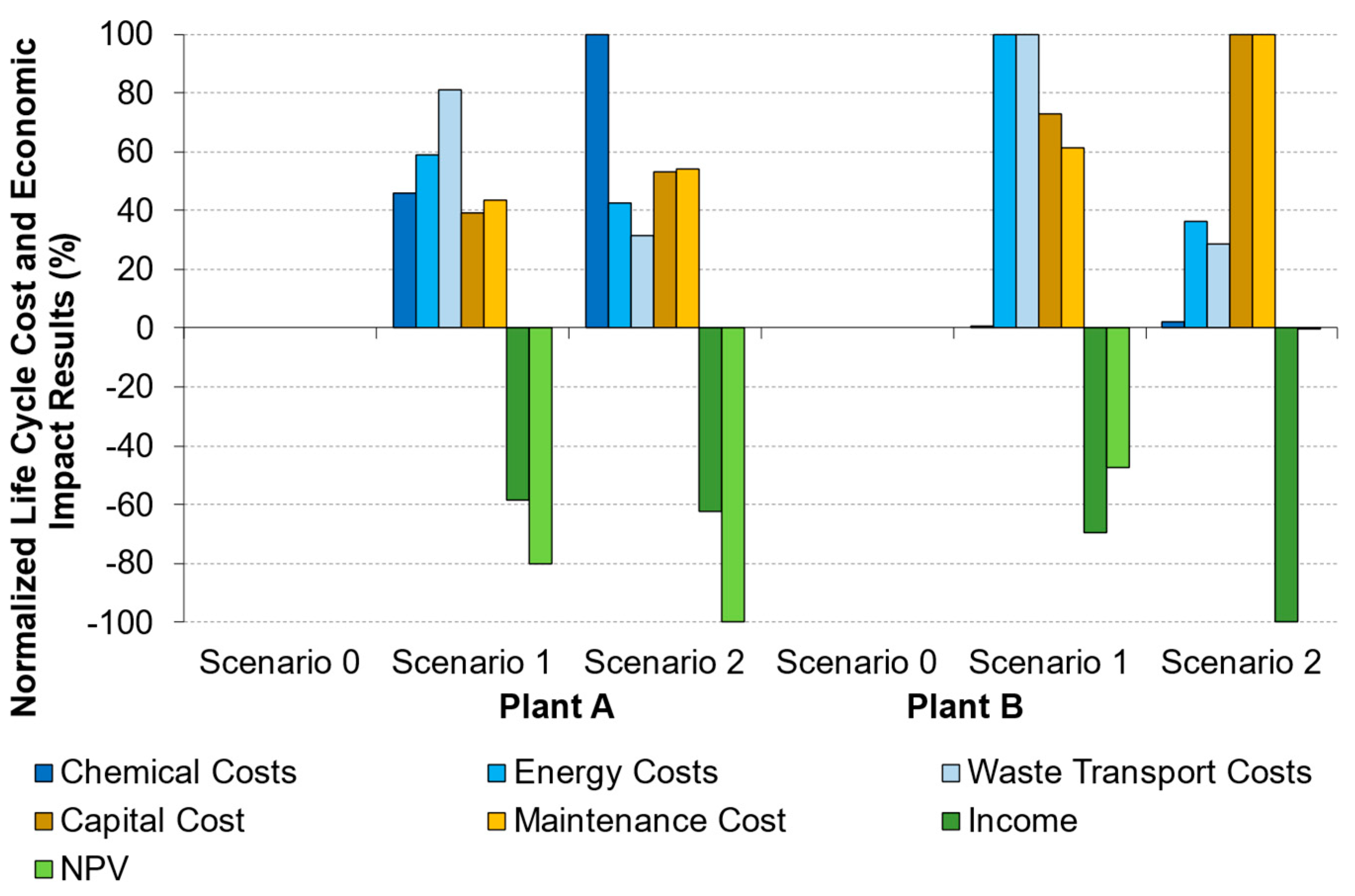
Figure 10.
LCSA overall sustainability: (a) ranked weighting factors and (b) weighted sum score.
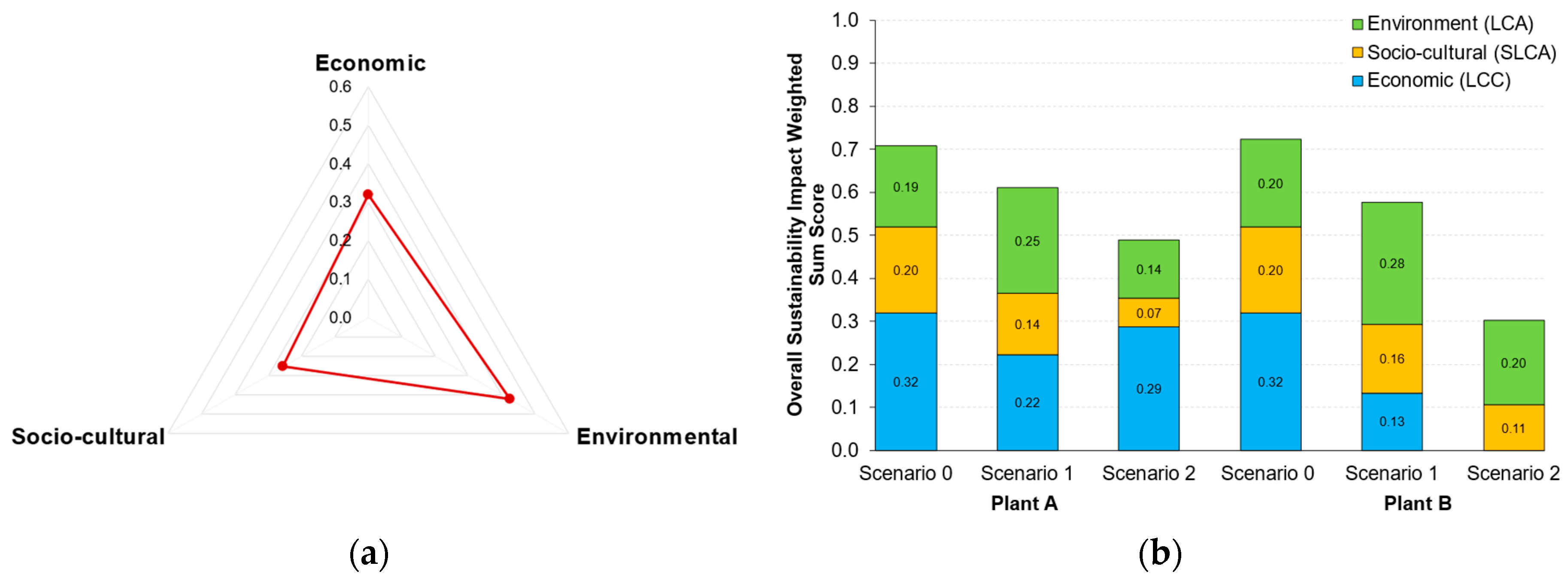

Table 1.
Normalized environmental and socio-cultural impact assessment results of Plant A and Plant B across scenarios 0 through 2. The green indicates good (near 0) and red indicates bad (near 1) performance.
Table 1.
Normalized environmental and socio-cultural impact assessment results of Plant A and Plant B across scenarios 0 through 2. The green indicates good (near 0) and red indicates bad (near 1) performance.
| Plant A | Plant B | |||||||
|---|---|---|---|---|---|---|---|---|
| Criteria Sub-category |
Indicator | S0 | S1 | S2 | S0 | S1 | S2 | |
| Environmental (LCA) | Air | CC | 0.00 | 0.74 | 0.37 | 0.00 | 0.78 | 1.00 |
| SOD | 0.00 | 0.97 | 0.28 | 0.05 | 1.00 | 0.97 | ||
| IR | 0.48 | 0.88 | 0.00 | 0.48 | 1.00 | 0.56 | ||
| OF | 0.49 | 0.79 | 0.53 | 0.49 | 1.00 | 0.00 | ||
| PM | 0.49 | 0.81 | 0.56 | 0.49 | 1.00 | 0.00 | ||
| Land | TA | 0.42 | 0.84 | 0.33 | 0.42 | 1.00 | 0.00 | |
| TET | 0.69 | 0.89 | 0.23 | 0.69 | 1.00 | 0.00 | ||
| LU | 0.93 | 0.97 | 0.22 | 0.93 | 1.00 | 0.00 | ||
| MRS | 0.48 | 1.00 | 0.00 | 0.52 | 0.97 | 0.48 | ||
| FRS | 0.51 | 0.80 | 0.28 | 0.51 | 1.00 | 0.00 | ||
| Water | FE | 1.00 | 0.45 | 0.00 | 0.94 | 0.47 | 0.51 | |
| ME | 0.00 | 0.02 | 0.64 | 0.00 | 0.03 | 1.00 | ||
| FET | 0.74 | 0.14 | 0.00 | 1.00 | 0.14 | 0.01 | ||
| MET | 0.76 | 0.15 | 0.00 | 1.00 | 0.15 | 0.00 | ||
| WC | 0.00 | 0.25 | 0.09 | 0.00 | 0.71 | 1.00 | ||
| Human Health | HCT | 0.49 | 0.79 | 0.51 | 0.49 | 1.00 | 0.00 | |
| HNCT | 0.50 | 0.02 | 0.84 | 0.53 | 0.00 | 1.00 | ||
| Socio-cultural (SLCA) | Working Conditions | EO | 1.00 | 0.49 | 0.29 | 1.00 | 0.32 | 0.00 |
| IN | 1.00 | 0.70 | 0.37 | 1.00 | 0.00 | 0.28 | ||
| HS | 0.00 | 0.59 | 0.24 | 0.00 | 1.00 | 0.35 | ||
| RI | 0.00 | 0.39 | 0.42 | 0.00 | 0.40 | 1.00 | ||
| Social Responsibility | ANMR | 1.00 | 0.51 | 0.22 | 1.00 | 0.19 | 0.00 | |
| ID | 1.00 | 1.00 | 0.29 | 1.00 | 1.00 | 0.00 | ||
| ED | 1.00 | 0.74 | 0.00 | 1.00 | 0.91 | 0.60 | ||
| Environmental Responsibility | AMR | 1.00 | 0.99 | 0.00 | 1.00 | 0.99 | 0.93 | |
| DA | 1.00 | 0.60 | 0.00 | 1.00 | 0.47 | 0.01 | ||
| CO | 1.00 | 0.00 | 0.00 | 1.00 | 0.98 | 0.98 | ||
| Governance | FM | 0.00 | 0.30 | 1.00 | 0.00 | 0.00 | 0.00 | |
| EN | 1.00 | 0.40 | 0.00 | 1.00 | 1.00 | 0.99 | ||
| CB | 1.00 | 0.56 | 0.35 | 1.00 | 0.25 | 0.00 | ||
Table 2.
Normalized environmental and socio-cultural impact assessment results of Plant A and Plant B across scenarios 0 through 2.
Table 2.
Normalized environmental and socio-cultural impact assessment results of Plant A and Plant B across scenarios 0 through 2.
| Plant A | Plant B | ||||||
|---|---|---|---|---|---|---|---|
| Criteria Sub-category |
S0 | S1 | S2 | S0 | S1 | S2 | |
| Environmental (LCA) |
Air | 0.27 | 0.81 | 0.39 | 0.28 | 0.93 | 0.50 |
| Land | 0.64 | 0.91 | 0.22 | 0.65 | 1.00 | 0.08 | |
| Water | 0.38 | 0.24 | 0.12 | 0.42 | 0.45 | 0.68 | |
| Human Health | 0.49 | 0.41 | 0.68 | 0.51 | 0.50 | 0.50 | |
| Socio-cultural (SLCA) | Working Conditions | 0.50 | 0.54 | 0.33 | 0.50 | 0.43 | 0.41 |
| Social Responsibility | 1.00 | 0.75 | 0.17 | 1.00 | 0.70 | 0.20 | |
| Environmental Responsibility | 1.00 | 0.53 | 0.00 | 1.00 | 0.82 | 0.64 | |
| Governance | 0.67 | 0.42 | 0.45 | 0.67 | 0.42 | 0.33 | |
Table 3.
Normalized environmental and socio-cultural impact assessment results of Plant A and Plant B across scenarios 0 through 2.
Table 3.
Normalized environmental and socio-cultural impact assessment results of Plant A and Plant B across scenarios 0 through 2.
| Plant A | Plant B | |||||
|---|---|---|---|---|---|---|
| Criteria | S0 | S1 | S2 | S0 | S1 | S2 |
| Environmental (LCA) | 0.44 | 0.58 | 0.32 | 0.48 | 0.67 | 0.46 |
| Socio-cultural (SLCA) | 0.79 | 0.57 | 0.00 | 1.00 | 0.70 | 0.29 |
| Economic (LCC) | 1.00 | 0.62 | 0.88 | 1.00 | 0.42 | 0.00 |
Disclaimer/Publisher’s Note: The statements, opinions and data contained in all publications are solely those of the individual author(s) and contributor(s) and not of MDPI and/or the editor(s). MDPI and/or the editor(s) disclaim responsibility for any injury to people or property resulting from any ideas, methods, instructions or products referred to in the content. |
© 2023 by the authors. Licensee MDPI, Basel, Switzerland. This article is an open access article distributed under the terms and conditions of the Creative Commons Attribution (CC BY) license (http://creativecommons.org/licenses/by/4.0/).
Copyright: This open access article is published under a Creative Commons CC BY 4.0 license, which permit the free download, distribution, and reuse, provided that the author and preprint are cited in any reuse.


