

Submitted:
17 September 2023
Posted:
18 September 2023
You are already at the latest version
Abstract
The overexploitation of forest resources in the charcoal production basin of the city of Lubum-bashi (DR Congo) is reducing the resilience of miombo woodlands and threatening the survival of the riparian as well as urban human populations that depend on it. We assessed the socio-economic value and availability of plant-based non-timber forest products NTFPs in the rural area of Lubumbashi through ethnobotanical (100 respondents) and socio-economic (90 respondents) interviews, supplemented with floristic inventories, in two village areas selected on the basis of the level of forest degradation. The results show that 60 woody species, including 46 in the degraded forest (Maksem) and 53 in the intact forest (Mwawa), belonging to 22 families are used as sources of NTFPs in both villages. Among these species, 25 are considered priority species. NTFPs are collected for various purposes, including handcrafting, hut building, and traditional medicine. Moreover, the ethnobotanical lists reveal a similarity of almost 75%, indicating that both local communities surveyed use the same species for collecting plant-based NTFPs, despite differences in the level of degradation of the miombo woodlands in the two corresponding study areas. However, the plant-based NTFPs that are collected from miombo woodlands and traded in the urban markets have significant economic value, which ranges from 0.5 to 14.58 USD per kg depending on the species and uses. NTFPs used for handicraft purposes have a higher economic value than those used for other purposes. However, the sustainability of this activity is threatened due to unsustainable harvesting practices that include stem slashing, root digging, and bark peeling of woody species. Consequently, there is a low availability of plant-based NTFPs, particularly in the village area where forest degradation is more advanced. It is imperative that policies for monitoring and regulation of harvesting, and promoting sustainable management of communities’ plant-based NTFPs priority, be undertaken to maintain their resilience.
Keywords:
traditional knowledge
; forest degradation
; socio-economic value
; non-timber forest products
; miombo woodlands
1. Introduction
Forests are ecosystems that provide numerous services to the human population, including the supply of timber, fuelwood, and various non-timber forest products (NTFPs) [1]. NTFPs are goods of biological origin other than timber, derived from forests, other wooded lands, and trees outside forests, that directly or indirectly support people’s livelihoods [2,3]. These products include fodder, materials for hut building and crafts, traditional medicines, and agricultural equipment [3,4,5,6], NTFPs play a crucial role in ensuring food security and contributing to the survival of riparian and urban human populations [7,8]. In fact, studies by Refs. [3,9,10] reveal that more than one-third of the world’s population, and over 75% of the rural and even urban populations in developing countries, rely on NTFPs for their nutritional and medicinal needs. It has been established that NTFPs are especially important in reducing the vulnerability of poor populations by providing food during times of scarcity as well as raw materials for nutritional supplements [9]. One of the distinctive features of NTFPs is their accessibility, even to people without arable land and/or sufficient income [11].
However, the overexploitation of forest resources, supported by the poverty of an ever-growing human population coupled with rapid urbanization, is leading to an increase in deforestation and forest degradation [12,13]. As a result, there has been a decline in the abundance of numerous plant species that are a source of NTFPs in Sub-Saharan Africa [14]. Recent studies have pointed out the threats posed by human activity on forest ecosystems and on the availability of NTFPs in miombo woodlands [15,16,17]. These threats should be taken seriously in regions where there is limited forest law enforcement and where poor communities rely heavily on forest resources for their survival. The living conditions of the poor are closely linked with the state of the environment, but poverty can also be the root cause of environmental degradation. This creates a vicious cycle where poverty and environmental degradation reinforce each other, as seen in the Democratic Republic of the Congo (DRC) [18].
Several studies have been conducted on ethnobotany and the utilization of plant-based NTFPs by local communities in the DRC [11,19,20,21], and particularly in the Katangese Copperbelt Area in the southeastern part of the country [22,23] where miombo woodlands predominate and account for almost 70% of the former Katanga Province [24] and 12% of the Lubumbashi plain [25]. Notably, in Haut-Katanga Province, over 80% of the population live predominantly in rural areas and rely heavily on forests for their survival [21]. However, human activity in the form of agriculture and charcoal production has caused significant regression of miombo woodlands in the Lubumbashi region [16]. As a result, an estimated deforestation rate of 1.41% of miombo woodlands was reported in Haut-Katanga Province between 2000 and 2010 [24].
On the one hand, the basic features of slash-and-burn agriculture, such as limited levels of agricultural investment, low productivity, and poor quality of inputs (fertilizers, seeds, etc.), low levels of supervision in the agricultural sector [26,27], and high levels of pollution (air, soil, and water) due to mining activity, have contributed to a decline in the abundance of miombo woodland patches [28,29,30]. On the other hand, the widespread use of charcoal as the primary source of cooking fuel among households in the city of Lubumbashi is contributing to deforestation and degradation of miombo woodlands [31]. This depletion of wood resources is worsening the already existing poverty of rural populations, who rely on NTFPs for their subsistence and to improve their standard of living [14]. In fact, in the rural areas around Lubumbashi, people depend heavily on the forest for their protein, medication, energy, construction materials, and income [22]. As rural populations seek to secure their livelihood in a weak economy by any means necessary, they often pay little heed to the sustainability of resources while resorting to collection practices that could lead to the complete disappearance of miombo woodlands around the city of Lubumbashi.
Moreover, the increasing deforestation of miombo woodlands is undermining the resilience of forests and their ability to provide ecosystem services, especially NTFPs, to local populations [32]. For instance, it is negatively impacting the availability and distribution of NTFP source species around villages [33]. Currently, the future of these forest resources is cause for concern in the Lubumbashi region [34], as miombo woodlands are among the most threatened woodland ecosystems and should be prioritized for conservation efforts [35].
However, only a few studies have investigated the availability of plant-based NTFPs in the face of increasing human pressure on forest resources [23]. Consequently, there is limited information on the sustainability of harvesting practices for plant-based NTFPs in the Lubumbashi region. This information gap could hinder efforts to conserve forest resources sustainably [36] and the miombo woodlands as a whole. Yet, the conservation of forest resources, which remains a major challenge for scientific communities [37], can be achieved through the integration of social, cultural, and economic values that local communities associate with these forest resources [38]. Indeed, assessing the socio-economic and cultural value of NTFPs and their impact on the livelihoods of rural and urban populations in a region is crucial for promoting policies that support their sustainable management, monitoring, and regulation [5]. Such measures can help identify priority NTFPs—namely those with high commercial, ethnobotanical and frequency of use value, multiple uses, and those that are rare or vulnerable—and develop focused conservation or sustainable exploitation measures [39].
Thus, the present study was initiated to investigate the availability and socio-economic value of plant-based NTFPs in the rural area of Lubumbashi city, known as a “charcoal production basin.” It tested the following hypotheses: (i) the floristic diversity of the woody species that are sources of NTFPs used by riparian populations is low in degraded miombo woodlands due to the scarcity of such species; (ii) regardless of the village area, local communities’ NTFP-harvesting practices are less sustainable, and contribute to the degradation and low availability of forest resources, including NTFPs; and (iii) plant-based NTFPs harvested in the rural area of Lubumbashi have significant socio-economic importance, as evidenced by their high value on the urban market.
2. Materials and Methods
2.1. Study Area
This study was carried out in the rural area of Lubumbashi (Figure 1), the main city of Haut-Katanga Province, DRC.
The study area belongs to the CW climate type, as classified by the Koppen system [40], characterized by the alternation of a rainy season (November to March) and a dry season (May to September) separated by two transitional months (April and October). The average annual temperature is approximately 20°C [22], and the total annual rainfall is nearly 1,270 mm. However, there has been a decline in the number of rainy days since the early 2000s [41]. Situated at an altitude between 1,200 m and 1,300 m and at 11°40’ S latitude – 27°29’E longitude, miombo woodlands established on ferralsol [42] are the pristine vegetation of the rural area of Lubumbashi [43]. This pristine vegetation is currently undergoing regression due to human activity [44], as the population of the Lubumbashi rural area is largely poor, living on less than 1.25 USD per day [45], and engaged in natural resource exploitation activities such as shifting agriculture, charcoal production, illegal timber exploitation, (artisanal) mining, and small (informal) trade [18,46]. In addition to these activities, the harvesting of NTFPs remains a subsidiary activity, and serves as a means of generating income or providing self-consumption for the local communities [22].
2.2. Methods
2.2.1. Village selection and population sampling
Two village areas (Maksem and Mwawa) within an 80-km radius of Lubumbashi, in the charcoal production basin, were chosen for this survey. These village areas were identified as significant charcoal production sites by charcoal sellers during pre-surveys on urban markets. Moreover, despite being identified as areas of intense human activity, these village areas were selected based on the extent of forest degradation and their proximity to main roads (Table 1). The level of miombo woodland degradation was established based on the community’s perception of the differences in deforestation and forest degradation levels between both village areas [18]. The accessibility of a village area was determined by the condition of the road leading to it. For example, a village area with degraded forests is more accessible with a macadamized road than a village area with intact forests, where the road is almost impassable and prone to flooding during the rainy season. As there was a lack of statistical data on the number of people engaged in NTFP harvesting, which is a subsidiary activity, the snowball method was utilized for this study, as recommended by Ref. [47]. At the end of each interview, respondents were asked to provide the name and contact information of another person involved in NTFP harvesting [48]. Using this method, 100 individuals (50 per village area) were selected in the main village of each of the two village areas. The survey was conducted between August 3 and September 26, 2022.
2.2.2. Ethnobotanical data collection
The semi-directive individual interview method, as described by Ref. [12], involved the use of both open-ended and closed-ended questionnaires. This approach allowed the interviewees’ discourses to be partly oriented around different themes previously defined and recorded in the questionnaire [49]. The data collected during these surveys included information on the source species of NTFPs and their uses, useful organs, and harvesting practices. Through this information, the importance and social value of these species were determined, as well as the sustainability of the harvesting practices employed [5]. The identification of plant species cited in vernacular names by the respondents was made possible through the utilization of existing flora (Flora of Zambia, Flora of Zimbabwe, and Worldflora) as well as specialist books, manuals, and various identification guides [22,50,51,52]. Moreover, field trips with some of the respondents allowed for the identification of certain species cited and described in the local language by the communities. However, herbaceous species were excluded from the study due to the chosen period of floristic inventories corresponding with the dry season in the Lubumbashi rural area, during which many herbaceous species disappear due to water stress.
2.2.3. Economic value of commonly used miombo woodland NTFPs
To assess the economic value of commonly harvested plant-based NTFPs in miombo woodlands [53], research was conducted into all NTFP sellers in 14 markets in Lubumbashi city. Finally, sellers of plant-based NTFPs not harvested from miombo woodlands and animal-based NTFP sellers were removed from the database. Therefore, this study focused on 90 sellers of plant-based NTFPs.
2.2.4. Floristic inventories of plant-based NTFP species
The impact of forest degradation on the frequency and, consequently, the availability of plant species used for NTFPs was investigated by installing 24 inventory plots in both village areas [54]: half of the plots (12) in Maksem degraded forest and the other half (12) in Mwawa intact forest, as suggested by Ref. [55]. Plot dimensions were determined based on previous studies [55,56] that indicated that 50 m × 20 m, or 1,000 m², is adequate for conducting floristic studies in miombo woodlands. In these plots, all woody individuals with a diameter at breast height (dbh) ≥ 5 cm were inventoried and measured using forest tape [55]. Unknown woody species were collected, pressed, and preserved as herbarium specimens for later identification using flora, specialist books, manuals, and identification guides, which were used to identify species found on ethnobotanical lists.
2.2.5. Data Analysis
To determine the most commonly used plant-based NTFPs by population, the citation frequency (Cf) was calculated using the ethnobotanyR package in R software version 4.2.1. This was based on data collected from ethnobotanical surveys. This approach was supported by the assumption that the species of NTFPs that are most frequently cited by respondents are the most used [14]. The equation used to determine citation frequency is as follows (Equation 1):
where s represents the number of people citing the species and N represents the total number of people surveyed. As Cf approaches 0, the species can be considered weakly utilized, while an Cf approaching 100 indicates that the species is heavily utilized.
In addition, diversity indices (Shannon’s and Simpson’s indices; Pielou equitability) were calculated and a diversity t-test conducted to compare the floristic diversity [32] between both village areas using the database from the floristic inventories. The software used for this analysis was Past version 4.11. Simpson’s index describes the probability that a second individual encountered in a forest is the same species as the previous one, while Shannon’s index indicates the species heterogeneity of a plant community and the distribution patterns of individuals within those species [55]. Pielou’s equitability is the ratio of the observed diversity to the maximum possible diversity, and can be affected by the total number of species inventoried [32]. To compare the diversity indices for both village areas, a diversity t-test was conducted to determine if there was a statistical difference between them [32].
Furthermore, an assessment was conducted on the availability of plant-based NTFPs in both village areas using dendrometry parameters such as the diameter structure of individuals, species density (N; Equation 2), relative density (RD; Equation 3), frequency (F; Equation 4), and relative frequency (RF; Equation 5) of the different source plant species of NTFPs [55,56]. The relative density and relative frequency were calculated using the entire floristic inventory database, while other dendrometry parameters (diameter structure, density, and frequency) were based only on the inventoried NTFP source species. Density is a measure of the number of individuals per unit area (hectare), while relative density shows the proportion of individuals of a specific species in relation to the total number of individuals in a forest. Frequency expresses the probability of a woody species appearing in each floristic inventory plot, while relative frequency is the proportion of a species out of all plant species [55,56]. The dendrometry package for R was used for these calculations. While dendrometry parameters approach 0, the species can be considered less available.
Finally, Jaccard’s similarity index (Equation 6) [57] was calculated to compare plant species lists derived from the ethnobotanical surveys with the lists obtained from the floristic inventories conducted in each village:
where J is Jaccard’s index; in the case of this study, a is the total number of species listed or inventoried in both village areas; and b and c are the number of species listed or inventoried, respectively, in one of the two village areas.
J = a / a + b + c
3. Results
3.1. Ethnobotanical knowledge and floristic diversity of woody plant species that serve as NTFP sources in miombo woodlands, as cited by respondents
Ethnobotanical surveys of miombo woodlands were conducted in both riparian villages, revealing that 60 woody species served as sources of NTFPs, including 46 in the degraded forest (Maksem) and 53 in the intact forest (Mwawa). These species belong to 44 genera (Maksem: 36, and Mwawa: 40) and 22 families (Maksem: 18, and Mwawa: 20), of which the Fabaceae were most widely used as a source of NTFPs. Of these species, 22 versus 27 were used in hut building, 9 versus 16 for food, 32 versus 29 for traditional medicine, 19 versus 19 for handicrafts, and 12 versus 3 for traditional rituals in Maksem and Mwawa, respectively. Overall, Acacia sieberiana, Albizia adianthifolia, Albizia antunesiana, Bobgunnia madagascariensis, Cassia abbreviata, Entandrophragma delevoyi, Isoberlinia spp., Lannea discolor, Sterculia quinqueloba, Strychnos cocculoides, Terminalia mollis, and Uapaca kirkiana were the species most in demand for harvesting of plant-based NTFPs. Specifically, S. cocculoides and U. kirkiana were the species mainly used for food purposes in Maksem and Mwawa villages, respectively. Almost one-fifth of the Maksem local community used A. antunesiana, while the same fraction of the Mwawa local community used not only the aforementioned species but also B. madagascariensis. In addition, the Maksem and Mwawa communities used Isoberlinia spp. and U. kirkiana, respectively, as the most common species for hut building. Sterculia quinqueloba was the most widely used species in traditional rituals in Maksem, while in Mwawa, A. sieberiana, E. delevoyi, and L. discolor were used for this purpose. Finally, C. abbreviata and T. mollis were the most widely used species in traditional medicine in Maksem and Mwawa, respectively. Some species, such as A. adianthifolia and Annona senegalensis, served multiple purposes for the local communities of both villages. All parts of plants were harvested for traditional medicine (barks, roots), food (fruits), and hut building (stems or cord) or handicraft creation (stems). Further details are summarized in Table 2, below.
The Simpson’s diversity index, showing the diversity for the ethnobotanical lists of the two villages, was 0.9588 and 0.9562, while the Shannon’s index was 3.42 and 3.44, for Maksem and Mwawa, respectively. Pielou’s equitability was 0.8931 and 0.867 for Maksem and Mwawa villages, respectively. The fact that these values are similar indicates that the floristic diversity of these two ethnobotanical lists is similar, as confirmed by the diversity t-test carried out on these indices (p > 0.05). Jaccard’s similarity index showed that the ethnobotanical lists of both areas had a similarity of almost 65.38%, indicating that the local communities of both villages used the same species for collecting plant-based NTFPs (Table 2).
Notably, more than three-fourths and more than half of the local community in Maksem village and Mwawa village, respectively, are increasingly collecting the stems, roots, and bark of woody species. In addition, fruit were only collected by almost 20% and over 25% of the community in Maksem and Mwawa, respectively. When it comes to harvesting NTFPs, more than three-fourths of both local communities used slashing and plucking as harvesting practices. (Table 2).
3.2. Socio-economic values of the main NTFPs collected in each village area
In the different markets of Lubumbashi city, the economic value of the NTFPs collected mostly from the miombo woodlands varied according to their different uses, ranging from 0.5 to 14.58 USD per kg. NTFPs used for handicraft purposes had a higher economic value than those used for other purposes. A considerable proportion of these NTFPs did not have economic value and were mainly consumed for personal use. Of the NTFPs that did have economic value, the value of those used as food was low, ranging between 0.5 and 2.5 USD per kg of fruit. For those used in handicraft, their economic value varied depending on the type of handicraft (pestles, mortars, handles, mixers, tam-tams, sieves), and ranged from 0.84 to 14.58 USD per kg. NTFPs collected for hut building had a similar price regardless of the species collected, amounting to approximately 0.83 USD per kg of stem. Finally, the price of NTFPs collected for use in traditional medicine was determined by the size of the root or bark, with an average value of 9.25 USD per kg of root or bark (Table 3)
3.3. Availability of woody plant species NTFP sources in both forest habitats
Almost all woody-species NTFP source individuals inventoried in both ecosystems (degraded forest: Maksem, and intact forest: Mwawa) had a diameter at breast height (dhp) that varied between 5 cm and 45 cm. In Maksem, almost all individuals were found in the low diameter class (5–15 cm). whereas in Mwawa, the inventoried individuals were distributed in all diameter classes with an acceptable number of individuals. That diametric structure of Mwawa forest presents an inverted J-curve, indicating a multispecies, ecologically stable habitat with high regeneration potential (Figure 2).
A total of 1,059 individuals (Maksem: 444; Mwawa: 615) were inventoried, belonging to 57 species (Maksem: 34; Mwawa: 47); 39 genera (Maksem: 26; Mwawa: 35), and 21 families (Maksem: 15; Mwawa: 21). Of the total, 785 (Maksem: 397; Mwawa: 388) individuals were sources of NTFPs. These individuals belonged to 40 woody species (Maksem: 27; Mwawa: 33), 28 genera (Maksem: 21; Mwawa: 25), and 13 families (Maksem: 11; Mwawa: 13). The NTFP source individuals represented 74.13% (Maksem: 89.41%; Mwawa: 63.09%) of the total forest, while the NTFP source species accounted for 70.41% (Maksem: 79.41%; Mwawa: 70.21%) of all inventoried woody species.
The density of species per hectare varied between 0.83 and 107.5 individuals. It ranged from 0.83 to 92.5 individuals (mean: 13.19 ± 22.85) and from 0.83 to 107.5 (mean: 10.86 ± 19.2) individuals in the Maksem and Mwawa forests, respectively. Relative density varied between 0.21 and 24.34% and from 0.16 to 20.98% in Maksem and Mwawa forests, respectively. Isoberlinia spp. and B. spiciformis had high density in both forests, with individuals of these species representing nearly a quarter of the total individuals in each forest.
The probability of species being found in all floristic inventory plots (or the frequency species) varied between 0.08 to 1. The frequency of species in the Maksem forest ranged from 0.08 to 0.83 (mean: 0.31 ± 0.21), and from 0.08 to 1 (mean: 0.32 ± 0.26) in the Mwawa forest. In addition, A. adianthifolia, Ficus sycomorus, Julbernardia paniculata, and Parinari curatellifolia had a high probability of being found in all floristic inventory plots. Notably, F. sycomorus, J. paniculata and P. curatellifolia had a near-100% probability of being inventoried in all floristic inventory plots in Maksem degraded forest, while A. adianthifolia had a similarly high probability in the Mwawa intact forest. The relative frequencies of species varied between 0.55 and 7.75%, ranging from 0.78 to 7.75% (mean: 2.86 ± 1.92) and from 0.55 to 6.59% (mean: 2.13 ± 1.70) in Maksem and Mwawa forests, respectively. Julbernardia paniculata and B. spiciformis represented around 10% of all species in each forest (Table 4).
When comparing the floristic diversity between both surveyed forests, the Simpson’s diversity index was 0.8537 for the degraded forest (Maksem) and 0.8668 for the intact forest (Mwawa). In addition, Shannon’s index was 2.452 for Maksem and 2.739 for Mwawa. The diversity t-test, applied to the Shannon diversity index, indicated a significant difference between both forests (p < 0.01). Finally, Jaccard’s similarity index indicated that both floristic inventory lists have 50% similarity.
A Jaccard similarity index of more than 50% was observed between the lists of ethnobotanical surveys and floristic inventories conducted in both forests. This means that the woody species inventoried as NTFP sources represent almost half of the species listed in the ethnobotanical survey for both village areas. Specifically, in Maksem and Mwawa forests, the comparison between ethnobotanical and floristic inventories lists resulted in 53.84% versus 53.85% similarity, respectively.
4. Discussion
4.1. Ethnobotanical knowledge and floristic diversity of woody species NTFP sources harvested from miombo woodlands and used by riparian populations in village areas.
The ethnobotanical surveys revealed a list of around sixty woody species, with nearly fifty species in each village. These results demonstrate that the riparian communities of the miombo woodlands have proven knowledge of species, as stipulated by Ref. [58] for the riparian communities of miombo woodlands in Tanzania. The rich ethnobotanical lists found in this survey highlight the important role played by NTFPs in the daily lives of riparian communities [19], particularly in miombo woodlands [22]. However, the diversity of traditional knowledge and the floristic diversity of NTFP source species in the living environment will influence the number of NTFP source species reported by local community members [59]. It has been found that the diversity of NTFPs and their varied uses by different communities is related to these communities’ habits and customs, which can differ greatly from one community to another [59], as we revealed for two riparian communities in Lubumbashi (Table 2). The ethnobotanical lists have a similarity rate of roughly 75%, even in the face of varying levels of degradation in the miombo woodlands between the two village areas. This can be attributed to the fact that local riparian communities usually belong to the same ethnic group and share similar customs and habits [22]. This result corroborates those of Refs. [14,60], which suggest that increased interaction among ethnic groups in the same geographic area may impact their knowledge of woody species.
However, the similarity between the two ethnobotanical lists may also indicate that the local community in the village areas with degraded forests are continuing to harvest NTFPs as they would in intact forests, even by utilizing seedlings, to meet their NTFP needs. This practice may decrease the forest’s ability to regenerate.
4.2. NTFP-harvesting practices used in the two villages, and organs collected
The harvesting practices for plant-based NTFPs have low sustainability, and may be having negative impacts on the miombo woodlands. Indeed, slashing the stems of woody individuals contributes to a direct reduction in the density of the forest, particularly for the populations of woody species that are sources of NTFPs [4]. Additionally, this harvesting practice contributes to forest degradation and reduces the capacity of forests such as the miombo woodlands to provide ecosystem services to dependent riparian and urban communities. This practice also contributes to a loss of plant biodiversity [61] in the miombo woodlands, which possess significant floristic diversity with a high rate of endemism [35]. Harvesting stems from seedlings (woody individuals with dhp < 10 cm) compromises the future of the forest, as these seedlings constitute the adult individuals of the future [6]. This may explain the high forest degradation and lower biodiversity of plant-based NTFPs observed in Maksem village area, where the most common harvesting practice used is slashing. In contrast, plucking of fruits remains the most common harvesting practice in the Mwawa village area (Table 2). This method is more sustainable and has a lower negative impact on the forest’s future and the environment [4]. However, research conducted in South Africa has indicated that wild fruit resources have declined due to excessive harvesting [62]. Excessive harvesting and exportation of fruits from the forest will ultimately compromise its capacity for regenerative growth.
Moreover, the harvesting of roots, stems, and bark of woody species may be considered harmful due to the fact that they play a crucial role in the survival of plant species [63] and the integrity of forest ecosystems [7], especially in the miombo woodland ecoregion, which are characterized mainly by the alternation of dry and rainy seasons [22]. Excessive harvesting of individual roots by digging negatively impacts their stability and ability to absorb water and minerals from the soil. Additionally, bark harvesting disrupts the circulation of sap and leaves the plant more vulnerable to aggressors and diseases that could lead to desiccation [4,64].
4.3. Socio-economic values of NTFPs collected in miombo woodlands and sold in urban and peri-urban markets
Most of the NTFPs harvested from miombo woodlands have high economic value, with prices in urban markets confirming the findings of other researchers [4,19,22,39] who have shown the importance of NTFPs in daily life. Rural and urban communities rely on these NTFPs for their livelihood, especially for those without arable land or sufficient income [11,65]. However, NTFPs used for food have a lower economic value, as urban populations in Lubumbashi are increasingly opting for manufactured food substitutes.
Furthermore, the exceptionally high economic value of NTFPs for artisanal use and hut building may motivate members of local communities, particularly those in poverty, to overharvest the forest resources for their own survival. This phenomenon can lead to forest degradation, deforestation, and the disappearance of several plant species [4]. Combined with the proximity of a village to a road and its accessibility (facilitating the transport of NTFPs, along with various other forest products, to urban markets)—as in the case of Maksem village—this accentuates the overexploitation of forest resources and can lead to the rapid degradation of the forest.
4.4. Availability of woody species as sources of NTFPs in the areas around the two villages: Maksem (degraded forest) and Mwawa (intact forest).
The availability of woody species as sources of NTFPs is low, particularly in the degraded Maksem forest. This low availability is due to factors such as low floristic diversity, low density, low frequency, and low dhp of woody individuals that serve as sources of NTFPs. Excessive human activity and unsustainable harvesting practices may be the main causes of this situation [66]. These results corroborate those of previous studies, such as that conducted by Ref. [54] in miombo woodlands in Mozambique, where less-disturbed habitats had higher diversity, density, and dhp of woody individuals. This demonstrates that overexploitation of miombo woodlands can lead to the depletion of forest resources, specifically those related to NTFPs. Human activity—essentially agriculture, wood-energy production, and particularly activity related to the harvesting of NTFPs—is one of the factors driving deforestation and degradation of miombo woodlands in the peri-urban and rural areas of Lubumbashi city [16,17]. In addition, the low availability of woody individuals (sources of NTFPs) in the Lubumbashi region could be attributed to deforestation and forest degradation as a result of urbanization [67,68,69], intensive mining activity, and soil pollution by trace metals, as demonstrated by previous studies [28,29]. Climate change in the region could also be a contributing factor to its forest degradation [18].
4.5. Implications of the results for the sustainability of miombo woodland ecosystem services
NTFPs play a crucial role in the survival of riparian and urban communities [20], as evidenced by the ethnobotanical lists provided by community members in this survey (Table 2). However, due to the low production capacity of the agricultural system and the effects of climate change, these communities rely heavily on forest resources for their survival, contributing to forest degradation [6,14], especially in miombo woodlands [70]. This rapid degradation of miombo woodlands is leading to a reduction in the availability of NTFPs in the rural area of Lubumbashi, and it is endangering both the forest and the communities that depend on it. Domesticating woody species that are sources of NTFPs would represent an alternative solution [71]. Domestication can play a crucial role in maintaining biodiversity, particularly in the case of NTFP source species found in natural environments [72]. With domestication and the establishment of nurseries for NTFP woody species, it is possible to reduce human pressure on forest resources [73] and allow woody species to naturally reconstitute forest stands. The strategy would require the identification of priority NTFP woody species [14,39,54]. For example, Ref. [74] successfully domesticated miombo woodland woody species, namely U. kirkiana, P. curatellifolia, S. cocculoides, and Sclerocarya birrea (A. Rich.) Hochst., in South Africa to counteract the excessive collection of NTFPs in natural areas. Nonetheless, implementing a monitoring system can enable the identification of priority NTFP source species, which can serve as a foundation for conservation efforts [39,75,76].
In addition, to mitigate the low availability of NTFP woody species in degraded miombo woodlands highlighted in the present study’s findings (Table 4), one option is the enrichment of degraded forests. This could be achieved through reforestation using woody species native to miombo woodlands [77]. This approach would help maintain the forest’s structure, composition (floristic diversity), and function in the region [18,78]. However, research conducted by Ref. [32] indicates that native miombo woodland species regenerate poorly and grow slowly, slowing down the reforestation and enrichment of forest ecosystems. Therefore, an alternative solution would be to use exotic multipurpose species such as Acacia auriculiformis A. Cunn. ex Benth [79,80]. These exotic species have already been used elsewhere, and have produced desirable outcomes on the Bateke plateau [81] as well as in the Lubumbashi region (Mukoma and Kikonke) in the DRC.
NTFPs harvested from miombo woodlands hold economic value for both local and urban communities, as they serve as a source of income and generate economic benefits [14], as indicated by the results in this study (Table 3). However, this economic value could lead to their overexploitation, as harvesting regulation is weak and monitoring systems are lacking [82]. Thus, implementing a certification system for NTFPs sold on the market is a necessary step, as noted by Ref. [79]. This certification process plays a crucial role in enhancing the economic value and sustainability of forest resources, especially NTFPs [83]. This certification would enable the identification of sustainably harvested NTFPs on the market, encouraging harvesters, sellers, and consumers to adopt environmentally responsible practices [84].
The harvesting practices for NTFPs—particularly slashing—remain unsustainable and compromise the miombo woodlands’ regeneration capacity. Unfortunately, many local community members continue to use unsustainable harvesting practices, as indicated by the results of this study (Table 2). These practices contribute to forest degradation and reduce the ecosystem services that these forests provide to rural communities [14]. To mitigate this, it is essential to regulate the exploitation of woody species by reforming forest resource exploitation legislation [82]. Tanzania has already attempted to regulate miombo woodland exploitation by reforming woody species harvesting legislation and setting a minimum cutting diameter below which individuals should not be harvested, thereby promoting the sustainable exploitation of woody forest resources [15]. However, the key to implementing these standards for forest resource exploitation lies in educating and sensitizing local communities to their adoption.
5. Conclusions
This study examined the socio-economic value and availability of plant-based NTFPs in the rural area of Lubumbashi by means of ethnobotanical and socio-economic interviews, supplemented with floristic inventories in two village areas, each characterized by contrasting forest conditions (degraded and intact). Results revealed that ethnobotanical lists of the tree species used by the riparian communities as source of NTFPs were similar (almost 75%) despite the evident contrasts in the degradation of the miombo woodlands in both village areas. The study identified 60 tree species, including 46 in the degraded forest and 53 in the intact forest, as the sources of NTFPs within both village areas, highlighting 25 priority species. Furthermore, the study demonstrated that the practices utilized for harvesting plant-based NTFPs in the miombo woodlands were unsustainable. These practices, including slashing, digging, and peeling, accounted for nearly three-quarters of all survey citations and, as a result, are causing significant forest degradation. Finally, it was found that NTFPs harvested in the miombo woodlands had a non-negligible economic importance, playing an essential role in the life of rural and urban communities. Economic values ranged from 0.5 to 14.58 USD per kg depending on the type of NTFP (species and use), forming one of the primary sources of income for households in both study areas. Thus, it is crucial that the monitoring, harvesting regulation, and sustainable management of plant-based NTFPs be given priority, thus maintaining the capacity of miombo woodlands to provide ecosystem services to local communities.
Funding
This research was funded by This research was funded by the Academy of Research and Higher Education (ARESCCD, Belgium)
Data Availability Statement
The data related to the present study will be available upon request from the interested party.
Acknowledgments
Authors thank the Académie de Recherche et d'Enseignement Supérieur (ARES) for granting a doctoral scholarship to Dieu-donné N'tambwe Nghonda and Héritier Khoji Muteya through the Development Research Project: "Renforcement des capacités de gestion durable de la forêt claire de miombo par l'évaluation de l'impact environnemental de la production de charbon de bois et l'amélioration des pratiques vis-à-vis des ressources forestières, PRD CHARLU in short". The authors would also like to express their gratitude to the members of the local communities and traditional authorities of the villages who participated in this study, for their availability during the ethnobotanical surveys and floristic inventories.
Conflicts of Interest
The authors declare no conflict of interest.
References
- West, P.C.; Narisma, G.T.; Barford, C.C.; Kucharik, C.J.; Foley, J.A. An alternative approach for quantifying climate regulation by ecosystems. Front. Ecol. Envir. 2011, 9, 126–133. [Google Scholar] [CrossRef]
- Kouakou, K.A.; Barima, Y.S.S.; Kpangui, B.; Godron, M. Analyse des profils écologiques des produits forestiers non-ligneux dans la région du Haut-Sassandra (Centre-Ouest de la Côte d’Ivoire). Tropicultura 2018, 36, 435–446. [Google Scholar]
- Romabai, W.; Pamei, T.; Manikho, P.F.; Nevidita, L.; Panmei, R. Assessment of economically important tree-based NTFPs in Indo-Burma region, Manipur, India. For. Trees and Livelihoods 2023, 32, 1–11. [Google Scholar] [CrossRef]
- Andel, T. Les produits forestiers autres que le bois d’œuvre : La valeur des plantes sauvages. Fondation Agromisa et CTA, Wageningen, 2006, 82p.
- Ingram, V.; Ndoye, O.; Iponga, D.M.; Tieguhong, J.C.; Nasi, R. Les produits forestiers non ligneux : contribution aux économies nationales et stratégies pour une gestion durable. In : de Wasseige C., de Marcken P., Bayol N., Hiol Hiol F., Mayaux Ph., Desclée B., Nasi R., Billand A., Defourny P. et Eba’a Atyi R., (Eds). Les forêts du bassin du Congo–Etat des Forêts 2010. Office des publications de l’Union Européenne. Luxembourg, 2012, pp 137-154.
- Talukdar, N.R.; Choudhury, P.; Barbhuiya, R.A.; Singh, B. Importance of Non-Timber Forest Products (NTFPs) in rural livelihood: A study in Patharia Hills Reserve Forest, northeast India. Trees, Forests and People 2021, 3, 100042. [Google Scholar] [CrossRef]
- Tchatat, M.; N’Doye, O. Etude des produits forestiers non ligneux d’Afrique Centrale : réalités et perspectives. Bois For. Trop. 2006, 289, 27–39. [Google Scholar]
- Moupela, C.; Vermeulen, C.; Daïnou, K.; Doucet, J.-L. Le noisetier d’Afrique (Coula edulis Baill.). Un produit forestier non ligneux méconnu. Biotechnol. Agron. Soc. Environ. 2011, 15, 451–461. [Google Scholar]
- Mujawamariya, G.; Karimov, A.A. Importance of socio-economic factors in the collection of NTFPs: The case of gum Arabic in Kenya. For. Policy Econ. 2014, 42, 24–29. [Google Scholar] [CrossRef]
- Zima, G.G.; Mialoundama, F.; Yangakola, J.M.; Kossa, I. Importance des produits forestiers non ligneux médicinaux d’origine végétale et impacts des activités anthropiques sur leur durabilité dans le Sud-Ouest de la République Centrafricaine. Eur. Sci. J. 2018, 14, 202–220. [Google Scholar] [CrossRef]
- Biloso, M.A. Valorisation des produits forestiers non ligneux des plateaux de Batéké en périphérie de Kinshasa (R. D. Congo). Acta Bot. Gall. 2009, 156, 311–314. [Google Scholar] [CrossRef]
- Traoré, L. , Hien, M. & Ouédraogo, I. Usages, disponibilité et stratégies endogènes de préservation de Canarium schweinfurthii (Engl.) (Burseraceae) dans la région des Cascades (Burkina Faso) Uses, availability and endogenous conservation strategies of Canarium schweinfurthii (Engl.) (Burseraceae) in the Cascades region (Burkina Faso). Ethnobot. Res. App. 2021, 21, 1–17. [Google Scholar] [CrossRef]
- Khoji, M.H.; N’tambwe, N.D.; Malaisse, F.; Salomon, W.; Sambieni, K.R.; Cabala, K.S.; Munyemba, K.F.; Bastin, J.-F.; Bogaert, J.; Useni, S.Y. Quantification and Simulation of Landscape Anthropization around the Mining Agglomerations of Southeastern Katanga (DR Congo) between 1979 and 2090. Land 2022, 11, 850. [Google Scholar] [CrossRef]
- Badjaré, B. , Kokou, K., Bigou-laré, N., Koumantiga, D. & Akpakouma, A. Étude ethnobotanique d’espèces ligneuses des savanes sèches au Nord-Togo : diversité, usages, importance et vulnérabilité. Biotechnol. Agron. Soc. Environ. 2018, 22, 152–171. [Google Scholar]
- Chidumayo, E.N.; Gumbo, D.J. The environmental impacts of charcoal production in tropical ecosystems of the world: A synthesis. Energy Sustain. Dev. 2013, 17, 86–94. [Google Scholar] [CrossRef]
- Useni, S.Y.; Malaisse, F.; Cabala, K.S.; Munyemba, K.F.; Bogaert, J. Le rayon de déforestation autour de la ville de Lubumbashi (Haut-Katanga, RD Congo) : Synthèse. Tropicultura 2017a, 35, 215-221. http://hdl.handle.net/2268/227664.
- Cabala Kaleba, S.; Useni Sikuzani, Y.; Mwana Yamba, A.; Munyemba Kankumbi, F.; Bogaert, J. Activités anthropiques et dynamique des écosystèmes forestiers dans les zones territoriales de l’Arc Cuprifère Katangais (RD Congo). Tropicultura 2022, 40, 1–27. [Google Scholar] [CrossRef]
- N’tambwe, N.D.; Khoji, M.H.; Kasongo, K.W.N.B; Sambiéni, K.R.; Malaisse, F.; Useni, S.Y.; Masengo, K.W. & Bogaert, J. Towards an Inclusive Approach to Forest Management: Highlight of the Perception and Participation of Local Communities in the Management of miombo Woodlands around Lubumbashi (Haut-Katanga, D.R. Congo). Forests 2023, 14, 687. [Google Scholar] [CrossRef]
- Biloso, A.; Lejoly, J. Etude de l’exploitation et du marché des produits forestiers non ligneux à Kinshasa. Tropicultura 2006, 24, 183–188. [Google Scholar]
- Ngbolua, K.N.; Ngemale, G.M.; Konzi, N.F.; Masengo, C.A.; Gbolo, Z.B.; Bangata, B.M.; Gbiangbada, N. Utilisation de produits forestiers non ligneux à Gbadolite (District du Nord-Ubangi, Province de l’Equateur, RD Congo): Cas de Cola acuminata (P. Beauv.) Schott & Endl. Malvaceae) et de Piper guineense Schumach. & Thonn.(Piperaceae). Congo Sci. 2014, 2, 61–66. [Google Scholar]
- Mwengi, A.I.; Mpupu, B.; Kawanga, R.; Matondo, M.; Moyene, A.B. Analyse socioéconomique de la cueillette de Gnetum africanum L. dans le secteur de Mateko en République Démocratique du Congo. RAFEA 2019, 2, 27–33. [Google Scholar]
- Malaisse, F. How to live and survive in Zambezian open forest (Miombo Ecoregion). Plecevo 2010, 144, 377–378. [Google Scholar] [CrossRef]
- Chuimika, M.M.; Tshomba, K.J.; Bakari, A.S.; Useni, S.Y.; Stefaan, W.; Mazinga, K.M. Causes de la disparition des plantes médicinales du Miombo Katangais (RD Congo) : Cas du commerce non conventionnel de Securidaca longepedunculata Fresen (Polygalaceae). RAFEA 2023, 6, 98–107. [Google Scholar]
- Potapov, P.V.; Turubanova, S.A.; Hansen, M.C.; Adusei, B.; Broich, M.; Altstatt, A.; Mane, L.; Justice, C.O. Quantifying forest cover loss in Democratic Republic of the Congo, 2000–2010, with Landsat ETM+ data. Remote Sens. Envir. 2012, 122, 106–116. [Google Scholar] [CrossRef]
- Munyemba, K.F. Quantification et modélisation de la dynamique paysagère dans la région de Lubumbashi : évaluation de l’impact écologique des dépositions issues de la pyrométallurgie. Thèse de doctorat, Université de Lubumbashi, Lubumbashi, République Démocratique du Congo, 2010, 284p.
- Schneibel, A.; Stellmes, M.; Röder, A.; Finckh, M.; Revermann, R.; Frantz, D.; Hill, J. Evaluating the trade-off between food and timber resulting from the conversion of Miombo forests to agricultural land in Angola using multi-temporal Landsat data. Sci. Total Environ. 2016, 548, 390–401. [Google Scholar] [CrossRef] [PubMed]
- Kazungu, M.; Velasco, R.F.; Zhunusova, E.; Lippe, M.; Kabwe, G.; Gumbo, D.J.; Guenter, S. Effects of household-level attributes and agricultural land-use on deforestation patterns along a forest transition gradient in the Miombo landscapes, Zambia. Ecol. Econ. 2021, 186, 107070. [Google Scholar] [CrossRef]
- Mwitwa, J.; German, L.; Muimba-Kankolongo, A.; Puntondewo, A. Governance and sustainability challenges in landscape shaped by mining: miningforestry linkages and impacts in the copper belt of Zambia and the DR Congo. For. Policy Econ. 2012, 25, 19–30. [Google Scholar] [CrossRef]
- Vranken, I.; Amisi, Y.M.; Munyemba, F.K.; Bamba, I.; Veroustraete, F.; Visser, M.; Bogaert, J. The spatial footprint of the Non-ferrous mining industry in Lubumbashi. Tropicultura 2013, 31, 20–27. [Google Scholar]
- Morley, J.; Buchanan, G.; Mitchard, E.T.; Keane, A. Quasi-experimental analysis of new mining developments as a driver of deforestation in Zambia. Sci. Rep. 2022, 12, 18252. [Google Scholar] [CrossRef]
- Kabulu, D.J.-P.; Vranken, I.; Bastin, J.-F.; Malaisse, F.; Nyembwe, S.; Useni, S.Y.; Ngongo, L.M.; Bogaert, J. Approvisionnement en charbon de bois des ménages Lushois: Quantité, alternatives et conséquences. In : Anthropisation des Paysages Katangais; Bogaert, J., Colinet, G., Mahy, G., Eds.; Les Presses Universitaires de Liège: Liège, Belgium, 2018; pp. 297–311. [Google Scholar]
- Kalaba, F.K.; Quinn, C.H.; Dougill, A.J.; Vinya, R. Floristic composition, species diversity and carbon storage in charcoal and agriculture fallows and management implications in Miombo woodlands of Zambia. For. Ecol. Manage. 2013, 304, 99–109. [Google Scholar] [CrossRef]
- Kouakou, K.A. , Barima, Y.S.S., Zanh, G.G., Traoré, K. & Bogaert, J. Inventaire et disponibilité des produits forestiers non-ligneux utilisés par les popuations riveraines de la Forêt classée du Haut-Sassandra après la période de conflits armés en Côte d’Ivoire. Tropicultura 2017, 35, 121–136. [Google Scholar]
- Useni, S.Y.; Muteya, H.K.; Bogaert, J. Miombo woodland, an ecosystem at risk of disappearance in the Lufira Biosphere Reserve (Upper Katanga, DR Congo)? A 39-years analysis based on Landsat images. Global Ecol. Conserv. 2020a, 24, e01333. [Google Scholar] [CrossRef]
- Mittermeier, R.A.; Mittermeier, C.G.; Brooks, T.M.; Pilgrim, J.D.; Konstant, W.R.; da Fonseca, G.A.B.; Kormos, C. Wilderness and biodiversity conservation. Proc. Nat. Acad. Sci. U.S.A 2003, 100, 10309–10313. [Google Scholar] [CrossRef]
- Assongba, Y.F.; Djègo, G.J.; Sinsin, B. Distribution des habitats de Dialium guineense (willd) (Fabaceae : Caesalpinioideae) dans les phytodistricts Est du Sud-Bénin. Bull. sci. Inst. natl. environ. conserv. nat. 2013, 12, 1–16. [Google Scholar]
- Tchoumba, B. République démocratique du Congo. Le projet pilote REED de conservation international : une production inédite de la disney. WRM et Réseau Cref., 2011, 37 p.
- Dossou, M.E. , Houessou, G.L., Lougbégnon, O.T., Tenté, A.H.B. & Codjia, J.T.C. Etude ethnobotanique des ressources forestières ligneuses de la forêt marécageuse d’Agonvè et terroirs connexes au Bénin. Tropicultura 2012, 30, 41–48. [Google Scholar]
- Kouakou, K. Disponibilité et vulnérabilité des espèces sources de produits forestiers non ligneux d’origine végétale de la forêt classée du Haut-Sassandra et sa périphérie après la décennie de crise au Centre-Ouest de la Côte d’Ivoire. Thèse de doctorat, Université de Jean LOROUGNON GUEDE, Côte d’Ivoire, 2019, 188 p.
- Kalombo, K.D. Évolution des éléments du climat en RDC : Stratégies d'adaptation des communautés de base, face aux événements climatiques de plus en plus fréquents. Éditions universitaires européennes, 2016, 220p.
- Kalombo, K.D. Caractérisation de la répartition temporelle des précipitations à Lubumbashi (Sud-Est de la RDC) sur la période 1970-2014. XXIII Colloque de l’Association Internationale de Climatologie, Liege, 2015, 531-536.
- Ngongo, M. L., Van Ranst, E., Baert, G., Kasongo, E. L., Verdoodt, A., Mujinya, B. B., & Mukalay, J. M. Guide des sols en République Démocratique du Congo, tome I : étude et gestion. Lubumbashi, République Démocratique du Congo, 2009, 260p.
- Malaisse, F.; Bogaert, J.; Boisson, S.; Sikuzani, Y.U. La végétation naturelle d’Élisabethville (actuellement Lubumbashi) au début et au milieu du XXième siècle. Geo-Eco-Trop 2021, 45, 41–51. [Google Scholar]
- Munyemba, K.F.; Bogaert, J. Anthropisation et dynamique spatiotemporelle de l’occupation du sol dans la région de Lubumbashi entre 1956 et 2009. E-revue Unilu 2014, 1, 3–23. [Google Scholar]
- Cadre Intégré de Classification de la sécurité Alimentaire (IPC). Analyse de l’Insécurité Alimentaire Aiguë er de la Malnutrition aiguë de l’IPC; IPC: Kinshasa, Democratic Republic of the Congo, 2022. [Google Scholar]
- Useni, S.Y.; Boisson, S.; Cabala, K.S.; Khonde, C.N.; Malaisse, F.; Halleux, J.-M.; Bogaert, J.; Kankumbi, F.M. Dynamique de l’occupation du sol autour des sites miniers le long du gradient urbain-rural de la ville de Lubumbashi, RD Congo. Biotechnol. Agron. Soc. Environ. 2020b, 24, 1-14. https://popups.uliege.be/1780-4507/index.php?id=18306.
- Johnston, L.G.; Sabin, K. Échantillonnage déterminé selon les répondants pour les populations difficiles à joindre. Methodol. Innovations 2010, 5, 38.2–48. [Google Scholar] [CrossRef]
- Marpsat, M.; Razafindratsima, N. Les méthodes d’enquêtes auprès des populations difficiles à joindre : Introduction au numéro spécial. Methodol. Innov. 2010, 5, 3–16. [Google Scholar] [CrossRef]
- Dubois, É.; Michaux, E. Étalonnages à l’aide d’enquêtes de conjoncture : de nouveaux résultats. Econ. Previ. 2006, 172, 11–28. [Google Scholar] [CrossRef]
- Smith, P., & Allen, Q. Field guide to the trees and shrubs of the miombo woodlands. Royal Botanic Gardens, 2004, 176p.
- Meerts, P. J., & Hasson, M. Arbres et arbustes du Haut-Katanga. ULB-DIPOT, 2016, 386 p. http://hdl.handle.net/2013/ULB-DIPOT:oai:dipot.ulb.ac.be:2013/242504.
- Vollesen, K. & Merrett, L. A photo rich field guide to the (wetter) Zambian Miombo woodland: Based on Plants from the Mutinondo Wilderness Area, Northern Zambia (2-volumes set). 2020, 1200p.
- Aparicio, H.; Hedberg, I.; Bandeira, S.; Ghorbani, A. Ethnobotanical study of medicinal and edible plants used in Nhamacoa area, Manica Province–Mozambique. S. Afr. J. Bot. 2021, 139, 318–328. [Google Scholar] [CrossRef]
- Bruschi, P.; Mancini, M.; Mattioli, E.; Morganti, M.; Signorini, M.A. Traditional uses of plants in a rural community of Mozambique and possible links with Miombodegradation and harvesting sustainability. J. Ethnobiol. Ethnomed. 2014, 10, 59. [Google Scholar] [CrossRef]
- Ameja, L.G.; Ribeiro, N.; Sitoe, A.A.; Guillot, B. Regeneration and Restoration Status of Miombo Woodland Following Land Use Land Cover Changes at the Buffer Zone of Gile National Park, Central Mozambique. Trees, Forests and People 2022, 9, 100290. [Google Scholar] [CrossRef]
- Thiombiano, A., Glele kakaï, R., Bayen, P., Boussim, J.I. & Mahamane, A. Méthodes et dispositifs d’inventaires forestiers en Afrique de l’Ouest : état des lieux et propositions pour une harmonisation. Annales des Sciences Agronomiques, Université de Ouagadougou, Spécial Projet Undesert-UE, 2016, 15-31.
- Albatineh, A.N.; Niewiadomska-Bugaj, M. Correcting Jaccard and other similarity indices for chance agreement in cluster analysis. Adv. Data Anal. Classif. 2011, 5, 179–200. [Google Scholar] [CrossRef]
- Kacholi, D.S.; Mvungi, H.A. Ethnomedicinal survey of antidiarrheal plants of the Nyamwezi people of Nsenda ward in Urambo District, central western Tanzania. Ethnobot. Res. Appl. 2022, 24, 1–14. [Google Scholar] [CrossRef]
- Adomou, A.C.; Yedomonhan, H.; Djossa, B.; Legba, S.I.; Oumorou, M.; Akoegninou, A. Étude éthnobotanique des plantes médicinales vendues dans le marché d’Abomey-Calavi au Bénin. Int. J. chem. biol. Sci. 2012, 6, 745–772. [Google Scholar] [CrossRef]
- Rakotoarimanana, V.; Gondard, H.; Ranaivoarivelo, N.; Carriere, S. Influence du pâturage sur la diversité floristique, la production et la qualité fourragères d’une savane des Hautes Terres malgaches (région de Fianarantsoa). Sécheresse 2008, 19, 39–46. [Google Scholar]
- Thies, C.,Rosoman, G., Cotter, J. & Madden, S. Intact Forest Landscapes, Why it is crucial to protect them from industrial exploitation. Rapport technique, Greenpeace International, 2011. http://www.greenpeace.org/international/en/publications.
- Shackleton, S.E. & Shackleton, C.M. & Cousins, B. Re-valuing the Communal Lands of Southern Africa: New Understandings of Rural Livelihoods. London. Overseas Development Institute: Natural perspective ressources, 2000, 4p.
- Lawin, I.F.; Laleye, O.A.F.; Agbani, O.P. Vulnérabilité et stratégies endogènes de conservation des plantes utilisées dans le traitement du diabète dans les communes de Glazoué et Savè au Centre-Bénin. Int. J. Bio. Chem. Sci. 2016, 10, 1069. [Google Scholar] [CrossRef]
- Tonga, K.P.; Zapfack, L.; Kabelong, B.L.P.R.; Endamana, D. Disponibilité des produits forestiers non ligneux fondamentaux à la périphérie du Parc national de Lobeke. Vertigo 2017, 17, 18770. [Google Scholar] [CrossRef]
- Ambrose-Oji, B. The contribution of NTFPs to the livelihoods of the “forest poor”: evidence from the tropical forest zone of south-west Cameroon. Int. Forest. Rev. 2003, 5, 106–117. [Google Scholar] [CrossRef]
- Mpanda, M.M.; Khoji, M.H.; N’Tambwe, N.D.; Sambieni, R.K.; Malaisse, F.; Cabala, K.S.; Bogaert, J.; Useni, S.Y. Uncontrolled Exploitation of Pterocarpus tinctorius Welw. and Associated Landscape Dynamics in the Kasenga Territory: Case of the Rural Area of Kasomeno (DR Congo). Land 2022, 11, 1541. [Google Scholar] [CrossRef]
- Useni, S.Y.; Cabala, K.S.; Nkuku, K.C.; Amisi, M.Y.; Malaisse, F.; Bogaert, J.; Munyemba, K.F. Vingt-cinq ans de monitoring de la dynamique spatiale des espaces verts en réponse á ('urbanisation dans les communes de la ville de Lubumbashi (Haut-Katanga, RD Congo). Tropicultura 2017b, 35, 300-311. https://hdl.handle.net/2268/227664.
- Useni, S.Y., André, M., Mahy, G., Cabala, K.S., Malaisse, F., Munyemba, K.F. & Bogaert, J. Interprétation paysagère du processus d’urbanisation à Lubumbashi: Dynamique de la structure spatiale et suivi des indicateurs écologiques entre 2002 et 2008. In : Anthropisation des Paysages Katangais ; Bogaert, J., Colinet, G., Mahy, G., Eds.; Les Presses Universitaires de Liège-Agronomie : Gembloux, Belgium, 2018a, pp. 281–296.
- Useni Sikuzani, Y.; Sambiéni Kouagou, R.; Maréchal, J.; Ilunga wa Ilunga, E.; Malaisse, F.; Bogaert, J.; Munyemba Kankumbi, F. Changes in the spatial pattern and ecological functionalities of green spaces in Lubumbashi (the Democratic Republic of Congo) in relation with the degree of urbanization. Trop. Conserv. Sci. 2018b, 11, 1–17. [Google Scholar] [CrossRef]
- Vinya, R., Syampungani, S., Kasumu, E.C., Monde, C. & Kasubika, R. Preliminary Study on the Drivers of Deforestation and Potential for REDD+ in Zambia. A consultancy report prepared for Forestry Department and FAO under the national UN-REDD+ Programme Ministry of Lands & Natural Resources. Lusaka, Zambia, 2011, 65p.
- Bikoue, C., Essomba, H., Tabuna, H., Degrande, A., Tchoundjeu, Z., & Walter, S. Gestion des ressources naturelles fournissant les produits forestiers non ligneux alimentaires en Afrique Centrale. Produits forestiers non ligneux. Document de travail (FAO), 2007, 50p.
- Michon, G.; H De Foresta, P. Levang, and F. Verdeaux. Domestic forests: a new paradigm for integrating local communities’ forestry into tropical forest science. Ecol. Soc. 2007, 12, 1. [Google Scholar] [CrossRef]
- Tchoundjeu, Z.; Duguma, B.; Tiencheu, M.L.; Ngo-Mpeck, M.L. Domestication des arbres indigènes agroforestiers : la stratégie du CIRAF dans les régions tropicales humides d’Afrique centrale et d’Afrique de l’Ouest. In : Sunderland, T., Clark, L.E. & Vantomme, P. (eds) les produits forestiers non ligneux de l’Afrique centrale. Recherches actuelles et perspectives pour la conservation et le développement, 2000, 171-180.
- Akinnifesi, F.K., Kwesiga, F.R., Mhango, J., Mkonda, A., Chilanga, T. & Swai, R. Domesticating priority miombo indigenous fruit trees as a promising livelihood option for small-holder farmers in southern africa. 632: XXVI International Horticultural Congress: Citrus and Other Subtropical and Tropical Fruit Crops: Issues, Advances and Opportunities, 2004. I. [CrossRef]
- Pelletier, J.; Paquette, A.; Mbindo, K.; Zimba, N.; Siampale, A.; Chendauka, B.; Siangulube, F.; Roberts, J.W. Carbon sink despite large deforestation in African tropical dry forests (miombo woodlands). Environ. Res. Lett. 2018, 13, 094017. [Google Scholar] [CrossRef]
- Pelletier, J.; Chidumayo, E.; Trainor, A.; Siampale, A.; Mbindo, K. Distribution of tree species with high economic and livelihood value for Zambia. For. Ecol. Manage. 2019, 441, 280–292. [Google Scholar] [CrossRef]
- Doggart, N.; Morgan-Brown, T.; Lyimo, E.; Mbilinyi, B.; Meshack, C.K.; Sallu, S.M.; Spracklen, D.V. Agriculture is the main driver of deforestation in Tanzania. Environ. Res. Lett. 2020, 15, 034028. [Google Scholar] [CrossRef]
- Meng, J.; Lu, Y.; Lei, X.; Liu, G. Structure and floristics of tropical forests and their implications for restoration of degraded forests of China’s Hainan Island. Trop. Ecol. 2011, 52, 177–191. [Google Scholar]
- Vermeulen, C.; Schippers, C.; Julve, C.; Ntoune, M.; Bracke, C.; Doucet, J.-L. Enjeux méthodologiques autour des produits forestiers non ligneux dans le cadre de la certification en Afrique Centrale. Bois For. Trop. 2009, 300, 69–78. [Google Scholar] [CrossRef]
- Ramade, F. Eléments d’écologie. Ecologie appliquée : action de l’homme sur la biosphère. 7e édition, Dunod, France, 2012, 791p.
- Reyniers, C. Agroforesterie et déforestation en République démocratique du Congo. Miracle ou mirage environnemental ? Mondes dév. 2019, 187, 113–132. [Google Scholar] [CrossRef]
- Luoga, E.J.; Witkowski, E.T.F.; Balkwill, K. Harvested and standing wood stocks in protected and communal miombo woodlands of eastern Tanzania. For Ecol Manage. 2002, 164, 15–30. [Google Scholar] [CrossRef]
- UICN-Burkina Faso. Certification des PFNL au Burkina Faso : Manuel simplifié à l’usage des Organisations Communautaires de Base (OCB). Ouagadougou, Burkina Faso : UICN, 2015, 32 p.
- Bodin, B., Ravilious, C., Mant, R, Bastianelli, C. Les synergies entre la REDD+ et les objectifs d’Aichi de la Convention sur la Diversité Biologique en Afrique Centrale - L’apport de l’analyse spatiale pour la planification conjointe de deux engagements internationaux sur les forêts. UNEP-WCMC, Cambridge, UK, 2014.
Figure 1.
Lubumbashi City (gray polygon) and its rural area (the white area around Lubumbashi city). The gray dot refers to the villages covered by this study. The geographical coordinates used for this cartography were taken from the royal courts of the respective villages. Ethnobotanical surveys, including floristic inventories, were conducted in the two villages (Maksem and Mwawa), while commercial surveys were organized in Lubumbashi city’s markets.
Figure 1.
Lubumbashi City (gray polygon) and its rural area (the white area around Lubumbashi city). The gray dot refers to the villages covered by this study. The geographical coordinates used for this cartography were taken from the royal courts of the respective villages. Ethnobotanical surveys, including floristic inventories, were conducted in the two villages (Maksem and Mwawa), while commercial surveys were organized in Lubumbashi city’s markets.
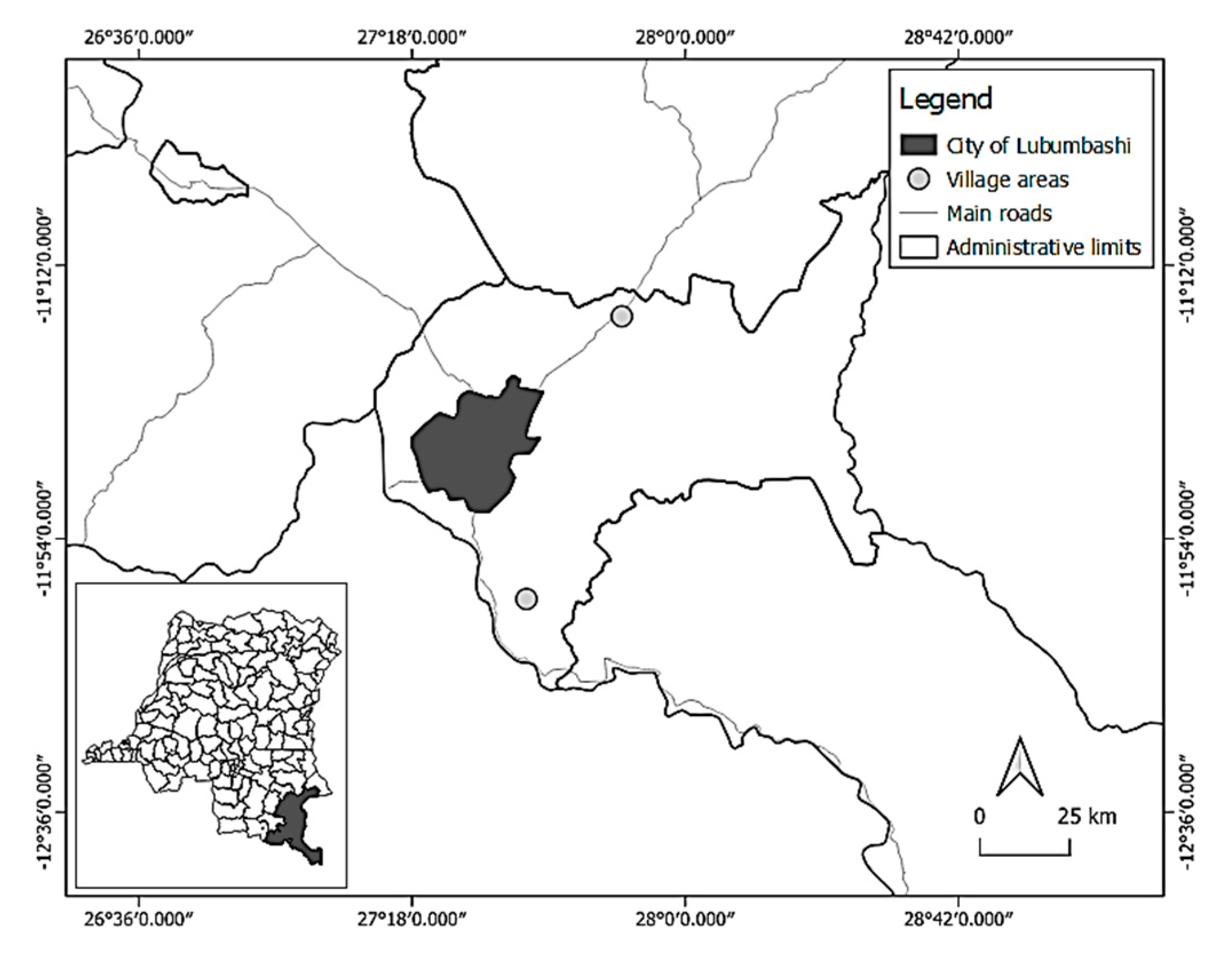
Figure 2.
Diameter structure (cm) of NTFP source species inventoried around two villages: Maksem (degraded forest) and Mwawa (intact forest).
Figure 2.
Diameter structure (cm) of NTFP source species inventoried around two villages: Maksem (degraded forest) and Mwawa (intact forest).
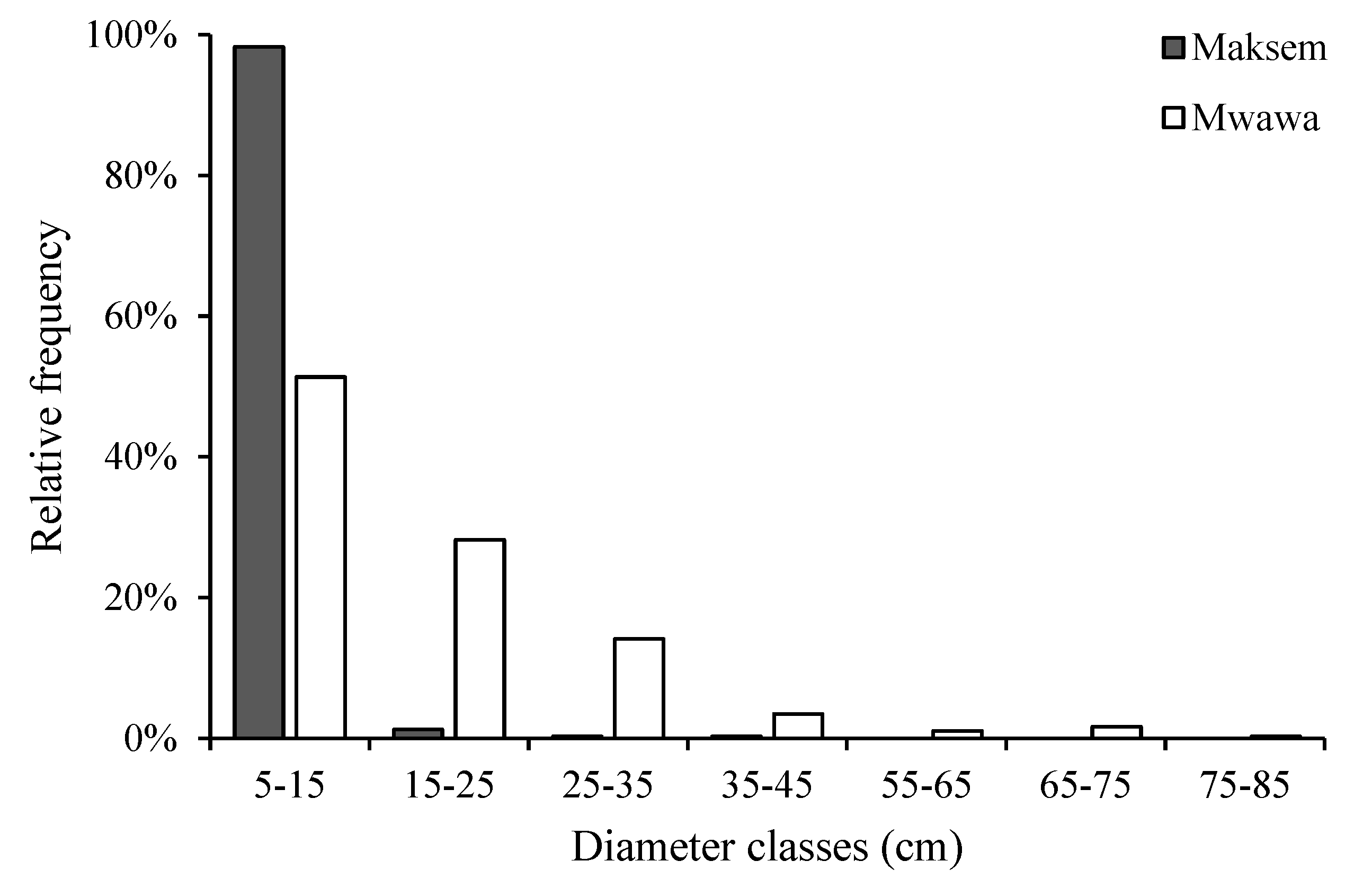

Table 1.
Geographic location, forest status, accessibility of the village area, and sample size within the selected villages. M: Male; F: Female.
Table 1.
Geographic location, forest status, accessibility of the village area, and sample size within the selected villages. M: Male; F: Female.
| Village areas | Latitude | Longitude | Forest status | Accessibility | Surveyed (%) | Total | |
|---|---|---|---|---|---|---|---|
| M | F | ||||||
| Maksem (n=50) | S 11,32998 | E 27,83755 | Degraded | Close/very good | 66 | 34 | 100 |
| Mwawa (n=50) | S 12,05379 | E 27,59325 | Nearly intact | far/bad | 70 | 30 | 100 |
Table 2.
Ethnobotanical list of woody species sources of NTFPs collected from miombo woodlands in the rural area of the city of Lubumbashi. Cf: Frequency of citations; Mak: Maksem village; Mwa: Mwawa village; Ba: Bark; Ro: Root; St: Stem; Le: Leaf; Fr: Fruit; Pe: Peeling; Sl: Slashing; Pl: plucking; Di: Digging; Fo: Food; Ha: Handicraft; Bu: Building; Tr: traditional rituals; Tm: Traditional medicine. -: species was not mentioned by the respondents in the corresponding village area.
Table 2.
Ethnobotanical list of woody species sources of NTFPs collected from miombo woodlands in the rural area of the city of Lubumbashi. Cf: Frequency of citations; Mak: Maksem village; Mwa: Mwawa village; Ba: Bark; Ro: Root; St: Stem; Le: Leaf; Fr: Fruit; Pe: Peeling; Sl: Slashing; Pl: plucking; Di: Digging; Fo: Food; Ha: Handicraft; Bu: Building; Tr: traditional rituals; Tm: Traditional medicine. -: species was not mentioned by the respondents in the corresponding village area.
| N° | Species | Families | Cf (%) n=50 | Organs | Harvesting practices | Mains uses | ||||
|---|---|---|---|---|---|---|---|---|---|---|
| Mak | Mwa | Mak | Mwa | Mak | Mwa | Mak | Mwa | |||
| 1 | Acacia polyacantha Wild. | Fabaceae | 2 | .- | Ba, Ro | - | Pe, Di | - | Tm | - |
| 2 | Acacia sieberiana DC | Fabaceae | 2 | 2 | Ro | Ro | Di | Di | Tm | Tr |
| 3 | Afzelia quanzensis Welw. | Fabaceae | 14 | 4 | St, Le | St | Sl, Pl | Sl | Ha, Bu, Tr | Ha |
| 4 | Albizia adianthifolia (Schumach.) W. Wight | Fabaceae | 10 | 40 | Ba, Ro, St | Ba, Ro, St | Pe, Di, Sl | Pe, Di, Sl | Ha, Tm | Ha, Bu, Tm |
| 5 | Albizia antunesiana Harms | Fabaceae | 50 | 22 | Ro, St | Ba, Ro, St | Di, Sl | Pe, Di, Sl | Ha, Bu, Tm | Ha, Bu, Tm |
| 6 | Albizia versicolor Welw. Ex Oliv. | Fabaceae | 18 | - | Ro, St | - | Di, Sl | - | Ha, Tm | - |
| 7 | Anisophyllea boehmii Engl. | Anisophilleaceae | 46 | 54 | Ba, Fr | Ba, Fr, St | Di, Pl, Sl | Pe, Pl, Sl | Fo, Tm | Fo, Bu, Tm |
| 8 | Annona senegalensis Pers. | Annonaceae | 10 | 16 | St | Ba, Fr, Ro, St | Sl | Pe, Pl, Di, Sl | Ha, Bu, Tm | Fo, Ha, Bu, Tm |
| 9 | Bobgunnia madagascariensis (Desv.) J.H. Kirkbr. & Wiersama | Fabaceae | 16 | 42 | Ba, Ro, St | Ba, Ro, St | Pe, Di, Sl | Pe, Di, Sl | Bu, Tr, Tm | Ha, Bu, Tm |
| 10 | Brachystegia boehmii Taub. | Fabaceae | 10 | 24 | Ba, St | Ba, St | Pe, Sl | Pe, Sl | Bu | Ha, Bu, Tm |
| 11 | Brachystegia floribunda Benth. | Fabaceae | - | 2 | - | Ba | - | Pe | - | Bu |
| 12 | Brachystegia spiciformis Benth. | Fabaceae | 20 | 16 | Ro, St | Ba, St | Di, Sl | Pe, Sl | Ha, Bu, Tm | Bu, Tm |
| 13 | Cassia abbreviata Oliv. | Fabaceae | 28 | 4 | Ba, Ro | Ba, Ro | Pe, Di | Pe, Di | Tm | Tm |
| 14 | Combretum molle Engl. & Diels | Combretaceae | 8 | 8 | Ba, Ro, St | Ba, Ro, St | Pe, Di, Sl | Pe, Di, Sl | Ha, Bu, Tm | Ha, Bu, Tm |
| 15 | Diospyros mespiliformis Hochst. Ex A. DC. | Ebenaceae | - | 2 | - | Ba, Ro | - | Pe, Di | - | Tm |
| 16 | Diplorhynchus condylocarpon (Müll. Arg.) Pichon | Apocynaceae | 20 | 6 | Ba, Ro, St | Ba, Ro | Pe, Di, Sl | Pe, Di | Ha, Bu, Tm | Tm |
| 17 | Entandrophragma delevoyi De Wild. | Meliaceae | - | 2 | - | Ba, Ro | - | Pe, Di | - | Tr |
| 18 | Erythrina abyssinica Lam. Ex DC. | Fabaceae | - | 14 | - | Ba, Ro, St | - | Pe, Di, Sl | - | Ha, Tm |
| 19 | Erythrophleum africanum (Welw. Ex Benth.) Harms | Fabaceae | 2 | 10 | Ba | St | Pe | Sl | Bu | Ha, Bu |
| 20 | Faurea saligna Harv. | Proteaceae | 4 | 2 | St | St | Sl | Sl | Bu | Bu |
| 21 | Ficus stuhlmannii Warb. | Moraceae | 2 | 1 | Le | St | Pl | Sl | Tr | Tr |
| 22 | Ficus sycomorus L. | Moraceae | 10 | 2 | Ba, St | St | Pe, Sl | Sl | Ha, Tr, Tm | Ha |
| 23 | Ficus sp | Moraceae | - | 2 | - | St | - | Sl | - | Bu |
| 24 | Garcinia huillensis Welw. | Clusiaceae | 4 | 18 | Fr | Ba, Ro | Pl | Pe, Di | Fo | Fo, Tm |
| 25 | Hexalobus monopetalus (A. Rich.) Engl. & Diels | Annonaceae | 2 | - | Fr | - | Pl | - | Fo | - |
| 26 | Hymenocardia acida Tul. | Phyllanthaceae | 10 | 4 | Ba, Ro, St | Ro, St | Pe, Di, Sl | Di, Sl | Ha, Tr, Tm | Bu, Tm |
| 27 | Isoberlinia spp | Fabaceae | 56 | 20 | Ba, St | Ba, Ro, St | Pe, Sl | Pe, Di, Sl | Ha, Bu, Tm | Ha, Bu, Tm |
| 28 | Julbernardia globiflora (Benth.) Troupin | Fabaceae | 8 | - | Ba, St | - | Pe, Sl | - | Bu | - |
| 29 | Julbernardia paniculata (Benth.) Troupin | Fabaceae | 30 | 22 | Ba, St | Ba, Ro, St | Pe, Sl | Pe, Di, Sl | Ha, Bu, Tm | Ha, Bu, Tm |
| 30 | Landolphia kirkii Dyer ex Hook. F. | Apocynaceae | 2 | 12 | Ro | Fr | Di | Pl | Tm | Fo |
| 31 | Lannea discolor (Sond.) Angl. | Anacardiaceae | 6 | 4 | Le, St | Ro, St | Pl, Sl | Di, Sl | Ha, Tr, Tm | Ha, Tr, Tm |
| 32 | Marquesia macroura Gilg | Dipterocarpaceae | 4 | 6 | St | St | Sl | Sl | Ha, Bu | Ha, Bu |
| 33 | Monotes katangensis (De Wild.) De Wild. | Dipterocarpaceae | - | 2 | - | St | - | Sl | - | Bu |
| 34 | Ochna schweinfurthiana F. Hoffm. | Ochnaceae | 2 | - | Ba | - | Pe | - | Tm | - |
| 35 | Olax obtusifolia De Wild. | Olacaceae | - | 2 | - | St | - | Sl | - | Bu |
| 36 | Parinari curatellifolia Planch. Ex Benth. | Chrysobalanaceae | 26 | 52 | Ba, Fr, Ro, St | Ba, Fr, Ro, St | Pe, Pl, Di, Sl | Pe, Pl, Di, Sl | Fo, Bu, Tm | Fo, Bu, Tm |
| 37 | Pericopsis angolensis (Boulanger) Meeuwen | Fabaceae | 22 | 30 | Ro, St | Ro, St | Di, Sl | Di, Sl | Ha, Bu, Tr, Tm | Ha, Bu, Tm |
| 38 | Piliostigma thonningii (Schumach.) Milne-Redh. | Fabaceae | 12 | 2 | Ba, Ro | Ba, Ro | Pe, Sl | Pe, Di | Bu,Tr, Tm | Bu,Tm |
| 39 | Pseudolachnostylis maprouneifolia Pax | Phyllanthaceae | - | 4 | - | Ba, St | - | Pe, Sl | - | Bu, Tm |
| 40 | Psorospermum febrifugum Spach | Hypericaceae | - | 2 | - | Ro | - | Di | - | Tm |
| 41 | Pterocarpus angolensis DC. | Fabaceae | 46 | 18 | Ba, Ro, St | St | Pe, Di, Sl | Sl | Ha, Bu, Cu, Tm | Ha, Bu |
| 42 | Pterocarpus tinctorius Welw. | Fabaceae | 60 | 4 | Ba, Ro, St | St | Pe, Di, Sl | Sl | Ha, Bu, Tm | Ha, Bu |
| 43 | Rothmannia engleriana (K. Schum.) Keay | Rubiaceae | 2 | - | Le | - | Pl | - | Tr | - |
| 44 | Securidaca longepedunculata Fresen. | Polygalaceae | 16 | 6 | Le, Ro | Ro | Pl, Di | Di | Tr, Tm | Tm |
| 45 | Sterculia quinqueloba (Garcke) K. Schum. | Malvaceae | 26 | 2 | Ba, Le, Ro, St | Ba, Le | Pe, Pl, Di, Sl | Pe, Pl | Bu, Tr, Tm | Bu |
| 46 | Strychnos innocua Delile | Loganiaceae | - | 6 | - | Fr | - | Pl | - | Fo |
| 47 | Strychnos pungens Soler. | Loganiaceae | - | 2 | - | Ro | - | Di | - | Tm |
| 48 | Strychnos spinosa Lam. | Loganiaceae | 12 | 6 | Fr, Ro | Fr, Ro | Pl, Di | Pl, Di | Fo, Tm | Fo, Tm |
| 49 | Strychnos cocculoides Baker | Loganiaceae | 48 | 60 | Fr, Ro | Fr, Ro | Pl, Di | Pl, Di | Fo, Tm | Fo, Tm |
| 50 | Strychnos sp | Loganiaceae | 2 | 4 | Ro | Ro | Di | Di | Tm | Tm |
| 51 | Syzygium cordatum Hochst. Ex C. Krauss | Myrtaceae | - | 2 | - | Fr | - | Pl | - | Fo |
| 52 | Syzygium guineense DC. | Myrtaceae | - | 6 | - | Fr | - | Pl, Sl | - | Tm |
| 53 | Terminalia mollis M.A. Lawson | Combretaceae | 24 | 32 | Ba, Ro, St | Ba, Ro | Pe, Di, Sl | Pe, Di | Ha, Bu, Tm | Tm |
| 54 | Thespesia garckeana F. Hoffm. | Malvaceae | 8 | 22 | Fr | Fr, St | Pl | Pl, Sl | Fo | Fo, Ha |
| 55 | Uapaca kirkiana Müll.Arg. | Phyllanthaceae | 46 | 68 | Fr, Ro, St | Fr, St | Pl, Di, Sl | Pl, Sl | Fo, Bu, Tm | Fo, Ha, Bu |
| 56 | Uapaca nitida Müll.Arg. | Phyllanthaceae | 2 | 8 | Fr, St | Fr, St | Pl, Sl | Pl, Sl | Fo, Bu | Fo, Bu |
| 57 | Uapaca pilosa Hutch. | Phyllanthaceae | - | 6 | - | Fr | - | Pl | - | Fo |
| 58 | Ximenia sp | Olacaceae | 2 | 2 | St | St | Sl | Sl | Ha | Bu |
| 59 | Zanha africana (Radlk.) Exell | Fabaceae | 2 | - | Ro | - | Di | - | Tm | - |
| 60 | Zanthoxylum chalybeum Engl. | Fabaceae | 22 | 28 | Ro | Ba, Ro, St | Di | Pe, Di, Sl | Tm | Ha, Tm |
Table 3.
Socio-economic values of the top-five most-harvested NTFPs in miombo woodlands according to their different uses. NTFPs collected for self-consumption are excluded from this table. Cf: Frequency of quotation. -: species was not mentioned by the respondents in the corresponding village area. Average weight of a mixer = 0.24 kg; handle = 0.80 kg; pestle = 1.78 kg; mortar = 8.78 kg; juvenile stem = 3 kg.
Table 3.
Socio-economic values of the top-five most-harvested NTFPs in miombo woodlands according to their different uses. NTFPs collected for self-consumption are excluded from this table. Cf: Frequency of quotation. -: species was not mentioned by the respondents in the corresponding village area. Average weight of a mixer = 0.24 kg; handle = 0.80 kg; pestle = 1.78 kg; mortar = 8.78 kg; juvenile stem = 3 kg.
| N° | Species | Village areas (Cf%) ; n=50 | Economic value (USD) | |
|---|---|---|---|---|
| Maksem | Mwawa | |||
| Food use | ||||
| 1 | A. boehmii | 21 | 27 | 2.5/kg |
| 2 | S. cocculoides | 23 | 28 | 0.5/kg |
| 3 | U. kirkiana | 22 | 31 | 0.57/kg |
| Handicraft use | ||||
| 4 | A. adianthifolia | - | 12 | 1.88/kg of Handle or 0.84/kg of pestle |
| 5 | A. antunesiana | 16 | 8 | 1.88/kg of Handle or 0.84/kg of pestle |
| 6 | A. versicolor | 9 | - | 1.88/Handle |
| 7 | A. senegalensis | - | 5 | 1.88/Handle |
| 8 | B. madagascariensis | - | 12 | 1.88/kg (Handle) or 0.84/kg (pestle) |
| 9 | Isoberlinia spp | 13 | 4 | 1.43 -14.58/kg of art |
| 10 | P. angolensis | - | 5 | 1.43 -14.58/kg of art |
| 11 | P. angolensis | 8 | 7 | 1.43 -14.58/kg of art |
| 12 | P. tinctorius | 12 | - | 1.43 -14.58/kg of art |
| Use in hut building | ||||
| 13 | A. antunesiana | 12 | - | 0.83/kg of stem |
| 14 | B. madagascariensis | - | 9 | 0.83/kg of stem |
| 15 | B. boehmii | - | 11 | 0.83/kg of stem |
| 16 | B. spiciformis | - | 7 | 0.83/kg of stem |
| 17 | E. africanum | - | 4 | 0.83/kg of stem |
| 18 | Isoberlinia spp | 26 | 4 | 0.83/kg of stem |
| 19 | J. paniculata | 10 | 7 | 0.83/kg of stem |
| 20 | P. angolensis | - | 11 | 0.83/kg of stem |
| 21 | P. angolensis | 20 | - | 0.83/kg of stem |
| 22 | P. tinctorius | 24 | - | 0.83/kg of stem |
| 23 | U. kirkiana | - | 12 | 0.83/kg of stem |
| 24 | U. nitida | - | 4 | 0.83/kg of stem |
| Use in traditional medicine | ||||
| 25 | B. madagascariensis | - | 12 | 9.25/kg of Root or Bark |
| 26 | C. abbreviata Oliv. | 14 | - | 9.25/kg of Root |
| 27 | S. longepedunculata | 7 | - | 9.25/kg of Root |
| 28 | T. mollis | 10 | 16 | 9.25/kg of Root or Bark |
| 29 | Z. chalybeum | 11 | 12 | 9.25/kg of Root |
Table 4.
Woody plant species sources of NTFPs inventoried in the miombo woodlands around the two villages. Maksem (Mak): degraded forest and Mwawa (Mwa): intact forest. -: species was not inventoried during floristic inventories in the corresponding village’s forest.
Table 4.
Woody plant species sources of NTFPs inventoried in the miombo woodlands around the two villages. Maksem (Mak): degraded forest and Mwawa (Mwa): intact forest. -: species was not inventoried during floristic inventories in the corresponding village’s forest.
| N° | Species | Families | Density /ha | Relative Density (%) | Frequency | Relative Frequency (%) | ||||||
|---|---|---|---|---|---|---|---|---|---|---|---|---|
| Mak | Mwa | Mak | Mwa | Mak | Mwa | Mak | Mwa | |||||
| 1 | A. polyacantha | Fabaceae | - | - | - | - | - | - | - | - | ||
| 2 | A. sieberiana | Fabaceae | - | - | - | - | - | - | - | - | ||
| 3 | A. quanzensis | Fabaceae | - | - | - | - | - | - | - | - | ||
| 4 | A. adianthifolia | Fabaceae | 4.17 | 17.5 | 1.1 | 3.41 | 0.25 | 0.83 | 2.33 | 5.49 | ||
| 5 | A. antunesiana | Fabaceae | 10.83 | 11.67 | 2.85 | 2.28 | 0.5 | 0.58 | 4.65 | 3.85 | ||
| 6 | A. versicolor | Fabaceae | - | - | - | - | - | - | - | - | ||
| 7 | A. boehmii | Anisophylleaceae | 2.5 | 6.67 | 0.66 | 1.3 | 0.08 | 0.42 | 0.78 | 2.75 | ||
| 8 | A. senegalensis | Annonaceae | 1.7 | - | 0.43 | - | 0.17 | - | 1.55 | - | ||
| 9 | B. madagascariensis | Fabaceae | 1.7 | 5.83 | 0.43 | 1.14 | 0.17 | 0.42 | 1.55 | 2.75 | ||
| 10 | B. boehmii | Fabaceae | 2.5 | - | 0.65 | - | 0.17 | - | 1.55 | - | ||
| 11 | B. floribunda | Fabaceae | - | - | - | - | - | - | - | - | ||
| 12 | B. spiciformis | Fabaceae | 15.83 | 107.5 | 4.17 | 20.98 | 0.5 | 1 | 4.65 | 6.59 | ||
| 13 | C. abbreviata | Fabaceae | - | - | - | - | - | - | - | - | ||
| 14 | C. molle | Combetaceae | 0.83 | 3.33 | 0.22 | 0.65 | 0.08 | 0.25 | 0.77 | 1.65 | ||
| 15 | D. mespiliformis | Ebenaceae | - | - | - | - | - | - | - | - | ||
| 16 | D. condylocarpon | Apocynaceae | 13.33 | 15.83 | 3.51 | 3.09 | 0.58 | 0.58 | 5.43 | 3.85 | ||
| 17 | E. delevoyi | Fabaceae | - | - | - | - | - | - | - | - | ||
| 18 | E. abyssinica | Fabaceae | - | - | - | - | - | - | - | - | ||
| 19 | E. africanum | Fabaceae | - | 5.83 | - | 1.13 | - | 0.33 | - | 2.2 | ||
| 20 | F. saligna | Proteaceae | - | - | - | - | - | - | - | - | ||
| 21 | F. stuhlmannii | Moraceae | - | - | - | - | - | - | - | - | ||
| 22 | F. sycomorus | Moraceae | 0.83 | - | 0.21 | - | 0.83 | - | 0.78 | - | ||
| 23 | Ficus sp | Moraceae | - | 0.83 | - | 0.16 | - | 0.08 | - | 0.55 | ||
| 24 | G. huillensis | Clusiaceae | - | - | - | - | - | - | - | - | ||
| 25 | H. monopetalus | Annonaceae | 0.83 | - | 0.22 | - | 0.08 | - | 0.78 | - | ||
| 26 | H. acida | Phyllanthaceae | - | 0.83 | - | 0.16 | - | 0.08 | - | 0.55 | ||
| 27 | Isoberlinia. Spp | Fabaceae | 92.5 | 15.83 | 24.34 | 3.09 | 0.67 | 0.75 | 6.2 | 4.94 | ||
| 28 | J. globiflora | Fabaceae | 24.17 | - | 6.35 | - | 0.42 | - | 3.88 | - | ||
| 29 | J. paniculata | Fabaceae | 75 | 4.17 | 19.74 | 0.81 | 0.83 | 0.17 | 7.75 | 1.1 | ||
| 30 | L. kirkii | Apocynaceae | - | 1.67 | - | 0.32 | - | 0.08 | - | 0.55 | ||
| 31 | L. discolor | Anacardiaceae | - | 5 | - | 0.98 | - | 0.33 | - | 2.2 | ||
| 32 | M. macroura | Dipterocarpaceae | - | 17.5 | - | 3.41 | - | 0.25 | - | 1.65 | ||
| 33 | M. katangensis | Dipterocarpaceae | - | 7.5 | - | 1.46 | - | 0.41 | - | 2.75 | ||
| 34 | O. schweinfurthiana | Ochnaceae | 5.83 | - | 1.54 | - | 0.42 | - | 3.88 | - | ||
| 35 | O. obtusifolia | Olacaceae | - | 2.5 | - | 0.48 | - | 0.17 | - | 0.55 | ||
| 36 | P. curatellifolia | Chrysobalanaceae | 0.83 | 6.67 | 0.21 | 1.3 | 0.83 | 0.41 | 0.78 | 2.75 | ||
| 37 | P. angolensis | Fabaceae | 1.7 | 10.83 | 0.44 | 2.11 | 0.17 | 0.58 | 1.55 | 3.85 | ||
| 38 | P. thonningii | Fabaceae | - | 0.83 | - | 0.16 | - | 0.08 | - | 0.55 | ||
| 39 | P. maprouneifolia | Phyllanthaceae | - | 4.16 | - | 0.81 | - | 0.17 | - | 1.1 | ||
| 40 | P. febrifugum | Hypericaceae | - | - | - | - | - | - | - | - | ||
| 41 | P. angolensis | Fabaceae | 10 | 20.83 | 2.63 | 4.07 | 0.58 | 0.58 | 5.42 | 3.85 | ||
| 42 | P. tinctorius | Fabaceae | 19.17 | - | 5.04 | - | 0.58 | - | 5.42 | - | ||
| 43 | R. engleriana | Rubiaceae | - | - | - | - | - | - | - | - | ||
| 44 | S. longepedunculata | Polygalaceae | - | - | - | - | - | - | - | - | ||
| 45 | S. quinqueloba | Sterculiaceae | - | - | - | - | - | - | - | - | ||
| 46 | S. innocua | Loganiaceae | - | - | - | - | - | - | - | - | ||
| 47 | S. pungens | Loganiaceae | - | 0.83 | - | 0.16 | - | 0.08 | - | 0.55 | ||
| 48 | S. spinosa | Loganiaceae | 3.33 | 5 | 0.88 | 0.33 | 0.25 | 0.17 | 2.33 | 1.1 | ||
| 49 | S. cocculoides | Loganiaceae | - | 3.33 | - | 0.65 | - | 0.33 | - | 2.2 | ||
| 50 | Strychnos sp | Loganiaceae | - | 4.17 | - | 0.81 | - | 0.33 | - | 2.2 | ||
| 51 | S. cordatum | Myrtaceae | - | - | - | - | - | - | - | - | ||
| 52 | S. guineense | Myrtaceae | - | 0.83 | - | 0.16 | - | 0.08 | - | 0.55 | ||
| 53 | T. mollis | Combretaceae | 0.83 | - | 0.21 | - | 0.08 | - | 0.78 | - | ||
| 54 | T. garckeana | Malvaceae | - | - | - | - | - | - | - | - | ||
| 55 | U. kirkiana | Phyllanthaceae | 11.67 | 17.5 | 3.07 | 3.41 | 0.41 | 0.75 | 3.88 | 4.94 | ||
| 56 | U. nitida | Phyllanthaceae | 3.33 | 10 | 0.88 | 1.95 | 0.17 | 0.42 | 1.55 | 2.75 | ||
| 57 | U. pilosa | Phyllanthaceae | - | - | - | - | - | - | - | - | ||
| 58 | Ximenia sp | Olacaceae | - | - | - | - | - | - | - | - | ||
| 59 | Z. africana | Fabaceae | - | - | - | - | - | - | - | - | ||
| 60 | Z. chalybeum | Rutaceae | - | - | - | - | - | - | - | - | ||
Disclaimer/Publisher’s Note: The statements, opinions and data contained in all publications are solely those of the individual author(s) and contributor(s) and not of MDPI and/or the editor(s). MDPI and/or the editor(s) disclaim responsibility for any injury to people or property resulting from any ideas, methods, instructions or products referred to in the content. |
© 2023 by the authors. Licensee MDPI, Basel, Switzerland. This article is an open access article distributed under the terms and conditions of the Creative Commons Attribution (CC BY) license (http://creativecommons.org/licenses/by/4.0/).
Copyright: This open access article is published under a Creative Commons CC BY 4.0 license, which permit the free download, distribution, and reuse, provided that the author and preprint are cited in any reuse.


