

Submitted:
11 September 2023
Posted:
13 September 2023
You are already at the latest version
Abstract
Almost 115 million tons of fibers of which almost 90 million tons of chemical fibers were produced in the world in 2021, which are mainly used for the production of clothing and footwear. 30% of textile and apparel products are never sold, which means an extreme waste production. This article points out the possibilities of forecasting the sales of clothing in the case of one relatively large online store. Inadequate stocks of textile products in the company lead to loss and the need to sell products at a discount, which is undesirable for the company. The study in this article points to the calculation of the sales forecast for 2019 for the selected textile products, finding the analogy of the followed product sale. Sales for the years 2017 and 2018 serve as input data. The problem with textile products is that they have a short life cycle, i.e. the length of the life cycle is approximately half a year, and a high seasonality is also presented there. Therefore, the seasonal indices and Holt-Winters methods (multiplication and additional approaches) were used for products forecasting. Ultimately, this model could contribute to reducing the loss of unsold goods and thus reduce the waste of resources and increase the use of goods in other similar companies.
Keywords:
textile
; apparel
; clothe
; forecasting
1. Introduction
Textile and apparel industries are one of the fastest-growing industries, providing employment to millions of people. Estimation according to the Ellen MacArthur Foundation is that globally, the clothing industry employs more than 300 million people along the value chain, which can be understood to also include people that work in design, distribution and retail divisions of the fashion industry. In Europe, there are 1.3 million people employed in the textile and clothing industry at approx. 143,000 companies [1]. Its growth can be presented from $530.97 billion in 2021 to $575.06 billion in 2022 at a compound annual growth rate (CAGR) of 8.3% [2]. The market is expected to grow to $760.21 billion in 2026 at a CAGR of 7.2%. On the other hand, textile production uses a lot of water, as well as land for growing cotton and other fibers. The global textile and clothing industry is estimated to have used 79 billion cubic meters of water in 2015 – while the water demand of the entire EU economy was 266 billion cubic meters in 2017. It is estimated that 2,700 liters of fresh water are needed to produce one cotton T-shirt – which corresponds to the need for drinking water for one person for 2.5 years [3]. Greenhouse gas emissions during the production of clothing and footwear constitute another negative impact on the environment, accounting for roughly 10% of global greenhouse gas emissions.
Next topic to think about, in connection with the textile and apparel industry, is the considerable waste of resources. This is proven by the authors' study [4] and other facts:
- Consumers in the United Kingdom have an estimated $46.7 billion worth of unworn clothes in their closets [5]. Another study with 18,000 members of various households in 20 countries, conducted by relocation and removals company Movinga, revealed that the majority of consumers around the world are highly delusional about how much they own versus how much they actually wear. This study was generalized to the results, that people do not wear at least 50 percent of their wardrobes [6].
- Contrary to general hope, a lot of our clothes are not recyclable. It is said that only 13.6% of clothes and shoes thrown away in the US end up being recycled and that just 12% of the material used for clothing ends up being recycled. This 12% will likely end up being shredded and used as furniture stuffing, or made into insulation or cleaning cloths. Less than 1% of what is collected will be used to make new clothing [7,8].
This trend of wasting resources is certainly not easy to stop or mitigate. However, overproduction, i.e. offer exceeding demand, is evident. This article proposes a simple solution through the analysis and prediction of the consumption of textile and apparel products in a local e-shop offering this kind of products and is aimed at the Czech and Slovak market. This can be inspiring for any store, anywhere in the world, that has unnecessary stocks of goods that are not in high demand, and vice versa, insufficient stocks of goods that are in short supply or sell out quickly. The study analyzes some selected clothes that are considered common and key anywhere in the world.
Of course, this way of reducing sources is not the only one, because this fact of wasting resources in the textile industry has already been noticed by many authors in their publications, and thus they contribute with their research not only to reduce the consumption of new resources, but especially to increase the share of material recycling [9]. For example as the author Chaka has described in his publication the conversion of spinning wastes into valuable products and it will accelerate growth and development by generating additional income and also contributing to environmental conservation [10]. The authors Baruque-Ramos et al. also pointed to the reduction of resource consumption and mainly to increase public opinion about the need for saving by approaching responsible lifestyles and environmental awareness and the refusal to waste resources in general. They do not even stop thinking at the production itself, where the main socioenvironmental benefits are related to the training of labor and local income generation [11]. The authors Stone, C. has focused on comparing the negative impacts for freshwater ecosystems from the way we produce, use and dispose of textiles. The comparison was made from the point of view of the risks associated with the use of natural or synthetic fibers. Woolen (natural) textiles pose the most risk during the production phase, while PET (synthetic) textiles pose the most risk during the use and disposal phases [12]. Similar research for marine ecosystems has brought by the authors Agamuthu, P. et al. They had noted that tackling the marine debris crisis is not a straightforward, one-size-fits-all solution, but rather an integrated and continuous effort required at local, regional and global level [13]. The authors Provin, A.P. et al. has also dealt with the idea of reducing raw material inputs in the textile industry by use of alternative biomaterials in their research. The bacteria of the Komagataeibacter xylinus family, which is present in the probiotic drink Kombucha, is a great source for the production of bacterial cellulose (BC) and has the potential to replace fabrics in the production of clothing and accessories [14].
In this industry, it is not only about of raw materials waste, but also a continuous increase in energy consumption and Energy Intensity (EI) index, primarily on electrical and thermal energy, which was noticed by the authors Jaitiang, T. et al. The four scenarios of energy conservation and the implementation of renewable energy in the sector they have studied: 1) Business-As-Usual (BAU); 2) switching to high-efficiency equipment and waste heat recovery; 3) solar PV (PhotoVoltaic) utilization; and 4) the combination of the equipment switching, heat recovery, and solar PV utilization. They recommend that the textile industry should implement more renewable-related measures or the alteration of policy and technology is needed [15]. The case of water pollution by the textile industry (also mentioned above) has been suggested by the authors Behera, M. et al.; Huang, M. et al. and Gupta, R. et al. in their publications, where they made an extensive overview of many specific technologies with aim to initiate influential policies among the research community to combat the widespread risk of reluctant treatment practices of toxic organic pollutants generated from textile industrial plants. However, water pollution does not end only with production itself, but also by using products made from synthetic fabrics. Micro-plastic fibers (MPFs) also get into waste water by washing clothes in households [16-18]. The authors Cai, Y.P. at al. also have claimed the threat of MPFs. and the aim of their study was to investigate the presence of MPFs in various intermediate and finished polyester textile products. On average, five times more MPFs could be extracted from textiles with processed surfaces (such as Fleece, Plain brushed and Microfiber) compared to those with unprocessed surfaces. This suggests that abrasive friction during production may be another critical factor for MPF formation. Furthermore, scissor-cut textiles demonstrated three to 31 times higher number of extracted MPFs than laser-cut textiles, enabling us to quantitatively discriminate between the contribution of MPFs from the textile surface opposed to those originating from the textile edges [19]. Also authors Ramasamy, R. and Subramanian, R.B. looked for solutions to reduce the formation of MPFs in their review. They have found that the use of finer count yarns with filaments and compact structures reduces microfiber shedding. A significant increase is noted in the microfiber reduction percentage after the chemical (coating) finishing process [20]. This issue of MPFs threats also has motivated authors Henry, B. et al. to introduce a critical review of factors affecting the release from fabrics of microfibers, and of the risks for impacts on ecological systems and potentially on human health [21]. The authors Araque-Gonzalez, G. et al. have proposed a modern approach to reduce input requirements, especially in the clothing industry for small and medium-sized enterprises, in which they propose an industrial production model with a focus on Industry 4.0 (Big Data and Decision-making analysis) that allows improving procedures, jobs and related costs within the study organization [22].
The worldwide expansion of textile and apparel industries also results in the development of related industries, which is undoubtedly transport. It has a secondary impact on the environment and the authors Dhonde, B. and Patel, C. and they have found out that by well-organized trip planning and optimized utilization of payload capacities can be reduced vehicular emission generated from commercial goods movement in the textile industry to 2/3rd of its current levels [23].
Forecasting in the textile industry is crucial because it helps businesses to stay ahead of the competition and plan for future growth. Companies can ensure that they have the right inventory in place to meet customer needs and avoid stock shortages or overproduction by predicting demand. This is particularly important in the fast-paced and ever-changing world of fashion where trends and styles can change quickly [24].
In addition to inventory management, forecasting can also help textile companies to make decisions about new product development, market expansion, and production processes. By anticipating demand, businesses can determine which products will be most popular and allocate resources accordingly. They can also identify new markets and opportunities for growth, helping to drive long-term success. Authors Jiang, S. and Liu, Y. forecasted the variable demand for textile products for small and medium enterprises in China. According to them, the use of Gray models of forecasting appears to be a very good choice [25]. Other authors Thomassey, S. et al. solved forecasting to improve supply chain management for textile companies in uncertain environment by use of simulation [26]. The same authors also presented a forecasting model which is composed of several methods and performs forecasts for various horizons and at different sales aggregation levels. This system is based on soft computing techniques such as fuzzy logic, neural networks and evolutionary procedures, allowing the processing of uncertain data [27]. Research does not have to include only the use of artificial intelligence methods, because the authors Sabir, E.C. and Batuk, E. verified the creation of forecasts using classic methods and found that Basic Exponential Smoothing method is unsuitable demand forecasting method while Trend Corrected Exponential Smoothing method and Winter's method might be used for demand forecasting system in textile dyeing-finishing mills [28]. Authors Yuan, BJC. and Chang, PC. published their study of forecasting using the Delphi method to present results for the industry, government, and academics in their continuous promotion and research of the textile industry [29].
2. Materials and Methods
In today's data-driven business environment, quantitative methods are still widely used to make accurate and reliable forecasts. These methods use statistical and mathematical models to analyze historical data and make predictions about future trends and patterns. Quantitative methods for forecasting in the textile industry are based on regression analysis, time series analysis. This article includes methods such as, Holt-Winters (Multiplicative and Additive approach) and Seasonal indices. These methods are particularly useful for industries with clear patterns in demand and seasonality, which is typical in the textile and apparel industry. Textile companies can make informed predictions about future demand for their products and make strategic decisions to improve their bottom line, by analyzing historical sales data, production data, and economic indicators [30,31].
As it was described above, the Holt-Winters forecasting method and Seasonal indices method can be applied in the textile industry for demand forecasting and inventory management. Demand for products is influenced by various factors such as seasonality, fashion trends, and economic conditions in the textile industry. These methods can be used to forecast demand for specific textile products, such as cotton shirts or woolen sweaters, taking into account seasonal patterns and trends in consumer behavior. This information can then be used to adjust production and inventory levels, reducing the risk of overstocking or stock shortages. Additionally, the methods can be used to forecast raw material demand, allowing textile companies to plan and manage their supply chain more effectively.
The objects of the forecast were chosen in the form of a group of products that have a common meaning, approximate appearance, functionality and thus can be classified into a common category. Therefore, specific items were not selected because the behavior of selling of particular items is very changeable or volatile [32-36]. The product groups were chosen to cover the entire seasonal life cycle of clothing. In the winter period, sales of coats were significant, in spring and summer, dresses, short-sleeved T-shirts, sneakers and jeans were sold well, and leather jackets came to the forefront of sales at the turn of autumn. It can be concluded that the life cycle of the mentioned clothing also extends into the next season, but often with a lower sales volume. The products are chosen so that their life cycle is the longest and at the same time they are among the best-selling products. So the life cycle of these products can be characterized as two-season. The data for calculating of the forecast comes directly from the company operating the e-shop. Since this company operates its e-shop in the Czech Republic as well as in the Slovakia, two total forecasts will be created for each group of products: the forecast “CZ+SK” (this means for both markets together) and separately “SK” (for the Slovak market only).
3. Objects and Results
The groups of products that were selected for the analysis and solution of the forecast represent a wide range of assortment offered by the company engaged in the sale of Textile and apparel products.
- The first group of products: Coats_1. Black coats were chosen because they were the best-selling items in a given period, i.e. from January to June, when the end of their life cycle is also expected. The life cycle lasted 6 months in the 2017 season and only 5 months in the 2018 season. Taking into account the interseasonal period, the life cycle lasted a total of 26 weeks. The chosen coats were from Vero Moda, which is the Danish fashion brand for women.
- The second group of products: Coats_2. The sale of winter coats was from January to June in 2017 and from January to May in 2018. The total sale lasts 23 weeks and starts in the first week of the year. The product group consists of Dorothy Perkins brand coats. This brand is very popular and is characterized by its high quality. It is one of the most successful British fashion brands for women with more than 100 years of tradition.
- The third group of products: Dresses in blue with a floral pattern. The sale in 2017 was from May to November and in 2018 from May to December. The sale started in the 19th week and ended in the 50th week in the given years. The products are Closet brands. The brand has been on the market since 1996 and is a well-known British brand popular especially among celebrities.
- The fourth group of products: White sneakers. In 2017 they were sold from February to August and in 2018 from January to August. The total life cycle lasts 31 weeks. It starts in the 5th week and ends in the 35th week. The common feature of sneakers is their simple cut. They are from the Swedish brand Vagabond, which was first for men and later also for women. It is characterized by high quality and a wide range of styles. It was founded in 1968. In addition to footwear, it also offers leather accessories in more than 40 countries around the world.
- The fifth group of products: Black T-shirt for men. They were sold from January to November. This is the longest life cycle of selected products. It lasts 44 weeks and starts on the 2nd week and ends on the 45th week in the given years. This product is Jack & Jones brand. It is a Danish brand that makes models for men. It was founded in 1990 and currently has more than 1,000 shops in 38 countries and cooperates with more than 1,000 wholesalers.
- The sixth class of products: Red T-shirt for women with short sleeves. They are Vero Moda brands. Sales in 2017 were from March to September and in 2018 from February to September. The total life cycle lasted 33 weeks. It started at week 6 and ended at week 38.
- The seventh group of products: Brown leather jacket. It is a universal leather jacket and very popular among women. The zipper is located in the middle and the collar forms a waist with buttons. The sales in 2017 and 2018 were from February to September and lasted a total of 32 weeks. It started at week 9 and ended at week 40 in those years. The jackets are from Only brand, which is Danish fashion for women. It was founded in 1995. It belongs to the Bestseller Company, which also includes the brands Vero Moda and VILA, which are mentioned among the products.
- The eighth group of products: White shirts. They are classic white button down shirts. Sales in 2017 were from April to November and in 2018 from March to November. Missing data were filled in with the number one. The total life cycle lasted 34 weeks. It started at 12 weeks and ended at 45 weeks. The products are of the Dorothy Perkins brand, which is characterized by the second class of products.
- The ninth group of products: Dark blue jacket with a classic one-button cut. The sleeves are gently layered. The sale was in 2017 and 2018 from January to June. The total life cycle lasted 24 weeks. It started in week 1 and ended in week 24 in the given years. Products are from the Vero Moda brand.
- The tenth group of products: Simple skinny jeans with a torn effect. Jeans of this cut have been in fashion for several seasons. The sale took place in 2017 from May to October and in 2018 from April to November. The total life cycle lasted 29 weeks. It started at 17 weeks and ended at 45 weeks.
Table 1 shows the sales periods of individual products and in the respective weeks in graphic reports.
3.1. Products characteristics and forecsts
Coats_1 - The popularity of black coats varies depending on the season. Generally, coats are more popular during colder months in SK and CZ regions.
Coats_2 – there is a big similarly to Coats_1 and have the same features of the sale behavior compared to the previous product Coats_1. Having multiple coats (winter coats) to choose from can be useful for different weather conditions or outfit styles.
Dresses in Blue - Blue is a popular color and dresses are a versatile clothing item that can be worn for various occasions, so dresses in blue can be relatively popular.
White sneakers - White sneakers have been a popular footwear trend in recent years, and they continue to be a popular choice for their versatility and simplicity.
Black T-shirt - Black is a classic and versatile color, and T-shirts are a staple item in most people's wardrobes.
Red T-shirt - Red is a bold and eye-catching color, and T-shirts are a casual and comfortable item. Red T-shirts can be popular depending on the fashion trend and personal preferences.
Brown leather jacket - Leather jackets are a timeless fashion staple during many years, and brown color is a versatile and classic that can add sophistication to any outfit.
White shirts - White shirts are a classic wear that can be dressed up for serious or casual occasions and this makes them a popular clothing item in most wardrobes.
Dark blue jacket - Dark blue is also a versatile color that can pair well with many different outfits, and jackets are essential outerwear for colder weather.
Simple skinny jeans - Skinny jeans have been a popular clothing item for several years, and they continue to be a staple item in most wardrobes for youngers and olders as well. Simple designs can be versatile and easily paired with other clothing items, making skinny jeans a best-loved choice.
The following Figure 1 comprises all diagrams of products sale, as they were introduced above.
In the following Figure 2, there are graphic diagrams showing in more detail the forecast for 2019 and the actual sales in 2019 for the SK and SK+CZ market. The differences between actual sales and the forecast are the inputs to the calculation of the forecast errors, which are quantified below.
3.2. Calculation of forecasting error and its relevancy
The quantification of the forecasting errors is calculated based on the comparison of the actual sales values from 2019 and the forecasts that were calculated for the year 2019 - mentioned in the previous subsection. Forecasting errors are calculated using generally known indicators, i.e. by Mean Absolute Percentage Error (MAPE) and Root Mean Squared Error (RMSE). They are an important metric in evaluating the accuracy of forecasting models. Due to the fact that these metrics are the most commonly used indicators, this article does not include the exact procedures and formulas for their calculation. The following Table 3 shows values of forecast errors RMSE and MAPE of the mentioned products in both market areas.
4. Discussion
The sales analysis and prediction of the first product - Black coats (Coats_1) indicated that there would be a decrease in sales. There is a year-on-year decrease of more than a third (from 332 units in 2017 to 204 units in 2018) on the SK+CZ markets. The forecast showed that sales in the next year will drop slightly to 141 units. The reality was not far from the forecast as shown by the actual sales of 147 pieces of clothing. The situation was similar on the single SK market, but the decline was not so striking. The sale of 37 pieces of clothing in 2017 decreased to 25 pieces in 2018. According to the forecast, a slight decrease to 22 pieces was expected, but the actual sale was slightly higher up to 29 pieces. The overall sales outlook for this specific product next year is that it is expected to be replaced by redesigned products, which may lead to a more modest increase in sales.
In the analysis and forecasting of the second product of winter coats (Coats_2), a slight year-on-year increase in sales on the SK+CZ markets was recorded (240 units were sold in 2017 and 252 units were sold in 2018), while the peak sales were during the 1st week of January 2018. The forecast points to a slight increase, but the number of units sold in 2019 was almost the same as in 2018. A similar situation was also recorded on the SK market, where sales were at the level of 34 units compared to the forecast of 32 units. Although it was the same model from 2018, sales in 2019 were supported by colder weather in January 2019 than in 2018 [37].
The analysis of the third product (Dresses in Blue) indicated the typical behavior of a short-term fashion hit, where peak sales were registered at the beginning of June, which is considered the first summer month in SK and CZ. However, the forecast for this product for 2019 indicates a decrease, which actually happened and sales in 2019 were 208 units, which is almost half less than in 2018. This phenomenon can be seen in the gradual saturation of the market despite the frequent change of a cut of this dress. A similar situation can also be seen on SK market.
The fourth product (White sneakers) is traditional, unisex, popular for all generations, and after analysis it can be seen that the time series is typically seasonal, sales volumes in individual years are relatively the same - at the level of 450-550 pcs. The sales forecast for 2019 was both for the SK+CZ market and for the single SK market slightly optimistic compared to actual sales with differences of 32 units on the SK+CZ market and 8 units on the SK market, which is a 7.3% difference on the SK+CZ market and 11.0% on the SK market.
Another traditional clothing item for men is the Black T-shirt, which also shows signs of seasonality with top sales in the second half of May. It is a product that has one of the longest life cycles in the clothing industry, because it is redesigned very little and therefore it is possible to claim that it is the same product during the three years of the sale observation. The analysis shows that the volume of sales increases slightly from year to year, and also the assumption resulting from the forecast points to an increase in sales in 2019. So, the sales on the SK+CZ market were 890 units in 2017, 1020 units in 2018, and 1024 units were sold in 2019. 107 units were sold on the SK market in 2017, 155 units in 2018 and 180 units in 2019.
The sixth analysis and forecast was created for another similar and popular product (Red T-shirt). This is a relatively stable situation compared to the years 2017 and 2018. Both in the case of the SK+CZ market and in the case of the SK market, there was a slight increase in sales in 2018. The forecast and reality in both cases pointed to the stability of sales of this product, but still a slight decrease in sales for 2019 was registered by 6.4% on the SK+CZ market and by 4.2% on the SK market.
For the seventh product, there was an interesting double season of interest in this product during a year. The first minor seasonal interest occurred in the period of changeable weather at the beginning of April, and even more interesting is the fact that in the middle of the summer there was a significant seasonal interest in the middle of the summer, that is, at the turn of the months of July and August. It is possible that these were sales with discounted prices, but this information is not known retrospectively. While on the SK+CZ market the forecast also showed the fact that a slight increase in sales continues (515 pcs in 2017, 536 pcs in 2018 and 570 in 2019), on the SK market there was a relatively significant drop in sales in 2019 by 28 pcs, which is a decrease by almost 30%. This may be affected by the extremely warm weather at the end of July in 2019 [38]. Otherwise, thanks to the changes in a cut of these jackets, there is constant interest in sales.
The eighth product (White shirts) is also a product for which there is constant high interest, because it is a part of formal clothing. A constant slight increase in sales was also expected, which was confirmed by the forecast and the fact of sales in 2019 on SK+CZ and on SK market. The year-on-year increase on the SK+CZ market is 24% on average, and the year-on-year increase in sales on the SK market is 20.6% on average.
The analysis and sales forecast of the ninth product (Dark blue jacket) did not indicate any significant changes. A slight decrease in sales was predicted for the SK+CZ market, which was also indicated by the fact that from 381 pcs in 2017 to 328 pcs in 2019. However, the forecast was a bit more pessimistic, but in 2019, in the second half of March, there was short-term colder weather in several places in Czechia [39]. On the contrary, an increase was recorded on the SK market between 2017 and 2018 and a slight decrease in sales in 2019 by 13.5%.
A similar situation as with the ninth product is also with the last tenth item (Simple skinny jeans). The forecast was more pessimistic than the sales themselves, which peaked on the SK+CZ market in the second half of August and exceeded even the expected sales in this period. Overall, however, a decrease in sales was recorded compared to 2018 by 132 units (25.6%). A decrease in sales was also expected on the SK market, but in reality it was smaller than expected, compared to 2018 by 16 units (17%).
5. Conclusions
This article is focused on the forecasting of textile products with a predominantly short life cycle. The problem consisted in an incorrect estimation of product sales, so the e-shop often had to sell off stock with a bigger discount. This was ultimately reflected in the company's losses. The aim of the cooperation with the mentioned e-shop was to find products that will be substituted by products with similar properties in the following periods (redesigned products, products with a small change of cut, etc.). In this way, at least 10 products were selected, for which a more accurate sales plan for the following season was prepared thanks to forecasting.
The forecast was made for the year 2019, based on data from their sales during the years 2017 and 2018. The data was obtained from the company's database in a weekly cycle and the provided data was from single sales in Slovakia (SK) and other from sales of the Czech Rep. and Slovakia together (SK+CZ). The combination of the Slovak and Czech markets was chosen because sales in Slovakia were not so high that can reflect significant changes. Even if the data did not cover the period of the whole year, the period when the sales of the given products were recorded was decisive. This reflected the life cycle of the selected products. The shortest life cycle of the product group was 23 weeks and the longest life cycle was 45 weeks. The forecast was calculated using simple methods (the Holt-Winters method – both approaches and the method of seasonal indices), which are intended for seasonal data.
In the next work, authors would like to devote themselves to expanding the product range, updating to current data (analyzing sales during the global COVID-19 pandemic) and also, not least, to put forecasting through the neural network methodology, because, as it was already mentioned above, the sales themselves are influenced of many other factors. One of such important factor is the influence of the weather.
Author Contributions
Conceptualization, P.K. and N.L.; methodology, P.K.; software, P.K. and N.L.; validation, P.K.; formal analysis, P.K. and N.L.; investigation, P.K.; resources, N.L.; data curation, N.L.; writing—original draft preparation, P.K.; writing—review and editing, P.K.; visualization, P.K.; supervision, P.K.; project administration, P.K.; funding acquisition, P.K. All authors have read and agreed to the published version of the manuscript.
Funding
This research was funded by the Cultural and Educational Grant Agency of the Ministry of Education, Science, Research and Sport of the Slovak Republic and the Slovak Academy of Sciences as part of the research project KEGA 010TUKE-4/2023
Institutional Review Board Statement
Not applicable.
Informed Consent Statement
Not applicable.
Data Availability Statement
The data presented in this article were obtained from the analyzed e-shop upon the agreement to provide data for the purpose of publishing this article only and are available upon the request from the corresponding author.
Acknowledgments
The authors would like to thank the anonymous referees for their valuable comments that improved the quality of the manuscript.
Conflicts of Interest
The authors declare no conflict of interest.
References
- Fashion United. Available online: https://fashionunited.com/global-fashion-industry-statistics (accessed on 14/03/2023).
- Globe Newswire. Available online: https://www.globenewswire.com/news-release/2022/04/06/2417253/0/en/Textile-Global-Market-Report-2022.html (accessed on 14/03/2023).
- News European Parliament. Available online: https://www.europarl.europa.eu/news/sk/headlines/society/20201208STO93327/vplyv-textilnej-vyroby-a-textilneho-odpadu-na-zivotne-prostredie-infografika (accessed on 15/03/2023).
- Akter, M.M.K.; Haq, U.N.; Islam, M.; Uddin, M.A. Textile-apparel manufacturing and material waste management in the circular economy: A conceptual model to achieve sustainable development goal (SDG) 12 for Bangladesh. Clean. Environ. Syst. 2022, 4, 100070. [Google Scholar] [CrossRef]
- Busines 2 Community. Available online: https://www.business2community.com/fashion-beauty/30-shocking-figures-facts-global-textile-apparel-industry-01222057 (accessed on 15/03/2023).
- Fashion United. Available online: https://fashionunited.uk/news/fashion/people-do-not-wear-at-least-50-percent-of-their-wardrobes-according-to-study/2018081638356?_gl=1 (accessed on 15/03/2023).
- Good on You. Available online: https://goodonyou.eco/waste-luxury-fashion/ (accessed on 16/03/2023).
- Awogbemi, O.; Von Kallon, D.V.; Bello, K.A. Resource Recycling with the Aim of Achieving Zero-Waste Manufacturing. Sustainability 2022, 14, 4503. [Google Scholar] [CrossRef]
- Zimon, D.; Gajewska, T.; Malindzakova, M. Implementing the Requirements of ISO 9001 and Improvement Logistics Processes in SMES Which Operate in the Textile Industry. Autex Res. J. 2018, 18, 392–397. [Google Scholar] [CrossRef]
- Chaka, K.T. Beneficiation of Textile Spinning Waste: Production of Nonwoven Materials. J. Nat. Fibers 2021, 19, 9064–9073. [Google Scholar] [CrossRef]
- Baruque-Ramos, J.; Amaral, M.C.; Laktim, M.C.; Santos, H.N.; Araujo, F.B.; Zonatti, W.F. Social and economic importance of textile reuse and recycling in Brazil. In Proceedings of the 17th World Textile Conference AUTEX 2017- Textiles - Shaping the Future, Corfu, Greece, 29-31 May 2017. [Google Scholar]
- Stone, C.; Windsor, F.M.; Munday, M.; Durance, I. Natural or synthetic – how global trends in textile usage threaten freshwater environments. Sci. Total. Environ. 2019, 718, 134689. [Google Scholar] [CrossRef]
- Agamuthu, A.; Mehran, S.B.; Norkhairah, A.; Norkhairiyah, A. Marine debris: A review of impacts and global initiatives. Waste Management & Research 2019, 37, 987–1002. [Google Scholar]
- Provin, A.P.; Cubas, A.V.; Dutra, A.A.; Schulte, N.K. Textile industry and environment: can the use of bacterial cellulose in the manufacture of biotextiles contribute to the sector? Clean Techn Environ Policy 2021, 23, 2813–2825. [Google Scholar] [CrossRef]
- Jaitiang, T.; Vorayos, N.; Deethayat, T.; Vorayos, N. Energy conservation tracking of Thailand’s energy and GHG mitigation plan: A case of Thailand’s textile industry. Energy Reports 2020, 6, 467–473. [Google Scholar] [CrossRef]
- Behera, M.; Nayak, J.; Banerjee, S.; Chakrabortty, S.; Tripathy, S.K. A review on the treatment of textile industry waste effluents towards the development of efficient mitigation strategy: An integrated system design approach. J. Environ. Chem. Eng. 2021, 9, 105277. [Google Scholar] [CrossRef]
- Huang, M.; Liang, Z.; Ren, L.-F.; Wu, Q.; Li, J.; Song, J.; Meng, L. Robust mitigation of FO membrane fouling by coagulation-floatation process: Role of microbubbles. Desalination 2022, 531. [Google Scholar] [CrossRef]
- Gupta, R.; Pandit, C.; Pandit, S.; Gupta, P.K.; Lahiri, D.; Agarwal, D.; Pandey, S. Potential and future prospects of biochar-based materials and their applications in removal of organic contaminants from industrial wastewater. J. Mater. Cycles Waste Manag. 2022, 24, 852–876. [Google Scholar] [CrossRef]
- Cai, Y.; Mitrano, D.M.; Heuberger, M.; Hufenus, R.; Nowack, B. The origin of microplastic fiber in polyester textiles: The textile production process matters. J. Clean. Prod. 2020, 267, 121970. [Google Scholar] [CrossRef]
- Ramasamy, R.; Subramanian, R.B. Synthetic textile and microfiber pollution: a review on mitigation strategies. Environ. Sci. Pollut. Res. 2021, 28, 41596–41611. [Google Scholar] [CrossRef] [PubMed]
- Henry, B.; Laitala, K.; Klepp, I.G. Microfibres from apparel and home textiles: Prospects for including microplastics in environmental sustainability assessment. Sci. Total. Environ. 2018, 652, 483–494. [Google Scholar] [CrossRef]
- González, G.A.; Hernández, A.S.; Vásquez, M.G.; Uribe, J.V.; Avellaneda, A.B. Sustainable manufacturing in the fourth industrial revolution: A big data application proposal in the textile industry. J. Ind. Eng. Manag. 2022, 15, 614–636. [Google Scholar] [CrossRef]
- Dhonde, B.; Patel, C. IMPLEMENTING CIRCULAR ECONOMY CONCEPTS FOR SUSTAINABLE URBAN FREIGHT TRANSPORT: CASE OF TEXTILE MANUFACTURING SUPPLY CHAIN. Acta Logist. 2020, 7, 131–143. [Google Scholar] [CrossRef]
- Mazuchova, L. Possibilities of forecasting of short life cycle products – textile products. MSc. Thesis, Technical University of Kosice, Slovakia, 2018. [Google Scholar]
- Jiang, S.; Liu, Y. The method for forecasting textile market demand basing on Gray System Model. In Proceedings of the 15th International Conference on Industrial Engineering and Engineering Management, Zhengzhou, China, 20-22 Sep. 2008. [Google Scholar]
- Thomassey, S.; Happiette, M.; Castelain, J.M. Textile items classification for sales forecasting. In Proceedings of the 14th European Simulation Symposium, Dresden, Germany, 23-26 Oct. 2002. [Google Scholar]
- Thomassey, S.; Happiette, M.; Castelain, J.M. A textile supply chain management requirement: Improvement of sales forecasting. In Proceedings of the 2nd International Industrial Simulation Conference, Malaga, Spain, 07-09 Jun 2004. [Google Scholar]
- Sabir, E.C.; Batuk, E. Demand forecasting withof using time series models in textile dyeing-finishing mills. Tekstil ve Konfeksiyon 2013, 23, 143–151. [Google Scholar]
- Yuan, B.J.; Chang, P.C. A study forecasting the development tendency of the textile industry in Taiwan. Int. J. Technol. Manag. 2002, 24, 296. [Google Scholar] [CrossRef]
- Kačmáry, P.; Malindžák, D. The forecast methods of sale and production in dynamically changing market economy. VŠB TU Ostrava, The Czech Rep., 2013, p. 92.
- Seger, J.; Hindls, R. The statistical methods in market economy, 1st ed.; Victoria Publishing, Prague, The Czech Rep., 1995, pp. 257-338.
- Kačmáry, P.; Rosová, A.; Straka, M.; Malindžáková, M.; Puškáš, E. Introduction to the combined model of forecasting and its applicationand comparation with ARIMA model. In Proceedings of the Carpathian Logistics Congress 2015. Jesenik, The Czech Rep., 164-169., 4-6 Nov. 2015. [Google Scholar]
- Hart, M.; Rašner, J.; Lukoszová, X. Demand Forecasting Significance for Contemporary Process Management of Logistics Systems. In Proceedings of the Carpathian Logistics Congress (CLC), Podbanské, Slovakia, 23-26 Sep. 2014. [Google Scholar]
- Straka, M. System of distribution logistics of enterprise Alfa, a. s. Acta Montanistica Slovaca 2010, 15, 2010, 34–43. [Google Scholar]
- Saderova, J.; Marasova, D.; Gallikova, J. Simulation as logistic support to handling in the warehouse: case study. TEM Journal 2018, 7, 112–117. [Google Scholar]
- Janekova, J.; Fabianova, J.; Kadarova, J. Selection of Optimal Investment Variant Based on Monte Carlo Simulations. Int. J. Simul. Model. 2021, 20, 279–290. [Google Scholar] [CrossRef]
- Slovak Hydrometeorological Institute. Available online: https://www.shmu.sk/en/?page=1&id=klimat_operativneudaje1&identif=11968&rok=2019&obdobie=1991-2020&sub=1 (accessed on 19/04/2023).
- Slovak Hydrometeorological Institute. Available online: https://www.shmu.sk/en/?page=1&id=klimat_operativneudaje1&identif=11816&rok=2019&obdobie=1991-2020&sub=1 (accessed on 19/04/2023).
- Czech Hydrometeorological Institute. Available online: https://www.chmi.cz/historicka-data/pocasi/mesicni-data/mesicni-data-dle-z.-123-1998-Sb (accessed on 19/04/2023).
Figure 1.
Graph diagrams of the products sales 2017-2018 with forecasting for 2019.
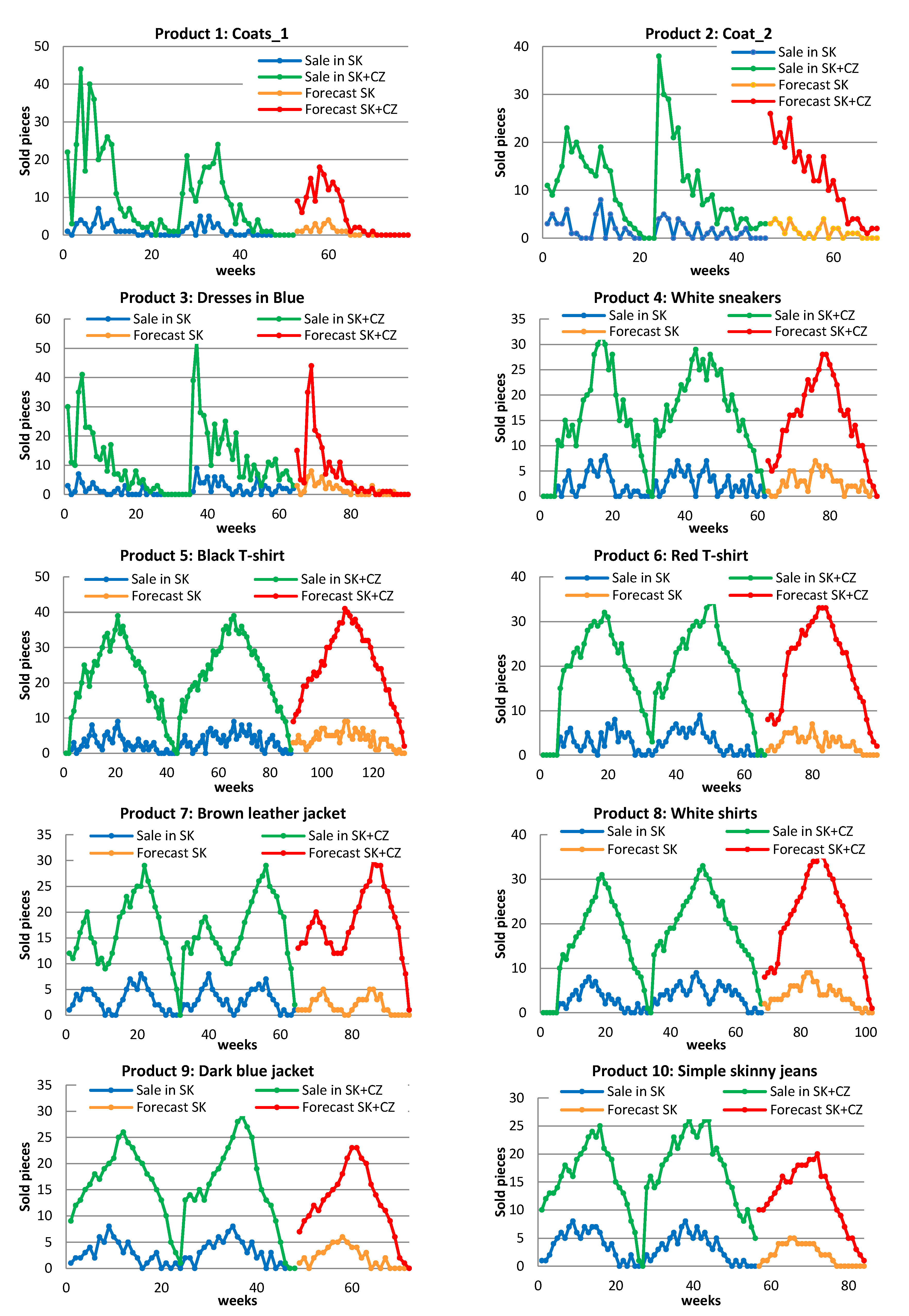
Figure 2.
Graph diagrams of the real products sales and forecasting in 2019.
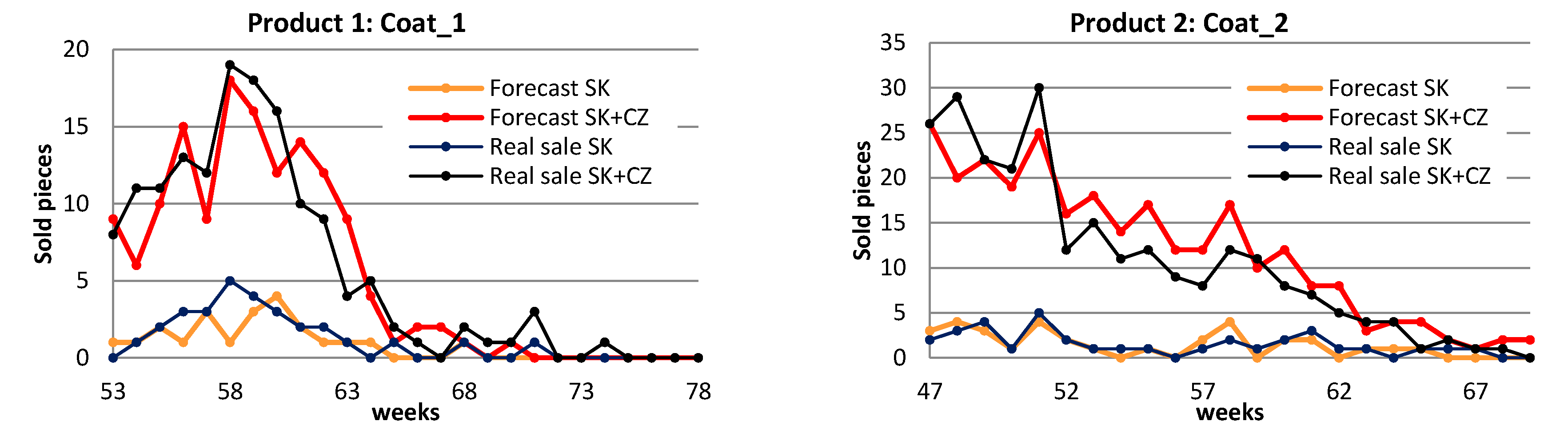
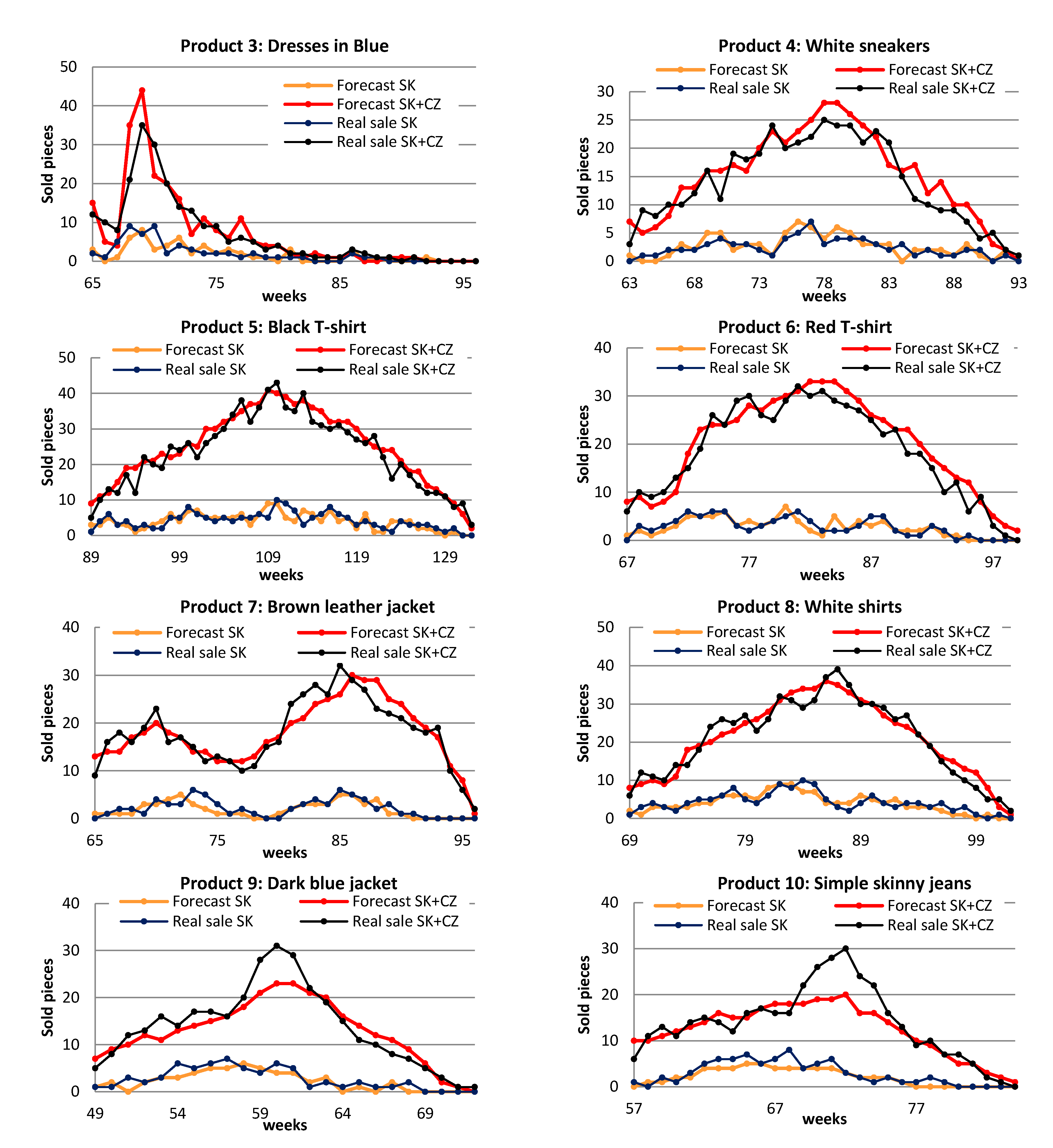

Table 1.
Registered periods of the products sale.
| Product | Date of registered sale (period of sale) |
|---|---|
| Product 1: Coats_1 | 01/01 - 30/06 2017 and 01/01 - 30/06 2018 |
| Product 2: Coats_2 | 01/01 - end of May 2017 and 01/01 - first week of June 2018 |
| Product 3: Dresses in Blue | 07/05 - end of November 2017 and 08/05 - 05/12 2018 |
| Product 4: White sneakers | 01/02 - 31/08 2017 and 01/02 - 31/08 2018 |
| Product 5: Black T-shirt | 10/01 - end of October 2017 and 11/01 - end of October 2018 |
| Product 6: Red T-shirt | 01/02 - mid September 2017 and 01/02 - mid September 2018 |
| Product 7: Brown leather jacket | 01/03 - 30/09 2017 and 01/03 - 30/09 2018 |
| Product 8: White shirts | mid-March - 31/10 2017 and mid-March - 31/10 2018 |
| Product 9: Dark blue jacket | 01/01 - mid June 2017 and 01/01 - mid June 2018 |
| Product 10: Simple skinny jeans | 01/05 - 31/10 2017 and 01/05 - 31/10 2018 |
Table 2.
Transformation of periods to weeks in graph diagrams.
| Product | X axis (weeks in graph diagrams) |
Forecast (weeks in diagram) |
|---|---|---|
| Product 1: Coats_1 | 1-26 and 27-52 | 53-78 |
| Product 2: Coats_2 | 1-23 and 24-46 | 47-69 |
| Product 3: Dresses in Blue | 1-32 and 33-64 | 65-96 |
| Product 4: White sneakers | 1-31 and 32-62 | 63-93 |
| Product 5: Black T-shirt | 1-44 and 45-88 | 89-132 |
| Product 6: Red T-shirt | 1-33 and 34-66 | 67-99 |
| Product 7: Brown leather jacket | 1-32 and 33-64 | 65-96 |
| Product 8: White shirts | 1-34 and 35-68 | 69-102 |
| Product 9: Dark blue jacket | 1-24 and 25-48 | 49-72 |
| Product 10: Simple skinny jeans | 1-28 and 29-56 | 57-84 |
Table 3.
Transformation of periods to weeks in graph diagrams.
| Product | RMSE | MAPE | ||
|---|---|---|---|---|
| SK | SK+CZ | SK | SK+CZ | |
| Product 1: Coats_1 | 1.019 | 2.236 | 19.04% | 31.24% |
| Product 2: Coats_2 | 0.834 | 3.369 | 25.51% | 35.49% |
| Product 3: Dresses in Blue | 1.668 | 3.841 | 29.71% | 23.49% |
| Product 4: White sneakers | 1.136 | 2.806 | 28.74% | 22.59% |
| Product 5: Black T-shirt | 1.638 | 2.900 | 29.31% | 12.76% |
| Product 6: Red T-shirt | 1.155 | 2.752 | 27.03% | 24.26% |
| Product 7: Brown leather jacket | 1.250 | 2.710 | 28.40% | 12.89% |
| Product 8: White shirts | 1.361 | 2.532 | 27.31% | 14.18% |
| Product 9: Dark blue jacket | 1.323 | 3.123 | 26.63% | 17.43% |
| Product 10: Simple skinny jeans | 1.336 | 3.808 | 24.72% | 20.64% |
Disclaimer/Publisher’s Note: The statements, opinions and data contained in all publications are solely those of the individual author(s) and contributor(s) and not of MDPI and/or the editor(s). MDPI and/or the editor(s) disclaim responsibility for any injury to people or property resulting from any ideas, methods, instructions or products referred to in the content. |
© 2023 by the authors. Licensee MDPI, Basel, Switzerland. This article is an open access article distributed under the terms and conditions of the Creative Commons Attribution (CC BY) license (http://creativecommons.org/licenses/by/4.0/).
Copyright: This open access article is published under a Creative Commons CC BY 4.0 license, which permit the free download, distribution, and reuse, provided that the author and preprint are cited in any reuse.


