
Submitted:
04 September 2023
Posted:
06 September 2023
You are already at the latest version
Abstract
In this paper, we study semiconic idempotent commutative residuated lattices. After giving some
properties of such residuated lattices, we obtain a structure theorem for semiconic idempotent com-
mutative residuated lattices. As an application, we make use of the structure theorem to prove that
the variety of strongly semiconic idempotent commutative residuated lattices has the amalgamation
property.
Keywords:
Residuated lattices
; Idempotent semigroup
; Chain
; Construction
; Amalgamation
MSC: 06F05; 20M10
1. Introduction
A commutative residuated lattice is defined as an algebra of type satisfying the following conditions:
is a lattice;
is a commutative monoid with identity e; and
, where ≤ is the lattice ordering.
Some time, commutative residuated lattices are also called commutative residuated lattice-ordered monoids and abbreviated by CRLs. It is well known that holds if and only if ≤ is compatible with · and for all contains a greatest element (denoted by .
A CRL is called idempotent if for all , ; is called integral if for all , ; is called totally ordered if for all , or ; is called semilinear when it is a subdirect product of totally ordered CRLs; is called conic if for all , or (see [4,9,12]). A semilinear idempotent CRL is said to be an odd Sugihara monoid if for all , . An integral idempotent CRL is said to be a Brouwerian algebra if for all , . As in [12], a CRL is called semiconic when it is a subdirect product of conic CRLs.
Idempotent CRLs form an important tool both in algebra and logic ( see [10]). Among them, semiconic ones make a valuable contribution, because they include several important algebraic counterparts of substructural logics (see [19]). Recently, algebra properties for semiconic CRLs have been given by many authors ( see [4,5,7,8,9,10,12,13,14,15,16,17,18,19,20,21]). In [20], the authors obtain a structure theorem for semilinear idempotent CRLs. In this paper, we will investigated algebraic structure properties of semiconic idempotent CRLs. Idempotent CRLs are indeed ordered semigroups (for ordered semigroups, see [1]). The natural partial order play an important role in investigation of semigroups (see [16]). We will make use of the natural partial order to obtain some important properties and then establish a structure theorem of semiconic idempotent CRLs, which generalizes the main result of [20].
We proceed as follows: in Section 2, we present some definitions and facts used in the sequel. In Section 3, we obtain some properties of semiconic idempotent CRLs. In Section 4, we give a structure theorem for semiconic idempotent CRLs, which generalizes the main result of [20]. In Section 5, we prove that the variety of strongly semiconic idempotent CRLs has the amalgamation property, which generalizes the main result of [11].
2. Preliminaries
In this section, we will list some facts about CRLs.
A monoid is said to be a po-monoid when it is also a poset , and in which ≤ is compatible with ·, in the sense that . A po-monoid is said to be a lattice-ordered monoid when is a lattice. A lattice-ordered monoid is said to be idempotent if for all , ; is said to be commutative when the monoid reduct is a commutative monoid; is said to be conic, if for all , or . For convenience, we simply write as for . The reader is referred to reference [1] for detailed information on lattice-ordered monoids.
We need the following results.
Lemma 1.
[21]Let be an idempotent lattice-ordered monoid with identity e, and .
.
If , then .
If , then .
If , then .
If , then .
Let be a CRL and ≤ shall always denote the lattice order of in this paper.
From now on, we denote and by and , respectively. Next, we shall present some known facts on conic idempotent s used in later proofs. More details on semiconic residuated lattices can be found in [4,12,13].
Lemma 3.
[12]Let be a conic idempotent , and .
If a and b are incomparable, then
The elements a and are comparable.
if and only if
If , then
is a chain in
3. Some Properties
To begin with, we obtain some properties of conic idempotent commutative lattice-ordered monoids.
Now let be a conic idempotent commutative lattice-ordered monoid. Since the monoid reduct of is an idempotent commutative monoid, we define the natural partial order on as follows: for ,
It is clear that is a semilattice. For , [resp. ] means that a and b are incomparable under ≤ [resp. ]; [resp. ] means that [resp. ] and for any , [resp. ] implies either or . Let and if it exists in .
Proposition 1.
Let be a conic idempotent commutative lattice-ordered monoid. The following statements are true for :
- (1)
- If , then if and only if .
- (2)
- If , then if and only if .
- (3)
- if and only if .
- (4)
- If and , then .
- (5)
- If and , then .
Proof. Let be such that . Then by Lemma 1(3),
: is similar to .
If , then since is conic, or . If , then by , is impossible. Thus . Similarly, if , then . Conversely, let such that . Suppose that or . Then since is conic, by Lemma 1(4,5), or , which implies that or , a contradiction. Hence or . Thus, by (1) and (2), .
Let such that and . Then by Lemma 1(3), . Let such that and . Then and , so . Thus . Since and ,
Let such that and . Then by Lemma 1(2), . So by (2), and . Let such that and . Then and , so . Thus . Therefore . □
Secondly, we obtain some properties of conic idempotent CRLs.
Proposition 2.
Let be a conic idempotent . The following statements are true for :
- (1)
- If , then and .
- (2)
- If and , then .
- (3)
- If , then and .
- (4)
- If and , then .
- (5)
- If and , then and
Proof. Let such that . Then and so . Since by Lemma 2(4), by Lemma 1(5), which implies that Since by Lemma 3(2), , by Proposition 1(3), .
Let such that and . Then and so . Suppose that . Then since by Lemma 3(4), , by Proposition 1(2), , contrary to . Thus
: is similar to .
: is similar to .
Let such that and . Since , by (1), and Let such that and . Then and , so by Lemma 2(1). Thus . Therefore Because , by Lemma 2(3). Suppose that Then , so by , . But since , by Lemma 3(4), a contradiction. Thus . □
Proposition 3.
[4]Let be a conic idempotent , and let such that . If or , then or
Let be a join-semilattice, and let such that for all . is said to be an upper pre-lattice when isn’t a lattice and is a lattice. Let be a lattice and . is said to be an upper pre-sublattice of if is an upper pre-lattice and there exists such that is a sublattice of . Similarly, we can define lower pre-lattice and lower pre-sublattice.
Let be a conic idempotent CRL. We define the following sets: , , , , . For every , let . By Lemma 3(4), for all . Since for all by Proposition 2(1,3) and Lemma 3(4), by Proposition 2(4). It follows that for all . Because and is a chain by Lemma 3(5), is a chain. It is clear that .
We have the following result, which generalizes [7].
Theorem 1.
Let be a conic idempotent .
If , then if and only if .
If , then if and only if . In addition, for all .
If such that , then .
If , then is a sublattice of and is a Brouwerian algebra, where is given by for all .
If , then has a greatest element j and is either a sublattice of or an upper pre-sublattice of .
If such that , and then .
If and such that is an upper pre-sublattice of , then there exists such that in and is a sublattice of with a least element .
If satisfies that , then is a sublattice of for all .
If and , then .
is finitely subdirectly irreducible if and only if is a finitely subdirectly irreducible Brouwerian algebra.
is a totally ordered odd Sugihara monoid and subalgebra of , that we call its skeleton.
Proof. We only need to verify the necessity because the sufficiency is clear. Suppose that . Then there exists such that . Thus by Lemma 2(6), .
We only need to prove the sufficiency because the necessity is obvious. Suppose that . Since by assumption, by . Let . Then by Proposition 2(1), . Let such that . Suppose that . If , then by Proposition 2(2), , a contradiction. If , then since , by Proposition 2(4), a contradiction. Consequently, .
It is obvious.
Let and let . Then which together with by Lemmas 2(3) and 3(5), derives that , whence . If or , then or , and so , which implies that . If then by Proposition 2(5), and so , which implies that . Thus is a sublattice of . By (1), . Let . Then . Thus i is the greatest element of and so is an integral idempotent commutative lattice-ordered monoid with an identity i. We can claim that for all . To prove this, we consider the following cases:
- If , then by Lemma 3(3) and so .
- If or , then by Proposition 3, or . So or by Lemma 3(1). Thus , whence
We define for all . Thus is a Brouwerian algebra.
Let . By similar arguments as in the proof of , j is the greatest element of and for all , so is a join-semilattice with a greatest element j. Suppose that isn’t a sublattice of . Then there exist such that and Hence and by Lemma 2(3). Let . Suppose that . Then by Lemma 3(1), which is contrary to . Assume that . Then by Lemma 2(3), which is contrary to . Thus for all , Similarly, if such that then for all , It follows that . Therefore is a sublattice of . Consequently, is an upper pre-sublattice.
Let such that and let , . If , then by , and . Suppose that . Then , which is contrary to . Thus by Lemma 3(2), whence . Conversely, if , then and . Suppose that . Then , which is contrary to . Thus . Similarly, .
Let and such that is an upper pre-sublattice of . Then there exist such that and Let . Then . Since , by . Let such that . Suppose that . Then by , contrary to . Thus in . We have . We claim that . Otherwise, if , then since , by (6) and so . It follows that . It’s a contradiction. Thus . Consequently, is a sublattice of with a least element .
Let and . Then and so . It follows that is a sublattice of .
Since and , by and . Then and by Proposition 1(1-2). Suppose that . Then . Conversely, assume that . We claim that . Otherwise if , then , which contrary to . Consequently, by Lemma 3(4). By Proposition 2(1,3), and . Suppose that If , then , and so by Proposition 2(2), , which contrary to . If , then , and so by Proposition 2(4), , which contrary to . Consequently, .
Suppose that is finitely subdirectly irreducible, then e is join-irreducible in L. Since is a sublattice of , e is join-irreducible in , which implies that is finitely subdirectly irreducible. Conversely, is finitely subdirectly irreducible. Then e is join-irreducible in . By (6), we have that for all and such that , which implies that e is join-irreducible in Thus is finitely subdirectly irreducible.
By Lemma 3(5), is a totally ordered set, which implies that is a sublattice of . Let . If , then . If , then . If or , then by Lemma 1(4,5), . Thus is closed with respect to multiplication. By Lemma 2(7), we have . Consequently, is a subalgebra of . By Lemma 2(6), . It follows that is a totally ordered odd Sugihara monoid. □
Theorem 2.
Let be conic idempotent s, and be a homomorphism between conic idempotent s.
and for all .
If such that is an upper pre-sublattice of and , then is an upper pre-sublattice of and there exists such that in and in .
Proof. Let . Then there exists such that . Since f is a homomorphism, , which implies that . Let and . Then and so , which implies that . It follows that .
Since is an upper pre-sublattice of , by Theorem 1(4) and there exist such that . Let . By the proof of Theorem 1(7), in and so in L. Hence by Theorem 1(6). It follows that and by Theorem 1(2). We claim that . Otherwise if , then and so by Proposition 2(4), , which contrary to . Thus . We have and by (1). Suppose that . Then and so by Proposition 2(1,3), which contrary to . Consequently, . It follows that is an upper pre-sublattice of and by the proof of Theorem 1(7), in . □
4. The Construction Theorem
In this section we shall show how to construct a conic idempotent and then prove that any conic idempotent is isomorphic to some conic idempotent constructed in this way.
To start with, we introduce some new concepts.
Definition 1.
Let be a chain with a greatest element e. Let such that and for every pair such that . Let . Let be a family of pairwise disjoint nonempty poset indexed by J. is called a chain expansion-system (abbreviated by -system) if the following conditions hold:
- (CE1)
- If , then is a Brouwerian algebra with a greatest element i.
- (CE2)
- If , then is either a lattice with a greatest element or an upper pre-lattice with a greatest element .
- (CE3)
- If such that is an upper pre-lattice, then there exists such that in I.
Given a -system , put . Define a binary relation ≤ on the set L as follows. Let . in L if one of the following conditions is satisfied:
- (P1)
- and .
- (P2)
- and .
- (P3)
- , and in I.
- (P4)
- and .
Lemma 4. is a lattice.
Proof.
Firstly, we will prove that is a poset. Obviously, ≤ is reflexive. Next we prove that ≤ is antisymmetric. To see this, let such that and .We consider four cases:
- If , then by , and . Since is a poset, .
- Suppose and . Then since and , and , a contradiction. Thus and is impossible.
- By similar arguments as in the previous case, and is impossible.
- Similarly, either or is impossible.
Next, we prove that ≤ is transitive. Let be such that and . We consider four cases:
- . Then by , and . Since is a poset, . Thus by , .
- . If and , then and so by , . If such that in I, then and so by , . If and , then and so by , .
- . Then by similar arguments as in the prior case , .
- and . If , then and , and so , which implies that by . If and , then by , . If such that , then and in I by . Since is a chain, and so by , .
We conclude , and whence ≤ is transitive.
Finally, we will prove that for all , and exist in L. Let . We consider three cases:
- If , then and in L.
- If , then and in L.
- If , then by the definition of ≤, . If , then since is a Brouwerian algebra, exist in . Let such that . If , then by , and , and so . Thus by , . If , then since , either and or , which together with , derives that . It follows that in L. Similarly, in L. If , then is either a lattice or a pre-lattice by (CE2). If is a lattice or an upper pre-lattice and exists, then by similar arguments as in the prior case, and in L. If is an upper pre-lattice and doesn’t exist, then by similar arguments in the prior case, in L. By (CE3), there exists such that in I. We claim that in L. Because is the greatest element of by , by . Let such that . Since is an upper pre-lattice and doesn’t exist, , and so by , either or there exists such that and in I, which implies that either or such that . It follows that by . Thus in L.
□
We define a multiplication ∘ on L in the following ways: for ,
Lemma 5. is a conic lattice-ordered idempotent commutative monoid with identity e.
Proof.
It is clear that and for .
Let . If , then since e is the greatest of I, which together with e is the greatest element of by , derives that and . If , then , so and . Now, we will show that ∘ satisfies the associative law. Let . We consider the following cases:
- If then and whence .
-
If and , thenandIt follows that .
-
If thenandHowever, .
- If then and whence .
Finally, we will show that ≤ is compatible with ∘. Let be such that . We need only to prove that for every . Suppose that . We need to consider the following cases:
If , then by the definition of ∘, and . Since , .
If and , then and . The following subcases need be considered:
- If , then and so by the definition of ∘, and , whence .
- If , then by the definition of ∘, and . It follows that .
If and , then by the definition of ∘, and , whence .
If and , then , so by the definition of ∘, and , whence .
If and , then since , in I by . The following subcases need be considered:
- If , then by the definition of ∘, and , whence .
- If , then by the definition of ∘, and . It follows that .
If , then by the definition of ∘, and , whence . □
We may define a binary operation → on L in the following way: for such that ,
We denote by the above .
Theorem 3.
is a conic idempotentCRL
.
Proof.
We need only to prove that for all . Suppose that . We need to consider the following cases:
Case 1. and , or and . We need only to check the following subcases:
If and , then by the definition of ∘, . Let such that . If , then by , . If , then by , and by the definition of ∘, , which together with , derives that . Thus , whence .
If and , then by the definition of ∘ and , . Let such that . If , then by , . If , then by the definition of ∘, . Assume that . Then by the definition of ∘, , so by , which is contrary to . Thus , which implies that and so by and .
Case 2. and , or and . We need only to check the following subcases:
If and , then by , and so by the definition of ∘, . Let such that . Suppose that . Then by , and by the definition of ∘, , which implies that , a contradiction. Suppose that such that . Then , which implies that , a contradiction. Thus and , whence
If and , then by the definition of ∘, . Let such that . If , then by . If such that , then and so by . If such that , then by the definition of ∘, .
Case 3. such that or . Then by the definition of ∘ and , , which implies that . Let such that . Suppose that or such that . Then by , and by the definition of ∘, , which implies that , a contradiction. If such that , then by . If such that , then by the definition of ∘, , which implies that , so by . Thus .
Case 4. and , or and . We need only to check the following subcases:
If and , then by the definition of ∘, . Let such that . If , then by . If , then by the definition of ∘, .
If and , then by the definition of ∘, . Let such that . Suppose that . Then by the definition of ∘, , a contradiction. If , then by the definition of ∘, , which together with , derives that .
Case 5. and , or and . We need only to check the following subcases:
If and , then by the definition of ∘ and , . Let such that . Suppose that . Then , a contradiction. If , then by the definition of ∘, , which together with , derives that .
If and , then by the definition of ∘ and , . Let such that . Suppose that . Then by the definition of ∘, , a contradiction. If , then by the definition of ∘, , which together with , derives that . Thus , whence . □
Next we shall prove that any conic idempotent CRL is isomorphic to some . Suppose that is a conic idempotent CRL. Let , and . Let . By Proposition 2, for all , , so . If such that , then there exist such that and , so . Thus .
Lemma 6. is a -system.
Proof.
By Theorem 1(1-5,7), is a -system. □
Theorem 4.
is equal to .
Proof.
For convenience, we denote by the imposed ordering on . We need only to prove that for all and .
We now prove . Let . Assume that . We need to consider three cases:
If , then by Lemma 3(4) and by Theorem 1(6), , which together with and , derives that by .
If then , which together with and , derives that by Theorem 1(6). Thus by , .
If and then by Lemma 3(4), and , so and , whence by ,
Thus
Suppose that . We need to consider four cases:
If , then by .
If such that , then by Theorem 1(6), .
If such that , then by Theorem 1(6), .
If and , then by Lemma 3(4), and , so .
Thus whence
It remains to verify for all . For this, we need to consider three cases:
If , then by Lemma 1(3), On the other hand, by the definition of ∘ and , , whence .
If then by similar arguments as in (1),
and .
- If , then by Lemma 3(4) and by Lemma 2(3), which together with and derives by the definition of ∘. On the other hand, by Proposition 2(3). Hence .
- If , then by Lemma 3(4) and by Theorem 1(4), which together with and derives by the definition of Suppose that . Then , so by Proposition 2(4), , a contradiction. Thus by Lemma 1(4,5). Hence .
□
By Theorem 4, we have the following result, which generalizes [20].
Theorem 5.
Let be aCRL. The following conditions are equivalent:
- (I)
- is a subdirectly irreducible idempotent semiconicCRL .
- (II)
-
There exists a -system such thatis a nontrivial subdirectly irreducible Brouwerian algebra or and there exists such that in I;.
Proof.
Let be a subdirectly irreducible semiconic idempotent CRL. Then since semiconic idempotent CRL is the variety generated by conic idempotent CRLs, is conic. By Theorem 4, , where is a -system. Because is a subdirectly irreducible CRL, the set has a greatest element. Let . If , then , so by Theorem 1(4), is a nontrivial subdirectly irreducible Brouwerian algebra. If , then since , and , so , which implies that . On the other hand, by Proposition 2(1), , so . Thus , whence by Theorem 1(1).
Conversely, let be a -system such that and . Then by Theorem 3, is a conic idempotent CRL. If is a nontrivial subdirectly irreducible Brouwerian algebra, then exists and so , which implies that is a subdirectly irreducible semiconic idempotent CRL. If and there exists such that , then by , , which implies that is a subdirectly irreducible semiconic idempotent CRL. □
5. The Amalgamation Property
In this section we will use the structure theorem of conic idempotent CRLs to give some new result about the amalgamation property of the variety of semiconic idempotent CRLs, which generalize the main results of [11].
Let be a class of algebras. A span is a pair of embeddings between algebras . The class K is said to have the amalgamation property if for every span of K, there exist an amalgam and embeddings and such that .
Example 1.
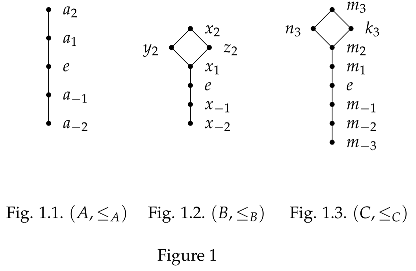
eFig. 1.1. eFig. 1.2. eFig. 1.3. Figure 1
Let . We define an order relation on A by , see Figure 1.1. We can define a multiplication operation on A by for all ,
and for all . Let . We define an order relation on B by , see Figure 1.2. We can define a multiplication operation on B by for all and ,
and for all . Let . We define an order relation on C by , see Figure 1.3. We can define a multiplication operation on C by for all and ,
and for all . We define a division operation on P by for all , where . It’s easy to see that and are subdirectly irreducible semiconic idempotentCRLs. We define two maps as follows: ; and for ; ; , for and . It’s clear that , are embeddings of into respectively. We claim that there doesn’t an amalgam in where is the class of all conic idempotentCRLs. Suppose that there exist an amalgam and embeddings and such that . Then and . Hence by Theorem 2, in . But in . It’s a contradiction. We conclude that the span hasn’t an amalgam in .
By Example 1, we have the following result.
Proposition 4.
The class of all conic idempotentCRLs and the class of subdirectly irreducible semiconic idempotentCRLs haven’t the amalgamation property.
Definition 2.
The variety of strongly semiconic idempotentCRLs consists of the semiconic idempotentCRLs that satisfy
Proposition 5.
A conic idempotentCRL is a strongly semiconic idempotentCRLif and only if is a lattice for all .
Let be a CRL. A lattice filter F of is called normal if it contains e and it’s closed under multiplication. A normal filter F of is said to be prime if it is prime in the usual lattice-theoretic sense; that is, whenever , then or Let F and be a normal filter and a congruence of respectively. It’s well known that is a congruence of and the upper set of the equivalence class is a normal filter. Moreover:
Lemma 7.
[2]The lattice of normal filters of aCRL is isomorphic to its congruence lattice . The isomorphism is given by the mutually inverse maps and .
Lemma 8.
In what follows, if F is a normal filter of , shall always denote the quotient algebra . Given a element , we write or if no confusion for the equivalence class of x in .
Lemma 9.
Let be a semiconicCRL, and let F be a normal filter of . Then the following statements are equivalent
- (1)
- F is prime.
- (2)
- For all , whenever , then or .
- (3)
- is a finitely subdirectly irreducible conicCRL .
Proof. By specialization.
Suppose that holds, and let . Since is semiconic, . It follows that either or . If , then by Lemma 8, . If , then Thus is a conic CRL. Let such that . Then since is conic, , which implies that . Hence or , which derives that or . Since and . It follows that or . Consequently, is a finitely subdirectly irreducible conic CRL.
Assume that holds, and let such that . Then . It follows that or or or . Thus F is prime. □
Lemma 10.
[2]Let be a residuated lattice and , finite subsets of the negative cone of with the property that , for any i and j. Then
Lemma 11.
[15]Let be a subclass of a variety satisfying the following conditions:
- (i)
- Every subdirectly irreducible member of is in .
- (ii)
- is closed under isomorphisms and subalgebras.
- (iii)
- For any algebra and subalgebra of , if and , then there exists such that and .
- (iV)
- Every span in has an amalgam in .
Then has the amalgamation property.
We have the following result, which generalizes [15] in the commutative case.
Theorem 6.
Let be a variety of semiconicCRLs, and suppose that the class of finitely subdirectly irreducible conicCRLs in has the amalgamation property. Then has the amalgamation property.
Proof.
It is well known that every subdirectly irreducible semiconic CRL is a finitely subdirectly irreducible conic CRL. It is clear that the class of finitely subdirectly irreducible conic CRL is closed under isomorphisms and subalgebras. By Lemma 11, we need only to prove that for any , any subalgebra of , and such that is a finitely subdirectly irreducible conic CRL, there is such that and is a finitely subdirectly irreducible conic CRL. Since has the congruence extension property, there is a normal filter F of , such that . Let denote the poset, under set-inclusion, of all set-inclusion, of all normal filters of whose intersection with A is P. Since , . By Zorn’s lemma, element Q. Next, we shall show that Q is a prime normal filter of . Suppose otherwise, and let be such that but and . Let and be the normal filters of generated by and , respectively. Then, by the maximality of Q, P is a proper subset of the normal filters and of and so there exist elements , and such that , and . Hence by Lemma 8, and . Thus by Lemma 10, . It follows that . Since , the map is an embedding, which together with derives that . Because is a finitely subdirectly irreducible conic CRL, or . Then by Lemma 8, , or . But , which is a contradiction. Thus Q is a prime normal filter of , and by Lemma 9, is a finitely subdirectly irreducible conic CRL. The proof of the theorem is complete. □
Lemma 12.
[11]The class of totally ordered Sugihara monoids has the amalgamation property.
The following result is essentially due to Maksimova (see [6]).
Lemma 13.(Maksimova) The variety all Brouwerian algebras has the amalgamation property and the class of finitely subdirectly irreducible Brouwerian algebras has the amalgamation property.
Theorem 7.
The class of finitely subdirectly irreducible strongly conic idempotentCRLs has the amalgamation property.
Proof.
Let be a span of finitely subdirectly irreducible strongly conic idempotent CRLs, assuming without loss of generality that and are inclusion maps and that Then using Theorem 1(11), we also have inclusions between their skeletons and . Since by Theorem 1(11), these skeletons are totally ordered odd Sugihara monoids, Lemma 12 yields an amalgam J for this span that is also a totally ordered odd Sugihara monoid. Moreover, we may assume that . Let and .
Consider . Recalling that , clearly and . If , then by Theorem 1(10), , and are finitely subdirectly irreducible Brouwerian algebras and by Theorem 2, is a subalgebra of and . Hence by Lemma 13, there exists a finitely subdirectly irreducible Brouwerian algebra as an amalgam with . If , then by Lemma 13, there exists a Brouwerian algebra as an amalgam with . If , then by Proposition 5, each of and is a lattice. It is well known that class of lattices has the amalgamation property. It follows that there exists a lattice as an amalgam with . Since i is the greatest element of and , it is also the greatest element of . Now, for all and , let and . Let . By construction, is a -system. Thus is a conic idempotent CRL. Since is a finitely subdirectly irreducible Brouwerian algebra, is a finitely subdirectly irreducible conic idempotent CRL. By Proposition 5, is strongly finitely subdirectly irreducible conic idempotent CRL. To show that is an amalgam of the original span, it suffices to check that and are subalgebras of . Consider with . Then . If in , then and , so and . If , then since is a lattice and is a sublattice of , and . If , then since is a Brouwerian algebra and is a subalgebra of , and . Thus is a sublattice of . By the definition of , we have
and
Thus .
By the similar arguments, we have .
The proof that is a subalgebra of is symmetrical. □
Since every variety of commutative residuated lattices has the congruence extension property, by Theorem 6, we have the following result ,which generalizes [11, Theorem 5.6].
Theorem 8.
The variety of strongly semiconic idempotentCRLs has the amalgamation property.
Funding
This research was funded by the NSF of China grant number 11571158 and the NSF of Fujian Province grant number 2020J01799.
Data Availability Statement
This paper contains no data.
Conflicts of Interest
The author declares no conflict of interest.
References
- Birkhoff, G. : Lattice Theory; Amer. Math. Soc.: Providence, 1967. [Google Scholar]
- Blount, K. , Tsinakis, C.: The structure of residuated lattices. Internat. J. Algebra Comput. 2003, 13(4), 437–461. [Google Scholar] [CrossRef]
- Chen, W. : On semiconic idempotent commutative residuated lattices. Algebra Univers. 2020, 81, 36. [Google Scholar] [CrossRef]
- Chen, W. , Chen, Y.: Variety generated by conical residuated lattice-ordered idempotent monoids. Semigroup Forum 2019, 98, 431–455. [Google Scholar] [CrossRef]
- Chen, W. , Zhao, X.: The structure of idempotent residuated chains. Czechoslovak Mathematical Journal 2009, 59(134), 453–479. [Google Scholar] [CrossRef]
- Gabbay, D. M. , Maksimova, L.: Interpolation and definability: Modal and intuitionistic logics; Oxford Logic Guides, vol. 46, The Clarendon Press Oxford University Press: Oxford, 2005. [Google Scholar]
- Galatos, N. , Raftery, J.G.: Idempotent residuated structures: some category equivalences and their applications. Trans. Amer. Math. Soc. 2015, 367, 3189–3223. [Google Scholar] [CrossRef]
- Galatos, N. , Raftery, J.G.: A category equivalence for odd Sugihara monoids and its applications. J. Pure Appl. Algebra 2012, 216, 2177–2192. [Google Scholar] [CrossRef]
- Galatos, N. , Olson,J., Raftery, J.G.: Irreducible residuated semilattices and finitely based varieties. Rep. Math. Logic 2008, 43, 85–108. [Google Scholar]
- Galatos, N. , Jipsen, P., Kowalski, T., Ono, H.: Residuated Lattices: an algebraic glimpse at substructural logics; Studies in Logics and the Foundations of Mathematics, Elsevier, 2007.
- Gil-Férez, J. , Jipsen, P., Metcalfe, G.: Structure theorems for idempotent residuated lattices. Algebra Univers. 2020, 81, 28. [Google Scholar] [CrossRef]
- Hsieh, A. , Raftery, J.G.: Semiconic idempotent residuated structures. Algebra Univers. 2009, 61, 413–430. [Google Scholar] [CrossRef]
- Hsieh, A. : Some locally tabular logics with contraction and mingle. Reports on Mathematical Logic 2010, 45, 143–159. [Google Scholar]
- Jipsen, P. , Tsinakis, C., A survey of residuated lattices, in: Ordered Algebraic Structures; J. Martinez ed., Kluwer Academic Publishers, Dordrecht, 2002; 19-56.
- Metcalfe, G. , Montagna, F., Tsinakis, C.: Amalgamation and interpolation in ordered algebras. Journal of Algebra 2014, 402, 21–82. [Google Scholar] [CrossRef]
- Mitsch, H. : A natural partial order for semigroups. Proceedings of the American Mathematical Society 1986, 97(3), 384–384. [Google Scholar] [CrossRef]
- Olson, J.S. : The subvariety lattice for representable idempotent commutative residuated lattices. Algebra Univers. 2012, 67, 43–58. [Google Scholar] [CrossRef]
- Olson, J.S. : Free representable idempotent commutative residuated lattices. Internat. J. Algebra Comput. 2008, 18, 1365–1394. [Google Scholar] [CrossRef]
- Olson, J.S. , Raftery, J.G.: Positive Sugihara monoids. Algebra Univers. 2007, 57, 75–99. [Google Scholar] [CrossRef]
- Raftery, J.G. : Representable idempotent commutative residuated lattices. Trans. Amer. Math. Soc. 2007, 359, 4405–4427. [Google Scholar] [CrossRef]
- Stanovský, D. : Commutative idempotent residuated lattices. Czechoslovak Math. J. 2007, 57(132), 191–200. [Google Scholar] [CrossRef]
Disclaimer/Publisher’s Note: The statements, opinions and data contained in all publications are solely those of the individual author(s) and contributor(s) and not of MDPI and/or the editor(s). MDPI and/or the editor(s) disclaim responsibility for any injury to people or property resulting from any ideas, methods, instructions or products referred to in the content. |
© 2023 by the authors. Licensee MDPI, Basel, Switzerland. This article is an open access article distributed under the terms and conditions of the Creative Commons Attribution (CC BY) license (http://creativecommons.org/licenses/by/4.0/).
Copyright: This open access article is published under a Creative Commons CC BY 4.0 license, which permit the free download, distribution, and reuse, provided that the author and preprint are cited in any reuse.


