
Submitted:
28 August 2023
Posted:
04 September 2023
You are already at the latest version
Abstract
This research paper aims to unveil the splendor of the diverse architectural heritage of Lahore, one of the most culturally, ethnically and traditionally rich cities in the Indian subcontinent. Lahore is renowned for its Mughal-era grandeurs, British monuments and historic architecture which is meticulously embellished by a unique amalgamation of Islamic, Persian, and Indian architectural styles. The paper discusses some of the most significant historical buildings in Lahore, including the Lahore Fort, Shalimar Gardens, and traces their architectural evolution over time.The research also highlights the unprecedented challenges faced by Lahore’s architectural heritage in terms of preservation and its potential by which Lahore could emerge as a tourist attractive city. Due to less proper maintenance, a plethora of Lahore’s historical buildings are deteriorating rapidly. The paper outlines some of the measures that could be taken by the government and NGOs to restore a myriad of these buildings, including the formation of conservation boards and the enforcement of strict laws.Through a detailed and thorough analysis of the structural heritage of Lahore, this research paper calls on the need for greater restoration awareness and appreciation of the city’s mesmerizing historical marvels. The paper concludes that while there are significant challenges in conserving Lahore’s architectural heritage, concerted efforts by the government and the individuals can aid to safeguard these treasures for future generations.
Keywords:
Lahore
; Architecture
; south Asia
; Pakistan
Introduction
Lahore is a city with a diverse cultural legacy that dates back thousands of years. Its history is marked by a diverse range of influences, from Lodhi Dynasty to the Mughal Empire and the British colonial period. This paper explores the heritage of Lahore, with a focus on its mesmerizing architectural grandeur.
The main objectives of this research were:
- To analyze Lahore’s historical architectural diversity.
- To shed the light on the significance of restoration on Lahore’s historical marvels.
- To help boost the city’s tourism industry.
- To help improve Pakistan’s economic situation through Lahore’s tourism potential.
Figure 1.
Painting of Lahore made by Henry Ambrose Oldfield in January 1849. Note: The painting shows old skyline of Lahore along the bank of River Ravi (Hassan 2010).
Figure 1.
Painting of Lahore made by Henry Ambrose Oldfield in January 1849. Note: The painting shows old skyline of Lahore along the bank of River Ravi (Hassan 2010).
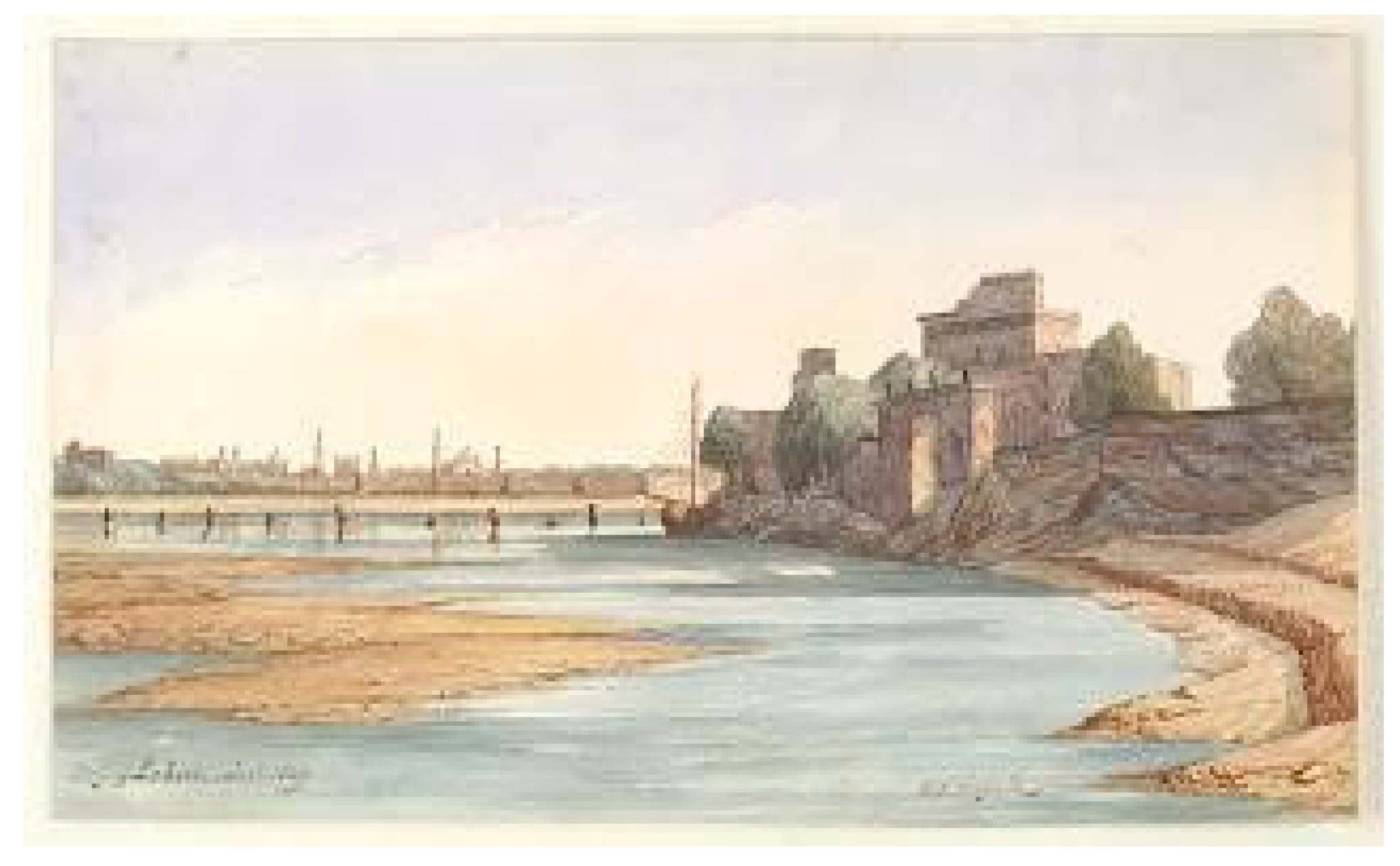
The article discusses about remains of Lahore’s historic evolution with a focus on city’s importance over the time. Furthermore, this research was based on five research questions and these questions were kept in view while laying the framework of this research. These questions are as follows;
- Is Lahore really South Asia’s historic treasure trove?
- Are the historical grandeurs of Lahore being restored?
- Are only the main attractions center of restoration or the attention is also being given to smaller ones?
- Can the work on Lahore’s historic marvels boost city’s tourism industry?
- How can tourism help to flourish Lahore’s economy?
An important aspect of Pakistan’s heritage is its architecture of Lahore. Lahore has remained as one of the most important cities in the world for centuries, connecting north western India to the north eastern India by the ancient Grand Trunk Road. ‘Lahore is Lahore’ famous by this saying, this city saw many crowns, treasures and jewels, be it Kohinoor Diamond or Lahore Diamond which this city had not adorned yet. The city served as the capital city of the Ghaznavid empire for many years. Lahore was the capital city of the Mughal empire for over fourteen years during Akbar’s reign.
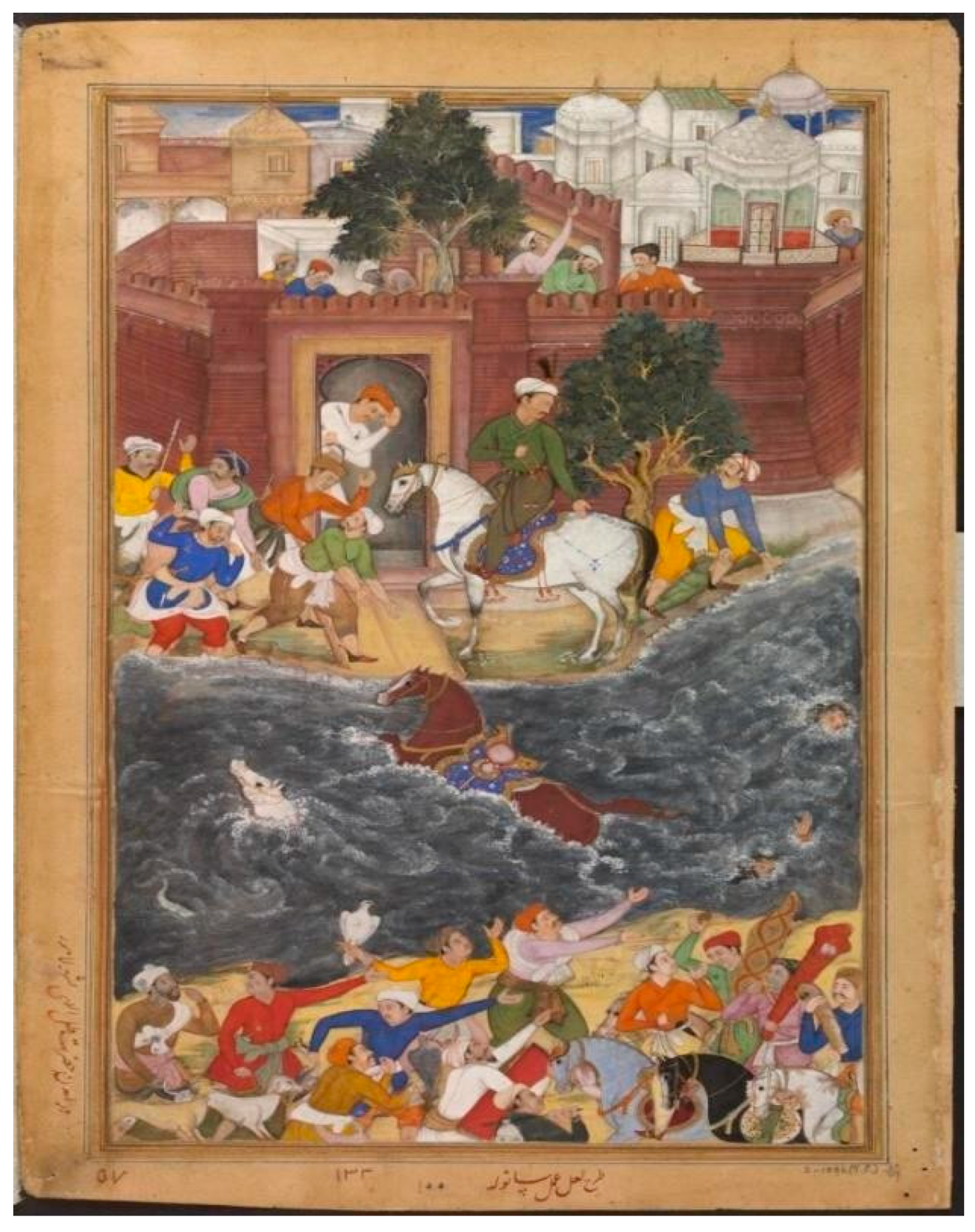
Figure 2.
Painting from Akbarnama made during 1590-1595. Note: The painting shows the Lahore Fort in the back, Akbar on the horse and River Ravi on the front (VAM 2023).
Figure 2.
Painting from Akbarnama made during 1590-1595. Note: The painting shows the Lahore Fort in the back, Akbar on the horse and River Ravi on the front (VAM 2023).
Ranjit Singh, the emperor of Sikh empire made Lahore as the capital city of his Raj. In the colonial period, the city served as the capital for the entire province of British Punjab. Nowadays, Lahore is the second most populous city of Pakistan, a major metropolitan city of the country and again sworn as the capital city of Punjab, Pakistan. In Lahore lies the resting place of many kings including Sultan Qutb-ud-Din Aibek, Jahangir and Maharaja Ranjit Singh. These events of the past are enough to show that Lahore has always been a center of attention of regional and foreign empires and kingdoms, thus making this city South Asia’s historic treasure trove.
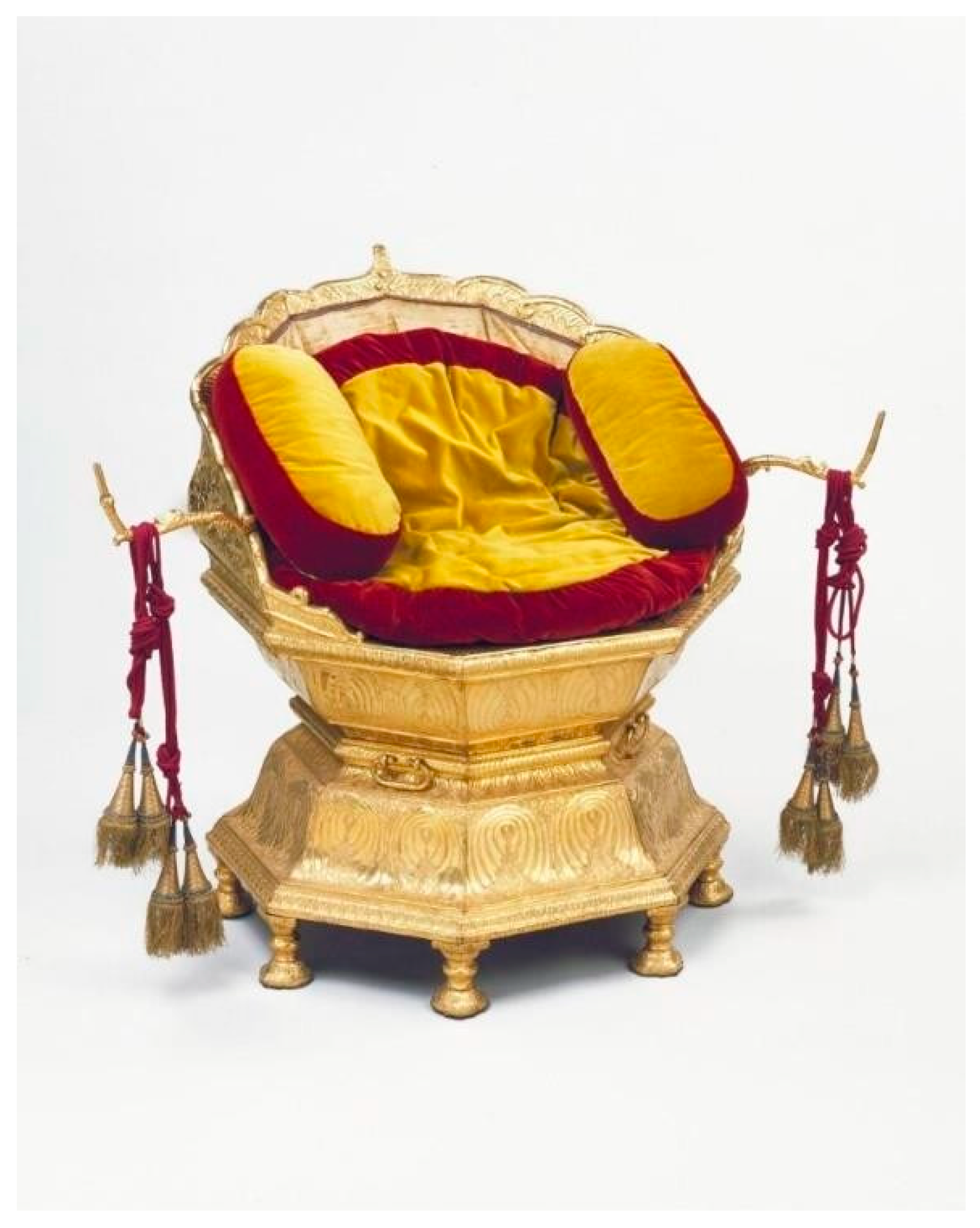
Figure 3.
Throne of Maharaja Ranjit Singh which was used in Lahore Fort during Maharaja’s time. Note: The throne is cladded in pure Gold (VAM 2023).
Figure 3.
Throne of Maharaja Ranjit Singh which was used in Lahore Fort during Maharaja’s time. Note: The throne is cladded in pure Gold (VAM 2023).
The city’s fort, palaces and gardens reflect its history of various empires and rulers. For example, the Badshahi Mosque in Lahore was built during the Mughal Empire and is one of the largest mosques in the world. The Shalimar Garden in Lahore, which was constructed on Shah Jahan’s vision of paradise, is a historic heritage site and is known for its fabulous intricate frescoes and decorative tiles.
Methodology
Research Design
This research paper aims fulfil the objectives of this research and to answer the research questions, a secondary research methodology was applied through qualitative analysis. By a detailed exploratory research, different research articles and books were studied on Lahore’s architectural heritage.
Data Collection
The data was majorly collected from different journal articles and books, while a few of it was taken from internet websites. On-site tour was done to capture some of the photographs needed in this research and to ensure that the transparency of the data collected was accurate and precise to be used in this study.
Data Analysis
The data collected was thoroughly studied and then analyzed on different scales. Firstly, the authenticity of the data was checked from different journal articles and internet websites so that the provided information is not outdated. Secondly, the cited sources were checked that they legitimate to be used in this research paper.
Literature Review
A city of many traditions, costumes, cuisines, traditions, landscapes, cultures and architectural marvels, Lahore never fails to mesmerize its tourists. Specifically, Lahore’s historic heritage has a versatile background, with many buildings and structural grandeurs
British and Christian Heritage
Lahore, a culturally enriched city, has a diverse British architectural landscape that includes several notable Christian buildings. These sites, such as the Cathedral Church of the Resurrection and the Sacred Heart Cathedral, showcases grand designs and intricate details like ornate spires, colorful glass windows, and marble floor.
Other Christian architectural landmarks in Lahore include the Forman Christian College and the Victoria Memorial Hall, Punjab Assembly, Governor House, Aitchison College, Lawrence and Montgomery Halls (Quaid-e-Azam Library), Bradlaugh Hall, Charing Cross, Mayo School of Arts, Punjab University, which serve as educational institutions, political avenues and cultural centers. These iconic buildings are a great testament to Lahore’s multicultural past and are an important part of the city’s extraordinary diverse heritage. During this time span, the British built many amazing and fabulous structures in Lahore, including government offices, educational institutes, and churches, with a distinguished blend of European and Indian architectural styles (Pervez 2017: p.25).
One of the most renowned British erections in Lahore is the Lahore High Court, which was completed in 1911, Punjab Assembly, which was constructed in 1861, and the Lahore Museum which was built in 1894. The high court comprises a distinctive humongous red-brick exterior with grey terrazzo stone floors and a central dome. The design of the building is geometrical, with two wings flanking the central dome connecting a large entrance portico. Punjab Assembly is rectangular in shape with pillars supporting its canopy, inspired from the European architectural styles. The Lahore Museum features a red stone exterior with white marble trim and three domes. The museum's interior is cherished with wood paneling, and impressive plasterwork. The High Court is functional and thus it is restored.
Lahore has a remarkable Christian heritage. The architecture of these churches reflects a blend of European and local styles. The Cathedral Church of the Resurrection was built in 1887, it features a Gothic style with ornate arches, ribbed vaults, and glass-stained windows. The church's interior is decorated with delicate wood carvings and intricate plasterwork. The renovation of the church is done when it seems necessary and the building is well maintained.
Lahore’s Bradlaugh Hall stands at the Rattigan Road, Lahore. It was built during the 19th century for the sessions of Indian National Congress (INC), hence the INC’s 1893 annual session was held at Bradlaugh Hall, Lahore (Asian Historical Architecture, 2011). The building was named after the British member of parliament (MP), Charles Bradlaugh. He was renowned for his secularist beliefs and devotion towards the social justice. After a few years, Lala Lajpat Rai formed a school here where the teaching curriculum was based on the basis of Indian nationalism. This building was the alma matter of many including, Bhagat Singh, Chandra Shekhar Azad, Raj Guru, Bhaguti Charan Daas, Master Mota Singh and Professor Bheem Seen who was the Registrar of the National College and later held the position of education minister of Punjab. All of these together laid the foundations of ‘Naujawan Sabha’ in 1926. This awe-inspiring building had been through a lot of adversities after the 1947 partition of India. The hall is currently in a situation of complete negligence by the government and the authorities (Naqvi, The Illustrious Philanthropist Lala Lajpat Rai and his memorabilia in Lahore).
Another important example of Christian architecture in Lahore is the Sacred Heart Cathedral. Built in 1907, the institute features a Romanesque style with a spherical dome and a bell tower. The interior of the cathedral is decorated with ornate marble altars, stained glass windows, and a painted ceiling. The interior of the church is adorned with stained glass windows, carved woodwork, and an elaborate pulpit. The maintenance of The Cathedral is done by the Sacred Heart School’s authority located in proximity to the church.
Charing Cross is a famous British landmark and roundabout located in the heart of Lahore, Pakistan. It is named after the Charing Cross in London, England, which is also a major intersection. The Lahore Charing Cross connects Mall Road, Jail Road, and Queen's Road, and it serves as a major traffic hub in the city. The roundabout features a typical Indian architectural aura. Since it is located in front of the Punjab Assembly, it’s look after is done by Punjab Government. The Lawrence Hall was built in 1864 and was used as a club for British officers. The structure was named after Sir Henry Montgomery Lawrence, a British soldier and commander who served in India during the mid-19th century. The Lawrence Hall is a beautiful example of Victorian architecture and showcases a dazzling facade with colorful carvings and ornamentation.
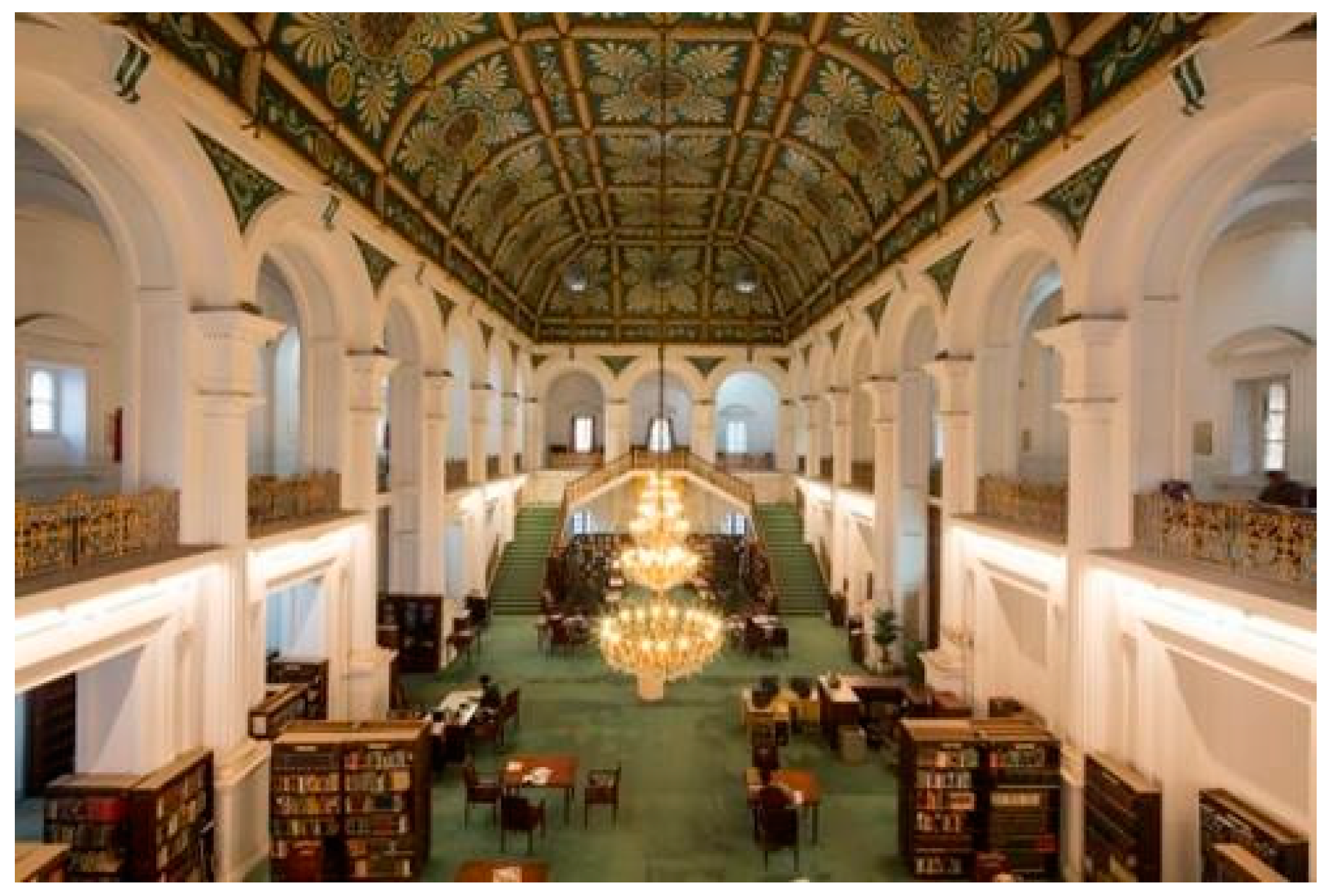
Figure 4.
Inside view of Lawrence Hall. Note: The roof of the hall shows the mixture of Indian and European styles (Hassan 2016).
Figure 4.
Inside view of Lawrence Hall. Note: The roof of the hall shows the mixture of Indian and European styles (Hassan 2016).
The Montgomery Hall, on the contrary, was built in 1874 and was used as barracks for British soldiers. The building was named after Field Marshal Bernard Law Montgomery, a British military leader who participated in World War II. The Montgomery Hall is also an impressive example of Victorian architecture and has a gigantic entrance with an enchanting clock tower. These halls provided as a site of recreation for British officers. Both of these halls were renamed as “Quaid-e-Azam Library”, after independence. Both of these halls are well preserved.
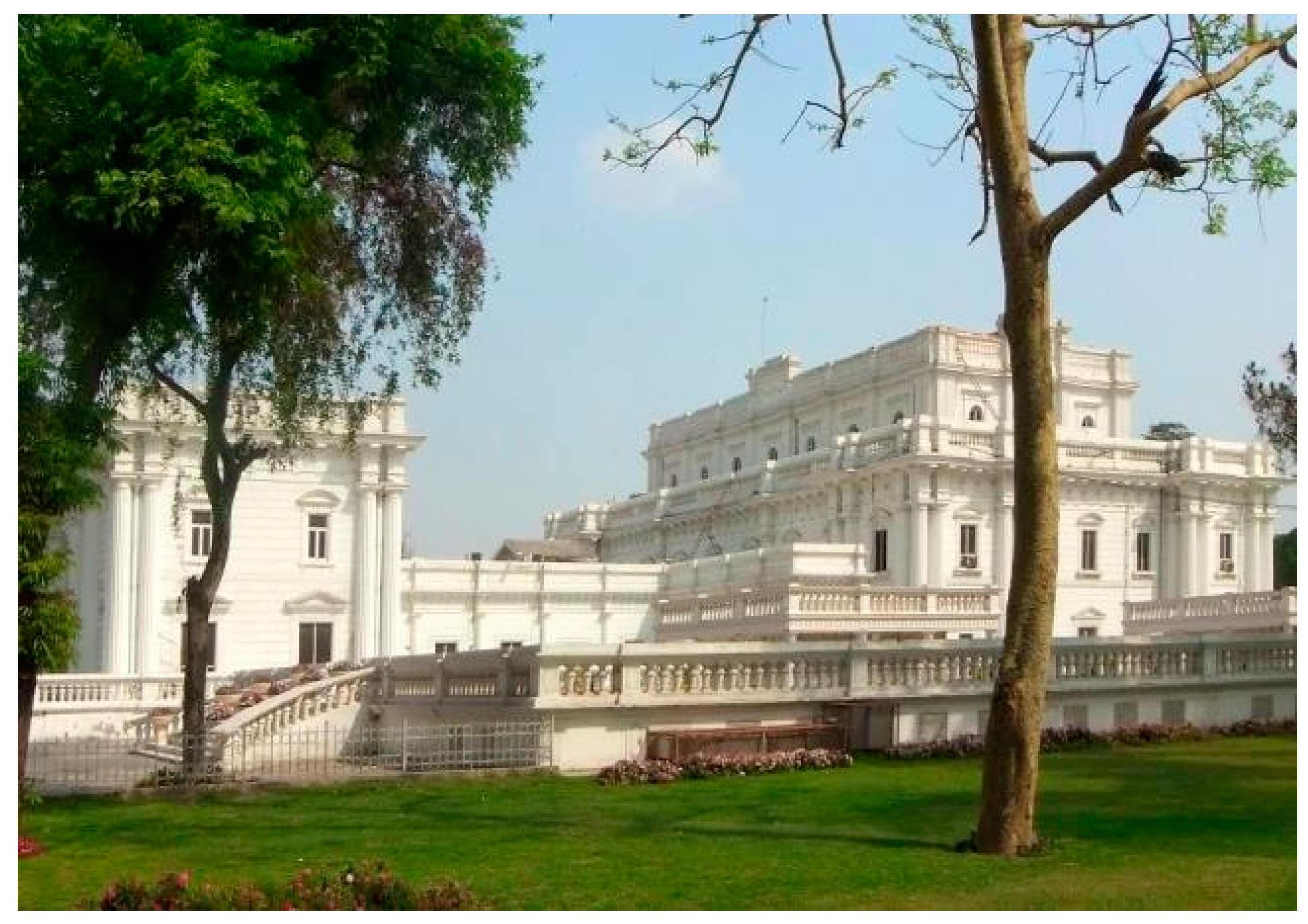
Figure 5.
Sideview of Halls. Note: The building shows the extravagant British rational designs (Ibid.).
Figure 5.
Sideview of Halls. Note: The building shows the extravagant British rational designs (Ibid.).
Governor's House construction began in 1846 and was completed in 1850. Its architecture was designed by Bhai Ram Singh, a renowned Indian architect who also designed many other prominent buildings in Lahore, including the Lahore Museum and the Government College University, which are stunning marvels of British architecture. The Governor's House is an impressive sample of British colonial architecture and features a grand tetrahedral entrance and dominating columns. The splendor of lush gardens and fountains, add to its grandeur (Rehman et al. 2017).
Constructed in 1882 as the University of the Punjab, making it one of the most prestigious universities in Pakistan. The university was founded during the colonial era when the province was under British rule and served as a center of higher education for the people of Punjab. Allama Iqbal Campus was designed by the English architect Edward Lutyens in the early 20th century. The campus has a mix of neo-Gothic and Indian architectural styles and is famous for its red-brick walls, giant clock tower, and huge impressive gardens. The institute’s historic architecture is well restored.
Hindu Heritage
Lahore, a city with a prodigious amalgamation of many cultures has a number of notable Hindu structures that reflect its Hindu past. Before the partition of subcontinent in 1947, Lahore was a cosmopolitan city with a prominent Hindu population. The city's past was carved by a series of Hindu and Muslim rulers who left an unerasable imprint on its traditions and culture. Many historians argue that the word ‘Lahore’ literally means the fort of ‘Loh’, Loh being the son of ‘Rama’ (God in Hinduism). Similarly, the river ‘Ravi’, which flows east of the city, where Ravi was named for the Hindu goddess ‘Durga’ (Rehman 2016).
Lahore was the epicenter of Punjabi Hindu reformist organizations among which Brahmo Samaj and Arya Samaj are included. Brahmo Samaj was formally founded at Lahore. One of India’s leading Hindu political organization, Arya Samaj gained its popularity in Lahore. This made Arya Samaj to shift their headquarters from Bombay to Lahore. In this city, they established numerous DAV colleges and schools to teach Hindus. Furthermore, many newspapers of Arya Samaj, like Pratap, Milap and Bande Matram, which were purely Hindu classics had their operations in Lahore (Qasmi, Re-imagining Lahore as a Hindu city).
However, the partition of India led to the mass migration of Hindus and Sikhs from Lahore to India, while Muslims migrated from India to Pakistan. The Hindu’s moved to Amritsar from Lahore while the Muslims of Amritsar migrated to Lahore, both being the border cities contributed to mass migration of religious groups. This migration was aggravated by the partition violence of Punjab.
This massive migration led to a significant reduction in the number of Hindus in Lahore. According to the 1951 population census of Pakistan, the Hindu population in Lahore was only 2.4% of the total population, down from 20% before the partition. In 2018 population census of Pakistan, the percentage of Hindus in Lahore, dropped to 0.02% of the total population of the city. Eventually Lahore was left with few Hindus and many Hindu landmarks.
Before the 1947 partition, the Lahori Hindus had their residences, temples, hospitals and educational institutes in many areas. These include the Bhati Gate, Jain Mandir, Krishna Temple, Valmiki Temple, Shiv Mandir, Model Town (old), Shah Alam market, Anarkali bazaar, the walled city of Lahore, Sanatan Dharma College (currently known as M.A.O College), Saddar Bazar, Gajumata, Bansi Dhar Mandir, Dayanand Anglo Vedic College (currently known as Government Islamia College Civil Lines), Sanatan Dharm Mandir, Dharampura, Sir Ganga Ram Hospital, Brahmo Samaj Mandir, Gulab Devi Hospital, Harbanspura and Lakshmi Chowk (Qasmi, Re- imagining Lahore as a Hindu city). Though many of these structures including Shah Alam market’s Havelis, temples, Havelis of the walled city and Saddar Bazar’s historic Hindu structures, suffered through various periods of deterioration and negligence. Despite of the time’s irony, these buildings still wait to be restored.
These buildings exhibit stunning designs with engraved stone carvings, ornate terraces, and captivating artwork. The buildings that were once part of the Hindu educational or literary architecture and currently functioning as educational institutes are well restored and preserved. Although, few of these structures are vulnerable to extinction like Bansi Dhar Mandir, Shiv Mandir and Lakshmi mansion. But they remain significant sites of worship and a reminder of Lahore’s diverse past (Kabir et al. 2017: p.359).
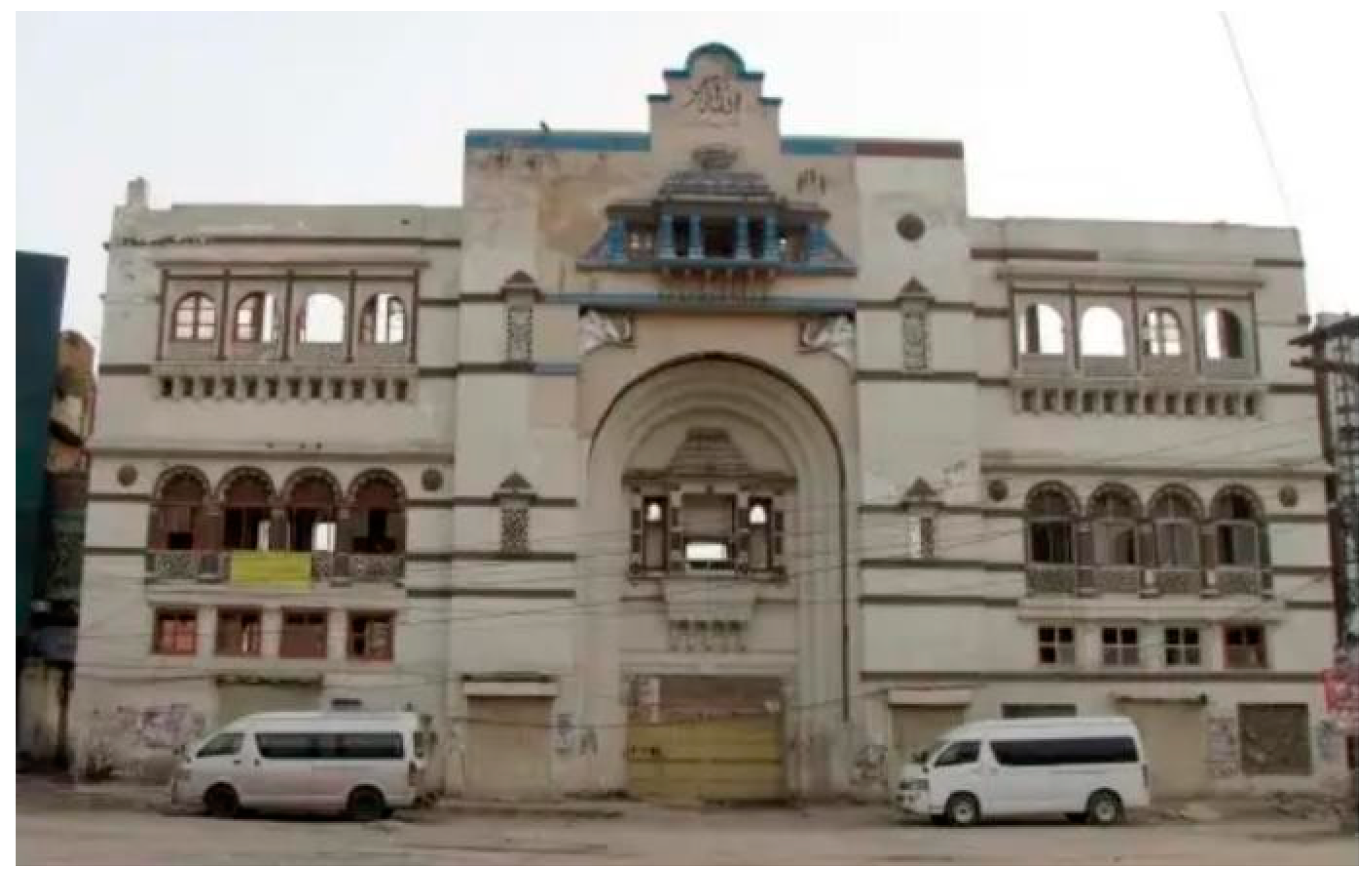
Figure 6.
The exterior view of Lakshmi Mansion. Note: The interior of building has been demolished, losing its vintage grace and significance (Naqvi, The Illustrious Philanthropist Lala Lajpat Rai and his memorabilia in Lahore).
Figure 6.
The exterior view of Lakshmi Mansion. Note: The interior of building has been demolished, losing its vintage grace and significance (Naqvi, The Illustrious Philanthropist Lala Lajpat Rai and his memorabilia in Lahore).
Valmiki Temple of Lahore is believed to be 1200 years old and its building features unique facets of Indo-Aryan architecture. The temple is situated amidst the Anarkali bazaar of Lahore. It is one of the only two functional Hindu temples of Lahore, the other being the Krishna Temple. Valmiki is one of the many Hindu deities mentioned in the Ramayana and is said to be associated with the Hindu lord Ram. The temple is visited by the Valmiki Hindus of Lahore.
Krishna temple stands on the Ravi Road opposite Timber market, it is believed to be built prior to the partition of India. The temple features Hindu god Krishna, who is one of the most important Hindu deities in scriptures. The temple is a double story building with vintage style pillars and ornamented walls. The temple is functional but less restoration work is seen, unlike Lahore’s Jain Mandir which is well restored.
The Beij Nath Haveli is a historical mansion located in the Walled City of Lahore. It was raised in the 19th century by a wealthy Hindu merchant named Beij Nath. The haveli is renowned for its stunning verandas, featuring red sandstone and marble usage with flower carvings, colorful frescoes. The haveli has courtyards, galleries, and rooms with high ceilings and spacious terraces. Much of the Haveli’s compartments are in the state of negligence and the structure is on the brink of further degradation (WCLA, 2021).
Dina Nath haveli was named after Dina Nath, the courtier of the famous Sikh ruler, Raja Ranjeet Singh. After the partition of the subcontinent, the haveli was transferred to the Muslims, and at a time, 5 families were residing in this magnificent haveli, which harmed many of its mesmerizing attractions. Still, the haveli portrays the typical essence of Hindu architecture (Shuja & Junejo, 2020). Much efforts are needed to conserve this building for this generation and the future generations to come.
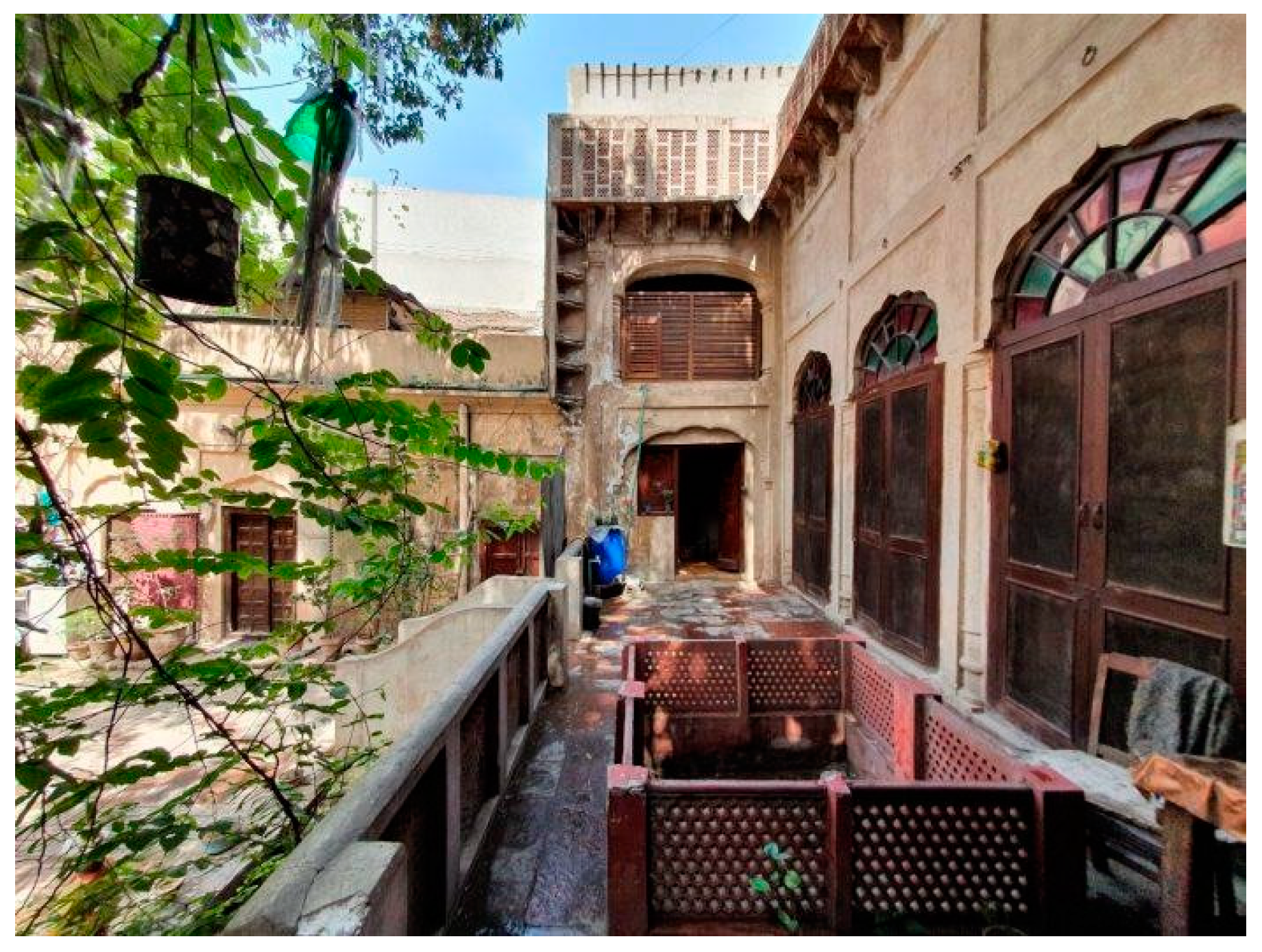
Figure 7.
The exterior view of Dina Nath Haveli. Note: The windows have an array of colours which shows the typical Hindu style (WCLA, 2021).
Figure 7.
The exterior view of Dina Nath Haveli. Note: The windows have an array of colours which shows the typical Hindu style (WCLA, 2021).
Sikh Heritage
Lahore’s Sikh architectural buildings reflects the city’s Sikh past. Gurdwara Dera Sahib, Gurdwara Janam Asthan, Gurdwara Shaheed Ganj, and Gurdwara Sri Guru Singh Sabha, these buildings feature golden designs with colorful motifs, check floors, and lotus dooms. Alas, some of these buildings have fallen into disrepair over the decades (Shuja & Junejo, 2020). Lahore’s Sikh Havelis architecture is awe inspiring. They were built during the Sikh reign of the city in the 19th century. These havelis were constructed by wealthy Sikh merchants who were involved in city's trade and commerce. The havelis feature a blend of Mughal and Sikh architectural styles with Indian delicacy (Malik and Jamil 2011: p.90).
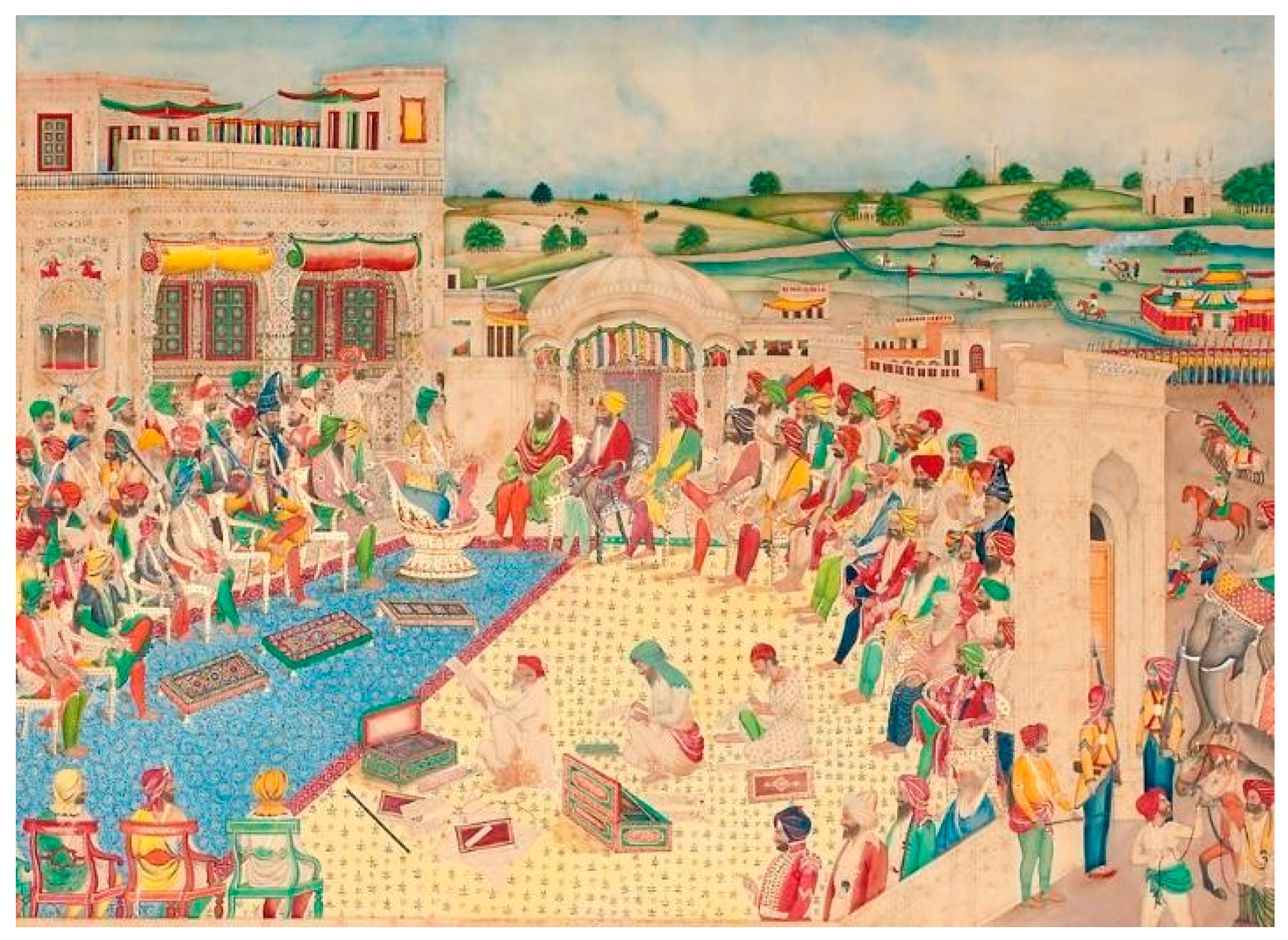
Figure 8.
Painting of the Darbar of Ranjit Singh. Note: Court of Maharaja Ranjit Singh at Lahore Fort (Singh 2017).
Figure 8.
Painting of the Darbar of Ranjit Singh. Note: Court of Maharaja Ranjit Singh at Lahore Fort (Singh 2017).
Some of the famous Sikh Havelis in Lahore include Kaushal Singh Haveli, Nau Nihal Singh Haveli, and Chauburji Haveli. Nau Nihal Singh Haveli was founded by the grandson of Maharaja Ranjit Singh. Located near the Mori Gate, Shish Mahal, Hawa Mahal are a further part of this structure. The Hawa Mahal used to provide the ventilation to the residents of this mansion. Nowadays, this structure is serving as an academic building and known as the Victoria Girls’ High School (Malik et al. 2019). The building’s ironic condition is visible from the picture below.
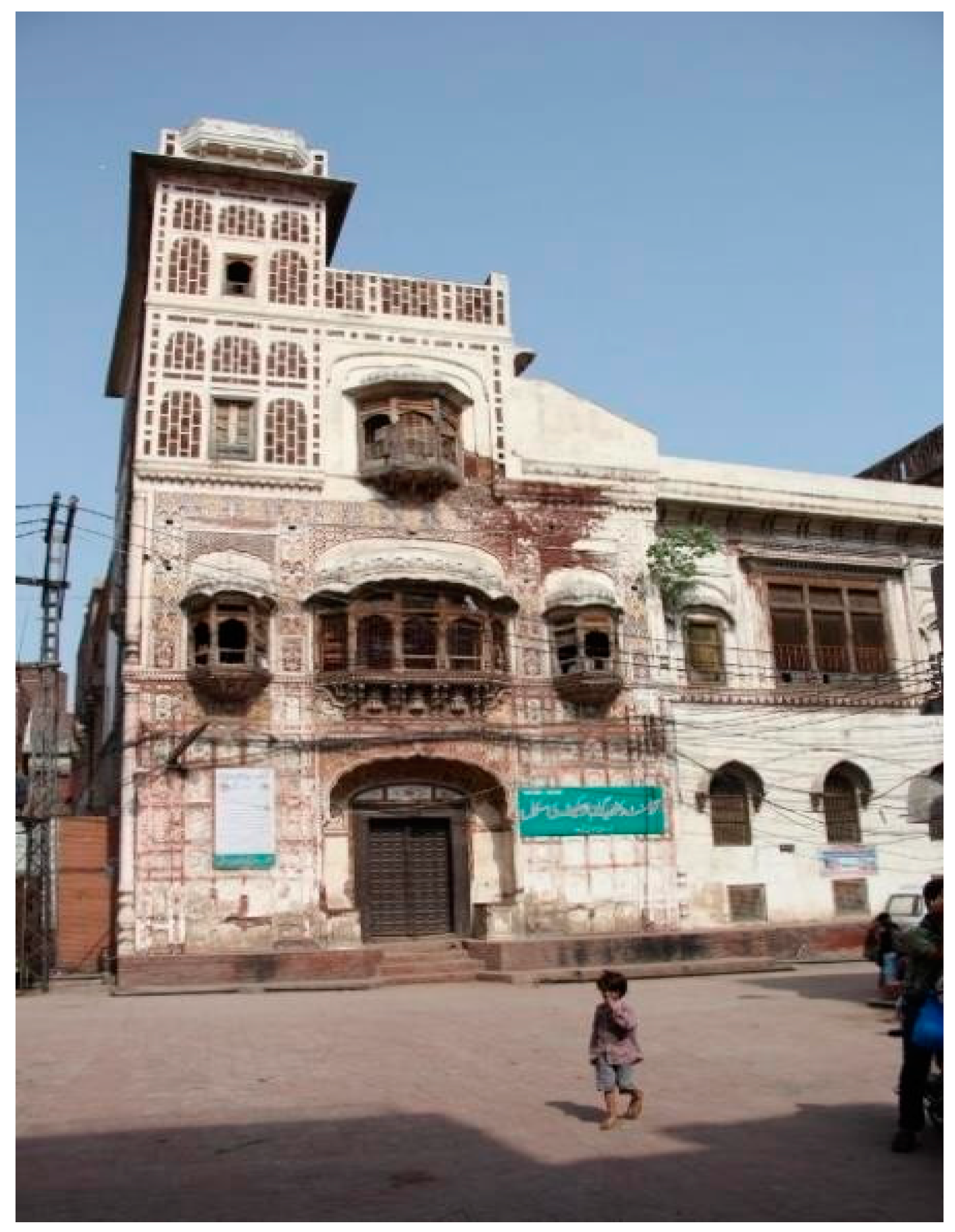
Figure 9.
The Nau Nihal Singh Haveli. Note: The upper most portion shows the Hawa Mahal which was used as source of ventilation (WCLA, 2021).
Figure 9.
The Nau Nihal Singh Haveli. Note: The upper most portion shows the Hawa Mahal which was used as source of ventilation (WCLA, 2021).
Haveli Kaushal Singh is said to be the biggest surviving Haveli of the current time. With sprawling courtyards, arched hallways, zenana gardens and Sikh imagery, it is representative of the Sikh approach towards architecture in Lahore. This Haveli has been converted into a government college currently known as Government Fatimah Jinnah College for Women. Over the time, many of these havelis fell in distress and were at risk of being extinction and decay. Many Havelis of Lahore are either converted to government schools or they are in the state of negligence (Qureshi et al. 2020).
The Gurudwaras of Lahore are significant spiritual spots for the Sikh community. These Gurudwaras were constructed during the Sikh rule in the 19th century and are renowned for their historical and cultural importance. Gurudwara Janam Asthan is the birthplace of Guru Ram Das, the fourth Sikh Guru. The Gurudwara Dera Sahib is dedicated to the fifth Sikh Guru, Guru Arjan Dev, who was martyred in Lahore. The Gurudwara Shaheed Ganj is also significant, as it is the place where Bhai Mati Das, one of the Sikh martyrs, was executed.
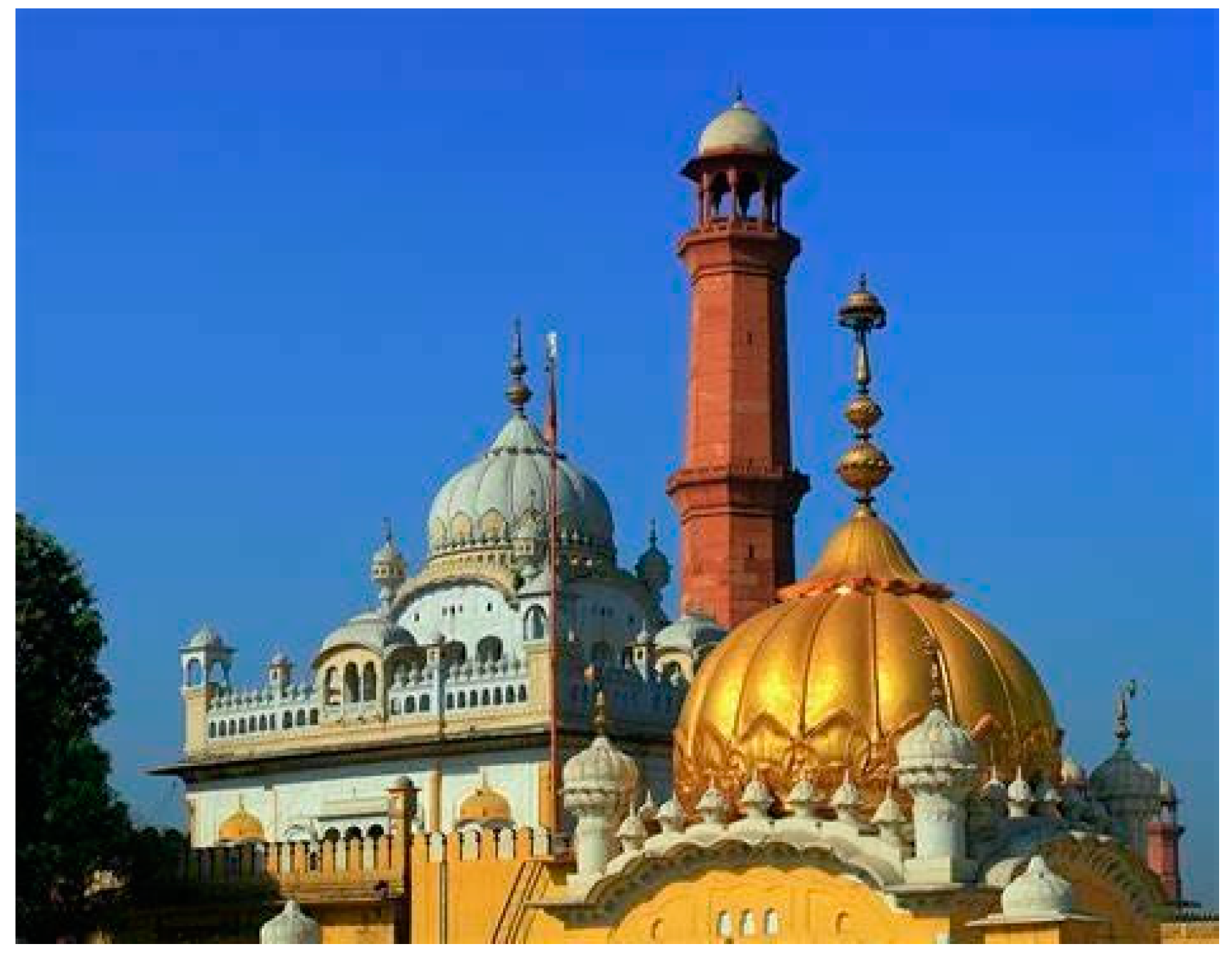
Figure 10.
The exterior view of the Dera Sahib Gurudwara. Note: Golden and white domes depict the simplicity and royalty of the Sikh Architecture (Khawar 2019).
Figure 10.
The exterior view of the Dera Sahib Gurudwara. Note: Golden and white domes depict the simplicity and royalty of the Sikh Architecture (Khawar 2019).
The design of these Gurudwaras creates a mesh of Punjabi and Kashmiri styles, with sculptures and geometrical ponds. The buildings are adorned with paintings reviving Sikh history and traditions. The Gurudwaras of Lahore are site for Sikh rituals and pilgrimage, and are also open to visitors of all faiths as a symbol of the region's religious and cultural harmony. Most of the Gurudwaras of Lahore are well restored, maintained and preserved including the historical Gurudwara Dera Sahib.
Mughal Heritage
The city of Lahore in Pakistan has a commendable heritage dating back to the 11th century. During the Mughal era, Lahore flourished emerging as a center of Islamic arts and culture. Numerous examples of Mughal heritage in Lahore include the Badshahi Mosque, Shalimar Gardens, Jahangir’s mausoleum, Wazir Khan Mosque, the walled city of Lahore, Faqir Khana Museum, Shahi Hamam (royal bath house), the Lahore Fort, and Sufi shrines like the Data Darbar (Rehman et al. 2017: p.12).
During the on-site study, Shahi-Guzargah (royal pathway) was checked for the maintenance and preservation of its Mughal era structures which comprises Delhi Gate, Gali Surjan Singh (street), Dina Nath well, Sabeel Wali Gali (street), Wazir Khan Mosque, Shahi Hamam, Havelis (historic mansions), Badshahi Mosque and Lahore Fort. Walled City of Lahore Authority (WCLA) did tremendous work on preserving and restoring these architectures. Be it a major building or a minor structure, the efforts to preserve the tourist spots were visible. From Delhi Gate to Lahore Fort, many illegal settlements were removed and the passage was cleared for the visitors to tour it without any inconvenience. Apart from all of this, more efforts are still needed to make it more attractive for tourists (Rehman 2016).
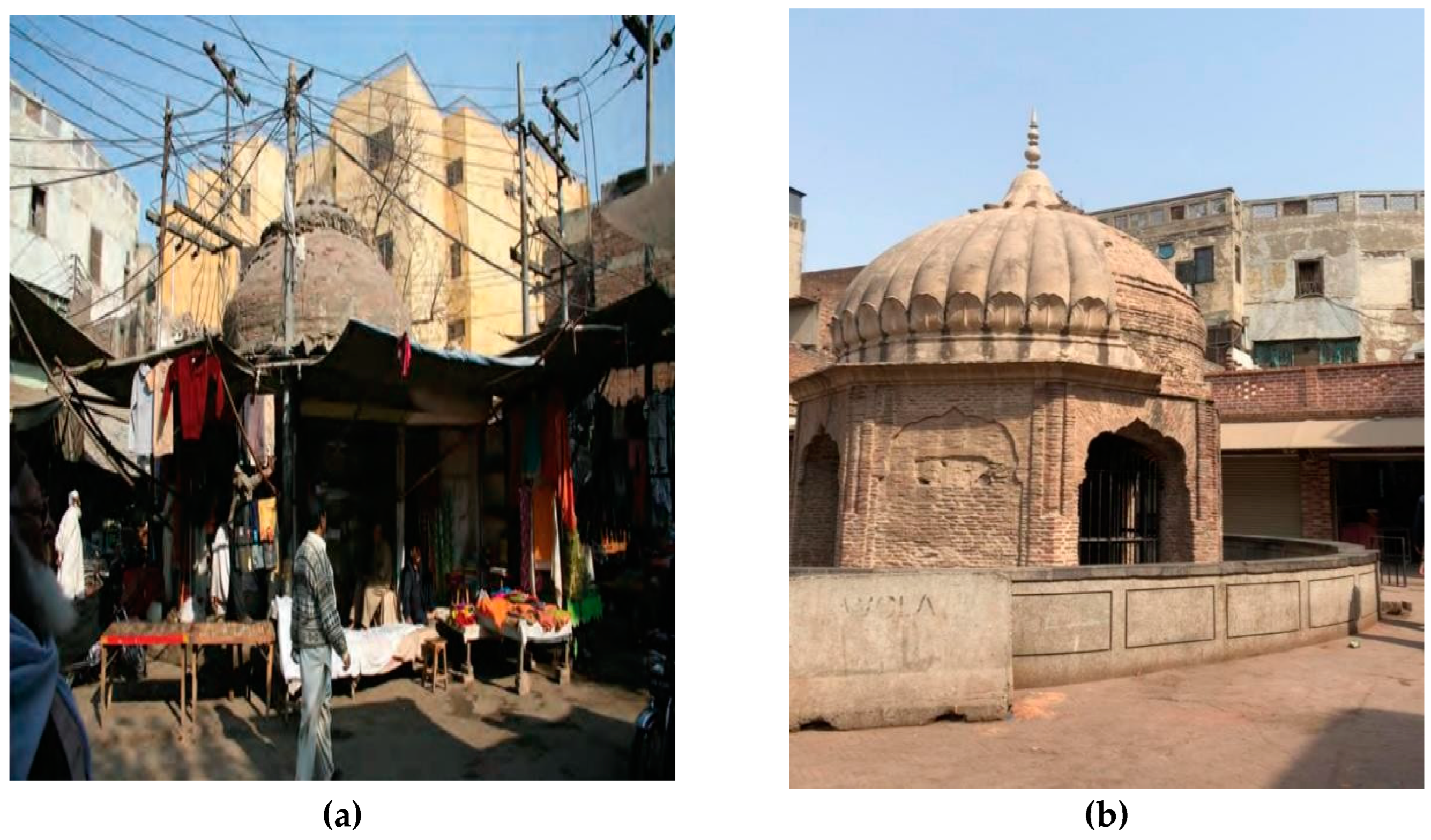
Figure 11.
(a)Old photograph pf Dina Nath well situated amidst Shahi-Guzargah. Note: Previously, the well was surrounded by unlawful settlements mainly shops and residential buildings (Lashari 2021). (b) Recent image of Dina Nath Well. Note: The well was restored and the surrounding area was cleared to make it accessible for the tourists (on-site study).
Figure 11.
(a)Old photograph pf Dina Nath well situated amidst Shahi-Guzargah. Note: Previously, the well was surrounded by unlawful settlements mainly shops and residential buildings (Lashari 2021). (b) Recent image of Dina Nath Well. Note: The well was restored and the surrounding area was cleared to make it accessible for the tourists (on-site study).
Badshahi Mosque is a mesmerizing mosque, built in 1673 by Mughal Emperor Aurangzeb, and it is one of the largest mosques in the world. The mosque's architecture is a reflection of Mughal and Persian styles, featuring red sandstone and ivory construction with detail floral designs and calligraphy. The mosque has three domes and four minarets, with a large courtyard.
Lahore Fort, properly built in 16th century, is a mixture of Mughal, Sikh, and British styles, featuring giant structures and marble construction with intricate artwork, frescoes, and tile work. The fort contains several palaces, mosques, and gardens, including the famous Sheesh Mahal (Palace of Mirrors), Diwan-e-Aam, Diwan-e-Khas, Shahi Bawarchi Khana (Royal Kitchen), Pari Mahal (Palace of Fairy), Hazuri Bagh, Moti Masjid, Barood Khana, famous picture wall and Naulakha Pavilion. It is a UNESCO World Heritage Site and a famous tourist attraction in Pakistan. Many of the structures in the fort are being preserved but more attention should be given to some areas for example the secret underground tunnels spread underneath the fort which was used by the royals to escape in times of war. Also, little to no access is given to the general public in some specific areas like Pari Mahal, which used to be the actual residence of the emperor and the royal family (Rehman 2016).
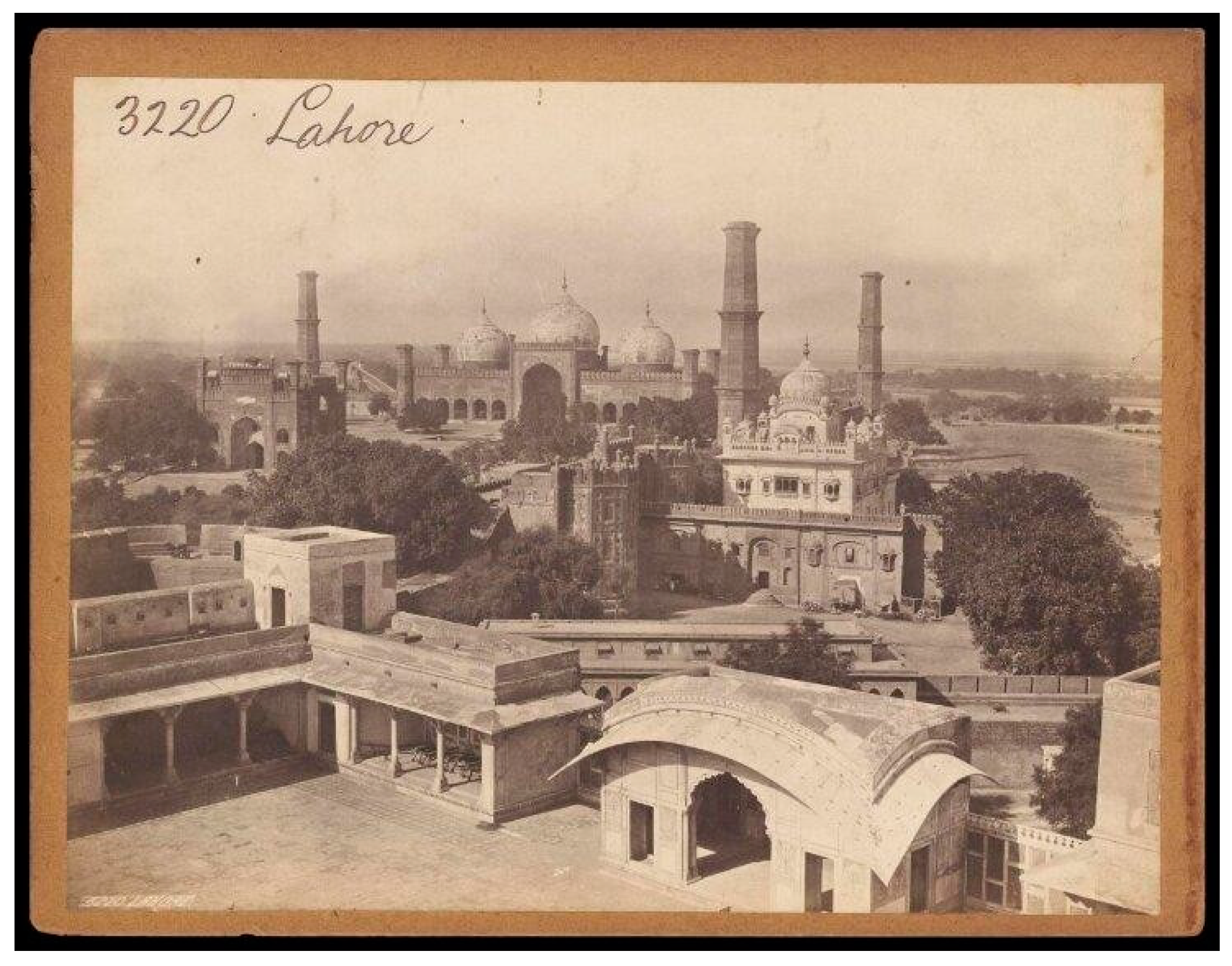
Figure 12.
An old photograph captured in 1863/1864. Note: photograph shows Badshahi Mosque, Lahore Fort and Gurudwara Dera Sahib (VAM, 2023.).
Figure 12.
An old photograph captured in 1863/1864. Note: photograph shows Badshahi Mosque, Lahore Fort and Gurudwara Dera Sahib (VAM, 2023.).
Marium Zamani Mosque is a historical mosque in Lahore. It was built in 1614 by Emperor Akbar's wife, Jodha Bai, and is known for its unique architecture and decoration. The mosque's style is a blend of Rajasthani and Persian styles, featuring white marble inlay with colorful tile work, frescoes, and calligraphy. The mosque has three domes and two minarets and is adorned with intricate geometric and floral patterns (Rehman 2016).
Shalimar Garden is a historical garden located in Lahore, Pakistan, built in 1642 by Mughal Emperor Shah Jahan as a present for his wife, Mumtaz Mahal. The garden is known for its beautiful buildings and design, featuring Persian-style gardens, fountains, and water channels. The garden's central feature is the large pool, which reflects the dazzling surrounding structures and adds to the overall beauty of the garden. It is also a UNESCO World Heritage Site. Some of the structures of the garden needs more attention (Mubin et al. 2013)
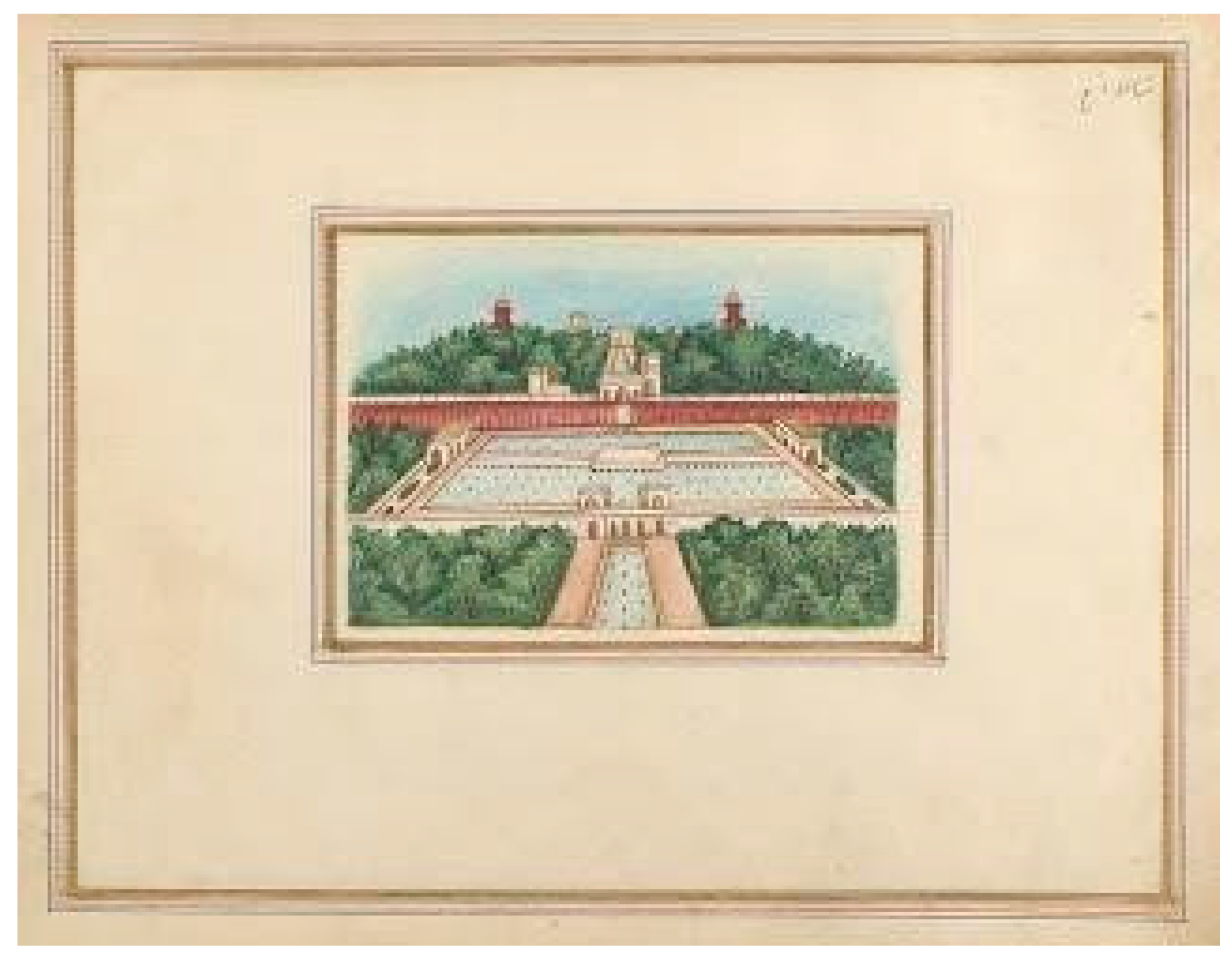
Figure 13.
An old painting made in 1860. Note: The painting shows Shalimar Gardens and River Ravi (Hassan 2010).
Figure 13.
An old painting made in 1860. Note: The painting shows Shalimar Gardens and River Ravi (Hassan 2010).
Wazir Khan Mosque is a mosque located in the walled city of Lahore, constructed in 1634 by the Mughal governor of Punjab, Hakim Ilm-ud-din, who was also famous as Wazir Khan. The mosque's architecture is a blend of Mughal and Persian styles, featuring colorful niches and artistic patterns with several domes and minarets. During the on-site visit, the minarets of the mosque were being renovated and the structure was well restored. The Havelis (historic mansions) surrounding the mosque were preserved and the old original decor was visible, which is shown in the pictures below.
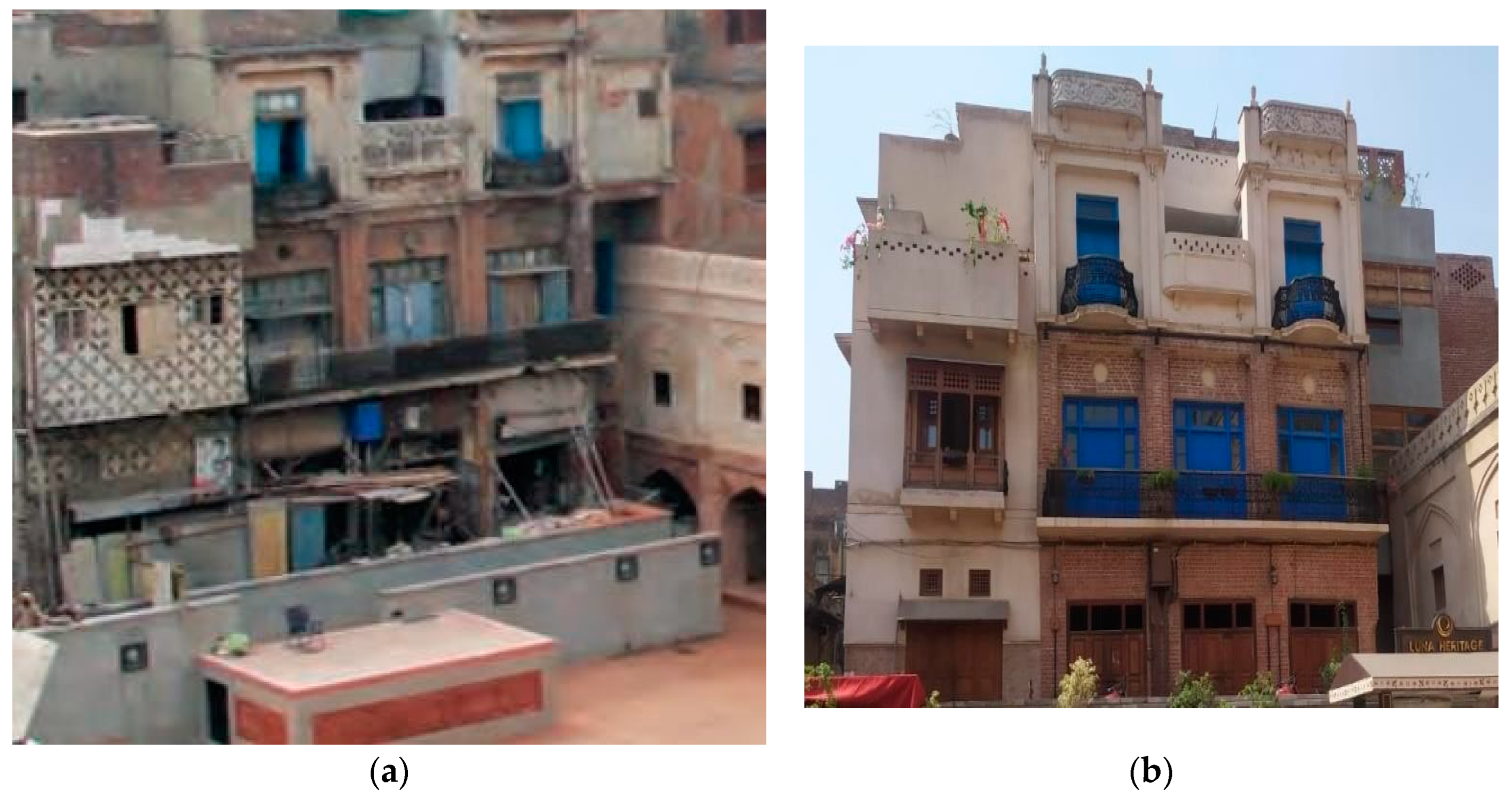
Figure 14.
(a) An old photograph of a Haveli (adjacent to Wazir Khan Masjid) before restoration. Note: The Haveli beside Wazir Khan Mosque before renovation (Lashari 2021). (b) Recent photograph of the same Haveli. Note: The Haveli after renovation (on-site study).
Figure 14.
(a) An old photograph of a Haveli (adjacent to Wazir Khan Masjid) before restoration. Note: The Haveli beside Wazir Khan Mosque before renovation (Lashari 2021). (b) Recent photograph of the same Haveli. Note: The Haveli after renovation (on-site study).
Sunehri Mosque is a historical mosque located in Lahore, Pakistan. It was built in 1753 during the Mughal era by Nawab Bhikari Khan. The mosque is renowned for its golden domes and minarets, which were originally covered in gold leaf. The mosque is a blend of Mughal and Sikh styles, showcasing white marble and golden-yellow sandstone cuttings with complex frescoes and calligraphy (Rehman 2016).
Dai Anga Mosque is another mosque in Lahore. It was raised in 1635 for Dai Anga, who was the nurse of Mughal Emperor Shah Jahan. The mosque has three domes and two minarets and is adorned with decorative elements such as pietra dura inlay, muqarnas, and arabesques.
Kamran Baradari is a historical marvel of Lahore. It was built during the reign of Mughal minister Kamran Mirza in the 16th century as a summer house. The structure is awe inspiring but it needs more restoration work. Albeit, the architecture is known for its unique vintage style, trussing a twelve-pillar pavilion with three domes and arched ventilation (Khaskheli and Zhang 2021).
Jahangir's Tomb is a historical asset of the Mughal emperor Jehangir located in Lahore, Pakistan. It was erected during the early 17th century by the Mughal emperor Shah Jahan, in memory of his father. The tomb is renowned for its beautiful architecture, featuring marble inlay with gauzy tile work, and Islamic calligraphy. The mausoleum has a square base and a dome- shaped roof with numerous small cupolas. The interior of the tomb contains the many-hued cenotaph of Jahangir and several other graves of Mughal royalty. The tomb is surrounded by a green garden, including a mosque and a Caravanserai. Iconic Akbari Sirai and Nur Jehan’s tomb are included in the boundaries of this mausoleum (Mubin et al. 2013).
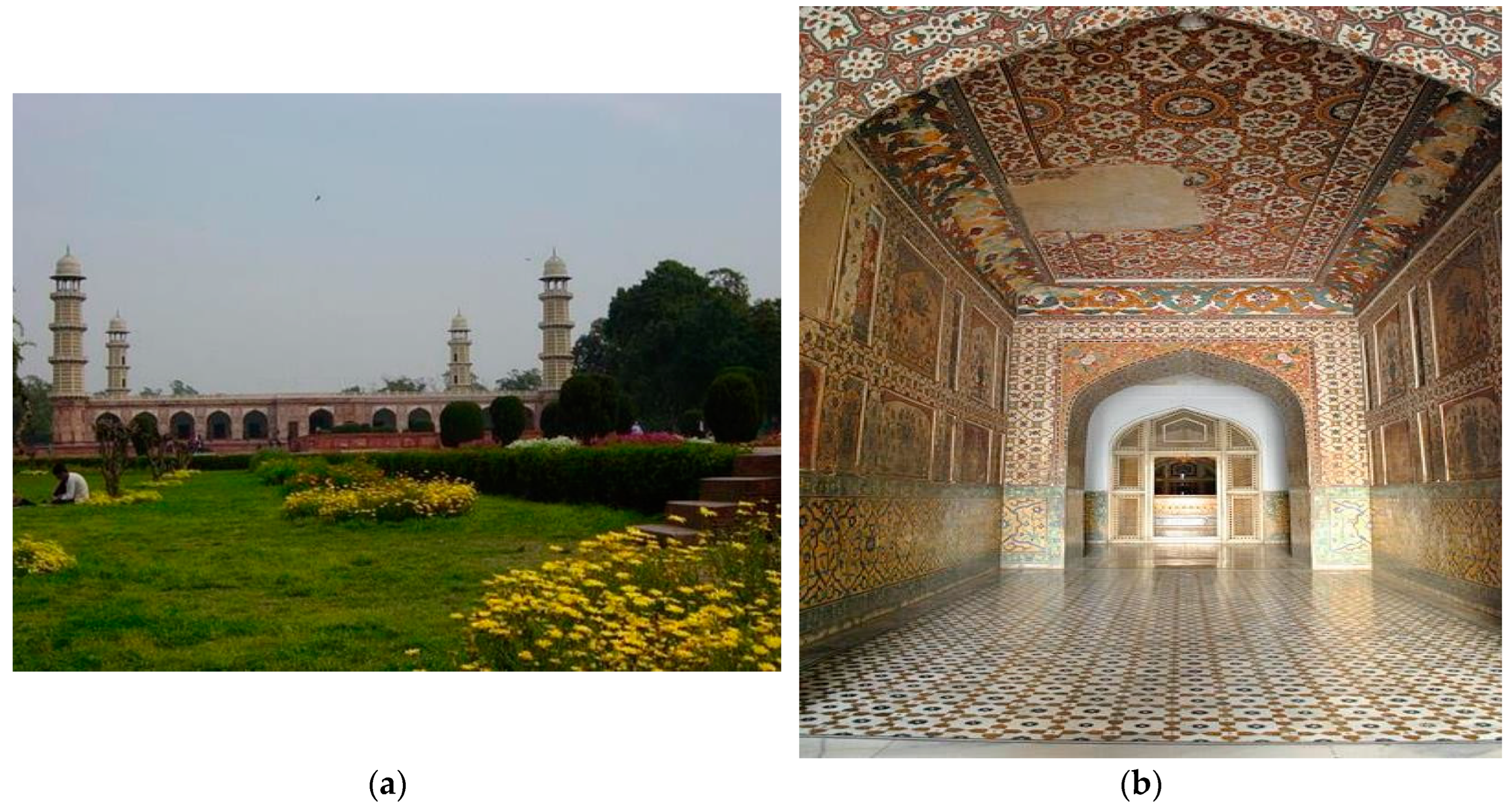
Figure 7.
(a) The outside view of Jehangir’s mausoleum. Note: The four minarets surrounding a grand chamber show the emperors magnificence and strength (Mubin et al. 2013). (b) The inside view of mausoleum. Note: The awe-inspiring forms of Mughal art inside the corrider (Asian historical architecture, 2011).
Figure 7.
(a) The outside view of Jehangir’s mausoleum. Note: The four minarets surrounding a grand chamber show the emperors magnificence and strength (Mubin et al. 2013). (b) The inside view of mausoleum. Note: The awe-inspiring forms of Mughal art inside the corrider (Asian historical architecture, 2011).
The Gates of Lahore are historical gates that were built as tool of the city's fortifications during the Mughal era in the 17th century. There were thirteen gates in total, but only six remain today; Roshnai Gate, Bhati Gate, Yakki Gate, Lahori Gate, Delhi Gate, and Shahalmi Gate. Of these remaining gates, Lahori gate is on the brink of extinction and damage. The gates served as entry posts to the city and were also used for military purposes. Each gate has a unique design and architecture, featuring arches, and prominent brick work (Rehman 2016: p.41).
Lahore as a Global Tourist Spot
Major structures such as the Badshahi Mosque, M.A.O College, Government Islamia College Civil Lines, Shalimar Gardens, Shahi Guzargah, Quaid e Azam Library, Shahi Hamam, Lahore Fort, Lahore Museum, Gali Surjan Singh, Jahangir’s Tomb, Gurudwara Dera Sahib, Sabeel Wali Gali, Wazir Khan Masjid and Delhi Gate are the main center of attention by the authorities for preservation and restoration work. Rest all of the structures are either in a state of less restoration or complete negligence.
Mainly the Havelis, some temples, some mosques and some related structures like Sunehri Masjid, Valmiki Temple, Haveli Dina Nath, Haveli Beij Nath, Bradlaugh Hall, Kamran Baradari, Gates of Lahore (except Delhi Gate), Dai Anga Mosque, Neela Gumbad Mosque, Lakshmi Mansion, Haveli Kaushal Singh, Jahangir’s Mausoleum, some areas of Lahore Fort and Shalimar Gardens needs more attention and work. A few of the minor structures like the Dina Nath Well, Sabeel Wali Gali, Sabeel Wali Gali, Akbari Sirai and the Haveli were restored because they lied near to the main attractions, Shahi Guzargah, Jahangir’s mausoleum and Wazir Khan Masjid. Hence these minor structures were maintained because these were a cause of interest of the tourists who visited the major structures.
As discussed above, Lahore has the potential to attract millions of tourists every year. Revitalizing the historical sites of Lahore could usher in a new era of tourism for the city. The historical sites are usually the most attractive for the tourists alike to that of Istanbul and Agra. In Istanbul, most tourists swarm in the city’s historical places i.e., Topkapi Palace and Hagia Sophia. The remarkable thing to notice is that the Türkiye’s government has established state of the art museums in these historical structures. Similarly, In Agra, it is the historic Taj Mahal that attracts the foreign tourists to India. Hence, India ensures the maintenance and the restoration of the historical structures in Agra (Kerimoglu et al. 2013; Srivastava 2011).
Hence Lahore’s vintage landmarks hold immense cultural significance, and their restoration could work wonders in drawing both local and international travelers. This resurgence could yield numerous benefits including cultural heritage, economic upswing, enhanced public appeal, marketing goldmine, thematic endure, ecological flourish and etc. By breathing new life into these historical sites, their invaluable heritage would be preserved for generations to come. Such sites often serve as magnets for history buffs and inquisitive tourists, thereby keeping the past alive. With some more efforts from the government and the private sector, Lahore could emerge as a new global tourist spot (Shah and Patel 2021).
Restored sites of Lahore could boast a visual charm that's hard to resist. The splendor of well-kept structures like Badshahi Mosque, Lahore Fort and their surroundings, entices tourists and photographers alike. This allure makes these sites more shareable on social media, potentially amplifying their allure. Renovation efforts alike to that of Shahi Guzargah, typically encompass infrastructural improvements like smoother access routes, improved lighting, informative signs, and better facilities. These enhancements contribute to a more enjoyable experience, prompting tourists to explore further. The restoration of these sites can captivate tourists interested in cultural exploration and learning. Guided tours, interactive exhibits, and special showcases could make the sites more engaging, enticing a wider array of visitors.
A revived historical site could serve as a fresh marketing angle. Travel companies, tourism boards, and tour organizers could utilize the restoration narrative to entice travelers seeking unique experiences. The restoration of historical sites could lead to a renaissance in their immediate environs. New enterprises, cafes, and shops could sprout up to cater to the augmented footfall, thereby enhancing the neighborhood's overall charm. Restored sites could be tailored around specific historical themes or events. These themed attractions add layers to the visitor experience and cater to different tastes, such as architecture, art, and spirituality.
Renovations often incorporate storytelling alike Dastangoi (masterpiece of Urdu literature) including Dastan-e-Amir Hamza, elements through multimedia displays, audio guides, and interactive exhibits. These aids help tourists connect with the site's historical and cultural significance, intensifying their visit. Renovations can include the creation of green spaces and gardens within historical sites. These areas provide relaxation spots for visitors and contribute to the city's sustainability efforts. Combining historical charm with natural beauty can attract a wider range of tourists, thus contributing towards Eco-Tourism (Lashari 2021).
Refurbished sites could be adapted for nocturnal visits and special occasions, like light displays, cultural performances, and festivals. These features cultivate vibrant night scenes and diverse tourist experiences. Ensuring the safety of tourists in various destinations is a paramount concern for both travelers and local authorities. Security measures are instrumental in attracting visitors and cultivating a positive perception of the location. These measures not only safeguard tourists but also play a pivotal role in the overall success and continuity of the tourism sector.
Lahore’s Tourism as an Economic Power House
This research took a comprehensive look at the intricate relationship between historical tourism and its influence on economic aspects. By delving into both the direct and indirect effects on various economic indicators, including GDP (Gross Domestic Product) growth, development, local businesses, job creation, and community engagement, this study aims to offer a thorough analysis of how historical tourism intertwines with economic well-being. Using a combination of real-world cases, empirical studies, and a review of existing literature, this research sheds light on the potential advantages and challenges posed by historical tourism as a tool for economic development (Srivastava 2021).
Historical tourism directly bolsters GDP through foreign and national investments, expenditures on accommodation, food, transportation, and consumption factor. One of the direct outcomes of historical tourism is the creation of jobs in various sectors, from guides to local artisans. Historical tourism often leads to entrance fees and other revenue streams that support the preservation of historical sites. Historical tourism spurs demand for local services, such as eateries and accommodations.
Tourism's influence on GDP is clear through the substantial expenditures it triggers. This covers a gamut of economic activities – accommodations, transport, dining, entertainment, and shopping. Visitor spending injects fresh funds into local economies, creating a multiplier effect that reverberates across sectors. The collective value of these expenditures significantly boosts the host country's GDP. There is a strong bidirectional relationship between PGDP (Per Capita GDP) and TOUR (International Tourists Receipts), thus tourism boosting the economic growth in all the regions (Wijesekara et al. 2022).
Catering to tourists often spurs infrastructure development. This includes better transport, new hotels, upgraded facilities, and enhanced cultural attractions. This development provides immediate benefits through job creation and increased demand for construction materials, while setting the groundwork for long-term growth in real estate and construction sectors. Tourism's labor-intensive nature results in increased demand for a range of jobs – hotel staff, tour guides, restaurant workers, transport personnel, and artisans. This not only addresses unemployment but also enhances workforce skills. Tourists boosts the primary and the secondary and tertiary sectors of industry, this is often described as the multiplier effect. In simple terms it is how many times money spent by a tourist circulates through a country's economy.
The employment multiplier prompts spending and propels economic growth. Tourism often becomes a critical source of foreign exchange earnings. International tourists bring in foreign currency through their spending on services and goods. This inflow stabilizes a country's balance of payments, boosts foreign reserves, and reinforces economic stability. Tourism has been the biggest foreign exchange earning sector for the countries like India, Spain and Thailand (Wijesekara et al. 2022; Kerimoglu et al. 2013).
Cultural and heritage tourism magnifies the economic impact. Tourists frequently engage in activities that celebrate a destination's cultural heritage, such as visiting historic sites, museums, and cultural events. These experiences bring revenue to local businesses, add to tax coffers, and contribute to cultural preservation. Tourism fuels demand for ancillary services – financial, legal, telecommunications, healthcare, and more. The need to cater to tourists generates opportunities for these sectors to expand, fueling economic activity.
Governments gain from tourism-related activities via diverse routes. Direct taxation on tourism-related services and products is a revenue source. Additionally, tourism leads to licensing fees, permits, and regulatory charges, all of which contribute to public funds. Tourism stimulates innovation and entrepreneurship as businesses innovate to meet varied tourist needs. This fosters the growth of small and medium-sized enterprises (SMEs), igniting economic dynamism, job creation, and competitive markets (Shah and Patel 2021).
Conclusion
Pakistan possesses a diverse and splendid heritage, showcasing its rich history influenced by some factors. The country boasts various historic monuments and archaeological sites, such as Hindu sanctuaries, Mughal classics, and many others. However, there is a need for proper legislation to protect these treasures. Drawing inspiration from international conservation charters, Pakistan should make an advisory board of experts to oversee the progress of archaeology and museum departments at the state level. It is essential to implement risk management guidelines for both registered and unregistered monuments to ensure their safety from natural phenomenon’s.
Ensuring safety in tourism is the necessity and hence it should involve well-lit areas, women police force (along with men), maintained facilities, and visible security, preventing crime through security personnel, cameras, and safety info. Technological innovation towards the security checks should be implemented which should prevent any sort of inconvenience for the tourists. Emergency readiness plans should be available for disasters and medical crises. Crisis management is crucial during major incidents especially as Cybersecurity could protect tourists' data.
Tourist centers should be made which provide guidance, cultural respect, community engagement and security. Guides need safety training, strong law enforcement collaboration, and regular assessments. Public awareness campaigns should be organized as well as public-private partnerships, and tourism police units should assist travelers. Overall, a collective effort ensures tourist safety and destination reputation. Moreover, Marketing and Advertising strategies through all means of media and communication, should be made and put into action to grab the attention from around the world towards these historical sites.
Establishing specific preservation policies, along with strong coordination between federal and provincial departments, is significant for effective heritage management in Pakistan. Taking inspiration from international conservation principles like the China Conservation Principles, the Venice Charter of 1964, United Nations 11th Sustainable Development Goal (SDG) of sustainable cities and communities, and the International Council on Monuments and Sites (ICOMOS) charters for protection and management, there is an urgent need to establish tourism research centers, detailed guidelines and conservation legislation for monuments in Lahore, Pakistan (Khan et al. 2022: p. 9).
References
- Ali, A. (2011). Asian historical architecture. Available online: https://www.orientalarchitecture.com/sid/569/pakistan/lahore/jahangirs-tomb.
- Hassan, B. (2016). Best Public Libraries of Lahore, 2016. Available online: https://www.locallylahore.com/best-public-libraries-of-lahore/ (accessed on 2 August 2016).
- Hassan, S. (2010). Old Paintings and Images of Lahore, Available online: http://shirazhassan.blogspot.com/2010/09/old-paintings-and-images-of-lahore.html.
- Kabir, N. , Abbas G., Hayat K. (2017) ‘A historic journey of the Lahore city, to attain its identity through architecture’, European Journal of Interdisciplinary Studies 3(3).
- Kerimoglu, E. , Koramaz K., Yazgi B., Ertekin O. (2013),’Challenges in tourism development: Can Istanbul survive without a masterplan?’, European Regional Science Association 1-16.
- Khan, N. , Nuti C., Monti G., Micheli M. (2022), ‘Critical review of Pakistani current legislation on sustainable protection of cultural heritage’, Multidisciplinary Digital Publishing Institute.
- Khaskheli, R. , Zhang W. (2021),’Analysis of historical built Baradaris(Pavilions) Architecture in Pakistan’, International Journal of Scientific and Engineering Research 12(7): 1356-1370.
- Khawar, N. (2019). Gurdwara Dera Sahib, Lahore, Pakistan. Available online: https://pixels.com/featured/gurdwara-dera-sahib-lahore-pakistan-nadeem-khawar.html.
- Lashari, K. (2021). Profile-Walled City of Lahore Authority, Available online: http://walledcitylahore.gop.pk/wp-content/uploads/2021/08/profile-book.pdf.
- Malik A, M. , Jamil F. (2011), ‘Ghulam Rasool building-A case of neglect of British period architectural legacy-on Mall Road, Lahore’, Journal of Historical Society 69(2): 89-102.
- Malik M, A. , Rashid M., Haider S S., Jalil A. (2019),’A Study of conservation significance of Pirzada Mansion, Lahore Pakistan’, Journal of Research in Architecture and Planning 24(1): 34-44.
- Mubin, S. , Gilani A I., Hasan W. (2013) ‘Mughal Gardens in the City of Lahore-A Case Study of Shalimar Garden’, Pakistan Journal of Science 65(4): 511- 522.
- Naqvi A F, S. ‘The Illustrious Philanthropist Lala Lajpat Rai and his memorabilia in Lahore’, Available online: https://www.academia.edu/35422168/The_Ilustrious_Philanthropist_Lala_Lajpat_Rai_and_his_memorabilia_in_Lahore_All_Rights_Reserved_Lahore_Shanasi_Foundation.
- Pervez, A. (2017), ‘Old city Lahore: Popular culture, arts and crafts’, ‘Institute of Urdu language and literature 21-33.
- Qasmi U, A. Re-imaging Lahore as a Hindu city, Available online: https://archive.lums.edu.pk/interactives/hindu/chapter1.
- Qureshi K, A. , Farooq S., Kamal A M. (2020), ‘Viability Analysis for Restoration and Adaptive Reuse of Sustainable Sikh Era Havelis in Lahore, Pakistan’, Journal of Xi’an University of Architecture & Technology. 12(10), 1162- 1167.
- Rehman, A. (2016), ‘Lahore: History and architecture of Mughal monuments’, Oxford University Press 40-41. Available online: https://books.google.com.pk/books?hl=en&lr=&id=o6ohEAAAQBAJ&oi=fnd&pg=PT5&dq=Lahore:+The+Architectural+Heritage&ots=mFi0Ks2283&sig=1TZS7xpuapxsLDFLyAeMhCRNQOU&redir_esc=y#v=onepage&q=Lahore%3A%20The%20Architectural%20Heritage&f=false.
- Rehman, A. , Naz N., Khan M., Almas R. (2017), ‘Basil Martin Sullivan: Architectural contributions of a legendary British architect of colonial Lahore’, Global Business and Economic Review 8(1).
- Shah, A. , Patel M. (2021),’Adaptive Reuse of Heritage buildings’, Journal of Emerging Technologies and Innovative Research 8(9): 79-87.
- Shuja, S. , Junejo R. (2020). ‘Appropriating Indo-Saracenic style: Bhai Ram Singh’s contributions to the architectural identity of 19th century Lahore’, Journal of Traditional Building, Architecture and Urbanism. [CrossRef]
- Singh, B. (2017). MAHARAJA: The Splendor of India's Royal Courts. Available online: https://www.asianart.com/exhibitions/maharaja/3.html.
- Srivastava, S. (2011), ‘Economic potentials of tourism: A case study of Agra’, Tourismos: An International Multidisciplinary Journal of Tourism 6(2): 139- 158. [CrossRef]
- VAM. (2023). Lahore, Available online: https://www.vam.ac.uk/.
- WCLA. (2021). Havelis of Lahore. Available online: http://walledcitylahore.gop.pk/havelis-of-lahore/.
- Wijesekara, C. , Titigalla C., Jayathilaka A., Illukpotha U., Jayathilaka R., Jayasinghe P. (2022), ‘Tourism and Economic Growth: A study on Granger casuality and wavelet coherence’, PLOS ONE 17(9): e0274386.
Disclaimer/Publisher’s Note: The statements, opinions and data contained in all publications are solely those of the individual author(s) and contributor(s) and not of MDPI and/or the editor(s). MDPI and/or the editor(s) disclaim responsibility for any injury to people or property resulting from any ideas, methods, instructions or products referred to in the content. |
© 2023 by the authors. Licensee MDPI, Basel, Switzerland. This article is an open access article distributed under the terms and conditions of the Creative Commons Attribution (CC BY) license (http://creativecommons.org/licenses/by/4.0/).
Copyright: This open access article is published under a Creative Commons CC BY 4.0 license, which permit the free download, distribution, and reuse, provided that the author and preprint are cited in any reuse.


