

Submitted:
30 August 2023
Posted:
01 September 2023
You are already at the latest version
Abstract
The aim of this paper is to study the main areas in which Artificial Intelligence (AI) will impact the field of project management that relates to cost, risk and scheduling. The research model was based on a previous study of the ten project management knowledge areas presented in the PMI’s PMBOK 6th edition where project schedule-, cost- and risk management knowledge areas were identified as being the ones most likely to be affected by the development of AI. A group of experts that participated in the study agreed that AI will affect the project management profession in the future. Different elements of the three knowledge areas were considered to be affected more by AI than others. The schedule baseline is the element believed to be affected the most out of the project schedule management elements. For project cost management, the estimation of resource cost is believed to be affected the most. In the case of project risk management, the application of AI will have the strongest impact on the probability and impact format.
Keywords:
Project Management
; Artificial Intelligence (AI)
; Project Schedule Management
; Project Cost Management
; Project Risk Management
1. Introduction
Artificial Intelligence (AI) is expected to have large influence in our societies in the near future and remarkable progress has been made in the field. AI can be explained as a term that covers everything done by a machine or a computer that resembles the human mind [1]. It will reshape many areas of the business environment as well as daily life of people. However, the degree of impact on particular areas of management is known to lesser extent. Some parts will arguably be automated while others will rather be augmented by AI. The expectations to AI are high due to the rapid development in technology in the society today. Project management seems to be less suitable for automation due to the wide diversity of projects being managed. However, AI is creating new application possibilities for the field of project management [2]. In the future, managers at all levels will have to adapt to the use of machines as part of their profession. Most likely, AI will prove to be cheaper and more efficient than humans in certain tasks. That does not mean that machines will completely take over the profession of being a manager. Instead, managers can spend their valuable time on tasks that only humans are able to do [3]. A study by Fridgeirsson et al. was conducted to investigate the impact of AI on the ten knowledge areas of project management as defined by the Project Management Institute (PMI) [4]. The study revealed that AI will affect the project management areas in the future and indicated that it is useful where historical data and information are used for planning and estimation. It also indicated that AI can be useful to monitor schedules, maintain baselines and adjust forecasts. Around 50% of the respondents who participated in the research believed AI to have very high or high effect on three of the ten knowledge areas. These areas were the management of schedule, cost and risk.
The presented study is the second phase of the previous study by Fridgeirsson et al. [4]. Because of the high impact estimates on these three particular knowledge areas, this follow-up study goes much deeper into these knowledge areas to enhance our understanding on how they will be affected by AI. The aim of the study is to give a comprehensive guide to business leaders, managers and scholars on the most current issues to focus on regarding AI in the field of project management. This will be helpful in developing research, training and integration of the discipline of project management in context of AI. The research is based on cross sectional interviews with experts in the field of project management and AI. The interviews include statements that are formed based on the 6th edition of the Project Management Body of Knowledge (PMBOK®). The statements state that AI will impact certain elements of project management and the experts give their impact estimates. This study will consequently give indications on which managerial elements of the cost-, scheduling- and risk processes within the domain of the project management discipline will be influenced primarily by the challenges of AI.
2. State of knowledge
Over the past decades, research on project management has developed and become a popular topic in various studies. Project management has been defined as the application of tools, techniques, knowledge and skills to activities of the project to be able to meet expected project success criteria at a certain time [5]. The Project Management Institute (PMI) is an international society for project managers and a non-profit professional membership association for the profession of project management [6]. Their standards are the most widely recognized ones in the profession for project, program and portfolio management. The institute develops standards, hosts training seminars and online courses, and the number of people receiving certifications from the PMI continues to increase [6]. PMI’s standards for project management are included in the Project Management Body of Knowledge (PMBOK®) which describes in detail the characteristics of project management and is therefore well suited for research. In this study, the authors apply the 6th edition of the PMBOK as reference. It must be noted that since the study was executed, the 7th edition of PMBOK has been published - in late summer of 2021. The new version does not include the knowledge areas used in this research. PMBOK 7th edition is focused on principles rather than processes. However, the "Summary of Changes" section of the 7th version of the PMBOK states that:“Nothing in this edition of The Standard for Project Management or A Guide to the Project Management Body of Knowledge negates alignment with the process-based approach of past editions. Many organizations and practitioners continue to find that approach useful for guiding their project management capabilities, aligning their methodologies, and evaluating their project management capabilities. That approach remains relevant in the context of this new edition.” [7]. The new PMBOK with its radical changes does therefore not deem the traditional approach as redundant for the type of research presented in this study. The PMBOK 6th edition, includes a collection of guidelines, terminologies, processes and best practices that are accepted as standards in project management [8]. The PMBOK process framework consists of 5 process groups, 10 knowledge areas and 47 project management processes [8].
A Project Management Process Group is a logical grouping of processes to accomplish specific objectives regarding the project. The five process groups are as follows: initiating process group, planning process group, executing process group, monitoring and controlling process group, and closing process group [8]. The initiating process group consists of processes that either define a new project or define a new phase of an existing project by receiving authorization to start a new phase or project. The planning process group is about establishing the scope of the project, determine its objectives and plan the course of action to be able to achieve the desired outputs. The executing process group includes the processes that are performed to finalize the work described in the planning process group to achieve the right requirements. The processes needed to track the performance and progress of the project as well as initiating changes, if needed, are included in the monitoring and controlling process group. Lastly, the closing process group includes processes that formally close the project, both on time and within the right budget. The PMBOK categorizes the processes into ten knowledge areas, in addition to the process groups. The knowledge areas are described as identified areas of project management, defined by its knowledge requirements [8]. The present study is based on a previous study where all the ten knowledge areas were covered, only three of the ten knowledge areas will thus be further analyzed in this study.
3. Project Schedule Management
The project schedule management includes processes required to make sure that the project is completed in time and is divided into six processes.
Figure 1.
An overview of the project schedule management processes.
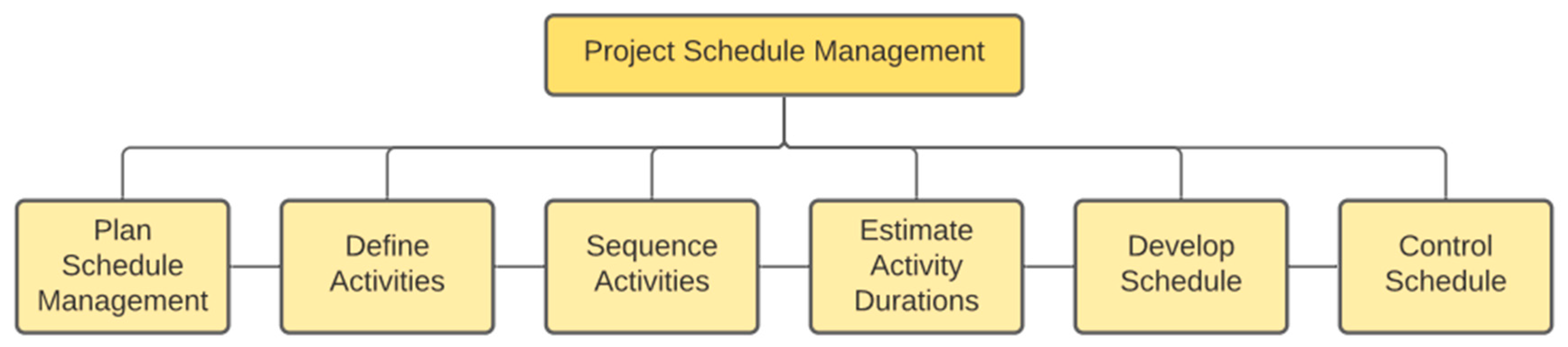
Plan Schedule Management contain the project schedule throughout the project. Define Activities contains the actions needed to provide the right project deliverables and work packages in this process. Sequence Activities contains the relationship between the project activities is identified and a logical sequence of work. Estimate Activity Durations contains the amount of time needed to complete each activity based on estimated resources. Develop Schedule contains a schedule model to obtain an overview of planned dates for completing the activities needed for the project. Control Schedule contains monitoring of the project status, update the project schedule if needed, and managing changes to the schedule baseline.
4. Project Cost Management
The project cost management mainly includes processes that involve the cost of the resources needed to complete all activities of the project. Furthermore, it is useful to make sure that the project is completed within the approved budget. This includes planning, estimating, managing and controlling costs. This knowledge area is divided into four processes.
Figure 2.
An overview of the project cost management processes.
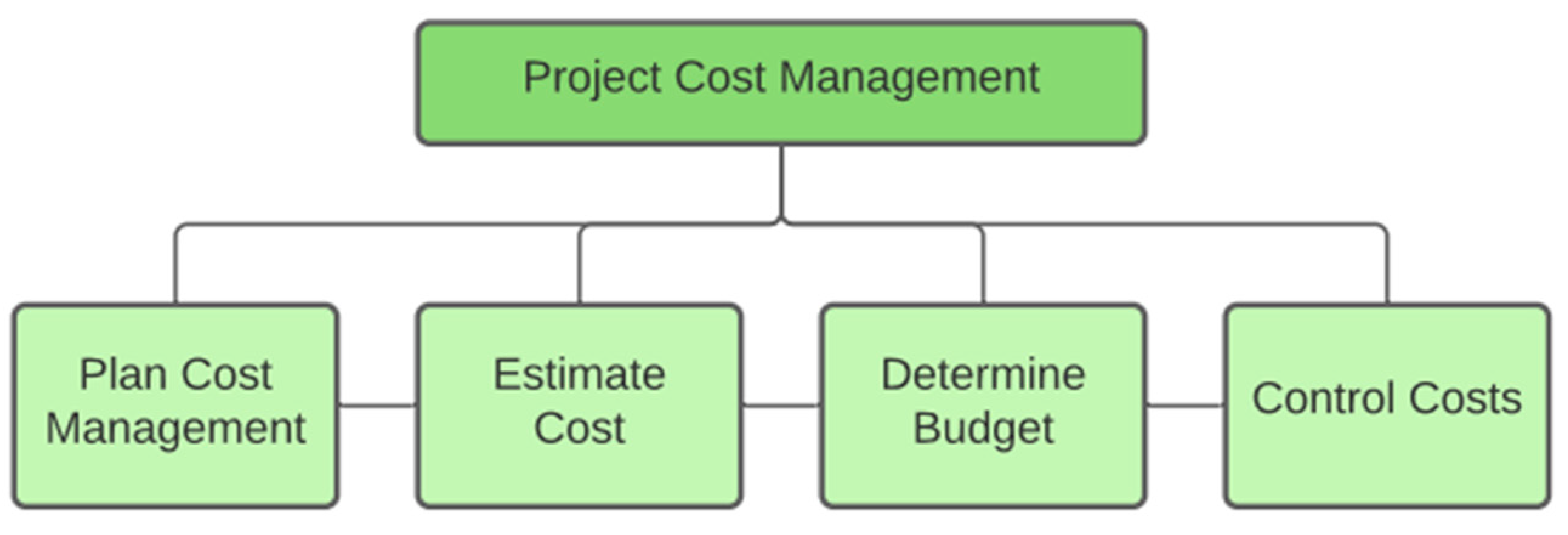
Plan Cost Management contains developing a plan on how the project costs will be estimated, managed, controlled etc. Estimate Costs contains the cost of all resources needed to complete a project is estimated. Determine Budget contains collecting all cost estimates to establish a cost baseline. Control Costs contains the project status is monitored to be able to update the project costs in terms of changes to the cost baseline.
5. Project Risk Management
The main objective of project risk management is to optimize the chances of project success by increasing the probability and/or impact of positive risks and decreasing the probability and/or impact of negative risks. If risks stay unmanaged, it may cause delays, cost overruns or loss of reputation. This knowledge area includes identifying and managing risks and is divided into seven processes.
Figure 3.
An overview of the project risk management processes.

Plan Risk Management contains determining how to conduct the risk management activities. Identify Risks contains identifying project risks, both individual as well as sources of overall risk. Perform Qualitative Risk Analysis focuses on high-priority risks. Perform Quantitative Risk Analysis contains a numerically analyses of the combined effect of identified risks on the project objectives. Plan Risk Responses contains the appropriate options to address identified project risks. Implement Risk Responses contains the implementation of risk responses in the process above. Monitor Risk involves monitoring the implementation of the risk response.
Nils J. Nilsson, a well-known American computer scientist, defines AI as “the activity devoted to making machines intelligent, and intelligence is that quality that enables an entity to function appropriately and with foresight in its environment”[9]. AI is recognized to have a large impact on our nearest future and will reshape many areas of the business environment. The use of AI in management leads to constant interactions between humans and machines. Managers in key organizational domains have already started using AI. These domains include human resources, marketing, customer management and product innovation [10]. The fourth industrial evolution is a topic that has been discussed a lot in the recent years where the nature and extent of rapid technological changes are discussed. The technology’s positive and negative impacts are evaluated and reflected on how technology can be managed for the benefit of businesses and the society, and what to expect in the coming years [11]. AI approaches and available tools to be used for automating tasks in business project management have been research. It was clear that the expectations exceed today’s possibilities, the solutions available hardly meet the requirements of terms such as Project Management BOT or Automated Project Management. A project manager’s tasks can currently only be automated in small, defined areas [2]. In the future, managers at all levels will have to adapt to the use of machines as part of their profession. A survey by Kolbjørnsrud et al [3], published in the Harvard Business Review, explored how managers could grow and succeed in the age of AI. Based on their survey, five practices were considered necessary for managers to be successful. These five practices include leaving administration to AI, focusing on judgement work, treating machines as “colleagues”, working like a designer, and developing social skills and network. Most likely, AI will prove to be cheaper and more efficient than humans in certain tasks. However, that doesn’t mean that machines will completely take over the profession of being a manager. Instead, managers can spend their valuable time on tasks that only humans are able to do. These tasks include the application of experience and expertise to critical business decisions. AI is intended to support managers, not replace them [3]. To achieve a successful outcome of any project, planning and scheduling are crucial elements. A research by Morad and Vorster [11] compared two approaches that can be used in project planning. The first approach focuses on network-based techniques and decision models. The second approach focuses on techniques based on artificial intelligence. Based on the results, AI is expected to have a great impact on the field of project management and can be an effective tool in project planning. The main advantage of the techniques based on AI is that they make a clear distinction between the mechanism and the knowledge used to process the knowledge. This allows knowledge to be added independent of the project solving strategy that is performed by the system, which makes them more flexible than network-based techniques. These techniques can handle uncertainty in identifying interrelationships among various tasks in the project plan, while network-based techniques don’t consider uncertainty among the tasks. They can also store and use heuristic knowledge about the constraints and assist in generating detailed plans [11]. Other studies have been implemented where AI methods are used to forecast project duration [12], and AI is applied to predict cash flow trends in projects to obtain strategic control over them. This can augment project cost management [13]. Research indicates that AI will affect the work of project managers. They must learn to adapt to the changes to be able to keep up with the changing future of their occupation as a project manager. A review essay by Raisch and Krakowski utilized three recent books about AI as a starting point and explored the automation and augmentation concepts in the management domain. Automation means that a machine takes over a human task, while augmentation implies that humans and machines collaborate to perform or solve a particular task. According to the three books, organizations are advised to prioritize augmentation rather than automation. Managerial tasks can be complex where rules or modules are not fully known. Therefore, the use of automation only can be difficult, but managers could use an augmentation approach to obtain a deeper understanding of the problem. This involves the managers and they are forced to collaborate with the machines on certain tasks. They use their expertise to monitor and evaluate the machine´s outcome which also allows them to carry out other valuable tasks. By initially using an augmentation approach to a complex task, organizations aim to increase the level of automation by replacing time consuming human tasks with automated processes. This interaction between AI technology and managers helps them to increase their understanding of certain tasks over time, which may lead to a transition to automation. Raisch and Krakowski concluded that by over-emphasizing on either of the two concepts, can have a negative effect on the organization’s outcomes. Organizations should adopt a broader perspective and compromise both automation and augmentation to benefit the business [10]. AI has also been researched in connection with decision augmentation and automation, as it could potentially enhance human decision-making. Humans are likely to desire control and have confidence in handling every situation. The research demonstrated that humans tend to have little trust in AI [14]. Considering available research on AI today, some parts of management will arguably be automated, while others will be augmented by AI. A recent study by Fridgeirsson and Ingason et al investigates AI’s degree of impact on particular areas of project management and how it might augment the different areas. According to the results, AI will clearly affect the future of project management and its knowledge areas, as defined in the PMBOK. The research demonstrates that out of the ten knowledge areas, project schedule management, project cost management and project risk management are likely to be affected the most by AI and benefit from it [4]. Going forward, AI is a benefit for project managers. It can handle scheduling, planning, risks and decreases the need for human input. It can be used as an assistant to project managers which allows them to spend more time on tasks where the human mind is necessary and tasks that involves its employees. AI can manage complex analytics which enables it to observe the movement of a project and make valuable predictions about the project’s future. The potential benefits of AI in project management are compelling and can have a great impact on the future of project management [15].
6. Methods
The method is a qualitative cross-sectional study based on interviews. There is little or no use of statistical analysis or numerical data in this type of research. It is usually small-scale in terms of number of people or situations researched [16]. The results are then used to predict the future of the topic being researched. A cross-sectional study is referred to when all measures are taken at the same time or over a short period of time [16]. In this study, the interviews are used as the main method of data collection. Semi-structured interviews were conducted and had predetermined statements in a pre-defined order. The statements had pre-defined options for answering as well, which indicated the degree of impact to each statement. Unplanned questions were also used, depending on the flow of the interview and as a follow up on what the respondent said [16]. One open-ended question was included in the end of the interview where the respondents could make a comment if they would like to add something to their response.
A convenience sample was used in the research where the most appropriate respondents were chosen for the interviews [16]. A convenience sample was chosen to make sure that the respondents had the appropriate knowledge to answer and understand the meaning of the questions. The sample of experts was chosen based on their knowledge areas and profession. They need to have experience in project management as well as a professional background in the field and be familiar with the PMBOK framework. Another essential factor is that the respondents have knowledge in the field of artificial intelligence or computer science and experience in managing software projects. The sample of experts need to have good knowledge in both fields of study to be able to get significant results from the research. An overview of the respondents’ background and occupation is presented in Table 1 below.
The results from the previous research by Fridgeirsson et al. [4] concluded that project schedule management, project cost management and project risk management are the three knowledge areas where AI would have the strongest effect. This study narrows the perspective even more. It looks at these three knowledge areas in more depth to obtain a deeper understanding on the effect that AI might have in these areas. The questionnaire for the interviews consisted of 30 statements about AI affecting the following three knowledge areas; project schedule management, project cost management and project risk management. The three knowledge areas focused on in this research were decomposed into the technical and social elements supplementary with each respective knowledge area. For each knowledge area, the inputs to every process were considered to include all of the necessary elements needed to cover all aspects of each knowledge area. Each element was then arranged in statements that stated that AI would affect the different technical and social elements of the three project management knowledge areas. The statements were attached to a Likert scale suitable for research containing five fixed alternative expressions [16]. Weights of 1, 2, 3, 4 and 5 were assigned to the alternatives. The alternatives on the Likert scale were labelled “very much”, “significantly”, “moderate”, “insignificantly”, “very little” where 5 indicated “very much” and 1 “very little”. A “don’t know” option was given the number 0. An open question was included in the end of the interview if the respondent would like to add a comment. The statements are included in Appendix A. Furthermore, the conduct of the interview was tested on a respondent who was not a part of the research to verify that the interview was within an acceptable time limit and to verify that the statements were understandable.
7. Results
7.1. Artificial Intelligence and the Impact on Project Schedule Management
Figure 4 shows the results from the experts’ impact estimates. A majority of the respondents believe that AI will have very much or significant impact on project schedule management. The elements considered to be affected the most by AI is the schedule baseline and enterprise environmental factors when planning schedule, which in both cases had 83% of the respondents believe it to have very much or significant impact. 33% of the respondents believed that AI would have insignificant impact on the development of the project charter and the work performance data. 75% believed AI to very much or significantly affect the schedule management plan and scope baseline when defining, sequencing and estimating activities. Overall, the experts’ impact estimates indicate that AI will affect project schedule management greatly in the next ten years.
7.2. Artificial Intelligence and the Impact on Project Cost Management
Project cost management was divided into 10 statements that covered the necessary elements for this knowledge area. Figure 5 shows the results from the Likert scale based on the experts’ impact estimates. According to the results, 91% of the respondents believe that AI will very much or significantly impact cost management estimates and estimation of resource cost based on market conditions, resource cost rate, exchange rate and inflation. AI is believed to have the lowest impact on cost negotiation and contracting, where 75% of the experts think it will have insignificant or very low impact. AI’s impact on cost types in projects also had a low score among the respondents.
7.3. Artificial Intelligence and the Impact on Project Risk Management
Project risk management was divided into 12 statements that covered the necessary elements for this knowledge area according to the PMBOK. Figure 6 shows the results from the experts’ impact estimates based on the Likert scale. The element that is considered to be affected the most by AI is the probability and impact matrix, where 91% of the respondents believed it to have very high or significant impact. The development of the risk management plan and the setting of risk thresholds for a project had also a high score, with 83% of respondents considering it to have very high or significant impact. The determination of roles and responsibilities for managing risk had the lowest score, where 34% believed AI to have very low or insignificant impact. Overall, AI is believed to have significant impact on project risk management according to the experts’ impact estimates.
8. Artificial Intelligence and the Impact on the Three Knowledge areas
According to the experts’ impact estimates, it is clear that AI will have an impact on all of the three knowledge areas in the next ten years. The overall impact estimates for each of the three knowledge areas was found by using the average scoring percentage for the statements. It indicates that AI would impact project schedule management the most where 61% of the experts believe AI to have very high or significant impact on that knowledge area. Similar results are attained for project cost management and project risk management where the score is 52% and 56%, respectively. Only 9% believed AI to have very low or insignificant impact on project risk management and 78% believed AI to have moderate or significant impact. Overall, the experts agreed that AI will have more impact on schedule and risk management as compared to cost management. The overall impact on each of the three knowledge areas is presented in Table 2 below. The total scoring for the statements can be found in Table A2 in Appendix B.
The experts were asked how they see project management develop in the next ten years. They all agreed that the project manager will never be replaced by AI. Human skills, intuition and experience will always be an important part of the profession. AI can feed the project manager with information, but the project manager has to know how to use it. AI makes it possible for project managers to focus on more complicated and specific tasks, which are often involved with the project team. The communication is the hard part, but a good project manager has good interpersonal skills. The human factor becomes important when all this technology is available and using tools like AI will make project managers even better at their job. It makes their profession more powerful and enjoyable by eliminating routine tasks that may be complicated, like extensive projects where it‘s hard to monitor everything and compile data. AI without human overview is not good because AI doesn‘t have human judgement.
Based on the experts’ answers, AI is already used in scheduling in other fields, an example mentioned was a scheduler for robots on Mars. Scheduling is a large area within project management, and it is believed to be simple to make schedules for any kind of project to maximize utility. AI will be useful to collect, analyze, update and monitor schedules and tackle more tasks at once and AI will most likely have very high impact here in the next ten years. However, cognitive biases must be considered when designing AI software for scheduling. When considering project cost management, humans tend to estimate poorly, often due to cognitive biases, which can be expensive. However, if data is available from previous projects, this can be used to make a budget proposal. The project manager doesn’t always decide on the cost, the cost is often defined in advance, which is a possible limitation for using AI in cost management. Today, project risk management is rather subjective in practice - according to the experts. However, AI is believed to reduce risk affinity if historical data is available. AI is also believed to be useful in risk analysis but the data needs to be significant and comparable to be able to use it. There are optimization methods available today which would be easy to expand and make more adaptive, to react to changes if the system is more alive. However, data needs to be inserted into the system immediately. It is a combination of human factors and AI.
The results clearly indicated that AI would have more impact on tasks where historical data is available and for repeated tasks. When producing data, AI can be trained to learn how to deliver the expected output - but the results can never be never better than the data inserted into the system. However, when dealing with tasks where human skills and communication are required, AI will have less impact.
9. Discussions and conclusion
The purpose of the study was to get a deeper understanding of AI and its impact on project management by interviewing experts in the field. The research indicates how the managerial elements, technical and social, of project schedule-, cost- and risk management will be affected by AI, and which of these elements will be the ones most affected, in quantified metrics. The number of participants in the study were 12. These were all experts on project management and had knowledge in the field of AI as well. However, some of the experts did not have as much knowledge or experience in relation to AI and stated that it was somewhat difficult for them to imagine how AI could impact the managerial elements in the future. Since this is a qualitative research and conducted by interviewing experts in the field, the findings are believed to be valuable and give a reasonable outline of how AI could impact the field of project management. The results may also assist project managers in obtaining a deeper understanding of how their profession will develop in the coming years, what skills will be required and how to deal with the change in their work environment.
Since this is a cross-sectional study, different results may emerge if it is repeated over time. In the future, respondents may have a better understanding of the topic and the technology may be even better than it is today, which could make it less complicated to predict the impacts of AI. The experts all agreed that the strengths of AI lie in these areas of project management, where historical data can be used to learn from and when it comes to repeated tasks. In tasks where human skills are required, AI is believed to have the least impact. This indicates that there is a consensus among the experts that these areas are the ones most prone to AI. The elements that are considered to be affected the most by AI are the schedule baseline, enterprise environmental factors when planning costs, cost management estimates and probability and impact matrix. Although, the impact estimates on all three knowledge areas are rather similar. Cost negotiation and contracting had the lowest score as it depends on human communication and trust.
The human factor becomes important when we have all the available technology today. The experts agreed that the role of project manager would not be replaced in the near future. AI will make their profession more powerful and enjoyable by eliminating routine tasks that may be complicated, e.g. to monitor every task and compile data in large projects with detailed WBS. The human skills will play an essential role as well in applying the AI technology in the best possible way. It will assist with decision-making and make the project manager’s work more effective. A majority of the statements are based on data, and if data is available, AI can be used to monitor or create new data.
According to the experts, project managers tend to have an inability to make reliable plans and schedules where projects often end up behind schedule or in cost overrun. This can be because of external factors that affect their decision-making which results in irrational decisions and may lead to over- or underestimation of time and cost and affect the outcome of projects. Project managers’ previous decisions might also lead to anchoring bias which can affect estimates. According to the experts, a common goal should be to have the ability to obtain reliable information and data about a project to be able to make rational, numerical decisions based on valuable data. AI in project management is designed to provide valuable insight into decision-making and planning. Although AI can assist managers with decision-making, it might be complicated for AI to deal with cognitive biases. It might cause problems such as biases being built into algorithms which can result in unreliable outcomes. The cognitive biases that affect project managers decision-making process are common and result in using shortcuts in thinking, which may appear when programming and designing AI due to biased assumptions. The right data must be inserted into systems to collect and process the data as missing data or information might also cause biases. Therefore, it’s essential to research the potential biases and the errors it can cause when developing AI software. Biases can be a challenge when developing AI, and algorithms used for AI might be influenced by biases. As mentioned during the interviews, developers of AI might not be able to choose the optimal key indicators or variables to design the appropriate system for project managers and without biases. To prevent this from happening, good communication between managers and AI developers is essential as the design of AI needs to incorporate the ideas from the end-user, which is the project manager. Project schedule-, cost- and risk management are three areas of project management that are considered to be weakest as these areas are where project managers can do better when it comes to estimates, and also areas that are prone to the impact of cognitive biases. They have the greatest potential for improvements.
Further research can give more specific results about AI’s impact on project management. In-depth interviews with specialists in the field of AI could be conducted to give more specific answers to exactly how AI can be used in the different elements of project management. Research on cognitive biases when developing AI systems for project schedule-, cost- and risk management could give better insight into the potential biases that can occur in AI. This could give an even deeper understanding of how AI can be used for specific tasks and the future effect on project management. It would also be interesting to research the knowledge of AI within the project management profession, as several of the respondents thought it to be difficult to imagine the effects of AI which may have resulted in some inconsistency in their answers.
Appendix A

Table A1.
Statements for the Interviews.
| Project management knowledge areas | Answer options | |||||
|---|---|---|---|---|---|---|
| Statements | Very much | Significantly | Moderate | Insignificantly | Very little | Don’t know |
| Project schedule management | ||||||
| AI will affect the development of the project charter | ||||||
| AI will affect the scope management plan and development approach when planning schedule | ||||||
| AI will affect enterprise environmental factors when planning schedules | ||||||
| AI will affect the schedule management plan and scope baseline when defining, sequencing and estimating activities | ||||||
| AI will affect duration estimating databases, productivity metrics and location of team members | ||||||
| AI will affect the schedule baseline | ||||||
| AI will affect the performance measurement baseline | ||||||
| AI will affect the work performance data | ||||||
| Project cost management | ||||||
| AI will affect the financial resources when planning costs | ||||||
| AI will affect the reaction to enterprise environmental factors when planning costs | ||||||
| AI will affect the financial controls procedures | ||||||
| AI will affect the cost management estimates | ||||||
| AI will affect the estimation of resource cost based on market conditions, resource cost rates, exchange rates and inflation | ||||||
| AI will affect the determination of budget based on cost- and resource management plan | ||||||
| AI will affect the monitoring and reporting methods of the variance of the cost baseline | ||||||
| AI will affect cost negotiation and contracting | ||||||
| AI will affect cost awareness | ||||||
| AI will affect cost types in projects | ||||||
| Project risk management | ||||||
| AI will affect the development of the risk management plan | ||||||
| AI will affect the determination of roles and responsibilities for managing risk | ||||||
| AI will affect the setting of risk thresholds for a project | ||||||
| AI will affect risk breakdown structures (RBS) | ||||||
| AI will affect the information/lessons learned repository from previous similar projects | ||||||
| AI will affect the identification of project objectives that are at risk | ||||||
| AI will affect the identification of areas subject to uncertainty | ||||||
| AI will affect the budgeting for risk management | ||||||
| AI will affect the identification of costs subject to risk or uncertainty | ||||||
| AI will affect the probability and impact matrix | ||||||
| AI will affect risk identification techniques | ||||||
| AI will affect the mitigation of risk | ||||||
Appendix B
Table A2.
Total Scoring for the Statements.
| Project management knowledge areas | Answer options | |||||
|---|---|---|---|---|---|---|
| Statements | Very much | Significantly | Moderate | Insignificantly | Very little | Don’t know |
| Project schedule management | ||||||
| AI will affect the development of the project charter | 8% | 25% | 33% | 33% | 0% | 0% |
| AI will affect the scope management plan and development approach when planning schedule | 25% | 33% | 25% | 17% | 0% | 0% |
| AI will affect enterprise environmental factors when planning schedules | 8% | 75% | 17% | 0% | 0% | 0% |
| AI will affect the schedule management plan and scope baseline when defining, sequencing and estimating activities | 17% | 58% | 25% | 0% | 0% | 0% |
| AI will affect duration estimating databases, productivity metrics and location of team members | 25% | 33% | 42% | 0% | 0% | 0% |
| AI will affect the schedule baseline | 50% | 33% | 17% | 0% | 0% | 0% |
| AI will affect the performance measurement baseline | 8% | 42& | 33% | 17% | 0% | 0% |
| AI will affect the work performance data | 17% | 25% | 25% | 33% | 0% | 0% |
| Project cost management | ||||||
| AI will affect the financial resources when planning costs | 17% | 17% | 67% | 0% | 0% | 0% |
| AI will affect the reaction to enterprise environmental factors when planning costs | 17% | 42% | 17% | 25% | 0% | 0% |
| AI will affect the financial controls procedures | 17% | 58% | 17% | 0% | 0% | 8% |
| AI will affect the cost management estimates | 33% | 58% | 8% | 0% | 0% | 0% |
| AI will affect the estimation of resource cost based on market conditions, resource cost rates, exchange rates and inflation | 33% | 58% | 8% | 0% | 0% | 0% |
| AI will affect the determination of budget based on cost- and resource management plan | 8% | 33% | 58% | 0% | 0% | 0% |
| AI will affect the monitoring and reporting methods of the variance of the cost baseline | 33% | 42% | 8% | 17% | 0% | 0% |
| AI will affect cost negotiation and contracting | 0% | 0% | 25% | 50% | 25% | 0% |
| AI will affect cost awareness | 33% | 8% | 50% | 8% | 0% | 0% |
| AI will affect cost types in projects | 0% | 17% | 25% | 50% | 0% | 8% |
| Project risk management | ||||||
| AI will affect the development of the risk management plan | 25% | 58% | 8% | 8% | 0% | 0% |
| AI will affect the determination of roles and responsibilities for managing risk | 0% | 17% | 50% | 17% | 17% | 0% |
| AI will affect the setting of risk thresholds for a project | 8% | 75% | 8% | 0% | 0% | 8% |
| AI will affect risk breakdown structures (RBS) | 17% | 33% | 42% | 8% | 0% | 0% |
| AI will affect the information/lessons learned repository from previous similar projects | 33% | 25% | 33% | 0% | 8% | 0% |
| AI will affect the identification of project objectives that are at risk | 0% | 42% | 58% | 0% | 0% | 0% |
| AI will affect the identification of areas subject to uncertainty | 8% | 50% | 33% | 8% | 0% | 0% |
| AI will affect the budgeting for risk management | 17% | 17% | 58% | 8% | 0% | 0% |
| AI will affect the identification of costs subject to risk or uncertainty | 25% | 42% | 33% | 0% | 0% | 0% |
| AI will affect the probability and impact matrix | 8% | 83% | 8% | 0% | 0% | 0% |
| AI will affect risk identification techniques | 0% | 25% | 50% | 17% | 0% | 8% |
| AI will affect the mitigation of risk | 0% | 58% | 25% | 17% | 0% | 0% |
References
- W. N. Hosley, “The application of artificial intelligence software to project management,” Proj. Manag. J., vol. 18, no. 3, pp. 73–75, 1987, [Online]. Available: https://www.pmi.org/learning/library/application-artificial-intelligence-software-pm-5234.
- G. Auth, O. Jokisch, and C. Dürk, “Revisiting automated project management in the digital age – a survey of AI approaches,” Online J. Appl. Knowl. Manag., vol. 7, no. 1, pp. 27–39, May 2019. https://doi.org/10.36965/OJAKM.2019.7(1)27-39. [CrossRef]
- V. Kolbjørnsrud, R. Amico, and R. J. Thomas, “How Artificial Intelligence Will Redefine Management,” 2016.
- T. V. Fridgeirsson, H. T. Ingason, H. I. Jonasson, and H. Jonsdottir, “An Authoritative Study on the Near Future Effect of Artificial Intelligence on Project Management Knowledge Areas,” Sustainability, vol. 13, no. 4, p. 2345, Feb. 2021. https://doi.org/10.3390/su13042345. [CrossRef]
- “What is Project Management | PMI.” https://www.pmi.org/about/learn-about-pmi/what-is-project-management (accessed May 09, 2021).
- PMI, A Guide to the Project Management Body of Knowledge (PMBOK Guide), 7th ed. USA: Project Management Institute, Inc., 2021).
- [19] PMI, A Guide to the Project Management Body of Knowledge (PMBOK Guide), 6th ed. USA: Project Management Institute, Inc., 2017.
- N. J. Nilsson, “THE QUEST FOR ARTIFICIAL INTELLIGENCE A HISTORY OF IDEAS AND ACHIEVEMENTS,” 2009. Accessed: May 09, 2021. [Online]. Available: http://www.cambridge.org/us/0521122937http://www.cambridge.org/us/0521122937http://www.cambridge.org/us/0521122937.
- S. Raisch and S. Krakowski, “Artificial Intelligence and Management: The Automation–Augmentation Paradox,” Acad. Manag. Rev., vol. 46, no. 1, pp. 192–210, Jan. 2021. https://doi.org/10.5465/amr.2018.0072. [CrossRef]
- A. Morad and M. C. Vorster, “Network-based versus AI-based techniques in project planning,” Proj. Manag. J., vol. 24, no. 1, pp. 23–30, 36, 1993, [Online]. Available: https://www.pmi.org/learning/library/artificial-intelligence-based-techniques-problem-solving-2109.
- M. Wauters and M. Vanhoucke, “A comparative study of Artificial Intelligence methods for project duration forecasting,” Expert Syst. Appl., vol. 46, pp. 249–261, Mar. 2016. https://doi.org/10.1016/j.eswa.2015.10.008. [CrossRef]
- H. F. Þorsteinsson, G. Jónsson, R. H. Magnúsdóttir, L. D. Jónsdóttir, and K. R. Þórisson, “Ísland og fjórða iðnbyltingin,” 2019. [Online]. Available: https://www.stjornarradid.is/library/04-Raduneytin/ForsAetisraduneytid/Framtidarnefnd/Fjorda-idnbyltingin-skyrsla.pdf.
- M.-Y. Cheng, H.-C. Tsai, and C.-L. Liu, “Artificial intelligence approaches to achieve strategic control over project cash flows,” Autom. Constr., vol. 18, no. 4, pp. 386–393, Jul. 2009. https://doi.org/10.1016/j.autcon.2008.10.005. [CrossRef]
- 14. M. Leyer and S. Schneider, “Decision augmentation and automation with artificial intelligence: Threat or opportunity for managers?,” Bus. Horiz., Feb. 2021. https://doi.org/10.1016/j.bushor.2021.02.026. [CrossRef]
- R. Schmelzer, “AI In Project Management,” Forbes, 2019. https://www.forbes.com/sites/cognitiveworld/2019/07/30/ai-in-project-management/?sh=45227249b4a0 (accessed May 09, 2021).
- C. Robson, Real World Research: A Resource for Users of Social Research Methods in Applied Settings, 3rd ed. United Kingdom: John Wiley & Sons Ltd, 2011.
Figure 4.
AI impact estimates on project schedule management.
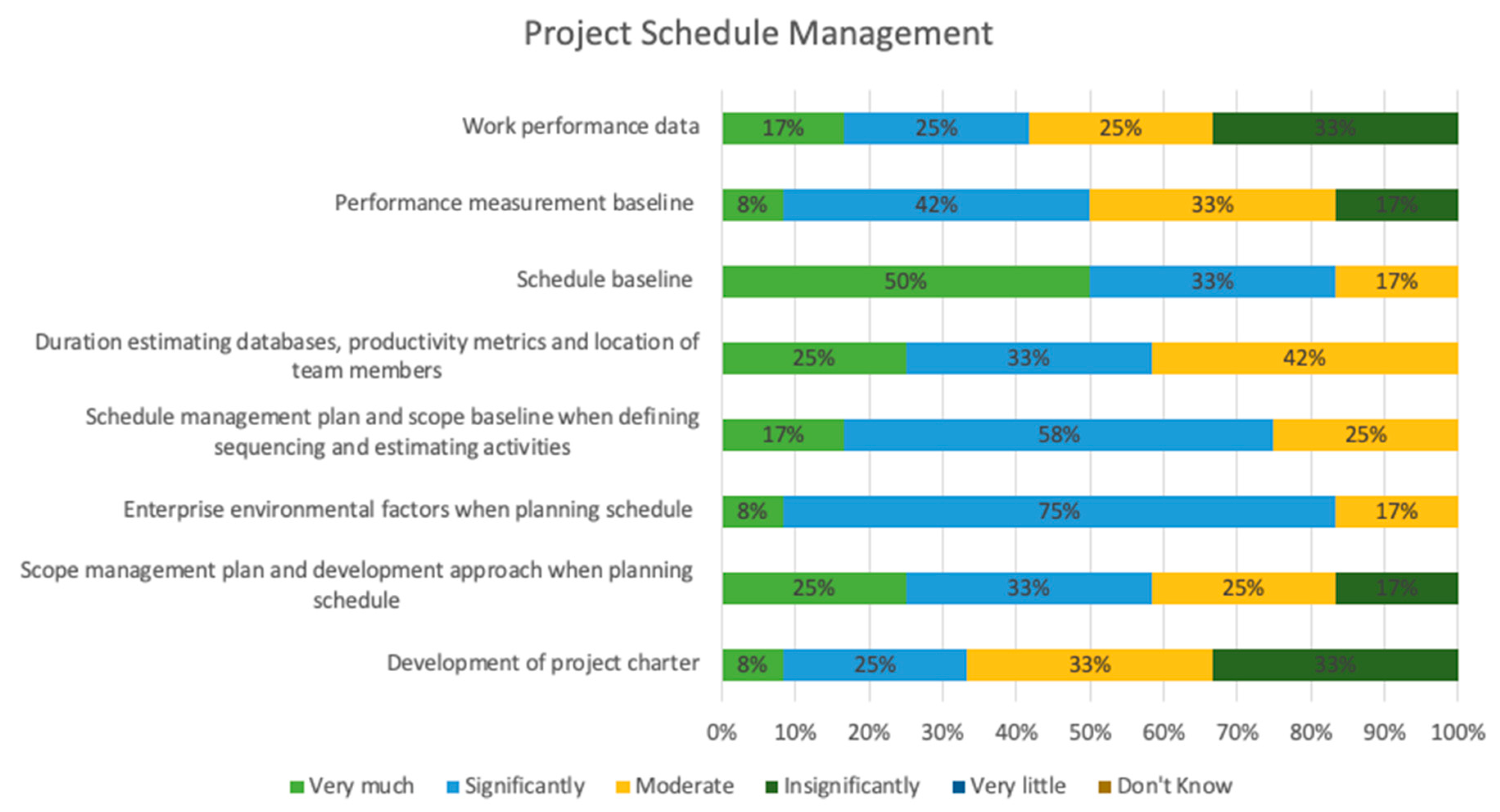
Figure 5.
AI impact estimates on project cost management.
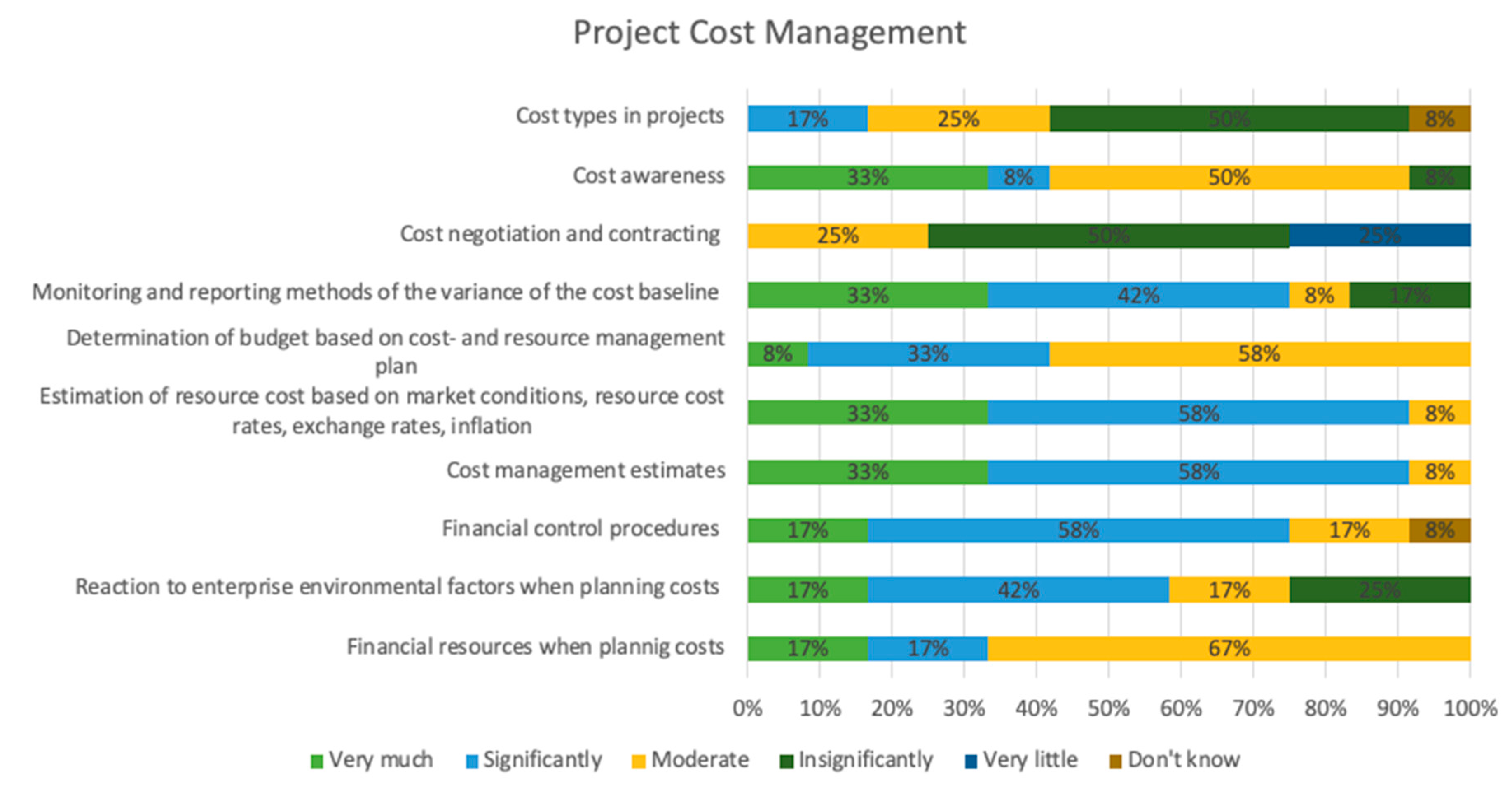
Figure 6.
AI impact estimates on project risk management.
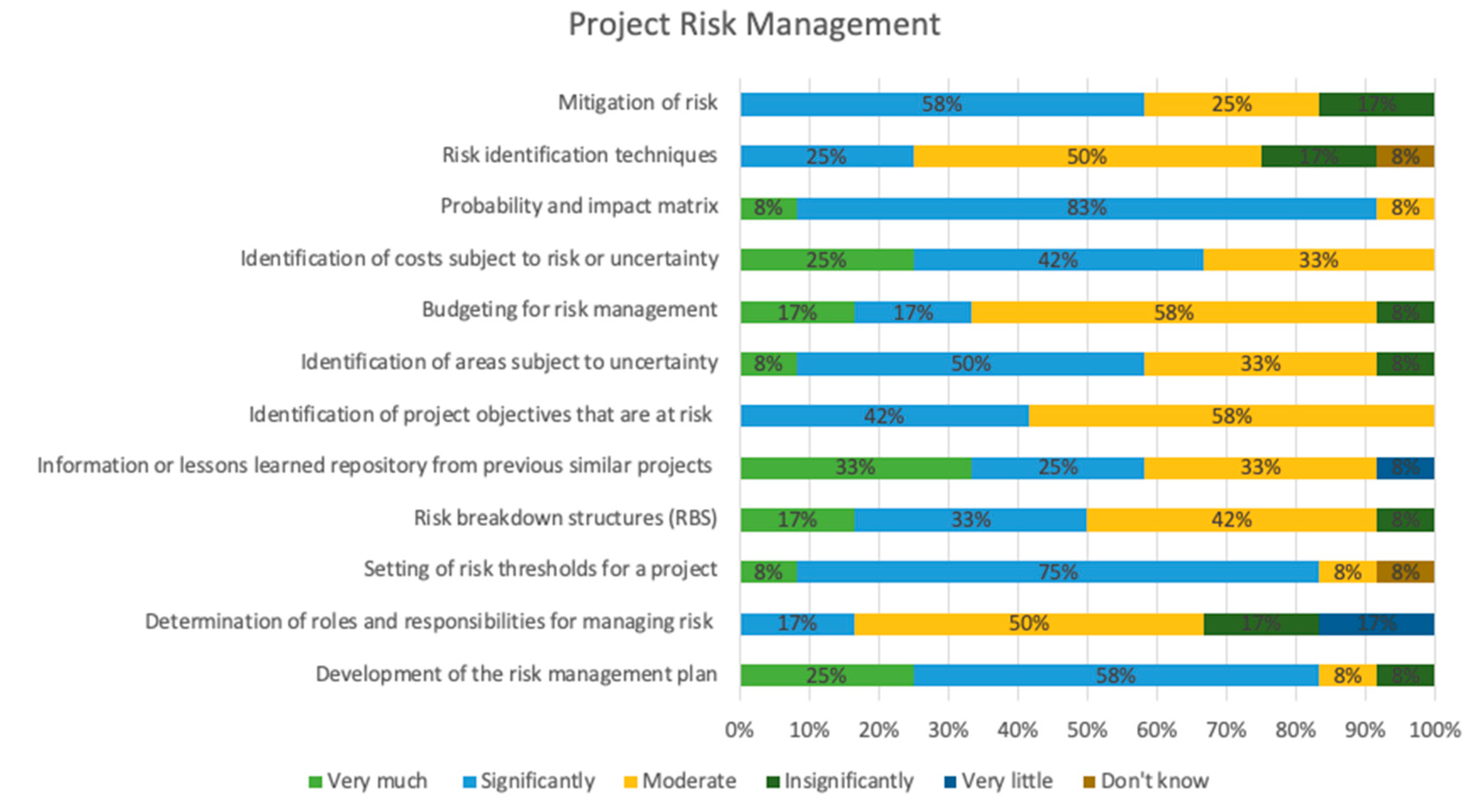
Table 1.
An overview of the background of respondents.
| Respondent # | Background |
|---|---|
| 1 | Ph.D. in engineering. MPM instructor with good background in PM. Self-employed engineer. |
| 2 | MPM degree and IPMA level C certification. Experienced project manager with software background. Project manager at a large IT company. |
| 3 | MPM degree and IPMA level B certification. Experienced project manager with software background and experience in managing software projects. Project manager at a large IT company. |
| 4 | Ph.D. in computer science with good background in AI. Associate professor at Reykjavík University. |
| 5 | PM and leadership training. IPMA level B certification. Project manager at a large food processing company. |
| 6 | MPM degree and IPMA level B certification. Project manager at a construction contracting agency. |
| 7 | Ph.D. in computer science with a good background in AI. Professor at Reykjavík University. |
| 8 | MPM degree and IPMA level B certification. Experienced project manager with software background and experience in managing software projects. Project manager at a telecommunication company. |
| 9 | MPM degree and IPMA level B certification. Engineer at an engineering consultant company. |
| 10 | MPM degree and IPMA level C certification. Project manager at a large health technology company. |
| 11 | M.Sc. in computer science. Has good background in AI. Adjunct professor at Reykjavík University. |
| 12 | Ph.D. in signal processing. Has good background in AI. Associate professor at Reykjavík University. |
Table 2.
An overview of AI impact estimates for the three knowledge areas.
| Very much | Significantly | Moderate | Insignificantly | Very little | Don’t know | |
|---|---|---|---|---|---|---|
| Project Schedule Management | 20% | 41% | 27% | 13% | 0% | 0% |
| Project Cost Management | 19% | 33% | 28% | 15% | 3% | 2% |
| Project Risk Management | 12% | 44% | 34% | 7% | 2% | 1% |
Disclaimer/Publisher’s Note: The statements, opinions and data contained in all publications are solely those of the individual author(s) and contributor(s) and not of MDPI and/or the editor(s). MDPI and/or the editor(s) disclaim responsibility for any injury to people or property resulting from any ideas, methods, instructions or products referred to in the content. |
© 2023 by the authors. Licensee MDPI, Basel, Switzerland. This article is an open access article distributed under the terms and conditions of the Creative Commons Attribution (CC BY) license (http://creativecommons.org/licenses/by/4.0/).
Copyright: This open access article is published under a Creative Commons CC BY 4.0 license, which permit the free download, distribution, and reuse, provided that the author and preprint are cited in any reuse.


