

Submitted:
31 August 2023
Posted:
01 September 2023
You are already at the latest version
Abstract
Fish and fish products are very appreciated in the human diet because of high quality proteins and other important nutrients, such as minerals and polyunsaturated fatty acids. Maintaining freshness, quality and safety is essential in the fish supply chain, starting from on board vessels where the product must be carefully checked and protected from any source of contamination. Safe fishing and handling of fish are very important to reduce the risk of foodborne diseases caused by pathogenic microorganisms such as Salmonella spp., Vibrio spp., Listeria monocytogenes, Clostridium botulinum type E, viruses, and parasites. The inspection of raw material, use of good quality ice and water, high standards of personnel hygiene and cleanliness of equipment and fa-cilities as well as proper storage temperature are the most effective measures to ensure safety of fish and fish products for consumers. This review describes the good hygiene practice to be ap-plied on ships to preserve both fish products and public health.
Keywords:
fish
; fishing
; freshness
; hygiene
; pathogens
; safety
1. Introduction
Fish production displays an increasing trend and according to FAO the total world catches amounted to 96.4 million tons in 2018, with an increase of 5.4% compared to the previous three years [1]. In 2020, fisheries and aquaculture production reached 214 million tons and the global consumption increased from an annual average of 9.9 kg per capita in the 1960s to 20.2 kg [2]. Fish products are an excellent source of nutrients, especially proteins, vitamins, minerals, and long-chain polyunsaturated fatty acids (PUFA), including omega-3 [3]. Nevertheless, they are very perishable foods because of post-mortem modifications and formation of spoilage compounds, such as alcohols, organic acids, aldehydes and ketones, sulfides, histamine, and other biogenic amines [4,5].
The decay of fish is mainly caused by microorganisms, but also enzymatic activity and lipid oxidation are responsible for the decrease of freshness [6]. Good hygiene and proper storage are essential to maintain the quality and safety of fish throughout the fish supply chain from harvest to consumption. Various handling activities (i.e., selecting, gutting, slicing, packing, etc.) taking place on board vessels may represent sources of contamination due to the possibility of dissemination of bacteria through human hands, trays, buckets, floor, etc. Proper cleaning of equipment and facilities as well as frequent washing of hands are effective to manage quality control of fish during these operations.
Large numbers of bacteria belonging to the genera Acinetobacter, Aeromonas, Bacillus, Clostridium, Lactobacillus, Micrococcus, Moraxella, Pseudomonas, Shewanella, Photobacterium, Vibrio, etc. are especially found on the skin, in the gills and the gastrointestinal tracts of fish [7]. They can spread to the flesh during some operations carried out on board vessels and grow when temperature conditions are favorable. The good hygiene practice after capture is noteworthy as it can affect the successive stages of the fish supply chain. The storage temperature of fish after caught is one of the most important measures for preserving and avoiding the microbial growth as well as the production of dangerous substances particularly histamine, which causes a variety of allergy-like symptoms, such as rashes, flushing, swelling of the face and tongue, sweating, nausea, vomiting, diarrhea, headache, dizziness, palpitation, oral burning, metallic taste, and hypotension. Life-threatening cases have also been reported [8]. Besides scombroid poisoning, many foodborne outbreaks due to the consumption of fish and shellfish are reported every year around the world and they are caused by pathogenic microorganisms, such as Salmonella spp., Vibrio spp., Listeria monocytogenes, viruses (hepatitis A virus, norovirus, etc.), and parasites [9].
This review focuses on the hygiene measures to be applied on board vessels to ensure fish quality and avoid its contamination with different hazards, such as bacteria, viruses, and parasites, as well as histamine formation.
2. Structural Requirements for Vessels and Correct handling And Storage of Fish
According to Regulation (EC) 853/2004, vessels used to harvest fish products or to handle or process them after catch must comply with some structural requirements, such as the use of equipment and food contact surfaces of corrosion-resistant material, which must be smooth and easy to clean and disinfect. Vessels must be constructed so as not to cause contamination of the products with bilge-water, sewage, smoke, fuel, oil, grease or other objectionable substances. Further obligations are set for vessels designed and equipped to preserve fishery products for more than 24 h, and for freezer and factory vessels, i.e., any vessel on board which only freezing and operations such as filleting, slicing, skinning, shelling, shucking, mincing, or processing are carried out, respectively (Figure 1).
The application of good hygiene practice on board vessels is imperative to ensure both quality and safety of fish. The first aspect (i.e., fish quality) is particularly associated with freshness, as fish is very perishable because of many intrinsic factors, such as a high moisture and protein content favoring microbial growth, lipid oxidation, especially for PUFA, and the glycogen amount in muscle tissue. The latter can be influenced by the fishing method, e.g., line-caught fish are stressed during harvesting and show lower glycogen than net-caught fish, so that the production of lactic acid is little, and the final post-mortem pH is higher (6.0-6.7) [10].
Due to its chemical composition, i.e., high water activity, relatively low acidity and significant presence of non-protein nitrogen compounds, this type of food is an ideal substrate for microbial colonization by many spoilage bacteria, the so-called specific spoilage organisms (SSOs). Poor hygiene practices and improper conditions (e.g., abuse temperature) in harvesting, handling, processing, and storage, can favor the growth of such microorganisms [11,12]. When SSOs become dominant in the total microbial population, they produce some metabolites responsible of off-odors and off-flavors. Their precursors are carbohydrates for various organic acids, the amino acids cysteine and methionine for sulfur by-products (e.g., dimethyl sulfide), and other amino acids for ammonia and various carbonylic compounds [13].
Freshness of fish is very important for both food industry and consumers, as it determines the acceptability of the product. The assessment of freshness is based on an organoleptic exam regarding some aspects, i.e., skin and skin mucus, eyes, gills color and smell, and flesh texture. Table 1 resumes the criteria established in the Regulation (EC) 2406/1996 for whitefish and bluefish classified in the extra freshness category. High quality fish have a seaweed-like smell and not a fishy odor, gills are red, not brown or grey, skin is shiny and firm to the touch, eyes are convex and bright, and not flat or concave, flesh is firm and not soft or flaccid. The sensory analysis based on such regulatory criteria presents many disappointments, because it does not evaluate the species-specific spoilage characteristics, and there is the possibility of highlighting one criterion among others as discriminative to rise the freshness grade. Moreover, no specification for sampling and examination of fish is provided, so that training and experience from operators are required.
There is another test named Quality Index Method (QIM), which is more specific for the individual fish species and evaluates a higher number of attributes. It gives different points to each attribute, generally from 0 to 3 (0 indicates optimal conditions, while 3 is given when fish is almost spoiled) and the overall quality index is obtained from the total scores [14]. Many differences exist among fish species to consider when a sensory exam is performed. For instance, fish belonging to the Gadidae and Merluccidae families exhibit early soft meat after capture and have high levels of total volatile nitrogen compounds responsible of definite smell; fish of the family Anguillidae show natural mucus on the skin, and Pleuronectidae have small eyes resulting difficult to check as freshness parameter. While the Regulation (EC) 2406/1996 considers only two fish categories, i.e., whitefish and bluefish described in Table 1, the QIM takes in account the specific characteristics of each species and therefore its scheme is more detailed and precise.
The fishing method can affect freshness and its evaluation. For instance, fish, selachians, cephalopods and crustaceans belonging to the extra freshness category must be free from signs of pressure or injuries that can be caused by trawling. Several studies demonstrated the effects of different fishing gear, such as trawls, gillnets, traps, trolling rods, longlines and handlines, on fish quality [15]. Other factors may influence such criterion, such as the fish species and the stress suffered during catch, the time and temperature of storage, and the amount of ice used to cover it [16]. By contrast, dehydration of fish can occur if they are left uncovered and exposed to the sun, so that the skin can loss brightness.
Physical damages can be also caused by fishermen when they handle fish on board vessels [10]. The fish flesh is delicate compared with the muscle tissue of mammals, and it is easily injured. Bruising appears when blood seeps into the flesh and clots, while gaping occurs when layers of muscle tissue separate. These lesions can be caused by slamming fish onto the deck, or throwing them into a fish box, and over-filling it so that fish on the bottom are compressed. They can appear several days after the fish is harvested, so it is important to handle the fish gently from catching to off-loading [17].
Some operations carried out on board vessels can reduce the microbial load of the product. For instance, dressing can include gilling and gutting, but also heading and finning. Small fish are generally chilled as whole and therefore they are minimally handled, whereas large fish must be stunned and bled, and then dressed as soon as possible. All surfaces in contact with fish should be rinsed to remove blood, slime, and offal, and cleaned with a mixture of seawater and detergent [17]. All equipment used for catching and processing fish should also be cleaned and sanitized. Finally, fish should be protected by contamination from fuel and oil, chemicals, birds, and flies [18].
The way that fish is stored (whole, fillet, or gutted) also contributes to its final quality. In most studies, whole chilled and frozen fish present longer shelf life than those preserved as gutted and filleted. However, evisceration can hurdle the microbial spread in muscle tissue as well as the so-called belly bursting or burnt belly, produced by the action of digestive enzymes present in the fish gut [19]. Such enzymes cause massive gas development due to lipid hydrolysis and oxidation, as well as fish muscle softening from extensive autolysis [20].
Chilling and/or freezing fish after caught remain the most valid preservation method to apply from on board vessels to consumption. Maintaining the cold chain at a temperature approaching that of melting ice reduces both microbial growth and enzyme activity, but it can damage fish if the chunks of ice are large or if the seawater with ice is too cold and fish can freeze. Cooling should be made with a bed of ice deep enough so that when the ice melts, the fish will not be in contact with the bottom of the fish box. Fish should be arranged in rows, side-by-side but not touching each other, and should be completely covered with ice. About 2 kg of ice are necessary to properly chill 1 kg of fish, and a layer of ice over fish is essential so that they do not dehydrate [17]. Small ice crystals allow for better contact with fish and reduce physical damages, while larger pieces exert more pressure, injuring the fish tissue [21].
Superchilling is another process used to increase the shelf life and consists of two stages; the product is firstly cooled to its initial freezing point and a little part of its water content (5%–30%) is frozen. Then, the formed ice absorbs heat from the food interior and for short period of transport or storage, it provides a refrigeration reservoir around the product [22]. In addition, there is a smaller amount of structural damage caused by ice crystals compared to freezing, and the shelf life can be prolonged from one and a half to four times than after chilling [23]. Gutted cod superchilled onboard vessels as whole or fillets showed a decrease of microbial activity and protein decomposition in whole fish, and an extension of both freshness (2–4 days) and shelf life (3 days) in fillets [24].
3. Influence of Microbial Contamination on Fish Quality
3.1. Natural Microbiota of Fish
The microbial load on fish muscle surfaces after caught ranges from 102 to 106 cm2, depending on the harvest environment (cold or warm water, salinity, etc.), the fishing method (trawl, longline, traps, etc.), and postharvest handling on board vessels [25]. The initial microbiota of fish includes both Gram negative genera, such as Pseudomonas, Shewanella, Psychrobacter, Pseudoalteromonas, Moraxella, Acinetobacter, Flavobacterium, Vibrio, Photobacterium, and Aeromonas, and Gram-positive microorganisms, i.e., lactic acid bacteria and Micrococcus, Corynebacterium, Bacillus, and Clostridium genera. They are considered indigenous bacteria, while the exogenous microbiota (Enterobacteriaceae, staphylococci, and other microbial groups) arises from contamination of food contact surfaces, workers, etc., during the handling of the products after harvesting [13]. Specifically, microorganisms associated with the human and animal digestive tract, such as Escherichia coli and those belonging to the genera Enterococcus, Salmonella, Enterobacter, Klebsiella, Shigella, Yersinia, can sometimes colonize waters as contaminants from the terrestrial environment, while Staphylococcus aureus and L. monocytogenes can derive from workers nose, throat, and skin and unsanitary equipment and surfaces, respectively [26]. The geographical origin, type of waters (seawaters or freshwaters, cold or temperate), potential contamination and other conditions on board vessels (e.g., hygiene practices, temperature, and time of storage) can influence the microbial load. Psychrophilic microorganisms, e.g., Photobacterium spp., can be found in seafood from cold seawaters such as the North Atlantic and North Sea, but they are infrequent in fish living in temperate waters like the Mediterranean Sea [27].
3.2. Spoilage Phenomena
The spoilage of fish and fish products is related to three main post-mortem processes, i.e., lipid oxidation, microbial degradation, and autolysis, which are responsible for their main sensory changes. The crucial factor delaying such phenomena is temperature, therefore fish should be chilled in ice as soon as possible after caught, to inhibit bacterial growth and enzymatic action, and contribute to freshness and safety maintenance with consequent shelf life extension [14]. The rate of spoilage also depends on many other factors such as fish species, hygiene conditions on board vessels, and amount of food in the guts. One of the most important aspects for consumers which is directly related to freshness is the taste, and ammonia, trimethylamine, dimethylamine, and other volatile basic compounds are responsible of the so-called fishy odor. Sea fish contain trimethylamine-oxide, which is reduced to trimethylamine by bacteria after death. Free fatty acids and thiobarbituric acid are the main compounds deriving from lipid oxidation, while K-value is obtained from the autolytic decomposition of adenosine triphosphate (ATP) [28]. However, autolytic enzymes such as ATPase can reduce the flesh texture, but they do not result in known off-odors and off-flavors [29]. Figure 2 shows the main compounds produced during fish spoilage.
The microbiological spoilage of fish is linked to intrinsic characteristics (i.e., moisture content, pH, oxidation-reduction potential, and available nutrients) as well as extrinsic factors associated with the handling and storage environment, particularly temperature and relative humidity, but also, numbers and species of microorganisms that are present. Fresh seafood products have high water activity (0.98–0.99), while pH ranges from 5.4 for red meat fish species (e.g., tuna) to 7.0 for some crustaceans [25]. The composition of fish microbiota changes during spoilage and Shewanella putrefaciens and Pseudomonas aeruginosa have been identified as the key bacteria of deterioration of marine and freshwater tropical fish stored in ice, while at temperature abuse conditions (about 25°C), the microbiota is dominated by Vibrionaceae and, when fish is caught in polluted waters, Enterobacteriaceae [13]. Morganella morganii and Proteus mirabilis are responsible for histamine formation in fish, which is particularly rapid at ambient temperature between 29° and 31°C [28]. The deamination and decarboxylation of amino acids are two important biochemical reactions caused by microorganisms during spoilage. The deamination reaction is fundamental for their energy metabolism and substance synthesis, but ammonia can increase the flesh pH and the production of off-flavor. Decarboxylation of amino acids lead to the formation of biogenic amines, some of them such as cadaverine and putrescine are associated with changes of fish quality, while others like histamine can cause human intoxication [30].
4. Biological Hazards Affecting Fish Safety
Several pathogens can cause disease in humans by handling infected fish aboard ships, in retail stores, or through the ingestion of raw or improperly cooked contaminated fish and/or seafood. The widespread presence of these microorganisms in fish along the seafood chain may be favored by lack of basic hygiene practice. Unsanitary handling can lead to the contamination of fish with potentially foodborne pathogens, especially when fish is eaten raw or undercooked, posing a significant risk to public health [31]. The main hazards associated with incorrect handling and storage of fish are reported in the following paragraphs.
4.1. Pathogenic Bacteria
Some pathogenic microorganisms such as Vibrio parahaemolyticus, Vibrio vulnificus, Vibrio cholerae, L. monocytogenes, Escherichia coli, Salmonella spp., Shigella spp., Staphylococcus aureus, etc. can be indigenous bacteria of raw fish or they can derive from air, contaminated water, sewage, unclean hands, or insanitary utensils and equipment used on board vessels. They occur only sporadically and at low levels, but under temperature abuse, their potential for development and/or toxin production is of particular concern. In Table 3 some favoring conditions for pathogen growth are reported [32].
Contamination of fish and fish products is often due to poor personal hygiene, poor processing hygiene or poor water quality. Animal or human feces are the main source of many pathogens, i.e., Salmonella spp., Shigella spp., pathogenic E. coli, Campylobacter jejuni, or viruses such as norovirus and hepatitis virus, which can contaminate seafood through direct discharge or after inadequate sewage treatment [33].
V. parahaemolyticus is a halophilic Gram-negative microorganism widely distributed in estuarine environments and found in seafood such as eel, clam, oyster, crab, and shrimp. It causes an acute gastroenteritis with nausea, diarrhea, vomiting, fever, and chills, while in immunocompromised individuals a severe bacteremia can also occur [34]. Strains of V. cholerae belonging to serogroups O1 and O139 and possessing the cholera toxin gene cause a severe illness characterized by a life-threatening diarrhea, while non O1/O139 cause only mild to moderate gastroenteritis [33]. V. vulnificus is an opportunistic human pathogen, causing occasionally a mild gastroenteritis in healthy individuals, but it is responsible of primary septicemia in patients with chronic pre-existing conditions, or wound infection after contact with the bacterium via seawater or by handling seafood [35].
Pathogenic strains of V. vulnificus, V. parahaemolyticus, V. cholerae and Salmonella enterica in raw oysters, clams, and mussels, but also, tuna, shrimp, and cockles, as well as L. monocytogenes in raw, lightly processed seafood, ready-to-eat fish products, vacuum- packed smoked products, etc. can cause foodborne diseases in humans [36]. Furthermore, shellfish can grow in areas which are commonly subject to contamination from sewage and as filter organisms they concentrate pathogens in their body. As they are often consumed as whole, either raw or partially cooked, they can cause several intoxications and/or diseases in consumers [26].
Non-proteolytic Clostridium botulinum type E is an anaerobic and spore-forming microorganism able to produce a highly human-toxigenic neurotoxin causing flaccid paralysis, which may lead to death [37]. Other symptoms occurring from 18 to 36 h after consumption of contaminated fish are weakness, dizziness, double vision, difficulty in speaking, swallowing and breathing, abdominal swelling, constipation, and paralysis. It can germinate and grow at refrigerated temperatures as low as 3.3°C and, as a result, it is a biohazard in refrigerated products, especially in vacuum or modified atmosphere packaging with low or no oxygen [38]. The worst scenario arises when toxin production occurs before fish spoilage. Catfish fillets inoculated with C. botulinum type E and stored in air, vacuum and modified atmosphere packaging at temperatures between 4° and 16°C spoiled before toxin was detected in all experimental conditions at 4°C, while at 16°C (and 8°C for vacuum packaging) the toxin was found on the same day of spoilage. Flounder fillets inoculated with a mixed culture of C. botulinum type E and non-proteolytic types B and F, and stored under vacuum and in oxygen permeable film at 4° and 10°C, showed sensory spoilage after toxin production only in the first condition [25].
Seafood can be naturally contaminated with this pathogen, as it is mainly associated with the aquatic environments including marine and freshwater sediments [39]. It should be assumed that C. botulinum type E is present in any raw fishery product, particularly in the viscera. Therefore, the evisceration of fish on board vessels by careful and complete removal of all internal organs in the body cavity without puncturing or cutting them represents the most important measure to eliminate this microorganism. For small fish (e.g., anchovies and herring sprats) which are not eviscerated, some further processing can eliminate the preformed toxin or prevent its formation when a water phase salt content of 10%, or a water activity of below 0.85, or a pH of 4.6 or less are achieved [38].
Some growth conditions for the main pathogenic bacteria occurring in fish are reported in Table 2.
4.2. Viruses
The main viruses found in seafood, especially bivalve mollusks as filter organisms, are norovirus and hepatitis A virus from contaminated waters [40].
Noroviruses are non-enveloped and single-stranded RNA viruses belonging to the family Caliciviridae. They are classified into 10 genogroups (GI-GX), but only genogroups GI, GII and GIV can infect humans [41]. The symptomatology is characterized by sudden onset of severe vomiting, abdominal cramps, watery and non-bloody diarrhea, myalgia, headache, and mild fever. It usually resolves in 2-3 days, but in vulnerable groups such as children, elderly, and immunocompromised individuals, complications can lead to dehydration and hospitalization, or even death [42]. Different food can cause illness, such as shellfish harvested in marine contaminated waters, and vegetables and soft fruits (i.e., raspberries, leafy greens, or salads) irrigated with water contaminated by sewage [43]. The bioaccumulation of human norovirus in shellfish is genotype dependent and is associated with specific attachment receptors, as reported in oysters by Ueki et al. [44].
Hepatitis A virus is one of the most severe foodborne viruses associated with the consumption of contaminated water and foods, particularly raw or undercooked shellfish. It causes acute hepatitis with elevated levels of liver enzymes, dark-colored urine, and further symptoms such as fatigue, malaise, and abdominal pain [45]. However, the infection usually resolves completely in most patients, and it is almost asymptomatic in children. The immunological status, age and occurrence of other hepatic diseases can affect its severity [46].
4.3. Parasites
Parasites, especially in their larval stage, can cause foodborne diseases when fish and seafood are consumed uncooked, undercooked, or subject to mild technologies such as light brining, marination, cold smoking, etc. They can be nematodes or roundworms (Anisakis spp., Pseudoterranova spp., Eustrongylides spp., and Gnathostoma spp.), cestodes or tapeworms (Diphyllobothrium spp.), and trematodes or flukes (Chlonorchis sinensis, Opisthorchis spp., Heterophyes spp., Metagonimus spp., Nanophyetes salmincola, and Paragonimus spp.). Most of them cause mild-to-moderate illness, but more severe symptoms can also occur. Roundworms give origin to nausea, vomiting, diarrhea, even severe abdominal pain and sometimes they penetrate the intestine. Tapeworms are responsible for abdominal swelling and abdominal cramps and may lead to weight loss and anemia. Intestinal flukes cause abdominal discomfort and diarrhea. Some intestinal flukes may also migrate to and damage the heart and central nervous system. Liver flukes and lung flukes may migrate respectively to liver and lung and cause serious problems in other vital organs [47].
The life cycle of parasites occurs in one or several hosts. Fish can be carriers or act as transitional hosts of some parasitic species affecting humans, such as metacercariae of trematodes (Opisthorchis felineus, Pseudamphistomum truncatum, Clinostomum complanatum, Metagonimus yokogawai, Heterophyes heterophyes, Cryptocotyle lingua, Echinochasmus perfoliatus), plerocercoids of cestods of the genus Diphyllobothrium and larvae of nematodes (Anisakis simplex, Dioctophyme renale, and Gnathostoma hispidum) [48].
Nematodes of the genus Anisakis have an indirect life cycle including various hosts, marine mammals as definitive, while fish and crustaceans are intermediate hosts. Larvae of Anisakis spp. (particularly A. simplex and Anisakis pegreffii) can be detected in pelagic, benthopelagic and demersal teleost fish from the Atlantic Ocean, the Mediterranean Sea, and the Pacific Ocean. Their transmission requires a wide availability of hosts, the stability of marine trophic webs, and some abiotic environmental parameters such as water temperature and salinity, which can affect the hatching of eggs and the survival and dispersion of the first larval stages [49].
The consumption of raw, undercooked, marinated, salted, or smoked fish can infect humans with the larvae of this parasite, which can be killed by a freezing treatment at -20°C for 24 h or heating to 65°C. The evisceration of fish immediately after capture prevents the migration of larvae from the visceral cavity to the muscle tissue [48]. Particularly, when fish ingest an infected first intermediate host, the larvae penetrate the intestinal wall and may encyst in a coil on the surface of internal organs, and/or migrate into the musculature. This migration occurs both when fish are alive (intra-vitam migration) and after death (post-mortem migration) [50].
Some authors investigated the localization of A. simplex larvae in herring from the North Sea and demonstrated that different organs were infected, i.e., hind stomach (57%), pyloric caeca (21%), hind intestine (15%), but not fish muscle [51]. Cipriani et al. [52] found A. pegreffii larvae in the body cavity (62.9%) and liver (28.3%), and only 6.6 and 2.1% were in the ventral and dorsal part of fish flesh, respectively. The temperature of samples was constant (below 0°C) as a post-mortem migration of larvae in the fish flesh can occur when it is above 2°C. Then, temperature is the main parameter able to activate larvae. The post-mortem migration of A. pegreffii larvae in anchovies was observed at 5° and 7°C but not at 2°C [50]. Suzuki et al. [53] reported that the penetration rate of A. simplex larvae in samples of Scomber japonicus stored for 20 h at 4° and 20°C corresponded to 9.3 and 19.2%, respectively. As temperature and time play an important role in larval motility, gutting or chilling fish at the temperature of the melting ice as soon as possible are the most significant strategies to apply on board vessels. According to Regulation (EC) 853/2004, the viscera and parts that may constitute a danger to public health must be removed as soon as possible and kept apart from fishery products intended for human consumption.
4.4. Histamine Formation
Scombroid poisoning or histamine intoxication is caused by the consumption of fish species with a high histidine content. Fish belonging to Scombridae and Scomberesocidae families are commonly involved in these outbreaks, but even other species of non-scombroid fish have been reported [54]. Therefore, maximum limits for histamine are established worldwide. The Food and Drug Administration of the United States (US) adopted the limit of 50 mg/kg, while the European Union (EU) criteria correspond to 100 and 200 mg/kg in both raw and processed fish products, except for those that have undergone an enzyme maturation treatment in brine, whose maximum limit is 400 mg/kg. According to the sampling plan based on EU and US schemes, 9 or 18 sample units from the same batch are analyzed, respectively [55].
The formation of histamine in fresh fish is extremely variable and depends on species and individual fish, time and temperature of storage, and types and numbers of bacteria. Some non-pathogenic spoilage microorganisms such as M. morganii, Enterobacter aerogenes, Hafnia alvei, Raoultella planticola/ornithinolytica, and Photobacterium damselae may generate histamine when time/temperature abuse conditions favor their growth [25]. The histidine-decarboxylating microorganisms can be present in the natural microbial population of live fish, but they can also derive from post-catching contamination on board vessels, especially Enterobacteriaceae [56]. Some operations, such as evisceration and gill removal, may reduce the number of histamine-forming bacteria, but when done improperly, they may accelerate the process of histamine production by spreading the bacteria from the visceral cavity to the flesh.
Scombrotoxin formation has been frequently associated with a time/temperature abuse of fish post-harvest. The growth of histamine-forming bacteria is possible over a wide range of temperature, even if it is more rapid at high-abuse than at moderate-abuse temperatures. As the most prolific histamine producers are mesophiles, temperature is a critical factor for histamine formation in fish. The optimum temperature reported in many studies corresponds to 25°C, while a low temperature (0°C or below) can effectively control both microbial development and histamine production [57].
5. Conclusions
Fish are characterized by different intrinsic (e.g., flavor, texture, centesimal composition, etc.) and extrinsic qualities that are a result of how they were treated on board vessels after caught. The latter can be managed by handling fish properly, and cleaning and chilling as soon as possible. Temperature, time, and good hygiene practice are key factors to preserve quality and extend shelf life, as well as to ensure the safety of fish products. Maintaining seafood at low temperature is the most critical factor and the use of time temperature indicators may be a valid solution to ensure cold chain preservation and monitor some important dangers, such as C. botulinum toxin, V. parahaemolyticus, V. vulnificus, and histamine formation in scombrotoxic fish species [58]. To minimize the risk for consumers, the food business operators involved in this sector, primarily fishermen, should implement prerequisite programs, as well as good hygiene practice or good aquaculture practice.
Funding
This research received no external funding.
Institutional Review Board Statement
Not applicable.
Informed Consent Statement
Not applicable.
Data Availability Statement
Not applicable.
Conflicts of Interest
The author declares no conflict of interest.
References
- Edirisinghe, S.K.; Wickramasinghe, I.; Wansapala, M.A.J.; Warahena, A.S.K. Adoption of hygienic practices in selected fish markets along the fish supply chain, in Sri Lanka. Food Research 2022, 6, 374–382. [Google Scholar] [CrossRef]
- FAO. The State of World Fisheries and Aquaculture 2022. Towards Blue Transformation. Rome, FAO, 2022; pp. 1–266. [CrossRef]
- Visciano, P. Chemicals and Safety of Chemical Contaminants in Seafood. In Food Safety Chemistry. Toxicant Occurrence, Analysis and Mitigation; Liangli, L.Y., Shuo,W., Bao-Guo, S., Eds.; CRC Press; Taylor & Francis Group, Boca Raton, FL, USA, 2015; pp. 215–236.
- Kuley, E.; Yavuzer, M.N.; Yavuzer, E.; Durmuş, M.; Yazgan, H.; Gezginç, Y.; Özogul, F. Inhibitory effects of safflower and bitter melon extracts on biogenic amine formation by fish spoilage bacteria and food borne pathogens. Food Bioscience 2019, 32, 100478. [Google Scholar] [CrossRef]
- Saelens, G.; Houf, K. Systematic review and critical reflection on the isolation and identification methods for spoilage associated bacteria in fresh marine fish. Journal of Microbiological Methods 2022, 203, 106599. [Google Scholar] [CrossRef]
- Gómez-Limia, L.; Cutillas, R.; Carballo, J.; Franco, I.; Martínez, S. Free amino acids and biogenic amines in canned European eels: Influence of processing step, filling medium and storage time. Foods 2020, 9, 1377. [Google Scholar]
- Comas-Basté, O.; Latorre-Moratalla, M.L.; Sánchez-Pérez, S.; Veciana-Nogués, M.T.; Vidal-Carou, M.C. Histamine and other biogenic amines in food. From scombroid poisoning to histamine intolerance. In Biogenic Amines; Proestos, C., Ed.; IntechOpen, London, UK, 2019; pp. 1–20. [CrossRef]
- Evangelista, W.P.; Silva, T.M.; Guidi, L.R.; Tette, P.A.S.; Byrro, R.M.D.; Paula Santiago-Silva, P.; Christian Fernandes, C.; Gloria, M.B.A. Quality assurance of histamine analysis in fresh and canned fish. Food Chemistry 2016, 211, 100–106. [Google Scholar] [CrossRef]
- Bavisetty, S.C.B.; Vu, H.T.K.; Benjakul, S.; Vongkamjan, K. Rapid pathogen detection tools in seafood safety. Current Opinion in Food Science 2018, 20, 92–99. [Google Scholar] [CrossRef]
- Marshall, D.L. Spoilage of Animal product. Seafood. In Encyclopedia of Food Microbiology, Second Edition, Batt, C.A., Tortorello, M.L. Eds.; 2014, 3, pp. 453–458. [CrossRef]
- Ghaly, A.E.; Dave, D.; Budge, S.; Brooks, M.S. Fish spoilage mechanisms and preservation techniques: Review. American Journal of Applied Sciences 2010, 7, 859–877. [Google Scholar] [CrossRef]
- Anagnostopoulos, D.A.; Parlapani, F.; Boziaris, I.S. The evolution of knowledge on seafood spoilage microbiota from the 20th to the 21st century: Have we finished or just begun? Trends in Food Science & Technology 2022, 120, 236–247. [Google Scholar] [CrossRef]
- Boziaris, I.S., Parlapani, F.F. Specific Spoilage Organisms (SSO) in Fish. In The Microbiological Quality of Food: Foodborne Spoilers; Bevilacqua, A.; Corbo, M.R.; Sinigaglia, M.; Sykes, R. Eds.; Elsevier, Woodhead Publishing Series in Food Science, Technology and Nutrition 2017, pp. 61–98.
- Freitas, J.; Vaz-Pires, P.; Câmara, J.S. Quality Index Method for fish quality control: Understanding the applications, the appointed limits and the upcoming trends. Trends in Food Science & Technology 2021, 111, 333–345. [Google Scholar] [CrossRef]
- Sogn-Grundvåg, G.; Zhang, D.; Dreyer, B. Fishing methods for Atlantic cod and haddock: quality and price versus costs. Fisheries Research 2020, 230, 105672. [Google Scholar] [CrossRef]
- Mahmud, A.; Abraha, B.; Samuel, M.; Mohammedidris, H.; Abraham, W.; Mahmud, E. Fish preservation: A multi-dimensional approach. MOJ Food Processing & Technology 2018, 6, 303–310. [Google Scholar]
- Beverly, S. Proper fish handling for quality and safety. In Fisheries Newsletter, Number 134, January–April 2011. 20 April.
- Duarte, A.M.; Silva, F.; Pinto, F.R.; Barroso, S.; Gil, M.M. Quality assessment of chilled and frozen fish—Mini review. Foods 2020, 9, 1739. [Google Scholar]
- Singh, A.; Benjakul, S. Proteolysis and its control using protease inhibitors in fish and fish products: A review. Comprehensive Reviews in Food Science and Food Safety 2018, 17, 496–509. [Google Scholar] [CrossRef]
- Microbial spoilage of fish and fish products and its preservation, by Sanjogta Thapa Magar. Edited By: Sagar Aryal, September 24, 2021. https://microbenotes.com/microbial-spoilage-of-fish-preservation/ (accessed on 18 August 2023).
- Watts, E. Seafood handling, processing, and packaging. Reference Module in Food Sciences 2022, 1–17. [Google Scholar] [CrossRef]
- Banerjee, R.; Maheswarappa, N.B. Superchilling of muscle foods: Potential alternative for chilling and freezing. Critical Reviews in Food Science and Nutrition 2019, 59, 1256–1263. [Google Scholar]
- Tavares, J.; Martins, A.; Fidalgo, L.G.; Lima, V.; Amaral, R.A.; Pinto, C.A.; Silva, A.M.; Saraiva, J.A. Fresh fish degradation and advances in preservation using physical emerging technologies. Foods, 2021, 10, 780. [Google Scholar] [CrossRef]
- Eliasson, S.; Arason, S.; Margeirsson, B.; Bergsson, A.B.; Palsson, O.P. The effects of superchilling on shelf-life and quality indicators of whole Atlantic cod and fillets. LWT - Food Science and Technology 2019, 100, 426–434. [Google Scholar] [CrossRef]
- Benner, R.A. Organisms of concern but not foodborne or confirmed foodborne. Encyclopedia of Food Safety 2014, 2, 245–250. [Google Scholar]
- FDA. Chapter 4 - Pathogens From the Harvest Area. In Fish and Fish Products Hazards and Controls Guidance, 4th ed., Silver Spring, MD, USA, 2020a; pp. 75–90.
- Parlapani, F.F. Microbial diversity of seafood. Current Opinion in Food Science 2021, 37, 45–51. [Google Scholar] [CrossRef]
- Prabhakara, P.K.; Vatsa, S.; Srivastav, P.P.; Pathak, S.S. A comprehensive review on freshness of fish and assessment: Analytical methods and recent innovations. Food Research International 2020, 133, 109157. [Google Scholar] [CrossRef]
- Prabhakara, P.K.; Srivastav, P.P.; Pathak, S.S. Kinetics of total volatile basic nitrogen and trimethylamine formation in stored rohu (Labeo rohita) fish. Journal of Aquatic Food Product Technology 2019, 28, 452–464. [Google Scholar] [CrossRef]
- Zhuang, S.; Liu, X.; Li, Y.; Zhang, L.; Hong, H.; Liu, J.; Luo, Y. Biochemical changes and amino acid deamination & decarboxylation activities of spoilage microbiota in chill-stored grass carp (Ctenopharyngodon idella) fillets. Food Chemistry 2021, 336, 127683. [Google Scholar] [CrossRef]
- Bedane, T.D.; Agga, G.E.; Gutema, F.D. Hygienic assessment of fish handling practices along production and supply chain and its public health implications in Central Oromia, Ethiopia. Scientific Reports 2022, 12, 13910. [Google Scholar] [CrossRef] [PubMed]
- FDA. Chapter 12 - Pathogenic Bacteria Growth and Toxin Formation (Other Than Clostridium botulinum) as a Result of Time and Temperature Abuse. In Fish and Fish Products Hazards and Controls Guidance, 4th ed., Silver Spring, MD, USA, 2020b; pp. 209–244.
- Toyofuku, H. Safety of Food and Beverages: Seafood. Reference Module in Food Sciences 2023, 1–10. [Google Scholar] [CrossRef]
- Lee, J.H.; Oh, M.; Kim, B.S. Phage biocontrol of zoonotic food-borne pathogen Vibrio parahaemolyticus for seafood safety. Food Control 2023, 144, 109334. [Google Scholar] [CrossRef]
- Tao, Z. , Larsen, A.M., Bullard, S.A., Wright, A.C., Arias, C.R. Prevalence and population structure of Vibrio vulnificus on fishes from the northern Gulf of Mexico. Applied and Environmental Microbiology 2012, 78, 7611–7618. [Google Scholar] [CrossRef]
- Li, Y.; Pei, X.; Yan, J.; Liu, D.; Zhang, H.; Yu, B.; Li, N.; Yang, D. Prevalence of foodborne pathogens isolated from retail freshwater fish and shellfish in China. Food Control 2019, 99, 131–136. [Google Scholar] [CrossRef]
- Maier, M.B.; Schweiger, T.; Lenz, C.A.; Vogel, R.F. Inactivation of non-proteolytic Clostridium botulinum type E in low-acid foods and phosphate buffer by heat and pressure. PLoS ONE 2018, 13, e0200102. [Google Scholar] [CrossRef]
- FDA. Chapter 13 - Clostridium botulinum Toxin Formation. In Fish and Fish Products Hazards and Controls Guidance, 4th ed., Silver Spring, MD, USA, 2020c; pp. 245–292.
- Lenz, C.A.; Reineke, K.; Knorr, D.; Vogel, R.F. High pressure thermal inactivation of Clostridium botulinum type E endospores – kinetic modeling and mechanistic insights. Frontiers in Microbiology 2015, 6, 652. [Google Scholar] [CrossRef]
- Ababouch, L. Food safety assurance systems: Good practices in fisheries and aquaculture. Encyclopedia of Food Safety 2014, 4, 159–167. [Google Scholar]
- Chhabra, P.; de Graaf, M.; Parra, G.I.; Chan, M.C.W.; Green, K.; Martella, V.; Wang, Q.; White, P.A.; Katayama, K.; Vennema, H.; Koopmans, M.P.G.; Vinjé, J. Updated classification of norovirus genogroups and genotypes. Journal of General Virology 2019, 100, 1393–1406. [Google Scholar] [CrossRef] [PubMed]
- Mulondo, G.; Khumela, R.; Kabue, J.P.; Traore, A.N.; Potgieter, N. Molecular characterization of Norovirus strains isolated from older children and adults in impoverished communities of Vhembe District, South Africa. Advances in Virology 2020, 8436951, 1–9. [Google Scholar] [CrossRef]
- Thébault, A.; David, J.; Kooh, P.; Cadavez, V.; Gonzales-Barron, U.; Pavio, N. Risk factors for sporadic norovirus infection: A systematic review and meta-analysis. Microbial Risk Analysis 2020, 17, 100135. [Google Scholar] [CrossRef]
- Ueki, Y.; Amarasiri, M.; Kamio, S.; Sakagami, A.; Ito, H.; Uprety, S.; Umam, A.N.; Miura, T.; Nguyen, T.H.; Sano, D. Human norovirus disease burden of consuming Crassostrea gigas oysters: A case study from Japan. Food Control 2021, 121, 107556. [Google Scholar] [CrossRef]
- Fusco, G.; Di Bartolo, I.; Cioffi, B.; Ianiro, G.; Palermo, P.; Monini, M.; Amoroso, M.G. Prevalence of foodborne viruses in mussels in Southern Italy. Food and Environmental Virology 2017, 9, 187–194. [Google Scholar] [CrossRef]
- Pintó, R.M.; Pérez-Rodríguez, F.J.; Costafreda, M.I.; Chavarria, M.; Guix, S.; Ribes, E.; Bosch, A. Pathogenicity and virulence of hepatitis A virus. Virulence 2021, 12, 1174–1185. [Google Scholar] [CrossRef]
- FDA. Chapter 5 - Parasites. In Fish and Fish Products Hazards and Controls Guidance, 4th ed., Silver Spring, MD, USA, 2020d; pp. 91–98.
- Kopper, G.; Mirecki, S.; Kljujev, I.S.; Raicevic, V.B.; Lalevic, B.T.; Jovicic-Petrovic, J.; Stojanovski, S.; Blazekovic-Dimovska, D. Chapter 27 - Hygiene in Primary Production. In Food Safety Management (Second Edition). A Practical Guide for the Food Industry, 2023, pp. 521–585. [CrossRef]
- Mattiucci, S.; Cipriani, P.; Levsen, A.; Paoletti, M.; Nascetti, G. Molecular epidemiology of Anisakis and anisakiasis: An ecological and evolutionary road map. In Advances in Parasitology, Rollinson, D., Stothard, J.R. (Eds.) 2018, 99, pp. 94–263. [CrossRef]
- Cipriani, P.; Acerra, V.; Bellisario, B.; Sbataglia, G.L.; Cheleschi, R.; Nascetti, G.; Mattiucci, S. Larval migration of the zoonotic parasite Anisakis pegreffii (Nematoda: Anisakidae) in European anchovy, Engraulis encrasicolus: Implications to seafood safety. Food Control 2016, 59, 148–157. [Google Scholar] [CrossRef]
- Bao, M.; Strachan, N.J.; Hastie, L.C.; MacKenzie, K.; Seton, H.C.; Pierce, G.J. Employing visual inspection and magnetic resonance imaging to investigate Anisakis simplex s.l. infection in herring viscera. Food Control 2017, 75, 40–47. [Google Scholar] [CrossRef]
- Cipriani, P.; Sbaraglia, G.; Paoletti, M.; Giulietti, L.; Bellisario, B.; Palomba, L.; Bušelić, I.; Mladineo, I.; Nascetti, G.; Mattiucci, S. The Mediterranean European hake, Merluccius merluccius: detecting drivers influencing the Anisakis spp. larvae distribution. Fisheries Research 2018, 202, 79–89. [Google Scholar] [CrossRef]
- Suzuki, J.; Murata, R.; Hosaka, M.; Araki, J. Risk factors for human Anisakis infection and association between the geographic origins of Scomber japonicus and anisakid nematodes. International Journal of Food Microbiology 2010, 137, 88–93. [Google Scholar] [CrossRef]
- Visciano, P.; Campana, G.; Annunziata, L.; Vergara, A.; Ianieri, A. Effect of storage temperature on histamine formation in Sardina pilchardus and Engraulis encrasicolus after catch. Journal of Food Biochemistry 2007, 31, 577–588. [Google Scholar] [CrossRef]
- Visciano, P. Fast and reliable methods for histamine detection in fish. In Book of Abstracts of 4th Edition of Euro-Global Conference on Food Science and Technology, Virtual event, 12-13 September 2022, p. 46.
- Fusek, M.; Michálek, J.; Buñková, L.; Buñka, F. Modelling biogenic amines in fish meat in Central Europe using censored distributions. Chemosphere 2020, 251, 126390. [Google Scholar] [CrossRef] [PubMed]
- European Food Safety Authority. Assessment of the incidents of histamine intoxication in some EU countries. EFSA supporting publication 2017:EN-1301. [CrossRef]
- Tsironi, T.N.; Taoukis, P.S. Current practice and innovations in fish packaging. Journal of Aquatic Food Product Technology 2018, 27, 1024–1047. [Google Scholar] [CrossRef]
Figure 1.
Structural and equipment requirements for specific vessels.
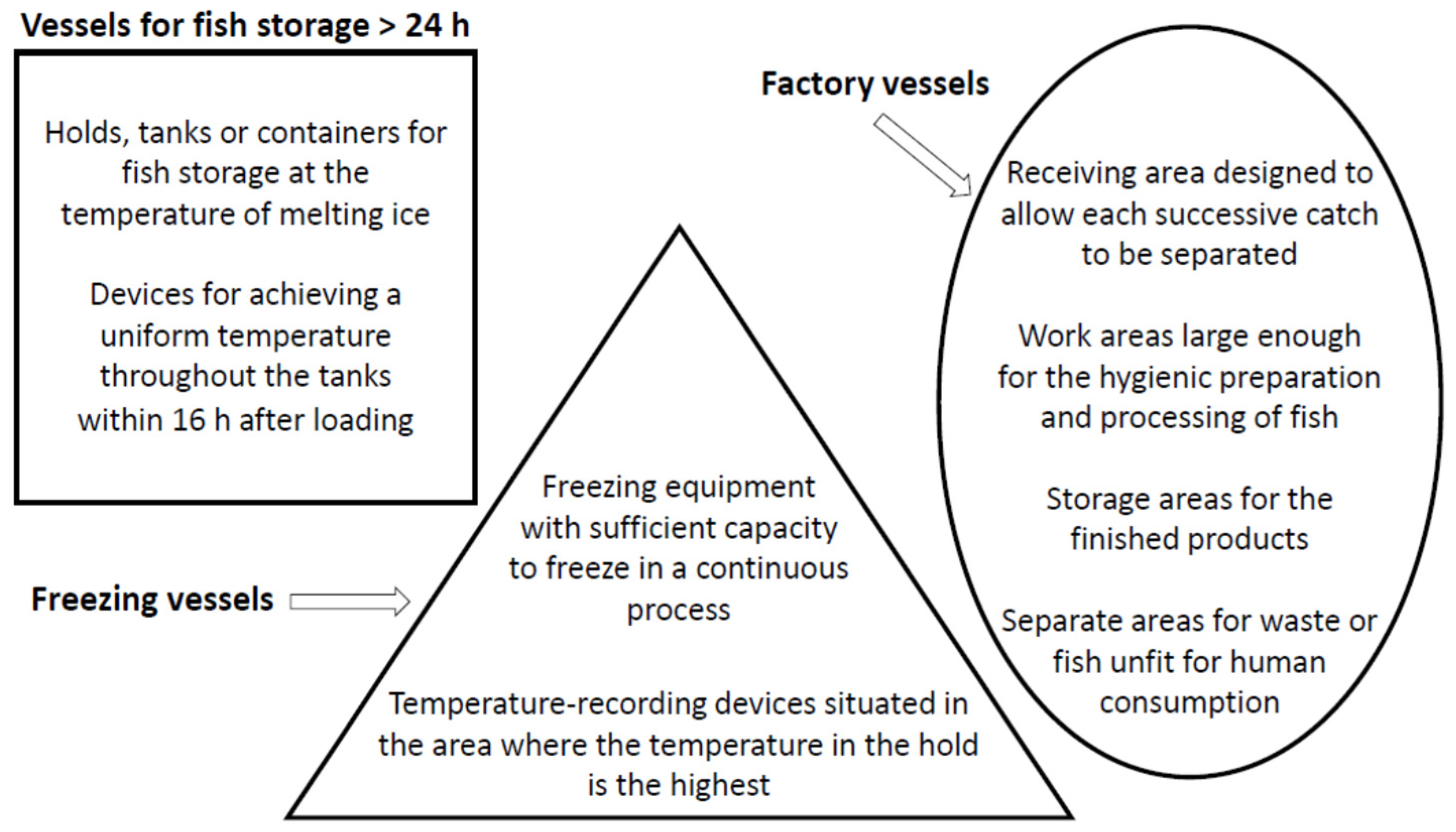
Figure 2.
Fish spoilage and related compounds.
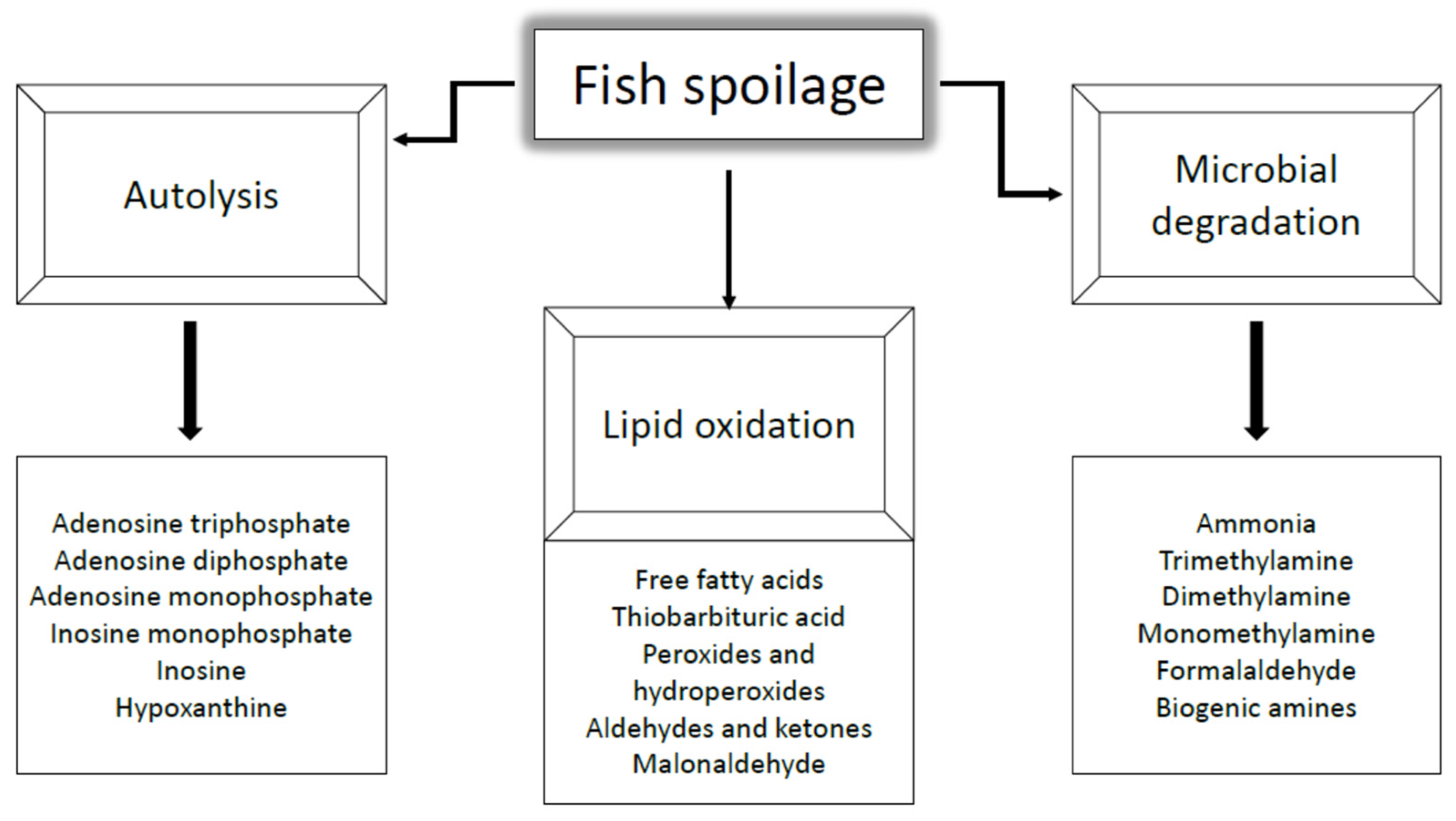

Table 1.
Extra freshness category criteria.
| Criteria | Whitefish | Bluefish |
|---|---|---|
| Skin | Bright, iridescent pigment or opalescent, no discoloration | Bright, shining iridescent colors, clear distinction between dorsal and central surfaces |
| Skin mucus | Aqueous, transparent | Aqueous, transparent |
| Eye | Convex, black bright pupil, transparent cornea | Convex, blue-black bright pupil, transparent eyelid |
| Gills | Bright color, no mucus | Uniformly dark red to purple, no mucus |
| Gill covers | - | Silvery |
| Peritoneum (gutted fish) | Smooth, bright, difficult to detach from flesh | - |
| Smell | Seaweedy | Fresh seaweed, pungent, iodine |
| Flesh | Firm, elastic, smooth surface | Very firm, rigid |
Legend: whitefish = haddock, cod, saithe, pollack, redfish, whiting, ling, hake, Ray’s bream, anglerfish, pouting and poor cod, bogue, picarel, conger, gurnard, mullet, plaice, megrim, sole, dab, lemon sole, flounder, scabbard fish; bluefish = albacore or longfinned tuna, bluefin tuna, bigeye tuna, blue whiting, herring, sardines, mackerel, horse mackerel, anchovy, sprat.
Table 2.
Growth conditions (pH and temperature range) for pathogenic microorganisms in fish.
| Pathogen | pH | Temperature |
|---|---|---|
| Listeria monocytogenes | 4.4 – 9.4 | -0.4 – 45 |
| Vibrio parahaemolyticus | 4.8 – 11 | 5 – 45.3 |
| Vibrio vulnificus | 5 – 10 | 8 – 43 |
| Vibrio cholerae | 5 – 10 | 10 – 43 |
| Escherichia coli | 4 – 10 | 6.5 – 49.4 |
| Salmonella spp. | 3.7 – 9.5 | 5.2 – 46.2 |
| Shigella spp. | 4.8 – 9.3 | 6.1 – 47.1 |
| Staphylococcus aureus | 4 – 10 | 7 – 50 |
| Clostridium botulinum type E | 5 – 9 | 3.3 – 45 |
Disclaimer/Publisher’s Note: The statements, opinions and data contained in all publications are solely those of the individual author(s) and contributor(s) and not of MDPI and/or the editor(s). MDPI and/or the editor(s) disclaim responsibility for any injury to people or property resulting from any ideas, methods, instructions or products referred to in the content. |
© 2023 by the authors. Licensee MDPI, Basel, Switzerland. This article is an open access article distributed under the terms and conditions of the Creative Commons Attribution (CC BY) license (http://creativecommons.org/licenses/by/4.0/).
Copyright: This open access article is published under a Creative Commons CC BY 4.0 license, which permit the free download, distribution, and reuse, provided that the author and preprint are cited in any reuse.


