

Submitted:
26 August 2023
Posted:
29 August 2023
You are already at the latest version
Abstract
This study aims to explore predictors of the foreign investment from China coming into Rwanda. One of the components of Rwanda’s economy is the investment it receives from other countries. In order to achieve these objectives, the study gathers econometric secondary data from 2007 to 2020 quarterly which were availably provided by National Statistics of China, World Bank, UNCTAD, National Institute of Statistics of Rwanda, and the National bank of Rwanda. From literature and based on the availability of data, market size, trade openness, infrastructure, and human capital were measured as predictors of Chinese FDI. The data is analyzed using linear regression in Stata. The finding of the study showed that variables have a positive effect on FDI from China, and it found that though FDI had an effect on overall economy of Rwanda, the effect was not statistically significant. The study suggested that Rwanda’s policy on foreign investment should aim to attract and encourage Chinese investment to increase the economy of Rwanda. To encourage more FDI, the Rwandan government can offer Chinese investors greater ownership, locational, and internalization benefits. It also should continue to strengthen economic policy transparency since it lowers transaction costs and hence improves incentives for foreign investment.
Keywords:
Economic growth
; Foreign Direct Investment
; Import and Export
; Influence Analysis
; Labor Force
1. Introduction
1.1. Research background
One of the most debated topics in academia is how foreign direct investment affects a country's economy. According to (Happiness 2019) claims that FDI has a favorable relationship with economic drivers in developing countries (trade openness, gross fixed capital formulation, and efficient variables) and there is a substantial positive association between Foreign Direct Investment (FDI) and economic growth. Companies that conduct business just within their national borders will find it difficult to survive as the global marketplace becomes more global (David K. EITEMAN 2018). One solution is for businesses to expand their operations beyond their home country's borders into other countries through FDI because it is a type of cross-border investment in which an investor from one economy forms a long-term relationship with another, and it is also a type of cross-border investment in which an investor from one country has a long-term stake in and significant influence over a company from another country, in contrast to making a portfolio investment, which is considered as an indirect investment. FDI might take the shape of buildings, machinery, equipment, and factories.
China has been a major beneficiary of foreign direct investment for some years, and studies on China’s investment are increasing according to (Cheng and Ma 2007) who discovered that the real GDP of host economies and the distance between host countries and China had a substantial impact on China's foreign direct investment (FDI). (Miao et al. 2021) looked at China's investment behavior in developed and developing countries and found that both market- and resource-seeking motives are important, and Chinese export to developing countries tends to induce Chinese FDI, but they couldn't find any evidence that China's investment in Africa is resource-seeking. Rwanda began systematically increasing foreign direct investment shortly after the 1994 genocide to provide a platform for investment, technical transfer, and knowledge transfer. Since 2008, when Rwanda's government implemented a new industrial policy, FDI inflows have increased dramatically.
Rwanda had a goal of becoming a knowledge-based economy and a private-sector-led middle-income country by 2020(PLAN 2010), now it has a new goal of being a middle-income country by 2035 and a high-income country by 2050. The Economic Development and Poverty Reduction Strategy (EDPRS) is the Government's long-term development agenda's mid-term framework. The value and necessity of foreign direct investment has long been recognized in Rwanda (DEVELOPMENT 2010).According to (Yin-Wong Cheung 2009), the shift toward regulatory transparency and liberalization, together with developments in Chinese enterprises' technology and managerial standards, has facilitated investment in Chinese firms. Furthermore, the Chinese government encourages more mature industries to invest abroad in order to maximize profits. As a result, the primary goal of this research is to look into the impact of Chinese FDI on Rwanda's economic growth. In the last decade, FDI has played a significant role in the internationalization of business. It resulted in a response to technological advancements, expansion of the national regulatory framework governing company investment, and capital market developments; according to Oman, viable changes in the scale, breadth, and methods of FDI occurred(OECD 2015). The cost of global communication is decreasing, and foreign investment management has never been easier, thanks to new information technology tools. The most significant impetus for FDI's increased significance has probably been the sub-sequence changes in trade and investment policy and the regulatory environment around the world in the last decade. Trade policy and tariff liberalization, the relaxation of foreign investment restrictions, and the deregulation and privatization of many industries are just a few examples of the adjustments. According to Summer, Globally and regionally, FDI has surpassed global trade(National Bank of Rwanda 2019). Since the early 1980s, FDI has been increasing. Between 1980 and 1997, global FDI increased by about 13% on average, compared to a meager 7% increase in global trade. The findings of this paper after analyzing the data using linear regression in Stata showed that variables have a positive effect on FDI and Chinese investment have an effect on overall economy of Rwanda although the effect is not significant
With the findings, this study will give a better understanding about Chinese FDI and its impact on economic growth of Rwanda. It will also help researchers to get a deep understanding about this topic (The impact of Chinese foreign direct investment on economic growth of Rwanda) and it will help the future researchers by adding to the existing literature.
Secondly it will also contribute to the government as it will review FDI of Rwanda and its effect on economic growth by using variables which are market size, trade openness, human capital, economic, FDI and infrastructure, and it will also help the Government to increase the influencing factors in order to attract more investment in Rwanda. The findings of this research will also benefit the society as it will show the possibility of increasing economy of Rwanda and also it will improve the understanding of FDI and the importance of investment.
Lastly the research will benefit policymakers, investors and academicians as it adds to the existing literature and the efficiency of Chinese investment in Rwanda. Investors from China will find from this research the benefits of investing in Rwanda, the efficient and factors that influences it.
1.2. Problem statement
FDI has become a buzzword in the economic world since it is seen to play a critical part in the expansion of economies in both developed and developing countries by a variety of people across time and place. The shortage of capital in most developing economies has hampered their economic growth and development. To halt the downward trend, governments have turned to investment, particularly FDI, as a panacea that will not only increase their targeted gross domestic investment and savings, but also strengthen their economies and development. According to Gichamo FDI benefits host economies in a variety of ways, including job creation, knowledge transfer, technological spillovers, and lower prices by boosting competition among local enterprises (Giannakis-Bompolis and Boutsou 2014). The term "foreign direct investment" refers to net inflows of investments used to acquire a long-term management stake (10 percent or more of stock or voting rights) in a company operating outside of the investor's native country. When an investor opens a business operation or purchases assets in a foreign country, it is considered FDI. Such investments can take the form of "greenfield" investments, which are investments in a new company venture, or merger and acquisition (M&A) investments, which are investments in an existing business (Anyanwu 2011). To attract more FDI, officials must first understand the factors that influence FDI inflows.
According to Ewe-Ghee Lim's research (Yilmaz, Tag et al. 2014), "FDI boosts inflation and creates negative trade balances, affecting the country's economic growth." "GDP, market size, infrastructure human capital and trade openness have a substantial beneficial impact on Rwanda's FDI inflows," according to (happiness 2019). The real exchange rate depreciation increases FDI inflows, but inflation has little effect on FDI inflows." However, modernization theory claims that FDI can help developing countries grow economically, whereas dependence theory states that FDI can hurt the host country's economy. According to the absorptive capacity theory, the effect of FDI on the recipient country is determined by its absorptive capacity. Even though Rwanda has achieved rapid economic progress in recent years, it confronts significant development concerns. According to UNCTAD, agriculture provides the majority of the population's income or sustenance, accounting for 31% of Rwanda's GDP. At the same time, land pressure, population growth, erosion, and exploitation mode indicate that agricultural labor productivity has deteriorated. Rwanda will need to reform its economy by growing the secondary and tertiary sectors in order to embark on a strong economic path, achieve general poverty reduction, achieve the Sustainable Development Goals (The Sustainable Development Goals, often known as the Global Goals, are a set of 17 interconnected global goals aimed at creating a "blueprint for a better and more sustainable future for all." The United Nations General Assembly established the Sustainable Development Goals (SDGs) in 2015, with the goal of achieving them by 2030.), and maintain firm peace and stability. Rwanda's economy must be transformed in the industrial and service sectors if it is to provide the large number of employments required by a young population. According to the census (Rwanda 2012), between 2006 and 2010, around 220,000 young men and women would enter the workforce yearly, rising to approximately 265,000 annually in 2016-2020. Rwanda would have to start the transformation process gradually and methodically if it wants to achieve the Vision 2035 and SDGs goals with the substantial contribution of Chinese FDI influx in the time frame envisaged. It must also take into account the speed with which successful Asian economies, such as China, have grown in prior decades. At the same time, national investment (both private and governmental) would undoubtedly be required to drive the transition process; China's FDI might provide several benefits. Contribution and transfer of skills, practical knowledge, entrepreneurship, and capital are among the most notable. Given Rwanda's economic structure and investment constraints, the government should pursue a moderately unique FDI policy in order to attract individual Chinese entrepreneurs and small- and medium-sized Chinese businesses across a wide range of industries. Rwandan policies such as Vision 2020, the Poverty Reduction Strategy Paper (PRSP), and the National Investment Strategy all understand that wealth generation and economic progress would be led by the commercial private sector. As a result, the goal of this study is to provide a benchmark assessment of Rwanda's success in terms of attracting Chinese FDI thus far, as well as a roadmap for Rwanda to pursue in order to fulfill its economic development goals while expanding the Rwanda-China relationship.
This study examines FDI as a type of capital flow and as one of the most important sources of external finance for developing countries in depth and it emphasizes on the growing importance of FDI for economic growth and development in developing nations, particularly Rwanda.
The purpose of this research is to find answers to the following questions: What factors influence FDI from China in Rwanda? What influence does Chinese foreign direct investment have on Rwanda's economy? What is the impact of Chinese OFDI on Rwanda's total economy? What are the most common roadblocks that external foreign direct investors face in Rwanda?
1.3. research scope
The study focusses on the determinants of China's FDI on Rwanda's Economy" as the research object with the purpose of to examine its impact over a period of fourteen years quarterly which makes the number of observations 56. In order to achieve these objectives, the study carried out with the help of econometric secondary data from 2007 to 2020 which are availably provided by National Statistics of China, World Bank, UNCTAD, National Institute of Statistics of Rwanda, and the National bank of Rwanda. From literature and based on the availability of data, market size, trade openness, infrastructure, and human capital are measured as predictors of Chinese FDI. The data is analyzed by using linear regression in Stata.
1.4. objective of the study
The motivation behind the study came after realization of how Chinas’ economy is ranking globally and how its FDI is increasing in African countries, in that way the study took it as a reference on how Rwanda explore China’s investment hence the study's objective was to determine how China's FDI stimuli Rwanda's economic growth.
The following are the overall objectives of Rwanda's economy and the influence of Chinese outward foreign direct investment:
- Examine the influence of Chinese FDI on Rwanda's economy;
- Examine the overall impact of Chinese FDI on Rwanda's total economy;
- Examine the Chinese FDI barriers in Rwanda and how to overcome them.
2. literature review
2.1. theoretical review
2.1.1. Foreign Direct Investment in Africa
Annual flows of Chinese FDI to Africa have increased dramatically since 2003, the earliest year for which official statistics is available(bank 2021), rising from $74.8 million in 2003 to $5.4 billion in 2018. Chinese FDI into Africa fell to $2.7 billion in 2019, but rebounded to $4.2 billion in 2020, despite the COVID-19 outbreak. Over the same time span, Chinese FDI stocks in Africa increased over 100-fold, from $490 million in 2003 to $43.4 billion in 2020, with a high of $46.1 billion in 2018. Since 2014, China has been Africa's fourth largest investor, surpassing the United States. China's loans to Africa have dominated headlines, with a total value of $153 billion between 2000 and 2019. Investment flows, on the other hand, receive significantly less attention despite accounting for a third of all loans.
Figure 1.
Chinese FDI stock and flows to Africa in billions USD. Source: China Statistical Yearbook
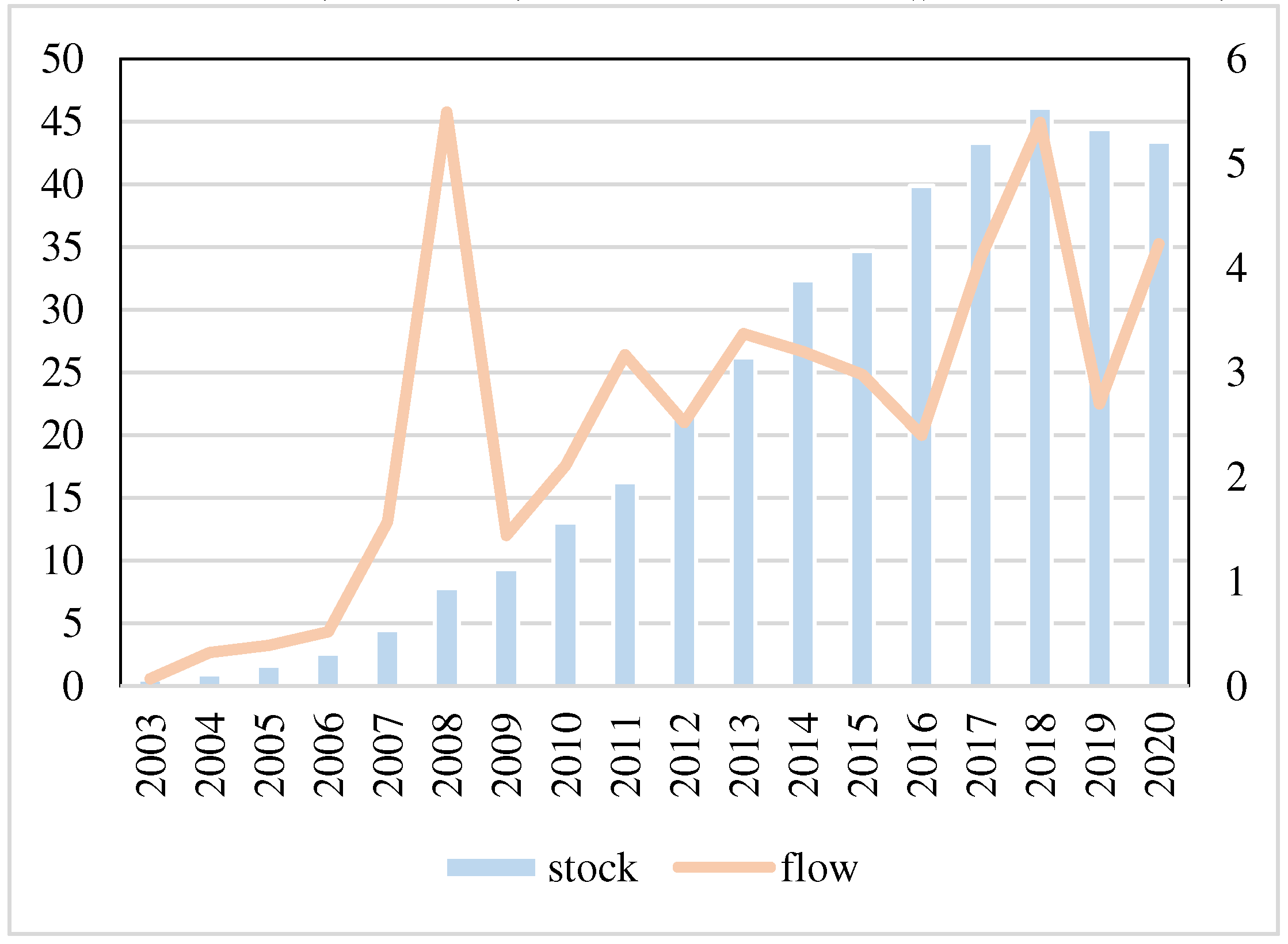
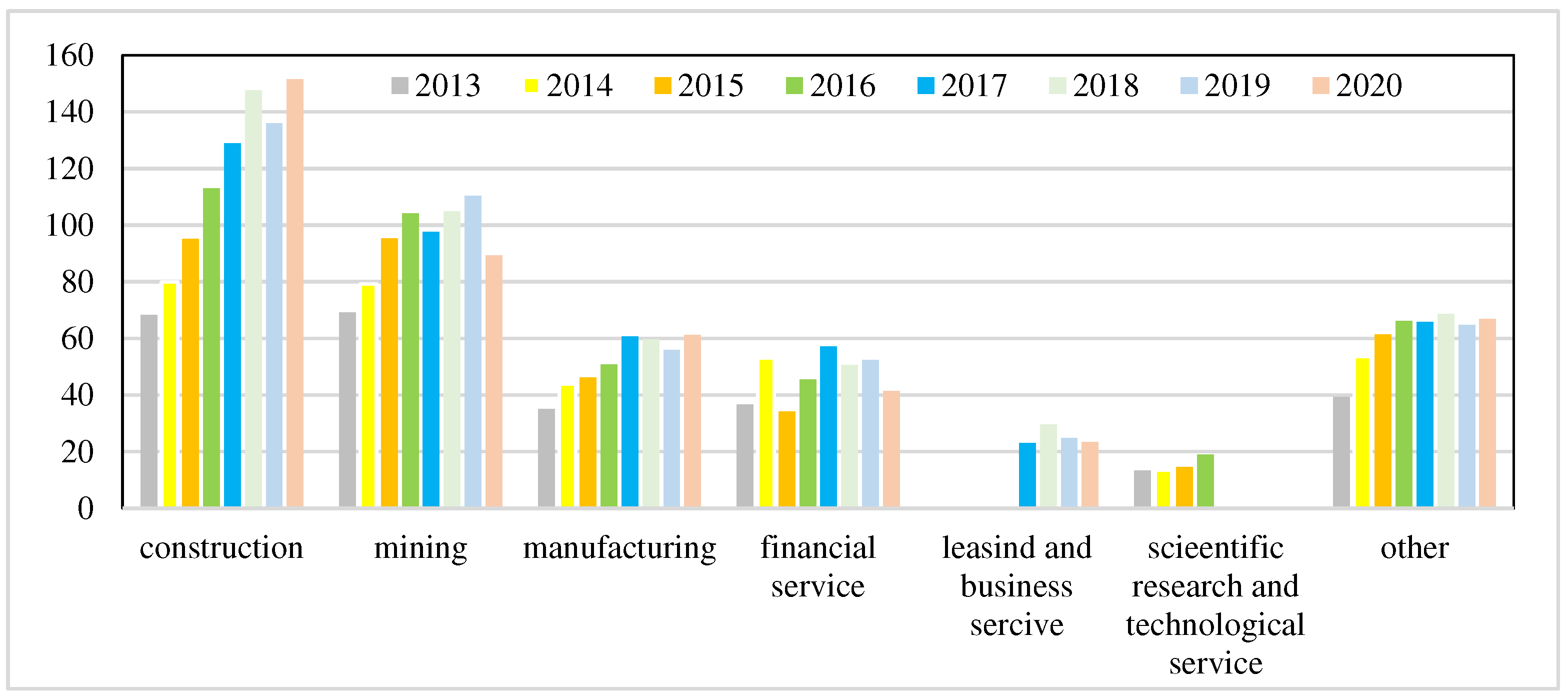
Figure 2.
Top 5 industries for Chinese FDI stock in Africa. Source: China Statistical Yearbook
Annual Chinese FDI flows to Africa, officially termed in Chinese official publications as OFDI ("Overseas Foreign Direct Investment"), have been gradually increasing since 2003.Flows increased from 75 million dollars in 2003 to 4.2 billion dollars in 2020. They reached a high of US$ 5.5 billion in 2008, thanks to the purchase of 20% of Standard Bank of South Africa's shares by the Industrial and Commercial Bank of China (ICBC).
Figure 3.
Chinese FDI vs. US FDI to Africa. Source: The statistical bulletin of China’s outward foreign direct investment, U.S. bureau of economic analysis.
Figure 3.
Chinese FDI vs. US FDI to Africa. Source: The statistical bulletin of China’s outward foreign direct investment, U.S. bureau of economic analysis.
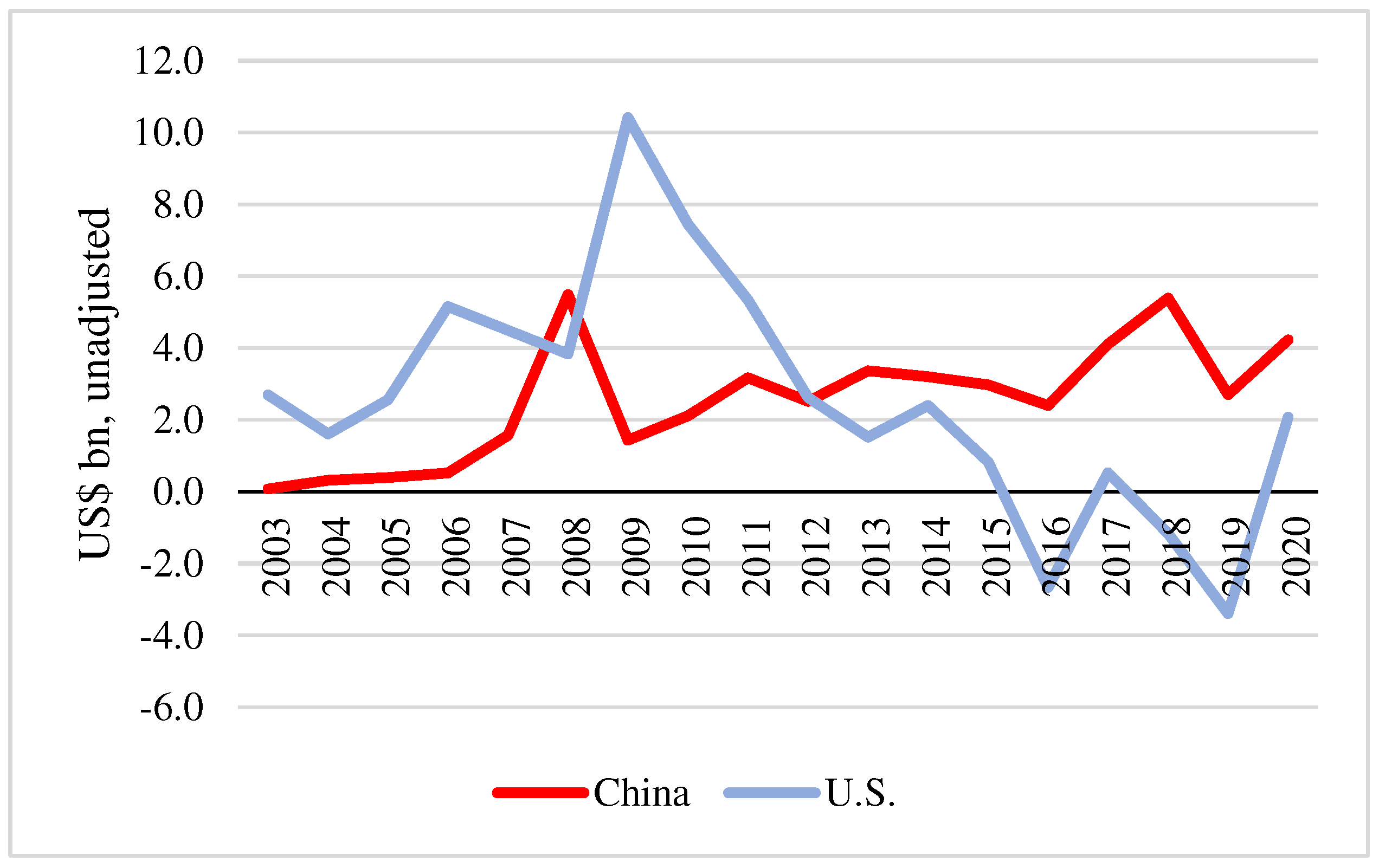
Since 2003, Chinese FDI flows to Africa have outpaced those from the United States, as seen in the graph below, despite the fact that U.S. FDI flows have been dropping since 2010. Kenya, the Democratic Republic of Congo, South Africa, Ethiopia, and Nigeria were the top five African locations for Chinese FDI in 2020.
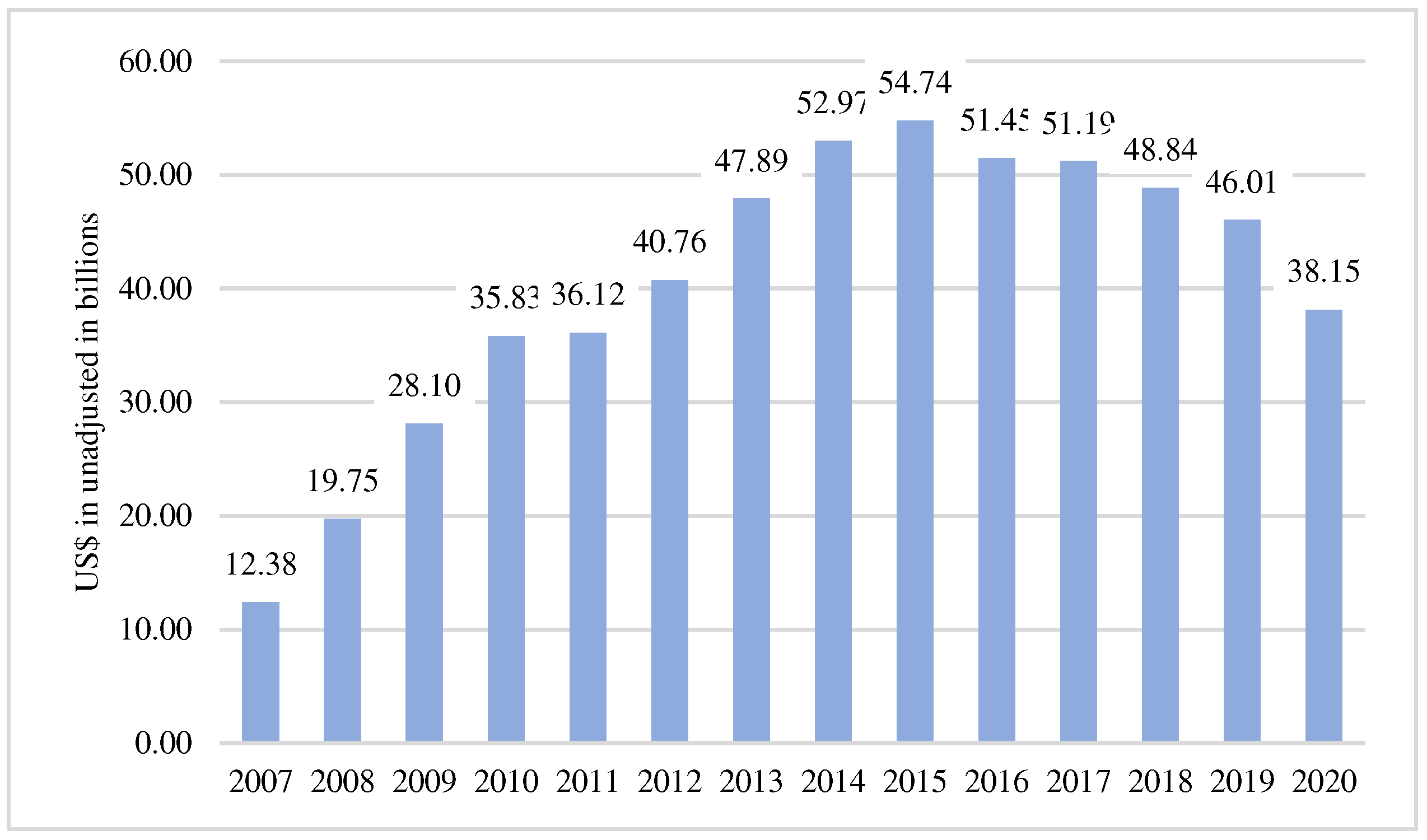
Figure 4.
Gross annual revenues of Chinese construction projects in Africa. Source: National Bureau of Statistics of China.
Figure 4.
Gross annual revenues of Chinese construction projects in Africa. Source: National Bureau of Statistics of China.
2.1.2. Foreign Direct Investment in Rwanda
The East African Community (EAC) is comprised of six member states: Burundi, Rwanda, Kenya, Tanzania, South Sudan, and Uganda, with its headquarters in Arusha, Tanzania. When yearly FDI flows as a proportion of GDP of EAC nations are compared over the last decade (2008-2018), Rwanda emerges as the leader from 2015 to 2018.
Figure 5.
EAC FDI inflows percent share. Source: east African community data.
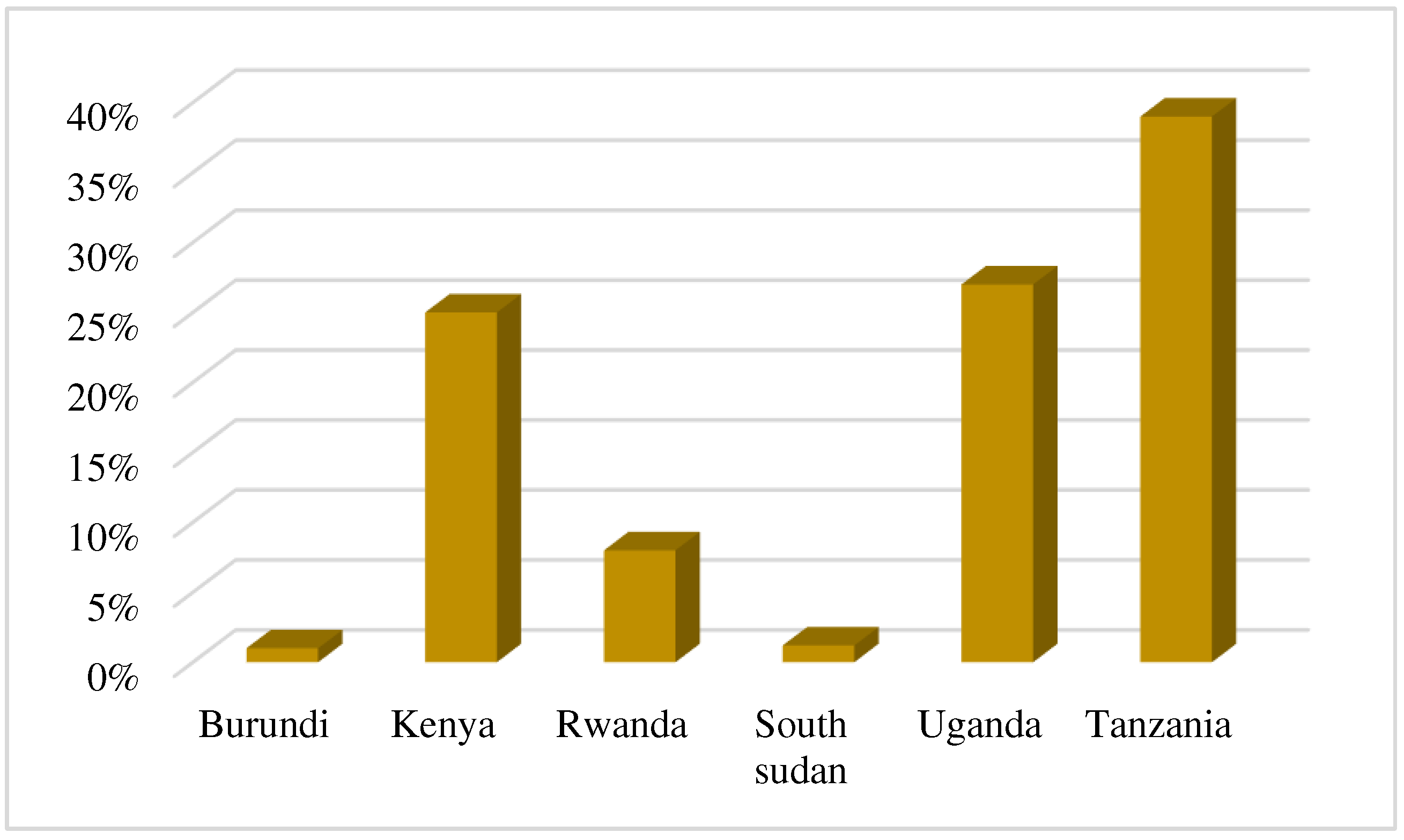
Previously, we saw a continuous increase in FDI inflow to Rwanda from 2002 to 2010, with a dip between 2011 and 2015, but a consistent increase in the years in between. However, Rwanda's share of total FDI inflow to the EAC remains low, at 8.05 percent, compared to 25 percent, 26.46 percent, and 39.69 percent for Kenya, Uganda, and Tanzania, respectively. receives 0.38 percent of FDI, whereas South Sudan receives 0.40 percent.
The increase of FDI (as well as foreign portfolio investment) in Rwanda has been phenomenal during the last two decades. FDI inflows climbed from USD 382 million in 2018 to USD 420 million in 2019, according to statistical records, and stocks were assessed at USD 2.6 billion at the end of 2019. In addition, according to a report published by the Rwanda Development Board(RDB) (Kaberuka 2012), the economy received 2.46 billion USD in investment, a record high, with FDI accounting for 37% of the total. Mining, construction and real estate, infrastructure, and information and communication technologies are the main sectors targeted by investors, according to a report by the Rwanda Development Board (RDB). The major investing countries, according to the RDB report, are India, the UAE, Portugal, the United Kingdom, and France.
Rwanda's government has made a concerted attempt to attract more FDI through a variety of policies aimed at improving the country's business climate. Various supportive mechanisms have been put in place, including a one-stop canter where new enterprises may be registered and any information on investment can be obtained, as well as exchange platforms between senior management and business leaders. In 2015, policymakers approved a new investment code aimed at providing incentives to investors, such as a preferential corporate tax rate of 0% for international companies with their headquarters or regional offices in Rwanda, a preferential corporate tax rate of 15% for any investor, a corporate income tax holiday of up to 7 years, capital gains exemption, customs tax exemption for products used in export processing zones, and so on. Various special economic zones, such as the Kigali free zone and the Kigali industrial park free-trade zone, have also been established by the government. This has helped Rwanda become one of the most popular investment locations in recent years, as indicated by a World Bank 2020 report that ranks Rwanda 38th out of 190 countries in terms of ease of doing business, making it the highest-ranked country on the African continent. Ameliorating Investment is one of the methods aimed at guiding Rwanda's economy toward its goal of being a middle-income country by 2035 and a high-income country by 2050.
Rwanda had a spectacular economic performance during the last two decades, with an average GDP growth rate of 8%. It contributes to an annual rate of 8% since its productivity is higher than the economy's average. This trend continued in 2015, with a 6.9% increase in GDP. However, it has grown from a meager 5% of the total in 1990 to 20% now. The economy is dominated by services, which account for 0.33 percent of GDP. At the same time, the country is rapidly urbanizing, with 80 percent of the population still farming, and the average farm size has shrunk. The country is a small, poor, land-locked country with one of the highest population densities in the world. The economy has been continuously growing. Even as on-farm reduction Policy 2013-2018, published at the top of the commodities boom, envisioned expedited the Vision 2020 strategy, which planned for export growth of 15% each year, the government's strategy understands that off-farm jobs must be generated promptly. National exports are increasing at a rate of 28% per year. The updated national export plan for 2015-18 suggests a slightly less ambitious yearly rate of exports-to-GDP (14 percent), based on a sector-by-sector study of potential. The country must learn to sell more to the rest of the world. The national strategy also emphasizes the importance of foreign direct investment, which has been pushed up to 18 percent annually in the strategy for 2010-15. Poverty productivity and economic development must both be enhanced. Given the tiny domestic market of 12 million people and the low growth rate of 20% in Africa, the development of non-traditional exports has been crucial. International regional-integration agreements can be a powerful policy tool for attracting FDI (which necessitates relatively open regional agreements) as well as enhancing government cooperation to limit the negative effects of policy competition, such as downward pressures on labor and environmental standards, as well as costly beggar-thy-neighbor policy wars and incentive wars. Rwanda joined the East African Community (EAC) and the Common Market for Eastern and Southern Africa (COMESA) in order to put this plan.
2.1.3. economic growth theory
Most developing economies, including Rwanda, have experienced significant growth in recent decades, reflecting the Solow growth model. "The growth model relies on 8 the assumption of a constant saving rate, which attracts to understand the nature of the country's growth in terms of labor, capital, and technology," (Romer, 2010) said. However, the model explicitly explains to understand the welfare of people, in which the model explains the relationship between the aggregate variable and individual's satisfaction outcome." "Economic growth should be designed in such a way that capital stock, labor force, and advanced technology interact with the economy's growth, as well as how individuals are able to access goods and services within a nation," according to (Mankiw, 2015).
2.2. Empirical review
2.2.1. Foreign Direct Investment Concept
FDI is defined as any investment in a foreign country by a multinational company with the aim of managing production activities and controlling assets in that country. FDI contributes to the growth and development of international business by providing new marketing channels and markets for a company's services or products and it provides a new source of capital, technology, organizational technologies, products, processes, and current management techniques to the foreign company or host country that receives the investment. All of these factors are thought to play a role in the country's economic development and expansion. FDI is important not only to developing countries like Rwanda, but also to developed countries according to (Pradhan, 2009) The United Nations Conference on Trade and Development (UNCTAD, 2010) uses a widely accepted definition of FDI in its World Investment Report series, which is based on definitions from the Organization for Economic Cooperation and Development(OECD 2015) and the International Monetary Fund (IMF). It is a long-term investment that represents the long-term interest and management of a resident entity in a single economy (foreign direct investor or parent enterprise) (FDI enterprise or affiliate enterprise or foreign affiliate).
FDI is a long-term commitment by foreigners to invest in fixed assets with the goal of building a productive capacity to make things or provide services for a profit. FDI indicates that the investor has a large amount of control over the management of the firm in the "host" economy. Because it generates stable and long-lasting ties between economies, FDI is a critical component of international economic integration. FDI is also a major avenue for the transfer of technology between countries, stimulates international trade by providing access to foreign markets, and has the potential to be a significant driver of economic development.
2.2.2. Models and types of Foreign Direct Investment
"FDI can be categorized into five different models," according to (Ball and McCulloch, 2018): "(1) Greenfield investment, (2) merger or acquisition, (3) joint venture, (4) horizontal FDI, and (5) vertical FDI." The following sections go over them in detail: Investment in a new location "A firm that wants to fully own a foreign subsidiary can start with a greenfield investment, which involves building new facilities or expanding existing ones." Greenfield investment in Rwanda includes the construction of industrial units and facilities in export processing zones (EPZs). Acquisition or merger "A merger or acquisition occurs when a foreign firm obtains the existing assets of a local firm,". In Rwanda, for example, a major telecommunications company called Airtel purchased Tigo Telecom in 2018. This purchase was utilized to start a company called "Tigo-Airtel." "A joint venture can be formed in a variety of ways. When an international corporation joins forces with a local company (or another foreign company) to form a corporate entity, it is known as a joint venture. On the other side, a multinational corporation could incorporate a corporate entity with the government of the country of investment." Take, for example, Rwandan construction firms. FDI in the horizontal direction "Horizontal FDI refers to a circumstance in which a corporation invests in the same industry in another country as it does at home." Consider the case of Azam in Rwanda. FDI in the vertical direction: There are two types of vertical FDI: (1) Backward vertical FDI entails investing in a sector that provides inputs for the investing firm's domestic manufacturing; and (2) Forward vertical FDI entails investing in a sector that sells the output of the investing firm's domestic operations." Various sorts of investments can be distinguished depending on factors such as the target market, strategic motives, internal structure, industry, growth path, ownership, and others. The types overlap to some extent, indicating the multifaceted character of the investment decision. List of the sorts of foreign investments.
(1) Resource seeking investment is based on Traditional locational advantages, such as input costs and transaction costs. Raw materials are frequently extracted for export or further processing and sale in the host country in this form of venture. The extractive industries are typical examples of this type of investment.
(2) Market seeking investment: In order to increase a company's market strength, market seeking investment is based on strategic locational advantages. The goal is to identify better ways to access and expand new markets, either by meeting local demand or by exporting to other countries. Market size, market growth prospects, market share, and competitive condition are all common motivations for investment. This is the most frequent sort of investing currently. It has the highest level of involvement with the host market. Food is a good example of something that cannot be shipped and must be created on the spot.
(3) Production efficiency seeking investment aim is to locate low-cost production elements with high productivity. Labor cost benefits, low raw material costs, low transportation costs, low energy costs, or the availability of a competent labor force may all be motivators for investment. It usually refers to off-shore production that takes place in the host country's special economic zones. The sourcing industries are thus typical representatives.
(4) Knowledge seeking investment (strategic asset seeking investment) aim in the host country is to obtain access to technology or management skills. It is primarily concentrated in sophisticated industrial economies and has unique locational needs (e.g. technical knowledge, learning experiences, management skills, and organizational competence). The rise in mergers and acquisitions (M&A) highlights the growing importance of knowledge-based investing according.
(5) Political safety seeking investment strives to reduce the risk of expropriation and might take the shape of investments in countries that are unlikely to interfere with MNC activities or disengagement from politically dangerous nations.
2.3. Research hypothesis
To address the stated research problem and achieve the research aim, the literature reviewed was used to underpin the following hypotheses for this research to effectively determine the impact of Chinese FDI on economic growth of Rwanda. The null hypotheses that guided this research is as follows:
Market size: market size hypothesis claims that if a country does not meet the market requirements in terms of size, due to economies scale FDI will not be taken because market size is very necessary for the effective implementation of production technology. Numerous empirical studies confirm that market size is one of the key determinants of FDI inflows, particularly market-oriented projects of FDI. Basically, the dominant view is that a larger market of the host country attracts a big number of foreign investors. Although there could be variables that are much more important to Chinese FDI in Rwanda to determine its effect, this study’s analysis will test whether there is a positive or negative effect between FDI and market size. This leads to the first hypothesis:
Ho1: FDI does not have a significant effect on the market size of Rwanda.
Trade openness: trade openness has effectively influenced the ability of FDI to establish investment projects across various countries. it has a positive and significant impact on economic growth. The higher the level of trade openness is, the greater the effect on FDI will be. Chinese investors have been considering the trade openness in Africa countries including Rwanda for the aim of establishing effective trading activities. Countries that are open to international trade tend to grow faster, innovate, improve productivity, provide more opportunity and higher income to their people. Without trade openness the standard of life would fall significantly across the world and many people will fall into poverty. Therefore, this study will test whether there is a positive effect between FDI and trade openness or not where trade openness will be calculated on the basis of the sum of total imports and exports divided by GDP of Rwanda. This leads to the second hypothesis:
Ho2: FDI does not have a significant effect on the trade openness of Rwanda.
Infrastructures: Infrastructure is one of the determinants of FDI. Over the past decades, Chinese investors have been directing foreign direct investments across Africa to develop the various infrastructures which would facilitate economic growth and development. The important sectors of infrastructure are gas, oil, power sector, transportation, construction and mining sectors, which attracted FDI inflow and contributes to GDP growth. When a country has overcome the shortage of electricity it attracts more FDI. In this study infrastructure represent the electric power consumption (kWh per capita). This leads to the third hypothesis.
Ho3: FDI does not have a significant effect on the infrastructure of Rwanda.
Human capital: According to world bank a higher level of human capital is expected to increase the potential growth effect of FDI. Human capital measured by secondary school enrolment as percentage of gross enrolment ratio. That is the ratio of total enrollment regardless of age group that officially corresponds to the level of education. Numerous literatures shows that the growth effect of FDI is dependent on the level of human capital in the host country. Hence a minimum level of human capital is essential in order to maximize and absorb the positive and significance growth effect of FDI. So, this study will give information about whether there is positive or negative relationship between human capital and FDI. This leads to the fourth hypothesis:
Ho4: FDI does not have a significant effect on the human capital of Rwanda.
2.4. Conclusion from the Literature
There is a substantial amount of literature on FDI, its promotion, regime, and management by economies. Furthermore, the research reviewed above reveals that Rwanda's recent sequence of business and investment rules, judicial, and institutional make-up reforms have resulted in a remarkable growth in foreign investments, particularly FDI inflows. In the last years, Rwanda's performance in terms of FDI and other foreign investments has been quite encouraging. A comparison of EAC countries' FDI inflows as a percentage of GDP, for example, demonstrates that Rwanda has significantly outperformed the rest of the EAC since 2015. However, more work needs to be done in order to keep that trend stable and long-term.
3. Model Analysis
Panel data estimate with dynamic parameter analysis is used in this study due to its advantage over numerous cross-sections. This study's data covered the years 2007 through 2020 quarterly. Because most Chinese FDI are dispersed across all operating sectors of Rwanda's economy, market size is used as a proxy for GDP, implying that the net impact of market size on FDI is likely to be positive. Trade openness as a proxy for import and export, implying that it is an important tool to determine whether Chinese FDI affects Rwanda's economy in any way. Infrastructure, because the quality and availability of infrastructure is a major component that influences FDI decisions, and human capital because a lower real wage attracts more investment to Rwanda. As a result, the study's analysis will be based on them as predictors of Chinese FDI. The relationship between Chinese FDI and different Rwandan indicators was modelled and the model's basic equation is as follows Based on literature and the availability of data, market size (MS), trade openness (TO), infrastructure (INFRA), and human capital (HC) were measured as predictors of Chinese FDI.
𝐹𝐷𝐼 = (𝑀𝑆, 𝑇𝑂, 𝐼𝑁𝐹𝑅𝐴, 𝐻𝐶)
After converting FDI inflow and MS into logarithmic form, these variables have an impact on FDI inflows and are part of a model that may be stated as a regression equation. The raw data of variables is scaled down and better estimation results are generated by converting FDI inflow and MS into logarithmic form:
s’ are the slopes of coefficients in this equation and (i =1…N, t =1…T, where t is the linear time period of analysis and i represent country). The main independent variable is FDI which is the foreign direct investment after taking log, net inflow for country i at time t; MS represent the log of GDP in current US$ for the country i at time t, and it measures the domestic market size of any country. TO represent the openness which is calculated on the basis of the sum of total imports and exports divided by GDP for country i at time t; INFRA represent the electric power consumption (kWh per capita) for country i at time t; and HC represent the school enrolment, secondary (percent gross) for country i at time t. In this model, Uit represent the random error term. As for the assessment of effect of Chinese FDI on the economy of Rwanda, the total amount of Rwandan GDP was used as proxy. FDI is the foreign direct investment after taking log, net inflow for country i at time t; ECO represent the log of total amount of GDP in current US$ for the country i at time t, and it measures the economy of any country:

Table 1.
Variables and calculation.
| variables | Full words | calculation |
| FDI | Foreign direct investment | Represent the foreign direct investment after taking log, net inflow for country i at time t; |
| MS | market size | represent the log of GDP in current US$ for the country i at time t, and it measures the domestic market size of any country |
| TO | Trade Openness | represent the openness which is calculated on the basis of the sum of total imports and exports divided by GDP for country i at time t; |
| INFRA | infrastructure | represent the electric power consumption (kWh per capita) for country i at time t; |
| HC | Human Capital | represent the school enrolment, secondary (percent gross) for country i at time t. In this model. |
| ECO | economy | represent the log of total amount of GDP in current US$ for the country i at time t, and it measures the economy of any country. |
Explanatory research examines the influence of independent variables on dependent variables to explain why or how the phenomena being examined occurs according to (saunders, 2012). Secondary financial data of 14 years from 2007 to 2020 quarterly are basically used in this study. The relevant secondary data are collected from:
- National Statistics of China;
- World Bank;
- UNCTAD;
- The National Institute of Statistics of Rwanda; and
- National bank of Rwanda.
The goal is to figure out how Chinese FDI affects Rwanda's economic growth and Panel data techniques are used to estimate the FDI equations because they have advantages over cross-sections in that they employ all of the features available, which are not visible in traditional cross-sections. Other data for this study, including the barriers to FDI, came from earlier research.
Table 2.
China’s FDI to Rwanda quarterly.
| YEAR | Q1 | Q2 | Q3 | Q4 | Mean |
| 2007 | -0.1025 | -0.1025 | -0.1025 | -0.1025 | -0.1025 |
| 2008 | 3.222 | 3.22 | 3.22 | 3.22 | 3.22 |
| 2009 | 2.115 | 2.115 | 2.115 | 2.115 | 2.115 |
| 2010 | 3.18 | 3.18 | 3.18 | 3.18 | 3.18 |
| 2011 | 2.4225 | 2.4225 | 2.4225 | 2.4225 | 2.4225 |
| 2012 | 1.225 | 1.225 | 1.225 | 1.225 | 1.225 |
| 2013 | -1.485 | -1.485 | -1.485 | -1.485 | -1.485 |
| 2014 | 3.735 | 3.735 | 3.735 | 3.735 | 3.735 |
| 2015 | 1.015 | 1.015 | 1.015 | 1.015 | 1.015 |
| 2016 | -2.2975 | -2.2975 | -2.2975 | -2.2975 | -2.2975 |
| 2017 | 2.47 | 2.47 | 2.47 | 2.47 | 2.47 |
| 2018 | 11.36 | 11.36 | 11.36 | 11.36 | 11.36 |
| 2019 | 4.2525 | 4.2525 | 4.2525 | 4.2525 | 4.2525 |
| 2020 | -1.6375 | -1.6375 | -1.6375 | -1.6375 | -1.6375 |
Source: author’s illustration with data from source mentioned above.
4. Data Analysis result
The determinants of Chinese FDI to Rwanda are identified in this section and are used to analyze this study. This section will also investigate if market size, trade openness, infrastructure, and human capital have an impact. Finally, it examines the overall impact of Chinese FDI on Rwanda's economy. Stata is used to evaluate secondary data collected over a period of fourteen-year. Below are the figures that represent all the variables.
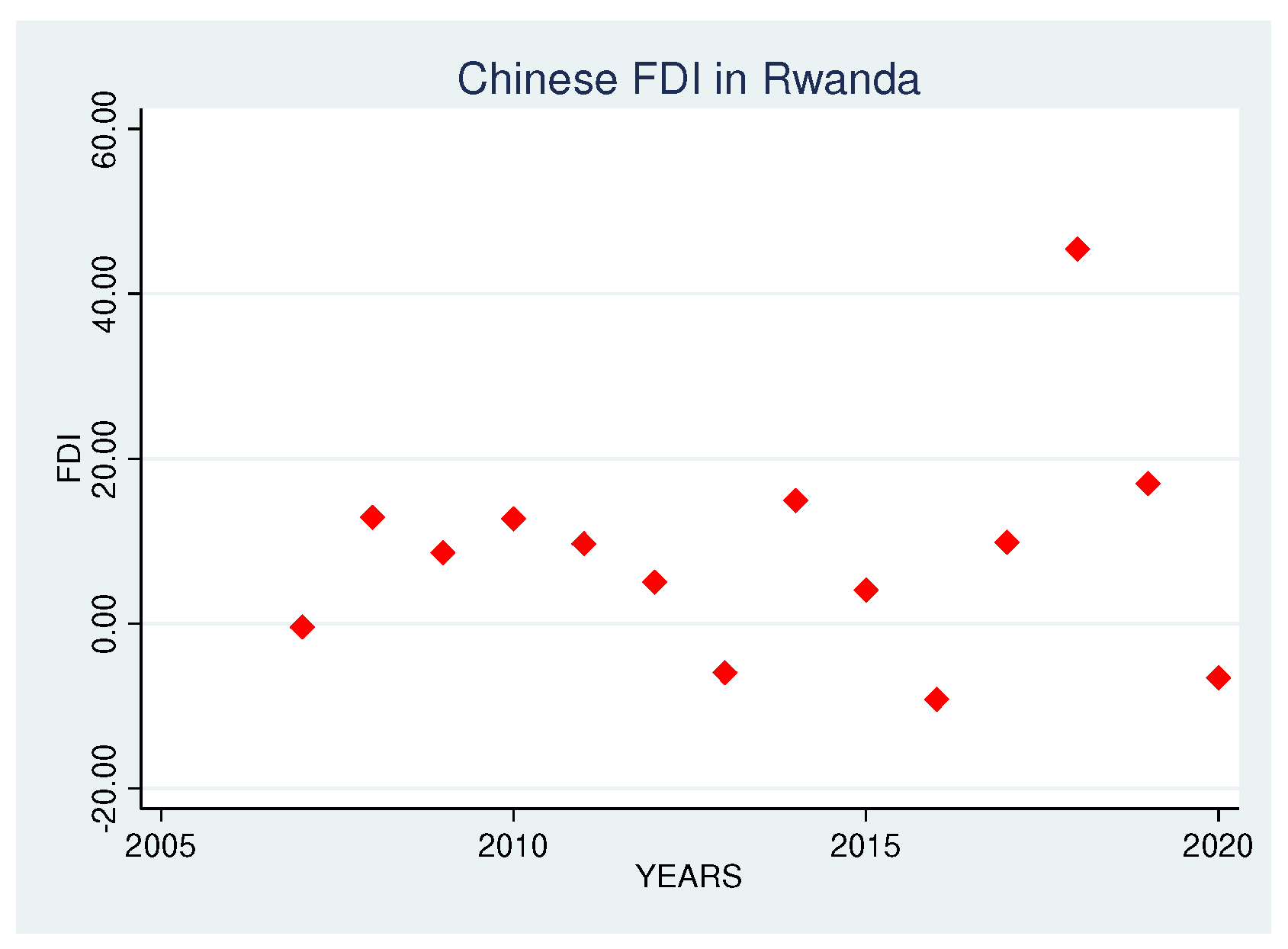
- Foreign direct investment: The term FDI in this study referred to Chinese investments in Rwanda. In the first section of the study, FDI was treated as a dependent variable, and the determinants of FDI from China were examined.Figure 6. Chinese Foreign Direct Investment in Rwanda from 2007 to 2020.
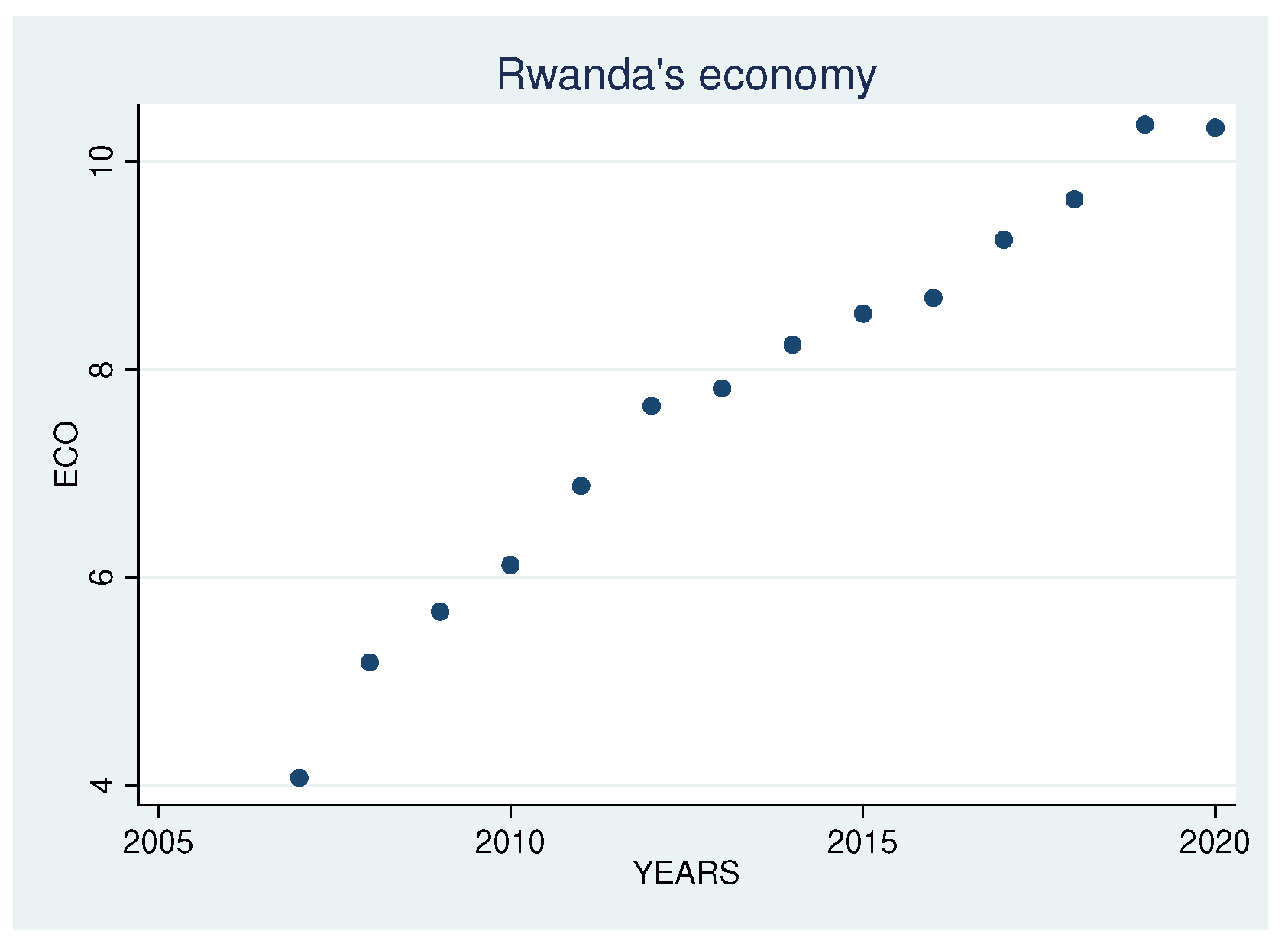
- Economy: China has surpassed its stage of being known as latecomer to the African continent. So, as it launches its investments in Rwanda, there is an effect of its Foreign Direct Investments on the economy of Rwanda. In this study ECO is the log of total amount of GDP in current US$ it measures the economy of RwandaFigure 7. Rwanda’s Economy in US$ from 2006 to 2020.
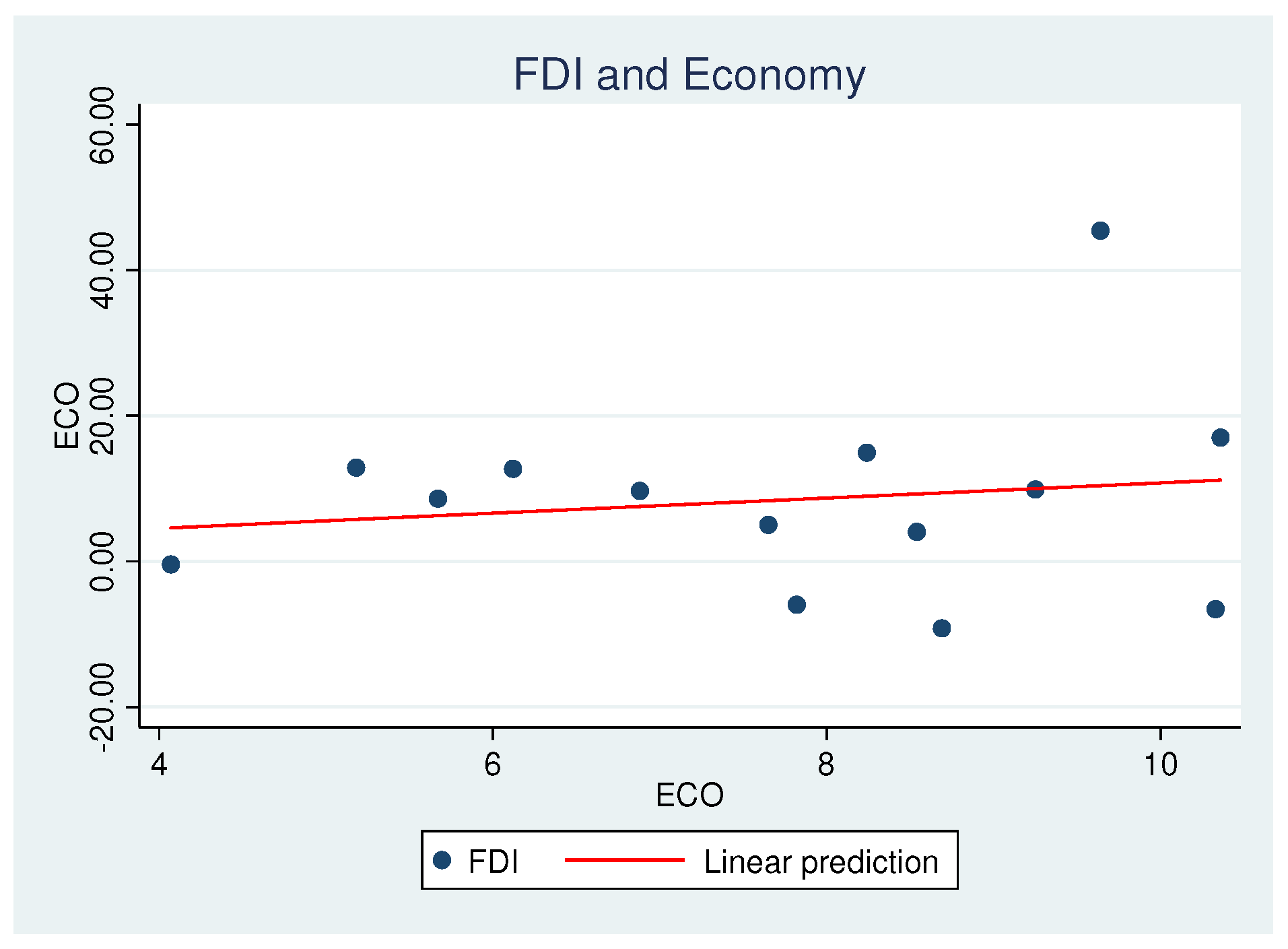
- Chinese FDI and Economy of Rwanda: The data for Chinese FDI in Rwanda were corrected from National Statistics of China and the data shows that in 2020 FDI was negative due to reduced global demand from the COVID-19 pandemic that affected global economy and other sectors that attracted significant investment according to the Ministry of Finance and Economic Planning (MINECOFIN)Figure 8. FDI and Economy.
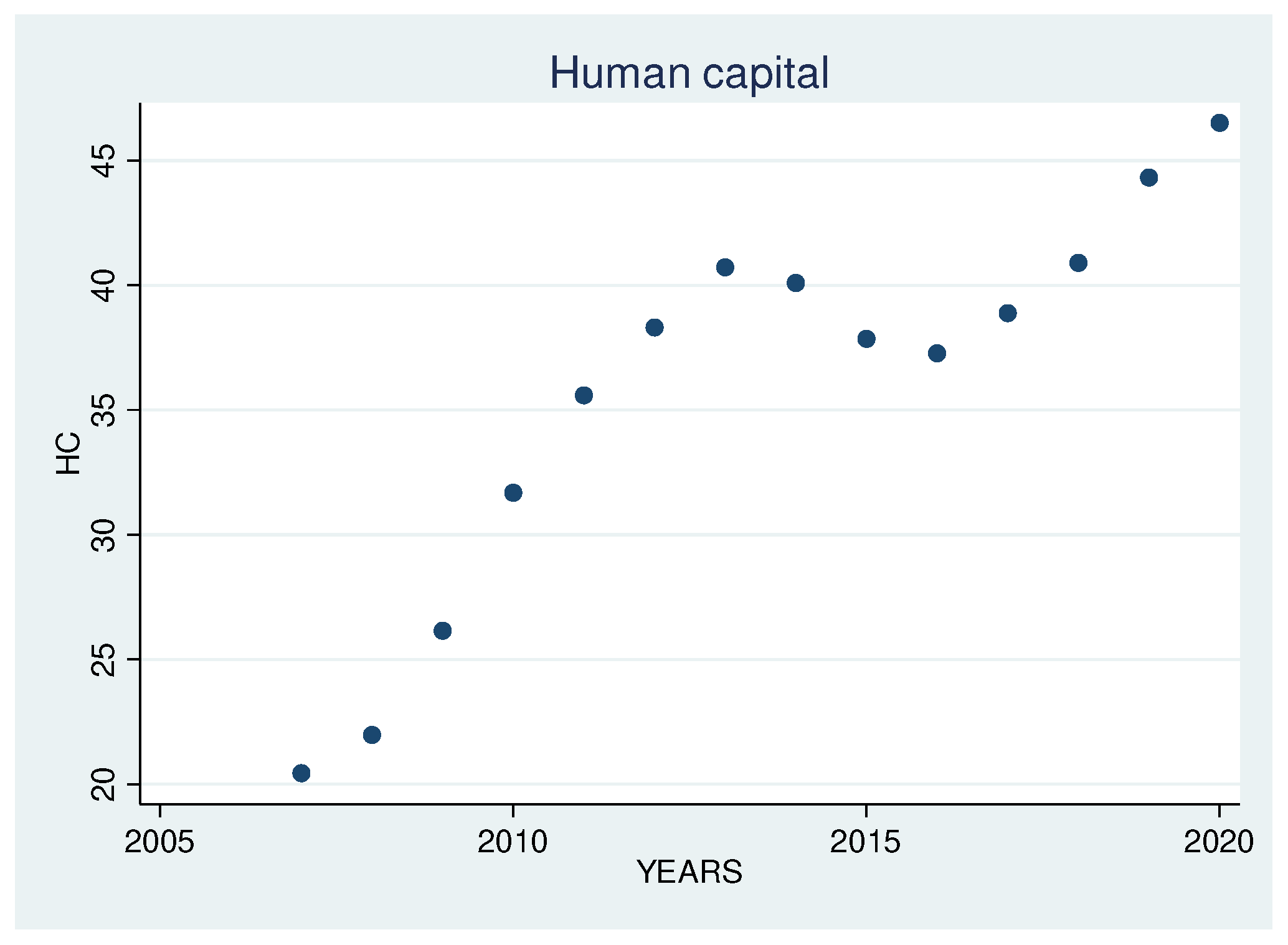
- Human capital: (Kumari 2017) believe that Postulate that the value of human capital is determined by taking into account the society's economic, social, and physical surroundings. Education, health, and employment are three fundamental determinants that have been identified in the literature. Alsan et al., Assessed human capital based on the number of educated people aged 15 to 64 and the annual school enrolment rate(Alsan 2006). Therefore, Secondary school enrollment was used in this study.Figure 9. Human Capital.
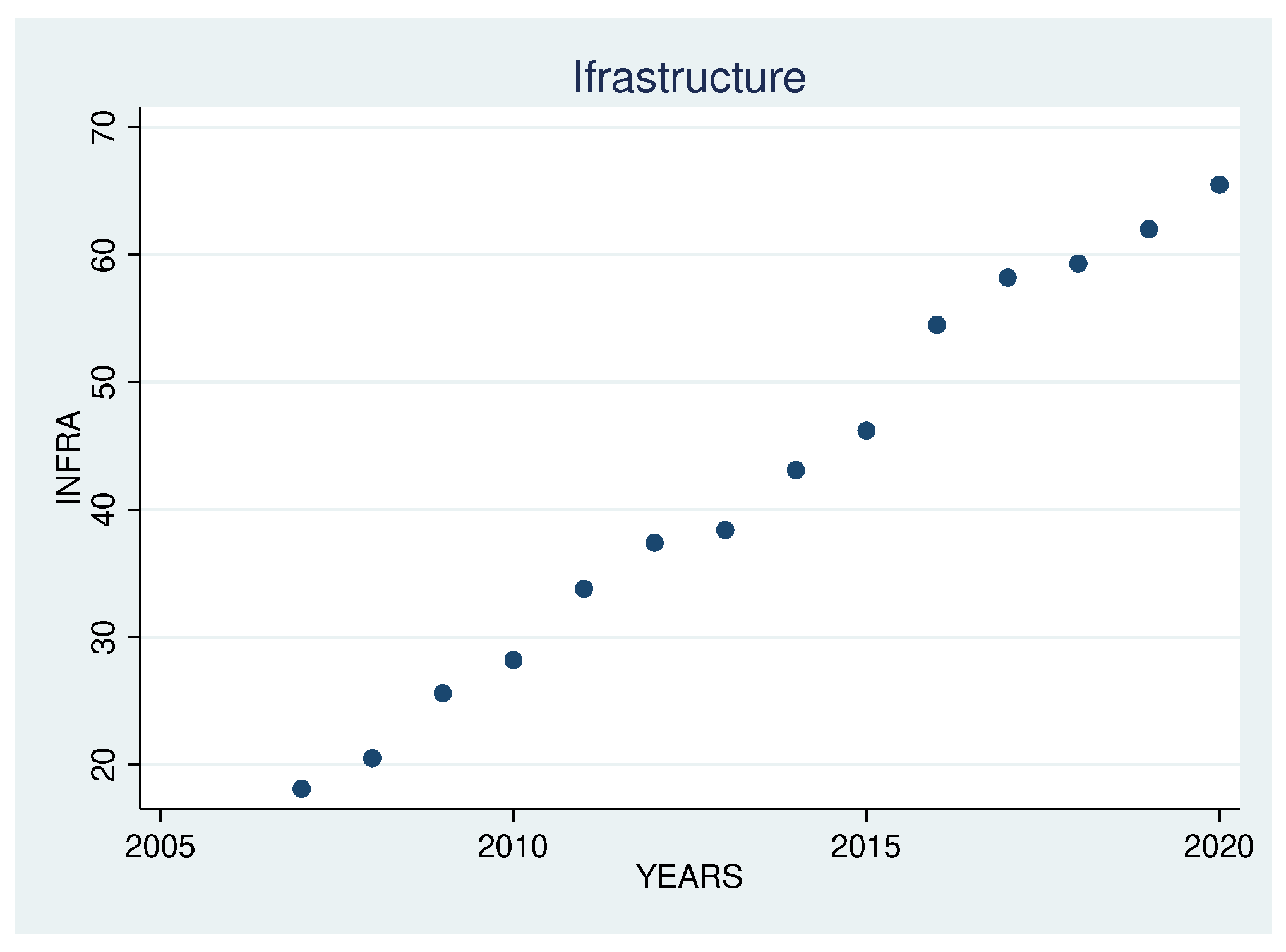
- Infrastructure: In general, it is considered that countries with relatively adequate infrastructure attract more FDI. Asserted solid infrastructure is one of the top goals for international investors, according to (Tsen 2005), because it indicates effective commercial operations in the host country. Many scholars have used various proxies for infrastructure, according to Kinoshita & Campos: per capita electricity power consumption (kWh); per capital energy use (Kg of oil equivalent); telephone line (both fixed and mobile) per 1,000 population; rail density per 1,000 population; air transport, freight (million tons per kilometer); and paved road as percent of total road. Electric power usage (in kWh) was utilized as a proxy for infrastructure in this study.Figure 10. Infrastructure.
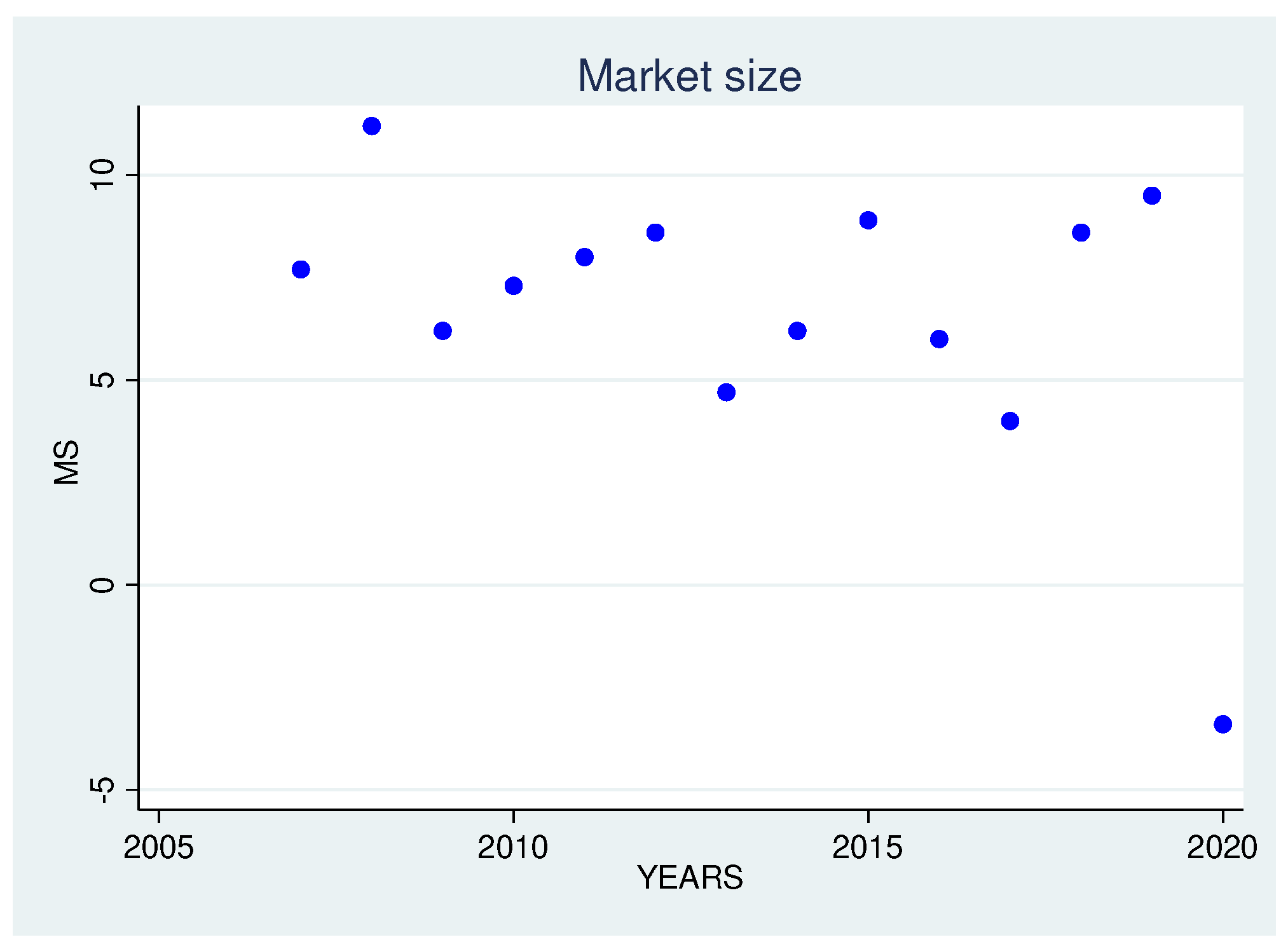
- Market size: The majority of academics use the GDP growth rate as a measure of market size. According to (tintin 2013), GDP per capita income, GDP (current US$), and total population are all good proxies for market size since they reflect the purchasing power of consumers in host nations. investors prefer a larger market size for investment because it is thought to indicate a higher degree of development and higher per capita income. GDP growth rate was used as a proxy for market size in this study. The below figure shows how in 2020 market size decreased due to the COVID-19 pandemic that affected global economy and other sectors including market size.Figure 11. Market Size.
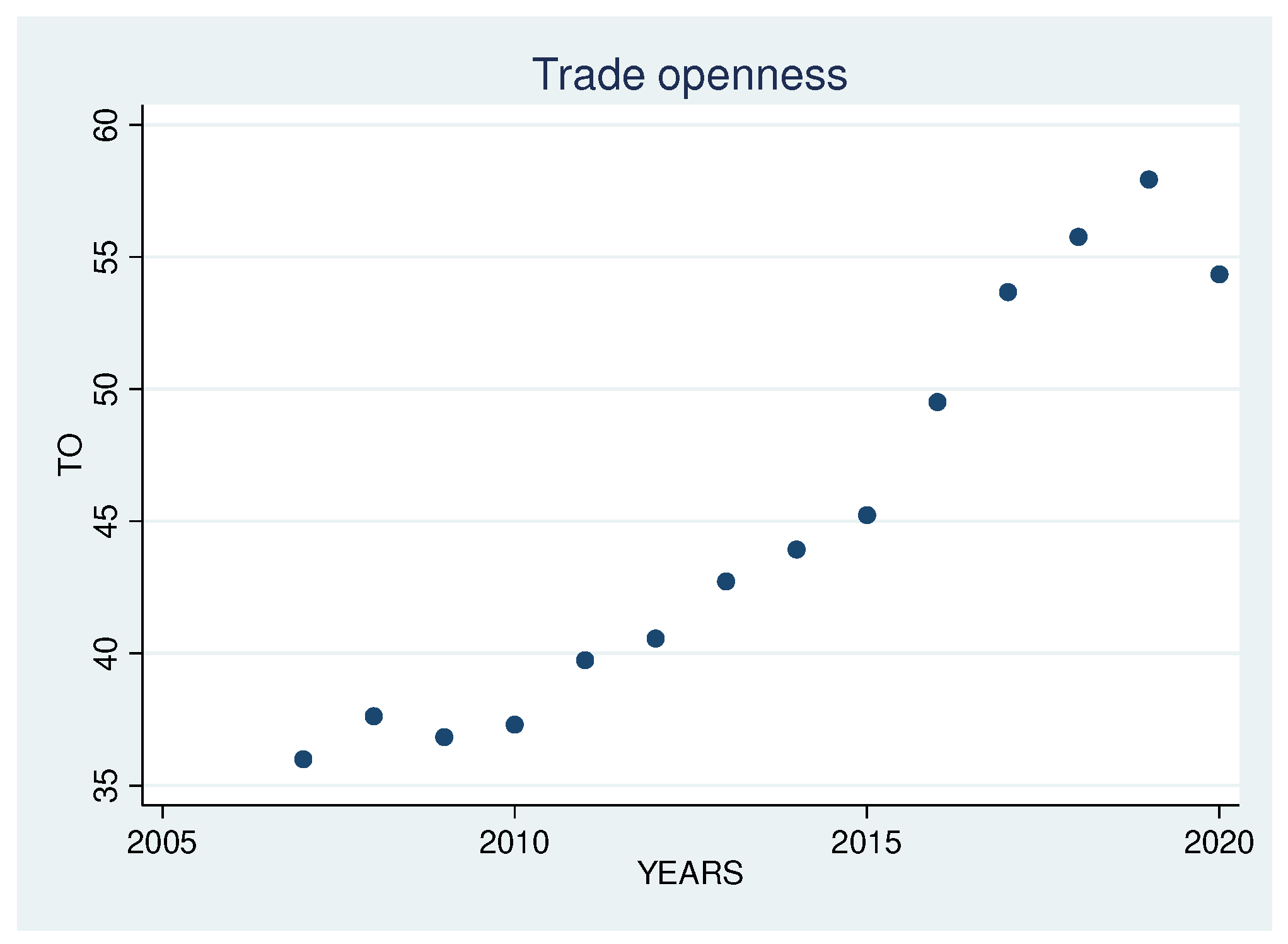
- Trade openness: Lie and Asiedu pointed out, a country's trade openness is a key determinant in determining the scope of its import and export ties with other countries. Openness necessitates not only exports but also imports, as many investors seek intermediate inputs from other nations. The current analysis employed what most empirical studies and Tintin calls it ratio, which is export plus import divided by GDP [(export + import)/GDP], as a proxy for determining trade openness.Figure 12. Trade Openness.
4.1. Summary Statistics
Table 3.
Summary Statistics
| Variable | Obs | Mean | Std. Dev. | Min | Max |
| FDI | 56 | 2.109821 | 3.380102 | -2.2975 | 11.355 |
| MS | 56 | 1.669642 | 0.870133 | -0.85 | 2.8 |
| TO | 56 | 11.27017 | 1.937827 | 8.9975 | 14.482 |
| INFRA | 56 | 10.55 | 3.972707 | 4.525 | 16.375 |
| HC | 56 | 8.940714 | 1.979764 | 5.11 | 11.6275 |
| ECO | 56 | 1.936428 | 0.485068 | 1.0175 | 2.59 |
| FDI_ch | 56 | 4.609822 | 3.380102 | 0.2025 | 13.855 |
| Ms | 56 | 2.669642 | 0.870133 | 0.15 | 3.8 |
| log_FDI | 56 | 0.637811 | 0.269528 | -0.05268 | 1.003 |
| log_MS | 56 | 0.553521 | 0.200785 | -0.1277 | 0.6803 |
| log_TO | 56 | 0.948764 | 0.042206 | 0.89581 | 1.0148 |
| log_INFRA | 56 | 0.916764 | 0.104647 | 0.72397 | 1.04551 |
| log_HC | 56 | 0.887445 | 0.063253 | 0.754373 | 0.95991 |
MS (Market Size); TO (Trade Openness); INFRA. (Infrastructure); FDI (Foreign Direct Investment from China); HC (Human Capital).
A variety of factors come into play when deciding to invest in a foreign country. Macroeconomic factors such as market size, trade openness, infrastructure, and human capital were evaluated in this study after reviewing the literature and data available on the determinants of FDI. The descriptive statistics of the variables included in the study are shown in this study's preliminary analysis. The mean of FDI was 2.109821, with a standard deviation of 3.380102, the maximum FDI from China is 11.355 and the lowest is -2.2975 as indicated in Table 4.
4.2. multicollinearity check using VIF test
As the below table shows the result after testing multicollinearity using Variance Inflation Factor (VIF). With FDI as an independent variable and dependent variables as HC, TO and MS, the results shows that the data does not suffer multicollinearity.
4.3. Pearson Correlation
The study was also carried out with regression analysis to determine which of the variables predicted FDI from China and to see the Pearson correlation. There was a significant correlation between market size and FDI from China, as shown in Table 6, with a Pearson correlation of 45.56%.
The analysis also showed a positive relationship between trade openness and FDI from China, with a Pearson correlation of 25.52%. The relationship between infrastructure and FDI from China is also positive, with a Pearson correlation of 12.96%. However, the relationship between human capital and FDI from China is significant which is equal to 5.31%.
4.4. Impact of the Variables on FDI
To find out which of the variables predicted FDI from China to Rwanda, a regression analysis was used. According to the model summary in Table 7, market size, trade openness, and infrastructure all played a role in determining FDI from China. Market size has a positive coefficient on FDI from China which is 179.7878%, trade openness has a positive coefficient on FDI from China which is 274.7516%, and infrastructure has a negative coefficient -125.9769%. Human capital has a positive coefficient which is 57.65298% on the dependent variable (FDI from China). However, the effect was not significant.
A large variety of factors have been considered in the literature as determinants of FDI from any country. Economic growth, market size, low cost of doing business, low risk to investors, and high returns on investment, according to previous literature, are all variables that attract FDI from other nations. In parallel, this study discovered that market size, trade openness, and human capital all had a beneficial impact on FDI from China into Rwanda, with human capital being particularly important. Furthermore, according to Asiedu, resources such as good infrastructure, low inflation, an effective legal system, and a good FDI regulatory framework show that FDI from other countries will be beneficial(Asiedu 2002). Asiedu's conclusions are backed up by other experts. Also according to (Addison 2003) Small domestic markets are frequently regarded as the principal disincentive for the majority of low-income countries that fail to attract considerable FDI inflows. According to this research, host nations with big domestic markets attract comparatively substantial amounts of FDI, owing to a higher potential demand for products and services. The findings show that policies in all four areas, which are infrastructure, human capital, trade openness, and market size, must be improved in order to attract more FDI from China. Even though current policies have increased Chinese FDI inflows, there is still potential for improvement.
(Blomstron 2009) mentioned that conducted empirical study that revealed that FDI is positively connected with economic growth. Economic growth was utilized as a proxy for market size in this study, and the results are similar to those found by Blomstrom et al. and Borensztein. Tariffs, a further driver, were found to have a positive impact on FDI when combined with growth rate and openness, but a negative effect when combined with wages. When openness, domestic investment, and government consumption are combined, the real exchange rate has a beneficial effect. When domestic investment is taken out of the equation, the result is negative. This backs up the premise that a more efficient environment with more trade openness will attract international enterprises.
4.5. Robust test
To confirm the robustness of this paper’s result, an addition test was conducted. FDI was used as an independent variable. Market size, trade openness, infrastructure, and human capital were used in order to capture their effect on FDI. After running the regression with robust the coefficients are all the same, standard errors are higher except MS and t-values are smaller except MS which is translated into less powerful significance.
4.6. Barriers of Foreign Direct Investment
Insufficient transparency in past years: This has been linked to a number of other barriers in the literature and can arise at any point of the investment process. According to (Adeleke 2014), One of the reasons why some foreign investors avoid investing in some African countries is the alleged lack of openness. Lack of transparency has also been a problem in Rwanda in the past few years, dating back to 2010. Concession and power purchase agreements, for example, are confidential, according to some investors, making it difficult to evaluate their projects. Because of the lack of transparency, the government may find it simpler to apply various contracts and conditions to different investors, strengthening the government's bargaining power. Low transparency, on the other hand, drives certain investors away from Rwanda, which Rwanda has been tackling for the past ten years and which has helped Rwanda accomplish exceptional successes, as seen by several recent national and global annual reports.
Investment Incentives: This is becoming increasingly significant, and the lack of a good investment incentive may cause investors to look for opportunities elsewhere. It is apparent that most Rwandan investors value investment incentives as well. Investment incentives, such as tax breaks and favorable terms, are critical in making investment decisions. Rwanda is successful in attracting investors by providing a sufficient amount of investment incentives. The empirical findings, however, suggest that the investment incentives are insufficient, prompting investors to invest less or later. Rwanda has established various advantageous investment incentives, according to certain investors; nevertheless, depending on the type of project, the incentives may not please all investors. Investment incentives that have been established are negotiated to some extent, resulting in varying conditions for the investor.
Ambiguity of relevant laws and regulations in the past years: This barrier is linked to a variety of other sorts of government regulations-related restrictions. According to research Wu and Blackman, foreign investors in China's power sector view this obstacle to be the most severe. This was also true to some extent for foreign investors in Rwanda's power sector. Some investors pointed out that the lack of standardized policies and concession agreements were severe barriers for the foreign investors in Rwanda, especially for smaller entrepreneurs. The reason why these areas were considered that important depended on the investors’ wish to have similar conditions for all investors. However, the current laws and regulations are favorable to everyone especially Chinese investors.
Project approval process risk in the past years: This was known in research to be among of the severe barriers for foreign investors from China’s power sector in the past years then the country had to change some of the policies among which now takes only three days to get the project license. Ambiguity of relevant laws and regulations was one reason to the perceived risks in the project approval process. Many investors were not able to go through the full project approval process due to a long bureaucracy, indicating that barriers connected to this area were problematic for Rwanda. Some investors noted that it could take them up to two years to get all the approvals and all necessary contracts signed, hence creating a major barrier. However, Risk associated with the project approval process is rarely a concern for the foreign investors in Rwanda nowadays due to a reform in policies regarding foreign investments.
Poor financing institutions: This is challenging for some investors in Rwanda. Drawing from other literatures, some investors find that the interest rate on the loans might be higher which makes access to affordable loans limits investments in the country. Parallel to this assertion, it has been noted that the access to the local currency is still difficult depending on the amount of foreign currency. Also, the previous researchers have identified poor financing institutions as potential barrier. Likewise, according to (Soubbotina 2004) assert easy convertibility to the local currency is essential for foreign investors.
5. Conclusion and Recommendation
5.1. Conclusions
This research paper's prime target has been to investigate the determinants of China’s FDI in Rwanda. from the test results and information from the reviewed literature, it is evident that there is an immense and close correlation between variables mentioned in the model and Chinese FDI. Based on literature and the availability of data, market size, trade openness, infrastructure, and human capital were measured as predictors of Chinese FDI over the period of fourteen years quarterly from 2007 to 2020 . The impact of Chinese FDI on economy of Rwanda is positive based on the analyses and the finding of the study showed that Market size, trade openness, and human capital have a positive effect on FDI from China, and the study found that though FDI had an effect on overall economy of Rwanda, the effect was not statistically significant. The study suggested that Chinese investment is needed for investing in the economy of Rwanda, Other components of Chinese investment, such as aid and other forms of support, should be assessed with foreign investment from China.
China has increasingly established itself as a major player in African trade and development. Over time, trends have shifted away from Europe's traditional dominance in Africa and toward China. China's FDI policy is one of their most important policies in Africa. Most of their multinational corporations have been allowed to enter economies where they previously would not have been able to due to competition from states and other European powerhouses. Rwanda has made great progress in reconstructing its economic and social infrastructure, and is known as a good governance country around the world. This study was created with this premise in mind, to investigate the impact of FDI inflows from China to Rwanda. This was mostly due to the expanding Chinese presence in Rwanda, which coincided with the country's growing GDP in comparison to other African countries. The study's initial goal was to identify the factors in Rwanda that influenced FDI, specifically the determinants of FDI from China. Using secondary data from 2007 to 2020, linear regression analysis in Stata was used to discover which of the variables predicted FDI from China. The model summary presented that market size, trade openness, infrastructure, and human capital’s R-squared is 30.37%. The probability of F test was 46.41%. Market size coefficient was 56.26796% with standard deviation of 40.70375% and P-value of 20%, trade openness coefficient was 886.0565%, with standard deviation of 710.6324%% and the P-value of 24.4%. And infrastructure coefficient was -588.6516% with standard deviation of 475.3645% and the P-value of 24.7%. Human capital coefficient was 458.1479% with standard deviation of 430.0731% and the P-value of 31.4% in the dependent variable. However, the effect was not significant. This study examined the effect of FDI from China on the economy of Rwanda and results shows that FDI from China contributes 2.23% of the variance in the dependent variable, Rwandan economy.
5.2. Recommendations
Rwanda's political situation has stabilized, and the country is looking for measures to increase domestic output. It is therefore proposed that:
- Government of Rwanda should increase its foreign direct investment which will increase economy
- More capital projects are needed to be improved by the Rwandan government which will improve infrastructural facilities on which foreign investors can build on thereby increasing FDI.
- Regulations tailored toward FDI flow be enacted, with a focus on forming partnerships with local enterprises. This will have a huge impact on future economic growth.
- It is advocated that all other factors that influence foreign investments to be examined in one study. China has made enormous achievements in information and technology in recent years, and Rwanda might benefit from this strength in its desire to grow its economy.
- Rwanda should preserve macroeconomic and political stability in order to encourage productive activities and raise GDP, as this is one of the major factors of FDI in the country.
- The Rwandan government should continue to strengthen economic policy transparency since it lowers transaction costs and hence improves incentives for foreign investment, and other motivations should be developed.
- The Rwandan government should continue to improve good governance and anti-corruption measures because they provide a credible mechanism for the protection of property rights, which is important because foreign investors prefer to invest in countries with strong legal and judicial systems that ensure the security of their investments. Most African countries, especially Rwanda, have waged a battle against corruption, trade liberalization, and good governance. These are aspects that help to strengthen the domestic business environment and are a big draw for foreign direct investment from any country.
- By collaborating with local enterprises in the areas of technology and communication, agriculture, and manufacturing, Chinese institutions and associates should provide assistance for these efforts to improve and stabilize Rwanda's economy.
5.3. Limitation of the study
This study which focused on China’s FDI as correlation to the economic growth of Rwanda was faced with several challenges which include the challenges of sourcing for data during the research, secondary data were used and they usually have disadvantage of being tempered with. Also, the study found that the results of model, years of data employed and variables are limited and when new sets of data, variables or method of efficiency estimation are employed these results can be changed. Lastly, the study also experienced the challenge of data collection as it was difficult for the researcher to obtain such relevant information to go in depth analysis of FDI.
Author Contributions
writing—review and editing, Clemence Abadata.; supervision, Tian Ze. All authors have read and agreed to the published version of the manuscript.
Funding
This research is supported or funded by fundamental research funds for central universities of China. grant number B220207035
Data Availability Statement
Secondary financial data of 14 years from 2007 to 2020 quarterly are basically used in this study. The relevant secondary data are collected from:
- National Statistics of China,
- World Bank,
- UNCTAD, and
- The National Institute of Statistics of Rwanda.
- National bank of Rwanda
Acknowledgments
We give thanks and glory to almighty God, for the gift of life and health he has given unto us in our lives. We thank him for the wisdom, love, care and protection. We would also like to thank the anonymous editor and the referees, for their time, comments and suggestions which are very helpful we will also like to thank the fundamental research funds for the central universities of China for the founding.
Conflicts of Interest
The authors declare no conflict of interest and the funders had no role in the design of the study; in the collection, analyses, or interpretation of data; in the writing of the manuscript; or in the decision to publish the results.
Appendix A
| variables | Full words | Sources |
| FDI | Foreign direct investment | National Statistics of China |
| MS | market size | World bank |
| TO | Trade Openness | National bank of Rwanda |
| INFRA | infrastructure | World bank |
| HC | Human Capital | UNCTAD, and The National Institute of Statistics of Rwanda. |
| ECO | economy | World bank |
References
- Happiness, B. 2019. “The impact of foreign direct investment on economic growth of rwanda”, Masters diss., unversity of Rwanda 5-19.
- David K. EITEMAN, A. I. S., Michael H. MOFFETT. 2018. “Multinational Business Finance”. UC Riverside Undergraduate Research Journal,4-6.
- Cheng, L., & Ma, Z. 2007. “China's outward FDI: Past and Future”. School of Economics, Renmin University of China Working Paper Series,5.
- Miao, M.; Borojo, D.G.; Yushi, J.; Desalegn, T.A. The impacts of Chinese FDI on domestic investment and economic growth for Africa. Cogent Bus. Manag. 2021, 8, 1886472. [Google Scholar] [CrossRef]
- Donald K. 2000a.”Rwanda Vision 2020”. Rwanda: Minister for Finance and Economic Planning, 31.
- UNCTAD, DITC. 2010. “Rwanda’s development-driven trade policy framework.” united nations publication, 81.
- Yin-Wong Cheung, X. Q. 2009. “The Empirics of China’s Outward Direct Investment”. Journal of international business study, 29.
- OECD. 2015. “foreign direct investment restrictions in oecd countries”. working papers on international investment number, 3-6.
- Natinal Bank of Rwanda. 2019. “foreign private capital in rwanda”. https://rdb.rw/wp-content/uploads, 41.
- Fung, K.C., Hitomi Iizaka, Joseph Lee, Stephen P. 1999. "Determinants of U.S. And Japanese Foreign Direct Investment in China". The Quarterly Review of Economics and Finance, 57.
- John C. Anyanwu. 2011. "working 136 Determinants Of Foreign Direct Investment Inflows To Africa". working paper series, 32.
- Yilmaz, I.; Tag, M. N.; Ozkan, C.; Degirmen, S. Host Country Marketing Culture and Foreign Direct Investment. Procedia - Social and Behavioral Sciences 2014, 148, 299–306. [Google Scholar] [CrossRef]
- Mankiw. 2015. "countries economy's growth". Journal of International Economics, 33.
- Romer, B., Blinder. 2010. "relationship between the aggregate variable and individual's satisfaction outcome". publishing company, 138.
- Donald K. 2012.”Rwanda Vision 2020 revised”. Rwanda: Minister for Finance and Economic Planning, 40.
- Ochieng, H. K. 2022. “China's Public Diplomacy towards Africa: Strategies, Economic Linkages and Implications for Korea's Ambitions in Africa”. East Asian Economic Review,49-91.
- Nunnenkamp, Peter Spatz, Julius. 2003. “Foreign direct investment and economic growth in developing countries: how relevant are host-country and industry characteristics”. Kiel Institute for World Economics, 49.
- Schindler. 2003. “an econometric analysis”. master thesis., university of bergen, department of economics.
- saunders, M. N. K., Lewis, & Thornhill A. 2012. “research methods for business students”. Journal of human resource and sustainability studies, reseach methods, 16.
- Kumari, R. S., A. K. 2017. “Determinants of foreign direct investment in developing countries”. a panel data study. International Journal of Emerging Markets, 12.
- Alsan, M.; Bloom, D.E.; Canning, D. The effect of population health on foreign direct investment inflows to low- and middle-income countries. World Dev. 2006, 34, 613–630. [Google Scholar] [CrossRef] [PubMed]
- Tsen, W. H. The determinant of foreign direct investment in the manufacturing industry of Malaysia. Journal of Economic Cooperation 2005, 2, 91–110. [Google Scholar]
- tintin, C. 2013. “foreign direct investment inflows and economic freedoms: evdance from centeral and eastern european countries, advances in business-related scientific research”. economic research.
- Asiedu, E. 2002. “the determinant of foreign direct to developing countries: is africa different?”. world development.
- Addison, T. H., A. 2003. “the new global determinants of FDI flows to developing countries, the importance of ICI and democratization”. world Institute for development economic research, united nations university. world Institute for development economic research, united nations university.
- Blomstron, M., Lipsey, R. E. & Zejan, M. 2009. “What explains developing country growth?”. NBER, Cambridge, MA, Working paper, 4143.
- Adeleke, K. M., Olowe, S. O. & Fasesin, O. O. 2014. “Impact of Foreign Direct Investment on Nigeria Economic Growth”. international journal of academic research in business & social sciences.
- Soubbotina, T. P. 2004. “Beyond Economic Growth: An Introduction to Sustainable Development”. The World bank Washington, D.C.,.
Table 4.
Multicollinearity test using VIF table.
| VARIABLES | VIF | 1/VIF |
| HC | 2.88 | 0.0346679 |
| TO | 2.58 | 0.387798 |
| MS | 1.26 | 0.793883 |
| MEAN VIF | 2.24 |
Table 5.
Pearson Correlation.
| FDI | MS | TO | INFRA | HC | |
| FDI | 1.0000 | ||||
| MS | 0.4556 | 1.0000 | |||
| TO | 0.2552 | -0.3326 | 1.0000 | ||
| INFRA | 0.1296 | -0.4522 | 0.9659 | 1.0000 | |
| HC | 0.0531* | -0.4527 | 0.7821 | 0.8827 | 1.0000 |
| ECO | 0.1494 | -0.3989 | 0.9289 | 0.9795 | 0.9430 |
| FDI_ch | 1.0000 | 0.4556 | 0.2552 | 0.1296 | 0.0531 |
| Ms | 0.4556 | 1.0000 | -0.3326 | -0.4522 | -0.4527 |
| log_FDI | 0.8318 | 0.4997 | -0.0522 | -0.1641 | -0.1331 |
| log_MS | 0.3855 | 0.9323 | -0.3581 | -0.4533 | -0.4301 |
| log_TO | 0.2341 | -0.3417 | 0.9983 | 0.9754 | 0.8040 |
| log_INFRA | 0.1216 | -0.4231 | 0.9205 | 0.9848 | 0.9299 |
| log_HC | 0.0641 | -0.4190 | 0.7474 | 0.8610 | 0.9942 |
| log_FDI | log_MS | log_TO | log_IN~A | log_HC | |
| FDI_ch | |||||
| Ms | |||||
| log_FDI | 1.0000 | ||||
| log_MS | 0.4214 | 1.0000 | |||
| log_TO | -0.0755 | -0.3600 | 1.0000 | ||
| log_INFRA | -0.1586 | -0.3968 | 0.9373 | 1.0000 | |
| log_HC | -0.1216 | -0.3768 | 0.7721 | 0.9233 |
Table 6.
Impacts of the Variables on FDI.
| FDI | Coef. | Std. Err. | t | P>t | [95% Conf. | Interval] | ||||||
| MS | 1.797878 | 1.239556 | 1.45 | 0.181 | -1.006192 | 4.601948 | ||||||
| TO | 2.747516 | 2.332759 | 1.18 | 0.269 | -2.529551 | 8.024583 | ||||||
| INFRA | -1.259769 | 1.5198 | -0.83 | 0.429 | -4.697795- | 2.178258 | ||||||
| HC | .5765298 | 1.132162 | 0.51 | 0.623 | -1.984598 | 3.137657 | ||||||
| _cons | -94.88406 | 67.98301 | -1.40 | 0.196 | -248.6723 | 58.90419 | ||||||
| Adj R-squared | ||||||||||||
| Source | SS | df | MS | F (4, 9) | R-squared | Adj R-squared | Prob > F | |||||
| Model | 1043.02989 | 4 | 260.757473 | 1.76 | 0.4389 | 0.1895 | 0.2209 | |||||
| Residual | 1333.3906 | 9 | 148.154511 | |||||||||
| Total | 2376.42049 | 13 | 182.801576 | |||||||||
Table 7.
robust test
| FDI | Coef. | RobustStd. err. | t | p>|t| | [95% Conf. | Interval] |
| MS | 1.797878 | .9392832 | 1.91 | 0.088 | -.3269281 | 3.922684 |
| TO | 2.747515 | 2.679685 | 1.03 | 0.332 | -3.314352 | 8.809383 |
| INFRA | -1.259768 | 1.780035 | -0.71 | 0.497 | -5.286487 | 2.766951 |
| HC | .5765295 | 1.308514 | 0.44 | 0.670 | -2.383535 | 3.536594 |
| _CONS | -94.88406 | 86.04367 | -1.10 | 0.299 | -289.5284 | 99.76025 |
Disclaimer/Publisher’s Note: The statements, opinions and data contained in all publications are solely those of the individual author(s) and contributor(s) and not of MDPI and/or the editor(s). MDPI and/or the editor(s) disclaim responsibility for any injury to people or property resulting from any ideas, methods, instructions or products referred to in the content. |
© 2023 by the authors. Licensee MDPI, Basel, Switzerland. This article is an open access article distributed under the terms and conditions of the Creative Commons Attribution (CC BY) license (http://creativecommons.org/licenses/by/4.0/).
Copyright: This open access article is published under a Creative Commons CC BY 4.0 license, which permit the free download, distribution, and reuse, provided that the author and preprint are cited in any reuse.


